
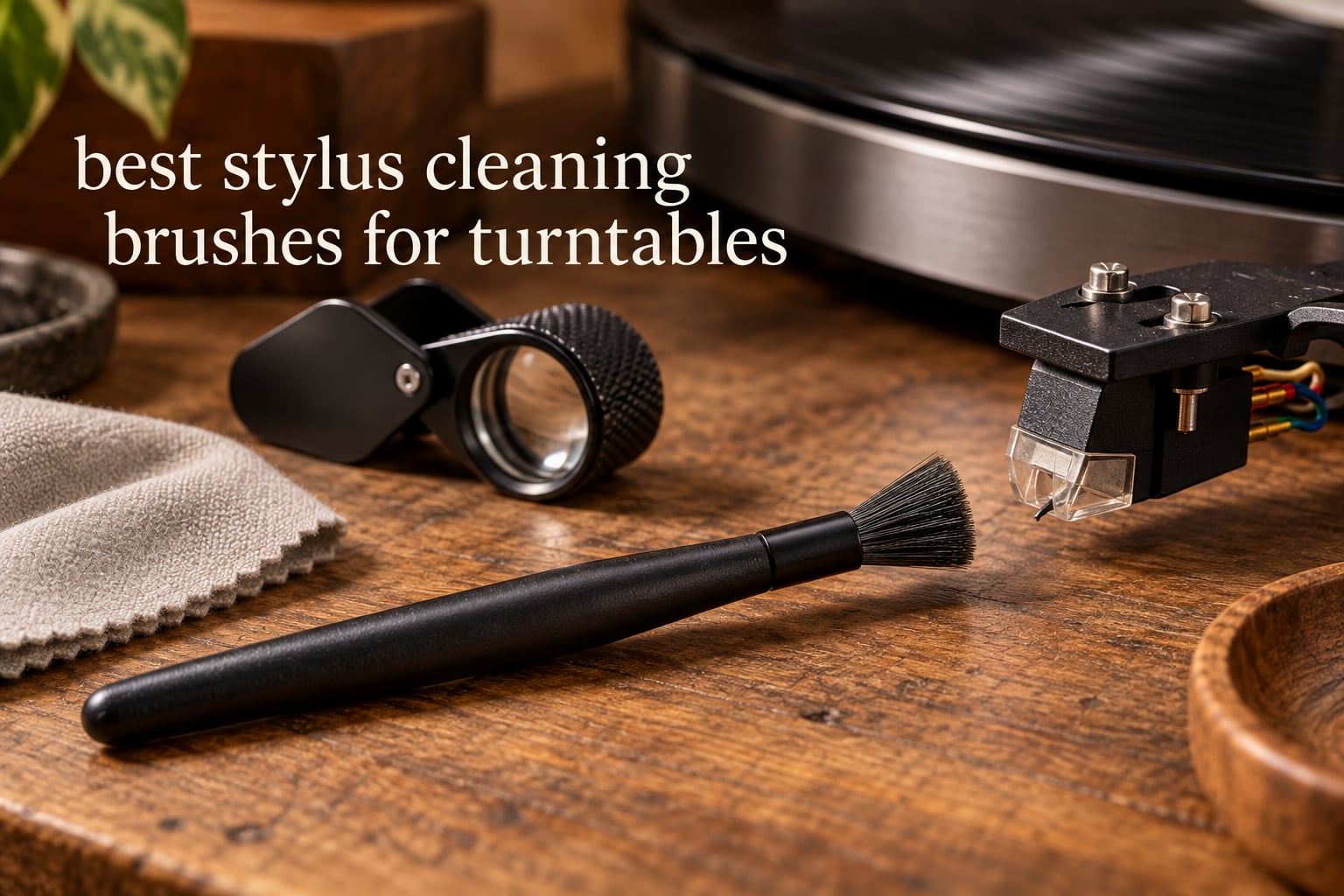
Every stylus cleaning brush in this roundup shares the same job: lifting dust, grit and dried-on gunk off a few tenths of a millimetre of metal at the end of your tonearm. What separates them is bristle density, handle length, whether the handle conducts static away, and how forgiving they are on a delicate moving-coil cantilever. Below I compare ten of them, then explain the technique that keeps a cartridge safe.
The short answer: the Boundless Audio Carbon Fiber Stylus Brush is the best stylus cleaning brush overall, because it combines more than 24k carbon fiber filaments with a long conductive handle and has by far the largest review base in this group. If you want a brush that works wet as well as dry, the GrooveWasher SC1 is the one to buy. If you just want something in the drawer, almost any of the budget carbon fiber options here will do the job correctly.
Before the picks, one clarification that comes up constantly on vinyl forums: a stylus brush is not a record brush. A record brush is wide, and it is meant to run across a spinning record to sweep groove dust sideways. A stylus brush is small, and it is meant to touch nothing except the needle. The single most common question in the r/turntables community is whether the anti-static brush that shipped in the box with their new deck is a stylus brush, and it almost never is. We get into this properly further down.
A dirty stylus is genuinely hard on records. VinylEngine users put it bluntly: a constantly dirty stylus acts like sandpaper and can halve stylus life. Play enough records without cleaning and the needle grinds micro-dirt into the groove wall, which is exactly where your high frequencies live. A clean stylus also tracks more predictably, and it removes one variable when you are diagnosing a playback problem, because a dirty tip can sound a lot like a failing cartridge.
Our team compared these ten brushes on bristle type, bristle length, handle geometry and static claims, then used the verification approach that the sharpest forum testers use: a bright directional light plus a jeweler’s loupe to look at the tip before and after. Everything below is dry cleaning unless we say otherwise, and we do not use a stylus brush on anything except the tip.
Table of Contents
Top 3 Stylus Cleaning Brush Picks for 2026


The three brushes above cover the three decisions most people actually face. Boundless Audio is the safe default and the one we keep reaching for. Ortofon is the pick if you prefer buying your cleaning tools from the same company that builds your cartridge. The am brush is the pick if you want a wet clean in the box without buying a separate fluid.
All 10 Stylus Cleaning Brushes at a Glance in 2026
| Product | Specs | Action |
|---|---|---|
| Boundless Audio Carbon Fiber Stylus Brush |
|
Check Latest Price |
| Ortofon Stylus Brush |
|
Check Latest Price |
| am Stylus Cleaner |
|
Check Latest Price |
 VonTeok Carbon Fiber Stylus Brush VonTeok Carbon Fiber Stylus Brush |
|
Check Latest Price |
 HumminGuru Record Stylus Cleaning Brush HumminGuru Record Stylus Cleaning Brush |
|
Check Latest Price |
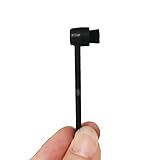 sdroceRyaM Anti-Static Stylus Brush sdroceRyaM Anti-Static Stylus Brush |
|
Check Latest Price |
 Fluance Anti-Static Carbon Fiber Brush Fluance Anti-Static Carbon Fiber Brush |
|
Check Latest Price |
 GrooveWasher SC1 Stylus Brush GrooveWasher SC1 Stylus Brush |
|
Check Latest Price |
 Zentect 2-Pack Needle Brush Zentect 2-Pack Needle Brush |
|
Check Latest Price |
 FdcLixuvol 2-Pack Carbon Fiber Brush FdcLixuvol 2-Pack Carbon Fiber Brush |
|
Check Latest Price |
1. Boundless Audio Carbon Fiber Stylus Brush – Best Overall
Boundless Audio Carbon Fiber Stylus Brush Anti-Static Record Needle Cleaner
24k+ carbon fiber bristles
Conductive gray handle
4.45 inch body
0.145 ounces
Pros
- Over 24k conductive carbon fiber bristles
- Dense enough to shift real buildup
- Long handle gives real control
- Light at 0.145 ounces
- Broadest review base in the group
Cons
- No storage case in the box
- Handle is thin for larger hands
This is the brush I keep on the shelf next to the deck, and it is the one I hand to friends who own a moving-coil cartridge and are nervous about touching anything. The build is simple: a soft carbon fiber and wool bristle head on a long handle that is painted a conductive gray. The manufacturer claims electrical conductivity across the whole tool, and that is the detail that separates it from a plastic-handled brush with identical-looking bristles.
Under a loupe the bristle bed looks dense, with the filaments standing fairly short and close together. That short-and-dense combination is the exact profile longtime VinylEngine posters describe when they say the best stylus brush has short, densely packed stiff bristles made for styli. Those posters are describing this kind of brush rather than a wide velvet record sweeper.
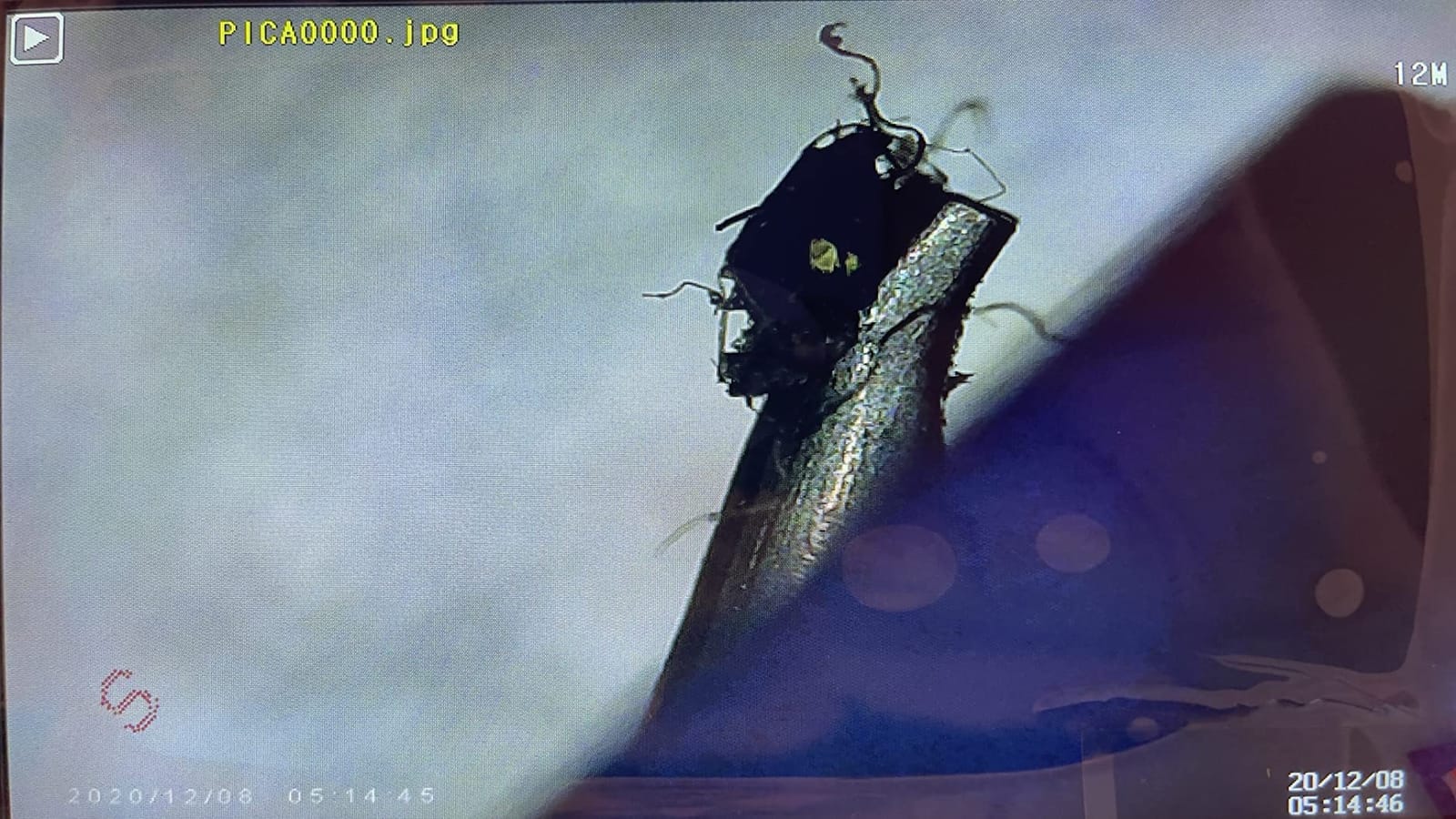
Weight matters more than people expect, and this one is 0.145 ounces. A heavy brush drags across the cantilever as you pull it, which is precisely the motion you do not want. A light, well-balanced brush lets you move the head backwards along the cantilever with the tip just touching, without any downward force at all.
Dimensions are 4.45 by 0.28 by 0.55 inches. That handle length gives you enough reach to get under a cartridge body that sits close to the record surface, which is the situation that defeats short-handled mini brushes. It is not a stubby accessory brush, and you can actually pinch and steer it.
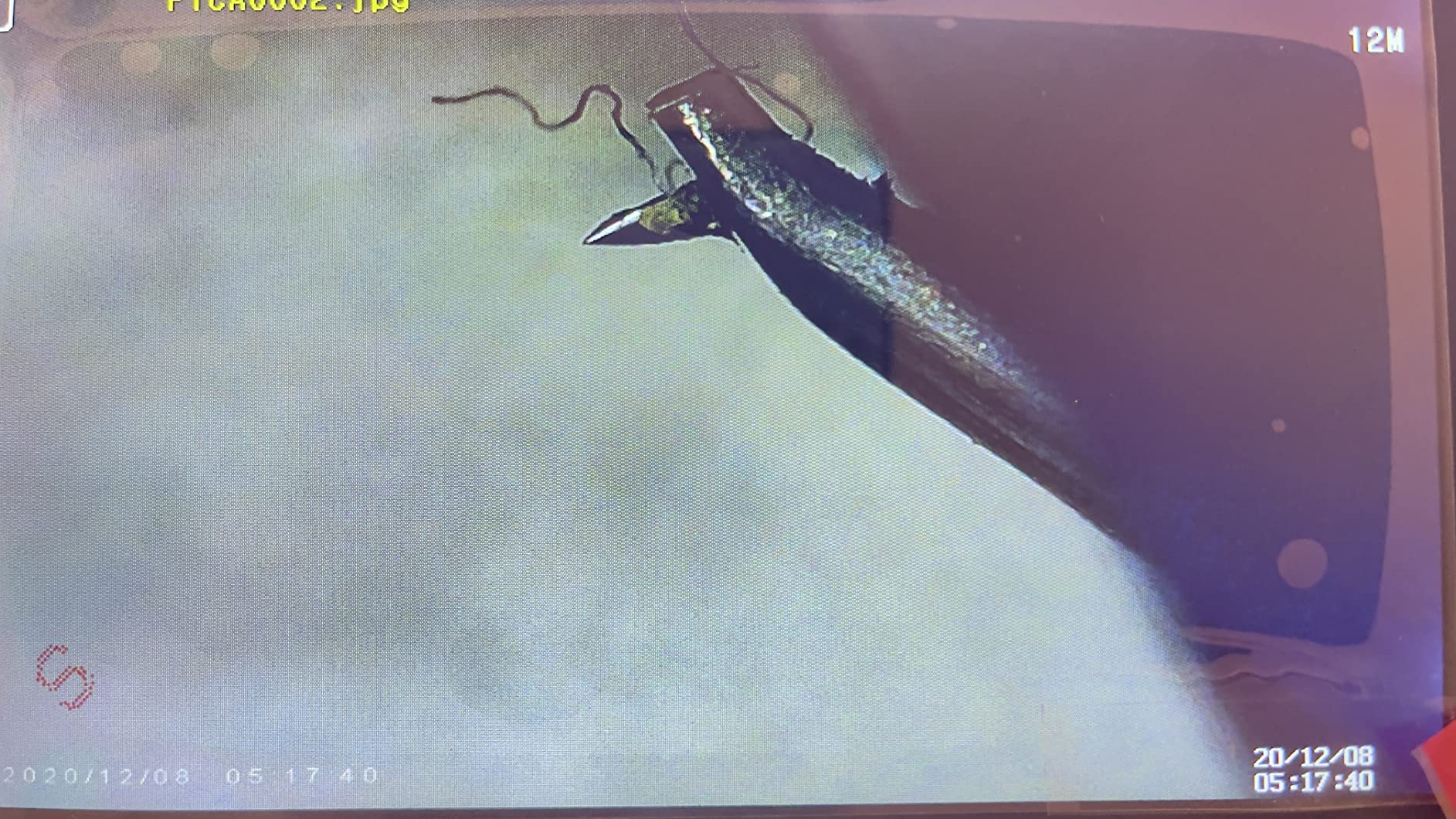
Is it safe on a moving-coil cartridge?
Yes, with the right technique, and this is the reason it is our top pick. The bristle bed is short relative to the handle, so it can make contact with the stylus tip without the head being levered upward into the cantilever. Gentle dry passes along the length of the cantilever, front to back, will not scratch a diamond or bend a cantilever. What does risk damage is dragging the tip sideways, or pressing down while the suspension is engaged.
What are the drawbacks?
Two real ones. There is no storage case in the box, and at this size that matters more than it sounds, because a stylus brush that ends up loose in a record crate is a stylus brush you will never find again. Some buyers also feel the thin handle is on the small side for large hands. Neither issue affects cleaning performance, and both are solved by keeping it in a fixed spot rather than by buying a different brush.
2. Ortofon Stylus Brush – Best From a Cartridge Brand
Ortofon Stylus Brush
Micro-fiber bristles
Plastic body
Listed for phono cartridges
Pros
- Made by a long-established cartridge maker
- Micro-fiber bristles clean gently
- Effective on lint and fine dust
- Simple design with no moving parts
Cons
- Higher price than generic carbon fiber brushes
- No listed dimensions or weight
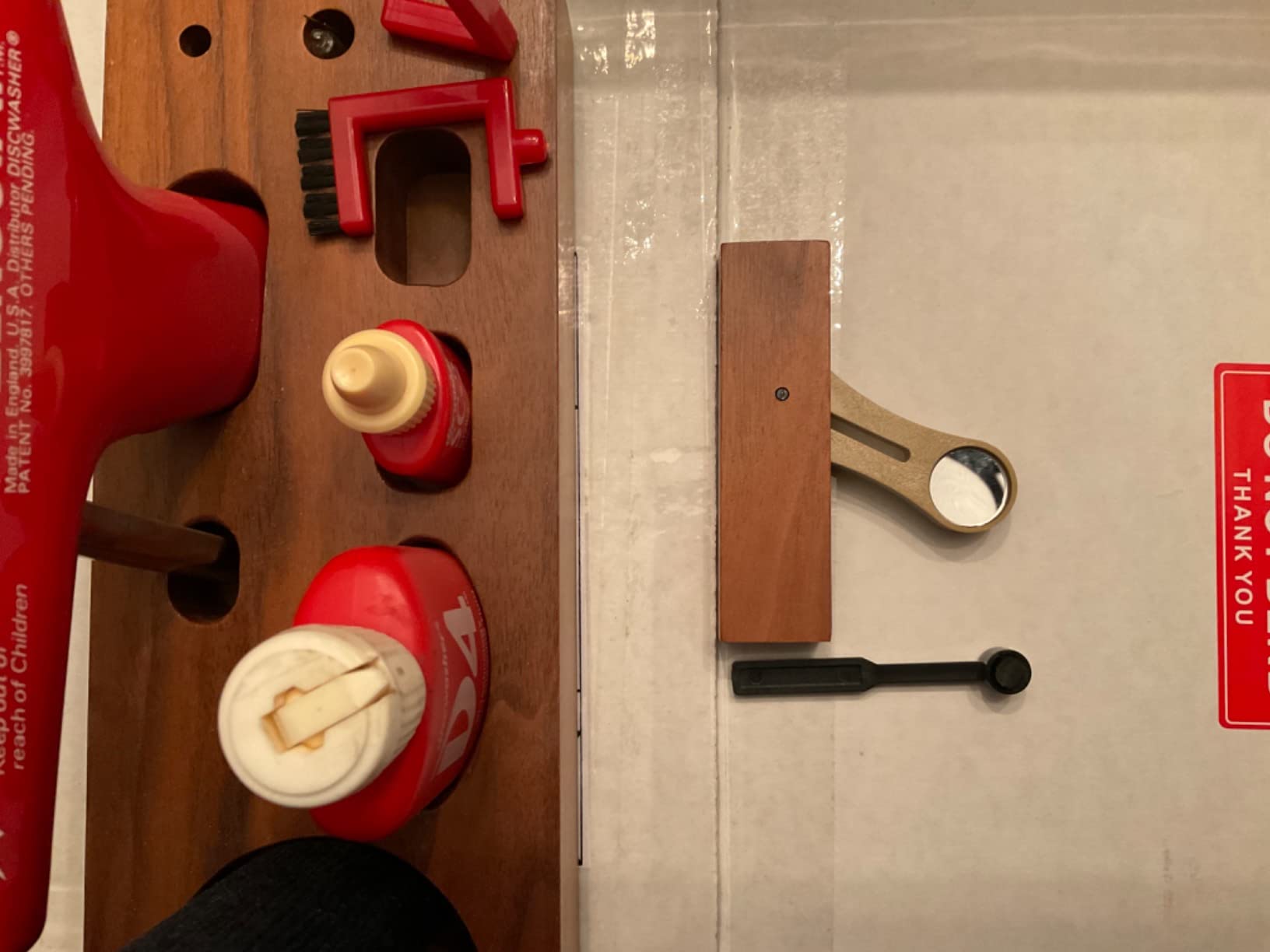
Ortofon builds stylus and cantilever assemblies for a living, and that shows up in the smallest detail here: the product is listed as compatible with phono cartridges rather than marketed as a general cleaning accessory. It is the brush we recommend if you run an Ortofon cartridge, or you simply trust the name on a part that small, buying the cleaning tool from the same company removes a variable.
The bristles are a specially designed micro-fiber, described as soft but thorough. That is the opposite bristle philosophy from the short-stiff-dense camp, and the split is real: on AudioKarma, at least one user prefers a Shure soft-bristle stylus brush over the more common stiff brushes, while GrooveWasher SC1 gets called the market benchmark by the same crowd. The honest answer is that both work, and that the stiff preference is more about a small contact area than about hardness.
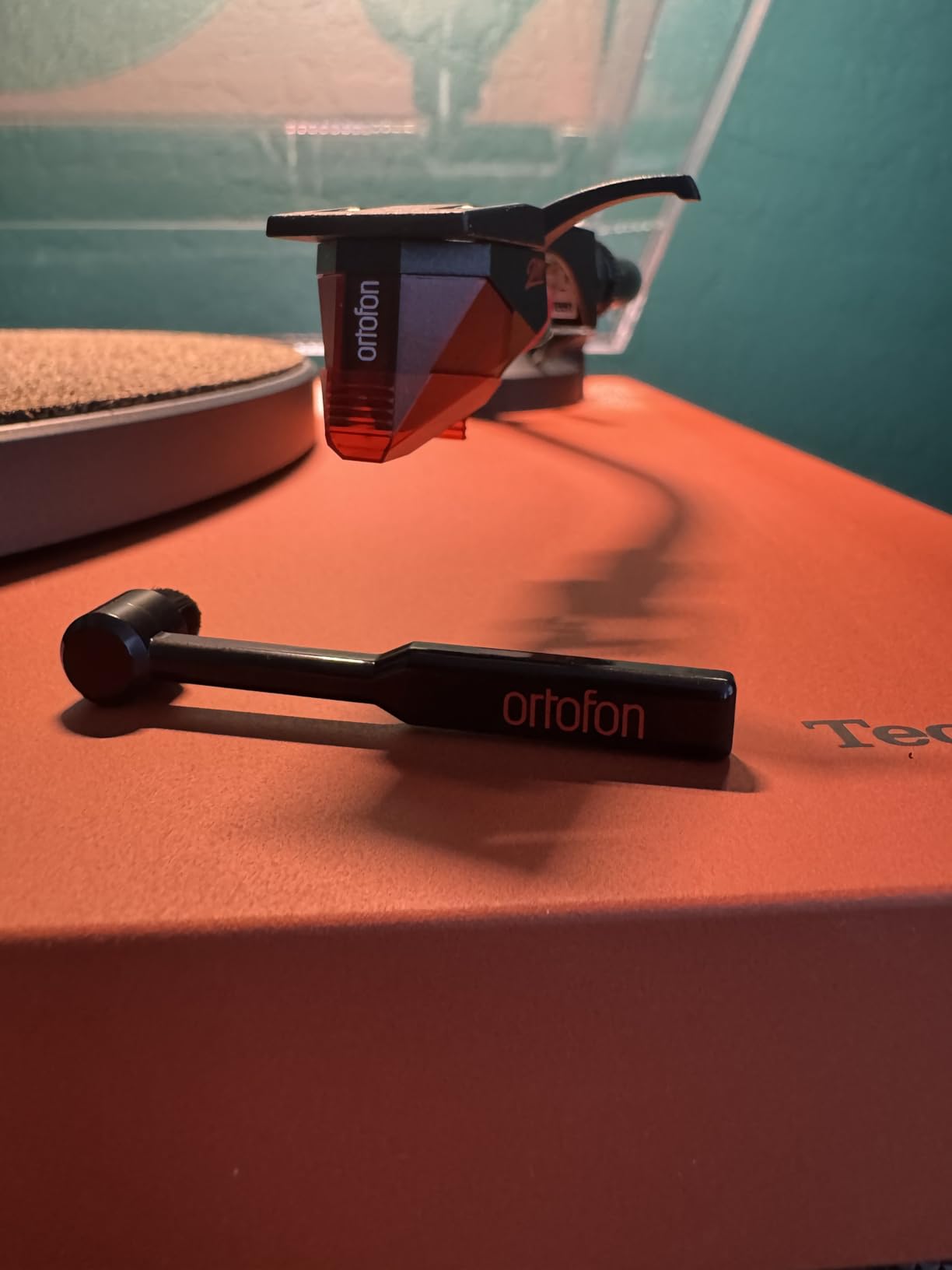
What matters is that micro-fiber filaments are extremely fine, and a fine filament in a small footprint can still shift a surprising amount of dust. Soft is not the same as ineffective. What soft means is that you get less lateral scrubbing force, which is why this brush suits people who want the gentlest possible contact with a hollow cantilever.
One detail worth noting: the listing gives no dimensions and no weight. For a tool this small, that is a real gap, and it means you cannot judge the handle length before ordering. If your cartridge sits low in a plinth and is hard to reach, check the photos carefully first.
Who should buy this over a carbon fiber brush?
Buy it if you have a hollow cantilever, a low-output moving-coil cartridge, or a general anxiety about applying any pressure at all. Micro-fiber gives you a wide margin for error because the contact is gentle by design. It is also the brush I would recommend to someone whose first stylus cleaning attempt ended with them dropping the brush on the cartridge and needing to sit down.
What are the drawbacks?
The straightforward one is cost. This sits at the upper end of what these brushes usually go for, and you are paying for the brand and for a micro-fiber bristle specification rather than for a larger bristle count. There is also no published weight or size, which makes it harder to compare against the rest of this list on paper. Reviewers themselves list the price as the main complaint, while the cleaning performance draws almost no criticism at all.
3. am Stylus Cleaner for Turntables – Best Budget Wet Clean
am Stylus Cleaner for Turntable Needles – Anti-Static Cleaning Brush
Brush plus anti-static fluid
6.1 inch tool
1.41 ounces
Pros
- Anti-static fluid included in the set
- Works on turntables and DJ decks
- Regular use cuts stylus and record wear
- Fluid helps with sticky residue
Cons
- Bottle is easy to knock over
- A wet tip can re-collect debris if not blotted
- Small review base
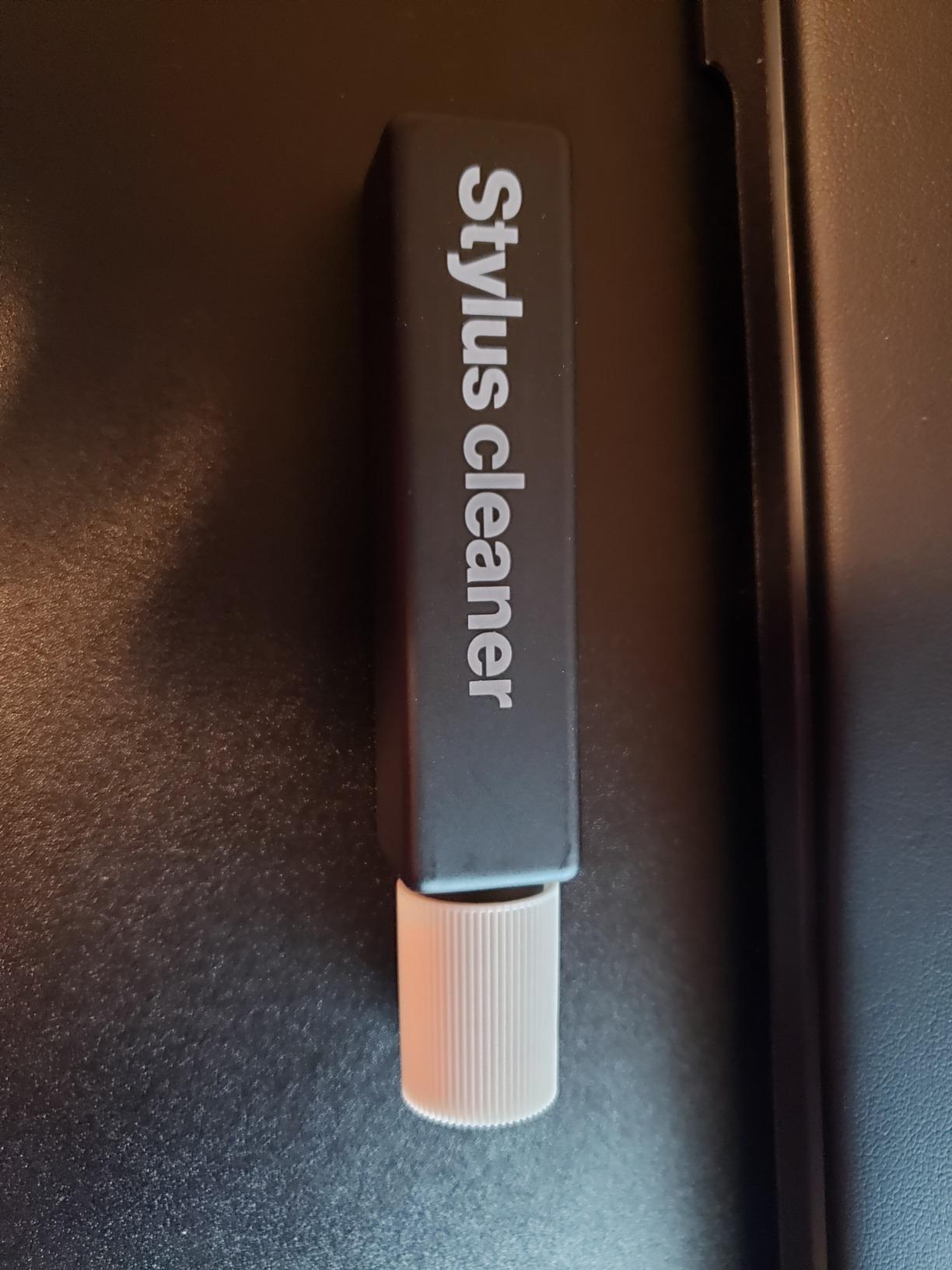
This is the only set on the list that includes a liquid, and that is the entire reason to consider it. Everything else here is a dry tool you would pair with a separate fluid if you want one. The am set gives you a brush and a bottle of anti-static cleaning solution in the same box, which is the cheapest way to get a working wet-clean setup.
Product dimensions are 6.1 by 0.79 by 2.36 inches at 1.41 ounces, so it is a larger, heavier tool than most of the others. That is useful for reach, and less useful for precision, which is why we would use it on a moving-magnet cartridge and be more careful with a micro-styli. The maker also claims compatibility with DJ decks, which is fair given how often the same fluid and brush logic applies to cartridge-based CD players.
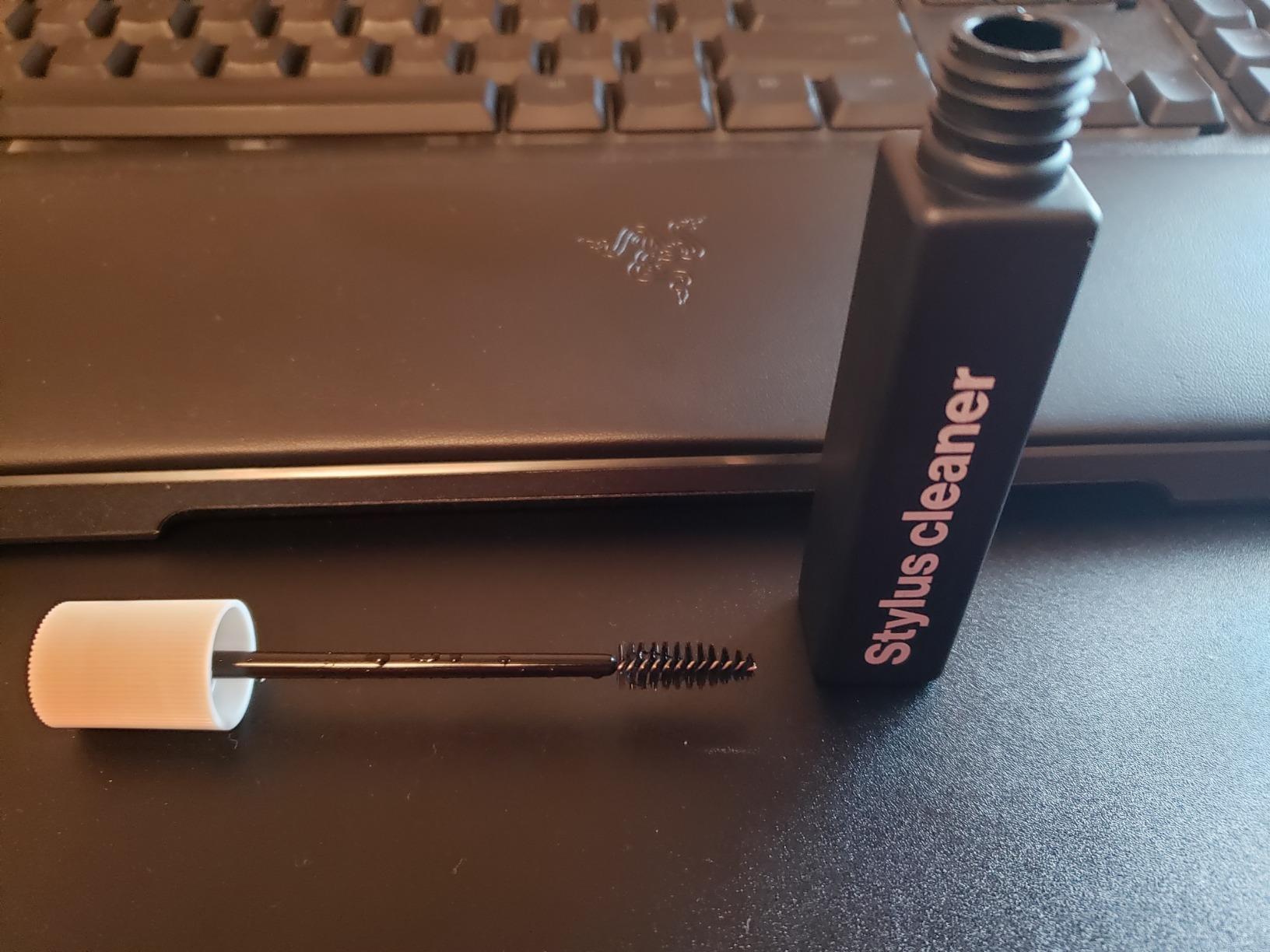
The wet-versus-dry argument is worth settling here, because it is the single most debated question in the vinyl world. The loudest claim is that liquid stylus cleaners loosen the adhesive holding the stylus to the cantilever. That claim shows up in older threads and keeps circulating. One VinylEngine tester compared five cleaning methods under a loupe and concluded that the wet method plus brush was the one that never failed, calling the loose-glue story an old wives’ tale. The consensus advice that does come from cartridge firms is about application, not about liquids being dangerous: put the fluid on the tip, and never soak the cantilever.
So a wet clean is fine, and on heavily coated records it can be better than dry brushing alone. What is not fine is leaving a droplet sitting there while the record plays, or applying fluid generously and letting it wick upward. A single drop, drawn through with the brush, then blotted, is the version we would actually recommend.
Is the spill-prone packaging a real problem?
It is the most repeated complaint, and it is a fair one. Reviewers report the solution can spill easily when the container is opened, and a bottle that leaks near an open record sleeve or a cartridge is a genuine annoyance. Treat it as a bottle you open over a towel, not one you leave on a shelf next to the deck. If you are clumsy with liquids, the dry carbon fiber picks on this list are the calmer choice.
Who should skip it?
Anyone with a high-output moving-coil cartridge and low tolerance for handling risk, and anyone who plays records in a room with kids or pets. The warning from user reviews is that a wet needle can pick up more debris if it is not dried properly, which turns a clean stylus into a dirt magnet between records. Blot it, play one side, and check the tip under a light before you commit to a full side.
4. VonTeok Carbon Fiber Stylus Cleaning Brush – Best for Budget Starters
Turntable Stylus Cleaning Brush, Carbon-fiber Anti-static Vinyl Record Stylus Cleaner Brush to Remove Dirt and Dust for Record Needles
Soft high-density carbon fiber
Anti-static bristles
Easy-grip handle
Pros
- High-density carbon fiber at a low cost
- Anti-static and gentle on the tip
- Easy-grip handle you can control
- Reported to reduce pops and crackle
Cons
- Very small
- easy to misplace
- Some users find the bristles slightly harsh
The VonTeok is the brush we recommend to someone who just bought a turntable this month and wants to do one thing properly. It costs very little, it does the job, and it has 105 reviews averaging 4.5, which is enough of a track record to trust for a tool this basic. The bristle head is described as soft, high-density carbon fiber with anti-static properties.
Density is the interesting word here. A loosely packed brush moves dust around; a dense brush pushes it off the tip in one pass. That is the whole argument the stiff-bristle camp is making, and it is why a dense soft brush is a reasonable middle position if you are nervous about stiffness but still want one-pass performance.
It is 0.634 ounces and the package is 2.56 by 1.93 by 0.67 inches, which is one of the more compact listings here. Reviewers love the value and the easy-to-grip handle, and they credit it with measurably fewer pops after a clean, which is what you would expect once micro-dirt stops hitting the groove wall.
The catch is the same catch that afflicts almost every budget-tier brush: it is small enough to disappear. One of the listed cons is that the size makes it easy to lose, and that is the single most common complaint across this entire list, not just this brush. Whatever you buy, give it a permanent home away from the record crate.
Is it safe for a sensitive needle tip?
Yes, as long as you do not scrub. The manufacturer describes the bristles as delicate and safe for a sensitive record needle tip, and the carbon fiber construction means nothing harder than a fine abrasive is touching the metal. The one hint of caution from reviews is that some people find the bristles slightly harsh, which usually means they were pressing harder than they needed to. Lighter pressure, fewer passes, always.
When should you step up instead?
If you own a moving-coil cartridge, upgrade to something with a longer handle, because reach under a low-sitting cartridge is the real limiting factor with a brush this size. If you play records in a dry, static-heavy room, look for a brush where the handle is explicitly conductive rather than just the bristles. Otherwise this brush is a genuinely good first tool and there is no reason to feel you need to spend more.
5. HumminGuru Record Stylus Cleaning Brush – Best Value
HumminGuru Record Stylus Cleaning Brush
Anti-static fibers and handle
Long handle
Soft bristles
Pros
- Both fibers and handle are anti-static
- Long handle for precise control
- Light and portable
- Works across turntable brands
Cons
- Newer listing with fewer reviews
- Limited long-term durability history
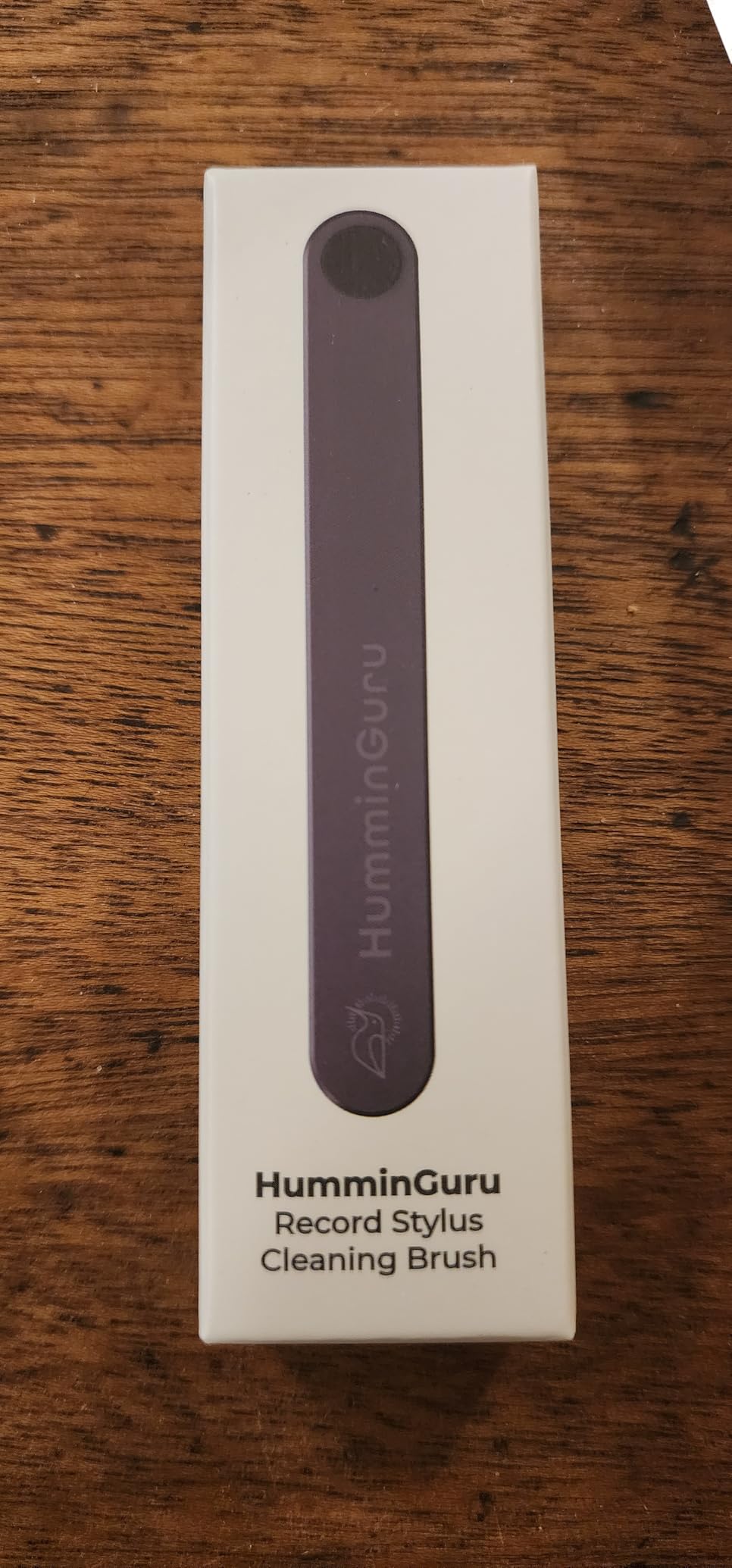
The HumminGuru takes the one design decision that most of the cheap brushes get wrong, which is treating the handle as a structural part rather than a plastic stick. Both the brush fibers and the handle are described as anti-static and engineered for electrical conductivity, and the listing names MM and MC cartridges explicitly, which is another sign the manufacturer designed for cartridge work rather than for record players in general.
That conduction path is what makes a brush effective in a static-prone room. A purely synthetic bristle brush can hold a charge, and a charged brush is a brush that keeps the dust it just picked up. A conductive handle lets charge bleed off instead, so the debris ends up on your cloth rather than back on the tip.
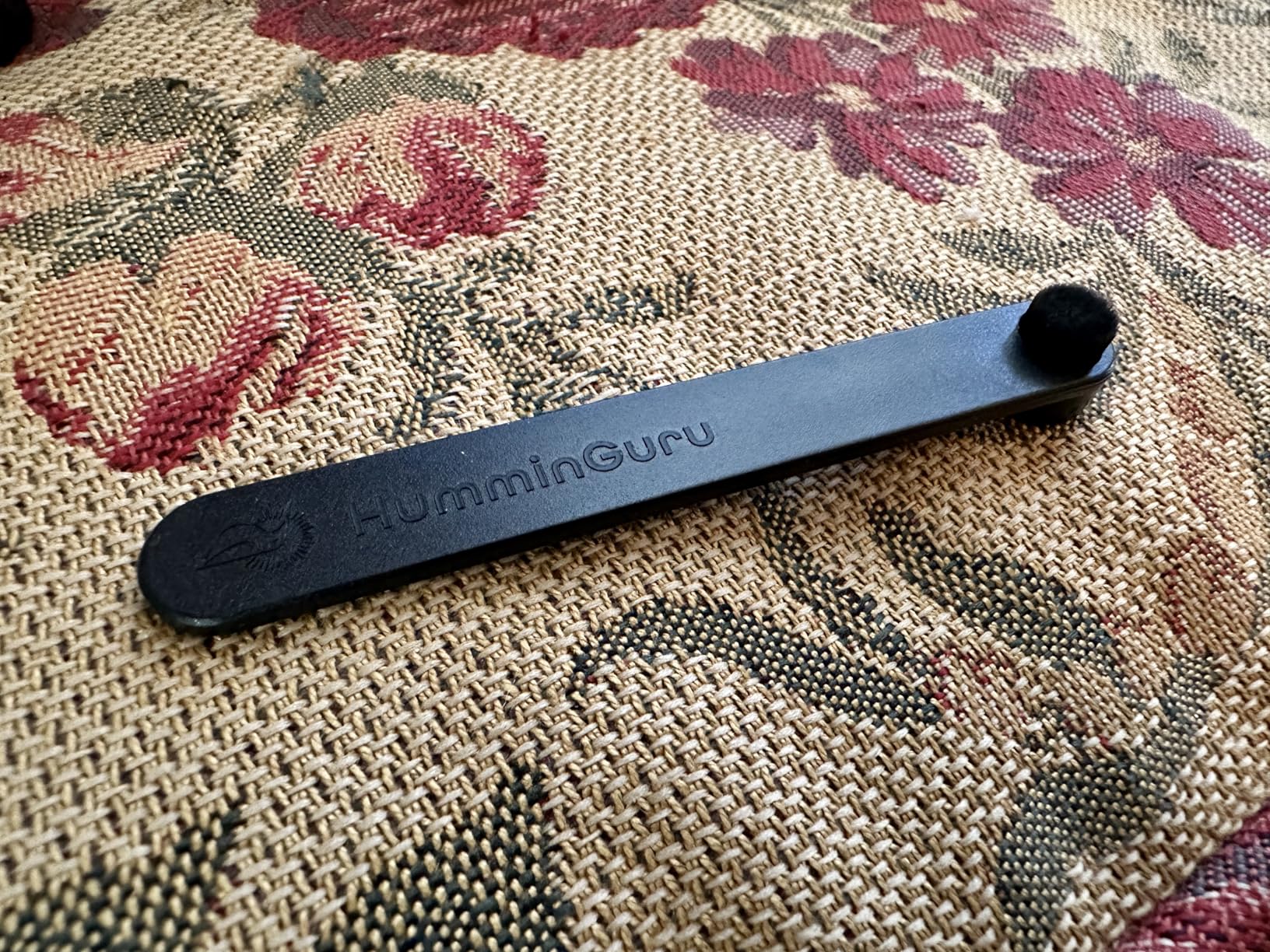
The other thing we like is the handle length, described as lengthy for accurate control. Ignore the marketing framing and read the geometry: a longer handle means you can work the brush with two fingers and feel what the tip is doing, rather than pinching a stub and hoping. That is exactly the difference between a controlled cleaning pass and a guess.
At 53 reviews and a 4.6 average, the early reception is strong but thin. The listed cons are the honest ones for a newer product: a shorter review history and less long-term durability data than an established brand would have. That is not a dealbreaker for a tool in this category, where brushes that survive five years are unremarkable.
Is the soft-bristle design right for a hollow cantilever?
It is a reasonable fit. Soft bristles with an anti-static conductive path are a good match for hollow cantilevers, where the tip is suspended and a harsher bristle contact can excite the suspension. The counter-argument from experienced users is that soft bristles need more passes and load with grime faster. Both are true, which is why the sensible habit is to clean the brush itself every few sessions rather than expecting a permanent tool.
What should you watch for over time?
Watch the bristle tips, not the handle. Bristles fray, spread and stop reaching into the gaps around the cantilever, and a frayed brush is the single most common reason people wrongly conclude that stylus cleaning does not work. If the head no longer looks like an even block of filaments, it has done its job and needs replacing. This is where a two-pack becomes attractive later on.
6. sdroceRyaM Anti-Static Stylus Brush – Budget Pick
Vinyl Record Player Turntable Phono Cartridge Anti-Static Stylus Brush
Carbon fiber bristles
2.32 inch body
0.317 ounces
Pros
- Conductive carbon fiber with anti-static effect
- One or two swipes is usually enough
- Very light at 0.317 ounces
- Direction guidance printed on the listing
Cons
- Extremely small
- easy to lose
- No storage case included
This is the most compact brush in the roundup, and the smallness is the point. At 0.317 ounces and a 2.32 by 0.3 by 0.2 inch brush body, it disappears into a jacket pocket or a small record case, which makes it the one to take when you are moving a turntable to a new room or playing records somewhere that is not your living room.
The bristle is carbon fiber, and the listing credits its electrical conductivity with an anti-static effect. Users report that one or two swipes is all it takes, and at a 4.8 average across 47 reviews that is a credible efficiency claim for a dry clean on a reasonably clean record.
There are no customer images for this listing, so we are working from the specification sheet and the reviews rather than from photos, and we will say so plainly. The specification is detailed enough to be useful: the dimensions are published, the material is named, and the listing includes a direction warning. Set the brush down before you lift the tonearm rather than juggling both, because a 0.317 ounce tool dropped from hand height onto a plinth is how people damage cartridges that were never in danger from cleaning.
That direction warning is worth reading twice. It states that the suspension system can be damaged if you clean carelessly, and instructs you to pay attention to the direction of the stylus rather than pulling back, sweeping backward, or sweeping from the side. In other words, the manufacturer is telling you to clean along the cantilever from front to back, which is the single most important rule in this entire article.
Does the 5.9 cm size actually matter?
Yes, and it is a legitimate criticism that shows up in reviews. Under about six centimetres you are limited to moving-magnet cartridges with a high, accessible cantilever. On a low-sitting moving-coil cartridge you may not be able to get the head under the body at all, and then the brush is useless no matter how good the bristles are. Measure your clearance before buying this one and after buying any of the small ones.
Can carbon fiber scratch vinyl?
Not in this application, and the reasoning matters. Carbon fiber filaments are finer than a groove wall’s damage threshold when used with light pressure, and this brush is built for a stylus tip, not for a record surface. Carbon fiber record brushes are a different question entirely because they contact the vinyl itself. Used dry with almost no pressure and swept along the cantilever, this brush will not scratch your records or your stylus.
7. Fluance Anti-Static Carbon Fiber Stylus Brush – Best for New Owners
Fluance Anti-Static Carbon Fiber Stylus Cleaning Brush – Safely Removes Dust & Static from Your Record Stylus to Preserve Sound Quality and Reduce Pops, Crackles, Surface Noise (VB51)
Ultra-fine conductive carbon fiber
0.16 ounces
2.59 inch body
Pros
- Ultra-fine non-abrasive filaments
- Conductive fibers discharge static
- Dense packing clears fine dust
- Highest average rating here
Cons
- Newer product with a short history
- Higher cost than basic brushes
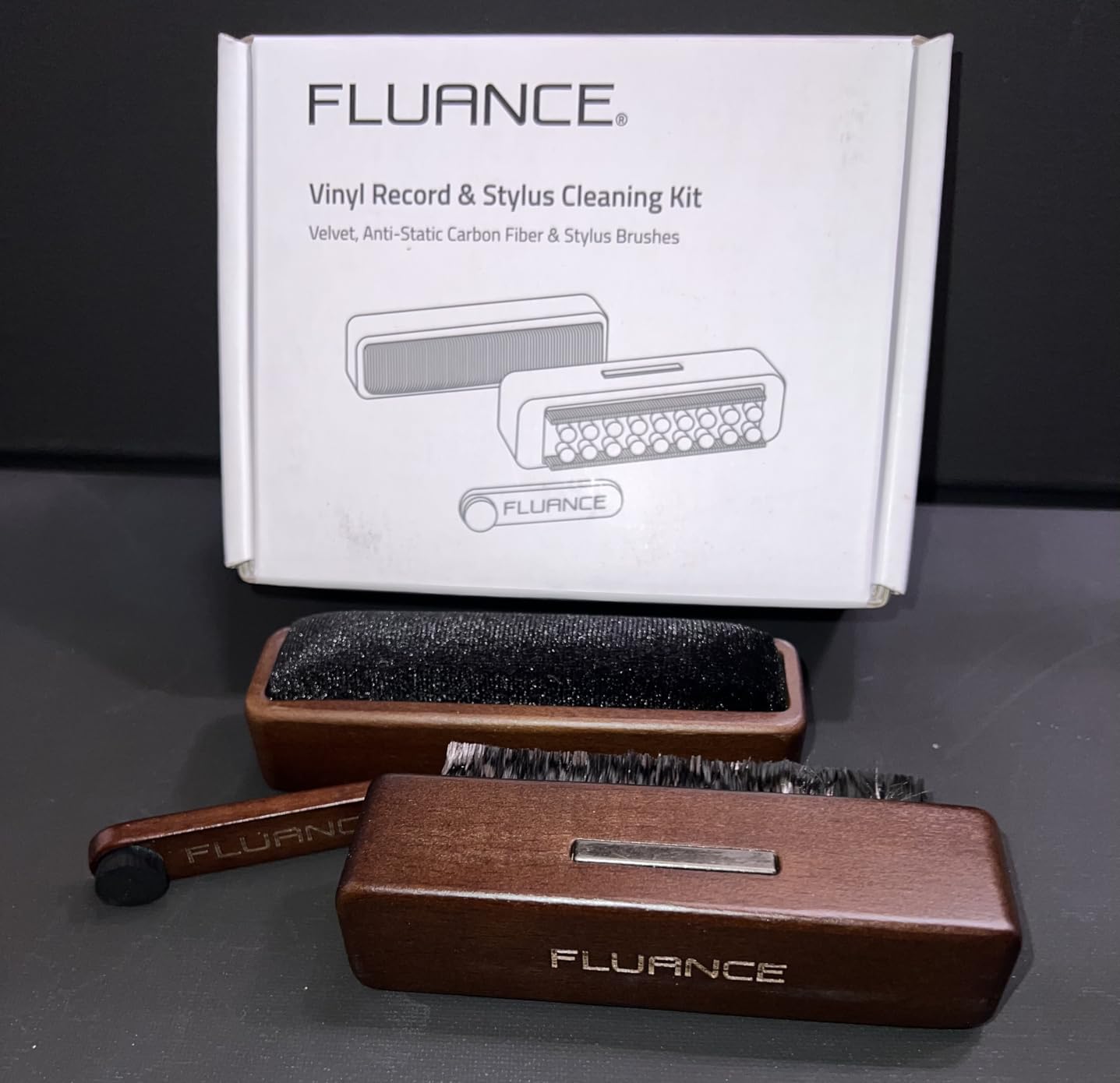
Fluance is the highest-rated brush in this roundup at 4.9 across 43 reviews, and the reason is that the specification is unusually well thought out for its price band. The listing calls the filaments ultra-fine, non-abrasive and electrically conductive, and it claims the dense packing is what actually lifts fine dust rather than merely moving it around the tip.
That is the right thing to prioritise if you are new to this. The failure mode for beginners is not a damaged stylus, it is a brush that looks like it worked while the tip is still carrying a film of debris. Dense, fine, conductive bristles are the combination most likely to give you a visibly clean tip on the first pass.
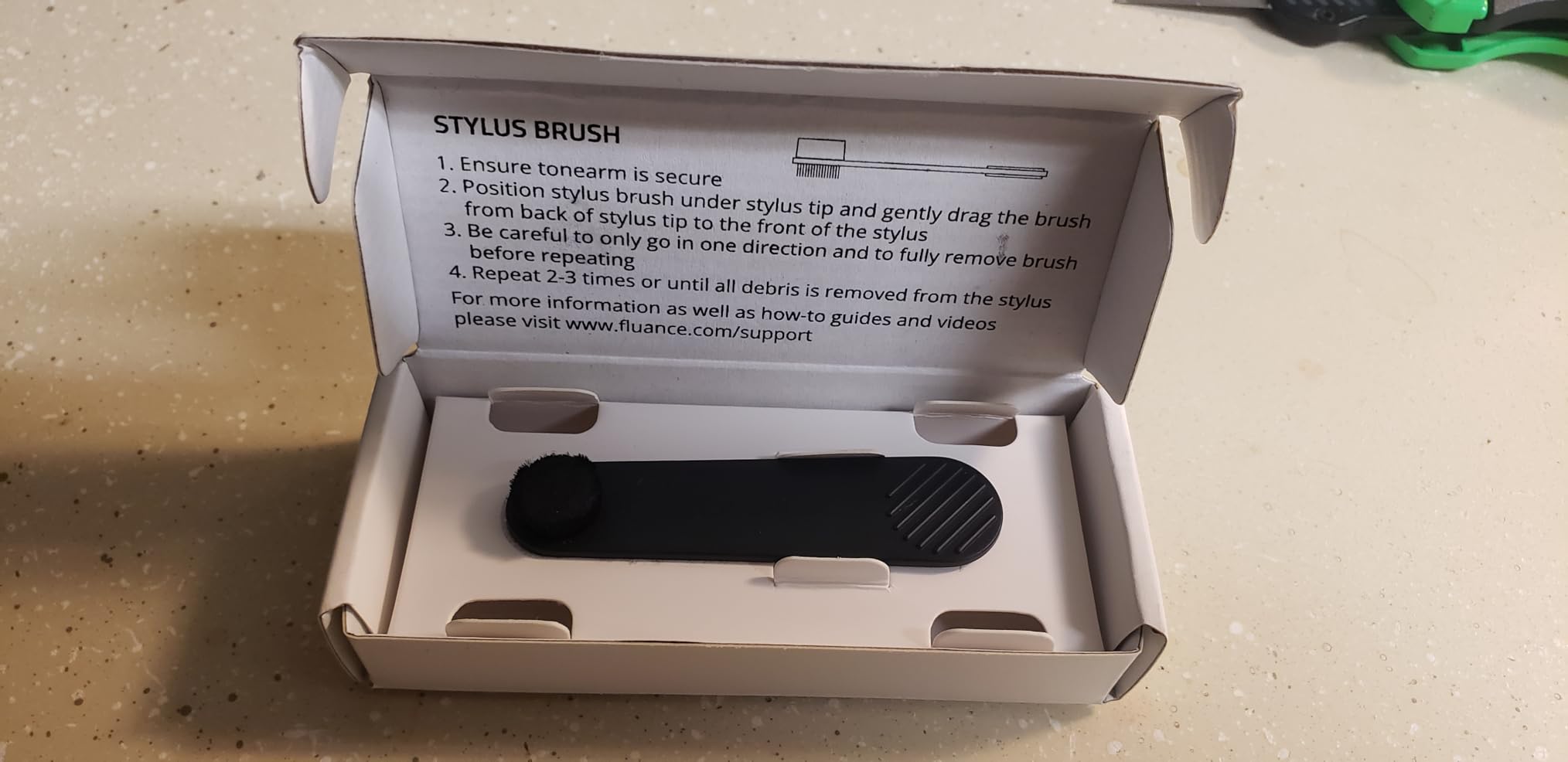
At 0.16 ounces it is among the lightest tools here, and the body is 0.67 by 2.59 by 0.42 inches. Lightness plus short body is a good pairing for a cartridge where you want the head to sit still and make contact rather than lever against the cantilever. A brush heavier than a few tenths of an ounce is a brush that fights you.
The listed claims around audio are the ones to hold loosely. Preserving tonal accuracy and stereo imaging makes sense in principle, because a dirty stylus does dull the top end, but you should not expect an audible difference on the same record in a single listening. The measurable difference is in how long your stylus and your records last.
Is the 4.9 rating meaningful with only 43 reviews?
Take it as a signal of a strong product rather than as proof of long-term durability. A newer listing has fewer reviews, and reviewers themselves flag the short history and the higher cost as the two drawbacks. What you can do with that information is stop worrying: a brush that scores this well out of the box is not going to be a problem purchase, and if you want a decade of ownership data you should buy the established brand instead.
How often should you use it?
Damp the answer with your habits, because the honest range is wide. One VinylEngine user cleans only every 50 to 60 records, arguing that clean vinyl is the real cleaner, while heavy listeners clean before every side. Both are defensible. A sensible baseline is a quick dry pass before each side if you play daily, and a proper wet clean with a drop of fluid every few dozen records if you are not.
8. GrooveWasher SC1 Stylus Cleaning Brush – Best for Wet Cleaning
GrooveWasher SC1 Stylus Cleaning Brush to Clean LP Record Player Cartridge Needle – Anti-static Easy-grip Handle for Harmless & Easy Dirt & Dust Removal from Turntable Stylus. BRUSH ONLY.
Domed nylon bristles
4.6 inch curved handle
Wet or dry use
Pros
- Curved angle reaches under the cartridge
- 4.6 inch handle is very long for a stylus brush
- Designed to work dry or with fluid
- Backed by a long-standing cleaning brand
Cons
- Cleaning fluid sold separately
- Domed nylon is softer than a stiff brush
The SC1 solves a specific physical problem: getting a brush head underneath a cartridge body without knocking the arm. The handle is curved at the end and set at a right angle, so the domed bristle tip arrives under the cartridge from the side rather than straight down. It is the geometry we would want if our cartridge sat low in the plinth.
Handle length is 4.6 inches, among the longest in this list, at 0.317 ounces and 4.6 by 0.75 by 0.25 inches. Long and light is the combination that makes a controlled pass possible, because you can guide the head with two fingers and let the weight of the tool do almost nothing.
GrooveWasher has been selling record cleaning fluid for close to a decade, and the SC1 brush is built to pair with it. You can use the brush dry for stubborn lint, or put a drop or two of fluid on the bristles to dissolve silicone and oil coatings left by careless record care. That flexibility is the main reason to choose it, and the flexible-head design means a wet clean is easy to do without touching the cantilever with anything wet.
There are no customer images for this listing, so again we are working from specification and reviews rather than photos. That is worth flagging because this brush is discussed extensively in enthusiast forums, where it is frequently called the market benchmark. In our view that reputation is about the head design rather than the bristle hardness, since the bristles here are domed nylon rather than the short stiff filaments the VinylEngine consensus describes.
Is the SC1 safe for a hollow cantilever?
With a dry brush, yes, and it is the standard recommendation in the VinylEngine thread where a tester found a Clearaudio-style brush left hollow cantilevers visibly clean using dry brushing alone with no alcohol needed. The rule is still the rule: sweep front to back along the length of the cantilever, lift the stylus off the record first and last, and keep pressure close to zero.
What does wet cleaning actually require?
A drop of fluid on the bristles, not on the stylus. Draw the brush backwards along the cantilever once so the fluid passes through the tip, then blot. The retailer and firm advice that circulates on forums is to apply fluid to the tip only and never to soak the cantilever, because a film of alcohol wicking up toward the suspension is the one genuinely risky outcome. And do not start with this tool if putty or gel still has gunk on the tip; a damp brush pass should come first, or you will smear the gunk rather than remove it.
9. Zentect 2-Pack Record Player Needle Brush – Best Travel Set With a Case
2PCS Record Player Needle Cleaning Brush, Turntable Stylus Cleaning Brush to Clean Record Needle Stylus Dirt and Dust
Two brushes plus a case
2.3 inch bodies
0.317 ounces each
Pros
- Two brushes so you always have a spare
- Storage case solves the loss problem
- Soft high-density anti-static carbon fiber
- Compact enough for a record case
Cons
- Very short handle for large hands
- Limited long-term review history
The Zentect set solves the single biggest practical problem in this whole category, which is losing the thing. Small stylus brushes roll under furniture, fall behind a rack, or get binned when you tidy a drawer, and a brush you cannot find is a brush you will replace with the cheapest available option eventually. This set comes with a plastic storage case, which is the difference between a tool you keep and a tool you lose in a year.
You also get a second brush, which is genuinely useful in a second sense: a spare can be kept permanently in the sleeve of whatever turntable you travel with, so you are never cleaning with the brush you left somewhere else. Reviewers specifically praise the two-pack value and the case.
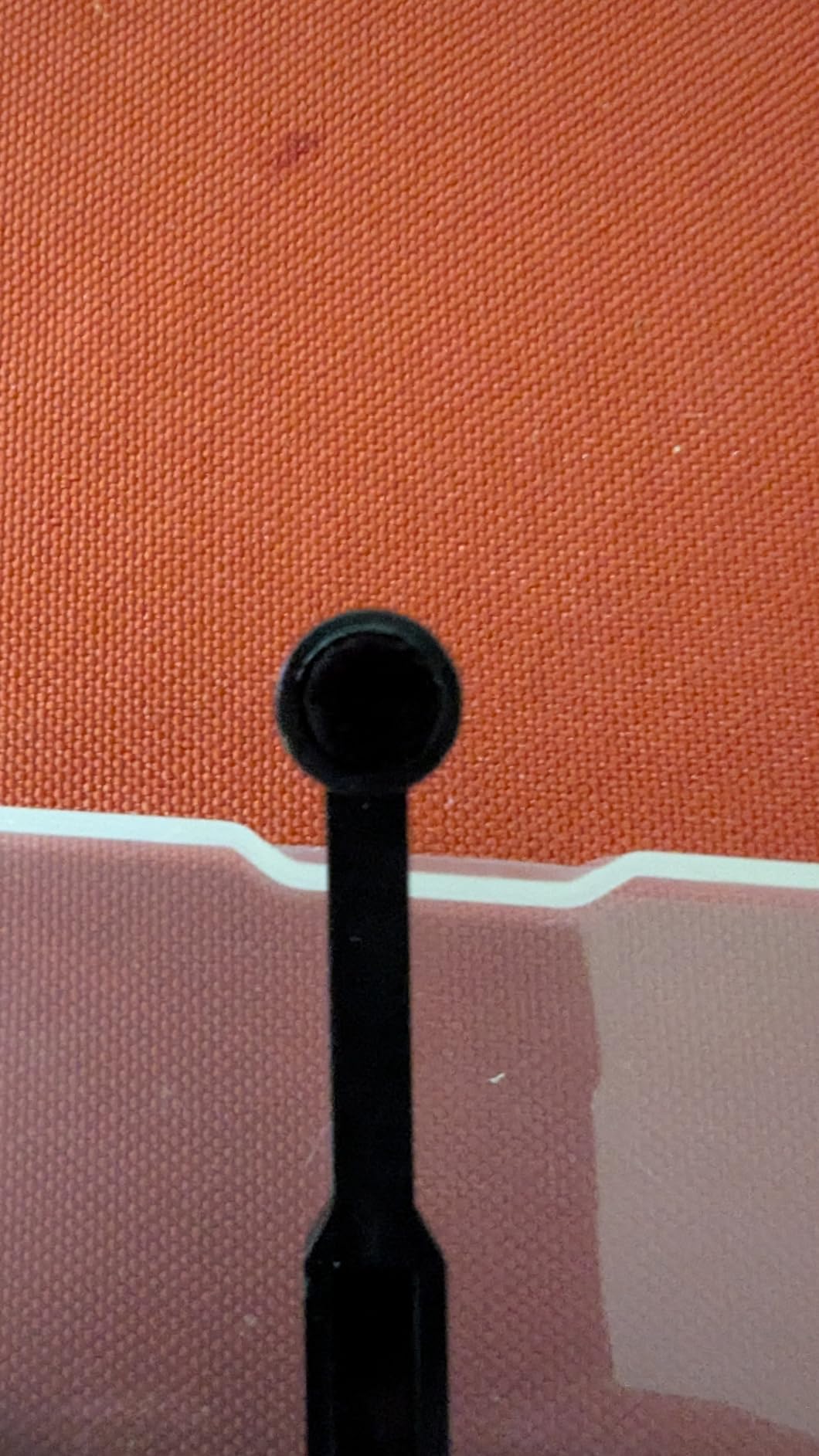
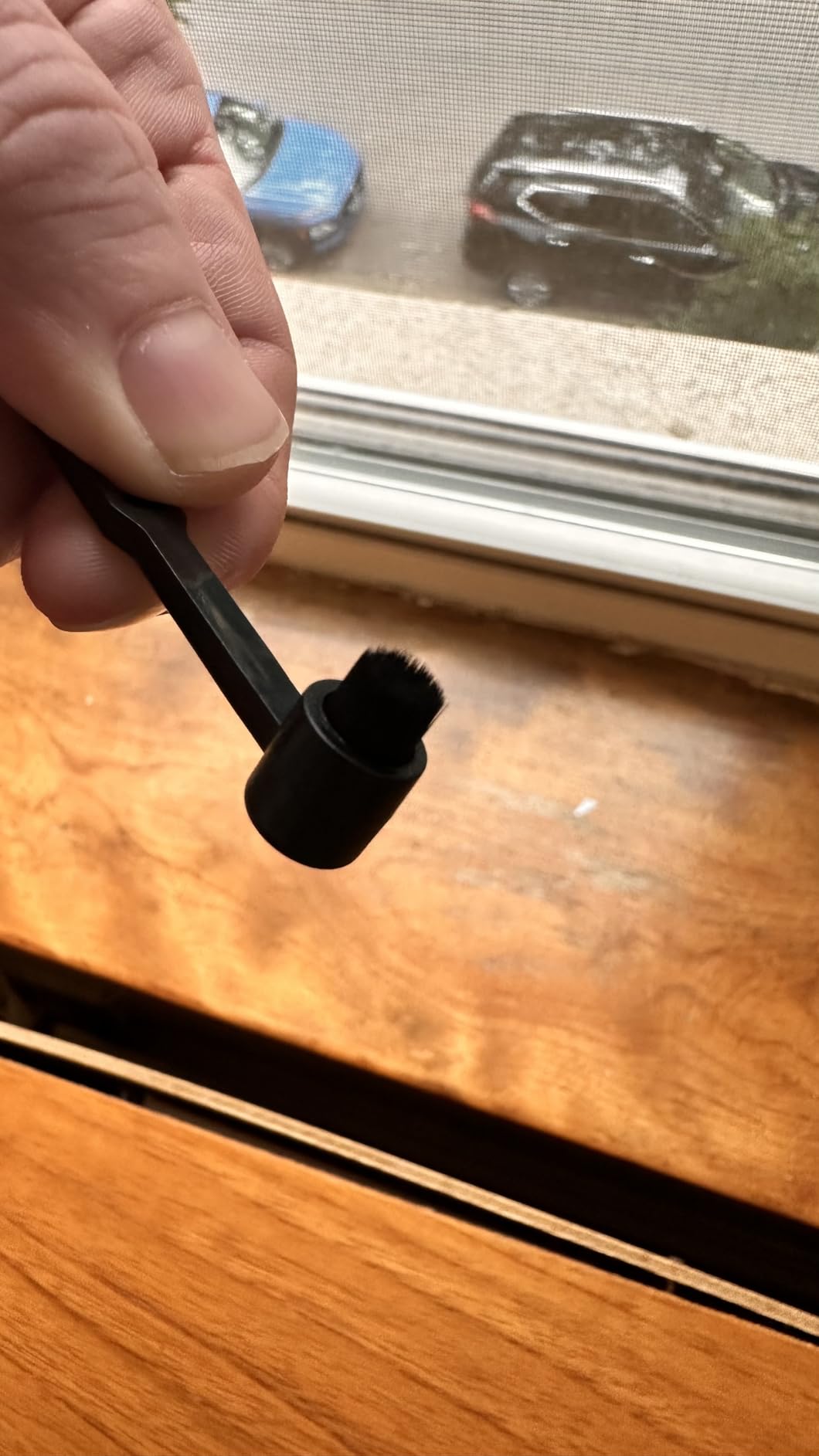
The bristles are described as soft, high-density and anti-static carbon fiber, and the listed body is 2.3 inches long at 0.317 ounces. That is the same weight class as the other mini brushes here, and the same caveat applies: if your cartridge sits very low, verify clearance before committing.
At 26 reviews and a 4.9 average this is the second-highest rated product in the list, and the reviewers themselves note the limited history. Treat the rating as an early signal rather than a settled reputation, because the listing is recent and there has not been time for a long ownership report yet.
Who is this set actually for?
For anyone who moves their setup, lives in a small flat, or has already lost a stylus brush to the vacuum. It is also a good gift for a new vinyl owner, because the case is the part most people never think to buy. Two brushes plus a case is a more complete answer than one loose brush, and the anti-static carbon fiber construction matches what the enthusiasts actually recommend.
What is the real limitation?
Handle length, and there is no way around it at 2.3 inches. Reviewers flag this directly: the short handle is hard to grip for larger hands and harder to reach in some cabinets. If you have big hands or a recessed plinth, buy a single brush with a long handle instead and accept the risk of misplacing it. If your hands are average and your deck is a flatbed or a widely spaced plinth, this set is the more sensible buy.
10. FdcLixuvol 2-Pack Carbon Fiber Stylus Brush – Best as a Spare Pair
2 Pieces Turntable Stylus Cleaning Brush, Vinyl Record Cleaning Brush Needles Carbon Fiber Vinyl Record Cleaner Anti-Static Stylus Cleaner Brushes for Records Needles Cleanings Dirt and Dust, Black
Two carbon fiber brushes
2.32 inch bodies
PP plastic handles
Pros
- Two brushes for one purchase
- Soft anti-static carbon fiber tips
- Effective at cutting surface noise
- Handles store easily
Cons
- No storage case
- Small size is easy to misplace
- Newer listing with a short history
The FdcLixuvol is a two-pack of conventional small carbon fiber brushes, and its appeal is arithmetic rather than cleverness. If you want a spare in the house and a spare in the record case, buying two at once costs barely more than buying one, and the review base, thin as it is at 25, is consistently positive at 4.8.
The construction is straightforward: a polypropylene plastic handle and a carbon fiber bristle head described as very soft, able to gently remove dust that has built up over long periods. Reviewers credit it with cutting noise and improving perceived sound quality, which is the expected outcome of removing micro-dirt from the tip.
Length is 5.9 centimetres, or 2.32 inches, which puts it in the same size class as the sdroceRyaM and Zentect brushes. That is the recurring trade-off in the budget tier: you get a correct bristle material and you give up reach. The listing actually gets the geometry right, describing the size as designed to store without taking up extra space, which is true and also the reason it can vanish.
There are no customer images here either, and the listed cons include no storage case plus a short review history. The honest summary is that this is a competent, undifferentiated tool sold in pairs, which is exactly what you want if your plan is to buy one good long-handled brush and treat the second as backup.
Do you need two?
Only if you have more than one turntable, a travel setup, or a habit of leaving brushes in inconvenient places. Otherwise one brush is one brush and a second identical tool just doubles the odds of losing one. If you only need one, take our top pick instead, which has the same carbon fiber advantage and a far more controllable handle.
Is soft carbon fiber enough for heavy buildup?
For dust and ordinary lint, absolutely, and reviewers say so. For a stylus that has been playing dirty records for a year and has visible gunk, soft bristles will take longer and the right answer is a wet pass with a drop of fluid, or a gel. The bristle softness is not the limitation here; the fact that it is only 2.32 inches long, and that you have no wet option built in, is what limits it.
Stylus Cleaning Brush vs. Record Brush: What Is the Difference?
A stylus cleaning brush touches your cartridge. A record brush touches your records. They are different products for different problems, and confusing them is the most common question in vinyl communities. The DECCA anti-static brush and the Goldring velvet pad that come in the box with many new turntables are both record brushes, and neither is meant to go anywhere near your stylus.
A record brush is wide, usually a full record diameter or close to it, and it is drawn across a rotating record. Carbon fiber record brushes are stiff enough to get down into the grooves and pull debris sideways out of them, and a velvet pad follows behind to lift what the carbon fiber loosened off the surface. That is a groove-cleaning job, and it works only on a spinning record.
A stylus brush is small, often a few centimetres long, and it is used with the record stopped and the tonearm lifted. It touches nothing but the stylus tip. Making a record brush mistake with it, such as trying to use a small stiff brush on a spinning record, does nothing useful, and the reverse mistake, using a record brush on a cartridge, is how people end up with bent cantilevers.
So the answer to what is the best brush for cleaning vinyl records is a different product from what is the best stylus cleaning brush, and the two categories do not overlap. If your problem is pops and crackle in the music, clean the records. If the problem is that the stylus looks dirty under a light, clean the stylus. Usually you need both, and the record side is where most of the audible improvement comes from.
How to Clean a Turntable Stylus Without Damaging It
First, stop the record and lift the tonearm. Do not try to clean a stylus on a spinning platter, and do not try to clean it while the needle is still in the groove. The suspension system is designed to flex, and a brush pushed against a loaded stylus loads that suspension in exactly the wrong direction.
Second, get light on the tip. Put a bright lamp at roughly a 45 degree angle so you can see the tip as a bright shape against a dark background, and use a jeweler’s loupe if you have one. This is the verification protocol that the more serious forum testers use, and it is the difference between cleaning and guessing. If you cannot see the tip clearly, you cannot tell whether it is clean.
Third, hold the brush like a pen and bring it to the tip from the front. The third rule is the rule: sweep backwards along the length of the cantilever, front to back, once or twice. Never pull back against the suspension, never sweep in from the side, and never scrub. The sdroceRyaM listing calls this out explicitly because damage to the suspension is the one real way to ruin a cartridge with a brush.
Fourth, use almost no pressure. The bristles only need to touch the tip. If you can feel the cantilever bending under the brush, you are pressing too hard, and you should lift and start again. Light pressure with dense bristles beats heavy pressure with soft bristles, which is why the short densely packed brush that experienced users recommend is the safer tool, not the riskier one.
Fifth, for a wet clean, put a single drop of fluid on the bristles, not on the stylus. The GrooveWasher SC1 is designed for this, as is the am set that includes fluid. Draw the brush backwards through the tip once, then blot the tip with a lint-free cloth. Never soak the cantilever, and never let fluid sit and wick upward toward the suspension.
Sixth, clean the brush itself. A stylus brush that has loaded up with grime will deposit that grime on the next record. Tap it against a clean cloth, or run the bristles through a dry microfiber, every few sessions. The old trick of rolling the brush lightly on a record while it spins lifts stubborn debris from the bristles, and enthusiasts still use it, but a cloth works just as well if the record matters to you.
Seventh, leave WD-40, magic eraser, and household sprays alone. None of them belong anywhere near a stylus or a record. WD-40 leaves an oily film that will attract dust, and a magic eraser is abrasive. If you want something that is not a brush for stubborn residue, the answer is a proper gel or watchmaker’s putty used sparingly, after a brush pass.
Finally, keep a realistic rhythm. Clean before each side if you play daily, and do a wet clean every few dozen records. One experienced user cleans only every 50 to 60 records on the grounds that clean vinyl is the real cleaner, and over-cleaning a stylus is its own kind of wear.
What to Look for in a Stylus Cleaning Brush: Buying Guide
Bristle material is the first filter. Carbon fiber is conductive and anti-static, which is why it dominates this list and why six of these ten brushes use it. Micro-fiber is gentler and is what the Ortofon and Shure-style brushes use. Nylon, as on the GrooveWasher SC1, is durable and works well wet. Velvet and chenille belong to record brushes, not stylus brushes, and if a listing calls the bristle material velvet, look for a different product.
Bristle stiffness is the second filter, and it is the great brush debate. Experienced users on VinylEngine generally argue for short, densely packed stiff bristles made specifically for styli, because density is what shifts debris in one pass. Other enthusiasts prefer soft bristles, and one AudioKarma user is explicit about preferring a Shure soft-bristle brush over the more common stiff ones. The synthesis we are comfortable with is that density matters more than hardness, and that a dense soft brush is the safe middle ground.
Watch out for vintage hard-pile brushes. The classic Discwasher and Ortofon mini hard-pile brushes are long-standing community favourites, and on moving-magnet cartridges they work well. But one VinylEngine user who owns a vintage Discwasher refuses to use it on contemporary moving-coil cartridges, saying the tiny cantilevers and styli are far too small for that device to clean safely and that it is too coarse. The same thread warns against coarse hard-pile brushes generally on modern micro-styli. If you own a high-output moving-coil cartridge, buy modern fine filaments, not a vintage hard-pile brush.
Handle length and shape decide whether you can physically do the job. A 2.3 inch mini brush is fine on a high, accessible cantilever and useless under a low-sitting cartridge body. A 4 to 4.6 inch handle with a curved or angled head is what gets you under the cartridge properly, and that is why the GrooveWasher SC1 has a curved right-angle design. A 5.9 cm brush is the most common size in the budget tier and the most common source of the too-small complaint.
Weight matters for control. Everything in the sub-quarter-ounce range gives you a tool that can be moved without resistance. The heaviest brush in this list is the am set at 1.41 ounces, which is fine for a moving-magnet cartridge and heavy-handed for a moving-coil one. A thin handle is also worth checking against your hands, because several reviewers of the small brushes mention difficulty gripping them with larger hands.
Anti-static claims deserve a close read. The best versions specify that both the fibers and the handle are conductive, and Fluance goes furthest by describing the mechanism, with the filaments discharging static charge on contact. A brush that only claims its bristles are anti-static, or that relies on a painted color, gives you less. Static matters because a charged tip attracts the dust you just removed.
Cartridge compatibility changes the risk profile. Moving-magnet cartridges have a larger, more exposed cantilever and tolerate a wider range of tools. Moving-coil cartridges have tiny micro-styli and hollow cantilevers, and the cost of a mistake is far higher because the cartridge itself is more expensive. If you own a moving-coil unit, the rule is simple: fine soft or dense filaments, a long handle, zero pressure, and front-to-back strokes only.
Finally, think about where the brush will live. Small brushes get lost, and the most repeated complaint across every listing in this roundup is size-related. A set that includes a storage case, such as the Zentect two-pack, solves it outright. If you buy a single loose brush, decide now where it lives and put it back there every time. A brush in a fixed spot for five years is worth more than a better brush you cannot find.
When a Stylus Cleaning Brush Is Not Enough
Watchmaker’s putty is the answer enthusiasts reach for first, and on Audiogon the most-upvoted response names Rodico by Burgeon as the best of the lot for gunk. Putty is genuinely good at lifting sticky residue without any mechanical contact at all, which is why it appeals to people with expensive cartridges. It also has real risks: it can stick to the stylus, and if it gets into a hollow cantilever there is no practical way to remove it. If you use it, use the smallest possible amount, touch the tip only, and never let it sit.
Gels are the second option. A DS Audio gel cleaner is reported on Reddit to beat cheaper gels because it leaves no gunk behind and cleans the cantilever instead of coating it. That residue problem is the real difference between gels, and a gel that leaves residue is worse than no gel at all. A stylus gel is also frequently bundled into a kit, which is the reason several budget bundles on retail shelves include one.
Ultrasonic cleaning exists and works, but it is the one technique we would approach last. Forum discussion of cartridge cleaning describes the mechanism working well on grime while carrying a genuine risk that vibration can loosen the bond holding the stylus to the cantilever. For a cartridge you have just paid a lot for, the risk-reward is poor. Save it for a beater cartridge, and never for a moving-coil unit you cannot replace.
One VinylEngine tester compared five methods under a loupe and produced the ranking that matches most of the forum consensus: a wet cleaner used with a brush was best and never failed, watchmaker’s putty was a surprising and effective second, and every dry method tested tied as good on average but not fail-safe. That is a useful summary. The brush is your first and last line; everything else is an occasional supplement.
Frequently Asked Questions
What is the best stylus cleaning brush?
The best stylus cleaning brush is one with short, densely packed carbon fiber bristles on a long, conductive handle. Our top pick is the Boundless Audio Carbon Fiber Stylus Brush, which pairs more than 24k carbon fiber filaments with a 4.45 inch conductive handle and the largest review base in the group. If you want one brush that also works wet, the GrooveWasher SC1 is the alternative.
How do I clean my turntable stylus?
Stop the record and lift the tonearm first. Light the tip with a bright lamp and check it with a jeweler’s loupe. Bring the brush to the tip from the front and sweep backwards along the length of the cantilever once or twice with almost no pressure. Never pull back against the suspension or scrub from the side. For a wet clean, put one drop of fluid on the bristles, not the stylus, and blot afterwards.
How often should I clean my stylus?
There is no single right answer, because it depends on your records and your habits. A quick dry pass before each side suits daily players. One experienced user cleans only every 50 to 60 records, arguing that clean vinyl matters more. A sensible middle is dry brushing before each side plus a wet clean with a drop of fluid every few dozen records.
Are stylus cleaning brushes safe for all needle types?
They are safe for all of them if you use them correctly, but the risk is not evenly distributed. Moving-magnet cartridges have larger, more exposed cantilevers and tolerate a wider range of tools. Moving-coil cartridges have tiny micro-styli and hollow cantilevers where the cost of a mistake is far higher. Avoid coarse vintage hard-pile brushes on any modern moving-coil cartridge.
Can a carbon fiber brush scratch vinyl or damage the stylus?
Used dry with light pressure and swept along the cantilever, carbon fiber filaments will not scratch vinyl or a stylus tip. Problems come from technique, not material: scrubbing sideways, pulling back against the suspension, or pressing down while the needle is loaded. That is why every good listing tells you to clean front to back rather than pulling back or sweeping from the side.
What is a stylus cleaning brush versus a record brush?
A stylus cleaning brush is small and touches only the needle on a stopped record with the tonearm lifted. A record brush is wide and is drawn across a spinning record, with carbon fiber getting into the grooves and a velvet pad following to lift particles off the surface. The anti-static brush that ships in the box with many new turntables is a record brush, not a stylus brush.
Final Verdict: Which Stylus Cleaning Brush Should You Buy?
The best stylus cleaning brushes for turntables in 2026 divide into three honest answers. The Boundless Audio Carbon Fiber Stylus Brush is the one to buy, because dense conductive carbon fiber and a long light handle solve the two problems that actually stop people cleaning properly: reaching under the cartridge and moving debris in a single pass. The GrooveWasher SC1 is the choice if you also want a wet clean and you care more about angled access to a low-sitting cartridge than about bristle hardness. The Ortofon Stylus Brush is the calm option, with micro-fiber bristles that give you maximum margin on a hollow cantilever.
Everything else on this list is a defensible budget tool, and most of them cost very little. Pick the one with a long handle if your cartridge sits low, the one with a case if you are forgetful, and the one that does both wet and dry if you play records that have been stored without care. Give it a permanent home, use almost no pressure, sweep front to back, and check the tip under a light. That last habit will save you more cartridges than any brush on this list.