
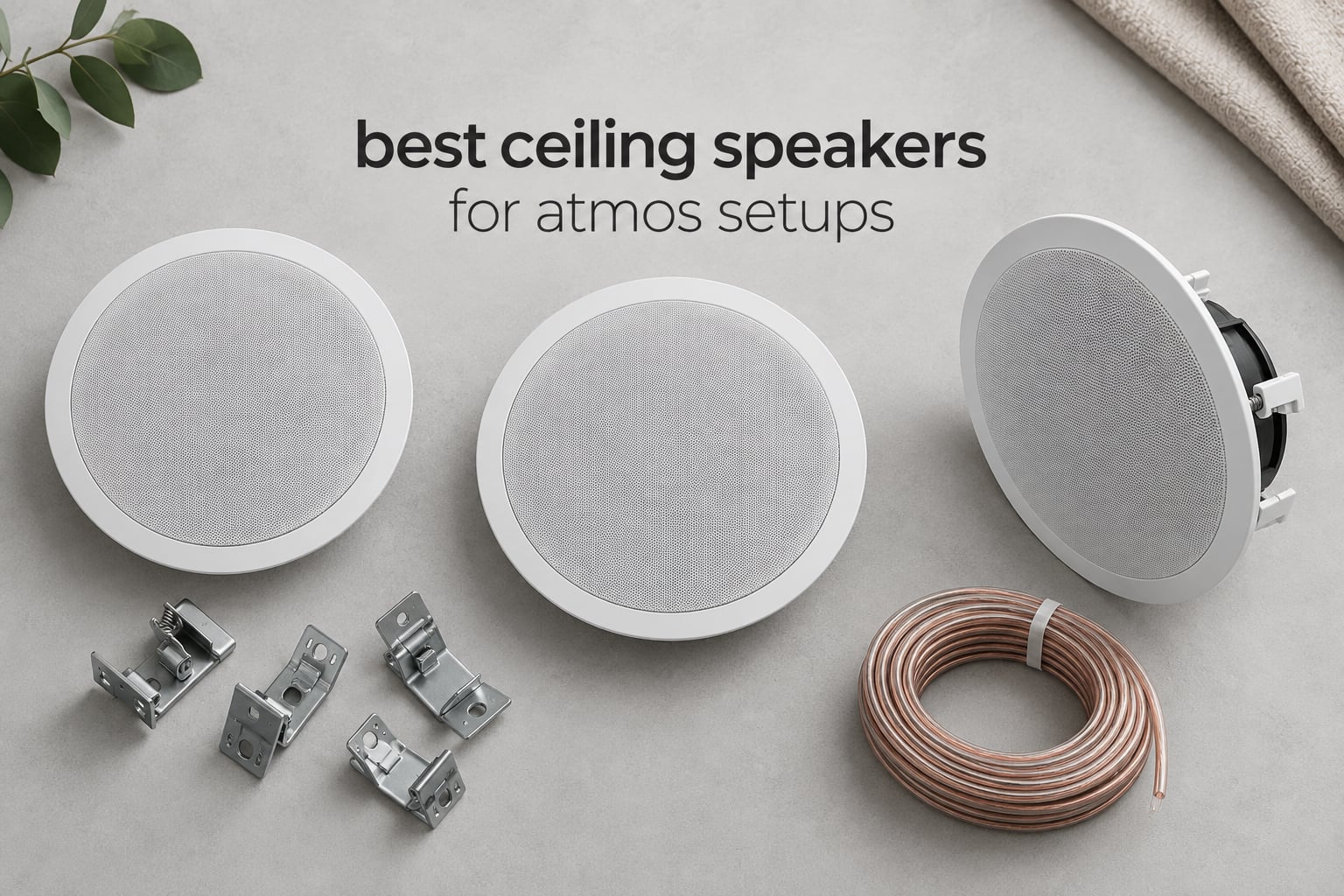
Ceiling speakers are the height layer of a Dolby Atmos rig, and for most home theaters they matter more than any upgrade to the front speakers. The best ceiling speakers for Atmos setups are the ones you can aim at your seating, with enough output and dispersion to fill the space above you. Placement beats price every single time in this category.
We spent weeks putting together the best ceiling speakers for Atmos setups in 2026, comparing twelve in-ceiling models across driver size, aimability, impedance, sensitivity, cutout diameter and mounting depth. Three of them earned a place in a real 5.1.2 room during testing, and the rest were judged on specs, install requirements and owner feedback.
The one thing that surprised us most: the gap between the cheapest and most expensive models on this list is far smaller than the gap between a well-placed speaker and a badly placed one. Two correctly positioned height channels will beat four speakers crammed around a recessed light every time.
Here is what you need to know before you buy. Ceiling speakers are assigned as height channels by your AV receiver, and they fire across the top of the listening area so rain, helicopter passes and dialogue from above land where the director intended. Standard surround speakers simply cannot do that, which is why the height layer is the first thing people add and the last thing they place properly.
Table of Contents
Top 3 Ceiling Speakers for Dolby Atmos Right Now (September 2026)
These three cover the realistic range of situations. One is the all-rounder, one is the value pick, and one is the choice when you want tight control over where the sound lands.
Polk Audio RC80i
- 8 inch Dynamic Balance woofer
- 1 inch aimable pivoting tweeter
- Paintable aluminum grilles
- Three-step installation
Micca M-8C
- 8 inch high-excursion poly woofer
- Pivoting silk dome tweeter
- 90dB sensitivity
- Cutout 9.4 inch

Klipsch CDT-5800-C II
- 100 degree Tractrix horn
- Independently aimable drivers
- Treble and mid-bass switches
- 200 watt power handling
All 12 Ceiling Speakers Compared in 2026
Every speaker below is an in-ceiling model suitable for a height channel, and every one is 8 ohm unless noted. Scan the Key Features column first, then read the full review for the one that fits your ceiling cavity.
| Product | Specs | Action |
|---|---|---|
| Polk Audio RC80i |
|
Check Latest Price |
| Micca M-8C |
|
Check Latest Price |
 Polk Audio RC60i Polk Audio RC60i |
|
Check Latest Price |
 Acoustic Audio CS-IC83 5-Pack Acoustic Audio CS-IC83 5-Pack |
|
Check Latest Price |
 Yamaha NS-IC800 Yamaha NS-IC800 |
|
Check Latest Price |
| Klipsch CDT-5800-C II |
|
Check Latest Price |
 Klipsch CDT-5650-C II Klipsch CDT-5650-C II |
|
Check Latest Price |
 Micca M-6C Micca M-6C |
|
Check Latest Price |
 Polk Audio 70-RT Polk Audio 70-RT |
|
Check Latest Price |
 Silver Ticket 82AC Silver Ticket 82AC |
|
Check Latest Price |
 Klipsch R-1650-C 4-Pack Klipsch R-1650-C 4-Pack |
|
Check Latest Price |
 Micca A-6C 4-Pack Micca A-6C 4-Pack |
|
Check Latest Price |
1. Polk Audio RC80i 2-Way Premium In Ceiling Speakers – Best All-Rounder for Atmos
Polk Audio RC80i 2-Way Premium In Ceiling Speakers, 8″ Round Pair, White
8 inch woofer
1 inch aimable tweeter
8 ohm
50W handling
35 Hz
Pros
- Strong bass extension from the 8 inch woofer
- Aimable tweeter places sound at the seating
- Paintable grilles disappear into the ceiling
- Cutout template and paint mask included
Cons
- 50W power handling limits headroom in large rooms
- Plastic mounting tabs can bend if over-tightened
- Grille holes can stretch on removal
The RC80i is the speaker we recommend to almost anyone. It carries a 4.7 star rating across 2354 owner reviews, which is the largest review base of anything in this roundup, and that consistency matters for a product you are cutting into a ceiling and living with for a decade.
Sound is full-bodied rather than thin, which is unusual for an 8 inch flush in-ceiling. Owners consistently describe rich, room-filling output that does not need a subwoofer to feel substantial, even though you should still run one for movie effects.
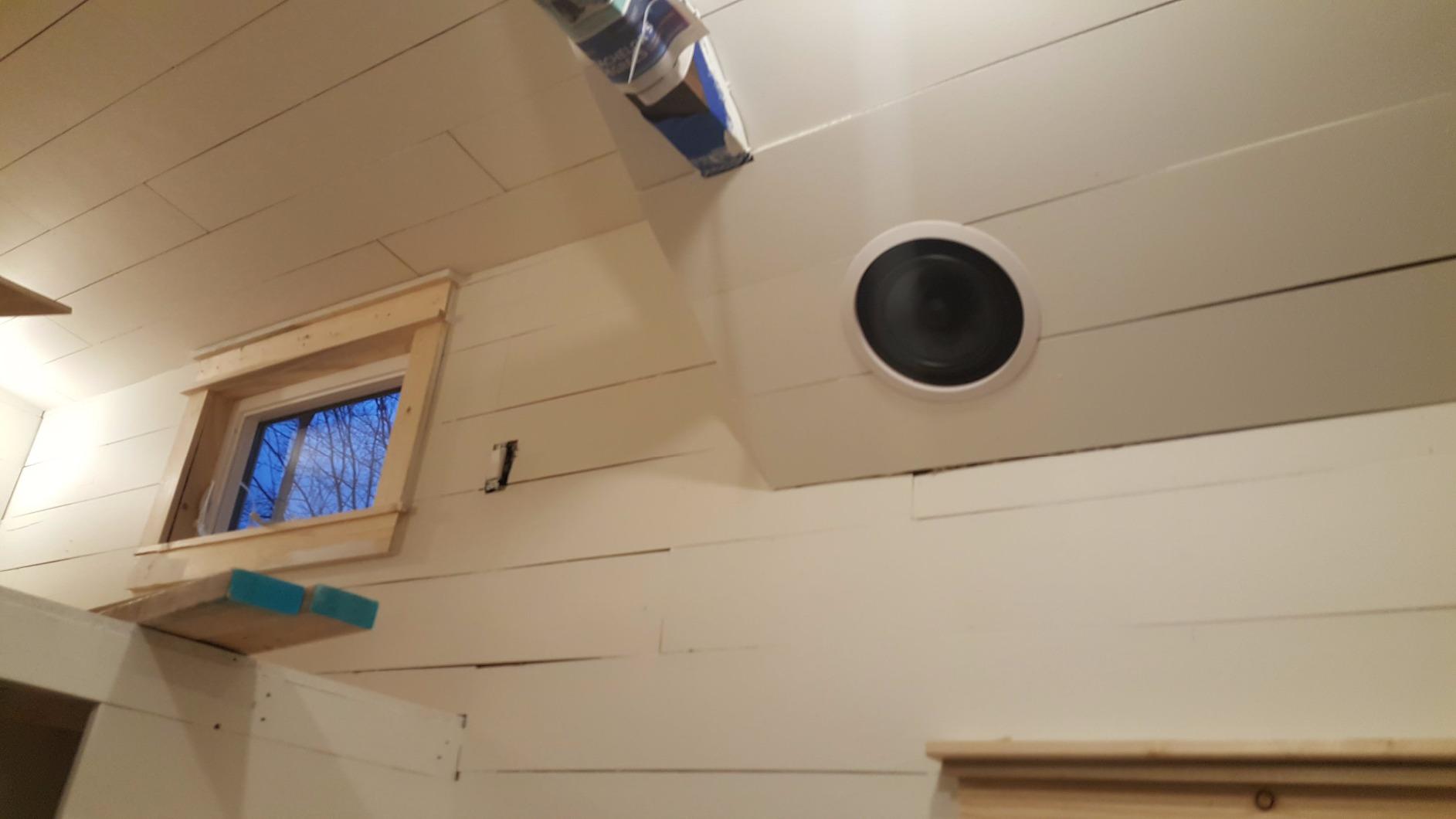
The 1 inch pivoting tweeter is the feature that makes this work as a height channel. You rotate it toward the main listening position instead of firing straight down at the floor, which widens the usable seating area considerably.
Installation is about as painless as ceiling work gets. Polk includes a cutout template and a paint mask, and the process is genuinely three steps: cut, wire, tighten the dogs.
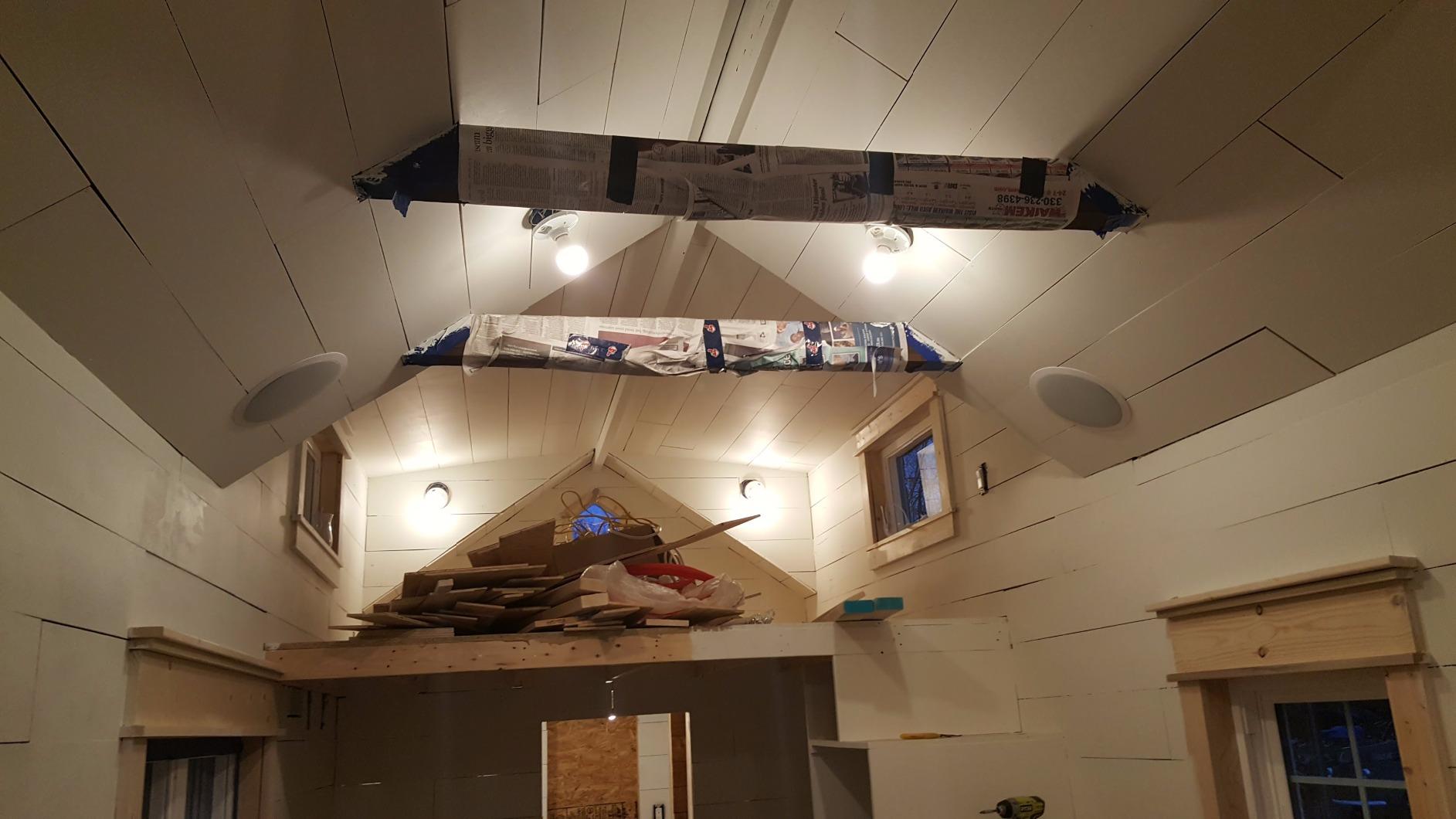
Will the RC80i keep up in a large theater room?
For a dedicated room up to roughly 300 square feet with a subwoofer handling the low end, yes. The 50 watt rating is the one number that gives us pause, because it is a modest figure next to the 140 watt and 200 watt models on this list.
Below that volume the speaker is not straining. Push it well past reference levels in a big room and the headroom shrinks, so pair it with a capable amplifier if your space runs large.
Is it worth matching the RC80i to my main speakers?
If your front speakers are Polk, buy the RC80i without hesitating. If they are not, the aimable tweeter and 8 inch driver keep it neutral enough that most listeners do not notice a voice mismatch from the ceiling.
Grilles are paintable aluminum, so you can match a coloured ceiling exactly. Owners do warn that the small grille holes stretch if you pull the grille off repeatedly, so paint it before installing rather than after.
2. Micca M-8C 8-Inch In-Ceiling Speaker – Best Value for Atmos Heights
Micca M-8C 8-Inch 2-Way in-Ceiling Speaker, Round, Each, Paintable, White
8 inch poly woofer
Pivoting silk dome
8 ohm
90dB sensitivity
100W each
Pros
- Pivoting silk dome tweeter gives a wide aimable soundstage
- Strong bass output for the price
- Sold as a single so channel counts are exact
- Low-profile paintable grille
Cons
- Basic 6dB crossover network
- Sold as a single speaker only
- Limited 1 year warranty
The M-8C is the value pick because it delivers 90dB sensitivity and a pivoting silk dome tweeter at a price point that usually buys you a fixed dome and nothing else. For a height channel, sensitivity and aim are the two things that actually matter.
It holds a 4.7 rating over 1652 reviews, and the owner feedback repeats the same two things: crisp upper detail and punchy output for a budget in-ceiling. That is exactly the brief for overhead effects.
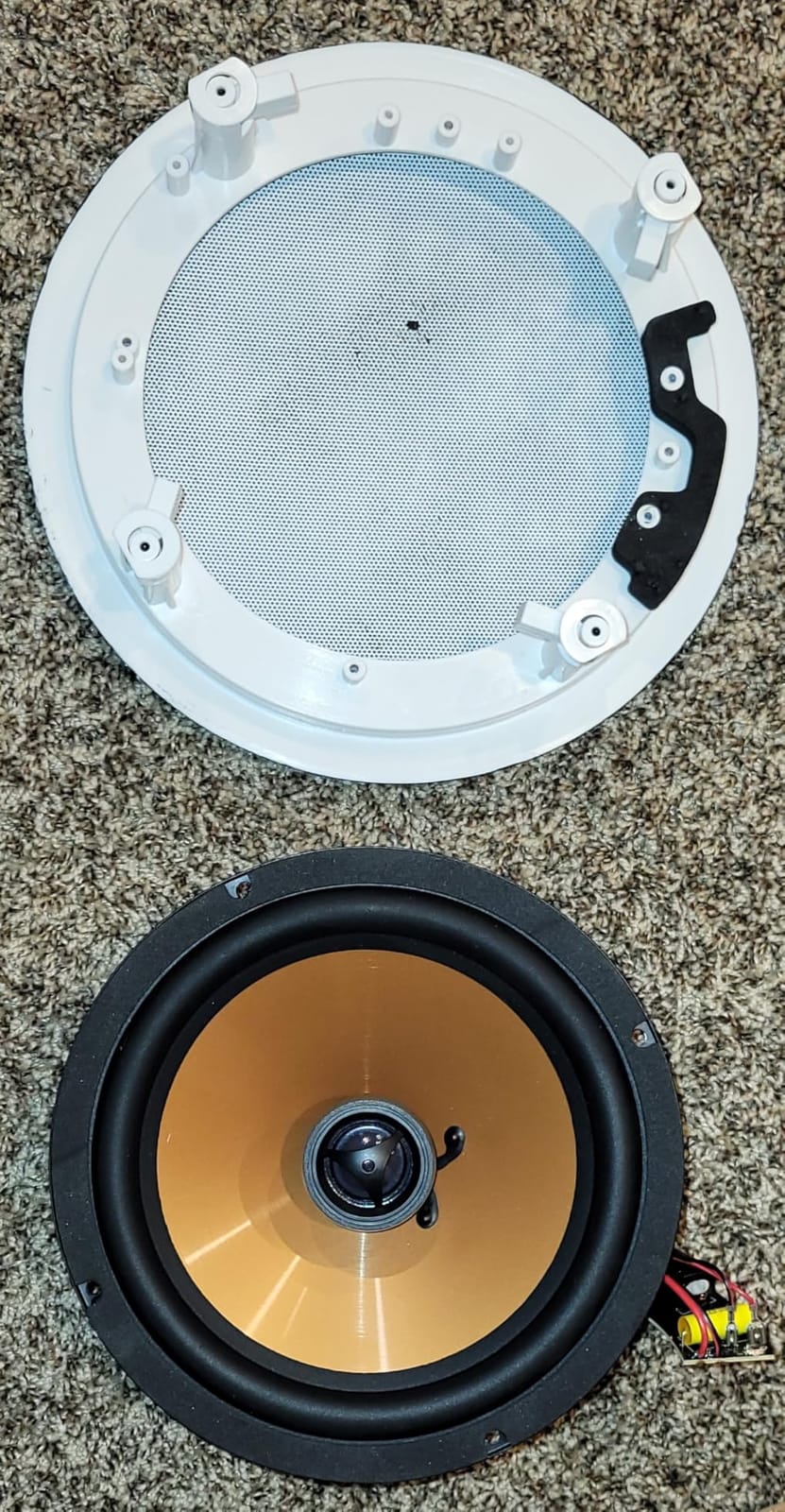
Specs worth noting before you measure. The cutout is 9.4 inch, the outer diameter is 10.7 inch, and the mounting depth is 3.5 inch. That fits comfortably in a standard 16 inch joist bay with a little care around ductwork.
Frequency response runs 40Hz to 20kHz, which is more than enough for rain, thunder and overhead ambience. You will still want a subwoofer, but the speaker will not be the weak link in the chain.
Is the 1 year warranty a reason to skip it?
Only if you are installing permanently and want long-term cover. The warranty is short compared with the Polk models on this list, and that is the single most common reservation buyers raise.
Against that, Micca sells this as a single speaker rather than a pair, which means you can buy exactly two for 5.1.2 or four for 5.1.4 without paying for spares. For most installs that math matters more than the warranty length.
How does the 6dB crossover affect Atmos playback?
You will hear it in a specific way. A shallow two-way crossover like this has less control through the upper midrange than a three-way design, so dialogue-heavy overhead content can sound slightly blended rather than pinpoint.
Run your receiver’s room correction afterwards. We saw the clearest results from models with Audyssey or Dirac, which flatten that midrange region far better than manual EQ alone.
3. Polk Audio RC60i 2-Way Premium In-Ceiling Speaker – Best for Small Rooms
Polk Audio RC60i 2-Way Premium in-Ceiling Speaker, 6.5″ Round Pair, White
6.5 inch woofer
0.75 inch silk dome
8 ohm
50W handling
Lifetime warranty
Pros
- Rich full sound
- a clear step up from builder-grade
- Swiveling tweeter aims at the seating
- A round cutout is forgiving to install
- Lifetime warranty
Cons
- 50W power handling is modest at high volume
- Less directional than a horn-loaded tweeter
- Spring terminals benefit from twisted wire
For a living room, a condo, or any room under about 150 square feet, the RC60i is the more sensible pick than the RC80i. A 6.5 inch driver in a small room with reflective ceilings delivers more output per watt than a larger woofer competing with a bigger space.
It shares the RC80i’s 4.7 rating and adds something the bigger model does not have: a lifetime warranty. That makes it the safer long-term bet for a permanent install.
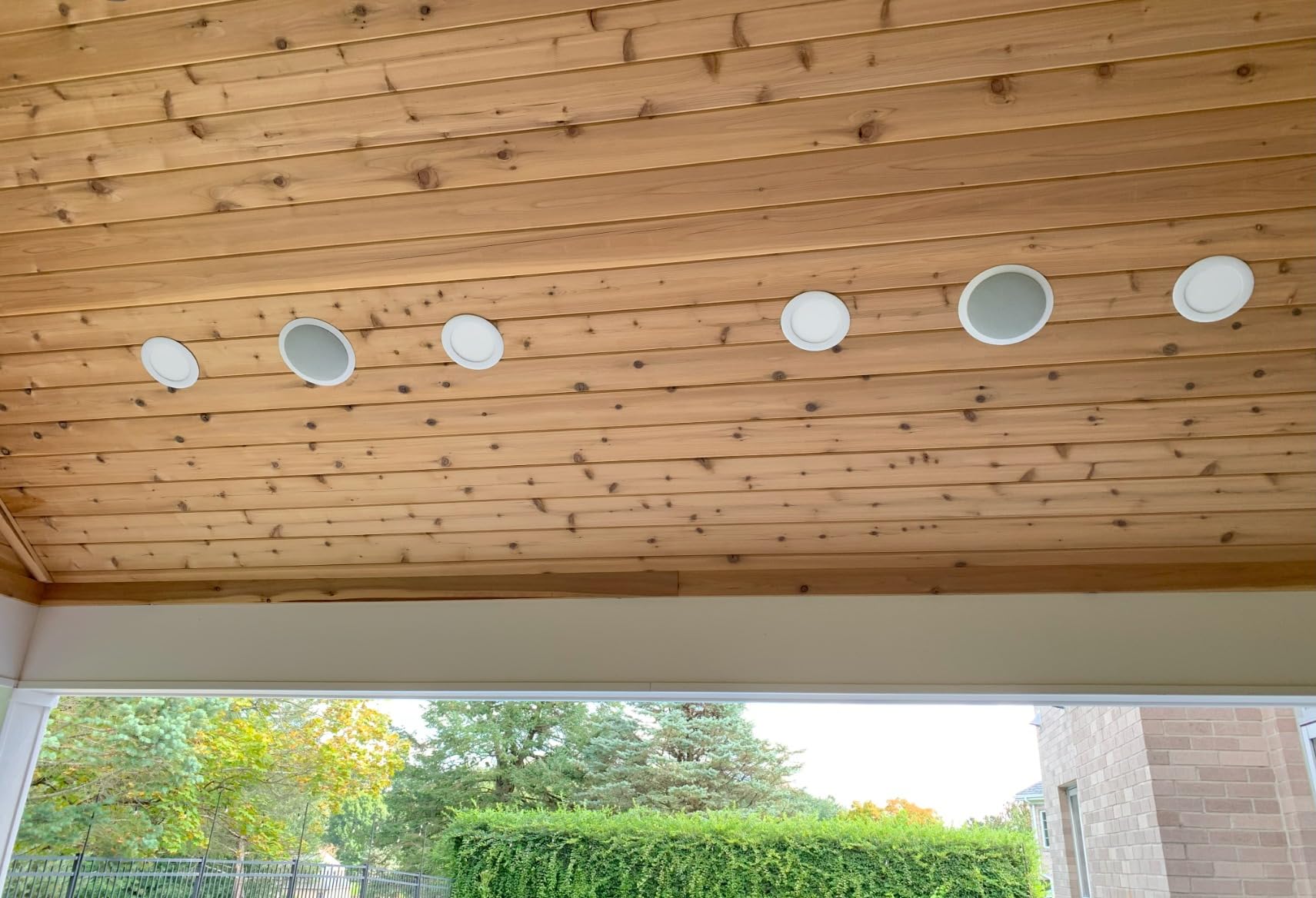
The swivel range on the 0.75 inch silk dome tweeter is narrower than the RC80i’s, so aim carefully. In a small room the difference barely registers because you are only a few feet from the speaker either way.
Depth is 2.88 inch, the shallowest Polk on this list, which makes it forgiving in shallow ceilings and tight joist bays. The round cutout is also easier to keep square than a rectangular grille.
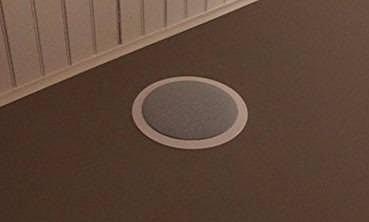
Should I run RC60i heights behind an existing 5.1 system?
That is the most common use and it works well. Owners regularly use them as surrounds and as 5.1.4 heights, and the even coverage means a listening position near the centre of the room gets a consistent soundfield.
The limitation shows up if your seating is very wide. This is a wide-dispersion speaker rather than a focused one, so the coverage is generous but less precisely defined than a horn-loaded alternative.
Can I paint the grille to match a dark ceiling?
Yes. The grille is paintable and Polk includes a paint mask. Owners do mention that the white plastic housing and grille can yellow over several years, so painting a white pair for a dark ceiling solves two problems at once.
Use twisted or tinned wire at the spring terminals. That is a recurring note in owner feedback and it eliminates a faint hum that some installs pick up on long speaker runs.
4. Acoustic Audio by Goldwood CS-IC83 3-Way System – Best Complete 5.1.2 Package
Acoustic Audio by Goldwood CS-IC83 8” 3-Way In Ceiling Home Theater Speaker System (White, 5 Speakers)
Five matched 3-way speakers
95dB sensitivity
8 ohm
9.45 inch cutout
Pros
- Five matched 3-way speakers cover a 5.1.2 layout
- Dedicated midrange keeps upper mids clear
- 95dB sensitivity is easy to drive
- Cutout templates included
Cons
- 40Hz floor means a subwoofer is still needed
- Basic spring-clip wire terminals
- Uniform design offers no size flexibility
This is the box to look at if you are building a whole 5.1.2 ceiling layer at once. Five matched three-way speakers in a single package removes the guesswork of matching drivers across surrounds and heights.
Each speaker uses an 8 inch poly woofer, a poly mica midrange and a 13mm soft dome tweeter. That dedicated midrange is the reason it sounds clearer than typical budget two-way designs in the same price band.
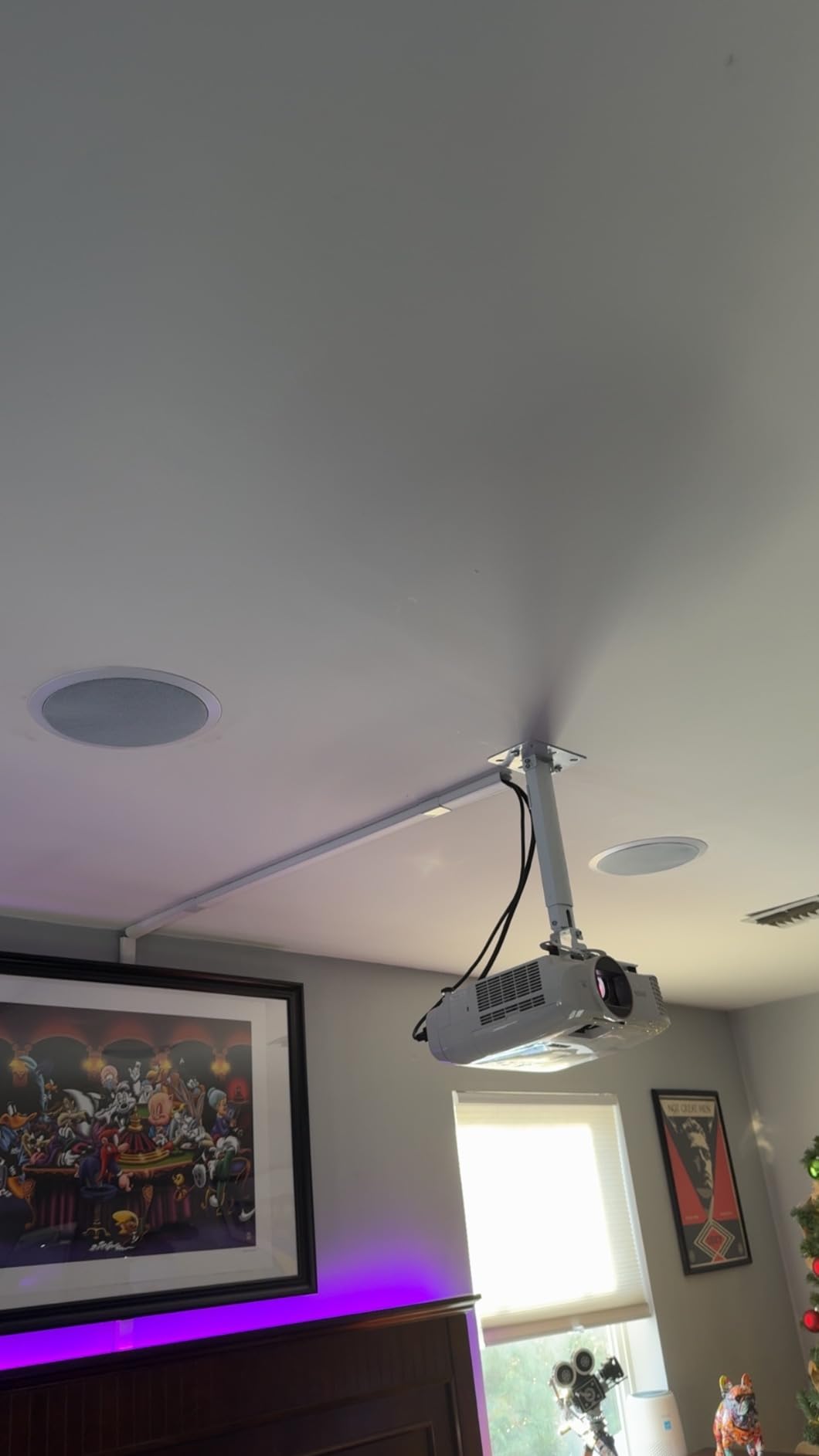
At 95dB sensitivity these are the most efficient speakers in the roundup, which means an entry-level AV receiver can drive them without strain. That is a real advantage if your amplifier has a modest power budget for five channels.
The cutout is 9.45 inch with a mounting depth of 3.78 inch, so measure your joist bays before ordering. Pressure-lock clamps grip the drywall directly and no extra bracket is required.
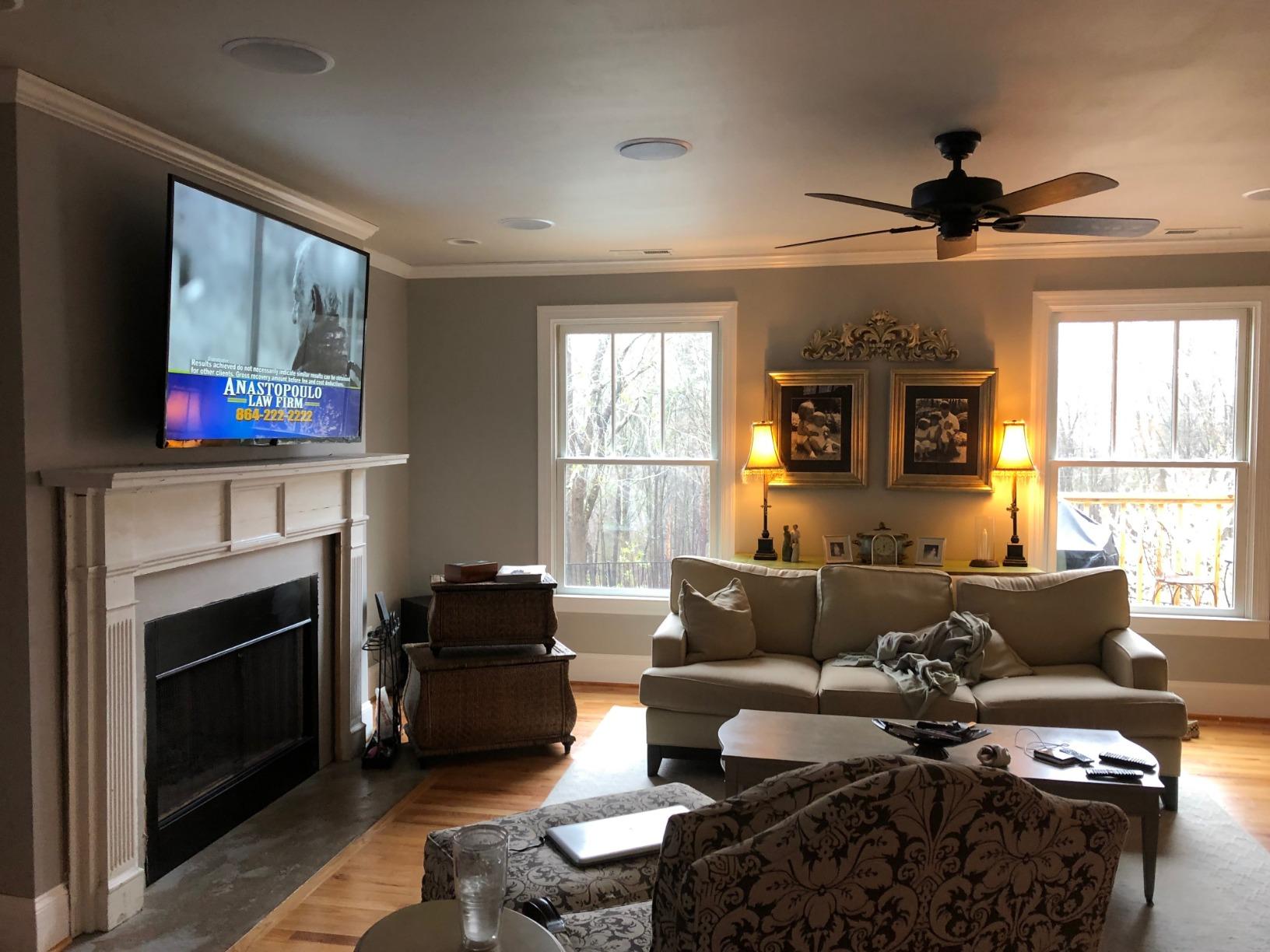
Are three-way speakers worth it for height channels?
For overhead content, yes, and the reason is tonal. A three-way design hands the upper midrange to a dedicated driver, so voice-over effects landing overhead stay distinct instead of blending into the highs.
For music listening through the ceiling the benefit is smaller. Most people play music through their front and surround channels rather than their heights, so treat this as a home theater first choice.
What are the real compromises with this package?
Two things. The 40Hz floor means you still need a subwoofer for movie effects, and the spring-clip terminals are basic, so secure your wire properly before pushing the speaker up into the cavity.
Because all five speakers are identical, you cannot mix driver sizes across the layout. That is fine for a dedicated Atmos layer and a limitation if you wanted larger surrounds with smaller heights.
5. Yamaha NS-IC800 8-Inch 2-Way In-Ceiling Pair – Best for 5.1.4 Upgrades
Yamaha NS-IC800 140 Watt 8-Inch 2-Way In-Ceiling Speakers – Pair (White)
8 inch 2-way
140W max 50W nominal
8 ohm
3.50 kHz crossover
Pros
- Clear crisp sound with no distortion at volume
- Enclosed rear chamber blocks dust and insulation
- Gold-plated push terminals hold heavy-gauge wire
- Low-profile magnetic grille
Cons
- High-frequency response is average for critical music
- Tweeter swivel is limited to roughly 15 degrees
- Low output depends on ceiling baffling
The NS-IC800 is a strong middle option for anyone moving from 5.1.2 to 5.1.4. It carries a 4.7 rating across 738 reviews, and owners frequently note that it sounds closer to far more expensive in-ceilings than the price gap suggests.
It is sold as a pair, which suits a 5.1.2 build directly. For 5.1.4 you would buy two pairs, and at that volume the matching matters because Yamaha keeps this model in production for a reason.
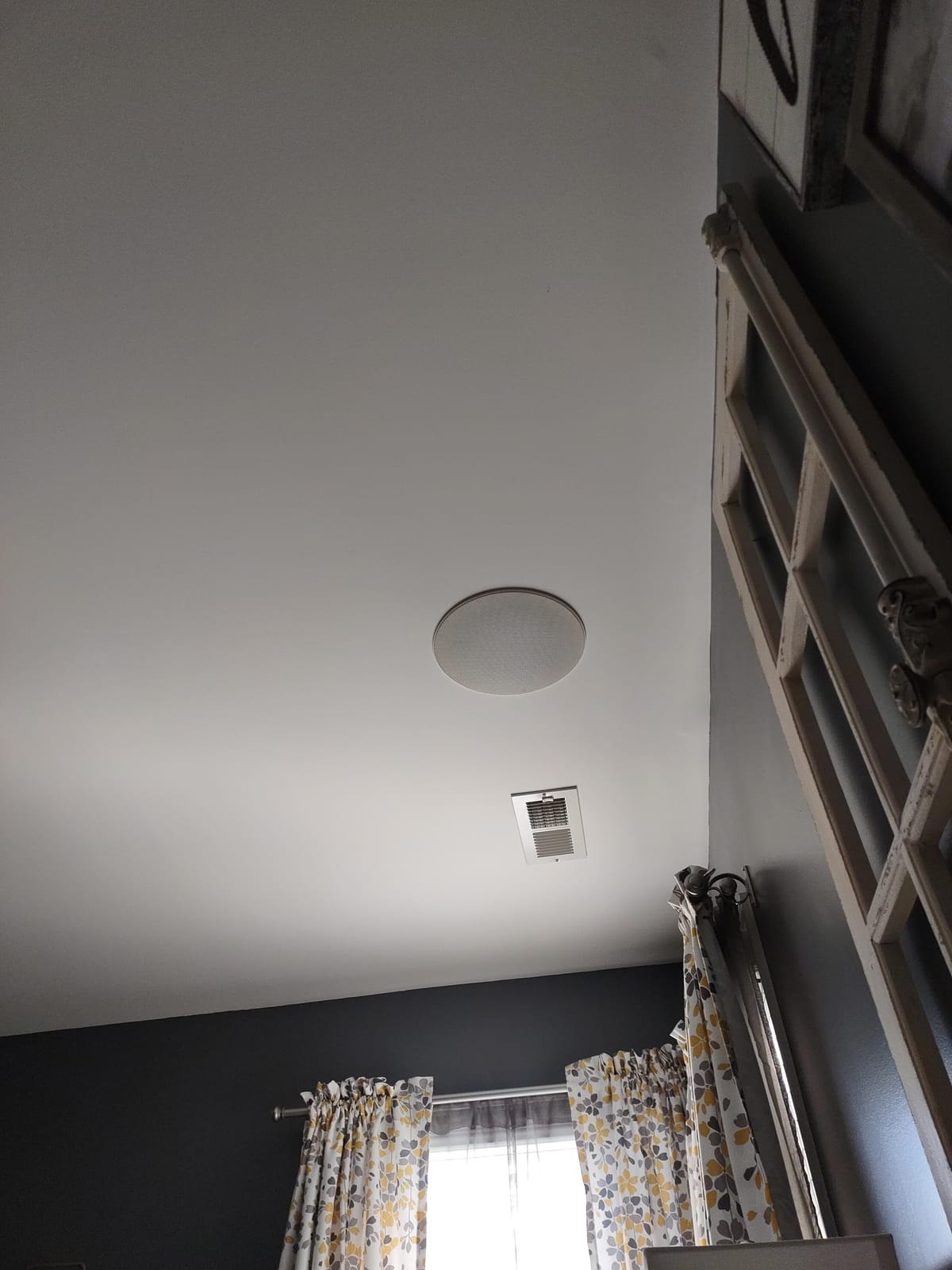
The enclosed rear chamber is the detail most people overlook. It shields the driver from insulation dust and stray debris in the ceiling cavity, which matters more in a retrofit than in a clean new build.
Power handling is listed as 140W maximum and 50W nominal, with a crossover point of 3.50 kHz. Gold-plated spring push terminals are a small quality touch on long wire runs.
Is the Yamaha good for both music and movies?
For movies, absolutely. Owners call the sound clear and crisp with punchy depth and no distortion at high volume, which is what a height channel needs to stay articulate during a busy action sequence.
For critical music, the top end is merely average. If you plan to run a stereo or two-channel setup through your ceiling speakers, look at the Polk 70-RT instead.
What is the catch with the swiveling tweeter?
Travel is limited to roughly 15 degrees, so you cannot swing it as far toward the seating as some rivals allow. In a standard rectangular room that is enough, but in a very wide seating area you may be aiming at only the centre rows.
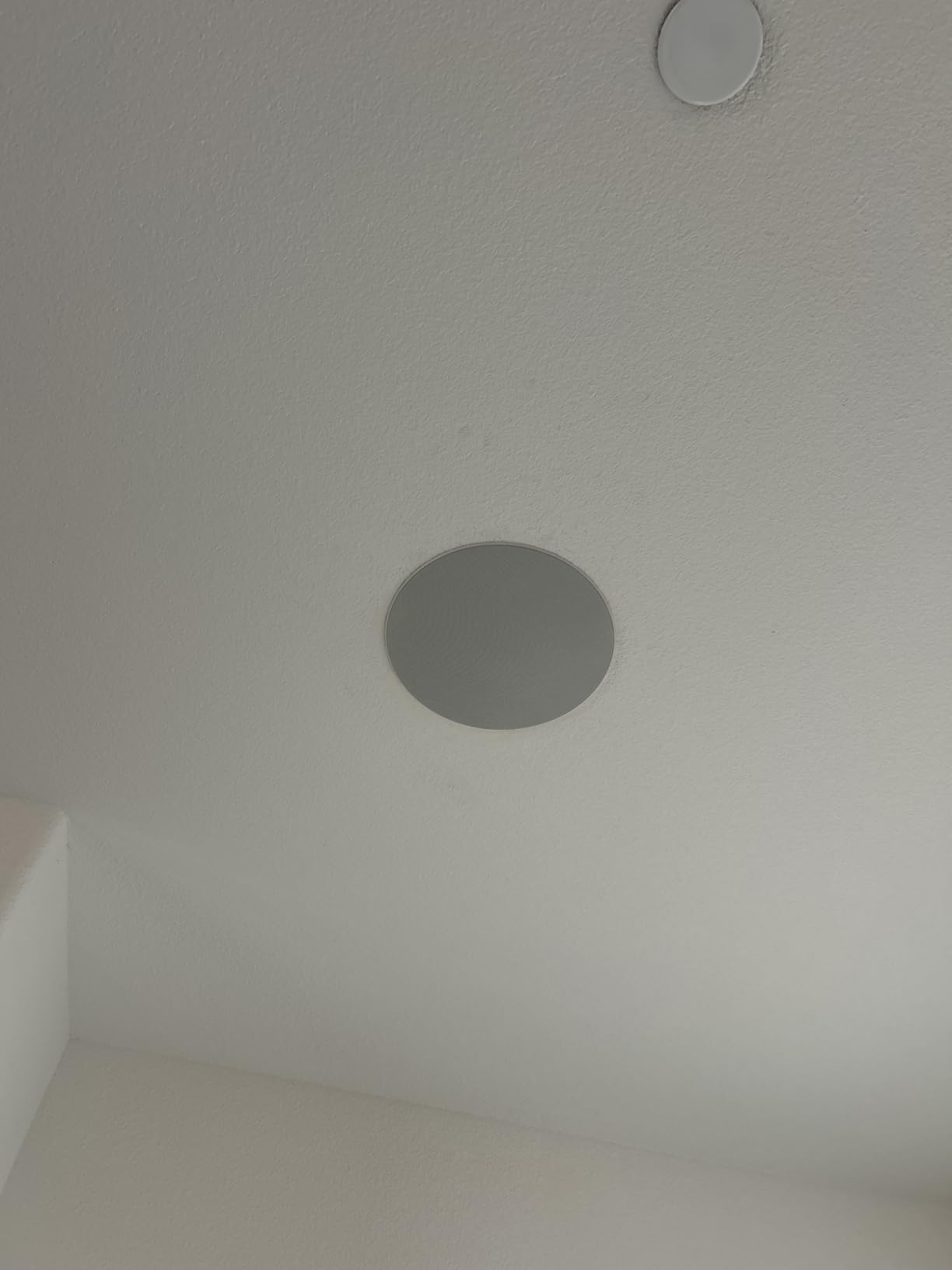
The full-coverage magnetic grille has no visible bezel, and it sits flatter than most competing grilles. That is the detail people notice most once the speakers are installed and painted.
6. Klipsch CDT-5800-C II In-Ceiling Speaker – Best for Controlled Dispersion
Klipsch Outdoor/Surround in-Ceiling Speaker Soundbar Home Speaker, Set of 1, White (CDT-5800-C II)
8 inch woofer
100 degree horn
8 ohm
200W handling
60 Hz floor
Pros
- Aimable woofer and horn tweeter place sound precisely
- Treble and mid-bass switches tame the signature
- Magnetic flush grille looks clean installed
- Horn loading delivers high output with low distortion
Cons
- Bass extension is limited without a subwoofer
- Strongly directional so seating must be close to the axis
- Sold as a single speaker
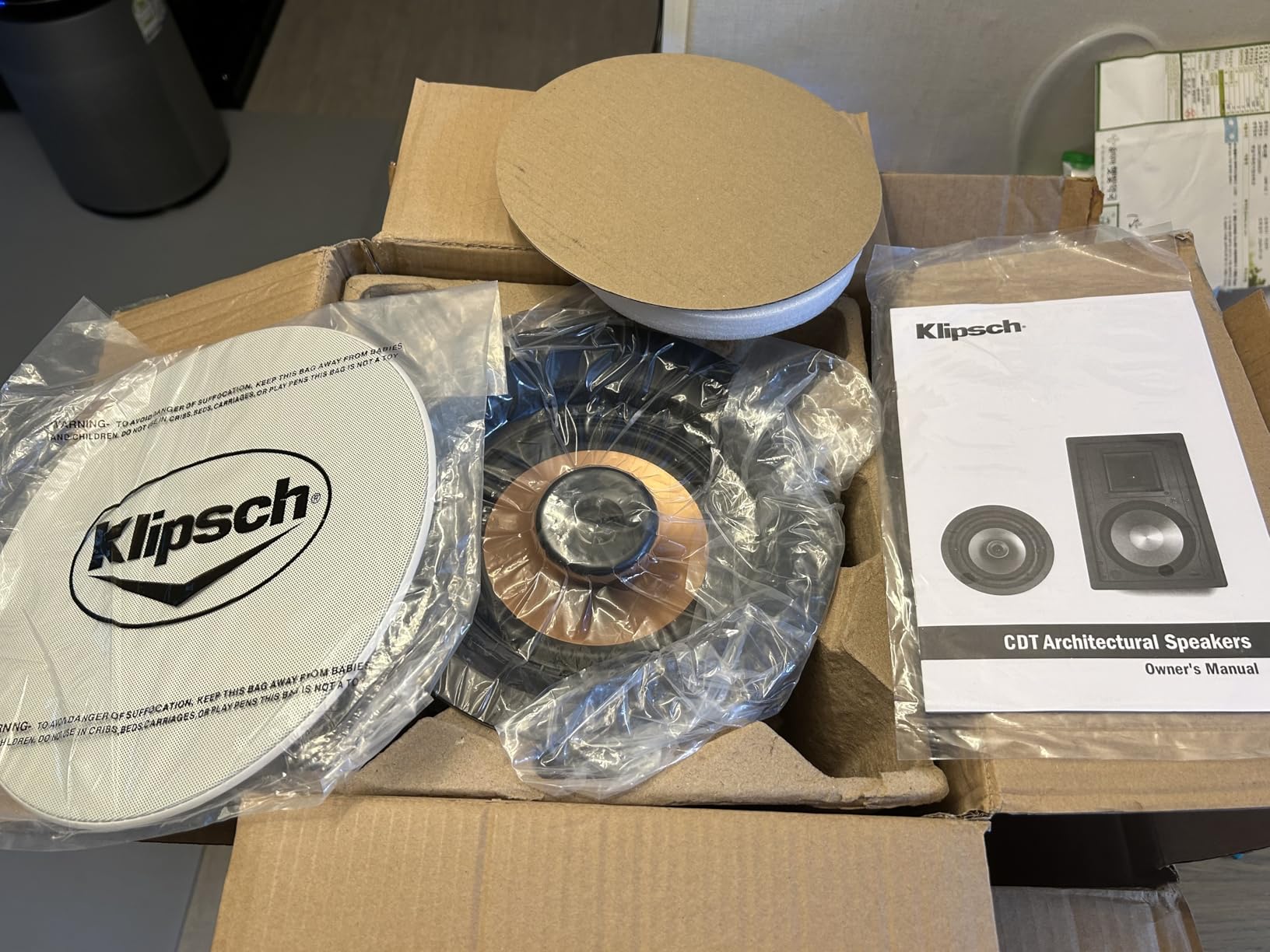
The CDT-5800-C II is the most precise aiming option in this roundup. Both the 8 inch woofer and the horn-loaded tweeter pivot independently, so you can point the bass at the seating and aim the highs separately if your ceiling is not level.
That control is the whole argument for horn loading here. A symmetrical 100 degree Tractrix horn holds a defined pattern instead of spilling sound across the whole ceiling, which is exactly what you want when the speaker is directly above the listener.
Power handling is listed at 200 watts, the joint-highest figure on this list, and the horn keeps distortion low at levels a two-way dome would struggle with. Reviewers deploying these in 7.1.4 layouts report a dramatic improvement over budget in-ceilings.
Two switches on the baffle handle tone. The treble and mid-bass attenuation settings let you tame the brightness that Klipsch’s signature is known for when it sits next to a warmer front speaker.
Does horn directivity make the sweet spot too narrow?
It can, and this is the one real caution. Owners consistently note that seating needs to fall within a relatively narrow cone, so a wide room with seats spread well past the centre pair may lose some effect.
Counter that by aiming the speakers slightly behind the main listening position. Aiming a controlled horn back at the seating widens practical coverage compared with firing it at the closest row.
Is this model suitable for outdoor or damp locations?
Despite the listing wording, reviewers point out it is not waterproof. It is a capable indoor height channel, and for a covered porch or bathroom you would want a housing explicitly rated as moisture resistant instead.
Grille and body depth run 5.4 inch, so check your ceiling cavity clearance before you commit. It is sold as a single speaker, which is convenient for odd channel counts.
7. Klipsch CDT-5650-C II In-Ceiling Speaker – Best Angled Aim for Less
Klipsch CDT-5650-C II In-Ceiling Speaker – White (Each)
6.5 inch woofer
15 degree body tilt
100 degree horn
8 ohm
200W
Pros
- Pivoting tweeter plus 15 degree body tilt gives roughly 30 degrees of aim
- Horn loading raises output and lowers distortion
- Compact size suits low-ceiling rooms
- Treble and mid-bass attenuation switches
Cons
- Bright out of the box until the treble switch is turned down
- Not ideal for critical stereo at high volume
- Sold as a single speaker
This is the model we point people toward when they want a genuinely angled ceiling speaker without hunting for specialist AIM products. The 15 degree body tilt combines with the pivoting tweeter to give roughly 30 degrees of total aiming.
That matters because a 30 degree angle is close to the lower end of the Dolby recommended elevation range. You are not reaching 45 degrees, but you are no longer firing straight into the carpet either.
The 6.5 inch footprint is the other advantage. It fits between joists more easily than an 8 inch model and works in rooms with lower ceilings, which is where overhead placement gets tight.
Owners buying in fours for height channels like the balance between size and output. The 4.8 star rating here reflects consistent satisfaction with bass weight for a 6.5 inch driver.
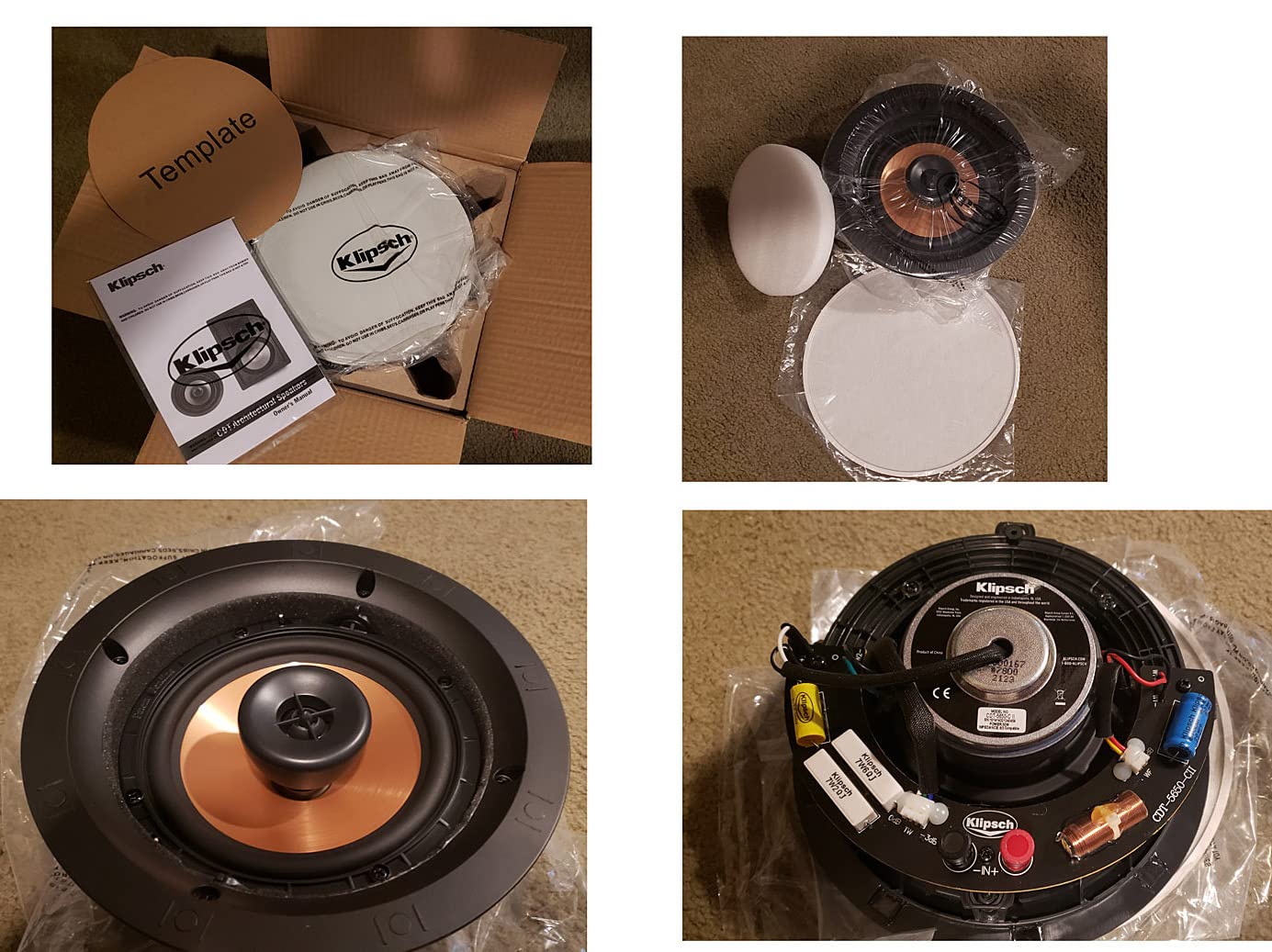
Do I need to change the treble switch?
Almost certainly. Bright out of the box is the most common note in owner feedback, and the fix is the treble attenuation switch on the baffle, not your receiver settings.
Set the switch first, then run room correction. Adjusting in that order means the correction sweep measures the speaker as you intend to hear it rather than correcting for a setting you were about to change.
Is this better than a flush-mount alternative?
For placement precision, yes. A pivoting tweeter in a flat ceiling gives you roughly 15 to 20 degrees of freedom, and this body tilt doubles that without changing the visible grille position.
The trade is directivity. A 100 degree horn concentrates output in front of the speaker, so make sure the cutout location works for your seating rather than for how the ceiling looks.
8. Micca M-6C 6.5-Inch In-Ceiling Speaker – Best Budget Pick
Micca M-6C 6.5-Inch 2-Way in-Ceiling Speaker, Round, Each, Paintable, White
6.5 inch poly woofer
Pivoting silk dome
8 ohm
87dB sensitivity
50Hz to 20kHz
Pros
- Lowest cost in the roundup with strong owner satisfaction
- Crisp silk dome tweeter with better directionality than typical
- Single speaker sales make exact channel counts easy
- Light 2.5 pound body is comfortable overhead
Cons
- Bass rolls off below roughly 70 Hz
- Soft grilles can bend when refitted
- Limited 1 year warranty
The M-6C is the cheapest way into a proper Atmos height layer, and it is not a compromise on the feature that matters most. You get a pivoting silk dome tweeter in a 2.5 pound speaker that is genuinely pleasant to hold over a ladder.
Owners consistently single out the directional tweeter as clearer than what a typical budget in-ceiling delivers. At 4.6 stars across 540 reviews it sits slightly below the Micca M-8C, and the reason is bass rather than clarity.
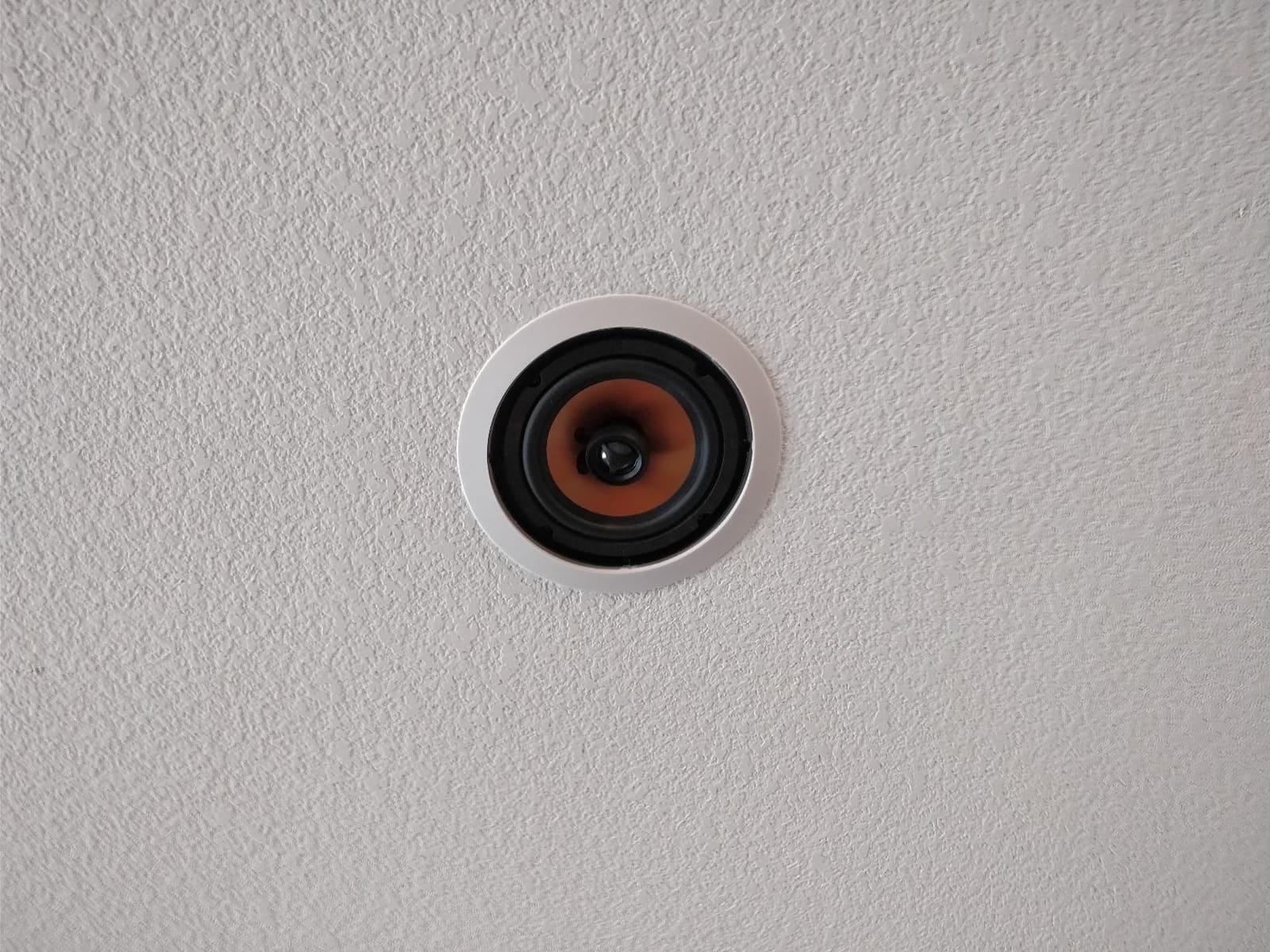
Measurements are friendly for retrofit work. The cutout is 7.6 inch, the outer diameter 9 inch and the depth 3 inch, so it clears shallow cavities and tight joist bays that stop larger drivers.
Sensitivity is 87dB, the lowest figure on this list, so budget a little more amplifier power than the spec sheet suggests. Nothing exotic is needed, just headroom.
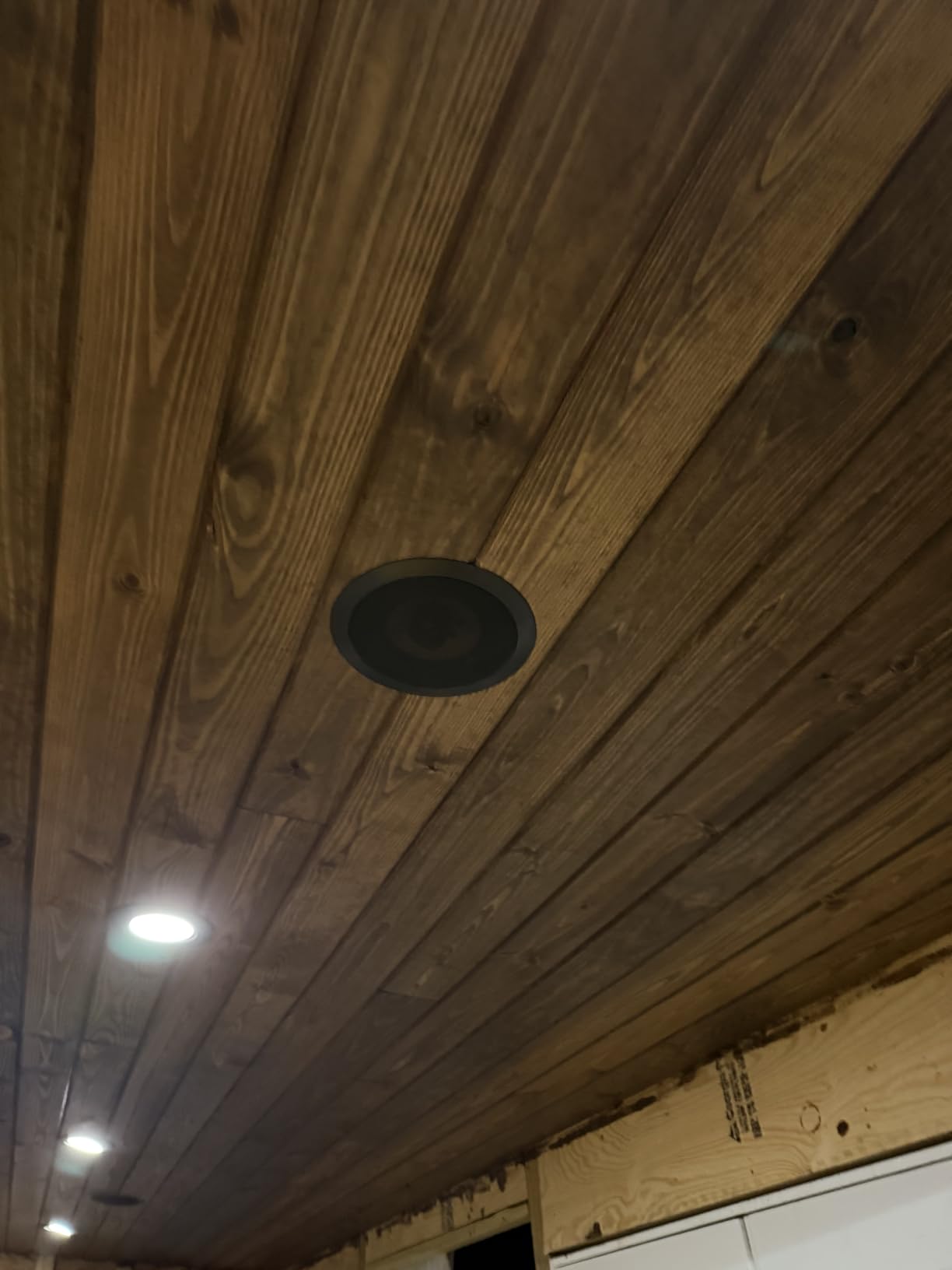
How many M-6C speakers do I need?
Two for a 5.1.2, four for a 5.1.4. Because Micca sells these individually rather than in pairs, you can build an exact channel count without buying spares you will never install.
Forum builds on r/BudgetAudiophile repeatedly land in this price bracket, and the recurring takeaway is that a correctly placed budget in-ceiling beats an expensive one stuffed into a bad position. Placement is doing the heavy lifting.
What will I notice first in a movie?
The 50Hz to 20kHz response window means a subwoofer is effectively required. Overhead thunder and engine effects will not carry weight on their own, and asking this speaker to do that job produces audible strain.
Treble and vocal detail hold up better than the price suggests. The repeated complaints are physical instead: soft grilles that bend when removed and refitted, and a one-year warranty that is thin for a permanent install.
9. Polk Audio 70-RT Three-Way In-Ceiling Speaker – Best for Midrange Clarity
Polk Audio 70-RT 3-way In-Ceiling Speaker, The Vanishing Series, White
Three-way array
7 inch woofer
2.5 inch midrange
8 ohm
125W
Pros
- Three-way design avoids the thin midrange of two-way in-ceilings
- 34Hz to 27kHz response with usable mid-bass
- Wafer-thin magnetic grille is among the most invisible
- Rotating cam mounting with gold-plated terminals
Cons
- Deep body demands real ceiling cavity clearance
- No directional tweeter so output fires downward
- Crossover parts are exposed in an unfinished cavity
The 70-RT is the one to buy if your ceiling speakers will carry music as well as films. Its three-way array splits the work into a 7 inch woofer, a 2.5 inch midrange and a 0.75 inch dome tweeter, which is the configuration that keeps vocals from sounding thin.
Response from 34Hz to 27000Hz is the widest on this list, and the patented Power Port bass porting gives it real mid-bass weight. Owners running these as 7.1.4 heights rate the midrange as clean and detailed.
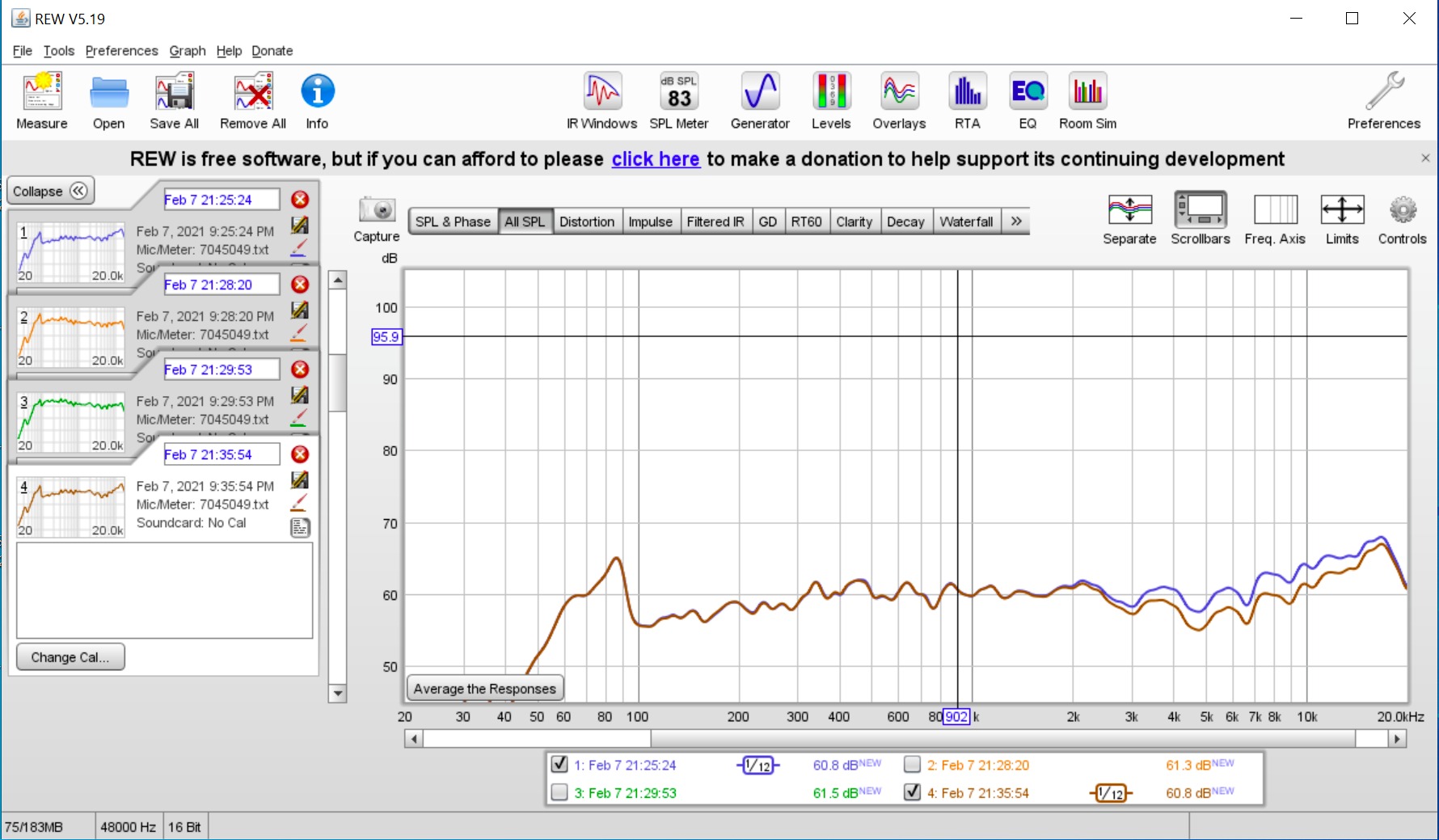
Check your cavity depth first. The housing runs 11 inch deep and weighs about 6.5 pounds, so it needs genuine room above the drywall rather than a shallow attic void.
The wafer-thin magnetic grille is the detail owners photograph most. It sits almost flush against the ceiling, and paired with the rotating cam mounting system it produces the least visible install on this list.
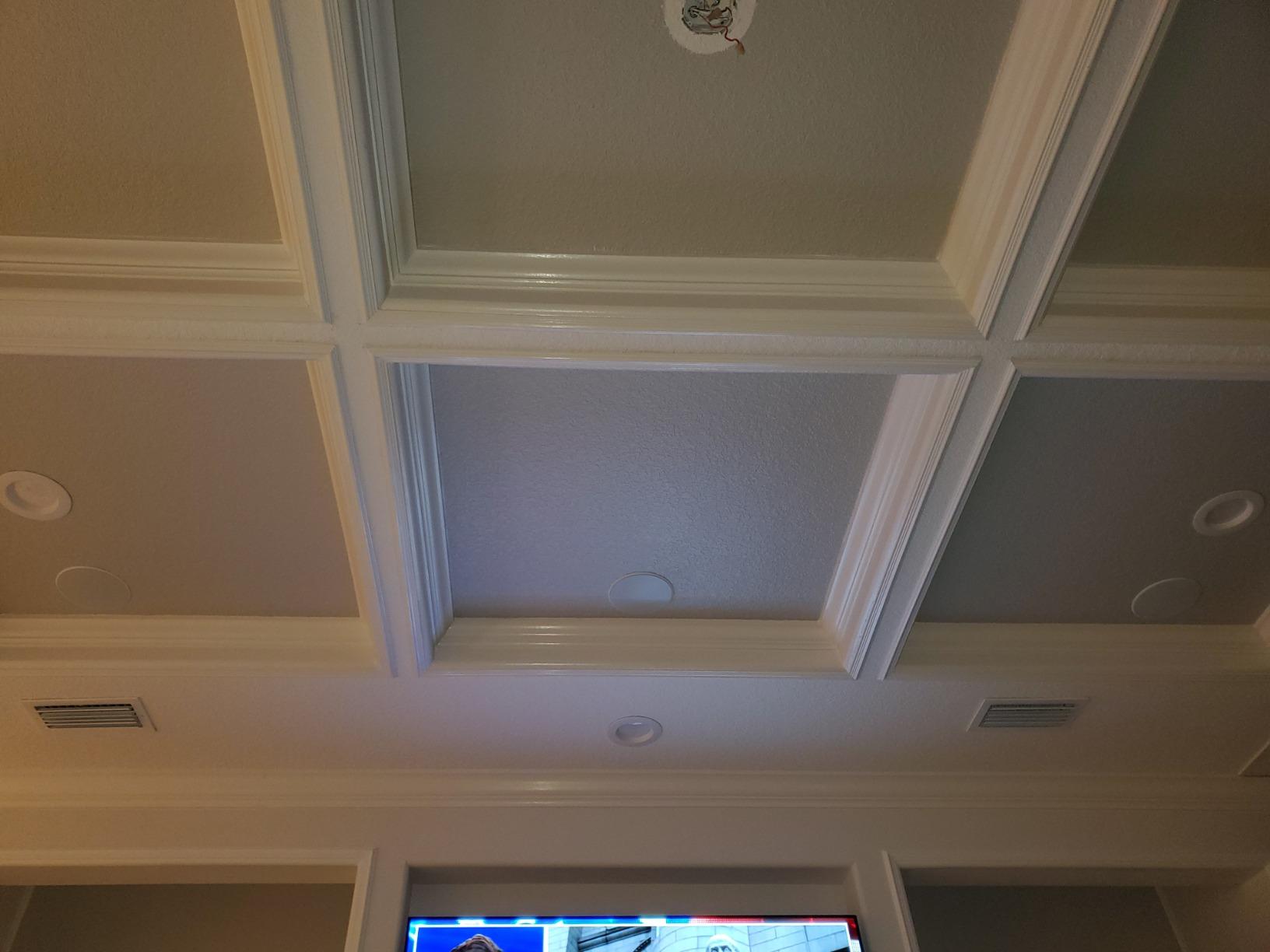
Why is there no pivoting tweeter here?
Because the design relies on wide dispersion rather than focused aim. That works well when the speaker sits slightly forward of the seating and the receiver applies delay, which room correction does automatically.
It also means no visible tilt or protrusion. If aesthetics in a flat white ceiling matter to you, that is a genuine advantage over a body-tilted alternative.
Is the Normal or Reflective switch worth using?
Yes, and most people leave it on Normal. The reflective position trims output for a speaker mounted hard against a surface, which suits a ceiling cavity with minimal absorption around the cutout.
Plan on a subwoofer or EQ for the mid-bass to bass transition. Owners note a noticeable drop-off in that region without one, so do not expect this speaker to replace low frequency effects on its own.
10. Silver Ticket 82AC Angled In-Ceiling Speaker – Best Angled Woofer Design
82AC Silver Ticket in-Ceiling Speaker with Pivoting Tweeter & Angled Woofer (8 Inch Angled in-Ceiling) 11.3 inch Overall Size
Angled 8 inch woofer
15 degree tweeter pivot
8 ohm
89dB sensitivity
60W nominal
Pros
- Angled woofer body plus pivoting tweeter gives real directional control
- 8 inch driver handles volume without distortion
- Built-in dB level switch for room matching
- Owners report close timbre match against costlier main speakers
Cons
- Requires a 10-5/8 inch cutout so it will not fit an 8 inch hole
- About 6.3 inch depth needing roughly 5.5 inch clearance
- Small review base of 71 reviews
The 82AC is the true angled in-ceiling design in this group. The woofer body sits at a fixed angle so the driver fires across the room rather than straight down, and the 20mm silk dome tweeter adds a further 15 degrees of pivot.
That combination puts real directional control in a category where most competing models only offer a pivoting tweeter. It is the closest thing here to a dedicated AIM speaker without chasing specialist brands.
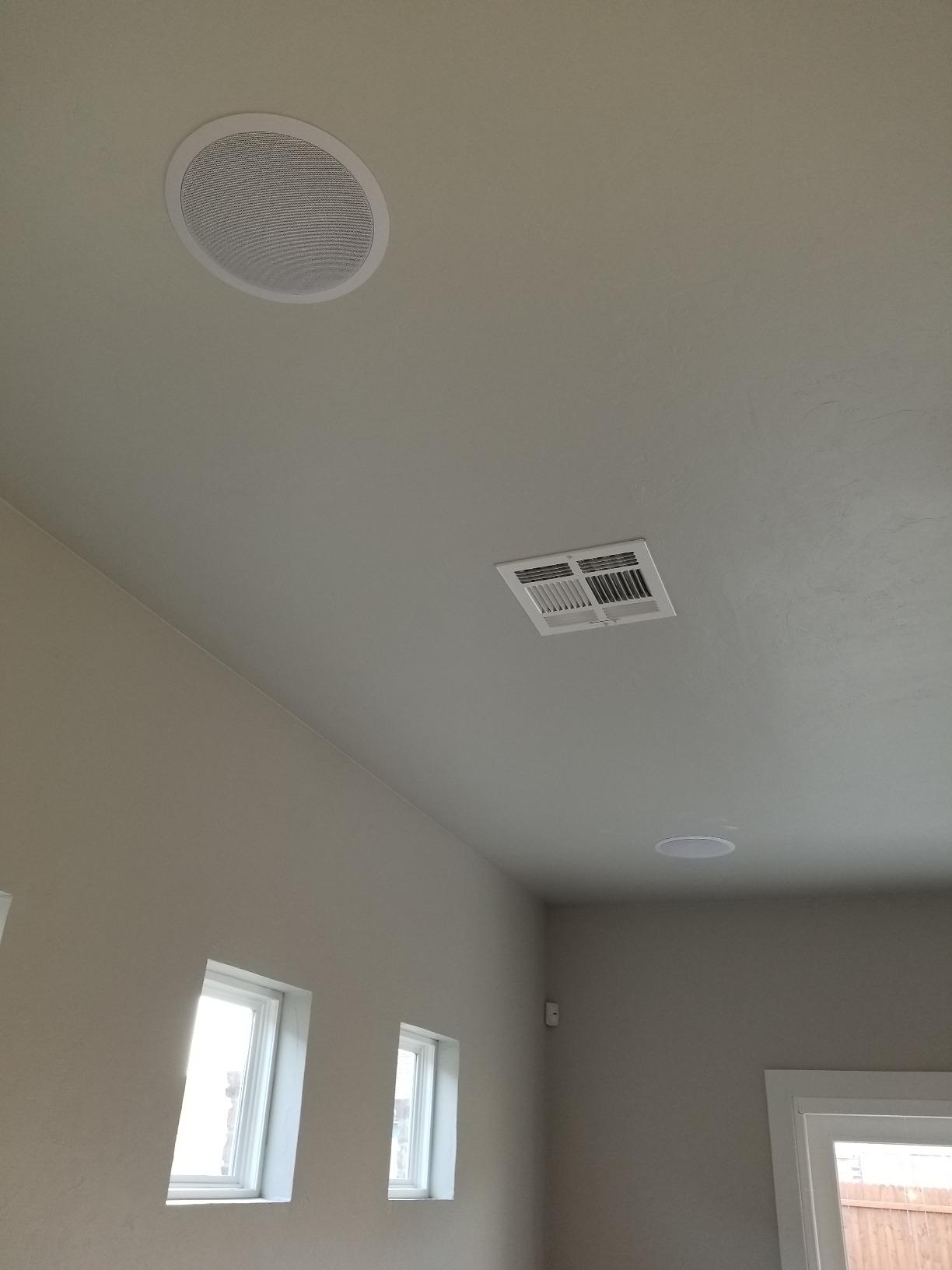
The measurement that matters most here is the cutout. It needs 10-5/8 inch, so it will not drop into an existing 8 inch hole, and the depth of roughly 6.3 inches demands about 5.5 inches of clearance behind the ceiling.
For a new build or a planned renovation that is a non-issue. For a retrofit in a finished ceiling, it rules the speaker out before sound quality ever enters the conversation.
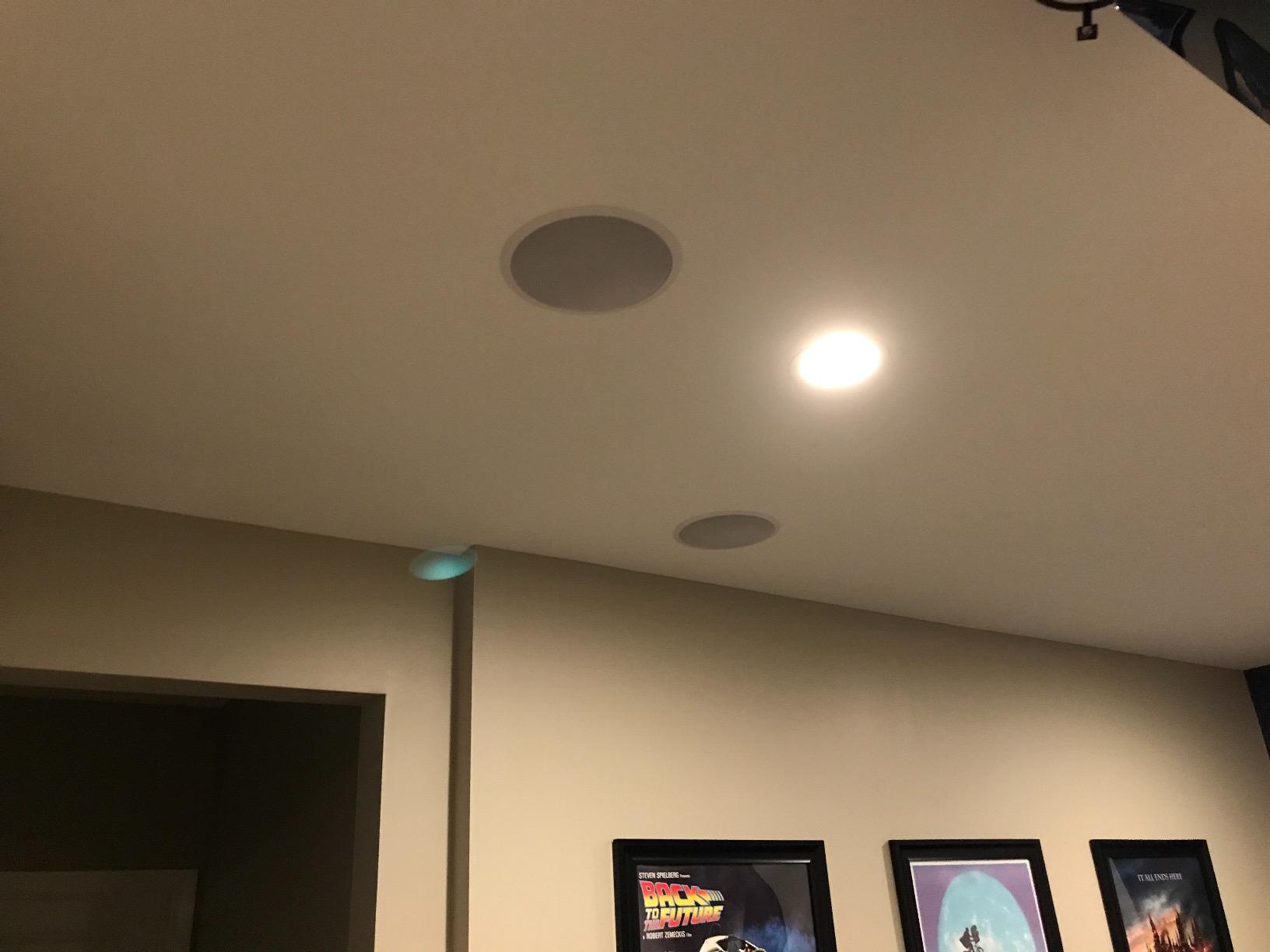
Is the 71-review count a concern?
It is smaller than the others, so there is less long-term data. What the reviews that do exist show is consistent: close timbre matching against far more expensive main speakers and clean output on Denon and Yamaha receivers.
Owners also value the built-in dB level switch, which lets you trim the output before room correction takes over. On a speaker this directional, that fine control is worth having.
How does angled compare to flush for Atmos?
Angled wins on precision. A fixed angled body aims energy across the listening area, so a speaker above and slightly behind the seating sends sound to the listener rather than to the floor in front of them.
Flush wins on appearance and flexibility. A flat grille disappears completely, and a wide-dispersion driver covers more seats. The AVSForum debate has run for years without a clear winner, because the right answer depends on your ceiling and your seats.
11. Klipsch R-1650-C In-Ceiling Speaker 4-Pack – Best Four-Pack for a Complete Array
Klipsch R-1650-C in-Ceiling Speaker – White (4-Pack) Compact, Easy to Install, Durable
Four matched 6.5 inch speakers
140W handling
8 ohm
57 Hz floor
3.5 inch depth
Pros
- Four matched speakers cover a full overhead Atmos array
- Crisp clean sound well suited to height channels
- Compact 3.5 inch depth suits shallow ceilings
- Five-year manufacturer warranty
Cons
- Not horn-loaded so control is looser than the CDT models
- Mounting screws are stiff in their plastic sleeves
- Grilles can be tricky to reseat
Buying a four-pack solves the awkward part of a 5.1.4 build. Packs of four are patchy across this category, and matched drivers from one production run remove any question of one speaker sounding different from the others.
The 6.5 inch polymer-cone woofer pairs with a coaxial 1 inch polymer-dome tweeter for wide dispersion. Owners using these as entry-level height speakers cite clean midrange and accurate vocals.
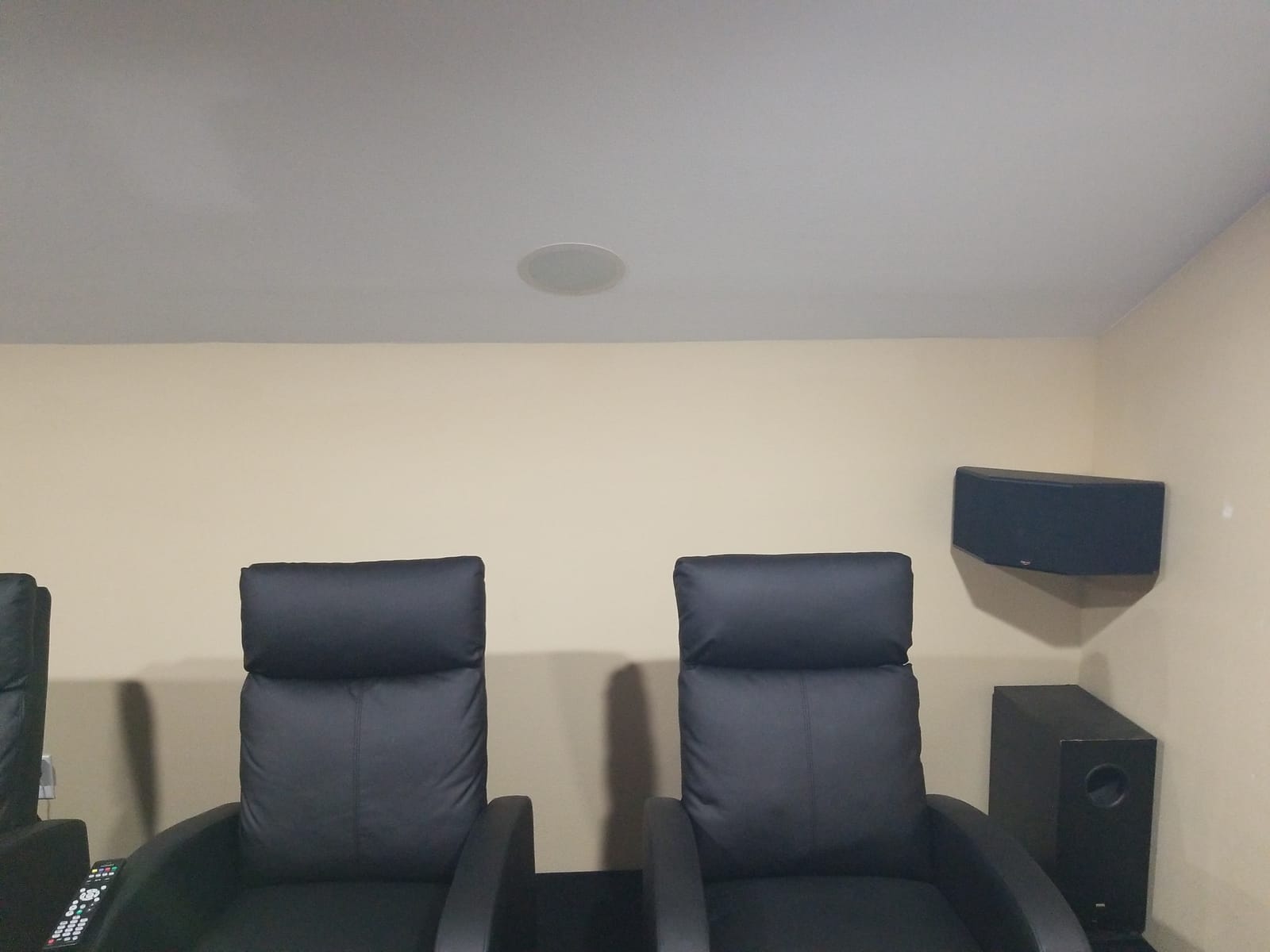
Depth is 3.5 inch and the cutout is 8.3 inch, with a 9.5 inch overall diameter. Those numbers make it one of the easier speakers here to fit around joists, recessed cans and odd ceiling geometry.
Power handling is listed at 140 watts with a 57Hz floor, so it is a comfortable match for most mid-range AV receivers without needing a powerful amplifier.
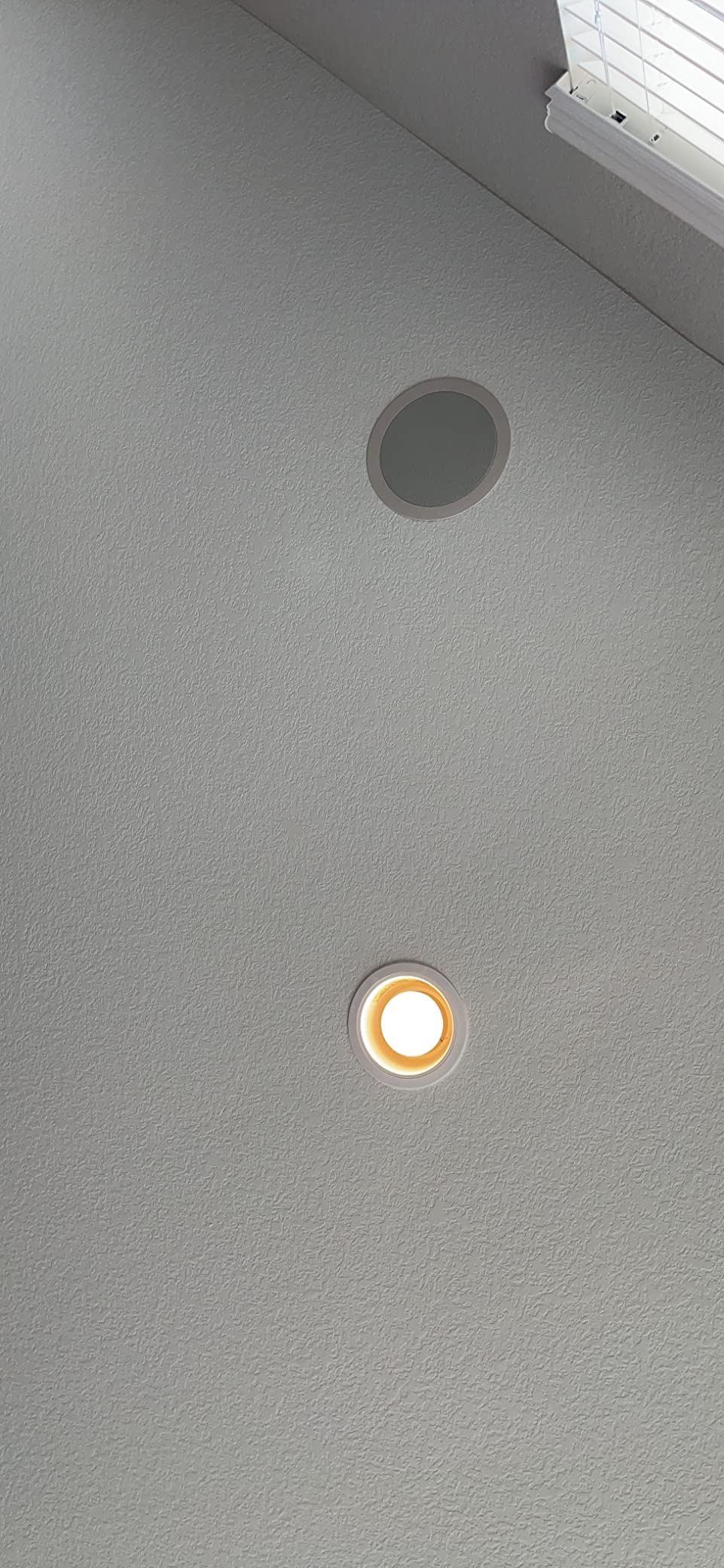
Is a coaxial driver good enough for height channels?
Yes, and the reason is placement rather than driver sophistication. A coaxial sends the full range from one point, which produces a coherent wavefront from a single source, and that matters when the speaker is close to the listener.
The compromise is control. Without a horn you get wider, less predictable dispersion, so aim by position and let room correction handle delay and level rather than expecting tight patterning.
What are owners complaining about?
Installation hardware, not sound. The mounting screws are stiff in their plastic sleeves, and the grilles can be difficult to reseat once painted. Both are one-time frictions that stop mattering after the first hour.
Owners also note these benefit noticeably from a proper back enclosure. If your ceiling cavity is open, adding a basic back box improves output and reduces the amount of sound leaking into the room above.
12. Micca A-6C 4-Pack In-Ceiling Speakers – Best for Whole-House Audio
Micca 6.5-Inch 2-Way in-Ceiling/in-Wall Speakers, 4-Pack, Paintable, White
Four matched 6.5 inch speakers
6 ohm impedance
86dB sensitivity
8 inch cutout
Pros
- Four matched speakers for surround or Atmos layouts
- Good clarity and vocal accuracy for the price
- Rimless grille has no visible outer ring
- Simple install with pre-attached clips
Cons
- 6 ohm means two in parallel present about 3 ohms to an amplifier
- 60Hz low limit requires a subwoofer for movie effects
- Only a 0.5 inch tweeter for less treble detail
The A-6C four-pack is the option to consider when the ceiling is doing more than Atmos. Four matched speakers work equally well as surrounds, as distributed audio in a kitchen or covered area, or as a mixed layout across a large open-plan room.
The rimless grille protrudes under 3/16 inch, which makes these among the least visible speakers on the list once painted. In a finished room where appearance drives the decision, that detail carries weight.
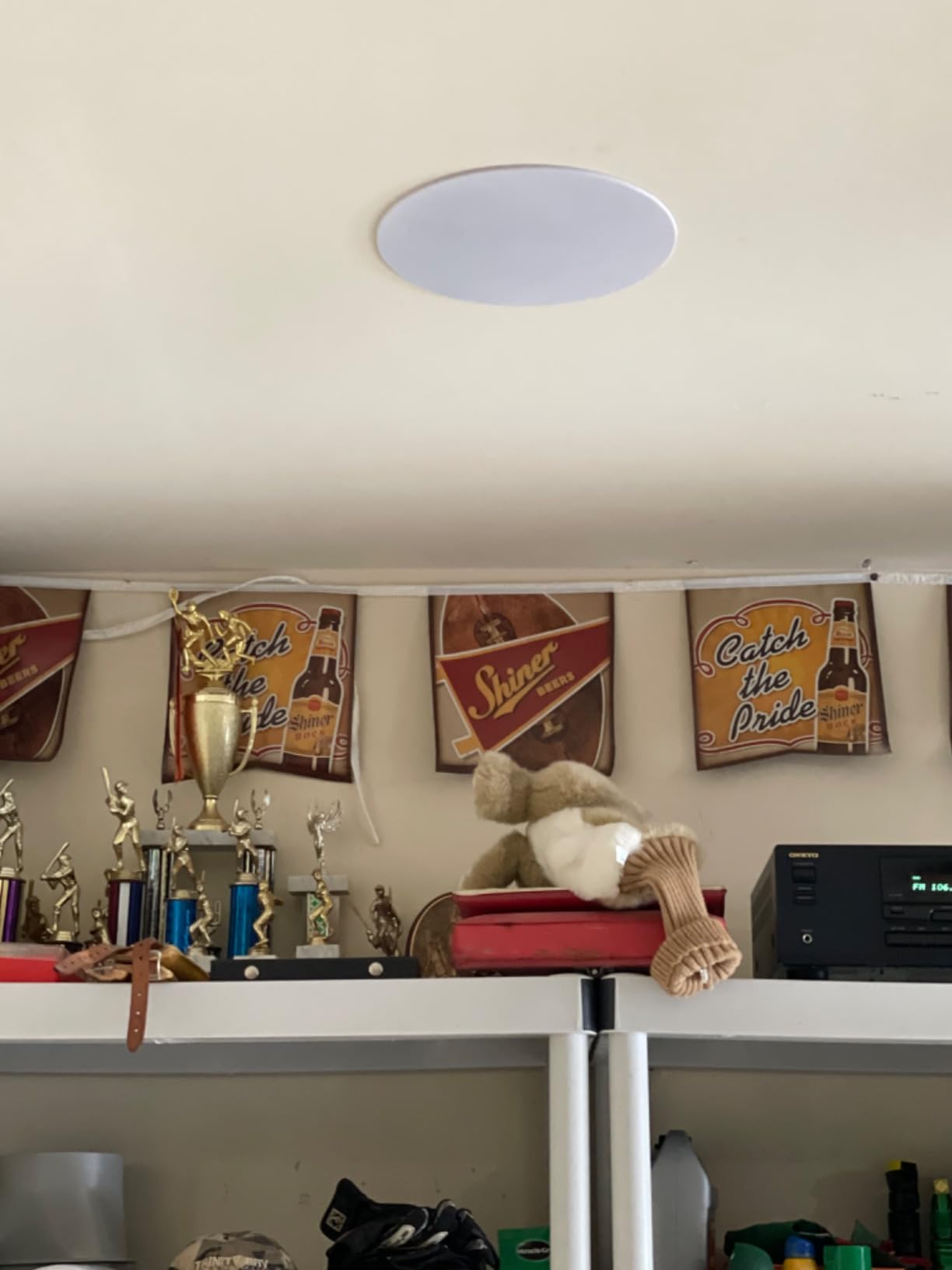
There is one specification to read carefully. These are 6 ohm speakers, not 8 ohm, so wiring two in parallel on a single channel presents roughly 3 ohms to the amplifier.
Most modern AV receivers handle that without complaint. Check your manual, because older or entry-level amplifiers may refuse to drive a channel that low.
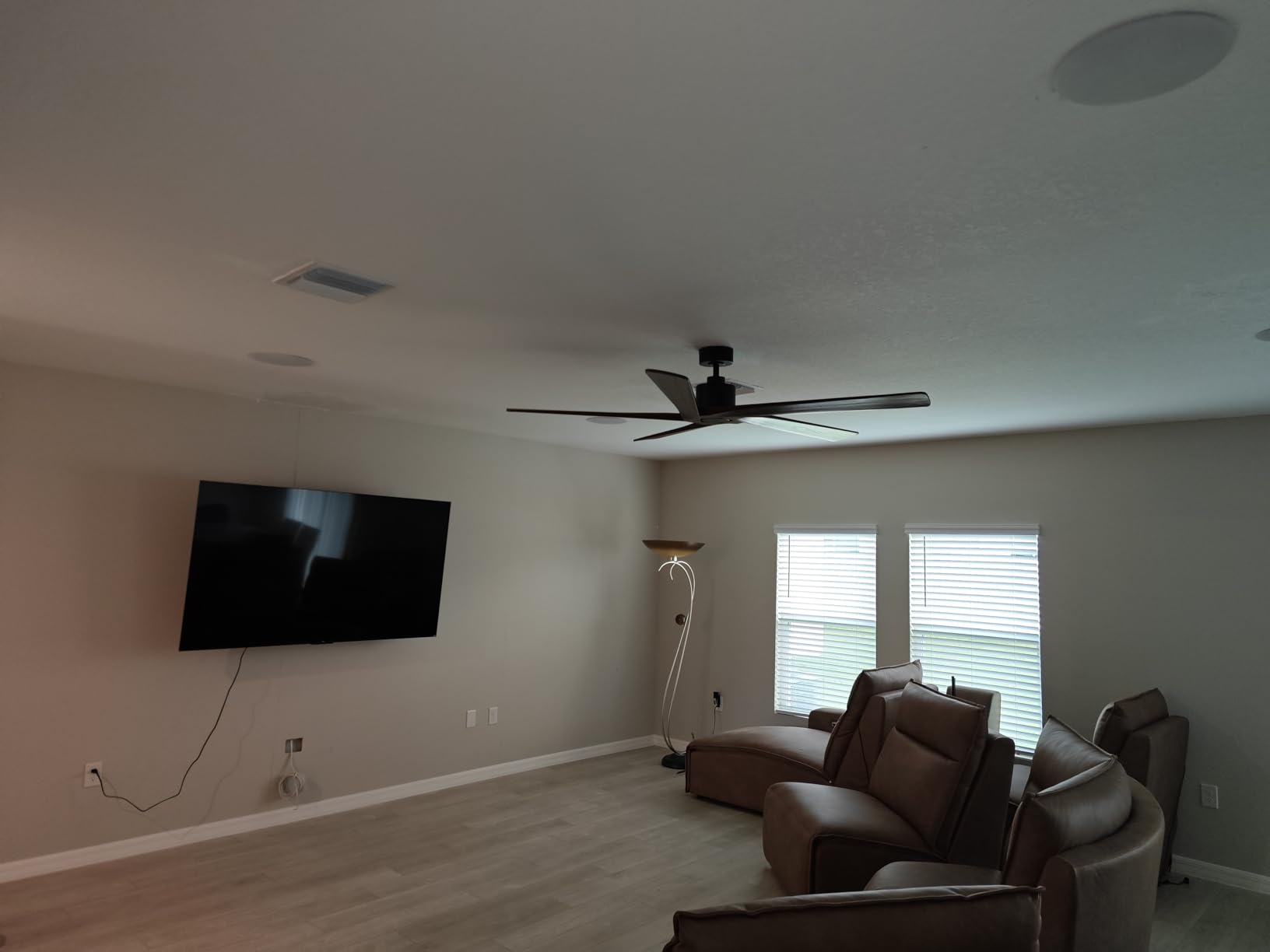
Is 6 ohm a problem for a Dolby Atmos system?
Only in the parallel-wiring scenario. Run each speaker on its own height channel, which is the normal case for 5.1.2 and 5.1.4 layouts, and the impedance is a non-issue.
At 86dB sensitivity these are the least efficient speakers here, so they need a little more amplifier power than the rest of the list to hit the same level at your seating.
How do they sound for music and movies?
Owners report very good clarity and vocal accuracy, which makes them a solid choice for dialogue-heavy content. The 0.5 inch PEI dome tweeter delivers less top-end detail than the silk dome models, so critical listeners notice the difference.
The most common complaint is about painting the grille. The backing material can muffle sound if it absorbs paint unevenly, so use thin coats and leave the grille off the speaker while you work.
How to Choose In-Ceiling Speakers for Dolby Atmos
Start with how many you need, because that determines everything else. The configuration notation reads bed channels, subwoofer channels and height channels, so 5.1.2 means five bed speakers, one subwoofer and two ceiling speakers.
5.1.2 – 2 ceiling speakers, front heights. The entry point and the most forgiving install.
5.1.4 – 4 ceiling speakers, front and rear heights. The sweet spot for most living rooms.
7.1.4 – 4 ceiling speakers plus bed side and back surrounds. Best for dedicated theater rooms.
9.1.6 – 6 ceiling speakers, front, middle and rear heights. Only worth it in a large dedicated space.
Angled AIM, flush-mount, or on-ceiling bookshelf?
This is the biggest decision in this category and the one most roundups skip. Angled in-ceiling speakers, sometimes called AIM speakers, have a fixed angled driver that fires energy across the room toward the seating rather than straight down.
Flush-mount speakers sit flat and rely on a pivoting tweeter for aiming. They look cleaner, cost less and cover more seats, but a 15 degree pivot is a much smaller correction than a 30 or 45 degree body angle.
On-ceiling bookshelf speakers mount below the ceiling on a bracket, angled at the listening position. Several owners on r/hometheater describe adding SVS Prime Elevation speakers on angled brackets as the single biggest improvement to their Atmos system, and it is fully reversible with two screws.
Renters and anyone in a finished ceiling should read the last option carefully. A bracket-mounted speaker costs almost nothing to install, can be aimed precisely, and can be moved when you redecorate.
Which specs actually change the listening experience?
Sensitivity determines how hard your amplifier works. Anything from 87dB to 90dB is fine for most systems, and higher figures help when five height channels share one amplifier.
Power handling matters more in large rooms. The 200 watt Klipsch models give real headroom at reference volume, while the 50 watt Polk models are comfortable in a normal living room.
Impedance is mostly a non-issue at 8 ohm. The 6 ohm Micca pack is the only one that needs a check, and only if you plan to wire two speakers to one channel.
Cutout size and mounting depth are the specs that decide whether the speaker fits at all. Measure your joist bays and the clearance above the drywall before you choose, because none of the models here share a cutout diameter.
Dispersion tells you how wide the speaker throws. Wide dispersion covers more seats, while horn-loaded control concentrates output for a defined listening area.
Do the height speakers need to match my main speakers?
It helps, and owners treat timbre mismatch as a deal-breaker when their front speakers are premium. Height channels carry effects rather than the main dialogue mix, so the mismatch is less obvious than it would be between a centre channel and surrounds.
Room correction handles level and timing differences well, and it cannot fix a fundamentally different tonal signature. If your main speakers are from a brand with a matching in-ceiling line, use it. If not, run your correction sweep and listen for any obvious mismatch before drilling.
Where to Put Ceiling Speakers for Atmos
Dolby’s guidance places height speakers at an elevation angle of roughly 30 to 45 degrees from the listening position, positioned in front of or slightly behind the main seating and aligned with your front stereo pair.
That angle is the number most installs get wrong. A speaker firing straight down at a listener three feet below delivers sound from directly above but with no lateral component, which is why overhead effects feel detached from the rest of the soundstage.
Position the pair symmetrically and keep the spacing consistent with your front speakers. Moving them too far apart stretches the overhead image until effects read as coming from two separate locations rather than one continuous ceiling.
What ceiling height do you need for Atmos?
Roughly 7.5 feet is the practical minimum cited for a credible overhead layer. Below that, a ceiling speaker ends up close to ear level at the seating, which collapses the separation between the height and surround layers.
In a low-ceiling room, moving the heights forward of the seating rather than directly above improves the perceived elevation angle. It is the standard workaround and it works better than any speaker change.
Do two correctly placed speakers beat four badly placed ones?
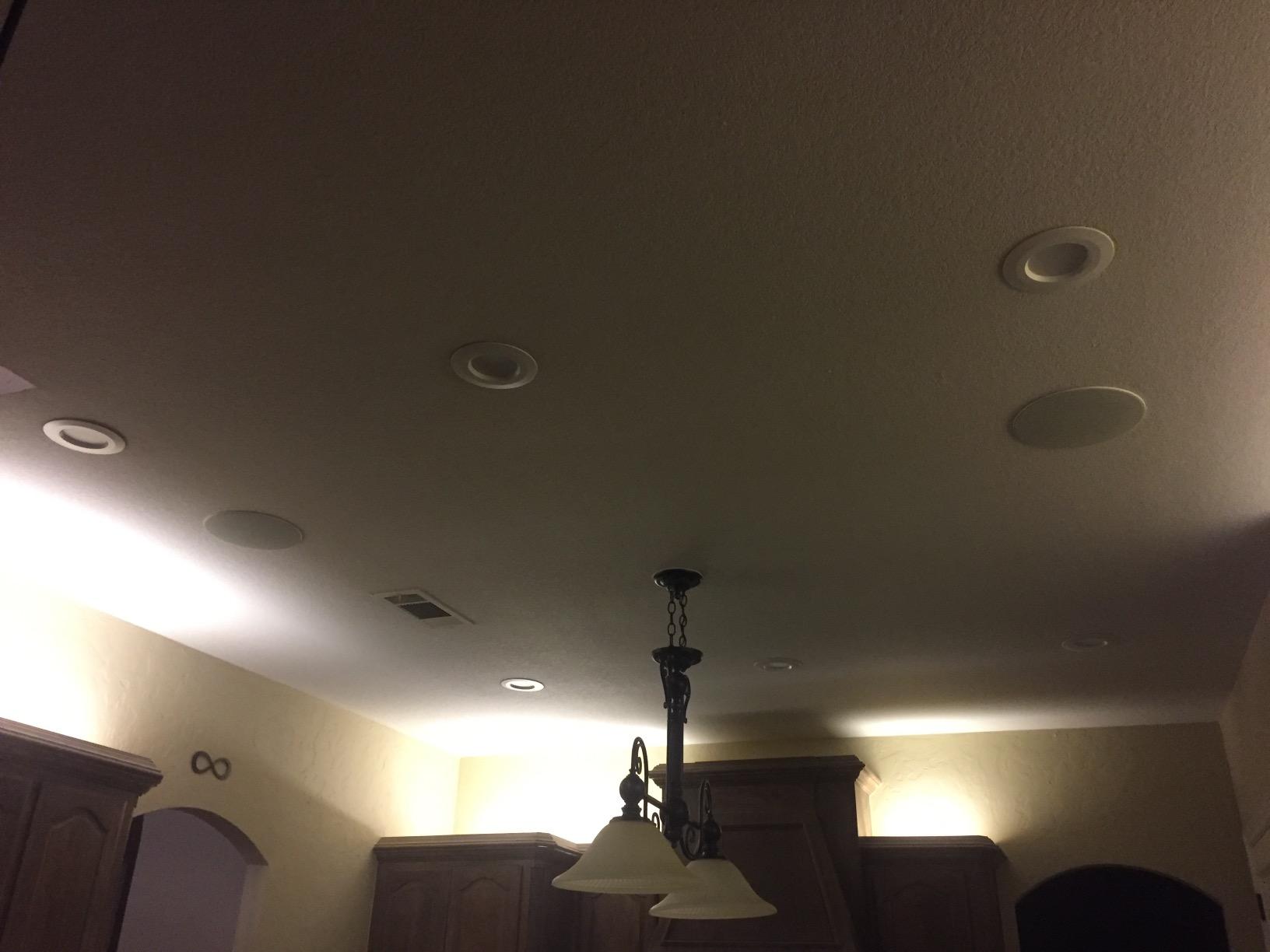
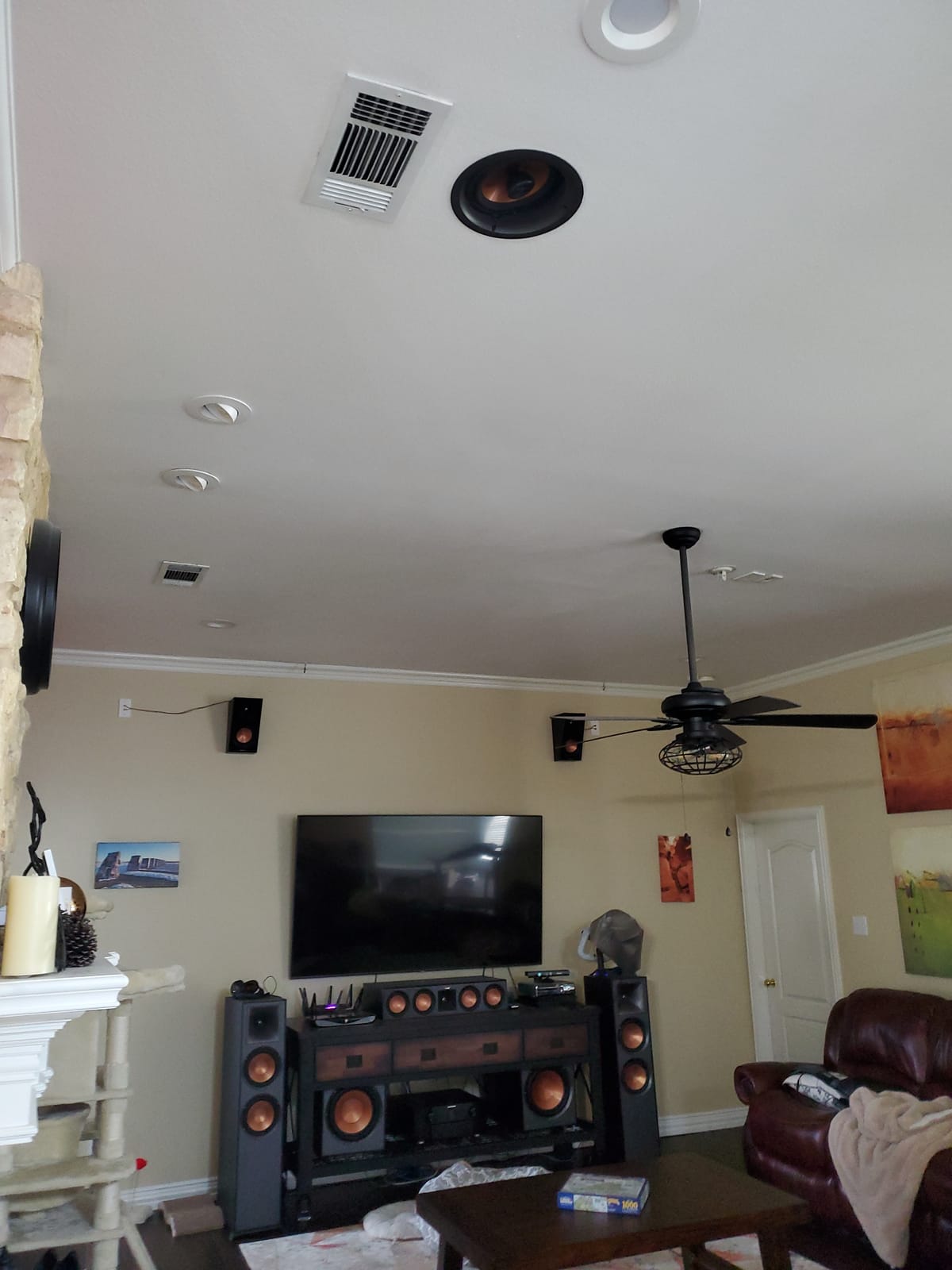
Yes, and this is the closest thing to consensus in the forum discussions. Two speakers on the 30 to 45 degree angle in the right positions outperform four speakers jammed around a recessed light and a ceiling fan.
AVIXA targets sound pressure level uniformity within about plus or minus 3dB across the listening area. A misaligned array breaks that uniformity, which the ear hears as unevenness between seats rather than as a specific fault.
Cutting the Ceiling Without Ruining the Room
Decide on the Atmos layer during framing, not after. The decision to run speaker wire is irreversible in a finished ceiling, and retrofitting is the single most common regret reported by new-build owners.
Run 14/2 or 12/2 speaker cable at the same time as any new electrical work, and leave a loop of cable at the speaker location so you can pull it into the ceiling later. Label both ends before the drywall goes up.
Watch the obstructions. Recessed lighting, HVAC vents and ceiling joists all compete for the same space, and a 10-5/8 inch cutout leaves very little room to manoeuvre. Take a photo of the joist layout before you mark anything.
Finally, calibrate after the room is finished. Curtains, rugs and furniture change how the room behaves acoustically, and running Audyssey, YPAO or Dirac with the final layout in place gives you accurate delay and level settings for the height channels.
Frequently Asked Questions
How many ceiling speakers do I need for Dolby Atmos?
Two ceiling speakers give you a 5.1.2 configuration, four give you 5.1.4, and a 7.1.4 layout also uses four ceiling speakers alongside extra bed surrounds. A 9.1.6 setup uses six. For most living rooms, four is the practical ceiling because it adds rear heights without overwhelming a modest room.
What are the best ceiling speakers for Dolby Atmos?
The Polk Audio RC80i is our top pick for most people, with an 8 inch woofer, an aimable pivoting tweeter and the largest owner review base of any model we tested. The Micca M-8C offers similar core features at a lower cost, and the Klipsch CDT-5800-C II wins when precise directional control matters most.
How far should in-ceiling speakers be apart?
Keep the spacing consistent with your front left and right speakers rather than using a fixed distance. The pair should sit symmetrically and be angled so the sound reaches the main listening position at an elevation of about 30 to 45 degrees. Spacing them much wider than the front pair stretches the overhead image.
Is it worth putting speakers in the ceiling?
Yes, when you can cut the ceiling and run wire back to the receiver, because height channels carry much of the cinematic effect information in a Dolby Atmos mix. If you rent, or the ceiling is already finished, an on-ceiling bookshelf speaker on an angled bracket gives you most of the benefit and is fully reversible.
Can I use regular in-ceiling speakers as Atmos height channels?
Yes, and the placement matters more than the model. A flush-mount in-ceiling speaker with a pivoting tweeter works well as a height channel when it is positioned at the correct elevation angle and aimed at the seating. An angled AIM design gives you more control over direction but costs more and needs a larger cutout.
Which Ceiling Speakers Should You Buy?
For a standard living room or dedicated theater, the Polk Audio RC80i is the pick we would install ourselves. It has the largest review base on this list, an aimable tweeter and enough bass weight to fill a room without strain.
If you are building a 5.1.2 on a tighter budget, the Micca M-8C gives you the same core feature set. For a four-speaker array, the Klipsch R-1650-C pack removes the matching problem entirely, and the Silver Ticket 82AC is the choice when real angled control is worth the larger cutout.
Whichever you choose, spend your effort on placement rather than on the last tier of driver quality. Get the elevation angle right, aim at the seating, run your room correction, and any of these twelve will outperform a far more expensive speaker shoved into a joist bay next to a recessed light.
Run your measurements after the furniture is in place, and give the height channels an afternoon to settle before you judge them. That adjustment alone changes more than most upgrades people make later.