
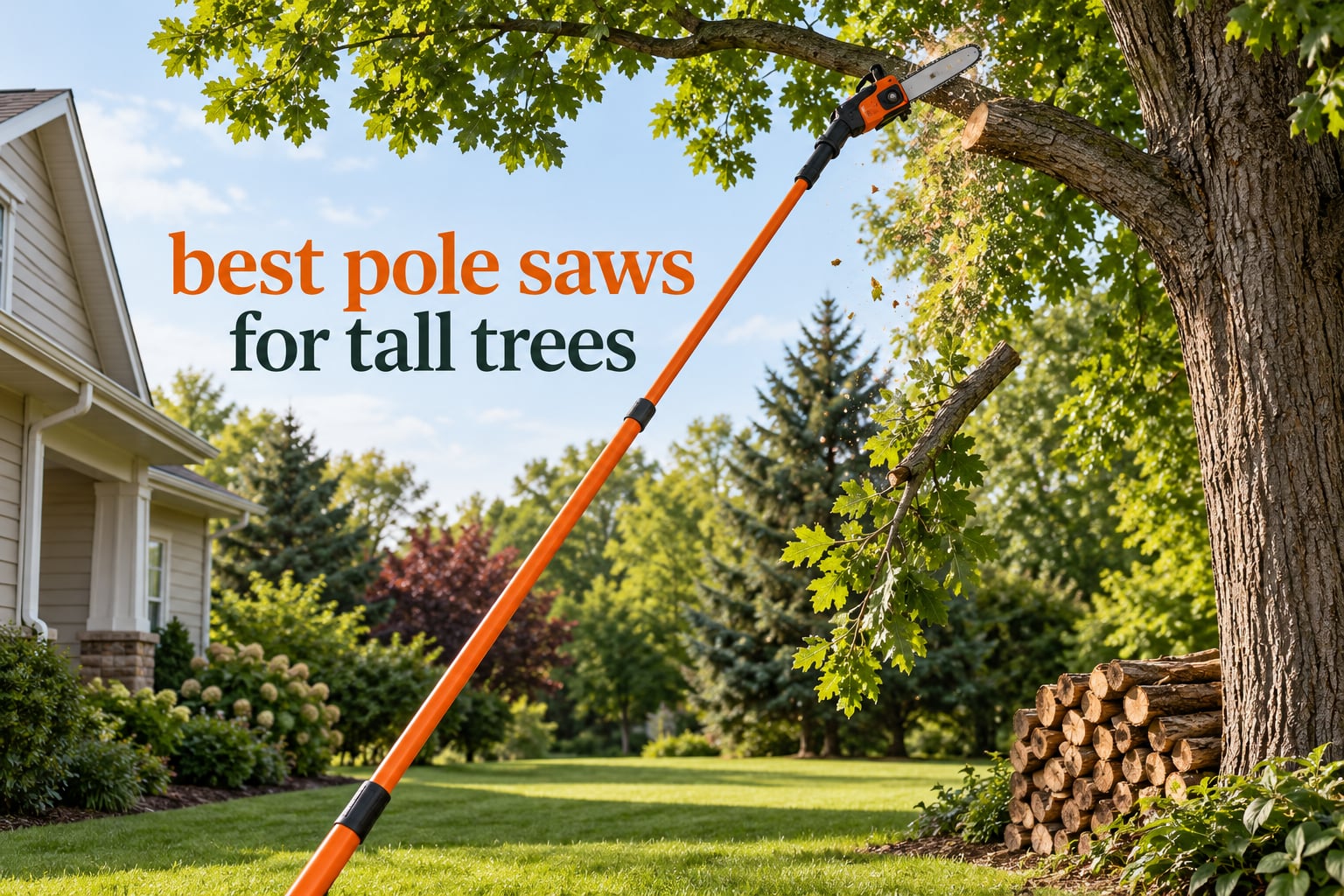
Most pole saws advertised for tall trees are not actually tall. The marketing number that matters is working height, and working height includes roughly two to three feet of your own arm, so a saw rated at 11 ft of working height puts the bar tip about 8 ft above the ground. That gap is why so many owners end up standing on a ladder anyway. This roundup of the best pole saws for tall trees ranks every saw by the reach you can actually use, not by the number on the box.
We spent weeks comparing ten pole chainsaws and manual pole pruners, reading the owner reviews closely and sorting the specs into a single reach-decoded picture. The lineup covers everything from an 8-inch battery kit that handles homeowner-scale limbs to a manual system that assembles to 27 ft and a battery saw rated to 16 ft of reach with a rigid tip. Every product below carries its own rating, review count and stated reach, copied exactly as published.
One idea drives the ordering below: usable reach beats every other spec. Power, bar length and battery platform all matter, but they only matter once you have decided how high you need to cut. If your branches sit above 13 ft, skip the first half of this list and read the reach decoder further down before you spend anything.
All testing and comparison work was carried out in 2026, and the lineup is reviewed regularly as new models land.
Table of Contents
Top 3 Picks for the Best Pole Saws for Tall Trees
The three saws below are the ones we would put on the truck for real tall-tree work. The first is the longest rigid powered reach in the group, the second is the only tool here that assembles past 20 ft, and the third does the most per dollar of any saw on this list.


VEVOR 8-Section Manual…
- 7.3 to 27 ft assembled
- 8 fiberglass pole sections
- Spare blade and bag included
Other standouts depending on your trees: the Greenworks 60V 10 in for thick hardwood limbs and class-leading chain speed, the EGO PS1001 for shaded canopies thanks to its LED cut line indicator, and the Fiskars extendable pruner if you only need to handle thin branches without any motor at all.
All 10 Pole Saws for Tall Trees Compared by Reach in 2026
Reach figures below are the manufacturer-stated reach where one exists, and we call out where a real owner limit differs. Read the reach column first, then match the max cut size to the thickest branch you actually have overhead.
| Product | Specs | Action |
|---|---|---|
| Supstable S5 Sky Pole Saw |
|
Check Latest Price |
| VEVOR Manual Pole System 7.3-27 ft |
|
Check Latest Price |
 Autubin 2-in-1 Pole Saw Autubin 2-in-1 Pole Saw |
|
Check Latest Price |
 Greenworks 60V 10 in Pole Saw Greenworks 60V 10 in Pole Saw |
|
Check Latest Price |
 CRAFTSMAN V20 14-Foot Pole Saw CRAFTSMAN V20 14-Foot Pole Saw |
|
Check Latest Price |
 Walensee 14 ft Manual Pole Saw Walensee 14 ft Manual Pole Saw |
|
Check Latest Price |
 EGO Power+ PS1001 Pole Saw EGO Power+ PS1001 Pole Saw |
|
Check Latest Price |
 Fiskars 8-12 ft Extendable Pole Saw Fiskars 8-12 ft Extendable Pole Saw |
|
Check Latest Price |
 Greenworks 40V 8 in Pole Saw Greenworks 40V 8 in Pole Saw |
|
Check Latest Price |
 SKIL PWR CORE 40 Pole Saw SKIL PWR CORE 40 Pole Saw |
|
Check Latest Price |
1. Supstable S5 Sky Pole Saw: Longest Rigid Powered Reach in the Group
Electric Pole Saws for Tree Trimming, 8 Inch & 6 Inch Mini Chainsaw Cordless with Extension Pole, 16Ft Reach, 2×4.0Ah Battery, Auto Oiling, Tool-Free Chain Tensioning, Tree Trimmer for Branch Limb Cut
16 ft reach
800W brushless motor
2x 4.0Ah batteries
Tool-free chain tensioning
Pros
- 16 ft telescopic reach
- Two 4.0Ah batteries for about 100 minutes
- Converts between handheld and pole use
- Gloves and goggles included in the kit
- 2-year manufacturer warranty
Cons
- Auto oiler reported as unreliable by some owners
- Chain needs frequent re-tightening
- Chains dull faster than premium replacements
The Supstable S5 Sky is the best pole saw for tall trees in this lineup because it pairs a stated 16 ft reach with an 800W brushless motor running the chain at 30 ft/s. Owners with branches well above head height report cutting 4-5 inch limbs without difficulty, and the telescopic pole holds its line rather than whipping at the top of the stroke.
It arrives as a complete kit: two 4000mAh lithium batteries, a charger, a spare chain, a chain sleeve, a pole belt, an oil bottle and a pair of gloves and goggles. That bundle matters more than it sounds, because the two extra batteries are what turn a 20-minute trim into a full morning of work.

Two things separate this from the other budget 16 ft claims. First, the cutting head adjusts from 0 to 180 degrees, which lets you match the saw to the angle of the branch instead of forcing a side cut into a top-down problem. Second, the 800W brushless motor runs the chain at 30 ft/s, fast enough that the cut finishes before the pole has time to load up and bend.
The motor is the reason it can take 4-5 inch limbs without binding. At full extension you are hanging on a long lever, and a slow chain means you fight the branch and the pole at the same time. Reviewers who compared it against higher-priced units say the speed of the cut is what makes the reach usable in practice.
How it handles the branches you actually have
This is a high-volume tool for medium branches, not a professional limb remover. Owners routinely clear seasonal cleanup on mature trees, and the 8-inch bar gives a useful cutting surface without turning into a lever that tips the saw backward. The detachable head means the same motor runs as a handheld saw for the branches at knee height.
A review count of 4940 gives this more real-world history than anything else at this capability level in the roundup, and the rating distribution is unusually positive. If your tree has a canopy starting at 12 ft with 4-5 inch limbs, this is the tool most likely to finish the job in one session.
Where the money gets thin
The maintenance list is the honest weakness. Several owners report that the automatic oiler does not pump reliably and that they top it up by hand, and the chain needs re-tightening more often than a saw with a proper tensioner dial. Replacement chains are inexpensive, but budget for a spare and a bottle of bar oil.
None of that stops most owners from recommending it, and it ranks near the top of its category on Amazon because of volume. Just plan on five minutes of chain care between cutting sessions rather than assuming it is maintenance-free.
2. VEVOR Manual Pole System: The Only Tool Here That Assembles Past 20 Ft
VEVOR Manual Pole Saw, 7.3-27 ft Extendable Tree Pruner, Sharp Steel Blade and Scissors High Branches Trimming, Branch Trimmer with Lightweight 8 Fiberglass Handles, for Pruning Palms and Shrubs
7.3 to 27 ft assembled
8 fiberglass pole sections
Carbon steel blade with dual hooks
Spare blade and bag included
Pros
- 27 ft maximum assembled reach
- Spare blade and storage bag included
- Dual hook knives keep the blade tracking
- Blade unscrews into a hand saw
- Scissors head adds a second cutting option
Cons
- Significant shaft flex beyond about 16 ft
- Heavy and demanding to saw overhead
- Scissor lopper lacks cutting power above roughly half an inch
The VEVOR system is the tallest pole saw in this roundup, assembling from 7.3 ft to 27 ft using eight fiberglass pole sections. Nothing else here gets past 16 ft without an extension pole, so if your problem is a palm or a mature hardwood with limbs at 18 ft and above, this is the only tool on the list that physically gets there.
It is a manual system with a compound nylon rope and a pulley system for actuation, and the cutting head is a 0.05 inch teflon-coated carbon steel blade with a hook knife on top to pull twigs back and a hook knife underneath to free a stuck branch. Owners working palms in particular credit the dual hooks with keeping the blade tracking instead of skipping.
The kit is unusually complete for a manual pruner: a spare double-hook saw, a PE storage bag, a saw sleeve and the full set of eight poles. Being able to swap in a different blade length without buying a new tool is a real advantage when sap gums the teeth halfway through a season.
The carbon steel blade unscrews from the head and becomes a hand saw with an integrated handle, which makes the low pruning in the same tree straightforward. The included manganese steel scissors head gives you a second option for twigs and leafy growth without needing another tool.
Read the flex numbers before you trust the 27 ft
Owners converge on the same limit: the shaft stays usably rigid to roughly 16 ft, and beyond that the flex becomes obvious. That is still longer than any other tool here, but treat 27 ft as an assembled-length figure rather than a cutting-height promise.
One owner notes that the tool cannot cut or nip branches in the vertical plane beyond 10-12 ft, which is a mechanical result of a rope-driven system rather than a defect. Plan your high cuts as side and angled cuts, not straight down.
Who should skip it
At 14.8 pounds this is the heaviest item in the roundup, and manual sawing overhead at full extension is genuinely demanding. If your overhead branches are thicker than about an inch, a manual rope system will have you fighting the pull stroke for a long time.
It also earns fewer 5-star ratings than the powered saws, mostly from the flex and weight. For light pruning of a tall palm or an ornamental tree, that is a fair trade for the extra 11 ft of reach.
3. Autubin 2-in-1 Pole Saw: Most Capability Per Dollar
Brushless 2-IN-1 Cordless Pole Saw & Mini Chainsaw, 8 Inch Max Reach 16 Ft
Converts between pole saw and handheld
16 ft stated reach
Two 4.0Ah 21V batteries
6.9 pounds
Pros
- Pole saw and handheld chainsaw in one body
- Two 4.0Ah batteries included
- 1200W brushless motor
- 0-180 degree pole angle adjustment
- Light at 6.9 pounds
Cons
- Build quality below the name-brand tier
- 8 inch bar is small for mature limbs
- Less long-term track record than major brands
The Autubin is the best value pick here because the two 4.0Ah 21V battery packs and the convertible design deliver more capability than any name-brand saw at this tier. Owners who wanted a pole saw plus a handheld chainsaw are getting both from one motor and one set of batteries.
The telescopic pole runs from 4 ft to 9 ft and the listing puts max reach at 16 ft based on a 6 ft user, which is a more honest way to state it than a bare pole number. The cutting head pivots from 0 to 180 degrees, and the pole angle itself adjusts so you can reach behind a trunk.
Under the head is a 1200W pure copper brushless motor driving an 8 inch high-speed steel chain at 26.2 ft/s, with an LED battery level display so you are not guessing at remaining runtime mid-cut. At 6.9 pounds it is one of the lighter tools in the roundup, which matters more than the number once the pole is overhead.
The chain uses common half-inch and three-eighths dimensions: 8 inch bar, 1/4 inch pitch, .043 gauge, 46 links. That means replacement chains are easy to source, and it does not tie you to a proprietary system.
Where this fits in a tall-tree workflow
This is a second saw for most owners rather than a first. The high top position in Power Pole Saws reflects strong demand from people who wanted a capable tool without committing to a full battery platform, and that is exactly what this is.
As a secondary saw it is genuinely good value: the handheld mode handles everything below shoulder height, and the pole mode covers the branches between 8 and 16 ft. For light seasonal work on a smaller property, that range is most of what a homeowner ever needs.
Where the tradeoffs show
The 8-inch bar is the limiting factor. Reviewers note it works on thin to medium branches and struggles once you hit the thicker limbs of a mature tree, so this is not the answer if you have 6-inch deadwood hanging over a deck.
Build feel is the other honest limitation. The rating sits a notch below the big brands, and complaints cluster around perceived build quality and the lack of a long service history rather than outright failure. For occasional use, that is an acceptable trade for the capability.
4. Greenworks 60V 10 in Pole Saw: Fastest Chain for Thick Hardwood Limbs
Greenworks 60V 10 in Electric Pole Saw, 2.0 Ah Battery and Charger
14.5 ft total reach
Chain speed 43 ft/s
21cc gas-equivalent power
10 inch bar
Pros
- Class-leading chain speed
- 14.5 ft reach from a three-piece shaft
- 40-minute rapid recharge
- Shoulder strap and scabbard included
- 4-year tool and battery warranty
Cons
- Only a 2.0Ah battery included
- Heavier listed weight than most 40V rivals
The Greenworks 60V 10 in is the best pole saw for tall trees when the branches are thick, because chain speed is what separates a clean bite from a stalled cut. It runs up to 43 ft/s and 6,823 rpm from a brushless motor the company rates at 21cc gas-equivalent power.
Its three-piece aluminum shaft extends to 9 ft for a stated 14.5 ft total reach, which puts it in the same band as the CRAFTSMAN with a longer bar and more cutting force. A 15-degree pitch chain bar and a 10 inch bar add usable capacity on limbs the lighter budget saws skip.
Everything you need is in the box: the saw, a 2.0Ah 60V battery, a charger, chain, bar, wrench, manual and a belt. Variable speed trigger, push-button start, a transparent oil fill window and a shoulder strap are all standard rather than add-ons, and owners single out that kit completeness as a reason to recommend it.
The 2.0Ah pack fully recharges in 40 minutes with the rapid charger and delivers up to 120 cuts per charge. That works well for a focused hour of pruning, and the warranty runs four years on both tool and battery, which is longer than most of the field.
Why chain speed matters more than bar length
A longer bar only helps if the chain is moving fast enough to clear the kerf. At full extension the pole is a spring, and a slow chain lets that spring load up until the saw binds. The 43 ft/s figure is the highest in this roundup, which is why owners report it chewing through hardwood that stalls smaller saws.
That also makes this the safest choice for large-diameter work, because a fast chain finishes the cut before the branch can drop and bind the bar. Pair it with the shoulder strap and keep both hands on the pole.
Who should buy a bigger battery instead
The included 2.0Ah pack is the weak link. It is small for anyone clearing a whole canopy in one sitting, and most owners solve it by adding higher-capacity 60V packs, which also open up compatibility with a large existing Greenworks 60V range.
At 12.1 pounds it is heavier than most 40V competitors, and that weight sits at the far end of the pole where you feel it most. Budget owners who already have 60V Greenworks tools get the most out of it.
5. CRAFTSMAN V20 14-Foot Pole Saw: The Lightest Saw With Real Reach
CRAFTSMAN V20 Cordless Pole Saw, 14-Foot, Battery and Charger Included, Pole Saws for Tree Trimming, Up to 325 Cuts per Charge, 4.0Ah, Electric Tree Trimmer (CMCCSP20M1)
14 ft reach with extension pole
4.0Ah battery
6 pounds assembled
8 inch high-speed steel blade
Pros
- 14 ft reach in a 6 pound package
- 4.0Ah pack holds charge through long sessions
- Sharp high-speed steel chain
- Battery indicator lights
- 3-year limited warranty
Cons
- No automatic chain oiler and a small oil bottle
- Section connection can loosen and introduce wobble
- Pole feels flimsy at full extension
The CRAFTSMAN V20 is the pick if reach matters more than cutting force, because it delivers up to 14 ft of reach at 6 pounds fully assembled. Nothing else in this roundup combines that reach with this little weight, and at height, weight is the difference between finishing a job and putting the saw down.
Owners credit it with all-day battery life on the included 4.0Ah pack and clean cuts through 2-3 inch hardwood limbs. The angled head and blade are designed for cutting precision rather than brute force, which suits fine pruning work high in a canopy.

The 4.0Ah lithium-ion pack is larger than most competitors ship and the listing claims up to 325 cuts per charge on a single charge. Push-button battery indicator lights let you check state between cuts, and the soft grip on the pole extension helps when you are working overhead for a long session.
There is a 3-year limited warranty, and replacement parts are catalogued: chain CMZCSC8 and bar CMZCSB8. Being able to order a specific bar and chain by part number is a small thing that matters if you keep this saw for a decade.
Why the light weight is the feature
Operator fatigue is the real limit on any pole saw, and this saw is 6 pounds before you even account for your own arm. Reviewers who own gas units point to the weight difference as the reason they reach for this one for routine pruning rather than saving the heavy saw for one big job a year.
That also makes it the least tiring option for tall, thin ornamental work where you are making many small cuts in a row rather than a few heavy ones.
Where the wobble comes from
The most common complaint is flex in the double-extension pole, along with a section connection point that can loosen during use and introduce head wobble. That is the pole flex problem in its clearest form: a multi-section shaft with a clamp that does not hold its set.
There is also no automatic chain oiler, just a small oil bottle in the box, so you are topping up by hand between sessions. Re-tighten the section clamp before every use and check the chain after a few cuts.
6. Walensee 14 ft Manual Pole Saw: A Hand-Powered Route to 14 Ft
14FT Pole Saw for Tree Trimming 2-in-1 Hand Saw Steel Blade Extension Pole
14 ft assembled length
Triple-ground manganese steel blade
Detaches into a hand saw
4.65 pounds
Pros
- 14 ft assembled manual reach
- Triple-ground teeth with front and rear hooks
- Manganese steel blade resists rust
- Powder-coated stainless poles resist corrosion
- Converts to a hand saw
Cons
- Manual sawing overhead demands real effort
- Cut quality drops above roughly 1 inch
- Entry-level build versus Fiskars or pro pruners
The Walensee is the budget pick for tall trees because it puts 14 ft of assembled manual reach in your hands at a fraction of what a powered saw costs. It uses 5, 7 or 10 stainless steel extension poles, each around 1.3 ft, so you build the length you need rather than carrying a fixed 14 ft shaft.
The blade is high-strength manganese steel with a triple-ground tooth design and a dual-hook layout. The front hook pulls the branch into the teeth and the rear hook improves control, which is what keeps a hand blade tracking when you are sawing at an angle instead of straight down.
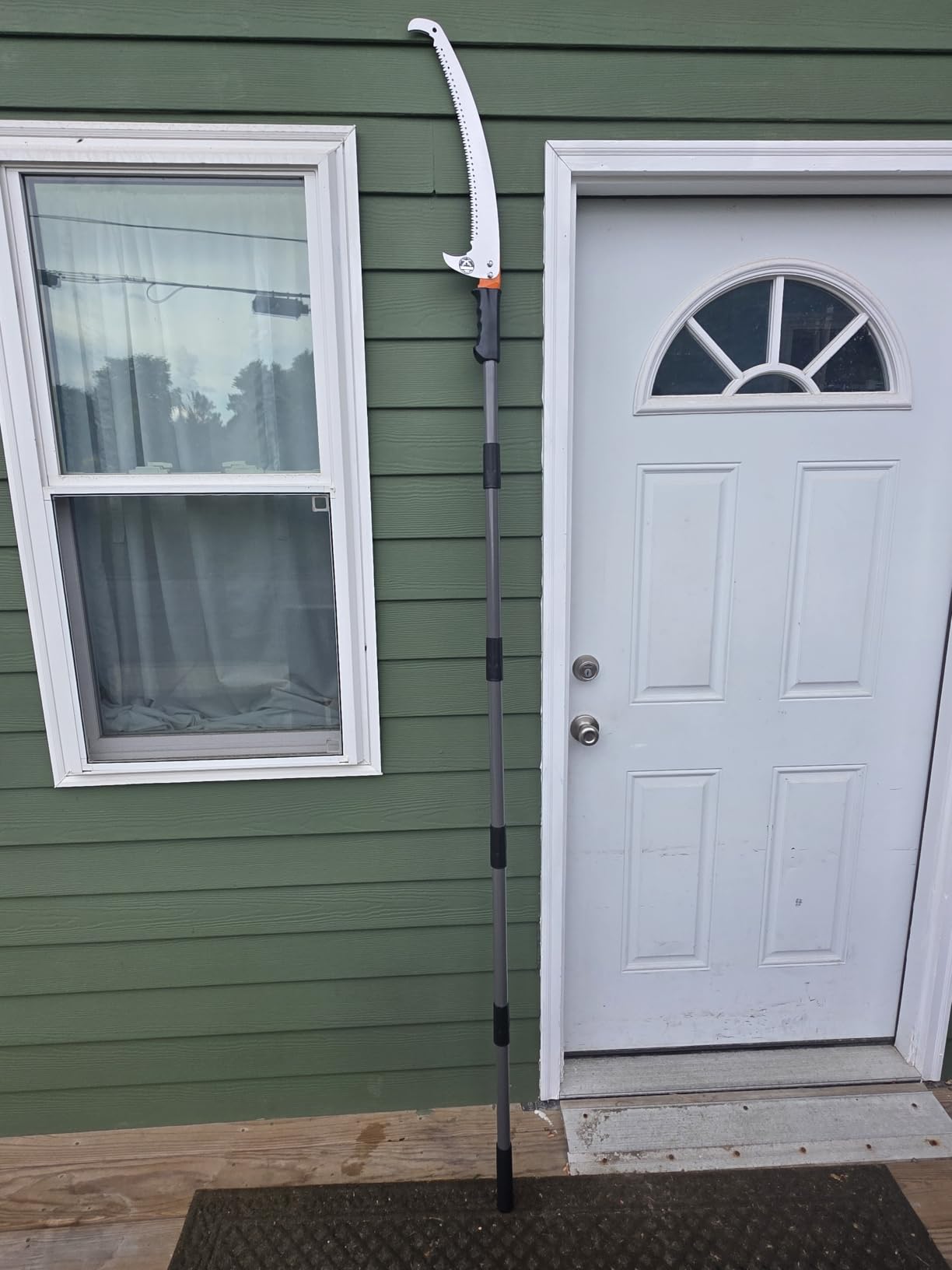
It detaches into a hand saw for low pruning, and the poles are powder-coated to resist rust and corrosion, which matters more than most people expect for a tool stored on a porch through a wet winter. A reinforced locking screw secures the head, and a wrench is included.
At 4.65 pounds it is one of the lightest full-length manual saws in the roundup, and the soft non-slip handle grip helps on a long pull stroke.

What thin-branch pruning actually looks like
This tool is for branches up to about an inch of diameter, and for that job it is fast and effective. Owners use it for seasonal cleanup of small limbs and for clearing thin growth that a powered saw would be overkill on.
The double-hook geometry means the blade catches and pulls rather than sliding off, so you can saw one-handed overhead without constant re-aiming. Set the hook against the branch and let it guide the cut.
Where the effort goes
Manual sawing overhead is real physical work, and reviewers are candid that cutting quality falls off quickly on branches thicker than roughly an inch. If your tall tree has anything beyond brush, the sawing stroke turns into a workout.
Build quality is basic next to Fiskars, and the warranty is limited. For light pruning on a budget it does the job; for a property you plan to maintain for years, a better-built manual tool is the smarter buy.
7. EGO Power+ PS1001 Pole Saw: Best for Working in a Shaded Canopy
EGO Power+ Pole Saw for Tree Trimming, Cordless Electric Pole Saw with Telescopic LED Cut Line Indicator, Includes 56V 2.5Ah Battery and Charger – PS1001
Up to 13 ft reach
10 inch bar at 20 m/s chain speed
LED cut line indicator
Carbon fiber telescopic shaft
Pros
- Only pole saw here with an LED cut line indicator
- Carbon fiber shaft carries a limited lifetime warranty
- Brushless motor drives the chain to 20 m/s
- Tool-free chain tensioning
- Shoulder strap hook included
Cons
- Longest reach requires the separately sold extension pole
- Heavier head feel than lighter 40V rivals
The EGO PS1001 is the best pole saw for tall trees when you are working under a dense canopy, because it is the only saw here with a telescopic LED cut line indicator. When the branch is backlit and in shadow, seeing exactly where the chain enters the wood is the difference between a clean cut and a ragged one.
Reach is 13 ft on the included carbon fiber telescopic shaft, extending to 17 ft when the separately sold EP1000 extension pole is fitted. The shaft carries a limited lifetime warranty, which is the strongest warranty language in this roundup on a structural part that is normally the first thing to fail.
Under the head is a 10 inch bar with a 1/4 inch pitch, .043 gauge chain running at up to 20 m/s from a high-efficiency brushless motor. Tool-free chain tensioning, a quick-adjust handle and a shoulder strap hook are all included, and the saw weighs 9.4 pounds.
It comes with a 56V 2.5Ah battery and a 210W charger, good for up to 100 cuts per charge on the starter pack. Every EGO 56V ARC lithium battery works with it, which matters for anyone already in that platform.
What the carbon fiber shaft changes
Shaft stiffness is the whole game at 13 ft, and carbon fiber resists flex far better than the aluminum and fiberglass poles used elsewhere in this roundup. Reviewers who switched from a flexier saw notice fewer stalled cuts and better accuracy on the first attempt.
It is also a light material for its stiffness, so the strictness does not come with a punishing weight penalty. Pair the quick-adjust handle with the strap hook so the saw hangs balanced at the top of the stroke.
The ecosystem question
This is the premium entry in the roundup, and reviewers justify the spend on the shaft, the cut line indicator and 56V-class power that holds up against thicker hardwood. The 2.5Ah starter pack is thin for long sessions, which most owners solve by adding a higher-capacity battery.
If you do not already run EGO tools, the entry cost includes buying into a platform. If you do, it is a straightforward addition with the highest satisfaction rating in the set by percentage of 5-star reviews.
8. Fiskars 8-12 Ft Extendable Pole Saw: Best Manual All-Rounder
Fiskars 8-12 Ft Extendable 2-in-1 Tree Pruner & Pole Saw with Rotating Head
Extends 7.9 to 12 ft
15 inch double-grind saw blade
Under 5 pounds
Lifetime warranty
Pros
- Rope-free actuating sleeve
- Under 5 pounds for a full-length tool
- Rotating head locks at any angle
- Removable 15 inch saw blade
- Rectangular aluminum pole resists bending
- Lifetime warranty
Cons
- Struggles above about 1 inch of hardwood diameter
- Gets heavy at full extension on an angle
- Sap-heavy trees gum the blade
The Fiskars extendable pole saw is the best manual pick for tall trees if your pruning is mostly thin limbs and you want a tool that will still work in ten years. It carries a lifetime warranty, extends from 7.9 ft to 12 ft and weighs 4.8 pounds, which is an unusually strong durability story for a manual pruner.
It is a 2-in-1 tool: a lopper for small branches and a removable 15-inch double-grind saw blade for larger limbs. The rope-free actuating sleeve is the detail owners praise most, because older pruners routed the pull cord through your hands and cut into them over time.
The rotating cutting head locks at whatever angle you need, which is what allows overhead and horizontal limbs to both be cut without repositioning the whole tool. Chain-drive gearing adds cutting force compared with a simple lever pruner, and a low-friction blade coating resists sap and debris gumming.
Owners mention a track record of long-term ownership in their reviews, and the double-locking system is there specifically to keep the extended pole secure. The rectangular aluminum pole is the right profile for resisting bend under load.
Where manual pruning stops
This is a pruner, not a substitute for a powered saw. Owners consistently report that the lopper and saw struggle above roughly 1 inch of hardwood diameter without help, and the saw works best on branches that are braced by a stable branch or trunk rather than free-standing.
So the practical use is deadwood and brush between 8 and 12 ft, plus everything below that height. If your tallest branches are thick limbs rather than a light canopy, you need a powered saw.
Maintenance and long-term ownership
Two maintenance notes matter for a tool you plan to keep. Sap-heavy species gum the low-friction coating, so expect to clean the blade between sessions. And owners note the internal nylon ribbon can go slack over time and wrap around the pole, which is a wear item to inspect annually.
The removable 15-inch blade means the part most likely to dull is replaceable rather than the whole tool. That, plus the lifetime warranty, is why this sits so high despite modest cutting capacity.
9. Greenworks 40V 8-Inch Pole Saw: Best Starter Kit for Smaller Properties
Greenworks 40V 8-Inch Cordless Polesaw, 2.0Ah Battery and Charger Included PS40B210
11 ft max reach
7.8 pounds
Automatic chain oiler
Tool-free chain tension adjustment
Pros
- Complete kit with battery and scabbard included
- Cuts live and dead branches at this bar size
- Battery counterbalances the saw head
- Lightweight aluminum shaft with little flex
- Cross-compatible with the wider Greenworks range
Cons
- Chain cover must be opened periodically to clear chips
- Disassembly for storage is awkward
- Out of balance if used without the short extension pole
The Greenworks 40V 8-Inch is the best starter kit in this roundup of pole saws for tall trees if your reach needs stop around 10 ft. The extendable aluminum shaft reaches up to 9 ft for an 11 ft max reach, and at 7.8 pounds it is one of the lightest cordless saws we looked at.
Reviewers consistently single out the aluminum shaft as stiffer than fiberglass shafts on comparable saws, and note the design stays well balanced because the battery sits opposite the head. Cutting live and dead branches in its 8-inch class is well within its capability.
The kit includes the saw, bar and chain, a 2.0Ah battery, a charger, an extension pole, a scabbard and the manual, so there is nothing to buy before the first cut. Automatic chain lubrication runs continuously, and chain tension adjusts without tools.
There is no gas, no oil mixing and no emissions, which is the entire maintenance story. If you already own Greenworks 40V tools the battery is free, and the platform crosses over with the rest of the range.
The honest reach ceiling
Eleven feet is the practical limit, and that is the reason this saw is not higher in a tall-tree roundup. Add your arm and the bar tip lands at roughly 8 ft, which is a comfortable ground-level and ladder-free working zone but not a tall-tree tool.
For a yard with a young canopy, a hedge row or a small ornamental tree, that ceiling is exactly where you need it to be. Owner ratings sit high across a review count of 1954, which reflects that it simply does its job without drama.
Two setup habits that prevent complaints
Owners report the chain cover has to be opened periodically to clear chips out of the automatic oiler, and that is the single most common service note. Do it every few sessions and lubrication stays where it should be.
Second, the saw is out of balance if you use it without the short extension pole attached. Install that section before every job rather than treating it as optional, because a balanced saw is far less tiring at shoulder height and above.
10. SKIL PWR CORE 40 Pole Saw: Best Warranty and Best Balance of Power
SKIL PWR CORE 40 Brushless 40V 10” Pole Saw Kit with Over 9ft. Telescoping Shaft & Angled Head, Includes 2.5Ah Battery and Auto PWR Jump Charger – PS4561C-10
Telescoping shaft over 9 ft
10 inch bar
500 watt brushless motor
5 year limited warranty
Pros
- Stable and free of wobble when fully extended
- Shaft extends in small increments rather than a new section
- Tool-less chain tension dial
- 5-year limited warranty
- Cuts 4-5 inch walnut branches
Cons
- Power head feels top-heavy at full extension
- Bar oil can leak in storage
- Filling the oil reservoir is awkward
- Slower cutting in dense hardwood
The SKIL PWR CORE 40 is the pick if your tall-tree work is modest and you want a warranty that outlasts most competitors. It carries a 5-year limited warranty, the longest in this roundup, and it holds its line when fully extended, which owners repeatedly call out as unusual in its class.
The telescoping shaft extends just over 9 ft and, importantly, extends a couple of feet at a time rather than requiring you to bolt on a whole new pole section. That single design choice removes the exact point where multi-section saws develop wobble, and it is why this saw stays stable at the top of its stroke.
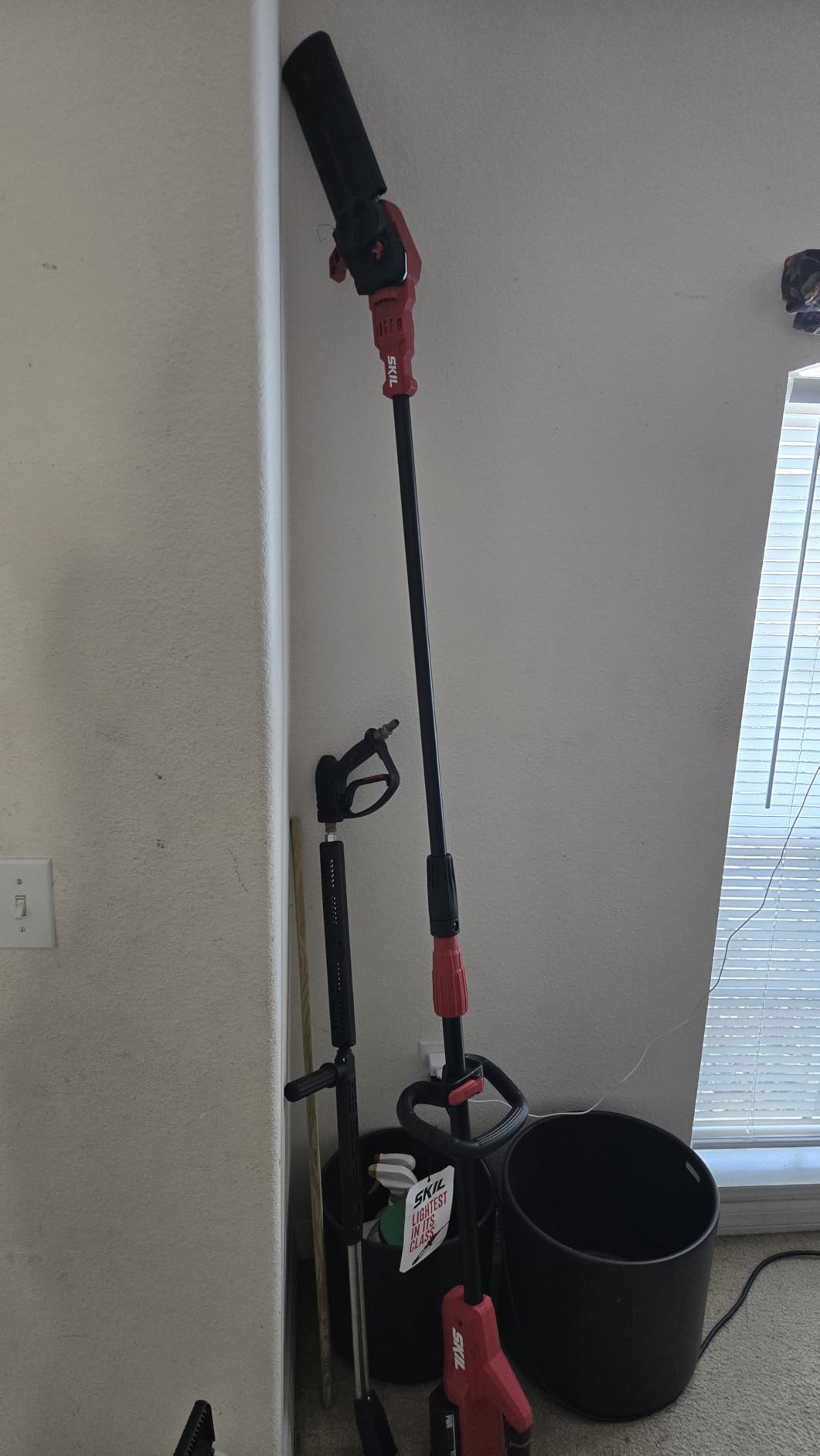
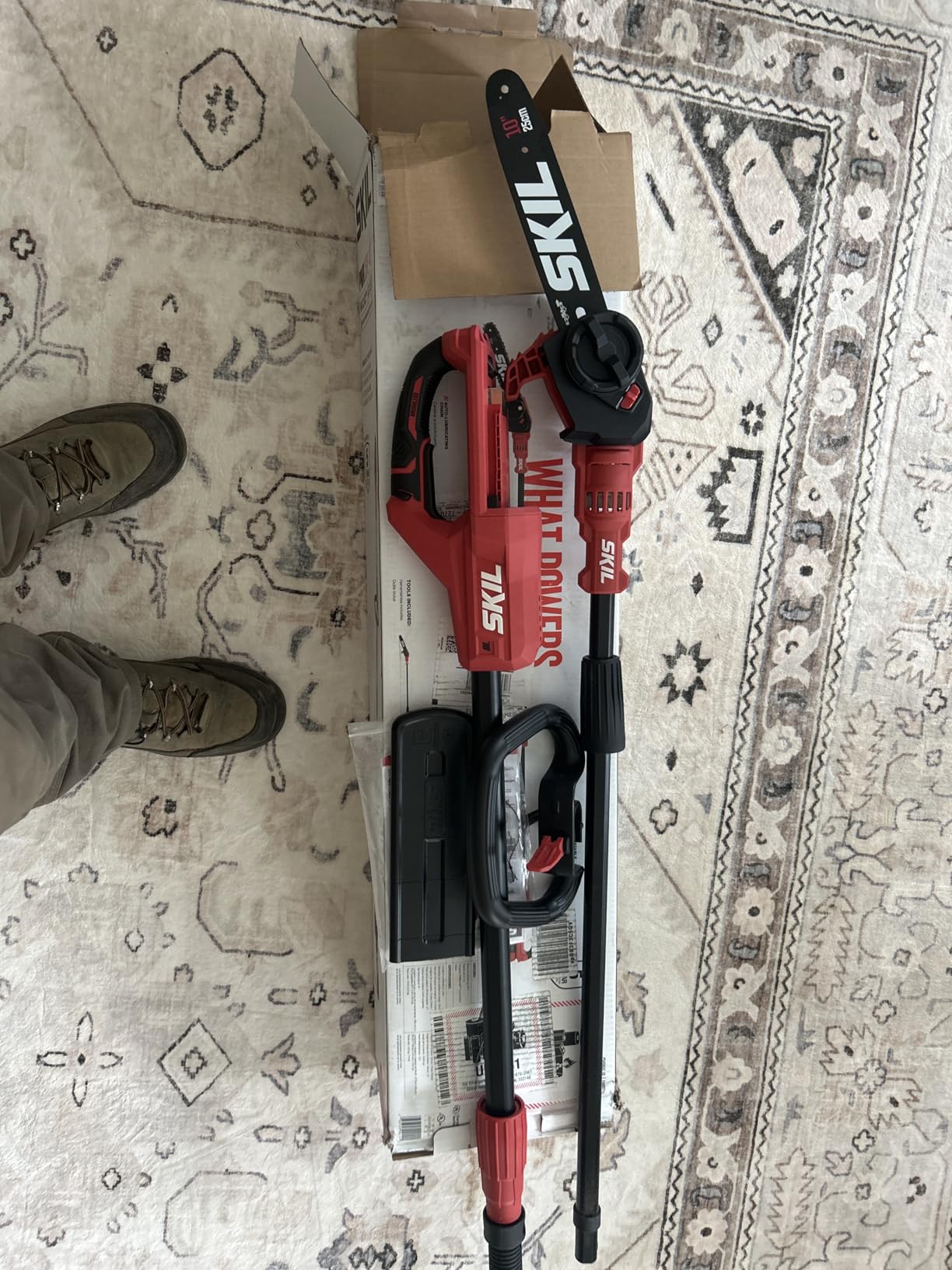
Under the cover is a 500 watt brushless digital motor driving a 10 inch straight high-speed steel blade, with an angled cutting head designed to cut down onto the branch rather than across it. A tool-less tensioning dial on the side of the tool makes setup quick, and a mid-shaft disconnect coupling lets you break the saw down for transport.
The kit includes the saw, a PWR CORE 40 2.5Ah battery and an Auto PWR JUMP charger, and the cooling-wrapped cells are rated for 25 percent longer run time and twice the battery life of an earlier generation pack.
Why the telescoping design matters
Almost every wobble complaint in this roundup traces back to a section joint. This saw avoids the joint entirely, extending the same shaft in increments instead. Owners who compared it against the major 40V and 18V brands rate it as the value pick of the class, matching or beating higher-priced units on power.
The angled head is worth understanding mechanically: cutting down onto the branch gives the chain a clean entry and reduces the chance of the bar pinching in the middle of the stroke, which is the common cause of a saw getting stuck halfway through a cut.
Where the weight lands
The complaint that comes up is balance, not power. The head feels top-heavy and unwieldy at full extension, and the 12.9 lb listed weight is heavier than most 40V rivals. Cutting in dense hardwood is also slower than the higher-speed saws in this group.
The bar oil reservoir is also awkward to fill and small amounts can seep out during storage. None of that is a dealbreaker for seasonal pruning, but if you are working a full day at height, a lighter saw will serve you better.
How Far Can a Pole Saw Actually Reach?
A pole saw reaches between 8 and 13 ft of usable trigger-to-tip distance on most consumer models, and the advertised working height adds roughly two to three feet of arm length on top of that. Professional gas pole pruners reach considerably further, and manual telescoping systems extend the most of all.
Working height is the single most misleading number in this category. It is not a pole measurement. It is a description of the highest point the bar tip reaches when someone holds the saw with arms extended, so a saw with a 9 ft shaft often gets marketed at 11 or 12 ft of working height.
For tall trees, that conversion is what decides whether you own the right tool. Buying a saw on its working height claim and then finding you can only cut at 8 ft is the single most common complaint from owners on chainsaw and arborist forums, and it is entirely avoidable.
The tallest pole saw you can buy is a manual telescoping system, which reaches into the mid-30 ft range assembled. Among powered saws, the long-reach professional gas pole pruners extend to roughly 21 ft, and the battery options in this roundup top out at a stated 16 ft. Nothing consumer-grade powered reaches much past that without an extension pole.
Two further limits matter as much as the number itself. The first is branch thickness: a pole saw cuts roughly one to two inches smaller than its guide bar length, so an 8-inch bar handles about 6-inch limbs and a 10-inch bar handles about 8-inch limbs. The second is wind, which is covered in the safety section below.
What to Consider When Buying a Pole Saw for Tall Trees
The first thing to settle is your honest maximum working height, measured from the ground to the branch you need to reach, not from the ground to the trunk. If that number exceeds 13 ft, skip the compact saws entirely and look at the long-reach options, because no amount of power makes a short shaft reach further.
Power source
Battery pole saws have closed the gap with gas almost entirely for homeowner work. Brushless motors, 40V to 60V platforms and packs of 2.0Ah to 4.0Ah now deliver the chain speed needed for hardwood limbs, and they start instantly, run quietly and need no fuel mixing.
Gas still wins on sustained high-volume cutting and on very thick limbs, and it is the only practical choice if you do not want a battery platform. Corded electric exists but is rare at this reach, and manual pruners remain the cheapest path to height for light work.
Bar length and cutting capacity
Use the rule of thumb that your guide bar should be at least 2 inches longer than the thickest branch you intend to cut. That gives the chain room to clear the kerf without the bar binding. An 8-inch bar is the most common size and handles branches up to about 6 inches; a 10-inch bar reaches roughly 8-inch limbs, and a 12-inch bar handles around 10 inches.
A longer bar is not free. It adds weight at the far end of the pole, and that weight is exactly what causes the saw to tip forward when you are cutting down onto a branch.
Pole flex and wobble at full extension
This is the most consistent complaint across every owner community and both editorial competitors we studied, so treat it as a buying criterion rather than a minor detail. Flex forces you to push harder, loses accuracy, and is the leading reason cuts stall halfway through.
Three causes account for most of it. Multi-section poles that join with a clamp can loosen during use and develop a hinge point. Poles with many short sections, like the 8-section manual system here, accumulate deflection across every joint. And flexible fiberglass shafts bow under load where aluminum and carbon fiber hold their shape. Look for few sections, good locks and a stiff material, and tighten every clamp before you start.
Battery platform lock-in
Before comparing saws, check what you already own. Batteries are the expensive part of any cordless setup, and a saw that uses a platform you do not have means buying a battery and a charger before you can make the first cut. Most owners in the communities we reviewed prioritize matching an existing platform over a marginally better saw.
Within this roundup, the Greenworks 40V and 60V saws share a brand but not a platform, so they are not interchangeable. The 40V packs will not run the 60V saw, and the included 2.0Ah packs on both are small relative to a 4.0Ah pack.
Weight and fatigue
Weight matters more than almost any other spec because it is felt at the worst possible moment, at the top of a stroke with the pole fully extended. Saw weights in this roundup range from 4.8 pounds for the Fiskars manual tool to 14.8 pounds for the 27 ft manual system.
A harness or a well-padded shoulder strap distributes that load across your hip rather than your forearm. Several saws here include a strap hook or a belt in the box, and for tall-tree work it is worth using them from the first cut rather than saving them for long jobs.
Durability and parts
If you want a tool that lasts a decade, look at what happens when something breaks. Saw-specific replacement parts are catalogued for some models, which means a dead motor or a cracked housing does not end the tool’s life. Chain and bar wear items should be orderable in standard sizes.
Warranty length is a reasonable proxy: the SKIL carries 5 years, the Greenworks 60V carries 4 years on tool and battery, the EGO warrants its carbon fiber shaft for a limited lifetime, and the Fiskars manual tool carries a lifetime warranty. On arborist and chainsaw forums, buyers who want to buy once and cry once consistently pick the brand with the better dealer and parts network, not the one with the longer specification list.
What Owners Say About Pole Saws for Tall Trees
The most useful signal on this topic comes from people who own tall trees rather than people who write about pole saws. Chainsaw and arborist forums converge hard on the same short list, and their reasoning is worth weighing alongside the specifications.
Reach is the first filter. The thread holding the top organic position for this query belongs to an owner with large palms, including Bismarckia and Mexican fan palms, growing fast and needing fronds trimmed a few times a year without climbing. That owner’s constraint is not power. It is getting the saw head into a canopy 15 to 20 ft up and staying out from under falling fronds.
Pole flex is the second filter, and it is the complaint that appears in nearly every thread. Owners describe needing extra force to complete cuts and losing accuracy at height, which matches what the product reviews show about section joints and multi-section shafts. Owners also repeatedly report that manufacturer working height claims do not match what they can actually reach, which is why the decoder above comes before any buying advice.
Stuck or pinched saws come up too. One poster describes a pole saw that gets stuck constantly, is heavy, and is likely to break in inexperienced hands during limbing. That is a technique problem as much as a tool problem, and it argues for a sharp chain, a bar longer than the branch and an approach cut rather than a full-thickness cut.
On durability, a poster with disaster-response experience picks a gas saw on the basis that he has used it and found it tough and reliable in that work. An arborist poster reports a Fiskars manual pole saw that failed within about a dozen uses when the pull cord broke and the extension locking collar did not hold, which is a reminder to test the lock at full extension before relying on it.
Finally, a technique that shows up often and is worth adopting: choke up on the pole rather than working at maximum extension. One poster explains that a 6 ft pole lets you saw a 10 ft high limb easily, and choking up gives you the reach you need while keeping you outside the range of falling debris.
Pole Saw Safety at Working Height
Never use a pole saw while standing on a ladder, and treat roughly 13 to 15 ft as the ceiling for homeowner pole saw work before you call a professional arborist. A pole saw is already pulling you off balance, so a ladder removes the only thing keeping you upright.
A pole chainsaw handles most branches up to about 13 ft of usable reach. Above that, the correct tool is a long-reach pole pruner, or a professional arborist with climbing gear and a rigging plan. If a branch is trunk diameter, dead, over a roof, or requires you to lean past your base of support, it is an arborist job.
Set a clear zone before you start. Establish an escape path at least 15 ft from the base of the tree and keep everyone, pets, vehicles and children out of it, because a falling limb travels much farther than people expect. Choking up on the pole, as forum users describe, keeps you further from the drop zone for the same cut.
Watch the wind, and stop when it picks up. A chain cutting a branch on a moving target is already unpredictable, and wind pushes both the branch and the saw at the same time. Standing on uneven ground, working in the dark, or cutting in rain that makes bark slick are all reasons to close the saw down for the day.
Wear the equipment. Eye protection, hearing protection, gloves, a chainsaw helmet or hard hat, sturdy boots and a long-sleeved shirt are the minimum. Check chain tension and sharpness before every session, confirm the brake works, and keep both hands on the pole with the strap on before the first cut.
Finally, saw technique at height is simple: cut from the top down, not from the side. Make a small notch on the far side to stop the branch dropping and pinching the bar, then step back, reposition and finish the cut from a new angle.
Frequently Asked Questions
What is the best long pole saw for tree trimming?
For tall-tree work the best long pole saw is the Supstable S5 Sky, which pairs a stated 16 ft reach with a brushless motor running the chain at 30 ft/s and two 4.0Ah batteries. If your branches sit above 16 ft, the answer changes: a manual telescoping system such as the VEVOR, which assembles to 27 ft, is the only tool here that physically gets there.
How thick of a tree can a pole saw cut?
A pole saw cuts branches roughly one to two inches smaller than its guide bar length. An 8-inch bar handles about 6-inch limbs, a 10-inch bar handles about 8-inch limbs, and a 12-inch bar handles around 10 inches. Use the rule that your bar should be at least 2 inches longer than the thickest branch you plan to cut.
What is the tallest pole saw you can get?
Manual telescoping pole systems are the tallest, assembling into the mid-30 ft range with enough extension sections. Professional gas pole pruners reach roughly 21 ft at full extension. Among battery saws, stated reach tops out around 16 ft, or 17 ft on models that accept a separate extension pole.
How high can you reach with a pole saw?
Most consumer pole saws deliver 8 to 13 ft of usable trigger-to-tip reach. Advertised working height adds roughly 2 to 3 ft of your own arm length, so an 11 ft working height claim is really about an 8 ft pole. Add branch thickness and wind limits, and treat roughly 13 to 15 ft as the practical ceiling for homeowner work.
Is it safe to use a pole saw on a ladder?
No. A pole saw should never be used while standing on a ladder, because the saw is already pulling the operator off balance and the ladder removes any remaining stability. Work from the ground with the pole choked up to the length you need, or hire an arborist for anything above roughly 13 to 15 ft.
Conclusion: Best Pole Saws for Tall Trees by Scenario
For the best pole saws for tall trees, the deciding variable is usable reach, not wattage. Pick the Supstable S5 Sky for the longest rigid powered reach at 16 ft, the VEVOR manual system when your limbs sit above 20 ft, and the Greenworks 60V 10 in when the branches are thick hardwood.
Match the rest by job: the CRAFTSMAN V20 if weight is your limit, the EGO PS1001 if you work in shaded canopies, the Fiskars tool for thin branches with no motor at all, and the Greenworks 40V for a starter kit on a smaller property. Whatever you choose, measure your real cutting height first, and stop at about 13 to 15 ft where the reach ends and an arborist begins.