
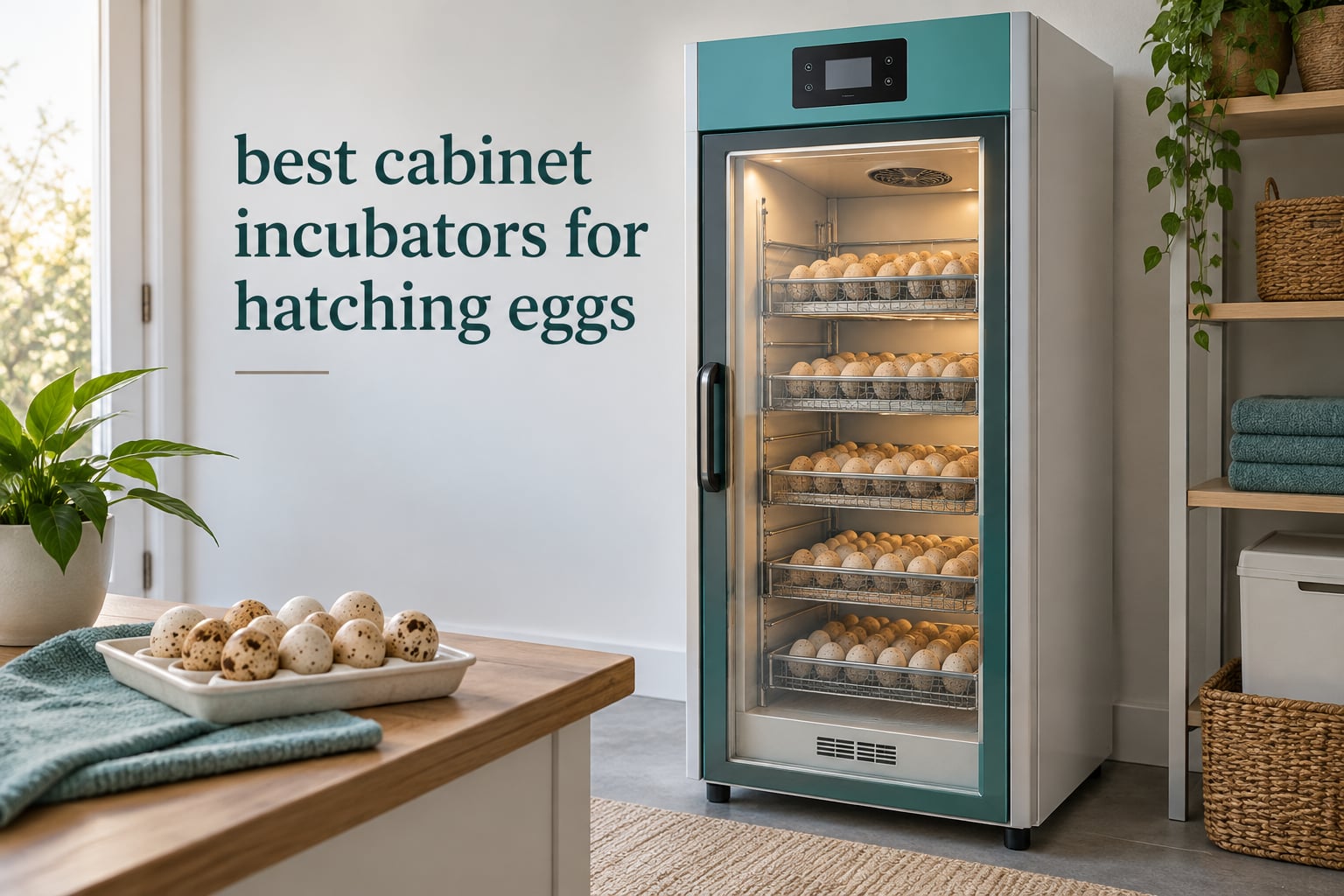
The short answer: the Hatching Time Cimuka CT180 SH is the best cabinet incubator for hatching eggs for most backyard breeders, because it sets and hatches in one 180-egg cabinet with automatic turning, automatic humidity and alarm sensors, and it carries by far the largest owner review base in this group. Below that sit a GQF 1502 Sportsman combo for tight insulation and included trays, a pair of GQF setter and hatcher-only cabinets for staggered batches, and three 400-egg units for buyers who want raw capacity instead of a small footprint.
A cabinet incubator is a tall, upright, insulated box that holds anywhere from a few dozen to several hundred eggs, runs its own digital thermostat and humidity system, and turns the eggs for you through the first 18 days. That is the whole reason people move up from a tabletop unit. A tabletop model relies on you to turn eggs, top up water and react when the room temperature swings. A cabinet does all three, which is why hatch rates stay steadier across a large batch instead of being decided by how attentive you were that week.
We spent 2026‘s season reading specifications, owner reviews and forum threads across the four brands that actually build cabinets: Cimuka (sold as Hatching Time in the US), GQF, and the two 400-egg imports that dominate the cheap end of the market. What follows is built from published specifications, review patterns, warranty terms and the recurring owner complaints that show up year after year, and we flag clearly where a rating rests on a handful of reviews instead of hundreds.
One naming convention explains most of the confusion in this category, so use it before you read any spec list. A capital S means setter only, a capital H means hatcher only, and SH or C means a combined unit that does both. The Cimuka CT180 SH sets and hatches. The GQF 1550 only hatches and needs a separate setter, while the GQF 1500 only sets and needs a separate hatcher. Get that letter right and half the models on the market suddenly make sense.
Table of Contents
Top 3 Cabinet Incubators for Hatching Eggs (October 2026)

Hatching Time Cimuka CT180 SH
- Set and hatch in one cabinet
- Conturn automatic egg turners
- Humisonic humidity control
- Up to 180 chicken eggs

GQF 1502 Digital Sportsman Combo
- Digital thermostat with on-board computer
- Three auto-turning racks plus hatching tray
- 5-gallon water reserve system
- Up to 288 chicken eggs
VEVOR CR400 400 Egg Incubator
- 400-egg cabinet capacity
- 360-degree air circulation
- Integrated humidity sensor
- Manual 12V battery switchover
The CT180 SH leads because it is the only unit here that combines a well-proven control system, a genuinely compact footprint and a review base large enough to trust. The GQF 1502 scores higher with the owners who rated it, but only 23 people have. The VEVOR is the honest budget option and the most reviewed of all eight, with 239 ratings that include a real minority of complaints.
Cabinet Incubator Quick Overview in 2026
| Product | Specs | Action |
|---|---|---|
| Hatching Time Cimuka CT180 SH |
|
Check Latest Price |
| GQF 1502 Digital Sportsman Combo |
|
Check Latest Price |
 GQF 1550 Digital Cabinet Hatcher GQF 1550 Digital Cabinet Hatcher |
|
Check Latest Price |
 GQF 1500 Digital Professional GQF 1500 Digital Professional |
|
Check Latest Price |
 Cimuka HB700S Professional Setter Cimuka HB700S Professional Setter |
|
Check Latest Price |
 Montary 400 Egg Cabinet Montary 400 Egg Cabinet |
|
Check Latest Price |
 Legendstone 400 Egg Cabinet Legendstone 400 Egg Cabinet |
|
Check Latest Price |
| VEVOR CR400 400 Egg Incubator |
|
Check Latest Price |
Two things stand out in that table. First, the four cabinets from Cimuka and GQF all measure capacity in true chicken eggs on a standard tray, while the three 400-egg units advertise a headline number that includes much smaller eggs. Second, the GQF 1550 and 1500 are a matched pair and neither is useful alone.
1. Hatching Time Cimuka CT180 SH: Best All-Rounder for Chicken Eggs
Hatching Time Incubators for Hatching Eggs, CT180SH Egg Setter & Hatcher
Up to 180 chicken eggs
70W average, 200W max
24.5 x 17 x 42 inches, 49 lb
Set and hatch in one cabinet
Pros
- Sets and hatches in a single cabinet
- Automatic turning with Humisonic humidity supply
- Large multi-species capacity
- Low 70W average power draw
- Front and rear doors for cleaning
Cons
- Indoor-only cabinet needs a stable room
- Quail and goose capacity needs extra racks
- 12% of ratings are one-star
The CT180 SH is the unit we keep coming back to. It is a combined cabinet: eggs go in on turning racks for the first 18 days, then move to the included hatching baskets for lockdown. That single decision removes the most common beginner mistake, which is running out of hatching space three days before the first chick pips.
Capacity is the real strength. Beyond the 180 chicken eggs, the manufacturer rates it at 252 partridge, 216 pheasant, 120 turkey or duck, and 72 goose or peacock eggs. Quail capacity is 324 on the standard racks, rising to 468 if you fit the QT13 racks. That spread matters for a mixed flock, because you are not locked into one egg size.
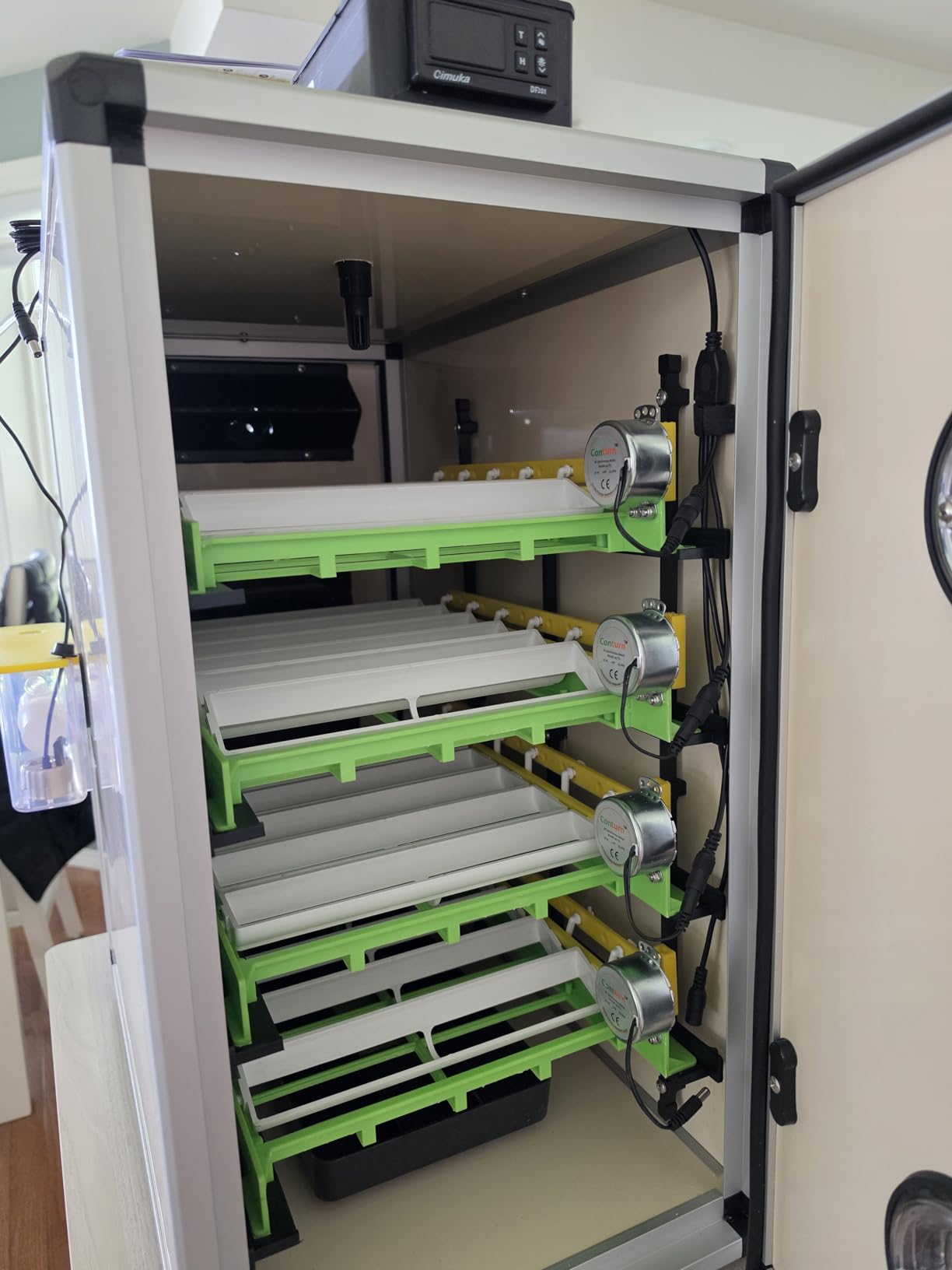
Control is handled by Conturn automatic turners, Humisonic humidity supply and a digital thermostat, with high and low alarms for both temperature and humidity, each paired with a room sensor. That room sensor pairing is a detail worth paying for. It means the cabinet tells you when the problem is inside the cabinet and when the problem is the room it is standing in, which is a distinction a lot of cheaper units cannot make.
The AirRoute ventilation is IP55-certified and runs Active Periodic Cooling, scheduled cooling and moisture-release periods. Physically it is a well-behaved piece of furniture: 24.5 x 17 x 42 inches and 49 lb, with insulated ABS walls on an anodized aluminum frame, and front and rear doors so you can load, swap baskets and clean without pulling the whole cabinet apart.
How the CT180 SH handles humidity and dry rooms
The Humisonic system supplies moisture on demand rather than relying on you topping up a pan twice a day, and the Active Periodic Cooling cycles release moisture in scheduled windows. Between those two features, this is the cabinet we would trust most in a dry winter house or anywhere above a few thousand feet, where a moisture pan simply evaporates faster than you can refill it.
One thing to note: the cabinet is rated for indoor use, and the cooling and alarm system only help if the surrounding room itself is reasonably stable. Put it in a garage that swings from freezing to warm and the thermostat is chasing a moving target no matter how good the sensor is.
Where the CT180 SH falls short
The 195 ratings average 4.2, and the distribution explains why: 71% five-star, but 12% one-star. That is a wider spread than the GQF units show, and the negative reviews cluster around hardware and electronics reliability rather than hatch results. Treat the electronics as the part to watch if you are buying to keep for a decade.
The other real limitation is that the higher species capacities depend on racks you buy separately. The 468-quail figure assumes QT13 racks, and goose eggs need their own large-egg setup. Budget for the accessory if quail or goose is your plan, not a footnote.
2. GQF 1502 Digital Sportsman Combo: Highest Rated With Trays and Water System Included
Pinnon Hatch Farms Incubator GQF 1502 Cabinet Incubator Hatcher Holds Up to 288 Chicken Eggs Includes + 6pk Hatching Egg Trays & 3030 Water Reserve System (with 6 Universal Trays)
Up to 288 chicken eggs
1368 quail or 162 duck eggs
30.25 x 15.75 x 31.75 inches
5-gallon water reserve included
Pros
- Highest rating in the group at 4.6 stars
- Turning racks and hatching trays included
- 5-gallon reserve cuts humidity chores
- Quiet insulated plastic board build
- Hand-assembled and 24-hour tested
Cons
- Only 23 ratings so far
- Accessory upgrades are bundle-specific
- 20% restocking fee on returns
This is the configuration we would tell a first-time cabinet buyer to look at first, because it arrives complete. The listing includes six universal egg trays plus hatching egg trays and a 3030 Water Reserve System with a 5-gallon tank and a constant-level humidity pan. GQF cabinets sold as bare cabinets are famously tray-less, so seeing the trays and the water system in the same package removes the most annoying part of assembly day.
Inside, the LCD panel shows temperature and humidity with an on-board computer for real-time monitoring, and three racks turn automatically with electronic controls that give audio and visual indication. Capacity is up to 288 chicken eggs, 162 duck eggs or 1368 quail eggs depending on which trays you fit, and the same cabinet handles goose, peafowl and emu with the right egg trays.
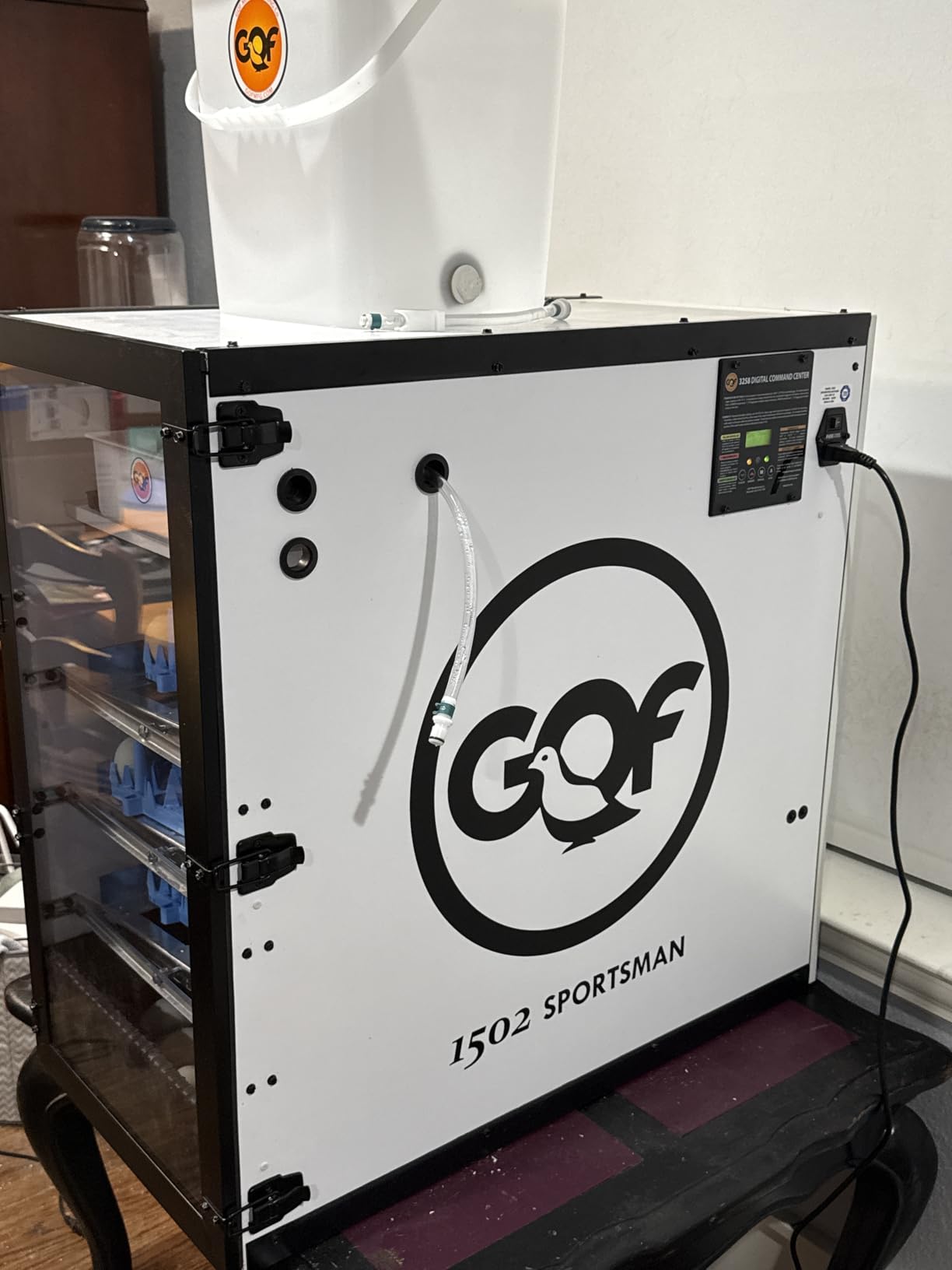
Construction is high-strength plastic board with insulation, which reviewers repeatedly describe as quiet and easy to wipe down. GQF hand-assembles each unit and tests it for a full 24 hours before it leaves the factory, and the physical footprint is a genuinely cabinet-shaped 30.25 x 15.75 x 31.75 inches, narrower than most 400-egg units on this list.
Owner satisfaction is the highest of the eight at 4.6 stars with 79% five-star ratings and no one- or two-star reviews at all. Read that carefully, though. Twenty-three ratings is a small sample, and the feedback is so clean that it tells you what early owners think, not what a fifteen-year ownership record looks like.
Why the Sportsman cabinet has the strongest long-term reputation
On a platform like Reddit’s r/homestead, owners describe Sportsman cabinets as units that last. One breeder reports a roughly 20-year-old Sportsman that has hatched thousands of chicks, and the recurring advice in that thread is to buy the cabinet type and stop worrying. On Backyard Chickens, Sportsman and Brinsea cabinets are routinely called very high quality with great hatch rates.
That durability reputation matters more than any spec line, because a cabinet is a decade purchase. The 3030 water reserve system is the part of this package we would point out as the quiet hero: a 5-gallon tank feeding a constant-level pan means you are not opening the cabinet twice a day to top up water, which is where most humidity failures actually start.
What to watch on the GQF 1502
There is a known complaint pattern on older Sportsman cabinets around temperature control, particularly difficulty dropping the internal temperature on hot days, and breeders have run dedicated threads on retrofitting wafer-thermostat cabinets with modern controls. That history is mostly about older units rather than current electronics, but it is worth asking a retailer directly what the digital thermostat on a new cabinet actually does when room temperature climbs.
Also note the 20% restocking fee. On a cabinet this size that is a real cost if you order the wrong tray configuration, so confirm egg size before you commit. And keep a small tabletop unit on hand for odd batches, which is what most experienced breeders do anyway.
3. GQF 1550 Digital Cabinet Hatcher: Best for Setter and Hatcher Setups
Pinnon Hatch Farms 1550 Cabinet Hatcher GQF Chicken Quail Duck Pheasants Geese Hatching Egg
Hatcher only cabinet
Accepts a full 1500 setting
On-board computer per-second monitoring
Made in the USA
Pros
- Accepts the complete 1500 setting
- Per-second system and environment monitoring
- Built in the USA
- Perfect scores from available reviews
Cons
- Only 2 ratings available
- Requires a separate 1500 setter
- Very few published specifications
The 1550 is not a standalone incubator. It is a dedicated hatcher that accepts the complete setting from a GQF 1500, and its entire reason to exist is hatch-day capacity. Once you run eggs in a setter, something has to hold them still at high humidity for the final three days, and this is that something.
Its on-board computer monitors systems and the surrounding environment every second, updating in real time. For a unit whose only job is to hold three conditions steady for 72 hours, that level of monitoring is exactly what you want, because a hatcher failure on day 19 costs you the whole batch.
When a hatcher-only cabinet actually pays off
The economics are straightforward. The moment you start setting a new batch before the previous one finishes hatching, a separate setter plus a separate hatcher stops wasting the days when your combined unit is locked down and empty. Three GQF 1500 setters feeding one 1550 is the pattern most breeders describe as the sweet spot, because eggs never sit in a turning cabinet for three extra days waiting for a drawer to free up.
It also solves the sizing problem nobody mentions. A 288-egg setter with a 72-egg hatching tray means only a quarter of your batch hatches at once even in a combined unit. With a dedicated hatcher holding a full 1500 setting, your hatch days spread out instead of colliding with the next set.
Where the 1550 is a hard sell
Two ratings, both five-star. That tells you the people who received one were happy. It tells you almost nothing about long-run reliability, and we will not pretend otherwise. There is also very little published specification for this listing, so you are relying on the GQF name rather than a data sheet.
If you are hatching one or two batches a year for a family flock, this is a poor purchase on cost per hatch. If you are running weekly batches, it is the piece that stops your schedule from stalling. Returns carry a 20% restocking fee, so pair it carefully with a 1500 rather than ordering one and hoping.
4. GQF 1500 Digital Professional: Setter-Only Picker for Staggered Batches
1500 Digital Professional Incubator – Holds Up to 288 Chicken Eggs
Setter only cabinet
Up to 288 chicken or 1368 quail eggs
Three automatically turned racks
Hand-assembled in the USA
Pros
- Three racks turn automatically
- Factory-calibrated temperature and humidity readouts
- LCD display with touch controls
- Very high capacity ceiling for quail
- Hand-assembled in the USA
Cons
- Only 2 ratings available
- No hatching baskets listed
- 20% restocking fee on returns
The 1500 is the setter half of the GQF pair, and on paper it is the most capacity-efficient setting cabinet in this group. Three racks turn automatically, and the factory-calibrated digital readouts for temperature and humidity are specified as high precision, with an LCD display and touch controls for adjustment.
Capacity runs to 288 chicken eggs, 180 duck eggs or 1368 quail eggs. The quail number is the standout, and it comes from the same trim-to-fit tray logic that makes GQF cabinets popular with game bird breeders. If quail is a serious part of your operation, this is where a setter earns its floor space.
Why a setter-only cabinet beats a combined unit for volume hatching
A combined cabinet spends its last three days as a very expensive egg shelf. Every turning rack is empty or holding a hatching basket while the cabinet runs hot and wet, and you cannot set new eggs into those racks. A dedicated setter never stops working, so a breeder setting weekly batches gets more usable hatch cycles per year from the same number of cabinets.
It also simplifies the physical workflow. You set eggs on the 1500 on a schedule, and on day 18 you move the whole setting across to a 1550. That one transfer moment is the part beginners find confusing with a single combined unit, and having two distinct cabinets makes the step obvious rather than improvised.
What the 1500 does not do
There is no hatching basket or hatching tray listed with this configuration, so you need the 1550 or an equivalent hatcher to finish a batch. That is not a flaw, it is the design, but it means the real purchase is two cabinets and a realistic budget for both.
Owner feedback is two five-star ratings, which is too small to plan around. Treat the specification sheet as the evidence here, and if you want confidence in long-run behaviour, ask a retailer for a current warranty term and whether replacement parts for turning racks, wick pads and the water reserve system are sold years after purchase before you order.
5. Cimuka HB700S: Best for Hatchery-Scale Setting
Incubators for Hatching Eggs – HB700S Egg Incubator Setter, Automatic & Self-Regulated Temperature & Humidity, Chicken Egg Incubator, Professional Cabinet Poultry Incubator by Cimuka
Up to 700 chicken eggs
20 adjustable setter trays
160W average, 425W peak
32 x 21 x 71 inches, 115 lb
Pros
- Largest setting capacity in the group
- Self-regulated temperature and humidity
- Two alarms with room sensors
- Trays adapt across egg sizes
- Multiple capacity configurations
Cons
- Only 2 ratings available
- 71-inch height and 115 lb need floor space
- Hatcher sold separately and covers required
The HB700S is the biggest cabinet here and the only one built around the idea of production rather than hobby batches. Twenty adjustable setter trays with adaptable dividers handle eggs from quail up to large poultry sizes, and the same chassis is available in 175, 350, 500 and 700 egg configurations, so the cabinet can match the scale you actually intend to run.
Temperature is self-regulating and paired with Humisonic humidity management, meaning you add water to the reservoir and the system meters moisture itself. The alarm system is the most thorough in this group: two separate alarms for high and low temperature and high and low humidity, each paired with its own room sensor.
What 700 eggs of capacity actually gives you
Stated capacity is 1980 quail, 1120 partridge, 960 pheasant, 700 chicken, 480 turkey, 480 duck, and 300 goose or peacock eggs. Converting that to a plan: a 700 chicken-egg setting is roughly 20 hens laying for a full cycle, or a 30-bird breeding program working through a season. If your flock is smaller than that, you are paying for capacity you will not fill every time.
The power draw is worth planning around. At 160W average with peaks of 425W on 110V/60Hz, a full cabinet is the largest single load in a typical outbuilding circuit, so check what else shares that circuit before you commit.
Where the HB700S demands planning
At 32 by 21 by 71 inches and 115 lb, this is a floor-standing unit that needs a dedicated spot, a stable temperature-controlled room, and two people to move. It is explicitly rated for indoor use in a draft-free, temperature-controlled room, and it will not tolerate a barn.
Two configuration traps catch people out. The hatcher is sold separately, so a 700 egg setter does not hatch 700 eggs on its own. And if you intend to set and hatch in the same cabinet, the FLX35Y-K setter tray covers are required. With only two ratings on record, we would want a warranty conversation in hand before committing at this size.
6. Montary 400 Egg Cabinet: Mixed-Batch Capacity in a Simple Box
400 Eggs Incubator Cabinet, Automatic Incubator for Hatching Egg, with Automatic Egg Turning and Temperature Humidity Control, Poultry Hatcher for Chicken, Duck, Goose, Quail Eggs
400-egg stated capacity
360-degree turning every 2 hours
Digital temperature and humidity displays
50 x 50 x 50 inch PE cabinet
Pros
- Handles mixed species in one run
- Auto-turns every two hours
- Digital displays with fluctuation alarms
- Panoramic observation window
- Also offered in a 1000 egg version
Cons
- Only 2 ratings available
- Very large 50-inch cube footprint
- Uninsulated PE body versus higher-priced cabinets
The Montary cabinet takes a different approach from everything above it. Instead of insulated panels, a digital command centre and species-specific trays, it offers a large sealed volume with 360-degree rotation, circulating air ducts and automatic humidification, in corrosion-resistant PE.
That design has one genuine advantage for a particular buyer: mixed batches. The manufacturer is explicit that it accommodates mixed batches of chicken, duck, goose and quail eggs in a single run, with a panoramic observation window for progress checks and smart alarms that notify on temperature and humidity fluctuation.
Turning is fully automatic at 360 degrees every two hours, and the real-time digital displays are specified for millimetre-level accuracy on both temperature and humidity. There is also a 1000-egg version of the same design if you outgrow this one.
When a plastic cabinet of this size makes sense
Rotary cabinets suit breeders who run a lot of small eggs and value sheer volume over tray finesse. A rotary drum moves quail eggs without the delicate dividers that tray-based cabinets need, and it removes the manual-egg-tilting step entirely. If you are hatching several hundred mixed quail, duck and chicken eggs a season, that simplicity is worth something real.
The easy-cleaning surface and corrosion-resistant body also suit an outdoor-adjacent utility room better than an exposed plastic board cabinet would, and the panoramic window means you can inspect progress without opening anything.
Where the Montary falls down
The footprint is the first problem. A 50 x 50 x 50 inch cube is enormous for 400 eggs, and it eats a corner of a room that a GQF 1502 covers in a fraction of the space. Plan the floor before you plan the purchase.
Then there is the evidence problem. Two ratings, both four-star. Nothing is reported as broken, and nothing is reported as exceptional, which is exactly what a two-review sample tells you. The uninsulated PE body will also drift further with room temperature than a properly insulated cabinet, so the auto-humidification and air ducts are carrying more of the load than they would in a foam-insulated cabinet. Treat this as a capacity-first purchase rather than a precision-first one.

7. Legendstone 400 Egg Cabinet: Entry Capacity With Documented Turnaround Issues
400 Egg Cabinet Incubator, Automatic Digital Poultry Hatcher with Temperature & Humidity Control – Commercial Large Capacity Egg Turning System for Chicken, Duck, Quail Eggs
400-egg stated capacity
360-degree turning every 2 hours
43.82 x 48.5 x 74.84 inches
54.4 lb corrosion-resistant PE
Pros
- Automatic turning every two hours
- Alarms reported working by buyers
- Owners report good hatch rates
- Digital temperature and humidity displays
- Same 400 and 1000 egg family
Cons
- Rotary turners stack eggs to one side
- Hatching trays too shallow for day-3 chicks
- Doors detach when opened
- Turn trays need adapting out of the box
This cabinet shares its core specification with the Montary: 400 egg capacity, 360-degree automatic turning every two hours, digital temperature and humidity displays with fluctuation alarms, circulating air ducts with auto-humidification, and a panoramic observation window in a corrosion-resistant PE body. At 43.82 x 48.5 x 74.84 inches and 54.4 lb, it is a more conventional vertical footprint than the 50-inch cube above.
Where it differs is in the owner feedback, which is far more specific. Verified buyers report that the alarms work properly and that hatch rates are good when running eggs. That is a meaningful signal in a category where most cabinets at this tier have thin evidence.
The turning design is the thing to understand first
Owners report that the rotating turners push eggs toward one side and stack them, rather than tilting them in place like a tray-based cabinet. For quail eggs this can be a problem, because stacked eggs load unevenly. If you are hatching eggs of one uniform size, the rotation is fine. If you are running mixed batches, expect to sort eggs partway through.
This is the fundamental trade of every rotary cabinet: it is mechanically simple and turns everything, at the cost of gentle per-egg handling. Tray systems rotate the tray; rotary systems rotate the drum. If you have ever hatched quail and had eggs roll into corners, you already understand the difference.
Problems worth fixing before your first batch
Three documented issues deserve attention. The hatching trays are reported as too shallow to keep day-3 chicks from escaping, so plan a brooder or a secure transfer area. The removable latching doors have no hinges and detach completely when opened, which is a handling risk with a full cabinet of eggs. And the hatch trays need adaptation out of the box before they will work as intended.
Some buyers also report fan motor noise, and there was a warranty and refund dispute among verified buyers. At 3.5 stars from 6 ratings, this is the least settled unit in the group. We would only choose it as overflow capacity alongside a cabinet you already trust, not as your primary machine.
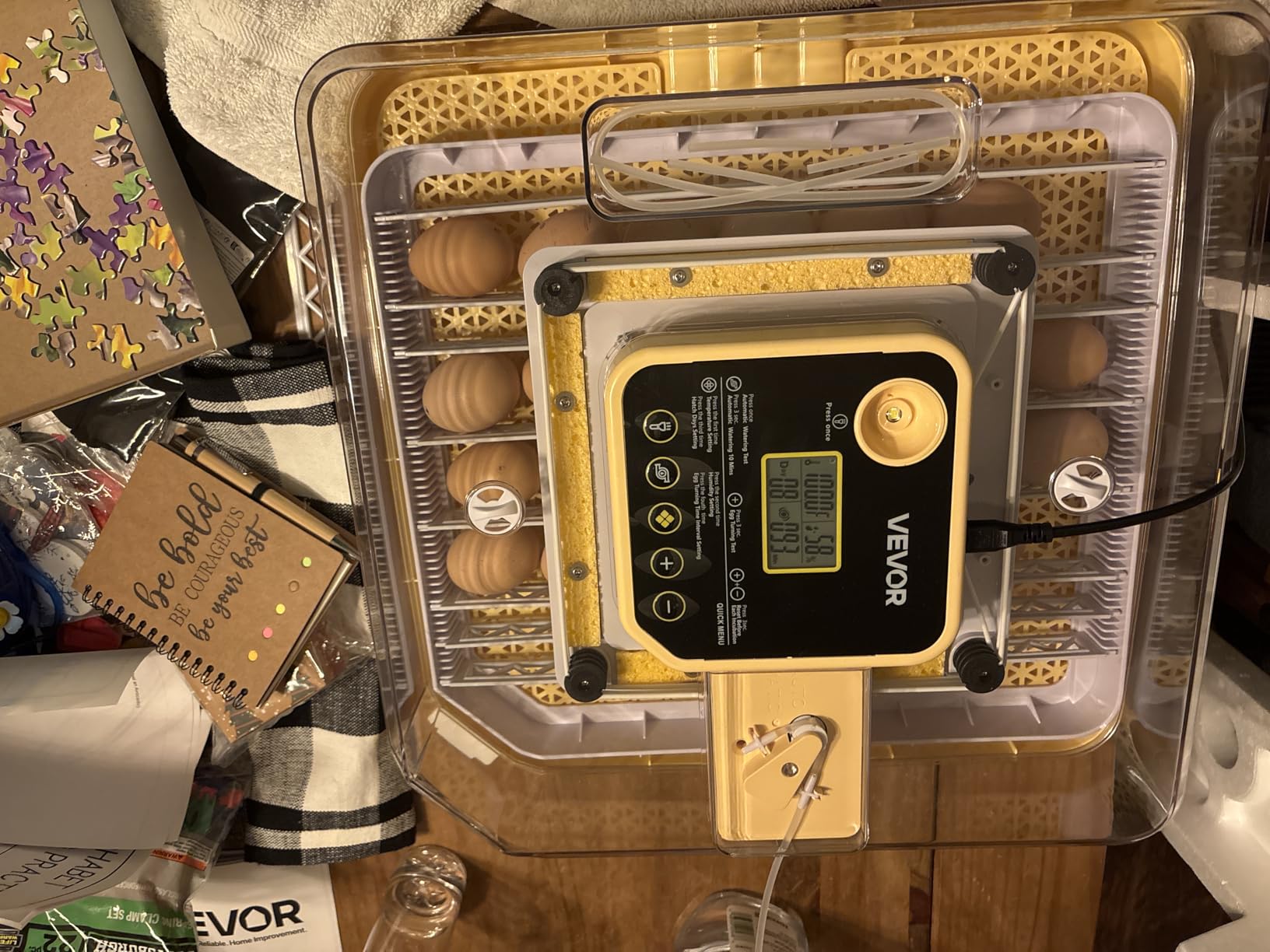
8. VEVOR CR400 400 Egg Incubator: Most Reviewed Cabinet in the Group
VEVOR 400 Egg Incubator, Poultry Incubator Cabinet with Automatic Eggs Turning, Temperature & Humidity Control, Heating & Cooling Egg Hatcher, Commercial Incubators for Hatching Chicks Ducks Goose
400-egg stated capacity
0.9F normal fluctuation
24.02 x 19.49 x 37.6 inches
55.1 lb, 110V with 12V switchover
Pros
- 239 ratings
- most reviewed here
- 360-degree air circulation
- Integrated humidity sensor with display
- Transparent shell with built-in lighting
- Manual 12V battery switchover for outages
Cons
- 26% of ratings are one-star
- Overall 3.6 stars
- Heating and cooling is the least specified element
The CR400 is the most transparent cabinet in this roundup because 239 people have rated it, and the results are genuinely split. Fifty-two percent are five-star and twelve percent four-star, which is a good core. But twenty-six percent are one-star, the highest single negative share of any cabinet here, and 3.6 stars overall is the lowest rating in the group.
What the satisfied owners praise is specific: 360-degree air circulation for even temperature and humidity distribution, an integrated sensor with a real-time display of humidity fluctuations to help prevent shell breakage, automatic 360-degree turning, and a transparent shell with built-in lighting so you can watch embryo development without opening anything.
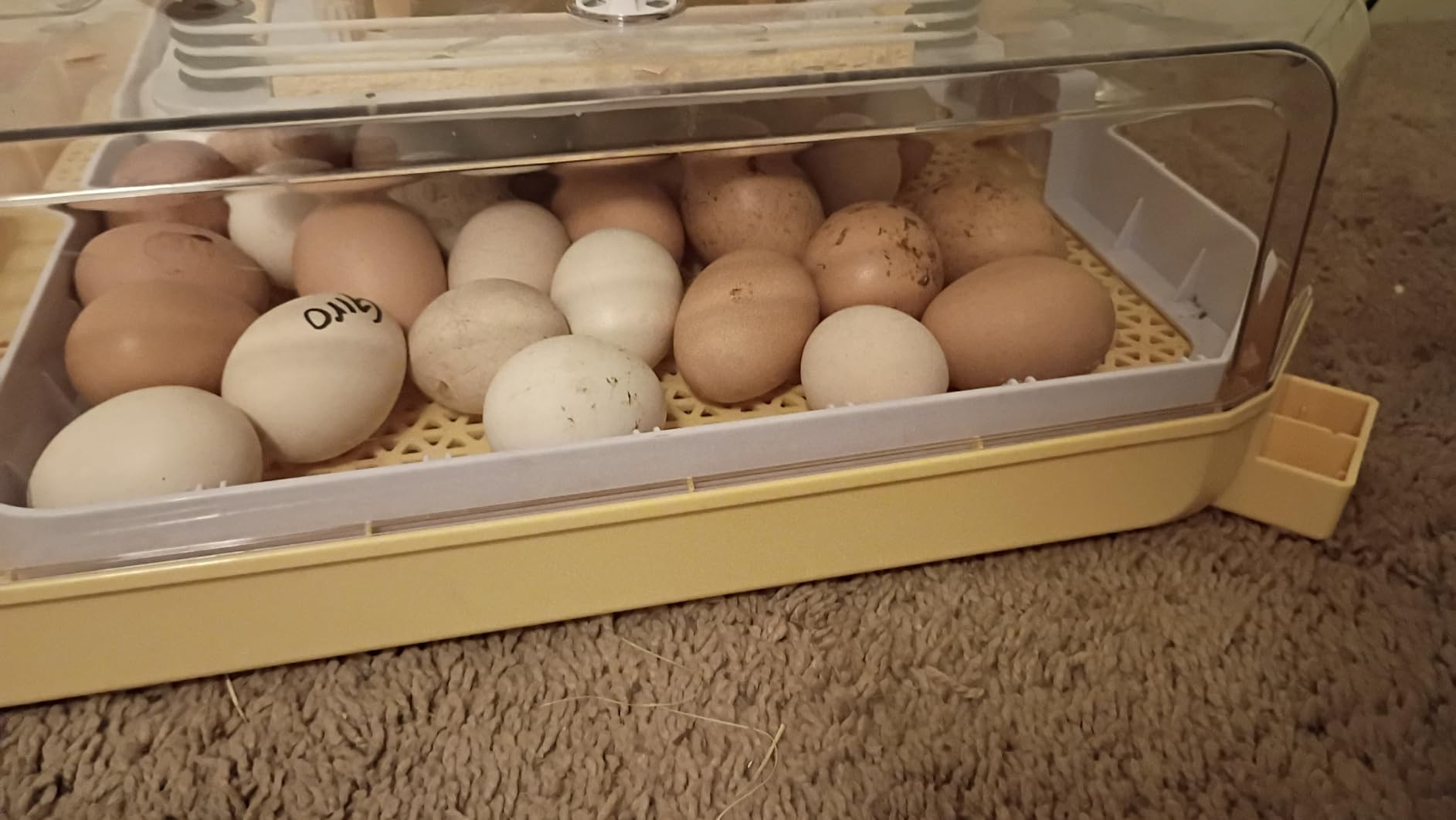
The practical details are well handled for the money. It is 24.02 x 19.49 x 37.6 inches and 55.1 lb, which is a smaller footprint than either 400-egg cabinet above it, with a PP shell for stability. Stated normal temperature fluctuation is 0.9F, and the manufacturer is clear that this range does not affect incubation. The stylised foam packing can be kept for extra insulation in cold rooms.
Why the 12V switchover matters more than it sounds
On 110V, this cabinet can be manually switched to a 12V battery. That is the only explicit outage provision in this entire roundup, and it is more useful than it first appears. A full cabinet of eggs in week two is the single most expensive thing to lose in a power cut, and being able to move the load onto a battery while you restore power is a genuine advantage at this tier.
The 360-degree turning here is the same rotary mechanism as the two cabinets above it, so expect the same stacking behaviour, and the multi-species claim covers poultry, small birds and reptiles in a 400-egg volume. A 36-egg and 48-egg version of the same design also exist if 400 is more cabinet than you need.
Where the VEVOR will let you down
Heating and cooling is the least specified element of the control system, and the 26% one-star share points at exactly that. Buyers who succeed tend to praise circulation, sensors and turning; the dissatisfied group reports control accuracy, turning reliability and durability problems. At this rating you are buying a known quantity, which is both the risk and the reason the sample is so valuable.
Keep the 0.9F fluctuation figure in mind when you read glowing claims from higher-priced cabinets. Every incubator in this category has some fluctuation, and the ones that publish their number deserve more credit than the ones that do not.
How to Choose a Cabinet Incubator for Hatching Eggs
The right cabinet is the one whose format matches how often you set eggs, and almost nothing else matters as much. Buyers routinely get this wrong in both directions, overbuying capacity they will never fill or underbuying hatching space for a schedule they already committed to.
Setter, hatcher or combined: pick the format that matches your hatch calendar
A setter holds eggs for the first 18 days with automatic turning. A hatcher holds eggs still at higher humidity for the final three days. A combined unit, marked SH or C in model numbers, does both in one cabinet using the same racks early and hatching baskets late.
Combined suits almost every first-time buyer and anyone hatching one or two batches a season. The cost is dead capacity in the final three days, when the turning racks sit empty and the cabinet is running hot and wet.
A setter plus a hatcher pair pays off the moment you start a new batch before the last one finishes. Three setters feeding one hatcher is the pattern most experienced breeders converge on, and it removes the day-18 transfer confusion that trips up beginners using a single unit.
Hatcher-only cabinets only make sense in that pair, or alongside a combined unit you already own. A hatcher with no setter is a very expensive storage cupboard.
Sizing capacity from your batch schedule
Work out your largest realistic batch, then work out how many days a year you will fill it. A breeder setting 60 eggs once a year does not need 288 egg capacity, and a breeder setting 60 eggs every week needs far more than 60.
For chicken eggs, a practical rule is to size to roughly 1.5 times your typical full batch so you have room for a poor fertility week. Quail changes the maths completely: the GQF 1500 and 1502 hold 1368 quail eggs where they hold 288 chicken eggs, so quail operators should think in trays rather than egg counts. Duck, turkey and goose sit between the two, and goose needs large-egg racks that are usually a separate purchase.
Also check the hatch tray size against your batch. This is the hidden capacity limit nobody mentions: a large setter with a small hatching tray means only part of your batch hatches at once, and the rest sits past the right hatch window waiting for space.
Humidity hardware and dry rooms
Humidity is where home hatching usually fails, and the hardware matters more than the readout. A basic moisture pan needs topping up daily or twice daily. Wick pads and a water pan cover are better. A water reserve system with a larger tank, such as the 3030 unit on the GQF 1502, removes the daily chore entirely. Automatic humidification systems, where you fill a reservoir and the machine meters the moisture, are the strongest option in dry climates.
Two environmental factors push you toward better hardware. Altitude lowers the boiling point of water and slows evaporation, so a dry mountain climate or a heated indoor room in winter both need more moisture than the same cabinet would need on a mild coast. Check whether the cabinet has a room sensor paired with its alarms, because that tells you whether the cabinet or the room is the problem.
Where the cabinet goes and what an outage does
Every cabinet in this roundup except the rotary imports is rated for indoor use in a draft-free, temperature-controlled room. That is a real constraint for a lot of people, whose instinct is to put the incubator in the barn next to the birds. It is worth remembering that room temperature compensation is a cabinet feature and a stable room is a precondition for it.
Plan for outages too. A full cabinet holds 70 to 425W depending on model, so it is the largest continuous load in a typical outbuilding. A generator, an inverter with enough headroom, or a cabinet with a battery switchover such as the VEVOR CR400 will protect a batch. Unattended candle-and-bucket hatching is a last resort, and a temperature drop of more than a few hours in week two is a real loss risk.
Hidden costs: racks, covers, trays and the brooder
Some cabinets arrive without plastic egg trays, and quail, goose and large-egg racks are almost always separate purchases. A combined unit that you intend to use for both stages may require specific setter tray covers, as the HB700S does with its FLX35Y-K covers. Automatic humidification is an add-on on many bare cabinets.
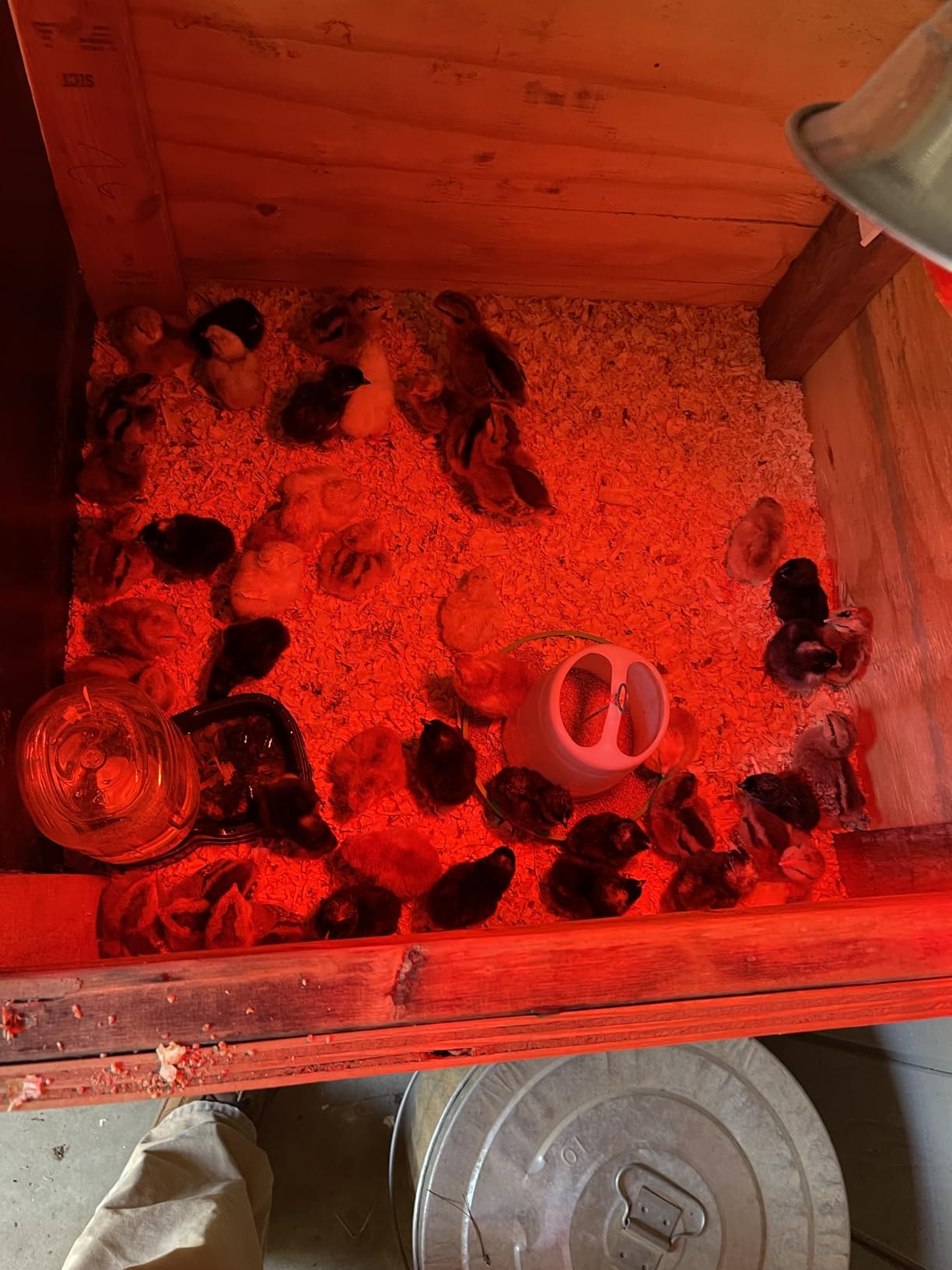
Then there is the brooder. A cabinet incubator hatches eggs. It does not raise chicks. Chicks need a heat source, bedding and shelter from about day one through to feathering, so budget for a brooder as part of the system, not as an afterthought. Experienced breeders keep a small tabletop unit alongside the cabinet anyway, for odd batches and for the awkward week after hatch day.
Finally, check warranty length, support location and replacement part availability before you buy. Published warranty terms, US-based support, and the ability to reorder turning racks, wick pads, water reserve systems, doors and casters years later are what separate a cabinet that stays in service for a decade from one that ends up in a corner of a shed.
Frequently Asked Questions
Which incubator is the best for hatching eggs?
For most backyard breeders, the Hatching Time Cimuka CT180 SH is the best cabinet incubator for hatching eggs. It sets and hatches in one cabinet, turns eggs automatically, regulates humidity itself and holds up to 180 chicken eggs, and it has the largest owner review base of any cabinet we compared. If you hatch weekly batches, the GQF 1500 setter with a 1550 hatcher gives you more usable hatch cycles per year.
What is setter and hatcher in incubator?
A setter is the part of the system that holds eggs for the first 18 days, usually on racks that turn the eggs automatically. A hatcher holds eggs still at higher humidity for the final three days so chicks can pip and dry. A combined unit, marked SH or C in model numbers, does both in one cabinet. Most model names use S for setter only, H for hatcher only and SH or C for combined.
Is a cabinet incubator worth the money compared to a tabletop unit?
A cabinet earns its cost once you hatch more than roughly 30 eggs at a time, or whenever you cannot turn eggs and manage humidity reliably by hand. It holds temperature and moisture steady across a large batch and turns on a schedule, which is what keeps hatch rates consistent. For a handful of eggs a year, a good tabletop incubator is still the sensible purchase.
How do I choose the right size cabinet incubator?
Size to about 1.5 times your largest realistic batch, then check that the hatching tray or baskets can hold that batch at once, since a big setter with a small hatch tray only frees part of the batch at a time. Think in quail trays rather than egg counts for quail, where the same cabinet can hold well over a thousand eggs. Buy large-egg racks separately for goose and emu.
Do I need a brooder after hatching in a cabinet incubator?
Yes. A cabinet incubator hatches eggs but does not raise chicks. Chicks need a separate heat source, dry bedding and shelter from about day one until they are fully feathered, so plan a brooder as part of the same budget. Many experienced breeders also keep a small tabletop incubator for odd batches and for the week after hatch day.
Our Verdict on the Best Cabinet Incubators for Hatching Eggs
The Hatching Time Cimuka CT180 SH is our pick for the best cabinet incubators for hatching eggs. It does the two-stage job in one cabinet, it manages its own humidity, it has alarms with room sensors so you can tell cabinet problems from room problems, and 195 owner ratings is enough evidence to say how it behaves in real use rather than how the brochure describes it.
Pick the GQF 1502 instead if you want the highest owner satisfaction and want the trays and 5-gallon water system in the box. Move to a GQF 1500 plus 1550 pair when you start setting batches weekly, since that is the point where a dedicated setter and hatcher stop wasting hatch days. The HB700S is the right answer at hatchery scale, and the 400-egg cabinets are capacity purchases with real mechanical trade-offs, not precision instruments.
Whichever you choose, put it in a stable room, plan the brooder, and check the warranty and replacement parts before the first batch. Those three things decide more hatch outcomes than any feature on a spec sheet.