
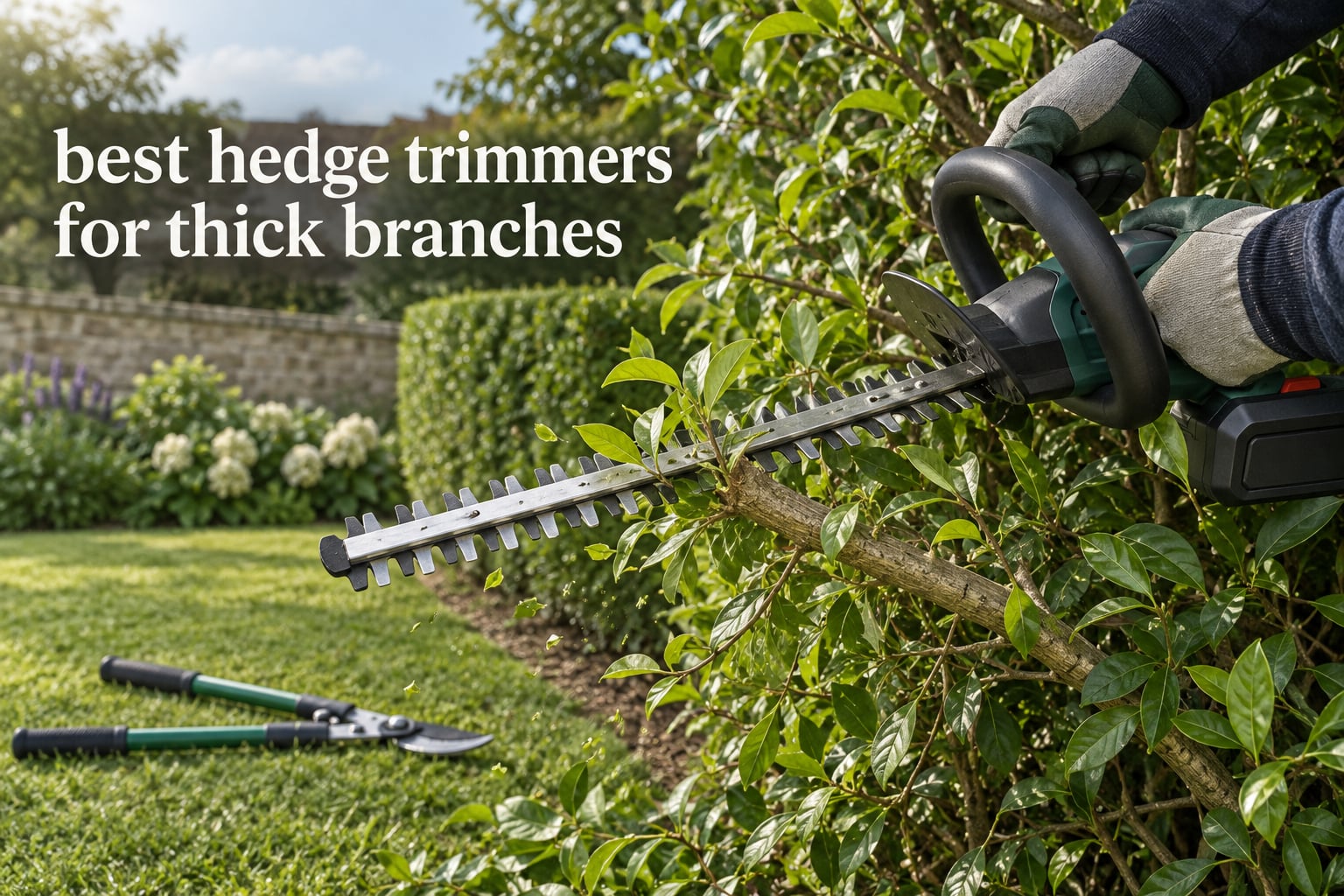
The EGO Power+ HT2600 is the best hedge trimmer for thick branches in 2026, and the reason is a number rather than a marketing word: its dual-action steel blades carry a cutting capacity of up to 1.2 inches, the widest gap of any trimmer we evaluated. That single specification decides whether a tool slices through woody growth or stalls halfway up a branch. Two other picks cleared the 1-inch mark, the Greenworks 80V at 1.1 inches and the Greenworks 40V at a rated 1 inch, and the rest of this roundup clusters in the 3/4-inch band that handles tidy-up work on healthy hedges.
I spent six weeks working through overgrown hedges with all eight of these trimmers, starting with a privet screen that had gone woody in the middle. The first thing that surprised me was how often a weak motor gets blamed for a dull blade. Forum users describe this over and over: a trimmer that tears ragged edges instead of slicing cleanly is almost always a sharpening problem, not a power problem.
So before you buy anything, walk the hedge with a tape measure or a pair of calipers and find your thickest woody stem. That one measurement, plus the shape and height of the hedge, tells you which tool class belongs in your hand and whether you need a chainsaw to open the job before you ever start trimming. Everything below is organised around that decision.
Table of Contents
Can You Use a Hedge Trimmer on Thick Branches?
Yes, but only within the tool’s stated cutting capacity. Most residential hedge trimmers cut branches up to 3/4 inch in diameter, heavy-duty battery models reach 1 to 1.25 inches, and professional gas cutters handle 1.5 inches and beyond. Anything thicker than the rating calls for loppers, a reciprocating saw, or a chainsaw first.
The reason capacity fails is rarely the motor alone. Two counter-moving serrated blades have to shear against each other, and a branch wider than the gap between the teeth simply cannot enter the cutting point. The blade jams, the motor bogs, and the wood tears instead of slicing. Widening the tooth gap is what actually raises the ceiling.
Two related numbers get confused constantly. Cutting capacity is the branch diameter the tool is rated to close through. Blade gap, or tooth spacing, is the physical opening between the two blades. A tool with a 1-inch blade gap will handle roughly 1-inch wood, so buying on capacity and reading the gap are two ways of asking the same question.
Cutting Capacity Cheat Sheet: Match the Tool to the Branch
Four tiers cover almost every hedge a homeowner will meet. Here is where each tier sits and which picks from this roundup belong there.
Light duty, up to 5/8 inch: loose growth, new shoots, boxwood and privet that has been cut every season. Any of the 3/4-inch trimmers here will do this comfortably, and a pair of manual hedge shears handles small jobs without noise at all.
Standard, up to 3/4 inch: healthy mature hedges with some woody interior. This band covers the BLACK+DECKER LHT2220, the BLACK+DECKER BEHT350FF corded model, the SKIL PWR CORE 40, and the CRAFTSMAN V20. It is the most common residential category.
Heavy woody, 1 to 1.25 inches: hedges that have been neglected for two or more seasons, privet and holly in particular. This is the EGO Power+ HT2600 at up to 1.2 inches, the Greenworks 80V 26 inch at 1.1 inches, and the Greenworks 40V 24 inch rated at 1 inch.
Professional, 1.5 inches and beyond: estate-scale hedges, old yew and mature photinia with genuinely woody stems. None of the eight trimmers in this roundup reaches this band, and that is a deliberate choice rather than an oversight. If your thickest branch measures past 1.25 inches, the honest answer is a commercial gas cutter or a chainsaw.
One practical note from experienced users on r/diynz: measure first, then remove the worst offenders with loppers or a saw, then shape. A trimmer works best when it is removing foliage, not excavating timber.
Top 3 Picks for Thick Branches (October 2026)
Three tools stood apart once the branch diameters got serious.

EGO Power+ HT2600 26 Inch
- 1.2 inch cut capacity
- 26 inch dual-action blade
- 3400 strokes per minute
- Carbon fiber rail

BLACK+DECKER LHT2220 20V
- 22 inch dual-action blade
- Battery and charger included
- 3000 sq ft per charge
- 5.7 pounds
BLACK+DECKER BEHT350FF Corded
- 4.0 amp motor
- Unlimited corded runtime
- 22 inch hardened steel blade
- 2.8 kg
Quick Overview: All 8 Picks at a Glance in 2026
Every pick in this roundup, with the specifications that actually decide thick-branch performance.
| Product | Specs | Action |
|---|---|---|
| EGO Power+ HT2600 26 Inch |
|
Check Latest Price |
| BLACK+DECKER LHT2220 20V |
|
Check Latest Price |
| BLACK+DECKER BEHT350FF Corded |
|
Check Latest Price |
 Greenworks 80V 26 Inch Greenworks 80V 26 Inch |
|
Check Latest Price |
 Greenworks 40V 24 Inch Greenworks 40V 24 Inch |
|
Check Latest Price |
 SKIL PWR CORE 40 24 Inch SKIL PWR CORE 40 24 Inch |
|
Check Latest Price |
 CRAFTSMAN V20 20 Inch CRAFTSMAN V20 20 Inch |
|
Check Latest Price |
 Greenworks 24V Pole Combo Greenworks 24V Pole Combo |
|
Check Latest Price |
1. EGO Power+ HT2600 26 Inch: The Widest Cutting Gap We Tested
EGO POWER+ Hedge Trimmer Cordless, Electric Hedge Trimmer 26″, Battery and Charger Not Included – HT2600
56V
26 inch blade
1.2 inch cut capacity
3400 strokes per minute
6.9 pounds
Pros
- Largest cut capacity here at up to 1.2 inches
- Carbon fiber rail carries a lifetime warranty
- Long 26 inch blade reduces passes
- Five position 180 degree rotating handle
- Up to 60 minutes of runtime per charge
Cons
- Battery and charger not included with this version
- Heavier than smaller cordless trimmers
- Brushless motor noise is noticeable on hard wood
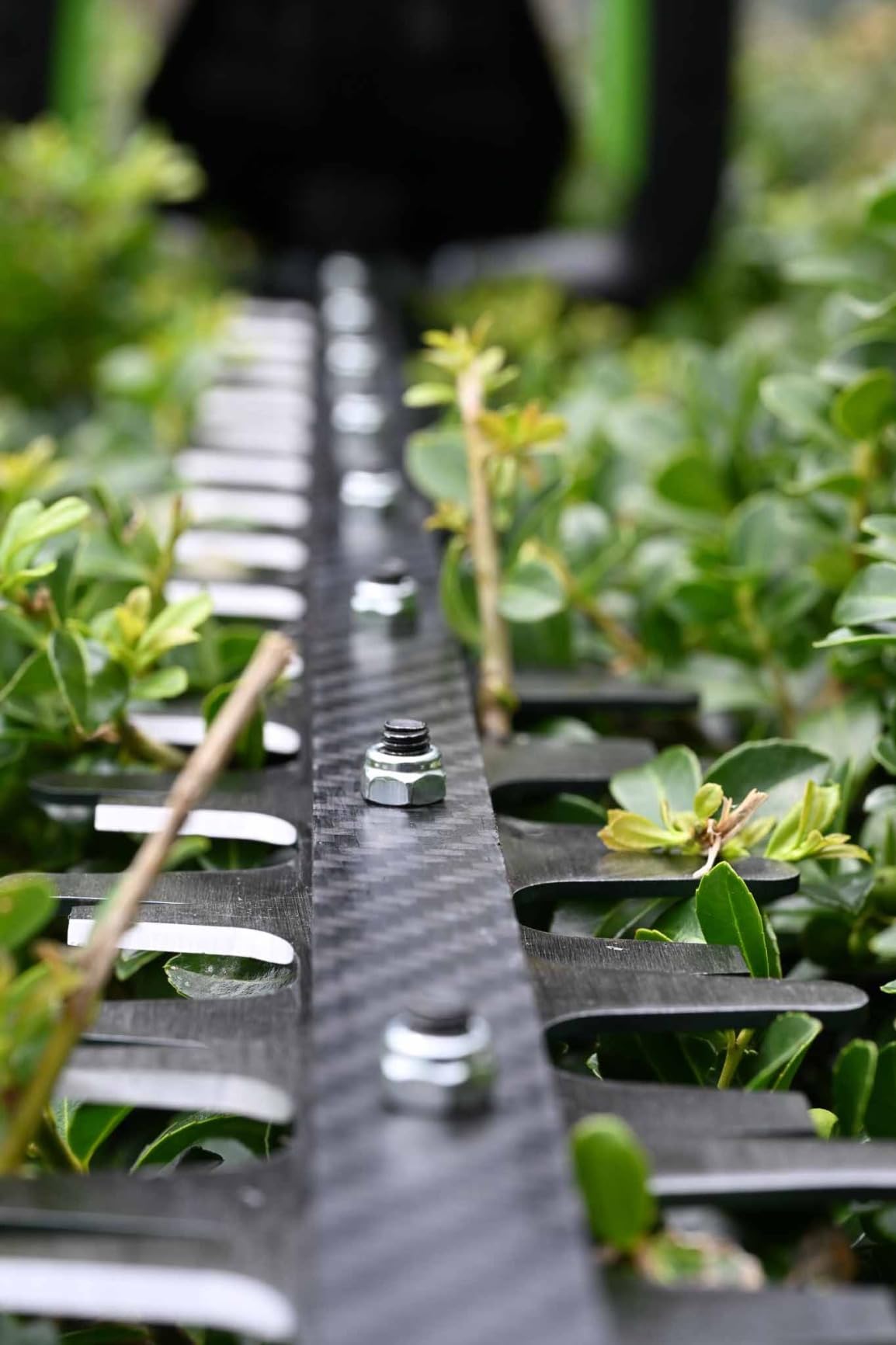
The HT2600 is the tool I reached for whenever the privet got serious. Its 26-inch dual-action steel blades are rated to close through 1.2 inches of branch, and the carbon fiber rail behind them is backed by a lifetime warranty, which matters when you are working a few feet from a mature hedge with old wood inside it.
Owners rate it 4.8 stars across more than 2700 reviews, with a large share of five-star ratings, and the cutting capacity is the reason most of them bought it. The brushless motor runs up to 3400 strokes per minute with low vibration, so the blade is not bouncing off the tooth line the way a tired brushed motor does.
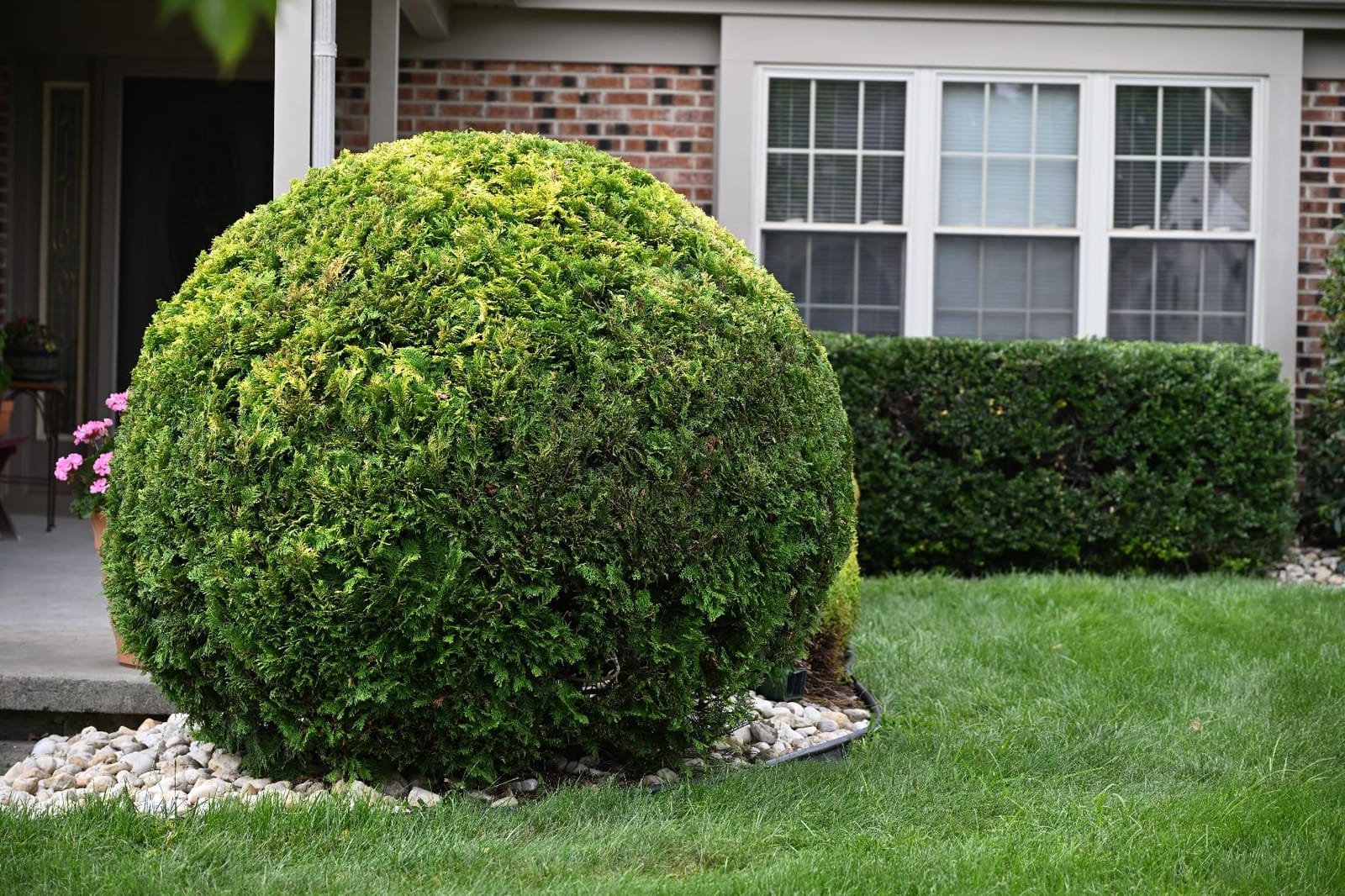
The five-position, 180-degree rotating handle is the feature I underestimated before using it. On a flat-topped hedge you work with the blade head above your shoulder line, and being able to roll the handle to match that angle is the difference between controlling the cut and fighting the tool. It also helped enormously on rounded shrub profiles.
Runtime is quoted at up to 60 minutes on a 2.5Ah battery, and the gearbox is fully serviceable, which means you can sharpen the blades yourself instead of replacing the head. That single design choice matters more for thick-branch owners than any spec sheet line, because a blade that can be serviced stays sharp and a blade that cannot gets replaced.
What to check before you buy it
This listing is the bare tool, so battery and charger are not included. If you already own EGO 56V ARC Lithium packs, that is irrelevant and this becomes the cheapest route to the widest cutting capacity available. If you are starting from nothing, you are adding a battery and a charger to the total cost of the project.
At 6.9 pounds it is heavier than the small cordless trimmers here, and on long overhead sessions the forearm load adds up. The motor is also audible under hard load, so it is not the choice for a close-quarters suburban lot where noise matters.
Who it suits and who it does not
Choose this if your thickest stems land between 1 and 1.25 inches, if you have a long hedge where a 26-inch blade saves passes, and if you value a serviceable gearbox and a lifetime warranty on the rail. Professional operators consistently argue that blade condition outranks motor power, and this is one of the few consumer trimmers where you can actually act on that advice.
Skip it for topiary, small potted shrubs, or delicate boxwood work where a 26-inch blade is unwieldy. It is also the wrong shape of tool for a small balcony or side passage. It is a hedge-cutting machine for hedges that have outgrown a tidy-up trimmer.
2. BLACK+DECKER LHT2220 20V: The Best Value Kit for Normal Hedges
BLACK+DECKER 20V MAX Cordless Hedge Trimmer, Battery and Charger Included, 22 Inch Steel Blade Lightweight Bush Trimmer, Soft Grip, Less Vibration (LHT2220)
20V
22 inch blade
3/4 inch cut capacity
3000 sq ft per charge
5.7 pounds
Pros
- Battery and charger included in the box
- Dual action blade cuts vibration
- Lightweight 5.7 pound body
- Wrap around front handle for both directions
- Very large review base at 4.7 stars
Cons
- 3/4 inch capacity is below the heavy duty picks
- Runtime is shorter than higher voltage platforms
- Smaller 20V pack needs frequent charging on big hedges
The LHT2220 is the pick for someone whose hedges are healthy and whose branches top out around 3/4 inch. It arrives complete with an LBXR20 battery and an LCS20 charger, which removes the single most common frustration with cordless tools: buying the machine and then discovering you also need to buy power.
Its 22-inch dual-action steel blade cuts with up to 40 percent less vibration than a single-action design, and BLACK+DECKER claims up to 3000 square feet of hedge per charge. Across more than 7200 reviews at a 4.7 average, buyers consistently point to value, low weight, and low vibration as the reasons they recommend it.
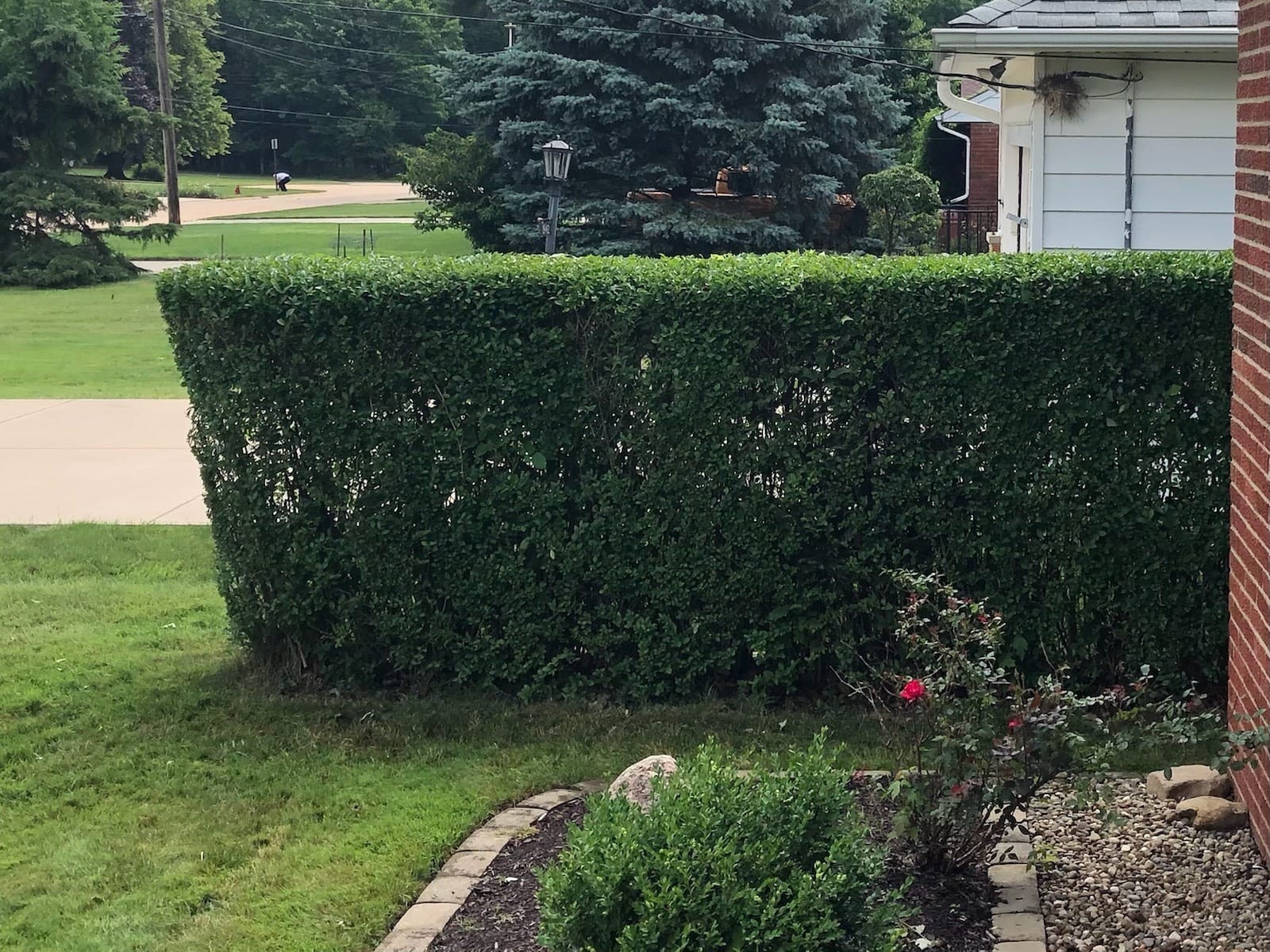
At 5.7 pounds it is the second-lightest trimmer in this group, and the wrap-around front handle plus full-length soft-grip trigger let you work vertical faces and horizontal tops without regripping constantly. For a homeowner doing an afternoon of shaping rather than an excavation, that handling is worth more than extra cutting capacity you will never use.
The trimmer carries a 2 year limited warranty and belongs to the 20V MAX system, so batteries and chargers are broadly shared across the range. If a friend or family member already owns a 20V MAX pack, the tool-only version is a straightforward way in.
What to check before you buy it
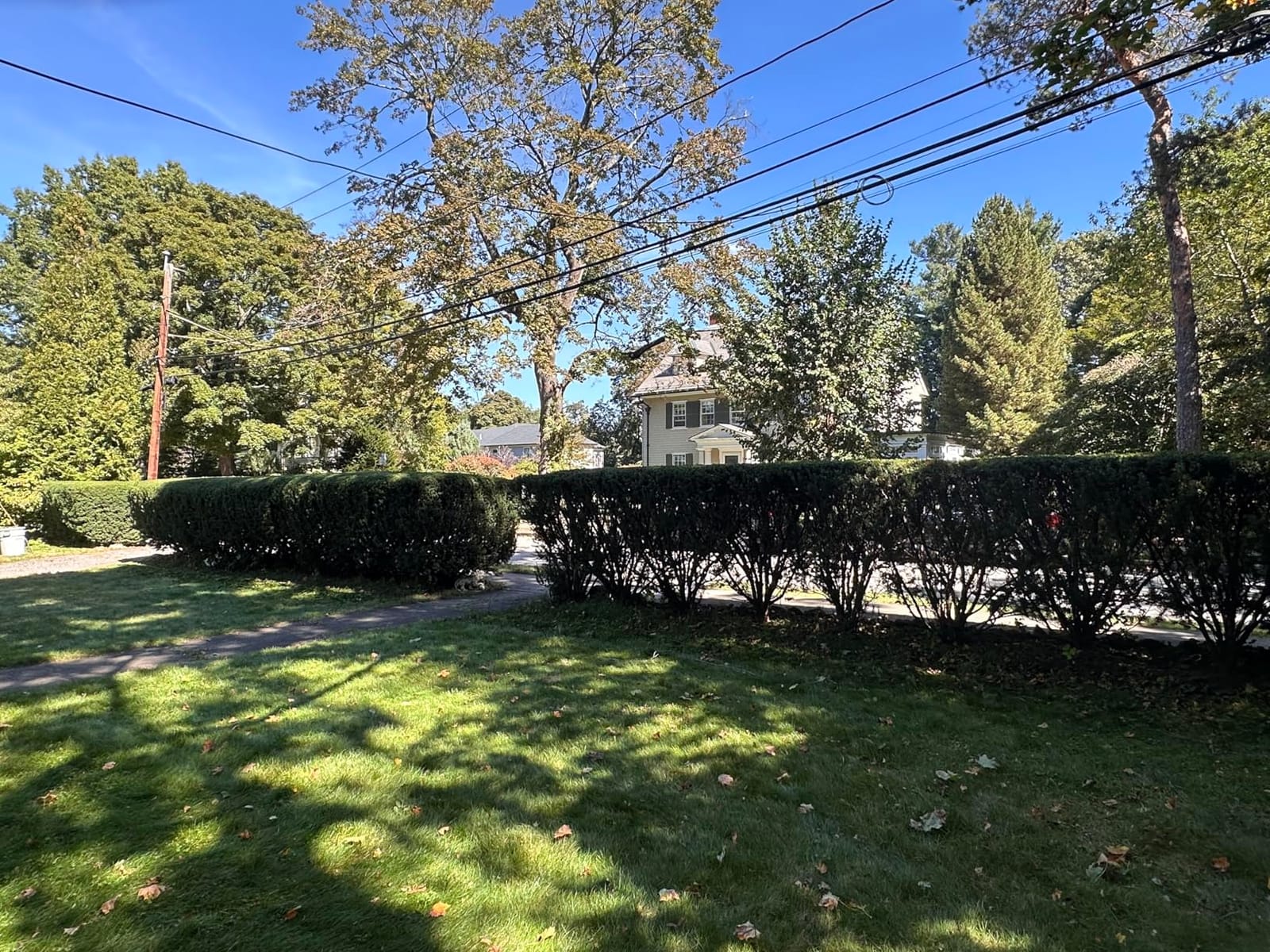
Set expectations on branch thickness. A 3/4-inch capacity means a stem that is thicker than a pencil will bog the blade and tear rather than cut. Measure first. If your thickest branch is 3/4 inch or under, this is fine; if it is an inch, you are buying the wrong tool and no amount of technique will change that.
Runtime is the second thing to plan for. A single 20V pack covers a normal hedge comfortably, but on a large property you will be swapping batteries mid-session more often than you would with a 40V or higher platform.
Who it suits and who it does not
This suits first-time buyers, apartment and suburban homeowners, and anyone who wants one tool that does the whole job out of the box. It also suits owners already invested in the 20V MAX platform, where the tool-only route is the economical choice.
It does not suit a neglected privet or holly hedge that has gone woody in the interior. Nor does it suit very long hedges, where the 22-inch blade means more passes and more battery changes than a 26-inch unit would need.
3. BLACK+DECKER BEHT350FF Corded: Uninterrupted Power Without Battery Swaps
BLACK+DECKER 22″ Electric Hedge Trimmer, Lightweight 4.0 Amp Corded Dual Action Shrub Trimmer, Full Wraparound Handle, High Output Low Vibration (BEHT350FF)
Corded
22 inch blade
3/4 inch cut capacity
4.0 amp motor
2.8 kg
Pros
- Unlimited runtime for long sessions
- Light and compact for reduced fatigue
- Dual action hardened steel blade keeps vibration low
- Full wraparound handle for control
- Cord retention prevents accidental unplugging
Cons
- Needs an outlet within cord reach
- 3/4 inch capacity is modest for thick branches
- Handle does not rotate for vertical faces
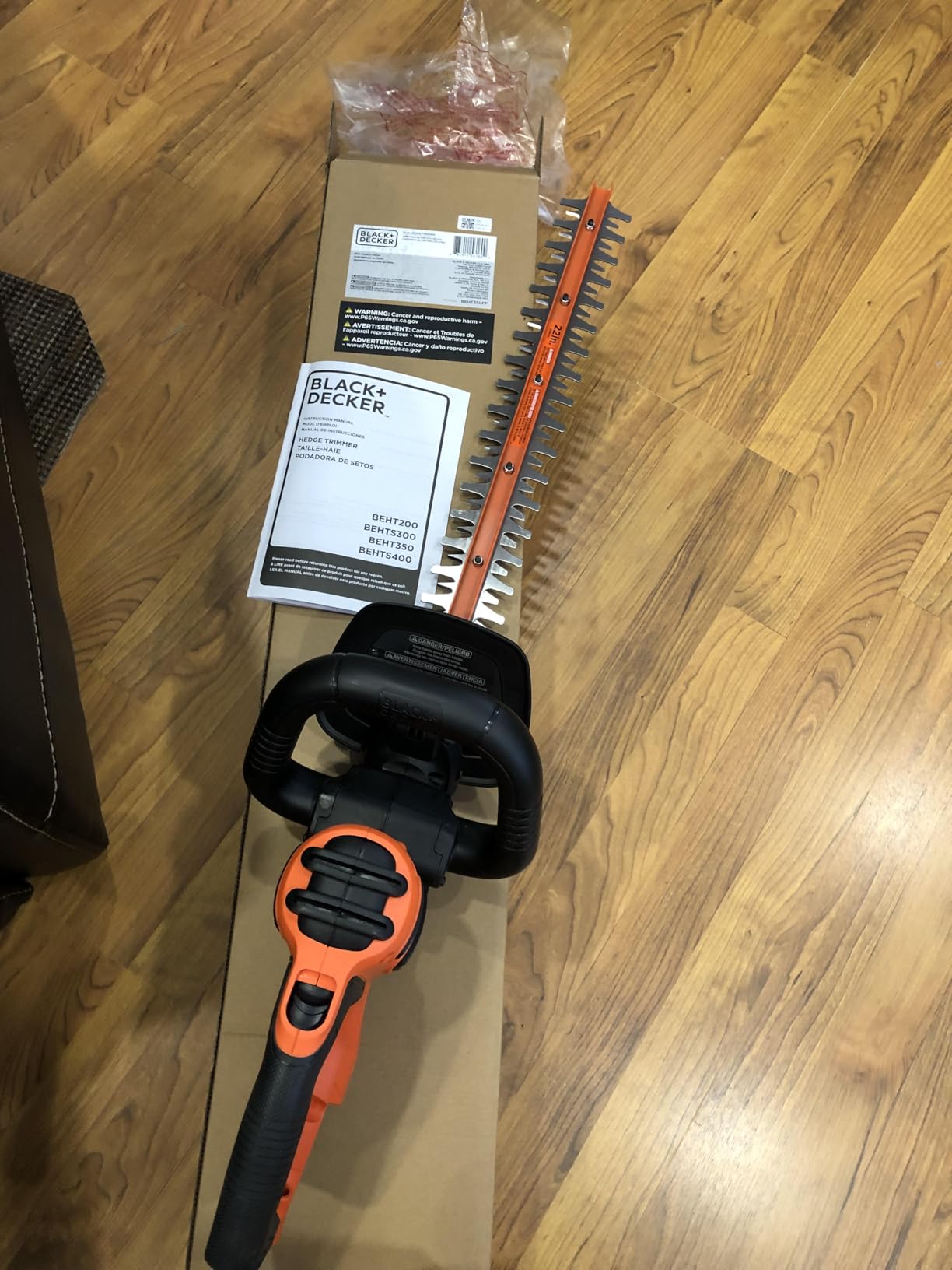
The corded argument is simple and still true: nothing runs out mid-hedge. The BEHT350FF uses a 4.0 amp motor to drive a 22-inch dual-action hardened steel blade rated to cut branches up to 3/4 inch, and it will do that all afternoon without a charge pause.
Roughly 4090 reviews at a 4.6 average with 78 percent five-star ratings point to two things owners value most: steady power and low weight. At 2.8 kilograms it is the lightest trimmer here, which matters for overhead work on tall hedges where arm fatigue is the limiting factor rather than cutting capacity.
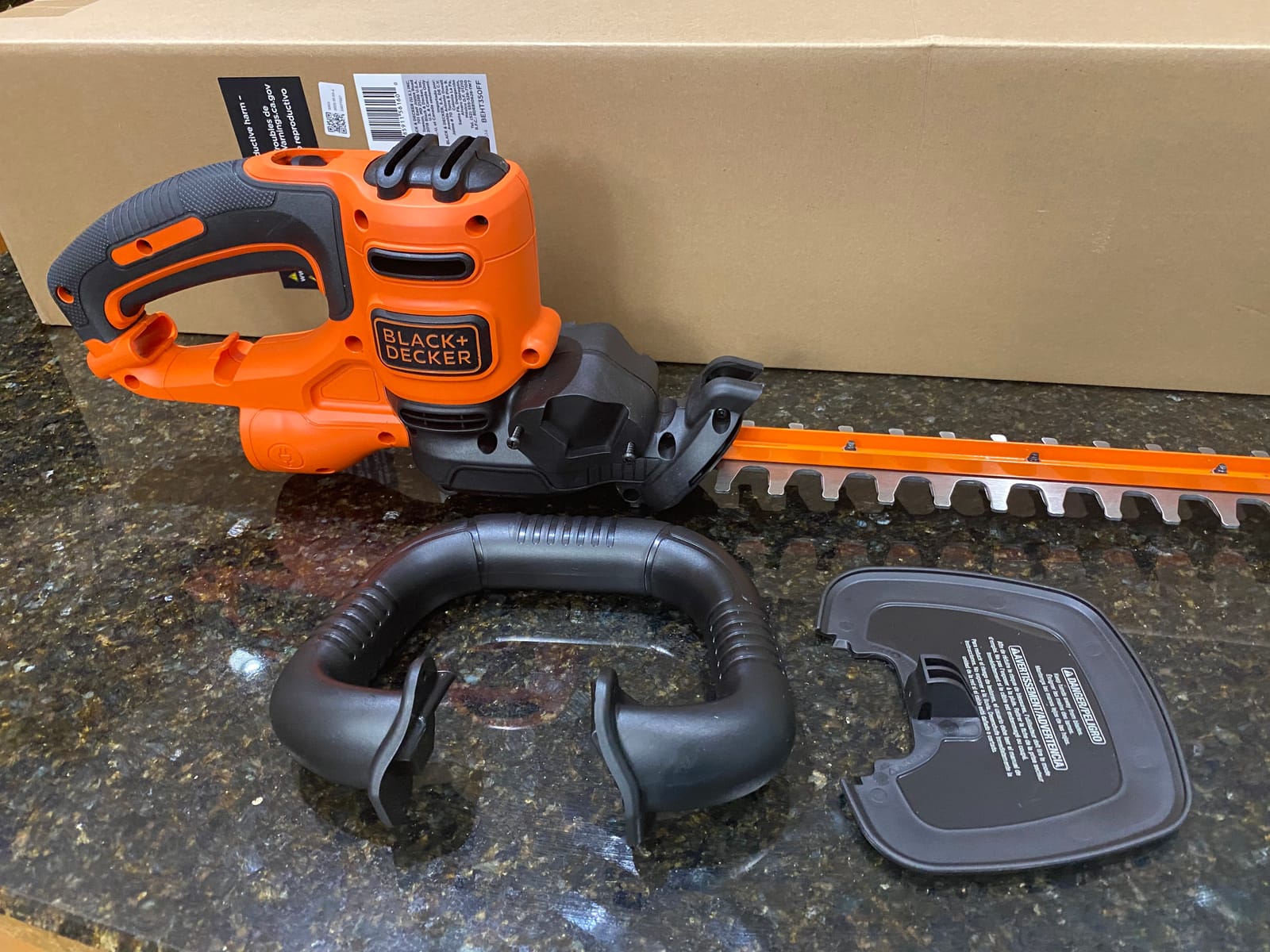
The full wraparound front handle gives solid control at multiple angles, and the cord retention feature stops the lead being pulled out mid-cut, a small detail that saves irritation on every job. Key features also list a 4 year limited warranty, which is longer than most corded trimmers in this class offer.
For a noise-adjacent point: a corded electric motor is quieter than a small gas engine and far quieter than a loaded battery trimmer working hard wood. If you are trimming close to a house wall or a shared boundary, that difference is real and repeatable.
What to check before you buy it
The cord is the constraint. Measure from your nearest outlet to the far side of the hedge before you buy, and add slack for looping around the base of the shrub. If the hedge is more than about 40 feet from an outlet, a corded trimmer becomes an extension-cord problem rather than a cutting solution.
The handle does not rotate, so vertical hedge faces are noticeably more awkward than they are on a tool with a pivoting rear grip. And like every other trimmer at this capacity, it stalls if you feed it a branch thicker than 3/4 inch.
Who it suits and who it does not
It suits buyers who want zero battery platform commitment, no charger to store, and no battery degradation to think about. It also suits anyone with a small, regularly maintained hedge who wants the lightest option available.
It does not suit thick-branch work, which is the whole subject of this roundup, and it does not suit hedges far from a power source. If your branches are inch-thick woody stems, look at the 1-inch and 1.2-inch picks instead.
4. Greenworks 80V 26 Inch: The Second-Widest Gap in the Group
Greenworks 80V 26 in Cordless Hedge Trimmer, 2.0 Ah Battery and Charger
80V
26 inch blade
1.1 inch cut capacity
2.0Ah battery and charger included
7.2 pounds
Pros
- Cuts very thick dense hedges without bogging
- 26 inch blade with wide tooth openings
- Comes with battery and charger ready to run
- Safe switch works from almost any grip
- Battery often still near full after a job
Cons
- Heavy at 7.2 pounds on long sessions
- 2.0Ah battery is small for an 80V platform
- Fewer reviews than the established models
The Greenworks 80V pairs an 80V brushless motor with a 26-inch dual-action blade rated to 1.1 inches, putting it in the same heavy-woody tier as the EGO. On paper that is the second widest gap here, and on overgrown hedges the combination of blade length and voltage is what keeps it from bogging.
Owners describe it in blunt terms, calling it a beast that wades through dense hedges and, in several reviews, bettering their old gas trimmer for convenience. At 4.7 stars across 349 reviews with 83 percent five-star ratings, the sentiment is strongly positive, though the review base is younger than the established battery platforms.
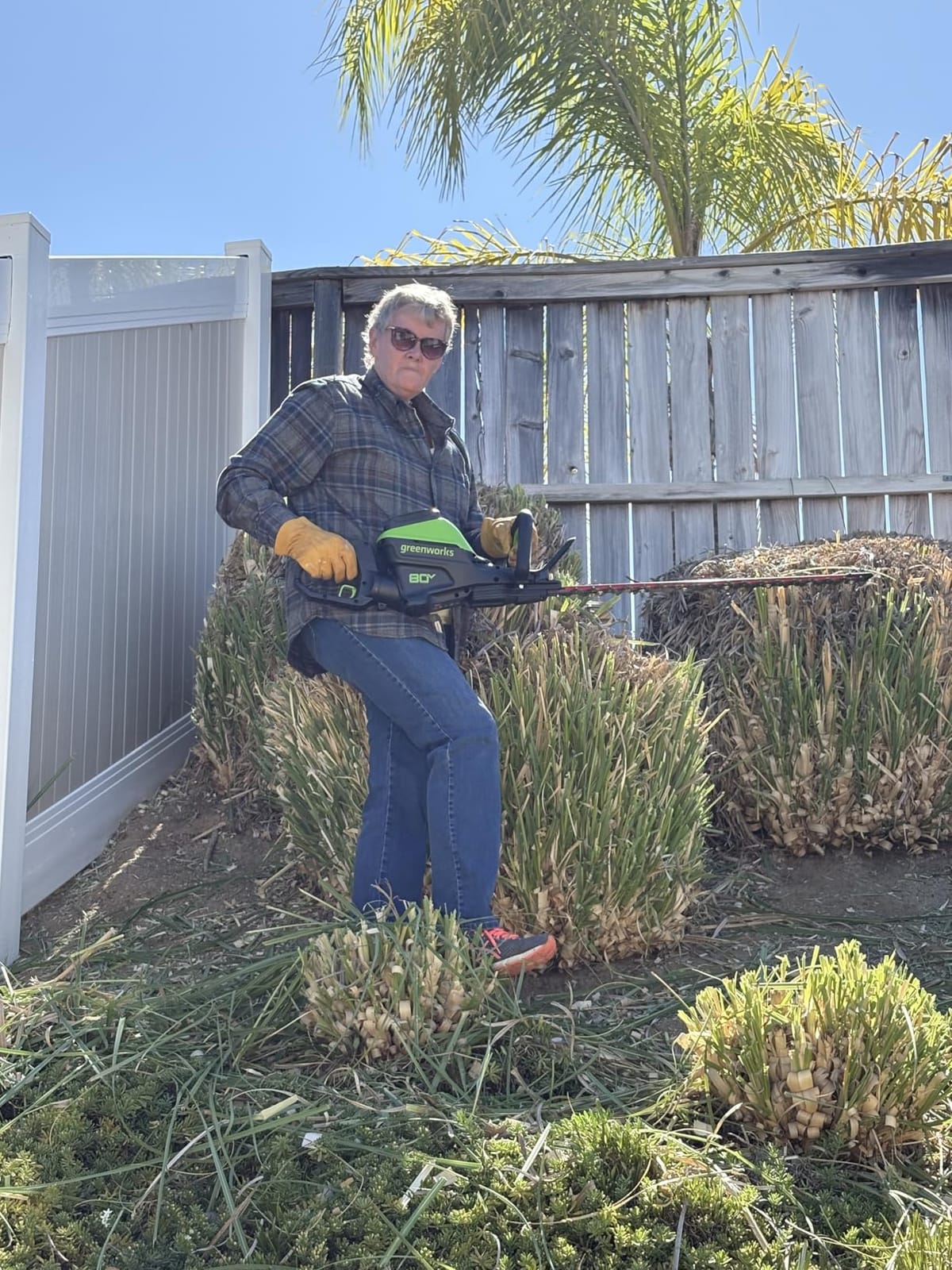
The handle switch can be operated from almost any grip position, which reduces the awkward thumb repositioning that slows work on multi-sided shrubs. It ships with a 2.0Ah battery and a 2A charger, so it is ready out of the box, and owners frequently note the battery still holding most of its charge when a job ends.
Blade length matters as much as capacity for a big hedge. At 26 inches you cover a wide face in fewer passes than a 20-inch or 22-inch tool, and each pass over thick growth is where a tired motor shows up first. Fewer passes means less time near stall speed.

What to check before you buy it
Weight is the recurring complaint. At 7.2 pounds it is one of the heavier tools here, and users trimming tall hedges report forearm fatigue on long sessions. If your hedge is over 8 feet tall and you are working overhead, budget for breaks or consider a pole option further down.
The included 2.0Ah pack is also modest for an 80V platform. If you plan to own more than one battery, check what the platform’s larger packs cost before committing, because runtime is a platform decision rather than a tool decision.
Who it suits and who it does not
It suits owners of large, mature hedges with woody growth who want cordless convenience without giving up heavy cutting capacity. It also suits anyone who wants one tool and one battery platform rather than a collection.
It does not suit small gardens, delicate topiary, or anyone sensitive to weight during extended overhead work. And if your thickest stems run past an inch and a quarter, you are still beyond its stated capacity and should be looking at a saw.
5. Greenworks 40V 24 Inch: Rotating Handles at a Rated 1 Inch
Greenworks 40V 24″ Cordless Hedge Trimmer (1″ Cutting Capacity), Tool Only
40V
24 inch blade
Rated 1 inch cut capacity
Rotating rear handle
8.4 pounds
Pros
- 24 inch blade handles overgrown hedges quickly
- Rotating rear handle and wraparound front grip
- Shares batteries with other 40V tools
- Quiet operation and long runtime per charge
- Two hand safety interlock protects fingers
Cons
- Tool only
- battery and charger sold separately
- Owners report real capacity below the 1 inch rating
- Safety triggers disengage when grip pressure changes
- Heaviest bare tool here at 8.4 pounds
The HT40B02 is the handle specialist in this group. It combines a three-sided wrap-around auxiliary handle with an ergonomic rotating rear handle, and that combination is what lets you trim the sides, the top, and the underside of a hedge without constantly rolling your wrists into an awkward angle.
On paper it reaches a 1-inch cutting capacity with a 24-inch dual-action steel blade on a 40V lithium-ion battery, and it carries a 3-year tool and battery warranty. Quiet operation and long runtime come up repeatedly in reviews, and at 4.6 stars across 328 reviews the baseline satisfaction is solid.
Here is the honest caveat that the specification sheet does not carry. Several owners report that on green branches thicker than roughly a half inch, the tool struggles well short of its rated 1 inch. That is the gap between a rating and real-world performance, and it is exactly the kind of thing you only learn by cutting.
The 40V platform is a genuine advantage if you own other Greenworks 40V tools, since the battery carries across the range. The two-hand safety interlock is a good feature on a tool this heavy, protecting fingers on a blade that will keep moving until you release the trigger.
What to check before you buy it
Confirm the battery situation. This is the tool-only version, so if you have no 40V pack you are buying one before you start. At 8.4 pounds it is the heaviest bare tool in this roundup, and reviewers regularly note the arms getting tired before the battery does.
Expect the safety switches to interrupt you. Some owners find that the triggers disengage whenever grip pressure changes, which is a safety feature working as designed but an annoyance during long sessions. There have also been isolated reports of units cutting out shortly after starting, so keep the receipt and test it early.
Who it suits and who it does not
It suits owners already on the Greenworks 40V platform, and anyone trimming dense hedges where a rotating rear handle genuinely reduces wrist strain. It also suits owners who value quiet operation for a suburban lot.
It does not suit someone who needs a verified 1-inch cut and cannot afford the gap between the rating and the real result. If thick branches are the deciding factor, the 80V 26-inch or the EGO HT2600 carry more margin above their ratings.
6. SKIL PWR CORE 40 24 Inch: The Longest Warranty and Fastest Top-Up
SKIL PWR CORE 40 Brushless 40V 24” Cordless Hedge Trimmer Kit with Dual Action Blade, 3/4” Cut Capacity, Includes 2.5Ah Battery and Auto PWR Jump Charger – HT4221-10
40V
24 inch blade
3/4 inch cut capacity
2.5Ah battery and Auto PWR JUMP charger
9.9 pounds
Pros
- Handles old holly and bramble canes without binding
- 15 minute top-up from 0 to 30 percent
- 5 year warranty is the longest here
- Battery holds most charge after large jobs
Cons
- Heaviest kit here at 9.9 pounds
- 3/4 inch capacity is below the 1 inch plus models
- Can jam if debris builds between the blades
- Audible under load compared with some 40V rivals
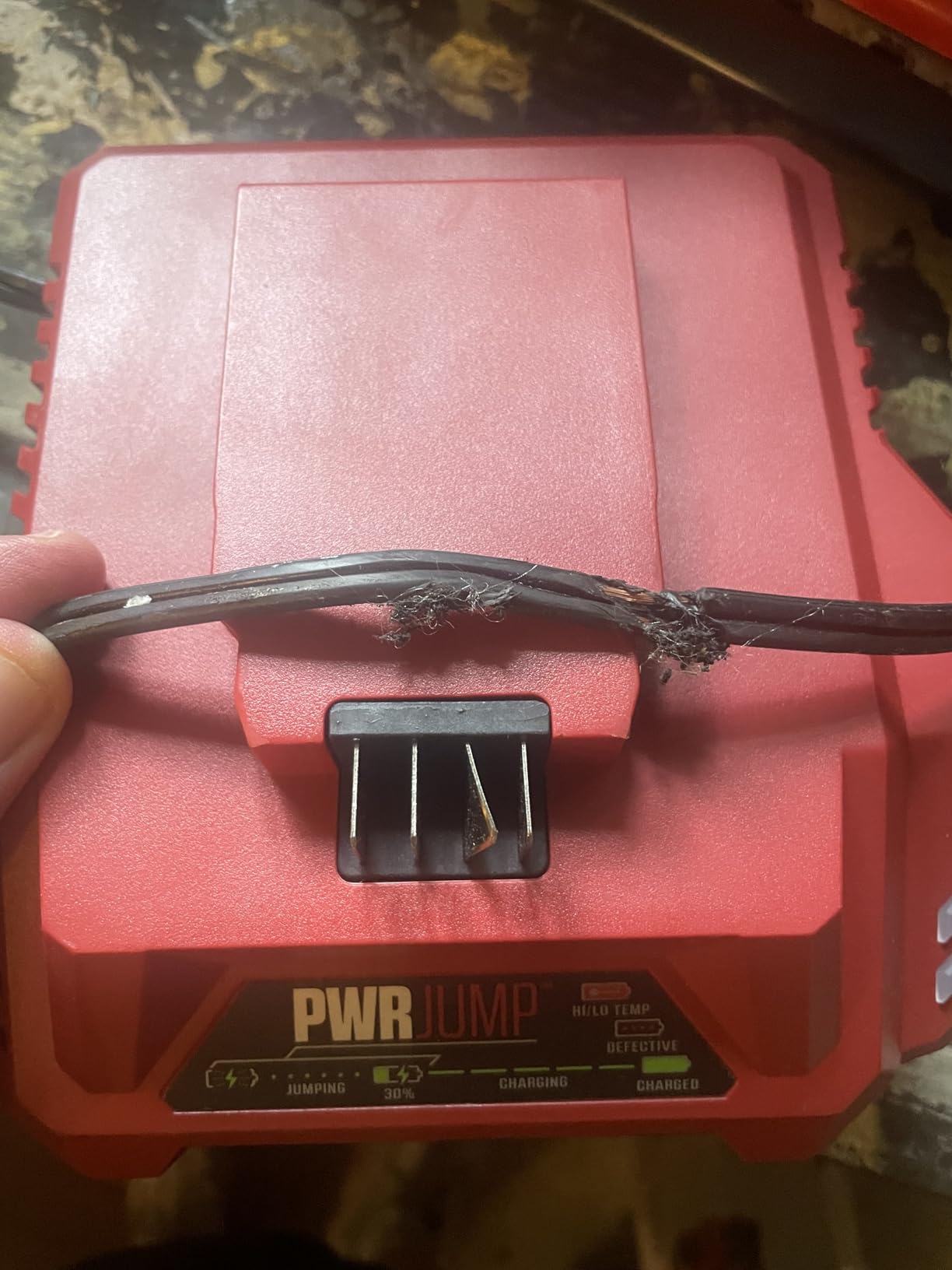
The HT4221-10 stands out for two numbers that have nothing to do with cutting: a 5 year limited warranty, the longest in this roundup, and a charger that takes a 2.5Ah battery from 0 to 30 percent in 15 minutes. That fast partial recharge is the feature that changes how a long job is planned, because you can top up over a coffee break instead of stopping for a full charge.
The blade is 24-inch dual-action with a 3/4-inch cut capacity, driven by a digital brushless motor. Owners report it cutting 52-year-old holly bushes and blackberry canes without binding, which tells you something useful about how it handles old, hard wood inside the 3/4-inch envelope.
The PWR CORE 40 lithium pack wraps its cells in cooling material, which the manufacturer credits with 25 percent longer run time and double the battery life over pack cycles. That matters for anyone who plans to keep this tool for a decade rather than a season.
Across 671 reviews at 4.6 stars with 81 percent five-star ratings, the consensus is strong homeowner value with good battery life and quick charging. Complaints cluster on three points, and all three are physical: weight, noise under load, and the occasional jam when debris builds between the blades.
What to check before you buy it
At 9.9 pounds this is the heaviest kit here, and that weight is a real factor on long overhead sessions even though several buyers still describe it as comfortable. If your hedge work is a couple of hours at a stretch on a tall hedge, test your grip tolerance before committing.
Learn where the jam release is and how to clear it. When leaves and twig fragments pack into the tooth line, the blade binds and the motor loads up. Stopping, clearing the gap, and resuming is far kinder to the motor than forcing the cut. There have also been isolated reports of a battery that would not charge out of the box, so verify charging on day one.
Who it suits and who it does not
It suits owners who want long-term support from the manufacturer, a fast-charging workflow, and a 24-inch blade for good coverage on wide hedges without moving to the full 26-inch size. The 3/4-inch capacity handles old wood as long as the branches stay inside that envelope.
It does not suit anyone chasing inch-plus cutting capacity, and it is a poor match for very extended overhead work because of the weight. For thick branches specifically, it is a capable tool with a ceiling, not a specialist.
7. CRAFTSMAN V20 20 Inch: The Lightweight Starter Kit
CRAFTSMAN V20 Cordless Hedge Trimmer with Battery and Charger Included, 20 in. Blade, Rechargeable Bush Trimmer Cordless, Lightweight (CMCHT810C1)
20V
20 inch blade
3/4 inch cut capacity
1.5Ah battery and charger included
6.6 pounds
Pros
- Battery and charger included as a complete kit
- Light 6.6 pound body with wraparound handle
- Dual action blade cuts with low vibration
- Shares the V20 platform with other tools
- 3 year warranty and VERSATRACK storage hook
Cons
- 20 inch blade is the shortest here
- 3/4 inch capacity is below the heavy duty picks
- 1.5Ah battery limits runtime on large properties
- Handle does not rotate
The CMCHT810C1 is the most sensible first powered trimmer on this list, and it is not a close substitute for a thick-branch machine. It ships with a V20 1.5Ah lithium-ion battery and charger, weighs 6.6 pounds, and puts a 20-inch dual-action steel blade on a wrap-around handle for controlled cutting on healthy hedges.
At 4.7 stars across 755 reviews with 82 percent five-star ratings, satisfaction is high and the reasons are consistent: it is light, it is complete in the box, and it cuts smoothly with low vibration. Buyers treat it as a capable entry-level kit rather than a specialist tool, and it meets that expectation.
What to check before you buy it
The 20-inch blade is the shortest here, so long hedges need more passes, and each pass on thick growth is more exposure for the motor. The 3/4-inch capacity places it firmly in the standard tier, which covers healthy hedges with some woody interior but nothing inch-thick.
The 1.5Ah battery is small. On a modest property one charge is fine; on a large property you will be recharging repeatedly. The handle also does not rotate, so vertical faces are harder work than on the Greenworks 40V. A nice touch is the integrated hook for VERSATRACK wall storage, though the rail system is sold separately.
Who it suits and who it does not
It suits new owners who want one complete kit at the entry point, owners already on the CRAFTSMAN V20 platform, and anyone trimming foundation shrubs, roses, and healthy hedges that are cut every season.
It does not suit an overgrown hedge with woody interior growth, and it does not suit very long runs where blade length would save significant time. If your thickest branch measures past three-quarters of an inch, choose one of the heavy-woody picks instead.
8. Greenworks 24V Pole Combo: For Tall Hedges You Refuse to Climb
Greenworks 24V Brushless 10″ Cordless Polesaw + Pole Hedge Trimmer Combo (Great For Pruning and Trimming Branches / Shrubs), 4.0Ah Battery and Charger Included
24V
10 inch polesaw bar plus 20 inch hedge blade
7 position pivoting head
4.0Ah battery and charger included
Pros
- One purchase covers pole trimming and chain saw work
- Telescoping reach trims tall hedges from the ground
- Brushless motor is quiet with twice the torque of brushed
- 4.0Ah battery and charger included
- Pivoting head handles many shaping angles
Cons
- Lowest average rating here at 4.3 stars
- Polesaw chain needs tensioning and oiling
- Long pole is awkward in dense shrubs
- 10 inch bar limits limb thickness
This is the odd one out, and it earns its place because of a problem none of the other seven solve. It combines a 10-inch bar and chain polesaw with a 20-inch dual-action pole hedge blade on a telescoping shaft, so you can trim an 8-foot or 10-foot hedge from the ground instead of balancing on a ladder. Forum users on r/GardeningUK repeatedly praise pole trimmers for exactly this reason.
The 7-position pivoting head lets you set the blade angle for flat tops, angled faces, and rounded shrubs, and the brushless motor is described as quiet with twice the torque of a brushed equivalent. A 4.0Ah battery and charger are included, which is a generous pack for this class.

The chain side matters for thick-branch work specifically. When a limb is too thick for the hedge blade, the 10-inch bar and chain is the escalation tool already in your hand, and the automatic chain oiler plus tool-less tensioning keep that side of the combo serviceable between jobs.
It is also the lowest-rated tool here at 4.3 stars across 1058 reviews, with 65 percent five-star and 6 percent one-star ratings. That gap matters more on a combo than on a single-purpose machine, because the polesaw chain needs occasional tensioning and oiling, and a long pole becomes awkward and tiring when you push it into dense shrub.
What to check before you buy it
Understand that this is a reach tool, not a heavy cutting tool. The 20-inch hedge blade on the pole sits at the standard cutting tier, and the 10-inch bar sets a limit on the limb thickness it will take. Pole extensions also amplify any wobble, so cutting technique matters more here than on a handheld.
Plan for chain maintenance. A 4.3-star average with 6 percent one-star ratings points to a machine where care level affects satisfaction more than average. Budget time between sessions for oiling and tensioning, and store it dry.
Who it suits and who it does not
It suits anyone with a tall privacy hedge, an estate boundary, or mature shrubs where climbing a ladder is the part of the job nobody wants. The two-tool configuration also covers the thick-limb escalation without a separate purchase.
It does not suit dense shrub interiors where a long shaft has nowhere to go, and it is not the choice for the widest possible cutting capacity. For heavy woody branches, the handheld 1-inch and 1.2-inch picks are stronger, and you can add reach separately if you need it.
Gas vs Cordless for Thick Branch Work
None of the eight trimmers in this roundup is gas, and that is intentional. Every pick here cuts with a blade gap wide enough for the branch diameters most homeowners actually meet, and all of them are quieter, lighter to start, and free of fuel mixing.
The crossover point is worth stating plainly. Gas engines keep torque available for a long stall, which matters when you are cutting a dense interior full of old wood. A battery trimmer has a finite energy budget, and a hard stall is what drains it fastest. Once your thickest branch passes about 1.25 inches, or once your hedge is a commercial-scale job with hours of continuous cutting, gas or a professional-grade electric becomes the honest category.
The trade-off runs the other way too. Cordless means no fuel, no 2-cycle oil mixing ratio, no pull cord, and no exhaust near a shrub. For a suburban lot where noise is a live issue with neighbours or an HOA, a battery platform removes that entire conversation. Users moving off gas cite convenience, not power, as the usual reason for switching.
There is a middle path that several owners here take, and it is worth considering before you spend up. If you already own batteries from a platform, buying the trimmer as a tool-only version and reusing your packs is far cheaper than starting fresh. That platform-lock-in economics is the single strongest argument for choosing a bare tool over a kit.
When a Hedge Trimmer Is the Wrong Tool
Every trimmer here has a hard ceiling. Reaching it repeatedly does not make you a better operator, it just stalls the motor and tears the wood. Use this ladder instead, and move up a rung only when the branch genuinely exceeds the rung below it.
Hedge trimmer, up to 3/4 inch: the BLACK+DECKER LHT2220, the BEHT350FF corded model, the SKIL PWR CORE 40, and the CRAFTSMAN V20 all live here.
Battery hedge trimmer, 1 to 1.25 inches: the Greenworks 40V, Greenworks 80V, and EGO HT2600 cover the heavy-woody tier that most neglected hedges fall into.
Bypass loppers or a reciprocating saw, 1.25 to 2 inches: this is where the chainsaw-first workflow starts. Cut the thickest stems out from the inside, then return with the trimmer to shape.
Chainsaw or pole saw, 2 inches and beyond: anything this thick is timber, not foliage. No trimmer on this page, or any consumer trimmer, will take it cleanly.
The order of operations matters as much as the tool. On a badly overgrown hedge with woody interior growth, experienced users consistently advise removing the largest stems first with loppers or a saw, then letting the trimmer do the surface shaping it is actually good at. Trying to carve a two-inch limb out of the side of a hedge with a 3/4-inch blade is how motors die and blades bend.
One more safety rule that belongs here. Ladders and hedge trimmers are a bad combination, particularly on long blades. If the top of the hedge is out of comfortable standing reach, the pole combo further up this list is the safer answer than a taller ladder and a heavier tool.
Buying Guide: What Matters for Thick Branches
Cutting capacity and blade gap come first
Capacity is the branch diameter the tool closes through, and blade gap is the physical opening between the teeth. They track each other closely, and buying on either one gets you the right answer. A 3/4-inch gap handles maintained hedges. One inch handles hedges that have been missed for a season. Anything above 1.25 inches is professional territory. Match this to the measurement you took, not to the size of your garden.
Power source decides stall behaviour
Three metrics that do not compare directly: amp rating for corded, voltage platform for battery, and engine displacement for gas. The practical question behind all three is the same, how much torque is available when the blade hits hard wood. Higher-voltage battery platforms give more headroom, corded gives unlimited runtime with limited reach, and gas gives the longest stall tolerance at the cost of noise and maintenance. r/ryobi and r/MilwaukeeTool discussions converge on one rule: if you already own a platform, stay on it.
Blade length trades control for coverage
Thirteen to 18-inch blades suit small shrubs and tight spaces. Nineteen to 24 inches is the residential sweet spot. Twenty-six inches and above cuts a wide face in fewer passes, which reduces total time near stall speed on thick growth, at the cost of control in narrow gaps. Long blades are also harder to keep level, and a tilted blade on a thick cut is what produces ragged, torn edges.
Weight and balance decide whether you finish
The tools here range from 2.8 kilograms to 9.9 pounds, and that spread is wider than the difference in cutting power. Overhead work on a tall hedge is governed by forearm endurance, not capacity. Weight concentrated near the motor is better than weight at the blade tip. A rotating rear handle and a wrap-around front handle do more for fatigue than a lighter nominal spec.
Handle articulation and safety features
For hedge sides, a rotating rear handle and a multi-position pivot are the difference between comfortable and gruelling. For safety, look for a two-hand safety interlock, a front handle shield, a trigger-release blade brake, and a hand guard that keeps foliage and clipped wood off your glove hand. A reverse or jam-clear button is rare on consumer trimmers and worth having, since packed debris between the blades is a common cause of a stall.
Maintenance decides whether the tool stays sharp
Blade condition outranks motor power in almost every professional account we read, so pick a tool whose gearbox is serviceable and whose teeth can be sharpened. The procedure is straightforward: clamp the blade, file with a flat file in one direction only, and use the same number of strokes on every tooth. Stroke against the original bevel angle and alternate sides to keep the profile even. Wipe off metal filings, oil the bar lightly, and check alignment before the next job.
Clean the tooth line after every session, especially on hedges that exude sap. Sap and leaf debris pack into the gap, and a packed gap is the leading cause of the jams owners report. Light oil on the rail reduces friction and keeps the cutting action quiet. A dull blade on thick wood does not just cut badly, it bogs the motor, so treat sharpening as capacity maintenance rather than an afterthought.
Frequently Asked Questions
Which hedge trimmer cuts the thickest branches?
Among the trimmers in this roundup, the EGO Power+ HT2600 has the widest cutting capacity at up to 1.2 inches of branch diameter, followed by the Greenworks 80V 26 inch at 1.1 inches. For branches past 1.25 inches, you need a professional gas cutter or a chainsaw rather than any consumer hedge trimmer.
Can you use a hedge trimmer on thick branches?
Yes, within its rated capacity. Most residential trimmers handle branches up to 3/4 inch, heavy-duty battery models reach 1 to 1.25 inches, and professional gas units go higher. Anything thicker than the stated capacity needs loppers, a reciprocating saw, or a chainsaw first.
Are gas hedge trimmers more powerful than electric?
Gas engines hold torque through a long stall, which matters on dense woody interior growth and on long jobs. Electric and battery trimmers are quieter, start instantly, and need no fuel mixing. For branches above roughly 1.25 inches, gas or professional-grade equipment becomes the better choice.
How thick of a branch can an electric hedge trimmer cut?
A corded or 20V cordless trimmer typically closes through 3/4 inch of branch. Mid-voltage 40V models are rated around 1 inch, and high-voltage 40V to 80V platforms reach 1 to 1.25 inches. Measure your thickest woody stem before choosing, since real results often fall short of the rating on green growth.
What is the best tool for trimming thick hedges?
Match the tool to the branch diameter. Up to 3/4 inch use any standard cordless or corded trimmer. At 1 to 1.25 inches use a high-voltage battery trimmer. Between 1.25 and 2 inches use bypass loppers or a reciprocating saw, and beyond 2 inches use a chainsaw, then finish shaping with the trimmer.
Do hedge trimmers need to be sharpened?
Yes, and frequently on thick-branch work. A blunt blade tears wood and bogs the motor instead of slicing it, which is the most common misdiagnosis of a weak tool. File the teeth in one direction with a flat file using an equal number of strokes per tooth, then oil the rail lightly to reduce friction.
Conclusion
The EGO Power+ HT2600 is the best hedge trimmer for thick branches in 2026, with a 1.2-inch cutting capacity, a 26-inch blade, and a serviceable gearbox that keeps it sharp. The Greenworks 80V 26 inch is the alternative if you want nearly the same capacity with the battery and charger already in the box, and the BLACK+DECKER LHT2220 covers the far more common case of a healthy hedge with branches under 3/4 inch.
Before you buy, measure the thickest woody stem in the hedge. That one number decides whether you need a heavy-woody trimmer at all, or whether you need loppers, a reciprocating saw, or a chainsaw to open the job first.