
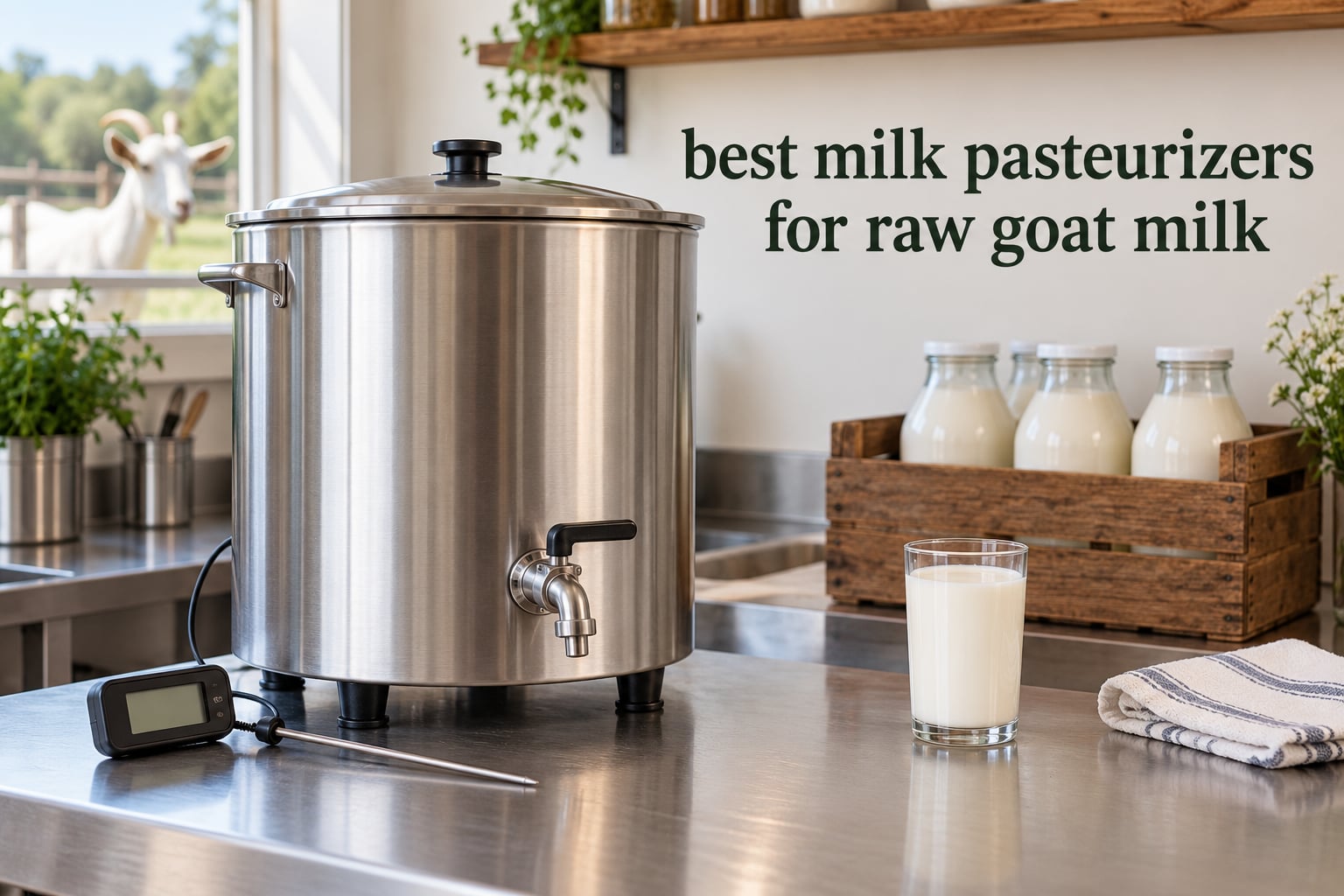
Quick answer: For a small goat herd, the best milk pasteurizers for raw goat milk are the 13-14L stainless countertop machines for two to ten does, a 20-30L model once you pass roughly a dozen does, and 50L or larger floor-standing machines for real daily volume. Every machine below heats milk to a set point and holds it; only some cool it back down for you.
Raw goat milk is one of the hardest milk types to heat gently. The fat globules are smaller, the milk is more viscous, and milk solids catch on a bare heating element faster than they do in cow’s milk. That is why a thin single-wall pot produces disappointing results and why we weighted jacketed or water-bath designs heavily when picking this list.
We spent 2026‘s season comparing these machines on published specifications, hold-temperature claims, wattage against real circuit limits, cleaning access, and whether a cooling stage is included. Only a handful of pasteurizers in this category carry any owner feedback at all, and we say plainly below which ones do and which ones do not, because a listing with zero reviews is not a machine that works badly, it is a machine nobody has documented yet.
Table of Contents
Top 3 Picks for Raw Goat Milk Pasteurizers (October 2026)
Schlueter Home Pasteurizer
- 2 gallon dishwasher-safe canister
- Pasteurizes in about 25 minutes
- 115V 1250W

All 12 Milk Pasteurizers Compared Side by Side in 2026
| Product | Specs | Action |
|---|---|---|
| Milky FJ 30 Pasteurizer |
|
Check Latest Price |
| Schlueter Home Milk Pasteurizer |
|
Check Latest Price |
 Koalalko 13L Countertop Pasteurizer Koalalko 13L Countertop Pasteurizer |
|
Check Latest Price |
| Kolice 14L Pasteurizer |
|
Check Latest Price |
 HNZXIB 14L Pasteurizer HNZXIB 14L Pasteurizer |
|
Check Latest Price |
 Generic 14L A-1 Pasteurizer Generic 14L A-1 Pasteurizer |
|
Check Latest Price |
 MXBAOHENG 50L Pasteurizer MXBAOHENG 50L Pasteurizer |
|
Check Latest Price |
 100L Refrigerated Pasteurizer 100L Refrigerated Pasteurizer |
|
Check Latest Price |
 Kolice 150L Pasteurizer Kolice 150L Pasteurizer |
|
Check Latest Price |
 Wtecom 14L Pasteurizer Wtecom 14L Pasteurizer |
|
Check Latest Price |
 Koalalko 20L Induction Pasteurizer Koalalko 20L Induction Pasteurizer |
|
Check Latest Price |
 Kolice 20L Refrigerated Pasteurizer Kolice 20L Refrigerated Pasteurizer |
|
Check Latest Price |
1. Milky FJ 30 – Best Overall for a Small Goat Herd
Milk Pasteurizer Milky FJ 30 (115V) | For Milk, Cheese, Yogurt and Juice | 9.2 Gal | Made of Stainless Steel | Removable Container | Time and Temperature Control | Made in the EU | 2-year Warranty
29L capacity
115V 1.6 kW
Removable 304 stainless vessel
2-year warranty
Pros
- Removable 304 stainless vessel lifts out for cleaning
- Burn prevention water layer under the milk
- Programmable heat duration with auto shutoff
- Cools milk through a tap-fed connection
- Two-year warranty
Cons
- No owner reviews or ratings on the listing
- Needs a tap connection to cool the finished milk
The Milky FJ 30 is the machine I keep coming back to for anyone running a genuine small herd rather than a hobby. Its 29-liter removable vessel holds most of a day of milk from ten to fifteen does in a single pass, and the vessel lifts straight out so you can carry it to a sink instead of scrubbing around a fixed tank.
The detail that matters most for goat milk is the burn prevention water layer. Instead of a bare element touching milk, a thin water jacket sits between the heat source and the vessel, which is exactly the failure mode homestead forums complain about when single-wall pots scorch high-viscosity goat milk.
It runs on 115V at 1.6 kW, so it needs a dedicated 15-amp circuit rather than a kitchen counter outlet. Heating from 4C to 76C takes roughly 75 minutes on a full load, and the electronic panel lets you set both temperature and duration rather than relying on a fixed cycle.
Who this machine fits
This is the right pick if you want one device that handles drinking milk, chevre, yogurt, sour cream and juice without swapping equipment. The safety lock and auto shutoff also make it a calmer choice for a household kitchen than an open hot plate.
Who should look elsewhere
Skip it if your herd is under four does, where 29 liters is more capacity than you will ever fill in one run, or if you have no tap nearby and want an integrated chilling stage. A buyer needing automated cooling in a single cycle should look at the 20L induction machine further down instead.
2. Schlueter Home Milk Pasteurizer – Best Small Batch for Two or Three Does
The Schlueter Company Home Milk Pasteurizer [115V]
2 gallon canister
115V 1250W
About 25 minutes
Dishwasher-safe canister
Pros
- Fastest cycle time in this roundup at about 25 minutes
- Canister lifts out and goes in the dishwasher
- Doubles as a storage and serving vessel
- Buzzer signals the end of the cycle
- Explicitly listed for goat or cow milk
Cons
- Home use only
- not rated for commercial operation
- Only a 2 gallon working capacity
This is the smallest credible answer to the question, and for a household with two or three does it is genuinely the most practical. A two gallon canister pasteurizes in about 25 minutes, which means you can run a fresh batch before breakfast and again in the evening.
The canister lifts out of the outer water chamber and is dishwasher safe, which removes the single most common cleaning complaint we heard from small-herd owners. It also doubles as the vessel you pour from and store in, so you are not hunting for containers.
It draws 1250W on 115V, which means a normal kitchen circuit handles it without any changes. The design is a water bath rather than a direct element, which is the gentler arrangement for goat milk.
Who this machine fits
Best for a first-time raw milk drinker, a family with a few goats, or anyone who wants safe drinking milk this week without committing to a floor-standing machine. A short cycle also means less babysitting.
Who should look elsewhere
It is not a commercial machine and the listing is explicit about that, so it will not satisfy a licensed dairy requirement. If a dozen does are milking daily you will run this four or five times a day, and a larger tank becomes the cheaper answer in labor terms.
3. Koalalko 13L Countertop Pasteurizer – Best Countertop Setup
Commercial 13L Countertop Pasteurization Machine with Plug for Processing Milk,Juices,Beer,Syrups and other liquid foods,Pasteurizer with Timer,Temperature Control,Auto Wash,Fast Heating,US Plug
13L 304 stainless tank
110V 1000W
60 to 85C range
US plug
Pros
- Food grade 304 stainless tank
- 360 degree stirring leaf for even heating
- Includes a US plug so no hardwiring is needed
- Auto wash function cuts cleanup time
- Timer plus adjustable 60 to 85C control
Cons
- No customer ratings exist for this model
- Heating only with no active chilling stage
Thirteen liters is the sweet spot for a herd in the five-to-ten-doe range, and this is the model I would put on a counter rather than a floor. At 1000W on 110V it is the least demanding electrically of the stainless countertop machines we looked at.
The 360-degree stirring leaf matters more for goat milk than most listings admit. Viscosity traps milk solids against the tank wall, and a stirred batch heats far more evenly than a static one, which reduces the scorching that ruins flavor and texture.
It carries an auto wash function and an acrylic viewing cover, so you can watch the batch without lifting the lid and losing heat. Temperature range is 60 to 85C with a separate timer.
Who this machine fits
Good for a small farmstead operation, a farm store, or a home kitchen with counter space to spare. It handles milk, juice, beer and syrup liquids on the same cycle, which widens its usefulness across a season.
Who should look elsewhere
There is no cooling stage, so you need an immersion chiller or ice bath to bring milk down to 45C after the hold. And with no published owner feedback, treat every performance number on the listing as a manufacturer claim rather than a measured result.
4. Kolice 14L Pasteurizer – Top Rated 14L Machine With Real Owner Feedback
Kolice Commercial 14L Milk Pasteurization Machine, Juice Pasteurization Machine, Pasteurizer, Sterilization Dairy Equipment (Heating only without refrigeration)
14L stainless tank
110V 1000W
40 minute cycle
Heating only
Pros
- Only machine in this roundup with posted owner ratings
- Stainless tank resists corrosion and wipes clean
- Acrylic cover lets you watch the batch
- Plywood case protects it in transit
Cons
- Heating only with no refrigeration stage
- Cannot hold temperature once the set point is reached
Almost every machine on this list has zero owner reviews, which is a category-wide problem rather than a fault of any one seller. The Kolice 14L is the exception, and I put it in the top three for that reason alone: three owners have posted a 3.6 out of 5 rating, and the pattern in their feedback is consistent.
Those reviews describe a machine that performs adequately, with the absence of cooling the recurring complaint. That matches the specification exactly, since the listing states heating only with no refrigeration, and it means the temperature falls the moment the cycle stops.
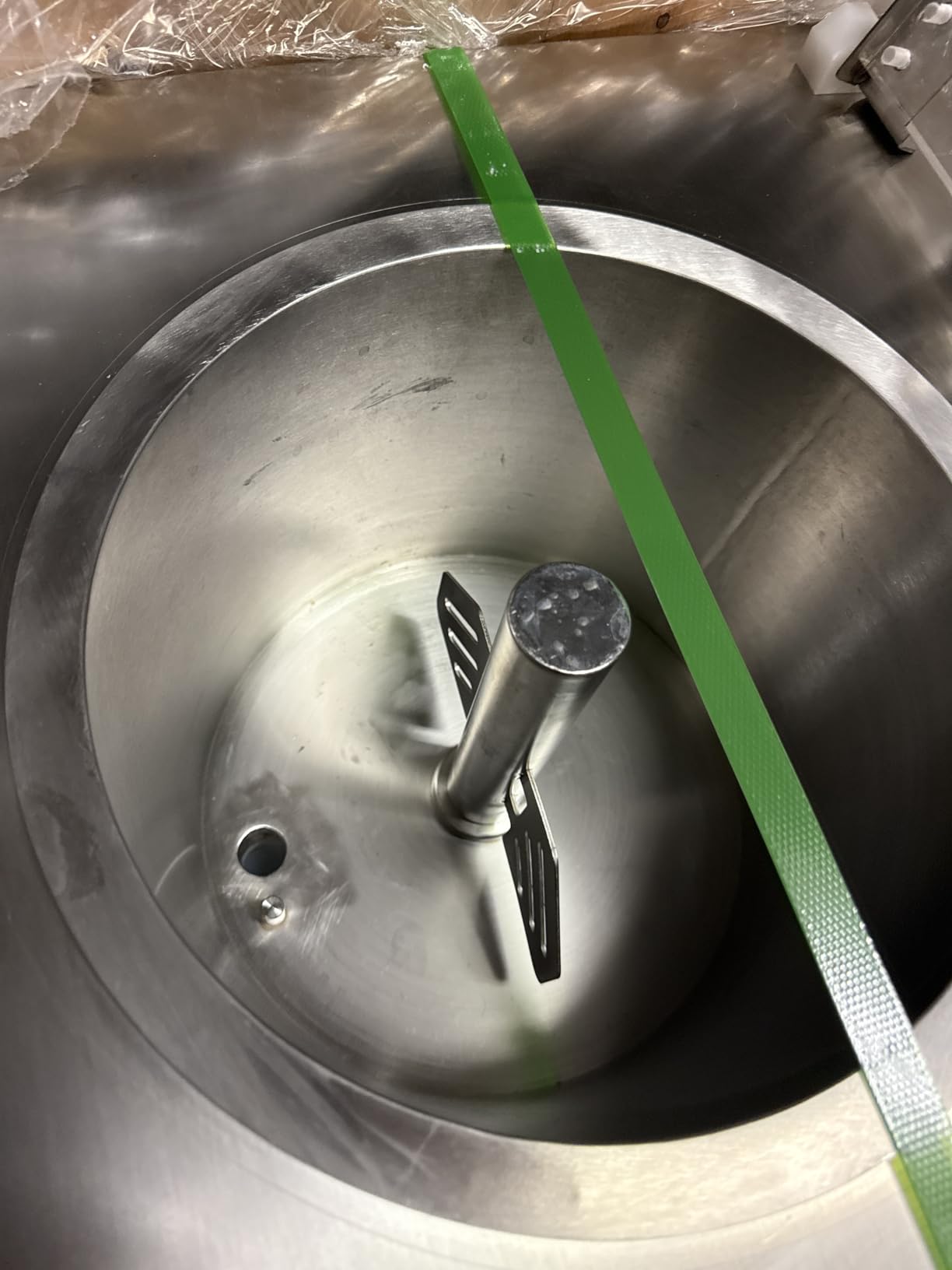
The batch runs from 60C to 85C in about 40 minutes with 360-degree stirring and a detachable, replaceable shaft. The auto wash function reduces manual scrubbing around the heating area, which is where milk solids build up fastest in any of these machines.
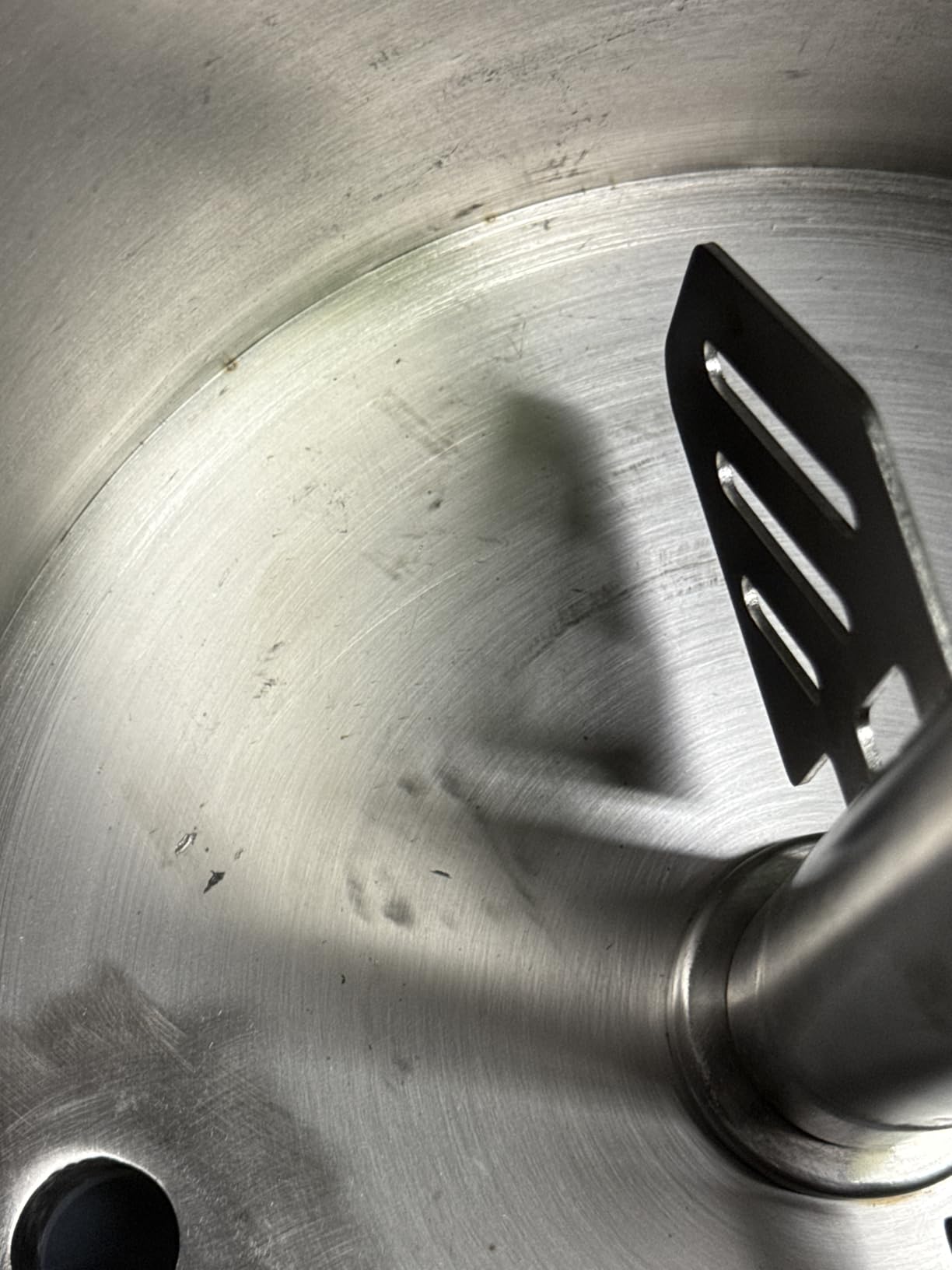
At 80 pounds the unit is heavier than the other 14L machines on this list, so plan the counter and the lifting path before it arrives. Dimensions are 22.05 by 21.26 by 20.32 inches, which is a meaningful step up from the 17-inch class.
One more thing worth knowing: this model cannot hold temperature once it reaches the set point. For a true low-temperature long-time hold of 30 minutes at 145F, you need a machine with a dedicated hold function, and most of the machines in this roundup are built for short holds with a timer instead.
Who this machine fits
A buyer who wants documented owner experience more than they want a cooling stage, and who has a sturdy counter and a 110V circuit. It is also a reasonable choice for juices, where the same time and temperature profile applies.
Who should look elsewhere
If your plan is to bottle and sell refrigerated goat milk, heat-only is the wrong shape, because you need rapid cooling to hold shelf life. The two 20L machines later in this roundup do heat and cool inside the same tank.
5. HNZXIB 14L Pasteurizer – Best for Gelato and Ice Cream Mix
HNZXIB 14L Commercial Pasteurizer Machine,Food-Grade Stainless Steel Pasteurization Machine for Milk, Gelato, Juice & More, 110V, 1000W
14L 304 stainless tank
110V 1000W
40 minute batch
170 pounds
Pros
- Handles milk
- juice
- ice cream mix
- yogurt and sauces
- Pasteurizes a full batch in about 40 minutes
- 304 stainless tank with acrylic viewing lid
- Auto clean with detachable stirring paddle
- Arrives in a plywood case
Cons
- No customer reviews exist for this listing
- Listed at 170 pounds which affects handling
If your goat milk is heading into ice cream, gelato or frozen dessert mix rather than a drinking glass, this machine earns its place. The listing names ice cream mix and sauces alongside milk, and the 60 to 85C range with a 40-minute batch suits bases that need pasteurizing before freezing.
The 304 stainless tank and acrylic lid let you check the batch visually instead of lifting the cover, which matters when you are holding a target temperature. Auto clean and a detachable 360-degree paddle address the disassembly problem that causes returns in this category.
Be realistic about the weight. The listed figure is 170 pounds, the heaviest of the 14L machines here, so you need two people or a dolly to position it and a counter rated for the load.
Who this machine fits
A farmstead dessert maker or a small gelateria running goat milk through a frozen product line. The 40-minute cycle is long enough to get a real hold on a full tank.
Who should look elsewhere
A household with three or four does will never fill 14 liters, and the machine is heating only. There is no owner feedback on the listing, so the published cycle time is a manufacturer figure you should verify with a thermometer in the milk on your first run.
6. Generic 14L A-1 Pasteurizer – Best for a First Small Batch
Milk Juice Pasteurization Sterilization Machine, 14L Food Grade Stainless Steel with 360° Stirring, Auto Washing & Timer for Efficient Processing
14L food grade tank
60 to 85C
30 to 40 minute cycle
55 pounds
Pros
- Heats from 60C to 85C in 30 to 40 minutes
- Food grade stainless body and tank
- Auto wash plus built-in timer
- Transparent acrylic cover
- Compact 55 pound countertop footprint
Cons
- No customer ratings or reviews available
- Sold under a generic brand with thin documentation
Fourteen liters with a 30 to 40 minute heat-up is a sensible first machine for a household moving from raw to safely drinking milk. The stainless body and tank are food grade as specified, and the acrylic cover lets you watch the milk rather than guess at it.
At 55 pounds net weight and roughly 17 by 18.5 by 17.3 inches, it sits comfortably on a standard counter, which is more than can be said for several machines in this roundup. The auto wash function is worth having even on a small unit.
The honest caveat is documentation. This is an unbranded listing, so manuals, spare parts and support are thinner than a named brand, and there are no owner reviews to fall back on when something behaves unexpectedly.
Who this machine fits
A first purchase for someone processing three to eight gallons a week, or a backup machine for a kitchen that already has cooling handled separately. The 360-degree paddle with a detachable shaft is the part that will last longest on it.
Who should look elsewhere
If you are building a licensed dairy business, buy from a supplier that will provide a calibration certificate and replacement elements. Unbranded machines are fine for family use and a poor choice when an inspector asks who stands behind the equipment.
7. MXBAOHENG 50L Pasteurizer – Best 220V Machine for a Working Herd
MXBAOHENG 50L Pasteurization Machine Commercial Pasteurizer for Milk Juice Beer Sterilization Disinfection 220V
50L stainless tank
220V hardwired
Water immersion heating
One year warranty
Pros
- 50 liter capacity handles substantial daily volume
- Food grade 304 stainless construction
- Microcomputer temperature control
- Polyurethane insulation cuts energy use
- Water immersion heating tube gives wide heating area
Cons
- 220V only and no plug included
- The single posted customer review is a 1 star rating
Fifty liters is where a homestead operation stops being a household project. This machine is built for that step, with a 50-liter stainless tank, microcomputer temperature control and polyurethane insulation around the vessel to reduce heat loss between cycles.
The water immersion heating tube creates a large, even heating area rather than a hot spot on the tank floor, which is the right approach for viscous goat milk. Overheat protection is built in.
Two things to weigh carefully. It is 220V and arrives without a plug, so it needs a direct connection to an air switch, which means an electrician rather than a wall outlet. And the only customer review on the listing is a single 1-star rating, which is too thin a sample to generalize from but is not a signal to ignore either.
Who this machine fits
A farm with fifteen to thirty does that already has 220V service and someone who can wire a dedicated circuit. The insulation and control make it more efficient across repeated daily batches than an uninsulated tank.
Who should look elsewhere
Do not install this in a standard kitchen. It also heats only, so cooling 50 liters still means moving the milk or adding a separate chiller. Anyone who needs a complete heat and cool cycle at that volume should look at the 100L refrigerated model further down.
8. 100L Refrigerated Pasteurizer – Best for High Daily Volume
Commercial Refrigerated Pasteurization Machine with Cooling Function for Milk, Juice, Beer, Sauce, and Dairy Sterilization – 100L Capacity
100L capacity
6000W heat and 1500W cooling
220V single phase
Floor standing
Pros
- Heating and cooling in one vessel
- 6000W heating element for fast come-up
- Double layer jacket accepts city water
- 360 degree stirring with real time display
- Food grade stainless with seamless brushed finish
Cons
- 220V single phase with no plug
- Large floor standing footprint rather than a countertop machine
One hundred liters with a built-in refrigeration stage is the configuration most micro-dairies actually want, and this machine has both functions in the same tank. Heating runs at 6000W and cooling at 1500W, so a full batch heats fast and then comes down without leaving the vessel.
That matters more than it sounds. Milk that stays warm after pasteurizing loses shelf life just as surely as milk that never got hot, and rapid cooling is the step most home setups skip. The double-layer jacket takes a city water line, which gives you another lever on the heat side.
Stirring runs at 360 degrees with a real-time temperature display, and overheat protection uses indicator lights. Maximum set temperature is 210.2F, with 185F given as the ideal working temperature.
Who this machine fits
A small dairy processing serious daily volume where milk goes to bottle rather than churn. A 150L version is listed as a variant for operations that outgrow this tank.
Who should look elsewhere
This is a floor-standing machine measuring over 51 inches wide and 45 inches deep, and it needs a 220V single-phase circuit with no plug. A household kitchen is the wrong room for it, and a herd under twenty does will not fill it in a single run.
9. Kolice 150L Pasteurizer – Best for Micro-Dairy Scale
Kolice Commercial 150L Milk Pasteurizer Pasteurization Machine Sterilization Dairy Pasteurizer for Milk, Coffee, Ice Cream Mix.,Juice,Sauce-220V,3 Gear Pasteurization Control,Double Layers,No Freezing
150L capacity
220V 9000W
Three gear control
Heating only
Pros
- 150 liter capacity with a 9000W water immersion element
- Three gear pasteurization controller
- Double layer tank with city water inlet
- 360 degree directional stirring
- Real time display with adjustable manual limit
Cons
- Heating only with no cooling or freezing function
- 220V with no plug so direct breaker wiring is needed
The 150-liter tank with a 9000W water immersion element is built for a dairy moving real volume through a single batch. That power level is what makes a full tank practical, because the come-up time on a cold 150 liters is otherwise the bottleneck in your morning.
What separates this from a generic large tank is the three-gear pasteurization controller, which lets you match time to different products instead of re-setting the machine for every run. The double-layer design accepts a city water line, and stirring runs at 360 degrees.
It is also explicitly heating only. Cooling requires draining and refilling the tank several times, which is a real time cost at 150 liters, and the maximum set temperature is 210.2F with 185F given as the best pasteurization temperature.
Who this machine fits
A micro-dairy running 300 liters a day or more where heating and cooling happen in separate stations. The three-gear control pays off when you move between whole milk, cream and flavored products in the same week.
Who should look elsewhere
It is 220V at 9000W with no plug included, so this is an installation project with a load calculation, not an appliance you carry in from a box. Owners who want a single-tank cycle should look at the 100L refrigerated machine instead.
10. Wtecom 14L Pasteurizer – Best for a Small Commercial Kitchen
Wtecom Commercial 14L Pasteurization Machine,Sterilization Pasteurizer
14L food grade tank
60 to 85C
30 to 40 minutes
55 pounds
Pros
- Food grade stainless tank and body
- Heats from 60C to 85C in 30 to 40 minutes
- Auto wash with detachable shaft and paddle
- Transparent acrylic cover for monitoring
- Compact 55 pound countertop size
Cons
- No customer reviews are available for this model
- No integrated chilling function
This is the 14L configuration aimed squarely at a small commercial kitchen rather than a farm house, with a food grade stainless tank and body and a stated 60 to 85C working range. The 55-pound weight and 17 by 18.5 by 17.3 inch footprint keep it on a normal counter.
The detachable shaft and stirring paddle are the parts that matter for longevity. Being able to pull the shaft out means you can soak it in an alkaline wash instead of watching milk solids cook onto it over months, and the auto wash handles the tank.
Heating from 60C to 85C takes 30 to 40 minutes per batch. There are no owner reviews on this listing, so treat the cycle time as a published figure and confirm it yourself with an independent thermometer.
Who this machine fits
A cafe, bakery or small food business making goat milk drinks, sauces or desserts where a stainless tank and a wash cycle matter more than a warranty length. The acrylic cover makes staff training simpler.
Who should look elsewhere
There is no integrated chilling, so a business that bottles product needs a separate cooling step. Anyone needing verified owner feedback should consider the Kolice 14L, which has ratings posted.
11. Koalalko 20L Induction Pasteurizer – Best Heat and Cool in One Tank
Commercial 20L Pasteurization Machine with Plug for Processing Milk,Juices,Beer,Syrups and other liquid foods,Pasteurizer with Timer,Temperature Control,Auto Wash,Fast Heating and Cooling,US Plug,110V
20L tank with heating and cooling
110V 3400W induction
60 / 75 / 85C presets
US plug
Pros
- Heating and cooling in a single 20 liter tank
- Three automatic pasteurization presets at 60 / 75 / 85C
- Automatic wash cool and auto operating modes
- Induction heating at 3400W on standard 110V
- Includes a US plug for installation without hardwiring
Cons
- No customer reviews exist for this listing
- Heavy 102 pound body with a tall floor standing footprint
This is the configuration I would point a ten-to-twenty-doe operation toward. Twenty liters with both heating and cooling in the same tank, driven by 3400W of induction, means one complete cycle without a second vessel or an ice bath.
Induction is the quiet advantage here. There is no exposed element for milk solids to bake onto, which is the single biggest cause of long-term problems in electric vat pasteurizers, and the three presets at 60, 75 and 85C let you match a cycle to the product in front of you.
Automatic wash, cool and auto modes cover the daily sequence, and it runs on 110V at 60Hz with a US plug included. At 102 pounds and nearly 35 inches tall, it is a floor-standing machine even though the tank is countertop-sized.
Who this machine fits
A farmstead dairy that wants safe drinking milk, yogurt and fresh cheese from one machine, and wants the cooling done automatically. Induction heating also means no element replacement in most ownership scenarios.
Who should look elsewhere
There are no owner reviews to draw on, and 3400W on 110V belongs on a dedicated circuit rather than a shared kitchen outlet. A herd under eight does will rarely fill 20 liters in one batch.
12. Kolice 20L Refrigerated Pasteurizer – Best for Cheese and Yogurt Work
Kolice Commercial Automatic Milk Pasteurizer with Cooling Function, 20L Refrigerated Pasteurization Machine, Blending Mixing Function for Juice, Beer, Milk Ice Cream Mix, Sauce, 110V 60Hz
20L with cooling
2000W heat and 1200W cooling
1500rpm blending
110V 60Hz
Pros
- Fully automatic heating cooling and washing cycle
- Pasteurize at 65 / 75 / 85C then cool to 5 to 15C
- 1500rpm blending function for juice and sauce
- Intelligent touch panel with acrylic door
- Food grade stainless with butterfly discharge valve
Cons
- No customer reviews are posted for this model
- Weighs 180 pounds so it needs a solid counter
Where the other 20L machine heats and cools, this one adds a 1500rpm blending function and drops the milk to 5 to 15C on its own. That combination is aimed at cheese and yogurt work, where you need cultures inoculated at temperature and a smooth mix afterward.
Heating runs at 2000W and refrigeration at 1200W, and the pasteurization presets sit at 65, 75 and 85C. The 65C setting is useful for softer treatments, and the automatic one-key cycle means less supervision than a manual profile.
The large butterfly discharge valve is a real convenience when you are draining into molds or buckets, and the acrylic door lets you check progress. At 180 pounds it is the heaviest machine in this roundup, so the counter needs to be built for it.
Who this machine fits
Farmstead cheesemakers and yogurt makers who want one machine to cover pasteurizing, cooling, blending and washing. It also handles beer, sauce and juice according to the listing.
Who should look elsewhere
It is a commercial machine with no owner feedback published, and 180 pounds makes it awkward in a domestic kitchen. A small household should step back to a two-gallon canister instead.
Why Goat Milk Behaves Differently in a Pasteurizer
Goat milk has smaller average fat globules than cow’s milk, and those globules carry less heat before the surrounding protein begins to denature. The practical result is that goat milk scorches earlier in a heating cycle, and the flavor turns cooked faster.
Viscosity is the second difference. Goat milk carries more total solids at a given fat level, so it moves sluggishly and milk solids settle against the tank wall. That is why every machine worth owning for goat milk has stirring, and why a still pot is a poor substitute.
Milking hygiene is the third. Small herds are often milking in the same barn where bedding, hay and manure dust settle, which is exactly the environment that loads raw milk with Salmonella and Escherichia coli before it ever reaches your tank. Pasteurization is the step that makes that load manageable.
None of this means goat milk needs a gentler temperature than cow’s milk. It reaches the same 161F for 15 seconds or 145F for 30 minutes. What changes is the equipment around that target, not the target itself.
HTST vs. LTLT: Which Method Suits Raw Goat Milk?
HTST means high-temperature short-time: 161F (72C) held for 15 seconds. LTLT means low-temperature long-time, also called vat holding: 145F (63C) held for 30 minutes. Both destroy the vegetative pathogens that matter most in raw milk.
HTST is faster, uses less energy, and causes less protein denaturation, so it keeps more of the fresh, slightly sweet flavor that goat milk drinkers look for. LTLT is gentler on flavor still and is the traditional method in vat-based cheese making, but it costs far more energy and much more time.
For most small herds, HTST is the practical answer because you can run it in a countertop machine in under an hour. LTLT needs a machine with a genuine hold function, and most of the units in this roundup are built for timed short cycles with a timer instead.
One honest caveat: the countertop machines in this list are generally sold as sterilizers with a 60 to 85C range, which sits above HTST temperature. Running them hotter than the pasteurization target is a manufacturer choice, and for drinking milk you should set the control to the lowest temperature that still delivers the hold you need rather than the highest the panel offers.
How to Size a Pasteurizer for Your Goat Herd
Start with daily volume, not herd size. A typical doe yields roughly one to one and a half gallons a day, so multiply does by gallons and you have your daily working volume. Eight does producing 1.5 gallons each is about 12 gallons, or 45 liters.
Then add headspace. Fill the tank to about 75 percent of rated capacity, which leaves room for expansion and for you to stir without milk coming over the rim. A 14-liter machine working at 75 percent handles roughly 10 liters, or 2.6 gallons, per run.
For eight does you would therefore run about five cycles a day on a 14L machine, which is realistic but tiring. The same herd on a 30-liter machine runs twice. That is the entire sizing argument, and it is the first question asked in every small-farm forum we reviewed.
A worked comparison: a 2-gallon canister suits two or three does, a 13 to 14L machine suits five to ten does, a 20 to 30L machine suits twelve to twenty does, and 50L or larger is for herds that outgrow running multiple batches. Past about 30 does, look at continuous flow equipment instead of a batch tank.
How to Pasteurize Raw Goat Milk Step by Step
Sanitize the vessel, the probe and the fittings with a no-rinse acid sanitizer, then let them air dry.
Filter the milk through a clean cloth or filter pad to remove hair, bedding and hay debris.
Fill the tank to about 75 percent of rated capacity. More than that risks boiling over.
Insert the probe into the milk mass, not against the tank wall, or you will read the wall temperature.
Turn on agitation if the machine has it, and set the target to 145F for a 30-minute hold or 161F for 15 seconds.
Watch the come-up time. A slow ramp is a sign the heating element is scaled or the unit is underpowered for the load.
Start the hold timer only when the milk itself, not the jacket, reaches the target. Verify with a second independent thermometer.
Complete the full hold. A timer that starts before the milk reaches temperature is not a pasteurization.
Cool rapidly to 45C or below using an immersion chiller, an ice bath, or the machine’s own cooling stage. Cool as fast as you safely can.
Empty, wash with an alkaline detergent, rinse, sanitize again, and record the time and temperature for your own file.
The two mistakes I see repeated are heating too hot and cooling too slowly. Going above 161F tastes cooked and damages the proteins you may want for cheese. Leaving milk warm for an hour after the hold gives surviving bacteria a head start that no amount of later chilling reverses.
Alternatives to Heat for Preserving Raw Goat Milk
Freezing is the simplest option. It halts microbial growth entirely, and frozen goat milk keeps most of its character for several months. Freeze in small containers, leave headspace, and expect some separation that a gentle reheat fixes.
Fermenting preserves by acid. A cultured or kefir-style ferment drops the pH quickly, which is inhospitable to the pathogens raw milk can carry, and produces yogurt and soft cheese at the same time. A starter culture of Lactobacillus does the work instead of a machine.
Ultraviolet treatment is a non-thermal option used in some water and juice systems, though it is not a standard method for raw milk and requires validated dose control. Ultra-high-temperature processing extends shelf life dramatically but is a factory process, not a farm-scale one.
For drinking milk specifically, none of these beat pasteurization on the pathogen question. Fermenting is a lifestyle choice as much as a preservation method, and freezing does nothing about bacteria in the milk you pour for your family.
How to Choose a Milk Pasteurizer: 9 Specs That Matter
1. Stainless grade on every milk-contact surface
Ask for 304 or 316 stainless, and check the drain valve and the probe as well as the tank. Homestead communities consistently warn against aluminum, which reacts with the acidity in goat milk and off-flavors the batch.
2. Real temperature hold accuracy
A published accuracy of plus or minus 1C is the only claim worth paying for. Vague phrases like precise control tell you nothing, and a unit that overshoots by 8C cooks your milk regardless of the label.
3. Agitation
Any machine with a 360-degree stirring paddle or motor handles goat milk better than a static tank. Viscosity is what makes goat milk scorch, and motion is the cheapest fix.
4. A water layer or jacket under the heat
Burn prevention, water bath, or double-layer jacket. A bare element against the tank floor is the arrangement homestead owners complain about most, and it is the one to avoid.
5. Voltages and wattage against your actual circuit
Anything at or below 1500W runs on a standard 15-amp outlet. Between 1500W and 3500W wants a dedicated 20-amp circuit. Above 5000W is 220V equipment and an installation project, not an appliance.
6. Whether cooling is included
Most countertop units in this category heat only. If you plan to bottle and sell refrigerated milk, an integrated cooling stage removes a whole step and is worth paying for, which is why two of the picks here are 20L heat-and-cool models.
7. Cleanability and disassembly
Look for a detachable shaft and paddle, a removable vessel, and an auto wash function. Milk solids around a heating element and a drain valve are the most common return triggers we found discussed.
8. Drain valve placement
A bottom drain at the low point of the tank saves an enormous amount of time. A side or top drain means lifting a full vessel to empty it, which is where back strain comes from.
9. Warranty and spare parts
The only machine here with a warranty beyond one year is the two-year cover on the 29-liter unit. For everything else, assume you will source your own element, probe and gasket, and check that the seller carries them before you buy.
Electrical Requirements and Kitchen Safety
A countertop unit at 1000W to 1250W runs on an ordinary 115V kitchen outlet. The 1600W and 3400W machines want a dedicated 20-amp circuit, and anything from 6000W to 9000W is 220V single-phase that must be wired to a breaker by someone qualified.
All of the 220V machines in this roundup arrive without a plug, which means an air switch or breaker connection. That is a deliberate design choice for fixed commercial installations, and it is why those models belong in a utility room rather than a kitchen.
For safety, use GFCI protection on any circuit near water, keep the machine locked or powered off while filling, and never reach into a hot tank to reposition the probe. A burn from 85C milk is a serious injury, and the acrylic covers on several models here exist precisely to stop people doing that.
Cleaning, Sanitizing, and Legal Requirements
Run an alkaline wash after every batch, rinse thoroughly, then apply a no-rinse acid sanitizer and let the vessel dry. Disassemble the paddle and shaft weekly and soak them, because trapped milk solids around a shaft are the usual failure point over a season.
Home consumption of your own milk is straightforward. Selling pasteurized milk is a different matter entirely: most jurisdictions require a dairy license, a facility inspection, a pasteurization record, and a phosphatase test to confirm the milk was properly treated before it can leave your property.
The requirement to sell pasteurized rather than raw milk is a food safety rule, not a judgment about your herd. Raw milk sold for human consumption is restricted or banned in many regions precisely because of the pathogen load discussed earlier, and goat dairies are held to the same standard as cow dairies.
Ask your state or regional dairy authority before you sell anything. A phosphatase test is cheap, and having a written time and temperature log for every batch is the document an inspector asks for first.
Frequently Asked Questions
How do I pasteurize raw goat milk?
Filter the milk, fill the tank to about 75 percent of capacity, insert the probe into the milk rather than against the wall, and heat to 161F (72C) for 15 seconds for a high-temperature short-time treatment, or 145F (63C) for 30 minutes for a low-temperature long-time hold. Start the hold timer only when an independent thermometer confirms the milk has reached temperature, then cool rapidly to 45C or below. Sanitize the vessel before and after every batch.
What is the best home milk pasteurizer?
For two or three does, a 2-gallon canister unit that pasteurizes in about 25 minutes and has a dishwasher-safe removable vessel is the most practical choice. For five to ten does, a 13 to 14L stainless countertop machine with 360-degree stirring, a 60 to 85C range and an auto wash cycle handles the volume without refilling. Look for food grade 304 stainless and plus or minus 1C hold accuracy.
Can I pasteurize raw milk myself?
Yes, in most places you can legally pasteurize raw milk for your own household use with any accurate heating vessel, including a double boiler with a thermometer, as long as you hit the time and temperature target. What you cannot usually do without a license and inspection is sell that milk to other people. Household pasteurization is a personal safety measure, not a commercial activity.
Why is it illegal to sell goat milk?
In many jurisdictions it is not the goat milk itself that is restricted, but the sale of raw, unpasteurized milk for human consumption. Raw milk can carry Salmonella, E. coli, Listeria and Campylobacter, and the restriction exists because of that pathogen risk. Dairy operations are typically permitted once milk is properly pasteurized, with a license, facility inspection, batch records and a passing phosphatase test.
What are the different types of pasteurizers?
For farm and home scale there are three main types. Batch or vat pasteurizers heat a full tank of milk and hold it, which suits most goat operations under 300 liters a day. Continuous flow or HTST units use a plate heat exchanger and holding tube, which processes large volumes quickly but needs a building and a clean-in-place system. Household water-bath canisters are a small third category for two or three does.
How to preserve raw goat milk without a pasteurizer?
Freezing halts microbial growth and keeps milk usable for several months, though it separates slightly. Fermenting with a Lactobacillus starter culture preserves by acid and produces yogurt or soft cheese at the same time. Neither approach matches pasteurization for pathogen reduction on drinking milk, so many operators do both, freezing surplus and pasteurizing what the household consumes.
Conclusion
After working through twelve machines for raw goat milk, the pattern is clear. Match the tank to your daily volume, insist on 304 or 316 stainless with stirring, and decide early whether cooling is part of your workflow, because heat-only machines make you find that answer yourself.
For a household, the 2-gallon canister wins on simplicity. For a genuine small herd, the 29-liter machine with a removable vessel and a two-year warranty is the one we would buy, and for a commercial operation the 20L heat-and-cool models remove the most common failure in home setups, which is milk that never gets cold enough.
Verify the hold temperature with your own thermometer on the first three batches, keep a written log, and check your local dairy rules before selling a single bottle. Those three habits matter more than any spec on a listing.