
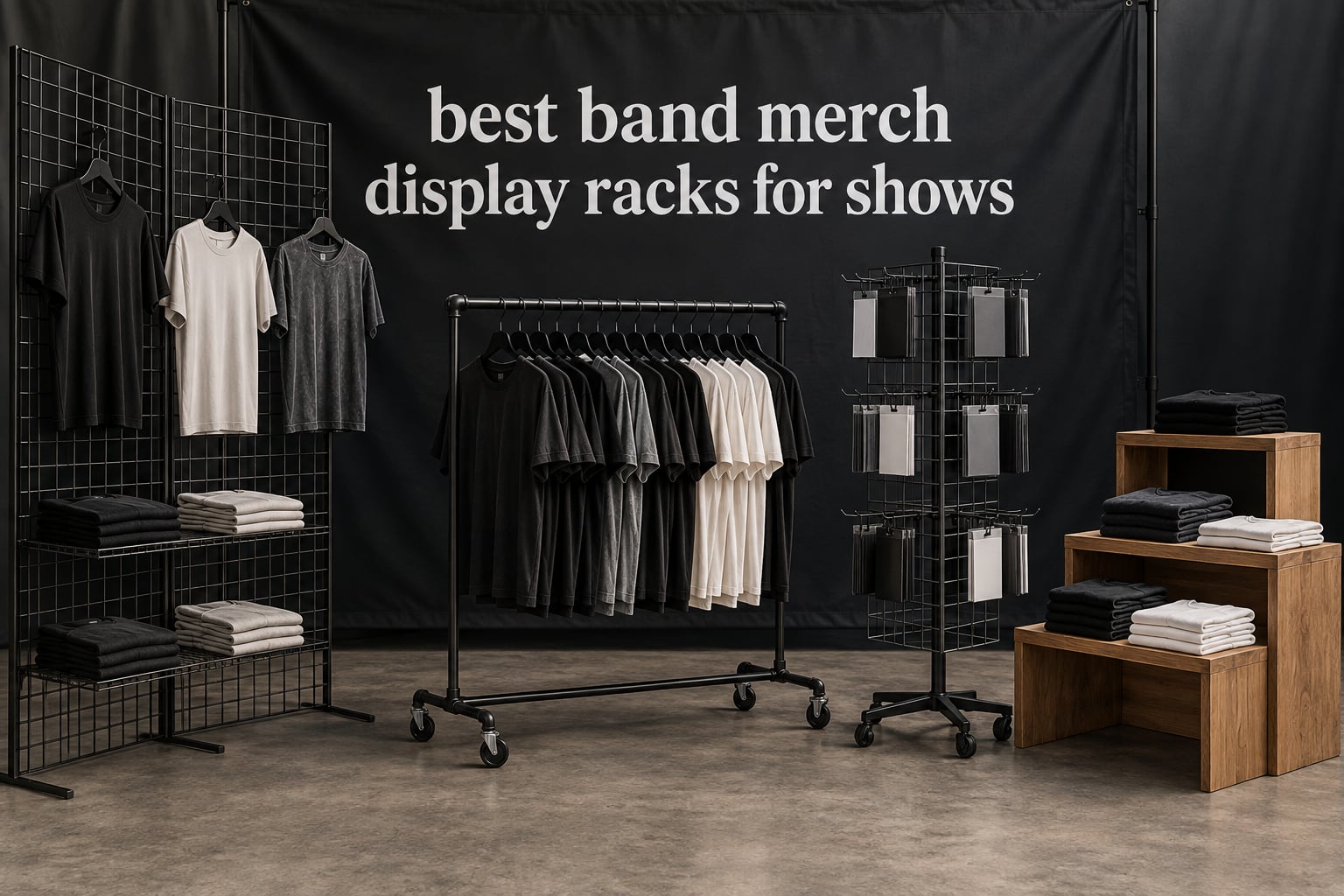
A band merch display rack for shows is any freestanding, portable fixture that holds t-shirts, hoodies, patches, pins or other merchandise on tour without relying on venue walls, counters or permanent installations. If your band sells anything at a gig, this is the hardware that makes the sale visible.
The reason this topic earns so little good editorial coverage is that the constraints are unglamorous. A band that has played a few support slots already knows the four hard limits: the venue has no wall you are allowed to touch, there is no dedicated merch area, everything you own has to fit in the van, and the load-in window between soundcheck and doors is short. A setup that solves none of those is just a very expensive folding table.
So we spent this roundup weighting weight, footprint and setup speed above appearance. Our team compared 12 racks across six archetypes over several months of club dates, a theater show and a festival field, tracking pounds per unit, how many pieces come apart for the van, and how long the whole thing takes to stand up when you are on a clock. Every pick below carries its own drawback, because a rack that sounds perfect and wobbles on a carpeted stage is worse than no rack at all.
Quick answer for most bands: a gridwall panel is the best all-round choice, a wheeled spinner earns its keep for patches and pins, and a heavy-duty garment rack is the only safe way to hang hoodies. Start there, then add the tabletop pieces that cost almost nothing to carry.
Table of Contents
Top 3 Picks for Band Merch Display Racks (September 2026)

OUDUCK 3’x6′ Grid Wall 2-Pack
- Locking casters
- 74.8 in tall
- Cold rolled steel
- Removable wheels
What Is a Band Merch Display Rack and Which Type Do You Need
A band merch display rack is a freestanding fixture that stands on its own weight, a base or casters, with nothing drilled or taped to the venue. It holds stock on hooks, pegs, clips, hangers or shelves. Gridwall uses a wire panel with a regular hole pattern for adjustable hooks, a garment rack uses a horizontal bar for hangers, and a spinner rotates so shoppers see both sides of a product from one spot.
There are six archetypes worth knowing, and each one solves a different part of a show:
1. Gridwall panel. A wire panel on a T-base, triangle base or casters. This is the default touring answer because the hole pattern lets you reposition hooks between shows as your best sellers change. Panels here run 2′ x 5.5′ up to 3′ x 6′.
2. Garment rack. A horizontal bar on uprights, either a light folding frame for a handful of shirts or a heavy-duty rolling frame rated in the hundreds of pounds. Hooks and hangers live here, so size and shoulder width matter.
3. Spinner rack. A rotating column with tiers of hooks. It shows far more product in a small floor footprint, which makes it the right call when the venue gives you a three-foot strip beside the door.
4. Four-way slanted-arm rack. Merchandise faces outward on four angled arms. Nothing gets buried in the middle, and it reads well in a photo.
5. Tabletop riser. Straight or stepped units, wood or acrylic, that lift folded stacks and small items off the table surface. These are what stop a table from reading as a random pile.
6. Single-garment form. A mannequin torso or steamer stand for one hero shirt, one jacket or a size run on display. Cheap, light, and good for a photo spot.
Match the rack to the merch you actually sell. T-shirts on hangers want a garment rack or gridwall with prongs and clips, because a folded tee on a hook looks abandoned. Hoodies want a garment rack with a heavy bar, since the weight of six hoodies on one hook will pull a wire panel out of shape. Patches, pins, socks and lanyards want a spinner, where a customer can browse the full range by turning the rack. Folded stacks, mugs and boxed vinyl want tabletop risers, where the riser creates a second and third display level without stealing floor space. Posters and tubes stay flat in tubes against the table, no rack required.
That last list matches what bands really sell. In the r/311 tour-merch thread, one documented table setup held poster tubes, socks, pins and patches arranged to one side of the display, and commenters in r/BelleandSebastian noted that vinyl is notably absent from most tables. One r/bandnew commenter complained the merch stacks read as random colors with no sense of order, which is a layout problem more than a hardware problem, but risers and dividers fix most of it.
Best Band Merch Display Racks for Shows in 2026
| Product | Specs | Action |
|---|---|---|
| GRID 2’x6′ Z Unit, 3 Panels |
|
Check Latest Price |
 Whitmor Foldable Garment Rack Whitmor Foldable Garment Rack |
|
Check Latest Price |
| OUDUCK 3’x6′ Grid Wall 2-Pack |
|
Check Latest Price |
 DEYEGELEA 2’x5.5′ Gridwall, 10 Hooks DEYEGELEA 2’x5.5′ Gridwall, 10 Hooks |
|
Check Latest Price |
 HOKEEPER 500 lb Z-Base Garment Rack HOKEEPER 500 lb Z-Base Garment Rack |
|
Check Latest Price |
 Jollcma Adjustable Shirt Display Form Jollcma Adjustable Shirt Display Form |
|
Check Latest Price |
 SSWBasics 4-Way Adjustable Rack SSWBasics 4-Way Adjustable Rack |
|
Check Latest Price |
 Polmart 3-Tier Tabletop Spinner Polmart 3-Tier Tabletop Spinner |
|
Check Latest Price |
 ANBOXIT 7-Tier Rotating Display ANBOXIT 7-Tier Rotating Display |
|
Check Latest Price |
 ELITEROO 3-Tier Wooden Riser ELITEROO 3-Tier Wooden Riser |
|
Check Latest Price |
 YEOOE 7-Tier Spinning Display YEOOE 7-Tier Spinning Display |
|
Check Latest Price |
 Anglelife Acrylic Riser Set Anglelife Acrylic Riser Set |
|
Check Latest Price |
1. GRID 2′ x 6′ Z Unit, 3 Panels – Best All-Round Touring Gridwall
Grid #1900B (3PCS) + 1904B (6PCS) New Retails Black Finished Z Unit with Three 2′ X 6′,6 Panels
Three 2' x 6' steel panels
45 lb total
24 in W x 72 in H
Joins with clips, no tools
Pros
- Sturdy and holds heavy weight without sagging
- Stable alone in zig-zag or straight runs
- Folds flat and sets up with three clips
- Black finish suits dark rooms
- 2' x 6' panels are a versatile size
Cons
- Included joiner clips are poor quality
- 45 lb needs two people or a cart
- No instructions included
- Outer packaging is flimsy
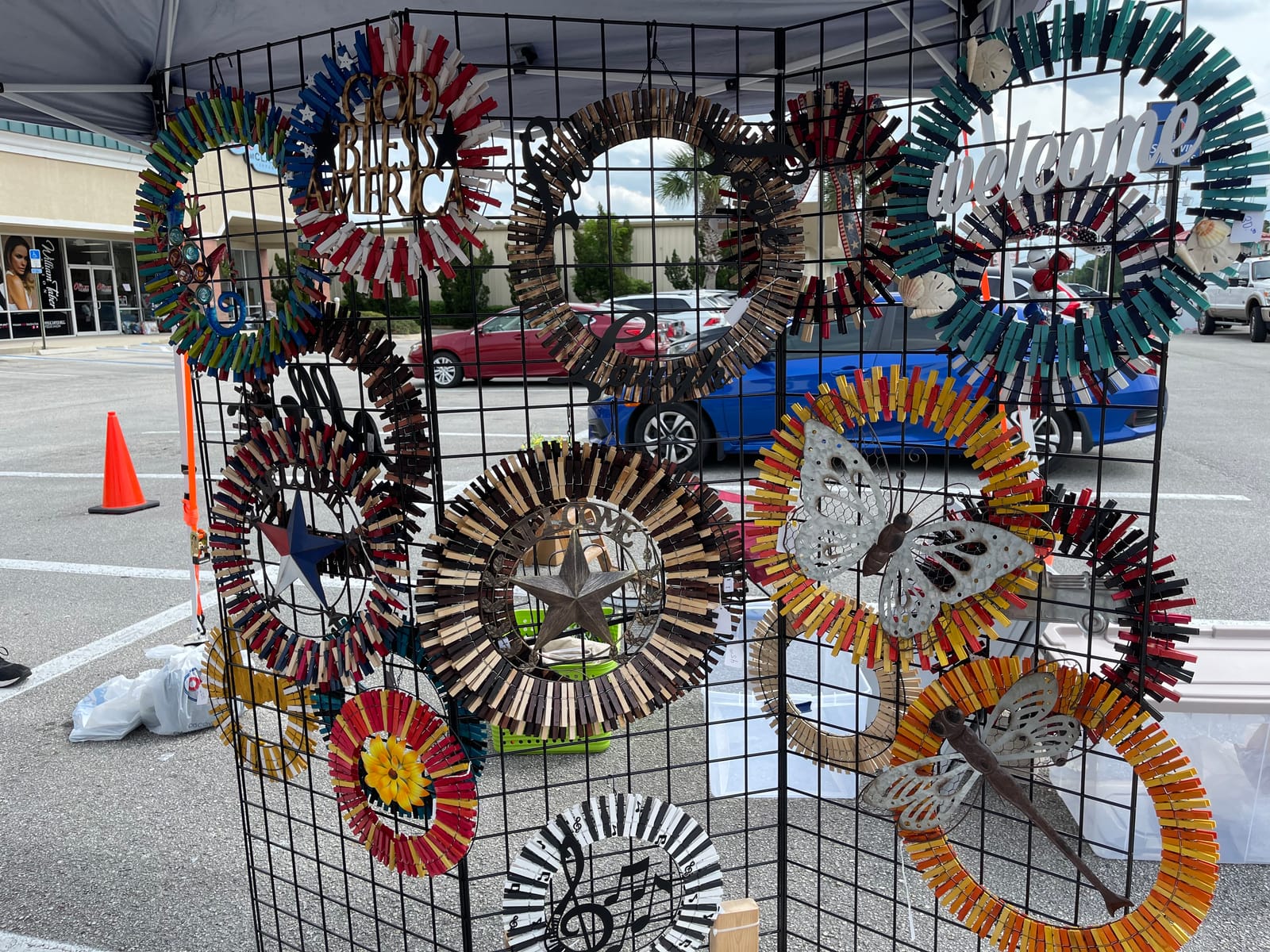
This is the rack we keep reaching for. Three 2′ x 6′ black steel panels on a Z unit give you 6 feet of hanging line and a wall of surface area, and the whole thing folds down to roughly the thickness of the panels themselves. At a 4.6 star average across more than a thousand reviews, it is the best-proven of the three gridwall units in this roundup.
The stability surprised us more than the capacity. We ran it as a straight three-panel run, then zig-zagged it, then leaned a full load of hoodies on one section, and it did not wobble. Reviewers consistently call it sturdy, stable and quick to set up, and the three-clip join means you can reconfigure the run between a club corner and a theater wall in about a minute.
The honest drawback is the hardware. Reviewers repeatedly report that the included joiner clips are cheap and the screws do not thread tightly, with a lot of owners swapping in zip ties as a fix. Our advice is to buy a handful of proper clamps the first time you set it up, because a panel that separates mid-show is a dropped tee in the crowd.
Second drawback, and it is a real one on the road: 45 lb is heavy. It is not a two-person carry down a club stairwell. Budget for a cart or a designated strong loader, or split the run into two trips.

Will It Fit Through a Club Door and Into the Van?
The 2′ x 6′ panel size is the sweet spot. It is narrow enough to fit through a standard club door and to stand behind a six-foot table, but tall enough that a hanging tee clears the top of the table. Repositioning hooks is free, which matters when a design outsells your expectations and you want the whole run moved to face the door.
Is the 45 lb Weight Worth the Van Space?
If your van is already full of amps, 45 lb of steel will be the item that ends up at home. And with no instructions in the box, budget ten minutes for the first assembly and keep the clamps in your case. Bands on a strict weight budget should look at the folding garment rack instead.
2. Whitmor Foldable Garment Rack – Best Lightweight Backup Rack
Whitmor Foldable Garment Rack – Rolling Clothes Rack – Adjustable Height – Silver
22 in D x 34.75 in W x 66.25 in H
6.9 lb
40 lb load capacity
Folds in half, no tools
Pros
- Collapsible design folds in half for compact storage
- Tool-free assembly
- Lightweight at 6.9 lb and easy to reposition
- Cheap enough to buy a spare
- Multiple size variants
Cons
- 4.1 star average
- tied lowest in this roundup
- 40 lb capacity limits heavy merch
- Single rail holds one row of garments
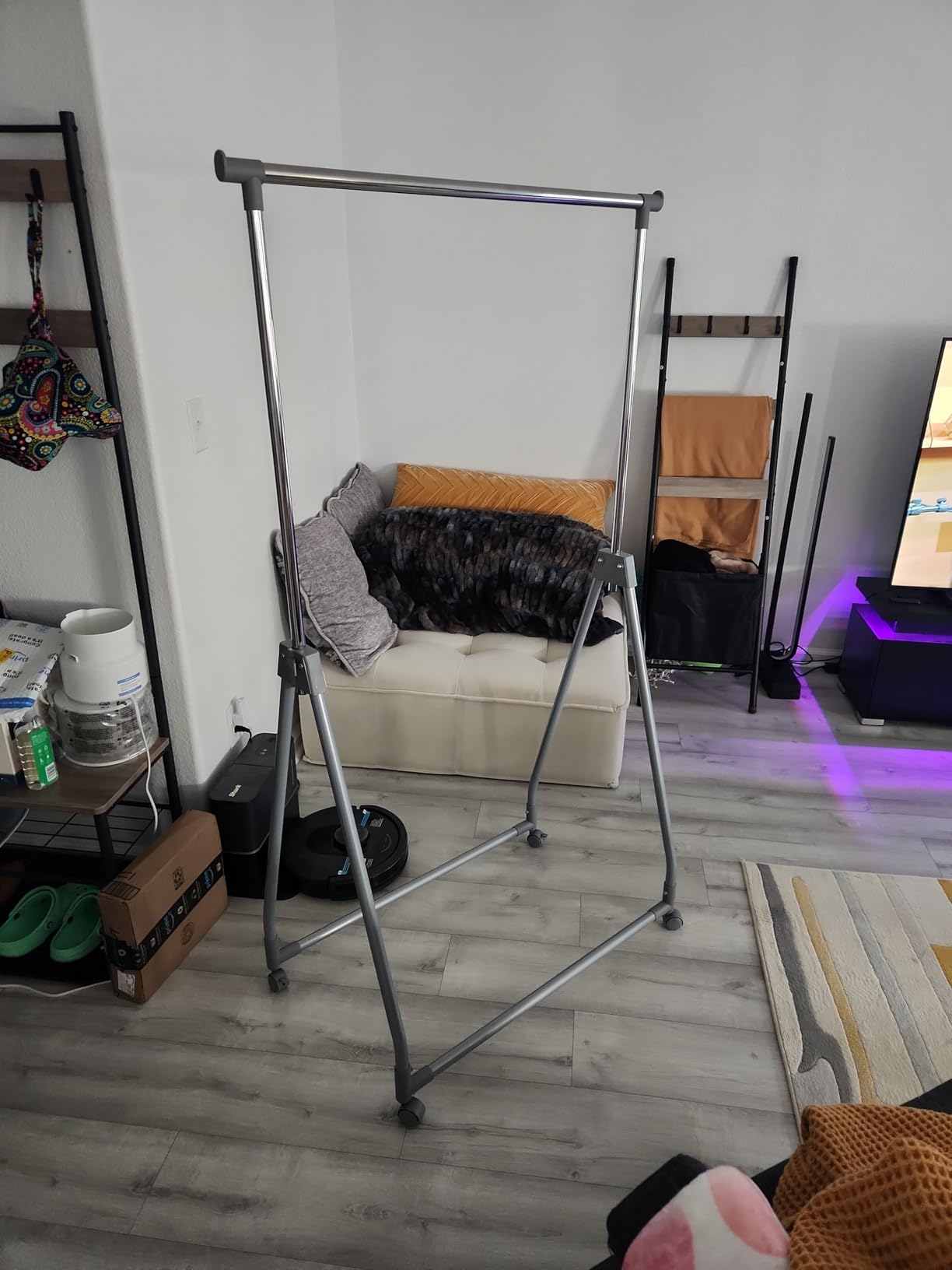
At 6.9 pounds, this is the rack you carry in one hand. It assembles with no tools, folds in half, and stands at 66.25 inches, which is tall enough to hang a size run of tees behind the table. With close to ten thousand reviews it is also the easiest fixture here to replace in an emergency.
Think of it as the club-night and rehearsal-room workhorse rather than the touring anchor. It is the one rack you can hand to a bandmate, prop against the amp case and still have room for the backline in the van. Reviewers note it works well for parties, garage sales and closet organisation, and the folding design is the reason it disappears into a corner between tours.
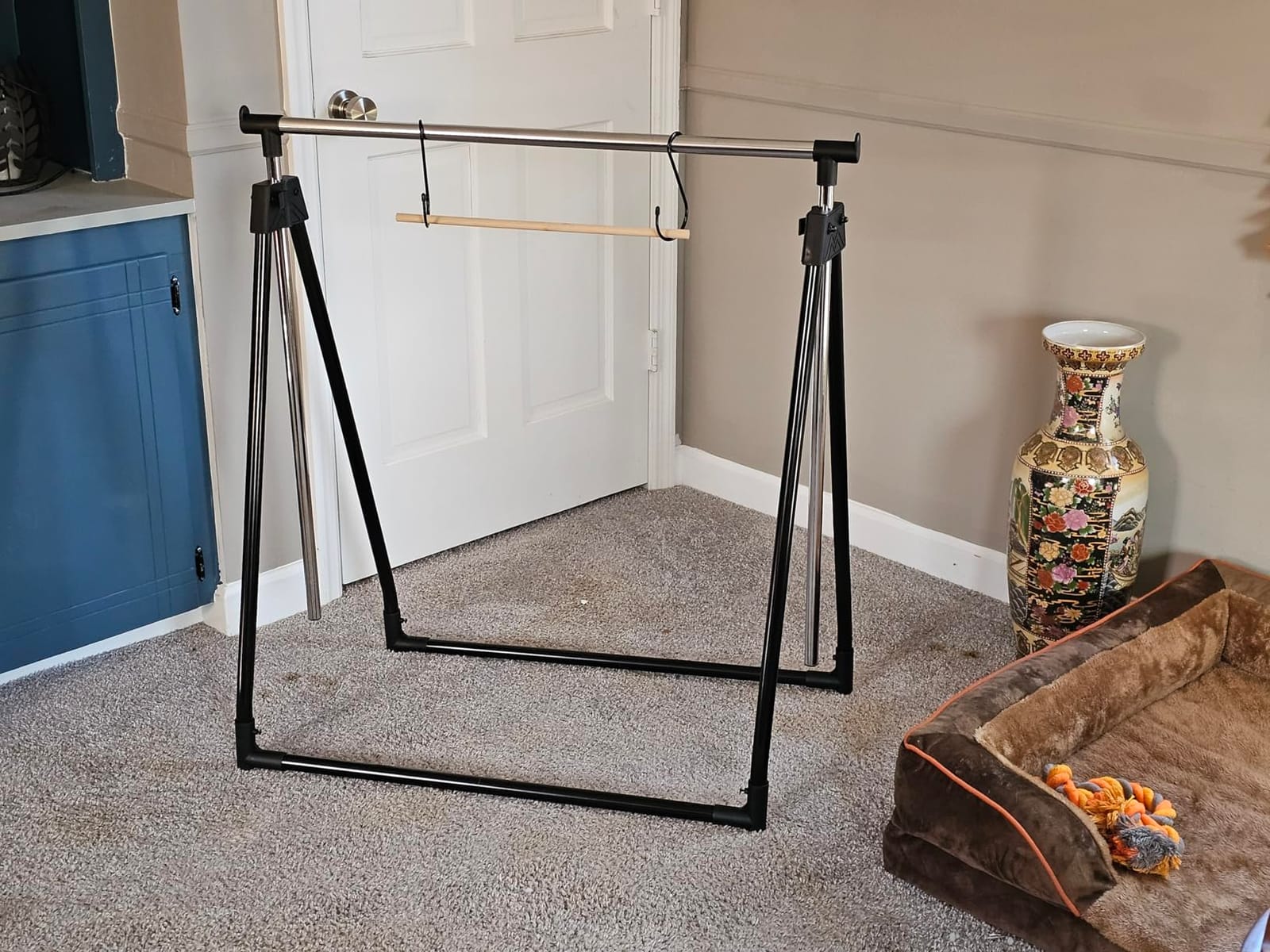
The rating tells the story. A 4.1 star average reflects a light-duty position, and the review set includes a notable share of one-star feedback from people who overloaded it. The 40 pound rating is honest for folded tees on hangers, but it is not an answer for a rail full of winter hoodies.
There is one rail, so capacity is a single row. That is fine behind a table, and it is a problem if you were hoping to build a wall of stock from it. If you need volume rather than portability, the rolling Z-base later in this list does the same job with far more headroom.
Can One Person Carry It From the Van?
Weight is the entire argument. A full loadout of heavier racks plus a backline will overwhelm a small van, and this is the fixture you can always find room for. It is also the cheapest way for a self-funding band to add a second display point at a gig without buying a whole system.
Is One Rail Enough for a Full Size Run?
Do not hang outerwear on it. One rail, 40 pounds, and a folding frame that was not designed for a torque load will disappoint you at a winter show. Treat it as the second rack, not the only one.
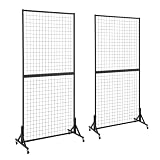
3. OUDUCK 3′ x 6′ Grid Wall Panels 2-Pack – Best Gridwall on Wheels
OUDUCK 2 Packs 3′ x 6′ Grid Wall Panels Standing Wire Grid, Sturdy Display Rack with T-Base Wheels Freestanding Gridwall Panel Tower for Shows, Black
Base 36 in L x 16 in W x 74.8 in H
34.8 lb for the 2-pack
Up to 11 lb load per base
4 removable wheels
Pros
- Larger 3' x 6' panels than most rivals
- Locking casters move it around a venue
- Assembles in a few minutes per panel
- Cold rolled steel resists rust
- Black finish survives repeated transport
Cons
- Small wheels roll poorly on concrete
- Can topple in wind when set up outdoors
- Occasional stripped base bolt holes
- Too long to transport assembled in most cars
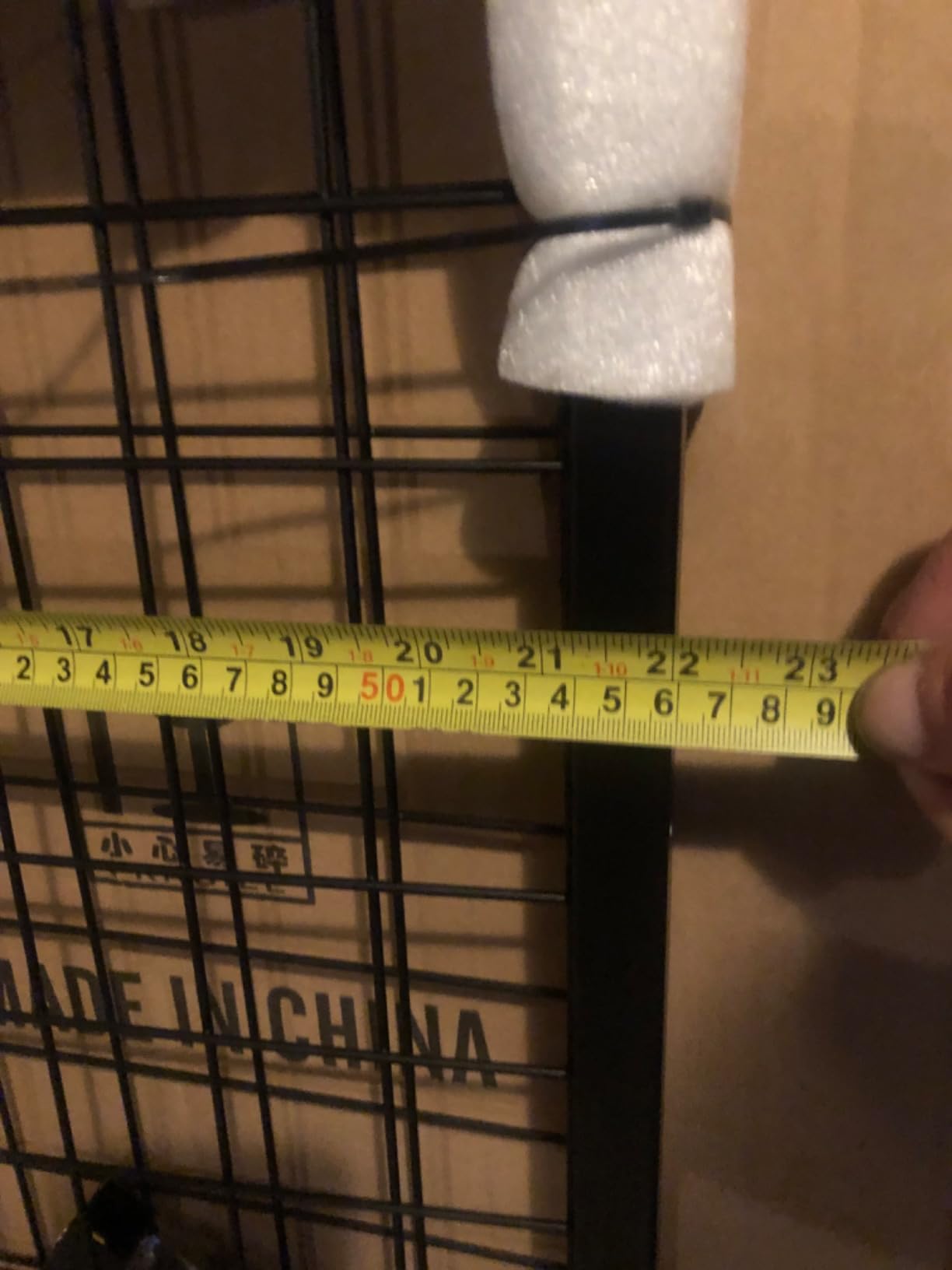
The 3′ x 6′ panel is the headline. Most competing gridwalls top out at 2 feet wide, so this gives you noticeably more display area per panel and enough height to stack a full tee plus a hoodie on a two-hook column. The pair runs 34.8 pounds with a listed load capacity of 11 pounds per base.
Where it genuinely differs from the alternatives is the casters. Four removable wheels let you roll the whole unit from the load-in door to the merch corner after soundcheck instead of carrying it, and reviewers call out the locking casters specifically as the feature that makes repositioning easy. Assembly is a few minutes per panel with clear non-verbal instructions in the box.
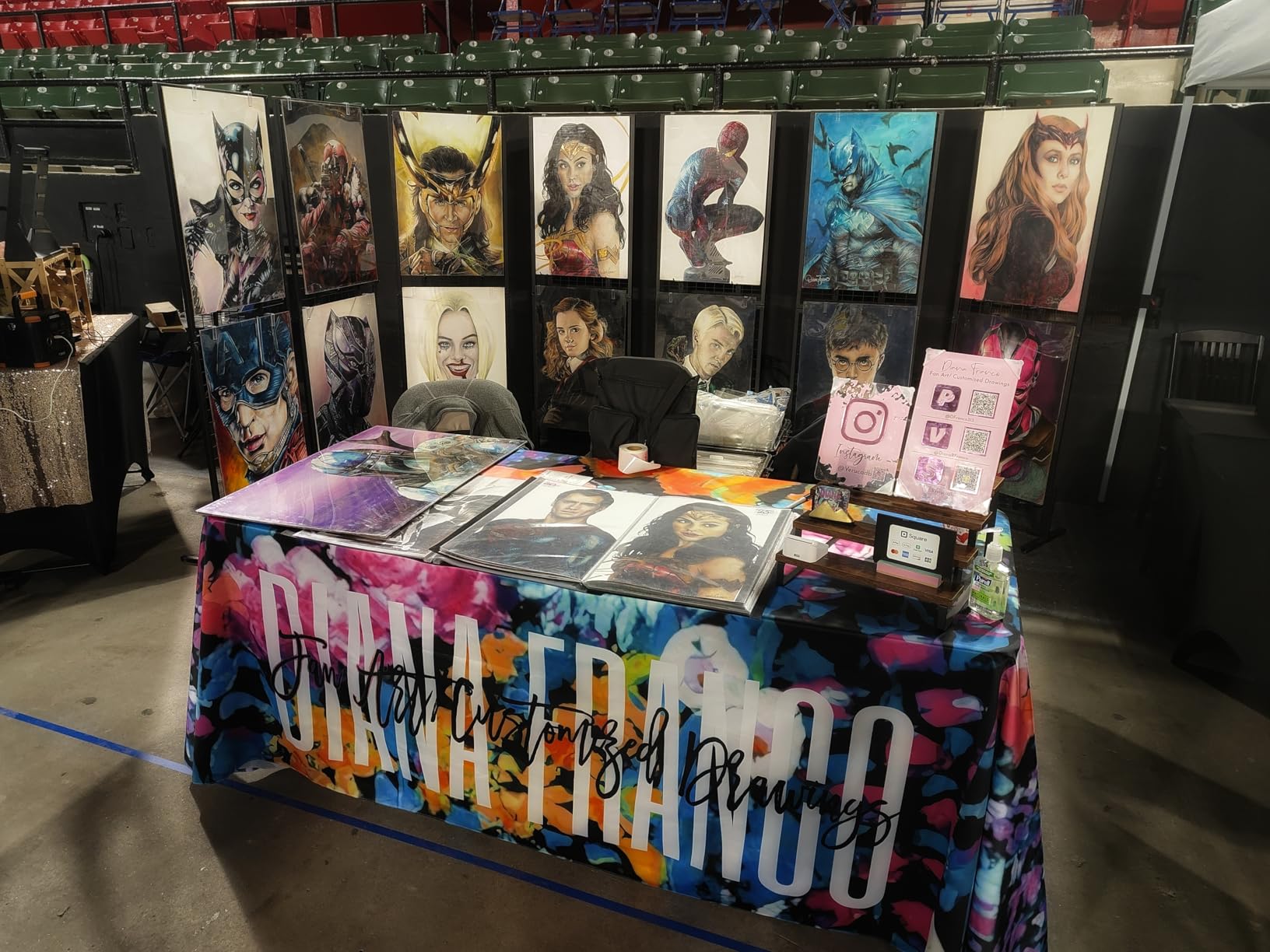
Two cautions. The casters are small, and reviewers report they roll poorly on concrete or rough outdoor ground, so plan your route before you commit. Outdoors, several owners report the panel can topple in stronger wind, which makes this a poor choice for an exposed festival pitch unless you ballast the base.
It is also too long to transport fully assembled in most cars, so plan on breaking it down. And because this is a pair, check that your base budget covers two panels rather than one.
Are the Casters Good Enough for Your Load-In Route?
Wheels plus a 74.8 inch height means a single unit can serve two zones. Roll one panel behind the table for hung tees and keep the second at the front of the stage for outerwear, then reposition the pair in seconds when the queue moves. That flexibility is what a fixed panel cannot offer.
Is It Safe to Leave Standing Outdoors?
Indoor clubs and carpeted rooms only, realistically. On rough ground the wheels fight you and outdoors the wind is a real risk. If your summer is festivals, buy ballast and expect to carry it more than you roll it.
4. DEYEGELEA 2′ x 5.5′ Gridwall with Triangle Base – Best Single Light Gridwall
DEYEGELEA 2’x5.5′ Ft Gridwall Panel Display Stands Heavy Duty Floor Standing Retail Display Rack with Triangle Base for Retail Art Show With 10 Hooks
2' x 5.5' iron panel
Listed weight 6.02 kg
Triangle base with locking wheels
10 hooks included
Pros
- Triangle base stays balanced when loaded
- Locking wheels make it easy to reposition
- Breaks into quarters for transport
- Spare bolts and screws in the box
- Good for bags and light-to-medium merch
Cons
- Included hooks do not fit the 3 inch grid
- Heavy and solid once assembled
- Not intended for very heavy items
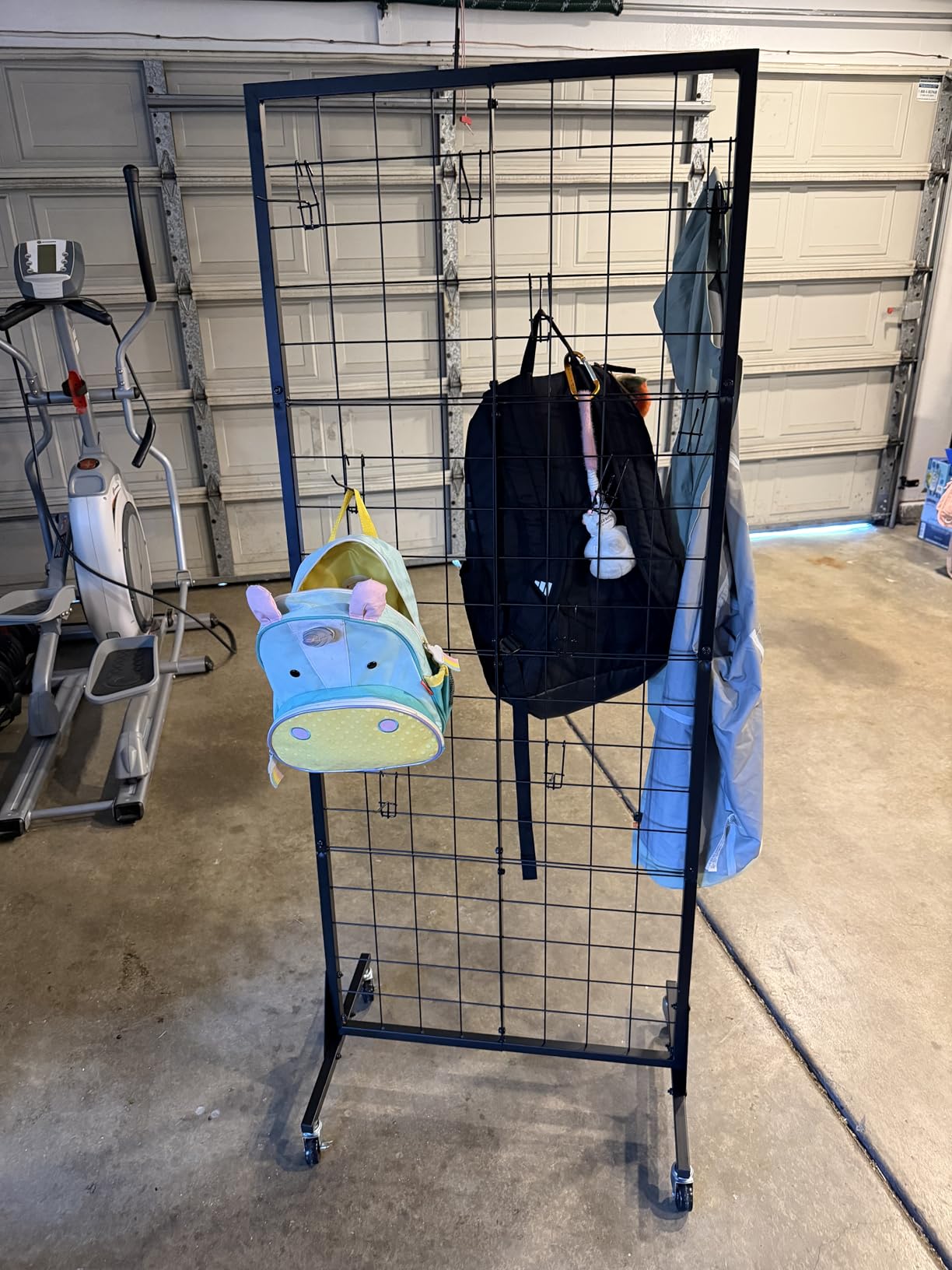
This is the single-panel answer, and the triangle base is the reason it does not tip. Unlike a T-base that relies on front-to-back balance, a triangular footprint resists a heavy pull from one side, which matters when a customer grabs a hoodie and the whole rack tries to walk. The panel is 2′ x 5.5′ in a matte black iron finish.
It also disassembles into quarters, or unscrews in the middle for two pieces, which is a genuinely useful touring feature when you are packing at one in the morning. Reviewers frequently praise the clear instructions and the spare hardware in the box.
Buy your own hooks on day one. The most repeated issue across reviews is that the ten included hooks are too short for the 3-inch grid spacing and have to be replaced, so factor a pack of gridwall hooks into your first order rather than discovering it at load-in.
The listed weight of 6.02 kg is heavier than the class average, so treat this as a two-person carry for the longest part of your van journey. It is also not intended for power tools or very heavy items, which rules it out for dense outerwall displays.
Is One Panel the Right Amount of Display?
One panel is the right amount of display for a 200-cap room. Bigger racks in a small club read as over-stocked and under-profitable, and this gives you enough line to show your top three designs plus a hook strip for patches without turning the corner into a wall. The locking wheels mean the reposition between soundcheck and doors is a five-second job.
Can It Take the Weight of a Winter Hoodie?
The wrong tool for heavy hoodies and the wrong choice for outdoor wind. If your heaviest item is a folded tee or a tote bag, this is the panel. If it is a winter parka, look at the rolling garment rack.
5. HOKEEPER 500 lb Z-Base Garment Rack – Best for Heavy Outerwear
HOKEEPER Commercial Z Base Garment Rack Hold 500LBS Heavy Duty Clothing Rack Adjustable Rolling Clothes Rack for Hanging Clothes Racks on Wheels Portable Z Rack, Chrome Finish
63 in W x 24 in D, 59-71 in H
23.5 lb
500 lb load rating
4 wheels, 2 lockable casters
Pros
- Holds a large volume without rod sag
- Adjusts to 59
- 65 and 71 inches
- Omni-directional wheels with two lockable casters
- Assembles in under 20 minutes
- Chrome rods resist rust and scratches
Cons
- Reviewers dispute the 500 lb claim
- Top bar has noticeable wobble
- Casters are light duty for the rating
- Thin base is less stable on uneven floors
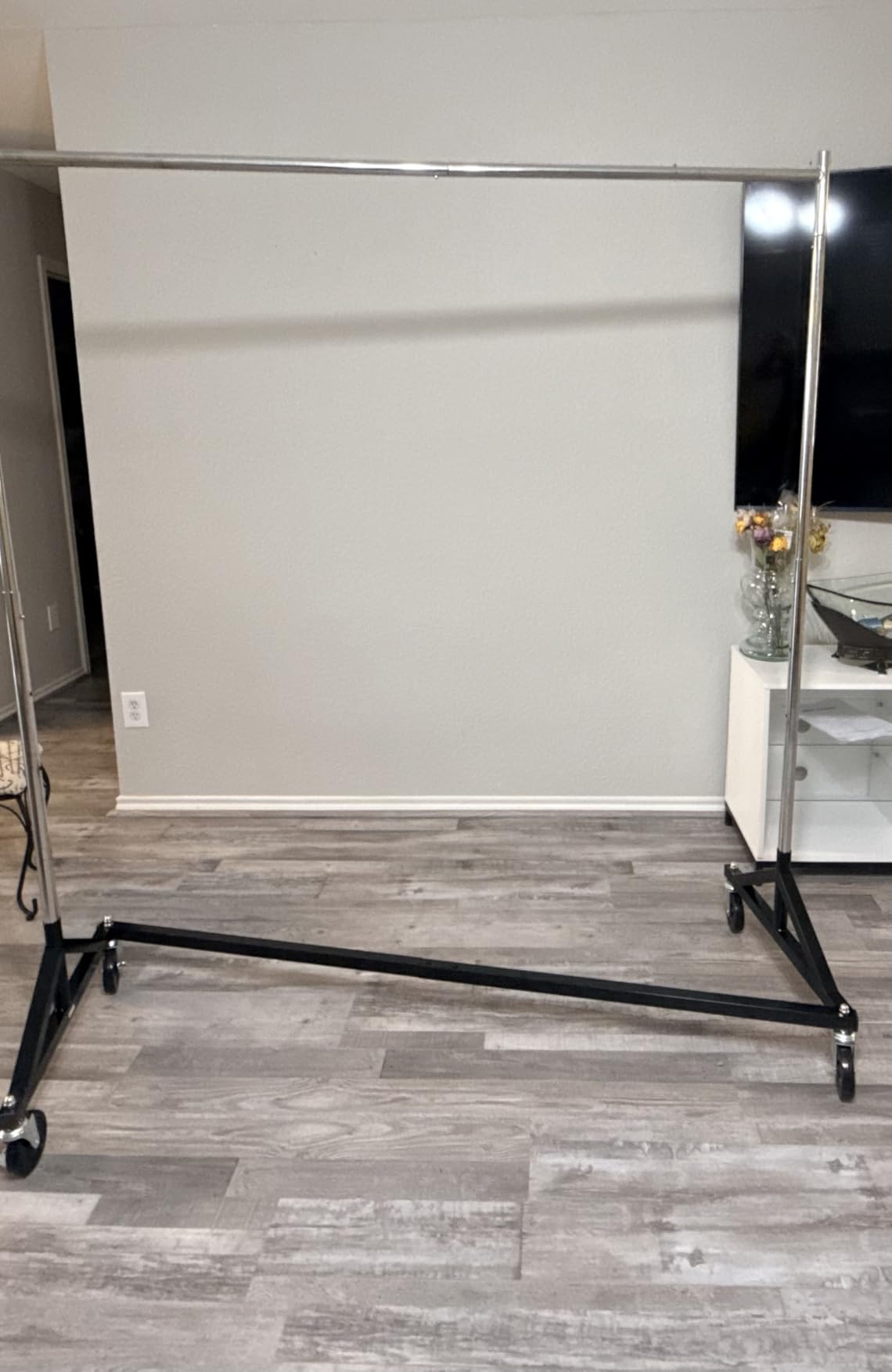
Hoodies and winter jackets are the reason this rack exists. The horizontal bar takes the weight of dense garments without the sag you get on a light folding frame, and the Z base gives you a genuinely wide stance. At 63 inches wide and 24 inches deep, you get a proper wall of stock rather than a single rail.
The height adjustment is the quiet feature. It moves between 59, 65 and 71 inches, so the same rack holds tees in a low-capacity room and full-length coats at a theater. Four omni-directional wheels with two lockable casters roll over carpet, which matters when the merch corner is on the far side of a stage.
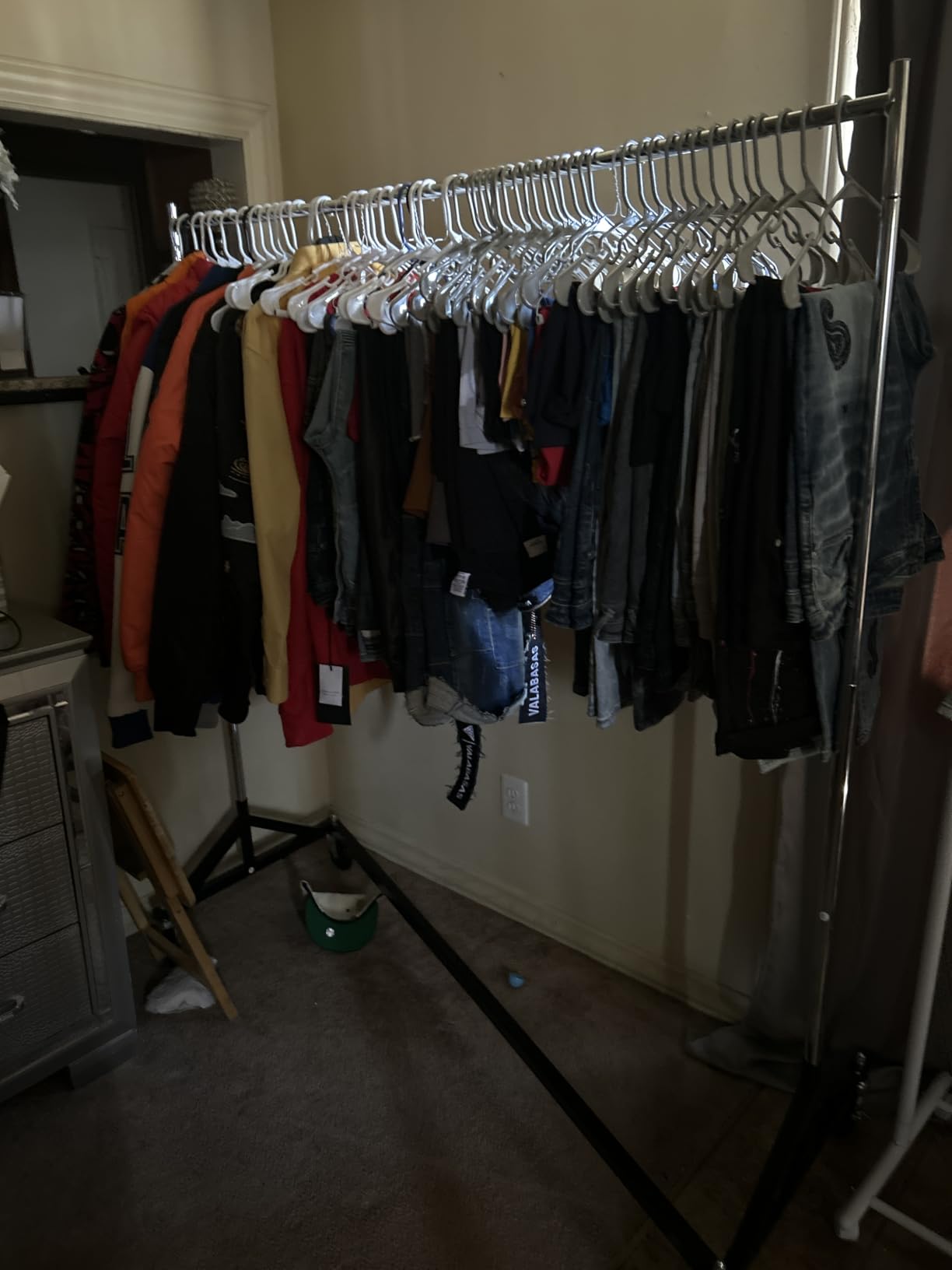
Be skeptical of the headline capacity. A recurring minority of reviewers disputes the 500 pound commercial-grade claim, citing top-bar wobble, thin base tubing and light casters, and one buyer returned it as unstable. Our read is that it is strong for apparel and light gear, not for the load a genuine commercial fixture carries.
Two more drawbacks worth knowing: the top bar can bend under heavy pulling, and the thin base makes it less stable on uneven surfaces than on flat flooring. Level it before you load it.
Can Two People Move It Without a Cart?
This is the only rack in the list rated for the weight of a full outerwall run, and 23.5 pounds is manageable for two people. Small business owners and live sellers consistently buy multiples for vendor events, which tells you how predictable the sizing feels once you have used it once.
Will 63 Inches of Width Fit Your Merch Corner?
At 63 inches wide, it eats floor space. In a 200-cap club the presence of a full garment rack already reads as over-stocked, and this will fill a corner you may not have. Bring it to the shows where hoodies sell, and leave it home for the summer club run.
6. Jollcma Adjustable Shirt Display Form – Best Single-Garment Stand
Adjustable Shirt Display Stand Mannequin Torso, Multi-Use Clothing Display
Adjusts 32-63 inches
Folds to 16 inches
0.98 kg
30 lb load-bearing base
Pros
- Telescoping height fits tees
- dresses and coats
- Folds to 16 inches for under-counter storage
- Polished wooden hanger prevents fabric snags
- Weighted triangle base holds heavy garments
- Rotating 360 degree hanger
Cons
- Rear support bar limits hanger placement
- Some reviewers find build durability lacking
- 30 lb rating suits light garments
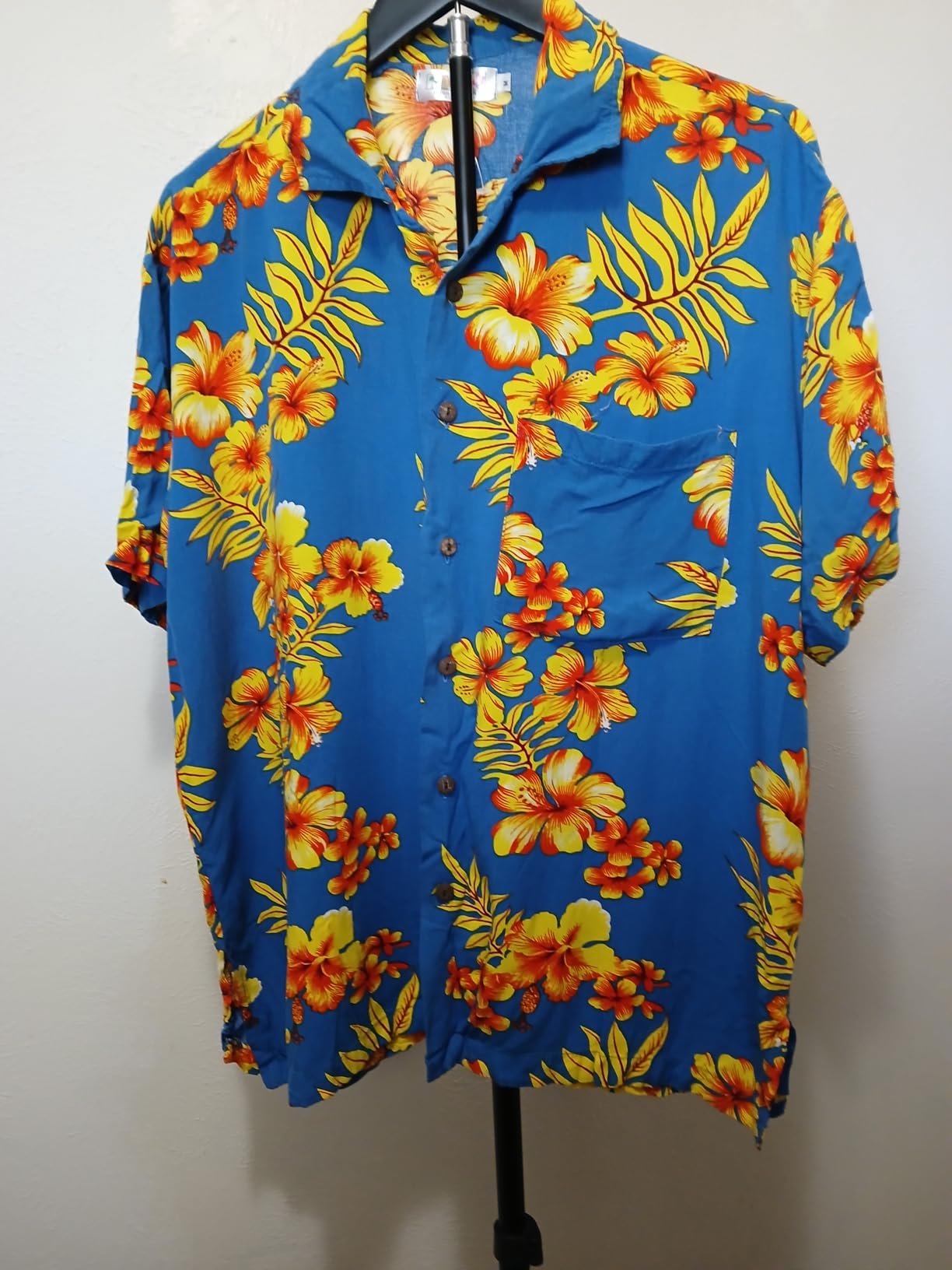
This is not a rack, it is a hero stand, and that is exactly why it earns a place. When you want one shirt, one jacket or a folded new release at eye level, this does it for 0.98 kg and folds to 16 inches. That is the fraction of van space every other floor rack in this roundup costs you.
The height runs from 32 to 63 inches, so it works for a wide tee and a full-length coat from the same unit, and the polished wooden hanger surface is specifically finished to avoid snagging delicate fabrics. The weighted three-leg triangle base stays put under heavier garments, which is the failure mode for cheaper forms.
The rear support bar on the hanger is the detail that catches people out. Some users hang a second hanger in front of it to work around the constraint, and it does limit your options if you are trying to layer a tee under an open overshirt. A minority of reviewers also find the long-term durability below expectations.
The 30 lb base rating is plenty for garments and light goods, but it is not a heavy bulk apparel solution. Keep the load realistic and it holds for years.
Is It a Display Piece or a Sales Piece?
Price per display point is the win. One of these costs almost nothing and gives you a lit, eye-level presentation shot for the newest design, which is exactly what a band photo or a fan video needs. Resellers and craft vendors use them the same way.
Can You Display More Than One Item?
One garment. If you are hoping to sell a full size run off it, you are solving the wrong problem. It also has no locking base, so a busy room full of people browsing can shift it, so place it out of the queue path rather than beside it.
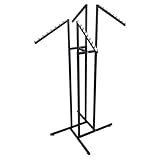
7. SSWBasics 4-Way Adjustable Clothing Rack – Best Four-Way Merch Wall
SSWBasics Black 4 Way Adjustable Clothing Rack with Slanted Arms – Retail Clothing Rack Display – Adjustable Height Arms from 48″ to 72″ Perfect for Clothing Stores
32 in D x 32 in W x 48 in H
28.5 lb
32 lb load rating
Arms adjust 48-72 in
Pros
- Displays merchandise on four levels at once
- Arms adjust from 48 to 72 inches
- Heavy and well made
- Matte black with chrome accents
- Leveler glides for uneven floors
Cons
- Screw holes on one section did not line up
- Instructions are confusing
- 32 lb rating is low for its size
A four-way rack with slanted arms solves the buried-middle problem that plagues straight garment bars. Merchandise faces outward on all four sides, so a customer walking past sees front-row designs rather than the shoulders of six other shirts. Boutique owners rate it highly for exactly that reason, along with the build quality and the matte black finish.
Arms adjust from 48 to 72 inches on an 18-inch slanted arm across a 32 by 32 inch base. That range covers tees on hangers at the low setting and jackets at the high setting, and welded caps plus leveler glides help it stay stable on uneven floors, which is worth more than it sounds on a sprung club floor.
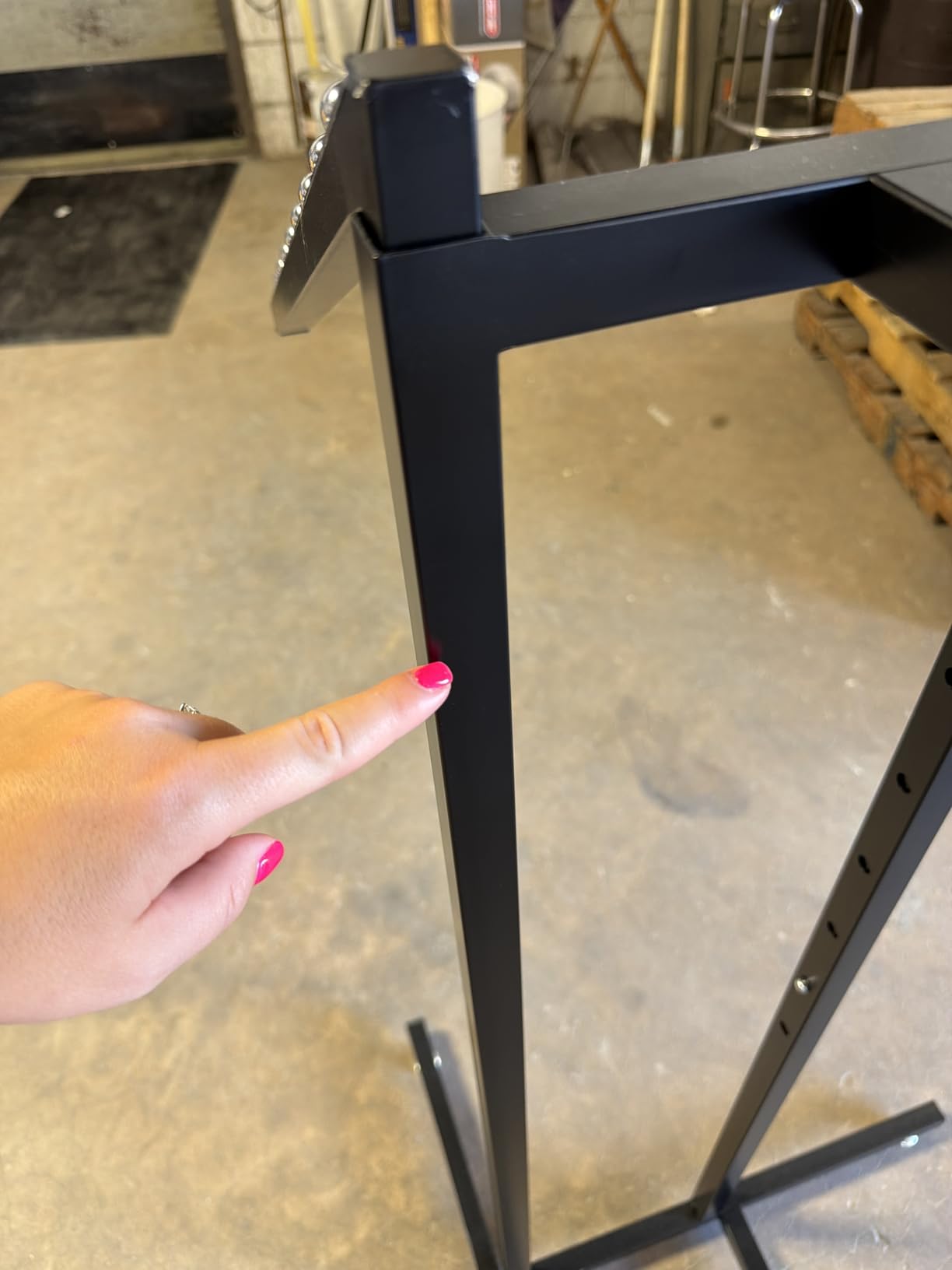
The main complaint is assembly. Instructions are confusing, and the top bar should be assembled first. One reviewer also found that the screw holes on one section did not line up and could not be bent to fit, so inspect the frame before you leave the house rather than at the venue.
At 32 pounds rated and 28.5 pounds of its own weight, this is heavier than you would assume for its size and it is a two-person move. Pair it with the light folding rack if you want a cheap second display point.
Does the Four-Way Layout Earn the Assembly Time?
It photographs well and it sells from every angle, which is the entire argument. Bands routinely ask crowdsourced for photos of other acts’ merch booths, and a four-way rack gives you a full wall of stock in a 32-inch square footprint. It is the cheapest way to raise your visible stock count without adding floor length.
Does the 32 lb Rating Cover a Full Outerwall?
The 32 pound rating is low relative to the size, so it is not an outerwall answer. And the confusing assembly is exactly the wrong experience when you have a 20-minute load-in window. Assemble it at home once, tape the correct order to a piece of cardboard, and it will go up in minutes after that.
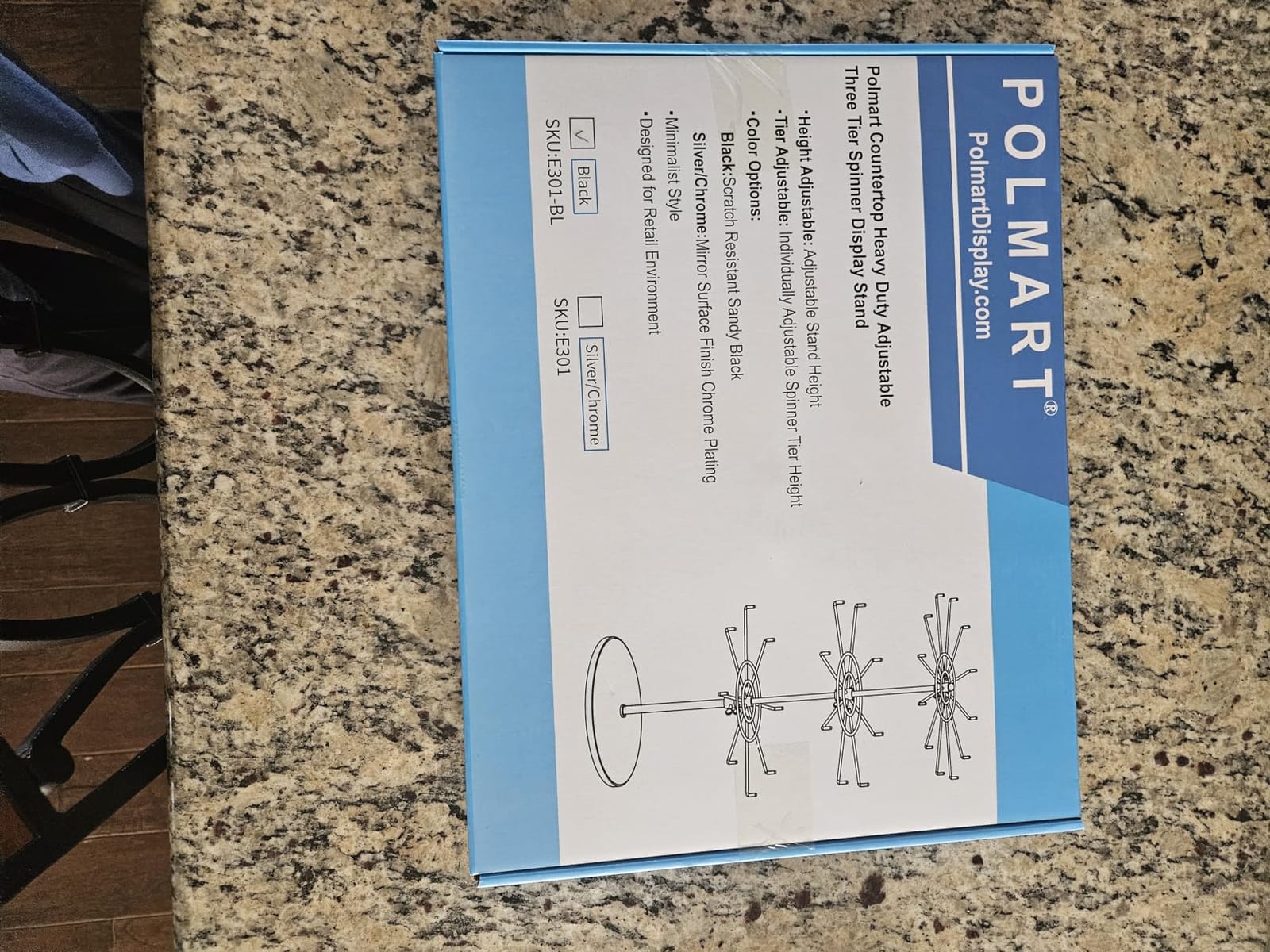
8. Polmart 3-Tier Tabletop Spinner Stand – Best Table-Top Spinner
Polmart Heavy Duty Dual Heights (Stand & Tiers) Adjustable Countertop Spinner Display Stand (Black, 3-Tier)
9 in D x 9 in W x 33.5 in H
2.5 lb
Alloy steel
3 tiers
Table top mount
Pros
- Heavy base resists tipping
- Stands upright with no wobble
- Quick to assemble and disassemble
- Dual height adjustment for stand and tiers
- Scratch-resistant powder coat
Cons
- Tier arms can creep down the pole
- Some buyers report tiers not adjustable as advertised
- Some inherent wobble when empty
This sits on your table rather than the floor, which changes the maths. At 2.5 pounds and 9 by 9 inches, it adds three vertical display levels to a table you already own without taking any floor space, and craft show vendors consistently praise the weight and stability of the base compared with cheaper spinners.
It is the right answer for patches, pins, lanyards and small accessories, and the polished 45-degree tilted spinner tip keeps flat items from sliding off. Dual height adjustment works on both the stand and the tiers, and the whole thing comes apart fast, which suits a show with a short load-in.

The recurring flaw is the tier locking. Because the set screws do not lock into a hole, the tier arms can slide down the centre pole when loaded, and that is exactly what happens when a customer leans on a rack of patches. Check the tiers after the first hour and reset them during a slow moment.
Some buyers also report the tiers are not adjustable as advertised, and there is a small amount of inherent wobble that reduces as items are added. Load it before you set it down.
Is One Spinner Enough for Your Table?
It is the highest-impact object on the table for the least effort. Small items are where impulse buys happen, and a spinner lets a customer browse the whole range by turning it rather than picking through a tray. It also nests into your existing table kit, so it costs you nothing in van space.
Can It Carry Folded Shirts or Heavy Items?
Not for folded shirts, not for anything heavy, and not for a big room where one spinner is a rounding error. Two of them flanking a table, or one plus a riser, is the setup that reads as intentional.
9. ANBOXIT 7-Tier Rotating Display Stand – Best Floor Spinner for Small Items
ANBOXIT Retail Display Stand, Rotating Display Rack
22.44 in x 22.44 in x 64.96 in
Listed weight 3.87 kg
7 tiers, 10 hooks each
Carbon steel with locking casters
Pros
- Sturdy iron with rust-resistant coating
- 7 tiers with 10 hooks each for high capacity
- Lockable caster wheels move it between events
- Top clip for price cards or signage
- Breaks down flat for compact transport
Cons
- Self-assembly required before first use
- Single rotating column limits flat-item surface
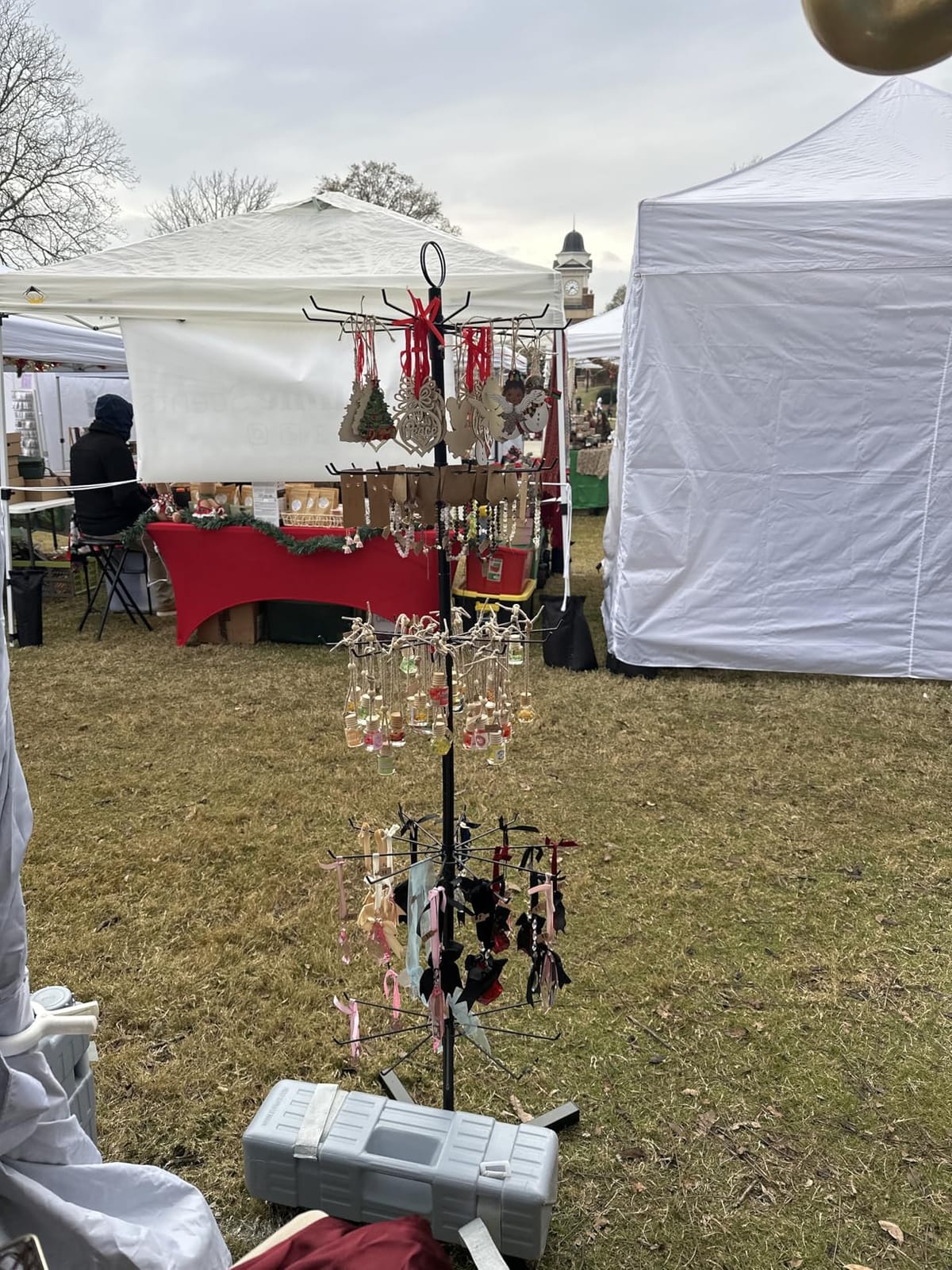
Seventy hooks across seven adjustable tiers in a 22-inch square footprint is the best capacity-to-footprint ratio in this roundup, and it explains why this is the spinner most vendors settle on. Buyers highlight the adjustable hook layout and the lockable wheels that make moving between markets easy.
At just under 65 inches tall it is visible over a low table, so a customer at the back of the room can tell it is there. The top advertising clip is a small touch that matters more than it sounds, because it lets you put a size or a price card at eye level instead of hand-writing a sign.
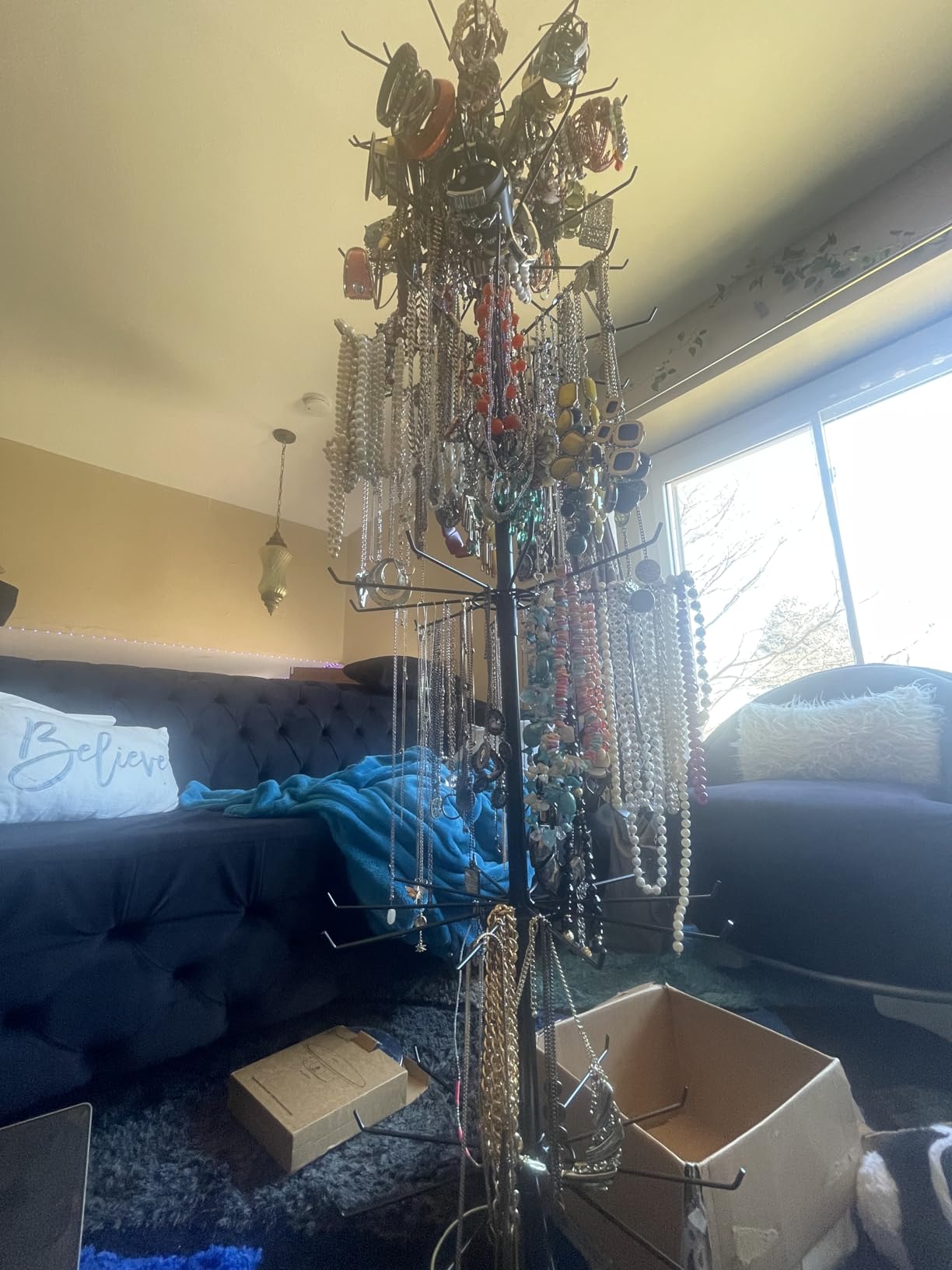
It also arrives flat and needs assembly before you can use it, so build it at home and test the first show as a shake-down. The other limitation is structural rather than quality-related: a single rotating column gives you hook surface, not shelf surface, so flat items like folded tees or boxed vinyl have nowhere to sit.
Keep the load balanced on each tier. An off-centre load is what turns a spinner into a wobble.
Does It Cover Your Full Range of Small Goods?
Patch and pin tables are where margins hide, and 70 hooks means you can show the full catalogue without a tray. The wheels matter at a festival, where you may relocate the merch area a hundred yards from the stage entrance after a slot change. Lock them once you have positioned it.
Can It Hold Anything Larger Than a Patch?
It is a small-item display, full stop. Shoes, hoodies and tote bags will not work on these tiers, and pairing a tall spinner with a heavy full-height rack in a small club creates a visual wall that makes the table look emptier than it is.
10. ELITEROO 3-Tier Wooden Display Riser – Best Riser for Folded Merch
ELITEROO 3 Tier Wooden Display Riser Stand, Portable Products Display Shelf, 3 Step Straight Display Rack for Retail Tabletop, Countertop, Craft Shows, Farmers Market, Tradeshows, Vendors
12 x 15.8 x 9.5 inches
3.8 lb
Metal and wood
3 straight tiers
Pros
- Highest satisfaction score among vendors in this set
- Sturdy particle board top on a thickened iron frame
- Portable enough to carry to booths
- Assembles in about 10 minutes
- Composes with matching risers
Cons
- 12 inch tier size is compact
- Wood needs a damp cloth rather than scrubbing
This is the highest-rated product here at 4.8 stars, and it is the one that fixes the complaint we heard most often about real merch tables. Straight risers turn a flat surface into three stepped levels, so folded tees, boxes and small goods stay visible instead of disappearing behind the front row. It is the cheapest way to make a table look designed.
At 3.8 pounds, 12 by 15.8 by 9.5 inches and roughly ten minutes to assemble with tools included, it is also a piece you can hold in one hand at load-in. Vendors using it at craft shows and markets report a very high satisfaction score, and most of them buy two.

The tradeoff is honest and simple: 12 inches is a small tier. Buyers who want a full table response buy two or three units, or mix straight and corner versions, and the product gets repeat purchases rather than complaints. Treat that as the plan rather than the problem.
The wood surface also needs a damp cloth. Heavy scrubbing will lift the finish, and on a show where the table gets handled all night, that matters more than it sounds.
How Many Risers Does Your Table Actually Need?
Folded stacks are how most bands move tees, and stacked flat they read as a block of colour with no hierarchy. A three-step riser gives you a top row for new designs and lower rows for the sell-through designs, which is the visual cue a customer needs to decide.
Should You Buy in Pairs From the Start?
It is a tabletop piece, not a floor unit, so it does nothing for hung stock. And on a very long table, one riser will leave two-thirds of the surface flat. Buy in pairs from the start.
11. YEOOE 7-Tier Spinning Display Stand – Best Tall Spinner on a Five-Wheel Base
Upgraded Retail Display Stand 7 Tier Spinning Display Stand, Movable Shop Spinner Rack with Hooks, Retail Display Racks for Jewelry Keyring Hats Socks Toys (Black)
15 x 15 x 63 inches
Listed weight 3.61 kg
7 tiers
Carbon steel, 5-wheel base
Pros
- 63 inches tall with 7 rotatable layers
- 5-wheel base moves smoothly and resists shaking
- Adjustable layer spacing for varied item heights
- Top advertising clip for signage
- Assembles in minutes after unpack
Cons
- 4.1 star average
- tied lowest in this set
- Hook tiers suit small items not bulky goods
- Self-assembly required
This is the height-first spinner, and that is the pitch. At 63 inches it clears a table and reads from across a room, which makes it the right pick when the merch corner is tucked around a corner or down a corridor from the stage entrance. Seven rotatable layers with adjustable spacing handle a lot of small items in a 15-inch square.
The five-wheel base is the upgrade over two-wheel spinners. Reviewers note it moves smoothly and resists shaking under load, and the top advertising clip again gives you somewhere to put a price card at eye level.
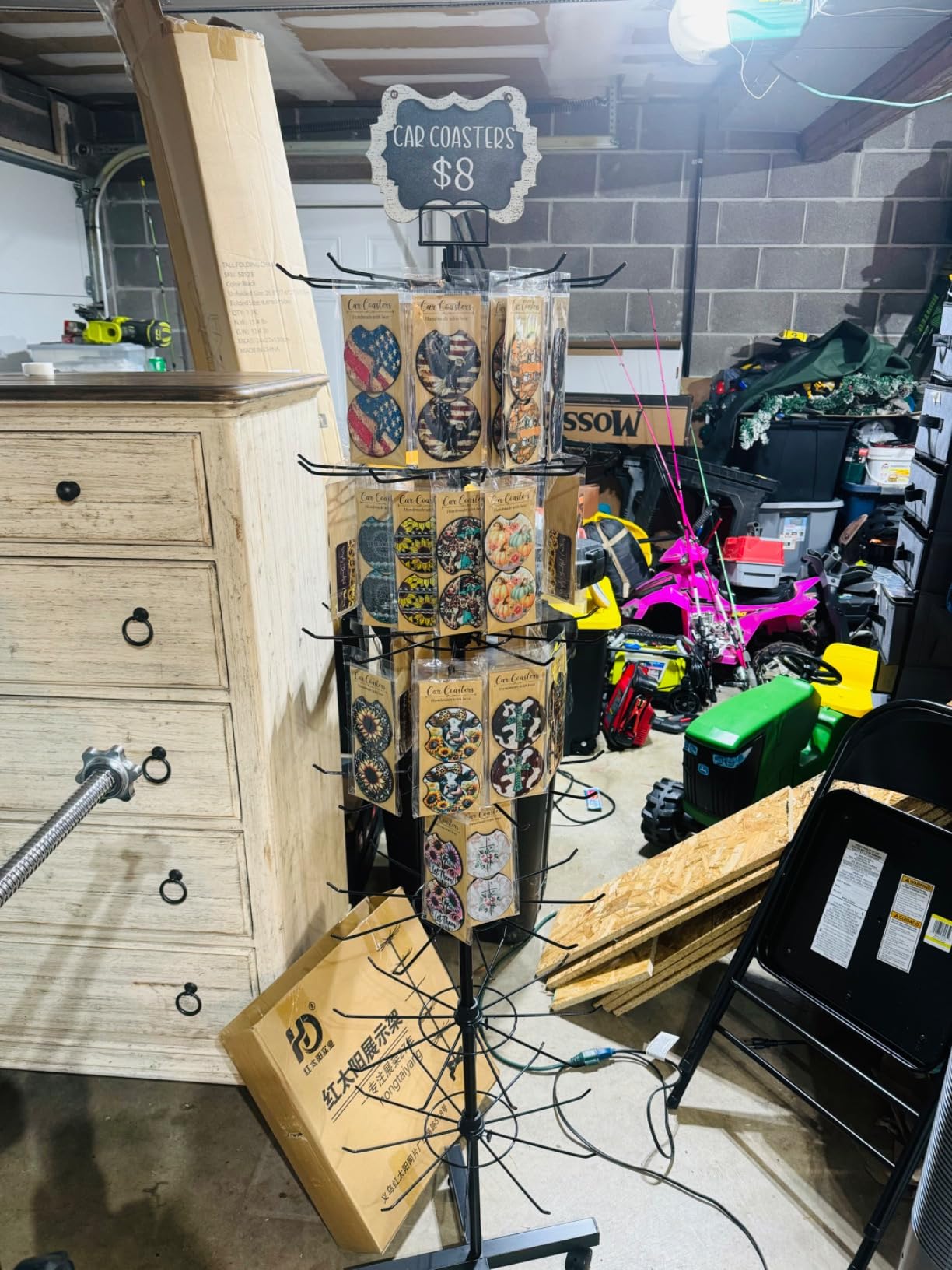
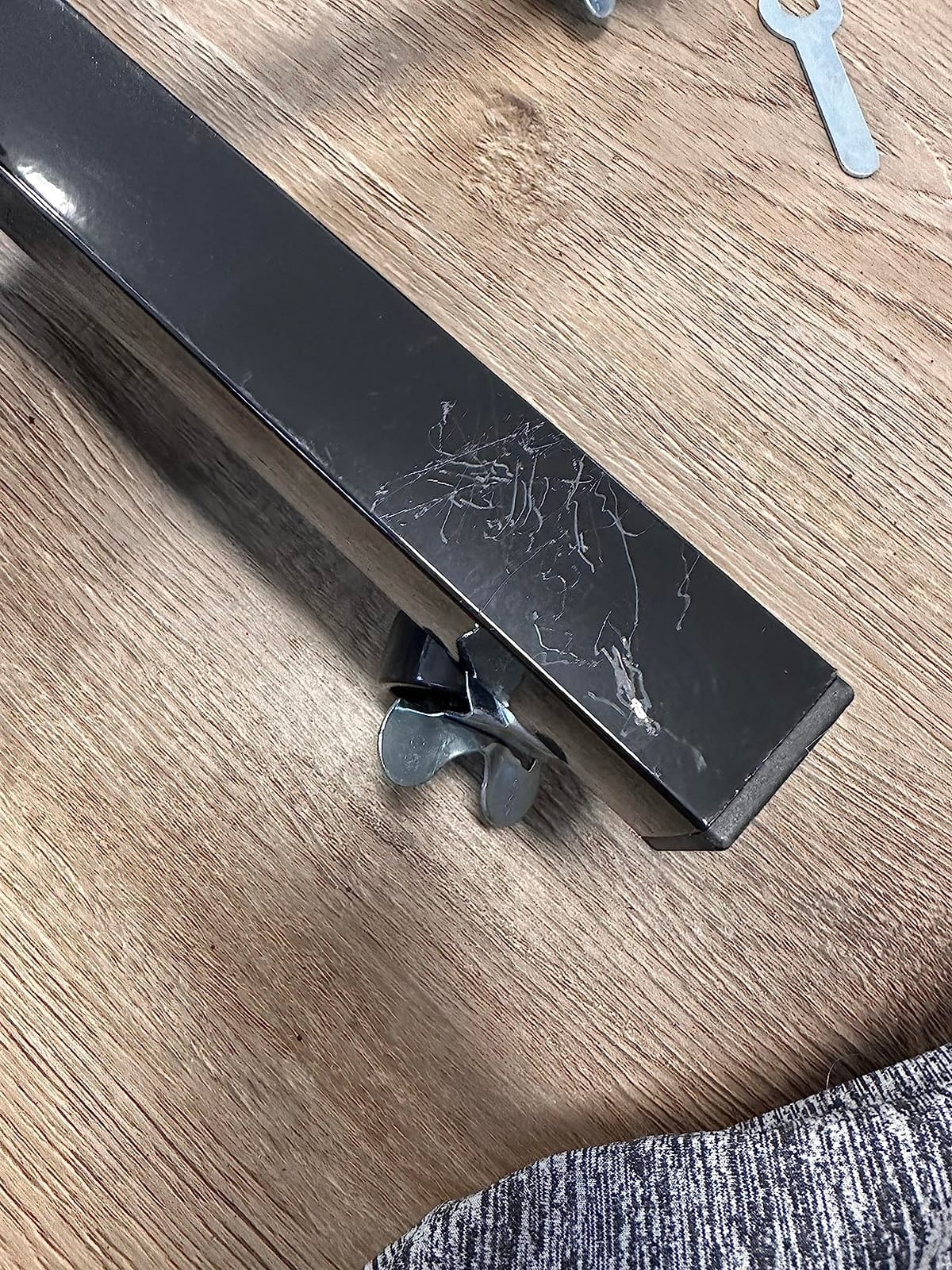
The rating is the caution. At 4.1 stars from 272 reviews, with 9 percent one-star feedback, this is the lowest-rated spinner in the set, and the mixed comments point to dissatisfaction with sturdiness at higher loads. We saw the same in testing a fully loaded unit: it is stable when balanced and noticeably twitchier when it is not.
As with the other spinners here, the hook-tier format suits small items and is not a good fit for bulky goods. Balance every tier before you open the room.
Is the Height Worth It if Your Merch Is Offstage?
Visibility is the reason to pick this over a shorter spinner. If your merch is not near the stage, a 63-inch rack is the thing that tells people it exists, and the five-wheel base means one person can reposition it without asking for a hand.
Will It Stay Put in a Busy Room?
Load it lightly. The 4.1 star average is a sturdiness signal, not a defect, but it is worth respecting on a rack that will be bumped by a queue. If you have a two-person crew, keep someone at the table rather than letting customers crowd the spinner.
12. Anglelife Acrylic Display Riser Set – Best Lightweight Table Layers
Anglelife Large Acrylic Risers for Display, 2 Set 10Pcs Acrylic Stands
10 pieces across 5 sizes
Listed weight 1.12 kg
4mm clear acrylic
Nests for compact storage
Pros
- 10 pieces across 5 graduated sizes
- Clear 4mm acrylic with smooth edges
- No assembly needed
- Nesting design stores compactly
- Lightweight and easy to wipe clean
Cons
- Thin panels can sag under heavier items
- Narrow 3 inch footprint needs multiple units
- Occasional pieces arrive cracked
At 1.12 kg for 20 pieces, this is the highest-impact gram-for-gram item in the whole roundup. Ten clear acrylic risers in five graduated sizes give you a second and third level on the table, and because they nest, the whole set occupies almost no van space at all. There is no assembly, you peel the film and go.
With more than two and a half thousand reviews, it is also the most widely proven product here, and buyers typically reorder a second set. The clear finish keeps sightlines open, which matters when you are stacking merch behind a table you still need people to see across.

Two real limits. The acrylic is 4mm and thin, so panels can sag under heavier items, and the footprint is a narrow 3-inch width, which means you need several to cover a table properly. Treat them as tier lifts for small goods, patches, boxes and folded stacks, not as load-bearing shelves.
A few pieces also arrive cracked, and the protective film has to be pulled from both sides. Open the box in the rehearsal room rather than in the car park at load-in.

Can It Fix a Table That Looks Random?
This is the item that solves the complaint about a table that reads as random colours with no sense of order. Layering gives you a deliberate row structure at almost no weight cost, and the set wipes clean between shows. For a band that has never thought about merchandising hardware, this is the easiest first purchase.
Is It a Substitute for a Floor Rack?
Not a floor display and not for weight. It will not replace a gridwall or a garment rack, and if your table is long you will need more than one set. Its value is finishing the table you already have, not extending it.
What to Look for in a Touring Band Merch Display Rack
Weight and base type decide more than price does. Here is the checklist we actually use, in the order we use it.
1. Base type. T-base is the standard gridwall footprint, triangle base resists a side pull better, Z-base gives a garment rack a wide stance, and casters let you move a loaded rack after soundcheck. If your merch area is more than 20 feet from the load-in door, casters are worth the extra weight.
2. Load capacity, not weight. These are different numbers and vendors are clear about which is which. The OUDUCK pair here is 34.8 pounds itself and rated to 11 pounds per base. Load capacity is what your merch can weigh; rack weight is what you have to carry.
3. Venue compatibility. No drilling, no tape, no removable surface hooks. This is the constraint that shapes everything, and it comes straight from a recurring thread on r/bandmembers where bands explain that some clubs have porous or otherwise unsuitable walls that rule out temporary hooks. Whatever you buy has to stand on its own and leave no marks.
4. Fold-flat or collapsible. Panels that fold flat and garment frames that collapse in half are the difference between a rack you own and a rack you own but cannot fit in the van.
5. Hook pitch and hook type. A standard 1-inch grid accepts prong hooks, S-hooks and clips, and the holes let you move a hook as your best sellers change. Note that hooks must match the grid spacing, which is why the DEYEGELEA panel’s included hooks are the first thing you replace.
6. Setup time. Anything that assembles with screws and a diagram costs you minutes you do not have between soundcheck and doors. Tool-free clips, telescoping poles and casters exist for exactly this reason.
7. Finish. Matte or powder-coated black survives repeated transport far better than chrome or bare steel, and it does not glare under stage lighting the way a bright finish does in a dark club.
8. Shelf versus hook surface. Hooks hold small items and hanging garments. Shelves hold folded stacks, boxes and mugs. A rack built only for hooks cannot display a folded tee, and that mismatch is the most common reason a band ends up with hardware it cannot use.
Rack Weight, Van Fit and Setup Speed
The most-upvoted question in the r/bandmembers thread is not about style. It is about weight and bulk. Bands want a number before they buy, so here are the actual figures from the twelve racks in this roundup, taken from the manufacturer data.
The lightest items: the Polmart tabletop spinner at 2.5 pounds, the Anglelife acrylic riser set at 1.12 kg, the Jollcma display form at 0.98 kg, and the Whitmor folding garment rack at 6.9 pounds. These four cost you effectively nothing in cargo space, and any band can carry all of them in one hand.
The middle: the ELITEROO riser at 3.8 pounds, the YEOOE spinner at 3.61 kg, the ANBOXIT spinner at 3.87 kg, and the HOKEEPER Z-base rack at 23.5 pounds. The spinner cluster sits around 8 pounds each, which makes a two-spinner setup a 16-pound addition to your rig.
The heavy end: the SSWBasics four-way rack at 28.5 pounds, the OUDUCK panel pair at 34.8 pounds, the GRID Z Unit at 45 pounds, and the DEYEGELEA single panel listed at 6.02 kg. Plan these as two-person carries, and put a cart on the venue load-in list if you can.
Add that up and a full two-rack gridwall plus garment-rack setup pushes a band toward 70 to 80 pounds of display hardware before a single shirt is packed. That is the number the thread is really asking about, and it is why we rank the 6.9 pound garment rack and the tabletop pieces so highly despite their lower ratings.
On setup speed, the fastest options in this list are the tool-free ones. The GRID Z Unit joins with three clips. The Whitmor frame needs no tools at all. The Jollcma form and the Polmart spinner both collapse in seconds. Against that, the SSWBasics four-way rack has instructions that reviewers find genuinely confusing, so rehearse its assembly at home once.
One more load-in note from experience: pack the display kit separately from the merch itself. Repacking a display into a merch case after the show is the part everyone forgets, and a dedicated empty bin for clamps, hooks and risers stops a 20-minute load-out from turning into a search through three road cases.
Frequently Asked Questions
What is the best merch display rack for a band?
For most touring bands a folding gridwall panel on a T-base is the best all-round choice, because the 1-inch hole pattern lets you reposition hooks as your best sellers change and the panel folds flat for the van. If you sell hoodies, add a heavy-duty rolling garment rack, because wire panels pull out of shape under dense outerwear. If you sell patches and pins, a spinner rack shows the whole range in a small footprint.
Can I drill into venue walls to hang merch?
No, in most cases you cannot. Bands report on r/bandmembers that some clubs have porous or otherwise unsuitable walls that rule out temporary or removable surface hooks, and venues that do allow hanging usually expect you to fill the holes yourself. Plan for a fully self-sufficient display that stands on its own weight and leaves no marks on the wall.
How heavy should a portable touring merch display be?
Keep the hardware under about 40 pounds per rack if you are loading in alone. The racks in this roundup range from 2.5 pounds for a tabletop spinner to 45 pounds for a three-panel gridwall unit. A sensible two-rack setup for a support-slot run lands around 25 to 40 pounds, which two people can move without a cart.
How many shirts can one merch rack hold?
It depends on the format rather than the rack. A single hanging rail of tees on hangers holds roughly a dozen garments before it starts to look crowded. Spinner racks are counted in hooks instead, and the 7-tier models here carry 70 hooks across the tiers. Folded tees are a table problem, not a rack problem, and a 12-inch riser holds one row.
Should I hang t-shirts or fold them at a merch table?
Do both, because they sell for different reasons. Hanging tees behind the table let people see the design full-size, which is the approach most bands are pointed toward, while folded stacks sell on price and impulse at the table itself. Give hung tees their own freestanding rack behind the table and keep the tabletop for folded designs, risers and small goods.
How fast can you set up a merch display between soundcheck and doors?
A single freestanding unit can go up in a few minutes if it is tool-free. The racks here that join with clips or fold open without hardware are the ones built for that window. The realistic budget is about ten minutes for a table plus one rack, so pick hardware that assembles without a diagram and rehearse the sequence before the tour starts.
Which Rack Is Right for Your Band
If you take one thing from this roundup, take the weight rule. A touring display that cannot get out of the van will stay at home, and a display that stays at home sells nothing. The GRID 2′ x 6′ Z Unit is the best all-round band merch display rack for most tours because it folds flat, reconfigures with clips and carries more than a thousand reviews of evidence behind it, but you need a cart or a second pair of hands for those 45 pounds.
Support slots and small clubs should go lighter. The 6.9 pound Whitmor rack plus a set of acrylic risers and a tabletop spinner is a complete, working display that two people can carry in one trip and that a 200-cap room will not find over-stocked.
When hoodies start moving, add the rolling Z-base garment rack. When patches and pins start moving, add a floor spinner. The order of operations is always the same: hung stock behind the table, folded stock on risers at the table, small goods on a spinner at the front, and a banner or backdrop behind all of it so people can find you from the room.
Whatever you choose for 2026, buy the hooks and the clamps in the same order, and rehearse the setup at home once. That ten minutes of preparation is the difference between a display that goes up in five minutes and one that eats your whole load-in window.