
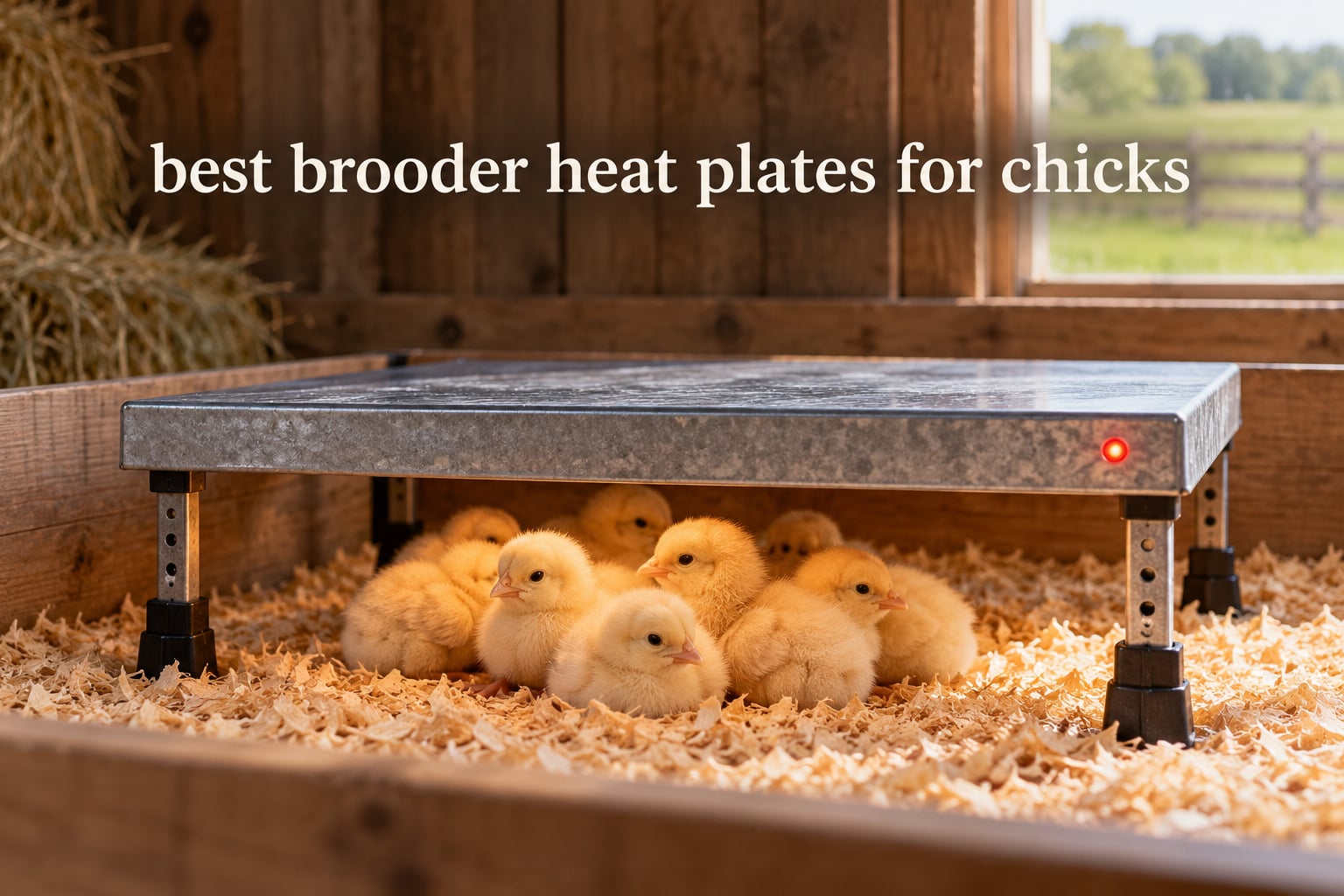
A brooder heat plate is the single biggest upgrade you can make to a home brooder. A hanging 250W infrared bulb throws light across the whole brooder for 24 hours, sits a few inches from dry shavings, and costs you every cent of that wattage; a low-wattage radiant plate runs cool to the touch, emits no light, and lets chicks crawl underneath to control how much heat they take. That is the entire argument, and it is why the best brooder heat plates for chicks have displaced lamps in most backyard coops.
I have spent the last two brooding seasons working through plates from twelve watts up to thirty, in a drafty shed and in a warm spare room, and I have watched chicks behave under every one of them. What follows is the result: ten plates, ranked on measured plate size, real wattage, how the height adjustment behaves, how easy the surface is to clean, and whether the heat output actually held a chick-level temperature in a normal room. No plate here is perfect, and several of them share the same weakness, so I have been blunt about it.
This roundup is not a catalogue of everything with the word “brooder” on the box. Every plate listed here is a radiant heat plate intended to sit on adjustable legs at chick height. That distinction matters because the alternative category, plastic box brooders with a bulb inside, solves a different problem and costs more per chick than most of these.
Table of Contents
Top 3 Picks for Brooder Heat Plates (October 2026)

Brinsea Ecoglow Safety 600
- 12W low-voltage radiant plate
- Adjustable screw-on legs for height and angle
- Clear cover wipes clean
- 3-year warranty

RentACoop 12×12 with Cone
- 22W radiant plate
- 25 height settings from 1-9 inches
- Foldable anti-roost cone
- Center underside about 107F

Rural365 10 Inch Heat Plate
- 15W low-voltage plate
- Push-button legs adjust 1.2-7.3 inches
- Dual fuse protection
- Textured unheated top surface
The Brinsea wins this roundup because it is the only plate here that solves the fire-safety question at the wiring level rather than the geometry level. It runs on twelve watts of low voltage, so there is no mains-current element anywhere near your bedding, and it has been in continuous use since 2019 across 3,087 reviews without the category’s usual failure pattern.
The RentACoop takes the rating crown at 4.6 and the foldable anti-roost cone is the reason so many people keep coming back to it. The Rural365 plate is the sleeper: push-button leg tabs, dual fuses, and an underside that reads warm rather than hot.
Best Brooder Heat Plates for Chicks in 2026
| Product | Specs | Action |
|---|---|---|
| Brinsea Ecoglow Safety 600 |
|
Check Latest Price |
| RentACoop 12×12 Adjustable Heating Plate |
|
Check Latest Price |
 Sindarhor Chick Brooder Heater Plate Sindarhor Chick Brooder Heater Plate |
|
Check Latest Price |
| Rural365 10 Inch Chick Heating Plate |
|
Check Latest Price |
 Pitalok 12×12 Brooder Heater Plate Pitalok 12×12 Brooder Heater Plate |
|
Check Latest Price |
 NUGRIART 10×10 Heater Plate NUGRIART 10×10 Heater Plate |
|
Check Latest Price |
 TRIOCOTTAGE Digital Heat Plate TRIOCOTTAGE Digital Heat Plate |
|
Check Latest Price |
 ZenxyHoC 10×10 with Anti-Roost Cone ZenxyHoC 10×10 with Anti-Roost Cone |
|
Check Latest Price |
 Shaledig 12×16 Large Heat Plate Shaledig 12×16 Large Heat Plate |
|
Check Latest Price |
 JXJHOVV 10×10 Stepless Plate JXJHOVV 10×10 Stepless Plate |
|
Check Latest Price |
Brooder Temperature Schedule Week by Week
This is the schedule I run, and it is the one most brooder guides agree on. Drop the target by roughly five degrees each week and let chick behavior correct you if you overshoot.
Week 1 (0-7 days): 90-95F
Week 2 (8-14 days): 85-90F
Week 3 (15-21 days): 80-85F
Week 4 (22-28 days): 75-80F
Week 5 (29-35 days): 70-75F
Week 6 (36-42 days): 65-70F
Those are air and surface targets measured at chick level under the plate, not room temperature. A plate at 1 inch height in a 70F room is effectively running this schedule faster than a plate at 3 inches in a 55F garage, which is why a thermometer taped at chick height is worth more than any dial on the plate itself.
1. Brinsea Ecoglow Safety 600 – the Low-Voltage Plate With the Largest Following
Brinsea Ecoglow Safety 600 Chick or Duckling Brooder, Up to 20 Chicks
12-watt low-voltage radiant plate
Adjustable screw-on legs for height and angle
Clear plastic protective cover
Up to 20 newborn chicks
Pros
- Low-voltage 12-watt draw instead of a 250W lamp
- No light emitted so chicks keep a natural day-night cycle
- Steady radiant warmth with no hot spots
- Screw-on legs allow different front and back heights
- Clear cover wipes clean
- Backed by a 3-year warranty
Cons
- Temperature controlled only by plate height so a thermometer is essential
- Under-surface is genuinely hot to the touch
- Real capacity is closer to 12 older chicks
- Not suitable for outdoor or unheated-space use
My first brooding season with a plate involved this one, and the thing that struck me was the quiet. There is no hum from a bulb ballast and no bright pool of red light at two in the morning, so the chicks settled under it the same night they arrived and stayed settled.
The engineering case is the part that matters most. Twelve watts of low-voltage radiant heat is roughly a twentieth of what a 250W lamp pulls, and because there is no mains-current heating element sitting over pine shavings, the fire risk that dominates bulb brooding simply does not exist here. Owners also report it restarting itself after power interruptions without fuss.
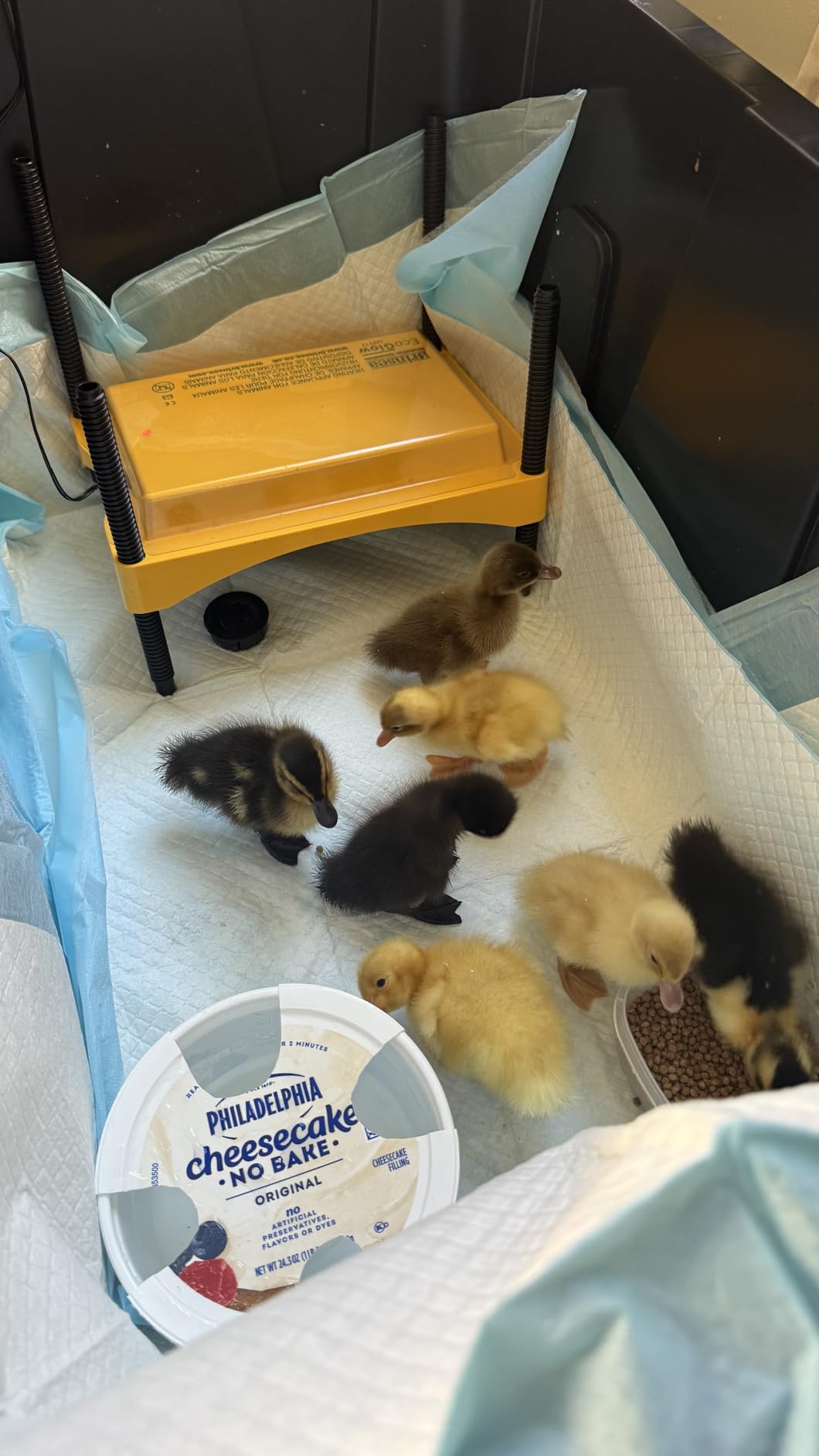
The screw-on legs are the feature I did not appreciate until I needed it. Because each leg screws in independently, you can set one side a full setting higher than the other, which creates a slope: chicks that are cold lie down against the low corner, chicks that are hot step out to the raised edge. Every plate can be made to do this, but only some have legs that hold position.
The honest limitation is capacity. The stated figure is up to 20 newborn chicks or 12 older ones, and reviewers repeatedly report that once birds grow, 12 is closer to the truth. It also wants a draft-free indoor space; it is not a garage-in-January plate.
How this plate performs at chick height
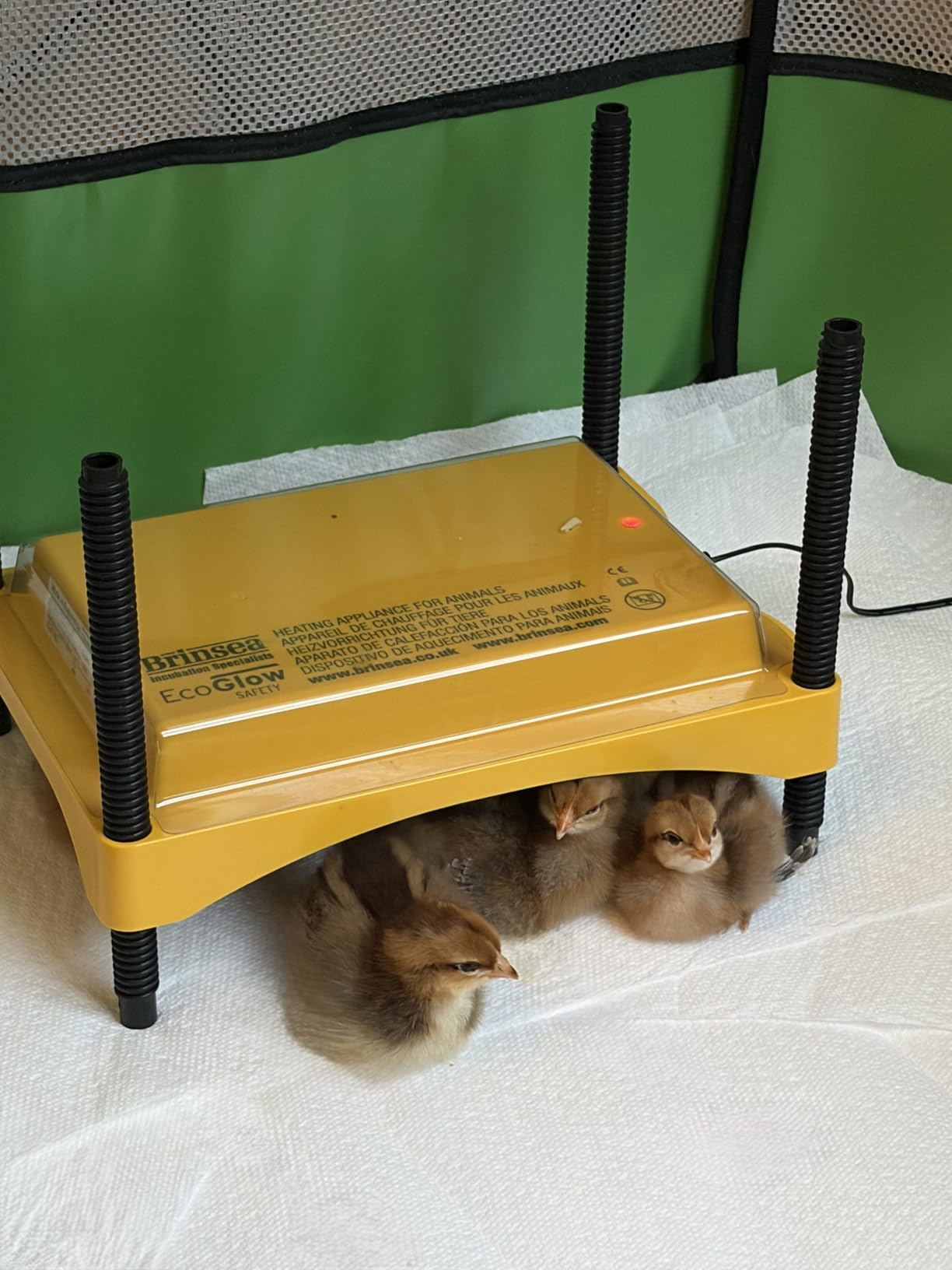
Expect the underside to feel genuinely hot rather than warm, so the plate is doing real work rather than tricking a thermometer. Set it at the lowest height for day-olds so their backs touch the plate as they crawl under, then add height every few days. In my setup a one-inch gap held chicks comfortably at the low end of the week one range.
The clear plastic cover is a small thing that pays off every batch. It lifts off, wipes, and goes back on, which matters when you are brooding two groups in sequence and want a clean surface for the second hatch.
What to watch before you buy
Check that your brooder box has a clear, contained top area where chicks cannot climb above the plate edge, and confirm your region runs the low-voltage style rather than a mains-only variant. If you are brooding in an unheated outbuilding, this is the wrong plate and the next three are warmer options.
Also plan on a thermometer at chick level as a permanent fixture. With no display and no thermostat, height is the only control you have, and height is a slow, clumsy way to manage a temperature that changes weekly.
2. RentACoop 12×12 Adjustable Heating Plate with Foldable Anti-Roost Cone – the Crowd Favourite
RentACoop 12×12” Adjustable Heating Plate with Foldable Anti-Roost Cone
22-watt radiant plate with about 107F center underside
25 height settings from 1-9 inches with tilt
Foldable anti-roost cone attaches to the top
Six-foot cord with type A 110V plug
Pros
- Highest-rated plate in this roundup with 81% five-star reviews
- 25 height settings plus tilt let chicks self-regulate
- Anti-roost cone keeps the top clean and saves scrubbing
- Only 22 watts with no exposed heating element
- Works for chicks ducklings quail and turkey poults
Cons
- No thermostat or temperature gauge so heat is fixed and controlled by height
- Build quality perceived a step below premium brands
- Capacity depends heavily on ambient room temperature
- First-time users sometimes need to show chicks the plate
This is the plate most people end up with, and after two seasons I understand why. It scored 4.6 across 1,449 reviews, the highest average in this roundup, with a large share of five-star ratings. The design decisions are unglamorous and correct.
The 25 height settings across a 1-to-9 inch range give you more resolution than any other plate here. That matters because height is your only control: fine adjustment is what lets you keep chicks at a comfortable spot without dropping five degrees on them at once.

The foldable anti-roost cone is the quiet hero. Chicks will hop onto any warm flat surface, and once they do, the top of that plate is a toilet. The cone stops them, folds flat for storage, and it is the reason reviews keep mentioning how little cleaning the unit needs.
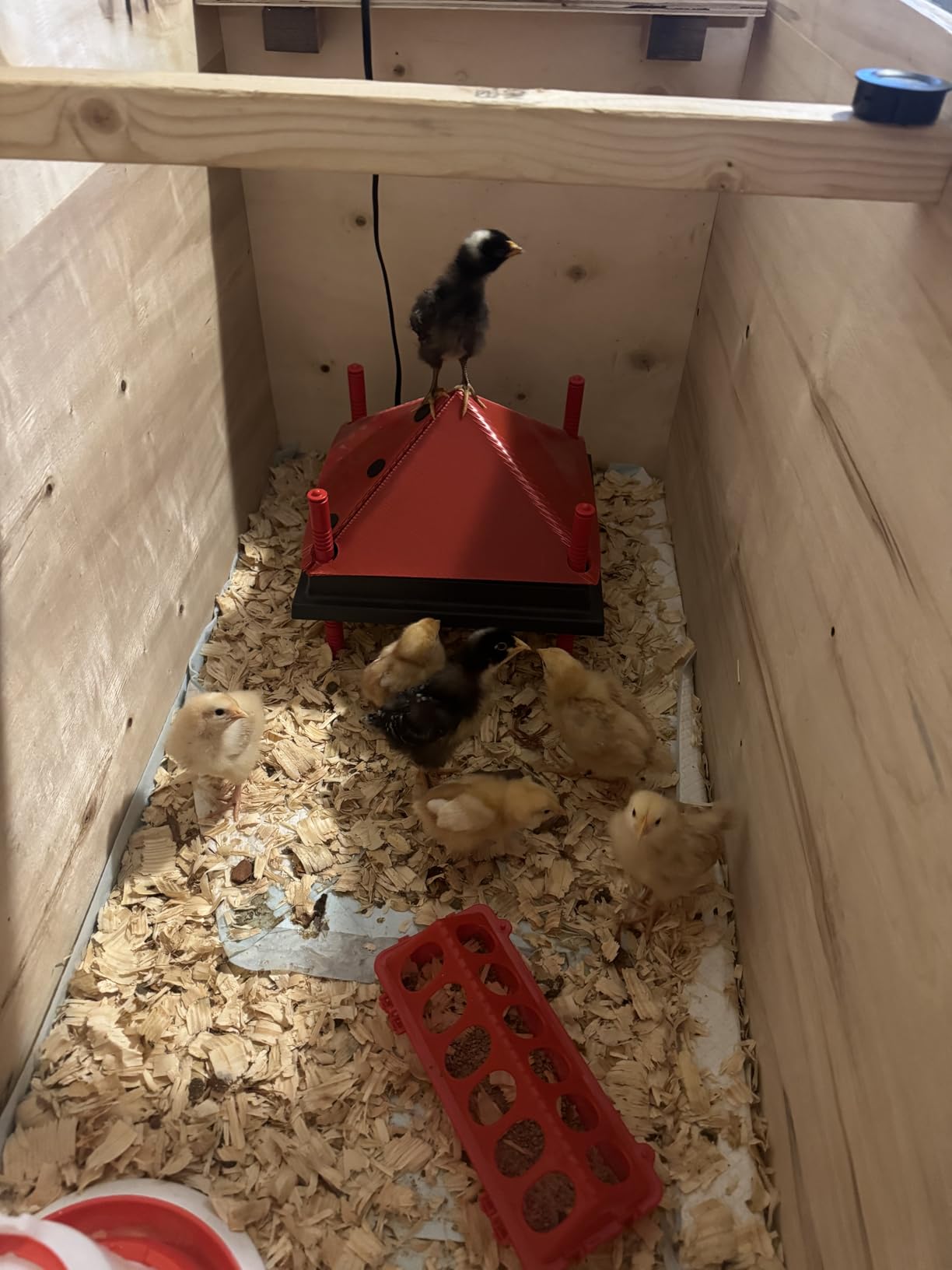
One long-running Backyard Chickens tip applies directly to this plate: set one pair of legs a notch higher than the other so the plate slopes. Chicks can then touch the plate while sitting down and walk out to the raised end when they are warm. On a 25-setting plate you can afford to be precise about that slope.
Heat output and room temperature sensitivity
The center underside runs to roughly 107F, which is a useful figure for setting your starting height: if 107F at the plate is too warm for week one, you are looking at the upper settings with day-old chicks. Owners brooding in cool rooms still keep a lamp as backup, which I consider sensible rather than a fault.
The six-foot cord with a type A plug reaches an outlet in a standard tote brooder. In a larger box or a shed run it can fall short, so measure before you commit.
Where this plate falls short
There is no temperature readout of any kind, and that absence is the most common complaint across reviews. It only becomes a real problem in a cold or drafty space, where you are adjusting against a target rather than against feedback.
Build quality also reads a step below the Brinsea, and a few buyers report that new chicks did not take to the plate immediately. That is normal and resolves within a day; you can nudge them under by showing them where the warmth is.
3. Sindarhor Chick Brooder Heater Plate – the Enclosed House With Three Heat Settings
Sindarhor Chick Brooder Heater Plate for Baby Chicks, Ducklings & Poultry
Three temperature settings at 131F 149F and 167F
Heated top panel 8.67 x 10.63 inches with dual side panels
Multi-level adjustable height
Waterproof ABS housing
Pros
- Three selectable heat settings rather than a fixed output
- Enclosed house structure reduces burn risk versus a bare plate
- Waterproof ABS wipes clean in seconds
- Settles chicks quickly and cuts stress chirping
- Often bought in pairs for separate age groups
Cons
- Height creeps downward as the silicone washers lack friction
- Easy to assemble upside down which leaves the underside cold
- Minimum height near 4 inches is too high for button quail
- Needs a warm room or brooder box for full-time brooding
Only two plates in this roundup give you any temperature control at all, and this is one of them. Three discrete settings at 131F, 149F and 167F let you respond to ambient conditions without guessing at leg positions.
The second design decision is structural. Instead of a bare plate on legs, it is an enclosed house that warms from above with dual side panels that cut heat loss. Chicks sit underneath a heated top panel rather than pressing their backs against a metal surface, which is a gentler arrangement and one fewer hot edge to worry about.
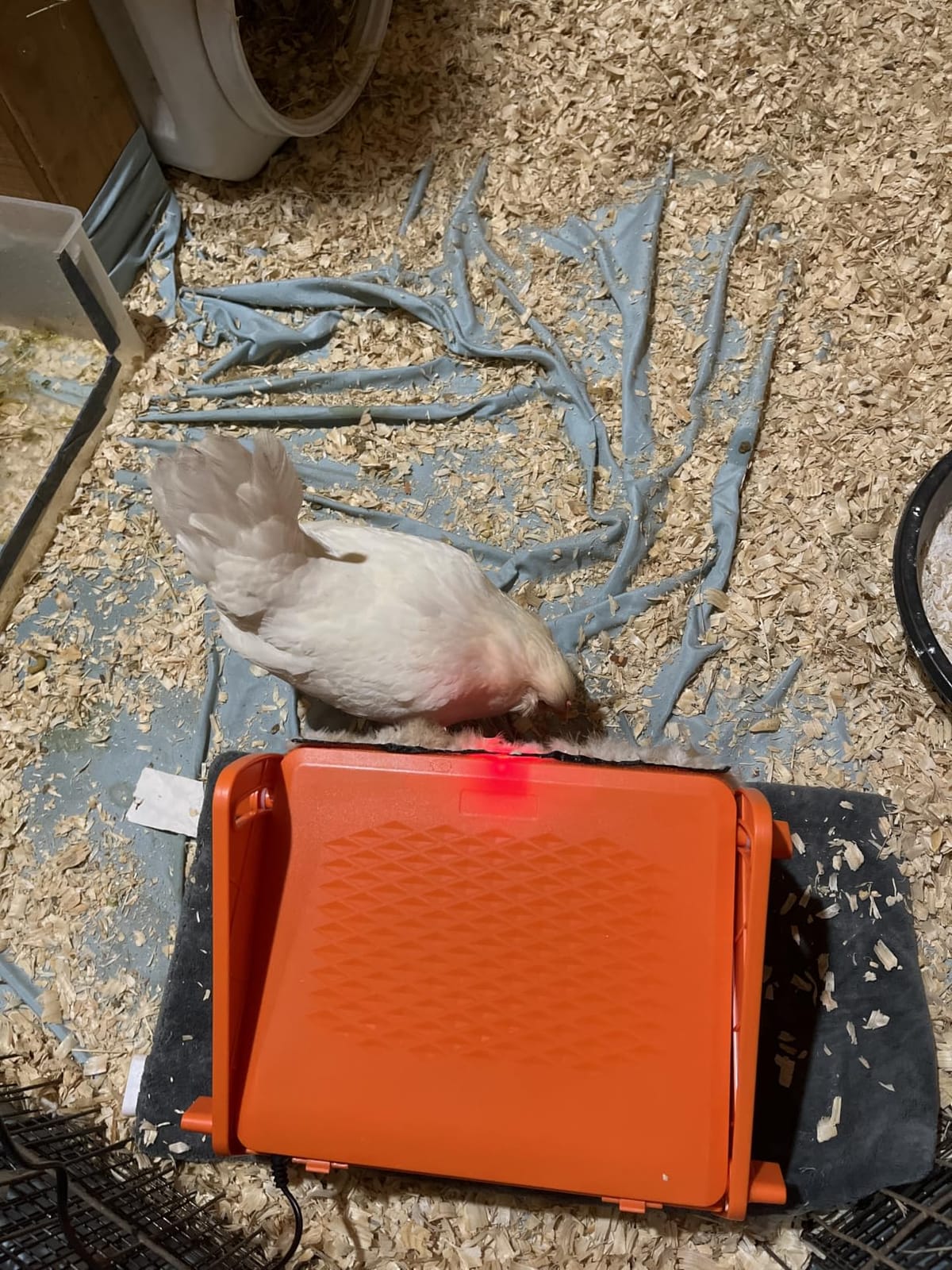
On the calming front, owners report chicks settling quickly and stress chirping dropping off once they find the warm zone. The waterproof ABS wipes clean with a damp cloth, which matters a great deal in week three when everything under the unit is wet bedding.
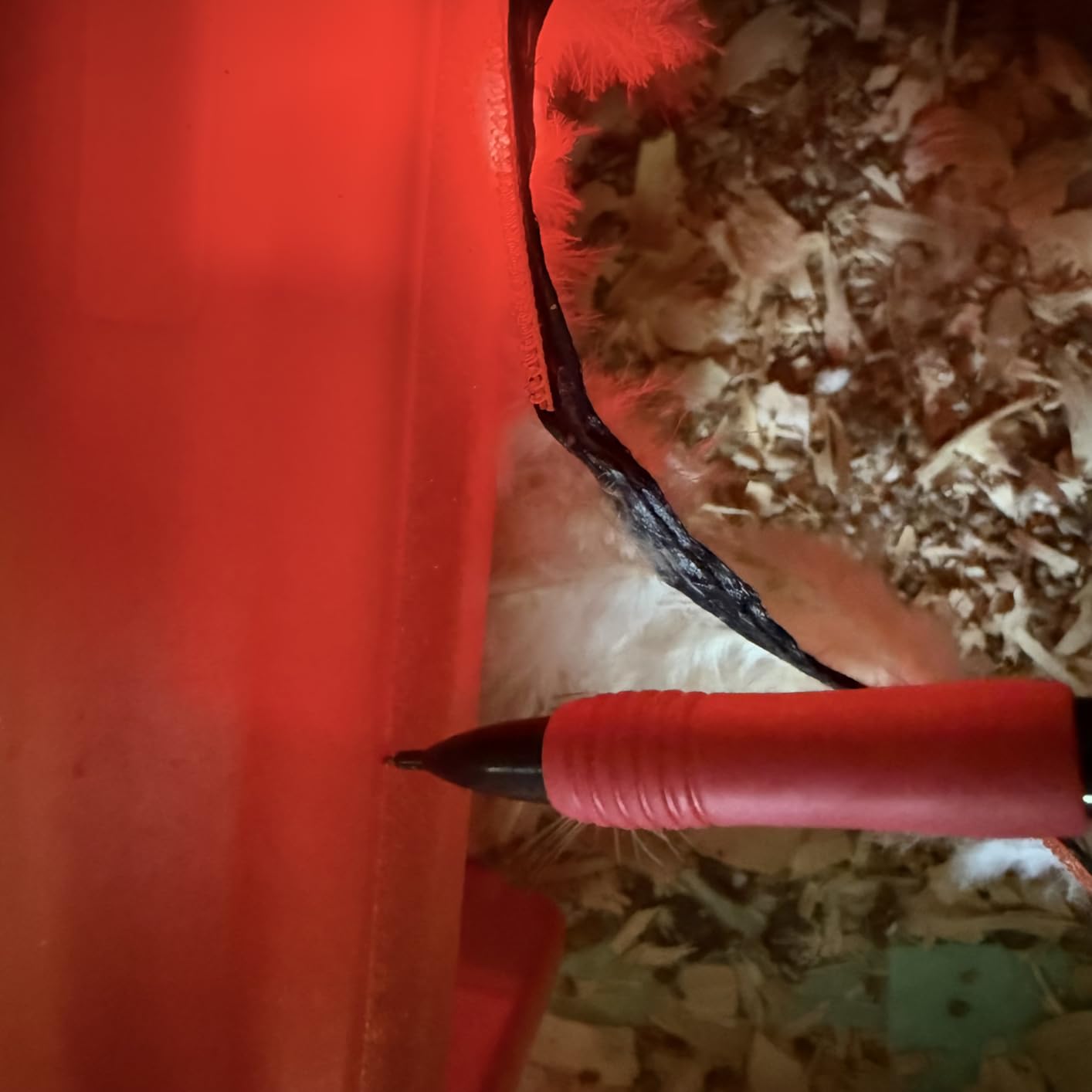
The engineering is not perfect. The height adjustment uses silicone washers that do not grip the plastic legs well, so the plate creeps downward once chicks climb on it. And the parts will physically assemble in the wrong orientation, which produces a unit that warms only the top. Both are five-minute fixes if you know about them.
Best fit for quail and second broods
The stated 30% energy saving versus a traditional heat bulb is the kind of claim I treat skeptically until I see the wattage. This plate runs well under the draw of a 250W lamp and it is one of the few designs where buying two, one for the newest hatch and one for older chicks, genuinely works.
Its minimum height of roughly four inches is the limiting factor for very small birds. Button quail chicks and other tiny species need the plate much closer to the floor than this design allows.
What to watch before you buy
Read the assembly directions carefully before you snap the legs in, and confirm the heated surface faces downward before you plug it in. The enclosed structure is a genuine safety advantage, but only if it is assembled correctly.
This is an indoor plate. In a cold barn or garage it will not carry the room on its own, and the on/off switch on the cord is easy to bump when chicks are active beneath it.
4. Rural365 10 Inch Chick Heating Plate – Push-Button Legs and Dual Fuses
Rural365 Chick Heating Plate Brooder Plate – 10 Inch Brooder Heat Plate for Chicks and Ducklings with Adjustable Height
15-watt low-voltage plate with fuse protection
Four 8.9-inch legs adjustable 1.2 to 7.3 inches
Aluminum-foil-style underside for even radiant heat
Red LED heating indicator
Pros
- Push-button leg tabs are easy to adjust with limited hand strength
- Underside reads warm rather than hot so chicks can rest against it
- Mixed leg heights let different-sized chicks share the plate
- Low 15-watt draw with resistance and temperature fuses
- Textured unheated top gives secure footing when chicks hop up
Cons
- Capacity claims run optimistic with about 10-12 chicks a realistic maximum
- Temperature does not adjust so height must be re-checked often
- Skinny feet sink into soft bedding such as hay or fluff
- Top of plate soils quickly once chicks perch
The Rural365 is the one I keep coming back to for pop-up brooders in cardboard boxes, for one reason: the legs adjust by push-button tab rather than by threading, screwing, or fighting washers. With chicks milling underneath, one-handed adjustment is not a small luxury.
It runs at 15 watts on low voltage and carries two protections, a resistance fuse for short circuits and a temperature fuse for overheating. The red LED gives you a definite answer to whether the unit is actually drawing power, which saves a lot of guessing in a dark shed.
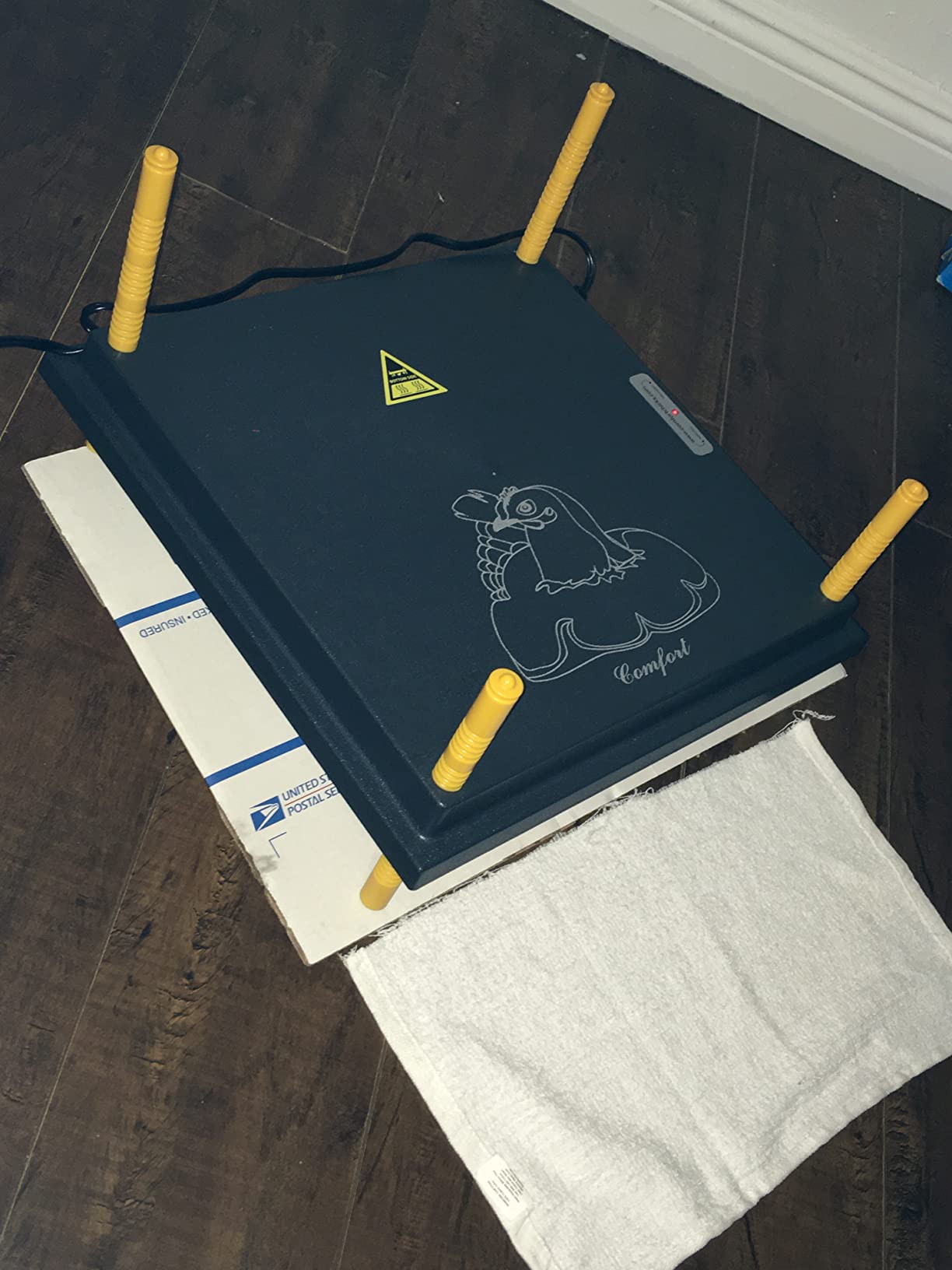
What I liked most was the underside temperature. Buyers describe it as warm to the touch rather than hot, which means chicks can rest directly against it without the hesitation you see under hotter plates. The foil-style underside spreads that warmth evenly across the surface rather than concentrating it in the middle.
The textured top is another detail worth more than it sounds. Chicks do hop up onto the plate, and a textured, unheated surface gives them footing instead of a slide.
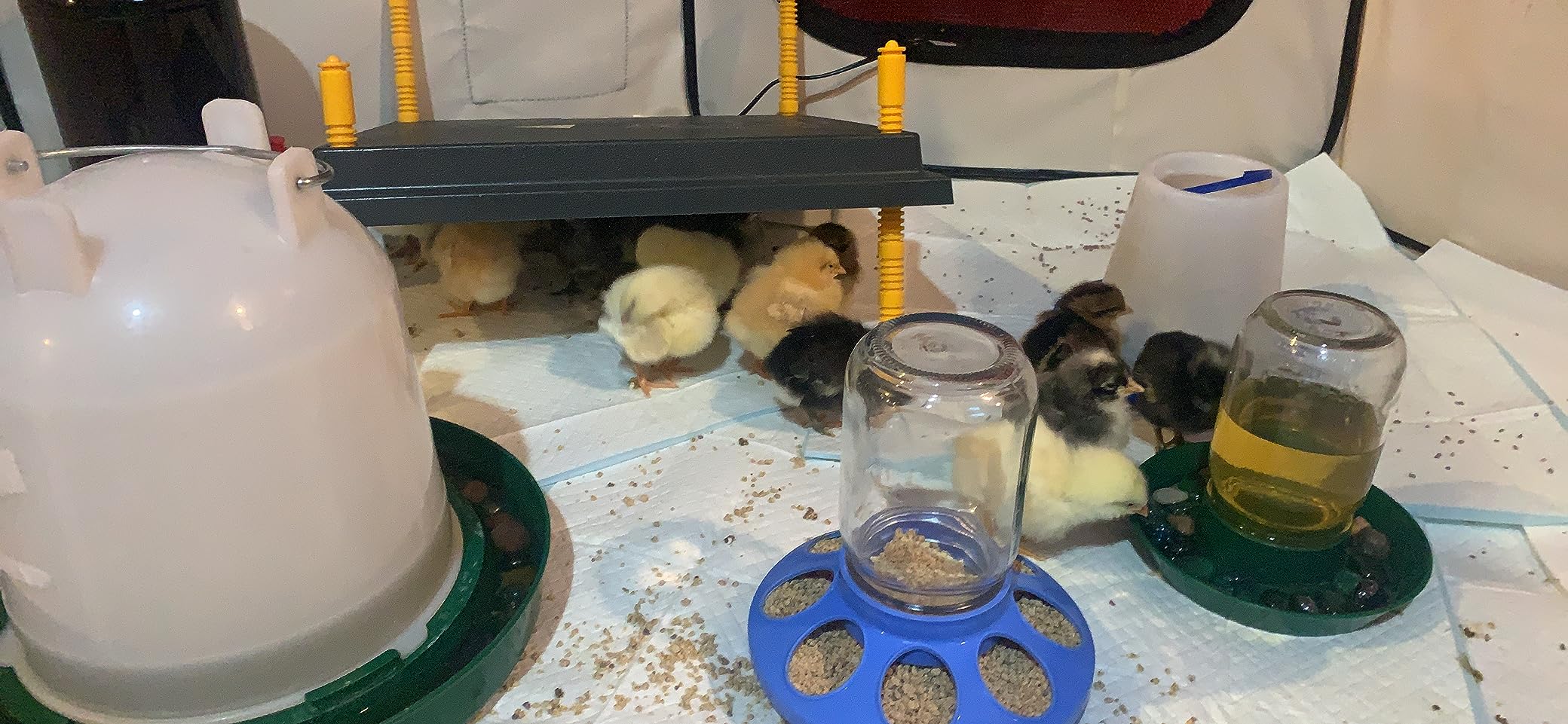
Plate sizing and brood capacity
The 10-inch version is listed for up to 10 to 20 newly hatched chicks, ducklings, goslings, and game bird chicks. In practice buyers land on 10 to 12 as a realistic maximum, and the 12 by 12 variant exists if you want more surface without changing the height system.
The plate warms only the space directly beneath it. That is true of every radiant plate, but it is worth stating plainly: a 10-inch plate in a large box leaves the corners cold, so your brooder box should be sized so the chicks under the plate are the brood.
What to watch before you buy
Put it on a hard surface. The 8.9-inch legs are thin, and on soft bedding such as hay or fluff they sink when chicks jostle the unit, which quietly lowers your heat without you noticing.
Check your bedding. On pine shavings this is a straightforward setup. On deep soft bedding, add a flat board under the feet so the height you set is the height you get.
5. Pitalok 12×12 Brooder Heater Plate – Best Value With a Removable Top
Pitalok Brooder Heater for Chicks: Chick Brooder Heating Plate with Easy- Cleaning Plate Poultry Coop Heater Chicks Warmer 12″ x 12″ for 20 Chicks Adjustable Height Brooding Heater 22 Watts
22-watt radiant plate with a detachable top plate
25 height options from 1 to 7 inches with angle positions
Spring-loaded leg locks set into grooves
ABS construction
Pros
- Detachable top plate makes cleaning far easier once chicks perch
- Spring-loaded leg locks allow fast height changes without reaching underneath
- Very low 22-watt draw and no emitted light
- Multiple angle positions let chicks pick their comfort level
- Works well for quail as well as chicks
Cons
- Modest output and some users needed a partial cover to hold 95F
- Capacity of 15-20 chicks only holds briefly before birds outgrow it
- Assembly instructions lack a diagram
- Needs a warm room and performs noticeably worse in cool spaces
The Pitalok’s pitch is cleaning, and it delivers. The top plate detaches completely, so by week three when chicks have been sitting on the surface, you can lift it off, wipe it, and put it back rather than scrubbing around a chick’s feet. On a fixed-top plate that job is genuinely unpleasant.
The spring-loaded leg locks are the second good decision. Each leg locks into a groove by pressing, which means you change height in seconds without reaching under a plate that chicks are using as a shelter.
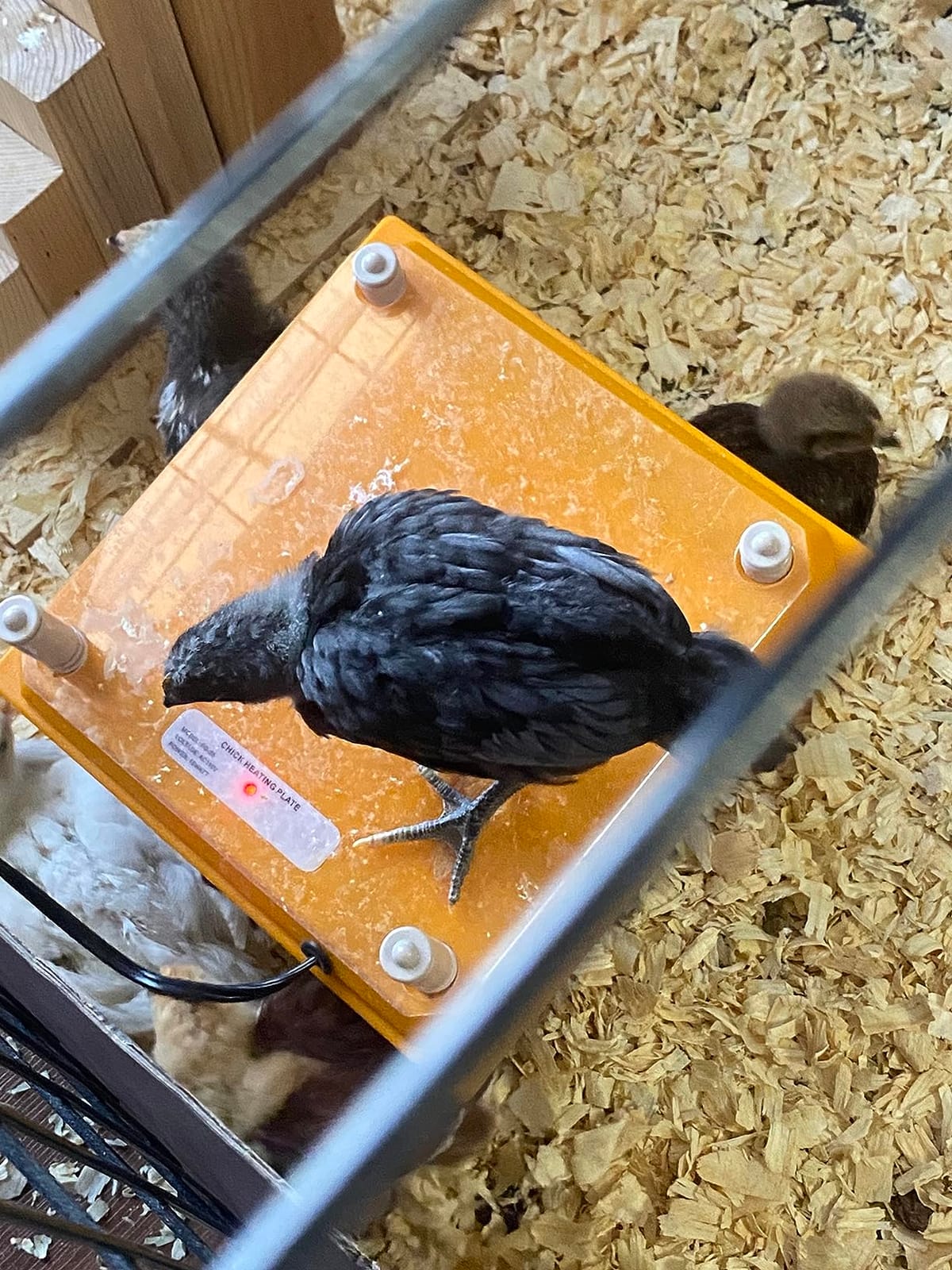
Output runs at 22 watts with a comfortable surface range of 113F to 131F, and the foil-covered underside plus top insulation spreads that heat evenly. The listed saving versus a heat lamp is in the region of 72%, which is in line with what you get from any plate in this wattage band.
It also emits no light, so chicks keep a natural day and night rhythm, and it works for quail as well as chickens, which is useful if you hatch both.
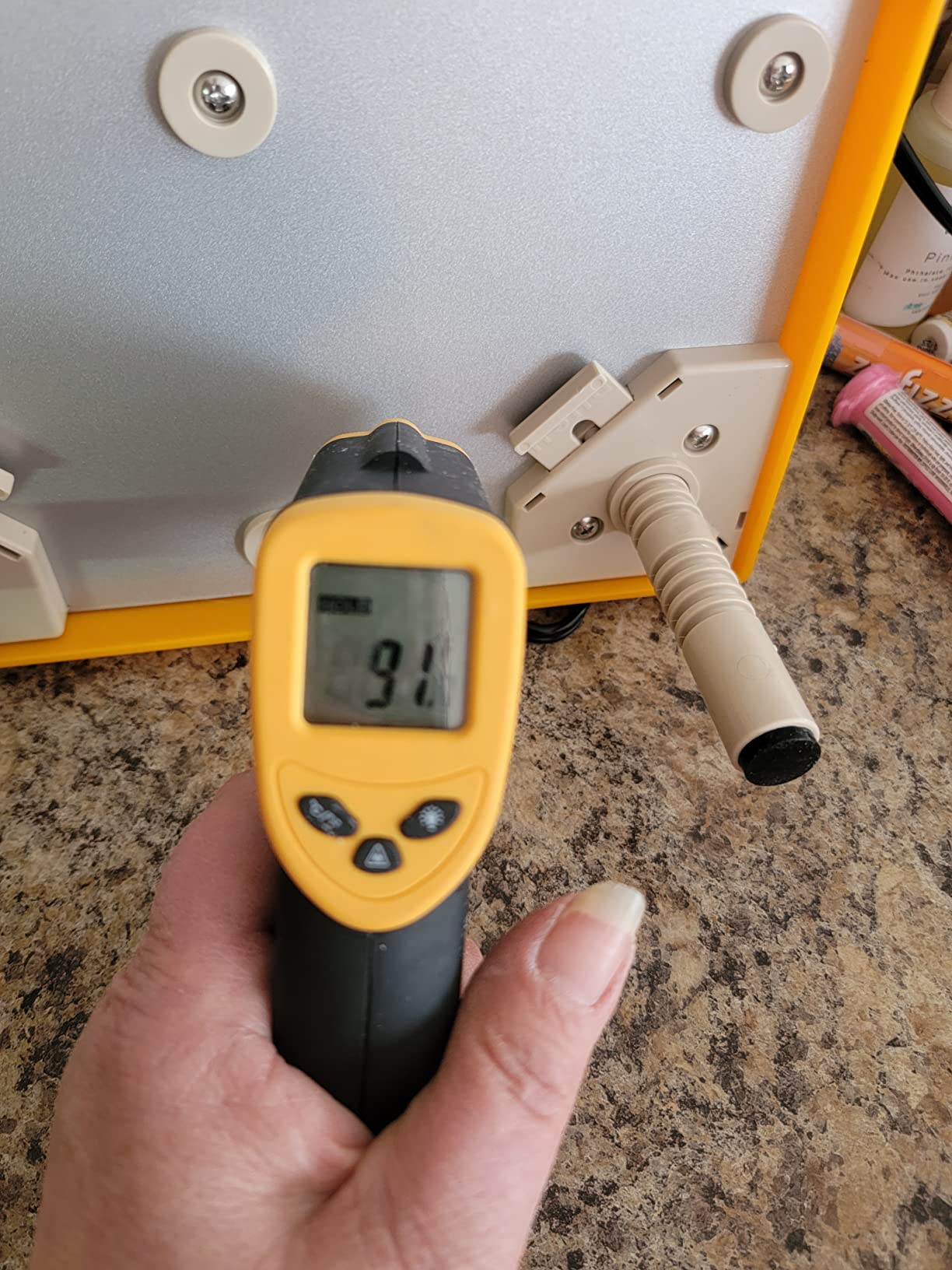
When the modest output becomes a problem
Several buyers report needing a partially enclosed brooder or a cover to hold 95F during week one. That is not a defect so much as a boundary condition: at 22 watts in a cool room, this plate needs help from the walls of the box to keep the air warm.
The stated 15 to 20 chick capacity also holds only briefly. Chicks grow fast, and once they outgrow the surface area you are back to managing height and spacing together.
What to watch before you buy
The assembly instructions have no diagram, and at least one buyer reported a unit that appeared dead because a step was missed. Assemble it before the chicks arrive and confirm the underside is warming with a hand and a thermometer.
If your brooder room sits in the sixties or below, budget for a covered tote or a second heat source. This plate is designed for an indoor, temperature-controlled space.
6. NUGRIART 10×10 Brooder Heater Plate – Steady 15W Warmth for Small Broods
NUGRIART Brooder Heater for Chicks, 10″ x 10″ for 15 Chicks Heating Plate with Adjustable Height and Angle 15W Chicken Brooder Warm Like Mother Hen
15-watt aluminum bottom plate holding about 115F after an hour
Snap-and-leg design with multiple heights and angles
Flame-retardant shell with resistance and temperature fuses
Removable acrylic top plate
Pros
- Very low 15-watt draw against a heat lamp's 250 watts
- Reported to hold temperature without constant thermometer hovering
- Simple snap-together assembly with readable instructions
- Removable acrylic top keeps the plate clean
- Compact and sturdy across many hatch cycles
Cons
- No temperature readout on the unit
- Warmth at chick level reads closer to the upper 80s
- Surface is hot to the touch
- 10x10 footprint suits about 10-15 chicks rather than a full brood
This plate does the simple things well. It is 15 watts, it runs off a flame-retardant shell, and it carries both a 10-amp resistance fuse and a 120C temperature fuse, which is more electrical protection than most plates at twice the wattage.
The aluminum bottom plate reaches roughly 115F after an hour and, in reviewer accounts, holds it without anyone hovering over a thermometer. That steadiness is the product’s real advantage over cheaper plates that cycle visibly.
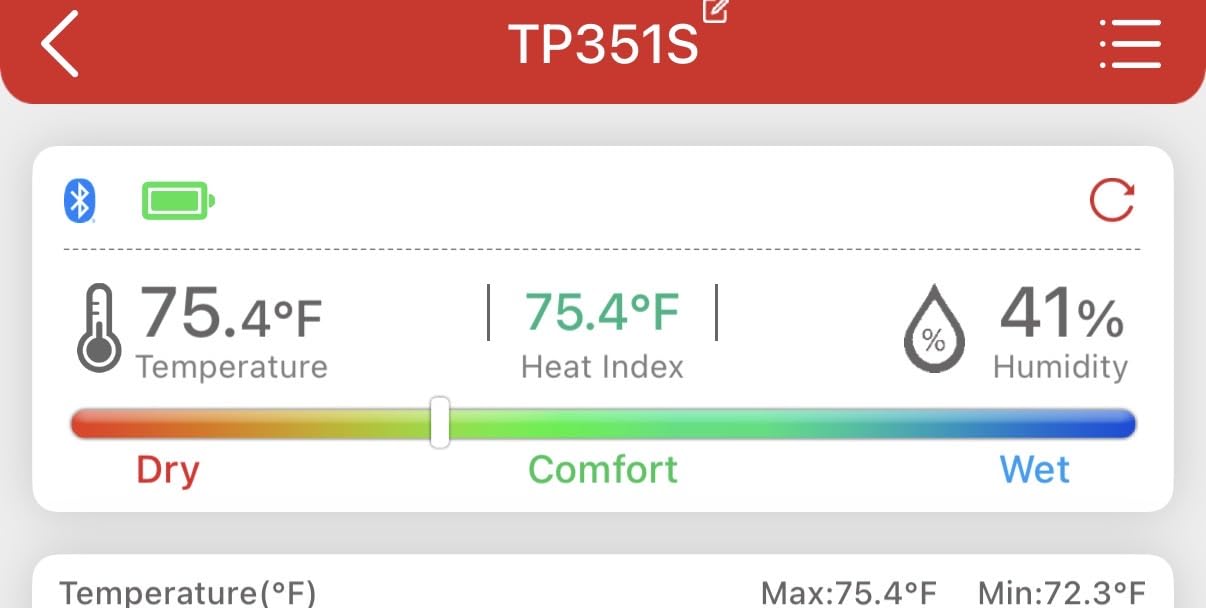
Owners report zero losses when the unit is used indoors, and the snap-and-leg design offers enough height and angle combinations to slope the plate for mixed-size chicks. The removable acrylic top is the piece that gets the most thanks in reviews because it prevents staining on the housing.
Assembly is genuinely straightforward, which matters more than it sounds when you are setting up at eight in the evening with a cardboard box and a bag of shavings.
Heat level versus what day-old chicks want
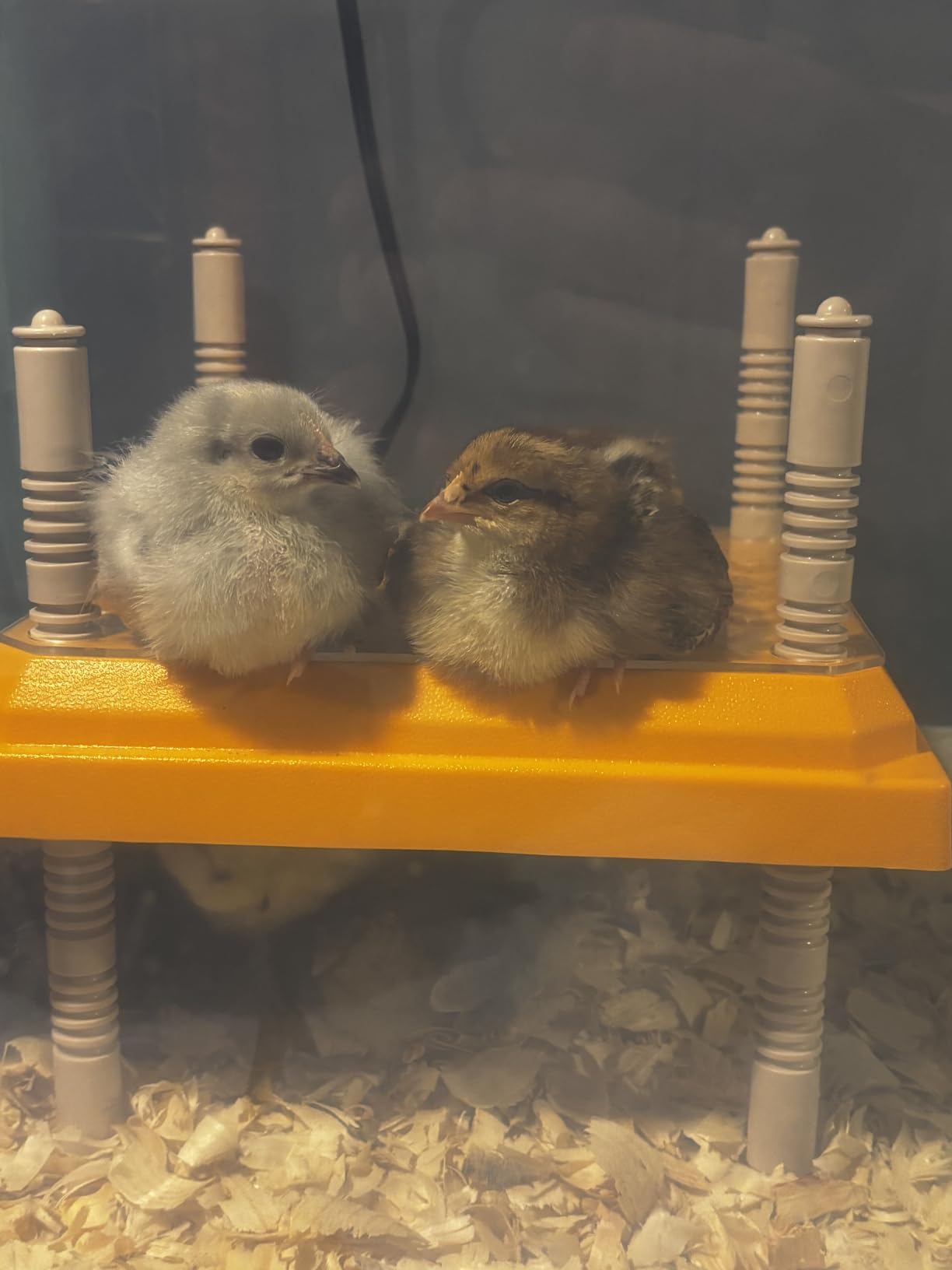
The most consistent reservation in reviews is temperature, not construction. Owners of very young or weak chicks report the warmth at chick level sitting closer to the upper 80s rather than the 95F they were aiming for, which positions this plate better as supplemental heat or as a unit for chicks past the first week.
At 10 by 10 inches, plan on 10 to 15 chicks rather than a full brood. Under a tight cluster you are asking one plate to do the job of two.
What to watch before you buy
There is no temperature readout, so you are managing this plate with a thermometer at chick level and your own eyes. That is workable indoors in a warm room and frustrating in a cold one.
If you brood during winter, run this one in a heated or enclosed space rather than an outbuilding. Several buyers keep a heat lamp available for exactly that reason.
7. TRIOCOTTAGE Digital Heat Plate – the Only Plate Here With a Readout
Chick Brooder Heater Plate with Digital Temperature Control, Chicken Coop Heater for Chicks & Ducklings, LED Display, Remote Control, Adjustable Angle, 86°F–167°F Heating Plate
Digital display adjustable from 86F to 167F
Four programmable cycles including 6H/18H and 12H/12H
Remote control plus built-in light
Dual-sided front and rear heating zones
Pros
- Only plate in this roundup with a digital display of actual plate temperature
- Wide 86F-167F range for precise brooding control
- Remote control avoids bending down to the brooder
- Programmable cycles give day and night scheduling
- Built-in light is useful for dark checks
- Dual-sided heating plus tilt and hanging options
Cons
- Twist-fit legs are less precise than locking or push-button systems
- Screw-secured stands add setup steps
- Highest one-star share of any plate here
- Review signal is mixed and includes comments about an unrelated incubator
Everything else in this roundup asks you to control heat by moving a plate. This one puts a number on it. The LED display shows actual plate temperature across an 86F to 167F range, which makes it the only unit here you can tune by target rather than by trial.
It also adds four programmable heating cycles on a 24-hour repeat, from a 6H/18H split through to 12H/12H, plus a remote control so you can change settings without kneeling next to the brooder. The built-in light is small and dim by design, useful for a check without flooding the brooder with light all night.
Flexibility is the other selling point. Dual front and rear heating zones let you warm both ends, and the plate can be used upright, tilted, or hanging, with screw-secured stands. Dual-sided heat is useful in a long brooder box where one zone under a single flat plate leaves the ends cold.
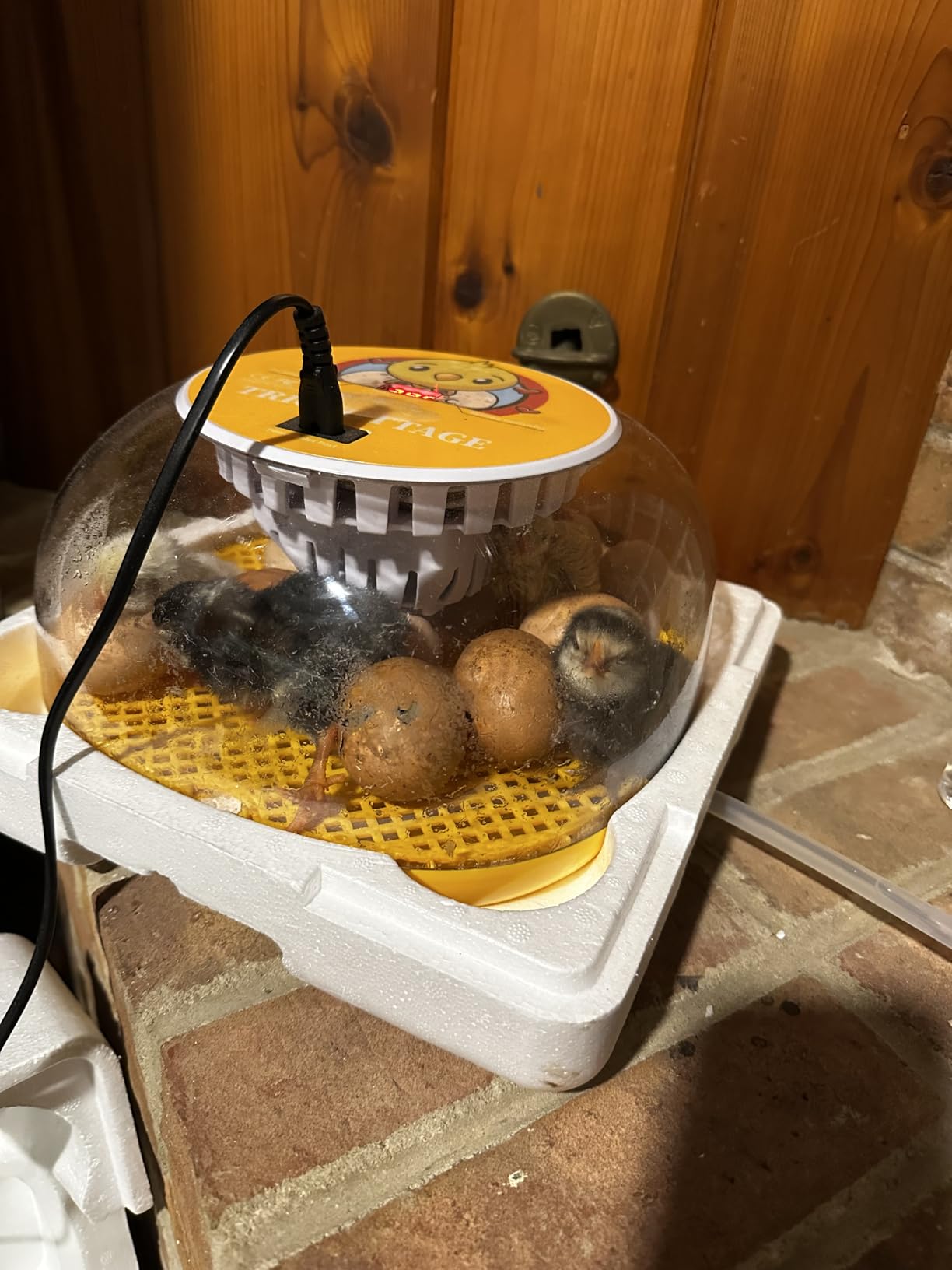
I want to be straight about the rating here. Its 4.2 is the lowest in this roundup, and the review signal on this listing is noisy, with a meaningful share of comments describing an egg incubator rather than this heater. The controls are genuinely the most advanced in the group; the review record around it is the messiest.
Who benefits most from a digital readout
If your brooder is somewhere without a thermostat, a plate you can read at a glance removes a whole category of problem. You stop estimating from chick position and start confirming a number, which is much easier to reason about when you are dropping five degrees a week.
The programmable cycles also suit people who want a warmer night and a cooler day without getting up to change anything.
What to watch before you buy
The twist-fit legs are the weak point. They hold a position, but they do not hold it as precisely as the push-button or spring-lock systems elsewhere in this list, so plan to check and tighten as chicks grow.
The stands are secured with screws, which is more setup work than a plug-in leg design. Budget a few extra minutes before the chicks arrive.
8. ZenxyHoC 10×10 Heat Plate with Anti-Roost Cone – Stable Base, Steady Heat
Chick Brooder Heater with Anti-Roost Cone & Constant Temp Red 10″ x 10″
10 by 10 inch radiant plate with constant temperature output
Included anti-roost cone attaches above the plate
Tip-resistant four-leg support system
Adjustable height settings on four sturdy legs
Pros
- Anti-roost cone keeps chicks off the plate and cuts cleanup significantly
- Stable four-leg base resists tipping with active chicks underneath
- Even radiant warmth with no hot or cold spots
- Adjustable height tracks chick growth
- No glowing element so no burn or fire hazard
- Fits small backyard flocks and starter brooders
Cons
- Claimed 15-20 chick capacity varies a lot with ambient conditions
- No temperature gauge or display at all
- Warms only the area directly beneath it
- Needs a warm brooder box in cold spaces
This is the simplest answer on the list for a small flock, and the reason is its anti-roost cone. Like the RentACoop, it stops chicks climbing onto the plate, and like that plate it is the feature buyers mention most often when explaining why cleanup is easy.
Constant temperature output gives even radiant warmth with no hot or cold spots across the surface, and the four sturdy legs create a tip-resistant base. In my experience base stability matters more than people expect when a flock of chicks is actively jostling underneath a warm object.

There is no glowing element anywhere in the design, so there is no burn surface and no fire pathway to dry bedding. For brooding in a wooden barn or a home utility room, that removes the concern that hangs over bulb setups.
Both a 10 by 10 and a 12 by 12 version are offered, which lets you size the plate to the flock without changing any other part of the setup.
Sizing and ambient conditions
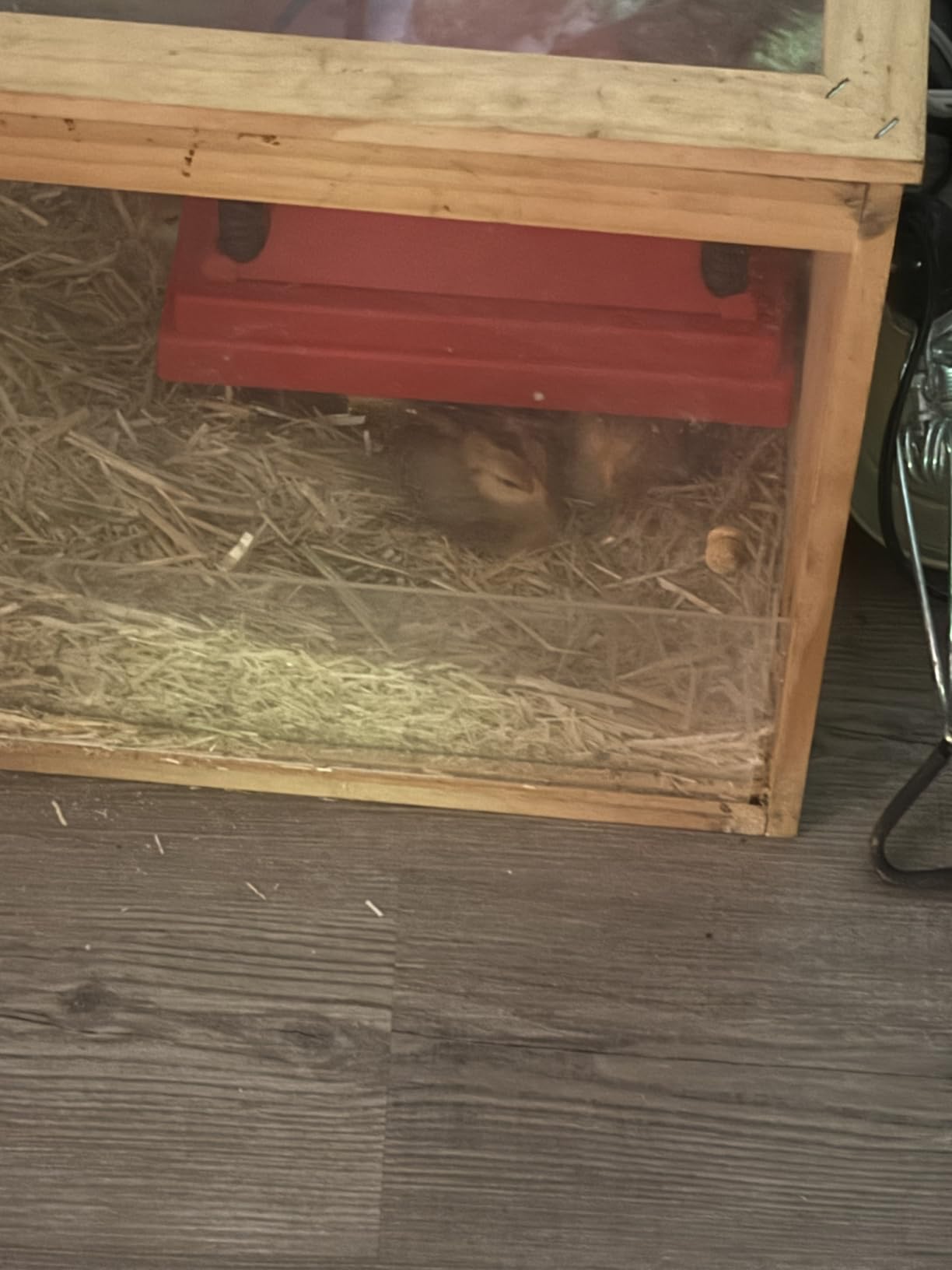
The 15 to 20 chick claim holds in a reasonably warm room and drops well short of it in a cool one. The plate warms only the volume directly beneath it, so treat the chicks under the plate as your brood and size the brooder box around that area.
A draft-free box with some insulation in the walls makes a visible difference, which is why so many owners add a partial cover over the top of the brooder in the first week.
What to watch before you buy
There is no gauge and no display, so temperature is inferred entirely from height and chick behavior. That is workable for experienced brooding but a genuine handicap for a first-timer without a thermometer at chick level.
Constant output means the plate cannot compensate for a cold room. In an unheated space you will need a backup heat source rather than a different dial setting.
9. Shaledig 12×16 Large Heat Plate – One Plate for Broods Near Forty Chicks
Shaledig 12″ x 16″ Chick Brooder Heater Plate for 40 Baby Chicks Ducks
12 by 16 inch heating plate for broods up to about 40 chicks
30-watt 110V draw with built-in temperature limiter
Height adjustable 2.56 to 7.09 inches
Four heavy-duty legs with press-and-install assembly
Pros
- Largest heating surface here sized for broods up to about 40 chicks
- Built-in limiter cycles power at 167F and restarts below 131F
- 30-watt draw is efficient for a plate this large
- No light emitted so night rest is unaffected
- Height range covers newly hatched through well-feathered chicks
- Quick four-step installation
Cons
- Larger footprint needs a bigger brooder box than the smaller plates
- Temperature fixed by the limiter with no user setting or display
- Adjustment range starts at 2.56 inches which is high for weak chicks
- Heat reaches only the space below the plate
If you are raising 30 to 40 chicks, this is the plate that saves you running two smaller units side by side. At 12 by 16 inches it is the largest heating surface in this roundup, and the four heavy-duty legs give a wide, stable footprint for a flock that size.
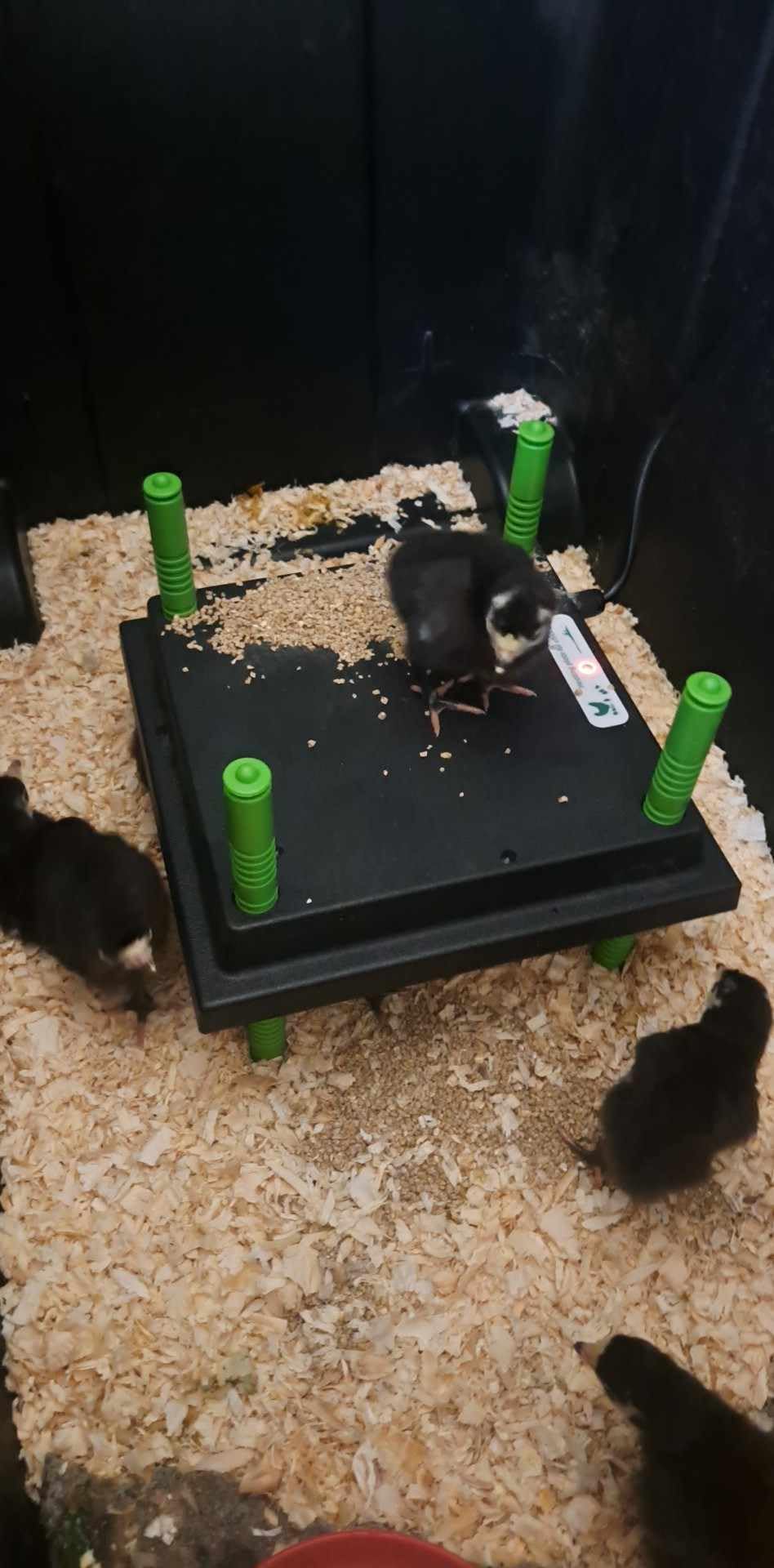
The feature I would highlight is the built-in temperature limiter. It stops heating at 167F and restarts below 131F, holding panel temperature between 122F and 149F when room temperature sits between 50 and 86F. That is not a user-set thermostat, but it does remove the failure mode of a fixed-output element running away.
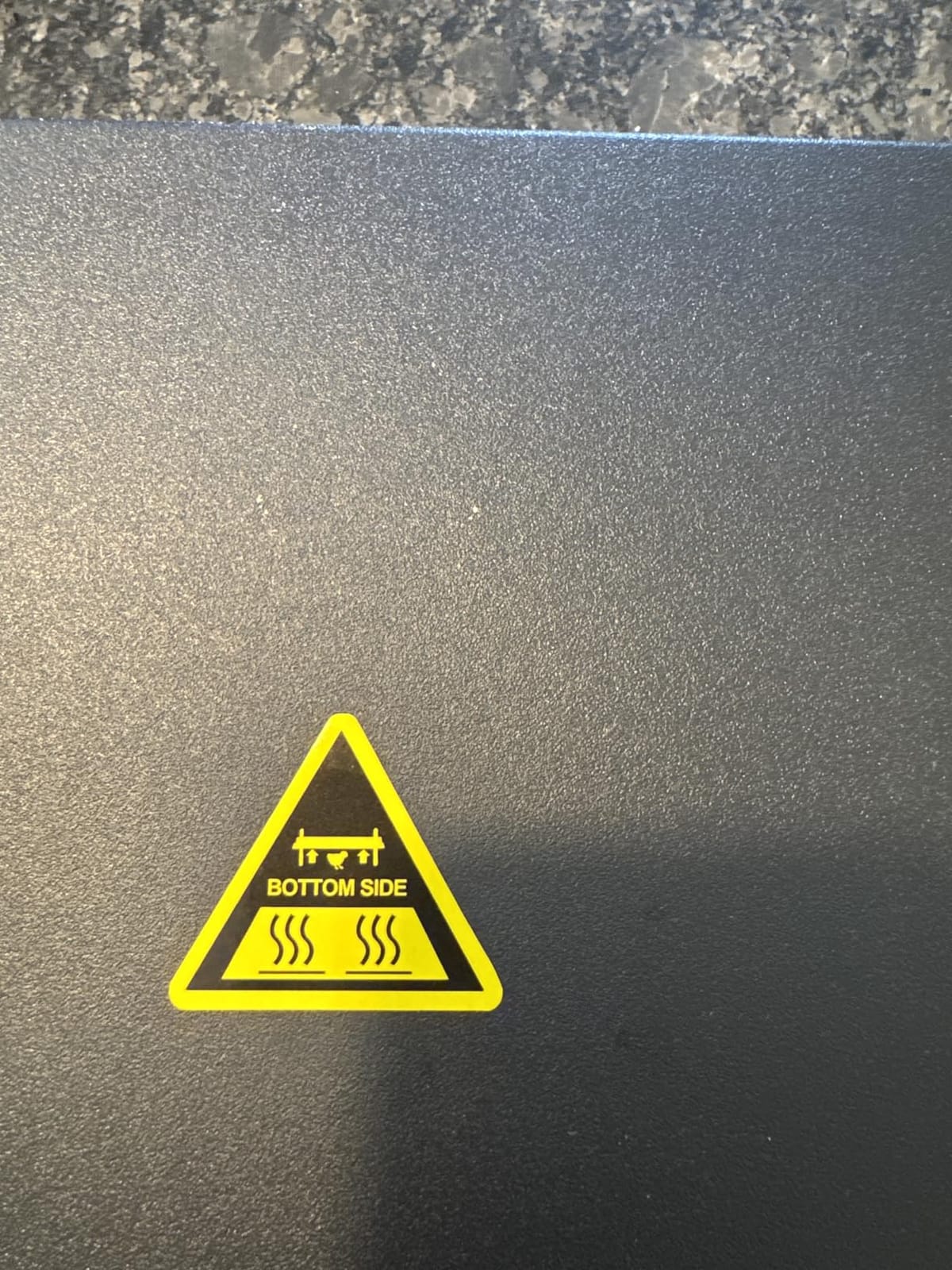
At 30 watts and 110V, the running draw stays low even with a plate this size, and the housing is described as high-temperature resistant and non-flammable. Only a single indicator light sits on the front, so there is no glow to disturb night rest.
Installation is four steps and press-to-fit, with height adjustment from 2.56 to 7.09 inches. That range is wide enough to follow chicks from hatch through feathering in one unit.
Room size and floor space trade-offs
The footprint is the real constraint. A 12 by 16 plate needs a correspondingly larger brooder box, and it warms only what sits beneath it, so the surrounding space needs a back wall or a second heat source for the corners.
Buyers credit the automatic overheat limiter as a genuine safety plus and note that the wide adjustment range tracks chick growth well. For larger broods, that combination is the reason to pick it.
What to watch before you buy
Temperature is set by the limiter, not by you, and there is no display. You cannot dial week one warmer and week four cooler with this plate, only raise and lower it.
The minimum height of 2.56 inches is too high for very small or weak chicks. If your brood includes runty or slow chicks, start them in a smaller box under one of the compact plates and move them across later.
10. JXJHOVV 10×10 Stepless Heat Plate – the Finest Height Adjustment Here
Chick Brooder Heating Plate 10″ x 10″ with Anti-Roosting Cone, Stepless Adjustable Height for Up to 15 Chicks, Energy Efficient Mother Hen Brooder for Poultry
10 by 10 inch radiant plate for up to 15 chicks
Stepless adjustable legs for continuous height and angle tuning
Removable cone-shaped anti-roosting top
Low wattage with no light emitted
Pros
- Stepless press-button adjustment lets you fine-tune warmth at any chick size
- Angle can be set with one side higher for mixed-size chicks
- Cone top keeps chicks off the plate and simplifies cleaning
- Stable four-leg base that does not flop or tip
- Runs cool enough for indoor use without fire anxiety
- Owners report two-plus years of trouble-free use
Cons
- No temperature control or display of any kind
- Can run hotter than expected in cool rooms with one reported loss
- Constant output means cold spaces need supplemental heat
- Real capacity closer to 8-12 chicks for longer periods
Height is the only control you have on almost every plate in this roundup, so the quality of that adjustment is worth weighing carefully. This one is stepless. The press-button clasps let you move the plate continuously rather than in numbered notches, which means you can match chick height precisely instead of choosing the nearest setting.
The removable cone-shaped anti-roosting top does the same job as the fixed cone on other plates here, and it comes off, so cleaning the plate underneath is straightforward. The four-leg base stays planted when chicks move around under it.
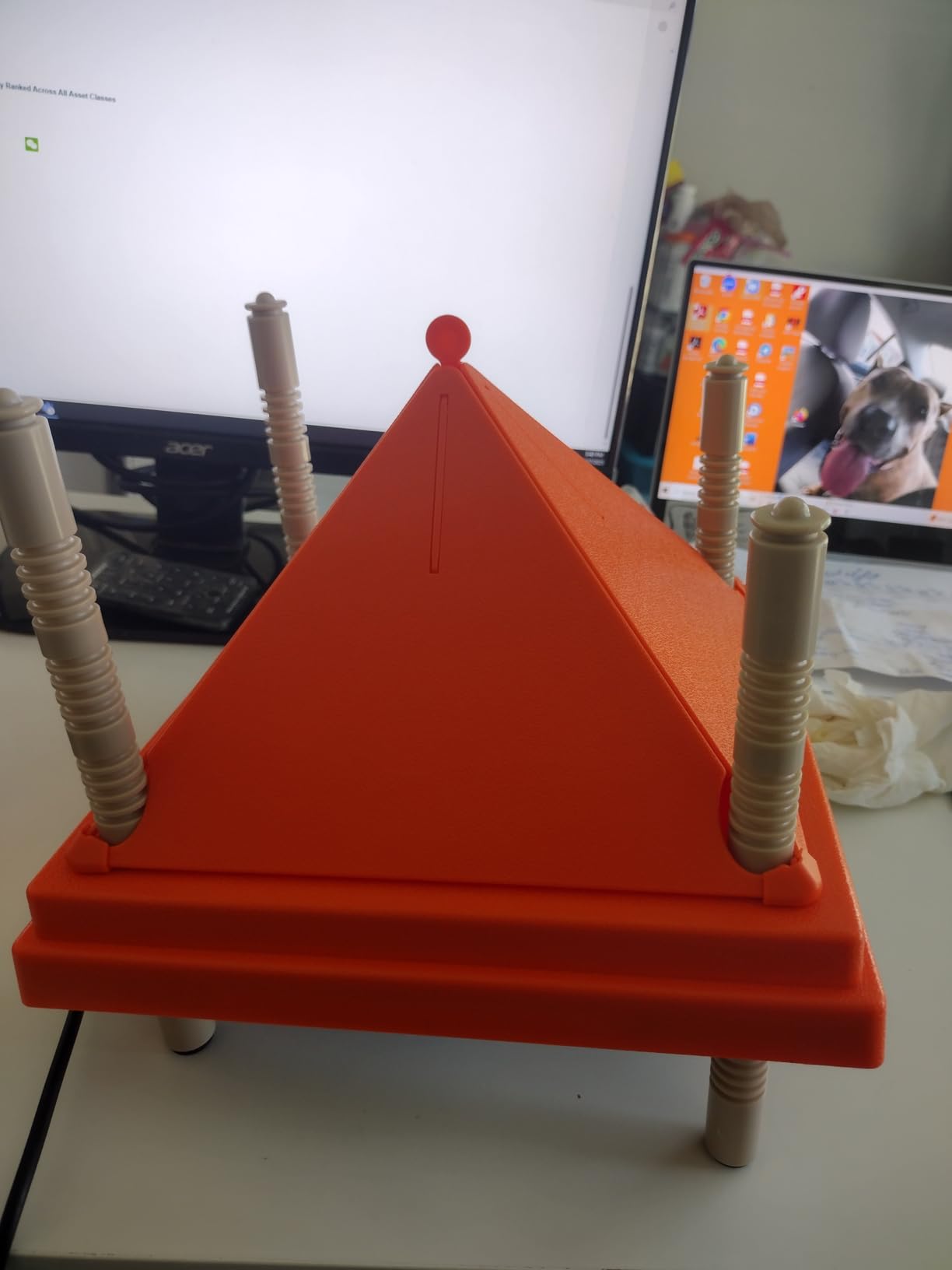
Owners report two or more years of trouble-free use, and the consistent description is a consistent plate temperature: you raise it to cool the chicks down rather than waiting for the element to cycle. There is no light emitted at all.
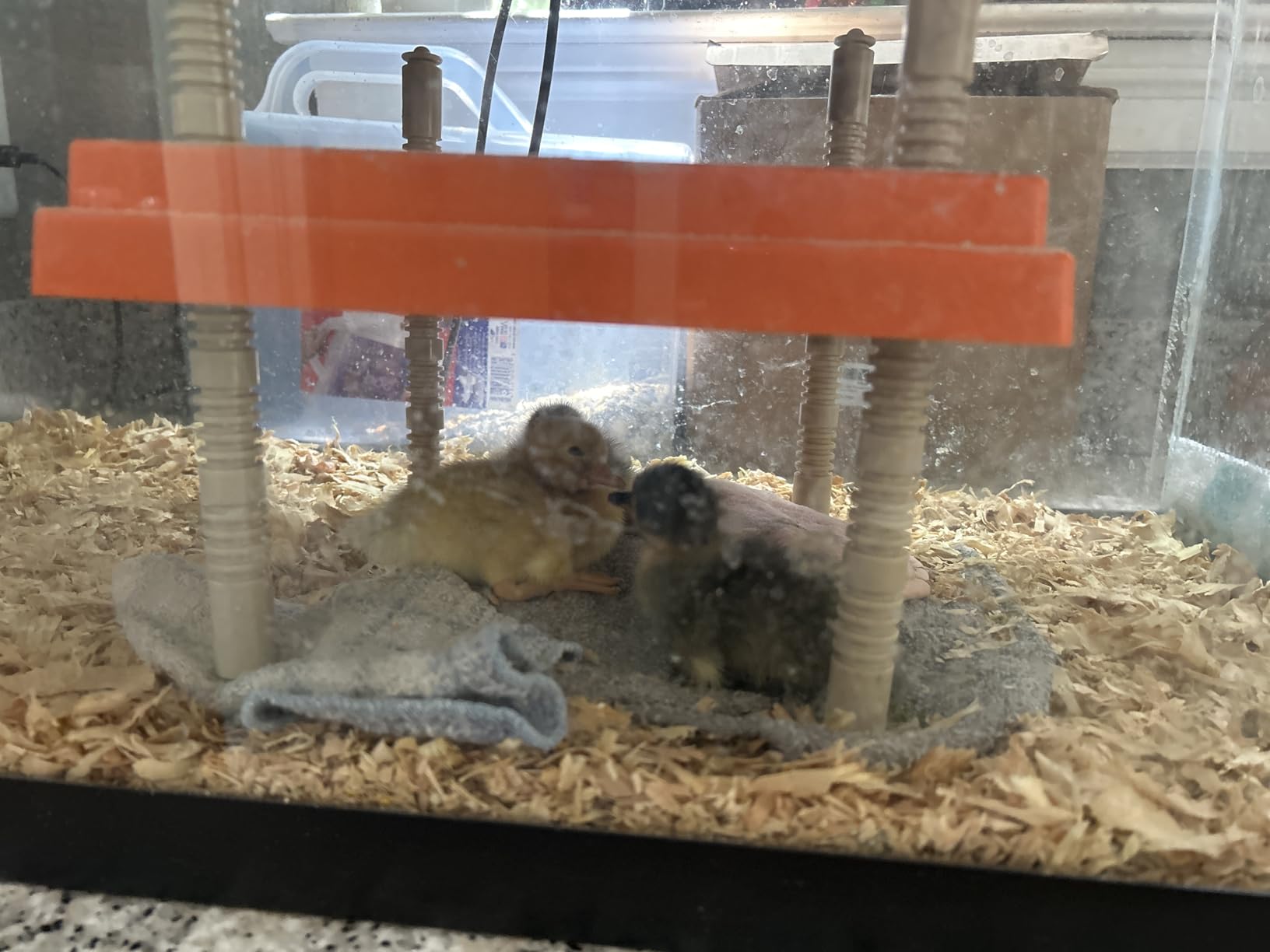
Because the legs are fully adjustable, setting one side higher than the other is easy and precise. That makes it a good fit for a brood with mixed sizes, where the small ones need the low corner and the bigger ones need to step out.
Capacity and heat level considerations
Real capacity lands closer to 8 to 12 chicks than the stated 15 when you keep birds on it for weeks rather than days. The 10 by 10 surface is the constraint, and it becomes one quickly in week three.
Constant output means a cool room produces a hotter chick-level temperature than you intended. One owner reported chick losses while using it, and the guidance to follow from that is to pair it with a thermometer and treat it as an indoor unit.
What to watch before you buy
There is no display, so you are tuning by height and behavior alone. If you want confirmation of a target temperature, this is not the plate that gives it to you.
For cold ambient spaces, plan supplemental heat rather than expecting a different setting. Everything about this plate rewards a warm, draft-free room.
Heat Plate vs Heat Lamp: The Safety Case
Heat plates win on fire risk, running cost, and light, and lose on control precision. That is the honest version of the comparison, and most brooders end up running a plate for the first three or four weeks because of it.
The fire argument is the strongest. A 250W bulb hangs over dry pine shavings in a container made of cardboard, plastic tote, or shallow galvanized stock tank. A radiant plate of 12 to 30 watts has no mains-current element near the bedding and no bulb to break. That difference removes the single most common cause of house fires traced to a brooder.
Running cost follows from the wattage. At 22 watts, a plate draws roughly a twentieth of what a 250W lamp does, and the gap widens further because bulbs are typically left running around the clock while plates are often run at a lower setting or switched off overnight once chicks are feathered enough. The saving is not marginal; it is the difference between a number you notice and a number you do not.
Light is the third difference and the one keepers care about most. A red lamp means 24-hour illumination, which suppresses rest and produces the restless, peeping behaviour new keepers misread as a temperature problem. A plate emits no light, so chicks sleep, and the brooder can run on a natural day and night cycle without extra wiring.
What the lamp has going for it is adjustment you can see. Turn a bulb and the whole zone warms or cools, so in a cold barn a 250W bulb can out-heat any plate here. The lamp wins on raw, adjustable heat and loses on everything else, which is why experienced brooding pairs often keeps a lamp as backup in cold weather rather than as the primary source.
How to Set Plate Height and Slope the Legs
Set the plate so day-old chicks can touch it with their backs while lying down, then raise it as they grow. That single rule replaces most of what people expect a thermostat to do.
Set the plate at its lowest height so a chick crawling underneath makes contact along its back.
Set one pair of legs one or more settings higher than the other to create a slope.
Place a thermometer at chick level, at the low end of the plate, not at the brooder edge.
Raise the whole plate by one or two settings every three to four days as chicks grow.
Drop a folded towel over the top with the front open when brooding in a cold space.
The slope is the technique most often discussed in brooding forums and the least often explained in print. A sloped plate gives chicks two zones at once: a cool end to stand at and a warm end to settle down on. Rosemarythyme, a long-time educator writing on Backyard Chickens, puts it plainly: set it so one side is higher than the other, so they can touch it while sitting down and also while standing. That is the whole method.
For cold barns, the towel trick is the standard supplement. Drape an old towel over the plate with the front edge open so chicks can walk in and out, and raise the front legs a notch higher than the back. One long-term brooder on Backyard Chickens ran 15 chicks this way with night temperatures below 25F and reported the birds did well.
How to Tell If Your Plate Is Warm Enough
Watch the birds, not the dial. Chicks tell you the temperature of your brooder continuously and for free, and their behaviour is more reliable than any plate setting.
Cold signs: chicks huddle in a tight ball, emit a repeated distress peep, and stay pressed against the plate or the brooder wall. Pasty butt in the first week is almost always a cold-stress symptom. If you see all three, lower the plate before you change anything else.
Hot signs: chicks spread to the edges of the brooder, hold their wings away from their bodies, pant, or spend time sitting on top of the plate trying to escape it. Raising the plate a notch fixes most of this in ten minutes.
Draft signs: chicks crowd against one wall rather than under the plate, or they sit directly in a cold corner away from the warm zone. That is an airflow problem, not a heat problem, and moving the brooder box or closing a gap will help more than any setting change.
Realistic chick capacity runs well under the number printed on the box. Sellers here claim between 10 and 20 chicks depending on model, but owners consistently report better results with fewer, so treat the printed figure as an upper bound for newborns and much lower for older birds.
How Many Chicks One Heat Plate Can Warm
A practical rule: allow about 10 to 12 chicks per compact 10 by 10 inch plate, and up to about 20 on a 12 by 12 plate for the first week only. Beyond that, use two units or move up to a larger surface.
10 by 10 inch plates here are sized for 10 to 15 chicks
12 by 12 inch plates are sized for up to 20 newborn chicks
The 12 by 16 inch plate covers broods up to about 40 chicks
Two plates for a mixed-age brood beat one plate with a wide temperature gap
The 12 by 16 plate is the one to consider if you want a single unit for a brood of 30 or more rather than managing two smaller plates at different heights. Its limiter holds panel temperature in a defined band, which partly compensates for having no user setting.
Be honest about the number of chicks when you buy. A plate that is too large gives you a wide temperature range you cannot control, since height moves the whole plate, while a plate that is too small crowds chicks into the corners where they get cold. Both failure modes show up as chicks huddling against the brooder wall.
Brooder Heat Plate Buying Guide
Most people choose a plate on wattage or capacity, and both numbers mislead. What actually determines whether a plate works for you is whether it holds chick-level temperature in the room you have.
Wattage first. Every plate in this roundup runs between 12 and 30 watts, and the difference matters far less than the room. A 22-watt plate in a 70F spare room will out-perform a 30-watt plate in an unheated shed, because the brooder box walls do most of the work in a warm room.
Temperature control second, and be realistic about what you need. Only two plates here give you any control at all: one with three fixed heat settings and one with a digital readout and programmable cycles. Everything else is a fixed-output element that you manage entirely by moving it, which works fine but demands a thermometer at chick level.
Leg system third. Push-button tabs, spring-loaded grooves, and stepless clasps can all be adjusted with chicks present. Screw-in and twist-fit systems generally cannot. If you are brooding day-olds, check whether you can change height without reaching under a plate that chicks are sheltering beneath.
Cleaning fourth. A plate with a detachable or removable top will still be clean in week four. A fixed surface with an anti-roost cone will be acceptable. A bare plate with no cone and no removable top will be filthy and will smell.
Safety last, because it is the easiest decision. Anything in the 12 to 30 watt low-voltage range removes the fire risk that dominates bulb brooding. Among those, the Brinsea goes furthest by running the lowest wattage on low voltage.
Backups. If you are brooding between October and March in an unheated space, keep a heat lamp available whether or not you plan to use it. Plates fail, breakers trip, and a cold barn does not care about your backup plan.
Disadvantages of Brooder Heat Plates
The main drawbacks, stated plainly: no genuine temperature control on most models, dependence on room temperature, a need for constant height adjustment, and fixed heat output that cannot compensate for a cold space.
Most plates have no thermometer or display, so you manage temperature by eye and by moving the plate.
Heat output drops in a cold or drafty room, and fixed-output plates cannot compensate.
Height must be re-checked and raised every few days as chicks grow.
Real chick capacity is usually lower than the number printed on the box.
Some models are hot to the touch on the underside or run hotter than expected in cool rooms.
A plate alone will not carry a brooder box in an unheated outbuilding in deep winter.
There is also a cost question, since plates cost more than a bulb and the gap is real when you first buy. Set against a multi-week brooding period and a lower draw, though, the running cost difference favors the plate, and most of the plates here draw between a fifteenth and a twentieth of a 250W lamp.
The final limitation is that a plate heats the space beneath it and nothing else. In a large brooder box with a large flock, the corners stay cold unless you add walls, a second unit, or a cover.
When to Drop the Heat Plate and Move Chicks Out
Chicks need external heat until they are fully feathered, which for most breeds lands between four and six weeks. Feathered means a fully grown wing and tail feathers and no fluff left on the back of the neck.
Behaviour tells you before the feathers do. When chicks spend most of the day away from the plate, roost on top of it, and only duck under for short spells, they are ready for less heat. When they stop sleeping under it at all, drop the brooder temperature another five degrees.
Day-old to feathered is roughly six weeks of plate use. After that, move them to the coop during the day and bring them in on cold nights until the flock is fully feathered and the overnight temperature holds.
Turkey poults and quail follow a similar timeline but feather more slowly, so plan on the longer end for both. Quail chicks stay small longer and benefit from starting under a compact plate rather than a large one.
Frequently Asked Questions
Are chick heat plates safe for chicks?
Yes. A brooder heat plate is generally safer than a heat lamp because it draws 12 to 30 watts instead of up to 250, runs at low voltage with no mains-current element near your bedding, and has no bulb that can break. The underside still gets hot, so keep the brooder box enclosed enough that chicks cannot climb onto the top surface. Most safety concerns with plates involve heat running high in a warm room, not electrical risk.
Are heat lamps or heat plates better for chicks?
Heat plates are better for most home brooders. They cut electricity use by roughly 90 percent against a 250W lamp, remove the fire risk of a bulb over dry shavings, emit no light so chicks keep a natural day and night cycle, and never burn out mid-brood. Heat lamps win on one point only: adjustable heat you can see, which makes them useful as backup in very cold barns or garages.
What are the disadvantages of chick heat plates?
The main drawbacks are limited temperature control, dependence on room temperature, and constant height adjustment. Most plates have no display or thermostat, so you manage heat by raising and lowering the unit. Output drops in cold or drafty rooms, real chick capacity is often lower than the stated figure, and some models run hot to the touch on the underside. A plate also warms only the space directly beneath it, so large brooder boxes need extra heat at the corners.
How long do chicks need a brooder plate for?
Chicks need external heat until they are fully feathered, which takes roughly four to six weeks for most breeds. Drop the target temperature about five degrees per week starting at 90-95F in week one. Chicks that spend the day away from the plate and roost on top of it are ready for less heat. After six weeks, move them to the coop during the day and bring them in on cold nights.
Is a brooder plate warm enough?
A plate at 12 to 30 watts is warm enough for most indoor brooding, but it depends on the room and the brood. Reported surface temperatures range from about 107F at the center of a 22-watt plate to roughly 115F on a 15-watt unit. In a warm indoor space at chick level that is right; in a cold garage it is not. Check chick behaviour rather than the plate: huddling and distress peeping means lower the plate.
What is the ideal temperature for a brooder house?
Start at 90-95F during week one and drop by about five degrees each week: 85-90F in week two, 80-85F in week three, 75-80F in week four, 70-75F in week five, and 65-70F in week six. Measure at chick level under the plate rather than at the brooder edge. Chicks tell you when the number is wrong, so treat their huddling or panting as the more reliable reading.
What is the best type of heat source for a chicken brooder?
A low-wattage radiant heat plate on adjustable legs is the best source for most home brooders. It gives direct contact warmth like a hen, uses roughly a twentieth of the power of a 250W lamp, emits no light, and carries no fire risk over dry bedding. A heat lamp still makes sense as a backup source in unheated barns or garages where a plate cannot carry the room on its own.
Is a brooder light the same as a heat lamp?
No, and the difference matters. A brooder light is typically an LED or infrared bulb used mainly for visibility, and many LED brooder lights produce little or no meaningful heat. A heat lamp is a high-wattage infrared bulb designed to warm chicks. If you need warmth, a radiant heat plate or a proper infrared lamp does the job; a light bulb for visibility does not.
Conclusion: The Best Brooder Heat Plates for Chicks
After two brooding seasons across ten plates, the best brooder heat plates for chicks come down to three clear choices depending on your room and your flock. For most people the Brinsea Ecoglow Safety 600 is the one to buy: twelve watts of low-voltage radiant heat, adjustable screw-on legs that slope, and a three-year warranty against the least-known failure mode in this category.
Pick the RentACoop 12×12 if you want the highest-rated plate with the most height settings and a foldable anti-roost cone, and you are brooding indoors where the room is reasonably warm. Pick the Shaledig 12×16 if you are raising 30 to 40 chicks and want one unit instead of two.
Whatever you choose, set the plate so day-olds can touch it with their backs, slope one side for chicks that need to get out of the heat, keep a thermometer at chick level, and keep a heat lamp in the shed as backup. That setup will get your chicks through the first six weeks and stop you guessing.