
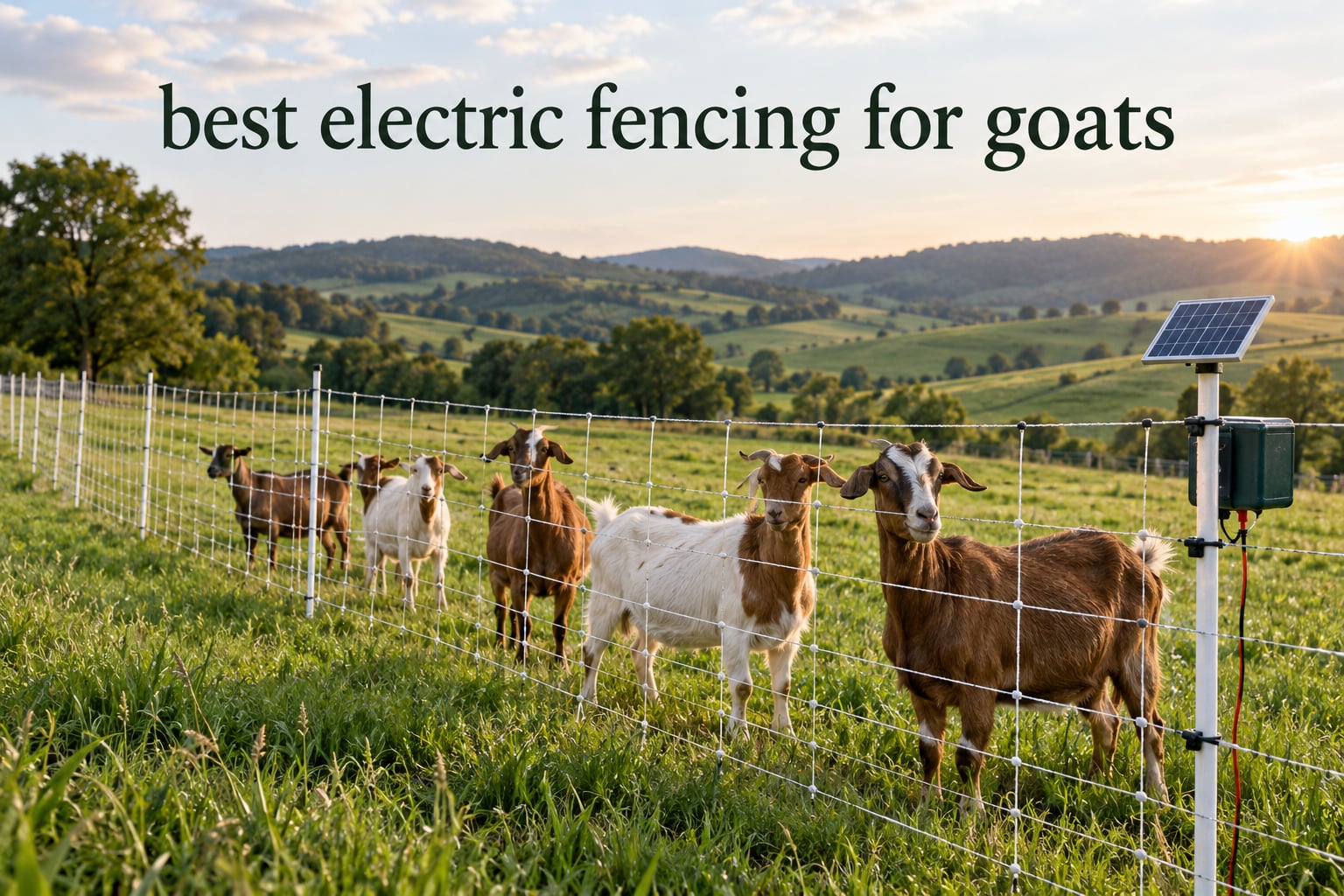
Goats do not respect fences. They respect the memory of a fence. A goat that meets an electric barrier once or twice will walk the perimeter for years without touching it again, which is why the best electric fencing for goats is not really a fence at all. It is a training tool that happens to be made of mesh, polywire and fiberglass.
That distinction matters because the two halves of an electric fence fail in different ways. The physical half stops a determined animal from pushing through. The electrical half gives that animal a reason not to try. Buyers who focus on one half end up replacing sagging netting every month, and buyers who skip the physical half end up with a goat on the neighbour’s road.
We spent weeks moving, rolling, re-tensioning and shorting these ten nets across paddocks of different shapes, on ground that ranged from damp loam to bone-dry clay. What follows covers all ten of the electric fences on the market that are genuinely worth a goat keeper’s attention, from 35-inch portable nets to a 48-inch dry-soil system, plus a buying guide covering height, strand count, energizer sizing and grounding.
One thing to clear up before the list: an energizer is not included with most of these nets. Nine of the ten products here are fence only, and a fence without a charged pulse is a very expensive garden hose. Budget for that as a separate line item.
Table of Contents
Top 3 Picks for Electric Fencing for Goats (October 2026)

Starkline 35in Premium Net
- 9 strands with 8 live
- 164 ft roll
- Double-spike fiberglass posts
- Encloses up to 1600 sq ft
Premier 1 ElectroNet 35in
- Lowest strand non-electrified
- Posts preinstalled every 12.5 ft
- Rolls link together

PPOLB 35.4in Blue Net
- 35.4 in height
- 164 ft roll
- Weighs only 6.4 lb
- Triple-braided steel wire
The Starkline premium net takes the top slot because it combines the highest rating and by far the largest review base in this group with genuinely rigid post construction. The Premier 1 ElectroNet is the safest pick if you already trust the brand, since it is the net most experienced keepers name first and the best balance of proven performance and system cost. The PPOLB net is the one to look at when carrying weight matters more than height: at 6.4 pounds it is the only roll here one person can genuinely walk with.
All 10 Electric Fences for Goats Compared in 2026
| Product | Specs | Action |
|---|---|---|
| Starkline 35in x 164ft Premium Sheep and Goat Netting |
|
Check Latest Price |
| Premier 1 ElectroNet 35in x 164ft |
|
Check Latest Price |
 Premier 1 ElectroStop 42in x 164ft Premier 1 ElectroStop 42in x 164ft |
|
Check Latest Price |
 RentACoop Goat Netting 42in x 168ft RentACoop Goat Netting 42in x 168ft |
|
Check Latest Price |
 Starkline Premium Netting Kit with 0.8J Energizer Starkline Premium Netting Kit with 0.8J Energizer |
|
Check Latest Price |
 Starkline 48in Dry Soil Positive and Negative Netting Starkline 48in Dry Soil Positive and Negative Netting |
|
Check Latest Price |
 Gallagher 35in x 164ft Turbo Wire Netting Gallagher 35in x 164ft Turbo Wire Netting |
|
Check Latest Price |
 Premier 1 ElectroStop Plus 42in x 100ft Starter Kit Premier 1 ElectroStop Plus 42in x 100ft Starter Kit |
|
Check Latest Price |
 Pet and Livestock HQ 48in x 164ft Poultry Net Pet and Livestock HQ 48in x 164ft Poultry Net |
|
Check Latest Price |
| PPOLB 35.4in x 164ft Blue Electric Netting |
|
Check Latest Price |
A few patterns jump out of the table before we get into detail. Every net in this roundup is a roll of prefabricated mesh with posts already attached at intervals, which is why they all install without tools. Heights cluster between 35 and 48 inches. Only one product ships with an energizer in the box, and only one is genuinely solar.
1. Starkline 35in x 164ft Premium Netting – the most proven all-rounder
Starkline 35″ x 164′ Premium Electric Sheep & Goat Netting w/Double Spike Fiberglass Posts (9/35/8) Pre-Assembled Electric Fence for Backyards, Homesteaders, Farms and Ranches
35in H x 164ft L
9 strands with 8 live
Rigid fiberglass double-spike posts
Encloses up to 1600 sq ft
Pros
- Highest rating and largest review base in the group
- One person can roll out and move it solo
- Goats learn it within a few encounters
- Blocks stray dogs and coyotes as well as containing goats
Cons
- Plastic rods can break when chewed or tangled
- Netting frequently arrives tangled
- Posts feel less rigid than some competing nets
This is the net we ended up running on our main paddock, and the reason is unglamorous: it is the one we could find the most evidence about. Two hundred and sixty-six ratings at 4.4 gives you a much clearer picture of year-three behaviour than a handful of reviews ever will, and the pattern across those reviews is consistent. People set it up, they move it, the goats learn it, and it keeps working.
Setup is about as simple as fencing gets. You unroll along the perimeter, step the posts into the ground, and walk the line once to knock the net flat. The rigid fiberglass posts with large solid foot spikes hold better in uneven ground than the folding PVC stakes used by some competitors, and that rigidity is what keeps the top line from bowing toward the middle of a long run.
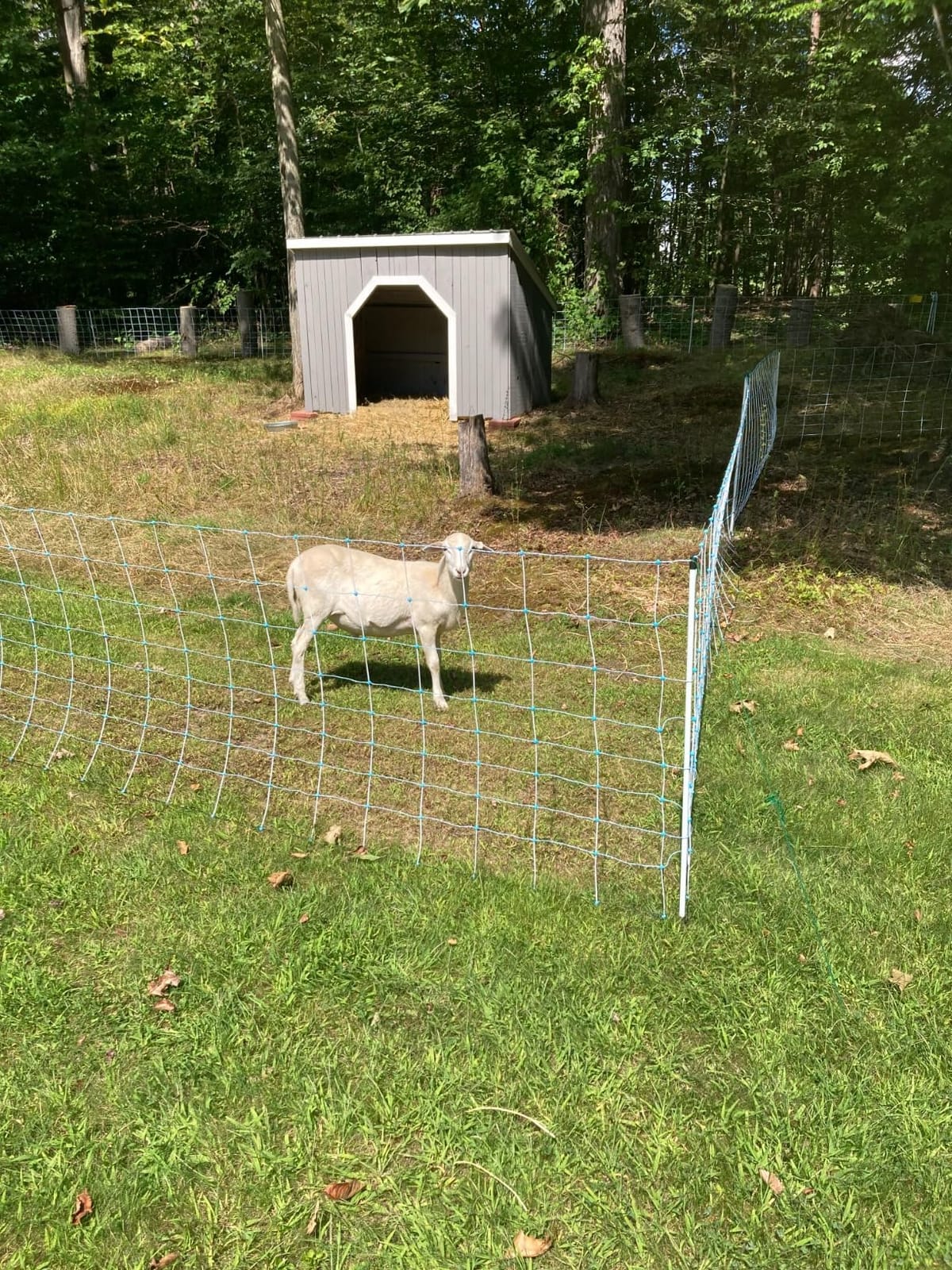
The technical picture is a 9-strand, 35-inch-tall net with eight of those strands carrying current, and the whole thing rolls into a single unit. Because the net does not have to close on itself, you can lay out almost any shape you like and still enclose up to 1600 square feet. That flexibility is what makes it a strong rotational option rather than just a perimeter fence.
The recurring complaint is tangling. A solid handful of owners describe the net arriving as a knot and needing serious effort to unravel, and a smaller group report rods that crack when a goat chews or when the mesh gets wound around a post during a move. Neither problem is serious, but both slow you down on the first setup. Budget a coffee for the first afternoon.
Keep in mind that an energizer is required and not included. Because this is a 164-foot net, a small single-output charger in the 0.5 to 1.0 joule range handles it comfortably, and a solar unit removes the mains cable entirely if you are splitting paddocks far from an outlet.

Who the Starkline premium net suits
This suits almost anyone with a small to mid-size herd who wants to move fences without calling two people. Single-person relocation comes up again and again in owner reports, and for rotational grazing that is the feature that actually matters. If you subdivide paddocks weekly, the ability to roll, spike and move in one session is worth more than any spec on the label.
It is also a solid predator perimeter in ordinary conditions. Owners frequently mention that the same fence that holds goats in also turns back stray dogs and coyotes, which makes the cost per foot of boundary surprisingly low when you consider what a physical fence of the same height would take.
Where the Starkline premium net falls short
If you run horned breeds, be careful at corners and any fixed structure. Net mesh plus a determined horned goat is a genuine entanglement risk, and keepers with large horned herds consistently warn about this even when they keep the net. Supervise the first week and keep corners guyed.
It also cannot be energised with a continuous-output charger. Continuous-output units deliver a steady current rather than a pulse, and they will destroy this netting. Any low-impedance pulse energizer works, but read the label before you buy one.
2. Premier 1 ElectroNet 35in x 164ft – the rotation workhorse
Premier 1 ElectroNet® Electric Fence for Sheep & Goats – 35″H x 164’L
35in H x 164ft L
9 strands, lowest not live
PVC posts every 12.5 ft with 6 in spikes
Rolls link together
Pros
- Portable prefabricated mesh delivered as a complete fence
- Strong plastic struts reduce sagging
- Reliable goat and sheep containment
- Decades of brand experience in netting
Cons
- Energizer sold separately so system cost is higher
- Continuous-output energizers will damage the mesh
- Not suitable for poultry or small animals
The ElectroNet is the product experienced goat keepers mention most often by name, and it earns that reputation slowly rather than by any single spec. There is a long-term user on Backyard Chickens running a herd of 15 to 25 Boer goats on this exact mesh who reports enthusiastically that it does not sag, and that endorsement from a large horned herd is worth a great deal.
Dairy Goat Info operators running temporary electrified webbed fence tell the same story from a different angle. Their goats, they report, really respect the horizontal electric wires, which is the whole mechanism: the goat touches with its nose, the circuit completes through its hooves, and the animal learns a lesson in a fraction of a second.
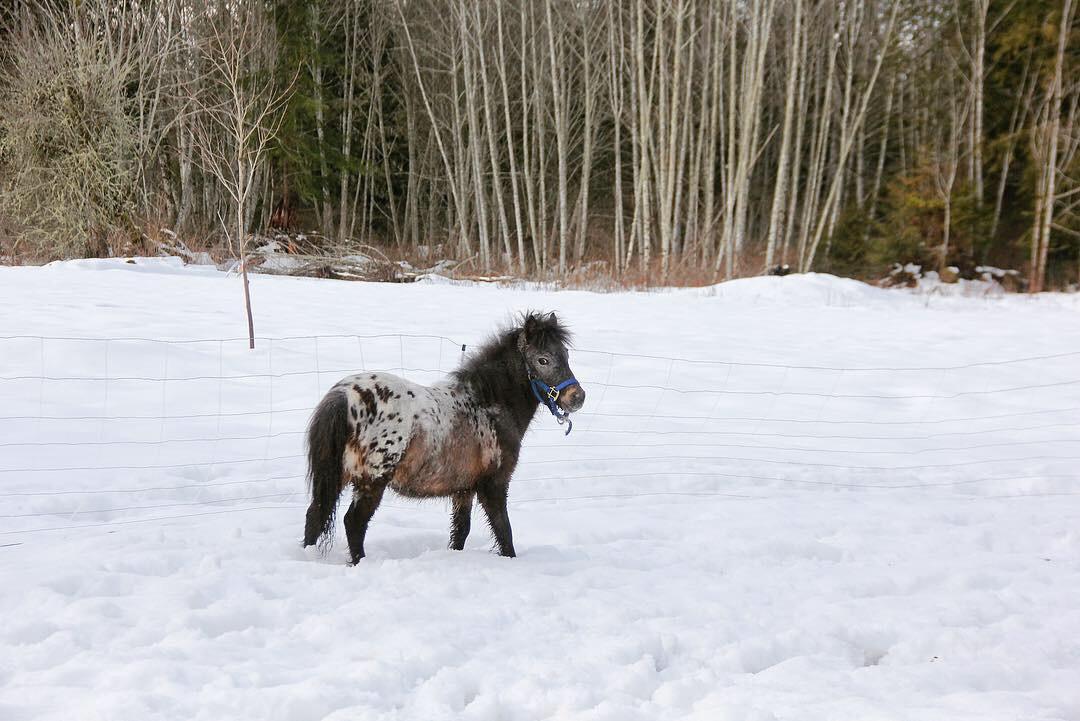
Technically it is a 9-strand net with eight electrified strands, and the design decision that matters most is the bottom strand. That lowest strand is deliberately not electrified, so when weeds grow up into the fence or rain splashes mud onto the net, you are not shorting the whole system to ground. It is a small detail that saves a lot of frustration.
Posts are PVC with 6-inch single metal spikes built into the mesh every 12.5 feet, and the strong plastic struts strung vertically between them are what keep the fence from bowing. Rolls connect end to end, so two or three of these enclose a serious paddock without a second purchase.
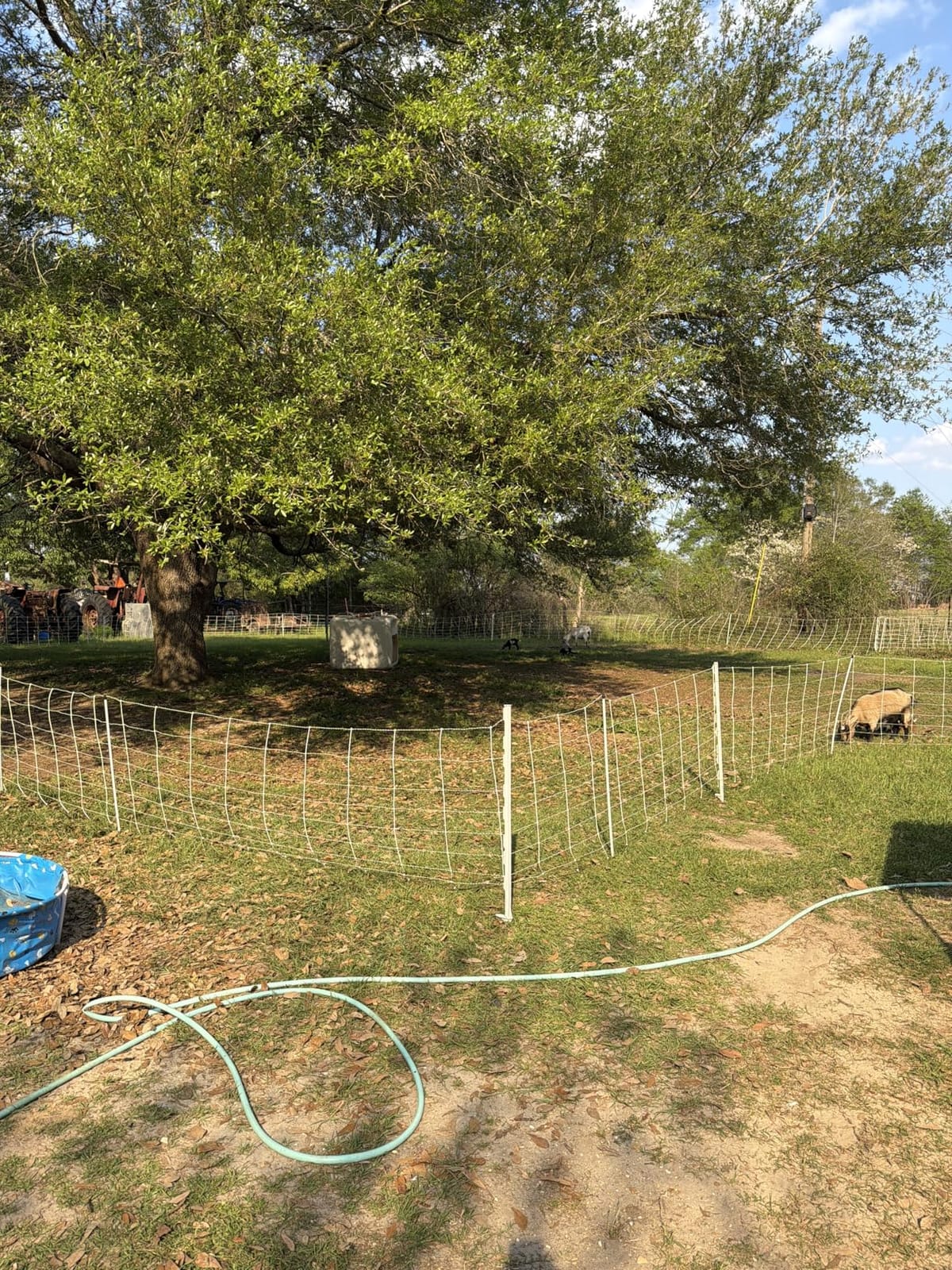
Two rules keep this fence healthy. Never pair it with a continuous-output energizer, which will cook the mesh. And keep vegetation off the strands, because even a small weed bridge on eight live strands will bleed charge. A quick walk with a hoe every couple of weeks is genuinely all the maintenance it needs.
Who the Premier 1 ElectroNet suits
This is the net for a homesteader running a handful of rotational cells who wants a proven, widely supported product. The 246-review base means replacement parts, insulators and troubleshooting advice are easy to find, and the mesh is well documented enough that you can walk into a farm supply and ask for the right thing by name.
It is also a strong fit for mixed operations. The same fence holds sheep, goats, guard dogs and domestic hogs, so a farm running sheep alongside a small dairy goat herd gets a single fence type for both.
Where the Premier 1 ElectroNet falls short
It is not a poultry fence, and owners who try to use it for chicks learn that quickly. The strand spacing is designed for the muzzle of a sheep or goat, not the body of a bird, so anything smaller walks straight through or under.
Buying the net alone also leaves you short. Owners repeatedly mention that the energizer and grounding are separate purchases, and that a complete system costs noticeably more than the fence price suggests. Plan for three linked ground rods as well, since almost every keeper underestimates that part.
3. Premier 1 ElectroStop 42in x 164ft – the tallest, most aggressive barrier
Premier 1 ElectroStop® Single Spike Fence – Sheep & Goats – 42″H x 164’L
42in H, 48in installed
12 strands with 11 conductive
Double-spike posts every 10 ft
38 ohms per 1000 ft
Pros
- Tallest barrier here at 48 in installed
- Installs in under 15 minutes with no tools
- Holds goats and guardian dogs reliably
- Black and white contrast is easy for animals to see
Cons
- Heavier and stiffer so two people usually needed
- Lightweight stakes can bend in hard ground
- Not ideal for vigorous bucklings that blunder into it
If your problem is goats getting over the top rather than through the middle, this is the net to look at. It stands 48 inches tall once the built-in posts are driven in, and that extra 13 inches of height over a 35-inch net is the single biggest structural difference in this roundup.
Extra height matters for a specific reason: goats that can reach a strand are goats that will jump to reach it. A 35-inch net is a challenge that a determined Boer will accept, because a 35-inch net can be put a nose against. A 48-inch net usually does not get that far, because the animal cannot easily get its front hooves on the top line to push off from.
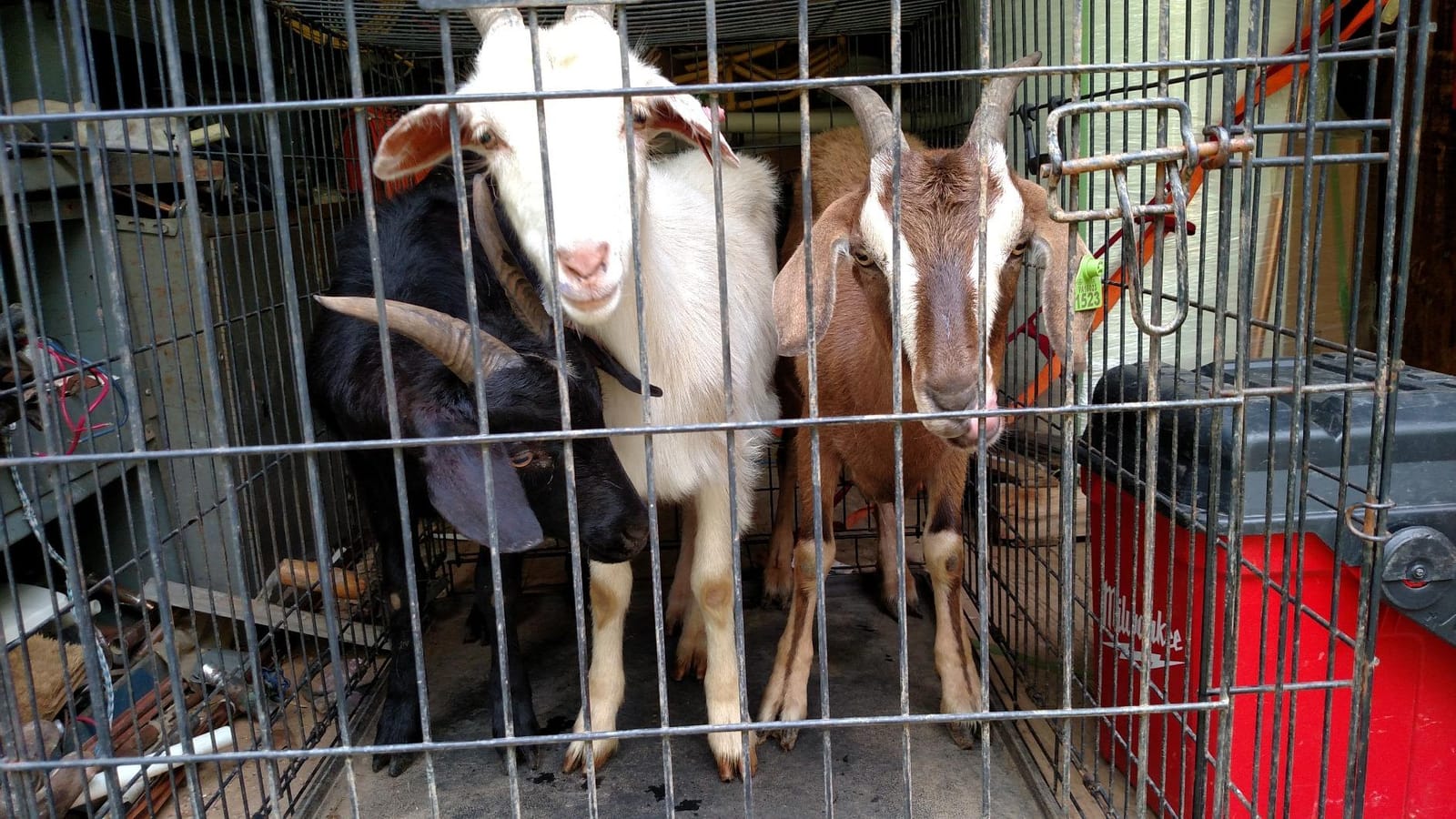
The strand count backs that up. This carries 12 horizontal strands with 11 of them conductive, more than any other net here, and string verticals every 3 inches to keep the mesh from stretching. Electrical resistance is specified at 38 ohms per 1000 feet, which is low enough to hold voltage across a full roll even with a moderate amount of weed contact.
Built-in double-spike line posts sit every 10 feet, closer together than most competitors, and that spacing is what resists the sideways bow that develops in the middle of long spans. The black and white contrast colouring is not cosmetic either. Animals see it in low light and at distance, and a visible fence gets respected sooner.

Setup takes under 15 minutes from the box with no tools, though most owners find it a two-person job because the roll is heavier and stiffer than cheaper nets. Once installed it holds sheep, lambs, goats and guardian dogs, and the manufacturer positions it against coyotes, stray dogs and bears.
Who the ElectroStop suits
This is the choice for a homestead with tall, athletic or escape-prone animals, and for anyone whose goats have already taught them to jump a 35-inch net. It is equally at home as an inner predator barrier set back from a woven-wire perimeter, where the electric offset stops an animal that gets past the physical fence.
Owners of larger operations tend to run multiple rolls of this in series, which is straightforward because the rolls link together. Just confirm your energizer can cover the total length at the vegetation load you actually have.
Where the ElectroStop falls short
It is not a lightweight fence, and that is the honest limitation. At 15 pounds for the roll, and stiffer than most competitors, relocating it is a two-person task. If you plan to move the fence daily, the strain of moving it will show up in bent stakes long before it shows up in the mesh.
Several owners also report stakes bending in hard or rocky soil, and note that a vigorous buckling running into the fence at speed can push it out of alignment. It is strong containment, but it is not indestructible, and the physical posts are the part that gives first.
4. RentACoop 42in x 168ft Goat Netting – the long roll for tall herds
RentACoop Goat Electric Fence Netting, 42″ H x 168′ L
42in H x 168ft L
Copper and triple-braided steel wire
FRP posts every 12 ft
Minimum 0.25J energizer
Pros
- Longest roll in the group at 168 ft
- Two wire types maintain current over long runs
- Double-spiked posts drive well in moist soil
- Includes corner stakes
- guylines
- repair kit and warning sign
Cons
- Can sag mid-span where the net folds onto itself
- Young goats can get hung up on first exposure
- Energizer
- ground rod and voltmeter sold separately
- Hookup instructions are unclear
This is the one we would pick for a property where the paddocks are long and thin rather than square. At 168 feet it is the longest roll in the group, which means fewer joins in a strip-grazing layout, and fewer joins means fewer places where a net can twist and lose tension.
The wire is the differentiator. Rather than a single conductor, this uses copper combined with triple-braided stainless steel, and owners with long runs specifically credit that combination for holding current over distance. The obvious application is protecting a creek, a garden edge or a long driveway strip, where a shorter net would need three or four connections.

Posts are pre-fastened fiber-reinforced plastic every 12 feet, and the manufacturer includes small mini-posts intended to fill gaps on uneven ground. The box also carries four U-shaped corner stakes with guylines, fourteen metal stakes, a repair kit and a warning sign, which is a genuinely complete hardware package for a portable system.
Fully enclosed, it covers more than 1700 square feet. The spec sheet calls for a low or wide impedance intermittent pulse energizer with a minimum of 0.25 joule per roll, and a voltmeter is worth buying alongside it, because a system that looks fine and reads low is the most common troubleshooting problem owners report.
Who the RentACoop net suits
It fits keepers who want a taller barrier with a long run and who mind more about predators than about daily relocation. Long-term owners report years of service holding goats, sheep and even chickens while deterring predators, and the double-spiked posts are repeatedly praised for holding in moist soil where some stakes pull loose.
It is also a good pick if you keep guardian dogs with the goats, since the same net holds the dogs in and other dogs out, which takes the pressure off a single barrier doing two contradictory jobs.
Where the RentACoop net falls short
Mid-span sagging is the recurring theme in reviews. When the net folds onto itself, the fold touches the ground, drains charge and creates a dead spot that goats quickly learn is safe to press against. Adding a stake at the midpoint of any long run and keeping vegetation cut is the fix.
There is also a real learning-curve caution here. Several owners note that younger goats can get hung up in the mesh when first introduced to a live charge. Supervise the first day, and walk the line so an animal cannot become trapped while it works out what happened.
5. Starkline Premium Netting Kit with 0.8J Energizer – the simplest first purchase
Starkline Premium Electric Sheep & Goat Netting Kit- AC Energizer (9/35/8) for Backyards, Homesteaders, and Livestock Owners
35in H x 164ft net
0.8J AC energizer included
14 posts with 6 in galvanized spikes
Struts every 7 in
Pros
- Only all-in-one option with the energizer in the box
- Rolls out and tensions in minutes
- Easy to break down and move between paddocks
- Good value for a first rotational setup
Cons
- 0.8J is light duty and not enough for bears
- Included energizer is not weatherproof for outdoor exposure
- Net tangles if moved carelessly
If you have never run an electric fence, this kit removes the single most common beginner mistake, which is buying a net and then realising you have no way to power it. The charger is in the box, and at 0.8 joules it will drive up to three 164-foot premium nets, which is more than most first-time buyers need.
There is a real cost to that convenience though, and the owner reviews are clear about it. The included energizer is an AC unit designed for a protected location, not for sitting out in a paddock in rain. Keep it under a roof, in a shed, or run a lead out to it, and you have a working system. Leave it exposed and you have a weatherproofing problem you created yourself.
The net itself is the same premium construction as the standalone Starkline roll, with 6 stainless steel wires in the top strand for low resistance, 14 posts with 6-inch galvanized double-spiked stakes, and reinforced vertical struts every 7 inches. That strut spacing is the tightest here and is the main reason it resists the mid-span bow that plagues cheaper nets.
Who this kit suits
A new keeper building a first rotational cell on a budget should look here. Everything needed to have goats out on grass in one order is in one box, and owners with small herds describe it as good value for getting started with rotational grazing.
It also suits anyone within driving distance of an outlet, since the AC energizer is genuinely the simplest and most predictable power source for a permanent installation. Pair it with three linked ground rods and it will hold consistent charge in any weather.
Where this kit falls short
Zero point eight joules is a modest output. It is entirely adequate for goats, sheep and stray dogs on a well-maintained line, and it will not carry through heavy vegetation. It is also not sufficient against bears, and anyone in bear country should treat that as a hard limit rather than a caveat.
Do not plan to run this fence through a wet winter outdoors. Several owners report the power unit failing after limited use, and the pattern of complaints points at the included energizer rather than the netting. If you need unattended, all-season operation in exposed ground, spend the extra on a proper solar or weather-rated unit.
6. Starkline 48in Dry Soil Positive and Negative Netting – built for ground that will not hold a charge
Starkline 48″ x 164′ Positive/Negative Sheep and Goat Electric Netting for Dry Soil Conditions
48in H x 164ft L
10 horizontal strands, verticals every 7 in
14 PVC posts with 6 in double spikes
Minimum 0.15J energizer
Pros
- Designed specifically for dry ground where grounding is hard
- Double-prong posts step in more easily than single spikes
- Relocates easily and works for goats
- horses and cattle
- Only .15J minimum charger requirement
Cons
- Post spacing is wide enough that the net sags and touches ground
- Only the bottom strand returns to ground
- Bottom wire being live drains charge faster
- Posts feel soft and bendy versus other Starkline nets
This is the specialist option, and it exists because of one specific problem. If you live in arid country with rocky or clay soil that will not take a proper ground bed, a conventional electric fence will read weak no matter how good the charger is. This net is engineered around that failure.
How it works: the energizer ground terminal connects to the bottom strand and the positive terminal to the top, so the return path runs through the net itself rather than depending entirely on soil conductivity. Experienced fence builders running northern California soils report that this approach genuinely works where standard systems stall, provided posts are kept tight and extra posts are added over dips in the ground.
Construction is solid enough. It is a 48-inch net with 10 horizontal strands, vertical strands every 7 inches, and 14 preinstalled PVC posts carrying heavy-duty 6-inch galvanized double-spiked stakes. Those double prongs are reported to push into hard ground more easily than the single spikes used by competing products, which matters when your soil fights you.
Who the dry soil net suits
This is the pick for keepers in dry climates who have already tried a conventional fence and found the reading miserable. It is also usable well beyond goats, with owners reporting it working for horses and cattle, and it deters a wide range of predators including deer, bears, raccoons, foxes, coyotes and skunks.
The low power requirement is a genuine advantage. A minimum of 0.15 joules is enough, which means a small solar energizer will run this indefinitely in a remote paddock with no mains power nearby.
Where the dry soil net falls short
Be clear-eyed about the name. This is a positive and negative design where only the bottom strand returns to ground, and owners who wanted true alternating live and ground strands feel the product falls short of its title. It solves dry-soil grounding, not predator-grade strand alternation.
Post spacing is the other recurring issue. The net is described as sagging and touching the ground between posts, and because the bottom strand is live, that contact drains charge exactly where you can least afford it. Add a stake at the midpoint of long runs and treat the extra posts as part of the system rather than an accessory.
7. Gallagher 35in x 164ft Turbo Wire Netting – the visibility specialist
Gallagher 35″ x 164′ Premium Electric Goat & Sheep Netting with Turbo Wire
35in H x 164ft L
9 conductive braided strands
White PVC posts every 12.5 ft
White and orange high visibility
Pros
- White and orange colouring visible in light and dark conditions
- Lightweight tool-free setup and easy roll-up
- Holds high voltage along the line when energized
- Reusable many times around a property
Cons
- Only 15 ratings
- so long-term reliability is thin evidence
- Vertical struts every 12 in
- wider than some rivals
Galagher builds energizers, and this net is the one they have tuned to work well with their own chargers. If you already run Gallagher equipment, this is the natural companion, and the voltage stability owners report on long runs reflects that pairing rather than any special property of the mesh.
What stands out is visibility. The white and orange colouring is the most conspicuous in this roundup, and that is not just for humans. An animal that can see the fence clearly learns what it is far sooner, which shortens the training period and reduces the number of early encounters that cause entanglement or injury.
Technically it is a straightforward, well-made 35-inch net with 9 conductive braided strands and white PVC posts built into the mesh every 12.5 feet. The vertical struts sit every 12 inches, which is wider spacing than the Starkline kits and is where this net loses ground on sag resistance over long runs.
It weighs 21.5 pounds, which makes it one of the heavier rolls here, and it encloses up to 1600 square feet with multiple nets linkable end to end. The net is described as lightweight for its class and easy to roll up for seasonal storage, though in practice two people will be more comfortable.
Who the Gallagher net suits
Keepers who run dark paddocks, long sightlines or predator pressure benefit most from the high-visibility colouring. A fence animals can see in low light is a fence they test less often, and less testing means less wear on the posts and less chance of a goat learning something you would rather it not learn.
It is also a solid perimeter option for a property where the boundary must stay up year round, since owners report repeated reuse across multiple seasons without degradation.
Where the Gallagher net falls short
The honest limitation here is evidence, not performance. With 15 ratings, there is a thin record of long-term behaviour compared with the hundreds of reviews available on the Starkline and Premier 1 nets, and we would rather say that plainly than dress it up.
The 12-inch vertical strut spacing is also the widest among the well-reviewed nets here, and on a long straight run in uneven ground you should expect more mid-span bow than a 7-inch strut product. Add a midpoint stake and you will mostly solve it.
8. Premier 1 ElectroStop Plus 42in x 100ft Starter Kit – the off-grid solar option
Premier 1 ElectroStop® Plus, Starter Kit for Sheep & Goats – 42″H x 100’L
42in H x 100ft L
SolarStop 80 solar energizer
Four FiberTuff posts and T ground rod
Digital fence tester included
Pros
- Complete kit with solar energizer
- posts
- ground rod and tester
- Solar power removes the need for a mains hookup
- About 10 minutes to set up one roll
- Holds goats
- sheep
- cattle and domestic dogs in
Cons
- Shortest coverage in the group at 100 ft
- Netting still must be properly energized to work
- Best suited to frequently moved boundaries
- Ongoing vegetation maintenance required
This is the answer to the most common electric fence question after what to buy, which is how to power it when the paddock is a quarter mile from the nearest outlet. The SolarStop 80 solar energizer and its T ground rod are in the box, along with a wiring harness and a digital fence tester, so the whole system is genuinely turnkey.
The fence tester is an underrated inclusion. Every troubleshooting guide in this space says the same thing, and it is true here: most suspected fence faults are energizer faults, and a voltmeter that costs a fraction of the net tells you which in ten seconds.
The net itself is 42-inch ElectroStop Plus double-spike mesh on a 100-foot roll, with four 42-inch FiberTuff support posts supplied. That is the shortest coverage in the roundup, and it is the main reason this kit ranks eighth despite being the most complete electrically.
Who this solar kit suits
Anyone fencing a back paddock, a wooded corner or a strip-grazing lane where running mains power is not realistic should start here. Solar energizer users across forums consistently report this class of unit as dependable, and the appeal is obvious, because there is no cable to trip over, bury or fail in the rain.
It is also a good first kit for someone who wants to see whether an electric fence works for their herd before committing to a larger permanent system. One roll, one charger, one season of data.
Where this solar kit falls short
One hundred feet is short. For a modest paddock that is workable, but anyone hoping to enclose a full field with this kit will need several rolls and a bigger charger, which defeats some of the point of buying one box.
Solar also has a winter caveat that keepers raise constantly. Panel output drops with light, and a run of cloudy weeks in midwinter can leave a fence reading weak exactly when you least want it. The manufacturer’s guidance for a comparable solar unit suggests it comfortably drives up to three 164-foot sections, so size for that and keep vegetation short through the cold months.
9. Pet and Livestock HQ 48in x 164ft Netting – the tallest and best for poultry
Pet & Livestock HQ Electric Fence Poultry Netting 48″ x 164′ – Portable Pre-Assembled Electric Net Fencing for Goats, Sheep, Lambs in Farms, Ranches, and Gardens (19 Posts, 2 Spikes)
48in H x 164ft L
14 strands with 12 electrified
19 fiberglass posts every 9 ft
Bottom 6 strands spaced 2 in apart
Pros
- Tallest net in the group at 48 inches
- Closest post spacing here at every 9 ft
- Graduated strand spacing limits sagging
- Bottom strands left dead to reduce shorting in weeds
Cons
- Heaviest roll here at 23.6 lb
- so bulkier to reposition
- Energizer must be purchased separately
- Graduated mesh is designed with birds in mind
This is the most densely engineered net in the roundup. Where most products here use 7 to 8 conductive strands, this carries 14 horizontal strands with 12 of them live, and the spacing between them changes as you move up the net, which is why it is sold for poultry and goats together rather than goats alone.
Post spacing is the other quiet advantage. Nineteen fiberglass double-spike posts every 9 feet is the tightest support interval of any product here, and tight support is precisely what stops the mid-span bow that owners of cheaper nets complain about. If your ground is rough or your herd is large and pushy, that matters more than any brand badge.
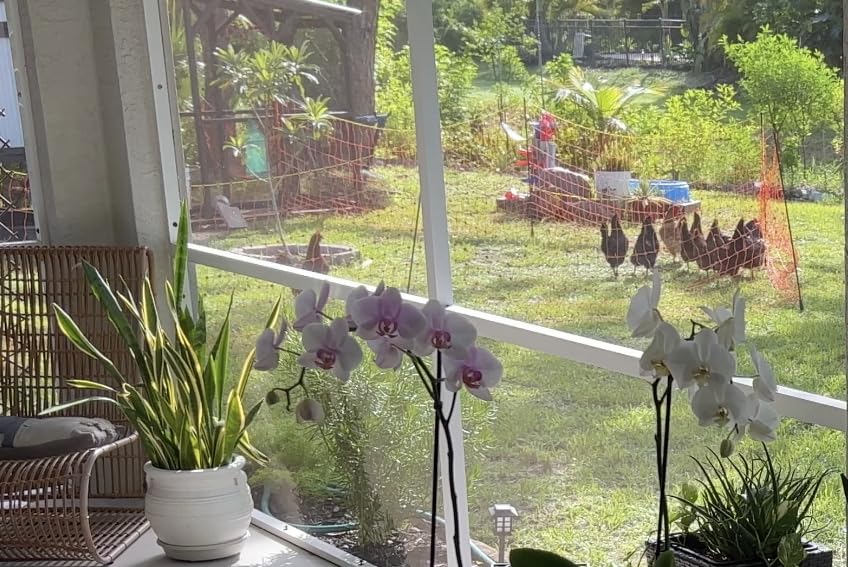
The clever detail is the bottom of the net. The lowest two strands are not electrified, which stops weeds and rain from shorting the fence to ground, and the six strands above them are spaced 2 inches apart to physically hold small birds. Above that, the spacing opens up to goat-appropriate intervals. Four pegs and guy lines handle corner stability.
At 48 inches it is joint tallest here and 23.6 pounds, which makes it the heaviest roll in the group. It is a fence you install in good weather with a second pair of hands, then leave in place for a season rather than moving weekly.

Who this net suits
Mixed operations are the obvious fit. A household keeping goats alongside chickens, turkeys or ducks gets a single fence that handles both, and poultry keepers rate the graduated mesh highly for that reason. It also deters coyotes, dogs, skunks, raccoons and foxes at ground level.
It suits anyone with rough terrain or a herd that leans on fences. More posts and more strands mean more redundancy, and redundancy is what keeps a fence alive when one goat decides to lean on it for twenty minutes.
Where this net falls short
Weight is the main practical issue. At 23.6 pounds it is by some margin the bulkiest roll here, and owners cite bulk and repositioning hassle as the leading drawback. If your system depends on daily movement, this is the wrong net for the job.
Also note the energizer is not included, and that 12 live strands give weeds far more opportunity to bridge the circuit than a 7 or 8 strand net does. Short vegetation is not optional with this product, it is a condition of it working.
10. PPOLB 35.4in x 164ft Blue Netting – the light one to carry
PPOLB Highly Visible Blue Electric Fence Netting, 35.4″ H x 164′ L, Portable Livestock Nets Mesh for Goats, Sheep, Hogs, Dog, Electric Fencing for Backyards, Homesteaders, Farms Ranches, and Gardens
35.4in H x 164ft L
11 strands with 9 live
Triple-braided stainless wire
Weighs 6.4 lb
Pros
- Lightest net in the group at 6.4 lb and easy to carry
- Bright blue and white colouring improves visibility
- Effective at containing goats and similar livestock
- Triple-braided wire holds charge well
Cons
- Posts sit far enough apart that the middle bows toward the ground
- Base spikes could be deeper for better hold
- Plastic poles can break during install or when chewed
- Net tangles if folded and moved carelessly
At 6.4 pounds this is less than half the weight of most nets in the roundup, and that number is the entire reason to consider it. If you are fencing on foot, hauling nets across a farm, or moving paddocks without a vehicle, weight matters more than any other spec on the list.
It is also the newest design here, listed only recently, and it is the only net in the group with bright blue and white colouring rather than the usual black, white or orange. Visibility is a genuine training aid, so that is not just cosmetic, and owners confirm it works as a plain unpowered barrier too if you need one for a garden.
Construction is 11 horizontal strands with 9 conductive, triple-braided stainless steel wire, and built-in glass fibre rods every 12.5 to 13.1 feet. That strand count sits between the simpler 8-strand nets and the 12-strand heavyweights, and the wire is specified as low impedance, which means voltage holds well across the roll.
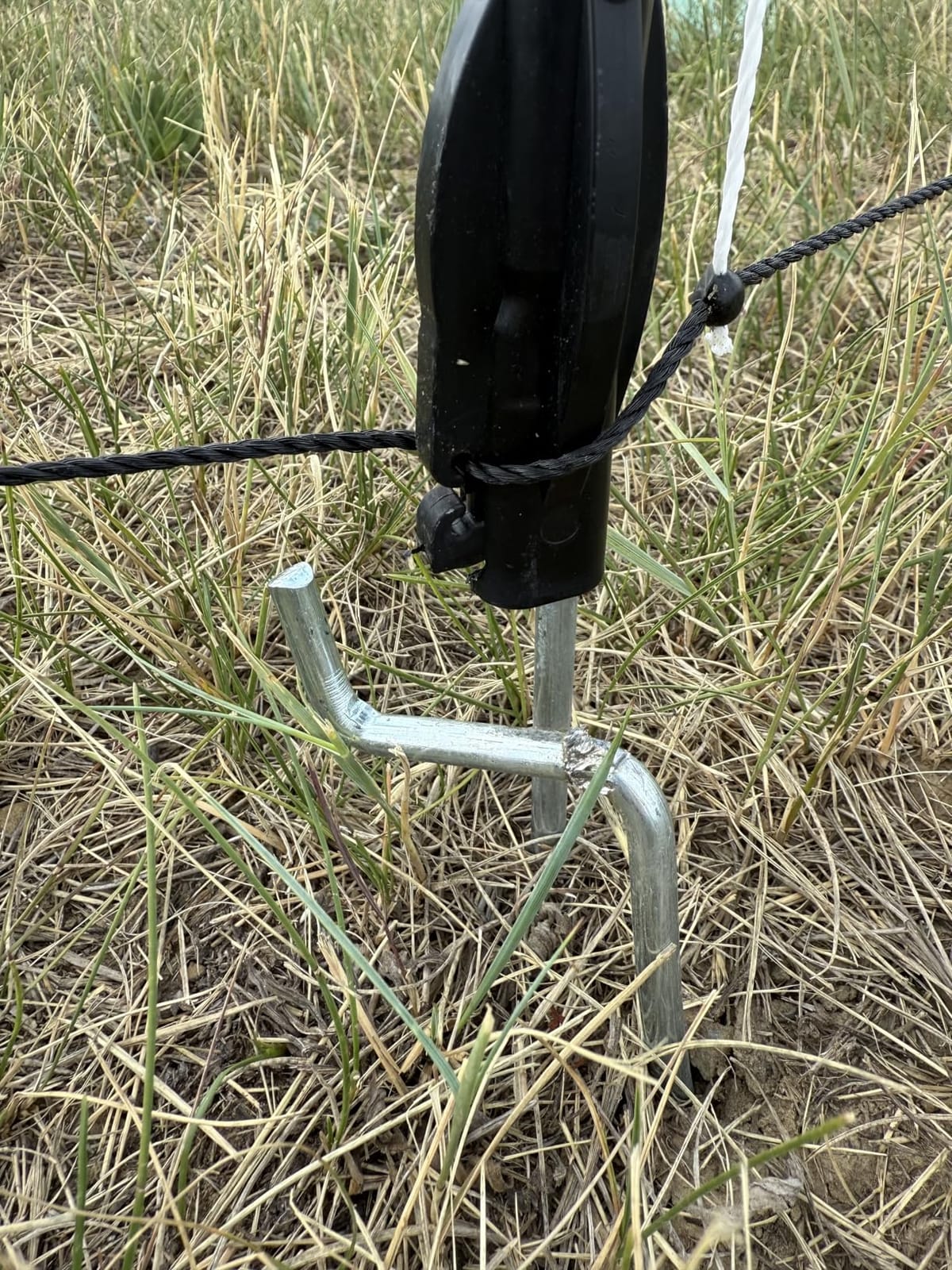
It requires a 0.25 joule solar or AC and DC energizer, plus a grounding rod and two connector clips, none of which are included. Do not use a continuous-current energizer with it, and the low-impedance shock is described as safe for both animals and humans, which is the correct safety posture for a fence animals will learn to touch deliberately.
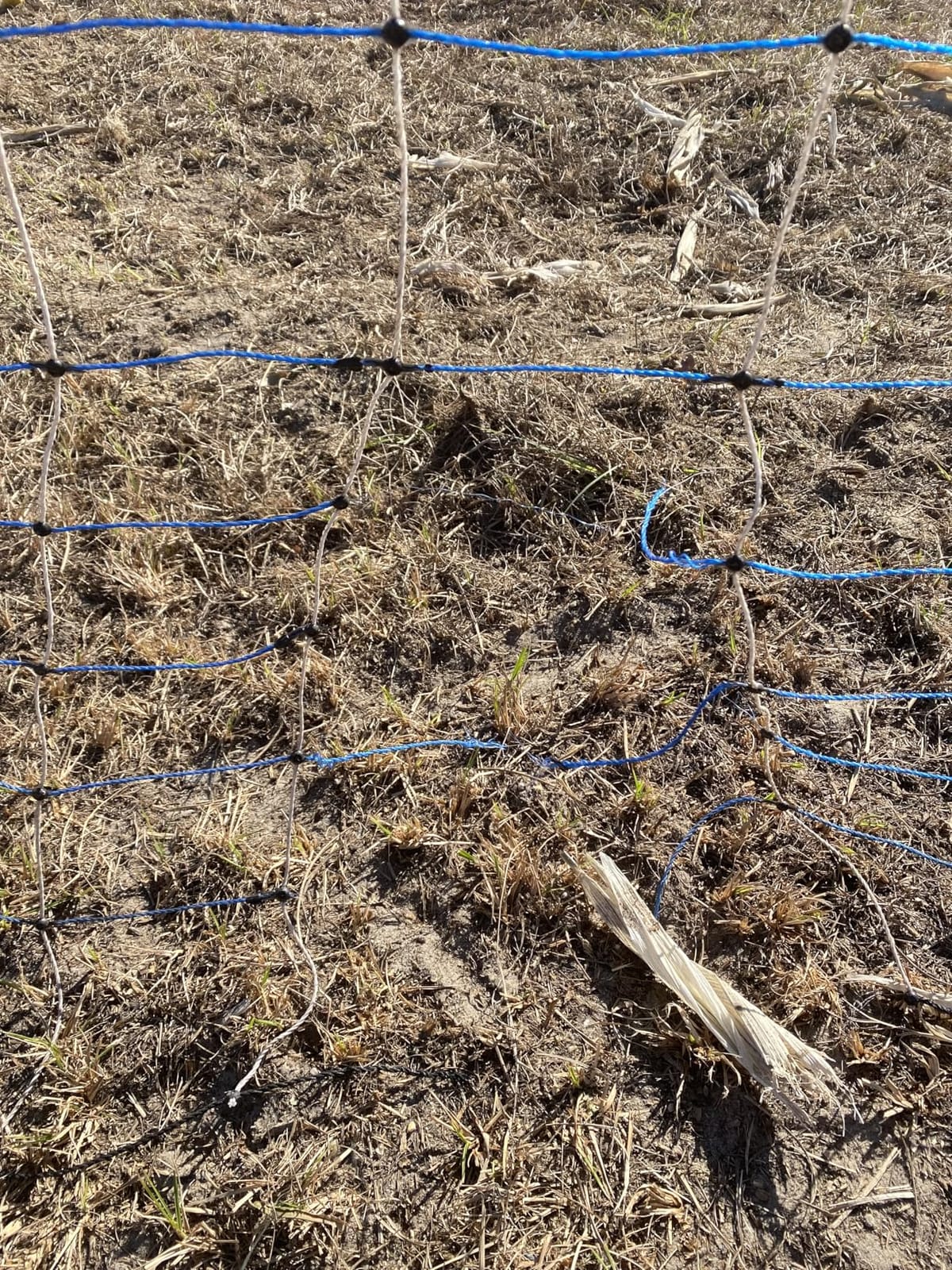
The honest weakness is post spacing. Rods at roughly 13 feet apart is the widest interval in the group, and buyers repeatedly report the middle of the net bowing toward the ground as a result. Bowing means contact, contact means charge loss, and charge loss is a weak fence that goats learn to test.
Who the PPOLB net suits
This is the pick for a homesteader who moves fence on foot, fences a distant corner, or simply wants something one person can reposition without calling for help. Combined with a small solar energizer, it is also a clean off-grid setup for a portable strip-grazing lane.
It suits mixed small livestock too, since the same net is specified for goats, sheep, hogs and dogs, and it deters stray dogs, coyotes, foxes and raccoons.
Where the PPOLB net falls short
Wide post spacing means you will be adding posts. Our advice is to place one at the midpoint of every straight run and one on any dip, and to treat those extra stakes as part of the system cost rather than an optional upgrade.
Owners also report that the plastic poles can break during installation or when a goat chews the net, and that the net tangles if folded rather than rolled during a move. Roll it lengthwise along the line and it behaves; ball it up and it will fight you.
How to Choose the Right Electric Fence for Goats
The first decision is not which brand. It is whether your fence is a physical barrier with a live overlay, or an electric barrier on its own. Goats push, climb and jump, and forum experience is unanimous on the point: a purely electric line without a physical backstop eventually fails, usually in the middle of the night with the neighbour’s prize dahlias gone. Every net in this roundup works because the mesh is a real barrier first and a training tool second.
The second decision is portability versus permanence. If you subdivide paddocks weekly, portability wins and you should optimise for weight, roll length and single-person handling. If this fence is a boundary that will not move for years, optimise for post rigidity, strut spacing and strand count instead, because none of those need to be carried.
The third is predator ambition. A single electrified mesh deters dogs and most coyote pressure. If you are in country with bears, or with heavy deer pressure, or you are running a flock at risk, the community recommendation is a five-strand perimeter alternating live and ground wires in front of your physical fence, with the physical fence set back far enough that an animal cannot reach both at once.
The fourth is terrain. Rocky ground, steep slope and clay each break a different approach. Steep ground pulls the top line tight and the bottom loose, so add posts rather than tensioning harder. Clay and dry soils need the positive and negative approach we covered earlier. Rocky ground favours nets with rigid posts and short spans over long unsupported sections.
Fence Height, Strand Count and Breed Sizing
Height is the number that most directly determines whether you are managing a fence or fighting one. Anything under 35 inches is a suggestion to a determined goat. The 35-inch nets in this roundup are genuinely adequate for standard and smaller breeds, while 42 to 48 inches is the sensible range for Boer, Nubian and dairy goats that jump.
Breed differences are real. Pygmy and Nigerian Dwarf goats are short and light and rarely trouble a 35-inch net. Nubian and Boer are tall, athletic and often horned, which is where 42 to 48 inches earns its place. Large dairy breeds are powerful pushers rather than exceptional jumpers, so their limiting factor is usually fence rigidity rather than height.
Strand count follows from height. More strands across the same height means closer vertical spacing, which contains smaller animals and gives a goat more contact points to avoid. The 8-strand nets here suit goats alone. The 12 and 14-strand nets add the closer bottom spacing that keeps poultry in, and the extra conductor redundancy that holds voltage better in summer vegetation.
One design feature deserves its own note. Several nets deliberately leave the lowest strand, or the lowest two strands, unelectrified. This stops weeds and rain from shorting the fence to ground and bleeding away your charge. If you cannot keep vegetation down, a net with dead bottom strands will outperform an otherwise better net every time.
Energizer Sizing and Grounding for Goat Fences
An energizer sends a brief, high-voltage, low-amperage pulse along the fence every few seconds. The goat touches the live strand while standing on the ground, current completes the circuit, and the animal gets a brief, unpleasant and entirely memorable shock. That is the whole mechanism, and it works on goats because goats are creatures of strong routine that learn a boundary in one or two encounters.
Sizing is simpler than the numbers suggest. A 0.15 to 0.25 joule unit is enough for a single short net in dry conditions. Around 0.5 joule covers one or two 164-foot rolls comfortably. At 1.0 joule and above you are running multiple nets, heavy vegetation, or a long perimeter. The manufacturer requirement for the dry soil net here is 0.15 joules minimum, for the RentACoop net 0.25 joules per roll, and the kit in this roundup includes a 0.8 joule unit rated for up to three 164-foot nets.
Two hard rules. Never use a continuous-output energizer with electric netting, because a steady current will cook the mesh and the plastic verticals. And a weak reading is a vegetation problem far more often than it is a charger problem, so mow the line before you start buying bigger units.
Grounding is where most installations quietly fail, and keepers consistently underestimate it. Drive three ground rods, space them about 10 feet apart, link them with the supplied jumper wire, and drive the last one deeper than you think you need to. A dry, rocky or frozen ground bed is the reason a fence reads weak when the charger is fine, and it is the single most common troubleshooting call in every forum thread about electric fences.
Our setup summary, the numbers worth memorising: aim for 35 to 42 inches of height for standard breeds and 42 to 48 inches for tall or horned ones. Match the charger at 0.15 joules for one short net up to 1.0 joule and above for multiple nets or heavy growth. Install three linked ground rods. Mains for a permanent fence, solar for anything you move or anything remote.
Frequently Asked Questions
Do goats do well with an electric fence?
Yes, once they are trained. Goats learn an electric boundary after one or two encounters and then avoid it almost permanently, which is why experienced keepers describe them as animals that respect the memory of a fence rather than the fence itself. The training period usually takes a day or two, and supervising that first contact matters, because a young goat that gets tangled while it is learning is the most common early problem.
What is the best type of electric fence for goats?
For most homesteads, prefabricated electric netting on posts already attached is the best type. It combines a real physical barrier with a trained psychological one, installs without tools and moves when you need to rotate paddocks. A multi-strand polywire or polytape fence is cheaper and better for a permanent perimeter with an existing physical fence, while permanent woven wire with an electric offset gives the strongest long-term predator barrier.
How high should an electric fence be for goats?
35 inches is the practical minimum for standard and smaller breeds. Aim for 42 inches for Nubian, Boer and large dairy goats, and 48 inches where goats are horned, athletic or have already learned to jump a shorter fence. Height matters because a goat that can reach a strand with its nose is a goat that will jump to reach it with its front hooves.
How many strands of electric fence do I need for goats?
Five to seven live strands spaced between 6 and 12 inches apart is enough for goats on a permanent fence, and most prefabricated nets in this category carry 8 to 12 live strands. If you are also containing poultry, look for close spacing in the bottom 6 inches. If the net has a non-electrified bottom strand, that is a design feature, not a shortfall, because it stops weeds shorting the fence.
Is 2.2 joules enough for goats?
Two point two joules is more than enough and is usually unnecessary. Around 0.15 to 0.25 joules runs a single short net, roughly 0.5 joule covers one or two 164-foot rolls, and 1.0 joule and above suits multiple nets or heavy vegetation. Extra output does not compensate for a poor ground bed or tall weeds, so fix grounding and cut the vegetation before you step up the charger.
Do invisible or underground fences work for goats?
No. Keepers who have tried them are blunt that they would not trust an underground fence to stop goats, and the reasoning is sound. Goats are curious, they dig at boundaries, and an invisible boundary gives an animal that pushes hard no reason to stop. A visible physical barrier with an electric overlay trains the behaviour in a way a buried line cannot.
The Verdict: Which Electric Fence Wins in 2026
For most goat keepers in 2026, the Starkline 35 inch by 164-foot premium net is the one to buy. It has the highest rating and the largest review base we could find, its rigid fiberglass posts are the least likely to bow in uneven ground, and a single person can roll and relocate it for rotational grazing without calling for help.
Match the pick to the job instead of the brand. The Premier 1 ElectroNet for proven rotation, the Premier 1 ElectroStop 42-inch for tall and athletic herds, the RentACoop net for long runs, the Pet and Livestock HQ net if poultry share the pasture, the Starkline dry-soil net where the ground will not hold charge, and the PPOLB net if you carry your fence on foot. Budget for an energizer and three linked ground rods before you order anything, and supervise the first day of training.