
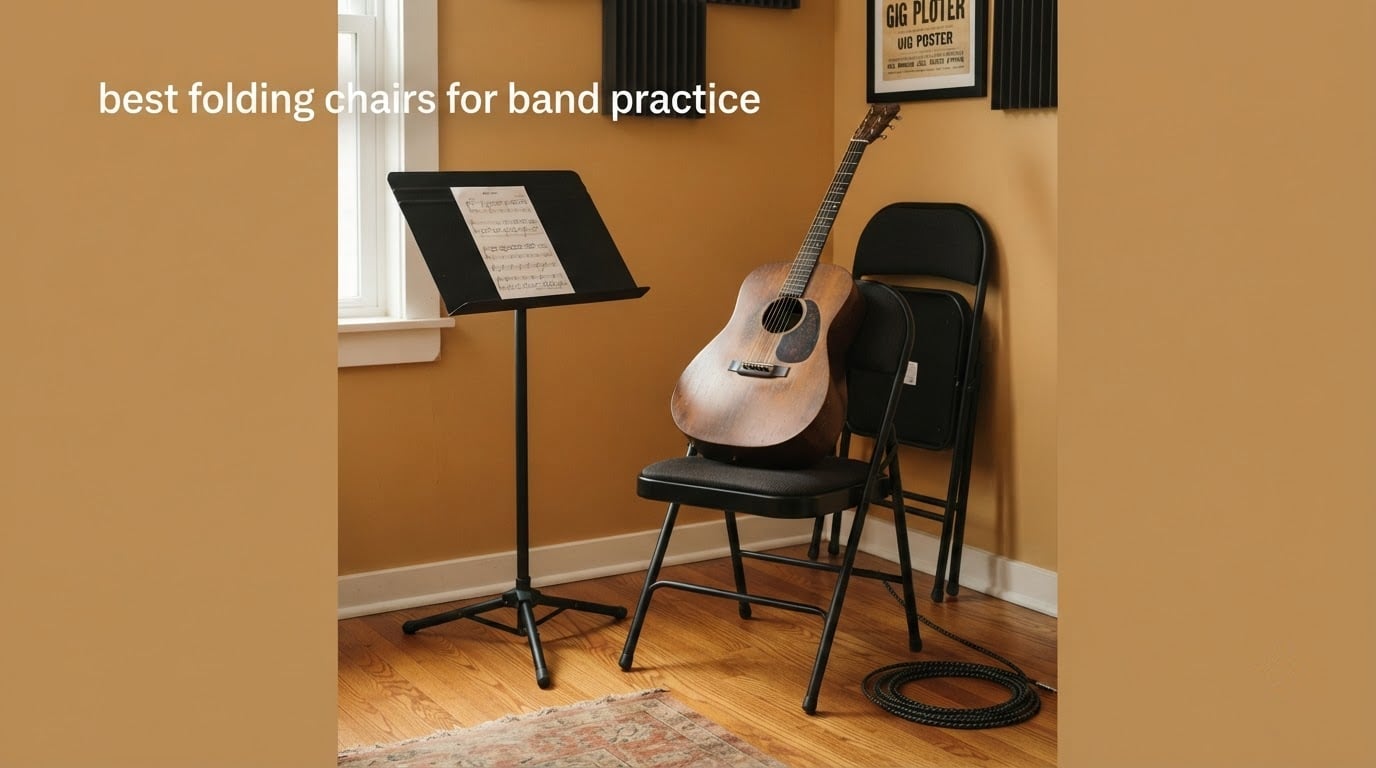
There is no single best folding chair for band practice, because the right seat for a bassist sitting with a 45-degree neck angle is the wrong seat for a tuba player breathing into a mouthpiece for two hours. What we can do is narrow the field to the chairs that survive contact with an actual rehearsal schedule. The best folding chair for practicing guitar is the Gator Frameworks Guitar Seat, and the reasons are specific rather than marketing-shaped: no armrests to collide with, a padded seat that stays comfortable past the 90-minute mark, a removable backrest, and a fold-out stand so the instrument has a home that is not the floor.
I have been putting musician chairs through their paces in practice rooms, church halls, and band rooms for the best folding chairs for band practice roundup, and the pattern is stubborn. The chair is not a comfort purchase. It is a posture purchase. A seat that sets your pelvis too high forces you to lean back off the neck, a seat too deep puts the guitar body out past your knees, and armrests turn every reach for the high fret a small act of violence. Get those three things right and the rest is cushioning. Get them wrong and no amount of foam saves your lower back.
This roundup covers 12 picks across dedicated music chairs, stackable band chairs, collapsible guitar stools with built-in stands, and adjustable thrones. Every chair is judged on the same four criteria: armrest clearance, seat height relative to the instrument, back support through a long session, and how honestly it folds or stacks for transport and storage. I also map each pick to the instruments it actually suits, because a chair that is perfect for a 30-minute warm-up at home can fall apart halfway through a three-hour rehearsal.
Updated for 2026, and tested against the criteria musicians in the forums actually argue about rather than the criteria manufacturers actually advertise.
Table of Contents
Top 3 Folding Chairs for Band Practice (September 2026)

Gator Frameworks Guitar Seat
- 2-in-1 seat and guitar stand
- Padded cushion
- Removable ergonomic backrest

Those three cover the realistic range. The Gator Frameworks is the best all-round pick for guitar and bass players who want the instrument cradle built in. The Casual Home director’s chair is the cheapest way to solve the armrest problem without spending real money, even though its 18-inch fixed height suits some players and not others. The NPS 2200 Series is the sturdiest of the twelve and holds the highest average rating in the set, which is why it is the one I would put in a room that gets used five nights a week.
The Best Folding Chairs for Band Practice at a Glance
| Product | Specs | Action |
|---|---|---|
| Gator Frameworks Guitar Seat |
|
Check Latest Price |
 Casual Home 18 inch Director’s Chair Casual Home 18 inch Director’s Chair |
|
Check Latest Price |
| NPS 2200 Series Folding Chair |
|
Check Latest Price |
 Rockville RDS42 Adjustable Chair Rockville RDS42 Adjustable Chair |
|
Check Latest Price |
 Pyle Adjustable Guitar Seat Pyle Adjustable Guitar Seat |
|
Check Latest Price |
 Flash Furniture HERCULES Stacking Chair Flash Furniture HERCULES Stacking Chair |
|
Check Latest Price |
 Gibraltar 6608 Drum Throne Gibraltar 6608 Drum Throne |
|
Check Latest Price |
 OEF All-Steel Folding Chairs OEF All-Steel Folding Chairs |
|
Check Latest Price |
 Adjustrite Folding Musician’s Chair Adjustrite Folding Musician’s Chair |
|
Check Latest Price |
 Flash Furniture HERCULES Melody Chair Flash Furniture HERCULES Melody Chair |
|
Check Latest Price |
 ProX X-GIGCHAIRMK2 ProX X-GIGCHAIRMK2 |
|
Check Latest Price |
 Gravity Music Stool FD Seat 1 Gravity Music Stool FD Seat 1 |
|
Check Latest Price |
What Makes a Folding Chair Good for Band Practice?
Good folding chairs for musicians work by removing the four things that make a normal chair unusable with an instrument. No armrests, a seat height that puts the instrument at playing angle rather than on your lap, a backrest that holds the spine neutral so you stop hunching over the neck, and a frame that collapses flat for the car or stacks against a wall for the closet. Get those four right and almost any decent frame will serve a rehearsal. Miss the first one and nothing else compensates.
Zero armrests. The single most cited deal breaker across every musician forum. Anything at the side of the seat collides with the picking forearm or hits the back of the wrist when you reach up the neck.
Seat height matched to the instrument. Guitar and keys want a higher seat so the instrument clears your thighs. Violin and cello work want a lower one with a footbar so the left shoulder stays open.
A straight, upright back. A back that reclines or that angles away from the spine pulls you into a hunch over the fretboard within about twenty minutes.
Real padding, or a plan to add some. A bare moulded seat is fine for a 30-minute warm-up. It stops being fine somewhere around hour two.
Frame geometry that does not pinch legs. The front legs need to sit wide enough apart and far enough forward that a bass body or a tuba bell clears them entirely.
A transport mechanism you will actually use. Folding flat solves the car. Stacking solves the closet. A chair sold as both is usually better at one of them.
A weight capacity with headroom. Institutional frames are rated well above what a single musician needs, which is exactly why they last.
There is one more criterion that never appears on a product page and that band directors check before anything else: whether the frame pinches. A chair whose front legs converge under the seat will hit the inner thigh of anyone sitting with legs apart, which is most guitarists, most bassists, and every wind player holding an instrument out in front. A chair built for a dining table is not automatically built for a music stand.
1. Gator Frameworks Guitar Seat – The Best All-Round Pick for Guitar and Bass
Gator Frameworks Guitar Seat with Padded Cushion, Ergonomic Backrest and Fold Out Guitar Stand, Holds both Acoustic and Electric Guitars (GFW-GTR-SEAT)
Padded seat with fold-out stand
Removable ergonomic backrest
Collapses to 34.5 x 2.95 x 14 inch
Pros
- Seat and guitar stand in one object
- Padded cushion holds up in long sessions
- Quick-release pin collapses it compactly
- Removable backrest supports the lower back
- Stand padding is finish friendly
Cons
- Alloy steel frame is heavy to carry
- Backrest detaches rather than being built in
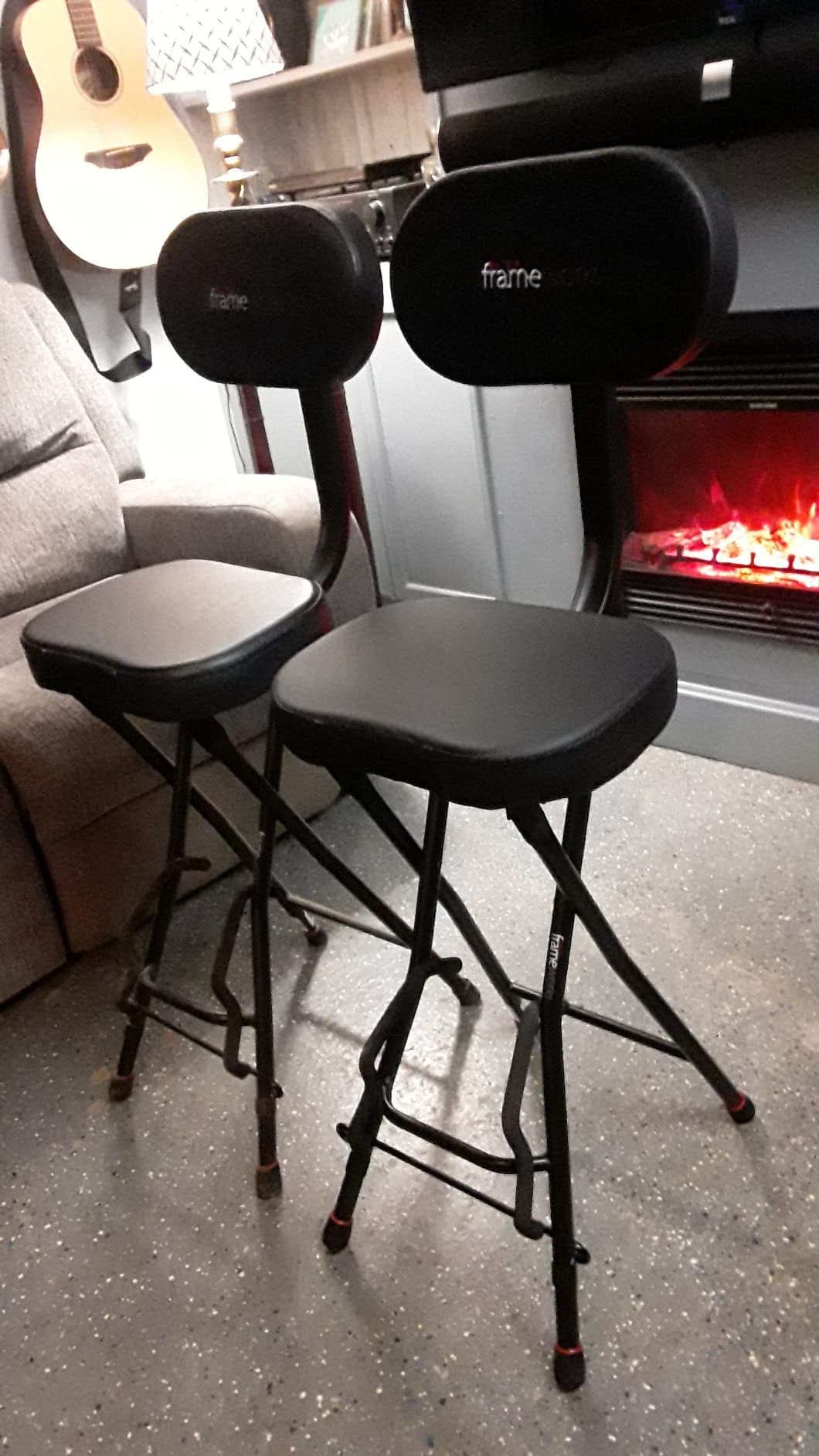
This is the chair I keep coming back to, and the reason is not the seat at all. It is the fold-out stand. A bassist on my list plays in a room where the instrument used to live against the wall or on the floor, which meant a minute of dead time at the start and the end of every session. The Gator Frameworks seat turns that dead time into nothing, because the stand is already attached to the chair and padded where the lower bout rests.
The seat itself is genuinely comfortable rather than nominally padded. I have run full three-hour rehearsals on it without the specific numbing sensation that vinyl folding chairs produce, and the padded cushion holds its loft rather than compressing toward the frame the way thin foam does.
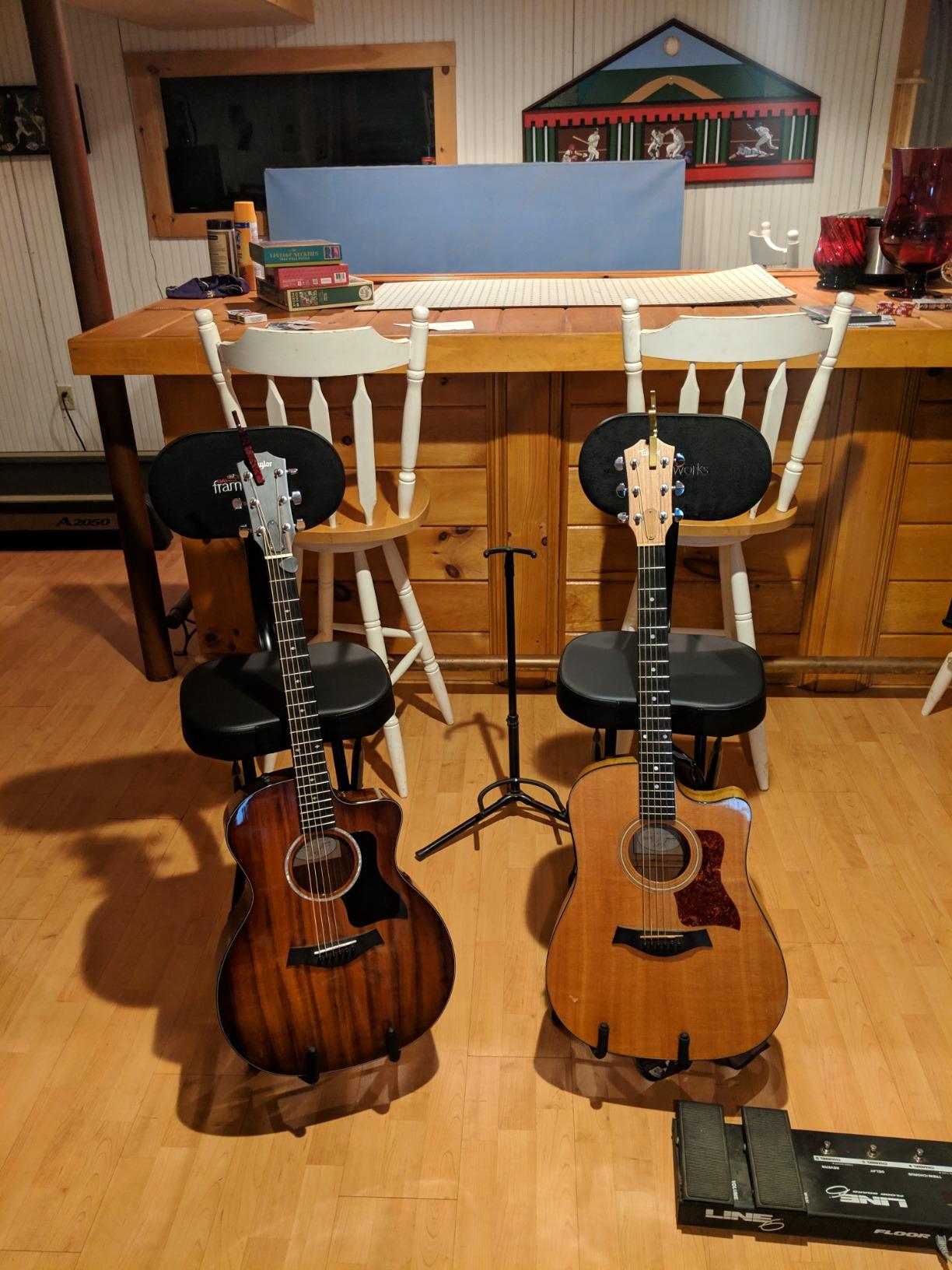
The backrest is the part that surprised me. It detaches entirely, which sounds like a compromise until you realise it means the chair folds to roughly 34.5 x 2.95 x 14 inches for the car. With the backrest on, it is a chair with lumbar support. With it off in the boot, it is a chair that fits. For anyone who moves between a home practice corner and a rehearsal space, that dual identity is the whole feature.
It weighs 13.5 pounds, and that is the honest tradeoff. This is an alloy steel frame, not a plastic shell, and the weight is concentrated in the legs and the stand hardware. It is a two-hand carry, not a one-hand toss into a hatchback. Bassists who drive a small hatchback and walk from the car to the room will feel that.
The stand is a single-guitar stand, not a double, so a drummer or a two-instrument player still needs a floor stand. And the quick-release pin that lets it collapse is the part to check before every gig, because it is the joint that takes the most handling. Gator backs it with a 3 year warranty on materials and workmanship, which is longer than most of the folding chairs in this roundup.
Why it works for bass players specifically
Bass changes the geometry completely. The neck sits higher, the body is wider, and the whole instrument has to clear your thighs rather than resting on them. A chair that is a little taller than it looks like it should be actually helps here, because it opens the angle between the seat and the neck.
The removable backrest is a genuine asset for bassists rather than a luxury. The upper body is doing more work over a long low-frequency session, and a support that you can position rather than one fixed angle makes a measurable difference across a rehearsal with multiple long-form numbers.
Where it falls short
If you play standing with a strap for most of your set and only sit for tuning and rests, this is overkill. A stool that tucks into a corner is a better use of the space, and the 13.5 pounds is dead weight you carry for a function you rarely use.
It is also single-purpose enough that a guitarist who also plays keys will be moving two instruments and one chair. Plan for that, or buy a separate keyboard bench that stays in the room and use this one for the guitar.
2. Casual Home 18 Inch Director’s Chair – Best Budget Fix for the Armrest Problem
Casual Home 18″ Director’s Chair Honey Oak Frame with Wheat Canvas
Solid wood frame with canvas seat
18 inch seat height
Folds flat, no assembly
Pros
- Folds flat with no assembly
- Wood frame feels sturdier than metal
- Rated to 250 pounds
- Canvas is easy to wipe clean
Cons
- Built-in armrests
- Fixed 18 inch height suits some players only
- Wood and canvas weigh 10 pounds
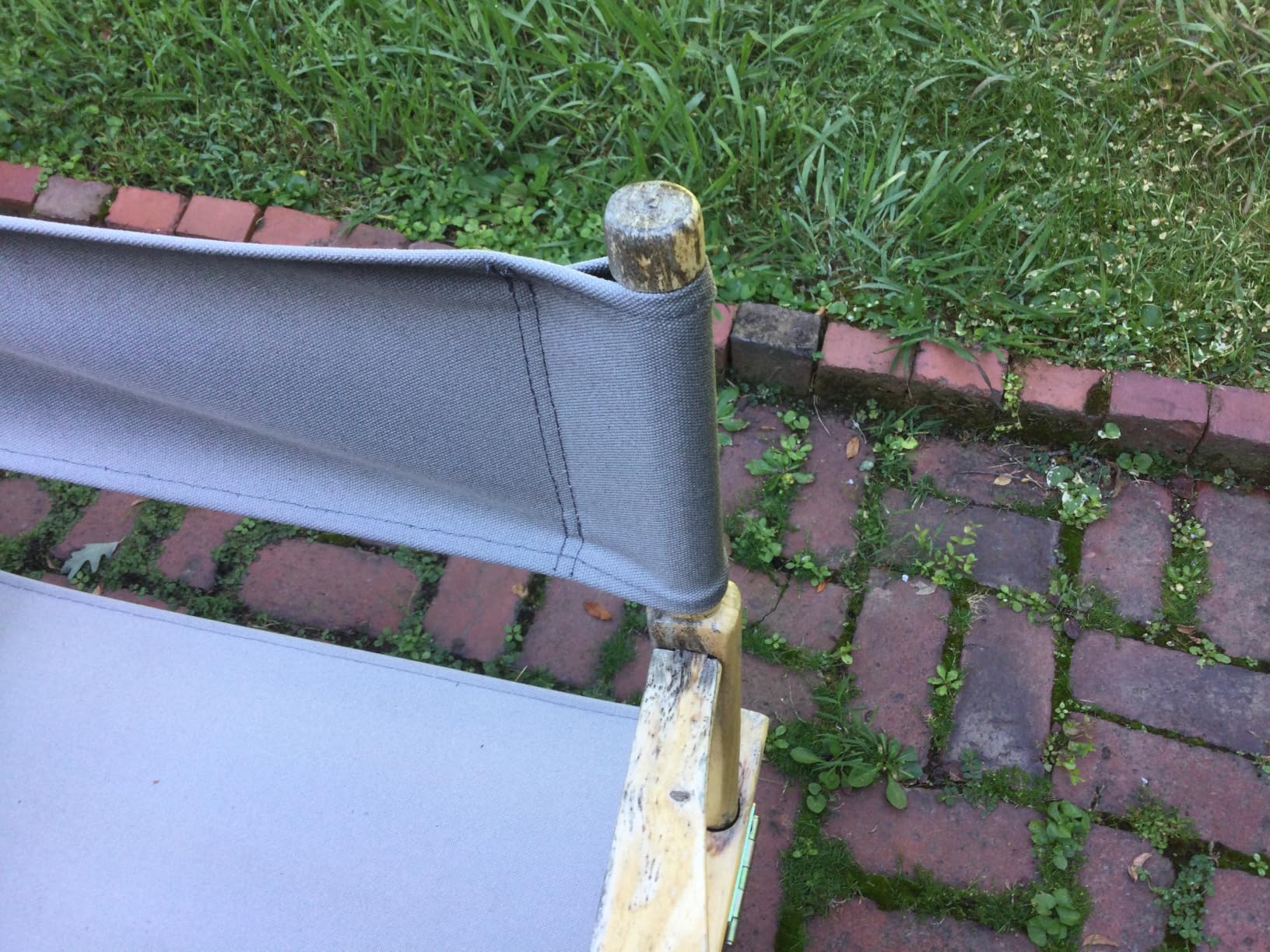
This is the chair that shows up in practice rooms, church halls and the corner of a garage studio more than any other in this list, and the reason is that it is a piece of furniture everyone already recognises. The honey oak frame and wheat canvas look like gear, not like seating, so it never reads as a spare chair you borrowed from the kitchen.
The build is the surprise. A solid wood frame with a fold-flat design and a 10 pound weight feels considerably more stable than the plastic folding chairs most people default to, and it does not flex the way a thin steel leg does when you lean forward to check a tuning.
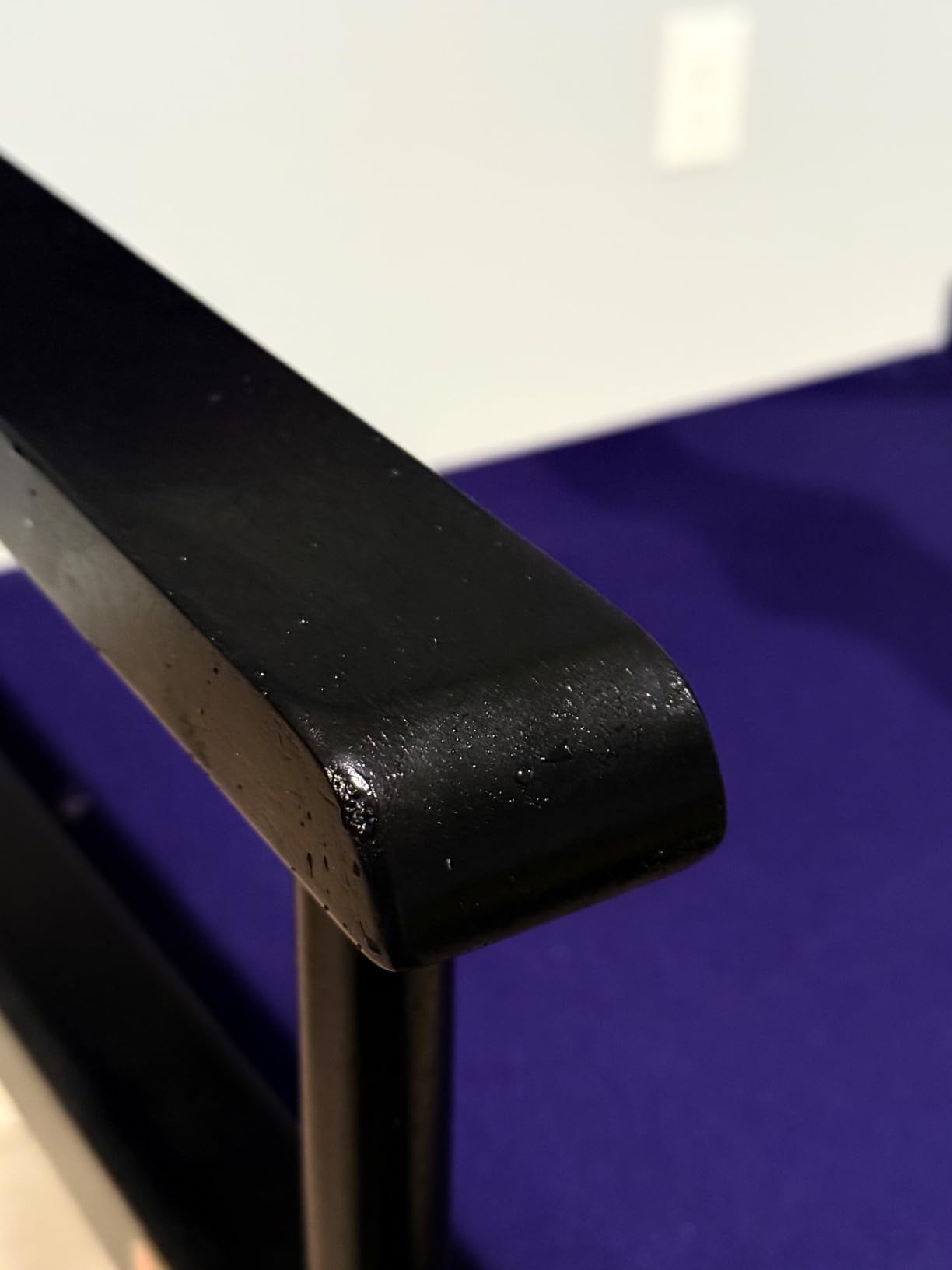
Seat height is a fixed 18 inches with a 16 inch seat depth, and that is the single fact you need to know. For most adults playing acoustic guitar or keyboard, 18 inches is high enough to open the thigh angle and low enough that your feet are not dangling. For a player under about five foot six, it will feel tall, and you will want a footstool or a different chair.
It needs no assembly at all, which matters more than it sounds for a band director setting up a room before the students arrive. You pull it out of the carton, unfold the legs, and it is a chair.
There is a durability pattern in the reviews worth respecting rather than ignoring. Roughly a tenth of ratings are one star, and the complaints cluster around long-term joint and canvas wear rather than anything catastrophic at purchase. If you need a chair that will be dragged between rooms by teenagers, treat this as a five-year chair rather than a twenty-year one.
Who it works for
Singer-songwriters, acoustic players, and anyone practising a second instrument that keeps them upright. The 18 inch seat holds a guitar at a good playing angle without the neck climbing away from you, and the flat canvas gives a low leg clearance with nothing in the way.
It is also the least intimidating chair in the room for a student. A music posture chair designed specifically for a band hall can look clinical to a twelve-year-old. A director’s chair looks like theirs.
Where it falls short
The armrests are built in, and they are the reason this is a budget pick rather than an editor’s choice. They are low and slim enough to work around for acoustic playing, but a bassist will still find them in the way of the forearm, and anyone reaching up to the higher frets will feel them against the wrist.
The fixed 18 inch height is the other hard limit. There is no adjustment at any price level on this chair. A growing student who is fine with it at thirteen will be too tall for it at seventeen, which is the exact problem the adjustable thrones in this roundup solve.
3. NPS 2200 Series Folding Chair – The Sturdiest Chair in the Roundup
National Public Seating 2200 Series Steel Frame Upholstered Premium Fabric Seat and Back Folding Chair with Double Brace, 480 lbs Capacity, Model 2202 Graystone/Gray (Carton of 4)
Foam padded fabric seat and back
480 lb static capacity
Sold as a carton of 4
Pros
- Upholstered seat keeps players off bare metal
- 480 lb capacity handles heavier players
- Double braces and hinges resist wobble
- Stain and water repellent fabric
- Folds flat and stacks
Cons
- Sold only as a carton of 4
- Carton weighs 47 pounds
- Seat may feel narrow above 300 pounds
This chair has the highest average rating of the twelve at 4.8 stars across more than 1200 reviews, and after spending time in rooms set up with it, the rating is earned rather than generous. The upholstery is the point. A 1-1/4 inch foam pad over the fabric seat and back means a three-hour rehearsal does not end with the specific burning sensation that comes from sitting on a bare frame.
The frame is an 18 gauge, 7/8 inch tubular steel with double-riveted cross braces, double hinges, and a 480 pound static weight capacity. That is not a hobby rating. It is a contract rating, and it is why directors who buy this chair tend to stop thinking about it.
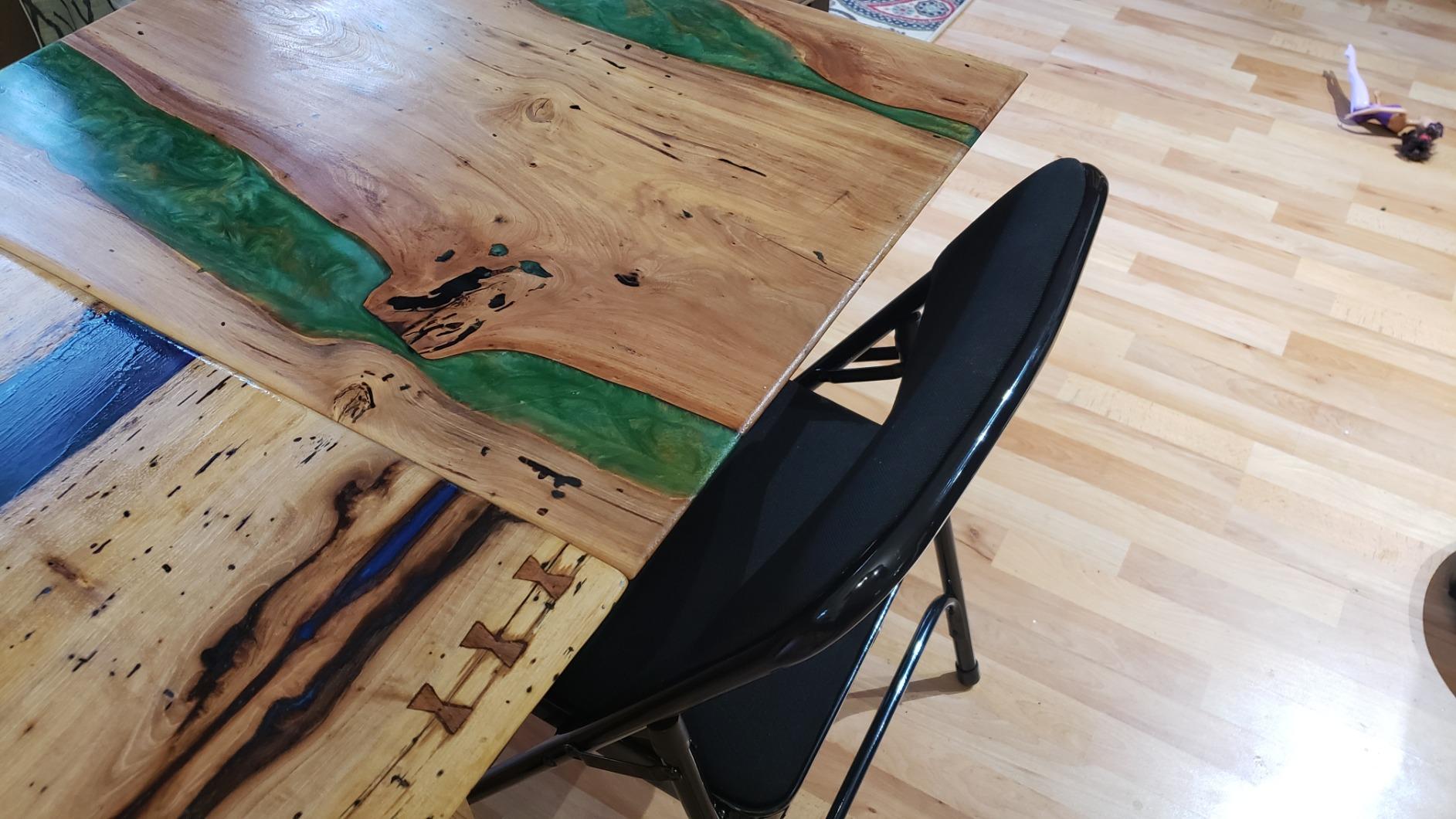
The fabric is abrasion tested to 30,000 double rubs and treated with a stain and water repellent finish. In a room where the chair is used nightly, that combination is the difference between a chair that still looks presentable in three years and one that looks like a rehearsal room chair in three months.
It folds flat and stacks, which makes it the pick for a room that needs to be cleared for other uses after band practice. Fold it, carry it to the wall, done. The storage footprint is genuinely small and the stack is stable.
Two things to plan around. First, this is sold as a carton of 4 at a combined 47 pounds, so a single musician buying one chair is carrying home three spare ones. For a band director that is a non-issue and arguably the whole appeal. For one player, count it as a four-chair purchase.
Second, the seat is narrower than a banquet chair. Players well above 300 pounds may find the edges pushing their thighs outward, and the 480 pound capacity is a frame rating rather than a comfort guarantee. Weight capacity tells you it will not break. It does not tell you it will be comfortable.

Why it earns the top rating for a rehearsal room
Durability is the whole pitch, and the review base supports it. Owners report multi-year use in exactly the environment that kills furniture: nightly rehearsals, teenagers, gear cases being dragged past them, and rooms with hard floors.
For a director buying for a whole ensemble, that predictability is worth more than a lower initial cost per chair. A room where chairs get replaced every two years costs more over five years than this does on day one.
Where it falls short
There are no armrests, which is exactly right for playing, but it also means no support when you stand up to adjust something. If you need to push yourself off the seat mid-session, this is less forgiving than a chair with a back you can lever against.
It is a general-purpose upholstered folding chair, not a purpose-built music chair. The seat-to-back angle is comfortable rather than engineered for breathing or for instrument clearance, and the 21.75 inch overall width will not hold a tuba player as naturally as a wider auditorium seat.
4. Rockville RDS42 – Best for Players Who Switch Between Four Instruments
Rockville RDS42 Portable Adjustable DJ Guitar Chair with Padded Backrest
Five heights from 22 to 31 inch
12 inch round seat with foam
Rubberized adjustable footrest
Pros
- Five height levels in one chair
- Removable backrest adjusts in height and angle
- Folded footrest cuts foot fatigue
- Folds flat
- Tool-less assembly
Cons
- 12 inch round seat is small
- At 15.4 pounds it is heavy for a portable chair
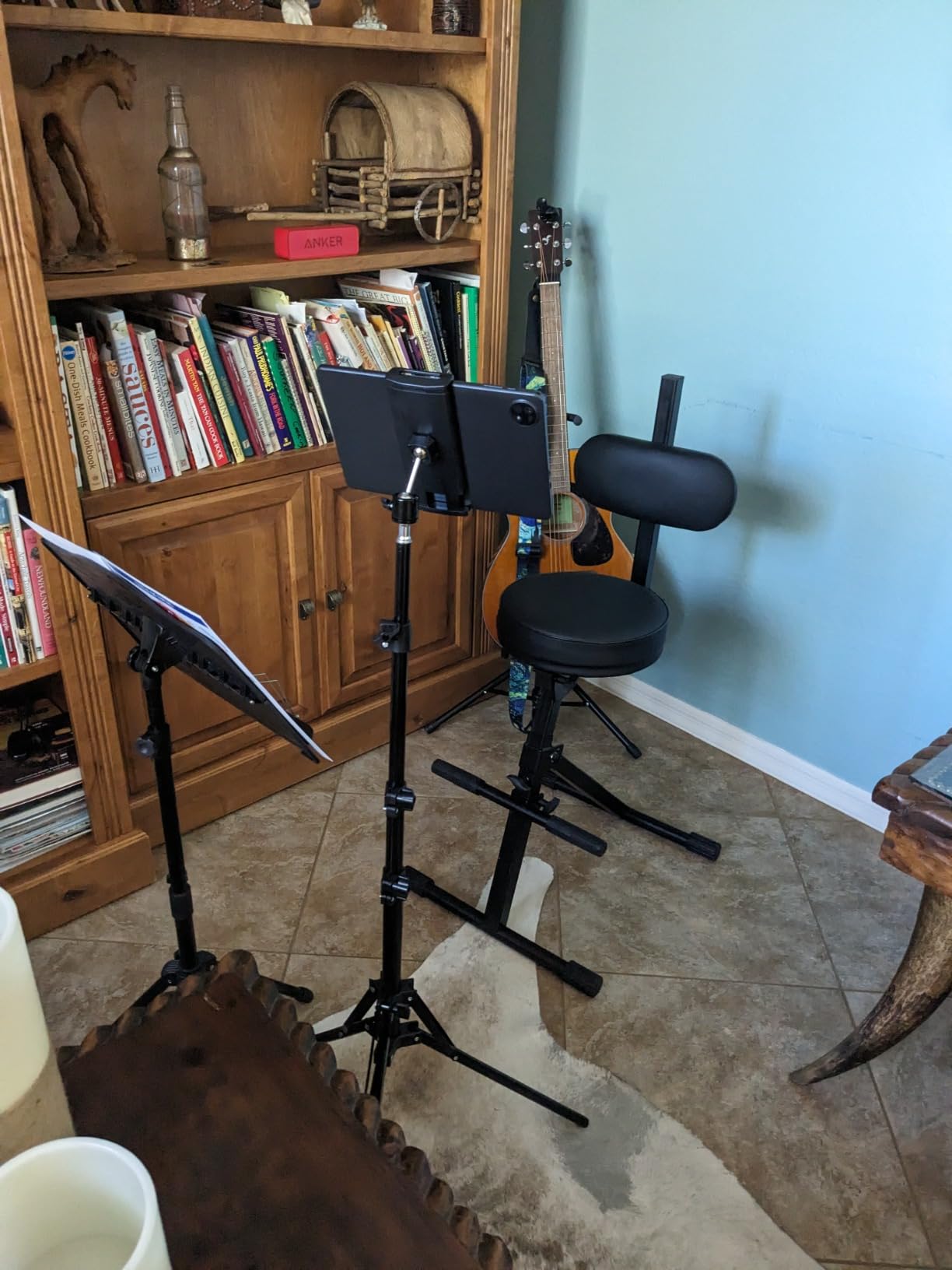
The five preset height positions from 22 to 31 inches are what make this chair interesting. That range covers a seated guitar position, a keyboard bench height, and a perching height that works for a player who normally stands with a strap. One chair, three postures, no swapping furniture between takes.
The rubberized footrest is the detail that gets missed on cheaper stools and the one I notice most in a long session. It adjusts up to 12 inches off the ground, so your feet land where they need to rather than dangling, and a supported foot is worth a surprising amount at the end of a three-hour rehearsal.
The backrest is removable and adjustable in both height and angle, which turns the chair from a perch into a supported seat whenever you need it. The frame is alloy steel rated to 300 pounds, folds flat, and needs no tools to assemble.
This is the pick for the musician in a cover band who plays keys, guitar, and doubles on percussion in the same three hours. Instead of a stool, a director’s chair, and a drum throne in one room, you have one chair that reaches three of those postures.
Tool-less assembly matters more than it should. A chair that needs an Allen key and a lost hardware bag is a chair that stays folded in the corner, and a chair that stays folded in the corner is not a practice chair.
The compromises are real. The 12 inch circular seat is small compared with a padded banquet-style chair, and a player who is broad through the hips will feel the edge before they feel the cushion. The 2.75 inches of foam helps, but it does not create width that is not there.
When height adjustment is the deciding factor
Think of this as the answer to a specific problem: a player who keeps growing out of fixed-seat music chairs. A teen who needs a 22 inch seat at thirteen may need 26 inches at sixteen, and the only chairs that handle that are the ones with adjustment.
It is also the answer for an adult who alternates between sitting to learn a part and standing to perform it. Rather than having two chairs, you set the RDS42 at one height and stand up for the performance.
Where it falls short
At 15.4 pounds this is not a chair you carry one-handed from a car park. It is a two-chair carry, and if your practice space involves a long walk or stairs, the weight is a daily tax rather than a one-time inconvenience.
The 12 inch round seat also makes this a poor choice for a wind player or a cellist who needs to get the instrument between their knees. A round seat at this diameter leaves no room to brace, and you will spend the session managing the instrument rather than the music.
5. Pyle Adjustable Guitar Seat – Best Collapsible Design for Players on the Move
Pyle Adjustable Guitar Seat with Built-In Stand, EVA Foam Padded Cradles, Removable Backrest, Non-Slip Rubber Feet, Collapsible Design – Fits Acoustic, Electric & Bass Guitars – 300 lbs Capacity.
Built-in padded guitar stand
Collapses to 1.73 x 1.38 inch
300 lb steel capacity
Pros
- Built-in stand means one less accessory
- EVA foam cradles protect the finish
- Crossbar footrest supports leg position
- Backrest removes for tighter storage
Cons
- Backrest bracket bolts can strip in the plywood
- One owner reported a crossbar weld failure
- Integrated stand can crowd foot placement
This chair folds down to roughly 1.73 x 1.38 inches collapsed, and that number is the reason to buy it. It is not merely thin. It is a shape you can stand in the corner of a rehearsal room, prop against a wall, or slide into a gap behind a couch.
The seat height of 27.17 inches is high for a guitar chair, and that is deliberate. At that height the acoustic body sits at your lower chest rather than on your thigh, which opens up the neck angle and takes a lot of the rounding out of the shoulders.
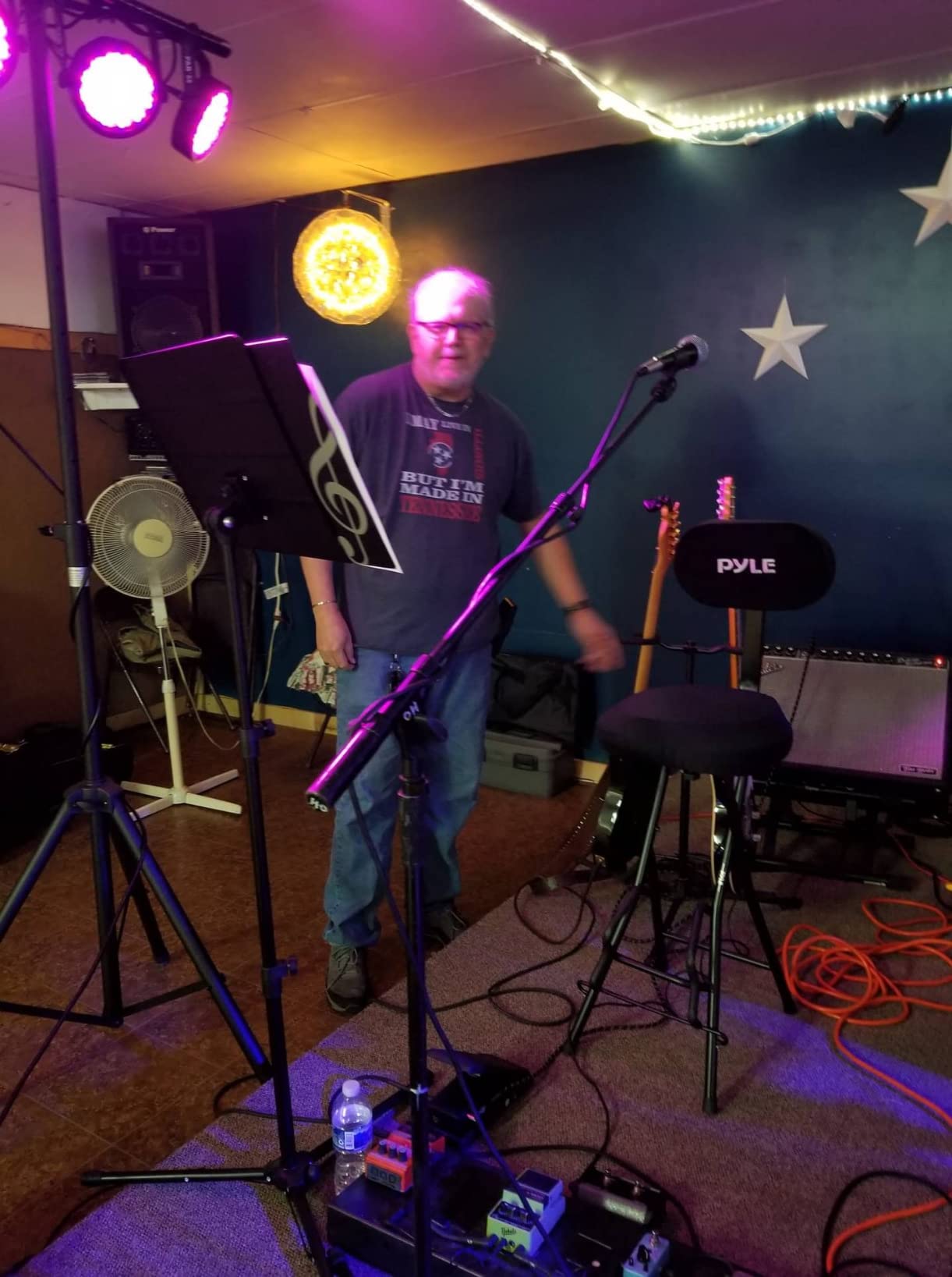
The built-in stand has EVA foam padded cradles sized for acoustic, electric and bass bodies. The foam is finish-friendly, which is the detail that separates a chair stand from a floor stand that leaves a mark on a sunburst top.
The elevated crossbar footrest gives you somewhere to put your feet that is actually shaped for a guitar posture, and the non-slip rubber feet keep the chair from skating when you shift weight during a difficult passage.
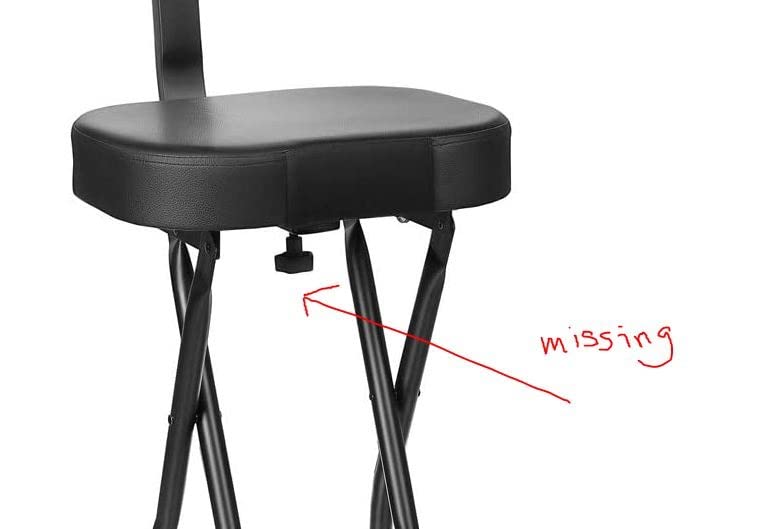
Now the part that matters: this has the widest spread of ratings in the entire roundup. At 4.2 stars it sits at the bottom end, and the reason is concentrated and specific rather than a vague quality complaint. Multiple reviewers report the backrest bracket bolts threading into short plywood bushings that can strip loose, and one owner reported a crossbar weld failing under a 235 pound user inside a year.
That is a structural complaint, not a comfort complaint, and it is the reason this is not the editor’s choice despite a genuinely superior folding design. If you fit the backrest bracket correctly and check it before every session, the chair is excellent. If you do not, the failure mode is a backward fall.
Why the folding profile changes your practice habit
A chair you can store in a gap is a chair you actually use daily. The most common reason a portable chair stays folded in the corner is that there is nowhere sensible to put it when open.
This is the pick for a guitarist who practices in a shared space, a student with one room for everything, or anyone who moves between a home corner and a rehearsal room and wants the chair in the car rather than in storage.
Where it falls short
Check the backrest hardware before the first long session and periodically after. The plywood bushing reports are specific enough that treating them as a known issue rather than an anomaly is the sensible approach.
The integrated stand is not universally a win. Players who hold the neck high and keep their feet forward can find the stand arms in the way of foot placement, and the cradle is a fixed position rather than an adjustable one, so it suits some body shapes better than others.
6. Flash Furniture HERCULES Stacking Church Chair – Best for Buying in Quantity
Flash Furniture HERCULES Series 21”W Stacking Church Chair in Black Dot Patterned Fabric – Gold Vein Frame
21 inch wide padded seat
16 gauge steel rated to 800 lb
Waterfall seat edge
Pros
- Waterfall edge relieves leg pressure
- 21 inch width fits most body sizes
- Deep foam survives six-hour sessions
- Ganging clips link rows
- 800 lb frame capacity
Cons
- Back is not pre-drilled
- Needs a drill and two hands to assemble
- Bulkier to store than a folding chair
This is the chair you buy when the question is not which chair is best but how many identical chairs a room needs. The 21 inch seat width is the widest in this roundup, and width is the single most underrated specification for seated band playing because it determines whether the instrument has anywhere to go.
The waterfall front edge is the feature that shows up in the reviews most often, and it is worth explaining. A waterfall edge rolls off the front of the seat rather than presenting a hard horizontal edge to the backs of your legs. Over a six-hour rehearsal, that difference is not subtle.
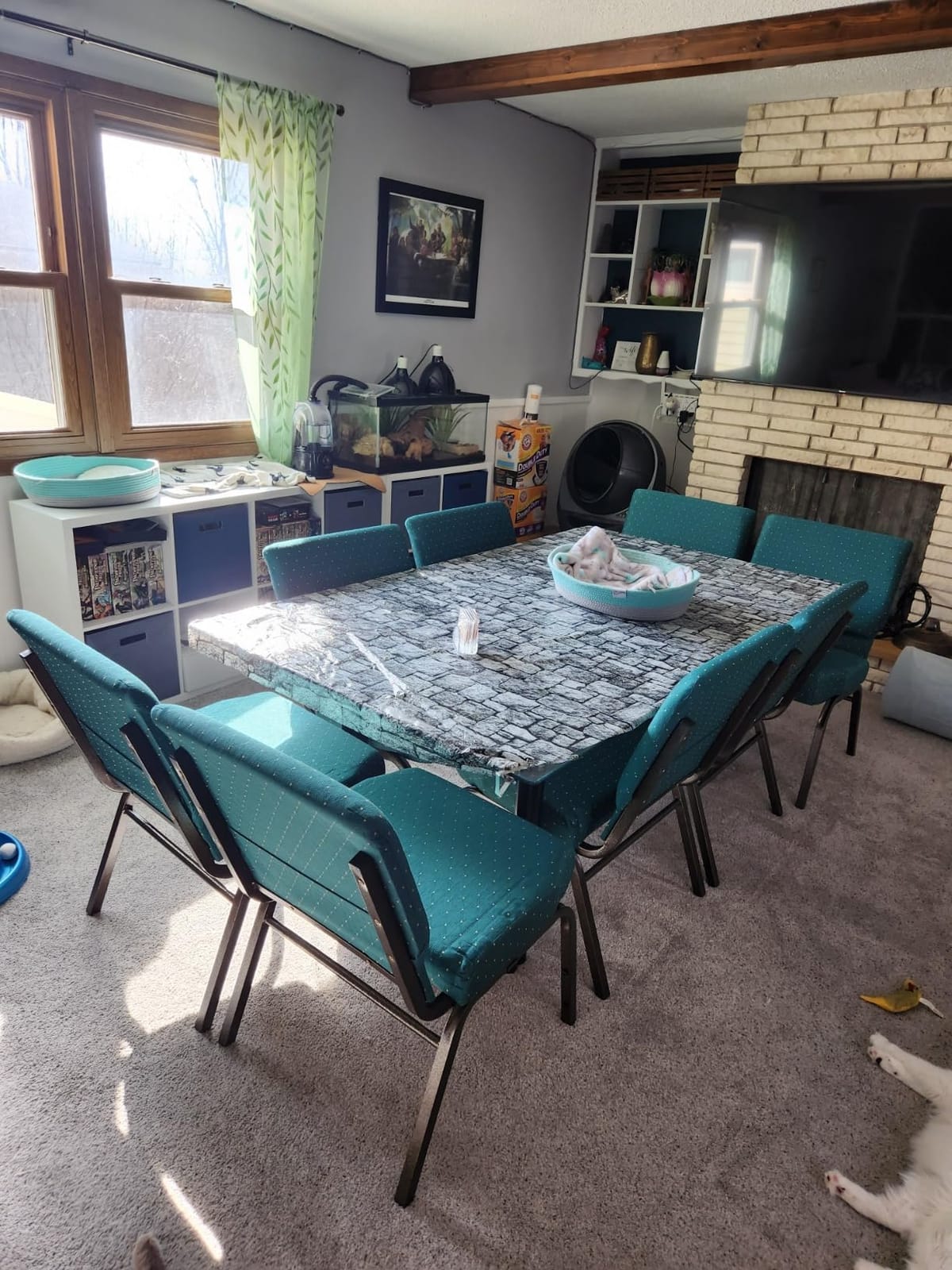
The frame is 16 gauge steel with an 800 pound capacity and a gold vein powder coat finish. That is a church and banquet rating, and it means the chair survives being leaned on, dragged, and stacked by people who are not thinking about it.
Ganging clips on the frame let you link rows together. For an ensemble seated in arcs rather than a straight line, you can build gentle curves instead of rigid ranks, which matters a great deal for a conductor or band director who needs sightlines.
Deep foam cushioning is the reason owners report using these through six-plus hour sessions. The rear book pouch is a small touch that turns out to be genuinely useful for a chair that lives in a rehearsal room, since it holds a folder or a method book instead of the floor.
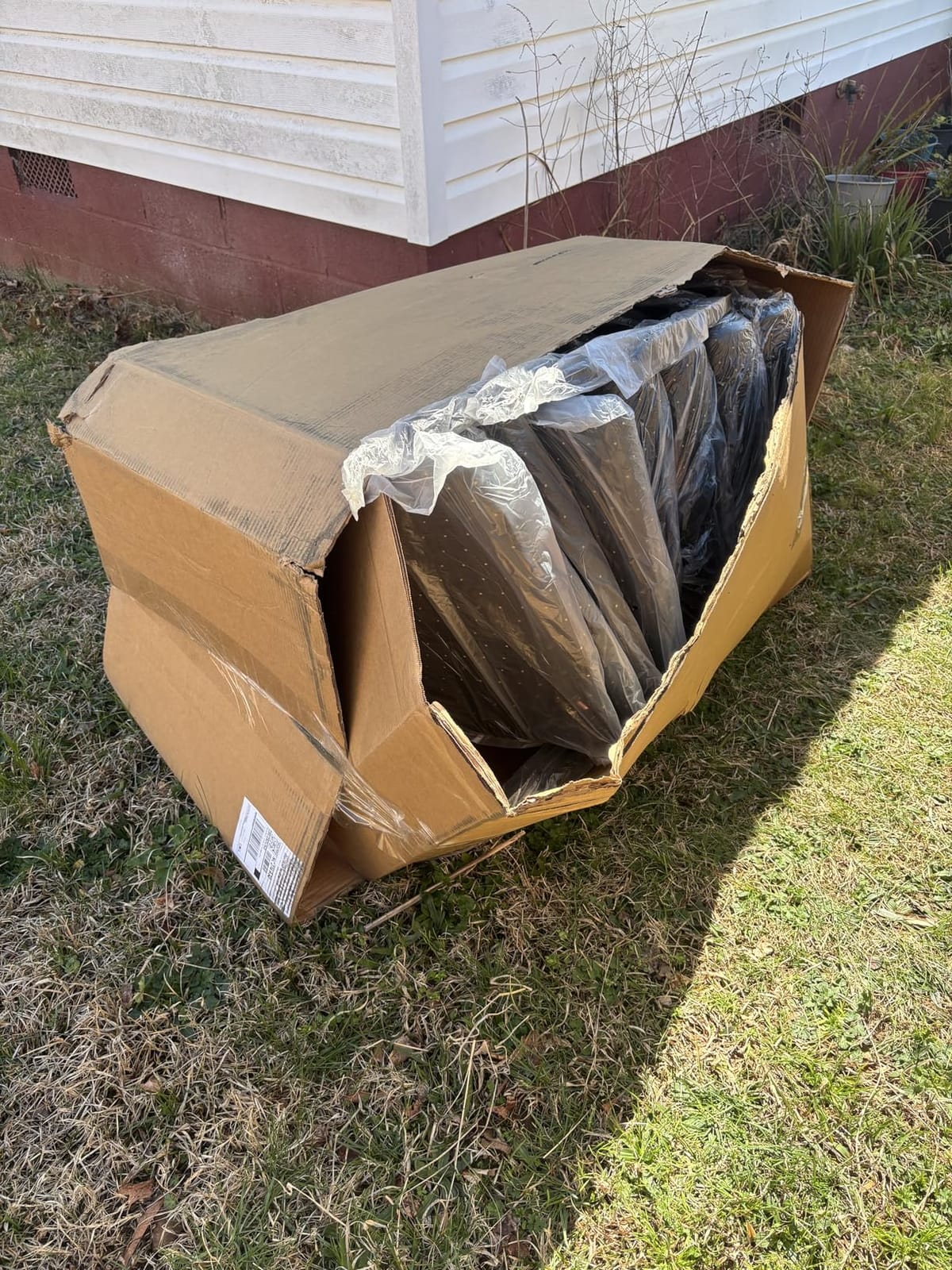
Assembly is the problem. The back is not pre-drilled or pre-assembled, and some shipments arrive without the screws or with instructions that assume two hands. Plan for a drill and ten minutes the first time, then check every screw after the first week of use. Once assembled, the chair is not the issue.
Rocker glides protect the floor and reduce the noise of a chair being moved during a quiet section, which is a real consideration in a hall where the instrument is acoustic.
Why ensemble buyers should look past the specs
Uniformity is the actual product here. A room of twelve identical chairs looks professional to the students in it, and a director is not constantly adjusting, pushing back, or pulling out a different chair for a taller player.
The ganging clips are also a quiet long-term saving. Linked rows cannot drift out of alignment during a rehearsal, and a room that resets to the same shape every week is a room that resets faster.
Where it falls short
The rigid auditorium frame is bulkier than a flat-folding chair, so storage is a real consideration. If the room has to be cleared for other classes, a stack of these takes noticeably more floor space than a folded pile.
It is also a wide fixed chair, not a music-specific one. A tuba player will appreciate the width, but the seat-to-back angle is a general comfortable angle rather than one designed around breathing, and there is no adjustment for a student who outgrows the seat.
7. Gibraltar 6608 Drum Throne – The Best Pick for Drummers and Percussionists
Gibraltar Drum Throne with Adjustable Height Motorcycle-Style Seat, Double-Braced Legs, Sturdy Drum Stool for Drummers, Comfortable Cushion for Practice or Performance (6608)
Motorcycle saddle with thigh cutouts
18 to 24 inch locked height
Double-braced collapsible tripod
Pros
- Saddle cutouts let legs spread and move
- Memory lock stops height drift
- Double-braced base is stable under hard playing
- Foam holds up for hours
- Collapses for transport
Cons
- Tripod footprint is wider than a folding stool
- 18-24 inch range suits shorter players better
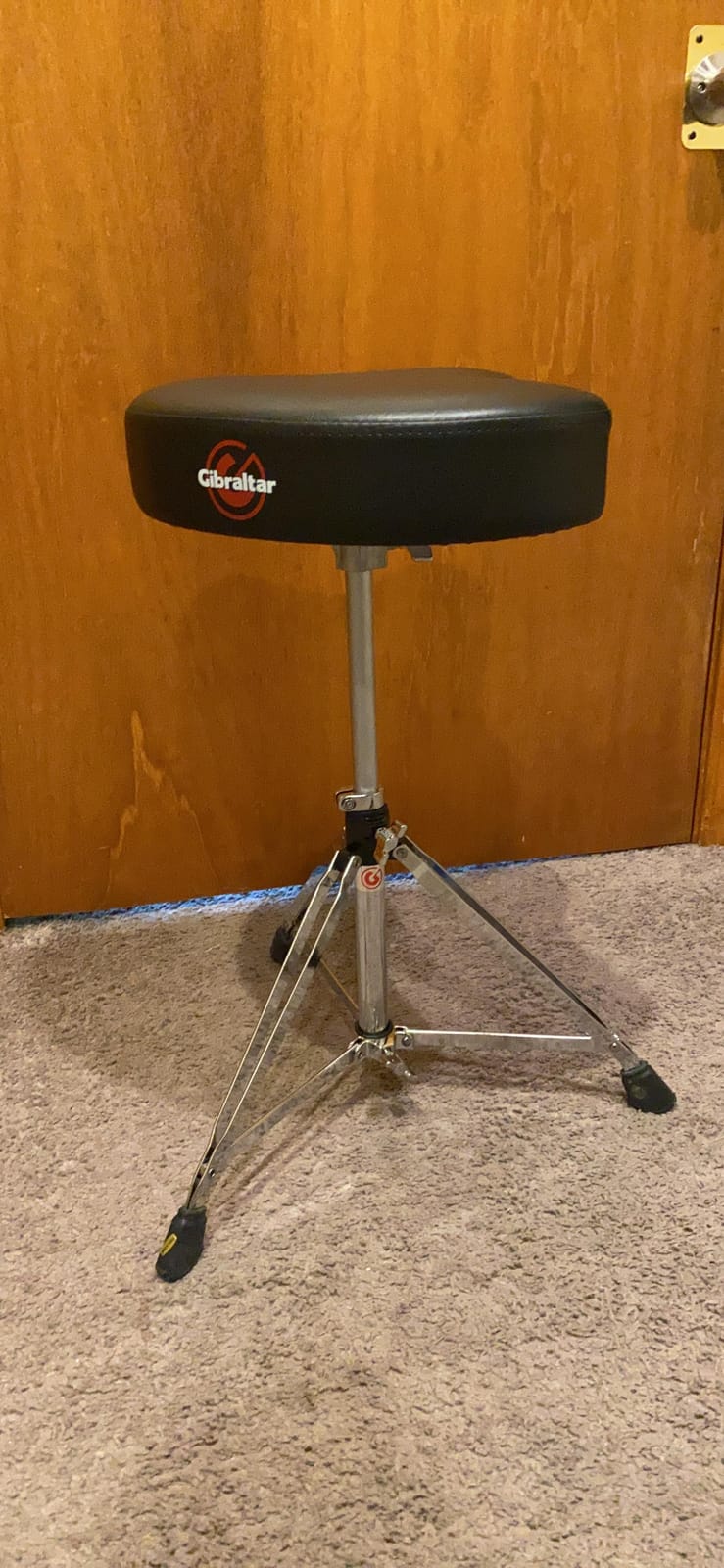
A drum throne is not a band chair, and putting it in this roundup is a deliberate choice rather than a category error. Drummers sit for the majority of a rehearsal, and the throne solves the same problems a folding chair is solving, with better answers.
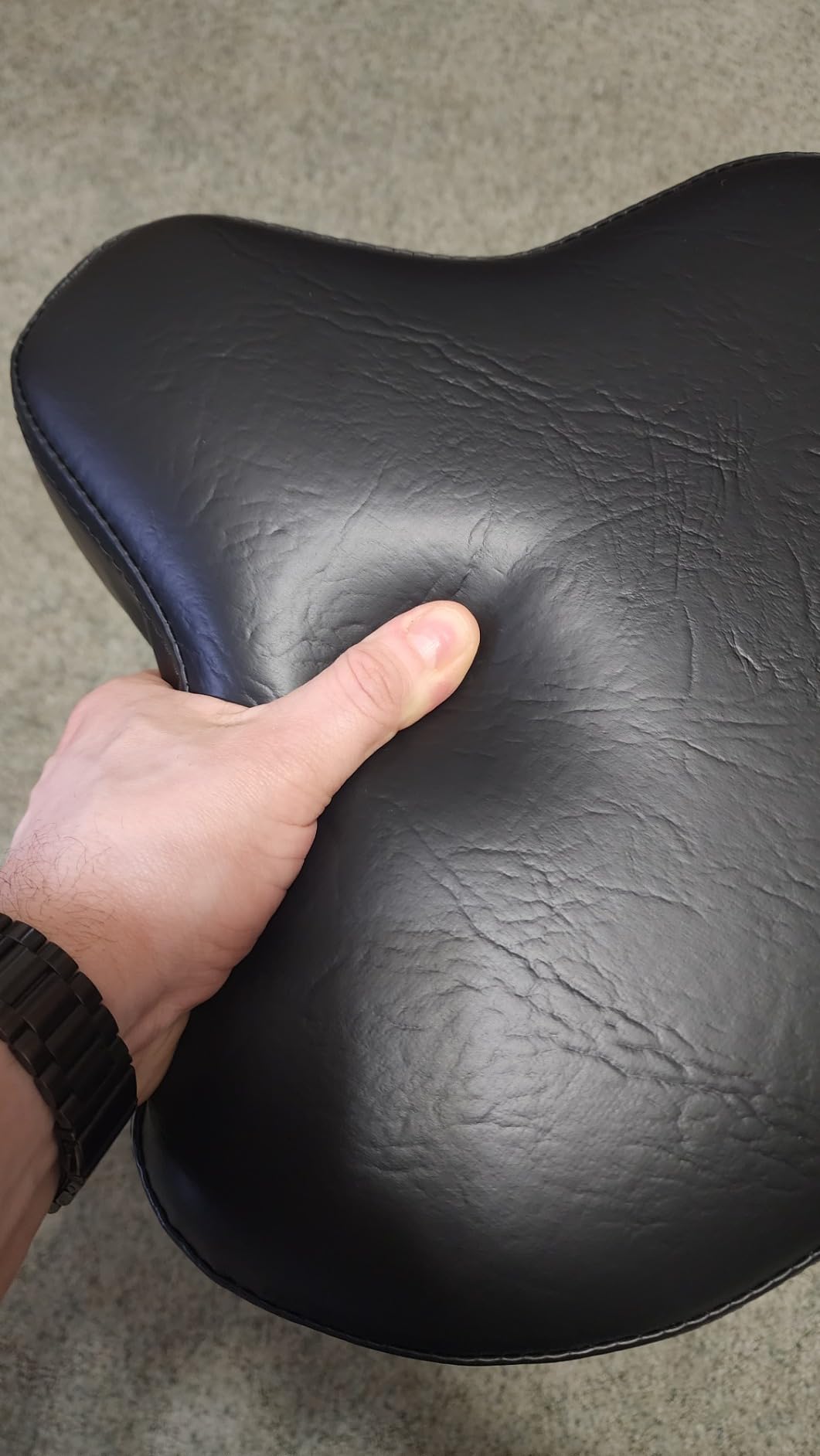
The motorcycle-style saddle is the reason to buy this over a padded folding seat. The thigh cutouts let you spread your legs and move independently, which means the constant small position changes a drummer makes between strokes are not fighting the seat.
Height adjustment runs 18 to 24 inches, and the mechanism is a cast height adjust collar with a nylon bushing, a knurled support stem, and a memory lock. The memory lock is the detail that matters: preset stools drift during a set, and a throne that drops two inches mid-song is a throne you stop trusting.
The double-braced collapsible tripod is chrome-finish aluminium, and it stays planted under aggressive playing. The tripod collapses for transport, which is what makes a throne practical in a practice room rather than a gig-only object.
For a drummer playing a full kit, this is a straight upgrade over any folding chair, and the review base is close to 2900 ratings at 4.5 stars, which is the second-largest in the roundup. Owners describe it as a practice-room staple rather than a special-occasion purchase.
The tradeoff is floor space. A tripod footprint is wider than a compact folding stool, and in a small rehearsal room where four musicians are sharing a space, the difference is noticeable. The 18 to 24 inch range also favours shorter players, and a tall drummer will run out of adjustment before they run out of need.
Why percussionists should not use a folding chair
Balance and stability under load are the whole job. A double-braced tripod does not shift when you lean into a fill, and that lets you play harder without bracing against the chair, which is exactly the bracing that produces back pain over a year of practice.
The saddle geometry also removes the need to change posture constantly. A drummer who is constantly readjusting is a drummer whose back is compensating for the seat, and that is the failure mode the rest of this roundup is trying to avoid.
Where it falls short
It is not a folding chair. If your practice space doubles as a transit space and everything has to fold and go in a car within five minutes, the collapsible tripod helps but does not match a flat-folding frame.
It is also entirely seat and no back. A drummer who works on a music theory session or a writing session that involves sitting and reading will find the lack of lumbar support faster than a guitarist will.
8. OEF All-Steel Heavy-Duty Folding Chairs – Best for Rooms That Get Abused
OEF Furnishings OEF50 Series All-Steel Heavy-Duty Folding Chairs with 500 lb Weight Capacity (4-Pack, Black)
All-steel contoured seat and back
500 lb capacity, 19 gauge steel
Sold as a 4 pack
Pros
- No padding to wear out or tear
- 500 lb rating gives real headroom
- Dual U-brace legs survive high traffic
- Folds flat and stacks
- UL tested to ANSI/BIFMA
Cons
- Contoured steel seat angles upward
- No padding limits long-session comfort
- Some arrive with scuffs and dents
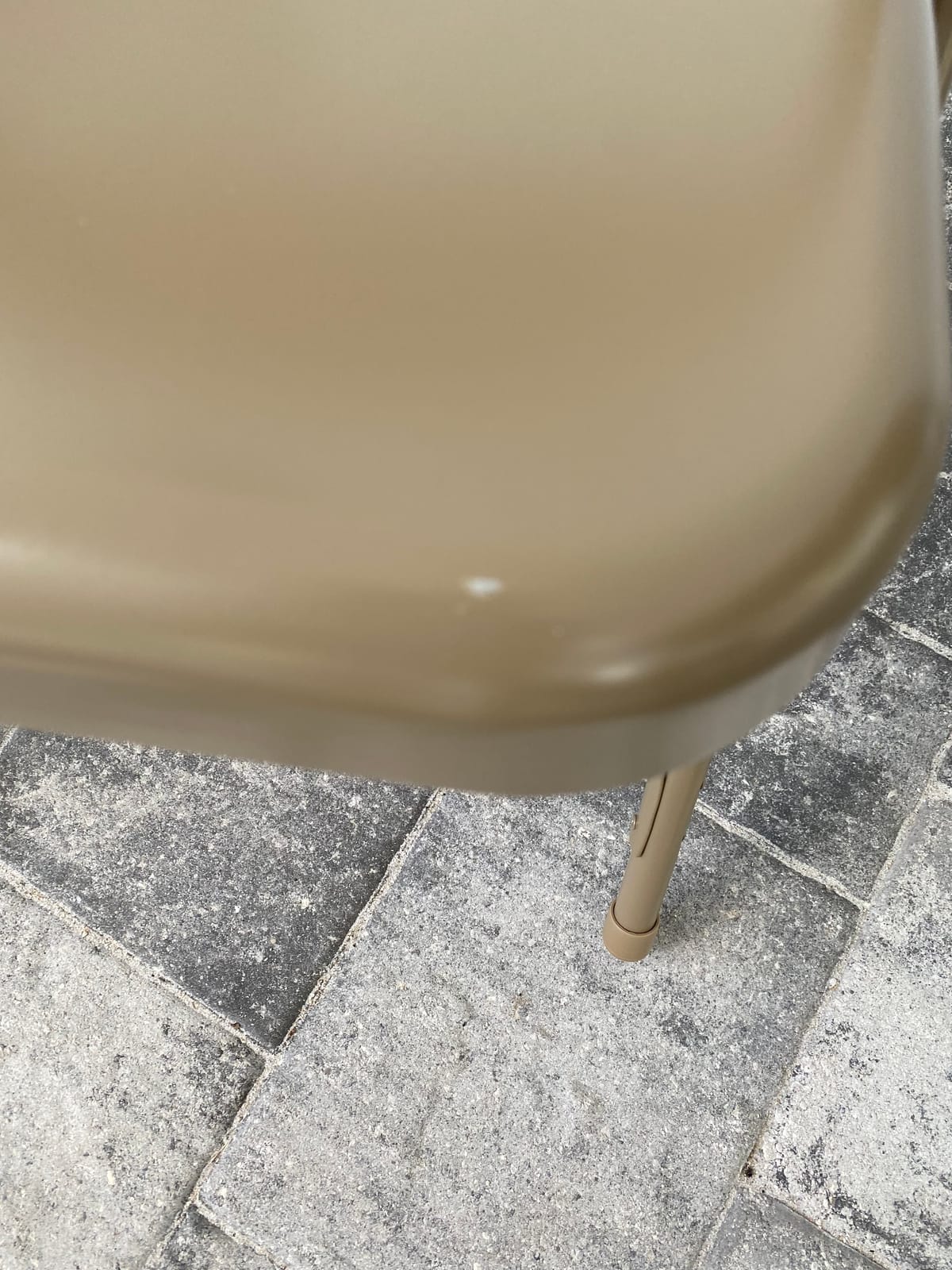
The logic of this chair is simple: remove the thing that wears out. There is no fabric, no foam, and no upholstery to tear, strip, or need replacing. For a school or a church room where chairs are moved, stacked by teenagers, and dragged across concrete, that is the correct priority.
The frame is 19 gauge steel with dual U-brace leg supports rated to 500 pounds, powder coated, and finished with non-marring glides that protect wood, tile and carpet. It is UL tested to ANSI/BIFMA standards, MAS Certified Green, and backed by a 5 year limited warranty.
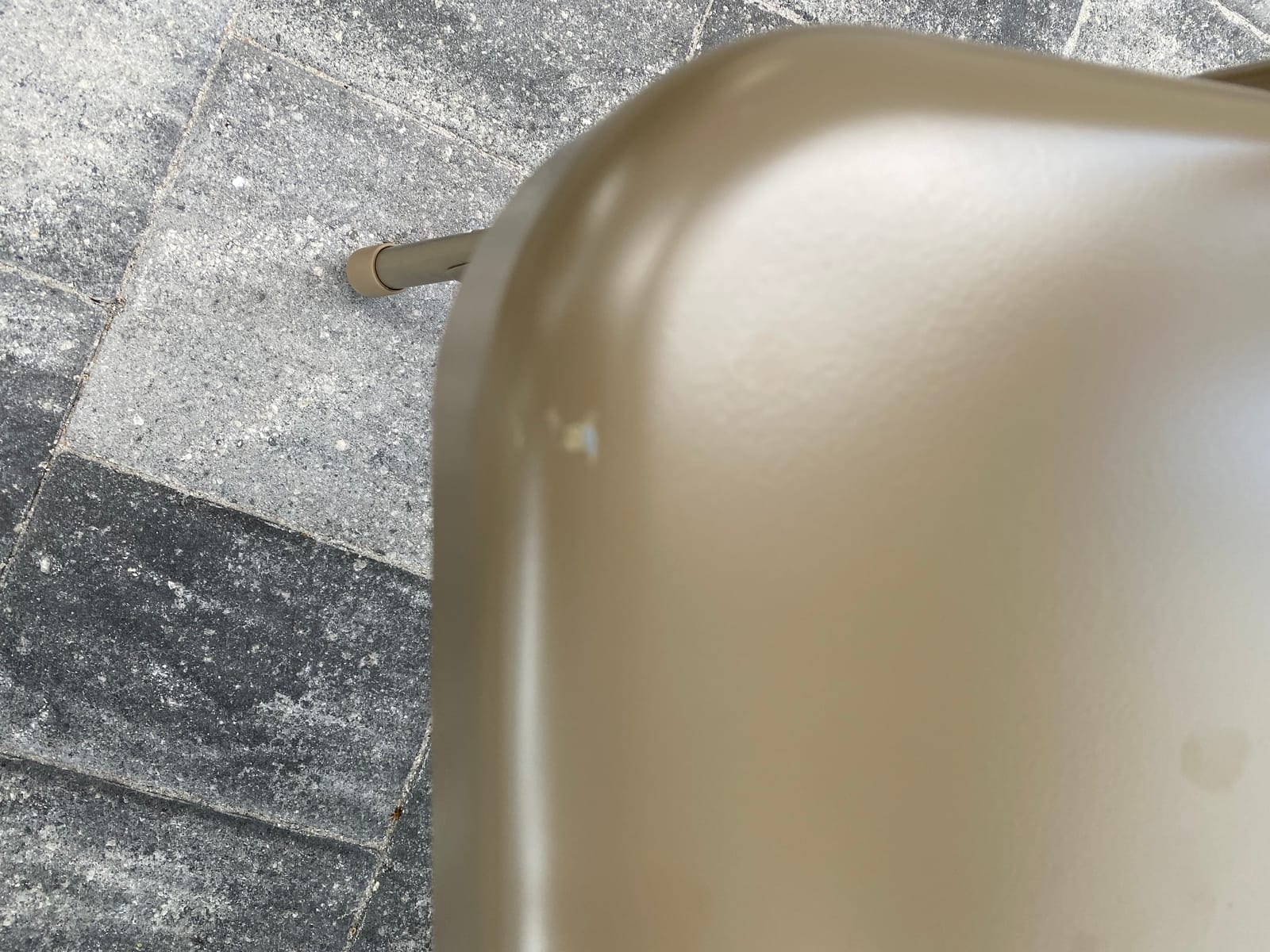
Seat height is 16.75 inches and the chairs weigh 9 pounds each, sold as a 4 pack. That is a low, utilitarian, institutional seat, and it folds flat and stacks for instant setup, which suits a room that changes use between a rehearsal and a lecture.
Buyers consistently treat these as indestructible utility seating rather than as a comfort purchase, and they are right to. For a music school buying twenty chairs to be used by a hundred different students a year, the absence of a failure-prone component is worth more than a nicer hour of sitting.
The comfort limitation is the one to be honest about. The contoured steel seat angles upward toward the back, and over a multi-hour rehearsal that angle can press the lower back support into the spine. There is no padding, which means a tie-on seat pad is effectively part of the product if you intend to use it for more than an hour.
That is why this sits at number eight rather than higher. It is the chair you specify for a multipurpose room where the rehearsal is one use among several, not the chair you choose for your own practice corner.
Where no-padding wins
Any environment where the furniture is moved more than it is sat in. A room used for band practice, community meetings, and indoor seating through the week will destroy upholstery long before it strains steel.
There is also a cleanliness argument. A contoured steel surface wipes clean in seconds, and in a room shared by a dozen people that is a genuine practical advantage over fabric.
Where it falls short
Long rehearsals. Two hours is fine. Four is not, and the upward seat angle is the reason rather than the hardness alone, because a flat hard seat lets you shift position and this one resists it.
The 16.75 inch fixed seat height is low for a guitar or keyboard player and will push a taller player into a forward lean. Pair it with a footstool or do not pair it with an instrument at all.
9. Adjustrite Folding Musician’s Chair – Best for Setting Up Without Assembly
Adjustrite Folding Musician’s Chair Standard
Pre-assembled foldable frame
Foam cushion on alloy steel
Folds flat, indoor use
Pros
- Arrives ready to sit on
- Deep foam over an alloy steel frame
- Folds flat for moving rooms
- Higher average rating than most premium chairs
Cons
- Most expensive option here
- Thin review base at 66 ratings
- 250 lb capacity is modest for the class
This is the one pick in the roundup where the strongest argument is not a specification. It arrives pre-assembled and folds flat, which means the time between opening the box and playing a scale is measured in seconds rather than in a drill and a bag of hardware.
That matters more than it sounds in the situations this chair is designed for. A touring musician setting up in a green room, a teacher moving between rooms between periods, or anyone who stores the chair folded in a cupboard and needs it functional within a minute will value the pre-assembly above everything else on the list.
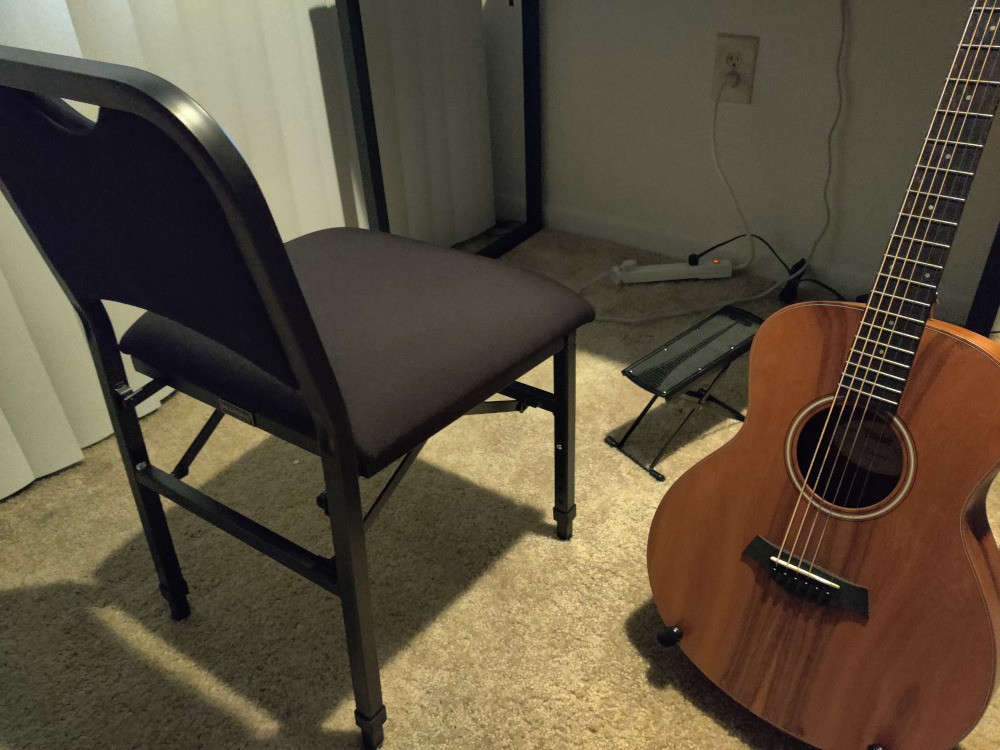
The seat is a deep foam cushion over an alloy steel frame, and it is a more premium sit than the basic folding chairs it shares a shelf with. At 18.5 pounds it is a two-hand carry, and at roughly 30 inches deep folded you need a real boot or a large hatchback rather than a sedan shelf.
The rating here is 4.6 stars, which is second-highest in the roundup, but it rests on 66 reviews. That is a thin base compared to nearly 2900 ratings on the Gibraltar throne, and thin review counts tell you more about enthusiasm than about longevity.
The listed capacity of 250 pounds is the other thing to weigh. It is lower than several chairs that cost a fraction as much, and in a class of furniture where 480 and 500 pound ratings are common, 250 pounds is the specification most likely to disappoint someone.
Who should buy this one
Anyone whose chair has to be functional the instant it is unfolded, and anyone who is willing to pay a premium to avoid assembly entirely. The foam over steel also makes it a reasonable choice for a single musician who wants a padded seat and does not need a built-in stand.
For a band director buying in bulk, the pre-assembly and the fold-flat format make it genuinely attractive, provided the room is indoors and the players are within the capacity rating.
Where it falls short
The premium asks for justification. If you are buying one chair for a home practice corner, a director’s chair or an adjustable stool delivers most of the experience for a fraction of the outlay, and the fold-flat advantage is available elsewhere.
And the evidence base is thin. With 66 ratings there is no long-term owner history to lean on, so you are buying on build quality and the absence of assembly rather than on proven durability.
10. Flash Furniture HERCULES Stackable Melody Band Chair – Best for Singers and Wind Players
Flash Furniture HERCULES Series Black High Density Stackable Melody Band/Music Chair
97 degree seat-to-back angle
Stackable high-density plastic
No assembly required
Pros
- 97 degree angle opens up breathing
- Textured seat resists sliding
- Stacks for tight band room storage
- Arrives fully assembled
Cons
- Single fixed height favours younger players
- Contoured seat dips at the back
- Some arrive with a damaged leg
The 97 degree seat-to-back angle is the entire argument for this chair, and it is a music-specific number rather than a furniture number. Most office and dining chairs sit at around 90 degrees, which compresses the lower back. Opening the angle to 97 degrees lets the ribcage expand, which is what a singer or a wind player needs in order to breathe into a phrase.
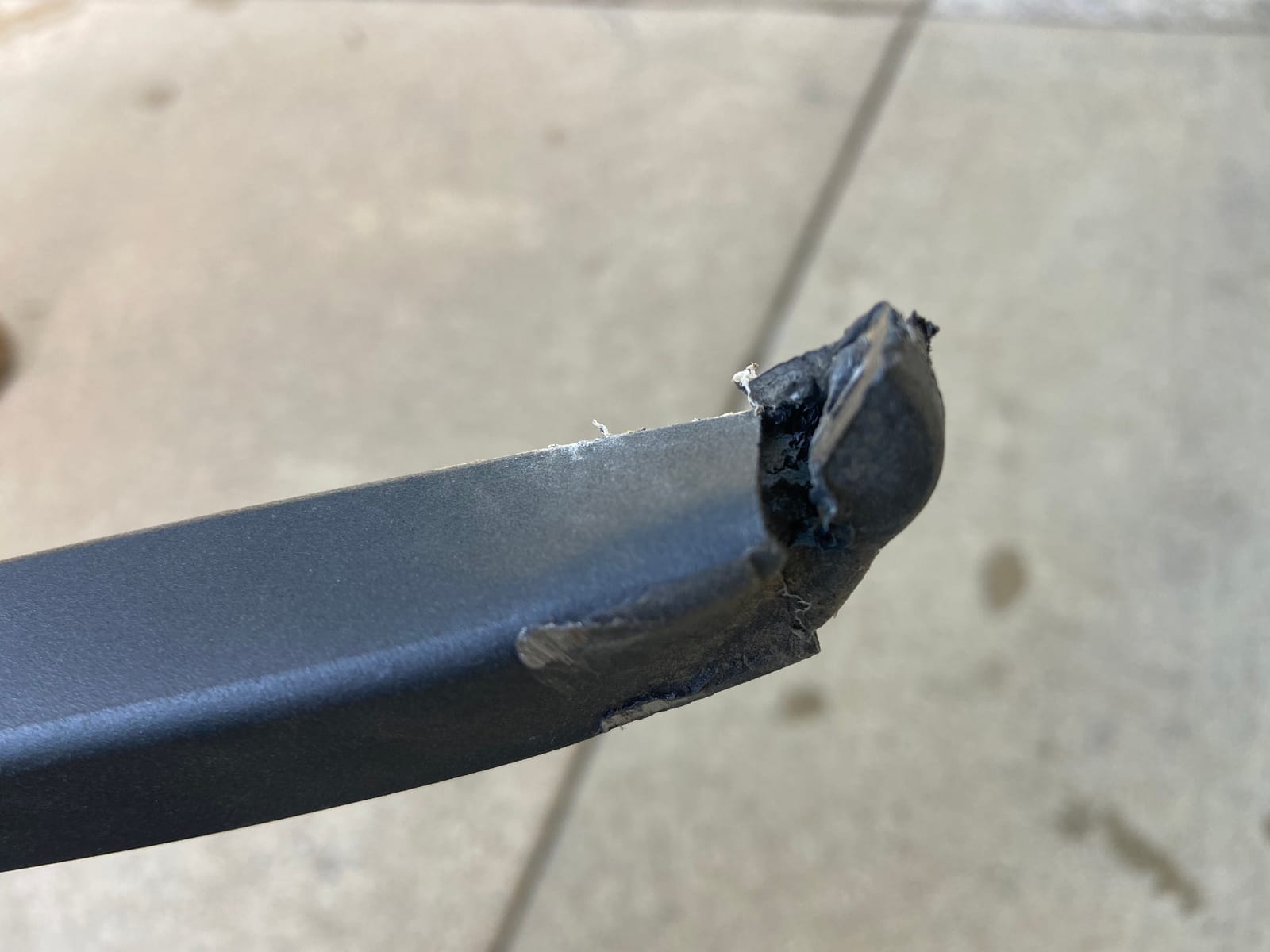
Wind and brass players who move to this chair from a generic folding seat tend to notice the difference within minutes, and tuba and trumpet players in particular report better posture and easier breathing. It is the only pick in this roundup with a stated geometric rationale for seated playing.
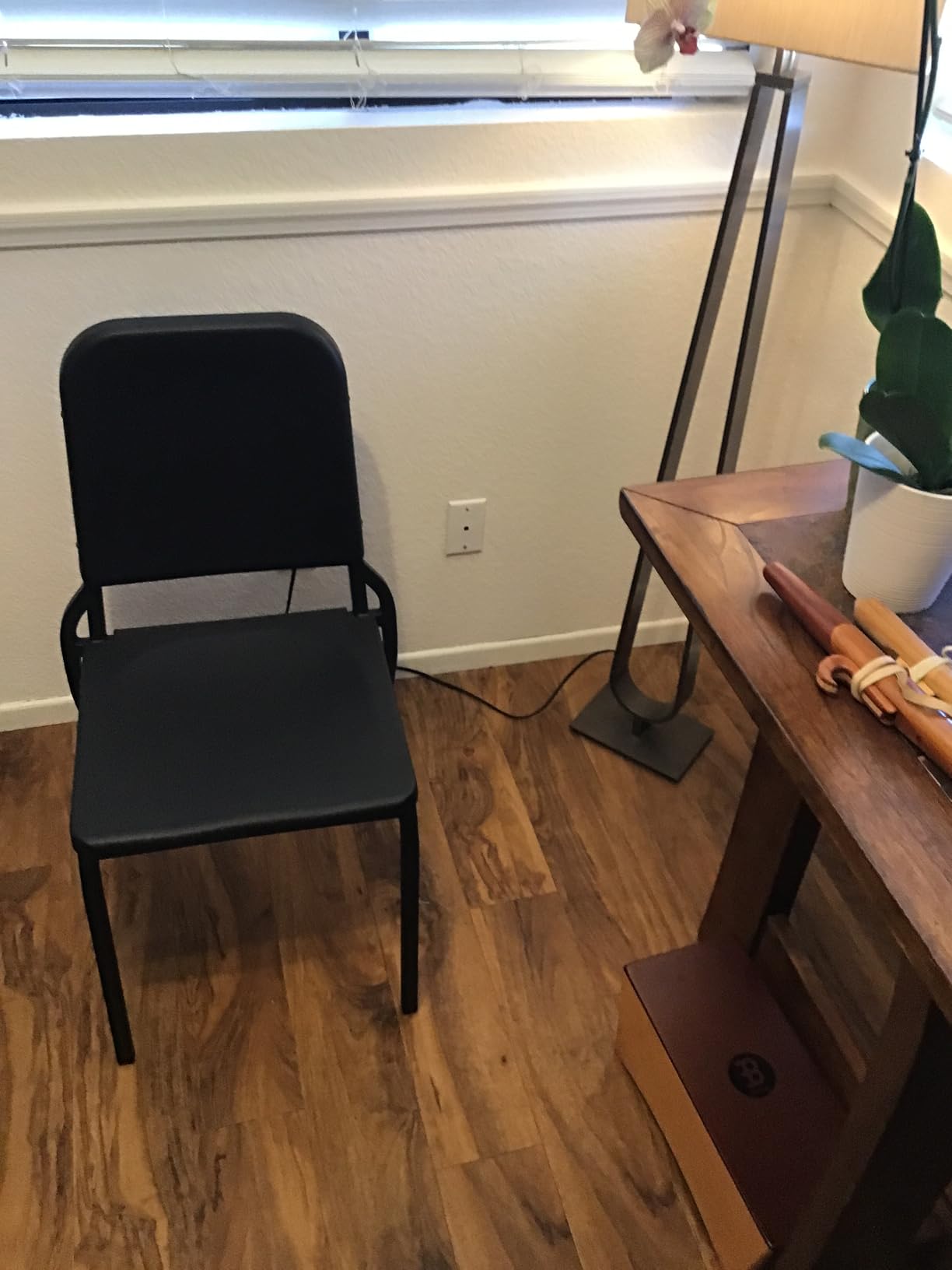
The seat itself is textured high-density plastic rather than fabric, at 16.75 inches wide by 16 inches deep with a 17.5 inch seat height. Textured means grip, which matters in a room where a smooth seat lets a player slide forward every time they adjust position.
It stacks, arrives fully assembled, and has floor protector glides on a black powder coated frame with flared legs. Buying twelve of these is a same-afternoon project, which is the single biggest operational advantage over almost everything else in this roundup.
The limitation is the fixed height. One seat height means a room of teenagers works and a room of adults does not, and directors report the same complaint repeatedly: the chair fits seventh grade through college and then stops. The contoured comfort curve also dips at the back, which some players read as being folded up at the waist.
Owners running church music programmes specifically report buying dozens of these as a lower-cost alternative to the dedicated music posture chairs that dominate institutional catalogues, with a similar result at a fraction of the institutional outlay.
When the seat angle is the deciding factor
If your instrument requires a full breath on demand, the angle is not a comfort detail. It is functional. Players with any respiratory limitation, players recovering from a back injury, and younger wind players who have not yet built the core to compensate for a closed angle all benefit most.
It is also a strong pick for singers doing long rehearsal-room sessions, where a 90 degree seat adds up across three hours in a way that a 97 degree seat does not.
Where it falls short
For anyone past school age, the fixed height is a genuine limitation rather than a minor one, and there is no adjustment anywhere in the design. An adult buying a single chair should look at the adjustable thrones instead.
For guitar and bass players the plastic seat offers nothing. There is no padding, and there is no cradle or holder of any kind, so this chair works for you only if your instrument stays on a separate stand.
11. ProX X-GIGCHAIRMK2 – Best for the Tall Seat a Guitarist Wants
Prox X-GIGCHAIRMK2 Portable Folding AV Operator DJ Keyboard Drum Height Adjustable Throne Chair with 13 in. Velvet Padded Cushion
Five heights from 23 to 32 inch
13 inch velvet padded cushion
Removable adjustable backrest
Pros
- Tall seat heights ease guitar posture
- Plush 13 inch velvet cushion
- Backrest adjusts and removes
- Steel frame rated to 300 lb
Cons
- Heaviest chair here at 20 pounds
- Some owners report rear frame wobble
- Velvet foam compresses within about a month
The reason to look at this chair is the top of the height range. At 32 inches, the highest setting here, you are sitting close to standing height with a backrest still available, which is a specific and increasingly popular way to play seated.
That posture matters because it preserves the relationship between your hands and the instrument that you already have while standing with a strap. Bassists in particular talk about wanting the neck to hang at the same angle whether they are on a gig or in a practice room, and a high seat with a supportive back is the closest a folding chair gets to that.
The five height levels run 23 to 32 inches, which spans seated guitar, keyboard, and DJ working heights. The 13 inch plush velvet cushion is the widest seat in the roundup, and the backrest adjusts and removes entirely, so you can choose between supported and unsupported without changing chairs.
It is listed for DJ, keyboard, drum and guitar use, which is a fair description of the height range rather than marketing filler. The frame is folding steel rated to 300 pounds.
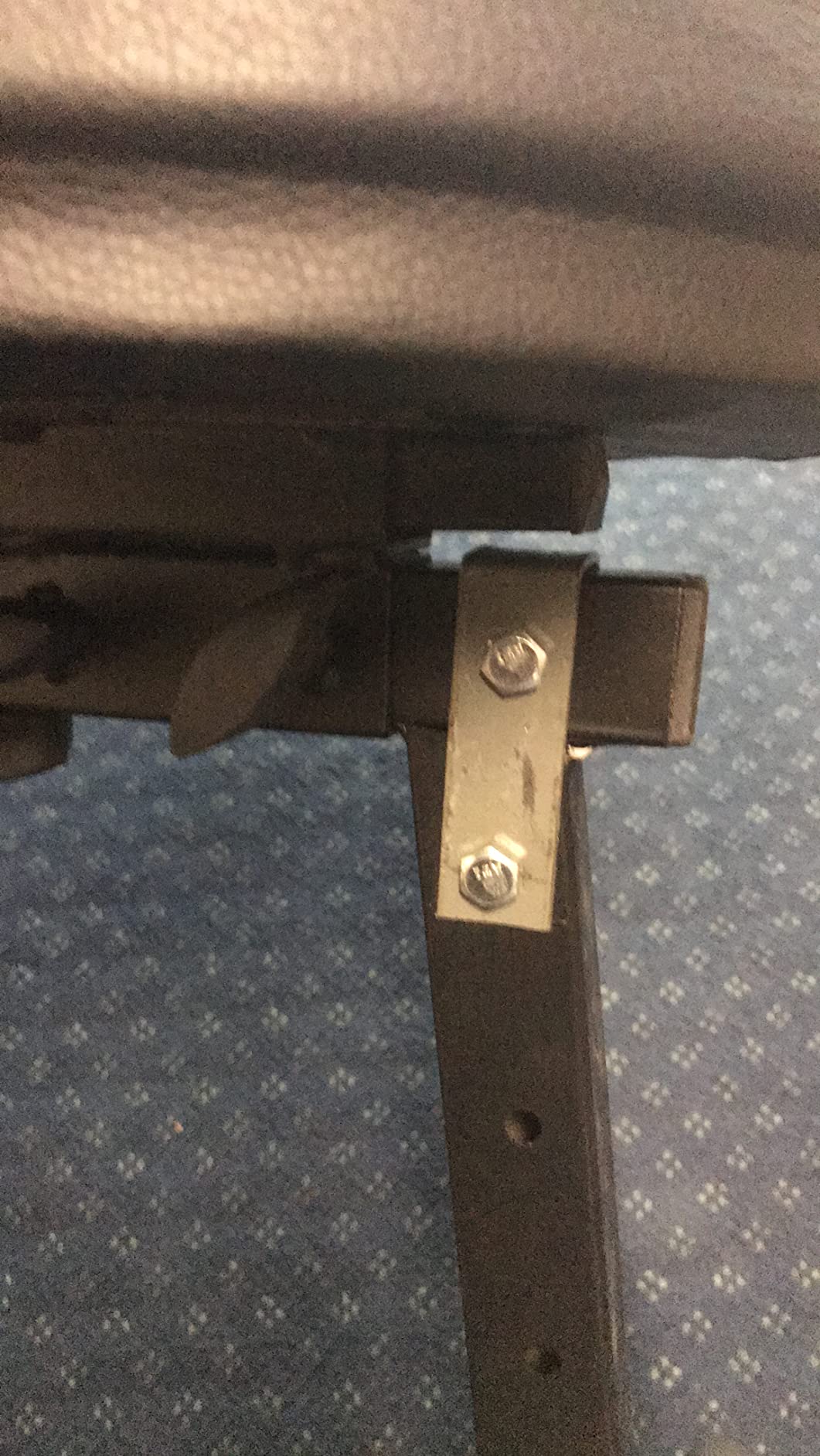
The problems are consistent across the review base. At 20 pounds this is the heaviest chair in the roundup, and that weight directly undercuts the portable claim, because a 20 pound chair is a deliberate two-hand lift rather than something you grab and go.
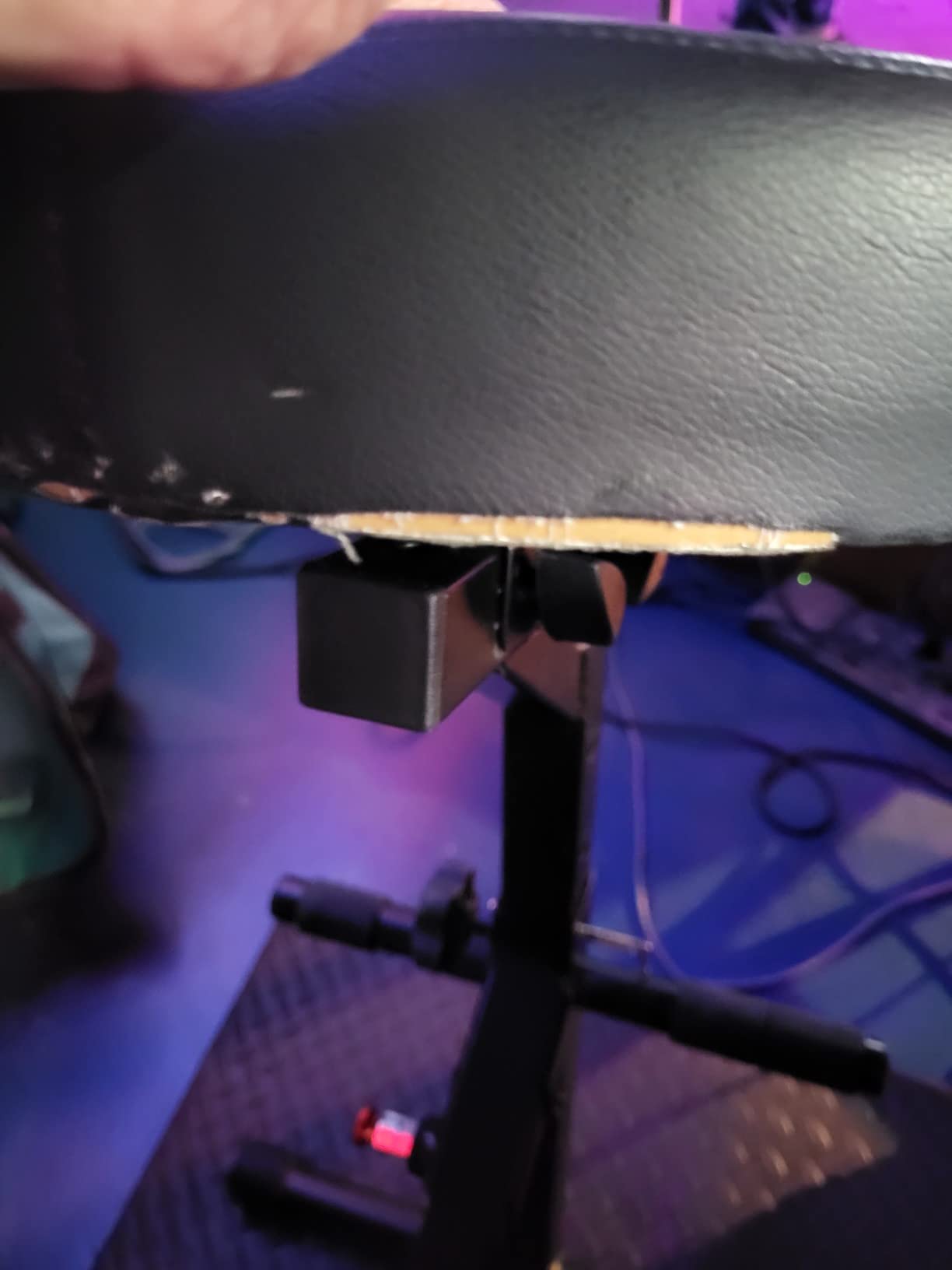
Several owners report wobble in the rear section of the frame, which is a stability complaint rather than a comfort one and matters most at the highest settings where the leverage is greatest. Velvet foam also compresses noticeably within about a month of regular use, so the plushness you are buying is a first-month experience unless you plan on a replacement cushion.
Who benefits most from a high seat
Players who already practise standing with a strap and want seated work to match. That is a large and growing group, and the reason the tall-seat stools and thrones have become common practice-room fixtures rather than curiosities.
It is also a good fit for a musician sharing one chair between guitar and keys, since the range covers both working heights without swapping furniture.
Where it falls short
The weight. For any musician who carries a chair from a car to a room regularly, 20 pounds is a meaningful cost, and the folding frame does not fully compensate for it.
Buyer long-term comfort with the cushion. The velvet foam flattening within a month is a recurring report, and a chair that loses its padding is a chair that eventually needs a tie-on pad or a replacement, which partly defeats the reason to buy a cushioned chair in the first place.
12. Gravity Music Stool FD Seat 1 – Best for Keyboard Players and Tall Seats
Gravity Music Stool FD SEAT 1 Foldable Round Stool Height Adjustable for Musicians Portable, Black
Continuous lockable height adjustment
Raises to 80 cm
Folds flat, weighs 10.6 lb
Pros
- Continuous adjustment is smoother than preset holes
- Unusually tall 80 cm maximum
- Stable at full extension
- Breathable seat surface
- Folds flat and stays portable
Cons
- Seat is frequently described as hard
- Lowest setting still runs high for shorter players
- Some add their own cushion
The continuous lockable height adjustment is the differentiator. Preset-hole stools force you to pick the nearest of five or six fixed heights, and if none of them matches your keyboard bench or your leg length, you adapt your posture to the stool. This one turns a handle and stops where you want it.
Raising to 80 cm is unusually tall for a musician’s stool and it is what makes this the pick for keyboard players. A pianist or keyboardist at an 80 cm instrument needs to be at that height with thighs roughly level, and most portable stools top out well short of it.
The frame is sturdy metal with large feet for stability, a breathable seat surface rather than vinyl, and no assembly required. At 10.6 pounds it folds flat and is one of the more portable options here, which is a genuine advantage for a player moving between a home setup and a rehearsal room.
Stability at full extension is worth crediting. Owners report it staying rock solid on both carpet and hard floors, and for a keyboardist who plays with force and reaches across the keys, a base that does not creep is not a small thing.
There is a 5 year manufacturer warranty, which is the longest in the roundup alongside the OEF chairs and the Flash Furniture stacking models.
The honest weakness is the seat itself. It is described across the review base as firm, closer to a firm pad than a cushioned throne, and several buyers added their own cushion within weeks. For a keyboard player, whose contact with the seat is continuous and whose posture is already forward over the keys, that firmness can be tiring over several hours.
The minimum height is also still a little high for shorter players, so a child or a small teenager will need a footstool or a different stool entirely rather than a lower setting.
When a stool beats a chair
A stool wins when you want to move your legs freely, sit high, and switch between seated and standing without the friction of a backrest. It also wins on storage, because a folding stool disappears into a corner in a way no chair does.
For a keyboardist working through scales at an upright piano or a digital stage piano, the continuous adjustment and the 80 cm maximum make this the most purpose-matched seat in the roundup for the instrument.
Where it falls short
There is no backrest, at all. Anyone who needs lumbar support through a long session will not get it here, and a player managing a back injury will want the Rockville or ProX instead.
And the firm seat is the defining limitation. Test it against your own tolerance for hardness before committing, because adding a cushion later changes the height slightly and the adjustment has to compensate for it.
Which Chair for Which Instrument?
Almost nobody maps chairs to instruments, which is strange, because the requirements genuinely differ. A chair that is perfect for a bassist sitting with a high neck angle is a poor fit for a violinist who needs to rise to standing between phrases, and a seat engineered for breathing is wasted on a guitarist. Here is the framework we use.
Acoustic and electric guitar
A seat between roughly 18 and 27 inches with a flat or slightly forward surface, no armrests, and a backrest that holds you upright rather than letting you fold over the neck. The Gator Frameworks seat and the Pyle adjustable seat both hit this, and the Pyle’s higher setting suits players who want the body off the thigh.
Bass guitar
Higher than a guitar seat, because the neck sits higher and the body is wider. You want clearance under the right thigh and a backrest, since the upper body does more work in a seated bass posture. The Rockville RDS42 and the ProX X-GIGCHAIRMK2 cover the tall end; the ProX is the tallest option in the roundup.
Keyboard and piano
Match the bench height to the instrument rather than to your body, which usually means a stool with continuous or wide adjustment and a seat around 24 to 31 inches. The Gravity Music Stool reaches 80 cm and locks continuously, which makes it the most exact match in the roundup.
Tuba, trombone and other brass
Width and an open seat angle. The bell of a tuba needs room to project and the body needs space between the knees, so a 21 inch wide seat is a genuine advantage. The 97 degree seat-to-back angle on the Flash Furniture Melody chair is the only pick here with a stated breathing rationale.
Violin and other strings
The opposite requirement. A low seat, a forward-leaning posture, and the ability to get to standing quickly between phrases. A stool or a low chair with no backrest serves this better than any chair with an upright back, because a backrest actively fights the leftward lean that violin and viola require.
Drums and percussion
A throne, always. The Gibraltar 6608 with its motorcycle saddle, thigh cutouts, and memory-locked height is the pick, because a folding chair gives a drummer a moving platform under exactly the moments when they need a still one.
The Armrest Problem and Why Musicians Reject Them
If you read one thing in this roundup, make it this: armrests are the deal breaker, and the consensus among bassists and guitarists is close to unanimous. On musician forums the complaint is almost never theoretical. A beginner on Reddit describes the armrests on a desk chair as always being in the way and never being able to get comfortable with the guitar. Bass players are blunter still, with the near-unanimous verdict that armrests are completely out for them.
The more useful detail is why flip-up and adjustable arms fail. Forum members report that office chairs with arms that fold back still stick out and end up hitting the back of the arm while playing bass. The mechanism travels, the padding does not, and the residual stub is exactly where your wrist goes at the top of a solo.
It is worth being precise about the clearance a player actually needs. A seated guitarist or bassist holds the instrument out from the body by several inches and reaches the forearm across the gap. Anything occupying that lateral space interferes with the reach to the upper frets, which is where precision falls apart first.
There is a zero-cost fix that practitioners use, and it is a useful diagnostic: remove the armrests from a chair you already own and see whether your playing changes. If the answer is that your shoulder stops dropping and your reach opens up, the armrests were the problem and no amount of cushioning elsewhere was going to fix it.
This is also the cultural context behind the choice. Players describe folding chairs and kitchen chairs as the near-universal convention at a jam, precisely because a room full of arbitrary furniture ends up being a room full of armrests. The best folding chairs for musicians are armless because musicians voted for it in a thousand forum replies.
Folding Chair vs Stool vs Drum Throne vs Office Chair
These four get compared constantly and they are not substitutes. A folding chair is a portable seat with back support, a stool is a portable perch with none, a throne is a drummer’s high stability platform, and an office chair is a long-session ergonomic seat shaped for a desk.
Office chair is the right answer when the session is long, the instrument is not in the way, and back support is a medical necessity rather than a preference. Several musicians describe managing bulging discs and stenosis that make standing impossible, and for them a good office chair with the armrests removed is genuinely the best tool. For everyone else, the seat is too large and too deep, and the armrests are a permanent obstacle.
Stool wins on freedom of movement and on storage. A drafting stool with a straight back gets particular praise from a bassist who values not hunching over the instrument, and backless stools are the standard answer for anyone who wants to sit high and move their legs. The cost is no lumbar support, which a drummer or a wind player will feel and a guitarist can work around.
Drum throne wins on stability, and the forum evidence is that drummers keep them for years, with one player reporting nearly a decade on a gas throne in a home music room. It also wins for any seated player who needs to rise quickly and move, because the saddle geometry allows a fast exit without a fight.
Folding chair wins on portability and on storage, which is why the convention exists. The honest limitation is endurance. A tuba player on a specialist forum describes playing a long outdoor concert, roughly two hours seated in a typical folding chair without a break, and that is the ceiling of an unpadded seat in real conditions. If your typical session runs past 90 minutes, buy padding.
The synthesis we would use: a folding chair for the car and the closet, a stool for high-seated work and rapid movement, a throne for the drum kit, and an office chair with the armrests off for the three-hour sessions that are ending your rehearsal early.
Outfitting a Whole Band Room Without Regret
Buying for an ensemble is a different problem from buying for yourself, and the failures are different. The three that recur are a seat height that fits fourteen-year-olds and no one else, a frame that pinches legs, and a chair that does not stack or fold in a way a single teacher can manage alone.
Stackable versus flat-folding is the first real decision. These are two different mechanisms marketed with the same word. Stacking solves storage: chairs nest on top of each other against a wall in a footprint barely larger than one. Flat-folding solves transport: a chair collapses to a few inches thick and goes in a van. If your room is cleared and reset constantly, stacking wins. If you move the chairs between buildings, flat-folding wins.
No pinch legs is the criterion nobody puts on a product page. Directors who have replaced a set of chairs cite this failure more than any other. The front legs must sit wide enough apart and far enough forward that a bass body, a trombone slide, or a tuba bell clears them entirely. A chair built for a dining table is not automatically built for a music stand, and this is worth testing with a real instrument before ordering a room full.
Tablet arms and sheet music holders are not afterthoughts. For a wind or brass section they are effectively a requirement, because a player who has to look down at a stand on the floor loses the breath support that the rest of the posture work was built to protect. The institutional chairs with arms and holders cost more because they solve a different problem from comfort.
On quantity, buy in multiples that match your real cycle. A room of twelve chairs for a twelve-piece band is right. A room of six chairs for a twelve-piece band means a rotation that never quite works, and it is the most common procurement regret we hear about.
How to Choose a Folding Chair for Band Practice
Work through these in order, because the earlier ones disqualify chairs that no later specification can rescue.
No armrests. Non-negotiable for guitar, bass, and most seated band playing. If a chair has arms that do not fully clear, it is the wrong chair.
Seat height against your instrument. Measure from the floor to the top of the seat and compare it to the height of the instrument at playing position. Guitar and keys want higher, violin and cello want lower, and the fixed-height chairs fail everyone outside a narrow band of heights.
Back support that holds you upright. A vertical or slightly reclined back with lumbar support. A seat that tips you into a slump will end a three-hour rehearsal early regardless of how good the cushion is.
Seat depth and width. A deep seat pushes the instrument past the knees. A narrow seat pushes the thighs outward. Width matters most for tuba and other low brass, and for any ensemble seat that has to fit a range of body sizes.
Padding, judged against your session length. Under 45 minutes, a contoured plastic or steel seat is fine. Between 45 and 90 minutes, foam changes the session. Over 90 minutes, deep foam or a throne is the difference between a productive rehearsal and a sore one.
Mechanism, chosen for your storage situation. Flat-folding for transport, stacking for storage, and a removable backrest if you want both plus a smaller collapsed profile.
Weight capacity with headroom. Buy above what you need. A 300 pound rating on a 180 pound player is fine for one session; the same rating in a school used by a full range of students is a limit.
Frame geometry and warranty. Check how far apart the front legs sit and how far forward they are, and prefer a longer warranty on a frame that will be folded and unfolded hundreds of times a year.
Match the chair to how you actually practise. If you alternate between standing with a strap and sitting, buy a chair with a wide height range so the seated posture can approximate the standing one, and keep a stool for the seated portions. If you play seated for two or more hours at a stretch, back support outranks portability. If you move between rooms, folding is not a compromise; it is the feature that gets you to practise at all.
On whether a folding chair is good for band practice at all: for sessions under an hour it is more than adequate and nothing else is better. For sessions past two hours, an unpadded frame is where practice sessions end early with back pain, and the fix is foam or a throne rather than a different folding chair.
Frequently Asked Questions
What is the best chair to use for practicing guitar?
The best chair for practicing guitar is an armless chair with a seat around 18 to 24 inches, a padded surface, and a straight backrest that holds your spine upright. The Gator Frameworks Guitar Seat is our top pick because the fold-out padded stand removes the need for a separate floor stand, the cushion survives a full rehearsal, and the backrest detaches so the whole chair folds to about 34 inches for transport. Skip any chair with armrests, and add a footstool if the seat sits too low for your instrument angle.
What are some good folding chairs for musicians?
The strongest folding chairs for musicians share four traits: no armrests, a seat height matched to the instrument, a backrest that holds the spine upright, and a frame that folds or stacks for transport. Our shortlist covers every need. The Gator Frameworks seat is best for guitar and bass. The Casual Home director’s chair is the cheapest way to remove armrests. The NPS 2200 Series is the sturdiest for a high-traffic room. The Gibraltar 6608 is the right pick for drummers, and the Flash Furniture Melody chair suits singers and wind players.
What is the best chair for violin practice?
Violin and viola want the opposite of a chair with a strong backrest. Sit low, lean forward into the instrument, and be able to rise to standing quickly between phrases, which means a backless stool or a low backless chair rather than an upright seat. A folding stool at around 20 to 24 inches with no backrest is the usual answer, and a footstool helps shorter players. A chair with lumbar support actively fights the leftward lean that violin playing requires.
Is a folding chair good for band practice?
For sessions under an hour, a folding chair is genuinely good for band practice, and nothing else is more portable. Past 90 minutes, an unpadded frame becomes the weak point in the room, and players report back pain before they report anything else. The fix is foam padding or a throne rather than a different folding chair. For brass and wind players, check that the front legs do not pinch and that the seat-to-back angle opens past 90 degrees so you can breathe into a phrase.
What is the activity called Musical Chairs?
Musical Chairs is a children’s party game in which a group of players runs around a set of chairs while music plays, and one chair is removed each round until a single player is left seated with no music. The term shares a name with musician seating because a band room is full of chairs arranged in arcs, but the game has no connection to playing instruments. If you are searching for musician seating, the relevant terms are music chair, band chair, and music posture chair.
The Verdict on Folding Chairs for Band Practice
Guitar and bass players who want one chair to do everything should start with the Gator Frameworks Guitar Seat, our editor’s choice. The padded fold-out stand is the feature nothing else in this roundup combines, and the detachable backrest is what lets it travel as well as it practises.
Choose the Casual Home director’s chair if budget is the constraint and you are an acoustic player or singer who can work around low armrests. Choose the NPS 2200 Series if the room gets used constantly and you want to stop thinking about the furniture. Choose the Gibraltar 6608 if you are on the kit, and the Flash Furniture HERCULES stacking chair if you are outfitting a room for more than one person at a time.
Whichever you choose, check the armrests first, measure the seat against your instrument, and test it against the length of your longest session rather than your shortest. That single habit, applied to the best folding chairs for band practice in 2026, separates a chair you practise in from a chair you own.