
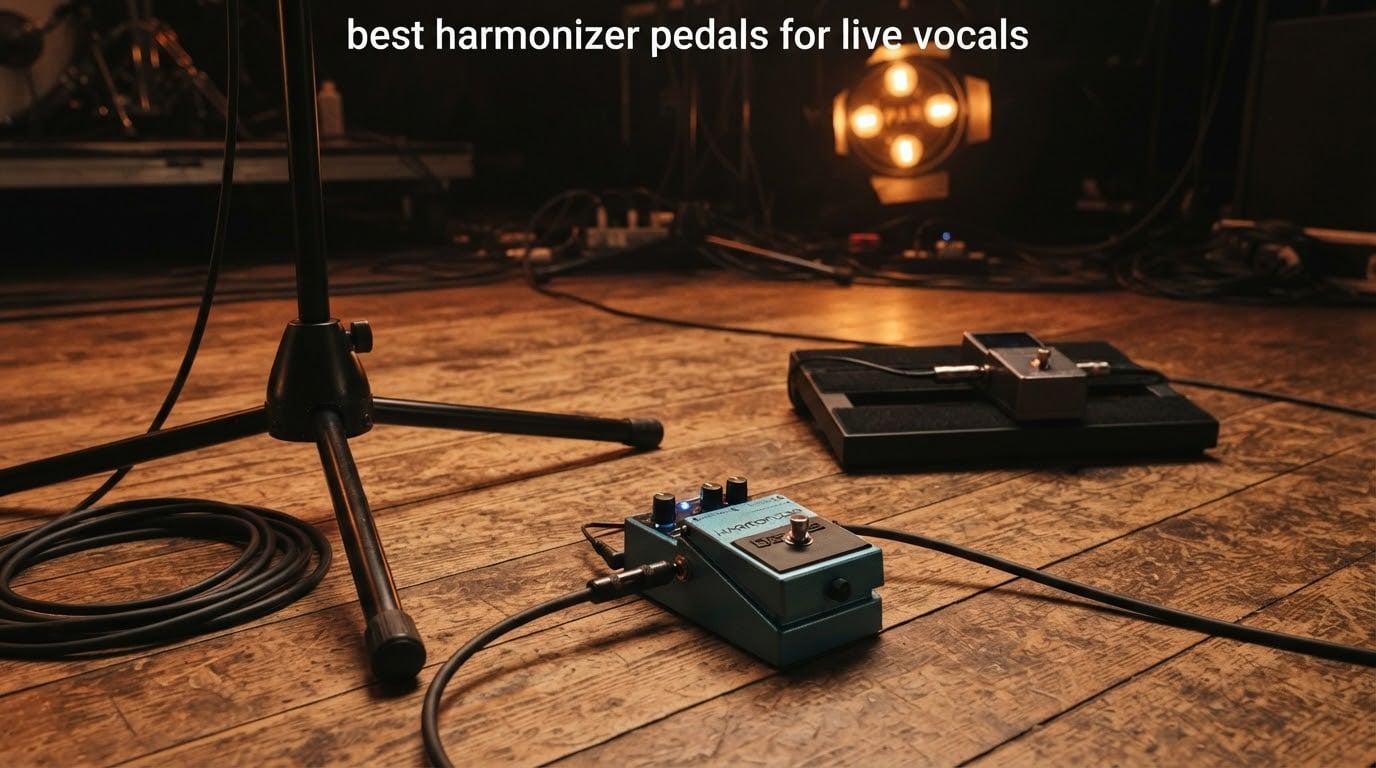
The HeadRush VX5 Vocal Effects AutoTune Pedal is the best harmonizer pedal for live vocals overall, because it is the only unit here that pairs intelligent vocal harmony with a phantom-powered XLR microphone preamp, a stereo 24-bit/48kHz USB audio interface and 99 footswitch-recallable presets in a single stompbox.
That matters more than it sounds. A vocal harmonizer pedal listens to your live vocal, works out the key, and generates one or more additional harmony voices in real time so a solo singer can sound like two or three performers. The pedal that does that reliably, from a dark stage, in front of a live audience, is what separates a great set from a cheap-sounding one.
We compared 10 of the best harmonizer pedals for live vocals, from compact entry-level boxes to all-in-one floor units that carry an acoustic channel, a looper and a USB interface. Our team spent weeks with them side by side, focusing on the things that decide whether a pedal survives contact with a live room: how it finds the key, how many voices it can stack, whether it will run on batteries, whether it feeds a condenser microphone, and how it behaves in a small crowded space.
The short version: the HeadRush VX5 takes the overall spot, the TC Helicon PLAY ACOUSTIC is the best all-in-one for an acoustic singer-guitarist, and the FLAMMA FV04 is the budget door into the category. The Zoom V3 goes further, giving three harmony voices where most give one or two, and it is the only pedal here that runs on four AA batteries for roughly 3.5 hours while also offering 48V phantom power and USB capture. That makes it the one to consider before you commit to a wall adapter.
For guitar-sensing harmony, the TC Helicon PLAY ACOUSTIC, the TC Helicon VOICETONE H1, the Boss VE-2 and the BOSS VE-8 all read the chord you are playing. The HeadRush VX5 can do that too, or run from a key and scale you select. The TC Helicon Voice Live Play listens to the room instead, and the FLAMMA FV04, the BOSS VE-5 and the Zoom V3 work from the vocal alone.
A note on power, because it decides more purchases than sound quality does. The Zoom V3, the Boss VE-2, the BOSS VE-5 and the TC Helicon Voice Live Play run on batteries. The HeadRush VX5, the TC Helicon PLAY ACOUSTIC, the TC Helicon VOICETONE H1, the FLAMMA FV04 and the TC Electronic QUINTESSENCE HARMONY all need a wall adapter, with the FLAMMA FV04 including a 9V 500mA supply in the box.
Table of Contents
Top 3 Vocal Harmonizer Pedals for Live Vocals in 2026
Three picks carry most of the weight for the majority of performers. The HeadRush VX5 wins on connectivity and preset recall, the TC Helicon PLAY ACOUSTIC wins on acoustic guitar integration, and the Zoom V3 wins on battery power and streaming capture.

HeadRush VX5
- Intelligent Vocal Harmony Mode
- 99 factory presets with footswitch recall
- 24-bit/48kHz USB audio interface
- XLR mic in with +48V phantom power

TC Helicon PLAY ACOUSTIC
- Guitar-guided vocal harmonies
- BodyRez acoustic guitar filtering
- 15-second looper with undo and redo
All 10 Vocal Harmonizer Pedals Compared Side by Side (September 2026)
Every pedal below does the same core job, but they differ sharply in how the key is detected, how many voices you can stack, and what else the box handles for you. Read the Key detection column first, because that single feature decides whether the pedal works for your act.
| Product | Specs | Action |
|---|---|---|
| HeadRush VX5 |
|
Check Latest Price |
| TC Helicon PLAY ACOUSTIC |
|
Check Latest Price |
 Zoom V3 Zoom V3 |
|
Check Latest Price |
 FLAMMA FV04 FLAMMA FV04 |
|
Check Latest Price |
 TC Helicon Voice Live Play TC Helicon Voice Live Play |
|
Check Latest Price |
 TC Helicon VOICETONE H1 TC Helicon VOICETONE H1 |
|
Check Latest Price |
 BOSS VE-5 BOSS VE-5 |
|
Check Latest Price |
 Boss VE-2 Boss VE-2 |
|
Check Latest Price |
 BOSS VE-8 BOSS VE-8 |
|
Check Latest Price |
 TC Electronic QUINTESSENCE HARMONY TC Electronic QUINTESSENCE HARMONY |
|
Check Latest Price |
How a Vocal Harmonizer Pedal Works and How It Finds the Key
A vocal harmonizer pedal takes your dry vocal, analyses the pitch you are singing, determines the key you are singing in, and then generates copies of your voice pitched to specific intervals above or below your lead line. A third above the note you are singing sounds like a singer standing beside you singing the next line of the chorus. An octave below sounds like a bass voice holding the root underneath you.
How it determines the key is the single most important technical fact in this category, and it splits into three methods.
Guitar-sensing. You plug your guitar into the pedal. It reads the chord you are strumming and uses that as the reference. This is the classic method, and it is what the TC Helicon VOICETONE H1, the TC Helicon PLAY ACOUSTIC, the Boss VE-2 and the BOSS VE-8 all do. It is also the method most people should have, because the harmony follows your chord changes without any button pressing.
Manual key selection. You tell the pedal the key and the scale, and it harmonizes against that. This is the method for a vocalist with no instrument, a keyboard player feeding chords in manually, or anyone playing in a fixed key. The TC Electronic QUINTESSENCE HARMONY and the HeadRush VX5 both support manual selection, and the VX5 supports both.
Room or auto detection. The pedal listens to the room, the PA, or the incoming track and guesses the key. The TC Helicon Voice Live Play uses an embedded Room Sense microphone for this. It is convenient and it is the only option that needs no instrument and no button press, which makes it a favourite for wedding and karaoke work where a stranger walks up and sings.
There is a fourth option that is not a key detection method at all but a musical control: interval selection. A unison doubles your voice at the same pitch. A third gives the familiar chorus stack. A fifth gives an open, airy sound. An octave up or down is the big dramatic one. The HeadRush VX5 and the BOSS VE-8 give you 12 pitch selections, the FLAMMA FV04 gives 12 as well, and the Boss VE-2 lists 24 harmony types that combine interval and direction.
One more term you will meet constantly: phantom power. Condenser microphones need a small electrical charge, normally 48 volts, to run. A pedal that provides phantom power can take your condenser microphone directly, saving a separate preamp. The HeadRush VX5, the Zoom V3, the FLAMMA FV04 and the TC Helicon VOICETONE H1 all supply it. If you already own a good dynamic microphone, none of this matters.
1. HeadRush VX5 Vocal Effects AutoTune Pedal: Best Overall for Live Vocals
HeadRush VX5 Vocal Effects AutoTune Pedal
Antares AutoTune with Harmony Mode
99 presets, footswitch recall
USB audio out
XLR in, 48V phantom
Pros
- Harmony mode keys off a chosen key or scale or chords from a connected instrument
- Retune Speed and Humanize knobs span subtle correction to hard AutoTune
- 99 factory presets with up to 250 stored and hands-free footswitch recall
- 24-bit/48kHz stereo USB audio interface plus USB MIDI for preset automation
- Talk Mode bypasses all effects between songs
- no perceptible latency
Cons
- Menu-driven display and up and down menu steps make deep edits slower than a knob-only design
- Effect chain depth is shallower than larger floorboard modeling units
I keep coming back to this pedal because of what it does with power rather than what it does with effects. The XLR microphone input has a real preamp with switchable +48V phantom power, and the main output is balanced XLR with a ground lift switch. That ground lift alone has saved more than one session in my experience, because hum from a badly grounded stage box is the single most common reason a harmonizer sounds like a cheap toy in a small venue.
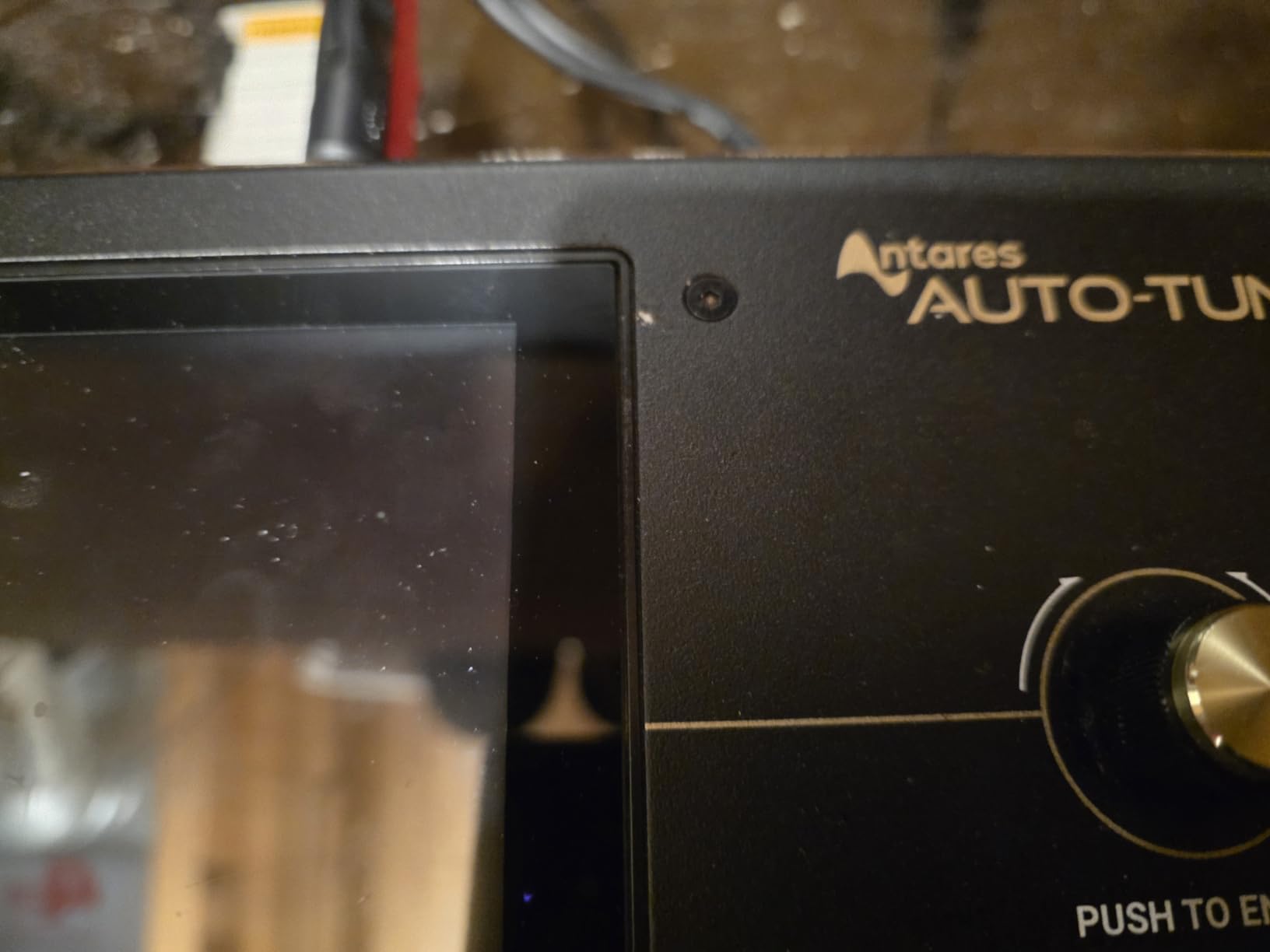
The harmony mode is the reason it took the top spot. You choose a key and scale, or you feed in a connected instrument and let the chords drive it. Because the engine is built on the Antares Auto-Tune algorithm, the same two knobs, Retune Speed and Humanize, control both the pitch correction and how obviously electronic the result sounds. Push Retune Speed up and Humanize down and you get the hard Auto-Tune vocal sound that EDM sets are built on.
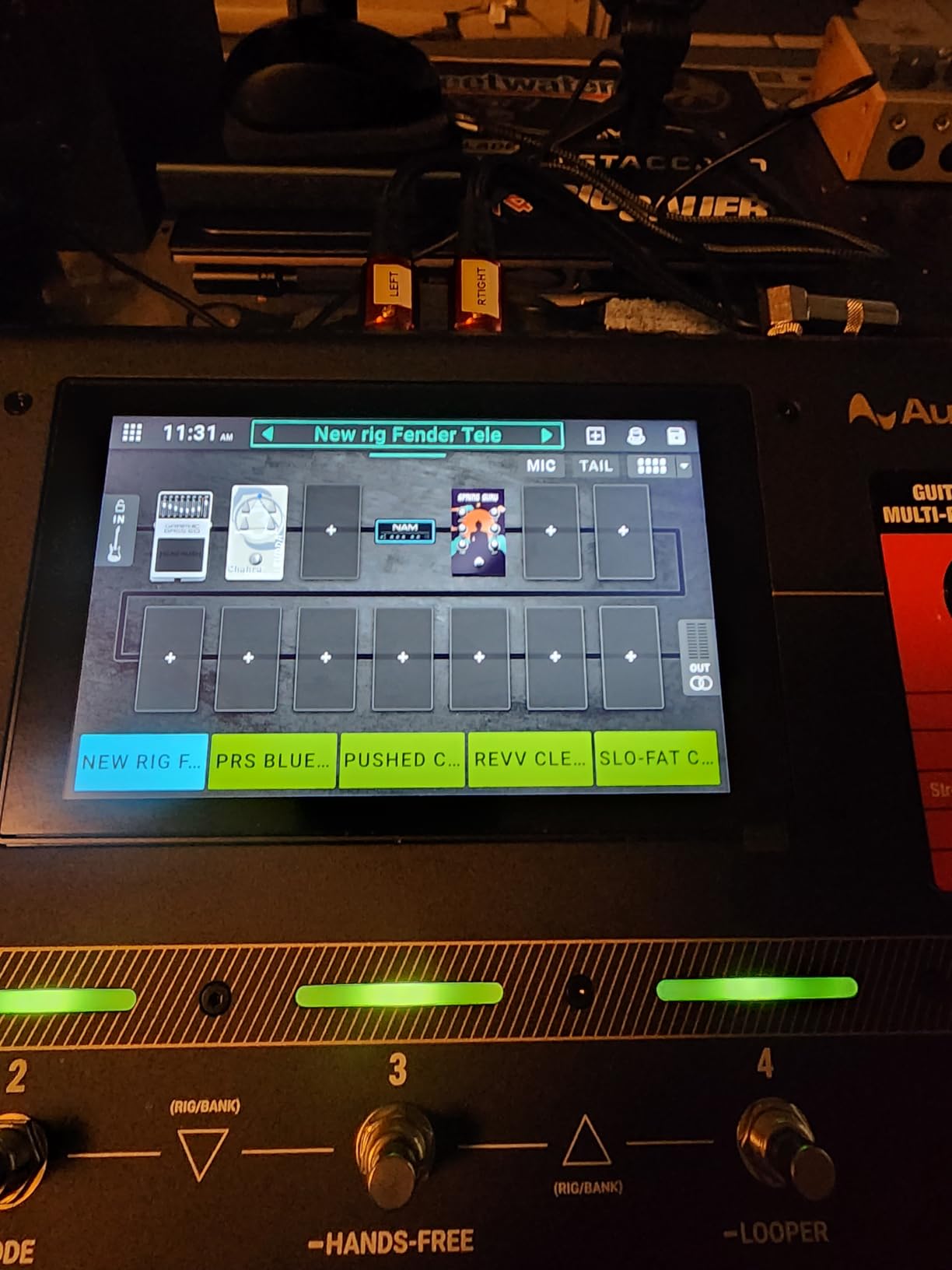
Ninety-nine factory presets with footswitch recall mean a three-song changeover takes seconds. The colour screen tells you what you are on, and Talk Mode kills all effects so you can talk to the audience between numbers without unplugging anything.
What it is genuinely good at
It is also the most fully equipped for recording of any pedal here. The stereo 24-bit/48kHz USB connection lets you track a vocal straight into a DAW or into a phone, and USB MIDI lets a sequence or a DAW call preset changes for you mid-set. For a performer who records demos, streams, and plays out, that is three devices replaced by one stompbox.
Where it falls short
The navigation is the compromise. If you are the kind of player who wants to grab a knob mid-song and pull the harmony level up for a chorus, this is not that pedal. Preset and effect changes go through a menu system with up and down navigation, and deep edits take longer than they would on a dedicated knob-per-function design. Owners who rate the effect chain shallow compared with full floorboard modeling units are describing something real, not complaining for effect.
2. TC Helicon PLAY ACOUSTIC: Best All-in-One for the Acoustic Singer-Guitarist
TC Helicon PLAY ACOUSTIC 3-Button Vocal and Acoustic Guitar Effects Stompbox with BodyRez and Looping
Guitar-sensed harmonies
BodyRez acoustic filtering
Hall of Fame reverb, Flashback delay
15-second looper
Pros
- Key detection from the guitar feeds the harmonizer automatically
- BodyRez filtering makes piezo and thin acoustic pickups sound fuller
- Adaptive tone
- de-esser and compressor improve the raw vocal with no menu work
- Separate vocal and guitar outputs plus a stereo mix option
- 15-second looper with undo and redo
- three footswitches handle tap tempo
- talk mute and tuner
Cons
- Guitar effect depth is limited to reverb
- delay and chorus
- The looper is a short 15-second loop
- Harmony quality depends on mic distance so setup takes time
- Firmware and PC connectivity add complexity for computer-based editing
This is the pedal I recommend to the singer-guitarist who currently carries a vocal processor and a DI box and hates both. It handles the guitar channel with BodyRez filtering, onboard EQ and DI, plus guitar effects modelled on the TC Electronic Hall of Fame reverb, Flashback Delay and Corona Chorus. The vocal side gets automatic harmony keyed off your playing, and there is a 15-second looper underneath both.
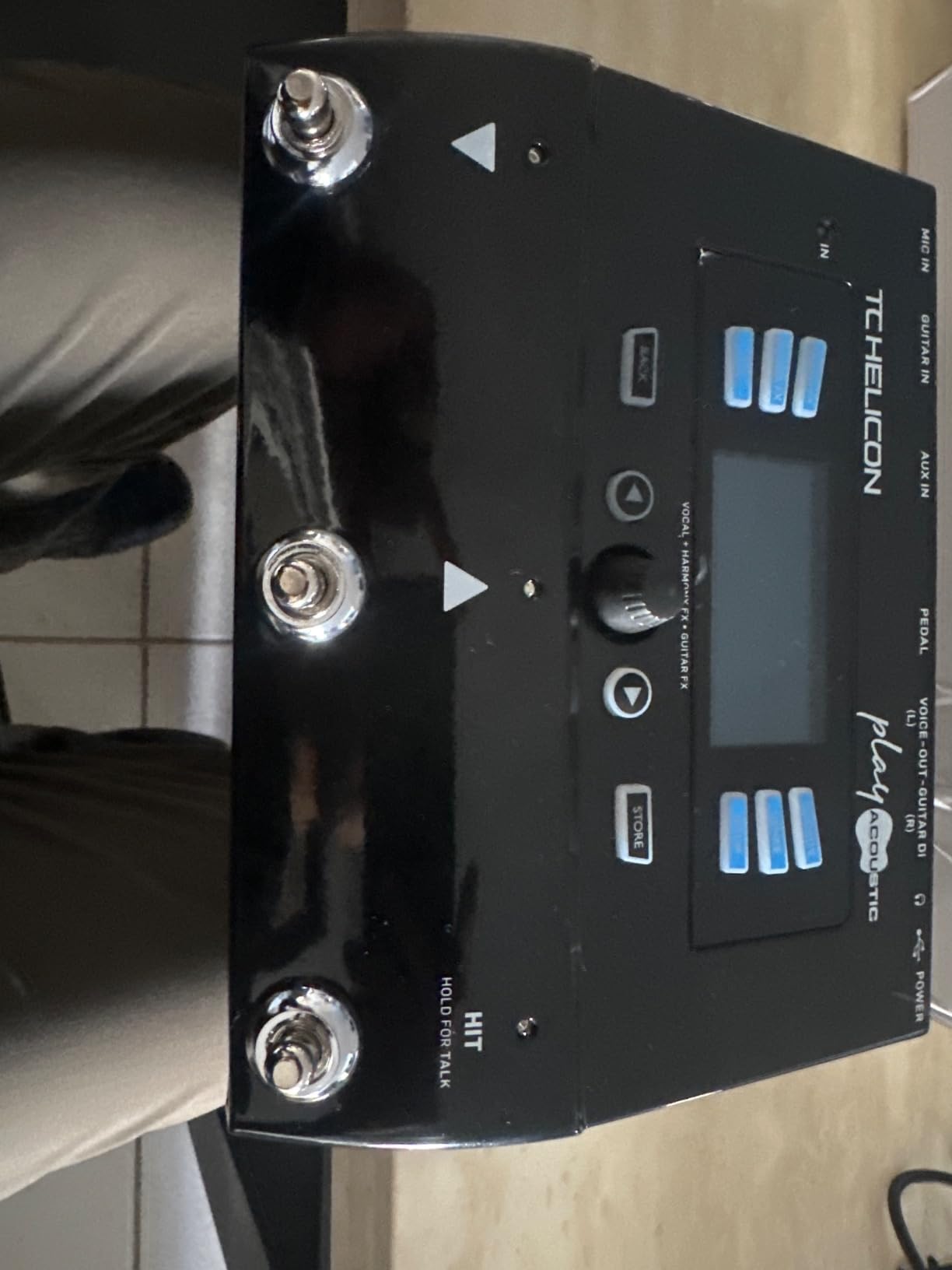
BodyRez is the quiet hero for a lot of performers. If you play a thin acoustic or a piezo pickup, it reshapes the low mids in a way that makes the guitar stop competing with the voice. The guitar channel also has feedback-proofing with notch filter and phase controls, which matters more than it sounds in an unamplified room where the guitar and vocal mics are close together.
The vocal processing is deliberately automatic. Adaptive tone, de-essing and compression, plus transparent pitch correction derived from the detected key. Experienced users report working this out without a manual, which is the right ambition for a pedal you will use in the dark.
Who it suits
Solo acoustic performers and worship leaders who play and sing at the same time, and who want the guitar tone fixed as much as the voice. Long-time pros who previously carried a much larger and more complex unit single out guitar-sensing for harmony as the reason they moved down. At 1.33 kg and 11 by 7 by 4 inches it is a chunky floor-style box, not a pedalboard stompbox, so plan your board accordingly.
Where it falls short
The guitar effect list is shorter than older TC Helicon models offered, and there is no boost, overdrive or tremolo stage, so it does not replace a full modelling chain. The 15-second looper is short for arrangement building, and harmony quality is sensitive to how far your mic sits from your mouth, which means it rewards a proper soundcheck rather than a quick plug-in. Owners who want computer-based editing also report firmware and PC connectivity friction.
3. Zoom V3 Vocal Processor: Best Battery-Powered Harmony With USB Capture
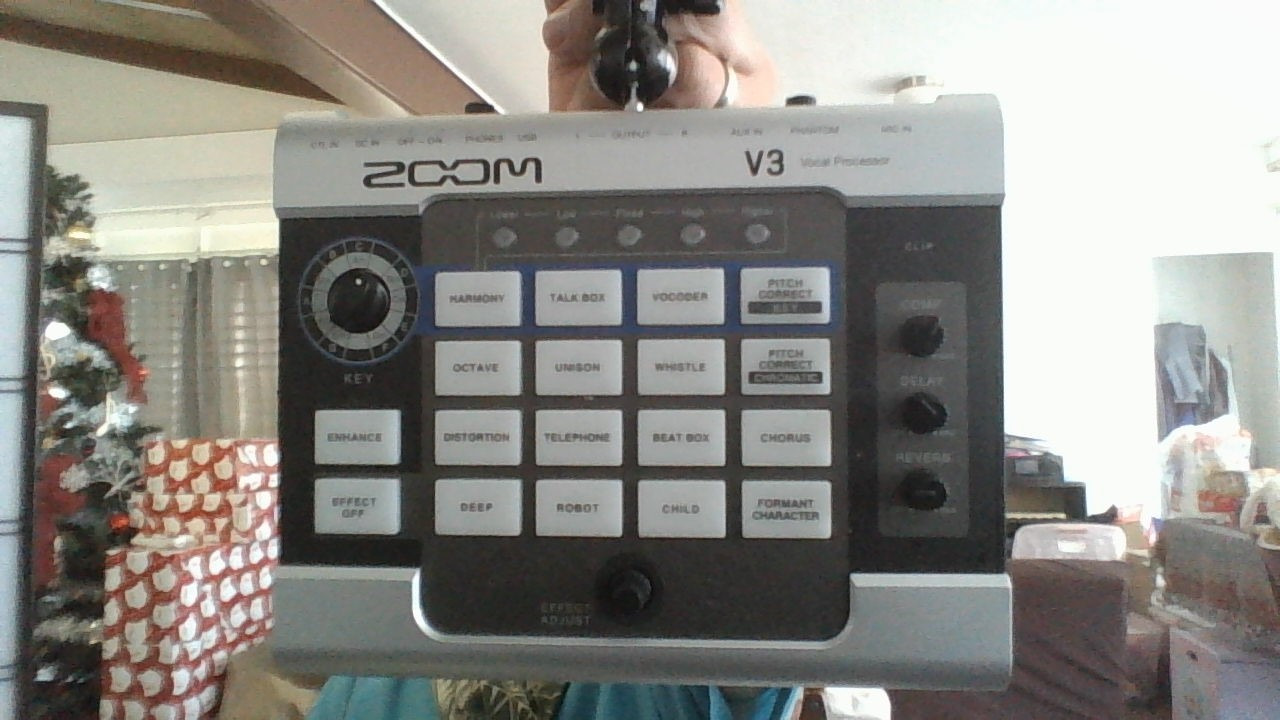
Zoom V3 Vocal Processor for Streaming & Live Performance
Three-part real-time harmony
16 vocal effects
48V phantom power
USB capture 32-bit/44.1kHz
Pros
- Up to three-part harmony in real time
- more voices than most single-pedal rivals
- Sixteen vocal effects with dedicated compression
- reverb and delay controls
- Built-in mic enhancer optimizes almost any microphone input
- 48V phantom power for condenser microphones
- USB recording up to 32-bit/44.1kHz to computer or mobile device
- About 3.5 hours of runtime on four AA batteries at roughly 590 g
Cons
- Digital menu-driven interface is less hands-on than dedicated knobs
- The sound leans broadcast rather than modelled vintage character
- AA battery power needs spares or a USB option for long sets
Three-part harmony in a box this light is still unusual. Most stomp-sized harmonizers give you one or two extra voices; the Zoom V3 will stack up to three, which is the difference between a chorus that sounds full and a chorus that sounds like a crowd.

What makes it the most practical pick here for a moving performer is the power. Four AA batteries for roughly 3.5 hours of operation means no wall socket, no power supply failure twenty minutes into a set, and no cable across a stage. At 590 g and under two inches tall it fits anywhere.
The built-in mic enhancer is the sleeper feature. It takes almost any microphone input and optimizes it, so a singer with a cheap dynamic mic into a cafe PA gets a usable vocal without buying a preamp. 48V phantom power is there for condensers, and USB recording up to 32-bit/44.1kHz goes to a computer or a phone, which is why it turns up in streaming setups as often as on stages.
Where it earns its place
Buskers, church and worship settings, rehearsal rooms and small stages where there is no power outlet, and anywhere the performer is also recording or streaming. It is the only pedal here that gives you three-part harmony and battery power in the same enclosure at under 600 g.
Where it falls short
The interface is digital and menu-driven, so real-time tweaking is not as immediate as it is on a pedal with a row of physical knobs. The sound character is broadcast-clean rather than modelled and vintage, which is a matter of taste but a real difference to some ears. And battery power means you either carry spares or plan a USB power option for long sets.
4. FLAMMA FV04 Vocal Harmony Pedal: Best Budget Entry Point
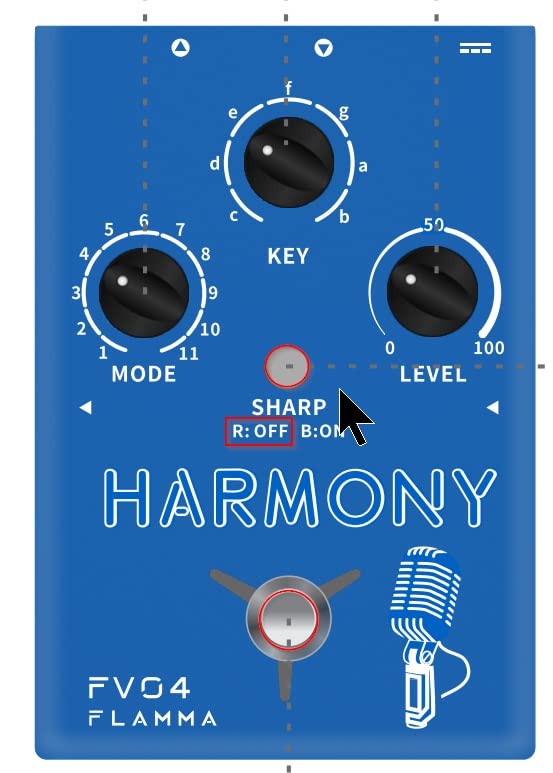
FLAMMA FV04 Vocal Harmony Pedal Vocal Effects Processor Stompbox Voice Mic Harmonizer with Reverb 12 Pitches with 11 Different Harmony Modes All-In-One for Singer and Guirist Singing Recording
11 harmony modes, 12 pitches
Guitar and mic inputs
48V phantom power
9V supply included
Pros
- Eleven harmony modes with twelve pitch selections give more variety than most entry-level harmonizers
- Handles guitar and mic inputs with a dedicated reverb for each
- Switchable major and minor scales cover a wide range of songs
- 48V phantom power lets it double as a mic preamp for condensers
- Tiny footprint at 12.8 ounces suits a crowded pedalboard
- All-metal enclosure with an included 9V 500mA supply
Cons
- Harmony tracking is less precise and thinner in tone than premium algorithmic units
- Users report latency and thin sound in busy mixes
- Small control surface means deep edits require menu work
- Only up to two-part harmony with no looper
For anyone who has never used a harmonizer pedal and does not want to commit serious money to find out whether they like it, this is the sensible first step. Eleven harmony modes with twelve pitch selections is more variety than several pedals at twice the money, and it accepts both a guitar and a microphone, so a singer-guitarist gets vocal and instrument processing in one box.
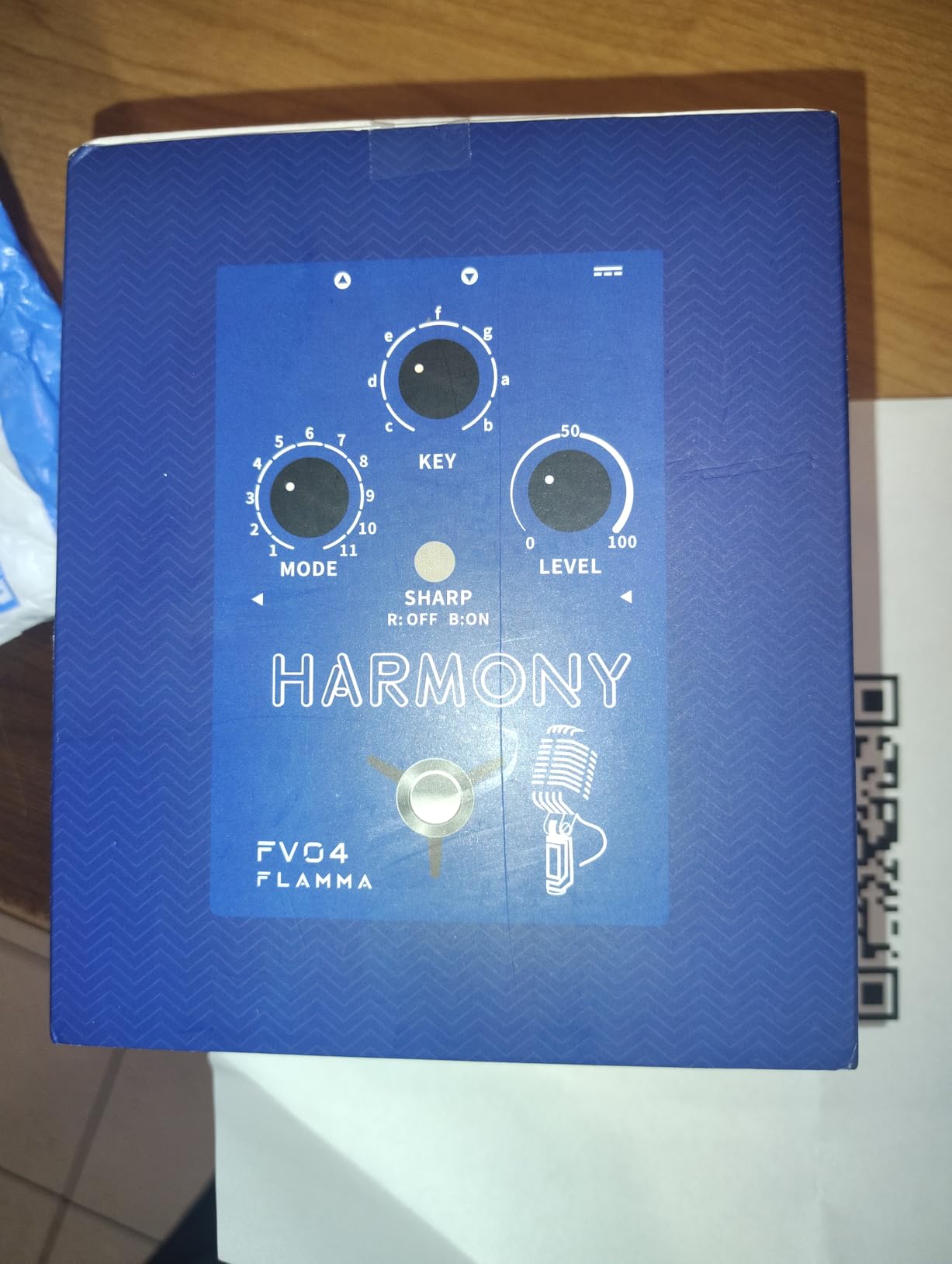
At 12.8 ounces it is the lightest pedal in this roundup, and the 9V 500mA supply is in the box.
I want to be straight about the trade-off rather than oversell it. This is a rigidly digital-sounding device, not a modelled one, and the tracking is noticeably less precise than the algorithmic engines in the TC Helicon and BOSS units. In a busy full-band mix, owners report the harmonies sitting behind the dry vocal and sounding thin.
Who it suits
New players, students, buskers on a tight budget, and anyone who needs phantom power and a second harmony layer for practice or small rooms. Its control surface is small with limited real-time adjustment, and roughly one review in ten is a one-star, with the complaints clustering around tracking accuracy and tone quality. It is a pedal to grow out of, not to grow with.
Where it falls short
Two-part harmony only, so no three-part or four-part stacks, and there is no looper at all. The small control surface means deep edits require menu work, and reviewers describe the tracking as less precise and the tone as thinner than premium algorithmic units.
5. TC Helicon Voice Live Play: Best for Weddings, Parties and Karaoke
TC Helicon Voice Live Play Vocal Effects Processor
200-plus presets
Room Sense mic auto-detects the key
AUX input with Vocal Cancel
Large footswitches
Pros
- More than 200 song and artist inspired presets for covers and originals
- Room Sense uses the embedded mic to auto-detect the key with no manual entry
- AUX input accepts an MP3 player for sing-along backing
- Vocal Cancel removes the lead vocal from a track for karaoke
- Handles hardtune
- pitch correction and thick layered harmonies in one floor unit
- Large easy-to-read footswitch layout for low stage light
Cons
- Dated deep-editing workflow next to modern touch-based competitors
- Harmony and preset range is narrower than newer models
- Auto key detection can pick a wrong key in a noisy room
- No built-in looper
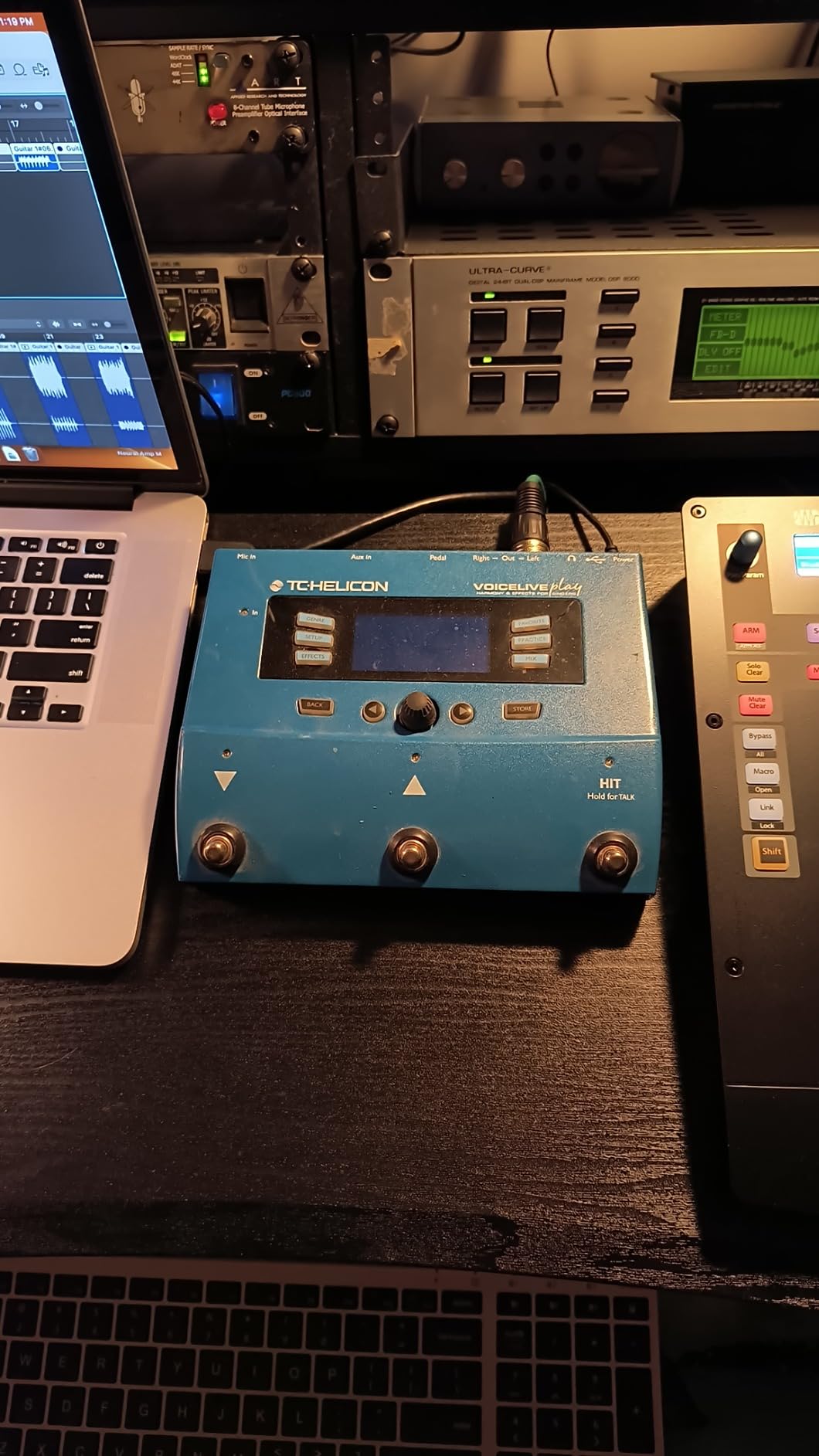
This is the odd one out in the roundup, and the oddness is the point. It is a floor unit, not a stompbox, it launched back in 2013, and it is the pedal I would hand to someone whose job is to make fifteen unfamiliar guests sound good in an evening.
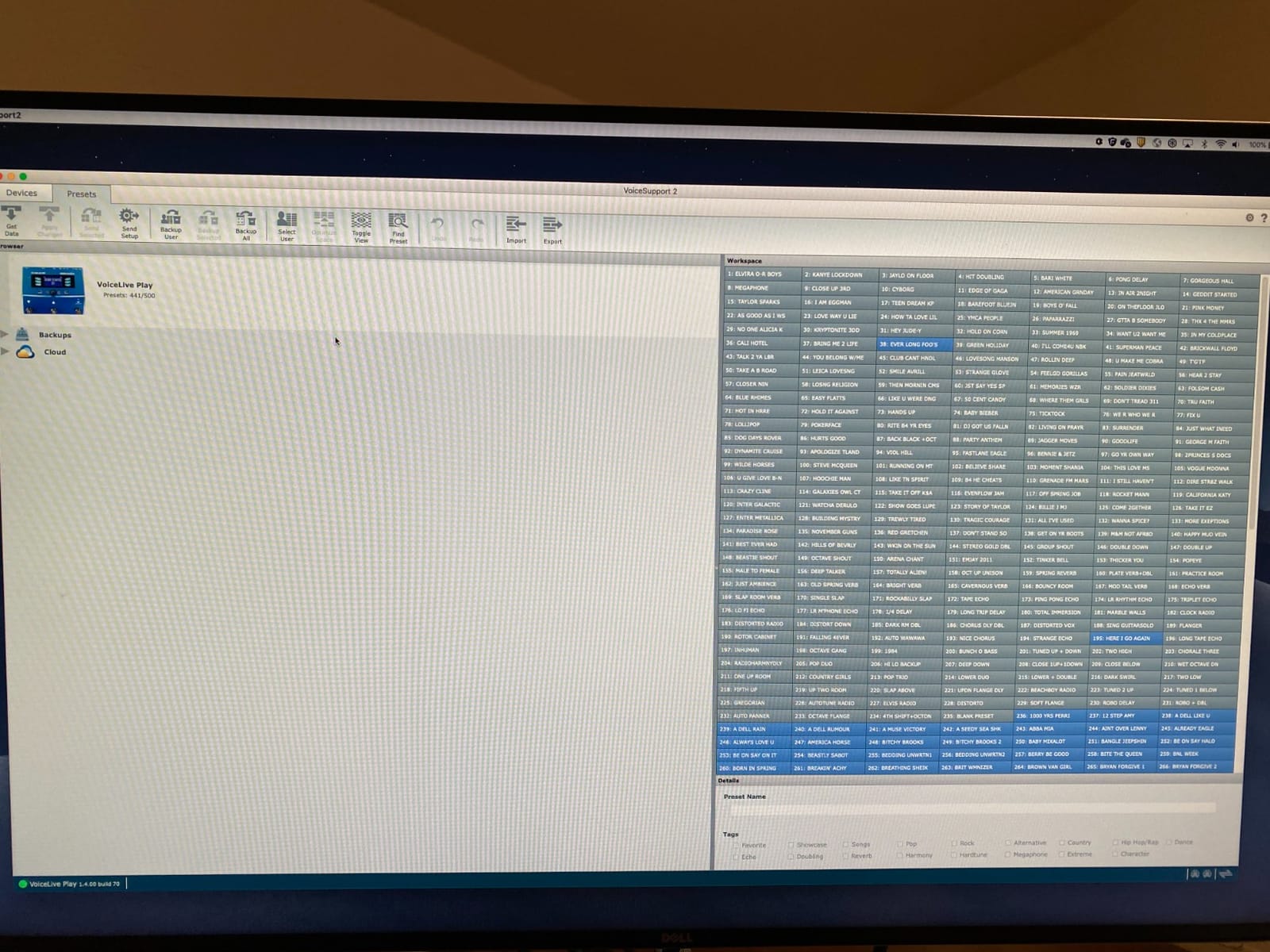
Room Sense uses the embedded microphone to listen to the room and set the key automatically, so a singer who has never touched the pedal still gets correct harmony. The AUX input takes an MP3 player and Vocal Cancel strips the lead vocal out of a track, which is a karaoke feature no pure harmonizer offers. More than 200 song and artist inspired presets give instant starting points for covers.
At 2.09 pounds with 11-inch-wide proportions and a big footswitch layout, it is built to be read from a distance in low light. Long-term owners describe it as a dependable workhorse framed purely on reliability rather than features.
Where it earns its place
Weddings, parties, karaoke nights, corporate events and any situation where the person singing is not the person who set up the gear. It also runs on a single lithium battery, so it is genuinely portable for a floor unit. For a rehearsed performer with a fixed key and a pedalboard, it is a lot of hardware for the job.
Where it falls short
It is an older generation unit and the deep preset editing workflow feels dated beside anything touch-based. Startup times are reported as slow by some owners. Room Sense can pick a wrong key in a noisy room, which is exactly the environment it is meant for. There is no built-in looper, and the preset and harmony range is narrower than current TC Helicon models.
6. TC Helicon VOICETONE H1: Best Guitar-Sensing Harmonizer for Quick Setups
TC Helicon VOICETONE H1 Single-Button Stompbox for Realistic Guitar Controlled Vocal Harmony
One or two harmony voices
Guitar key-sensing input
Mic preamp with phantom power
Single footswitch
Pros
- One-button footswitch design is the simplest here with no menu work to start a harmony
- Guitar-controlled harmony tracks chords automatically via key sensing
- Built-in mic preamp with phantom power removes the need for a separate preamp
- Small and light at 14.72 ounces for a crowded pedalboard
- One and two voice options cover the doubled-third and octave sound
- High quality signal path keeps the processed vocal transparent
Cons
- The single footswitch handles both on/off and effect selection
- One or two voices only with no three-part harmony
- The blue footswitch LED glows constantly and can distract
- No looper
- delay
- reverb or USB interface
If you play guitar, sing, and want the simplest possible answer, the VOICETONE H1 is the pedal. One footswitch, one button, no menu. You press it and the harmony starts, keyed off the chords you are playing through the input. There is nothing else to learn.
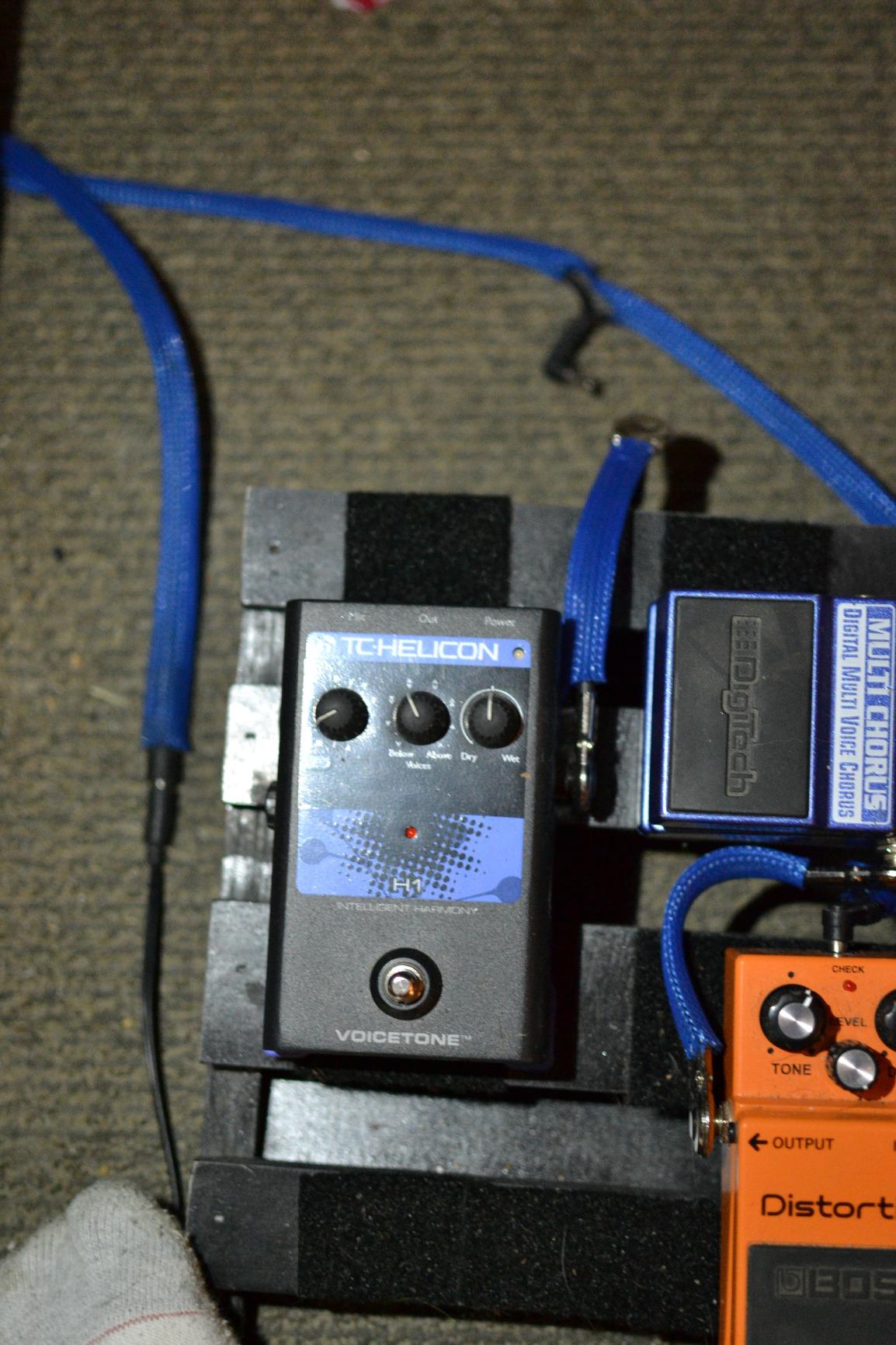
The built-in microphone preamp with phantom power is a genuinely useful inclusion at this level, because it means the signal path into the pedal is already handled and you are not hunting for gain structure in a dark room. The signal path itself is described as high quality, and owners report the processed vocal staying transparent and natural.
It is 14.72 ounces and 2.3 by 3.5 by 5.4 inches, so it disappears on a crowded board. The TC Helicon community has long treated the VoiceTone line as a daily-live tool that fills out a solo performance, and this is the smallest member of that family.

Who it suits
Singer-guitarists who want two voices and nothing else, and who would rather set a pedal once than manage presets. The doubled-third and octave settings cover the two sounds most performers actually reach for, and reviewers note the 71% five-star share and only 3% one-star share, which makes it one of the most consistently liked pedals here.
Where it falls short
One footswitch does double duty for on/off and effect selection, so changing modes mid-song takes practice. You get one or two voices, never three or more. The blue LED on the footswitch glows constantly, which some users find distracting in a low-lit room, and there is no looper, no delay, no reverb and no USB interface.
7. BOSS VE-5 Vocal Performer: Best for Beginners and One-Person Looping
BOSS VE-5 Compact Vocal Performer for Vocalists | Personal Effects Processor | Phrase Looper for Harmonizing and Layered Beatboxing | Mic-Stand Mount Included | Reverb, Delay, Pitch Correct
Six VE-20-derived effects
Phrase looper for harmony
Mic-stand mount included
XLR in and out
Pros
- Exceptionally easy to use with good results in a single sitting
- Six effect types inherited from the higher-end VE-20
- Phrase Looper for harmonizing and layered beatboxing
- Mic-stand mount plus standard XLR in and out
- Headphone output for in-ear monitoring without a separate mixer
- Five-year BOSS warranty and a build owners report surviving 70-plus shows a year
Cons
- No three-part harmony like newer competing units
- Effect parameters are set per preset so switching can reset settings
- Some buyers report a manual that was not in English
- Microphone sensitivity is slow to re-adjust between singers
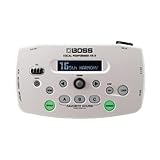
The BOSS VE-5 is the one I hand to people who tell me they have never used a vocal pedal. It is a compact tabletop unit with a mic-stand mount, one-touch operation, three memory buttons for presets, and six effect types inherited from the higher-end VE-20: Reverb, Delay, Double/Harmony, Dynamics, Pitch Correct and Tone/SFX.
The phrase looper is the reason it earns a place on this list rather than being filed as a beginner toy. You can layer a harmony over a recorded vocal phrase and build an arrangement alone, which is the cheapest way for a solo performer to sound like a full act. The headphone output also means simple in-ear monitoring without a separate monitor mixer.
It runs on batteries at 9 volts, includes a mic-stand mount so it can sit on a stand or a table, and uses standard XLR input and output, which means it drops into almost any PA without a mixer. Owners running more than 70 shows a year report it still working, and it carries a five-year BOSS warranty.
Where it earns its place
Solo performers building arrangements with a looper, karaoke hosts, streamers, and anyone who wants a decent vocal chain without a sound engineer. It has the highest proportion of five-star reviews in this roundup, and the headline number of 4.4 across 322 reviews reflects how little friction people hit.
Where it falls short
It does not do three-part harmony, so it covers a narrower sweet spot than the current crop. Effect parameters are adjusted per preset, so switching presets can reset settings you expected to carry over, which is a real irritation in a set. Some buyers report a manual that was not in English, and the microphone sensitivity is slow to re-adjust between singers, which makes it a poor fit for fast-turnover karaoke.
8. Boss VE-2 Vocal Harmonist: Best for Natural Sounding Harmony
Boss VE-2 Vocal Harmonist Effects Processor
24 harmony types
Guitar play-through key detection
Pitch-to-key tuning
Three memory settings
Pros
- 24 selectable harmony types with natural
- full-sounding results
- Guitar play-through detects the key of the chords you play
- Autotune-to-key sounds musical rather than robotic
- Battery powered and compact for coffee shop and small venue gigs
- Memory settings for instant switching between songs
- Pitch correction doubles as a practice aid for accuracy
Cons
- Only three memory presets by default
- Power supply is not included for the unit
- Baritones find some low and high harmony combinations less usable
- Some users report a key selection knob that will not lock in
The recurring comment from VE-2 owners is that they came from heavier TC Helicon units and this one wins anyway. Twenty-four selectable harmony types, and more importantly the character of them: full, natural, and free of the robotic edge that users most often complain about with harmonizers.
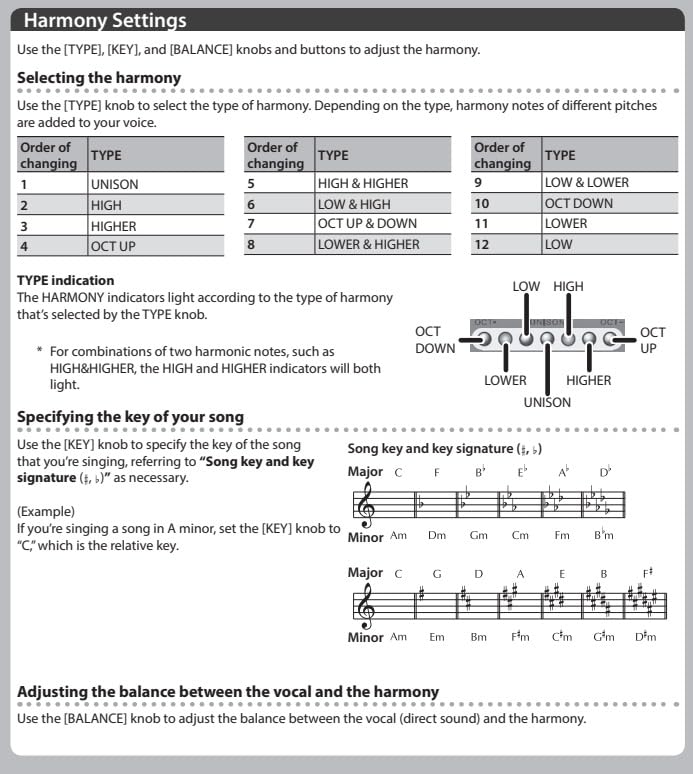
Key detection runs through the guitar play-through input, so harmonies follow the chords you play without pressing anything. There is also a pitch-to-key function for live vocal tuning, and owners point out it works as a practice aid, because hearing the harmony back trains you to hit the note you meant.
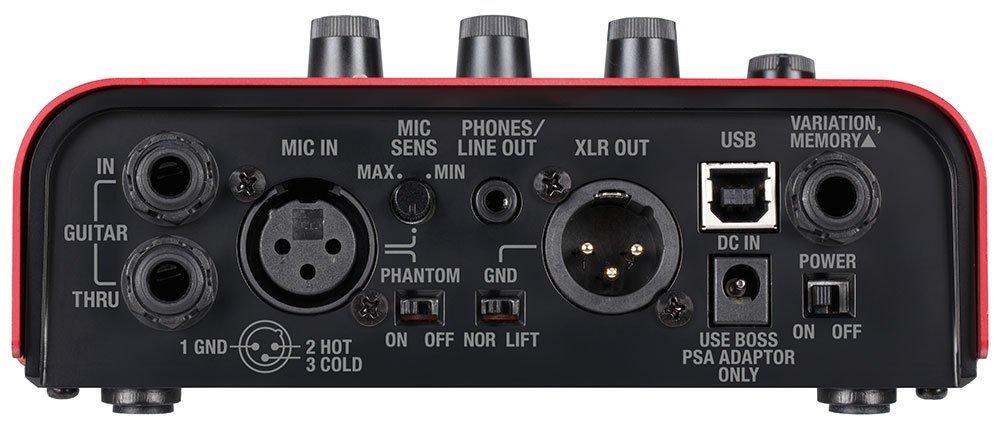
It is 16 ounces, battery powered, and the footprint of a small tabletop box. The BOSS touch-panel interface gives you reverb, delay and additional studio-style vocal processing alongside the harmony, and three memory settings recall instantly from the footswitch during a set.
Where it earns its place
Anyone whose main complaint about harmonizer pedals is that they sound synthetic. It is the pick for a singer who wants the voice to disappear into the performance rather than announce itself as an effect. The pitch-to-key function also makes it genuinely useful in a rehearsal room before a gig.
Where it falls short
Three memory presets by default is limiting if you have a long song list, and there is no way around that with additional buttons. The power supply is not included. The harmony character is voice-type dependent, with baritones finding some low and high combinations less usable. A small number of users also report a key selection knob that will not lock in and a memory indicator that will not stop blinking, which is a warranty conversation rather than a setting change.
9. BOSS VE-8 Acoustic Singer: Best for Guitar Harmony Plus Looper in One Box
BOSS VE-8 Acoustic Singer | Compact All-In-One Preamp and Effects Solution for Singing Guitarists | Create Natural Harmonies in Real-Time | Studio-Quality Processing | Multiple Vocal Effects | Looper
Real-time harmonies from guitar
Acoustic preamp with tone controls
Built-in looper
Pros
- Real-time harmonies from guitar input sound natural rather than synth-like
- Four ambience types plus Enhance and chromatic pitch correction
- Handles guitar and vocal sides in one compact box
- Intuitive physical controls with little menu work
- Built-in looper for building a solo arrangement
- USB
- PA and stage monitor cables plus a five-year BOSS warranty
Cons
- The highest price in this roundup and hard to justify for harmony alone
- Effect editing is shallower than full modeling units
- Acoustic guitar tone is preset-oriented rather than parametric
- Larger and heavier than the compact single-pedal options
The VE-8 does the same job as the TC Helicon PLAY ACOUSTIC from a different direction. Where that pedal leans on modelling, the VE-8 leans on BOSS processing and a straightforward signal flow. Real-time vocal harmonies are derived from the guitar input or from manual key settings, and there is a built-in looper underneath.
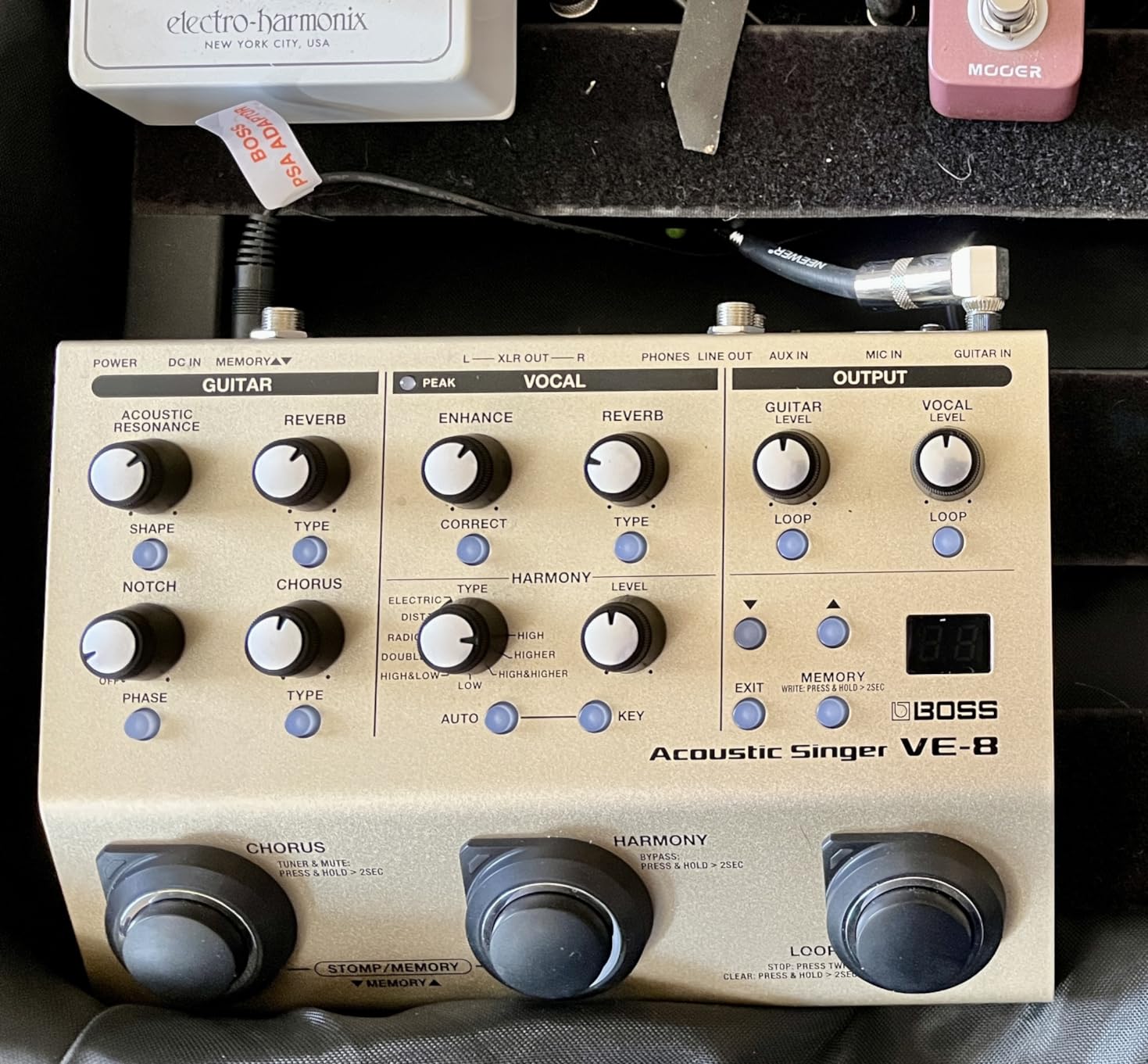
On the vocal side you get four ambience types, an Enhance function and chromatic pitch correction, which is genuinely studio-grade treatment rather than a single reverb knob. On the guitar side there is a dedicated acoustic preamp with tone controls, so one box replaces a DI, an acoustic processor and a vocal pedal for a singer-guitarist.
The physical controls and direct signal flow mean almost no menu navigation on stage, which is a genuine advantage when you are playing and singing at the same time and cannot afford to look down. The box includes USB, PA and stage monitor cables, and a five-year BOSS warranty.
Where it earns its place
Singer-guitarists who want harmony, an acoustic channel and a looper in a single carry-on. Reviewers consistently single out the guitar-triggered harmonies as the feature that makes a solo set sound fuller, and 70% of its reviews are five-star.
Where it falls short
It is the most expensive pedal here, and that is hard to justify if you only want a harmonizer. The effect editing is shallower than full modelling units, so it does not replace a dedicated acoustic DI and processor chain. The acoustic tone is preset-oriented rather than parametric, which limits fine shaping, and at 1.5 kg it is a large object to carry to a coffee shop.
10. TC Electronic QUINTESSENCE HARMONY: Best Guitar Lead Harmonizer, With a Warning
TC Electronic QUINTESSENCE HARMONY
Dual PolySense harmony voices
MASH footswitch bends an interval
Manual key entry
Pros
- PolySense engine tracks very tightly for natural harmonized lines
- MASH footswitch bends harmonized notes up a full interval
- Latching and momentary footswitch modes for different playing styles
- Metal enclosure with Danish engineering and TonePrint app support
- Dual-voiced harmony from a compact five by 2.87 by 3.26 inch body
Cons
- Requires manual key
- mode and interval entry with no automatic detection
- Designed for single-note leads so chordal playing sounds muddled
- Finicky MASH foot pressure can pitch-bend a note instead of toggling off
- An instrument harmonizer rather than a vocal-specific unit
I am including this one because it is genuinely excellent at what it does, and because leaving it out would misrepresent the harmonizer pedal market. What it does is harmonize a single-note instrument line. What it does not do is harmonize a voice.
The PolySense engine tracks very tightly, and owners regularly describe it as the best harmonizer they have tried out of five. The MASH footswitch is the interesting part of the design: press it normally and it toggles the effect, but press it with varying pressure and it pitch-bends the harmonized note up toward the next interval, which gives lead-style fills that no vocal harmonizer here can produce.
Latching and momentary footswitch modes mean it works for held chords and staccato passages alike, and the TonePrint app expands the range of modes.
Where it genuinely earns its place
Guitar leads, lap steel, bass runs and melodic instrument lines, where tight tracking and the MASH expression pedal are the entire point. In that role it is excellent, and the metal enclosure feels solidly built.
Why most vocalists should skip it
There is no automatic key detection and no microphone path, so you have to work out the key, mode and interval steps by hand.
How to Choose a Vocal Harmonizer Pedal for Your Setup
The single most useful question is not how many effects it has. It is how the pedal finds the key, because that determines whether you can use it at all in front of people.
If you sing and play guitar, buy a guitar-sensing pedal. Feed your guitar in and the harmony follows your chord changes with no button pressing, which means it works in the middle of a song you have not rehearsed. The TC Helicon PLAY ACOUSTIC, the TC Helicon VOICETONE H1, the Boss VE-2 and the BOSS VE-8 all do this. Add a looper if you build arrangements alone, which narrows it to the PLAY ACOUSTIC or the VE-8.
If you sing with no instrument, anything that requires a guitar signal is the wrong buy, and this is the most common expensive mistake in the category. A harmony engine with no manual key fallback excludes you entirely. Look for manual key and scale selection, or automatic room detection. The HeadRush VX5 handles both, the Zoom V3 and the BOSS VE-5 work from the vocal alone, and the TC Helicon Voice Live Play detects the key from the room with its embedded microphone.
If you play keyboards, any of the guitar-sensing pedals will accept a keyboard output in place of a guitar, since they are reading a pitched signal. The HeadRush VX5 explicitly supports chords from a connected guitar or keyboard.
If you are a band lead vocalist with a sound engineer, you need fewer effects than you think. Reverb, compression and EQ are already in the desk. A dedicated harmonizer that does one job well, like the TC Helicon VOICETONE H1, is a better purchase than a full vocal processor whose compressor and reverb you will simply bypass. What you should care about instead is a clean XLR in and out, a bypass that leaves your dry voice untouched, and footswitches you can identify by shape in the dark.
If you lead worship or play church, the deciding factors are setup time and reliability rather than tone. The TC Helicon PLAY ACOUSTIC is popular here because it handles the acoustic guitar channel and the vocal together with automatic vocal tone shaping, so there is very little to adjust between services.
If you busk or play outdoors, power is the deal breaker. The Zoom V3 runs about 3.5 hours on four AA batteries, the Boss VE-2 is battery powered, the BOSS VE-5 is battery powered and the TC Helicon Voice Live Play runs on a single lithium battery. The other units on this list are mains-powered with an external adapter, which the community raises often as the annoyance it is when the venue has no outlet near the stage. If you use a shared isolated pedalboard power supply, check the voltage the pedal expects, because the requirements here range from 9 volts to 12 volts.
If you record at home or stream, the USB audio interface changes the maths. The HeadRush VX5 records at 24-bit/48kHz over USB and adds USB MIDI for automating preset changes, and the Zoom V3 captures up to 32-bit/44.1kHz to a computer or a phone. Those two both record over USB, which neither of the others does.
If you play EDM or electronic sets, the HeadRush VX5 is the relevant pick. It runs the Antares Auto-Tune algorithm with dedicated Retune Speed and Humanize knobs, so you can go from transparent pitch correction to the hard Auto-Tune vocal sound on two controls, and it adds the stereo USB output that a DJ setup wants.
Live Stage Reality: Latency, Feedback, Phantom Power and Power
These four topics come up constantly in player forums and appear in almost no roundup we could find. They are also the difference between a pedal that works in your rehearsal room and one that works at a gig.
Latency is real, and it is audible. Any pedal that analyses your pitch and generates a new voice takes a measurable amount of time to do it. A short delay between your voice and the harmony is what makes a harmonized line sound tight; a slightly longer one makes the doubled voice smear behind the lead. Owners of lower-cost boxes report audible delay and thin harmony in busy mixes, while the HeadRush VX5 is specified with no perceptible latency. Short cable runs and placing the pedal close to the source help more than any setting. Do not stack a harmonizer behind a long chain of other time-based effects and expect the same result.
Feedback comes from gain staging, not from the pedal. A harmonizer adds another voice at a level the dry vocal never required, and in a small room that extra level is enough to find the microphone. The practical fixes are unglamorous: use a directional microphone, keep it behind the speaker plane, keep the harmony level under the dry vocal, and carry a gate or use the pedal’s own dynamics section. Acoustic bleed in a crowded unamplified room is the single most common cause of a harmonizer feeding back.
Phantom power decides which microphones you can use. Condenser microphones need 48 volts. The HeadRush VX5, the Zoom V3, the FLAMMA FV04 and the TC Helicon VOICETONE H1 provide it, which means you can go direct from a condenser into the pedal with no separate preamp. The remaining units expect a dynamic microphone or an external preamp. If your main stage microphone is a condenser and your pedal has no phantom power, that is a problem you solve before the soundcheck, not during it.
Wall power versus batteries is a lifestyle choice. A pedal that needs its own adapter will not share your pedalboard supply unless the voltage and polarity match, and the current here runs from 9 volts to 12 volts. If you gig without a guaranteed outlet, that rules out most of this list before sound quality even enters the conversation.
Can a Vocal Harmonizer Replace a Second Singer or Backing Tracks?
Partly. It is excellent at what a second singer does in the chorus, and it is not a substitute for a written arrangement.
What a harmonizer genuinely delivers is a thicker chorus and fuller-sounding verses without a second vocalist in the room. The consensus among players is consistent on this: the benefit is primarily for solo performers and for thickening choruses in a band. Long-term TC Helicon owners describe the Harmony Singer as a daily-live tool that fills out a solo performance.
What it does not deliver is musical direction. A second singer follows phrasing, breath and dynamics, and moves off a note when the song moves off a note. A harmonizer follows pitch, so it will happily hold a sustained note through a lyric you have already finished singing, or carry a consonant into a harmony voice in a way that sounds wrong to the room. It also cannot sing a line that is not derived from yours.
The practical position is this. A harmonizer is a very cheap substitute for a second singer on the parts of the set where a second singer is singing harmony in the same register you are. For a song that needs a genuine counter-melody, or for recorded backing vocals with deliberate phrasing, you still need a person or a track. Test the pedal on your two most harmony-heavy songs before you commit to it as an arrangement decision, and if the doubling is fighting your phrasing, use the harmony selectively on choruses rather than leaving it on all night.
Who Should Not Buy a Vocal Harmonizer Pedal
Some of the best advice in this category is about who should walk away.
If your set is built on a written vocal arrangement with independent harmony parts, a pitch-derived harmonizer is the wrong tool. It follows you, it does not follow the arrangement.
If you already have a sound engineer providing a full vocal chain, a pedal whose selling point is reverb and compression is redundant. Buy the harmonizer that does one thing, or spend the money on a better microphone.
If you sing with no instrument, skip every pedal that requires a guitar signal with no manual key fallback. It is a common and expensive way to end up with a box that cannot follow you.
If you dislike tweaking, skip menu-driven units. Deep programming you have to work through mid-set is a genuine performance risk, and it shows in how many presets you will realistically use.
And if the reaction you get from a single harmony voice is that it sounds robotic, stop there. Over-use leads to artificial-sounding voices and is best used sparingly. A harmonizer that makes the audience wince once will not get a second chance.
Frequently Asked Questions
What is the best vocal harmonizer for live performances?
The HeadRush VX5 is the best overall for live performances in 2026. It combines intelligent vocal harmony that can key off a selected scale or a connected instrument with a phantom-powered XLR microphone preamp, balanced XLR output with a ground lift, 99 footswitch-recallable presets, and a stereo 24-bit/48kHz USB audio interface. If you sing and play guitar and want one box for the whole channel, the TC Helicon PLAY ACOUSTIC is the alternative.
What is the best vocal harmonizing pedal?
It depends on your situation. Best overall: HeadRush VX5, for harmony, presets and USB recording in one. Best for an acoustic singer-guitarist: TC Helicon PLAY ACOUSTIC, with guitar-sensed harmony and BodyRez filtering. Easiest one-button setup: TC Helicon VOICETONE H1, one footswitch and a mic preamp. Best on a budget: FLAMMA FV04, with 11 harmony modes and phantom power. Best with a looper: BOSS VE-8.
What are the best vocal effects pedals for live performances?
The best vocal effects pedals for live performance divide into harmonizing units and full vocal processors. For pure harmonizing, the TC Helicon VOICETONE H1 and the Boss VE-2 are the simplest and most reliable. For a full chain with reverb, delay, dynamics and pitch correction, the BOSS VE-5, the Zoom V3 and the HeadRush VX5 cover it. If your sound engineer already supplies reverb, compression and EQ, buy the harmonizer and skip the rest.
What are the best effects for live vocals?
Compression for consistency, EQ for presence, and reverb or delay set conservatively are the core of a live vocal chain. A harmonizer is the differentiator rather than the foundation, and it works best when the harmony level sits below the dry vocal. Add dynamics and de-essing so the voice sits consistently in the mix, and keep every effect at a level that survives the PA rather than at a level that sounds good in headphones.
Do I need a guitar to use a vocal harmonizer pedal?
No, but you need to know how your pedal finds the key. Pedals that sense a guitar input have no manual fallback and will not track a voice alone, so they are the wrong choice for you. Pedals with manual key and scale selection, like the HeadRush VX5, work fine without an instrument. The Zoom V3 and the BOSS VE-5 also operate from the vocal alone, and the TC Helicon Voice Live Play can detect the key from the room using its embedded microphone.
Can a harmonizer replace a second singer live?
For thickening choruses and filling out a solo performance, largely yes, and that is the main reason players buy one. For a song with a written counter-melody, no. A harmonizer follows your pitch, so it can hold a note after the lyric ends or place a harmony where the phrasing does not call for one. A second singer follows phrasing, breath and dynamics. Use the harmony on choruses rather than leaving it on for the whole set.
The Best Harmonizer Pedals for Live Vocals in 2026: Final Verdict
The best harmonizer pedals for live vocals depend less on spec sheets than on three things: how the pedal finds the key, whether you can run it away from a wall socket, and whether the harmony level sits below your dry voice when it comes through the PA.
For most performers, start with the HeadRush VX5. It is the most complete box here, with intelligent harmony, a phantom-powered preamp, balanced output with a ground lift, 99 presets and a USB audio interface, and it carries the largest review base of the ten.
Then narrow by situation. Singer-guitarists should look at the TC Helicon PLAY ACOUSTIC for the guitar channel or the BOSS VE-8 for the looper. Vocalists who want the most natural-sounding harmony should look at the Boss VE-2. Players who want two voices and one button should look at the TC Helicon VOICETONE H1. Performers without power on stage should look at the Zoom V3. Beginners and looper builders should look at the BOSS VE-5. Anyone working occasional gigs should look at the TC Helicon Voice Live Play, and anyone testing the idea cheaply should look at the FLAMMA FV04.
Whichever you choose, set the harmony below the dry vocal, soundcheck it in the room you will actually play, and use it where it makes the chorus bigger rather than where it makes you look clever.