

The three picks I would put on stage without hesitating: the Fishman Neo D as the best all-round acoustic guitar pickup for live shows, the LR Baggs Anthem-SL for the most natural amplified tone, and the AMUMU SP60 for players who want onboard volume and hum rejection without spending premium money. All three are soundhole systems, all three need no drilling for the pickup itself, and the Anthem-SL is the only one of the three with a battery to keep an eye on.
That last point is the whole argument this roundup is built around. A microphone is the obvious way to amplify an acoustic guitar, and it is the wrong tool the moment a band starts playing. Players running Facebook music groups keep describing the same problem in the same words: a live mic in a band situation feeds back and pins you to a stand, which is exactly the freedom a pickup is supposed to buy you. A pickup turns string and top vibration into a clean electrical signal you can walk around with.
What separates a good live pickup from a bad one is not tone in a quiet room. It is how the unit behaves when the room is loud, the monitors are folding back, and the band is pushing. That is the lens we used for every pick below: feedback behaviour at stage volume, string-to-string balance, how hard the install is, whether you can trust it for weeks on the road, and what the thing costs you in compromises.
I also want to set expectations honestly. Ten pickups is not a ranking of ten winners. Six of the ten here are passive magnetic soundhole units that all need a preamp or a PA channel with gain to reach a useful level. Two need an end-pin hole drilled. One is wireless. One is a battery-powered hybrid that has no business near a very loud stage. Knowing which bucket your situation falls into saves more money than any star rating.
Table of Contents
Top 3 Picks for Live Play (September 2026)
Fishman Neo D Soundhole Pickup
- Passive magnetic single coil
- No battery
- No drilling
- Direct to PA or preamp

Seymour Duncan Woody HC…
- Passive humbucker soundhole
- Warm walnut tone
- 14 ft cable
- Direct to mixing console

AMUMU SP60 Humbucker Pickup
- Passive humbucker
- Built-in volume wheel
- Adjustable pole pieces
- No battery
All 10 Acoustic Guitar Pickups at a Glance in 2026
The table below is the short version of this roundup. Every one of these units mounts in the soundhole, and every one of them, except the two marked as requiring an end-pin hole, leaves your guitar free of drilled modifications. Read the type column first, because it decides everything else.
| Product | Specs | Action |
|---|---|---|
| Fishman Neo D Soundhole Pickup |
|
Check Latest Price |
 AMUMU SP30 Woody Soundhole Pickup AMUMU SP30 Woody Soundhole Pickup |
|
Check Latest Price |
| Seymour Duncan Woody HC Hum Canceling |
|
Check Latest Price |
 Seymour Duncan Woody Single Coil Maple Seymour Duncan Woody Single Coil Maple |
|
Check Latest Price |
 SUNYIN Wireless Pickup with Mic SUNYIN Wireless Pickup with Mic |
|
Check Latest Price |
 Gretsch Deltoluxe Soundhole Pickup Gretsch Deltoluxe Soundhole Pickup |
|
Check Latest Price |
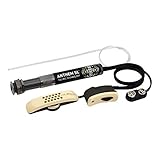 LR Baggs Anthem-SL Pickup and Mic LR Baggs Anthem-SL Pickup and Mic |
|
Check Latest Price |
 Fishman Neo-Buster Humbucker Pickup Fishman Neo-Buster Humbucker Pickup |
|
Check Latest Price |
 LR Baggs M1 Active Soundhole Pickup LR Baggs M1 Active Soundhole Pickup |
|
Check Latest Price |
| AMUMU SP60 Humbucker Soundhole Pickup |
|
Check Latest Price |
1. Fishman Neo D: the best acoustic guitar pickup for live shows overall
Fishman Neo D Single Coil Magnetic Soundhole Pickup,PRONEOD01
Passive magnetic soundhole single coil
Neodymium magnet, 4.2 oz
No battery required
Drill-free install
Pros
- Retains the natural character of the instrument
- No battery so nothing dies mid-set
- No guitar modification at all
- Cork pads protect the finish
- Strongest review volume on this list
Cons
- Single coil can pick up hum from poorly balanced power
- Fixed cable can snag on a gig strap
- Passive output needs a preamp for stage volume
Passive magnetic single-coil soundhole pickup with a neodymium magnet, no battery required, and an install that takes about as long as clipping the end off a set of strings. The Fishman Neo D has been in continuous production since 2004, and the 4.2 average across more than a thousand ratings tells you what that tenure buys you: not perfection, but a very low surprise rate.
What it actually sounds like on stage is the guitar. There is no piezo quack, no thin nasal edge that EQ has to hide, and no preamp colouring the signal before it reaches the desk. Reviewers consistently describe the string-to-string balance as the standout, which is what tells a sound engineer they can ride the fader without constantly re-solving the mix.
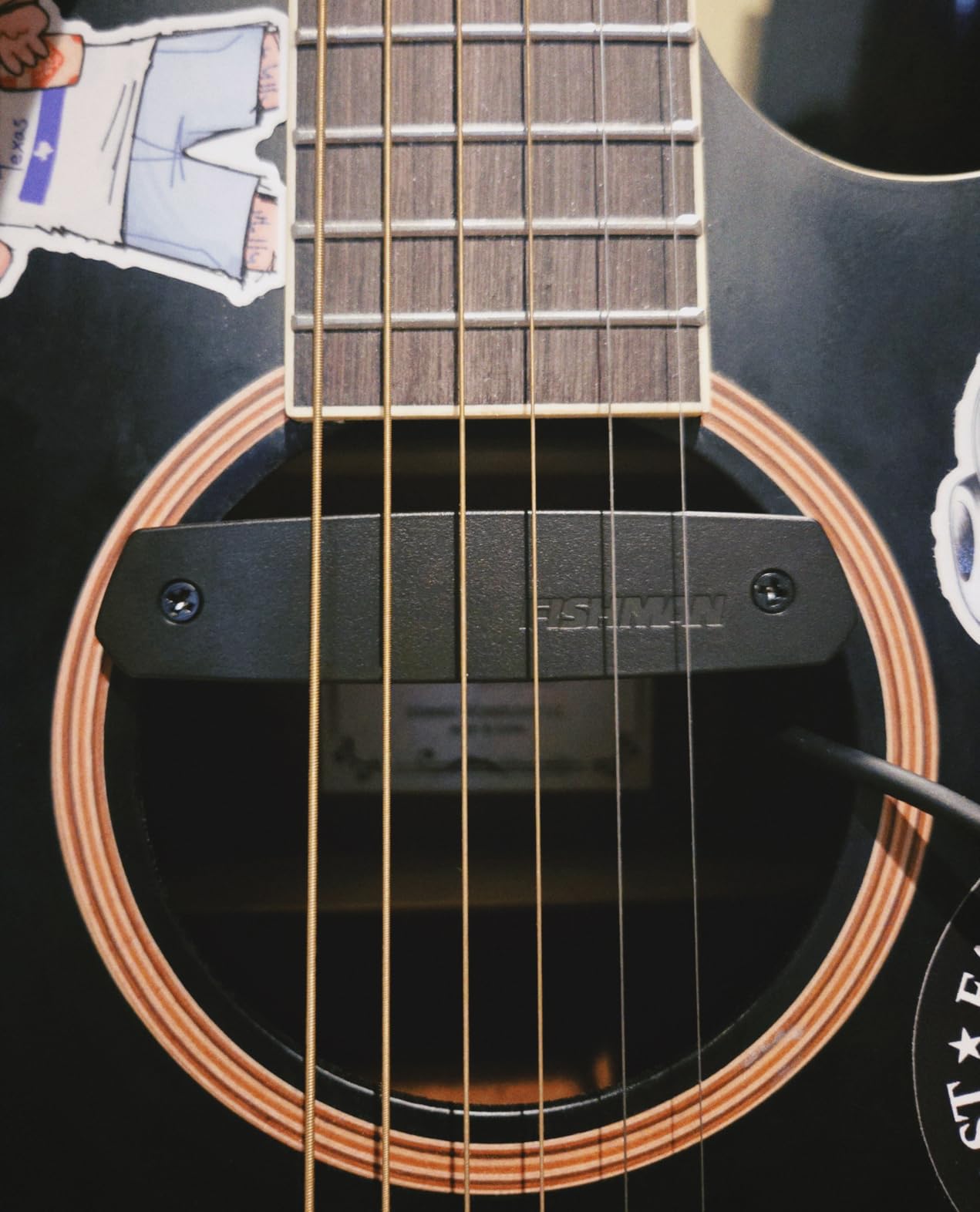
On stage it behaves because it is a magnetic coil, not a transducer glued to the bridge. A passive magnetic signal has very little high-frequency content to feed back, which is why this class of pickup handles a loud band far more gracefully than a cheap under-saddle element does. The passive output is genuinely low, so plan on a DI with gain or a preamp pedal in the chain from the first rehearsal.
The Neodymium magnet is the reason the output holds up despite being passive. It reads the steel strings the same way an electric guitar pickup does, which is why it needs steel strings to work at all.
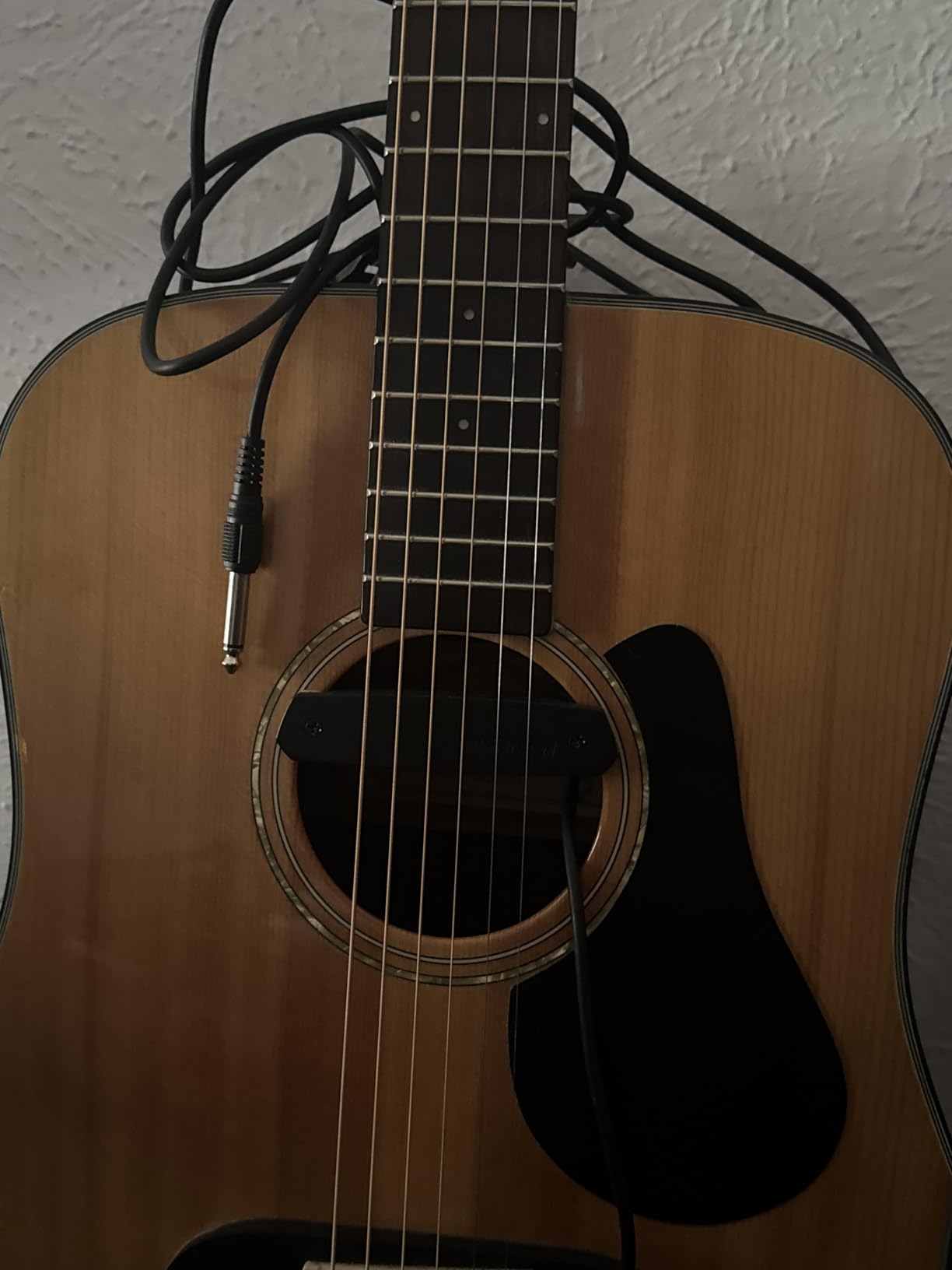
Where the Neo D holds up in a live setting
It is the safest first upgrade for a player who giggles in bars, churches, and small festival stages and wants a signal that survives a soundcheck without fuss. Battery-free operation means there is one fewer thing to forget in a bag full of cables. The cork pads on the clamp surfaces are a small detail that matters more than it sounds, because cheaper units scratch the finish of a guitar you care about.
Direct to PA or into a small acoustic amp with a gain stage both work, which makes it flexible when the venue hands you a backline you did not choose.
Where the Neo D will frustrate you
It is a single coil, so fluorescent lighting, dimmer racks, and unbalanced venue power can all show up as hum. That is a solvable problem for an engineer with a notch filter, and a recurring annoyance for everyone else.
The attached cable is permanently fixed, which is a real annoyance when you are using a strap and moving across a stage. And if your guitar is a small-body or parlour model with a narrow soundhole, the fit can be tight. Measure before you order.
2. AMUMU SP30 Woody: the budget pick for a first stage pickup
AMUMU SP30 Woody Magnetic Soundhole Pickup with Rare Earth Neodymium Magnet for Steel String Acoustic Guitars – Single Coil, Passive, Battery-Free, Clear & Balanced Acoustic Tone
Passive rare earth soundhole pickup
Beech wood housing, 3.6 oz
Fits 3.82 to 4.33 inch soundholes
Detachable cable
Pros
- Very low cost for a working passive pickup
- Install takes about 30 seconds
- Beech housing gives a warm voice
- No battery to manage
- Detachable cable avoids strap snags
Cons
- Soundhole must measure 3.82 to 4.33 inch
- Some units ship with foam pads reversed causing buzz
- Not for nylon or 3/4 size guitars
- Needs external boost for stage level
Rare earth neodymium magnet, hand-wound oxygen-free copper coil, beech wood housing, and a passive high-impedance design that needs no battery. The AMUMU SP30 exists for one reason: putting a working pickup on a guitar whose original preamp is dead, without a workshop appointment.
The beech wood housing is not a styling choice. Wood transmits mechanical vibration rather than damping it, and players report a warm, natural voice that punches above its cost. Cable options include a detachable 10 foot run, which solves the fixed-cable problem that annoys people on other units.
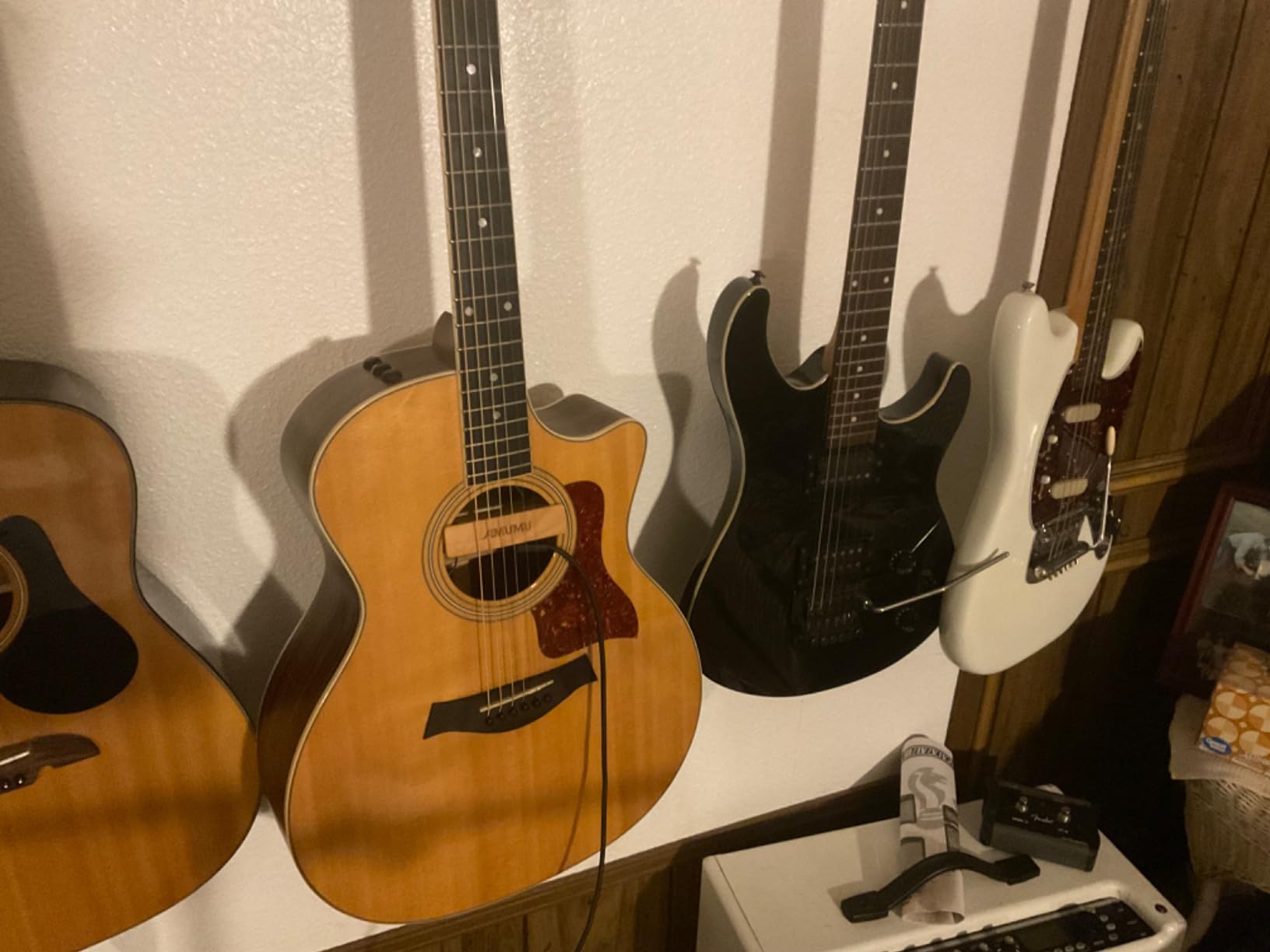
Because it is a magnetic coil, it behaves well in a rehearsal room with a loud band, and the 3.82 to 4.33 inch soundhole range covers most steel-string dreadnoughts, orchestras, and auditors. Like the Fishman Neo D, it produces a low passive output, so most players run a boost pedal or a preamp in front of an acoustic amplifier.
The 4.1 average reflects that this is a functional tool rather than a boutique one, and reviewers treat it accordingly: a gig-saver, a backup, or a first electric upgrade.
Where the SP30 holds up in a live setting
It is genuinely useful for a player who needs an acoustic-electric signal tonight, in a hurry, without spending real money or modifying a guitar. Installation is tool-free and takes about 30 seconds, so you can move it between instruments at a gig or swap it in when an instrument is being serviced.
Reviewers also use it as a permanent backup unit in a case, which is a reasonable way to think about something at this level.
Where the SP30 will frustrate you
Measure your soundhole before buying. The fit range is narrower than several competitors, and a mismatch means the unit will not sit properly. It is steel-string only, so nylon players can rule it out entirely.
Some units arrive with the thick and thin foam pads fitted in the wrong order, which produces string buzz at higher fret capos. It is a two-minute fix, but it is a fix. Passive level also means it will not drive a small amp on its own without help.
3. Seymour Duncan Woody HC: the pick for warm, hum-free tone
Seymour Duncan Woody Hc Hum Canceling – Walnut – Acoustic Guitar Pickup
Passive humbucker soundhole pickup
Double potted walnut cover, 9.8 oz
Includes 14 ft cable
Feeds amp or PA directly
Pros
- Warm rich tone for strumming and fingerstyle
- Humbucker design rejects 60 cycle hum
- Quick-mount fit in the soundhole
- 14 ft studio cable in the box
- Storage pouch included
Cons
- Output lower than many competing units
- High strings can run louder than the low
- Bulkier body than slim soundhole units
- Cable is permanently attached
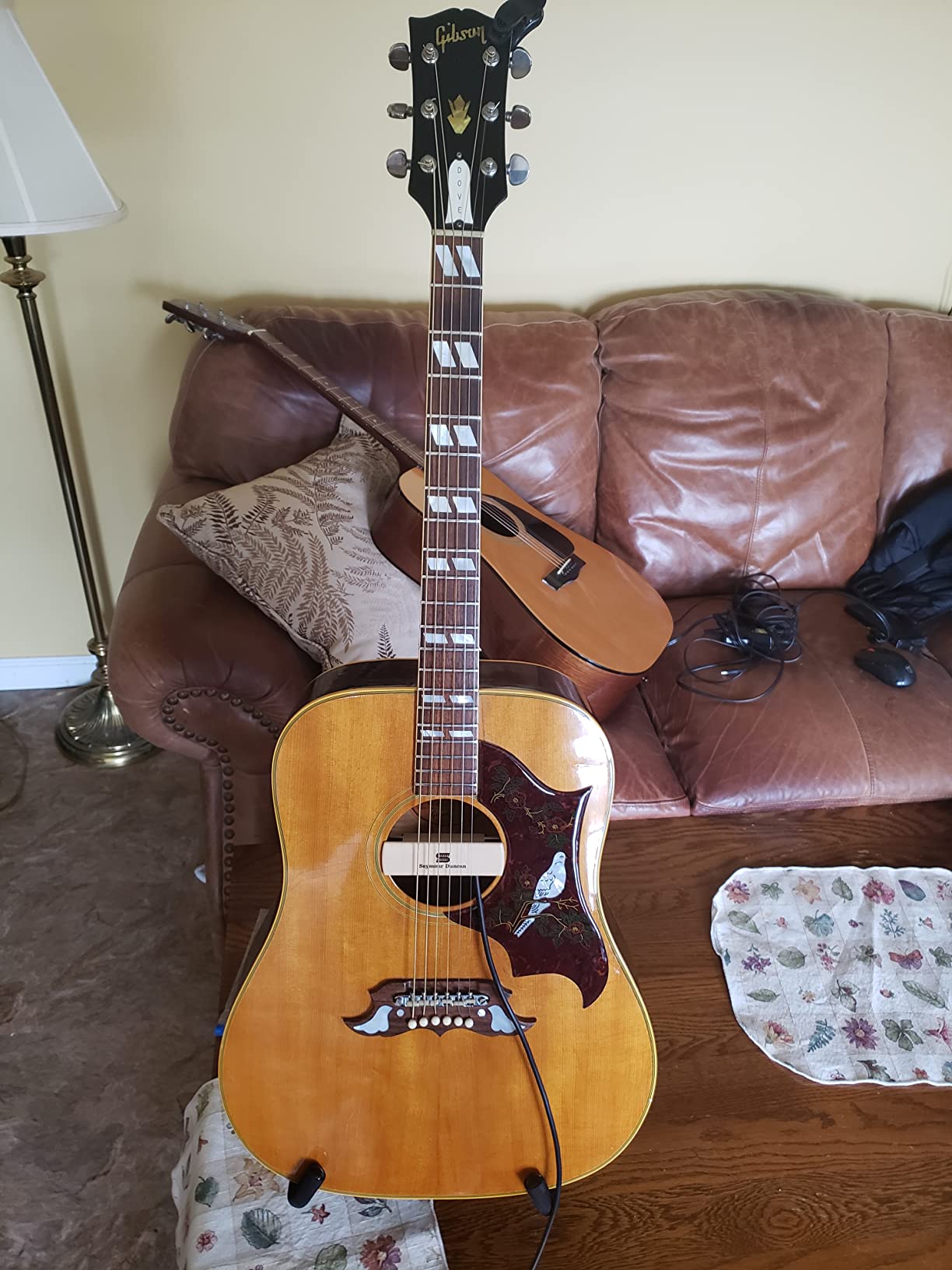
A doubly potted humbucker in a walnut housing, with moderate output and no battery. The Seymour Duncan Woody HC is the reference point in this list for one specific reason: it is the only unit here that combines a warm acoustic voice with real hum rejection, and it does it passively.
Two coils wired in hum-cancelling opposition is an electric guitar technique, and it matters here because poorly grounded venue power is one of the most common complaints in acoustic pickup threads. Players running shared power in small clubs will notice the difference immediately. The walnut cover adds mass to the top, which is often described as contributing to the warmth.
The included 14 foot cable is unusually long for a soundhole pickup, and it feeds an amplifier, a DI, a console, or a PA directly. For live use that means one box in the case instead of two. The 4.4 average sits higher than most of the passive units here, and reviewers consistently describe the tone as rich and clear rather than thin.
It also works for delicate fingerstyle, which is unusual for a humbucker. The moderate output means most players add a boost pedal with a small amplifier, and reviewers more often solve it with EQ than by rejecting the unit.
Where the Woody HC holds up in a live setting
It is the pick for shared-power venues, older buildings, and anywhere hum would be a problem. Direct-to-console use is its strongest configuration, because the moderate output level suits a mixing desk channel better than a small practice amplifier.
The 14 foot cable reaches from a backline position to a stage box without an extension, which removes a failure point from the rig.
Where the Woody HC will frustrate you
String balance can run uneven, with the high strings louder than the low, and that is an EQ problem rather than a defect. The output is modest, so a boost pedal is close to mandatory in a loud band context.
At 9.8 ounces it is the heaviest unit in this roundup, and the body is bulky enough to struggle in a narrow soundhole. The cable is fixed, so the same strap snag applies as with the Fishman Neo D.
4. Seymour Duncan Woody Single Coil: the pick for fingerstyle and bright strumming
Seymour Duncan Woody Single Coil – Maple – Acoustic Guitar Pickup
Passive single-coil soundhole pickup
Maple housing, 3.2 oz
Includes 14 ft low capacitance cable
Hand built in the USA
Pros
- Crisp bright chime that cuts through a mix
- Slides in and out instantly
- Wood housing feels durable
- Substantial cable plus drawstring bag
- Hand built in Santa Barbara California
Cons
- Low passive output needs a preamp or PA feed
- Can buzz into a high-gain interface at close range
- Will not fit small parlour soundholes
- No onboard volume or tone
The single-coil counterpart to the Woody HC, with a maple housing, a 3.2 ounce weight, and a voice that sits at the opposite end of the spectrum. Where the humbucker is warm and round, the Seymour Duncan Woody Single Coil is bright, chimey, and articulate.
That brightness is the whole point for fingerstyle players. Individual notes separate cleanly, which matters when a band is playing underneath and the audience needs to hear the picking pattern rather than a wash. Reviewers with long ownership histories describe it as a dependable gig pickup that slides in and out in seconds, with a substantial cable and a drawstring bag in the box.
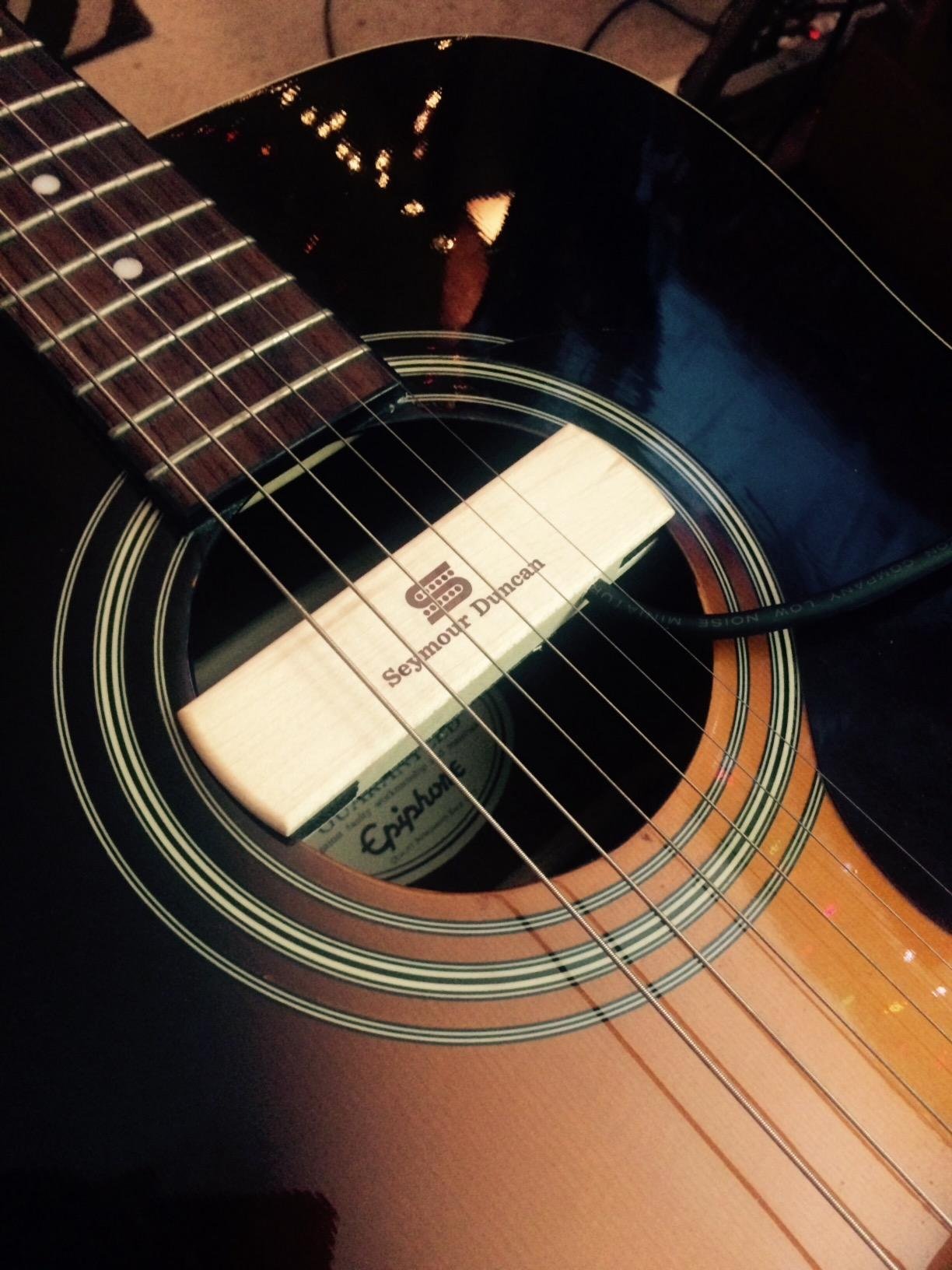
At 3.2 ounces it is the lightest unit here, and the low-capacitance 14 foot cable is designed for long runs to an amplifier, DI, console, or PA. That is a real stage benefit because standard unbalanced cable loses high frequencies over distance, and this one is built not to.
Hand built in Santa Barbara, California, with a wooden housing that feels considerably more durable than the plastic bodies used by cheaper units.
Where the Woody Single Coil holds up in a live setting
Fingerstyle sets, ukulele-adjacent lineups playing steel strings, and any arrangement where note definition matters more than warmth. It cuts through a mix better than the darker units in this list, which is often the deciding factor in a band rehearsal.
Its low weight makes it comfortable on a guitar you play for three-hour sets, and the instant slide-in mount means it can live in the case and go into whichever instrument is in rotation.
Where the Woody Single Coil will frustrate you
Output is low. Players report needing a preamp or a PA feed with real gain, and anyone planning to run straight into a small practice amplifier will be disappointed. It can also buzz when run into a high-gain audio interface at close range, which matters if you record from the stage rather than from the board.
It will not fit smaller or parlour soundholes without modification, and there are no onboard volume or tone controls, so every tone decision happens downstream at the desk.
5. SUNYIN Wireless Pickup: the pick for stage movement without a cable
Wireless Acoustic Guitar Pickup Rechargeable Magnetic And Microphone Soundhole Pickup For Acoustic Guitar Build-In Volume Control(Black)
Wireless magnetic coil plus built-in microphone
100 ft transmission, onboard EQ
Rechargeable lithium battery
Wired and wireless modes
Pros
- No cable run across the stage
- Mic plus coil gives a fuller tone
- Onboard EQ phase and dual volume
- One charge covers a full gig
- Drill-free install
Cons
- Receiver and pickup both need recharging
- EQ needs a small screwdriver mid-set
- Not for ukulele or classical guitar
- One report of receiver pairing failure
A rechargeable wireless system that combines a magnetic coil with a miniature microphone capsule in one soundhole unit, with a one-key phase switch, onboard EQ, and a stated 100 foot transmission range. The SUNYIN is the only wireless option in this roundup, and it is worth understanding exactly what that buys you before choosing it.
What it buys is movement. If you play in a pit, walk the crowd, or work a small stage where a cable run is a trip hazard, wireless removes a genuine problem rather than an imagined one. The hybrid coil-plus-mic design also produces a fuller sound than a bare magnetic coil, and users report it getting close to a premium acoustic at church and open mic gigs.

Battery life is stated at about 8 hours in wireless mode and over 100 hours in wired mode, so a single charge covers a normal set. You get both modes, with a 3.5 mm output jack and cable included, which means you can fall back to a wired run mid-show if the band is only a few metres from the amp.
The fit range of 80 to 120 mm soundholes is wide, which covers most steel-string acoustics. The phase switch is a genuinely useful live control rather than a gimmick: flipping polarity against the mix can cancel a feedback loop faster than reaching for the EQ.
Where the SUNYIN wireless holds up in a live setting
Church worship teams, open mic nights, and function bands where the player moves. The onboard mic volume, mic tone, output level, and EQ controls mean the player can shape the signal from the guitar rather than waiting for an engineer between songs.
It fits a wide range of soundhole sizes and needs no drilling, so it suits a player with several instruments or one guitar they refuse to modify.
Where the SUNYIN wireless will frustrate you
Two batteries means two things to charge, and forgetting the receiver unit is a real failure mode on tour. Adjusting the onboard EQ requires a small Phillips screwdriver, which is awkward mid-set and is a design choice that will irritate some players.
It is not for ukulele or classical guitars. There is also one documented report of the receiver losing pairing after under four months with no responsive support, which is a single report rather than a pattern, but on a wireless system reliability is the entire proposition. Very loud stages with wedge monitors are still the hardest environment for any 2.4 GHz system.
6. Gretsch Deltoluxe: the pick for parlor guitars and vintage tone
Gretsch® Deltoluxe Acoustic Soundhole Pickup
Single-coil soundhole pickup with Alnico 5
End-pin jack included, 1 year warranty
6.4 oz, chrome and tortoise
No battery
Pros
- Warm vintage tone for blues and folk
- Small enough for parlour guitars
- Owners report no feedback at stage volume
- Retro styling suits vintage instruments
- No battery to manage
Cons
- Single coil produces background hum unless grounded
- No onboard volume or tone controls
- End-pin jack requires drilling the end block
- Some find the voice too electric
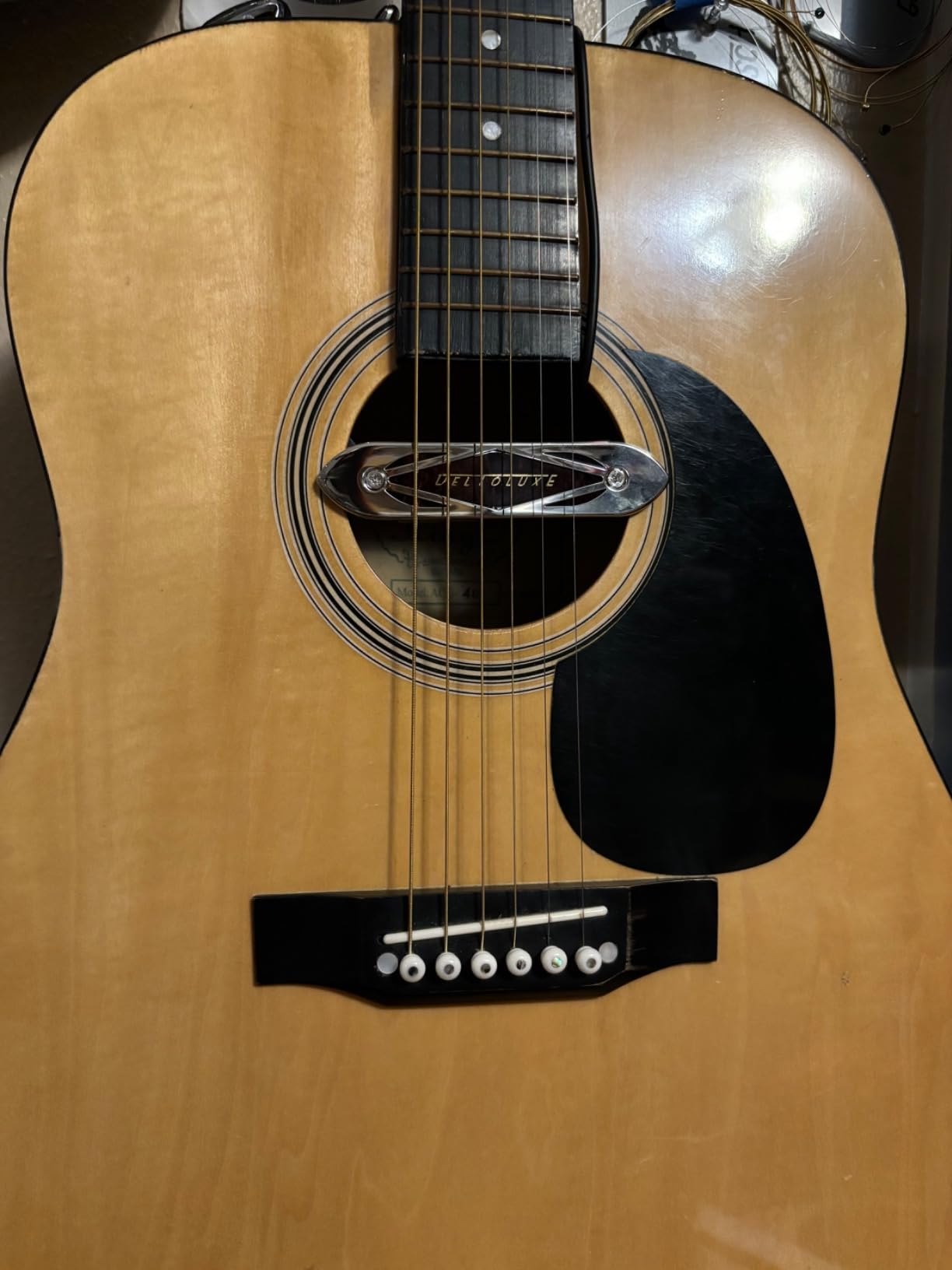
Alnico 5 magnets in a chrome and tortoise housing, weighing 6.4 ounces, and small enough to fit the soundhole of a parlour guitar such as the Gretsch Jim Dandy. The Deltoluxe is the odd one out in this roundup in a good way: it is designed around a specific instrument size rather than a standard dreadnought.
Owners with vintage and blues tastes rate the tone warmly, describing a 1950s and 1960s character that suits fingerstyle arrangements. Because it is a magnetic single coil, it behaves well enough at stage volume that owners report playing it without the feedback drama that normally accompanies cheaper units, provided the preamp gain is set sensibly.
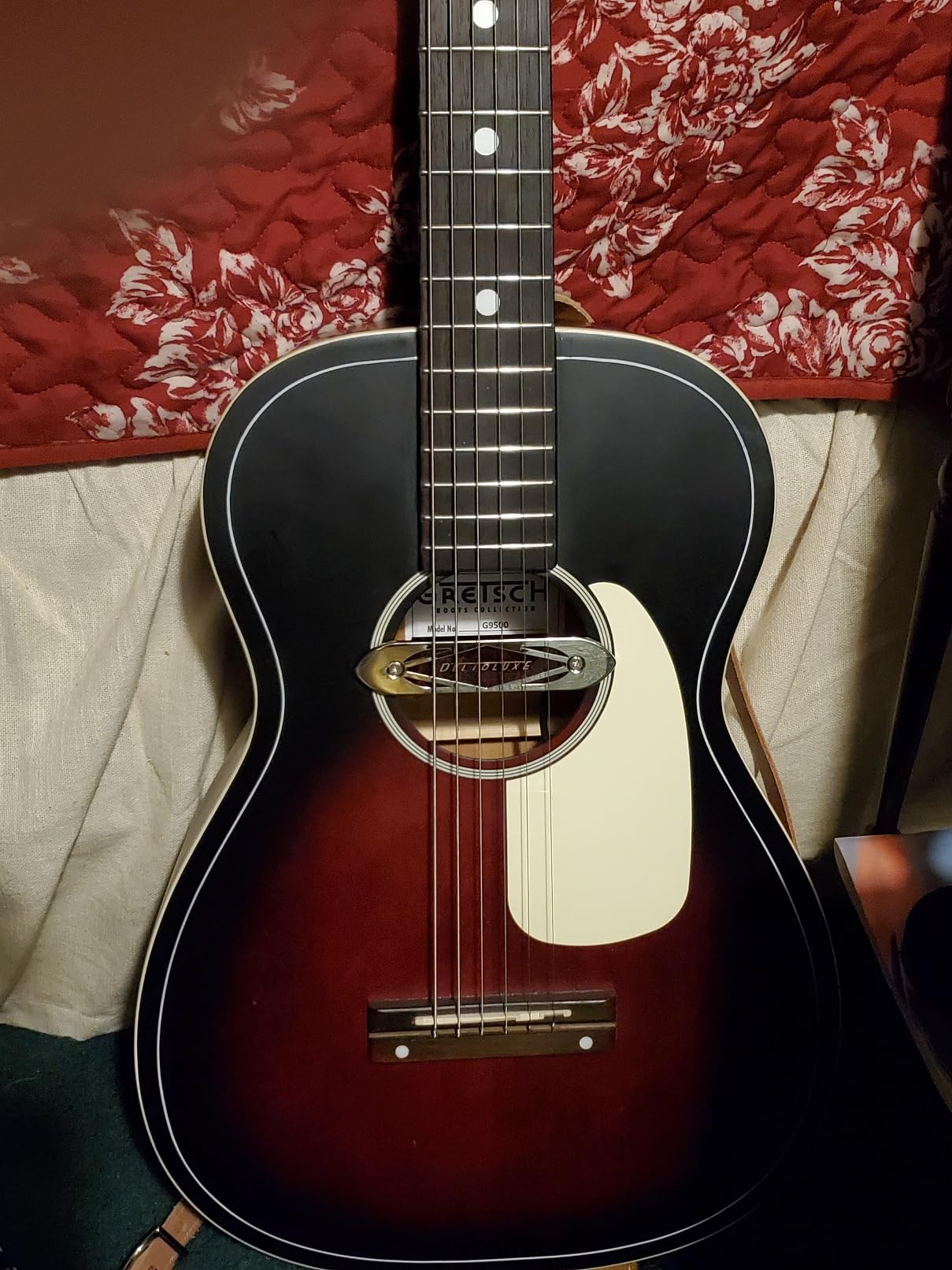
The electrical specification is a DC resistance of 14.6k and inductance of 8.0 Henries, which places it firmly in passive territory with no battery to manage. An end-pin jack is included in the box, and mounting is easy in most acoustics.
The 4.5 average is high, though it is built on a much smaller base of ratings than the units at the top of this list, so treat the number as encouraging rather than settled.
Where the Deltoluxe holds up in a live setting
Small-body, parlour, and vintage instruments where a full-size soundhole pickup will not physically fit. The compact footprint is the entire reason to buy this one, and nothing else in this list is designed around that constraint.
It suits blues and folk fingerstyle players who want a warmer, older voice than a modern single coil delivers, and it feeds a passive acoustic amplifier without any battery management.
Where the Deltoluxe will frustrate you
It is a single coil, so some background hum is expected. The common fix is having a luthier ground the unit to the strings, which is a workshop job on top of a workshop job if you also need the end-pin jack.
There are no onboard volume or tone controls, and the end-pin jack installation requires drilling the end block, which is a permanent modification on a vintage instrument. Some listeners also find the sound more electric than a faithful acoustic reproduction, so it is not the choice for someone who wants a mic-like signal.
7. LR Baggs Anthem-SL: the pick for the most natural amplified tone
L.R. Baggs Anthem-SL Acoustic Guitar Pickup and Microphone
Hybrid mic and pickup system with TRUMIC
Endpin preamp and soundhole remote
Preset crossover between sources
1 year limited warranty
Pros
- Most natural sounding unit in this roundup
- High feedback resistance in loud rooms
- Two-source blend is dial in and forget
- Compact endpin preamp adds little mass
- Reliable battery life in regular gigging
Cons
- Supplied adhesive pads and tape hold poorly
- Installation is not beginner friendly
- Some want more output without a boost
- Crossover trims some frequencies
A hybrid system that pairs a miniature condenser microphone with an internal pickup element, feeding a pre-contoured endpin preamp with a preset crossover. The LR Baggs Anthem-SL is the reference standard for natural amplified acoustic tone, and working players describe it as the closest thing to the unplugged sound that survives a PA.
How the split works matters. The TRUMIC capsule carries the majority of the guitar’s frequency range and brings naturalness and air, while the element handles the lowest frequencies and brings the body and the punch. Levels between the two are preset, so a sound engineer sets the channel once and it stays set. The soundhole remote gives the player volume and mic trim without reaching for the guitar.
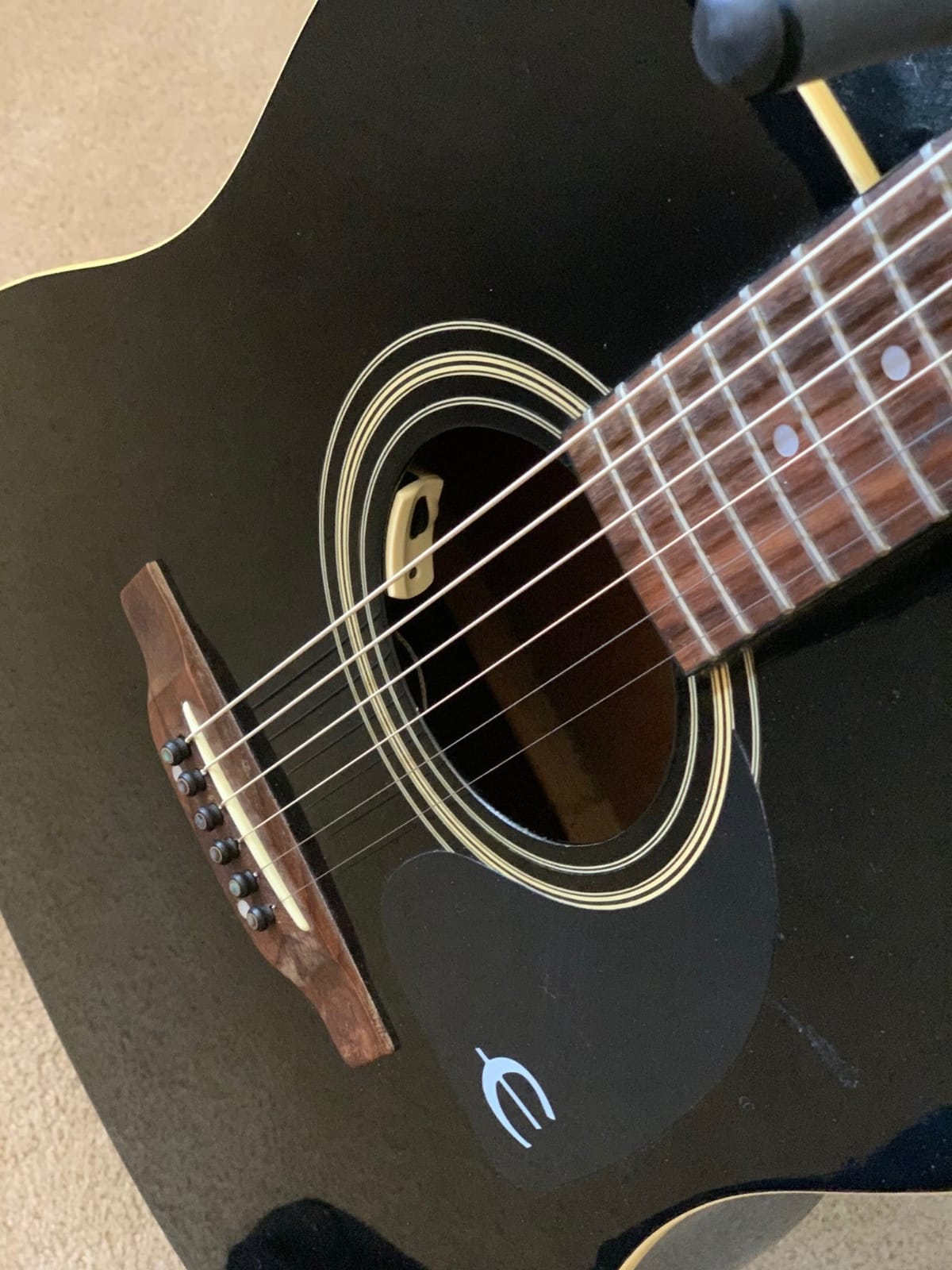
Feedback resistance is the headline for live use. Owners report it working in loud band and worship settings, which is exactly where the cheaper hybrid and piezo systems struggle. A 4.6 average across 250 ratings is high, and reviewers tend to qualify praise with installation notes rather than sound complaints.
The endpin preamp is the compact version, adding far less mass to the top of the guitar than the full Anthem system, which some players find changes the instrument’s response noticeably.
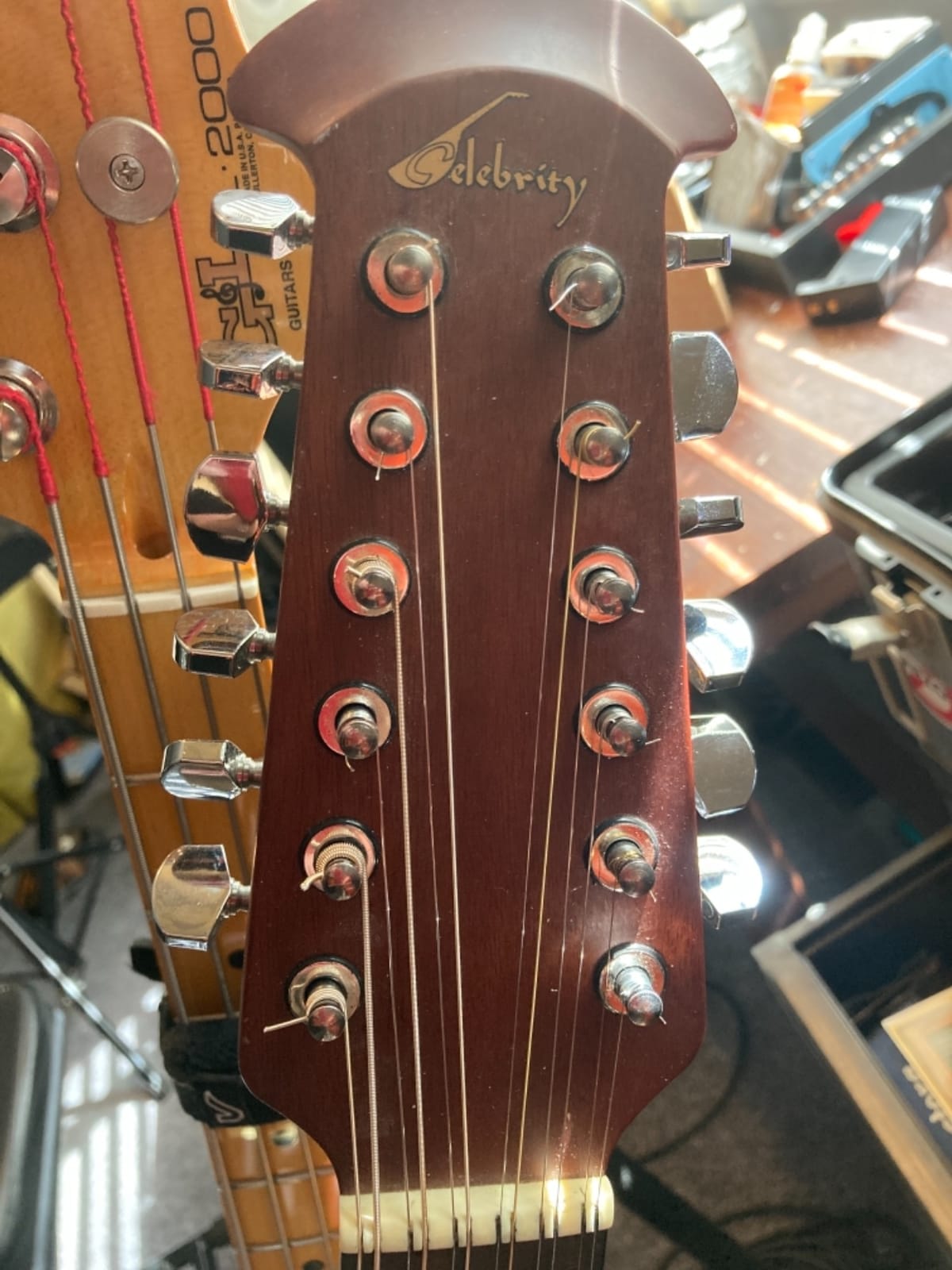
Where the Anthem-SL holds up in a live setting
It is the pick for a singer-songwriter who wants the audience to hear their guitar rather than an amplified version of it, and for worship and function band players who need a signal that stays clean when the room is full.
Battery life in regular gigging use is reported as reliable, and the noise-cancelling microphone technology removes the honky internal-mic tone that usually gives cheap systems away.
Where the Anthem-SL will frustrate you
Installation is the real hurdle. This is not a beginner-friendly job, particularly where bridge bracing sits in the way, and it is the reason several reviews are qualified rather than glowing.
The supplied adhesive pads and tape are widely reported as weak, so owners end up buying commercial adhesive. A few users also want more output than the system gives and add an external boost. The crossover trims some frequencies by design, so it is engineered to sound good rather than to be spectrally faithful.
8. Fishman Neo-Buster: the pick for hum and feedback control
Fishman Neo-Buster Humbucker Soundhole Acoustic Pickup & Feedback Buster
Humbucking soundhole pickup with feedback buster
Slim metal profile, 8.1 oz
Reduces 60 cycle hum for stage use
No battery
Pros
- Humbucker design keeps the signal quiet on noisy stages
- Feedback buster built into the same unit
- Slim profile fits a standard soundhole
- No battery to manage
Cons
- Limited written reviews on this listing
- Only three stated features
- No onboard controls
- Tone detail is not documented
A humbucking soundhole pickup with an integrated feedback buster, in a slim 4.72 by 1.97 by 0.28 inch profile. The Fishman Neo-Buster is the shortest entry in this list because it does one specific thing, and that thing is signal cleanliness on a noisy stage.
Combining a humbucker with a feedback buster in a single unit is unusual. Most feedback control happens at the DI or the channel strip, where the engineer works around it. Having it at the source means the reduction is present regardless of who is at the desk, which for a touring player with a rotating sound tech is worth knowing.
Fishman sells it as model PRONEOFB2, and the humbucking configuration is the reason for the 60-cycle hum reduction on badly grounded venue power. The 4.3 average comes with a strong five-star skew.
Where the Neo-Buster holds up in a live setting
Badly wired clubs, old buildings, and shared power circuits, where hum is the complaint that stops a player using a pickup at all. The low-profile body fits a standard soundhole without modification, and the feedback buster buys headroom before the amp and mic.
It is also a sensible companion for anyone playing a magnetic single coil who keeps fighting noise in a particular venue.
Where the Neo-Buster will frustrate you
There is very little written detail available about this unit. The listing surfaces a limited number of customer reviews, so tone and output claims are thin compared with every other pick in this roundup, and I would want to hear one in a shop before committing.
There are no onboard controls, and only three stated features, which tells you the design is deliberately simple. If you want EQ at your fingertips or a mix dial, this is not it.
9. LR Baggs M1 Active: the pick for per-string balance and loud rooms
L.R. Baggs M1 Active Acoustic Guitar Magnetic Soundhole Pickup
Active magnetic soundhole pickup
Onboard volume control, adjustable pole pieces
About 1000 hours on one 3V coin cell
Strap jack or end-pin jack output
Pros
- Very low feedback in loud band and PA settings
- Pole pieces allow true per-string balance
- Onboard volume mutes between songs
- Long coin cell battery life
- Body taps come through naturally
Cons
- End-pin jack must be drilled and routed by hand
- Sensitive to knocks on the top
- Coin cell is awkward to access and replace
- Can be bright and no cable is included
An active magnetic soundhole pickup with adjustable pole pieces, an onboard volume control, and roughly 1,000 hours of battery life on a single 3V lithium coin cell. The LR Baggs M1 has been in service since 2004, and players with decades of use describe it as a workhorse.
The adjustable pole pieces are the feature experienced users rate highest. Instead of solving string-to-string imbalance with EQ, you set each pole by hand at the soundcheck, and the balance holds for the rest of the tour. That is a real time saver for a player moving between venues, where the mix changes every night and nobody has time to solve a balance twice.
Forum discussion around working players repeatedly compares the M1A against other LR Baggs models when asking which acoustic pickup is best overall, which tells you how widely it is deployed. Owners also note that body percussion and knocks on the top come through naturally.
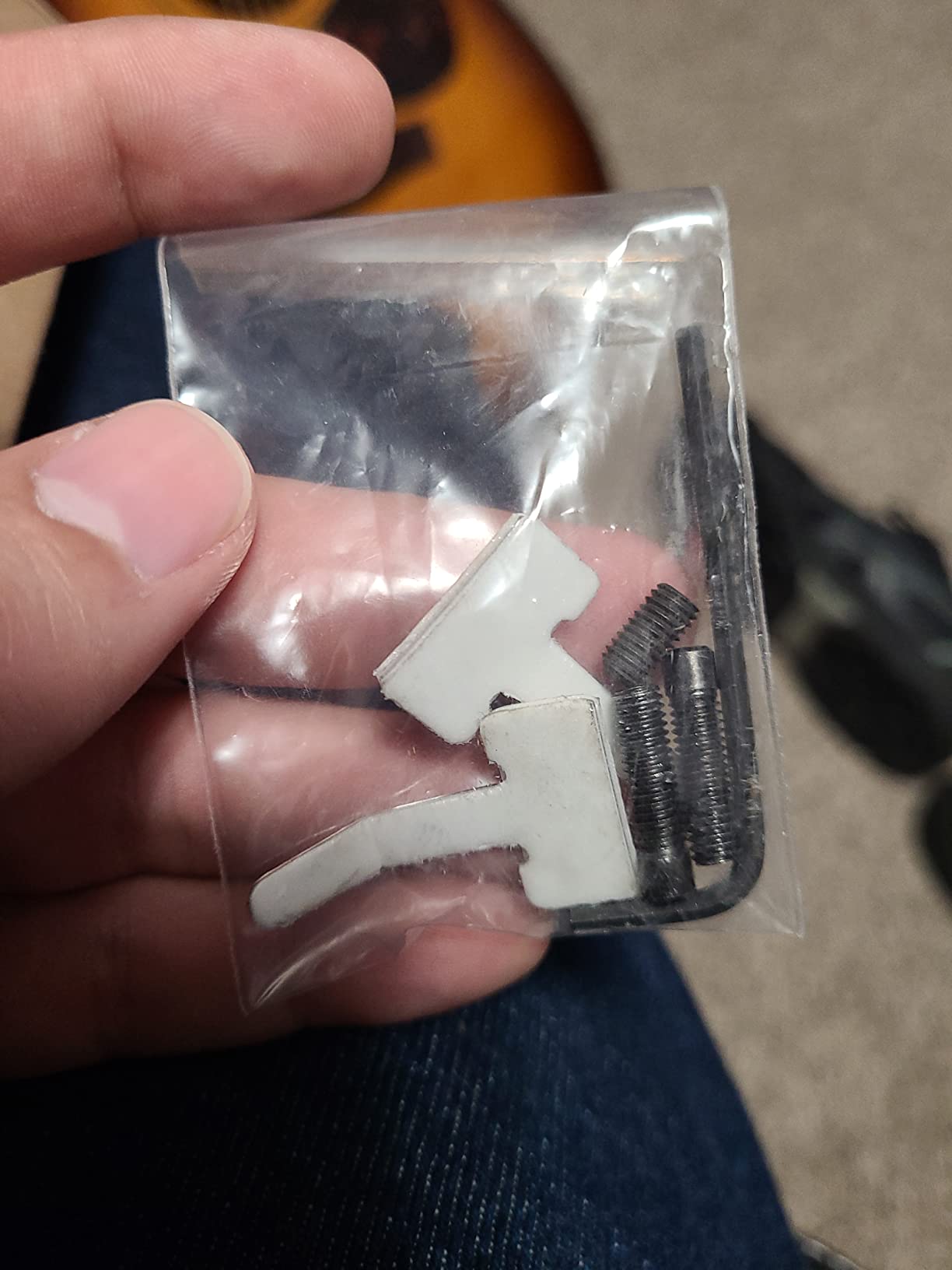
Being active means the pickup delivers a hotter signal, which is why it is described as highly feedback-resistant in loud band and PA settings. Feedback is the number one real-world pain point in acoustic pickup threads, and an active design gives the preamp a stronger signal to work with before gain is applied.
The onboard volume control is more useful than it sounds, letting you mute quickly between songs without asking the engineer. The output works through a strap jack or an end-pin jack, and the cable is removable.
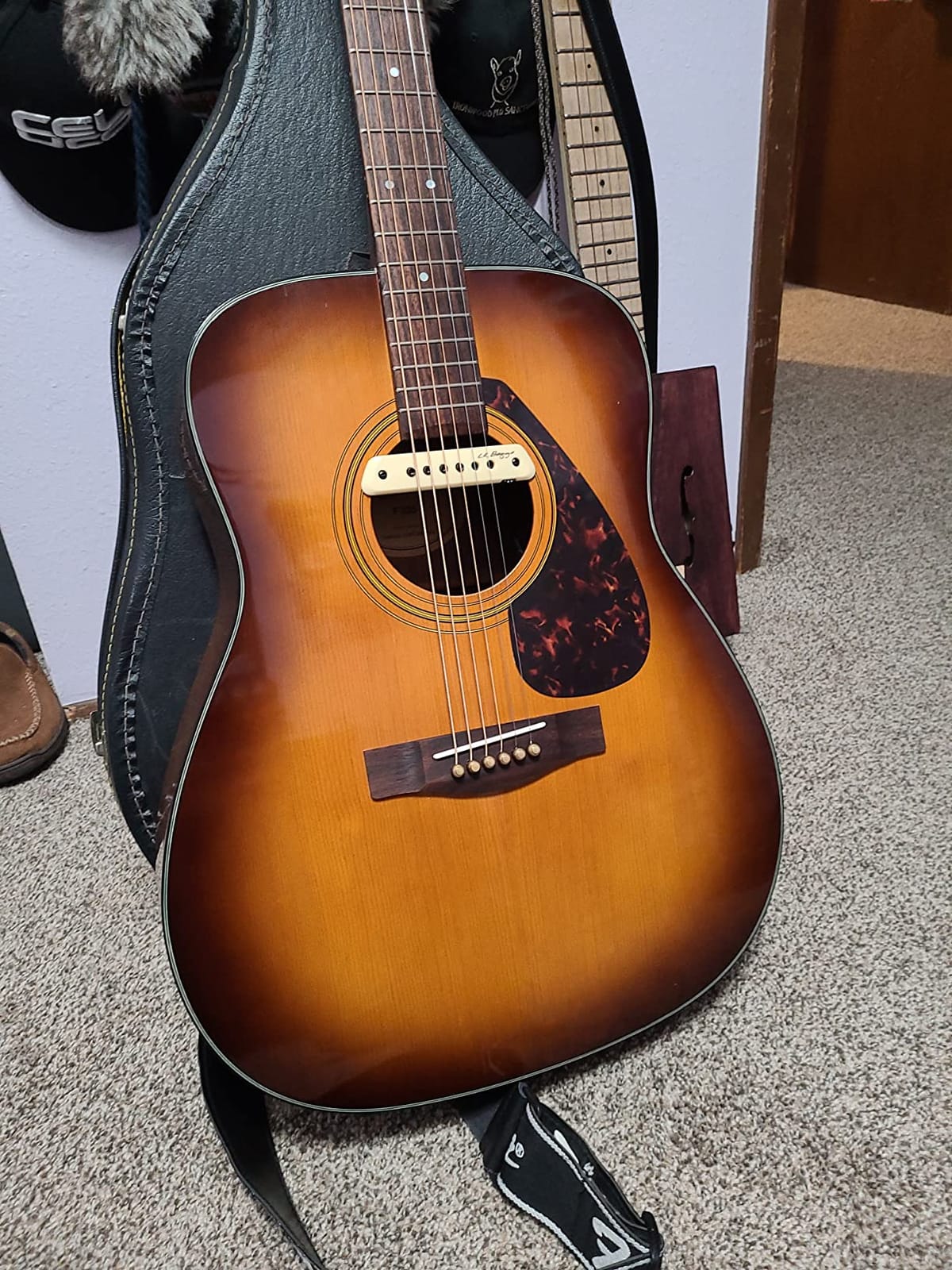
Where the M1 Active holds up in a live setting
Loud band rehearsal rooms, small club stages with wedge monitors, and worship sets where a passive signal would need a lot of help reaching a backline. The active output and low feedback behaviour are the reasons it is trusted in those rooms.
The coin cell lasts roughly 1,000 hours, so on typical touring frequency a battery change is a twice-a-year job rather than a per-gig panic.
Where the M1 Active will frustrate you
The end-pin jack has to be drilled and routed by hand, and the instructions are widely criticised as unclear. If you are not going to pay a luthier, budget an hour and watch a proper video first.
It is very sensitive to body noise, so a knock on the top or a strap button tapping becomes audible in the mix. It can also be bright on some guitars, where a few users add EQ or a DI to tame it. The coin cell is awkward to reach, and no external cable is supplied.
10. AMUMU SP60: the best value humbucker with onboard volume
AMUMU SP60 Acoustic Guitar Pickup Humbucker Magnetic Passive Soundhole Pickup for Acoustic guitar Black
Passive ceramic humbucker soundhole pickup
Built-in volume wheel, adjustable poles
Fits 3.82 to 5.1 inch soundholes
Steel-string only
Pros
- Humbucker clarity with no hum and no battery
- Volume wheel is unusual at this level
- Output rivals more expensive active units
- Black housing disappears into the soundhole
- Widest soundhole fit range here
Cons
- Passive output needs an amp with a preamp
- Fingerstyle takes time to adjust to
- End-pin jack requires drilling
- Can sound muddy until poles are adjusted
A passive ceramic humbucker with a built-in volume control wheel, adjustable pole pieces, and a fit range from 3.82 to 5.1 inch soundholes. The AMUMU SP60 covers more guitar shapes than anything else in this roundup, and at 4.6 from 187 ratings it punches well above where it sits in the market.
Owners are routinely surprised by how much tone and output they get for the money, and several compare it favourably to the LR Baggs M1, which is a more expensive unit. The dual-coil design means no hum and no battery, and the built-in volume wheel is close to unheard of at this level. It is the one pickup in this list that gives you a control at the guitar without costing you a battery.
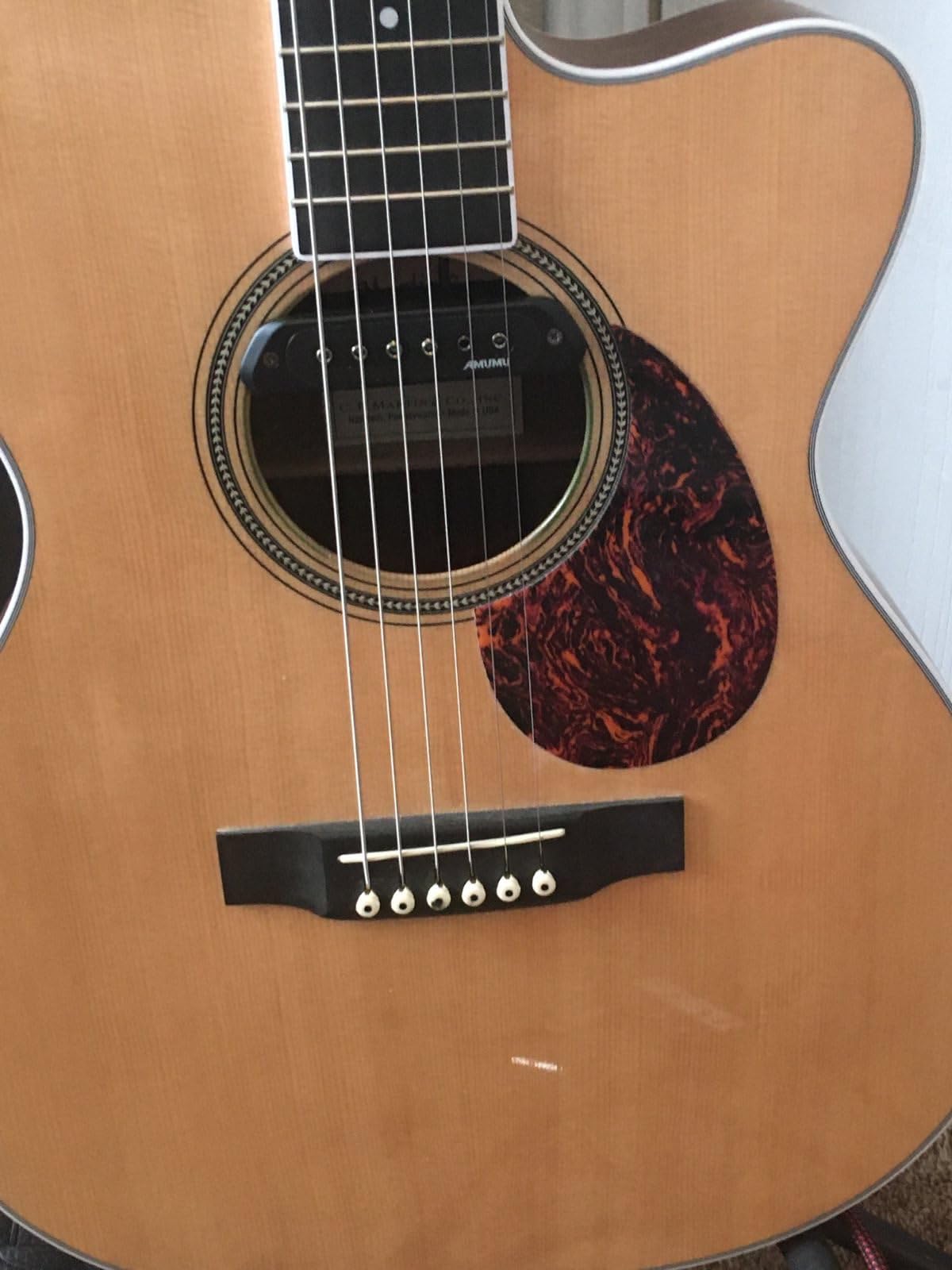
The wider fit range means it works on small-body steel strings as well as large ones, which removes the measuring guesswork that trips people up with narrower units. The black housing is designed to disappear into the soundhole, which matters on a stage under stage lighting.
It is steel-string only. Nylon players should skip this one entirely.
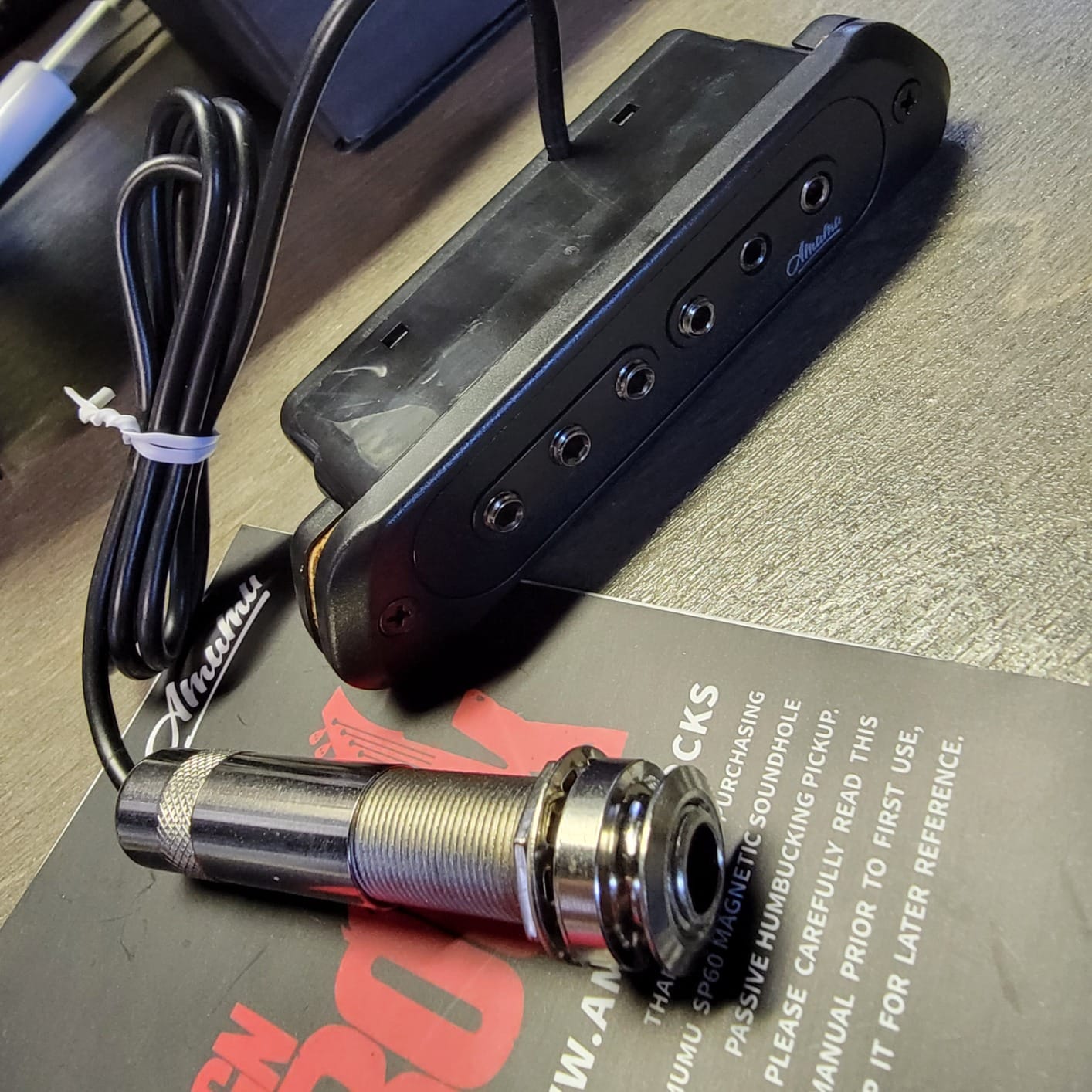
Where the SP60 holds up in a live setting
Any player who wants hum-free clarity and a volume control at the guitar without a battery, a preamp, or a premium price. The passive humbucker is quiet in a way single coils are not, and the output level is reported as rivaling active systems once a preamp is in the chain.
It suits players switching between instruments of different sizes in one set, given the wide fit range and the simple clamp mount.
Where the SP60 will frustrate you
Passive output still means an amplifier with a preamp, otherwise the level is low. Fingerstyle players report taking longer to adjust to a magnetic pickup than to a piezo, which is a real consideration for classical-influenced players on steel strings.
Sound can be muddy until the pole pieces are adjusted, so do not judge it in the first five minutes. The end-pin jack requires drilling and careful hole sizing, and enlarging a hole in a good guitar is a one-way door.
How to Choose an Acoustic Guitar Pickup for Live Work
Pickup choice is mostly a chain decision rather than a spec decision. The pickup sets the character of your signal, but the DI box, the preamp, and the channel strip at front of house determine whether that signal survives contact with a real room.
The four pickup types and who each one suits
Soundhole magnetic pickups work by reading the steel strings, exactly as an electric guitar pickup does. They need no drilling, they feed back less than piezo systems, and they are the default answer for live steel-string work. That is why seven of the ten products here are soundhole magnets.
Under-saddle and bridge-plate piezos read the physical vibration of the saddle or bridge plate. They can capture a very full sound and they suit players who want an electric-acoustic edge, but the common complaint is a thin, nasal quack that requires EQ to tame, and they have more high-frequency content to feed back. Our ten products here lean deliberately toward the soundhole end of the market.
Contact transducers glue to the bridge plate and read the wood. They are simple and very feedback-resistant, and they will not capture the top the way a soundhole unit does.
Hybrid systems add a small microphone capsule to one of the above, which is how the LR Baggs Anthem-SL and the SUNYIN reach a more natural tone. They are the most natural-sounding option and generally the most involved to install.
Non-invasive versus invasive installs, and resale value
Non-invasive means the pickup hangs on the soundhole rim with foam pads and a clamp, and the cable exits through the existing end-pin jack or a removable strap jack. Nothing is drilled, nothing is glued, and the guitar can be played unplugged with no trace of the modification.
Invasive means drilling the end block for an end-pin jack, routing a channel for the wire, or removing the saddle for an under-saddle element. It is a permanent change. Luthiers consistently treat drilling as the single thing most likely to reduce a guitar’s resale value, and the reluctance to do it is a genuine blocker that shows up repeatedly in player discussions.
My advice: buy a non-invasive unit first. If the guitar has no end-pin jack at all, a strap jack adapter solves the output problem without a workshop.
Passive versus active, and what happens when the battery dies
A passive pickup has no battery. It cannot fail because of power, and it is why several products here carry thousands of ratings from gigging players. The cost is low output, which means a preamp, a DI with gain, or an amplifier with a gain stage is required.
An active pickup uses a battery to run a built-in preamp, which produces a hotter, more feedback-resistant signal and often onboard volume and tone controls. The cost is a single point of failure. Two of the ten products here are battery-powered, and one offers a wired fallback mode that works for over 100 hours on a charge.
For touring, the practical answer is redundancy rather than a decision. Carry a passive unit in the case as a backup, and treat the battery unit as the primary when the stage is loud.
Steel string versus nylon and classical
Magnetic pickups read the steel in a string. On a nylon-string or classical guitar there is no steel core to read, so a magnetic unit produces nothing. Several products in this roundup state this limitation explicitly.
Classical and flamenco players need a piezo, contact, or hybrid system instead, and they should expect a different installation because nylon guitars often have different bridge and bracing construction. If you play both steel and nylon, budget for a dedicated classical system rather than hoping one unit covers both.
Bracing style also changes the response. An X-braced steel-string top and a fan-braced classical top vibrate differently under the same transducer, so a pickup tuned by ear on one guitar may need an EQ adjustment on another.
The stage signal chain: pickup, DI box, preamp, PA
A working live chain runs pickup to DI box to preamp to channel, and it works best when each stage does one job. The DI box converts the unbalanced instrument-level signal to a balanced line-level feed and provides the electrical isolation that stops venue hum. A passive, low-output magnetic pickup goes through a DI with substantial gain, and a DI with an onboard preamp lets you set level with a knob instead of a screwdriver.
The preamp stage adds gain and tone shaping. An acoustic amplifier channel, a small acoustic pedal, or a DI with a built-in preamp all serve this role. Keeping gain staging tight, with gain applied early and modestly rather than at the amp input, is the single most effective feedback prevention available.
Forum players ask repeatedly which preamp to pair with a pickup, and the honest answer is that the pairing matters far less than the gain structure. Pick a preamp with a bright tone control to tame piezo honk, and set levels so nothing clips before the desk.
A feedback-prevention checklist at stage volume
Feedback is the number one complaint raised about acoustic pickups on stage, and the fix is rarely a better pickup. It is almost always gain staging and monitor position.
Set your gain as low as you can while still reaching the level you need. More gain at the preamp means the amplifier has to work less hard, and a quieter preamp means a quieter input, which means fewer loops. Ask front of house for the EQ you need on your channel, and request a notch filter around the frequency where your note is feeding. Cut the midrange quack before you cut the top end, and only add high-frequency boost if the signal is genuinely dull.
Point the guitar away from the backline speaker as much as the stage allows. A 90 degree rotation at the monitor can end a loop that no amount of EQ fixed. Ask the monitor engineer to keep your channel out of the wedge entirely and take it through the mains instead, since removing your own voice from the monitor is the most reliable feedback fix there is.
Keep cables short and use the low capacitance cable that ships with a good pickup. And if a soundhole cover is fitted, check it: covers are used to manage feedback, and a poorly fitted one can make the problem worse rather than better.
Frequently Asked Questions
What is the most natural sounding acoustic guitar pickup?
The LR Baggs Anthem-SL is the most natural sounding unit in this roundup because it blends a miniature condenser microphone with an internal pickup element and splits the frequency range between them. The mic carries the majority of the range for air and realism while the element handles the lowest frequencies for body and punch. If you want the simplest route to a natural sound, the Fishman Neo D is the alternative: it is a single magnetic coil with no preamp colouring the signal at all.
Which is the best pickup for an acoustic guitar?
For live shows, the Fishman Neo D is our best overall acoustic guitar pickup because it is passive, needs no drilling, and has the largest body of owner ratings of anything on this list. The best natural tone comes from the LR Baggs Anthem-SL, the best hum rejection and onboard volume at a low cost comes from the AMUMU SP60, and players in noisy venues should look at the Fishman Neo-Buster.
What is the best soundhole pickup for acoustic guitars?
The Fishman Neo D is our pick for steel-string acoustics because it is passive, mounts in seconds, and its neodymium magnet delivers a usable level from a passive design. The Seymour Duncan Woody HC is the hum-cancelling alternative for venues with poor grounding, the Seymour Duncan Woody Single Coil is the brightest option for fingerstyle, and the AMUMU SP60 covers the widest range of soundhole sizes.
What is the best acoustic guitar pickup that doesn’t require drilling?
Nine of the ten pickups here need no drilling for the pickup itself, since they all clamp to the soundhole rim. The Fishman Neo D, the Seymour Duncan Woody HC, the AMUMU SP30, and the SUNYIN wireless unit are the strongest choices, all of them passive or battery-light and reversible in seconds. Only the Gretsch Deltoluxe and the LR Baggs M1 come with an end-pin jack requirement that means drilling the end block.
Do acoustic guitar sound hole covers work?
They can, but they are not a substitute for good gain staging. A soundhole cover reduces the amount of sound the body radiates, which can reduce how much of your own signal feeds back through the room. A poorly fitted cover can rattle against the bracing or damp the top’s response, so any cover needs to be fitted carefully and checked at soundcheck rather than added on the night of a gig.
Will a magnetic acoustic guitar pickup work on a nylon string guitar?
No. Magnetic soundhole pickups read the steel core in a string, and nylon strings have none, so the output is effectively silent. Nylon and classical players need a piezo, contact, or hybrid system instead, and should expect a different installation because classical bridge and fan bracing construction differs from a steel-string acoustic.
Final Verdict
The best acoustic guitar pickups for live shows are the soundhole systems, and the Fishman Neo D is the one to buy first. It is passive, it needs no drilling and no battery, it holds its tone through a loud room, and more than a thousand owners have already proven it on stages that are far less forgiving than yours.
If the budget stretches further, the LR Baggs Anthem-SL buys the most natural amplified tone available and handles feedback better than anything else here, at the cost of a difficult install. If it does not, the AMUMU SP60 gives you hum rejection and an onboard volume wheel for very little, and the AMUMU SP30 covers a first electric upgrade almost for nothing.
Whichever one you choose, install it non-invasively, carry a passive backup, and set your gain as low as the job allows. Feedback is a mixing problem far more often than it is a pickup problem, and the same advice holds in 2026 as it did the first time we said it.