

Short answer: 0.88mm to 1.2mm is the working range for metal rhythm guitar, and anything from a 1.0mm up to 1.5mm works if you play hard and downpick. If you want the short version of the best guitar picks for metal rhythm playing, start at 1.0mm and move up from there. The pick is the only object physically between your hand and the strings, so the thickness you choose decides whether palm-muted chugs stay tight or start flapping and buzzing.
We have run these picks through riffing sessions at our own practice room, swapping them mid-song at the same volume and gain settings. We logged how they behaved on chugga-chugga eighths, syncopated chop stabs, gallops and fast downpicked patterns. Nine picks made the final lineup, and the same handful kept coming back regardless of sub-style.
Here is the gauge map first, because that one number solves most of the guesswork:
0.73mm – too floppy for palm-muted metal; bends on impact and loses low end
0.88mm – the floor for metal rhythm, and a good entry point for beginners
1.0mm – the sweet spot for chugga-chugga eighths and syncopated stabs
1.14mm – heavier chugs, gallop riffs, and faster downpicking
1.38mm to 1.5mm – hard hitters, drop tunings, and players who bury the pick in the string
Above 1.5mm – almost never needed for rhythm; it eats speed and tone
Pick thickness is subjective, and every metal forum we read makes that point repeatedly. That is why we have not handed you one winner and called it done. The nine picks below are ordered by how useful they are across the widest range of metal rhythm work, and each one has a clear job.
Table of Contents
Top 3 Picks for Metal Rhythm Playing (October 2026)
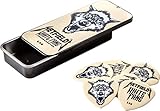
Dunlop Hetfield White Fang…
- Blended bevel for gliding
- Wide-angle sharp tip
- Low-profile raised grip


All Nine Picks at a Glance in 2026
| Product | Specs | Action |
|---|---|---|
| Jim Dunlop Hetfield’s White Fang 1.14mm |
|
Check Latest Price |
| Fender Premium Celluloid 351 Heavy |
|
Check Latest Price |
| Ernie Ball Everlast 1.0mm Purple |
|
Check Latest Price |
 Dunlop Petrucci Ultex Jazz III 1.5mm Dunlop Petrucci Ultex Jazz III 1.5mm |
|
Check Latest Price |
 Ernie Ball Prodigy Mini 1.5mm Ernie Ball Prodigy Mini 1.5mm |
|
Check Latest Price |
 Dan’s Precision Pick 1.5mm Dan’s Precision Pick 1.5mm |
|
Check Latest Price |
 D’Andrea Snarling Dog Brain 1.0mm D’Andrea Snarling Dog Brain 1.0mm |
|
Check Latest Price |
 D’Addario Duralin Duragrip-X-Hvy 1.50mm D’Addario Duralin Duragrip-X-Hvy 1.50mm |
|
Check Latest Price |
 Dunlop Max-Grip Jazz III Stiffo 1.38mm Dunlop Max-Grip Jazz III Stiffo 1.38mm |
|
Check Latest Price |
One note on the table above: gauge and material do more of the work here than brand does. Three different brands on this list use Delrin, and two use nylon, and the audible difference between them matters less than whether the pick bends on impact.
1. Jim Dunlop Hetfield’s White Fang 1.14mm – Best Overall for Metal Rhythm
Jim Dunlop Hetfield’s White Fang Pick Tin 1.14MM
1.14mm gauge
Small Flow and Black Fang profile
Blended bevel
Wide-angle sharp tip
6 picks per tin
Pros
- Raised thumb-pad grip holds through fast passages
- Blended bevel glides across strings with low friction
- Sharp tip focuses attack
- Small profile gives tight control
Cons
- Printed finish scratches off quickly
- Only six picks per tin
- Tin holds little else
This is the pick we ended up reaching for first on every downpicked riff, and it has the highest rating on our list at 4.9 across 1,190 ratings. The 1.14mm gauge sits right in the middle of the useful metal range: stiff enough that it barely flexes, thin enough that fast alternate picking still feels natural.
What separates it from a generic heavy pick is the geometry. Dunlop built it by combining the shape of their Flow picks with James Hetfield’s Black Fang pick, then added a blended bevel and a wide-angle tip. That combination is why it glides across the strings during a chug pattern instead of catching and dragging.
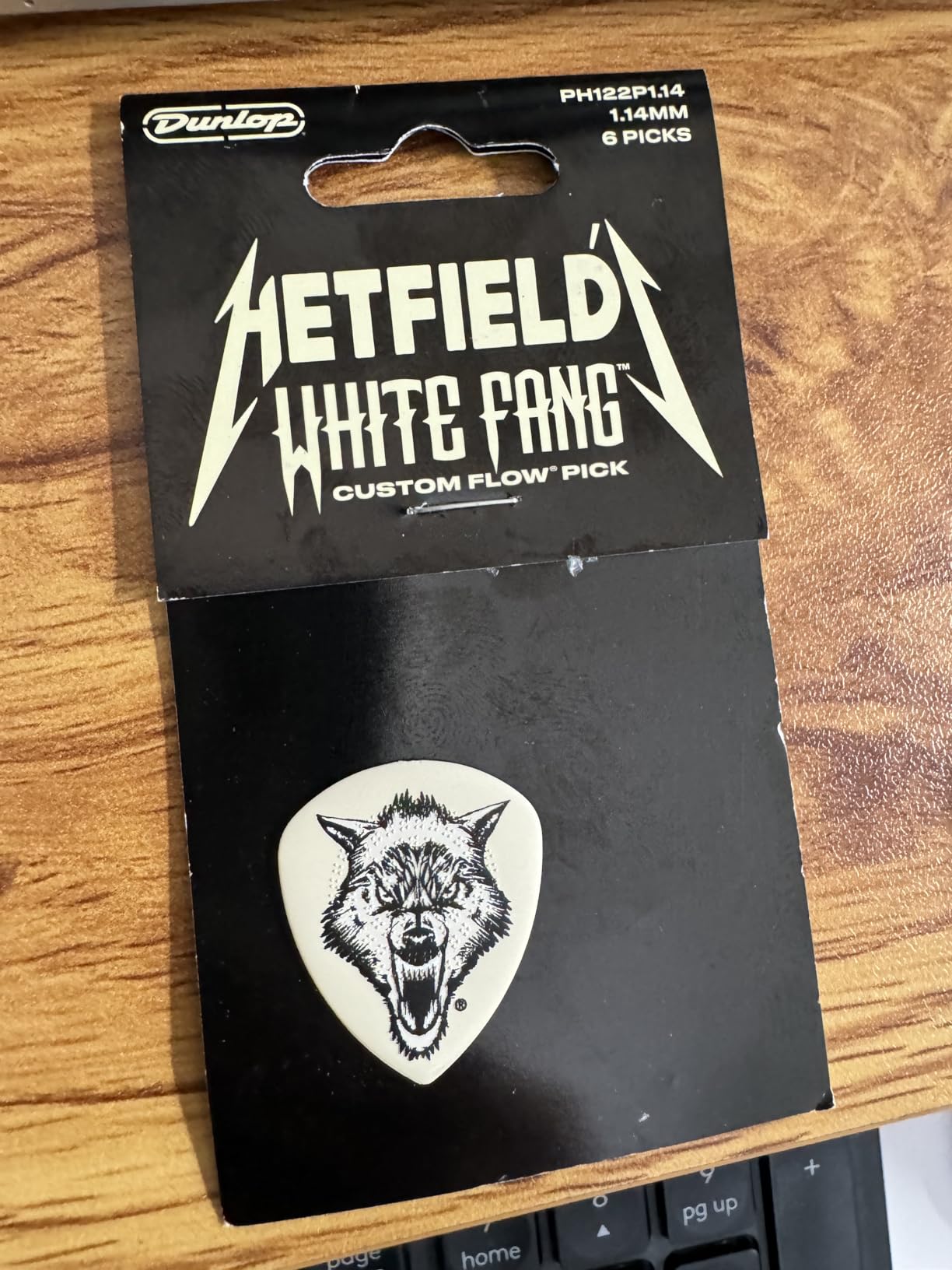
The raised thumb-pad grip is the part we did not expect to care about. Aggressive rhythm playing means a sweaty hand, and the most repeated complaint in every metal thread we read was a pick spinning out mid-song. This one stayed planted through every fast downpick run we threw at it.
Owners who switched to it from Dunlop Ultex Sharps and Black Fangs describe it as the same feel with more grip. Our own take: it is the most balanced pick here, and it does not force you to change how you pick to get a tight palm mute.
What it does well on stage
Low-profile grip and small body size mean very little wasted movement between strokes. That matters when you are playing syncopated eighths at speed and your arm is already tired.
The blend of bevel and sharp tip also gives a clean release every stroke, so fast single-note runs stay even rather than alternating between hard and soft notes. That consistency is what makes a rhythm part sit in a mix.
Where it falls short
Six picks per tin is the weak point. If you dig in as hard as the pick is designed for, a tin disappears quickly, and you will be restocking constantly.
The printed white finish also scratches and wears off with use, which is cosmetic but noticeable on a pick you will be staring at mid-song. The tin itself is minimal storage and holds little more than the picks.
2. Fender Premium Celluloid 351 Shape Heavy – Best Value
Fender Premium Celluloid Guitar Picks 351 Shape, Black Moto, Heavy, 12-Pack
Celluloid material
Heavy gauge
Traditional 351 shape
12 picks per pack
Warm balanced tone
Pros
- Rigid heavy gauge resists flex on hard chugs
- Traditional 351 shape feels familiar
- Warm round tone with clear attack
- 12 picks makes restocking simple
Cons
- Celluloid wears and rounds faster than synthetics
- Smooth face offers less grip when hands sweat
With 4,628 ratings at 4.8, this is the most heavily reviewed pick we tested, and it is the reference point most players already know. If you have been playing metal with any budget pick at all, this feels like the thing you have been approximating without owning.
The 351 shape is the widest point of contact on this list, which makes it the easiest to move to from a standard pick. Where the White Fang concentrates force into a small tip, this spreads it across a broader surface and trades a little precision for a lot of stability.
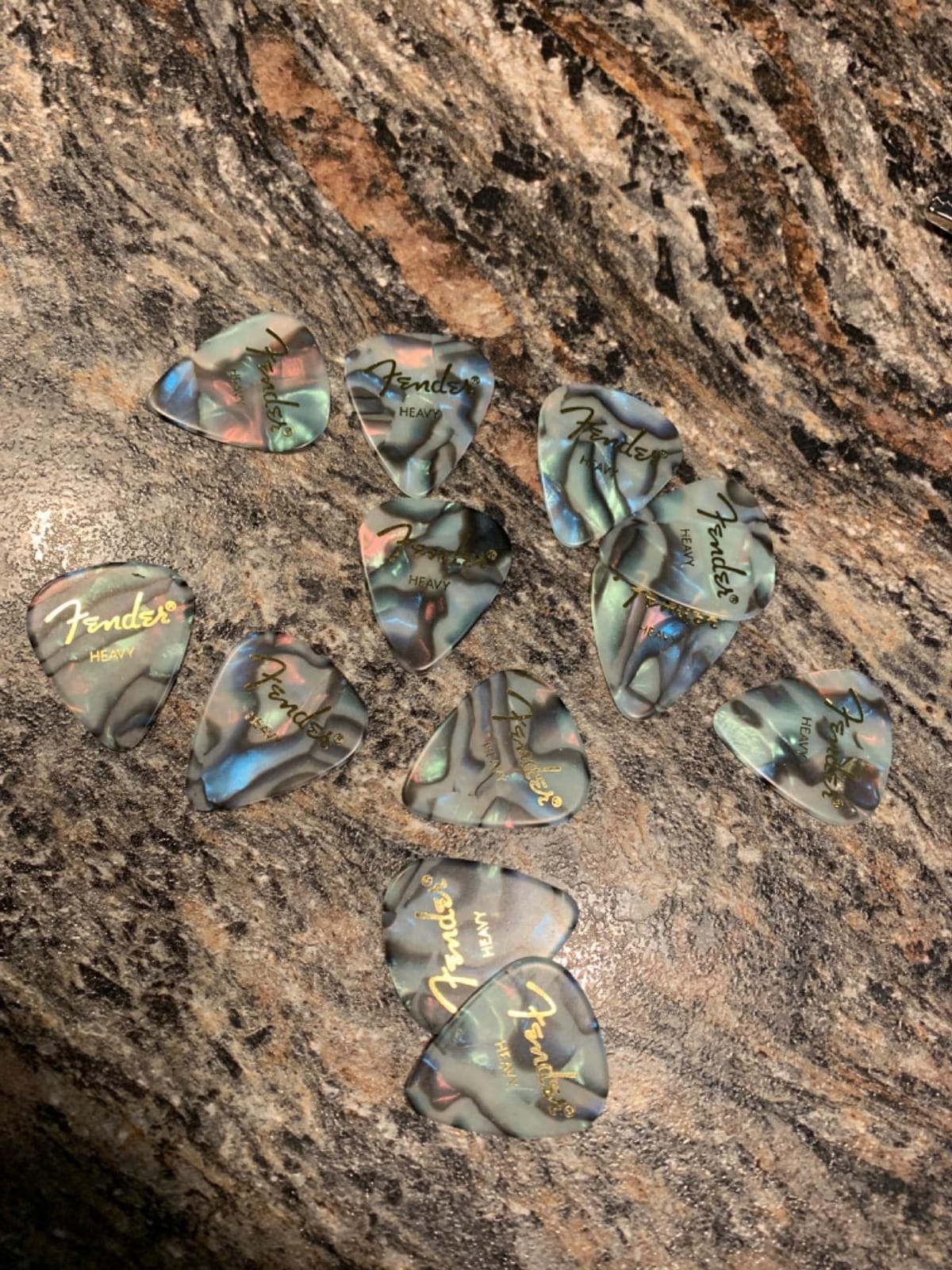
Celluloid gives a warm, round tone that most players describe as the familiar metal rhythm sound. Fender lists the sound profile as warm and balanced, and that matched what we heard on palm-muted open chords.
The heavy gauge here is rigid enough that it does not flex on hard downpicked chugs. In a two-week run through riffing, it never lost its shape, though the edges did start to dull near the end.
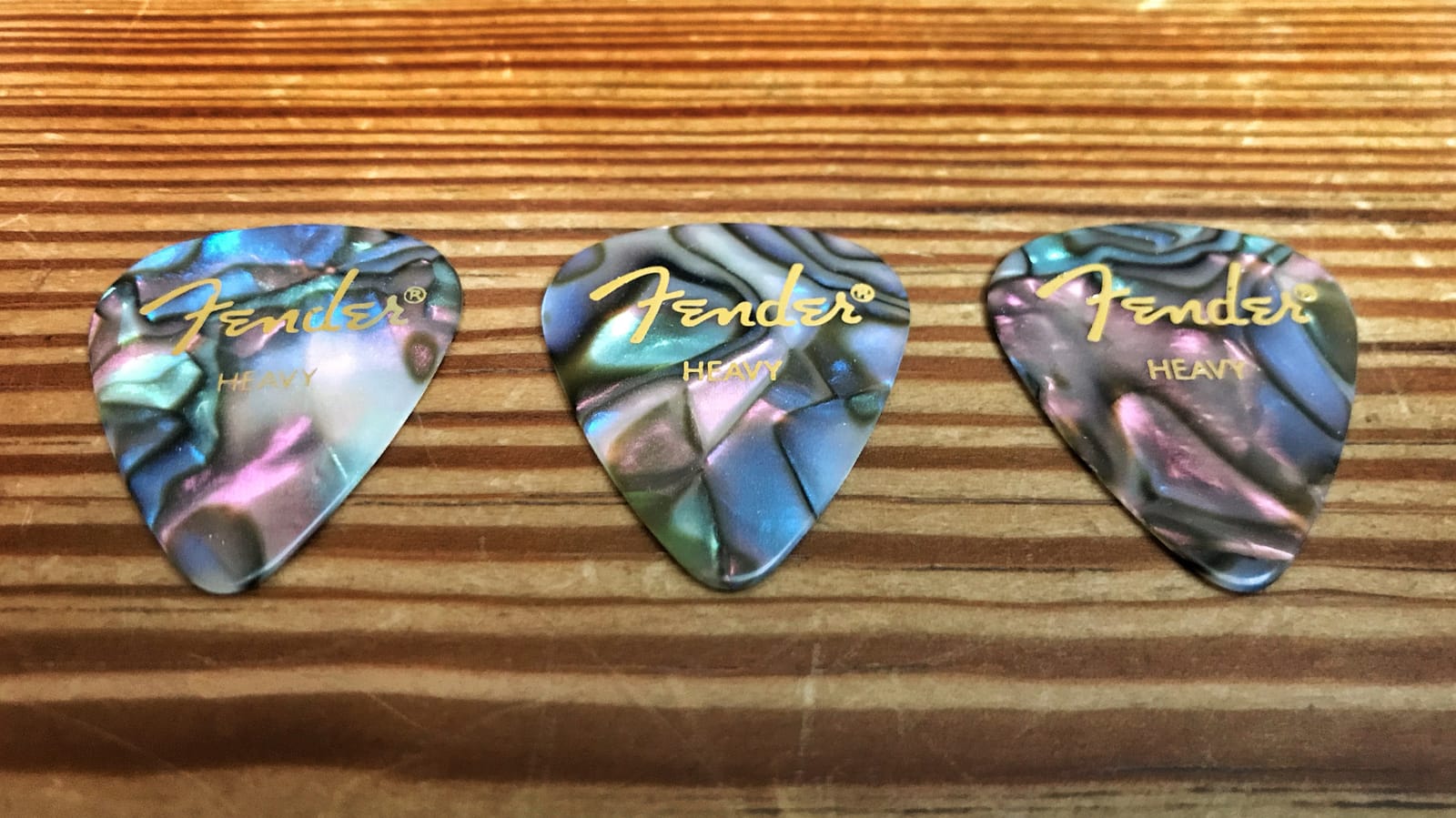
Best pick for players who want one pick for everything
If you strum chord shapes as often as you chug riffs, the 351 outline handles both without adjustment. The smaller Jazz III shapes on this list need real work from players who move between those two jobs.
It is also the easiest recommendation to give someone who has never chosen a gauge before. Nothing about the shape feels like a specialist tool, so there is almost no adjustment period.
Where the celluloid trade-offs show up
Celluloid wears faster than synthetics under heavy riffing, and the tip rounds off first. That dulls attack over time, which is exactly the failure we do not want in a pick meant for metal.
The smooth celluloid face also offers less grip than textured Delrin or nylon picks. On a hot stage or in a sweaty room, this one needs a firmer pinch than the White Fang or the Precision Pick.
3. Ernie Ball Everlast 1.0mm Purple – Best Wear Resistance for Chugga-Chugga
Ernie Ball Everlast Guitar Picks, Purple 1.0mm, 12-pack (P09193)
1.0mm gauge
Delrin material
Purple colour coding
12 picks per pack
Pros
- Delrin holds its edge far longer than celluloid
- Non-slip surface stays secure without feeling slick
- Colour coding makes gauges easy to identify
- Stiff enough to avoid flex on muted chugs
Cons
- Printed colour wears off with use
- New picks can carry a chalky coating
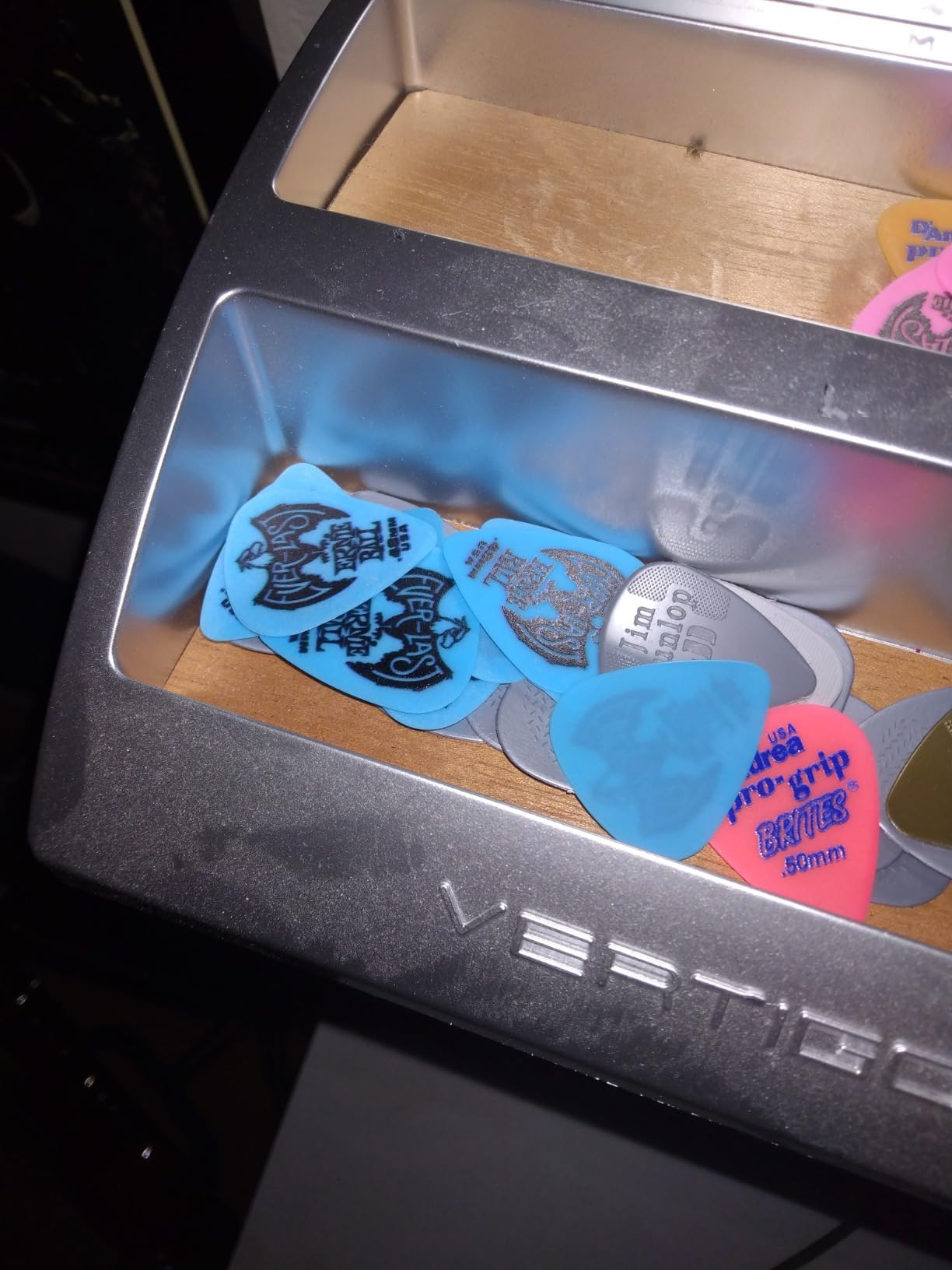
This is the most reviewed pick in the whole roundup at 4,718 ratings, and the 1.0mm Delrin build is the reason so many players never leave it. If your palm-muting keeps buzzing and you cannot work out why, the answer is usually that you are on something thinner than this.
Long-term owners describe the Delrin as effectively indestructible for players who dig in hard, and we saw no tip rounding after extended riffing. That durability is the practical headline, because picks are consumables and this one stretches a pack out further.
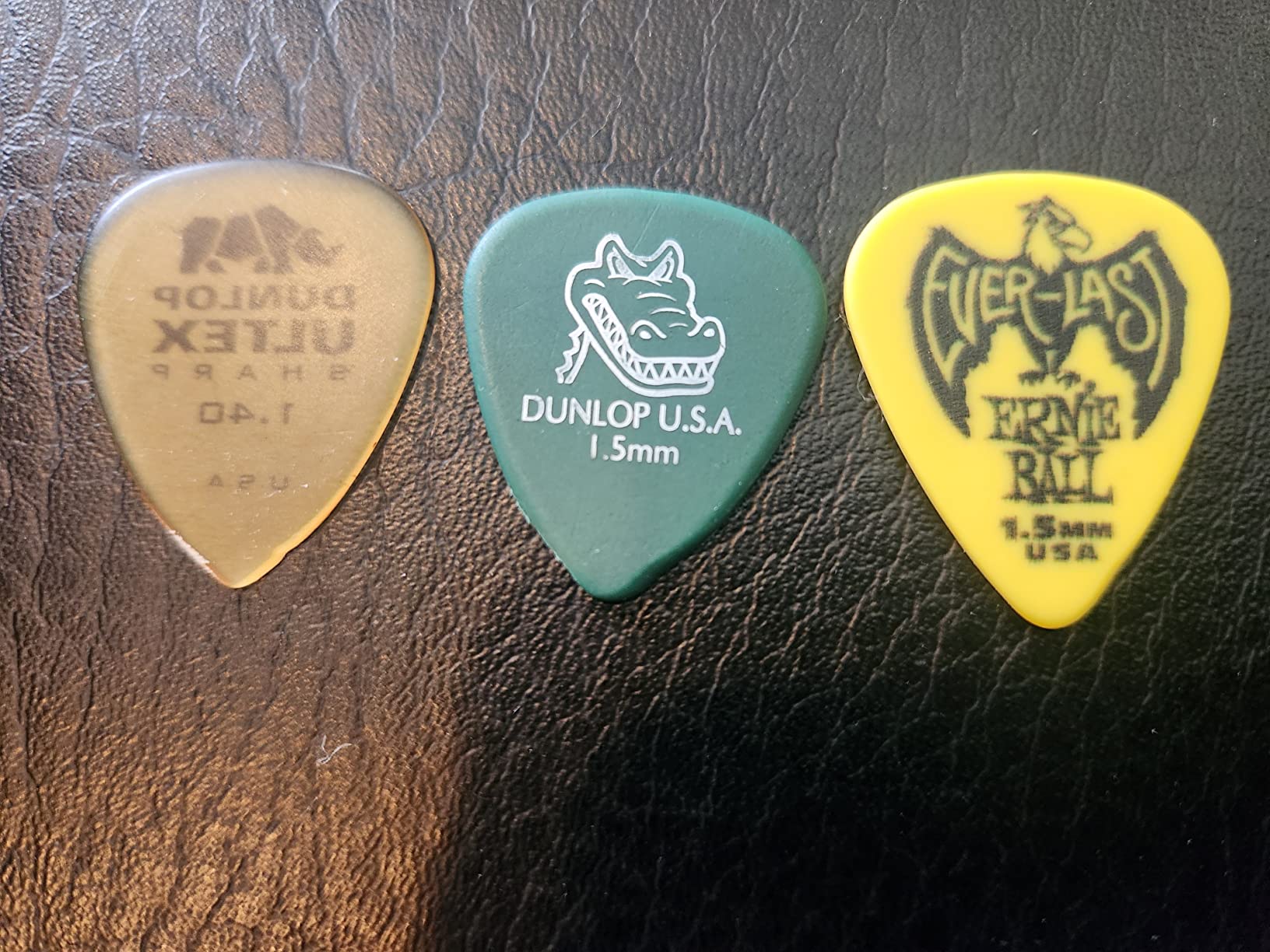
The purple colour coding is a small thing that matters more than it sounds. When you have three gauges in the same shape, being able to identify the 1.0mm at a glance removes the most common reason players get stuck on the wrong pick.
Compared with the Fender above, the tone is a little brighter and the surface has more resistance. We found 1.0mm to be the most forgiving thickness for syncopated chop riffs, because it stays rigid without feeling like a brick.
Why it suits fast eighth-note patterns
The Delrin body keeps its rigidity at speed, which is what stops fast stabs from sounding thin and fizzy. There is a real difference between a muted chug that has low end and one that just disappears into the distortion.
Non-slip grip also sits in a useful middle ground. It holds through fast playing without the abrasive feel that some players dislike on heavily textured nylon picks.
Two small annoyances
The printed colour wears off the surface with use, so after a few months the gauge marking becomes harder to read. It does not affect play at all, but it does affect the convenience the colour coding was there to provide.
New picks can also carry a light chalky coating, and some players sand it off before first use. We did the same on one pick and it made no measurable difference in feel, but be aware the surface is not glassy out of the pack.
4. John Petrucci Signature Ultex Jazz III 1.5mm – Best for Fast Chugs
John Petrucci Signature Ultex Jazz III Pick 1.5MM – 6 Pack
1.5mm gauge
Ultex material
Polished beveled tip
Raised logo grip
6 picks per pack
Pros
- Polished bevel glides off the string with low friction
- Thick firm body strikes consistently on rushed chugs
- Raised logo grip keeps the pick planted
- Ultex gives a darker fuller tone
- Handles strumming as well as precise work
Cons
- Grip is light and can slip with very sweaty hands
- Long logo can rub awkwardly at first
- Jazz III outline is small for strumming-heavy players
At 1.5mm this is the thickest pick in the Jazz III family on our list, and it is built for players who bury the pick and lean on it. With 3,880 ratings at 4.7, it is one of the most proven metal rhythm picks you can buy.
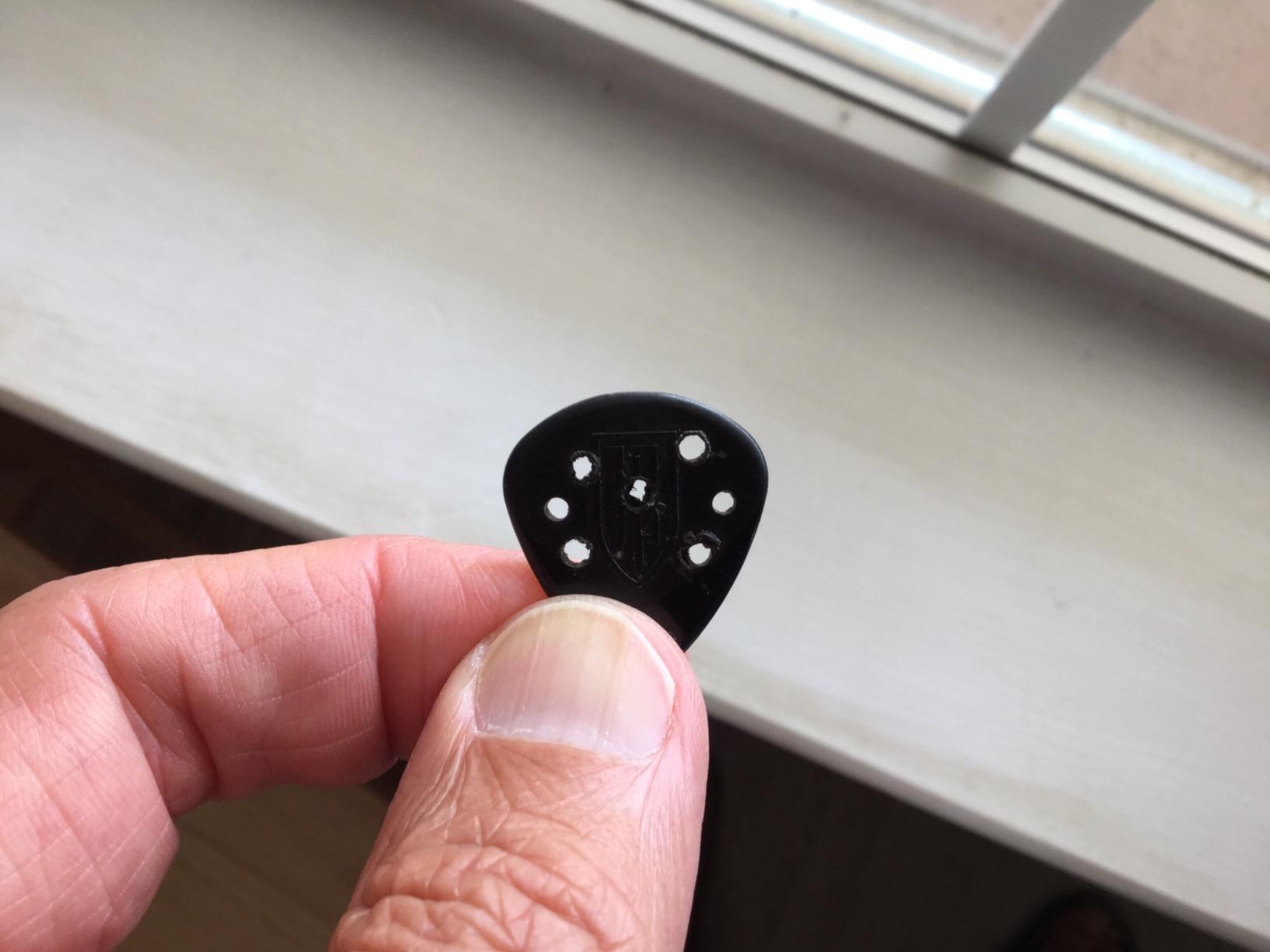
The polished beveled tip is the feature that changes how a stiff pick feels. Reviewers consistently credit the glide, saying it makes a rigid pick feel more dynamic and keeps fast rhythm runs accurate. We noticed the same thing: the pick releases the string rather than dragging across it.
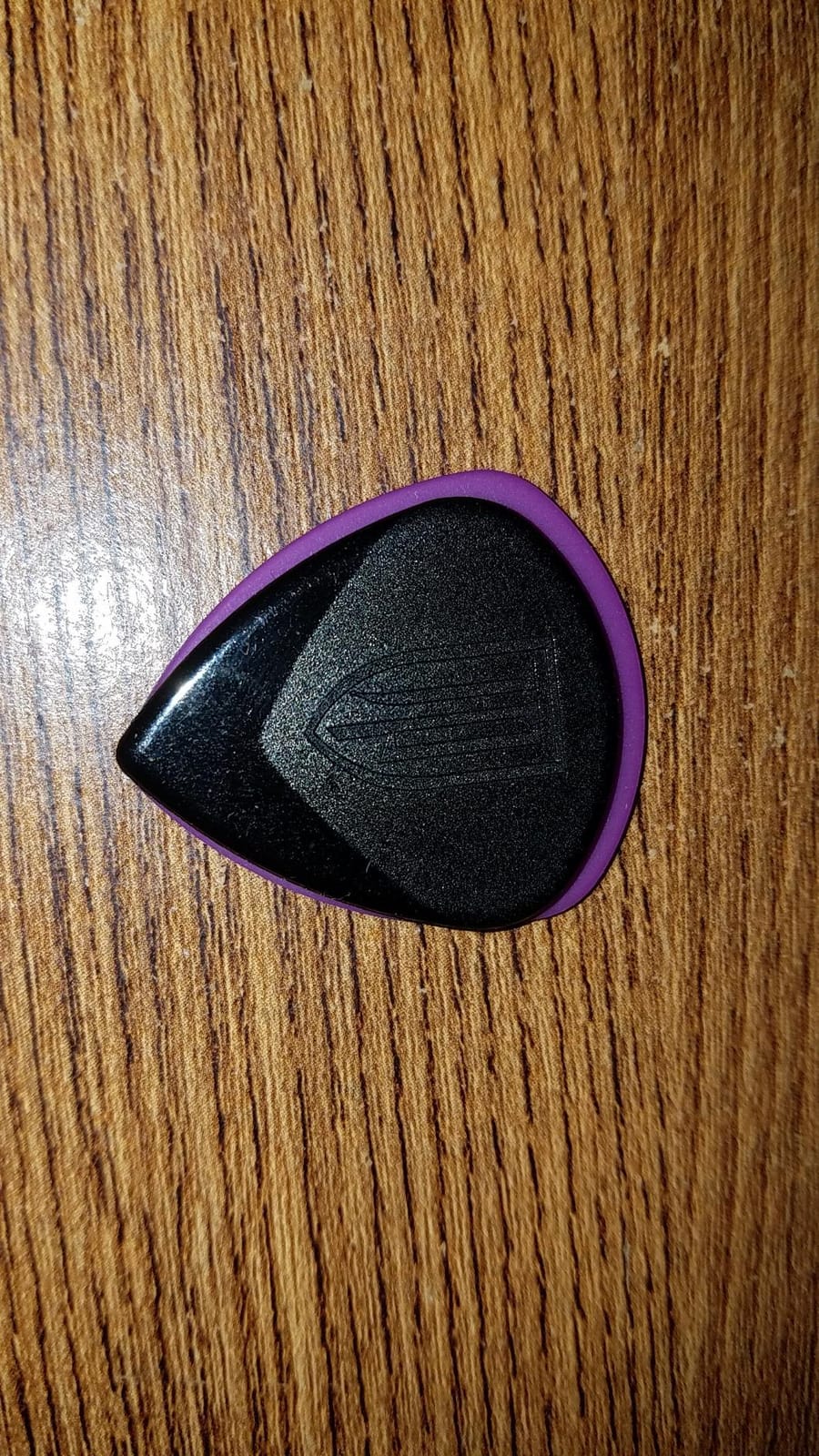
Ultex is described as producing a darker, fuller tone than standard acrylic, and that came through on palm-muted figures. Thick, firm and consistent is an accurate summary of how it plays, even when a stroke is rushed or sloppy.
This version is slightly larger than a standard Jazz III, which is the reason it manages strumming as well as precise rhythm work. That makes it a safer first move into small-profile picks than the narrower models.
Where the polished bevel pays off
Lower friction means less resistance to work through, which matters over a full set of fast downpicked patterns. The pick gets out of the way faster, so your stroke stays consistent even as tempo climbs.
Teachers in the reviews recommend this pick to students moving into faster metal passages, and the logic is sound. It is rigid enough to avoid buzzing without feeling like a different instrument.
Adjustment time and grip limits
Coming from a full-size 351 to a Jazz III takes real adjustment, and that is the single most common complaint about the shape in every forum thread we read. Allow yourself a few weeks of playing before judging it.
Grip is lighter than rougher Tortex-style picks and can slip with very sweaty hands. The raised JP logo grip helps, but if dropped picks are a recurring problem for you, this is not the pick to solve it.
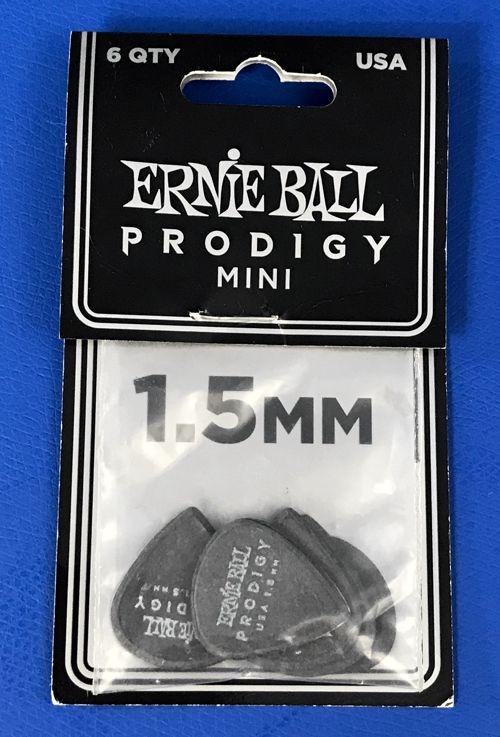
5. Ernie Ball Prodigy Mini 1.5mm – Best for a Sharp, Articulate Attack
Ernie Ball Prodigy Guitar Picks, Mini, Black 1.5mm, 6-pack (P09200)
1.5mm gauge
Delrin material
Sharp point
Beveled edge
Mini profile
Pros
- Very sharp point catches cleanly for tight riffing
- 1.5mm Delrin body is stiff rather than floppy
- Mini profile sits neatly for fast alternate picking
- Beveled edge helps the pick slide and release
Cons
- Grip is minimal and can feel slippery
- Sharp point wears faster under very fast picking
- Mini size needs adjustment
The sharp point is the headline here. Buyers describe it as extremely sharp and articulate, and well suited to metal and hard rock, which matches what we heard on single-note riffs where string separation matters.
At 1.5mm in Delrin with a matte finish, this is a stiff pick that will not flex. The mini profile sits neatly between the fingers, and for players who alternate-pick quickly that positioning is the whole point.
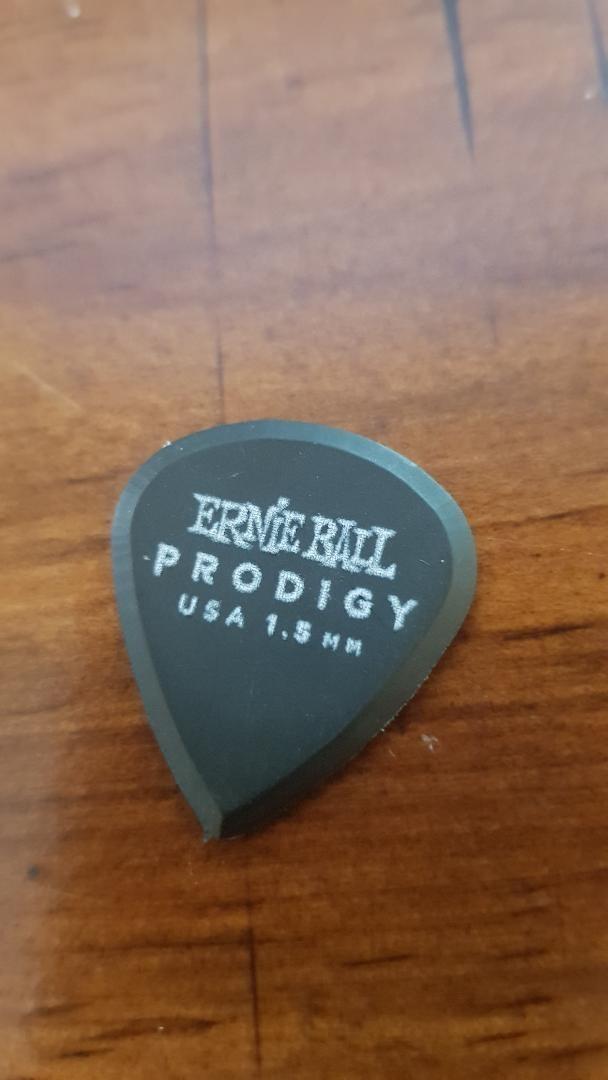
The beveled edge is listed for speed and control, and in practice it helps the pick slide and release quickly across the strings. On a fast run, that release is what keeps the notes even instead of smearing.
Durability is the strength. Delrin handles hard picking without rounding in a way celluloid cannot, though the point itself does wear down sooner than the body under extremely fast playing.
Best for tight syncopated riffs
The dagger-sharp point catches each string cleanly, which helps on syncopated chop figures where you are hitting individual strings rather than chugging. If your rhythm parts have gaps and stabs, this geometry makes them easier to place.
The small profile also gives more fingertip control, so you can see exactly where the pick is without much change in your grip.
Where it is the wrong tool
Grip is minimal compared with heavily textured picks and can feel slippery, particularly in a hot room. That is a genuine limitation for stage use, where hands get wet fast.
The mini size takes some adjustment if you are used to standard picks, and the sharp point digs in more than most players expect. If you play with a light touch, this will feel abrupt.
6. Dan’s Guitar Store Precision Pick 1.5mm – Best for Grip
Dan’s Guitar Store – Precision Pick – 10-Pack – Grippy Precision High-Visibility Plectrums for Professionals
1.5mm nylon body
Double-bevelled edge
Dagger tip
High visibility colour
Pros
- Abrasive grip texture keeps the pick planted through fast riffing
- 1.5mm nylon body has real mass so it sounds louder for less effort
- Double bevel sharpens the attack angle
- High visibility colour makes dropped picks easy to spot
Cons
- Grip texture can feel abrasive on fingertips
- Dagger tip digs in on lighter-touch playing
- Higher cost per pick
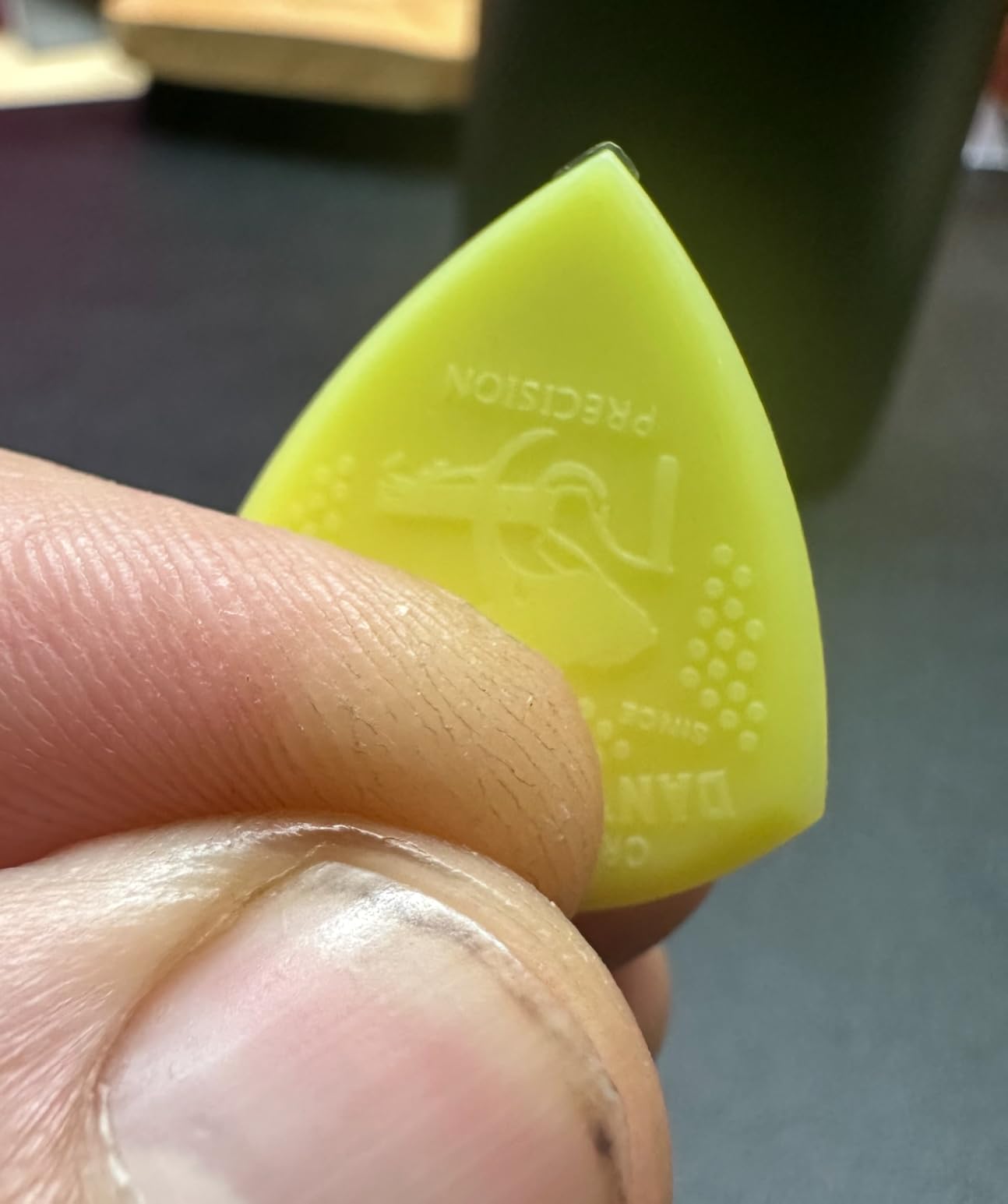
If your pick spins out of your hand, grip is the problem to solve, not thickness. This pick is built around that, with a fingerprint-sensitive abrasive grip pattern that keeps it planted through fast riffing chords.
The 1.5mm nylon body has genuine mass, and owners report playing louder with less effort. That tracks with the design intent, which is efficiency through strength and mass rather than through force.
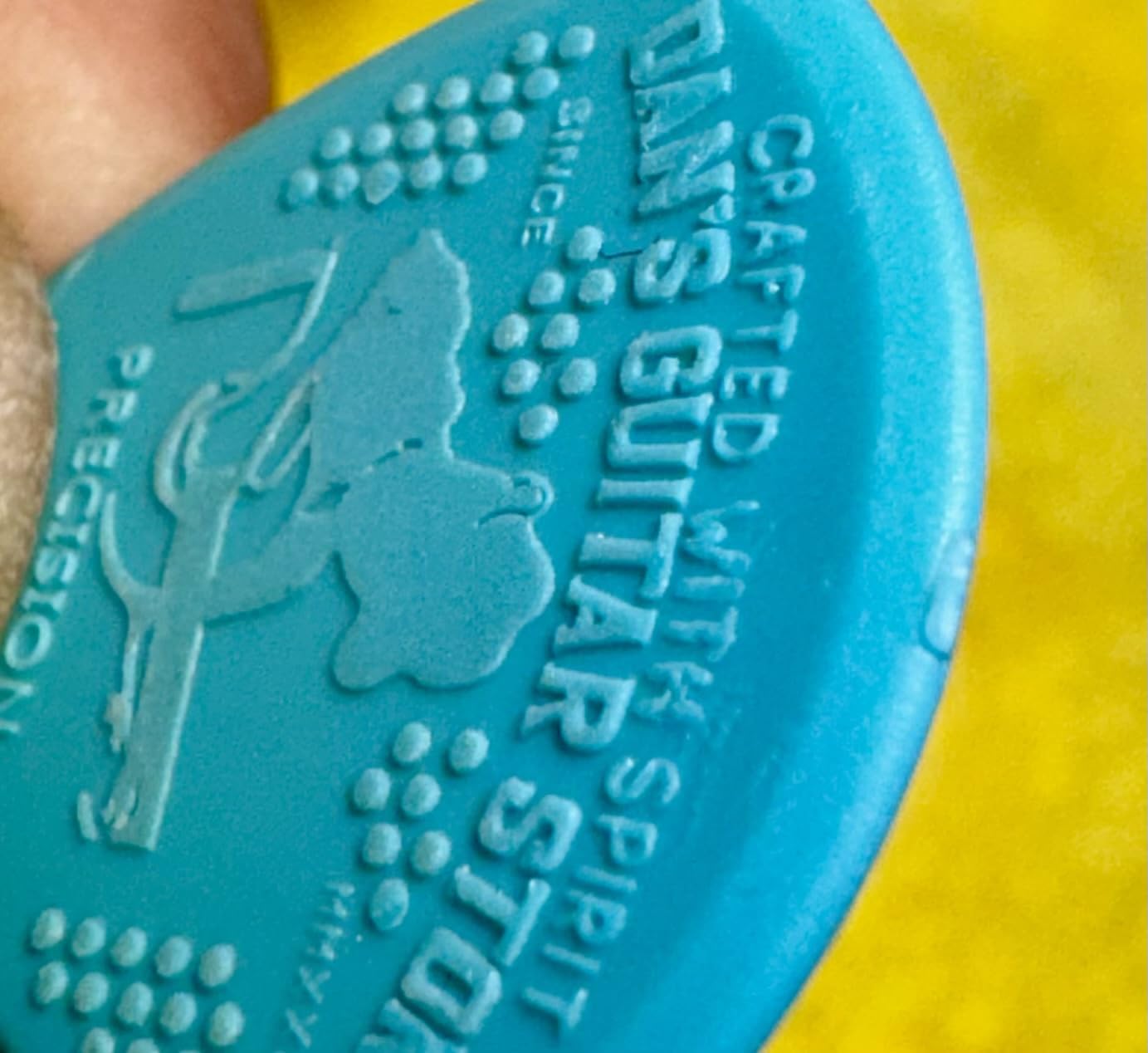
The double-bevelled edge sharpens the angle of attack and helps the pick glide, and the dagger tip gives positive strikes even with light hits. On hard palm mutes, the tone had real weight behind it.
Injection moulded nylon is also long-lasting, and the high-visibility colour means a dropped pick is easy to find on a dark stage floor. Small practical wins that matter more than they sound.
Best for players who drop picks
The grip pattern is fingerprint sensitive, which is why it stays put without you clamping down. That lets you relax your picking hand, and a relaxed hand is a faster hand over a long set.
If your main complaint is that your pick flies out during a fast song, this is the pick on our list most likely to fix it. Several players who switched from thinner picks reported the same thing.
The cost of the texture
The abrasive surface feels rough against fingertips, and that is a genuine dislike for players who prefer a smooth pick. It is not a flaw so much as a preference, but it is a strong one.
The dagger tip is aggressive and can dig in on lighter-touch playing, and the cost per pick runs higher than basic celluloid or Delrin packs. If you chew through picks fast, that adds up.
7. D’Andrea Snarling Dog Brain Nylon 1.0mm – Best for Nylon Tone and Grip
D’Andrea Snarling Dog Brain Nylon Guitar Picks 12 Pack with Tin Box (Grey, 1.00mm)
1.0mm gauge
Nylon material
Coarse grid grip
Tin box included
12 picks per pack
Pros
- Coarse grid surface grips firmly and is hard to drop
- 1.0mm nylon has useful stiffness without bending
- Nylon is forgiving on fast palm-muted runs
- Colour coded by gauge
- Tin box included
Cons
- Nylon is softer than Ultex so the tone is warmer and less bright
- Edges feel rough until the pick is played in
- Small shape is poor for strumming
This has the smallest review base in the roundup at 142 ratings, and I would treat that as information rather than a warning. Buy a pack, test it against a riff you know well, and judge it against that rather than against a spec sheet.
Reviewers consistently praise the grip, describing the coarse grid surface as finding the thumb and forefinger prints so the pick stays put. That is the same anti-spinout benefit as the Precision Pick, delivered with a softer, warmer voice.
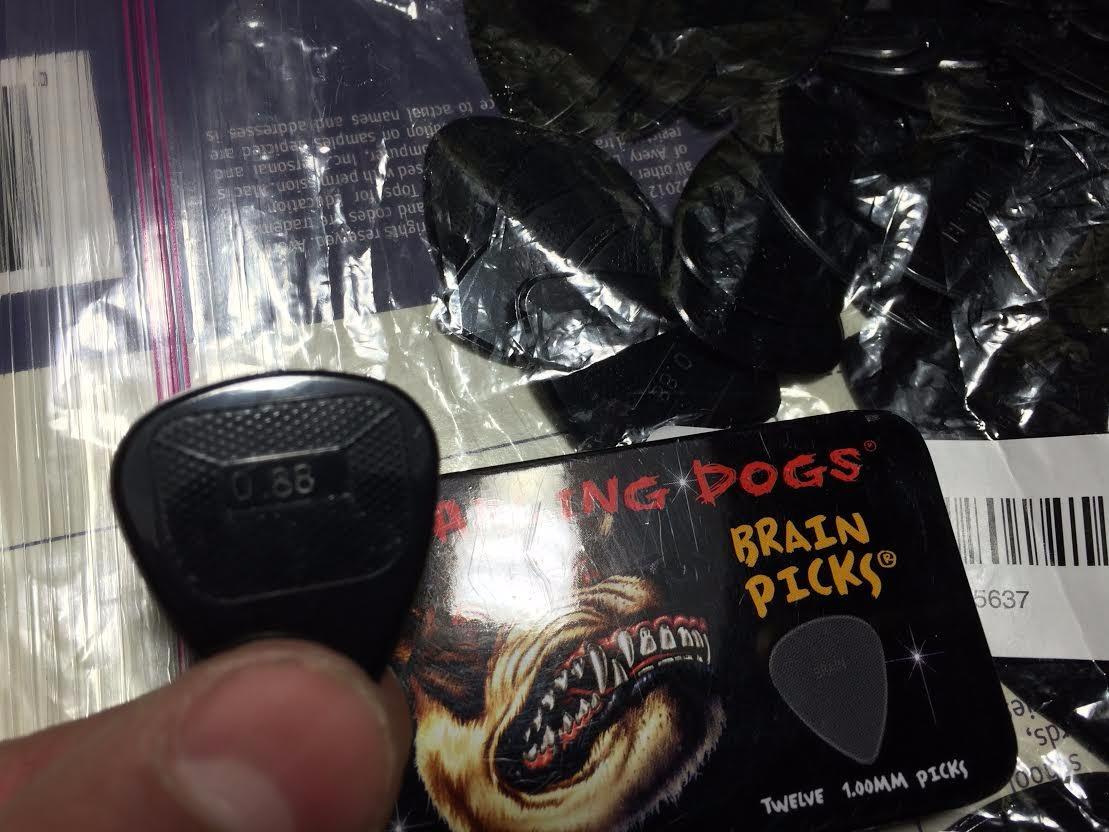
Several reviewers cite 1.0mm as their ideal thickness after finding 1.14mm too stiff, which is worth noting if you are already on heavy gauges. Nylon here has enough stiffness to avoid bending, but it is more forgiving than Ultex or Delrin.
Gauges are colour coded across six thicknesses, so you can build a matched set in this line and identify each one without reading the print.
Why nylon sounds different
Nylon is softer than Ultex or Tortex, so the tone is slightly warmer and less bright. Some players prefer that on open palm-muted chord rhythms, where a bright pick attack can get harsh under gain.
It is also more forgiving on fast palm-muted runs. That forgiveness cuts both ways: if you want maximum bite and edge, this is not the pick.
Break-in and size limits
The edges are not perfectly smooth until the pick has been played in, so give it a session before you judge the feel. Some players prefer to smooth them first.
The Brain shape is smaller and less suited to strumming than a 351-style pick. If your metal rhythm involves open chord rhythms with a wide strum, this is the wrong shape for the job.
8. D’Addario Duralin Duragrip-X-Hvy 1.50mm – Best for Strumming and Bright Attack
D’Addario 10 Duralin-Duragrip-X-Hvy (7DBK7-10)
1.50mm extra heavy
Duralin material
Stamped grip
Standard shape
10 picks per pack
Pros
- Stamped grip surface adds control over a standard shape
- Duralin resists abrasion on hard downpicking
- Extra heavy gauge gives a full punchy rhythm tone
- Standard shape is familiar and comfortable
Cons
- Standard triangle outline is less precise for single-note riffs
- Under 400 ratings means less long-term feedback
This is the widest and most conventional pick on the list, and for open chord rhythms that is a feature. The standard shape is comfortable for strumming and the stamped grip adds a layer of control without a rough texture.
Duralin is noted for strength, grip, durability and abrasion resistance, and it handles hard downpicking without wearing down quickly. At 1.50mm it is among the heaviest options here, and that gives a full, punchy rhythm tone.
Where it fits in a metal set
D’Addario highlights a bright clicking sound against the strings, which suits rhythm guitar and fast single-note passages. On palm-muted open chords it cut through the mix cleanly without sounding harsh.
If you alternate between palm-muted chugs and strummed chord shapes, this is a safe pick. Nothing about the geometry forces you to change approach.
The precision trade-off
The standard triangle outline is less precise for tight single-note technical riffs than a pointed pick. If you want per-string placement on syncopated figures, you will fight the shape.
With 399 ratings and a 4.4 average including 11% three-star feedback, the long-term picture is more mixed than the picks above it. The lower scores come mostly from players wanting a sharper point.
9. Jim Dunlop Max-Grip Jazz III Stiffo 1.38mm – Best for Dropped Picks and Fast Riffs
Jim Dunlop Max-Grip® Jazz III Stiffo Pick 1.38MM – 6 Pack
1.38mm gauge
Nylon material
Max-Grip texture
Stiffo sharp tip
6 picks per pack
Pros
- Max-Grip texture locks into fingerprints against sweaty hands
- Stiff body picks fast without flexing or hooking
- Sharp tip stays pointed far longer than thin picks
- Small size supports fast single-note work
- Long-term consistency across many owners
Cons
- Runs smaller than a standard pick and can feel awkward with large hands
- Small size is less effective for broad strumming
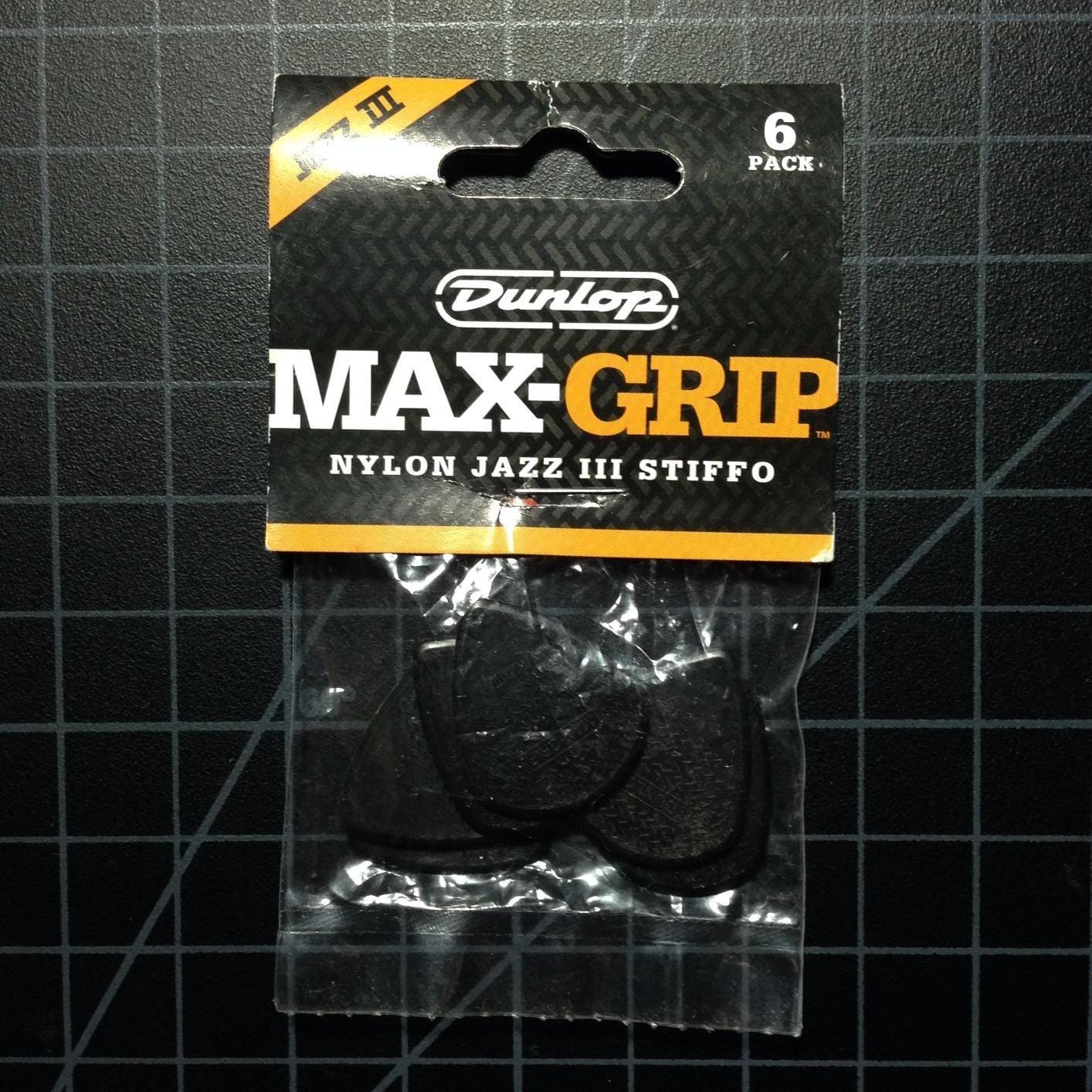
The Max-Grip Jazz III Stiffo combines the two things that fix most metal rhythm complaints: a textured surface that resists sweat, and Stiffo construction that keeps a sharp tip for longer than thin picks do.
Metal and hard rock players dominate these reviews, repeatedly crediting the combination of grip, a tip that stays sharp, and a size that supports fast riffs. That is a fair summary of what this pick does.
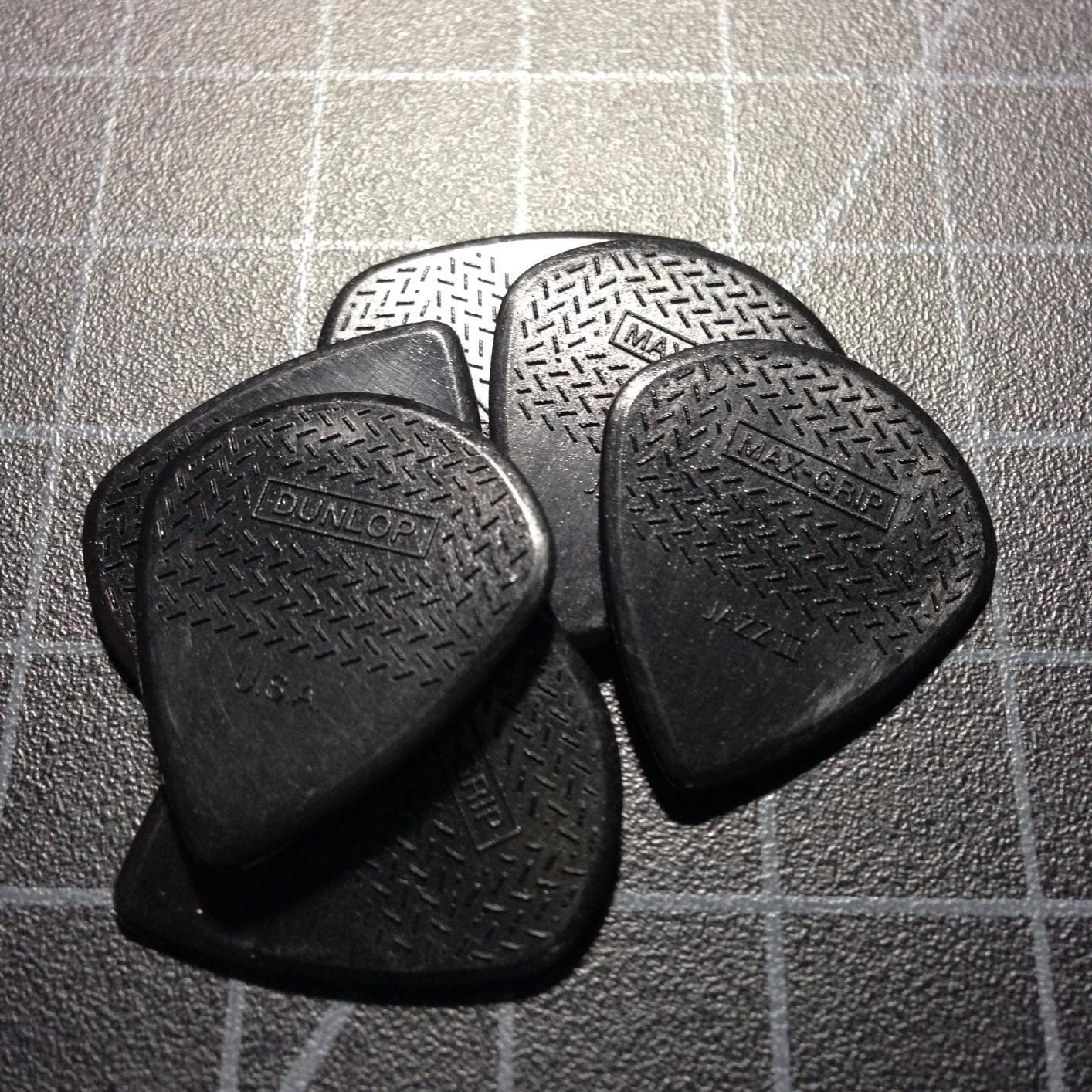
At 1.38mm the body is stiff enough to pick fast without flexing or hooking the string. That is the mechanical difference between a clean palm mute and a flapping one, and it is why we keep coming back to this range.
Multiple reviewers report a decade of consistent use with no breakage, which is the kind of longevity claim that matters for a consumable product. Very few picks make it a decade, but the Stiffo tip construction is the reason some do.
Best for players who play hot
Max-Grip texture locks into fingerprints and resists slipping with sweaty hands, which makes it a strong pick for stage use. If your current problem is lost picks, this addresses the cause rather than the symptom.
The small Jazz III size sits easily under the fingertip for fast single-note work, and the sharp tip stays pointed long enough to keep attack consistent across a set.
Size limits for larger hands
It runs smaller than a standard pick and several reviewers advise the XL version for larger hands. If you have big hands, the standard Jazz III outline can feel cramped.
The smaller size is also less effective for broad strumming patterns. This is a rhythm pick for riffs, not for players who sweep wide chord shapes across the neck.
How to Choose a Guitar Pick for Metal Rhythm Playing
Gauge comes first, then material, then shape, then grip. Get the gauge right and the rest is refinement. Most disappointing metal pick experiences trace back to a pick that is simply too thin for how hard the player attacks.
Gauge: the number that matters most
Gauge is thickness expressed in millimetres, and it is the single variable that most affects how a metal rhythm part sounds. Thick picks barely bend on impact, so more of your motion goes into the string rather than into flexing plastic. You get a harder attack, tighter low end, more sustain and a more controlled palm mute.
Thin picks do the opposite. They flex on impact, which softens the attack, loses low end under gain and buzzes on downstrokes. That is the exact opposite of what a rhythm part needs, and it is why 0.73mm picks show up in so many complaints.
A recurring minority view in the forums argues thinner picks reduce string resistance and hand fatigue for hard hitters. That is not wrong, and for players with a heavy grip it can be true. The compromise most players land on is 1.0mm to 1.2mm.
Metal rhythm sub-style to pick gauge
Chugga-chugga eighths – 1.0mm to 1.14mm, full-sized shape, Delrin or Ultex
Syncopated chop stabs – 0.88mm to 1.0mm, pointed tip, lighter for fast repositioning
Gallop riffs – 1.14mm to 1.38mm, sharp tip, fast alternate picking
Downpicked D-beats and fast downpicks – 1.2mm to 1.5mm, rigid body, textured grip
Open palm-muted chord rhythms – 1.0mm to 1.14mm, 351 or wide shape for strum clearance
Fast single-note leads and shredding – 0.88mm to 1.0mm, small profile for fingertip control
Matching pick thickness to string gauge and tuning
Standard tuning, 10-46 – 1.0mm to 1.14mm is plenty
Drop D, 10-46 – 1.14mm to 1.38mm keeps low strings tight
Drop C, 11-52 – 1.2mm upward; thicker strings need a stiffer pick
7-string, drop A, 10-59 – 1.2mm to 1.38mm
8-string, drop F, 10-64 – 1.38mm to 1.5mm
String changes alter how picks feel. Players who go from 09-42 to 10-46 report a noticeable change in picking speed and resistance, which is why picking feels different after a restring even with the same pick in hand.
Material and why it changes your tone
Celluloid – warm, round, traditional tone; wears fastest under heavy riffing
Acrylic – bright, hard, slightly clickier attack
Delrin – toughest of the synthetics, wear-resistant, long-lasting edge
Ultex – a step up in rigidity, darker and fuller than acrylic
Nylon – softer, warmer, more forgiving; grip is usually the best
Material matters less than rigidity for rhythm tone, and more for how long the pick lasts and how it feels in the hand. Delrin and Ultex hold their edges longest. Nylon and celluloid feel warmer. All four work for metal if the gauge is right.
Shape, tip geometry and the Jazz III question
The Jazz III is smaller and more pointed than a standard 351, which concentrates force into a tight contact area. That is why it feels fast and precise, and why it is poor for broad strumming. Players who only ever strummed with a full-size pick should expect a real adjustment period.
Sharp tips give focused attack and help on tight single-note work. Rounded tips are more forgiving, easier on strings, and less likely to dig in during light playing. Neither is wrong; they suit different players.
Grip, sweaty hands and dropped picks
Textured grip patterns feel rough against the fingertips, and players who dislike that would rather buy a thicker pick than adapt. Grip is the fix for dropped picks, not thickness. Smooth celluloid faces slide; Max-Grip and coarse grid surfaces do not.
Durability and cost per pick
Picks are consumables, so cost per pick matters more than pack cost. A thicker celluloid pick that rounds off in a week costs more over a year than a Delrin pick that lasts a year. Tip wear dulls attack before anything else, so buy the material that holds its point.
Frequently Asked Questions
What size guitar pick is best for metal playing?
A 1.0mm pick is the most common starting point for metal rhythm guitar, with 1.14mm to 1.5mm suits for hard hitters and fast downpicking. Below 0.88mm, picks flex on impact and palm-muted chugs lose low end under distortion.
What is the recommended thickness for metal guitar picks?
Most metal rhythm players land between 1.0mm and 1.2mm. Use 0.88mm as the floor for metal, 1.0mm for chugga-chugga eighths, 1.14mm for gallops, and 1.2mm to 1.5mm for fast downpicks and drop tunings.
Are Tortex guitar picks good for metal?
Yes. Tortex is a Delrin-type polymer noted for wear resistance, and its colour-coded gauges make thickness easy to identify mid-song. The main trade-off is that grip varies by model, so check whether the specific pick you buy is textured.
What are Jazz III picks good for?
Jazz III picks are smaller and more pointed than a standard 351, concentrating force into a tight contact area. That makes them excellent for fast single-note work, syncopated riffs and precise attack, and poor for broad strumming.
Can you strum with a Jazz III pick?
You can, but the small outline gives you less clearance for wide chord shapes. It is slightly larger than a standard Jazz III, so strumming is workable, but players focused on open chord rhythms usually prefer a 351 shape.
Do thicker picks make palm muting easier?
They usually do, because a stiffer pick transfers more of your stroke into the string instead of flexing away. Thick picks keep low end tighter under gain, though they cost some speed and pick-chord transitions feel less fluid.
What thickness pick did Eddie van Halen use?
Eddie van Halen is widely associated with a thin pick for lead work, closer to 0.73mm, which suits fast single-note phrasing. That is a different job from rhythm chugging, which is why metal rhythm players tend toward heavier gauges.
The Best Guitar Picks for Metal Rhythm Playing
The best guitar picks for metal rhythm playing in 2026 come down to gauge first. Start at 1.0mm if you are unsure, and move up when you want tighter low end or play faster downpicks. Pick preference is personal, and the only reliable way to find yours is to test two or three gauges in one sitting with the same riff.
Our pick of the nine is the Dunlop Hetfield’s White Fang at 1.14mm, because it does not ask you to change your technique to get a tight palm mute. The Ernie Ball Everlast 1.0mm is the safest long-term choice for chugga-chugga patterns, and the Fender 351 Heavy is the simplest way into a rigid rhythm pick if you strum as much as you riff.
For players whose real problem is a pick flying out mid-song, the Dan’s Precision Pick and the Dunlop Max-Grip Jazz III Stiffo solve that with texture rather than thickness. Check the current details on each pick below and put a few of them in front of your amp this week.