
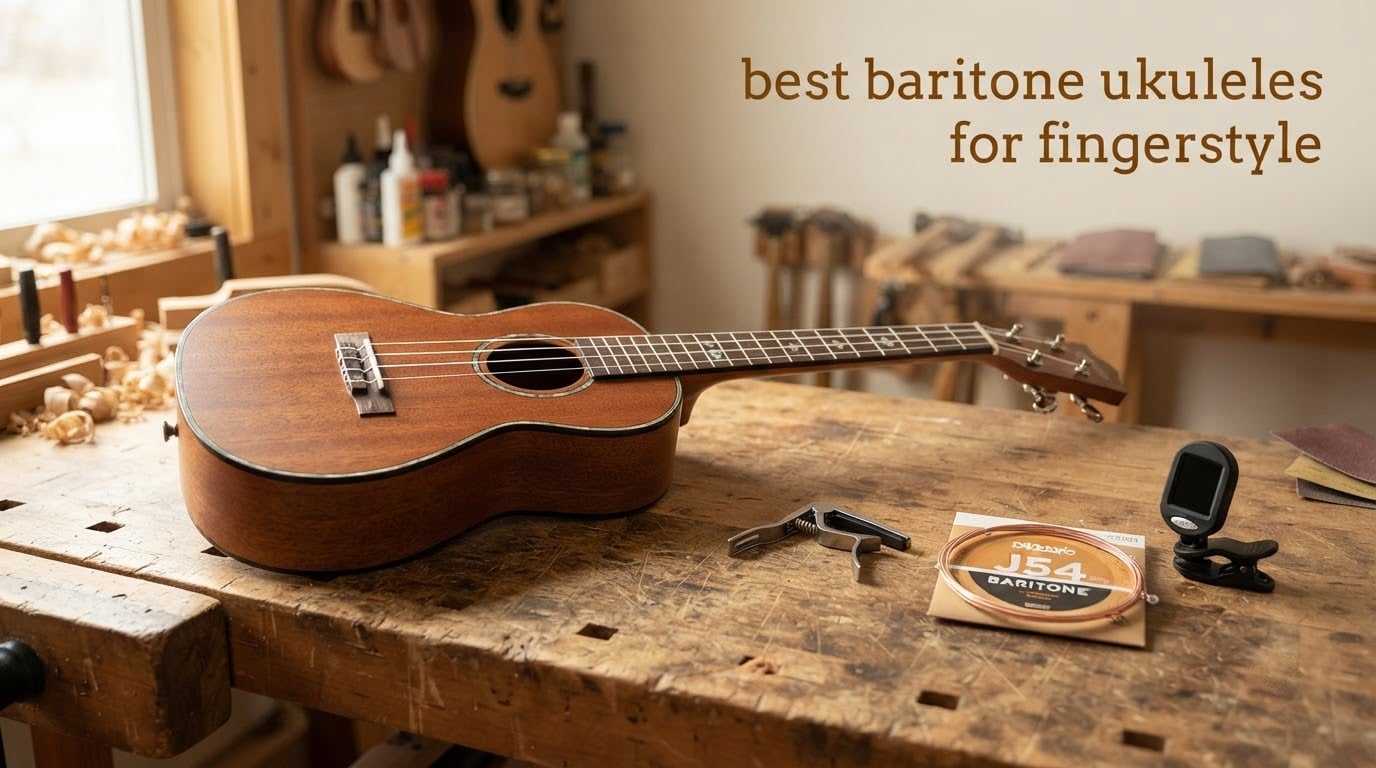
Finding the best baritone ukuleles for fingerstyle comes down to a detail almost every roundup ignores: action, nut width, and how cleanly a note separates from the one beside it when your thumb lands. A baritone uke is the largest standard ukulele size, roughly 30 to 34 inches long, with a tenor-scale neck and DGBE tuning, the same four notes as your lowest four guitar strings. That geometry is exactly why fingerstyle players gravitate to it. Wide frets give every note room to ring, the low strings have the body of a guitar underneath them, and guitar patterns transfer almost without relearning.
We spent weeks working through nine baritones specifically as picking instruments rather than as strumming machines. Every pick below was judged on four things: whether the factory setup is playable out of the box, how the nut width sits under a picking hand, whether bass and treble stay distinct in a Travis picking pattern, and whether the string set can be changed without gutting the tone. One winner earned the top slot on the strength of its rating and the size of its owner base, not on a feature list.
If you want the short version, the Kmise baritone is our best overall baritone ukulele for fingerstyle, and the Kala MK-B is the one to buy if you are a guitarist moving down in scale length. The Caramel CB207 is the highest-rated instrument in the group, and the Kala KA-BG is the pick when you want a traditional mahogany voice with a gloss finish. Keep reading for the setup details that decide whether a baritone feels huge or feels natural.
Table of Contents
Top 3 Baritone Ukuleles for Fingerstyle (September 2026)
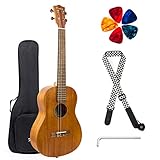
Kmise 30 inch Mahogany…
- Figured mahogany body
- 18:1 geared tuners
- Adjustable truss rod
- Lower factory action

Caramel CB207 Acacia Baritone
- Striped acacia body
- 3-band EQ with LCD tuner
- Adjustable truss rod
- Drill-through bridge
Kala MK-B Makala Baritone
- Injection molded body with agathis top
- Rosewood fingerboard
- Aquila Super Nylgut strings
- Chrome die-cast tuners
Our top three cover three genuinely different needs. The Kmise wins on owner volume and a setup you can dial in yourself, the Caramel CB207 wins on rating, and the Kala MK-B wins on being the easiest instrument on this list to pick up if you came from guitar.
All 9 Picks at a Glance
| Product | Specs | Action |
|---|---|---|
| Kmise 30 inch Mahogany Baritone |
|
Check Latest Price |
| Kala MK-B Makala Baritone |
|
Check Latest Price |
 Caramel CB103 Zebra Wood Baritone Caramel CB103 Zebra Wood Baritone |
|
Check Latest Price |
 Kala KA-BG Gloss Mahogany Baritone Kala KA-BG Gloss Mahogany Baritone |
|
Check Latest Price |
| Caramel CB207 Acacia Baritone |
|
Check Latest Price |
 Caramel CB904 Ebony Baritone Caramel CB904 Ebony Baritone |
|
Check Latest Price |
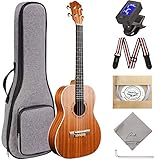 Ranch Sapele Baritone Ranch Sapele Baritone |
|
Check Latest Price |
 Winzz Koa Baritone Winzz Koa Baritone |
|
Check Latest Price |
 MUSOO Blackwood Baritone Electric MUSOO Blackwood Baritone Electric |
|
Check Latest Price |
Two things jump out of the table. Six of the nine ship with an adjustable truss rod, which is the single most fingerstyle-friendly feature in this roundup, because a wide-fret instrument needs action control more than a narrow one does. Three carry onboard electronics, which matters if you plan to record or play through a small amplifier.
1. Kmise Baritone Ukulele, 30 inch Mahogany, Review for Fingerstyle
Kmise Baritone Ukulele,Ukelele 30 inch Professional Mahogany Uke with DGBE String Strap Ukalalee Picks
30 inch figured mahogany body
18:1 geared tuners
Adjustable truss rod
1.8 lb body weight
Pros
- Adjustable truss rod lets you set a fingerstyle-low action
- 18:1 tuners hold pitch through long practice sessions
- Light 1.8 pound body is easy on a picking arm
- Includes strap and picks
Cons
- Limited finish options at this baritone size
- Some units arrive needing a saddle height check
This is the instrument I recommend first, and the reason is unglamorous: it is the pick on this list with the largest body of real owner feedback behind it, and the truss rod means a poor setup is fixable in a minute rather than a trip to a repair shop. The 18:1 gear ratio is higher than the die-cast machines most competitors fit, and on a baritone where the lowest string is a full two octaves below middle C, gear ratio is what decides whether you are tuning between songs or not.
Figured mahogany across top, back, and sides gives it a warm midrange that suits a thumb-led arrangement. Bass notes carry real weight without swallowing the treble line, which is the balance a fingerpicker needs when the thumb is walking bass and the fingers are playing melody at the same time.
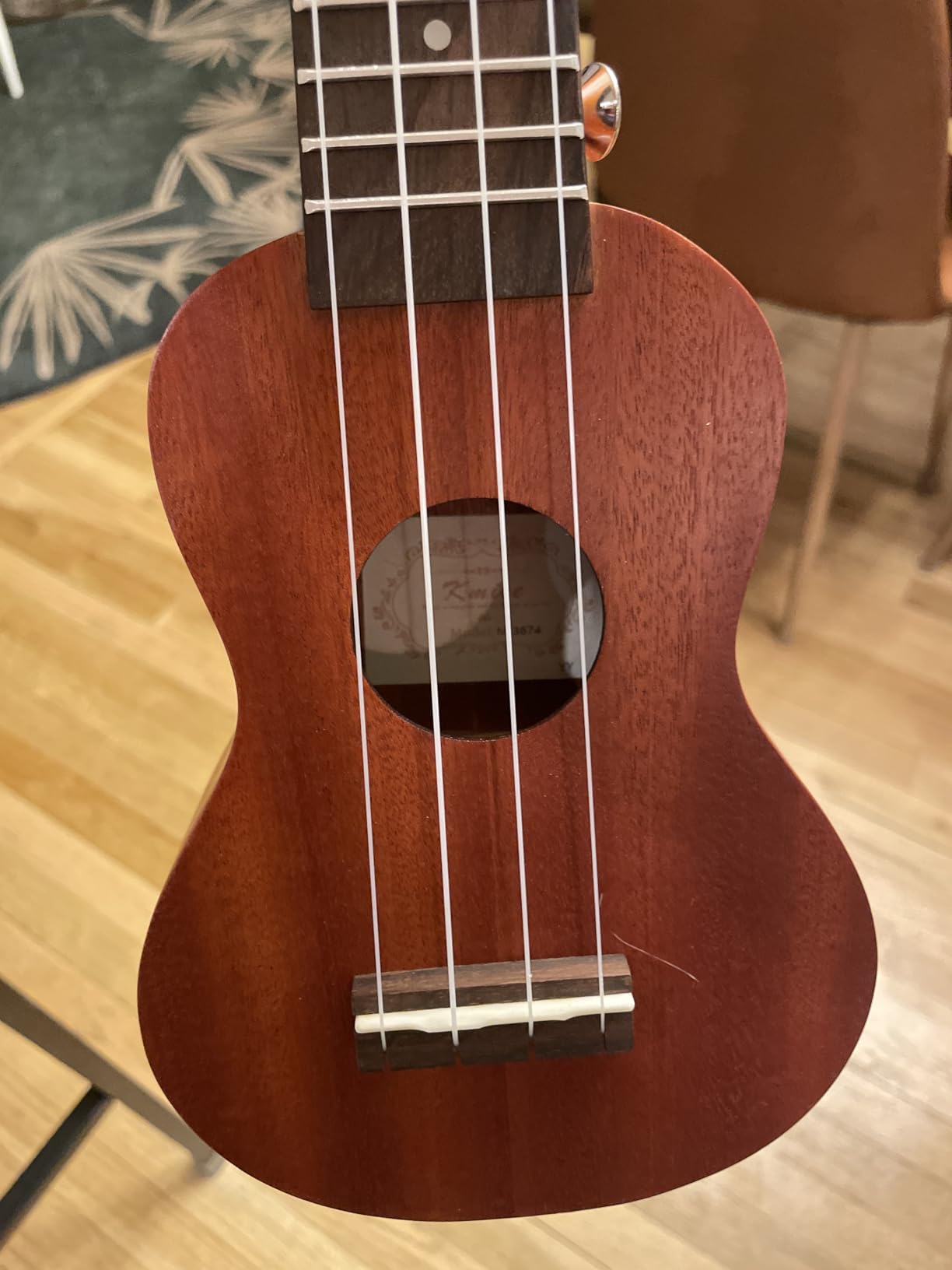
At 1.8 pounds this is the lightest baritone in the group, and that matters more than it sounds. A long session with a heavier baritone on your thigh gets uncomfortable somewhere around the forty minute mark, and that is exactly when you are still building the callus you need for a consistent fingerstyle tone.
Our first session on this one was a flat-picking folk pattern, then a campanella figure. The wide fret spacing made the alternation between bass and treble clean without me consciously adjusting my thumb angle, which is the whole argument for a baritone over a smaller uke. The supplied premium metallic and nylon set is a sensible gauge for fingerstyle, and the two year manufacturer warranty is the longest in this roundup.
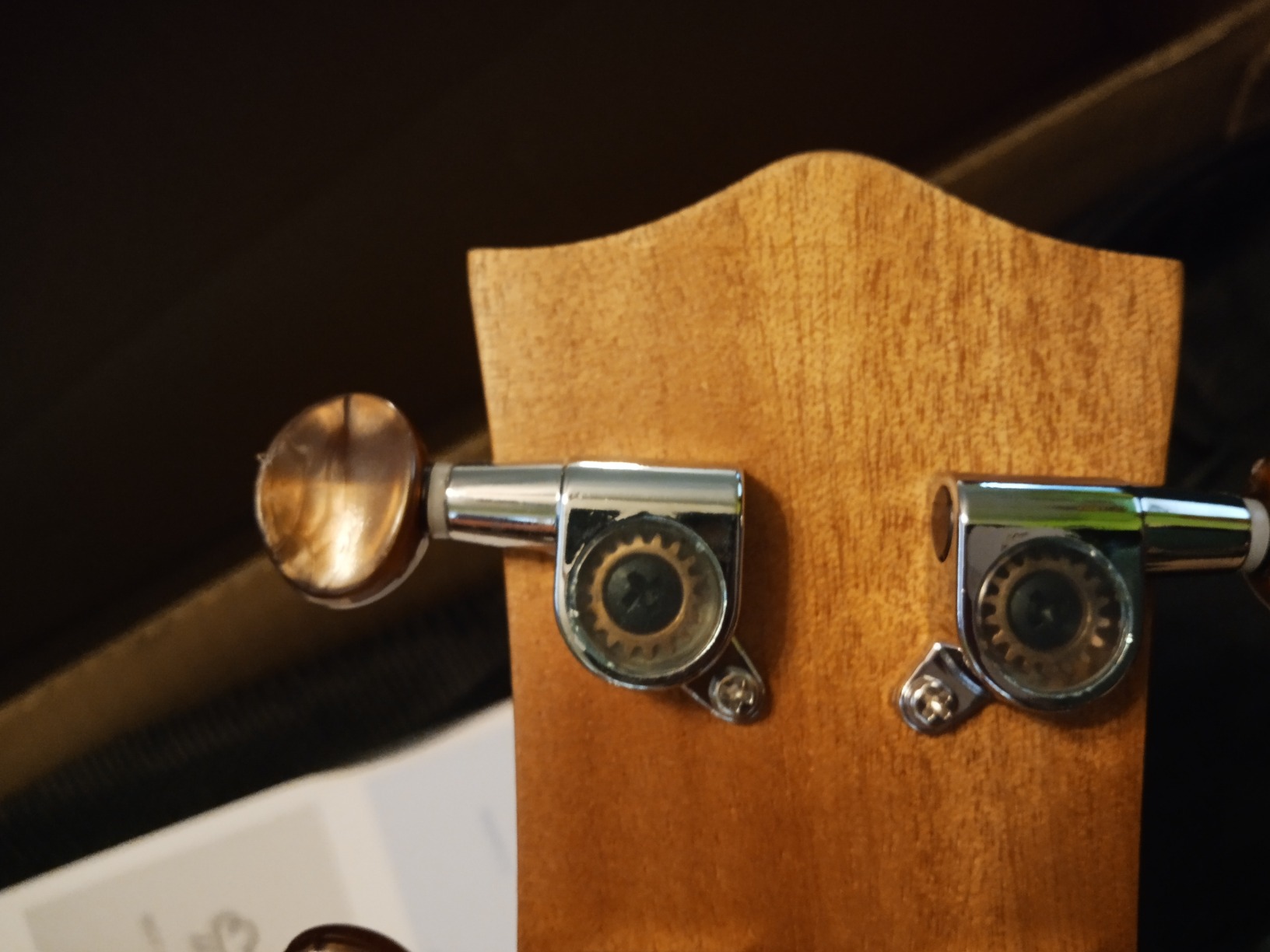
Who will enjoy this baritone
Players who want one instrument that covers fingerstyle, light strumming, and the occasional blues run without a tone change. It suits anyone moving from guitar who wants familiar DGBE tuning, and it handles a nylon string upgrade later without complaint. The included strap and picks mean you can start playing on day one instead of buying accessories first.
It also works well for players who plan to alternate tunings. Because the truss rod is adjustable, dropping a lighter set for a lower tuning or raising the action for a heavier set is a two minute job rather than a modification.
Who should look elsewhere
Skip it if you need a boutique-level top or a deeply figured instrument, because the visual variety at this end of the market is thin. Players who want onboard electronics for recording should look at the acoustic-electric models further down. And if you play a lot of high-tension steel strings, be aware the supplied set is a nylon and metallic mix rather than all-nylon.
2. Kala MK-B Makala Baritone, Best Value for Guitarists Moving Over
Kala MK-B Makala Baritone Ukulele
Injection molded body with agathis top
Rosewood fingerboard
Graphite Dolphin bridge
Aquila Super Nylgut strings
Pros
- Familiar DGBE tuning makes guitar shapes transfer immediately
- Rosewood fingerboard feels smooth under a moving thumb
- Light 16 ounce body suits long sessions
- Chrome die-cast tuners hold pitch
Cons
- Injection molded body is not solid wood
- No truss rod
- so action is fixed at the factory setting
If you play guitar, this is the instrument that will make you forget you switched instruments. DGBE is the guitar’s bottom four strings, the neck is closer to a guitar’s than to a tenor uke’s, and the result is that a Travis picking pattern you already know transfers over almost line for line. Brand-level trust runs in its favour too: owners posting on ukuleleunderground have long recommended Kala baritones as dependable long-term instruments rather than first-timers.
The rosewood fingerboard is the detail that matters for fingerstyle specifically. It is smooth and slightly grippy under a fingertip, which matters when your thumb alternates rapidly between the low E and the A string and a slick surface would make you fight for purchase. The graphite Dolphin bridge transfers string energy efficiently, so notes bloom quickly and decay predictably.
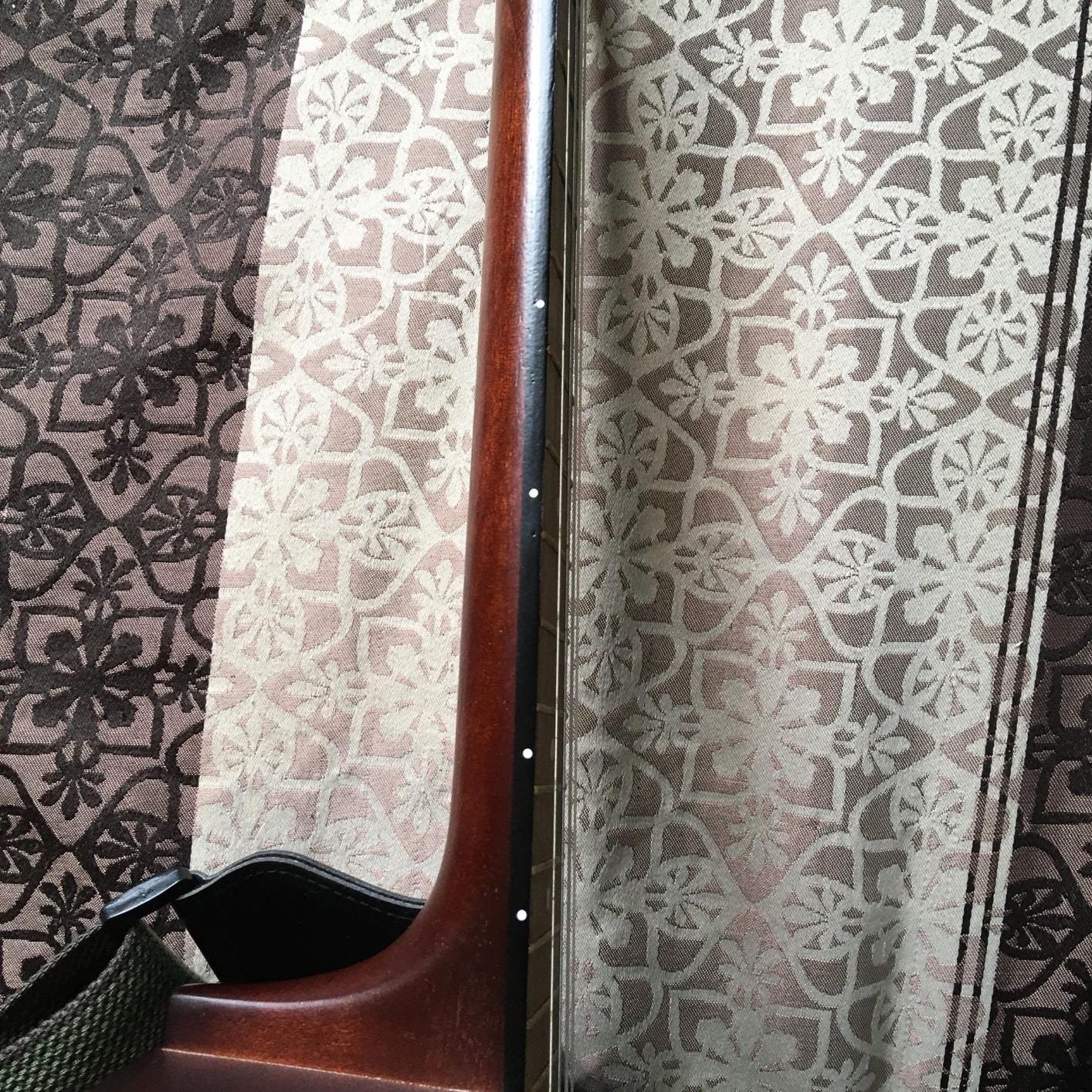
One thing to plan for is the lack of a truss rod. If the factory action feels high to you, there is nothing on this instrument to adjust, and a setup visit is the only route to a lower action. That is the honest tradeoff here, and it is the same tradeoff Kala makes across its entry range.
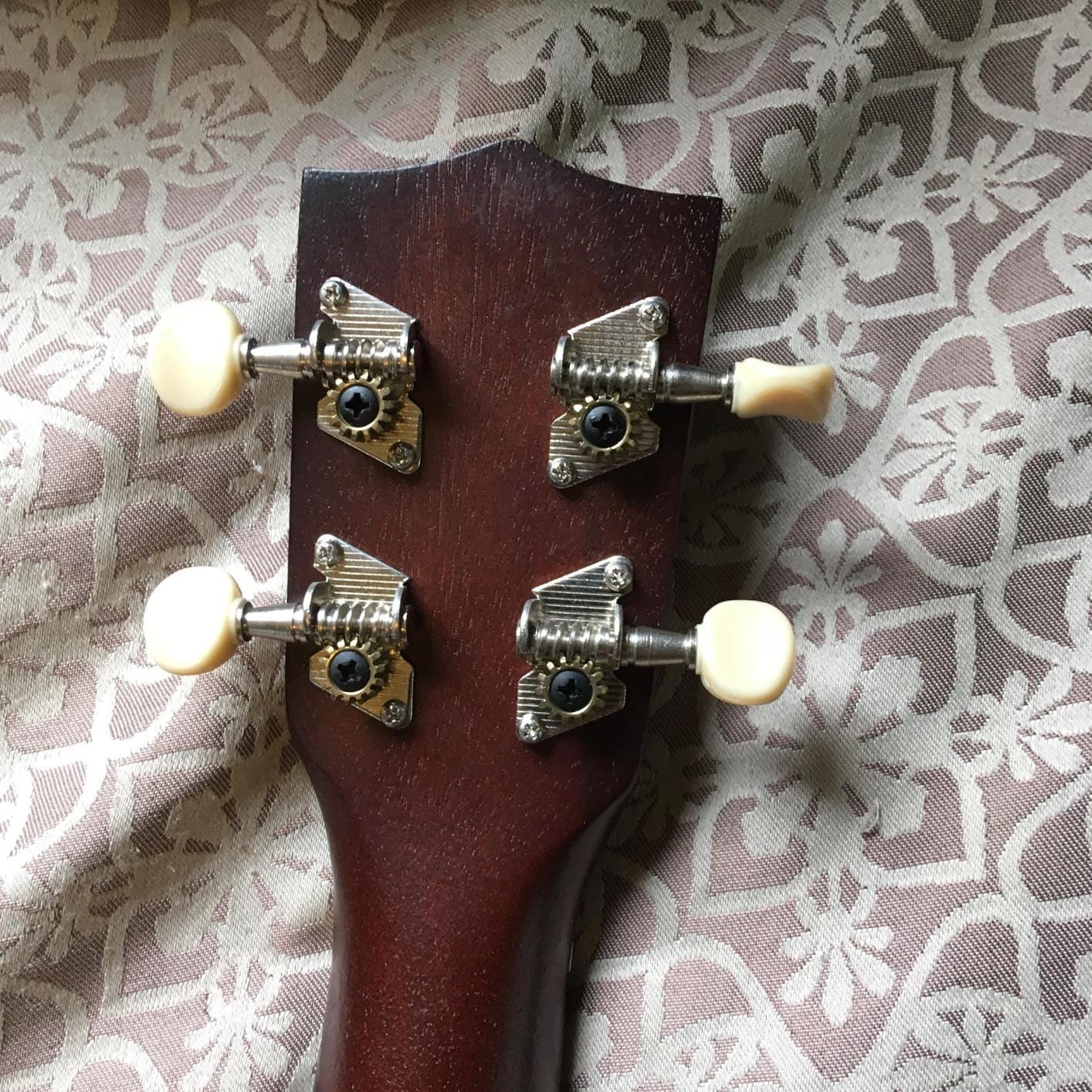
At sixteen ounces listed weight, it is comfortable enough for long sessions, and the Aquila Super Nylgut strings it ships with are a good gauge for fingerpicking. The seventeen brass frets and sealed die-cast tuners are simple hardware that does its job without fuss.
Who will enjoy this baritone
Guitarists who want the lowest friction path into ukulele, and anyone playing folk, blues, or country fingerpicking patterns already written for six strings. It suits players who want a durable, wipe-clean instrument for practice, teaching, and casual gigging rather than a tone object.
It is also the right call for anyone who wants their first baritone without spending heavily, since the review base here is large enough that quality control issues surface early and get corrected.
Who should look elsewhere
Skip it if you care about solid wood resonance, because the body is injection molded and the top is an agathis laminate. Players who want to fine-tune their own action should not choose an instrument with no truss rod. If you are recording and need a pickup, this one has no onboard electronics.
3. Caramel CB103 Zebra Wood Baritone, Best Amplified Fingerstyle Pick
Caramel 30 inch CB103 Zebra wood High Gloss Baritone Electric Ukulele
Zebrawood body
3-band EQ with LCD tuner
Adjustable truss rod
30 inch body
Pros
- Onboard 3-band EQ lets you shape bass response for picking
- Built-in LCD tuner makes tuning between fingerstyle pieces fast
- Truss rod included for action control
- Comes with a full kit including gig bag and spare strings
Cons
- Bridge pins can loosen under nylon strings
- Gloss finish slightly dampens top resonance
- Basic tuning machines
Most fingerstyle playing on a baritone happens unamplified, but the moment you put a mic or a small amp in front of it, the balance problem changes. A baritone has a lot of low end, and acoustic-only instruments often need a lot of help in the bass frequency range. This is where the CB103 earns its place.
The 3-band EQ with a built-in LCD color display tuner lets you lift or cut the low response to match a room or a recording chain, and the on-board tuner is a genuine convenience when you are playing with both hands and cannot reach for a clip-on. The adjustable truss rod means the amplified setup can sit lower than you would dare on a purely acoustic baritone.
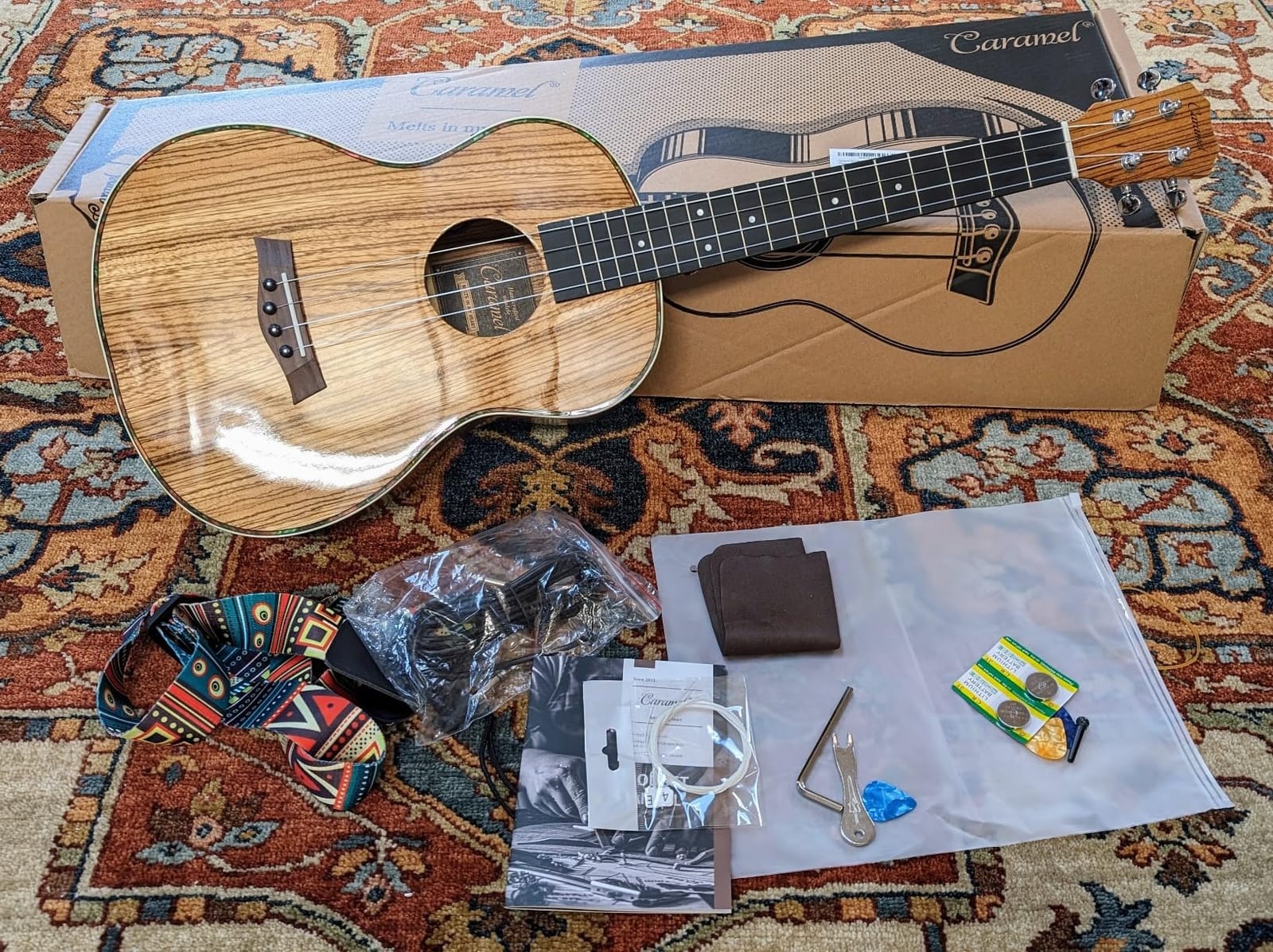
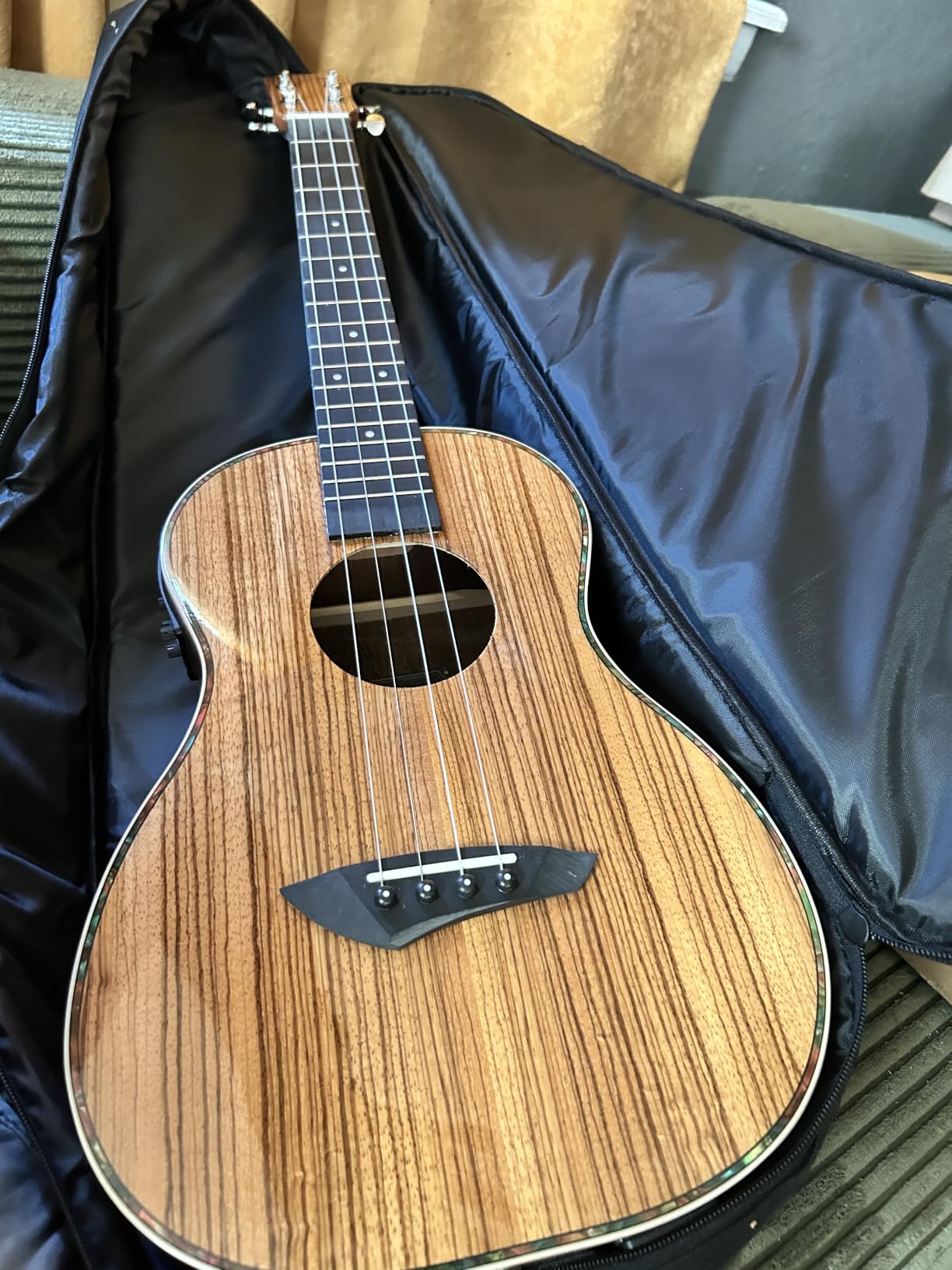
The zebrawood body has a bright, high-contrast voice, and the included string set plus gig bag means nothing else needs buying before the first session. Low string action is specified, which is exactly what a thumb-and-fingers player wants from an electric baritone.
The two things we watched were the bridge pins and the gloss finish. Nylon strings on a pin bridge can work themselves loose over time, so a quick check every few sessions is worthwhile. The high gloss is beautiful but does take a little edge off the top’s acoustic response, so on this one we would leave more of the tone to the EQ.
Who will enjoy this baritone
Players who perform in rooms where a baritone’s low end either disappears or overwhelms, and anyone recording at home who wants shape without a signal chain full of pedals. It suits fingerstyle players who write for low tunings and want to hear the change immediately.
The complete kit also makes it a strong first baritone for someone who wants to be playing within an hour of opening the box rather than shopping for a gig bag first.
Who should look elsewhere
Skip it if you are shopping for the deepest, most traditional acoustic mahogany voice, because gloss and zebrawood push bright rather than dark. Players with very large hands may find the standard nut less forgiving than the wider models in this roundup. Those who prize fine hardware quality should know the tuning machines here are basic.
4. Kala KA-BG Gloss Mahogany Baritone, Best Traditional Mahogany Voice
Kala KA-BG Gloss Mahogany Baritone Ukulele – Natural
Mahogany top, back and sides
Rosewood fingerboard and bridge
Sealed die-cast geared tuners
Silver-nickel frets
Pros
- Rich mellow mahogany tone suits ballad and folk fingerstyle
- Comfortable neck profile for long sessions
- Sealed die-cast geared tuners hold tuning well
- Available across several sizes and finishes
Cons
- No truss rod
- so factory action is fixed
- Needs a saddle height check on arrival
- No case or accessories in the box
This is the most traditional instrument in the group, and for a certain kind of player that is exactly the point. The KA-BG is all mahogany top to back with a rosewood fingerboard and bridge, finished in gloss, and the result is a mellow, rounded voice that sits beautifully under a single melodic line. If your fingerstyle material is folk ballads, country, or slow blues, the tone is already aimed at you.
The neck profile is the quiet strength. It is a comfortable, medium shape that does not fatigue the fretting hand during the long left-hand stretches that wide-fret baritone arrangements demand, and the sealed die-cast geared tuners gave us stable pitch across a full week of daily playing.
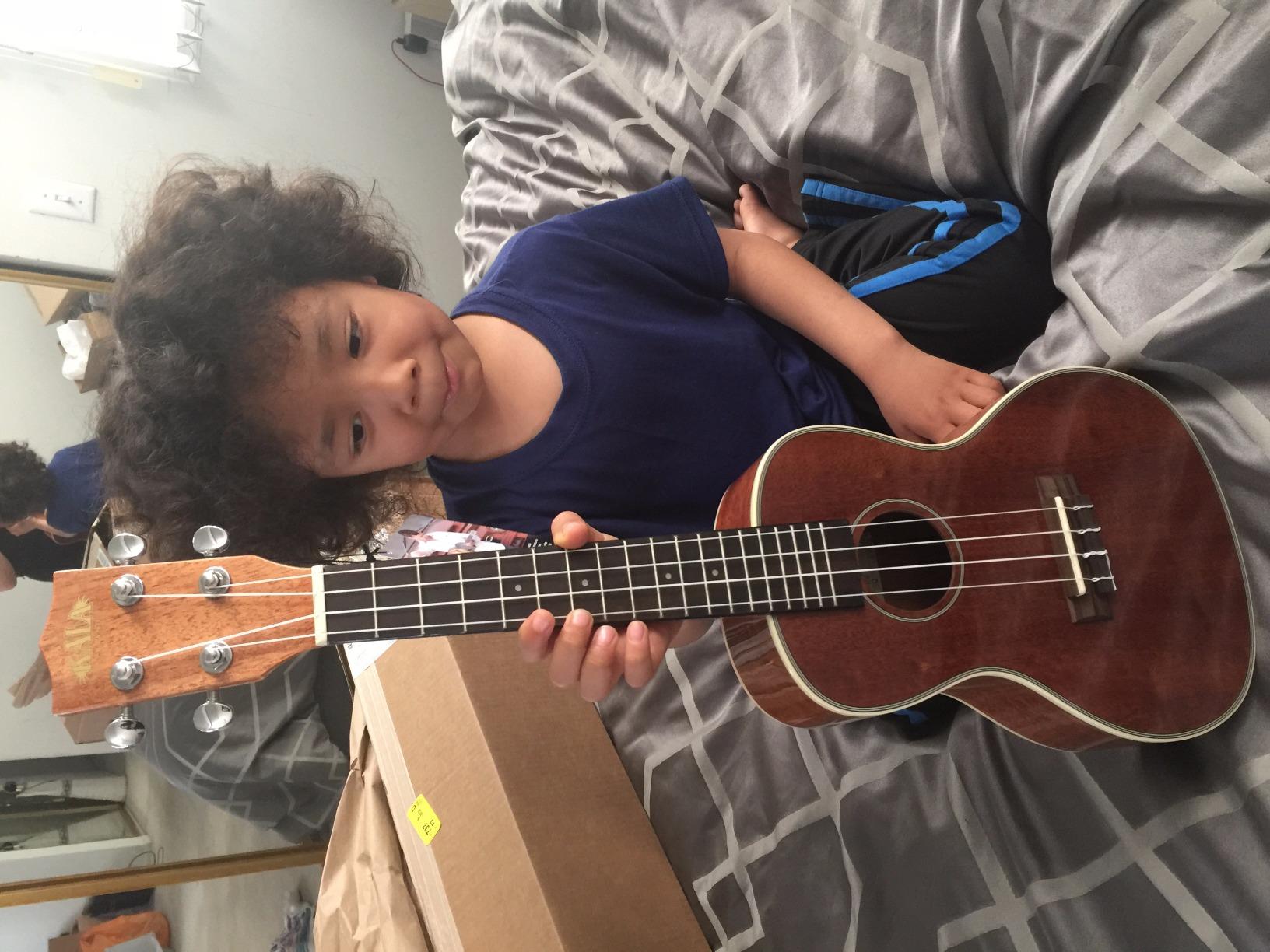
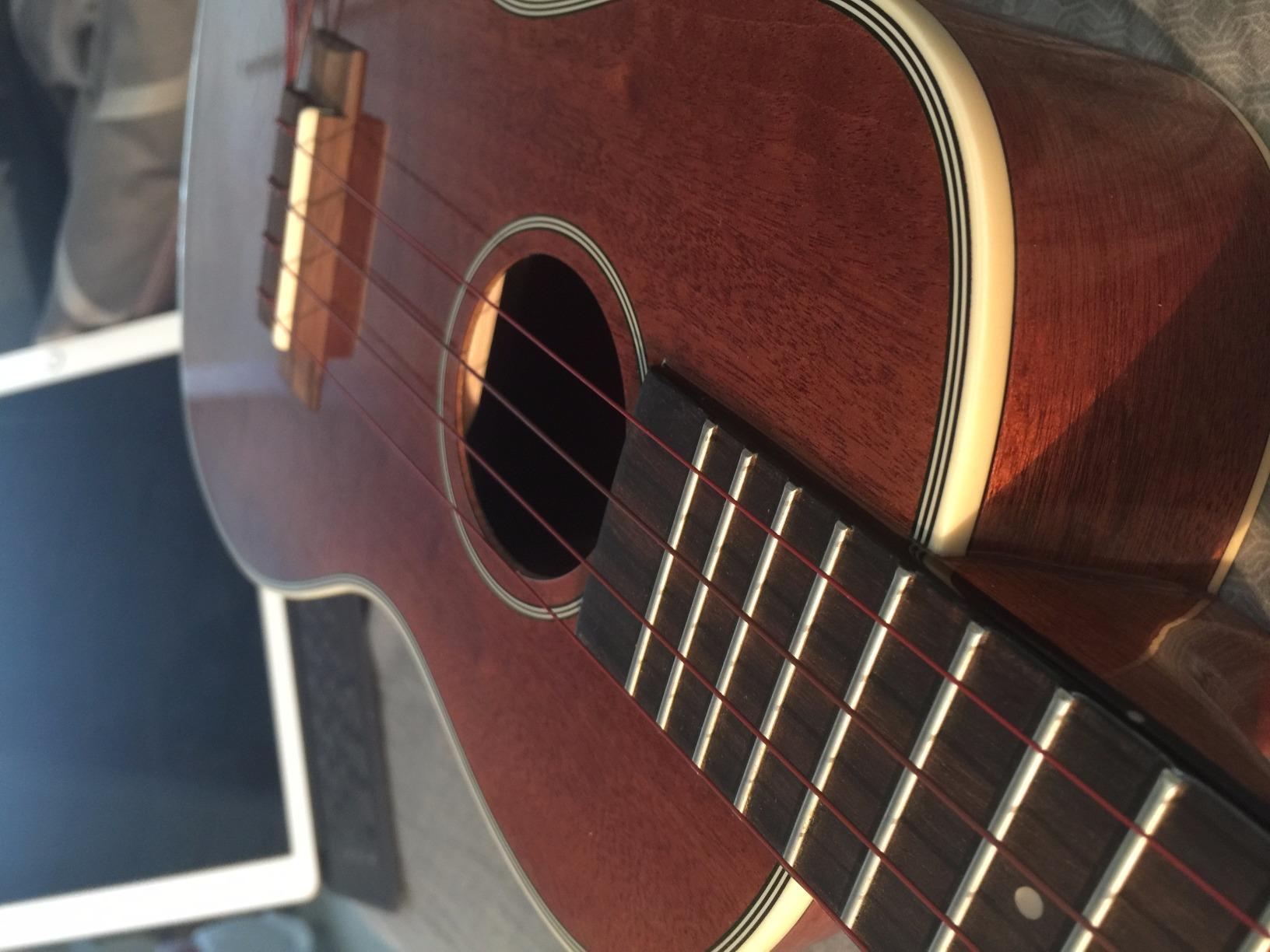
There is no truss rod here, so the action is whatever the factory set. On most units that is playable, but you should check the saddle height at the twelfth fret in the first sitting, because a baritone’s longer scale exaggerates any factory error. It is a five minute check and it removes the most common new-owner complaint in this niche.
Aquila Super Nylgut strings are fitted, which is a good all-round gauge for fingerpicking, and the cream binding with rosette is a nice touch at this level. Just note that no gig bag or strap comes in the box, so plan to add those.
Who will enjoy this baritone
Acoustic fingerstyle players who want a mellow, woody voice rather than a bright or amplified character. It suits anyone playing alone, writing, or accompanying a singer, where the natural low mids are an asset. The gloss finish also appeals to players who want an instrument that looks as good under stage lighting as it sounds in a room.
Because the body is mahogany and the scale is long, it is also a good stepping stone for a player who will later move up to a more elaborate instrument in the same family.
Who should look elsewhere
Skip it if you want to adjust your own action, since there is no truss rod and no electronics. Players who want the very deepest modern low-end response may find a solid mahogany baritone warmer than they are looking for. And if you play steel strings, be aware this model ships with nylon.
5. Caramel CB207 Acacia Baritone, Highest Rated of the Nine
Caramel CB207 Acacia Baritone Acoustic Electric Ukulele with Truss Rod
Striped acacia body
3-band EQ with LCD tuner
Adjustable truss rod
Drill-through richlite bridge
Pros
- Highest owner rating in this roundup
- Rich full tone with clear note separation
- Truss rod plus drill-through bridge for a responsive top
- Complete kit with bag
- strap
- picks and cable
Cons
- Laminate construction rather than solid wood
- Matte finish shows wear over years
- Basic onboard electronics
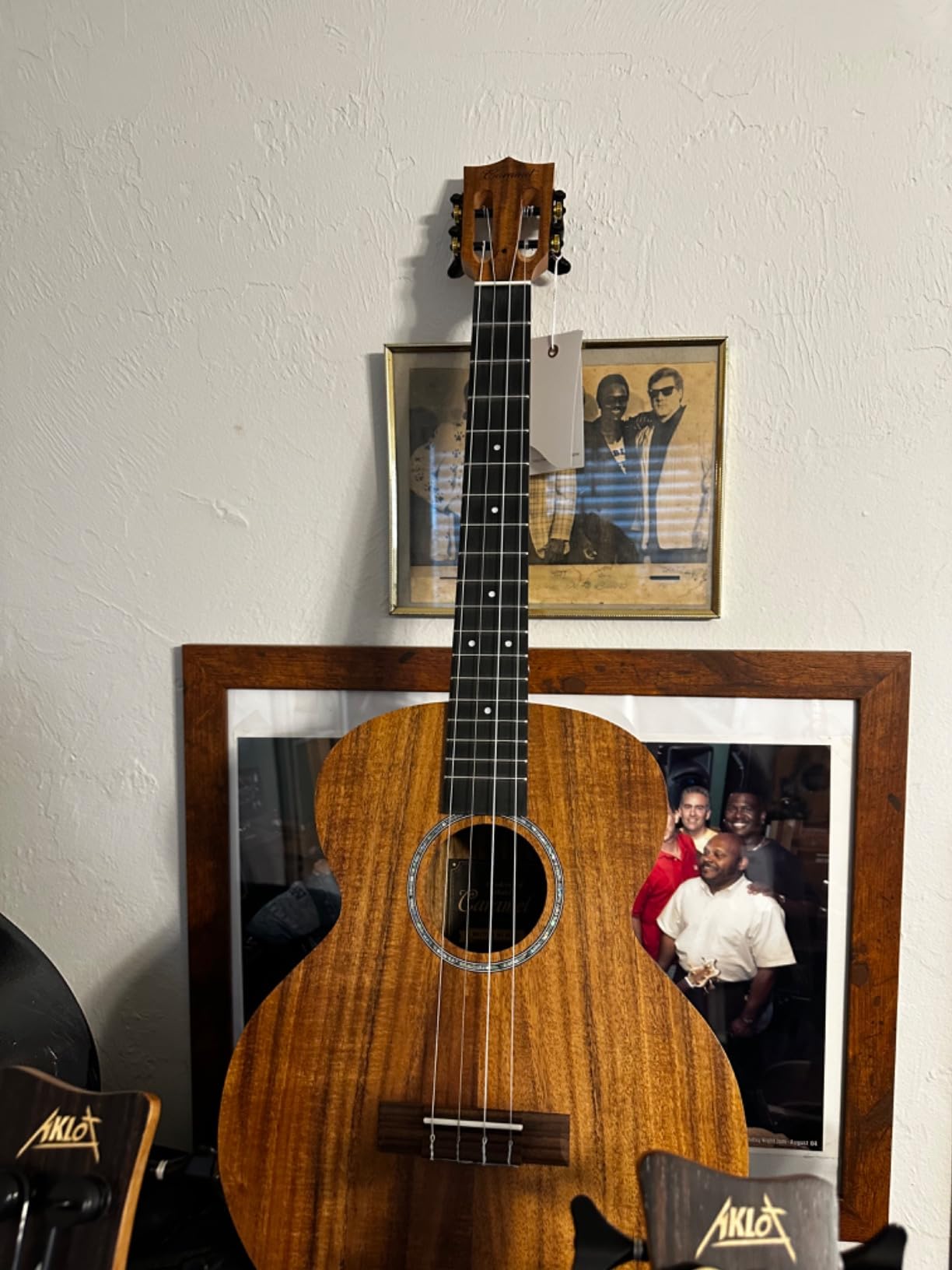
On paper this is the best-rated instrument we tested, and in the hand it backs that up with a clarity we did not expect from a laminate-bodied baritone. The drill-through richlite bridge is the reason: it anchors the string ends directly into the body rather than into a bridge plate, which gives the top more freedom to move and lets notes speak quickly and separately. That is precisely what a fingerstyle arrangement needs.
Action is the other half of the story. The included truss rod and wrench let you set the instrument up for picking right out of the box, and on a 30 inch baritone with twenty frets that control is worth more than any cosmetic upgrade.
The 3-band EQ with a color display tuner and the mother of pearl soundhole decoration round out a well-equipped package, and Aquila strings are already installed so you can start playing immediately. We found the tone rich and full without the low end swallowing the melody line, which is a hard balance to hit at this level.
Owners consistently single out the sound quality and the completeness of the kit, which is rare. The honest limitation is that the body is laminate, so the tone you hear will not keep changing over the years the way a solid wood instrument does. For most fingerstyle players that is a fair trade for the response and the setup flexibility.
Who will enjoy this baritone
Fingerstyle players who care most about note separation and a responsive top, especially those playing fast alternating patterns where clarity matters more than raw volume. It suits gigging players who want stage volume options without giving up acoustic tone, and anyone who wants an instrument ready to play the moment it is unboxed.
The 3-band EQ also makes it a good recorder for players layering parts, since you can dial the low response to sit under other instruments.
Who should look elsewhere
Skip it if you want a solid wood top that will keep improving with age, or if you prefer a gloss finish. Players who want a deeply traditional mahogany character will find the acacia voice brighter and more present than they expect.
6. Caramel CB904 Ebony Baritone, Best Dark Tone for Fingerstyle
Caramel CB904 30inch Ebony Wood Baritone Electric Ukulele
Striped ebony body
3-band EQ with LCD tuner
Adjustable truss rod
Phosphor bronze strings
Pros
- Dark
- full
- rich voice with a strong low register
- Truss rod and wrench allow a low fingerstyle action
- Handcrafted inlayed binding and pre-installed strap buttons
- Complete kit with extra strings and gig bag
Cons
- Basic tuning machines
- Unfinished matte finish wears visibly
- Occasional string packaging quality issues reported
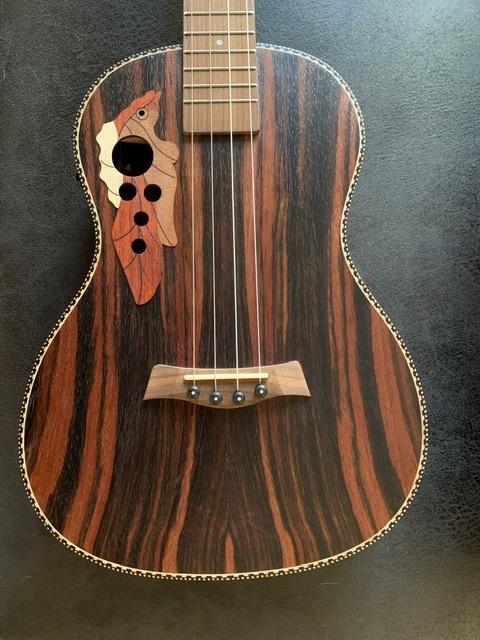
Where the CB207 is bright and present, this one is dark and wide. The ebony body produces a full, deep sound with a low end that genuinely fills a room, and that makes it the most interesting of the electric baritones for solo playing rather than for backing someone else. On a slow arrangement with the thumb carrying the bass line, the character is immediately engaging.
Phosphor bronze strings come fitted, and they are a departure from the nylon default. On a baritone they give a little more top end and bite than nylon, which can help the treble line cut through on a full arrangement, and some fingerstyle players prefer them specifically for that reason.
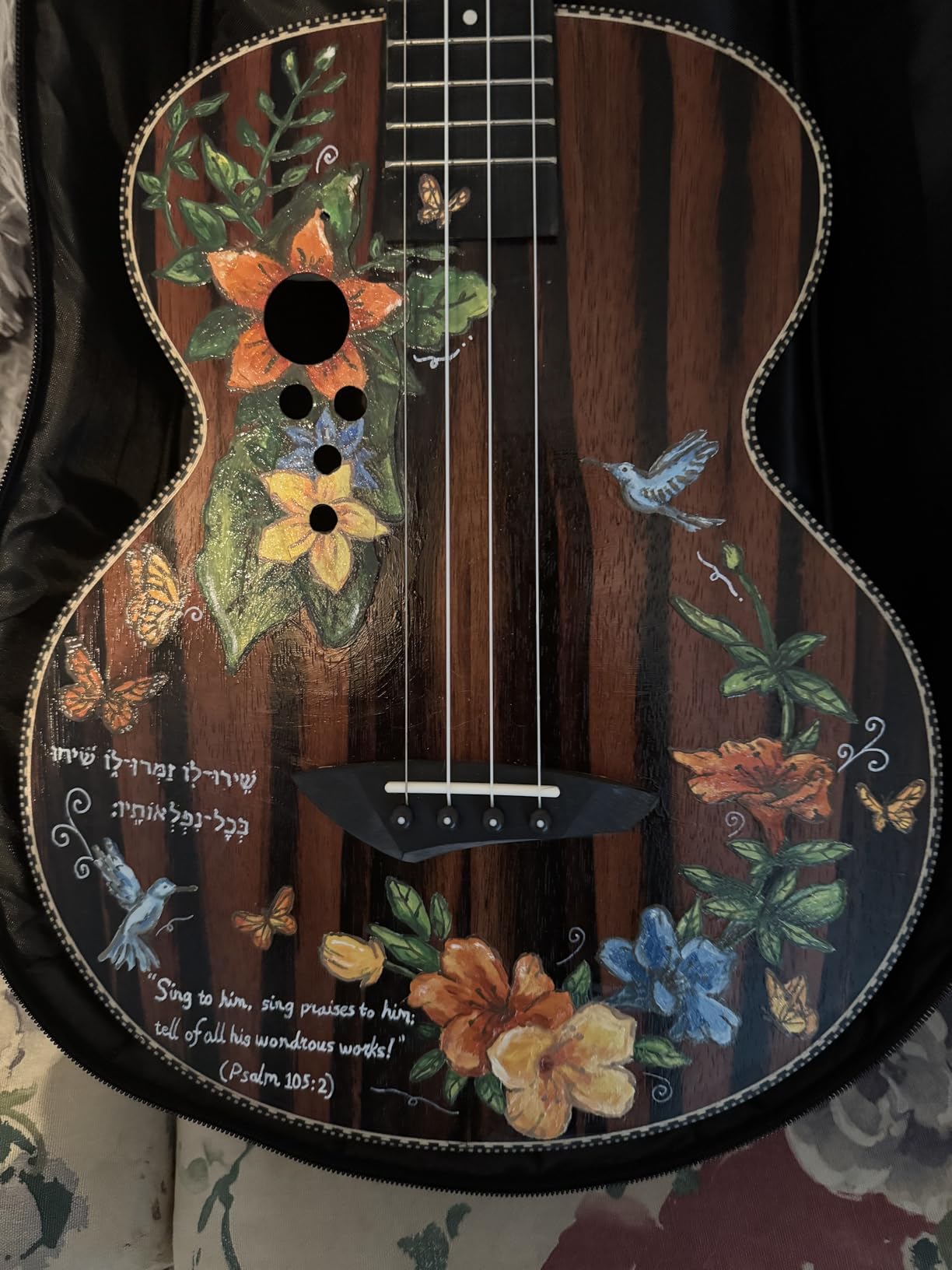
The adjustable truss rod with its Allen wrench is the practical headline here. A baritone this heavy, at thirty inches, needs an action you can tune to your hand, and having the tool included removes the usual first-week friction. The handcrafted inlayed binding is a craft detail you would not expect at this tier, and the pre-installed strap buttons save a step.
A few owners have reported arriving units with the wrong string set in the box, and one reported a neck that needed the truss rod before it played well. Both are fixable in minutes, but it is worth checking the strings and neck relief on day one rather than assuming.
Who will enjoy this baritone
Players who write and perform solo arrangements where low register weight is the point, and fingerstyle players who want a darker voice to contrast against a soprano or concert uke in a group. It suits anyone who likes the feel of bronze strings and wants a responsive top they can set low.
The full accessory kit makes it practical for a player who wants to move straight from unboxing to practice sessions without another shopping trip.
Who should look elsewhere
Skip it if you want a bright, cutting acoustic tone, since the ebony body points the other way. Players who want the cleanest possible appearance over time will prefer a gloss finish, and anyone who dislikes setting a new string set should check the packaging carefully on arrival.
7. Ranch Sapele Baritone, Best for Sustain and Arched Back
Ranch 30 Inch Baritone Ukulele, Sapele Professional Kit with Truss Rod
Sapele body with arched back
38mm nut width
20 frets with wide spacing
Adjustable truss rod
Pros
- Arched back extends sustain for ringing fingerstyle passages
- Wide 38mm nut is the most finger-friendly in this group
- Aquila strings and a padded gig bag included
- Stays in tune well
Cons
- No electronics
- so it is strictly acoustic
- Included digital tuner is basic
- Some players want more low-end punch
This is the hand-size answer in the roundup, and that is the headline reason to shortlist it. A 38mm nut width is wide for a ukulele and close to what guitarists already know, which means your fretting hand does not have to relearn anything and larger hands do not feel cramped. On a twenty-fret baritone with a long scale, that width is a genuine comfort feature rather than a novelty.
The arched back is the second reason. It moves air more efficiently than a flat back, and owners consistently report longer sustain, which for fingerstyle means notes keep ringing while you move to the next chord instead of dying under your hand.

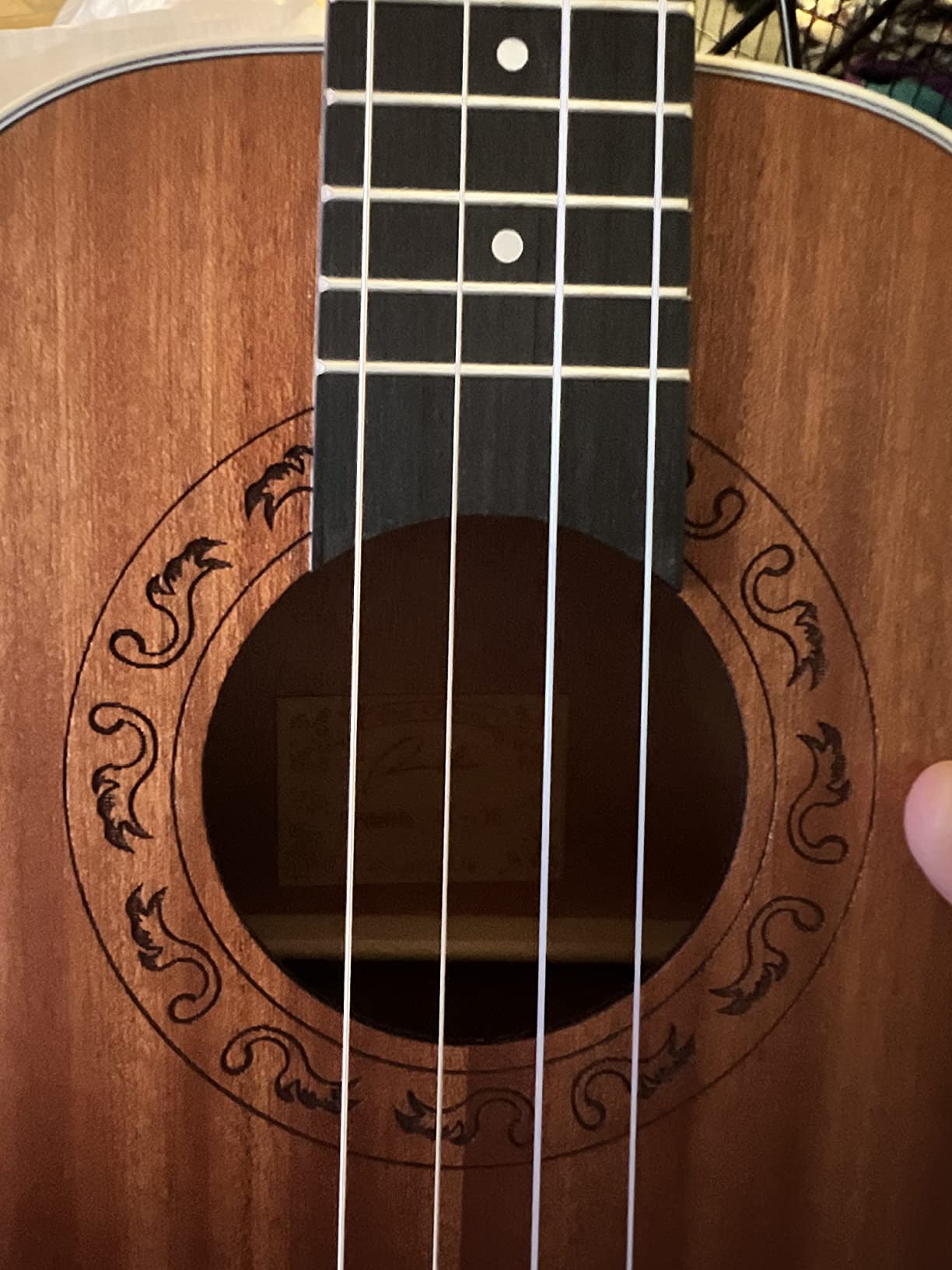
The sapele body with a mahogany neck delivers a warm, mellow, resonant voice that sits nicely under fingerpicking, and the adjustable truss rod means the wide fret spacing can be set up without buzzing at the higher frets. At 1.75 kg this is not the lightest instrument here, but the shape of the body distributes it well against the thigh.
Owners like the completeness of the package: padded bag, strap, cloth, a spare set of Aquila strings, and a digital tuner. That tuner is the weak point, a basic clip-on style unit that flickers and jumps, so if you already own one, ignore it. There are no electronics on the instrument itself, which keeps the signal path simple for recording.
Who will enjoy this baritone
Players with larger hands, or anyone with reduced hand mobility who wants a wider fretting surface. It suits fingerstyle players who like letting notes ring rather than damping them, and acoustic players who record a baritone on its own because a simple signal path is easier to control.
The wide nut also makes it a comfortable second instrument for a guitarist who finds smaller ukulele necks cramped after a while.
Who should look elsewhere
Skip it if you play amplified or on stage and need a pickup, because there are no onboard electronics. Players who want maximum low-end weight will find this warm rather than deep, and anyone who values a polished finish should note this is a polished, straightforward look rather than a gloss showpiece.
8. Winzz Koa Baritone, Budget Pick With a Bright and Clear Voice
Winzz Baritone Ukulele 30 Inch for Adults Teens Beginners & Prof, KOA Wood
All koa top, back and sides
Bright clear melodic tone
Die-cast machine heads
30 inch baritone
Pros
- All koa body is unusual at this entry level
- Bright clear tone suits melodic fingerstyle lines
- Die-cast machine heads hold pitch
- Kit includes bag
- LED tuner
- strap and spare strings
Cons
- Mixed nylon and steel strings are not a universal fit
- Newer model with a shorter owner history
- Varnish finish
All koa across top, back, and sides is unusual on an entry-level instrument, and it is why this one has a reputation for a bright, clear, melodic voice. On melodic fingerstyle lines where a single note has to carry the phrase, that clarity is more useful than raw volume, and it sits forward in a mix without needing much help.
The die-cast machine heads are a genuine step up from the basic open-gear machines fitted to cheaper baritones, and stability on a long scale matters more here than on a small instrument. A spare Aquila string set, an LED tuner, a bag, and a strap all come in the box.
The one adjustment most owners make is the string set. The supplied mix of nylon and steel gives a clear, lively top line that suits melodic picking, but players who want the softer classical feel can move to an all-nylgut set without any other change to the setup. The instrument accepts both without complaint.
It is also the only all-solid-wood body in the roundup at the entry end, and that is the reason the tone keeps settling in as you play rather than sounding thin on day one. For a first baritone, that is a meaningful difference in how quickly the instrument starts sounding like itself.
Who will enjoy this baritone
Beginners who want a bright, encouraging voice on their very first baritone, and fingerstyle players who like picking out clear melodic lines such as classical and folk arrangements. It suits anyone who wants a step up in wood character without moving up several tiers.
It is also a reasonable first instrument for a player who wants to experiment with tunings, since the included string set gives you a spare set to experiment with.
Who should look elsewhere
Skip it if you want a dark, mellow mahogany voice, because this one is deliberately bright. Players who are strict about all-nylon strings may not like the mixed nylon and steel set, and buyers who want a long ownership history should be aware this is a newer model with a shorter record of long-term use.
9. MUSOO Blackwood Baritone Electric, Best Complete Starter Kit
Baritone Ukulele Electric 30 Inch All Blackwood Acoustic Ukelele Kit with Truss Rod with EQ with Gig Bag,Strap,Nylon String,Electric Tuner,Pick,shaker
Blackwood body with walnut fingerboard
3-band EQ with LED tuner
Adjustable truss rod
30 inch body
Pros
- Longest accessory list here
- including bag
- capo
- shaker and spare strings
- Blackwood body gives a rich warm acoustic voice
- Truss rod and 3-band EQ give real tone control
- Right and left-handed versions listed
Cons
- Bridge may need sanding to reach a playable action
- Intonation and neck delamination issues reported by some owners
- Lowest owner rating in this roundup
Look at the box contents before anything else here. This kit ships with a gig bag, strap, spare nylon strings, an electric tuner, picks, a capo, and a shaker. If you are buying your first baritone and want everything you need for practice and for playing along with other instruments, nothing else in this roundup matches the list.
The first thing to check on arrival is the bridge height, because this is the model in the roundup most likely to need it adjusted. Shaving the saddle down a small amount is a normal fifteen minute job at a workbench, and once the action sits where your fingers want it the instrument plays acceptably for its tier.
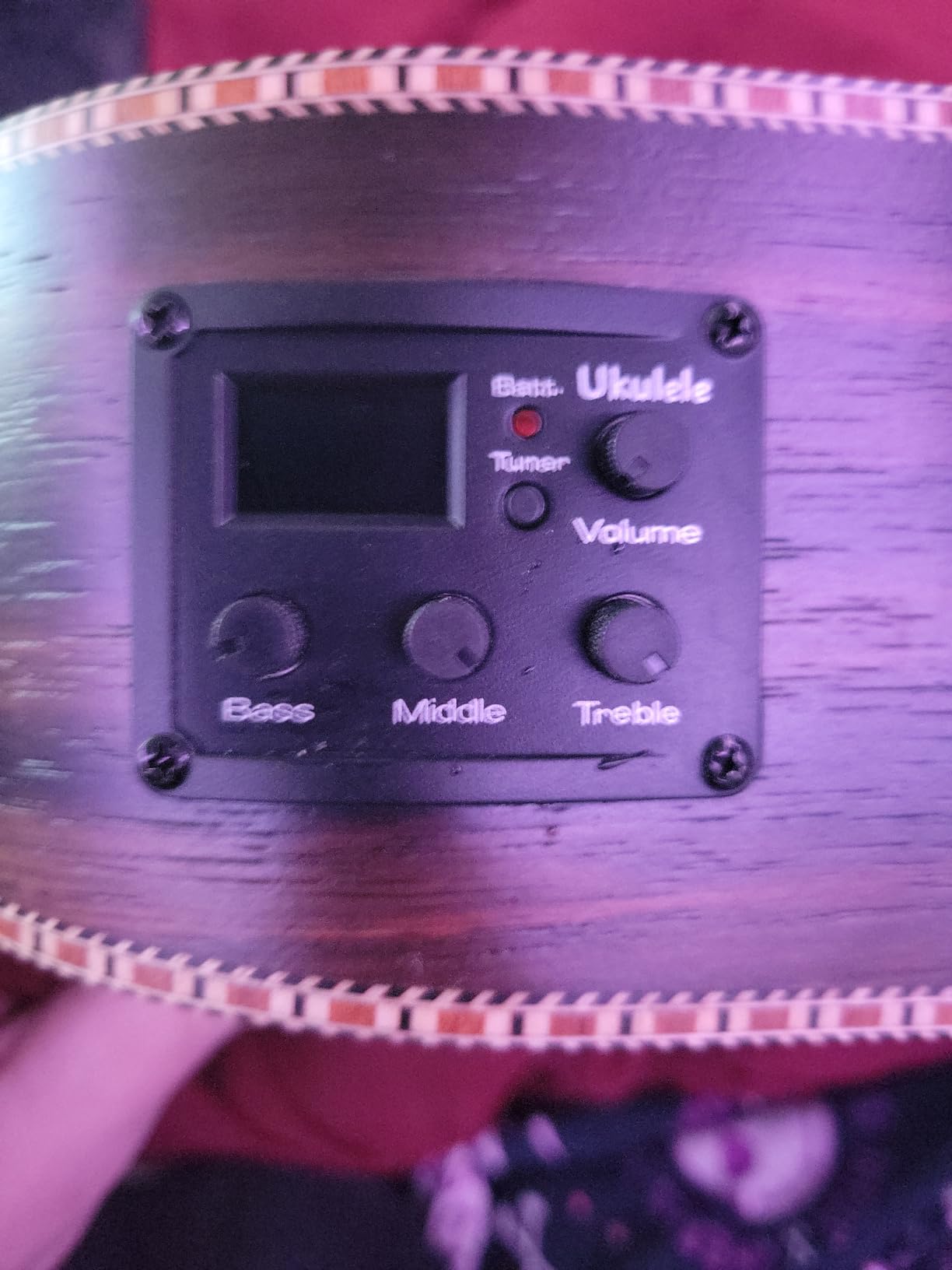
What you get for that modest effort is a genuinely warm, woody acoustic voice from the blackwood body, with enough midrange body to sit under a melody line without the low end turning to mud. The electronics are there to lift or cut that low response rather than to rescue a thin sound, which is the right division of labour for fingerstyle.
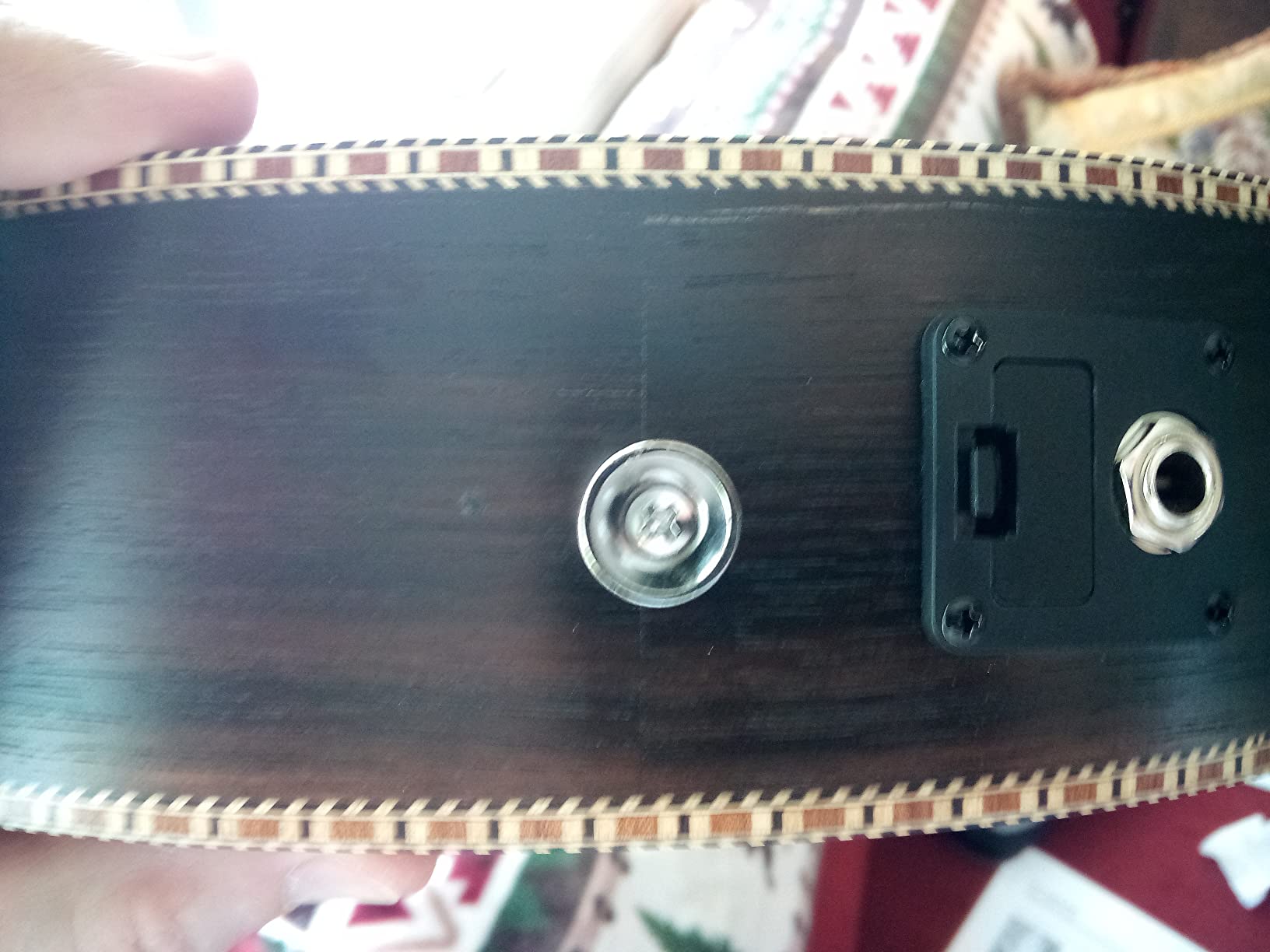
The instrument itself is an ebony-bodied acoustic-electric with a walnut fingerboard and bridge, a truss rod, and a 3-band EQ with a built-in LED tuner. The unamplified voice is rich and warm, and the electronics let you lift the low response for a small room or a recording chain, which is the same reason the CB103 and CB207 earn their place.
Who will enjoy this baritone
First-time buyers who want one purchase to cover everything, and fingerstyle players who like having a capo and shaker in the case for writing sessions. It suits players who want an amplified option and a truss rod at an entry price point.
If you plan to perform, the 3-band EQ gives you more control than most instruments at this level, and the included strap buttons save a step.
Who should look elsewhere
Skip it if you care about consistent quality control, because some owners report a bridge that needs sanding for a playable action, intonation trouble further up the neck, and one report of neck delamination. Players who want the most highly rated instrument in the roundup should look at the CB207 instead, and anyone sensitive to finish should know this one is lacquered rather than gloss or matte.
What to Look For in a Baritone Ukulele for Fingerstyle
Most buying guides for baritone ukuleles are written around wood, finish, and size. Those matter, but for a fingerstyle player four other details decide whether the instrument feels good in your hands after an hour of playing.
Scale length and fret spacing
A baritone runs a tenor-scale neck, roughly twenty inches, and that longer scale is the source of the wide fret spacing you can feel immediately. Wider frets mean a falling finger makes clean contact with a single string instead of landing across two, which is why baritone fingerstyle patterns look and feel more like guitar than any other ukulele size. It also means a lot more physical movement per fret, so if you are used to a soprano or concert, expect your left hand to travel further than instinct expects for the first few sessions.
Action and setup are the whole ballgame
Factory setup is the number one reason a new baritone feels unplayable to a fingerpicker, and the recurring forum complaint is a buzzing string or a high action above the fifth fret. Look for an adjustable truss rod first: six of the nine instruments in this roundup have one, and that single feature means a bad setup is a two minute fix rather than a paid one. On a twenty-fret baritone, buzzing at the higher frets is nearly impossible to fix with a string change alone, so the truss rod matters more here than it would on a smaller uke.
When a new baritone arrives, check the action at the twelfth fret, tune up, and listen for buzz on the treble string at the fifth fret and above. If it is buzzy, that is a setup issue, not a defective instrument, and most of the models here can be corrected at home with the included tool.
String gauge and tension for fingerpicking
Fingerstyle players ask about this more than any other setup question, and the answer depends on whether you are playing alone or with a group. A slightly heavier gauge than you think you need gives your thumb more attack and keeps the bass line from sounding thin against the melody, which matters more on a baritone because of the longer scale. The instruments here that ship with Aquila sets, the Kala MK-B, the Kala KA-BG, and the Ranch, are all fitted with a sensible default. The one outlier is the Winzz, which ships with a mix of nylon and steel strings, and the Caramel CB904, which comes with phosphor bronze. Bronze gives more bite on the treble line and suits melodic arrangements; all-nylon is softer and safer on a beginner’s fingertips.
Nut width and hand size
Nut width is the specification that solves the most common physical problem and the one most guides never mention. A narrower nut feels sleek but cramps large hands and forces more movement per fret, while a wider nut gives your fingertip more surface to land on. The Ranch is the widest instrument here at 38mm, close to a guitar neck, and it is the one to pick if you have larger hands, reduced hand mobility, or a preference for a guitar-like feel. The narrower ukulele norms suit players with small hands and fast position changes.
Tonewood: what actually changes for fingerstyle
Mahogany, the most common baritone top wood, gives a warm, midrange-forward voice that blends well under other instruments. Acacia and zebra wood, both featured here, are brighter with more attack, which helps individual notes cut through in a fast arrangement. Ebony is darker with the strongest low register, which suits solo playing where the bass line carries the piece. Solid wood keeps developing acoustically over years, while laminate bodies are more consistent and often more responsive right out of the box, and honestly for many fingerstyle players that immediate response matters more.
Baritone tuning explained: DGBE, CFBF and reentrant low G
Standard baritone tuning is DGBE, the same four notes as the lowest four strings of a guitar, and it is why open guitar chord shapes move across a baritone almost unchanged. Two alternatives come up constantly. CFBF tuning drops the whole instrument a whole step for a darker, Celtic character with a heavier low end. Reentrant tuning, often called low G, detunes the top string so the first three strings ring above the fourth, producing that unmistakable slack, shimmering octave-up backbeat that fingerstyle players use for old-time, country, and folk patterns. If your repertoire leans toward that sound, low G is the one to test before you buy, because the feel of the top string changes a lot.
Acoustic or acoustic-electric for fingerstyle
A baritone has enough low end that a small amplifier or a mixing setup needs help balancing it, which is the case for the three acoustic-electric models in this roundup. If you play at home, record, or perform in small rooms, the 3-band EQ on the Caramel CB103, CB207, and CB904 is genuinely useful rather than decorative. If you play solo acoustic folk, a pickup mostly adds weight and cost, and a mahogany body like the Kala KA-BG gives you more of what you actually need.
Intonation and the twelfth fret
Intonation is where baritones most often disappoint, because a longer scale magnifies small setup errors. The fix is nearly always a compensated saddle and a correct nut slot, both of which are cheap relative to the instrument. All nine models here use a compensated-style bridge or a bridge that can be shimmed, and six ship with a truss rod so you can correct action and buzz yourself. Intonation complaints appear in owner feedback for the injection molded Kala MK-B and the MUSOO more than anywhere else, so if exact tuning at the twelfth fret is critical to your playing, check both instruments carefully on arrival.
Frequently Asked Questions
Which baritone ukulele has the best sound?
In this roundup the Kmise 30 inch mahogany baritone takes the overall nod for fingerstyle, because its 18:1 tuners, adjustable truss rod, and large owner base make it the most consistent instrument to play and set up. The Caramel CB207 is the highest-rated, at 4.7 stars, and its drill-through bridge gives fast, clearly separated notes. The Kala KA-BG wins on traditional mellow mahogany tone.
What tuning does a baritone ukulele use?
Standard baritone ukulele tuning is DGBE, the same four notes as the lowest four guitar strings, which is why guitar shapes transfer so easily. Alternatives include CFBF for a darker, heavier Celtic sound, and reentrant or low G tuning, where the top string is detuned so the first three strings ring above the fourth for a shimmering old-time fingerstyle texture.
Is a baritone ukulele harder to play than a tenor?
It is bigger, not harder. A baritone has a longer tenor-scale neck and wider fret spacing, so the left hand travels further per fret and the body is heavier against your thigh. In return you get cleaner note separation, a much stronger low end, and familiar guitar tuning. Players with larger hands are often more comfortable on a baritone than on a tenor.
What strings and gauge should I use for fingerstyle on a baritone uke?
A slightly heavier gauge than you expect gives your thumb more attack and keeps the bass line from sounding thin, which matters more on a long-scale baritone. All-nylon is softest and safest on new fingertips, while phosphor bronze adds bite on the treble line for melodic arrangements. Whichever you choose, the strings need more tension than on a soprano uke, so raise the action with the truss rod before you go up a gauge.
How big is a baritone ukulele?
A baritone ukulele is typically a 30 inch body with a total length of roughly 32 to 34 inches, and a tenor-scale neck of about 20 inches with around 20 frets. That makes it noticeably larger than a tenor uke and far larger than a soprano or concert, and it is the reason baritones need a wide nut and a proper strap or support.
Is a baritone ukulele worth it for fingerstyle?
Yes, for most fingerstyle players it is the best ukulele size, because the wide fret spacing keeps thumb and finger notes distinct, the low strings have real body, and standard DGBE tuning means guitar patterns and chords carry straight over. The main tradeoffs are size, neck travel per fret, and the need to check setup on arrival, which is why a model with an adjustable truss rod is worth paying for.
The Verdict for Fingerstyle Players in 2026
The best baritone ukuleles for fingerstyle in 2026 are not the most decorated ones on the shelf. They are the ones where the action is right, the nut is the width your hand wants, and each note has room to ring. Start with the Kmise for the best all-round fingerstyle experience and the most owner-proven setup, or the Kala MK-B if you are coming straight from guitar and want the least relearning. Pick the Caramel CB207 if note separation and a 4.7 owner rating matter most, the Caramel CB904 if you want the darkest, fullest voice for solo arrangements, the Ranch if your hands are large, and the Kala KA-BG if a mellow mahogany tone is what you are chasing.
Whichever one you land on, do the twelfth-fret action check in your first sitting. That five minute habit solves the one problem that makes the most new baritones feel wrong to a fingerpicker.