

The Snark SN5X is the best guitar tuner for acoustic guitars in 2026 for most players. It reads pitch fast, holds a charge, and its vibration sensor keeps working when a rehearsal room turns loud, which is exactly the failure mode cheap acoustic tuners hit. Twelve tuners made it into this roundup, spanning stealth headstock mounts, soundhole units, a stomp pedal and a strobe benchmark, so you can match one to how and where you actually play.
Before the list, one clarification that trips people up constantly: the word tuner means two different products. An electronic tuner is a small device that tells you what pitch your strings are playing right now. A tuning peg, machine head or tuning machine is the physical gear inside your headstock that actually raises and lowers the string. If you are shopping for Gotoh, Guyker or Graph Tech Ratio machine heads, this page is not for you. Everything below is an electronic tuner.
We tested and updated this roundup for 2026. Each pick was checked for reading speed on an acoustic across standard EADGBE and open tunings, display legibility in a dim room, calibration range, power source and the specific failure modes owners report after months of use. We also looked hard at what each unit is bad at, because a tuner that drifts in a noisy room or dies mid-set is worse than one that is honest about its limits.
Table of Contents
Top 3 Picks for Acoustic Guitar Tuners (September 2026)

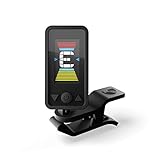
D’Addario Eclipse
- Vertical full color display
- 435-450Hz adjustable calibration
- Dual swivel mount

Donner DT-2
- Single-button operation
- Rotational multi-angle display
- Chromatic and standard modes
All 12 Guitar Tuners Compared in 2026
| Product | Specs | Action |
|---|---|---|
| Snark SN5X Clip-On Chromatic Tuner |
|
Check Latest Price |
 D’Addario Micro Headstock Tuner D’Addario Micro Headstock Tuner |
|
Check Latest Price |
 Fender FCT-2 Professional Clip-On Fender FCT-2 Professional Clip-On |
|
Check Latest Price |
| D’Addario Eclipse Headstock Tuner |
|
Check Latest Price |
 KLIQ UberTuner Clip-On KLIQ UberTuner Clip-On |
|
Check Latest Price |
 Snark ST-2 Chromatic Tuner Snark ST-2 Chromatic Tuner |
|
Check Latest Price |
| Donner DT-2 Clip-On Tuner |
|
Check Latest Price |
 D’Addario NS Micro Soundhole Tuner D’Addario NS Micro Soundhole Tuner |
|
Check Latest Price |
 LEKATO Rechargeable Clip-On Tuner LEKATO Rechargeable Clip-On Tuner |
|
Check Latest Price |
 Peterson StroboClip HD Peterson StroboClip HD |
|
Check Latest Price |
 Peterson StroboStomp HD Pedal Tuner Peterson StroboStomp HD Pedal Tuner |
|
Check Latest Price |
 Korg Sledgehammer Clip-On Korg Sledgehammer Clip-On |
|
Check Latest Price |
First, a Tuner or Tuning Pegs?
Gotoh and Guyker both make machine heads, which are the geared posts inside the headstock that hold and tension each string. Gotoh leans into higher-spec open-gear designs, Guyker into value-oriented open-gear and sealed models, and comparing them is a conversation about gear ratio, string gap and feel under your fingers. Taylor ships branded open-gear machine heads on many of its steel-string models. None of these devices tells you what pitch you are playing.
That is what the twelve units below do, and the distinction matters because machine heads change how a guitar feels and electronic tuners change how accurately you can set it. If your strings keep drifting and the fault is in the machine heads, a better tuner will not fix it, though a wider calibration range will at least let you compensate.
Why Acoustic Guitars Behave Differently
An acoustic drifts more than an electric for three reasons. Humidity and temperature move with the seasons, which swells or shrinks the neck and changes string tension. Fresh strings stretch into shape during the first days of use. And a top-heavy dreadnought body reacts more to room conditions than a solid-body instrument bolted to a neck.
That is also why sensing method matters. A contact microphone listens to the headstock and picks up the room along with the string, so a loud rehearsal space can push the reading around. A piezo vibration sensor reads the string mechanically, ignoring background noise entirely. On a quiet acoustic at home, the difference is academic. On a dim stage with a loud amp two metres away, it is the whole ballgame.
1. Snark SN5X Clip-On Chromatic Tuner – Best Overall
Snark SN5X Clip-On Chromatic Tuner for Guitar Bass and Violin
Full color display
USB rechargeable
Vibration sensing
1.58 oz
Pros
- Large high-contrast color display that reads in low light
- Rechargeable so there are no cells to carry
- Fast readings that rarely need re-checking
- Works on guitar bass violin and mandolin
Cons
- Plastic body does not survive drops well
- Clip can feel slick out of the box
- Included charging cable is short and low quality
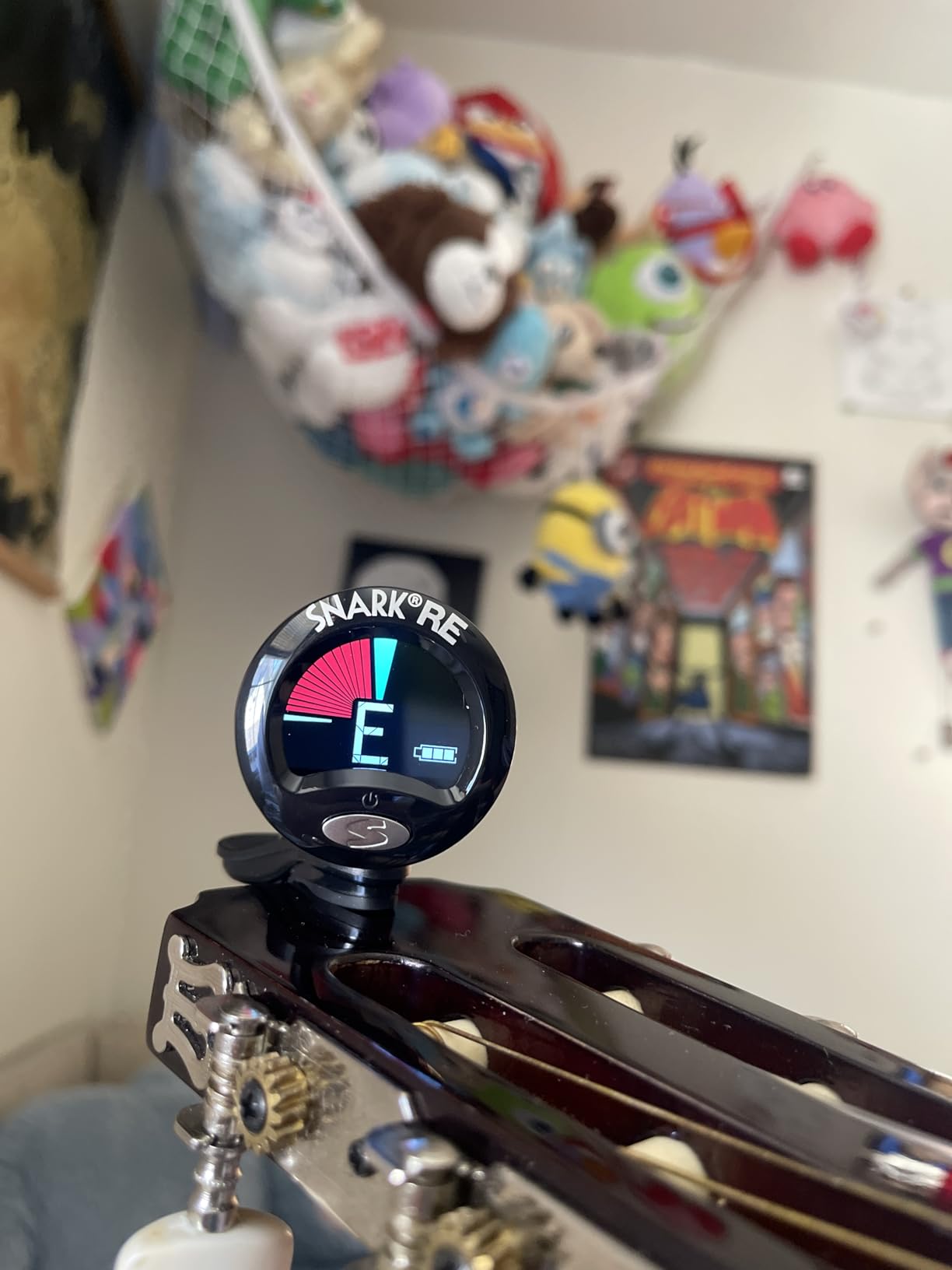
The SN5X is the tuner I keep reaching for, and it is the most reviewed clip-on in this group by a wide margin at more than 38k ratings. The full-color screen is the reason it wins: it is large enough to read at arm’s length on a dark stage, and the needle settles fast enough that you are not waiting on it between songs.
It uses vibration-based detection rather than a contact microphone, so a noisy rehearsal room does not corrupt the reading. The frequency range is tailored to guitar and bass, and it clips to either face of the headstock, which matters if your instrument has an unusual headstock angle.
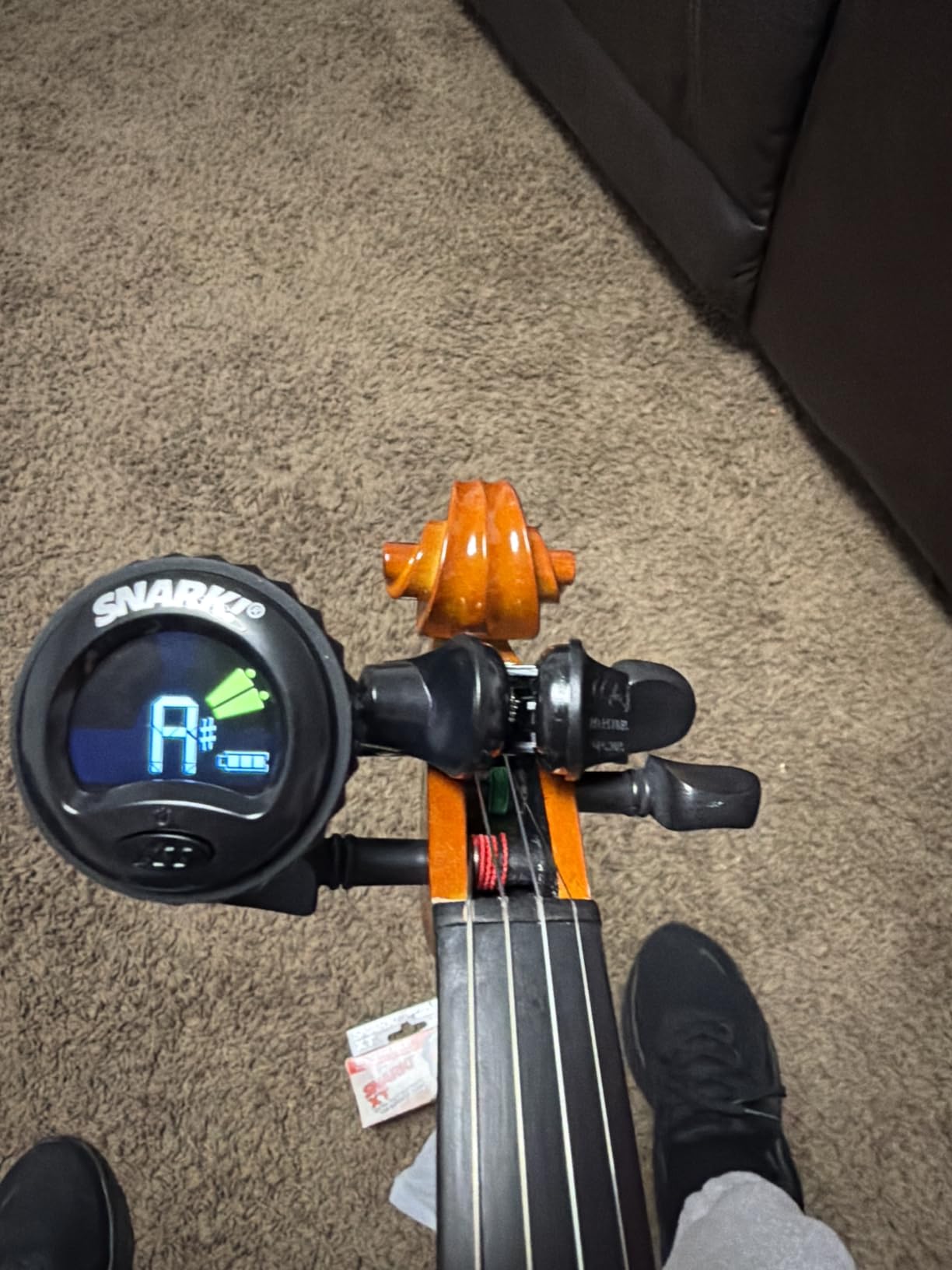
Charging is over USB, so there is no battery anxiety at a gig, and it works across guitar, bass, violin and mandolin if you play more than one stringed instrument. The calibration behaves predictably on an acoustic, including the low E where cheaper units wobble.
The honest weakness is build. The body is plastic, it does not like being dropped, and owners commonly report the clip feeling slick in the first days before it settles. The bundled charging cable is short and feels disposable, so bring your own USB lead if you travel. Even so, it is the most broadly useful of the twelve for acoustic players who play out, record at home, or both.
When the SN5X is the right call
It suits anyone who plays out, records at home, or simply wants a reading that does not move when a room does. At 1.58 ounces it disappears on the headstock, and the rechargeable cell means you can leave it mounted permanently.
Beginners get a chromatic display that names the note outright, so you stop guessing which string is which.
When it disappoints
If you are rough with gear or gig in the rain, the plastic shell is the weak point. Some variants of this model ship as battery powered rather than rechargeable, so read the box carefully.
It is also not a precision instrument. If you tune to a fixed pitch reference for recording, one of the strobe units below is the better tool.
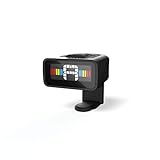
2. D’Addario Micro Headstock Tuner – Best Discreet Mount
D’Addario Micro Headstock Tuner, 1 Pack
Piezo vibration sensing
410-480Hz calibration
Tri-color backlit screen
0.32 oz
Pros
- Practically invisible behind the headstock
- Stores inside the case so it can stay mounted
- Accurate piezo sensing across a 410-480Hz range
- Handles unusually thick headstocks such as classical guitars
- Replaceable CR123A cell
Cons
- Springless ratcheting clamp can lose its grip over time
- Very small screen is harder to read at a glance
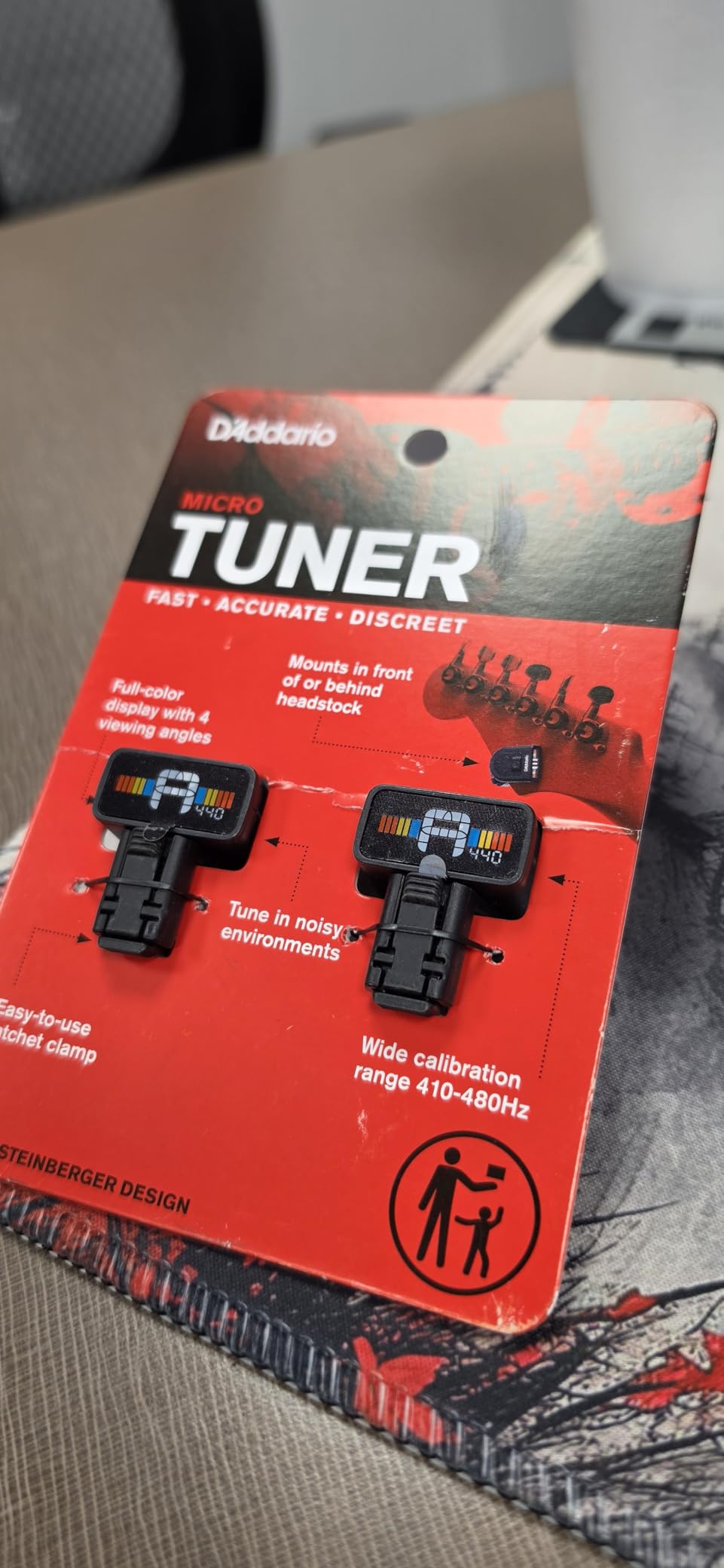
This is the tuner for anyone who hates how a tuner looks on a headstock. At 0.32 ounces it tucks behind the tuning posts and effectively disappears, and many owners buy a second one so each instrument keeps its own permanently mounted.
Because it is so small, it lives inside the case rather than in a pocket, which removes the whole question of whether you remembered to bring it. The piezo sensor reads string vibration rather than sound, so rooms do not interfere.
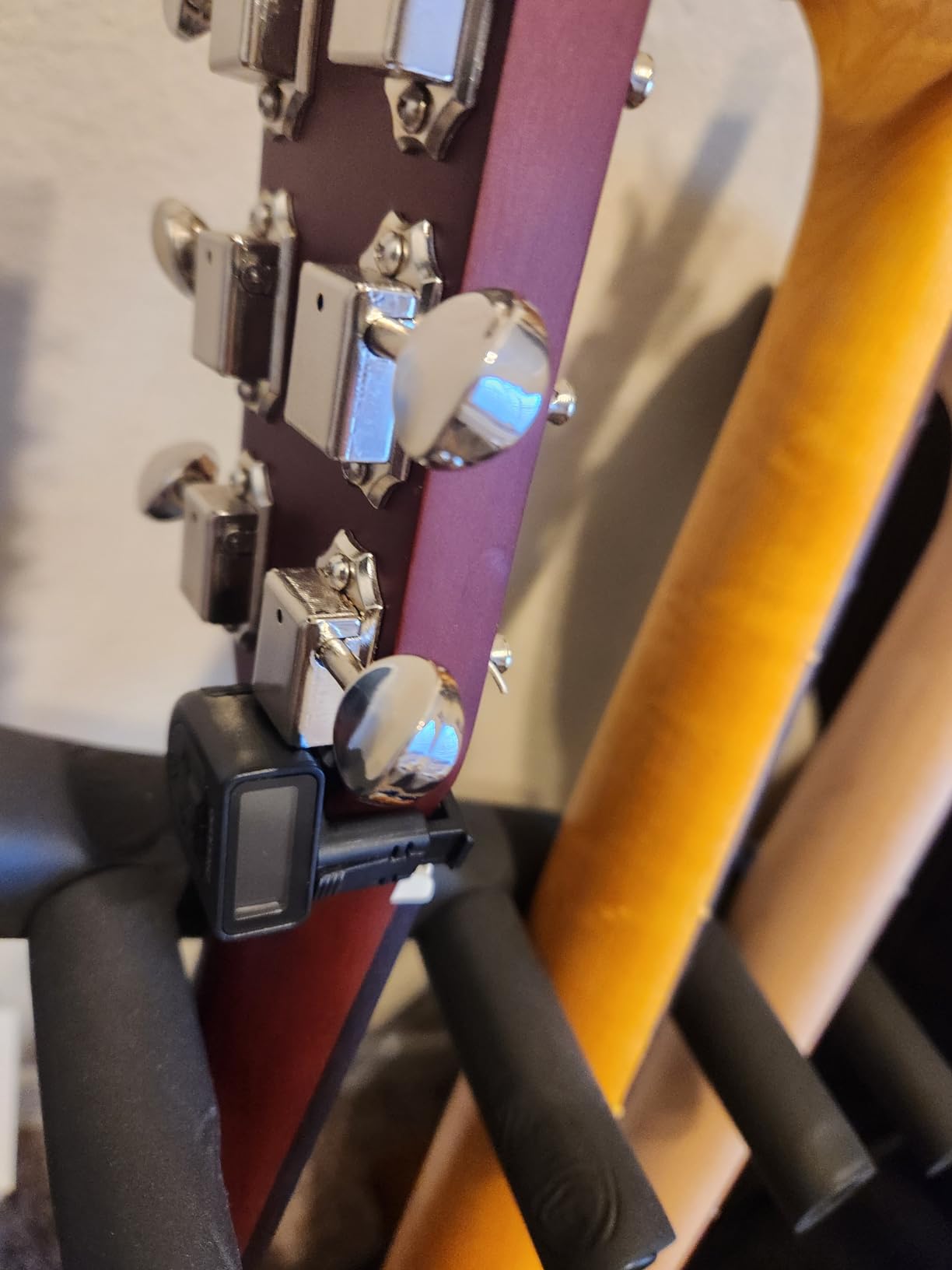
The calibration range of 410 to 480Hz is among the widest in this roundup, which gives you room to compensate for a guitar tuned in an unusual environment. The tri-color backlit screen runs red, yellow, green, so you can tune without reading numbers at all.
The known weakness is the clamp. It ratchets rather than springs, and once the plastic teeth wear, the tuner can slip off mid-session. Owners on lighter instruments, particularly ukuleles, report this first. The screen is also tiny, so it is less convenient for a beginner learning note names.
Who it fits
Players with vintage, high-end or plain-looking acoustics who would rather leave the headstock looking exactly as the maker left it. It suits anyone who wants the tuner to live permanently on the instrument.
The 410-480Hz range makes it a good second tuner if you play in varied humidity or work with a capo a lot.
Who should skip it
If you need a display you can read at a glance while playing, this is not it. The tiny readout asks you to lean in.
Heavy-handed players should also know the clamp has no spring to fail catastrophically, but it does lose tension as the teeth wear.
3. Fender FCT-2 Professional Clip-On – Best for Beginners
Fender FCT-2 Professional Multi-Instrument Clip-On Tuner for Guitar, Bass, Ukulele, and Violin
Color LCD needle display
Vibration sensing
Five instrument modes
CR2032 included
Pros
- Big readable needle display that works on stage
- Vibration sensing stays accurate in noisy rooms
- Dual-hinge clip fits either side of the headstock
- Guitar bass ukulele violin and chromatic modes
Cons
- Needs a disposable CR2032 cell rather than a rechargeable one
- Plastic construction draws occasional criticism
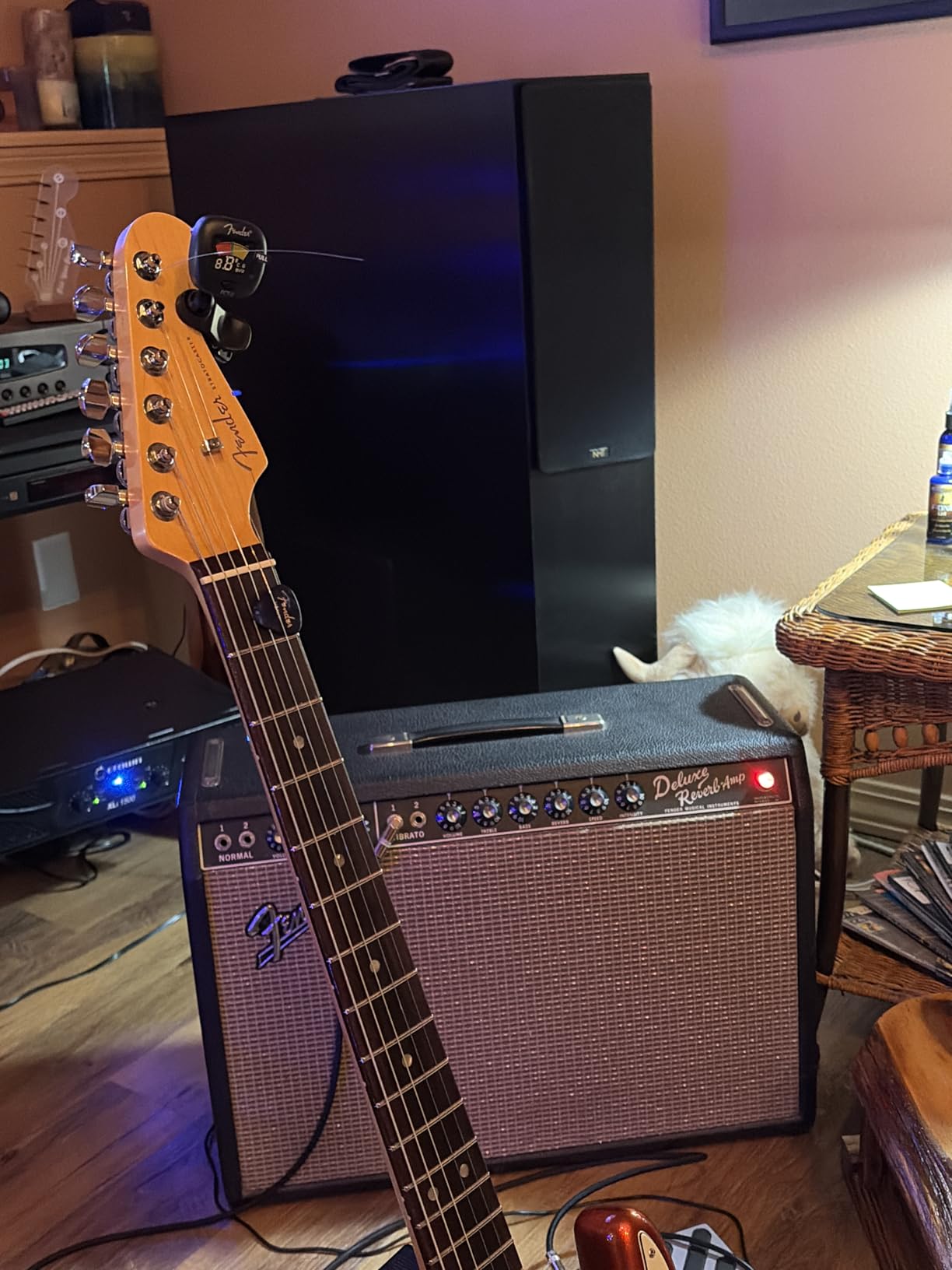
The FCT-2 is the tuner I hand to people who have never tuned a guitar. The needle sweeps across a color LCD like a miniature amp meter, so the visual logic is obvious without reading anything.
It senses vibration directly from the instrument, which is why it holds up in a loud room. It also works straight out of the box, calibrated to A440 across a B0 to B7 range, so there is no setup ritual before your first tune.
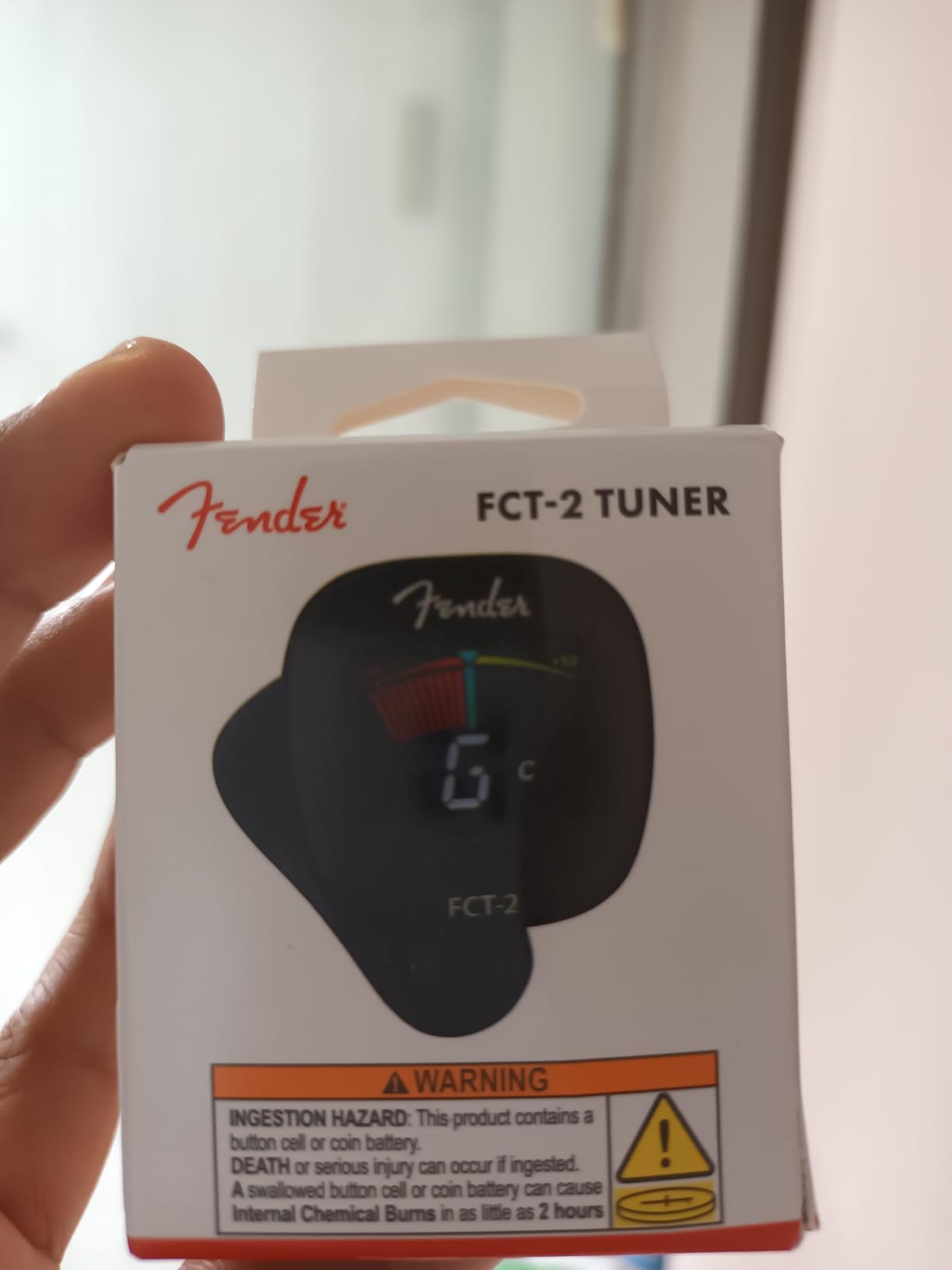
Five modes cover guitar, bass, ukulele, violin and full chromatic. For an acoustic player who also strums a ukulele, that is one clip-on doing the work of two, and it ranks as the best seller in Music Tuning Accessories.
What gives it away as a mid-range unit is the power. It runs on a CR2032 cell rather than a rechargeable one, so keep a spare in the gig bag, and the plastic body and clamp are unremarkable under abuse. There is also a one-year limited warranty.
When it is the right tuner
It is the safest recommendation for a new player because nothing about it needs explaining. The needle tells you which way to turn the peg, which is the hard part for beginners.
It also works well for anyone who plays more than one stringed instrument and does not want to carry separate units.
When it disappoints
Players who tour should note the disposable battery, since a dead tuner mid-set is a real risk with no mitigation.
The plastic construction is fine for home and rehearsal, but it is not a pedalboard-pedal level of build.
4. D’Addario Eclipse Headstock Tuner – Best Value
D’Addario Eclipse Headstock Clip-On Guitar Tuner, Black
Vertical full color display
435-450Hz adjustable calibration
Dual swivel mount
1.44 oz
Pros
- Large bright vertical color display with clear tuning lines
- Fast readings with no delay between pluck and display
- Calibration setting survives a power cycle and is shown on screen
- Dual swivel mount fits anywhere on the headstock
- Handles thick classical headstocks
Cons
- No auto power-off so it needs a manual on and off
- A minority report it powering down mid-tune or flickering after a few months
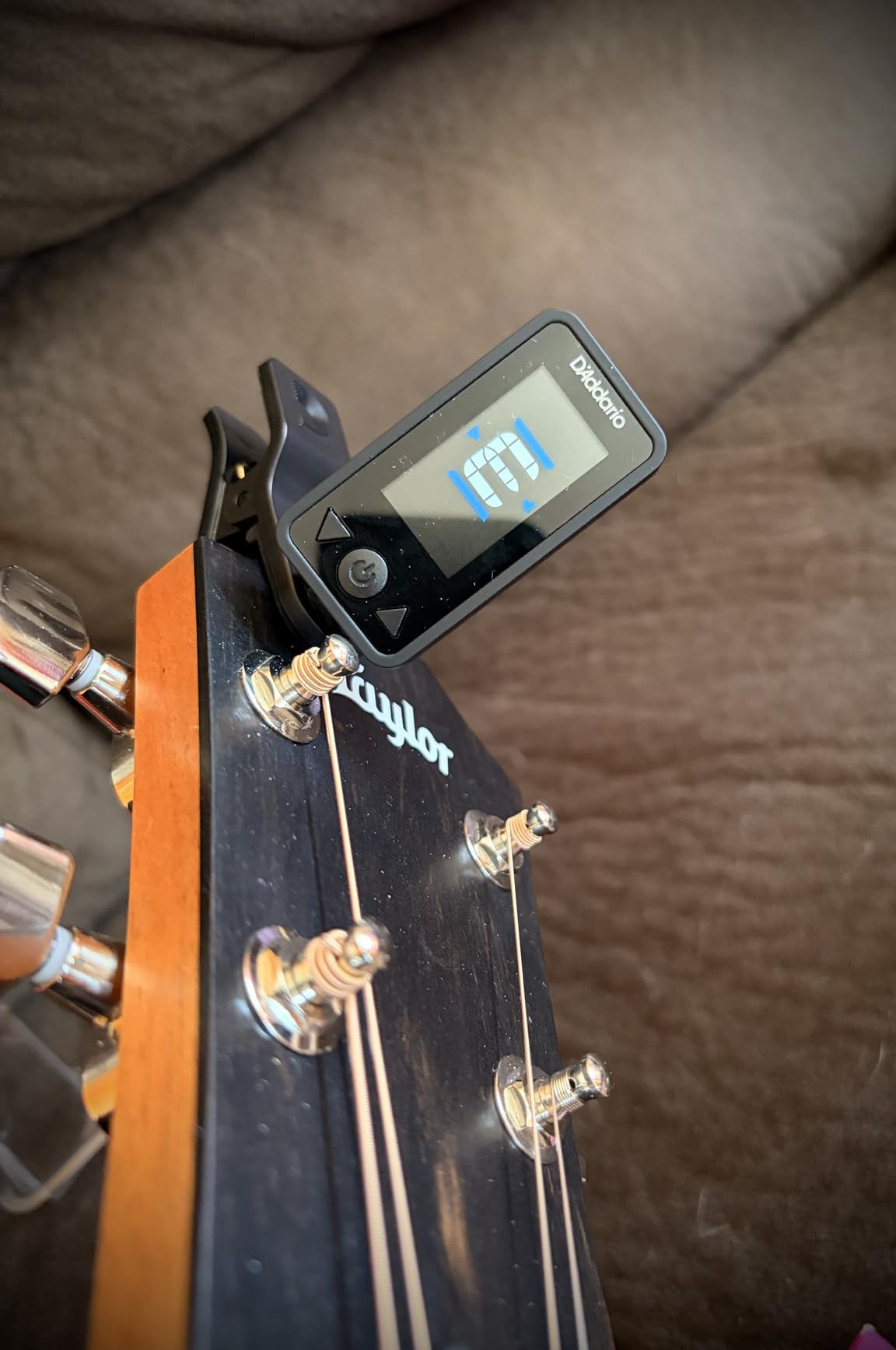
The Eclipse is the step up most acoustic players make after a budget tuner disappoints them. The vertical full-color screen is the standout, and unlike the competition it allows unlimited viewing angles, so it works whether your headstock faces up or down.
Calibration is adjustable from 435 to 450Hz and, unusually, the setting persists between power cycles and is displayed on screen so you are never guessing which reference pitch it is using.
Readings are quick and the clamp resists slipping, and it is specified for acoustic, electric, bass and ukulele, including thick nylon-string headstocks. At 1.44 ounces it is light enough to leave mounted.
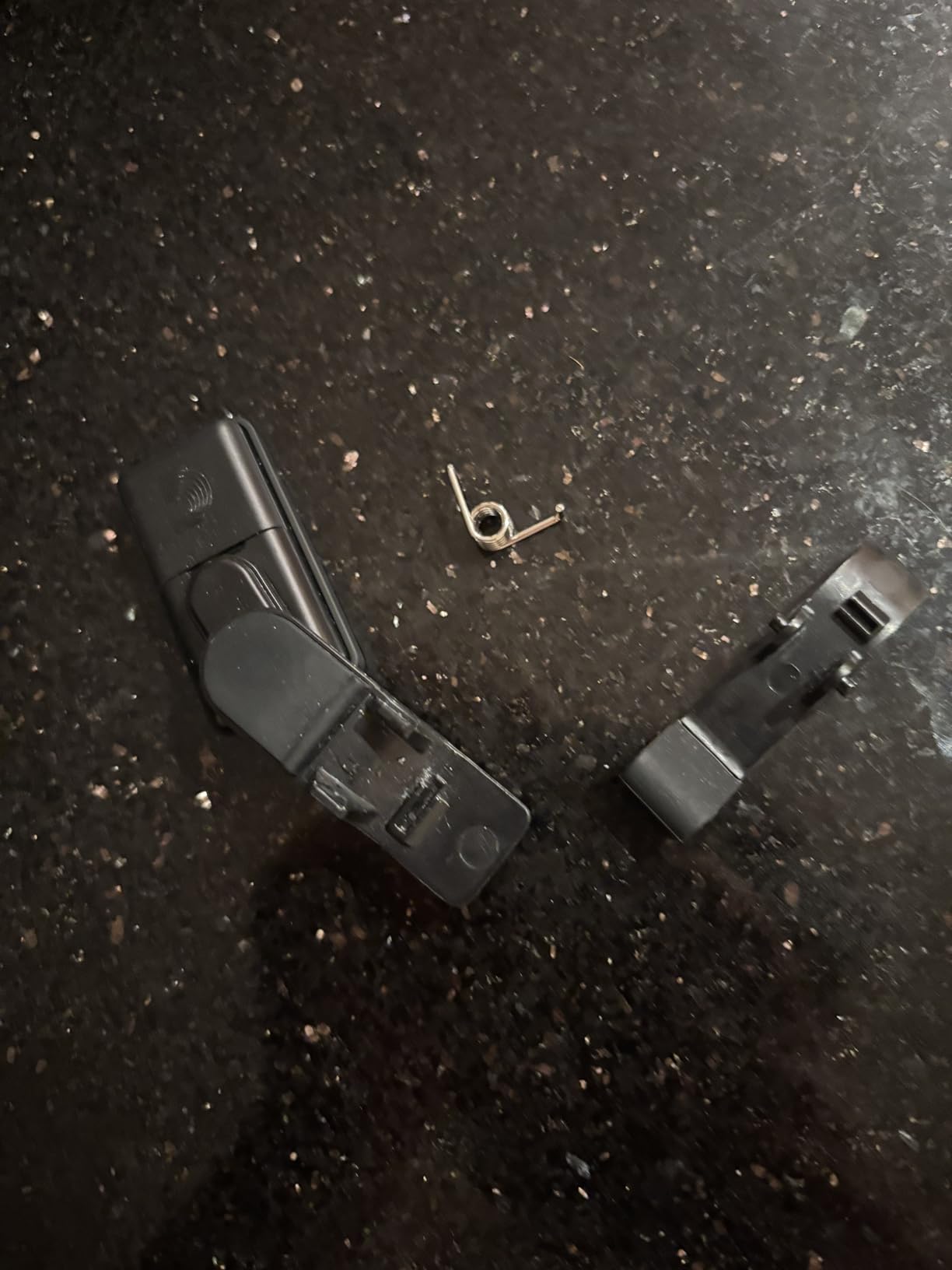
Two things to know. There is no auto power-off, so it needs a dedicated button press, and a minority of owners report the tuner powering down mid-tune or flickering after several months. Those reports are not universal, but they explain why the rating sits below the Snark units.
Where it earns its place
This is the value pick for someone who wants a full-color display and adjustable calibration without stepping up to a strobe tuner. It suits players who tune in non-standard reference pitches.
It is a natural fit for anyone upgrading from a first tuner bought years ago who wants a visible improvement rather than a lateral move.
Where it falls short
If you are forgetful about switching devices off, carry a spare cell habit or pick a model with auto-off. The calibration range here is narrower than the D’Addario Micro’s 410-480Hz.
Clamp durability is the standard long-term weak point of this style of headstock clip.
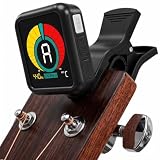
5. KLIQ UberTuner Clip-On – Best in Loud Rooms
KLIQ UberTuner Clip On Guitar Tuner -Black
Piezo sensor accurate to 1 cent
360 degree color display
430-450Hz calibration
3 year warranty
Pros
- Vibration sensing with no microphone
- immune to background noise
- Fast needle-style readings that settle quickly
- Padded clip that will not scratch the finish
- Three-year warranty and included carry case
Cons
- Swivel hinge can lose tension and go limp over time
- Point-and-click menu takes practice
- Footprint is larger than micro clip-ons
The KLIQ is the most precisely specced mainstream clip-on here, with a professional-grade piezo sensor rated accurate to within one cent. That figure matters on an acoustic because string stretch means you often correct a string two or three times before it settles.
There is no microphone at all. Detection is purely mechanical, so a noisy bar, a band rehearsing in the same room, or a passing bus all become irrelevant to the reading.
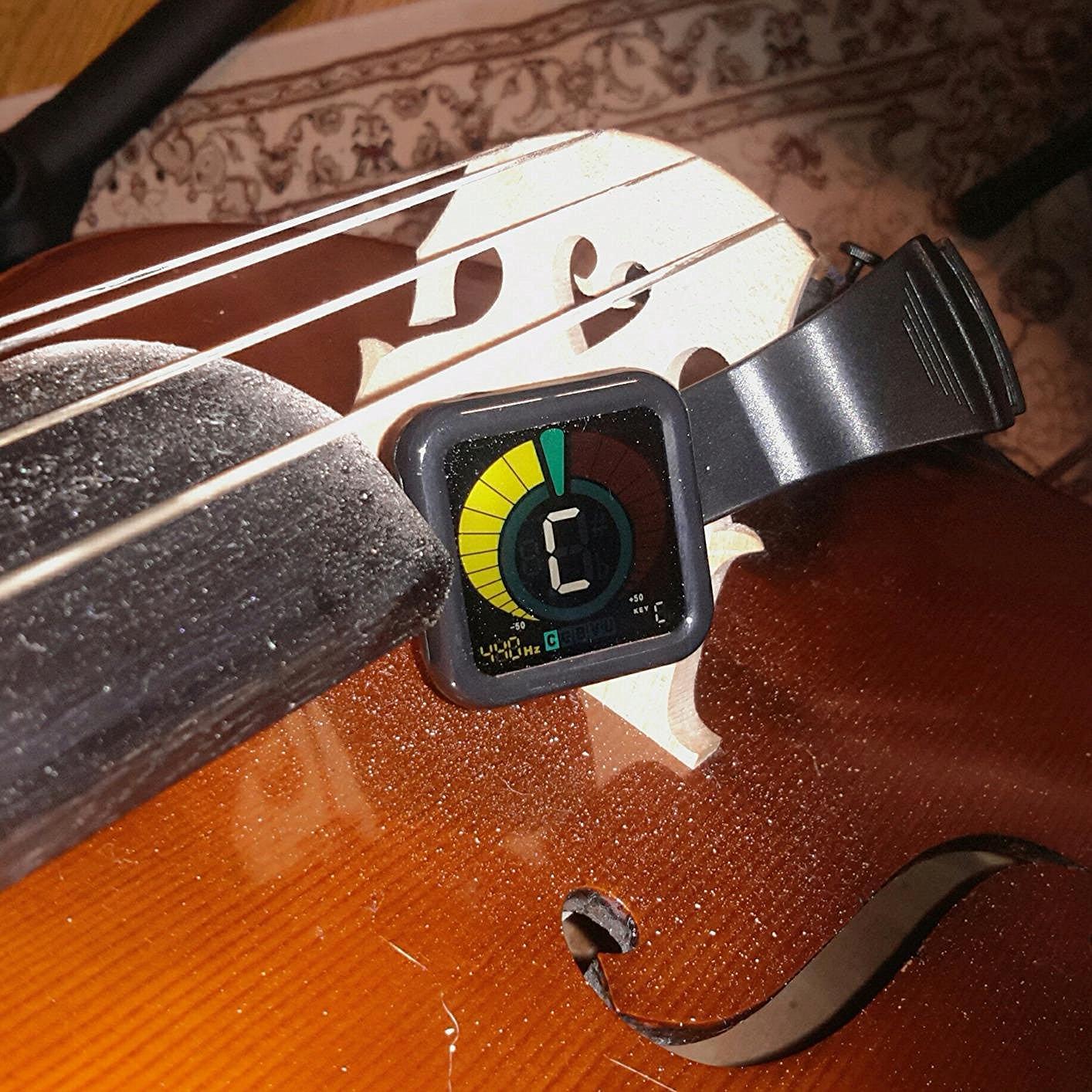
Calibration runs 415 to 450Hz with Bb, Eb, F and D transposition keys, calibration, which covers most flat tunings without a long menu. The display is full-color and rotates 360 degrees, the clip is padded so it will not mark a finish, and a case and three-year warranty are included, which is uncommon on clip-on tuners.
Two trade-offs. It covers a wide instrument range including mandolin, banjo and violin, but the point-and-click menu needs a few minutes to learn, and the swivel hinge is the component owners blame when it eventually goes limp. At 1.4 ounces the footprint is noticeably bigger than a micro clip-on.
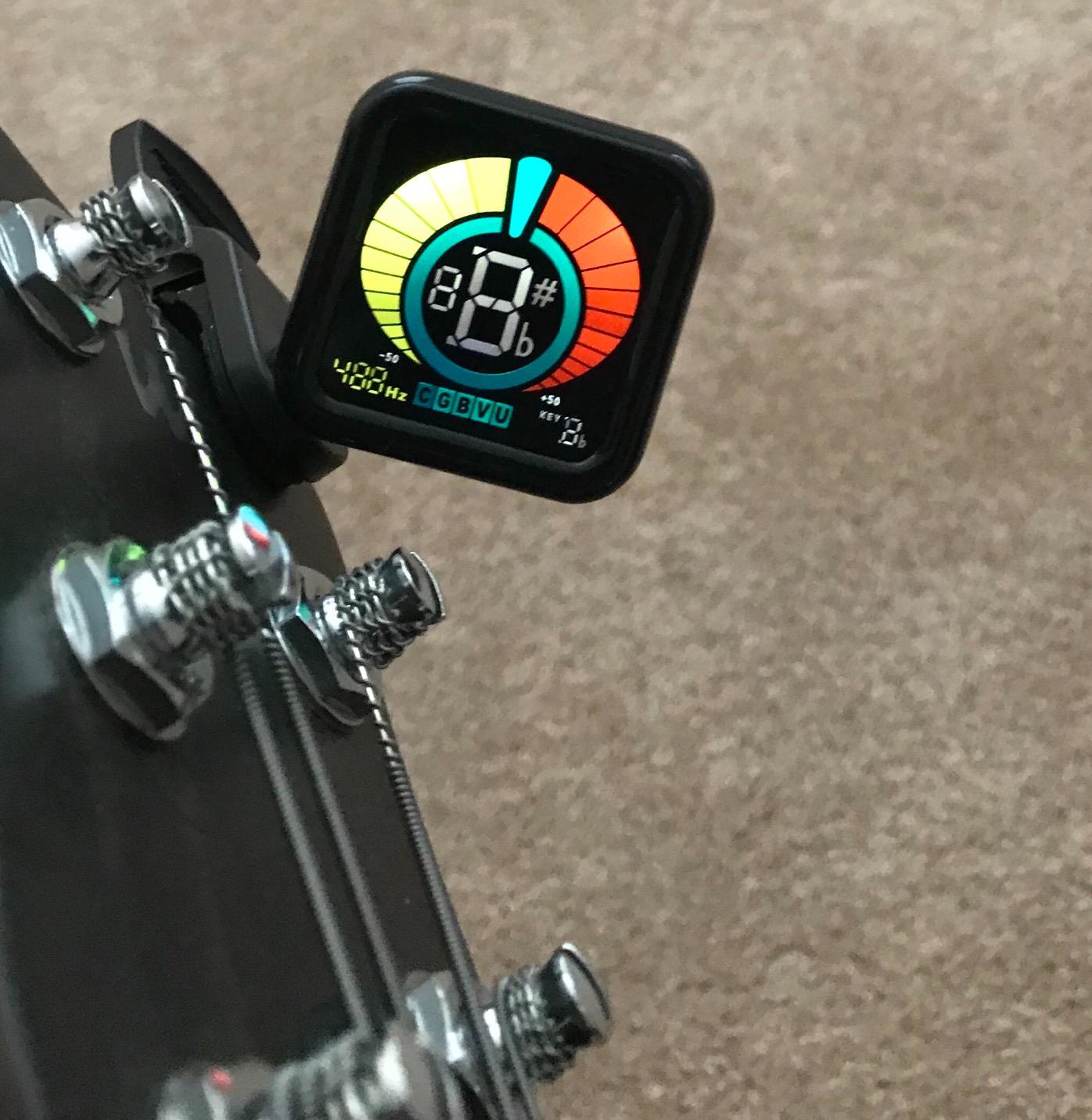
Who it suits
Rehearsal rooms and small stages where volume is the enemy of a contact microphone. The padded clip and case also suit players with older, thinner finishes.
Flat tuners and transposing instruments get dedicated keys rather than manual calibration hunting.
Who should pass
Anyone who wants to leave a tuner on the headstock permanently and barely notice it will find this too chunky for the job.
First-time tuner buyers should budget an evening with the menus before a gig, not the night of one.
6. Snark ST-2 Chromatic Tuner – Top Rated
Snark ST-2 Chromatic Multi-Instrument Tuner
Switchable mic or vibration sensor
415-466Hz calibration
360 degree rotating display
USB rechargeable
Pros
- Rechargeable so no disposable cells to carry
- Rotating high-resolution color screen
- Switchable microphone and vibration sensing
- Wide 415-466Hz calibration range
- Stay-put clip holds securely
Cons
- Menu system and mode switching take time to learn
- Sealed battery gives the unit a finite service life
The ST-2 carries the strongest rating distribution in this group, with 81 percent five-star ratings across more than 10k reviews. Where the SN5X commits to vibration sensing, the ST-2 gives you both options and lets you decide per string.
That switch is genuinely useful on an acoustic. The vibration sensor is right in a loud room, while the built-in microphone will pick up an unplugged or lightly amplified instrument and can be more sensitive to which part of the string you pluck.
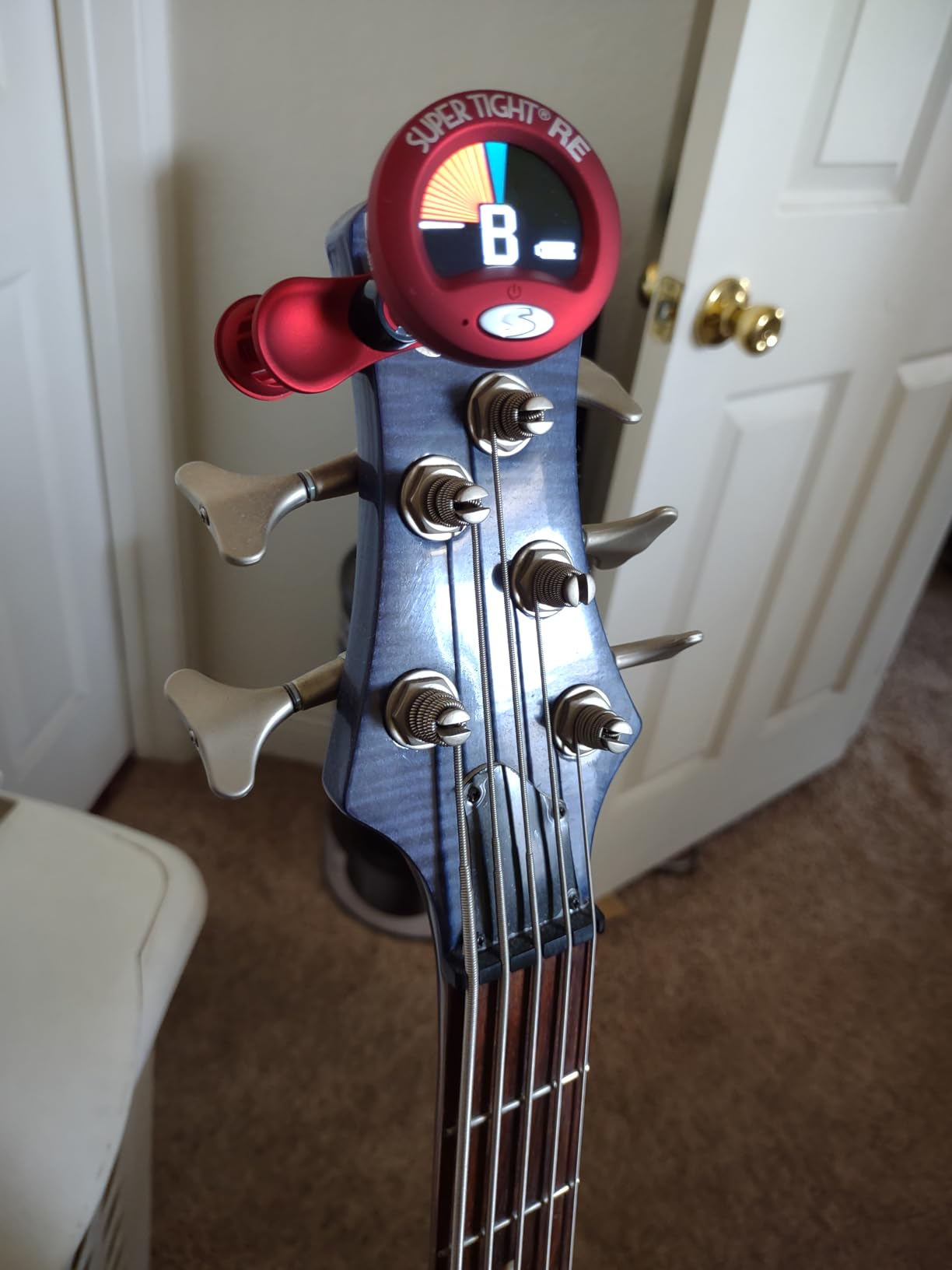
Calibration spans 415 to 466Hz, wider than most clip-ons, and the high-resolution screen rotates freely so the reading faces you however the headstock sits. USB charging means the battery is not a line item in your gig bag, and the stay-put clip does not creep mid-tune.
The cost of that flexibility is the menu system, which takes a little time to learn. The battery is sealed, so the unit does have a finite lifespan, and a rubber body means it will not survive being dropped on a loading bay floor. For most players that trade is worth it.
Best used for
Players who move between quiet practice and loud stages and want to choose their sensing method rather than accept one. It also suits anyone tuning to a reference pitch above 440Hz.
The rotating screen makes it comfortable for either-handed players without re-clipping it.
Worth knowing first
The mode switching is more involved than the SN5X, so give it time before you need it on a deadline.
Sealed rechargeable cells eventually lose capacity, and this category has a long replacement cycle, so expect to upgrade eventually rather than never.
7. Donner DT-2 Clip-On Tuner – Budget Pick
Donner Guitar Tuner Clip on-Accurate Chromatic,Acoustic Guitar Bass Violin Ukulele Tuner DT-2
Single-button operation
Rotational multi-angle display
Vibration clip
1.06 oz
Pros
- Lowest cost in the roundup while keeping chromatic and standard modes
- One-button control is genuinely beginner friendly
- Rotational clip gives a multi-angle view
- Lightweight at 1.06 ounces
- Backed by a 6-month guarantee
Cons
- Brightness and reading speed trail premium clip-ons
- Cheap-feeling materials and a less refined clamp
- CR2032 cell is not included
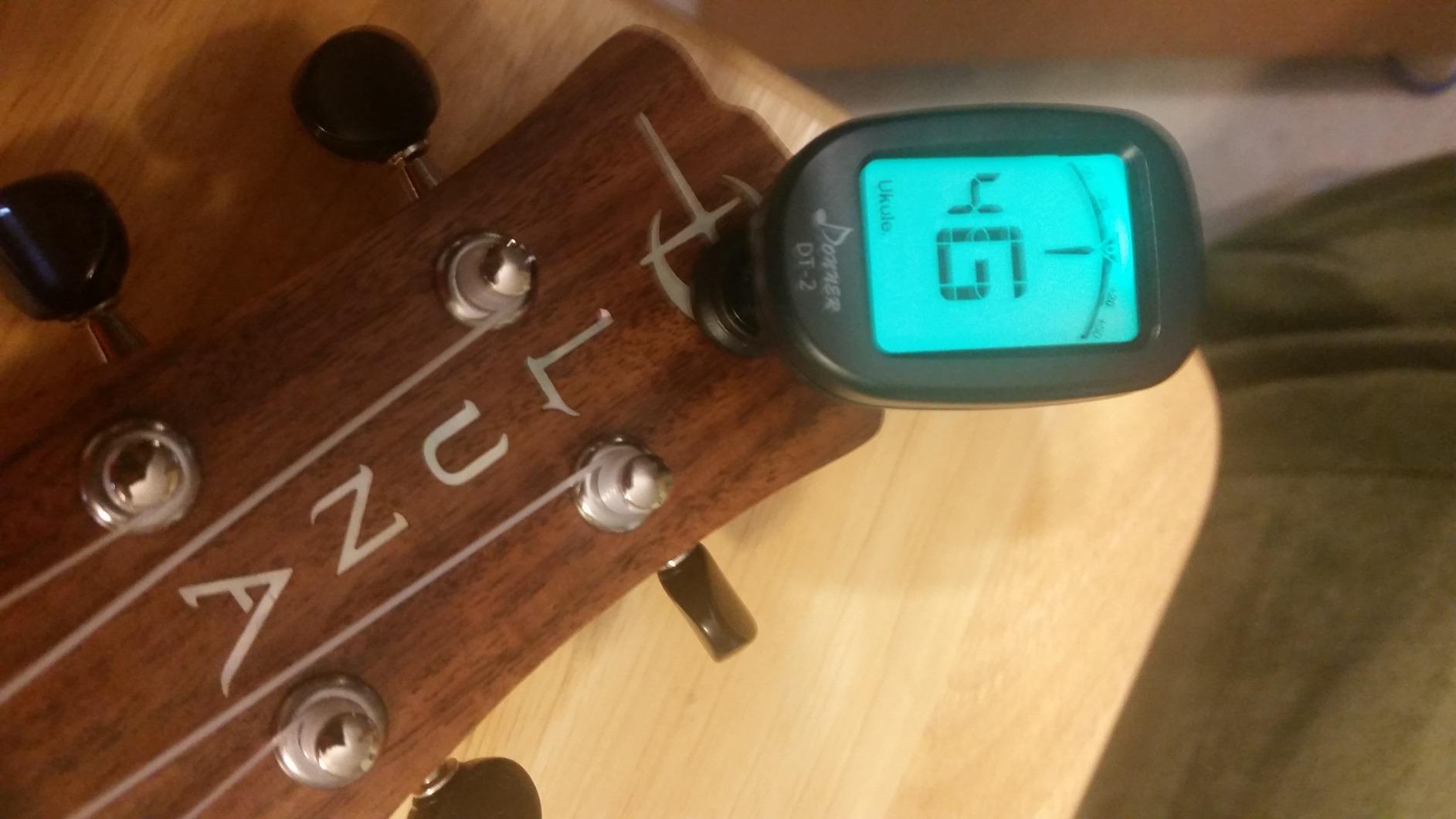
The Donner is the cheapest way to leave a bad tuner behind, and its single-button operation is unusually thoughtful. Clip it on, press once, tune. There is no calibration to set and no mode to choose for standard tuning.
The rotational clip design gives you a multi-angle view of the display, which solves the usual problem of a clip-on reading sideways when the headstock is angled.
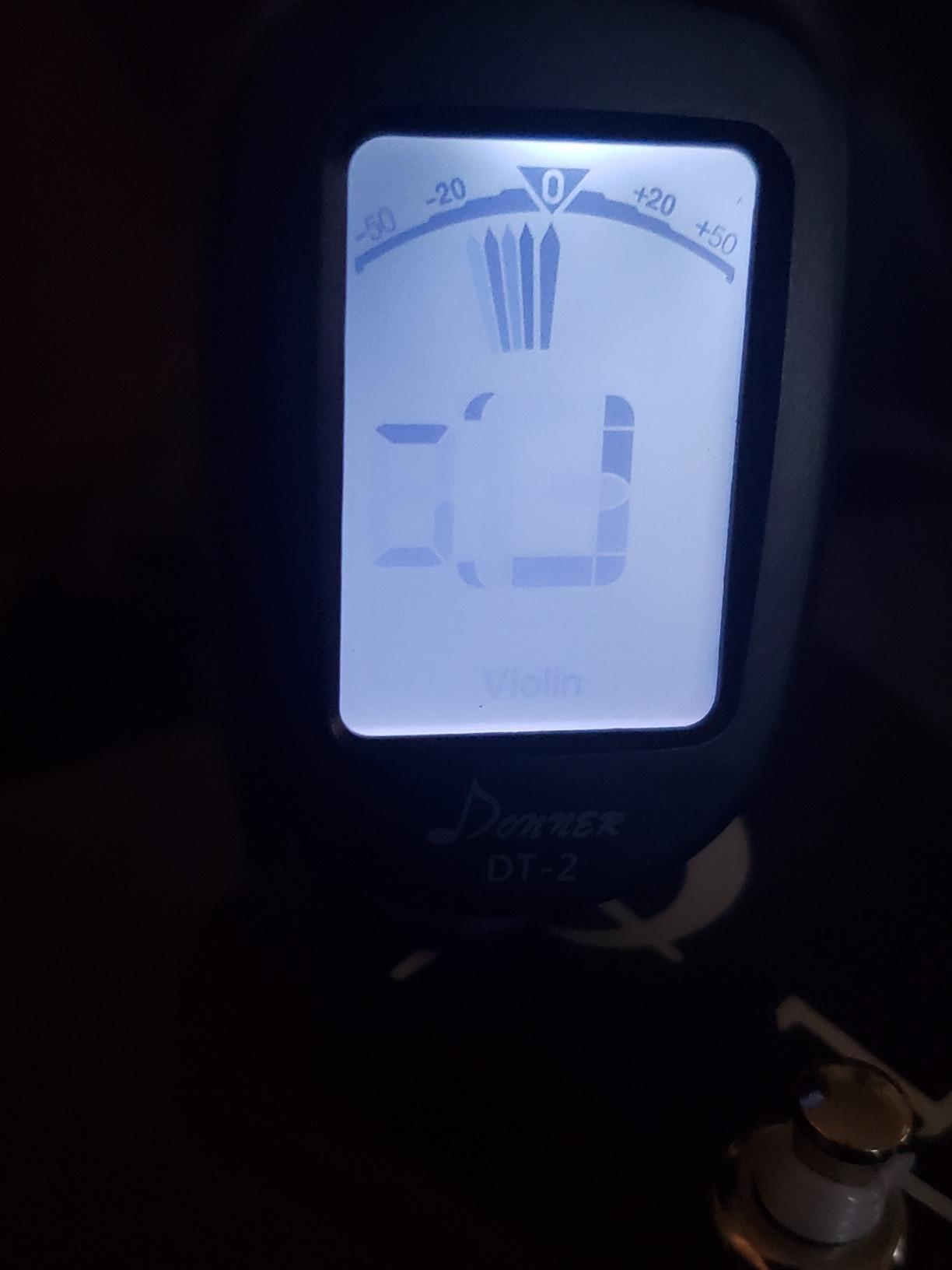
The vibration clip is sensitive enough to lock onto pitch quickly, and chromatic plus standard modes cover guitar, bass, violin and ukulele. A six-month guarantee is included.
What you give up is polish. The display is dimmer and the readings are slower than the branded units, and the materials and clamp feel thin. It carries the lowest rating in the group at 4.4, and the CR2032 cell is not included on this listing, so add one to the same order.
Where it makes sense
A first tuner for a first guitar, a backup that lives in a gig bag, or a stopgap while you decide on something better. For practice at home it is entirely adequate.
It suits anyone intimidated by tuners with menus and calibration screens.
Where it falls short
Do not use it as your only tuner on a dim stage, where a slow dim screen is a genuine liability.
Anyone who plays hard on their gear will find the clamp and body are the first things to go.
8. D’Addario NS Micro Soundhole Tuner – Best Soundhole Mount
D’Addario NS Micro Soundhole Tuner, Discreet Chromatic Acoustic Guitar
Mounts inside the soundhole
Piezo vibration sensing
410-480Hz calibration
Color screen
Pros
- Leaves the headstock completely untouched
- Stays in the guitar so there is nothing to clip each time
- Accurate piezo sensing across 410-480Hz
- Non-marring clip will not mark the soundhole
- Color screen reads in dark rooms
Cons
- Awkward to reach the buttons under the strings on a small soundhole
- Fixed position means less display angle adjustment
- Inconvenient when the guitar is in a stand or being carried
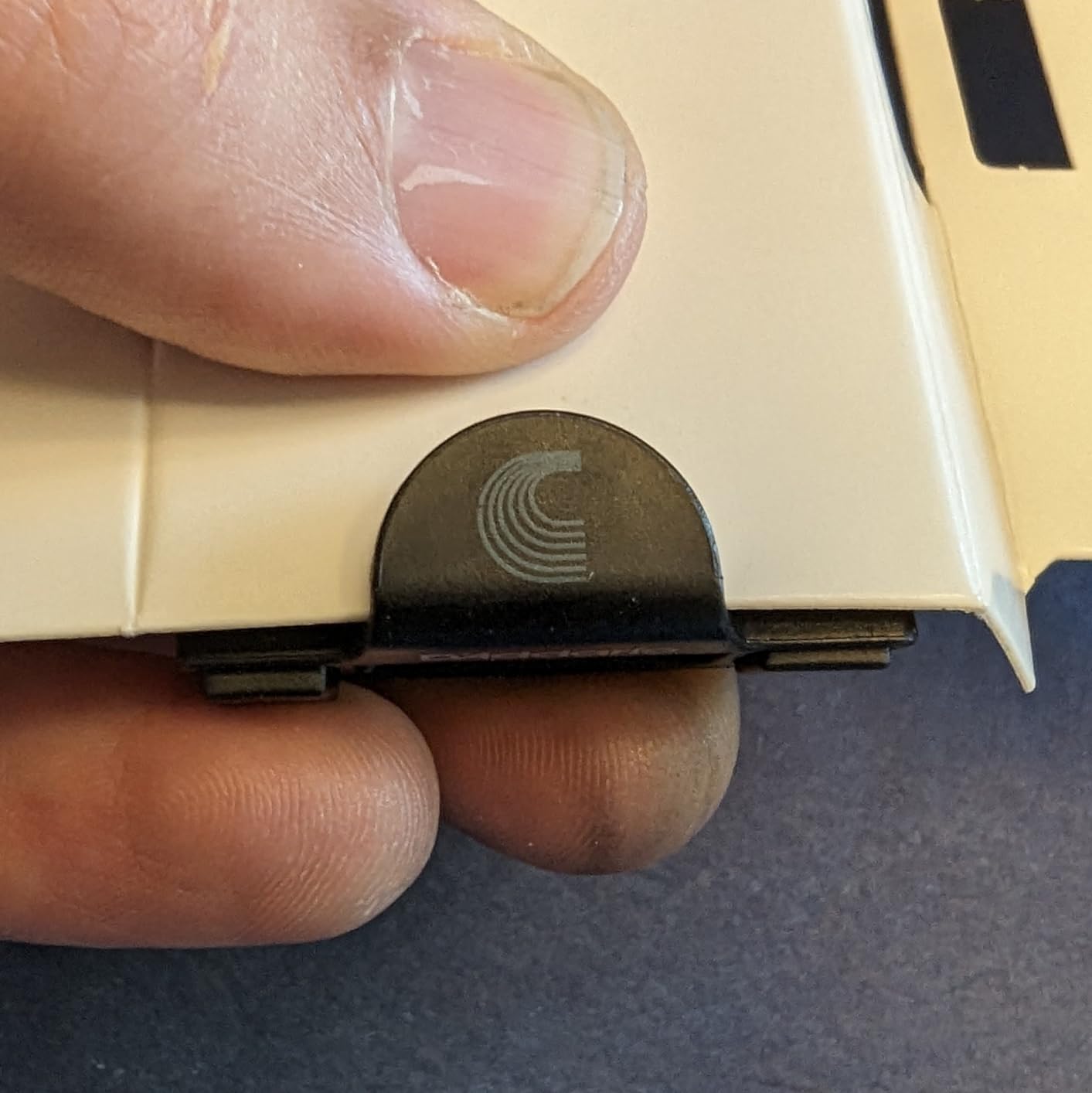
The NS Micro is the only soundhole mount in this roundup, and the approach is worth understanding. It sits inside the soundhole where a soundhole cover would normally clip, and its piezo transducer reads the string and body resonance rather than the room.
That makes it acoustically better suited to a steel-string than a headstock clip, and your headstock stays exactly as the maker left it, which is the reason most people with a good-looking acoustic choose it.
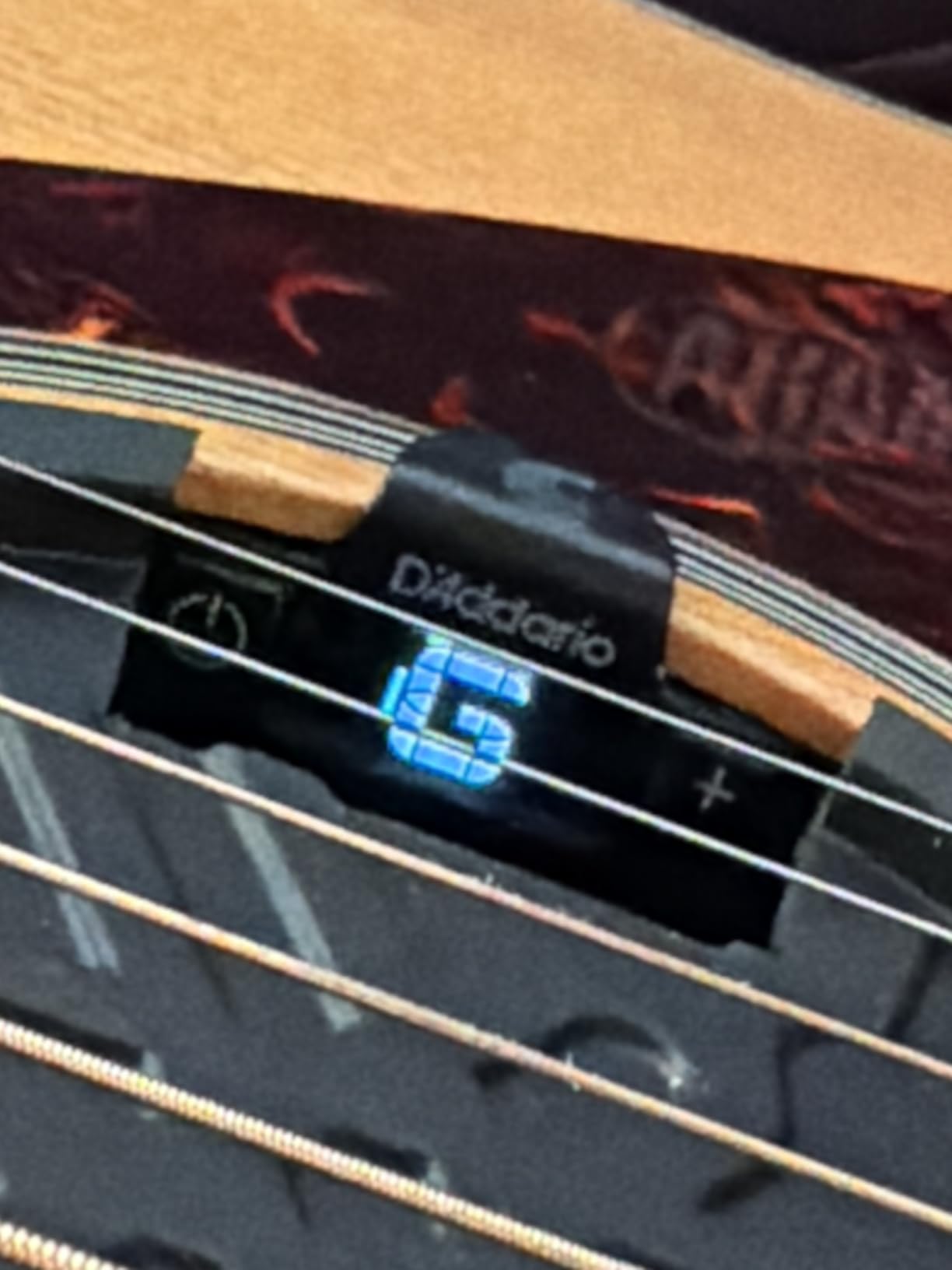
The calibration range of 410 to 480Hz is wide, the color screen is legible in a dark room, and the plastic clip will not mark the soundhole edge. It also stays in the instrument, so you are not clipping and unclipping it every time you play.
The catch is access. With a small soundhole your finger has to go under the strings to reach the buttons, which is genuinely awkward, and the fixed mounting position gives you less angle adjustment than a swivel clip-on. It is also inconvenient when the guitar is in a stand or being carried between rooms.
Who it suits
Owners of vintage, boutique or high-end acoustics who will not put a tuner on the headstock. It is also a good permanent fixture for a guitar that lives on a stand and gets played daily.
Anyone who wants a wide calibration range to manage a seasonally restless instrument will appreciate the 410-480Hz span.
Who should skip it
Players with a parlor or small-body guitar with a narrow soundhole, where reaching the controls becomes a chore on every tune.
Travelling players should know a soundhole unit has to be removed before the guitar goes in a gig bag, which partly defeats the permanent-mount benefit.
9. LEKATO Rechargeable Clip-On – Best for USB-C Charging
LEKATO Guitar Tuner Rechargeable, Chromatic Tuner Clip On for Guitar, Bass, Ukulele,Violin Tuner, 360° Rotatable, Fast Accuratie Tuning, Super Bright Display to Read, for Professional/Beginners
USB Type-C charging
Over 10 hours per charge
360 degree rotational clip
5 tuning modes
Pros
- Rechargeable lithium battery with a battery gauge
- Over 10 hours of use and auto power-down after 5 minutes
- Bright high-contrast display readable in any lighting
- One-button access to Drop D Open G Open D and Open E
- Built-in buzzer pickup reduces interference when playing loud
Cons
- Buttons sit on the back so you must remove it to change modes
- Broad in-tune region is not a precision instrument
- Guitar mode does not read the octave strings on a 12-string
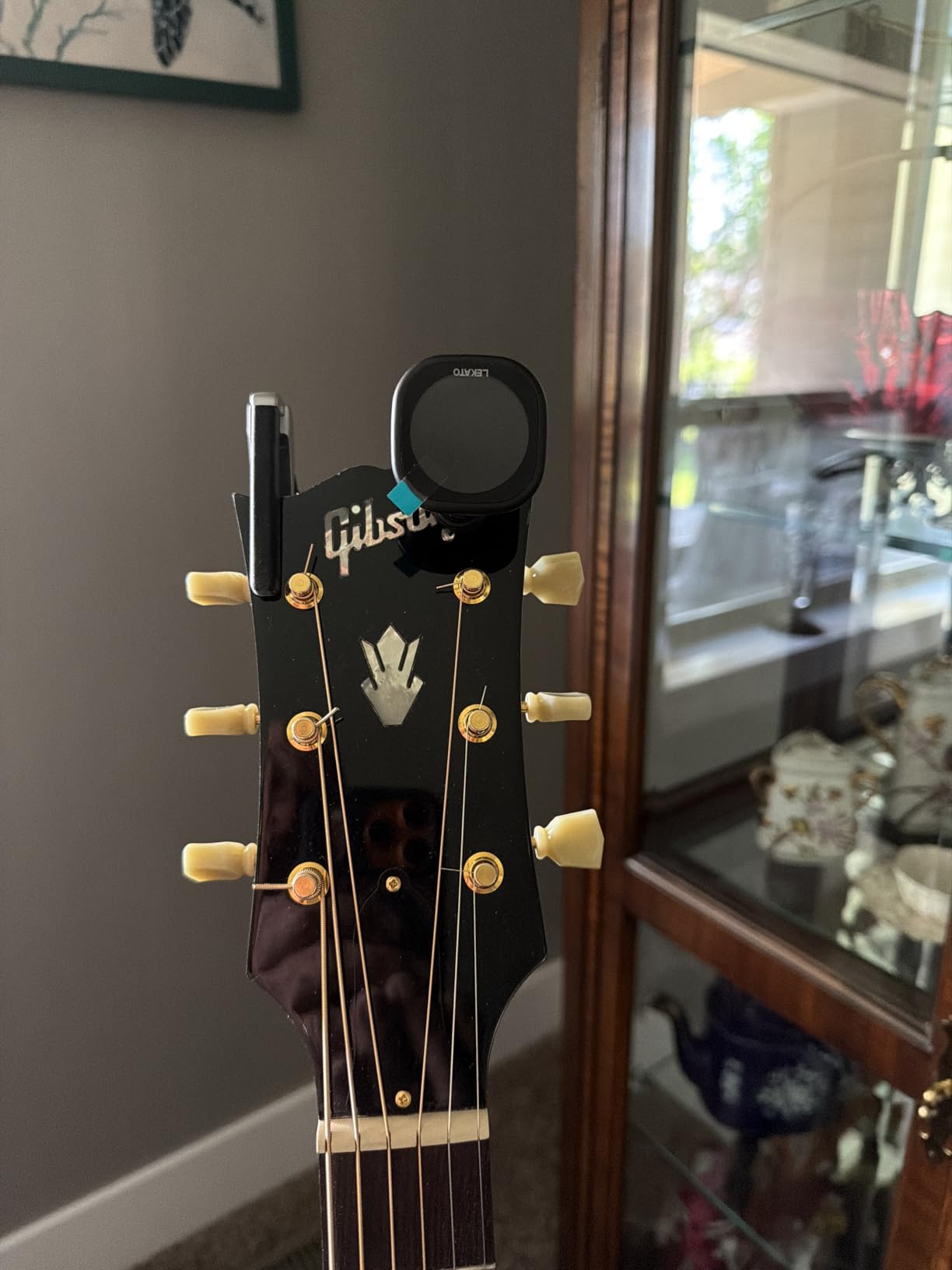
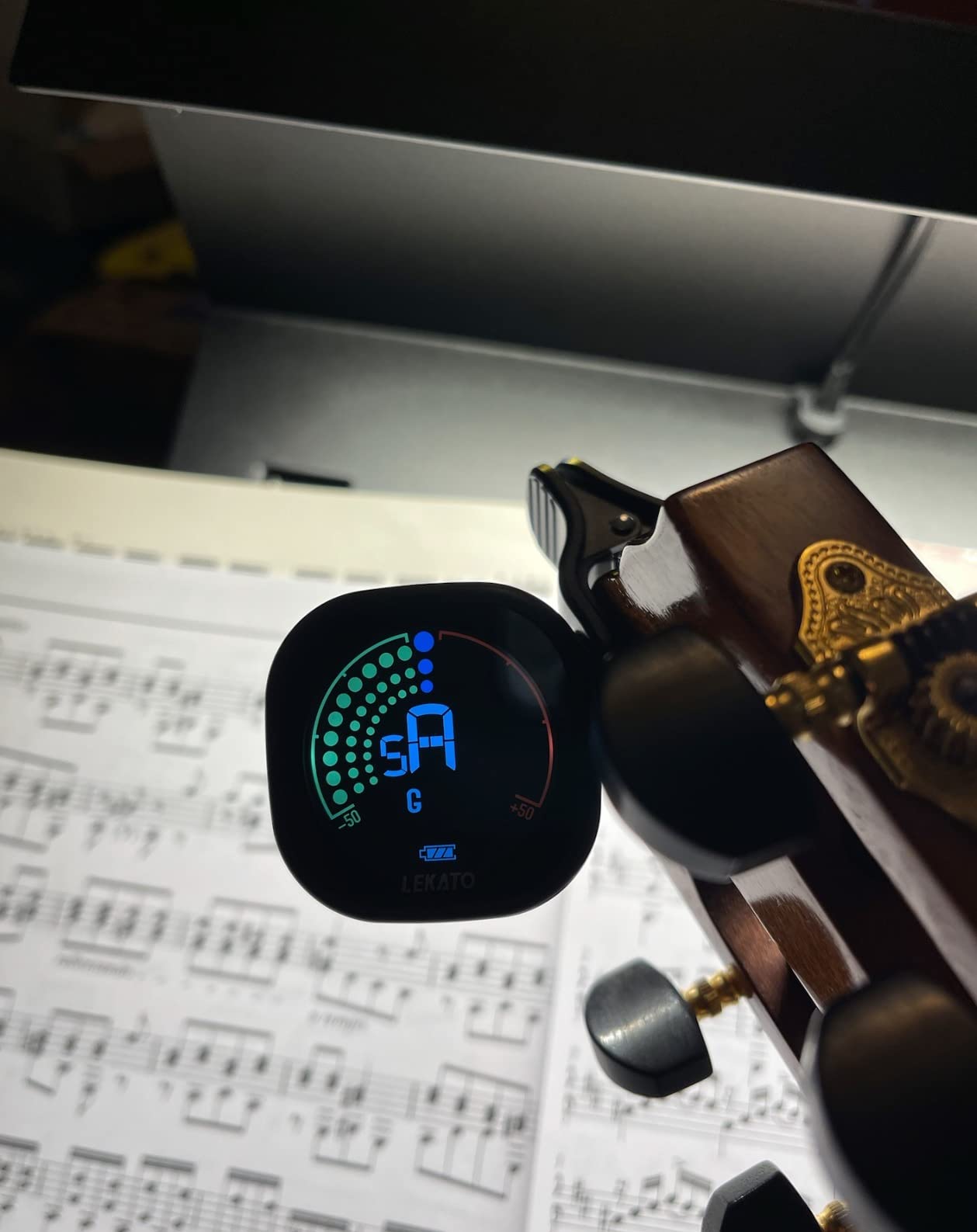
The LEKATO is the one to buy if your last tuner died from a flat battery mid-set. It charges over USB-C, the same cable as most current phones, and the battery gauge on screen tells you how much runtime is left before you need it.
Over ten hours of continuous use with auto power-down after five idle minutes covers a full rehearsal or a long set without a charger. The bright high-contrast display and 360-degree rotational clip make it readable from most playing positions.
For alternate tuners it has a dedicated note key function that switches to Drop D, Open G, Open D, Open E and flat tunings in guitar mode, and five modes overall covering chromatic, guitar, ukulele, bass and violin. Owners report fast acquisition across all six strings.
The design flaw owners keep naming is the button placement, with the controls on the back behind the pivot arms, so you must take the tuner off the guitar to switch modes or power it down. The in-tune region is also broad, so it is a convenience tuner rather than a precision one, and on a 12-string guitar you need chromatic mode for the octave strings.
Best for
Anyone who plays drop tunings or open tunings and wants one button instead of a menu. Touring players benefit most from the battery gauge and the ten-hour runtime.
The buzzer pickup inside reduces interference when the guitar is playing loud right next to the headstock.
Before you buy
Test whether you are comfortable detaching the tuner to change modes. If you switch tunings mid-song, the back-mounted buttons are an irritation.
The sealed battery means eventual end of life for the unit, and 3.53 ounces is heavier than most clip-ons here.
10. Peterson StroboClip HD – Best for Strobe Accuracy
Peterson StroboClip HD Clip-On Guitar Tuner, ±0.1 Cent Accuracy for Acoustic, Electric, Bass, Violin, Ukulele
Plus or minus 0.1 cent strobe accuracy
50 plus sweetened presets
HD backlit display
CR2032 power
Pros
- True strobe accuracy with no display lag
- Readable in direct sunlight and bright stage lighting
- Extensive sweetened presets for acoustic and alternate tunings
- Handles the low E where many clip-ons struggle
- Two-year manufacturer warranty
Cons
- Articulating display arm is thin and screw-mounted so it can loosen
- Buttons are tiny and the layout takes practice
- Some listeners find the sweetened presets sound sour
- Higher cost than the mainstream clip-ons
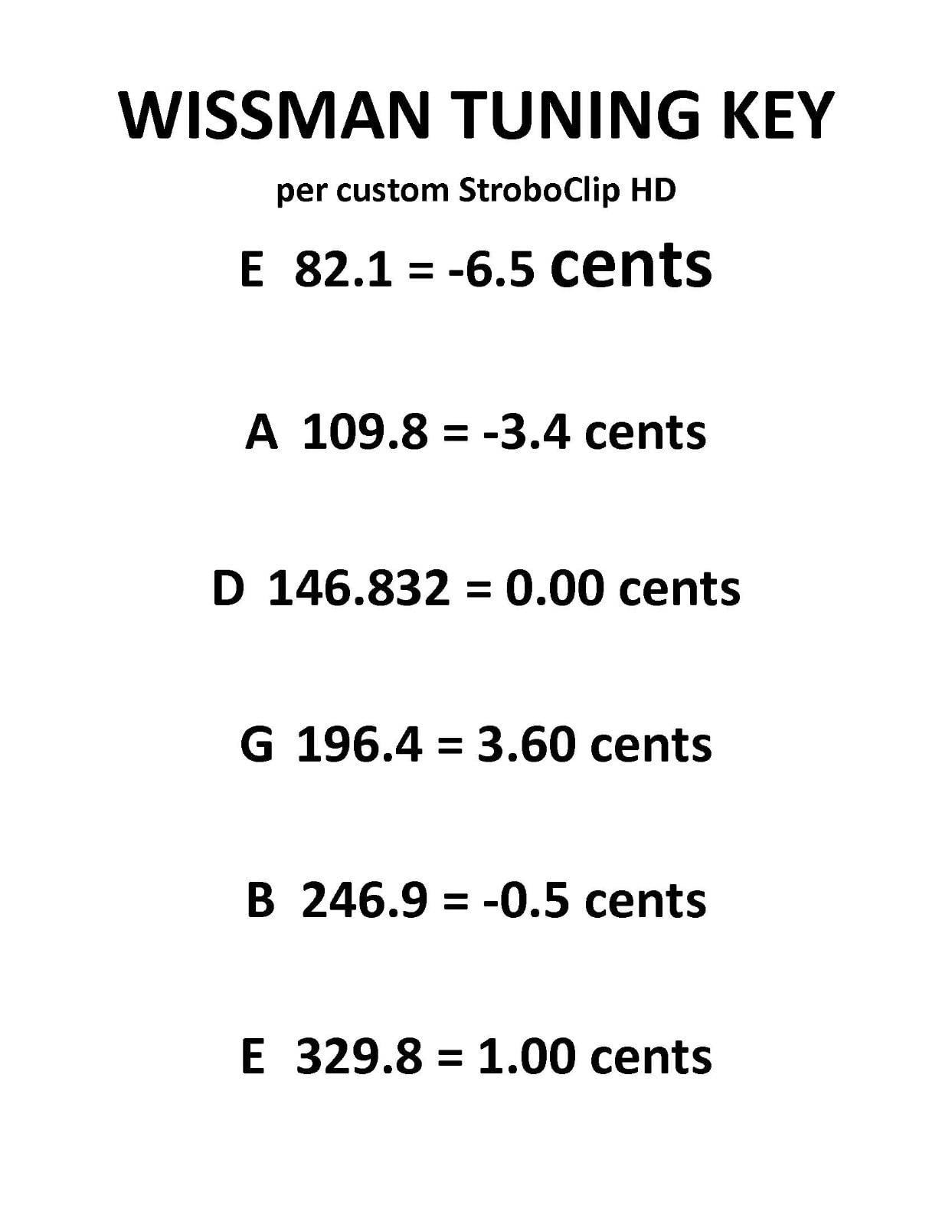
The StroboClip HD is the precision pick to compare everything else against, accurate to plus or minus one tenth of a cent, which is a thousandth of a semitone. On a well-adjusted acoustic that is the difference between sounding in tune and sounding exactly in tune to everyone else in the room.
How it works is a strobe simulation: a 192-segment LED array appears to stand still when the string frequency matches the reference, so there is no needle to interpret and no display lag to wait out.
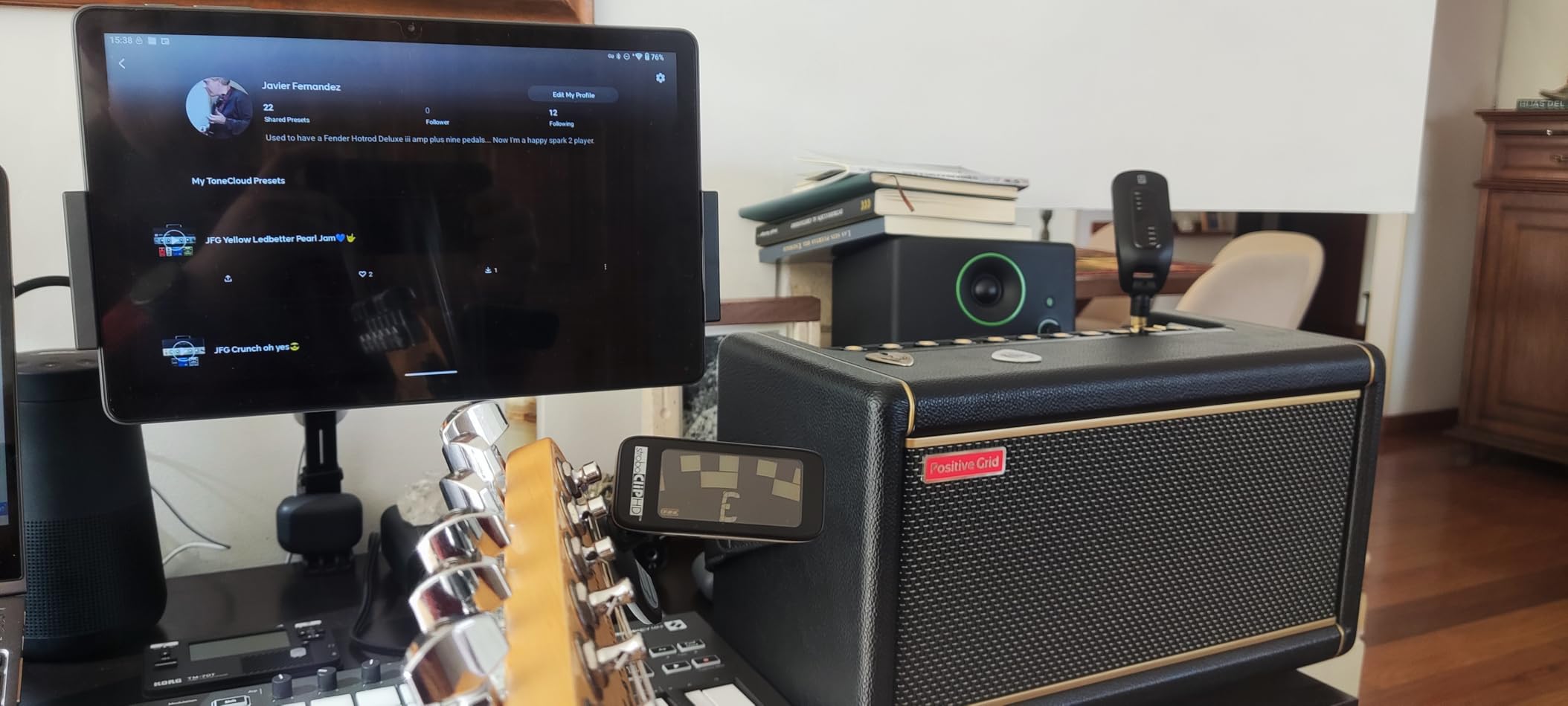
The HD backlit display is genuinely readable in direct sunlight, which matters outdoors and on a bright stage. It carries more than 50 sweetened tuning presets, works with six and 12-string acoustics, and handles capo offsets and drop tunings. Peterson has been making tuning products since 1948 and backs it with a two-year warranty.
The criticisms are specific. The articulating display arm is thin and held by a small screw, so it can loosen or break, and the button layout and clamp position take practice. Sweetened presets are divisive, with some listeners finding the resulting tuning sour rather than warmer. It also costs the most of the clip-ons in this roundup, and a replaceable CR2032 gives up to 24 hours of continuous use.
Who needs this level
Players recording at home or in a studio, session players, and anyone who tunes with a capo who wants the offset handled automatically.
It is also the tuner we recommend for guitarists who work at low tunings or 12-string acoustics, where the low E reading is usually the problem.
When it is overkill
If you practise at home in a quiet room, the extra precision is invisible to you and everyone else.
Owners who have had one for years warn about the display arm, so treat it as a precision instrument rather than something to toss in a bag.
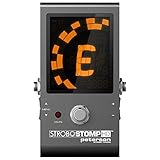
11. Peterson StroboStomp HD Pedal Tuner – Best for Pedalboards
Peterson StroboStomp HD Pedal Tuner
Strobe-accurate tuning
True or buffered bypass
USB firmware updates
Full color display
Pros
- Highest rating in the roundup at 4.8 with 90 percent five-star reviews
- Strobe accuracy no other pedal tuner in this price range matches
- Large bright full-color readout
- Selectable true or buffered bypass improves a passive signal
- Low-mounted jacks for tighter pedalboard spacing
Cons
- The supplied rubber base does not grip a pedalboard
- Side-mounted buttons are awkward to reach while playing
- Large display is prone to scratching or cracking
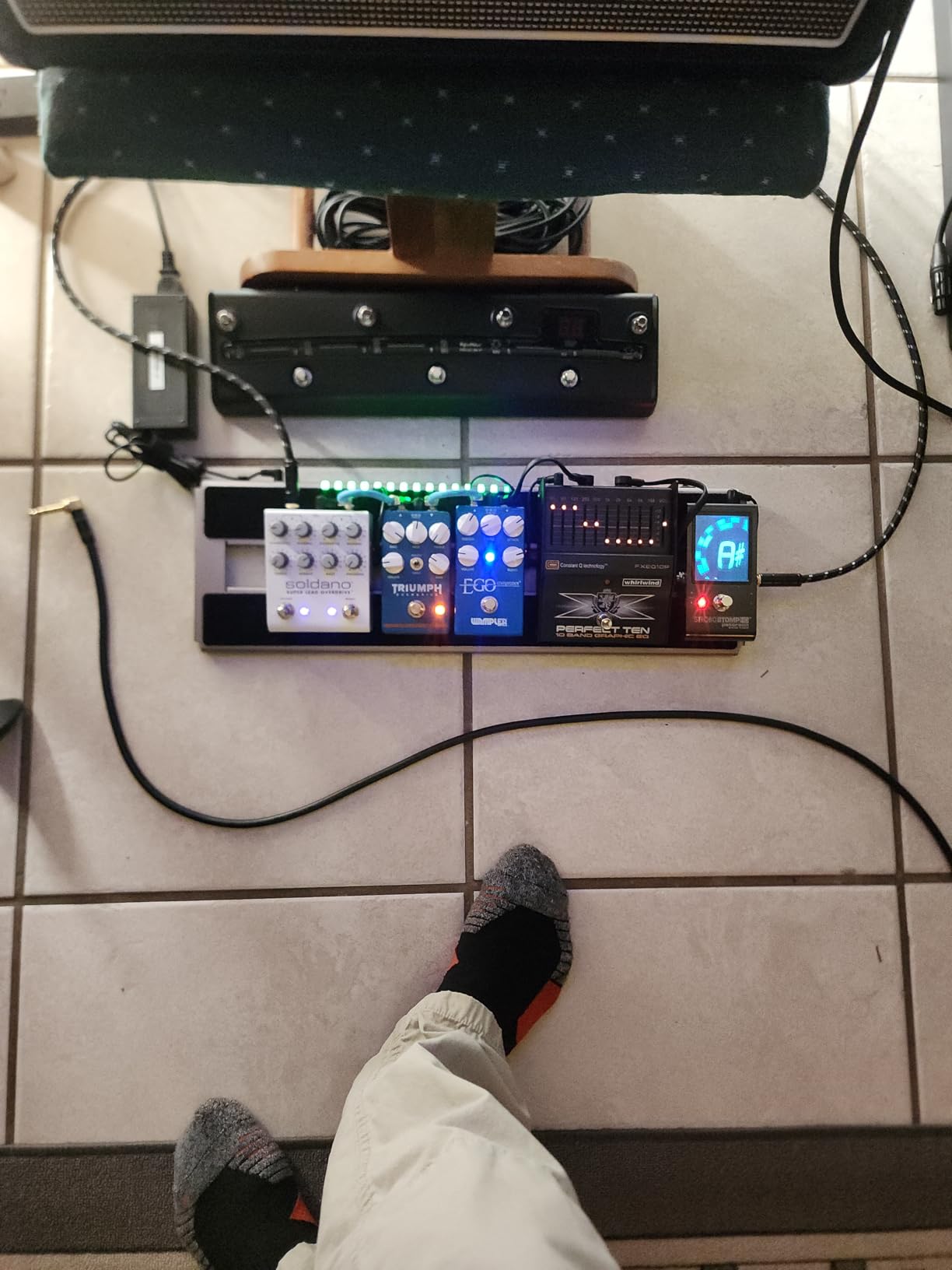
The StroboStomp carries the highest rating in this roundup, and it earns it, though the important caveat for an acoustic player comes first: a pedal tuner only works if your guitar produces a signal at the input jack. That means a pickup, and on an acoustic it should be a piezo or soundhole pickup, not a magnetic humbucker-style unit.
If your acoustic has no pickup, this pedal will sit silent no matter how good it is. If it has a piezo or soundhole system, the tuner reads the signal directly and works exactly as it would on an electric.
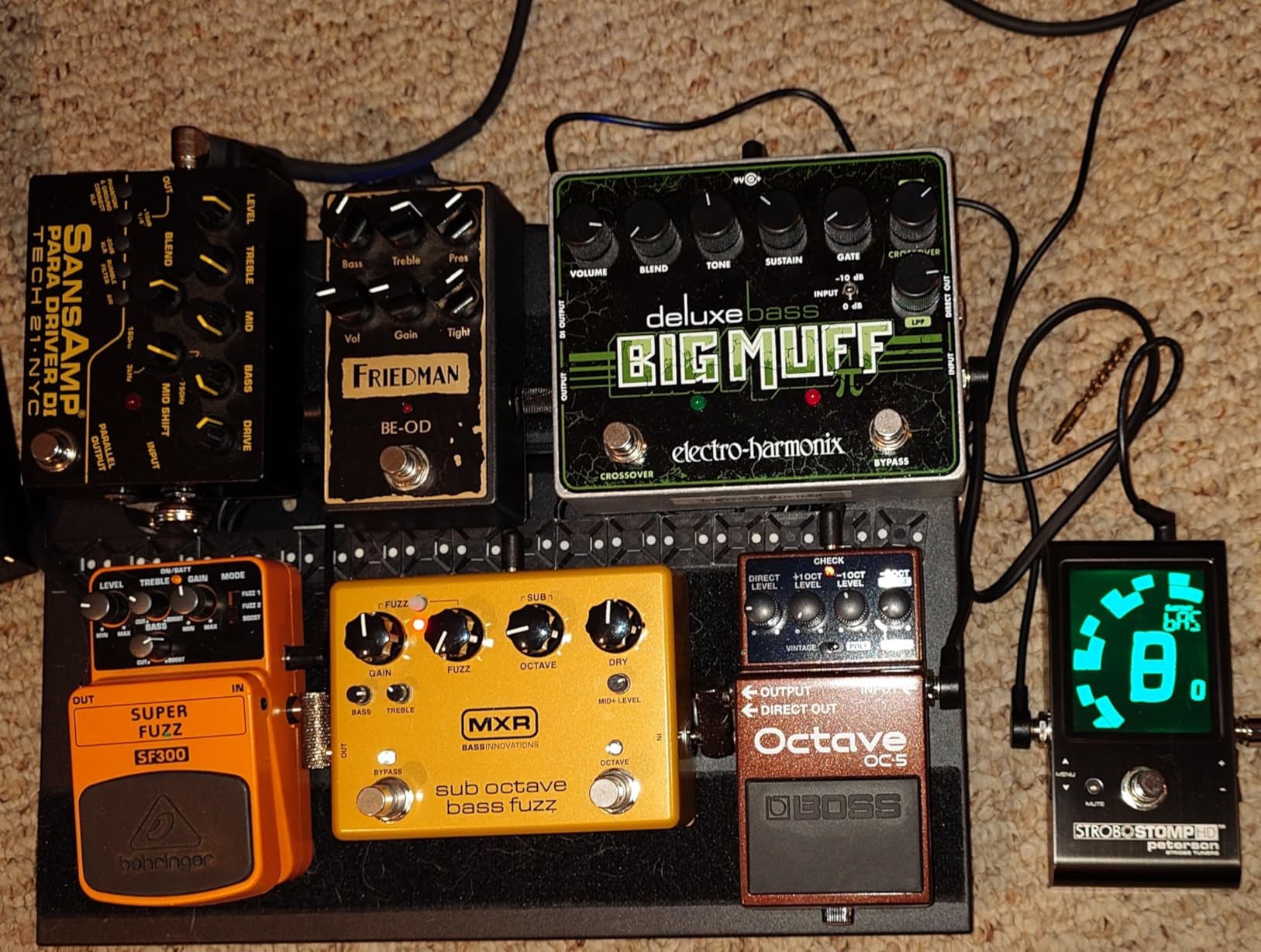
Once connected, the payoff is real. Tuning becomes invisible to the audience, which is what most gigging players actually want, and the strobe accuracy matches the StroboClip. The full-color display is large and bright enough for almost any lighting.
You can choose true bypass or buffered bypass, and the buffer visibly improves a passive pickup signal, which matters if you have ever noticed your acoustic sounding thin when the tuner was in the chain. Firmware updates run over USB from the manufacturer, and a three-year warranty is included.
Who should buy it
Acoustic players with a piezo or soundhole pickup who want to tune without bending to the headstock mid-set. It suits studio and stage use where a large display matters.
Anyone whose signal chain degrades through pedals will appreciate the selectable buffer.
Before you buy
Confirm your guitar has a pickup and that it is piezo or soundhole based. A magnetic pickup on an acoustic will not drive this tuner properly.
The included rubber base does not grip a pedalboard, so plan on Velcro, and put a screen protector on the large display before it gets knocked.
12. Korg Sledgehammer Clip-On – Best for Battery Life
Korg – SH-CS100 Custom Shop Series Sledgehammer Clip-on Guitar Tuner – Black
Plus or minus 0.1 cents accuracy
Approx 100 hours battery life
Note name display
AAA powered
Pros
- Noticeably more accurate than mainstream clip-on tuners
- Displays the actual note name which helps with leads and harmonies
- Bright screen readable in sunlight or a bright room
- Small and light enough to leave clipped on
- AAA cells are widely available and long lasting
Cons
- Spring-loaded on/off wheel is too smooth and can pull the tuner off
- AAA cell is not included
- Menu steps feel fiddly for a single-pitch tuner
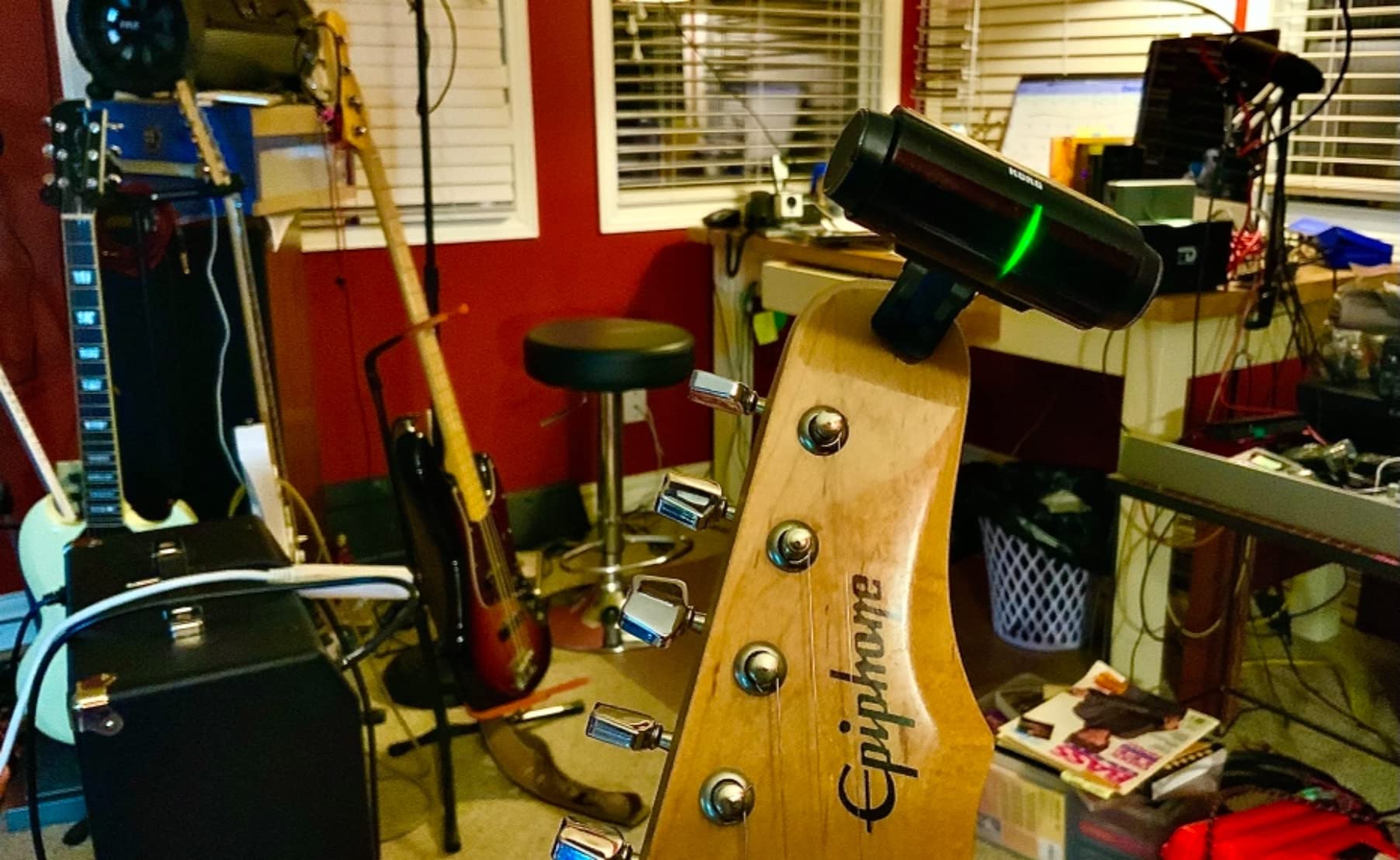
The Korg Sledgehammer solves the battery problem differently from the rechargeable units. One AAA cell runs for approximately 100 hours, and those cells are the easiest battery in the world to find in any town.
It is also rated accurate to plus or minus one tenth of a cent, which puts it in the same class as the Peterson on paper, and it displays the actual note name rather than a needle position, which is genuinely useful when you are working out leads and harmonies.
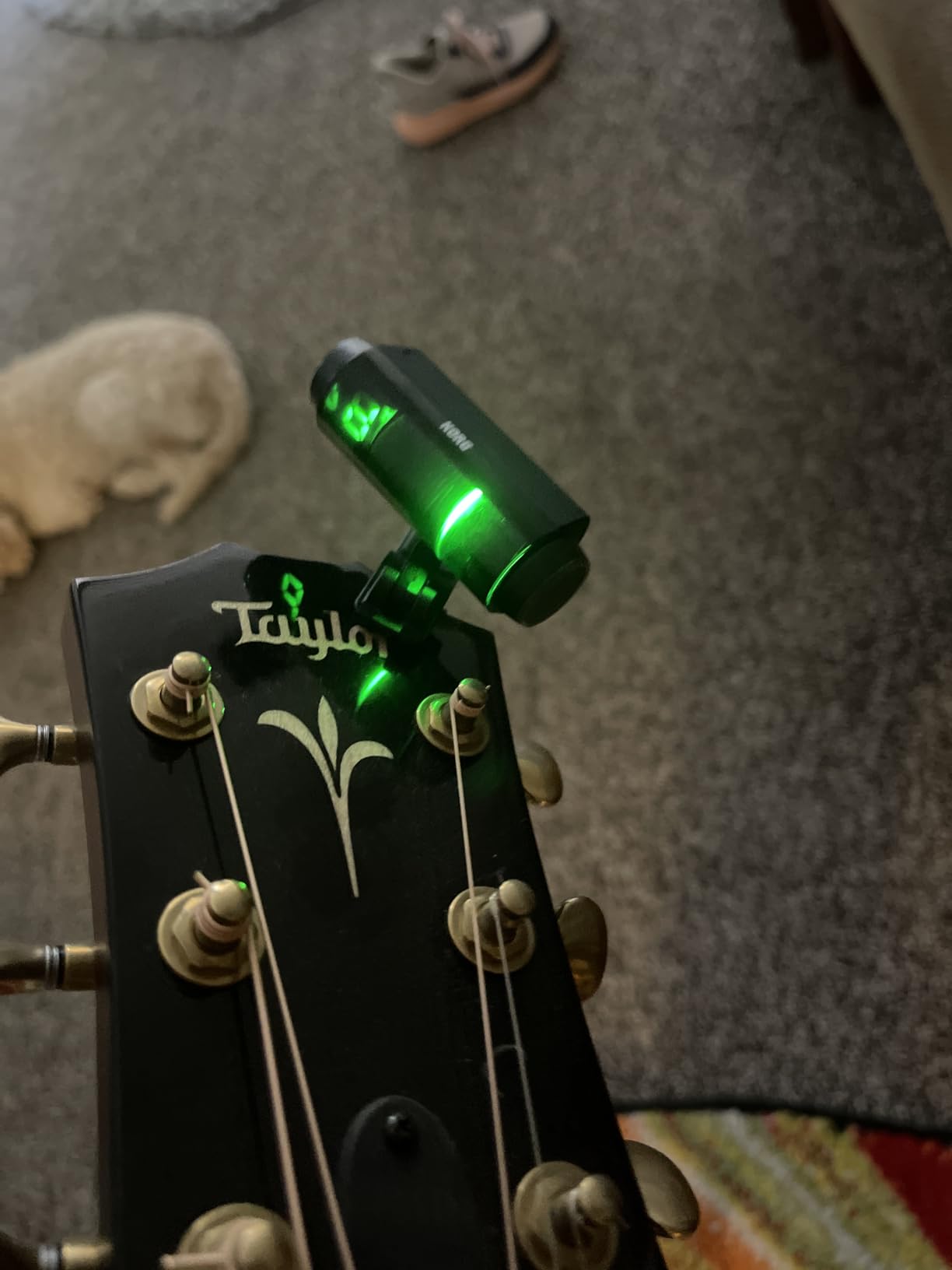
Owners report head-to-head comparisons where it clearly beats cheaper headstock clips, and it locks onto the low B of a seven-string guitar where budget units struggle. It is light at 0.03 kg and small enough to leave clipped on while playing.
Almost every complaint lands on the same part. The spring-loaded on and off wheel is too smooth, so your finger slips and you can tug the tuner off the headstock. The cell is not included, and the menu steps feel more elaborate than they need to be for a tuner that only tunes at 440Hz. It also has the smallest review base here at just under 500 ratings, so treat the consensus with more caution.
Where it makes sense
Touring players and anyone who wants to charge their tuner roughly once a year. A reader who wants the note name rather than a needle benefits most from the display style.
Anyone who plays extended-range instruments will like that it handles the low B string.
Where it does not
If you calibrate to a reference pitch other than 440Hz, this is the wrong unit, and the menu depth is an annoyance rather than a feature.
Fingers that slip on smooth controls will find the on/off wheel frustrating, and with the fewest ratings here, long-term durability is less proven.
How to Choose an Acoustic Guitar Tuner
Start with where you play, not with the specification sheet. A player who practises at home in a quiet room can succeed with almost anything on this list, while someone who plays a bar with a band needs vibration sensing, a readable screen and power that will not run out mid-set.
Next decide how visible the tuner can be. Some players will not put anything on a vintage or boutique headstock, which narrows the field to the soundhole and micro clip-on options immediately. Others want it permanently mounted and never removed, which favours the rechargeable units with auto power-off.
Chromatic, strobe and polyphonic modes explained
A chromatic tuner reads any note in any octave, so it handles drop D, open G, capo positions and non-standard tunings without reconfiguring. Almost every unit here is chromatic, and for acoustic players that is the sensible default.
A strobe tuner shows a spinning light pattern that freezes when pitch matches the reference. A polyphonic tuner reads several strings at once, which is rare among clip-ons and exists mainly as a pedal feature. For an acoustic, strobe is the useful upgrade, because polyphonic reading is a stage convenience rather than an accuracy gain.
Contact microphone or vibration sensor
A contact microphone hears the headstock, which means it hears the room, the amp, the drummer and the person talking to you. It is fine at home and unreliable in a loud space.
A piezo vibration sensor clamps mechanically to the string and ignores sound entirely. The Snark ST-2 is the only pick here that can switch between a built-in microphone and a vibration sensor, which makes it the most flexible option in a loud room.
Pedal tuners need a pickup first
A pedal tuner reads the signal arriving at its input jack, so your acoustic must have a pickup or preamp. Check what type before buying: a piezo or soundhole pickup is what pedal tuners expect, and a magnetic humbucker-style pickup on an acoustic will not drive one properly.
Many modern electric-acoustics also have a built-in tuner at the input jack, which is worth trying before you spend anything. If you already have a soundhole pickup, you can route it into a pedal tuner with a standard jack cable, though buying a dedicated soundhole tuner is usually quieter and simpler.
Reference pitch, A440 and sweetened presets
A440 means the A string above middle C vibrates 440 times per second. It is the concert standard, but orchestras, older recordings and players working with a band that tunes a little flat may sit anywhere between 430 and 450Hz, and if you play with those people a fixed tuner will fight you.
Look for an adjustable calibration range. The D’Addario Micro and NS Micro cover 410 to 480Hz, the ST-2 covers 415 to 466Hz, and the KLIQ adds transposition keys. Sweetened presets retune slightly sharp so that compensating for the narrower intervals between strings on an acoustic produces a more even-sounding chord; they are a preference, not a correction, and some listeners find them sour.
Power, batteries and stage visibility
Rechargeable units remove battery anxiety entirely, and the LEKATO adds a battery gauge. Replaceable cells are the other approach, and the differences are practical: the Korg runs about 100 hours on one AAA, while the Peterson StroboClip HD gives around 24 hours of continuous use on a CR2032.
For display readability, color and needle models are easier in low light, and the Peterson’s 192-segment HD strobe array holds up in direct sunlight better than a small LCD. Whichever you pick, check that the screen faces you when the tuner is clipped to a headstock, ideally with 360-degree rotation.
Tuner apps and when they are enough
Free tuner apps use your phone microphone, which makes them a reasonable first step at home and a poor stage solution, because a room with instruments in it gives the app plenty of wrong signals to measure.
The workaround is to move the phone close to the soundhole or to the headstock and keep the room quiet. If you already own a decent clip-on, an app is a useful backup for ukulele, violin and bass rather than a replacement for a guitar tuner for acoustic guitar.
Frequently Asked Questions
Which guitar tuner is the most accurate?
Among clip-on tuners, the Peterson StroboClip HD is the most accurate, rated at plus or minus one tenth of a cent, and the Korg Sledgehammer claims the same figure. For a pedal, the Peterson StroboStomp HD matches it. The practical difference on most acoustics is only audible in a recording or a room full of trained ears.
What is the best tuning for an acoustic guitar?
Standard tuning is E A D G B E from the low string, with each open string tuned to a reference pitch of A440 where the A string vibrates 440 times per second. Alternatives such as drop D, open G, DADGAD and D standard suit different playing styles, and any chromatic tuner here will read them if you set the reference pitch correctly.
Do acoustic guitars need a special tuner?
No, but acoustics drift faster than electrics because humidity, temperature and string stretch all move the pitch, so accurate tuning matters more. A vibration-sensing tuner is the practical upgrade, because it ignores room noise that a contact microphone picks up in loud rehearsal and stage conditions.
Can I use a pedal tuner on an acoustic guitar?
Only if your acoustic has a pickup feeding the input jack, and it should be a piezo or soundhole pickup rather than a magnetic humbucker-style unit. Without a pickup the pedal receives no signal and stays silent. If your guitar already has a built-in tuner at the jack, try that before buying anything else.
What is the difference between a chromatic and a strobe tuner?
A chromatic tuner names any note in any octave, which handles drop tunings, capo positions and unusual intervals. A strobe tuner shows a light pattern that freezes at the correct pitch, giving finer visual resolution and no display lag. Chromatic tells you which note you are on, strobe shows you how exact you are.
Which tuner is better, Guyker or Gotoh?
Both are machine head and tuning peg brands, not electronic tuners. Gotoh is better known for higher-spec open-gear designs, Guyker for value-oriented open-gear and sealed models, and the comparison is about gear ratio, string gap and feel. If you want a device that tells you what pitch your strings are playing, you want an electronic tuner instead.
The Verdict: Which Acoustic Guitar Tuner Should You Buy?
After testing all twelve, the Snark SN5X is the best guitar tuner for acoustic guitars in 2026 for the widest range of players. It reads fast, its color screen is legible on a dim stage, and it charges over USB so it never dies on you.
Buy the Fender FCT-2 if you are new to tuning. Buy the D’Addario Eclipse if you want adjustable calibration in a bright display. Buy the D’Addario NS Micro if nothing should be attached to your headstock. Buy the LEKATO if battery anxiety is your main concern, and the Korg Sledgehammer if you would rather change a cell once a year than charge anything. For recording precision, the Peterson StroboClip HD is the answer, and if your acoustic has a piezo or soundhole pickup and you want to tune without looking down, the Peterson StroboStomp HD does the job properly.
One last thing worth saying plainly. A better tuner does not stop an acoustic from drifting, because humidity, string stretch and worn strings still move the pitch. It does make every tune-up land where you intended, which is the part you control.