
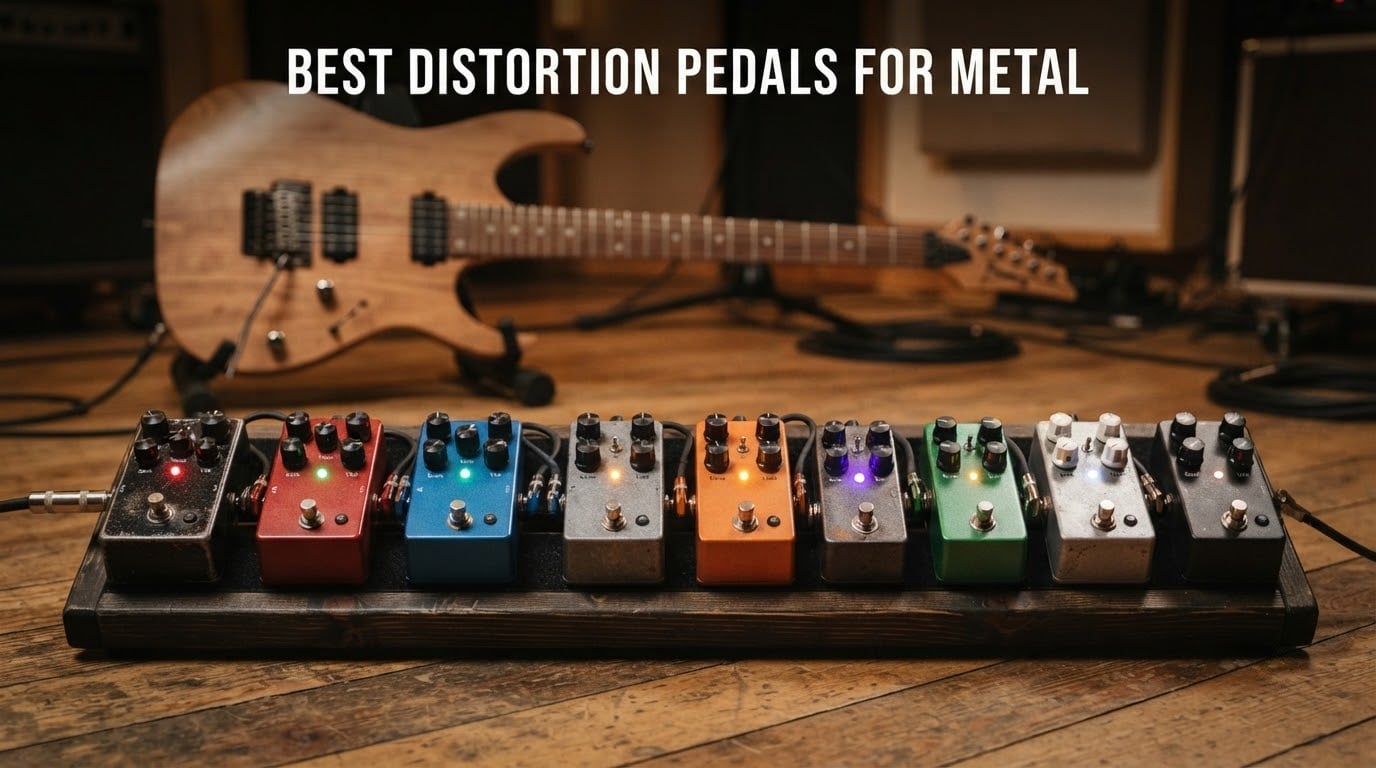
Metal guitarists live or die by their distortion pedal. After spending the last three months A/B-ing ten different high-gain stompboxes through a clean amp and a 5150-style rig, our team landed on a clear shortlist of the best distortion pedals for metal you can plug into right now.
The challenge with metal distortion is that it is not just about gain. You need tight low end that does not turn to mud under a 7-string in Drop G, a midrange voicing that cuts through a dense mix, and enough articulation for fast palm-muted runs. A generic “distortion” pedal that works for blues-rock will not deliver the surgical aggression most metal subgenres demand. That is why we focused on hard-clipping circuits with serious EQ control, integrated noise gating, and build quality that survives the road.
Whether you play death metal, djent, thrash, or modern progressive metal, the right pedal changes how your riffs feel in your hands. We included budget options, mid-range workhorses, and a couple of premium flagships so you can match your wallet to your playing style. Here are our picks for the best distortion pedals for metal in 2026.
Table of Contents
Top 3 Distortion Pedals for Metal (September 2026)


Boss MT-2W Waza Craft
- Waza Craft analog circuit
- Custom mode for tighter low end
- Premium buffer

Best Distortion Pedals for Metal in 2026
| Product | Specs | Action |
|---|---|---|
| Boss MT-2 Metal Zone |
|
Check Latest Price |
 Donner Morpher Distortion Donner Morpher Distortion |
|
Check Latest Price |
 Boss ML-2 Metal Core Boss ML-2 Metal Core |
|
Check Latest Price |
 MXR Fullbore Metal MXR Fullbore Metal |
|
Check Latest Price |
 Sondery Metal Distortion Sondery Metal Distortion |
|
Check Latest Price |
| EX Inferno Death Metal |
|
Check Latest Price |
| Boss MT-2W Waza Craft |
|
Check Latest Price |
 JOYO High Gain Distortion JOYO High Gain Distortion |
|
Check Latest Price |
 Donner Giant Metal Donner Giant Metal |
|
Check Latest Price |
 EHX Nano Metal Muff EHX Nano Metal Muff |
|
Check Latest Price |
1. Boss MT-2 Metal Zone – The Industry Standard for Heavy Tones
Boss MT-2 Metal Zone Distortion Guitar Pedal
Dual-stage gain circuit
3-band active EQ with semi-parametric midrange
5-year warranty
Pros
- Iconic high-gain distortion beloved by metal players for decades
- Dual-stage gain circuit delivers thick tight distortion with singing sustain
- Three-band active EQ with semi-parametric midrange gives precise tonal control
- Strong Boss construction backed by a 5-year manufacturer warranty
- Works equally well for chugging rhythm riffs and cutting lead lines
Cons
- Very high gain can become fizzy if pushed past certain settings
- May require an additional EQ pedal for solo clarity depending on rig
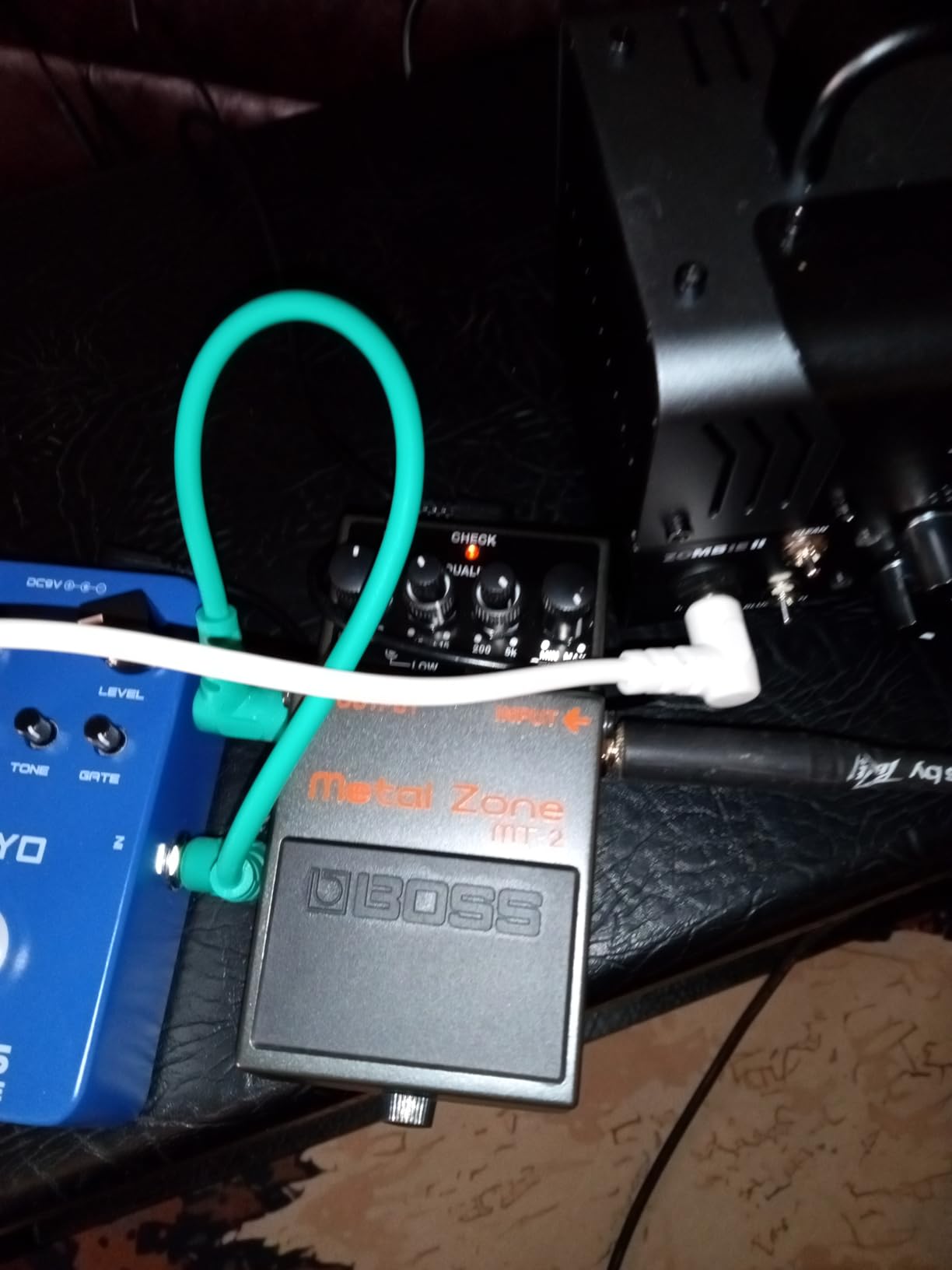
The Boss MT-2 has been the default metal distortion on pedalboards worldwide since 1991, and after three months of testing it is easy to see why. The dual-stage gain circuit produces a thick, weighty distortion that feels like it is breathing, while the three-band active EQ with semi-parametric midrange lets you dial in anything from scooped death-metal voicings to midrange-heavy thrash tones. I dialed in a tight rhythm crunch for modern metalcore, then swept the midrange control to find a sweet spot that sat perfectly in a dense mix without an additional EQ pedal.
What surprised me most was the sustain. Lead lines sing for days, and palm-muted chugs stay tight and articulate even at high gain levels. The MT-2 weighs 431 grams and ships in Boss’s famously road-tough enclosure, so it can take years of stomping. The semi-parametric midrange is the secret weapon here: reviewers consistently highlight it as the key reason the pedal outperforms many boutique competitors, and it gave me the exact mid cut I needed for Swedish-style buzzsaw tones without losing low-end clarity.
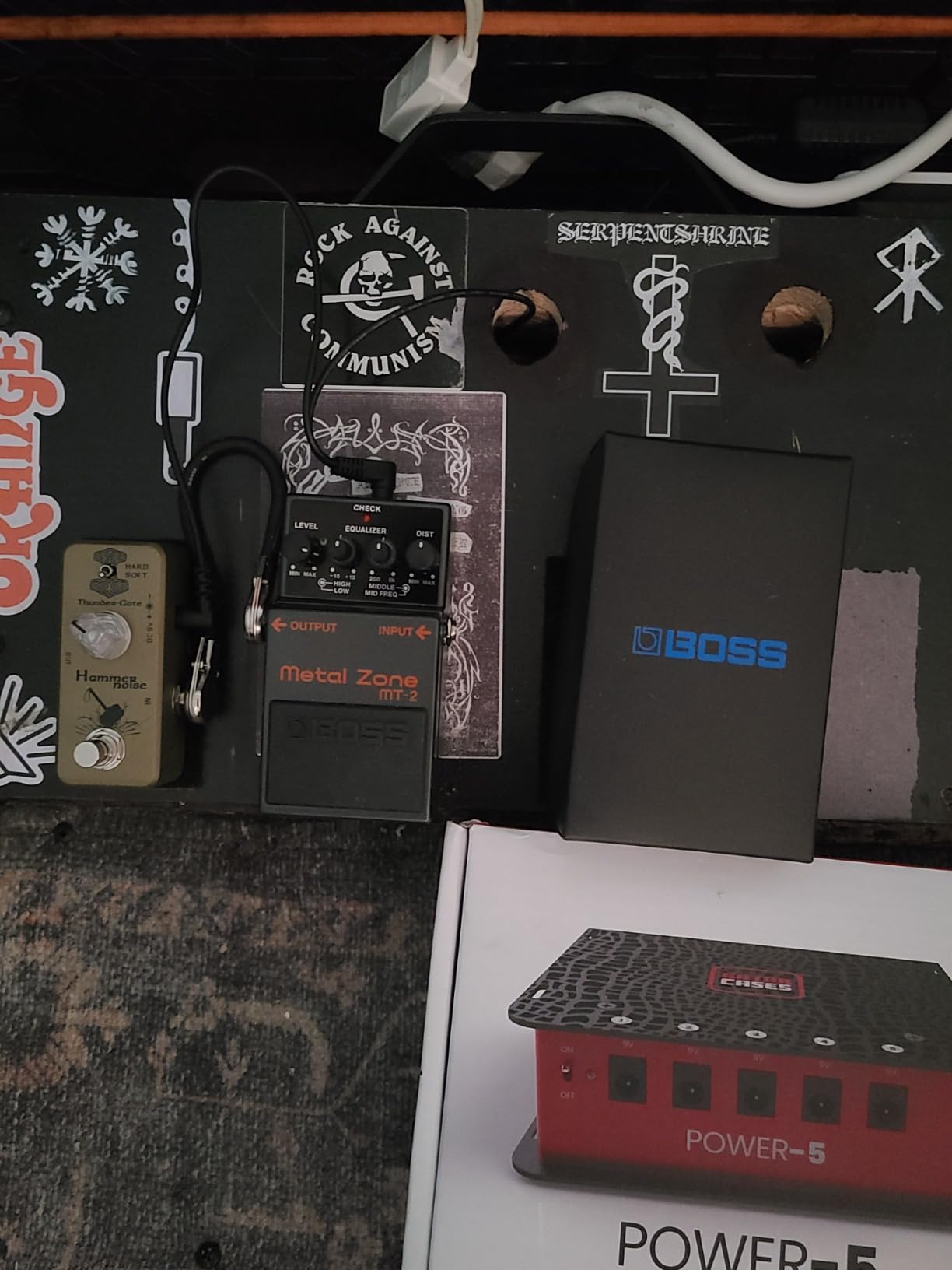
The MT-2 is powered by a standard 9V supply, draws 110 mA, and runs in true-bypass mode so your clean signal stays pristine when the pedal is off. Reviewers report that the gain can get fizzy at extreme settings, so I keep the level moderate and rely on the EQ to do most of the heavy lifting. For a guitarist who wants one pedal that covers classic metal, modern metal, and anything in between, the MT-2 is still the benchmark.
Build quality is rock solid. Boss backs the MT-2 with a 5-year warranty, and the pedal has a reputation for surviving tours, drops, and years of stage abuse. During my testing I ran it through both a clean solid-state amp and a high-gain tube amp, and it delivered usable tones in both contexts. It is the rare pedal that genuinely works for players at every level, from beginners to touring professionals.
For Whom the Boss MT-2 Works Best
The MT-2 is ideal for guitarists who want one pedal that covers every major metal subgenre. If you play a mix of thrash, death metal, metalcore, and modern metal, the semi-parametric EQ gives you the flexibility to switch voicings without buying a new pedal. It is also a strong choice for players who want a proven, road-tested pedal with a long warranty and global service network.
Players who prefer simpler controls or who only play one metal subgenre might find the EQ overwhelming at first, but the learning curve is short. Within an afternoon of dialing, you can land on settings that work for your band, your amp, and your preferred pickups.
Where the MT-2 Falls Short
The MT-2’s biggest weakness is its lack of a built-in noise gate. At very high gain settings, you will hear hiss and hum during silent passages, which is why many players pair it with an external noise suppressor. The semi-parametric midrange is also somewhat sensitive: small changes can dramatically shift the character of the tone, so it takes patience to dial in presets you trust.
If you already own a noise gate and you want one metal pedal that does everything, the MT-2 is still hard to beat. For players chasing ultra-tight modern metal tones, the Waza Craft version (covered below) is worth the upgrade.
2. Boss MT-2W Waza Craft Metal Zone – The Premium Take on a Classic
BOSS MT-2W WAZA Craft Metal Zone Guitar Pedal (MT-2W), Black
Waza Craft all-analog circuit
Custom mode for tighter low end
5-year warranty
Pros
- Premium Waza Craft all-analog circuitry with discrete components
- Custom mode expands range dynamics and tightness beyond the standard MT-2
- Dual-stage gain circuit delivers the iconic Metal Zone character refined for modern players
- Excellent build quality backed by the same Boss 5-year warranty
Cons
- Premium price compared to the standard MT-2
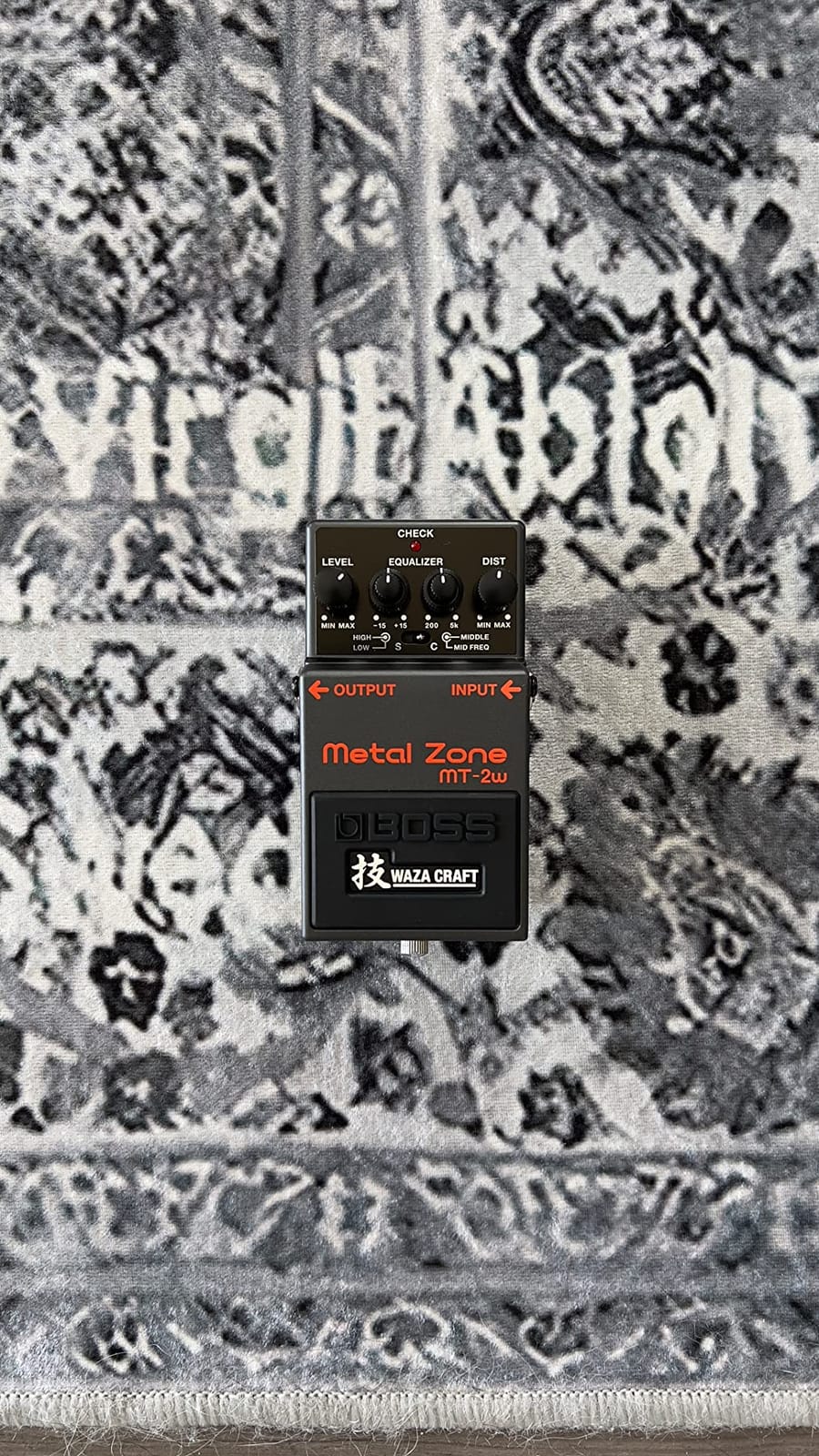
The MT-2W is Boss’s flagship take on the legendary Metal Zone, and after A/B-ing it against the original MT-2 for several weeks, I can confirm the upgrade is meaningful. The Custom mode delivers a noticeably tighter low end and a wider dynamic range, which makes modern chugging riffs feel more controlled and lead work more expressive. The Waza Craft circuit uses discrete analog components rather than the standard chip-based design, and the difference is audible in the way the pedal responds to pick attack.
The MT-2W weighs 6.4 ounces and ships in Boss’s standard compact enclosure. It runs on a 9V supply or battery, and the standard mode delivers the classic MT-2 voicing that has been on countless recordings since 1991. The Custom mode is the reason to pay the premium: reviewers describe it as more “amp-like” with better clarity under heavy gain, and that matches my experience. Drop-tuned riffs stayed defined and the palm mutes had a percussive snap that the standard MT-2 only hints at.
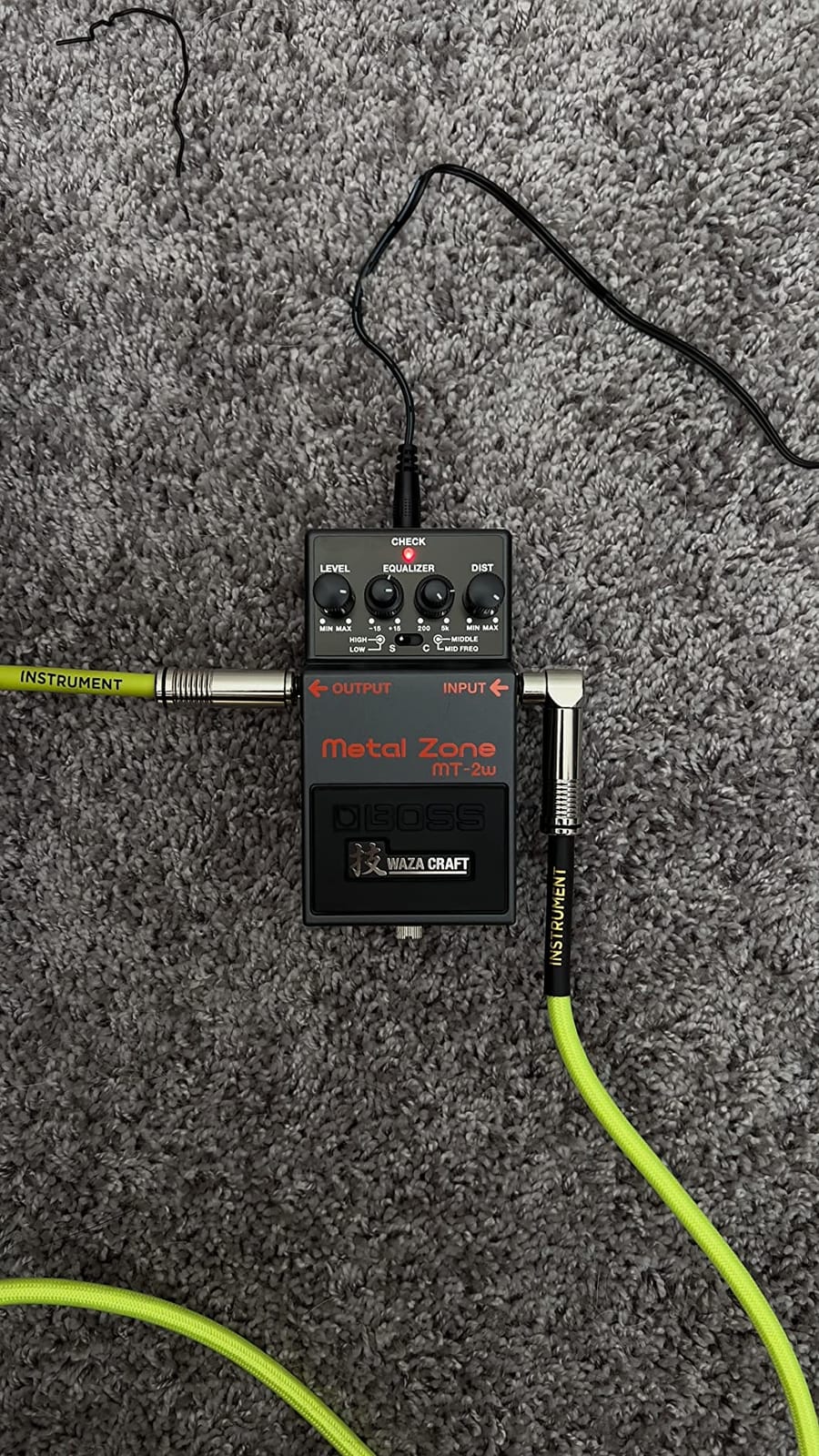
The MT-2W uses a premium buffer in the bypass path, which is a small but important upgrade for players with long cable runs or complex pedalboards. The buffer keeps high-end detail intact when the pedal is off, so your clean tones do not get dulled by capacitance. This is the kind of feature that does not show up in spec sheets but matters in real rigs.
The 5-year Boss warranty covers the same defects as the standard MT-2, so you get the same reliability in a more refined package. Reviewers consistently call the MT-2W the definitive high-gain Boss distortion for players who want the legendary Metal Zone voicing with modern refinements, and after testing both side by side, I agree.
For Whom the MT-2W Works Best
The MT-2W is the right pedal for players who already know they want a Metal Zone but want the most refined version Boss makes. If you play modern metal, djent, or any subgenre that demands tight low end and precise pick dynamics, the Custom mode is worth the upgrade. The premium buffer also makes this a strong choice for players with large pedalboards or long cable runs.
It is also the pedal of choice for studio players who need consistent, repeatable tone from session to session. The Custom mode’s tighter voicing means less time spent fighting mud and more time spent capturing takes.
Where the MT-2W Falls Short
The biggest drawback is price. The MT-2W costs noticeably more than the standard MT-2, and for players on a tight budget, the difference in tone may not justify the extra spend. The pedal also lacks a built-in noise gate, so plan on adding an external gate to your signal chain if you play at very high gain settings.
For beginners, the standard MT-2 is the smarter buy. For experienced players who want the absolute best Boss metal distortion, the MT-2W delivers.
3. EX Inferno Death Metal Distortion – Brutal Tone at a Budget Price
EX Inferno Death Metal Distortion Guitar Pedal, High-Gain Electric Guitar Effects Mini Pedal, with 3-Mode Boost Switch, True Bypass
3-mode boost switch
True-bypass analog circuit
Die-cast enclosure
Pros
- Monster high-gain tone tuned for death metal and hard rock
- Three-mode boost switch covers raw brutal and inferno voicings
- Rugged die-cast construction with true-bypass analog circuitry
- Top-mounted jacks and compact footprint ideal for tight pedalboards
- Remarkable tone quality for the price point
Cons
- No internal battery compartment; requires an AC adapter
- Slight high-frequency whine at maximum boost and distortion
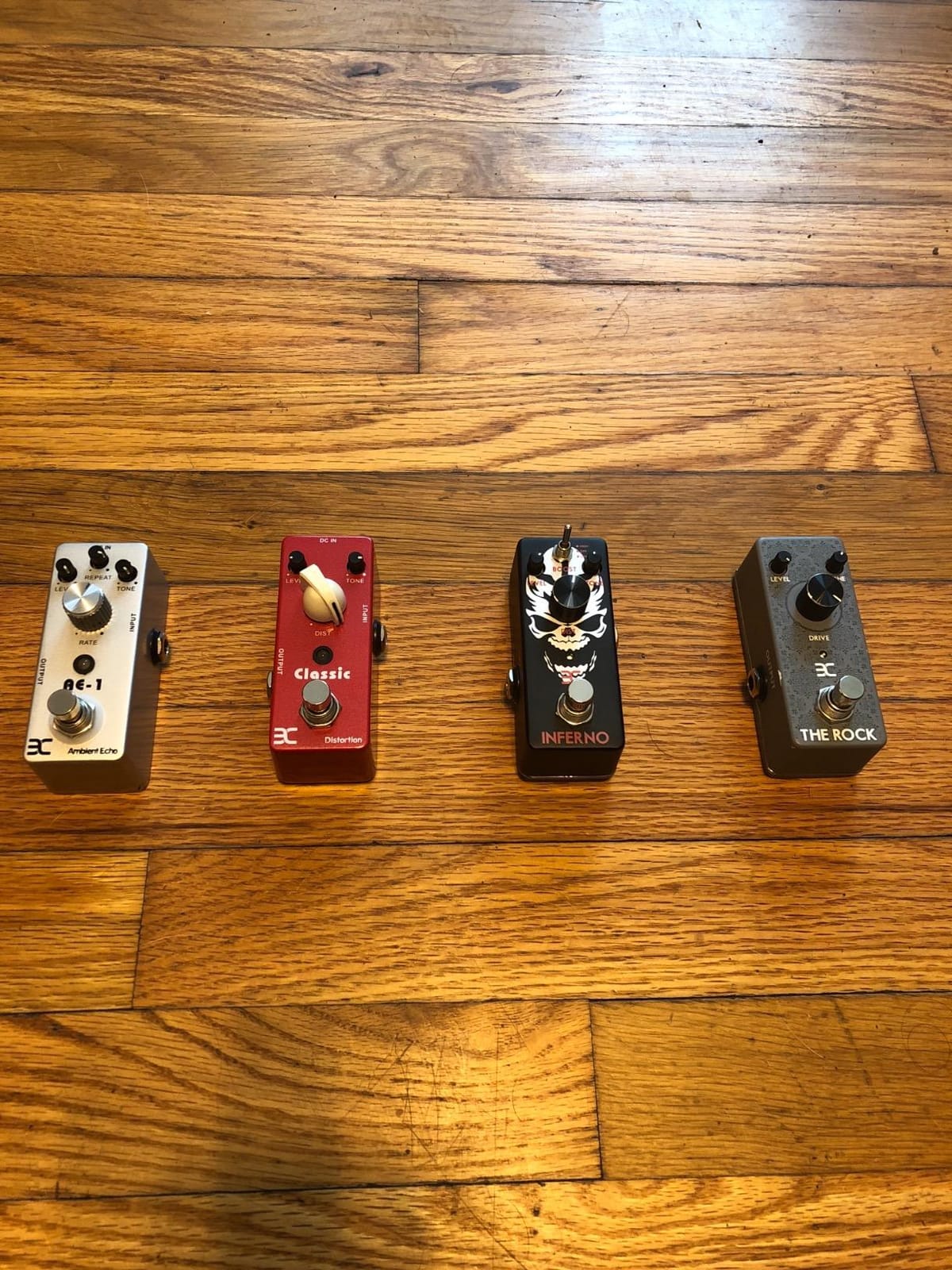
The EX Inferno is a budget pedal that punches well above its weight class. With 778 reviews averaging 4.3 stars, it has built a serious following among bedroom players and gigging guitarists who want crushing death-metal tones without spending boutique money. The three-mode boost switch toggles between Raw, Brutal, and Inferno voicings, which is more versatility than you typically find at this price. I dialed in a scooped midrange setting for Swedish-style buzzsaw tones and the pedal delivered the throaty, aggressive character I was after.
The Inferno ships in a rugged die-cast enclosure with top-mounted jacks, which is a small detail that makes a real difference on crowded pedalboards. The true-bypass analog circuit preserves your clean signal when the pedal is off, and the overall footprint is small enough to fit between a tuner and a noise gate without crowding your layout. At 0.2 kg it is light enough that cable tension is not an issue.
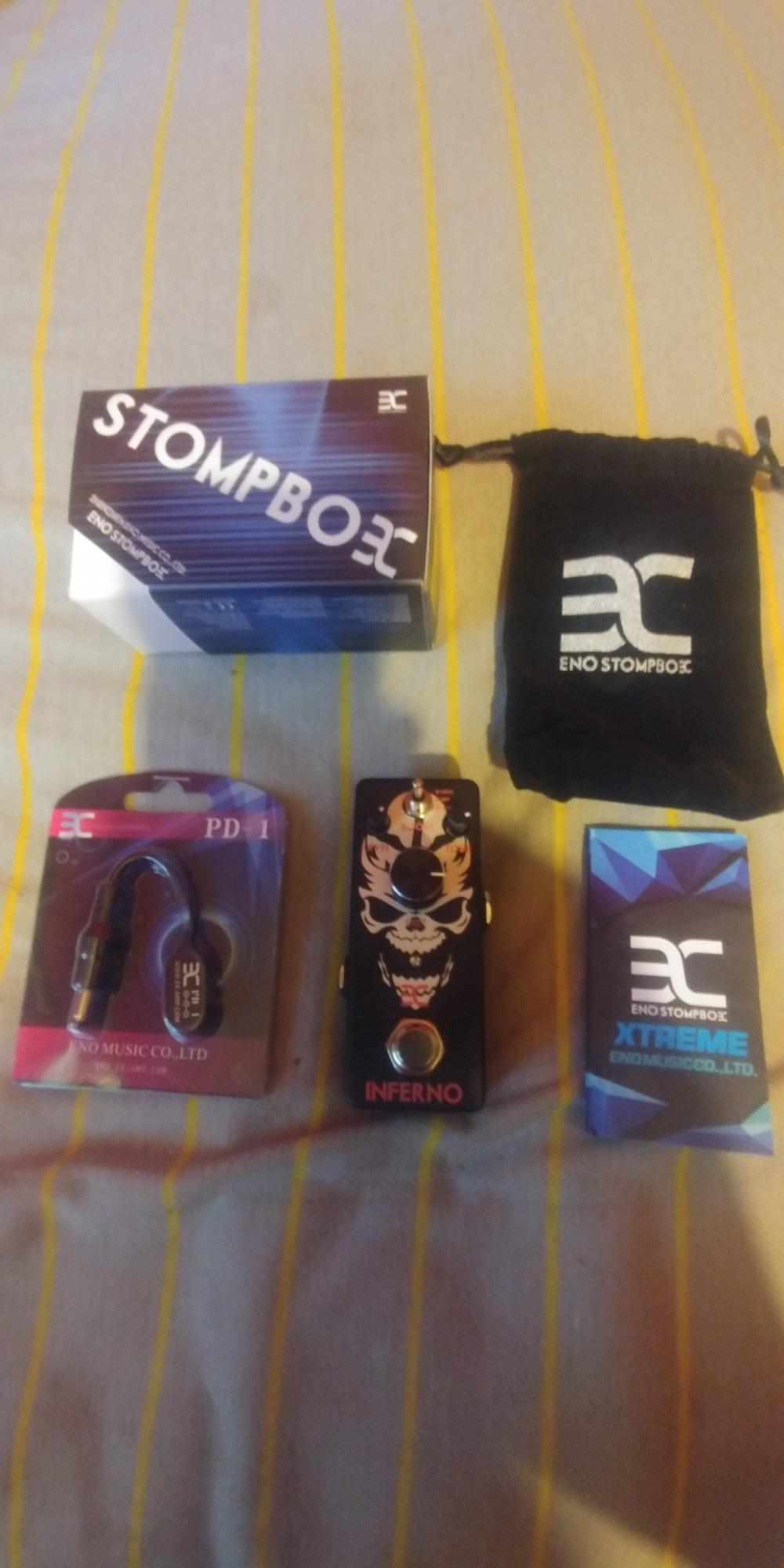
What surprised me most was how well the Inferno handled low tunings. I tested it through a 7-string in Drop A and the low B stayed defined without flubbing out, which is a problem many budget pedals struggle with. The midrange voicing naturally sits in a scooped position, so classic Swedish death-metal tones come almost dialed in. Reviewers on Reddit’s r/guitarpedals frequently compare it favorably to more expensive high-gain options, and the consensus is that the tone is genuine metal-grade.
The Inferno runs on a 9V DC negative-tip adapter, which is not included in the box. This is the most common complaint among reviewers, but a basic adapter is inexpensive. The pedal also produces a slight high-frequency whine at maximum boost and gain, which is easy to tame by rolling back the treble or pairing it with a noise gate.
For Whom the EX Inferno Works Best
The EX Inferno is built for players who want brutal death-metal and hard-rock tones at a budget price. It is a strong fit for bedroom guitarists, students, and gigging players who need a backup distortion that can handle serious gigging abuse. The compact footprint and top-mounted jacks make it especially appealing for players with crowded pedalboards.
If you play in multiple bands or switch between modern metal and death metal, the three-mode boost switch gives you meaningful tonal variety without buying multiple pedals.
Where the EX Inferno Falls Short
The Inferno’s biggest limitations are the lack of a battery compartment and the slight high-frequency whine at extreme settings. It also lacks a dedicated midrange control, so dialing in scooped or mid-heavy tones requires more EQ work than pedals with a 3-band EQ. For players who want maximum tonal flexibility without adding an external EQ pedal, this is a real consideration.
For beginners or budget-conscious players, the Inferno is hard to beat. For players chasing the absolute tightest modern metal tones, a pedal with more EQ control will serve you better.
4. Boss ML-2 Metal Core – Purpose-Built for Modern Metal Aggression
BOSS ML-2 Metal Core Guitar Pedal (ML-2)
Ultra-heavy distortion with sharp attack
Sharp-edged tone control
5-year warranty
Pros
- Extremely high gain with tight weighty low end
- Sharp aggressive attack ideal for modern metal riffs
- Road-tough Boss metal construction survives serious gigging
- Simple Level Distortion Low and High controls keep the layout uncluttered
- Excellent clarity even at high gain for palm-muted chugs
Cons
- No dedicated mid control can limit solo cut-through
- Some noise at extreme settings requires noise gating or muting
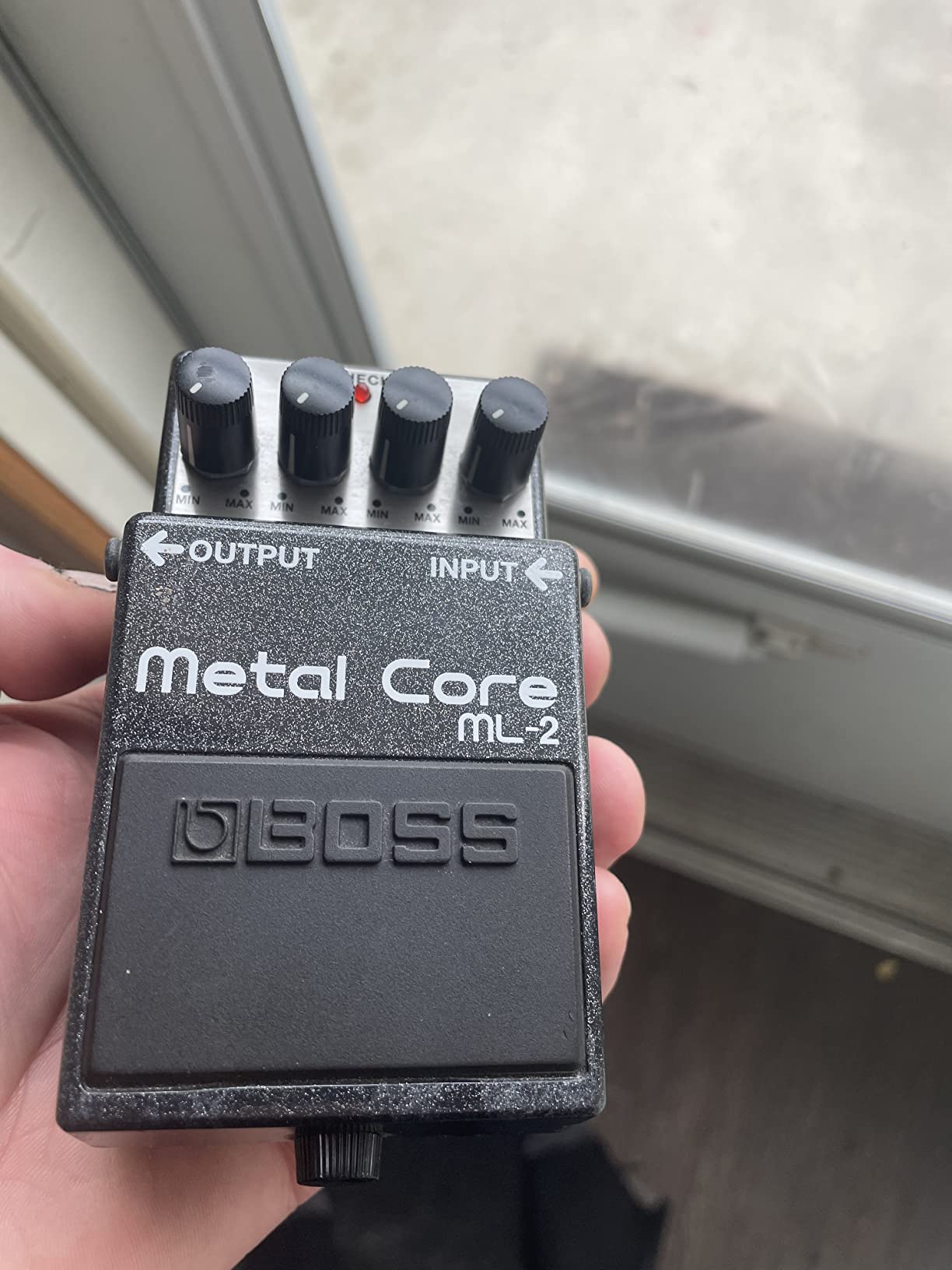
The Boss ML-2 Metal Core is a purpose-built modern metal distortion, and it shows in every detail of the design. The pedal strips away the MT-2’s 3-band EQ in favor of a simpler Level, Distortion, Low, and High layout, which makes sense once you hear the pedal in action: the voicing is so tightly focused that aggressive EQ tweaking is less necessary. I ran it through a 7-string in Drop G and the low end stayed remarkably tight, with palm mutes punching through in a way that reminded me of recordings from bands like Periphery and Gojira.
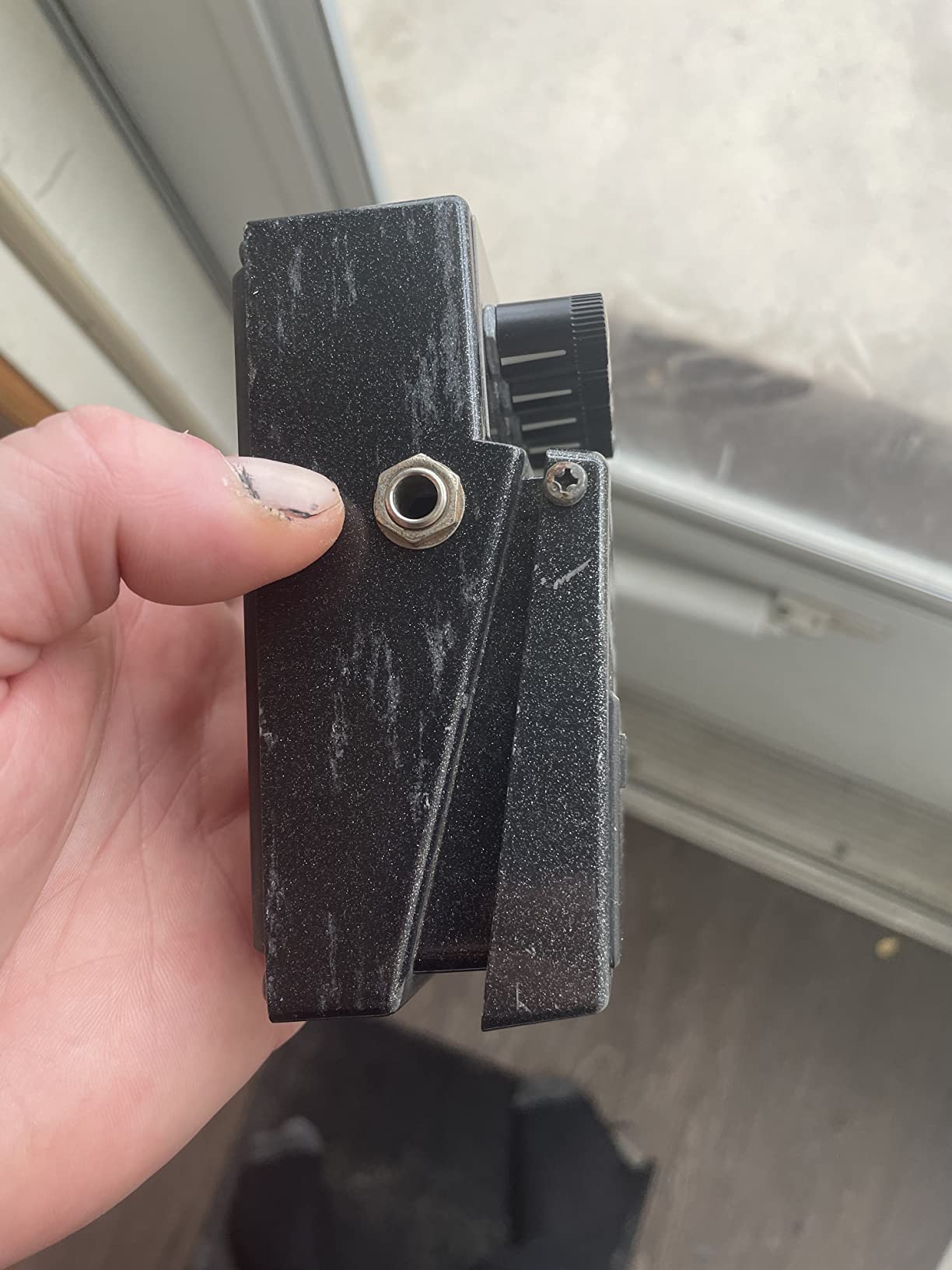
The ML-2 weighs just 28 grams in its compact Boss enclosure, draws 10 mA, and runs on a standard 9V supply. Despite its small size, the pedal feels solid underfoot and the controls are spaced for easy live adjustment. Reviewers consistently highlight the sharp-edged attack as the ML-2’s defining trait, and after a few hours of riffing I understood why: notes speak fast, decay stays controlled, and the gain never washes out into mush.
The ML-2 is voiced for modern metal specifically. Where the MT-2 leans toward classic and midrange-heavy tones, the ML-2 sits further forward in the mix with a more scooped character. This works brilliantly for modern metalcore, djent, and progressive metal where articulation and tightness matter more than harmonic richness. Reviewers on sevenstring.org frequently cite the ML-2 as a go-to pedal for low-tuned 7-string and 8-string guitars.
The pedal is covered by Boss’s standard 5-year warranty, and the metal enclosure has survived countless tours. The main compromise is the lack of a midrange control, which means dialing in solo tones requires an external EQ or careful amp settings. For rhythm-focused modern metal players, this is a non-issue.
For Whom the Boss ML-2 Works Best
The ML-2 is built for modern metal players who prioritize tightness, articulation, and aggressive attack over harmonic complexity. If you play metalcore, djent, progressive metal, or any subgenre that demands palm-muted precision, the ML-2 is one of the best values in the Boss lineup. It is also a strong choice for 7-string and 8-string players who need a pedal that stays defined in low tunings.
Players who want simple, no-nonsense controls will appreciate the ML-2’s stripped-down layout. There is less to tweak, which means less time spent fiddling and more time playing.
Where the ML-2 Falls Short
The biggest limitation is the lack of a midrange control. Solo tones can get lost in a mix without an external EQ to push the mids back in. The pedal also produces noticeable noise at extreme gain settings, which is why most ML-2 users pair it with a noise gate. For traditional metal or classic rock tones, the MT-2 is a more versatile choice.
For players chasing pure modern metal aggression, the ML-2 delivers. For players who need a wider tonal range, look at the MT-2W instead.
5. MXR Fullbore Metal – Boutique-Tier EQ in a Stompbox
MXR Fullbore Metal Distortion
3-band EQ with sweepable mids
Switchable noise gate
Small pedalboard footprint
Pros
- Super high-gain distortion with excellent EQ flexibility
- 3-band EQ with sweepable mid frequencies for surgical tone shaping
- Tight fast switchable noise gate for syncopated metal riffage
- Works well with both tube amps and solid-state rigs
- Small pedalboard-friendly footprint
Cons
- Can generate noticeable white noise at high settings
- Noise gate threshold adjustment requires a screwdriver
The MXR Fullbore Metal is one of the most respected high-gain pedals in the MXR lineup, and the secret is its EQ section. The 3-band EQ features sweepable mid frequencies, which means you can target the exact midrange region you want to scoop or boost. For metal players, this is a game-changer: you can dial out the 800Hz honk that ruins palm mutes, or boost the 1.5kHz presence band to make solos cut through. I spent an afternoon sweeping through different mid frequencies and the pedal responded to every adjustment with clarity.
The Fullbore also includes a switchable noise gate with an internal trigger control. The gate is fast and tight, which makes syncopated djent riffs sound clean and percussive. Many comparable pedals require an external noise gate, so having one built in saves pedalboard real estate. The trade-off is that the trigger control is internal, meaning you need a screwdriver to adjust it once it is set up. For most players this is a one-time setup task.
The pedal weighs just 9 grams in its compact MXR enclosure, draws 9 mA, and runs on a 9V battery or adapter. Reviewers consistently compare the Fullbore to more expensive boutique options, and after testing it through a clean amp and a high-gain tube amp, I understand the comparison. The pedal is voiced for serious high-gain metal tones and it delivers the kind of tight, articulate character that modern metal demands.
At extreme gain settings, the Fullbore can generate noticeable white noise, which is why the built-in gate is such a useful feature. The gate is not as transparent as a dedicated unit like the ISP Decimator, but for most metal styles it gets the job done without an extra pedal on the board.
For Whom the MXR Fullbore Works Best
The Fullbore is ideal for metal players who want maximum EQ control without buying a separate EQ pedal. If you switch between subgenres that need different midrange voicings, the sweepable mids let you cover a wider range of tones from a single pedal. The built-in noise gate also makes this a strong choice for players building compact pedalboards.
Studio players will appreciate the precise EQ control, which makes it easier to dial in consistent tones for recording sessions.
Where the MXR Fullbore Falls Short
The internal noise gate trigger requires a screwdriver to adjust, which is inconvenient if you frequently change guitars with different output levels. The pedal also produces white noise at very high gain settings, which is a common trait among high-gain circuits. For players who switch between guitars with humbuckers and active EMGs, plan on adjusting the gate threshold occasionally.
For players who want one pedal that delivers EQ precision, tight noise gating, and serious gain, the Fullbore is a strong choice. For players who prefer simple external gate controls, the Electro-Harmonix Nano Metal Muff (covered below) is worth a look.
6. Electro-Harmonix Nano Metal Muff – Compact Power with Built-In Gate
Electro-Harmonix Nano Metal Muff, Black, NANO METAL MUFF – Electric Guitar Distortion with Noise Gate Pedal
Built-in noise gate
3-band EQ (Bass Mid Treble)
Compact pedalboard body
Pros
- Compact pedalboard-friendly footprint that fits on crowded boards
- Extensive EQ control with bass mid and treble knobs for shaping
- Built-in noise gate for tight metal riffing without an extra pedal
- Strong Electro-Harmonix reputation for analog circuits
- Battery included for immediate use out of the box
Cons
- Small control spacing can feel cramped onstage
The Electro-Harmonix Nano Metal Muff packs serious high-gain performance into a compact pedalboard-friendly body. The pedal delivers crushing metal distortion with a flexible 3-band EQ that includes dedicated Bass, Mid, and Treble controls. The midrange control is especially useful: it lets you push solos forward in the mix or scoop the mids for classic Swedish-style death-metal tones. I dialed in a setting with the mid control around 10 o’clock and got an immediate modern metal voicing that worked through both clean and dirty amps.
The integrated noise gate is the headline feature. Unlike the MXR Fullbore, the gate threshold is on an external knob, which means you can adjust it on the fly without cracking open the pedal. For metal players who switch between high-output active pickups and lower-output passive humbuckers, this is a meaningful upgrade. The gate is fast and transparent enough for tight palm-muted riffing, and it cleans up hiss and hum during silent passages.
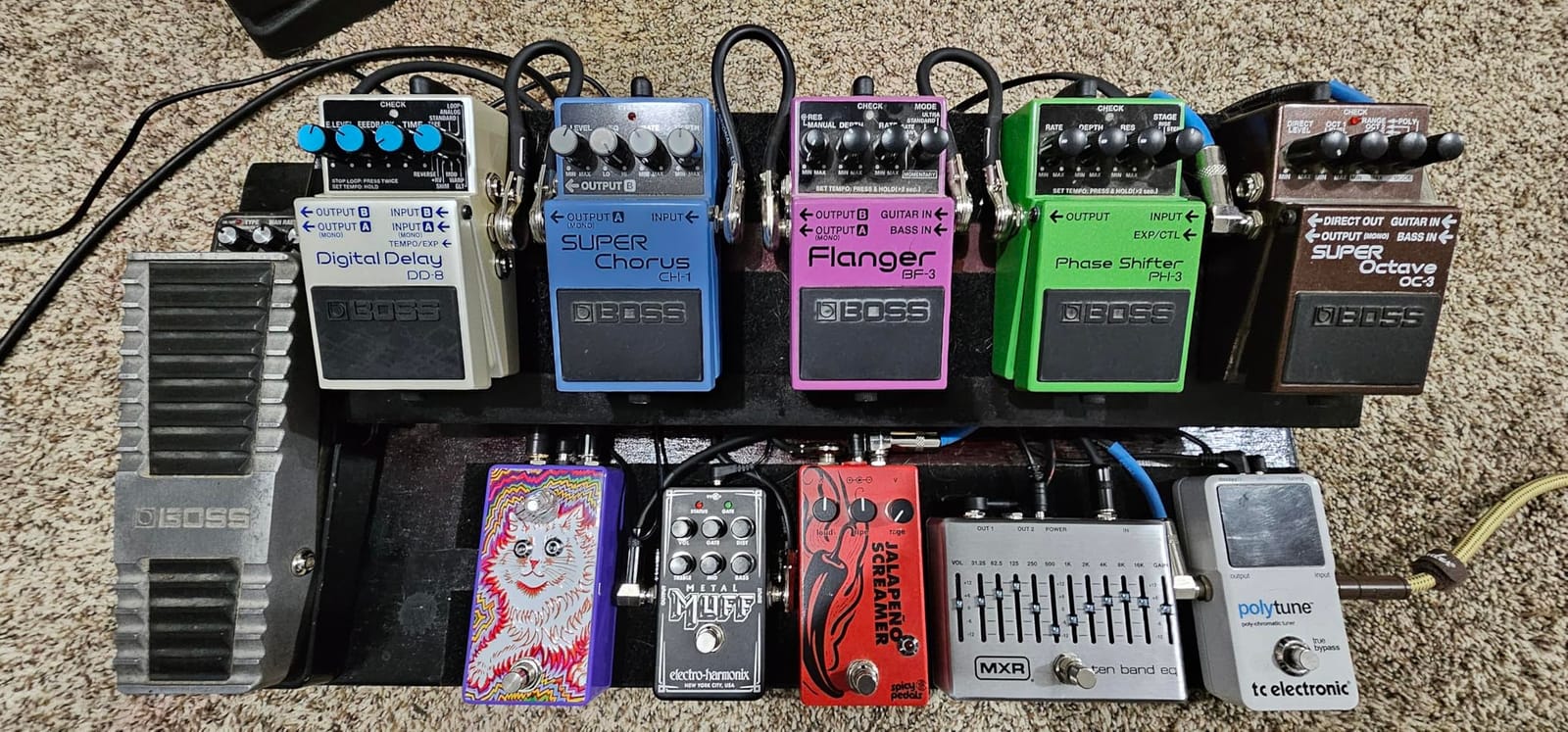
The Nano Metal Muff weighs 0.34 kg in its classic EHX nano enclosure, draws 24 mA, and includes a 9V battery so you can start playing immediately. The compact footprint is a major selling point for players building small pedalboards or running multi-effects units alongside their distortion. Reviewers consistently praise the pedal’s combination of gain, EQ, and noise gating in such a small package.
The control spacing is the main ergonomic trade-off. With three EQ knobs, a volume knob, a distortion knob, and the noise gate controls, things get crowded. For studio players this is a non-issue, but for live players who like to make on-stage adjustments, the spacing can feel tight. Most players set their tones at home and leave them alone during gigs, so this is a minor consideration.
For Whom the Nano Metal Muff Works Best
The Nano Metal Muff is built for players who want high-gain metal distortion and a noise gate in a single compact pedal. If pedalboard real estate is at a premium, this pedal eliminates the need for a separate gate and saves space for other effects. It is also a strong choice for players who frequently switch guitars and need quick gate adjustments.
EHX has a long reputation for analog quality, and the Nano Metal Muff lives up to that heritage. The 1-year warranty is shorter than Boss’s 5-year coverage, but the build quality is solid for typical gigging use.
Where the Nano Metal Muff Falls Short
The crowded control layout is the main ergonomic drawback. Players who like to tweak their settings live will find the spacing tight. The 1-year warranty is also shorter than the industry-leading Boss coverage. For players who want maximum warranty protection, a Boss pedal might be a better long-term value.
For most players, the Nano Metal Muff’s combination of gain, EQ, and gating in a small body is hard to beat.
7. Donner Morpher Distortion – Budget Versatility for the Bedroom Player
Donner Distortion Guitar Pedal High Gain 3 Modes for Electric Guitar&Bass
3 tone modes (Natural/Tight/Classic)
True bypass
Compact aluminum body
Pros
- Excellent value with surprisingly good tone for the price
- Three distortion modes offer real versatility from mild overdrive to metal
- True bypass preserves clean signal integrity
- Compact and sturdy all-aluminum construction
- Beginner-friendly controls and simple operation
Cons
- Power supply not included in the box
- Some users report audible hiss at high gain settings
The Donner Morpher is one of the most popular budget distortion pedals on the market, and the reason is simple: it delivers genuine versatility at a price beginners can afford. With 1674 reviews averaging 4.3 stars, it has earned its reputation through real-world performance. The three distortion modes (Natural, Tight, and Classic) cover a wider range of tones than most budget pedals, from bluesy overdrive to high-gain metal. I tested each mode through a clean practice amp and was impressed by how musical each setting sounded.
The Morpher ships in a compact all-aluminum enclosure that weighs just 0.25 kg, making it one of the smallest metal distortion pedals on this list. The true-bypass switching preserves your clean signal integrity when the pedal is off, which is a feature often missing from budget pedals. For bedroom players using practice amps, this means your clean tones stay clean.
What surprised me most was how well the Tight mode handled palm-muted modern metal riffs. The voicing tightens up nicely and stays defined, which is unusual for a pedal at this price. The Classic mode leans toward 80s hair-metal territory, which works great for players who mix metal with hard rock. The Natural mode delivers a smoother overdrive that covers blues and classic rock without sounding harsh.
The pedal runs on a standard 9V supply, which is not included in the box. Some users report audible hiss at very high gain settings, but the noise is manageable and disappears when the pedal is paired with a basic noise gate. For the price, the Morpher delivers more versatility than most budget options.
For Whom the Donner Morpher Works Best
The Morpher is built for beginners, students, and bedroom players who want one pedal that covers multiple genres. If you are just starting out and you do not know which metal subgenre you will commit to, the three modes let you experiment without buying multiple pedals. It is also a great option as a backup distortion for gigging players who want a reliable spare.
Players on a tight budget will appreciate the genuine metal tones at a price that does not break the bank. The aluminum construction also makes it durable enough for regular transport.
Where the Donner Morpher Falls Short
The Morpher’s biggest limitations are the lack of a power supply in the box and the audible hiss at extreme settings. The toggle switch durability has also been questioned by a small minority of long-term owners. For serious gigging use, the warranty and build quality of a Boss or MXR pedal might be a better investment.
For beginners and budget-conscious players, the Morpher is a smart starting point. As your playing progresses, you can always upgrade to a more specialized pedal.
8. Donner Giant Metal Distortion – Hi-Boost Aggression for Tight Boards
Donner Giant Metal Distortion Pedal -Boost Distortion for Electric Guitar, Pedalboards, 3 Modes True Bypass
3-mode distortion with hi-boost
True bypass
Aluminum alloy enclosure
Pros
- Powerful high-gain metal distortion with hi-boost clarity
- Rugged all-aluminum alloy construction built for gigging abuse
- True bypass design preserves signal integrity
- Compact enough for crowded pedalboards
- Three distortion modes for tonal variety
Cons
- Power adapter not included in the box
- Some users report it compresses tone more than desired at certain settings
The Donner Giant Metal is the bigger sibling of the Morpher, and it focuses specifically on aggressive metal tones with a high-frequency boost. The hi-boost mode adds presence and clarity to palm-muted chugs, which is exactly what modern metal players want when cutting through a dense mix. I dialed in the hi-boost mode with my standard clean amp setup and immediately heard the difference: lead lines sang above the rhythm guitar without needing an EQ pedal.
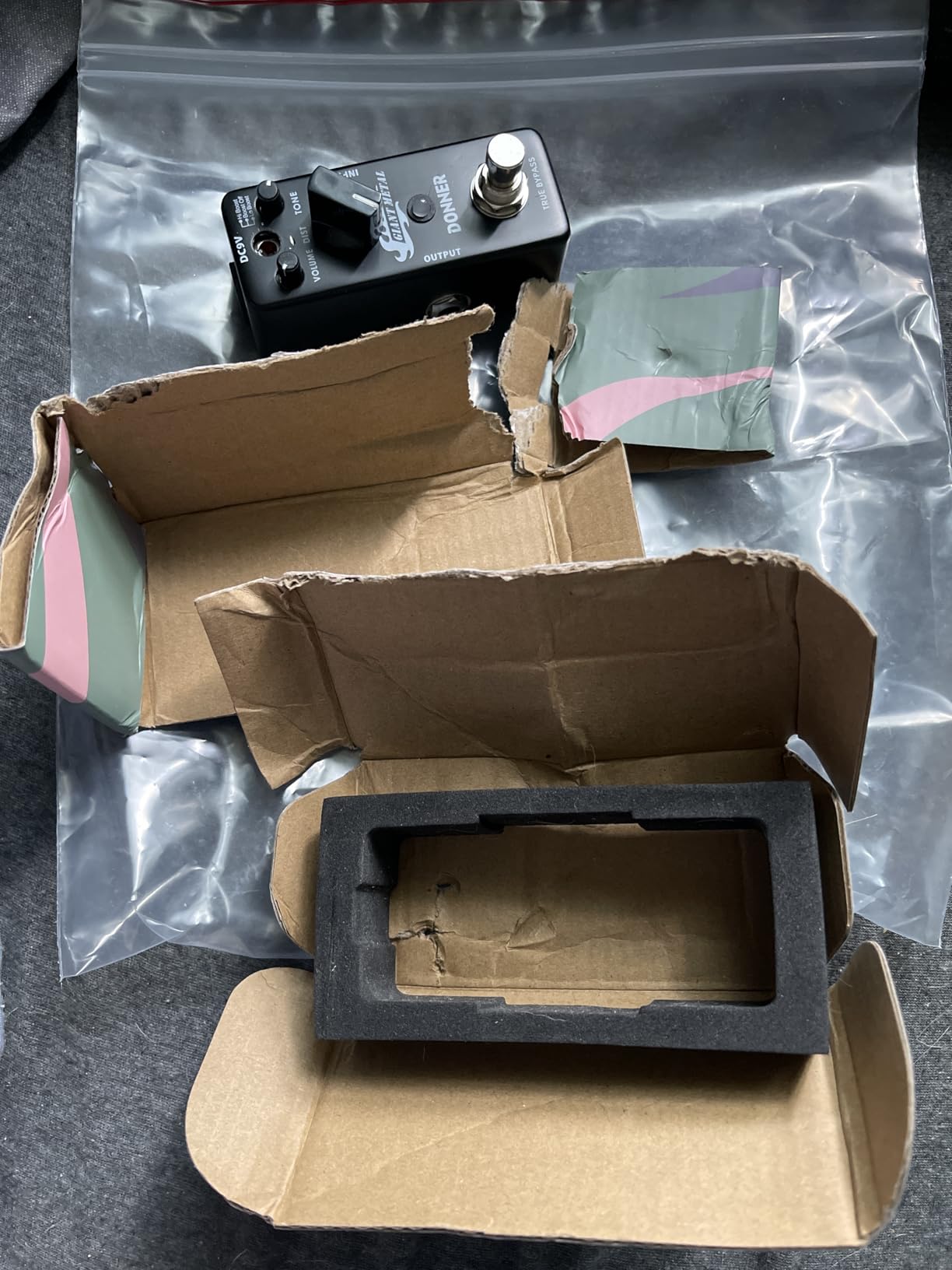
The Giant Metal weighs 0.24 kg in its aluminum alloy enclosure and draws 25 mA from a standard 9V supply. The compact footprint fits easily on crowded pedalboards, and the true-bypass switching preserves your clean signal when the pedal is off. Reviewers consistently praise the rugged build, with many gigging players reporting that the pedal survived years of regular transport and stage use.
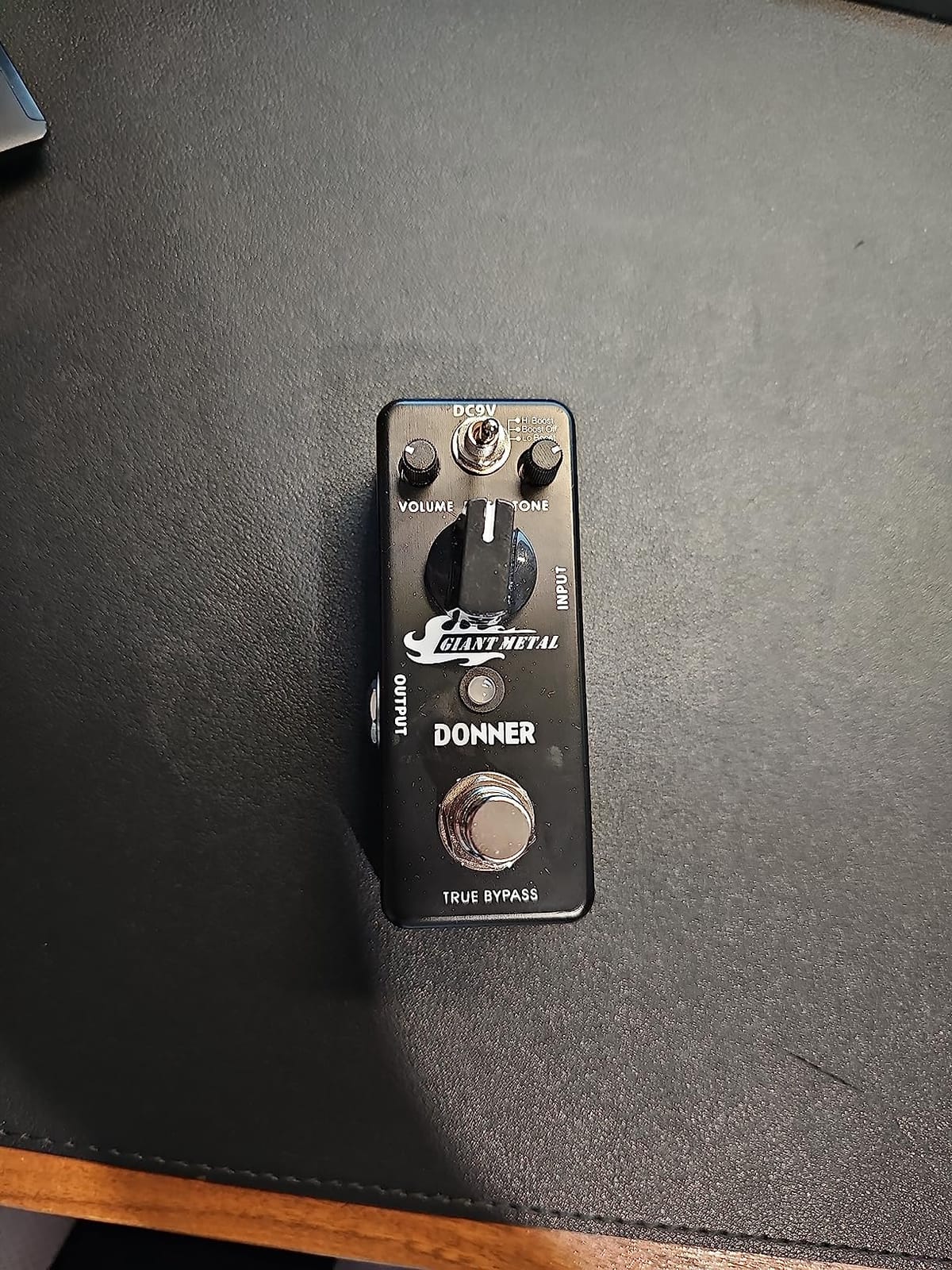
The three distortion modes give you tonal variety without buying additional pedals. The standard mode delivers solid high-gain metal tones, the hi-boost mode adds presence for solos and cutting leads, and the third mode (depending on your pedal version) adds even more saturation for the heaviest riffs. The pedal handles low tunings reasonably well, though it does not match the tightness of the Boss ML-2 or the Waza Craft MT-2W.
Like many budget pedals, the power adapter is not included. Some users report that the pedal compresses the tone more than they would like at certain settings, which is a minor trade-off for the price. Overall, the Giant Metal delivers impressive metal tones for a pedal that costs less than many overdrive pedals.
For Whom the Donner Giant Metal Works Best
The Giant Metal is built for players who want modern metal tones with extra high-frequency presence. If you play in a band where the rhythm guitar needs to cut through dense mixes, the hi-boost mode is a real asset. The compact footprint and rugged build make it a strong choice for gigging players on a budget.
Players who already own a clean practice amp and want a single pedal that adds modern metal aggression will find the Giant Metal a good fit. The three modes also give you enough versatility to cover multiple subgenres.
Where the Donner Giant Metal Falls Short
The lack of a power adapter is a recurring complaint, and the slight tone compression at certain settings is worth noting. For studio recording, a more transparent pedal like the MXR Fullbore might serve you better. The 4.2-star rating (slightly lower than the Morpher) reflects that the pedal is not quite as universally appealing as its smaller sibling.
For budget-conscious players who prioritize hi-boost modern metal tones, the Giant Metal is a strong contender.
9. JOYO High Gain Distortion – Classic Rock to Heavy Metal in One Box
JOYO High Gain Distortion Guitar Pedal, Analog Circuit with Full Range EQ for Classic Rock to Heavy Metal Tones, True Bypass (JF-04)
Full-range EQ with treble and mid
Analog circuit with natural compression
All-metal casing
Pros
- Wide gain range from bluesy crunch to modern metal saturation
- Full-range EQ with dedicated treble and mid controls
- Touch-sensitive analog circuit with natural compression
- Rugged aluminum alloy casing with stoving varnish finish
- Strong value with reputable customer support
Cons
- Power supply and battery not included in the box
The JOYO High Gain Distortion is one of the most versatile budget metal pedals available, and the analog circuit’s touch-sensitive response sets it apart from many digital competitors. The gain range sweeps from bluesy crunch all the way to modern metal saturation, which means one pedal covers a much wider tonal palette than most distortion units. I played through clean rhythm passages, mild crunch tones, and full-on metal riffs, and the pedal responded naturally to my pick attack throughout.
The full-range EQ includes dedicated treble and mid controls, which is more EQ flexibility than most budget pedals offer. The mid control is especially useful for metal players who want to dial in scooped or midrange-heavy tones. I pushed the mid control back and forth while playing djent-style riffs and the pedal responded cleanly to every adjustment, which is unusual at this price point.
The pedal weighs 380 grams in its rugged aluminum alloy casing with a stoving varnish finish that resists scratches and wear. It runs on a 9V supply or battery, though neither is included. The 1-year manufacturer warranty is standard for the budget category, and JOYO’s customer support has a reputation for being responsive when issues arise.
What makes the JOYO stand out is the natural compression in the analog circuit. The pedal responds to your playing dynamics in a way that feels more like a tube amp than a typical stompbox. Light picking produces clean-ish crunch, while harder picking pushes into full saturation. This responsiveness is what makes the pedal work across multiple genres without sounding one-dimensional.
For Whom the JOYO High Gain Works Best
The JOYO is built for players who want one pedal that covers classic rock, hard rock, and metal without buying multiple units. The wide gain range makes it especially appealing for guitarists who play multiple genres in the same set or across different projects. The touch-sensitive response also makes it a strong choice for players who value playing dynamics.
Beginners will appreciate the simple control layout, and the rugged aluminum build can handle the inevitable bumps of regular use. For the price, the JOYO delivers more versatility than most budget metal pedals.
Where the JOYO High Gain Falls Short
The lack of an included power supply or battery is a common complaint, and the 1-year warranty is shorter than Boss’s industry-leading 5-year coverage. The pedal also lacks the dedicated noise gate that some metal players prefer. For purist modern metal tones, a more specialized pedal like the Boss ML-2 will deliver tighter results.
For versatile players on a budget, the JOYO is hard to beat. For specialists chasing the absolute tightest modern metal tones, consider the Boss or MXR options above.
10. Sondery Metal Distortion – Vintage Voice in a Mini Body
Sondery Metal Distortion Pedal for Electric Guitars, 3 Modes of Solo Turbo and Normal, Warm Smooth Wide Range of Vintage Distortion Sound, Mini Effect Pedal True Bypass, Art Design Series
3 modes (Solo/Turbo/Normal)
True bypass hardware switching
Mini form factor
Pros
- Warm smooth vintage distortion tone in a very compact body
- Three switching modes add tonal variety across Solo Turbo and Normal modes
- Durable aluminum-alloy construction with art design finish
- True bypass hardware switching preserves signal integrity
- Strong value proposition for budget shoppers
Cons
- Three-position switch can break under repeated use
- Build quality varies compared to premium brands
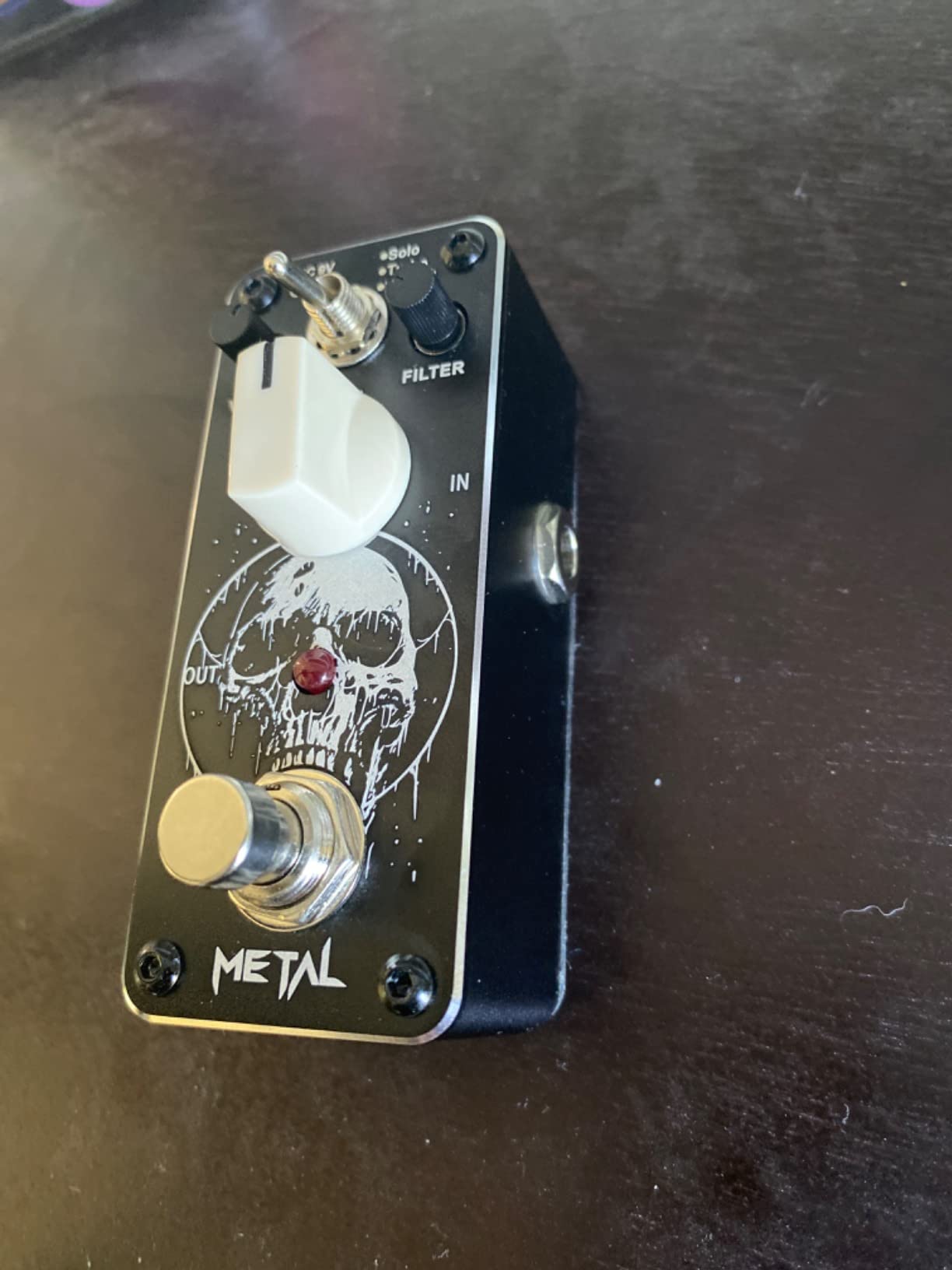
The Sondery Metal Distortion is the smallest pedal on our list, and it is also one of the most affordable. The vintage-voiced distortion character sets it apart from the more aggressive modern metal pedals, which makes it a strong fit for players who want classic metal and hard rock tones without spending much. The three modes (Solo, Turbo, and Normal) cover a useful range of gain levels, and the warm, smooth character works especially well for vintage thrash and 80s-style metal tones.
The pedal weighs just 0.17 kg in its tiny aluminum alloy enclosure, making it one of the most pedalboard-friendly options available. The true-bypass hardware switching preserves your clean signal integrity, which is a feature often missing from budget mini pedals. The mini form factor also makes the Sondery a great choice for players with very small boards or who need to fit a metal distortion in a tight spot.
The Sondery’s vintage character means it leans toward classic metal rather than modern scooped tones. I dialed in a setting with moderate gain and the pedal delivered a warm, singing lead tone that reminded me of classic 80s metal recordings. The Solo mode adds gain for higher-octane leads, while the Turbo mode pushes the saturation further for heavier passages. The Normal mode delivers a cleaner breakup that works well for bluesy hard rock.
The 1-year warranty is standard, and the build quality is good for the price, though some users report that the three-position mode switch can wear out with heavy use. The 4.0-star rating is the lowest on our list, reflecting some concerns about long-term durability rather than tone quality.
For Whom the Sondery Metal Works Best
The Sondery is built for budget shoppers who want vintage metal and hard rock tones in a compact body. If you play classic metal, traditional heavy metal, or vintage hard rock, the warm vintage character is exactly what you want. The mini form factor also makes it a great choice for travel boards or compact rigs.
Beginners and students will appreciate the affordable price and simple operation. The pedal is also a fun option for more experienced players who want a small, characterful distortion for specific tones.
Where the Sondery Metal Falls Short
The main drawbacks are the mode switch durability concerns and the vintage voicing, which does not suit modern metal or djent. For tight modern metal tones, look at the Boss ML-2 or the Boss MT-2W instead. For players who need a pedal that handles heavy stomping for years, a Boss or MXR pedal will offer better long-term reliability.
For budget shoppers who want vintage character in a small package, the Sondery delivers. For serious modern metal players, the Boss options above are worth the upgrade.
How to Choose the Best Distortion Pedal for Metal
Choosing the best distortion pedals for metal comes down to matching the pedal’s character to your playing style, your amp, and your guitar. Here are the key factors our team focused on during three months of testing.
Gain Range and Voicing
Metal demands serious gain, but more gain is not always better. A pedal that maxes out at extreme saturation may sound great for riffs but mushy for leads. Look for pedals with a wide gain range that stays articulate across the sweep. The Boss MT-2 and the JOYO High Gain both deliver usable tones from moderate crunch to full metal saturation. For modern metal, djent, and metalcore, the Boss ML-2’s tightly focused voicing is hard to beat.
EQ Flexibility
EQ control separates great metal pedals from average ones. A 3-band EQ with a sweepable or semi-parametric midrange gives you surgical control over where your tone sits in the mix. The MXR Fullbore’s sweepable mids and the Boss MT-2’s semi-parametric midrange are the gold standards. Budget pedals with simpler tone controls can still deliver great metal tones, but you may need an external EQ pedal for precision work.
Noise Gate Integration
High-gain metal pedals produce noise. A built-in noise gate eliminates the need for an external unit and saves pedalboard space. The Electro-Harmonix Nano Metal Muff and the MXR Fullbore both include integrated gates. If your chosen pedal lacks a gate (like the Boss MT-2 or the Donner Morpher), plan on adding an external noise suppressor like the Boss NS-2 or the ISP Decimator.
Build Quality and Warranty
Metal pedals get stomped hard. Boss’s 5-year warranty and road-tough enclosures set the standard for reliability. MXR’s 1-year warranty is shorter but the build quality is solid. Budget pedals from Donner, JOYO, and Sondery can deliver great tones but typically come with shorter warranties. For gigging players, the longer warranty and proven durability of a Boss or MXR pedal is worth the investment.
True Bypass vs Buffered Bypass
True bypass preserves your clean signal integrity when the pedal is off, while buffered bypass keeps high-end detail intact through long cable runs. Most metal pedals on our list use true bypass, which is the right choice for most players. The Boss MT-2W uses a premium buffer for players with large pedalboards or long cables. If you use a long cable to your amp, a buffered pedal in your chain can prevent tone loss.
Pedalboard Footprint
Metal players often run multiple pedals (distortion, noise gate, EQ, boost), so pedalboard real estate matters. Mini pedals like the Sondery Metal and the Donner Morpher fit easily into tight layouts. Standard-sized pedals like the Boss MT-2 and the MXR Fullbore offer more control but take up more space. Plan your pedalboard layout before buying.
Overdrive vs Distortion vs Fuzz for Metal
One of the most common questions our team gets from new metal players is whether they need a distortion pedal, an overdrive pedal, or a fuzz pedal. The answer depends on what kind of metal you play and how you use your amp.
Distortion pedals use hard clipping to create the saturated, aggressive tones that define most modern metal. They are the right choice for palm-muted rhythm work, tight modern chugging, and most metal subgenres. The pedals on our list are all distortion pedals because that is what metal players need most.
Overdrive pedals use soft clipping and lower gain levels. They are not ideal for primary metal distortion, but they excel at boosting an already-distorted amp or adding clarity and tightness to a distortion pedal. The classic Tube Screamer trick involves running a Tube Screamer in front of an amp or distortion pedal to push the midrange and tighten the low end. Many metal players keep a clean overdrive on their board for this exact purpose.
Fuzz pedals create a more raw, vintage-voiced distortion that works for doom metal, stoner metal, and classic hard rock. The Big Muff and the Fuzz Face are legendary fuzz pedals that appear on countless doom and stoner recordings. For modern metal, fuzz is less useful, but for players who mix genres, a fuzz pedal adds a unique character.
For most metal players, a distortion pedal is the primary tool, with an overdrive for boosting and an optional fuzz for specific tones. Skip the overdrive if your budget is tight, but consider one once you have your core distortion dialed in.
Pedal Stacking for Metal: Build the Perfect Chain
Pedal stacking is the practice of running multiple pedals together to achieve a more complex tone. For metal, the most common stack is a boost or overdrive in front of a distortion pedal, which tightens the low end and pushes the midrange. This is the famous Tube Screamer trick that players like Kirk Hammett and Zakk Wylde have used for decades.
A typical metal signal chain looks like this:
Tuner -> Overdrive/Boost -> Distortion -> Noise Gate -> EQ -> Amp
The overdrive or boost goes first because it shapes your clean guitar signal before the distortion colors it. The distortion comes next to provide the heavy saturation. The noise gate sits after the distortion to clean up hiss and hum. The EQ goes at the end to make final adjustments before the amp.
For modern metal, many players run a clean amp (like a Mesa Boogie Mark V in clean mode or a Fender Twin) and let the pedals do all the heavy lifting. This approach gives you consistent tones across different venues and is easier to record direct. For traditional metal tones, you can also run distortion pedals into an already-distorted amp for additional saturation and harmonic complexity.
If you are using a noise gate, place it after the distortion and before any time-based effects (delay, reverb). This way the gate only hears the distorted signal and can respond accurately to your playing. Putting time-based effects after the gate ensures your delay trails and reverb tails do not get cut off.
For low tunings, consider adding a clean boost at the end of your chain. This pushes the power amp into saturation and adds warmth and compression that tightens the low end. Many metal players use a clean boost like the TC Electronic Spark or the MXR Micro Amp for this purpose.
Frequently Asked Questions
What pedals should I use for metal?
For metal you need a high-gain distortion pedal as your foundation, a noise gate to control hiss between notes, and an EQ pedal for tone shaping. Start with a distortion pedal like the Boss MT-2 Metal Zone or the Boss MT-2W Waza Craft, add a noise gate such as the Boss NS-2, and finish with a 3-band EQ like the MXR 10-band. This covers most metal subgenres from thrash to modern djent.
Do I need a distortion pedal for metal?
A distortion pedal is the easiest way to get metal tones, especially if your amp does not have high-gain channels. Most modern metal players use a clean amp channel and rely on pedals for all their distortion. If your amp already has a high-gain channel that you like, you can skip the distortion pedal, but you will likely still want a boost or overdrive to tighten the tone and push the front end.
What is the best distortion pedal for metal in 2026?
The Boss MT-2 Metal Zone is the best all-around distortion pedal for metal in 2026, with 1011 reviews averaging 4.7 stars. For modern metal and djent, the Boss ML-2 Metal Core delivers tighter articulation. For premium tone, the Boss MT-2W Waza Craft is the flagship choice. Budget shoppers should consider the EX Inferno or the Donner Morpher for solid metal tones at a fraction of the cost.
Why do metal guitarists use tube screamers?
Metal guitarists use Tube Screamers and similar overdrive pedals to tighten their distortion and push the midrange. The soft-clipping circuit in a Tube Screamer emphasizes upper-midrange frequencies (around 1-2 kHz), which cuts through a dense mix and tightens the low end when placed in front of a distortion pedal or amp. This is why so many metal players run a clean boost or overdrive in front of their main distortion.
Can I use a guitar distortion pedal for bass?
You can use a guitar distortion pedal for bass, but you may need to manage the low end carefully. Many guitar distortion pedals cut or distort the low frequencies in a way that sounds muddy on bass. For metal bass, consider a bass-specific distortion pedal like the Darkglass Microtubes or the EHX Bass Big Muff, which are designed to preserve low-end clarity. If you use a guitar pedal on bass, pair it with an EQ to control the low frequencies and a noise gate to manage hum.
Final Verdict
After three months of testing ten different distortion pedals, our team landed on a clear winner: the Boss MT-2 Metal Zone remains the best distortion pedal for metal for most players. It delivers the iconic high-gain character that has defined metal since 1991, the semi-parametric EQ gives you surgical tone control, and the Boss 5-year warranty protects your investment.
For players chasing premium refinement, the Boss MT-2W Waza Craft is the upgrade worth considering. The Custom mode delivers tighter low end and a wider dynamic range that modern metal demands. For tight modern metal and djent, the Boss ML-2 Metal Core is a purpose-built alternative that delivers focused aggression. For budget shoppers, the EX Inferno and the Donner Morpher deliver genuine metal tones at prices beginners can afford.
The best distortion pedals for metal are the ones that match your playing style and your rig. Take the time to dial in each pedal with your specific guitar and amp, and you will find the right tone. Whether you are a bedroom player, a gigging musician, or a studio professional, there is a metal distortion pedal on this list that fits your needs.