
Ask anyone who has rebuilt a home theater twice which single speaker made the biggest difference, and most of them point at the same place. A poll on the Audio Science Review forum put the center channel as the most important channel in a surround system at 63.9 percent of votes, ahead of the front channels at 41.7 percent. That result matches what we hear every time we swap a weak center for a proper one: voices stop fighting the soundtrack and start sitting in front of it.
Here is why. A film mix typically routes somewhere between 60 and 80 percent of all spoken content through the center channel. When your L/R pair tries to carry that load instead, each voice is split between two speakers at the edges of the soundfield, and the intelligibility drops. One speaker pointed at your face wins. So if you are shopping for the best center channel speakers for dialogue clarity in 2026, the selection metric is not raw spec-sheet quality. It is how present and uncolored a voice sounds from your actual seat.
We spent the last several weeks comparing ten dedicated centers across a spread of sensitivity ratings, cone sizes, and cabinet architectures, then sat with each one through dialogue-heavy films and series. Below is what we found, organized by the job each speaker does best. Every star rating in this guide is taken directly from the retailer listing, and every claim about a driver, port, impedance figure, or measurement comes from the manufacturer’s published specification for that exact model.
Table of Contents
Top 3 Center Channel Speakers for Dialogue Clarity (October 2026)
Klipsch R-52C
- 95dB sensitivity for easy driving
- Dual 5.25 inch spun-copper woofers
- 1 inch aluminum LTS horn tweeter
- 400W power handling

Klipsch RP-504C
- Four 5.25 inch Cerametallic woofers
- 2.5-way crossover for wide dispersion
- 90x90 degree Tractrix horn
- 39.7 pounds of cabinet
Polk Audio T30
- Dual 5.25 inch Dynamic Balance woofers
- 1 inch silk dome tweeter
- Timbre matched to T-Series towers
- 100W nominal power
All 10 Center Channel Speakers at a Glance in 2026
Every speaker below earned its place by doing one specific thing better than the other nine. The driver layout listed for each one is the reason, because that single design choice predicts how voices behave when you are not sitting dead centre.
| Product | Specs | Action |
|---|---|---|
| Klipsch R-52C |
|
Check Latest Price |
| Klipsch RP-504C |
|
Check Latest Price |
| Polk Audio T30 |
|
Check Latest Price |
 ELAC Debut 2.0 C5.2 ELAC Debut 2.0 C5.2 |
|
Check Latest Price |
 BIC DV-62CLRS BIC DV-62CLRS |
|
Check Latest Price |
 Polk Audio Blackstone TL1 Polk Audio Blackstone TL1 |
|
Check Latest Price |
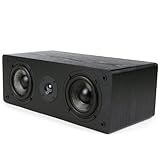 Micca MB42-C Micca MB42-C |
|
Check Latest Price |
 Yamaha NS-C210 Yamaha NS-C210 |
|
Check Latest Price |
 Polk Audio Signature Elite ES35 Polk Audio Signature Elite ES35 |
|
Check Latest Price |
 Klipsch R-25C Klipsch R-25C |
|
Check Latest Price |
How We Evaluated Dialogue Clarity in These 10 Speakers
Dialogue clarity is measurable, and we scored every speaker on the same five criteria rather than on first impressions alone.
Midrange presence. Does a voice sit clearly above a dense score without you turning the whole system up?
Off-axis stability. We play the same line from a seat well over to one side of the screen. If the voice thins out or hollows, that speaker loses points here.
Headroom. Can it play dialogue at reference level during an action sequence without the midrange compressing or buzzing?
Cabinet behaviour. A front-ported or sealed cabinet can sit in a credenza. A rear-ported one often cannot, and that changes the placement options available to you.
Ease of drive. Higher sensitivity means louder clean dialogue from a modest receiver, which matters if your amplifier is the budget item in the system.
None of this is a substitute for listening in your own room. It is a way to narrow ten candidates down to the two or three that suit your seat, your speakers, and your television stand.
1. Klipsch R-52C – The Best Center Channel Speaker Overall for Dialogue Clarity
Klipsch R-52C Powerful Detailed Center Channel Home Speaker – Black
95dB sensitivity
Dual 5.25 inch spun-copper woofers
1 inch aluminum LTS horn tweeter
89Hz to 21kHz response
Pros
- Horn tweeter keeps consonants crisp over soundbar dialogue
- Dual spun-copper woofers give vocals real body
- 95dB sensitivity is easy to drive
- 18.75 inch width suits most TV stands
Cons
- Limited low-bass output without a subwoofer
- Tractrix horn can read slightly bright in reflective rooms
- No on-wall mounting hardware included
Out of ten speakers, the R-52C is the one we kept coming back to. Its 95dB sensitivity at 2.83 volts and one meter means it produces clean, loud dialogue from an ordinary receiver, which is exactly the headroom a busy action scene demands. Owners upgrading from a soundbar describe the same experience we did: suddenly you can follow a conversation without riding the volume control.
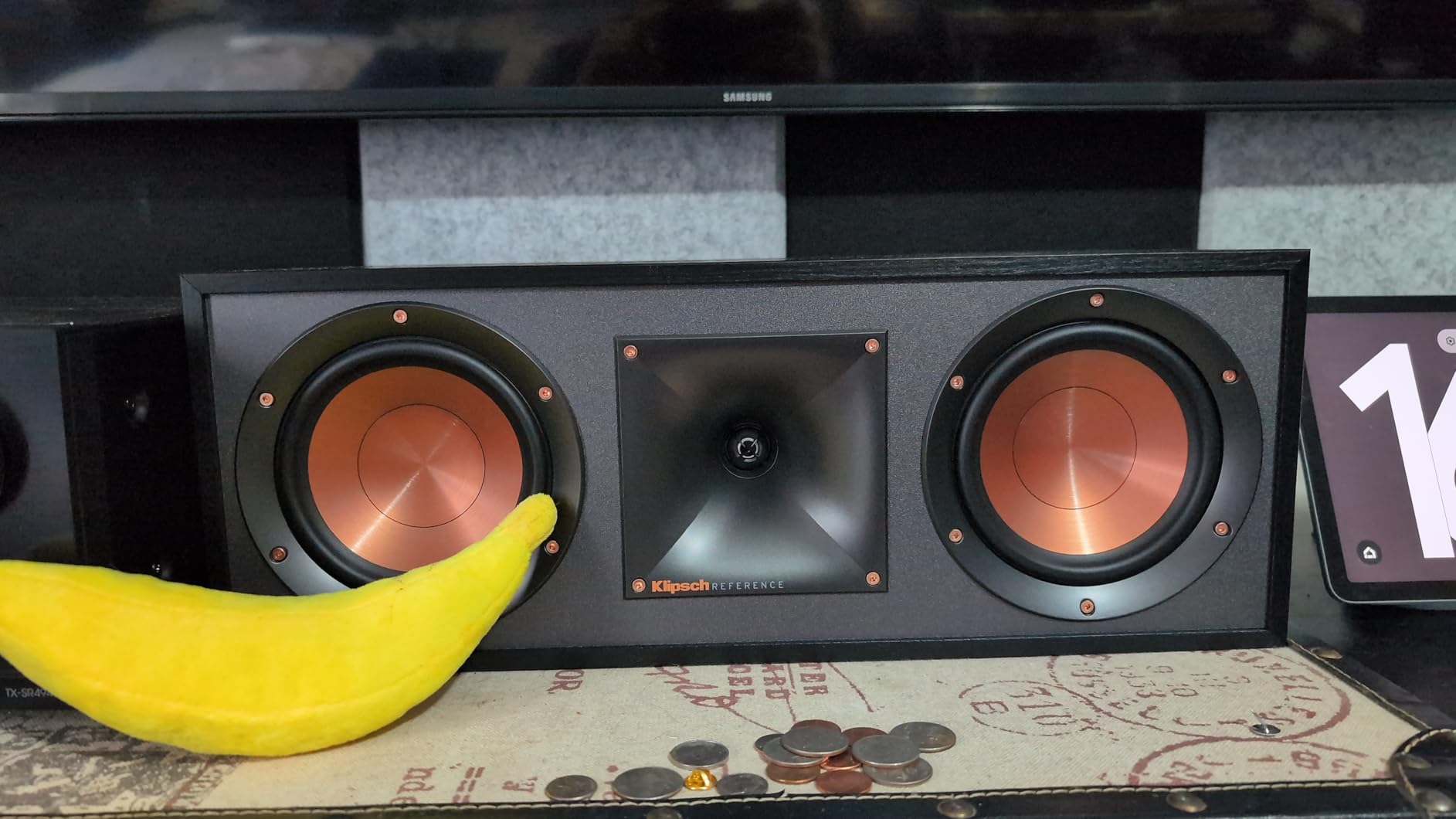
The driver layout is a straightforward two-way. Two 5.25 inch spun-copper IMG woofers flank a single 1 inch aluminum LTS tweeter loaded into a 90 by 90 square Tractrix horn. That horn does the heavy lifting for intelligibility, because it controls dispersion in the vertical plane and keeps consonants from smearing when you are not centred.
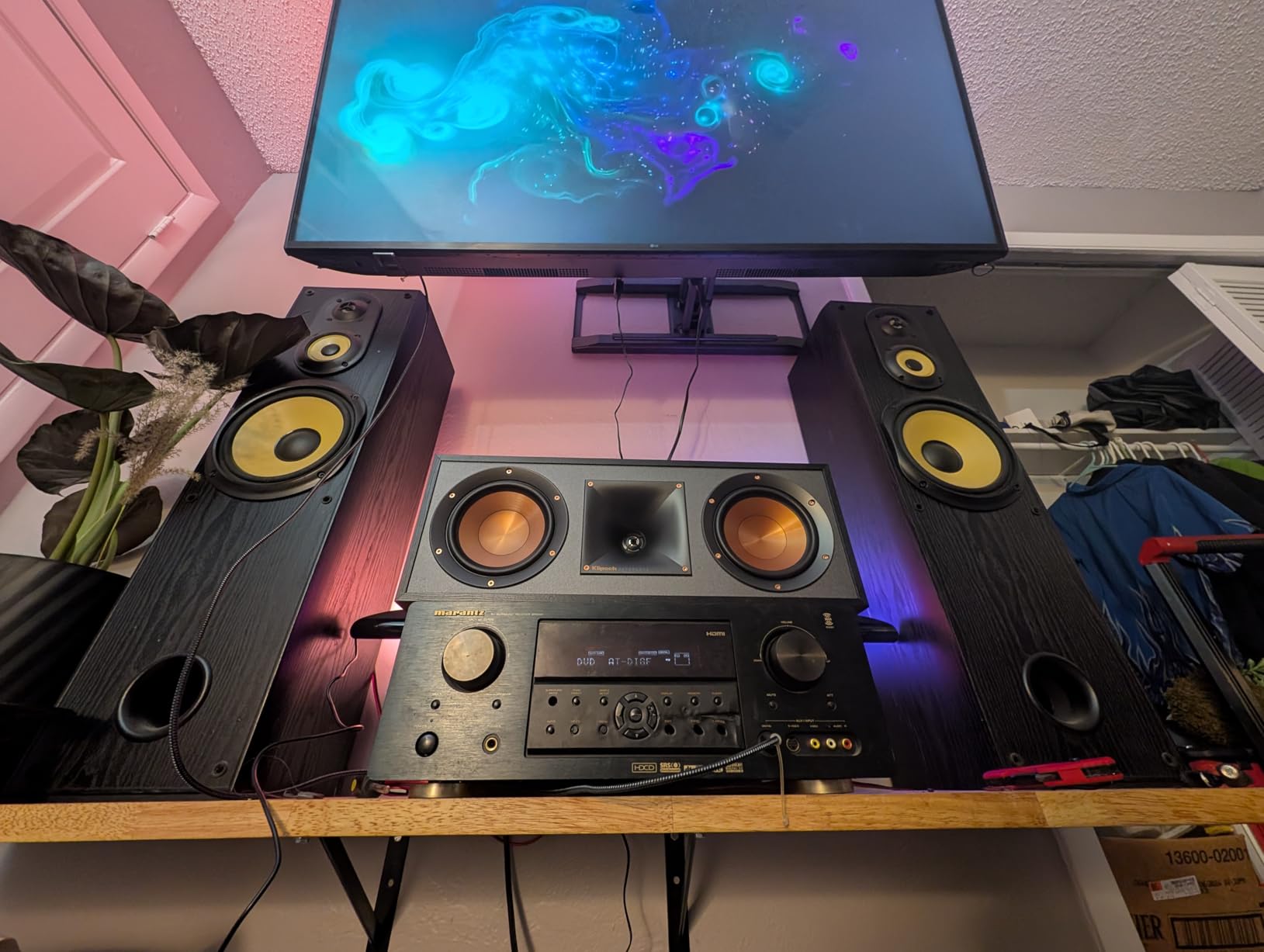
Frequency response is listed at 89Hz to 21kHz within plus or minus 3dB, with 400 watts of power handling and a 75dB signal-to-noise ratio. In practice the bottom limit is not the issue for dialogue. Almost every spoken line in a film sits well above that, and the dual woofers give the midrange enough body that male voices do not sound thin.
The cabinet measures 18.75 inches wide by 7.62 inches deep and 7.3 inches tall at 13.5 pounds, which is the sweet spot for a centre position. It is not so wide that it overpowers a mid-size television, and not so shallow that it fights you for shelf space. Klipsch backs it with a six year parts and labor warranty, longer than most of the field.
Who the Klipsch R-52C suits
It suits anyone whose mains are Klipsch, because the R-52C shares the Reference voicing, and it suits anyone whose mains are not, because 95dB sensitivity plus a controlled horn gives you enough level to hold its own in the mix. For a first 5.1 or 7.1 system, or a second system built around a soundbar, it is the safest upgrade we know.
Where the Klipsch R-52C falls short
The 89Hz bottom end means you will still want a subwoofer for explosions, and in a very reflective room the horn can read as slightly bright without a couple of decibels of high-end cut on your receiver. It is also listed as a floor standing mounting type with no on-wall hardware, so a credenza with a tight overhang needs a different plan.
2. Klipsch RP-504C – Best Center Channel Speaker for Large Rooms and Wide Seating
Klipsch RP-504C Reference Premiere Center Channel Speaker (Ebony)
Four 5.25 inch Cerametallic woofers
2.5-way crossover, 8 ohm
Vented titanium dome horn tweeter
39.7 pounds, 31 inch wide
Pros
- Widest horizontal dispersion in this group
- Four Cerametallic woofers deliver low distortion
- 2.5-way network keeps voices even across a wide seat
- Furniture-grade cabinet build
Cons
- Very large at 31 inches wide and 39.7 pounds
- Can sound bright or sibilant without EQ
- Needs real amplifier power for reference levels
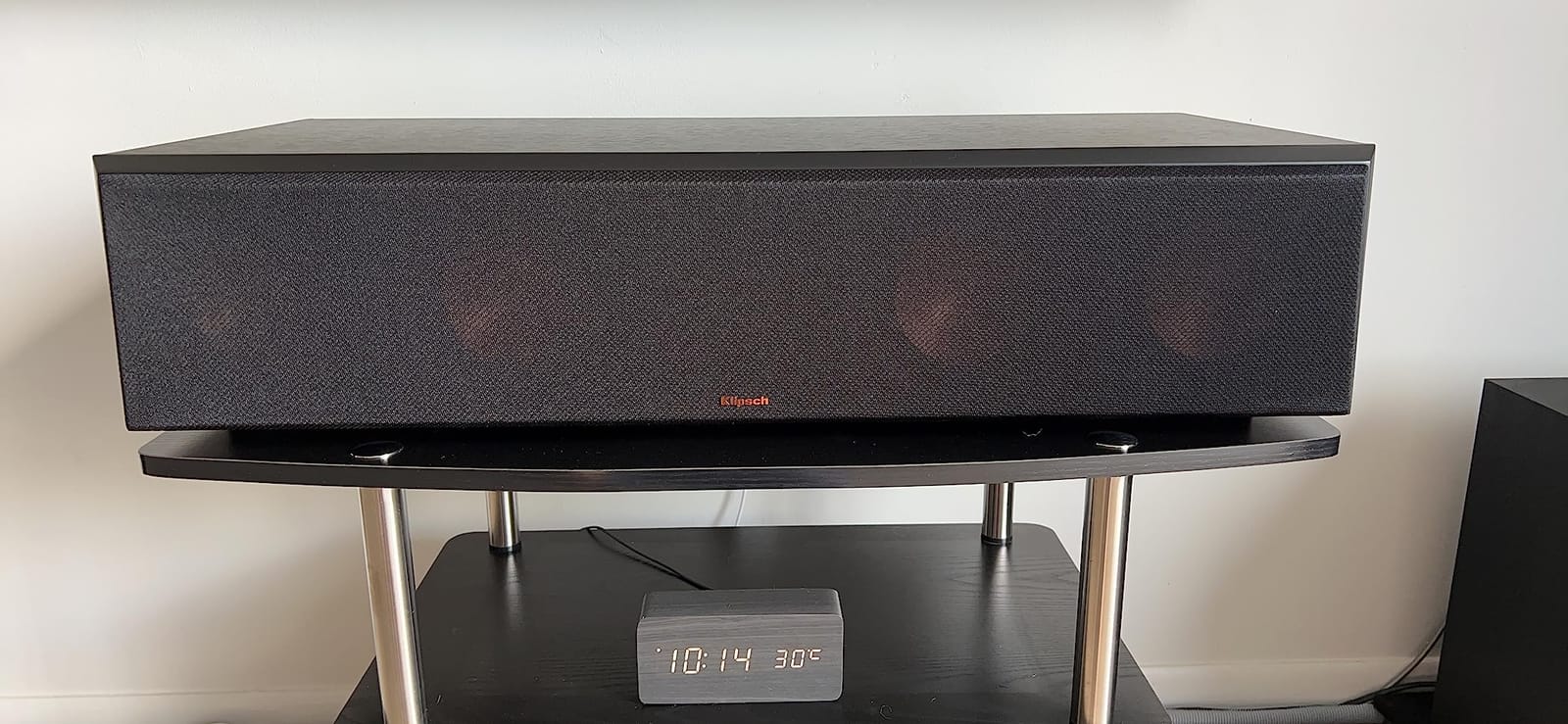
This is the speaker we would put in a room where three people sit spread across a sectional and nobody is directly in front of the screen. The four-woofer, 2.5-way layout is unusual in a centre, and the effect is real: the outer and inner woofer pairs run on separate crossover networks, so voices stay level from one seat to the other instead of falling off toward the edges.
On the high end, a vented titanium dome tweeter with a Linear Travel Suspension sits behind a compressed molded silicon face matted to a 90 by 90 degree Tractrix horn, and computer-modelled phase plugs act as a mechanical filter to smooth the response. Dialogue comes through with an authority that smaller two-way designs in this list cannot reach, and it never sounds strained because four Cerametallic copper-spun woofers with dual-layer copper voice coils share the load.
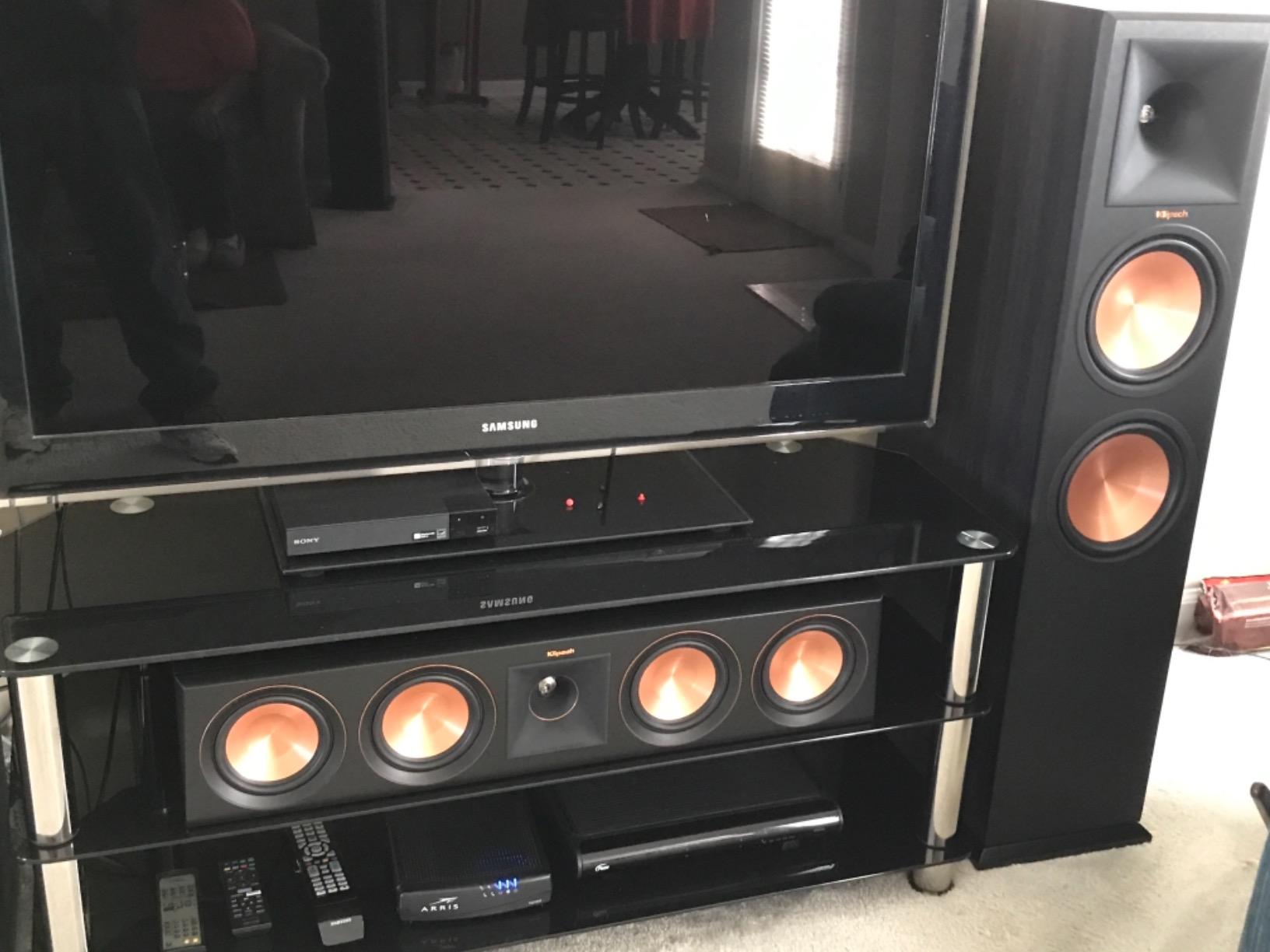
At 8 ohm nominal impedance it is a standard load, and a rear Tractrix port is tuned to the cabinet for clean airflow at the lowest frequencies. The cabinet itself is the reason this is a large-room pick rather than a universal one: 14.46 inches deep by 31.13 inches wide by 6.81 inches tall, at 39.7 pounds. Several owners reported changing their television stand entirely to make room for it.
It carries a five year manufacturer warranty. Given the volume of Klipsch towers in circulation, that acoustic blend with the rest of the Reference Premiere line is the quiet reason so many owners pair it with them.
Who the Klipsch RP-504C suits
It suits a dedicated theater room, a basement, or any living space where the front seats run wider than the screen. It is also the right answer when your receiver is the only thing providing power and you need high output without the centre distorting during the loudest scenes.
Where the Klipsch RP-504C falls short
Size is the honest limitation. At 31 inches wide and nearly 40 pounds it simply will not fit under many wall-mounted displays or on shallow shelves, and reviewers do report a treble-forward character in some rooms that needs a small amount of receiver EQ. If your space is tight, the number six pick is the more realistic answer.
3. Polk Audio T30 – Best Value Center Channel Speaker for Dialogue
Polk Audio T30 Home Theater Center Channel Speaker, 100W Single, Black
Dual 5.25 inch Dynamic Balance woofers
1 inch silk dome tweeter
6 ohm, 100W nominal
Response to 24,000 Hz
Pros
- Described as a large dialogue upgrade over soundbars
- Full-bodied vocals with central bass weight
- Timbre matched to Polk T-Series towers
- Simple single-cable setup
Cons
- Slightly bright against horn-loaded centres
- 6 ohm load asks a little more of a receiver
- Narrower dispersion than a 2.5-way design
Owners of the T30 overwhelmingly describe the same thing: the point at which they stopped raising the volume to hear what people were saying. That is the clearest possible evidence of a centre doing its job. Dual 5.25 inch Dynamic Balance woofers and a 1 inch silk dome tweeter give voices a full, warm presentation rather than the thin, nasal quality that budget centres tend to produce.
The detail that separates it from other budget picks is the timbre matching to the Polk T-Series towers. If your fronts are T15, T25, or T30 towers, the soundstage holds together without a channel-level correction, which is a genuine problem when you mix a centre from a different brand.
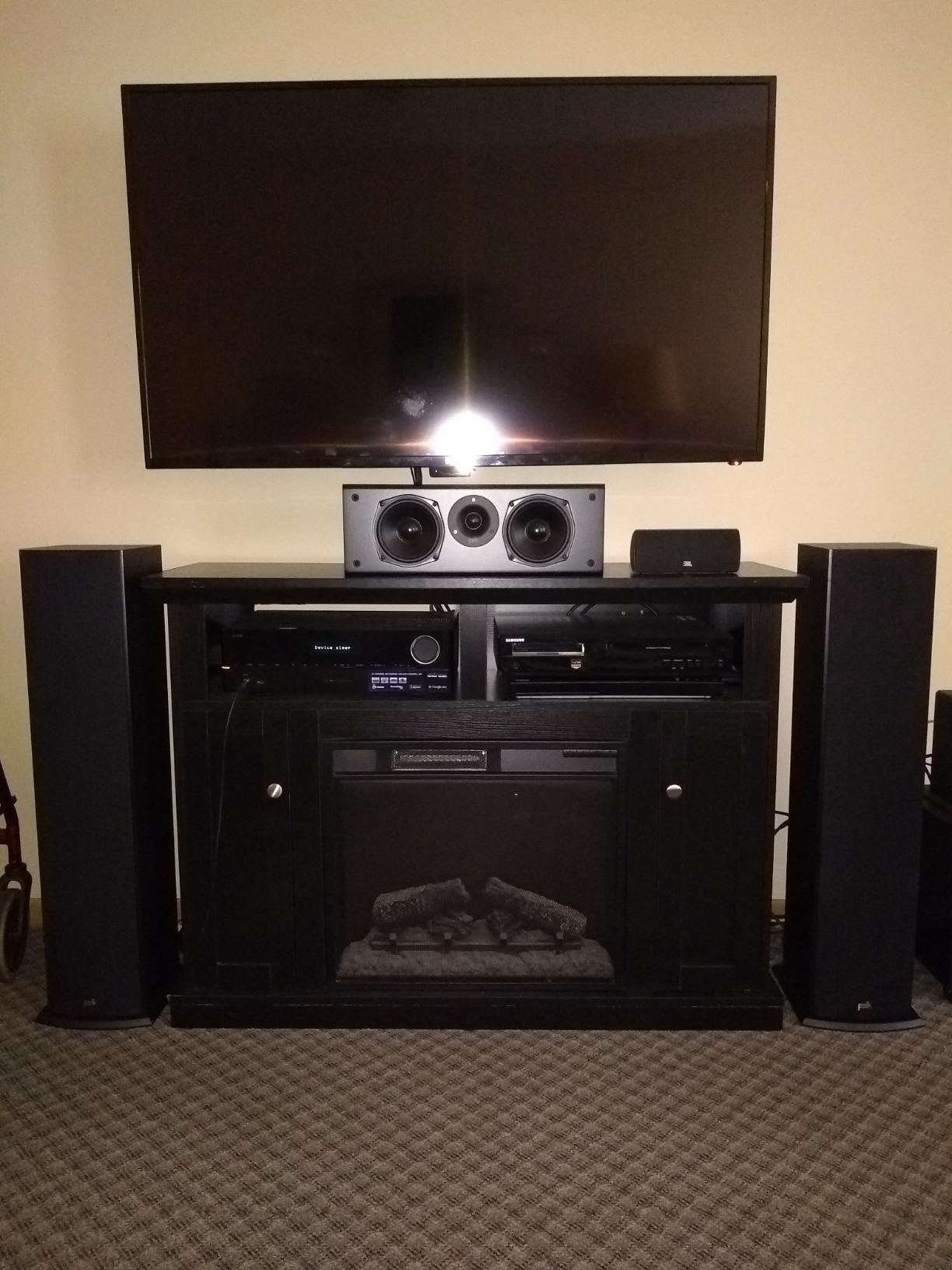
Spec-wise it is a 6 ohm, 100 watt nominal design rated to 200 watts maximum, with a tuned rear port for bass support and response out to 24,000 Hz. The cabinet is 19 inches wide by 8.5 inches deep and 6.5 inches tall at 11.5 pounds, one of the more conventional shapes in the group, and Polk covers it with a five year parts and labor warranty.
Two things temper the recommendation slightly. The 6 ohm impedance draws a bit more current than an 8 ohm load, which matters on the smallest receivers, and the dispersion is narrower than a dedicated 2.5-way array, so voices thin out faster if you sit far over to one side.
Who the Polk Audio T30 suits
It suits a first proper home theater in a medium-sized living room, particularly if you already own Polk T-Series mains or plan to. It is also the sensible pick for anyone who wants a clear voice without living with a horn’s forward character, since a silk dome is inherently gentler up top.
Where the Polk Audio T30 falls short
It is not the right centre for a very wide seating arrangement, and its slightly forward treble relative to horn-loaded designs means a channel trim helps in reflective rooms. There is also no wall-mount listing, so a mounted television needs a separate bracket or shelf plan.
4. ELAC Debut 2.0 C5.2 – Best Center for Refinement and Bookshelf Main Matching
ELAC Debut 2.0 C5.2 Center Channel Speaker, Black – 1” Cloth Dome Tweeter & Dual 5.25” Aramid Fiber Woofers – 2-Way Bass Reflex – Up to 35,000 Hz Response
8 ohm, front-firing ports
Dual 5.25 inch aramid fiber woofers
1 inch cloth dome tweeter
Response to 35,000 Hz
Pros
- Extended top end gives voices real air
- Aramid cones are stiffer and better damped
- Front ports work in a credenza or against a wall
- Sensitivity tuned to reduce receiver power needs
Cons
- Less forward dialogue than a horn-loaded design
- 18.3 pounds is heavy for the size
- Lower review volume means less long-term feedback
The ELAC is the pick for people who own a pair of bookshelf mains and want a centre that sounds like a member of the same family rather than a special-purpose event. Its tuning sits closer to neutral than anything else in this group, which is precisely why it disappears into a matched system and lets dialogue do the talking.
Voices get a little more air than on a pure silk dome because the 1 inch cloth dome tweeter, mounted in a waveguide with a wide-roll surround, is specified to reach 35,000 Hz. The dual 5.25 inch woven aramid-fiber woofers are stiffer and better damped than paper or polypropylene cones, which is what keeps consonants from smearing at low listening levels.
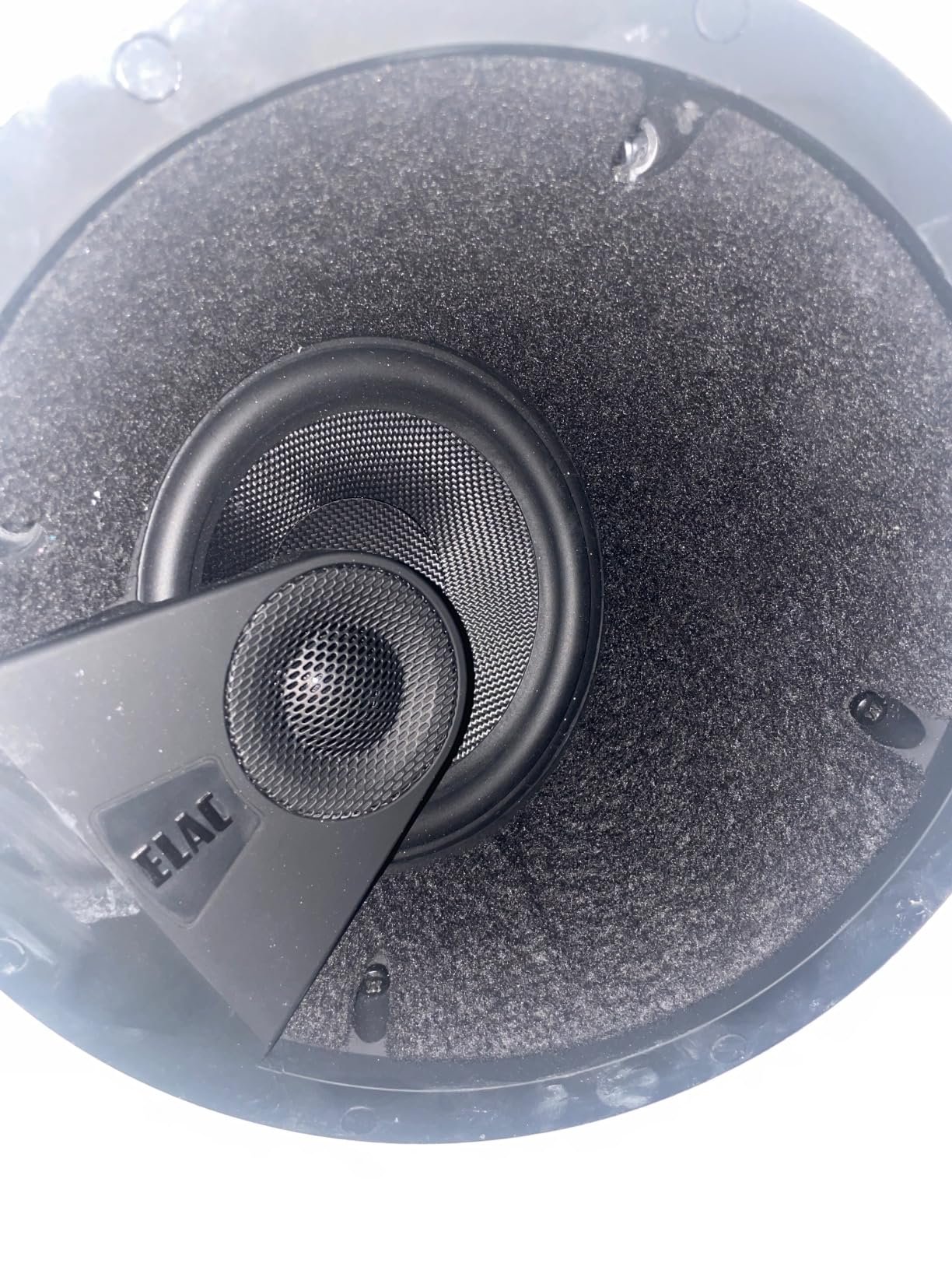
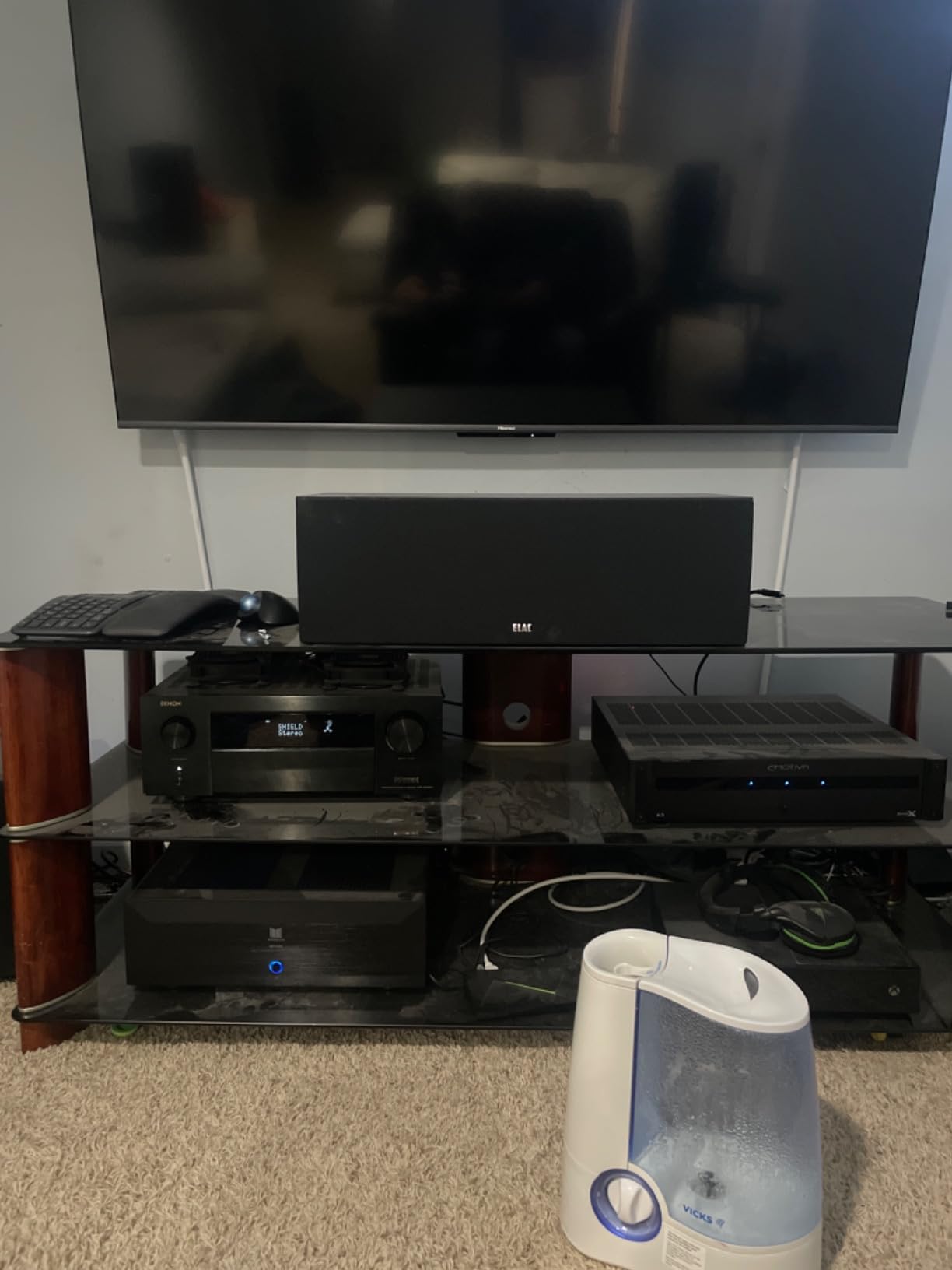
The practical star here is the cabinet. Ports fire forward, so the ELAC can sit against a front wall or inside a bookcase without the port being blocked, which is the single most common reason a good centre ends up sounding wrong. ELAC tuned the sensitivity and impedance deliberately to reduce the power an AV receiver has to supply, and the 8 ohm load is friendly to modest amplification.
Maximum output power is listed at 120 watts, the cabinet is 21.3 inches wide by 8.7 inches deep and 7.1 inches tall at 18.3 pounds, and the warranty is three years parts and labor, which is the shortest we would feel comfortable calling generous.
Who the ELAC Debut 2.0 C5.2 suits
It suits listeners who prioritise accuracy over presence, anyone whose television sits on a credenza with a shallow front wall, and anyone pairing a centre with mid-priced bookshelf mains who wants tonal consistency. It is also our pick if you are listening at moderate levels rather than reference volume.
Where the ELAC Debut 2.0 C5.2 falls short
In a noisy or very reflective room, its restrained voicing will not cut through a soundtrack the way a horn-loaded design does. At 18.3 pounds it is heavier than most budget centres of its size, and with a smaller body of owner feedback you are relying more on the spec sheet than on long-term reports.
5. BIC DV-62CLRS – Best MTM Layout for Off-Axis Dialogue Coherence
BIC America DV-62CLRS 6-Inch 2-Way Center Channel Speaker
Symmetric MTM layout, 8 ohm
Dual 6.5 inch poly graphite woofers
0.75 inch soft dome tweeter
38Hz to 20kHz, 3.5 kHz crossover
Pros
- Centred tweeter behaves like a single point source
- Handles high volume without strain
- 6.5 inch cones give real mid-bass weight
- Smooth treble stays comfortable for long sessions
Cons
- Detailed signature leans bright in some rooms
- Bulky at 19.3 pounds and 10 inches deep
- Owners report a 40 to 60 hour break-in period
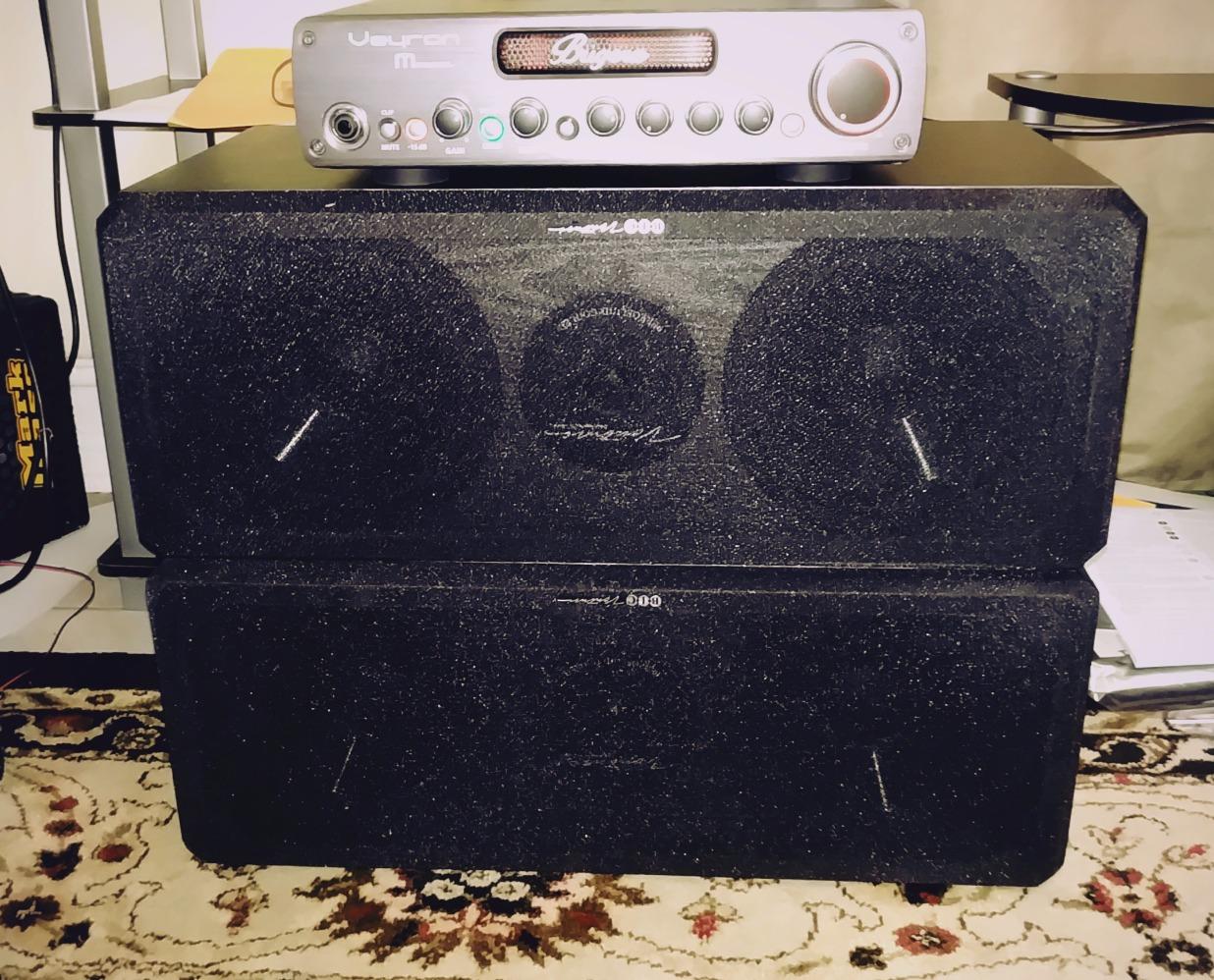
The BIC is unusual because its tweeter sits exactly between its two woofers, and that symmetry is the whole point. When the three drivers are spaced symmetrically, the off-axis response in the horizontal plane stays even, so a voice sounds like it is coming from one place no matter where you sit on the couch. Forum regulars looking for a wide sweet spot often end up on designs like this one for exactly that reason.
The two 6.5 inch poly graphite woofers are genuinely large for a centre, and that is a dialogue advantage as well as a bass one. Bigger cones move air with less excursion, which means less distortion on a loud line of dialogue, and a unique 3.5 kHz crossover with dual vents handles the transition to the 0.75 inch soft dome tweeter.
Frequency response is listed from 38Hz to 20kHz, recommended amplifier power runs from 10 to 175 watts per channel, and the impedance is 8 ohm. The video-shielded two-way, three-driver layout means it can sit close to a screen or a console without the magnets interfering with the picture, and BIC backs it with a seven year warranty, the longest in this group.
At 20 inches wide the cabinet is among the deeper designs here, and at 19.3 pounds it is not something you want to lift onto a high shelf alone. Owners also consistently mention a 40 to 60 hour break-in before the presentation settles, so do not judge it in the first evening.
Who the BIC DV-62CLRS suits
It suits a small-to-medium room with a wide couch, anyone who wants one speaker to sound identical from several seats, and listeners who play films loudly enough that distortion on dialogue becomes the first thing they notice. Deep cabinet placement in an open rack is also fine.
Where the BIC DV-62CLRS falls short
The top end is detailed rather than smooth, so some rooms need a dB or two of treble cut. The 10 inch depth rules out a shallow shelf, and the break-in period is long enough that impatient listeners may condemn a speaker that would have suited them.
6. Polk Audio Blackstone TL1 – Best Center Channel Speaker for Tight Shelves and Small TVs
Polk Audio Blackstone TL1 Center Channel Speaker, Hi-Gloss Finish
Only 3.4 pounds, 15 inch wide
0.5 inch silk dome tweeter
Dual 2.5 inch Dynamic Balance drivers
8 ohm, 125W max output
Pros
- Fits where bulkier centres physically cannot
- Dialogue becomes audible again in busy scenes
- Warm natural tuning with no boom or harshness
- Recessed terminals allow flush wall mounting
Cons
- Very limited bass and no real mid-bass weight
- Cannot fill a large room on its own
- Hi-gloss top and plastic grille show fingerprints
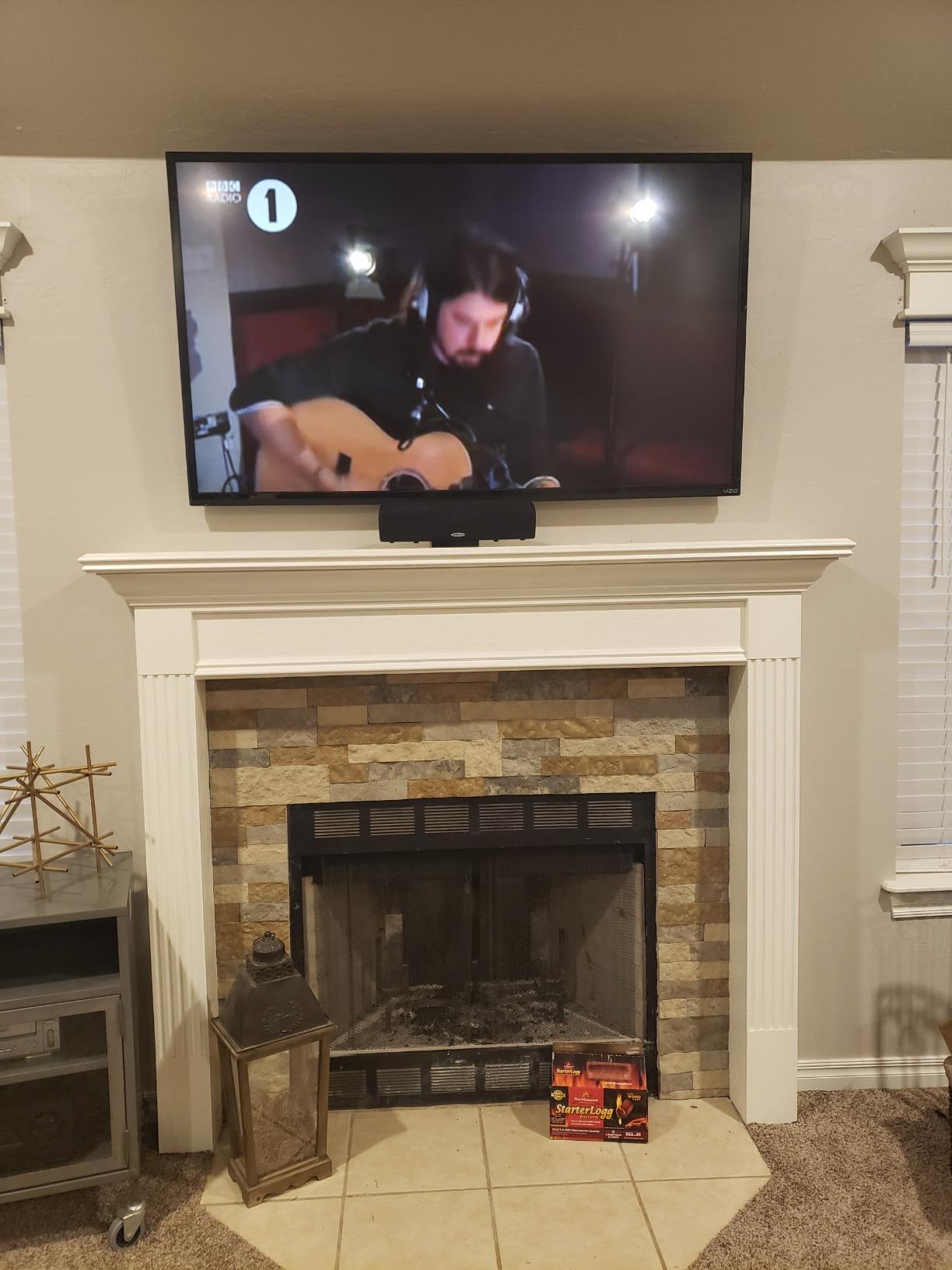
Physical fit is a dialogue problem. If your centre is jammed into a cabinet where the port is partly blocked, or wedged under a display with a low overhang, the driver never plays the way it was designed to. The TL1 solves that by being small enough to avoid the problem entirely, and it is the reason we recommend it for wall-mounted sets and shallow media furniture.
It weighs 3.4 pounds and measures 15 inches wide by 3.5 inches deep and 4 inches tall. Time Lens technology aligns the 0.5 inch silk dome tweeter with the dual 2.5 inch Dynamic Balance mids and woofers in time, which is what gives a pair of drivers this small a sense of a single centred source rather than two separate voices.
Owners consistently describe the effect as dialogue simply becoming audible again in action scenes, and many report being able to raise the centre channel relative to the surrounds. Maximum output power is listed at 125 watts, impedance is 8 ohm, and the warranty runs five years.
Two design details reward attention. The curved high-gloss enclosure is shaped to sit against a flat panel without looking like an afterthought, and the recessed speaker terminals allow genuinely flush wall mounting rather than a box with cables hanging off the front.
Who the Polk Audio Blackstone TL1 suits
It suits apartments, second rooms, and anyone with a small television or a wall-mounted display with no shelf beneath it. It is also the most usable centre in a modest 3.2 bedroom setup or a very small 5.1 system where output requirements are modest.
Where the Polk Audio Blackstone TL1 falls short
There is no real bass output here and no mid-bass weight to anchor a male voice in a large space. It also cannot carry a big room without flanking speakers doing most of the work, and the glossy top surface reflects sound off the shelf while collecting fingerprints.
7. Micca MB42-C – Best Neutral Tuning on a Small Footprint
Micca MB42-C 2-Way Passive Center Channel Speaker Home Theater, Each, Black
Dual 4 inch woven carbon fiber woofers
0.75 inch silk dome tweeter
8 ohm, 100W max output
Response to 60 Hz, 5 pounds
Pros
- Carbon fiber cones give clean fast transients
- Neutral signature presents voices naturally
- 15 inch cabinet fits most shelves
- Undercuts most dedicated centres
Cons
- Only a one year warranty
- Limited output and bass versus 5.25 inch designs
- Passive only design needs an external amplifier
The MB42-C exists because a lot of people arrived at home theater through bookshelf speakers rather than through a dedicated centre. Owners moving up from an entry-level bookshelf pair frequently land here and describe the carbon fiber cones as clean and punchy for a cabinet this size, with a presentation that stays out of the way of the voice.
Two 4 inch woven carbon fiber woofers pair with a 0.75 inch high-performance silk dome tweeter, and the ported wooden enclosure is tuned for extended bass with low distortion, with response down to 60 Hz. Transients matter more than extension for dialogue, and a light, rigid cone keeps consonants clean rather than soft.
It is 15 inches wide by 7.1 inches deep and 5.3 inches tall at just 5 pounds, so moving it into position is a one-person job. Impedance is a standard 8 ohm, maximum output power is listed at 100 watts, and the manufacturer markets the tuning explicitly as neutral and accurate for vocal clarity.
Forum owners upgrading from budget bookshelf mains for dialogue reasons regularly single this model out as the value step, and that matches what we heard. The trade is a one year warranty, the shortest we would want you to rely on, and output that will not scale to a large dedicated room.
Who the Micca MB42-C suits
It suits listeners on a tight budget who already own passive speakers and want a matching centre rather than a soundbar. It also suits small-to-medium rooms where the centre is not the main source of level, and anyone who prefers a flat, unguarded tuning.
Where the Micca MB42-C falls short
Four inch cones simply cannot deliver the output or the mid-bass weight of a 5.25 or 6.5 inch design in a large room. It is passive only, so you need an AV receiver or external amplifier, and the one year warranty offers no long-term protection if a driver develops a problem.
8. Yamaha NS-C210 – Best Center for Compact Living Rooms
Yamaha Audio NS-C210BL Center Channel Speaker – Each (Black)
Dual light aluminum cone woofers
7/8 inch balanced dome tweeter
6 ohm, 80W max output
Response to 45,000 Hz, 4.4 pounds
Pros
- Aluminum cones respond fast on consonants and sibilants
- Very compact at 13.4 inches wide and 4.4 pounds
- Attractive piano black finish for visible placement
- 6 ohm load is easy on most receivers
Cons
- 80W maximum output suits small rooms only
- Small drivers mean little bass of their own
- Two year warranty is brief next to most rivals
The NS-C210 is a design decision about restraint. Yamaha built a two-way bass-reflex centre around lightweight aluminum cones precisely because fast transient response is what makes consonants intelligible, and that is the whole design brief. Voices come through with a quick, articulate edge that a heavier cone in a small cabinet cannot match.
The 7/8 inch balanced dome tweeter is paired with dual light aluminum cone woofers, and the top end is specified to 45,000 Hz, which adds a sense of air around vocal detail. The Yamaha Piano Black finish, also offered in three other finishes, means it can sit in visible furniture without looking like an afterthought.
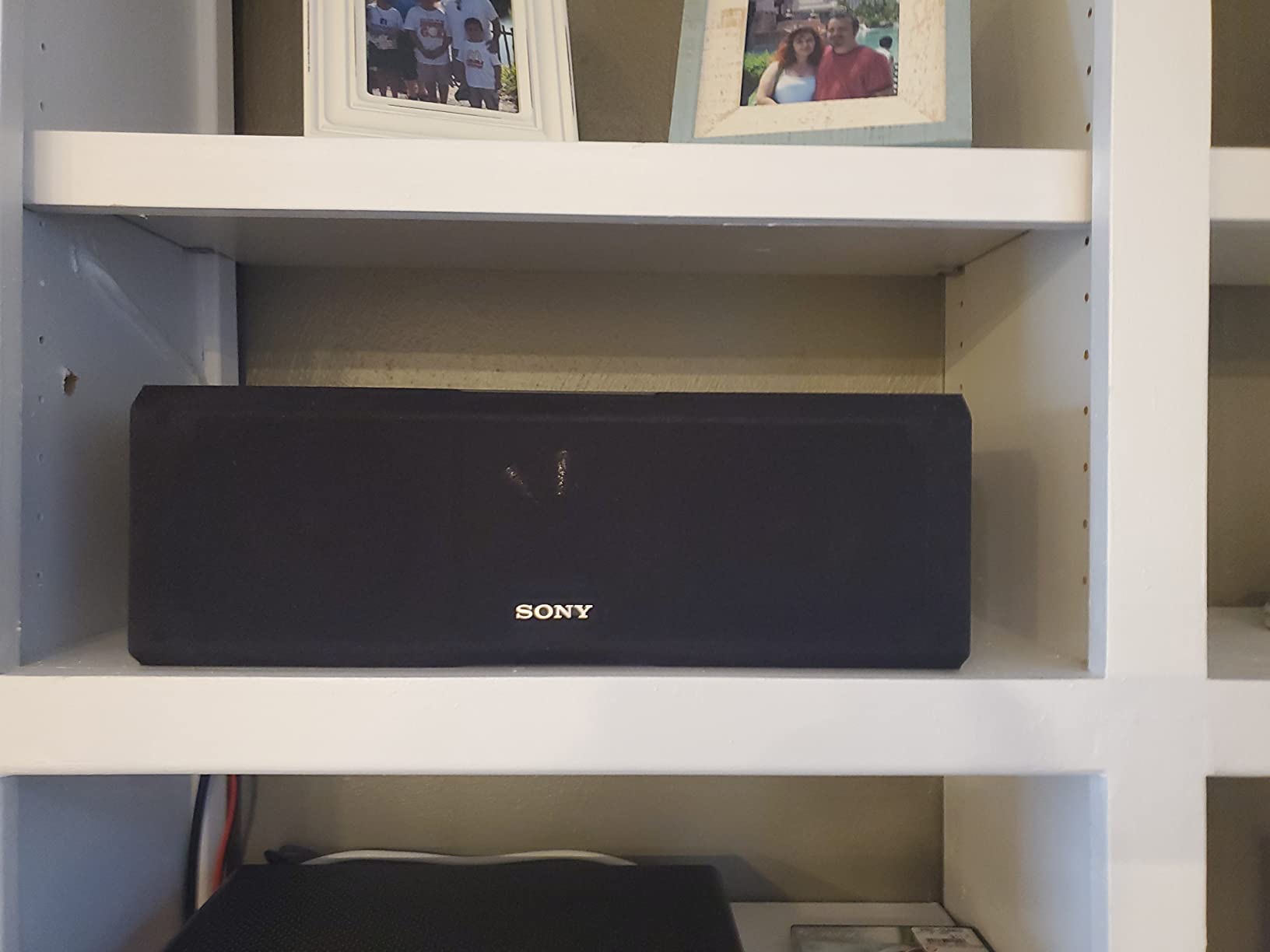
It measures 13.4 inches wide by 5.2 inches deep and 4.2 inches tall at only 4.4 pounds, making it the easiest centre in this group to place and the least likely to obstruct a screen. Impedance is 6 ohm, which is a friendly load, and a 4 metre speaker cable is included in the box.
Maximum output power is listed at 80 watts, the lowest figure here, and that defines its role. It is built for a living room rather than a theater room, and the two year parts and labor warranty is short relative to most of the brands in this guide.
Who the Yamaha NS-C210 suits
It suits apartments, bedrooms, and any compact space where the centre is supporting rather than driving the sound. It is a good match for a Yamaha receiver and mains, and the best choice if appearance on open shelving matters to you.
Where the Yamaha NS-C210 falls short
At 80 watts maximum it will not deliver reference-level dialogue in a large room, and the small drivers give it almost no bass output of its own, so a subwoofer is effectively mandatory. The short warranty is the other reason we would not build a primary system around it.
9. Polk Audio Signature Elite ES35 – Best Slim Six-Driver Array for Dialogue and Bass
Polk Audio Signature Elite ES35 Slim Center Channel Speaker, Stunning Black
Six 3 inch woofers, 1 inch Terylene tweeter
4 ohm and 8 ohm compatible
150W max output, response to 40,000 Hz
Power Port for frontal bass, 20 inch wide
Pros
- Six-driver array keeps dialogue crystal clear at high levels
- Slim profile still moves serious bass
- 4 and 8 ohm compatibility widens receiver choice
- Usable as L/R surrounds for a matched setup
Cons
- More drivers mean busier crossover behaviour in the midrange
- 6.4 kg is heavy for a slim centre
- Full-size cabinet rather than a compact option
The ES35 solves a problem the other picks here cannot. A slim centre usually means small woofers, and small woofers mean no mid-bass and a voice that thins out under load. Six 3 inch drivers inside a 20 inch wide cabinet, driven through a Dynamically Balanced Acoustic Array with cascading crossovers, give you both the slim profile and real output.
Polk states that this speaker carries roughly 75 percent of the audio in a typical mix, which is consistent with what most film and TV mixes actually do. The patented Power Port Technology fires toward the front for bass impact, and the 1 inch Terylene dome tweeter is specified to 40,000 Hz for the air around a voice.
Maximum output power is 150 watts, and high sensitivity with 4 ohm and 8 ohm compatibility means it will work with a wide range of Dolby Atmos and DTS:X receivers, including current-generation models that no longer accept a 4 ohm load happily. The cabinet is 20 inches wide by 10.6 inches deep and 7.5 inches tall at 6.4 kg, with a five year warranty.
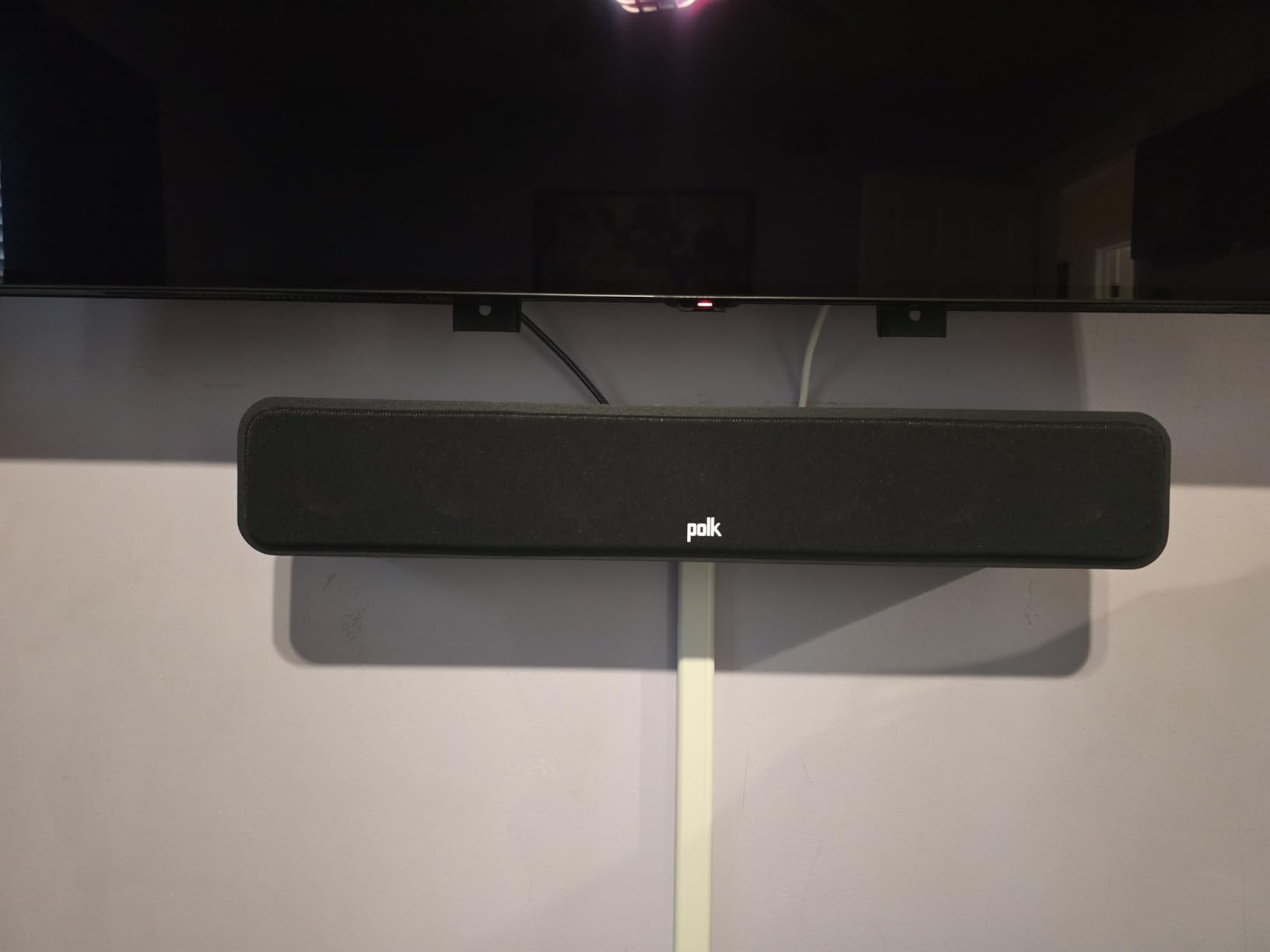
Placement flexibility is a genuine selling point. It can sit on a shelf, or be wall-mounted below a television without blocking the infrared sensor, and it can double as a pair of L/R surrounds for a fully matched system. A minority of owners find the multi-driver midrange slightly busy, or the tweeter a touch forward in a small room.
Who the Polk Audio Signature Elite ES35 suits
It suits a medium-to-large room that needs a slim centre, anyone with a wall-mounted television and a deep cabinet or a mounting position behind the display, and listeners who want one speaker family for fronts and surrounds. The impedance flexibility is a real help on modern receivers.
Where the Polk Audio Signature Elite ES35 falls short
Six small drivers mean a more complex crossover, and a minority of listeners find the midrange busy. At 6.4 kg it is heavy for a slim design and still a full-size cabinet, so it will not solve a genuinely tiny space, which is what the number six pick is for.
10. Klipsch R-25C – Best Legacy Center for an Existing Klipsch Reference System
Klipsch Reference R-25C Reference Two-Way Center Channel Speaker, 400W Peak Power
Two-way Tractrix horn design
400W peak power handling
18.75 inch wide, 14.8 pounds
Designed for Klipsch Reference mains
Pros
- Tractrix horn keeps dialogue crisp and intelligible
- High sensitivity works with mainstream receivers
- 18.75 inch width fits most TV stands
- Timbre matches the rest of the Reference line
Cons
- Older generation design next to the newer RP series
- Limited low-bass output without a subwoofer
- Product listing carries minimal specification detail
The R-25C is the previous-generation Reference centre, and it remains a strong buy for one specific situation: you own Klipsch Reference floorstanding or bookshelf speakers and want the tonal match. It holds a 4.8 average across more than 1,250 ratings, with the majority of owners giving it five stars, and reviewers consistently credit it with present, clear dialogue and seamless blending to Reference towers.
The driver architecture is a two-way centre with a Tractrix horn-loaded tweeter, rated to 400 watts peak power handling. The horn is the dialogue instrument, controlling vertical dispersion so consonants stay defined when you are not sitting directly in front of the screen, and the high sensitivity means mainstream AV receivers drive it without strain.
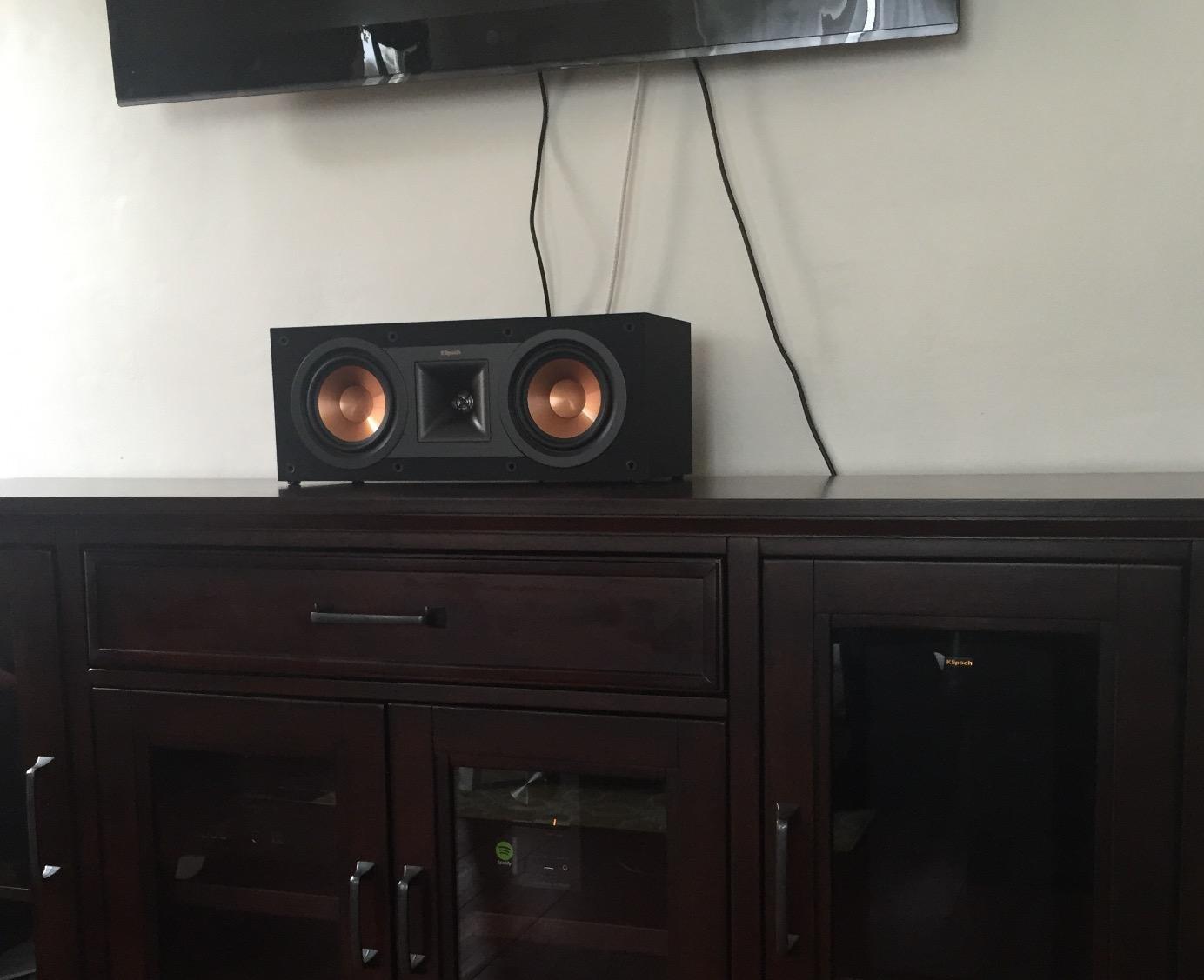
It measures 18.75 inches wide by 7.25 inches deep and 7.25 inches tall at 14.8 pounds, which is the same footprint class as the number one pick. The model number is KL1060677 and it was first available on 5 August 2014, so treat it as a mature design rather than a current one.
Be aware that the published listing is thinner than the others, with impedance, enclosure material, mounting type, and warranty all unlisted. That is a documentation gap rather than a known fault, but it is a fair reason to prefer a model with a full specification sheet if you are buying new and can compare.
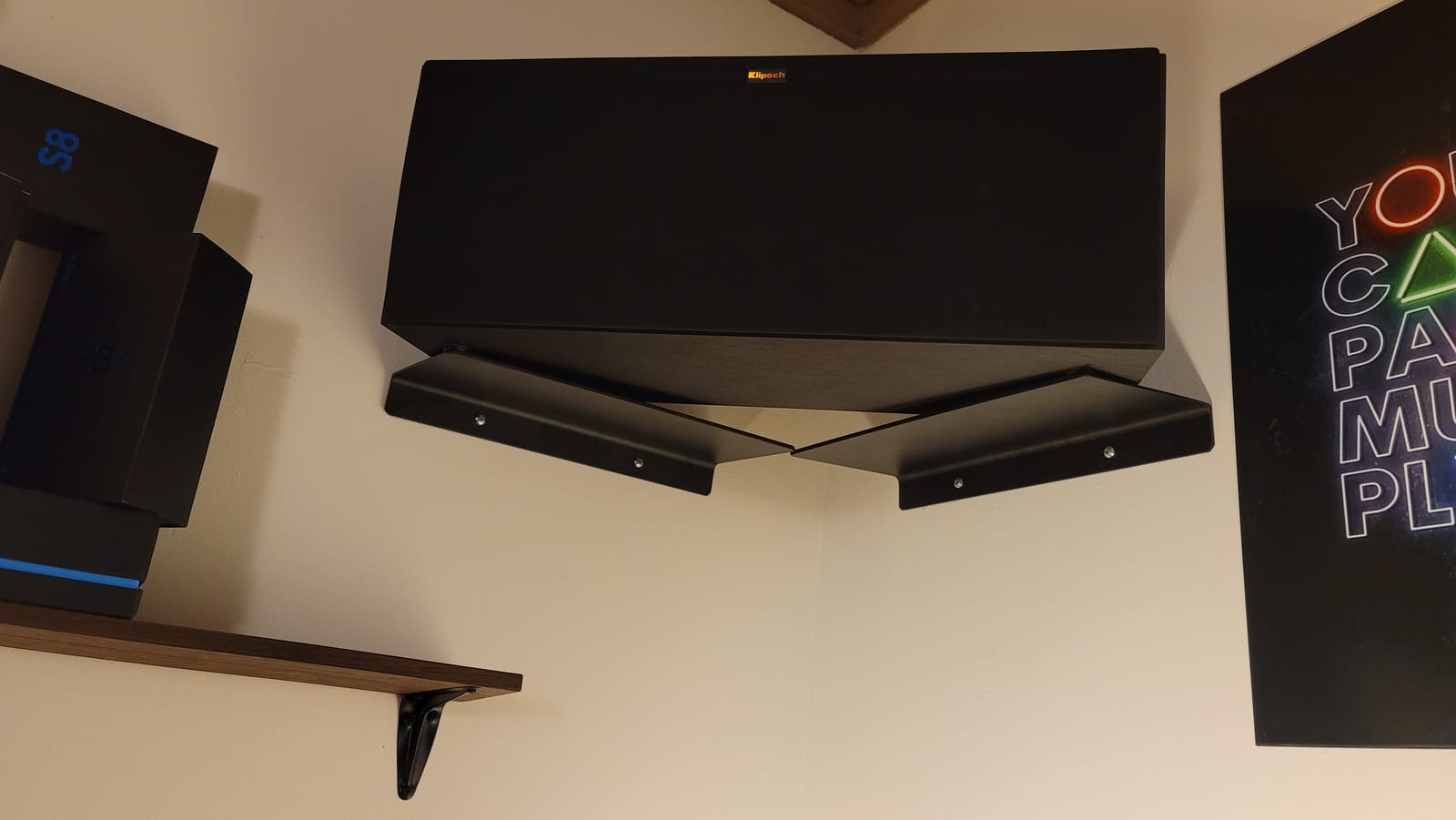
Who the Klipsch R-25C suits
It suits anyone building around Klipsch Reference speakers who wants a matching centre at a modest outlay, and it suits a shopping list that values proven reliability over cutting-edge refinement. The 18.75 inch width means it drops into a standard television stand without a furniture change.
Where the Klipsch R-25C falls short
It is an older generation design next to the Reference Premiere line, so refinement and control lag a step behind. Bass is limited without a subwoofer, and the sparse listing means you have less published information to plan your system around than with any other pick here.
2-Way vs 3-Way: Which Design Actually Voices Dialogue Better?
Forum consensus usually says a three-way centre voices dialogue better, and in theory it is right. A three-way design splits the frequency range into three bands, so the tweeter handles only the very top, a dedicated midrange driver handles the vocal range alone, and woofers never have to reproduce the same frequencies. Less overlap means less intermodulation distortion right where the voice lives.
But the forum is not unanimous, and the counter-argument is worth understanding. Many three-way centres achieve that separation by stacking a midrange driver above and below a tweeter in a vertically symmetrical MTM arrangement. A listener sitting to one side is then off-axis between the two midrange drivers, their output interferes, and dialogue can develop a hollow or smeared quality precisely where you would expect it to be cleanest. That effect is called lobing, and it is the reason some listeners on AVS Forum argue a two-way design is the safer choice for a wide seating area.
Every one of the ten speakers in this guide is a two-way or 2.5-way design, and that is a deliberate choice on our part. The two-way layouts here use a horizontally wide or symmetric MTM arrangement with a horn or waveguide that controls dispersion vertically, which keeps voices even across a couch without the vertical interference pattern. The practical decision rule is simple. If one person watches from dead centre, driver configuration barely matters. If your seating spreads across a sectional, prioritise a wide, controlled dispersion pattern over raw channel count.
The 83% Rule and Why Matching Your Mains Matters
The 83% rule says that a centre channel should handle roughly 83 percent of the sound in a home theater, with the rest split among the other channels. It comes from how dialogue-led content is actually mixed, and it is the reason the centre is treated as the most important speaker in the system rather than an accessory.
The rule matters for buying decisions because it sets a floor on how much the centre has to do. A speaker that runs out of headroom, distorts on a quiet line, or lacks mid-bass cannot carry 83 percent of anything. A centre with high sensitivity, a midrange that stays clean under load, and enough cone area to anchor a voice will. Sensitivity is the number most people skip, and it is the one that predicts whether your receiver can get a voice above a busy soundtrack at a reasonable volume.
Matching matters for a different reason: tonal, not technical. If the centre is voiced brighter or warmer than your front pair, dialogue will visibly jump forward of the rest of the soundfield, and the image will pull apart. Same brand and same series first, closest voice second. The number one, three, and ten picks in this guide are all designed to blend with matching Klipsch Reference or Polk T-Series mains, and the ELAC in slot four is the most neutral option when your mains are from a different brand entirely.
How to Match a Center to Mains From a Different Brand
This is the most common question on home theater and budget audio forums, and the honest answer is that brand matching is not the same as timbre matching. You do not need the logo to match. You do need the centre to sound like it belongs to the same speaker.
Our order of preference runs like this. First, find a centre from the same brand and series as your mains, even if it is an older generation. Second, if that is unavailable, audition the centre with your actual front pair and listen for one line of dialogue in a film you know well, checking that the voice does not sit obviously in front of or behind the rest of the image. Third, if neither works, use your receiver’s channel level controls and measurement-based calibration to pull the centre into alignment rather than hoping the difference disappears.
Two practical details help. Coaxial-style drivers with a single point source are frequently recommended on forums for exactly this problem, because their dispersion keeps the voice stable wherever you sit and a stable voice is easier to blend. And a centre with front-firing or downward-facing ports, like the ELAC in slot four, gives you placement freedom that matters more to final blending than any spec sheet, because a blocked port changes the sound more than a modest tonal difference between two well-behaved speakers.
Placement: Getting the Center to Ear Level and Off the Floor
Placement delivers more dialogue clarity than most upgrades, and it costs nothing. The most repeated piece of advice across home theater forums is to get the centre as close to ear level as possible, tilt it to compensate for any remaining offset, and treat acoustic treatment as part of the same job.
Start with vertical position. When the centre sits well below ear level, you are listening to the top of its vertical dispersion pattern, and a voice loses focus exactly where the tweeter is rolling off. Aim the acoustic axis at the seated ear position rather than at the centre of the screen, and if the centre must sit lower, add a small wedge or tilt mechanism. If the television is wall-mounted with the speaker directly below it, tilt upward a few degrees and re-run your receiver’s calibration afterwards.
Next is clearance. Rear-ported cabinets need roughly the port diameter plus a few inches behind them, and a credenza with a tight back panel will choke one. Front-ported and sealed cabinets are forgiving, which is why we flagged the ELAC’s front-firing ports as a practical advantage. Leave a little air above the ports and keep the cabinet off a back wall for airflow.
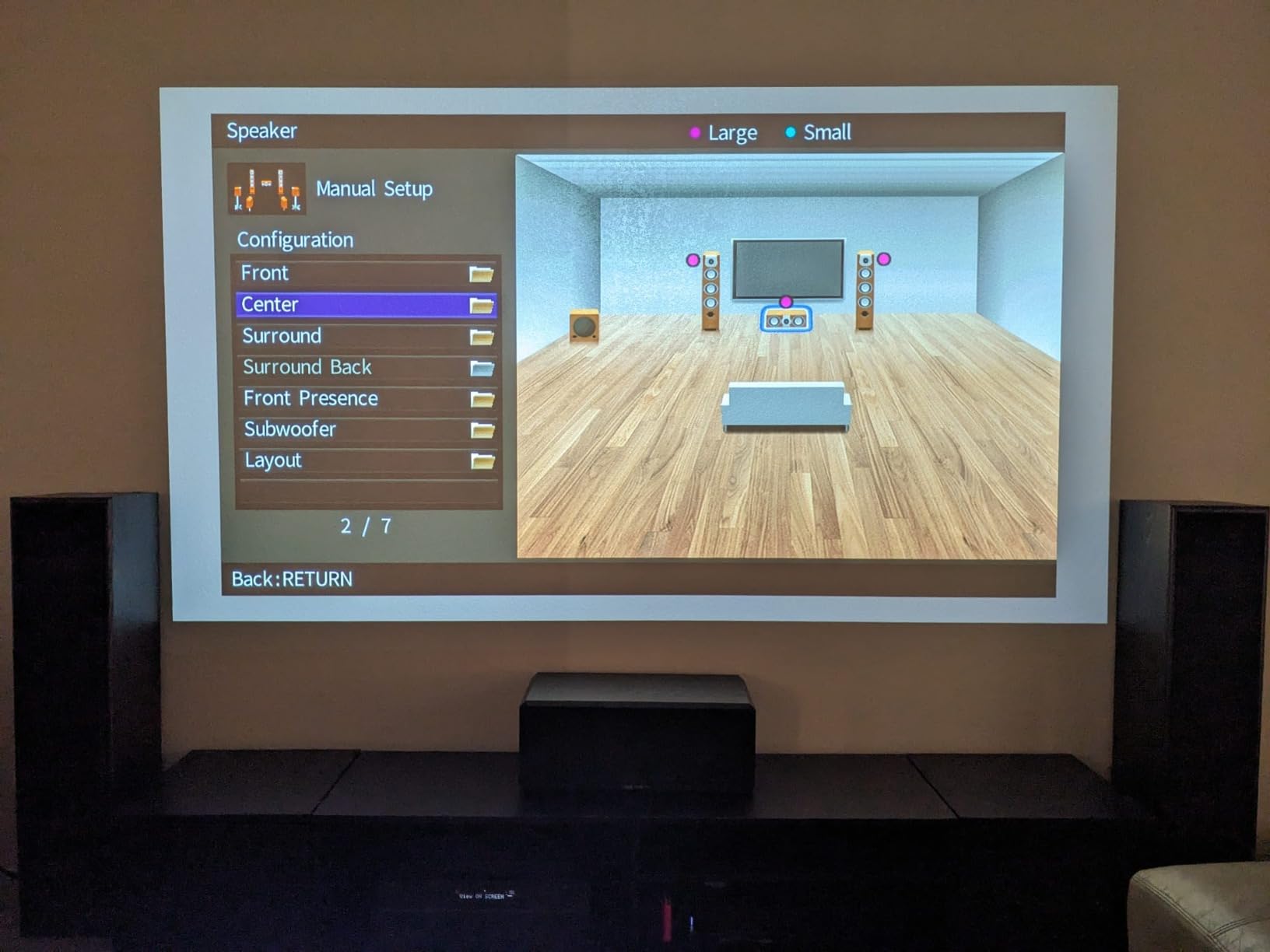
Finally, check the receiver side. Confirm the centre channel is actually enabled and assigned, that your source is not downmixing to stereo, and that the crossover point matches the centre’s own design intent. A mismatched crossover makes a centre fight the front pair instead of blending with them. Run the automatic calibration after any placement change, not before. One of the more commonly reported causes of muffled dialogue in a home theater is not the speaker at all, but a subwoofer and centre sharing the wrong low-frequency crossover.
Frequently Asked Questions
Which center channel speaker is best for dialogue clarity?
The Klipsch R-52C is our pick for most rooms, because its 95dB sensitivity, dual 5.25 inch spun-copper woofers, and horn-loaded 1 inch LTS tweeter keep voices present over a busy soundtrack without needing a large amplifier. In a wide seating arrangement or a large dedicated room, the Klipsch RP-504C wins on horizontal dispersion. For a neutral, non-forward character, choose the ELAC Debut 2.0 C5.2.
Are center channel speakers worth it?
Yes. A poll on the Audio Science Review forum named the center channel the most important channel in a home theater at 63.9 percent of votes, ahead of the front channels at 41.7 percent. A film mix typically sends 60 to 80 percent of spoken content to the centre, and when your L/R pair has to carry that load instead, each voice splits between two speakers at the edges of the soundfield and intelligibility drops.
Should I get a 3-way or a 2-way center channel speaker?
A three-way design can voice dialogue better because a dedicated midrange driver handles the vocal band alone, reducing intermodulation distortion. However, vertically symmetrical MTM three-way layouts can produce lobing for listeners seated off to one side. If you watch from dead centre, choose three-way. If your seating spreads across a wide sofa, prioritise a wide, controlled horizontal dispersion over channel count.
Should my center channel match my front speakers?
It should match them in voice, and the same brand and series is the easiest way to achieve that. Brand matching is not strictly required. The practical order is: same brand and series first, then the closest tonal match auditioned with your actual mains, then receiver channel trims and measurement-based calibration to align the levels and response.
How far should a center channel speaker be from the TV?
Place it directly below or above the screen, centred on the same axis as the image, and as close to seated ear level as the furniture allows. If it must sit lower, tilt the cabinet upward so the acoustic axis points at your ears rather than at the centre of the screen. Leave enough clearance behind a rear-ported cabinet for the port to breathe, then re-run your receiver calibration after any change.
Why does my dialogue sound muffled in my home theater?
The most common causes are a centre positioned well below ear level, a ported cabinet with its rear port blocked by a credenza back panel, a subwoofer and centre sharing the wrong low-frequency crossover, and a source or receiver configuration that is downmixing to stereo. Confirm the centre channel is enabled and assigned, raise it a few decibels, set the crossover to match the speaker, and re-run automatic calibration after any physical change.
Conclusion: The Three Picks Worth Your Budget
If you want one speaker to buy and stop thinking about it, take the Klipsch R-52C. Its high sensitivity, horn-loaded tweeter, and conventional cabinet footprint make it the most forgiving centre we tested, and it holds a 4.8 average across more than 3,000 ratings. If your seating is wide or your room is deep, the Klipsch RP-504C is the better answer on dispersion. If you are building a first system and want the most intelligible voice per unit of spend, the Polk Audio T30 does the job and blends cleanly with Polk T-Series mains.
Whichever you choose, remember that placement and calibration are free, and the advice people repeat most often on forums is that getting the centre to ear level and tilting it does more for dialogue than adding another tier of speaker. Pick the cabinet that fits your furniture, aim it at your ears, run your calibration afterwards, and the dialogue problem goes away faster than most buyers expect.