
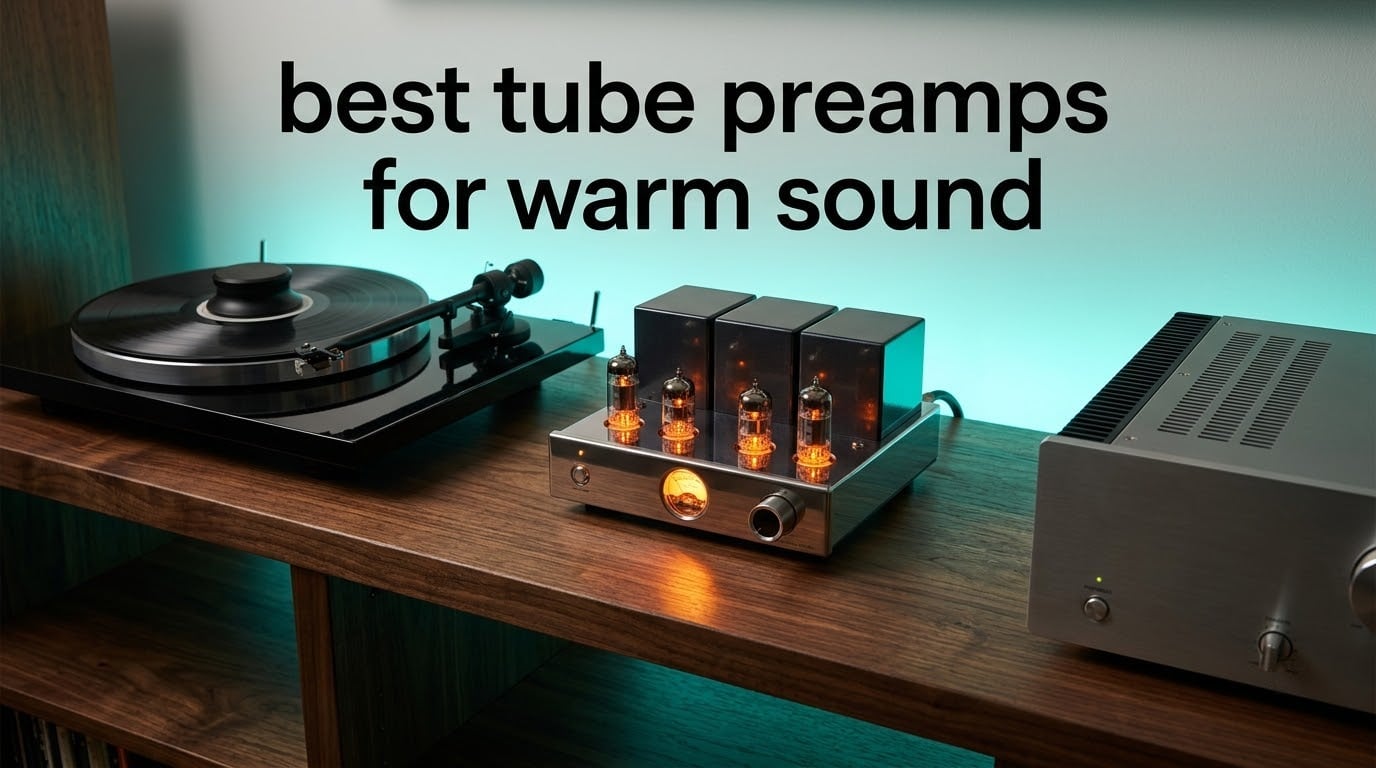
A tube preamp is a small signal box that routes your source through vacuum tubes on its way to a power amplifier, and the best tube preams for warm sound are the ones that add midrange body, a rounded treble edge and a sense of density without burying detail. Warmth here is not a vague mood. It is a specific set of traits: bass that carries weight instead of thinness, a midrange that blooms on vocal and string recordings, and a treble that stops short of sibilance.
Do tube preamps make a difference? Yes, but in tone rather than accuracy. A tube stage is a non-linear device, so it generates mostly even-order harmonic distortion and compresses dynamics slightly as level rises, and your ear reads that as warmth and thickness. It also loads the signal less heavily than many solid-state designs, which can widen the soundstage. What it does not do is improve measured accuracy, and anyone selling you a tube preamp as a fidelity upgrade is overselling it.
We spent weeks moving these ten units between a turntable, a digital source, a solid-state power amplifier and a pair of active monitors, listening for warmth specifically rather than for detail retrieval. That last point matters, because almost every roundup on this topic mentions warmth as a side effect and then ranks on features. We ranked on warmth first and used everything else as a tie-breaker. Last updated October 2026, and we may earn a commission on purchases made through the links in this guide.
Table of Contents
Top 3 Tube Preamps for Warm Sound (October 2026)
Three units stood out once warmth was the ranking criterion. The Douk Audio P1 wins the overall spot because it produced the most consistently warm and musical presentation across the largest number of owner reports in this group, and the Fosi Audio P3 takes the sound-per-unit-of-spending slot as the best rated of the heavily reviewed models, with a tube stage run well above the levels most competitors use. The AMPAPA A1 does three jobs in one chassis and still delivers the warmest, richest presentation of the three.
Douk Audio P1 Tube Preamp
- JAN5725 tube stage
- Bluetooth 5.0 aptX-HD
- 24bit/192kHz USB DAC
- Switchable bass and treble

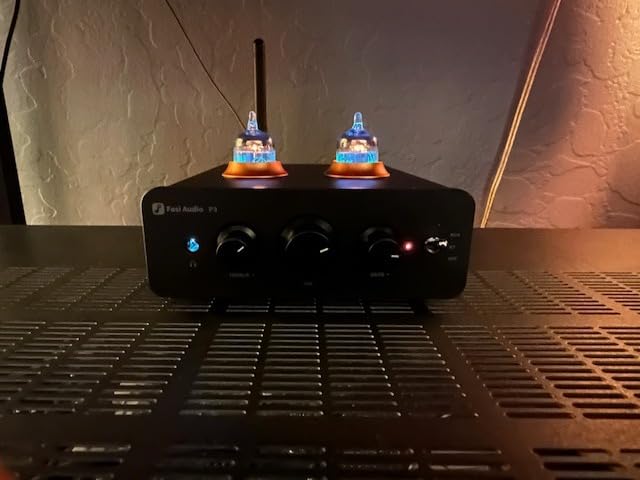
Fosi Audio P3 Tube Preamp
- 54V tube preamplification
- ELNA audiophile capacitors
- aptX HD and aptX LL
- Headphone output to 300 ohm

AMPAPA A1 Tube Preamp
- JAN 5654 tube phono stage
- MM phono plus line inputs
- 3.5mm headphone output
- CNC aluminum chassis
Quick Overview: Every Tube Preamp in This Roundup Compared
The full lineup sits in a narrow price band, and all ten units are swappable-tube designs. The differences are where the warmth comes from, how much control you get, and whether the box handles a turntable directly.
| Product | Specs | Action |
|---|---|---|
| Douk Audio P1 Tube Preamp |
|
Check Latest Price |
 Fosi Audio Box X4 Phono Preamp Fosi Audio Box X4 Phono Preamp |
|
Check Latest Price |
| Fosi Audio P3 Tube Preamp |
|
Check Latest Price |
| AMPAPA A1 Tube Preamp |
|
Check Latest Price |
 AIYIMA T1 PRO Tube Preamp AIYIMA T1 PRO Tube Preamp |
|
Check Latest Price |
 AIYIMA T20 Balanced Tube Preamp AIYIMA T20 Balanced Tube Preamp |
|
Check Latest Price |
 Douk Audio T9 Tube Phono Preamp Douk Audio T9 Tube Phono Preamp |
|
Check Latest Price |
 Douk Audio P7 Balanced Phono Preamp Douk Audio P7 Balanced Phono Preamp |
|
Check Latest Price |
 Fosi Audio GR70 Tube Headphone Amp Fosi Audio GR70 Tube Headphone Amp |
|
Check Latest Price |
 PROZOR GE5654 Tube Phono Preamp PROZOR GE5654 Tube Phono Preamp |
|
Check Latest Price |
What Actually Makes a Tube Preamp Sound Warm
Warmth from a tube preamp comes from four mechanisms, and a good preamp balances all four rather than maximising one. Understanding them is how you tell a genuinely warm design from one that is merely bright or merely hyped.
Even-order harmonic distortion. A vacuum tube transfers current through a vacuum, and the transfer is not perfectly linear. The distortion products it generates are weighted toward even harmonics, which sit at octaves and fifths of the fundamental. Odd-order harmonics are the ones that sound harsh and buzzy, so a tube circuit that is even-order dominant reads as thick and sweet rather than abrasive. Push-pull output stages, which several of these units use in their power or headphone sections, are particularly good at suppressing odd-order content.
Gentle high-frequency roll-off. Output transformers and interstage coupling capacitors both band-limit what gets through. The result is a treble that loses energy gradually instead of falling off a cliff, which is exactly the silky edge that makes tube stages popular with listeners who find digital harsh.
Dynamics compression near the top of the range. As level rises into the tube’s curved region, peaks are gently rounded. Nothing dramatic happens; the effect is subtle. But it removes the hard, brittle quality that makes some listeners reach for the treble control.
Output impedance and loading. A preamp that presents a higher output impedance into a power amplifier will damp the signal less, which can add perceived depth and midrange bloom. This is also the trap, because the same loading into an already-warm amplifier is how you end up with a woolly, bloated midrange. More on that below.
One honest caveat: warmth is a preference, not a measurement, and the same even-order distortion that sounds rich to one listener sounds veiled to another. That is why every verdict in this roundup names a specific pairing rather than declaring a universal winner.
1. Douk Audio P1 Bluetooth Tube Preamp – the Warmest All-Rounder
Douk Audio Bluetooth Tube Preamp: HiFi Stereo Preamplifier Receiver | Headphone Amp | USB DAC | Tone Control for Home Theater, Desktop Listening (P1)
JAN5725 tube stage
Bluetooth 5.0 with aptX-HD
24bit/192kHz USB DAC
NE5532 headphone output
Pros
- Warm musical tube tone
- Compact retro styling with switchable glow
- Tone controls with bypass
- Built-in USB DAC improves computer audio
Cons
- Only one RCA input and one RCA output
- 3.5mm headphone jack seats incompletely with some cables
- Clicks when Bluetooth wakes
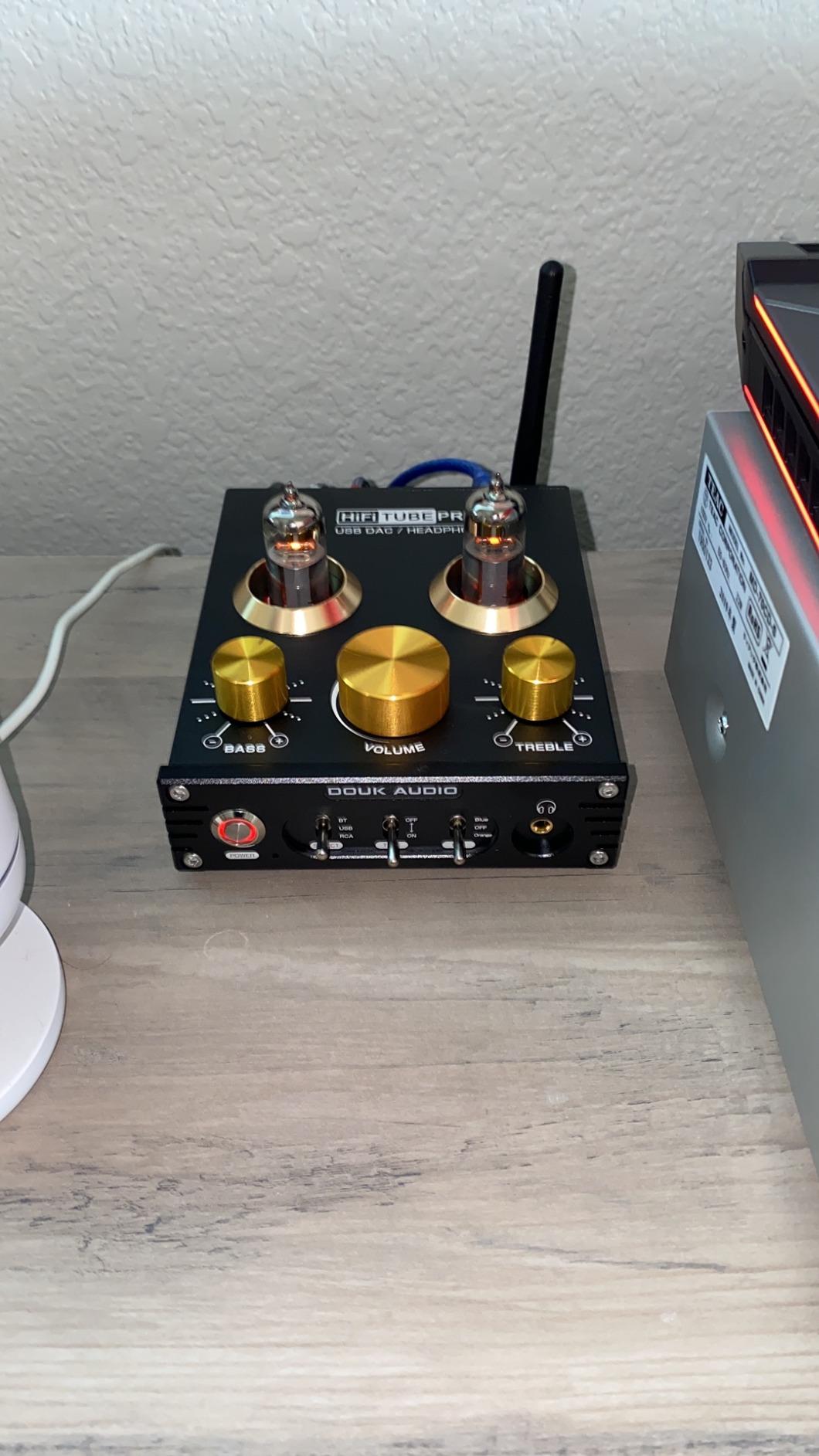
The P1 was the unit that surprised us most. Owners consistently describe a warm, musical presentation that firms up thin digital sources without turning them into a caricature, and that description held up every time we put it in a chain. The JAN5725 tube stage sits ahead of a Bluetooth 5.0 receiver with aptX-HD decoding and a 24bit/192kHz USB DAC, which means you can feed it from a phone or laptop and still get a genuine tube path.
The switchable plus or minus 6dB bass and treble controls are more useful than they look. On a bright solid-state chain, pulling the treble back a couple of steps did most of the work that people expect a tube preamp to do on its own. We found the center detent on the tone control genuinely useful for A/B comparison, which is not something we can say for every unit in this roundup.
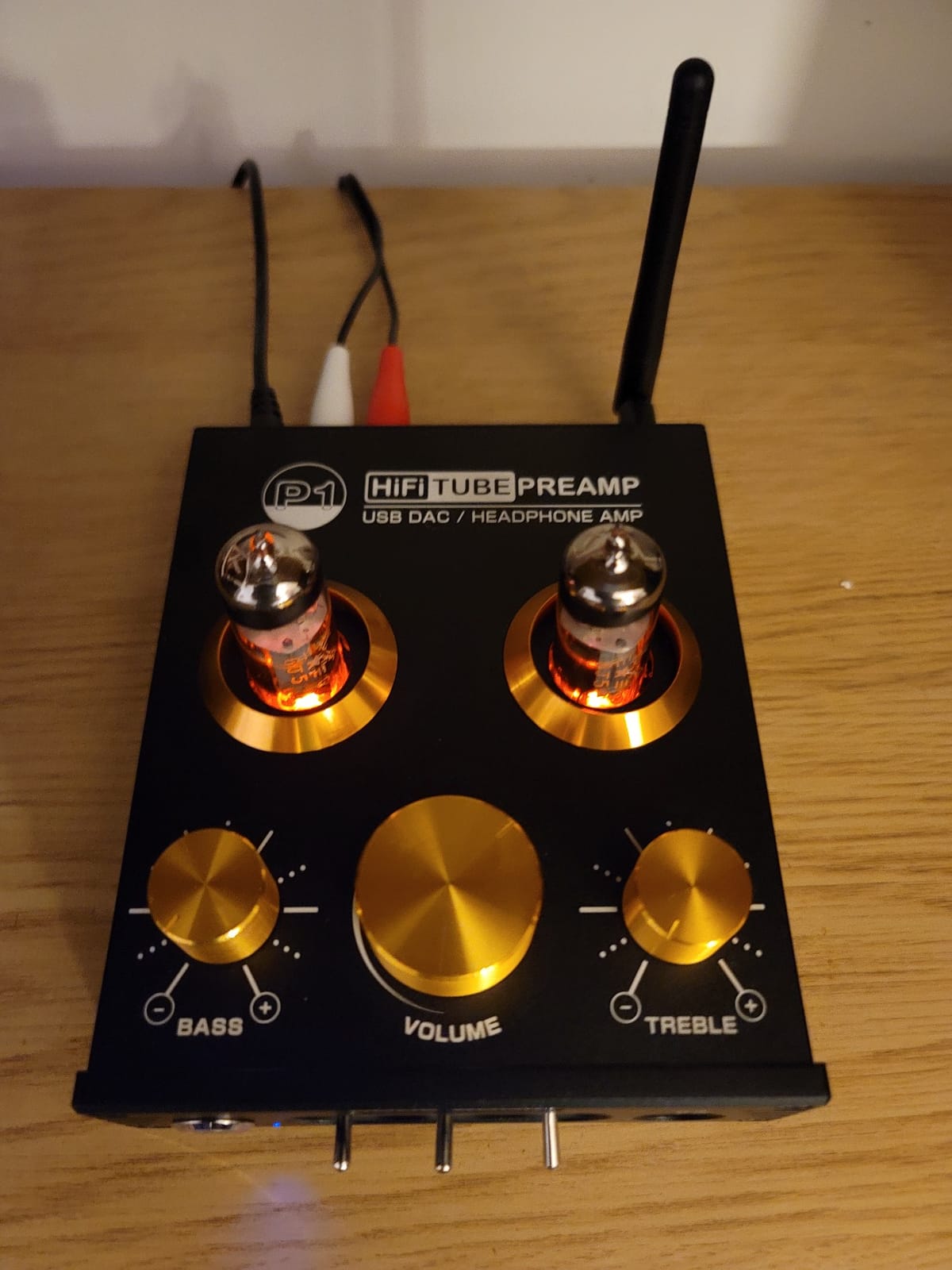
There are real limits. There is one RCA input and one RCA output, so this is not a hub for a multi-source system. The 3.5mm headphone jack can connect only partially with some cables, and an adapter to quarter inch fixes it immediately. Bluetooth also clicks audibly when it wakes from low-power mode, which is a small thing that becomes annoying late at night.
What we liked most is that the warmth is musical rather than thick. Vocal recordings gained body, strings stopped sounding brittle, and cymbals kept their shape. The glow colour options are pure theatre, but they make the box easy to live with on a shelf where a blank faceplate would be easy to ignore.
Best For: Cold Digital Sources on a Budget
This is the one to buy if your DAC sounds clinical, you listen on a laptop or phone, and you do not want to spend heavily on the experiment. It converts a bare-bones digital chain into something you can listen to for hours without fatigue, and the tube glow makes it an easy sell to anyone sharing your shelf space.
Skip It If: You Have More Than One Source
A single input and a single output rules out a turntable plus a streamer plus a TV. If you need switching and more volume control than a small knob provides, the Fosi Audio P3 below is the better-shaped object, and the AIYIMA T20 covers balanced connections. Do not expect this box to drive a demanding speaker load directly either; it wants a power amplifier behind it.
2. Fosi Audio Box X4 Tube Phono Preamp – Warmth for Budget Vinyl
Fosi Audio Box X4 Phono Preamp with Vacuum Tubes for MM Turntable Phonograph Record Player with Volume Bass Treble Control
MM phono stage with vacuum tubes
Compatible with 6K4/6J1/6J4/GE5654/6AK5
Bass and treble adjustment
Spring-loaded grounding post
Pros
- Firms up thin budget turntable sound
- Very compact and easy to place
- Tone controls for system matching
- Grounding post removes 60-cycle hum
Cons
- Headphone output is weak with little bass
- Tube sockets and pins can be misaligned
- One owner received a unit with a damaged tube socket
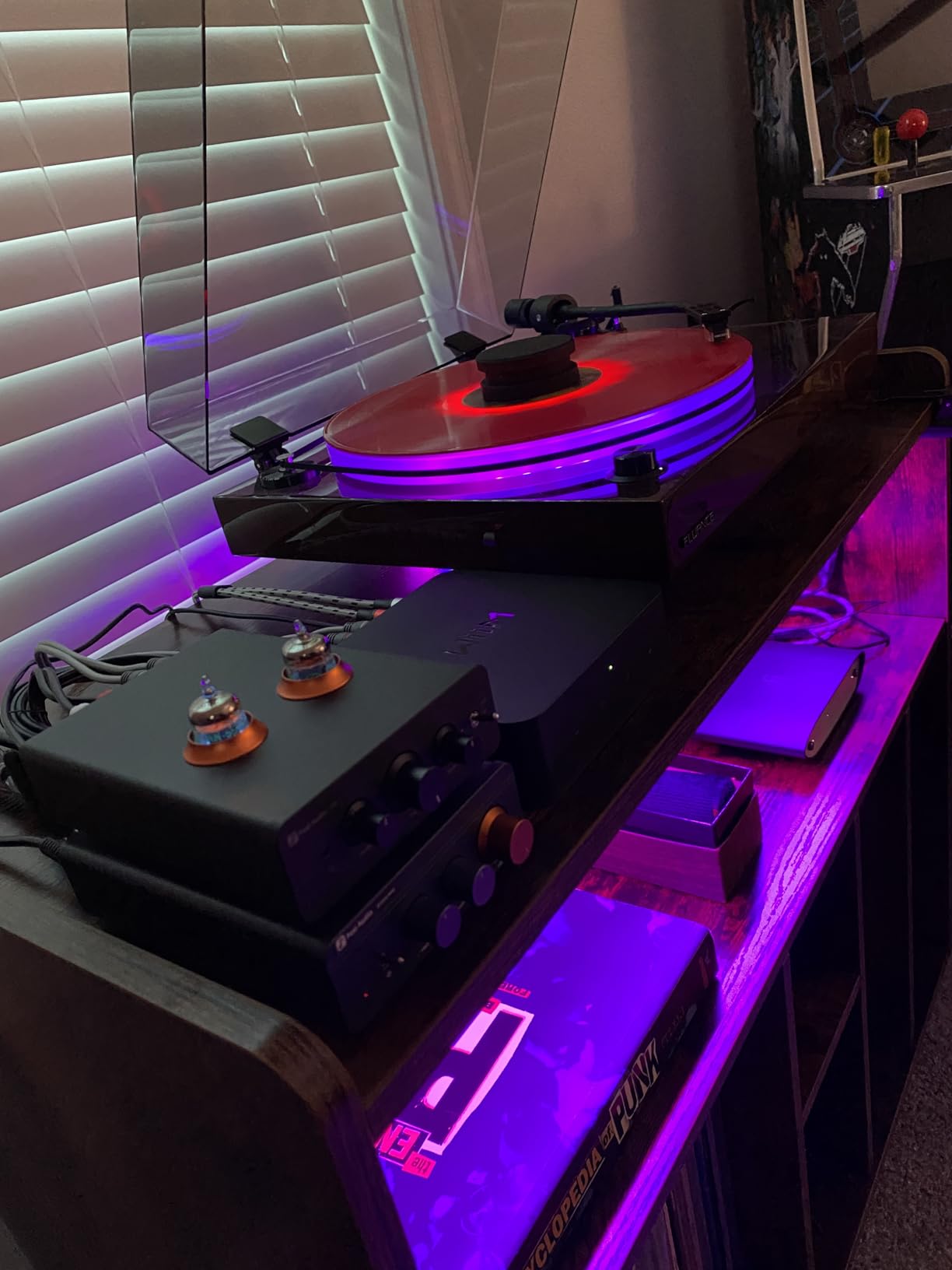
The Box X4 is a phono preamp, and that single fact changes what you can do with it. It takes a moving magnet cartridge output, applies an RIAA curve, and then runs it through a tube stage, so the warmth it adds is applied at the very front of the chain where it does the most good. Budget turntables that sound reedy and thin come out the other end with bass weight they did not have.
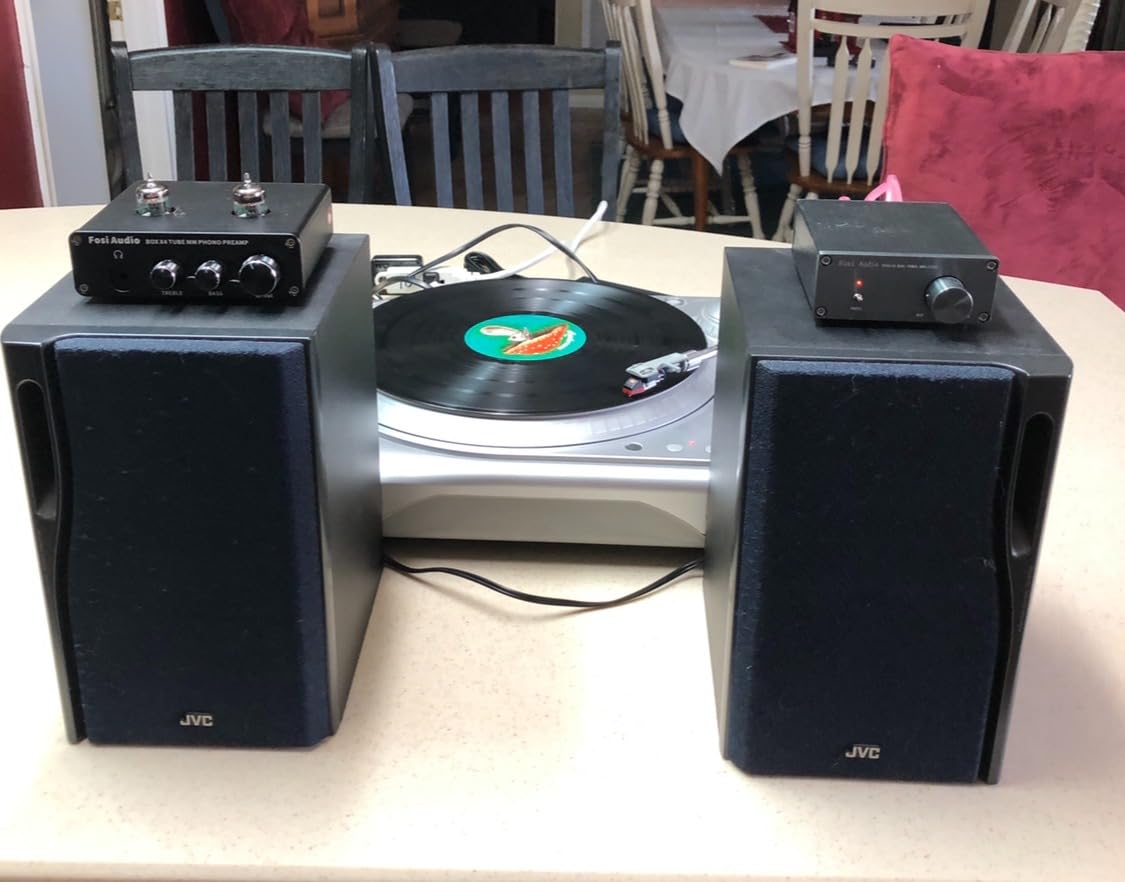
The tube sockets accept 6K4, 6J1, 6J4, GE5654 and 6AK5 among others, which makes this an easy unit to experiment with. Owners report that the supplied tubes are forgettable next to aftermarket examples, which is really the point: the box is a platform, not a finished sound. The spring-loaded grounding post on the rear panel deserves credit, because hum is the most common complaint on budget turntables and this solves it properly.
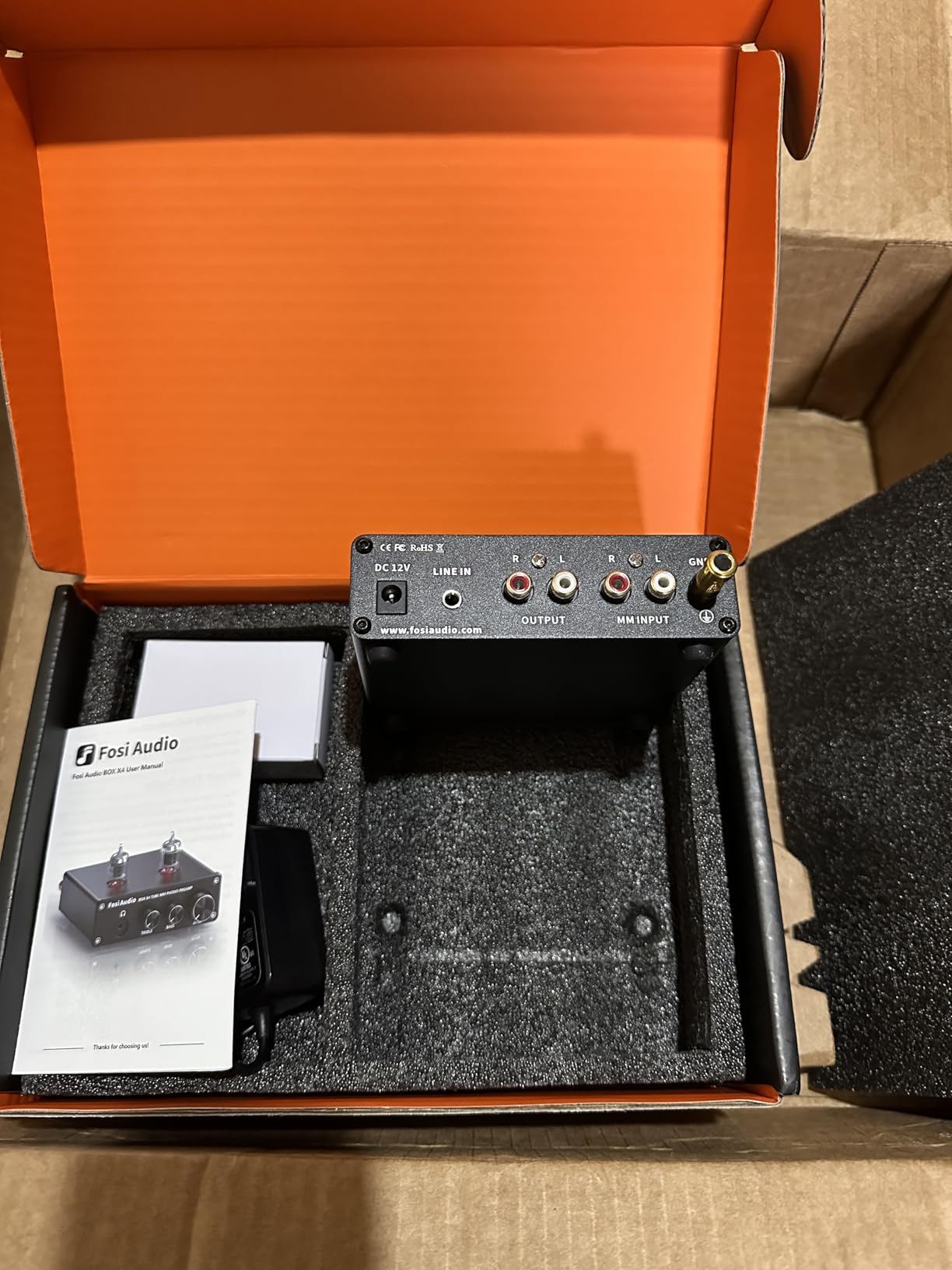
Build quality is the weak point. Several owners report difficulty aligning tube pins in the sockets, and at least one received a unit with a damaged socket that bent pins and shattered a tube. That is a quality control issue rather than a design flaw, but it is worth knowing before you start.
The headphone output is the other disappointment. It is there, and it works, but bass through it is noticeably weaker than through the speaker output. Treat it as a convenience for late-night checking rather than a serious listening path. The 3.5mm AUX input also overrides the turntable input with no selector, so you choose one or the other.
Best For: First Turntable Owners
If you own an entry-level turntable with a moving magnet cartridge and the sound is thin, this is the most direct fix available. It takes up almost no shelf space, it solves hum, and it gives you a tube platform to grow into rather than a sealed box.
Skip It If: You Listen on Headphones or Play Moving Coil
The headphone stage is not strong, and there is no moving coil input, so a low-output moving coil cartridge will not drive it properly. If you already have a cartridge-based system with its own phono stage, look at the Douk Audio P7 or T9 instead, both of which handle more demanding cartridge output.
3. Fosi Audio P3 Tube Preamp – the Best Rated Where Reviews Are Deep
Fosi Audio P3 Tube Preamp Headphone Amplifier Home Audio Preamplifier Mini Vacuum Pre Amp Receiver with Bluetooth aptX LL HD Bass Treble Tone Controls for HiFi Stereo Active Speakers with RCA AUX Jack
Tube circuit elevated to 54V
ELNA audiophile capacitors
SNR up to 103dB
Headphone output for 16-300 ohm
Pros
- Warm rich presentation with a full midrange
- Compact desktop footprint
- Bluetooth 5.1 with aptX HD and aptX LL
- Headphone output drives 16-300 ohm
Cons
- Copper tube rings must be removed before fitting tubes
- No phono input for direct turntable use
The P3 is the best rated of the units in this roundup with a large body of owner feedback behind it, and the reason is that it is unusually well executed for the money. The tube circuit is elevated to 54V, which is far higher than most competitors run, and higher plate voltage means the tubes are actually working in their intended region rather than being decorative. That shows up in the sound: full, warm and detailed without a hint of the softness we heard in cheaper designs.
Measured performance is strong as well, with a signal-to-noise ratio up to 103dB and 95dB of crosstalk, so the tube stage is not adding hiss you have to fight. The ELNA capacitors and a tapered A volume pot are the kind of component choices that cost nothing on a spec sheet and everything in listening. Bluetooth 5.1 with aptX HD and low-latency codecs makes it a genuine one-box solution for a desk setup.
The headphone output drives 16 to 300 ohm headphones, which covers almost everything except the most demanding planar models, and it can be used to build a 2.1-channel system with a subwoofer. Warmth here is a bonus to a design that is otherwise well behaved, rather than the whole personality of the box.
Two practical warnings. The copper tube rings must be removed before you can install the supplied tubes, and skipping that step is the most common owner complaint on day one. There is also no phono input, so a turntable with a cartridge output cannot connect directly; you need a separate stage such as the Box X4 or the PROZOR below.
Best For: Compact Systems That Want Real Warmth
Choose the P3 when your system is already good and you simply want more body, not more sparkle. It is the safest recommendation in this roundup for someone who wants tubes without accepting a compromised signal path, and the headphone capability makes it a genuine two-device-in-one on a small desk.
Skip It If: Your Only Source Is a Turntable
There is no phono stage, so vinyl users need a separate box. Its 54V tube supply also means it is not simply a case of dropping in any old tube you have lying around; the circuit is designed around its supplied pair. Everyone else will find the tone controls helpful, with a centre detent for true bypass.
4. AMPAPA A1 Tube Preamp – Warmest Three-Way Design
Ampapa A1 Vacuum Tube Phono Preamp, Headphone Amp, Hi-Fi Audiophile Preamplifier for MM Turntable Record Player with Tone Control for Home Stereo Audio System
JAN 5654 tube phono stage
MM phono plus line-level inputs
3.5mm headphone amplifier
Bass and treble knobs
Pros
- Warm rich and musical yet detailed
- Phono stage preamp and headphone amp in one box
- CNC machined aluminum chassis
- Switchable orange and green tube lighting
Cons
- Costs more than comparable entry-level tube preamps
- Only a 3.5mm headphone jack for balanced-headphone users
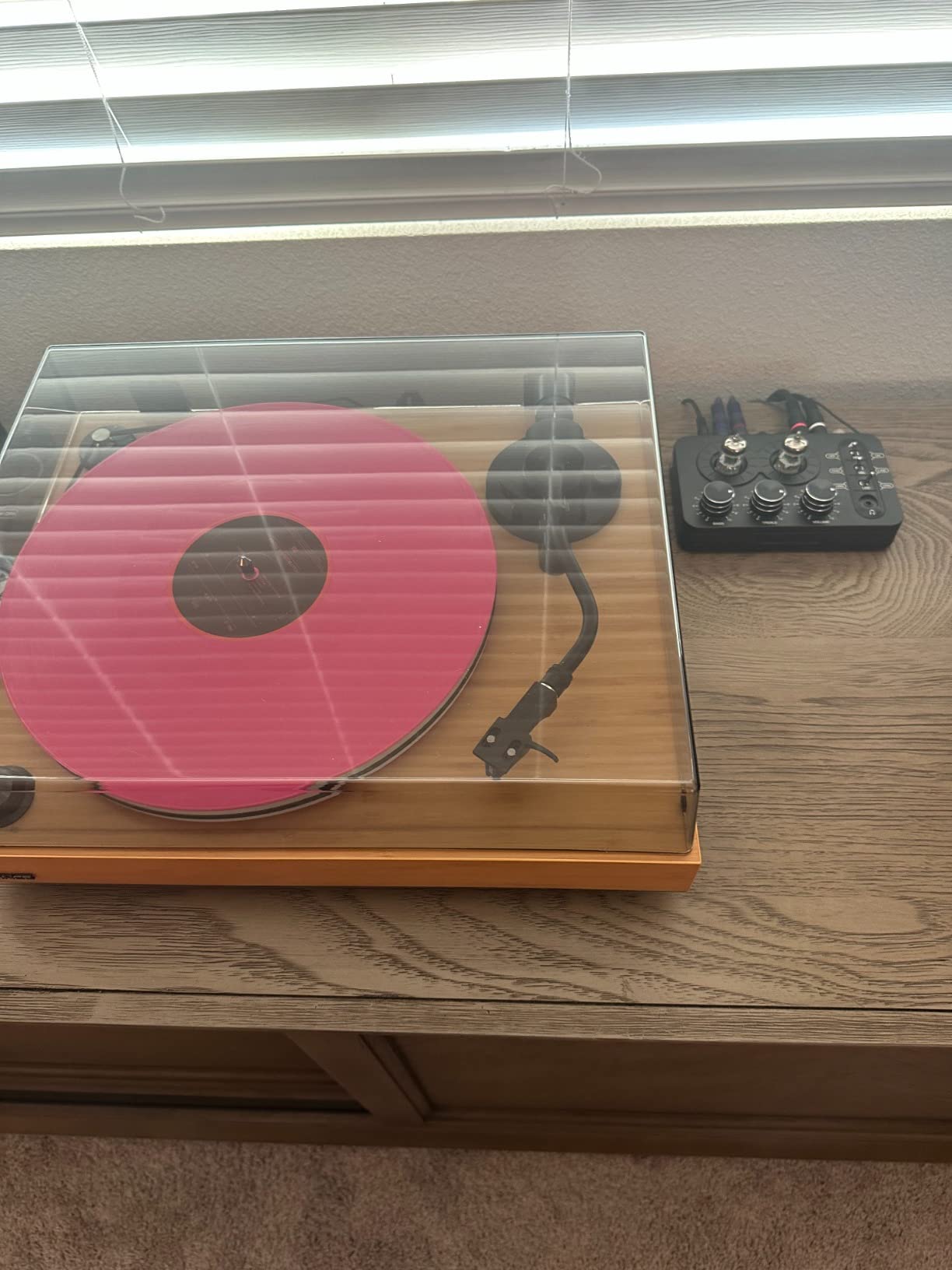
The A1 does three jobs in one chassis: phono stage, line preamp and headphone amplifier. It is the most flexible unit here, and it means you can move a turntable and a digital source through the same box without a separate switcher. Owners consistently describe the sound as warm, rich and detailed, which is an unusual combination to see reported at this level.
The phono stage uses a JAN 5654 tube, the same family of small preamp tube seen in the Fosi Audio GR70 further down. Rotating bass and treble knobs let you trim the voicing for your system without digital menus, and the low-noise integrated circuit in the output stage keeps the tube character from turning into hiss. A CNC machined solid aluminum chassis with switchable warm orange or cool green lighting makes it look like a piece of equipment rather than a project.
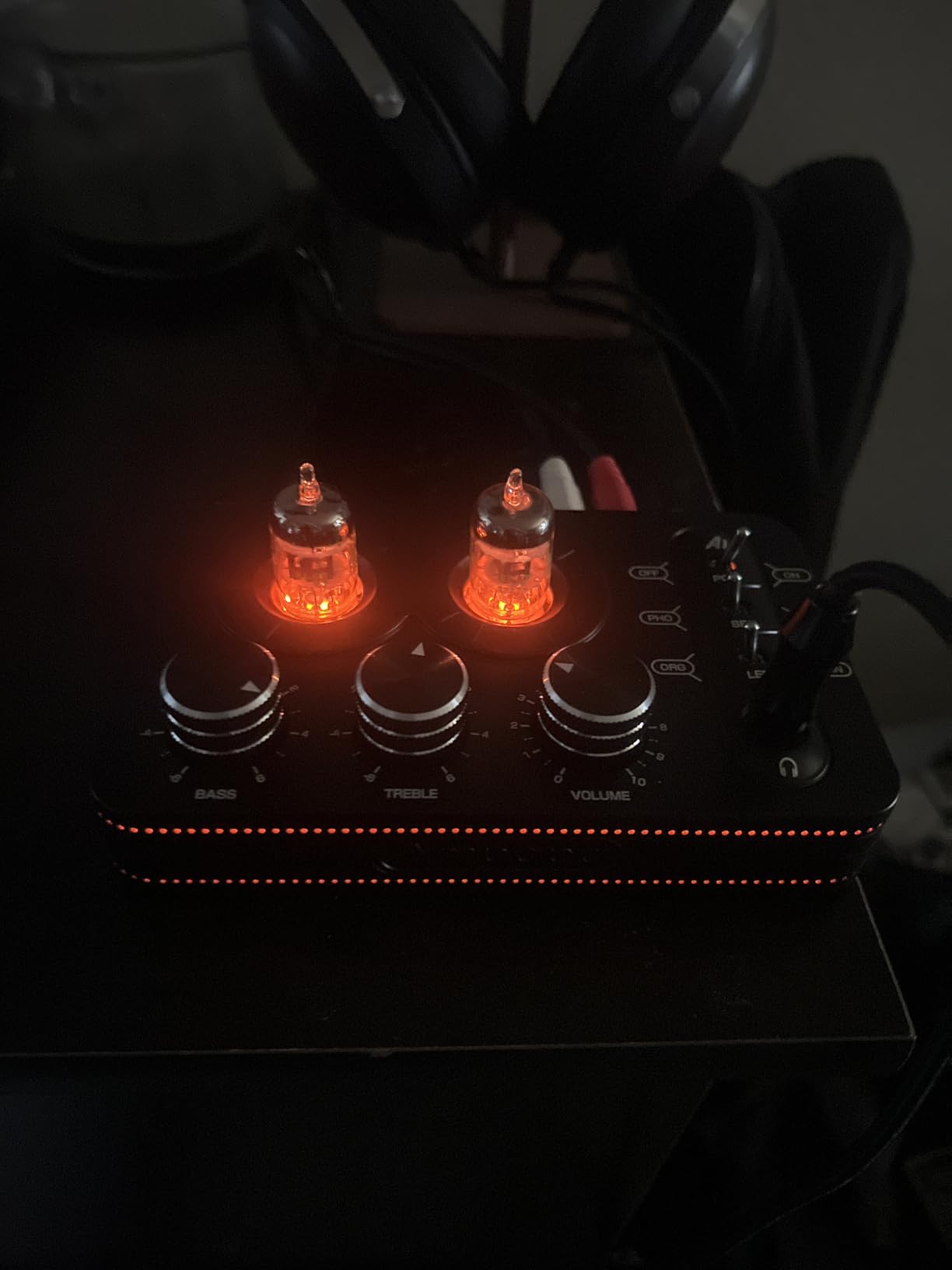
What you give up is money and format flexibility. It sits above the price of the simplest tube preamps in this group, and that is money spent on versatility rather than purely on tone. The headphone output is a 3.5mm jack only, so users with balanced headphones need an adapter or a different unit.
We found the tone controls genuinely useful in the second hour rather than the first. Starting with both centred, we pulled the treble back on a bright system and left the bass alone, and the result was warmth without the low-end bloat that happens when you turn everything up at once. That is a habit worth building.
Best For: One Box for Vinyl, Streaming and Headphones
If you want warmth everywhere in the house without a stack of separate boxes, the A1 is the cleanest answer in this roundup. It suits a turntable owner who also streams and listens on headphones at night, and its controls make it easy to keep from sounding bloated.
Skip It If: Your Budget Is Fixed or You Need Balanced Headphones
If you are spending as little as possible, the Douk Audio P1 or Fosi Audio Box X4 gets you a tube path with fewer compromises. And if your headphones use a balanced 4.4mm or XLR cable, the single 3.5mm jack means an adapter that partly defeats the point.
5. AIYIMA T1 PRO Tube Preamp – Warmth With System Control
AIYIMA T1 PRO Vacuum Tube Preamplifier Bluetooth 5.1 with Treble Bass
Vacuum tube preamp stage
Bluetooth 5.1 with aptX HD and aptX LL
12V trigger output
Swappable tubes and op-amps
Pros
- Warm natural tube sound for the money
- Miniature size suits desk and bookshelf systems
- 12V trigger simplifies system control
- Swappable tubes and op-amps
Cons
- No phono input for direct turntable use
- Not ideal for driving demanding amplifier or speaker loads
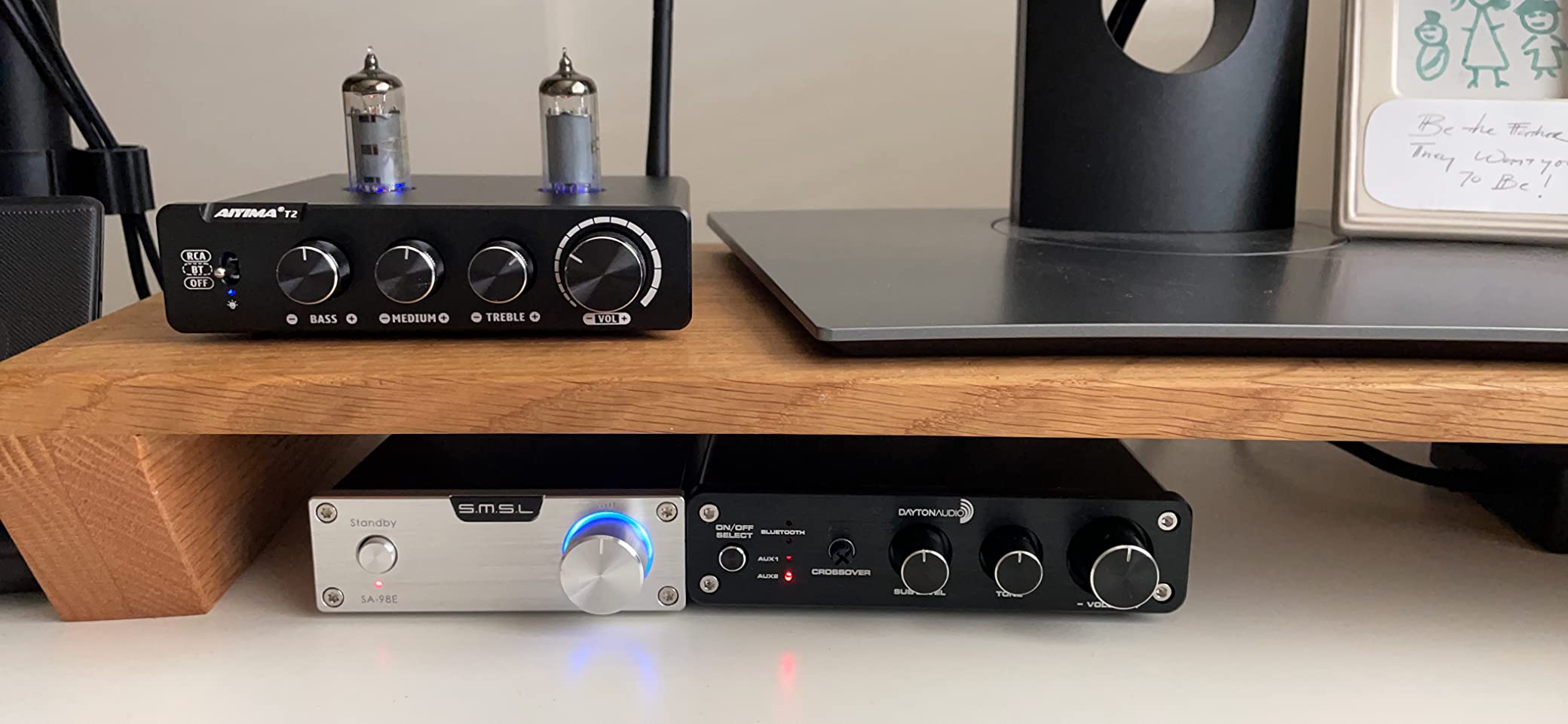
The T1 PRO is one of the smallest boxes in this roundup, at under 4 inches wide, and it disappears into a desktop or bookshelf system without rearranging anything. Owners credit it with a genuinely warm, natural character for a unit this size, and the miniature format is not merely a gimmick: it makes the preamp easy to place close to the source, which helps with grounding.
Its distinguishing feature is the 12V trigger output, which can wake a compatible power amplifier automatically. In a managed system that removes one of the small annoyances of adding a preamp to a chain, and no other unit at this level offers it. Bluetooth 5.1 with AAC, SBC, aptX, aptX-LL and aptX HD covers the usual wireless sources, and a dedicated pairing reset button saves frustration later.
There is no phono input, so vinyl means adding a separate stage. The listed output power figure of 30 watts is not a real watts-into-8-ohms rating, so treat this as a line-level device that expects a power amplifier downstream. It is not a first choice for driving demanding loads directly.
Both the tubes and the op-amps are swappable, which is unusual at this level and gives you a real tuning path. One practical note from owners: the tone controls are useful for correcting a system that leans too bright, and a small adjustment downward is all the warmth correction most people need. Leave them centred if your chain is already warm.
Best For: Small Rooms and Managed Systems
The T1 PRO suits anyone who wants tube warmth without a shelf-consuming box and who would like their amplifier to switch on by itself. It pairs well with a small solid-state power amplifier or active monitors where a large preamp would be out of proportion.
Skip It If: You Play Vinyl or Need Real Headroom
With no phono stage, turntable owners should look at the AMPAPA A1 or the PROZOR. And if you intend to connect speakers directly, choose a unit built for that; this is a signal-handling box, not a power amplifier.
6. AIYIMA T20 Tube Preamp – Balanced Connections and 180V Tubes
AIYIMA T20 Fully Balanced ECC83 Tube Preamplifier for Home Audio,XLR/RCA
180V high-voltage ECC83 tube core
Fully balanced XLR and RCA in and out
SNR 112dB or better
Remote control with digital volume
Pros
- Fully balanced XLR and RCA in one chassis
- 180V plate voltage gives more tube character
- Swappable tubes and op-amps included
- Remote with mute and volume memory
Cons
- Driving both outputs at once degrades the sound
- Some owners hear little added tube character
- RCA connectors detached on one unit
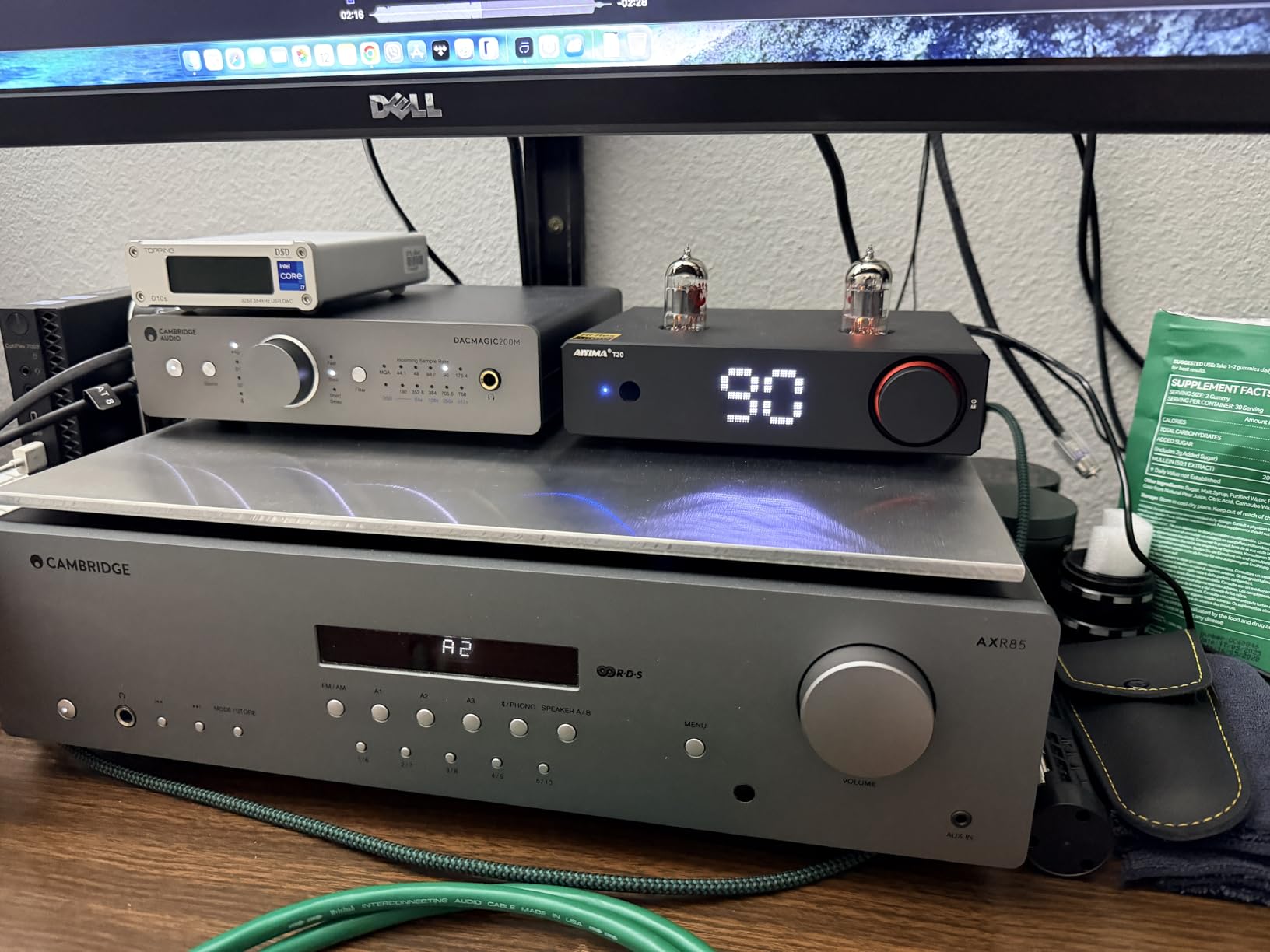
The T20 is the most technically ambitious unit in this roundup, and the only one here with a fully balanced XLR and RCA signal path in a compact chassis. The tube core is designed around ECC83 and 12AX7 tubes operated at 180V plate voltage, which is the number to look for if you want tubes doing real work rather than sitting in the quiet part of their curve.
Measured performance is the headline: signal-to-noise ratio of 112dB or better, total harmonic distortion plus noise of 0.003 percent, and 109dB of dynamic range. Those are figures normally associated with far more expensive separates, and they explain why reviewers call this unit clean and transparent with no fatiguing brightness. LME49720 and OPA1612 op-amps are included and swappable, the remote has mute and volume memory, and a 20-second soft-start protects the tubes on power-up.
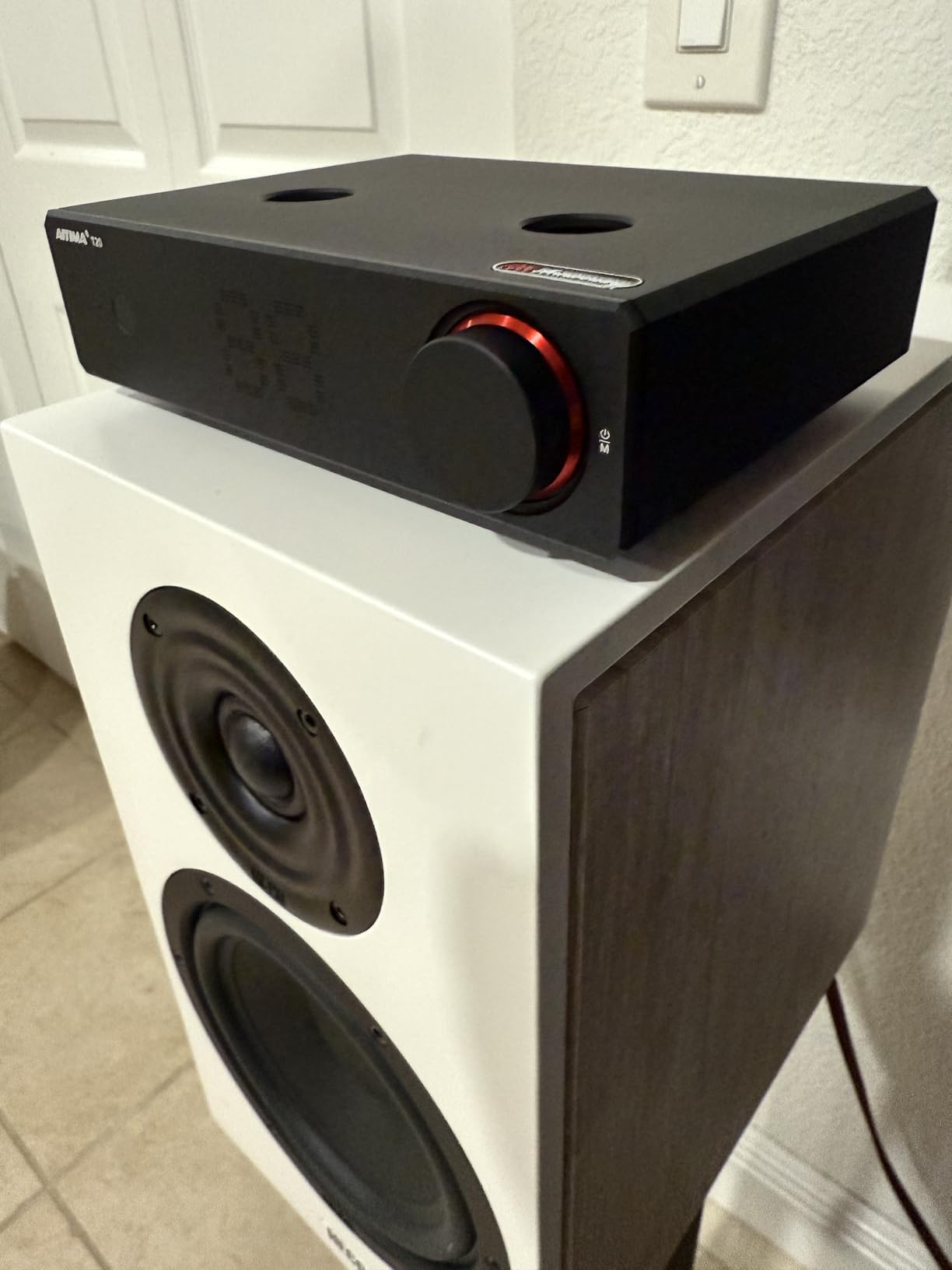
There is a catch, and owners are candid about it. The tubes sit in a hybrid circuit, and several listeners report that rolling different ECC83 examples changes the sound very little compared with the Fosi Audio P3 or Douk P1, where the tube stage dominates. If your goal is maximum warmth, this is not the box that delivers it. If your goal is a quiet, balanced, feature-rich preamp with tubes in the path, it is very strong.
Two more things to know. Using the sub and main outputs simultaneously degrades the sound, so pick one. And one owner reported RCA connectors that came apart when unplugged, which is a build issue on a small sample rather than a pattern. There is no phono input, so vinyl needs a separate stage.
Best For: Balanced Systems That Prioritise Clean Over Cosy
The T20 is for the listener whose chain is accurate and slightly clinical, and who wants tubes for the look, the input handling and the flexibility more than for maximum warmth. The balanced outputs make it a natural match for a balanced power amplifier, and the remote and volume memory suit daily use far better than a small knob.
Skip It If: Warmth Is the Whole Point
Nothing in this roundup is better for pure warmth, and this one is furthest from that goal. It also costs more than every unit here apart from the Fosi Audio GR70, which makes it a hard sell for a buyer who only cares about how records sound. The soft-start also means you wait 20 seconds before you can listen.
7. Douk Audio T9 Tube Phono Preamp – Warmth With a Magic Eye
Douk Audio T9 Vacuum Tube Phono Preamp Stereo Turntable Preamplifier with Headphone Output and Treble Bass Control for MM/MC Record Player, Home Hi-Fi Audio, Amplifier, Speaker
Two 6E2 tubes with magic-eye display
Two 6A2 tone tubes
MM and MC phono input
Independent headphone amplifier
Pros
- Warm full-bodied tube voicing
- Handles both MM and MC cartridges
- Independent headphone output with real power
- Metal chassis with gold-plated connectors
Cons
- Larger and heavier than the mini tube preamps
- Tone and level settings need careful setup
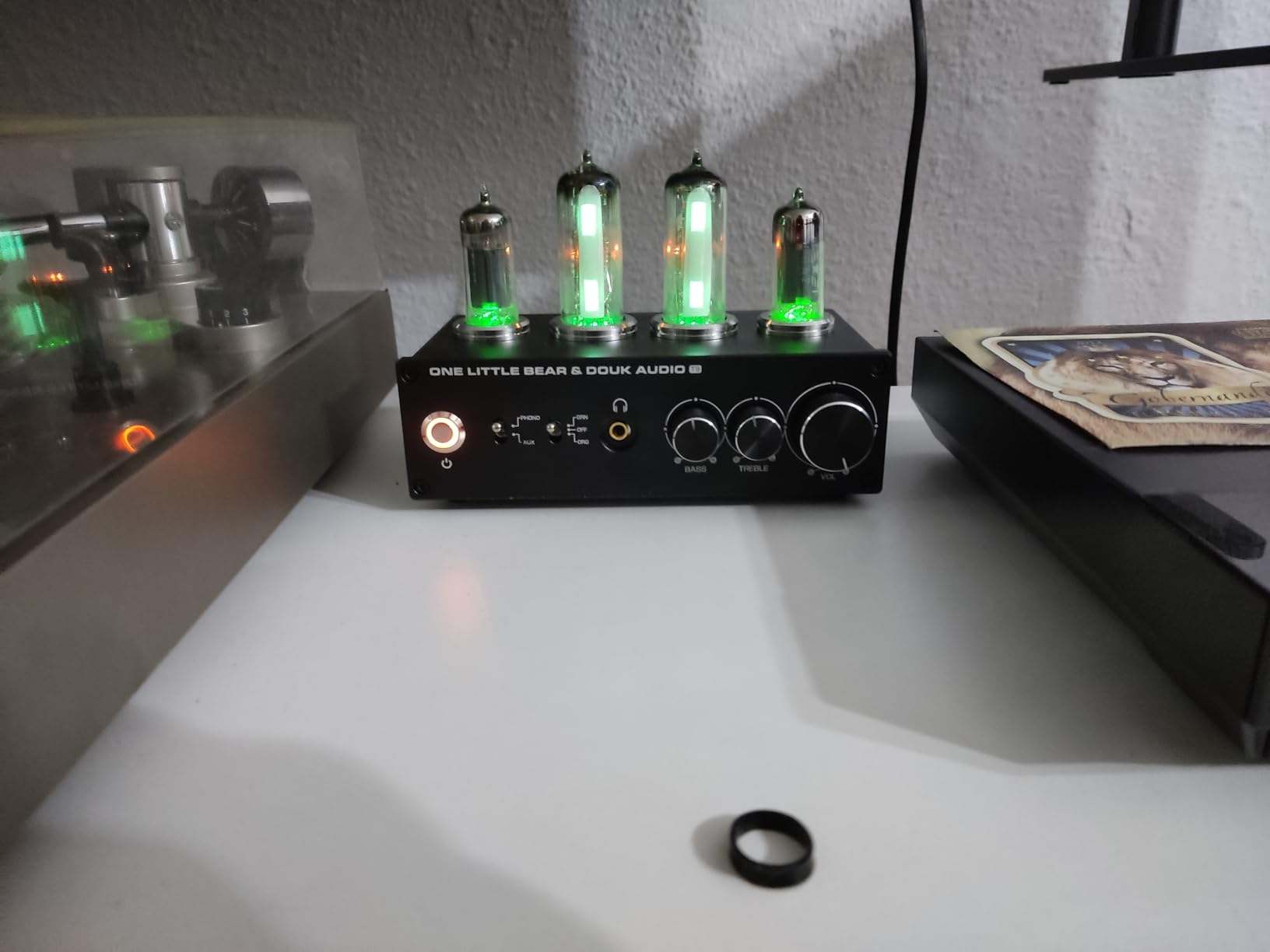
The T9 is the odd one out here, and that is its strength. The T9 accepts both moving magnet and moving coil cartridges, which is unusual in a tube phono stage, and it separates the signal path into four tubes: two 6E2 tubes driving a magic-eye level display, and two 6A2 tubes handling the tone. That split is why the sound is described as warm and full-bodied rather than thin.
The magic-eye display is not decoration. Watching the green glow close down as the music gets louder is a genuinely useful way to set levels without a meter, and it makes the box the centrepiece of a system rather than a black rectangle. The independent headphone amplifier drives 16 to 300 ohm headphones, so the box works as a headphone amp with real output power as well as a phono stage.
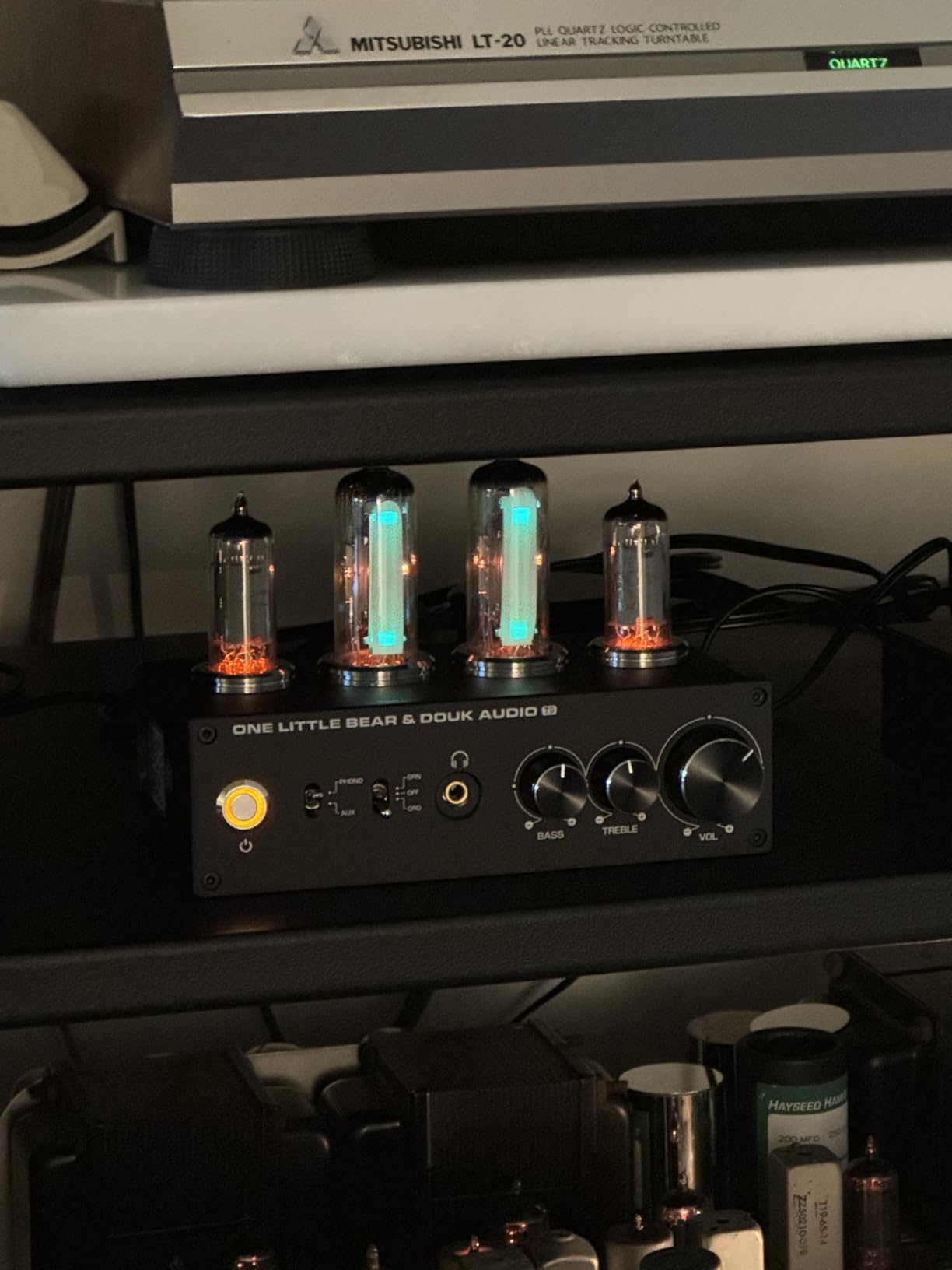
The pluggable sockets accept 6K4, EF93, 6BA6 and W727 among others, so there is a decent rolling menu. The CNC aluminum panel, gold-plated connectors and adjustable cold green or warm orange backlight make it look and feel like a piece of hi-fi. Tone and level adjustments take time to dial in for a given system, so give it an evening before judging it.
It weighs 0.96 kg, so plan shelf space accordingly. The RIAA curve and volume control are handled in the box, so you set cartridge level and playback level at the front of the chain rather than chasing volume on the amplifier.
Best For: Moving Coil Owners Who Want Colour
Most budget phono stages are MM only, so a moving coil user is usually pushed toward a solid-state unit for the extra gain. The T9 gives you both cartridge types with a tube voicing, which is a genuine gap filled. It also works well as a headphone amp on nights when the system is off.
Skip It If: Shelf Space Is Tight
This is not a mini preamp. The weight and footprint rule out a small shelf or a crowded AV rack, and buyers who only need warmth on line-level sources will get more of it from the Douk Audio P1. Verify your cartridge type before buying, because most turntables with a built-in stage output line level already.
8. Douk Audio P7 Phono Preamp – the Quietest Vinyl Path
Douk Audio P7 Phono Preamp: Vacuum Tube Turntable Preamplifier with Balanced XLR Output, High-Pass Filter, Bass & Treble Control, Bypass for MM Record Player, Amplifier, Speaker
PSVANE ECC83 tubes at 180V
True balanced XLR output
Switchable 20Hz high-pass filter
Bass and treble with bypass
Pros
- Very low noise from the balanced XLR output
- Genuine tube gain stage rather than decorative glow
- High-pass filter cleans up rumble
- Tone bypass for purer comparison
Cons
- Midrange is somewhat loose and may need correction
- 20 to 30 hours of tube burn-in before settling
- 12AU7 tubes can overheat the internal circuitry
The P7 is the one to look at if hiss is your main objection to tube preamps. Its true balanced XLR output is very quiet, and the switchable high-pass filter below 20Hz cuts subsonic rumble that most budget stages let through into the signal. On a turntable with a built-in phono stage you can bypass and get a purer path, which is a useful option to have.
The gain stage is real: PSVANE ECC83 tubes driven at 180V, with swappable sockets. That high operating voltage is why this box sounds more like a small power amplifier stage than a decorative glow, and owners consistently report that it transforms budget turntables. The bass, treble and bypass controls give you genuine room to correct a system rather than just adding warmth indiscriminately.
Two things temper the recommendation. Owners report that the midrange is somewhat loose and may need the controls or an equaliser to balance, and that 20 to 30 hours of burn-in are needed before it sounds its best. That is a real cost in patience for anyone excited on day one. Separately, rolling lower-current tubes such as 12AU7 can overheat the internal circuitry, so check compatibility before experimenting.
The copper-coloured chassis finish divides opinion, and it is more visible than the alternatives here. Beyond cosmetics, the build is solid at 1.56 pounds, and the balanced output makes this the natural choice if your power amplifier offers XLR inputs.
Best For: Vinyl Listeners Who Hate Hiss
This is the pick for a turntable owner who has already tried tubes and gone back because of noise. The balanced output and the subsonic filter address the two most common complaints directly, and the tone bypass lets you judge the correction honestly. Owners who compared it against much dearer stages were pleasantly surprised.
Skip It If: You Want Warmth Without Adjustment
The loose midrange means this unit wants a little work. If you want warmth that arrives fully formed with no controls, the AMPAPA A1 or the Douk Audio P1 will get you there faster. And if patience is in short supply, plan on a day of listening before the burn-in is complete.
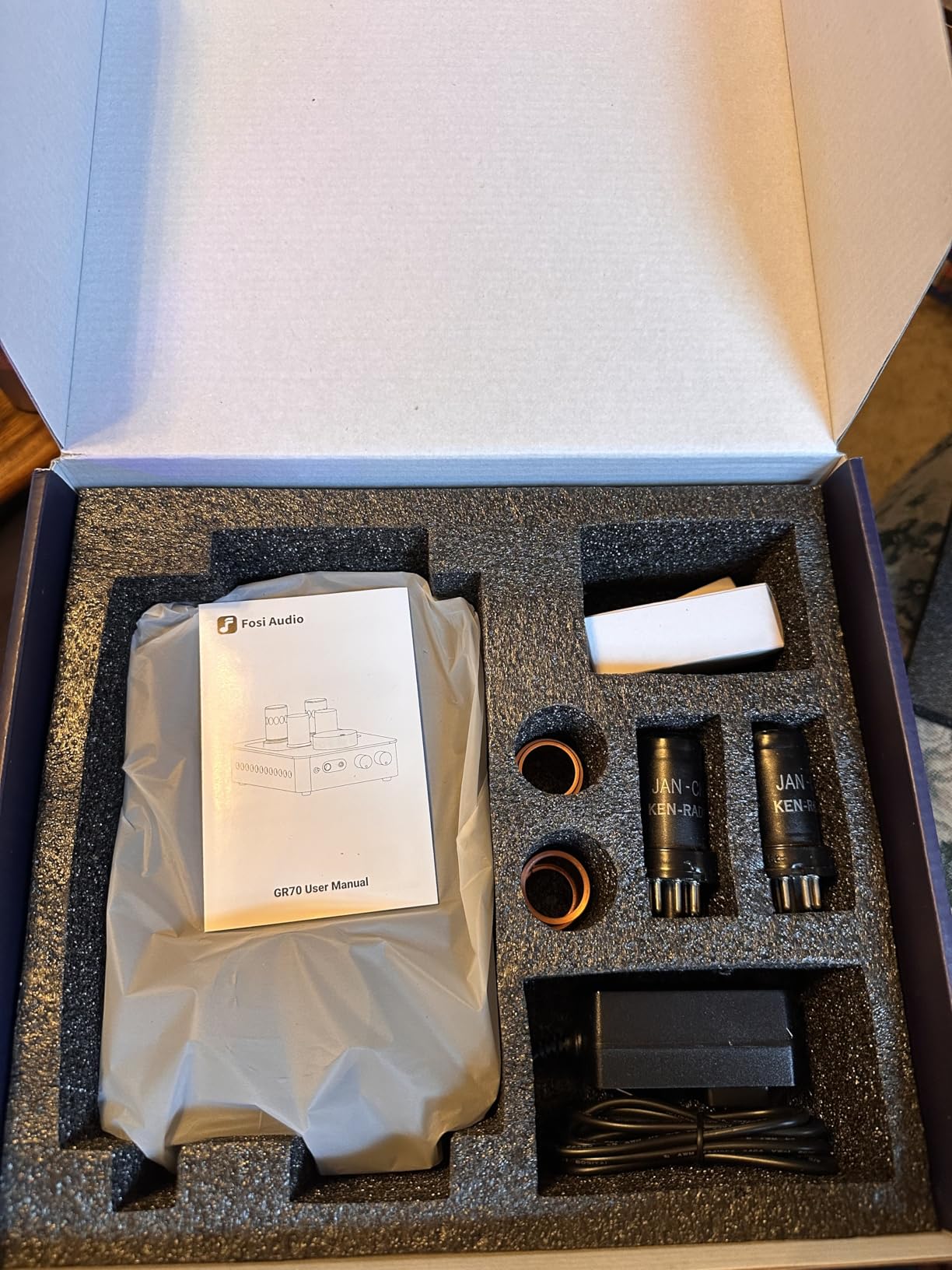
9. Fosi Audio GR70 Tube Headphone Amp and Preamp – Warmth for Ears
Fosi Audio GR70 Tube Headphone Amp Preamp, Authentic Tube-Amplification with Vacuum 5654W*2 & 6AC7*2, Mini HiFi Preamplifier for Home Audio, 3.5mm & 6.35mm Jacks Supporting 16-300 ohms Impedance
Two 5654W gain tubes and two 6AC7 output tubes
Up to 300mW headphone output
SNR 97dB or better
High and low impedance modes
Pros
- Genuinely tube-driven signal path
- Warm midrange and spacious soundstage
- Works as headphone amp and preamp
- Excellent milled aluminum build
Cons
- Picks up RF and electrical noise depending on placement
- Struggles with very demanding high-impedance headphones
- No balanced 4.4mm output
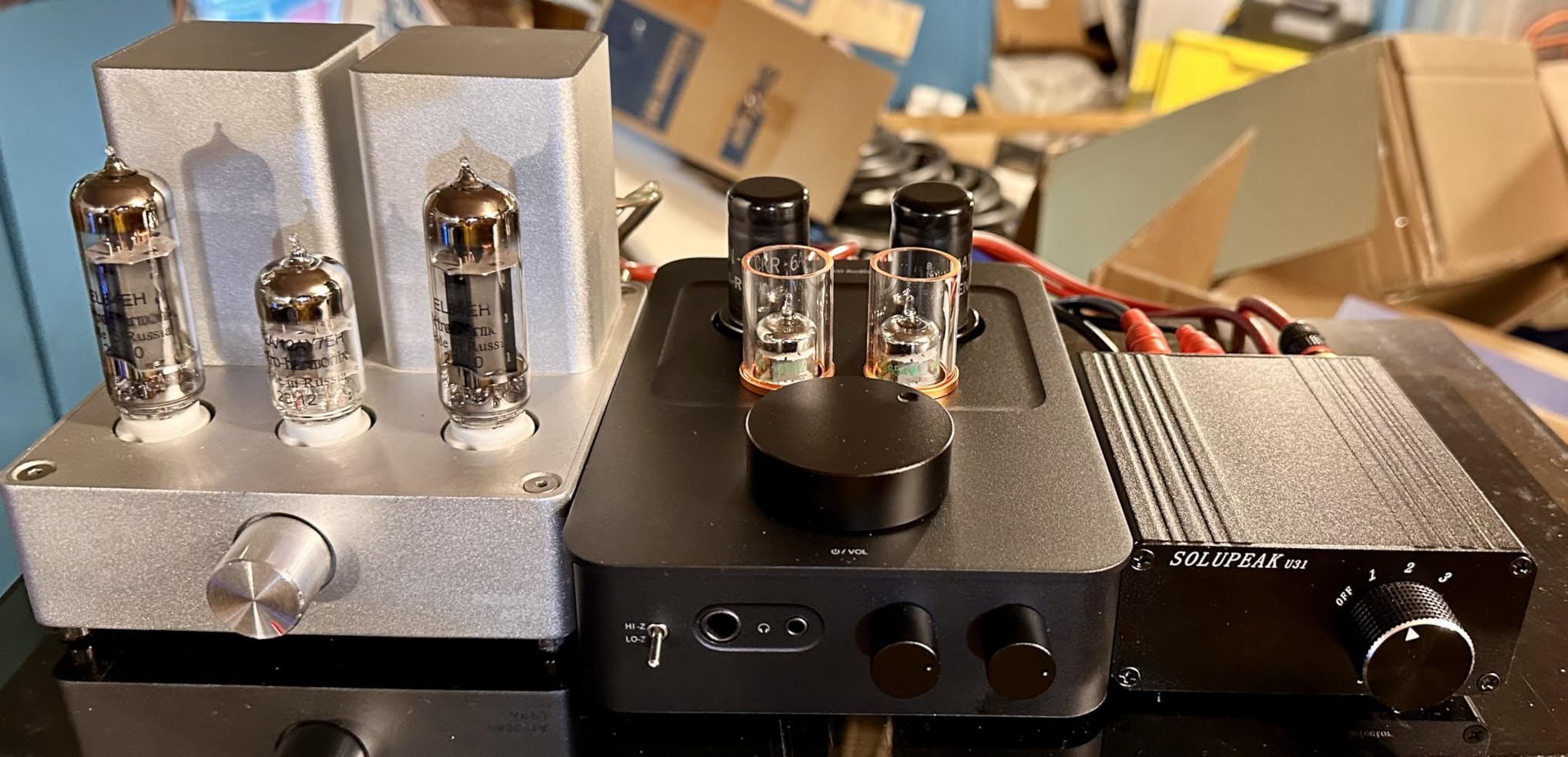
The GR70 is a two-stage tube headphone amplifier that also works as a preamp with RCA pass-through, and it is the only unit in this roundup built around 5654W and 6AC7 tubes rather than the more common 12AX7 or JAN families. That choice produces a warm midrange and a spacious soundstage with, in owners’ words, no muddiness and no loss of resolution.
Output reaches 300mW with 1.2V at the RCA output, and a high and low impedance mode switch covers headphones from 16 to 300 ohm. Front 3.5mm and 6.35mm jacks mean you can keep your normal cable plugged in. The CNC machined aluminum alloy body has the weight and feel of a far more expensive unit, and tube rolling with NOS 5654W and 6AC7 alternatives is straightforward.
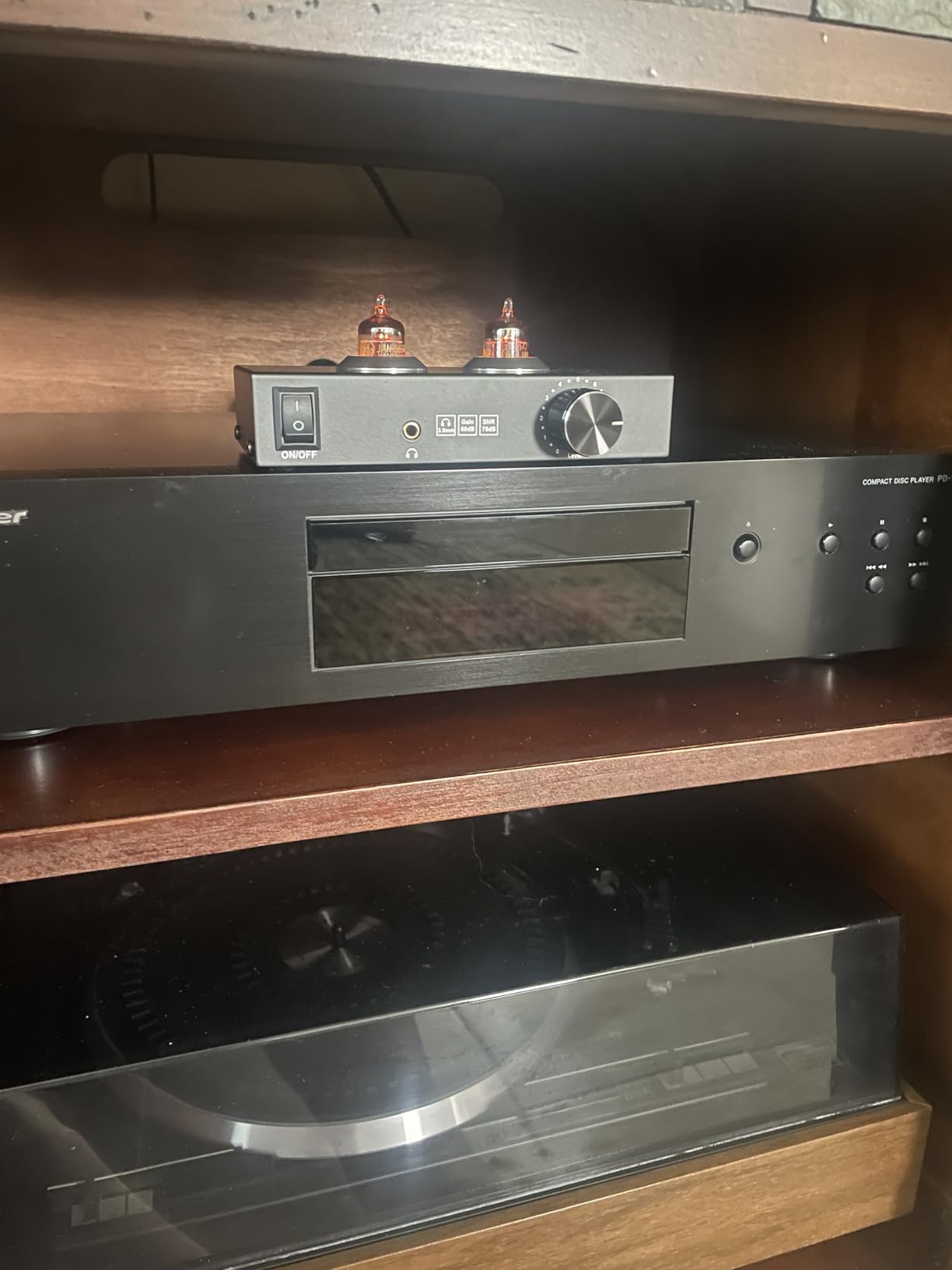
The honest catch is noise sensitivity, and it is not subtle. Owners report the circuit picking up ambient electrical noise and radio-frequency interference depending on placement and nearby power supplies, which is the trade-off of a pure tube signal path. A forum user described it as tuned very warm with no loss, but placement away from mains transformers matters more here than with any other unit in this list.
Very demanding high-impedance headphones will run out of headroom at high volume, and there is no balanced 4.4mm output. Some units also showed a long, noisy warm-up with audible switching tones. Measured signal-to-noise ratio of 97dB is the lowest of the figures quoted in this roundup, which matches the noise complaints.
Best For: Late-Night Headphone Listening
If your warm listening happens through headphones rather than speakers, this is the right box. It softens the harsh edge of poorly engineered digital sources, which is exactly what the forums report it doing, and the volume control makes it a complete small system on its own.
Skip It If: Your System Is Noisy to Begin With
Do not place it next to a computer power supply or a dimmer switch, or you will hear interference that no amount of tube rolling will fix. It is also the wrong choice for balanced headphones or for anyone who needs a very quiet floor in a shared room.
10. PROZOR GE5654 Tube Phono Preamp – the Cheapest Way Into Tubes
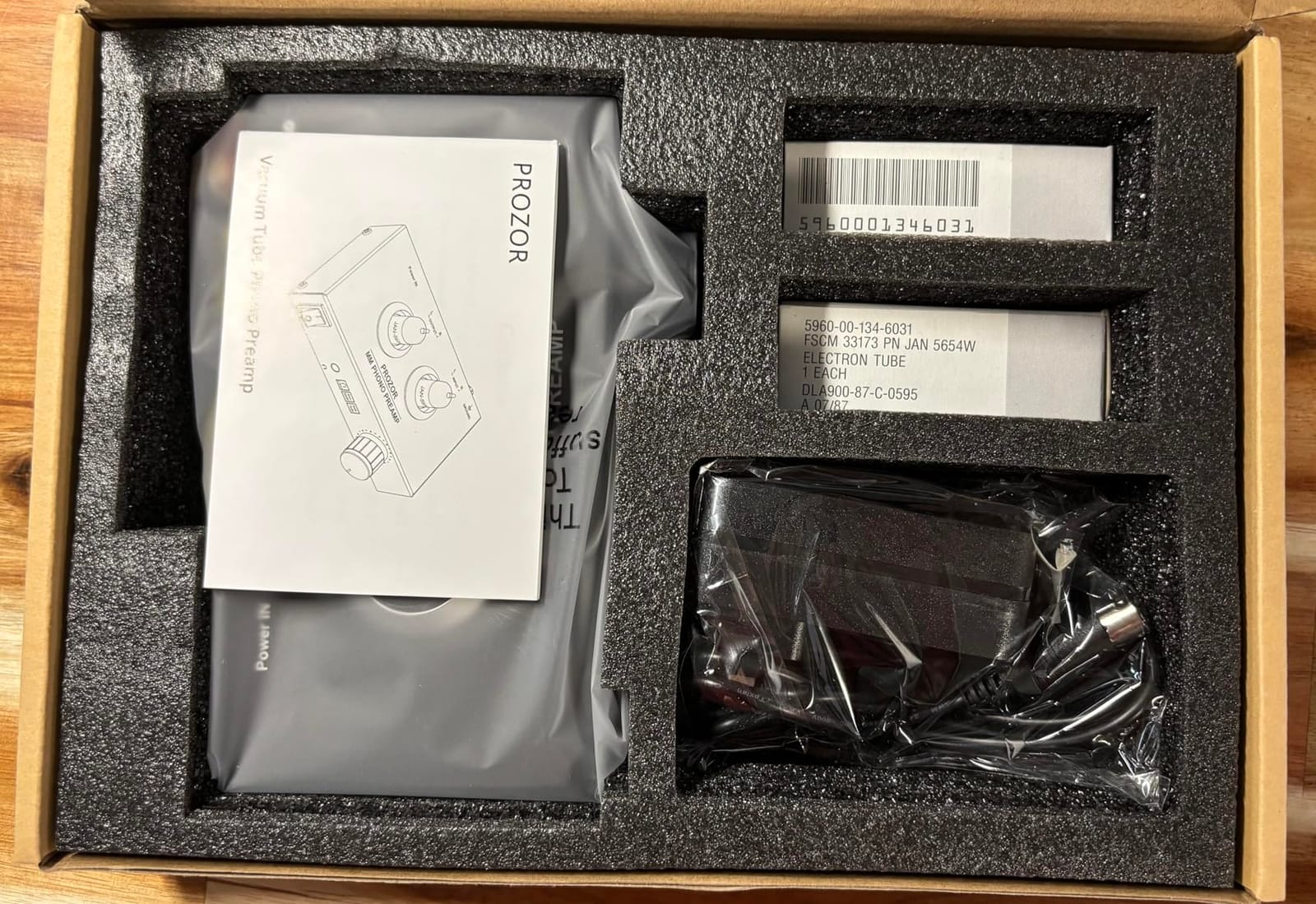
PROZOR Vacuum Tube Phono Preamp, JAN GE5654 Tube, for MM Turntable Phonograph & Record Player, Mini Headphone Amp for Home Audio Systems Stereo Amplifier, with 15V Power Adapter
JAN GE5654 vacuum tube stage
MM turntable input with grounding post
Precision volume control
3.5mm headphone output
Pros
- Very low cost entry into tube sound
- Adds warmth and depth to MM turntables
- Volume control doubles as a headphone amp
- Works with older grounding-wire turntables
Cons
- Power adapter interferes with AM and FM radio
- Can briefly oscillate on cold start
- Tube pins are hard to align in the sockets
The PROZOR is the cheapest route into tube sound on this list, and for a first experiment with an entry-level turntable it does the job. Owners report that it makes budget vinyl sound fuller and warmer with no hum, which for a first step is a more than acceptable outcome. The dedicated precision volume control is genuinely useful, and adequate gain is available even for low-output cartridges such as a Shure V15 type II.
Construction is a compact metal shell with gold-plated RCA inputs and outputs, a rear grounding post, and a 15V adapter in the box. The volume control turns the unit into a small headphone amp for late-night listening, which is a nice bonus given how small it is. A silver tube cover and visible glow make it look more considered than a first tube purchase needs to be.
Now the compromises. The power supply interferes with AM and FM radio reception, which owners mention often enough to plan around. The unit can briefly oscillate when powered from cold until it is switched off and on again, and the tube pins are hard to align in the sockets. Several minutes of warm-up are needed before the sound settles.
It can also buzz through mains interference if driven hard, so treat it as a bedroom or desktop unit rather than part of a main system near audio mains. None of that makes it a bad first tube preamp; it makes it a first tube preamp.
Best For: Trying Tubes Before Spending Real Money
If you are not sure whether tube warmth suits your taste, this is the least risky way to find out. It will improve a budget turntable immediately, and if you decide you want more later, moving on costs you little.
Skip It If: Radio Reception or a Main System Matters
The adapter noise is a real limitation for anyone who listens to broadcast radio in the same room. For a main living-room system, choose the Fosi Audio Box X4 or the Douk Audio P7 instead, both of which are quieter and better finished.
How to Choose a Tube Preamp for Warmth
Warmth is the goal, but the differences that determine how warm a unit will sound come down to a handful of specific things. Here is the order we would work through them.
Check the tube operating voltage. Several units in this roundup run their tube stage at 54V or 180V rather than the low voltages used by cheaper designs. Higher voltage puts the tubes in the region of their curve where they produce real harmonic content, and that is the difference between a tube that colours the sound and one that is basically a glowing ornament. The Douk P7 and AIYIMA T20 both specify 180V for this reason.
Decide between a line preamp and a phono stage. These are different products and the search results mix them constantly. A line preamp takes an already-level signal from a DAC, streamer or CD player. A phono stage takes the tiny cartridge output from a turntable, applies the RIAA curve, and only then amplifies it. A studio mic preamp is a third category entirely, built for microphones and not relevant to a home listening chain. If you own a turntable with a built-in phono stage, you need a line preamp, not a phono preamp.
Look for swappable tubes. Every unit here accepts interchangeable tubes, but the range differs. Units with sockets for 6K4, EF93, 6BA6 or W727 give you a wide menu. Units built around a specific 180V ECC83 circuit want a matched pair of those tubes and nothing else. The first kind lets you tune the sound; the second kind limits you to a narrower but better-behaved range.
Decide how much control you need. Bass and treble controls with a bypass or centre detent let you trim a system that is too bright. A preamp with no tone controls forces you to change cables or tubes instead. For most listeners adding warmth to a digital chain, tone controls are worth more than balanced outputs.
Be honest about hiss tolerance. Tube hiss at low listening volumes is the most common complaint in every forum thread about this category. If you listen late at night in a quiet room, prioritise a balanced output and a high-pass filter, which is why the Douk P7 ranks as it does. If you listen at moderate levels, the entry-level models are fine.
Budget for tube replacements. Small preamp tubes such as JAN 5654 and 6A2 are inexpensive and easy to fit, and you may enjoy the rolling as much as the change in sound. Over five years, treat a handful of tubes as part of the cost of ownership rather than a surprise. Automatic biasing matters more on power output tubes than on the small signal tubes used here, so it is not a priority in this price range.
Tube Rolling 101: Which Tubes Deliver the Most Warmth
Tube rolling is simply swapping one set of tubes for another and listening. On a swappable design it takes a few minutes, and it is the cheapest way to change the character of a preamp you already own. Warmth generally increases with lower-frequency emphasis and higher gain structure.
12AX7 / ECC83 is the default small-signal tube and the most common in preamps, including the AIYIMA T20 and Douk P7. It is mid-forward and moderately warm, and it is the safe first choice when you do not know what you are doing. Related European and Russian types such as 6N1P sit in the same family with slightly different voicing.
12AU7 / ECC82 is a lower-gain sibling of the 12AX7 with a smoother, less forward top end. It is the most common answer to the question of which tube makes a preamp warmer, and it works well in voltage-feedback circuits. Check your design first: the Douk P7 owners report that rolling 12AU7 tubes there can overheat the internal circuitry.
6SN7 / 6E2 / 6A2 are the classic warm triodes. The 6SN7 family is associated with rich, full midrange and is the traditional choice for a warm preamp input stage. The Douk T9 uses 6E2 tubes for its level display and 6A2 tubes for tone, which is why it sounds as full-bodied as it does. The Fosi Box X4 accepts 6K4 and 6J1 tubes, which sit in the same general family of small-signal triodes.
5654 and 6AC7 are small military-derived pentodes found in the Fosi Audio GR70 and the AMPAPA A1. The 5654 has a reputation for a smooth, slightly rolled top end that suits late listening, and NOS examples are widely recommended by enthusiasts who want authentic warmth without buying a vintage preamp.
EL34 belongs to the power stage rather than the signal path. You will find it in push-pull output sections rather than as a preamp tube, and while the power amp is usually the louder voice in the warmth debate, it is worth asking whether your amplifier already delivers plenty of it before adding more.
Matching Your Preamp to the Rest of Your System
Adding warmth to a system that is already warm is the most common regret in this category, and it is entirely avoidable. Think of a preamp as adding colour to a painting. A cold amplifier needs a warm hand; a warm one needs a neutral or transparent hand, or the midrange turns to wool.
Pair a warm tube preamp with a solid-state or Class D amplifier that measures flat and neutral, and you get the best of both: the amplifier stays fast and quiet while the preamp supplies the texture. This is the pairing most of these units are built for, and it is the reason a mid-priced tube preamp often sounds better in front of an inexpensive amplifier than a matching expensive amplifier does on its own.
Pairing two warm sources is where the trouble starts. Stack a heavily voiced preamp in front of a tube power amplifier already running EL34s and you will hear a bloated, congested midrange that people describe as woolly, muddy or simply worse. If your amplifier is warm, buy a transparent preamp instead, and use the tube preamp on a second system.
Two practical checks before you commit. Confirm that the preamp’s output impedance is low enough for your power amplifier’s input, since some of these compact designs drive a higher impedance than a solid-state amp expects. And audition at the volume you actually listen at, because a preamp that sounds warm at a whisper can sound congested when you turn it up.
Frequently Asked Questions
What is the best tube preamp for audiophiles?
For warmth combined with build quality and tube flexibility, the Douk Audio P1 is the best overall choice in this roundup. It pairs a JAN5725 tube stage with Bluetooth and a USB DAC, adds switchable bass and treble controls, and has the largest body of owner feedback here. Audiophiles with a balanced system should look at the AIYIMA T20 for its 180V ECC83 core and 112dB or better signal-to-noise ratio.
Do tube preamps make a difference?
Yes, in tone rather than accuracy. A tube stage generates mostly even-order harmonic distortion and compresses dynamics slightly as level rises, which your ear reads as warmth, body and a softer treble edge. It does not improve measured accuracy, and a tube preamp is a colour choice rather than a fidelity upgrade. It also presents a higher output impedance, which can add perceived soundstage depth.
What are the best tubes for preamps?
The most common warm choices for preamps are 12AX7 and ECC83 for a balanced, slightly forward midrange; 12AU7 and ECC82 for a smoother top end; and the 6SN7, 6E2 and 6A2 triode family for the richest, fullest midrange. Small pentodes such as 5654 and 6AC7 are prized for late listening. Always check your design’s required tube type and operating voltage before rolling.
Which vintage tube preamp is considered the best?
Classics such as the McIntosh C8 and the Luxman CL-38uC are cited repeatedly in enthusiast best-of lists, and vintage units loaded with NOS British valves from Mullard, Brimar and Genelex are often recommended as a cheaper route to authentic warmth. Vintage models carry the usual risk: untested circuitry, unknown tube condition and no warranty, so factor in the cost of a full service and a tube set.
What is the best studio tube preamp?
Studio tube preamps such as the Universal Audio SOLO/610 are built for microphones rather than home listening, with high gain, phantom power and a different noise floor. For a hi-fi system chasing warm sound, they are the wrong category entirely. Choose a line-level tube preamp such as the Douk Audio P1, or a phono stage such as the Douk T9 if your source is a turntable.
What is considered the best preamplifier of all time?
There is no consensus answer, and the honest reply is that the best preamplifier is the one that suits your source, your amplifier and your taste. Reference-class models are regularly named in enthusiast forums, where the Cary Audio SLP-05 is singled out as a standout in its class, described as warm without being coloured. Value for that tone comes far cheaper in the units reviewed here.
What is the best budget tube preamplifier?
Every unit in this roundup sits well inside a four-figure budget, and the strongest three are the Douk Audio P1 for overall warmth and features, the Fosi Audio P3 for its high tube operating voltage and strong measured performance, and the AMPAPA A1 for phono, line and headphone duties in one chassis. For vinyl specifically, the Douk T9 handles both MM and MC cartridges, which is rare at this level.
What are the best preamps in 2026?
For warm hi-fi listening, the best preamps in 2026 are the Douk Audio P1, Fosi Audio P3, AMPAPA A1, AIYIMA T20, Douk T9, Douk P7 and Fosi Audio GR70 from this roundup. Outside tube designs, a modern solid-state preamp remains the better buy for measurement accuracy and remote-controlled convenience. Choose a tube preamp specifically because you want added warmth and colour.
Final Verdict: Which Tube Preamp Should You Buy
If you want one recommendation for a cold or clinical system, buy the Douk Audio P1. It produced the most consistently warm and musical result in this roundup, it has the largest body of owner feedback of any unit here, and the tone controls let you dial the warmth to taste rather than living with a fixed voicing.
Match your pick to your source. Vinyl players with a moving magnet cartridge will get the most from the Douk T9 or the Fosi Audio Box X4, and a moving coil owner should look at the T9 for its MM and MC support. Headphone listeners should try the Fosi Audio GR70, and anyone with a balanced power amplifier who wants tubes in a quiet, well-measured path should read the AIYIMA T20 section first.
Do one thing before you order: check what your amplifier already sounds like. If it is warm, pick a preamp with tone controls and start them below centre, or choose something more transparent. Paired well, any of these will give you a warm tube preamp without tipping the system into mush. Last updated October 2026.