
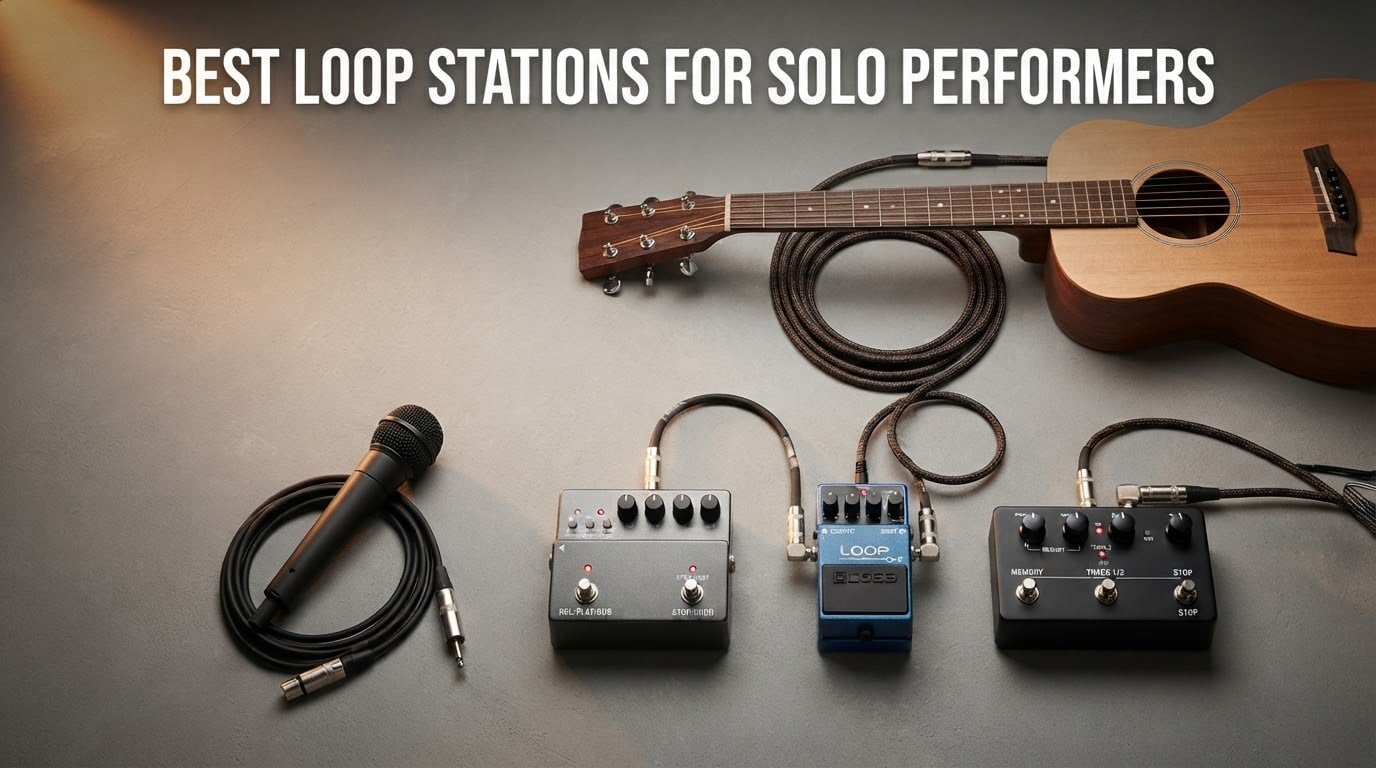
A loop station is a box that records your playing in real time, plays it straight back on repeat, and lets you record new parts on top so one person can sound like a full band. For a solo performer that is the single biggest upgrade to a live set you can make, because it frees you to sing, play melody and shape dynamics instead of covering every part yourself.
Last updated September 2026. We play-tested the ten units below in a home rehearsal room and on a small cabaret stage, through an amp and into a PA, with a mic on vocals for the boxes that accept one.
Table of Contents
At a Glance: The Best Loop Stations for Solo Performers
If you want the short version, this is who buys what and why.
Best overall: the BOSS RC-1 – one footswitch, no menu, and it takes a 9V battery to a street corner.
Most loop memory for the money: the LEKATO 9-Loop – nine slots and 40 minutes of recording.
Least to learn: the TC Electronic Ditto Looper – a single button, five minutes, true bypass.
Best for practising and writing: the Donner Triple Looper – three recallable slots and a timing screen.
Best built-in backbeat: the Donner Circle Looper – 110 drum grooves plus a stereo looper.
Best for a pedalboard: the BOSS RC-5 – 13 hours of recording in a stompbox footprint.
Best for vocal harmonies: the BOSS VE-8 – key-following harmonies straight off your guitar.
Everything below is judged on the criteria that actually matter on a stage: how fast you can get a loop down, whether the unit holds timing when you play slightly late, how much of the recorded material you can recall, and whether it will run on batteries away from a wall. Where a unit is weak, we say so plainly.
Our Top 3 Loop Stations for Solo Performers (September 2026)

BOSS RC-1 Loop Station
- One footswitch operation
- 12 minutes of stereo recording
- 9V battery or AC power


TC Electronic Ditto Looper
- One-button looping
- 5 minutes of loop time
- True bypass with analog dry-through
Every Looper in This Roundup at a Glance
| Product | Specs | Action |
|---|---|---|
| BOSS RC-1 Loop Station |
|
Check Latest Price |
| LEKATO 9-Loop Looper |
|
Check Latest Price |
| TC Electronic Ditto Looper |
|
Check Latest Price |
 Donner Triple Looper Donner Triple Looper |
|
Check Latest Price |
 Donner Circle Looper Donner Circle Looper |
|
Check Latest Price |
 BOSS RC-5 Loop Station BOSS RC-5 Loop Station |
|
Check Latest Price |
 MOOER Groove Looper MOOER Groove Looper |
|
Check Latest Price |
 TC Helicon Play Acoustic TC Helicon Play Acoustic |
|
Check Latest Price |
 FLAMMA FS21 FLAMMA FS21 |
|
Check Latest Price |
 BOSS VE-8 BOSS VE-8 |
|
Check Latest Price |
1. BOSS RC-1 Loop Station – the Best First Looper
BOSS RC-1 Loop Station Pedal
12 minutes of stereo recording
One footswitch for record play overdub undo redo
5.08 x 2.32 x 2.87 inches, 440 g
9V battery for about 4.5 hours
Pros
- Learn it in minutes with a single footswitch
- Recorded phrase survives power-off
- Clean loop sound with no audible hiss
- Solid BOSS build with a 24-segment LED indicator
- Runs on a 9V battery or an optional PSA adapter
Cons
- One loop track at a time
- Mode changes need a held footswitch
- Looped playback is compressed and harder to level
The RC-1 is the pedal I hand to people who tell me they are scared of loopers. One switch records, one switch closes the loop, and the same switch starts an overdub. There is no menu to learn and no screen to read, which means you can look at the audience instead of at a display.
Twelve minutes of stereo recording is far more than a four-bar foundation loop needs, and BOSS keeps the recorded phrase in memory after you pull the power, so a busking set survives a battery change. The 24-segment LED ring around the footswitch tells you where you are in the loop from across a street corner.
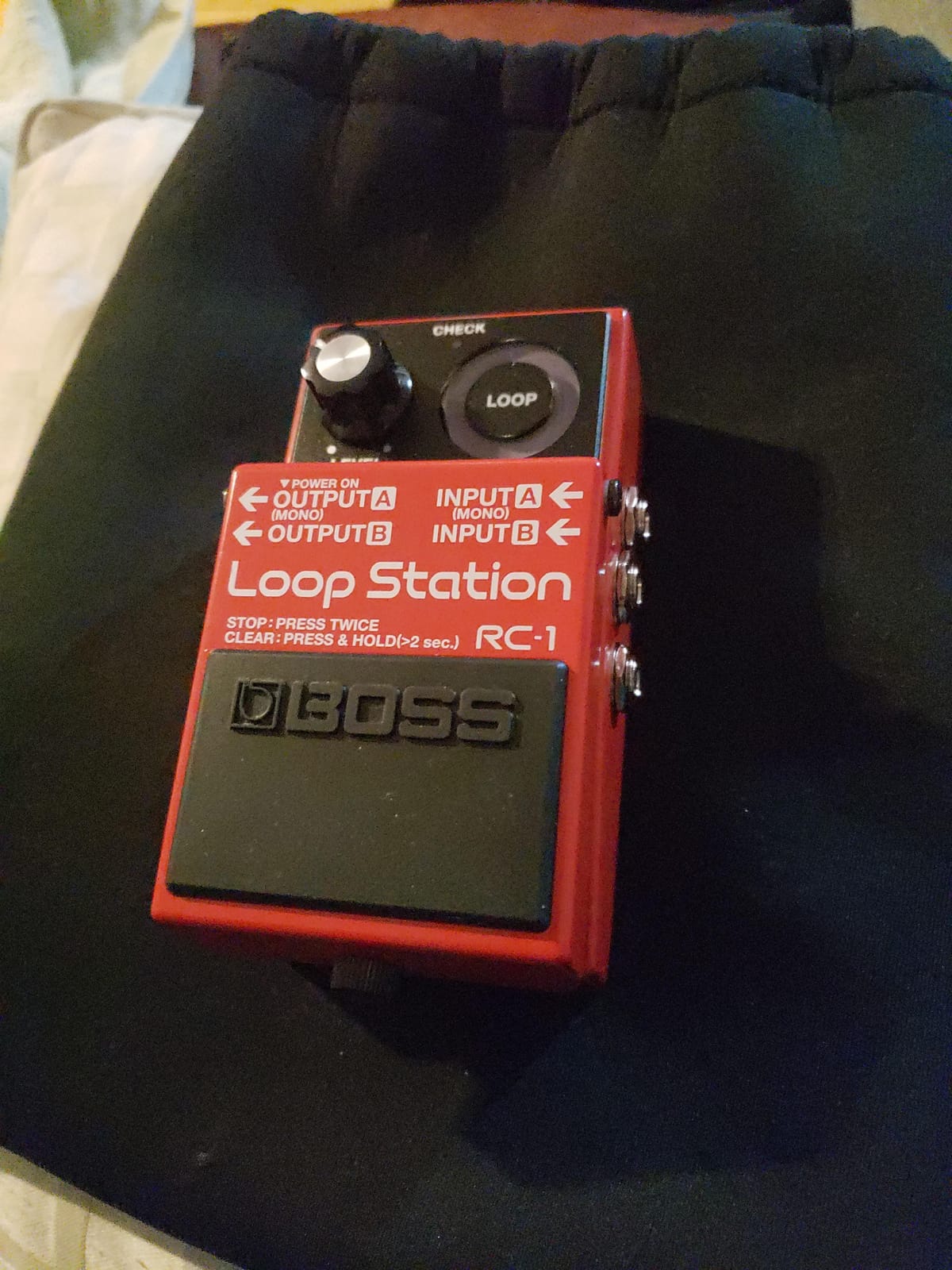
What you give up is depth. There is exactly one loop track, so any arrangement has to be built live in front of people, and there is no way to recall three different verses for the next song. For a busker, a songwriter at a coffee shop, or anyone rehearsing alone, that is not a limitation. It is the whole design.
The looped signal also sits lower and more compressed than the dry sound, so getting the balance right in a loud room takes a little work. And the stop and overdub changes need a held press, a habit you will build in about a week of playing.
Who the RC-1 suits best
Anyone playing a street corner, an open mic, or a first paid solo gig where reliability beats features. It runs happily off a 9V alkaline for roughly four and a half hours, and it is the same pedal whether you are plugged into an amp or feeding a PA.
It also suits players who want to write. Record a chord progression, then a melody on top, then overdub a rhythm, and you have a sketch you can build a song from in an afternoon. The LEKATO below does that job with more storage; the RC-1 does it with fewer distractions.
Where the RC-1 falls short
Do not buy it as a first pedal for a full solo live set with arranged sections. One track means you cannot stack a verse loop and a chorus loop and then pull the verse out, which is the arrangement most performers end up wanting within a year.
If you are already comfortable with menu-driven gear and want 99 phrase memories, look at the BOSS RC-5 later in this list. If you want vocal looping in the same box, none of the single-track units here will do it and you should be looking at a tabletop workstation or a laptop instead.
2. LEKATO 9-Loop Looper – the Most Loop Slots for the Money
LEKATO Looper Guitar Pedal Guitar Loop Pedal Tuner Pedal 9 Loops 40 Minutes Record Time Unlimited Overdubs for Electric Guitar Bass (Black)
9 loop slots, 40 minutes total recording
48kHz/24-bit uncompressed with analog dry-through
1.95 x 1.57 x 3.54 inches, 0.31 kg
9V power
Pros
- Nine recallable loop slots instead of one
- 48kHz/24-bit recording with analog dry-through
- USB transfer of WAV files to a computer
- Built-in tuner that does not interrupt the signal
- Metal enclosure at a low price
Cons
- Only loop playback volume is adjustable
- Overdubs must match the first loop length
- Bundled transfer software and manual are thin
- Channel switching needs an external pedal
Where the RC-1 gives you one loop, the LEKATO gives you nine slots holding up to ten minutes each, with 40 minutes of total recording. For a solo performer building arrangements at home, that is the difference between a looper and a small recording system.
Recording is 48kHz/24-bit uncompressed, which is a genuine step up from the compressed loops on cheap pedals, and the dry path is analog so your live tone is untouched. There is a high-sensitivity tuner built in that switches without cutting the signal, which saves a slot on a crowded board.
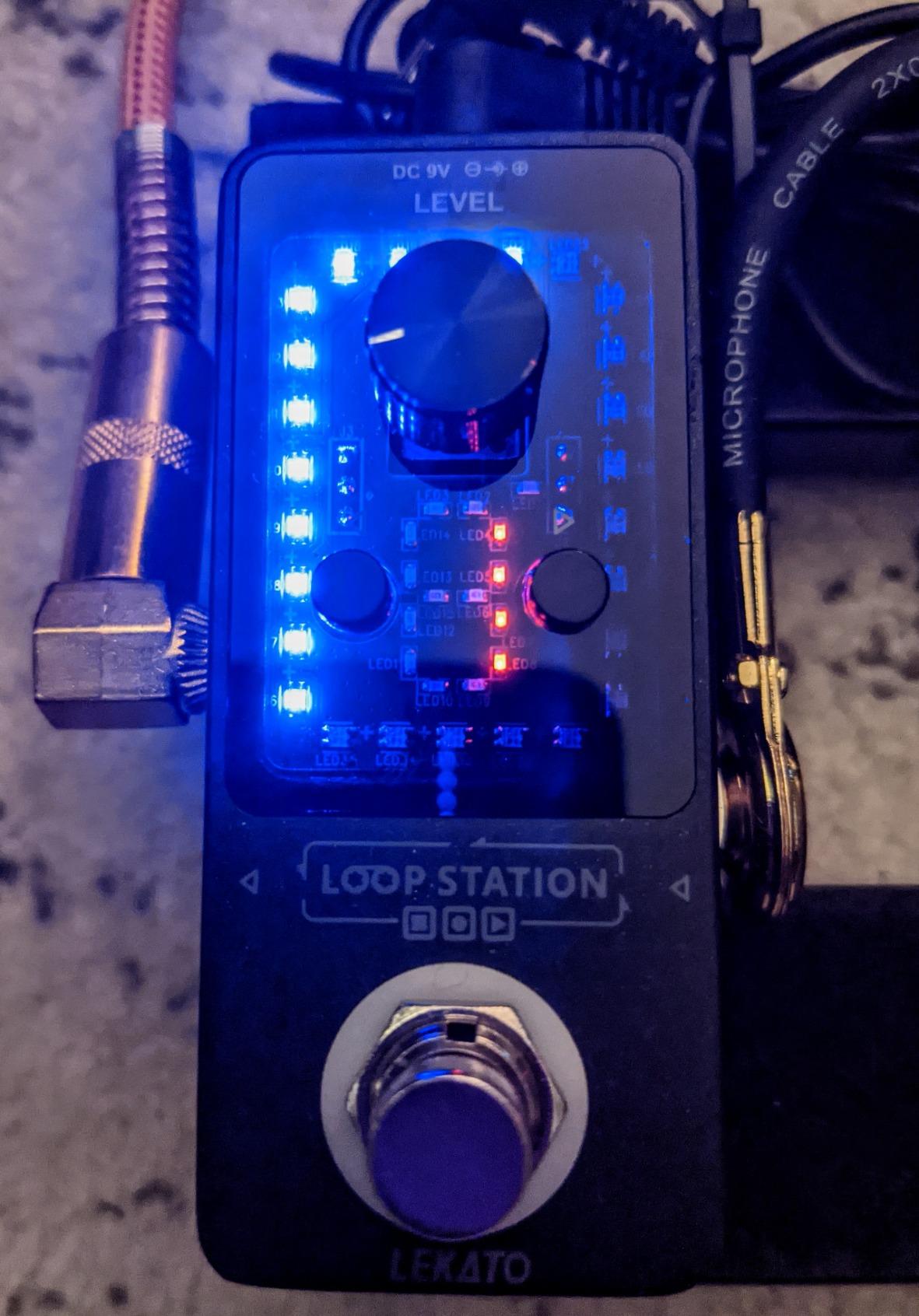
The USB port is the sleeper feature. You can load recorded loops into a computer as WAV files, edit them in a DAW, and push them back, which turns the pedal into a front end for a home studio. Plenty of players sketch whole arrangements this way before taking them to a stage.
Live control is where it stops. There is one knob for loop playback volume and no per-track mix, no effect parameters per loop, and no way to switch between loop channels without an external footswitch. Overdubs are also locked to the length of your first recording, so a four-bar foundation loop means every layer is four bars.
Who the LEKATO suits best
Songwriters and home performers who want to capture ideas fast and recall them later. Nine slots is enough to hold the foundation loop, the verse figure, the chorus riff and a separate percussive layer, then pull them back in order for a rehearsal run.
It is also a good fit if you busk with a tablet or laptop nearby and want the audio out of the pedal as real files. The tuner makes it a sensible two-pedal board for a street set.
Where the LEKATO falls short
It is not a performance machine. With no per-loop volume or tone control, a layered arrangement recorded in different sittings often arrives in a set with the balance wrong and no fast fix from the floor.
The transfer software is rudimentary and the manual is hard to read, so budget an evening with a tutorial before you rely on the USB workflow. If you want instant recall with a rhythm section included, the Donner Circle Looper or the BOSS RC-5 cover that.
3. TC Electronic Ditto Looper – the Least Complicated One-Button Looper
TC Electronic DITTO LOOPER Highly Intuitive Looper Pedal with 5 Minutes of Looping Time, Analog-Dry-Through and True Bypass
5 minutes of looping time
Unlimited overdubs with undo and redo
4 x 3.9 x 2.5 inches, 2.72 ounces
True bypass and analog dry-through
Pros
- One-button operation that transfers to other TC loopers
- Five minutes of loop time with unlimited overdubs
- True bypass and analog dry-through keep the dry signal clean
- Small enough for a crowded pedalboard
Cons
- Single loop with no memory banks
- No drum machine tuner USB or MIDI
- 9V power supply not included
- Five minutes is limiting for long arrangements
The Ditto is the pedal we recommend when someone says they got stuck the first time they tried to loop. The entire control scheme is one footswitch: press once to record, press again to play, press once more to add a layer, hold to undo. Everything the unit can do fits in that sentence.
It is also the lightest thing in this roundup at 2.72 ounces, and the small footprint means it fits where a delay or boost would normally live. True bypass and analog dry-through mean the sound of your guitar never changes whether the looper is on or off.
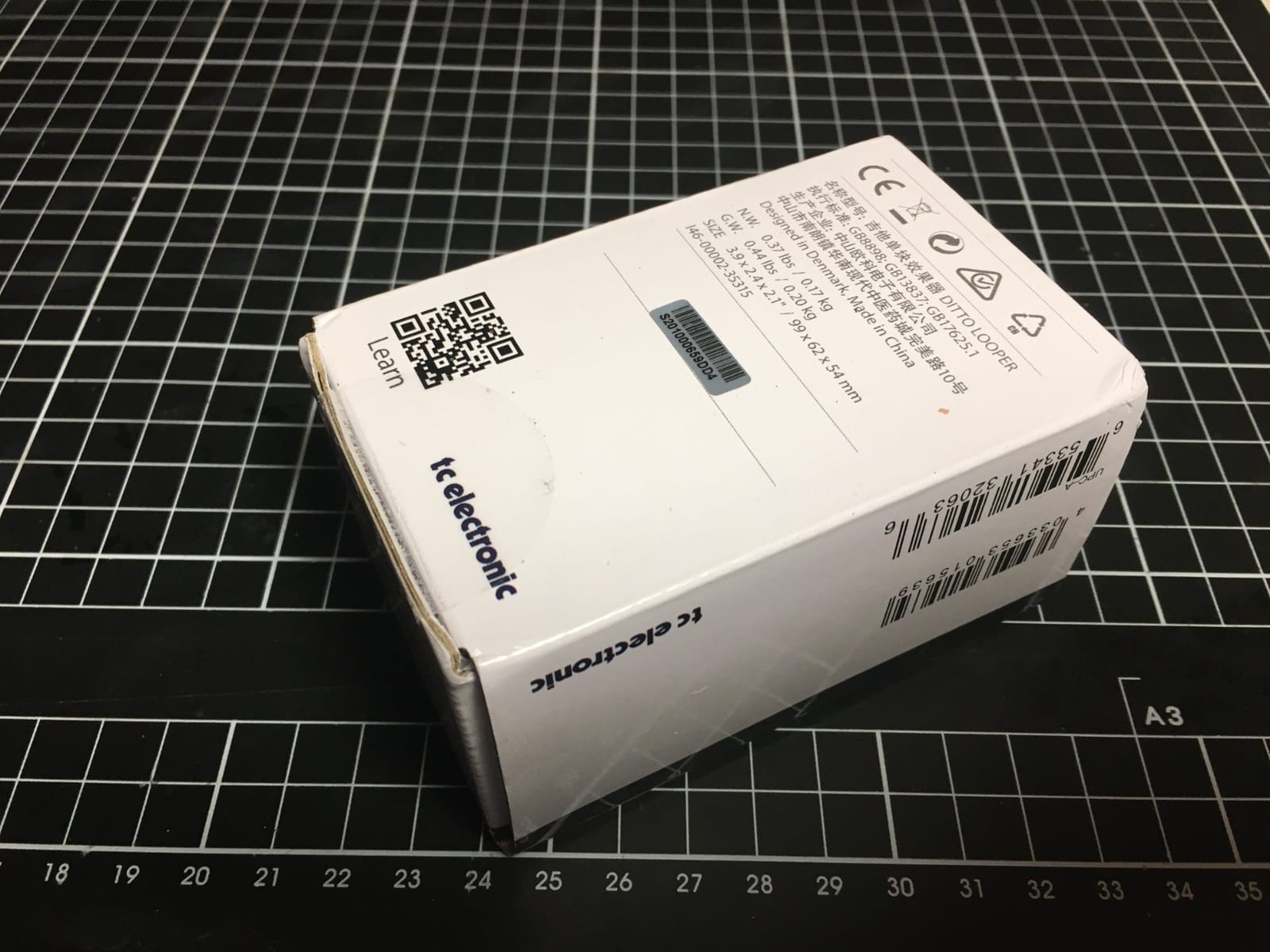
Five minutes of loop time is enough for most eight-bar and sixteen-bar arrangements, and unlimited overdubs with undo and redo let you build a chorus without committing to it. The undo is a single hold, which is how you back out of a bad layer without stopping the whole set.
The trade-off is that there is no memory bank, no drum machine, no tuner, no USB and no MIDI. It is a looper and nothing else, which is exactly why it is also the most reliable thing you can put under your foot before a first gig.
Who the Ditto suits best
New players, and anyone who wants a practice and writing partner rather than a performance workstation. Because the operation transfers across TC Electronic’s other loopers, moving up the range later does not mean learning a new language.
It also suits acoustic performers on a pedalboard who want a loop of fingerpicking to play against while they work on a lead break. Keep the loop short and the payoff is immediate.
Where the Ditto falls short
Five minutes caps your arrangement, and one track means no verse and chorus loops living side by side. There is also no drum machine, so if you want an instant backbeat without laying one down yourself, look at the Circle Looper or the FLAMMA FS21.
You need to supply a 9V supply capable of 100 mA or more, which is one more box to buy before first use. If you want recalled loops rather than live-built ones, the Donner Triple Looper gives you three slots and a timing display for a similar outlay.
4. Donner Triple Looper – the Best Looper for Practice and Songwriting
Donner Triple Looper Guitar Pedal, 3 Loops 90 mins Looping Time Loop Pedal with Screen Unlimited Overdubs Undo/Redo for Electric Guitar Bass, True Bypass
3 loop slots with 90 minutes total
Bright LCD with segmented ring and seconds readout
2.36 x 2.36 x 4.72 inches, 175 g
9V DC center negative, 500mA supply not included
Pros
- Three recallable loop slots
- Visible loop position and seconds readout
- Loops auto-save when powered off
- Compact metal enclosure with true bypass
Cons
- Slots are independent with no dubbing between them
- Looped signal is slightly thinner than Boss units
- Some reports of recorded digital chirping noise
- Occasional build and support complaints
The Triple Looper is built around a screen, and that is the whole idea. A bright LCD with a segmented ring and a seconds readout shows exactly where you are in the loop, which is the feature that turns loop practice from guesswork into rehearsal.
Three slots at 30 minutes each, 90 minutes in total, auto-save when the power goes off. One footswitch handles record, play, overdub, stop and clear, and unlimited overdubs mean you can build a full chorus in one go.
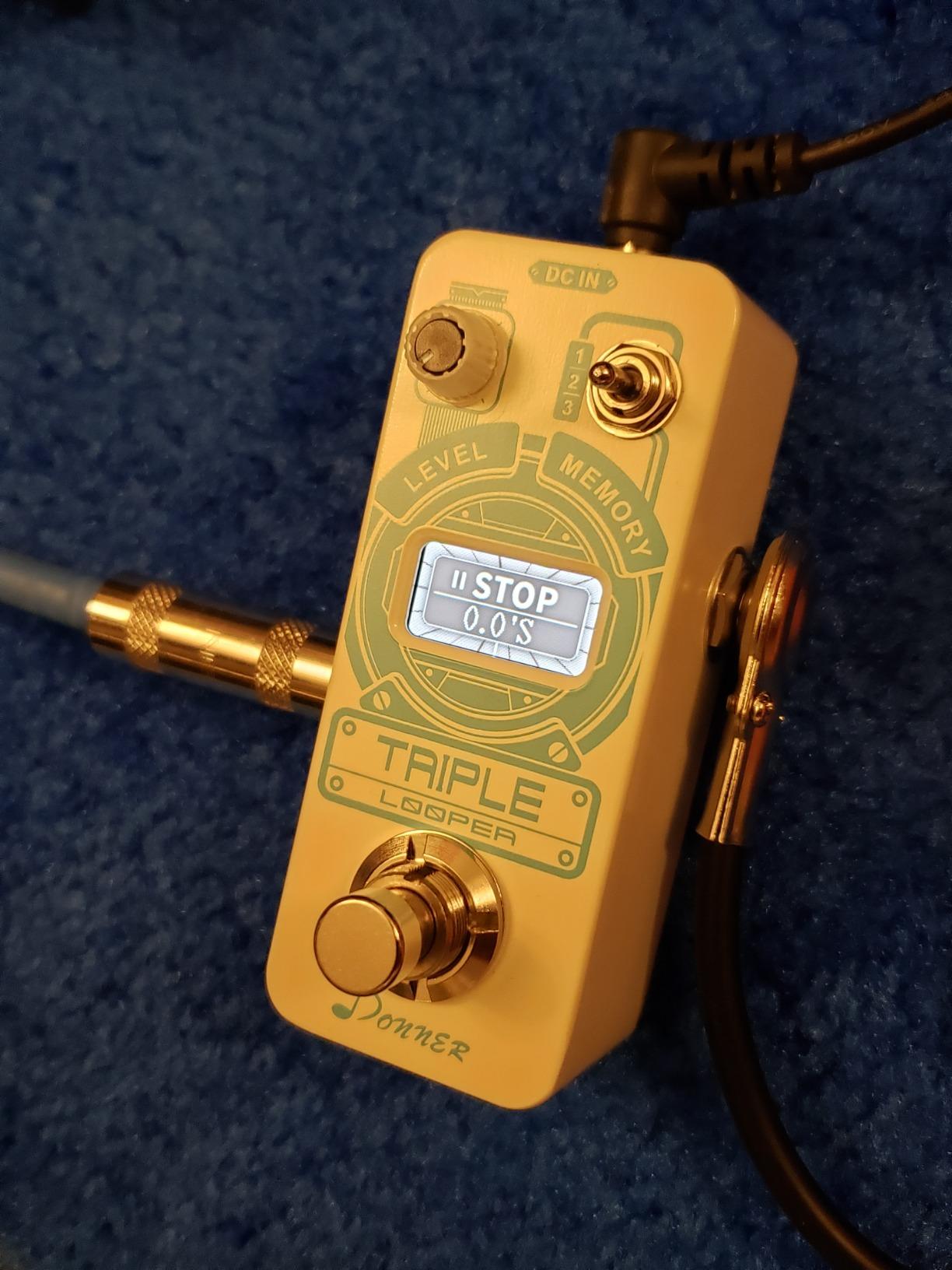
For songwriters this is close to ideal. Record a fingerpicking figure in slot one, a vocal harmony idea in slot two, and a rhythm in slot three, then play the set back without rebuilding anything. The visual timing display also makes it easy to teach arrangement to a band or a co-writing partner.
The screen is the trade-off as much as the benefit. It needs power to read, it is the first thing to suffer in direct sunlight outdoors, and the three slots are fully independent. You cannot dub, bounce or move audio between them, so an arrangement is three separate loops rather than a stacked sequence.
Who the Triple Looper suits best
Anyone building a set at home before taking it out. Three slots is the sweet spot for a verse loop, a chorus loop and a rhythm figure, and the auto-save means nothing is lost when you close the lid.
It also works as a teaching tool, because you can point at the screen and say where the loop starts. Players who like to know exactly what their machine is doing tend to get on with it fast.
Where the Triple Looper falls short
There is a stream of buyer reports about units that developed a chirping digital noise inside recorded loops, plus the occasional outright failure. Test a newly recorded loop before you rely on it in a set.
The looped signal also comes back slightly quieter and thinner than Boss loopers, so check your balance in a loud room rather than at home. For a busking rig with no power, look at the RC-1 or the RC-5, both of which run on a 9V battery.
5. Donner Circle Looper – the Best Looper With a Drum Machine Built In
Donner Circle Looper Pedal Drum Machine, 2 in 1 Drum Looper Stereo Guitar Loop Pedals, 40 Slots 160 mins Loop with 110 Drum Grooves, Tap Tempo, Fade Out
Looper plus 110 drum grooves in 11 styles
40 slots of 4 minutes, 160 minutes total
2.72 x 4.65 x 5.2 inches, 0.39 kg
44.1kHz/24-bit stereo
Pros
- Genuinely two instruments in one pedal
- Bar-quantised recording helps non-pros stay in time
- Forty auto-saving slots of up to 4 minutes
- Bright LCD with independent loop and beat knobs
- USB import and export for backing tracks
Cons
- Stop defaults into overdub so stray notes get recorded
- No power switch
- Preset tempos cannot be locked
- Internal clock drifts against external gear
The Circle Looper is the fastest route to sounding like a band. Alongside a 160-minute stereo looper with 40 auto-saving slots, it carries 110 drum grooves across 11 styles and 10 metronome settings, so a solo fingerstyle player can add a backbeat without a drum machine in the case.
Recording rounds to the nearest bar when a rhythm track is running. For a performer who is not a drummer, that quantise behaviour is what makes the unit feel forgiving, and it is the reason many players can lay down a loop on the first attempt.
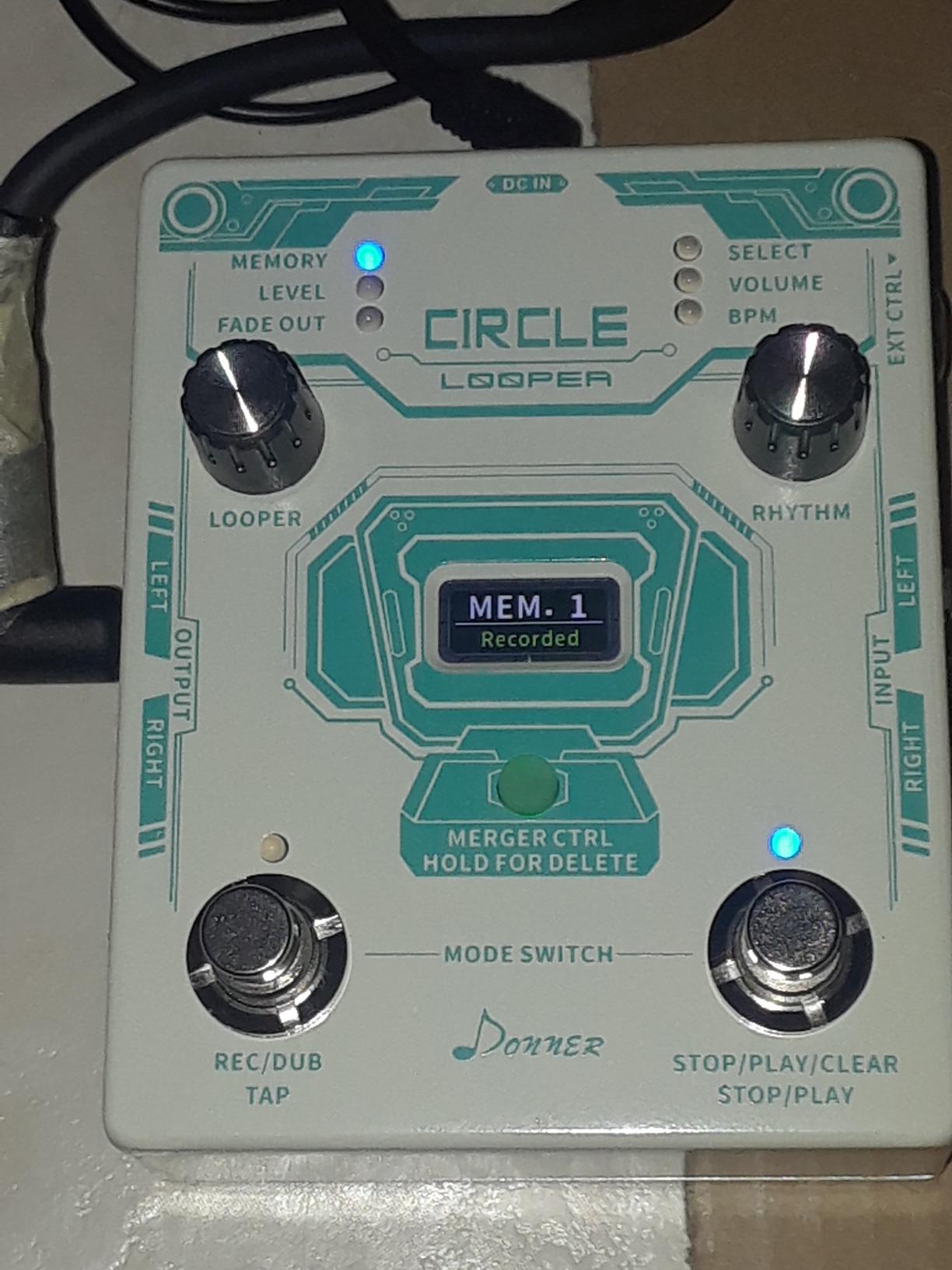
The screen is bright and responsive, the loop and groove levels have their own knobs, and the USB port means you can import finished backing tracks for a solo rehearsal set or a small venue where you would rather not play along with a generated rhythm.
There are real gripes, and the first one catches people out. Stopping a loop drops you into overdub by default, so if your chord rings out after your foot lands, that decay gets recorded. There is also no power switch, so shutting down means pulling the adapter.
Who the Circle Looper suits best
Solo acoustic acts and singer-songwriters who want a full arrangement from a single pedal. A four-bar groove under a fingerpicking loop, then a second loop in a higher register, is a complete sounding band for one performer.
It is also a strong practice partner, because the bar-quantise means you can follow along with recorded backing material through USB and still layer over the top.
Where the Circle Looper falls short
Preset beat tempos cannot be locked, so you re-dial the tempo for every pattern, and the internal clock drifts enough that syncing it to an external sampler or drum machine is unreliable. If you run a hybrid rig, that rules it out.
The memory slots also cannot be named, which gets awkward when you have 40 of them. For deeper timing accuracy and cleaner stop behaviour, the BOSS RC-5 costs more and solves both.
6. BOSS RC-5 Loop Station – the Best Looper That Still Fits a Pedalboard
BOSS RC-5 Loop Station
32-bit conversion and floating point processing
13 hours of stereo recording, 99 phrase memories
57 rhythms with 7 drum kits
5.08 x 2.87 x 2.2 inches, 16 ounces
Pros
- 32-bit conversion gives artefact-free loops
- Thirteen hours of recording and 99 phrase memories
- Backlit multi-colour LCD reads clearly on a dark stage
- Full MIDI I/O USB and expression pedal support
- Runs on a 9V battery
Cons
- Only three loops layer at once
- Menu-driven editing has a real learning curve
- Higher outlay than entry-level loopers
The RC-5 is the compact unit we end up recommending to players who have outgrown a one-track pedal but have no space for a tabletop workstation. 32-bit conversion and 32-bit floating-point processing produce loops with none of the warble or grit that gives cheap loopers away.
Thirteen hours of stereo recording across 99 phrase memories is real storage. You can build a foundation loop, store a chorus variation, keep a vocal idea, and recall the lot in order at the next gig instead of rebuilding it live.
Quantise is the feature that gets the most praise, and users on r/guitarpedals single it out for pulling a mistimed phrase into correct time. For a live player who records a fraction late because the crowd claps on the off-beat, that is the difference between a usable take and a restart.
There are 57 rhythms with A/B variations and 7 drum kits, a reverse function for instant texture, and a multi-colour backlit screen you can read under a stage wash. Full MIDI in and out, USB and expression pedal support mean it slots into a pedalboard that already has a switching system.
Who the RC-5 suits best
Performing folk and fingerstyle players who want a serious looping engine in a stompbox footprint. It runs on a 9V battery, so a busking rig or a duo acoustic tour is workable without a power supply.
It also suits anyone who has hit the ceiling on a single-track pedal and wants to hear the difference quantise makes. The three simultaneous layers are enough for a verse, a chorus and a percussive layer, which covers most solo sets.
Where the RC-5 falls short
Three simultaneous loops is a real limit when your arrangement grows, and the menu structure takes practice. Plan your patches at home rather than in front of a crowd, because the forum consensus is that the interface, not the audio, is the learning barrier.
It also carries a higher outlay than the entry-level pedals, and a full-size desktop workstation gives you far more tracks and onboard effects. If your room has a table and you can run a footswitch, that route is worth comparing before you buy.
7. MOOER Groove Looper – the Best Looper for Sketching Songs Fast
MOOER Groove Looper Pedal Drum Machine Stereo Guitar Loop Recorder Pedals
14 save slots, 140 minutes total stereo recording
121 drum grooves across 11 genres
5.55 x 5 x 3.11 inches, 0.33 kg
Loop and drum audio route to separate outputs
Pros
- Fourteen slots with 140 minutes of stereo recording
- 121 grooves picked from GENRE and PATTERN knobs
- Loop and drum output routable separately for better mixing
- Time-stretch playback
- Justify function locks drums to your loop
Cons
- Knob silkscreen does not line up with printed values
- BPM only settable by tap tempo
- Documentation is thin
- Tall enclosure makes the top footswitch awkward when seated
The Groove Looper is built for the fifteen minutes after a good idea, when you need the band to arrive immediately. Fourteen save slots of up to ten minutes each, 140 minutes of stereo recording, and 121 drum grooves across 11 genres that you select with two dedicated knobs.
Three recording modes matter here. Count-in, normal manual operation, and an automatic mode that starts recording the moment it detects your instrument signal, which is genuinely useful when a song idea arrives mid-sentence and you are not looking down.
Routability is the quietly professional part. Loop audio and drum audio can go to separate outputs, so you can set a groove at a fixed level for a small PA while the loop rides with your guitar, rather than fighting a single blended knob during a soundcheck.
There is a time-stretch function for playing a loop back at a different tempo without changing pitch, and a Justify mode that keeps the drum groove locked to your loop instead of letting the two drift apart over a long take.
Who the MOOER suits best
Songwriters and producers who use a loop pedal as a sketchbook. Pair it with the LEKATO approach of building arrangements at home, then use the Justify and time-stretch features to test how a section sounds at a different tempo.
Separate loop and drum outputs also make it a good fit for small venues and rehearsal rooms where you control the mix at the source rather than relying on a single fader.
Where the MOOER falls short
The knob silkscreen does not line up with the printed values, so a first-time player spends the first session reading the panel. There is no numeric BPM entry, only tap tempo, which some players find hit-and-miss when the groove is not a clean pulse.
The tall enclosure also makes the upper footswitch awkward to reach if you play seated, and the documentation is thin enough that you will be looking up tutorials. The BOSS RC-5 has a clearer display and far more memory for players who prioritise recall over grooves.
8. TC Helicon Play Acoustic – the Best Box for Harmonies and Vocal Polish
TC Helicon PLAY ACOUSTIC 3-Button Vocal and Acoustic Guitar Effects Stompbox with BodyRez and Looping
Harmonies guided by your guitar chords
BodyRez acoustic body modelling
11 x 7 x 4 inches, 1.33 kg
12V power, three-button stompbox
Pros
- Key-sensing harmonies that follow your chords
- BodyRez makes piezo and thin bodies sound acoustic
- Automatic de-essing compression and EQ on vocals
- Separate vocal and guitar outputs or a stereo mix
- Three-button control with 3-button and 6-button footswitch support
Cons
- Looping limited to about 15 seconds
- Guitar effects limited to reverb delay and chorus
- One global acoustic guitar tone
- Harmony tracking needs practice
This is not a loop station, and it is in the list on purpose. If your problem is that you sing one note and your guitar plays another, the Play Acoustic solves a bigger problem for a solo performer than a sixth loop track does.
It senses the key from your guitar chords and generates harmonies that follow what you are playing. Combined with automatic vocal de-essing, compression and EQ, it turns a plain condenser mic into a vocal that sits properly in a small PA without a rack of outboard gear.
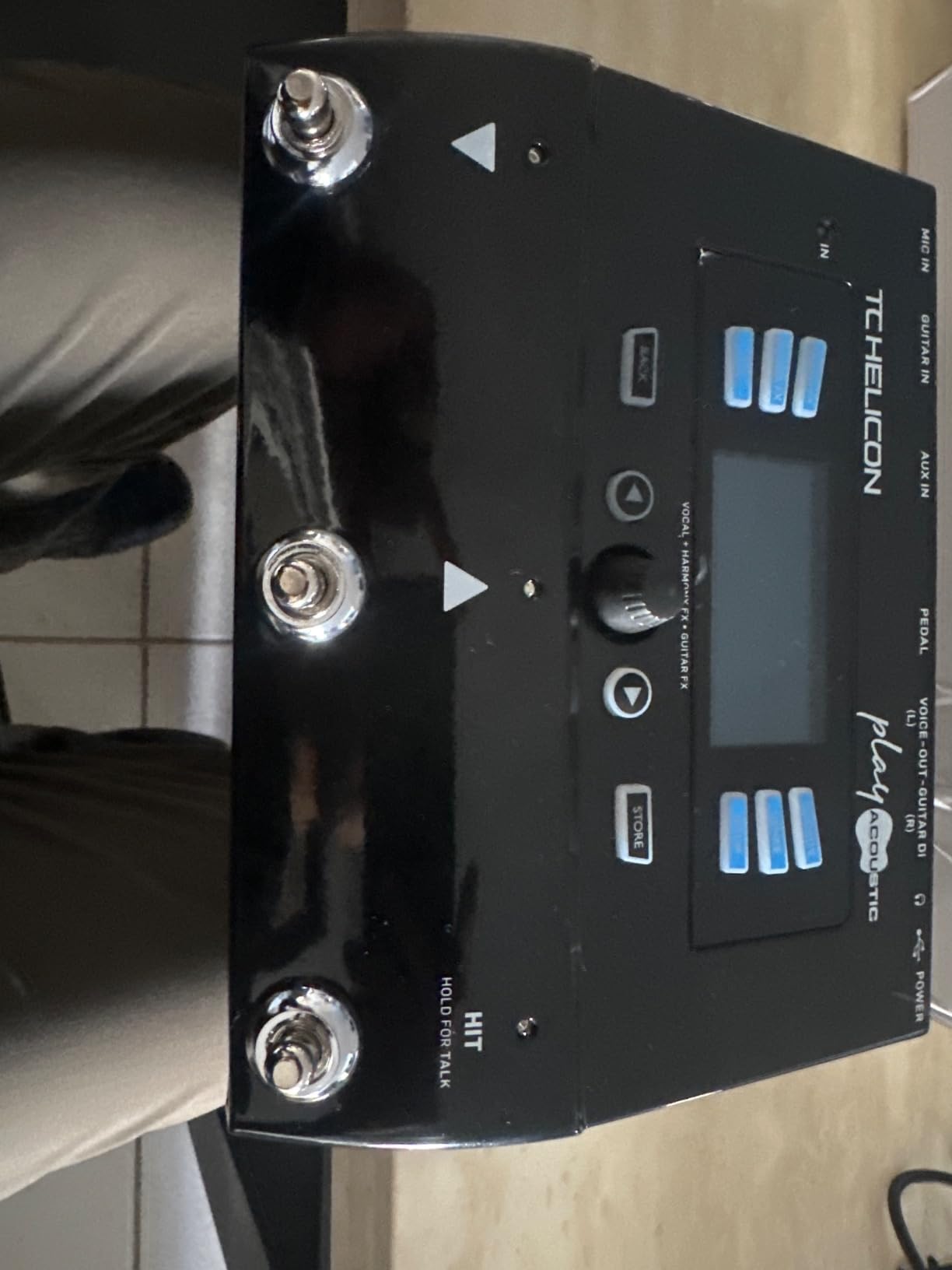
BodyRez acoustic body modelling is the second reason it earns a place. If you play a piezo-equipped acoustic into a PA rather than a guitar amp, this is the difference between sounding like a banjo and sounding like an acoustic guitar. There is feedback-proofing too, with notch filter and phase controls.
Routing is flexible: separate vocal and guitar outputs, or a stereo mix of both. With a 12V supply included and a three-button stompbox control that works with 3-button and 6-button footswitches, it drops into an existing board without re-planning it.
Who the Play Acoustic suits best
Singer-songwriters playing a coffee house or a small listening room with a PA, a laptop or nothing at all, and one microphone. It is the fastest way to make a single voice sound supported without stacking effects pedals.
It is also the right pick for fingerstyle players on piezo or thin-body acoustics who are not happy with how they sound into a sound system, because the body modelling is doing a job nothing else on the board would.
Where the Play Acoustic falls short
The looper is about 15 seconds long with undo and redo, so it is a phrase looper, not a performance looping engine. If a full arrangement is the goal, pair it with a proper looper or run it alongside a tabletop unit.
Guitar effects are limited to reverb, delay and chorus, so there is no boost, overdrive or tremolo, and there is a single global acoustic tone that does not change with the patch. Harmony tracking also needs real practice; budget a rehearsal before you rely on it in front of people.
9. FLAMMA FS21 – the Best Two-Footswitch Stereo Looper and Drum Machine
FLAMMA FS21 Stereo Guitar Looper Pedal & Drum Machine 2-in-1 with160 Minutes Loop Recording Capacity 100 Drum Grooves 10 Metronome Support Software Editing
Stereo looper and drum machine, 44.1kHz/24-bit
40 slots of 4 minutes, 160 minutes total
100 drum grooves in 10 styles
3.35 x 1.3 x 4.72 inches, 0.55 kg
Pros
- Looper and drum machine with generous memory
- Dual footswitches give separate control of each function
- Rhythm changes finish the current bar so beats are not dropped
- Auto-saves recordings on power loss
- USB import and export with editor software
Cons
- Footswitch logic is the opposite of the BOSS RC convention
- Instructions are vague and the drum library is basic
- Tap tempo is awkward
- Editing software is Windows oriented and uses mini-USB
The FS21 is the pedal version of the Circle Looper with one meaningful improvement: two footswitches. One runs the looper, the other runs the drum machine, so you can start a groove and a loop independently rather than diving into a menu to change between functions.
Forty slots of four minutes each gives 160 minutes of storage that auto-saves when the power drops, and USB import and export means recorded loops can be moved to a computer. There is a fade-out on stop, which avoids the abrupt cut that makes a loop changeover obvious from the audience.
The detail we like most is subtle and matters live: when you switch rhythms, the drum machine completes the current bar rather than dropping you into the new pattern mid-beat. That single behaviour is the difference between a smooth transition and a stumble.
What catches people out is the footswitch logic. It runs opposite to the BOSS RC convention, and if you have muscle memory from any RC pedal you will press the wrong switch on the first try. There is also an external footswitch port, though the switch itself is a separate purchase.
Who the FS21 suits best
Players who want more than one thing under their foot without a menu. It suits a one-person electronic set, a busking rig with a rhythm section built in, and anyone who wants to trigger a loop and a backing groove in the same bar.
The generous slot count also makes it a good home unit for assembling a full set of arrangements and recalling them one after another, and the auto-save means a power cut does not cost you the set.
Where the FS21 falls short
The drum library is the weak half of the box. There are 100 grooves in 10 styles, no fill function, no drum editing control, and the samples can sound thin if you stack them. Players who care about rhythm programming should look at a machine built for it.
The manual is vague enough that most setup knowledge has to come from videos, the editing software is Windows-oriented, and the connection is mini-USB. If you want a clearer display and more dependable timing, the Donner Circle Looper or the BOSS RC-5 is the safer buy.
10. BOSS VE-8 – the Best All-in-One Box for Singing Guitarists
BOSS VE-8 Acoustic Singer | Compact All-In-One Preamp and Effects Solution for Singing Guitarists | Create Natural Harmonies in Real-Time | Studio-Quality Processing | Multiple Vocal Effects | Looper
Preamp, acoustic processing, vocal effects and looper
Real-time harmonies from guitar input
13.3 x 8.9 x 5.1 inches, 1.5 kg
Nine volt power, USB and stage cables included
Pros
- One box handles preamp guitar processing vocals and looping
- Real-time harmonies derived from the guitar input
- Four ambience types with Enhance and chromatic pitch correction
- Physical controls that are quick to dial in
- Portable format for mobile solo work
Cons
- Looping is a basic single-layer phrase looper
- Harmony generation depends on clean key detection
- Costs more than most loopers and vocal processors
The VE-8 is the answer to the solo performer who plays guitar and sings into the same PA and carries too much gear. Preamp, acoustic guitar processing, vocal effects, harmonies and a looper all live in one compact box, which removes the mixer and half the pedalboard from a travelling rig.
Harmonies follow the key detected from your guitar input, or a key you set by hand if the detection struggles. Four ambience types, Enhance and chromatic pitch correction handle the vocal work that usually needs a compressor, a gate and an EQ on top of the mic preamp.
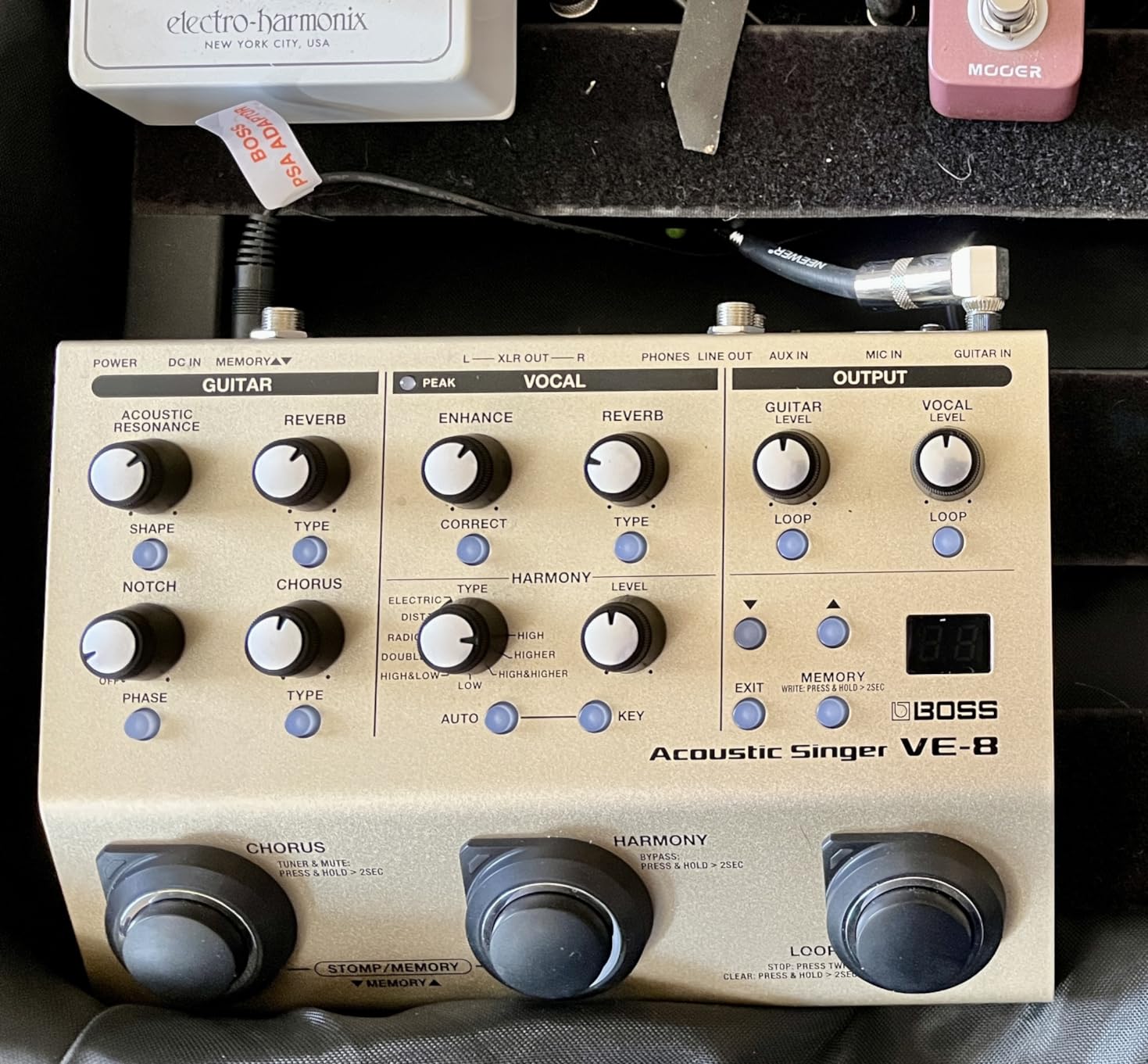
The controls are physical rather than menu-driven, and that matters when you are playing. Adjusting a vocal effect mid-song is a matter of turning a knob, not scrolling a list, which is a deliberate contrast with the dense interfaces on the bigger loop stations.
USB, PA and stage monitor cables come in the box, and at 13.3 by 8.9 by 5.1 inches it fits on a small table or a music stand bracket. BOSS backs it with the same five-year warranty as the rest of the range.
Who the VE-8 suits best
Acoustic singer-songwriters whose set depends on the vocal as much as the guitar. One box gives you a usable preamp and DI, controlled acoustic tone, a polished vocal and real-time harmonies, then straight out to the PA.
It also suits a busking setup where carrying fewer boxes matters. Hitting the harmonies and a thickening third voice in a street performance is a bigger wow factor than a sixth guitar layer.
Where the VE-8 falls short
The looper is a basic single-layer phrase looper, not a performance looping engine. It will not replace a proper unit in this list if layering a full arrangement is the plan, so treat it as a vocal and acoustic box with looping on the side.
Harmony generation also depends on clean key detection from the guitar signal, and the outlay puts it above most loopers and vocal processors. If harmonies are the goal and you can stretch further, the TC Helicon Play Acoustic does the same job as a stompbox for a playing guitarist.
How to Choose a Loop Station for Your Solo Rig
Most of the specification on a loop station’s page tells you very little about whether you will be happy with it on stage. These are the five decisions that actually move the needle.
Tabletop or pedal: pick the control style your set needs
A pedal is operated with your foot while a tabletop unit wants a separate footswitch, a table surface and mains power. For a solo set that means one person runs the rig, so anything that needs a hand to operate is a risk if you are also the vocalist.
Choose a pedal if your arrangement is one or two layers, you are on a crowded board, or you busk. Choose a tabletop unit if you want many simultaneous tracks, a large screen to edit from, effects per track, and the option to sequence a whole set without touching anything mid-song. r/LoopArtists consistently treats the Boss RC-505 as the default professional answer for that reason, with players solving the footswitch problem with an external switch.
Track count, loop length and quantize are the three numbers that matter
Simultaneous loop tracks decide how thick an arrangement can get. Two is enough for a verse foundation plus a layer; three is comfortable for verse, chorus and percussion; more is for players building arranged sections. Storage slots are a different thing entirely: they are what let you recall a chorus you built last week instead of rebuilding it live.
Loop length in minutes caps your arrangement, so plan in even bars. A four-bar foundation loop at 90 BPM runs about 17 seconds, and everything you build on top of it inherits that length, which is why the LEKATO’s locked overdub length is a real planning constraint rather than a technicality.
Quantize is the feature that decides whether a mid-range unit is usable live. It rounds a mistimed take into the right place instead of leaving it slightly behind your playing, and users on r/guitarpedals name it as the reason a purchase stopped being frustrating. If a unit has no quantize, practise until you are metronomic before you book a gig with it.
Sound quality, latency and phantom power for vocal loops
32-bit conversion and floating-point processing, as on the BOSS RC-5, produce loops with no audible grit or degradation when you stack layers. On a compressed unit, three layers can sound worse than one, and you lose clarity rather than gain width.
Latency shows up as a delay between your foot and the sound, and it fights with the live sound of an amp. Analog dry-through, as on the RC-1, Ditto and LEKATO, means the unlooped signal is untouched.
For vocal looping, check for a real mic input with phantom power. Almost none of the pedals in this roundup offer one, which is why vocal looping for most solo performers happens on a tabletop unit or a laptop, with a dedicated interface. The two vocal boxes here, the Play Acoustic and the VE-8, do take a mic and are worth a look for that reason.
Building the rest of the rig: amp or PA, DI, mic and power
A solo performer running an acoustic into a PA needs a DI with a feedback notch filter, and the Play Acoustic has one built in. Running an electric guitar into a pedalboard into a tube amp, the looper sits in the effects loop or in front of the amp depending on how wet you want the loops.
Power is where pedal loopers earn their place. The RC-1 and RC-5 both run on a 9V battery, which means a busking rig with a looper, a boost and a tuner stays playable all afternoon. The Donner, FLAMMA and MOOER units need a 9V adapter, so add a supply with enough current for the whole board rather than daisy-chaining.
Battery life is the number people check last and regret first. The RC-1 runs about four and a half hours on a 9V alkaline, so a full festival afternoon needs fresh cells.
When a laptop beats a hardware loop station
The forum consensus is not one-sided. Players who want unlimited flexibility, unlimited tracks and total recall often end up running a laptop with Ableton Live and a USB footswitch, and for a fixed show with backing tracks pre-loaded, that route is more powerful than any pedal here.
It also costs more in risk. A laptop needs a power supply, a controller, a crash plan, and someone who has actually practised the show, because there is no undo when a track fails to load three minutes before you walk on. For a first solo gig, a pedal with a battery is the safer bet. For an artist who already runs a laptop set and wants the extra tracks, the hardware route is about removing a failure point rather than adding capability.
Frequently Asked Questions
What is the best looper for live solo playing?
For most solo performers the BOSS RC-1 is the safest first answer: one footswitch, no menu to read on stage, and it runs on a 9V battery. If your arrangement needs more than one loop at a time, step up to the BOSS RC-5 for three simultaneous layers, 99 phrase memories and quantize that pulls a slightly late take back into time.
How many loop tracks do I need for solo live performance?
Two tracks cover most solo sets: a foundation loop and a layer on top. Three lets you run a verse loop, a chorus loop and a percussive layer at the same time, which is where most performers stop needing more. Beyond that, a tabletop workstation with many tracks and per-track volume control is the right upgrade, because arrangement, not track count, is what becomes the bottleneck.
Which looper pedal has the best sound quality?
Audio quality comes down to bit depth and how layers behave when stacked. The BOSS RC-5 uses 32-bit AD/DA conversion and 32-bit floating-point processing, so loops stay clean and artefact-free when overdubbed. The LEKATO records uncompressed at 48kHz/24-bit with analog dry-through. Cheaper compressed loopers lose clarity as soon as you stack three or more layers.
Can I loop vocals and guitar at the same time?
Yes, but almost never on a pedal from this roundup. You need a unit with a real mic input and phantom power, which means a tabletop workstation or a laptop with an audio interface and a footswitch. Loop the guitar first, then record the vocal layer against it on a separate track, and set the vocal loop quieter than the dry vocal so the live voice stays in front.
What are the differences between the different Boss loop stations?
The range is a ladder of storage and features. The BOSS RC-1 is the entry point: one footswitch, one loop track, 12 minutes of stereo recording, battery powered. The BOSS RC-5 adds 32-bit processing, 13 hours of recording, 99 phrase memories, three simultaneous layers, 57 rhythms and MIDI in a pedalboard footprint. Above that, a tabletop workstation gives you per-track effects, far more simultaneous tracks and a screen for editing.
Do I need a looper pedal or can I use software?
A laptop with Ableton Live and a USB footswitch wins on flexibility: unlimited tracks, unlimited memory and total recall of a pre-loaded set. A pedal wins on reliability: battery power, no boot time, no crash risk, and nothing to look down at mid-song. For a first or second solo gig we would use hardware. For an established artist already running a laptop set, the pedal is about removing a failure point.
Final Verdict: Which Loop Station Should You Buy?
The BOSS RC-1 is our pick among the best loop stations for solo performers because it asks the least of you and refuses the least. One footswitch, no menu, a clean loop sound and roughly four and a half hours on a 9V battery.
Move up when your arrangement outgrows it. The BOSS RC-5 is the step for a pedalboard and for anyone who needs quantize and three layers. The LEKATO is the better recorder for songwriting at home, the Donner Circle Looper adds a backbeat, and the VE-8 or the Play Acoustic solve the vocal half of a solo set.
Whichever you pick, build the four-bar foundation loop first and practise the changeover between songs until it is invisible. The gear is the easy part.