
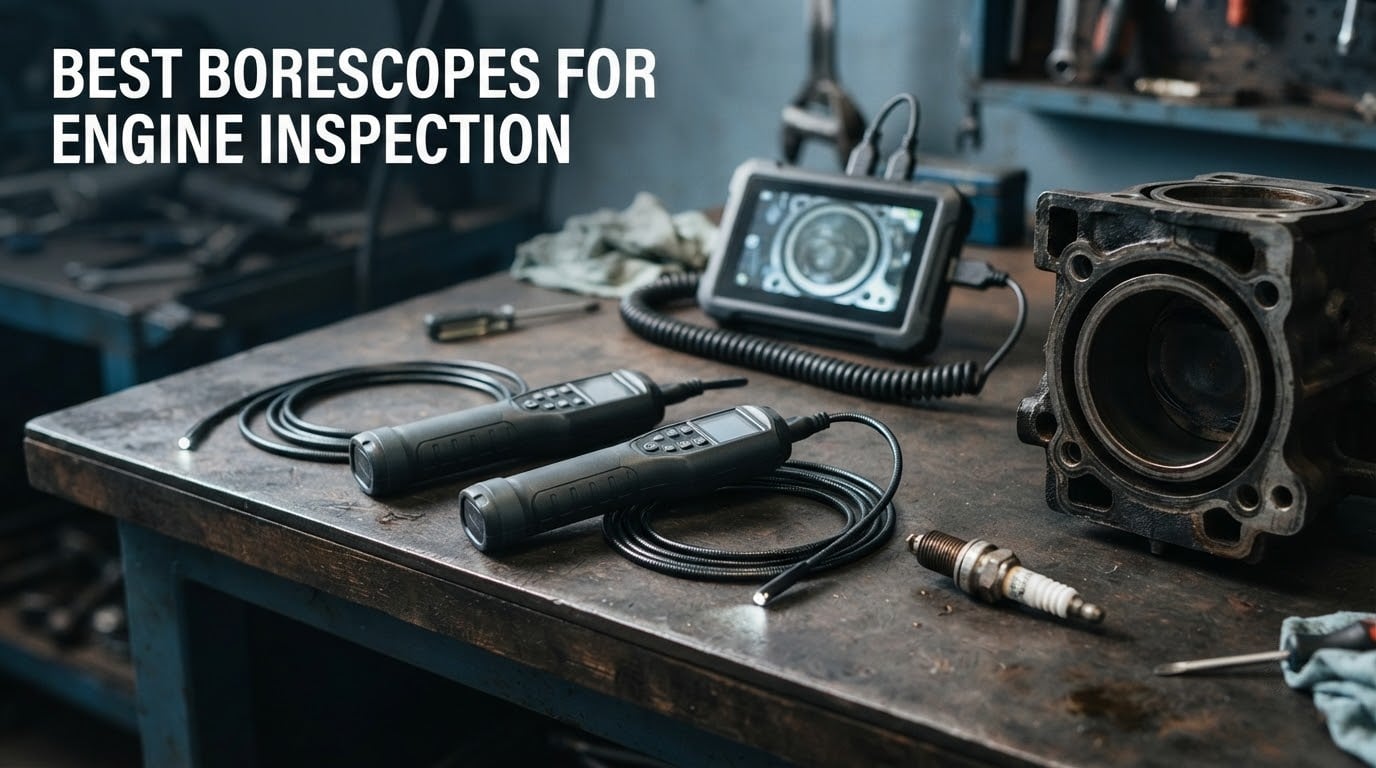
A borescope is a small illuminated camera on a thin probe that passes through a spark plug hole so you can see the piston crown, valves and cylinder walls without removing the cylinder head. An endoscope is the broader category; a borescope is the automotive and industrial subtype built for that spark plug access.
That single sentence solves the most common confusion in this category, and it sets the bar for everything below. A borescope is not a thermal camera, not a compression tester, and not a tool that needs a data port to work. It is a light, a lens and a cable, and its only job is to let you look at combustion chamber surfaces that were designed to be invisible.
Why bother looking? Because a borescope settles arguments before teardown. One user on r/mechanic borescoped a high-mileage Volvo cylinder by cylinder specifically to check whether an engine flush and additives had done anything, because they did not intend to trust the marketing claim without seeing the piston crown themselves. On CorvetteForum, a borescope inspection of a stray fastener found a destroyed cylinder and zero compression in that bank. You cannot buy that kind of information any other way before pulling a head.
This guide covers the best borescopes for engine inspection available in 2026, across three tiers: phone-only scopes for a first look, standing-screen scopes for regular use, and articulating scopes for valve work. We weighed probe diameter, articulation range, tip lighting, recording capability, cable handling and whether the scope actually documents what you see. Where a spec sheet and owner reports disagree, we say so.
Table of Contents
Top 3 Borescopes for Engine Inspection (October 2026)
Three picks cover most buyers. The Teslong TD450S is the one to buy if you want true articulation and a tip temperature sensor. The DXZtoz AGC430N gives you the largest probe head here alongside 8x zoom. The DEPSTECH DS300-DL is the lowest-risk first scope to live with.

Teslong TD450S Borescope
- Two-way 210 degree articulation
- 4.5 inch IPS LCD
- 8 adjustable LEDs
- audio recording

DXZtoz AGC430N Borescope
- Two-way 220 degree 8.5mm probe
- 1080P with 8x zoom
- 4.3 inch IPS display
- 4 hour battery
DEPSTECH DS300-DL Borescope
- Dual lens with 180 degree rotation
- split screen
- 16.5FT semi-rigid IP67 cable
- 4.3 inch IPS
The Teslong TD450S takes our top slot because the steering wheel is centered: you turn one control to aim the tip while your other hand manages the cable, and that is exactly the awkward part of plug-hole work. Owners also single out an on-screen tip temperature sensor with high-temperature auto shutoff, which matters when you are working on a warm engine.
The DXZtoz AGC430N is the value pick because an 8.5mm probe head passes plug holes more freely than the 0.33in probes on some competitors, and 8x zoom helps you read a valve face from a distance. The DEPSTECH DS300-DL has no steering at all, but its dual-lens head and 16.5ft cable make it a forgiving first tool.
All 10 Borescopes Compared in 2026
Every scope below has a probe that fits a common spark plug hole. The table is the fastest way to narrow the field before you read the individual reviews.
| Product | Specs | Action |
|---|---|---|
| Teslong TD450S Articulating Borescope |
|
Check Latest Price |
| DXZtoz AGC430N 8.5mm Articulating Borescope |
|
Check Latest Price |
| DEPSTECH DS300-DL Dual Lens Borescope |
|
Check Latest Price |
 Teslong TD500 Wi-Fi Articulating Borescope Teslong TD500 Wi-Fi Articulating Borescope |
|
Check Latest Price |
 Acoath Dual-Lens 1080P Borescope Acoath Dual-Lens 1080P Borescope |
|
Check Latest Price |
 DEPSTECH DS620TL-5M Triple Lens Endoscope DEPSTECH DS620TL-5M Triple Lens Endoscope |
|
Check Latest Price |
 MugEasy 7.9mm 16.5FT Endoscope MugEasy 7.9mm 16.5FT Endoscope |
|
Check Latest Price |
 Daxiongmao 8mm 1080P Borescope Daxiongmao 8mm 1080P Borescope |
|
Check Latest Price |
 Kinpthy W400-B Phone Borescope Kinpthy W400-B Phone Borescope |
|
Check Latest Price |
 DXZtoz AGC500L Dual-Lens Borescope DXZtoz AGC500L Dual-Lens Borescope |
|
Check Latest Price |
1. Teslong TD450S Articulating Borescope – The One With A Temperature Sensor
Teslong Articulating Borescope for Mechanic Automotive HVAC Wall Inspection
Two-way 210 degree articulation
5FT semi-rigid cable
4.5 inch IPS LCD
1080P video with audio
Pros
- Centered steering lever gives true one-handed tip control
- On-screen tip temperature sensor with high-temperature auto shutoff
- Color and clarity owners compare to rental shop cameras
- Records audio and video to a 32GB microSD card
- Two-year manufacturer warranty
Cons
- No Wi-Fi or wireless file transfer
- Semi-rigid cable can stall in tight 90 degree bends
- Fixed-focus lens with a limited close-focus range
I spent the most time on the TD450S of anything in this group, mostly because it is the scope I keep reaching for when the question is valve-related rather than piston-related. The probe is a single lens on a two-way 210 degree articulating head, and the steering control sits in the middle of the unit where your palm naturally rests.
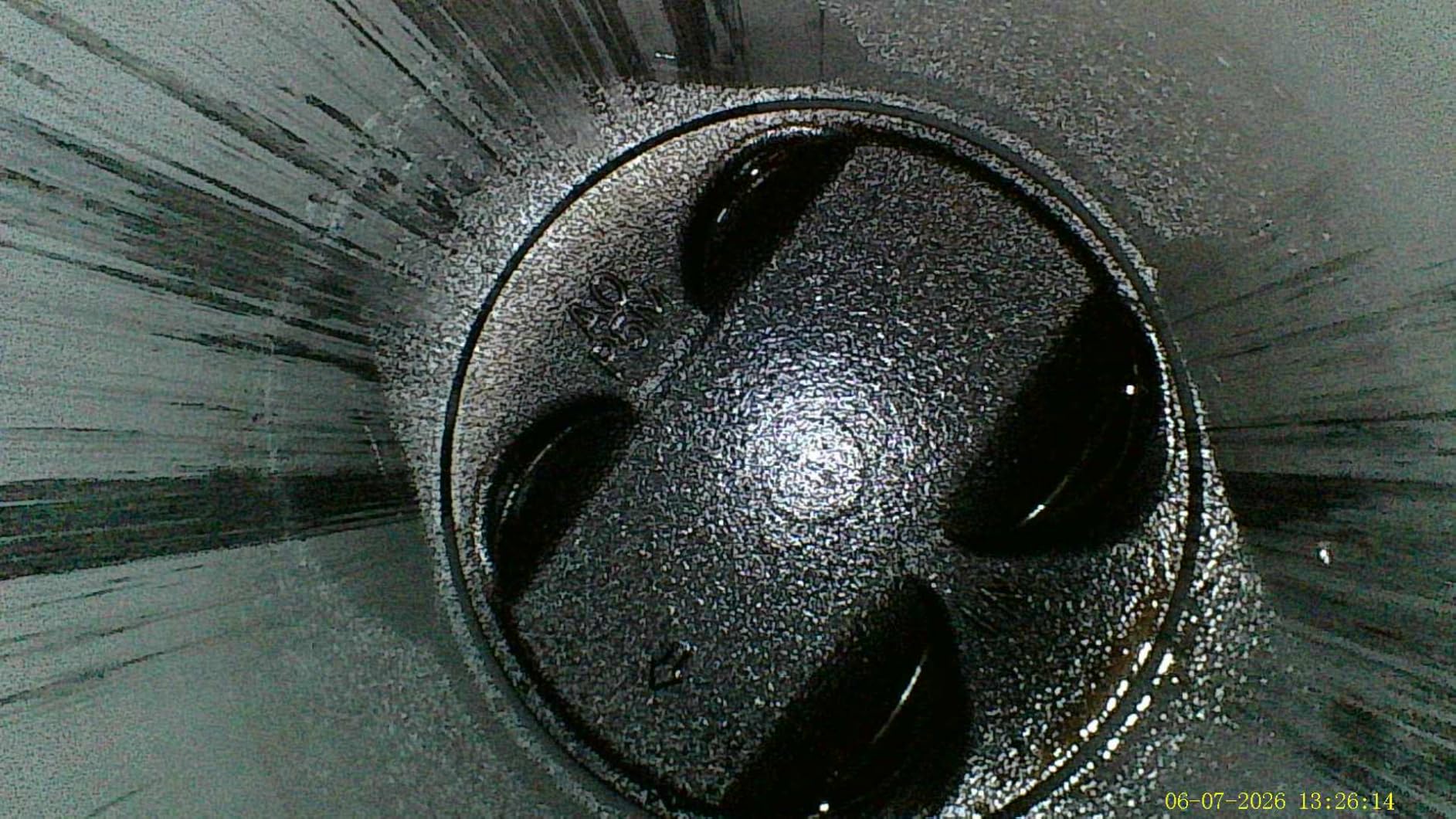
That layout matters more than the resolution number. In a plug hole you are working one-handed with the other hand on the cable, and a lever you have to reach around to find is a lever you will fight. Owners describe the color accuracy as good enough to show combustion staining clearly, which is a real difference when you are deciding between a glazed cylinder and a carbon-heavy one.
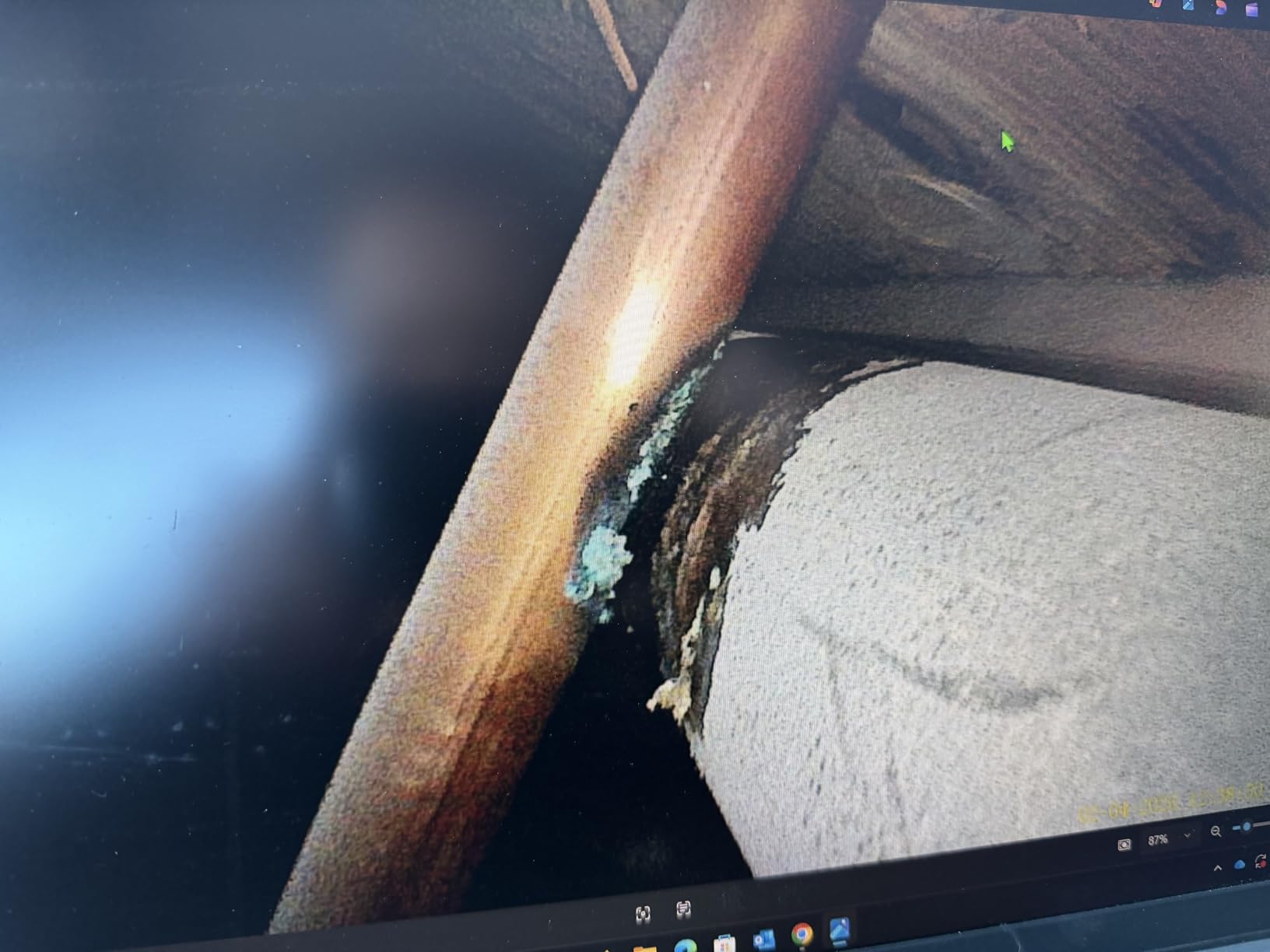
The unit records video with audio to a 32GB card, and audio is more useful than it sounds: hearing a knock or a misfire while the camera is pointed at a valve face changes the diagnosis. There is a 3000mAh battery with a 4 to 5 hour runtime, and the molded case stores the cable without disconnecting it.
The screen is a 4.5 inch IPS LCD with no app required, and the menu is described as more intuitive than competing brands. Tip lighting comes from 8 LEDs with adjustable brightness, and the macro focus range is 0.6 to 4 inches, which covers the distance from a piston crown to a valve seat. The stated angle of view is 70 degrees.
Who the Teslong TD450S suits
It suits anyone doing valve or seat work rather than a single top-down look, and it suits hot engines because the on-screen tip temperature sensor with automatic high-temperature shutoff reduces the chance of cooking a probe head you just paid for. The semi-rigid 5FT gooseneck holds a bend long enough to steer without fighting spring-back.
It also suits shops. The two-year warranty and the semi-rigid carrying case are the kind of details that matter when a scope gets thrown in a van daily.
Where the Teslong TD450S falls short
There is no wireless transfer. Files come off the microSD card and go to a computer, which is fine for a technician and inconvenient for someone who wants to message a photo to a client from the car. The articulating head is also described as delicate and unsuited to rough handling.
The fixed-focus lens has a limited close-focus range, so if you need fine detail on a valve seat from 1cm away, that is not the strength of this scope. The semi-rigid cable can also stall in a tight 90 degree pipe bend, which matters more for plumbing work than for engine work.
2. DXZtoz AGC430N – 8.5mm Probe, 8x Zoom, Four Hours of Battery
DXZtoz Two-Way Articulating Borescope with Light, 1080P Industrial Endoscope Inspection Camera with Flexible Articulated Probe for Automotive Engine Mechanic HVAC- 5.5FT
Two-way 220 degree 8.5mm head
5.5FT semi-rigid cable
4.3 inch IPS display
3000mAh battery
Pros
- 8.5mm probe passes plug holes without a fight
- 8x zoom helps read a valve face from further back
- 4 brightness levels on 8 high-intensity LEDs
- Up to 4 hours of working time
- Form-fitting hard case included
Cons
- Articulates side to side only with no up or down steering
- Shaft can be hard to rotate inside tight cavities
- Attachments can partially block the camera view
The AGC430N is the one I recommend to owners of older engines with tight or corroded plug wells. An 8.5mm camera head clears a rough hole far more easily than a 0.33in probe, and when the plug has not been out in a decade that difference decides whether you get a look or a stuck cable.
Articulation is two-way at 220 degrees, and that range is enough to sweep across a combustion chamber floor and catch the edge of an intake or exhaust valve. Zoom is listed as 8x digital and optical with a 1 to 15cm best focal range, which is a real advantage when you want to look at a valve face without pushing the probe right up against it.
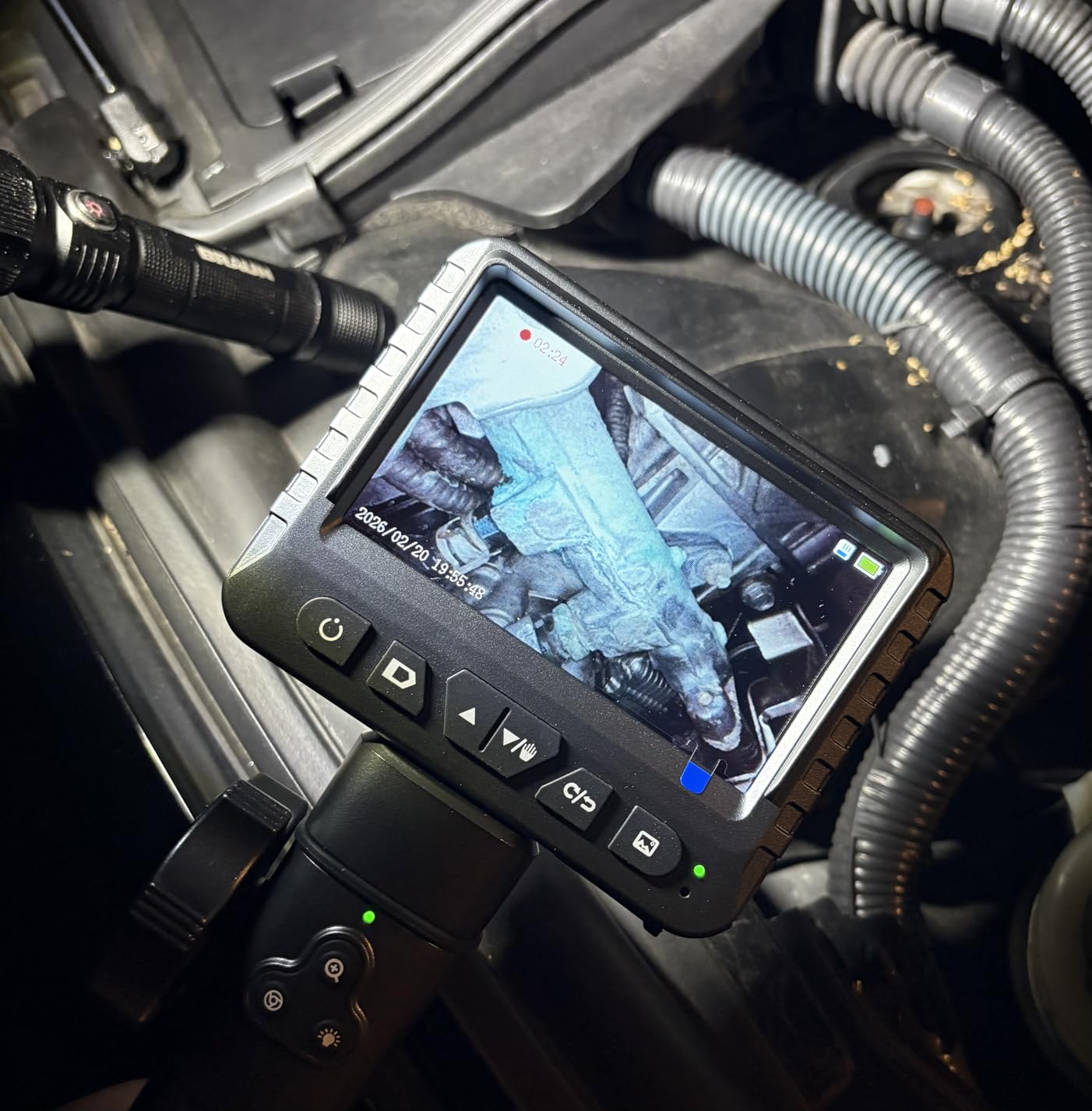
The screen is a 4.3 inch HD IPS panel and there is no app in the loop, which removes the single most common failure point in this category. Recording goes to an included 32GB microSD card in MP4 or AVI, and the 8 high-intensity LEDs have 4 brightness levels for a dark chamber.
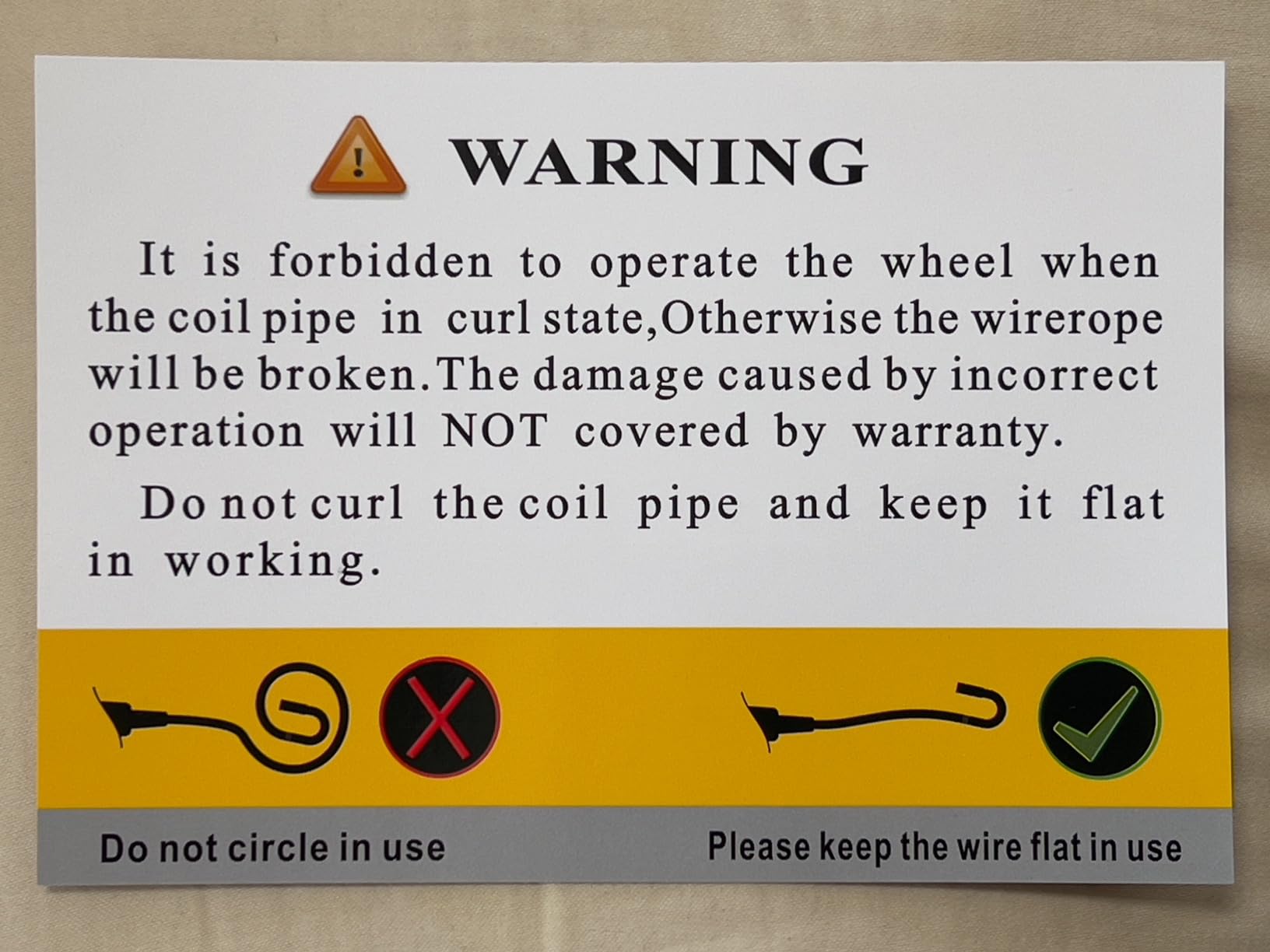
The kit includes a hook, a magnet, a side mirror and a hard case. The 3000mAh lithium battery gives up to 4 hours of working time, and the whole unit weighs 1.41 kg, so it is comfortable to hold one-handed for a full cylinder sweep.
Who the DXZtoz AGC430N suits
It suits anyone working on a vehicle where the plug holes are crusty, where a 6mm-class probe would be a coin toss, or where a head has already been off and you want to inspect the chamber from the deck. Mechanics and handymen using it for engine, HVAC and wall work tend to stay happy with it, and it is currently ranked near the top of the Borescopes category.
It also suits people who want documentation without a phone. The included card and the standalone screen mean the whole job works with no pairing step.
Where the DXZtoz AGC430N falls short
Steering is side to side only. There is no up or down articulation, so looking at the underside of a valve in a crossflow head is a matter of cable rotation rather than tip control, and owners note the shaft can be hard to turn inside a tight cavity. There is also no on-screen indicator of probe centering or steering direction, which means you often have to pull back and re-aim.
The included attachments can partially block the camera view if fitted carelessly, and the manual does not explain how to fit the tip accessories. Plan for a few minutes of trial and error the first time.
3. DEPSTECH DS300-DL – The Easiest First Scope With A 16.5ft Cable
DEPSTECH Endoscope Camera with Light, Dual Lens Inspection Borescope 16.5FT
Dual lens with 180 degree rotation
16.5FT semi-rigid IP67 cable
4.3 inch wide-angle IPS
1080P video
Pros
- Dual lens and split screen remove blind spots without steering
- 16.5ft semi-rigid cable reaches deep into engine bays and ducts
- 4.3 inch wide-angle IPS screen with a roughly 170 degree viewing angle
- Rechargeable battery with roughly 4 hours of run time
- 24-month warranty
Cons
- No articulating head so aiming depends on cable manipulation
- Fixed focus with a short working range
- TF card not included and menus are less intuitive
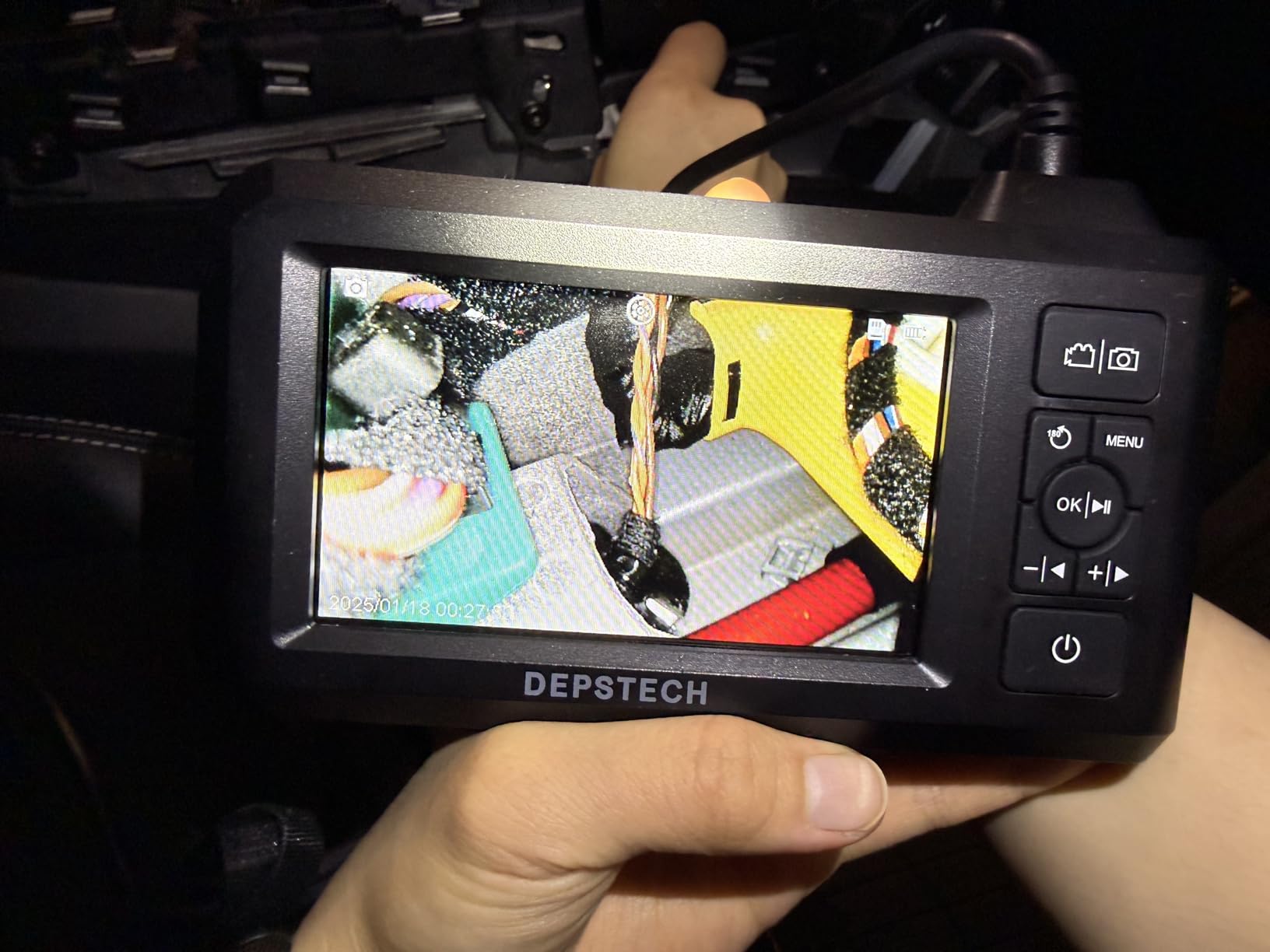
The DEPSTECH DS300-DL is what I suggest to someone buying their first scope and unsure whether they need steering. It has no articulating head at all, and yet owners report it is enough for a full cylinder look, because the head rotates 180 degrees and the screen can show two views at once.
That dual-lens setup is the whole point. One camera looks forward and the other looks to the side, so instead of rotating the cable against its own stiffness to find a valve, you switch views. Split-screen modes let you compare the forward and side images at the same moment, which is genuinely useful for judging how a valve face sits relative to the seat.
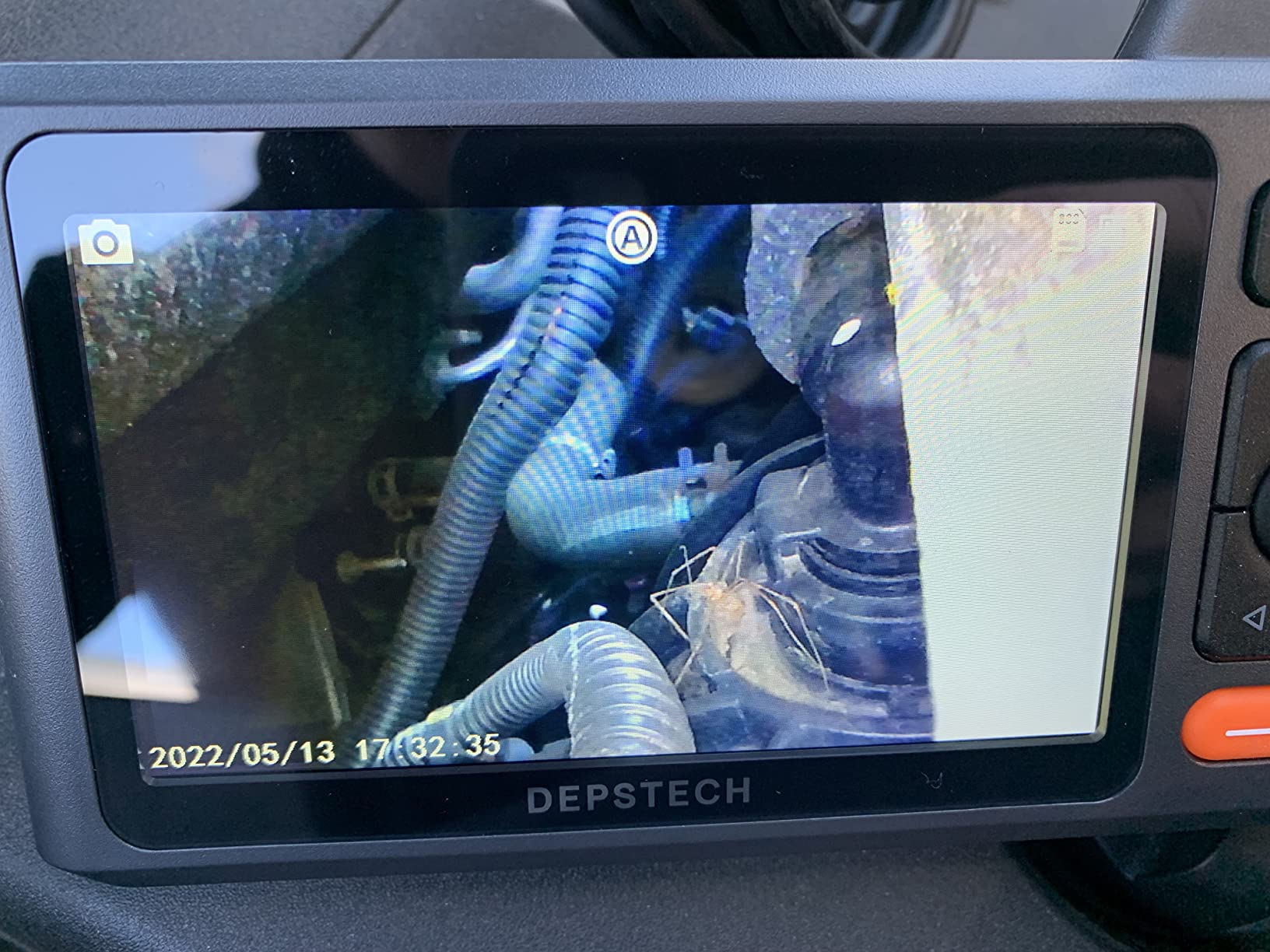
At 16.5ft, the semi-rigid cable is long enough to reach from a battery that is deep in a bay, around a firewall or into a radiator. The probe head is IP67 waterproof, so a cylinder that has been washed down or opened on a rainy day is not a problem.
Stills come out at 2.0MP with 1080P video capture, and the 4.3 inch TFT IPS screen has a roughly 170 degree horizontal viewing angle, which makes it legible in a dark garage. Seven adjustable LEDs with 3 brightness levels light the chamber. With more than 7000 owner ratings behind it, this is also among the most review-tested scopes in the category.
Who the DEPSTECH DS300-DL suits
It suits first-time buyers, and it suits anyone whose real interest stretches past engines into ducts, drains, wall cavities and appliances where a 16.5ft cable earns its keep. It also suits people who do a lot of used-car pre-purchase checks, because the scope is fast to set up and the screen is easy to hand to someone else.
Because it ships with a 24-month warranty and a rechargeable battery of roughly 4 hours, it is a low-risk first tool that is not a toy.
Where the DEPSTECH DS300-DL falls short
There is no steering. Where the articulating scopes can look back at the underside of a valve, the DS300-DL depends entirely on how you bend the cable, and a semi-rigid cable does not enjoy being twisted. Focus is fixed with a short working range, so very close detail is softer than on a scope with a macro mode.
The TF card is not included and the menu system is described as less intuitive than Teslong’s. Buy a card before the first job.
4. Teslong TD500 – Articulation Plus Wi-Fi Streaming To A Second Device
Teslong TD500 Articulating Borescope for Mechanic Automotive Inspection
Two-way articulating 0.33in probe
5ft semi-rigid gooseneck
5 inch IPS LCD
Wi-Fi streaming
Pros
- Built-in Wi-Fi lets a second person watch the live feed
- 5 inch IPS screen with 32GB microSD capture
- Articulating head reaches bores without a straight approach path
- Bluetooth connectivity and molded carrying case
- Manufacturer replaced a faulty unit quickly
Cons
- 0.33in probe is a tight fit in some smaller plug holes
- Wi-Fi app connection is glitchy to set up
- Screen is fixed and the cable exits the bottom of the unit
The TD500 is the pick when more than one person needs to see the same thing at the same time. Aircraft and automotive technicians like being able to hand a phone or tablet to a customer or a second tech and stream the live feed rather than crowding around a small screen.
The probe is a two-way articulating head on a 5ft semi-rigid gooseneck, and technicians who use it on piston and valve work describe the articulation as the feature that lets them reach a bore without a straight approach path. The screen is a 5 inch IPS LCD and the unit captures JPG stills plus MP4 video with audio to a 32GB microSD card.
Imaging is 1080P video with 2MP stills, adjustable tip lighting, a 70 degree real angle of view and a 0.6 to 4 inch macro range. The 3000mAh battery is described as moderate rather than long, so a full four-cylinder sweep plus a second pass is close to a full charge.
Aircraft hobbyists cross over into this same tool, and pilots on Pilots of America asking for flexible scopes in a fixed budget for aircraft valve work are describing exactly the same use case with a tighter engine.
Who the Teslong TD500 suits
It suits technicians who work alone but explain their findings, and it suits anyone whose diagnostic partner is standing on the other side of the engine bay. Bluetooth connectivity and the standalone screen mean you can work without any app at all if the wireless pairing misbehaves, which it sometimes does.
It also suits aviation and marine hobbyists who want articulation at a mid-range tier rather than a professional system.
Where the Teslong TD500 falls short
The 0.33in probe is a tight fit in some smaller spark plug holes, and that is the one limitation owners name most often. If your engine has already-tight access, check the plug thread diameter before committing.
The Wi-Fi app connection is described as fiddly to set up, and the screen is fixed rather than articulating with the cable exiting the bottom of the unit, so the viewing angle in a confined engine bay is less flexible than on a front-exit design. Battery life is only moderate and the warranty is 12 months.
5. Acoath Dual-Lens 1080P Borescope – Two Views Without Rotating The Probe
Acoath Two-Way Articulating Borescope, Endoscope Camera with Light, Dual-Lens 1080P Industrial Inspection Camera, 4.3″ IPS Screen, 32GB Card, IP67 Waterproof Sewer Tools – 5FT
70 degree and 60 degree dual lens
Two-way 210 degree articulation
5FT semi-rigid IP67 cable
4.3 inch IPS
Pros
- Front and side cameras remove blind spots without rotating the probe
- Lightweight 570g body is easy to hold for a long sweep
- Ships with a 32GB card and a full accessory kit
- IP67 waterproof and oil resistant housing
- Semi-rigid cable holds its shape inside engine bays and pipes
Cons
- Articulation range is narrower than some competing scopes
- Screen and image quality trail higher-end articulating models
- Side lens is lower resolution than the main lens
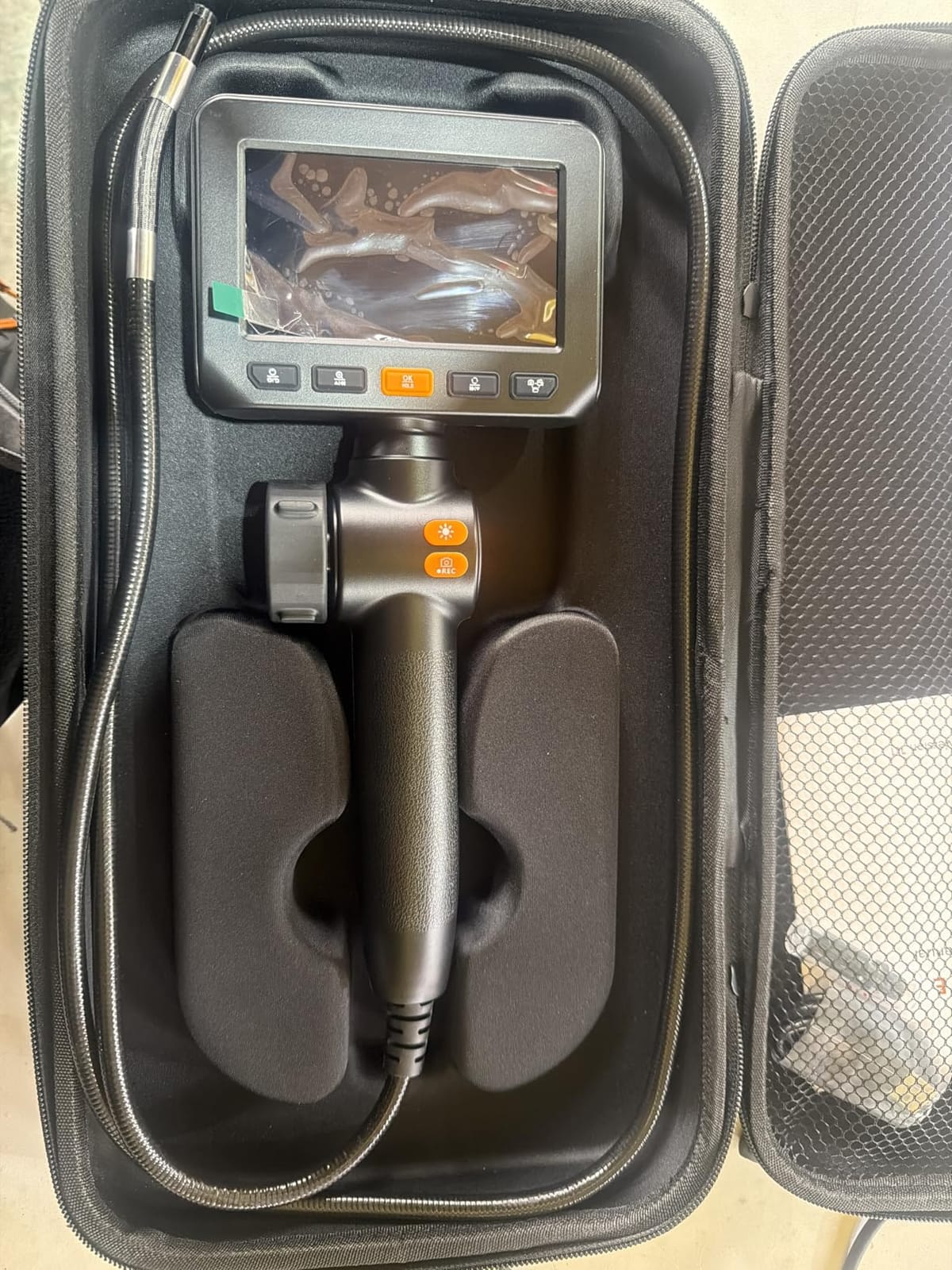
The Acoath pairs two cameras on one head, a 70 degree front and a 60 degree side, switched with a single button. That is a cheaper route around the dead-spot problem than a third lens, and it works well when the thing you need to see is off to one side of the probe path.
Articulation is two-way at 210 degrees, which the manufacturer describes as roughly 420 degrees of total range once you combine steering with the side camera. The probe is a slim 0.33in on a 5FT semi-rigid cable rated IP67 for water and oil, and the macro focus range is 2 to 10cm.
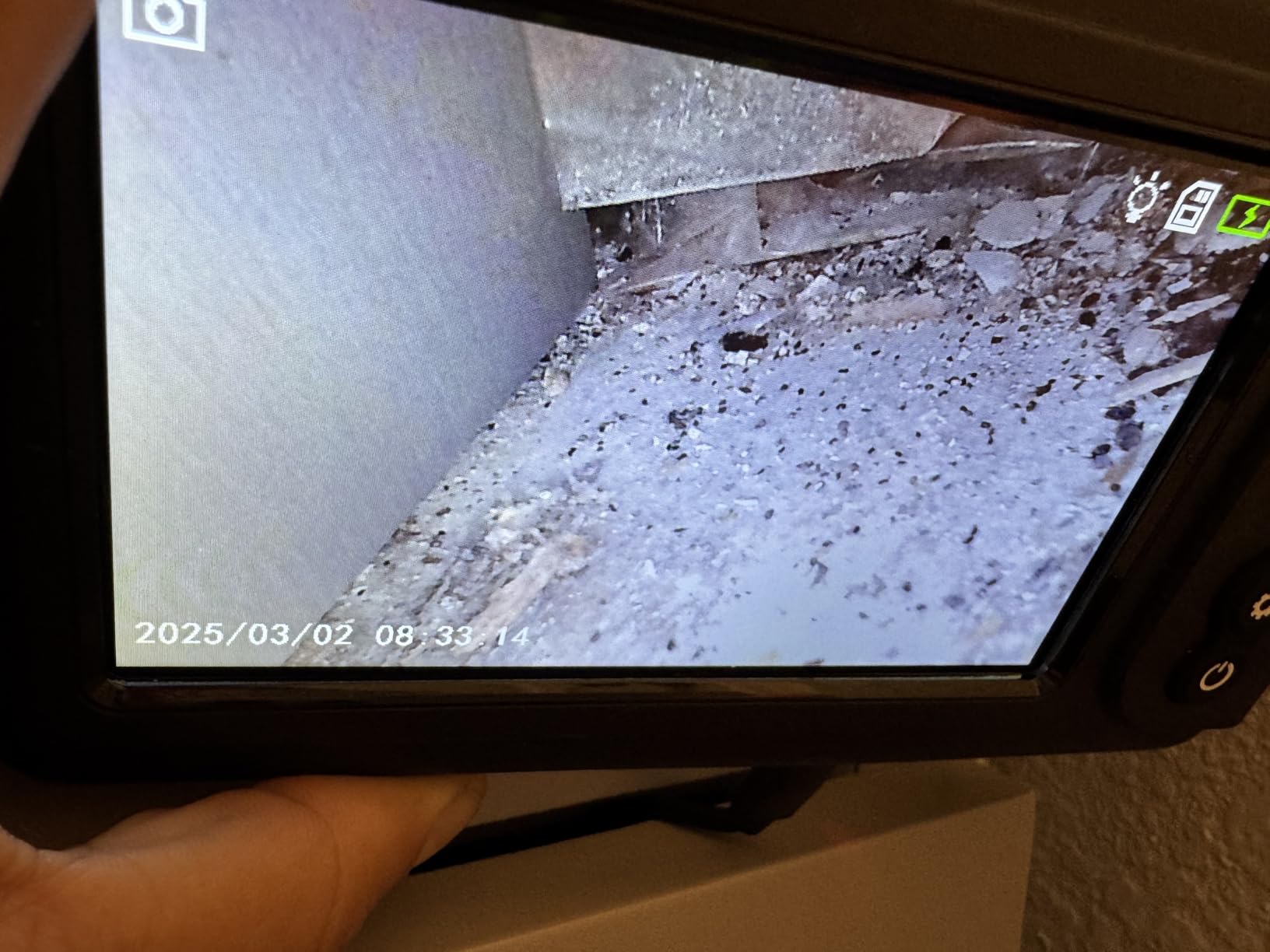
The screen is a 4.3 inch IPS panel with 1080P capture and 8 LEDs on 4 brightness levels. A 32GB TF card is built in, charging is USB-C, and the accessory kit includes a case, magnet, hook, mirror and a protective cap, backed by a 24-month warranty.
At 570g it is the lightest articulating scope here, which sounds trivial until you are holding your arm over a valve cover for ten minutes. Buyers highlight it for automotive, HVAC and pipe work across a mid-range budget.
Who the Acoath suits
It suits people who want side visibility without paying for a three-lens head, and it suits anyone working where a light body matters, such as a motorcycle or small engine. The included 32GB card and full accessory kit mean the first job is not delayed by a shopping trip.
The dual-lens arrangement also makes it a good general-purpose scope for drain and pipe work, not just engines.
Where the Acoath falls short
Owners describe the articulation range as narrower than some competing articulating scopes, so the side camera covers some of that gap but not all of it. Screen and overall image quality trail the higher-end articulating models, and the side lens resolves less than the main lens, so it is a situational view rather than a detail view.
The 2 to 10cm macro range is narrower than some rivals, which matters if you want extreme close-ups of a valve seat.
6. DEPSTECH DS620TL-5M – Three Lenses, A 16.5ft Cable And The Highest Rating Here
DEPSTECH Triple Lens Inspection Endoscope Camera with Light, 5″ IPS Screen
Triple lens head with one forward and two side views
16.5ft semi-rigid IP67 cable
5 inch IPS display
2MP stills and 1080P video
Pros
- Three lenses give multi-angle views without repositioning the probe
- Highest average rating in this group at 4.7
- 5 inch bright screen with a 76 degree field of view
- 16.5ft cable reaches deep into radiators
- drains and engine areas
- Reliable memory-card transfer to a computer instead of a phone app
Cons
- No split-screen view on this model despite other DEPSTECH models offering it
- Cable is fixed to the unit and not detachable
- microSD card is not included and the cable is stiff
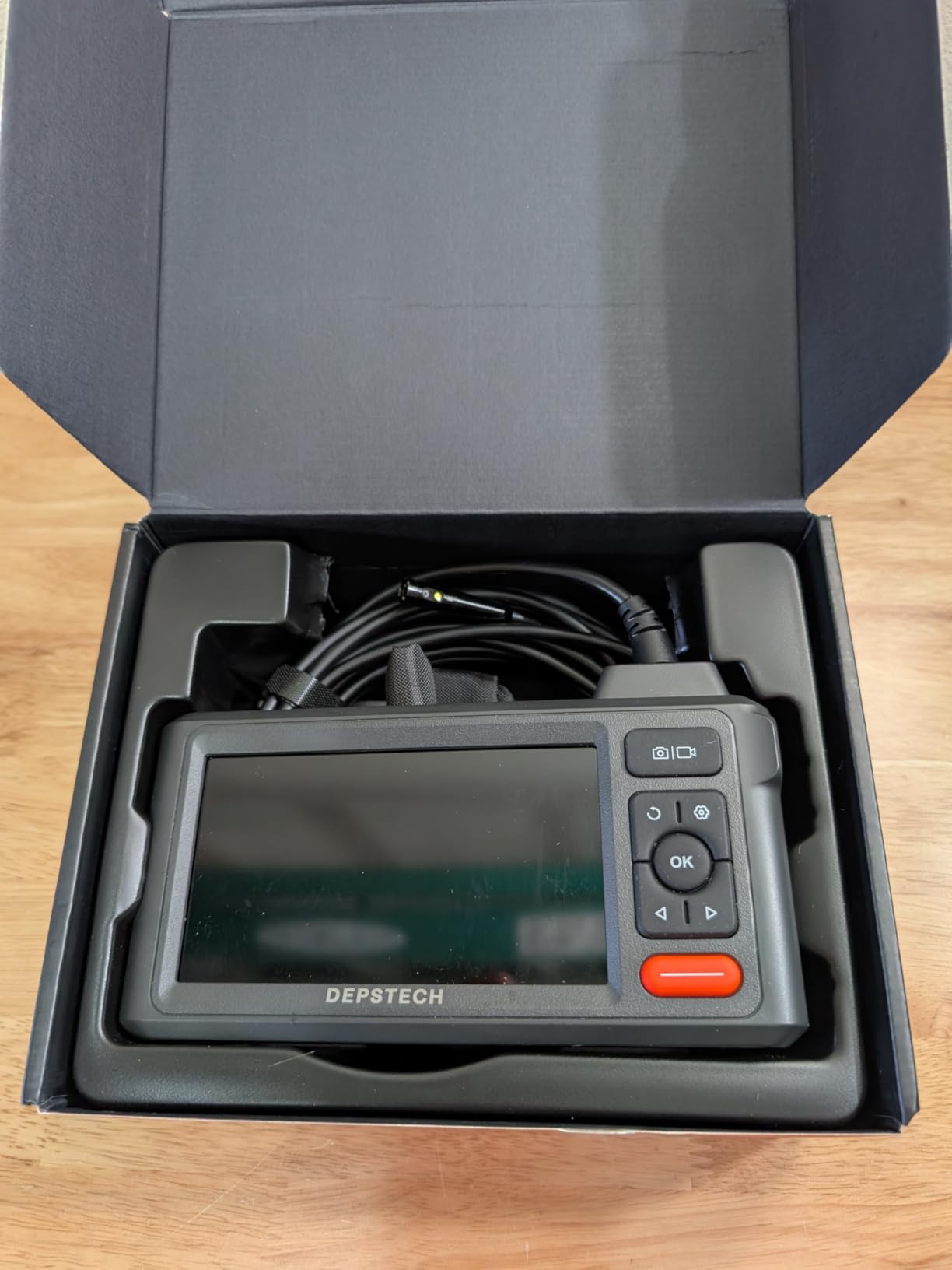
The DS620TL-5M has three cameras: one forward and two side, all switched by a button. That means you can look at a valve face, then look at the piston skirt without pulling the probe out and re-routing the cable, which is the single most common frustration with non-articulating scopes.
It also carries the highest average rating in this group at 4.7, and reviewers credit image clarity and the size of the 5 inch IPS display. Video is 1080P with 2MP stills at a 76 degree field of view, and 10 adjustable LEDs in an 8 plus 1 plus 1 layout light the chamber from behind and both sides.
The 16.5ft semi-rigid cable is IP67 waterproof and the unit runs 2 to 3 hours of continuous operation. Files go to a microSD card, which owners specifically like because transfer is a card to computer job rather than an app connection that can fail mid-inspection.
The carrying bag, charging cable, magnet and hook are included, and the warranty is 24 months. The unit measures 6.8 inches deep, 1.6 inches wide and 3.9 inches high.
Who the DEPSTECH DS620TL-5M suits
It suits technicians who move between engines, radiators and drains and want reach plus multiple angles in one tool. The 16.5ft cable is long enough that you rarely need to reposition the whole unit to get a line of sight, and the file workflow suits anyone who documents work for a customer.
It also suits owners who bounce between a car and a motorcycle, where a smaller engine bay rewards a long cable more than probe finesse.
Where the DEPSTECH DS620TL-5M falls short
There is no split-screen on this model, even though other DEPSTECH products offer it, so switching between the three lenses is a deliberate button press rather than a comparison. Changing view needs a roughly two second hold on the back button, which slows a fast inspection.
The cable is fixed to the unit and cannot be detached, so a damaged cable means a damaged scope. It is also stiff and takes practice to maneuver, and the microSD card is not included.
7. MugEasy 7.9mm Endoscope – A Cheap Look, But Nothing Gets Recorded
Endoscope Camera with Light, 1920P HD Borescope Tools(16.5FT)
7.9mm probe with 1.29in lens head
16.6ft semi-rigid cable
4.3 inch IPS screen
8 adjustable LEDs
Pros
- Sharp 1920x1080 live image on a 4.3 inch IPS screen
- 16.6ft semi-rigid cable reaches deep into pipes
- walls and engine bays
- 8 adjustable LEDs make dark spaces workable
- Standalone unit with no app or driver required
- IP67 waterproof for wet and dirty environments
Cons
- Cannot take or store photos or video files
- No articulating tip and a single lens only
- Fixed focus range means detail suffers when very close
This is the honest budget option: it shows you a live image, clearly and brightly, and it does not record anything at all. If your job is to look at a cylinder and answer one question for yourself, that is enough. If you need proof, it is the wrong tool.
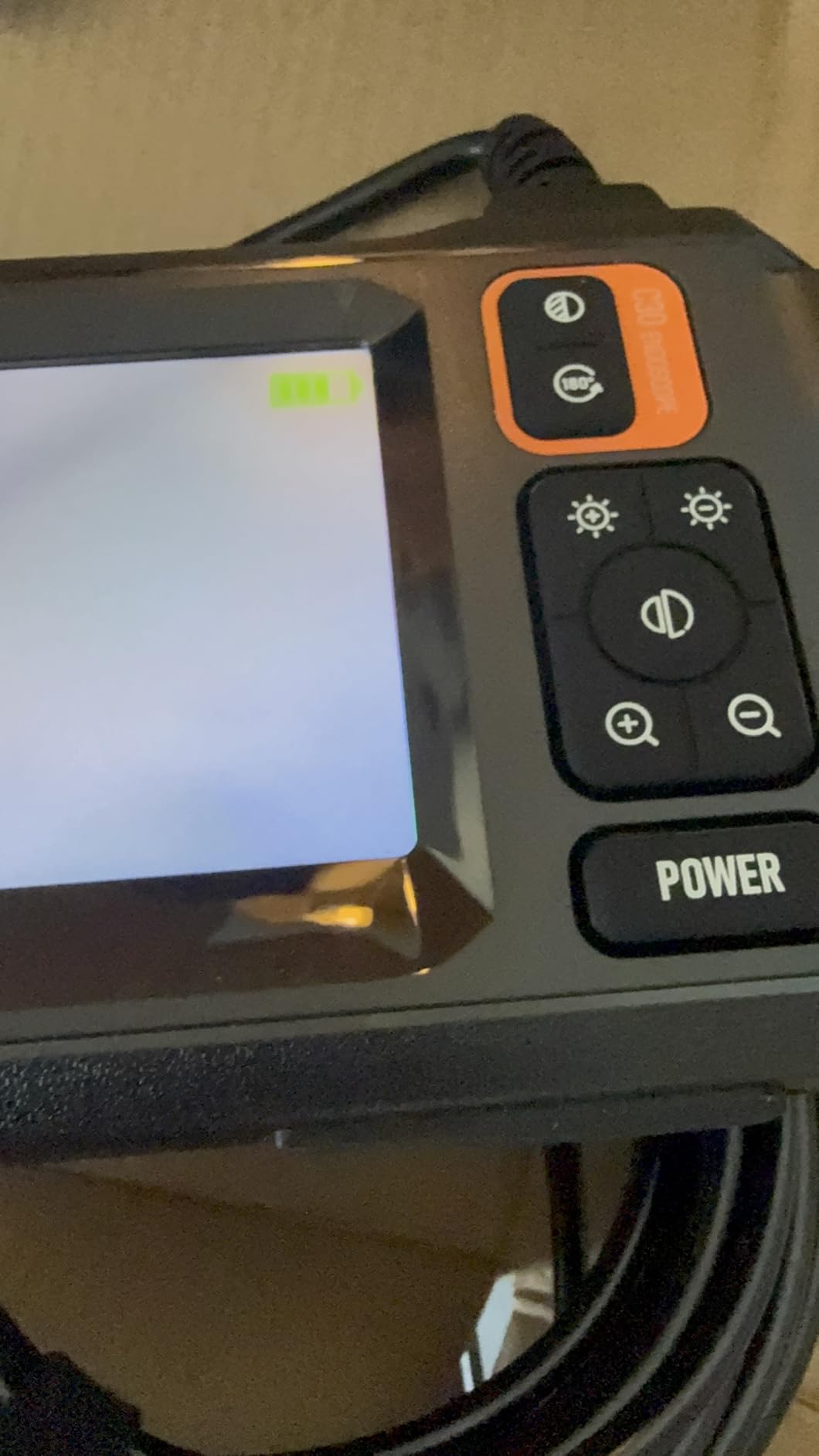
The 7.9mm probe has a short 1.29in lens head, which is about right for a plug hole, and the cable is 16.6ft semi-rigid. The screen is a 4.3 inch IPS panel showing 1920×1080 with a roughly 170 degree horizontal viewing angle, and there is 4x digital and optical zoom.
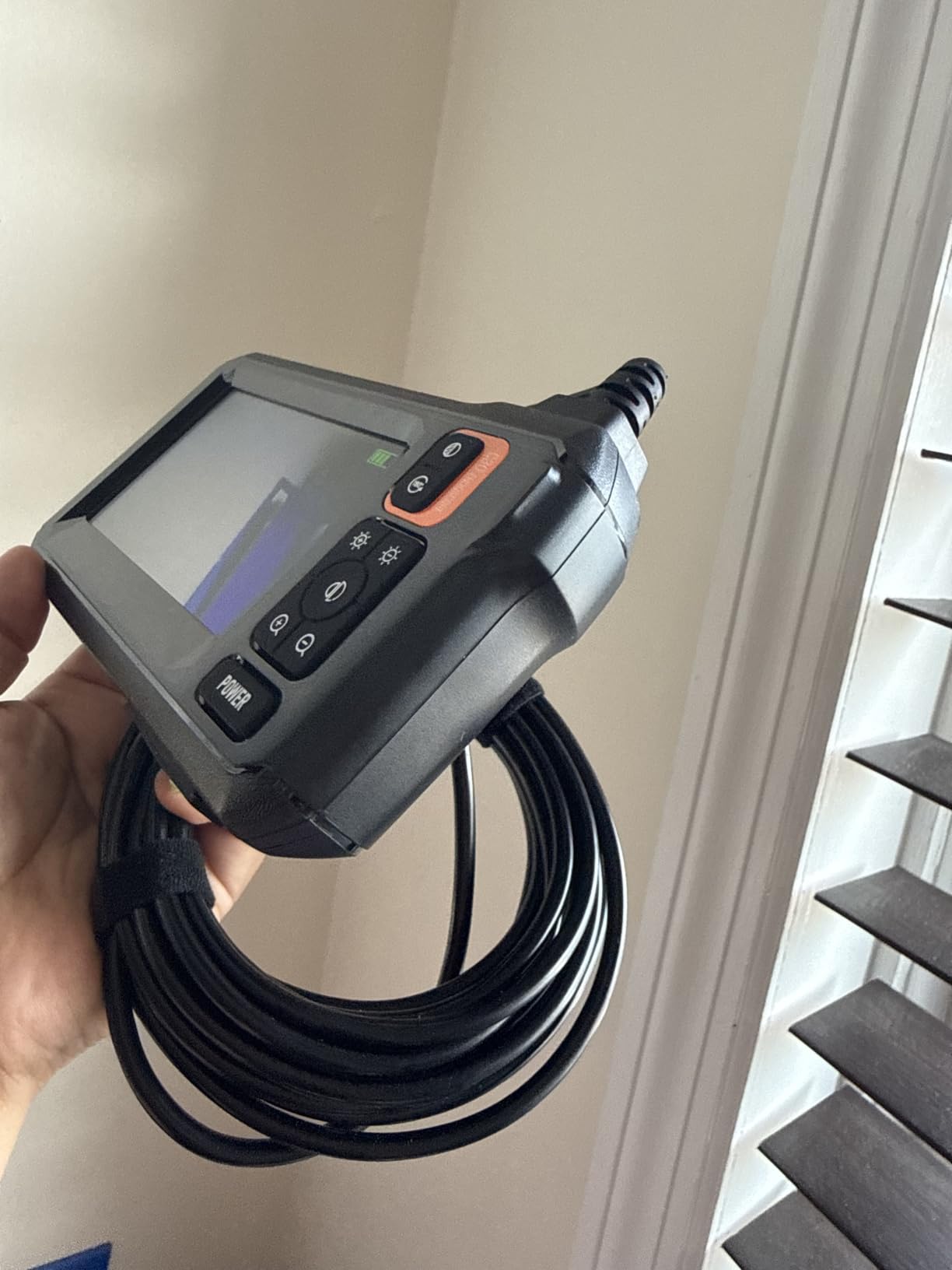
Eight LEDs have adjustable brightness, and colour flip and brightness shift functions help when a chamber is reflecting glare off a wet surface. The IP67 rating covers wet and dirty work, and the optimal focus distance is 2 to 10cm, so the probe sits a little way out rather than jammed against a valve.
It is a standalone unit with no app, no driver and no pairing, which removes the connection problems that dog the phone-based scopes. It is currently ranked first in Video Inspection Equipment, which tells you how much of this category is entry-level work.
Who the MugEasy suits
It suits a first look at an unfamiliar car, a quick check of a drainage problem, or anyone who wants to see whether a complaint is even mechanical before spending money on a better scope. With over 3000 owner ratings, it is also one of the most widely used scopes in the category.
It suits people who work on a phone or tablet anyway and are used to holding a screen in an awkward position.
Where the MugEasy falls short
No photo or video capture means you cannot document a finding, show a customer, or compare a cylinder before and after a treatment. That is a real limitation for anyone verifying an additive or flush claim over time.
There is no articulating tip, so aiming depends on steering the cable, and a single lens means no side view at all. Focus is fixed, so fine detail suffers when the probe is very close to a surface.
8. Daxiongmao 8mm Borescope – A Low-Cost Scope Sized For Plug Hole Access
Daxiongmao Endoscope Camera with Light, 1080P HD Borescope
8mm probe for spark plug hole access
16.5ft semi-rigid IP67 cable
4.3 inch LCD with 180 degree rotation
3.5 hour battery
Pros
- 8mm probe passes through spark plug holes into the combustion chamber
- Long 16.5ft semi-rigid cable reaches deep into ducts and pipes
- 180 degree rotatable LCD and adjustable LED brightness
- Semi-rigid cable pushes past obstacles where flexible cables fail
- Up to 3.5 hours of battery with USB-C charging
Cons
- Cannot record photos or video
- No articulating head
- Resolution is lower than the advertised 1080P in practice
The Daxiongmao exists because the entry end of this market is enormous, and with more than 4700 owner ratings it is clearly being used. The 8mm probe passes through a spark plug hole into the combustion chamber, and the manufacturer states it directly, which is more honesty than most listings in this category manage.
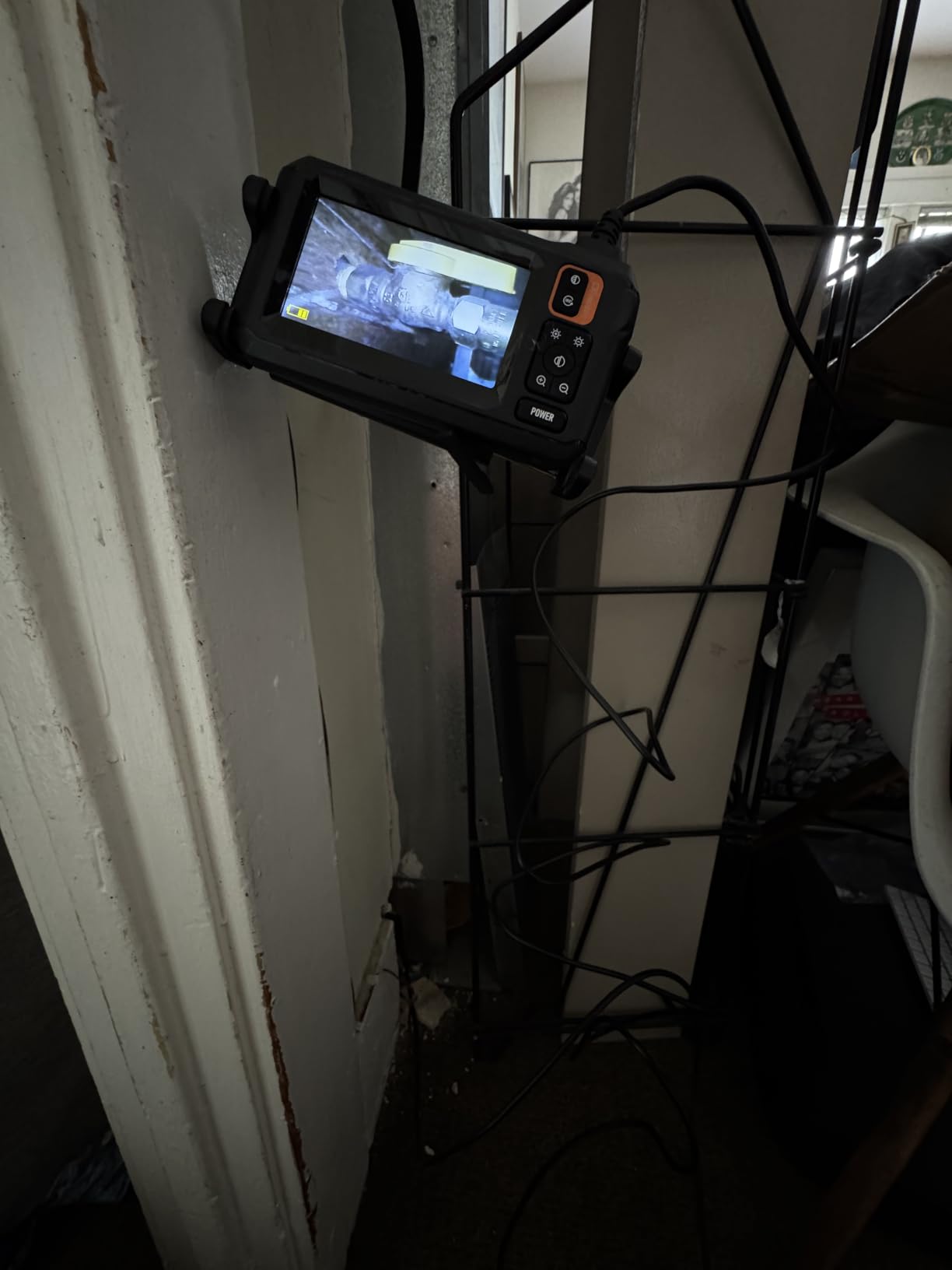
The screen is a 4.3 inch color LCD on a swivel that rotates 180 degrees, so you can angle it to see past your own hand. That is a small feature that matters more than it sounds when your wrist is at an uncomfortable angle above the plug well. Eight adjustable LEDs and a best observation distance of 1.5 to 5 inches cover a normal chamber.
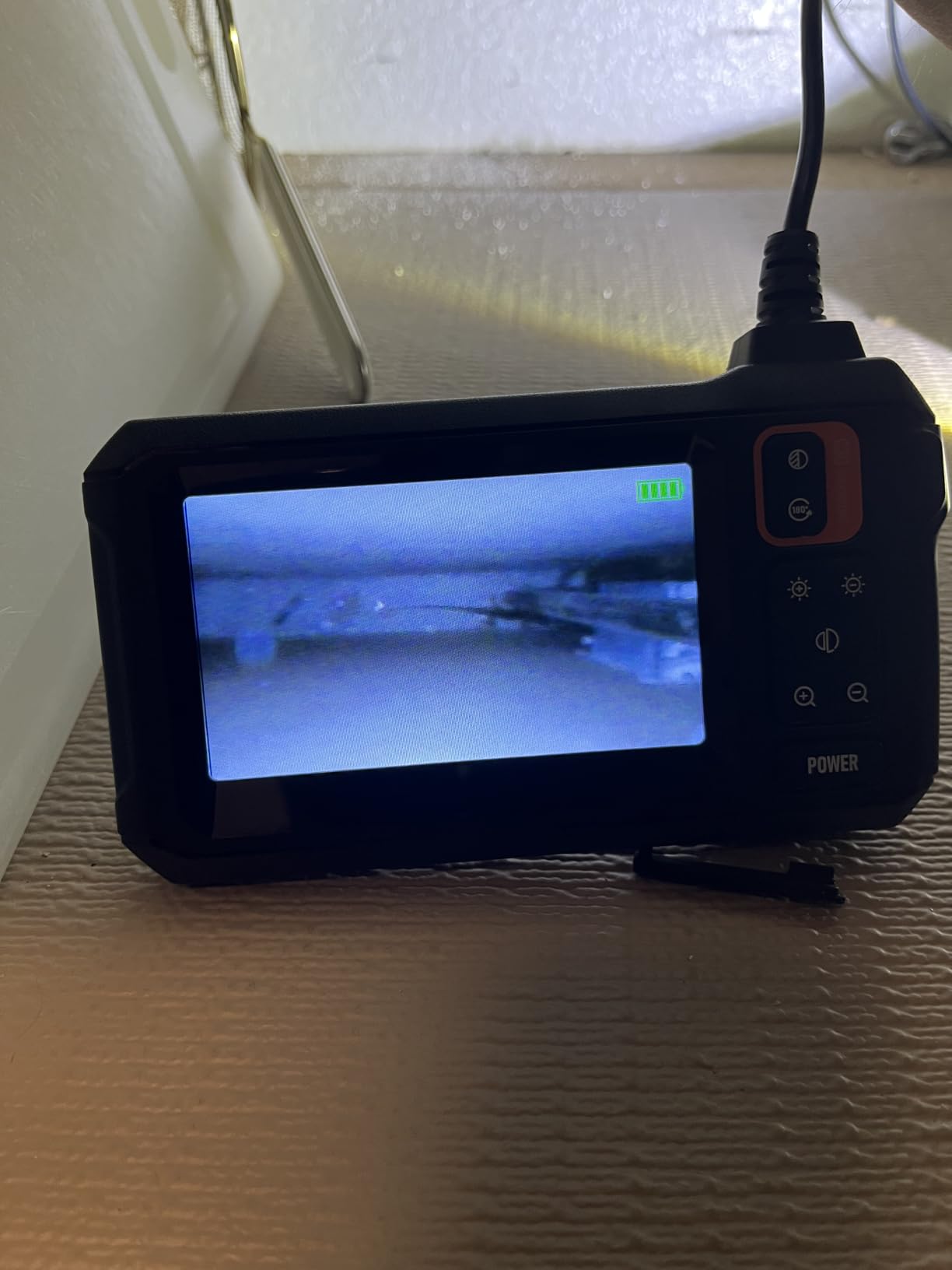
There is 3-step magnification at 1x, 1.5x and 2x, four LED brightness steps and three contrast steps. The probe is IP67 waterproof with a water-safe connector, battery life runs up to 3.5 hours and charging is USB-C. Hook, magnet and a side mirror are included.
The IP67 probe also means you can use it in a wet cylinder without hesitation, which is a legitimate use case when coolant is pooling and you want to see where it is sitting.
Who the Daxiongmao suits
It suits a first engine inspection, a garage tool for someone who fixes the occasional car, and anyone who needs to look into a wet or oily space where a scope with a display and software would be wasted. The rotatable screen and the 8mm probe make it forgiving in a plug well.
It also suits a buyer who wants a second, backup scope in the boot of a car rather than a single tool they worry about.
Where the Daxiongmao falls short
It cannot store photos or video, so nothing you find can be documented or shown to anyone later. There is no articulating head, which puts it in the same category as the MugEasy: aiming is entirely cable manipulation.
Owners consistently report that real-world resolution falls short of the advertised 1080P, and that the zoom, contrast and brightness controls have little visible effect. Owners also note that those adjustments invert the on-screen text, which is disorienting, and that the non-removable battery needs recharging roughly every three months in storage.
9. Kinpthy W400-B – Phone Only, Highest Review Count, No Built-In Screen
Kinpthy Endoscope Camera with Light,1920P HD Borescope Tools with 8 Adjustable LED Lights, Endoscope with Semi-Rigid Snake Camera, Inspection Borescope for iOS and Android-16.4ft Single Lens
7.9mm probe with 1920x1440 capture
16.4ft semi-rigid cable
Phone and tablet app display
8 adjustable LEDs
Pros
- Uses a phone or tablet you already own instead of a built-in screen
- 1920x1440 photo and video capture from a 7.9mm probe
- 16.4ft semi-rigid cable that rolls up quickly
- Works with iOS 9.0 and up and Android 7 and up
- IP67 waterproof rated to 3.28ft for one hour
Cons
- No built-in display so a phone or tablet is required
- Relies on a third-party app connection
- No articulating tip and no zoom
The W400-B sits at the entry end of this category and is the most review-tested scope we compared, with well over 7700 ratings. It is also the lowest rated at 4.3, and the two facts are connected: owners value the price and the reach more than the experience.
There is no built-in screen. The probe captures 1920×1440 photo and video and streams to a phone or tablet through the SUP-ANESOK app, and the stated compatibility is iOS 9.0 and up or Android 7 and up. A 7.9mm probe on a 16.4ft semi-rigid cable with 8 adjustable LEDs is the whole tool.
The cable rolls up quickly for storage, the probe is IP67 waterproof and rated to 3.28ft for one hour underwater, and a magnet, hook, mirror and protective cap are included with a 12-month warranty. It is currently ranked first in the Borescopes category, which reflects how many people start here.
Because the display is your own phone, the image is as big as your phone and as bright as your phone screen, which is a genuine advantage in a dark garage where a small built-in panel is hard to see.
Who the Kinpthy W400-B suits
It suits someone who wants an entry-level scope, already works on their phone, and needs a long, thin probe for narrow pipes and awkward gaps around engine components. It also suits anyone who will share footage from the field, because phone-based capture transfers without a card reader.
It suits a shop that wants a cheap dedicated screen-free scope for a technician who already has a rugged tablet on the cart.
Where the Kinpthy W400-B falls short
Everything depends on the app connection. If the pairing fails in a cold garage with gloves on, you have a probe and no image, and that single dependency is the reason the average rating sits below the rest of this group.
There is no articulating tip, focus is fixed and there is no zoom. Screen size is also outside your control, and some phone cases with a thick camera bump limit how flat a device can sit on a valve cover.
10. DXZtoz AGC500L – The Biggest Screen With A 90 Degree Side Camera
DXZtoz AGC500L Enhanced Articulating Borescope Dual Lens
Two-way 220 degree tip with 90 degree side camera
5FT semi-rigid cable
5.0 inch 1080P IPS screen
10x zoom
Pros
- Articulating tip plus a 90 degree side camera removes dead spots in tight spaces
- Large 5 inch screen with bright crisp imagery
- Smooth flex articulation reaches the underside of valves
- Can run on USB-C power so an aging battery is not a dead end
- Hook and magnet tips help retrieve debris from a cylinder
Cons
- Actual resolution is lower than claimed with grainy saved files
- Recordings can save at 720p in AVI despite the 1080P setting
- Semi-rigid cable struggles in tight pipe bends and focus is manual
The AGC500L is the pick when you want to see more rather than measure more. The screen is 5.0 inches, tied for the largest here, and the probe head carries both a forward lens and a 90 degree side camera on a two-way 220 degree articulating tip, which owners call out for removing dead spots in tight spaces.
Zoom is listed as 10x, the widest in this group, with a 1 to 15cm macro focus range and a best performance band of 2 to 15cm. That is the range you actually use in a combustion chamber, where the probe tip sits a few centimetres from whatever you are inspecting.
The cable is 5FT semi-rigid with a front-exit ergonomic design, so the screen sits above the cable rather than below it, which helps in a tight engine bay. The housing is IP67 waterproof and oil-proof with adjustable bright LEDs, and the battery is 3000mAh for 4 to 5 hours.
One underused feature: it can run on USB-C power, so a unit that has been in a van for four years with a tired internal battery is still usable. A 32GB microSD card, tool case, lens cleaning kit, hook and magnet are included.
Who the DXZtoz AGC500L suits
It suits people with limited vision, poor lighting in the workspace, or a habit of reviewing footage with someone else, because a 5 inch screen is genuinely easier to read than a 4.3 inch one. It also suits small-engine work, where owners report the articulating tip and side camera earning their keep in a much tighter space than a car cylinder.
The hook and magnet tips are a small extra: if a fastener has fallen into a cylinder, you can show the customer exactly what you found and, in the right conditions, retrieve it.
Where the DXZtoz AGC500L falls short
Owners are blunt about resolution: the real image quality is below what the 1080P label implies, saved files are grainy, and recordings can save at 720p in AVI format despite the setting. Manual focus with a limited range means you set it once and live with it.
The semi-rigid cable is difficult to navigate through tight pipe bends, and the internal battery is not user-replaceable, which is the one real longevity concern on a tool this size.
How to Inspect an Engine Cylinder with a Borescope
Six steps, in order, and the order matters. Skipping step two is the most common reason people get a confusing image.
1. Cool the engine first. Nobody should be opening a plug well on a hot engine. Let it cool, drain the coolant if you intend to look in a wet cylinder, and remember that a warm chamber fogs the image and risks the probe tip.
2. Remove the spark plug and rotate the engine to bottom dead centre. Crank the engine to roughly six o’clock on the tdc mark with the timing mark visible. At BDC the piston is at the bottom of its stroke, which gives you the full length of the cylinder to look through and puts the valve faces in view rather than hidden behind the piston crown.
3. Feed the probe in without forcing it. Thread the probe through the plug hole by hand. If a frayed or stiff cable resists, back it out. Users report that rough cables can damage the plug hole threads on the way out, and a stripped plug hole on a transverse engine is an expensive mistake.
4. Steer, then rotate. On a two-way articulating scope, turn the steering control to sweep the tip across the chamber, then twist the cable itself to change direction. On a dual-lens or triple-lens scope, switch cameras instead of re-routing the cable.
5. Capture stills of the same three views. Record the piston crown, each valve face and the cylinder wall. If you are checking a treatment or a flush, matching angles before and after is the only way to compare honestly.
6. Close the plug hole properly. Inspect the plug, the washer and the thread seal, then torque the plug as specified. A borescope inspection is a good reason to reseat a plug you were going to pull anyway.
What you are looking for matters as much as how you look. Users on r/mechanic and r/civic describe borescoping every cylinder to judge whether an engine is finished, and r/civic users pair it with watching the timing while the engine turns.
Carbon buildup is a dark, even or lumpy deposit on the piston crown and valve faces. Glazing is a smoother, shinier patch, usually on part of a ring land, where the seal has been glazed by repeated heat cycles without a break-in fuel event. Scoring is a directional groove running along the bore, and unlike carbon it does not wipe off.
Coolant pooling shows as a reflective liquid surface at the bottom of the chamber, sometimes with a swirl pattern that changes as the engine turns. Users advise checking for it through the plug hole before committing to a leak-down test, because it is faster and often conclusive. A warped or burned valve face is visible as a discoloured or irregular surface, and a butterfly screw or dropped fastener shows up immediately as a hard bright object in the chamber.
Borescope vs Endoscope: What the Words Actually Mean
An endoscope is the umbrella term for any camera probe inserted into a confined space. A borescope is the automotive and industrial subtype of that family, designed around spark plug hole access, engine oil and heat. Buying a general-purpose endoscope marketed for wall cavities and plumbing often means a probe that is too short, too floppy, or not built for oil.
Within the borescope family there are three technologies. A rigid borescope is a hollow metal tube with relay lenses and no moving parts; it is fast, tough and cheap, but it only looks straight ahead. A rigid borescope with a mirror attachment is the tool experienced technicians repeatedly recommend for cylinder-only inspection, because the mirror at the tip turns the view toward the walls and valves. The catch is that the mirror is a separate accessory that is easy to forget, and the rigid tube has no way to follow a curved path.
A flexible videoscope puts the camera on an articulating probe at the end of a pushrod, which is what nearly every product in this roundup is. A fiberscope uses a bundle of glass fibers to carry the image back, which is more serviceable in a plant environment but gives up image quality compared with a CMOS sensor. For engine work at home, a flexible videoscope with a standing screen is the practical default; the rigid-plus-mirror route is cheaper and more honest, because it is what the job actually needs when you only care about the chamber.
If your real task is a car engine, buy the automotive side of the category. If it is a wall cavity or a drain, a general endoscope is fine, and a longer, more flexible cable is the feature that matters.
What a Borescope Cannot Tell You About an Engine
A borescope shows you surfaces. It cannot measure compression, and a cylinder that looks clean can still have low compression. It cannot tell you whether a valve is sealing, only whether it looks intact.
That is the honest limit. Buyers who assume a borescope replaces a compression test and a leak-down test then misdiagnose engines, and that is the most expensive mistake made with these tools. A scope tells you where to look; the compression and leak-down tests tell you whether the engine holds pressure.
Two safety notes that appear nowhere else in this category. Cool the engine before inserting a probe, and never force a cable that resists, because a frayed or stiff probe can strip the plug hole threads on the way out. On a transverse engine with plugs in the valley, thread damage can mean pulling a head.
How to Choose a Borescope for Engine Work
Probe diameter versus plug hole. This is the decision that ends most searches. Roughly 3.9mm and 5mm probes are for tight access on small engines, motorcycles and aviation powerplants. A 6mm probe is the balanced default for most automotive spark plug holes. At 8mm and above you are choosing light intake and a clearer image, and you may also be choosing a probe that will not pass some older or tighter wells. The Air Force community comparison threads pit a Teslong articulating scope against a VEVOR one specifically on cylinder work, and the diameter is the first thing that separates them.
Two-way or four-way articulation. A two-way tip steers side to side, which covers a piston crown and both valves in most inline engines. Four-way adds up and down movement, which matters in a crossflow head where valves sit above the piston and a crosshead where you need to look back at a valve face. For a first scope, two-way with a side camera covers more real cases than an expensive scope with no side view.
Lighting. A chamber is a dark box with polished walls that reflect light straight back at you. Eight adjustable LEDs on multiple brightness levels is the useful baseline, because you will always want to drop the level when the image blows out near a valve face. Scopes with brightness and contrast controls that also invert the on-screen text are worse than they sound.
Display versus app reliability. Manufacturer guides in this category treat app reliability as a real buying factor, and owners agree. A scope that streams to a phone can lose its connection mid-inspection, and a phone screen in a dark engine bay is not always readable. A standing screen with a microSD card removes two failure points at once, and it is why most of the picks here have no app in the loop at all. If you do choose a phone-based scope, test the pairing before you need it.
Recording. If you plan to show a customer what you found, prove a repair worked, or compare an engine before and after a treatment, you need capture. Two scopes here cannot store anything at all, which is fine for a single look and useless for anything else.
Warranty and serviceability. A detachable cable and a replaceable battery extend the life of a scope. One of our picks has a fixed cable and a battery that is not user-replaceable; that is a real consideration for a tool that lives in a vehicle.
Our tiering in one line: a phone-based scope is enough for a first look, a standing-screen scope is the sensible default for regular work, and an articulating scope with a side camera is what you want when the question is about valves rather than the piston.
Frequently Asked Questions
What’s the difference between an endoscope and a borescope?
An endoscope is the broad term for any camera probe inserted into a tight space, including medical, plumbing and wall cavity tools. A borescope is the automotive and industrial subtype built for spark plug hole access, with a probe sized to pass through a plug well, oil resistance, tip heating protection and lighting aimed at a combustion chamber. Buying a general endoscope often means a probe that is too floppy, too short, or not built for oil.
Which is better, a borescope or an endoscope, for engine inspection?
For engine inspection, a borescope. An endoscope designed for walls and plumbing is optimized for a different job and usually gives you a floppy probe, a phone-only display and no tip temperature protection. A borescope gives you a semi-rigid or rigid cable, tip LEDs, a wider probe that fits a spark plug hole, and on good models a temperature sensor with high-temperature shutoff. The exception is a rigid borescope with a mirror attachment, which experienced technicians rate as the correct tool for cylinder-only work.
What is the best borescope for the money?
It depends which tier you are in. For a first look, a phone-based scope with a 7.9mm probe and a long semi-rigid cable is enough to answer whether you have a mechanical problem. For regular work, a standing-screen scope with dual lenses and a 16.5ft cable is the sensible default because it records and needs no app. For valve work, spend the money on an articulating scope with a side camera, a larger probe and USB-C power.
Is a 3.9mm borescope or a 6mm borescope better for a car engine?
For most automotive spark plug holes, a 6mm probe is the balanced default because it fits a typical plug well while still carrying enough light and sensor area for a clear image. A 3.9mm probe is worth it for motorcycles, small engines and aviation powerplants where access is much tighter. Going larger, around 8mm, buys light intake and easier insertion in a corroded well, at the cost of fitting only where the hole allows it.
Can a borescope diagnose a bad cylinder on its own?
No, and this is the most important limitation. A borescope shows you surfaces: carbon buildup, ring scoring, glazing, a damaged valve face, coolant pooling or a stray fastener. It cannot measure compression or confirm that a valve is sealing, so a clean-looking cylinder can still be weak. Use the scope to decide where to look, then confirm with a compression test and a leak-down test before you commit to a teardown.
Which Borescope Should You Buy?
If you want one answer for engine inspection in 2026, buy the Teslong TD450S. The centered steering lever makes plug-hole work manageable with one hand, the 4.5 inch IPS screen is bright, and the on-screen tip temperature sensor with high-temperature shutoff is the safety feature that justified the choice for us.
Buy the DXZtoz AGC430N instead if your plug wells are tight or corroded and you want an 8.5mm head and 8x zoom. Buy the DEPSTECH DS300-DL if you want a forgiving first scope with a long cable and dual views, and the Teslong TD500 if a second person needs to watch the live feed over Wi-Fi.
Everything below the Teslong is a question of how deep you want to go rather than how good the pick is. The Acoath and the DXZtoz AGC500L cover multi-angle viewing, the DEPSTECH DS620TL-5M gives you three lenses and a 16.5ft cable, and the MugEasy, Daxiongmao and Kinpthy cover the entry tier for a single look or a first diagnosis.
Whatever you choose, cool the engine, rotate to bottom dead centre, and force nothing. The scope will show you the surfaces, and a compression and leak-down test will tell you whether the engine holds pressure.