
Two people on the same soldering subreddit will give you opposite answers on the same question. One will tell you a cheap USB microscope is all a beginner needs. The other will tell you that the first time they worked through a stereo scope, they realised they had been soldering semi-blind for years. Both are right, and the difference between them is not budget. It is whether the work under your hands is finer than your unaided eyes can resolve.
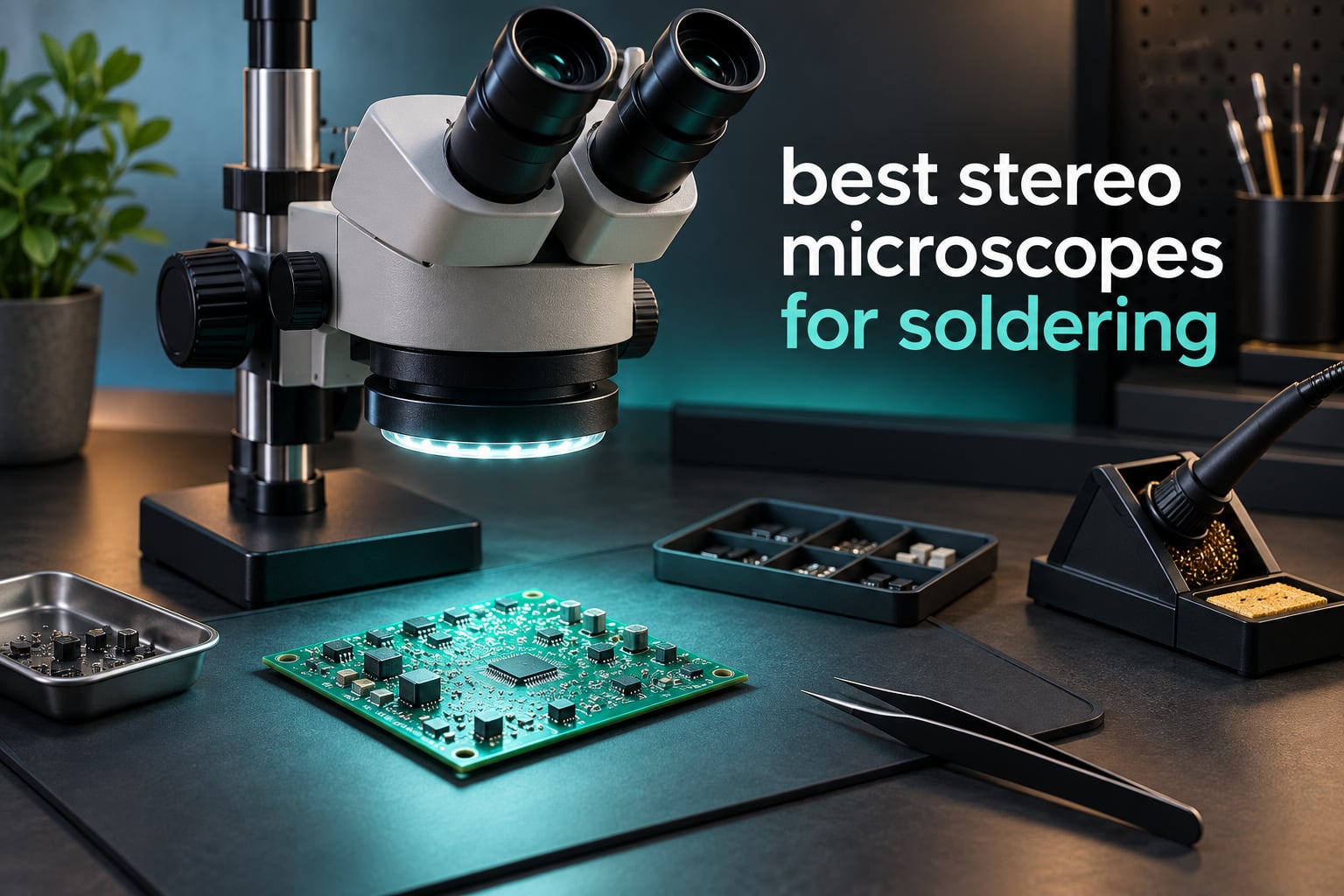
A stereo soldering microscope is a binocular low-power inspection scope that shows a depth-perceived image of a circuit board at roughly 7x to 45x. Light from an LED or ring source hits the board, a zoom objective magnifies it, and two eyepieces project slightly offset images so your brain reconstructs depth. Both hands stay free. Nothing forces you to look up and down between the board and a screen, which is where most of the eye strain in digital microscope work comes from.
That matters more than the spec sheet suggests. When you are placing a 0201 resistor next to a 0.5mm leadless chip footprint, the features you need to verify are well under a millimetre across. Without magnification you work from memory, bridge neighbouring pads, and discover the mistake only when the board fails. The best stereo microscopes for soldering let you see the joint before it cools instead of after.
We spent weeks working through the specs, owner reviews and forum threads behind the twelve scopes below, because this is a category where the marketing language is thinner than the real differences. The core finding: magnification is the spec buyers obsess over and the one that matters least. Working distance decides whether you can physically use the thing.
One r/soldering commenter put it better than any spec sheet: if you need depth perception, go with the stereo one, because you can still add a camera later. That single point separates almost every recommendations in this roundup, so we have built the whole article around it.
Table of Contents
Top 3 Stereo Microscopes for Soldering (October 2026)

AmScope SE306R-PZ Forward…
- 20X-40X-80X stereo magnification
- Widefield optical glass lenses
- All metal pillar stand
- Incident and transmitted lights

DZQ ZQ-1 Multi-Directional…
- 7X-45X continuous zoom
- 95-300mm working distance
- 60-LED dimmable ring light
- Spring arm with headrest

ZTEEERS Trinocular Boom…
- 3.5X-90X total range
- Double-arm boom stand
- 18 lb steel base
- 56S dimmable ring light
The AmScope SE306R-PZ is the pick we would put on a bench without hesitating. It has the largest owner base in the group at 321 reviews, a 4.6 average, and an all-metal pillar stand that does not wander when you lean in. Its halogen lighting is the weak point, and we get to that below.
The DZQ ZQ-1 solves the one problem that trips up most budget scopes: working distance that adjusts from 95mm to 300mm, so an iron, tweezers and both hands fit under the head. The ZTEEERS boom-stand trinocular goes further with a 6.4:1 zoom range and a camera port, at the cost of a genuinely heavy stand.
All 12 Stereo Microscopes at a Glance in 2026
| Product | Specs | Action |
|---|---|---|
| AmScope SE306R-PZ Forward Binocular |
|
Check Latest Price |
 AmScope SE306R-P-LED Cordless LED AmScope SE306R-P-LED Cordless LED |
|
Check Latest Price |
| DZQ ZQ-1 Multi-Directional 7X-45X |
|
Check Latest Price |
 AmScope SE508 8X Binocular AmScope SE508 8X Binocular |
|
Check Latest Price |
 SWIFT Trinocular 3.5X-90X Pillar Stand SWIFT Trinocular 3.5X-90X Pillar Stand |
|
Check Latest Price |
| ZTEEERS Trinocular Boom Stand 3.5X-90X |
|
Check Latest Price |
 SWIFT S7 Trinocular Single-Arm Boom SWIFT S7 Trinocular Single-Arm Boom |
|
Check Latest Price |
 CTISMICE Jewelry Microscope 7X-45X CTISMICE Jewelry Microscope 7X-45X |
|
Check Latest Price |
 SWIFT S7-TGL-CA05 Trinocular Pillar SWIFT S7-TGL-CA05 Trinocular Pillar |
|
Check Latest Price |
 ZTEEERS Trinocular 6X-45X Pillar Stand ZTEEERS Trinocular 6X-45X Pillar Stand |
|
Check Latest Price |
 Kaisi TX Soldering Microscope Kaisi TX Soldering Microscope |
|
Check Latest Price |
 GEMKIT Jewelry 7X-45X Boom Arm GEMKIT Jewelry 7X-45X Boom Arm |
|
Check Latest Price |
1. AmScope SE306R-PZ Forward Binocular Stereo Microscope
AmScope SE306R-PZ Forward Binocular Stereo Microscope, WF10x and WF20x
20X/40X/80X stereo steps
Widefield optical glass lenses
All metal pillar stand
Halogen top and bottom illumination
Pros
- Sharp widefield optics with convincing 3D depth perception
- Solid all-metal build that stays put on the bench
- Switchable incident and transmitted lights
- Backed by the largest owner review base in this group
Cons
- Halogen housing runs very hot near heat-sensitive work
- No continuous zoom
- only 2x and 4x objective steps
- Dimmer output than an LED replacement
- Shallow depth of field at 80X
Of the twelve scopes here, the AmScope SE306R-PZ has the deepest evidence base: 321 reviews holding a 4.6 average, and a #5 ranking in lab stereo microscopes. That combination of build quality and owner history is why it takes the top slot rather than a spec-sheet winner.
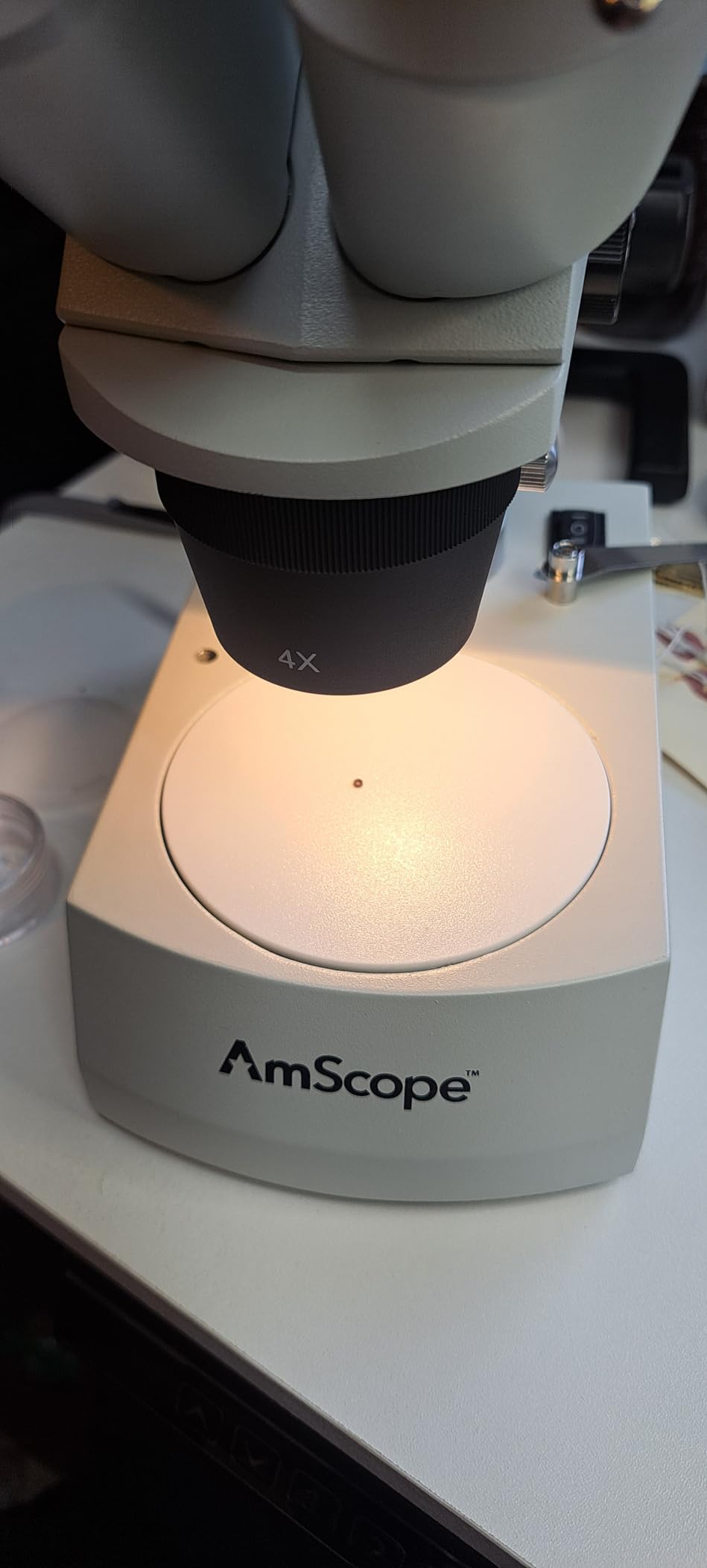
The forward widefield binocular head sits on a pillar stand with an all-metal framework, so the head holds position while you move a board underneath it. Magnification runs in steps at 20x, 40x and 80x from the 2x and 4x objectives, which is less fluid than a continuous zoom but perfectly workable for inspection work where you are moving between a whole board and a single joint.

The one genuine complaint that comes up repeatedly is the halogen lamp. It runs hot enough that owners warn about leaving heat-sensitive subjects under it, and several have swapped in LEDs. The upside of the older lamp type is a genuinely bright, even image with no LED colour cast on reflective solder joints.
Working distance is not published for this model, and that matters. On a forward pillar stand the clearance under the head is limited, so plan your bench layout before it arrives. Buy it for optics, build and the warranty, not for flexibility.
What it does well for a soldering bench
Through-hole assembly and inspection on 0805-and-larger parts is where this scope is at its best. The depth perception is strong enough to see a fillet forming, and the pillar stand is stable enough that you can keep your eye in the eyepieces while both hands work. For anyone moving from a digital USB microscope, the switch to real stereo vision is immediate and obvious.
The 45-degree viewing angle and the switchable top and bottom illumination also help. Bottom light is useful for inspecting a board from underneath or working on transparent substrates, and the switch is right there on the base rather than buried in a menu.
Who should skip it
Skip this scope if your work is hot-sensitive or heat-adjacent, or if you need continuous zoom while working. It is a stepped magnification head, so every change is a physical lens swap rather than a turn of the handwheel. Photographers and people doing fine-pitch rework will find 80x with a shallow depth of field frustrating.
It is also not the right choice if you plan to attach a camera later, since the head is binocular only. For that path, look at one of the trinocular models further down.
2. AmScope SE306R-P-LED Cordless LED Stereo Microscope
AmScope SE306R-P-LED Cordless LED Stereo Microscope, 20x-40x
20X and 40X magnification steps
Cordless LED illumination top and bottom
Widefield optical glass eyepieces
All metal pillar stand
Pros
- Cool LED light in both top and bottom positions
- Battery power keeps a cord off the bench
- Clean bright image from widefield optics
- Five year manufacturer warranty
Cons
- Only two fixed magnification steps
- Field of view narrows quickly at 40X
- No continuous zoom
This is the SE306R-PZ with the halogen swapped for LEDs and a battery inside, and for a lot of benches that is the better version of the same idea. It holds a 4.4 average across 223 reviews, so there is a real ownership history here rather than a thin listing count.
Running cordless is a small thing that turns out to matter. On a crowded electronics bench, a power lead trailing from the microscope base is one more thing to snag, and the freedom to reposition the scope without rewiring is genuinely convenient when you alternate between inspecting and assembling.
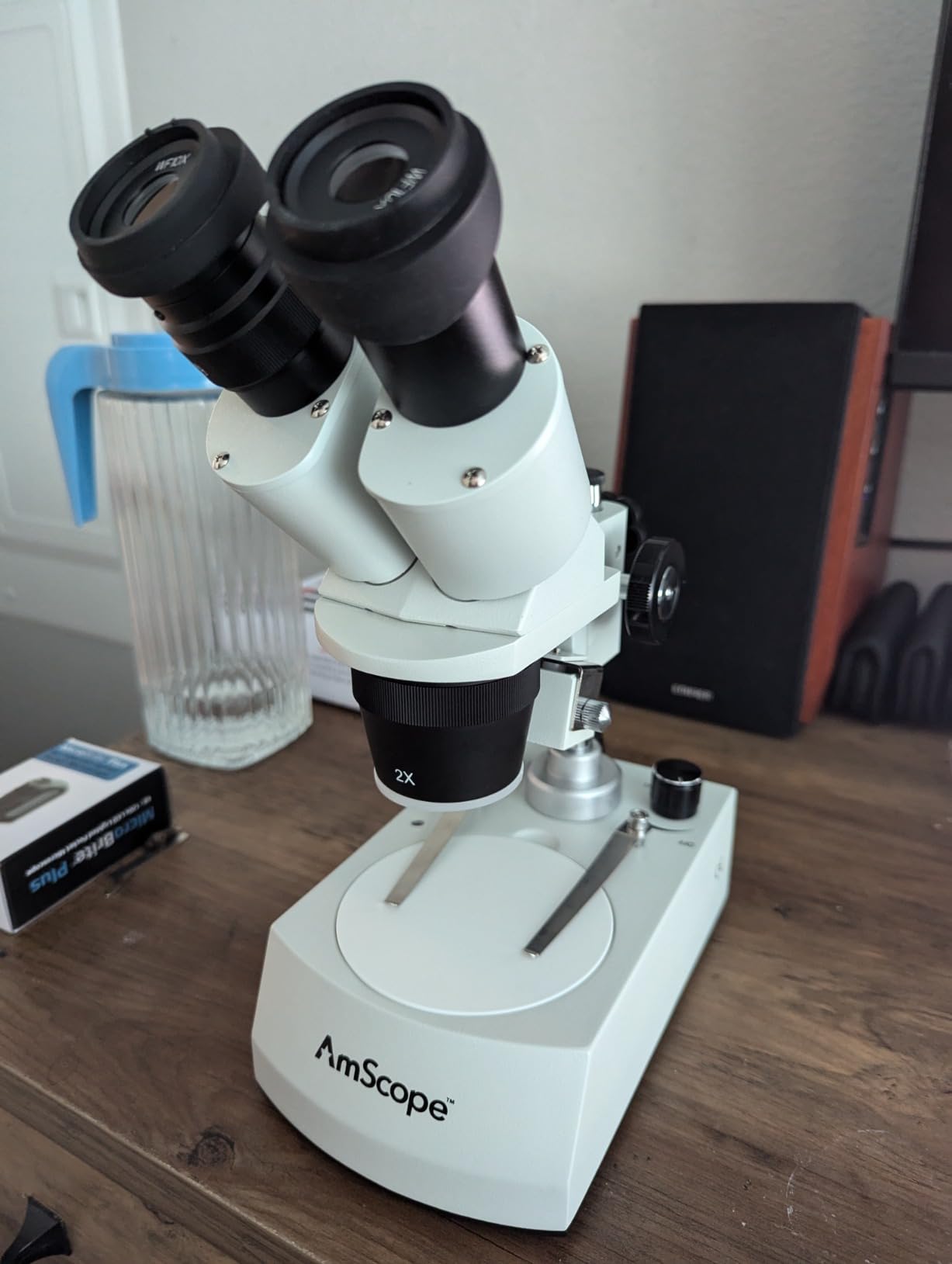
The LED illumination is the quiet win. It runs cool enough to work close to a board without worrying about heat, and the top and bottom lights switch cleanly for inspecting solder joints from above or checking a board from beneath.
The limitation is stated plainly in the reviews: two fixed steps at 20x and 40x. That is a narrower tool than a 7x-45x continuous zoom head, and buyers who later wanted to scan from a wide overview down to a single pad found the range restrictive.
Where it earns its place
For through-hole work, cable-free bench organisation and inspection of 0805 and larger components, it does everything needed. The widefield optical glass eyepieces produce a bright, clean image, and the all-metal pillar stand holds the head steady under pressure.
It is also the option we would suggest for a teaching or training bench, where several people share one scope and the ability to move it around without unplugging anything is worth more than magnification headroom.
Who should skip it
Anyone doing SMD rework on 0402 or 0201 parts will outgrow the 40x ceiling quickly. There is also no third port, so recording or documenting your work means a separate camera setup entirely.
If your bench has a dedicated microscope position already wired in, the cordless advantage disappears and you are better served by a continuous zoom head.
3. DZQ ZQ-1 Multi-Directional Microscope, 7X-45X
DZQ ZQ-1 Multi-Directional Microscope 7X-45X Magnification 0.5X Barlow Lens
7X-45X continuous zoom
95-300mm adjustable working distance
60-LED dimmable ring light
Spring arm with headrest
Pros
- Wide adjustable working distance leaves room for hand tools under the head
- Dimmable 60-LED ring light gives even shadow-free illumination
- Headrest and spring mount reduce fatigue over long sessions
- Includes a 0.5X Barlow lens
Cons
- Very heavy base and stand assembly
- Bulky footprint takes substantial bench space
The ZQ-1 is the answer to the most common complaint in this category. Its working distance adjusts from 95mm to 300mm, which means the head can sit far enough above the board that an iron, tweezers and both hands all fit in the space underneath. Most competing scopes in this group give you a fixed figure and no adjustment at all.
That single feature is why it takes the best value slot. Buyers consistently name it as the reason they bought the scope, and the 60-LED ring light with a 0-100% dimmer means you can dial the illumination down when working on reflective solder.
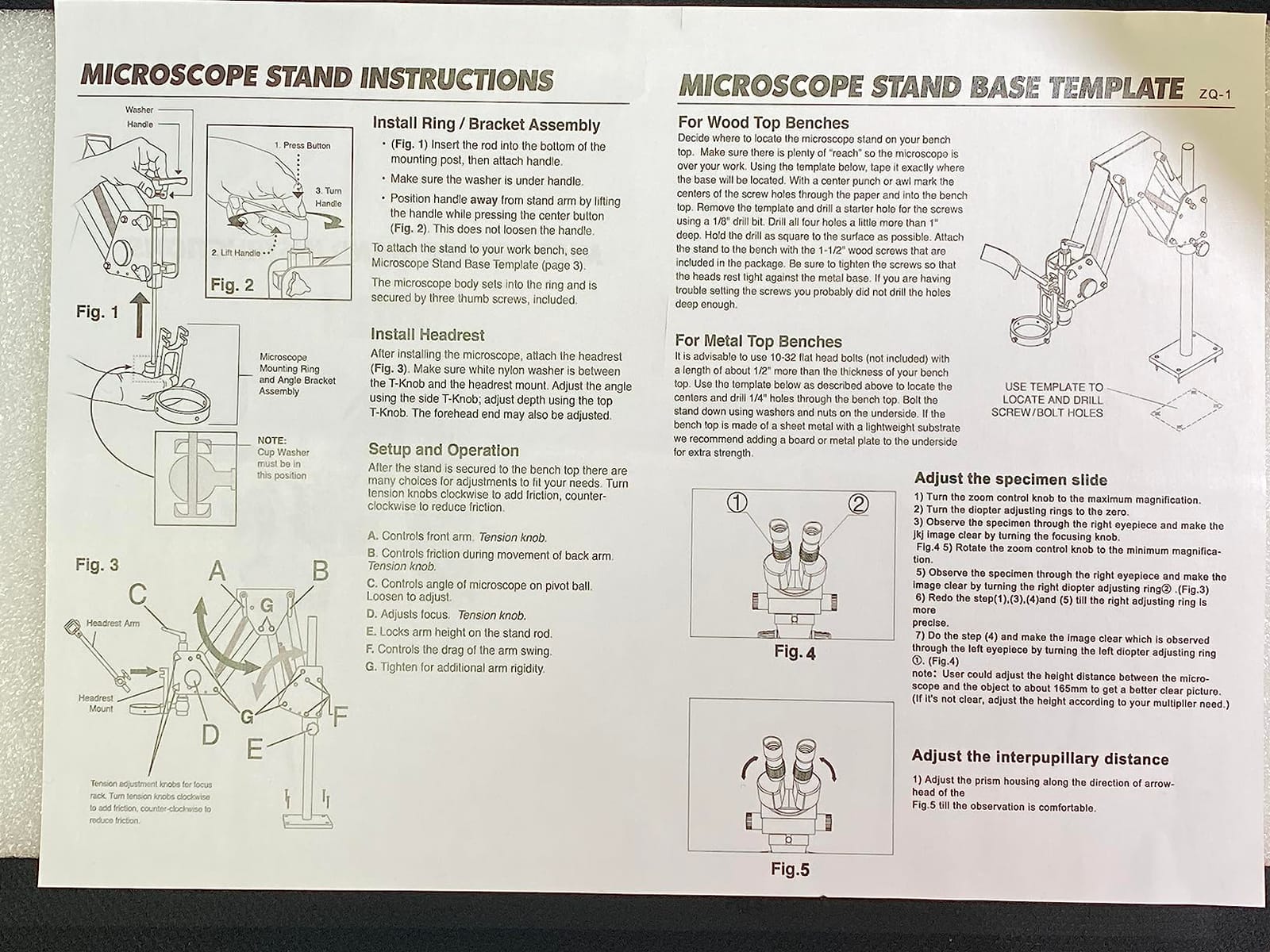
Magnification runs continuously from 7x to 45x on a 0.7x-4.5x zoom objective, and a 0.5x Barlow lens is included in the box for pulling back further when you need an overview of a whole assembly. The multi-directional spring bracket and headrest are unusual at this level and genuinely help over a long session.
Be aware of the size. The listed dimensions are 24 by 17 by 9 inches, and the weight is listed at 11.1kg. That is a large footprint, and on a small bench it will push everything else around. Plan the layout before ordering.
Why working distance changes the whole job
There is a well-known complaint from soldering bench owners that a microscope base can physically block the movement of a soldering iron, leaving no clearance to work at all. The ZQ-1 sidesteps that by letting you set the gap yourself. You can drop the head close for inspection, then lift it 200mm or more and still have a usable view while you bring an iron in.
For anyone moving between inspection and active rework on the same board, that flexibility is worth more than the extra magnification steps some competing scopes offer.
Who should skip it
Skip it if bench space is tight. This is not a compact instrument and there is no smaller version of the stand. It is also binocular only, so if filming your work matters to you, this is not the platform.
Buyers who need a camera port and a long working distance together should look at the ZTEEERS boom-stand model further down instead.
4. AmScope SE508 8X Binocular Stereo Microscope with Gooseneck Arm
AmScope – 8X Magnification Binocular Stereo Microscope w/ 360 Revolve – Dental, Lab, Electronic Repair, Soldering, Shop Gooseneck Illuminator – SE508
8X fixed magnification
95mm working distance and 25mm field of view
360-degree rotating head
12 inch gooseneck arm
Pros
- Genuine optical stereo at an accessible entry point
- Sharp image quality for inspection work
- Weighted metal base and a gooseneck that holds position
- Plenty of head clearance for sitting upright
Cons
- Fixed 8X with no zoom at all
- No focus knob
- focusing means bending the gooseneck
- Narrow depth of field
- Instructions are a single poorly reproduced sheet
The SE508 exists to answer one question: can a real optical stereo microscope be had cheaply? Owners say yes, repeatedly, describing the image as near lab grade for the money and using it for SMT soldering, motherboard repair, dental lab work and even splinter removal. It holds a 4.4 rating from 60 reviews.
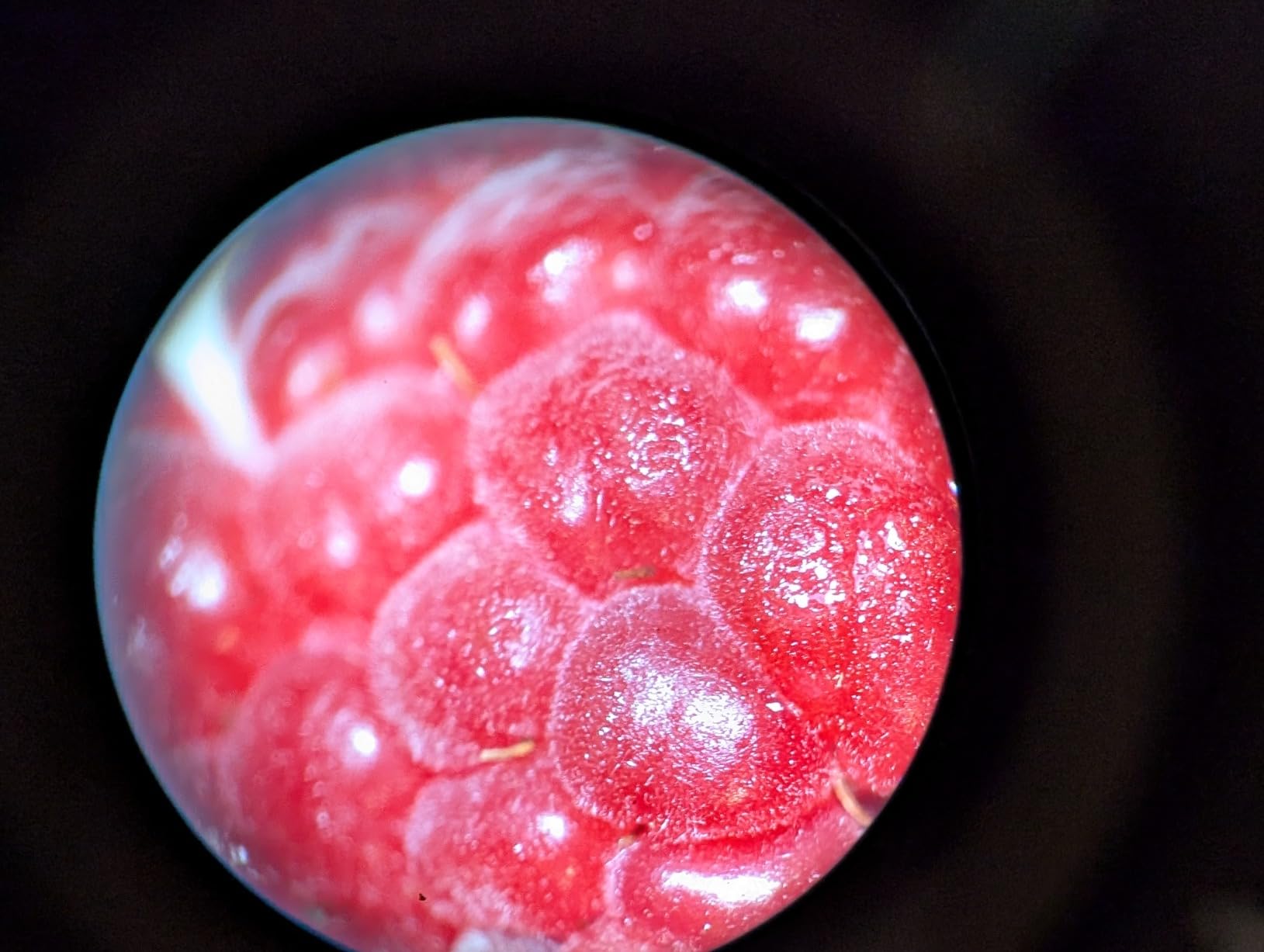
At 8x with a 95mm working distance and a 25mm field of view, this is an inspection tool rather than a rework tool. That is a real and useful distinction. For checking a board for bridging, verifying a joint, or confirming a placement, 8x optical with true depth perception beats almost any cheap digital scope.
The gooseneck arm is what makes it viable at this price rather than a bare head. It gives you vertical positioning without a stand to buy separately, so the scope is usable the day it arrives rather than after a trip to a parts supplier.
What works well
The weighted metal base and 12-inch gooseneck arm hold their position, and the 360-degree rotating head means you can bring the view around without moving the base. The head clearance is generous, so you can sit upright at the bench rather than hunching, which matters over a long evening.
Adjustable interpupillary distance is present, which is more than many scopes at this level offer. It is a small thing that makes a real difference when you have been soldering for three hours.
Who should skip it
There is no focus knob. Focusing is done by physically bending the gooseneck, and one reviewer is blunt that this makes it unsuitable for electronics repair. If you need to refocus constantly while moving a board, that is a genuine problem rather than an inconvenience.
Also skip it for anything finer than 0805 components. Eight times magnification cannot resolve a 0402 pad, and there is no path to more magnification without replacing the whole head.
5. SWIFT Trinocular Stereo Zoom Microscope, 3.5X-90X
SWIFT Trinocular Stereo Zoom Microscope with 56-Bulb LED Ring Light,3.5X-90X Magnification,WF10X Eyepieces,0.7X-4.5X Zoom Objective, 0.5X 2.0X Additional Objectives,Table Pillar Stand
3.5X-90X total magnification
7X-45X continuous 6.4:1 zoom
100mm working distance
45-degree tilted trinocular head
Pros
- Exceptionally wide total range using the included auxiliary objectives
- 56-LED ring light stays cool for sensitive work
- Tilted trinocular head with 360-degree rotation reduces eye and neck strain
- Third port accepts a camera for documentation
Cons
- Plain pillar stand limits reach over larger assemblies
- Auxiliary lenses must be physically swapped to change range
This is the first scope in our list that solves both the magnification and the documentation problem at once. Two WF10x eyepieces with a 0.7x-4.5x zoom objective give continuous 7x-45x at a 6.4:1 zoom ratio, and the included 0.5x and 2.0x auxiliary objectives stretch that to 3.5x-90x.
That range matters more than it looks. The 2.0x auxiliary gets you to 90x for inspecting a fine-pitch joint, while the 0.5x drops you to 3.5x for orienting yourself on a large assembly without lifting your head. The trade is that changing range means swapping a lens by hand rather than turning a control.
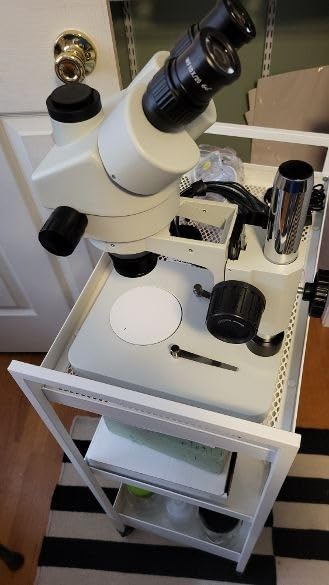
The trinocular head is the differentiator. It tilts to 45 degrees and rotates a full 360 degrees, which makes long sessions considerably more comfortable than a fixed head, and the vertical third port can be used either as a third eyepiece or as a camera and photo port.
That is the path enthusiasts talk about when they recommend a stereo scope: you keep stereo vision through both eyes and put a camera in the third port for recording or stills. Illumination is a 56-bulb LED ring, low heat and shadow-free.
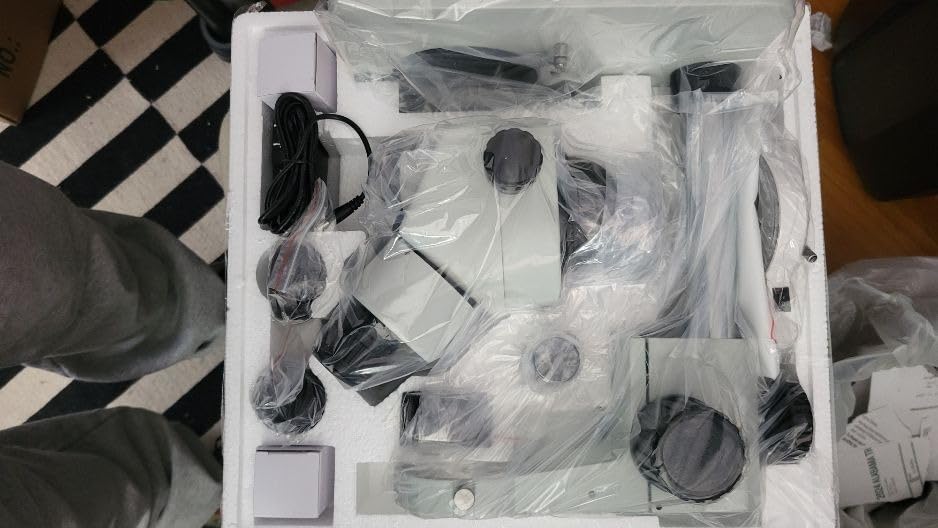
Where it suits a soldering bench
The 100mm working distance on a pillar stand gives reasonable room for an iron and a pair of hands, and the 4.2kg weight keeps the whole thing planted. If you work on phone or laptop mainboards, being able to swing from 7x for navigation to 45x for the joint without losing your stereoscopic view is the whole game.
It is also a good fit for documentation-heavy work. Soldering repair businesses that need before and after images of joints can mount a camera in the third port and keep working with both eyes in the eyepieces.
Who should skip it
Skip it if you work on large assemblies. A plain pillar stand has a fixed reach, and if your workpiece needs the head to swing out over it, you will be fighting the stand rather than working. Choose a boom stand for that.
Buyers who want continuous access to both ends of the range without swapping lenses should consider a scope with a wider single zoom objective instead.
6. ZTEEERS Trinocular Stereo Zoom with Double-Arm Boom Stand
ZTEEERS Professional Trinocular Stereo Zoom Microscope, 3.5X-90X Magnification,WF10X Eyepieces, 0.7X-4.5X Zoom,0.5X & 2.0X Auxiliary Lens, Double-Arm Boom Stand, 56S LED Ring Light,Two adapters
3.5X-90X with auxiliary lenses
Double-arm boom stand on 18 lb steel base
56S dimmable ring light
Two camera adapters included
Pros
- Roughly 20cm of boom clearance for irons and hand tools
- Everything needed is in the box including camera adapters
- Clear image with simultaneous camera and binocular viewing
- Heavy steel base keeps the arm rock steady
- Per-eye diopter adjustment and wide interpupillary range
Cons
- Very heavy and long footprint
- some buyers report it exceeds the listed dimensions
- Poor instructions
- Can tip if the arms are extended carelessly
Where the pillar stands fall short, a boom stand takes over. The ZTEEERS unit puts a double-arm boom on an 18 lb solid steel rectangular base, and reviewers specifically call out the roughly 20cm of clearance it creates for soldering irons and hand tools. That is the real reason to spend more here.
Optical specification is 0.7x-4.5x on the zoom objective with 0.5x and 2x auxiliary lenses, giving 3.5x-90x overall. The 56S LED ring light has a dimmer switch, and the trinocular port includes two adapters for digital cameras and electronic eyepieces.
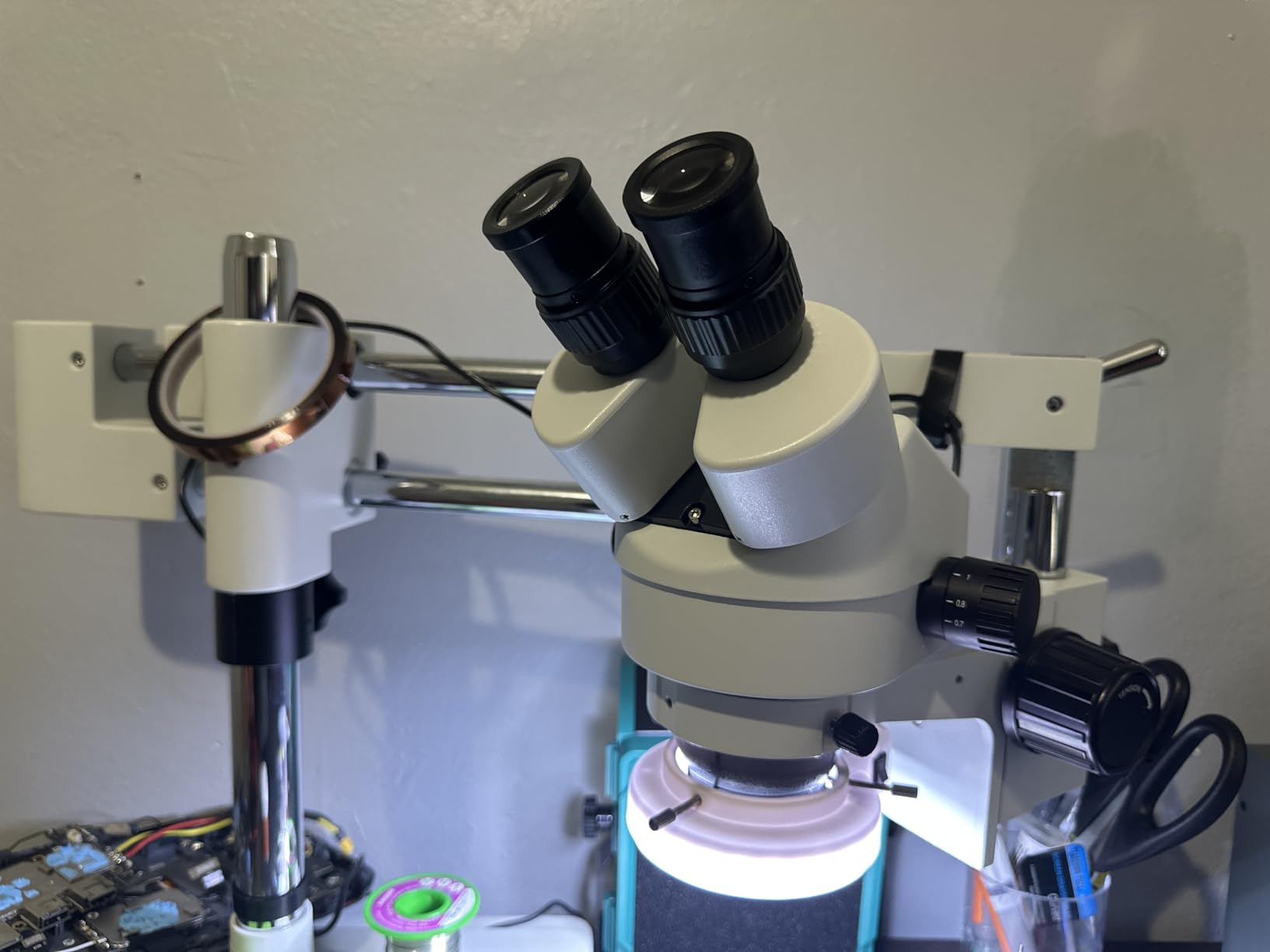
Two details separate it from cheaper trinocular scopes. The WF10x super widefield eyepieces carry per-eye diopter adjustment and a 48-75mm interpupillary range, so you can set the optics to your own eyes rather than adapting to them. And the ball-bearing glide on the boom means the arm moves smoothly under load rather than dropping when you release it.
Several buyers compare it favourably against a same-specification AmScope while costing noticeably less, which tells you where this sits in the market.
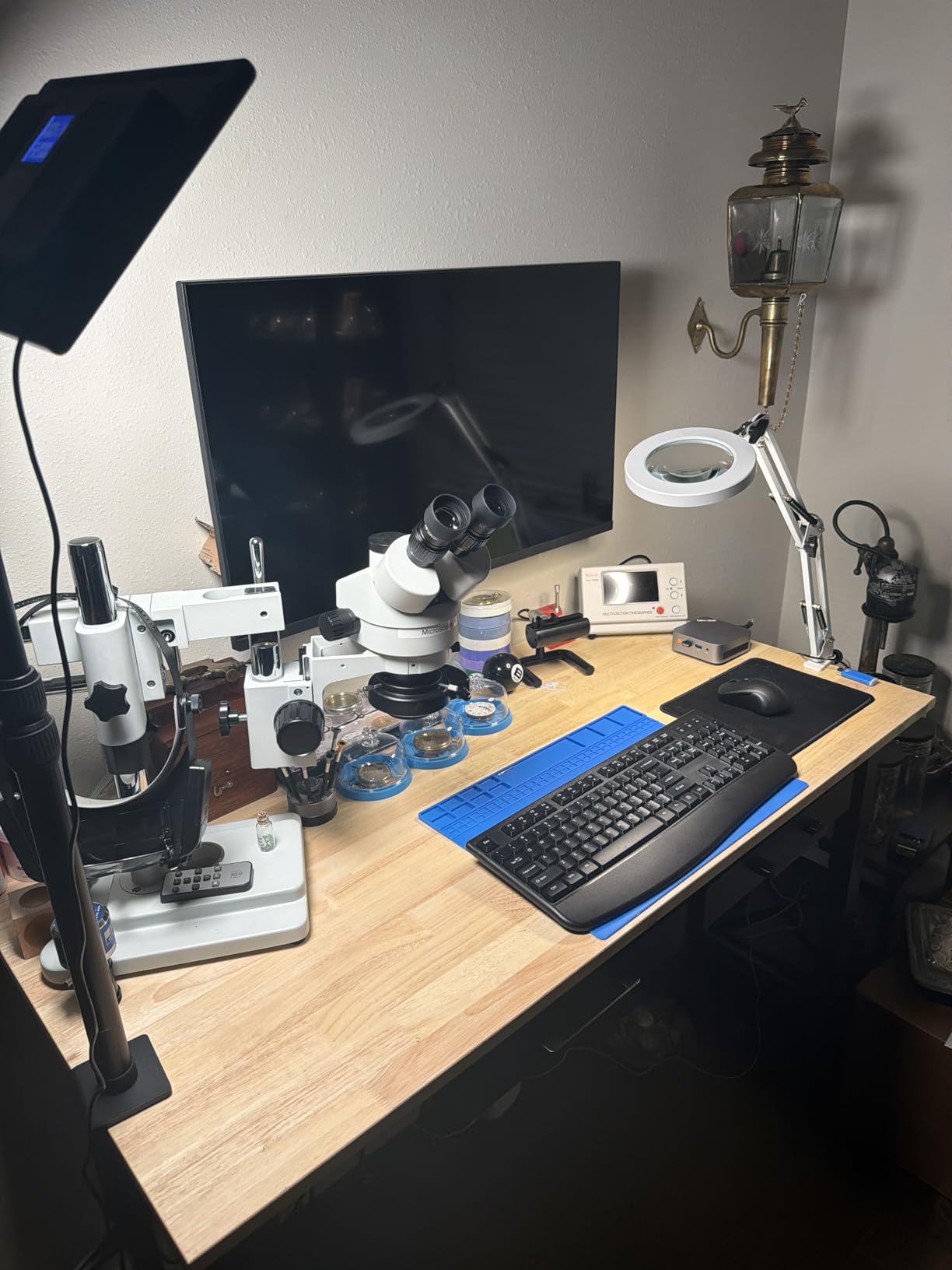
What makes a boom stand worth it
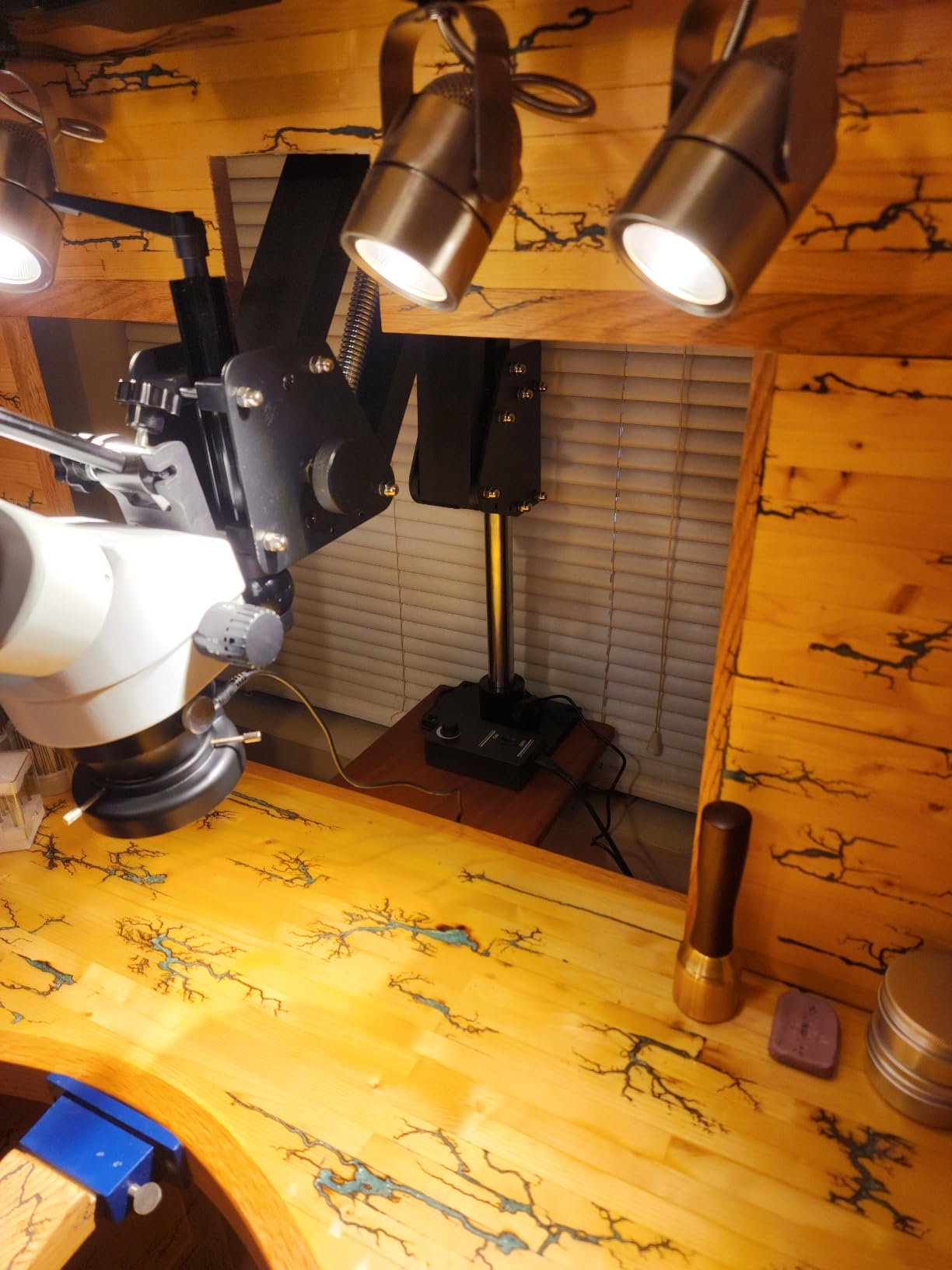
A pillar stand forces a fixed relationship between the head and the base. A boom stand lets you bring the head over a large board, a phone mainboard, or a workpiece that sits off to one side, then swing it clear when you need to solder without a microscope in the way. On a crowded bench, that freedom is the difference between using the scope constantly and using it occasionally.
The steel base is the trade. It is heavy on purpose, and that is why the arm stays put during long sessions, but it also means this unit owns a large piece of your bench.
Who should skip it
Skip it if your bench is small. Buyers report the unit is longer than the listed 19.5 inch dimensions suggest, and the double arm plus base needs real room to swing. Poor instructions are a known issue, so budget time for setup or look for a clear assembly video.
Buyers who only inspect and do not actively rework also get less value here, since the boom clearance matters most when an iron is in the same space as the head.
7. SWIFT S7 Trinocular Stereo Microscope with Single-Arm Boom Stand
SWIFT S7 7X-45X Trinocular Stereo Microscope with Wide-Field 10X Eyepieces,0.7X-4.5X Zoom Objective Lens, Single-Arm Boom Stand, and 56-Bulb LED Ring Light
7X-45X continuous zoom
Super wide-field 10X eyepieces with diopter adjustment
45-degree tilted trinocular head
56-bulb LED ring light
Pros
- Very clean optics with a sharp image
- Boom stand gives long adjustable working distance for big workpieces
- Cool 56-bulb ring light is safe for sensitive subjects
- Third port plus included 0.5X C-mount adapter simplifies camera work
Cons
- Heavy stand assembly needs a sturdy bench
- Small review base makes long-term reliability less well documented
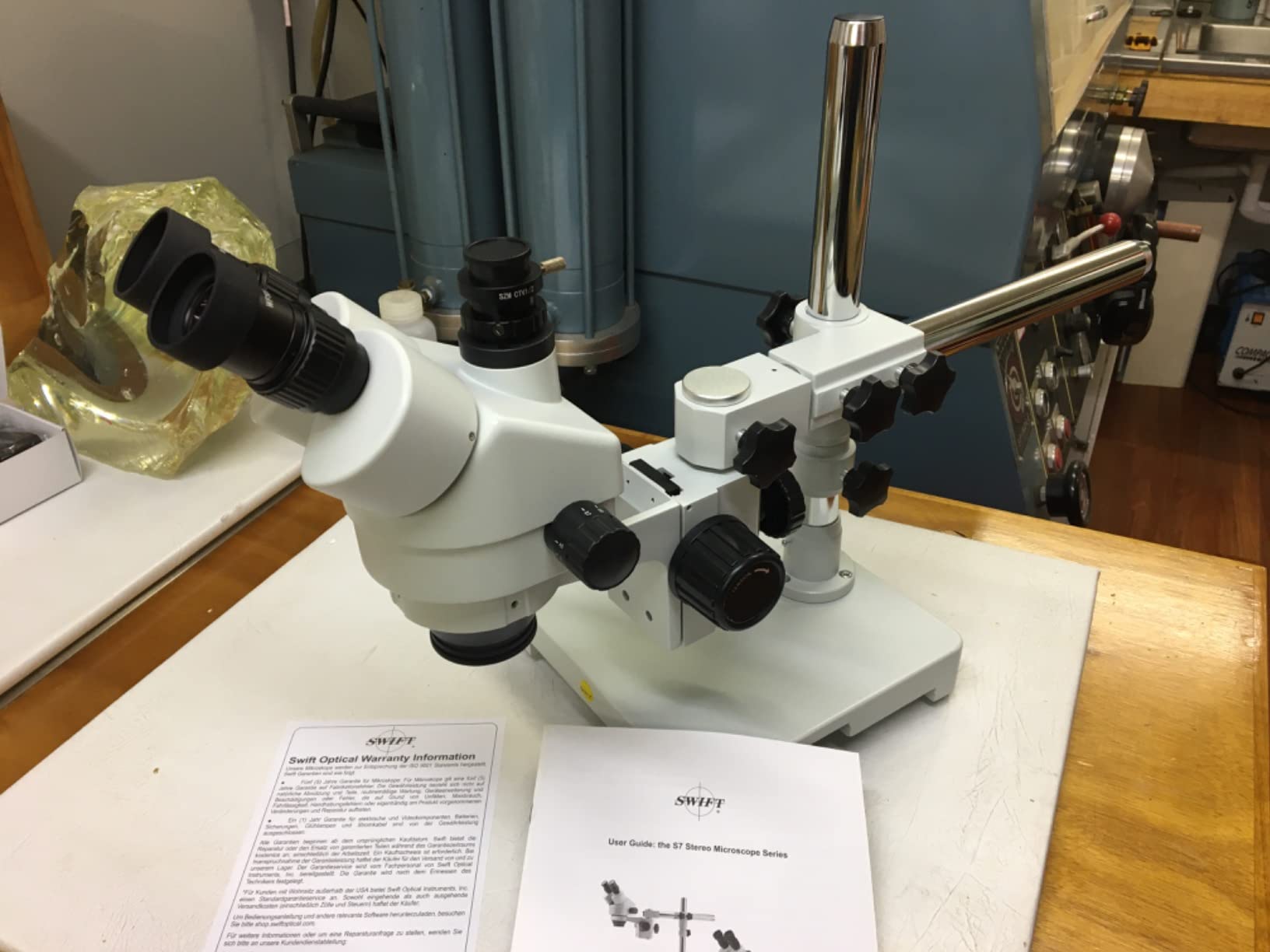
The S7 holds a 4.6 rating, and the review text is consistent about why: a very clean image, boom working distance that handles large workpieces, and cool ring illumination. Reviewers describe it as a stellar scope for circuit board work, gemology and engraving.
Magnification is a straightforward 7x-45x continuous range on a 0.7x-4.5x objective with two super wide-field 10x eyepieces carrying diopter adjustment. The ergonomic 45-degree tilted trinocular head has a third port that accepts either an eyepiece or a camera, and a 0.5x C-mount adapter is included to widen the view.
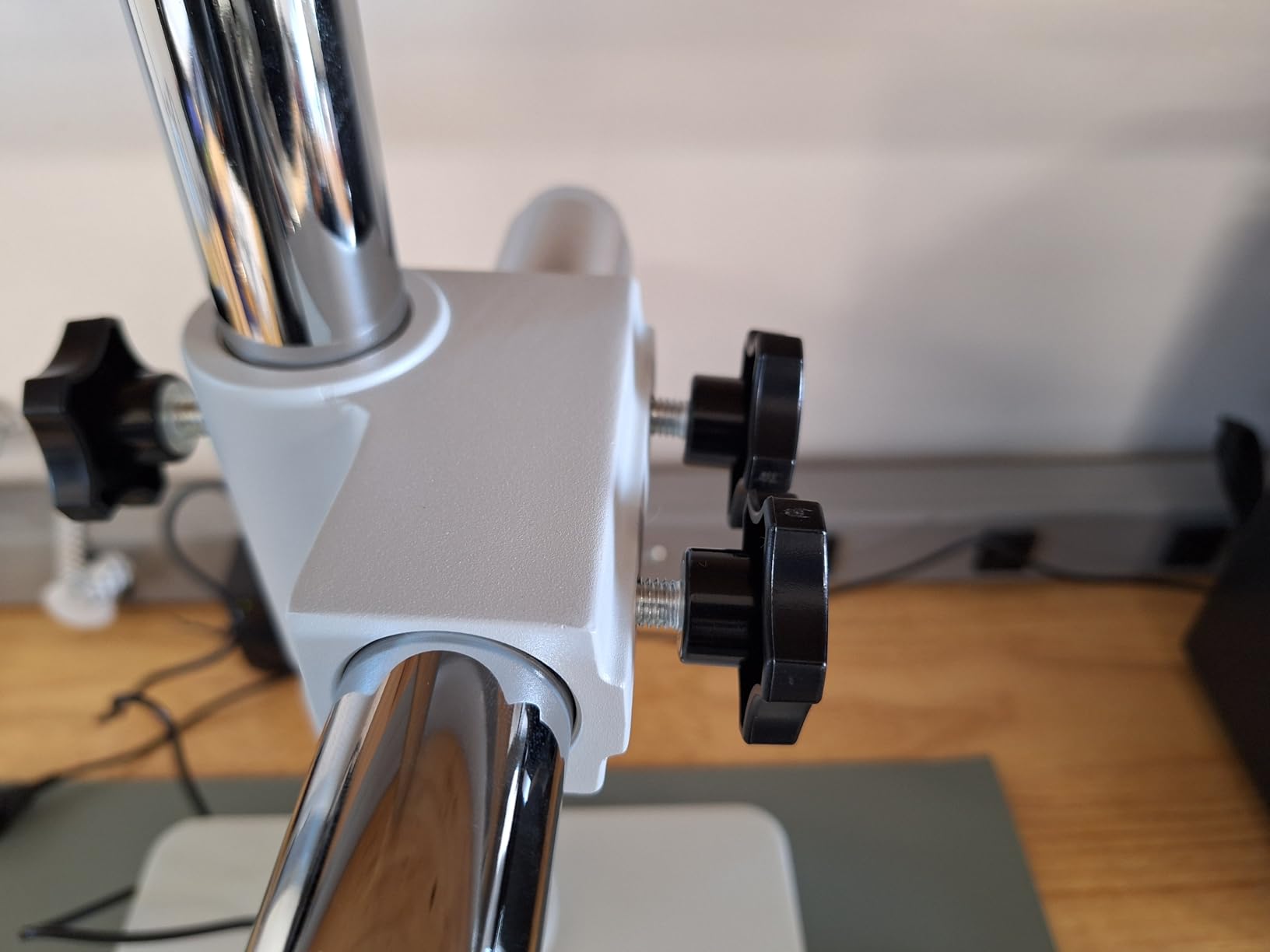
A very common frustration in board-level documentation is a camera image where the useful detail occupies a fraction of the frame and the rest is dead space. The 0.5x factor is the standard fix, and having it in the box saves you finding out.
The 56-bulb LED ring produces light that is cool enough for temperature-sensitive subjects, which matters more than it sounds when you are inspecting a component that has just been reflowed.
How it holds up on the bench
The swinging single-arm boom stand is what makes it usable on real work. You can pull the head back, get your hands and an iron in, work for a while, then push it forward to check the joint. That cycle is the daily rhythm of rework, and a fixed pillar stand breaks it.
For PCB work, watch repair and gemology the S7 covers all three without changing anything, and the wide-field eyepieces keep the working area large enough to orient yourself quickly.
Who should skip it
It is heavy. The listed weight is 17.45kg, so you need a solid bench and you cannot move it between workstations easily. If you need a portable or shared scope, this is not it.
With 22 reviews the ownership record is thinner than the leaders in this list, which is the main reason it does not take the top slot despite the equal rating.
8. CTISMICE Jewelry Microscope with 60-LED Ring Light
CTISMICE Jewelry Microscope for Diamond Setting Jewelry Making Engraving
7X-45X continuous zoom
95mm-300mm flex arm working distance
60-LED ring light with dimmer
Spring stand with headrest
Pros
- Highest average rating in the set at 4.9
- Generous 95-300mm working distance for fine hand tools
- Bright shadowless illumination from the dimmable 60-LED ring
- Headrest and spring stand support long sessions
- High resolution wide field for chips
- joints and stones
Cons
- Only 22 reviews
- so long-term reliability is less well documented
- Warranty is listed as none
The CTISMICE carries the highest average rating in this set at 4.9 from 22 reviews. Its specs, though, come from a different trade than most of the list, and they transfer to electronics work almost unchanged. The 7x-45x continuous zoom head uses a micro inlaid mirror, and the flex arm gives an adjustable working distance from 95mm to 300mm, which is the same ergonomic advantage that makes the DZQ a soldering favourite.
That mirror element is worth understanding. It redirects the light path internally, which is how the field of view stays wide across the whole zoom range rather than narrowing dramatically as you increase magnification.
What works well for board work
The 60-LED ring light on three metal screws with a 0-100% dimmer is excellent for PCB inspection. Ring illumination from a coaxial angle produces almost no shadow, so a solder fillet reads clearly, and the dimmer lets you tone it down on shiny components. Dimming also helps with the eye fatigue that sets in during a long session.
The head and magnifier lower together to whatever level is comfortable, and the included multi-directional spring stand, headrest arm and objective lens make it easy to settle into a repeatable position rather than re-angling every session.
Who should skip it
No warranty is listed, and that is a real consideration on a tool you rely on daily. At 22 reviews there is not yet a long-term reliability picture, so you are taking a slightly larger bet than with the established models.
It is also binocular only. If you need a camera port, this does not offer one, and the 7x-45x range has no auxiliary lenses to widen it.
9. SWIFT S7-TGL-CA05 Trinocular Microscope with Gooseneck Lighting
Swift S7-TGL-CA05 Trinocular Stereo Microscope, 7X-45X Zoom, WF10X Eyepieces, Gooseneck & Transmitted LED Lights, Pillar Stand, 110V
7X-45X continuous zoom
Dual gooseneck plus transmitted LED
45-degree tilted trinocular head
100mm working distance
Pros
- Dual goosenecks let you aim light from any direction to kill shadows
- Transmitted LED adds bottom-up illumination for flat subjects
- Solid metal construction and good optics for the money
- Easy assembly and 360-degree head rotation
Cons
- Camera mount is limited to a specific low-resolution camera
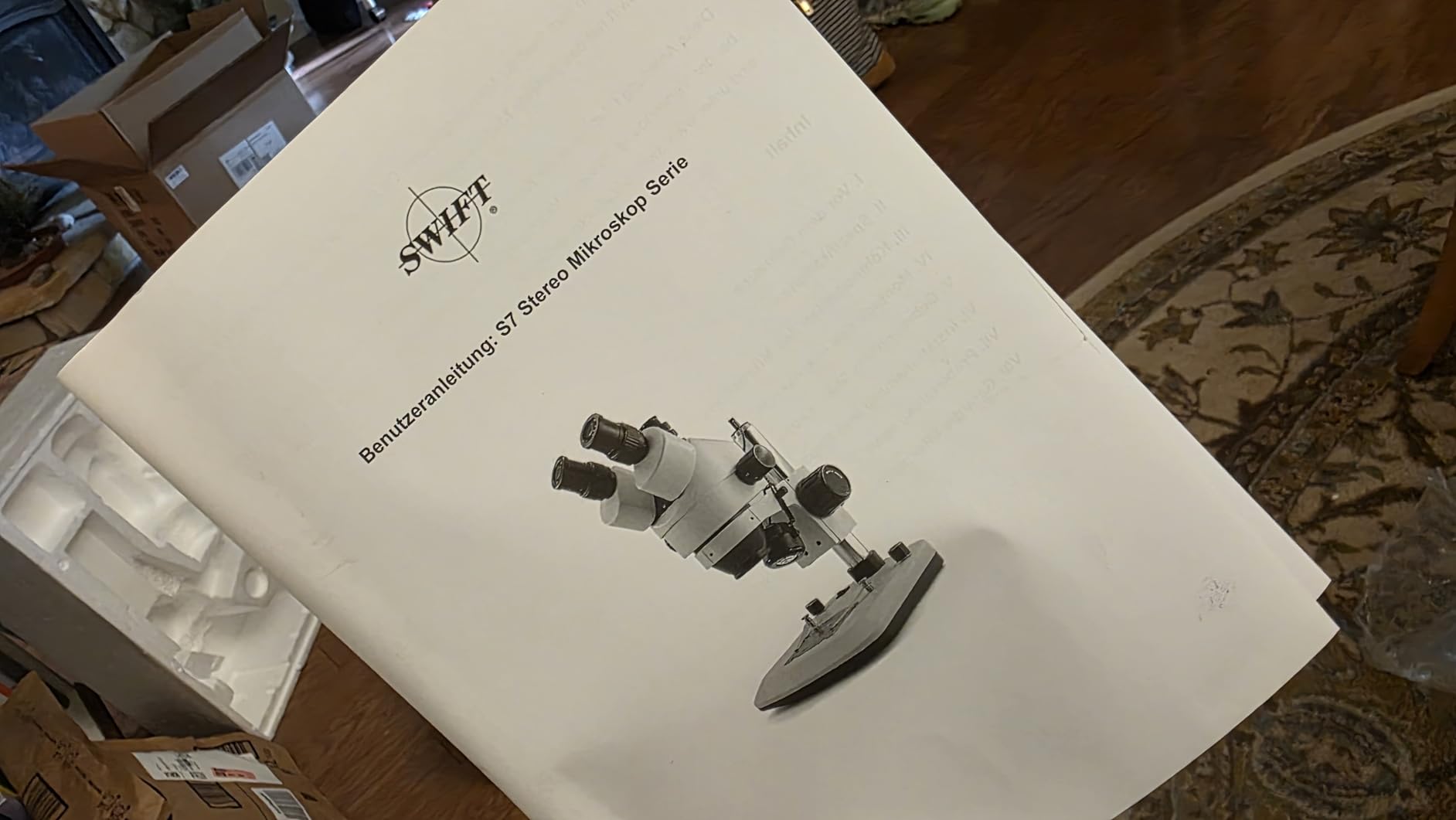
- Manual is largely in German
- Gooseneck arms can droop over time
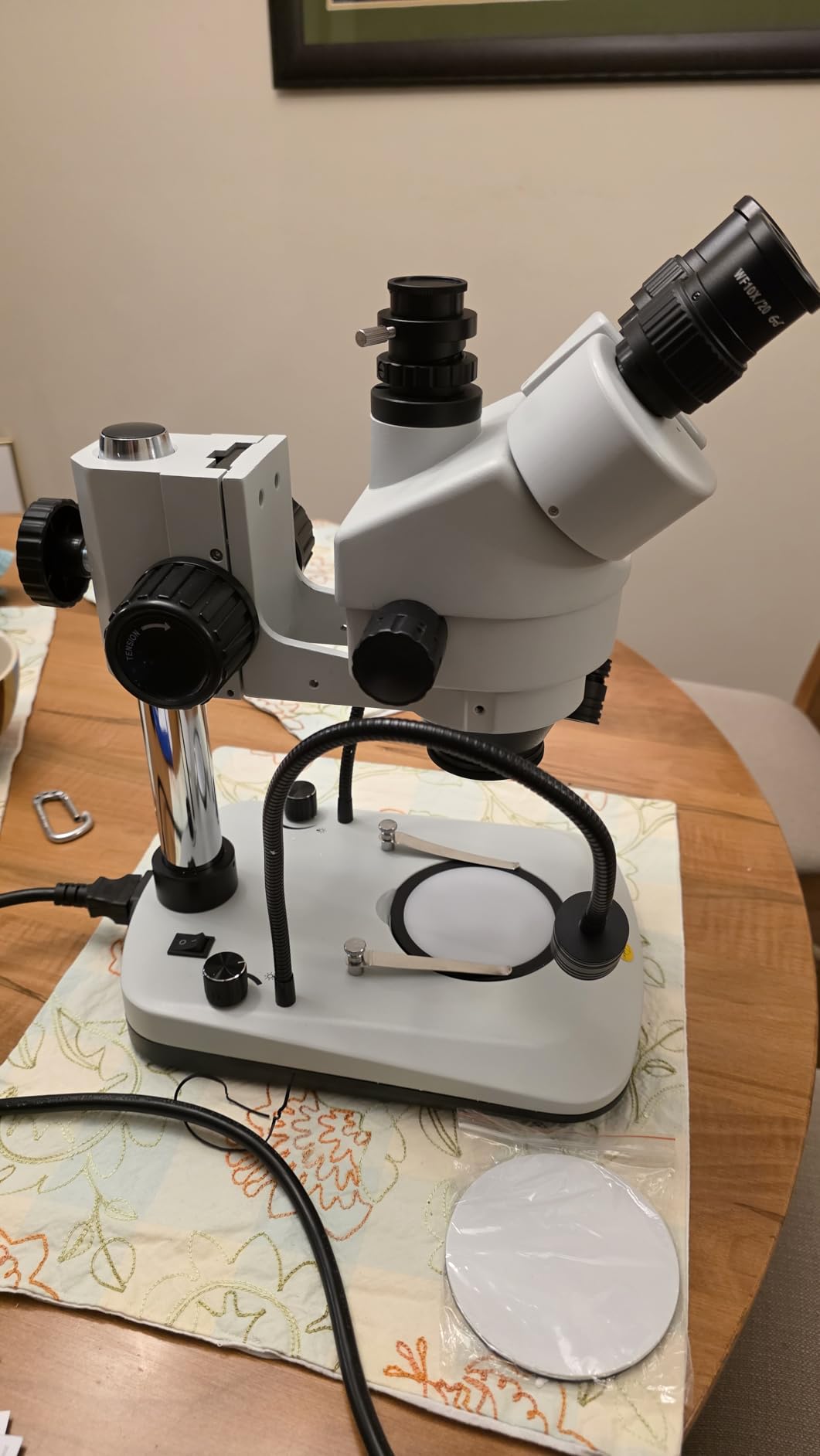
Every other scope on this list lights the board with a ring. This one gives you two flexible gooseneck lamps you can position by hand, plus a transmitted light for bottom-up illumination. On a real workbench that is a bigger advantage than it sounds, because tall components and phone frames cast shadows that a coaxial ring cannot reach around.
Optically it is a 7x-45x continuous range on a 0.7x-4.5x zoom objective with wide-field 10x eyepieces, and a 100mm working distance. The trinocular head adjusts for interpupillary distance, tilts to 45 degrees and rotates a full 360 degrees.
Owners use it for entomology and plant identification as much as electronics, and the reviews are warm about the flexibility of the lighting and the optical quality for the money. It is easy to assemble, which is more than can be said for several boom-stand models here.
It is also compatible with a smartphone, tablet, PC, laptop or TV for image capture, which makes sharing a view with someone at a distance straightforward without a dedicated camera.
When adjustable lighting wins
Ring lights are unbeatable for flat boards and small parts. They struggle when a component stands proud of the board, a shield can sits over a joint, or a phone chassis blocks overhead light. Two goosenecks let you put a raking light across the work from whatever angle actually reveals the defect.
For inspection work, and for any assembly where parts sit at different heights, that flexibility is worth more than the uniformity a ring provides. For watching solder flow, the angled light shows the meniscus better.
Who should skip it
Skip it if you want a proper camera on the third port. The mount is limited to a specific low-resolution unit, so you are locked into whatever that mount accepts rather than a standard C-mount. The manual being largely in German is a smaller annoyance but worth knowing.
It is the lowest-rated scope here with a meaningful review count, at 4.3 from 13 reviews, and the gooseneck arms can droop with age, which slowly reduces the aim precision that makes this scope useful.
10. ZTEEERS Trinocular Stereo Microscope, 6X-45X
ZTEEERS Trinocular Stereo Microscope,Trinocular Microscope,with 56-Bulb LED Ring Light,6X-45X Magnification,WF10X Eyepieces,0.6X-4.5X Zoom Objective and 0.5X ctv Adapter
6X-45X continuous zoom
0.6X-4.5X objective with damped handwheel
Trinocular head with camera port
56S LED ring light
Pros
- Continuous zoom across a useful range for the money
- 56S LED ring light gives even illumination across the field
- 0.5X CTV adapter included for wider overview shots
- Compact dimensions and a stable pillar stand
Cons
- Thinnest review base of the pillar-stand models at 10 reviews
- Modest 6X low end limits very wide overview work
If your bench cannot hold a boom arm, this is the shape of scope that fits. It measures 8 by 6 by 13 inches, weighs 4.5kg, and stands on a pillar base with an aluminium alloy frame. That is a small footprint for a trinocular with a camera port, which is unusual in this category.
Magnification is 6x-45x continuous on a 0.6x-4.5x zoom objective with a damped continuous handwheel. The damping is a small engineering touch that stops the focus from overshooting, which makes fine focus on a solder joint noticeably easier.
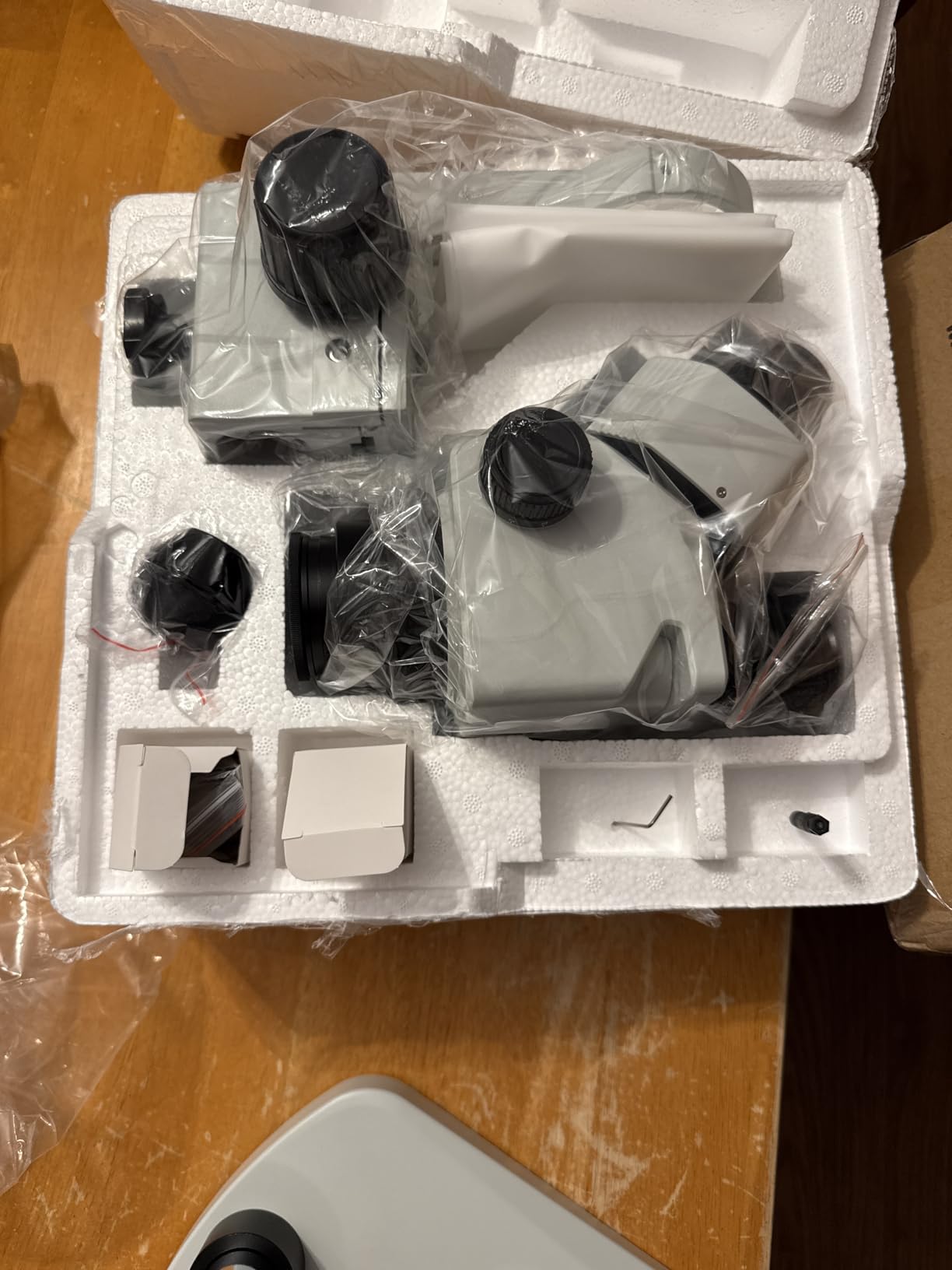
The 56S LED ring light gives uniform illumination across the field, and a 0.5x CTV adapter is included for pulling back to a wider overview when you need to orient yourself. The trinocular head supports binocular viewing with a camera attachment on the third port, and the one-year warranty is a year longer than several competing listings offer.
The honest limitation is the 6x low end. For orienting on a large board or tracing a circuit, a wider starting point helps, and this is where a scope with a 0.7x-4.5x objective or auxiliary lenses has more room.
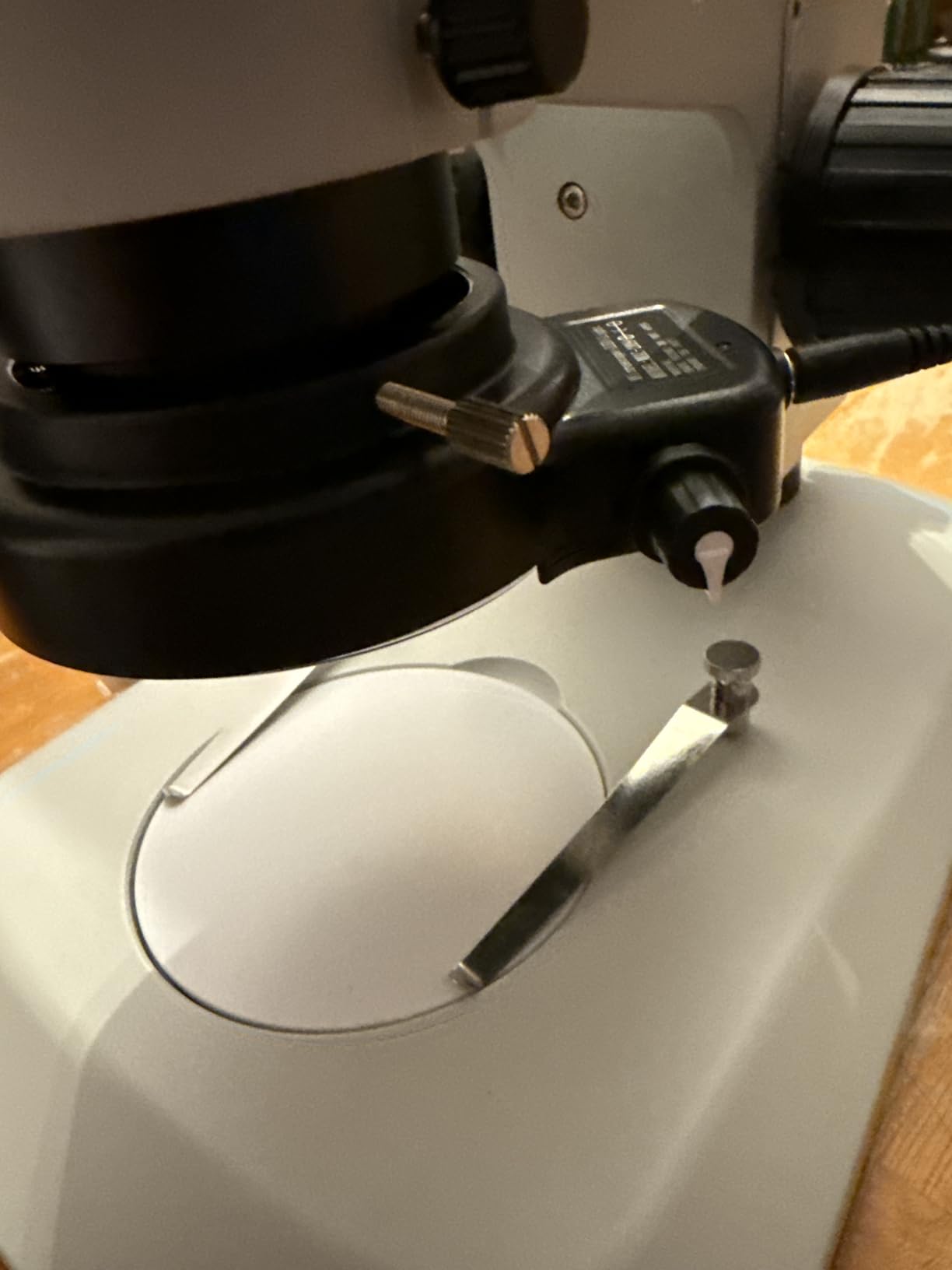
What it is good for
Hobby and semi-professional electronics work on a compact bench. The continuous 6x-45x range covers through-hole assembly, 0805 and 0402 handling, and inspection of joints at a magnification where solder texture is visible. The damped focus wheel is the feature owners appreciate most once they start working on fine joints.
It is also a sensible first trinocular. You get a camera port and a compact body, which means you can start recording work without committing to a large boom-stand platform.
Who should skip it
Skip it if you need a wide overview. At 6x minimum, a large phone mainboard fills the field and you lose your bearings. If your work is mainly inspection of already-soldered boards rather than active rework, the narrow low end matters less.
With 10 reviews, this is the thinnest evidence base in the group. The rating distribution includes a 1-star outlier, so treat the 4.3 average as provisional rather than established.
11. Kaisi Professional Trinocular Soldering Microscope
Kaisi Professional Stereo Microscope,Trinocular Microscope for Soldering
7X-50X continuous zoom
Integrated smoke exhaust fan
WF10x23 super wide-field eyepieces
Silicone heat-resistant work mat and parts trays
Pros
- Purpose-built for soldering with an integrated exhaust fan that clears fumes off the lens
- Large silicone heat-resistant mat and parts trays at the bench
- WF10x23 eyepieces give a noticeably wider field than standard
- Solid heavy base and clear instructions
Cons
- Stock rubber eye cups are stiff and make focusing with both eyes harder
- Working distance changes when swapping auxiliary lenses so focus needs resetting
Only one scope in this roundup is designed specifically for soldering, and it shows. The Kaisi TX has an integrated smoke exhaust fan, a 14.9 by 10 inch work floor with a 7.4 by 4.7 inch silicone heat-resistant soldering mat, and three small parts trays built into the base. Somebody thought about the bench as a whole rather than just the optics.
Magnification runs continuously from 7x to 50x on a 0.7x-5x zoom objective, and the WF10x23 wide-field eyepieces are wider than the standard WF10x20, so you see more of the board at any given magnification. The upgraded trinocular design is described in a specific way that matters: attaching a camera no longer leaves one eyepiece dark.
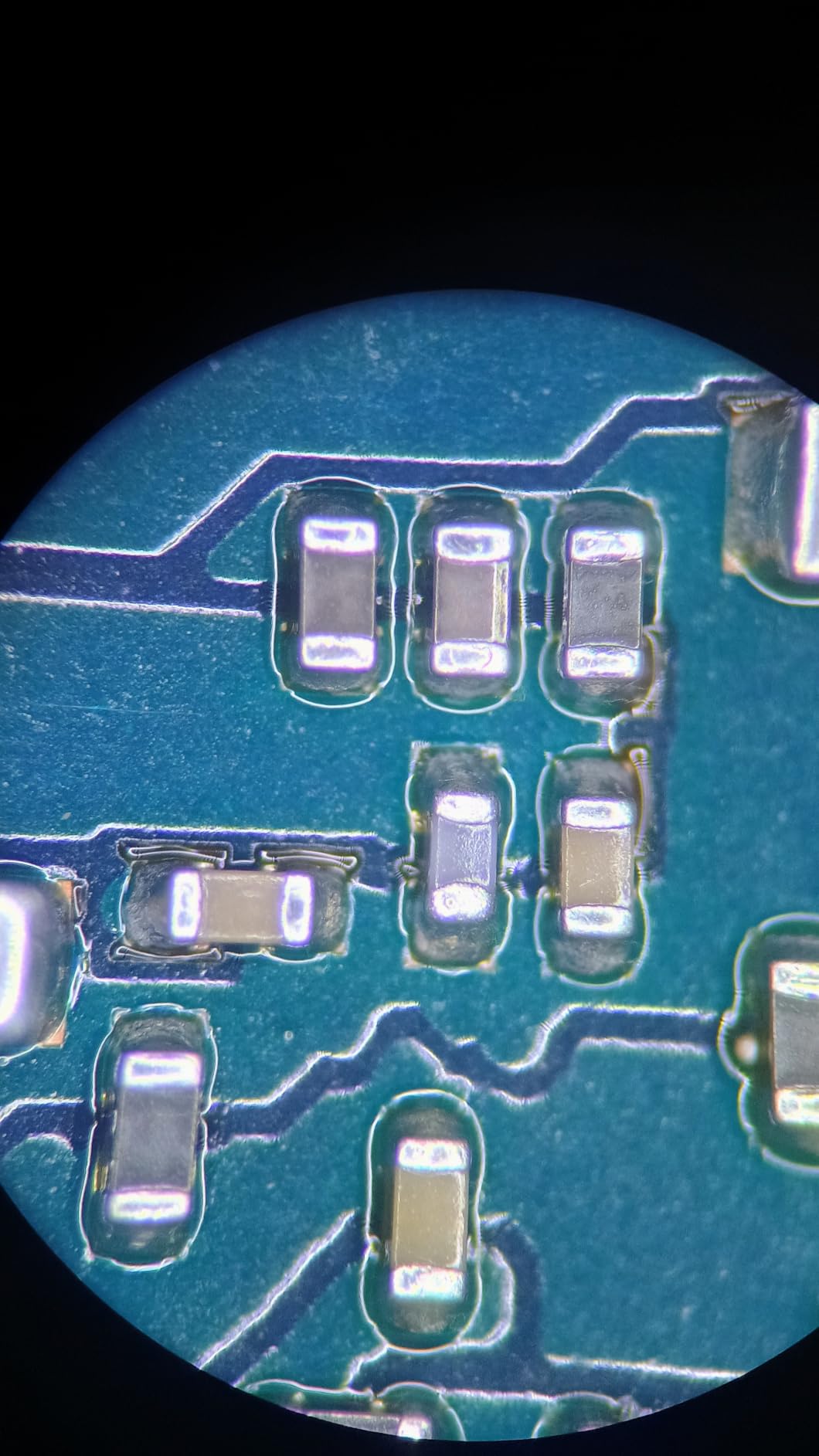
That last point is more important than it appears. On many budget trinocular heads, attaching a camera interrupts the light path and leaves you working one-eyed. Kaisi routes the light so both eyepieces stay usable, which means you keep stereo vision and record at the same time.
That 50x ceiling is the highest here on a plain pillar stand, and the 0.5x auxiliary drops the working distance profile for higher-power work.
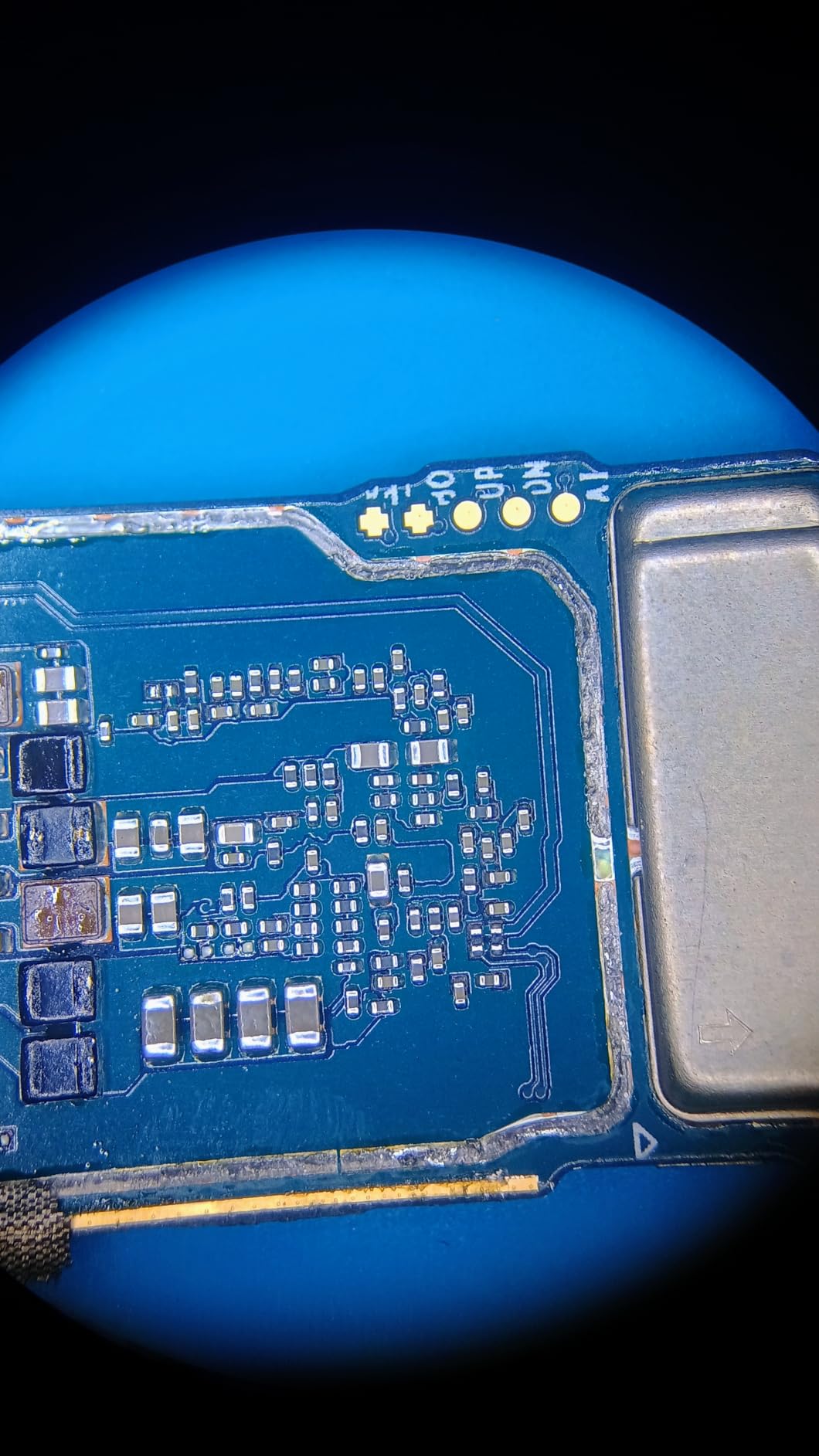
Why the exhaust fan matters
Flux smoke is the thing that makes microscope lenses unusable. A fine haze settles on the front element and on the eyepieces, and before you notice it, you are working through a slightly soft image and blaming your eyes. A bench-top fan that pushes air away from the lens keeps the optics clear without you thinking about it.
Combined with the heat-resistant mat and the parts trays, this is the most complete bench package in the roundup. Nothing needs bolting on or buying separately to get started.
Who should skip it
Skip it if you dislike the stock eye cups. That is the complaint that comes up most often: the rubber cups are stiff and can make it hard to focus comfortably with both eyes. Replaceable eye cups are inexpensive, but it is a fix rather than a feature.
Also be aware that the working distance changes with whichever auxiliary lens is installed, so focus needs resetting every time you swap lenses. Several buyers add a Barlow lens to raise the head further for soldering clearance, which works but adds a step.
12. GEMKIT Jewelry Microscope with Articulating Boom Arm
GEMKIT Jewelry Microscope, 7X-45X Binocular Stereo Zoom Microscope with 56-LED Ring Light, Articulating Boom Arm Stand, 0.5X Barlow Lens and Headrest for Gem Setting, Engraving and Jewelry Repai
7X-45X continuous zoom
0.5X Barlow extends working distance to 165mm
Multi-joint articulating boom arm
56-LED ring light
Pros
- Barlow lens extends working distance to 165mm for gravers
- tweezers and irons
- Multi-joint boom moves easily out of the way to free bench space
- 56-LED ring light reduces shadows on small parts
- Headrest helps reduce fatigue over extended sessions
Cons
- Binocular head only
- with no third port for a camera
- Warranty listed as 30 days
- Only 8 reviews
- so the record is the thinnest in the group
The GEMKIT solves the working distance problem with a 0.5x Barlow lens rather than an adjustable stand. With the lens fitted, working distance extends to 165mm, and the multi-joint articulating boom arm adjusts height, reach and angle. For a soldering bench that combination works well, since the extra clearance is what lets an iron and both hands under the head.
Magnification is a continuous 7x-45x on WF10x wide-field eyepieces. The 56-LED ring light mounts around the objective itself, which places the illumination as close to the subject as possible and keeps shadows minimal.
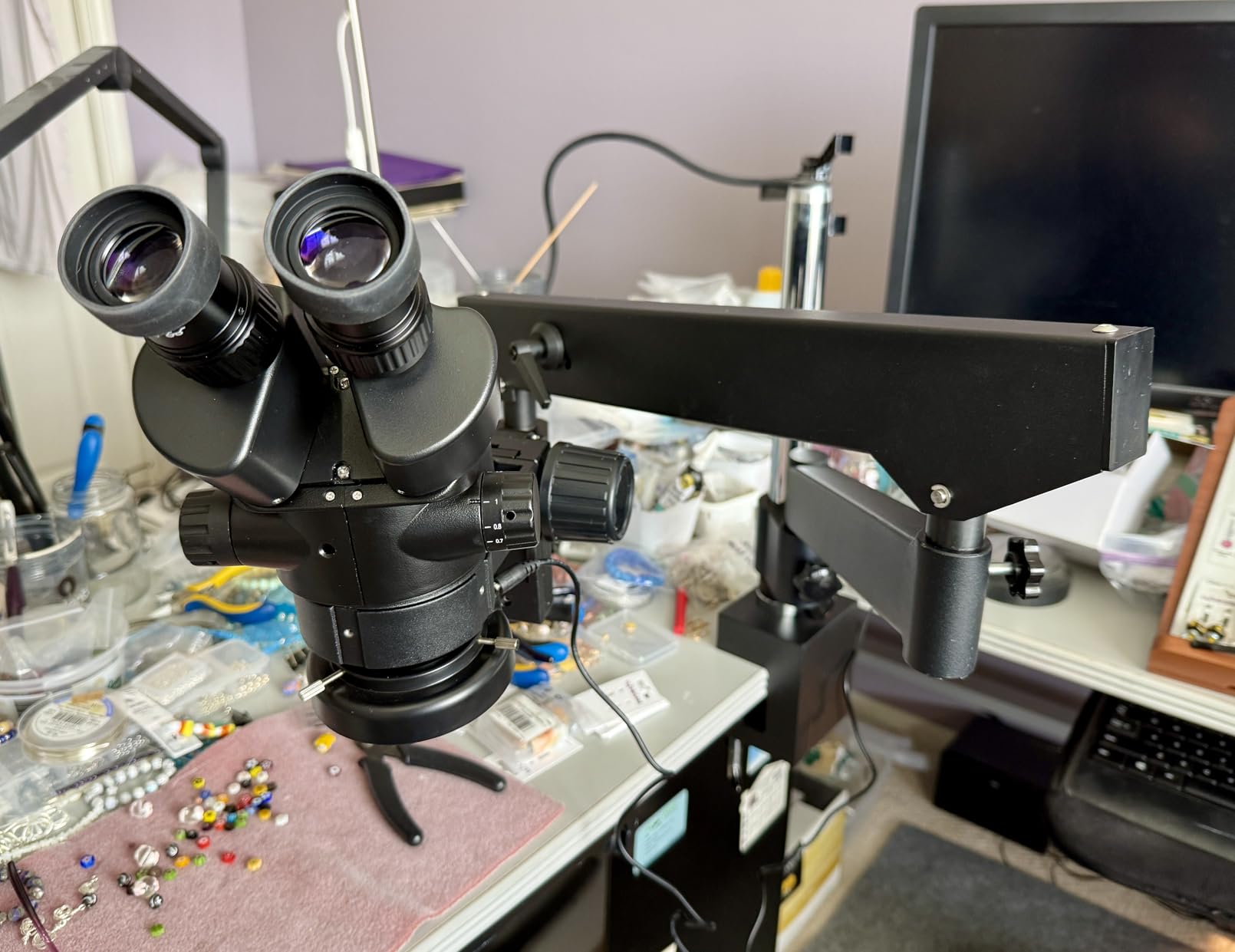
The headrest is a thoughtful inclusion for anyone doing this for hours. It stabilises your viewing position so you are not constantly re-settling your posture, and on a boom-arm scope the flexibility otherwise makes it easy to drift into a hunched position.
At 6 pounds and 12 by 8 by 15 inches, it is also lighter and smaller than the other boom-stand options here, which matters if you need to move it or share a bench.
Where it fits against the other boom stands
Compared with the double-arm ZTEEERS and the single-arm SWIFT S7, the GEMKIT is the lighter and more compact option, with a 165mm working distance achieved through the Barlow lens rather than a heavier stand. If your bench is small but you still need boom flexibility, that is a sensible compromise.
The lens-based approach has a limitation: changing to a different magnification profile means physically swapping the Barlow, and the working distance changes with it. An adjustable arm gives you continuous control instead.
Who should skip it
Skip it if you want to record or photograph your work. There is no third port on this head, so a camera means an entirely separate setup. It is also the thinnest evidence base in the roundup at 8 reviews, and the warranty is listed as 30 days.
For a first serious soldering microscope the short warranty is the deciding factor for us. Once you are soldering daily, the cost of an unexpected failure outweighs the saving.
What Magnification Do You Actually Need for Soldering?
Seven to 45 times is the practical sweet spot for soldering. Seven times lets you see a whole board and orient yourself without lifting your head. 45 times resolves solder fillets, pad edges and component leads clearly. Above 45 times the depth of field gets too shallow to work comfortably, and below 7 times you are not gaining useful detail.
Magnification on a stereo scope is not a single number. It is the eyepiece magnification multiplied by the objective, and both change. Most scopes use 10x eyepieces with a 0.7x-4.5x zoom objective, which is how a 7x-45x range is produced. Auxiliary lenses then multiply the range: a 0.5x lens halves it for overviews, a 2x lens doubles it for inspection.
For 0201 and 0402 components you need the upper half of that range. An imperial 0201 resistor is smaller than a grain of rice, and a 0.5mm leadless chip package has pads you cannot tell apart without real magnification. Working at 40x-45x, you are not squinting at a pad, you are inspecting a solder joint before you commit to it. The same forum thread that recommends a zoom stereo scope for imperial 0201 work is where most of this sizing guidance comes from.
Below 20x, you are orienting rather than inspecting. That is a legitimate and necessary part of the work, which is why a scope with a genuinely low starting magnification serves you better than one that starts at 20x and stops at 40x.
One caution: optical and digital magnification are not comparable. A digital scope advertising 300x is not showing you 300x worth of detail. The number that matters is resolution on the sensor and how closely the lens can focus, which is why the eye comfort and depth perception of an optical scope beat a high digital number in almost every soldering scenario.
Working Distance: The Spec That Decides Whether You Can Use It
Most pillar-stand scopes give you 95mm or 100mm, which is workable for inspection but tight for active rework. You need enough working distance to get your soldering iron, both hands and the board into the field of view at the same time. Anything from 150mm upward gives you room to work properly, and 200mm or more is comfortable.
This is the spec that forum buyers check first and spec sheets bury. A direct quote from a soldering thread captures the problem exactly: the base has to allow for the microscope to clear it, or there is no room for soldering irons. If the head sits 60mm above a board, you cannot bring an iron in without knocking the scope, and you end up lifting the scope every few minutes, which destroys the ergonomics the stereo view was supposed to provide.
There are three ways to get working distance, and they are worth telling apart. A pillar stand gives a fixed distance determined by the head position. A boom or flex arm lets you raise and lower the head, so you can drop it close to inspect and lift it to work. A Barlow lens multiplies the distance at the cost of magnification.
The scopes with adjustable arms or a range of working distances in this roundup are the DZQ ZQ-1 at 95-300mm, the CTISMICE at 95mm-300mm on a flex arm, the SWIFT S7 on a single-arm boom, the ZTEEERS double-arm boom, and the GEMKIT at 165mm with its Barlow lens. If soldering actively rather than inspecting is your main activity, the working distance ranking should drive your choice more than the magnification ranking.
The forward-pillar models here, including both AmScope SE306R units, do not publish a working distance at all. That is not necessarily a dealbreaker for inspection work, but it is a genuine unknown if you plan to rework rather than look.
Stereo vs. Digital Microscope: An Honest Comparison
Choose a stereo microscope for soldering because you need depth perception and hand-eye coordination under magnification. A digital USB microscope makes more sense when your main need is recording, sharing or inspecting while wearing a headset. The depth difference is the whole decision, and no amount of digital magnification makes up for it.
A stereo scope sends two slightly offset images to your left and right eye, and your brain reconstructs a three-dimensional scene. You reach for a component and your hand knows where it is without a learning curve. A digital scope shows you a flat screen, and you spend the first few minutes of every session re-orienting the board to find the pad you were looking at.
The digital class has real advantages. It costs less at the entry point, it records video natively, it can display the image on a laptop or tablet across the room, and it avoids the eye strain of looking into eyepieces for hours. For teaching, where several people need to watch one board, a screen beats an eyepiece outright.
The break-even point is clearer than most guides make it. A cheap digital scope is a reasonable stopgap for through-hole work on 0805 and larger parts. Once you are handling 0402 components, or doing recurring rework where joint quality determines whether a board works, a true binocular stereo scope earns its place. The moment depth perception stops being optional, the digital route stops making sense.
One note on the digital 3D HDMI class, which appeared in several editorial roundups in this space: they are a legitimate middle ground, offering binocular viewing on a screen with a 3D effect and built-in recording. The trade is that you still look at a screen rather than through eyepieces, so the ergonomics benefit of a stereo scope is reduced even though the depth cue is present.
Lighting Explained: Ring Light, Gooseneck LED and Dual Sources
A ring light gives you the most even illumination with almost no shadow, which makes it the best default for inspecting solder joints and small SMD parts. Gooseneck lamps give you control, letting you rake light across a board to reveal surface texture and shadow defects. Most serious soldering benches end up wanting both eventually.
Ring illumination is coaxial with the optical axis, so light arrives from the same direction you are looking from. That means a raised component casts its shadow directly behind itself, hidden inside the component. For flat boards and flush-mounted parts, this is ideal. For tall components, shields or a phone chassis, a ring light can leave the joint underneath in darkness.
Gooseneck lights are mounted on flexible arms so you can aim them independently. A pair of them, positioned on either side and slightly behind, is the classic workbench arrangement for a reason: angled light picks up every surface irregularity, so a cold joint, a lifted pad or a hairline crack shows up as a visible line rather than a flat area.
Colour temperature matters more than buyers expect. Warm halogen lighting gives a yellowish cast that makes it harder to judge a joint’s true appearance, while cool LED light shows the metal as it actually is. For lead-free solder work in particular, where surface appearance is your main quality signal, LED is the better choice.
Most LED rings in this group carry a dimmer, and that control is worth having. Full brightness on a reflective solder fillet is genuinely uncomfortable over a long session, and dimming to about half gives a much more usable image on shiny work.
Trinocular vs. Binocular: Do You Need a Camera Port?
You need a trinocular head if you want to photograph or record your soldering while still looking through both eyepieces. A binocular head serves you perfectly well for soldering alone, and the money you do not spend there goes into better optics or a better stand.
A trinocular head has three optical paths: two for your eyes and one vertical port above for a camera. That third port is the difference between recording your work and filming it with a phone held over the eyepieces. The camera output is a separate image from the same objective, so what you record matches what you see.
Simul-focal, which the enthusiast forums mention often, describes a trinocular head where the camera image and the binocular image stay in focus together across the whole zoom range. On a non-simul-focal head, the two images can drift out of alignment as you zoom, which is frustrating if you are following a live recording. For soldering work where you are actively manipulating the board, that alignment matters more than most buyers expect.
Check the mount before buying. Some trinocular heads accept a standard C-mount adapter, and some are locked to a specific low-resolution camera. The SWIFT S7-TGL-CA05 is an example of the latter, which is a genuine limitation. The ZTEEERS and SWIFT boom models include adapters, which is what to look for.
Also check whether both eyepieces stay lit when the camera is attached. On cheaper trinocular heads the third port steals light from one eyepiece, so you silently lose stereo vision the moment you start recording. The Kaisi scope is specifically designed to avoid that, and it is worth testing before you commit.
Stereo Microscope Buying Guide: The Specs That Actually Matter
Rank these in order: working distance, then illumination, then magnification range, then stand type, then camera capability. Most buyers do the reverse and end up with a scope that magnifies beautifully but cannot fit their hands underneath it.
1. Working distance. Get at least 100mm for inspection and 150mm or more for active rework. Adjustable arms are worth more than a longer fixed distance. Ask the simple question: can I get my iron, both hands and the board into the field of view at once?
2. Illumination type and control. LED over halogen, always, for heat reasons alone. Ring for evenness, gooseneck for control. A dimmer is not a luxury on a long session.
3. Magnification range. Look for a genuine 7x-45x continuous zoom from a 0.7x-4.5x objective on 10x eyepieces. Auxiliary lenses that widen the range are a bonus, not a requirement, but they are useful for overview and inspection extremes.
4. Stand type. Pillar stands are compact and stable, fine for a fixed microscope position. Boom and flex arms let you bring the head over large work and swing it clear when you need to solder, which is the difference between a scope you use constantly and one that sits in a corner.
5. Trinocular head. Decide honestly whether you will record. If yes, check for a standard camera mount and confirm both eyepieces stay lit with a camera attached. If no, spend the money on a better stand instead.
6. Head comfort. A 45-degree tilt and 360-degree rotation let you work at a natural posture. A fixed head forces you to bend, and that is how you get neck pain six months into a hobby.
7. Eyepiece adjustability. Wide-field eyepieces with a 23mm field number give you more context at any magnification. Per-eye diopter adjustment and a wide interpupillary range matter if your eyes are not matched.
8. Build and warranty. Metal frames and weighted bases survive a bench. Warranty length is a crude proxy for manufacturer confidence, and on a daily tool it is worth comparing. One listing here offers five years, several offer one, and one lists no warranty at all.
9. Component interchangeability. Check whether objectives, eyepieces and stands use standard fittings. A scope with proprietary parts can be locked into one configuration forever, and that is a real cost when you later want more magnification or a different stand.
Pitfalls When Buying a Microscope for Electronics
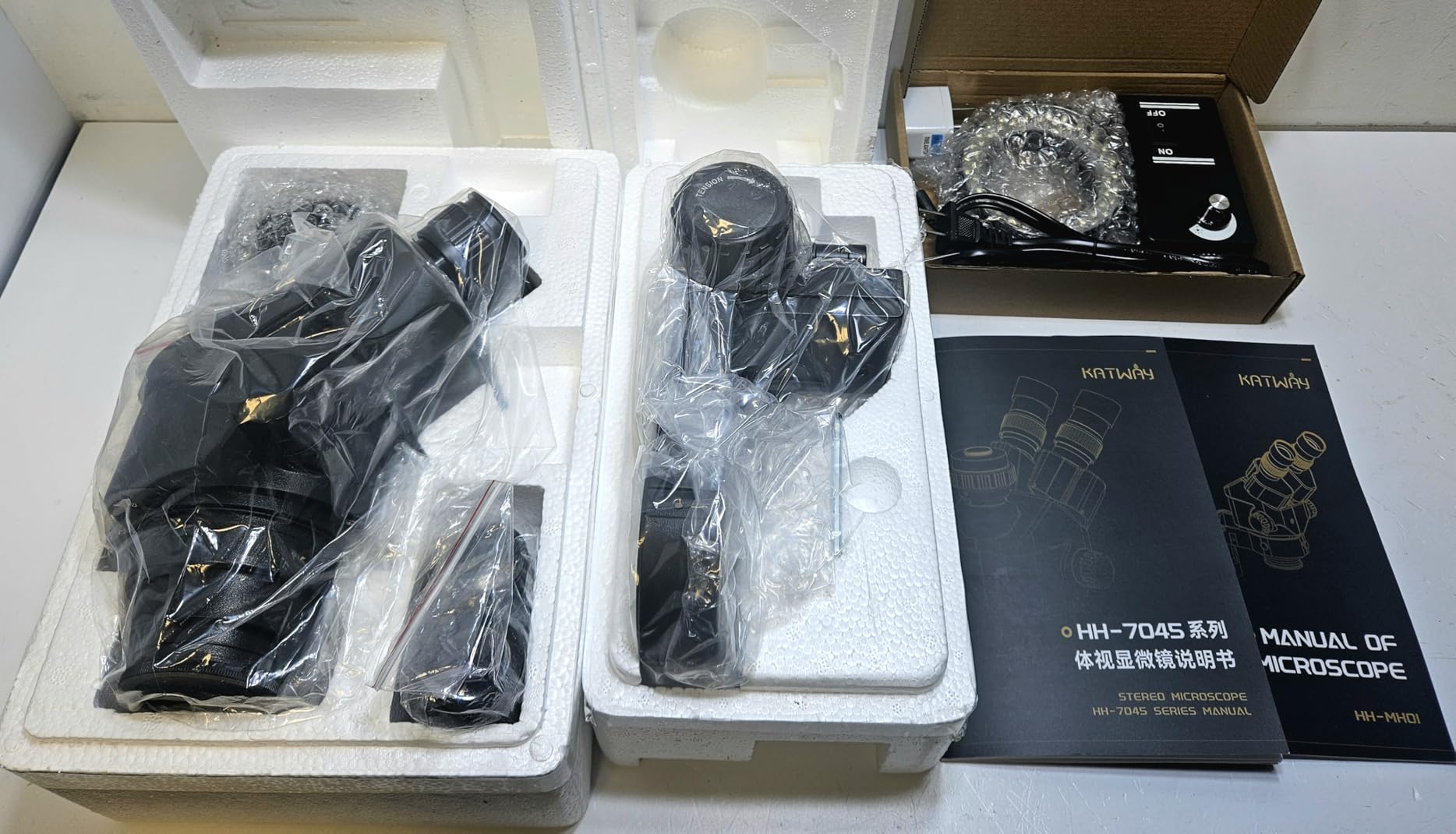
Check that the listing includes the stand, both eyepieces, the objective and working illumination. Forum buyers report cheap marketplace scopes arriving with a missing stand, missing eyepieces or a dead light source, and units sold explicitly for parts because the illumination failed. A scope head on its own is not a microscope.
Watch for parts-only listings dressed up as complete units. The tell is a vague photo set, no model number, no warranty and a description that lists the components separately without saying they are included. If a listing sits far below every other one for the same specification, that is usually the explanation.
Establish whether components are interchangeable before committing. There is documented interest in whether Parco PST objectives fit Edmund Scientific student-scope objectives, and that kind of question is hard to answer for most listings because compatibility information is simply not published. If the mount is a standard RMS thread and the eyepieces are 23.2mm, you have options later. If nothing states the fitting, assume there are none.
Do not judge a scope by the base footprint. A pillar stand looks compact in a listing photo and then blocks the swing of your soldering arm in real use. Measure the bench space including the swing arc of the arm, not just the base.
Check the lamp type against your work. A halogen scope is a poor match for anything heat-sensitive, and the housing on some models runs hot enough to be a hazard near a board you have just heated.
Finally, test the depth of field at your working magnification before you commit. Depth of field narrows as magnification rises, and if a joint will not stay sharp at 40x, the scope will frustrate you every time. Wide-field eyepieces help here more than buyers expect.
Setting Up Your Scope at the Electronics Bench
Position the scope so you sit upright with your head over the eyepieces, not with your neck craned. A 45-degree tilted head helps enormously here, and it is worth rotating the head rather than moving your body to reach a better angle.
Place your iron holder to one side and out of the head’s swing path, not underneath it. Fume extraction should pull air across the work and away from the front lens element, so a small fan positioned to move smoke away from the eyepieces is as important as the scope itself.
Set the working distance before you start, not during a job. Find the height where an iron and both hands fit under the head, and mark that position on the stand. Then check the focus at your most-used magnification and adjust the diopter to your dominant eye.
Keep a consistent posture and take breaks. Eye strain from microscope work is cumulative and does not announce itself clearly. Looking away from the eyepieces to a distant object every half hour of focused work is more effective than pushing through.
Frequently Asked Questions
What is the best type of microscope for soldering?
A binocular stereo microscope with continuous zoom is the best type for soldering, because true depth perception lets you work with both hands without looking away from the board. Digital USB microscopes are cheaper and record easily, but you lose hand-eye coordination under magnification.
What magnification is good for soldering?
Seven to 45 times is the practical range for soldering. Seven times orients you on the board and 45 times resolves solder fillets and component leads. Above 45 times the depth of field becomes too shallow for comfortable work.
What are the best digital microscopes for soldering?
Digital scopes make sense when recording, streaming or teaching matters more than depth perception, or when you need to inspect a board from anywhere in the room. For active rework on components smaller than 0805, a true stereo scope is the better tool.
What is a stereo soldering microscope?
A stereo soldering microscope is a binocular low-power inspection microscope that shows a depth-perceived image of a circuit board at roughly 7x to 45x. Two eyepieces project slightly offset images so your brain reconstructs depth, leaving both hands free to work.
How much working distance do I need for a soldering microscope?
At least 100mm for inspection, and 150mm or more for active rework so your iron and both hands fit under the head. Adjustable arms or flex stands are more useful than a longer fixed distance because you can drop the head close and lift it to work.
Are objectives and eyepieces interchangeable between scopes?
Often, but only when the fittings are standard. Most scopes use 23.2mm eyepieces and RMS thread objectives, which allows some swapping between brands. Listings rarely state the fittings, so check with the manufacturer before assuming a cheaper objective will fit.
Conclusion: Which Stereo Microscope Should You Buy?
For most people reading this, the AmScope SE306R-PZ is the right first step into the best stereo microscopes for soldering: 321 reviews at 4.6, an all-metal stand and widefield optics that hold up over years. Its halogen lamp is the flaw, and swapping in an LED light is a straightforward upgrade.
If you actively rework rather than only inspect, working distance should decide your purchase. The DZQ ZQ-1 gives you an adjustable 95-300mm range and a headrest, which is why it takes the best value slot despite sitting well below the boom-stand models. When your work involves large assemblies or phone mainboards, the ZTEEERS boom-stand trinocular earns its weight with roughly 20cm of clearance and a camera port that keeps both eyepieces active.
Check the box contents carefully before you order, and measure the swing arc of the stand rather than just its base. Those two habits prevent most of the disappointment we see in owner reviews.