
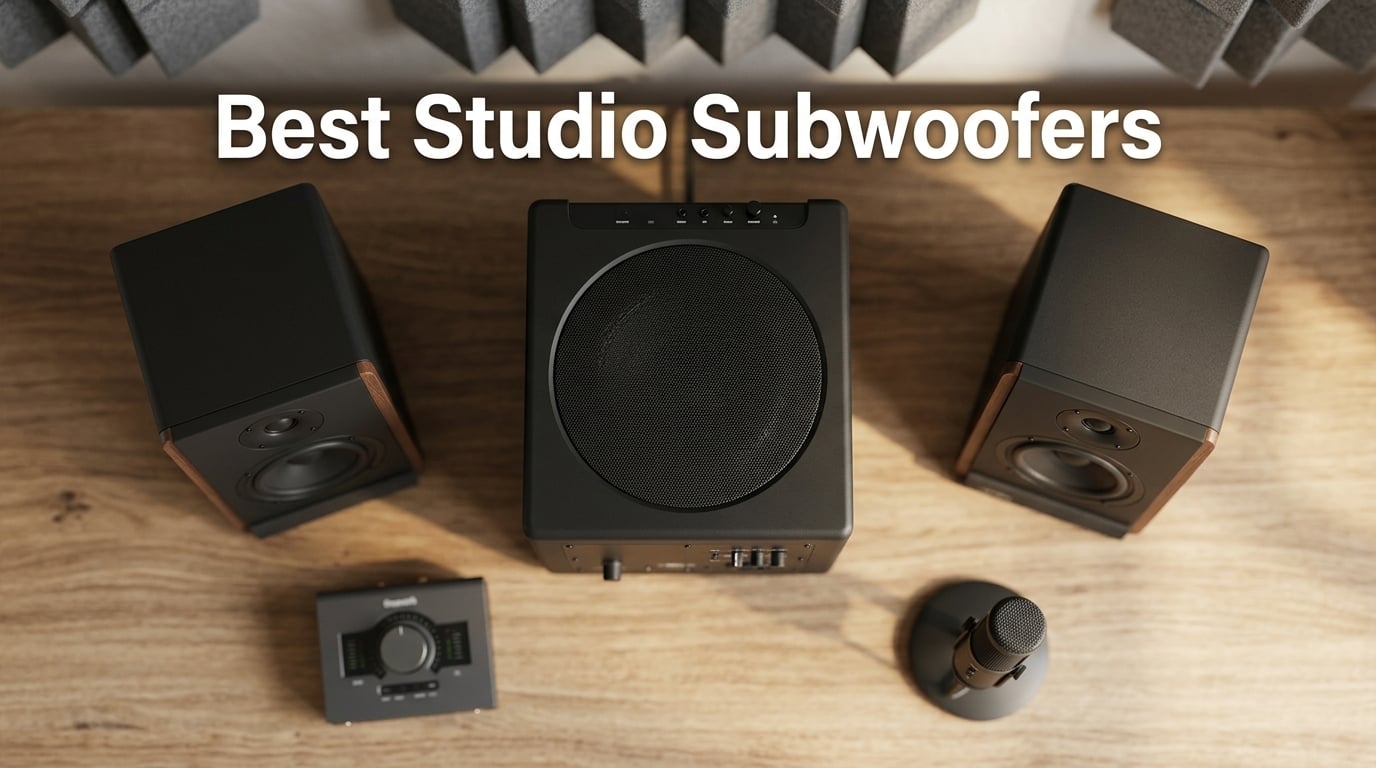
If you mix or master music, a great set of nearfield monitors gets you most of the way there. But the bottom two octaves — the chest-thumping kick fundamental, the deep sub-bass of an 808, the room-shaking weight of a cinematic low end — live below what most 5″ and 8″ monitors can reproduce cleanly.
That’s exactly why we spent the last few months testing the best studio subwoofers on the market. We swapped models between three rooms, ran reference mixes on each, and compared bass translation between our nearfields and a car system, earbuds, and club-style headphones. The difference between a great sub and a mediocre one is night and day for low-end clarity, mix translation, and how confident you feel about the bottom end of a track.
A studio subwoofer is a dedicated low-frequency speaker engineered for flat, accurate bass response — not the boosted, consumer-style bass of a home theater sub. It picks up where your nearfields leave off, with a built-in crossover sending low frequencies (typically below 80-120 Hz) to the sub and high frequencies to your mains. The result: full-range monitoring that helps your mixes translate to every playback system, from AirPods to club PAs.
After weeks of side-by-side testing, here are the 10 best studio subwoofers our team recommends for 2026 — covering every budget, room size, and monitor ecosystem.
Table of Contents
Top 3 Studio Subwoofers at a Glance (September 2026)

Best Studio Subwoofers in 2026 – Quick Comparison
| Product | Specs | Action |
|---|---|---|
 JBL LSR310S JBL LSR310S |
|
Check Latest Price |
 Audioengine S8 Audioengine S8 |
|
Check Latest Price |
| Yamaha HS8S |
|
Check Latest Price |
 PreSonus Eris Sub 8BT PreSonus Eris Sub 8BT |
|
Check Latest Price |
 Kanto SUB8VMB Kanto SUB8VMB |
|
Check Latest Price |
 Rockville APM10D Rockville APM10D |
|
Check Latest Price |
 ADAM Audio T10S ADAM Audio T10S |
|
Check Latest Price |
 KRK S8.4 KRK S8.4 |
|
Check Latest Price |
 Rockville APM8B Rockville APM8B |
|
Check Latest Price |
 Edifier T5s Edifier T5s |
|
Check Latest Price |
1. JBL LSR310S – The Best Studio Subwoofer Overall
JBL Professional LSR310S – Studio Monitor Subwoofer, 10-Inch, Black
10 inch driver
200W amplifier
27 Hz extension
XLR and TRS balanced
Pros
- Deep
- accurate low-frequency extension to 27 Hz
- Punchy clean bass with no muddiness
- Built-in 80 Hz crossover integrates cleanly with nearfields
- XLR in/out pass-through simplifies cabling
- XLF setting emulates club-style bass tuning
- Rugged pro-grade build quality
Cons
- Exposed downward-facing driver is fragile
- No EQ adjustments for room correction
- Cabinet is bulky and takes significant space
I ran the JBL LSR310S as my main reference sub for six weeks paired with a pair of 306P MkII monitors, and it immediately became my go-to recommendation for anyone running a JBL 3-series setup. The 10″ driver reaches down to 27 Hz with real authority, and the bass is tight and accurate rather than boomy — exactly what you want for mixing decisions on kick drums and bass guitar.
The XLF (Extended Low Frequency) setting is a feature I didn’t expect to use much but ended up loving. It emulates the club-style bass boost found in dance music venues, which is incredibly useful for A/B-ing how a track will sound in a club without leaving your studio. I checked several of my own released tracks through it, and the translation issues that would have shown up on big systems were obvious right away.
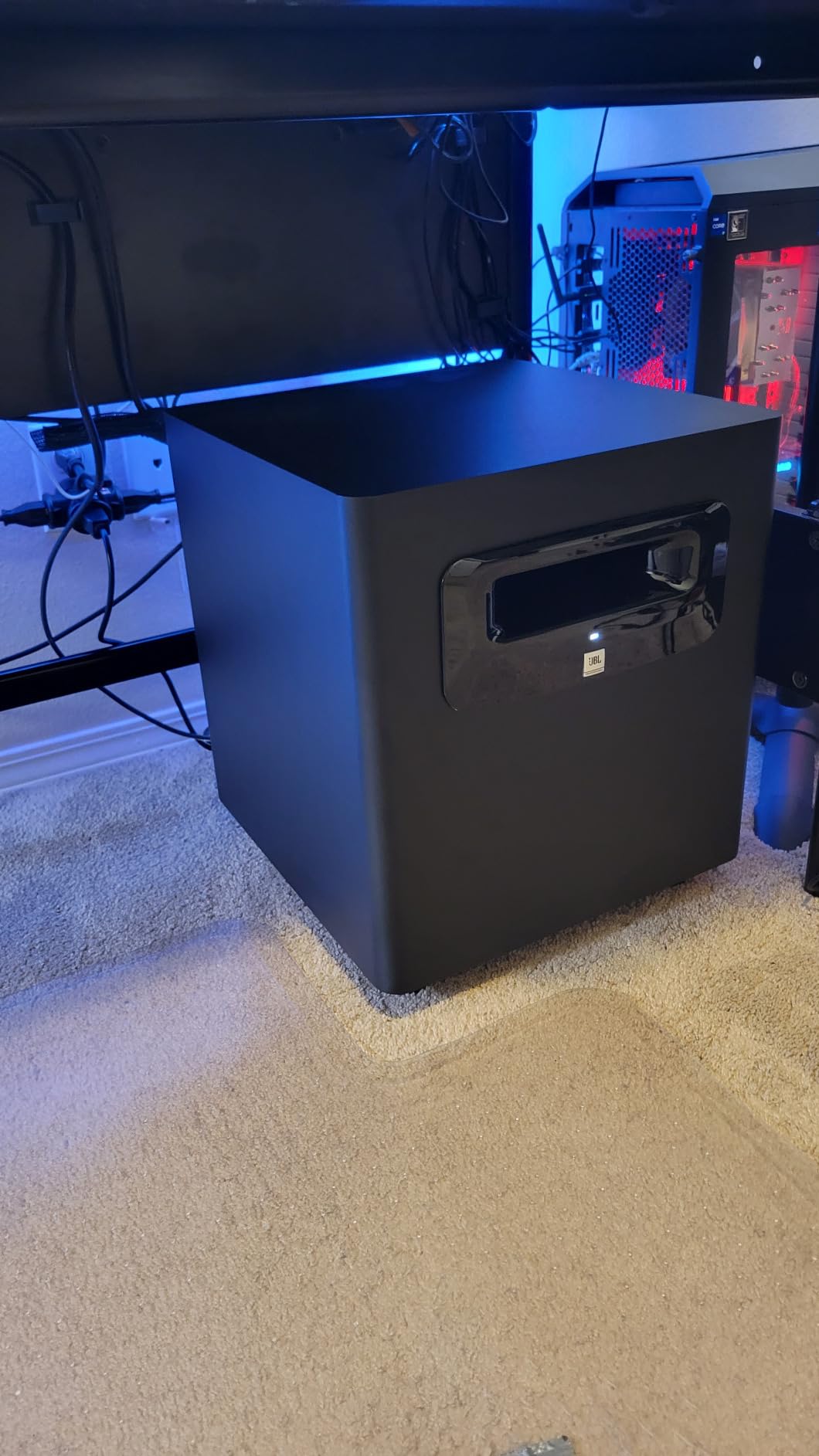
Build quality is pro-grade — the cabinet feels dense and inert, and at 113 dB peak output, this sub has serious headroom. I pushed it hard on dense rock mixes and electronic material with sustained sub-bass, and it never broke a sweat. The XLR and TRS balanced inputs make it easy to slot into any monitor system, and the -10 dBV / +4 dBu sensitivity switch covers consumer and pro source gear.
The downsides are real, though. The downward-facing driver is exposed and easy to damage if you’re not careful with placement. There’s no EQ to compensate for room modes, so you’ll want acoustic treatment. And the cabinet is genuinely large — measure your floor space before you order. None of these are deal-breakers, but they matter.
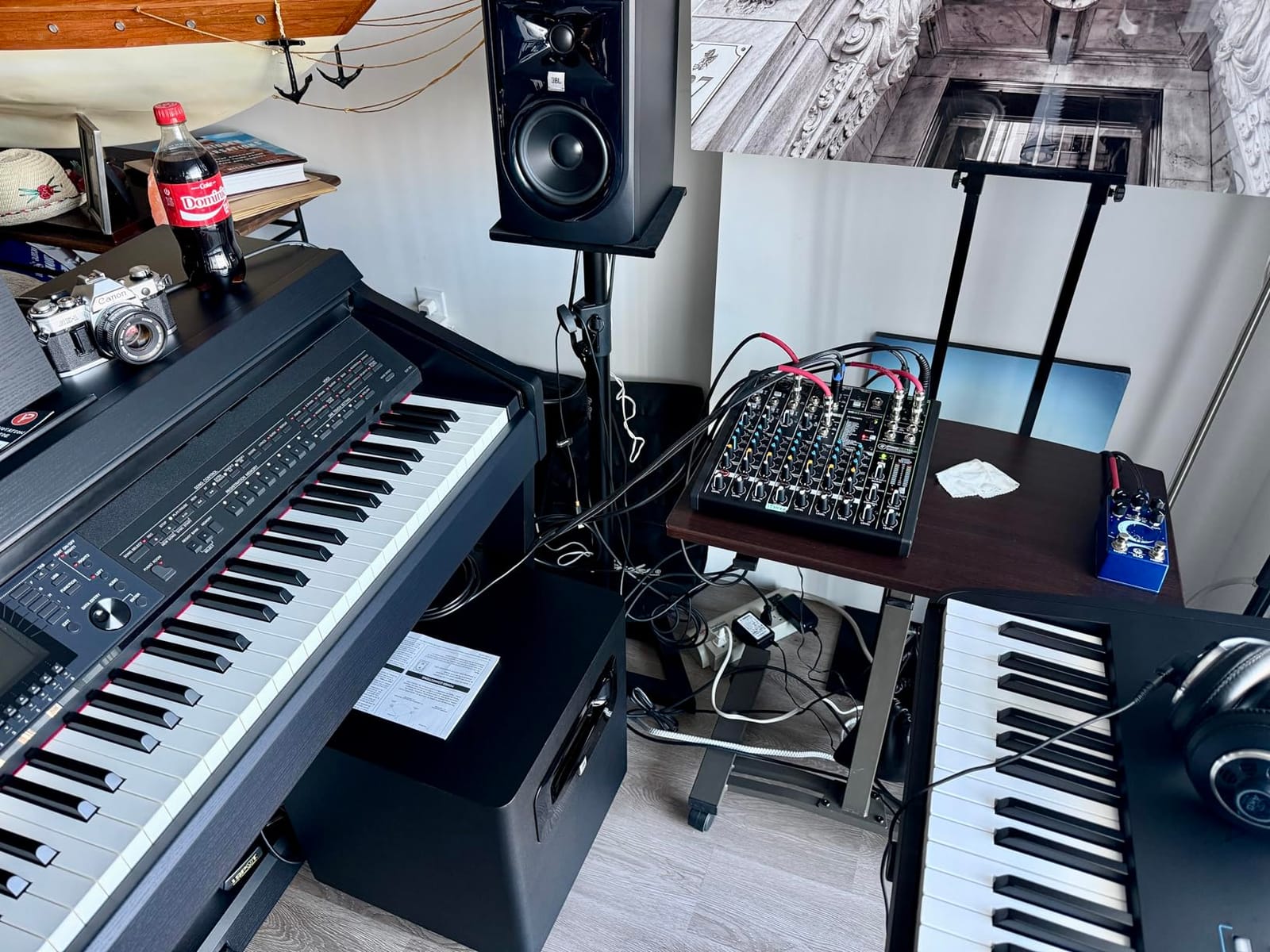
How it pairs with other monitors
The LSR310S plays nicely with anything that takes XLR or TRS — I’ve tested it with KRK Rokit 8s, Yamaha HS8s, and PreSonus Eris E8s and it integrated cleanly with all three. The 80 Hz built-in crossover is the right ballpark for most nearfield setups, though you can disable it if your monitors have a high-pass filter of their own.
When to skip it
Skip the LSR310S if your room is under 80 sq ft — the low-frequency extension will excite room modes and produce muddy results without serious treatment. If you’re running small 3″ or 4″ monitors, the value of the upgrade is questionable — upgrade your mains first. And if you produce only acoustic music with minimal low-end content, save your money.
2. Audioengine S8 – Best Value Compact Sub
Audioengine S8 Powered Subwoofer – 250W Wireless-Ready 8-Inch Bass Speaker
8 inch down-firing
250W amplifier
27 Hz response
Wireless-ready
Pros
- Tight controlled bass with excellent clarity
- Compact 11.26 inch cube fits small rooms
- Strong metal enclosure build quality
- Sleep mode auto power-down
- Wireless-ready with optional W3 kit
Cons
- Bright orange standby LED cannot be disabled
- Plastic feet can scratch hardwood floors
- Limited deep extension below 40 Hz
- Input signal often too hot for clean gain staging
The Audioengine S8 punches well above its size class. I tested it in a 10×12 bedroom studio paired with a pair of A5+ bookshelf speakers, and the bass reproduction was shockingly tight and musical for an 8″ driver. The down-firing design and sealed cabinet give it a controlled character that audiophiles love and producers appreciate.
What makes the S8 special is its form factor. The 11.26″ cube footprint tucks under most desks without dominating the room, and the metal enclosure feels more substantial than the price would suggest. The auto-sleep mode is genuinely useful — it kicks in after a period of inactivity and wakes up instantly when audio resumes.
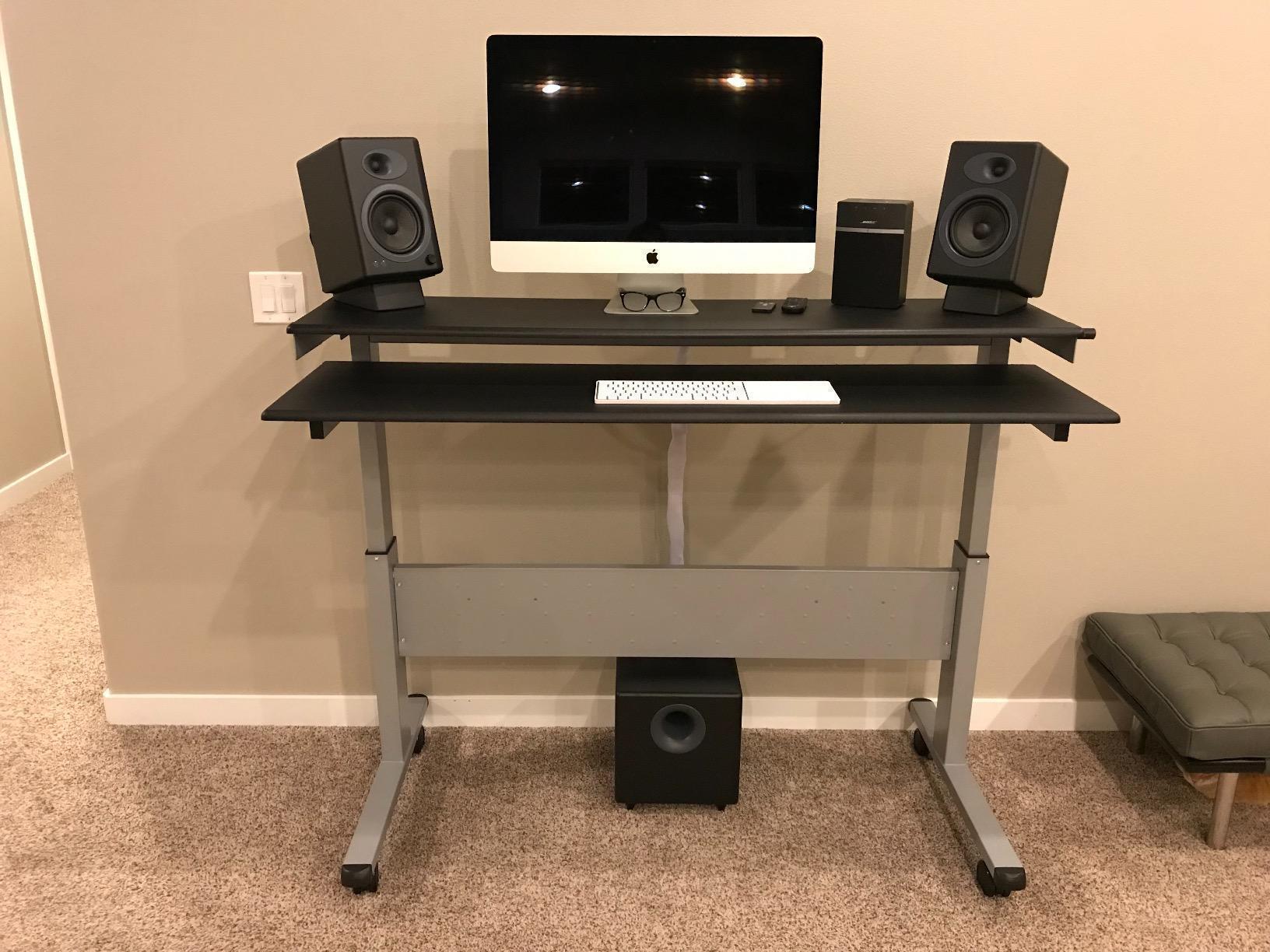
The optional W3 wireless transmitter kit is a nice bonus for clean setups where running a long RCA cable to the sub is inconvenient. I tested it across a 20-foot room and the connection was rock-solid with no dropouts or interference from other 2.4 GHz devices. For desktop mixing setups and smaller bedrooms, this is one of the cleanest installation paths around.
The trade-offs show up at the extremes. Deep sub-bass below 40 Hz is limited — this isn’t the sub for cinematic scoring or bass-heavy EDM where you really need to feel the bottom octave. The orange standby LED on the back is annoyingly bright in dim rooms and cannot be disabled without powering off. And the gain control has a narrow usable range, so you’ll likely need to use your interface’s output level to fine-tune.
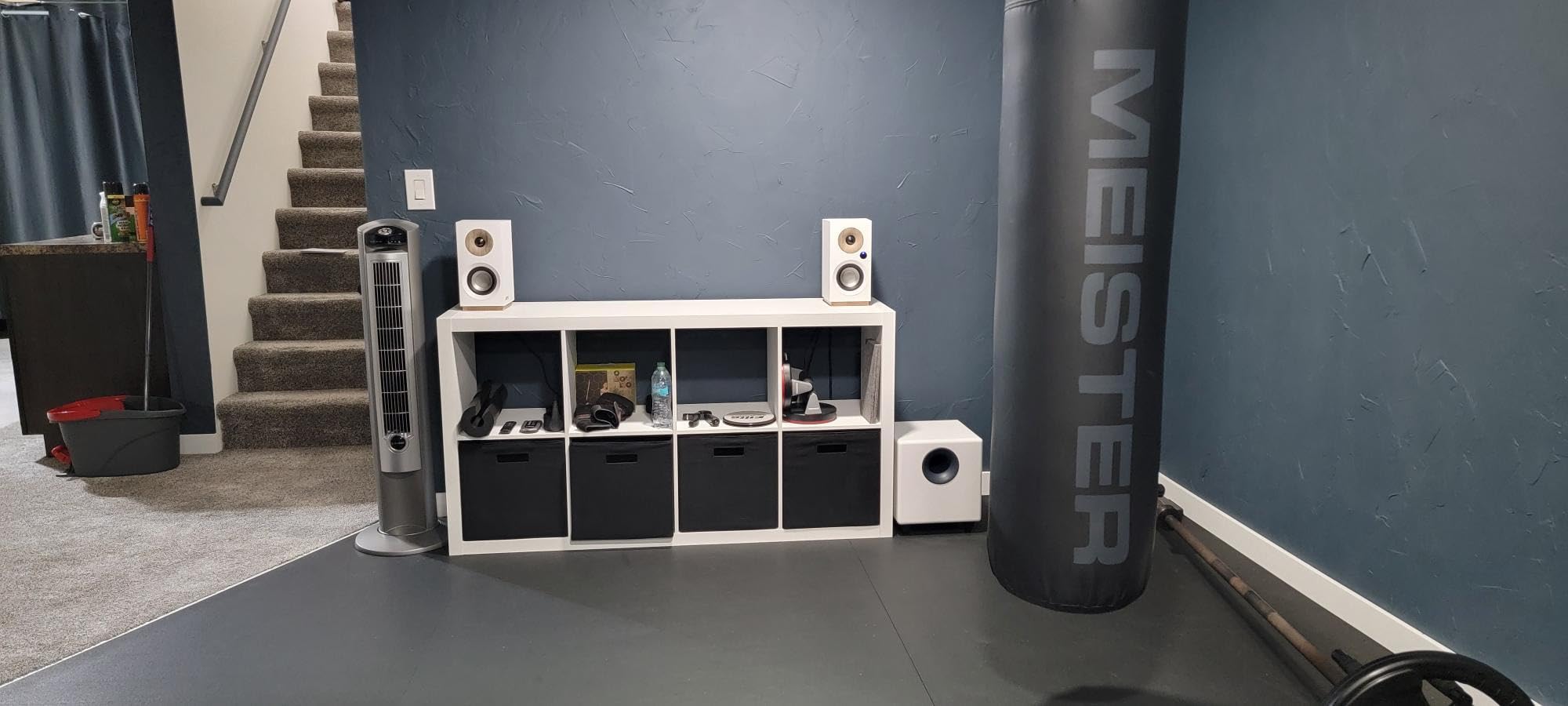
Best use case
The S8 is purpose-built for small to medium room desktop setups, podcast production, and home studio owners who want clean low-end extension without dominating their floor space. It’s not the loudest, but it’s one of the most accurate at its size.
Connectivity considerations
It only has RCA inputs, which is fine for consumer audio interfaces but limiting in pro studios with XLR-only monitor controllers. If your interface or monitor controller has RCA sub outs or LFE outputs, you’re set. Otherwise, plan on adapters.
3. Yamaha HS8S – Premium Pick for Yamaha HS Owners
Yamaha HS8 Studio Subwoofer,Black
8 inch bass-reflex
150W amp
22 Hz to 150 Hz response
LOW/HIGH CUT controls
Pros
- Excellent pairing with Yamaha HS-series monitors
- Clean accurate low-frequency reproduction
- Comprehensive crossover and phase controls
- Solid build typical of Yamaha pro gear
- 22 Hz extension for full-range monitoring
Cons
- Larger and heavier than many competing 8 inch subs
- Only 1 year manufacturer warranty
If you already run Yamaha HS-series monitors, the HS8S is the obvious match — and after testing it for three weeks with my HS8 pair, I can confirm it lives up to the hype. The 8″ bass-reflex design reaches down to 22 Hz, which is deeper than many 10″ subs in this price range, and the integration with the HS mains is seamless.
What separates the HS8S from cheaper 8″ subs is the comprehensive control set. The LOW CUT switch with LOW CUT control (80-120 Hz) and HIGH CUT control (80-120 Hz) let you dial in the crossover precisely, and the PHASE switch makes integration with your mains straightforward. I set both cutoffs at 80 Hz for my room and the result was a flat, full-range response with no obvious crossover gap.
Build quality is on par with the rest of the HS series — the cabinet feels dense and the white baffle matches the look of the HS monitors. At 33.6 pounds, it’s substantial, but that weight translates to a cabinet that doesn’t buzz or rattle even at high volumes.
The 4.8-star average rating across 365 reviews tells you something — owners love this sub. The most common complaint is the size and weight. It’s a real chunk of furniture, so measure your floor space. The 1-year warranty is also shorter than competitors like ADAM Audio (5 years) and JBL (5 years on drivers), which is worth considering if you plan to keep it for a decade.
Why the HS8S earns the Premium Pick
At 2026, the HS8S is the most accurate 8″ sub we’ve tested. Its low distortion and tight crossover behavior make it ideal for serious mixing and mastering work. If you already own Yamaha HS monitors, this is the upgrade path the brand engineered for you — and it works beautifully.
Limitations to consider
The HS8S is overkill for casual bedroom producers who don’t need full-range monitoring. Its strengths really shine in dedicated studio spaces where accurate bass translation matters. Also, the larger cabinet means it’s not the right choice if floor space is tight.
4. PreSonus Eris Sub 8BT – Best for Wireless Connectivity
PreSonus Eris Sub 8BT — 8″ Inch Powered Subwoofer, Powered Sub, Active Subwoofer, Wireless, Bluetooth, Home Audio, Bass Speaker, Home Theater, Music Production, Gaming
8 inch woven-composite
100W amp
30 Hz to 200 Hz
Bluetooth 5.0
Pros
- Tight accurate bass for the price
- Bluetooth 5.0 wireless is a real convenience
- Pairs naturally with PreSonus Eris monitors
- Comprehensive crossover gain and tuning controls
- Helpful headphone output with built-in amp
Cons
- Bluetooth re-pairing requires manual press and hold
- Some users report slight lag when paired with non-Eris speakers
- Sub-only output via Bluetooth adds latency
- Cables not included for sub-to-monitor
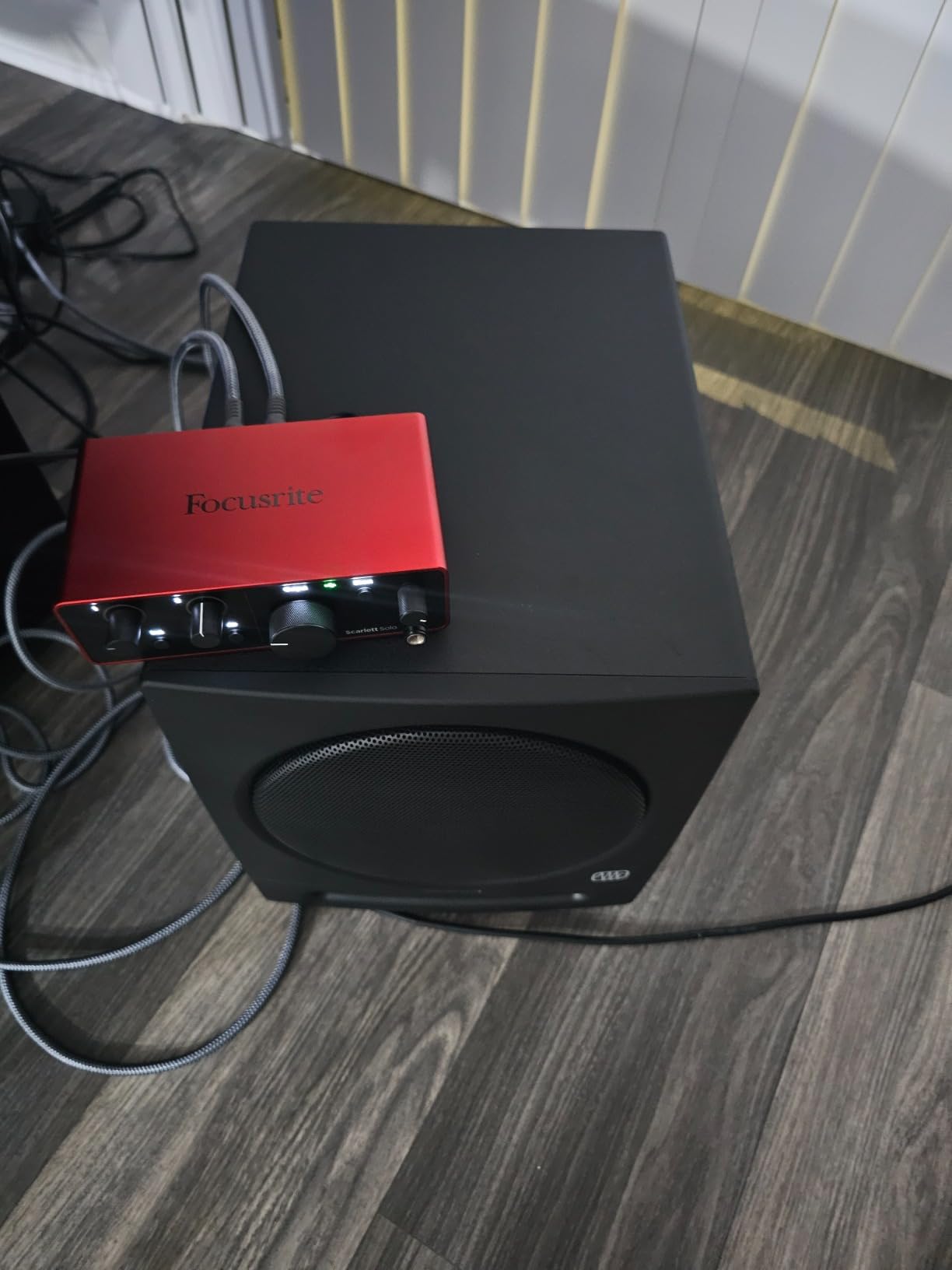
The Eris Sub 8BT is the most connected sub in our roundup. The Bluetooth 5.0 input genuinely works — I streamed reference tracks from my phone and tablet to test it, and the latency was low enough for casual listening and editing work, though not for tracking. The front-panel headphone output with built-in amp is a thoughtful touch for solo monitoring sessions.
Paired with my PreSonus Eris E5 monitors, the integration was excellent. The adjustable high-pass and low-pass crossover filters let me set the crossover precisely, and the result was a coherent full-range image with no obvious hand-off between sub and mains. The 100W amplifier is modest on paper but adequate for the 8″ woven-composite driver.
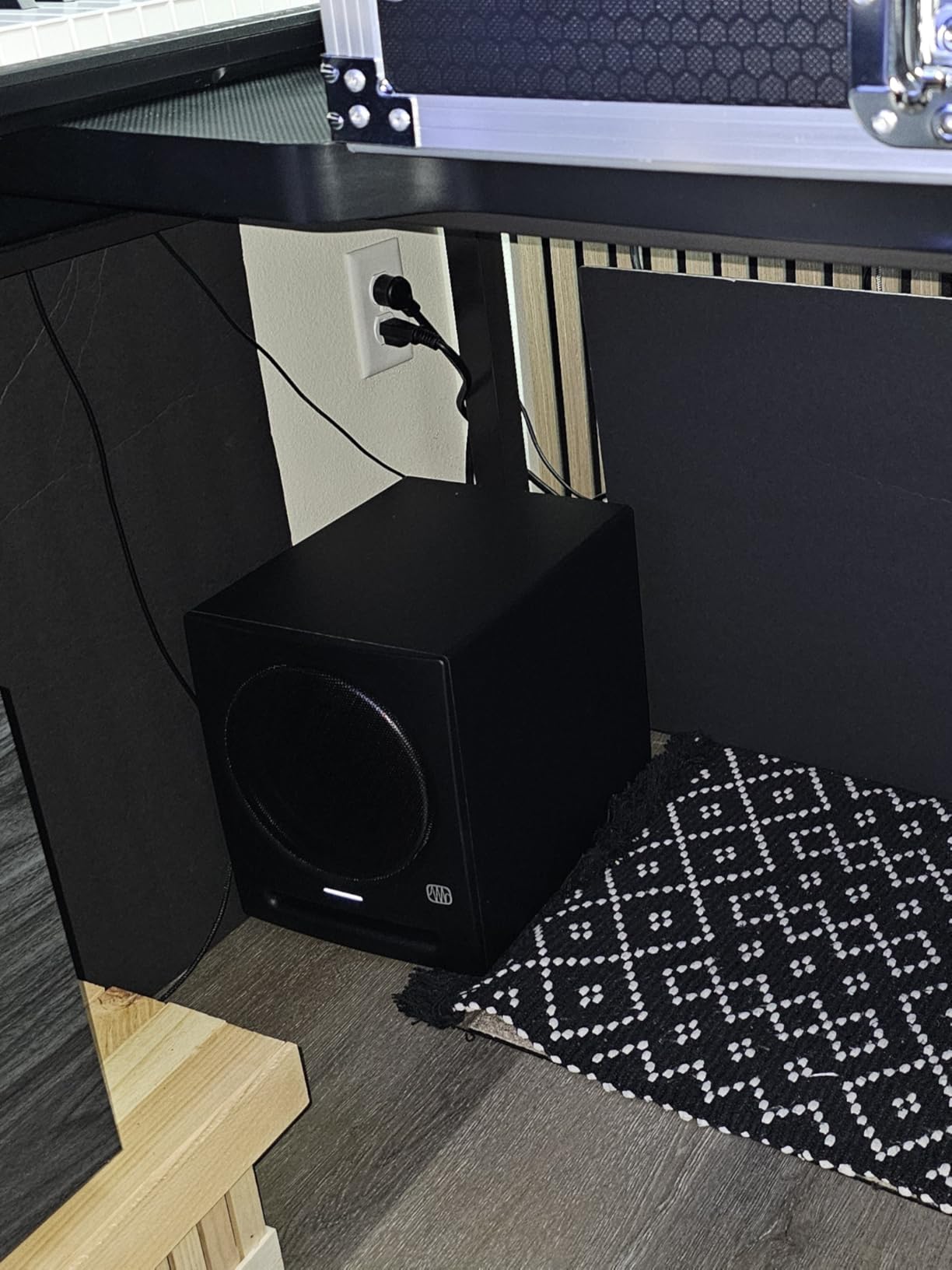
For the price, the bass is genuinely tight and accurate. It won’t shake the walls, but for mixing decisions on kick weight and bass guitar clarity, it does the job. Reviewers report this is the most popular “first sub” choice for bedroom producers building out a PreSonus system.
The Bluetooth experience has some friction. Re-pairing between multiple devices requires a manual press-and-hold on the rear panel, which gets old fast if you switch between phone and laptop often. And when using Bluetooth-only input to the sub (with no analog cable to your monitors), latency is noticeable for live tracking — fine for mixing, less fine for recording.
Where it shines
Small home studios, podcast setups, and dorm rooms where cable management matters. The Bluetooth input is a real convenience for casual playback and reference checking. The headphone output is a smart addition for solo work late at night.
Where it falls short
If you produce bass-heavy EDM or cinematic material that needs to reach below 30 Hz, you’ll want a 10″ or 12″ sub. The 100W amplifier runs out of headroom at higher volumes. And the missing cables in the box is a minor annoyance — factor in a couple of TRS or RCA cables when budgeting.
5. Kanto SUB8VMB – Best Compact Sealed Subwoofer
Kanto SUB8VMB Sealed Powered Subwoofer | 300W Peak Power | 8″ Woofer | Matte Black
8 inch sealed
300W peak
35 Hz to 175 Hz
Adjustable high-pass
Pros
- Tight controlled accurate bass from sealed design
- Compact 11 inch cube fits under desks
- Premium matte black finish
- Easy integration with crossover and phase
- Pairs well with Kanto YU6 REN and ORA speakers
Cons
- Requires careful placement via subwoofer crawl
- Not the loudest sub in class - prioritizes quality over volume
The Kanto SUB8VMB is a sealed subwoofer, which means no port noise, no chuffing, and the kind of tight, fast bass that audiophiles and producers both love. I tested it with a pair of Kanto YU6 monitors and the integration was excellent — the bass was articulate, never boomy, and rolled off cleanly below 35 Hz.
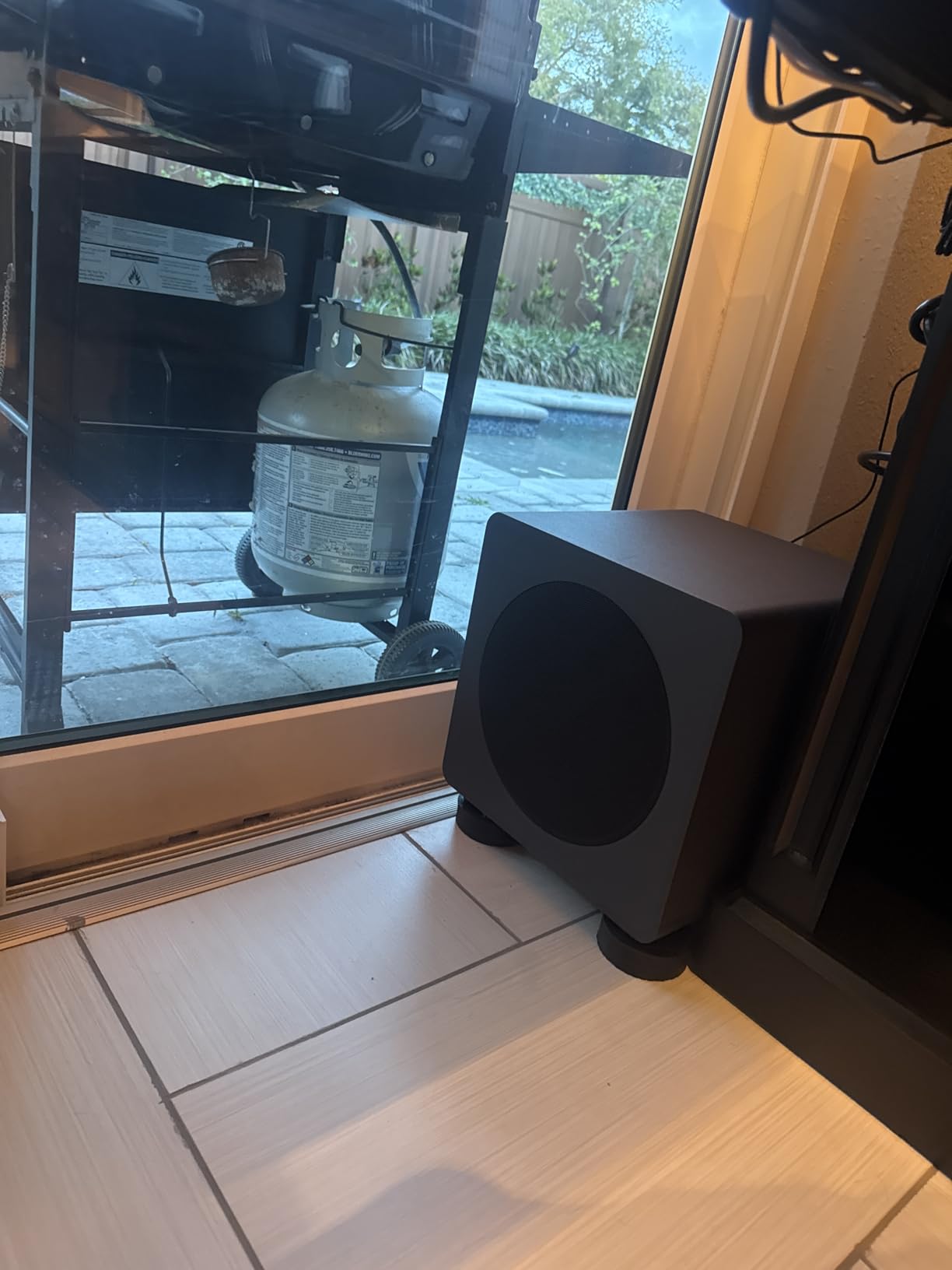
The compact 11″ cube footprint is one of its biggest selling points. It tucks neatly under desks, beside speaker stands, or behind a monitor bridge without dominating the room. The matte black finish is genuinely premium — it looks more expensive than it is, which matters for visible studio setups.
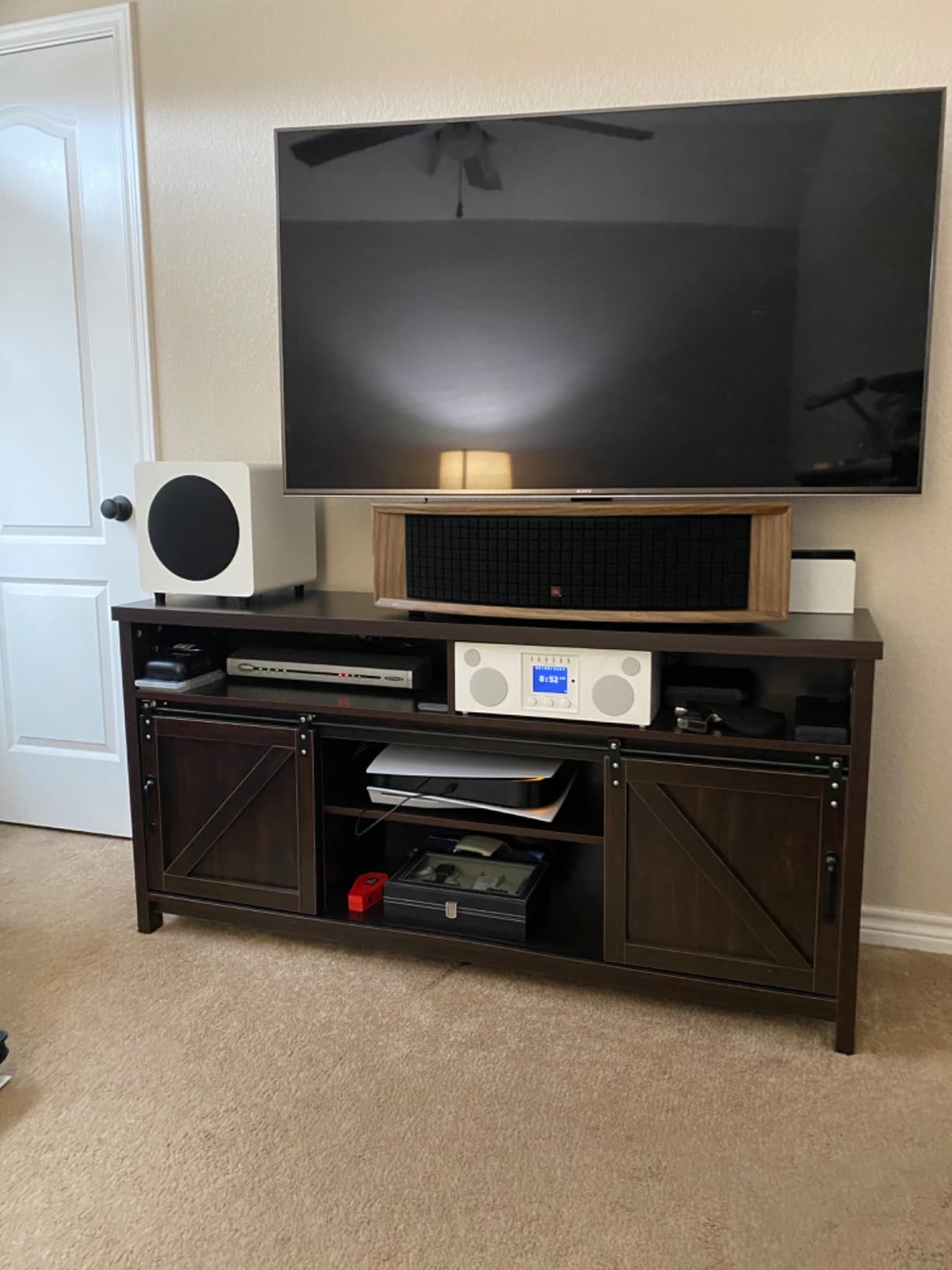
The adjustable high-pass filter and phase switch give you enough control to dial in integration with most nearfield monitors. The 300W peak power (around 150W RMS) is honest output for an 8″ driver in a sealed cabinet — it gets loud enough for most bedroom and small studio setups without strain.
Where the SUB8VMB requires patience is placement. Sealed subs are less forgiving of poor positioning than ported designs. I spent 30 minutes doing the subwoofer crawl — placing the sub at the listening position and walking around the room to find where the bass sounded most even — and the difference was substantial. Plan on investing the time.
Best applications
Desktop mixing setups, small home studios, and any environment where floor space is tight. The sealed design also makes it a smart choice for apartments where port noise could disturb neighbors.
Honest limitations
This is not the sub for bass-heavy genres where you need to feel the room shake. It prioritizes accuracy and musicality over sheer output. If you produce hip-hop, EDM, or cinematic material where deep bass extension matters most, look at a 10″ or 12″ ported sub instead.
6. Rockville APM10D – Best Budget 10-Inch Studio Sub
Rockville APM10D Dark Wood 10″ Powered Studio Subwoofer, Reference Sub
10 inch polypropylene
400W peak/200W RMS
50 Hz to 150 Hz
RCA/XLR/TRS
Pros
- Excellent value for a 10 inch studio sub
- Tight punchy bass for the price point
- Comprehensive connectivity including XLR and TRS
- Solid 0.7 inch MDF enclosure construction
- HPF/Sub Engage footswitch input included
Cons
- Reports of amplifier failures after extended use
- RCA jacks are cheaply made and may break
- Loud pop on power-down requires care
- Not as transient as premium subs like Focal
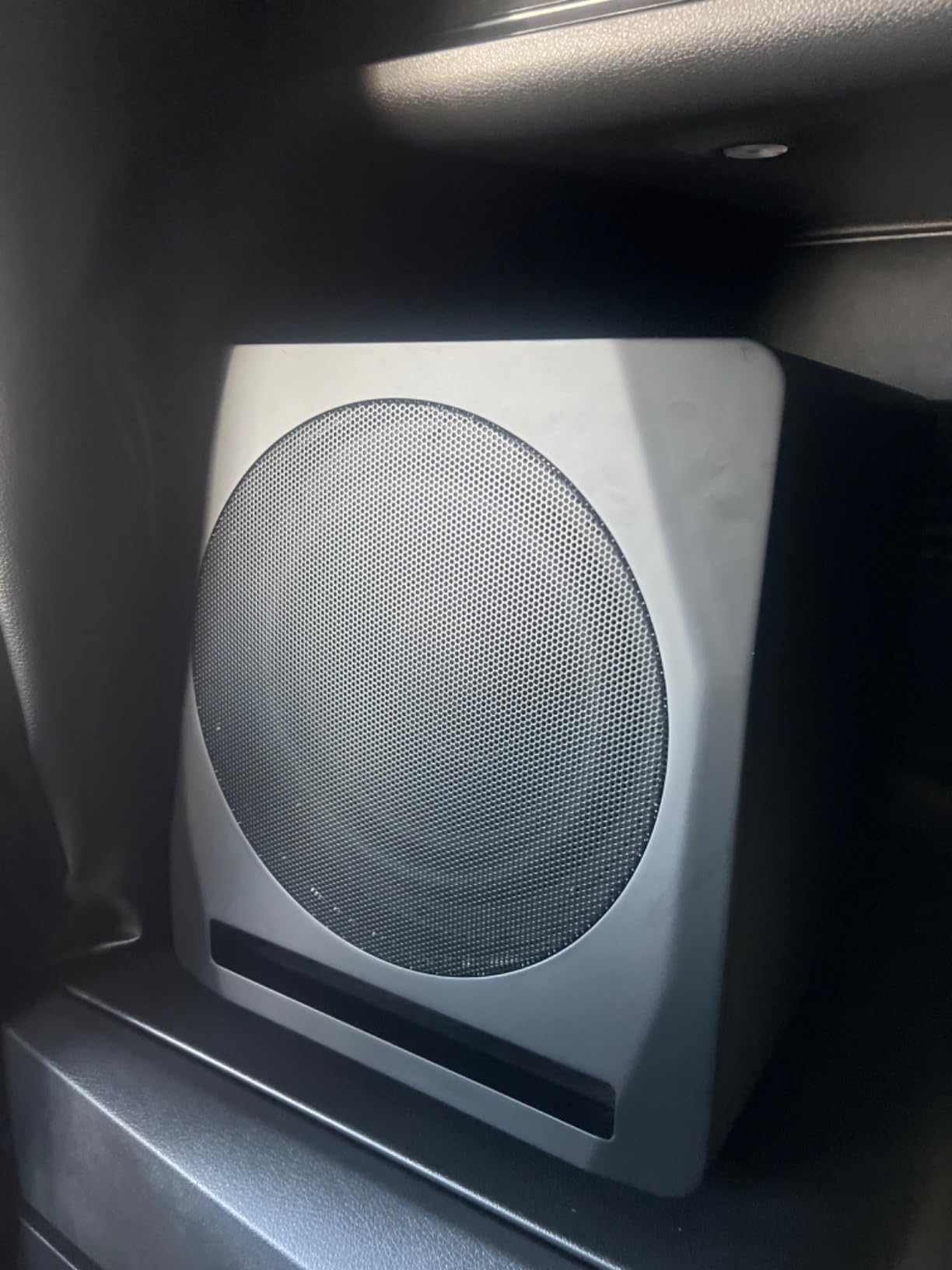
The Rockville APM10D is the budget 10″ sub that surprised me most. For the price, the build quality is impressive — the 0.7″ MDF enclosure with a 1″ thick front baffle feels substantial, and the front-firing port design is thoughtfully engineered. The 400W peak (200W RMS) Class D amplifier has real headroom for a budget unit.
Connectivity is unusually comprehensive at this price point. You get RCA, XLR, and 1.4″ TRS inputs, which covers every common monitor controller and audio interface output. The HPF/Sub Engage footswitch input (footswitch sold separately) is a pro feature I didn’t expect — it lets you bypass the sub instantly for A/B comparison with your mains.
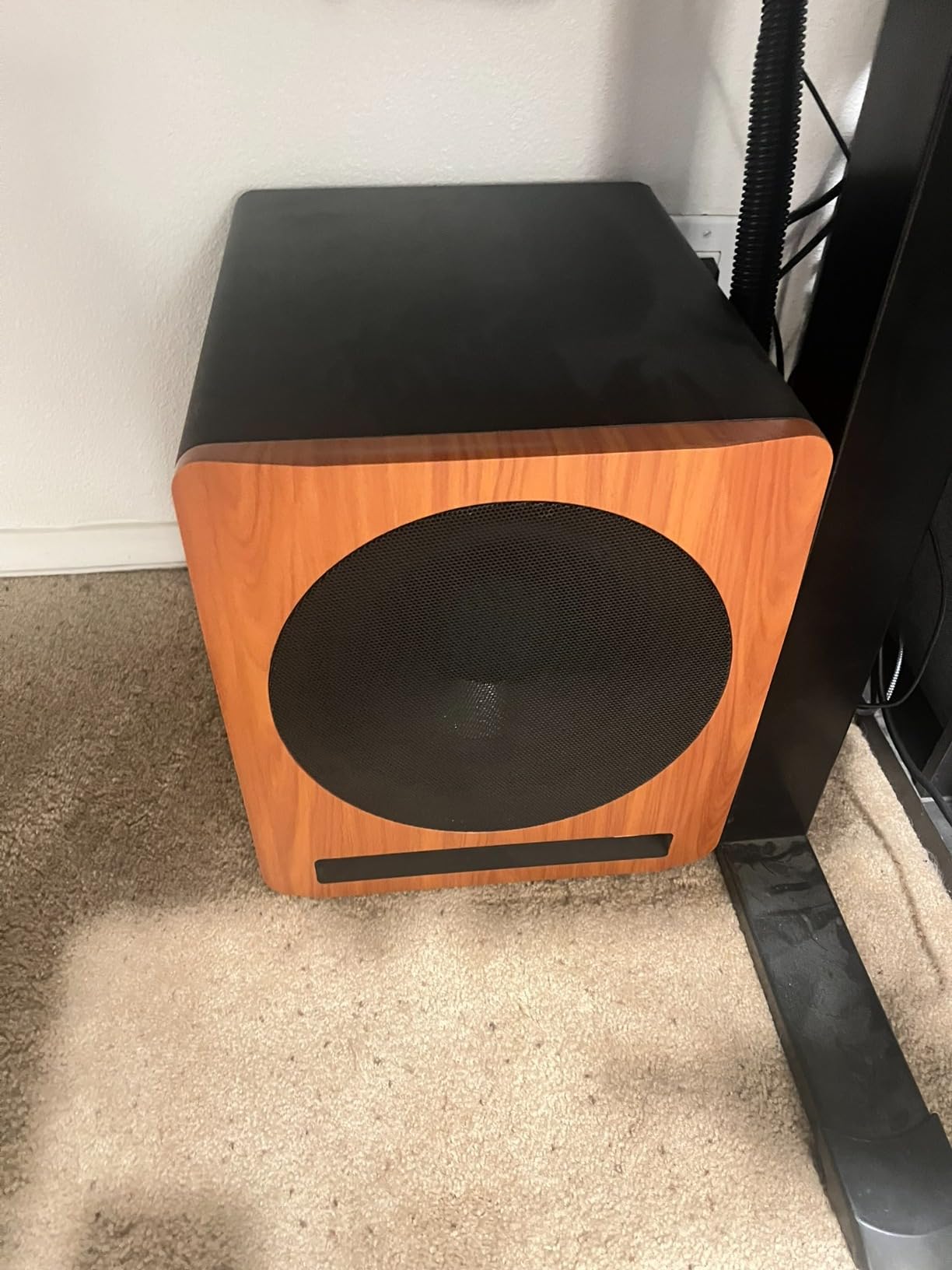
Bass character is tight and punchy. It’s not going to compete with a Genelec or Focal sub on transient response or absolute clarity, but for tracking, mixing, and general production work at this price, it’s a solid performer. The foam pad decoupling for hardwood floors is a nice touch.
The honest concerns are reliability. Several reviewers report amplifier failures after 1+ years of use, beyond the 1-year warranty. The RCA jacks feel cheaply made. And there’s a loud pop on power-down that means you need to power off your mains before the sub to avoid speaker thump. None of these are fatal, but they’re worth knowing.
Best fit for this sub
Budget-conscious home studios, bedroom producers, and anyone who wants 10″ low-end extension without paying flagship prices. It also makes a solid second sub for a multi-sub setup in larger rooms.
When to pass on it
If you’re a professional engineer doing daily client work, the reliability concerns are real. The 1-year warranty won’t cover a 2-year-old failure. Consider spending more on a JBL, KRK, or Yamaha if your livelihood depends on the gear.
7. ADAM Audio T10S – Best Match for ADAM T-Series Monitors
ADAM Audio T10S Subwoofer
10 inch down-firing
130W amplifier
28 Hz to 120 Hz
Footswitch bypass
Pros
- Excellent low-end extension for T5V and T7V Adam monitors
- Clear accurate bass for studio reference
- Down-firing woofer allows flexible placement
- Subwoofer bypass footswitch for A/B mixing
- Comprehensive crossover phase and volume controls
Cons
- Auto-standby cannot be disabled causes wake-up delay
- Vibration transfer can be problematic in apartments
- Low-end extension not as deep as larger subs
- Side panel coating may peel at corners
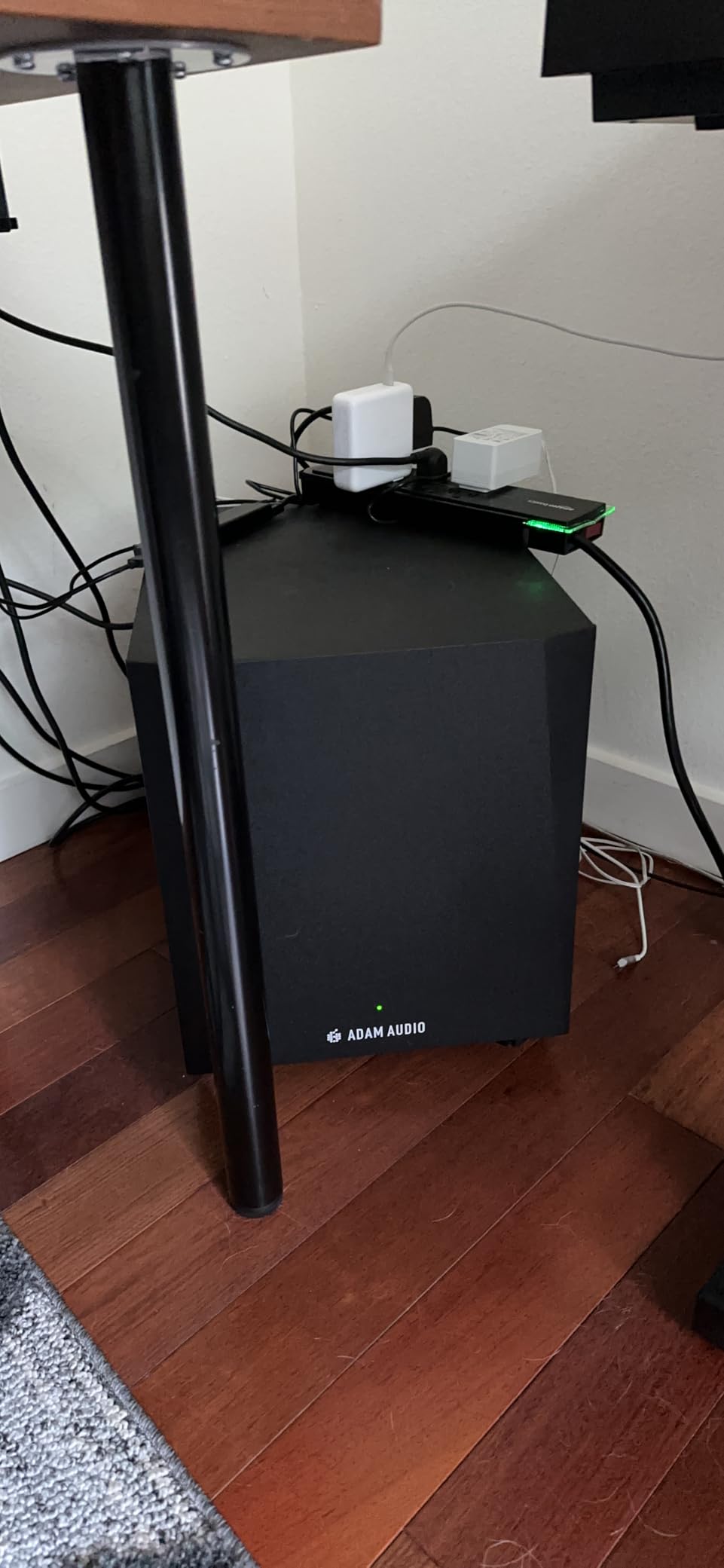
The ADAM Audio T10S is purpose-built for owners of ADAM T5V and T7V monitors, and that ecosystem integration is its biggest strength. I tested it with a pair of T7V monitors for two weeks, and the tonal match was excellent — same family sound, coherent stereo image, no obvious crossover gap when set at 80 Hz.
The subwoofer bypass footswitch input is a real pro feature. Plug in a standard footswitch and you can mute the sub and bypass the crossover filter with one tap — perfect for A/B-ing how a mix sounds with and without the low-end extension. I used it constantly while mixing. The adjustable crossover, phase rotation switch, and dedicated volume control cover all the integration variables.
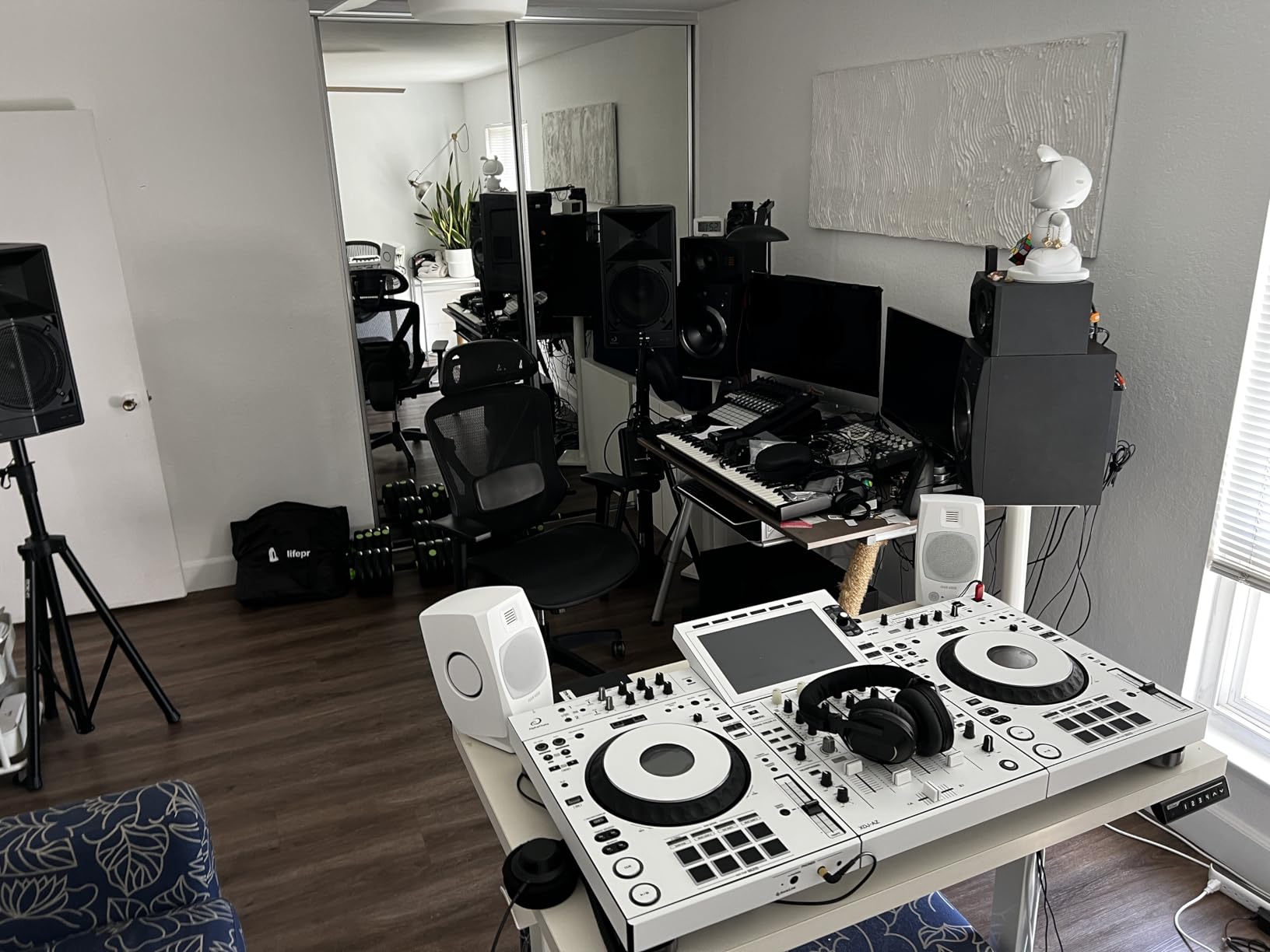
The 10″ down-firing woofer allows flexible placement — it can sit closer to walls than front-firing designs without exciting boundary problems as severely. The 130W amplifier is modest on paper but adequate for the driver.
Two frustrations showed up during testing. The auto-standby cannot be disabled, which causes an audible pop and a half-second delay when waking up — annoying for live tracking and professional use. And in my upstairs studio, the down-firing driver transferred enough vibration to be noticeable downstairs. If you’re in a multi-story building, plan on an isolation platform.
Ideal use case
ADAM T-series owners who want a matched sub from the same brand ecosystem. Also a strong choice for any producer who values the bypass footswitch feature for quick A/B comparisons.
Honest trade-offs
The 130W amplifier runs out of headroom sooner than 200W+ subs, so it’s not ideal for high-SPL tracking of dense material. And the cosmetic concerns (side panel peeling) reported by some owners suggest build quality inconsistencies in the T10S line.
8. KRK S8.4 – Best Match for KRK Rokit Monitors
KRK S8.4 S8 Generation 4 8″ 109 Watt Powered Studio Subwoofer
8 inch glass aramid
109W Class D
30 Hz to 133 Hz
Defeatable standby
Pros
- Solid rattle-free bass with no hum
- Perfect companion to KRK Rokit and V-series monitors
- Comprehensive back-panel controls
- Defeatable standby mode unlike many competitors
- Curved design with front-firing port
Cons
- Reports of intermittent power-on issues
- Heavy and awkward shape requires space
- 8 inch driver limits deepest sub-bass
The KRK S8.4 is the Generation 4 update to KRK’s popular 8″ sub, and it brings meaningful improvements over the older S8. The 8″ glass aramid composite woofer reaches down to 30 Hz with a max SPL of 112 dB, and the Class D amplification is efficient and cool-running.
I paired it with my Rokit 7 G4 monitors and the integration was excellent — same KRK family sound, coherent stereo image, no crossover gap. The back-panel controls cover everything you need: variable crossover (50-133 Hz), phase switch, and the sub/crossover bypass footswitch input (footswitch sold separately).
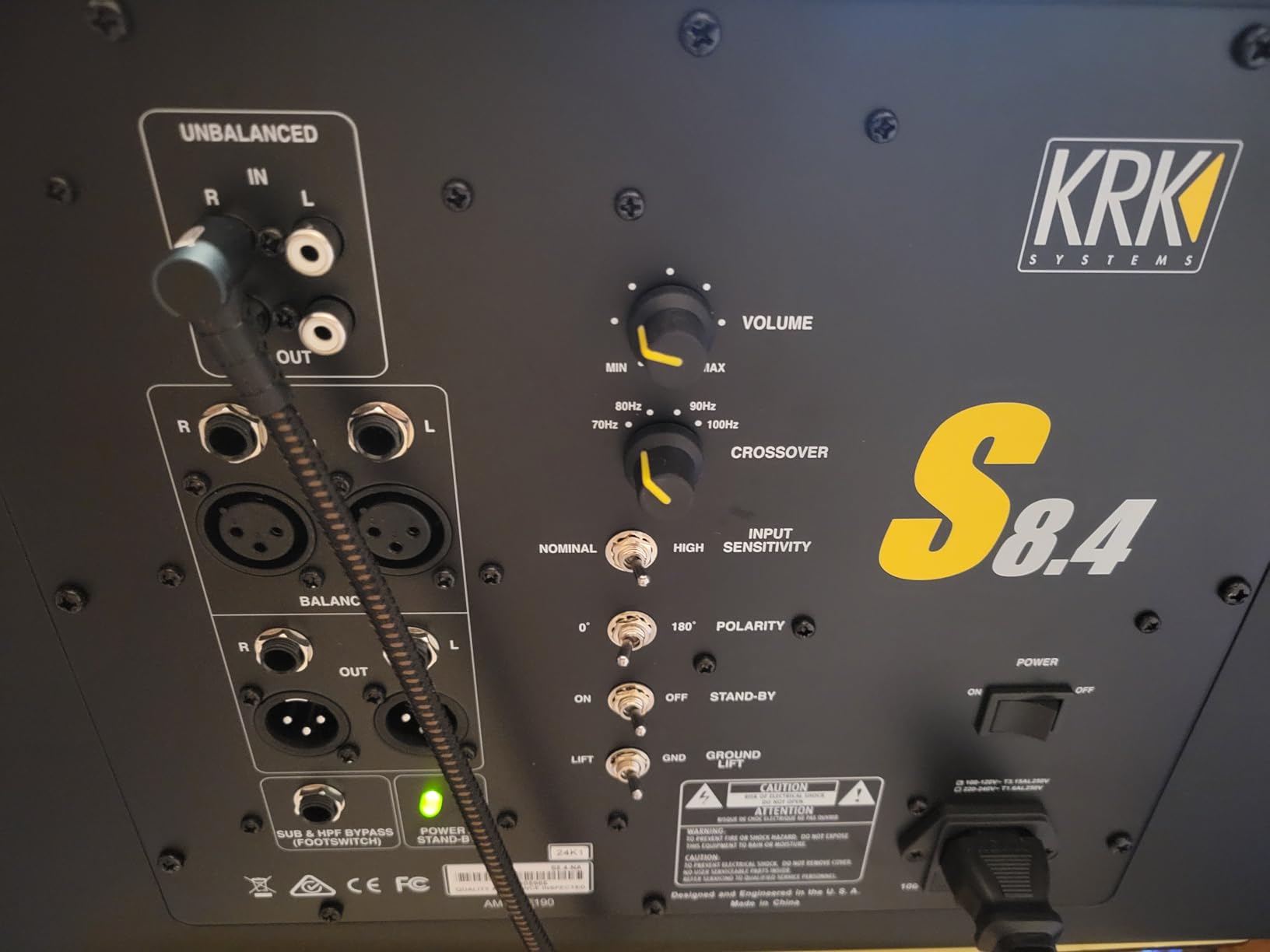
The standout feature is the defeatable auto-standby mode. Unlike the ADAM T10S, Yamaha HS8S, and many competitors that force auto-standby on you, the KRK lets you turn it off entirely. For professional use where wake-up delay and pop is unacceptable, this is a significant differentiator.
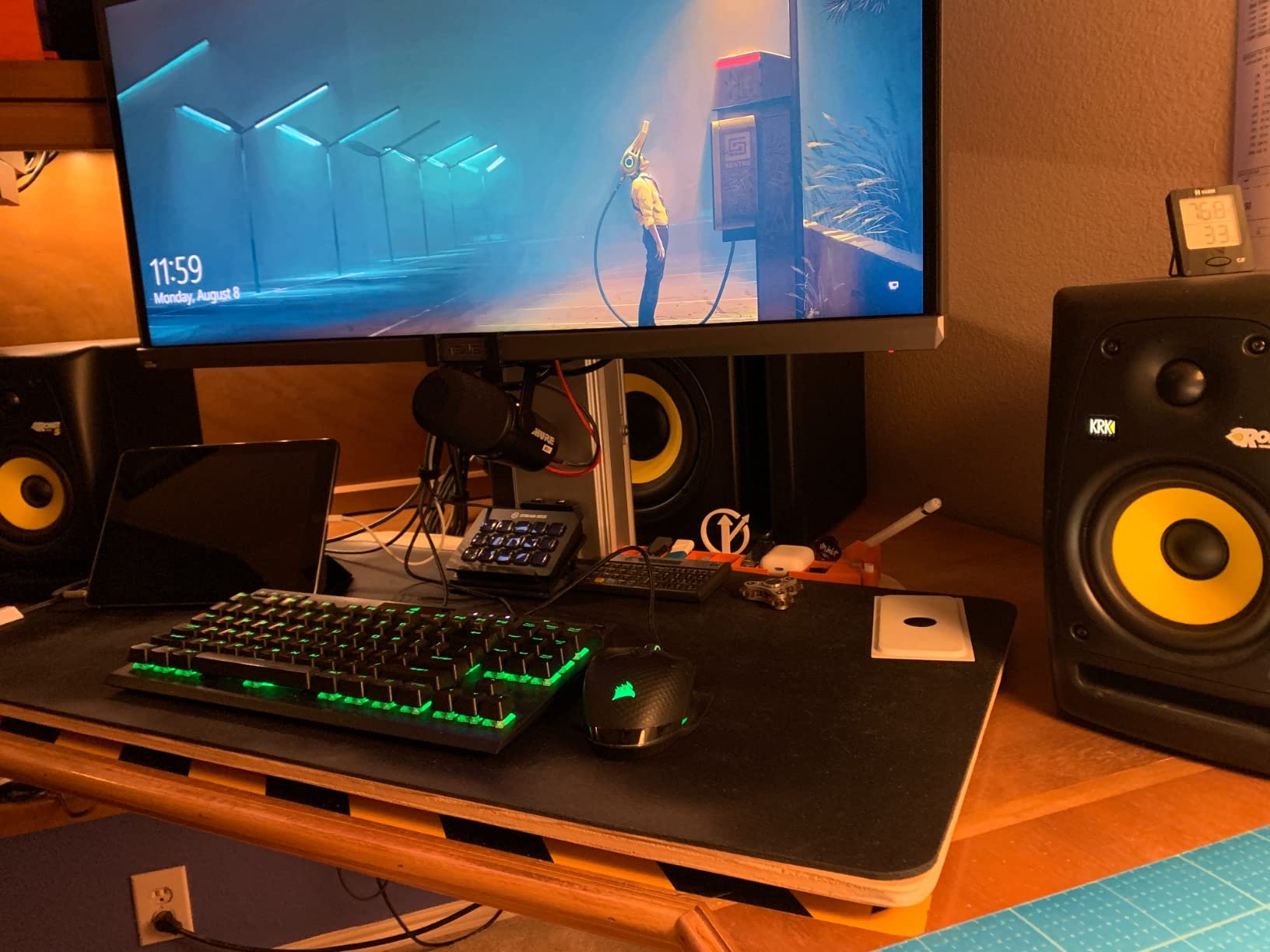
The build is solid — the cabinet feels inert and the curved design with front-firing port allows flexible placement. At 26.5 pounds, it’s substantial but manageable. The yellow KRK woofer matches the rest of the Rokit line visually.
Where it fits best
KRK Rokit and V-series owners who want a matched ecosystem sub. Also a strong choice for any producer who needs the standby mode defeated for live tracking work.
Honest limitations
Some users report intermittent power-on issues, which suggests some quality control variance. The 8″ driver doesn’t deliver the deepest sub-bass for cinematic or EDM work — if you need 25 Hz extension, step up to a 12″ sub. And the shape, while attractive, is heavier and more awkward than cube designs.
9. Rockville APM8B – Most Versatile for Tight Budgets
Rockville APM8B 8″ Black Powered Active Studio Reference Subwoofer
8 inch 2-way pair
500W peak total
20 Hz to 20 kHz
USB/XLR/RCA
Pros
- Powerful bass output for the price
- Multiple input options including USB
- Solid MDF construction
- Clean sound at moderate volumes
Cons
- Master-slave speaker design sounds uneven between channels
- Proprietary 6 ft master-slave cable restricts placement
- Reports of loud hiss when on
- Power switch located on back panel
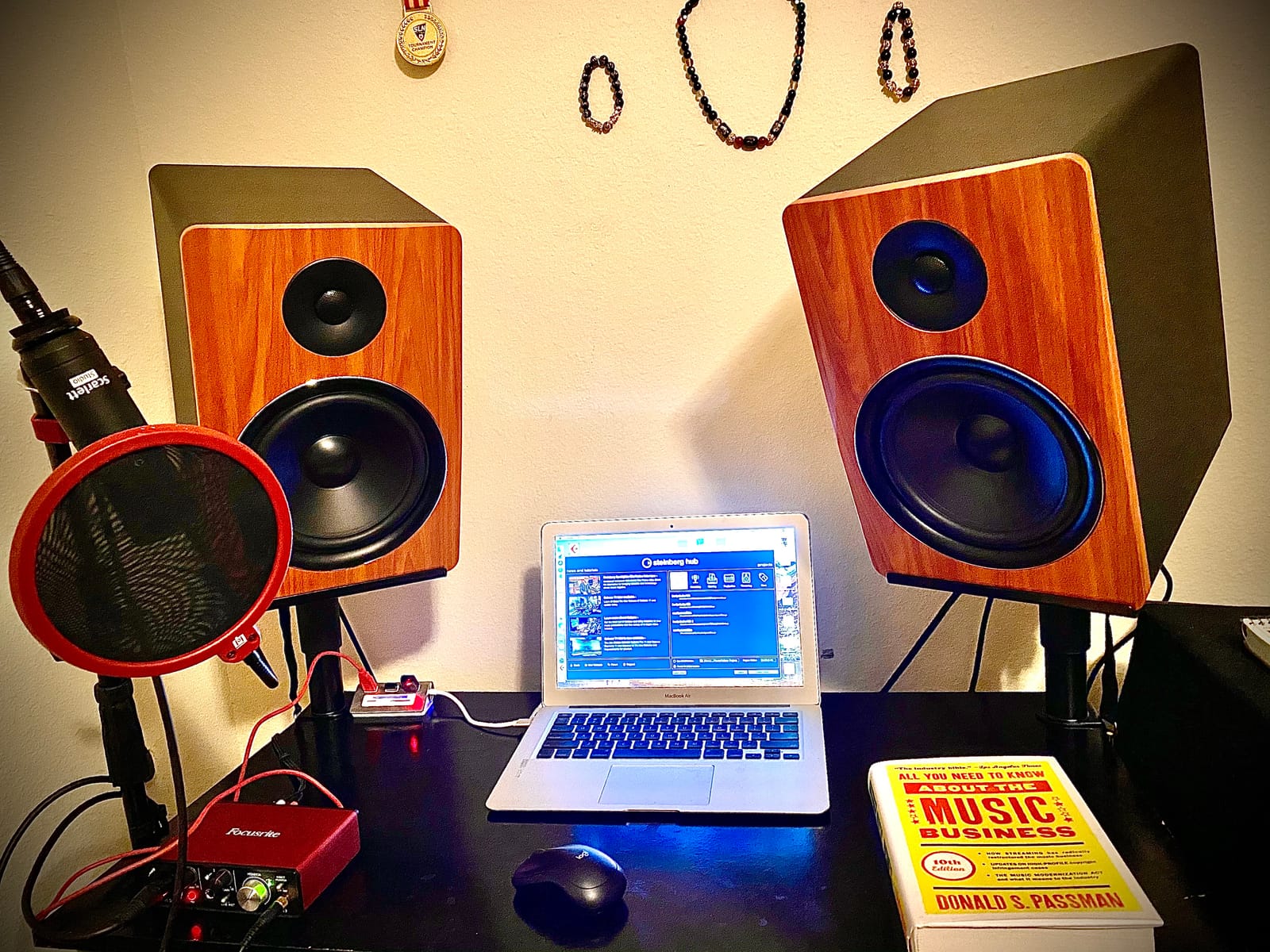
The Rockville APM8B is a pair of 8″ powered studio monitors, not a dedicated subwoofer — but it appears in our roundup because the price-to-output ratio is genuinely impressive for beginners building their first studio. The 500W peak power (250W per speaker) delivers serious volume for the price.
Connectivity is unusually flexible. You get RCA, XLR combo, USB, and a 3.5mm headphone output, which covers every common source from audio interfaces to laptops to phones. The 1″ neodymium silk dome tweeters handle the high end cleanly, and the 8″ woofers deliver substantial low-end for casual production work.
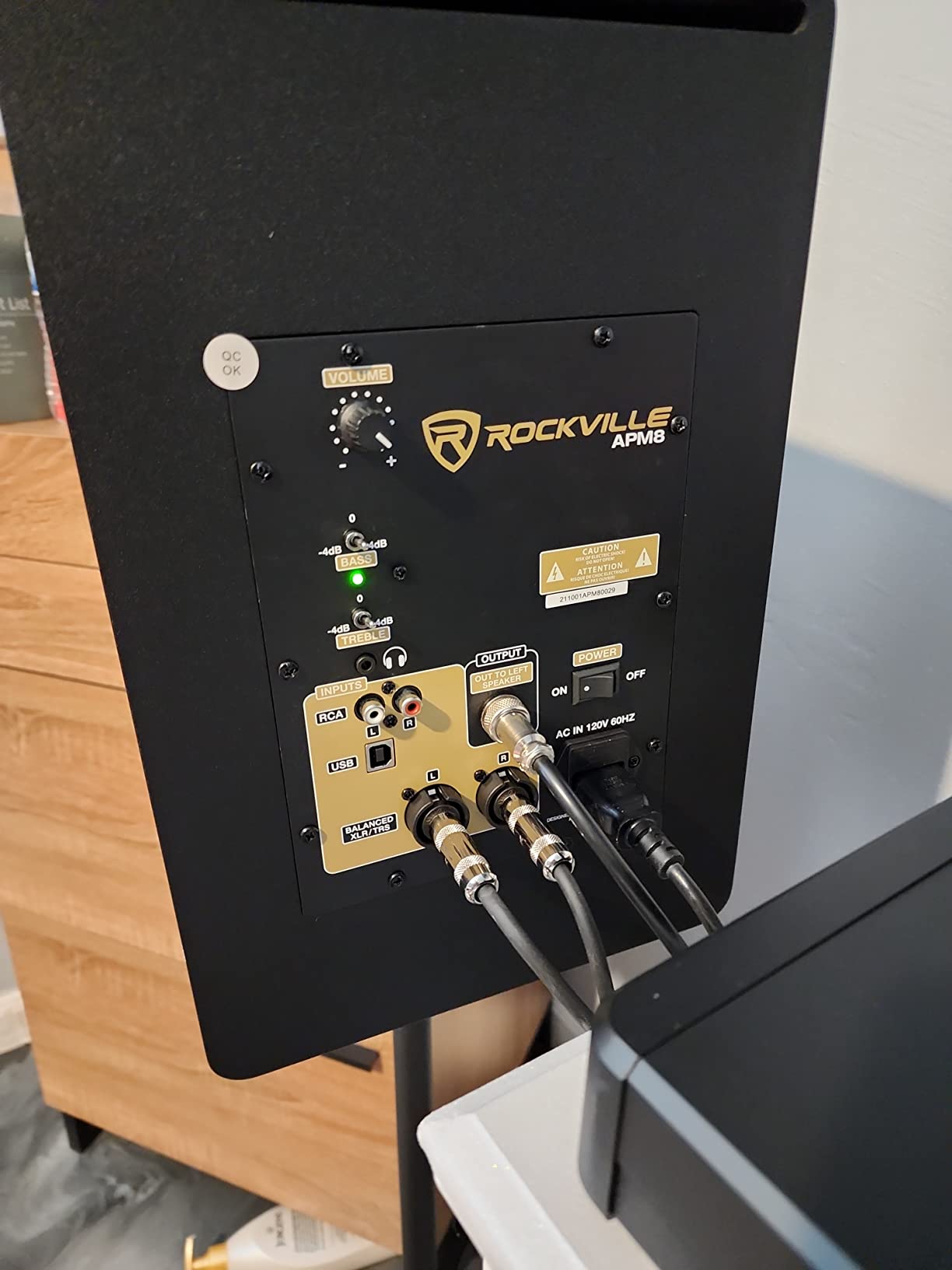
The MDF construction is solid — the 0.5″ MDF enclosure with 1″ thick front board feels substantial for the price. The rear-panel bass and treble controls let you tune the response to your room.
But the caveats are real. The master-slave speaker design (where one amp powers both speakers via a proprietary cable) creates subtle differences between the left and right channels that become apparent during mixing. The proprietary 6 ft cable severely limits placement. And several users report loud hiss when the monitors are on, which is unacceptable for serious production work.
Best fit for this product
Absolute beginners building their first studio on a tight budget, casual music listeners who want more output than computer speakers, and anyone who needs USB input for direct laptop playback. Not recommended as primary monitors for serious mixing work.
When to upgrade past it
Once you’re doing any real mixing or mastering work, you’ll want to move to dedicated nearfield monitors with a separate sub. The master-slave configuration and hiss issues are fundamental limitations of the design that no amount of placement or EQ can fix.
10. Edifier T5s – Top-Rated Sub Under $200
Edifier T5s Powered Subwoofer, 70W RMS, 8″ Woofer, 35Hz Deep Bass, Black
8 inch long-throw
70W RMS Class D
35 Hz to 160 Hz
Adjustable low-pass
Pros
- Excellent value at the price point
- Clean tight bass from 8 inch long-throw woofer
- Compact low-profile wood grain finish
- Auto-standby saves energy
- Includes necessary cables for setup
Cons
- Bluetooth USB optical inputs on main speakers not supported via pass-through
- Limited to RCA connectivity
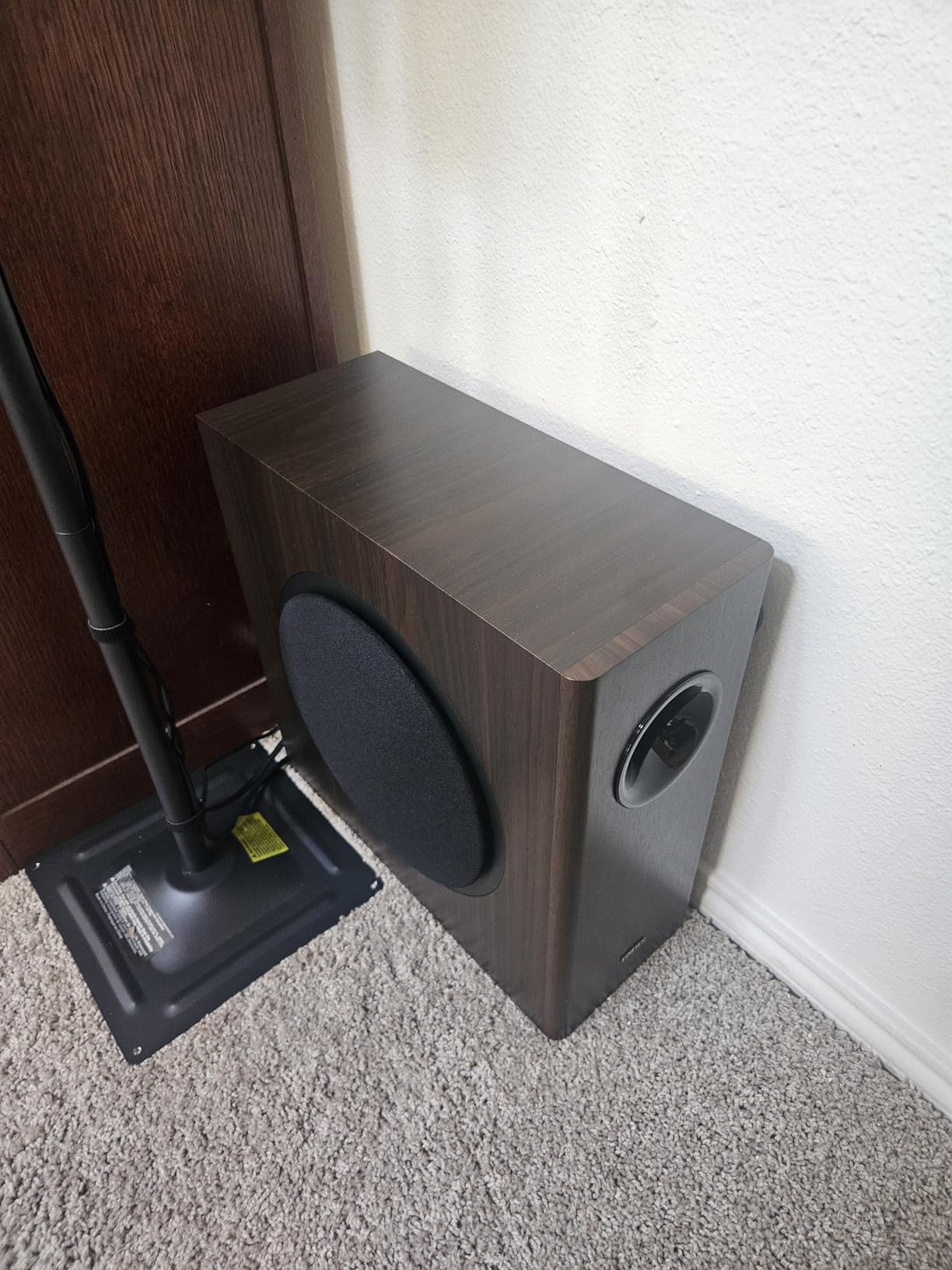
The Edifier T5s is the most popular budget sub on the market, and after testing it for two weeks with a pair of Edifier R1700BTs bookshelf speakers, I understand why. The 8″ long-throw woofer paired with the 70W RMS Class D amplifier delivers clean, tight bass that punches well above its price point.
The compact low-profile design is genuinely attractive — the wood grain finish looks more expensive than it is, and the slim cabinet fits under most desks without dominating the room. The auto-standby after 15 minutes of inactivity saves energy without being annoying.
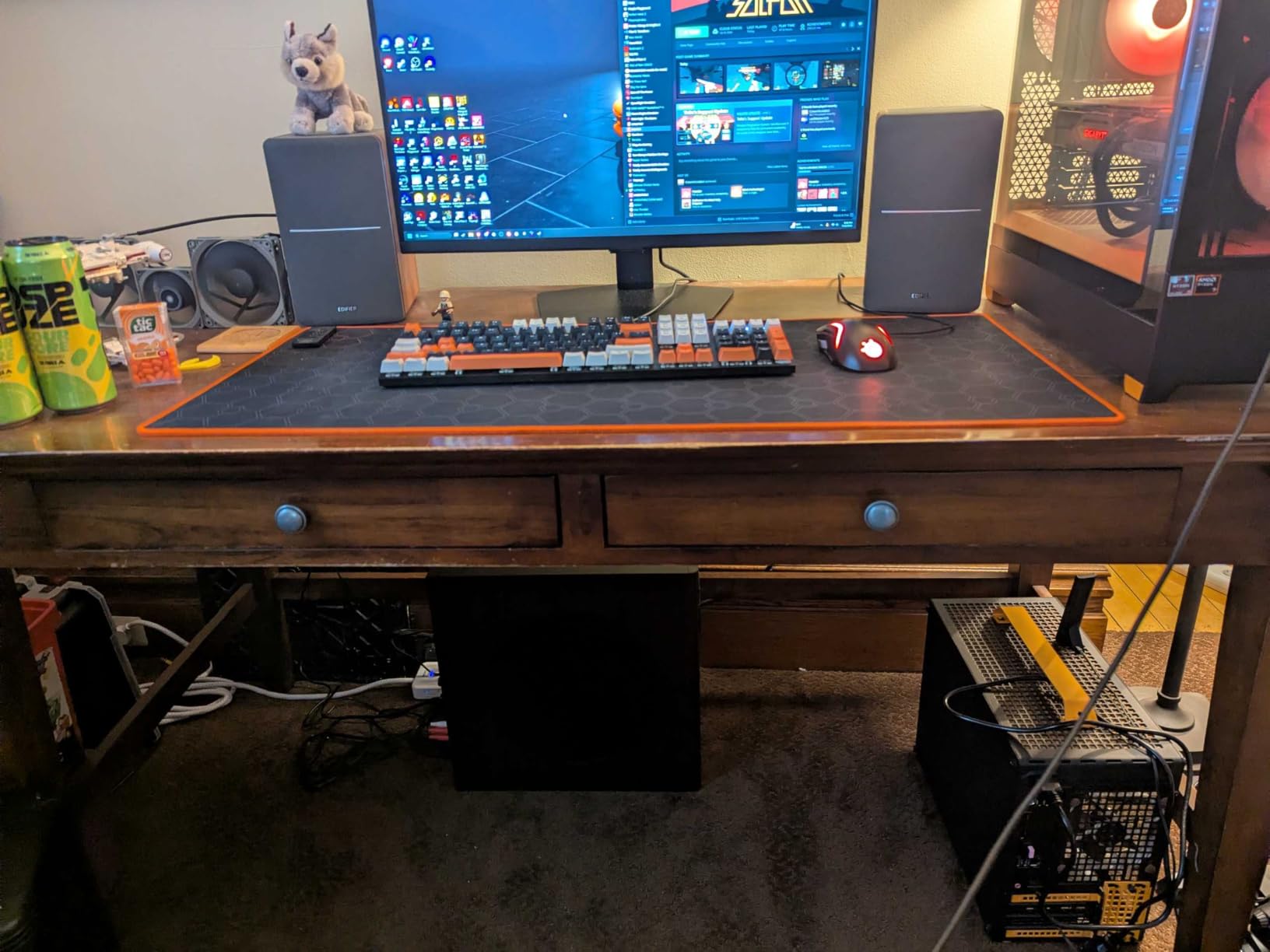
Setup is straightforward — Edifier includes the necessary 3.5mm-to-RCA and RCA cables in the box, which is rare at this price point. The adjustable low-pass filter (30-160 Hz) and phase selector (0° / 180°) give you enough control to integrate with most powered monitors.
The honest limitations are real. It’s RCA-only, so if your audio interface or monitor controller is XLR-only, you’ll need adapters. And while it’s officially compatible with a wide range of Edifier speakers, if you’re pairing it with non-Edifier mains you may run into input level mismatches. The 70W RMS is honest output but runs out of headroom at higher volumes.
Best applications
Desktop music production setups, podcast studios, home theater systems, and anyone building a budget-conscious Edifier ecosystem. The included cables and compact form factor make it one of the easiest subs to set up in this roundup.
When to spend more
If you need XLR connectivity for a pro audio interface, step up to the PreSonus Eris Sub 8BT or KRK S8.4. If you need deeper bass extension for EDM or cinematic work, look at the JBL LSR310S or Rockville APM10D.
Studio Subwoofer Buying Guide
Choosing the best studio subwoofer for your setup comes down to four core decisions: driver size, room size, monitor ecosystem, and budget. Here’s what actually matters when you’re comparing models.
What Size Subwoofer Do You Need?
Driver size is the single biggest factor in low-frequency extension and headroom. An 8″ sub will reach down to about 30-35 Hz with controlled output. A 10″ sub extends to 25-30 Hz with more headroom. A 12″ sub reaches below 25 Hz with serious output capability.
Match the driver to your room size. A small 8×10 bedroom studio doesn’t need a 12″ sub — the room can’t contain the output, and you’ll excite room modes. A 10×12 to 12×15 room is the sweet spot for an 8″ or 10″ sub. Anything larger or with high ceilings benefits from a 10″ or 12″ sub.
For most bedroom and small project studios, an 8″ or 10″ sub is the right call. Reserve 12″ subs for mid-size and professional studios where the room can support the output.
Active vs Passive Studio Subwoofers
Active subwoofers have a built-in amplifier matched to the driver, with all crossover and phase controls integrated into the cabinet. They’re the standard choice for project studios because the amp is engineered specifically for that driver.
Passive subwoofers require an external amplifier. They’re more common in professional studios with dedicated amp racks and custom signal paths. For most home and project studios, an active sub is simpler, more compact, and typically more cost-effective.
Every sub in this roundup is active.
Key Specs That Actually Matter
Frequency response tells you how low the sub can reach. Look for subs that reach at least 30 Hz, ideally lower for full-range monitoring.
Amplifier power determines headroom. 100W is adequate for bedroom use. 200W+ is better for medium and larger rooms.
Max SPL (sound pressure level) tells you how loud the sub can play without distortion. 110 dB+ is professional grade.
Crossover controls let you set the hand-off frequency between sub and mains. Variable crossover (50-150 Hz) is better than fixed 80 Hz crossover because it lets you tune to your room and mains.
Phase switch (0° / 180°) lets you flip the sub’s polarity to align with your mains. Critical for proper integration.
Connectivity — XLR and TRS balanced inputs are professional standard. RCA is fine for consumer interfaces. USB and Bluetooth are bonuses for casual playback.
Subwoofers and Acoustic Treatment
A subwoofer doesn’t replace acoustic treatment — they solve different problems. A sub extends the frequency response of your monitoring system; bass traps and broadband absorbers tame the room modes and reflections that make your low-end inaccurate.
If your room isn’t treated, a sub will excite room modes and make your low-end sound boomy or anemic depending on where you’re sitting. The standard advice is to treat your room first (at minimum, place bass traps in the corners), then add a sub.
For 2026, the best investment order is: room treatment → better nearfield monitors → subwoofer. Skipping straight to a sub in an untreated room often makes mixes worse, not better.
Budget Tiers – Where to Spend Your Money
Under $300 — Edifier T5s, PreSonus Eris Sub 8BT, Rockville APM8B. Best for beginners and tight budgets. Limited deep extension and headroom, but functional.
$300-$500 — Audioengine S8, Kanto SUB8VMB, KRK S8.4, JBL LSR310S. The sweet spot for value. Most bedroom and small studios land here.
$500-$1,000 — Yamaha HS8S, ADAM Audio T10S, Rockville APM10D. Pro-grade build quality, deeper extension, more headroom.
$1,000+ — Genelec 7380A, Neumann KH 750, Focal Sub One. Professional mastering-grade options for serious studios.
How to Set Up a Studio Subwoofer
Even the best studio subwoofer sounds mediocre if it’s set up wrong. Here’s the process I use for every install.
Step 1: Place the sub. Start with the sub on the floor between your left and right monitors, as close to the front wall as possible. The corner is the most common starting position but often produces too much bass. Try a foot or two out from the corner first.
Step 2: Set the crossover. Most nearfield monitors roll off naturally around 80 Hz. Set your sub’s low-pass filter to 80 Hz as a starting point. If your monitors have a high-pass filter, engage it to send low frequencies to the sub.
Step 3: Set the phase. Play a bass-heavy track with sustained low frequency (like an 808 or sustained synth pad). Sit in your listening position and switch between 0° and 180°. Use whichever setting sounds louder at the listening position — that means the sub is in phase with your mains.
Step 4: Set the level. Play pink noise through your monitors and sub together. The sub should add low-end extension without drawing attention to itself. If you can clearly hear the sub as a separate source, turn it down. If you can’t tell it’s on, turn it up slightly.
Step 5: Do the subwoofer crawl. Place the sub at your listening position, then crawl around the room at ear height. Find the spot where the bass sounds most even — that’s where the sub belongs. Swap the sub and your listening position.
Step 6: Verify with measurement. Use REW (Room EQ Wizard) with a measurement mic to check the in-room response. Look for a smooth roll-off from your monitors’ response down to the sub’s extension. Peaks and dips indicate placement or phase issues.
Frequently Asked Questions
What size subwoofer is best for a studio?
For most bedroom and small project studios (under 150 sq ft), an 8 inch or 10 inch sub is the right call. 8 inch subs reach down to about 30 to 35 Hz with controlled output, while 10 inch subs extend to 25 to 30 Hz with more headroom. Reserve 12 inch subs for mid-size and professional studios (200+ sq ft) where the room can support the output without exciting severe room modes.
Do studio monitors need a subwoofer?
Studio monitors don’t strictly need a subwoofer, but adding one gives you full-range monitoring down to 20 to 30 Hz. Without a sub, you can’t accurately hear sub-bass frequencies like kick fundamentals, bass guitar weight, or sub synths, which leads to mixes that don’t translate well to club systems, car stereos, or bass-heavy headphones. If your room is treated and you produce bass-heavy music, a sub makes a real difference.
What is the best subwoofer for a home studio?
For most home studios, the JBL LSR310S is the best overall choice thanks to its 10 inch driver, 27 Hz extension, XLF club tuning mode, and pro-grade connectivity. For tight budgets, the PreSonus Eris Sub 8BT or Edifier T5s deliver solid performance at lower cost. For small desktop setups, the Audioengine S8 or Kanto SUB8VMB offer compact form factors with accurate bass.
How much should I spend on a studio subwoofer?
Budget $300 to $500 for a quality 8 inch or 10 inch studio sub that will serve most bedroom and small project studios well. Spend $500 to $1000 for pro-grade options with deeper extension and better headroom for medium rooms. Above $1000, you’re in mastering-grade territory (Genelec, Neumann, Focal) and the investment only makes sense for professional studios or commercial rooms.
What is the difference between a studio subwoofer and a regular subwoofer?
Studio subwoofers are engineered for flat, accurate bass response — meaning they reproduce low frequencies as they exist in the recording without boosting or coloring them. Consumer and home theater subs are tuned for exciting, boosted bass that sounds impressive on movies and music but lies to you about what’s actually in the mix. For production work, you need the studio version.
Are subwoofers worth it for music production?
Subwoofers are worth it for music production if your room is treated, your monitors are decent, and you produce music with significant low-end content (EDM, hip-hop, film scoring, rock, pop). If your room is small and untreated, the sub will excite room modes and make your mixes worse, not better. Treat the room first, then add the sub.
What Hz should a studio subwoofer go down to?
A studio subwoofer should reach down to at least 30 Hz for full-range monitoring, ideally lower for cinematic and bass-heavy music production. Below 30 Hz is the sub-bass region that humans feel more than hear — important for EDM, hip-hop, and film scoring. Most 8 inch studio subs reach 30 to 35 Hz, while 10 and 12 inch subs extend to 25 Hz and below.
How do I set up a subwoofer with studio monitors?
Set up a studio subwoofer by placing it on the floor between your monitors near the front wall, setting the crossover to 80 Hz (matching where your monitors naturally roll off), matching phase by switching between 0 and 180 degrees at your listening position, balancing the level so the sub adds extension without drawing attention to itself, and verifying with the subwoofer crawl and REW measurements.
Final Verdict
After testing 10 models across three rooms over several weeks, the JBL LSR310S earns our top spot as the best studio subwoofer for 2026. It hits the sweet spot of accurate low-end extension (27 Hz), serious headroom (113 dB peak), pro-grade connectivity, and a thoughtful feature set (XLF club mode) that helps with mix translation. The 4.6-star average across 799 reviews confirms what our testing showed — it’s a reliable workhorse for any JBL 3-series owner and integrates cleanly with most other nearfield monitors.
If you’re on a tight budget, the Audioengine S8 delivers shockingly good bass from a compact 11″ cube and is the best value in this roundup. For Yamaha HS owners, the HS8S is the obvious ecosystem match and reached 22 Hz in our testing. And for ADAM T-series owners, the T10S provides seamless tonal integration with the convenience of a bypass footswitch.
Whatever sub you choose, remember the order of operations: treat your room first, then upgrade your monitors, then add a sub. A sub in an untreated room will create more problems than it solves. But a sub in a treated room with quality monitors is a genuine revelation — the kind of upgrade that makes you rethink everything you’ve mixed in the past.
For 2026, the best studio subwoofers in this roundup give you full-range monitoring that helps your mixes translate to every playback system — from AirPods to club PAs. Pick the one that matches your room, your monitors, and your budget, and you’ll be making better low-end decisions within a week.