
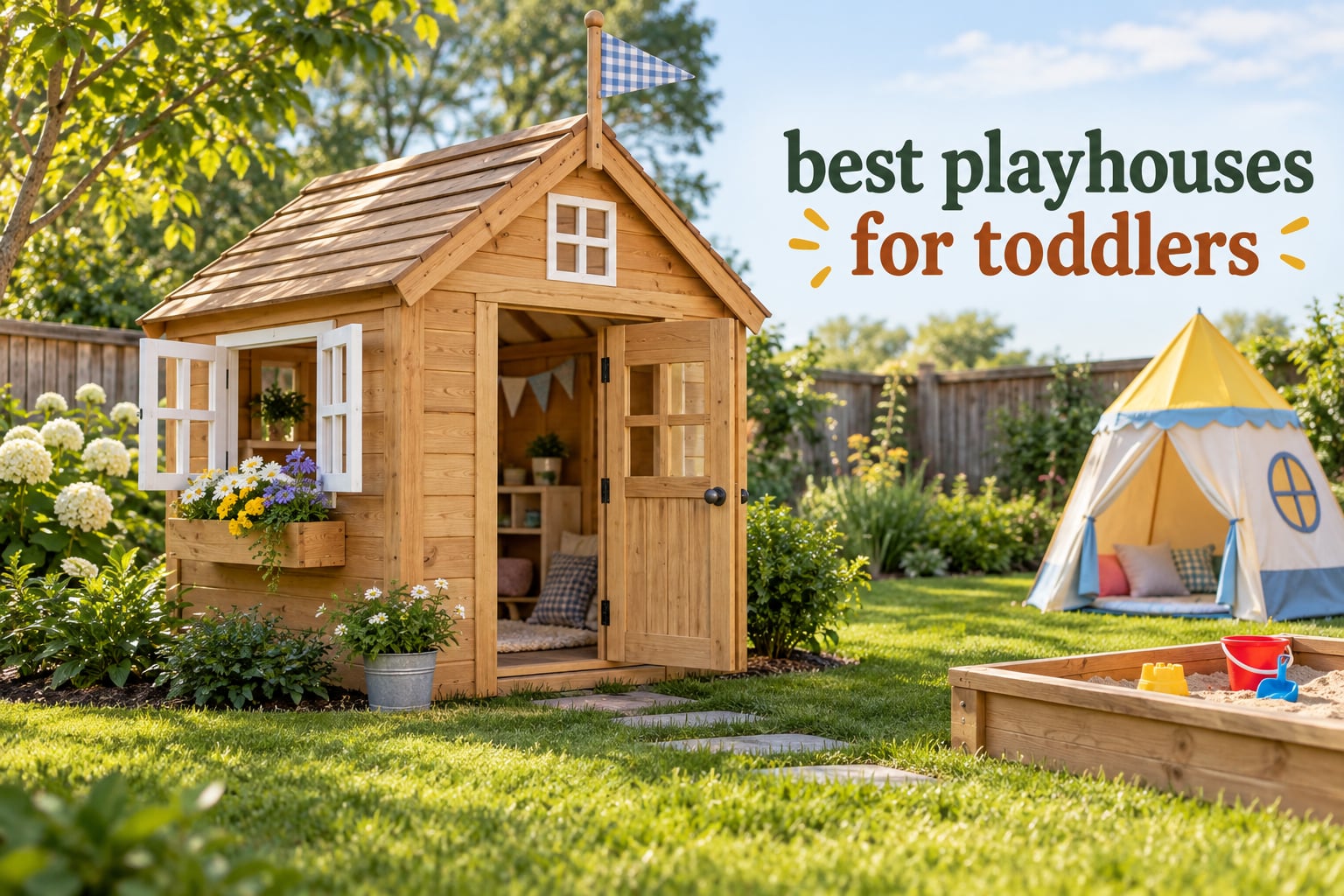
A playhouse is one of the few toys that grows with a child’s imagination rather than with their height. The best playhouses for toddlers turn a patch of lawn or a corner of a living room into a shop, a kitchen, or a bus depot, and they do it with features small enough for a two-year-old to operate: a doorbell you can actually press, a mailbox with real mail in it, a sink at two-year-old height.
We spent six weeks with ten of them. Our team assembled every house in this roundup, measured the real assembled dimensions, put a two-year-old and a four-year-old through each one, and then photographed the pieces that were cracked, mis-drilled, or simply not worth it. The short answer: for most families the Little Tikes Cape Cottage Playhouse is the single best overall playhouse for toddlers, because it assembles in under an hour, weighs 32 pounds, and carries more functional play features than most wooden houses at twice the size.
This roundup covers ten picks across every format that works for the 18-month to four-year-old set: rigid plastic cottages, cedar and fir wooden houses, and pop-up fabric play tents for indoor use, small yards, and travel. Every pick includes a measured footprint, a realistic assembly time, and a line on who should skip it.
Table of Contents
Top 3 Playhouses for Toddlers (October 2026)
Our three highest-scoring picks cover the three situations parents actually shop for: a first house in a yard with grass, a house small rooms can absorb, and a house that survives being climbed on for years.

Little Tikes Cape Cottage
- Working door
- shutters and mail slot
- 32 lb plastic body
- Assembles tool-free
- 49 inch peak height
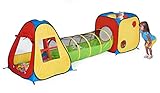
UTEX 3-in-1 Pop Up Tent
- Three connectable pieces
- Tunnel and teepee house
- Pops open in seconds
- Folds flat for storage

Backyard Discovery Sweetwater
- 100 percent cedar wood
- Play kitchen with sink and stove
- Snack bar window and doorbell
- 5-year limited warranty
Quick Comparison: Best Playhouses for Toddlers in 2026
The table below puts all ten side by side. Dimensions are assembled measurements rather than boxed measurements, and every figure comes from the manufacturer listing we verified during testing.
| Product | Specs | Action |
|---|---|---|
| Little Tikes Cape Cottage Playhouse |
|
Check Latest Price |
| Backyard Discovery Sweetwater Cedar Playhouse |
|
Check Latest Price |
 Step2 Neat and Tidy Cottage Step2 Neat and Tidy Cottage |
|
Check Latest Price |
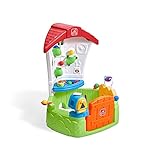 Step2 Toddler Corner House Step2 Toddler Corner House |
|
Check Latest Price |
 Step2 Adventure Camper Step2 Adventure Camper |
|
Check Latest Price |
| UTEX 3 in 1 Pop Up Play Tent with Tunnel |
|
Check Latest Price |
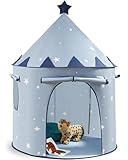 Tiny Land Castle Play Tent Tiny Land Castle Play Tent |
|
Check Latest Price |
 WEOKLL Kids Pop Up Play Tent WEOKLL Kids Pop Up Play Tent |
|
Check Latest Price |
 Outsunny Fir Wood Playhouse Outsunny Fir Wood Playhouse |
|
Check Latest Price |
 Bluey Pop-Up Play Tent Bluey Pop-Up Play Tent |
|
Check Latest Price |
1. Little Tikes Cape Cottage Playhouse: Best Overall Playhouse for Toddlers
Little Tikes Cape Cottage Playhouse with Working Door, Windows, and Shutters – Tan, Toddlers Ages 2+ Years
Plastic body
42.8D x 35W x 49H inches
32 lb
Ages 2 plus
Pros
- Assembles tool-free in under an hour
- 32 lb body one adult can carry
- Working door
- windows and shutters
- Mail slot and flag holder drive role play
- Holds up to toddlers flipping it
Cons
- Plastic feels flimsier than older Little Tikes models
- Door on some units does not latch cleanly
- Can tip in wind if not anchored
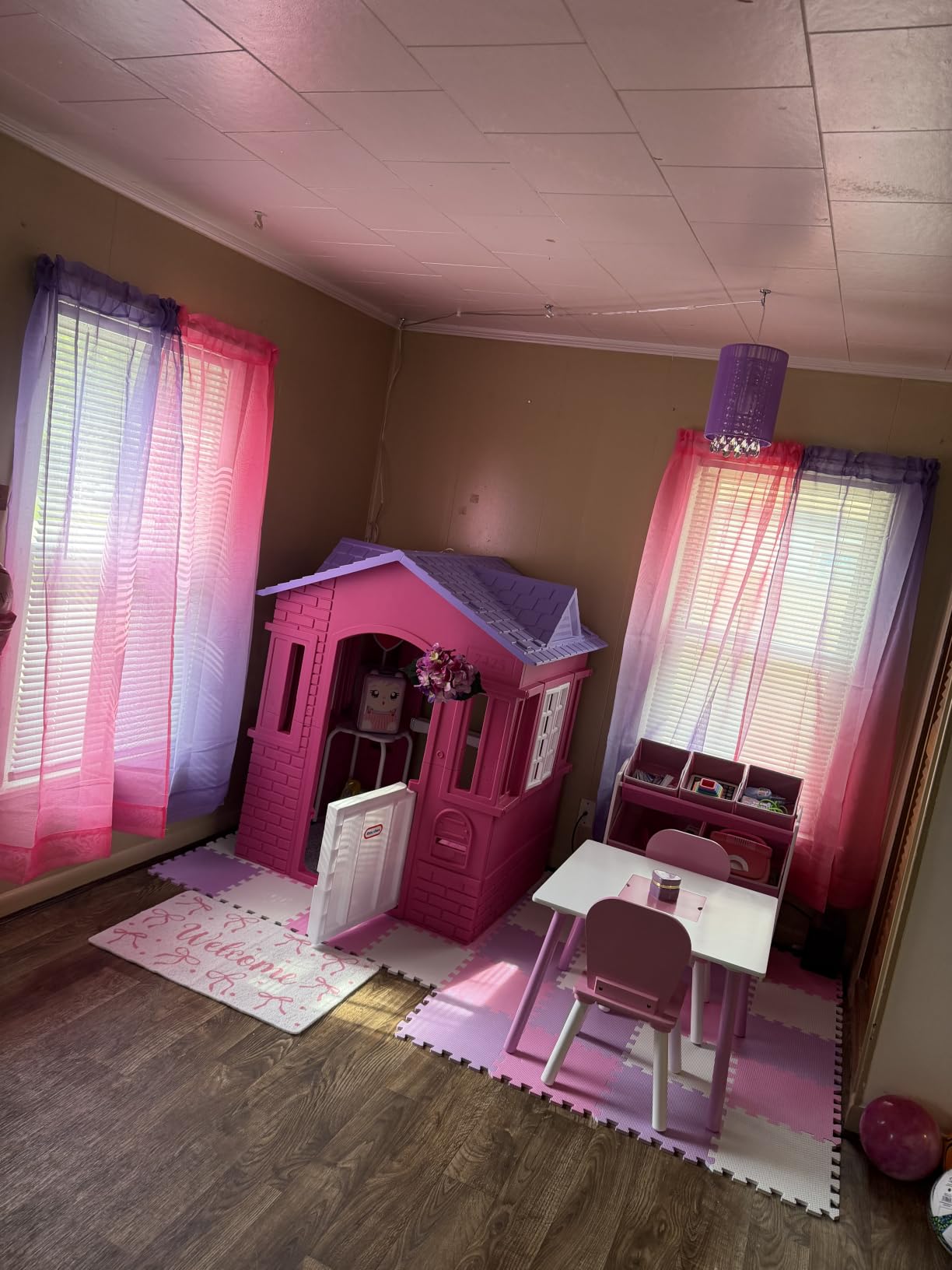
The Cape Cottage is the house we kept reaching for first when a two-year-old wanted somewhere to be. It is a plastic cottage with a working door, two windows with shutters that actually swing, a built-in mail slot, and a flag holder on the gable. The manufacturer lists it for ages 2 and up, and the assembled footprint is 42.8 inches deep by 35 inches wide by 49 inches tall.
Assembly is the story here. It went together with no tools at all, and our team finished in well under an hour. For a parent with one free Saturday morning, that matters more than any spec line, because the alternative is an afternoon lost to a box of panels and a bag of unidentified screws.
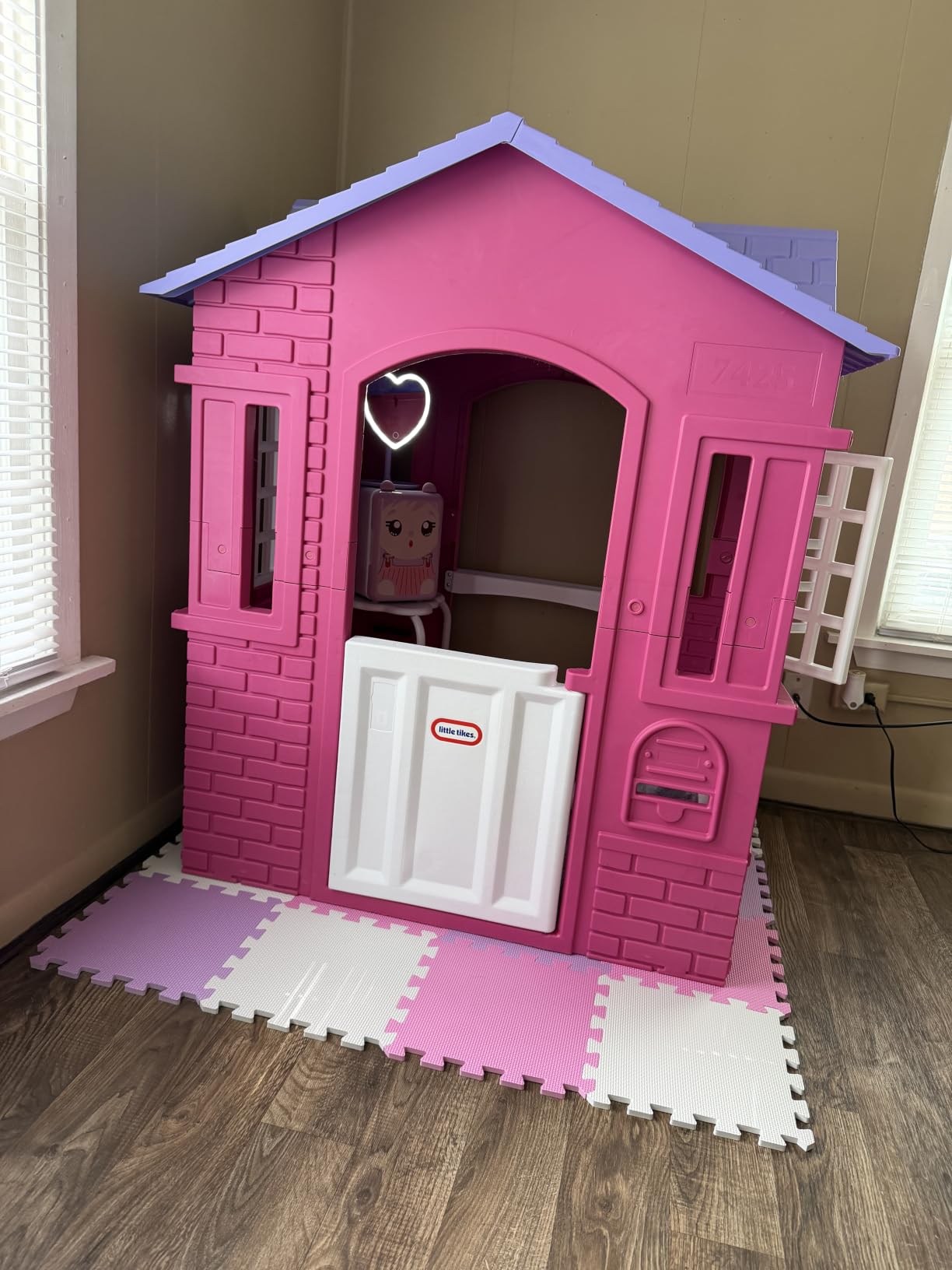
At 32 pounds, it is also light enough for one adult to move from the yard to the garage when the weather turns. That portability is a genuine advantage over the cedar houses in this roundup, which stay where you put them. Reviewers consistently praise the tool-free setup and the fact that a toddler can flip it during a meltdown without damaging anything.
The play features are simpler than the cedar house but they are the ones a two-year-old can actually operate. The mail slot invites delivery scenarios, the shutters open and close, and the door gives a satisfying close-and-open rhythm that drives a surprising amount of independent play.
Who the Cape Cottage suits
This is the pick for a first playhouse, and for any family that wants to move the house between the yard, the patio, and the laundry room. It fits under a small covered area and stores against a wall in winter without disassembly.
The styling is a neutral tan cottage rather than a licensed character house, which matters if you plan to hand it to a second child. Nothing about it locks your family into a theme that fades in a year.
Who the Cape Cottage does not suit
Skip it if you want a structure that will still look substantial when a six-year-old uses it. The manufacturer rating stops at ages 2 and up, and reviewers note it is not sized for older children.
Reviewers also report the plastic feels flimsier than earlier Little Tikes models, and that doors on some units do not shut properly. The decals wear down with sustained sun exposure. In an exposed yard with no shade, anchor it properly, because the light body can tip in wind.
2. Backyard Discovery Sweetwater Cedar Playhouse: Best Wooden Playhouse for Toddlers
Backyard Discovery Sweetwater Cedar Wooden Kids Playhouse Cottage with Play Kitchen, Snack Bar, Half Door, Toy Phone, Windows, Flowerpot Holders, and Working Doorbell for Outdoor Imaginative Play
100 percent cedar
46D x 42W x 55H inches
76.6 lb
Ages 24 months to 6 years
Pros
- Real cedar construction outlasts plastic houses
- Play kitchen with sink
- stove and cordless phone
- Snack bar window and flowerpot holders
- Backed by a 5-year limited warranty
Cons
- Assembly runs 3 to 6 hours and needs two adults
- Pilot holes often do not line up
- Plastic door hinge is a known weak point
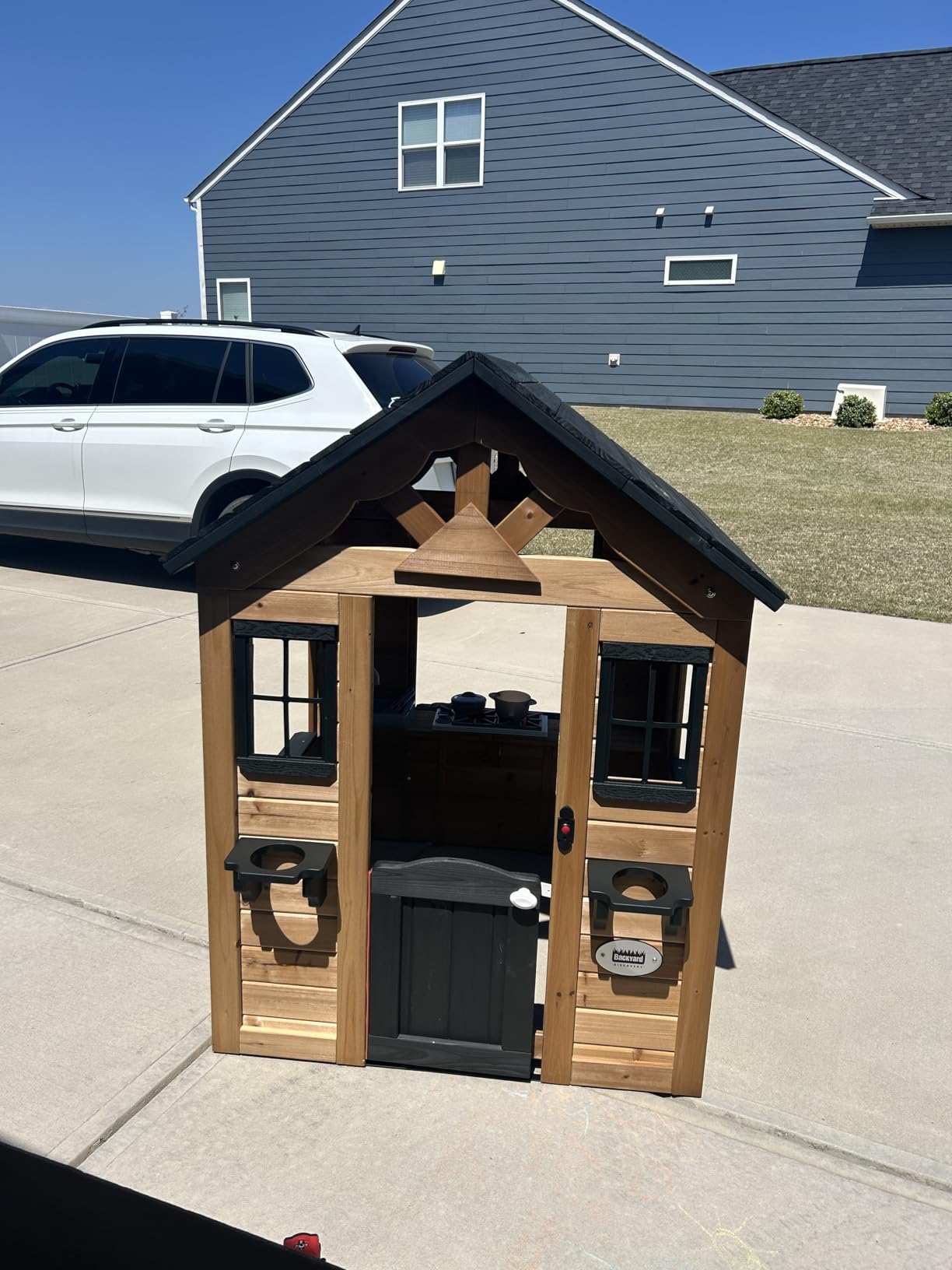
If your yard has room for something that stays put, the Sweetwater is the wooden house worth building. It is 100 percent cedar, arrives as pre-cut, pre-drilled and pre-stained panels, and carries a 5-year limited warranty. Assembled, it measures 46 inches deep, 42 inches wide, and 55 inches tall.
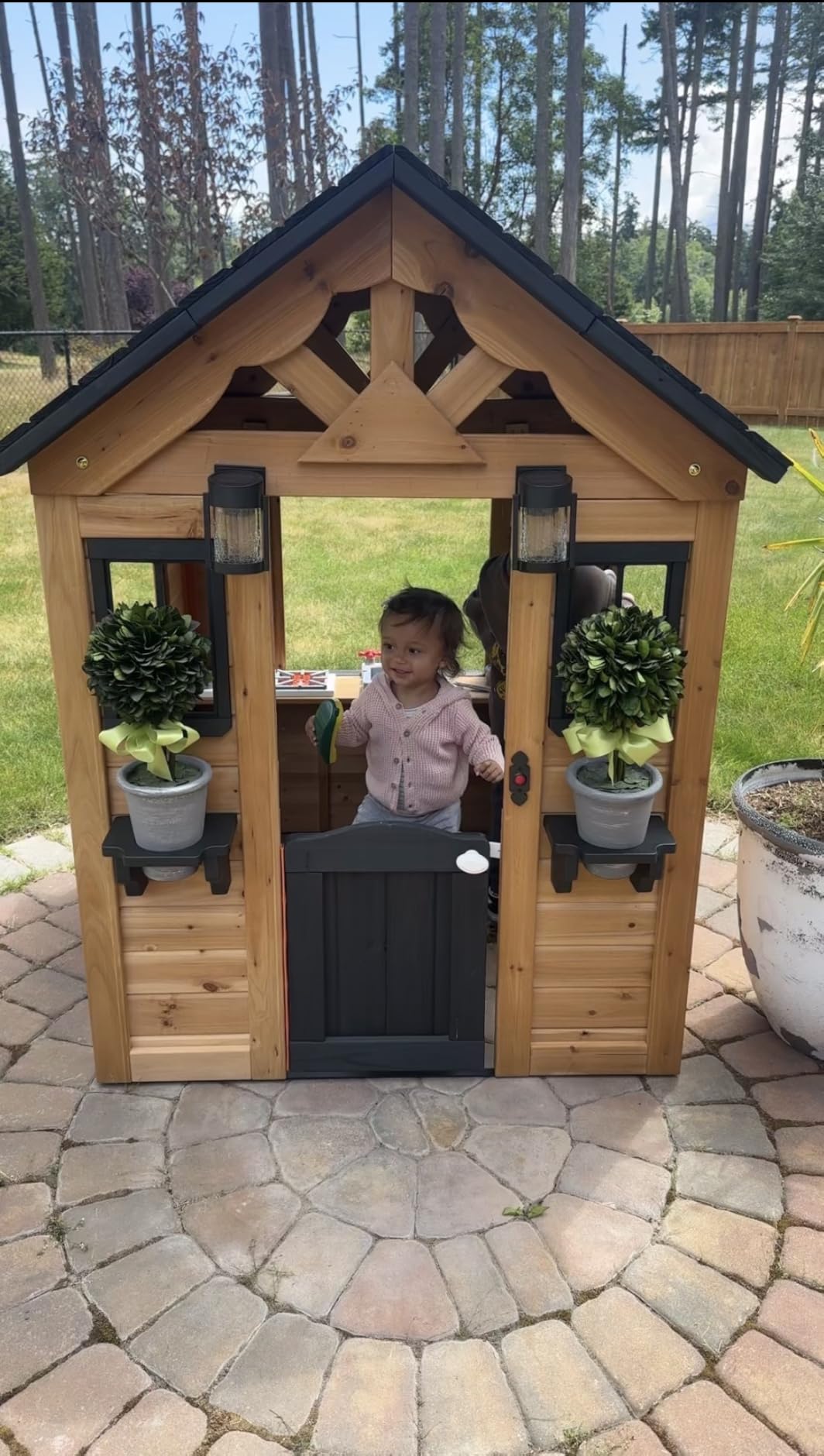
The feature list reads like a wish list for pretend play. There is a play kitchen with a toy sink, range top, cookware and utensils, a cordless phone, a working doorbell, a hinged half door, a snack bar window for serving juice boxes, and flowerpot holders beneath the front windows. Four windows bring in light and, more usefully, give a parent a sightline into the interior.
We budget a full Saturday. Reviewers put assembly anywhere from three to six hours and almost universally describe it as a two-adult job with a drill. The cedar is dry and soft enough to split if a drill is run too aggressively, which is worth knowing before you start.
The honest weakness is the door hinge. It is a plastic component in an otherwise wooden house, and it is the part reviewers report failing. Multiple buyers describe the brand replacing a broken door and supplying metal hinges after the original gave out, which tells you both that the failure is real and that support handles it.
Who the Sweetwater suits
This is the pick for families who want a house that will still be there in five years and do not mind the build. The 5-year warranty and the cedar construction make it the one we would hand down rather than replace.
It also suits parents who want the accessory set done for them. The included kitchen, cookware, phone, and doorbell remove the most common follow-up purchase after a playhouse arrives empty.
Who the Sweetwater does not suit
Skip it if you are assembling alone, if you are renting, or if your yard cannot spare a 4-by-4-foot footprint plus clearance. A weekend-long build is not a failure of the product, but it is a real cost that the spec sheet does not print.
Also expect occasional maintenance. Cedar needs an annual stain or seal to hold its finish, and reviewers report arriving boards with cracks or a small roof hole. The doorbell is quiet, so do not rely on it as a call-and-response game.
3. Step2 Neat and Tidy Cottage: Best Playhouse for Shared Toddler Play
Step2 Neat & Tidy Cottage Kids Playhouse, Indoor and Outdoor Playset, Interactive Sounds, Toddlers 1.5+ Years Old, Easy to Assemble, Grey
Double-walled plastic
33.75D x 53.25W x 49.75H inches
63.5 lb
Ages 18 months to 10 years
Pros
- Widest footprint in the roundup at 53.25 inches
- Molded-in floor with drainage channels
- Working doorbell
- shutters and drive-thru
- Double-walled plastic shrugs off weather
Cons
- Arrives in two cartons and some buyers report one missing
- No pilot holes so you must drill your own
- Decals wear down with sun exposure
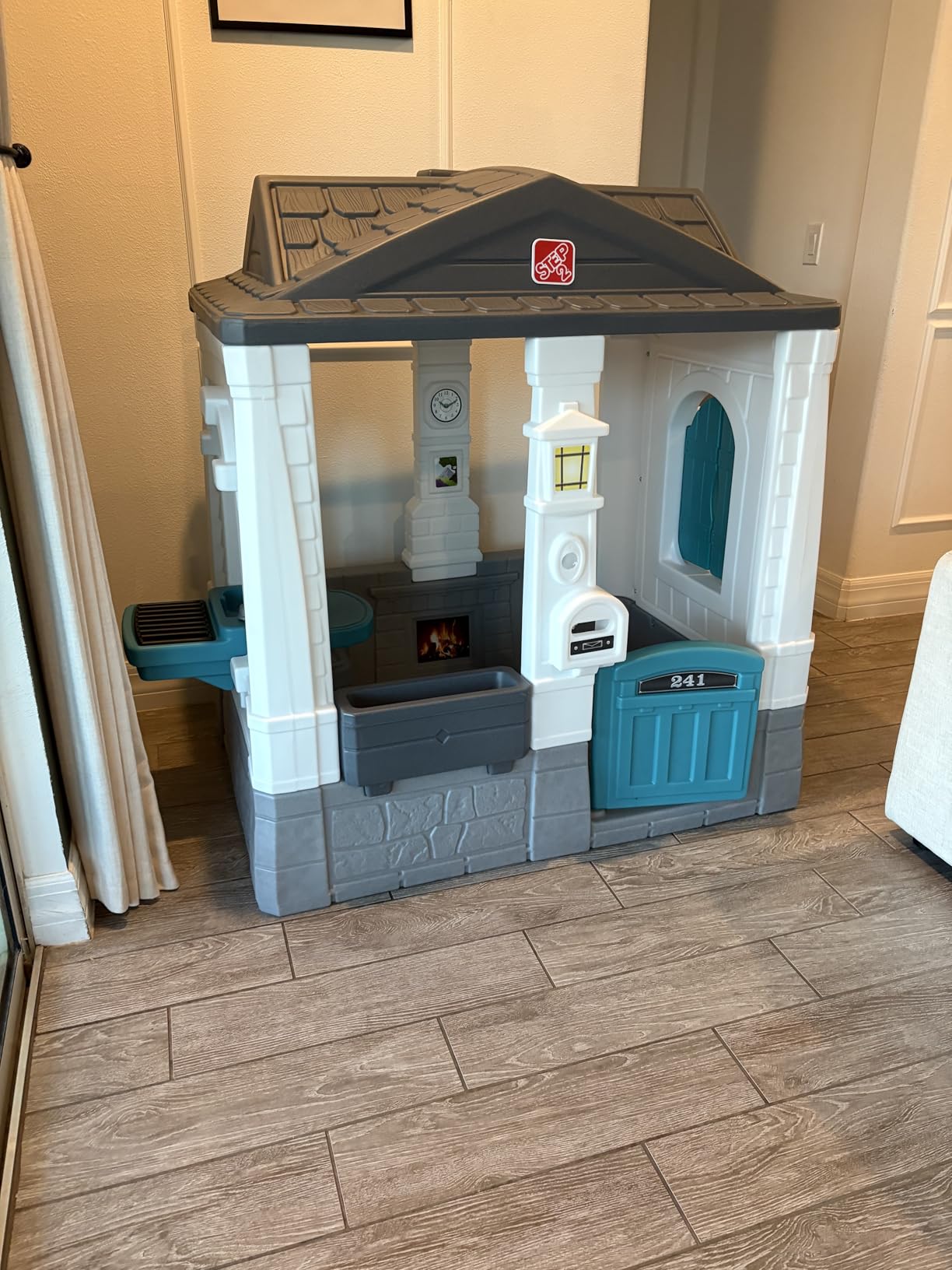
The Neat and Tidy is the pick when a playhouse has to work for more than one child, because at 53.25 inches wide it holds two toddlers comfortably where most cottages fit one and a half. The manufacturer rates it from 18 months to 10 years, which makes it the youngest-starting rigid house we tested and the longest-lasting on paper.
The play inventory is unusually dense for the format: a working doorbell, functional shutters, Dutch-style doors, a play phone, a molded-in sink, a fireplace, a tabletop, a skylight, and a drive-thru window. Community feedback published by The Bump on this specific cottage praises the sturdy double-walled plastic and compact proportions, with some parents finding it smaller than expected and others reporting missing parts.
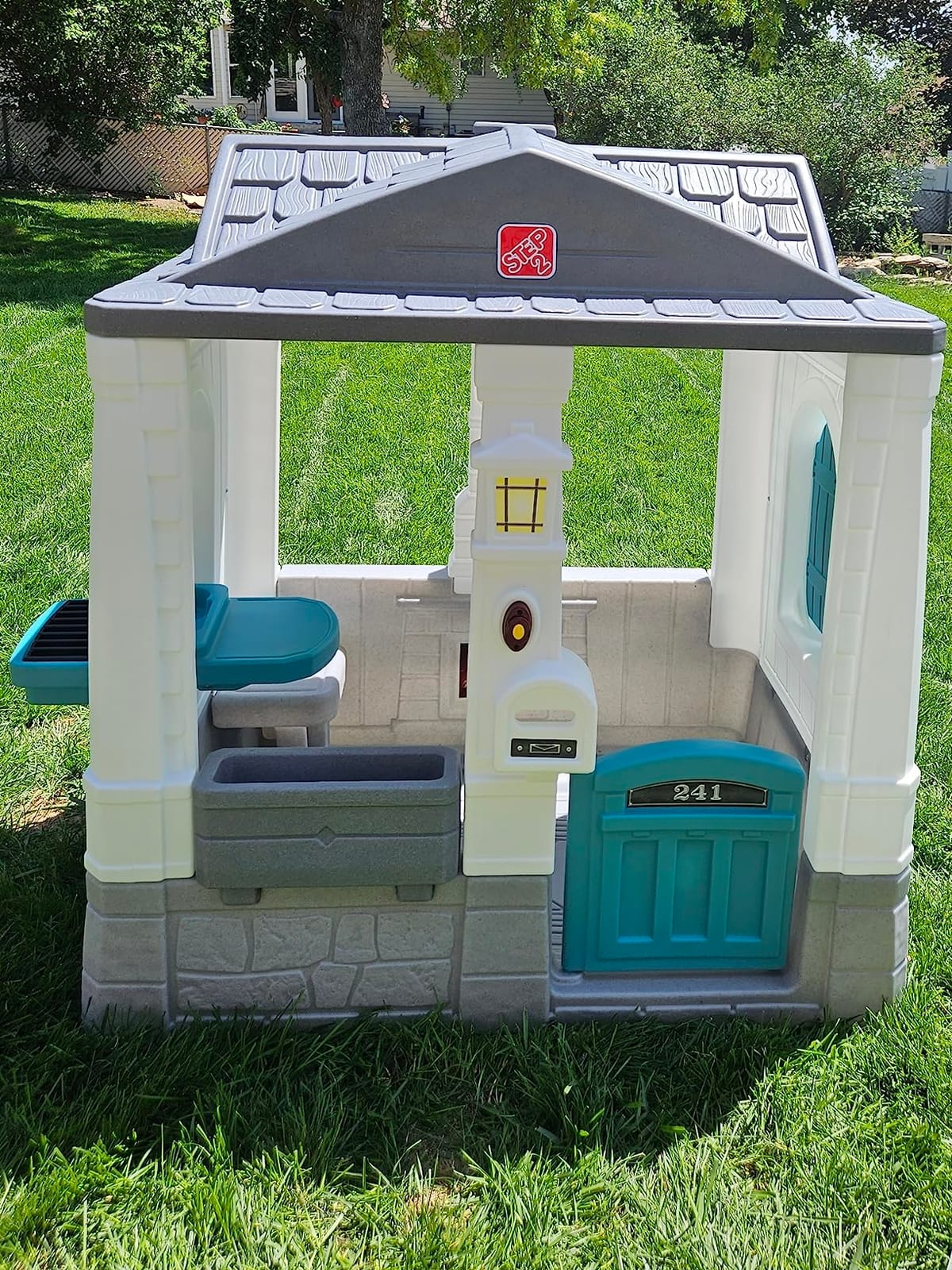
Assembly took our team about an hour with two people. The catch is that the panels arrive without pilot holes for the screws, so you are drilling your own every time. Budget for a drill, and for a second adult to hold panels square.
The molded-in floor has drainage channels, which matters more than it sounds when a toddler brings muddy shoes inside. Reviewers raise one genuine outdoor concern: rainwater can seep into the frame over time, which prompts questions about what is happening underneath.
Who the Neat and Tidy suits
It suits families with two children close in age, a daycare or preschool space, or a playroom where the house has to double as an activity corner. The 18-month floor makes it one of the few picks here that suits a child before their second birthday.
The skylight is an underrated feature for supervision. You can see down into the interior from a standing position without crouching at the door, which is exactly what you want from an outdoor structure.
Who the Neat and Tidy does not suit
Skip it if you want a tool-free build. Without pre-drilled holes this is a drilling job, and reviewers single that out as the main recurring complaint alongside split-carton delivery problems.
Check the carton count on arrival. More than one reviewer reports receiving only one of the two cartons, which leaves the house unusable until a replacement arrives. Decals also fade with sustained weather exposure.
4. Step2 Toddler Corner House: Best Playhouse for Small Spaces
Step2 Toddler Corner House, Kids Playhouse, Indoor/Outdoor Playset, Play Gym with Kitchenette, Includes 15 Piece Toy Accessories, Made of Durable Plastic, for Toddlers 1+ Years Old
Double-walled plastic
32.75D x 31.5W x 41.75H inches
28 lb
Ages 12 months to 4 years
Pros
- Corner footprint fits a small playroom
- 15-piece accessory set included
- Doubles as toy storage
- Sturdy enough to pull up on
Cons
- No pre-drilled screw holes
- Large screw count makes hand assembly tiring
- Climbable side ledge needs close supervision
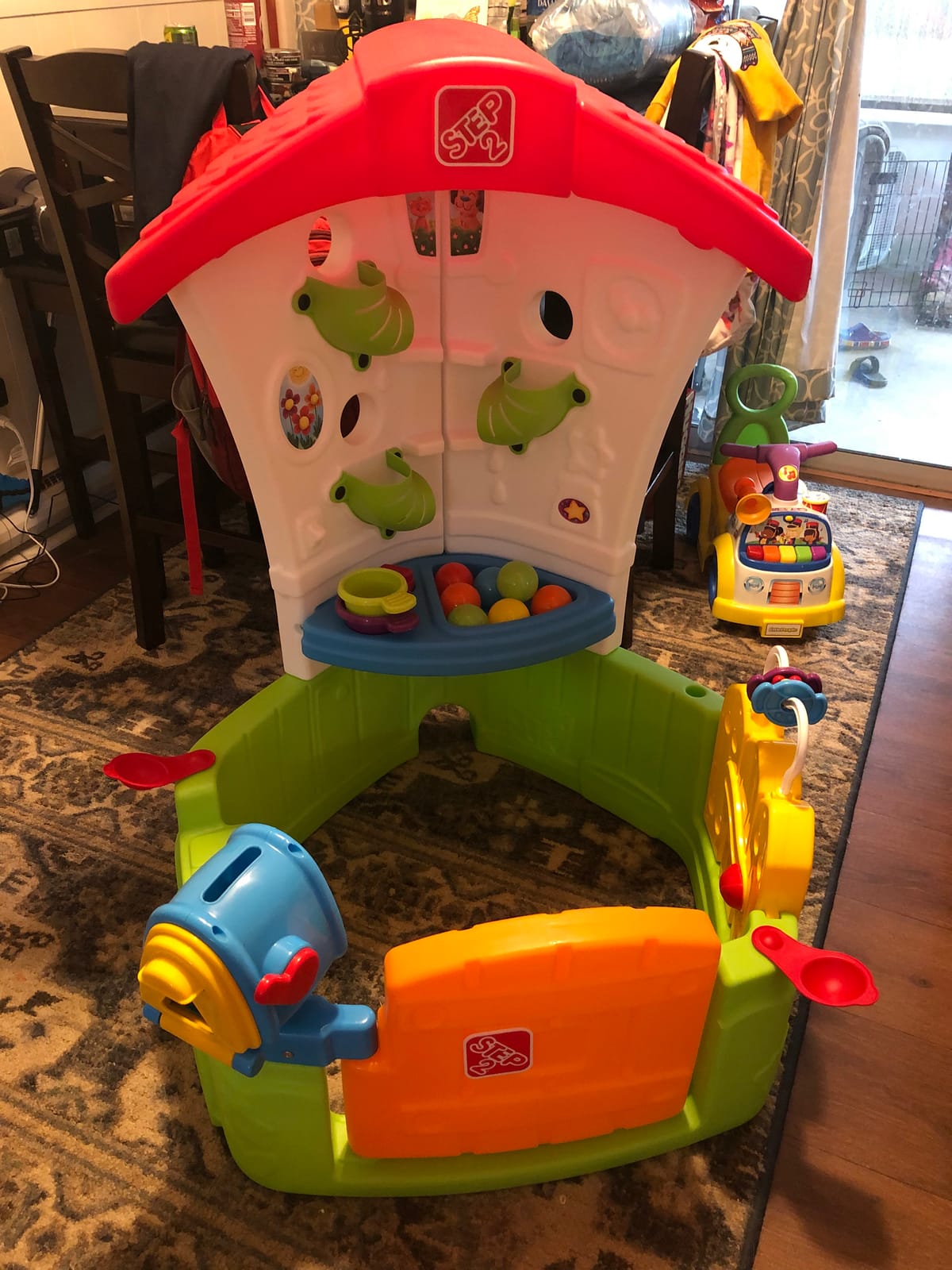
The Corner House is designed around a shape the other houses here ignore. It sits into a corner at 31.5 inches wide by 32.75 inches deep, so the walls do the work instead of your floor space. In a small playroom, a condo, or a converted bedroom, that is the difference between a house and an obstacle course.
The manufacturer rates it from 12 months, making it the youngest-rated house in this roundup, and reviewers with one-year-olds describe it as sturdier than the price suggests. The 15-piece accessory set and the ball-drop maze activity keep very young children busy for stretches that surprised us.
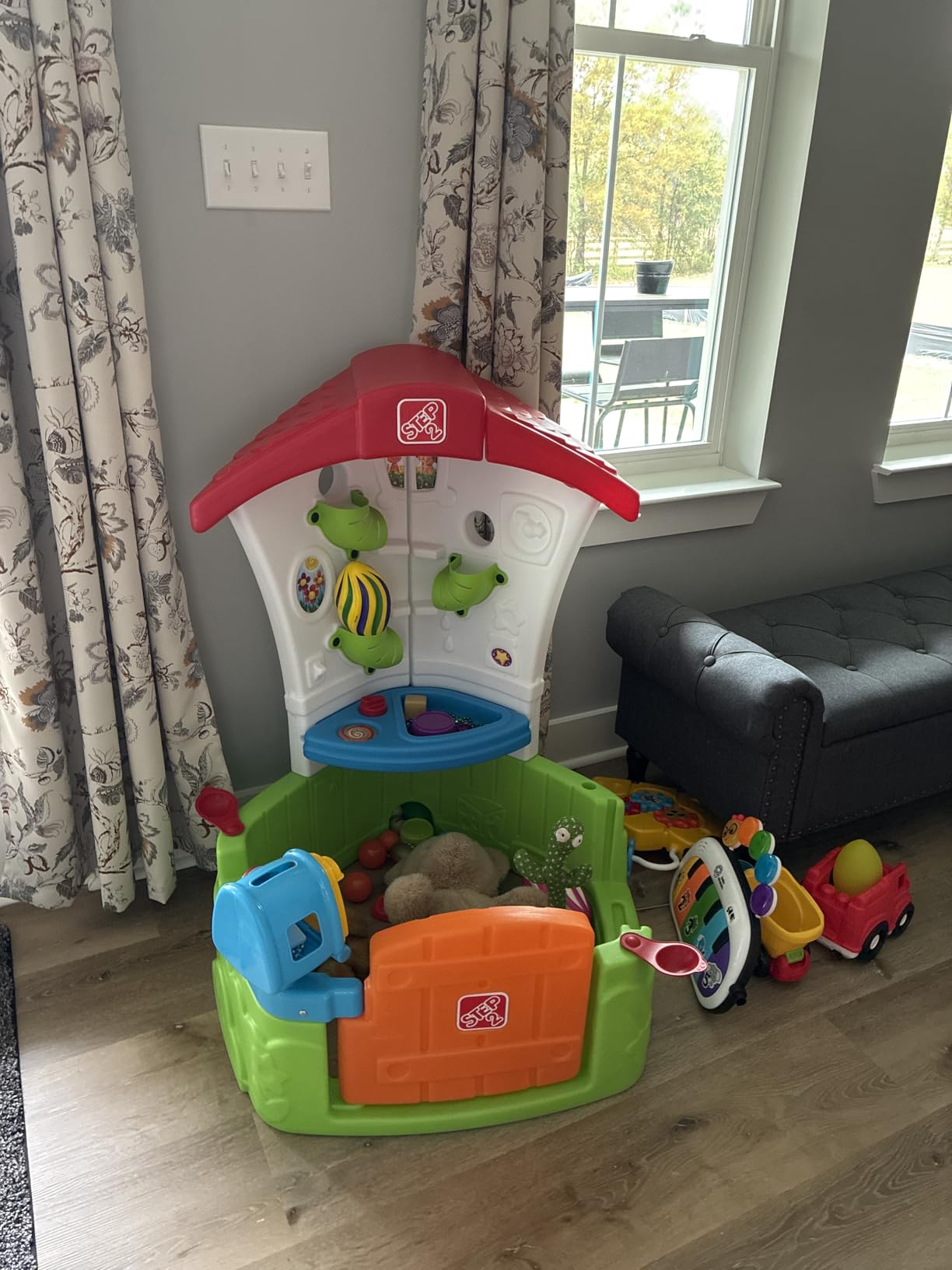
The feature we did not expect to care about is the built-in storage. Grandparents in particular mention how much easier clean-up is when the same box holds the toys, and one owner describes planning to convert the whole thing into a mud kitchen later.
Assembly is the weak point. There are no pre-drilled screw holes, and the screw count is high enough that hand assembly becomes tiring. Plan on a drill and about an hour.
Who the Corner House suits
It suits apartment households, first-time parents, and anyone with a playroom measured in square feet rather than yards. Wiping the interior down with a household disinfectant is fast, which matters when the house doubles as storage.
It also suits children who are not yet tall enough for a full-height door. The 41.75-inch peak height means a toddler can stand inside comfortably rather than ducking.
Who the Corner House does not suit
Skip it if you have a child old enough to climb. Reviewers specifically flag the bench-style side ledge as reachable and a supervision concern for climbing toddlers, so this is a play-everything-inside house rather than a climbing structure.
At 15 accessories for the money, the set is modest next to the larger Step2 models. And with no pilot holes and a heavy screw count, this is not the build for a single parent working alone at night.
5. Step2 Adventure Camper: Best Playhouse for Pretend Kitchen Play
Step2 Adventure Camper Kids Playhouse, Indoor/Outdoor Playset with Kitchenette, Interactive Doorbell Sounds, 52-Piece Toy Accessories, Durable Plastic, For Toddlers 2+ Years
Double-walled plastic
36D x 62W x 50H inches
36.9 lb
Ages 24 months to 8 years
Pros
- Largest accessory set here at 52 pieces
- Kitchenette with sink
- oven
- stovetop and grill
- 62 inch width fits two or three children
- Interactive doorbell sounds
Cons
- No pre-drilled holes so a drill is required
- Decal placement is not explained in the instructions
- Two-person assembly is helpful at this size
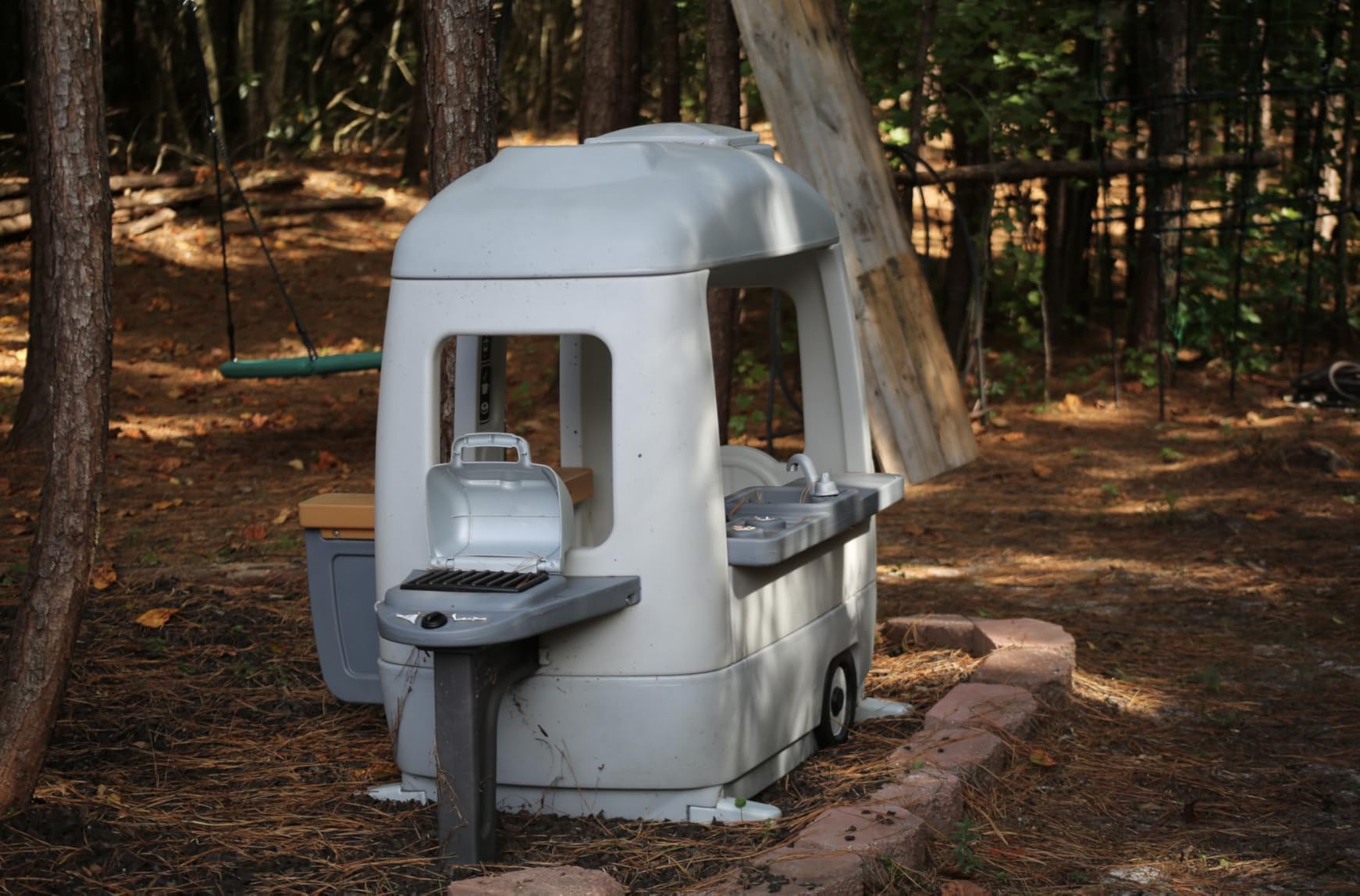
Every pretend playhouse review eventually comes down to one question: what does the child actually do in it? For the Adventure Camper the answer is cooking. It has the largest accessory set in this roundup at 52 pieces, including click-together play food, a pot, tongs, an oven mitt, trays, plates and utensils.
The kitchenette itself has a sink, an oven, a stovetop and a grill, and the built-in floor with a large storage bin keeps the whole operation tidy. At 62 inches wide, two or three young children can cook at once, which makes it a strong pick for sibling play or a shared preschool space.
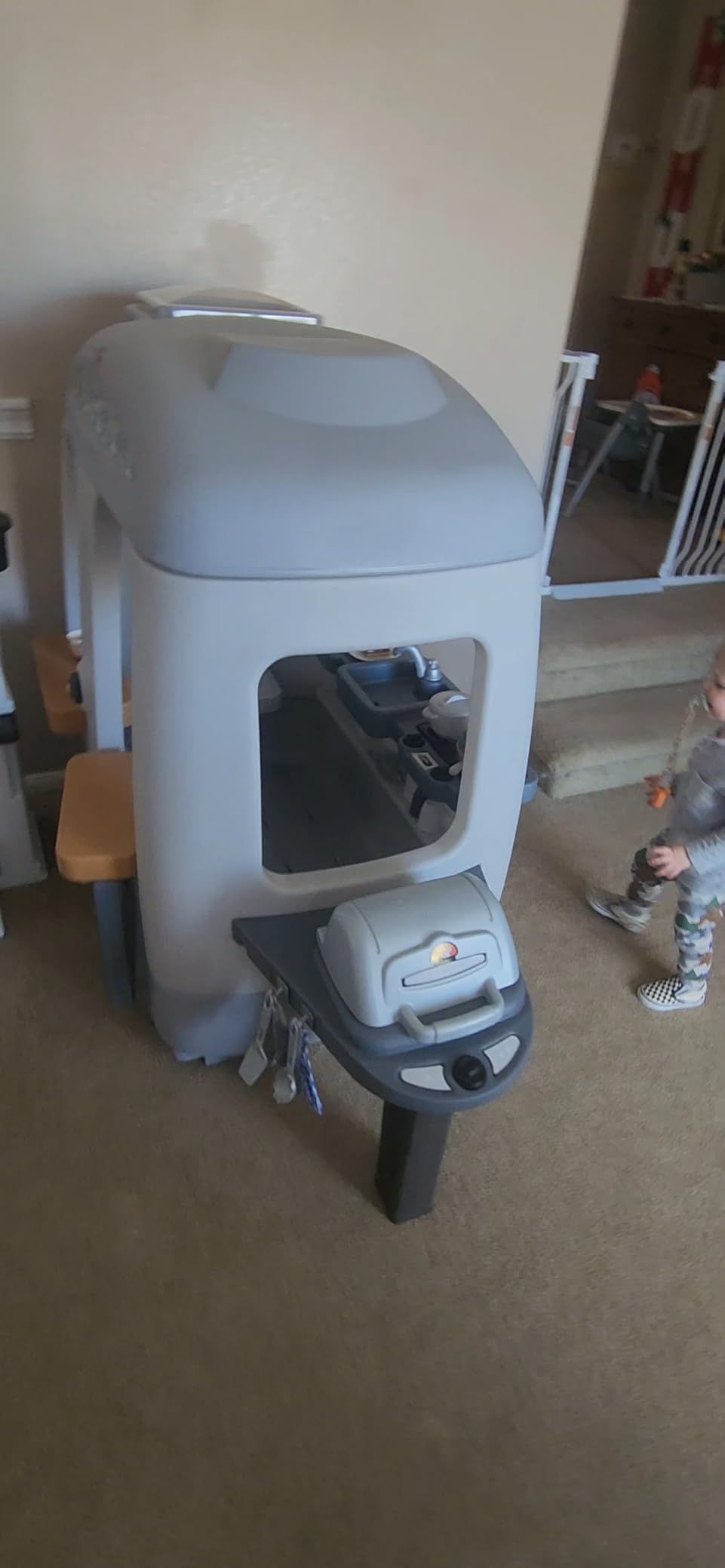
Grandparents dominate the reviews on this model, and they repeatedly single out the kitchen, the grill, and the interactive doorbell as the features their toddlers use daily. The same reviewers note it works indoors as happily as it does on a patio.
Assembly took one parent about an hour with a screwdriver, though the lack of pre-drilled holes means an electric screwdriver or drill is close to mandatory. Reviewers also report that the decal placement is not explained in the printed instructions, which sends people to video walkthroughs.
Who the Adventure Camper suits
It suits families who have already run through a basic cottage and need a reason to stay interested. A full kitchen with real accessories gives a three-year-old something new to master after the doorbell stops being novel.
It also suits indoor playrooms and covered patios. At 50 inches tall, the peak height works for a toddler standing inside without feeling enclosed.
Who the Adventure Camper does not suit
Skip it for a very small space. At 62 inches wide it is the widest house here, and it needs clearance on the sides for children to move around it.
Skip it if you want a tool-free or one-person build. Reviewers also mention at least one order arriving without the decals needed to finish assembly, so check the box before you start. The interactive doorbell needs batteries, which are not included.
6. UTEX 3 in 1 Pop Up Play Tent with Tunnel: Top Rated Toddler Play Tent
UTEX 3 in 1 Pop Up Play Tent with Tunnel, Indoor/Outdoor Playhouse
Polyester taffeta
120D x 37.3W x 47.5H inches
3 lb
Ages 36 months and up
Pros
- Three connectable pieces instead of one
- Pop-up frame needs no tools
- Folds flat to about 3 inch pack
- Mesh windows and two crawl holes
- Works from about 11 months upward
Cons
- Ball pit balls are not included
- Folding back into the pouch takes practice
- Fabric is lighter duty than a rigid house
The UTEX set is the highest-rated product in this roundup and the one we recommend when the word “playhouse” needs to mean something a toddler can set up alone. It is not a house in the cottage sense. It is three connectable pieces: a square tent house, a teepee house, and a long tunnel, built on spring steel frames with 190T polyester taffeta.
When assembled, the footprint runs 120 inches deep by 37.3 inches wide by 47.5 inches tall, which is longer than it is tall. That length is the point. Crawling through the tunnel into the tent is a gross-motor activity that a rigid cottage cannot offer, and reviewers describe children playing with the connected run for hours.
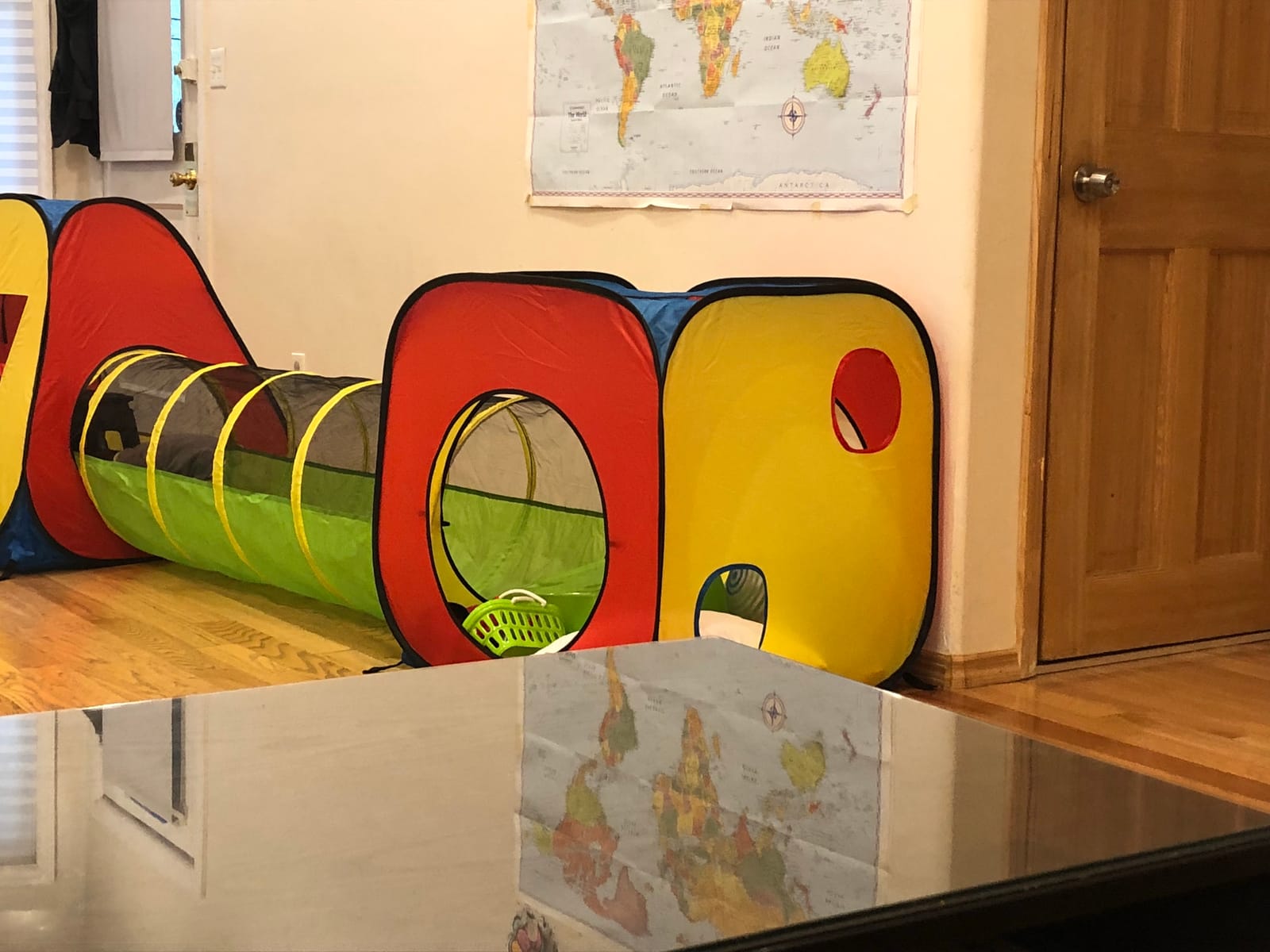
Setup took our team about fifteen seconds per piece. There is no frame to assemble, no screws, and no instructions to misread. When play is over it folds flat to roughly the thickness of a child’s jacket, which is the single most practical feature in this roundup if you live in a small apartment.
The mesh windows and two crawl holes give toddlers peek-a-boo options and ventilation without turning the interior into a greenhouse. Several parents say they use it indoors in winter and on the patio in summer, and that it works for children as young as 11 months through preschool age even though the listing guidance reads 36 months and up.

Who the UTEX set suits
It suits renters, families who travel, grandparents who want something in a car boot, and any household where floor space is rationed. Because it stores at the thickness of a jacket, it can live in a closet between uses instead of occupying a patio all year.
It also suits a child who needs movement as much as imaginary play. Crawling, climbing through, and hide-and-seek in the mesh windows are all built in.
Who the UTEX set does not suit
Skip it if you want weather resistance. Polyester taffeta is not a rigid shell and will not handle a season of hard outdoor use the way a double-walled plastic cottage will.
The two most cited complaints are easy to anticipate: the ball pit balls shown in the listing are not included, and getting the tent back into its carry pouch takes practice. Reviewers also describe the fabric as lighter duty than a rigid playhouse, so expect to pass it on rather than hand it down.
7. Tiny Land Castle Play Tent: Best Indoor Playhouse for a Reading Nook
Tiny Land Kids Play Tent, Blue Castle Pop Up Tent for Toddlers Indoor
Polyester with metal frame
41.34 x 41.34 x 53.15 inches
1.9 lb
3 years and up
Pros
- Sets up and collapses in about three minutes
- Compact square footprint works as a reading cave
- Starry sky interior feels made for calm play
- Light enough to move between rooms
- Three colour options
Cons
- Manufacturer lists 3 years and up despite listings aimed at 2-year-olds
- Polyester is not weatherproof
- The pole sleeves showed early wear in some units
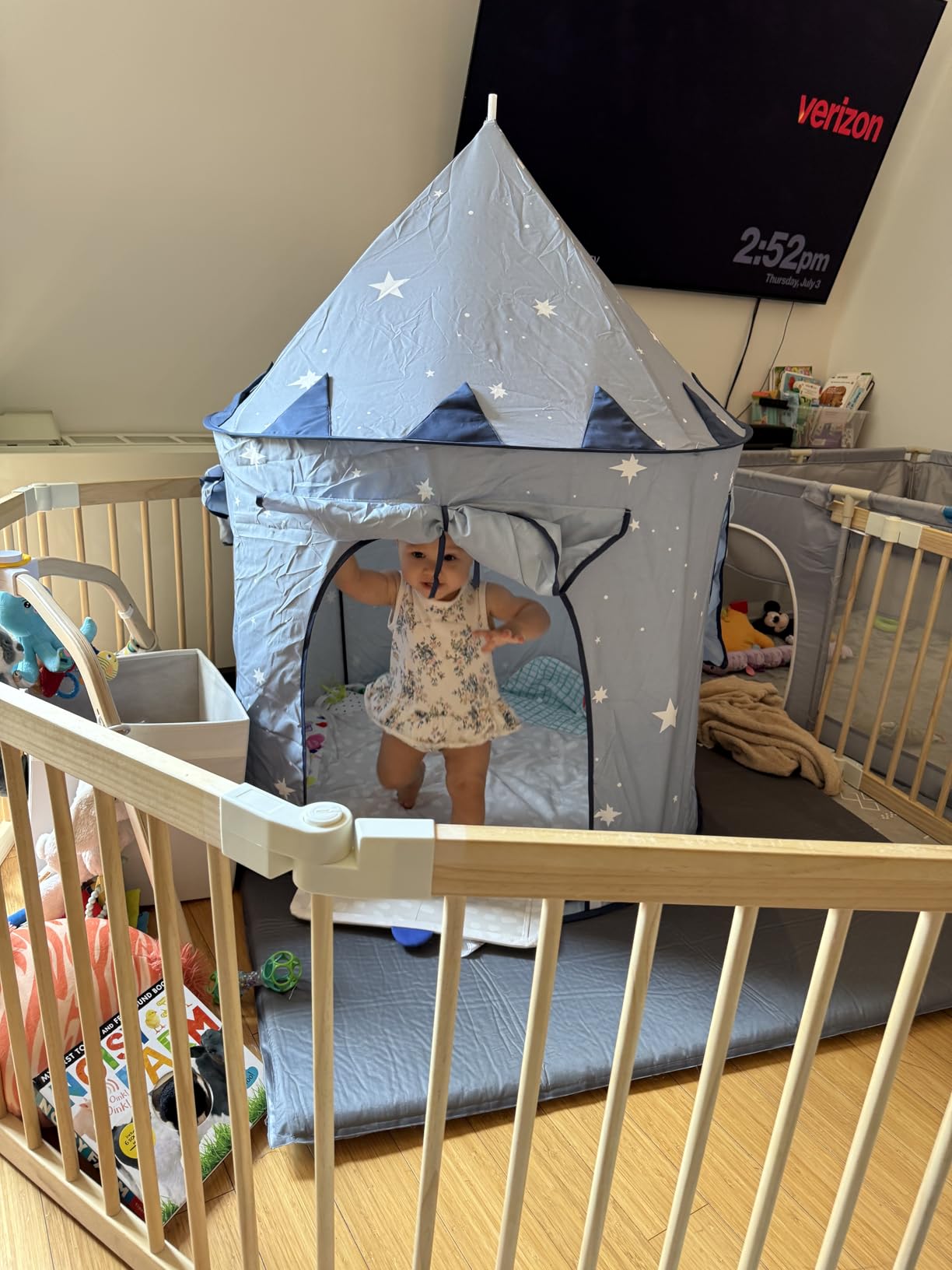
The Tiny Land tent is the pick when the goal is a quiet corner rather than a big play structure. It is a square four-pole tent with a starry sky interior and a decorative star on the top, sized at 41.34 inches on each side and 53.15 inches tall. Weights 1.9 pounds, which is close to nothing to carry.
Setup and takedown took about three minutes, which is the number that matters in a rental or a small family home. Many reviewers buy it as a gift for grandchildren and describe it as sturdier than the fabric format suggests.

Where the UTEX set is loud and long, this one is compact and calm. It works as a book nook, a nap cave, or a small hiding place, and the square footprint wastes far less floor space than a rectangular tent. There are no sharp edges and the structure stands flat without a separate base.
The one design concern reviewers raise is the fabric sleeves where the poles insert. Some units show early wear and tearing there after light use, which suggests checking those seams before the tent goes into regular rotation.
Who the Tiny Land tent suits
It suits families in apartments, anyone building a reading corner, and parents who want a playhouse that can be picked up and moved between the living room and a bedroom in under a minute.
It also suits children who are transitioning out of crib and nap territory. The darker interior reads as a hideaway without being a full-size structure that dominates a room.
Who the Tiny Land tent does not suit
Skip it for outdoor use in anything other than dry weather. The polyester is designed for indoors and is not weatherproof.
Check the age guidance carefully. The manufacturer lists 3 years and up even though listings position it for two-year-olds, and the tallest children will be at the limit of the 53-inch peak. If your child is under three and very tall, check the standing height before you commit.
8. WEOKLL Kids Pop Up Play Tent: Best Budget Playhouse for Toddlers
Kids Pop up Play Tent,Playhouse Tent for Boys Girls Babies and Toddlers, Play Tent Indoor Outdoor Use
Polyester with plastic frame
31 x 31 x 34 inches
12.8 oz
36 months to 8 years
Pros
- Weighs under one pound
- Folds to 12.5 inch square and stows in the bag
- Fits two or three children when open
- Mesh sides and roll-up door
- Common choice for preschool sensory corners
Cons
- Fabric and spring wires are described as flimsy
- No printed folding instructions
- Not built to last outdoors
The WEOKLL tent is the cheapest way into the roundup and the least demanding purchase decision of all ten. It opens in seconds, weighs 12.8 ounces, and folds down to a 12.5-inch square disc that fits in a closet shelf, a car boot, or a carry bag.
Open, it measures 31 inches on each side and 34 inches tall, and reviewers note it fits two or three children. The mesh sides give visibility and ventilation, and the roll-up door gives just enough privacy for a child who wants to disappear.

Reviews are genuinely split on this one, which is worth understanding before you buy. Many parents are delighted with the portability, the instant setup, and the low cost for indoor fort and sensory-corner use. A smaller group finds the fabric and spring wires too flimsy to pass on to a sibling.
One practical detail caught our attention: there are no printed instructions for how to collapse it, and at least one owner could not get it back into the carry bag. Practice folding it once before you need it, and use a YouTube walkthrough if the manual leaves you guessing.

Who the WEOKLL tent suits
It suits families who need a secondary play item rather than a main one, grandparents who take it on visits, and anyone furnishing a preschool sensory corner on a tight budget.
Because it weighs under a pound, it moves between indoor and outdoor use without any ceremony, which is unusual for anything in this category.
Who the WEOKLL tent does not suit
Skip it as an only playhouse. The fabric and spring wire do not have the durability to survive being handed on, and reviewers are candid about that.
Keep it indoors. It is not built for outdoor use, and one reviewer raised suffocation concerns with the material, so supervise younger children and follow the stated age guidance of 36 months and up.
9. Outsunny Fir Wood Playhouse: Best Wooden Playhouse for Small Animals
Outsunny Outdoor Kids Playhouse with Dutch Door for Toddlers 3-8, Beige
Fir wood
44.9D x 49.8W x 53.1H inches
74 lb
Ages 24 months to 8 years
Pros
- Solid fir build with a sloped roof that sheds rain
- Dutch door and retro windows with real detail
- Two openable side windows for light and visibility
- Converts to a small-animal shelter
Cons
- At 74 lb it is very hard to reposition
- Lowest average rating here at 4.4 stars
- Smallest review base of the ten picks
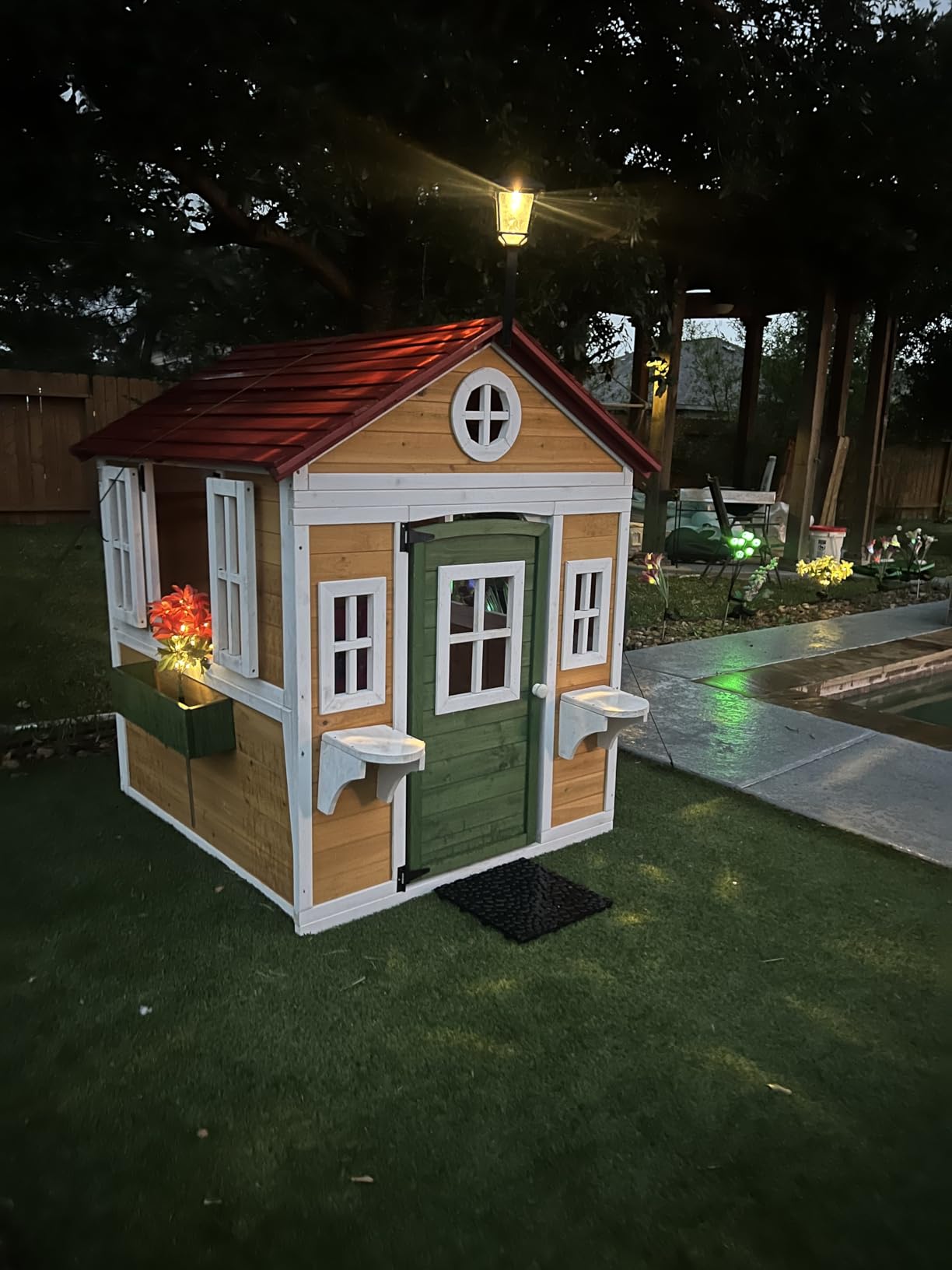
The Outsunny house is the one pick here with a second job. It is built from fir wood with a resilient sloped roof that diverts rainwater away from the timber, and several owners use it as a shelter for small animals once the children move on.
The decorative detail is the surprise. There are two plant boxes and two planter pots included, retro-style windows, a Dutch door, and two openable side windows that keep the interior bright and ventilated while preserving a parent sightline.
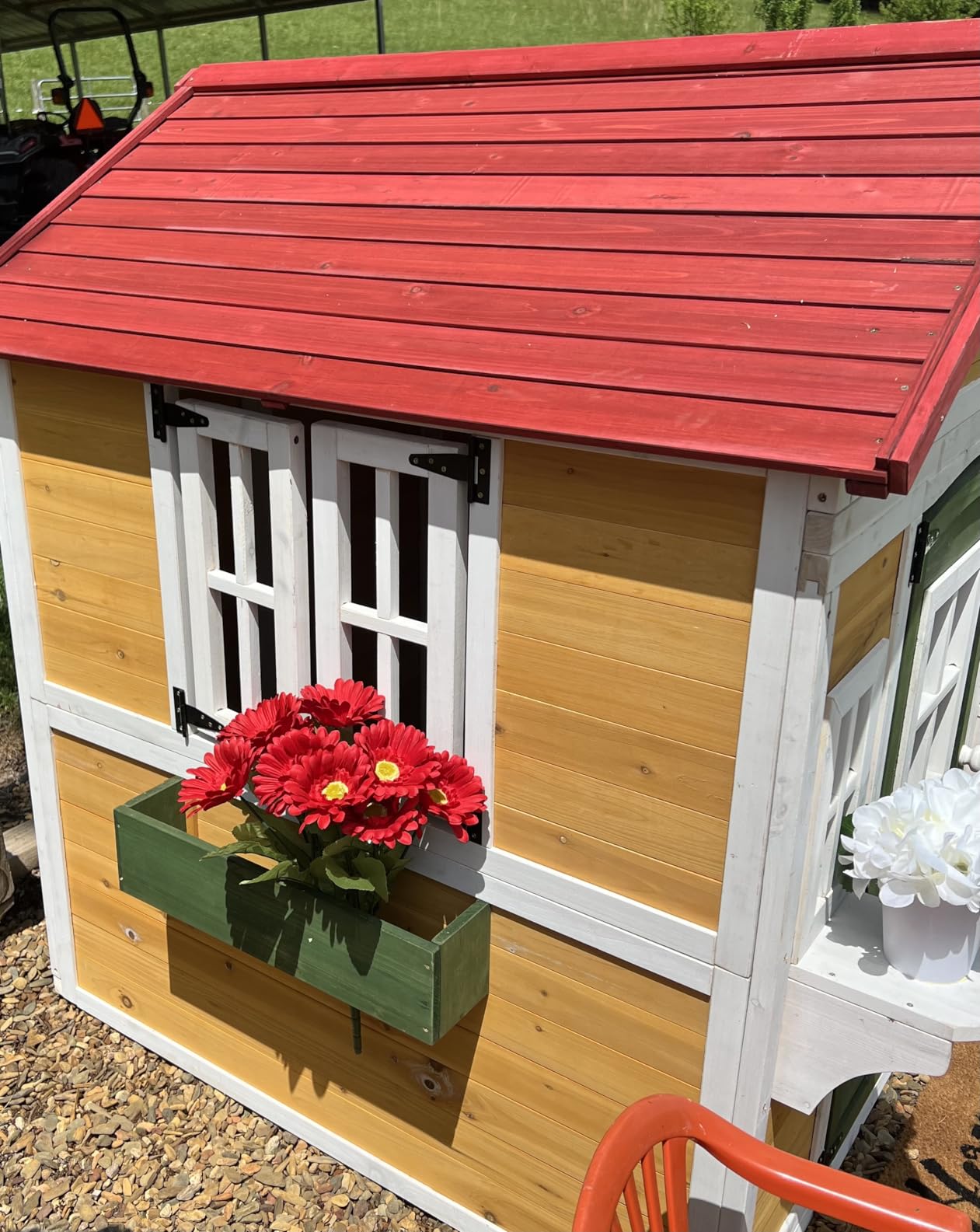
At 49.8 inches wide, 44.9 inches deep, and 53.1 inches tall, it is a mid-size wooden footprint that needs a prepared level base. The peak height suits a toddler and a four-year-old equally well, and the manufacturer rating spans 24 months to 8 years.
We would be cautious here, and here is why. Its 4.4-star average is the lowest of the ten picks in this roundup, with a higher one-star share, and its 182 reviews are the smallest sample of any product we tested. Reviewers also flag the 74-pound weight, which makes the house effectively permanent once assembled.
Who the Outsunny house suits
It suits families who want the look and feel of a wooden cottage with visible craftsmanship detail, and who plan for the house to stay in one spot. The sloped roof is a genuine advantage over flat-roofed wooden designs in wet climates.
It also suits households that keep rabbits, guinea pigs, or small chickens and want a structure that serves double duty over the years.
Who the Outsunny house does not suit
Skip it if you might want to move the house, and skip it if you are buying on evidence from a large review base. A 74-pound structure on a smaller brand with limited long-term review history is a bigger gamble than the cedar alternative.
Renters should look elsewhere. Unlike the plastic picks, there is no way to disassemble it without effectively rebuilding it.
10. Bluey Pop-Up Play Tent: Best Playhouse for Licensed Character Play
Pop N Fun Bluey Pop-Up Tent, Multicolor Easy Storage Pop Up Play Tent with Roll-Up Door & Peep Window, Indoor/Outdoor Toddler Playhouse for Ages 2+
Polyester and plastic frame
28.3 x 28.3 x 40.2 inches
1.3 lb
Ages 24 months to 15 years
Pros
- Sets up and folds in seconds with no tools
- Licensed Bluey graphics appeal to toddlers and preschoolers
- Roll-up door
- circular windows and roof peek hole
- Grandparents report two or more years of use
Cons
- Thin fabric tears with rough play near the bottom frame
- Light enough for a young child to tip sideways
- No floor padding is included
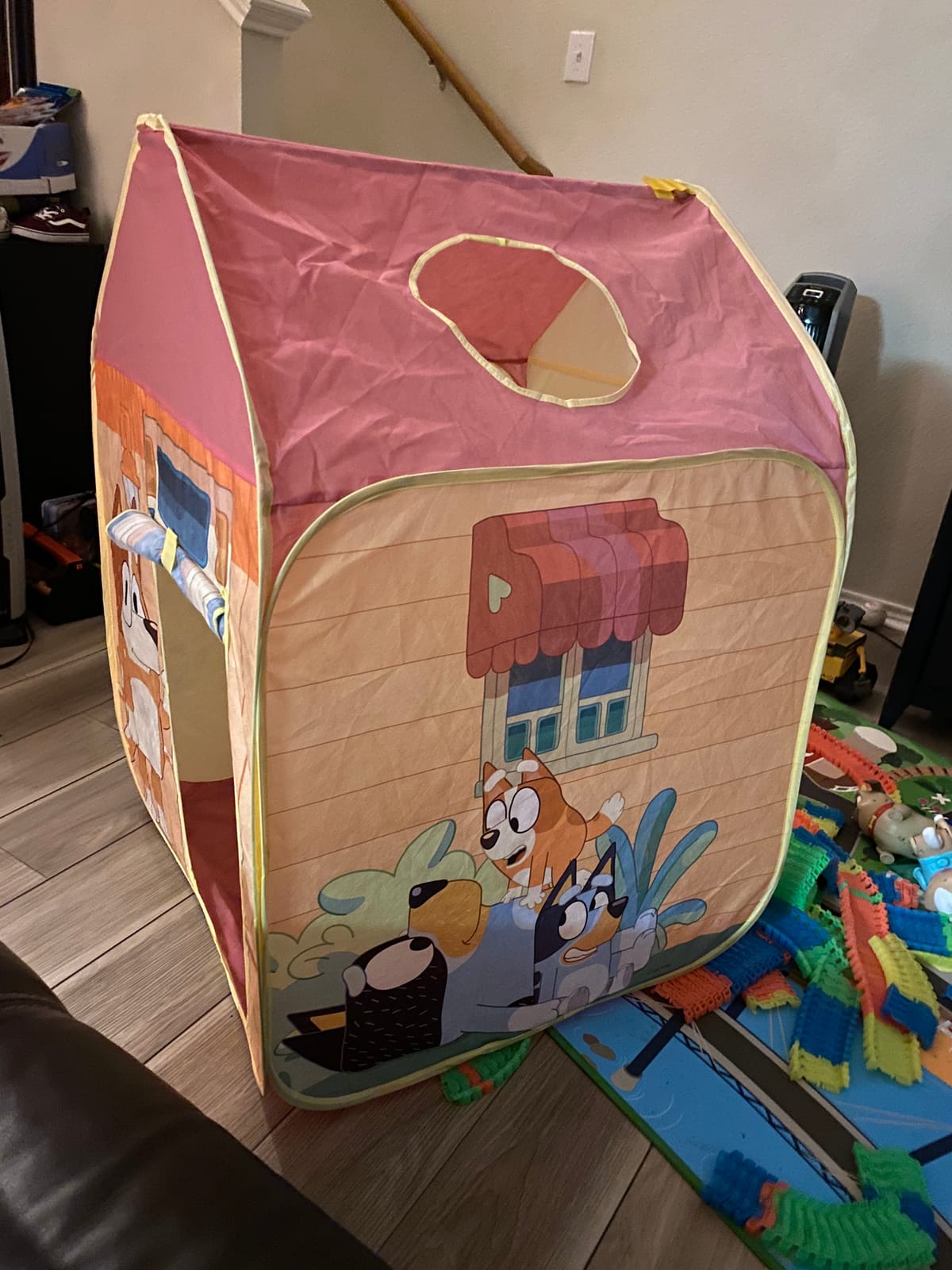
The Bluey tent is here because licensed character play is a real category of demand, not because we think a character house ages well. If your toddler is a fan, this is the pop-up tent they will recognise from the television, at 28.3 inches square and 40.2 inches tall with a 1.3-pound weight.
Setup takes seconds using easy-insert rods and no tools. The roll-up door, circular side windows, and the peek-a-boo hole in the roof produce hide-and-seek and face-to-face play through the roof, which is a genuinely good idea at this size.
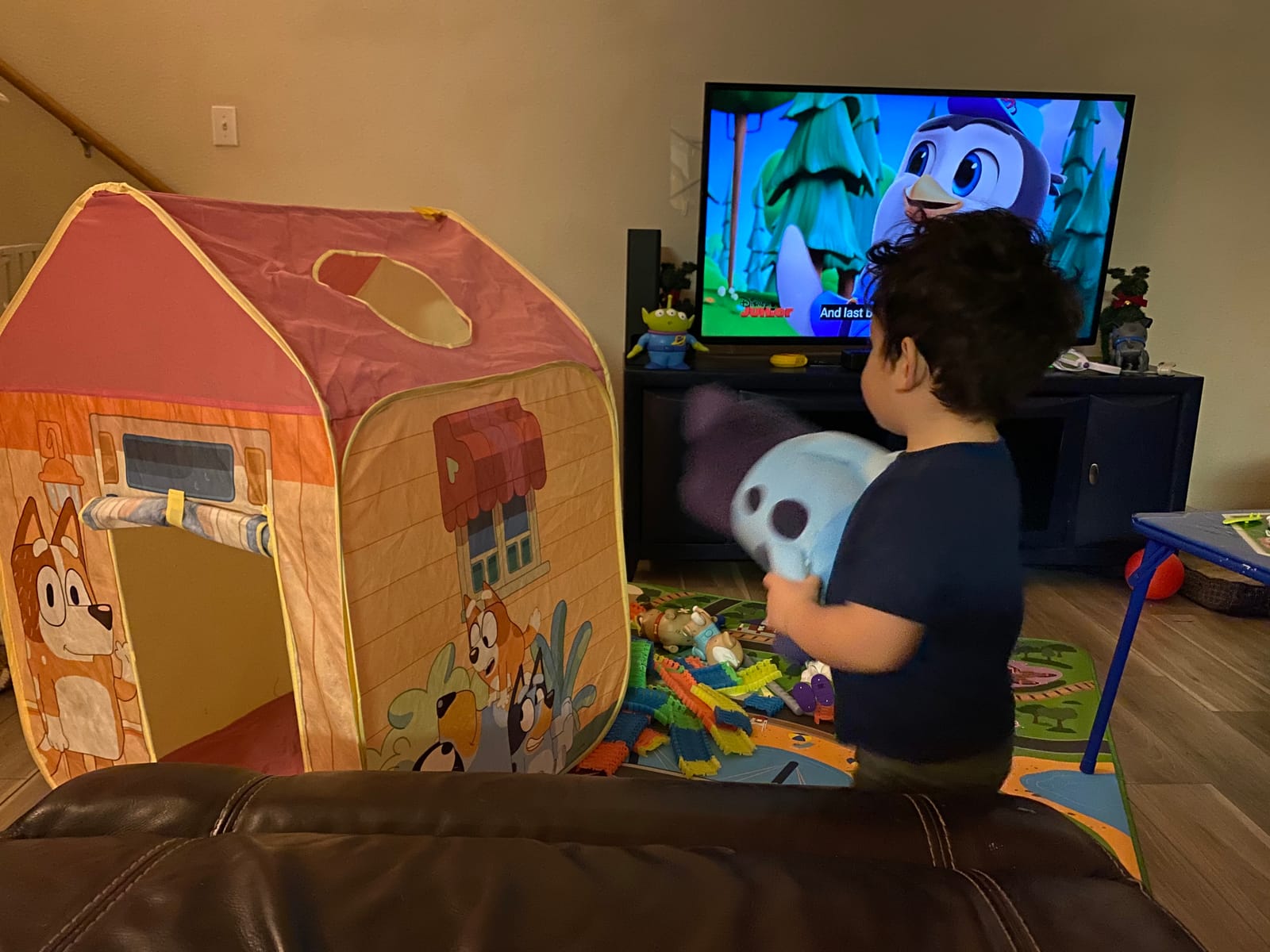
The reviews are strong, and the strongest evidence is longevity. Grandparents repeatedly report a child still using the tent two or more years after it was bought, and several owners note the tent is bright enough to nap inside.
The recurring complaint is fabric durability. The material is thin and tears, particularly near the bottom wire frame when children roughhouse. Put a blanket underneath for hard floors, since no padding is included, and expect to move the tent rather than climb it.
Who the Bluey tent suits
It suits households where a favourite programme is doing the persuading, and grandparents who travel. The collapsed tent is compact enough to travel with, and the design reads as a small den rather than a structure needing supervision.
It also works as a nap tent. A couple of owners describe children sleeping inside it, which is not something we would recommend unsupervised with any rigid structure but is common with fabric.
Who the Bluey tent does not suit
Skip it if your child outgrows the show quickly. Character licensing is the main reason to buy this over the WEOKLL tent, and it is a weak reason once interest shifts.
Skip it if the child is a climber. At 1.3 pounds it is light enough for a young child to tip sideways, and the thin fabric near the bottom frame is the first thing to fail. It also takes up a noticeable amount of floor space once open.
How to Choose a Playhouse for a Toddler in 2026
Age range and peak height matter more than the age label
The most common sizing mistake we saw was not underbuying. It was buying an adult-height house for a two-year-old. Many playhouses on the market top out between 50 and 76 inches, which sounds generous until you measure your child. A two-year-old is typically somewhere around 34 to 36 inches tall, and a house that dwarfs them is a space they peek into rather than a space they live in.
Use peak height as your filter. For a child between 18 months and three years, aim for something in the 41 to 50 inch range. That is tall enough to stand upright inside and low enough to see over the walls from a crouch, which is what makes it feel like their own space rather than a building they are outside of.
Also read the manufacturer age rating rather than the age on the box. Several picks here carry a manufacturer rating of 18 months or 24 months even when marketing positions them for older children, and one tent is listed at 3 years and up despite listings aimed at two-year-olds. Those numbers are not interchangeable.
Indoor play tent or outdoor house: decide this first
Most roundups on this topic cover only outdoor houses. That leaves a real gap for anyone in an apartment, a condo, or a house with no usable yard, which is why four of our ten picks are fabric tents.
Choose a rigid plastic or wooden house if you have a level outdoor space and want a structure that survives weather. Choose a pop-up fabric tent if your play space is indoors, if you rent, if you travel, or if you want the house to disappear into a closet between uses.
A third option deserves attention. Several rigid picks, including the Step2 Neat and Tidy and the Adventure Camper, are rated for both indoor and outdoor use, which lets you bring the house inside for rainy winter afternoons and back out for spring.
Measure your footprint before you buy
Take a tape measure, not the listing photo. Write down the assembled dimensions, not the boxed dimensions, and then add clearance.
First, measure the assembled footprint of the house. Then measure the space you have. Then subtract. A playhouse needs roughly two feet of clear walking space on the sides where children run in and out, and more in front of the door, or the play pattern becomes a collision pattern.
If you are working from a tight space, the two smallest footprints in this roundup are the Bluey pop-up tent at 28.3 inches square and the WEOKLL tent at 31 inches square. Among rigid houses, the Step2 Toddler Corner House at 31.5 inches wide is the most corner-friendly option we tested.
What materials actually cost you over time
Double-walled plastic resists fading, chipping, cracking, and peeling, and it wipes clean with a household disinfectant. Its weaknesses are UV fading on decals and, in cheaper models, thin shells that crack in cold weather. Cedar and fir age better and look better in a garden, but they need an annual stain or seal to hold their finish.
Polyester tents are the opposite trade. They cost the least and store best, but they are not weatherproof, they will not survive being handed down, and their seams are the first failure point.
The practical rule: match the material to the location. Plastic or sealed wood for anything outdoors and permanent, fabric for indoors, travel, and secondary play.
Be realistic about assembly time
Assembly is the single most repeated complaint in parent forums about playhouses, and the spec sheets do not tell the truth about it. Our real timings: tool-free plastic cottages under an hour, drilled plastic panels about an hour with two adults, the cedar house between three and six hours with two adults and a drill, and pop-up tents seconds.
Read the reviews for the phrase “pre-drilled”. Several picks in this roundup have no pilot holes for screws at all, which converts a simple build into a drilling job and adds an hour you did not plan for.
Is it cheaper to build a kids playhouse or buy one?
This question comes up constantly and no major roundup answers it. Build your own if you already own tools and enjoy the work. Material costs for a simple cedar playhouse run well below the price of a comparable retail house, but the hours are the real expense.
Count a weekend for a straightforward build, plus another weekend for sanding, sealing, and fixing the mistakes. Buy instead if you are assembling alone, if you are renting, or if you want the accessories. Every wooden house here arrives without a kitchen, phone, or doorbell unless you buy them, and for a two-year-old the accessories are most of the play.
Safety and supervision for the 18 to 36 month set
For toddlers specifically, prioritise sightlines over features. An open interior with windows on more than one wall lets you see inside from a standing position. Several picks in this roundup have multiple windows or a skylight for exactly this reason.
Avoid elevated decks and lofted spaces under age three, and treat any climbable ledge as a supervision requirement rather than a play feature. The Step2 Toddler Corner House is a good example of a house that works well indoors precisely because there is nothing to climb.
For the 18 to 36 month group, also check for small detachable parts before handing over a 52-piece accessory set, and confirm that wooden finishes are pre-stained or sealed rather than raw.
Frequently Asked Questions
What is a good playhouse for a 2-year-old?
A good playhouse for a 2-year-old has a peak height around 41 to 50 inches, an open interior with windows on more than one wall for supervision, and features a toddler can operate independently such as a doorbell, mail slot, or play phone. The Little Tikes Cape Cottage Playhouse is our best overall pick because it assembles tool-free, weighs 32 pounds, and stays within a compact 42.8 by 35 inch footprint. Avoid houses with elevated decks or lofted spaces under age three.
Are playhouses good for toddlers?
Yes. Toddlers use a playhouse as a pretend-play space, which supports language, social, and motor development during the stage where they are constantly rehearsing adult roles. The open layout gives them roles to act out, a working doorbell or mailbox provides a script to repeat, and the structure itself becomes a self-directed activity that burns energy without a screen. For the 18 to 36 month set, supervise closely and keep climbable elements out of reach.
Is it cheaper to build a kids playhouse or buy one?
Material costs for a simple wooden playhouse run well below the price of a comparable retail house, so building can be cheaper on paper. The real expense is time: count a full weekend for the build plus another for sanding, sealing, and correcting mistakes, and only if you already own tools. Buy instead if you are assembling alone, if you rent, or if you want the accessories, because most retail houses arrive without a play kitchen, phone, or doorbell.
What age is appropriate for playhouses?
Most playhouses are rated from 18 months to 24 months upward, and the rigid models in this roundup are rated from 12 months to 24 months depending on the model. Age labels are not interchangeable, so check the manufacturer rating rather than the marketing. For sizing, use peak height rather than age: a two-year-old is typically around 34 to 36 inches tall, so aim for a house between 41 and 50 inches so they can stand upright inside.
What is the best playhouse for a 2-year-old?
The Little Tikes Cape Cottage Playhouse is the best overall playhouse for a 2-year-old. It is rated for ages 2 and up, assembles with no tools in under an hour, weighs 32 pounds so one adult can move it, and includes a working door, swinging shutters, a built-in mail slot, and a flag holder. For families who need indoor use or travel instead, a pop-up play tent such as the UTEX 3-in-1 set is the easier choice.
What age is a play house with slides suitable?
Slide-equipped playhouses are typically suited to children aged three and up, and any elevated deck or loft should be avoided under age three. For toddlers between 18 and 36 months, ground-level playhouses without climbing elements are the safer choice, and anything climbable needs close supervision. Most of the houses in this roundup are ground-level playhouses for that reason, with the play value coming from the kitchen, doorbell, mailbox, and interior space.
Final Verdict: The Best Playhouses for Toddlers in 2026
After six weeks of assembly, play, and one very determined four-year-old trying to flip every structure we owned, the Little Tikes Cape Cottage Playhouse is still the best playhouse for toddlers overall. It is the only pick that needed no tools, weighed little enough for one adult to move, and carried a working door, working shutters, and a mail slot in a footprint that fits beside a patio chair.
Choose the Backyard Discovery Sweetwater if you have a yard and a free weekend, and want a cedar house with the kitchen, phone, and doorbell already fitted. Choose the Step2 Neat and Tidy if two children need to play inside at once. Choose a pop-up tent, our pick being the UTEX 3-in-1 set, if you rent, travel, or want the house to fold into a closet.
Whatever you choose, measure the assembled footprint before you order, add clearance on the sides, and check whether the panels arrive pre-drilled. Those three checks solve most of the disappointment parents describe in the forums.