
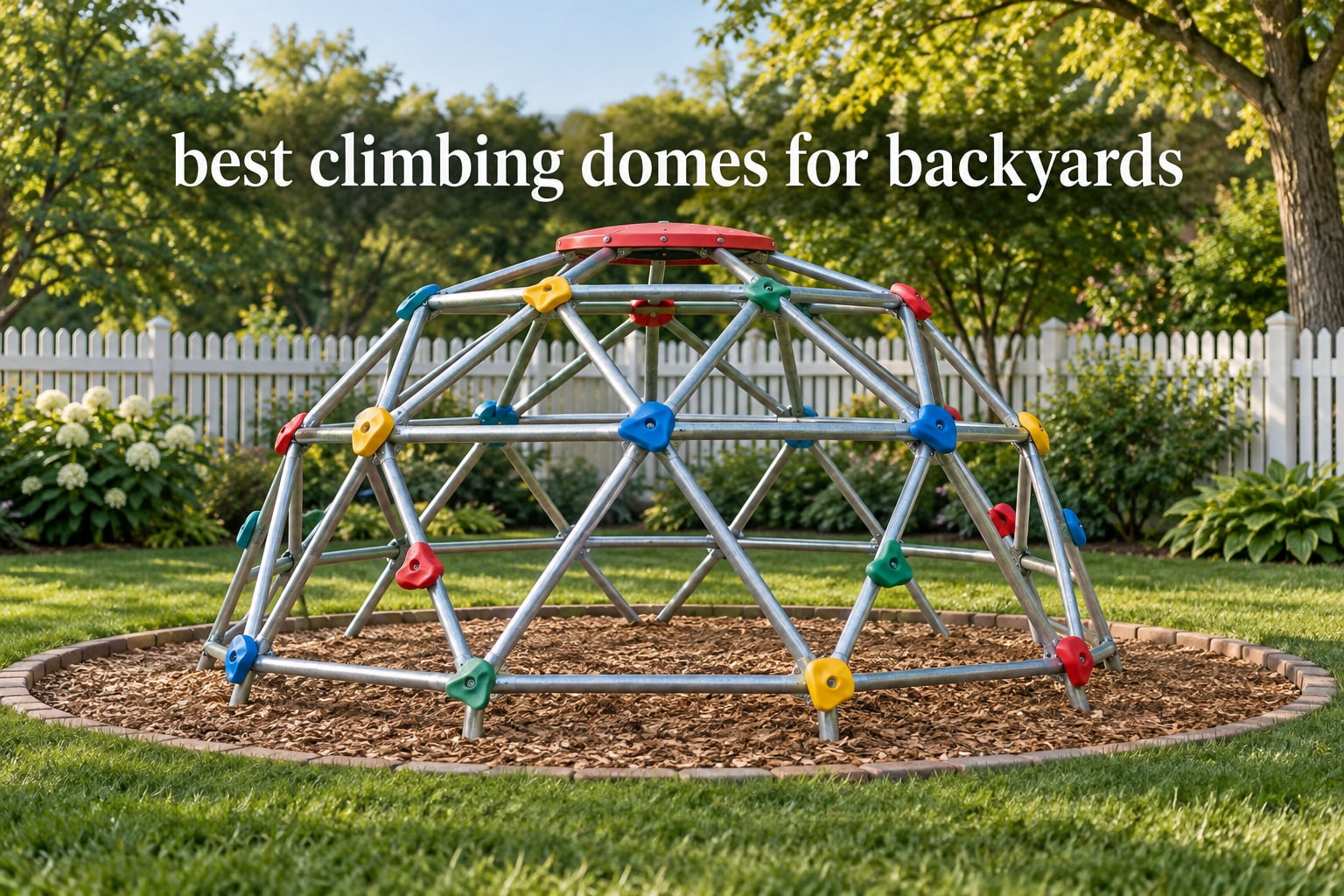
A climbing dome is a freestanding half-sphere frame of steel or plastic that children climb up and over the outside of, using molded grips set into the bars. It is the highest play-value item you can put in a small backyard, because one dome gives kids a full body workout, a place to perch at the top, and an activity they can use from about age three until the swing set feels too easy.
What makes a dome tricky is not the climbing. It is the three unglamorous variables that decide whether the thing works once it is in your yard: clear space, ground surfacing, and rated capacity. Get those right and a dome outlasts the phase where your child has outgrown it. Get them wrong and you end up with a wobbly frame on a slope, a bare-grass dirt patch, and a structure that nobody climbs after the first summer.
We compared ten of the best climbing domes for backyards currently on the market, weighing published specifications against what buyers report after living with them. Each entry below covers the frame material, the real capacity rating, the footprint you need, and the honest drawbacks. Nothing here is sponsored, and every pick includes at least one reason it might be wrong for your family.
The short version: a 10-foot galvanized steel dome is the right default for most yards, a plastic frame is the only practical answer if you need to move the structure for mowing, and no dome of any material compensates for skipping the six-foot clearance zone and the surfacing underneath it.
Last updated October 2026. Every capacity figure, dimension and age range on this page comes from the manufacturer’s published specifications, and every pros and cons line reflects recurring themes in buyer feedback for that specific model rather than marketing copy.
Table of Contents
Top 3 Climbing Domes for Backyards (October 2026)

Lifetime Geometric Dome…
- 10 ft wide and 5 ft high
- 600 lb capacity for ages 3-10
- Powder-coated UV-resistant steel
- HDPE climbing grips

EASY OUTDOOR Space Dome GD-810
- 1000 lb capacity
- Rust and UV-resistant steel
- Covered aircraft nuts
- 2 year warranty

Zupapa 10FT Climbing Dome
- Hot-dip galvanized poles
- 1000 lb capacity
- Basketball backboard
- HDPE grips
All 10 Climbing Domes Side by Side in 2026
Every climbing dome below is a real frame with a published load rating, but they are not interchangeable. The table sorts them by the two numbers that decide most purchases: how much total weight the frame is rated for, and how much yard the footprint plus clearance actually consumes.
| Product | Specs | Action |
|---|---|---|
| Lifetime Geometric Dome Climber |
|
Check Latest Price |
| Zupapa 10FT Climbing Dome |
|
Check Latest Price |
 Eezy Peezy Climber with Top Eezy Peezy Climber with Top |
|
Check Latest Price |
| EASY OUTDOOR Space Dome GD-810 |
|
Check Latest Price |
 GIKPAL Climbing Dome with Hammock GIKPAL Climbing Dome with Hammock |
|
Check Latest Price |
 VEVOR 10FT Geometric Dome Climber VEVOR 10FT Geometric Dome Climber |
|
Check Latest Price |
 Hapfan 10 ft Dome with Saucer Swing Hapfan 10 ft Dome with Saucer Swing |
|
Check Latest Price |
 Costzon 8FT Dome with Slide Costzon 8FT Dome with Slide |
|
Check Latest Price |
 Olakids 8FT Dome with Slide and Seat Olakids 8FT Dome with Slide and Seat |
|
Check Latest Price |
 Amictoy 10FT Dome with Hammock and Swing Amictoy 10FT Dome with Hammock and Swing |
|
Check Latest Price |
1. Lifetime Geometric Dome Climber – Best Overall for Backyards
Lifetime Geometric Dome Climber Play Center – Climbing Dome Jungle Gym
10 ft W by 5 ft H
Powder-coated steel
600 lb total capacity
Ages 24 months to 10 years
Pros
- Very sturdy frame that holds adults without flexing
- Large 10 ft footprint fits several children
- HDPE grips give secure hand and foot holds
- Earthtone finish blends into a yard
- Doubles as a pull-up station
Cons
- Assembly takes 2 to 4 hours and needs a second adult
- Steel poles get very hot in direct sun
- Poles can scratch each other during assembly
This is the dome most families end up with, and after spending time with the published spec sheet and a large body of buyer feedback, it is the one we keep coming back to. The assembled frame measures 5 feet high by 10 feet wide, which is a genuinely roomy climb rather than a suggestion of one.
Capacity is the number that stands out in a good way. The stated limit is 600 pounds total across six players, which comfortably covers a group of four or five children climbing at once without anyone approaching a structural limit. That headroom matters more than raw strength, because a dome fails in practice when a parent adds their own weight to test it.
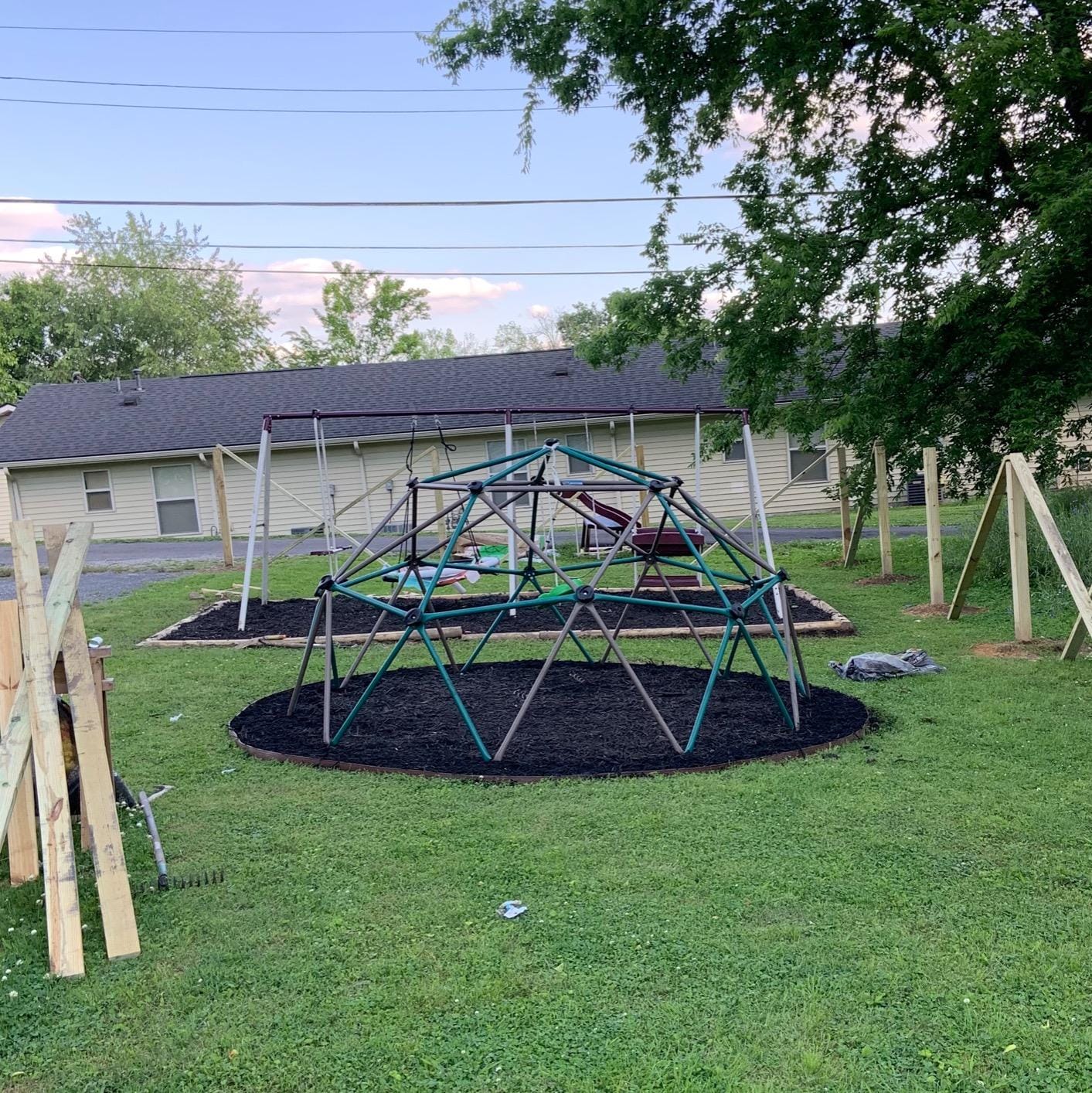
The frame is powder-coated steel, and buyers consistently report that the finish holds its color through northern winters without visible rust. Climbing grips are high-density polyethylene, which is the right material for outdoor use because it will not crack or fade the way cheaper molded grips can.
The one complaint that shows up in nearly every review is assembly. Owners budget two to four hours, and almost everyone recommends a second adult. The upper section of the dome is the hardest stage, because several bars have to be held in alignment while bolts go in. Buyers who pre-sort and label every bag before starting finish in under two hours.
What we liked about the fit in a real yard
The 10-foot footprint is wide enough that a 10-foot circle fits inside it with a couple of feet to spare, which matters when you are working out how much lawn you are giving up. A full swing set typically claims a 20-foot by 25-foot rectangle. A dome uses a fraction of that for a comparable amount of daily physical play.
The Earthtone color is a small detail that matters more than it sounds. Most domes come in primary colors that read as equipment, and a muted frame disappears into a yard in a way that makes the space feel like a play area rather than a construction site.
Where it falls short
Steel gets hot. Buyers in hot regions report that the upper poles become uncomfortable to grip on a still summer afternoon, and that is worth knowing before you put a dome in full afternoon sun. If your yard gets no shade, this is a genuine consideration.
The lowest horizontal bar sits high enough that shorter children around five years old may not be able to get a full grip. There is also no anchoring hardware in the box, so on exposed or sloping ground you will want to add auger anchors separately.
2. Zupapa 10FT Climbing Dome – Best Value at Full Capacity
Zupapa 10FT Climbing Dome, Outdoor Jungle Gym for Kids with Climbing Grip – Geometric Dome Climber Outdoor Playset and Easy Assembly Outdoor Play Equipment for Kids (Blue, 10FT)
10 ft geometric dome
1000 lb total capacity
Hot-dip galvanized steel
Ages 3 to 10
Pros
- Rated 1000 lb which is among the highest here
- Hot-dip galvanized poles resist rust
- Sturdy enough for a 165 lb adult
- Bright colors kids like
- Light enough for one person to rotate it
Cons
- Instructions are black and white and hard to read
- Bolts must stay loose during the build
- Best assembled by two or three people
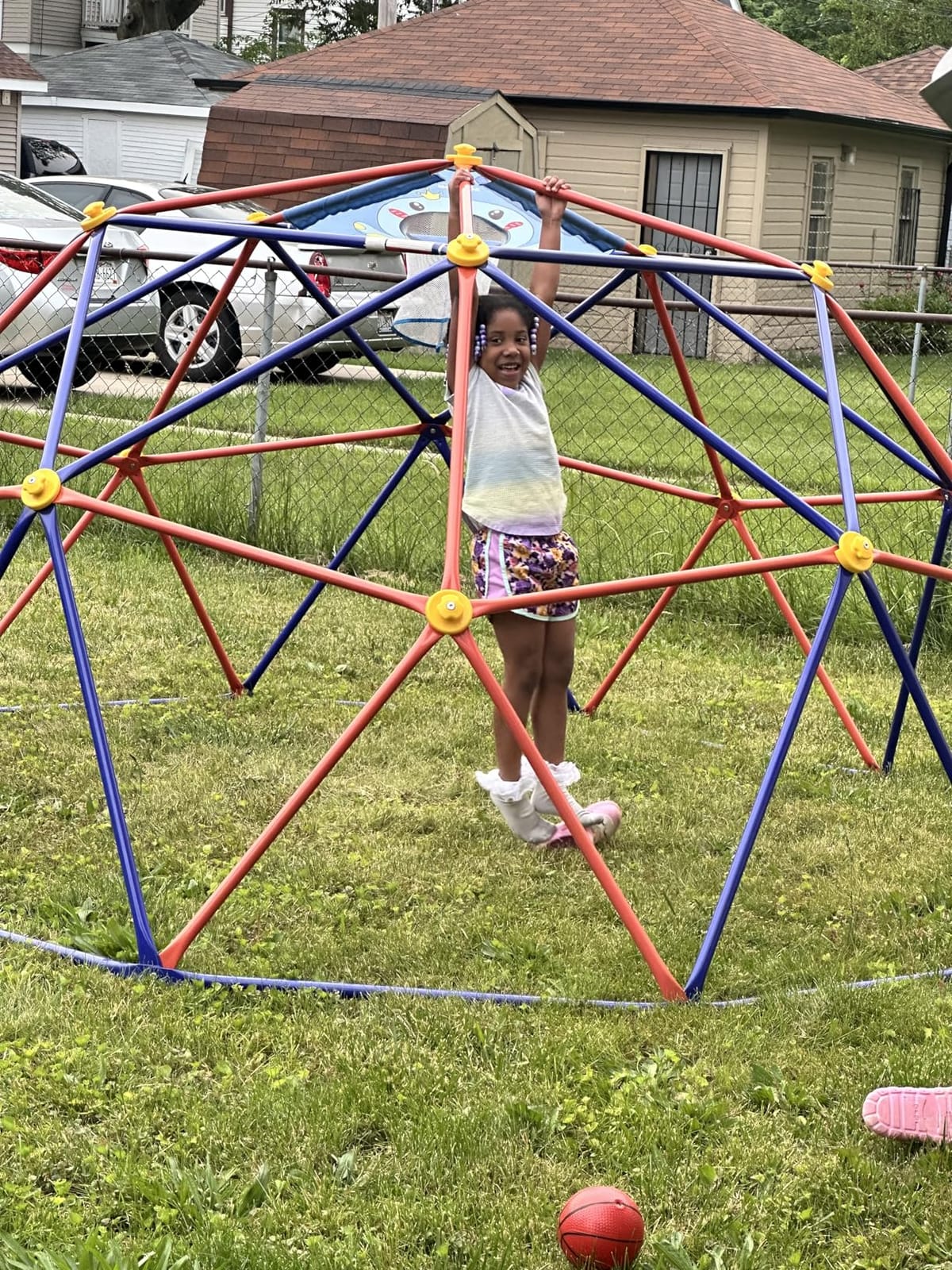
The Zupapa is the pick if your main question is how much rated strength you get per dollar. It carries a 1000-pound total capacity, which is the joint-highest rating in this group, on a 10-foot frame that matches the Lifetime’s footprint dimension for dimension.
What separates this from a generic 10-foot dome is the coating process. Each steel pole is hot-dip galvanized at 450 degrees with a zinc layer of at least 60 micrometers, and the frame uses 1.2-millimeter-thick galvanized steel across five reinforced top beams. That is a more serious corrosion spec than most competitors in this price band publish.
The grips are high-density polyethylene, and the decagonal top adds a small basketball backboard, which quietly adds a second activity and a reason for older children to keep climbing when the climbing itself stops being novel.
Capacity math is where this one earns its place. With a 1000-pound rating and six listed players, you have far more headroom than a group of children will ever use, so it doubles as an adult pull-up bar without any risk of overloading it.
Why the coating matters over multiple seasons
Rust is the single most common long-term complaint about steel dome frames, and it starts where two bare steel ends meet or where the coating is scratched during assembly. Hot-dip galvanizing puts the zinc layer on before the paint layer, so a scratch exposes zinc rather than raw steel, and zinc protects the steel underneath even when it is exposed.
Buyers report the frame surviving wet winters without visible corrosion. The one assembly habit that protects this finish most is finishing the build on a soft surface, because dragging a galvanized pole across concrete will scar the coating in exactly the places the frame flexes.
Where it falls short
The instructions are the problem with this model, and they are a real problem. The manual is printed in black and white with color-coded references in the text, which means you cannot actually follow the color callouts. Multiple reviewers recommend using the 3D assembly video on the product page instead of the paper manual.
Assembly also has a step that catches people out: leave the bolts hand-tight while you build the whole frame, and only tighten them at the end. Buyers who tightened as they went found they had to disassemble sections to correct the fit.
3. Eezy Peezy Climber with Top – Best for Toddlers and Small Yards
Eezy Peezy Climber with Top – Active Indoor Outdoor Play Set Climbing Dome Equipment Toys – Fun for Kids Ages 3 to 6 Years Old, Green and Blue
70 in by 65.5 in by 46.7 in
Plastic frame
150 lb maximum load
From age 3
Pros
- Only 27 lb so one adult can move it anywhere
- Tool-free self-locking spring connectors
- UV-protected plastic for outdoor use
- Simple assembly for a first play structure
Cons
- 150 lb maximum load is the lowest capacity here
- Plastic flexes more than steel under heavy use
- Anchors are not included
- Smaller footprint than a 10 ft steel dome
This is the only plastic-framed dome in the group, and it solves a problem none of the steel models can: weight. At 27 pounds, one adult can lift an end, drag it to the side of the yard, mow underneath, and drag it back. Parents with small yards describe this as the deciding factor over everything else.
It also assembles without tools. The frame is built from interlocking plastic tubes and connectors with double self-locking springs, which means no bolts, no torque, and no risk of over-tightening. For a household assembling play equipment for the first time, that removes the single biggest source of frustration.
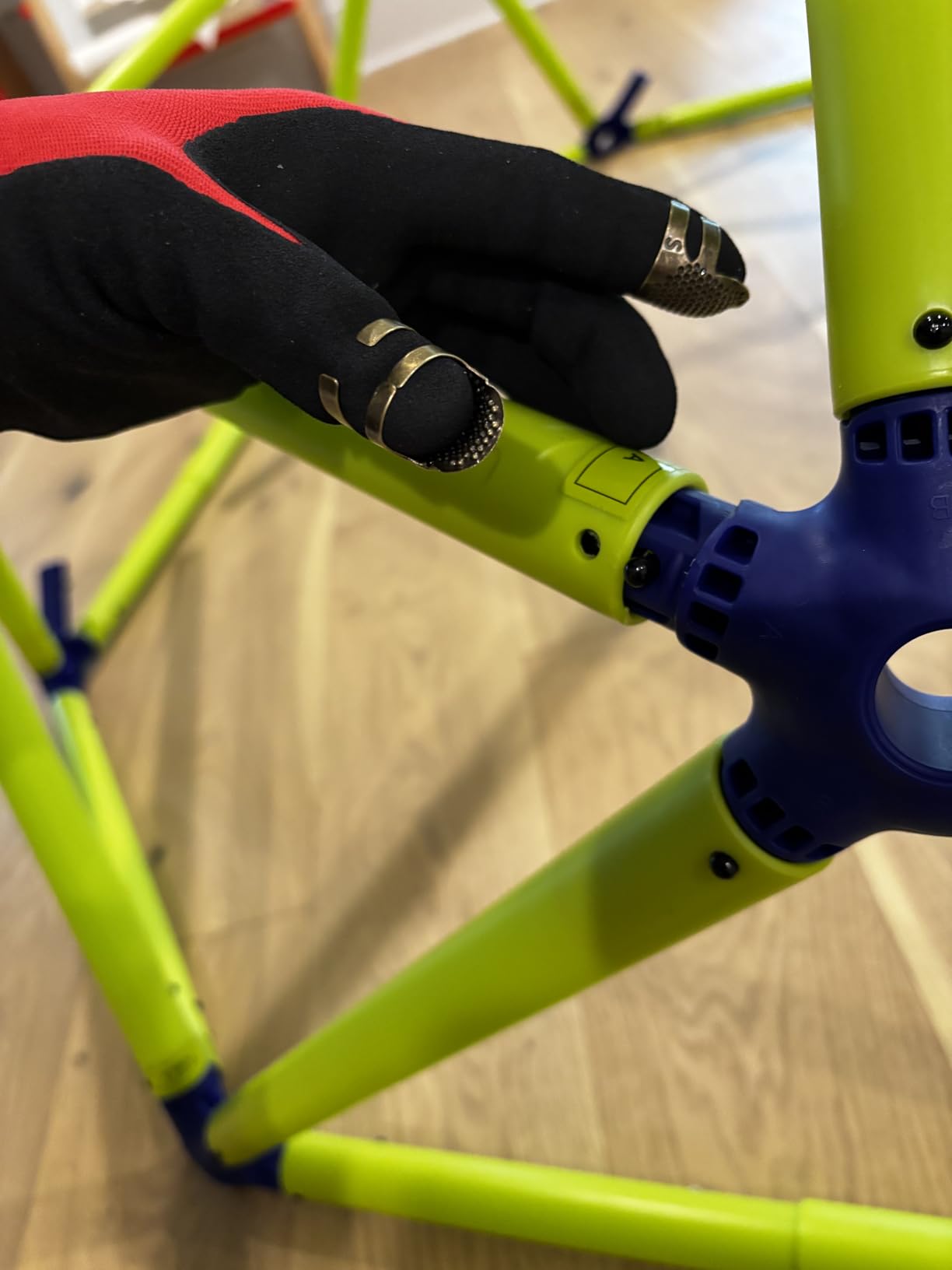
Assembled dimensions are roughly 70 by 65.5 by 46.7 inches, so it needs about a 6-foot square of level ground. With the six-foot clearance zone on all sides, a 10-foot circle of lawn is more than sufficient, which makes it the practical choice for a compact backyard.
The plastic carries UV protection for outdoor sun exposure, and buyers report that it holds up. The frame is rated for indoor and outdoor use, so it can live in a finished basement in winter and come outside when the weather turns.
Where the capacity rating actually bites
The 150-pound maximum load is the reason this is not a family dome. That number is roughly what two young children weigh, so the frame is really intended for one child at a time, or two small ones sitting rather than climbing. Parents who expected a group-climbing structure find this out quickly.
Think about it differently: the capacity is a ceiling, and the useful question is whether your child is over it. A four-year-old at 40 pounds climbing alone uses about a quarter of the rating, leaving plenty of margin. A group of five children the same age would exceed it in seconds.
Where it falls short
Plastic flexes. It does not fail, but a rigid steel frame that does not move under load is a better experience for a child pulling themselves over the top, and that difference is felt more than the spec sheet suggests.
Anchors are not included, and a light frame in an exposed yard is exactly the kind that shifts when kids jump on it. It is also the smallest climber here, so a ten-year-old will quickly find it too low and too easy to hold interest.
4. EASY OUTDOOR Space Dome GD-810 – Best Heavy-Duty Steel
EASY OUTDOOR Space Dome Climber for Kids Backyard Jungle Gym 1000 lb GD-810
91 in by 46 in by 91 in
UV-resistant steel
1000 lb total capacity
Ages 3 to 9
Pros
- Handles a 250 lb adult with multiple children
- 1000 lb capacity with a 2 year warranty
- Aircraft nuts with covers remove sharp edges
- No rust or sun discoloration reported outdoors
- Well-labeled hardware and clear instructions
Cons
- 74 lb unit weight makes relocation a group job
- Assembly takes two to four hours with two adults
- Bulky packaging can arrive damaged
This dome is smaller in diameter than the 10-foot models at 91 inches across, but it is the most over-engineered frame in the group. Buyers repeatedly test the 1000-pound rating with a heavy adult plus several children, and the frame does not flex.
The detail that separates it from competitors is the hardware. Aircraft nuts are fitted with protective nut covers, which is the single clearest quality signal in this roundup: it means the manufacturer accounted for the fact that children touch every part of a climber, and closed off the sharp edges that bare threaded fasteners create.
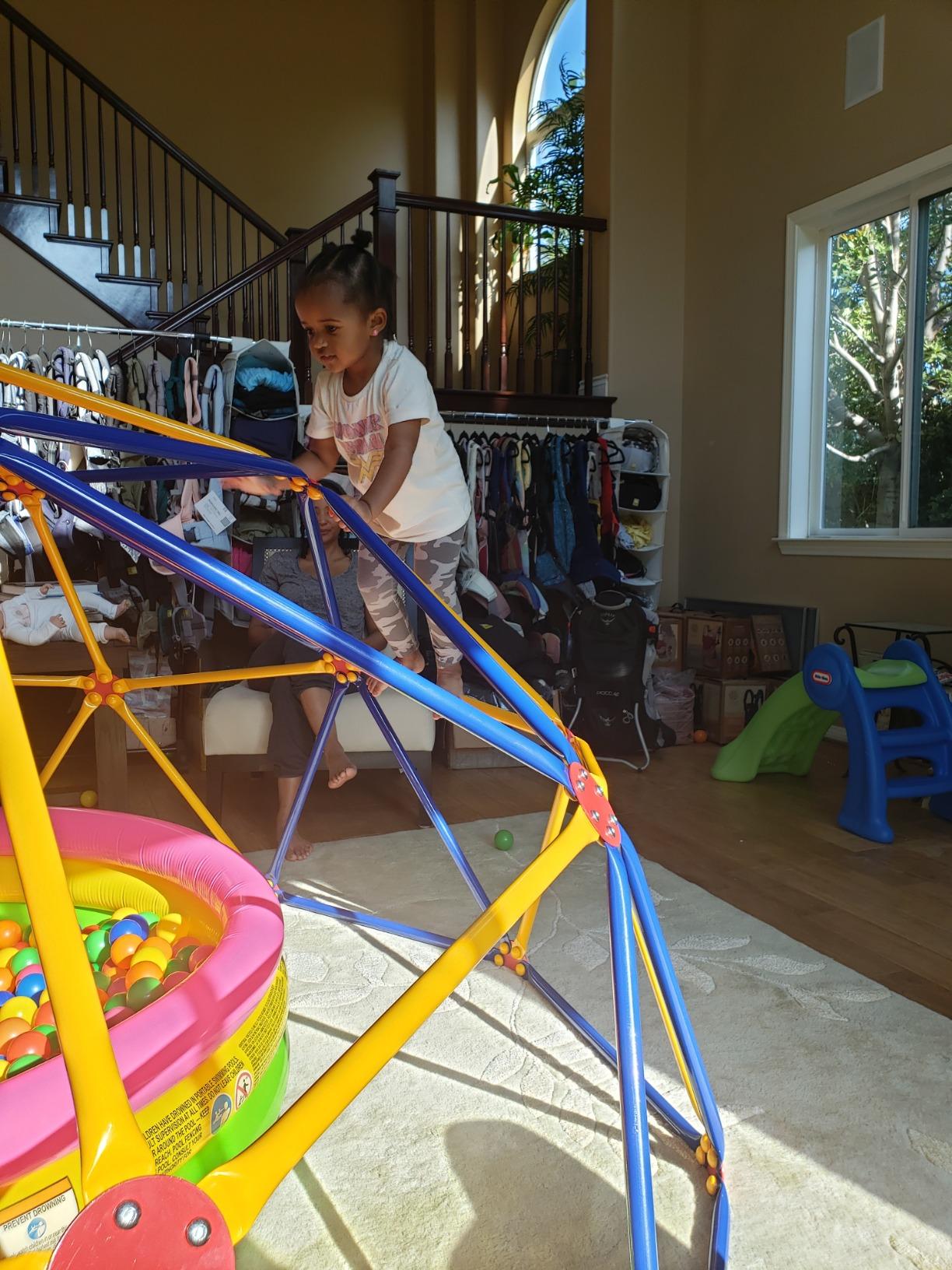
Material is rust and UV-resistant steel, and the warranty is a 2-year limited manufacturer warranty, the longest stated in this group. Multi-year follow-up reviews report no rust and no sun discoloration, which is the durability track record you want to see before committing a patch of lawn for a decade.
Intended for children ages 3 to 9 with up to five players, it sits in the sweet spot where a slightly younger age range than the 10-foot domes is offset by a stiffer, more compact frame.
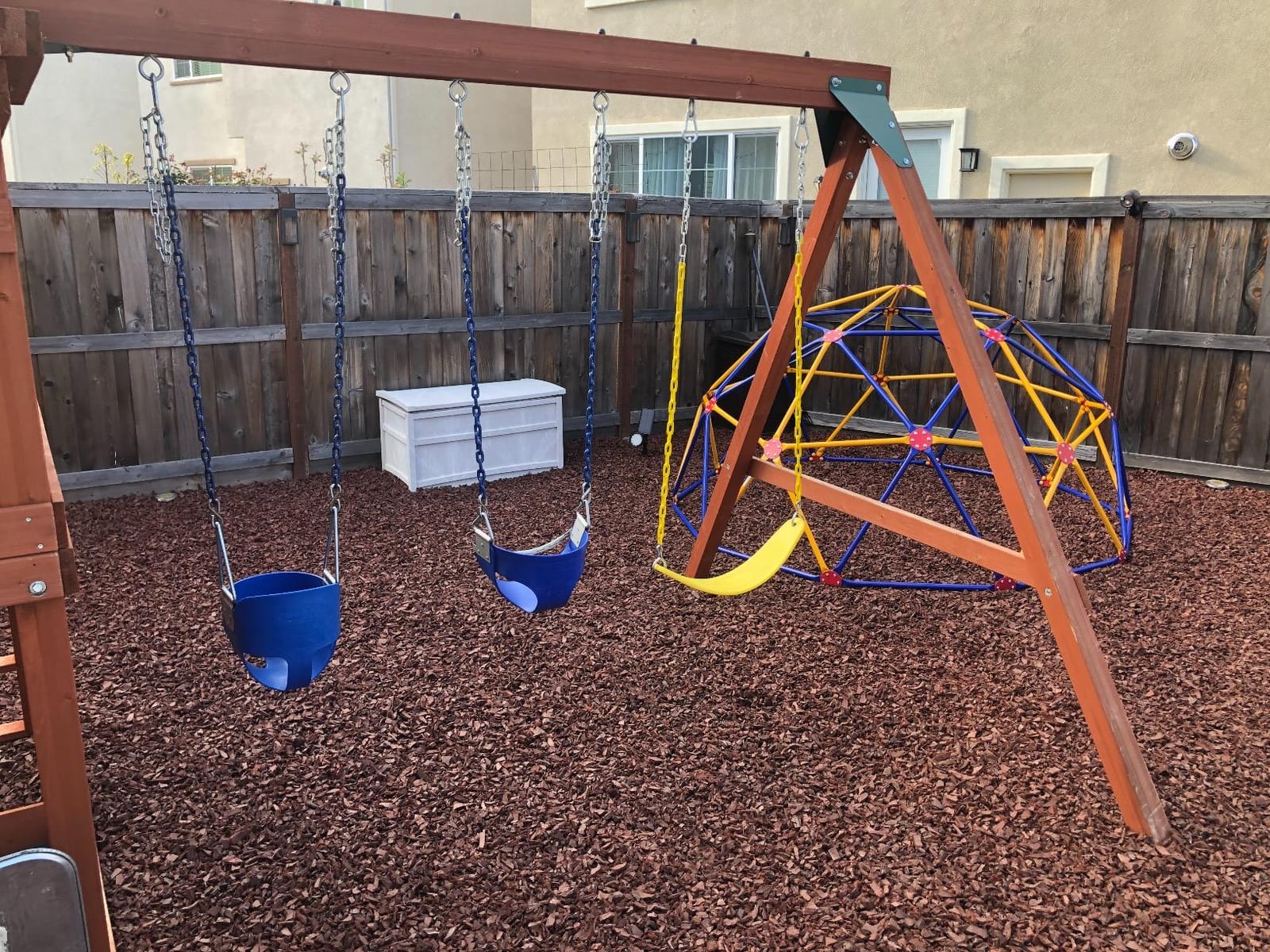
What the covered fasteners change in daily use
On a climber, every exposed bolt end is a place a shin, a forehead, or a hand meets steel. Covering the aircraft nuts removes that hazard entirely, and it also stops grit and water getting into the threads, which is what turns a fastener into a rust stain down the pole below it.
It is a small manufacturing decision that buys a lot of peace of mind for the price difference, and it is the reason this frame holds up better to unsupervised sibling play than cheaper domes of the same size.
Where it falls short
At 74 pounds, this is not a one-person job to reposition. If you want to mow underneath, you will need a second adult or a furniture dolly, and the frame will scratch if you drag it across concrete.
The smaller 91-inch diameter means fewer children on it at once than a 10-foot dome, despite the higher capacity rating. Capacity is the ceiling; footprint is the limit on how many kids fit. Buyers also report occasional shipping damage to the bulky box and incomplete hardware packs, so inspect everything before you start.
5. GIKPAL 10FT Climbing Dome with Hammock – Best Two-in-One
Climbing Dome with Hammock Swing Seat 10ft Outdoor Jungle Gym Kids Playset
10 ft diameter by 5 ft high
65 galvanized pipes
1000 lb capacity
Ages 3 to 10
Pros
- Hammock and detachable swing add real play value
- No flex when an adult hangs from the frame
- Galvanized pipes resist rust
- Smooth frame with no sharp points
- 5 ft height is enough to stand underneath
Cons
- Instructions are confusing so follow the part letters
- Assembly needs up to six poles held at once
- Not enough straps for both hammock and swing as supplied
A bare dome is a single-activity structure, and single-activity structures lose to boredom faster than most parents expect. This one adds a detachable two-in-one hammock and swing seat to a 10-foot galvanized dome, and the extra zone is what turns it from a climbing toy into a small hangout.
The frame uses 65 hot-dip galvanized pipes with a 2.5-millimeter iron wall, rated to 1000 pounds with a 10-foot diameter and 5-foot height. Buyers report no flex when an adult hangs off it, and children use the hammock for long stretches rather than treating it as an occasional novelty.
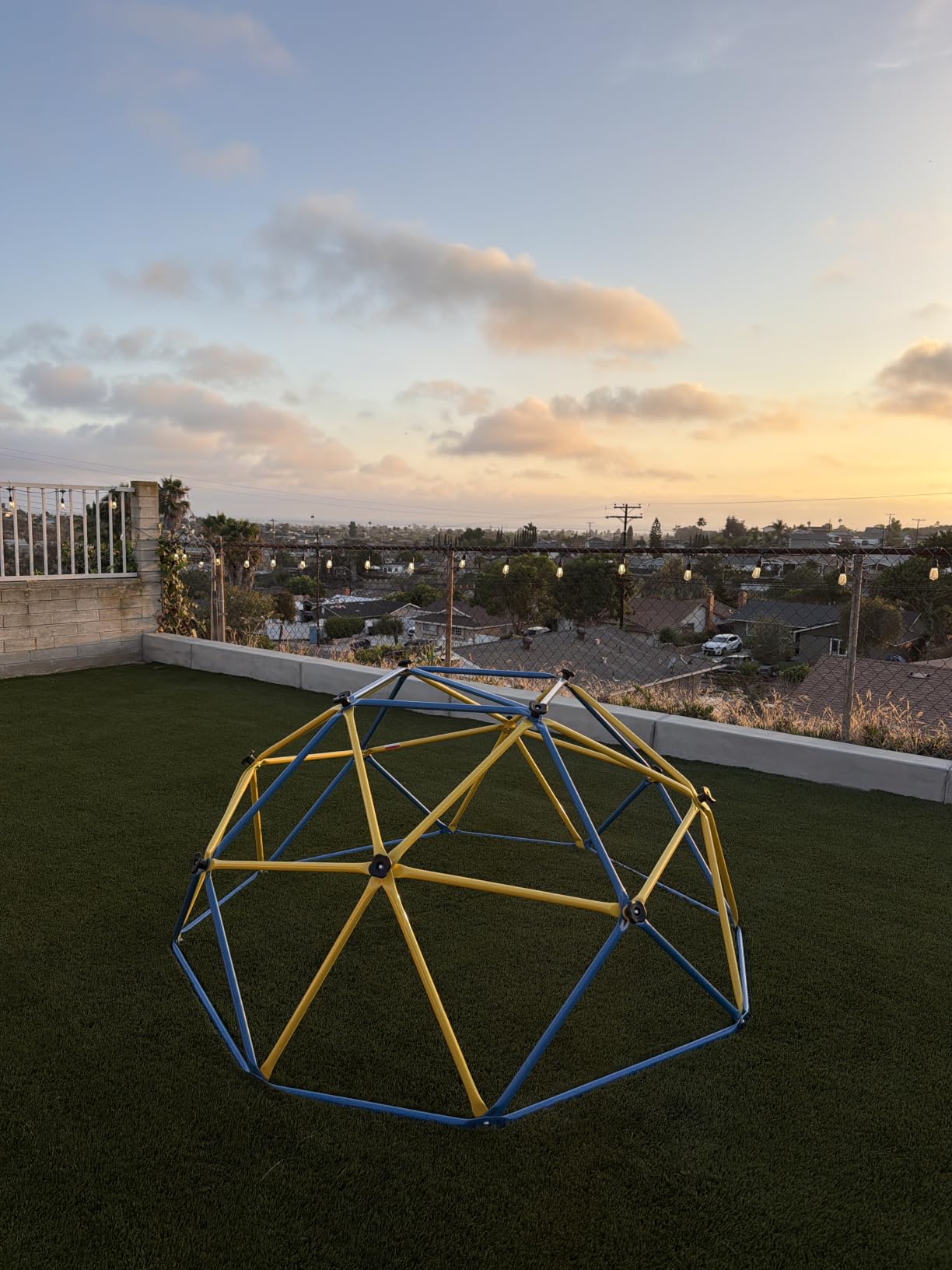
Sizing is for children ages 3 to 10, with up to six playing at once. The detachable mat doubles as a ground mat or a second-floor hammock, which means the same component does duty in two places.
One specification worth noting: at 5 feet tall, the dome has enough clearance under the top platform for an adult to stand. That detail is what makes it work as a supervised shared structure rather than a strictly single-child activity.
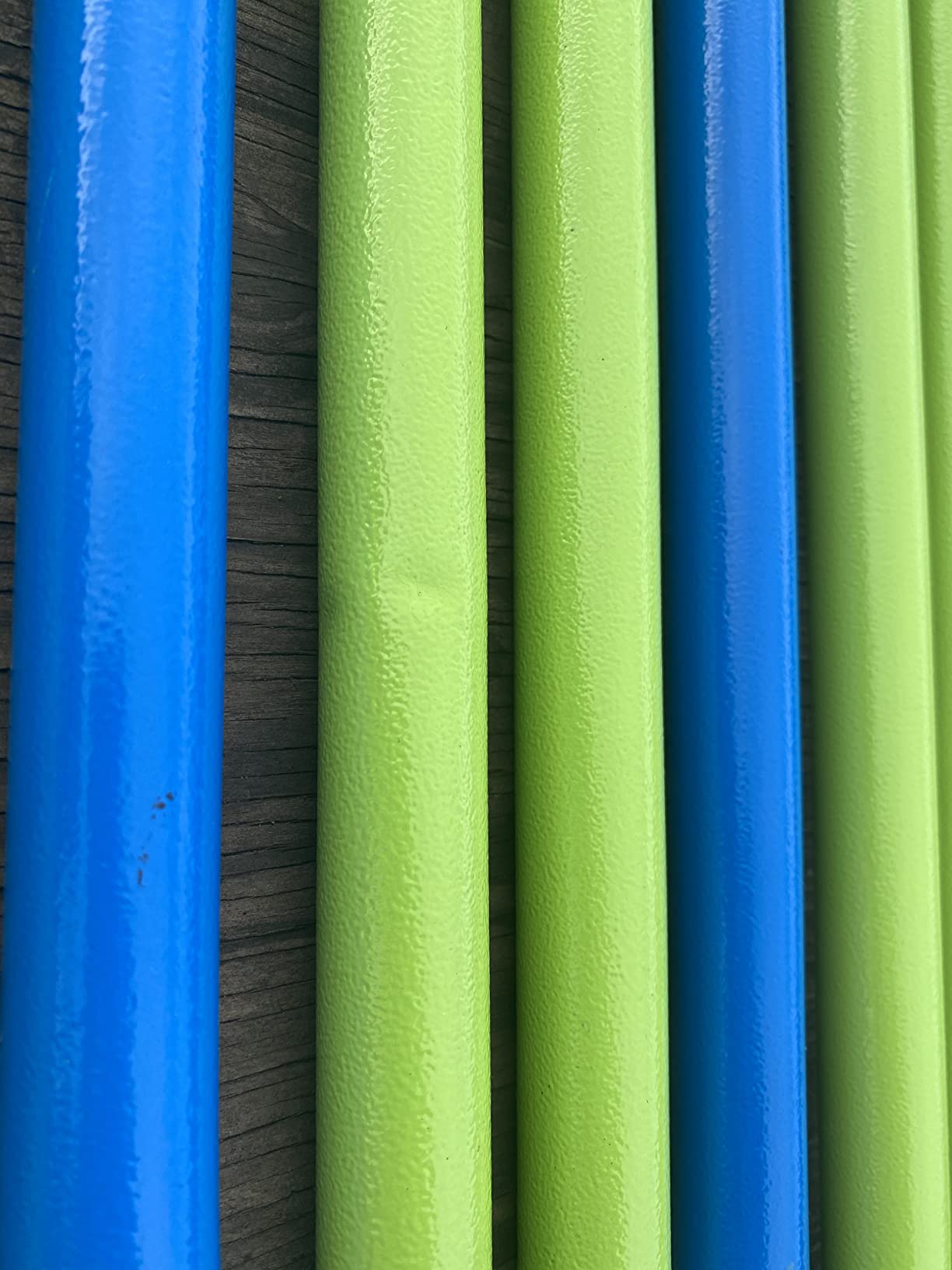
Why a hammock changes how the dome gets used
The complaint parents raise most often about a dome is that it is a one-child-at-a-time activity. A child who is not climbing has nothing to do, and the appeal fades. Adding a hammock and a swing creates a waiting activity that is genuinely appealing rather than a consolation prize, and siblings end up playing together instead of taking turns.
It also extends the usable age range downward. A three-year-old can sit in the hammock under the frame while an older sibling climbs, which means the structure serves a wider spread of ages at the same time.
Where it falls short
The assembly instructions are the real friction point. Pictures are difficult to follow, and several buyers found the build went smoothly only after they stopped using the diagrams and worked from the part letters instead. Expect to hold up to six poles at once while inserting bolts, which is not a solo task.
Only five straps are included, which is not enough to fit both the hammock and the swing in the configuration as supplied. Check what is in the box before you commit to this one, because buyers have had to source extra hardware to use both attachments.
6. VEVOR 10FT Geometric Dome Climber – Best Certified Frame
VEVOR Climbing Dome for Kids 3 to 10 Years Old 10FT Geometric Dome Climber
10 ft diameter for 4 to 5 children
Hot-dip galvanized steel
750 lb load capacity
Ages 3 to 10
Pros
- Three play modes in one frame with hammock and swing
- Thickened galvanized steel resists UV and corrosion
- ASTM and CPC certified
- PP mesh hammock sheds rain
- Redesigned handle reduces cut risk
Cons
- 750 lb rating is below several competitors
- 80 lb unit weight is awkward to move
- Smallest review base of the major 10 ft models
The VEVOR is built for a group, and the specification reflects that intent: a 10-foot dome sized for four to five children aged 3 to 10, with a 750-pound load capacity. That is a lower ceiling than the 1000-pound frames but a deliberate balance against the unit weight.
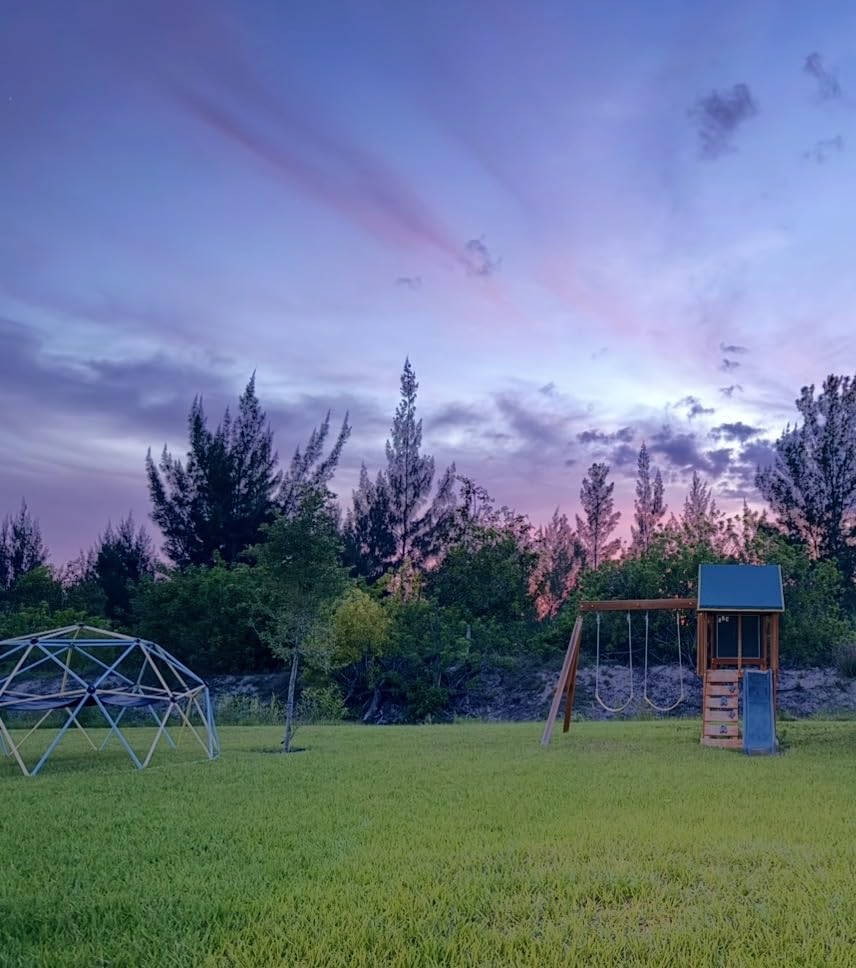
What makes it distinctive is the certification work. The frame is ASTM and CPC certified, and the climbing handle was redesigned specifically to prevent cuts, which tells you the manufacturer tested contact points rather than only structural strength.
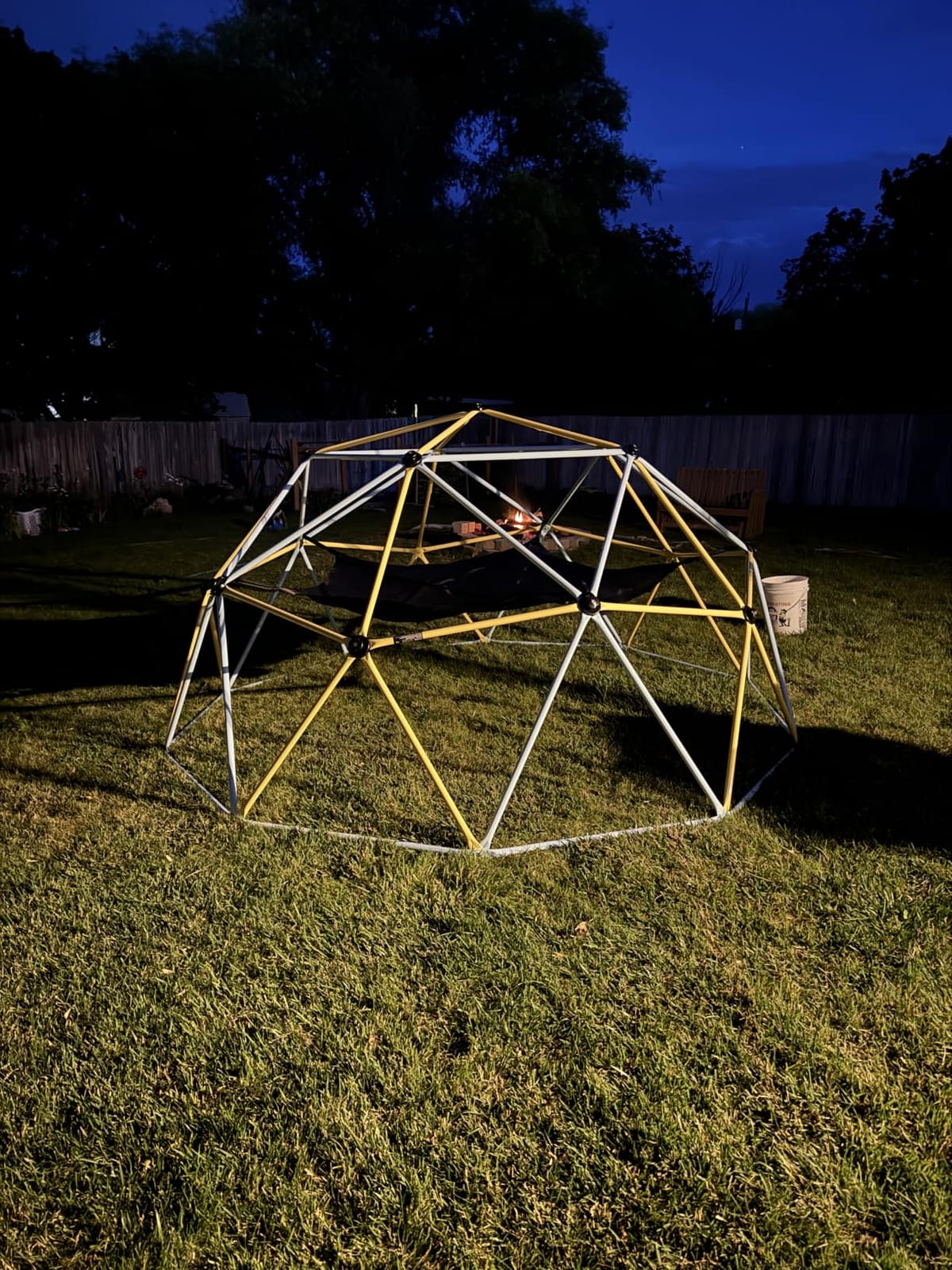
The frame is hot-dip galvanized and coated thickened steel that resists UV, rust and corrosion. The included swing and detachable cushion can be used as a ground pad or as a hammock, and the hammock fabric is PP mesh that resists rainwater and UV rays while remaining breathable on a hot day.
Installation tools, manuals and video guides are included, which is more than most competitors in this group provide and it shows during setup.
What certification does and does not tell you
ASTM and CPC compliance means the product was tested against published standards for things like stability, asphyxiation hazards, load and shear. That is a real baseline, and it is a meaningful differentiator when you are comparing a listing that lists no certification at all.
What certification does not tell you is how the product handles after three summers of UV exposure and rain, which is a function of coating quality rather than test compliance. Read it as evidence of due diligence on the design, not as a durability guarantee.
Where it falls short
The 750-pound rating is meaningfully below the 1000-pound figures on several competitors. That still covers four or five children, but if you routinely have six or more kids on the structure at once, you are closer to the ceiling than you would like.
At 80 pounds, this is one of the heavier units here and repositioning it for mowing is a two-person job. It also has the smallest review base among the major 10-foot steel domes in this roundup, so there is less long-term durability history to draw on.
7. Hapfan 10 ft Dome with Saucer Swing – Best Swing Add-On
Hapfan 10 ft Climbing Dome Swing Set with Saucer Swing for Kids 3-12
10 ft by 10 ft by 5 ft
65 steel tubes
800 lb total capacity
Ages 3 to 10
Pros
- 65 rust-resistant tubes with reinforced top poles
- 800 lb capacity with a 400 lb rated swing
- Swing is easy to hang and remove
- No extra tools needed and a 3D video is provided
- Light enough to move for mowing
Cons
- Bolt orientation is critical and easy to get wrong
- Two people are recommended for assembly
- Single-tube limit of 133 lbs means spreading weight
- Smallest review base in this roundup
The Hapfan pairs a 10-foot climbing dome with a saucer-style swing, and the swing is rated independently at 400 pounds on a PP jumping mat and Oxford fabric seat. For families who want one structure to deliver both climbing and swinging, this is the most balanced version we found.
The frame is built from 65 rust-resistant steel tubes with an 800-pound total capacity, and the top five blue poles use thicker tubing than the rest. That reinforcement is why the rating sits at 800 rather than the 500 or so a comparable frame with uniform tubing would claim.
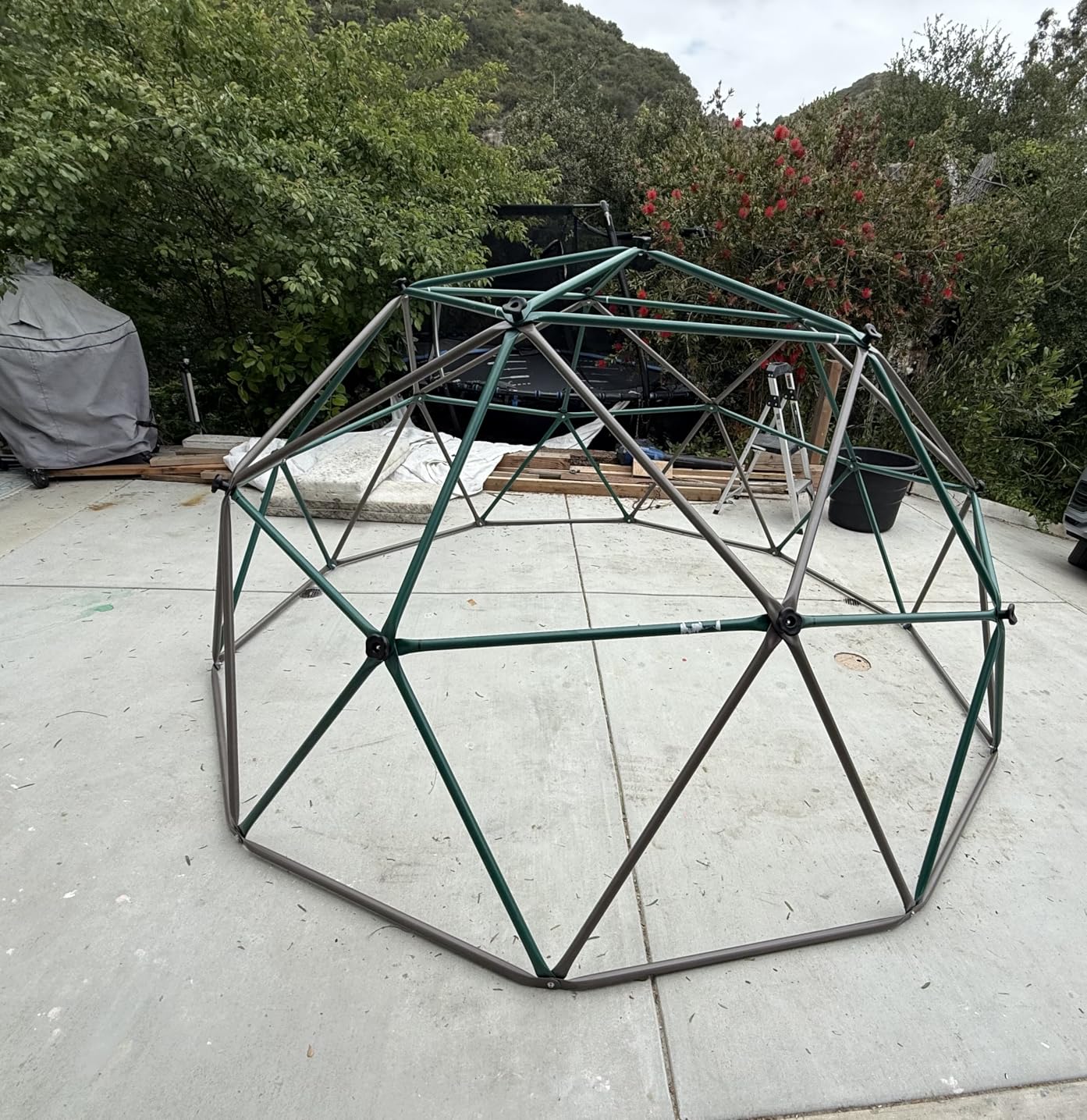
One practical detail matters more than it sounds: the swing is easy to hang and easy to remove. If the swing is not getting used on a given day, taking it down clears the space under the dome and stops it becoming a swing kids run into while climbing.
No additional tools are required, and a 3D assembly video is provided on the product page, which buyers say is the practical way to get the build right on the first attempt.
Why the 133-pound single-tube limit is not a formality
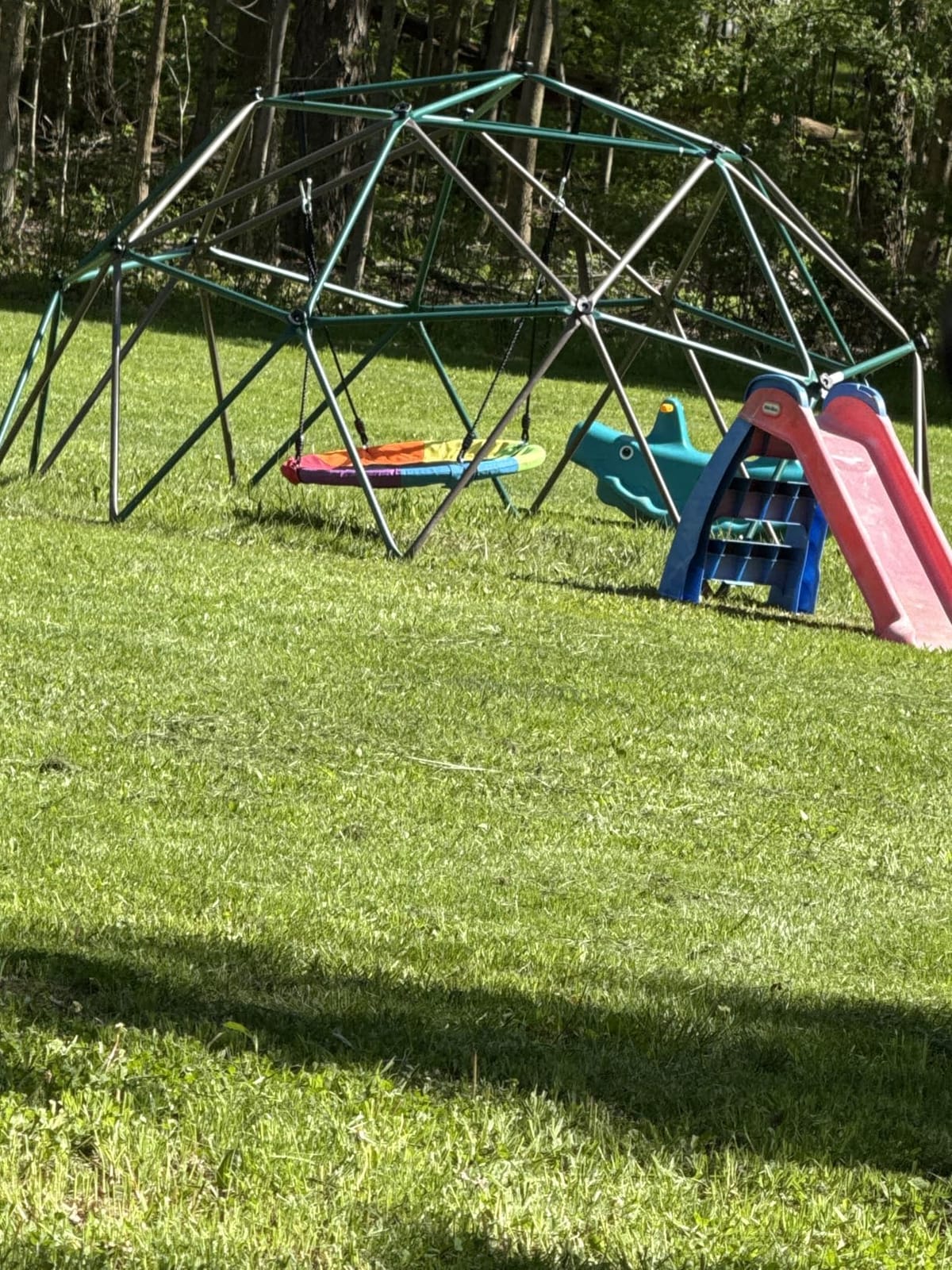
Published total capacity figures describe the frame as a system, not any single bar. This model publishes a 133-pound limit for one tube, and that number explains how weight should be distributed: spread across the surface rather than concentrated in one spot, which is exactly what happens naturally when several children climb at different points.
It becomes relevant when an adult tests the structure by hanging from one point, which is common and which no manufacturer designs for. Spread the load and the frame is well within rating. Concentrate it and you are testing something the rating never described.
Where it falls short
Bolt orientation is the critical assembly detail: bottom-layer bolts face inward and upper-layer bolts face upward so the grips attach correctly. Get it wrong and the grips do not sit properly. The 3D video exists specifically because the written instructions do not convey this clearly.
Two people are recommended for the build, and this is the smallest review base of any product in this roundup, so the long-term record is the thinnest. Treat the swing as the deciding factor, not the frame, if you are choosing between this and a plain dome.
8. Costzon 8FT Dome with Slide – Best Budget Two-in-One
Costzon Climbing Dome with Slide for Kids, 8FT Kids Jungle Gym Monkey Bar Climbing Toys for Outdoor, 2 in 1 Indoor Geometric Dome Climber Playground Set for 3-8 Boys Girls Toddlers Backyard Gifts
8 ft dome with slide
Powder-coated alloy steel
400 lb maximum load
Ages 3 to 8
Pros
- Slide plus dome in one compact footprint
- Powder-coated steel resists rust and wear
- Fabric platform is sun and water resistant
- Handrails on both sides of the slide
- Lightest steel option here at 51 lb
Cons
- 400 lb capacity is less than half the 1000 lb domes
- 8 ft dome suits younger ages rather than older kids
- Instruction clarity depends on the online video
- Lowest average rating in this roundup
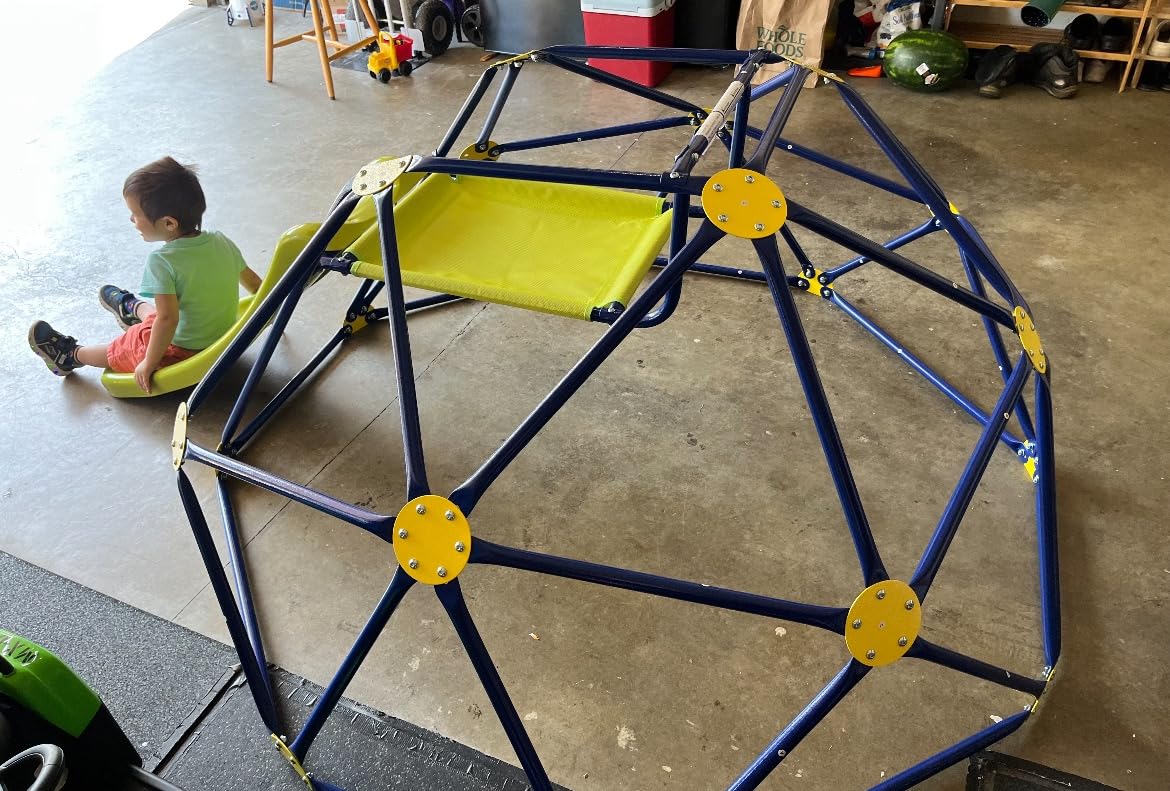
A dome on its own gives kids one thing to do. Adding a slide to an 8-foot frame gives them a way down as well as a way up, and for children who are not confident climbers yet, that is often the difference between using the structure constantly and giving up on it.
The frame is powder-coated alloy steel rated to 400 pounds total, with a 23 by 19-inch fabric cushion buffer at the base of the slide and handrails on both sides. The fabric platform is described as sun-proof, water-proof, fade-resistant and tear-resistant, and the whole set is ASTM and CPSIA certified with smooth corners and edges.
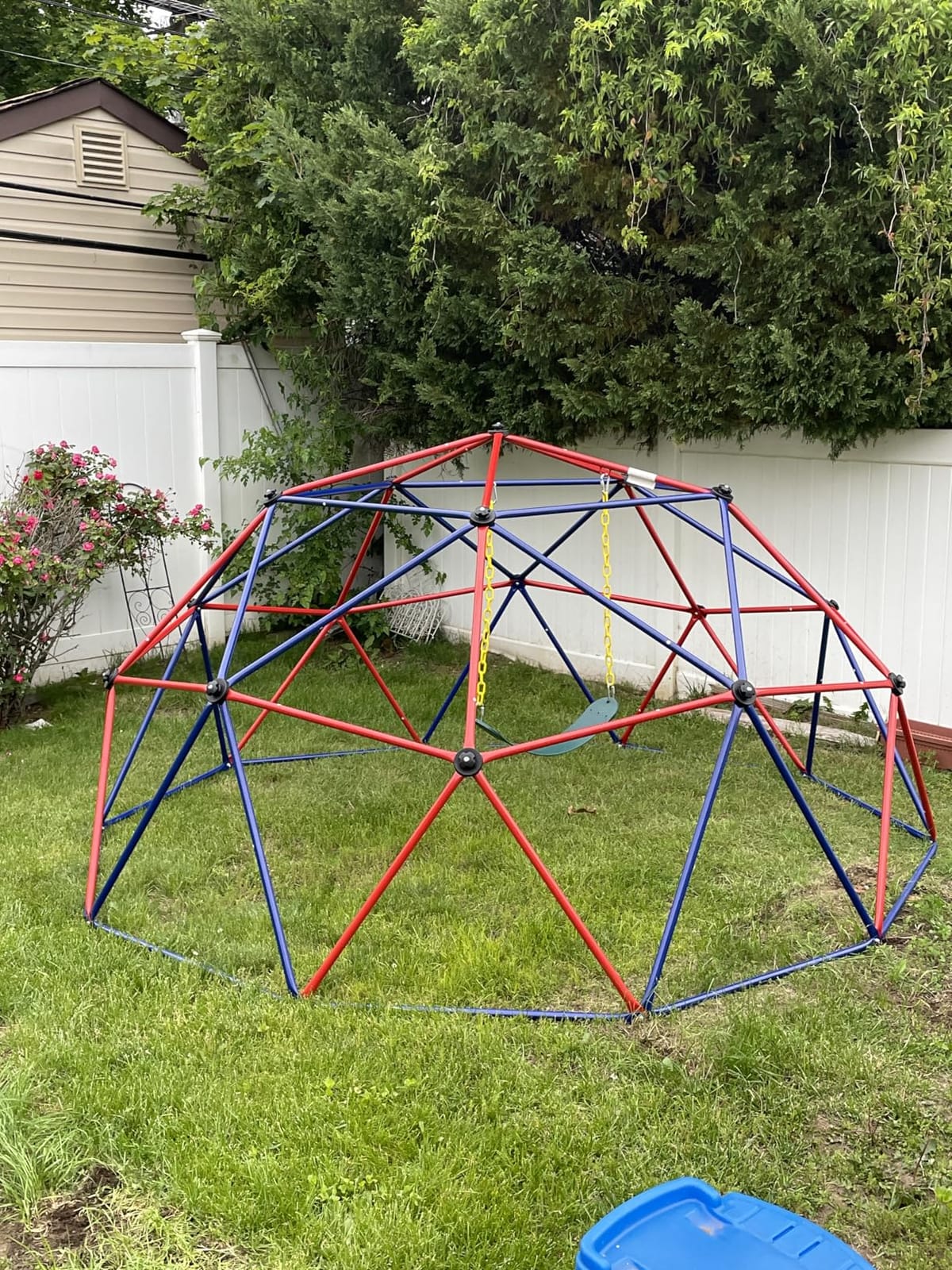
At 51 pounds, it is the lightest steel-framed option here, which makes it far easier to reposition than the 76-to-80-pound units. It is also the smallest footprint, so it is the pick if your yard is tight.
Listed for three players and ages 3 to 8. That range is narrower than the 10-foot domes on purpose, and it matches a two-in-one slide and climber format better than it matches a full-size geo dome.
Why a slide changes the age fit
Most domes are hard for a three-year-old because the climb requires real upper-body strength and tolerance for height. A slide gives that child a legitimate way to interact with the structure from day one, without needing to reach the top. Parents with a toddler and an older child report this as the reason the set keeps getting used.
The slide is also a rest point mid-play, which reduces the frustration that makes younger children abandon a climber. On a plain dome, a child who cannot finish the climb often just walks away. On this one, they ride down instead.
Where it falls short
The 400-pound limit is the honest constraint here. It is less than half the rating on several competitors, which means this is a structure for two or three children rather than a group. Two adults testing it together will exceed the rating.
Its average rating is the lowest in this roundup, and instruction clarity depends on the installation video on the product page. The 8-foot dome also suits ages 3 to 8, so it will feel small to a confident ten-year-old within a season.
9. Olakids 8FT Dome with Slide and Seat – Best for Compact Yards
Olakids Climbing Dome with Slide, Kids Outdoor Jungle Gym Geometric Dome Climber, Steel Frame, 8FT Climb Structure Backyard Playground Center Equipment for Toddlers
8 ft structure including slide
Anti-rust coated steel
330 lb total capacity
Ages 3 and up
Pros
- Dome plus slide and seat in one structure
- Anti-rust steel with weather-resistant coating
- Four ground hooks and four stakes included
- Free of BPA PVC phthalates lead latex and formaldehyde
- Passed stability asphyxiation load and shear tests
Cons
- 330 lb is the lowest steel-framed rating here
- Sliding seat is limited to 88 lb
- 8 ft size includes the slide length so the dome is smaller
- Higher share of 1-star reviews than most
If your yard is the binding constraint rather than your budget, this is the shortest complete structure in the group. It combines an 8-foot dome with an integrated slide and a seat, and it ships with four ground hooks plus four ground stakes, which is unusual because anchors are normally sold separately.
Having the stakes in the box matters more than it sounds. A dome on a slight slope shifts as children jump, the frame walks out of true over time, and anchoring is the difference between a structure that stays rigid for years and one that develops a lean.
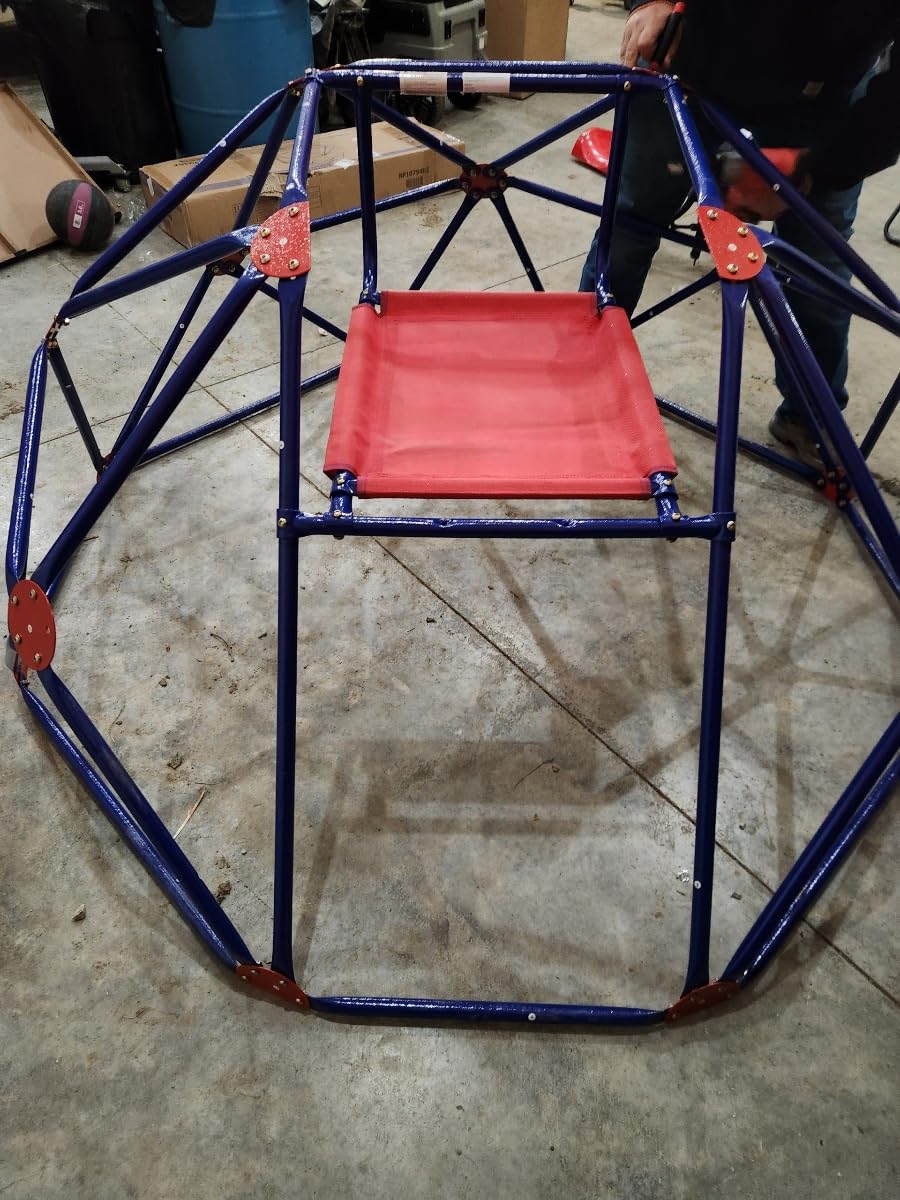
The frame is anti-rust steel with a weather-resistant coating. On materials, this listing is the most transparent of the group: it states compliance with US CPSIA and ASTM requirements and states that the product is free of BPA, PVC, phthalates, lead, latex and formaldehyde.
It also lists specific tests passed: stability, asphyxiation, load and shear. For a structure aimed at younger children, that documentation is worth more than an extra foot of diameter.
Read the 8-foot size carefully
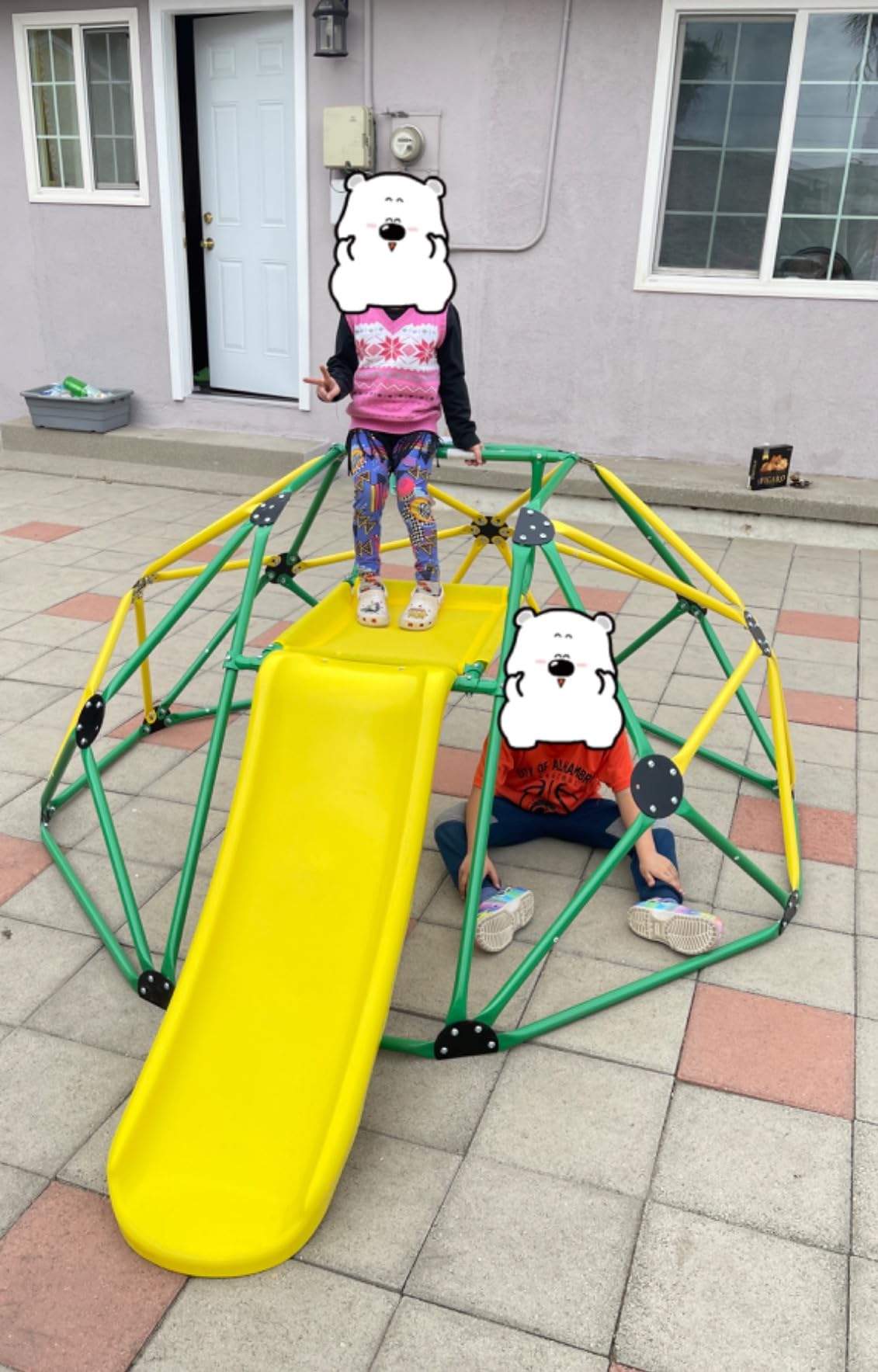
The listed size includes the length of the slide, so the dome itself is smaller than the 8-foot figure suggests. Buyers who measured for their available space and then found the climbing area tighter than expected are the recurring complaint in feedback on this format.
Before you buy any 8-foot dome-and-slide combination, measure the dome section separately rather than the overall footprint, and add the six-foot clearance on every side from there. That habit prevents the most common disappointment with this style of set.
Where it falls short
Capacity is the real limit: 330 pounds total, the lowest rating among the steel-framed domes here, and 88 pounds for the sliding seat. That makes it a two-child structure, or a single-child one that a parent supervises closely.
Its rating distribution shows a higher share of one-star reviews than the other products in this roundup, which usually points to assembly experience rather than frame failure, but it is worth factoring in if you are not confident about building it. The 3D installation video is the practical mitigation.
10. Amictoy 10FT Dome with Hammock and Swing – Best Multi-Zone Play
Amictoy Climbing Dome with Hammock and Swing, 10FT Backyard Jungle Gym
10 ft backyard jungle gym
Weather-resistant steel frame
For 5 to 6 children
Ages 3 to 10
Pros
- Climbing plus hammock plus swing in three zones
- Weather-resistant aerospace steel frame
- Suited to 5 to 6 children in larger yards
- No batteries needed for screen-free play
- Assembly kit and manual included
Cons
- Smallest review base in this roundup
- Claimed 30 minute assembly is optimistic
- Only one size offered in this configuration
- Limited range of add-on accessories
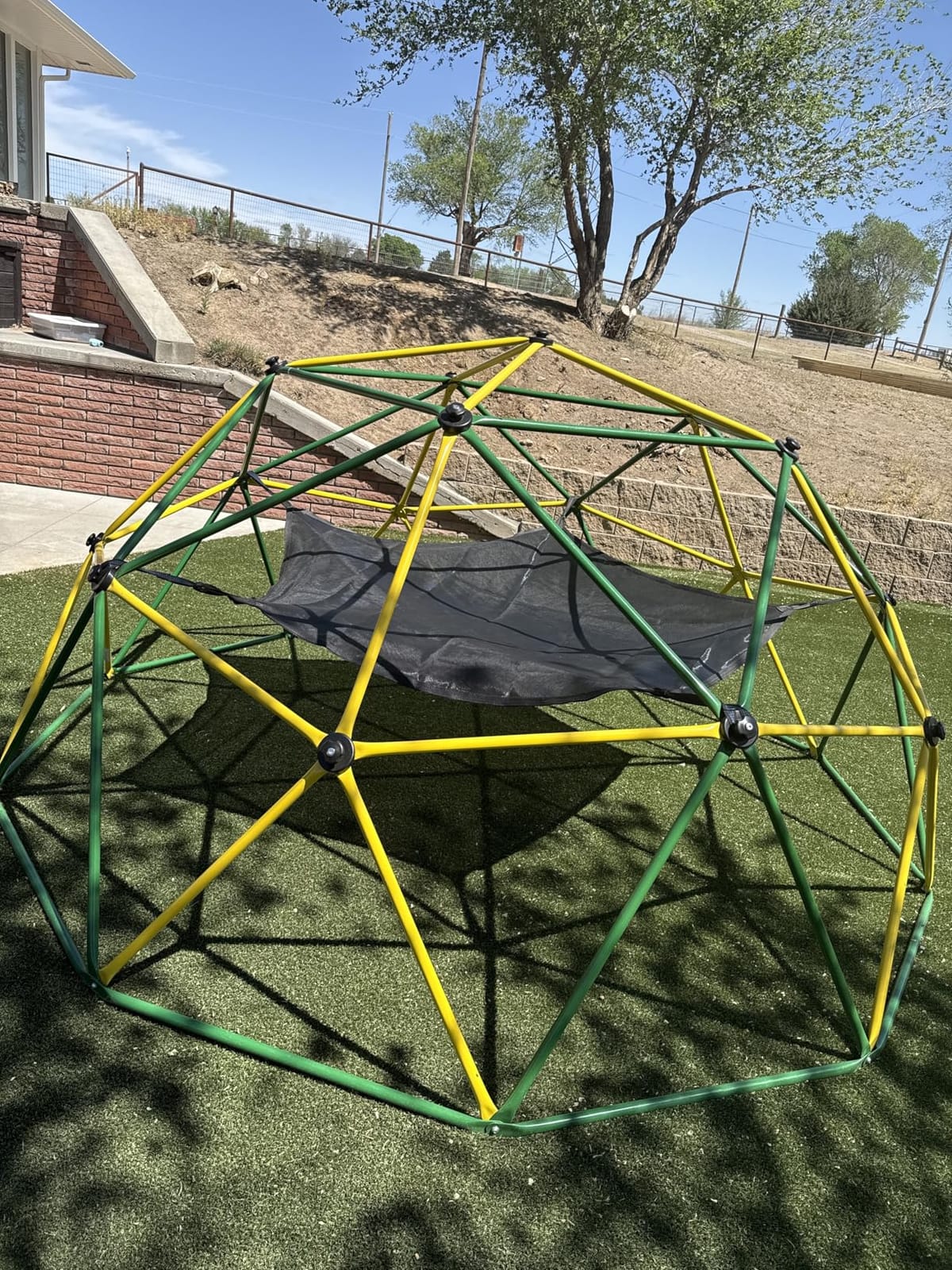
This dome is built around zoning rather than a single activity. It creates three distinct play areas in one 10-foot frame: a climbing surface, a hammock for lounging, and a swing for movement. That structure is the answer to the most common criticism of a plain geo dome, which is that it holds one child’s attention and nobody else’s.
The frame is a weather-resistant aerospace steel construction with ergonomic grips, sized for children ages 3 to 10 and for five to six children playing at once in a larger yard. It works indoors or outdoors and needs no batteries, which for a growing child means it does not become dead weight the way screen-based toys do.
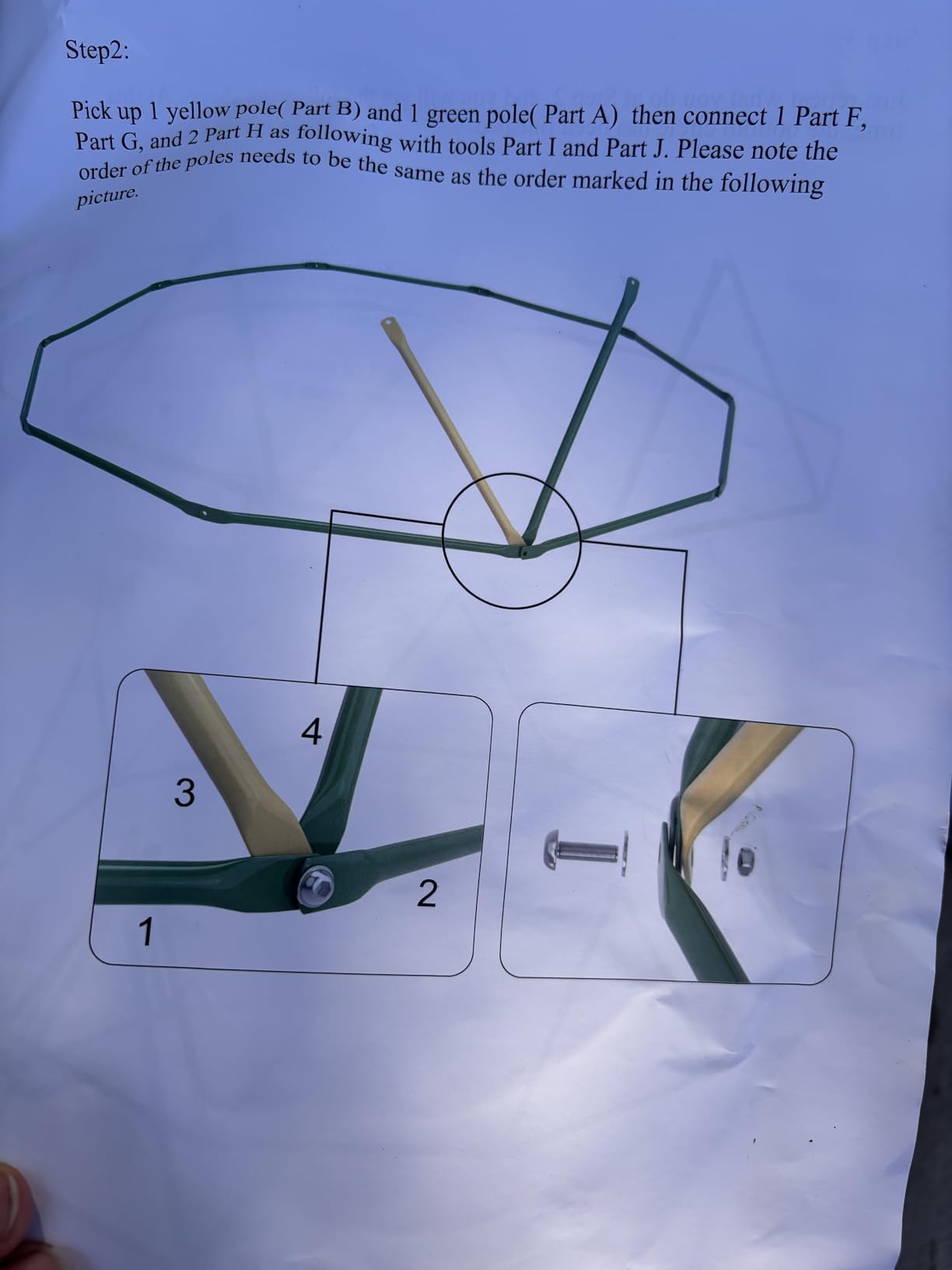
Assembly kit and manual are included, along with a manufacturer claim of roughly 30 minutes. Plan for longer. Domes in this format generally take two to four hours for two adults, because the upper section requires holding several bars in alignment while bolts are inserted.
The published footprint is 120 by 120 by 60 inches. With the six-foot clearance zone on every side, you need close to 22 feet across to place this comfortably, so it belongs in a genuinely open backyard rather than a compact one.
Why three zones beat one zone for group play
When every child wants the same thing at the same time, something has to give. A single-activity dome resolves that with turn-taking, which is where most sibling arguments about sharing play equipment start. Three zones mean the group self-sorts, so a child who is finished climbing can swing while another climbs, and nobody is waiting.
That structure also changes adult supervision. One adult watching a climbing dome is supervising a queue. One adult watching a three-zone structure is supervising three children who are all occupied, which is a meaningfully easier job.
Where it falls short
This is the newest and least-reviewed listing in the roundup, so there is no multi-season durability history behind it yet. That is a real consideration when you are committing lawn space for years, and it is why we would rank it below the more established frames despite comparable specifications.
Only the 10-foot size is offered in this configuration, so it will not suit a small yard. The claimed 30-minute assembly time is optimistic, and the range of compatible add-on accessories is limited compared with brands that sell replacement parts directly.
How to Choose a Climbing Dome for Your Backyard
Measure your clear space before anything else
Measure the footprint first, then add the clearance zone. CPSC guidance for residential play equipment calls for six feet of clear space on all sides of a climber with a fall height under 30 feet, which covers every dome in this roundup. A 10-foot dome therefore needs roughly a 22-foot circle of usable ground, and an 8-foot dome-plus-slide set needs close to 20 feet.
This is the number one reason dome purchases disappoint. People measure the frame, forget the clearance, and end up with a structure jammed against a fence with no safe landing area on any side. If your yard cannot give up six feet in every direction, look at a smaller footprint rather than a smaller budget.
Work out how many kids can climb at once
Capacity ratings describe a ceiling, not a headcount. The practical method is to multiply the number of children who will realistically be on the frame at the same time by a realistic average weight, then compare that against the rating with a wide margin left over.
A single 4-year-old at about 40 pounds uses a quarter of a 150-pound rating and one fifteenth of a 600-pound rating.
Four children averaging 45 pounds come to 180 pounds, which is fine on most steel domes but already uncomfortable on a 150-pound plastic frame.
Six children averaging 50 pounds reach 300 pounds, which is beyond the Costzon 400-pound dome when a parent climbs with them, and comfortably inside every 600 to 1000-pound frame.
Leave at least a threefold margin between the combined weight and the rating. The rating exists for impact loads when a child jumps onto a bar, which is several times their body weight, not just static weight.
Choose material for your climate and care level
Steel frames outperform plastic on stiffness and capacity, and the difference is felt: a plastic frame flexes slightly under a determined climber, while powder-coated or galvanized steel does not. For most families buying a dome that stays up year-round, steel is the right default.
The distinction that matters within steel is coating. Powder-coated steel is paint over steel, so any scratch exposes bare metal and that is where rust starts. Hot-dip galvanized steel has a zinc layer beneath the finish, so a scratch exposes zinc, which continues to protect the steel underneath. On a structure that will sit through rain and sun for years, galvanized wins on longevity.
Two cautions on steel: it gets hot in direct sun, which makes an unshaded backyard less comfortable in peak summer, and it must not be dragged across concrete, which scars the coating in the places the frame flexes most.
Match the gradient to your child’s age
Dome difficulty comes from the slope of the frame and the spacing of the bars, not from the rating. A steep 10-foot dome with widely spaced bars can be genuinely hard for a three-year-old to summit, and a child who fails repeatedly may abandon the structure rather than persist.
Look for models with a lower starting bar, a shallower incline, or molded grips that give a small child something solid to hold. A toddler-friendly option should have a low entry point and enough structural rigidity that a 30-pound child cannot flex the frame. These picks exist for exactly that reason, and they are the right starting point if your youngest climber is under four.
Budget two adults and a full afternoon
Every dome in this roundup takes between two and four hours to build, and every manufacturer instructs that at least two adults are needed. This is not a one-person job at any price point, including the tool-free plastic model, which is quicker but still takes a couple of hours of careful work.
Three habits make assembly straightforward. Pre-sort and label every hardware bag before touching the frame, because the build depends on parts arriving in a sequence. Leave bolts hand-tight until the entire frame is assembled, then tighten in a second pass, because tightening early locks pieces into misaligned positions. And work on a soft surface such as grass or a tarp to protect the powder coat.
Budget for level ground as well. A dome built on a slope sits unevenly, rocks under load, and eventually leans. Flattening a patch of ground is more work than most parents expect and it is worth doing before the frame arrives, not after.
Anchor it, and count the true total cost
A dome is sold as freestanding, but freestanding and stable are different things. On flat ground in a sheltered yard a weighted frame can stay put. On a slope, in an open yard, or in any region that sees strong seasonal wind, auger-style ground anchors are the difference between a structure that survives and one that shifts. Only a couple of the models here include stakes in the box.
Add the second cost that rarely gets mentioned: surfacing. A fall zone of the required size needs shock-absorbing material, and that is a separate expense from the dome itself. Budget for surfacing and anchoring before you buy, because both are cheaper to plan for than to add later.
Ground Surfaces and Clearance Zones for a Backyard Climbing Dome
Put shock-absorbing surfacing under the entire fall zone, which extends six feet beyond the frame on every side. CPSC guidance names specific materials for this purpose, and ordinary lawn grass does not qualify on its own, because turf compacts over time and loses its ability to absorb a fall.
Rubber mulch is the cheapest route to a compliant surface and is easy to spread, but it does not compact or stay level, so it needs topping up each season.
Engineered wood fiber has a softer, more natural feel and hides debris well, but it must be installed over a depth that meets the fall-height standard.
Rubber tiles are the most consistent option and never shift, at the highest cost per square foot and with seams you have to interlock carefully.
Poured rubber gives the best coverage with no seams, but it requires professional installation and a properly prepared base.
Grass is fine for a play surface and a poor fall surface. Keep the frame over it if you like, but do not count it as protection.
Drainage matters more than most buyers expect. A dome sitting in a puddle will sit in water at the base joints, and standing water trapped against galvanized steel is the fastest route to corrosion. A slight grade away from the frame, plus a surface that lets water through, protects the frame longer than any coating upgrade.
Frequently Asked Questions
Are climbing domes worth it?
For most backyards, yes. A dome delivers a full body workout, upper-body strength work and unstructured outdoor play in a footprint a fraction of what a swing set needs, and children use one from about age three until they outgrow the challenge. The two conditions that decide it are clear space and surfacing: you need six feet of clearance on every side and shock-absorbing material under the fall zone. If your yard cannot give that up, the value drops sharply.
What age are climbing domes for?
Most steel domes are rated for ages 3 to 10, and a 3-year-old may not manage the summit of a steep 10-foot model even with grips, so judge the gradient rather than the rating. If your youngest climber is between two and five, look for a lower entry bar, a shallower incline and molded grips sized for small hands, or consider a dome with an integrated slide. Plan on three to four years of serious use before the challenge fades.
What to put under a climbing dome?
Use a shock-absorbing surface across the entire fall zone, which extends six feet beyond the frame on all sides. Rubber mulch is the cheapest and easiest to spread, engineered wood fiber feels more natural, rubber tiles never shift but cost the most per square foot, and poured rubber gives seamless coverage with professional installation. Lawn grass works as a play surface but does not absorb falls, and a slight grade away from the frame prevents standing water at the base joints.
Which climbing dome is best for kids?
The Lifetime Geometric Dome Climber is the strongest all-round pick, with a 10-foot by 5-foot powder-coated steel frame, a 600-pound total capacity and a rating of 4.8 across more than 5,000 buyer reviews. For pure capacity, the EASY OUTDOOR Space Dome and the Zupapa 10FT both rate 1000 pounds. For a small yard or a toddler, the Eezy Peezy is lighter and simpler to move, though its 150-pound rating suits one or two children.
How much space does a climbing dome need?
Measure the frame, then add six feet of clearance on every side for the fall zone. A 10-foot dome therefore needs close to a 22-foot circle of usable ground, and an 8-foot dome-and-slide set needs about 20 feet. Most domes are built as circles, so a round area works far better than a narrow rectangle. If you cannot give up six feet in every direction, choose a smaller footprint rather than a cheaper model.
How long does a climbing dome last outdoors?
Longevity tracks coating quality more than brand. Hot-dip galvanized steel frames report multi-season outdoor use with no visible rust, and powder-coated steel holds up well as long as the coating is not scratched through to bare metal. Dragging a pole across concrete is the most common cause of early corrosion. Protect the finish by building on grass or a tarp, keep water draining away from the base joints, and expect a well-kept galvanized frame to outlast the surfacing beneath it.
The Verdict on the Best Climbing Domes for Backyards in 2026
The Lifetime Geometric Dome Climber is the pick we would put in our own yard: a 10-foot powder-coated steel frame, a 600-pound rating with real headroom, grips that hold up outdoors, and the largest body of buyer feedback in this group backing up the durability claims.
Before you buy anything, measure your clear space and plan the surfacing. Six feet on every side and a shock-absorbing surface under the fall zone decide whether the dome works, and no amount of frame quality makes up for getting that wrong. Start from the comparison table above, pick the capacity that matches how many children climb at once, and budget two adults and a full afternoon for the build.