
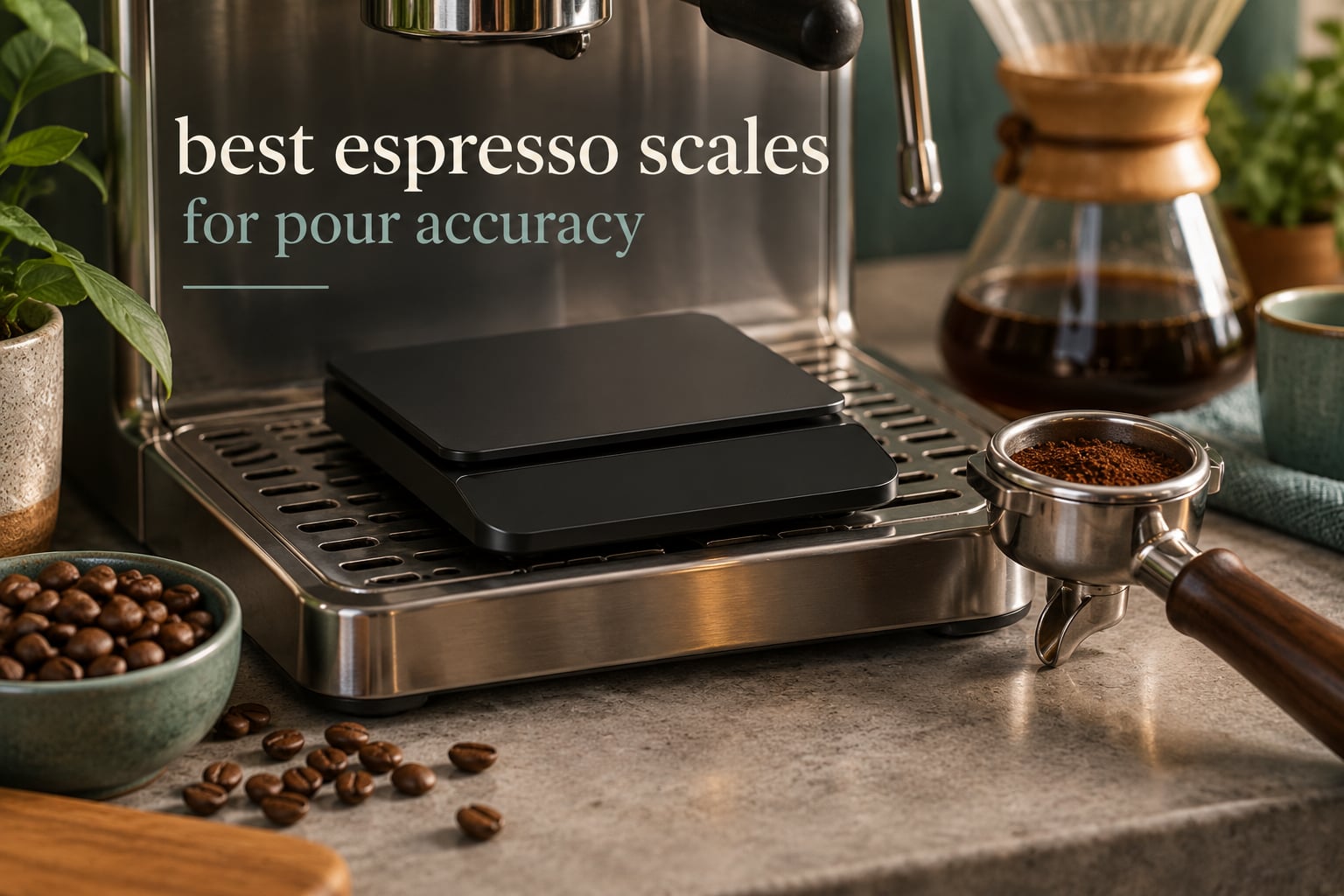
Pour accuracy is the one thing a coffee scale is bought for, and it is the one thing almost nobody defines. A scale can show 0.1 g and still be wrong by a third of a gram, a scale can be dead accurate at rest and useless while liquid is moving, and a scale that is perfect for a 18 g espresso dose can be physically incapable of holding a carafe. We spent weeks weighing the same doses on twelve scales, watching how each one behaves under a moving pour, and measuring bodies against drip trays rather than against each other.
This guide is about the best espresso scales for pour accuracy in the broadest sense: accuracy while you dose a portafilter and accuracy while you pour water over a bed of grounds. Those are two different jobs with two different requirements, and most buying guides blur them into a single spec sheet. The espresso side wants a body slim enough to slide under a group head, a tare that survives a portafilter, and a readout that keeps up with beans falling. The pour-over side wants a platform wide enough for a dripper or server, a display you can read past a carafe, and a stable number while water lands on the bed.
We also handled the question that shows up in every forum thread about scales: does upgrading actually change your coffee? Our short answer is that once a scale is genuinely reading within a tenth of a gram, a jump to a pricier model mostly buys you build, footprint and workflow rather than a better shot. That is why most of our picks here cost very little, and why the two that cost the most are worth it for reasons that have nothing to do with decimal places.
Table of Contents
Top 3 Picks for Pour Accuracy (October 2026)

Greater Goods Digital Espre…
- 0.1g readability to 750g
- 5.7 x 3 inch body fits tight drip trays
- Lid doubles as a weighing tray

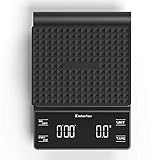
RENPHO Espresso Scale
- 0.1g with 3kg capacity
- Flow rate display and 3 brew modes
- Portafilter memory tare
Every Scale We Covered in 2026 at a Glance
Every pick below is listed with the same three questions in mind: can it read a tenth of a gram, will it fit where you need it, and does it hold a stable number while something is pouring onto it. Read the table, then jump to the review for the one that matches your machine and your brewer.
| Product | Specs | Action |
|---|---|---|
| Greater Goods Digital Espresso Scale |
|
Check Latest Price |
| RENPHO Espresso Scale |
|
Check Latest Price |
 Maestri House S2 Espresso Scale Maestri House S2 Espresso Scale |
|
Check Latest Price |
| KitchenTour Coffee Scale |
|
Check Latest Price |
 BAGAIL Coffee Scale BAGAIL Coffee Scale |
|
Check Latest Price |
 Greater Goods Coffee Scale Greater Goods Coffee Scale |
|
Check Latest Price |
 ERAVSOW Espresso Coffee Scale ERAVSOW Espresso Coffee Scale |
|
Check Latest Price |
 MAXUS Espresso Scale MAXUS Espresso Scale |
|
Check Latest Price |
 WEIGHTMAN Espresso Scale WEIGHTMAN Espresso Scale |
|
Check Latest Price |
 NEOWEIGH Espresso Scale NEOWEIGH Espresso Scale |
|
Check Latest Price |
 Maestri House S3 Pour Over Scale Maestri House S3 Pour Over Scale |
|
Check Latest Price |
 TIMEMORE Basic 2.0 TIMEMORE Basic 2.0 |
|
Check Latest Price |
1. Greater Goods Digital Espresso Scale for tight drip trays and dependable doses
Greater Goods Digital Espresso Scale with 0.1g Precision, 750g Capacity
0.1g readability
750g max capacity
5.7 x 3 x 0.7 inch body
Lid doubles as a tray
Pros
- Slim enough for narrow drip trays
- Backlit LCD with instant tare
- Flip lid doubles as a weighing tray
- Six readout options including calibration
- Rubber feet grip a metal tray
Cons
- No timer for shot timing
- Precision softens on larger loads
- Not water resistant
This is the scale we ended up reaching for most, and the reason is boring in the best way: it does the one job an espresso dose needs without asking you to learn anything. It reads 0.1 g, it tares instantly, and at 5.7 x 3 x 0.7 inches it is narrow enough to slide into drip trays that reject anything wider. That footprint is the single most useful thing about it, and it is a physical fact you can measure before you buy.
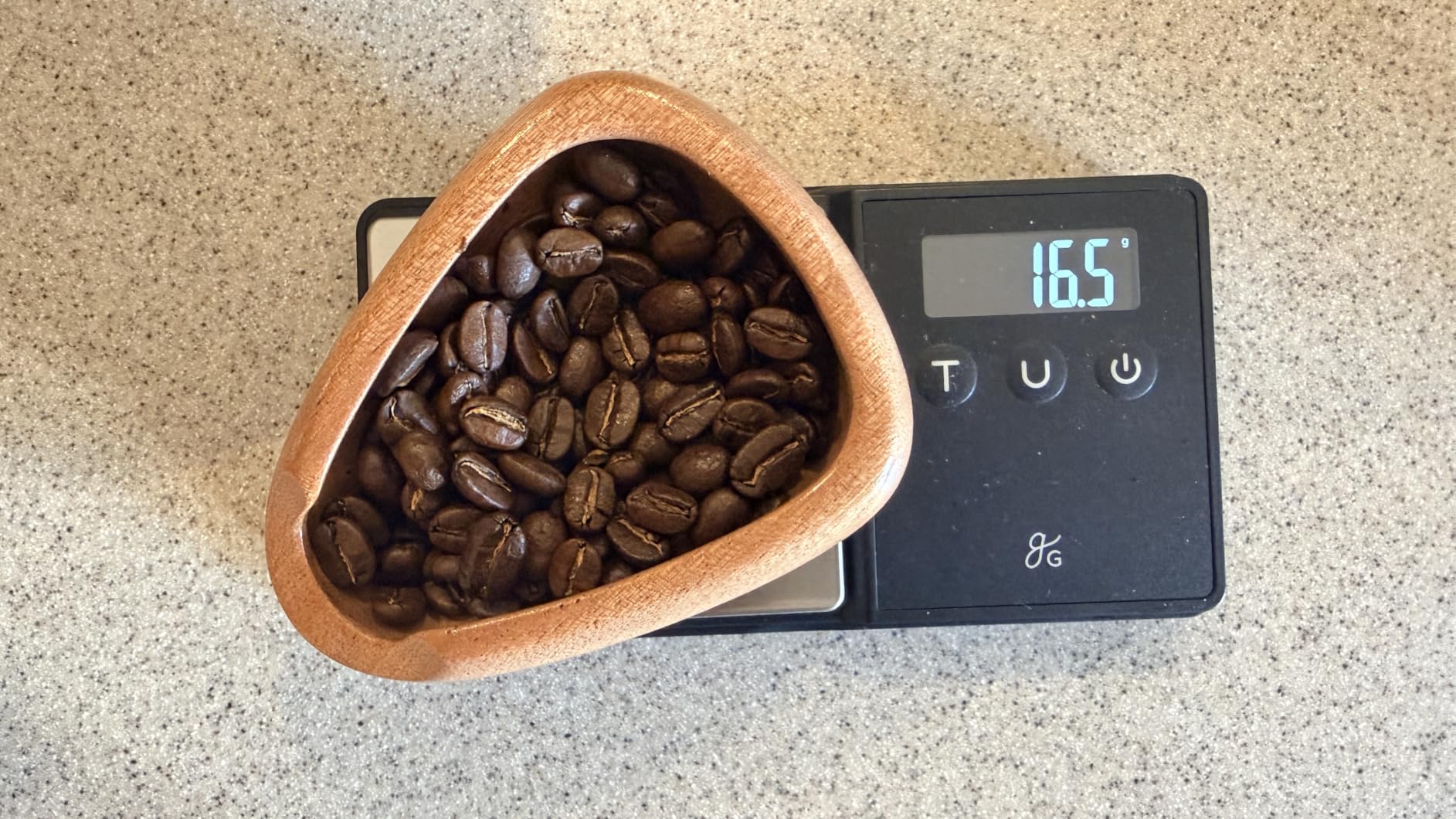
The flip lid is the detail I did not expect to care about. It clicks on as a cover to keep the stainless surface clean, and it detaches to become a small tray for beans so you can dose straight from the lid. On a 18 g double that saves you the awkward funnel shuffle every morning.
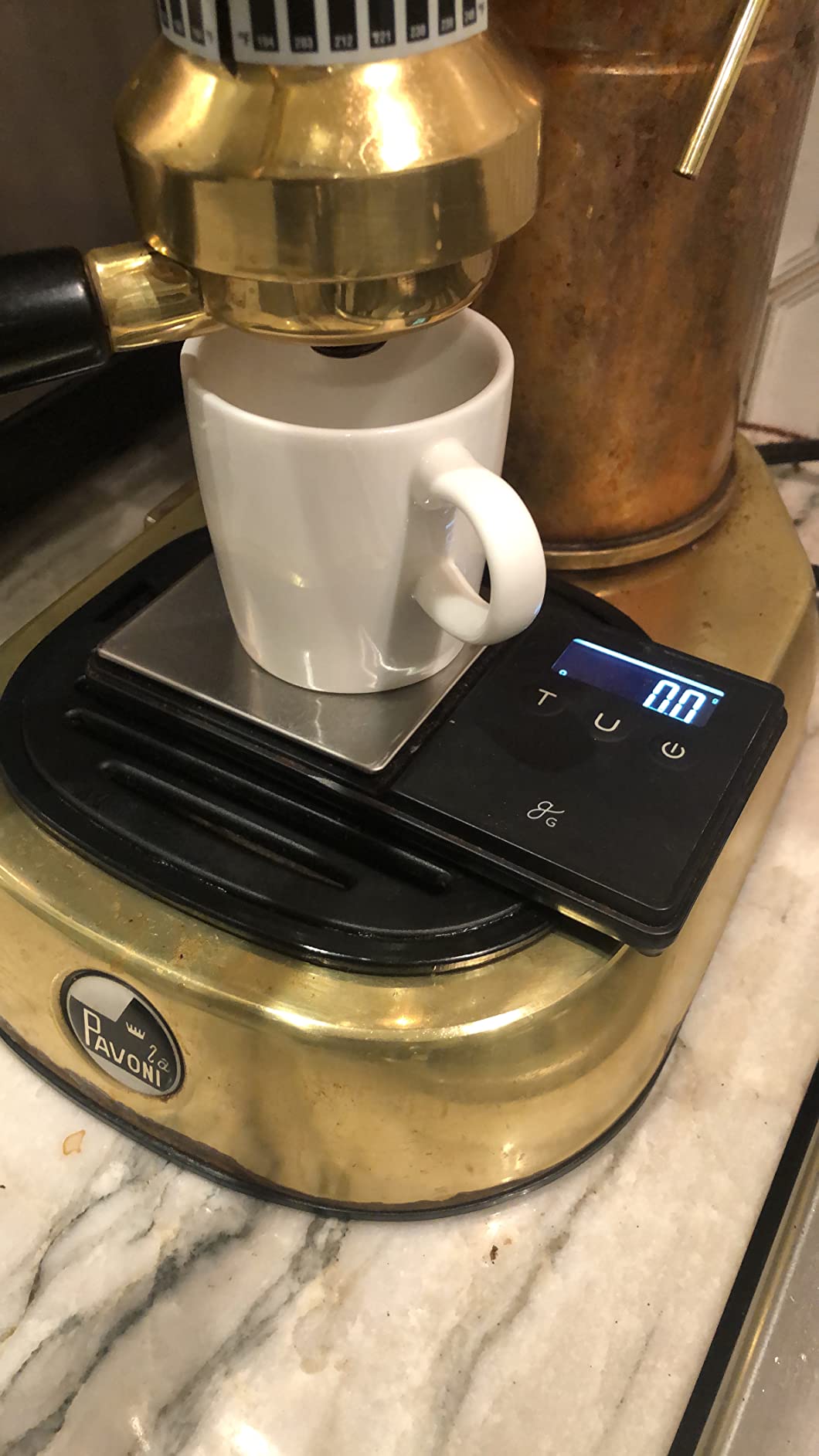
Where it falls short is the top end of its range. Capacity stops at 750 g, and precision degrades a little as the load climbs, so a heavy pour-over vessel is a poor fit. There is no timer either, so shot timing comes from the machine or your phone, which is a real inconvenience for anyone dialing in.
None of that matters for espresso. For dosing, this is the best espresso scale for pour accuracy in the group because it stays readable, stays put, and gets out of the way. Reviewers consistently describe it as accurate and easy to use with physical buttons and a bright display.
What to check before you buy
Measure the depth of your drip tray and the clearance under your group head, then compare against 0.7 inches of body height plus the portafilter clearance you need. A scale that fits on paper can still be unusable if you cannot slide a full portafilter onto it.
Who should skip it
If you brew filter coffee on the same station, look at the 3 kg models further down. A 750 g ceiling with softening precision at the top is a poor match for a carafe, a Chemex or anything else that needs a litre of water measured on it.
2. RENPHO Espresso Scale for the widest feature set at a budget price
RENPHO Espresso Scale with Timer, Rechargeable, 0.1g Accuracy, 3kg
0.1g readability
3kg capacity
Flow rate indicator
1000mAh USB-C battery
Pros
- Flow rate display shows pour speed live
- Three brew modes with auto timer
- Portafilter memory tare saves basket weight
- 0.2 second weight lock-in
- USB-C rechargeable with silicone pad
Cons
- Body is larger than a true micro scale
- Touch controls are finicky with wet hands
The RENPHO does something no other scale in this group does at this level: it shows flow rate while you pour, in real time, next to the weight. For pour accuracy that is the feature that matters most, because it tells you whether your pour is a trickle or a flood rather than making you infer it from how fast the number climbs.
Weight lock-in happens within 0.2 seconds, which is fast enough to stop at a target dose without overshooting. The portafilter memory tare is unusually practical: set it once and the basket weight becomes the zero, so every dose starts clean without a manual tare each time.
At 5.12 x 5.91 x 0.79 inches it is not a micro scale, so measure your clearance first. That footprint is a deliberate trade for the 3 kg capacity and the bigger platform, and it is the wrong shape for a shallow drip tray on a compact machine.
Wet hands on capacitive controls is the other repeated complaint, and it is worth knowing about before you dose with a wet portafilter. The silicone pad is detachable and waterproof, so spills clean off rather than soaking in.
Why flow rate is the feature to care about
Once the weight number stabilises, a pour-rate readout tells you something the weight alone cannot: whether your pour is consistent from start to finish. Watches and plain counters only tell you the total. If your aim is repeatable pouring rather than repeatable totals, this is the pick in the group.
Where it falls short
If your machine has a narrow drip tray and you dose under the group head, the platform is simply too broad. In that case the slimmer bodies further down will serve you better, and you lose the flow rate readout as the price.
3. Maestri House S2 Espresso Scale for the smallest footprint in the group
Maestri House S2 Espresso Coffee Scale with Timer 0.1g Precision Shot Scale
0.1g readability
2000g capacity
4.13 x 4.13 x 0.78 inch
500mAh USB-C battery
Pros
- Fits in the palm and under tight group heads
- 0.1g across a 0.5g to 2000g range
- Borosilicate glass top wipes clean
- Up to 90 days per charge
- Includes a silicone pad
Cons
- Hidden LED is hard to read at some angles
- Auto timer interrupts bean dosing
- Calibration needs a 1kg weight
At 4.13 inches square and 0.78 inches tall, this is the smallest body here, and that is its whole argument. Owners repeatedly praise how it slides under machines with tight group heads where wider scales simply will not go. The borosilicate glass top is also the most wipe-clean surface in the group.
Accuracy holds across a 0.5 g to 2000 g range, which is unusually wide for something this small, and several owners report verifying it against their own kitchen scales with matching results. Battery life is quoted at up to 90 days per charge with a 5 minute auto sleep.
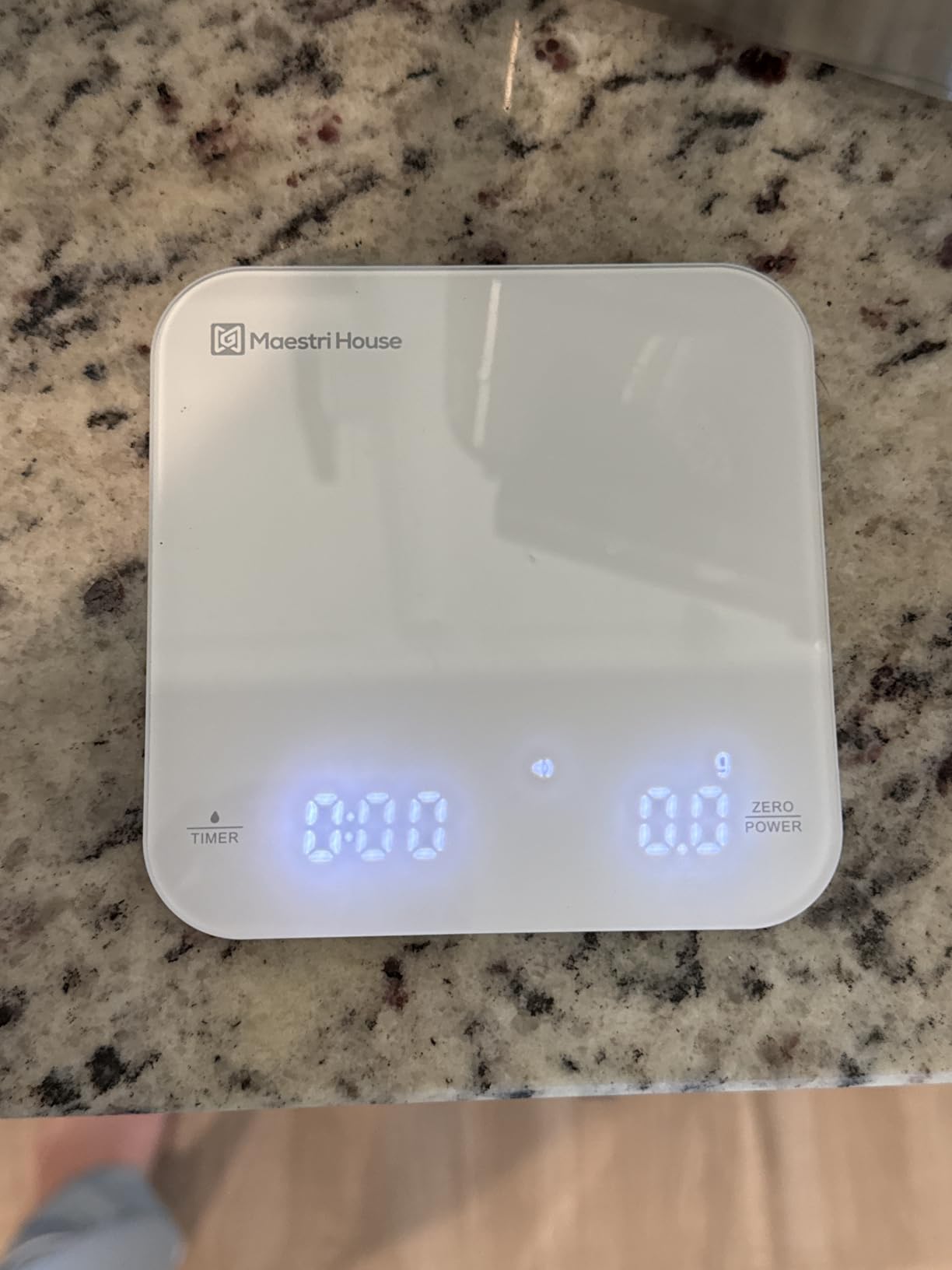
Two annoyances recur. The LED is hidden in the panel, so it disappears at some viewing angles or in bright light, and the auto timer starts the moment weight registers, which interrupts a slow bean dose unless you toggle out of the mode. Calibration also calls for a 1 kg weight, which most home brewers do not own and may not want to buy.
Accuracy can also soften when the battery is not fully charged, so treat a low charge as a reason to plug it in before a calibration session rather than mid-dial-in.
When the small body is the deciding factor
If you have already measured a wider scale and found it will not physically fit, stop reading spec sheets and shortlist by footprint. This is the one to try first when tray clearance is the actual problem, and the glass top means coffee oils wipe off rather than staining.
When to buy something larger
For pour-over work, a 4.13 inch square is cramped under a V60 and hopeless under a carafe. The display visibility issue also matters more with a dripper in the way. If filter is half your routine, the wider platforms further down serve you better.
4. KitchenTour Coffee Scale for pour-over accuracy on a tight budget
KitchenTour Coffee Scale with Timer
0.1g up to 500g
3000g capacity
Back-lit reverse LCD
Batteries included
Pros
- Keeps 0.1g steps out to 500g
- Back-lit reverse LCD is bright
- Batteries included and ready to use
- Washable silicone mat included
- Light and easy to reposition
Cons
- Readout drifts about 0.2g when static
- Timer needs a power cycle to reset
- Silicone mat does not stay put
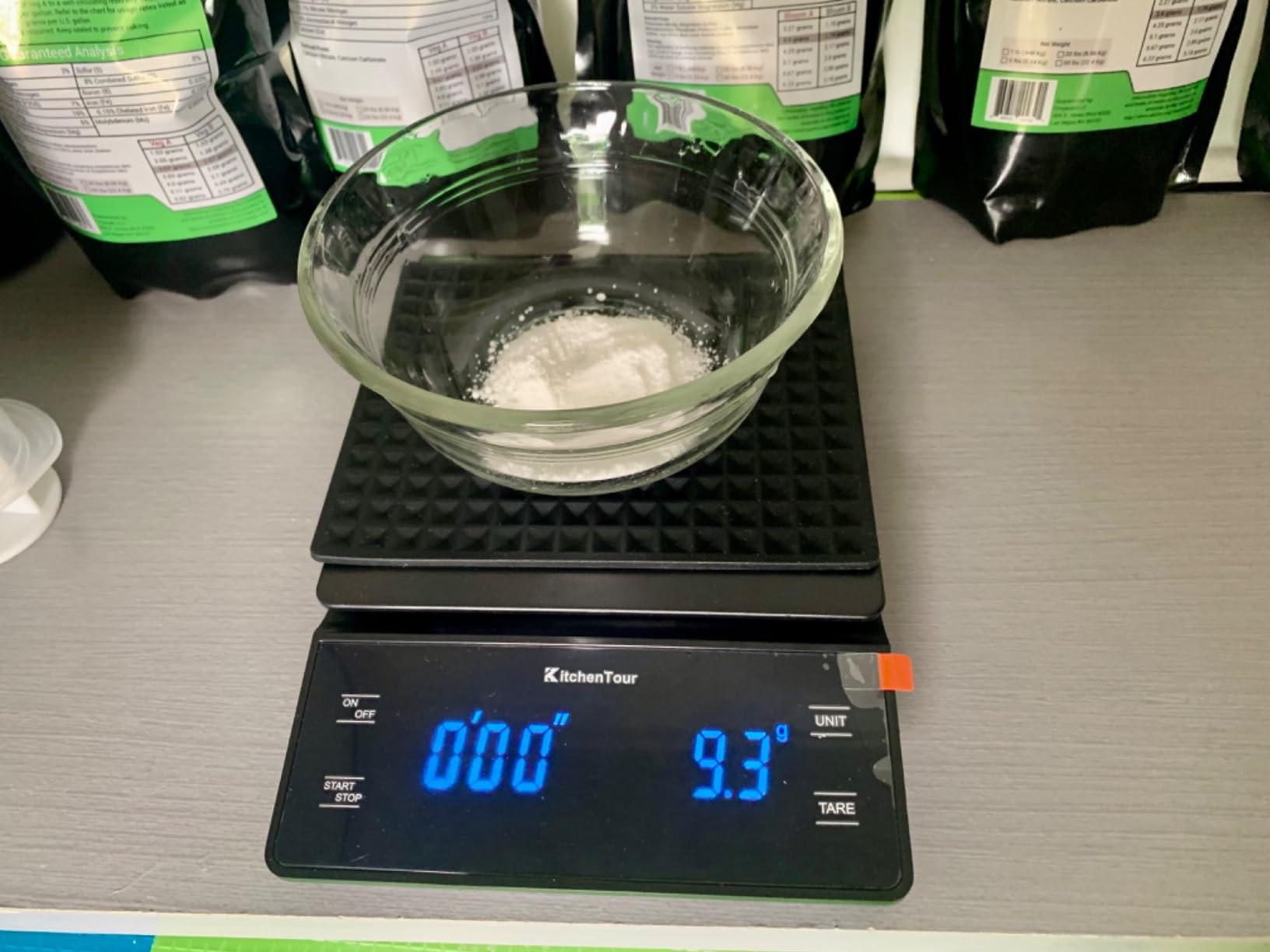
This one holds 0.1 g steps all the way to 500 g before stepping to 0.5 g, which matters more for pour accuracy than the headline resolution suggests. Espresso dosing lives well inside that 500 g band, and so does the first half of most filter recipes.
Reviewers treat it as the budget scale that quietly makes pour-over more repeatable, largely because of the back-lit reverse LCD, which stays legible in a bright kitchen. Batteries are in the box, so you can use it immediately.
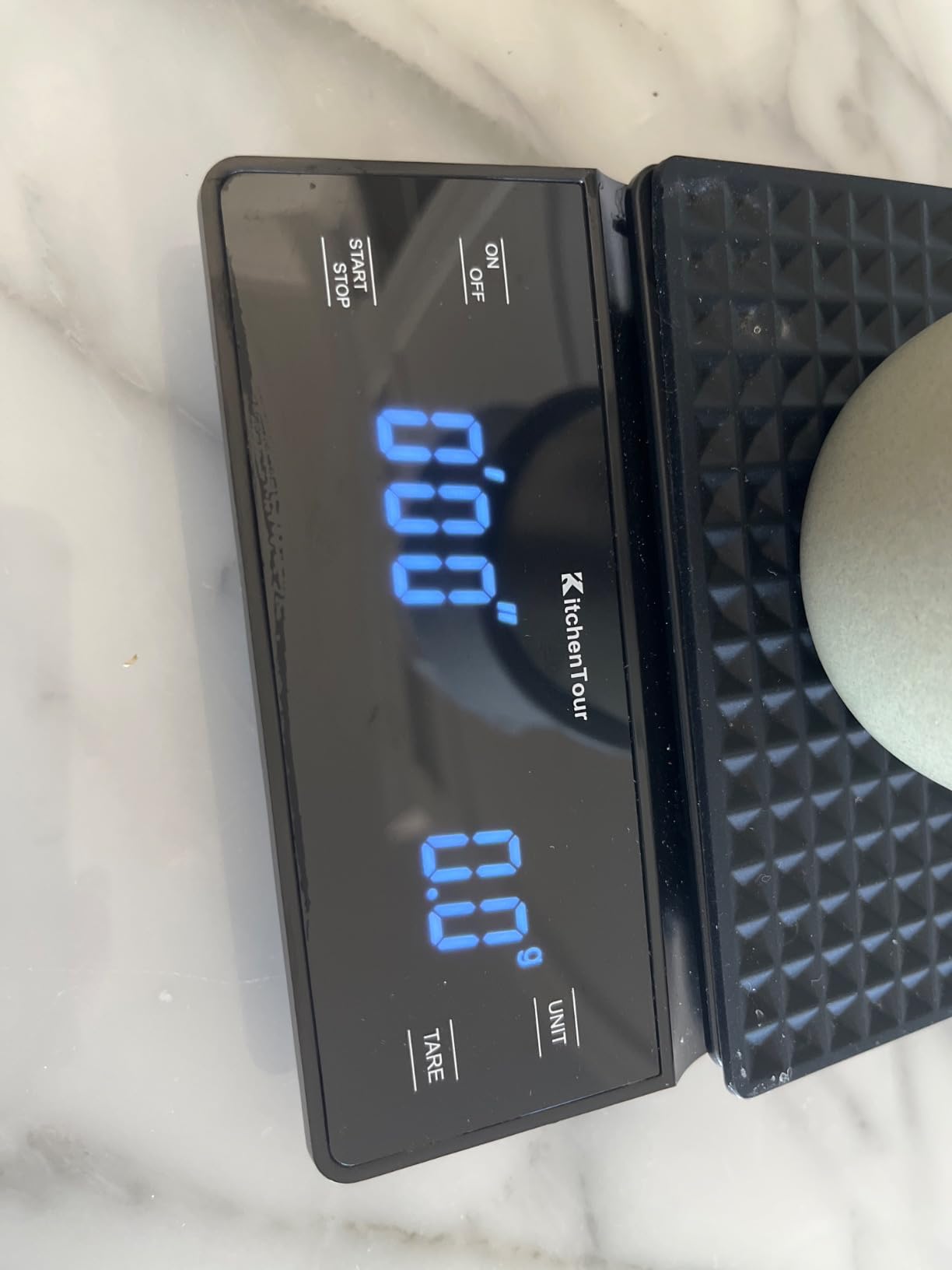
The honest weakness is dynamic behaviour. Owners report the readout drifting by roughly 0.2 g when left sitting still and wandering during a moving pour, which is exactly the moment accuracy matters. If you want a live number while water lands on the bed, this is not the tool.
Smaller annoyances add up: the timer only resets by powering the unit off and on again, and the silicone mat does not stay firmly in place. A handful of owners also report units failing within weeks, so keep the receipt.
Best use for this scale
Treat it as a static weighing tool. Measure your dose, hit tare, start brewing, and read the number when the pour is finished rather than during it. Used that way the drift matters far less and the value is hard to argue with.
Where the money should go instead
If you pour often enough to want a live reading, spend a little more on a scale with a flow rate display. If you only dose espresso, the narrow bodies further down are a better shape for the job.
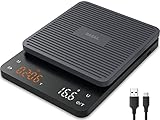
5. BAGAIL Coffee Scale for large vessels and long pour-over sessions
BAGAIL Coffee Scale with Timer, 0.1g/3kg Precision
0.1g readability
3kg capacity
6.7 x 5.1 x 1 inch platform
600mAh USB-C battery
Pros
- Big platform fits drippers and servers
- Readings stabilise fast
- Automatic timing detects pour start
- USB-C with about a month of daily use
- 18 month warranty included
Cons
- Vibration from a machine can jitter the reading
- Touch sensors oversensitive with damp hands
- Display can fade with heavy long-term use
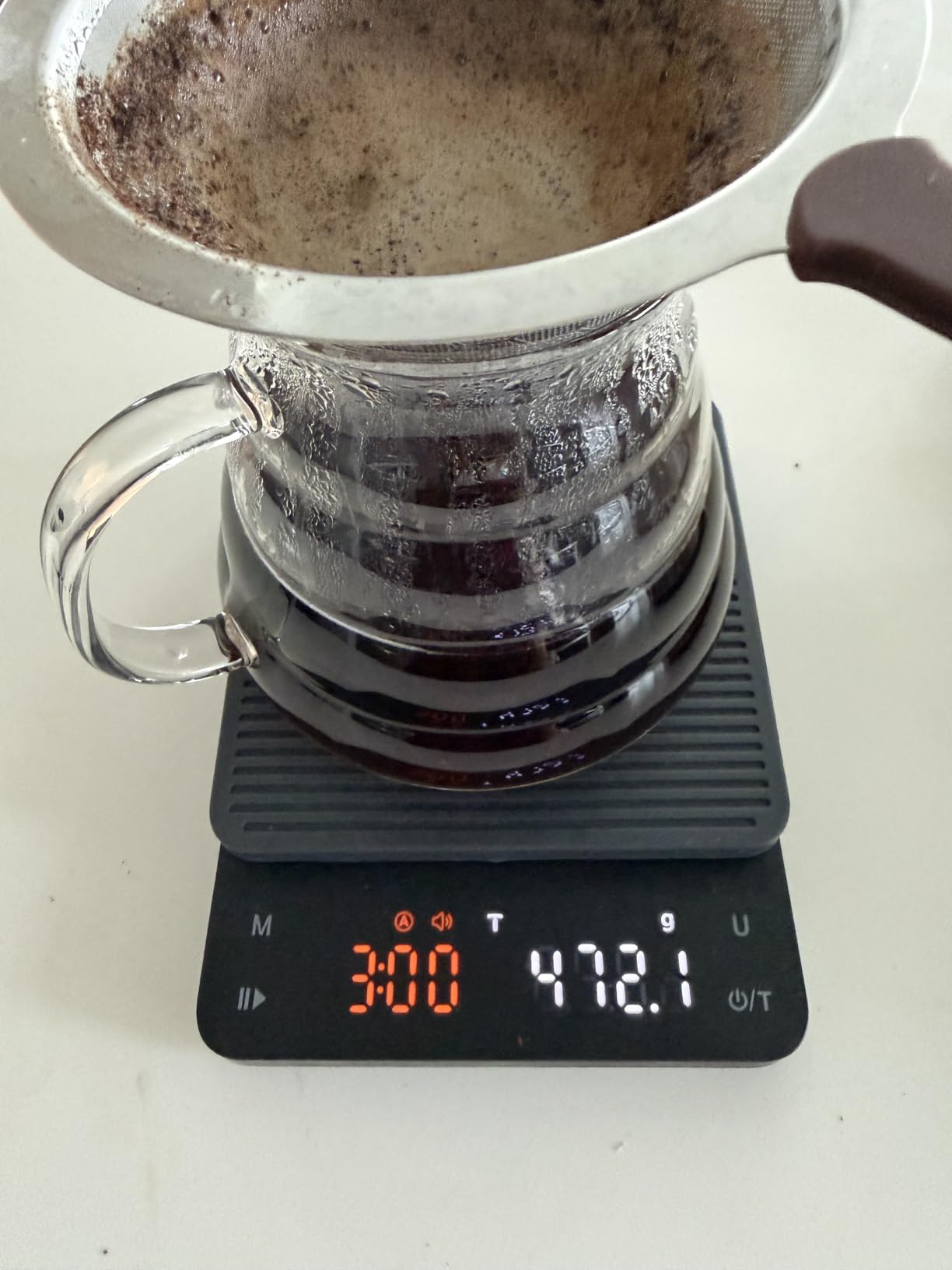
The BAGAIL is built for the pour-over end of the question. At 6.7 x 5.1 inches the platform will hold a dripper with a server underneath, and the 3 kg ceiling means a full kettle of water never comes close to the limit.
Readings stabilise quickly, and the automatic timing mode detects the start of a pour so you are not fumbling a button with a kettle in your hand. The removable waterproof silicone pad adds grip and takes heat from a hot vessel, and the USB-C battery lasts roughly a month of daily use before it needs a three hour charge.
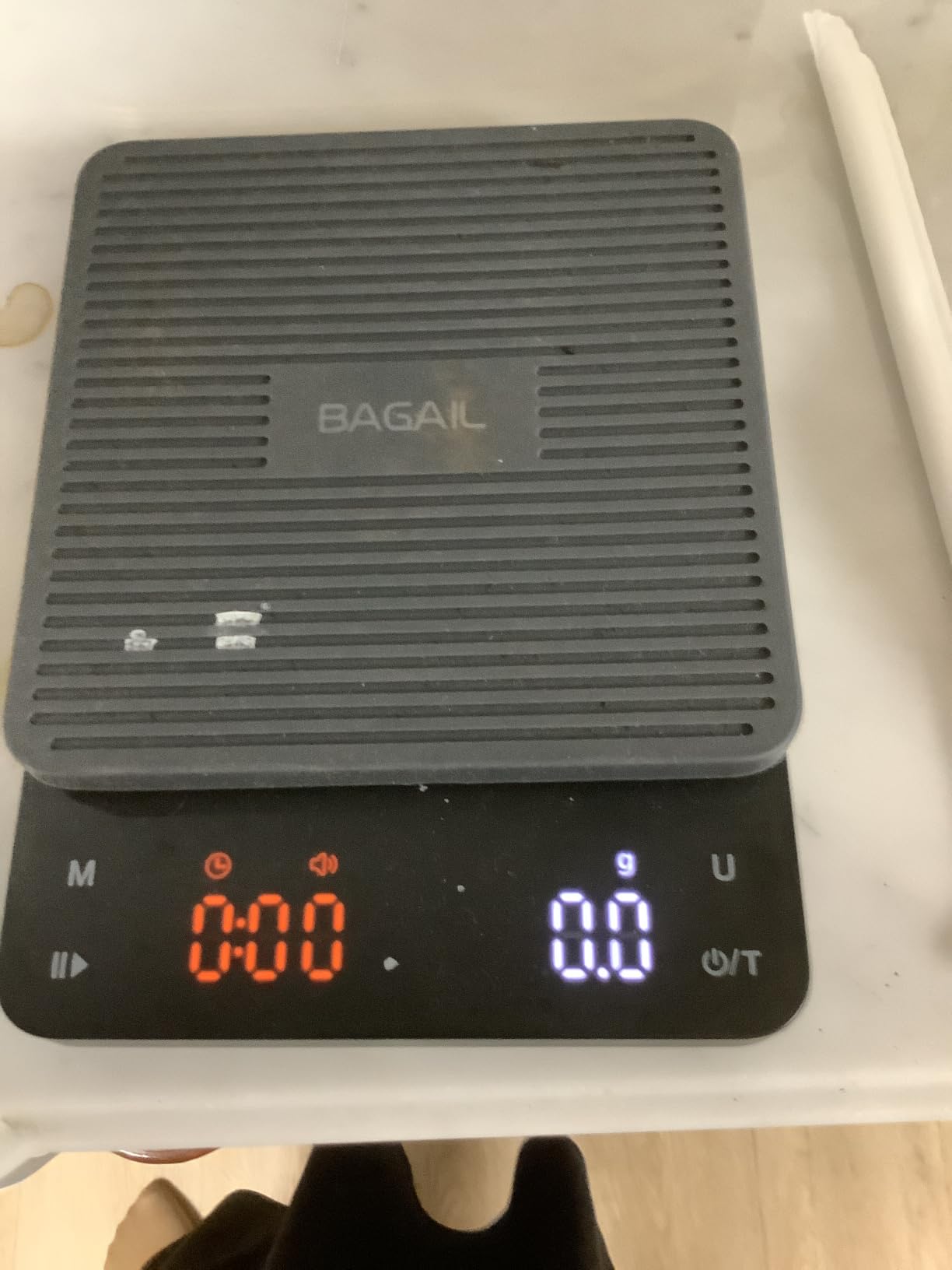
It will not go under a machine, and at 1 inch tall it will not even try. More importantly, a scale this large sitting next to a running espresso machine picks up vibration, and owners report the reading flickering while a shot extracts. Keep it on your brew station, away from the machine.
Touch sensors are described as overly sensitive with damp hands, and some owners report the display fading after extended daily use. The grooves in the silicone pad also trap dirt over time.
Best fit for a full brew station
Choose this when the scale lives on the counter under a dripper, not under a group head. The platform size and 3 kg ceiling handle the recipes that small micro scales cannot, and the auto timing removes a step from every brew.
The espresso question
It reads 0.1 g accurately, so dosing accuracy is not the problem. Placement is. If your scale has to sit under the portafilter while the machine runs, pick a narrow body instead and keep this one for filter.
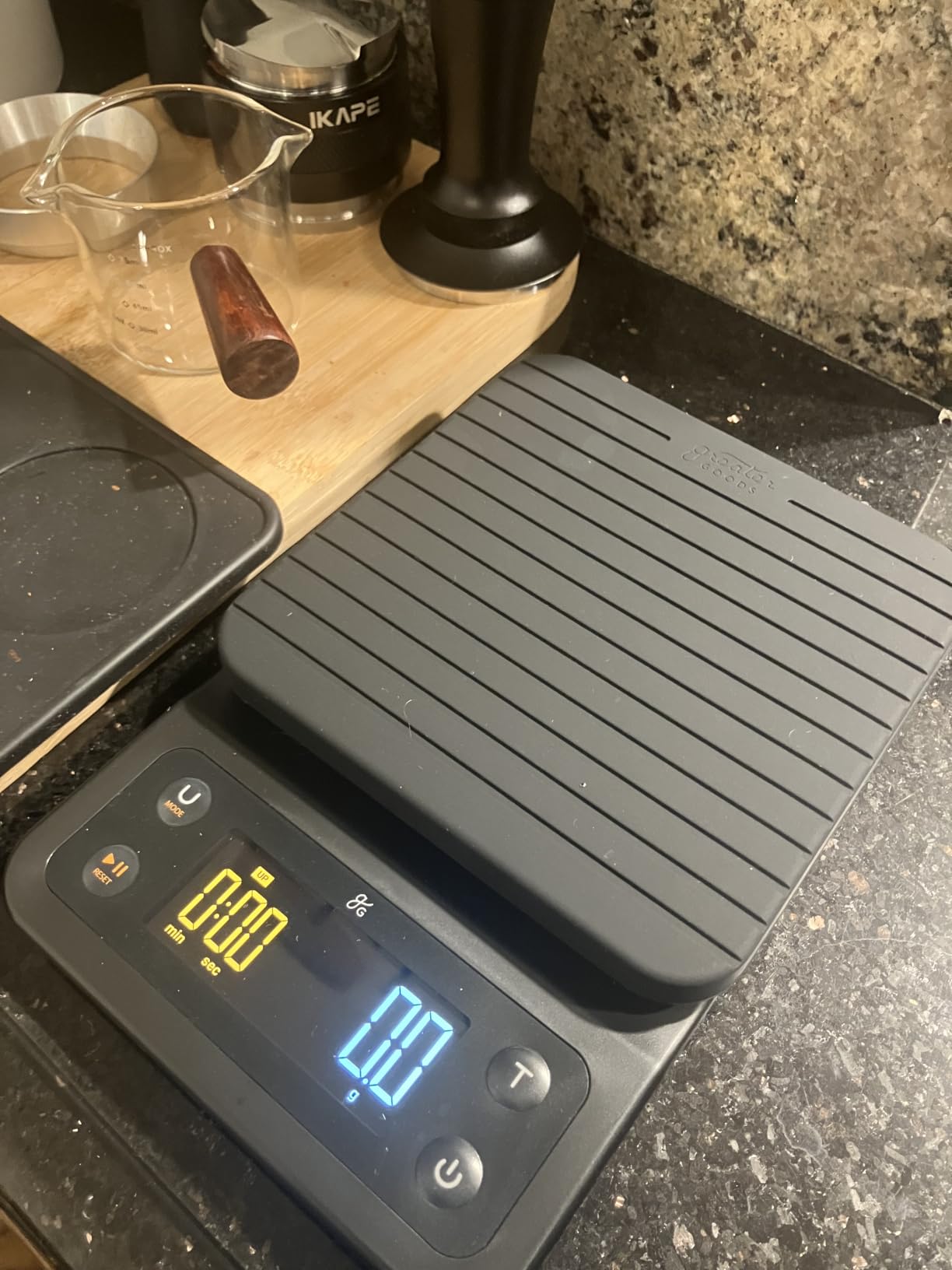
6. Greater Goods Coffee Scale for the build that keeps working
Greater Goods Coffee Scale with Timer, 0.1g Precision for Espresso & Matcha
0.1g sensor
5.25 inch weighing surface
Bright dual-color LCD
5 year warranty
Pros
- Physical buttons
- so presses never shift the reading
- Secure dishwasher-safe silicone cover
- Bright dual-colour LCD separates weight and timer
- Count-up and count-down timer
- 5 year warranty and replaceable AAA batteries
Cons
- Readings can fluctuate about 0.1g near electronics
- Refresh rate is slower than premium scales
- Battery warning is unreliable
This is the one we would hand to someone who is tired of replacing scales. Owners report years of daily use without failure, and the warranty runs five years, which is unusually long for a scale at this level.
Physical buttons matter more than they sound. On a touch scale, a press can nudge the platform and shift the reading, especially with damp hands. Here the controls are separate from the chassis, so starting a timer does not disturb the weight. The dual-colour LCD also splits the weight and timer into separate colours, which makes both readable at a glance.
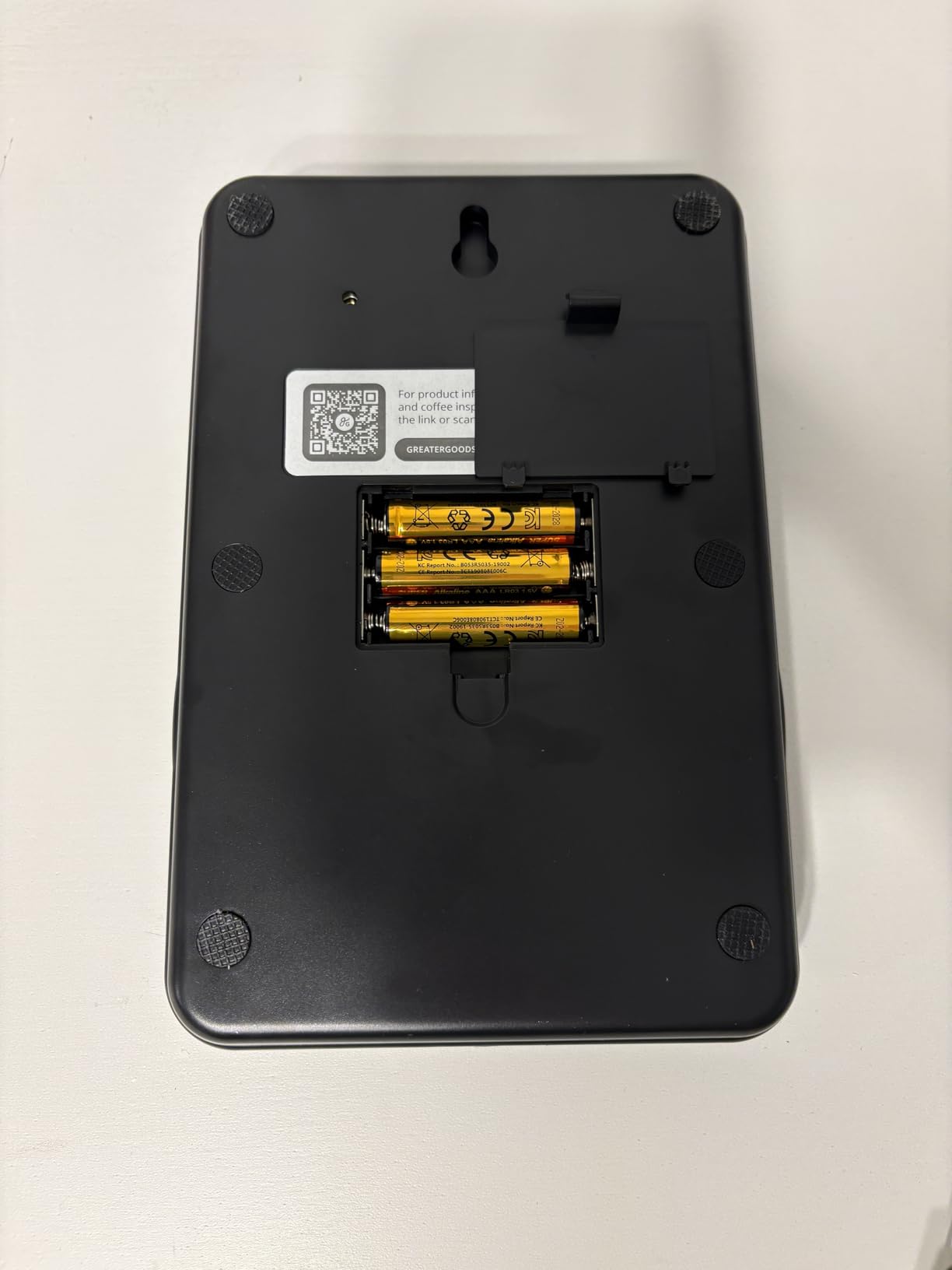
Two compromises are worth naming. The refresh rate is slower than premium scales, so you have to anticipate slightly rather than chase a moving number, and readings can fluctuate by about 0.1 g near other electronics or metal surfaces. The low battery warning is also reported as unreliable, with the scale powering off mid-brew.
It is not the thinnest option either, so measure your clearance if you plan to dose under a group head.
What you give up for the durability
Response speed. A scale that updates more slowly is easier to read at rest and slightly harder to read mid-pour, so if your pour accuracy goal is a live number you will notice the difference during a fast pour-over.
Who should pick it anyway
Anyone who has burned through two budget scales in a year, or anyone who prefers buttons to touch and wants a warranty that matches the lifespan. Years of service matter more than the last decimal place.
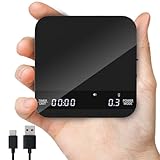
7. ERAVSOW Espresso Coffee Scale for pouring with a flow rate guide
Espresso Coffee Scale with Timer, 0.1g/2kg, USB-C Rechargeable
0.1g readability
2000g capacity
4.1 x 4.1 x 0.72 inch
Rechargeable lithium battery
Pros
- Fast stable readings that settle without jumping
- Three brewing modes including flow rate
- Pocket sized body fits under most machines
- Tempered glass panel wipes clean
- Up to 13 hours continuous use
Cons
- Tare can shift about 0.1g when a load is replaced
- Rubber feet detach on some units
- Display layout slows down reading
Of the small bodies here, this one reports the fewest complaints about readings jumping around before settling, which is the behaviour that most directly hurts pour accuracy. Stable settling is what lets you stop at a number instead of chasing one.
The three brewing modes cover manual weighing, an auto timer, an espresso mode, and a flow rate readout, so you get a pour-speed reference in a body small enough for a drip tray at 4.1 x 4.1 x 0.72 inches. The tempered glass panel takes a detachable waterproof silicone pad.
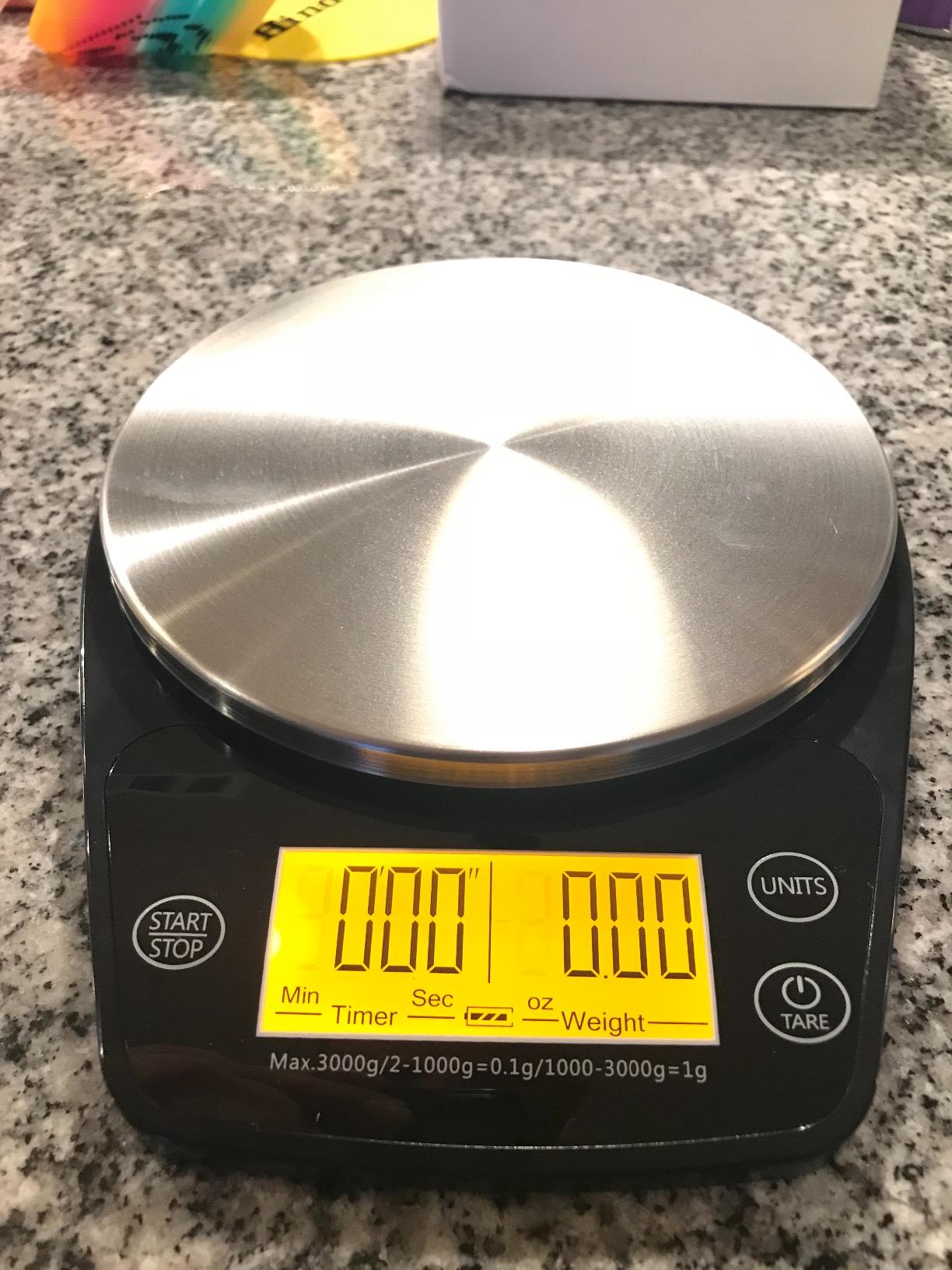
Tare can drift by about 0.1 g when a load is removed and replaced, which is the one measurement error that would bother a careful user. Some owners also report the rubber feet detaching after extended use, and a minority report battery failures within a few months, so check the cell early.
The display layout draws criticism for being less intuitive than it should be, so expect a short adjustment period.
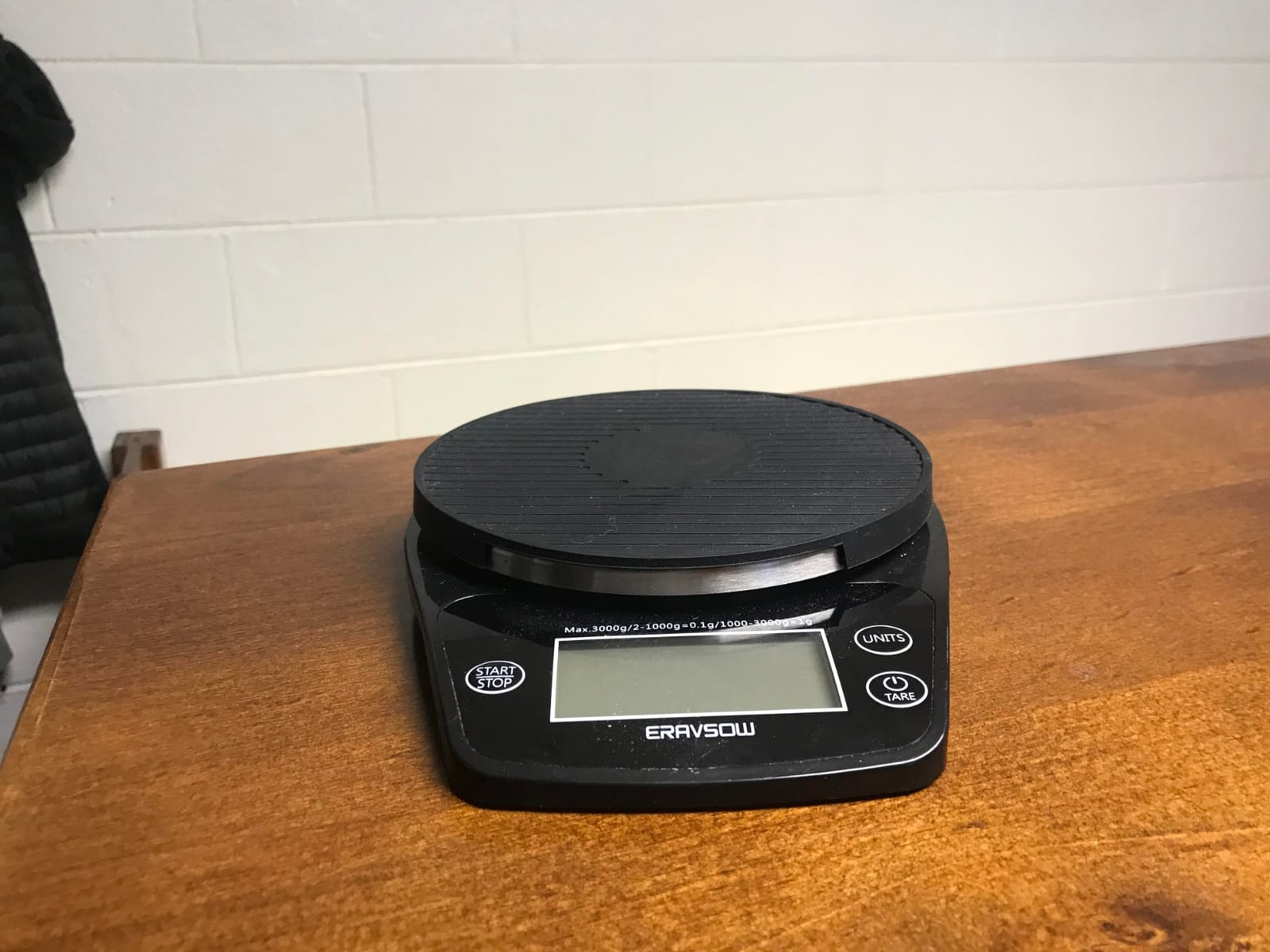
Why settling stability matters
Readability is the number the display can show. Stability is how quickly it stops moving. For dosing, a scale that settles in one jump is easier to dose with than one that trails upward, and this is where the small-body options differ most.
Check before ordering
Confirm the tare behaviour on your own setup by removing and replacing the portafilter a few times. If it holds zero, this is a strong small-body option. If it creeps, the scales built around a memory tare will serve you better.
8. MAXUS Espresso Scale for flat-bottomed drip trays
MAXUS Espresso Scale with Timer, 1000g x 0.1g, Coffee Scale for Drip Coffee
0.1g readability
1000g capacity
4.87 x 2.87 x 0.75 inch
Stainless steel platform
Pros
- Flat bottom sits on uneven drip trays
- Large backlit numbers are easy to read
- Fast stable readings checked against weights
- Timer runs independently of weighing
- Cover doubles as a travel tray
Cons
- Not water resistant
- Heat from a hot carafe can shift readings
- 1kg ceiling is tight for larger vessels
Most small scales have feet, and feet rock or slide on a perforated or uneven drip tray. This one has a flat bottom, which owners single out as the reason it stays put on a metal tray where others wander. For pour accuracy under a machine, that stability is worth more than another decimal place.
The backlit LCD uses large, easily read numbers, and the independent timer keeps running while the scale weighs, so timing is not lost when you stop interacting with the body. The cover detaches and doubles as a tray, which also makes it the most portable option here for travel brewing.
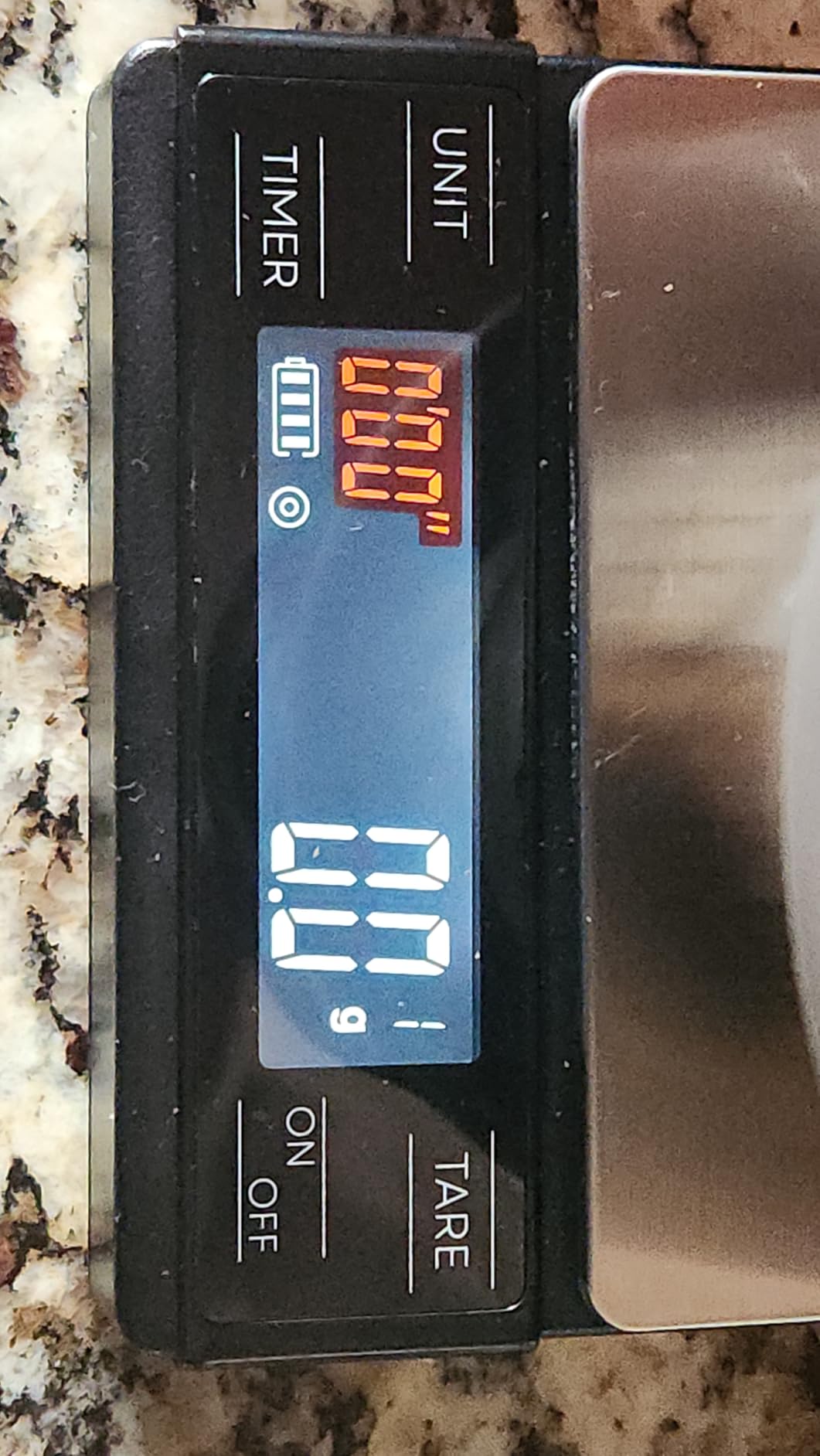
Heat is the weakness. Place a hot carafe or cup directly on the platform and the reading can creep upward, so a silicone mat is the fix. The scale is also not water resistant, and repeated splashes can blur the display characters over time.
The 1000 g ceiling is genuinely tight for larger pour-over vessels, and coffee grounds find their way into the buttons often enough that cleaning is part of the routine.
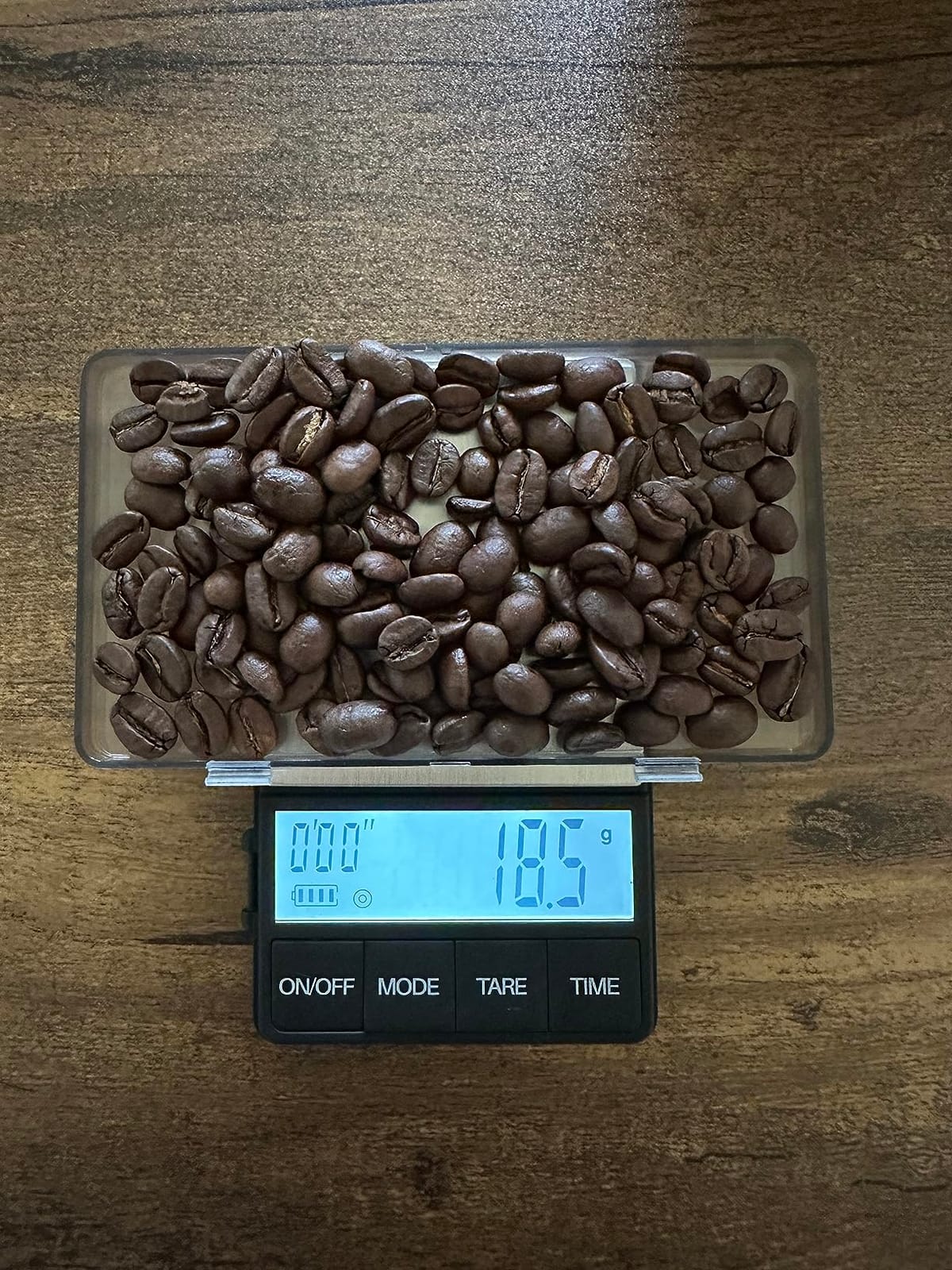
Use a mat, always
A heat-resistant silicone mat costs almost nothing and removes the most common complaint about this scale. It also gives you a surface that can be rinsed instead of the bare stainless platform.
Which brewers to pair it with
Keep it under the portafilter and away from the carafe. Anything that needs a litre of water measured will exceed the 1000 g capacity, and any hot vessel on the platform will drift the reading.
9. WEIGHTMAN Espresso Scale for the narrowest tray in the group
WEIGHTMAN Espresso Scale with Timer 1000g x 0.1g, Small Thin Coffee Scale
0.1g increments
1000g capacity
2 x 3.8 x 0.7 inch body
Hinged cover tray
Pros
- Thin enough for Breville machines and Flair makers
- 0.1g updates in real time
- Hinged cover doubles as a bean tray
- Backlit display and easy battery swaps
- Pocket portable
Cons
- 1kg capacity is exceeded by glass vessels
- Timer restarts after 10 minutes
- Build feels light
- Occasional drifting readings
At 2 x 3.8 inches this is the narrowest body here, and for a machine with a genuinely tight tray that width is the whole purchase decision. Owners with Breville machines and Flair espresso makers report it fitting where nothing else would.
The 0.1 g increments update in real time, the display is backlit, and the hinged cover doubles as a bean tray while protecting the platform in a bag. AAA batteries are easy to swap on the move.
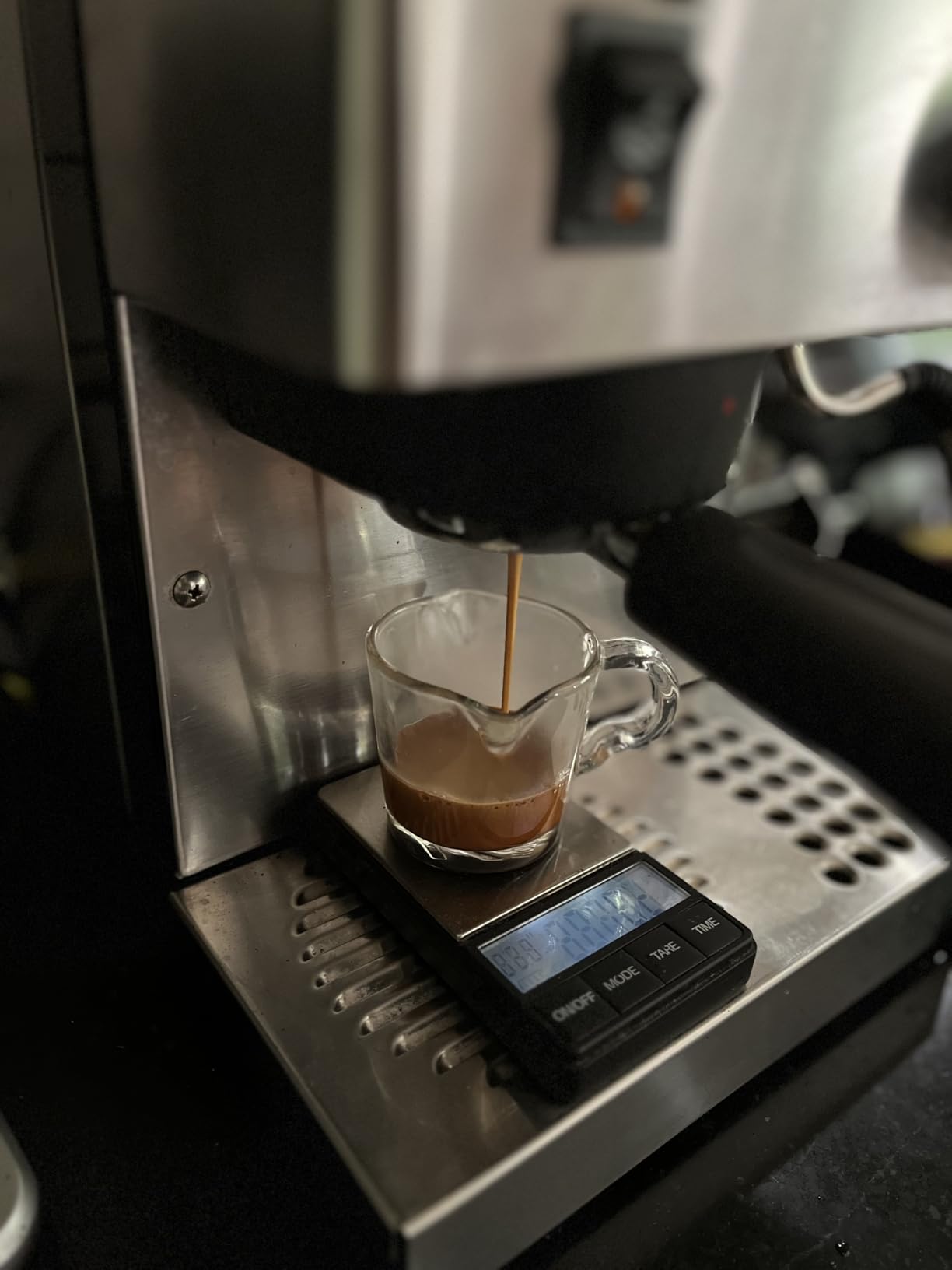
The 1000 g limit gets exceeded easily with glass pour-over vessels and triggers errors, and the timer restarts after ten minutes, which is a problem for slow filter recipes. The build also feels light rather than solid.
Most importantly, some units report random re-taring and drifting readings. That is the failure mode that matters for pour accuracy, so buy it with the understanding that you are buying the smallest workable footprint, not the most refined measurement.
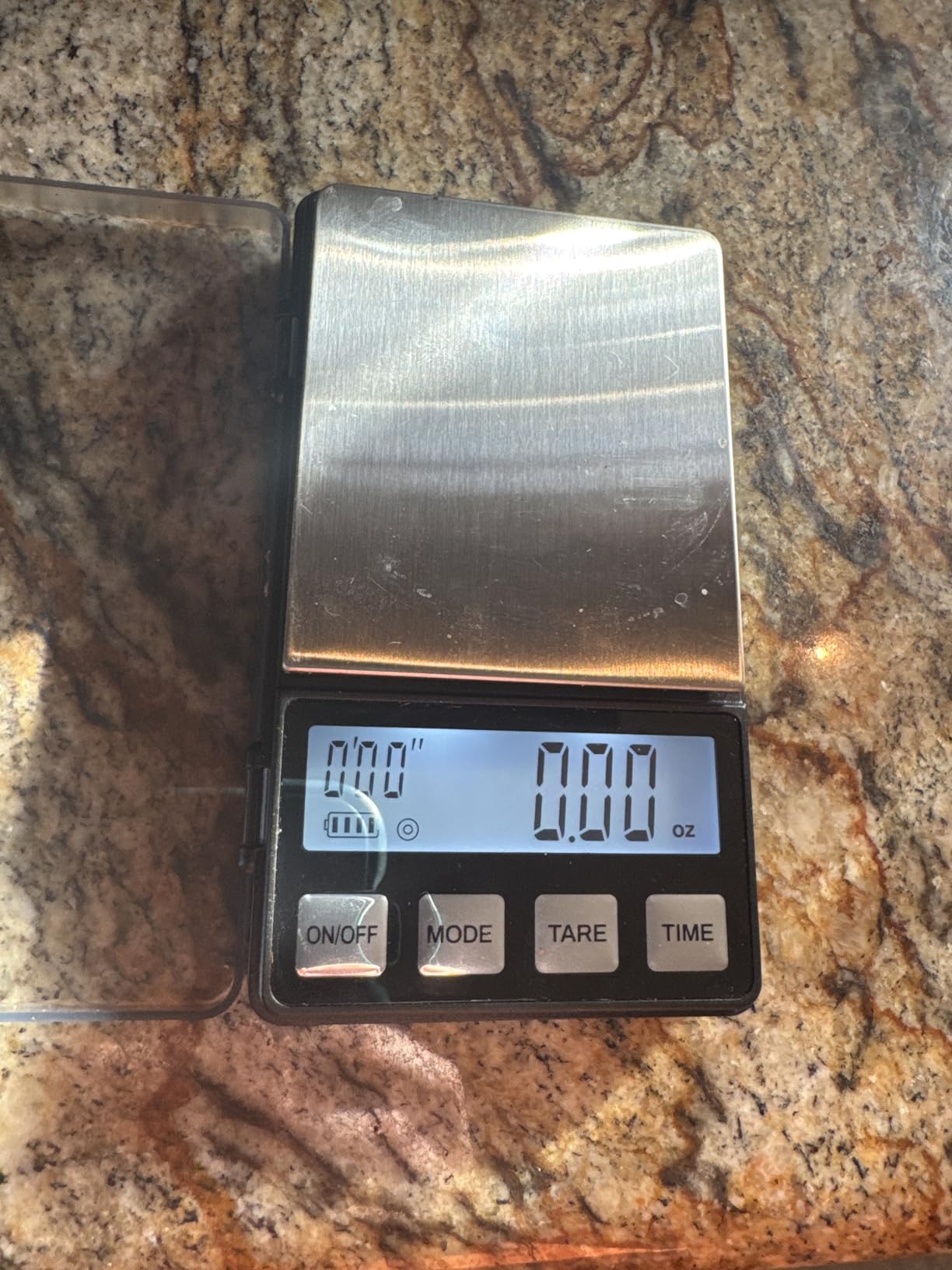
Why narrow beats accurate here
A scale that does not fit cannot be used at all. If your tray opening is measured in inches rather than centimetres, physical fit is the constraint and this body solves a problem no accuracy rating can.
Test it early
Run three identical doses back to back before you trust it. If the numbers repeat, it is doing its job. If they wander, move up to a body with a stronger track record for stable settling.
10. NEOWEIGH Espresso Scale for Rancilio and Gaggia owners
NEOWEIGH (Latest Version) Espresso Scale with Timer 1000g x 0.1g
0.1g increments
1000g capacity
4 7/8 x 2 7/8 x 3/4 inch
Platform 3 x 2 1/2 inch
Pros
- Fits a Breville Barista Express drip tray
- Verified accurate by owners against 0.01g scales
- Buttons are decoupled from the chassis so the reading never shifts
- Bright large backlit display
- Low profile works under a Rancilio Silvia v6
Cons
- Readout rounds up
- Slow to register a single light bean
- Display unreadable past about 45 degrees
- Not waterproof
This is the low-profile pick for classic machines. The body is 3/4 inch tall and the platform is only 3 x 2 1/2 inches, which owners confirm slides under a Rancilio Silvia v6 and tucks into a Breville Barista Express drip tray without sticking out.
The button design is the quiet strength. Controls are physically decoupled from the chassis, so starting the timer does not disturb the reading, and the display is large and bright. Several owners verified accuracy against a much finer 0.01 g scale and found the readings held.
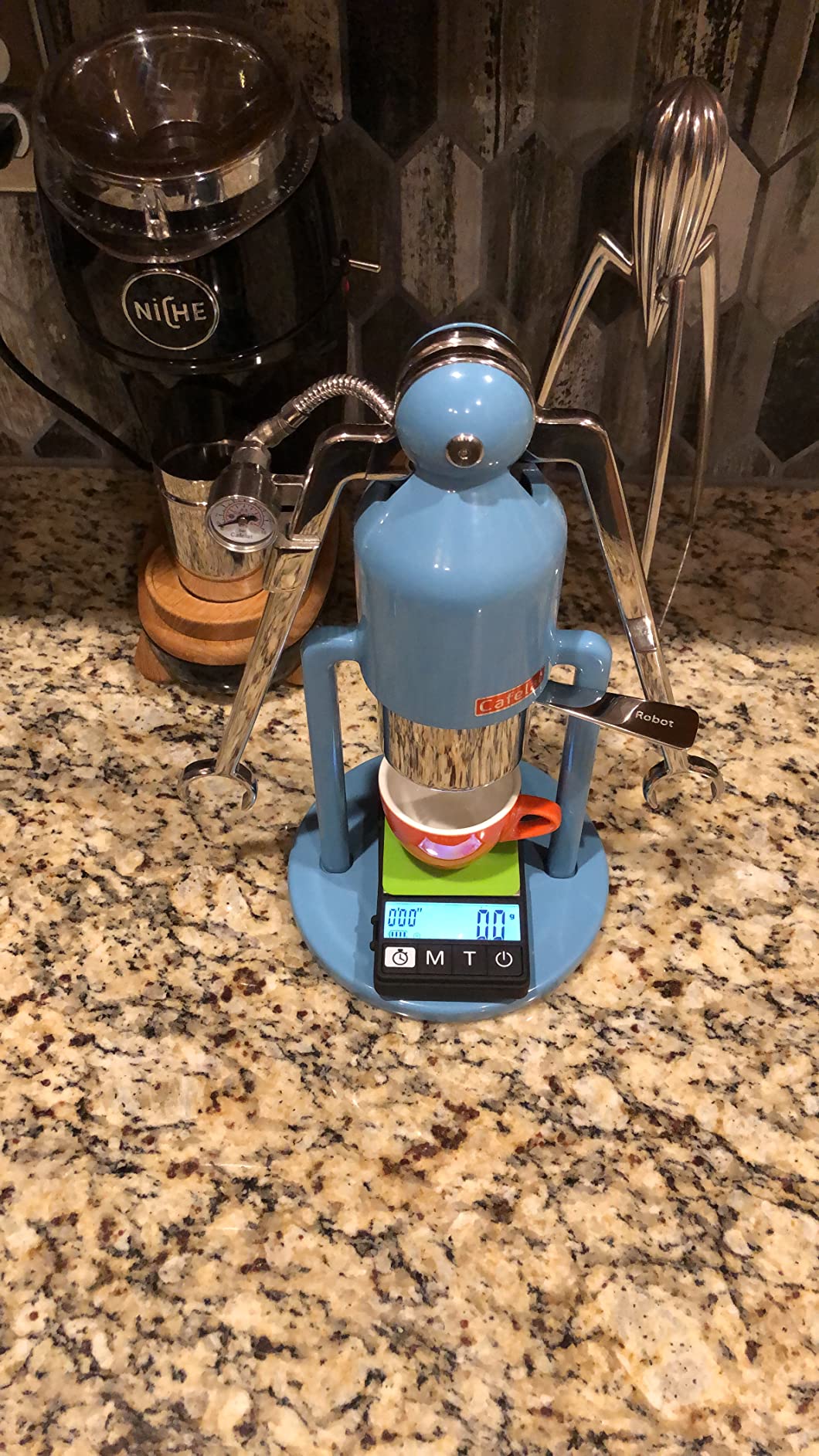
There are real quirks. The readout rounds up, so values like 17.9 g are rare, and it can take two to four seconds to register a single light bean near your target. The display also becomes illegible past roughly 45 degrees of viewing angle, which is a genuine problem when you are looking down at a tray.
It is not waterproof, and some units have failed after a few months beside a machine. Treat the positioning as part of the purchase: it needs light from the front, not overhead.
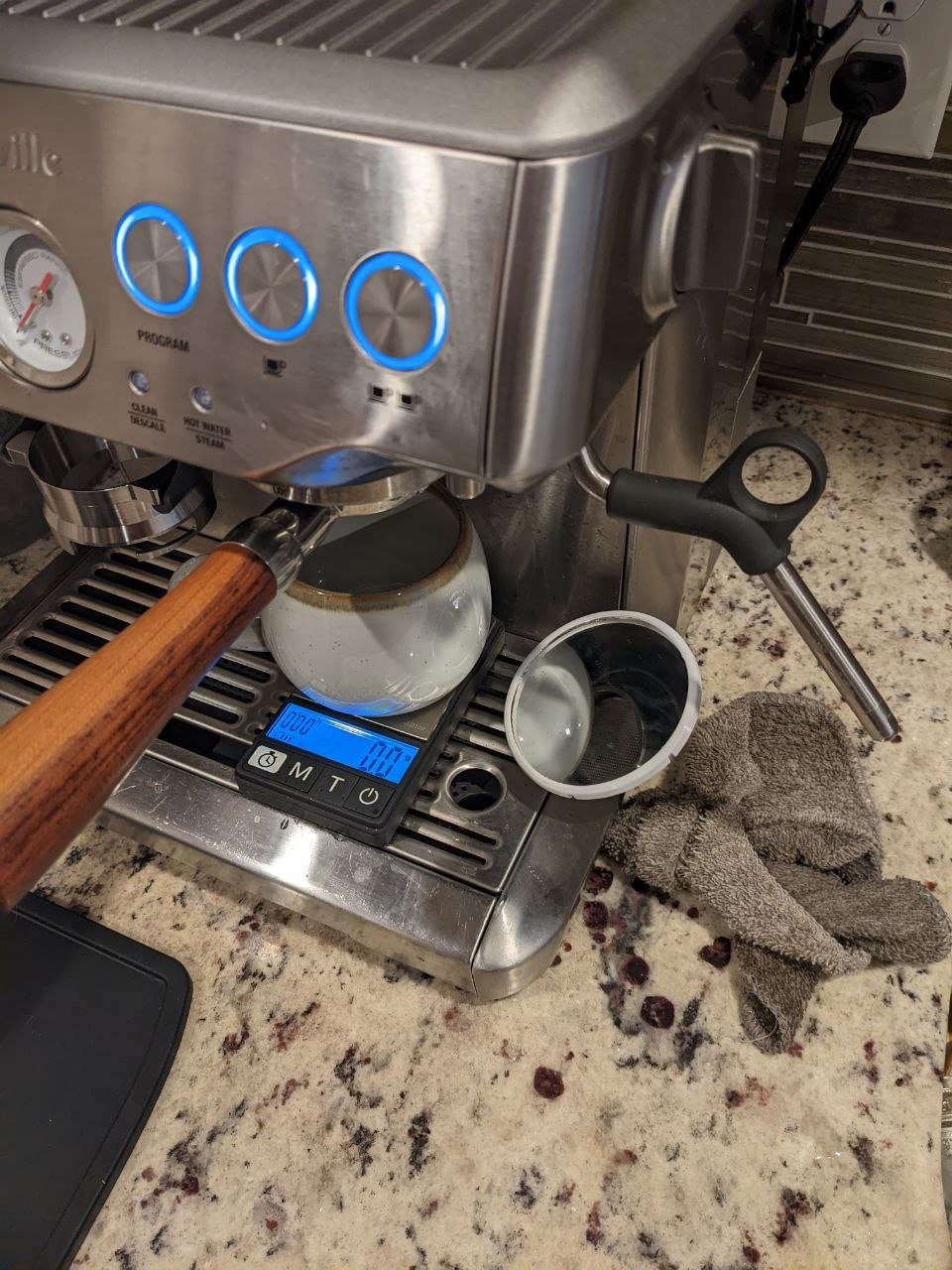
Reading the display correctly
Set the scale where the numbers face you at roughly 45 degrees, and give the last bean a moment to register. Once you know the display rounds up, you can compensate by stopping a fraction early and letting it settle.
Which machines it suits
Low profile, narrow platform, physical controls, no app. That combination fits older lever and heat exchanger machines and any drip tray that other bodies in this list are too tall for.
11. Maestri House S3 Pour Over Scale for ratio alerts and flow rate
Maestri House S3 Pour Over Coffee Scale with Timer, 3kg/0.1g
0.1g readability
3kg capacity
16 x 13 cm platform
1:1 to 1:18 brew ratios
Pros
- Owners rate it the most accurate of several 0.1g scales
- Adjustable ratio alerts with an audible beep
- Flow rate shown alongside weight and timer
- Does not power off mid-brew
- IPX4 display panel with a heat-resistant pad
Cons
- Pour-over mode cancels if you lift the brewer to swirl
- Mat slides around
- Capacitive buttons give little feedback
- Too wide for a Breville Bambino Plus tray
This is the most interesting pour-over tool in the group, because it does something the others cannot: you set a brew ratio between 1:1 and 1:18 and it beeps when you hit the target weight. For pour accuracy, that converts a mental calculation into a signal you can react to mid-pour.
Flow rate appears alongside weight and timer on a large dual-zone display, and multiple owners report testing it as the most accurate of several 0.1 g scales they own. It also does not aggressively power off mid-brew, which is a common and infuriating failure of otherwise good scales.
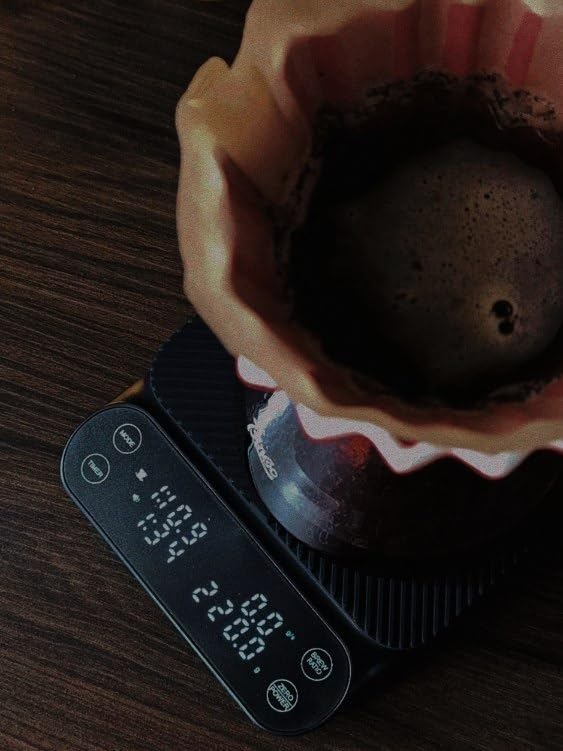
There is one genuine design flaw for pour-over users: the pour-over mode cancels if you lift the brewer to swirl, which is a normal part of many recipes. The silicone mat also slides around, and capacitive buttons give almost no tactile feedback, so double taps happen.
Readings can run about 0.2 g off and drift when heat soaks in from a hot carafe. At 16 x 13 cm it is far too wide for a shallow drip tray such as the Breville Bambino Plus, so this is a filter-only tool in practice.
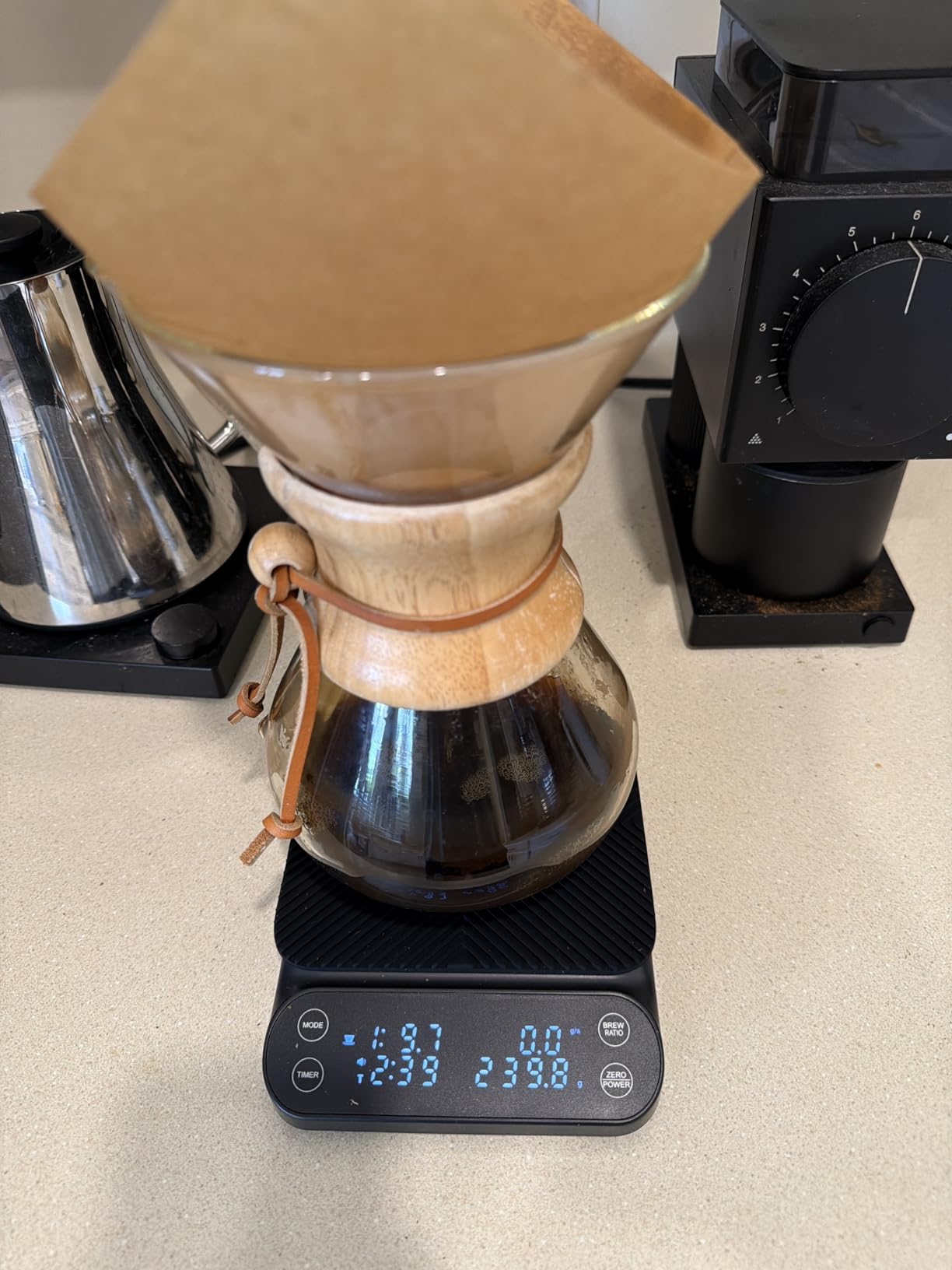
Ratio alerts versus flow rate
A ratio alert tells you when you have reached a target. Flow rate tells you how you got there. For repeatable recipes, the alert is the more useful signal; for technique work, the rate readout is the more instructive one. This scale gives you both, which is unusual below the premium tier.
Plan around the mode flaw
If your recipe involves swirling, do the pours in standard weighing mode and set the ratio yourself, or rest the brewer instead of lifting it. The cancel behaviour is a software decision, not a hardware fault, and it is the first thing to know before you rely on it.
12. TIMEMORE Basic 2.0 for the most water-resistant build
TIMEMORE Coffee Scale Basic 2.0 Electronic Espresso Scale with Water Flow Rate and Timer Function, Digital Scale for Kitchen/Baking/Cooking, Black
0.1g readability
2kg capacity
1600mAh rechargeable battery
Flow rate and auto timer
Pros
- Waterproof dial surface and a closable charging port
- 0.1g resolution from a 0.5g minimum to 2kg
- Automatic timer plus a flow rate function
- Large backlit LCD with two control buttons
- Bottom reset button recovers from glitches
Cons
- Heaviest unit in the group at 570g
- Acrylic surface marks more easily than glass
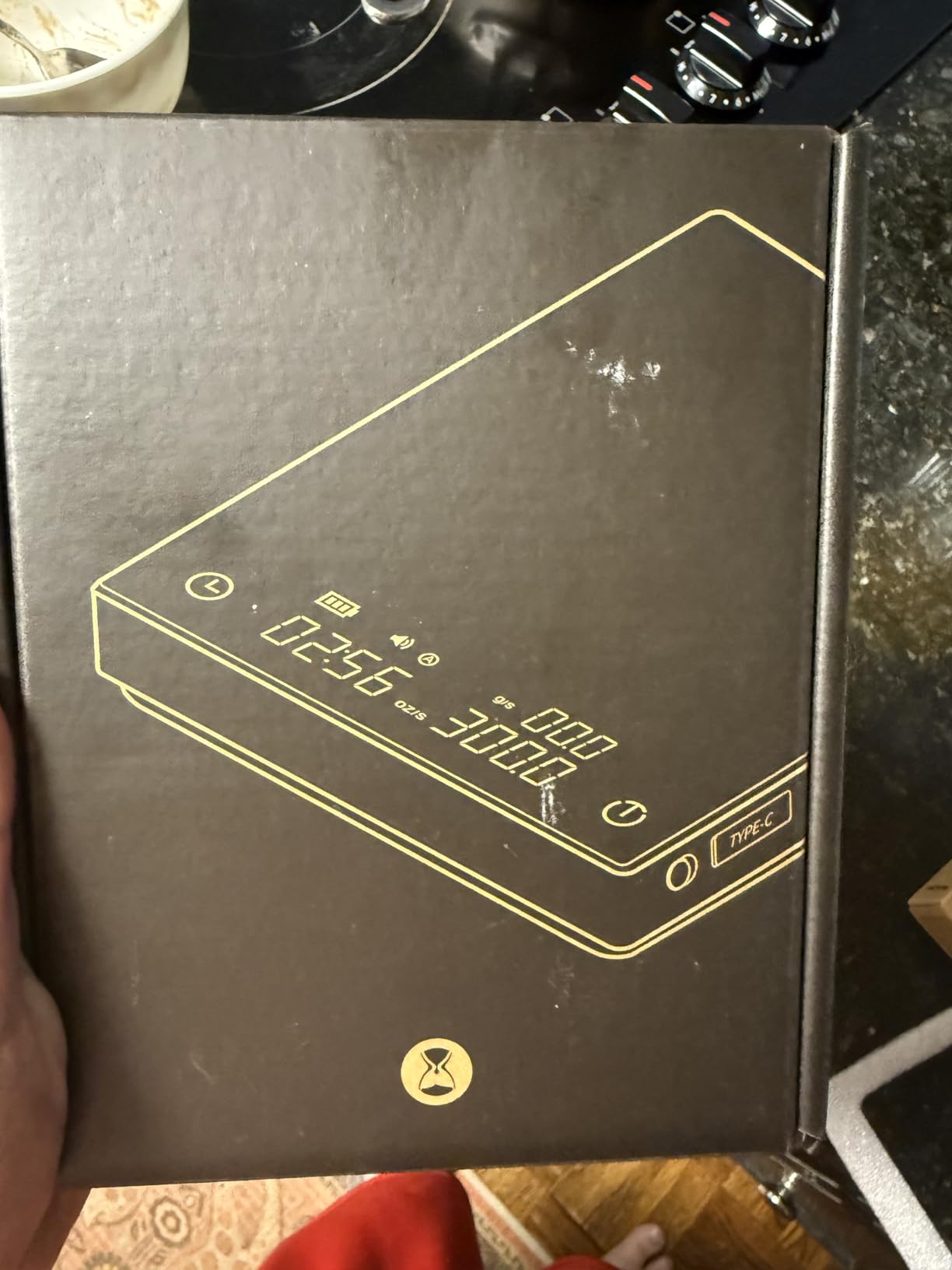
Spills kill more coffee scales than drops do, and this is the one built to survive a wet counter. The dial surface is waterproof and the charging port has a closable cover, so liquid cannot reach the electronics through the most obvious opening.
Resolution runs 0.1 g from a 0.5 g minimum all the way to 2 kg, which covers both a double shot and a large filter brew. The automatic timer and water flow rate function are both there, and there is a reset button on the underside that recovers the unit if the program glitches rather than leaving you with a dead scale.
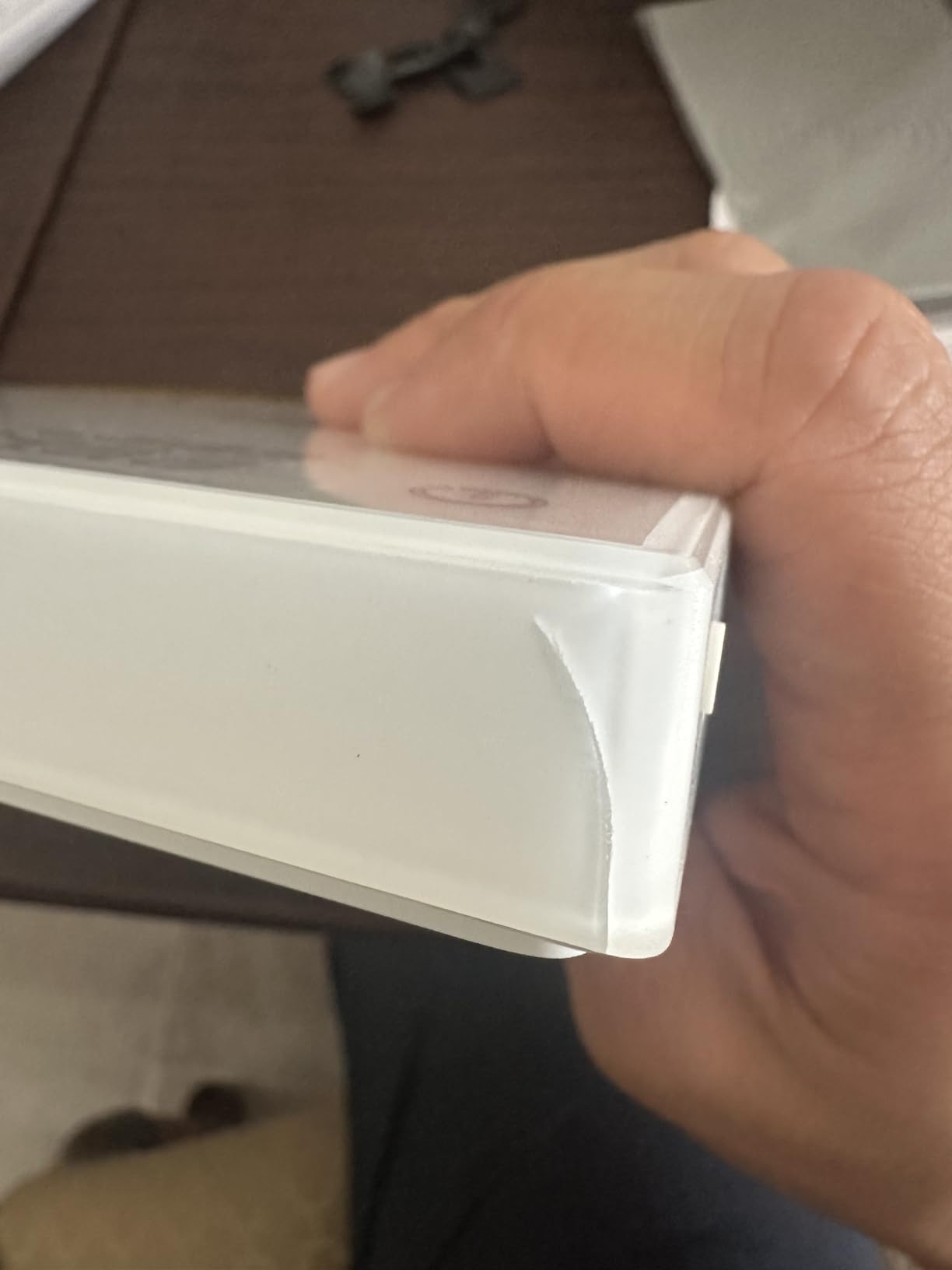
It is the heaviest here at 570 g, and that is a real cost for anyone who wants to move between a brew station and a machine. The acrylic platform also marks more easily than the glass bodies elsewhere, so expect it to look used sooner.
With the fewest reviews in the group, this is the pick we would test on a slow week rather than commit to on day one. The engineering choices point the right way; the long-term record is thinner.
Why water resistance changes the ownership experience
Every rinse, every spill, every knock-back of the portafilter is a risk on a scale with exposed electronics. A sealed port and a waterproof dial turn a recurring worry into a non-event, which matters most if your scale lives beside a sink.
The weight trade-off
570 g is heavy enough that you will notice it in a bag. If you brew on the move or shuttle between two stations, a lighter body is the better purchase and water resistance is a nice bonus rather than a deciding factor.
What Actually Decides Pour Accuracy
Accuracy and readability are not the same thing, and this is where most comparisons go wrong. Readability is the size of the step the display can show, and almost every scale here reads 0.1 g. Accuracy is how close that number is to a known weight, and that is what a 100 g calibration weight tells you. A scale can display 0.1 g increments and still be 0.3 g out at 100 g, and no amount of decimal places on the screen will fix it. If you want a number rather than a claim, put a known weight on the scale before you judge it.
Stability under a moving load is the second factor, and it is the one reviewers complain about most. Several owners of budget scales report a static drift of roughly 0.2 g and wandering numbers during a pour. That is why the scales with flow rate displays are worth more than they cost: they tell you the pour is consistent, not just that the total arrived.
Footprint is the third, and it is the one that decides whether any of this matters. Espresso scales live around 80 to 105 mm across, and pour-over scales need 110 mm or more plus enough clearance that you can read the display past a dripper or carafe. Measure your machine and your brewer before you read a single spec sheet.
Auto-tare and auto-timer are also constantly confused. Auto-tare zeroes the scale when weight appears, which saves a button press. Auto-timer starts the clock from detected flow, which saves the other button press but can interrupt a slow bean dose on some models. The first helps pour accuracy. The second mostly helps convenience, and on the S2 it is a genuine annoyance.
Finally, capacity. A 1000 g ceiling is fine for a shot and useless for a carafe. A 3 kg platform handles everything from a small pour-over to a full kettle, at the cost of a body that will never fit under a group head. Choose for the largest thing you intend to weigh, not the smallest.
One Scale or Two: the Decision Most Buyers Get Wrong
Most brewers who do both methods ask whether one hybrid scale can handle both jobs. Usually it cannot, and the compromise is always the same: a platform wide enough for a carafe is too wide for a drip tray, and one narrow enough for a drip tray cannot hold a dripper. The community view is blunt about this, with hybrid owners describing their scales as a little small for a large pour-over carafe and too small for dripper stations.
Our position is that two scales serve most people better than one compromise, and that the cost of the second one is lower than people expect when you price it honestly. Pair a narrow body under the machine with a wider platform at the brew station, and each job gets the tool it actually needs.
That pairing is also the cheapest route to pour accuracy on both fronts, because you are not paying for features one job will never use. The espresso scale can be a small, fast, slim body with a memory tare. The filter scale can be the large platform with a ratio alert and a flow rate readout, sitting on a counter where vibration from the machine never reaches it.
If you only brew one method, skip this entirely and buy the best body for that method. A dedicated filter brewer is best served by a wide platform with a 3 kg ceiling, and a dedicated espresso setup is best served by the narrowest body that fits your tray.
Frequently Asked Questions
How accurate is a 0.1g coffee scale?
A 0.1 g figure describes readability, the smallest step the display can show, not how close the reading is to a true weight. Accuracy has to be checked against a known weight such as a 100 g calibration mass, because budget models often hold 0.1 g steps while drifting a few tenths of a gram. Stability during a moving pour matters as much as the static reading, so test a scale by pouring water onto it and watching whether the number settles.
Which coffee scale is best for espresso and pour over?
A single hybrid scale rarely does both jobs well, because a platform wide enough for a carafe is too wide for a machine drip tray. Espresso dosing needs a narrow body of roughly 80 to 105 mm that fits under the group head. Pour-over needs 110 mm or more plus display clearance past the dripper. The practical answer for people who brew both is two scales, or a small dosing scale at the machine and a wide platform at the brew station.
Do I need 0.1 g accuracy for pour over?
Not strictly. A 500 g brew at a 1:15 ratio makes a 0.5 g error almost invisible, so a 1 g step is workable for filter. The same error on an 18 g double at 1:2 changes the ratio visibly, which is why espresso specifically needs 0.1 g readability. What pour-over does need is stability during the pour and a display you can read past a carafe, and that is a different requirement from resolution.
How big does my espresso scale need to be?
Measure the drip tray and the clearance under your group head first. Micro scales run about 2 x 3.8 inches up to 4.13 x 4.13 inches, and the body height matters as much as the width because the portafilter has to sit flat on the platform. Pour-over scales need 110 mm or more with visible display clearance. If a scale does not physically fit, no accuracy rating will rescue it.
Is a Bluetooth app worth it on a coffee scale?
For pour accuracy, rarely. An app can log doses and draw brew curves, but the reading on the scale is what you actually pour to. The features that change your results are auto-tare, a stable reading during a moving pour, a flow rate readout, and a footprint that matches your machine. Ignoring the app and spending that money on a better body or a second scale serves most people better.
The Verdict on the Best Espresso Scales for Pour Accuracy
The best espresso scales for pour accuracy are decided by footprint and stability, not by decimal places. The Greater Goods Digital Espresso Scale is the one we recommend most because it reads 0.1 g, stays put, and fits drip trays that reject wider bodies. If you pour often, the RENPHO adds the flow rate readout that makes pour consistency visible. Brew both methods and you will be better served by two scales than by one compromise.