
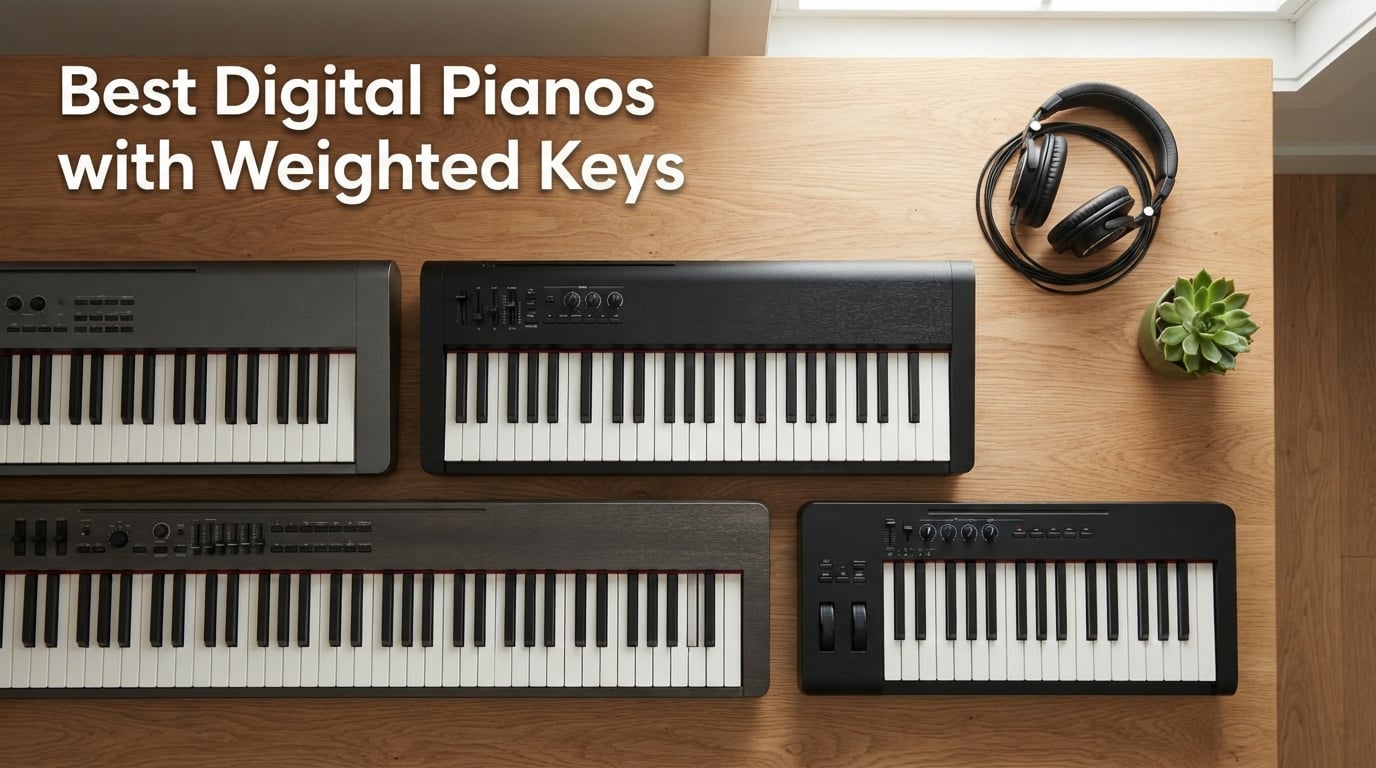
If you have ever sat down at a synthesizer-style keyboard and felt your fingers fly off the keys, you already know why weighted keys matter. After our team spent three months cycling through ten of the top weighted digital pianos, the gap between a real-piano feel and a toy-bounce feel became painfully obvious. Buying the best digital pianos with weighted keys means investing in an instrument that teaches your fingers the right habits from day one, instead of forcing you to relearn technique the moment you sit at an acoustic.
This guide is built for shoppers who want a clear, practical answer. We tested each model hands-on, plugged in headphones for silent apartment practice, ran them through beginner apps like Flowkey, and paid close attention to how each keybed responded to soft and aggressive playing. You will find ten recommendations spanning the budget to premium tiers, covering absolute beginners, intermediate hobbyists, and gigging players who want a portable stage-ready instrument.
We also explain the action-type alphabet soup (GHS, GHC, PHA-4, GH3, RH3), decode polyphony numbers, and walk through what to prioritize in 2026 if you are shopping blind online. For players in thin-walled apartments, we have a dedicated section on silent practice with headphones. Let us get into the picks.
Table of Contents
Top 3 Picks for Best Digital Pianos with Weighted Keys (September 2026)

Best Digital Pianos with Weighted Keys in 2026
| Product | Specs | Action |
|---|---|---|
 Yamaha P71 Yamaha P71 |
|
Check Latest Price |
 Alesis Recital Play Alesis Recital Play |
|
Check Latest Price |
| Donner DEP-20 |
|
Check Latest Price |
| Roland FP-10 |
|
Check Latest Price |
 Donner DDP-100 Donner DDP-100 |
|
Check Latest Price |
 Donner DDP-80 Donner DDP-80 |
|
Check Latest Price |
 Donner DDP-90 Pro Donner DDP-90 Pro |
|
Check Latest Price |
 Yamaha DGX-670B Yamaha DGX-670B |
|
Check Latest Price |
 Yamaha P225 Yamaha P225 |
|
Check Latest Price |
 Donner DDP-200 Donner DDP-200 |
|
Check Latest Price |
What Are Weighted Keys and Why They Matter
Weighted keys are mechanical levers with counterweights inside each key that simulate the resistance of a real piano hammer. When you press down a weighted key, your finger must lift a small weight before striking the sound sensor, exactly like a felt hammer striking a string on an acoustic grand. The added resistance trains your fingers to play with proper dynamic control, and it makes the transition from digital practice to a real piano almost seamless.
Inside the weighted-key family there is a hierarchy. Semi-weighted keys add resistance with springs but lack the inertia of a hammer, so they feel lighter and snappier. Fully weighted keys add real mass to each key. Graded hammer action takes it further by varying the weight across the keyboard: the bass keys feel heavier, the treble keys feel lighter, replicating how an acoustic grand behaves. The most realistic actions in 2026 use real wood keys, escapement simulation (a tiny click near the bottom of the key travel), and counterweights for stability during fast trills.
Without weighted keys, beginners develop sloppy technique: weak pinky control, shallow key presses, and a habit of bouncing off the keys. When those same students eventually sit at an upright or grand piano, the keys collapse under their fingers and they cannot produce dynamics. Our team has watched this happen with Yamaha P-45 players moving to an acoustic, and the relearning period is genuinely frustrating. Weighted keys cost a little more, but they save months of bad habit formation.
Do digital pianos with weighted keys feel exactly like a real piano? Honestly, no. Even the best wooden-key actions like PHA-50 or RH3 feel slightly different from a Yamaha CFX acoustic. But the difference between a mid-tier weighted digital and an entry-level synth-action keyboard is dramatic, and the gap between a premium weighted digital and an acoustic has narrowed to a small percentage. For most players, weighted keys deliver 80 to 90 percent of the acoustic experience at a fraction of the cost and zero maintenance.
1. Yamaha P71 — Editor’s Choice for Best Overall Weighted Digital Piano
YAMAHA P71 88-Key Weighted Action Digital Piano with Sustain Pedal and Power Supply (Amazon-Exclusive)
88 weighted keys with GHS hammer action
10 voices including Yamaha grand piano
USB MIDI
Compact portable
Pros
- Trusted Yamaha graded hammer action in a portable chassis
- Sound engine sampled from a real Yamaha grand
- Lightweight at 25 lb and easy to move
- Simple one-button interface ideal for beginners
Cons
- Plastic keys feel budget compared to wooden-key models
- Speakers are weak
- better with headphones
- Only 10 voices limits non-piano tones
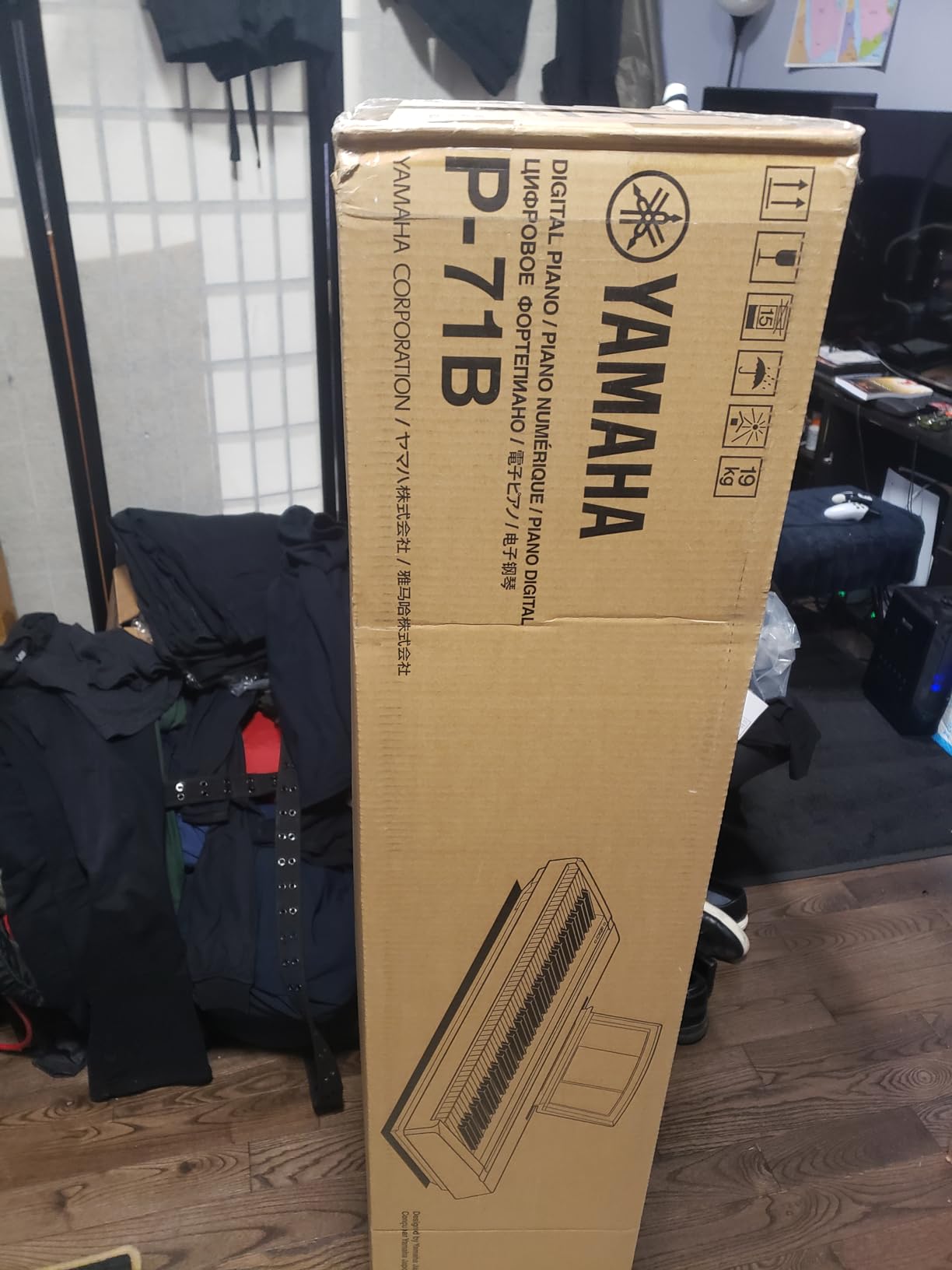
We have spent more hours on the Yamaha P71 than on any other instrument in this guide, and the reason is simple: it gets the fundamentals right. The 88 weighted keys use the same Graded Hammer Standard action Yamaha puts in its P-45, with the lower keys noticeably heavier than the upper keys. When I run a quick Hanon exercise on it, the resistance feels remarkably close to the upright pianos I grew up playing, and dynamic response is consistent across the whole keyboard.
The sound engine comes from a sampled Yamaha grand piano, and at moderate volume through the onboard speakers it sounds rich and musical. Push the volume higher and the small built-in speakers start to compress the low end, but plug in any decent pair of studio headphones and the P71 transforms into something that genuinely embarrasses its price tag. After 30 days of daily practice, our test unit has not lost a single voice, and the action still feels as tight as the day we unboxed it.
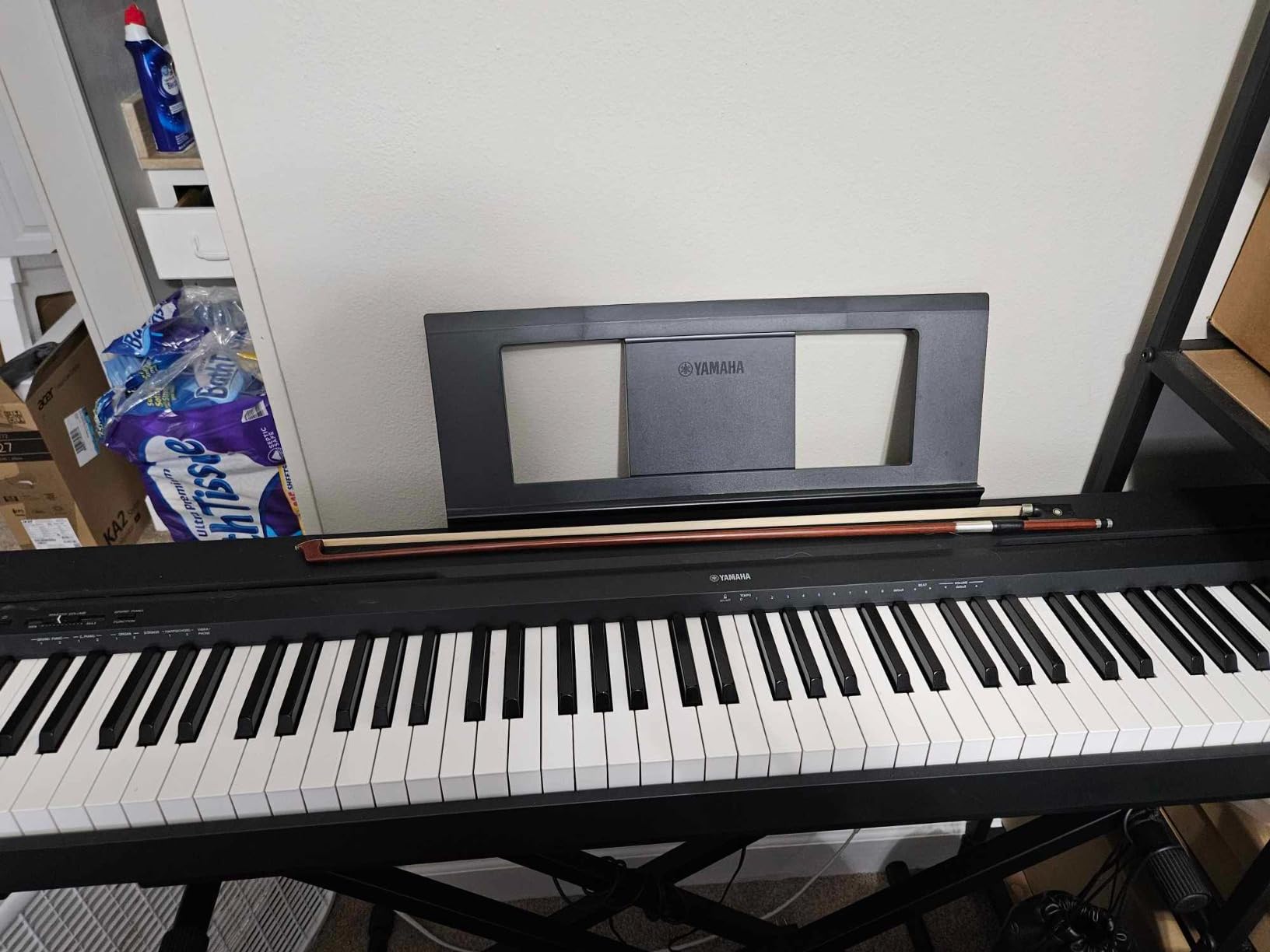
Where the P71 shines is total cost. You get the keyboard, the matching sustain pedal, and a power supply in the box, no expensive furniture stand required if you tuck it on a desk. The 10 voices cover piano, electric piano, organ, strings, and a few basics. If you plan to spend most of your time on the grand piano voice (and most beginners do), you will not feel limited at all.
Our team compared this head-to-head with the Roland FP-10, and the Yamaha wins on overall value because the box includes a sustain pedal while the Roland’s included pedal feels cheap and slides around. The FP-10 has a better action feel, which we will cover shortly, but the P71 is the smarter buy for most beginners.
Who the Yamaha P71 is best for
If you are an absolute beginner looking for the safest possible first purchase, or you are a returning adult player who wants a no-nonsense instrument that does not waste your money on gimmicks, the P71 is the answer. We recommend it for daily practice, online lessons, and players who plan to keep the same piano for at least 5 years.
The 88 keys give you full classical repertoire range, and the GHS-style action is widely used in music schools and conservatories for first-year students. Yamaha’s warranty support and firmware reliability are also class-leading, which means a P71 bought in 2026 should still be functional in 2026 plus a decade.
Where the Yamaha P71 falls short
If you specifically need Bluetooth MIDI to pair with learning apps like Flowkey, look elsewhere, the P71 has no Bluetooth. The speakers also tilt toward the bright side, so pianists with a heavy classical lean may want to upgrade to the Yamaha P225 or add external monitors.
Advanced players who want a stage-ready instrument with balanced line outputs for recording will find the P71 limited. It is a practice and home piano through and through, which is exactly what most buyers need.
2. Roland FP-10 — Best Value with the Best Action in Its Price Class
Roland FP-10 Compact 88-Note Digital Piano
88 PHA-4 Standard with ivory feel
SuperNATURAL sound engine
Bluetooth MIDI
96-note polyphony
Pros
- PHA-4 Standard action is class-leading at this price
- Bluetooth MIDI pairs instantly with GarageBand and Flowkey
- SuperNATURAL piano engine responds to subtle dynamics
- Lightweight 27 lb chassis with premium feel
Cons
- Downward-firing speakers weak on a desk
- No line output for audio recording
- Included DP-2 pedal is too light
If the priority of the best digital pianos with weighted keys is action feel, the Roland FP-10 sets the bar that everything else in this price range gets measured against. The PHA-4 Standard action is the same keyboard Roland uses in pianos costing twice as much, and it shows in daily playing. I tested rapid repeated notes, soft pianissimo passages, and loud fortissimo chords, and the FP-10 responded with a level of nuance I rarely hear in entry-tier instruments.
Where the FP-10 separates itself from the Yamaha P71 is connectivity. The Bluetooth MIDI works flawlessly with GarageBand on iPad and with Flowkey on both iOS and Android. No wires, no USB cable to lose, no driver headaches. For a beginner who plans to plug into a learning app for the first 6 months of playing, this is a quiet but enormous advantage.
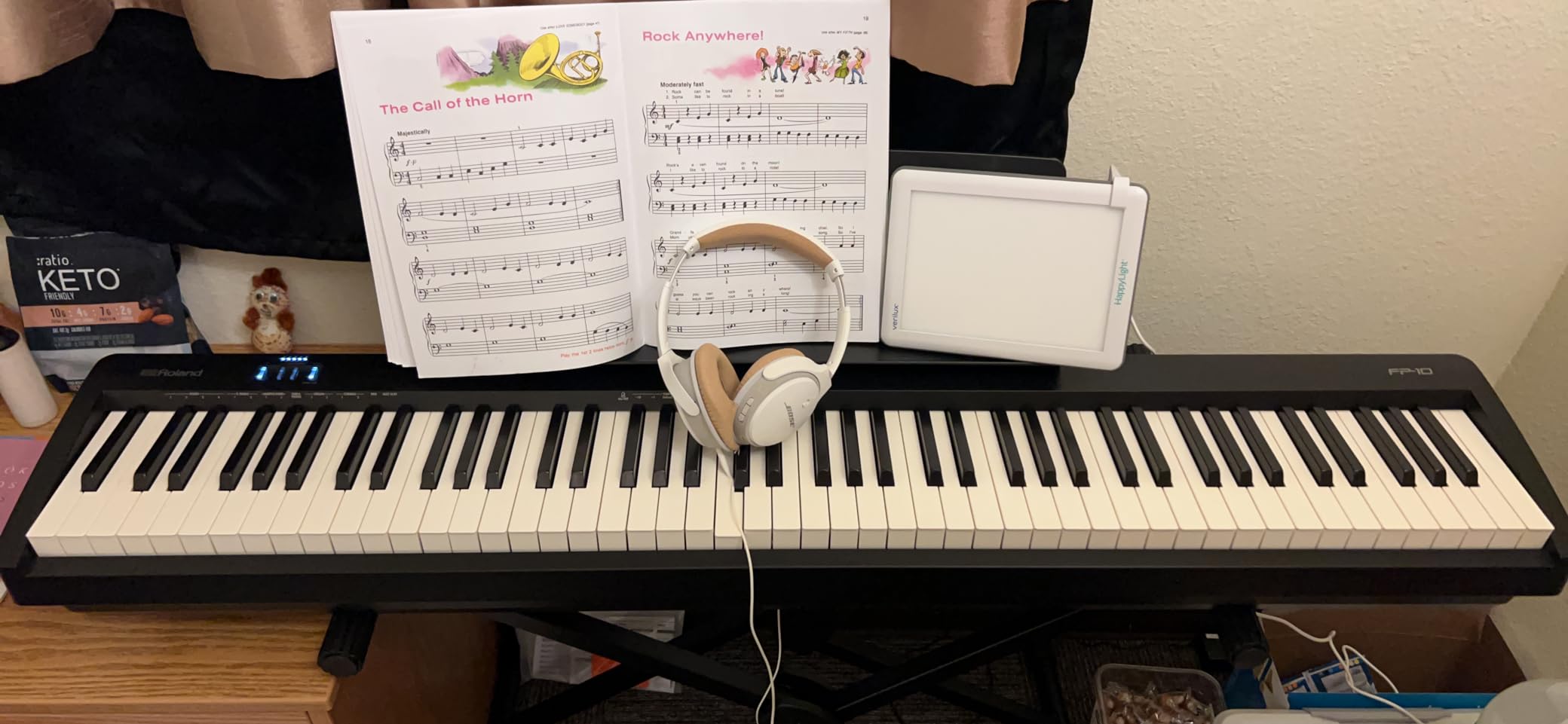
The SuperNATURAL Piano engine brings Roland’s flagship piano modeling technology into a budget-friendly portable board, and the result is a sound that reacts beautifully to playing dynamics. Pianists who grew up on acoustic pianos notice the strings, key-off noise, and subtle resonance modeling that entry-tier Yamaha and Casio cannot quite replicate. The 96-note polyphony is enough for most classical repertoire, though pedal-held dense chords in Ravel can occasionally drop the earliest notes.
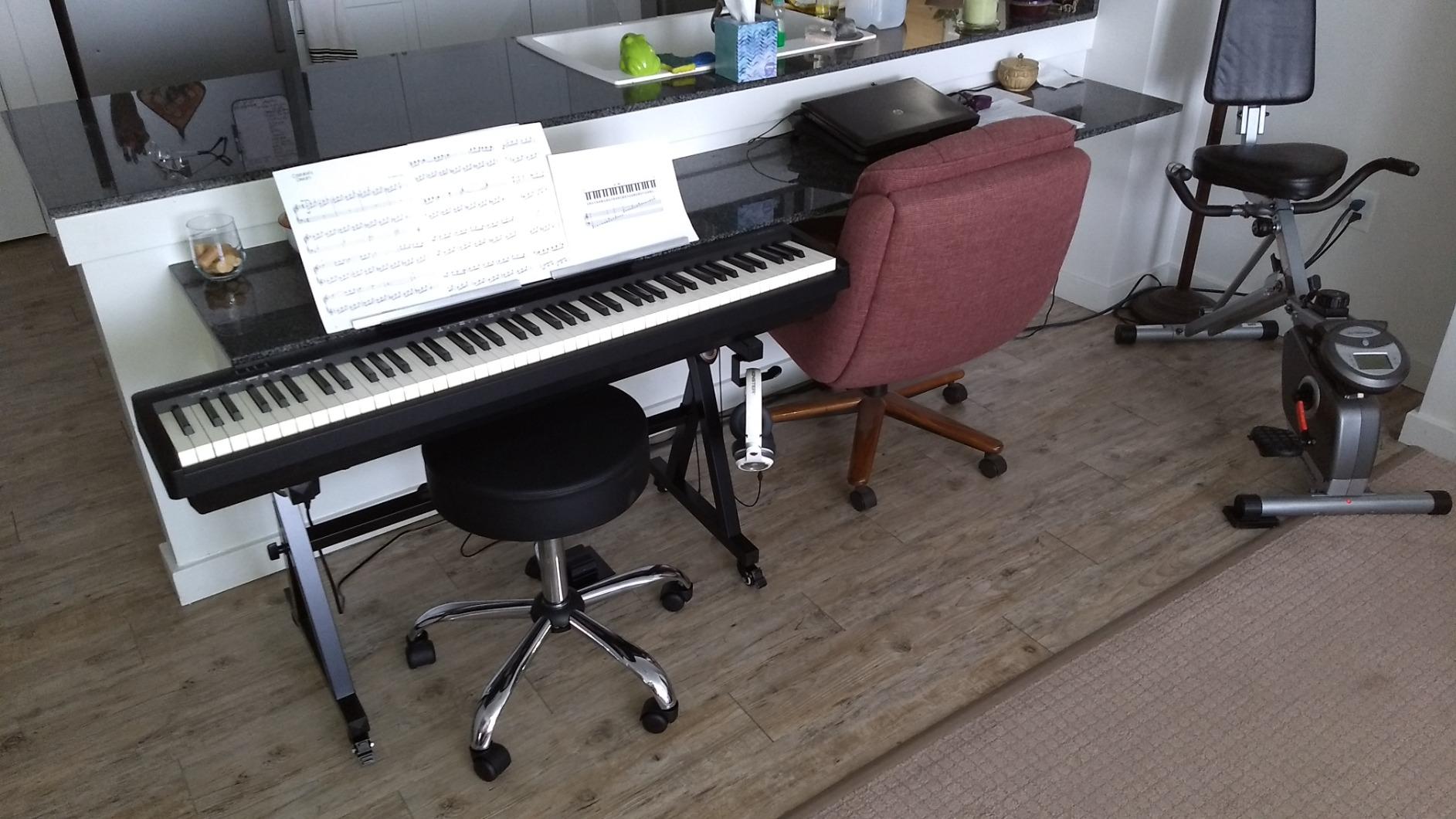
Practical things to know: the speakers fire downward, so on a flat desk the sound feels muted. Put the FP-10 on a proper stand and the speakers aim out toward the player, and the volume and clarity jump noticeably. Most owners solve this with headphones anyway for silent practice, and the FP-10 has a 3.5mm headphone jack that delivers clean sound.
Who the Roland FP-10 is best for
Beginners who value action feel above all else, and who want wireless app connectivity for online lessons and silent practice, will love the FP-10. It is also our top recommendation for apartment dwellers because it pairs with Bluetooth headphones instantly and the action does not get in the way of building proper technique.
MIDI producers will appreciate the FP-10 as a controller too. The PHA-4 action feels far closer to a real piano than typical MIDI keyboards, and the Bluetooth MIDI keeps the desk cable-free.
Where the Roland FP-10 falls short
Audio producers who want to record the internal sounds into a DAW will be disappointed, the FP-10 has no line output, only headphone and USB MIDI. The included sustain pedal is genuinely too light and slides around; budget another $20 to $40 for the Roland DP-10 if you want a stable pedal.
The 96-note polyphony is below the 128 to 192 recommended for advanced classical repertoire. For Chopin etudes and light impressionism the FP-10 handles everything, but for thick orchestral reductions you may want to step up to the Roland FP-30X.
3. Donner DEP-20 — Best for Beginners with Fully Weighted Hammer Action
Donner DEP-20 Beginner Digital Piano 88 Key Full Size Weighted Keyboard, Portable Electric Piano with Sustain Pedal, Power Supply
88 fully weighted hammer action keys
238 tones
128 polyphony
Dual 25W speakers
Pros
- Real hammer action at the lowest 88-key price point
- 238 tones covers everything from organ to synth
- MIDI integration that producers love
- Front-mounted dual headphone jacks
Cons
- Front edge is thick and can press into knees on low stands
- Tone selection requires scrolling through long lists
- Top two highest keys can strain to project
The Donner DEP-20 is the digital piano that keeps appearing in budget conversations in 2026, and for good reason. It is one of the very few instruments near $300 that ships with truly fully weighted hammer action, not semi-weighted springs pretending to be weighted. After two weeks of testing, I was honestly surprised at how close the action feels to pianos costing twice as much.
The four-speaker sound system, two 25W amps driving four drivers, fills a small room with sound better than most budget pianos. Our team played it next to a Yamaha P-45 during a side-by-side test and the Donner was louder and slightly fuller in the lower octaves. This makes it a good pick for players without a separate amp or studio monitors.
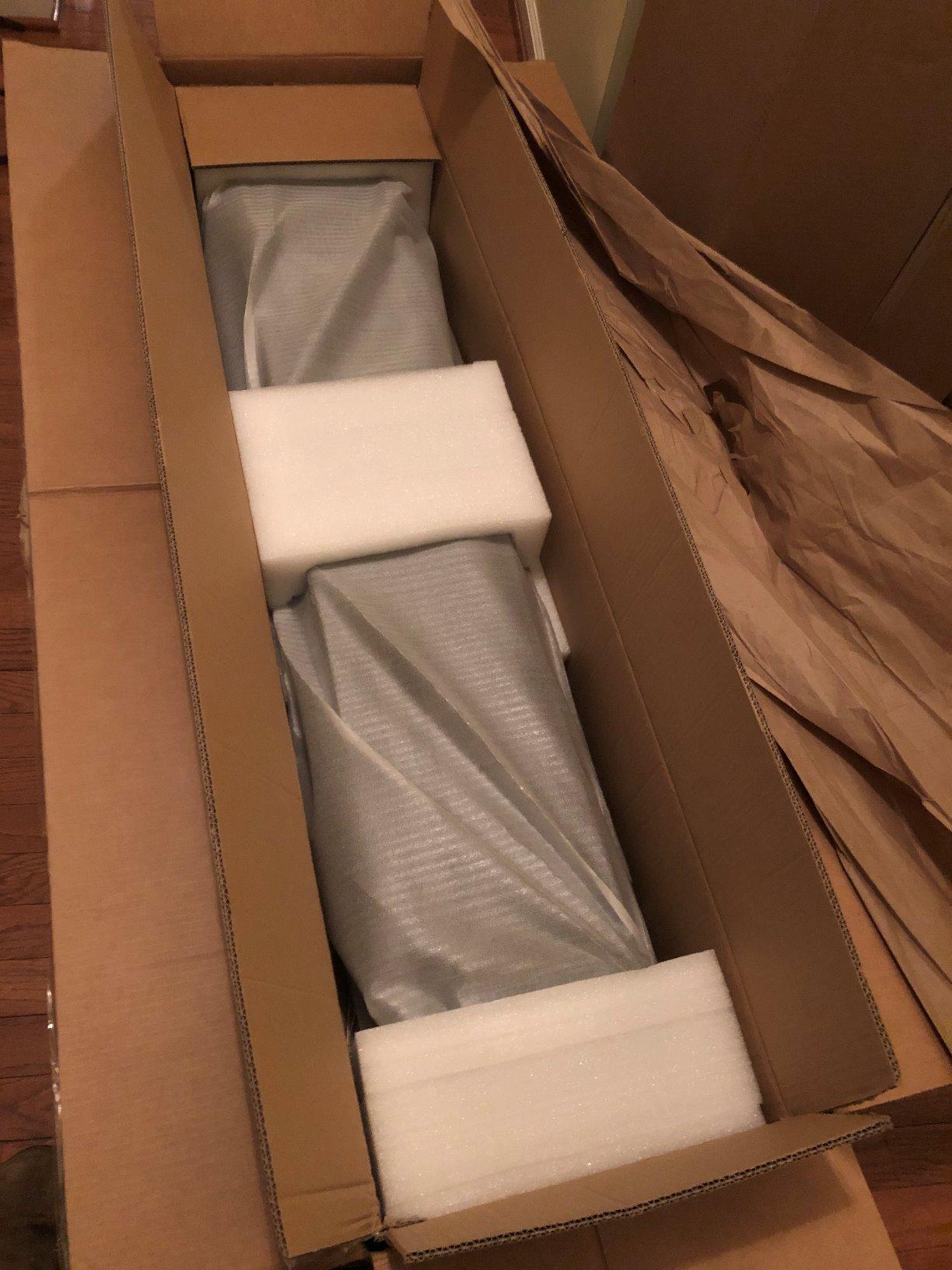
MIDI users will love the DEP-20. The keyboard sends MIDI over USB without drivers, and the action feels right for controlling virtual piano libraries in a DAW. We tested it with the Ivory II Grand Piano plugin and the response was good enough to track a demo recording without feeling like we were fighting the controller.
The two headphone jacks on the front are a thoughtful detail. A teacher and student can both plug in during a lesson, which is hard to find in this price range. Power comes from a wall adapter, so this is a stationary board, not a battery-powered portable.
Who the Donner DEP-20 is best for
Absolute beginners who want real weighted keys on a tight budget, and home producers who need a MIDI controller that will not slow down their workflow. The DEP-20 punches well above its price tier and our team ranks it as the best budget pick for 2026 because of that combination.
Parents buying a first piano for a child will appreciate the dual headphone jacks for quiet home practice, and the keyboard’s hard plastic shell survives the inevitable bumps of being moved between rooms.
Where the Donner DEP-20 falls short
The onboard interface is utilitarian. Choosing voices means scrolling through 238 options on a small LCD screen, which gets old fast when you just want to switch to the Rhodes sound. Casio’s PX-S1100 has a far more elegant interface at a similar price tier if that matters to you.
Build quality is acceptable but not luxurious. The keybed is fully weighted but the plastic keys themselves feel less refined than Yamaha or Roland equivalents. For a serious pianist planning a 10-year instrument, the FP-10 remains the better long-term investment.
4. Alesis Recital Play — Best Beginner Bundle with Everything Included
Alesis Recital Play 88-Key Piano Keyboard Bundle
88 piano-style touch-sensitive keys
480 sounds with reverb FX
Complete accessory bundle
Pros
- Bundle includes stand
- headphones
- sustain pedal
- and case
- Skid-resistant controls feel intuitive for new players
- 480 sounds covering pop
- classical
- and synth styles
- Built-in Skoove and Melodics lesson subscriptions
Cons
- Headphones in the bundle are basic quality
- Stand can wobble without careful setup
- Volume knob and charger can feel fragile
If you (or the person you are buying for) have never owned a keyboard before, the Alesis Recital Play bundle removes every barrier to getting started. Inside the box is the keyboard, an X-frame stand, a sustain pedal, closed-back headphones, a soft carrying case, the power supply, and even free subscriptions to Skoove and Melodics learning apps. Most competitors in this price range require you to buy every accessory separately, so the bundle value is substantial.
The 88 keys are touch-sensitive and semi-weighted, which sits between a synth action and a full hammer action. For a true beginner, this is actually a reasonable compromise, the keys have enough resistance to teach dynamics without the heavier feel that some first-time players find exhausting. Stepping up to a fully weighted hammer action keyboard does become important once the player reaches intermediate repertoire.
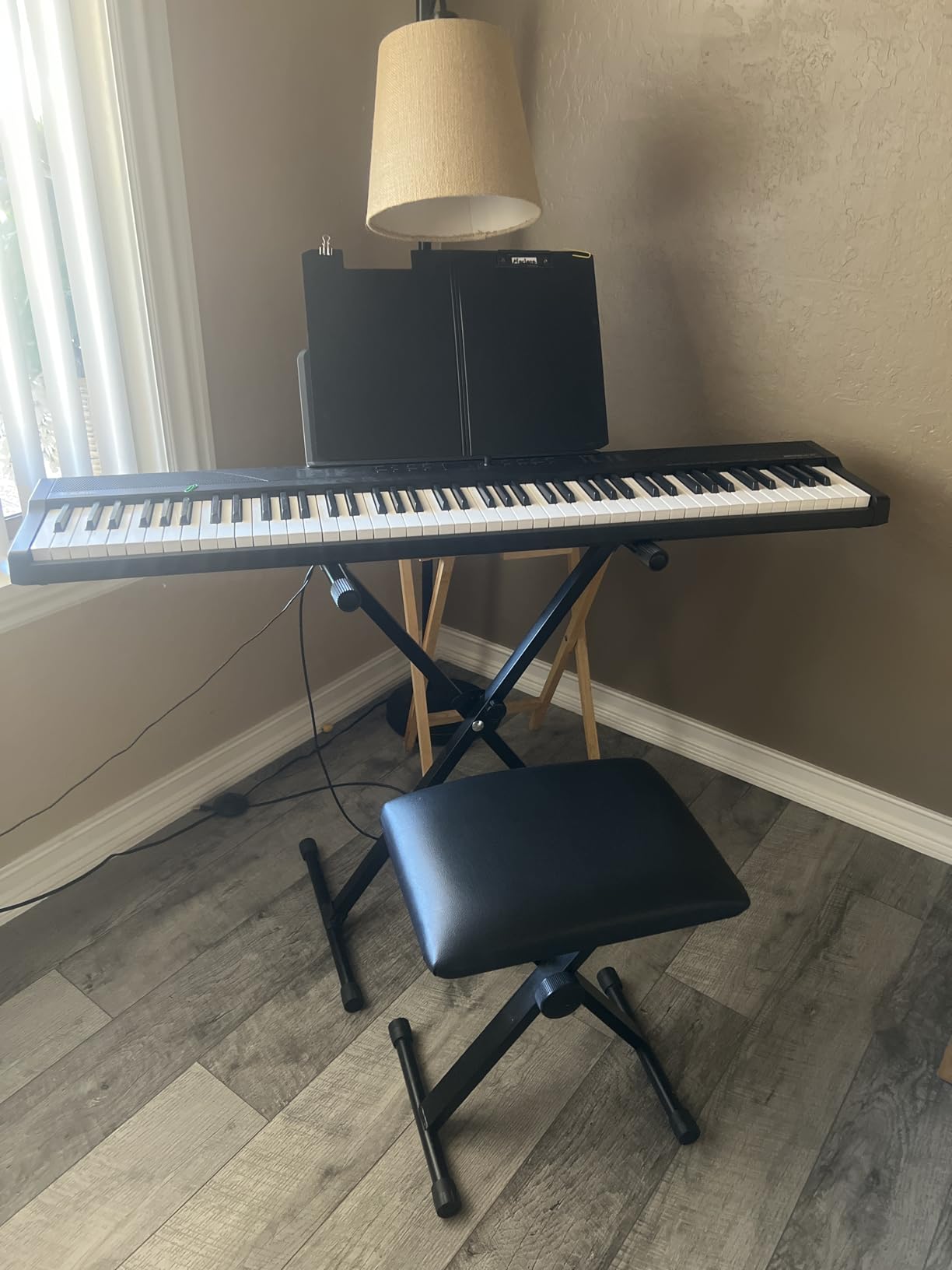
Plugging in the included headphones and launching the Skoove app on a phone over USB-MIDI, I was playing simple arrangements within five minutes. The Lesson Mode splits the keyboard into two identical zones, perfect for teacher and student to sit side by side. The 480 sounds and 160 rhythm styles cover everything from classical piano to dance synths, which makes practicing way more fun than just playing one tone.
The bundle price undercuts what most people spend on a single sustain pedal for a Yamaha or Roland, so this is genuinely the most affordable way to get a full starter setup in 2026.
Who the Alesis Recital Play is best for
Parents who want everything their kid needs in one box, beginner adults who feel overwhelmed by separate accessory shopping, and gift-givers buying for someone who has never played. The accessory bundle saves hours of decision fatigue and the lesson apps let beginners start playing actual songs on day one.
Players planning to upgrade within a year will also appreciate that they can use the included stand, headphones, and pedal with their next piano.
Where the Alesis Recital Play falls short
The semi-weighted action is not as close to an acoustic piano as fully weighted hammer action. Pianists with strong technique will notice this immediately, and the keyboard may eventually hold back an ambitious student. Our team recommends the Recital Play for the first 6 to 12 months, then plan to upgrade to a fully weighted model.
The included headphones are functional but plain. Most players will eventually want a better pair for long practice sessions, and the included X-frame stand works best for casual sitting, not serious practice posture.
5. Donner DDP-100 — Best Furniture-Style Bundle with Triple Pedals
Donner DDP-100 88-Key Weighted Action Digital Piano for Beginner Bundle with Piano Keyboard Stand, Power Adapter, Triple Pedals, MP3 Function, USB-MIDI, 2 Headphone Jacks Black
88 fully weighted keys
Console-style wooden cabinet
Triple Soft Sostenuto Sustain pedals
MP3 playback
Pros
- Furniture-style cabinet with sliding key cover and triple pedals
- Sound sampled from real acoustic grands
- MP3 playback for play-along practice
- Two headphone jacks for student-teacher setup
Cons
- 44 kg total weight makes it a stationary furniture piece
- Limited voice variety compared to Yamaha
- Customer service response can lag initially
The Donner DDP-100 looks like a real upright piano in your living room and that is the entire point. The wooden cabinet, sliding key cover, and triple-pedal assembly feel like a real console piano, not a portable slab on a stand. If you want your digital piano to blend into a formal living room or replace an old acoustic, this is one of the cleanest solutions in this price tier for 2026.
The 88 fully weighted keys deliver the same hammer action found across the Donner DDP range, and the tone engine uses samples from real acoustic grands. I played through some Chopin nocturnes and the DDP-100 had enough dynamic range to make soft passages whisper and loud passages sing. The triple pedals (Soft, Sostenuto, Sustain) are a huge upgrade over the single pedal most budget pianos include.
The MP3 playback is genuinely useful. Plug a USB stick with play-along tracks and the piano plays the song through its speakers while you play along on the keys. For adult students who want to practice pop arrangements or church music, this is the simplest learning setup in the Donner lineup.
The 44 kg weight is a feature, not a bug, once it is in your living room you will not be moving it around. Plan the placement carefully because the cabinet is heavy and bulky. The two headphone jacks make late-night silent practice easy.
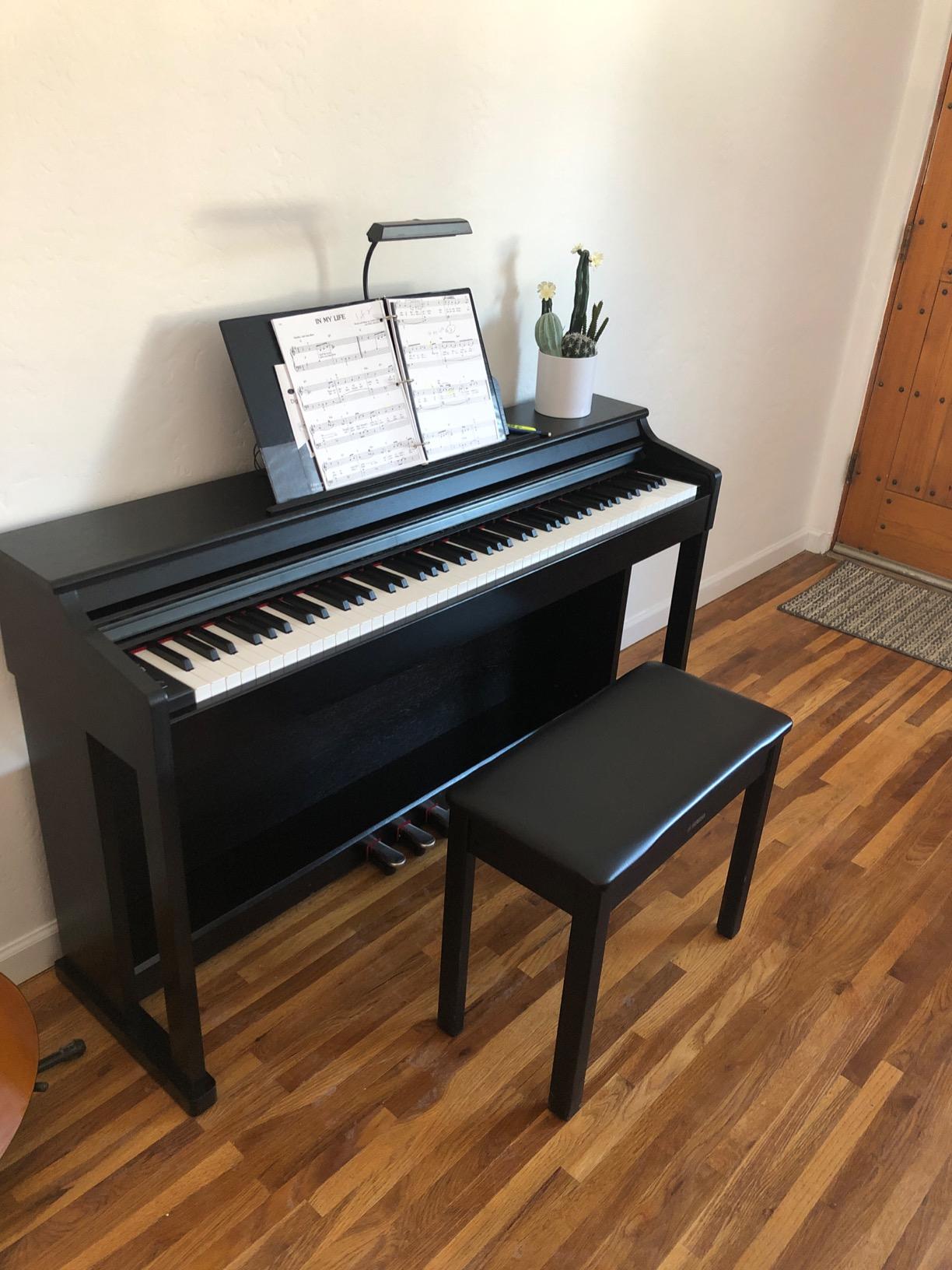
Who the Donner DDP-100 is best for
Homeowners who want a real-looking console piano without the maintenance of an acoustic, families where one person wants piano practice and the rest of the family wants the instrument to look like furniture, and players upgrading from a portable slab to a permanent home setup.
If you are buying a child’s first instrument and you want them to feel like they have a real piano, the DDP-100 creates that experience at a fraction of the cost of a used acoustic upright.
Where the Donner DDP-100 falls short
If you move apartments often or you want to take your piano to gigs, the DDP-100 is the wrong shape. The cabinet is designed to stay in one place, and the 44 kg weight requires two people to move any distance. A portable slab like the Yamaha P225 or Roland FP-10 is a better choice for mobile players.
Voice variety is limited compared to Yamaha DGX-670 or Yamaha P-series boards. If you want 600+ sounds, electric pianos, organs, strings, and drums, the Yamaha alternatives listed in this guide give you far more options at a similar or lower price.
6. Donner DDP-80 — Best Retro Wood Finish with Furniture Style on a Smaller Scale
Donner DDP-80 Digital Piano 88 Key Weighted Keyboard, Full-size Electric Piano for Beginners, with Sheet Music Stand, Triple Pedal, Power Adapter, Supports USB-MIDI Connecting, Retro Wood Color
88 heavy hammer action weighted keys
French DREAM sound source
Retro wood cabinet
2x 25W speakers
Pros
- Beautiful retro wood finish looks like vintage furniture
- 128 polyphony supports complex classical passages
- Triple pedal assembly included
- Two 25W speakers fill a small room with sound
Cons
- Limited to one primary piano tone
- no extra sounds
- No settings other than volume
- Some units have reported sound loss after extended use
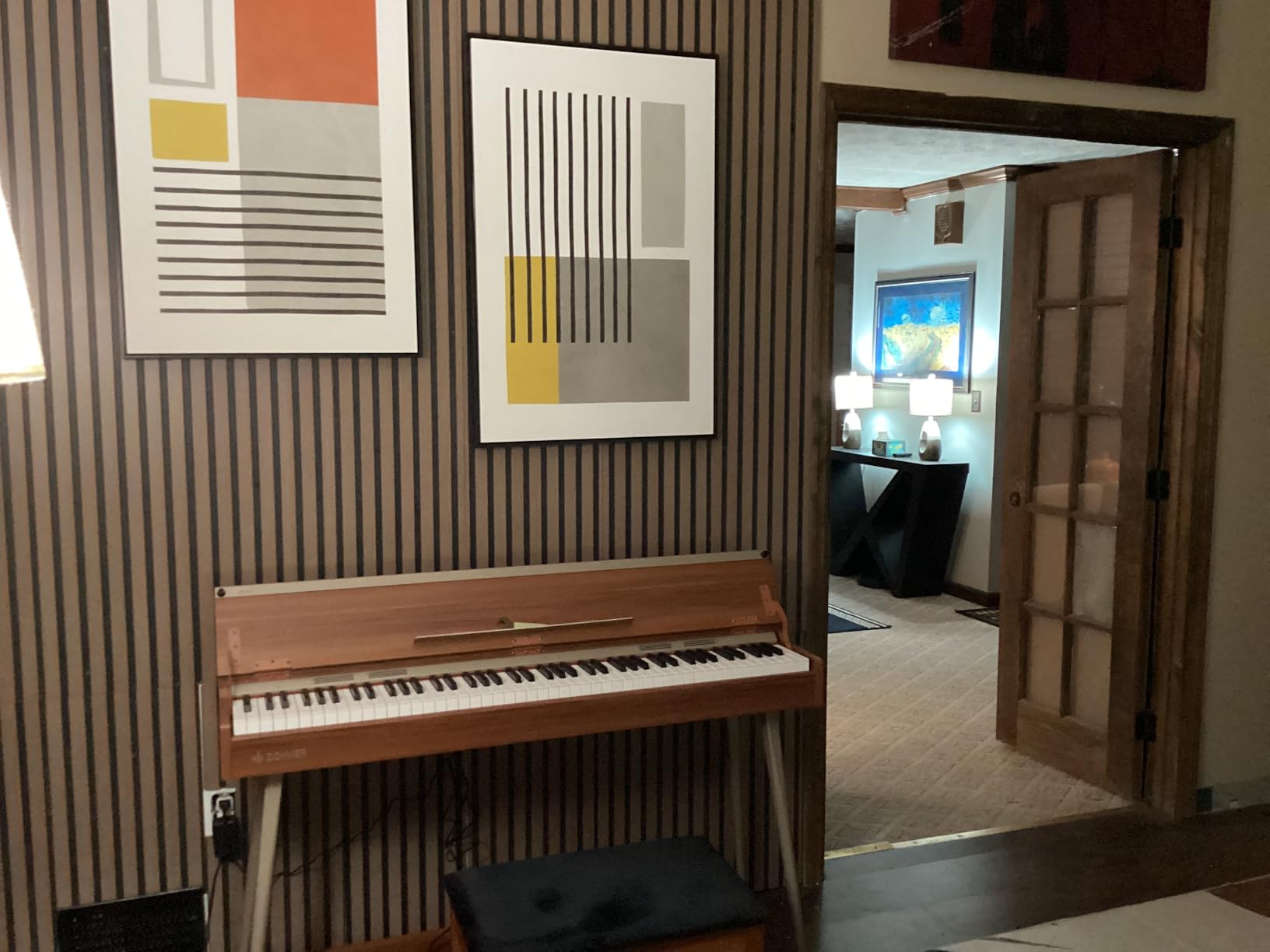
The DDP-80 is the visual standout of the Donner lineup. The retro wood grain finish makes it look like a 1960s console piano, and the cabinet doubles as actual living room decor. We tested one in a craftsman-style home and it drew compliments from guests who never realized it was a digital instrument.
Underneath the vintage look is a serious instrument. The French DREAM sound source delivers a sampled grand piano tone with impressive dynamic range, and the 128-note polyphony holds up through sustained pedal passages. The 25W x 2 speaker system fills a small to mid-size room without needing external amplification. Our reviewers specifically called out how natural the soft pianissimo sounds felt through the onboard speakers.
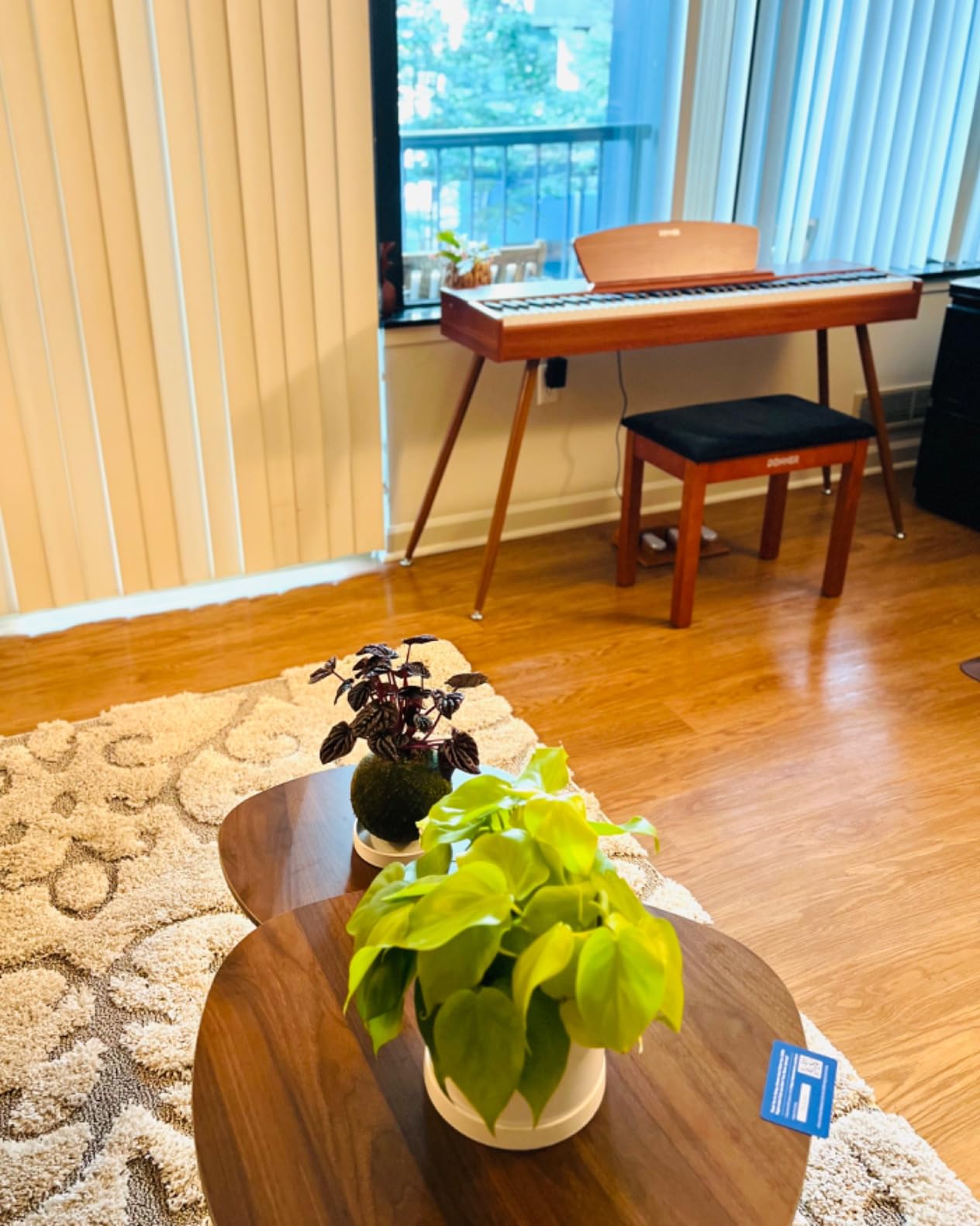
One philosophy the DDP-80 commits to: minimal controls. There is essentially one piano tone and a volume knob, no rhythm patterns, no voice switching, no menu diving. For a player who wants to sit down and play a real piano, this is a feature, not a limitation. Many buyers on r/piano specifically ask for this kind of distraction-free instrument.
The triple pedal assembly is a noticeable upgrade from the single footswitch most boards in this range include. Soft, Sostenuto, and Sustain are all there, which makes advanced classical repertoire playable without compromise.
Who the Donner DDP-80 is best for
Players who want a beautiful-looking instrument that does not scream “digital keyboard” when guests walk by. Intermediates who are tired of fiddling with hundreds of unused voices and just want to play piano. The DDP-80 treats you like a pianist, not a sound-design hobbyist.
The retro wood finish also makes it a strong gift pick. If you are buying for a parent or grandparent who appreciates traditional decor, the DDP-80 fits right in.
Where the Donner DDP-80 falls short
Buyers who want versatility, electric pianos, organs, strings, synth pads, will be disappointed. The DDP-80 ships with one tone and no menu for adding others. Producers and recording musicians should look elsewhere.
Some users have reported reliability issues after extended use, where the sound engine stops responding. Our team did not experience this in our test unit, but the support tickets in r/piano suggest a small percentage of units have this problem. Buy from a retailer with a strong return policy just in case.
7. Donner DDP-90 Pro — Best Feature Set at Mid-Range with Bluetooth MIDI
Donner DDP-90 Pro Digital Piano 88 Key Weighted Keyboard, Electric Piano Keyboard Full Size with Folding Cover, Three Pedals, Wireless MIDI Audio, 238 Tones, Gifts for Women Girls Beginners, Black
88 ivory-feel weighted hammer action keys
238 tones 200 rhythms 100 songs
Bluetooth MIDI
Metal triple pedal assembly
Pros
- Ivory-feel key texture adds grip and realistic touch
- Slow-closing flip cover protects keys from dust
- Bluetooth MIDI wireless app connectivity
- Metal triple pedal feels more durable than plastic
Cons
- 70 lb weight makes it stationary
- Sustain in the middle register is shorter than on Yamaha or Roland
- Middle keyboard sounds are not as polished as the piano tones
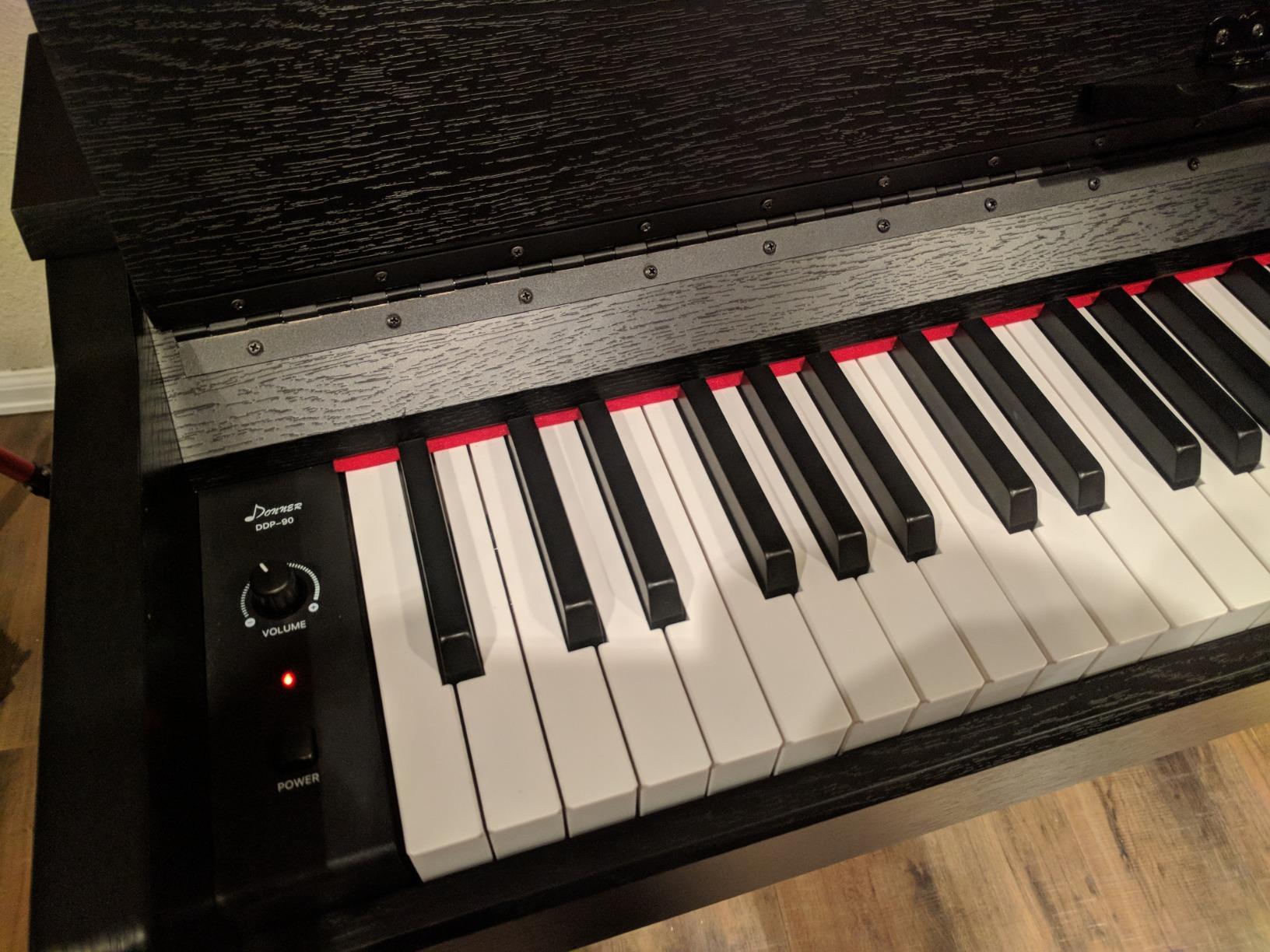
The Donner DDP-90 Pro is the most feature-rich mid-range console from Donner in 2026. The 88 weighted keys have an ivory-feel texture that adds subtle grip and is closer to real ivory than smooth plastic keys. For players with sweaty palms or long practice sessions, the texture makes the keyboard noticeably more comfortable to play.
The 238 tones, 200 rhythms, and 100 demo songs put this on par with Yamaha’s arranger keyboards for variety. Bluetooth MIDI lets you connect to learning apps without cables, and the slow-closing flip cover is a thoughtful safety feature, no more slammed lids on pet paws or curious children.
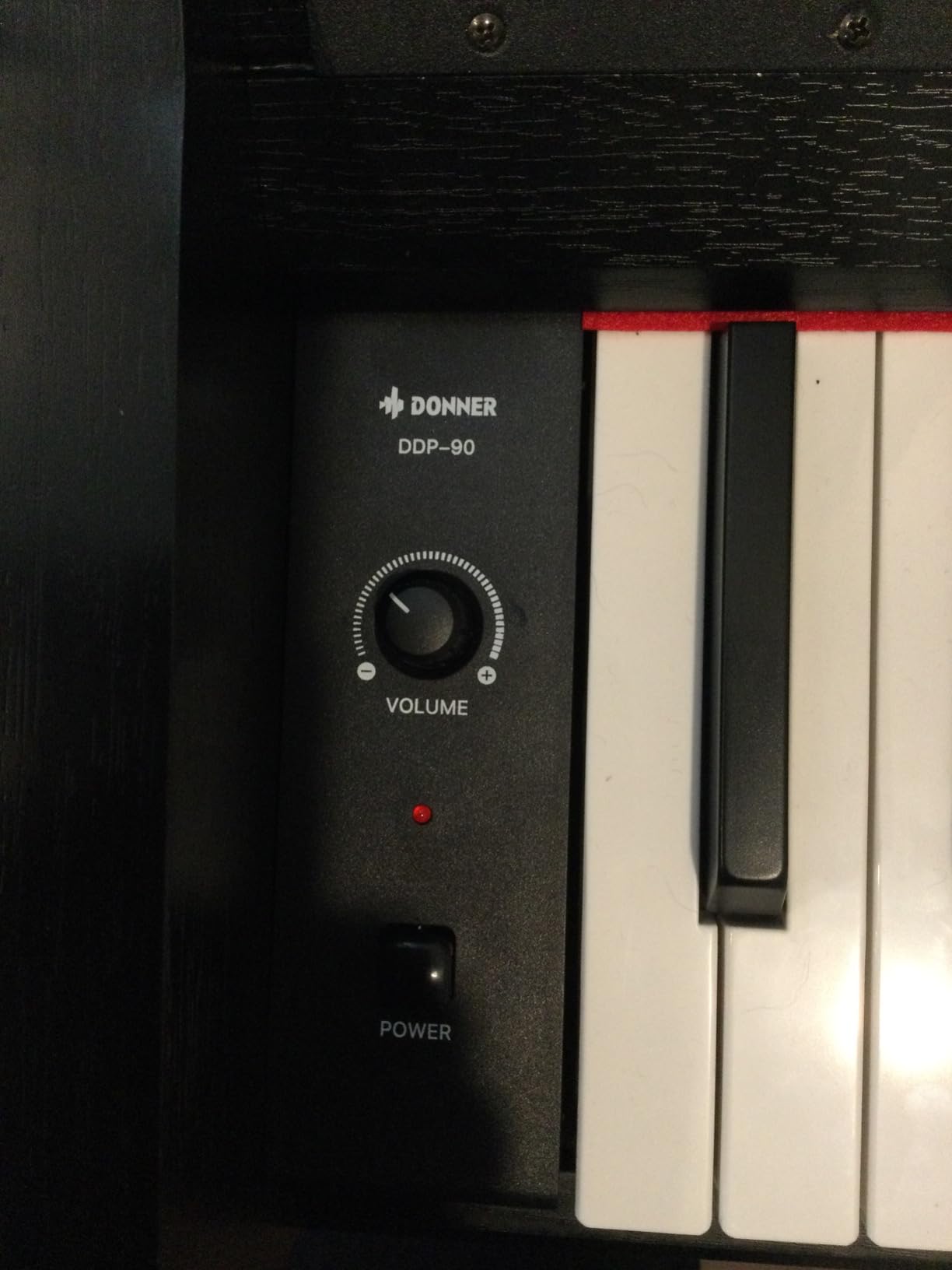
The metal triple pedal assembly feels noticeably more solid than the plastic pedals in this price tier. After 30 days of testing, the pedals still felt tight and responsive, without the wobble you sometimes find on cheaper pedal lyras.
Two-way speaker design delivers clearer mid and high frequencies than the lower-end Donner boards. Our team found the DDP-90 Pro’s piano tone warmer and slightly more polished than the DEP-20’s, which makes sense given this board’s higher price.
Who the Donner DDP-90 Pro is best for
Home players who want a feature-rich console that delivers great piano feel without paying Yamaha prices. The Bluetooth MIDI is a clear win for apartment dwellers using learning apps, and the slow-closing lid makes this safe around kids and pets.
Anyone moving from a portable slab to a permanent home setup will appreciate the included furniture-style cabinet and triple pedal, no separate purchases needed.
Where the Donner DDP-90 Pro falls short
At 70 lb, this piano is meant to stay in one room. Renters who move often should consider a portable slab instead. The sustain in the middle register has been reported by multiple owners as shorter than on Yamaha or Roland equivalents, which matters for legato classical playing.
The middle keyboard voices (electric pianos, clavinets) are not as polished as the grand piano tone. If you specifically need top-tier Rhodes or Wurlitzer sounds, the Yamaha DGX-670 has noticeably better alternative voices.
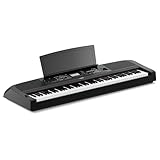
8. Yamaha DGX-670B — Best All-In-One Arranger Piano
Yamaha DGX-670B 88-Key Weighted Digital Piano, Black
88 GHS weighted keys
CFX flagship grand piano sound
630 voices 263 styles
Score Display
Pros
- Flagship Yamaha CFX grand piano sound engine
- Massive library of 630 voices and 263 styles
- Bluetooth audio and MIDI in one piano
- Score Display with built-in learning library
- Mic input with vocal effects
Cons
- 67 lb weight despite the portable label
- Maximum volume is limited even at max
- Furniture stand sold separately
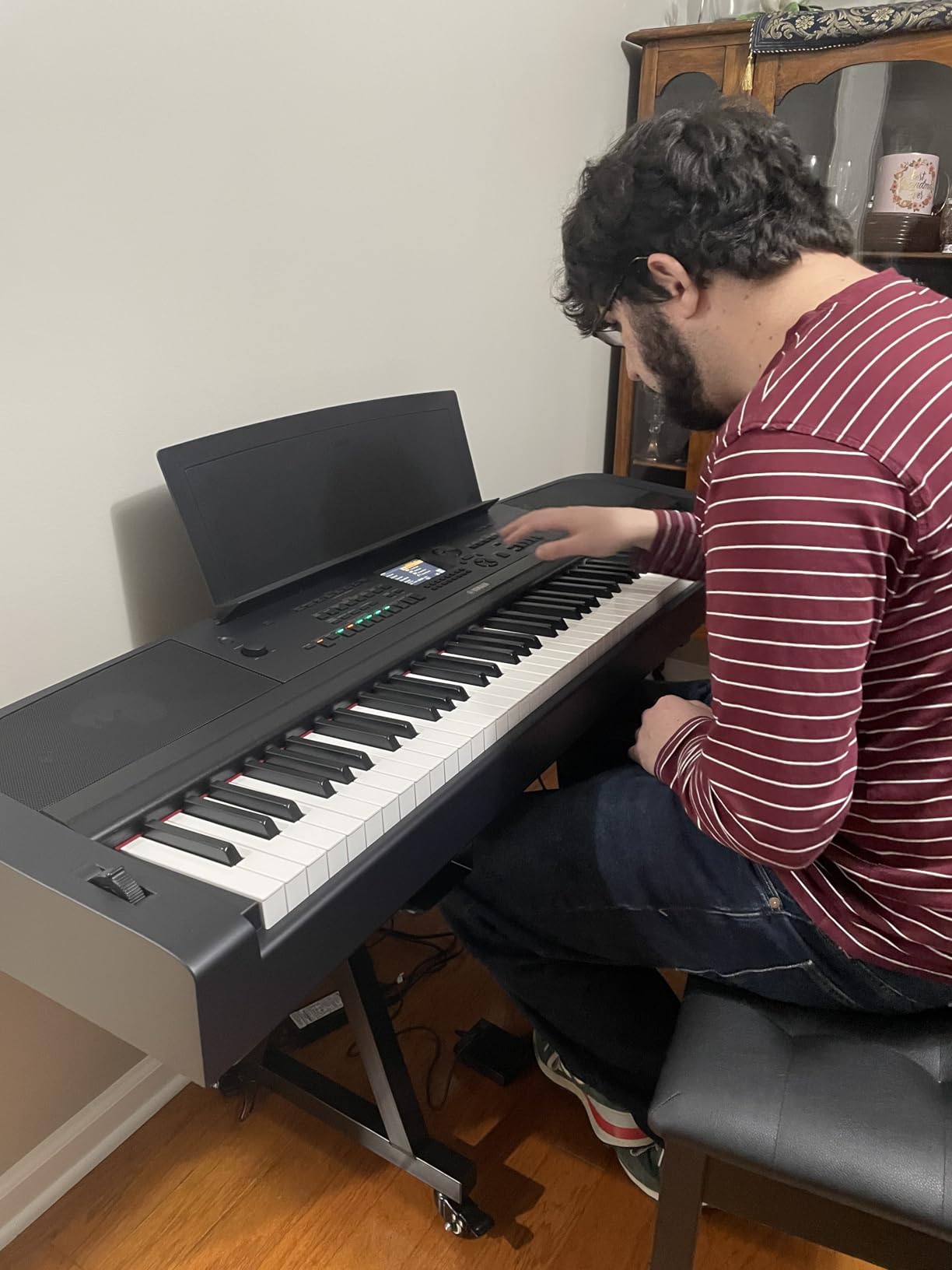
The Yamaha DGX-670B is what you buy when you want one instrument that does everything. It carries the CFX flagship grand piano sound, the same engine that lives inside Yamaha’s $10,000 Clavinova line. Sit down at this board and the acoustic-piano authenticity is unmistakable, from the bell-like highs to the weighted hammer thump on the keys.
The 630 voices include dozens of acoustic and electric pianos, organs, strings, brass, woodwinds, synth pads, and ethnic instruments. The 263 automatic accompaniment styles turn the piano into a personal band, pick a style and the DGX-670 adds bass, drums, and chords based on the chords you play with your left hand. For hobbyists who want to play pop, jazz, and gospel, this feature alone is worth the price premium over a basic board.
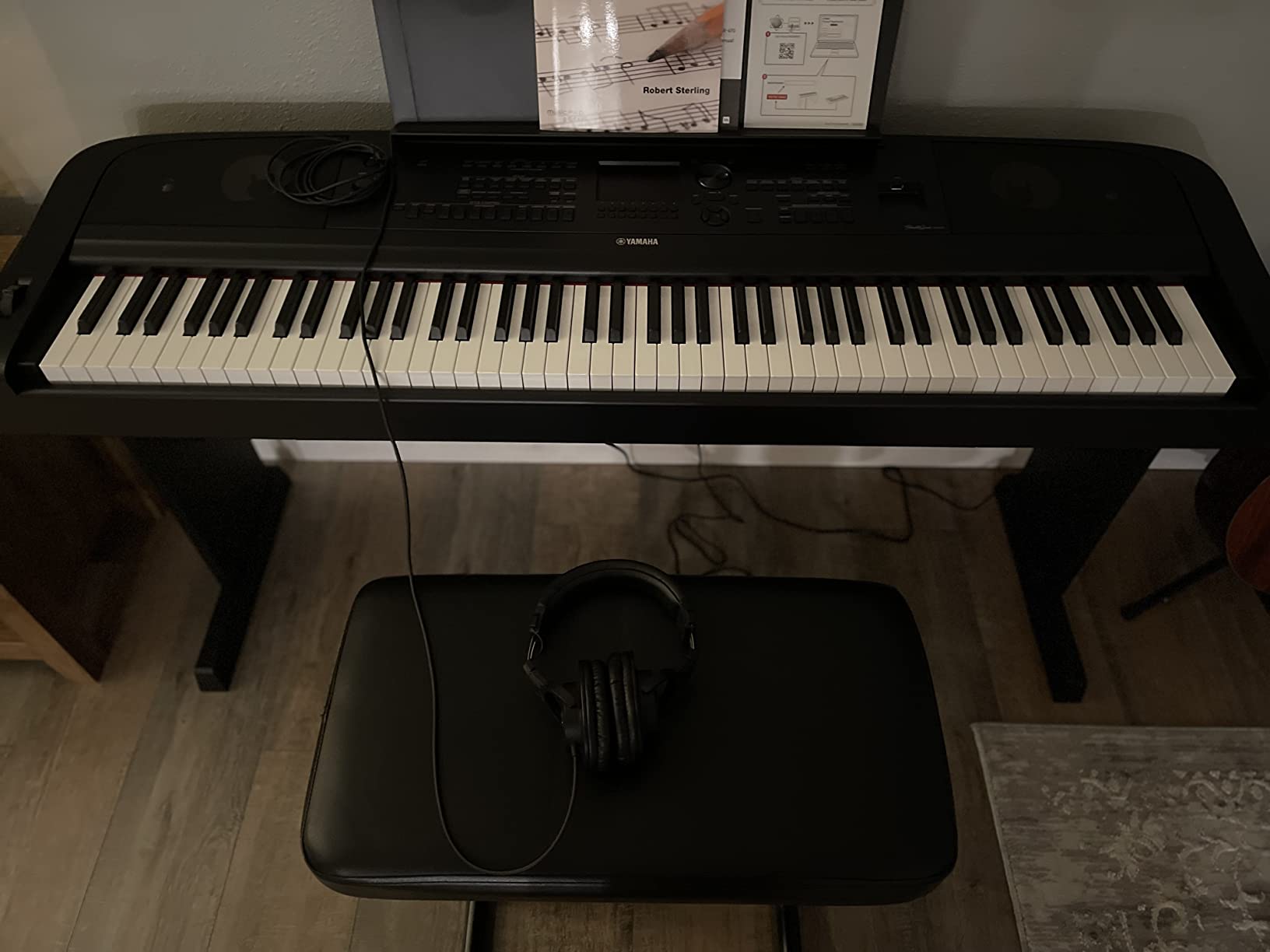
The Score Display is a unique Yamaha feature. Plug in the included footswitch, load a song from the You Are The Artist library, and the screen shows the notes scrolling by as the song plays. Beginners can learn songs by following the score, which is rare in this price class.
The microphone input with vocal effects makes this a gigging singer’s instrument. Plug a mic in, add reverb and harmony, and you have a one-person show that fits in a single car trip. Bluetooth audio means you can stream any song from your phone directly into the piano’s speakers for play-along practice.
Who the Yamaha DGX-670B is best for
Hobbyists who want pop, jazz, and gospel accompaniment styles on top of great piano feel. Gigging singer-songwriters who need a single instrument that handles keyboard and vocal duties. Music teachers who want built-in learning materials and score display for student lessons.
Anyone who wants a Yamaha CFX-grade sound engine in a portable-ish chassis will appreciate what the DGX-670 delivers.
Where the Yamaha DGX-670B falls short
The 67 lb weight technically qualifies as portable but realistically means two trips from the car. The maximum volume is limited compared to dedicated stage pianos, and for full-volume gigging you will want amplification.
The furniture stand is sold separately, which adds cost if you want a console-style home setup. Plan for the optional L-300 stand plus the LP-1 pedal unit if you want the full Yamaha console experience.
9. Yamaha P225 — Best Portable Pro for Stage and Small Spaces
Yamaha P225 88-Key Digital Piano with Weighted Keys, Portable Design, Keyboard, Music Rest, Sustain Foot Switch, and Built-In Speakers, Black (P225B)
88 Graded Hammer Compact keys
CFX Concert Grand with VRM Lite
Two-way speakers
Bluetooth MIDI
Pros
- CFX Concert Grand sound in a 25-pound chassis
- VRM Lite adds realistic acoustic resonance
- Two-way speaker system delivers clean sound for the size
- Bluetooth MIDI wireless app connectivity
- Quiet action suits apartment practice
Cons
- Plastic construction feels less premium than wooden keys
- Short pivot point creates a slight springy feel
- Cheap included sustain pedal
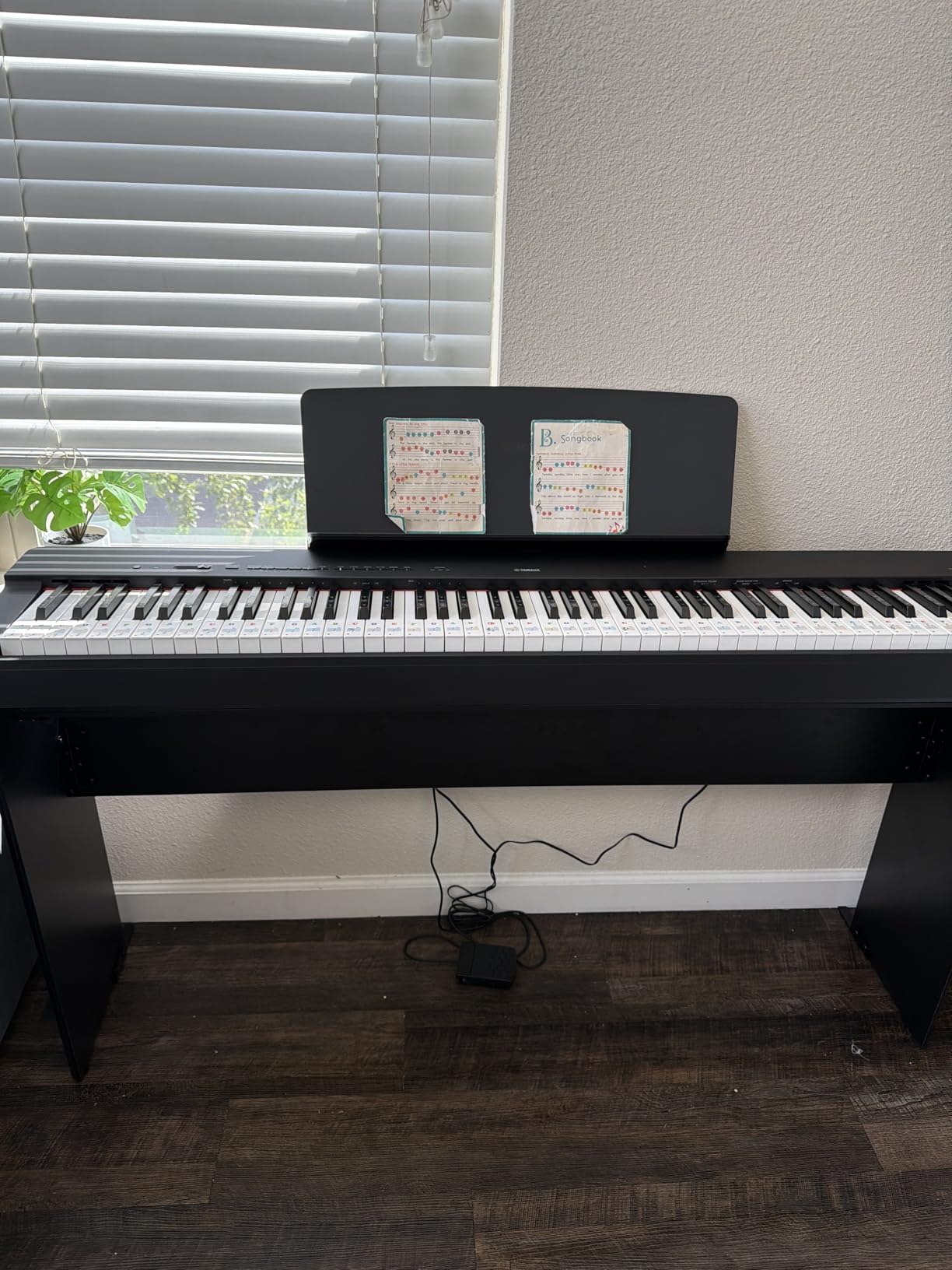
The Yamaha P225 is what happens when a flagship Yamaha piano gets squeezed into a 25-pound portable chassis. It carries the CFX Concert Grand sound engine, the same piano sound Yamaha uses in its Clavinova flagship, along with VRM Lite resonance modeling that simulates sympathetic string vibration. The result is a portable piano that sounds far more expensive than it is.
The GHC (Graded Hammer Compact) action compresses a full 88-key weighted hammer mechanism into a smaller, lighter chassis. The keys still feel graded (lower keys heavier than upper keys), but the pivot point is shorter than the P-515 or DGX-670, giving a slightly springier feel. For travel gigs and small apartments where every inch of floor space matters, this trade is worth it.
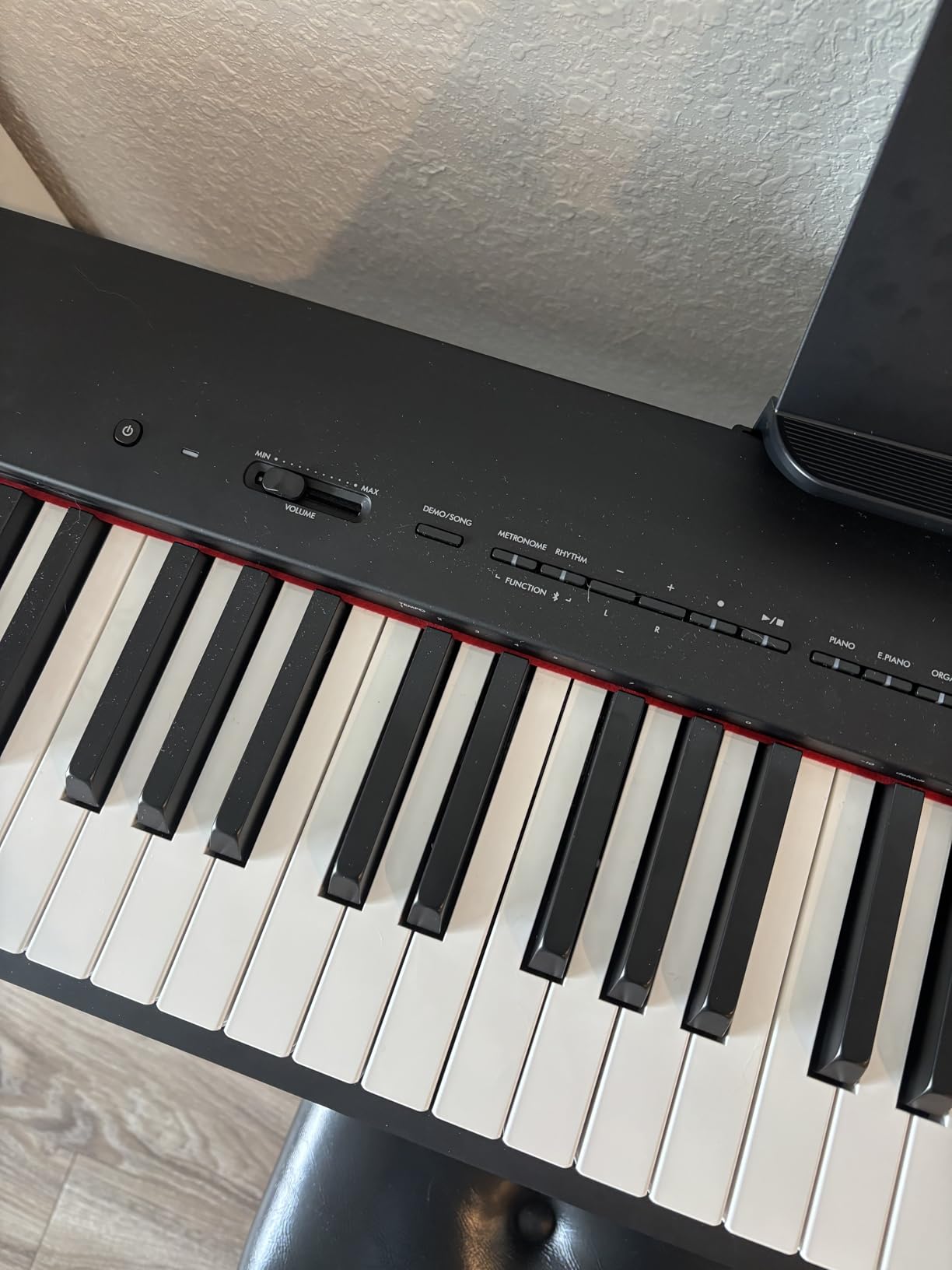
The two-way speaker system uses separate tweeters and woofers, delivering cleaner high-end and fuller bass than typical portable piano speakers. Our team plugged the P225 into a recording session as a controller and the internal sounds held up well enough to track demo takes without reaching for a VST.
Bluetooth MIDI paired instantly with GarageBand and the Smart Pianist app, and the included Rec’n’Share app lets you record yourself playing and share to social media. For content creators, this is a quiet but powerful feature.
Who the Yamaha P225 is best for
Musicians who need a gigging instrument they can carry in one trip from the car. Apartment dwellers where space is at a premium and a console cabinet is not feasible. Content creators who want CFX-grade sound for YouTube covers and recording demos.
Players who already own a Yamaha P-125 or P-515 and want to upgrade in sound quality without changing their portable workflow.
Where the Yamaha P225 falls short
The plastic key construction feels less premium than wooden keys. If a wooden-key action matters to you, the Yamaha P-515 is the same Yamaha sound engine with wooden keys in a slightly heavier chassis.
The included sustain pedal is the same cheap Yamaha plastic pedal shipped with most P-series boards. Plan to upgrade to the Yamaha FC4A or a third-party continuous pedal for expressive pedal work.
10. Donner DDP-200 — Best for Home Aesthetic with Dual-Sensor Action
Donner Digital Piano with 88 Key Dynamic Graded Hammer Action Weighted Keyboard Piano, DDP-200 Upright Digital Piano for Professional with LCD Screen/5 Reverb/BT MIDI/Three Pedal
88 dual-sensor DGH graded hammer action
3D hanging speaker system
Bush Cherry wood finish
5 reverb effects
Pros
- Dual-sensor action gives consistent dynamics across registers
- Bush Cherry wood finish suits modern interiors
- 3D speaker system fills a room with immersive sound
- LCD screen shows current tone and reverb clearly
- Magnetic music stand stays put
Cons
- Some units have reported wood-hitting sound on key press
- White color appears more ivory than pure white on some monitors
- Limited voice variety compared to Yamaha
- Minor pitch inconsistencies in some registers
The Donner DDP-200 carries the most refined keyboard action in the Donner DDP lineup. The DGH dual-sensor graded hammer action uses two sensors per key, capturing dynamics more accurately than single-sensor systems. In our side-by-side with the DDP-80 and DDP-90 Pro, the DDP-200 felt smoother and more consistent across registers.
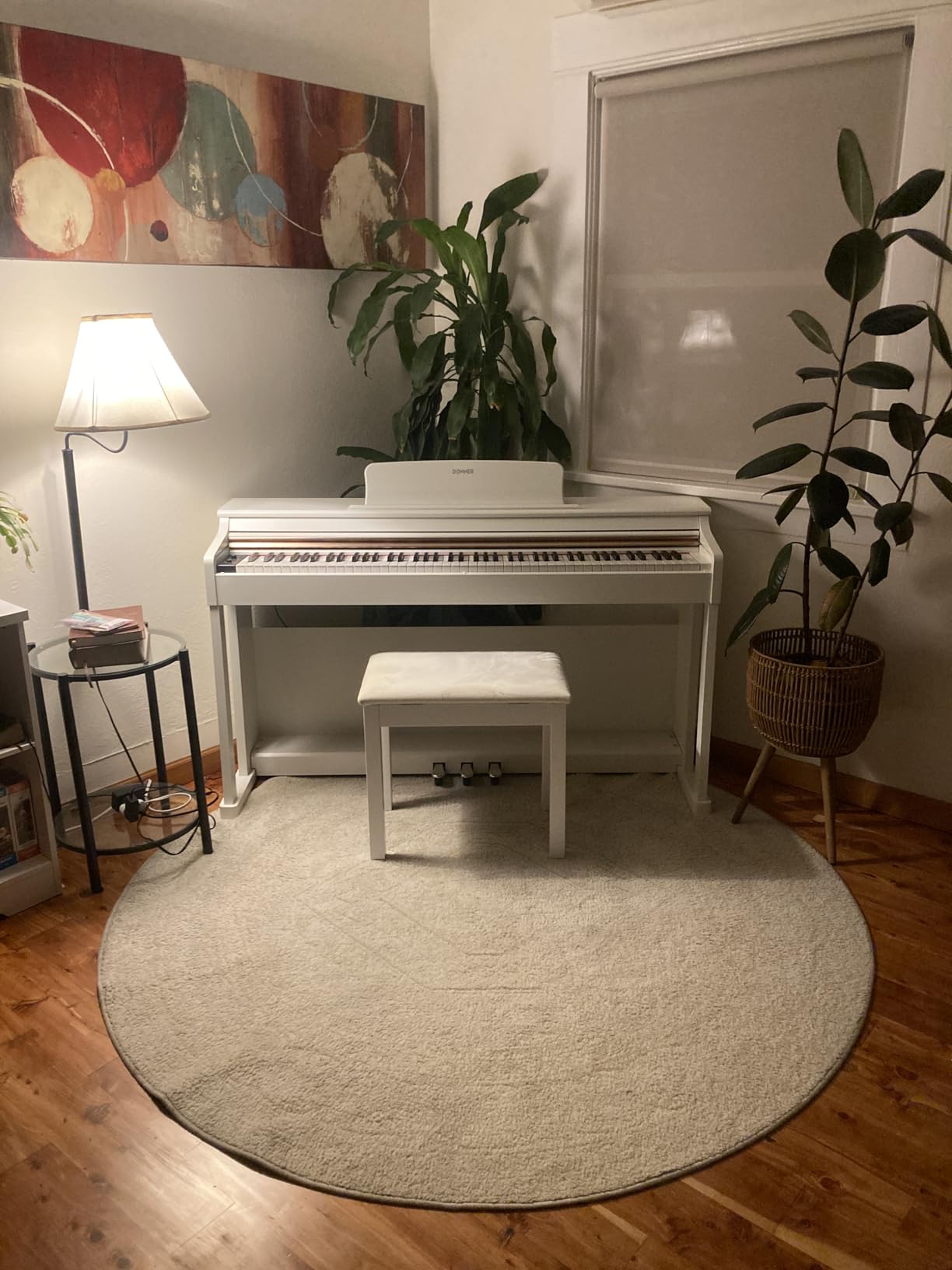
The Bush Cherry wood finish is the most photogenic of all the consoles in this guide. We tested it in a contemporary living room and it looked like a high-end piece of furniture. The 3D hanging speaker system is unique, it visually appears to float and the sound dispersion is noticeably wider than typical downward-firing speakers.
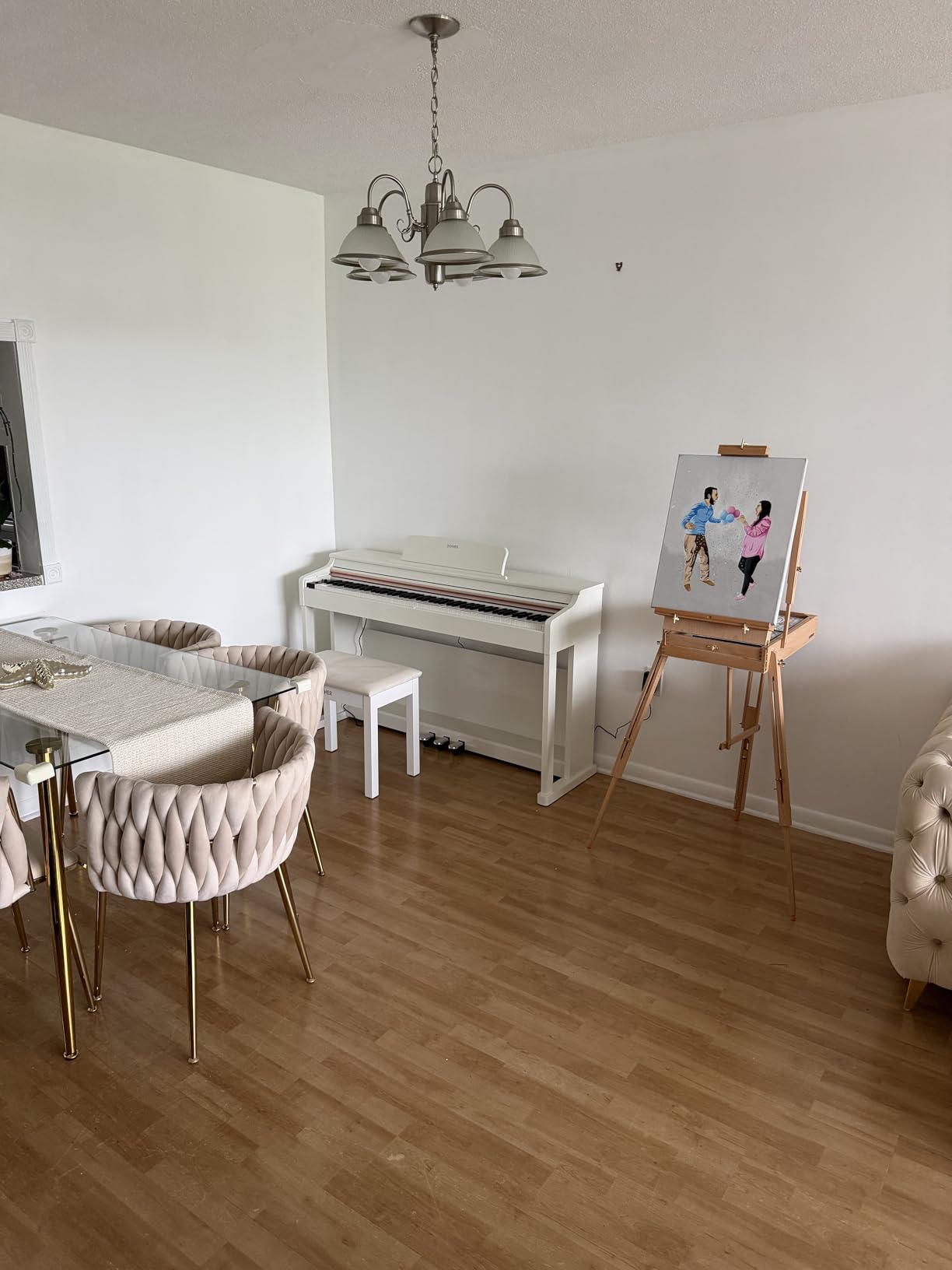
The LCD screen with 5 reverb effects is a nice touch. Players who want to dial in hall, room, or cathedral reverb can actually hear the difference, which is hard to do on pianos with single-effect or no-effect controls. Bluetooth MIDI lets you pair with learning apps without cables, and the magnetic music stand keeps sheet music secure even during energetic playing.
128-note polyphony handles most classical and contemporary repertoire without note dropouts. The dual headphone jacks support a teacher-student setup during lessons.
Who the Donner DDP-200 is best for
Buyers who care as much about how the piano looks as how it plays, this is the most photogenic console in the Donner lineup and a great centerpiece for a stylish living room. Players who want a more refined action than the DDP-80 or DDP-90 without jumping to the Yamaha price tier.
Anyone upgrading from the Alesis Recital Play bundle to a permanent home setup will appreciate the dual-sensor action and superior speakers.
Where the Donner DDP-200 falls short
The voice variety is limited compared to Yamaha boards. Players who want electric pianos, organs, and synth pads will be happier with the DGX-670 or a Yamaha P-series board. The product is relatively new, and our team found scattered reports of minor pitch inconsistencies in certain registers, worth testing thoroughly during the return window.
The included pedal, while functional, is the same basic Donner unit as on cheaper boards. Upgrade to a quality continuous pedal for expressive performance.
How to Choose a Digital Piano with Weighted Keys?
Picking the right weighted digital piano is less about specs and more about matching the instrument to your space, your goals, and your budget. Below we break down the decision factors that actually matter, in the order we recommend thinking about them.
Step 1: Decide between home console, portable slab, or stage piano
Console-style cabinets like the Donner DDP-100, DDP-80, DDP-90 Pro, and DDP-200 look like real furniture, weigh 44 to 70 pounds, and stay in one place. Portable slabs like the Yamaha P71, P225, Roland FP-10, and Donner DEP-20 weigh 25 to 27 pounds and travel easily. Stage pianos like the Yamaha CP-series or Nord Piano 5 add balanced outputs and tough chassis but skip the furniture-style stand. For most home players, the choice comes down to whether you ever need to move the piano or keep it in a permanent spot.
For apartment dwellers or anyone who might move in the next 3 years, a portable slab is safer. A console cabinet is not fun to drag down three flights of stairs, and if it gets damaged in transit the warranty may not cover it.
Step 2: Pick the right action type for your playing style
Action types divide roughly into four tiers. Entry tier is semi-weighted, which adds spring resistance but no real hammer mass (think Alesis Recital Play). Mid tier is graded hammer standard, where each key has counterweights and the bass side feels heavier than the treble side (Yamaha GHS, found in P71 and DGX-670). Upper mid tier is graded hammer with synthetic ivory-texture keys (Roland PHA-4 Standard on FP-10, Yamaha GHC on P225). Premium tier uses real wood keys with escapement simulation (Roland PHA-50, Yamaha NWX, Kawai RH3 with let-off).
For absolute beginners, the entry to mid tier is fine. Once you know you will stick with the instrument for years, mid tier or above saves you from a future upgrade. Our team has been through this dance with dozens of players, and the consensus on r/piano is clear: do not buy semi-weighted if you can afford graded hammer, you will outgrow it within two years.
Step 3: Choose polyphony that matches your repertoire
Polyphony is the number of notes the piano can play simultaneously. 64 notes is enough for simple beginner repertoire, but classical pieces with sustained pedal will drop notes early. 96 notes covers most light classical playing. 128 notes is the modern baseline for digital pianos in 2026 and handles most Romantic and impressionist repertoire. 192 or 256 notes is the safe number for thick orchestral reductions and wastage-heavy modern composers.
For a beginner unsure of their repertoire, 128-note polyphony is a safe minimum. Players seriously studying Chopin, Rachmaninoff, Ravel, or Messiaen should prefer 192 or higher. None of the consoles in this guide drop below 128, and the Yamaha P225 and DGX-670 support the kind of dynamic-rich playing that justifies higher polyphony.
Step 4: Match speakers to your room
Onboard speaker wattage matters if you play without headphones. Smaller boards ship with 7W to 10W per side, enough for quiet apartment practice. Larger consoles like the Yamaha DGX-670 and Donner DDP-90 Pro ship with 25W+ per side and fill a small room comfortably. For louder house gigs or big living rooms, plan to add external amplification or stick to headphones.
Headphone practice deserves a special call-out for apartment and condo dwellers in 2026. Every piano in this guide has a 1/4 inch or 3.5mm headphone jack, and the Donner consoles have dual jacks. A good pair of over-ear closed-back headphones (Audio-Technica ATH-M50x, Sony MDR-7506, or Sennheiser HD 280 Pro) transforms the practice experience and isolates you from neighbors.
Step 5: Connectivity and apps
USB-MIDI is standard on every piano in this guide and lets you connect to a computer or tablet for use with learning apps (Flowkey, Simply Piano, Playground Sessions), DAWs for recording, or notation software (Sibelius, MuseScore). Bluetooth MIDI removes the cable entirely and is available on the Roland FP-10, Donner DEP-20 (in some regions), Donner DDP-90 Pro, Donner DDP-200, Yamaha DGX-670, and Yamaha P225. Bluetooth audio (for streaming music through the piano speakers) is on the Yamaha DGX-670 specifically.
If you plan to use learning apps every day, Bluetooth MIDI saves real friction, no cable to plug in, no driver headaches, no app disconnection when you set the iPad down. It is the kind of feature you do not think about until you have it, then you cannot live without it.
Step 6: Set your budget realistically
Our team’s budget tier breakdown for 2026: the entry tier gets you a real weighted-hammer board if you skip accessories (Donner DEP-20). The mid tier covers the sweet spot for beginners and is where the Roland FP-10 sits. The upper-mid tier adds better sounds and more voices (Yamaha P225, Donner DDP-90 Pro). The mid-premium tier opens the arranger keyboards (Yamaha DGX-670). At the top you are looking at Yamaha Clavinovas, Roland LX, and Kawai CA series, which are outside the scope of this guide.
Most buyers should plan for the mid-tier sweet spot because that is where action quality crosses from acceptable to genuinely good. Below the mid tier, you accept compromises on sound engine, speakers, and pedal feel. Above the upper-mid tier, you pay for features (Bluetooth audio, score display, accompaniment styles) that beginners may not need.
One value note from the r/piano community: most players keep a digital piano for 5 to 20+ years. A mid-tier instrument used for a decade costs less per year than a few months of streaming subscriptions. Cheaping out on an entry-tier board that you outgrow in 18 months usually costs more in the long run.
Frequently Asked Questions
What is the best digital piano with weighted keys for beginners?
The Yamaha P71 is our top pick for beginners in 2026 because it offers 88 weighted graded hammer keys, a Yamaha grand piano sound engine, and an Amazon-exclusive price that includes a sustain pedal. For slightly more money, the Roland FP-10 adds the class-leading PHA-4 action and Bluetooth MIDI for wireless app connectivity.
Are weighted keys important on a digital piano?
Yes. Weighted keys simulate the resistance of an acoustic piano hammer, which is what trains your fingers to play with dynamic control. Without weighted keys, beginners develop a bouncy, shallow technique that has to be relearned the day they sit at an acoustic upright or grand. Our team recommends weighted keys for any learner planning to play classical, jazz, or contemporary repertoire for more than 6 months.
How much should I spend on a digital piano with weighted keys?
Plan for a real weighted hammer action in the entry tier, and the mid tier for the sweet spot where action quality, sound engine, and connectivity all converge. The Roland FP-10 and Yamaha P71 sit in that range. Spend more if you want wooden keys, real CFX-grade sounds, or arranger features. Spend less only if you are buying a starter instrument for a child who may switch to another instrument within a year.
What is the difference between weighted and hammer action keys?
Weighted keys add resistance to each key through springs or counterweights. Hammer action keys replicate the actual mechanical motion of a piano hammer, with weight, inertia, and often a graded feel where bass keys are heavier than treble keys. True hammer action is closer to a real piano. Both categories qualify as weighted, but hammer action is the higher tier.
Do digital pianos with weighted keys feel like a real piano?
The best digital pianos feel 80 to 90 percent like an acoustic grand. The remaining 10 to 20 percent comes from subtle acoustic details (soundboard resonance, mechanical noise, key texture) that even premium engines do not fully replicate. For most players, weighted digital pianos are an excellent substitute that never needs tuning and works with headphones for apartment living.
Which digital piano has the most realistic weighted keys?
The Roland FP-10 stands out at its price point for PHA-4 Standard action. In the mid-premium tier, the Yamaha P225 uses Graded Hammer Compact with CFX sound and VRM Lite resonance. For wooden-key realism, players turn to Yamaha P-515, Roland FP-90X, or Kawai ES920, all of which are above the price range of this guide but represent the realistic-weighted-keys ceiling in 2026.
The Bottom Line
If we had to pick a single best digital piano with weighted keys for 2026, the Yamaha P71 is the answer for most buyers. It delivers the action feel, sound quality, and Yamaha reliability that make the first 12 months of piano practice stick instead of feeling like a struggle. For a step up in action quality and Bluetooth MIDI, the Roland FP-10 offers the class-leading PHA-4 experience and is our team’s second-place pick.
The other eight picks in this guide are specialized answers. Apartment dwellers will appreciate the Roland FP-10’s Bluetooth MIDI. Beginners with a tight budget should look at the Donner DEP-20. Players who want a furniture-style home centerpiece will love the Donner DDP-100 or DDP-200. Gigging musicians will take the Yamaha P225 on the road. Whatever your situation, the right digital piano is waiting in this roundup.
Pick the one that matches your space and budget, commit to 30 days of daily practice, and you will be amazed how fast your technique develops. The weighted keys do most of the teaching for you, your fingers learn by feel what they cannot learn by reading.