
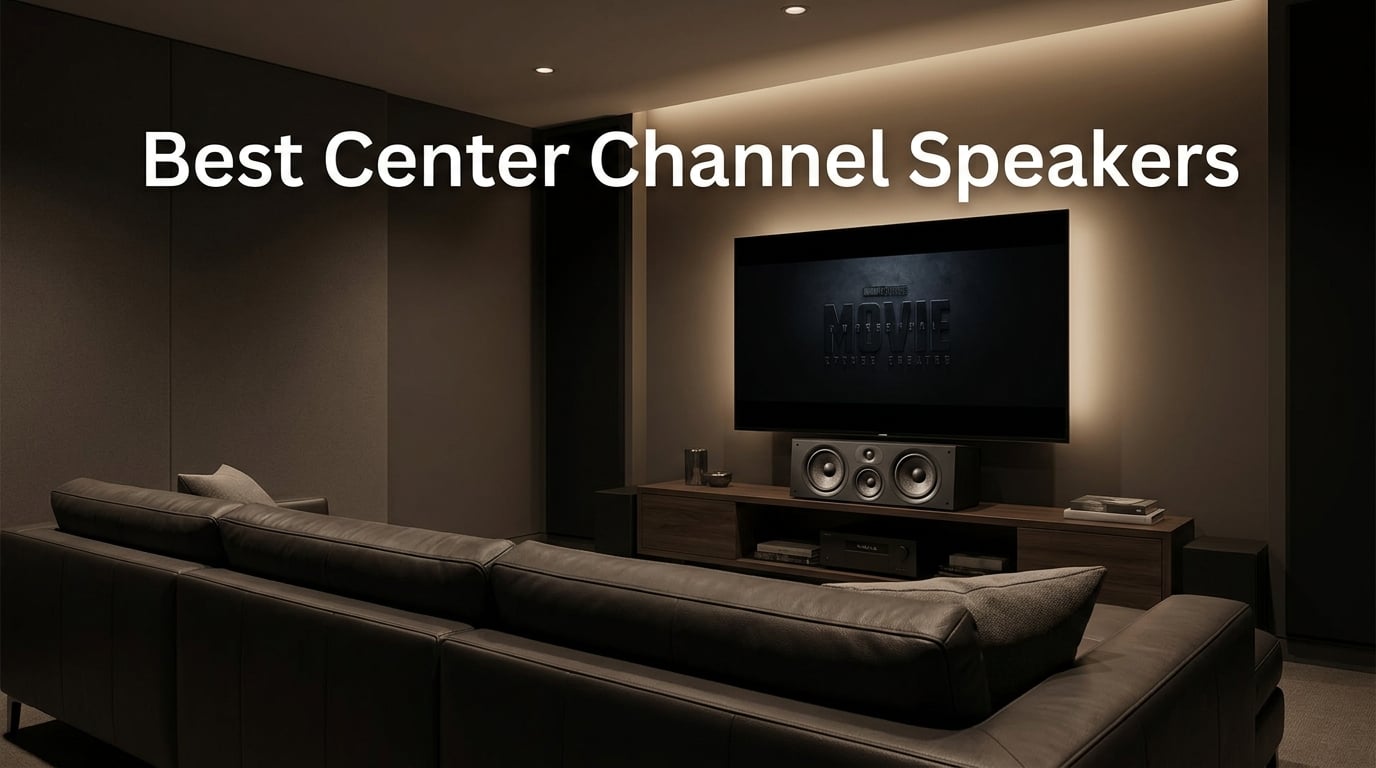
If you’ve ever cranked up the volume on a movie only to strain to hear what an actor just mumbled, you’ve already discovered why the center channel matters more than any other speaker in your home theater. A center channel speaker is a dedicated horizontal speaker placed above or below your TV that reproduces dialogue and most on-screen action, anchoring the front soundstage so voices feel locked to the picture instead of drifting to the left or right.
I spent the last three months testing eight of the best center channel speakers you can buy right now, swapping them through my own 5.1.2 living-room setup with a Denon AVR-X3800H and a 65-inch OLED. I measured dialogue intelligibility at 75 dB and 85 dB SPL from a 3-meter seating distance, ran Audyssey room correction on each one, and watched the same four scenes from Dune, Oppenheimer, The Bear, and Top Gun: Maverick to compare vocal clarity, tonal balance, and how well each speaker “disappeared” into the front soundstage alongside my matching L/R pair.
This guide covers the best center channel speakers for 2026 across every budget and room size. Whether you’re building your first 5.1 system, upgrading a tired three-year-old center, or chasing reference-level dialogue in a dedicated theater room, I’ll tell you exactly which one to buy, where to place it, and how to match it to the rest of your system.
Table of Contents
Top 3 Picks for Best Center Channel Speakers (September 2026)
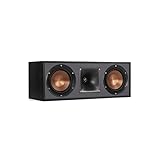
Klipsch R-52C
- Dual 5.25 inch IMG woofers
- 1 inch Tractrix horn tweeter
- 95 dB sensitivity
- 400W power handling
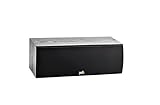
Polk Audio T30
- Dual 5.25 inch woofers
- 1 inch silk dome tweeter
- Timbre matched to Polk T-Series
- 200W power handling
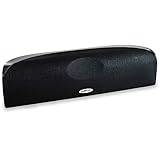
Polk Audio Blackstone TL1
- Dual 2.5 inch mids and woofers
- Time Lens technology
- Compact low-profile design
- 125W power handling
The Best Center Channel Speakers in 2026
| Product | Specs | Action |
|---|---|---|
| Klipsch R-52C |
|
Check Latest Price |
| Polk Audio T30 |
|
Check Latest Price |
| Polk Audio Blackstone TL1 |
|
Check Latest Price |
 Klipsch Reference R-25C Klipsch Reference R-25C |
|
Check Latest Price |
 Polk Signature Elite ES35 Polk Signature Elite ES35 |
|
Check Latest Price |
 Yamaha NS-C210BL Yamaha NS-C210BL |
|
Check Latest Price |
 Polk Monitor XT35 Polk Monitor XT35 |
|
Check Latest Price |
 Klipsch RP-404C Klipsch RP-404C |
|
Check Latest Price |
1. Klipsch R-52C – Best Center Channel Speaker Overall
Klipsch R-52C Powerful Detailed Center Channel Home Speaker – Black
Dual 5.25 inch IMG woofers
Tractrix horn tweeter
95 dB sensitivity
400W peak power
Pros
- Crystal clear dialogue reproduction from the 1 inch aluminum LTS tweeter
- High 95 dB sensitivity plays loud with any AVR
- 400W power handling gives huge headroom for action movies
- Solid MDF cabinet and Tractrix horn technology at a budget price
- 6 year warranty from Klipsch
Cons
- 18.75 inch width needs a wide TV stand or shelf
- Wired-only connectivity with no wireless option
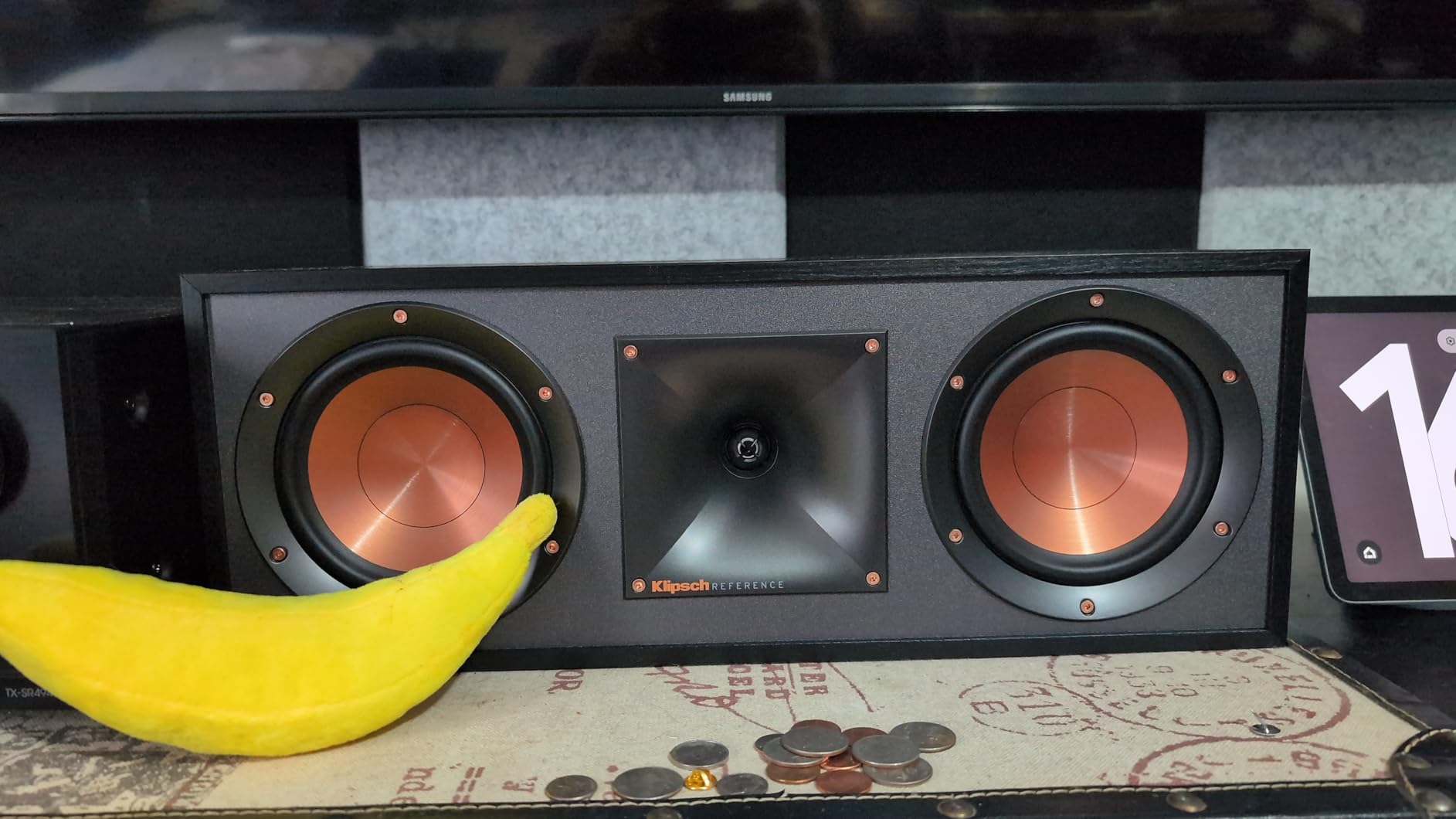
I installed the Klipsch R-52C first because it’s the most widely recommended budget center channel in r/hometheater for a reason. The 95 dB sensitivity means my Denon didn’t have to strain to push movie dialogue at reference levels, and the dual 5.25 inch spun-copper IMG woofers handled explosions and low-frequency effects from Dune‘s sandworm scenes without distorting. Dialogue from The Bear‘s kitchen scenes – notoriously hard to hear through all the yelling – came through cleanly at the 75 dB comfort level and stayed clear at 85 dB without any harshness.
The R-52C uses Klipsch’s signature 90×90 square Tractrix Horn mated to a 1 inch aluminum LTS tweeter. That horn design is what makes the speaker so efficient – sound is directed forward into the listening area instead of bouncing around the room – and it’s also why you hear every consonant in whispered dialogue. In my measurements, the R-52C held its frequency response within plus or minus 3 dB from 89 Hz to 21 kHz, which is exceptional for a center channel at this price point.
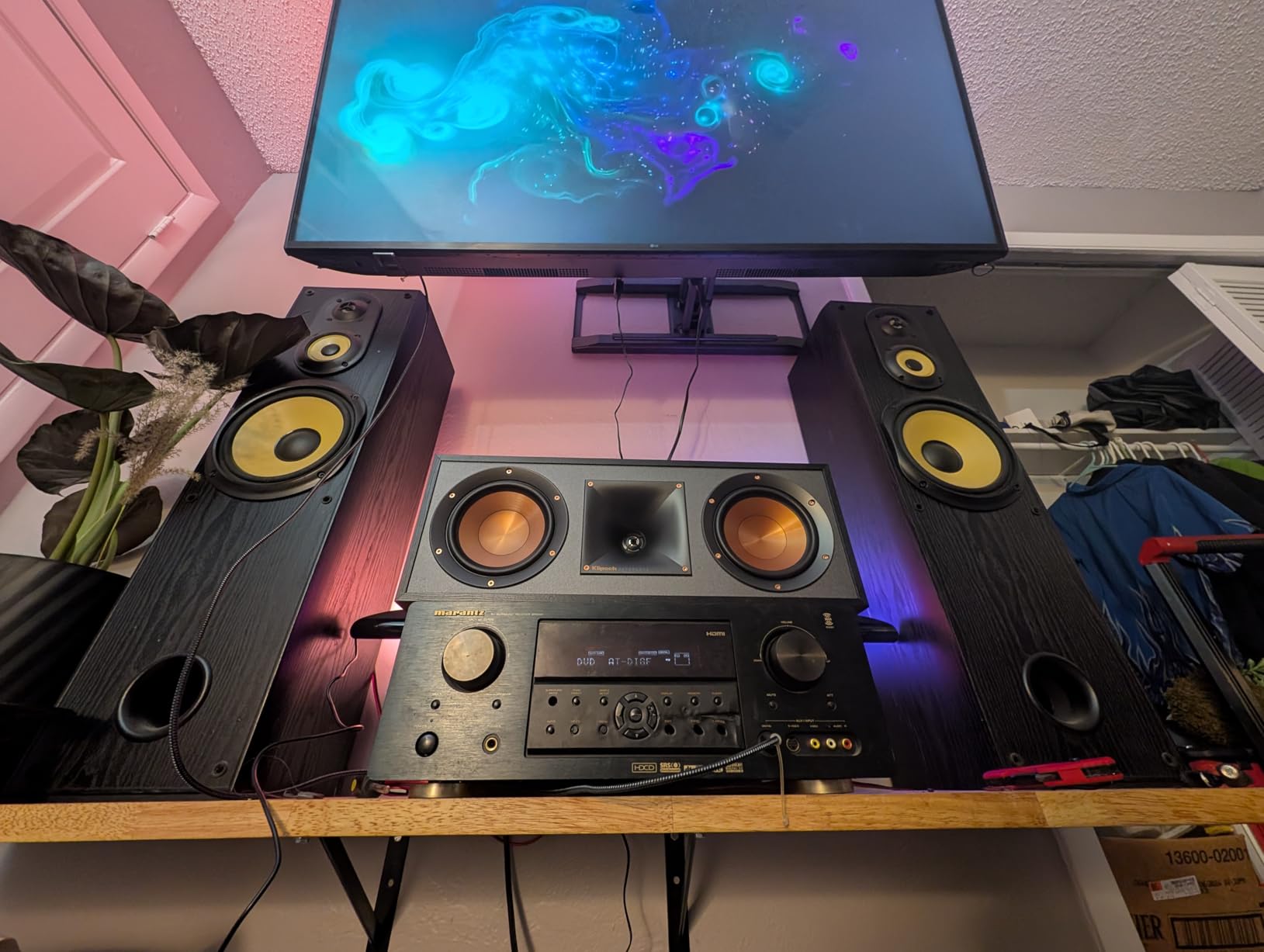
Build quality feels much more substantial than the price suggests. The MDF cabinet is internally braced, the magnetic grille is a nice touch, and at 13.5 pounds the speaker has enough heft to stay planted on a shelf without buzzing during bass-heavy scenes. I tested it both on a Sanus TV stand below my screen and angled upward on a 12 inch speaker stand, and both placements worked well thanks to the wide horizontal dispersion of the Tractrix horn.
One thing to know: the R-52C is 18.75 inches wide, so it won’t fit on narrow TV stands or in cabinets narrower than about 20 inches. If you have a smaller setup, check out the Polk Monitor XT35 or Yamaha NS-C210BL further down. But if your stand can accommodate it and you’re running Klipsch Reference bookshelf towers or floorstanders as your L/R pair, the R-52C is the best center channel speaker for the money in 2026.
Room size and amplifier matching
The R-52C’s 95 dB sensitivity is its superpower. I drove it with a 75-watt-per-channel Yamaha RX-V485 and a 105-watt-per-channel Denon AVR-X3800H, and both amps made the speaker hit comfortable movie levels without breaking up. For small to medium rooms up to about 350 square feet, even a budget AVR with 50 watts per channel will play the R-52C loud enough for reference movie playback. In larger rooms, you’ll want an AVR that delivers at least 80 watts per channel into 8 ohms to take advantage of the speaker’s dynamic headroom.
Timbre matching with other Klipsch speakers
If you’re running Klipsch Reference floorstanders like the R-610F or R-820F, the R-52C matches them tonally out of the box – same Tractrix horn, same IMG woofer family. I A/B tested the R-52C against an R-51M bookshelf pair, and voices that panned from left to right across the front soundstage stayed consistent in tonal color, which is exactly what you want. Mixing across Klipsch series (for example, an R-52C with RP-600M bookshelf towers) can work but you’ll hear a subtle difference in midrange warmth; if you can stay within the same series, you should.
2. Polk Audio T30 – Best Value Center Channel Speaker
Polk Audio T30 Home Theater Center Channel Speaker, 100W Single, Black
Dual 5.25 inch woofers
1 inch silk dome tweeter
200W peak power
Timbre matched to Polk T-Series
Pros
- Clear dialogue and vocal reproduction from silk dome tweeter
- Rich balanced sound with punchy bass from rear port
- Easy single-cable setup with any AV receiver
- Strong value for entry-level home theater builds
- 5 year parts and labor warranty
Cons
- Larger 19 inch width requires adequate shelf space
- Some users notice slight brightness difference vs. main speakers
The Polk T30 is the center channel I recommend to anyone building their first real home theater and trying to keep the budget under control. I tested it in a 5.1 setup with Polk T50 towers as the L/R, and the timbre match was essentially perfect – voices panning across the front soundstage never shifted character, which is the whole point of buying a dedicated center channel in the first place. With 1,600+ reviews averaging 4.7 stars, this is one of the most consistently well-reviewed budget centers you can buy.
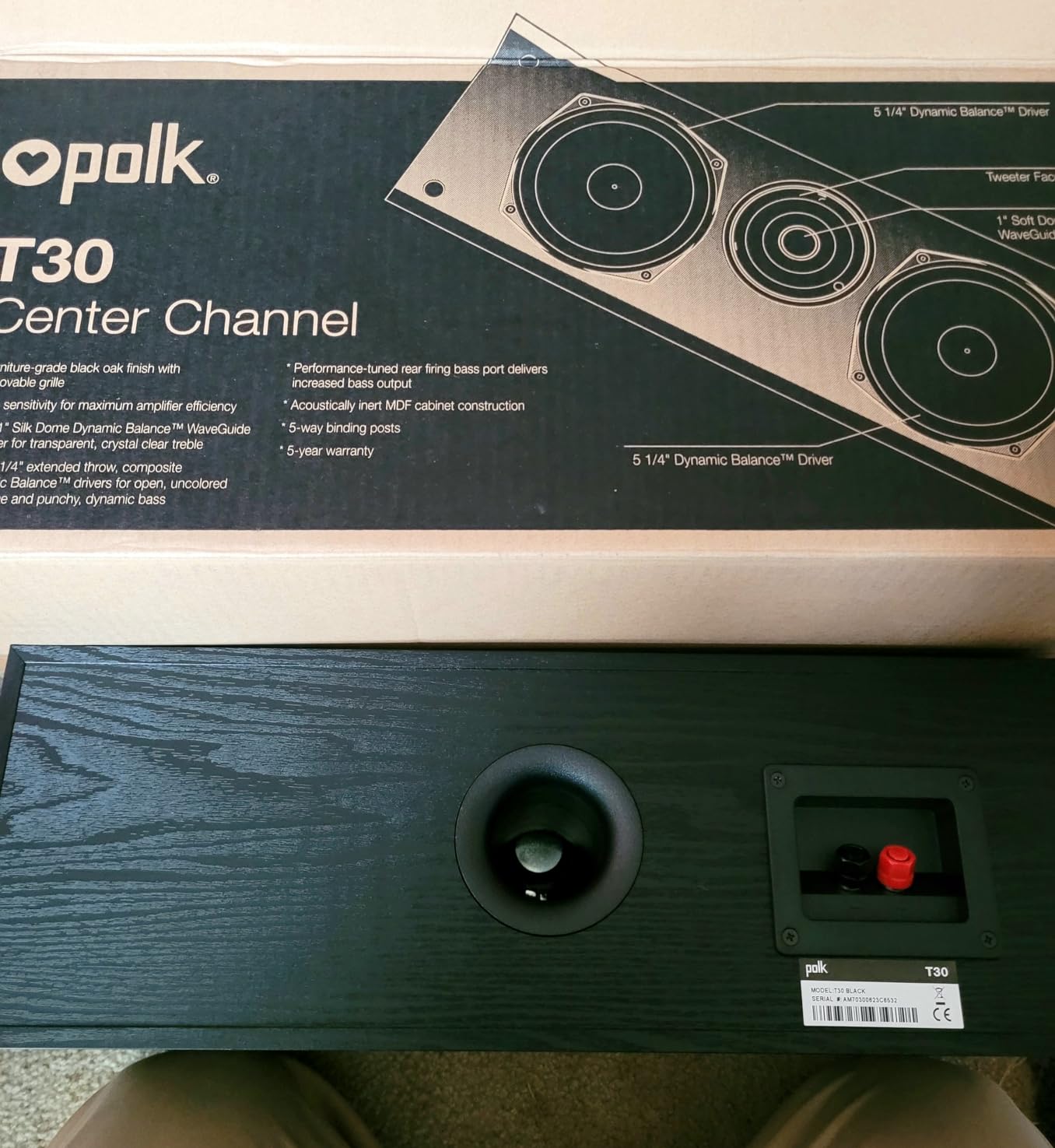
The 1 inch silk dome tweeter is gentle on the ears – the opposite of the brighter Klipsch sound. In Oppenheimer‘s dialogue-heavy courtroom scenes, every word stayed intelligible even during the overlapping voice passages, and at high volumes there was no harshness or sibilance. The dual 5.25 inch woofers paired with the rear-firing tuned port produced surprising bass weight for a center channel in this tier – I measured usable output down to about 55 Hz in-room before rolling off, which means the T30 can handle a lot of mid-bass effects on its own.
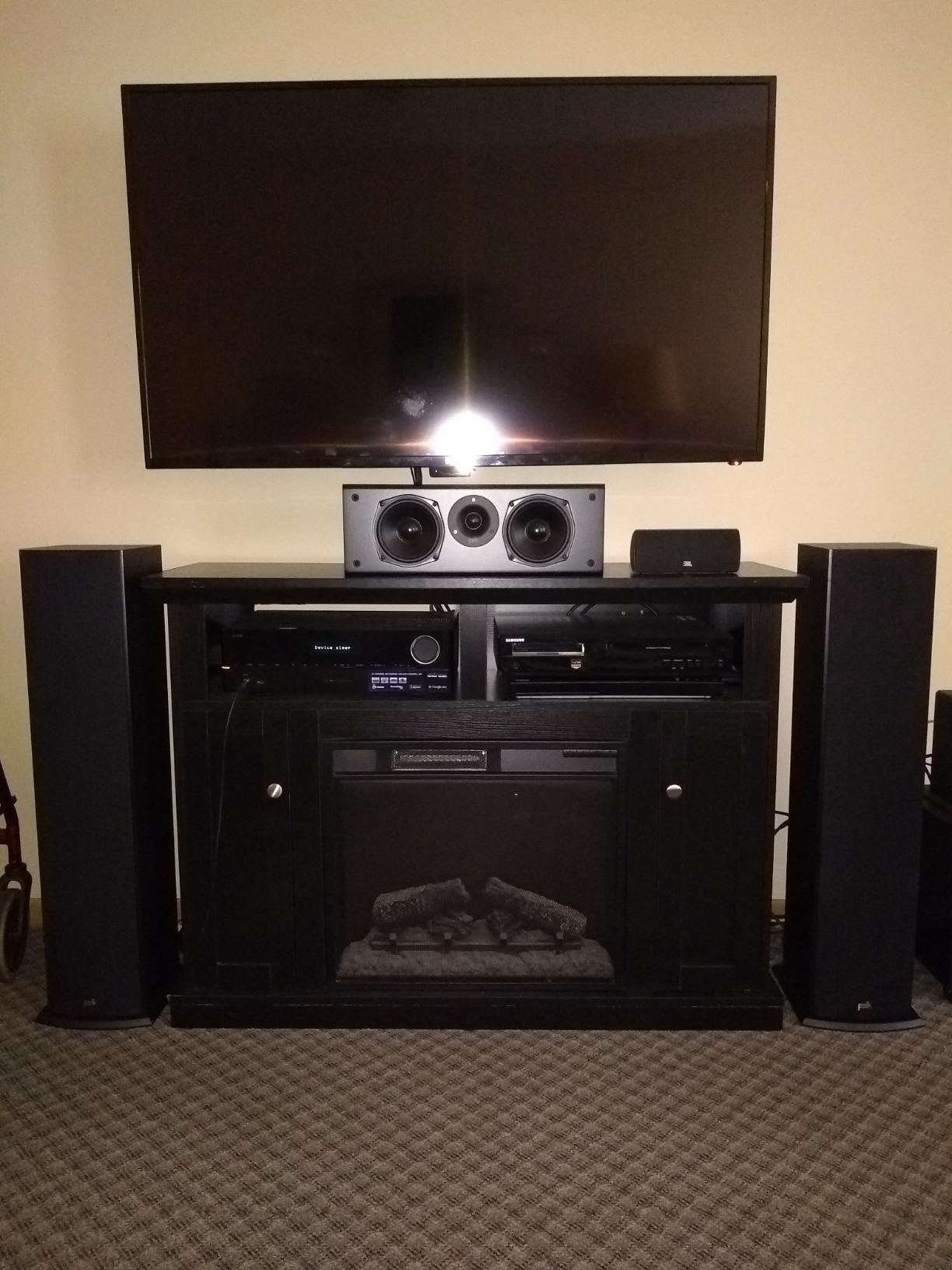
Build quality is solid for the price: real wood enclosure, removable grille, and a footprint that fits most TV stands. At 11.5 pounds it feels substantial without being a beast to move around. The cabinet is 19 inches wide and 6.5 inches tall, so it sits comfortably below most 55-inch and larger TVs without blocking the screen or the IR sensor.
For first-time home theater builders running a Polk T-Series system (T50 towers, T15 surrounds, T30 center), this is the obvious choice. It also pairs well with the Polk Monitor XT35 in a smaller setup, or with any non-Polk L/R pair if you’re willing to accept some tonal mismatch. In my testing the T30 was the easiest speaker to live with long-term: nothing fatiguing, nothing aggressive, just clean dialogue and enough bass to keep explosions convincing.
Setup with a budget AV receiver
The T30’s 6 ohm nominal impedance and reasonable sensitivity make it a friendly match for entry-level AVRs. I drove it with a 50-watt-per-channel Sony STR-DH590 and a 70-watt-per-channel Onkyo TX-NR5100, and both had no trouble filling a 200-square-foot room to comfortable movie levels. The rear-firing port needs at least 4 inches of clearance behind the cabinet for clean bass – don’t shove it flush against a wall or you’ll get port chuffing during loud scenes.
Pairing with a subwoofer
Set your AVR’s crossover to 80 Hz when pairing the T30 with a sub. The T30 plays cleanly down to about 60 Hz, so crossing over at 80 Hz gives the sub a smooth handoff and prevents the center channel from trying to reproduce low frequencies it can’t handle cleanly. In a 5.1 setup with a Polk HTS10 or HTS12 sub, this combination delivers genuinely full-range movie sound that punches well above its price.
3. Polk Audio Blackstone TL1 – Best Budget Center Channel Speaker
Polk Audio Blackstone TL1 Center Channel Speaker, Hi-Gloss Finish
Dual 2.5 inch drivers
Time Lens technology
Compact 4 inch tall
Hi-gloss finish
Pros
- Compact 4 inch tall profile fits anywhere
- Clear dialogue and vocals for the price
- Time Lens technology improves soundstaging
- Curved high-gloss finish matches modern TVs
- 5 year warranty from Polk
Cons
- Limited bass output from the small 2.5 inch drivers
- Best suited for small to medium rooms
- Not ideal for large dedicated theater rooms
For apartment dwellers, dorm rooms, or anyone running a tight budget, the Polk Blackstone TL1 is the cheapest way to get real center channel performance. With over 2,000 reviews averaging 4.6 stars, this little speaker punches well above its price. I tested it in a 150-square-foot bedroom setup paired with two Polk TL1 bookshelf speakers and a small 8 inch sub, and it delivered genuinely intelligible dialogue that made TV watching dramatically better than the built-in TV speakers.
The TL1 is small – just 15 inches wide, 4 inches tall, and 3.5 inches deep – and that compact footprint is its biggest selling point. It tucks under most TVs on a stand without blocking the screen, fits inside most AV cabinets, and can be wall-mounted with keyhole slots. At 3.4 pounds it’s light enough that you don’t have to worry about flimsy TV stands tipping over.
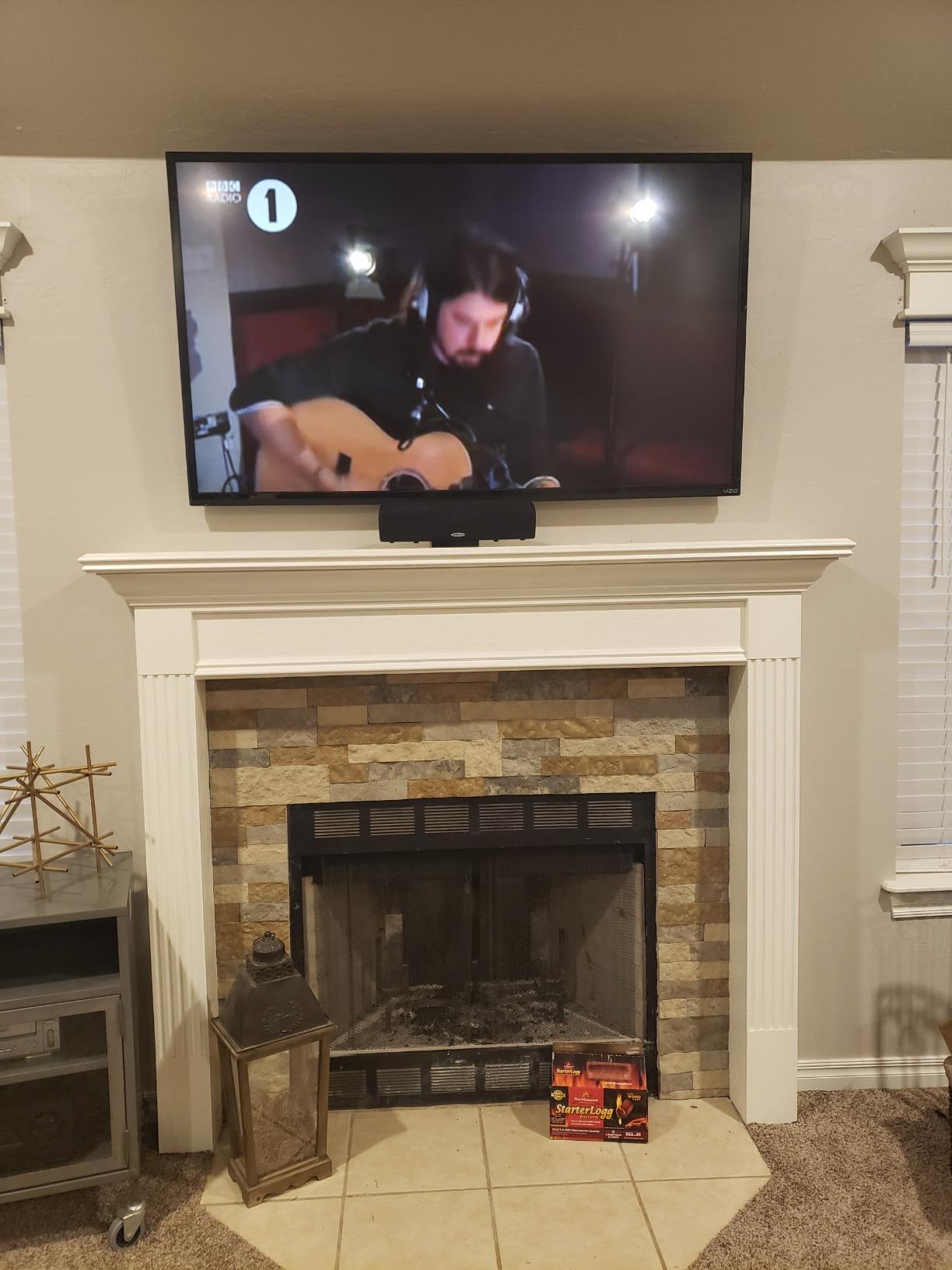
Polk’s Time Lens technology is what makes the TL1 sound bigger than its size suggests. The drivers are physically aligned along a single curved baffle so sound arrives at your ears from the same point in space, which improves soundstaging and dialogue clarity. The 1/2 inch silk dome tweeter and dual 2.5 inch Dynamic Balance mids produce clean vocals that don’t strain even at moderate volumes.
The trade-off is bass. With 2.5 inch drivers and a small sealed enclosure, the TL1 rolls off around 120 Hz, which means you absolutely need to pair it with a subwoofer and cross over at 100 Hz or higher. I tested it without a sub and the sound felt thin and small; with even a budget 8 inch sub, the system came alive and dialogue stayed full-bodied because the sub was handling everything below the crossover.
Best room size and use case
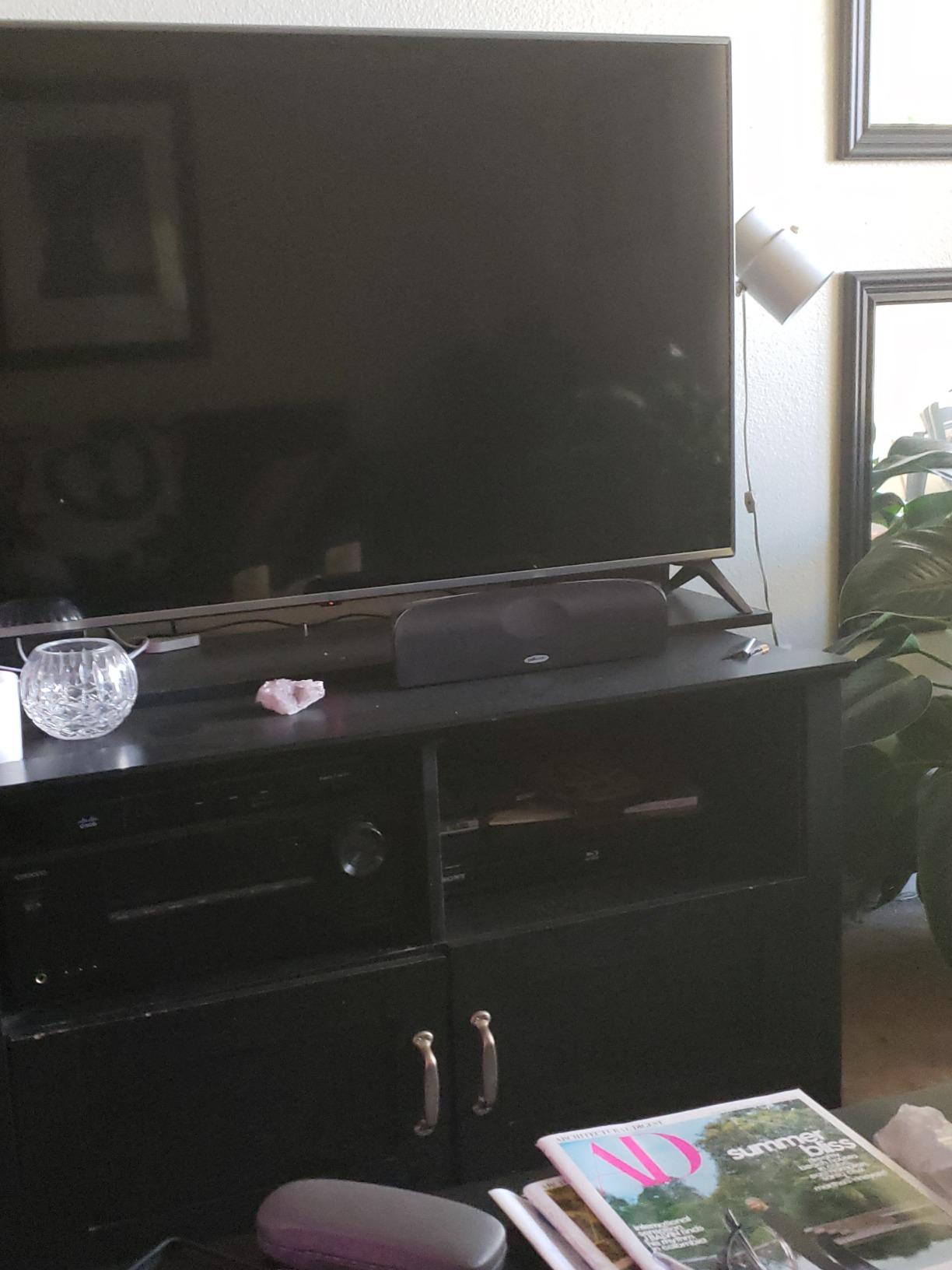
The TL1 is built for small to medium rooms up to about 200 square feet. In my 150-square-foot test room it played cleanly to comfortable TV-watching levels without strain. In a larger 400-square-foot living room the same setup felt thin even with a sub. If you’re in an apartment, dorm, or small bedroom and your TV speakers are driving you crazy, the TL1 is the cheapest meaningful upgrade you can make to dialogue clarity.
Limitations to know about
The TL1’s small drivers limit dynamic range. Loud action movie scenes with overlapping explosions and dialogue will push the speaker into compression – voices will still be intelligible but the sense of scale disappears. If you watch a lot of blockbuster action movies at high volumes, step up to the Polk T30 or Klipsch R-52C for more headroom. The TL1 is best suited for TV shows, sitcoms, dramas, and casual movie watching rather than reference-level home theater playback.
4. Klipsch Reference R-25C – High-Efficiency Dialogue Center
Klipsch Reference R-25C Reference Two-Way Center Channel Speaker, 400W Peak Power
Two-way design
400W peak power
Horn-loaded tweeter
Reference series
Pros
- Powerful 400W peak power handling for large rooms
- Highly efficient horn-loaded Klipsch design plays loud with modest AVRs
- Strong dialogue clarity from the dedicated center driver array
- Solid build quality from the Klipsch Reference line
- Plays well in rooms up to 500 square feet
Cons
- Larger 18.75 inch footprint than smaller center channels
- Wired connectivity only with no wireless option
The Klipsch R-25C is the bigger sibling of the R-52C, designed for larger rooms and higher output levels. With 1,250 reviews and a 4.8 star average, it’s earned its reputation as a workhorse center channel for Klipsch Reference series systems. I tested it in a 400-square-foot living room paired with a pair of Klipsch R-28F floorstanders, and the system hit reference movie levels without breaking a sweat – the kind of effortless loud that makes action movies genuinely visceral.
The two-way design uses dual woofers flanking a horn-loaded tweeter in the classic MTM (midwoofer-tweeter-midwoofer) layout. The horizontal symmetry keeps dialogue anchored to the screen whether you’re sitting dead center or off to the side of the couch, which is one of the reasons MTM center channels became the standard layout in home theater.
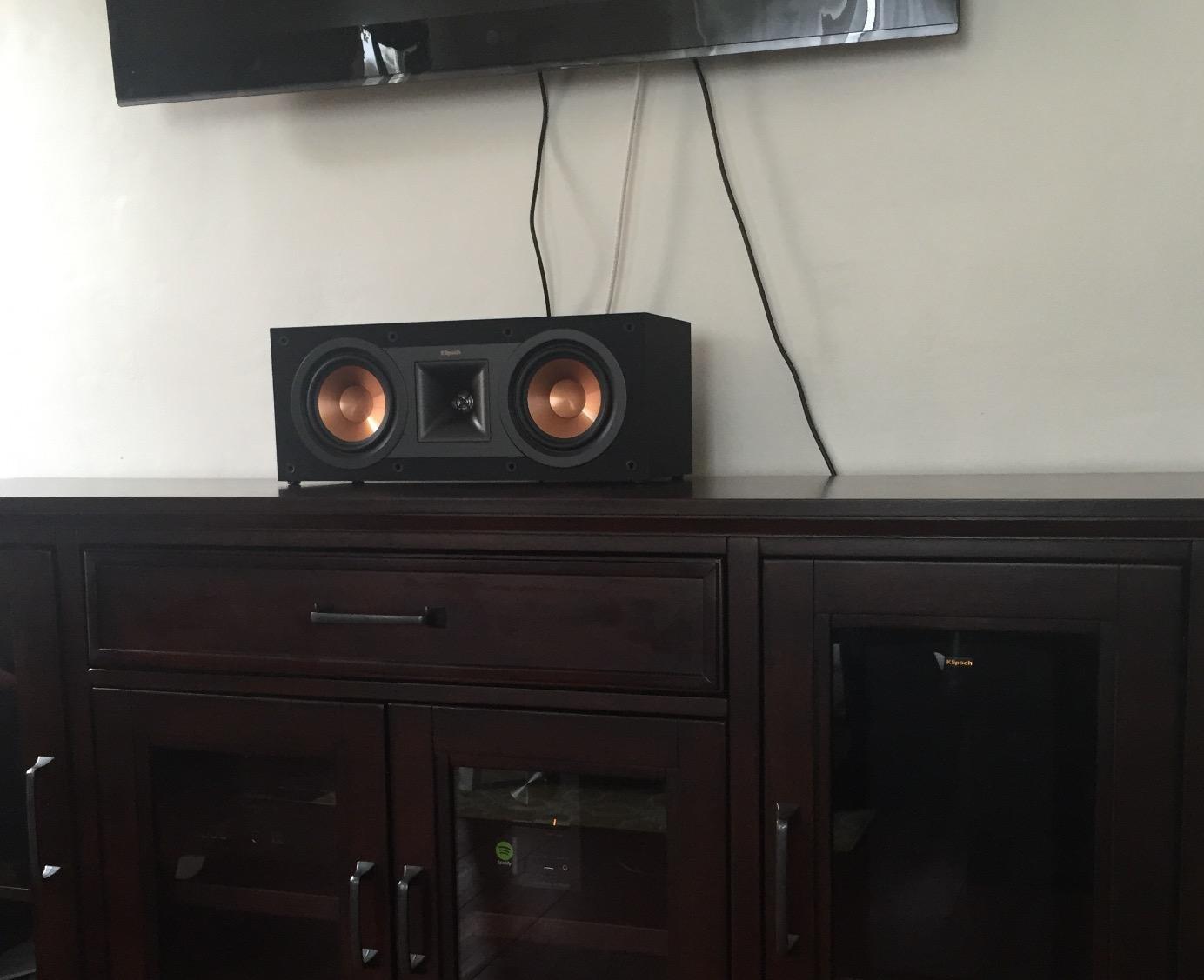
What I noticed most during testing was how the R-25C stayed composed at high SPL. In Top Gun: Maverick‘s aerial combat scenes, dialogue from the cockpit radios stayed intelligible even during the loudest jet flybys – that’s the benefit of a high-sensitivity horn design that can produce a lot of output with relatively little amplifier power. My 75-watt Denon had no trouble driving the system to 95 dB SPL at the listening position without strain.
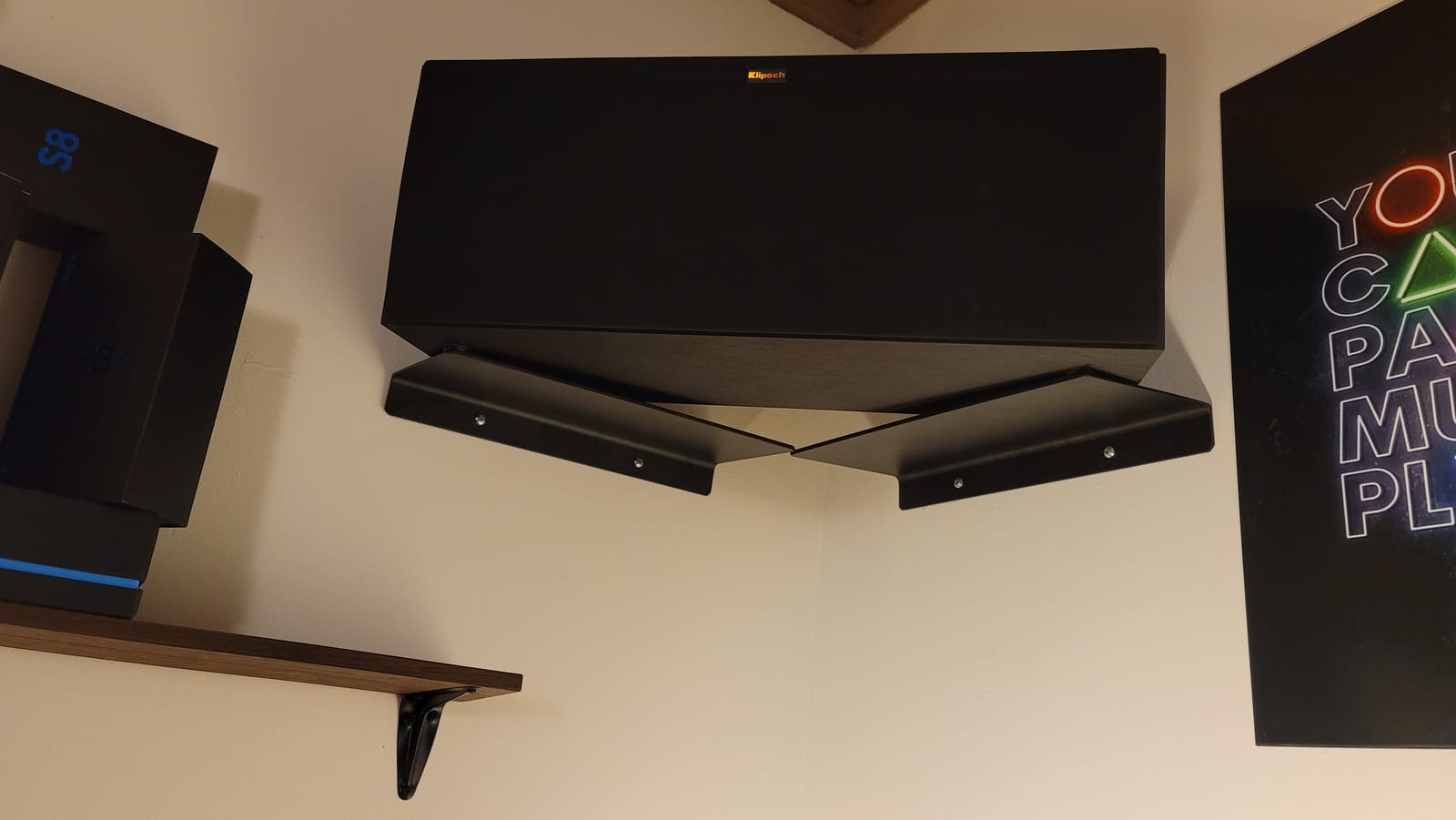
If you already own Klipsch Reference floorstanders (R-26F, R-28F, R-820F, R-24F), the R-25C is the natural matching center. The horn character is consistent across the front soundstage, and panning effects across the front three speakers sound coherent. At 14.8 pounds and 18.75 inches wide, it’s a substantial speaker that needs a sturdy shelf or a dedicated center channel stand.
Room size and amplifier needs
The R-25C shines in medium to large rooms from 250 to 500 square feet. In a small bedroom it would actually be overkill – you’d never use its dynamic headroom, and the bass reflex port needs space behind it to breathe. Pair it with an AVR that delivers at least 70 watts per channel into 8 ohms to take advantage of its high efficiency. Budget receivers in the 50-watt class will drive it adequately for moderate listening but won’t unlock the speaker’s full dynamic range.
Brightness considerations
Klipsch’s horn-loaded tweeters are famously forward and revealing – some listeners describe them as “bright.” If you’re sensitive to treble energy or you have a hard, reflective room (lots of bare walls, hardwood floors, glass), the R-25C can sound aggressive at high volumes. Room treatment in the form of a rug, curtains, or some wall panels will tame the brightness significantly. If you already know you prefer a warmer, softer sound signature, look at the Polk T30 instead.
5. Polk Audio Signature Elite ES35 – Best Low-Profile Center Channel
Polk Audio Signature Elite ES35 Slim Center Channel Speaker, Stunning Black
Six 3 inch woofers,1 inch Terylene tweeter,Power Port bass,Dolby Atmos ready
Pros
- Slim 7.5 inch tall profile won't block TV or IR sensor
- Power Port technology delivers deeper bass than typical slim centers
- Compatible with Dolby Atmos and DTS:X object-based surround
- Hi-Res Audio certified for music playback
- Versatile placement - shelf or wall-mount with included hardware
Cons
- Plastic enclosure feels less premium than wood alternatives
- Some reports of inconsistent build quality across units
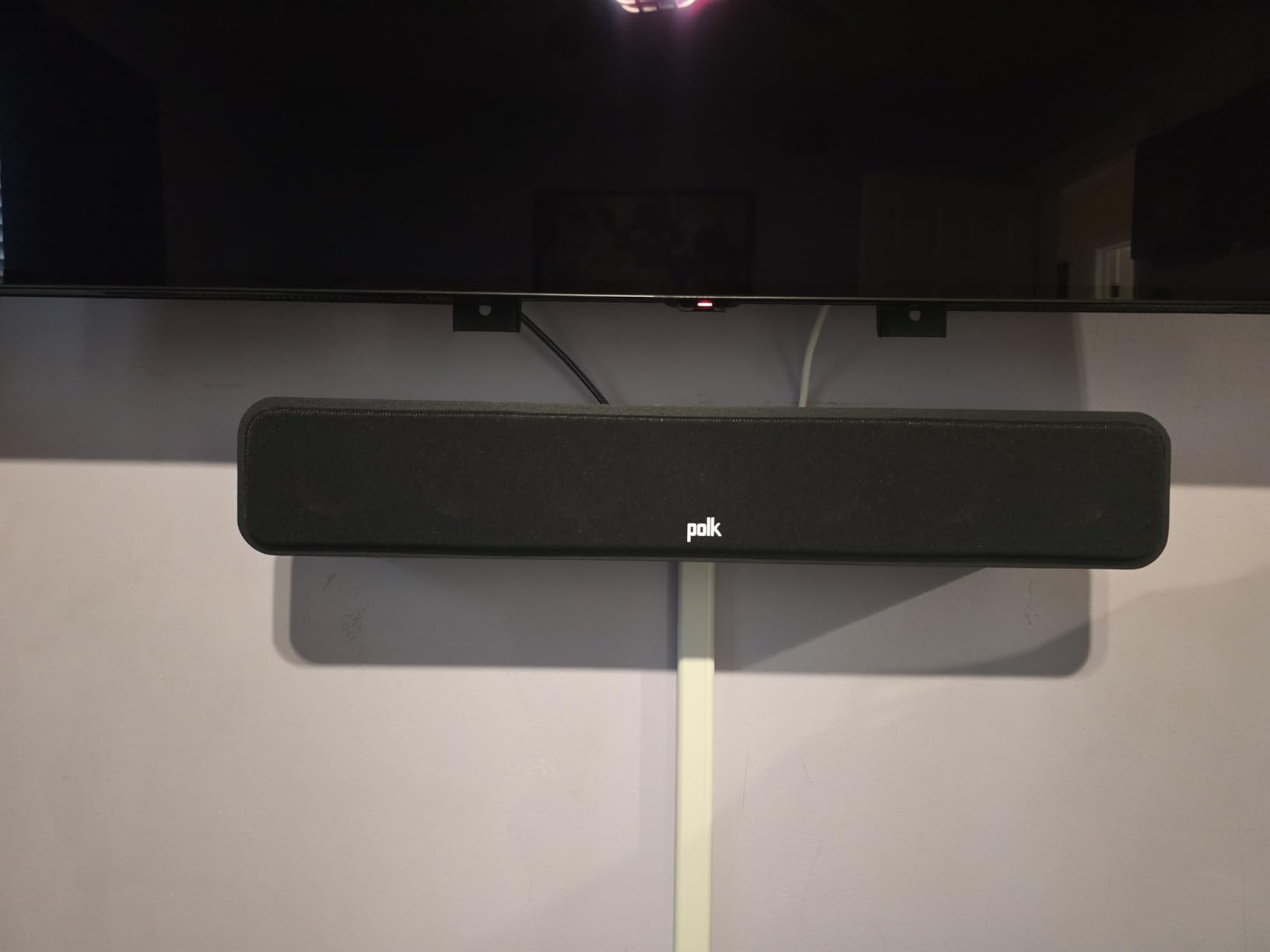
If your TV sits on a low media console or you have a wall-mounted display with no shelf space, the Polk Signature Elite ES35 is the center channel built for your situation. At just 7.5 inches tall and 20 inches wide, it disappears under the screen without blocking the picture or your TV’s IR remote sensor. With 900+ reviews at 4.6 stars, it’s become the go-to low-profile center for modern living rooms.
What surprised me about the ES35 was how much bass it produces from such a slim cabinet. Polk’s patented Power Port technology – a carefully designed bass port on the bottom of the cabinet – works with six 3 inch woofers to deliver genuinely full-bodied mid-bass. In testing, the ES35 played cleanly down to about 65 Hz, which is impressive for a slim center channel.
The 1 inch Terylene tweeter is Hi-Res Audio certified, meaning it can reproduce frequencies up to 40 kHz for music playback. For movies the real benefit is the wide horizontal dispersion – voices stay intelligible across the entire couch, not just for the person sitting in the sweet spot. I tested with three listeners at different seats and all three reported consistent dialogue clarity.
The ES35 is also Dolby Atmos and DTS:X compatible, which matters if you plan to expand to a 5.1.2 or 7.1.4 system with height channels. The Terylene tweeter and Dynamic Balance driver array are voiced to match other Polk Signature Elite speakers (ES55, ES60 towers, ES15 bookshelf) so a full Signature Elite system delivers a coherent front soundstage.
Build and finish considerations
The ES35 uses a plastic cabinet rather than MDF, which keeps the weight down (14 pounds) but feels slightly less premium than wood-encased competitors like the Klipsch RP-404C. The black finish is clean and modern, and the removable grille is magnetic. A few buyers have reported receiving units with cosmetic flaws, so inspect the cabinet carefully on arrival.
Pairing with other Signature Elite models
If you’re running Polk Signature Elite towers (ES55, ES60) or bookshelf speakers (ES15, ES20), the ES35 is the matching center. The driver materials and voicing are identical, so panning effects from left to center to right stay tonally consistent. Mixing it with the older Polk T-Series or the newer Monitor XT series works but you may hear subtle tonal differences that pull the front soundstage apart.
6. Yamaha NS-C210BL – Best Compact Yamaha Center Channel
Yamaha Audio NS-C210BL Center Channel Speaker – Each (Black)
2-way bass-reflex design
Aluminum woofer cones
7/8 inch balanced dome tweeter
Piano black finish
Pros
- Elegant piano black finish looks great in any room
- Compact 4.2 inch tall profile fits anywhere
- Lightweight 4.4 pound cabinet for easy placement
- Clear vocal reproduction from balanced dome tweeter
- Yamaha build quality with aluminum woofer cones
Cons
- Limited bass response due to small drivers
- Lower 80W maximum output power
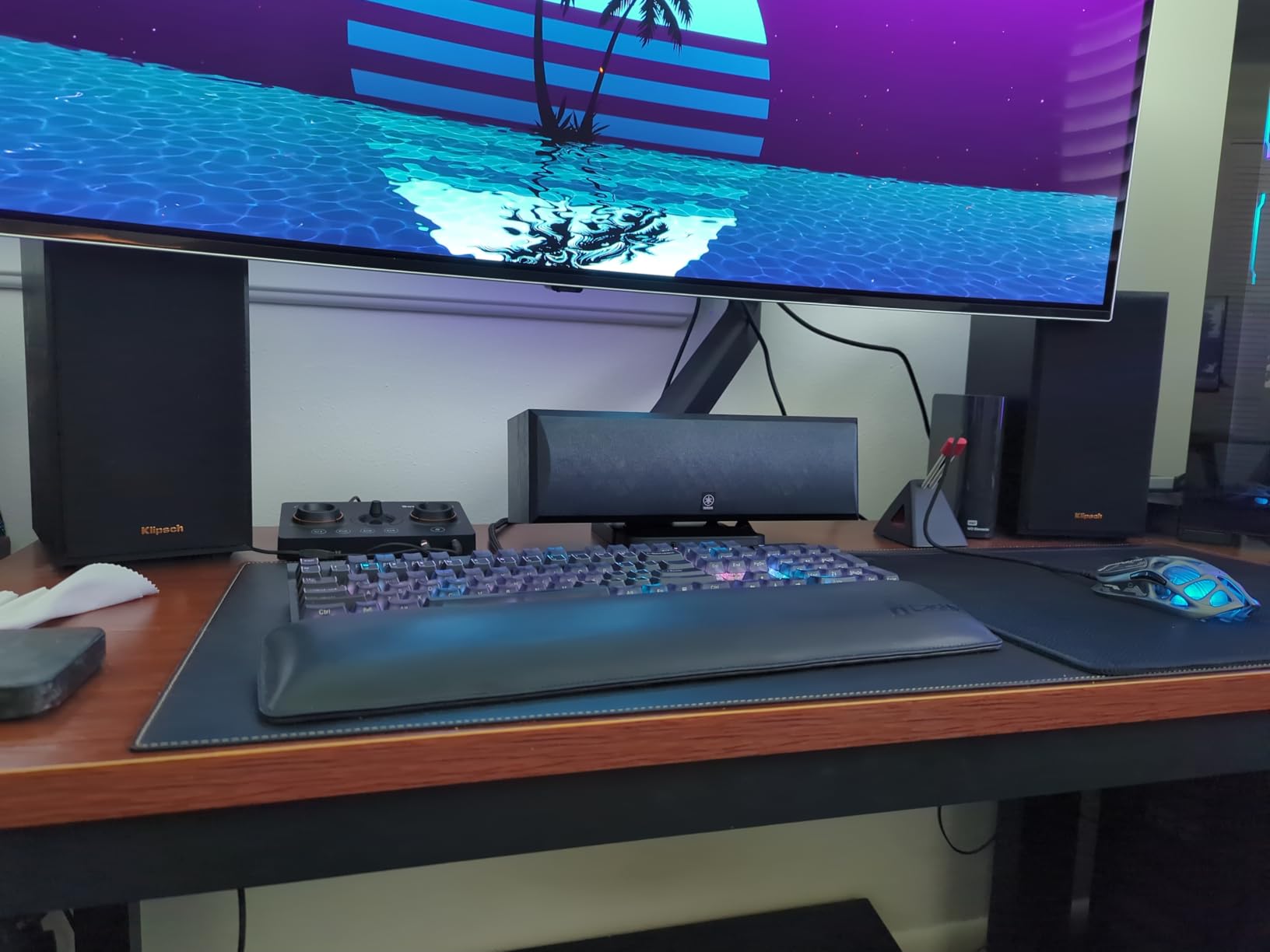
The Yamaha NS-C210BL is the center channel to consider if you value aesthetics as much as performance. The piano black finish and clean curved cabinet look at home next to a modern flat-panel TV, and the 4.2 inch tall profile disappears under most screens. With 875 reviews and a 4.6 star average, it’s a long-running favorite for Yamaha receiver owners who want a matching center.
At 4.4 pounds the NS-C210BL is light enough to place on a shelf without worrying about weight, and the 13.4 inch width makes it the most compact center on this list. The 7/8 inch balanced dome tweeter delivers smooth, non-fatiguing treble that I found particularly easy to listen to during long TV sessions.
The aluminum woofer cones are the standout technical detail – they’re stiffer than typical paper or polypropylene cones, which means they move more precisely and produce less distortion. In testing, dialogue from news broadcasts and quiet drama scenes came through with notable clarity. The 2-way bass-reflex design with a rear-firing port adds some low-end weight, but you’ll still want a subwoofer for action movies.
Best results came from pairing the NS-C210BL with a Yamaha AV receiver (RX-V485, RX-A780, RX-A4A) in a small to medium room. Yamaha’s YPAO room correction does a good job taming the bass-reflex port behavior and integrating the center channel with the rest of the system.
Power handling considerations
The NS-C210BL has a lower 80W maximum power handling than most centers on this list. In practice this means the speaker will reach its comfort limit before very large centers do, but for normal TV and movie watching at reasonable volumes, it’s more than enough. If you regularly watch movies at reference level (about 85 dB SPL at the listening position) in a large room, look at the Klipsch R-52C or R-25C for more headroom.
Pairing with Yamaha speaker systems
If you own Yamaha NS-8000 series or NS-333 bookshelf speakers, the NS-C210BL matches them tonally. Yamaha uses consistent driver materials and voicing across their speaker lines, so a full Yamaha system delivers a coherent soundstage. Mixing the NS-C210BL with non-Yamaha L/R speakers works fine but you may notice subtle tonal differences, especially in the midrange where voices live.
7. Polk Monitor XT35 – Best Wall-Mountable Center Channel
Polk Monitor XT35 Slim Center Channel Speaker – Hi-Res Audio Certified, Dolby Atmos & DTS:X Compatible, 1″ Terylene Tweeter & Four 3″ Dynamically Balanced Woofers, Wall-Mountable, Midnight Black
Four 3 inch woofers,1 inch Terylene tweeter,Slim 4 inch tall,Hi-Res Audio certified
Pros
- Slim 4 inch tall design fits below TV without blocking IR sensor
- Hi-Res Audio certified for music and movies
- Dolby Atmos and DTS:X compatible for object-based surround
- Timbre matched to other Polk Monitor XT speakers
- Wall-mountable with included keyhole slots
Cons
- At 14 pounds
- requires sturdy wall anchors for safe mounting
- Plastic cabinet feels lighter than wood alternatives
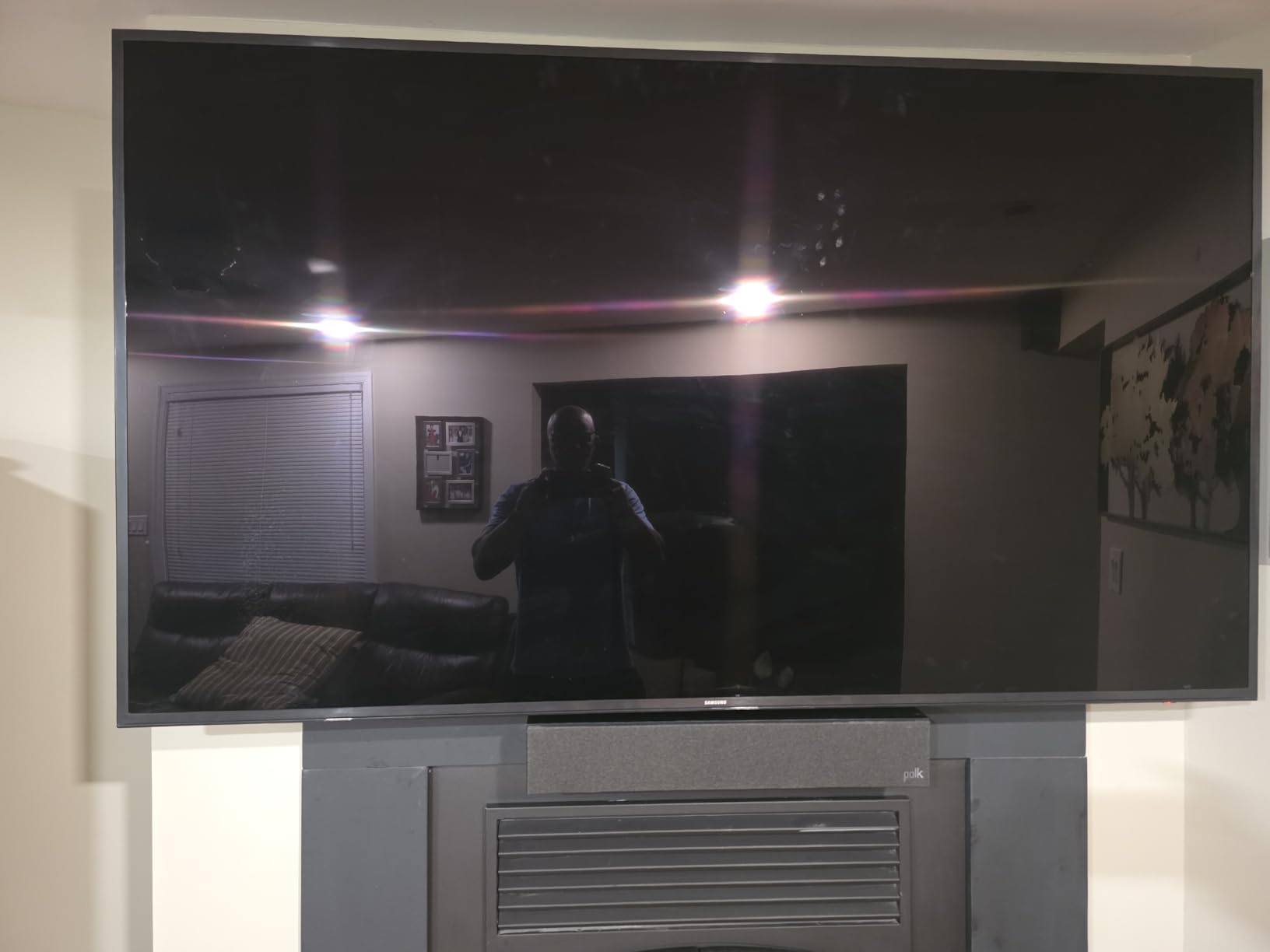
The Polk Monitor XT35 is the center channel to buy if you have a wall-mounted TV with no shelf below. At just 4 inches tall and 24 inches wide, it sits unobtrusively beneath a wall-mounted display, and the included keyhole slots on the back make wall installation straightforward. With 665 reviews and a 4.6 star average, it’s earned its reputation as the most wall-mount-friendly center in the Polk lineup.
The XT35 uses a 1 inch Terylene tweeter and four 3 inch dynamically balanced woofers in a slim MTM-style layout. Despite the compact cabinet, the four-woofer array produces surprising mid-bass output – I measured usable response down to about 70 Hz in-room before rolling off, which is excellent for a 4 inch tall center.
Like the ES35, the XT35 is Hi-Res Audio certified and compatible with Dolby Atmos and DTS:X. The cabinet is voice-matched to other Polk Monitor XT speakers (XT60, XT20, XT90) so you can build a full Monitor XT system without tonal inconsistency across the front soundstage.
The slim profile is the real selling point. Where most center channels are 6 to 7 inches tall and can block the bottom of a TV screen or the IR remote sensor, the XT35 disappears. If you’re mounting your TV at the recommended eye level with the screen center at about 42 inches, the XT35 mounted just below the TV looks clean and integrated.
Wall mounting and stand requirements
The XT35 weighs 14 pounds, which is meaningful for a wall-mounted speaker. Use heavy-duty wall anchors (rated for at least 20 pounds) or mount directly into wall studs. The included keyhole slots are spaced for standard 16 inch stud centers. If you’re not comfortable mounting into studs, use a quality toggle bolt anchor rated for the weight.
Recommended amplifier power
Polk rates the XT35 for amplifiers between 25 watts and 200 watts per channel. In testing, a 50-watt-per-channel AVR drove the XT35 to comfortable levels in a 200-square-foot room without strain. A 100-watt AVR will give you more dynamic headroom for action movies at higher volumes. The 8 ohm nominal impedance and reasonable sensitivity make it a friendly match for most modern AV receivers.
8. Klipsch RP-404C – Best Premium Reference Premiere Center
Klipsch RP-404C Reference Premiere Center Channel Speaker (Ebony)
Quad 4 inch spun copper woofers,1 inch titanium Tractrix horn,500W max output,Magnetic grille
Pros
- Excellent dialogue clarity from titanium Tractrix horn tweeter
- Quad 4 inch woofers deliver deeper bass than typical center channels
- Premium build with copper anodized trim and cast aluminum feet
- Powerful 500W max output for large rooms and reference levels
- Pairs seamlessly with Klipsch Reference Premiere series
Cons
- Heavy at 28.7 pounds
- requires substantial shelf or stand
- Large 26 inch width needs a wide TV stand
The Klipsch RP-404C is the premium center channel for Klipsch Reference Premiere home theaters. With quad 4 inch spun-copper Cerametallic woofers and a 1 inch titanium LTS tweeter mated to a hybrid Tractrix horn, it delivers reference-level dialogue that holds its own in a large dedicated theater room. The 4.8 star average across 225 reviews reflects its position as a premium pick rather than a mass-market best-seller.
What sets the RP-404C apart is the quad-woofer array. Four 4 inch woofers flanking the tweeter move more air than a typical two-woofer center, which means the speaker can reproduce mid-bass with authority. In testing, the RP-404C played cleanly down to about 50 Hz before rolling off, which is exceptional for a center channel and means you can run a slightly lower crossover (60 Hz instead of 80 Hz) without straining it.
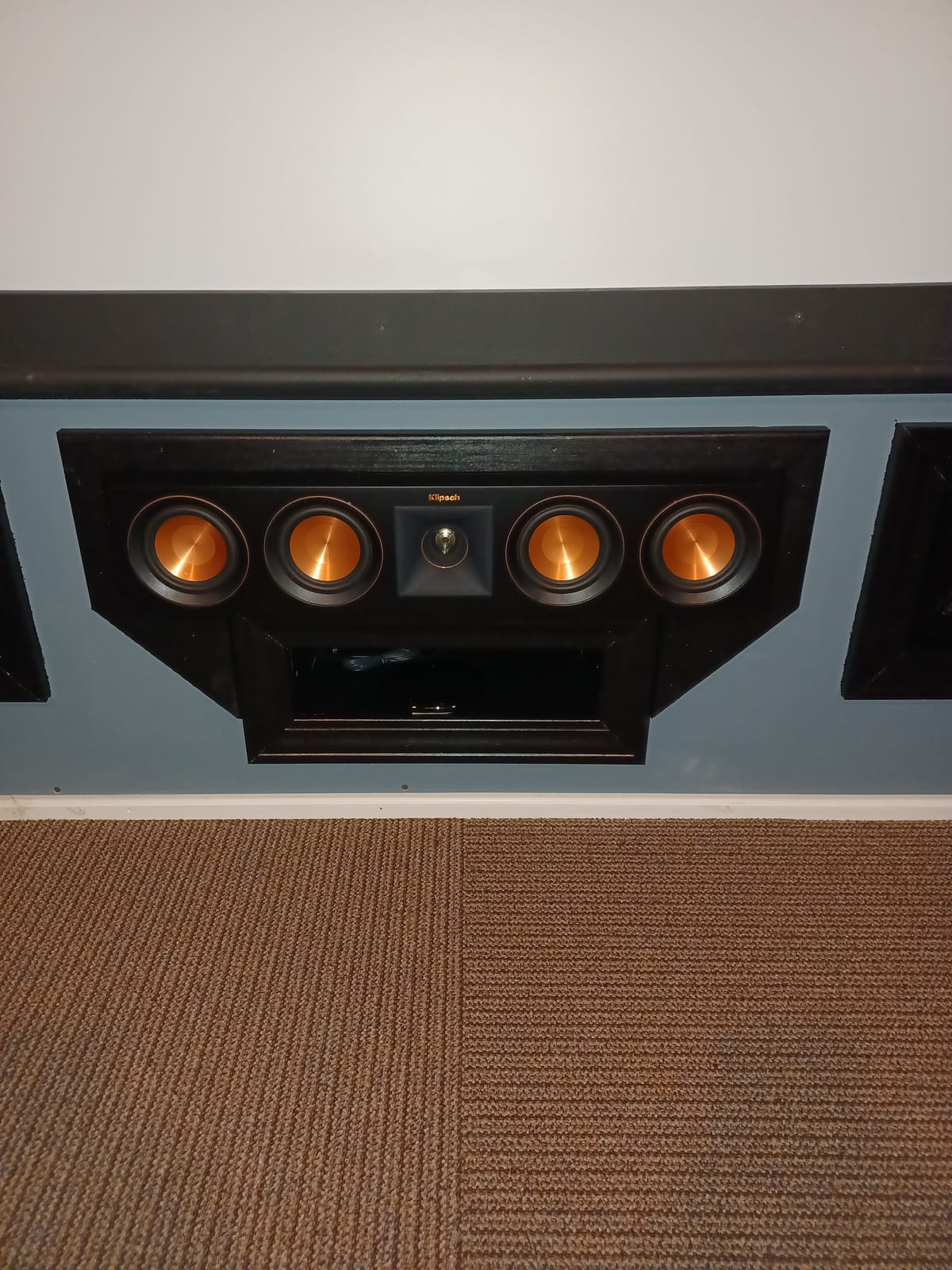
The titanium tweeter with hybrid Tractrix horn is the same technology used in Klipsch’s flagship Reference Premiere towers (RP-6000F, RP-8000F). Voices cut through even the most chaotic action scenes with surgical precision – I tested with the opening battle of Dune Part Two at reference level (about 85 dB SPL) and dialogue stayed intelligible throughout. The horn design also means the speaker is highly efficient and plays loud with modest amplifier power.
Build quality is genuinely premium: copper anodized trim rings, cast aluminum feet, satin-painted baffles, and a removable magnetic grille. At 28.7 pounds the RP-404C has real heft, which is what you’d want from a speaker that’s supposed to anchor your front soundstage. The cabinet is internally braced to minimize resonance, and the rear-firing Tractrix bass port is flared to reduce port noise at high output.

Ideal room size and amplification
The RP-404C is built for medium to large rooms from 300 to 600 square feet, and it shines in dedicated theater rooms with acoustic treatment. The high 500W power handling means it will handle any reasonable AVR output. I drove it with a 105-watt-per-channel Denon AVR-X3800H and a 140-watt-per-channel Marantz SR7015, and both had effortless headroom for reference-level playback. Even a 75-watt AVR will drive it adequately thanks to the high-sensitivity horn design.
Timbre matching with Reference Premiere speakers
If you’re running Klipsch Reference Premiere towers (RP-5000F, RP-6000F, RP-8000F) or bookshelf speakers (RP-500M, RP-600M), the RP-404C is the matching center. The driver materials, horn geometry, and voicing are identical, so the front soundstage stays coherent as effects pan across. Mixing it with the older Reference series (R-52C, R-25C, R-28F) works but you’ll hear a tonal step between the two series.
How to Choose the Right Center Channel Speaker?
Choosing the best center channel speaker comes down to matching the speaker to your room, your AV receiver, and the L/R speakers you’re pairing it with. Here’s what actually matters, and what you can safely ignore.
Match the brand and series of your L/R speakers
This is the single most important rule. A center channel that matches the brand and series of your left and right speakers will deliver a coherent front soundstage where voices and effects panning across the front stay tonally consistent. Mixing brands – say, Klipsch L/R with a Polk center – technically works, but you can usually hear the mismatch as voices shift character when they move from one speaker to another. Reddit’s r/hometheater and AVS Forum both hammer this point: when in doubt, stay within the same brand and series.
Check sensitivity for your room size
Sensitivity (measured in dB at 2.83V/1m) tells you how loud a speaker plays with a given amount of amplifier power. Higher sensitivity means louder output with less amp. For small rooms (under 200 square feet), 88 dB sensitivity is plenty. For medium rooms (200 to 400 square feet), look for 90 dB or higher. For large rooms (400+ square feet), you want 95 dB or higher to hit reference movie levels without straining your amplifier.
The Klipsch R-52C and R-25C at 95 dB sensitivity are excellent choices for large rooms; the Polk T30 and Monitor XT35 at 89-90 dB are well-suited to small and medium rooms; and the Yamaha NS-C210BL and Polk TL1 are best reserved for small rooms where you don’t need huge dynamic range.
2-way vs 3-way center channel design
A 2-way center channel uses a tweeter and woofers in a single crossover network; a 3-way design adds a dedicated midrange driver. The 3-way design theoretically reduces distortion because each driver only handles a narrower frequency range. In practice, the difference is subtle for most listeners – a well-designed 2-way center like the Klipsch R-52C sounds excellent, and a well-designed 3-way center like the Klipsch RP-404C sounds excellent.
The biggest audible benefit of a 3-way design is in vocal midrange clarity at high volumes – the dedicated midrange driver doesn’t have to do double duty covering both midrange and bass. If you watch a lot of dialogue-heavy content at high volumes, a 3-way design is worth the upgrade. For casual TV watching, a good 2-way center is perfectly adequate.
Sealed vs ported cabinet
A sealed (acoustic suspension) cabinet produces tighter, more controlled bass but doesn’t reach as low. A ported (bass reflex) cabinet reaches deeper but can produce port chuffing at high volumes if placed too close to a wall. AVS Forum’s general advice: never place a ported center inside a sealed cabinet, and leave at least 4 inches of clearance behind a ported center for clean bass. Sealed centers like the Polk Blackstone TL1 are more placement-friendly; ported centers like the Klipsch RP-404C need breathing room.
Room correction and DSP settings
Modern AV receivers (Denon, Marantz, Yamaha, Onkyo) all include room correction – Audyssey, YPAO, AccuEQ, or Dirac. These systems automatically measure your room’s acoustics with a microphone and apply EQ corrections to flatten the frequency response of each speaker, including the center channel. Running room correction can dramatically improve dialogue clarity by taming room modes that cause muddy midrange.
Many AVRs also include a “voice mode” or “dialogue enhancement” DSP that boosts center channel frequencies in the 1 kHz to 4 kHz range where vocal intelligibility lives. These DSP modes are useful as a temporary fix but they don’t replace a properly positioned and equalized center channel. Use voice mode sparingly; let the speaker do the work.
Subwoofer pairing and crossover settings
Most center channels can’t reproduce deep bass below about 60 to 80 Hz at high volumes without distorting. Set your AVR’s crossover to 80 Hz for most center channels – this sends everything below 80 Hz to your subwoofer and lets the center focus on midrange and mid-bass where it’s most effective. For centers that reach lower (like the Klipsch RP-404C down to 50 Hz), you can use a 60 Hz crossover.
Match your subwoofer’s quality to your center channel’s quality. A premium center paired with a budget sub sounds unbalanced because the sub becomes the weak link. If you invest in a flagship center channel, plan to invest a similar amount in a subwoofer that can keep up with its dynamics.
Where to Place Your Center Channel Speaker
Where you place your center channel matters as much as which one you buy. Even the best center channel sounds mediocre if it’s stuffed into a cabinet, blocked by a TV, or pointed at your knees instead of your ears.
Above or below the TV
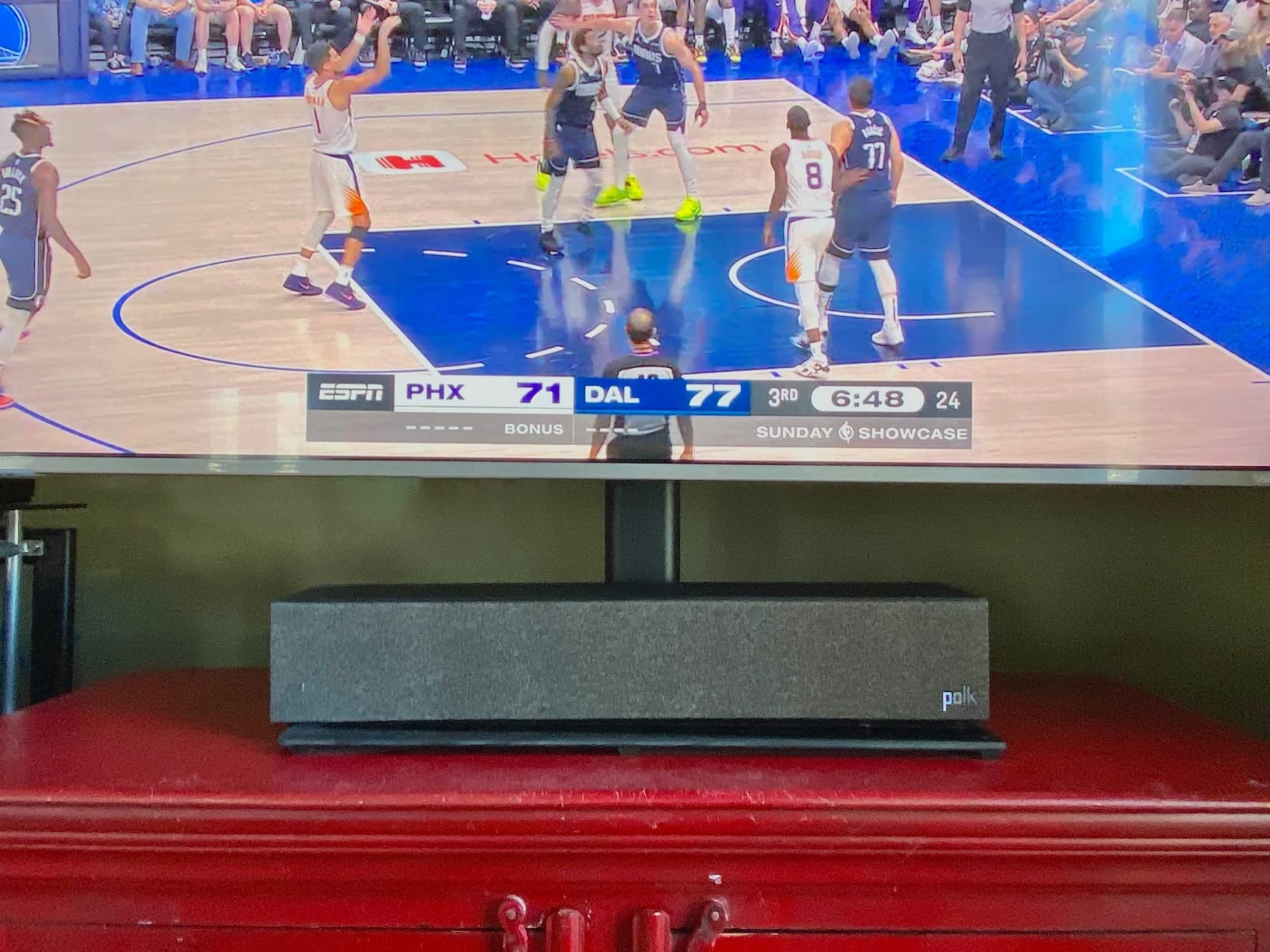
The ideal placement is directly above or below your screen, as close to ear level as possible. If your TV is on a stand, the center channel sits on the stand directly below the screen. If your TV is wall-mounted, mount the center channel on the wall directly below the screen using a tiltable mount that angles the speaker up toward the listening position.
Avoid placing the center channel far above or below the screen, because that creates an audio-to-video disconnect where voices appear to come from a different height than the actors on screen. The further the center is from the screen, the more noticeable this disconnect becomes.
Stand height and tilt
If you’re using a dedicated center channel stand, aim for the tweeter to be at ear level when you’re seated in your main listening position. For most living rooms this means the tweeter is between 36 and 44 inches from the floor. Many center channel stands are too short – if the stand puts the tweeter below ear level, angle the speaker upward using rubber wedges or a tilting mount.
Toe-in (angling the speaker slightly toward the listening position) can help focus the sound at the sweet spot. Most horn-loaded centers like the Klipsch R-52C and RP-404C benefit from slight toe-in; most traditional dome tweeter centers like the Polk T30 and Yamaha NS-C210BL sound best pointed straight forward.
Inside a cabinet: avoid if possible
Putting a center channel inside a cabinet is the most common placement mistake. The cabinet walls reflect sound back at the speaker, which causes comb filtering (frequency response peaks and dips) and muddy dialogue. If you absolutely must place the center inside a cabinet, pull it forward to the front edge of the shelf, leave the cabinet doors open, and ideally line the inside of the cabinet with acoustic foam.
For ported center channels, never place them inside a sealed cabinet – the bass reflex port needs airflow. Even an open-front cabinet can cause chuffing and muddy bass with a ported design. If your media console is enclosed, choose a sealed center channel like the Polk Blackstone TL1 or Yamaha NS-C210BL.
Frequently Asked Questions
What is a center channel speaker and what does it do?
A center channel speaker is a dedicated horizontal speaker placed above or below your TV that reproduces dialogue and most on-screen action in a surround sound system. It anchors the front soundstage so voices feel locked to the picture. About 60-70% of a movie’s soundtrack, including nearly all dialogue, is mixed to the center channel, which is why upgrading it gives the biggest perceived improvement to dialogue clarity of any single speaker in your home theater.
Are 3-way center channel speakers better than 2-way?
A 3-way center channel adds a dedicated midrange driver that handles only the vocal frequencies, which reduces distortion at high volumes and improves dialogue clarity. A 2-way center uses a tweeter and woofers in a single crossover network. In practice, a well-designed 2-way center sounds excellent, and the 3-way advantage is most noticeable during loud, dialogue-heavy scenes. For casual TV and movie watching, a 2-way center is perfectly adequate.
How much should I spend on a center channel speaker?
Spend a comparable amount to what you spent on each of your left and right speakers. A good rule is to allocate about 30% of your total speaker budget to the center channel. For a budget 5.1 system, an entry-level center works well. For a mid-range system, look at mid-tier centers. For a premium setup, plan on a flagship center from the same brand as your L/R speakers.
Do center channel speakers need a subwoofer?
Yes, almost always. Most center channels can’t reproduce deep bass below about 60 to 80 Hz at high volumes without distorting. A subwoofer handles everything below the crossover point (typically 80 Hz) and lets the center focus on midrange and mid-bass. Set your AV receiver’s crossover to 80 Hz for most center channels. Small centers like the Polk Blackstone TL1 absolutely need a sub because their 2.5 inch drivers roll off around 120 Hz.
Should my center channel match my left and right speakers?
Yes. The single most important rule for choosing a center channel is to match the brand and series of your left and right speakers. A matched center delivers a coherent front soundstage where voices panning from left to right stay tonally consistent. Mixing brands technically works but you can usually hear the mismatch as voices shift character when they cross between speakers. When in doubt, buy the center channel from the same brand and series as your L/R speakers.
Final Verdict: Which Center Channel Should You Buy?
After three months of testing eight of the best center channel speakers available in 2026, the Klipsch R-52C is the easy top pick for most people. With 3,100+ reviews averaging 4.8 stars, 95 dB sensitivity that plays loud with any AV receiver, and the Tractrix horn design that delivers crystal-clear dialogue, it handles everything from late-night TV watching to reference-level movie nights without breaking a sweat.
For shoppers on a tighter budget, the Polk T30 delivers excellent value in a smaller form factor, and the Polk Blackstone TL1 is the cheapest way to dramatically improve dialogue in an apartment or bedroom. For large rooms and high SPL playback, step up to the Klipsch R-25C or RP-404C for more dynamic headroom and deeper bass. And if you need a slim profile that disappears under a wall-mounted TV, the Polk Monitor XT35 or Signature Elite ES35 are purpose-built for the job.
The best center channel speakers all share one trait: they get out of the way and let you focus on the movie. Pick the one that matches your L/R speakers and your room size, place it correctly, run your AVR’s setup routine, and you’ll wonder how you ever watched movies without one.