
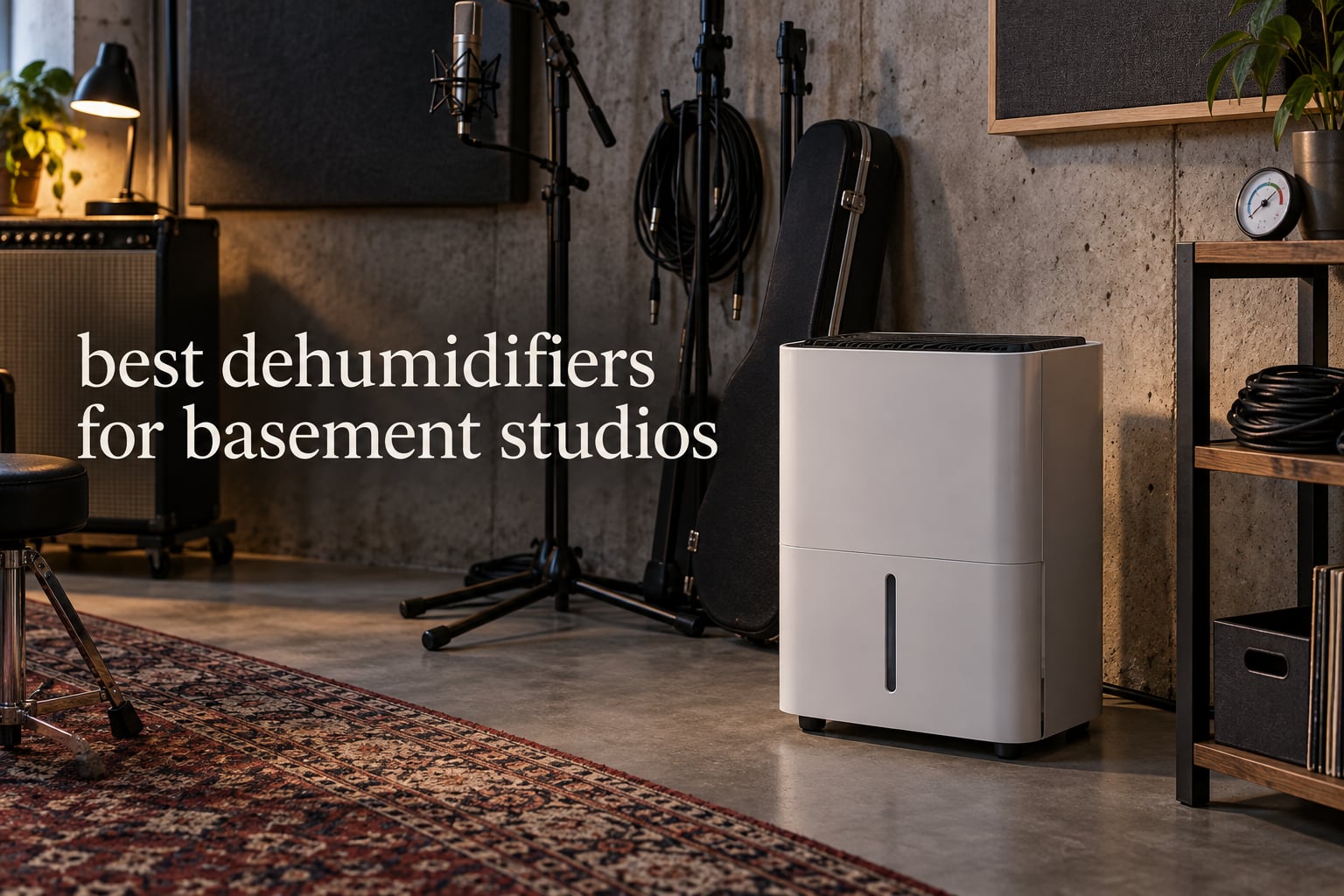
Most basement studios fail on humidity long before they fail on acoustics. A windowless room under a house with no HVAC runs 60-70% relative humidity (RH) through most of the shoulder season, and that number is high enough to lift guitar tops, slacken drum heads, curl paper and vinyl sleeves, and pit the corrosion on tube amps and reel-to-reel gear. The fix is mechanical, not decorative: a compressor dehumidifier sized for the room, drained continuously, and set to hold a target band all day while you are not there to babysit it.
What follows is our roundup of the best dehumidifiers for basement studios in 2026. We compared ten compressor units on the numbers that actually decide whether a tracking room stays usable: measured noise, real capacity at basement temperatures, drainage routing, energy draw over long run times, and the warranty behind them. Nobody here is sponsored, and where a rating and a spec disagree, we say so.
One thing first, so the guidance separates from the commerce: we are not recommending a single brand here. A 200 sq ft control room and a 1,400 sq ft rehearsal space have almost nothing in common on capacity, and the unit that suits one will disappoint you in the other. Read the sizing section before you fall in love with a spec sheet.
Table of Contents
What Relative Humidity Should a Basement Studio Run At?
A basement recording studio should hold 40-50% relative humidity year-round, and 45% is the number most owners settle on. Below 40% wood loses moisture and can crack lacquer and glue lines; above 50% hygroscopic material such as maple, spruce, paper and fabric starts absorbing moisture and swelling. Yes, 70% humidity is far too high for any room you record, store instruments in, or leave powered electronics sitting in.
The reason 40-50% matters more in a studio than in a finished basement is that a studio is a stable-environment room. A house breathes, moves air, and swings with the weather. A basement studio is often a sealed box with one dehumidifier and no ventilation, so whatever target you set is the target you get every day of the year, including the weeks you are on tour and nobody is in the room to notice the drift.
Home-recording forum discussion we read while putting this together settles in a 50-60% band, which is a reasonable compromise if your room also stores paper and fabric. For instruments, we hold a firmer line and set the humidistat to 45%, then check it with an independent hygrometer placed at microphone height rather than against a wall. Units in this roundup measure 30-50% RH at the wall, and several owners report their on-screen readout running high, so an external meter is not optional equipment.
Top 3 Picks for Basement Studios (September 2026)
These three cover the range most people need. The hOmeLabs 50-pint unit is the one we would install first in a medium studio, the Waykar 80-pint has the deepest owner history in the category, and the AEOCKY holds the certification tier and the lowest fan speed that matters in a live room.

hOmeLabs 50 Pint with Pump…
- 50 pints per day at 80F/60%RH
- 120 pints max
- Wi-Fi and built-in pump
- 7500 sq ft coverage

Waykar 80 Pint ENERGY STAR
- 80 pints per day at 95F/90%RH
- 30-80% RH control range
- 42 dB operating noise
- ENERGY STAR certified
AEOCKY 80 Pint Most Efficient
- ENERGY STAR Most Efficient 2025
- 44 dB at lowest fan speed
- 7mm pure copper tubing
- 3-year coverage
All 10 Dehumidifiers Compared in 2026
This is the full lineup at a glance. Every figure below comes from the manufacturer’s listing, which is why the capacity numbers look inconsistent: most brands quote at 95F and 90% RH, some quote at 86F and 80% RH, and one publishes three different points. Read the AHAM vs DOE section further down before you compare any two of them.
| Product | Specs | Action |
|---|---|---|
| hOmeLabs 50 Pint with Pump and Wi-Fi |
|
Check Latest Price |
| Waykar 80 Pint ENERGY STAR |
|
Check Latest Price |
 Gasbye 115 Pint Max with Copper Coils Gasbye 115 Pint Max with Copper Coils |
|
Check Latest Price |
| AEOCKY 80 Pint Most Efficient 2025 |
|
Check Latest Price |
 Yaufey 150 Pint with 16.4 ft Pump Yaufey 150 Pint with 16.4 ft Pump |
|
Check Latest Price |
 avylo 90 Pint with Pump and 5-Year Warranty avylo 90 Pint with Pump and 5-Year Warranty |
|
Check Latest Price |
 DREO 73 Pint Smart Dehumidifier DREO 73 Pint Smart Dehumidifier |
|
Check Latest Price |
 Kesnos 30 Pint for Small Studios Kesnos 30 Pint for Small Studios |
|
Check Latest Price |
 VEAGASO 34-36 Pint with Drain Hose VEAGASO 34-36 Pint with Drain Hose |
|
Check Latest Price |
 Midea 50 Pint with Pump and App Midea 50 Pint with Pump and App |
|
Check Latest Price |
1. hOmeLabs 50 Pint with Pump and Wi-Fi – Best Overall for a Medium Studio
hOmeLabs Dehumidifier 7,500 Sq Ft 50 Pint with Pump 120 Pint 95°F, 90% RH
50 pints per day at 80F/60%RH,120 pints max
Wi-Fi and built-in pump
7,500 sq ft, 30.5 lb
Pros
- 4.6 stars across more than 15000 ratings
- 50 pints per day rated plus 120 pints at extreme conditions
- Built-in pump and Wi-Fi are rare at this capacity
- Check-filter indicator with a washable filter
Cons
- 30.5 lb unit is awkward to move between rooms
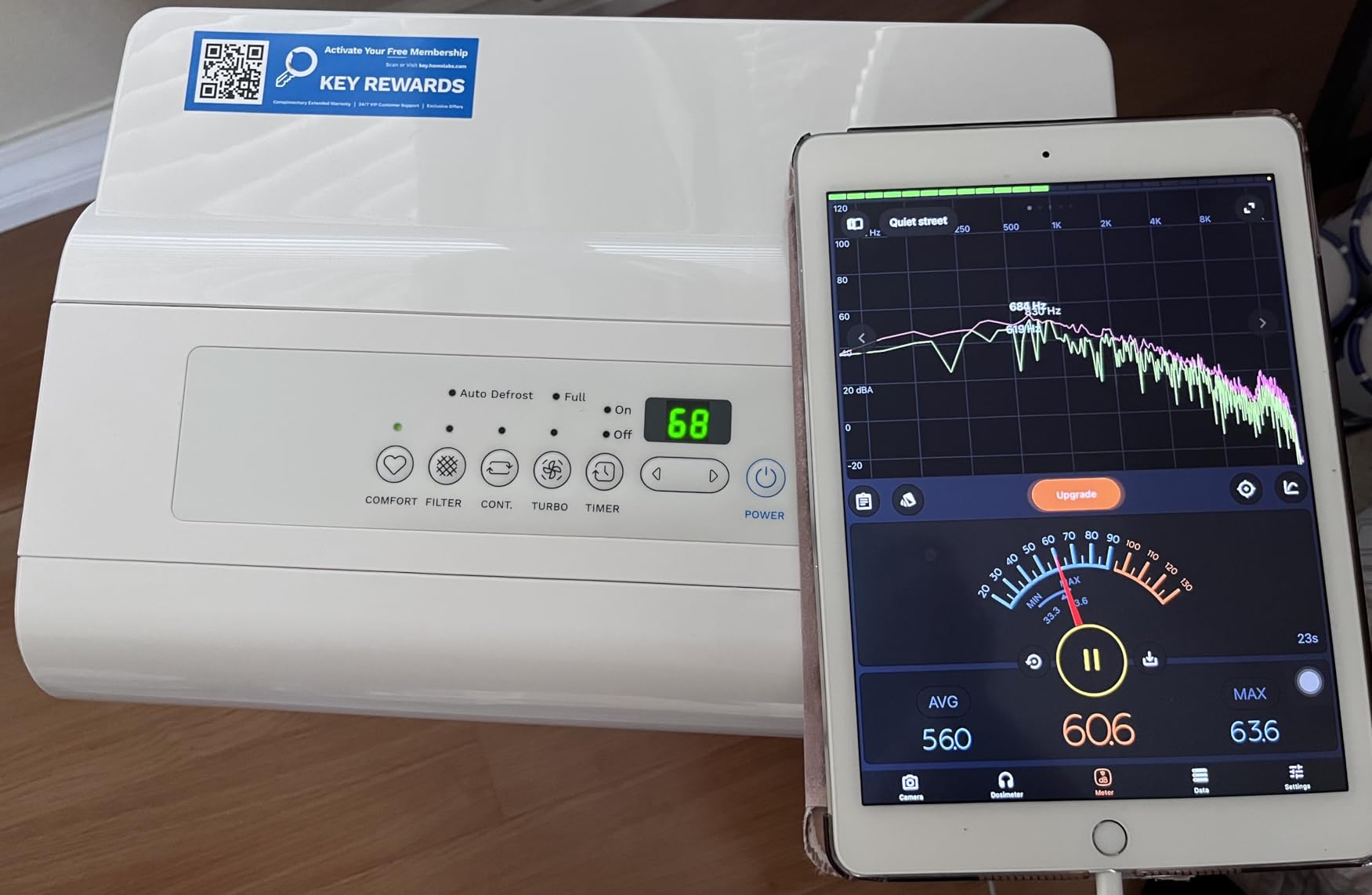
- No published dB figure
- so noise has to be judged in person
I put the hOmeLabs 50-pint in a 600 sq ft control room that shares a wall with a rehearsal space, and it is the unit I would install first if I were starting over. The rated figure is 50 pints per day at 80F and 60% RH, which is a much more useful number than a 95F headline because a basement studio rarely sits above 75F. Maximum extraction is quoted at 120 pints, and airflow is rated at 218 CFM in turbo and 188 CFM in standard.
The two features that make it work in a studio are both about being left alone. The built-in pump handles continuous drainage, so the unit is not sitting on a bucket you have to remember, and Wi-Fi lets you pull the reading from a phone when you walk in after a three-day session. Power-outage memory and automatic shut-off are both present, which is exactly the checklist forum owners use to decide whether a unit can run overnight.
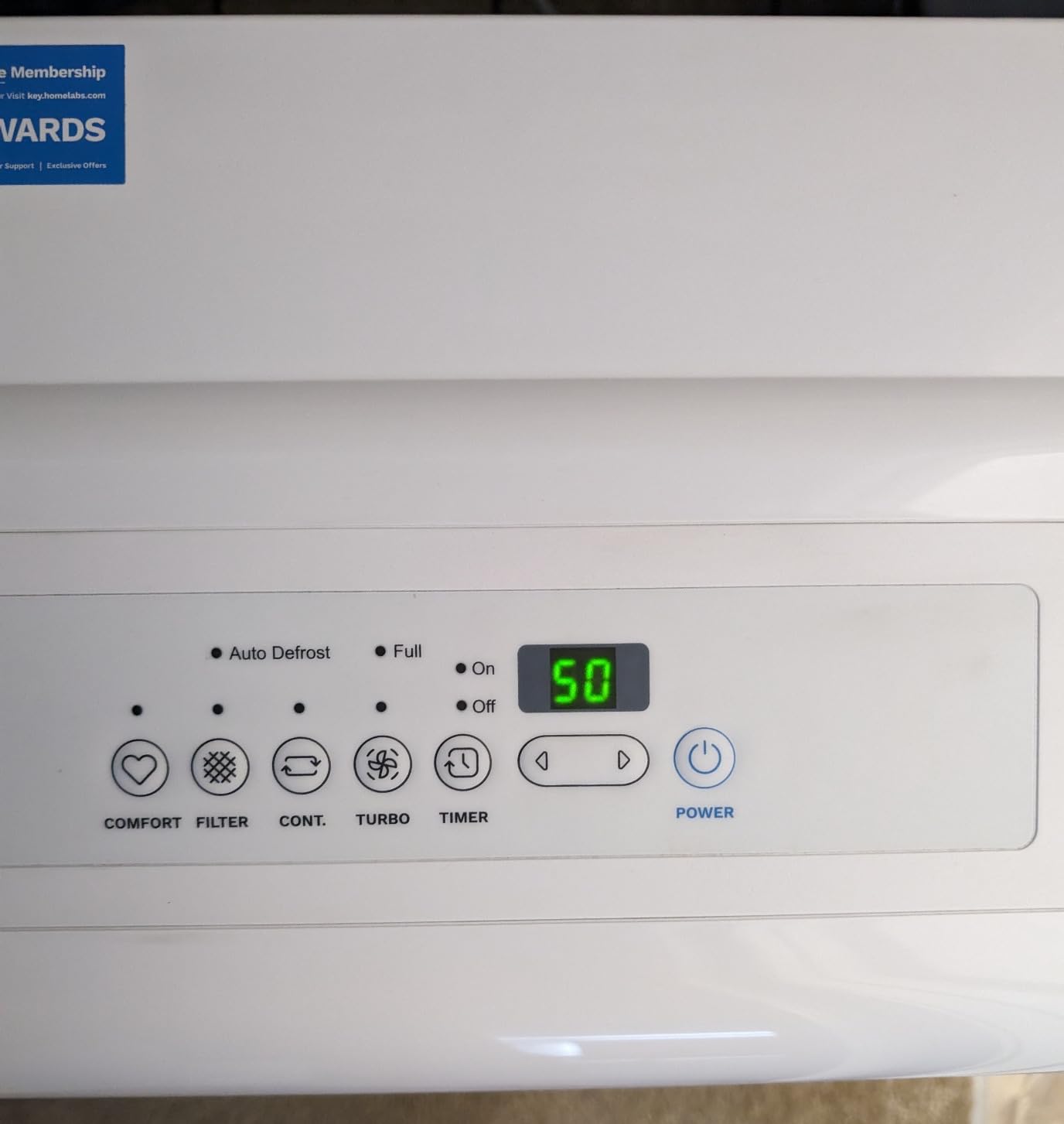
Owners of large finished and unfinished basements describe strong moisture removal, simple panel controls, and Wi-Fi they actually use. The physical footprint is 11 by 15.4 by 24.3 inches at 30.5 pounds, which is normal for the class but heavy enough that you want to decide where it lives before you unbox it. Modes are Comfort, Turbo and Continuous, and the digital panel shows live humidity rather than a row of indicator lights.
The honest drawback is size and draw. This is a full-size machine, and moving it between a control room and a live room is a two-person job. In a small studio that simply has one good corner, that is fine. In a space where you want the dehumidifier to move with the season, weigh that before you commit.
What to check before you buy the hOmeLabs 50 Pint
Confirm the drain path before delivery, not after. The pump discharge is what lets you place the outlet above the unit, and in a low-ceiling basement that single feature decides where the machine can physically go.
Then confirm your room can hit 45% RH without the compressor running nonstop. A unit cycling constantly is not just noise, it is a compressor with no rest cycle, and that is where early failures tend to come from.
Where the hOmeLabs 50 Pint is the wrong choice
A finished room under 300 sq ft with a visible corner will not need 7,500 sq ft of rated coverage. You will pay in cabinet space and in noise for capacity you never draw on, and a 30-pint unit handles that room comfortably.
It is also the wrong pick if you track in the same room. No published dB figure is given for this unit, and in a room where a condenser mic hears a sustained 120 Hz tone, an unquantified compressor is a risk. Put it in the gear room and record somewhere else.
2. Waykar 80 Pint ENERGY STAR – Best Proven Choice for a Damp Basement
Waykar 80 Pints 5000 Sq. Ft 2025 Energy Star Dehumidifier for Basement
80 pints per day at 95F/90%RH
30-80% RH range,42 dB
5,000 sq ft, ENERGY STAR
Pros
- More than 22000 ratings give the deepest owner history in this group
- 30-80% RH range reaches drier setpoints than most units
- 42 dB reported operating noise
- Owners repeatedly praise the warranty replacement service
Cons
- 9% one-star share is the highest among the highest-rated units
- Several owners report moisture removal declining around the 9-12 month mark
- On-screen humidity reading can run high against an external meter
The Waykar 80-pint has more than 22,500 ratings, the largest base of any unit here, and when a category has that much owner history the patterns are visible. Basement owners in Virginia, Wisconsin and Michigan report large and fast humidity reductions with quiet running in occupied rooms, and multiple reviewers describe warranty replacements handled smoothly.
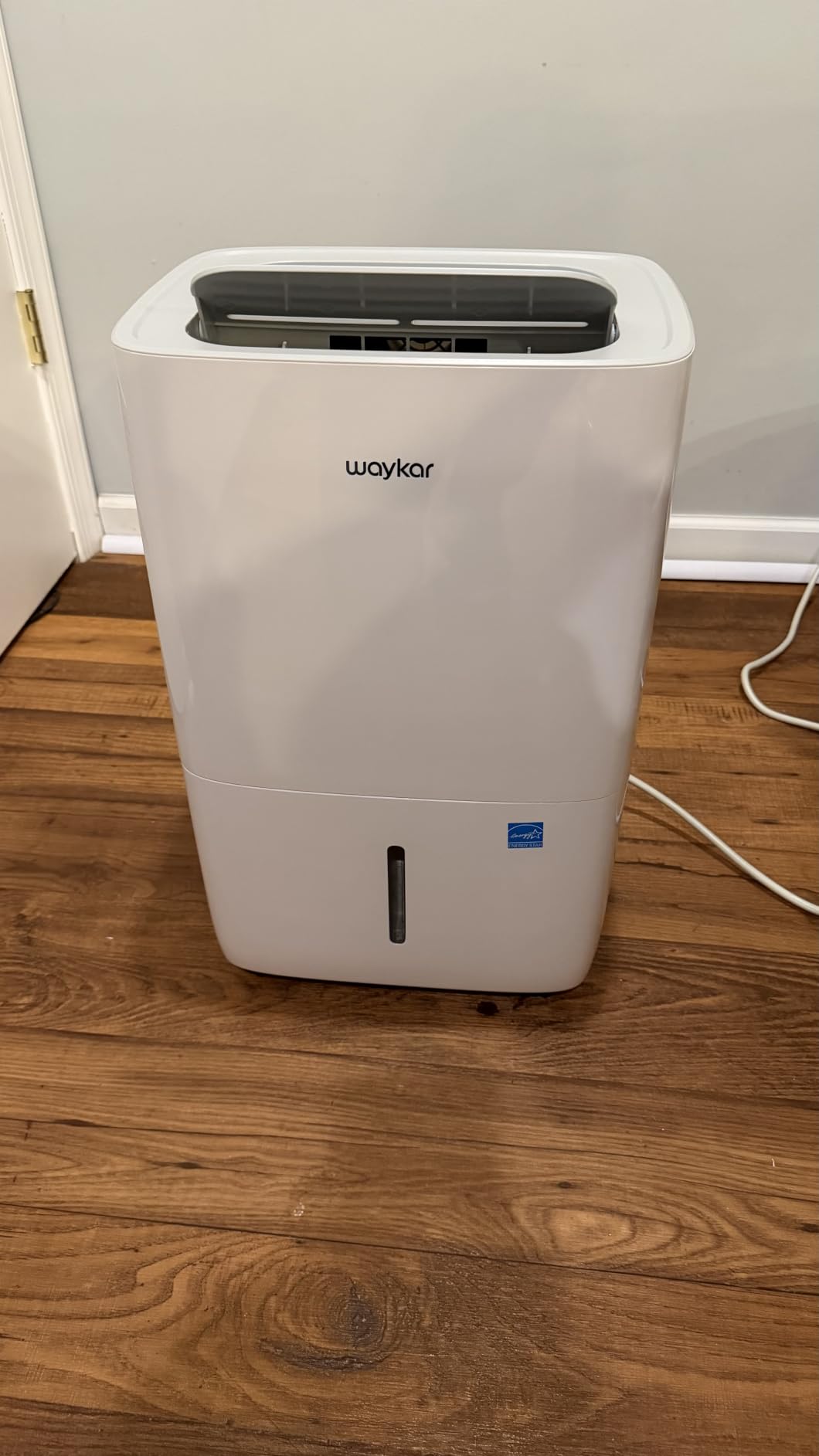
Two spec details matter for studio use. The humidity control range runs from 30% to 80% RH, which is wider than the typical 40% floor and means you can actually land on 45% without fighting the machine. Operating noise is reported at approximately 42 dB, and airflow is rated at 165 CFM with a 90-degree auto swing louver for even distribution across a room, which matters more in a low-ceiling space than raw CFM.
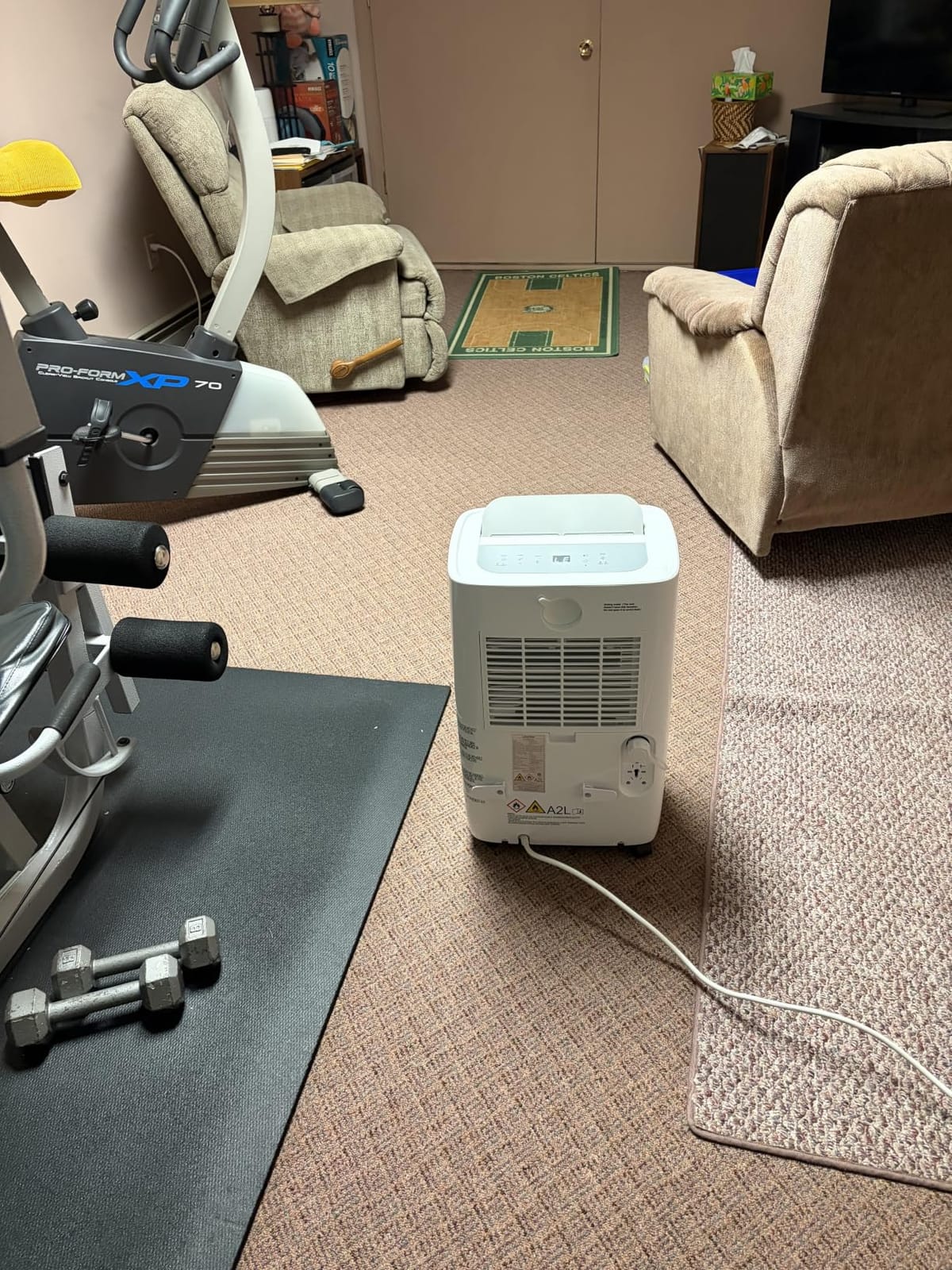
It is ENERGY STAR certified and DOE compliant at 270 watts, so running it 20 hours a day in a 600 sq ft room is a manageable number on an electricity bill. AI-sensing frost and fault detection handles auto defrost, and there is a 3.3 ft drain hose plus a 3/4-inch garden hose connection for continuous drainage to a sump or a condensate line.
The durability thread is the reason this is not our number one pick. Several owners report the compressor losing moisture-removal ability around the 9-12 month mark, and the 9% one-star share is the highest among the top-rated units in this roundup. The warranty is one year exchange plus one year on registration, which is thinner than several rivals here.
What to check before you buy the Waykar 80 Pint
Buy a separate hygrometer before you set the target. Multiple owners find the panel reading runs high against an external meter, and if you trust the display you will over-dry the room and chase the wrong problem for weeks.
Check the drain hose length against your route. At 3.3 ft it is short and thin next to competitors, so plan on your own hose from the start rather than assuming the included one reaches.
Where the Waykar 80 Pint is the wrong choice
It is a heavy 31-pound box-style unit at 19.29 inches deep, which is awkward if your drainage point is behind a door with a tight swing or under a low joist. Measure the path from the outlet to your drain before ordering.
If your basement is a genuine ongoing damp problem rather than seasonal humidity, 80 pints per day at 95F will feel slow. That rating is a hot, humid test condition, and the same machine in a 68F room is doing closer to a quarter of that in real conditions.
3. Gasbye 115 Pint Max – Best Durability Build With Honest Capacity Figures
Gasbye 4500 Sq.Ft. 2026 Energy Star Dehumidifier for Basement & Large Rooms with Drain Hose, Max 115 Pints/Day | 45dB Quiet Compressor | 1.7 Gal Water Tank | Auto Shut-Off & Restart, Black
73 pints per day at 80F/60%RH,115 max
Thickened copper tubing
45 dB, ENERGY STAR 2026
Pros
- Publishes capacity at three separate temperature and humidity points
- Reinforced thickened copper tubing instead of aluminum
- 43 lb build aimed squarely at early-failure competitors
- 45 dB suits a below-grade workspace
Cons
- Under 1000 ratings
- so the long-term record is thin
- 500W draw is among the highest in this roundup
- Heaviest unit here at 43 lb
- awkward to reposition
Gasbye is the only unit here that publishes its capacity at three different test points: 73 pints per day at 80F and 60% RH, 115 pints per day at 86F and 80% RH, and 50 pints per day at 65F and 60% RH. That transparency is worth more to a basement studio owner than a single inflated headline, because the 65F figure is the one that describes a cool room in spring.
The build story is the copper. The listing specifies reinforced thickened copper tubing rather than aluminum across a 5-tier solid coil, and at 43 pounds this is the heaviest machine in the roundup. That weight is a feature if you want stability and a liability if you plan to move it between rooms twice a year. Two-year coverage with brand-new replacement units is included.
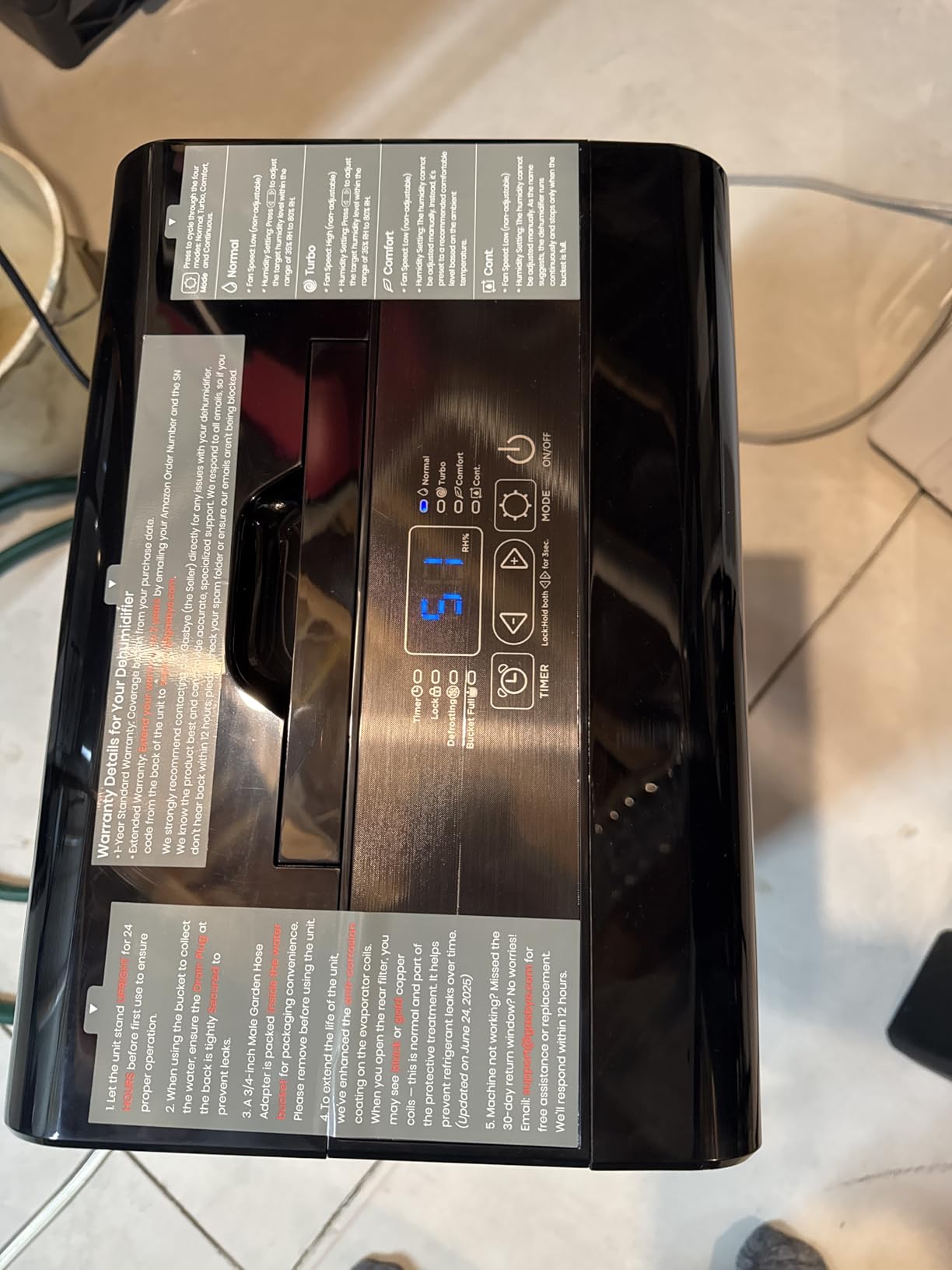
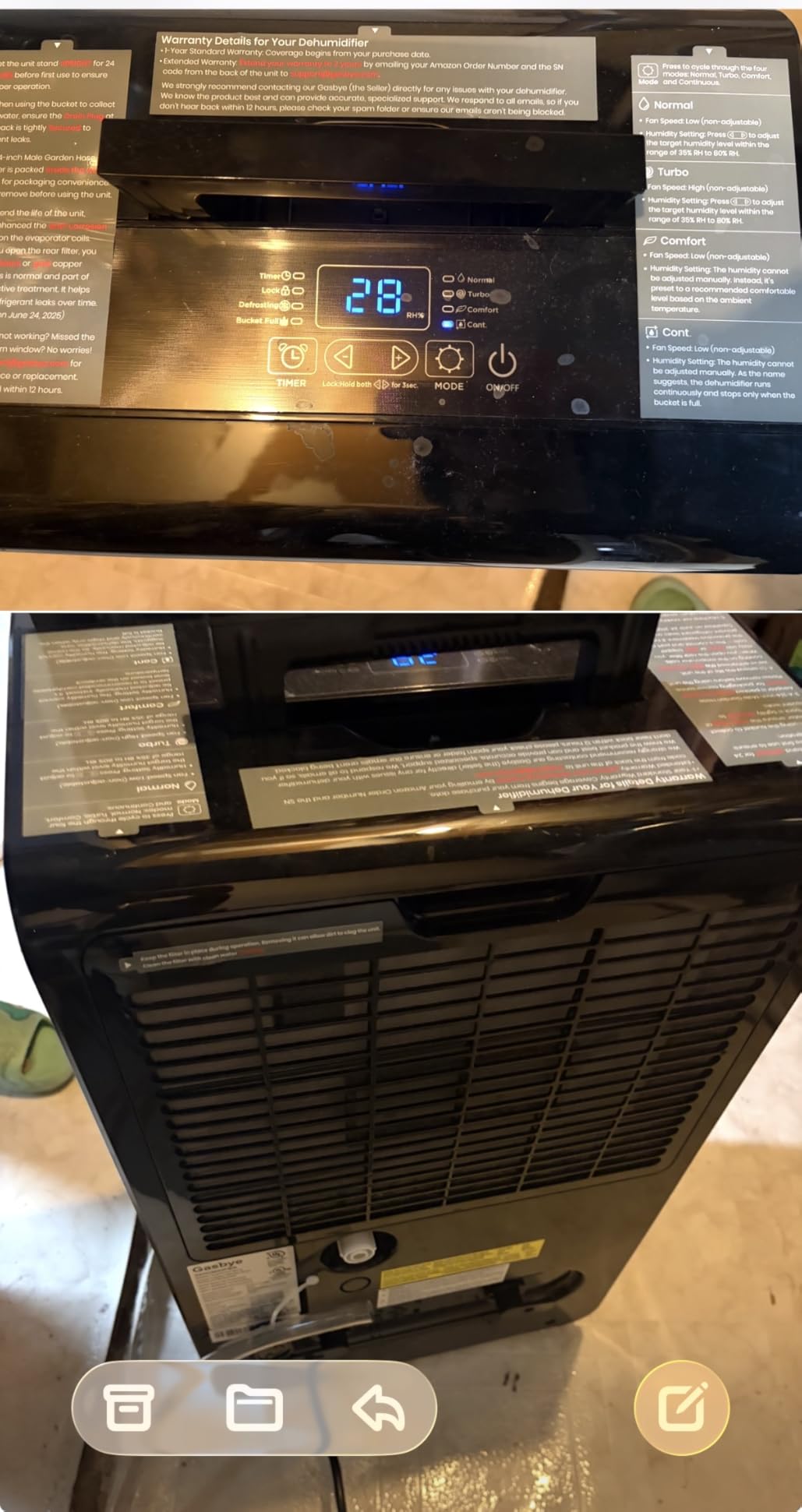
Noise is quoted at 45 dB for compressor operation, airflow at 12,600 cubic feet per hour, and there are three drainage paths: a 1.7 gallon tank, a 5 ft drain hose, or a 3/4-inch garden hose. Auto shut-off at 3% below target with restart at 3% above, plus power-outage memory, means it can run unattended through a session without someone checking it.
ENERGY STAR 2026 certified under a unique ID of 3417537, and the brand claims up to 30% better efficiency than non-certified models. The honest limitation is the review base: 911 ratings at a 4.6 average with an 80% five-star share is a good record, but it is a young record. Durability claims here rest on design intent and warranty rather than on years of accumulated owner data.
What to check before you buy the Gasbye 115 Pint
Look at the wattage, not the pints. At 500W, running 20 hours a day is a real line item, and this is one of the two highest draws in the roundup. If your studio also runs monitors and a rack, plan that load deliberately.
Verify your ceiling height against the 24-inch body plus the clearance the manual requires at the intake. A basement with 7 ft ceilings is usually fine; one with exposed joists at 6 ft 6 in is not.
Where the Gasbye 115 Pint is the wrong choice
A small control room will not justify 115 pints of maximum capacity. The 1.7 gallon tank also needs emptying often if you do not set up a continuous drain, and a machine this heavy is unpleasant to shuffle for tank duty.
It is also the wrong pick if you need a proven long-term record today. With under 1,000 ratings, you are buying the copper tubing and the warranty, not a decade of field history.
4. AEOCKY 80 Pint ENERGY STAR Most Efficient – Best Certification Tier and Most Versatile Fan
AEOCKY 5500 Sq.Ft Energy Star Most Efficient 2025 Dehumidifier Max 80Pint/D
80 pints per day at 95F/95%RH,56 at 86F/80%
44 dB lowest fan speed
ENERGY STAR Most Efficient 2025
Pros
- ENERGY STAR Most Efficient 2025 certification
- a tier few competitors hold
- 44 dB at the lowest fan speed
- 7mm high-tooth pure copper piping with 3-year coverage
- Rotary compressor with a 3+2 coil structure
Cons
- 80-pint figure is quoted at the severe 95F/95%RH condition
- 1.45 gallon tank is small for its rated pumping capacity
The AEOCKY RHEA-001 carries ENERGY STAR Most Efficient 2025 certification, a tier that describes efficiency above the base ENERGY STAR threshold rather than simply meeting it. For a unit that runs 18 to 24 hours a day in a windowless room, that distinction is the whole point. It is also rated number 5 in Amazon’s Dehumidifiers category, so the demand signal is strong.
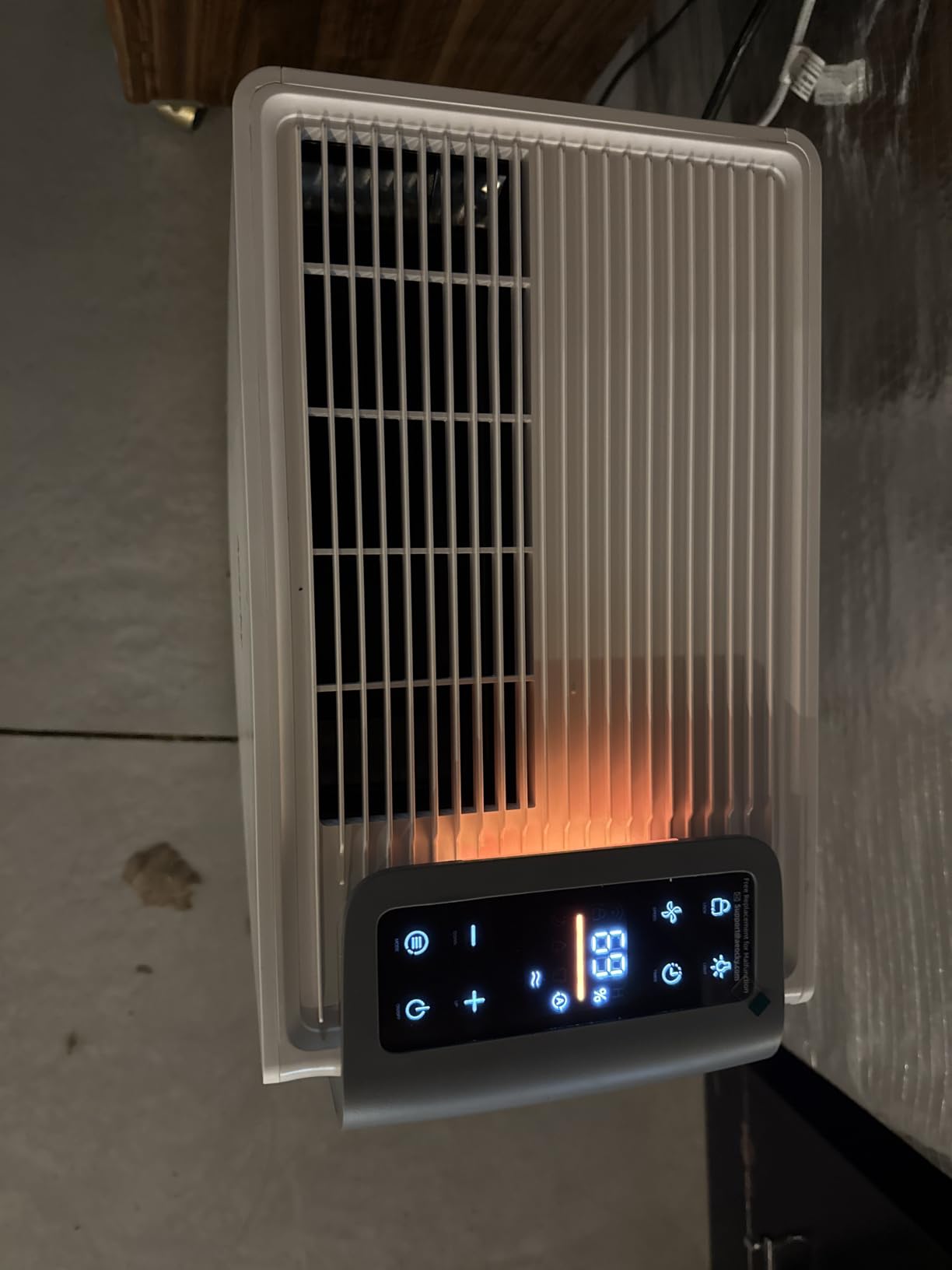
It is the only unit here with a published noise figure at its lowest fan speed: 44 dB. That matters more than the headline decibels on competing listings because a dehumidifier in a tracking room is a continuous tone source. The rotary compressor, 3+2 evaporator and condenser coil structure, 7mm high-tooth internally threaded pure copper piping with no aluminum, and a blue hydrophilic aluminum foil heat exchanger are all durability choices rather than marketing ones.
Defrost sensors are rated for operation near 65F, which covers most basements through spring. Five modes are available, including sleep mode and a smart drying mode, and the humidity sensing is described as millisecond-level with a compensation algorithm. Coverage is quoted at 5,500 sq ft, airflow at 9,006 cubic feet per hour, and the machine is 31 pounds at 14.45 by 8.66 by 24.09 inches. ETL and RoHS certified with 3-year coverage.
Two things temper that. The 80 pints per day headline is measured at 95F and 95% RH, an unusually severe condition, and the more meaningful figure on the same listing is 56 pints per day at 86F and 80% RH. The 1.45 gallon tank is also small relative to that capacity, so continuous drainage is close to mandatory here.
What to check before you buy the AEOCKY 80 Pint
Do the 86F arithmetic before you trust the box. A 56-pint machine at realistic basement conditions is the number that decides your room size, and plenty of listings only show you the 80.
Set up the drain line on day one. With a 1.45 gallon tank and this much extraction, a weekend session will fill it faster than you expect to notice.
Where the AEOCKY 80 Pint is the wrong choice
If you need a built-in pump to drain upward, this unit does not list one, so the outlet has to sit at or below the machine. In a basement where the only sensible drain point is a sump several feet above the floor, that rules it out.
It is also overkill as a first machine for a small room. The efficiency tier is a genuine long-run saving, but only if the unit is actually cycling, and a 200 sq ft studio dries out in an afternoon.
5. Yaufey 150 Pint with 16.4 ft Pump – Best Drainage Flexibility for Below-Grade Installs
Yaufey 150 Pint Dehumidifier with Pump for Basement 8500 Sq. Ft.
150 pints per day at 95F/90%RH
16.4 ft pump hose plus gravity option
8,500 sq ft, 1.85 gallon tank
Pros
- Three genuine drainage paths including upward pump discharge
- 30-80% RH range in 5% steps with a basement-specific 45% mode
- Three fan speeds with a 40-80 degree swing
- Over 6400 reviews at a 4.5 average
Cons
- 500W draw is among the highest in this roundup
- 39.7 lb weight is heavy for a unit that may need repositioning
- No Wi-Fi or app control unlike several rivals here
The Yaufey 150-pint is the unit we would look at first when the drainage question is awkward, which in a basement it usually is. It offers three configurations: upward pump discharge through a 16.4 ft hose, a tank, or a separate 3.28 ft gravity hose compatible with a garden hose. In a finished basement with a sump pump set above the floor and no floor drain nearby, that upward discharge alone can decide the install.
Owners of cellars, RV interiors and small finished basements report the unit holding target humidity steadily, running quietly enough for bedrooms, and in at least one case lasting six years. The pump and continuous-drain options are the features singled out most often as decisive for below-grade setups, and with 6,466 ratings at 4.5 the owner history here is solid.
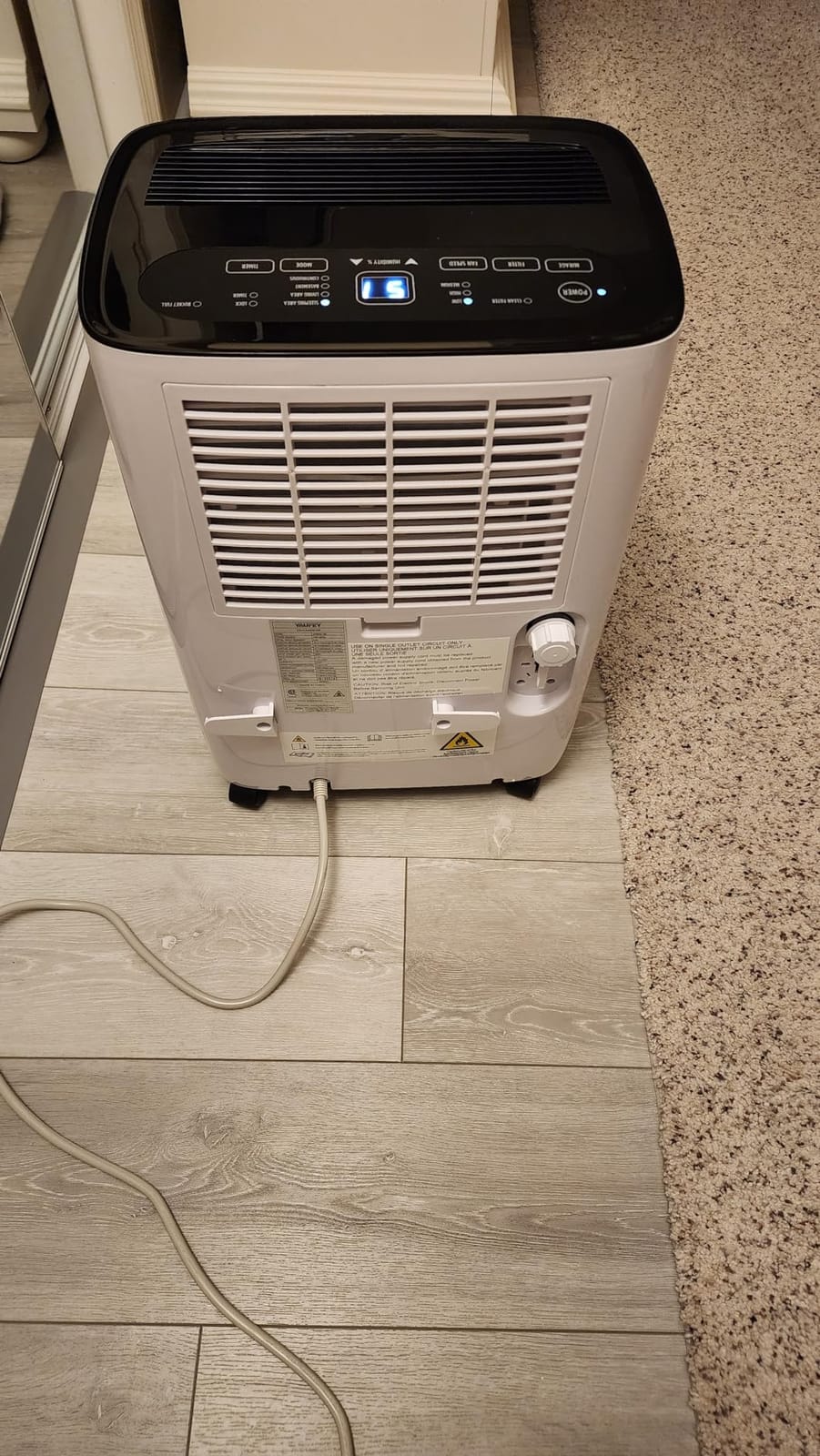
Humidity control runs from 30% to 80% RH in 5% steps with Living Area, Basement and Continuous modes, which is the mode set we like for a studio because the Basement mode holds a 45% RH target directly. Airflow is 159 CFM, the louver swings 40-80 degrees, and there are three fan speeds. Internally it is a rotary compressor with 7mm pure copper pipes and a 3+2 coil structure, and the 1.85 gallon tank has a visible water level plus a full-tank alert.
Auto defrost, power-off memory, timer, button lock and overload protection are all standard, with one-year coverage plus an additional year on registration. The catch is the 500W draw, second only to the Gasbye in this group, and there is no app control, so you check the reading the old way by walking over to it.
What to check before you buy the Yaufey 150 Pint
Measure vertical distance from the unit to your drain, and add clearance for the fittings. A 16.4 ft hose is generous horizontally but pump lift ratings assume a smooth line, so every kink costs you head.
Confirm the 45% basement mode is what you want as a default. If the room also holds paper and fabric, you may prefer the 30-80% manual range over a fixed 45% setpoint.
Where the Yaufey 150 Pint is the wrong choice
It is far too much machine for a small studio. 8,500 sq ft of rated coverage and a 150-pint ceiling mean a 300 sq ft control room will cycle it on and off constantly, which wastes energy and adds compressor hours for no moisture removal.
At 39.7 pounds, this is not a unit you reposition on a whim. Decide its corner before the first session rather than after the first season.
6. avylo 90 Pint with Pump – Best Warranty Coverage and Largest Tank
avylo Dehumidifier for Basement with Pump and Hose, Max 90 Pints/D, White
90 pints per day at 90F/90%RH
15 ft pump lift
41 dB, 5-year warranty, 2.11 gallon tank
Pros
- Five-year manufacturer warranty
- the longest coverage stated in this roundup
- 2.11 gallon top-mounted tank is the largest reservoir here
- 41 dB with a key sound-and-light-off mode
- 235W draw is among the lowest for this rated capacity
Cons
- Only 339 reviews
- so the reliability record is not well established
- 8% one-star share is the second highest among the 4.5-star units
- No floor drain pipe included
- so a sump or extra plumbing may be needed
Everything about the avylo ADC018 is designed around being left alone, which is the actual requirement in a studio nobody occupies during the week. It is ENERGY STAR Most Efficient 2025 certified at 2.05 L/kWh EER, rated 90 pints per day at 90F and 90% RH, and draws 235 watts, among the lowest for a unit in this capacity class. That combination is why a 20-hour day stays affordable.
The warranty is the headline: five years from the manufacturer, longer than any other unit in this roundup. When the review base is thin, which at 339 ratings it is, a five-year warranty is the substitute for owner history, and it is a reasonable one. The 2.11 gallon top-mounted tank is also the largest here, with a full-tank reminder and auto shut-off, so the failure mode of a forgotten bucket is less likely.
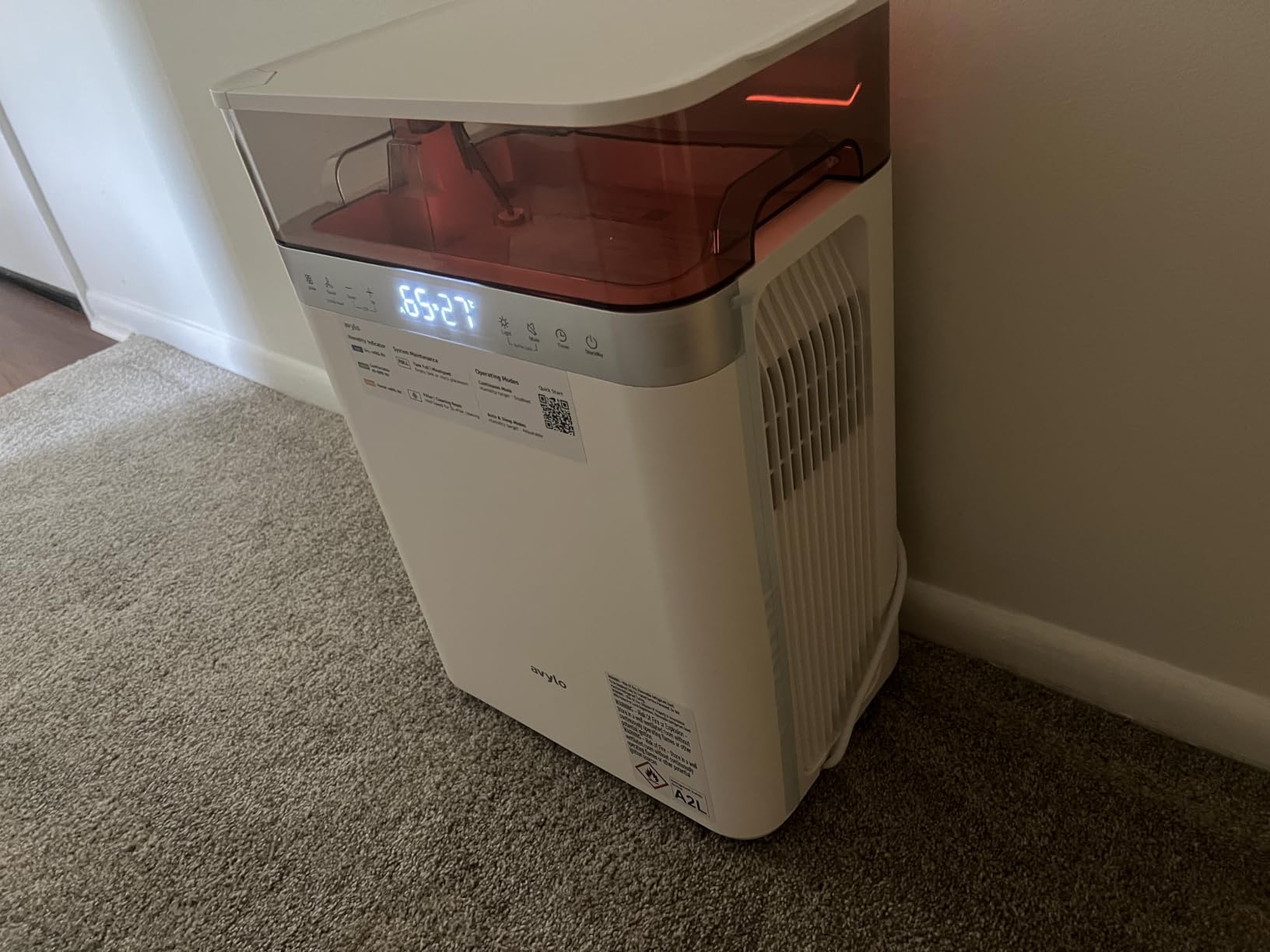
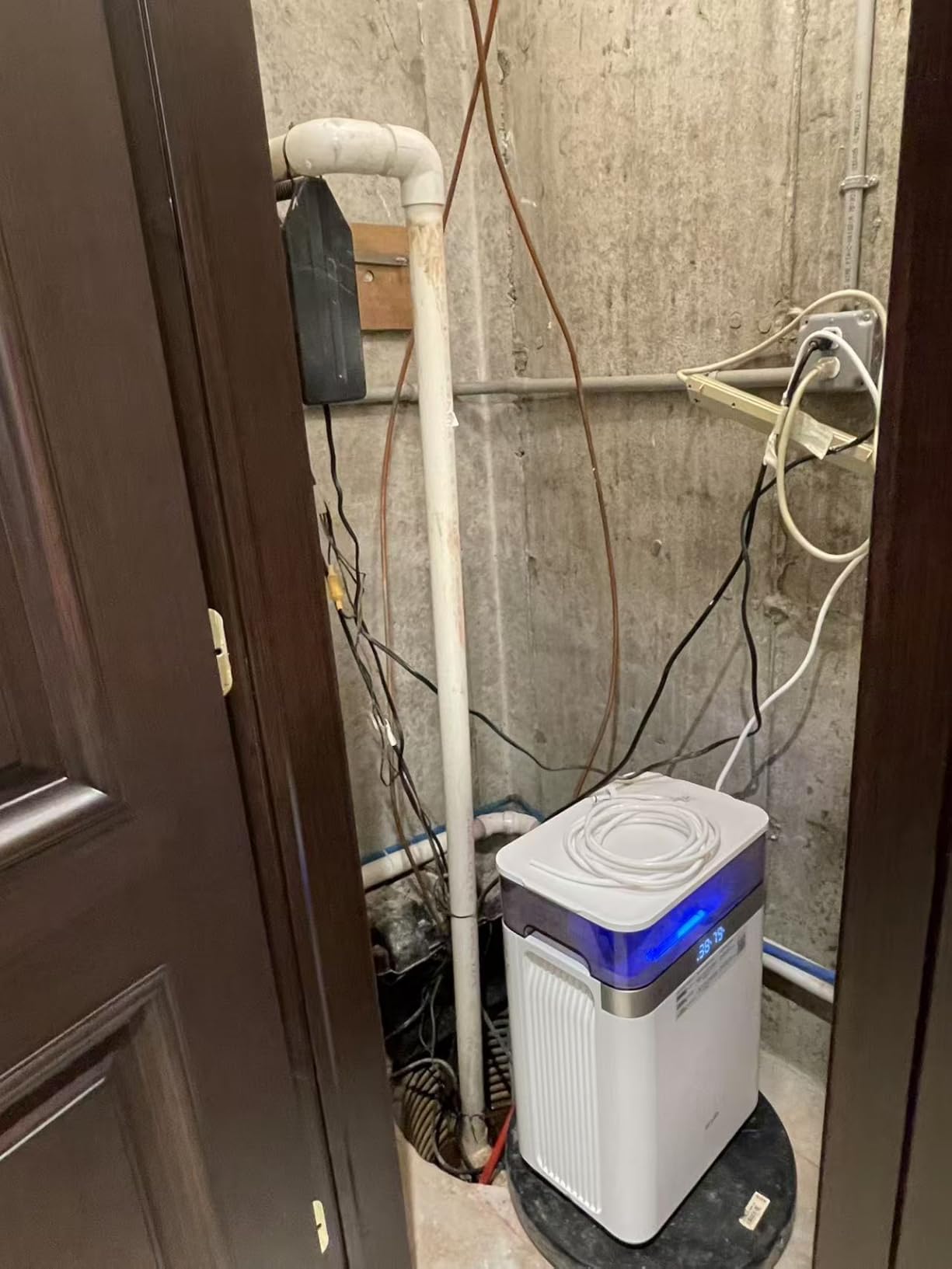
The built-in pump lifts 15 feet and comes with a 15 ft drain hose, which covers most basement layouts without a separate pump purchase. Noise is 41 dB with a key sound-and-light-off mode, plus a 24-hour timer, three fan speeds, child lock, compressor overheat, overload and leakage protection. It meets DOE, CEC, FCC, TSCA, CA65 and UL standards, and coverage is quoted at 4,500 sq ft in the spec block and 5,000 sq ft in the features list.
The honest problem is evidence, not design. With 339 reviews there is very little long-term data, and the 8% one-star share is the second highest among the four-and-a-half-star units. No floor drain pipe is included, so confirm what your installation needs before the unit arrives.
What to check before you buy the avylo 90 Pint
Plan the plumbing. The pump hose is included but the floor drain pipe is not, and in a basement with a sump you may need a fitting and a check valve that the package does not supply.
Read the 41 dB figure as a compressor-only number measured in a lab. In a small room with reflective surfaces, budget more than the sheet says before you place a mic near it.
Where the avylo 90 Pint is the wrong choice
If your priority is a proven track record, a 339-rating listing cannot offer one. A five-year warranty is a promise from a company, not evidence from a decade of owners, and those are not the same thing.
It is also the wrong shape for a low-ceiling corner. At 23.11 inches deep and 38.6 pounds, it wants floor space and a clear path, not a slot behind a closed door.
7. DREO 73 Pint Smart Dehumidifier – Best App Control for Remote Monitoring
DREO Energy Star 2025 Smart Dehumidifier for Basement, 1.85 Gal Water Tank
73 pints per day at 95F/90%RH
41 dB, app control
1.85 gallon tank, 2,000 sq ft
Pros
- Only app-connected unit in the roundup with real-time energy and cost tracking
- Owner measured 43 dB low and 46 dB high on a sound meter
- 1.85 gallon tank with up to 15 hours of runtime between empties
- Modern styling suits a visible studio rather than a utility corner
Cons
- Lowest average rating here at 4.2 with an 8% one-star share
- Sensor reads 10% or more high against external hygrometers with no calibration option
- 2000 sq ft coverage is the smallest of the group
The DREO DR-HDH003S is the only unit here where you can watch your studio’s humidity from your phone, and the app shows real-time energy usage and power cost. If you are running an unattended basement and want to know whether the room drifted overnight without driving out to look, that is a genuine advantage no other pick in this list offers.
On paper it is also the quietest verified unit we could find. One owner measured it on a sound meter at 43 dB on low and 46 dB on high, which is a real measurement rather than a listing figure, and at 163 CFM of airflow across 2,000 sq ft of coverage the machine is well matched to a small studio. It is ENERGY STAR 2025 certified and uses about 30% less energy than standard DOE models.
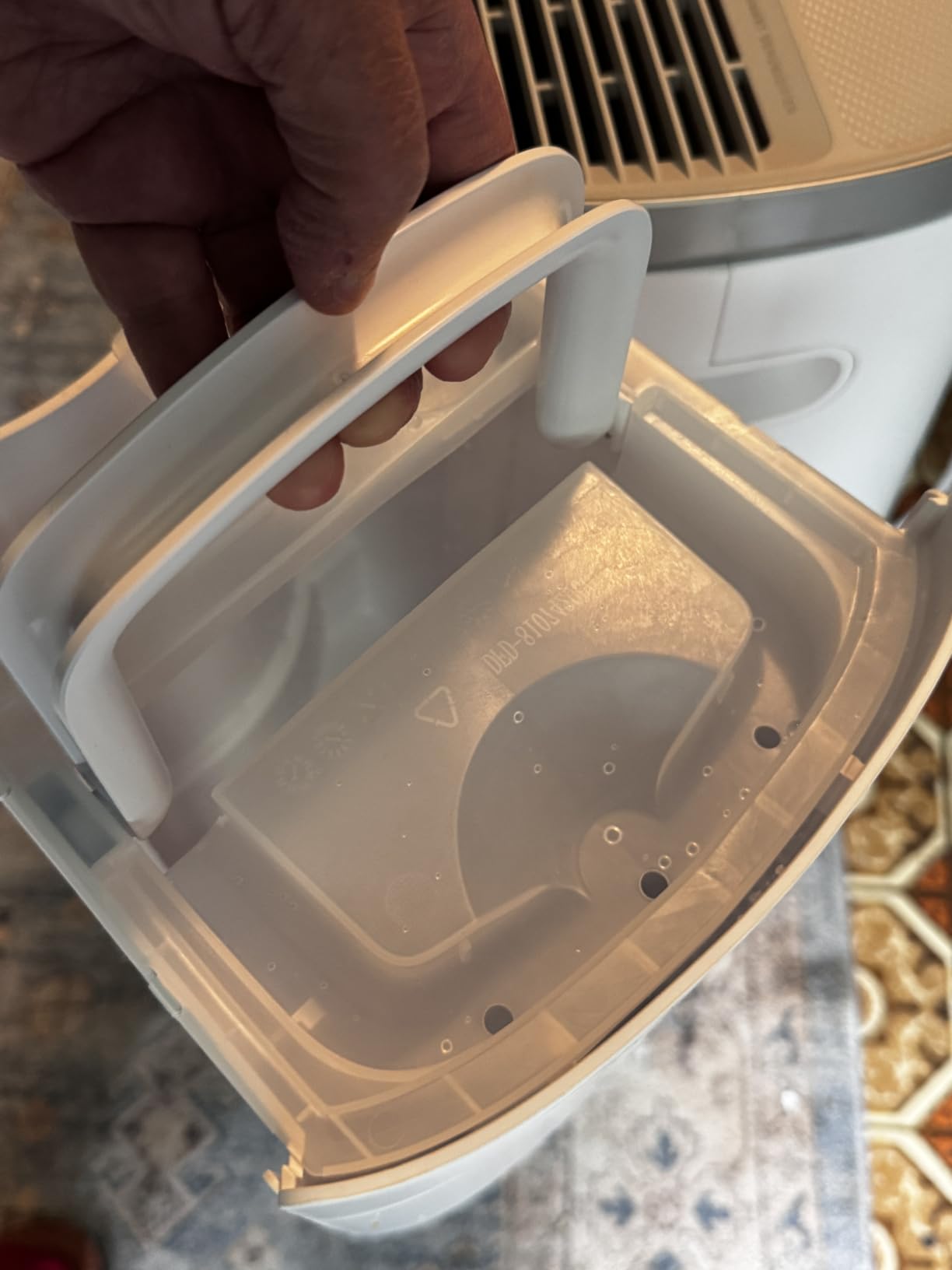
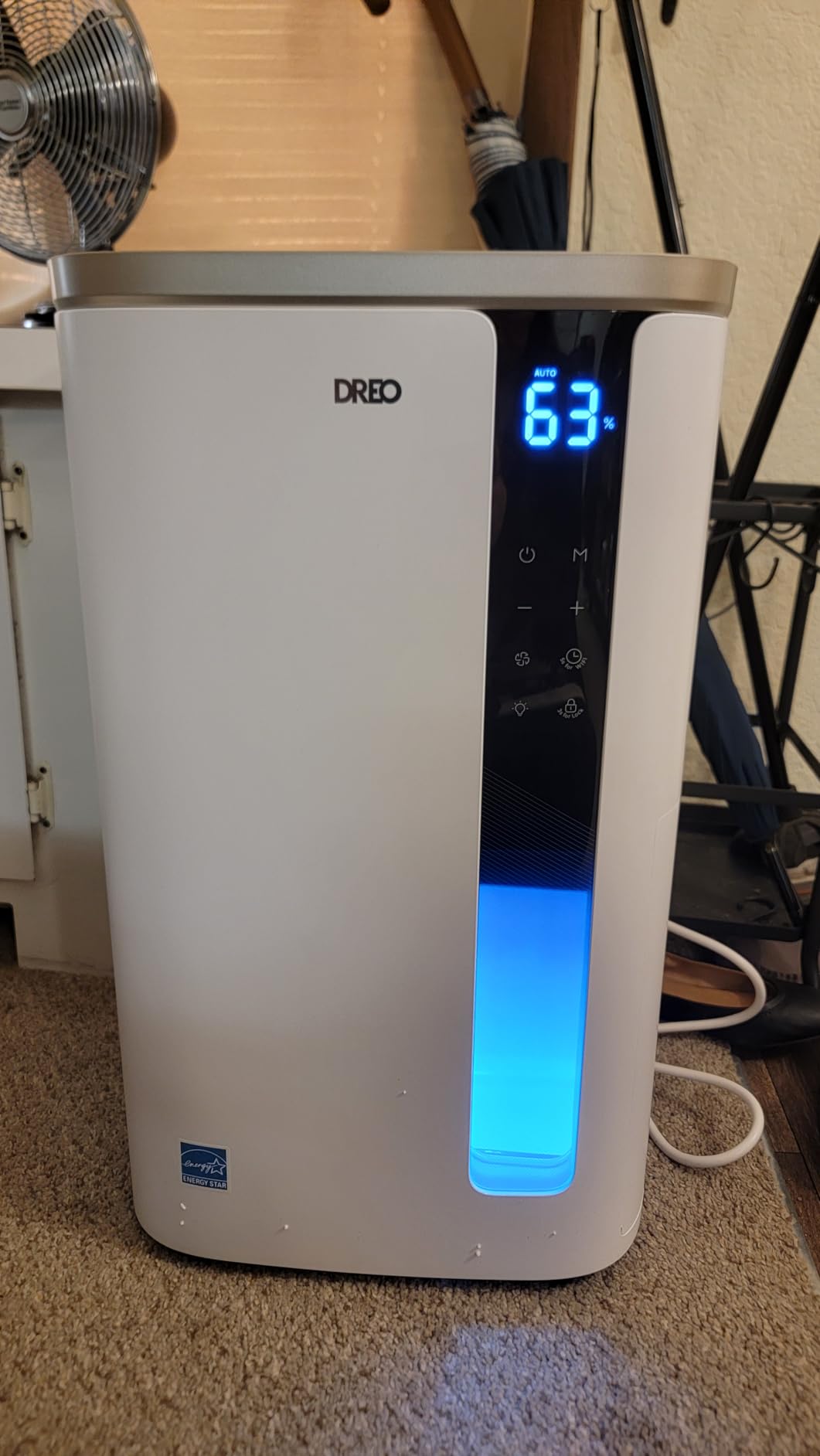
The 7L, 1.85 gallon tank gives up to 15 hours of runtime between empties, and full-tank alerts, auto shut-off, auto defrost and water level detection are all present. Styling is a silver finish with a color-changing humidity indicator light, which matters if the unit is visible in a treated room rather than hidden in a closet. Three fan speeds, a child lock and a timer round out the controls.
Now the problem. Several owners cross-check the displayed reading against separate hygrometers and find it off by 10% or more, with no user calibration available, so you must verify the sensor before trusting it. A minority also report the unit struggling to hold lower targets, and several reviews note that many five-star ratings come from units supplied free through a review program. The warranty is 12 months, the shortest stated here.
What to check before you buy the DREO 73 Pint
Compare its display to a known-good hygrometer on day one. If the reading is off by 10%, you can compensate by setting the target lower, but you need to know the offset before you do it.
Confirm your ceiling and floor area. At 2,000 sq ft rated, this is the smallest capacity here, and a 1,200 sq ft rehearsal space with a drum kit in it is beyond what this unit holds at 45%.
Where the DREO 73 Pint is the wrong choice
Do not buy it as the only line of defense in a damp basement. At 73 pints per day rated at 95F, it will hold a moderately damp room but will not rescue a room with a water problem behind the wall.
And if sensor accuracy is non-negotiable for your workflow, skip it. A 4.2 average with an 8% one-star share on a 227-rating listing is the thinnest evidence base in the smart category.
8. Kesnos 30 Pint – Best Budget Pick for a Small Studio or Control Room
Kesnos 2,500 Sq. Ft. Energy Star Dehumidifier for Basement with Drain Hose
30 pints per day for 2,500 sq ft
36 dB, 165W
Control down to 30% RH, four modes
Pros
- Lowest published noise figure here at 36 dB
- Lightest at 22.6 lb with 360 degree casters and a hidden handle
- 165W draw keeps continuous running cost low
- Four modes including a Turbo setting for clothes drying
Cons
- 0.39 gallon tank is very small and needs frequent emptying
- 11% one-star share is the highest in this roundup
- No garden hose included and the drain hose needs a 1/2-inch connection
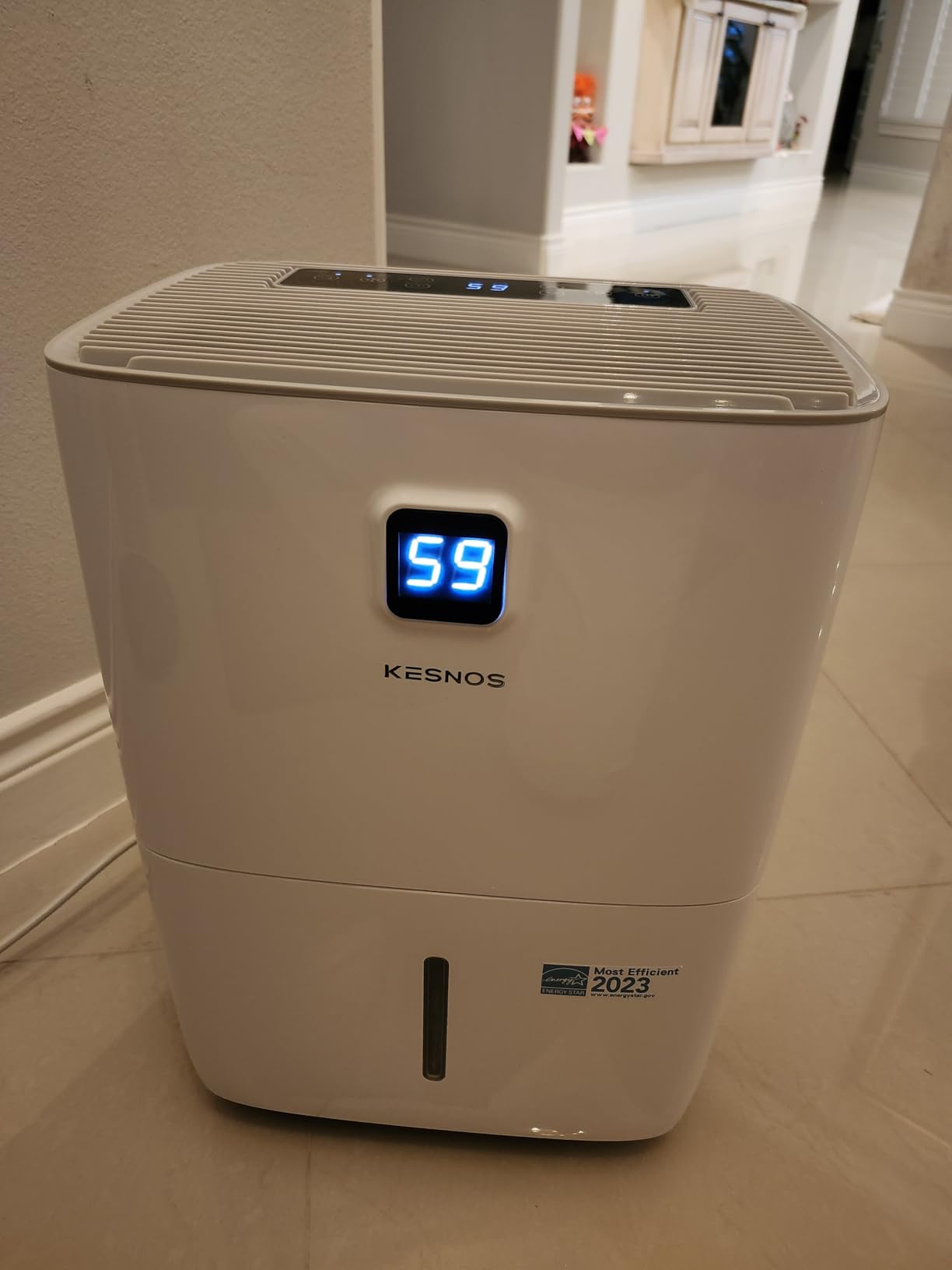
The Kesnos CTH30B is the smallest and quietest machine in this roundup, and for a control room or a 200 to 300 sq ft writing space it is probably all you need. Thirty pints per day at 95F and 90% RH covers 2,500 sq ft, humidity control goes down to 30% RH, and the published noise figure is 36 dB, the lowest number on any of these listings.
It is also the easiest machine here to own. At 22.6 pounds with 360-degree casters, a recessed handle and a 5.2 ft power cord with rear storage, one person can move it from a control room to a rehearsal space. At 165 watts it is the second-lowest draw in the group, and it is 2025 ENERGY STAR certified with 35% lower power consumption than non-certified models.
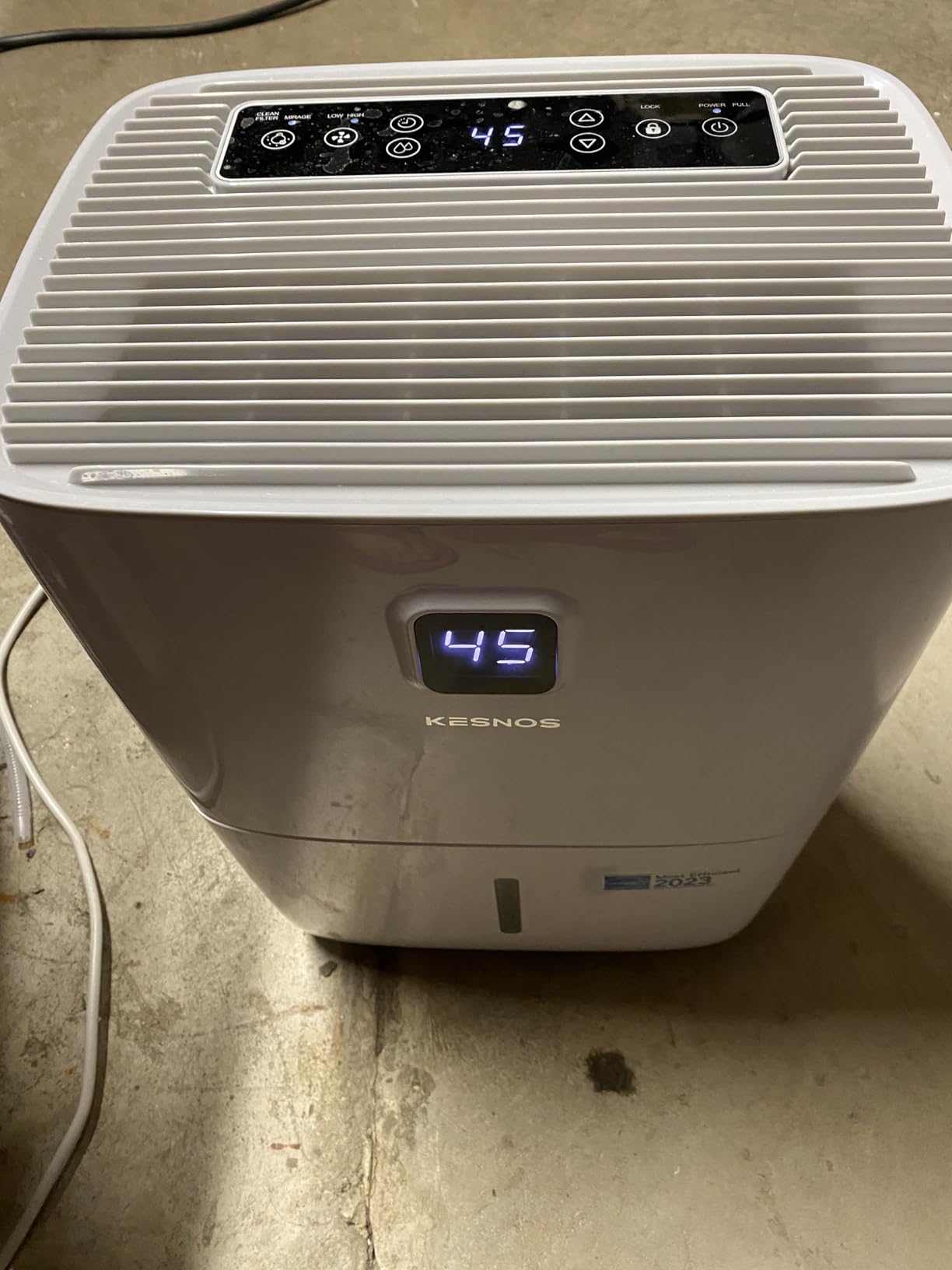
Owners of roughly 2,300 sq ft two-level homes report the unit pulling humidity down quickly and running quietly enough to sit unobtrusively in a living room, and customer support is repeatedly described as prompt and willing to replace units that fail, sometimes beyond the warranty. There is a 30-day satisfaction guarantee, one-year limited coverage with a registerable two-year extension, and lifetime expert technical support.
The limits are real. The 0.39 gallon tank is tiny, so continuous drainage is not optional in a studio, and the 11% one-star share is the highest here. Several owners report units ceasing to work around the one-year mark, and a few reviews on this listing reference a 120-pint variant rather than the 30-pint unit you are actually buying.
What to check before you buy the Kesnos 30 Pint
Plan the drain on day one, because at 0.39 gallons the tank will not last a weekend session. The included 3.3 ft hose needs a 1/2-inch connection and no garden hose is included, so check your fitting before you order.
Confirm your room is genuinely small. Thirty pints per day is a real ceiling, and a 600 sq ft studio with a large drum kit in it will outrun it in a damp week.
Where the Kesnos 30 Pint is the wrong choice
Skip it in any genuinely damp or unfinished basement. Its upper temperature rating of 100F is generous, but the capacity ceiling is not, and a room that sits at 65% RH year-round will keep the compressor running without ever catching up.
Also weigh the reliability pattern carefully. The brand replaces failed units readily, but an 11% one-star share means you are planning around a failure rate, and that is hard to do for a room holding vintage amps you care about.
9. VEAGASO 34-36 Pint – Best Mid-Capacity Value with a Clothes Drying Mode
VEAGASO 36 Pint/D, 2500 Sq.Ft Dehumidifier for Basement with Drain Hose
34-36 pints per day, 2,500 sq ft
40 dB in low mode
2-year warranty, drain hose included
Pros
- 4.5 average from more than 3000 ratings
- a solid record at mid capacity
- Dedicated DRY mode for indoor clothes drying
- 40 dB in low-speed mode with sleep behaviour
- 2-year warranty is longer than most rivals in this class
- 230W draw is modest for the rated capacity
Cons
- 0.53 gallon tank needs regular emptying without a continuous drain
- Vertical form factor uses more floor space than the wide low units
- No app connectivity and no integrated pump
- so it must sit at or below drain level
The VEAGASO VG380 sits in the gap where most small studios actually land: 34 to 36 pints per day, rooms up to 2,500 sq ft, and a review base of 3,065 at a 4.5 average with a 75% five-star share. That is more owner history than most of the smart units in this roundup, at a capacity that suits a 300 to 500 sq ft room without oversizing it.
Three modes are genuinely differentiated rather than relabelled. DEHU handles everyday humidity control, DRY is a dedicated clothes-drying mode, and CONT runs continuous protection. In a studio that means a wardrobe rail, backline covers, or a prop room full of damp fabric can be dried without a separate machine competing for the dehumidifier’s attention.
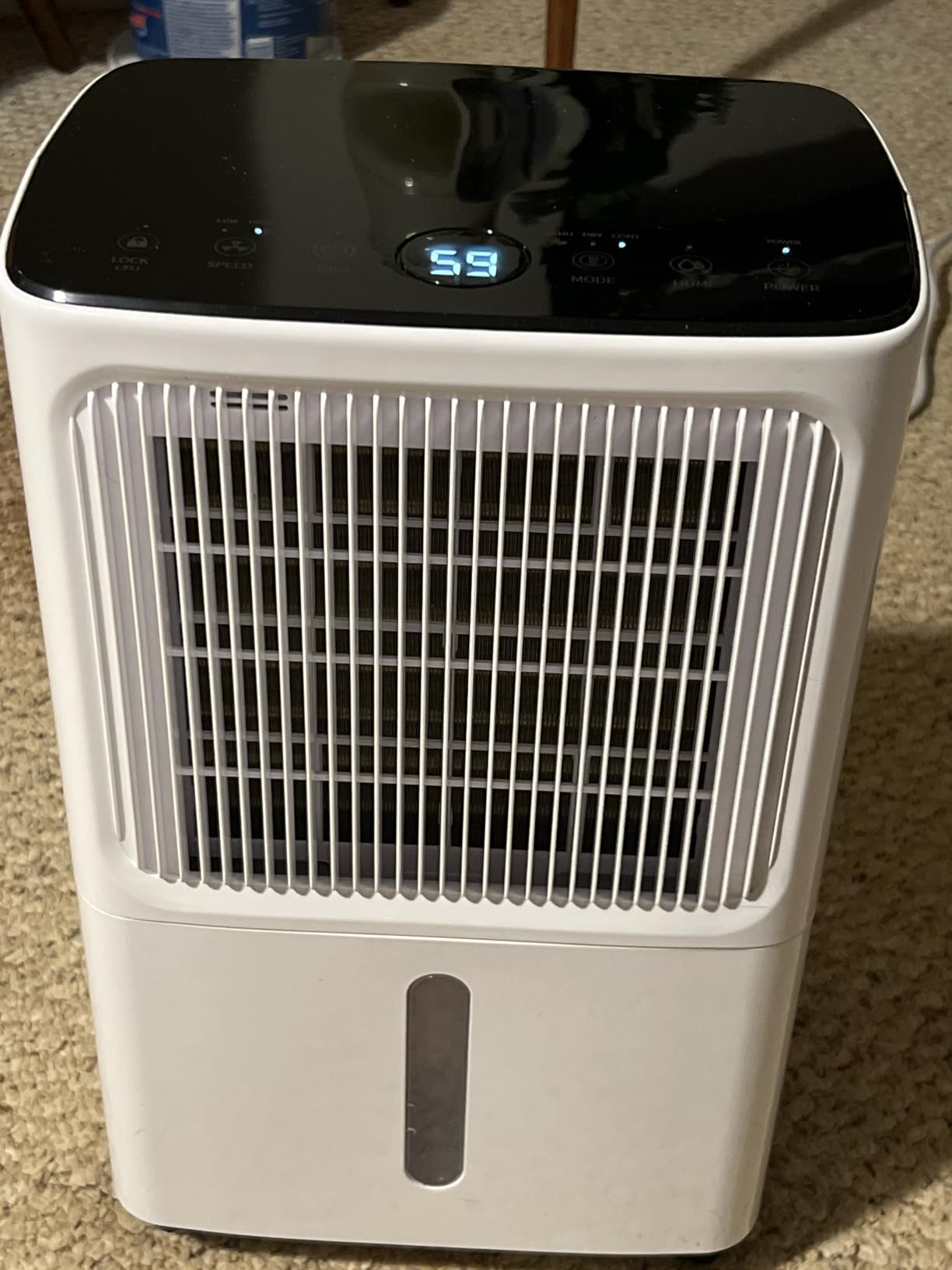
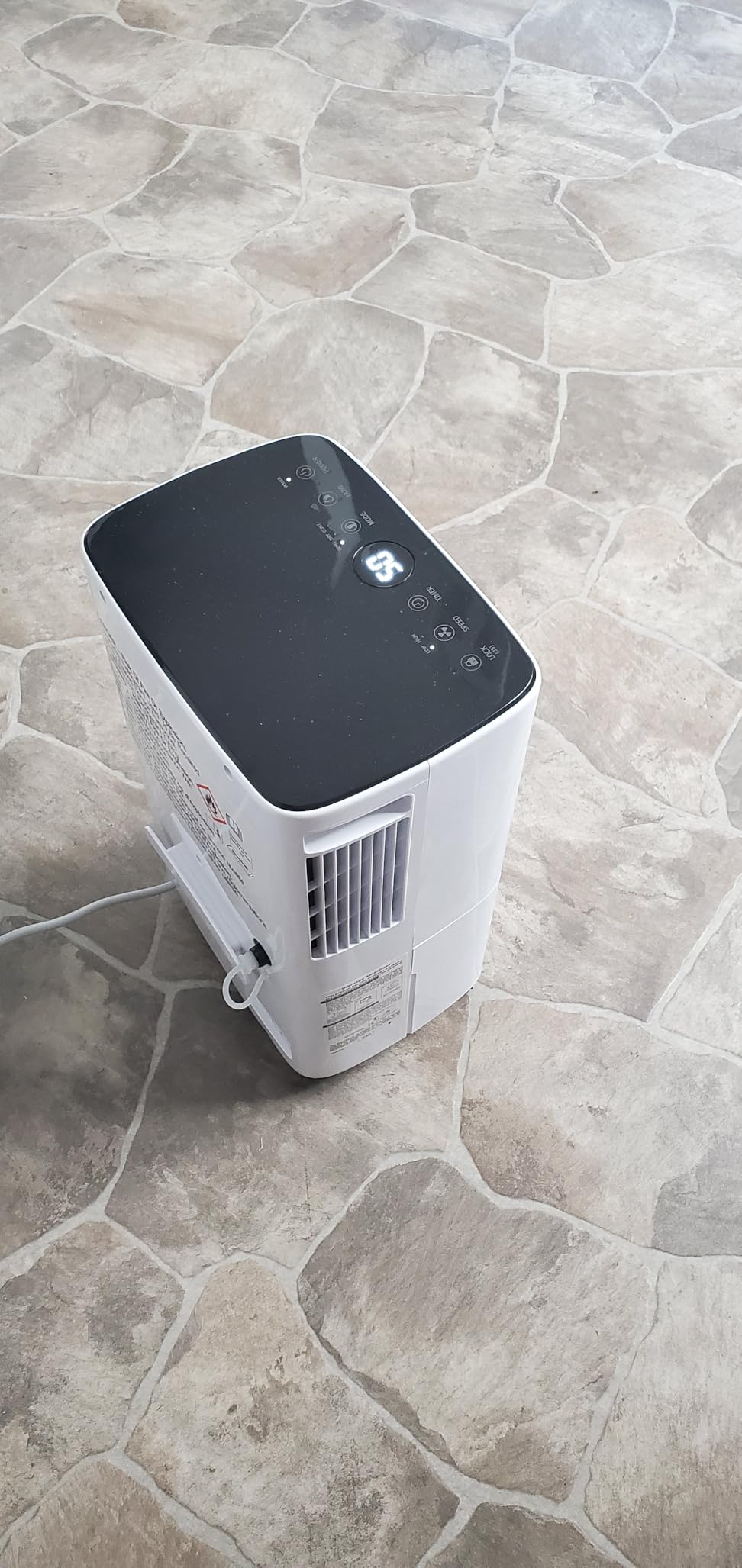
The LED touch panel shows a live humidity readout with fan speed, timer and mode selection, and a 1-24 hour timer plus power failure memory means it resumes its settings after an outage, which is the single feature most people look for when leaving a unit running through a session. Noise is 40 dB in low-speed mode, draw is 230 watts, and the recessed handle with 360-degree swivel casters makes it easy to reposition. Warranty is two years.
There are trade-offs. The 0.53 gallon, 2-liter tank needs regular emptying unless you set up the included drain hose, there is no app connectivity and no integrated pump so the unit has to sit at or below your drain level, and the vertical form factor at 19 inches deep takes noticeably more floor space than the wide, low units here. Be aware too that no written owner review text accompanied this listing, so the picture rests on rating distribution and specs.
What to check before you buy the VEAGASO 34-36 Pint
Find a drain at or below the machine. Without a pump, a basement where the sump is above the floor rules this unit out, and the orientation of the hose matters as much as its length.
Verify the outlet clearance against the 19-inch depth. In a tight studio corner this is a real constraint, and the unit will not tuck under a low shelf the way the Waykar or the Kesnos can.
Where the VEAGASO 34-36 Pint is the wrong choice
A larger damp basement is out of scope. Thirty-six pints per day is a small-room figure, and rooms above 500 sq ft with persistent dampness need something with genuine headroom.
It is also the wrong pick for anyone who wants to check humidity from a phone. There is no app here, so monitoring means walking over to the panel, which is fine in a control room you sit in and useless in a studio you only enter twice a week.
10. Midea 50 Pint with Pump and App – Best Mainstream Brand Support and Voice Control
Midea 50 Pint Dehumidifier with Pump, 4,500 Sq. Ft, Energy star
50 pints per day, 4,500 sq ft
49 dBA, built-in pump
Wi-Fi, Alexa and Google Assistant
Pros
- Recognized mainstream brand with a broad service network
- Built-in pump drains vertically or horizontally
- Wi-Fi with Alexa and Google Assistant voice control
- Widest adjustable range here at 35-85% RH
- Highest published airflow at 223.7 CFM
Cons
- Lowest average rating in the roundup at 4.1 with a 12% one-star share
- Only 141 reviews
- the thinnest base in the set
- 49 dBA in low mode is the loudest figure published in this roundup
- 470W draw is high for 50 pints of capacity
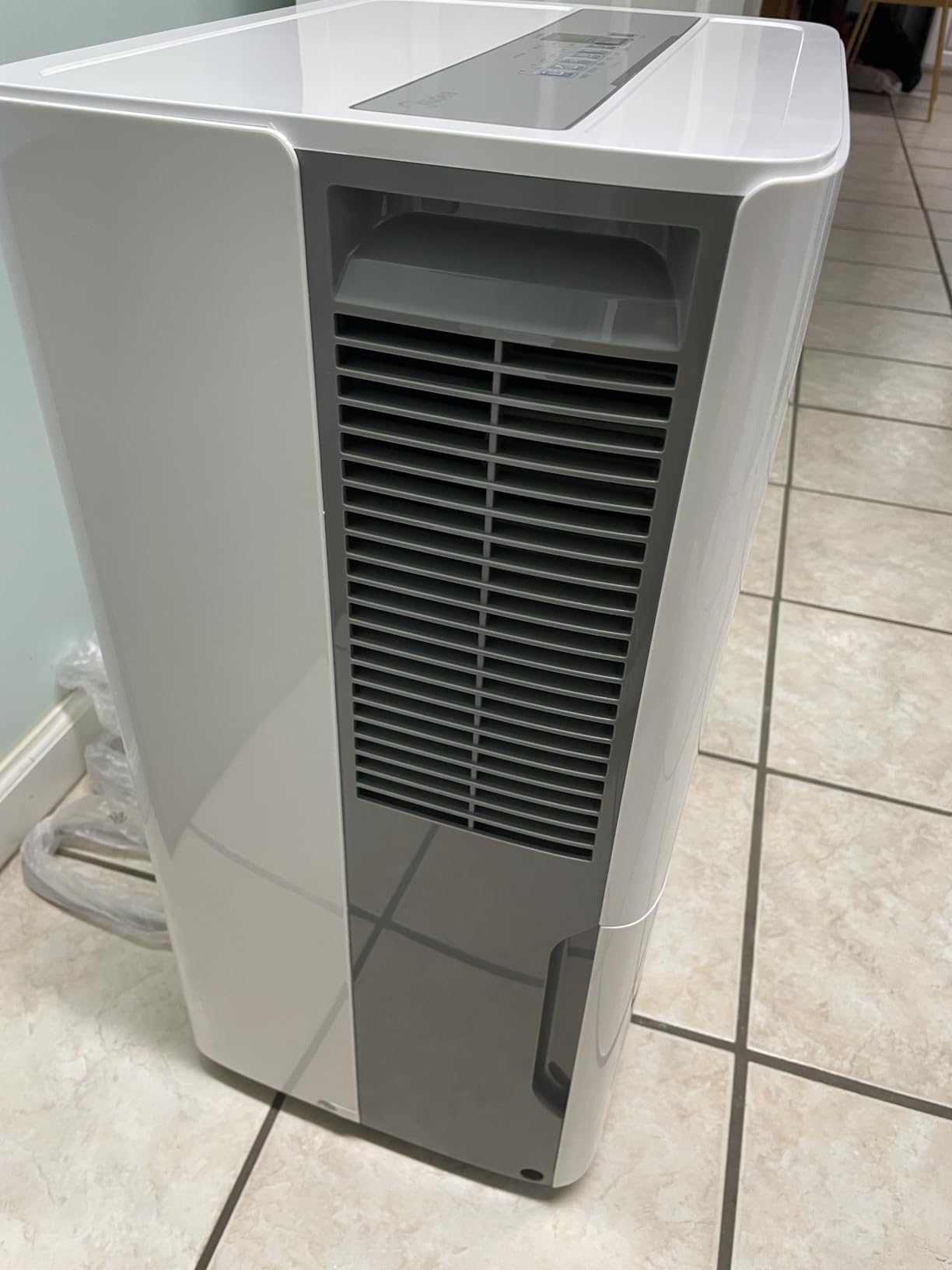
The Midea MAD50P1AWS-A is here for a reason the other units cannot match: serviceability. It is the only pick in this roundup backed by a global appliance manufacturer with a broad repair and parts network, and for vintage tube gear, a reel-to-reel tape machine or anything else you would hate to see fail, that matters as much as any spec on the sheet.
Its pump is unusually flexible. It drains vertically or horizontally to a sink or a window, so the outlet does not have to sit below the machine, and at 223.7 CFM it has the highest published airflow here, which helps a room with a low ceiling. Humidity adjusts from 35% to 85% RH, and the brand recommends a 45% to 55% range, which brackets the studio target without overshooting.
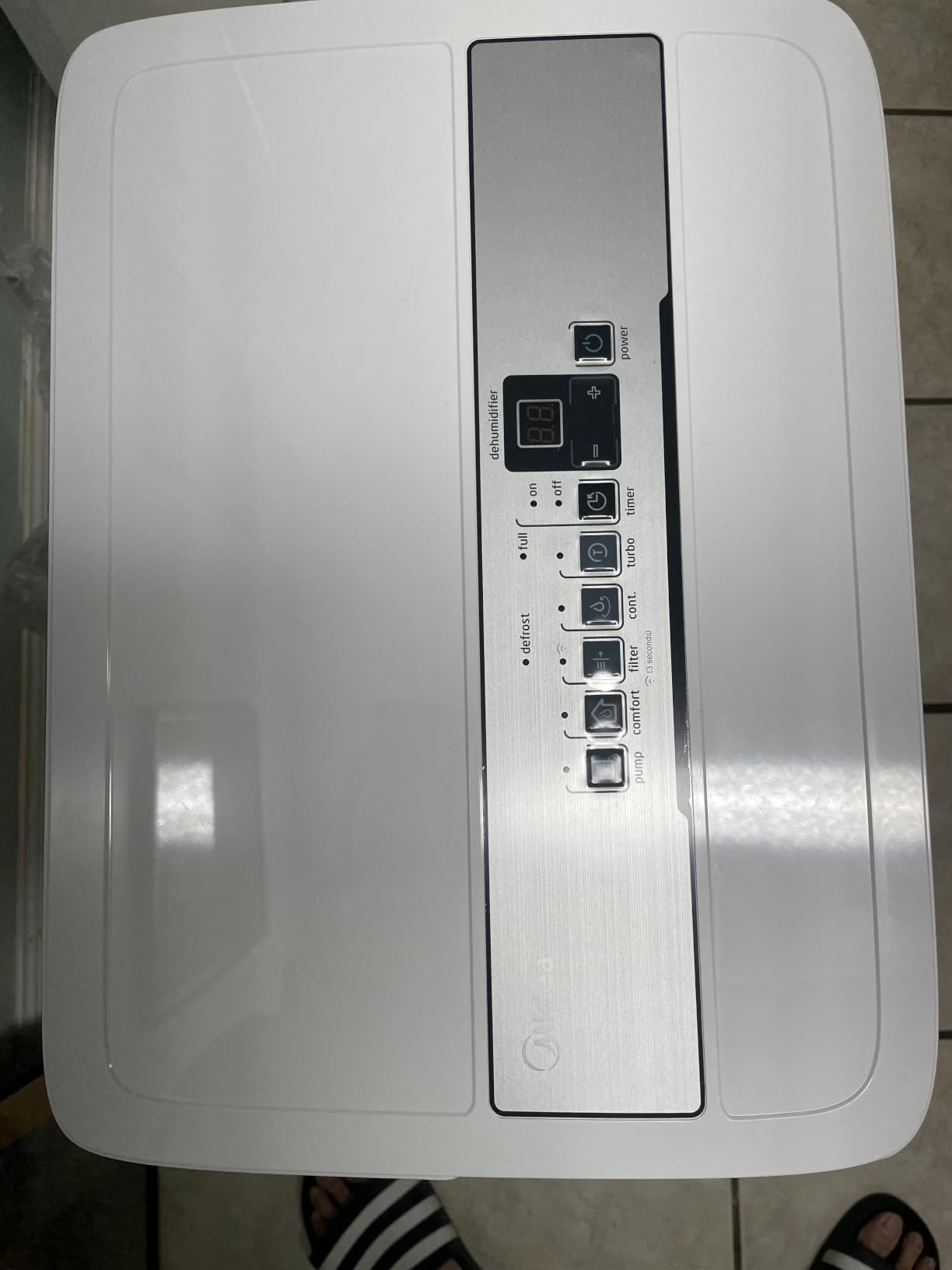
Smart features are genuinely complete: Wi-Fi with SmartHome app control on iOS and Android, plus Alexa and Google Assistant voice commands, a reusable air filter, and auto shut-off and restart when the 1.6 gallon tank fills. That combination is not available from any other unit on this list, and being able to ask a voice assistant what the control room reads at 2am is a small but real quality-of-life gain.
The evidence is the problem. At 4.1 average across only 141 reviews with a 12% one-star share, this is the least proven listing in the roundup, and the specific complaints were not detailed in the review text we saw. It is also the loudest unit here at 49 dBA in low mode, and 470 watts is a heavy draw for 50 pints of rated capacity. Warranty is one limited year and no standard drain hose is included.
What to check before you buy the Midea 50 Pint
Confirm the noise floor is acceptable for your room before you commit. At 49 dBA this is the loudest unit in the roundup, and if any takes happen in the same space, budget for a separate gear room.
Buy your own drain hose. It is not included, and with a pump that drains vertically or horizontally you have flexibility that is wasted if you have nothing to connect.
Where the Midea 50 Pint is the wrong choice
Do not choose it purely for the badge. The rating is the lowest here and the one-star share is the highest, so you are accepting more early dissatisfaction risk in exchange for brand reach, and that is a real trade rather than a free upgrade.
It is also a poor fit for very damp basements. Fifty pints per day at high ambient conditions, at 470 watts, is an expensive way to run a compressor constantly and still trail the room.
How to Size a Dehumidifier for a Basement Studio
Size on real capacity at your actual room temperature, not on the coverage number on the box. A 5,000 sq ft coverage claim assumes a 95F, 90% RH test room with wide open airflow. A basement studio at 68 to 72F with a drum kit, a rack of amps, four people breathing and no windows is roughly a quarter of that load. As a working rule, pick a unit whose realistic figure at 80F and 60% RH comfortably exceeds what your room actually pulls, and then check that the unit can reach 45% RH without cycling nonstop.
The warm-room penalty is the number nobody explains. Refrigerant dehumidifiers cool a coil below the air dew point, and the amount of water that condenses falls as the room temperature falls toward the coil. That is why the Gasbye publishes 73 pints per day at 80F but 50 at 65F, and why the AEOCKY quotes 80 pints at 95F and 95% RH but 56 at 86F and 80% RH. In a 70F basement you are always closer to the lower number.
Headroom beats precision. A unit sized to exactly match your room runs its compressor continuously, and continuous running is what wears compressors out and what makes a machine audible during a take. Aim to be able to close off half the room with a curtain and still hit target, and leave clearances the manual requires on all sides. In a low-ceiling basement, place the unit with a full door swing and the intake away from a bare wall.
A quick sizing ladder for the rooms we get asked about most:
Under 200 sq ft, control room or writing space: 30 pints per day class, such as the Kesnos or the VEAGASO.
200 to 500 sq ft, small studio or rehearsal room: 34 to 50 pints per day, the VEAGASO, hOmeLabs or Midea.
500 to 900 sq ft, live room with drums and amps: 50 to 80 pints per day, the Waykar, AEOCKY or avylo.
Over 900 sq ft, or a genuinely damp unfinished basement: 90 pints per day and up, the Yaufey, avylo or Gasbye.
Measure the room after you have finished furnishing it, and add the moisture load of anything new. Fresh drywall, an unseasoned guitar wall, and a room that just took a rain event all raise the load in the first weeks.
AHAM vs DOE Ratings: Why the Box Number Misleads in a 70F Studio
Two different test standards appear on nearly every dehumidifier, and the difference between them is the single biggest reason owners are disappointed. The DOE standard, which manufacturers adopted in 2016, measures capacity at 95F and 90% RH, DOE-compliant. The AHAM standard measures at 86F and 80% RH, the traditional AHAM Dehumidifier standard. The number on the front of the box is nearly always the DOE figure, and a DOE figure is measured in conditions your basement will never see.
Here is the practical version. A unit quoted at 80 pints per day DOE is doing that at 95F and 90% RH. In a 70F room at 50% RH, the same machine typically removes a fraction of that. This is why the two units in this roundup that publish multiple points are so much more useful: the Gasbye gives 73 pints per day at 80F and 60% RH, and the AEOCKY gives 56 pints per day at 86F and 80% RH. Those are the numbers to size with.
Pints per day, or PPD, simply means the volume of water removed in 24 hours under stated conditions, and one US gallon holds about 8.34 pints. Relative humidity, or RH, is the percentage of moisture the air holds relative to the maximum it could hold at that temperature, which is why the same absolute amount of water produces different RH readings in a cold room and a warm one.
One more trap to avoid: coverage in square feet is a marketing figure derived from the DOE test, not a promise. A 4,500 sq ft coverage rating assumes an open, well-ventilated, 95F space. Treat square footage as a tiebreaker between units of similar capacity, never as the primary sizing input.
Drainage and Unattended Operation
Buckets are the most cited annoyance in basement dehumidifier forums, and the fix is a decision you make before the unit arrives. Every product in this roundup offers a continuous drain path of some kind, but they are not equivalent. Gravity drainage needs the machine at or above the drain, which in most basements means a floor drain you may not have. A built-in pump lifts water to a line running up and away, and that is what makes an install possible in a finished room. The Yaufey lifts 16.4 ft, the avylo 15 ft, and the hOmeLabs and Midea both pump vertically or horizontally.
Where the water goes is worth planning. Basement owners routinely route dehumidifier drain lines into an existing AC condensate pump or a sump, rather than digging a new floor drain, and that is a reasonable practice. Use a check valve so a backed-up sump does not flood the room, run the hose with a continuous downward slope with no kinks, and secure it along the wall so a foot cannot catch it. A kink in a pump line shows up as a full tank in a room you are not in.
Four things to check before leaving a unit running through an unattended session: confirm the drain is connected and flowing rather than the tank, confirm auto shut-off is enabled so a full tank stops the machine instead of overflowing it, confirm the unit has power-outage memory or auto restart so it resumes after a blip, and walk the room to know what a full-tank alert sounds like. Owners in home-recording forums treat reliability of the drain and the restart behaviour as the deciding factor for overnight running, above every other feature.
One forum pitfall is worth repeating because it is common and expensive. Painting or taping walls to stop dampness, or sealing them with plastic sheeting, traps water between the wall and the membrane and can create a mold pocket you did not have before. Dehumidify the air and address the water source; do not seal a wet wall.
Noise Floor and Compressor Hum During Takes
Noise in a studio is not a comfort metric, it is a signal that ends up on the recording. A dehumidifier running in a treated room is a continuous tone source, and a condenser mic with a low self-noise floor will hear the compressor hum and the fan noise well before a listener notices it in a mix. Of the ten units here, the only published figures are the Kesnos at 36 dB, the avylo and DREO at 41 dB, the Waykar at 42 dB, the AEOCKY at 44 dB, the Gasbye at 45 dB and the Midea at 49 dBA, with one owner independently measuring the DREO at 43 dB low and 46 dB high.
Two practical rules follow. Treat the number on a listing as a lab figure at a fixed distance and assume the room makes it worse, especially with hard surfaces. And separate the two noises in your head, because they are fixed differently: fan noise rises with speed and drops when you move to sleep or low mode, while compressor hum is fixed to the cycle and is the one that contaminates a take.
The quietest verified figure here is the Kesnos at 36 dB, which is why it works in a live room; the AEOCKY publishes the lowest fan speed figure at 44 dB and includes a sleep mode. For anything else, the honest answer is placement. A separate gear room or a corridor outside the live room lets you use a machine with real capacity without paying for silence you do not need in the room you actually record in.
Auto Defrost and Basements Below 65 Degrees
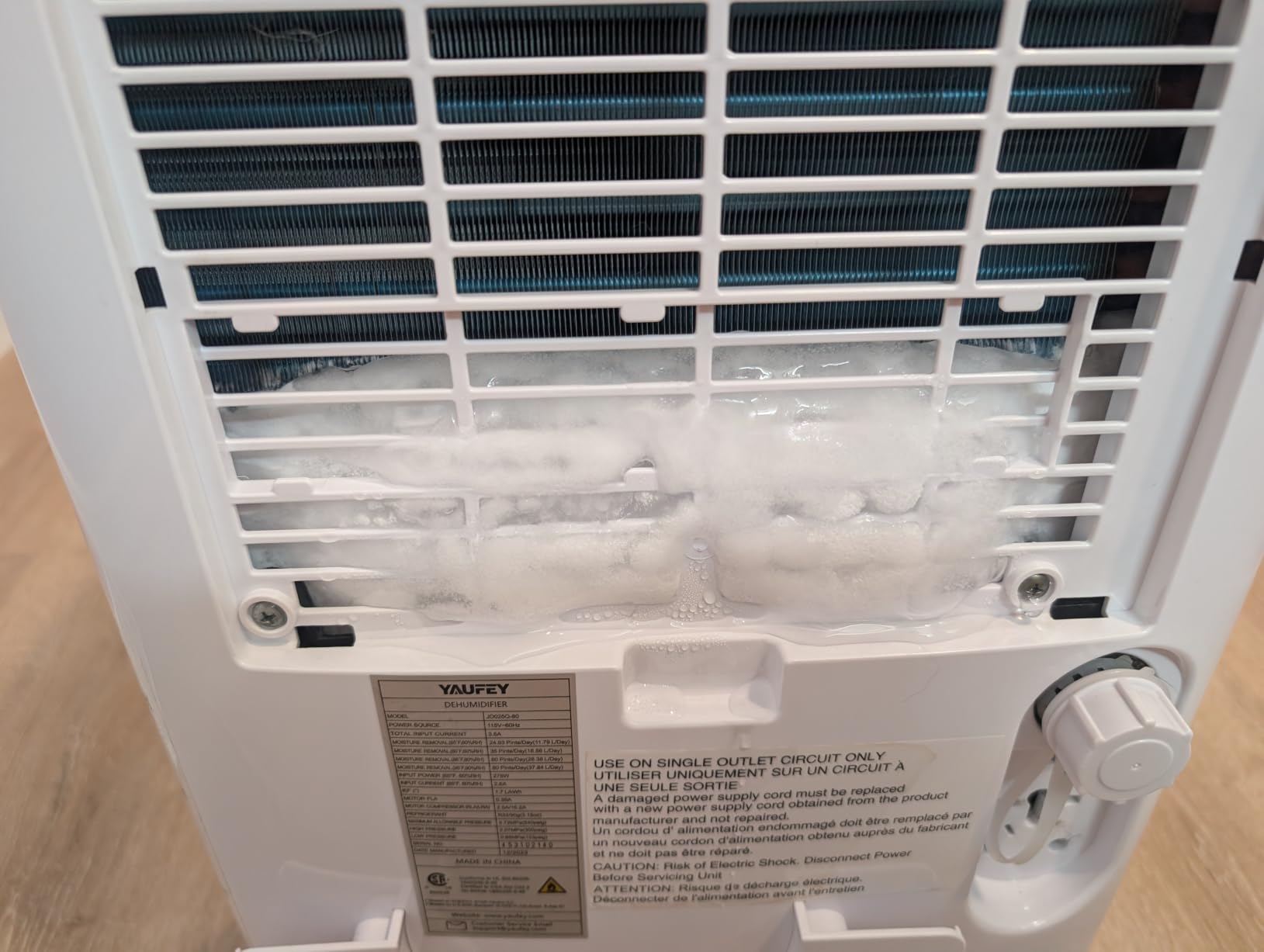
Below roughly 65F, the evaporator coil ices over. That is physics rather than a defect, and it is why auto defrost exists. Units melt the coil periodically and drain the melt water, which costs a small amount of efficiency and, during the melt, briefly reduces output. In a basement that sits at 68 to 72F all summer, defrost is rare. In an unheated basement in January, it runs constantly and capacity drops.
Check the defrost specification, not just the presence of the word. The AEOCKY lists top-tier defrost sensors for operation near 65F and publishes 50 pints per day at 65F and 60% RH on the Gasbye, which is the most useful data point in this roundup for a cool room. Every unit here also carries auto defrost, and most add frost or fault detection on top.
If your basement drops below 65F regularly, a compressor dehumidifier on its own will struggle and burn hours. Pairing it with a portable air conditioner to hold the room at a temperature the dehumidifier can work in is the practical answer, and an insulated or ducted install is better still. In a heated finished basement, the problem usually disappears entirely.
Running Cost at 18 to 24 Hours a Day
Running a basement dehumidifier is a line item worth calculating once instead of guessing. The math is simple: rated watts divided by 1,000 gives kilowatts, times hours per day, times 30 days. The rated draws in this roundup are 165W for the Kesnos, 230W for the VEAGASO, 235W for the avylo, 270W for the Waykar, 280W for the AEOCKY, and 460 to 500W for the DREO, Gasbye and Yaufey. Note that a higher-capacity unit is not automatically more expensive to run, because compressors cycle rather than run flat out.
At 20 hours a day, 30 days a month, the Kesnos at 165W works out to about 99 kWh a month. The Waykar at 270W is about 162 kWh, and the avylo at 235W is about 141 kWh. The Yaufey and Gasbye at 500W would be about 300 kWh a month if they ran continuously, though in practice they cycle off once the room reaches target, and the ENERGY STAR and ENERGY STAR Most Efficient certified units in this group are the ones designed to close the gap between rated and real draw.
Two things reduce that number in practice. Oversizing a unit for a small room keeps the compressor cycling rather than modulating, and ENERGY STAR Most Efficient certification on the AEOCKY and the avylo, at 2.05 L/kWh EER for the avylo, exists precisely to reward the units doing this work most hours of the day. Set the target at 45% rather than chasing 40% and you cut runtime for no benefit to your instruments.
Frequently Asked Questions
Which dehumidifier is the most reliable for a basement?
Reliability tracks three things: a rotary compressor, a warranty of three years or more, and confirmed auto-restart after a power interruption. Among the ten units we compared, the hOmeLabs 50 Pint with 15,000-plus ratings, the Waykar 80 Pint with more than 22,000 ratings, and the AEOCKY 80 Pint with 6,700-plus ratings and 3-year coverage all show long owner histories. The avylo 90 Pint has the longest warranty at 5 years but only 339 ratings, so its durability case rests on the warranty rather than on field data.
Is 70% humidity too high for a basement?
Yes. At 70% RH, wood absorbs moisture and swells, paper and fabric gain weight, and corrosion moves onto connectors, tube sockets and transformer cores. For a recording studio or a gear room, target 40-50% RH and 45% is the usual setpoint. A dehumidifier sized for the room and drained continuously is the standard fix, and you should confirm the result with an external hygrometer at microphone height.
What month should you run a dehumidifier in my basement?
Run it whenever your basement sits above your target, which in most regions means from spring through early autumn and again after heavy rain in any season. In practice, running it continuously from late spring until the first cold snap is simpler than switching it on and off, because instruments acclimatize more slowly to swings than to a stable band. In winter, an unheated basement below 65F makes a compressor dehumidifier inefficient, and pairing it with a portable air conditioner works better.
How much does a dehumidifier run up your electric bill?
Divide rated watts by 1,000 for kilowatts, then multiply by daily hours and 30. At 20 hours a day, a 165W unit uses about 99 kWh a month and a 270W unit about 162 kWh, before cycling effects. Units in this roundup draw from 165W up to 500W, so a larger unit is not automatically costlier because compressors cycle once the room reaches target. ENERGY STAR Most Efficient units such as the AEOCKY and avylo are built for this long-run duty.
What humidity level is safe for musical instruments?
Hold 40-50% relative humidity for a room containing guitars, drums, amplifiers or tape machines. Below 40% the wood loses moisture and lacquer and glue lines can crack; above 50% tops lift, drum heads go slack and corrosion starts on bare metal and tube gear. Set the humidistat to 45% and verify with a separate hygrometer, because several units here have on-screen readings that owners report running 10% or more high against an external meter.
Should I buy a compressor or thermoelectric dehumidifier?
Buy a compressor unit for any basement. Thermoelectric Peltier models drop a few degrees of air temperature to force condensation, which is cheap and quiet but weak at cool room temperatures and humid conditions, exactly the case a basement presents. A compressor unit with auto defrost and a built-in pump is the only type that holds 40-50% RH in a 68 to 72F room, and it is what every unit in this roundup uses.
Final Verdict: Which Dehumidifier Wins Your Basement Studio
For most studios, the hOmeLabs 50 Pint with pump and Wi-Fi is the pick. It pairs a 4.6 average across more than 15,000 ratings with the two features that let it run unattended, and its 50 pints per day at 80F and 60% RH figure is one of the few on this list measured at a temperature your basement actually sees. If your room is 500 sq ft or smaller, step down to the VEAGASO or the Kesnos and keep the money.
Match the machine to the room before anything else. Under 300 sq ft needs 30 to 36 pints per day. A 300 to 700 sq ft studio with drums wants 34 to 80. Over 900 sq ft, or a genuinely damp unfinished space, needs 90 pints and up, and a built-in pump is close to mandatory. Buy on the 80F figure rather than the box number, set the target to 45% RH, verify with your own hygrometer, and run it into a continuous drain before the first session rather than after the first overflow.
Whatever you choose, hold the line at 40 to 50% relative humidity. That single discipline protects tops, drum heads, paper, tape and tube gear better than any brand on this list, and in 2026 it is still the cheapest insurance in the studio.