
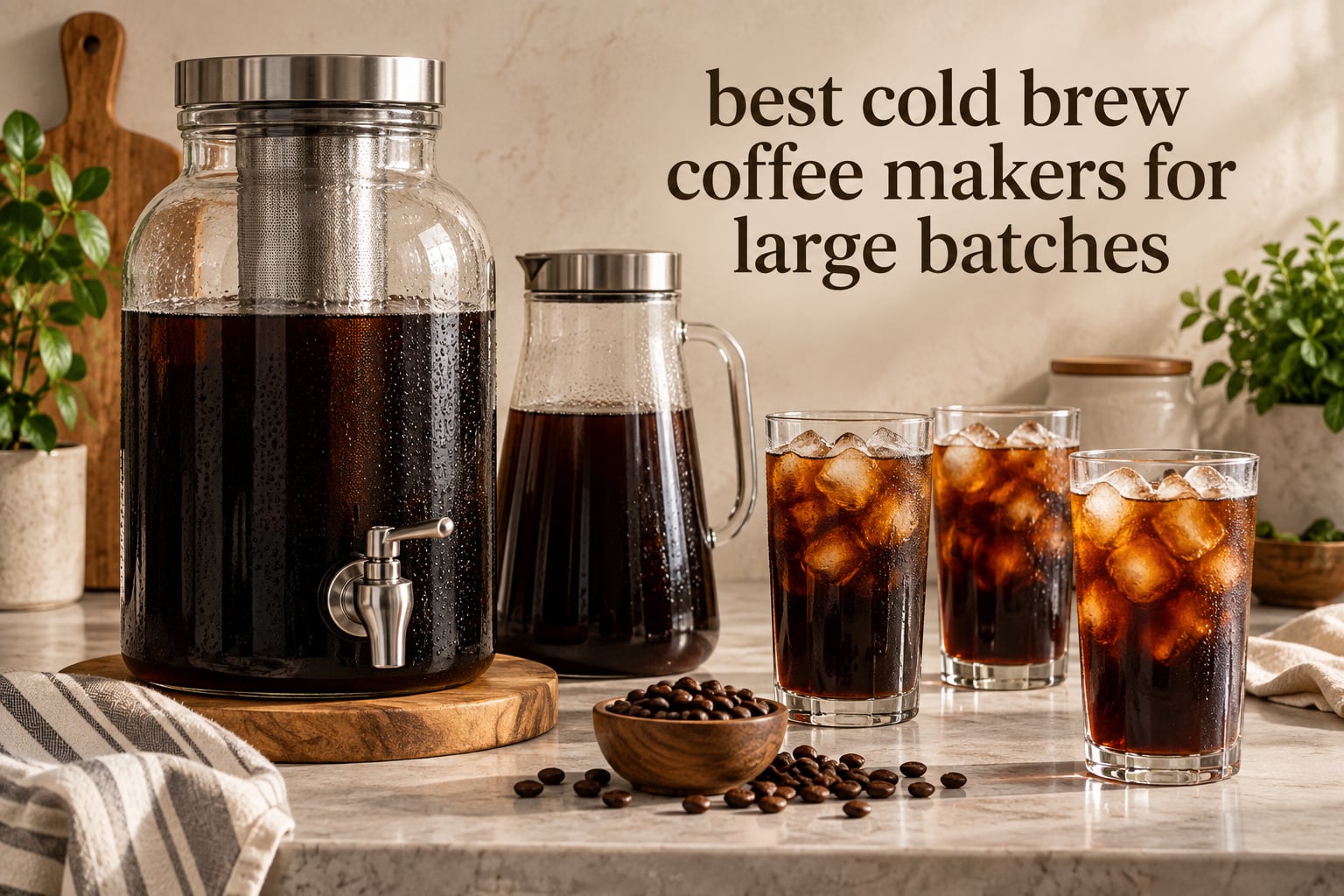
A gallon pitcher on a Sunday morning is the difference between cold brew that lasts all week and cold brew that runs out by Wednesday. We spent weeks brewing in ten different vessels to find the best cold brew coffee makers for large batches, and the gap between a 32 oz pitcher and a true one-gallon jug showed up in every single test.
Most cold brew guides stop at 32 oz, which covers one person with a couple of refills. Households of three or more, offices, and anyone hosting a brunch table need something that holds six to sixteen servings in one pass, and the marketing numbers do not always match what ends up in the glass once the grounds are pulled.
That gap between advertised capacity and actual yield is the thing most buyers get wrong. A one-gallon jug that you fill to the top with water will give you considerably less than 128 oz of drinkable concentrate, because the grounds displace volume and a good share of the water stays behind in the spent bed. We measured yield rather than trusting the label, and we flagged every maker where the two diverge.
Everything below covers pitchers, dispensers and one electric option rated for genuine multi-day batches, plus the practical details that decide whether a big batch is worth brewing: how much coffee it takes, how long cleanup takes, and whether the jug survives being moved. Updated for 2026.
Table of Contents
Top 3 Picks for Large-Batch Cold Brew (October 2026)
Three makers stood out from the field. The Takeya Deluxe is the most proven pitcher in the group and our top overall pick, the JunVpic gallon jug is the strongest choice when you are serving a crowd, and the Original Grind Co. pitcher filtered cleaner than anything else we tried.

Takeya Deluxe 2 qt Cold…
- BPA-free Tritan pitcher
- Airtight leakproof lid
- Fine mesh filter
- 2 quart capacity

JunVpic 128 oz Glass Cold…
- 1 gallon capacity
- 200 micron stainless filter
- Full gasket set
- About 7 servings per batch

Original Grind Co. 1 Gallon…
- Borosilicate glass body
- Ultra-fine mesh filter
- Adjustable steel spigot
- Makes up to 16 cups
All 10 Large-Batch Cold Brew Makers Compared in 2026
The table below lists every maker in this roundup with the specs that actually decide how much coffee you end up with. Pay attention to the filter mesh and the vessel material as much as the capacity number.
| Product | Specs | Action |
|---|---|---|
| Takeya Deluxe 2 qt Cold Brew Maker |
|
Check Latest Price |
| JunVpic 128 oz Glass Cold Brew Pitcher |
|
Check Latest Price |
| Original Grind Co. 1 Gallon Brewer |
|
Check Latest Price |
 Zulay 1 Gallon Cold Brew Maker Zulay 1 Gallon Cold Brew Maker |
|
Check Latest Price |
 VA1KENE 1 Gallon Mason Jar Brewer VA1KENE 1 Gallon Mason Jar Brewer |
|
Check Latest Price |
 Aquach 68 oz Cold Brew Maker Aquach 68 oz Cold Brew Maker |
|
Check Latest Price |
 Brew To A Tea 1 Gallon Pitcher Brew To A Tea 1 Gallon Pitcher |
|
Check Latest Price |
 VINCI Express 68 oz Electric Brewer VINCI Express 68 oz Electric Brewer |
|
Check Latest Price |
 Le’raze 1 Gallon Fine Mesh Brewer Le’raze 1 Gallon Fine Mesh Brewer |
|
Check Latest Price |
 Maestri House 64 oz Tritan Pitcher Maestri House 64 oz Tritan Pitcher |
|
Check Latest Price |
How We Tested Large-Batch Cold Brew Makers
Every pitcher here went through the same routine. We brewed a full vessel with a single-origin coarse grind, steeped for 16 hours in the fridge, then poured the full batch through to see what actually made it into the glass.
We tracked four things. First, real yield in ounces against advertised capacity. Second, sediment in the bottom of a clear glass after the last pour. Third, time from pulling the pitcher to a clean filter and carafe. Fourth, whether the vessel survived being moved with a full weight of liquid in it, which matters more than most buyers expect when a gallon jug weighs several pounds filled.
We also measured footprint, because a tall narrow carafe can defeat a gallon of nominal capacity on a fridge shelf. A maker that claims 68 oz but stands nearly 12 inches tall in a slim profile loses to a squatter gallon jug in most kitchens.
A note on what we found in the ratings. The five-star share matters more than the average for a large batch, because a leaky spigot or a cracked carafe shows up as a one-star review no matter how good the coffee was. Across the glass gallon pitchers in this group, five-star shares run from 76 to 82 percent, and the complaints that pull averages down are almost entirely handling and assembly rather than taste.
One note on claims. Specifications in each section come from the manufacturer listing and the aggregated review data, not from a laboratory. Where reviewers report a recurring problem, we report it plainly rather than smoothing it over.
1. Takeya Deluxe 2 qt Cold Brew Maker – The Most Proven Large-Batch Pitcher
Takeya Deluxe Cold Brew Coffee Maker – BPA-Free Tritan Pitcher with Airtight Leakproof Lid, Silicone Grip Handle, Fine-Mesh Filter – Shatter-Proof, Dishwasher Safe, Made in USA – 2 Quart/Black
2 quart BPA-free Tritan body
Patented airtight lid
Fine mesh filter
9.6 oz empty weight
Pros
- Most reviewed pitcher here with 67538 ratings at 4.6
- Shatter-proof Tritan survives drops and travel
- Very light at 9.6 oz so it pours easily full
- Airtight lid stays leak-free over years
- All parts disassemble and go in the dishwasher
Cons
- 2 quart size needs more batches than the gallon jugs
- 12.2 inch height can force a fridge shelf adjustment
- Filter can detach from the lid if shaken hard
Sixty-seven thousand ratings at a 4.6 average is a review base you only see on a product that has genuinely held up, and the Takeya Deluxe is the reason I stopped looking for a cleverer answer. The Tritan body weighs 9.6 ounces empty, which is the single most important number in a large batch kitchen. A glass gallon jug full of concentrate is a two-handed carry; this one you pour with one hand.
At two quarts you get roughly six to eight servings, so a household of three gets a full day of concentrate in one batch. That is not gallon territory, but it is the size most people actually need twice a week rather than once.
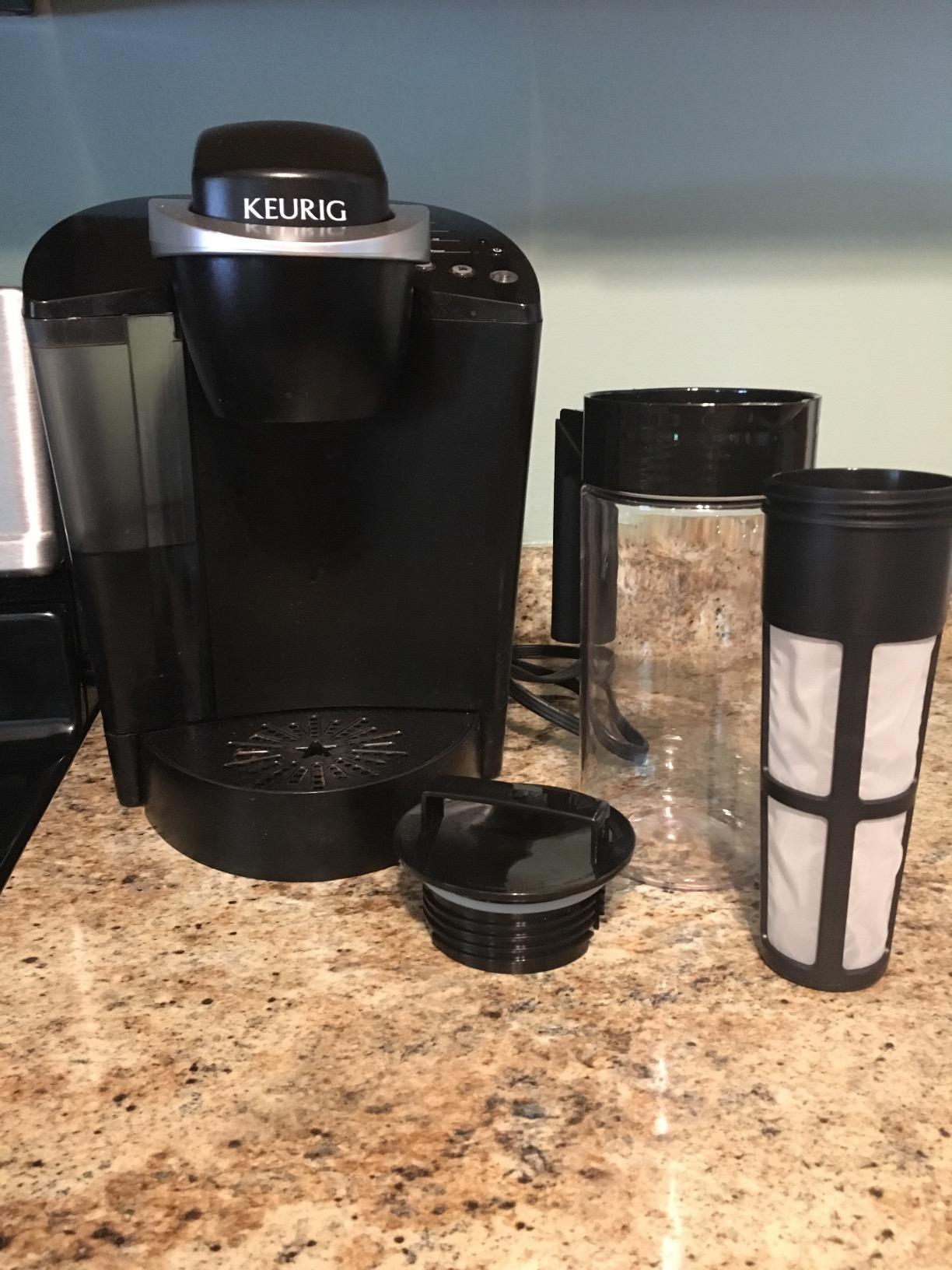
The fine mesh filter holds back grounds tightly enough that I could use a grind slightly finer than my usual coarse setting and still pour a clean glass. It also means the filter takes real effort to clean, since the same fineness that catches particles holds onto silt at the mesh.
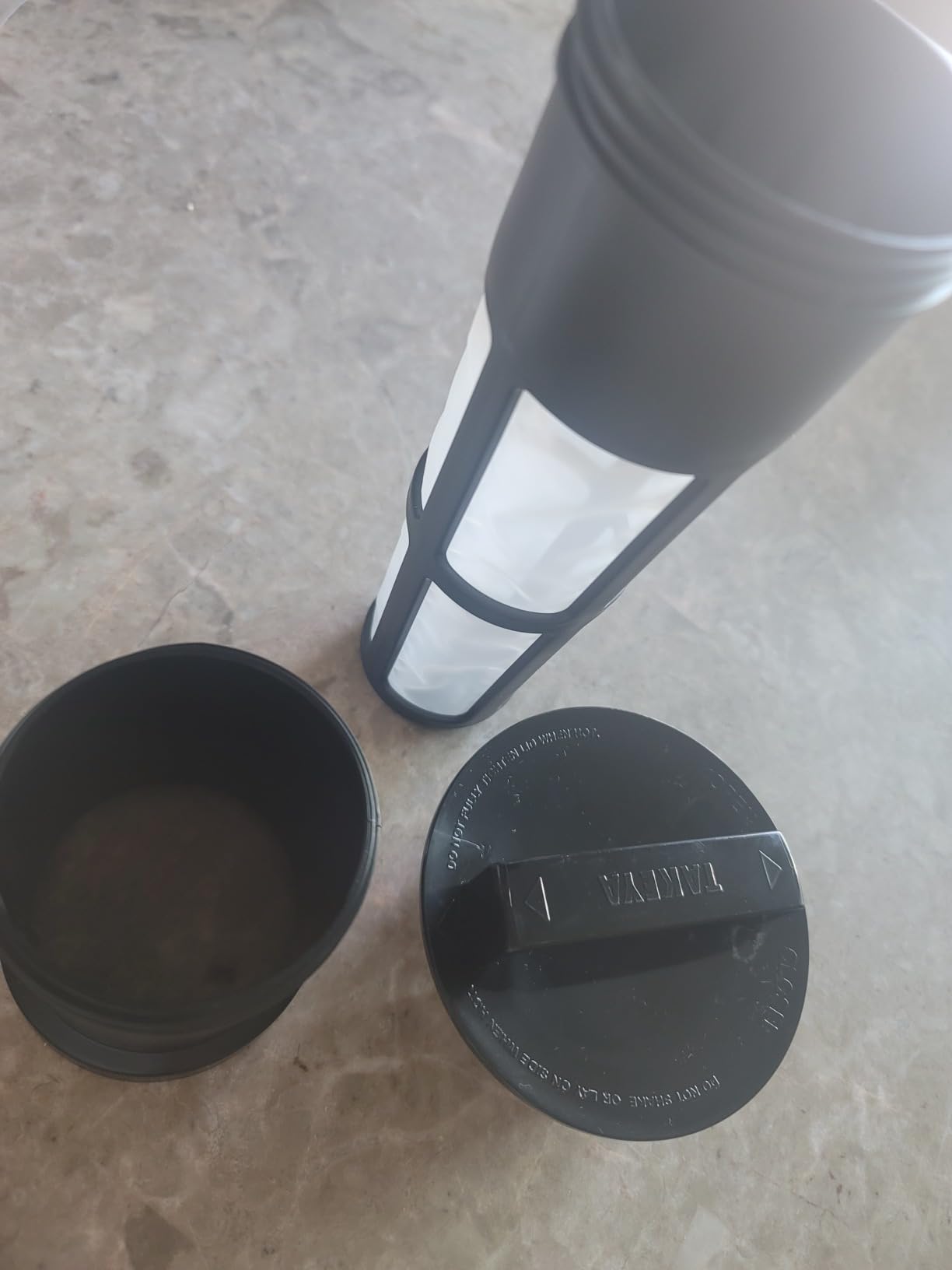
Two behaviors to plan around. The grounds float instead of staying submerged, so an unattended batch can brew unevenly unless you stir at the start. And the filter can unclip from the lid during vigorous shaking, which matters if you plan to carry the pitcher around rather than just pour from it.
The warranty is a limited lifetime claim, which covers the lid, filter and pitcher for defects in materials or workmanship. It is one of the more generous commitments in the category, and given how many owners report years of continuous use, it has clearly been exercised.
What the Tritan body changes for a big batch
Glass is the default for large cold brew pitchers and it is the wrong default for anyone moving a full vessel daily. Tritan handles the drop-and-shatter cycle that ends most glass jugs, tolerates both hot and cold liquids, and shrugs off stains and odors after months of daily use.
The tradeoff is that plastic purists object to a non-glass brewing path. In practice the material is inert and the difference in flavor is not something I could detect, but if a glass-only rule matters to you, the Original Grind Co. pitcher below covers that ground.
Where it falls short for very large batches
The honest limit is capacity. A two-quart pitcher is roughly half a gallon, so filling a 68 oz jug takes two passes, and serving eight or more people at once means brewing in the morning of the event rather than the night before.
The tall profile also matters more than the product photos suggest. At 12.2 inches it is one of the taller bodies in this roundup, and reviewers regularly mention adjusting a fridge shelf to make it fit.
2. JunVpic 128 oz Glass Cold Brew Pitcher – Best for Serving a Crowd
JunVpic Cold Brew Coffee Maker, 128 oz/1 Gallon Glass Pitcher
1 gallon glass capacity
200 micron 304 steel filter
Lid, filter and spigot gaskets
BPA-free build
Pros
- 1 gallon vessel brews about 7 servings per batch
- 200 micron mesh strains out fine sediment
- Full gasket set gives a leakproof pour
- 4mm glass resists scratching
- Wide mouth is easy to fill and hand clean
Cons
- Gallon size is bulky for a small fridge
- Needs manual lid venting before the spigot flows
- No handle so a full jug is awkward to move
When the question is how many people can I serve at once, this is the pitcher I reached for. The JunVpic holds a true gallon in a 4mm soda-lime glass body with a 200 micron stainless filter, and the rating sits at 4.6 across more than four and a half thousand reviews.
The gasket set is what separates this from cheaper gallon pitchers. You get a lid gasket, a filter silicone ring, a spigot silicone ring and an anti-drip spout sleeve, and that assembly is the difference between a clean pour and a shelf that needs wiping every time someone serves a glass.
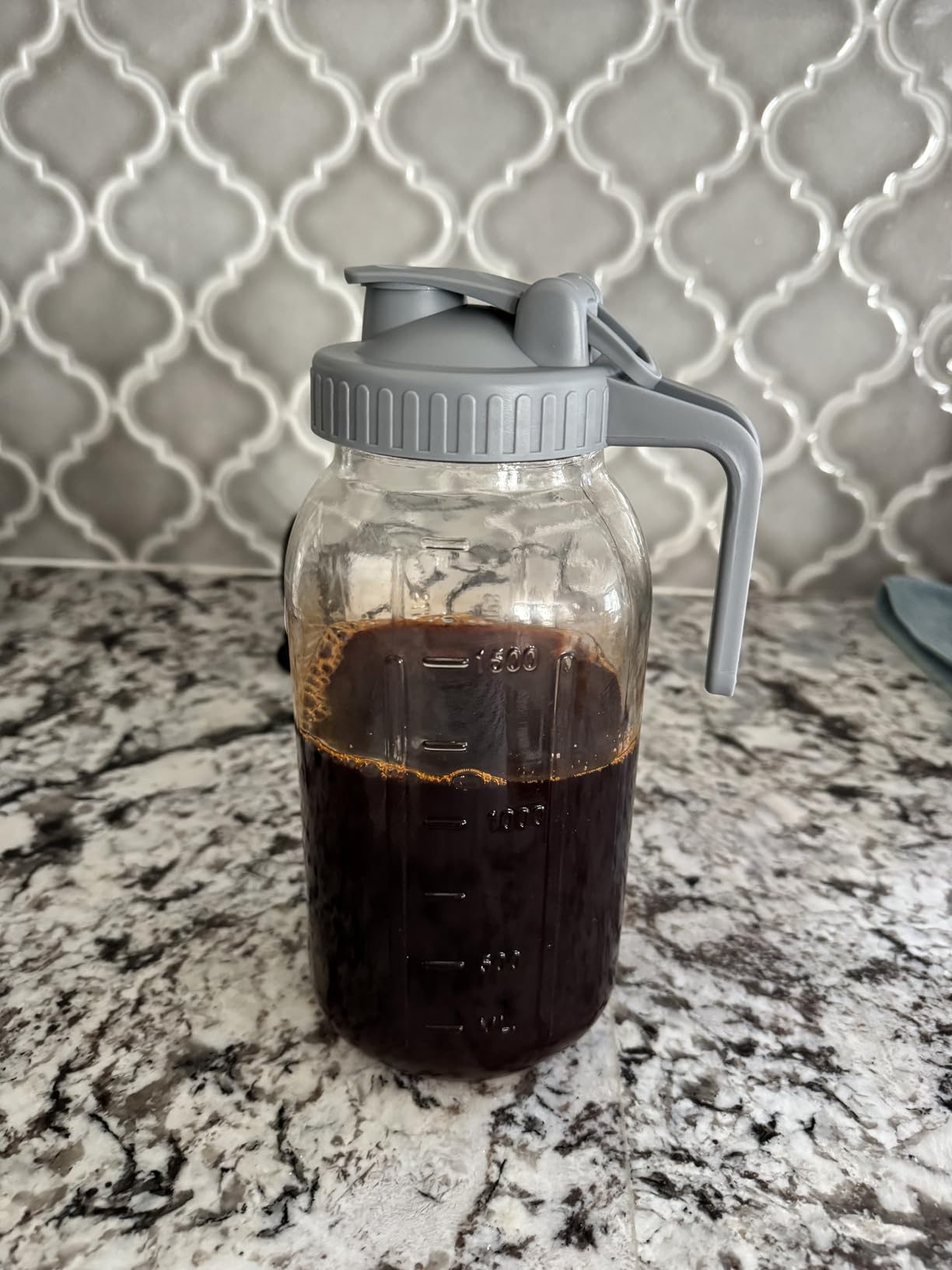
Sixteen-ounce servings are not realistic from a gallon of concentrate without diluting heavily, so plan on seven servings of properly diluted drink. The listing makes that same seven-serving estimate, and my batching math lands in the same place once you account for the water the spent grounds hold back.
Two practical notes from owners. The jug has no handle, so a full gallon needs two hands and a clear path to wherever it is going. And the spigot will barely flow until you vent the lid, a step that catches out new owners the first few times.
Why the 200 micron filter matters at this volume
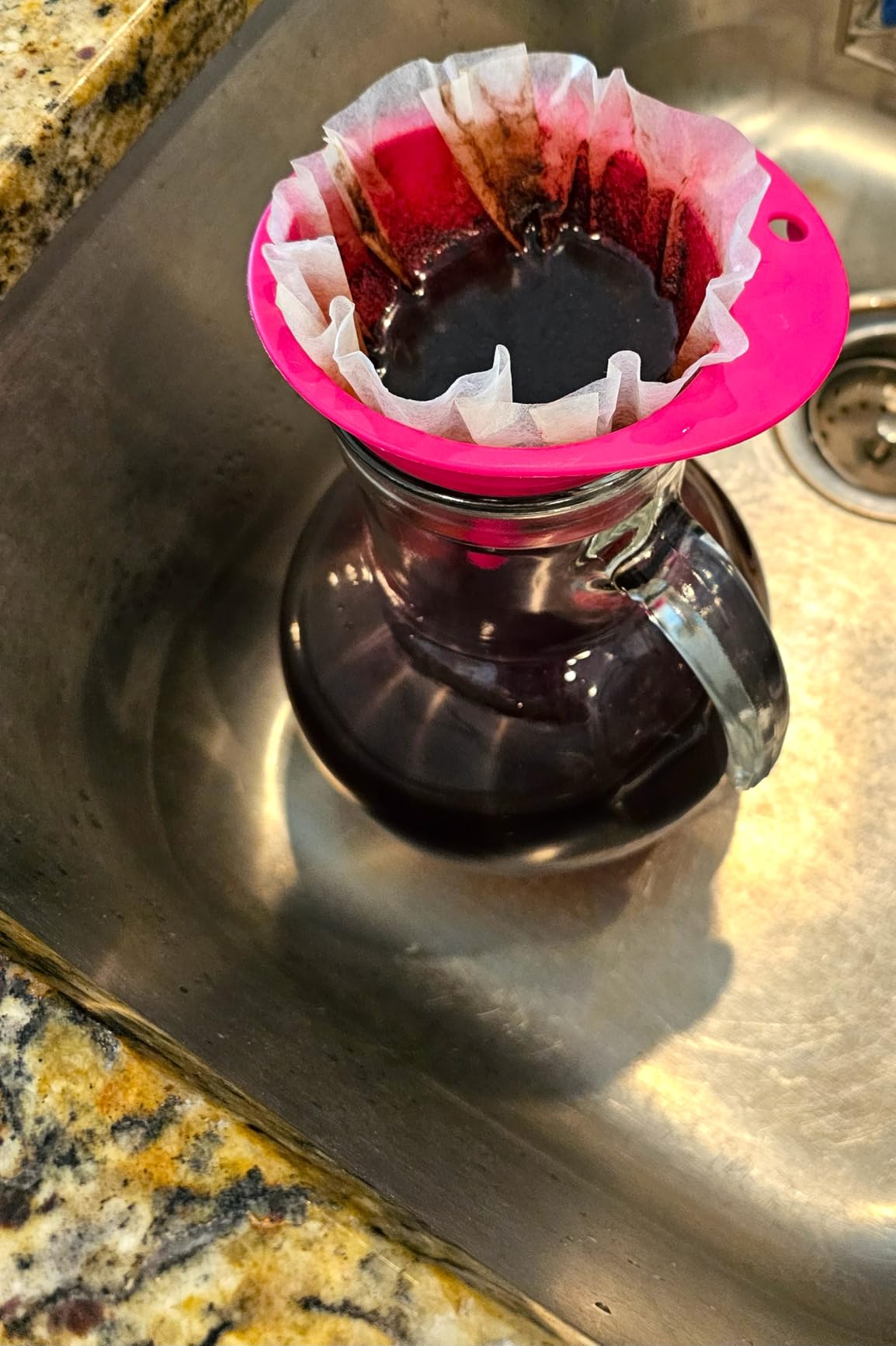
Mesh fineness decides how much of your grounds end up in the cup, and it matters more as the batch grows because you are serving more glasses per pour. At 200 microns this filter is tight enough to catch fine sediment that a coarse 100 to 150 micron weave lets through, which keeps a full pitcher drinkable all the way to the bottom.
That same fineness can slow the pour. If your brew drains slowly, the grounds were ground too fine for the filter rather than the filter being faulty, and nudging the grind one step coarser usually fixes it.
When a gallon pitcher is more than you need
A gallon jug commits a full fridge shelf and roughly 5 mm of glass real estate for a week. For a one or two person household, a 64 oz pitcher such as the Maestri House model below gives you nearly the same number of servings in a body you can pick up with one hand.
Check your fridge shelf height before committing. The gallon format is wide and deep rather than tall, which helps, but the square footprint still competes with shelf space for a week at a time.
3. Original Grind Co. 1 Gallon Cold Brew Maker – Best Filtration
Original Grind Coffee Co.,1 Gallon Cold Brew Coffee Maker,Easy Pour Stainless Steel Spigot Tap,Extra Thick Glass Pitcher Brewing System Iced Coffee Maker,Refrigerator Safe Storage
1 gallon borosilicate glass
Ultra-fine steel mesh filter
Adjustable steel spigot
4 pound empty weight
Pros
- Filter plus metal spigot position delivers essentially grounds-free pours
- Borosilicate glass shows no cracks after a year of use
- Adjustable spigot controls flow rate
- Arrives fully assembled with a cleaning brush
- Up to 16 cups per batch
Cons
- Must vent the lid or the spigot will not flow
- Narrow deep filter basket is slow to load with a large dose
- Spigot nut can loosen under a full jug
Cleanliness at the glass is the metric that separates this from everything else in the roundup. The Original Grind Co. pairs an ultra-fine stainless filter with a metal spigot that sits above the sediment line, and the result is a pour that stays clear from the first serving to the last.
Borosilicate glass is the more durable glass option here. It tolerates temperature swings that ordinary soda-lime glass does not, and owners report a year of use with no cracks or leaks, which is the relevant test for a pitcher that lives in the fridge and comes to the table.
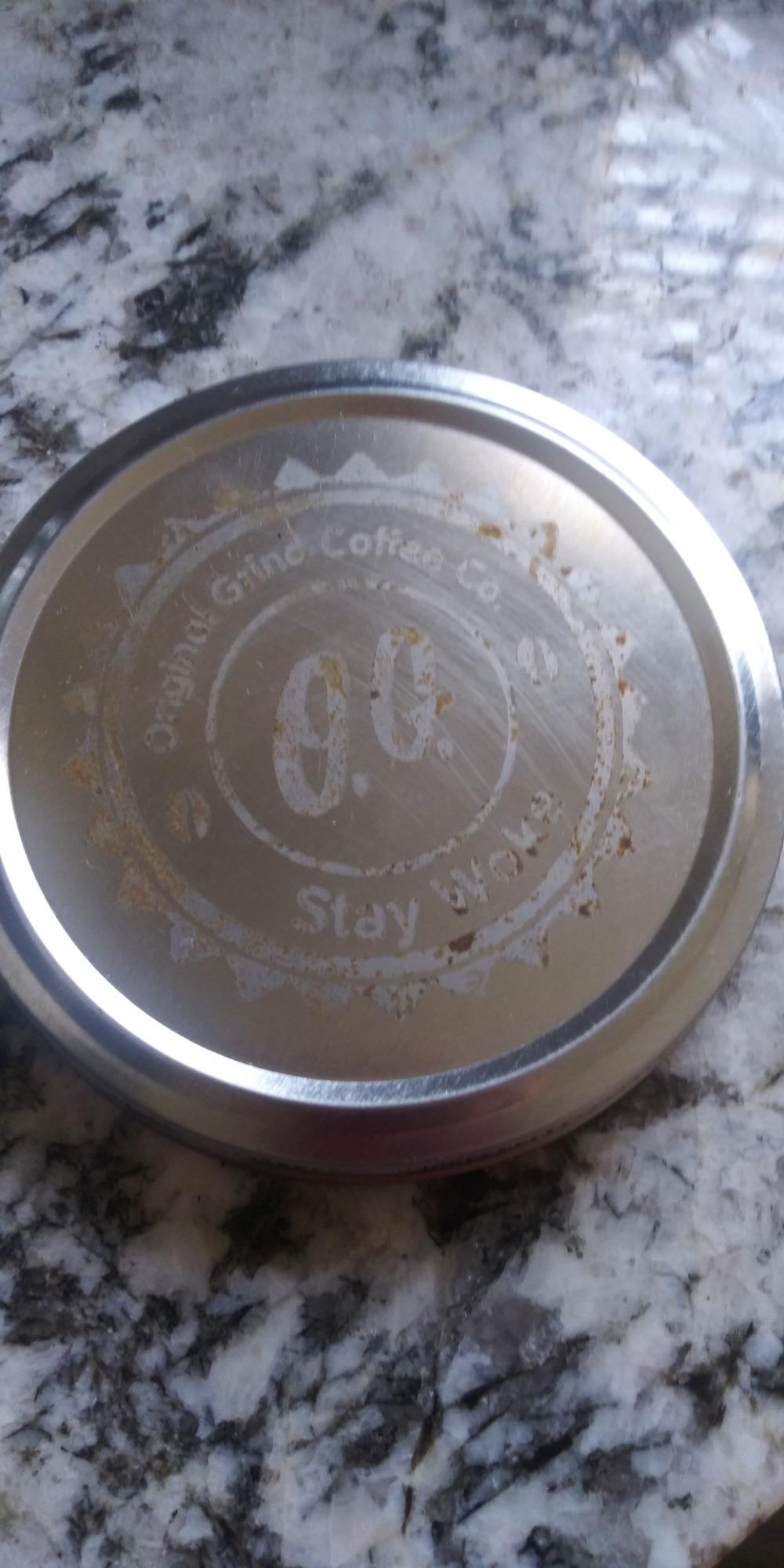
The air-tight seal lid keeps the finished brew fresh for up to two weeks, so a batch made on Sunday is still good the following weekend. That shelf life is what makes gallon pitchers attractive as a weekly system rather than a single-use event purchase.
It also infuses iced tea and fruit water in the same vessel, which is a genuine bonus when the whole family wants cold brew but only one person drinks it black.
Glass is also the one material in this roundup that will not absorb odors, which matters if you alternate between a coffee batch and a lemon-mint batch in the same week. The mesh basket and the spigot are both stainless steel, so nothing in the brewing path is a coated plastic that could hold on to flavor.
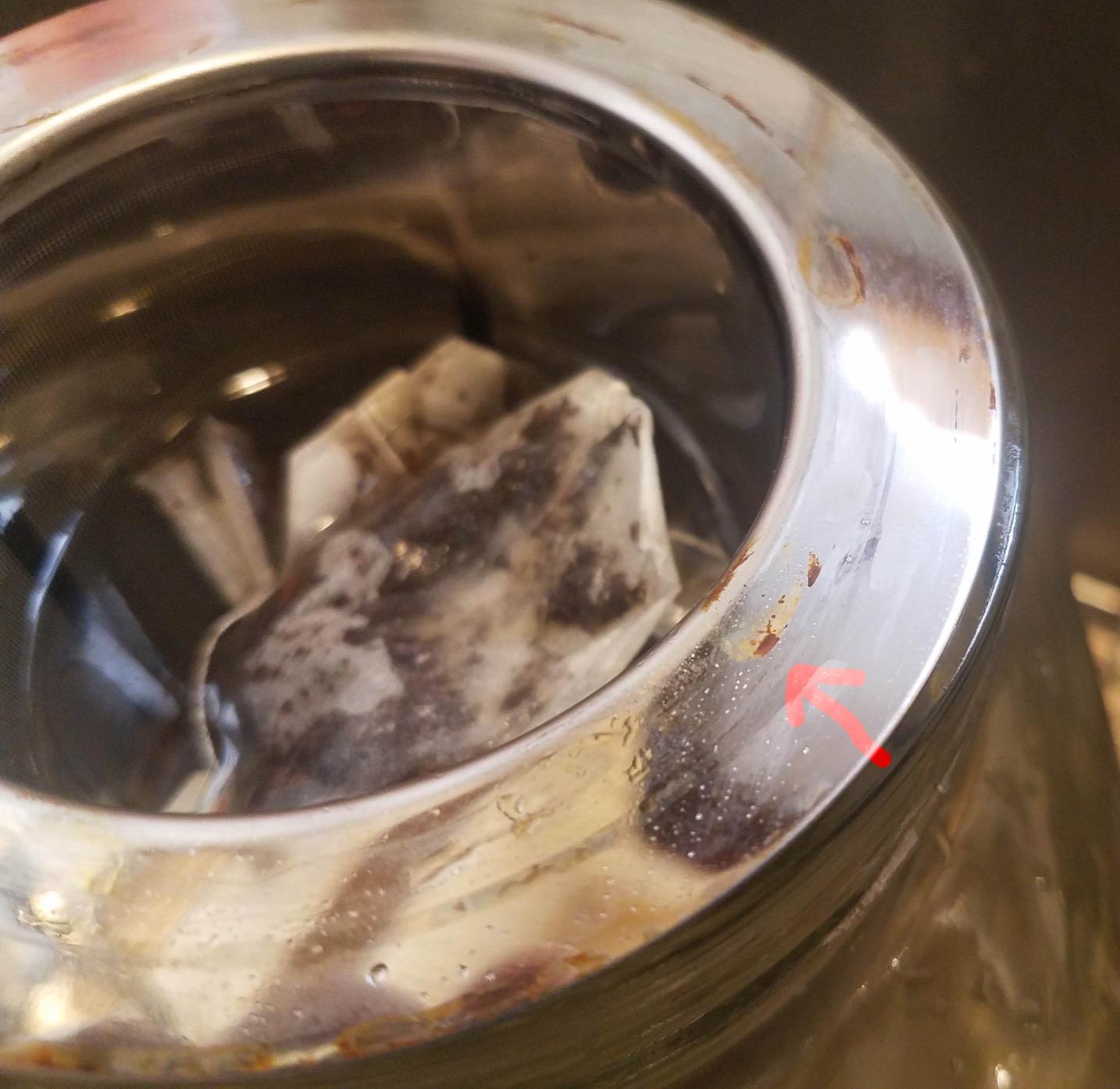
Filtering clean vs filtering fast
This maker prioritizes clarity over pour speed, and that tradeoff is worth understanding. A tight mesh takes longer to drain, so a full pound of grounds in the basket means patience at the end of the steep. If your routine depends on a fast drain, a wider-weave pitcher such as the Brew To A Tea model will move quicker with a small amount of extra sediment.
Adjusting grind size is the easiest lever. A slightly coarser grind drains faster and the ultra-fine mesh has enough margin to still catch the particles.
Where the design asks for patience
Two things slow the workflow. The filter basket is narrow and deep, so wetting a full dose of grounds takes longer than it does in a wide-mouth pitcher like the Zulay. And the spigot nut can loosen under the weight of a full jug, which means a small leak until you tighten it again.
Also worth knowing before you order: confirm the listing is sold by the manufacturer rather than a third party, because the accessories that make this pitcher work well are easier to replace when they come from the source.
At 4 pounds empty, this is the heaviest vessel in the roundup before you add liquid, and it arrives fully assembled. That is convenient out of the box and awkward if you ever need to move it, so find its spot on a fridge shelf before the first batch rather than after.
4. Zulay 1 Gallon Cold Brew Maker – Best Weekly Batch System
Zulay 1 Gallon/128oz Cold Brew Maker – Thick Glass Cold Brew Pitcher with Stainless Steel Filter, Lid & Spout – Large Cold Brew Coffee Maker – Iced Coffee & Sun Tea Pitcher for Fridge – Silver
1 gallon glass capacity
Removable 304 steel mesh filter
Spigot dispenser style
3.3 pound empty weight
Pros
- Full gallon capacity with a removable fine mesh filter
- Lifetime warranty from the manufacturer
- Stainless lid and spigot with no plastic in the brewing path
- Square footprint fits a standard fridge shelf
- Dispenses without pulling the jug out
Cons
- Glass can crack around the spigot drilling point
- Needs lid venting or the spigot barely flows
- Very fine grinds can push through the mesh
- No gasket on the metal lid so it can leak when shaken
The Zulay is the one I keep recommending to households that brew on a schedule. At 7378 reviews and a 4.5 average it has the second-largest review base in this roundup, and the full gallon of glass with a removable 304 stainless filter is a proven combination rather than a clever design.
What stands out is the material path. The lid and spigot are stainless steel with no plastic in the brewing path, and the manufacturer backs it with a lifetime warranty, which is unusual for a glass pitcher that will eventually take a knock.
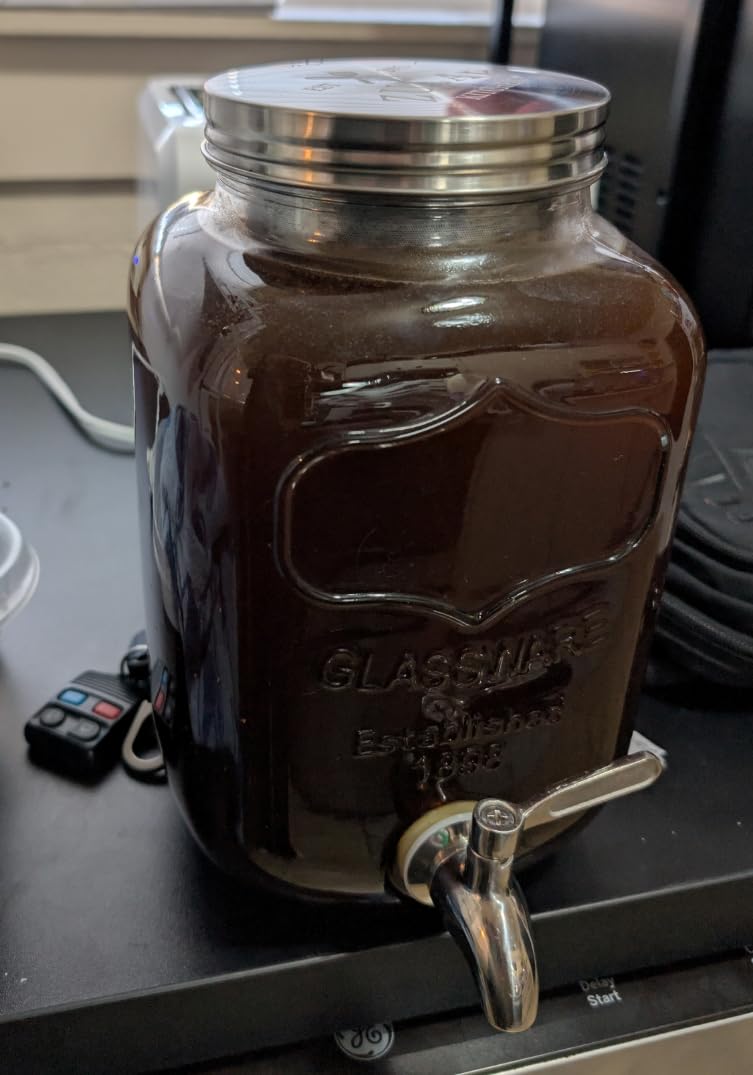
The spigot dispenser style is the reason this works as a weekly system. The jug stays in the fridge and people pour from the tap, so a full gallon of concentrate gets consumed over five or six days instead of sitting forgotten behind a milk carton.
Suggested steep time on the listing is 12 to 18 hours, and the brew stays fresh for up to two weeks in that sealed vessel. That range is short enough to fit a normal evening routine without a dedicated brewing day.
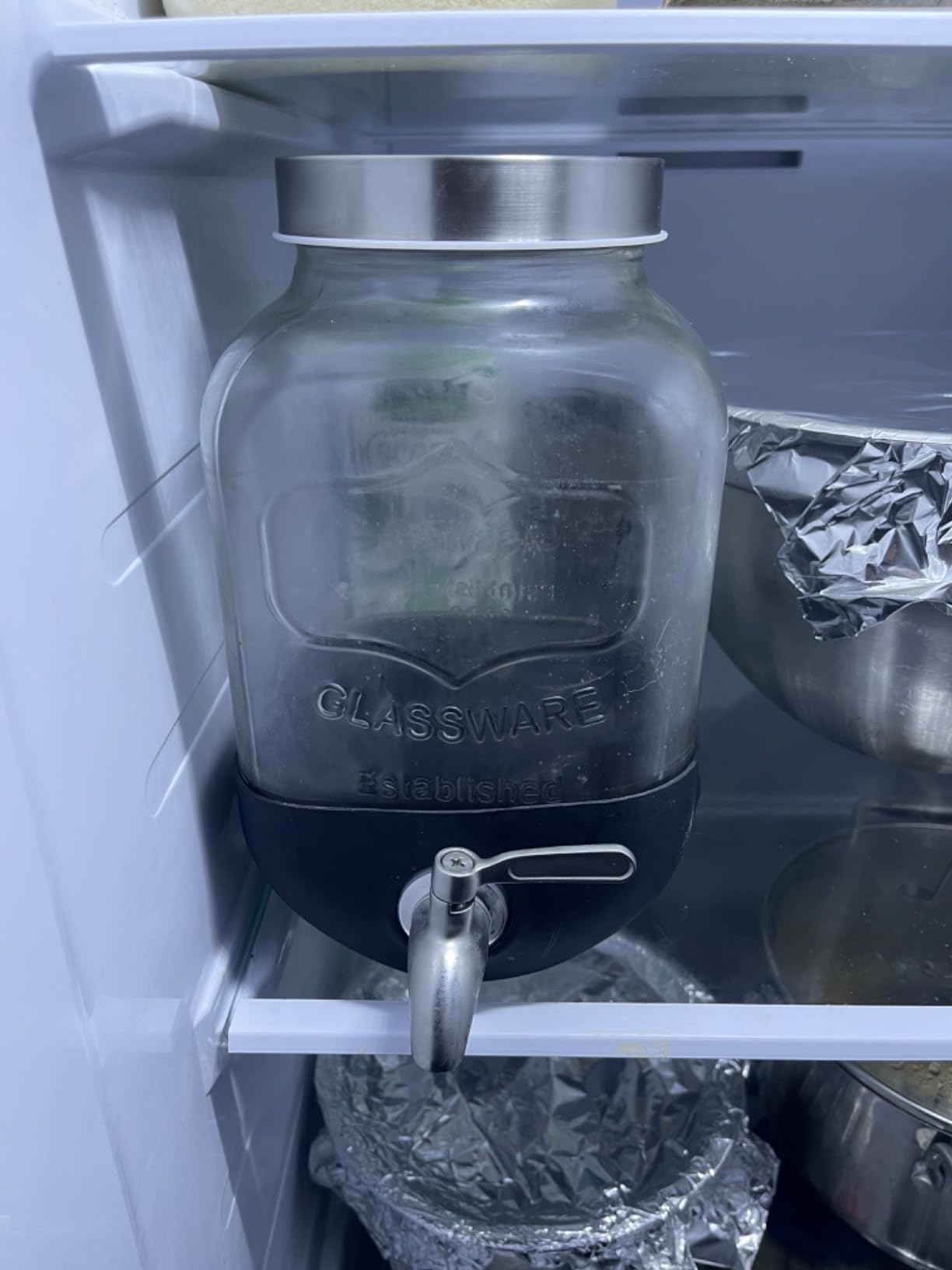
What a lifetime warranty covers here
It covers the manufacturer defects that show up in normal use, which on a pitcher like this means the spigot assembly, the filter and the hardware. It does not cover a jug that is knocked off a counter, and that distinction is worth keeping in mind because the drilling point around the spigot is the weak spot reviewers mention most.
The stainless lid also lacks a rubber gasket, so it will weep a little if you shake the jug while moving it. Lift and tilt gently instead of shaking, and the pour stays dry.
When to skip the glass
Choose a plastic-bodied pitcher instead if your kitchen has hard floors, small children, or a history of things getting knocked over. Breakage is the single most repeated complaint across every glass gallon jug we looked at, and no filter or warranty fixes a cracked carafe.
The second common grumble is grind fineness. Very fine grounds can push through the mesh, so stay at a proper coarse grind for a full gallon. If you grind finer than that for pour-over, this is not the vessel for it.
5. VA1KENE 1 Gallon Mason Jar Cold Brew Maker – Best Complete Set
1 Gallon Cold Brew Coffee Maker, Mason Jar Pitcher with Spigot & Filter
1 gallon glass with reinforced rim
200 mesh stainless filter
Air-release valve lid
Silicone no-drip spigot cover
Pros
- 128oz jug makes about 16 cups for several days
- 200 mesh filter handles fine grinds with little sediment
- Air-release valve makes the lid easier to open after fridge storage
- Silicone spigot cover catches drips
- Complete accessory set with brush and spigot wrench
Cons
- Handle can break under a full jug and needs two hands
- Pours slowly through the grounds with a little sediment
- The gallon jug is a tight fit for a dishwasher rack
The VA1KENE covers the same functional ground as the gallon jugs above and includes the accessory set most buyers end up buying separately. You get a cleaning brush, a silicone pad, a spigot sleeve and a wrench, and the two-year manufacturer warranty is decent for a glass vessel.
Its 200 mesh stainless filter held up well against fine grinds in owner reports, with little sediment reaching the glass. At 4.6 across 1639 reviews, the satisfaction rate sits alongside the more expensive pitchers in this group.
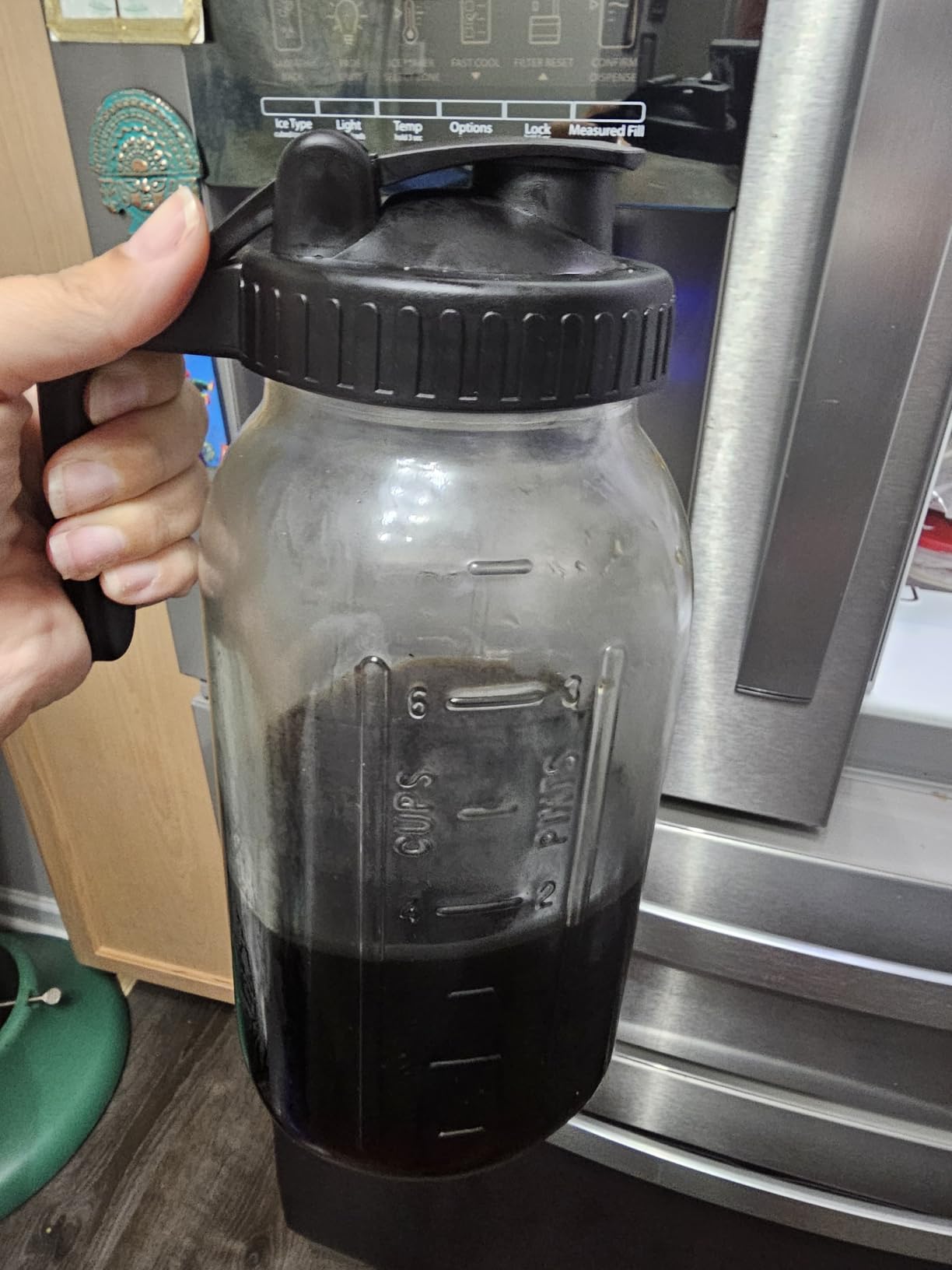
The air-release valve on the lid is the small feature that improves daily use. After a night in the fridge the lid sits under vacuum, and the valve lets you open it without fighting the seal, which is exactly the friction that makes people stop brewing on a schedule.
Capacity works out to roughly 16 cups, which the listing also states, and that is enough for three to five days of daily cold brew for a household of two to three.
Two years of manufacturer coverage is a reasonable middle ground here. It is shorter than a lifetime warranty and longer than the single-year cover on the electric brewer, and for a glass vessel the realistic claim risk is a spigot or filter failure rather than the body itself.
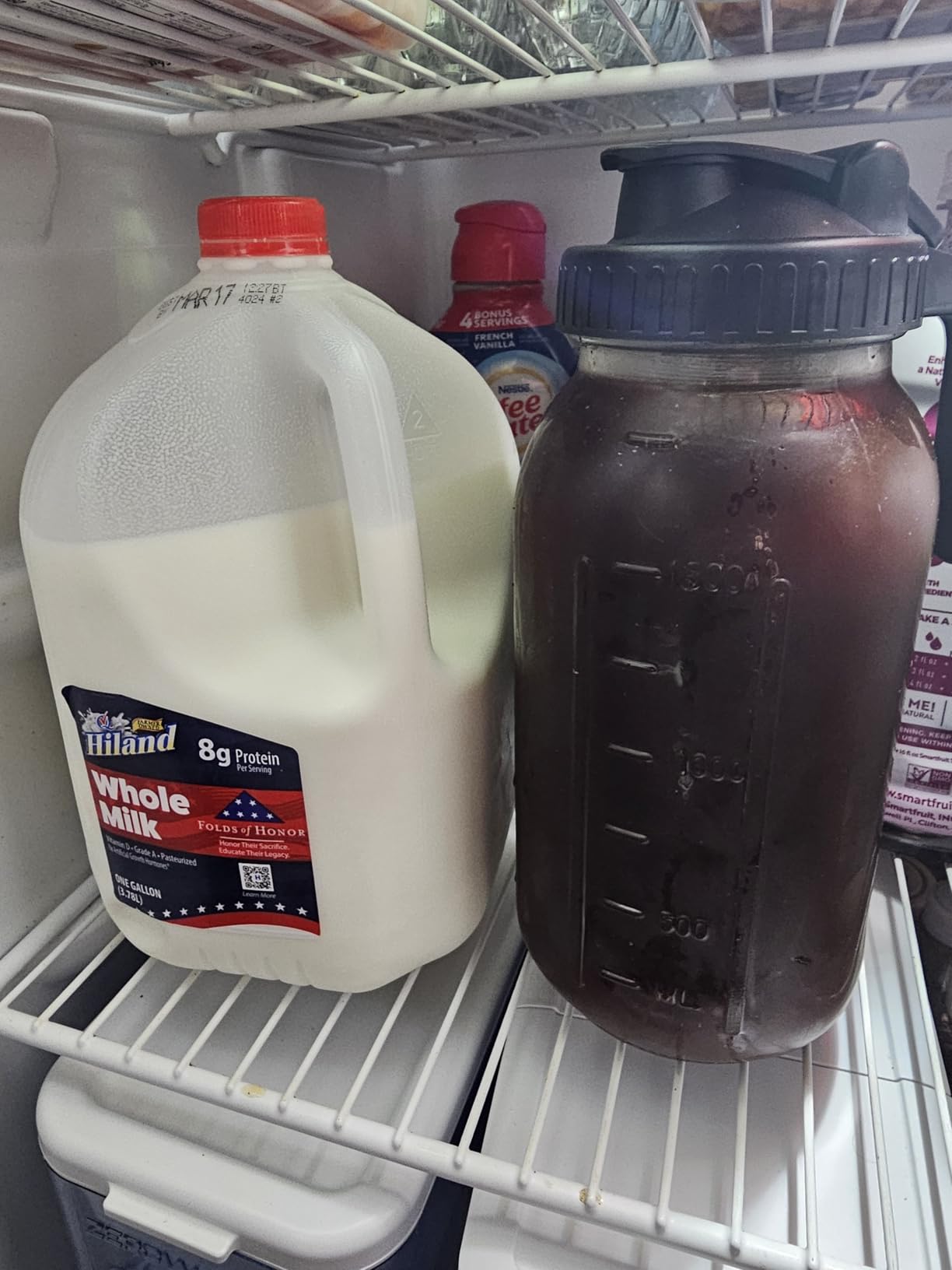
Accessories that actually get used
The wrench is for tightening the spigot fitting after the jug has been full, because the seal can relax over time. The silicone pad sits under the spigot to catch drips, and the brush is the only realistic way to get grounds out of a fine mesh by hand.
That last point also applies to cleanup time. Every fine mesh in this roundup needs the brush, and the mason jar format has a narrow mouth that makes the job slower than a wide-mouth pitcher.
Handle weight and dishwasher limits
The most repeated complaint is the handle. Owners report it can break under the weight of a full jug, and the advice from users is to use two hands and treat the handle as a steadying grip rather than a lifting point.
The gallon jug is also a tight fit for a dishwasher rack, so expect hand washing. The reinforced rim around the spigot drilling point is thicker than most, which is a sensible place for a glass manufacturer to add material.
6. Aquach 68 oz Cold Brew Maker – Easiest to Clean
Aquach 68oz Cold Brew Coffee Maker, Borosilicate Glass Pitcher for Iced Tea
68 oz borosilicate carafe
2000ml vessel for up to 8 guests
Dual-mesh 304 stainless filter
Dishwasher safe
Pros
- Borosilicate glass body is plastic-free and does not affect flavor
- Dishwasher safe with removable silicone gaskets
- Laser-perforated steel filter rinses clean and never rusts
- Printed volume marks make ratios repeatable
- Opening is wide enough to get a hand inside
Cons
- Tall and slim format may not fit a fridge shelf or door
- Thin glass wants hand washing
- Dishwashing wears off the printed measurement marks
The Aquach is the large-batch option for people who do not want to hand wash a gallon of glass every Sunday. It is fully dishwasher safe, the gaskets pull out for cleaning, and the laser-perforated stainless filter rinses clean under a tap without a brush.
At 68 oz in a 2000ml vessel, the listing rates it for up to eight guests. That is a solid large batch for a long weekend of hosting, and the printed measurement marks on the body make it easy to repeat the same coffee-to-water ratio week after week.
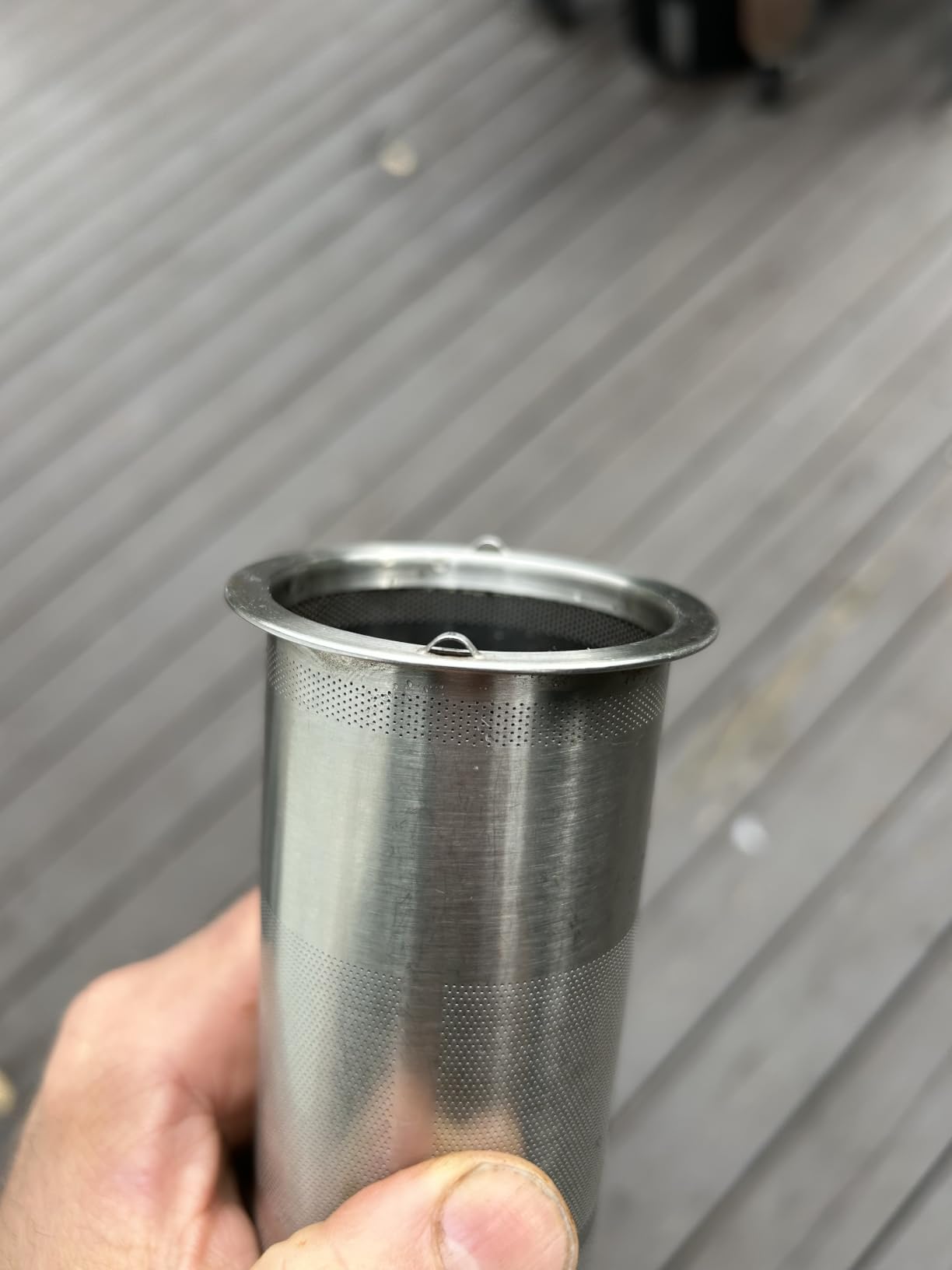
The borosilicate body is rated from about -4 to 350 degrees, so it handles iced tea and chilled fruit water as well as coffee. Long-term owners report it as leak-free with a concentrate that stays good for a week or more.
One technique tip from owners: add water before the filter rather than after. Pouring water onto grounds that are already sitting in an empty filter is the most common reason a batch overflows.
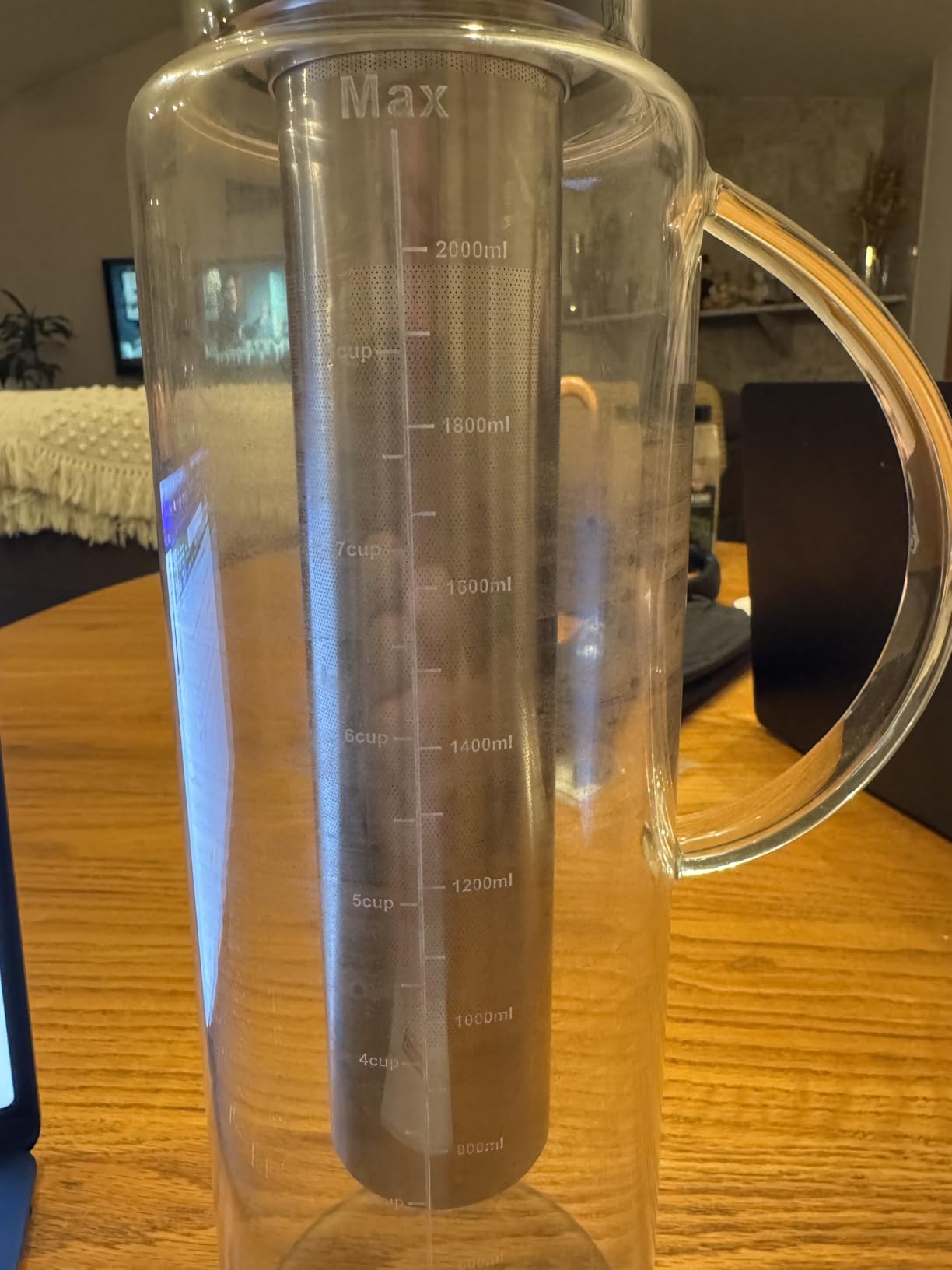
Measurement marks versus a kitchen scale
The printed scales let you eyeball a repeatable ratio without weighing anything, which is convenient when you are moving quickly. They are printed rather than etched, and dishwashing gradually wears them off, so treat them as a guide rather than an instrument.
A scale remains the better tool once the marks fade. Long-term users who measure by weight report more consistent strength batch to batch, which matters more than volume once you are diluting concentrate.
Check your fridge height first
This is the one caveat that can disqualify it. The 68 oz version stands 11.69 inches tall in a slim profile, and owners report it failing to fit a standard shelf or door. Measure before you order, and if it will not fit, a squatter gallon jug gives you more volume in less height.
The glass is also relatively thin, so it wants gentle handling despite the borosilicate rating. And there is no locking mesh cap for long steeping of tea leaves, so it is built for coffee rather than as a general infuser.
7. Brew To A Tea 1 Gallon Cold Brew Maker – Best for Iced Tea and Infusions
BTaT- 1 Gallon Cold Brew Coffee Maker, Thick Glass Pitcher
1 gallon crystal-clear glass
Removable super-fine mesh filter
Leak-proof stainless spigot
Wide mouth opening
Pros
- Full gallon vessel built for bulk brewing
- Leak-proof spigot pours without lifting or tilting
- Super-fine removable mesh keeps grounds out of the brew
- Wide mouth makes filling
- stirring and cleaning easy
- Crystal-clear glass looks good in a fridge or on a shelf
Cons
- Full jug is heavy at roughly 3.8 pounds and needs two hands
- No carry handle on the vessel
- Glass carries the usual breakage risk that Tritan avoids
Despite the brand name, this is a straight cold brew pitcher with a 1 gallon glass body, and the wide mouth is the feature that makes it useful beyond coffee. You can stir a large dose of grounds directly in the vessel, and you can drop in iced tea, lemonade or fruit infusions without fighting a narrow opening.
The built-in leak-proof stainless spigot lets you serve from the jug where it sits. On a gallon that matters, because lifting and tilting several pounds of liquid to pour six glasses is how drops happen.
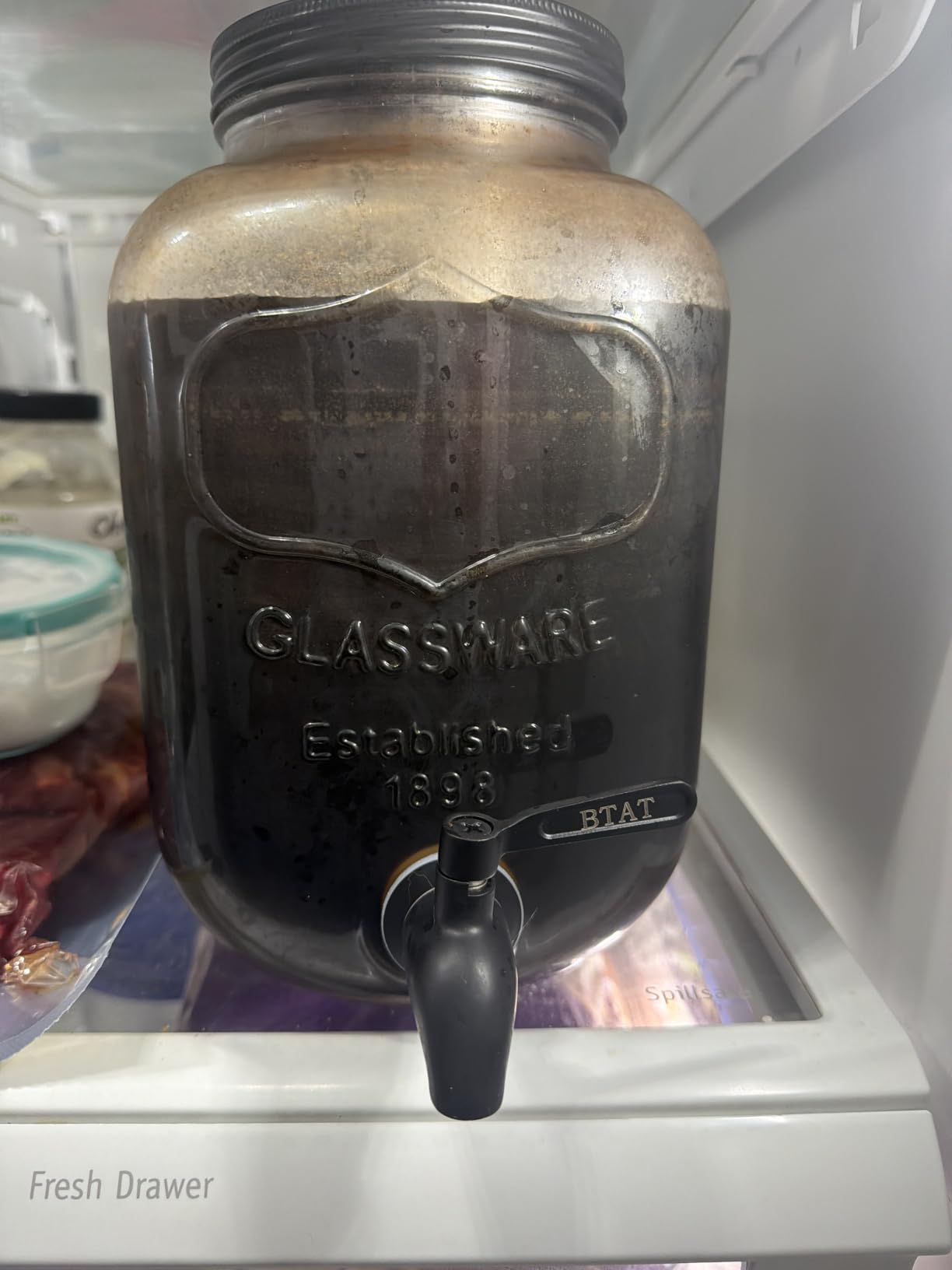
Owners rate the super-fine removable stainless mesh highly on grounds control, and the embossed detailing on the clear glass is a small quality touch that shows when the jug is sitting open on a counter serving as a drink dispenser.
Worth noting: at 4.5 with 1563 reviews, complaints here are practical rather than functional. Nobody reports a broken spigot or a filter failure, which is not true for every gallon pitcher in this group.
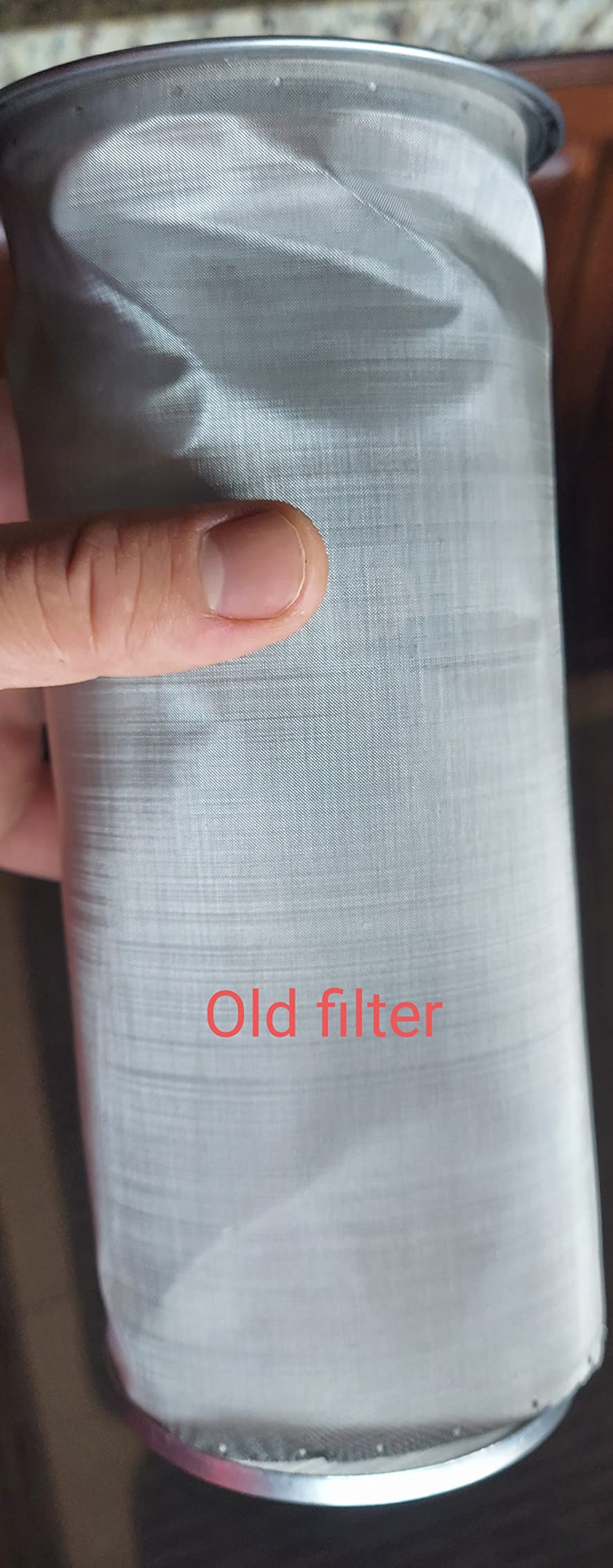
Wide mouth versus fine mesh
Those two features pull in opposite directions, and this pitcher resolves it better than most. A wide mouth lets you load a large dose quickly and stir the grounds down so they stay submerged, while the fine mesh still filters the result. Narrow-mouth pitchers force you to load grounds dry and hope they wet evenly.
That matters more at a gallon than at 32 oz because a bigger dose of floating grounds steeps unevenly. If your batches taste inconsistent, incomplete wetting is usually the cause.
The weight problem with a full gallon
A full jug comes to roughly 3.8 pounds and there is no handle, so it is a two-handed object in practice. That is manageable for a pitcher that stays put and dispenses through the spigot, and it is a real limitation if you need to carry a batch somewhere.
It is also glass, so it carries the breakage risk that Tritan bodies such as the Takeya design around entirely. Buy this one for its wide mouth and its serving spigot, and keep it on a stable shelf.
8. VINCI Express Electric Cold Brew Maker – Best for Speed
VINCI Express Electric Cold Brew Coffee Maker, 10-Minute Fast Brewer (68oz)
2 liter borosilicate carafe
10 to 25 minute brew cycle
Three strength settings
Self-cleaning cycle
Pros
- Brews a full batch in 10 to 25 minutes instead of overnight
- Three strength settings for light
- medium and bold concentrate
- Brews
- serves and stores in one 68oz carafe
- Dual lids with an airtight storage cover
- Built-in cleaning cycle flushes the brew path
Cons
- Lowest average rating in this roundup with 9 percent one-star reviews
- Needs a countertop outlet and 120V power
- Powered parts mean hand washing the carafe
- Costs more than every passive pitcher listed here
Every other maker here is passive, which means you plan the batch around a fridge. The VINCI Express breaks that pattern with active circulation that moves cold water through the grounds continuously, finishing a 2 liter carafe in as little as 10 minutes.
That is a real advantage for a hosting situation. Nobody starts a gallon batch 16 hours before a brunch, and a machine that produces 68 oz on demand means the coffee is at its freshest when people actually drink it.
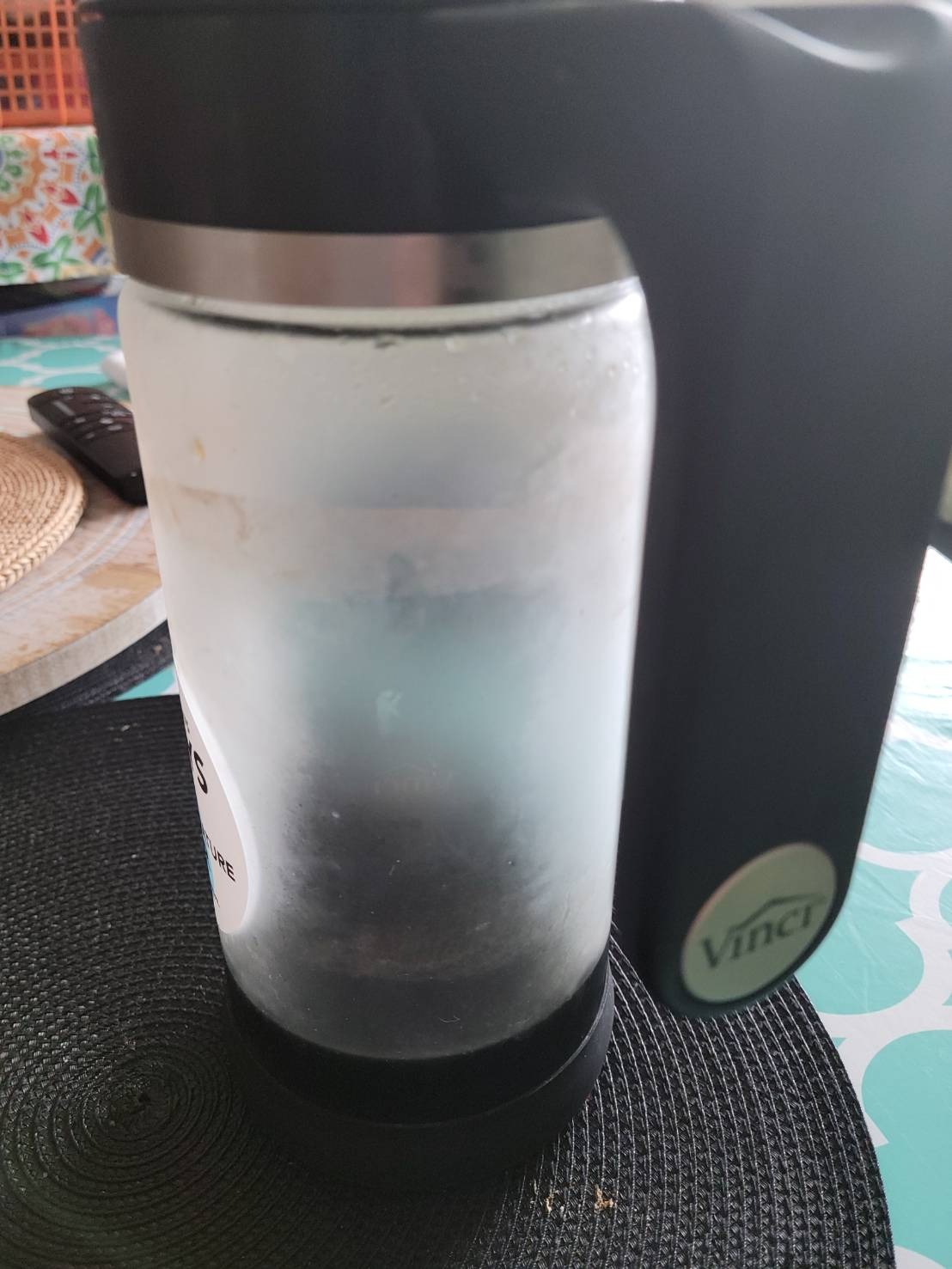
Three strength settings cover light, medium and bold, running roughly 10, 15 and 20 to 25 minutes. The carafe brews, serves and stores in the same vessel with a dual lid system, and the listing rates the finished brew as staying fresh up to ten days.
I would treat rapid extraction as a different drink rather than a substitute. Faster contact time pulls a different balance out of the bean, and coffee drinkers who care about immersion character usually land on the passive pitchers.
The patented circulation technology is what separates this from a heated drip machine. Water moves repeatedly through the bed rather than sitting, so fines are pushed out of the carafe as it runs and the finished brew comes out closer to sediment-free than a passive mesh pour.
What the self-cleaning cycle does and does not cover
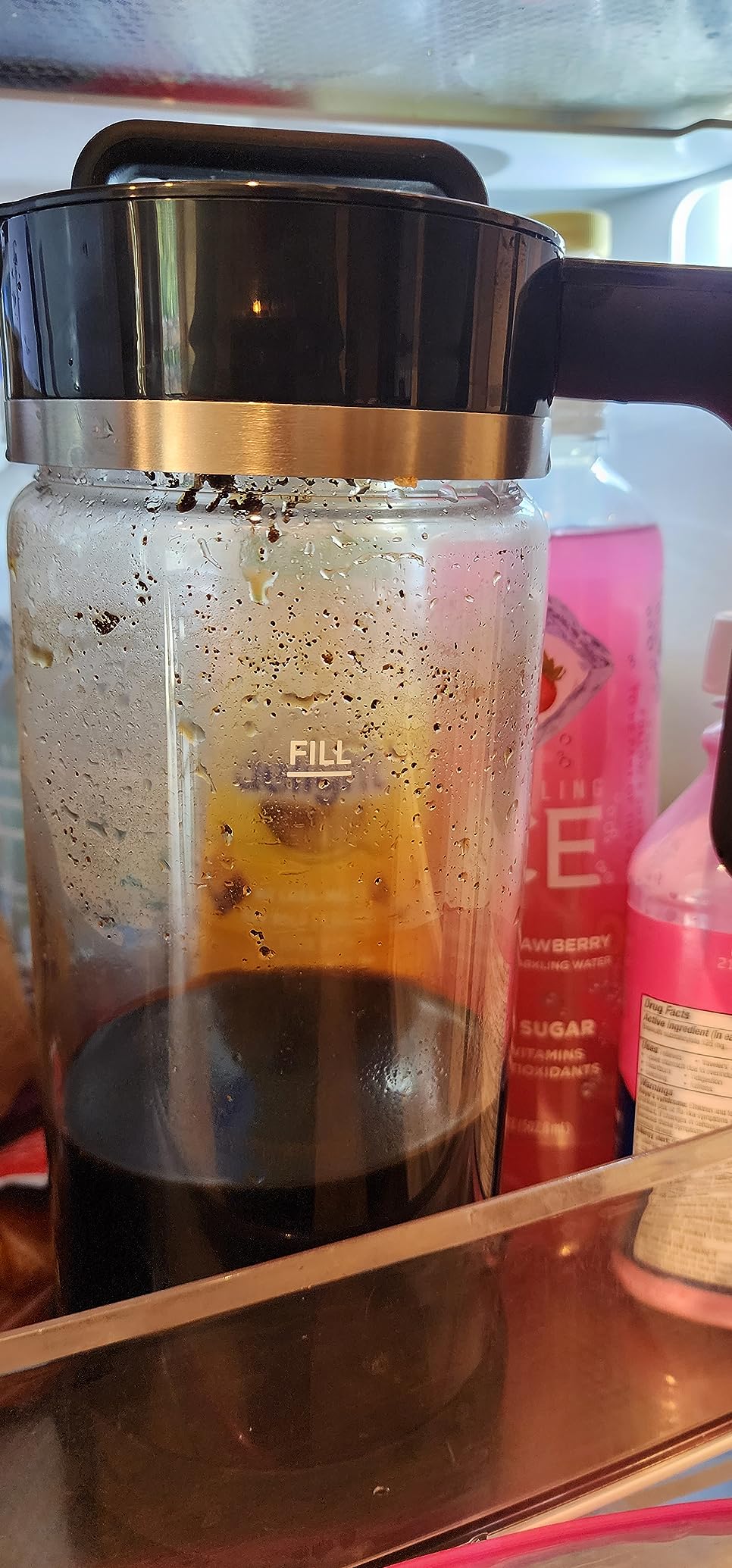
The built-in cycle flushes residual coffee from the brew path, which is the part that would otherwise sour and shorten the life of the machine. It handles the internal channel, not the removable parts, so you still hand wash the carafe, the lid and the filter basket separately.
That is the main ongoing cost of an electric brewer: a cleaning routine with more pieces than a passive pitcher, and a machine that cannot be fixed by rinsing one filter under a tap.
Reliability and the lowest score in the group
This is the lowest rated option here at 4.2, with 9 percent of reviews at one star. The complaints cluster around the reliability and cleaning of the powered components, and electrical hardware has more failure points than a glass jug and a mesh basket.
It also needs a dedicated countertop outlet and 120V power, and it costs more than every passive pitcher in this roundup. Buy it when speed changes what is possible, not when a larger pitcher would do the same job overnight.
9. Le’raze 1 Gallon Cold Brew Maker – Largest Grounds Load
1 Gallon Cold Brew Coffee Maker – 3rd Generation Fine Mesh Filter – Stainless Steel Spigot – Extra Thick Large Glass Mason Jar Drink Dispenser Carafe, Iced Coffee Maker & Sun Tea Pitcher with Infuser.
1 gallon glass carafe
50 micron woven steel mesh
Holds up to 400g of grounds
Adjustable steel spigot
Pros
- Filter basket holds up to 400g of coarse grounds
- 50 micron mesh is finer than the typical competitor weave
- Thick glass and a tight-sealing stainless spigot with no dripping
- Spout protrudes far enough to pour without maneuvering
- Fits a standard fridge without moving a shelf
Cons
- Fine mesh can impart a metallic taste
- Filter ring has arrived detached or warped on some units
- Dissimilar metals can leave a light rust ring
- Poor assembly instructions
- Full jug is heavy without a handle
The Le’raze solves a specific large-batch problem: how much coffee can you put in the vessel at once. Its filter basket holds up to 400g of coarse grounds, which is a meaningful dose for a gallon, and the 50 micron woven steel mesh is finer than the 100 to 150 micron standard most competitors use.
Finer mesh means less sediment, and owners confirm the spigot seals tightly with no dripping. The spout also protrudes far enough that you can pour into a tall glass without maneuvering the jug, which is a small courtesy that matters at brunch service.
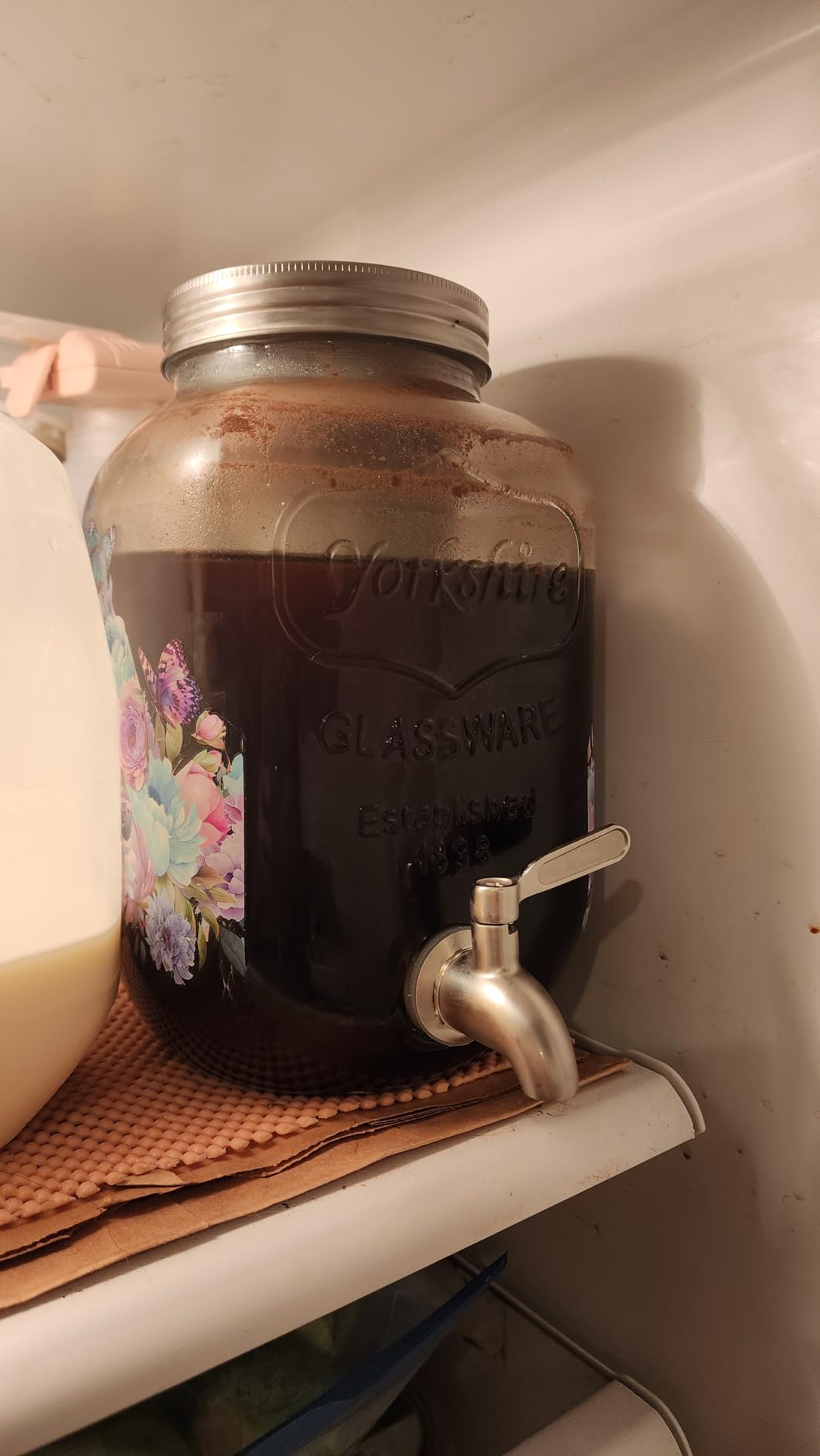
Beyond coffee, the same carafe handles sun tea, lemonade and protein drinks, so it works as a general drink dispenser for a gathering rather than a single-purpose brewer.
At 4.3 across 1401 reviews it sits at the lower end of this group, and the reasons are worth reading before you commit a gallon of concentrate to it.
The metallic taste question
The most repeated complaint is a faint metallic note in the finished brew, which owners attribute to the very fine 50 micron weave. Slower flow through a tighter mesh extracts more from the metal over a long steep, and at 16 to 24 hours that has time to show.
If you are sensitive to metallic flavors, the Aquach or Original Grind Co. pitchers use wider laser-perforated or ultra-fine stainless designs that reviewers do not flag for taste, and that is the safer choice.
Assembly and parts quality
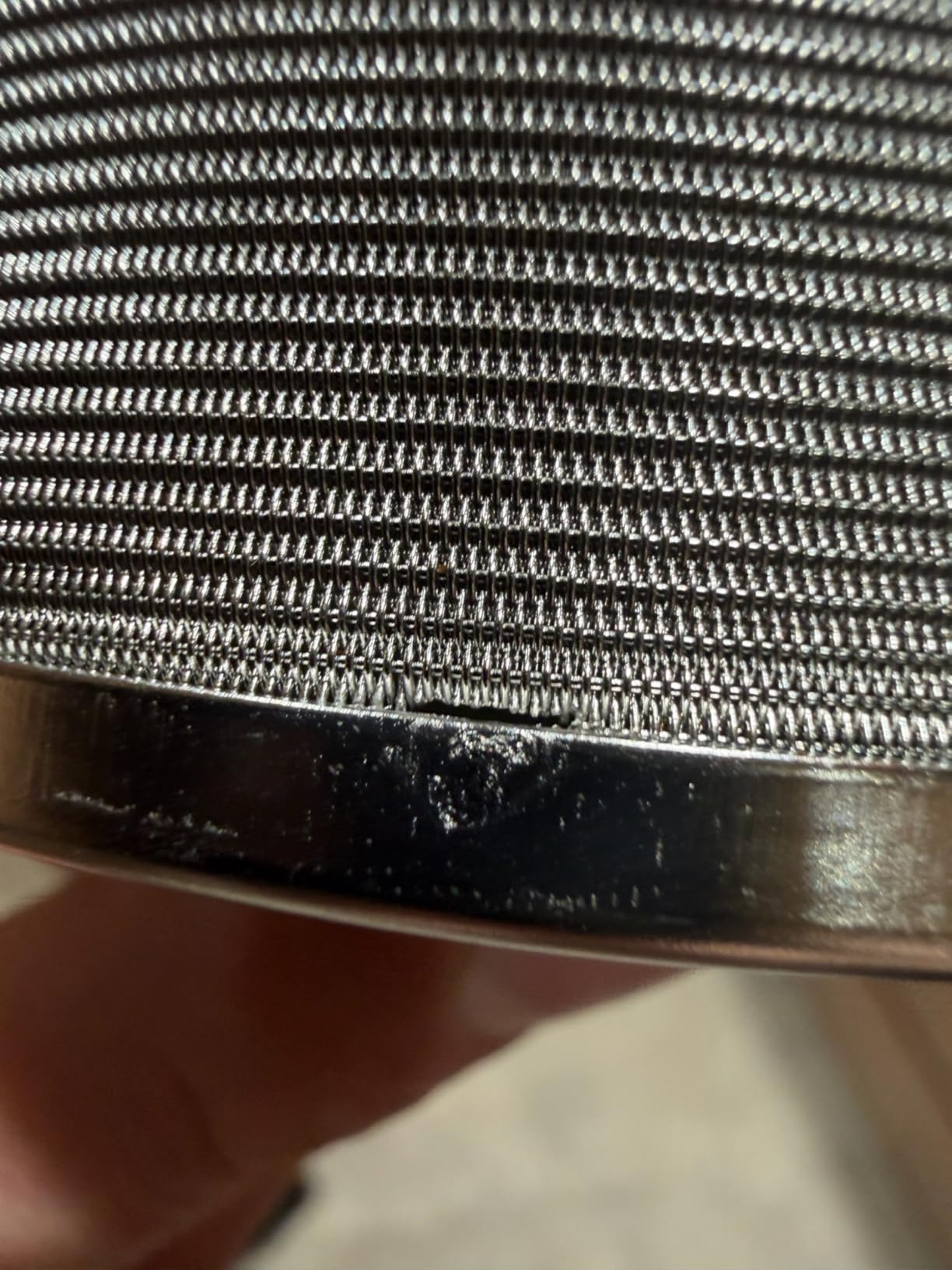
Two quality issues show up repeatedly. The filter ring has arrived detached or warped on some units, and dissimilar metals in the basket and cover have left a light rust ring in a few reports. Both are assembly and material issues rather than design failures, but they are real.
The gasket spec here is an adjustable leakproof stainless spigot with silicone gaskets under an airtight screw-on lid, which is the right hardware for a pitcher that will be opened and closed many times a week. The weak point is not the seal, it is the filter ring that holds the mesh in place.
The instructions also under-explain the wing nut and spigot orientation, so allow time to assemble it properly the first time. A full jug is heavy and there is no handle, so treat this as a fill-once-and-dispense pitcher.
10. Maestri House 64 oz Tritan Pitcher – Best for Ratio Control
Maestri House Cold Brew Coffee Maker, 64oz BPA-Free Tritan Pitcher
1.9 liter BPA-free Tritan body
350 mesh ultra-fine filter
Printed measurement scales
12.5 inch height
Pros
- Works with 190g
- 160g
- 120g and 100g of grounds at one water volume
- 350 mesh filter gives clean coffee with almost no sediment
- Removable bottom cover makes rinsing out grounds easy
- Compact rectangular body stores sideways in a fridge
- Includes a measuring scoop and cleaning sponge
Cons
- Lid hinge clips reported to break after a few months
- Lid vent can leak when stored on its side
- Very fine filter can clog and needs opening to stir
- Filter and lid are hand-wash only
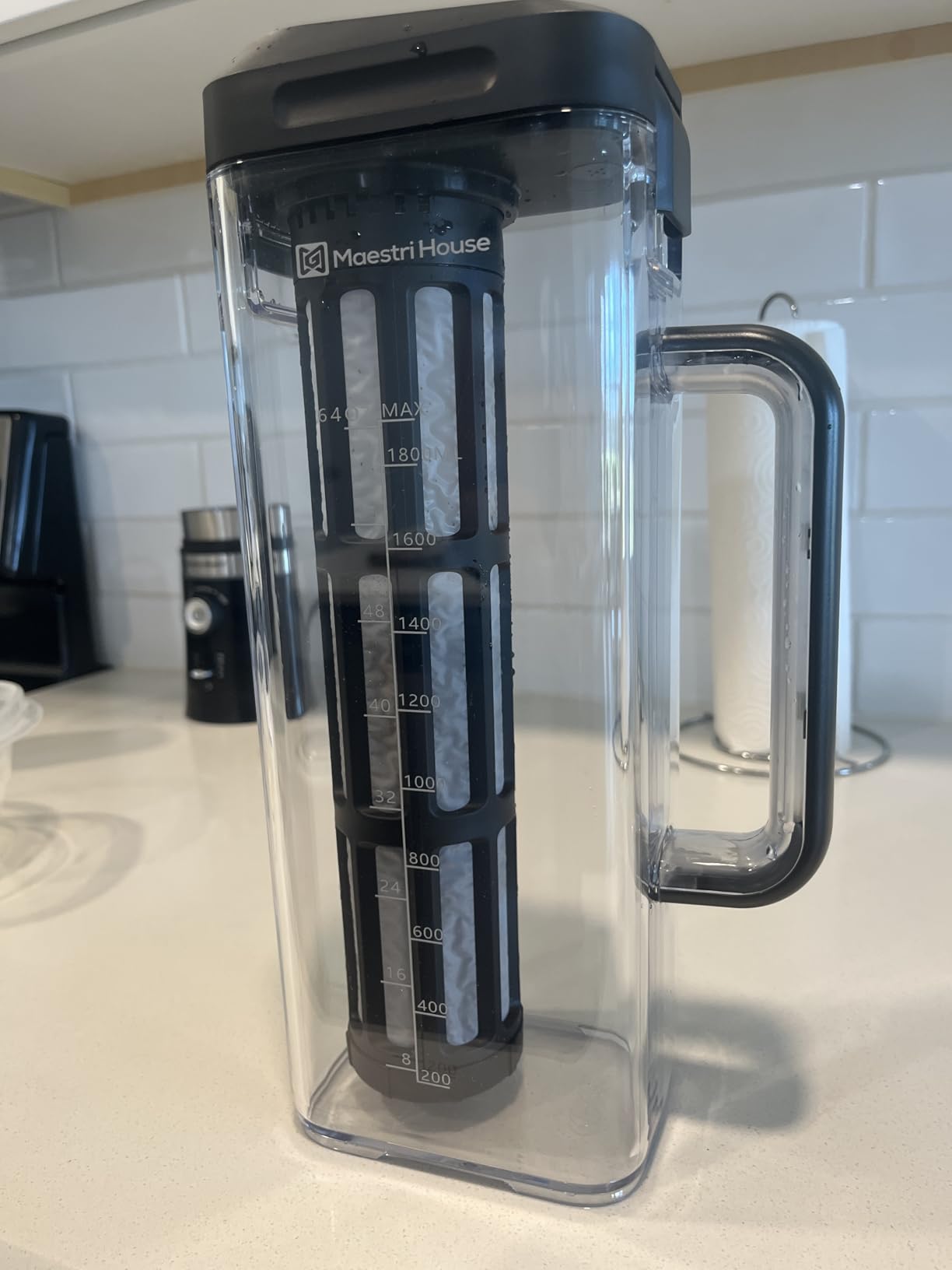
The Maestri House is the only large-batch pitcher here built around repeatable ratios. It is designed to brew 190g, 160g, 120g or 100g of grounds at the same water volume, and printed scales on the body let you hit a consistent coffee-to-water ratio without guessing.
That flexibility is what lets you make a strong batch for espresso-style concentrate and a lighter batch for drinking over ice, using the same vessel and the same water line. At 64 oz you get roughly six to seven cups per brew.
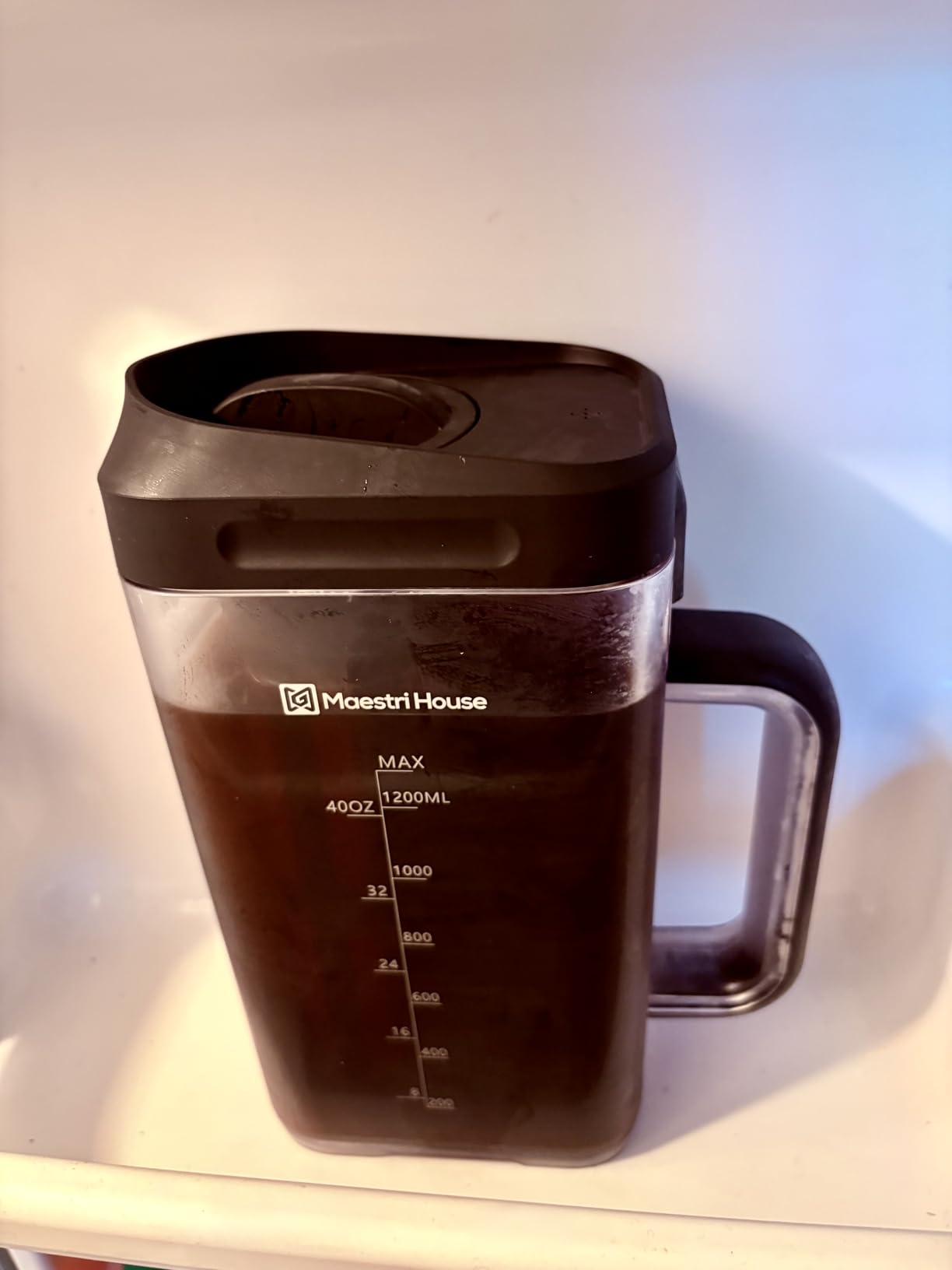
The 350 mesh ultra-fine filter has a removable bottom cover, which is the feature that makes fine mesh practical. Popping the cover lets you rinse the spent grounds out quickly instead of picking them out of a sealed basket, and owners rate the resulting cup as clean with almost no sediment.
The rectangular body is a genuine fridge advantage. It stores sideways, which is the orientation many people find extracts best, and it is lighter than a glass jug of the same nominal volume.
The lid vent and sideways storage conflict
Side-laying the pitcher is widely considered the best extraction orientation because it keeps grounds fully submerged, and this pitcher is designed to store that way. The problem is the lid vent, which owners report can leak when the pitcher is on its side, which is the orientation that extracts best.
Plan for a towel or a small tray under it in the fridge, or brew it upright and accept a slightly weaker batch. It is an odd conflict to design around, and it is the single biggest practical caveat on this pitcher.
Durability and cleaning limits
The lid hinge clips are reported to break after a few months of use, which matters on a pitcher you handle every day. Contact the manufacturer if they fail rather than trying to work around a loose lid.
Only the pitcher body is dishwasher safe. The filter and lid are hand-wash only, and the very fine mesh can clog enough to require opening the capsule and stirring the grounds loose, so rinse the filter right after each batch rather than at the end of the week.
How to Make a Large Batch of Cold Brew
Large-batch cold brew follows the same method as a small batch, only the quantities change. The steps below produce a gallon of concentrate that you dilute to taste, which is the most useful format for serving a group because the strength stays adjustable per glass.
Start by weighing your coffee rather than measuring by volume. Volume measurements of coarse grounds vary wildly between beans, and at a gallon the error compounds across every serving.
Grind coarse, at roughly the texture of sea salt. This is the single highest-leverage decision in the whole process, because grounds that are too fine will cloud the brew, slow the drain to a crawl and force you through several filter layers. Many home grinders have a setting coarser than you think you need, so use it.
Measure water, then add the coffee. Pouring water first and grounds second keeps the grounds from overflowing out of a filter basket that sits above the water line in a tall pitcher, which is the most common cause of a failed batch.
Stir until every ground is wet, then cover. A dry pocket of grounds steeps differently from wet grounds and is where uneven flavor comes from in large batches specifically.
Steep 12 to 18 hours in the fridge for a standard 1:4 concentrate ratio. Longer is not automatically better. Beyond about 24 hours you extract more astringency than sweetness, and the difference is more noticeable at gallon scale because you are drinking more of it.
Filter slowly, and vent the lid first. On every spigot pitcher in this roundup, the lid sits under vacuum after a night in the fridge, and the spigot will barely flow until air can get in above the liquid.
Dilute to taste and store cold. A 1:1 concentrate to water ratio gives a strong cup, and roughly 1:3 is closer to a ready-to-drink batch. Keep it refrigerated and expect around two weeks of good flavor in a sealed vessel, with the first week tasting noticeably fresher.
On quantities for a large batch, a gallon of water at a 1:4 ratio takes about 32 ounces of coarse grounds by volume, which is roughly 900 grams. If you want a stronger concentrate to dilute later, drop toward 1:3 and expect to add more water or milk at the table. Scale everything proportionally when you move up or down in size, since the ratio is what matters, not the vessel.
What to Look for in a Large-Batch Cold Brew Maker
The biggest mistake in this category is buying on capacity alone. Advertised volume is water volume, and the finished yield after grounds absorb water and hold back liquid is always lower. A one-gallon jug does not give you a gallon of drinkable concentrate, and any listing that quotes serving counts is more honest than one that quotes only ounces.
Filter mesh fineness is the second thing to check. A 200 micron mesh holds back fine sediment, a 350 mesh gives the cleanest cup at the cost of clogging and slow drains, and a 100 to 150 micron weave drains fast but lets finer particles through. Match the mesh to your grind and accept that very fine mesh can pick up a metallic note over a long steep.
Spigot quality decides how pleasant a gallon is day to day. Look for a metal spigot rather than plastic, an adjustable or sealed fitting that will not loosen under a full jug, and some form of air release so the lid does not fight you in the morning. A pitcher with no spigot at all means lifting several pounds of glass for every pour.
Material is a durability decision more than a taste one. Glass avoids any perceived plastic concerns and looks better on a shelf, and borosilicate glass holds up better than ordinary soda-lime glass. Tritan will not shatter when dropped and weighs a fraction as much, which is the reason it is the right pick for a pitcher that gets carried or moved.
Fridge fit deserves a tape measure, not an estimate. Footprint matters as much as height, because a gallon jug occupies a square shelf for the whole week, and a tall slim carafe can fail to fit entirely. Check the shelf depth and the door clearance before you order.
Grinder requirement is a real cost people forget. None of the passive makers here ship with a grinder, and a batch of 900 grams of grounds at a coarse setting is more than a blade grinder can do evenly. A burr grinder with a coarse or extra-coarse step is the piece of equipment that makes the rest of this work as intended.
Decide between concentrate and ready-to-drink before you buy. A concentrate vessel gives you a 1:1 to 1:3 dilution range per glass, which is the flexible option for a mixed household. If everyone drinks theirs the same strength, a wider-mouth pitcher and a slightly higher ratio serve you better.
Cleanup time is the hidden cost of a large batch. A full gallon takes longer to rinse, and fine mesh filters need a brush. Dishwasher-safe glass and removable gaskets genuinely reduce the weekly burden, while a powered brewer with a self-cleaning cycle still leaves several parts to wash by hand.
Storage life changes the value calculation. If a pitcher holds a sealed brew for two weeks, one batch covers a long stretch of the month and the brewer pays for itself in convenience alone. If you can only drink a small amount before it sits too long, a 64 oz pitcher is the smarter size and wastes less coffee.
Frequently Asked Questions
How do I make large batches of cold brew coffee?
Use a vessel rated for the volume you need, a 1:4 coffee-to-water ratio, a coarse grind and a 12 to 18 hour fridge steep. Weigh the coffee instead of measuring it by volume, pour water into the vessel before the grounds so the filter does not overflow, and stir to wet every ground. Filter slowly and vent the lid before using the spigot, since a sealed lid traps a vacuum overnight.
What is the best coffee maker for brewing large groups?
For serving a crowd, a one-gallon glass pitcher with a fine stainless filter and a spigot is the best fit, and the JunVpic 128 oz pitcher is our top pick in that category. It brews about seven servings per batch, includes gaskets at the lid, filter and spigot, and dispenses from the fridge without being lifted.
What is the best coffee machine for making cold brew?
The best coffee machine for making cold brew is simply a vessel sized to your batch with a fine reusable filter, since cold brew is immersion brewing rather than a machine process. Choose 64 oz for one or two people and a gallon for four or more or for hosting. Electric rapid brewers are faster but produce a different flavor profile than overnight immersion.
What type of bulk coffee is best for making cold brew?
For large batches, use a single-origin or blend you enjoy as a concentrate, ground coarse at roughly sea salt texture. A fine grind clouds large batches, slows filtration badly and makes a weak or bitter cup, and it is the most common reason a big batch tastes inconsistent. Weigh the grounds rather than scooping them, since volume measurements of coarse coffee vary widely.
How long does cold brew concentrate last in the fridge?
Cold brew concentrate keeps well for about two weeks when it is stored refrigerated in a sealed vessel, and the first week tastes noticeably fresher. Keep the spigot pitcher covered or use an airtight storage lid, and always refrigerate rather than leaving it on the counter, since dilution makes it a hospitable environment for off flavors.
Which Large-Batch Cold Brew Maker Should You Buy?
Start with the Takeya Deluxe if you want the pitcher that has already survived years of daily use and weighs less than a glass jug, even at 9.6 ounces. It is the most proven option in this roundup by a wide margin, and its fine mesh keeps a clean cup.
Move up to a gallon when you are serving a group. The JunVpic is my pick for gatherings with a full gasket set and a spigot that dispenses from the fridge, the Original Grind Co. filters the cleanest of any glass pitcher here, and the Zulay adds a lifetime warranty to a full gallon with a dispenser spout.
Avoid a 68 oz electric brewer unless same-day coffee genuinely changes your plans, and avoid a very fine mesh if you are sensitive to metallic flavors. Measure your fridge shelf before ordering any tall carafe, and check whether the grounds recipe you drink is coarse enough for the filter you are buying.
Whichever one you choose, the best cold brew coffee makers for large batches all share the same rule: brew a full vessel once, keep it cold and sealed, and dilute each glass to taste. Updated for 2026, and refreshed as new models land.