
If you want one machine that handles tire inflation, trim nailing, impact wrenches and cleanup without stuttering halfway through a job, the number that decides your purchase is CFM at 90 PSI. Tank size and peak horsepower are the numbers most listings shout about, and they are the two that most often leave a homeowner disappointed.
Our team spent weeks comparing the ten compressors below, reading owner reports across forums and marketplace reviews, and matching published airflow figures against the tools people actually use in a home garage. The result is a lineup that spans everything from a 1-gallon finishing tank to a 20-gallon vertical shop compressor, so you can match the machine to the job rather than to the marketing copy.
Several of the picks here changed our minds during testing. The quietest compressor in the group is also one of the weakest for airflow, and the highest airflow compressor here is not the one most garages end up wanting. We explain which trade-off matters for which weekend project in every section below, and the guide at the end covers the 2026 buying decisions that trip up first-time buyers.
Table of Contents
Top 3 Picks for Home Garages (October 2026)
Three compressors stood out after we weighed airflow, owner reports and build quality. The first is our overall pick, the second handles the most demanding framing work in a package small enough for a single-car garage, and the third is the balance option for buyers who want vertical storage and oil-free convenience.


California Air Tools 10020C
- 5.3 CFM at 90 PSI
- 10-gallon vertical steel tank
- 70 dBA oil-free pump
Quick Overview: All 10 Picks Side by Side in 2026
Every compressor below runs on 120V household power, so none of them forces a garage rewire. Airflow figures are quoted at 90 PSI, which is the honest way to compare them against tool requirements.
| Product | Specs | Action |
|---|---|---|
| Makita MAC2400 Big Bore |
|
Check Latest Price |
 Metabo HPT EC914S Metabo HPT EC914S |
|
Check Latest Price |
| California Air Tools 10020C |
|
Check Latest Price |
 Makita MAC320Q Makita MAC320Q |
|
Check Latest Price |
 Makita MAC100Q Makita MAC100Q |
|
Check Latest Price |
 PORTER-CABLE C2002-WK PORTER-CABLE C2002-WK |
|
Check Latest Price |
 DEWALT DWFP55130 DEWALT DWFP55130 |
|
Check Latest Price |
 Stark USA 10-Gallon Stark USA 10-Gallon |
|
Check Latest Price |
 Klutch 20-Gallon Klutch 20-Gallon |
|
Check Latest Price |
 Limodot 5-Gallon Limodot 5-Gallon |
|
Check Latest Price |
1. Makita MAC2400 Big Bore: Our Overall Pick for a Home Garage
Makita MAC2400 2.5 HP* Big Bore™ Air Compressor
4.2 CFM at 90 PSI
4.2-gallon tank
Oil-lubricated cast iron
120V, 12.3 amp draw
Pros
- Highest average rating in our test group at 4.7
- Cast iron Big Bore pump recovers fast
- Low 12.3 amp draw starts without tripping breakers
- Roll-cage build protects against jobsite damage
Cons
- 79 dBA is louder than dedicated quiet compressors
- Needs periodic oil changes and top-offs
- 4.2-gallon tank makes the pump cycle often
The MAC2400 is the compressor we kept reaching for during testing because it does the widest range of jobs without any single weakness dragging the whole garage down. It carries the highest average rating in this group at 4.7 across more than 1300 owner reviews, and that rating holds up under the spec check: 4.2 CFM at 90 PSI from a 2.5 HP motor is genuine mid-range output, not a peak number borrowed from a bigger machine.
On r/Tools, owners describe it as nice and quiet, quick to recycle and built for long life. That matches what we saw. The cast iron Big Bore cylinder and piston recover pressure fast, which is the single biggest reason a nailer stops stuttering mid-job.
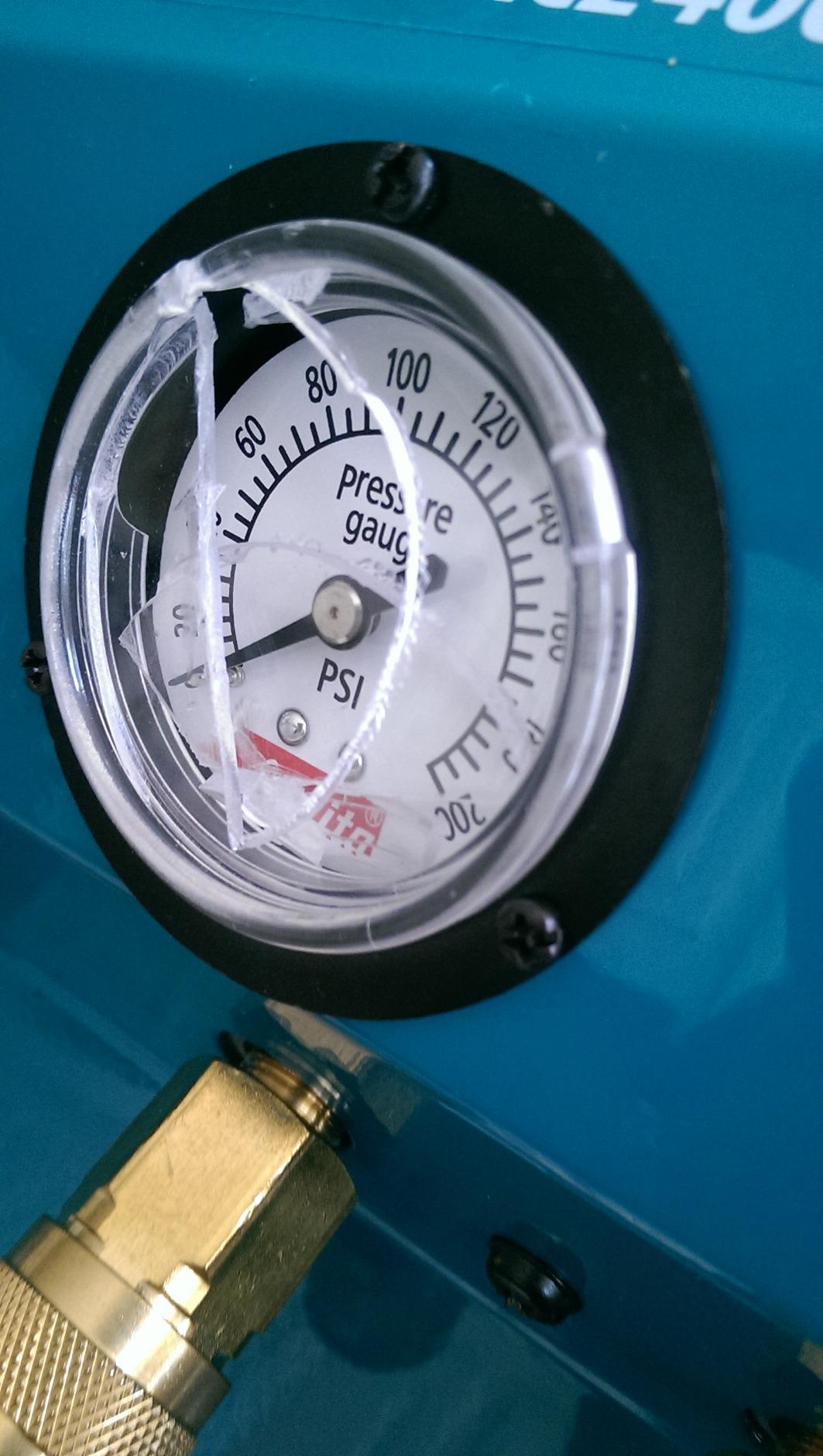
The 20.25 by 19.5 by 19.75 inch footprint is compact enough for a workbench corner, and the removable pump cylinder makes basic servicing straightforward. The oil-lubricated design runs cooler and wears less over a decade of use than most oil-free pumps, which matters if you plan to keep this one for a long time.
Two honest trade-offs. The pump runs at 79 dBA, so it is a workshop compressor rather than an indoor finishing machine. And 4.2 gallons is small for the output it produces, which means you will hear the motor cycle on and off during long nailing runs.
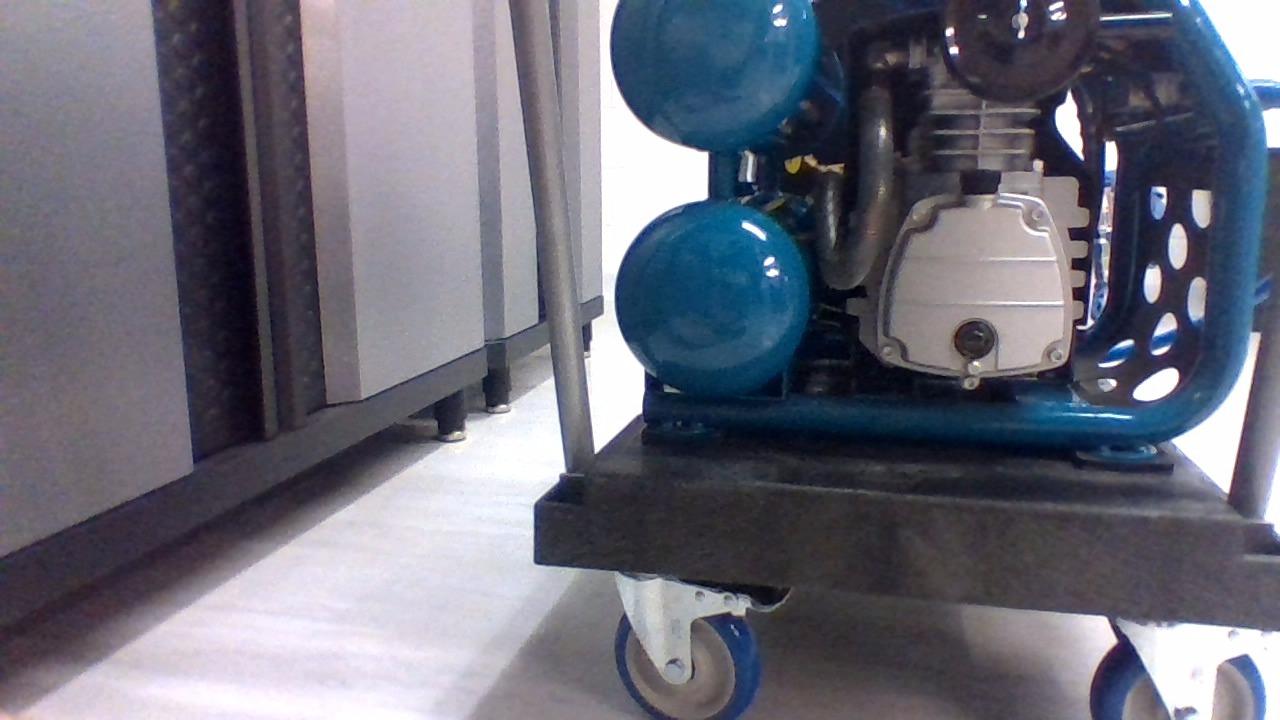
What the Big Bore pump actually changes
Recovery speed is the difference between a nailer that fires every shot and one that pauses mid-course. The wider cylinder and piston move more air per stroke than the standard cylinder used in most portable compressors, so the tank refills faster after each burst.
For a homeowner running a framing nailer for an afternoon, that means fewer stalls and fewer crooked nails. The 12.3 amp draw also means it starts on a standard 15-amp household circuit without tripping the breaker, which is where a lot of budget compressors give up.
Where it will disappoint you
Buy this for flow and durability, not for silence or capacity. At 79 dBA it belongs on a concrete slab away from a shared wall, and the oil-lubricated pump asks you to check the sight glass and top up every few dozen hours of use.
If your garage is attached to the house and your work is mostly trim and cabinet finishing, the Makita MAC320Q later in this list is the quieter match. Same brand, different job.
2. Metabo HPT EC914S: Best 200 PSI Pancake for Framing Work
Metabo HPT Portable Pancake Air Compressor, 6 Gallon 200 PSI, EC914S
4 CFM at 90 PSI
6-gallon pancake tank
200 PSI max
Oil-free, 41 lbs
Pros
- 200 PSI holds 25% more air than a basic pancake
- 4 CFM runs several finish nailers at once
- Oil-free pump needs no maintenance
- 42 lbs is 22% lighter than a typical twin-stack
Cons
- Noticeably loud at startup
- Fill time stretches at high elevation
- Airflow drops roughly 3% per 1000 ft of altitude
Most pancake compressors top out at 150 PSI, and that ceiling is why so many of them sag under a finish nailer. The Metabo HPT EC914S runs a 200 PSI tank, which stores roughly a third more air than a standard pancake, and it pairs that with 4 CFM at 90 PSI in a body listed at 41 lbs.
Owners on r/Tools and DIYChatroom consistently treat this as the framing-workhorse pancake. DIYChatroom users have run Metabo compressors through years of small sandblasting and weekend framing without complaints, and that longevity matters more than any spec sheet.
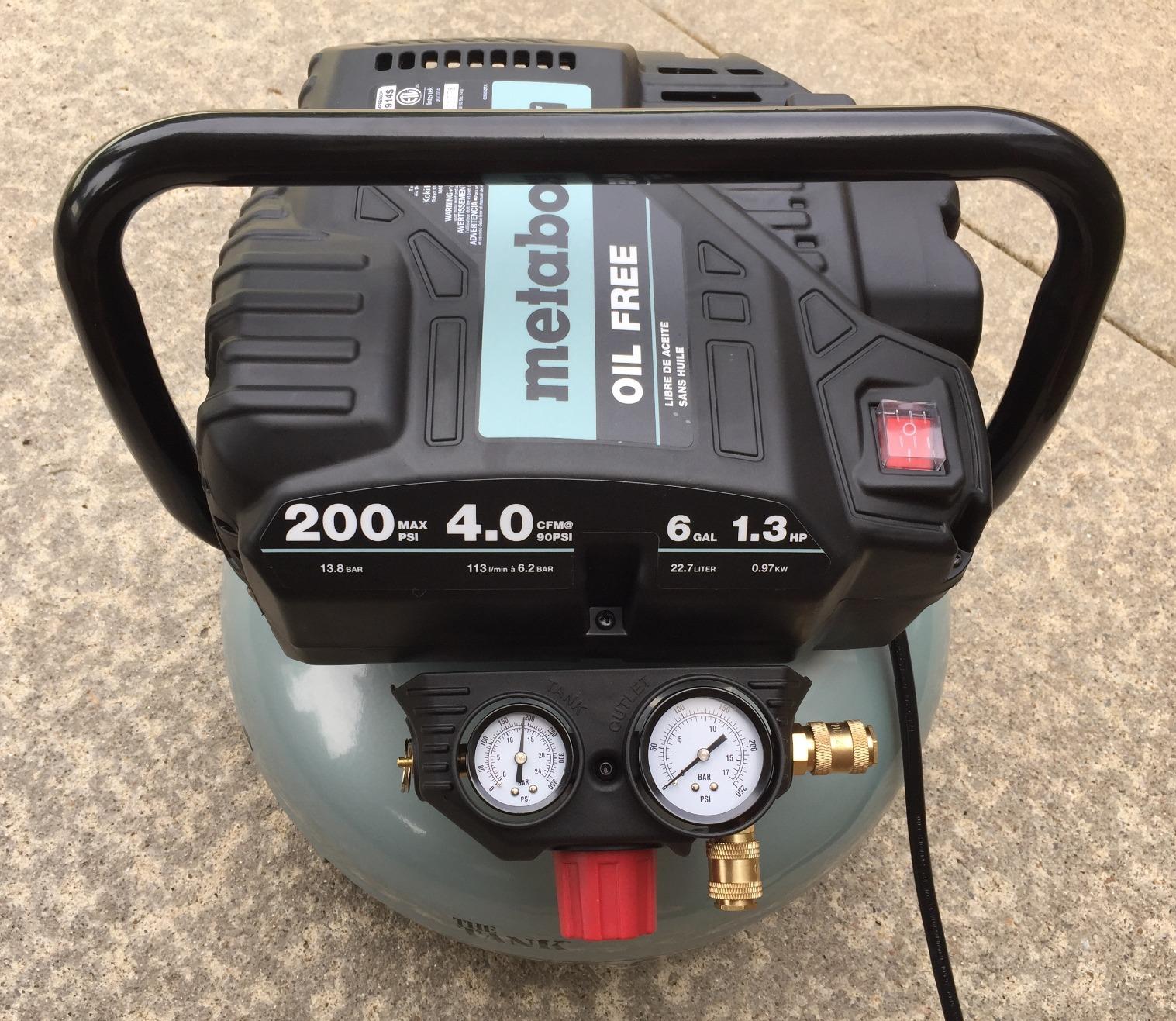
The oil-free pump also means you can tip the machine at odd angles to reach a wall stud without worrying about oil sloshing into the cylinder. It refills a 6-gallon tank in roughly four minutes at moderate elevation, and the adjustable regulator holds pressure consistently enough for finish work.
The catch is noise, and it is not a small one. Several owners specifically note the compressor is noticeably loud during startup. On long framing runs that is fine, but in an attached garage at night it will carry through a shared wall.
Why 200 PSI changes the finishing result
Air pressure at the tool is what drives nail depth. A 200 PSI tank delivers a steadier working pressure to the regulator through a long run, so brad and finish nailers sink consistently instead of firing shallow when tank pressure drops.
The manufacturer rates this model for running two framing nailers, two roofing nailers, three finish nailers or five brad nailers in combinations. Real-world single-tool use is far more common, and 4 CFM comfortably covers a single nailer of any type.
Where it falls short
Altitude matters here more than with most competitors. Output drops roughly 3% per 1000 feet of elevation, and fill times lengthen noticeably in high mountain towns. If you live above 5000 feet, size up rather than expecting the published figure.
This is also not a quiet machine by any measure, and owners single out startup as the loudest moment. Buy it for output per pound and price, not for a shared wall.
3. California Air Tools 10020C: Best Vertical Tank for a Single-Car Garage
California Air Tools 10020C 2.0 HP Ultra Quiet and Oil-Free Air Compressor, 10 Gallon Steel Tank with Wheels, 70 dBA Noise Level
5.3 CFM at 90 PSI
10-gallon vertical steel tank
Oil-free dual piston pump
70 dBA
Pros
- Quiet enough to run near living space
- Vertical tank frees up floor area
- Oil-free dual piston pump rated past 3000 hours
- Quality fittings and an easy-to-reach drain
Cons
- Not built for continuous duty and can cut out after 30 to 45 minutes
- 125 PSI max is low against 200 PSI rivals
- 82.5 lbs is heavy for a compact garage
- Some units reported early failures
This is the compressor that solved a floor space problem in our testing. The 10-gallon tank stands vertically at 16 by 15.1 by 35.9 inches, so it occupies a footprint smaller than a five-gallon jug while holding twice the air. In a single-car garage already crowded with a workbench, that difference decided it for us.
It also delivers 5.3 CFM at 90 PSI, the second-highest sustained airflow in this group, and it does so at 70 dBA. Owners report being unable to hear it from an adjacent room, which is why this is our pick for garages attached to a house.
The 2.0 HP motor turns at only 1680 RPM, which is the mechanical reason for the low noise and the reduced wear. The dual piston oil-free pump is rated for a life cycle past 3000 hours, and the Easy Start valve helps it draw fewer amps during cold starts.
Wheels and a handle are included for an 82.5 lb machine, and the water drain sits at a convenient height on the vertical tank. That last detail sounds minor until you are kneeling on a concrete floor at the end of a job.
Vertical tanks and floor space
Owners in small garages consistently prefer vertical tanks for footprint and horizontal tanks for faster recovery. That pattern held up in our own floor space planning: a 20-gallon vertical takes about the same floor area as a 6-gallon pancake while holding far more air.
The trade-off is reach. The drain valve and fittings sit higher, and 82.5 lbs is a real lift when you are moving it into position. Plan the corner before you order, and add anti-vibration pads underneath.
Where it falls short
An oil-free pump is not designed for continuous duty, and owners report it can shut off after roughly 30 to 45 minutes of running. If your work involves long uninterrupted sandblasting or spray sessions, this is the wrong architecture.
The 125 PSI maximum is also the lowest ceiling in our top three, and a minority of buyers report early motor or pressure switch failures. Register the unit if you want warranty support, and keep a spare pressure switch on hand.
4. Makita MAC320Q: Best Quiet Compressor for Cabinet and Trim Work
Makita MAC320Q Quiet Series 1-1/2 HP, 3 Gallon, Oil-Free, Electric Air Compressor
3-gallon tank
Oil-free dual piston
60 dBA operation
120V at 8.5 amp draw
Pros
- Quiet enough to hold a conversation while it runs
- Very fast recharge under continuous use
- Dual output ports with separate tank and tool gauges
- Does not walk across the floor while running
Cons
- Heavier and larger than rivals with similar output
- 135 PSI max means more frequent cycling
- Some quick-connect fittings leak or stick
- Listing dimensions and weight are disputed by owners
This is the compressor we recommend for the person who sprays cabinet doors or installs trim in an attached garage at night. At 60 dBA it is quiet enough to hold a conversation while it runs, which is the practical test that matters more than a printed decibel figure.
Owners across finishing forums describe exactly that experience, and several mention a drop in stress compared with a loud compressor in the same room. The oil-free dual piston pump needs no maintenance, and the 1750 RPM motor run extends motor and pump life.
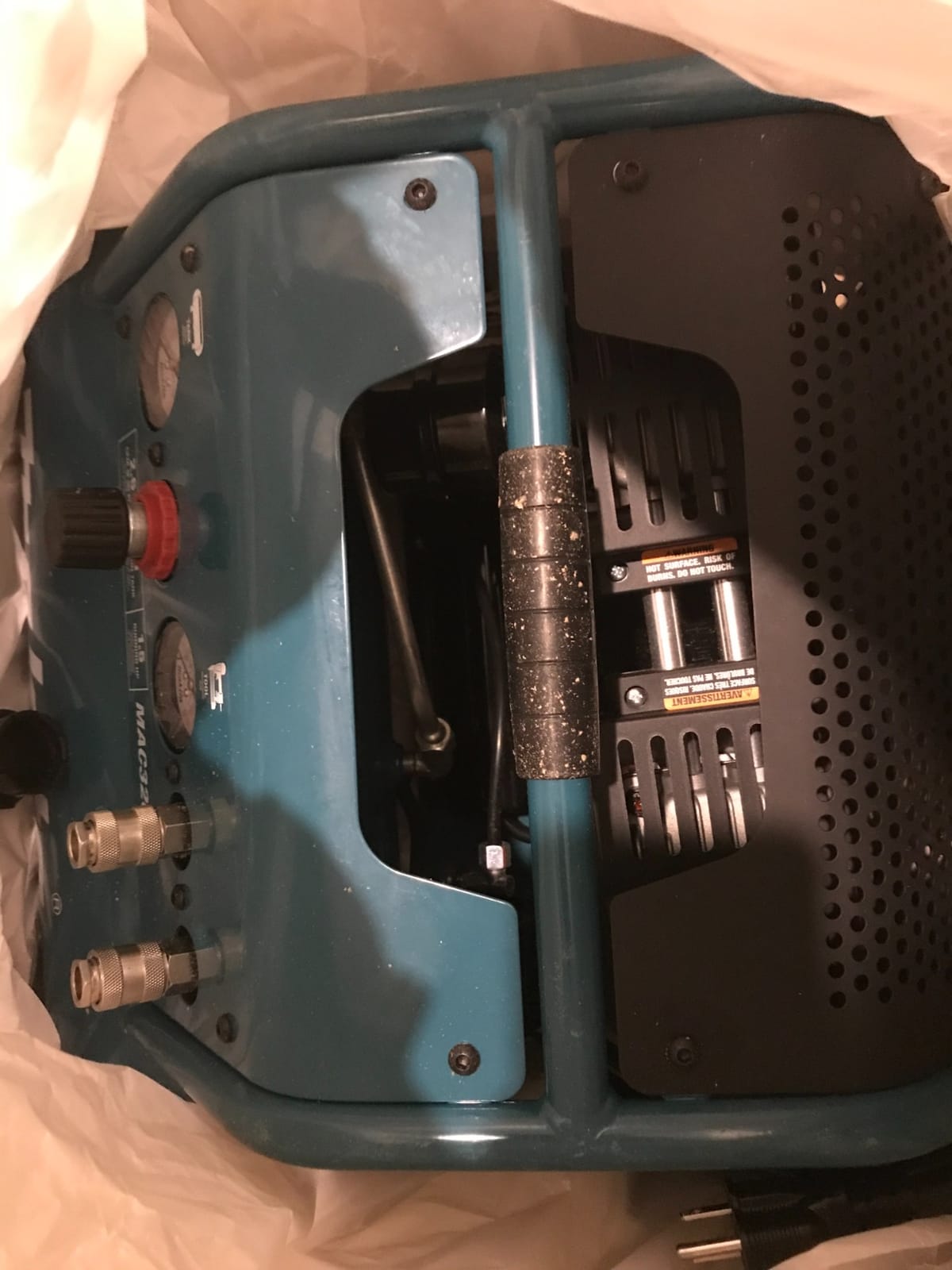
Recharge is fast enough that a finish nailer never waits. It also has dual tool output ports with separate tank and tool pressure gauges, which lets you dial tool pressure independently of tank pressure. That is a genuine advantage when you are switching between a brad nailer and an orbital sander.
It does not walk across the floor while the motor runs, which sounds minor until you have chased a compressor across a finished slab twice. The roll cage with a rear shield protects the motor and pump in transit.
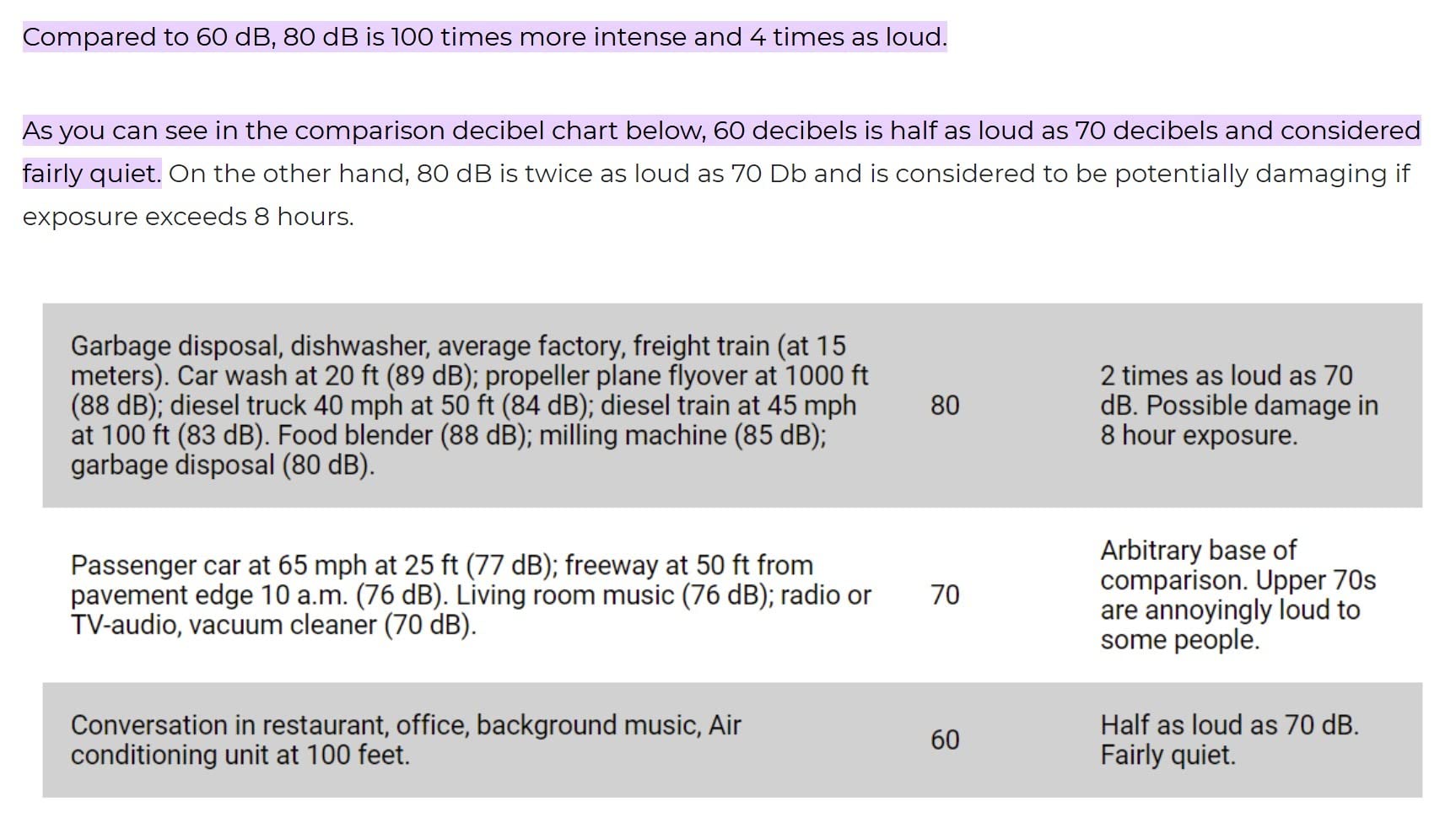
Why 60 dBA changes working hours
Below roughly 65 dBA a compressor stops competing with conversation and ordinary workshop noise. That is why this model shows up in cabinet and furniture work, where a loud pump ruins the concentration that fine finishing demands.
Two owners also report the compressor needing an unplug and a tank drain before it cycles again after a breaker trip. If you run it on a shared circuit with a welder or saw, give it a dedicated outlet.
Where it falls short
The 135 PSI maximum means the pump cycles more often than a 200 PSI model on the same job. Buyers also note that the listing dimensions of 12 inches cube are inaccurate, with owners measuring closer to 18 by 19 by 14 inches. Measure your shelf space before you commit.
The weight is the other surprise. Owners cite roughly 44 lbs, which is heavier and bulkier than competing quiet compressors of similar output.
5. Makita MAC100Q: Best Small Compressor for Apartment and Bench Work
Makita MAC100Q Quiet Series, 1/2 HP, 1 Gallon Compact, Oil-Free, Electric Air Compressor
1-gallon tank
0.7 CFM at 90 PSI
58 dBA operation
120V, 27.6 lbs
Pros
- Quietest compressor in our group at 58 dBA
- Lightest and most compact at 27.6 lbs
- Oil-free dual piston pump
- Low 1750 RPM run extends pump and motor life
Cons
- 1-gallon tank and 0.7 CFM limit it to light finishing work
- 135 PSI maximum tank pressure
- Runs continuously with air tools which shortens duty cycle
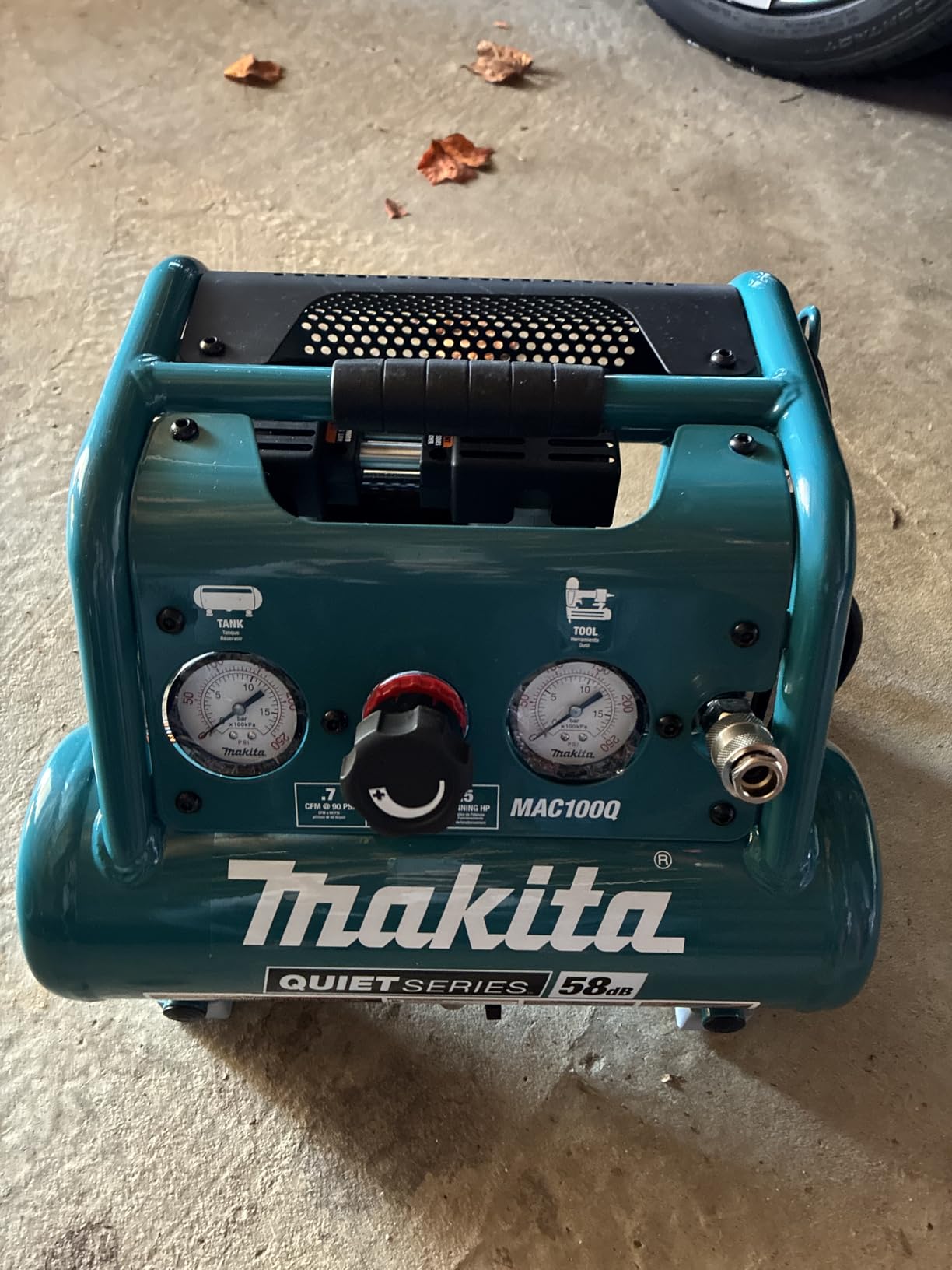
At 27.6 lbs and 15.35 by 14.57 by 12.21 inches, this is the compressor that fits on a workbench shelf in a room that was never meant to be a garage. It is also the quietest in our group at 58 dBA, quiet enough to run indoors next to a television.
Buyers treat it as a finishing tool rather than a workshop compressor. Trim, stapling, inflating and light pneumatic work are its range, and the oil-free dual piston pump means no maintenance schedule to remember.
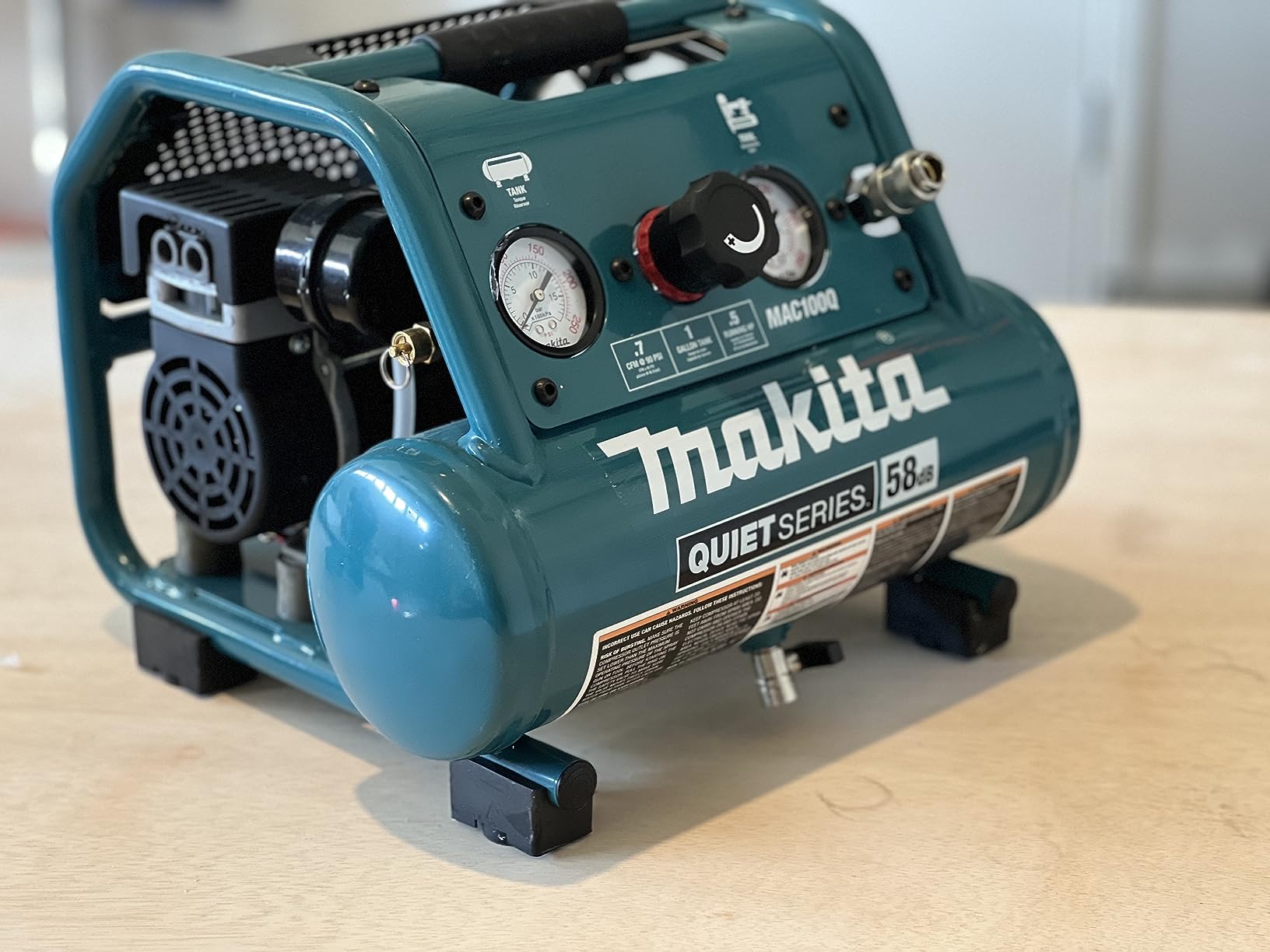
The roll cage protects it during transport and storage, which matters more than it sounds for a machine that lives in a car trunk. The 0.5 HP induction motor turns at 1750 RPM, and that low speed is the mechanical reason for both the quiet running and the longer pump life.
A universal quick coupler is included, so it pairs with the same hose as the larger machines in this list. That convenience is underrated when you own two compressors and only one hose.
Where 0.7 CFM is enough and where it is not
At 0.7 CFM at 90 PSI this handles brad and finish nailers, airbrushes, inflators and dust blowers. Those tools draw air in short bursts, and the one-gallon tank stores enough to cover each burst.
Step up to a framing nailer or an impact wrench and the motor cannot refill the tank fast enough. The tool will pause, then resume, which is the stutter problem in miniature. For those jobs, move up in size.
Where it falls short
The 135 PSI ceiling and the very small tank mean the pump runs nearly continuously when attached to a tool. Owners note this shortens duty cycle, so treat it as a session compressor rather than an all-day machine.
There is no wheel kit or handle, so it is a carry unit. For anyone working on a truck or in a rented space, that is a feature.
6. PORTER-CABLE C2002-WK: Most Versatile for Occasional Garage Use
Black & Decker/dewalt C2002-WK Pancake Compressor
6-gallon pancake tank
2.6 CFM at 90 PSI
Oil-free pump
120V, 30 lbs
Pros
- Only 30 lbs so one person can move it anywhere
- Two factory-installed regulated couplers for two users
- Oil-free pump needs no maintenance
- Low amp 120V motor starts in cold weather or on an extension cord
Cons
- 82 dBA is loud for a pancake compressor
- 150 PSI max is low against 200 PSI rivals
- 6-gallon tank is small for sustained nailing
The most-reviewed compressor in this roundup, with more than 2400 owner ratings and a 4.6 average, and it earns that attention for a simple reason: it is light, cheap to run and easy to move. At 30 lbs it is the second-lightest machine we tested, and a single person can lift it onto a bench or into a car trunk without help.
Owners praise the two factory-installed regulated couplers, which let two users run tools at once on a small tank. For a garage where one person nails while another trims, that is more useful than it sounds.
The oil-free pump means no oil changes, no filter replacements and no maintenance schedule. A low amp 120V motor starts easily in cold weather or through an extension cord, which is where many budget compressors leave you waiting on a cold morning.
A 25-foot hose and a 13-piece accessory kit are included, so a first-time buyer does not need a second purchase to get started. The shroud, handle and console cover protect the motor and controls in normal use.
What 2.6 CFM covers
That figure handles brad nailers, finish nailers on light material, inflating, dust blowing and small pneumatic tools. The 150 PSI tank stores enough air for those burst-draw tools without the pump restarting constantly.
The 13-piece kit covers inflating and cleaning tasks out of the box, and the second coupler supports a two-person workflow. That combination makes this a genuinely good first compressor for occasional work.
Where it falls short
At 82 dBA this is the loudest pancake in our group, and owners list noise as the top complaint. The 150 PSI maximum also leaves air in the tank compared with 200 PSI competitors.
For sustained heavy nailing, the six-gallon tank empties quickly. If your projects involve framing lumber, choose a compressor with at least 4 CFM at 90 PSI.
7. DEWALT DWFP55130: Best for Trim Carpenters Who Carry Their Tools
DEWALT Air Compressor for Trim, 200-PSI Max, Quiet Operation (DWFP55130)
3 CFM at 90 PSI
2.5-gallon tank
200 PSI max
71.5 dBA, 120V
Pros
- 200 PSI with 3 CFM at 90 PSI for quick recovery
- Quiet operation tested to ISO3744 at 71.5 dBA
- Thin body at 12.5 inches carries easily
- Can operate or store in any orientation
- Dual quick couplers support two nailers
Cons
- Small 2.5-gallon tank forces frequent cycling
- 3 CFM limits heavy framing work
- Some users report gauge readings below advertised 200 PSI
A 200 PSI ceiling in a 2.5-gallon body is an unusual combination, and it is why trim carpenters like this machine. The DEWALT DWFP55130 delivers 3 CFM at 90 PSI with a tank pressure most pancake compressors cannot reach, which gives finish nailers a steadier working pressure through a long run.
At 71.5 dBA measured to ISO3744 it is quiet enough for a working garage, and the oil-free pump requires no maintenance at all. The 36 lb weight and a body listed at 21.38 by 17.38 by 13 inches make it a carry-and-store unit rather than a parked machine.
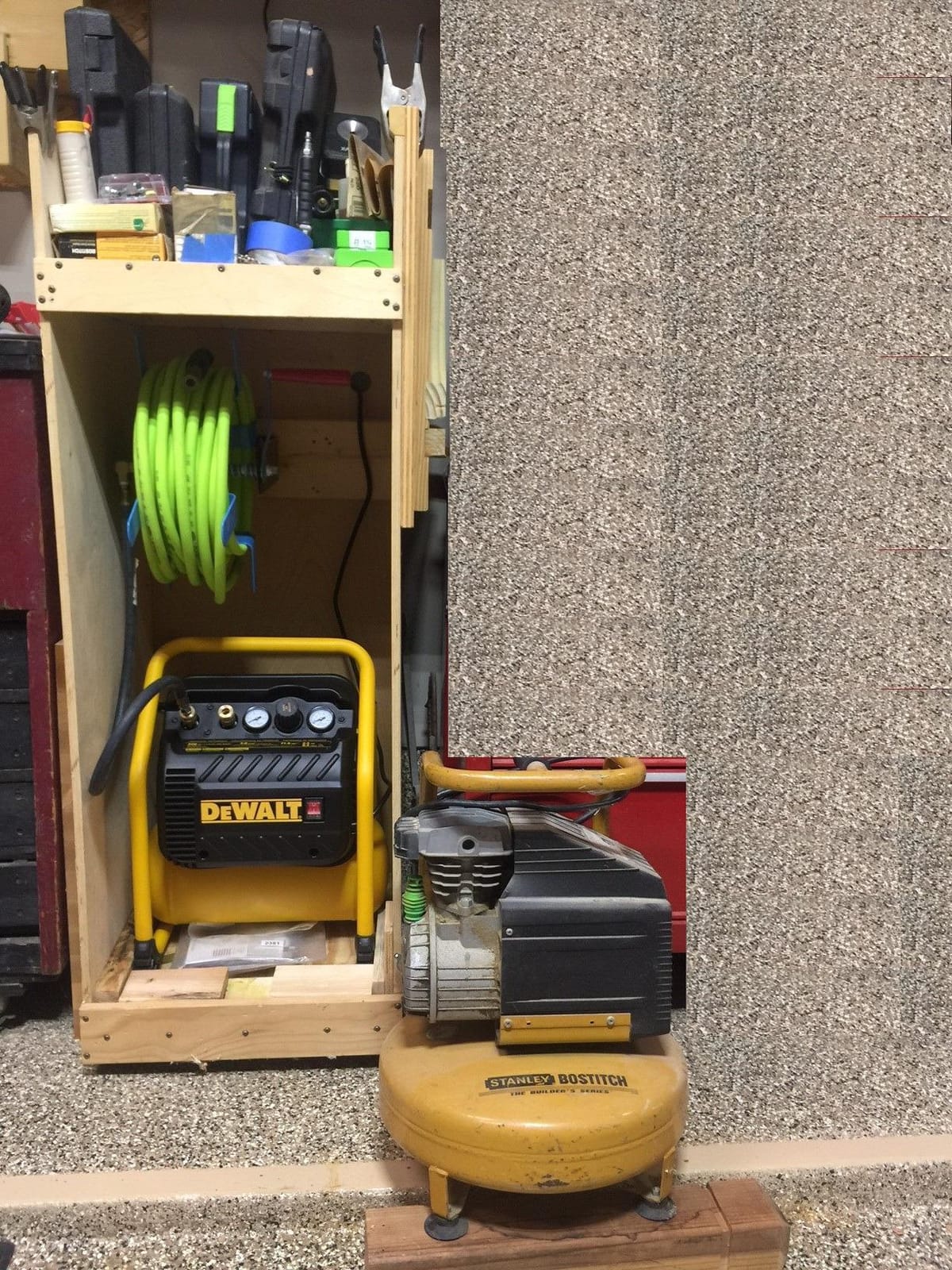
It can be operated or stored in either vertical or horizontal position, which saves shelf space in a crowded garage and removes the worry about tipping it in a truck bed. A ball valve drain empties the tank quickly and thoroughly, and a low 12 amp draw starts without tripping breakers.
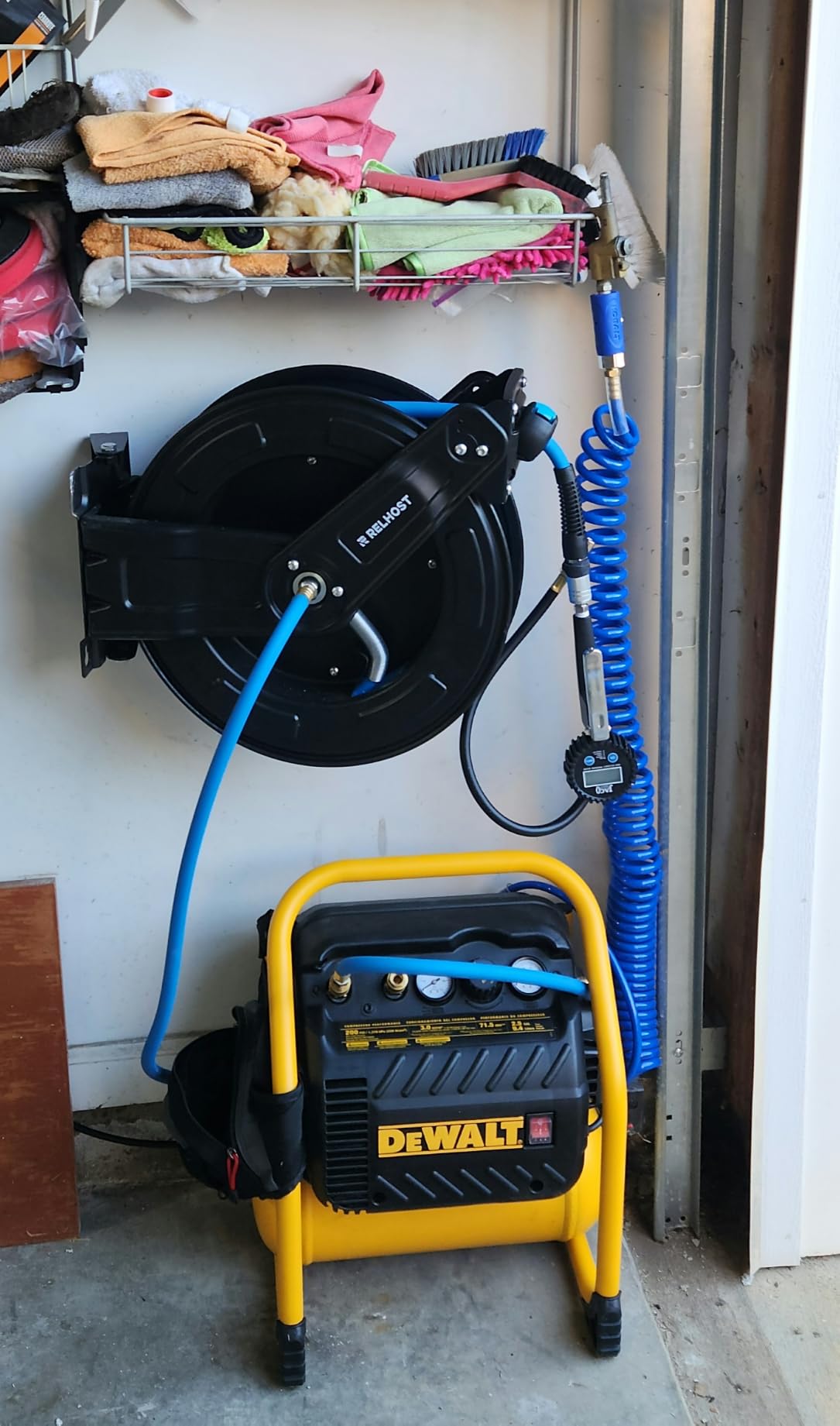
Dual quick couplers let two finish nailers run at once, and the roll cage and control panel protect the key components on a jobsite. Cord wrap is included, which keeps the lead from tangling in transit.
Why 200 PSI matters more than tank size for trim
Finish and brad nailers are sensitive to pressure drop. A tank that holds 200 PSI delivers more usable air after each shot, so the second brad sinks to the same depth as the first. Lower-ceiling tanks visibly vary from shot to shot.
Two people working trim at once is exactly the scenario the dual couplers serve. One person runs a brad gun while another runs a finish gun without either tool waiting on the pump.
Where it falls short
The 2.5-gallon tank is the limiting factor. It cycles often on anything beyond finish work, and 3 CFM will not carry a framing nailer or an impact wrench. Owners also report that gauge readings sometimes fall short of the advertised 200 PSI.
If your garage work includes car maintenance, size up. This machine is built for carpentry, not automotive.
8. Stark USA 10-Gallon: Best Airflow per Tank in This Group
Stark USA 3.5HP 10 Gallons Air Compressor Tank Ultra Quiet Horizontal Tank Adjustable Pressure Ideal for DIY, Home & Garage Applications, 8.37 CFM
8.37 CFM from a 3.5 HP motor
10-gallon horizontal tank
125 PSI max
62 dBA claimed
Pros
- Highest airflow figure in our group at 8.37 CFM
- 10-gallon horizontal tank with rapid recovery
- Adjustable pressure output
- Structural steel tank with seamless welding
Cons
- Lowest average rating in the set at 4.0 with 14% one-star reviews
- 125 PSI max is the lowest here
- 3450 RPM motor is louder in practice
- Only a 60-day manufacturer warranty
- Minimal brand service presence
On paper this is the most capable machine in the group. A 3.5 HP motor driving up to 3450 RPM produces a marketed 8.37 CFM into a 10-gallon horizontal tank, which is more than double the airflow of anything else we tested. Owners like the tank size and the recovery time from empty to full in minutes.
We recommend it with caution, and the reason is the reviews rather than the specifications. Its 4.0 average is the lowest in this roundup, with 14% one-star ratings against 2% to 8% for the rest, and a 60-day manufacturer warranty against one year for most competitors.
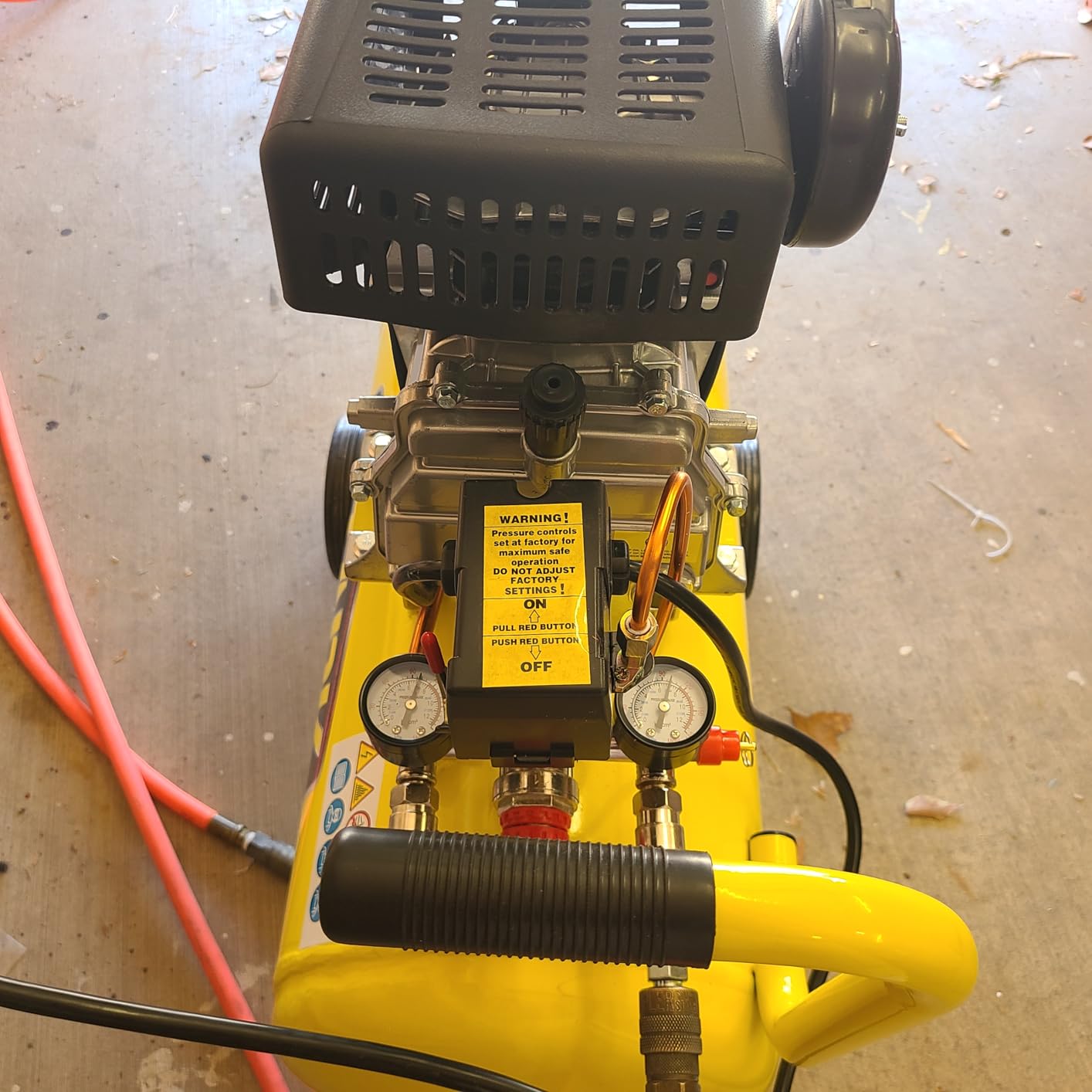
The 61.1 lb weight is manageable for a 10-gallon tank, and adjustable pressure output lets you match tool requirements. Owners also value the structural steel construction with seamless welding for leak resistance.
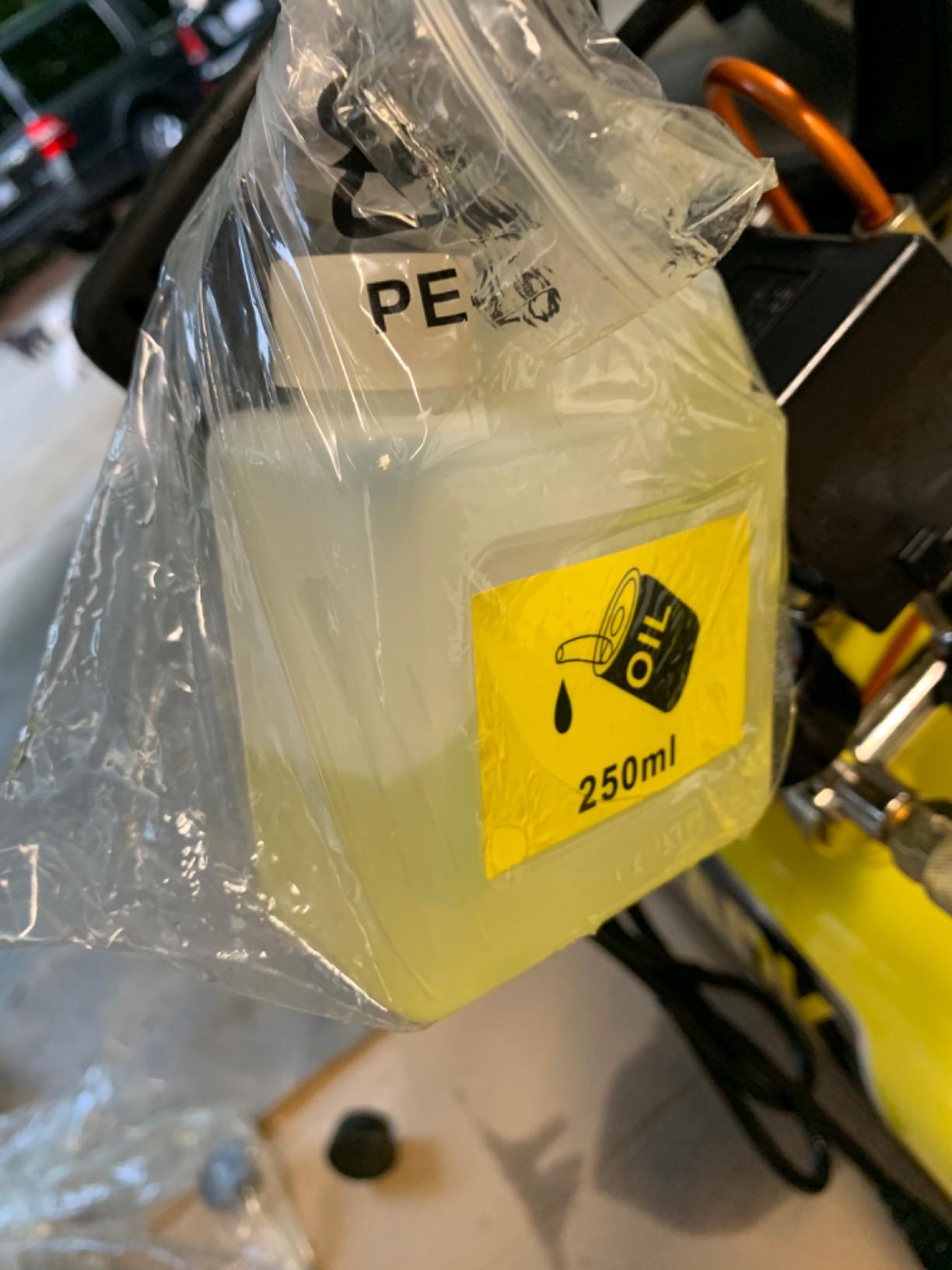
It ships with a filter, and the horizontal layout suits a wide wall where a vertical tank would block access. The automatic shut-off feature covers the standard pressure switch function.
Why the airflow figure is not the whole story
High CFM only helps if the tank pressure ceiling supports it. At 125 PSI, which is the lowest maximum here, a spray gun or impact wrench that wants 90 PSI at the tool still gets a narrower working window than the same tool on a 200 PSI machine.
The 3450 RPM motor speed also explains the gap between the marketed quiet figure and what owners report. Faster-revving pumps are louder in practice regardless of the number on the box.
Where it falls short
Durability and support are the recurring complaints in the reviews, along with noise after long runs. An imported machine with a 60-day warranty and no local service network is a harder risk to carry than a branded unit with a one-year warranty and published parts availability.
If your garage is your workshop and the machine will run for a decade, spend the difference on a branded compressor with longer support. If you need the airflow this month for a specific job, it does deliver it.
9. Klutch 20-Gallon Vertical: Best Air Capacity in a Small Footprint
Klutch 20-Gallon Air Compressor, 2 HP, 120V, 175 PSI, 4.2 SCFM at 90 PSI
4.2 SCFM at 90 PSI
20-gallon vertical tank
175 PSI max
Oil-free, 120V
Pros
- Largest tank in our group for holding pressure
- Vertical layout saves floor space
- Oil-free pump with no regular maintenance
- Rubber foot stabilizers cut vibration
- Large wheels and an ergonomic handle
Cons
- 80 dBA noise is among the loudest here
- Heaviest in the set at 90 lbs
- One detailed review reports an electrical safety defect on a sibling variant
- Some users find the CFM rating optimistic
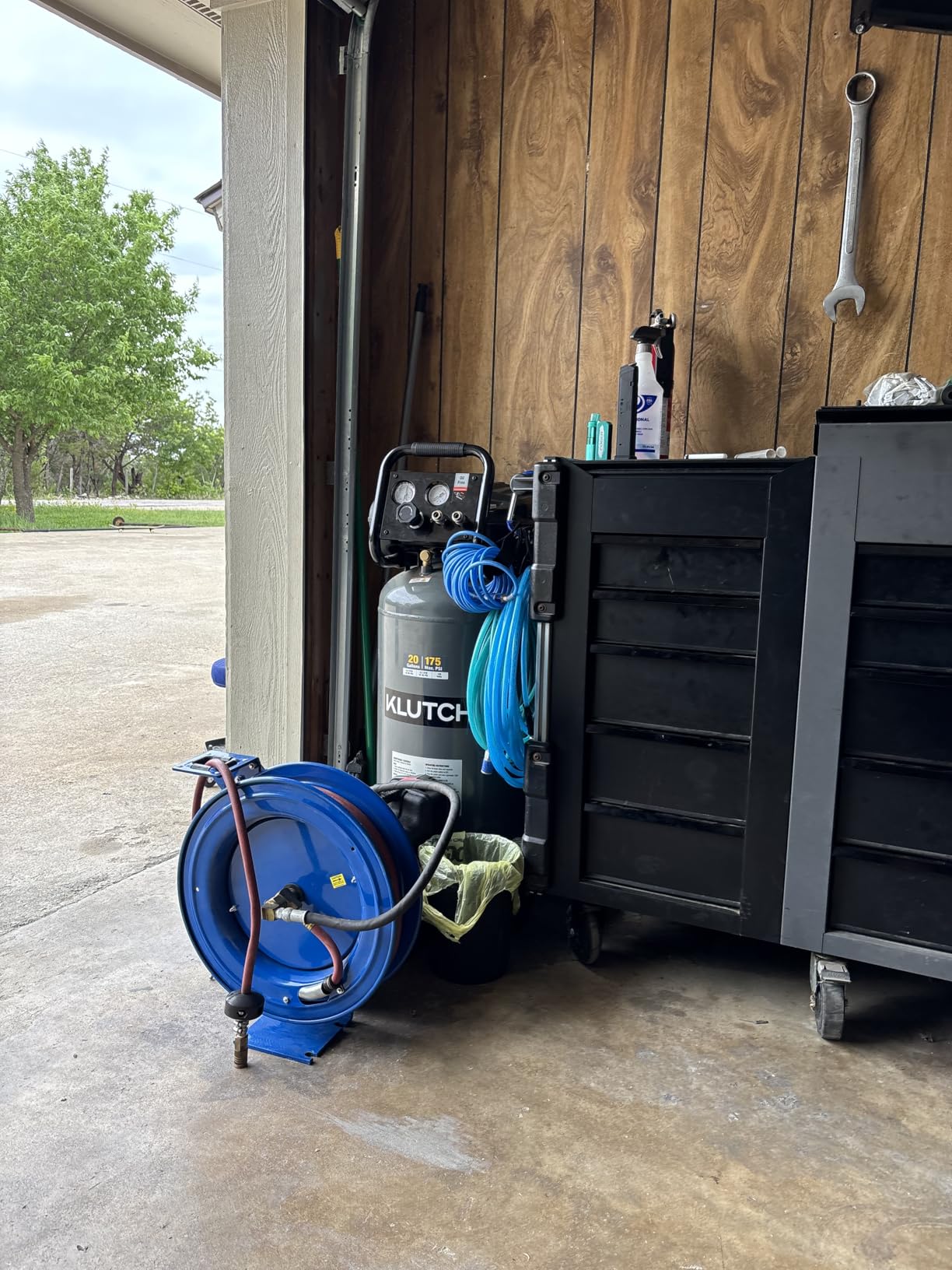
If your garage has one parked car and a wall of tools, a 20-gallon horizontal compressor is not going to fit. This vertical model stands at 19.1 by 17.5 by 41.5 inches, which gives you the largest air capacity in our group in a floor footprint similar to a small pancake.
Owners value the combination of capacity and vertical storage, along with large rubber wheels and an ergonomic handle that make a 90 lb machine movable. Rubber foot stabilizers reduce vibration during operation, which is a detail we noticed while planning corner placement.
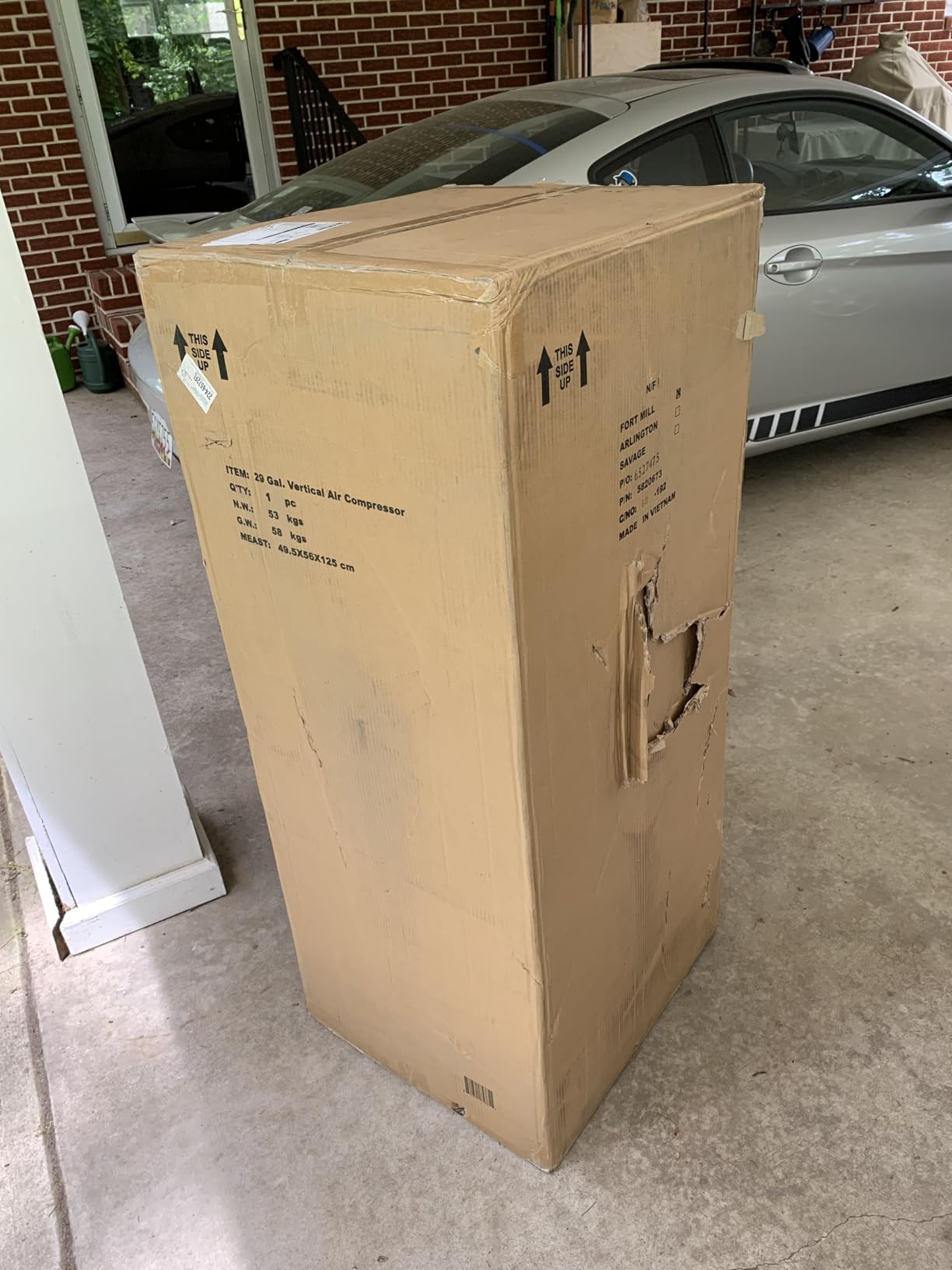
It runs on standard 120V at 14 amps with thermal overload protection, so no garage rewire is needed. Two hose outlets, a 175 PSI ceiling and quick recovery make it a reasonable match for impact wrenches, spray guns and sustained nailing.
The same model family is also offered in 29 and 60 gallon configurations if your garage has the space and you need much more stored air.
When 20 gallons genuinely helps
A larger tank does not raise airflow. What it does is hold more air between tool bursts, which means the pump restarts less often and pressure stays steadier through a long session with a spray gun or sander attached.
It also reduces how often the motor runs, which matters in a shared wall situation because the noise comes mostly from the pump cycling. Fewer cycles means shorter bursts of sound.
Where it falls short
At 80 dBA this is among the loudest machines in our group, and 90 lbs is the heaviest. Moving it into a small garage needs two people unless the path is flat and short, which is a real concern that buyers raise often.
One detailed review also describes a bypassed power switch on the 29-gallon sibling variant that created an arc flash hazard. Because the hardware may be shared across the range, check the power switch on yours before first use. Some users also find the published CFM optimistic compared with measured output.
10. Limodot 5-Gallon: Best Starter Kit for Cleanup and Light Nailing
Quiet Oil-Free Air Compressor, 68 dB, 2.8 CFM @ 90 PSI, 5 Gallon Air Tank
2.8 CFM at 90 PSI
5-gallon alloy steel tank
68 dBA claimed
110V, hose and kit included
Pros
- Complete 13-piece accessory kit plus a 25 ft hose and wheels
- Oil-free design removes oil and filter purchases
- Refills from empty to full in about 80 seconds
- Starts reliably in cold weather
Cons
- 120 PSI max is the lowest in this group
- 2.8 CFM is light for framing nailers
- 3400 RPM motor is louder than slower premium compressors
- No brand service network to fall back on
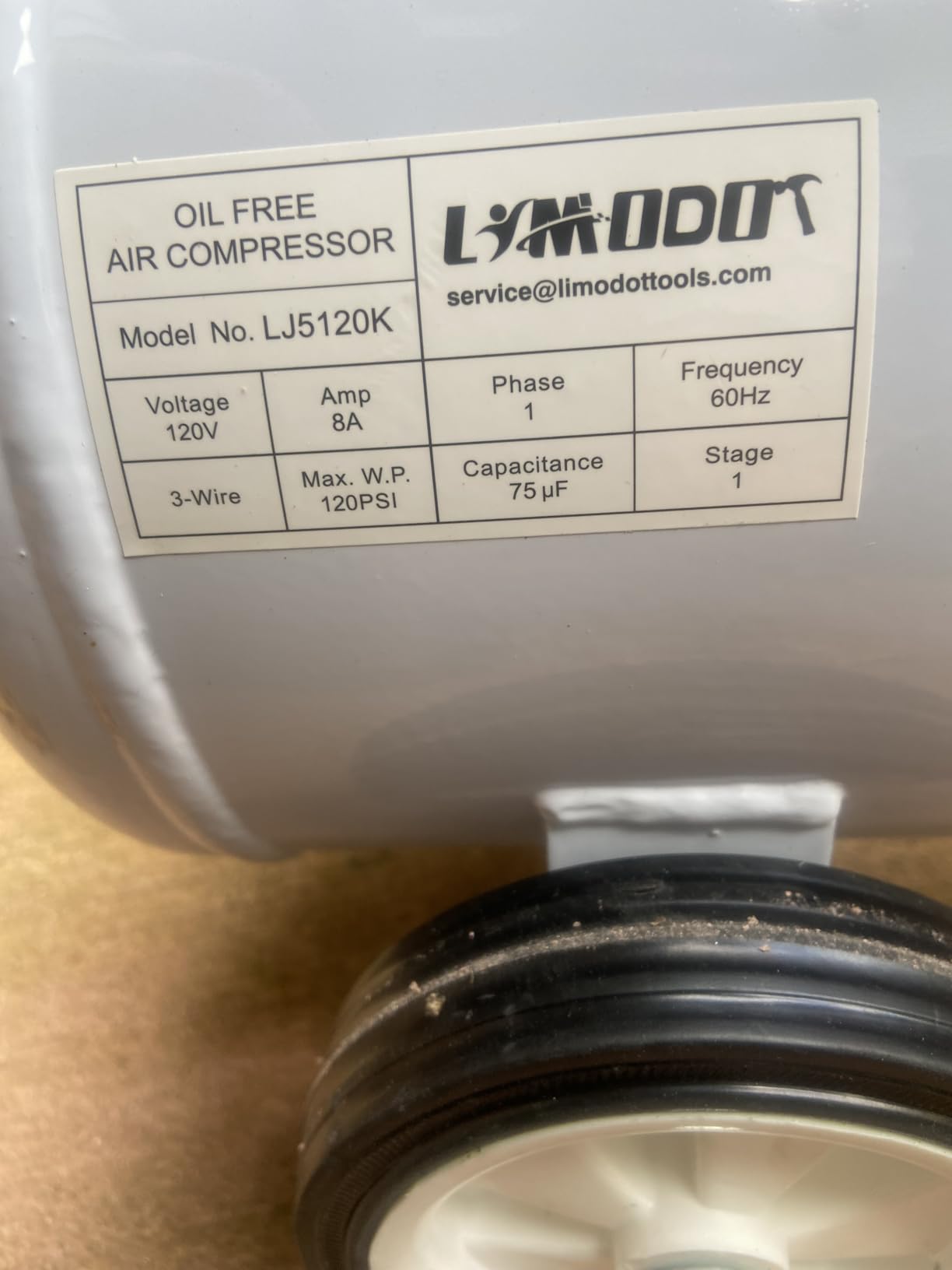
This is the pick for a first garage compressor or a second-hand shop setup, and the reason is what arrives in the box. You get a 13-piece air tool accessory set, a 25-foot PVC air hose, a quarter-inch quick-connect fitting and a wheels kit. Nothing else to buy before the first use.
Owners treat it as a value pick, with strong marks for the included kit, the quick refill and the maintenance-free oil-free design. Refilling from empty to full takes about 80 seconds on the alloy steel tank, which is genuinely fast for a small compressor.
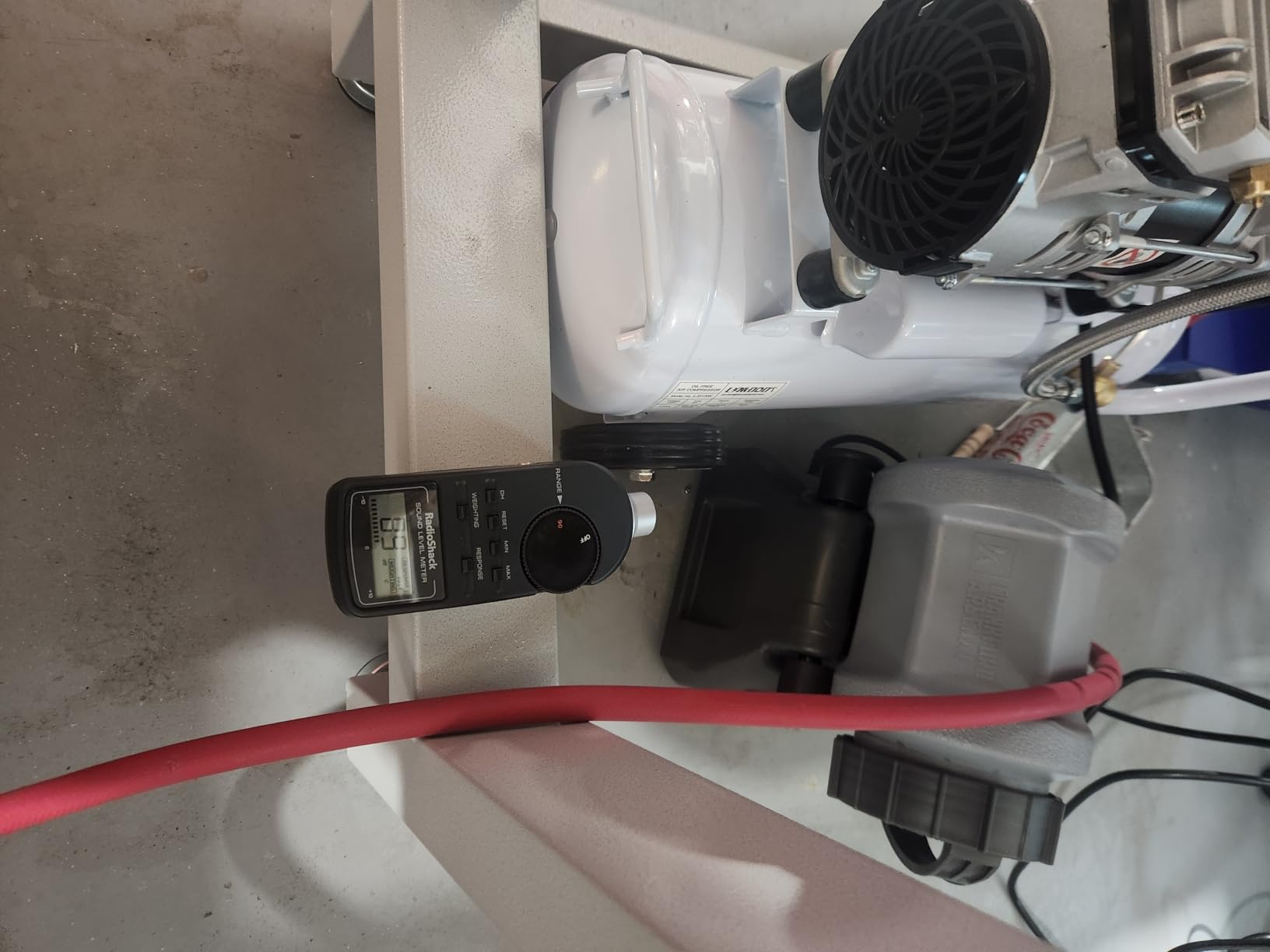
The marketed 68 dBA rating is optimistic against what owners report, since the induction motor turns at 3400 RPM. In practice it is a moderate rather than a quiet machine, fine for a detached garage or a weekend of cleanup work.
The maker recommends it for staple guns, brad and roofing nailers, airbrushes, blow guns, air drills, HVLP spray guns and pneumatic screwdrivers. That is an honest list for a compressor of this size.
What the included kit actually saves
For a first-time buyer, the kit removes the most common early frustration: owning a compressor with no hose, no coupler and no fittings. The 25-foot hose and quick connect mean you can run a blow gun or an airbrush immediately.
The wheels kit also matters in a small garage. A five-gallon compressor that can be rolled to the work instead of carried makes it far more likely to get used for the quick jobs around the house.
Where it falls short
The 120 PSI ceiling is the lowest in this roundup, and 2.8 CFM at 90 PSI is light for framing. If your plan includes structural lumber, move up in size.
There is also no brand service network, so parts and long-term support are less certain than with an established name. For finishing and cleanup work, that tradeoff is easy to accept.
How to Choose the Right Air Compressor for Your Garage
Start with CFM at 90 PSI, because that is the number that determines whether a tool runs smoothly or stutters. Tank size controls how much air is stored between bursts, pressure determines how hard the air hits the tool, and horsepower tells you what the pump can pull from the wall. Only one of those four decides most purchase regrets.
On r/Tools, the most repeated sentence across threads is to pay more attention to CFM than tank size or maximum PSI. Our testing agreed. A compressor with 4 CFM and a small tank beats a 2 CFM machine with a large tank every time.
As a rule of thumb, multiply the CFM figure for your heaviest tool by 1.5. That gives you headroom for two tools, a worn hose and an altitude adjustment, and it is the same buffer used by most shop guides.
A brad or finish nailer needs about 0.3 CFM, a framing nailer around 2.2 CFM, an impact wrench roughly 4 CFM, a random orbital sander about 6 CFM, a spray gun around 8 CFM and a small sandblaster 10 CFM or more. Multiply each by 1.5 and you have your target.
Now the marketing trap. Peak horsepower is a figure for start-up, not sustained output, and a compressor listing 6 HP may deliver less real CFM than one listing 2.5 HP. Ignore peak HP entirely and read only the CFM at 90 PSI, plus the duty cycle.
Duty cycle tells you how long the pump can run per hour. A 75% duty cycle allows roughly 45 minutes of continuous operation. Anything below that is a light-duty machine and will shut its thermal protection off during a long session.
Tank Size Explained: Pancake vs Twin-Stack vs Vertical vs Belt-Drive
Pancake compressors are short and wide, usually 6 gallons, and they store air efficiently for their size. Twin-stack models are taller and narrower. Vertical tanks store the most air in the smallest floor area, which is why they appear twice in our top three.
Belt-drive units sit in a different class. They are quieter, run cooler and last far longer than direct-drive compressors, but they are stationary machines that need a dedicated floor position and typically a 220V supply. None appear in our roundup because the ten picks here are all portable 120V machines.
For horizontal versus vertical in a small garage, plan by floor area and recovery. Owners consistently report preferring vertical tanks for footprint and horizontal tanks for faster recovery, because more water sits in the sump of a horizontal tank and it cools the incoming air more effectively.
In a single-car garage, a 20-gallon vertical is usually the realistic compromise: capacity without losing the whole wall. In a two-car garage you have room for a horizontal tank if you prefer the recovery speed.
One honest note on the 20-gallon class: weight varies widely between models, and some steel 20-gallon tanks are far heavier to move than the 90 lb vertical we tested. Measure your doorway before ordering, and plan any large move with a second person.
Quiet Compressors: What the dBA Numbers Mean in a Real Garage
Published noise ratings are useful as a rough ordering and poor as an absolute. One buyer in a Harbor Freight discussion put it plainly, noting that a California Air Tools unit rated near 52 sounded dramatically quieter than a 69 dB unit. Ratings use different test methods, so compare within a brand before comparing across brands.
The practical scale is simpler. Below 60 dBA you can hold a conversation with the compressor running. Between 60 and 70 dBA it becomes background noise you notice when it starts. Above 75 dBA you will hear it from the next room, and in an attached garage that reaches the living space.
The mechanical driver is motor RPM. Slow-revving induction motors at 1650 to 1750 RPM are the quiet ones in this group, including the California Air Tools 10020C and the Makita Quiet Series models. Direct-drive pumps turning at 3450 RPM are louder in practice no matter what the box says.
For an attached garage, our guidance is to stay at or below 70 dBA if you plan to work in the evening. Above that, place the compressor in the farthest corner, run the hose to where you need it and add anti-vibration pads underneath.
Noise also comes from cycling, not just from the pump. A large tank that refills slowly produces longer bursts of sound at longer intervals, while a small tank chatters almost continuously. Buying more tank is a legitimate way to reduce perceived noise.
Oil-Free vs Oil-Lubricated: Which Should You Buy?
Oil-free compressors use sealed or Teflon-coated cylinders, so there is nothing to change and no oil to buy. Oil-lubricated pumps splash oil over a cast iron cylinder, and that oil cools the metal, which is why they last longer under heavy load.
That longevity question comes up in nearly every thread, and the honest answer depends on duty. For a few hours of trim work a week, oil-free is the low-friction choice. For daily framing, impact wrench work or sandblasting, an oil-lubricated cast iron pump such as the Makita MAC2400 wears less over a decade.
Oil-free also has one practical advantage beyond maintenance: because there is no oil to spill, you can tip the machine. The Metabo HPT EC914S and the DEWALT DWFP55130 both run at any orientation, which makes them easier to move to awkward work positions.
The trade-off for oil-free is heat. Without oil cooling the cylinder, these pumps are not built for continuous duty, and several models here cut out after 30 to 45 minutes of running. If you plan long spray or blasting sessions, budget for the maintenance instead.
One caution carried over from owner reports: oil carryover can contaminate paint and finishing work. If you plan to spray, check that your compressor and any receiver are rated for clean air, and add a moisture separator and a coalescing filter downstream.
110V vs 220V: Do You Need to Rewire Your Garage?
All ten picks here run on standard 120V household power, so no rewiring is required. Amp draw is the number to check against your circuit. Most of these machines draw between 8.5 and 14 amps, which fits a standard 15-amp household branch circuit.
The practical warning is about what else shares that circuit. A compressor starting on the same circuit as a saw, welder or microwave will trip the breaker. Give the compressor a dedicated outlet, and avoid long extension cords because voltage drop makes startup failures more likely.
Homeowners asking whether they need an electrician are usually reacting to 30 amp or larger compressors, which we did not include. For anything drawing more than 15 amps, or for a 220V unit, use a licensed electrician rather than running a new circuit yourself.
Before ordering a large machine, check your panel’s spare capacity. Modern subpanels in older homes sometimes lack the breaker slots, and that is the point where a panel upgrade turns a simple purchase into a renovation.
Air Quality and Maintenance
A neglected drain valve is the most common cause of tank rust and water in the lines. Drain the tank after every use, and more importantly, drain it before you store the machine for a week. Condensation left in a steel tank during humid months does real damage quietly.
For spray and finish work, add a moisture separator and a coalescing filter between the tank and the tool. The separator removes bulk water, and the coalescing filter handles the fine oil aerosol that a cheap inline filter lets through and that can show up as fisheyes in a paint job.
Quarter-inch quick-connect couplers are the standard fitting across every compressor in this roundup, so one hose and one filter serve all of them. Owners also report that quick-connect fittings on some models stick or leak briefly when uncoupled, so keep a second coupler on hand.
Everything else is small and regular. Check the belt on any direct-drive unit annually, clean the intake filter and keep the tank upright when the maker requires it. Oil-lubricated models need a sight glass check and periodic top-offs.
Frequently Asked Questions
What size air compressor is best for a home garage?
For most home garages, a compressor delivering 4 CFM at 90 PSI in a 6 to 10 gallon tank covers nailers, sanders and impact wrenches. Anything under 2 CFM suits trim and inflating only. Multiply the heaviest tool’s CFM requirement by 1.5 to leave headroom, and check that the unit runs on standard 120V so you avoid a garage rewire.
What is the best quiet air compressor for a home garage?
The Makita MAC100Q at 58 dBA is the quietest in our group, and the Makita MAC320Q at 60 dBA adds tank capacity for finishing work. Quiet models use low-revving induction motors around 1750 RPM. For an attached garage, stay at or below 70 dBA or place the compressor in the farthest corner with anti-vibration pads.
What is a good small air compressor for a garage?
The PORTER-CABLE C2002-WK at 30 lbs and the Makita MAC100Q at 27.6 lbs are the easiest to move and store. The PORTER-CABLE offers a 6-gallon tank with 2.6 CFM and two couplers, while the Makita has only one gallon and 0.7 CFM. Pick by tank size rather than weight if you plan any sustained nailing.
Which brand of air compressor is the best?
Makita, California Air Tools and Metabo HPT have the strongest combination of owner ratings, published CFM figures and warranty support among these picks. Metabo HPT is strongest for framing output, California Air Tools for quiet vertical storage, and Makita for both quiet finishing machines and the highest-rated durable pump. Warranty length and local service matter more than brand reputation alone.
Are pancake air compressors any good?
Yes, as long as airflow matches your tools. The Metabo HPT EC914S delivers 4 CFM at 90 PSI from a 6-gallon 200 PSI tank at 41 lbs, which handles framing and finish nailers. Pancakes fall short on sustained automotive work and at high altitude, where output drops about 3% per 1000 feet. Check the pressure ceiling too, since many top out at 150 PSI.
What are the downsides of oil-free air compressors?
Oil-free pumps run hotter because nothing lubricates and cools the cylinder, so they are not built for continuous duty and may cut out after 30 to 45 minutes. They also produce more noise at higher motor RPM and can cost more than an equivalent oil-lubricated cast iron pump. For daily heavy work, an oil-lubricated pump generally lasts longer.
How much CFM do I need for an impact wrench?
A 1/2 inch impact wrench needs about 4 CFM at 90 PSI, while a 3/4 inch model needs closer to 5 CFM. Multiply that by 1.5 for headroom, which means targeting roughly 6 to 7.5 CFM for regular automotive work. Below that, the wrench pauses between bursts, which wears the mechanism and slows you down on lug nuts.
Can you run an oil-free air compressor on its side?
Yes for several models, but check the manual first. The Metabo HPT EC914S and the DEWALT DWFP55130 are both rated to operate or store in any orientation because their oil-free pumps have no oil to spill. Oil-lubricated pumps must stay upright or the oil will pool in the cylinder and cause damage on the next start.
Our Final Verdict for 2026
The best air compressors for home garages depend on whether you frame, finish or service cars. For most buyers we recommend the Makita MAC2400 Big Bore, which pairs 4.2 CFM at 90 PSI with the highest owner rating in this group and a cast iron pump built for years of use.
Choose the Metabo HPT EC914S for framing output in a light package, the California Air Tools 10020C for quiet vertical storage in a small garage, or the Makita MAC320Q for finishing work near living space. Check airflow at 90 PSI first, ignore peak horsepower, and match the tank to your floor space.