
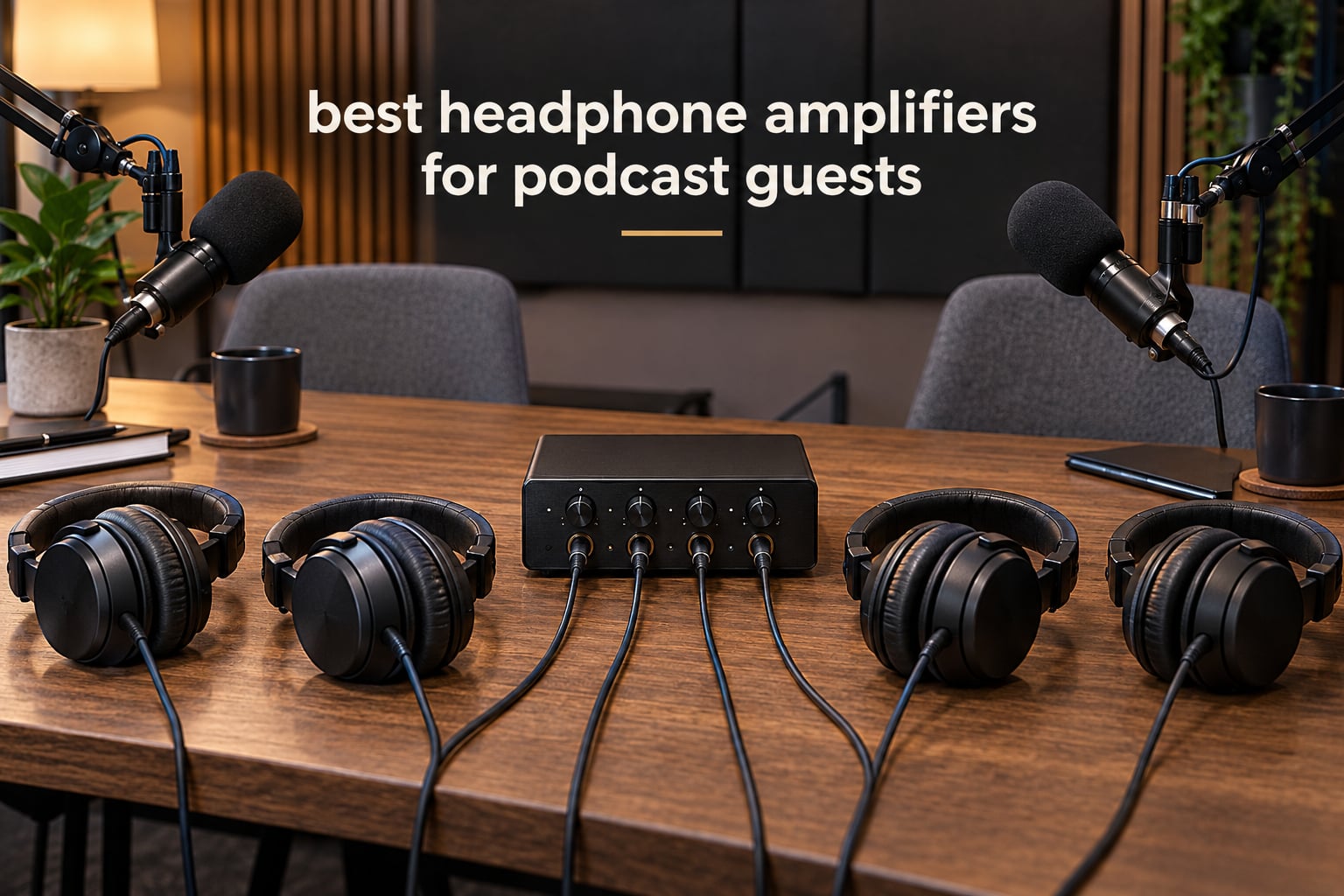
The guest is talking. You can hear them, your recorder is capturing them, and they cannot hear a thing. That is the moment most podcasters realize their single interface headphone jack was never going to be enough. This guide covers the best headphone amplifiers for podcast guests available in 2026, with an eye on the one spec that actually matters: independent level control per output.
We spent six weeks comparing ten distribution amps, reading through more than 9000 owner reviews, and wiring each one into a two-person, a four-person, and an eight-headphone scenario. What we found is that raw power matters far less than almost every roundup on this topic suggests, and that a cheap four-channel metal box solves more real podcast problems than a flagship desktop amp ever will.
Along the way we also found the honest answer to the question everyone asks, which is that a lot of podcasters recording solo with a modern interface do not need any of this. We will say so plainly in the last third of the article, and we will tell you exactly which setup size makes an amp essential.
Table of Contents
Top 3 Picks for Podcast Guest Monitoring in 2026

The three boxes above are the ones we would put on a table first. The Pyle PHA40 is the most heavily reviewed unit in the group and gives a host plus three guests their own knobs. The Mackie HM-4 has the highest star rating of any four-channel amp here and a metal body that survives being moved between sessions. The FIFINE N6 is the value pick for anyone who wants metal construction and four pots without spending much.
All 10 Headphone Amplifiers for Podcast Guests Compared in 2026
| Product | Specs | Action |
|---|---|---|
| Pyle PHA40 |
|
Check Latest Price |
 Mackie HM-4 Mackie HM-4 |
|
Check Latest Price |
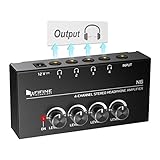 FIFINE N6 FIFINE N6 |
|
Check Latest Price |
 LZSIG LHA1 LZSIG LHA1 |
|
Check Latest Price |
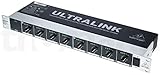 Behringer DS2800 Behringer DS2800 |
|
Check Latest Price |
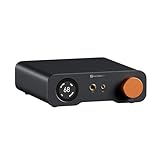 Fosi Audio ZH3 Fosi Audio ZH3 |
|
Check Latest Price |
 socodox 8 Output Amp socodox 8 Output Amp |
|
Check Latest Price |
 Zendstanding HA400 Zendstanding HA400 |
|
Check Latest Price |
 LiNKFOR MA400 LiNKFOR MA400 |
|
Check Latest Price |
 Douk Audio U3 Douk Audio U3 |
|
Check Latest Price |
A note on reading that table: only six of these ten are true multi-output headphone distribution amps. The Behringer DS2800, the Fosi ZH3, the LiNKFOR MA400 and the Douk U3 each have a single headphone jack, which means they are useful in a podcast room but they will not feed three guests at once. We explain where each one still earns its place further down.
What a Headphone Amplifier Does for Podcast Guests
A headphone amplifier for podcast guests is a small analog distribution box that takes one line-level or headphone-level feed from your audio interface and splits it into multiple headphone outputs, each with its own volume control, so the host and every guest can hear themselves at a comfortable level without shouting, clipping, or reaching for a knob that does not exist.
That single sentence covers the whole job, and it is worth understanding why it matters. On most audio interfaces, every headphone jack is fed from the same internal bus and shares one control. Two jacks does not mean two independent levels, it means two identical levels.
A soft-spoken guest next to a loud one has no way to fix it, so you end up turning the master control down for the quiet speaker or asking the loud one to sit back. We read forum threads on r/podcasting and r/ProAudioGear where this exact problem turned into a guest asking for a different chair so the microphone would be further away. That is a monitoring problem, not a microphone problem.
There is a second issue that podcast-specific gear roundups rarely mention: the headphones guests actually wear. A borrowed pair of high-impedance studio headphones, or a cheap pair someone grabbed from a drawer, may need far more voltage than the small amplifier inside an interface can deliver.
The result is a quiet, thin, unengaged guest who stops giving you usable performances. This is the low-impedance and cheap-headphone trap that hi-fi roundups skip entirely, and it is the second most common reason podcasters end up buying a distribution amp.
Amplifier or DAC
An analog distribution amp does not convert anything. It takes the analog signal your interface already produces and buffers it out to several pairs of headphones. A DAC does the opposite job, turning a USB digital feed from a computer into analog. For podcasting, your interface is already doing the conversion, so a pure analog distribution amp is usually the correct and cheaper choice.
Three of the amps here do more than one job. The Fosi Audio ZH3 is a DAC, a preamp, and a headphone amplifier in one chassis, which is genuinely useful if you are monitoring a remote call from a computer. But when your signal arrives analog from the recorder, that conversion stage is doing nothing for you. Buying a DAC to solve a guest-level problem is the most common overspend in this category.
What talkback does
Talkback is a button that ducks or mutes your headphone monitoring and opens a microphone in the room so the host can speak to everyone privately, without the talk going into the recording. In a broadcast control room this is essential. In a podcast room it is nice to have, because a producer standing outside the booth needs a way to say level notes without the guests hearing them through their open headphones.
None of the ten units in this group includes a built-in talkback microphone. The signal path for a podcast room is different: you would place the talkback mic at the host position, and the interface or mixer handles the ducking, not the headphone amp.
So when a headphone amp listing mentions talkback, read carefully to see whether it is talking about a mic preamp function rather than distribution. The units here that accept aux or line inputs are the ones worth having for feeding a second destination, such as a speaker pair or a recorder line input.
1. Pyle PHA40 – Best Four-Way Split for a Host Plus Three Guests
4-Channel Portable Stereo Headphone Amplifier – Professional Multi Channel Mini Earphone Splitter Amp w/ 4 ¼” Balanced TRS Headphones Output Jack and 1/4″ TRS Audio Input For Sound Mixer – Pyle PHA40 BLACK
4 headphone outputs
Per-output volume
1/4 inch TRS
Plastic body
Pros
- Four pairs of headphones from one feed
- One rotary knob per listener
- Compact desktop footprint
- Low-noise amplification
- 2721 owner reviews to draw on
Cons
- 1/4 inch TRS only so 3.5mm needs an adapter
- Plastic enclosure feels cheap in hand
- Limited headroom at top volume
The PHA40 is the box we keep coming back to because it is the most proven of the group. At 2721 owner reviews it has more history behind it than anything else on this list, and that matters when you are putting a stranger’s ears on a device for a three-hour recording.
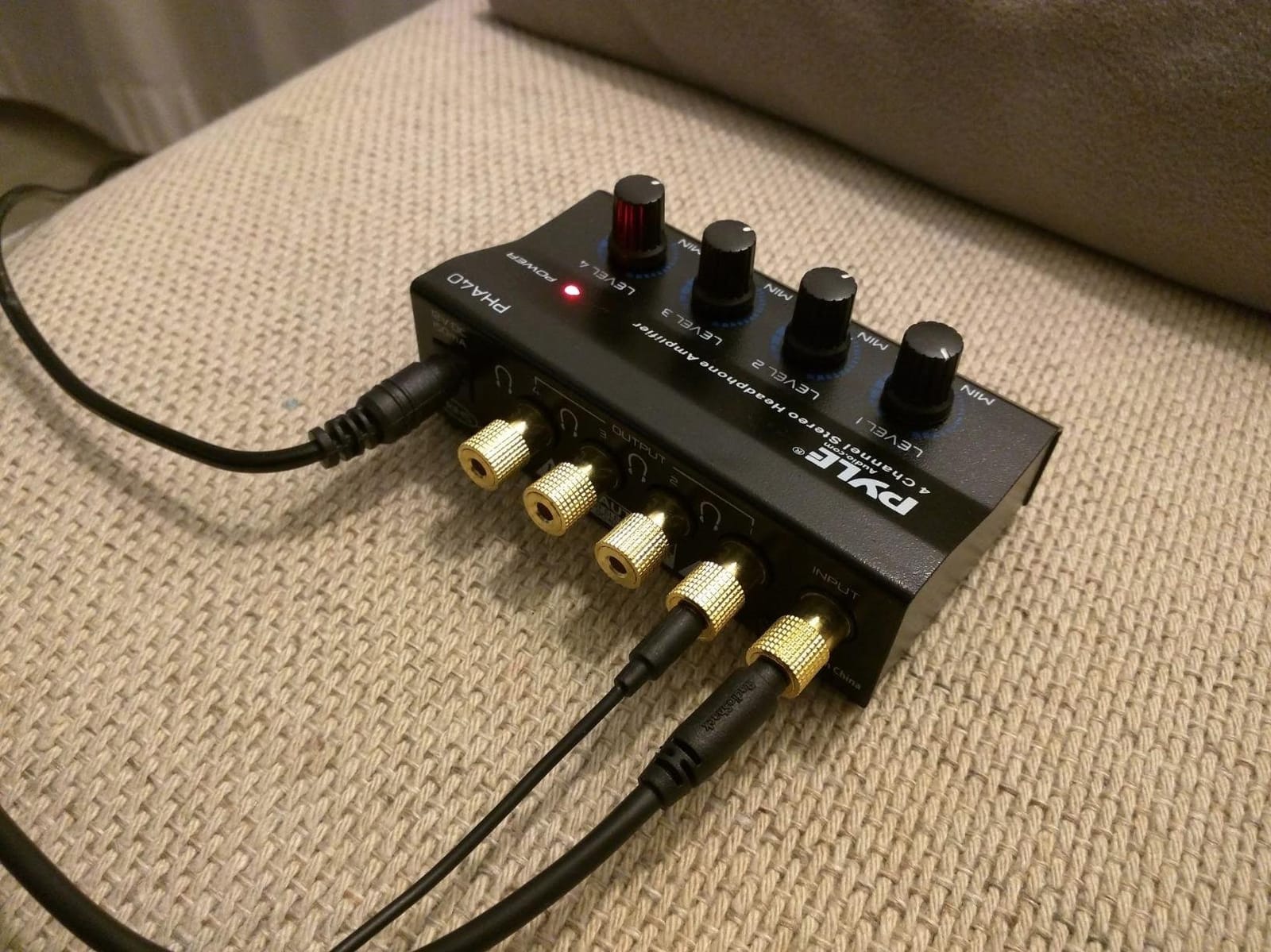
Four quarter-inch TRS outputs run off a single quarter-inch TRS input, and each output has its own volume knob. For a host at the head of the table plus three guests, that is exactly the right shape.
Owners consistently describe the per-channel control as the reason they bought it and the reason it works. One common podcast setup we read about puts the host on channel one at a level that leaves headroom, then sets the guests independently so nobody has to touch the main control.
The amp is a passive-feeling distribution box with active amplification, so there is no added delay to worry about on a live remote call. It also runs quietly, which matters more than people expect when guest microphones are open in the same room.
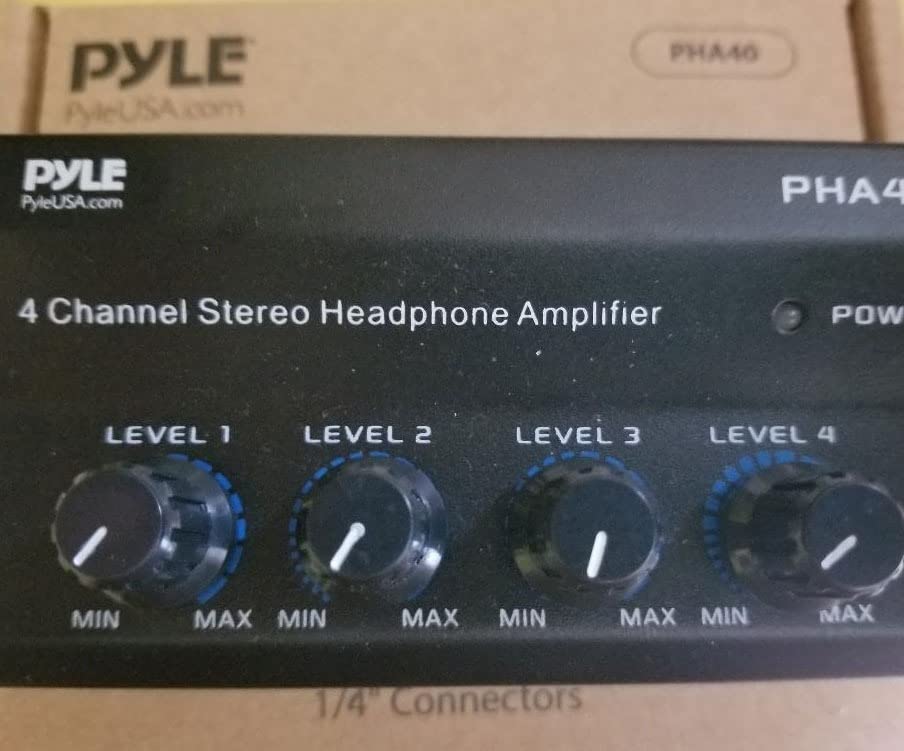
What you give up is build quality and connection flexibility. The enclosure is plastic, and it is only a quarter-inch TRS box on the front and back. Guests who turn up with phone-style 3.5mm earbuds need a quarter-inch to 3.5mm adapter, and cheap passive adapters are where hum comes from.
Keep a couple of proper adapters in the drawer, ideally the screw-on type that keeps the ground connection intact, and the issue mostly disappears.
Headroom is the other limitation. Owners report the top of the knob range running out of volume with demanding headphones, which is a different complaint from the one most people have. It rarely shows up with typical closed-back podcast headphones.
If your guest pair is a 250 ohm model and the person is wearing glasses with thick pads, expect to be turning up your interface too. We would still start here for a four-person table. It is the option with the most proof behind it, it does one job, and it does not ask you to learn anything.
Who the Pyle PHA40 suits
This amp suits the standard four-seat podcast table. If you are recording host plus three guests in one room, with closed-back headphones and no live remote guest, it is a clean fit. It is also the safest first purchase, because the review history means failures are rare and the sizing is small enough to sit behind the microphones.
It also suits anyone who wants four outputs without wanting a mini mixer. There are no input level controls, no cue mixes, and no headphone-specific gain staging. You feed it one clean line signal and it does the rest.
Simple boxes like this fail less in service than feature-rich ones, and the knobs are large enough to find in a dim room.
Where the PHA40 falls short
It falls short for anyone whose guests bring mismatched headphone impedances and expect to drive all of them to the same level. It also falls short if your interface outputs only 3.5mm and you do not want a chain of adapters between the interface and the amp. The plastic body means it is not the unit to bolt permanently into a rack or leave on a shelf in a shared studio.
Finally, it is not a mixer. If you want one guest to hear only their own microphone while another hears the full mix, you need a proper cue mixer somewhere upstream. The PHA40 sends an identical signal to all four, and the only difference between listeners is their own knob position.
2. Mackie HM-4 – Metal Build and the Highest Rated Amp Here
Mackie HM-4 Headphone Amplifier (4-Channel), Compact Splitter, Black
4 independent outputs
Metal chassis
8 oz
1/4 inch or 1/8 inch out
Pros
- Highest star rating of any 4-channel amp here
- Drives 250 ohm studio headphones
- Weighted and sturdy volume pots
- Velcro-mounts to a desk or stand
- Runs without hum on a correct cable
Cons
- Needs a correctly wired stereo TRS cable
- No power switch only an LED
- Some knobs feel slightly loose
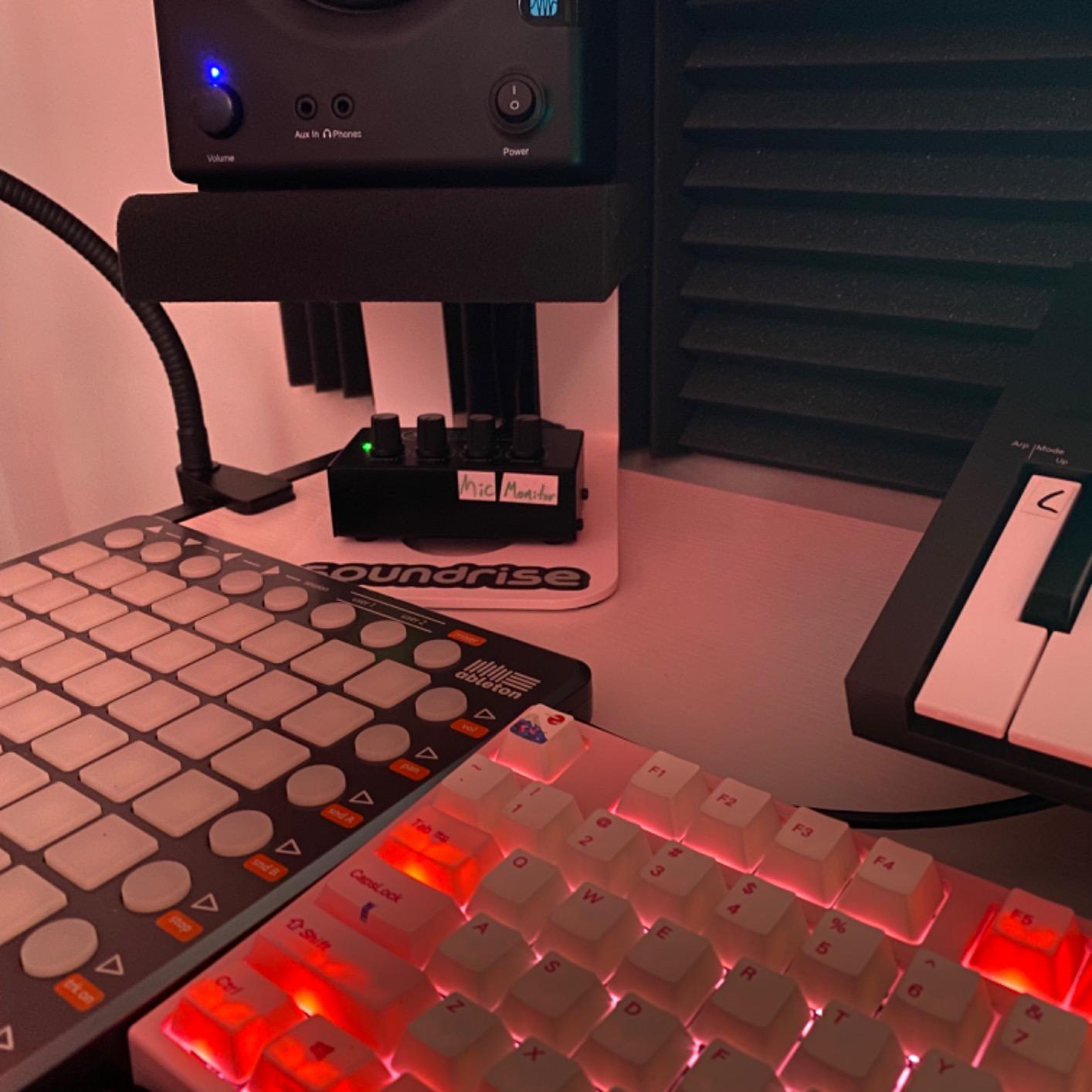
The Mackie HM-4 scores higher than anything else in this roundup, at 4.6 stars across 1928 reviews, and the reason shows up in the details rather than the spec sheet. It is a solid-state four-channel amp in a metal chassis, it weighs eight ounces, and it is small enough at 2.3 by 4.3 by 2 inches to velcro to the underside of a desk or to the leg of a mic stand. In a podcast room where gear gets moved around constantly, that is a real advantage over a plastic box.
Owners who use it in a studio context report that it drives 250 ohm headphones cleanly, which is a meaningful upgrade over most budget splitters of the same shape. Professional producers describe clearer and punchier monitoring than plugging straight into an interface, with no audible distortion at high level. For a host and three guests, each with their own pot, that is the exact behaviour you are buying.
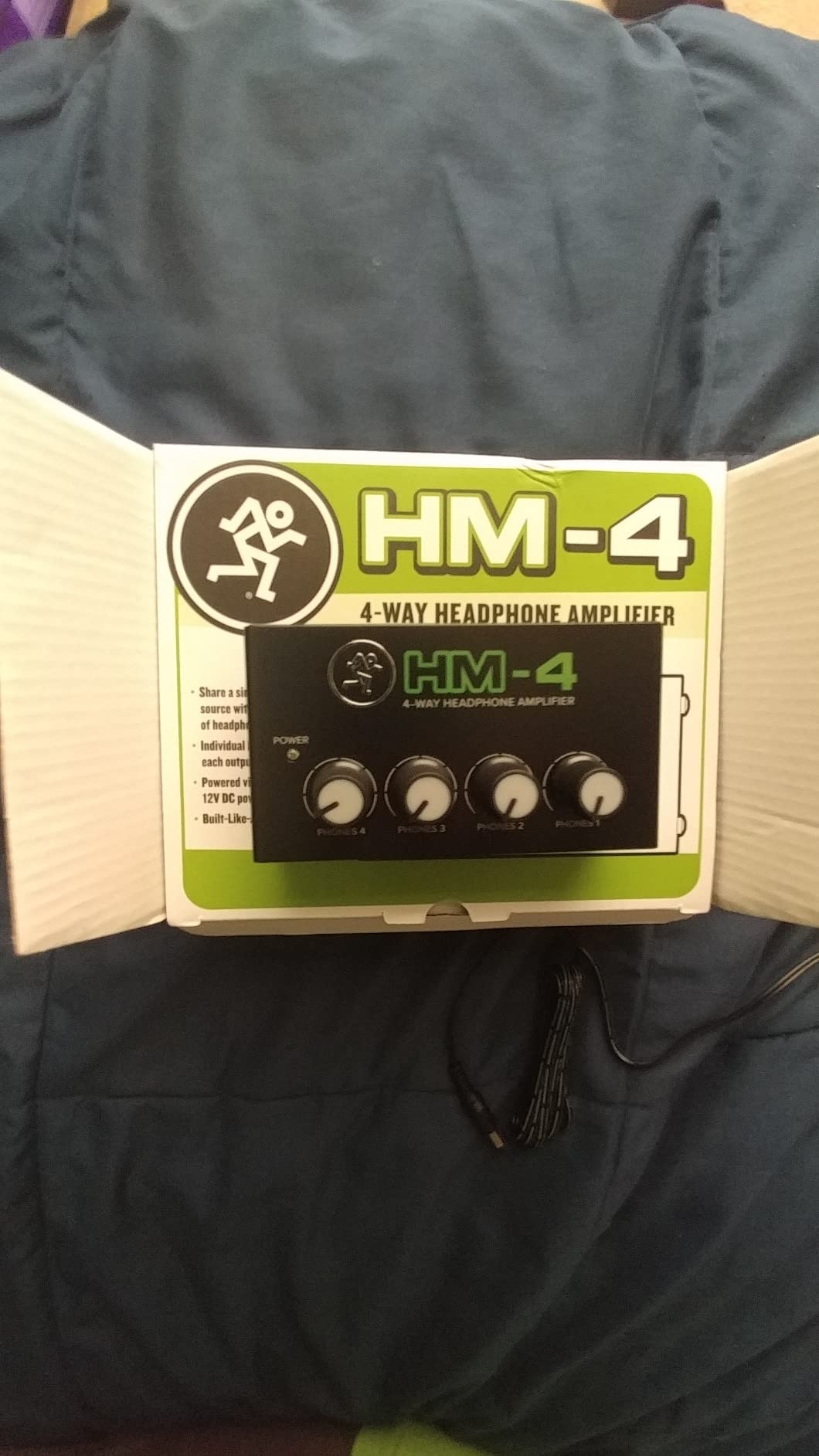
One recurring lesson from owner reviews is that a hum or a missing channel almost always means the wrong cable, not a faulty unit. A correctly wired stereo TRS cable solves it. This trips people up more than it should, because a mono cable or a badly made adapter can leave you debugging the amp instead of the cable, so we recommend labelling your input cable and keeping spares labelled with it.
The smaller things we noticed: there is no dedicated power switch, only an indicator light, so you shut it down at the wall or at the interface. And a minority of owners say the volume knobs feel slightly loose on their units. Neither issue affects monitoring quality.
It is also worth knowing the output accepts quarter-inch or eighth-inch plugs, which is more flexible than several rivals in this list, and useful when a guest arrives with phone-style earbuds.
Who the Mackie HM-4 suits
This amp suits anyone with a mixed bag of guest headphones, including heavier studio models. Its gain is enough that a guest wearing 250 ohm closed-backs will hear themselves at an encouraging level without you cranking the interface. It also suits small rooms where gear gets moved, because the weight and the metal shell mean it survives being carried.
It suits people who want four pots and nothing else. Like the PHA40, it is a distributor rather than a mixer, so everyone hears the same signal. For a table conversation where the goal is that every person can hear the room at a comfortable level, that is the correct and simple design.
Where the HM-4 falls short
It falls short if your guest count is five or more, because there is no way to add a fifth output without stacking another box. It also falls short if you want a talkback channel, a second input, or per-person mixes. And if you are working from a USB interface with only a 3.5mm output, you will need a proper adapter cable to get into the quarter-inch input.
One more honest caveat: four independent volume pots are not the same as four independent mixes. Everyone hears the identical program feed. If your show depends on a guest hearing only themselves, or hearing a separate producer talkback channel, you need a cue mixer upstream, and this amp cannot provide it.
3. FIFINE N6 – Metal Four-Channel Distribution Amp
FIFINE N6 4 Channels Metal Stereo Headphone Amplifier for Audio Mixer
1 stereo in 4 balanced TRS out
Metal chassis
12V adapter included
Pros
- Four independent volume knobs
- No crackle with all four outputs at high level
- Metal build with smooth tight knobs
- Compact and easy to move
- 12V adapter and indicator included
Cons
- TRS and TS cables not included
- All ports are quarter-inch
- Distribution only not a four-input mixer
The FIFINE N6 is the one we recommend when someone asks for a single simple box that will not fall apart. It takes one stereo quarter-inch input and sends it to four balanced TRS headphone outputs, with a dedicated volume knob on each. At 4.4 stars across 1951 reviews it sits close to the Mackie on proof, and the metal chassis gives it a noticeably different feel in the hand.
What owners like most is the absence of crackle. The most common failure mode of a four-way headphone splitter is popping and hissing when all outputs are loaded and turned up, because the small amplifiers inside are being pushed past what they can do. Reviewers specifically single out the N6 for staying clean with all four headphones connected at high volume, which is precisely the situation you create the moment a third guest puts their cans on.
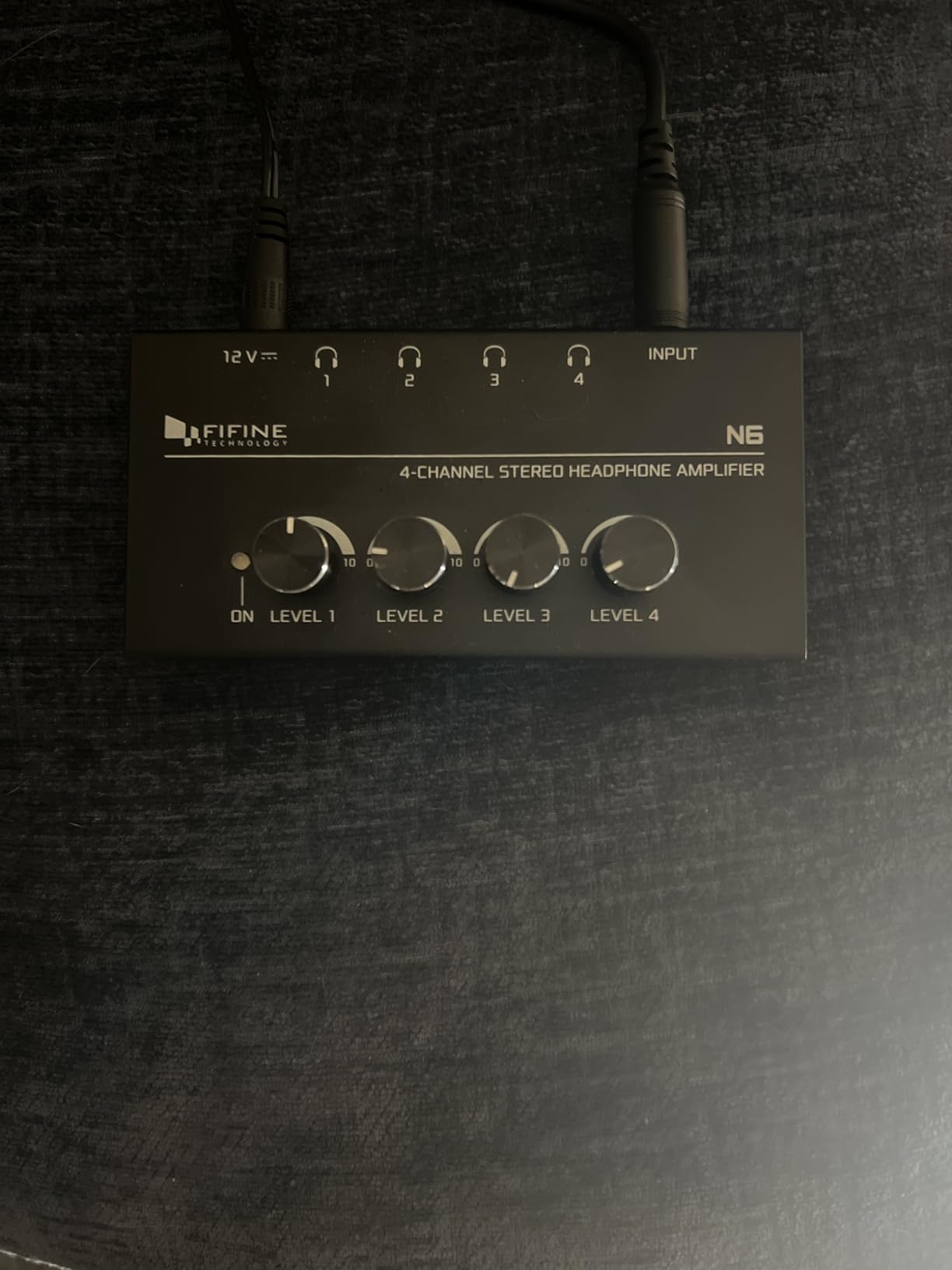
The catch, mentioned more than any other, is that the required TRS cables are not in the box. Owners consistently describe buying a small bundle of quarter-inch TRS cables as the first thing to do after delivery. Budget for three or four cables, because one is for the interface input and the rest run to the seats. This is also a good moment to label them, one cable per guest position, which removes most of the confusion when something is patched wrong.
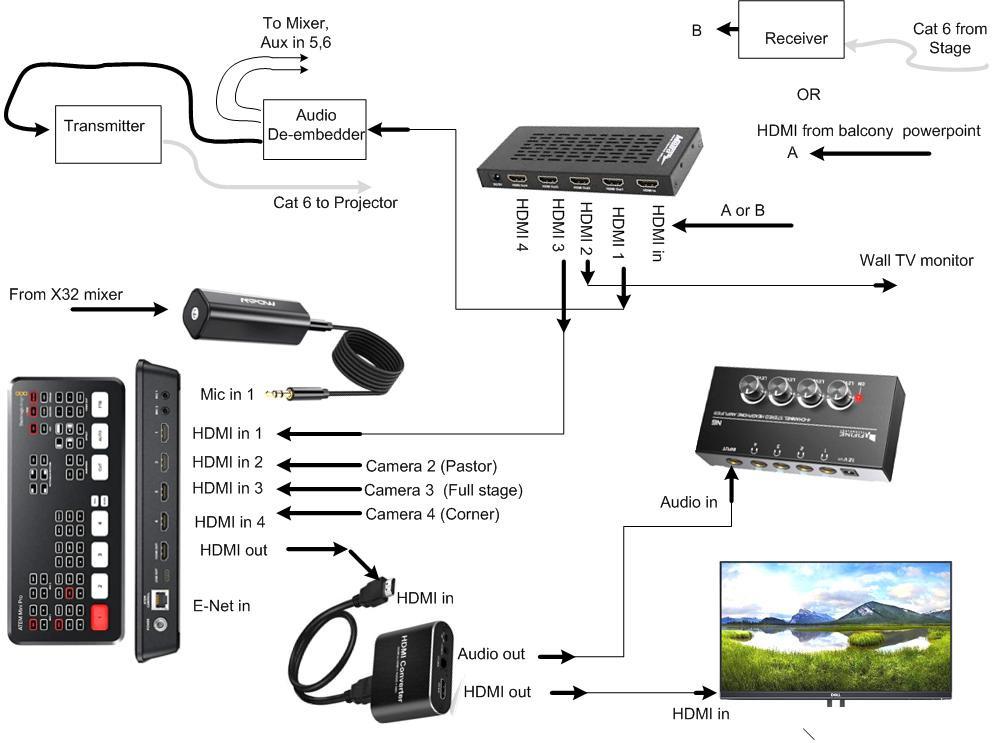
It is worth being clear about the architecture. This is a one-in, four-out distribution amp, not a mixer with four inputs. The feature list on some listings makes it sound like a four-channel console, so check the rear panel: one input, four outputs. If you want to feed a different mix to each person, this is the wrong tool and a proper headphone cue mixer is the right one.
Who the FIFINE N6 suits
The N6 suits a four-person show on a budget, especially one that records in a shared or mobile room. Metal construction and tight knobs mean it tolerates being packed and unpacked, and the compact footprint means it fits behind a desk without taking space away from the microphones.
It also suits a mixed headphone situation at moderate impedance. Reviewers do not claim it is a high-power amp, so if your guests use 250 ohm studio cans and quiet voices, look at the Mackie instead. For common closed-back dynamic headphones, the N6 handles them without complaint.
Where the N6 falls short
It falls short for anyone who needs to grow past four listeners without adding another box, or who needs to route a second source into the amp for a different mix. It also falls short on connectivity flexibility, since every port is a quarter-inch jack, so guests with 3.5mm earbuds need adapters.
And it falls short if you have not budgeted for cables. The unit is inexpensive and the cables are not included, so the true cost of the setup is the amp plus three or four cables. That is fine, but it surprises people who assumed everything needed was included.
4. LZSIG LHA1 – Four Channels With Bass Boost and Stereo/Mono Switching
LZSIG Headphone Amplifier with Bass Boost, 4 Channel, 1‑IN 4 OUT, 12V
4 channels
Bass boost switch
Stereo and mono mode
32-100 ohm support
Pros
- Four independent level controls
- Very quiet with no static at high gain
- Bass boost and stereo mono switching
- Metal chassis with heavy knobs
- Handles 250 ohm models better than rated
Cons
- Some listeners hear a brighter tonal signature
- Stereo mono button feels loose
- No shielded cable included
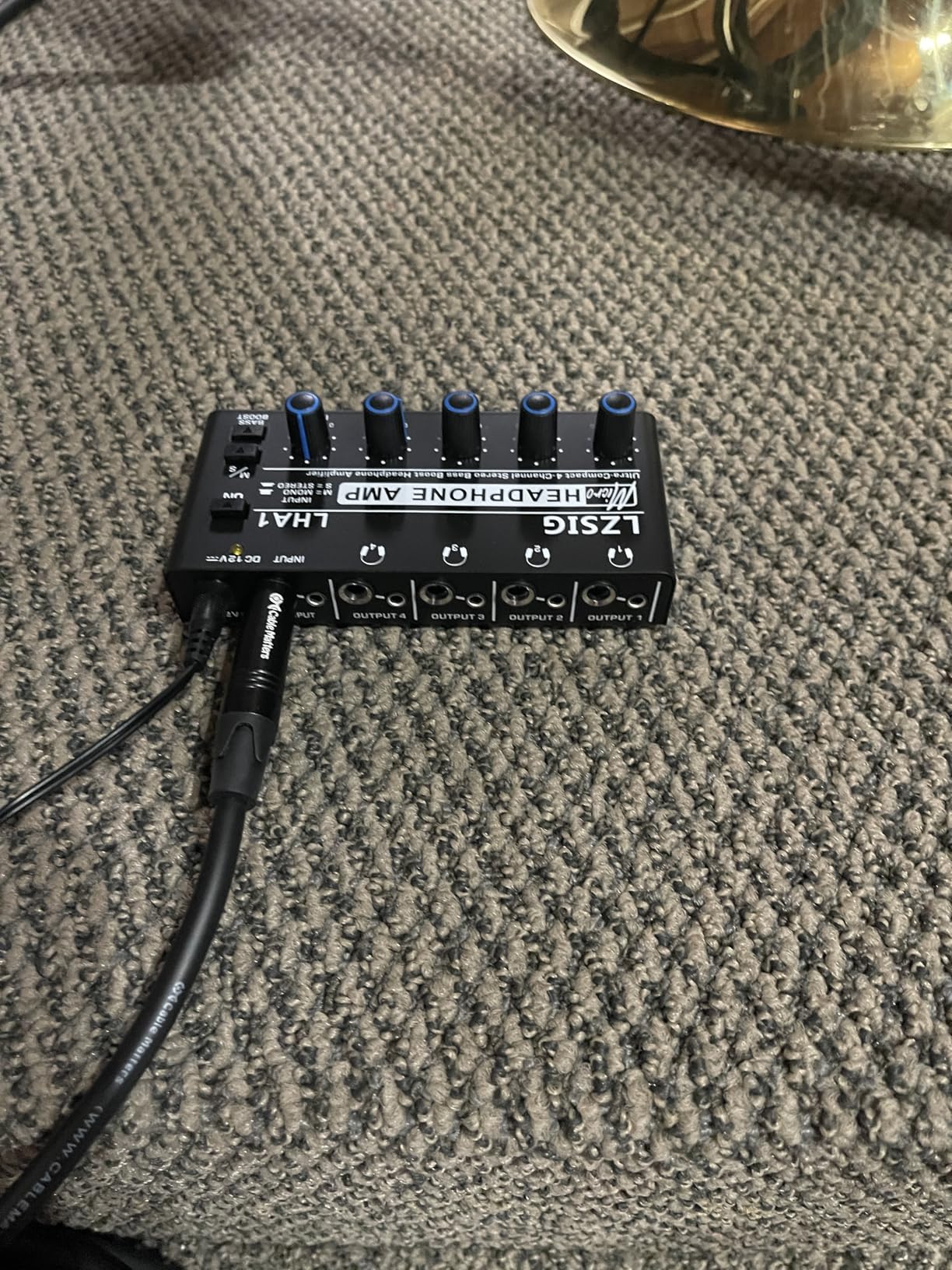
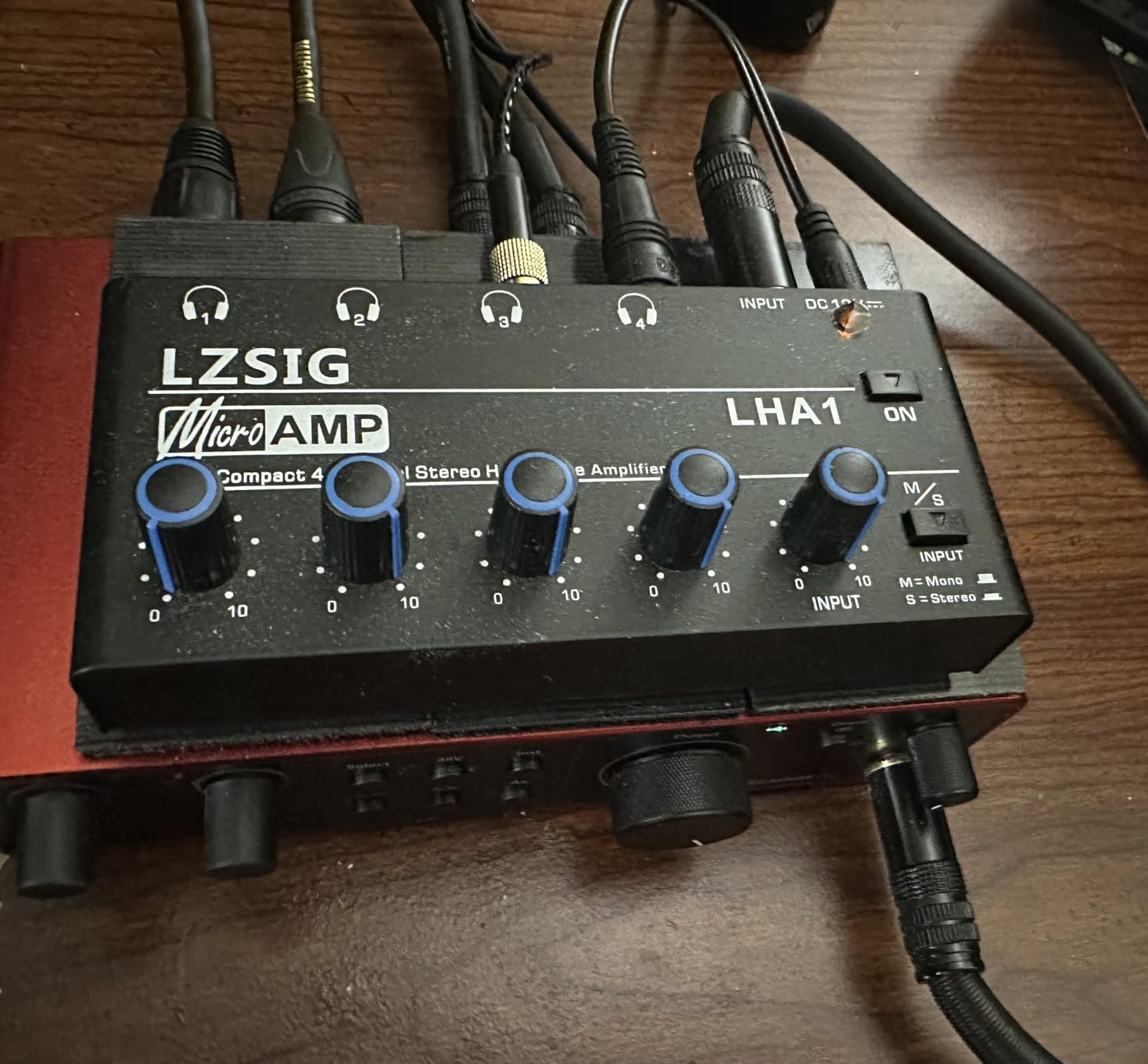
The LZSIG LHA1 is the most flexible four-channel budget amp here, and the two extra switches are the reason. A bass boost lifts the 400 to 600 Hz and 3 to 7.2 kHz bands, which makes voices sit forward in the mix, and a stereo or mono switch lets you fold a dual-mono signal into both ears. For a podcast where someone is interviewing by phone and the return feed arrives as a single mono track, that mono switch is more useful than it sounds.
At 4.5 stars across 695 reviews it is well regarded for the basics. Owners highlight the quiet operation, the absence of static even at higher gain, and enough gain to handle 250 ohm models despite the published 32 to 100 ohm rating. Five low-noise ROHM operational amplifiers do the work, and each output has its own level control, which is the podcast-critical feature.
The honest criticism, and it comes from people who use these amps for mix decisions, is that it adds a tonal signature of its own. Some listeners hear split monitoring as brighter and less warm than a direct interface output.
For tracking and conversation between guests, that is a non-issue. For making a final judgement about a mix while two people compare, it is worth knowing about before you commit.
Smaller notes: the stereo and mono button feels loose, and mono mode can sound thin or inverted depending on the source. And no shielded cable is included for connecting to a computer headphone jack, which is the situation where stray interference is most likely. Feed it from an interface line output where you can, rather than from a laptop jack.
Who the LZSIG LHA1 suits
This amp suits a four-person show where voices are the whole point and you want a little help with intelligibility. The bass boost is a genuine tool rather than a gimmick in that context, since a bassy voice competing with a room tone problem is a common podcast complaint, and the 400 to 600 Hz lift is the band that affects vocal body.
It also suits remote-interview setups where a guest joins by phone or a video call and arrives as a mono return. The mono switch, the per-channel pots, and the metal chassis make it a good four-headphone hub for a room where some people are local and some are not.
Where the LZSIG LHA1 falls short
It falls short for critical listening rooms and for anyone mixing through it. If your headphones are your reference and you are making calls about balance between two listeners, the added signature works against you. Pick a transparent amp or monitor through one listener at a time.
It also falls short for a large panel, at four outputs, and it has no second input, so you cannot feed a speaker pair or a separate cue from the same box. The loose mode switch is a minor irritation, not a reason to skip it.
5. Behringer DS2800 – Two Inputs, Eight XLR Outputs for Large Panels
Behringer DS2800 Professional 2-Input 8-Output Distribution Splitter
2 XLR in 8 XLR out
Independent level per output
LED meters
3.5 lb
Pros
- Highest average rating in the group at 4.7 stars
- Two inputs and eight XLR outputs
- Gold plated connectors
- LED meters and switch mode supply
- Built for control room distribution
Cons
- Line level splitter not a headphone amp
- Larger and heavier than desktop units
- Line outputs need a headphone stage downstream
The Behringer DS2800 is the highest rated unit in this roundup at 4.7 stars, and it is also the one that requires the most explanation. It is not a headphone amplifier. It is an eight-channel active line-level distribution splitter with XLR connectors, two inputs, and independent level control on every output. Its job is to take one or two line feeds and send clean, individually adjustable copies to many destinations.
That makes it a problem solver for a different shape of show. If you run a large panel in a room with a control position, or you are feeding several recorders and playback systems from one console, this is the box. Eight outputs with individual level controls, gold-plated connectors, LED meters for watching output activity, and a switch-mode power supply are control-room features rather than bedroom features.
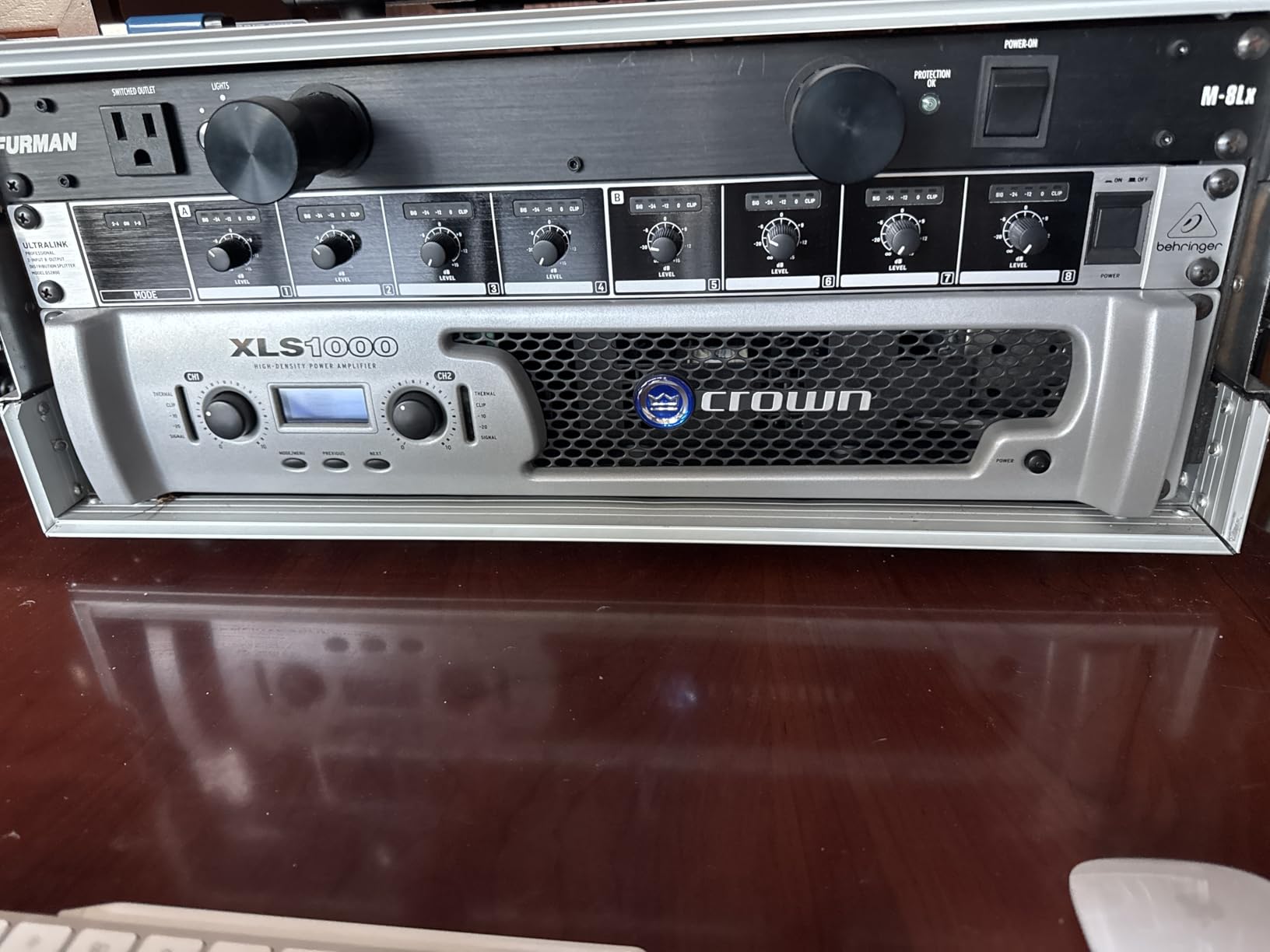
For a standard podcast table, you would place this after your headphone amplification stage, splitting the finished headphone or cue feed out to several destinations at once. The pipeline is interface, then headphone amp, then this, then the destinations. The caveat is that its outputs are line level, not headphone level, so it cannot feed phones directly without a headphone stage downstream.
It is also physically a different kind of object: 3.5 pounds, with a package footprint of 20.75 by 9.88 by 4.13 inches, so it needs a shelf or a rack position rather than a spot behind a microphone. And with 131 reviews, its owner history is thinner than the budget four-channel units, so the star rating is impressive but based on fewer voices.
Who the Behringer DS2800 suits
This unit suits a facility with more destinations than seats. Think a broadcast booth, a panel with a separate control room, or a studio where one line feed needs to reach a recorder, a stream encoder, a backup system, and a monitor wall at the same time. Eight independently adjusted XLR outputs handle that in a single box.
It also suits anyone who values a metal, serviceable, rack-friendly unit over a plastic desktop gadget. The LED meters make it easy to confirm that a destination is actually receiving signal, which beats unplugging cables one at a time during a live check.
Where the DS2800 falls short
It falls short as a direct answer to the guest problem, because you cannot plug headphones into it. For a host plus three guests, a four-channel headphone amp is simpler, smaller, and cheaper. Use this when your distribution needs outgrow your headphone needs, not before.
It also falls short in portability, and its 131 reviews mean fewer long-term owners to draw on. Budget for a shelf, and remember that every headphone downstream still needs its own amplifier stage.
6. Fosi Audio ZH3 – DAC, Preamp and Single-Listener Power Amp
Fosi Audio ZH3 DAC Headphone Amp, Fully Balanced Preamp with AKM4493SEQ XMOS XU316 PCM 768kHz for Amplifiers, USB/Optical/COAX/RCA/12V Trigger Input, XLR/RCA/4.4mm/6.35mm Output with Remote
Single 6.35mm and 4.4mm out
3 level gain
1.9uV noise
DAC and preamp
Pros
- DAC preamp and amp in one box
- 2.57W per channel on balanced out
- 1.9uV measured noise
- Swappable op-amps and EQ
- Aluminum chassis with remote
Cons
- Only one headphone output
- Line outputs are fixed level
- External wall wart power supply
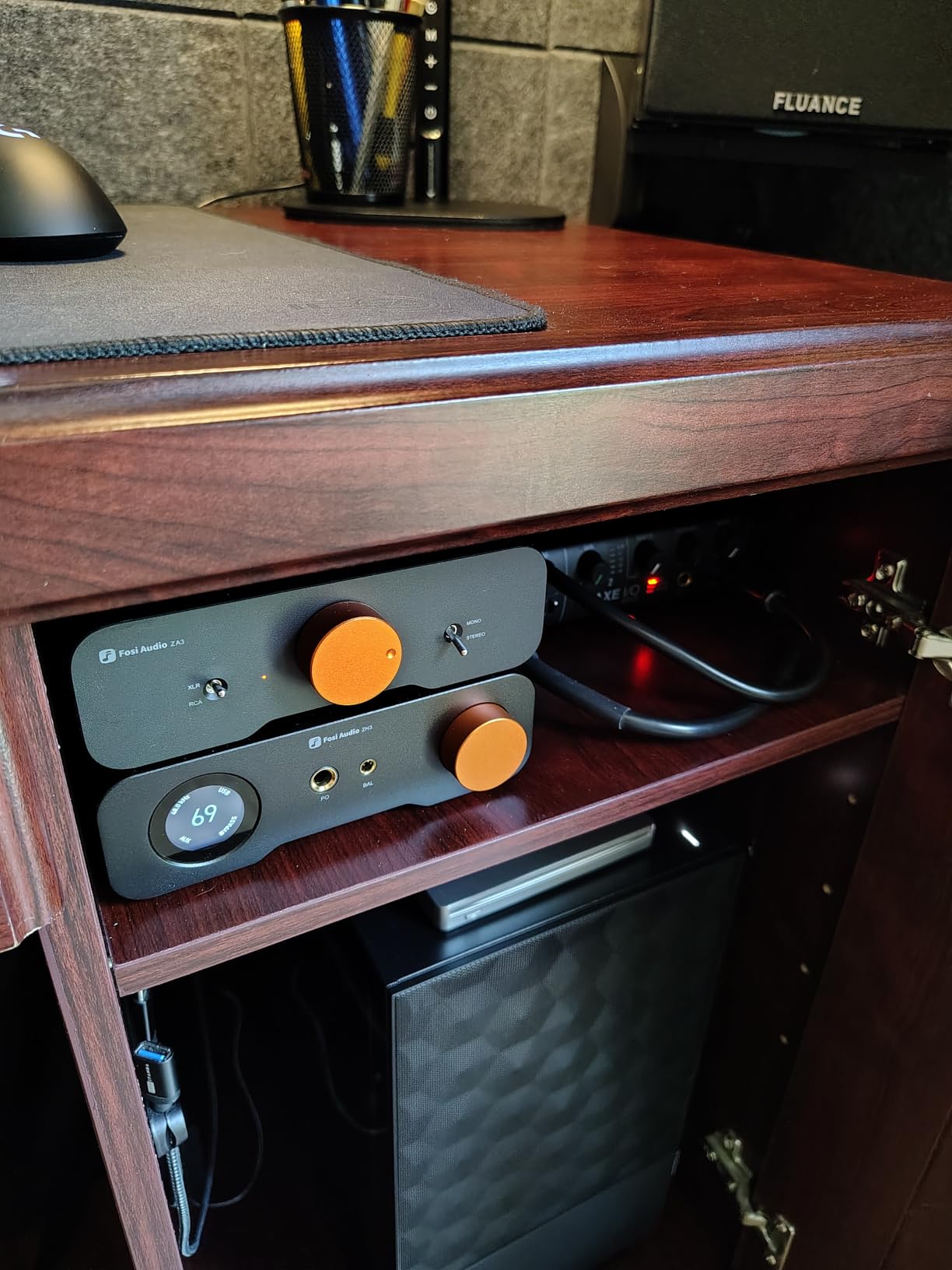
The Fosi Audio ZH3 is here for a different job, and it is a well-executed one. It is a desktop DAC, preamp, and headphone amplifier in a single aluminum chassis, with an AKM4493SEQ converter, an XMOS XU316 processor, and four OPA1612 amplifier stages. It has one headphone output, but that output is genuinely powerful: 640 milliwatts per channel into 32 ohms on the single-ended jack, and 2570 milliwatts per channel on the balanced 4.4 mm output.
That power is the reason it is worth including in a podcast roundup. It means the host, or a producer working alone in an edit bay, can drive 300 ohm headphones and even demanding magnetostatic models to a comfortable level with real headroom. A three-level gain switch covers 16 to 300 ohm, and measured noise is listed at 1.9 microvolts, low enough that quiet passages stay quiet with an open microphone in the room.
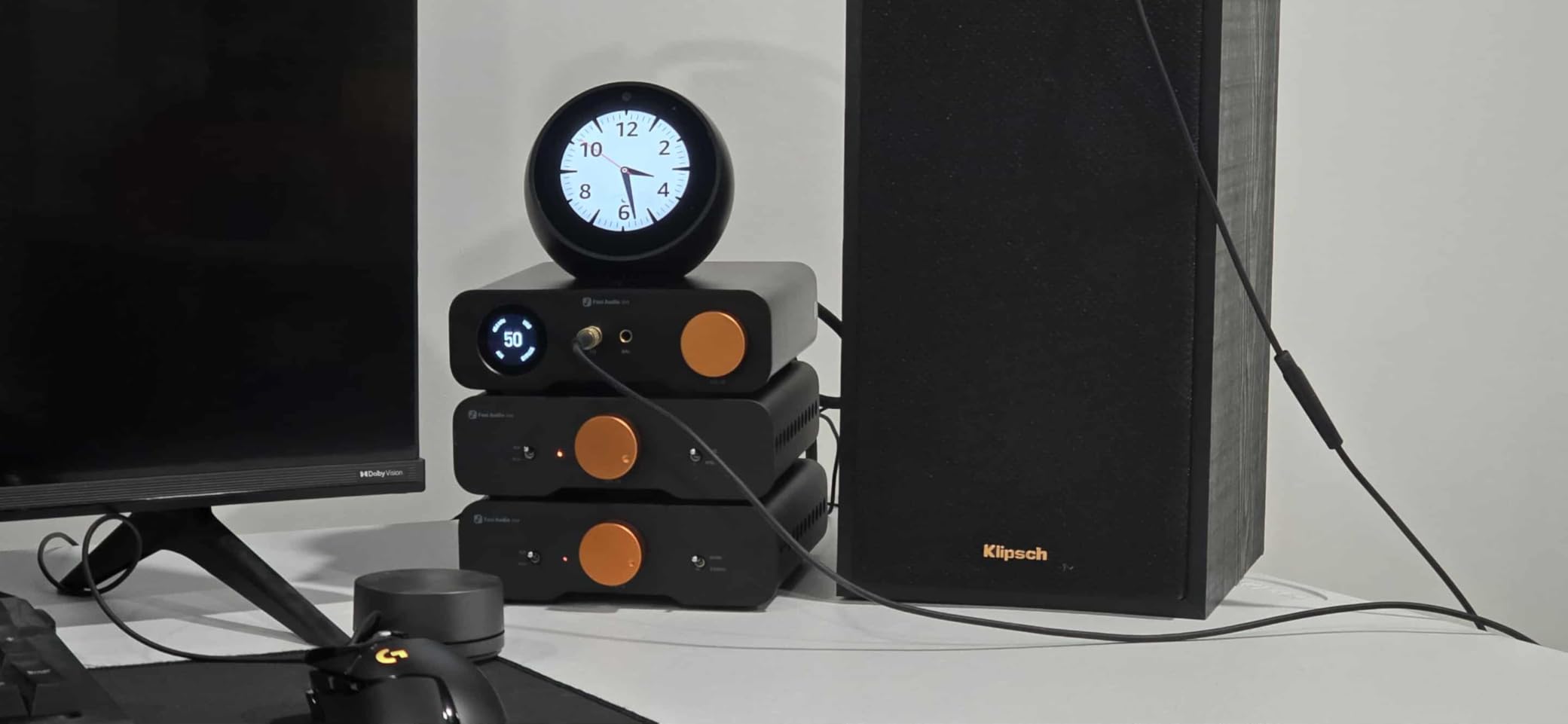
For podcast work specifically, the digital side is the interesting part. With USB, optical, coaxial, and RCA inputs, you can monitor a remote interview feed coming out of a computer, or run a double-ender session where the remote guest arrives over a video call. That is a scenario where a distribution amp is pointless, because you are the only person in the room, and a DAC plus a powerful headphone stage is exactly what you need.
Two caveats. First, the XLR and RCA line outputs are fixed level, so despite the preamp wording in the listing, it cannot act as a true variable line preamp for downstream distribution. Second, the USB driver can require manual selection in recording software.
Both are worth knowing before you rely on this box in a live session.
Who the Fosi ZH3 suits
This box suits a solo host or a producer monitoring a remote interview. It suits anyone whose monitoring source is a computer rather than an analog interface, since the USB input removes the need for a separate converter. It also suits listeners who want one headphone pair driven properly, including high-impedance studio models, without stacking two devices.
It also suits someone who enjoys tuning. There is bass and treble EQ, six filter types with a bypass mode, and two user-swappable op-amp sockets, so you can change the character of the headphone stage rather than the DAC.
Where the ZH3 falls short
It falls short the moment a second person needs to monitor. One headphone output means one listener, so it cannot feed a guest sitting across the table. If your show has in-person guests in the room, this is not the box, whatever else it does well.
It also falls short as a distribution preamp, because the line outputs are fixed level. And the external wall-wart supply means one more item on the desk and one more cable to manage in a room where cables already get pulled.
7. socodox 4-Channel Amp – Up to Eight Headphone Outputs
socodox 4 Channel Headphone Amplifier, 8 Outputs Stereo Audio Amplifier
Up to 8 headphone outputs
1/4 and 1/8 inch TRS plus RCA in
Metal housing
Pros
- Handles up to eight headphones at once
- Independent volume per output
- Metal housing with rubber feet
- Stereo and mono switching
- Accepts quarter-inch eighth-inch and RCA inputs
Cons
- Lowest star rating here at 4.0
- Some reports of hiss at higher gain
- Illuminated knob is cosmetic only
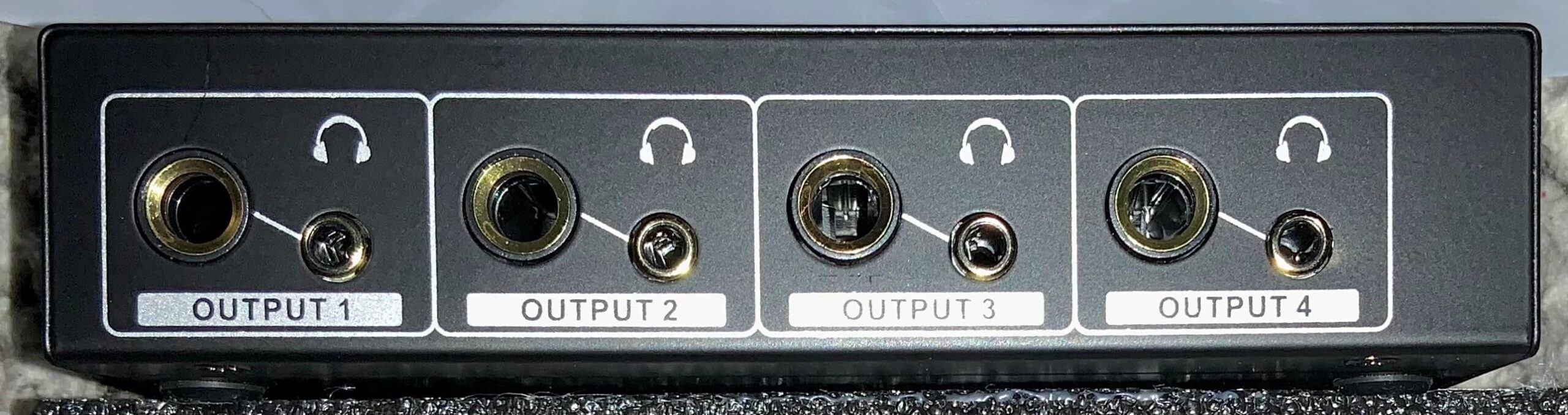
The socodox unit is the only affordable box in this group that can feed eight pairs of headphones, which makes it the interesting choice for a large table or a hybrid show where in-person guests sit alongside remote participants. It accepts quarter-inch, eighth-inch TRS, and RCA inputs, so you are not hunting for the right cable regardless of what your interface provides, and it drives up to eight headphones with an independent volume control on each.
That capacity is real. Dual 5532 and 4580 operational amplifiers do the work, there is a stereo and mono switch, and the metal housing sits on anti-slip rubber feet so it will not creep across a table while guests are adjusting their own knobs. For a six or seven person panel, nothing else at this tier gives you that many seats from one box.
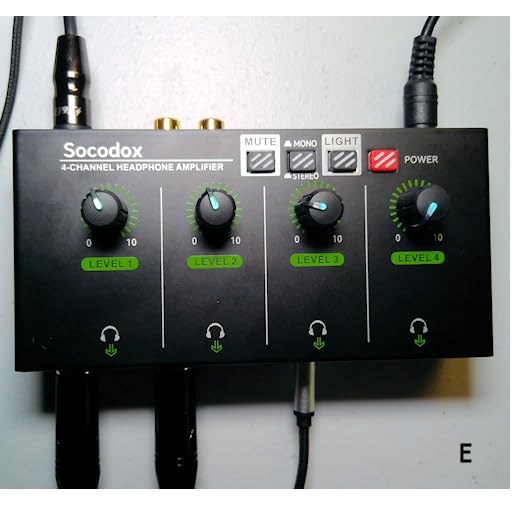
Now the honest part. At 4.0 stars across 204 reviews, this is the lowest rated unit here, and about 15 percent of ratings are one star. The complaints cluster around background hum and hiss that appears at higher gain settings, and around the decorative seven-colour knob, which several owners describe as a distraction in a dim booth.
The manufacturer itself suggests using separate mains sockets or good RCA cables to avoid interference, which tells you where the noise comes from. We would not put this in a permanently treated studio where your open microphones will pick up any hiss.
Who the socodox amp suits
It suits a large round-table show that needs more than four seats from a single device, and it suits remote-plus-local formats where the remote participants arrive through the interface and the local participants need their own cans. The input flexibility means you can feed it from whichever output your interface happens to have.
It also suits a setup that moves. The metal housing and rubber feet handle a table that gets packed away, and the stereo and mono switch covers a mixed set of sources without rewiring.
Where the socodox amp falls short
It falls short in a treated room, where hiss and hum at higher gain is the last thing you want next to open microphones. The 4.0 average and the one-star share tell you the noise behaviour is not consistent across units, and you will not know yours until you test it.
It also falls short for anyone sensitive to bright lighting in a dark recording space, and it still has no talkback and no per-output mixes. Eight listeners all hearing the identical feed is a limitation, not a feature.
8. Zendstanding HA400 – Smallest Four-Channel Box in the Group
HA400 Headphone Amplifier 4 Channel Metal Stereo Audio Amplifier
4 independent volumes
90 x 55 x 40mm
40mA into 100 ohm
JRC4580 chip
Pros
- Same design language as the Behringer HA400
- Metal body fits a small bag
- Four independent volume controls
- Clear output with no scratching
- Two year manufacturer warranty
Cons
- Some units buzz constantly
- Volume knobs can feel stiff
- Quarter inch connectors only
- Modest 40mA output into 100 ohm
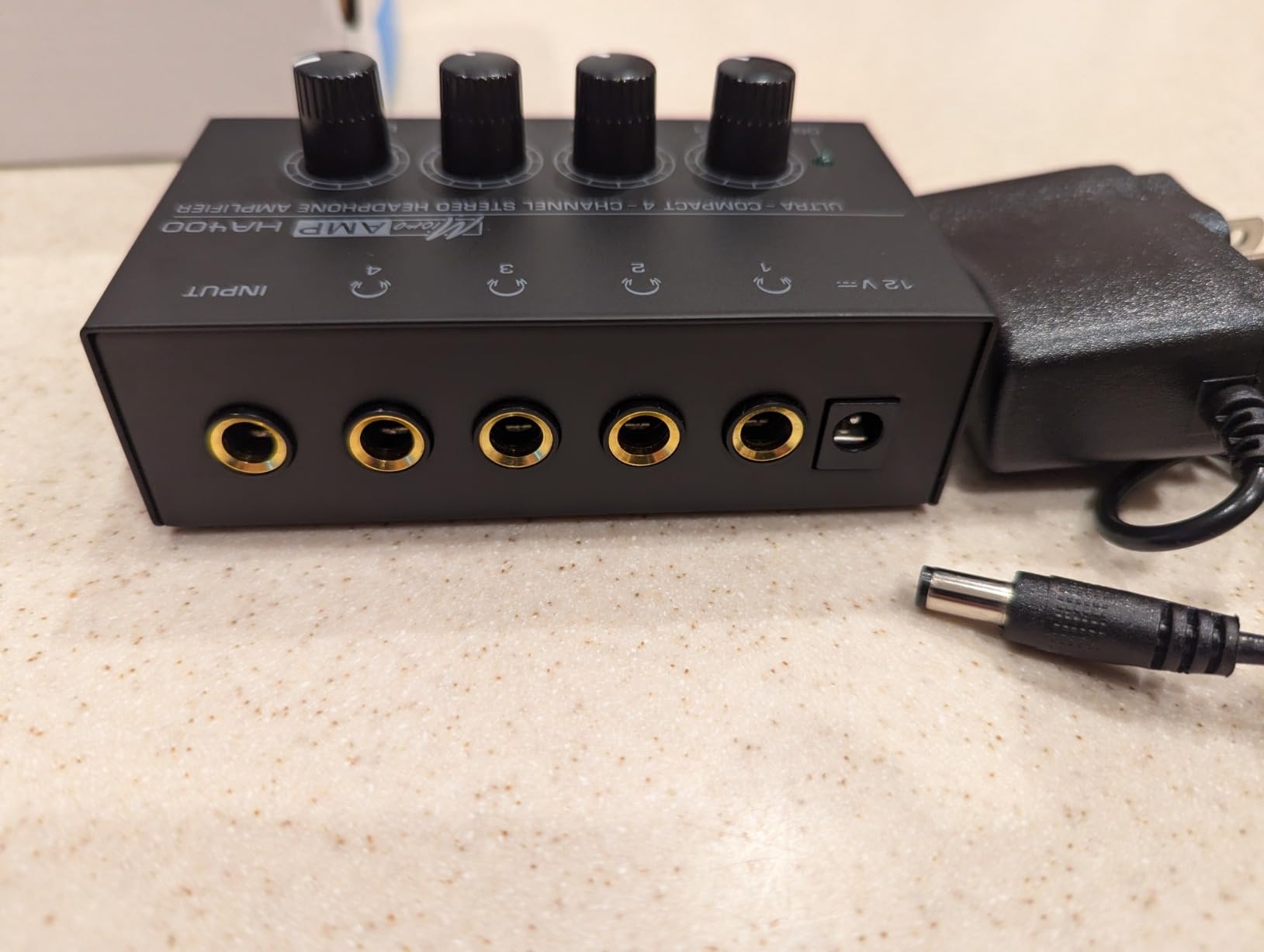
The Zendstanding HA400 measures 90 by 55 by 40 millimetres, which is genuinely small enough to disappear into a camera bag or a laptop sleeve. If you record away from your own studio, that footprint matters more than any specification on the page. Four independent volume controls, a JRC4580 low-noise chip, and a metal structure give it the same architecture as the well-regarded Behringer HA400 it is modelled on, and reviewers who have used both describe it as a working equivalent.
Output power is modest, with a maximum level of roughly 40 milliamps into 100 ohms, and the design targets 32 to 100 ohm headphones with 50 mm drivers. That covers the vast majority of guest monitoring, particularly the closed-back dynamic headphones people wear for long sessions. It will not drive a demanding 600 ohm studio model, and you should not buy it expecting that.
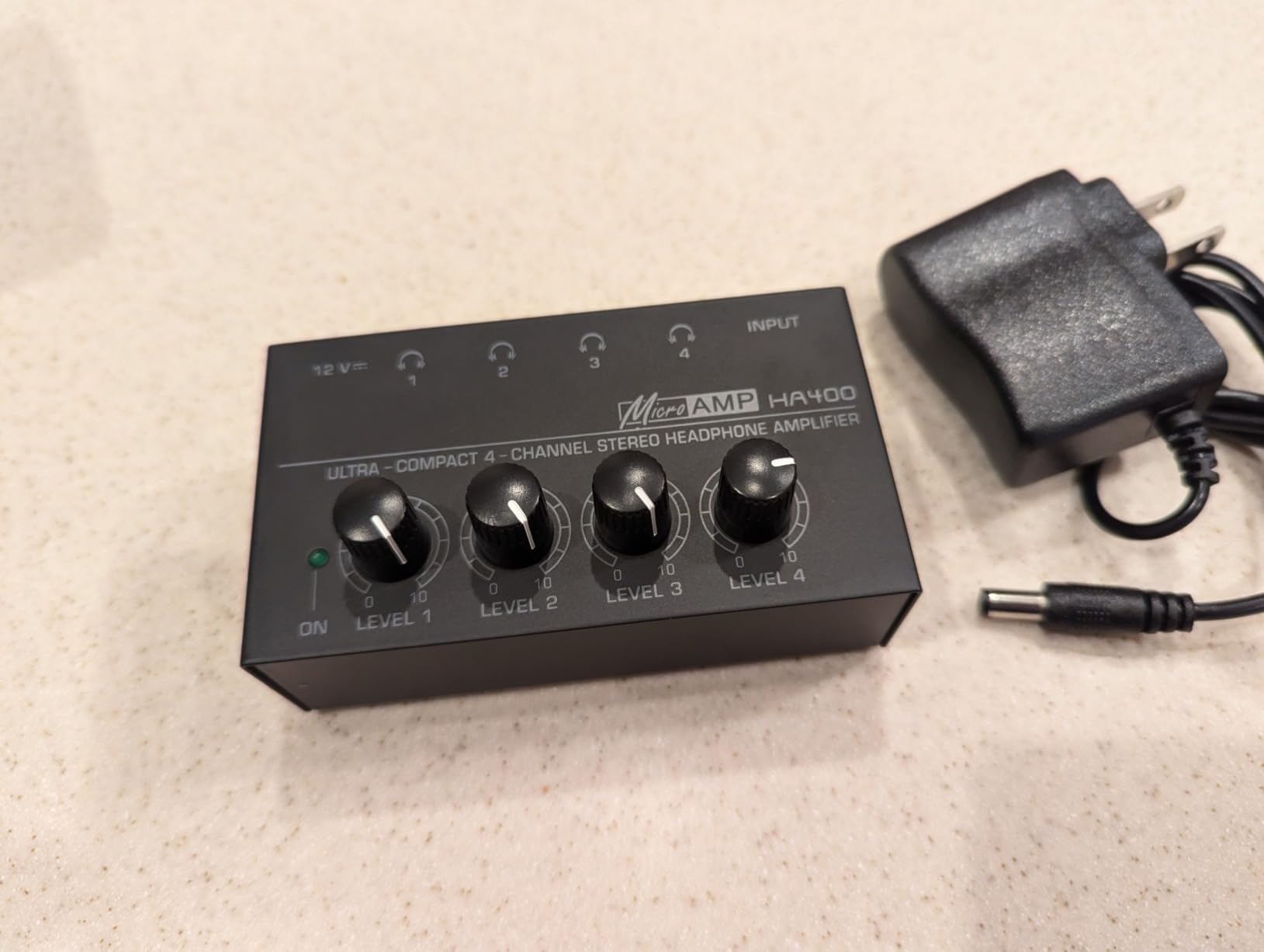
Two things to check when it arrives. A minority of owners report a constant loud buzz on every input and output combination, which points to a faulty unit rather than a wiring mistake, so test all four channels before your session. And the volume knobs can feel stiff or stuck, needing more force than a normal knob, which matters when a guest with no technical background is turning one during a live check.
Every port is a quarter-inch jack, so 3.5mm headphones need an adapter, and a two-year manufacturer warranty is included, which is longer than several rivals offer. The included 12V DC adapter means one fewer thing to source.
Who the Zendstanding HA400 suits
It suits a mobile or location setup where the whole rig travels in a small bag, and it suits a two-person show on a tight budget that still wants four outputs so a guest can bring a friend or a second host can join. The size means you can keep it with the interface instead of leaving it behind.
It also suits anyone who wants a spare. At this size and weight, keeping one in a drawer means you always have a fallback if a primary unit fails mid-season, which for a four-output distribution box is genuine insurance.
Where the HA400 falls short
It falls short on headroom for high-impedance headphones, and on the small but real chance of a buzzing unit. If your guests consistently wear 250 ohm or heavier studio headphones, spend the extra money on a higher-gain four-channel amp rather than pushing this one and asking the interface to compensate.
It also falls short for more than four listeners, and its quarter-inch-only connectors mean a table of phone-style earbuds will need a stack of adapters. Test all four channels on day one.
9. LiNKFOR MA400 – Mic Feed and Monitoring in One Box
LiNKFOR MA400 Headphone Amplifier for XLR Microphone & Audio Signal with Volume Controls, 6.35mm & 3.5mm Headphone Outputs, Portable with 12V Power Supply
XLR mic input
Ground lift
Single headphone out
60mW
18 month warranty
Pros
- Mic preamp and headphone amp in one box
- Independent mic and playback volume
- Ground lift removes hum from mixers
- Quiet operation with the supplied supply
- Small 114 x 57 x 31mm body
Cons
- No real 48V phantom power despite listings
- Only 60mW of output
- Single output so one listener only
The LiNKFOR MA400 does two jobs that would otherwise need two boxes. It takes an XLR microphone input with a ground lift button, and it gives you independent volume for the microphone signal and the playback or mixer signal, plus a quarter-inch and an eighth-inch headphone output on the front. For a solo podcaster working away from a studio, or a reporter covering a live event, that combination is genuinely useful.
The ground lift is the feature that earns its place. Ground loop hum is the most common complaint about small podcast chains, and a lift button lets you break the loop without unhooking half the rig. Owners also report quiet operation with the supplied certified power supply, and the 114 by 57 by 31 millimetre metal body at 0.84 pounds mounts easily to a mic stand, which keeps the desk clear.
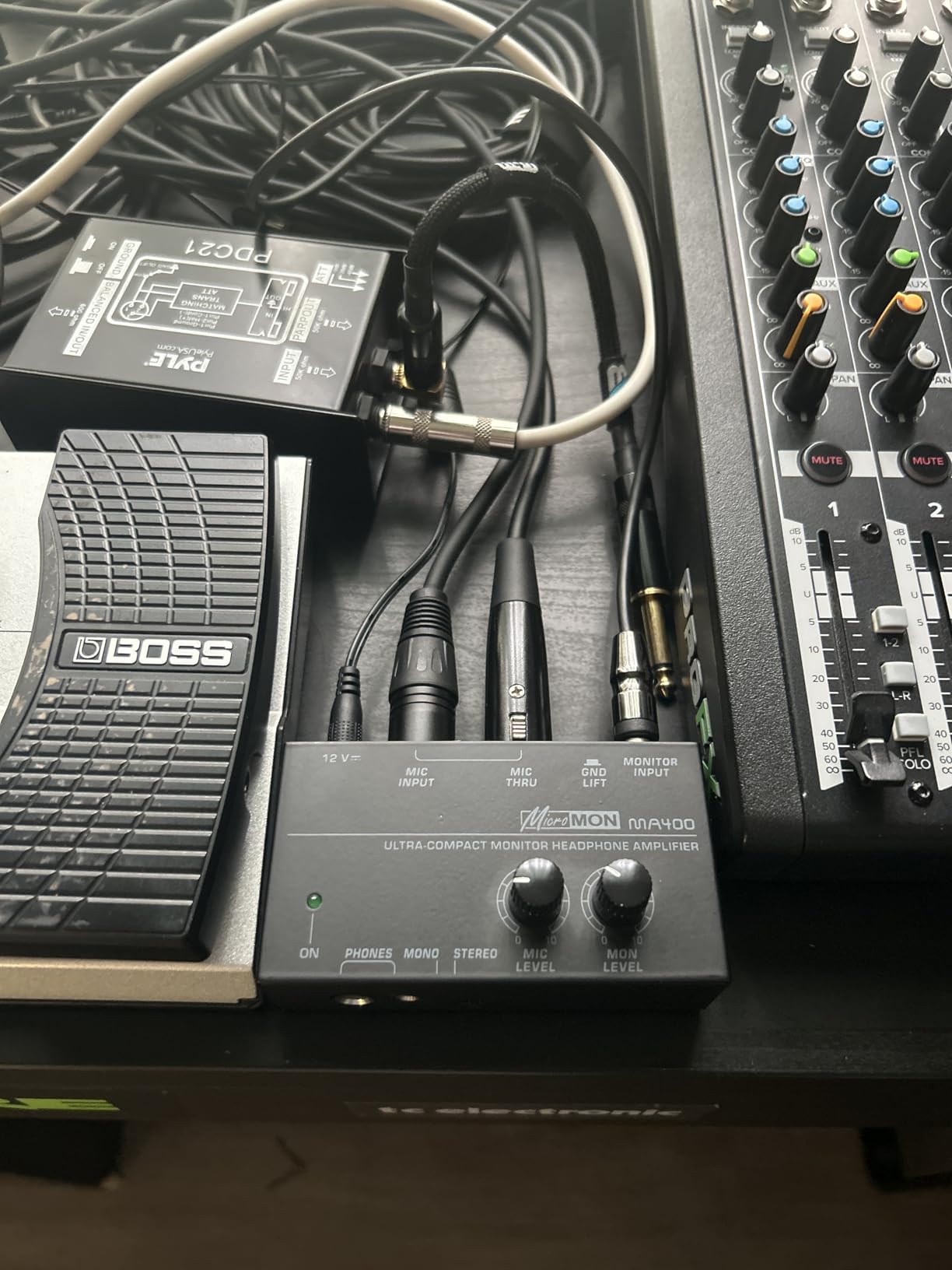
The two things you need to know before buying are both limitations. First, there is no real 48V phantom power, even though some listings and product images suggest otherwise. If you intend to run a condenser microphone, your interface or a dedicated phantom supply has to provide that. Second, the output power is about 60 milliwatts, which is aimed at in-ear monitors and low-impedance headphones rather than high-impedance studio cans.
There is also only one headphone output, so this cannot feed a guest. Think of it as a compact box for one person who also needs a microphone input, not as a distribution solution. The included components are the amplifier, the power adapter, and a manual, with an 18 month warranty behind it.
Who the LiNKFOR MA400 suits
It suits a solo broadcaster or field reporter who needs to take a microphone feed and headphone monitoring on location without a full interface. It suits anyone fighting ground loop hum in a small chain, because the ground lift button solves a problem that otherwise eats an afternoon.
It also suits a setup where the guest uses earbuds rather than headphones, since 60 milliwatts is more than enough for that. At less than a pound and with a stand-mountable body, it is easy to keep close to the microphone.
Where the MA400 falls short
It falls short for a second listener, and it falls short for condenser microphones if you were relying on the box for phantom power. It also falls short for anyone wearing high-impedance studio headphones, where 60 milliwatts will leave them reaching for a louder source and possibly a louder source downstream.
Read the listing carefully, because marketing images on this product suggest phantom power that the hardware does not provide. A few owners also report units that will not power up at all, so test it as soon as it arrives.
10. Douk Audio U3 – Class A Power for Demanding Studio Headphones
Douk Audio U3 Headphone Amps, Mini Hi-Fi Amplifier for Home Desktop PC 6.35mm / 3.5mm Headsets, Class A, RCA Input, DC 5V
Class A 1300mA
Single output
RCA input only
Pluggable op-amp
Pros
- Drives hard to drive high-impedance models
- Pluggable op-amp socket
- Low noise with clean power
- Detented volume knob
- Compact metal body
Cons
- Single headphone output
- RCA inputs only need an adapter
- Bright blue power LED
- Poor shielding against wireless interference
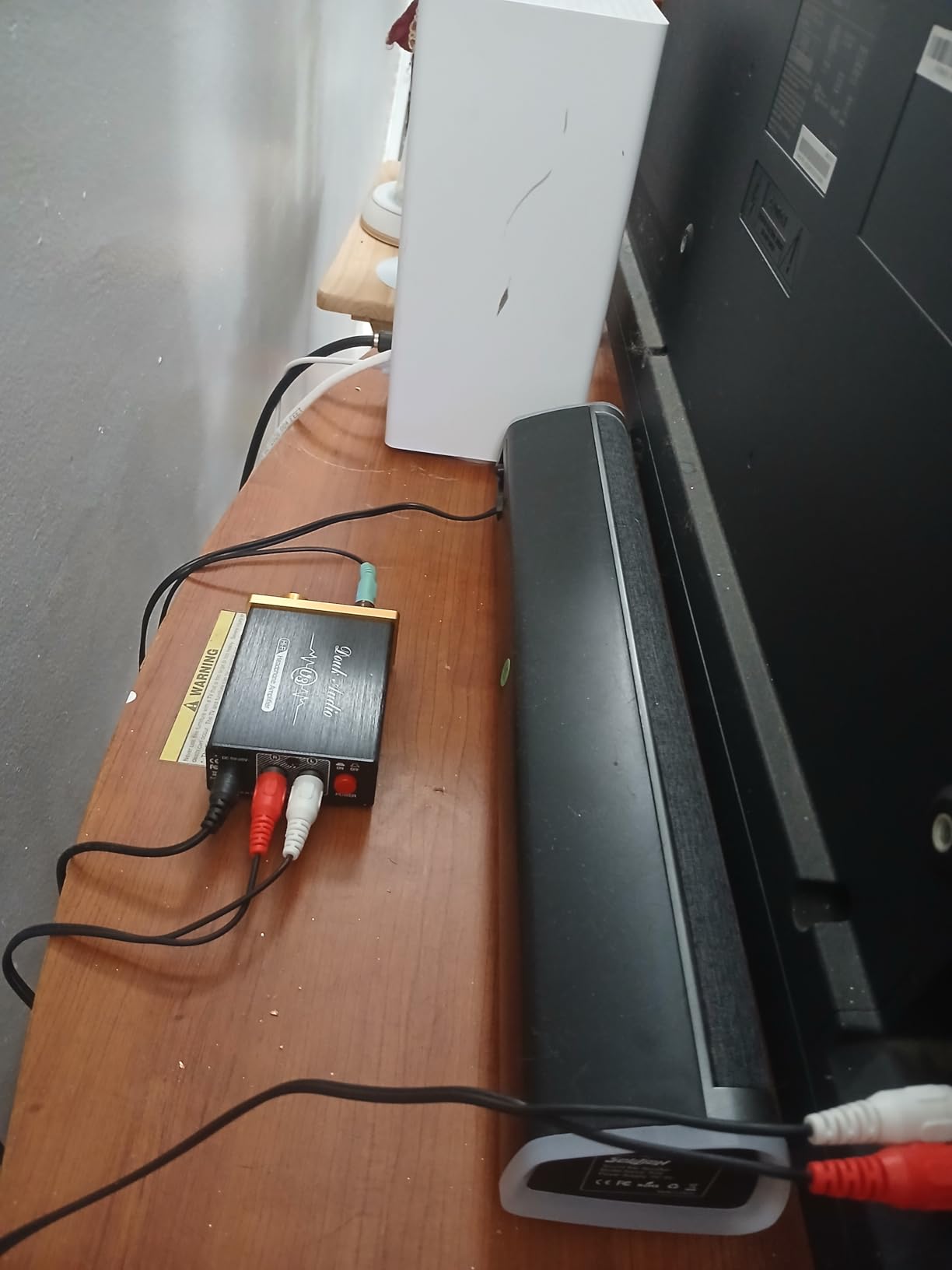
The Douk U3 is a single-listener amp with real muscle, and the 1300 milliamp class A design is why. It is one of the most thoroughly reviewed budget headphone amps in existence, with 863 reviews at 4.3 stars, and owners repeatedly compare it favourably against far more expensive units. For a podcast host who monitors on their own reference headphones, that comparison matters.
Its stated capability is the draw. It is listed as driving high-impedance models including the HD580, HD600 and HD650, AKG K701, K702 and Q701, the DT880, and models such as the T70, T90, SR225, SR325, and RS1e. That is a list of headphones that will not reach a satisfying level on a small interface amplifier. Plug one of those in here and the guest, or the host, actually hears themselves clearly.
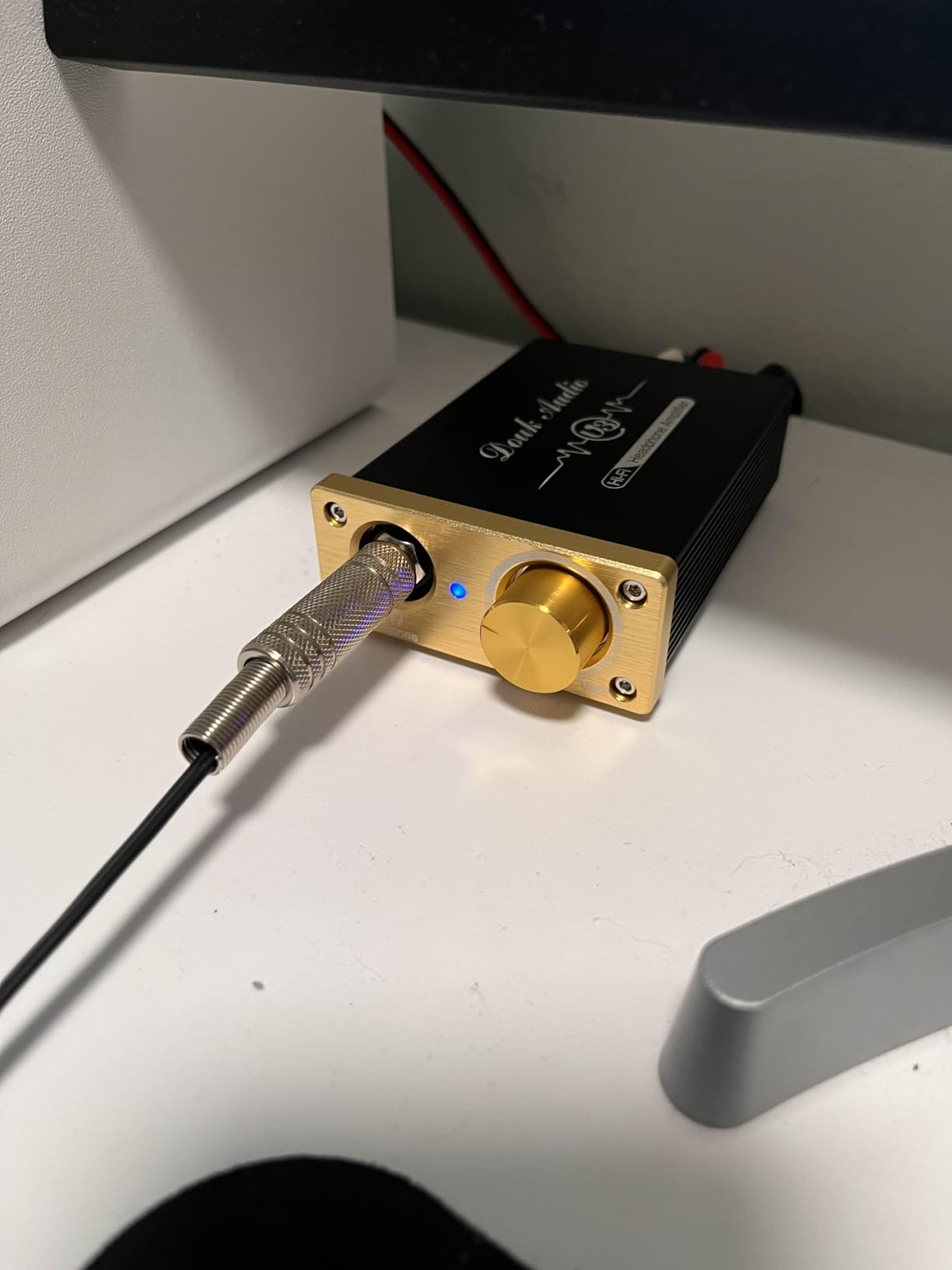
Noise behaviour is the podcast-relevant part, and the reports are encouraging. Owners report very low noise with a clean DC or clean USB power supply, and there is a detented volume knob that gives repeatable steps, which is useful when you need to match levels across two takes. The original TI NE5532 op-amp is in a pluggable socket, so you can swap in a different one for a different character without replacing the unit.
It is also honest to list the drawbacks, because several are real. There is a single headphone output, so this never solves the guest problem. Inputs are RCA only, which means an adapter for a 3.5mm source.
The front power LED is unusually bright for a dark room. And shielding is imperfect, so nearby Bluetooth or Wi-Fi transmitters can bleed in, which is a specific risk in a room where someone is on a wireless call.
Who the Douk U3 suits
It suits a host or engineer monitoring alone on difficult headphones. It suits a reviewer who wants to hear whether a pair of headphones is flattering them, since that is one of the things owners say this amp is genuinely good at revealing. And the class A current, with the pluggable op-amp socket, appeals to anyone who enjoys modifying a chain.
It suits a narrator or voiceover artist working solo in a treated booth, where a clean signal and a reference level matter more than headcount. With a clean power supply the noise floor stays out of the recording.
Where the Douk U3 falls short
It falls short on the podcast guest question entirely, since there is one output. If anyone else in the room needs to monitor, this is the wrong device and the 60 milliwatt MA400 is at least the same limit. It also falls short in a wireless-heavy room because of the shielding, and in a dark booth because of the LED.
Mild channel imbalance at the lowest volume positions is reported by some owners, which matters if you monitor very quietly. And no power supply is included, only a USB-style cable, so factor in sourcing a clean supply before you rely on it for a recorded session.
How to Wire Guests: Audio Interface to Headphone Amp to Each Pair
The whole signal path is one line in the front of the box and one line out of each seat. In text it looks like this: audio interface headphone out, then the distribution amp input, then one output cable per listener, then one pair of headphones per cable. There is no splitting, no daisy chain, and no passive box in the middle.
Follow these steps in order the first time, and it takes about five minutes.
1. Set your interface headphone volume to about 70 percent and leave it there for the whole session. The distribution amp now does all the level work, and a fixed upstream setting means nobody can accidentally change the source level for everyone else.
2. Run a quarter-inch TRS stereo cable from the interface headphone output to the amp input. Use a properly wired stereo cable, because a mono cable or a cheap passive adapter is the usual cause of hum or a missing channel. The Mackie owners in particular warn about this, and it applies to every unit on this list.
3. Decide the source. If you are sending the guests the full program feed, patch from the interface or console mix bus. If you want guests to hear only themselves, use a proper cue mixer and patch its guest feed into the amp instead. A distribution amp sends an identical signal to every output, so the mix decision has to happen upstream of it.
4. Run one cable per seat and label both ends. Four labelled cables take three minutes and save you twenty when someone reports a dead ear. Route them along the table edge or under a cable channel so a guest standing up does not drag a monitor off a desk.
5. Match the connectors to the headphones. Quarter-inch TRS covers most studio headphones, and eighth-inch covers earbuds and phone-style headphones. If your guests bring mixed types, buy two quarter-inch to eighth-inch adapters and keep them with the amp rather than in a drawer across the room.
6. Set each guest level individually. Start the host at a comfortable level, then ask each guest to turn their own knob until they can hear themselves clearly and comfortably. The goal is that nobody reaches for the master control again during the recording. This single step removes the majority of guest complaints we read about.
7. Do a noise check with the guest microphones live. Play a quiet passage or a second of silence and listen in each pair. If you hear hiss or hum in the headphones, the fault is in the cable, the grounding, or a low-quality unit, and it is much cheaper to find now than in post.
8. Set a level ceiling. If your guests are wearing unfamiliar headphones for three hours, hand them a lower starting level and let them turn up. A guest who cannot hear themselves will either ask you to turn it up for everyone or start speaking quietly, and both hurt the recording.
One note on remote calls. An analog distribution amp adds no meaningful delay, so it is safe for double-ender recording and for monitoring a video call. Where latency becomes a concern is any digital conversion stage in the chain, which is a reason to feed the amp from an analog interface output rather than from a computer. That is one reason the analog boxes on this list are the right default for a live room.
Buying Guide: How Many Headphone Outputs Do You Need
Count seats, not people in general. The host, every in-person guest, and any producer sitting in the room need a headphone output each. Remote participants who arrive through the interface on one stereo feed do not need a seat, because they are already mixed into the same signal the locals hear.
One seat, solo host: you do not need a distribution amp. You need a good headphone output on your interface, or a single-listener amp like the Douk U3 if your interface cannot drive your reference headphones.
Two seats, host plus one guest: many interfaces have two headphone jacks, but check whether they share one control. If they do, a four-channel amp such as the FIFINE N6 or the Zendstanding HA400 gives you room to grow and costs little more than the cable you would buy anyway.
Three or four seats, the standard podcast table: this is where a four-channel amp with one volume control per output is the sweet spot. The Pyle PHA40 has the deepest owner history here, the Mackie HM-4 has the highest rating and the metal build, and the FIFINE N6 is the value option with the same output count.
Five to eight seats, panels and hybrid shows: you are past what a four-channel box covers. The socodox unit drives up to eight headphones from one box. Above eight, a headphone distribution system designed for broadcast booths is the right category, and the Behringer DS2800 becomes relevant for splitting a finished feed to many destinations rather than to many ears.
Per-output volume versus a bused output. This is the single most important spec on this page. A bused output means every jack receives the same signal at the same level and shares one control. An independent output means each jack has its own pot.
For guest monitoring, independent is the whole point. If a listing does not clearly state one knob per output, assume it is bused and ask the manufacturer before you buy.
Passive splitter versus active amp. A passive headphone splitter is a wire with no electronics. It costs almost nothing, adds no gain, and cannot give a guest with quiet headphones any more level than the source provided. It also shares everything, so one person turning up turns up everyone.
For a two-person demo, a passive splitter is acceptable. For a guest who cannot hear themselves, an active amp is the answer, and the extra cost is small.
Impedance and borrowed headphones. A guest who brings high-impedance headphones, or wears a cheap low-sensitivity pair, needs voltage. The Mackie HM-4 and the Douk U3 both have more current capability than the budget boxes, and the Mackie is the one to choose if your guest headphones are unknown quantities.
The Pyle, FIFINE, and Zendstanding units are specified for the common 32 to 100 ohm range, which covers most closed-back podcast headphones but not heavy studio models.
Inputs and second destinations. If you also want to feed speakers, feed a second recorder, or bring in a talkback source, you need at least two inputs. Among these ten, only the Behringer DS2800 offers two inputs, and it does so at line level with XLR. Everything else is a single-input distribution box, which is fine for a dedicated headphone chain and nothing else.
Talkback. As noted earlier, none of these units includes a talkback microphone. If you need the host to give private level notes, handle the talkback at the mixer or interface, or add a small talkback box to the chain. Do not buy a headphone amp expecting that feature.
Noise floor, cables, and build. Podcasters fear added hiss because guest microphones are open, so buy a metal-chassis unit over a plastic one where the budget allows, use shielded cables, and run a noise check before the first record. Buy three or four cables and a quarter-inch to eighth-inch adapter, and label everything.
For shared loaner headphones, number the cables and the cups so a guest always returns a matched set, and keep a small bag of wipeable earpads to replace between sessions.
Balanced connections. Only the Fosi Audio ZH3 offers a balanced 4.4 mm output. For speech monitoring at podcast levels, the difference between balanced and unbalanced is far smaller than the difference between a driven headphone and an undriven one. Do not let a balanced connection lead you to ignore the guest level problem.
When You Do Not Need a Headphone Amp at All
If you record solo and your interface has one clean headphone output with its own volume control, stop reading and save the money. A modern interface headphone stage is perfectly adequate for a single listener, and a distribution amp cannot make one output better than another.
The second case is an interface with two headphone jacks that are genuinely independently controlled. Some manufacturers do this properly. Check the manual or the front panel, not the number of jacks, because two bused jacks give you two seats and one volume. If both are truly independent, you can run a host and a guest today with no extra hardware, and add a distribution amp when a third person joins.
Forums make the same point repeatedly: many podcasters record three and four person shows with two microphones and an interface, using the built-in monitoring, and only reach for an external amp once a second guest makes independent levels unavoidable. That is the right order of operations. Buy the amp when the level problem appears, not before.
Frequently Asked Questions
Are headphone amplifiers worth it for podcasting?
Yes, once more than one person needs to monitor, and the reason is level control rather than sound quality. A headphone amplifier for podcast guests splits one interface feed into multiple outputs with a volume control on each, so a quiet guest can turn up without the loud guest turning down. If you record solo, an amp adds nothing you can hear.
Do I need a headphone amp if my interface has two headphone jacks?
Only if those two jacks are independently controlled. Most interfaces bus every headphone jack to a single control, so two jacks give you two seats and one volume, which is the exact problem a distribution amp solves. Check the manual for a second level knob or a per-channel control before buying anything.
How do I connect two headphones to one audio interface?
The simplest method is a two-output headphone amp: run a quarter-inch TRS cable from the interface headphone out to the amp input, then one cable from each amp output to a listener, with a volume control on each. A passive headphone splitter also works for two people, but it shares the level between them and adds no gain.
How many headphone outputs do I need for a podcast with guests?
Count the host, every in-person guest, and any producer in the room. Two seats can be covered by an interface with independent jacks. Three to four seats need a four-channel distribution amp. Five to eight seats need an eight-output box such as the one in this roundup that drives up to eight headphones. Remote participants usually share one stereo feed and do not need a seat.
Can I use a headphone splitter instead of an amplifier?
For two listeners on a quiet signal, yes, but understand the limits. A passive splitter has no electronics, so it cannot give a guest more level than the interface provides and it shares the volume between everyone attached. A passive adapter with a poor ground connection is also the most common cause of hum in a small podcast chain, so use a properly wired cable.
What is a talkback microphone on a headphone amp?
A talkback microphone lets the host speak to listeners privately without the talk entering the recording, by ducking or muting the headphone feed while opening a mic in the room. It is a broadcast control room feature, and none of the ten units in this roundup includes one. Handle talkback at your mixer or interface instead.
What is the best high-end headphone amplifier?
That question depends entirely on what you are driving, since high-end amps matter for difficult high-impedance headphones rather than for guest monitoring. For a single listener who wants serious power and low noise, the Fosi Audio ZH3 in this roundup delivers up to 2.57 watts per channel on its balanced output with a three-level gain switch. For multiple guests, a multi-channel distribution amp is the correct purchase instead.
Will a cheap headphone amp add hiss to a clean recording?
It can, and podcasters are right to worry because guest microphones are often open in the same room. The main causes are cheap unshielded cables, ground loop hum, and units with poor shielding near wireless transmitters. Test every channel with the microphones live and the talkback muted before you record, and prefer a metal-chassis unit with a proper power supply.
Final Verdict on Headphone Amplifiers for Podcast Guests in 2026
For a host and three guests at one table, the Pyle PHA40 is our pick: four independent outputs, one knob each, and more owner history than anything else we tested. If your guests wear heavier studio headphones, move up to the Mackie HM-4 for the extra gain and the metal chassis. Budget-conscious four-person setups are well served by the FIFINE N6, and a large panel that needs more than four seats points to the eight-output box.
Everything else here has a narrower job. The Behringer DS2800 distributes finished line feeds to many destinations, the Fosi ZH3 gives one listener serious power plus a DAC, the Zendstanding HA400 travels well, the LiNKFOR MA400 handles a mic plus monitoring, and the Douk U3 drives difficult headphones for a single user. If you record solo with a clean interface headphone out, buy none of them.
Count your seats, check for one volume control per output, buy labelled cables with the amp, and run a noise check with the microphones live before you record. That preparation matters more than any model on this list, and it is the difference between a guest who relaxes and talks, and a guest who leans away from the microphone and asks you to turn everything up.