
If you’ve ever tried to lay down a melody with a mouse, you already know why people hunt for the best portable keyboards. A proper MIDI controller turns a plain laptop into an instrument you can actually play, with timing, dynamics, and feel that no piano roll can match. The challenge is sorting the hundreds of options down to a short list that actually fits your studio, your DAW, and your backpack.
Our team has spent the past several weeks testing mini MIDI keyboards from Akai, Arturia, Novation, M-Audio, Korg, and a handful of smaller brands. We plugged each one into Ableton Live, FL Studio, Logic Pro, and GarageBand on Mac, Windows, and iPad. We tested pads with finger-drumming routines, ran arpeggiators through evolving sequences, and folded, tossed, and packed each unit into a backpack. Below are the 10 best portable keyboards our team recommends in 2026, organized by what each one does best.
Quick answer: the Akai Professional MPK Mini IV is our editor’s choice for most people, the Arturia MiniLab 37 is the best value for those who want a fuller playing range, and the midiplus AKM320 is the budget pick that still gets the job done. Each pick also includes honest reasons to skip it, because the right keyboard depends on whether you’re producing on a laptop, finger-drumming in FL Studio, or sketching ideas on an iPad.
Table of Contents
Top 3 Picks for Best Portable Keyboards (September 2026)


Best Portable Keyboards in 2026: Quick Comparison
| Product | Specs | Action |
|---|---|---|
| Akai MPK Mini IV |
|
Check Latest Price |
 M-Audio Keystation 49 MK3 M-Audio Keystation 49 MK3 |
|
Check Latest Price |
| midiplus AKM320 |
|
Check Latest Price |
 Arturia MiniLab 37 Arturia MiniLab 37 |
|
Check Latest Price |
 M-Audio Oxygen Pro Mini 32 M-Audio Oxygen Pro Mini 32 |
|
Check Latest Price |
 Korg nanoKEY2 Korg nanoKEY2 |
|
Check Latest Price |
 Novation Launchkey Mini 25 MK4 Novation Launchkey Mini 25 MK4 |
|
Check Latest Price |
 M-VAVE 25 Key Wireless M-VAVE 25 Key Wireless |
|
Check Latest Price |
 Novation FLkey Mini Novation FLkey Mini |
|
Check Latest Price |
 Carry-on Folding MIDI Controller Carry-on Folding MIDI Controller |
|
Check Latest Price |
1. Akai Professional MPK Mini IV – Best Portable Keyboard Overall
Akai Professional MPK Mini IV 25-Key USB-C MIDI Keyboard Controller, Black
25 mini velocity-sensitive keys
USB-C with full-size MIDI Out
8 RGB MPC pads
Pros
- Real pitch and mod wheels replace the older joystick
- Responsive 25-key mini keybed with USB-C upgrade
- 8 RGB MPC pads with Note Repeat and chord modes
- Arpeggiator with Pattern
- Freeze
- and Mutate
- Plug-and-play on Mac
- Windows
- and mobile
Cons
- Mini keys still feel cramped for players with bigger hands
- Plastic build quality keeps weight low but feels light
- Hold to edit pads without preview until saved
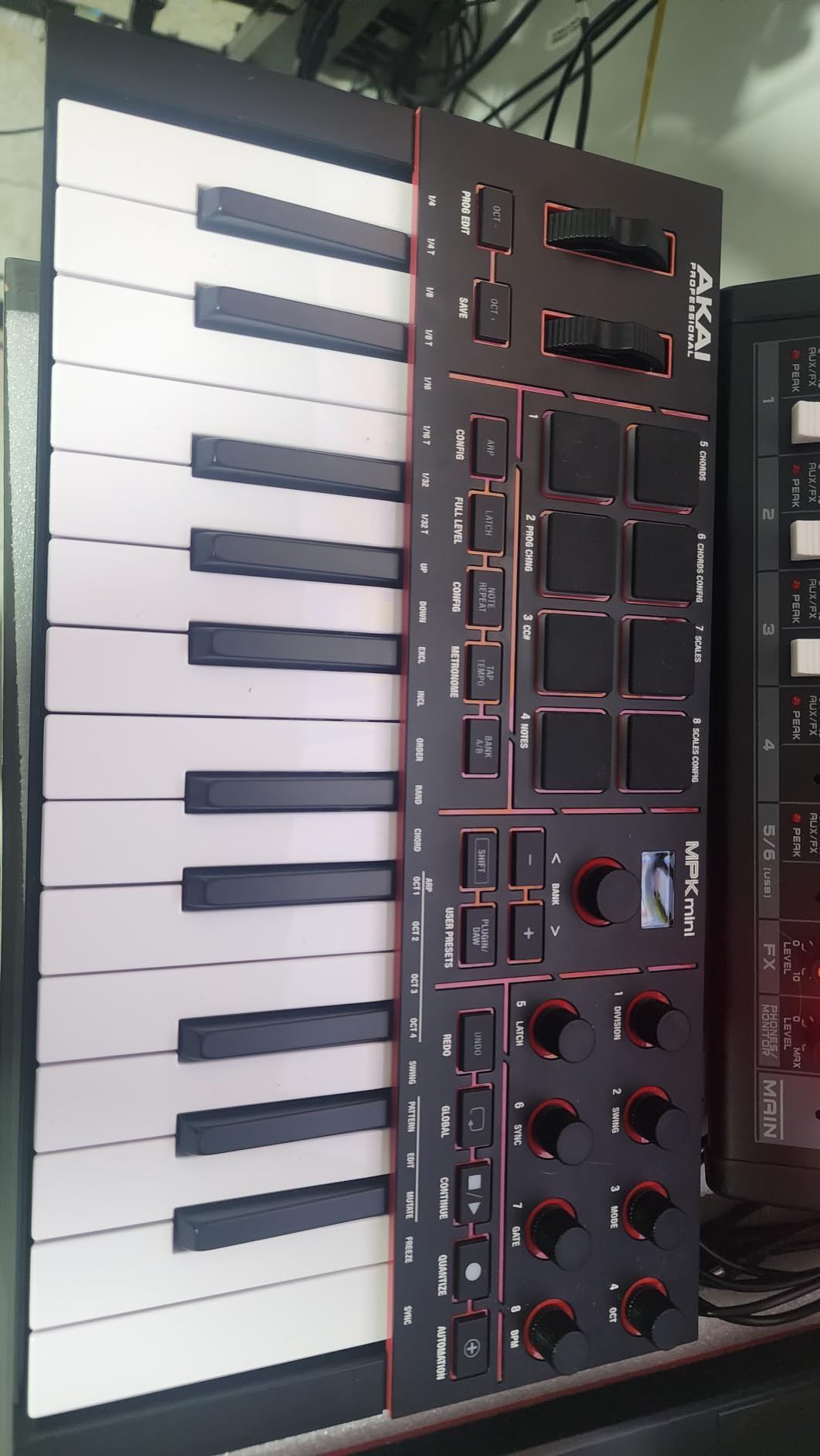
I have been carrying the Akai MPK Mini IV in my backpack for the past month, and it has replaced every other mini controller I own for daily sketching. The biggest upgrade over the older MPK Mini MK3 is the swap from a joystick to real pitch and modulation wheels. Reddit users complained about that joystick for years, so it is good to see Akai finally listen.
Plug it into a MacBook, open Ableton Live Lite, and the unit maps itself in about a minute. The 8 RGB MPC pads feel punchy and quiet enough for apartment recording. Arpeggiator with Mutate sparks ideas I would never have found clicking notes in a piano roll. Chord and Scale modes help me stay in key when I am writing melodies quickly.
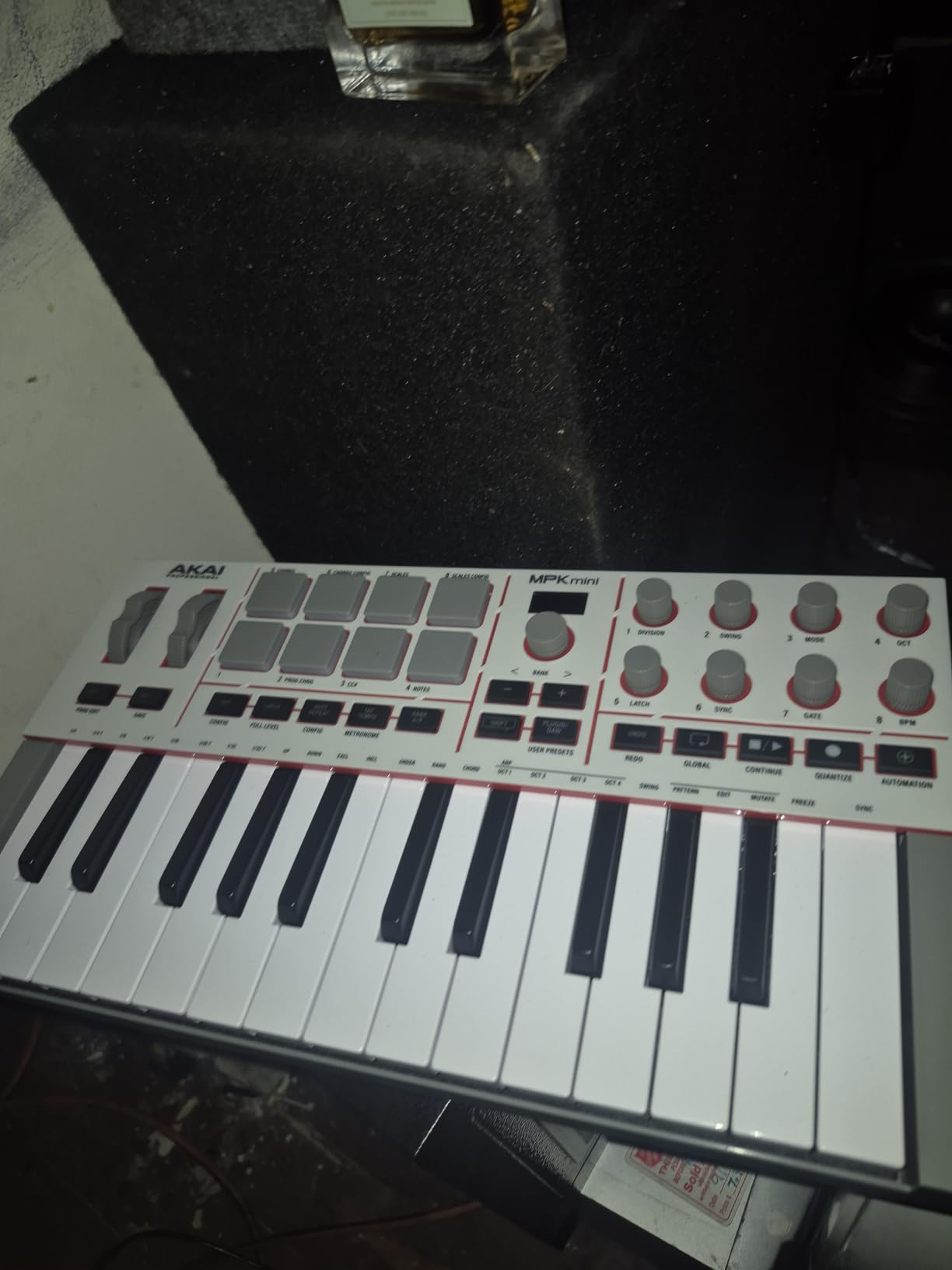
One thing I appreciate is the inclusion of a full-size MIDI Out jack, which is rare at this size. I have used it to drive a Korg minilogue and an Arturia MicroFreak without any adapter drama. The 1/4 inch sustain pedal input also means I can plug in my usual pedal for piano-style parts.
USB-C is another welcome upgrade. The unit draws power straight from the laptop, no extra bricks. The bundled software includes 1000+ sounds, 2 months of Splice, and a 30-day Melodics trial, which is more than I expected at this tier. For most producers hunting the best portable keyboards, this is the one I point them toward first.
For Whom It’s Good
The MPK Mini IV is ideal for bedroom producers, beat makers, and songwriters who want a full-featured mini controller without the bulk. If you work in FL Studio, Logic Pro, or Ableton Live, the auto-mapping works out of the box. It also suits guitarists and bassists who want a small MIDI keyboard for laying down demo parts without firing up a full studio rig.
For Whom It’s Bad
If you play piano seriously, the 25 mini keys will cramp your style within an hour. If you need aftertouch for expressive synth parts, look at the Arturia MiniLab 37 or the Novation Launchkey Mini 25 MK4 instead. If you only have an iPad, note that iOS support requires a USB adapter, which is one more thing to forget.
2. Arturia MiniLab 37 – Best Premium Mini MIDI Controller
Arturia MiniLab 37 MIDI Keyboard Controller
37 slim keys
USB-C with MIDI Out
Analog Lab Intro software
Pros
- 37 slim keys unlock two-handed playing in a compact body
- Excellent key feel reviewers call best in class for mini controllers
- 8 endless encoders and 4 faders for hands-on control
- Analog Lab Intro ships with hundreds of usable presets
- Real MIDI Out plus quality USB-C cable
Cons
- Pads can wobble at the edges causing accidental double-taps
- Minimal on-device labeling until you memorize the layout
- Touch sensors for pitch and mod instead of wheels
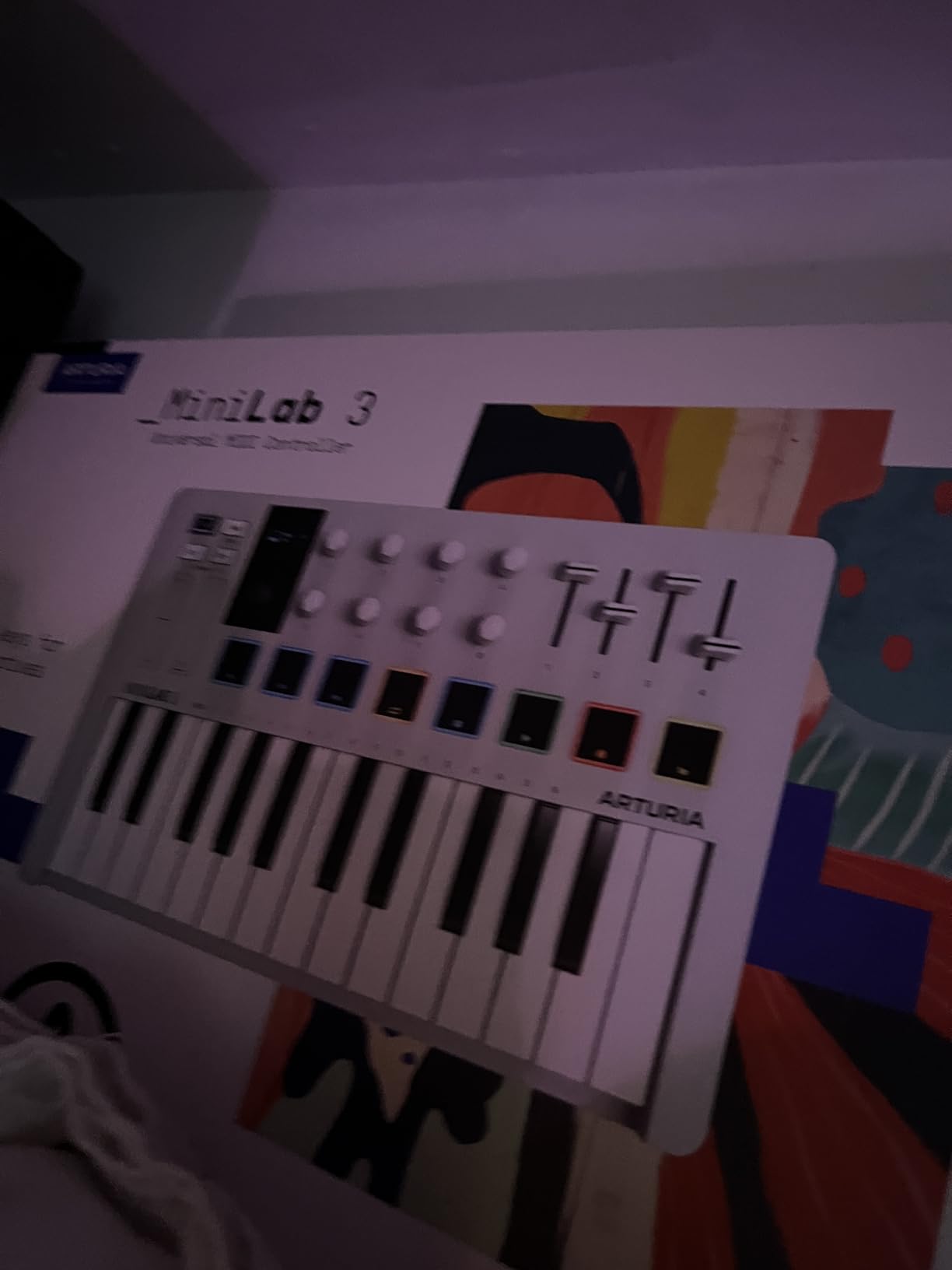
The Arturia MiniLab 37 is the keyboard I reach for when I want to actually play, not just sketch. With 37 slim keys, I can lay down two-handed synth parts and basslines without running out of range. The keybed has a snappy, defined feel that I have not found on any other controller at this size.
The control surface is generous for the footprint. 8 endless encoders, 4 faders, and an 8-pad RGB layout cover most of what I need without touching the mouse. The mini display shows parameter names clearly, which makes sound design far less click-heavy in Analog Lab. Bundled Analog Lab Intro is the real headline here: hundreds of presets from V Collection instruments give me pro-grade sounds without extra spend.
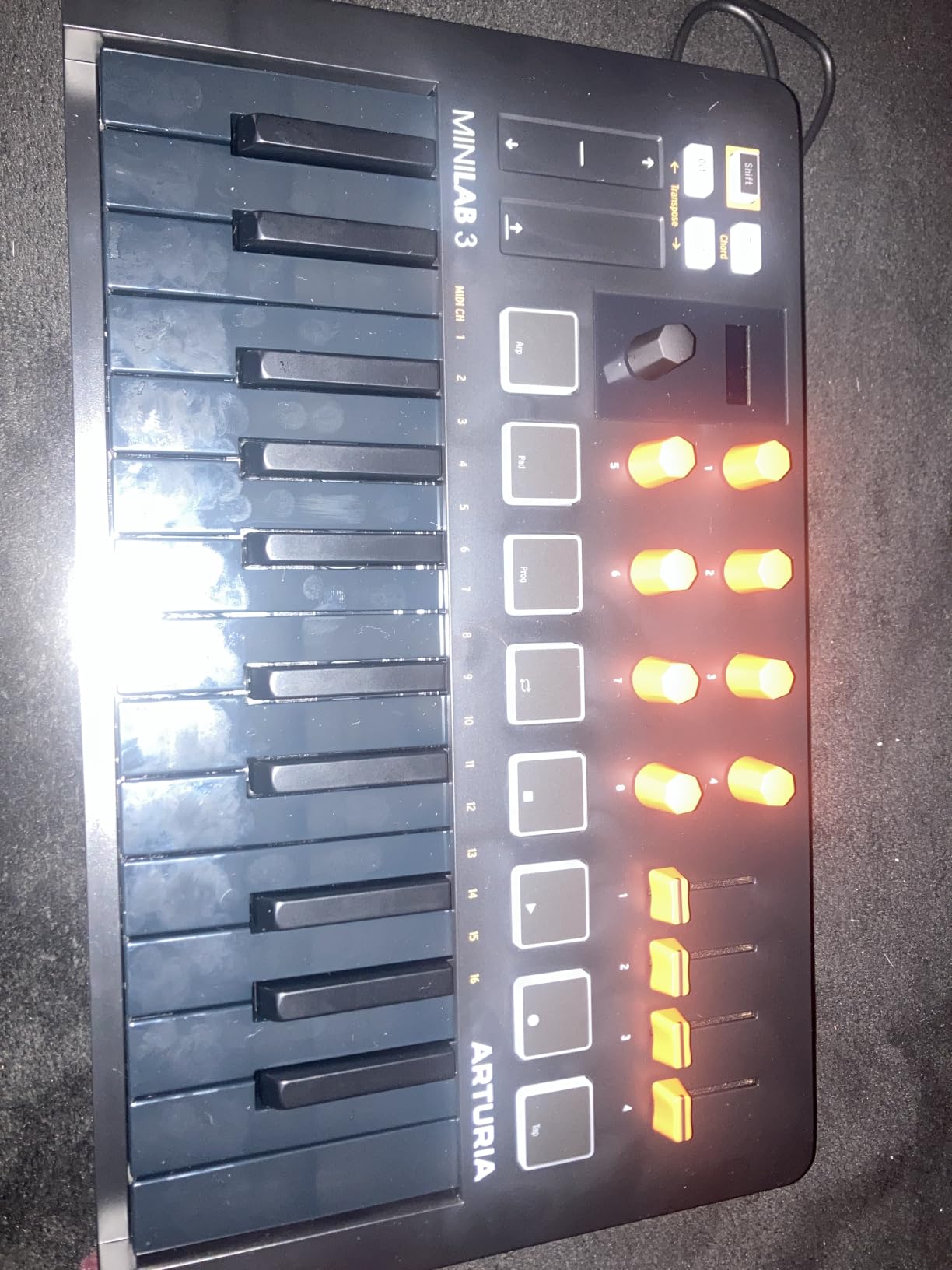
DAW integration with Ableton Live, Logic Pro, and FL Studio is solid, with transport controls working out of the box. The arpeggiator, chord mode, and transpose controls feel like proper creative tools rather than afterthoughts. For producers who want a portable keyboard with the feel of a bigger controller, this is the sweet spot.
The main honest trade-off is the pads. They work fine for finger drumming, but they feel slightly wobbly at the corners, which can trigger unintended hits during fast rolls. Pitch and mod use touch strips, which is fine for me but pianists who love precision wheels may want to look at the MPK Mini IV instead.
For Whom It’s Good
Producers who want a premium portable keyboard with deeper two-handed range. Anyone using Analog Lab or Arturia software benefits most. It also suits sound designers who want hands-on knobs and faders while shaping patches.
For Whom It’s Bad
If you are strict about pad feel, the slightly wobbly pads may annoy you. If you need pitch and mod wheels rather than strips, this is not the pick. For pure beat making, the FLkey Mini is a better fit.
3. midiplus AKM320 – Best Budget Portable MIDI Keyboard
midiplus AKM320 Midi Keyboard Controller
32 velocity-sensitive keys
Pitch and modulation wheels
USB powered
Pros
- Real pitch and modulation wheels at a budget tier
- 32 mid-size keys give more range than typical 25-key options
- Plug-and-play on Mac
- Windows
- and Linux
- Lightweight at 0.72 kg
- fits in a daypack
- Affordable entry point for beginners and students
Cons
- Plastic construction
- with rare reports of broken keys during travel
- Velocity resolution limited to about five distinct levels
- No pads
- knobs
- sliders
- or bundled software
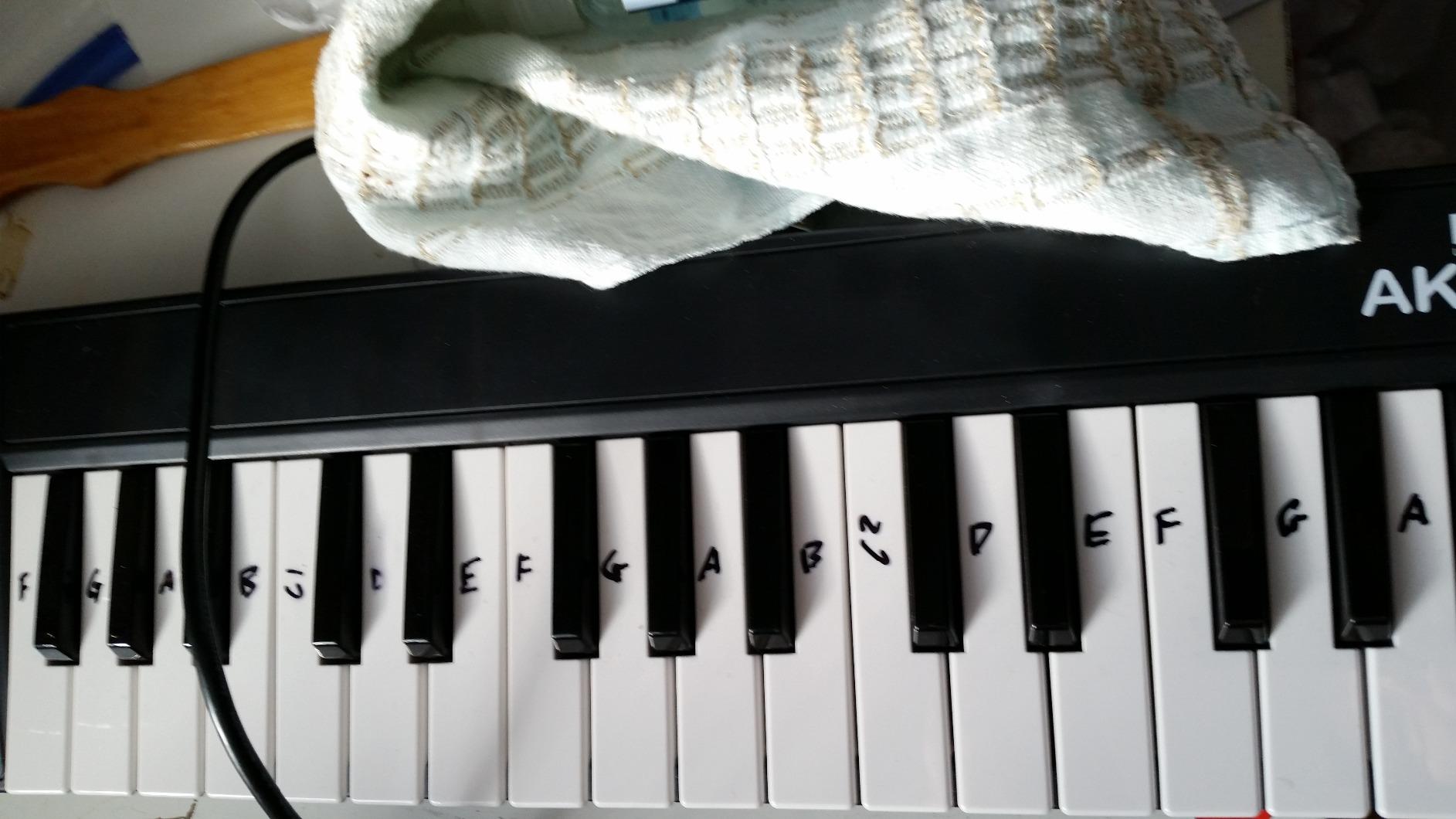
When my nephew asked for a MIDI keyboard to start learning music production, I sent him the midiplus AKM320. At a price that barely beats a meal out, you get a 32-key velocity-sensitive keybed, real pitch and mod wheels, octave and transpose buttons, and a sustain switch input. Nothing fancy, just a working portable keyboard.
Plug it into a MacBook running Logic Pro X and it lights up and plays within seconds. No driver hunt, no firmware drama. For producers starting out, that simplicity matters more than pads and faders they will not use yet.
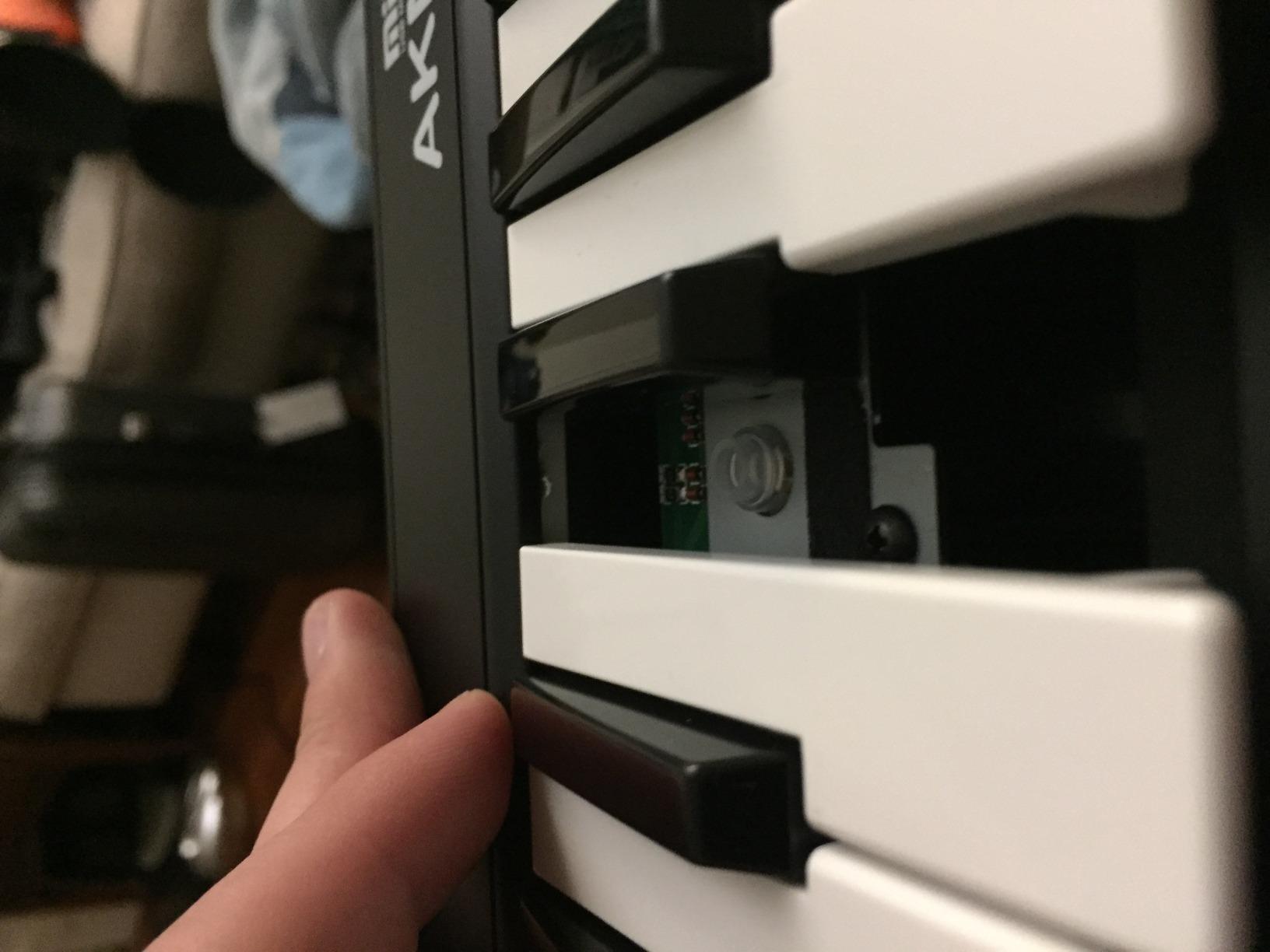
The trade-offs are real but fair at this price. Velocity resolution is limited, so very expressive playing will feel stepped. There are no pads, knobs, or sliders, so beat making requires a mouse or a second controller. The plastic shell is light enough to slip into a daypack, but I would not throw it in checked luggage.
What makes this one of the best portable keyboards on a budget is its sheer reliability. The unit has been around for years with thousands of positive reviews, and the spec sheet has not changed because there is nothing to improve at this tier. If you want a no-frills starter that simply works, the AKM320 is a sensible pick.
For Whom It’s Good
Beginners, students, and producers on a tight budget who want a real keyboard with proper pitch and mod wheels. Anyone who needs a lightweight travel backup for sketching ideas will appreciate the form factor.
For Whom It’s Bad
If you want pads, knobs, or bundled software, you will need to spend more. If expressive dynamic playing matters, the limited velocity range will frustrate you. If you need iPad compatibility with zero adapters, look elsewhere.
4. M-AUDIO Keystation 49 MK3 – Best Full-Size Budget Keyboard
M-AUDIO Keystation 49 MK3 USB MIDI Controller
49 full-size velocity-sensitive keys
Pitch and mod wheels
iOS compatible
Pros
- 49 full-size keys in a portable 32-inch footprint
- Reliable plug-and-play with Reaper
- Logic Pro
- and Ableton
- Solid build with stable tracking
- no double notes
- Generous bundled software suite including Ableton Live Lite
- Available in 49
- 61
- and 88-key configurations
Cons
- No MIDI out port
- USB only
- Keys are synth action rather than weighted
- Windows class-compliant setup can be unintuitive
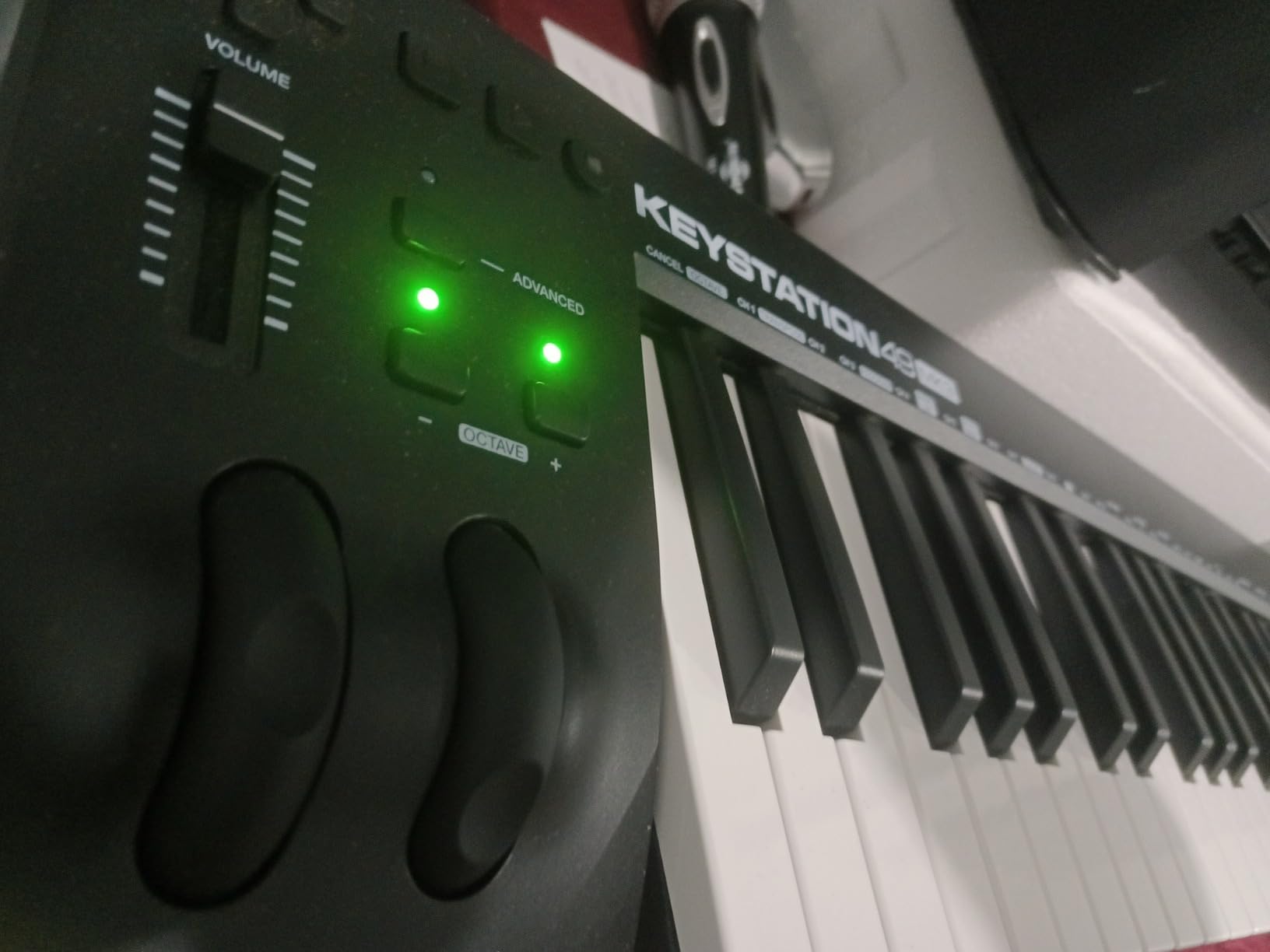
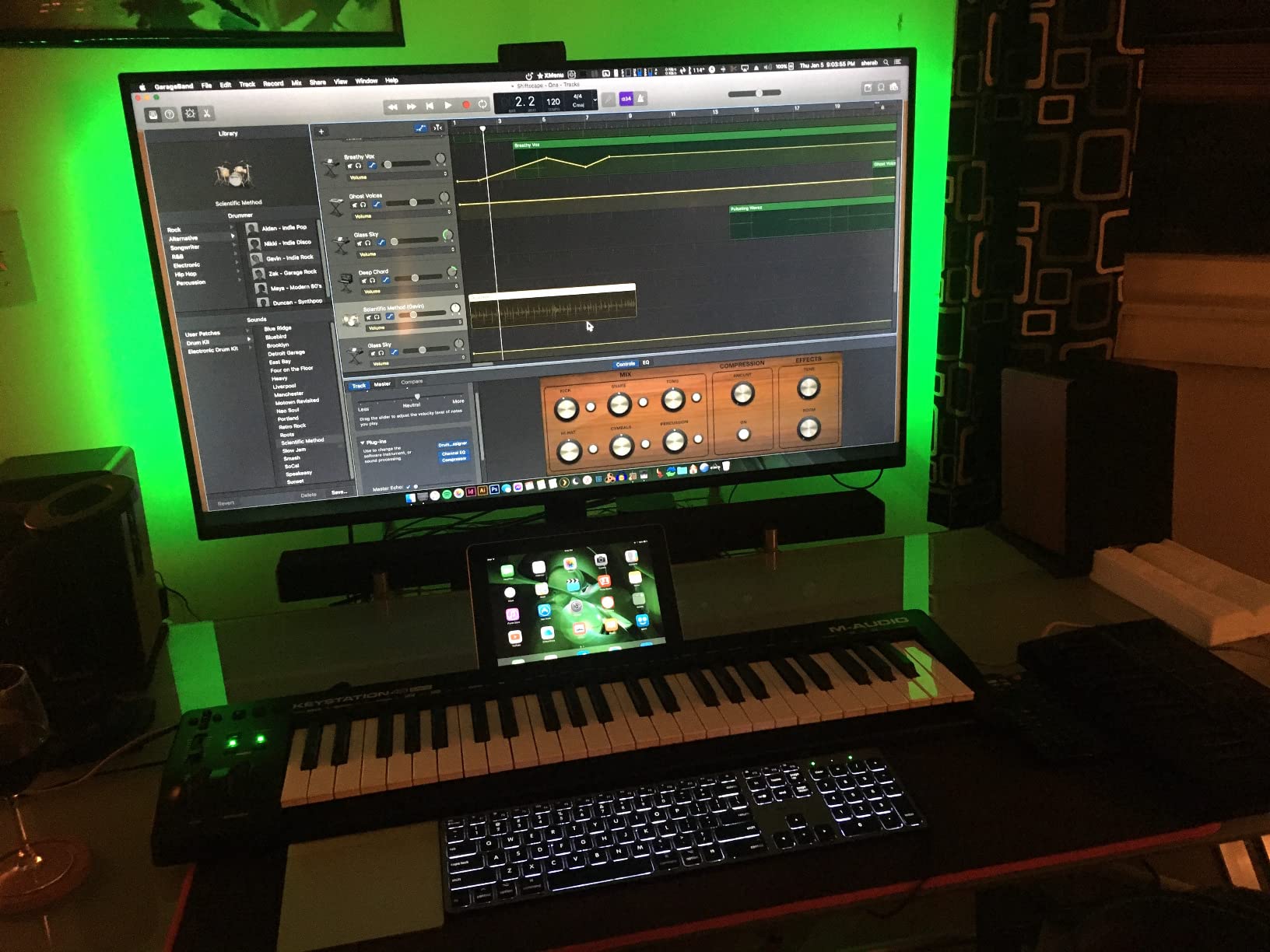
The M-Audio Keystation 49 MK3 is one of the most quietly successful portable keyboards of the past decade, with thousands of positive reviews and a strong 4.6-star rating. If you need full-size keys but still want something you can carry to a session, this is one of the best values around.
49 full-size synth-action keys give you a four-octave playing range, which is enough for most pop, rock, and electronic work without the bulk of a 61 or 88-key rig. Pitch and mod wheels are reliable. Transport and directional buttons plus a volume fader let you control your DAW without the mouse. The unit is bus powered over USB, so there is no wall wart to forget.
The software bundle punches above its tier: MPC Beats, Ableton Live Lite, Velvet, XPand2, Mini Grand, and Touch Loops are all included, plus Skoove lessons and 60+ Melodics exercises. Reviewers consistently note that the value is far higher than the price suggests.
The honest trade-off is no MIDI out port. If you want to drive a hardware synth directly, you need a controller with a 5-pin or 3.5mm MIDI jack. Keys are also synth action, so pianists used to weighted hammer action should look at premium picks. For everyone else, this is an honest, no-frills workhorse.
For Whom It’s Good
Producers and songwriters who want full-size keys without paying premium prices. Students learning piano with a software instrument like Pianote or Skoove will appreciate the key size and feel. Anyone using a 49-key controller as a songwriting scratchpad will find it hard to beat.
For Whom It’s Bad
If you need weighted hammer action, look at dedicated digital pianos or hammer-action controllers. If you want MIDI out for hardware synths, the M-Audio Oxygen Pro Mini 32 or Arturia MiniLab 37 are better fits. If 49 keys feels cramped, the 61 or 88-key versions exist but lose some portability.
5. Novation Launchkey Mini 25 MK4 – Best for Ableton Live
Novation Launchkey Mini 25 MK4 USB MIDI Keyboard Controller
25 mini keys
16 FSR pads with polyphonic aftertouch
Scale and Chord modes
Pros
- Deep
- out-of-the-box Ableton Live integration
- 16 FSR pads support polyphonic aftertouch
- Scale Mode and Chord modes unlock fast songwriting
- Compact and lightweight for backpack rigs
Cons
- Uses 3.5mm MIDI rather than traditional 5-pin DIN
- Bundled software registration is cumbersome
- Mini keys can feel narrow for extended play
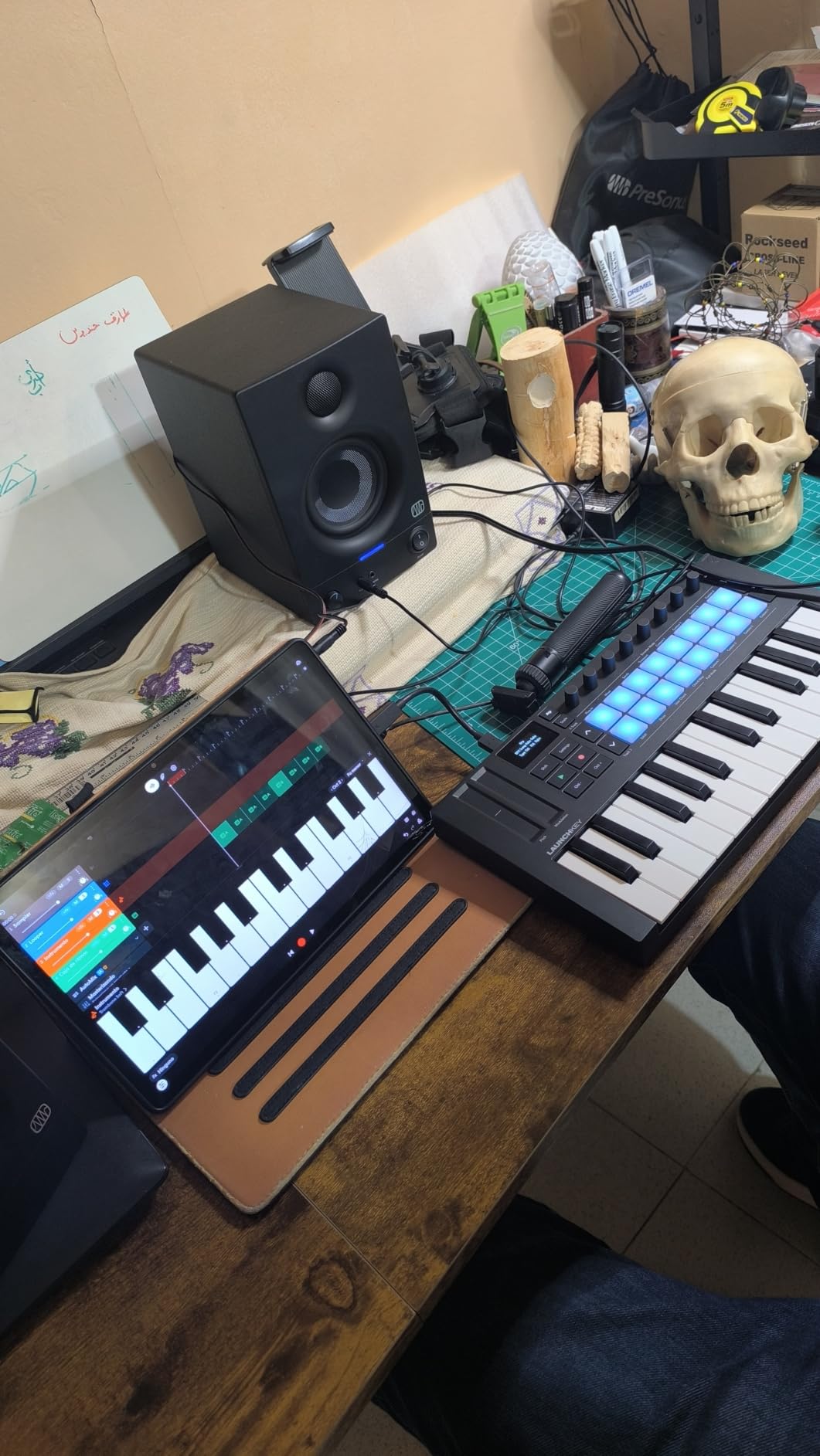
The Novation Launchkey Mini 25 MK4 is the controller Ableton users buy twice. Once you map it to Live, the pads run session view clips, the encoders control device parameters, and the transport section drives playback. There is no setup pain, which is rare.
The big upgrade over the older MK3 is the addition of polyphonic aftertouch on the pads. You can lean into individual pads and trigger expressive MPE-style modulation. It is a creative feature that pushes this mini controller into premium territory.
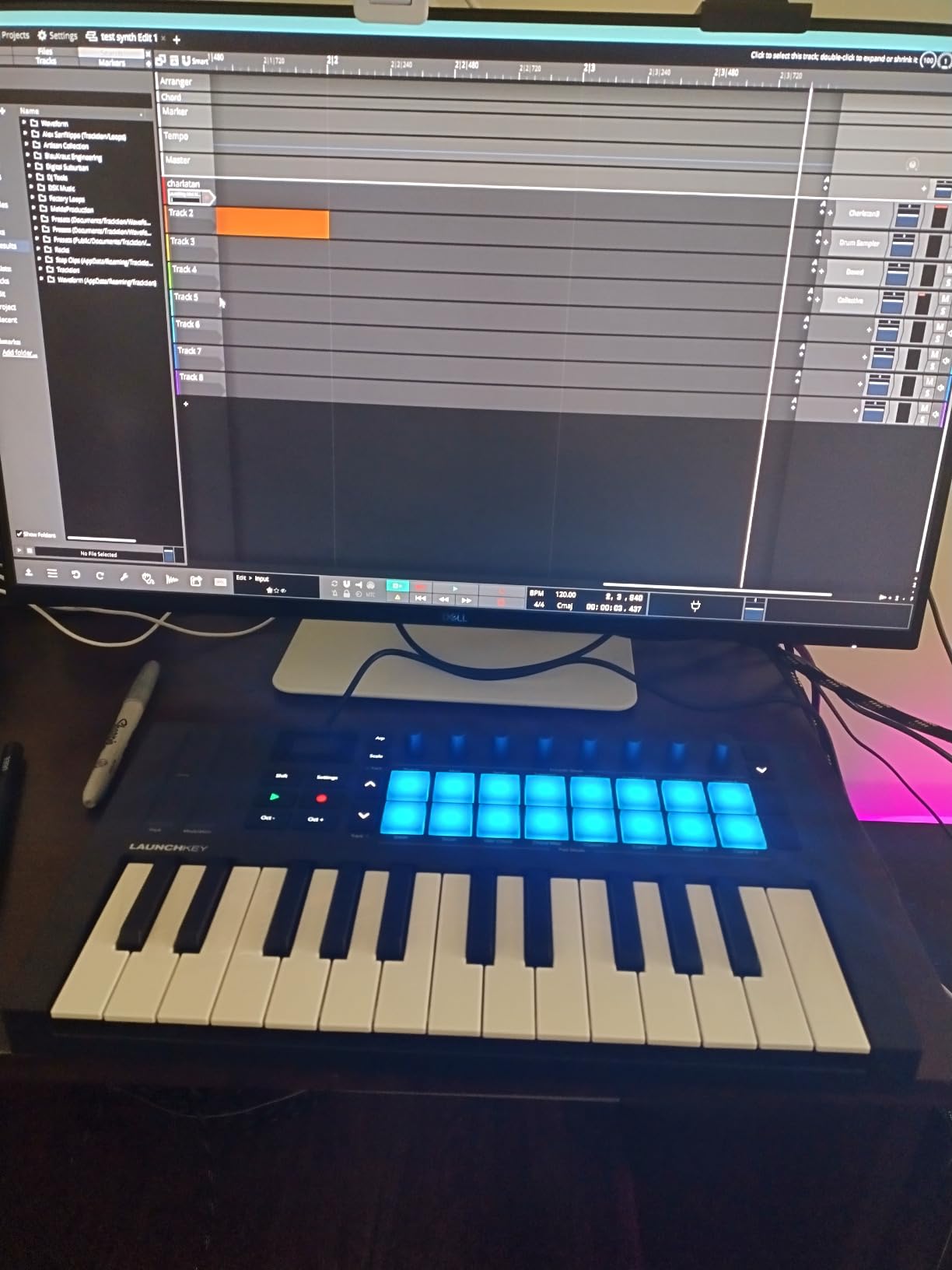
The bundled software is unusually generous for the price. Ableton Live Lite, Cubase LE, Novation Play, plus sounds from GForce, Klevgrand, Orchestral Tools, and Native Instruments come in the box. Scale Mode is great for staying in key when you are sketching melodies, and the arpeggiator with mutate function is genuinely fun.
The honest trade-off is the 3.5mm MIDI jacks instead of full-size 5-pin DIN. If you drive a hardware synth, you need an adapter. Bundled software requires multiple third-party accounts to register, which is friction. For pure Ableton work, this is one of the best portable keyboards you can buy.
For Whom It’s Good
Ableton Live users who want a compact controller that just works. Producers who value polyphonic aftertouch for expressive playing. Anyone who sketches ideas quickly and wants Scale and Chord modes to keep things musical.
For Whom It’s Bad
If you primarily use FL Studio, the FLkey Mini is a tighter fit. If you need traditional 5-pin MIDI out, look at the Akai MPK Mini IV or Arturia MiniLab 37. If you dislike registering software across multiple vendors, budget more time for setup.
6. Novation FLkey Mini – Best for FL Studio
Novation FLkey Mini USB MIDI Controller Keyboard
25 mini keys
16 RGB velocity-sensitive pads
Step sequencer with Note Repeat
Pros
- Designed from the ground up for FL Studio
- 16 RGB velocity-sensitive pads are excellent for finger drumming
- Step sequencer and Note Repeat speed up beat making
- Scale Mode keeps melodies in key for beginners
- Compact and solid build for the price
Cons
- Mini keys feel narrow and stiff for serious pianists
- Knob automation is limited without custom scripting
- Velocity curve requires hard strikes for top end
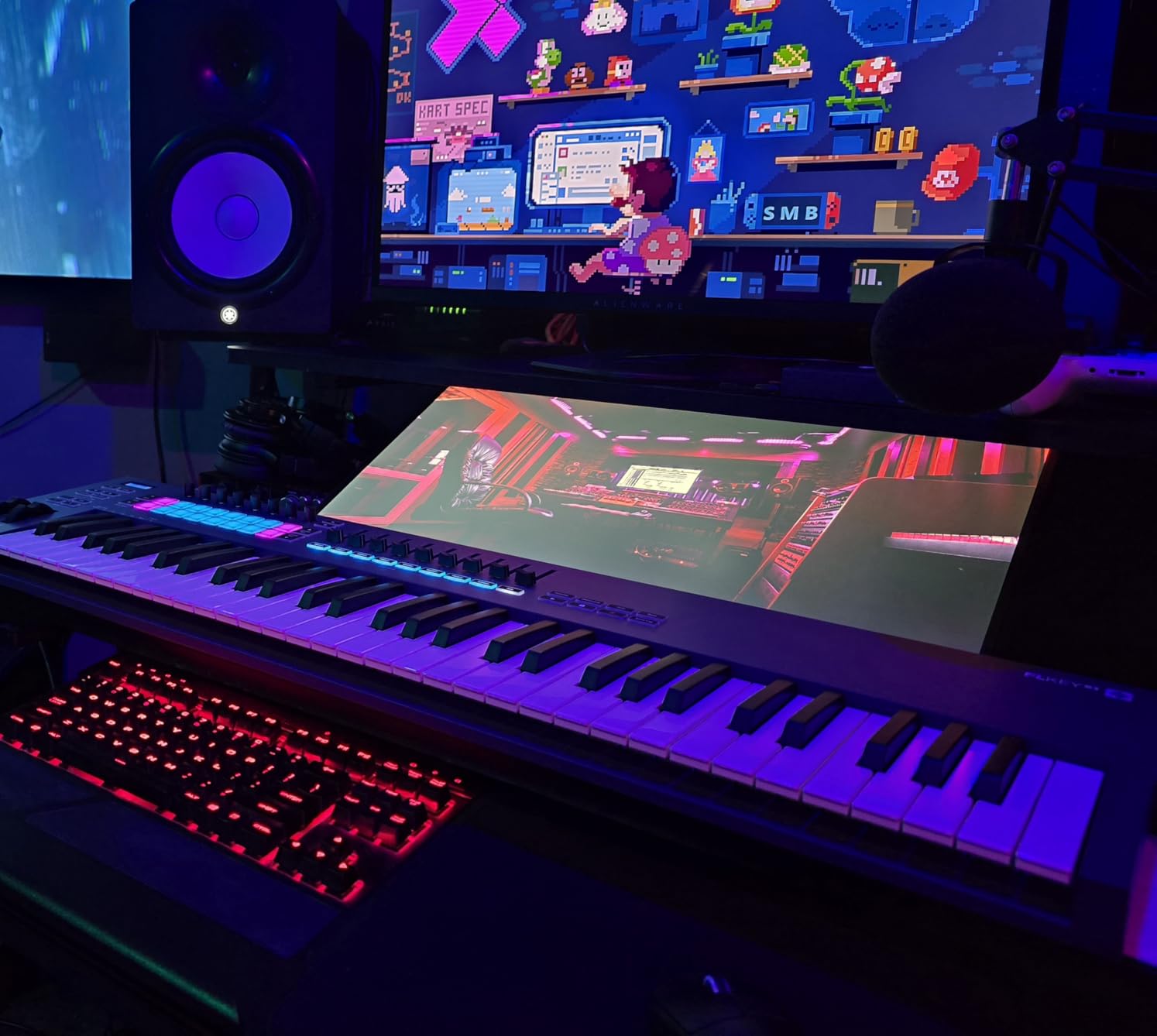
If FL Studio is your DAW, the FLkey Mini is the controller that finally makes the integration story feel complete. Plug it in and the mixer, channel rack, transport, and step sequencer light up without manual mapping. There is no other mini keyboard I have tested that does this with FL out of the box.
The 16 RGB pads are the highlight. They feel responsive for finger drumming, and Note Repeat makes hi-hat rolls effortless. The step sequencer mode lets you program beats directly from the pads, which is faster than clicking into the channel rack.
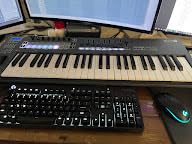
Scale Mode is the secret weapon for producers still learning theory. Pick a scale and every note you play is in key, which removes the most common reason beginners stall when writing melodies. The 8 knobs map to mixer volume and pan, and they feel smooth under the fingers.
The trade-offs are honest. Knob automation is limited to stock FL Studio instruments unless you add custom scripting. Mini keys are narrow and stiff, which pianists will feel quickly. For pure FL Studio beat making, however, this is the best portable keyboard at the price.
For Whom It’s Good
FL Studio producers who want a purpose-built controller. Beat makers who use step sequencing and Note Repeat heavily. Beginners who need Scale Mode to keep their melodies in key.
For Whom It’s Bad
If you play piano seriously, the stiff mini keys will frustrate you. If you use Ableton Live, Logic, or Cubase, the Launchkey Mini or MPK Mini IV are better fits. If you need lots of assignable knobs, look at the Oxygen Pro Mini 32 instead.
7. M-AUDIO Oxygen Pro Mini 32 – Best Control Density
M-AUDIO Oxygen Pro Mini 32 USB MIDI Keyboard Controller
32 semi-weighted mini keys
8 RGB pads with Note Repeat
NKS integration
Pros
- 32 keys provide more range than typical 25-key options
- 8 RGB pads with Note Repeat for finger drumming and clip launching
- Auto-mapping for major DAWs via the OLED screen
- Smart Chord and Smart Scale modes help beginners
- Native Kontrol Standard integration for Komplete sounds
Cons
- OLED display prone to burn-in without an off switch
- MIDI out uses 1/8-inch jack requiring an adapter
- Key feel is light and clacky compared to competitors
The M-Audio Oxygen Pro Mini 32 is the controller for producers who want maximum hands-on control without jumping to a full 49 or 61-key rig. It packs 4 faders, 4 knobs, 8 RGB pads, and a Smart Scale feature into a footprint that still slips into a backpack.
Auto-mapping to MPC Beats, Ableton Live, Cubase, and Logic via the OLED screen is genuinely useful. The screen tells you what is mapped to what, so you can adjust plugin parameters without reading a manual. The NKS integration is a major plus if you own Native Instruments Komplete.
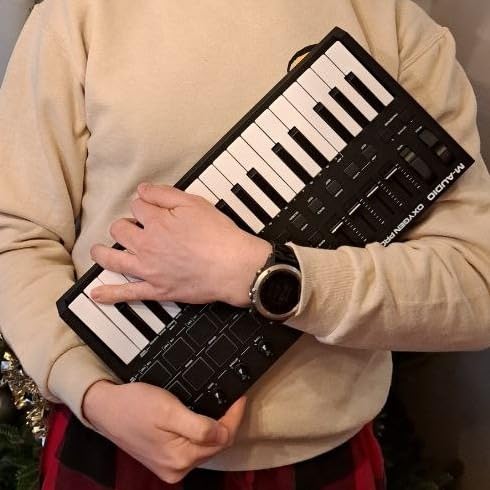
Smart Chord and Smart Scale are smart additions for producers still learning theory. Play a single key and Smart Chord generates a full chord. Smart Scale limits the keyboard to notes in a chosen scale, which removes wrong notes during fast sketching. The bundled software includes MPC Beats, Ableton Live Lite, AIR instruments, and MPC expansions.
The honest concerns are the OLED burn-in issue (there is no off switch) and the 1/8-inch MIDI out jack, which requires an adapter to connect to standard 5-pin DIN synths. Key feel is also light and clacky compared to the Arturia MiniLab 37. For control density, though, this is one of the best portable keyboards available.
For Whom It’s Good
Producers who want a high control density in a compact body. Anyone using Komplete or other NKS instruments will benefit most. Beginners who like the idea of Smart Chord and Smart Scale for fast songwriting.
For Whom It’s Bad
If you record for long sessions, OLED burn-in is a real concern. If you drive hardware synths, the 1/8-inch MIDI out jack requires an adapter. If key feel matters most, the Arturia MiniLab 37 or Akai MPK Mini IV are stronger picks.
8. Korg nanoKEY2 – Most Portable Mini Keyboard
Korg, 25-Key Midi Controller (NANOKEY2BK),Black
25 low-profile keys
Korg-tuned velocity response
USB-MIDI
Pros
- Ultra-slim and lightweight for laptop producers
- Responsive velocity-sensitive keys tuned by Korg
- Ample key width and spacing reduce mis-presses
- Trusted Korg build quality at an accessible price
Cons
- Limited to 25 mini keys with no expansion pads
- No sustain pedal or bundled software
- Pitch and mod functions accessed via buttons rather than wheels
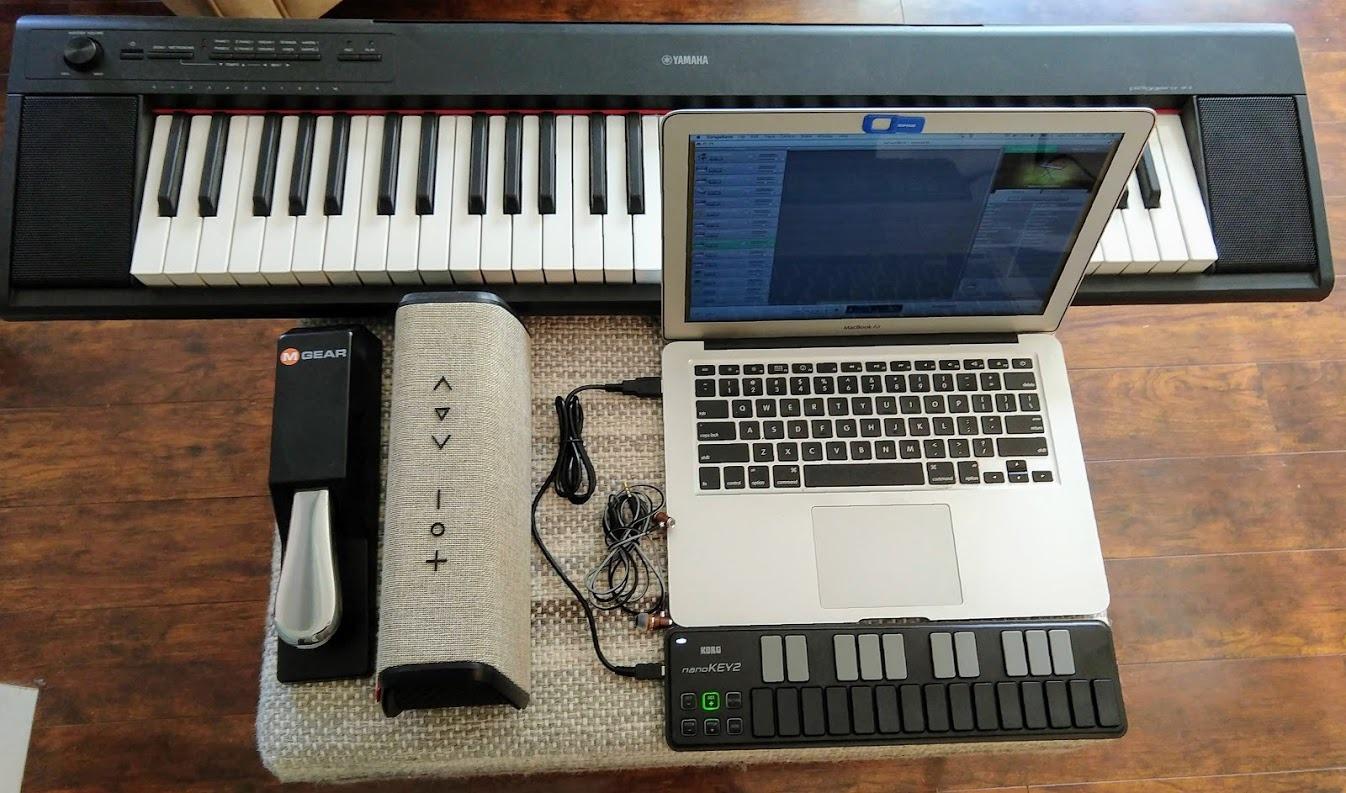
The Korg nanoKEY2 is the keyboard I keep in my messenger bag for impromptu sessions. It is barely longer than my laptop and weighs about a pound, so I forget I am carrying it. When inspiration hits at a coffee shop or a friend’s place, it pulls out and plays in seconds.
The keybed is impressive for the price. Korg has tuned the velocity response carefully, so dynamics feel musical rather than stepped. The wider key spacing reduces mis-presses compared to cramped mini keys on cheaper units.
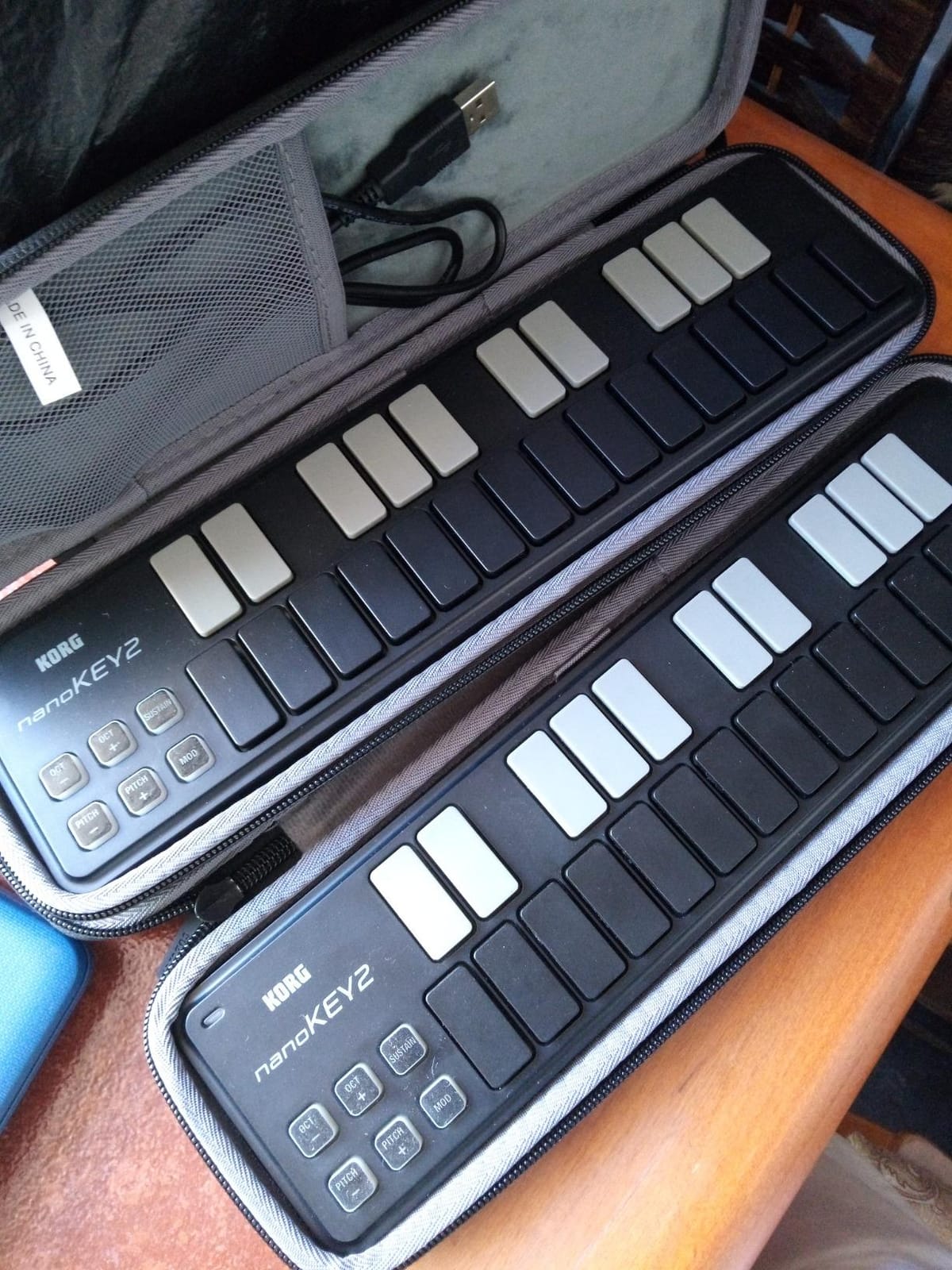
Pitch and modulation are handled via buttons rather than wheels, which is a fair trade-off at this size. The unit is class compliant, so it works on Mac and Windows without drivers, and it pairs with iOS devices via the Apple Camera Connection Kit.
The trade-offs are obvious: no pads, no knobs, no faders, no bundled software. If you want to trigger drums or tweak synth parameters, you will need a mouse or another controller. For pure melody and chord sketching on the road, however, this is one of the best portable keyboards for sheer portability.
For Whom It’s Good
Producers who need the most compact possible keyboard for travel or laptop sketching. Songwriters who want a no-fuss keybed with great velocity response. Anyone looking for a reliable backup controller to keep in a small bag.
For Whom It’s Bad
If you want pads or knobs, this is not the pick. If you play piano seriously, the mini keys will cramp your style quickly. If you need bundled software or DAW controls, look at the MPK Mini IV or Oxygen Pro Mini 32 instead.
9. M-VAVE 25 Key Wireless Controller – Best Bluetooth MIDI
M-VAVE 25 Key USB MIDI Keyboard Controller With 8 Backlit Drum Pads, Bluetooth Semi Weighted Professional dynamic keybed 8 Knobs and Music Production,Software Included (Black)
25 velocity-sensitive keys
Bluetooth with 16-hour battery
8 RGB pads
Pros
- Bluetooth wireless with 16-hour built-in battery
- 8 RGB drum pads and 8 assignable encoders
- Compatible with iOS
- Android
- Mac
- and Windows
- Smart Chord and Smart Sound functions for beginners
Cons
- Mini keys limit expressive playing
- M-VAVE is a less established brand than competitors
- Bluetooth latency can vary across devices
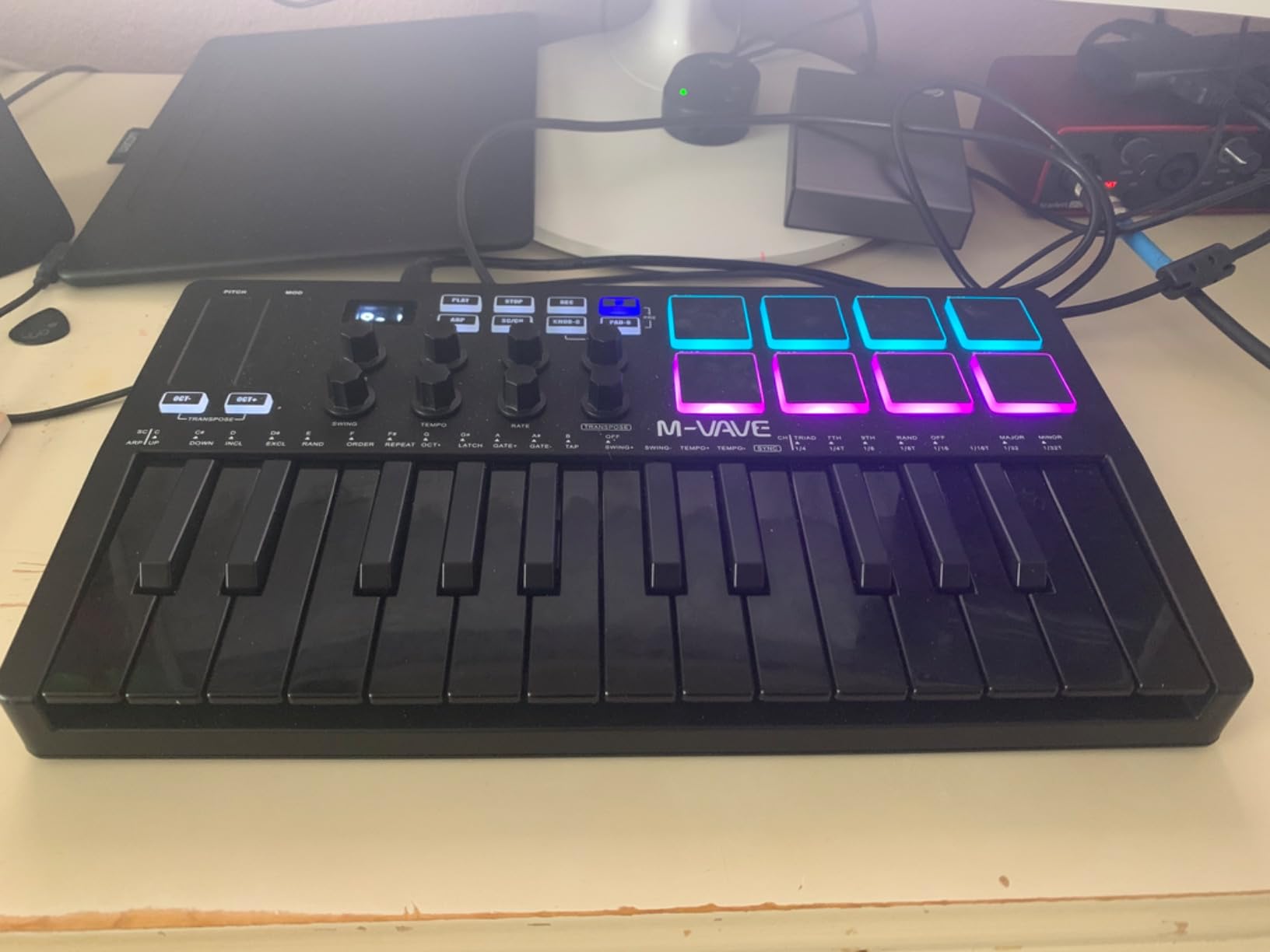
The M-VAVE 25 Key is the controller I recommend when someone wants wireless freedom without spending premium money. The built-in 2,000 mAh battery runs for roughly 16 hours on a charge, and Bluetooth pairing works with Mac, Windows, iOS, and Android.
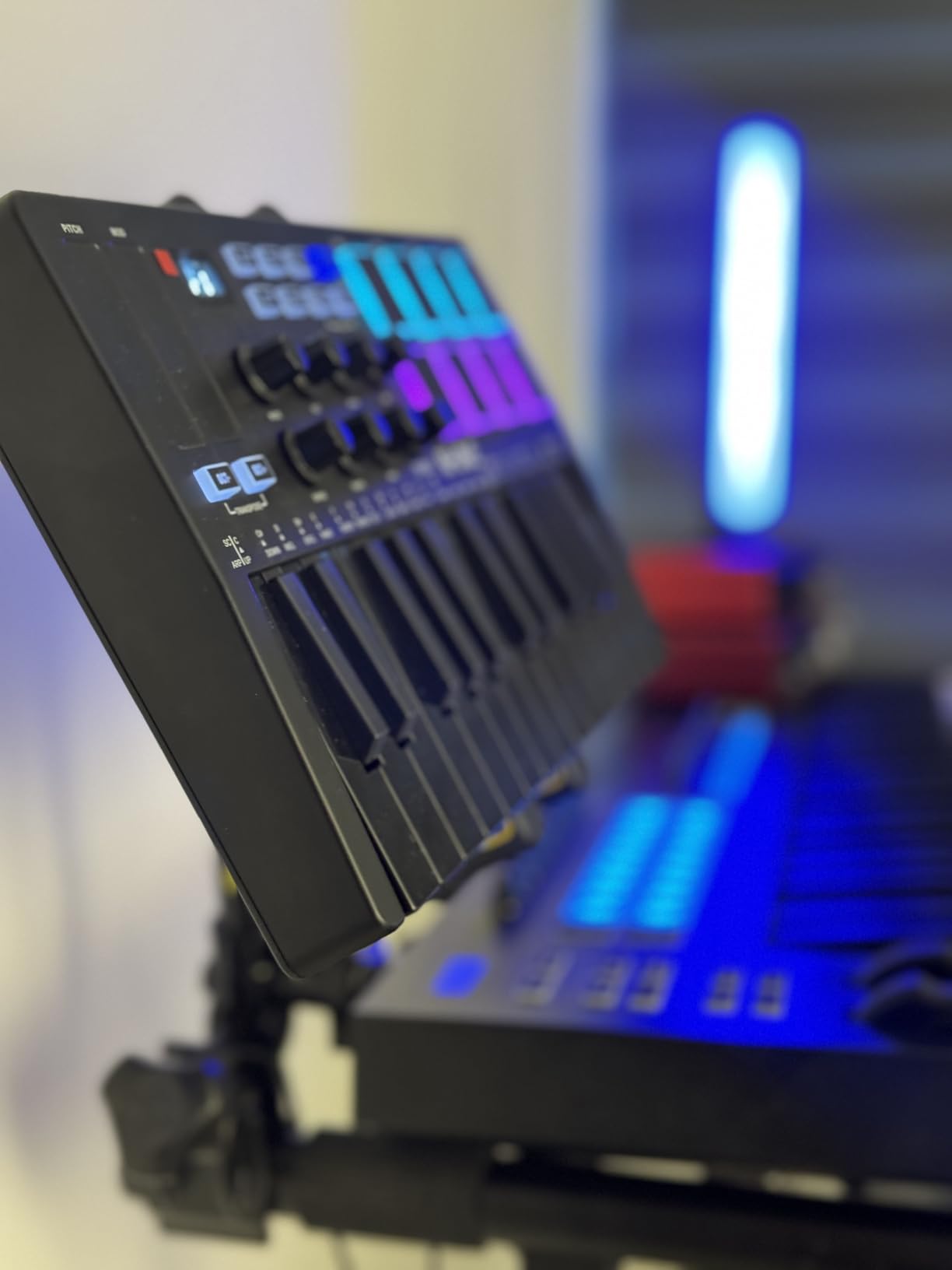
For a budget wireless unit, the control set is generous. You get 8 RGB pads for finger drumming, 8 assignable rotary encoders, and 2 capacitive touch strips for pitch bend. Smart Chord and Smart Sound are welcome features for beginners who want quick songwriting tools.
The trade-offs are honest. M-VAVE is a smaller brand than Akai, Arturia, or Novation, so firmware updates and long-term support are less predictable. Mini keys feel cramped for serious pianists. Bluetooth latency is generally fine for sketching but can vary across devices, especially older Android tablets.
If you need wireless MIDI on a budget, this is one of the best portable keyboards for the price. Just plan to test it with your specific devices before any critical recording sessions.
For Whom It’s Good
Mobile producers who want Bluetooth freedom without paying premium prices. iPad and Android users who want wireless MIDI. Beginners who like the idea of Smart Chord for quick songwriting.
For Whom It’s Bad
If you play piano seriously, the mini keys will frustrate you. If brand reputation and long-term firmware support matter, Akai or Novation are safer choices. If Bluetooth latency is critical for live performance, USB still beats wireless.
10. Carry-on Folding MIDI Controller – Best for Travel
Carry-on Folding MIDI Controller 25 – MIDI over Bluetooth &USB Ultra-Portable Keyboard Controller – Built-In Battery for Professional Music Production – Compatible with Mac, PC, iOS
Folding 25-key design
Bluetooth, USB, 3.5mm MIDI
8-hour battery
Pros
- Folds to fit in a backpack or carry-on
- Lightweight at under two pounds
- Three connectivity options: USB
- Bluetooth
- and 3.5mm MIDI
- Built-in battery lasts up to 8 hours
- Bundled Cubase LE and Cubasis LE software
Cons
- Mini keys are not full-length
- limiting expressive play
- Velocity sensitivity is limited
- Micro-USB rather than modern USB-C
- Some units reported reliability issues within a year
The Carry-on Folding MIDI Controller is the most travel-friendly keyboard I have tested. It folds flat into a shape that fits inside a backpack or carry-on, then unfolds into a working 25-key controller. At under two pounds, it disappears in luggage weight allowances.
The connectivity is impressive for a travel unit. You get USB, Bluetooth, and a 3.5mm TRS MIDI output, which covers laptops, tablets, and hardware synths. The 8-hour built-in battery means you can sketch without hunting for power outlets, and the bundled Cubase LE and Cubasis LE software give you a real DAW on both desktop and iPad.
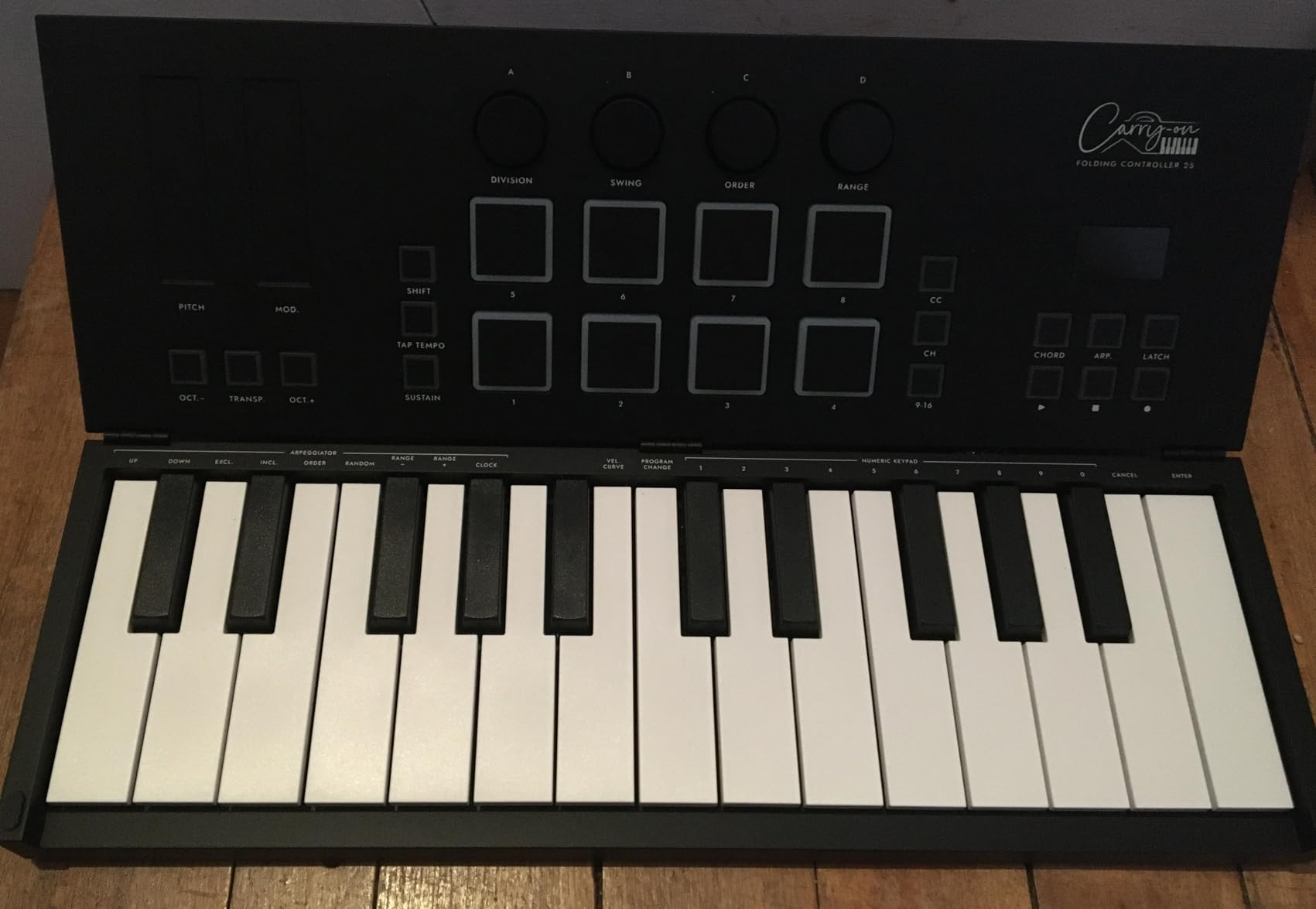
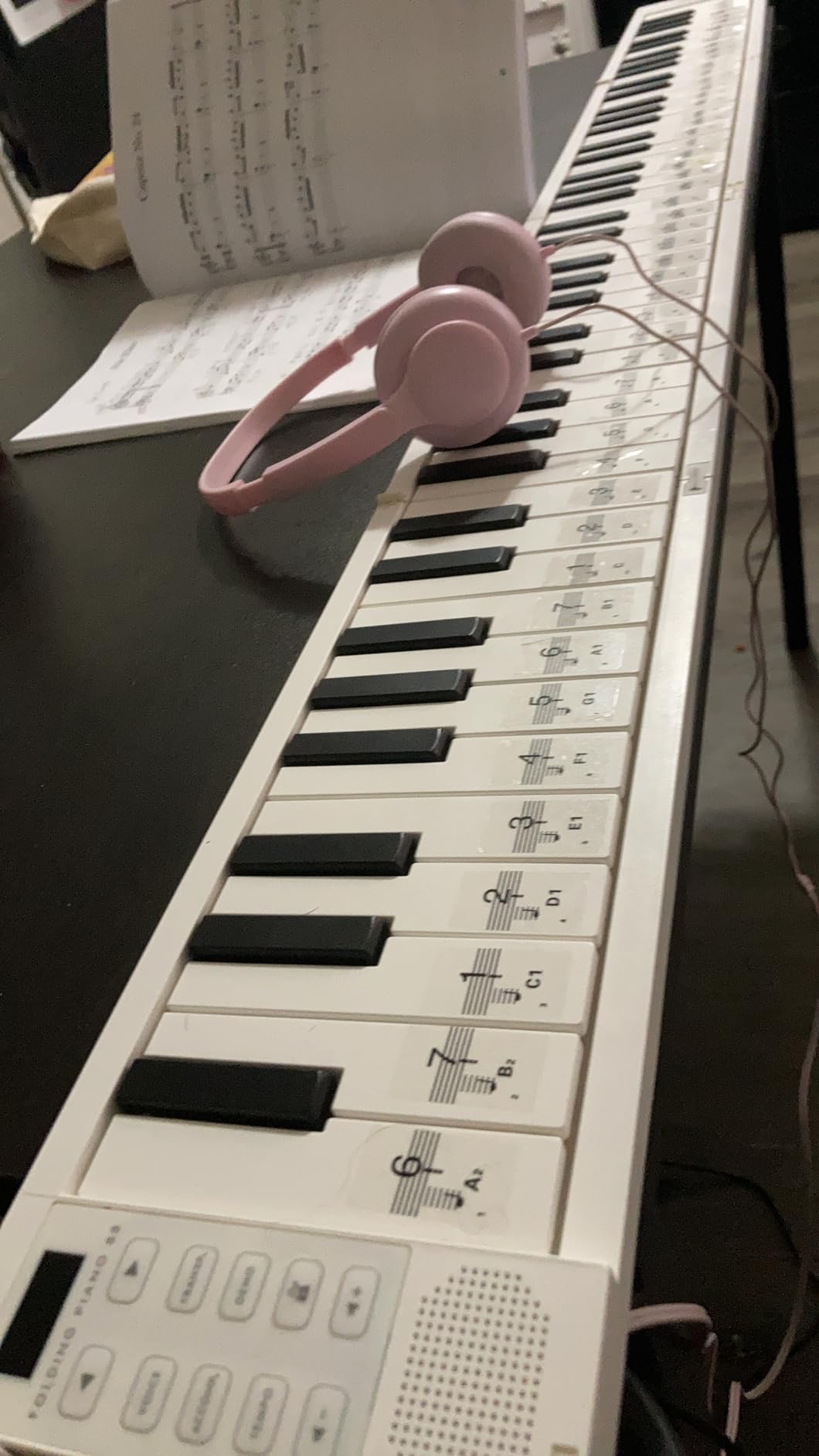
The honest trade-offs are real. Velocity sensitivity is limited, which hurts expressive playing. The keys are not full length, so pianists will struggle. The folding sections do not lock together, so you need a flat surface to play. Micro-USB rather than USB-C feels dated.
Some users have reported reliability issues within the first year. I would not choose this for daily studio use. For travel sketching, hotel-room practice, or emergency backup, however, it is one of the best portable keyboards for the niche.
For Whom It’s Good
Frequent travelers who need a keyboard that fits in a backpack or carry-on. Producers who sketch ideas on the road and want a self-contained unit with battery and Bluetooth. Anyone who needs a backup controller that lives in luggage.
For Whom It’s Bad
If you play piano seriously, the short keys will frustrate you. If you need USB-C and modern connectivity, look elsewhere. If you want a primary daily driver, choose a more proven unit like the MPK Mini IV or MiniLab 37.
How to Choose the Best Portable Keyboard for Your Setup?
Choosing the right portable keyboard comes down to five decisions: key count, key action, control layout, connectivity, and DAW fit. The right answer for you depends on whether you sketch on a laptop, produce in a fixed studio, play live, or work on an iPad.
How Many Keys Do You Actually Need?
25-key controllers like the Akai MPK Mini IV and Novation Launchkey Mini are the most portable. 32-key units like the midiplus AKM320 and M-Audio Oxygen Pro Mini give you more range for two-handed parts. 37-key units like the Arturia MiniLab 37 unlock fuller playing. 49-key controllers like the M-Audio Keystation 49 MK3 hit the sweet spot for piano-style playing but lose some portability. If you mostly write melodies and beats, 25 to 37 keys is plenty. If you play piano-style parts, lean toward 49 or more.
Mini Keys vs Full-Size Keys
Mini keys are smaller, lighter, and more portable, which is why nearly every controller on this list uses them. They feel cramped for players with larger hands or anyone with a piano background. Reddit users consistently report the same trade-off: great for sketching, frustrating for serious playing. If you want full-size keys in a still-portable package, the M-Audio Keystation 49 MK3 is the standout pick.
Synth Action vs Weighted Action
Synth action keys are light and quick, which suits electronic and beat-driven music. Weighted or hammer action keys mimic a real piano and suit producers recording piano-style parts. Most portable controllers use synth action because weighted keys add weight and cost. If you play classical or jazz, look for hammer action in a heavier unit. If you produce electronic music, synth action is the right pick.
Connectivity: USB-C, MIDI, and Bluetooth
USB-C is the modern standard and draws power from your laptop. 5-pin DIN MIDI is the classic hardware synth connection and shows up on premium units like the Arturia MiniLab 37 and Akai MPK Mini IV. 3.5mm MIDI jacks are smaller but require adapters. Bluetooth MIDI shows up on the M-VAVE K5 and Carry-on Folding Controller. Bluetooth is convenient but adds latency, so USB still wins for live performance.
DAW-Specific Fit
FL Studio producers should choose the Novation FLkey Mini for deep integration. Ableton Live users should pick the Novation Launchkey Mini 25 MK4. Logic Pro and Cubase users get solid mapping from the Akai MPK Mini IV, M-Audio Oxygen Pro Mini 32, and Arturia MiniLab 37. GarageBand and iPad users should check that the controller is class compliant and works with their adapter setup.
iPad and Tablet Compatibility
If you produce on an iPad, choose a class compliant controller with USB-C. The Arturia MiniLab 37, Akai MPK Mini IV, and Novation Launchkey Mini 25 MK4 all work with iPad via the Apple USB-C to USB adapter. Wireless Bluetooth options like the M-VAVE K5 and Carry-on Folding Controller skip the cable entirely. Always confirm class compliant status before buying for iPad use.
Frequently Asked Questions
What is the best portable MIDI keyboard?
The Akai Professional MPK Mini IV is our top pick for the best portable MIDI keyboard. It packs 25 mini velocity-sensitive keys, 8 RGB MPC pads, real pitch and mod wheels, USB-C, and a full-size MIDI Out into a backpack-friendly unit that works with Ableton, FL Studio, and Logic Pro out of the box.
Are mini MIDI keyboards worth it?
Yes, mini MIDI keyboards are worth it for producers who sketch ideas on the go, work on laptops, or compose on iPads. They trade some key feel and range for a much smaller footprint. If you play piano-style parts seriously, a full-size controller like the M-Audio Keystation 49 MK3 is a better fit.
How many keys do I need on a MIDI keyboard?
25 keys cover two octaves plus a note, enough for sketching melodies and beats. 37 keys unlock fuller two-handed playing. 49 keys hit the sweet spot for piano-style playing. If you mostly produce electronic music, 25 to 37 keys is plenty. If you play piano seriously or record piano-style parts, look at 49 keys or more.
Can I use a MIDI keyboard with an iPad?
Yes, most modern portable MIDI keyboards are class compliant and work with iPad via the Apple USB-C to USB adapter. Bluetooth options like the M-VAVE K5 and Carry-on Folding Controller work wirelessly. Always confirm class compliant status and check whether the controller needs drivers before buying for iPad use.
What is aftertouch on a MIDI keyboard?
Aftertouch is pressure you apply to a key after striking it, which the keyboard sends as continuous MIDI data. Channel aftertouch sends one value for the whole keyboard. Polyphonic aftertouch sends a separate value per finger, which enables expressive MPE-style playing on pads and synths.
Final Verdict: Which Portable Keyboard Should You Buy?
The best portable keyboard for you comes down to how and where you make music. Our team’s picks across the 10 controllers above cover most of the common scenarios in 2026, but here is the short version. The Akai MPK Mini IV is the right pick for most producers who want a balanced mini controller. The Arturia MiniLab 37 wins for anyone who values key feel and a deeper control set. The midiplus AKM320 is the smart budget pick that simply works.
If you produce in FL Studio, grab the Novation FLkey Mini. If you produce in Ableton Live, the Novation Launchkey Mini 25 MK4 is hard to beat. If you need full-size keys, the M-Audio Keystation 49 MK3 delivers at a great value. For control density, the M-Audio Oxygen Pro Mini 32 packs a lot in. For pure portability, the Korg nanoKEY2 disappears in a bag. For wireless freedom, the M-VAVE 25 Key runs on Bluetooth. For travel, the Carry-on Folding MIDI Controller folds flat.
Pick the controller that matches your DAW, your key count needs, and how often you leave the studio. Any of these 10 will serve you well. The most important thing is to start playing, because the best portable keyboard is the one you actually use.