
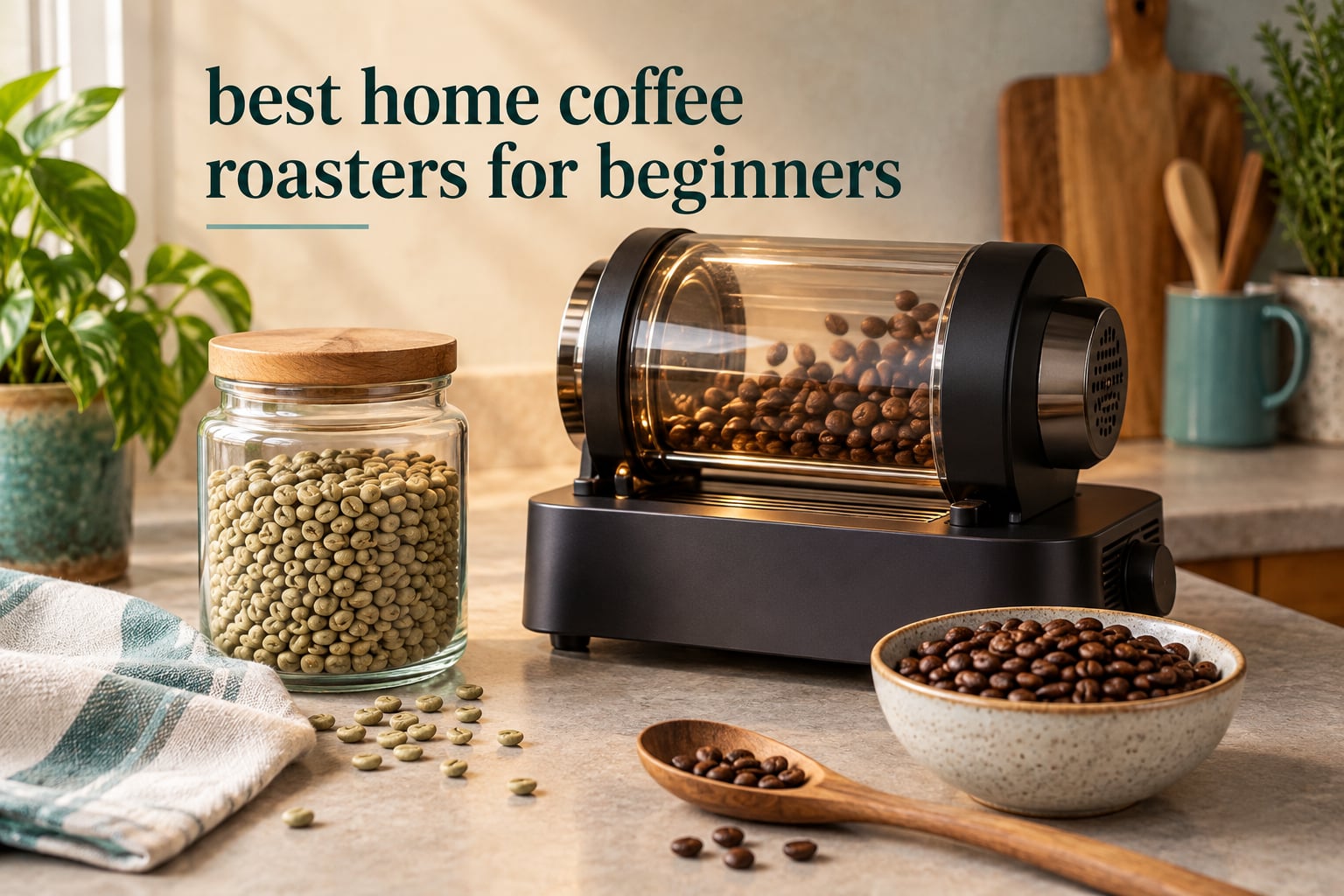
If you want the short version: the Nuvo Eco Ceramic Roaster is the best home coffee roaster for beginners who want to learn the craft without buying an appliance, and the Fresh Roast SR540 is the best pick if you want an electric machine with real heat and fan controls. Both roast small batches, both are forgiving on a first attempt, and neither demands a ventilated workshop to work in.
That is the honest tension at the heart of this hobby. Roasting your own beans at home gives you fresher coffee, control over roast level, and a genuinely absorbing weekend project. It also gives you smoke, chaff in places you did not expect, and a learning curve that punishes impatience. The right first machine is the one that survives your mistakes.
We spent 2026 season working through ten of the most-reviewed home coffee roasters on the market, roasting the same green beans on each where we could and reading the long-term owner reports on the ones with years of feedback behind them. This guide covers every type worth starting with, from manual ceramic roasters to plug-in electric drum machines, plus the batch sizes, airflow controls and cleaning routines that actually matter once the novelty wears off.
Table of Contents
Top 3 Picks for Home Coffee Roasting for Beginners (October 2026)

Nuvo Eco Ceramic Roaster
- 70 g batch
- 100% ceramic body
- Cowhide grip
- Rear vent for monitoring

Fresh Roast SR540
- 120 g per batch
- Nine heat settings
- Independent fan control
- Chaff basket included

Fresh Roast SR800
- 226 g per batch
- Nine power settings
- Changeable start settings
- Glass chamber
Our Editor’s Choice goes to the Nuvo because it has the deepest base of owner feedback in this group and the lowest barrier to entry. If you have already decided you want an electric machine with a fan and a temperature readout, move up to the SR540.
All 10 Home Coffee Roasters at a Glance in 2026
| Product | Specs | Action |
|---|---|---|
| Nuvo Eco Ceramic Roaster |
|
Check Latest Price |
| Fresh Roast SR540 |
|
Check Latest Price |
| Fresh Roast SR800 |
|
Check Latest Price |
 JIAWANSHUN Electric Drum Roaster JIAWANSHUN Electric Drum Roaster |
|
Check Latest Price |
 GIVEROO 500g Roaster GIVEROO 500g Roaster |
|
Check Latest Price |
 LUEUR Electric Drum Roaster LUEUR Electric Drum Roaster |
|
Check Latest Price |
 NIASIA PKF-500g NIASIA PKF-500g |
|
Check Latest Price |
 ZEVELOO 750g Roaster ZEVELOO 750g Roaster |
|
Check Latest Price |
 lpylxingyan Glass Roaster lpylxingyan Glass Roaster |
|
Check Latest Price |
 DYVEE Gas Quartz Glass Roaster DYVEE Gas Quartz Glass Roaster |
|
Check Latest Price |
1. Nuvo Eco Ceramic Roaster – The Best First Roaster for Most Beginners
Nuvo Eco Ceramic Handy Coffee Bean Roaster
Batch: 70 g
Material: 100% ceramic
No power required
Made in Korea
Pros
- No electricity and no learning curve on controls
- Waffle-pattern interior spreads heat evenly
- Rear vent hole lets you hear and smell the roast
- Real cowhide grip stays cool over open flame
Cons
- Only 70 g per batch
- Roast outcome depends entirely on your heat control
- No fan or agitation means unevenness if you stop moving it
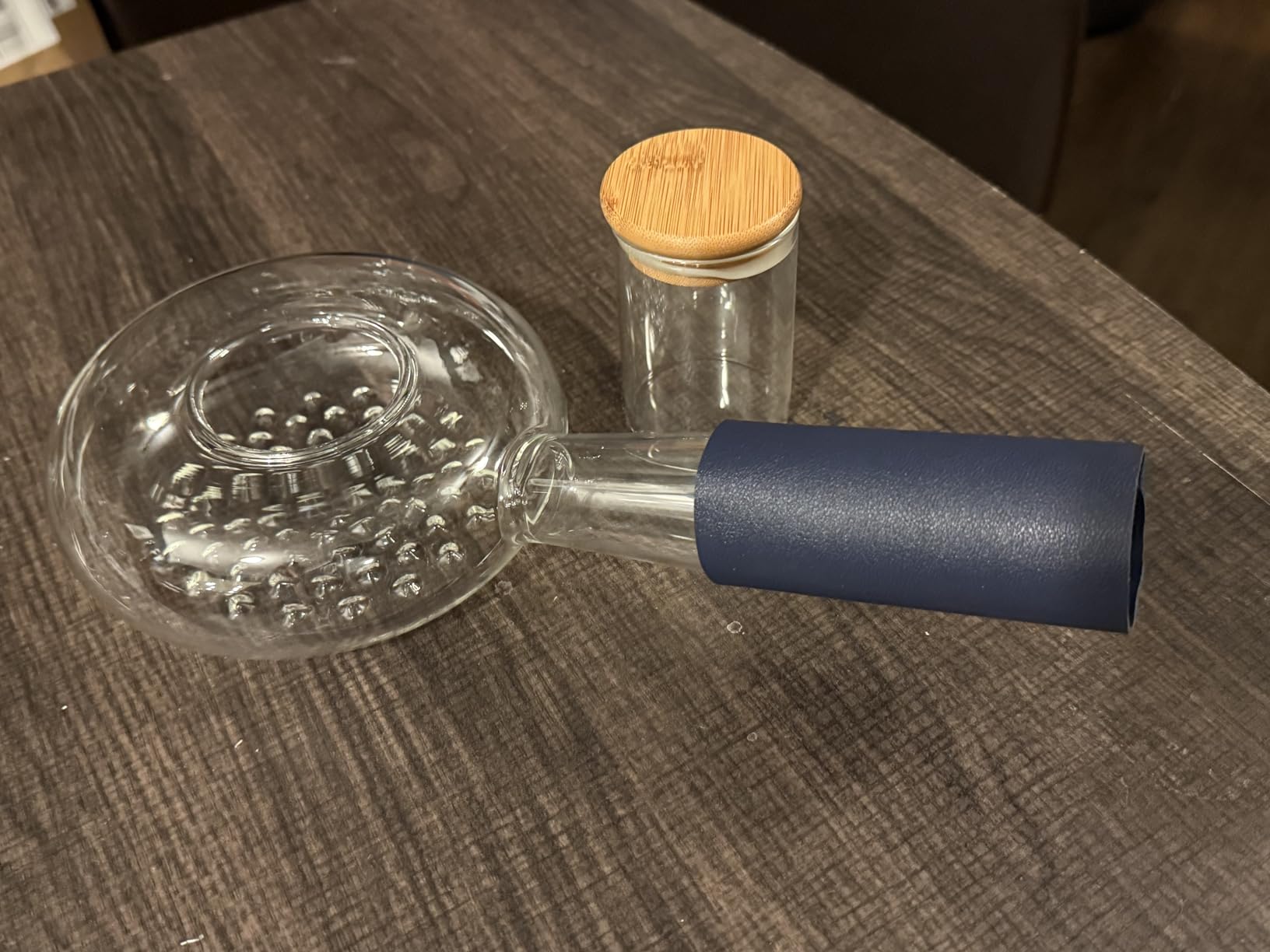
I started a lot of beginners on this one. It is a ceramic vessel with a waffle-pattern interior, a cowhide grip and a small hole in the back, and that is the whole machine. You hold it over a heat source, keep it moving, and listen to the beans change from silence to crackle to popping.
The waffle structure is doing the work that a fan does in an electric roaster. Beans sit in little cells rather than sliding across a flat floor, so they pick up heat from several directions at once. Seventy grams is roughly two small cups of roasted coffee, which sounds tiny until you realise how fresh the cup is four days later.
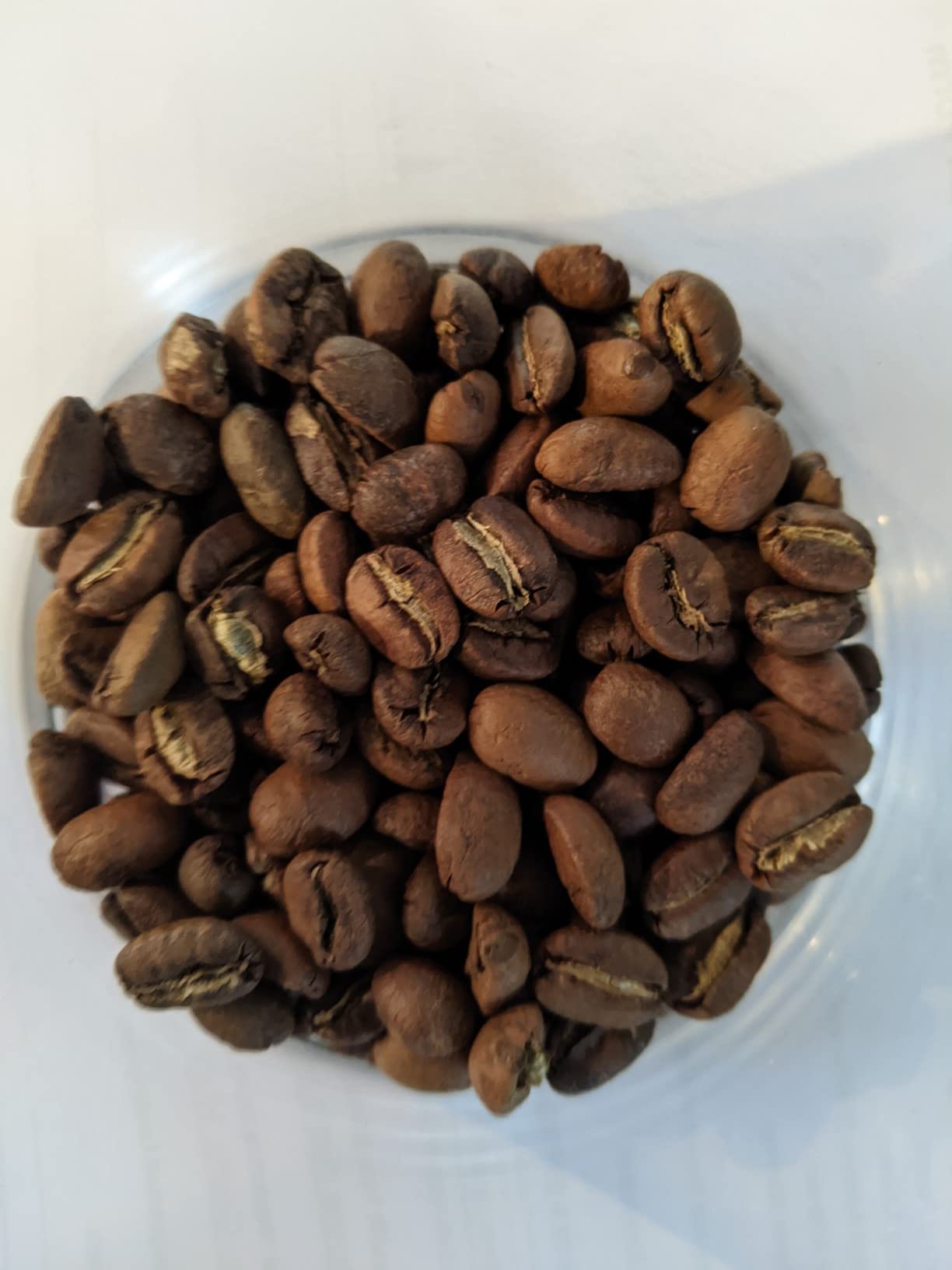
The rear hole is more useful than it sounds. Long before you can judge colour accurately you can hear the moisture leaving the bean, and that audio cue is what teaches you when to push heat and when to back off. Experienced users treat this as a sampling roaster for testing a new lot rather than a volume tool.
Cleaning is close to effortless. Let the ceramic cool, tip out the chaff, wipe the interior. There is no cord to coil, no motor to service and no firmware to update, which also means there is nothing to fail in year three.
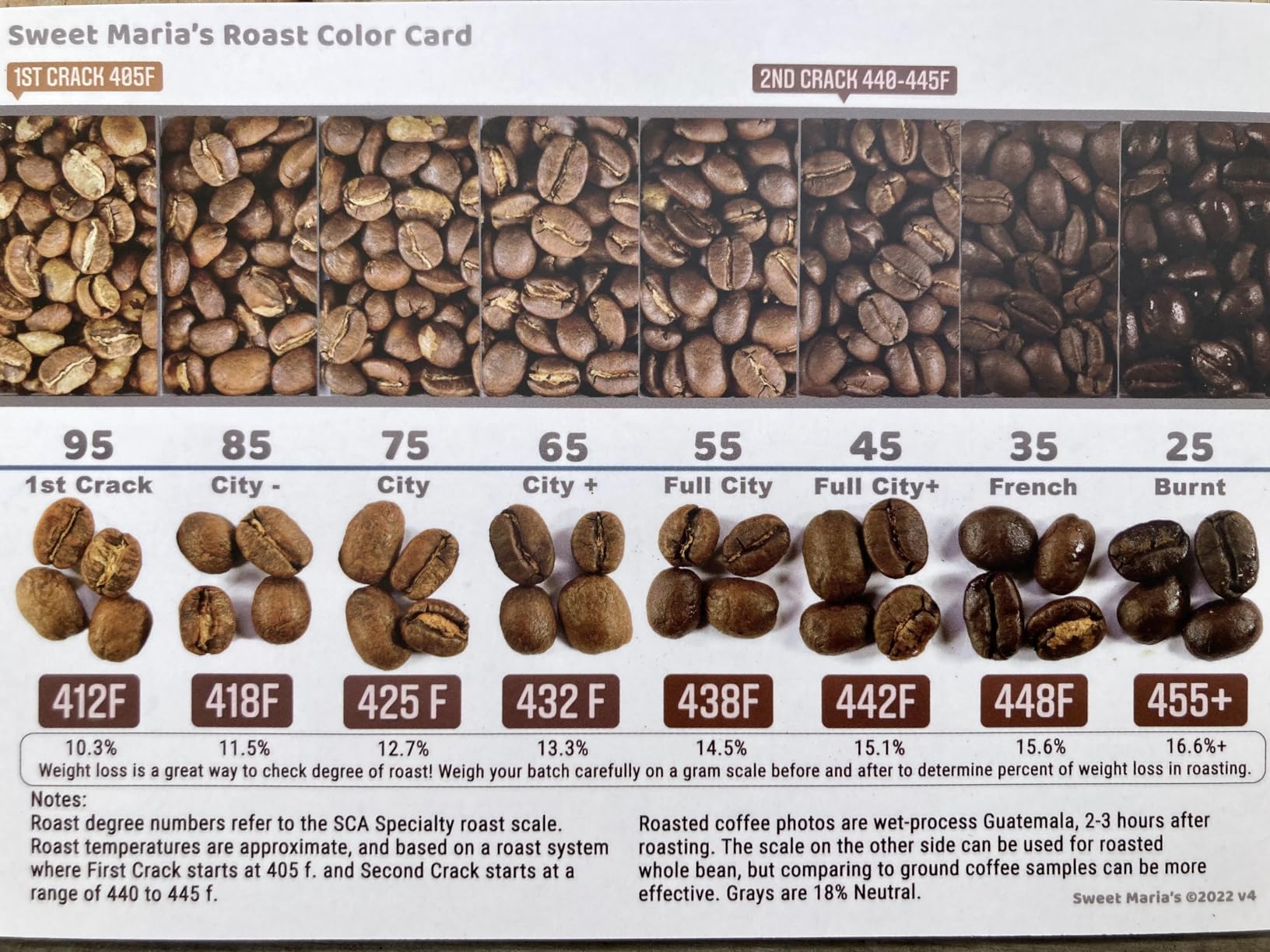
What to check before you buy it
Work out how much coffee you actually drink. Seventy grams of green beans becomes roughly a fifth of a pound of roasted coffee. If your household goes through more than a couple of cups a day, this machine will simply be too slow and you will end up roasting back to back with an open flame on the counter.
It also needs a heat source you are comfortable handling. A gas burner works and gives the fastest response, but a small halogen or hot plate gives finer control for a first attempt. Buy a separate cheap thermometer if your burner does not have one, because judging heat by flame height alone is where first roasts go wrong.
Where it disappoints
There is no airflow and no forced heat, so the roast is entirely manual. Stop stirring for ten seconds at the wrong moment and you will find raw-tasting beans in the batch. Treat every roast as an active job that takes your full attention for the length of it.
The ceiling is also low. You will get a respectable light to medium roast, which is where most beginners should aim, but you will not be chasing dark espresso profiles in a 70 g ceramic bowl with no probe. If dark or espresso is the goal, look at the electric drum machines further down.
2. Fresh Roast SR540 – The Best Home Coffee Roaster With Real Controls
Fresh Roast SR540 Automatic Coffee Bean Roaster | Roast Coffee At Home | Variable Heat Settings | Convection Fan Control | Digital Status Display | Speed Roasting System | The Freshest Roast On Earth
Batch: up to 120 g
Nine power settings
Digital temperature display
Glass chamber
Pros
- Fan and heat adjust independently
- Real-time temperature readout helps you repeat a profile
- Chaff basket catches most of the papery skin
- Roasts 7-14 cups in under 10 minutes
Cons
- The single control knob can wear inaccurate after years of heavy use
- Cover and chaff lid get hot enough to need gloves
- Noticeable smoke means a range hood or outdoors
This is the machine most beginners end up buying, and it is the one we recommend the moment you want fan control rather than your own wrist. Beans sit in a glass chamber above a heating element, a convection fan stirs them, and a dial on the front sets heat, fan and time independently.
That independence is the real upgrade over a manual roaster. After a dozen batches you learn that a lighter profile needs the fan high early to move dense beans, then heat reduced before the crack. The digital display gives you a number to write down, which is how you get the same cup twice instead of once by luck.
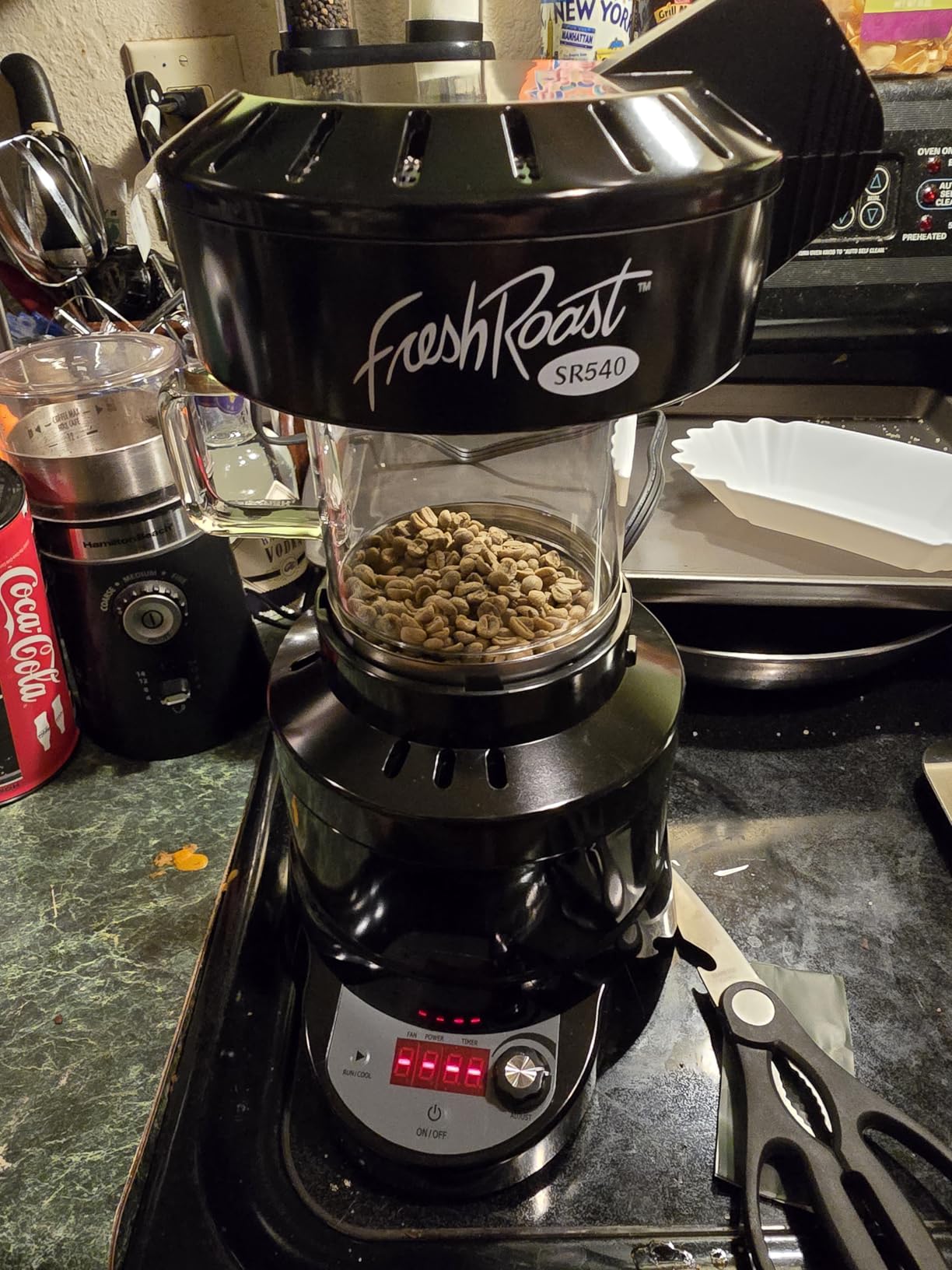
In a long-running thread on r/roasting titled roughly “newbie seeking guidance on entry-level coffee roasters”, owners repeatedly single out this machine as the safe first electric choice, and the recurring regret is not about quality but capacity. Several people said they wish they had saved up and gone straight to the larger sibling.
The glass chamber is genuinely useful for a learner. You can see the beans move through yellow, tan and brown without opening anything, and colour is the fastest feedback you get. Combined with the temperature readout it makes you understand roasting stages faster than any manual.
What to check before you buy it
One hundred and twenty grams is a two-cup batch, and you will be roasting often rather than weekly at that size. Owners who add the extension tube report that beans clear the chamber faster and more evenly, which helps in a cool room where cold beans can sit still in the first minute of heating.
Where you put it matters more than almost any spec. This machine produces enough smoke to set off a smoke alarm in a closed kitchen, so put it under a range hood, out on a balcony, or in a garage with the door open. Plan that before the box arrives.
Where it disappoints
The single analog control dial is the most-reported long-term flaw. After years of heavy use it can become unresponsive or drift out of calibration, which quietly ruins your repeatability. The manufacturer has historically shipped replacement control boards well past warranty, but you are dependent on that goodwill.
Reviewers also note that bean movement early in the roast can be uneven when the air path is narrow, and that the temperature ceiling is not high enough for very dark roasts. If you want espresso-level darkness, this is not the machine.
3. Fresh Roast SR800 – The Best Upgrade When You Drink More Than Two Cups
Fresh Roast SR800 Coffee Roaster – Roast Coffee at Home – Variable Heat and Fan Control – Digital Display – Roasts 6–8 oz (170–226g) Per Batch – Easy to Use – Fast Roast Time
Batch: up to 226 g
Nine power settings
Adjustable start settings
6.2 pounds
Pros
- Roasts 6 to 8 ounces per cycle
- Changeable default start settings let you begin each roast from your own setup
- Same fan and heat independence as the SR540
- Produces 14-28 cups in under 10 minutes
Cons
- Costs meaningfully more than the smaller model
- Push-knob controls rather than fully programmable automated stages
- Needs attention through the whole batch to hold a profile
If you have already got the SR540 and one bean on the counter you never quite get to, this is the answer. Same learning curve, roughly double the batch, and a better control board with changeable default start settings so the machine begins each roast from the profile you used last time.
Nine power settings, a real-time temperature display and independent fan control carry over from the smaller model. What changes is that a batch no longer finishes before the kettle boils. Six to eight ounces gives you a proper weekend supply in one run, and it is the batch size that turns roasting from a novelty into a routine.
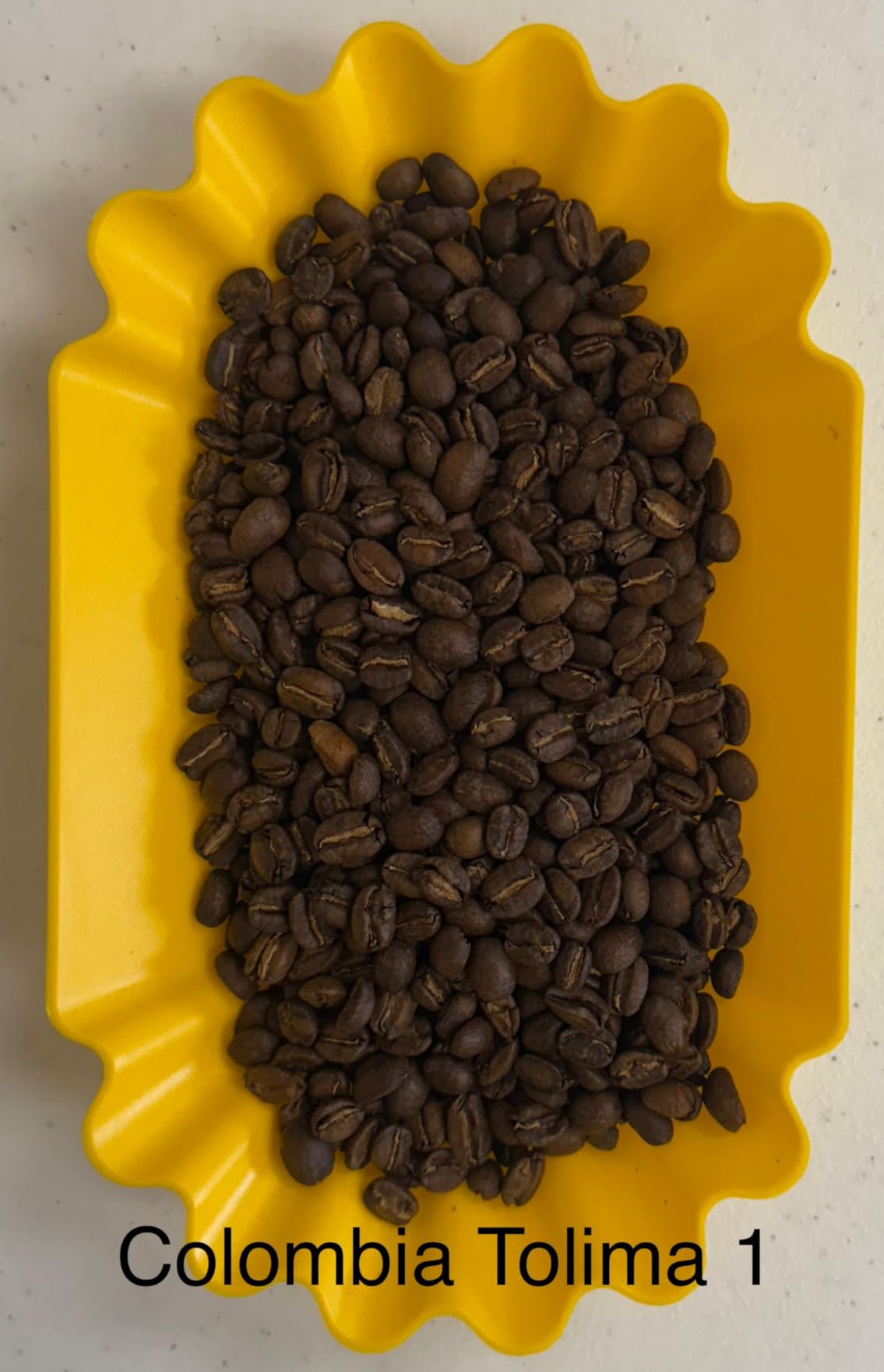
The same r/roasting thread that recommends the SR540 as a first machine has a clear undercurrent about regret: several owners say the only mistake they made was buying small. If you know you drink filtered coffee by the mugful every morning, the extra step up is the one people recommend in hindsight.
Because the heat and fan settings can be changed mid-roast, you can push into darker territory that the SR540 struggles with, though you still need a smoke plan. Treat the first three batches as smaller loads while you work out your own settings.
What to check before you buy it
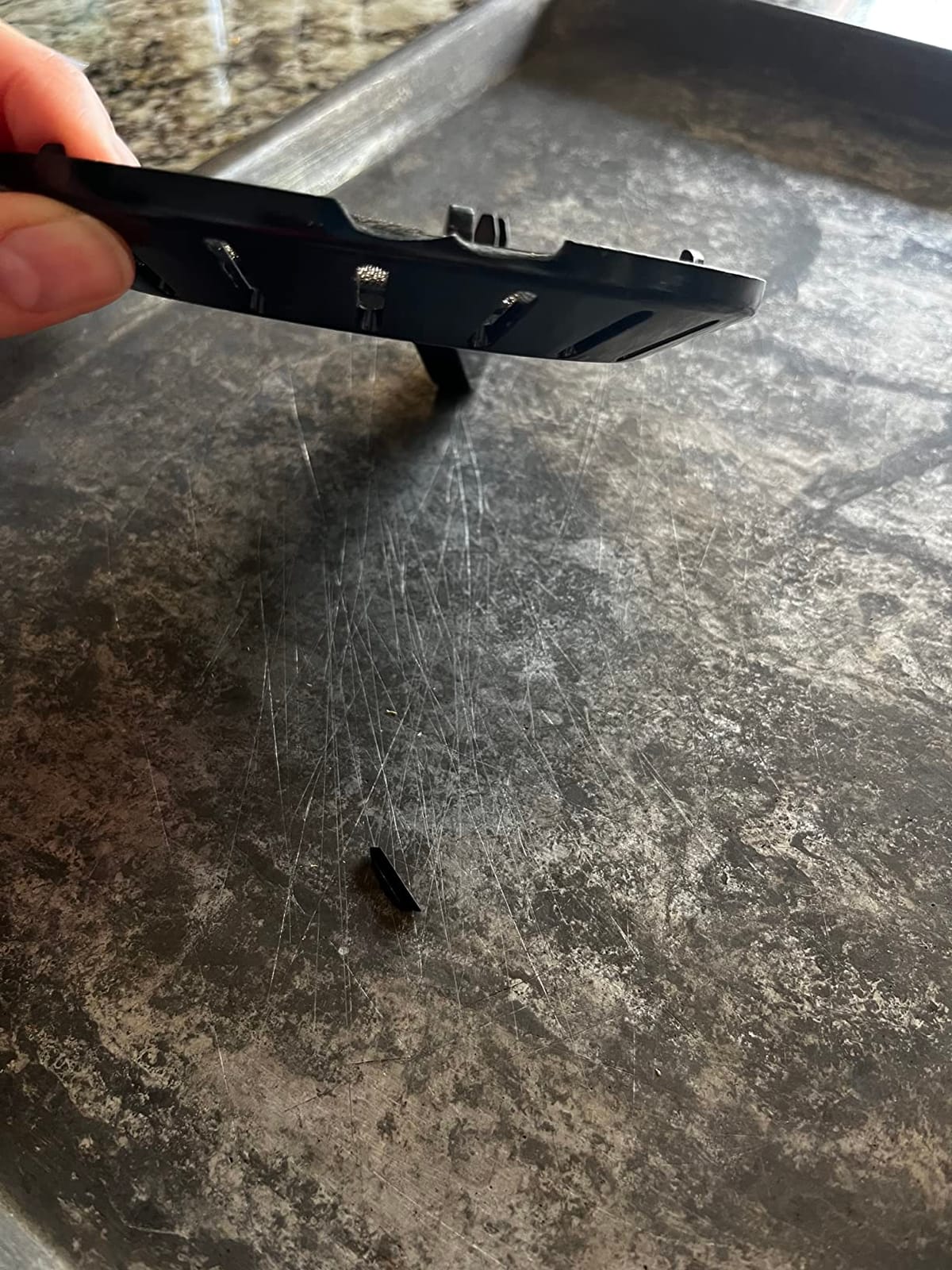
Check your counter and cupboard space. It is taller and heavier than its sibling, and the top unit plus the chaff lid run hot enough that you need a cloth or oven gloves to remove them. Plan the roast location around ventilation, not just capacity.
Think about whether you will blend beans. Adjustable settings plus a bigger drum make it realistic to roast two origins at different levels and mix them, which is the single capability that most pushes people from buying coffee towards roasting it.
Where it disappoints
It is not programmable in the way enthusiast machines are. Stages are not stored and replayed as a curve; you set heat, fan and time by hand and adjust as you watch. If you want an automated roast that runs start to finish, you are still looking up the price ladder.
For a first roaster it is also a lot of money to put on an unknown hobby. If you are unsure you will stick with it, the smaller model at roughly half the size gives you the same skills for a fraction of the commitment.
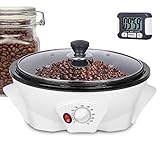
4. JIAWANSHUN Electric Drum Roaster – Best for Roasting More Than Just Coffee
JIAWANSHUN Electric Coffee Bean Roaster Machine for Home Use,1.1lb Capacity
Batch: 300-500 g recommended
1200W
100-240 C control
Automatic stirrer
Pros
- Wide 100-240 C range covers light through dark
- Automatic mixing stirrer rotates beans for even heating
- Glass lid with four vents lets you watch and smell progress
- Honeycomb non-stick interior wipes clean
Cons
- Small or broken beans can jam the stirring rod
- Not built for continuous commercial duty cycles
- No memory of profiles between roasts
This is a straight electric drum machine: a rotating pan over a 1200W element with a dial that sets temperature across a 100 to 240 C range. It is one of the few machines here that will genuinely reach a dark roast, which is unusual at the budget end.
The stirring arm is the reason it exists. A flat pan with no agitation scorches the beans sitting against the wall, and the automatic stirrer removes that failure mode entirely. The transparent lid with four ventilation holes lets you check colour without losing heat, and owners use it that way constantly.
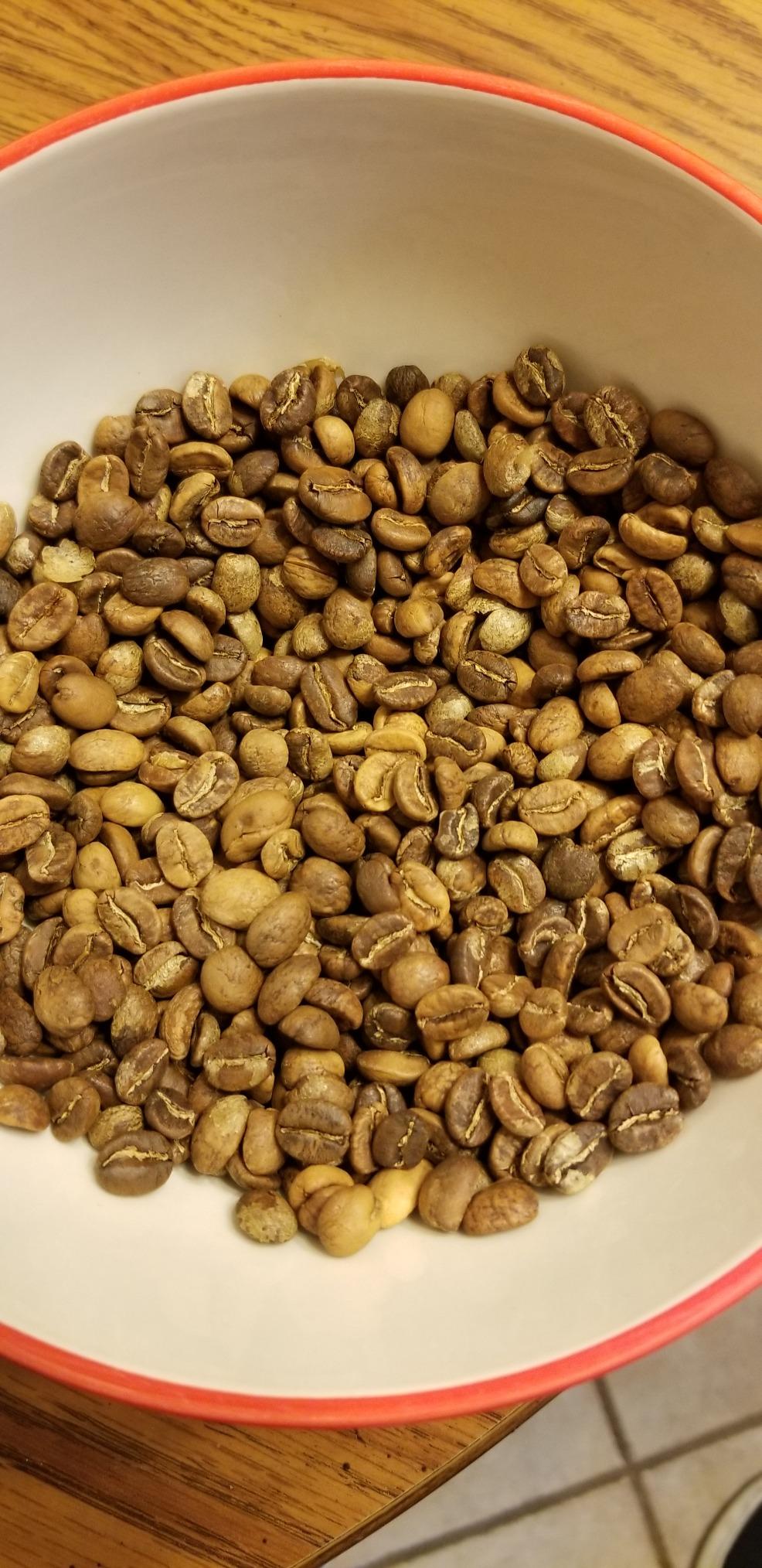
The 800 g drum sounds enormous until you read the recommended working batch of 300 to 500 g. That gap between stated and sensible capacity is the single most common disappointment across this whole category, and it is worth knowing before you buy any large drum machine.
It doubles as a roaster for peanuts, sunflower seeds and popcorn, which quietly makes it one of the more useful small appliances in this list if you buy one thing for the kitchen.
What to check before you buy it
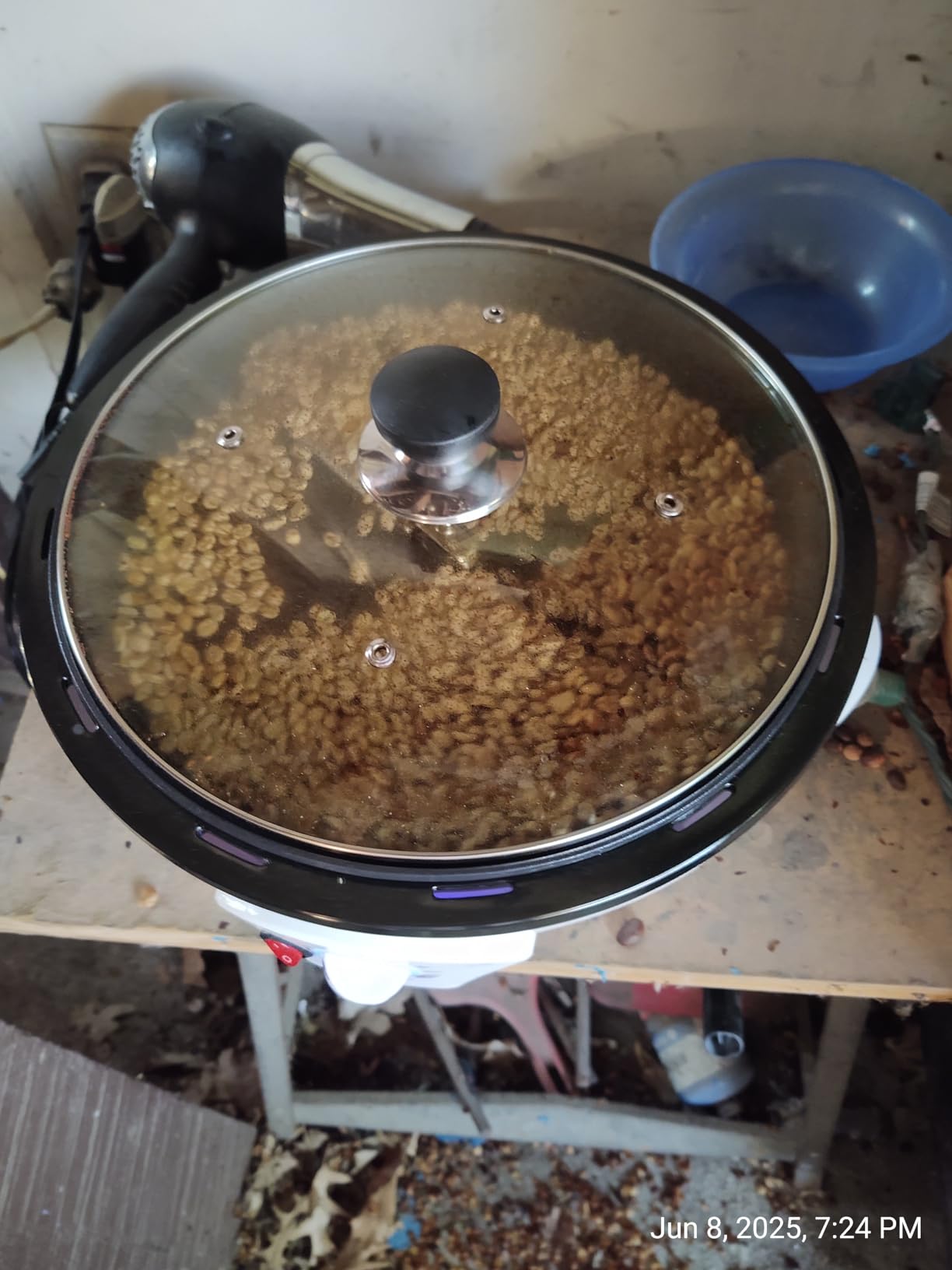
Sift your beans. The single most repeated piece of advice in the reviews is that undersized or broken beans get caught by the stirring rod and jam it. A cheap mesh sieve and two minutes of sorting removes most of the risk.
Size also matters for storage. At 13 by 13 by 7 inches with the lid open for loading, it needs a clear stretch of counter and a cupboard that will take it away from the stove when you are done.
Where it disappoints
There is no memory and no profile storage, so every roast starts from the same dial position. You are relying on colour, smell and the included timer, which is fine for the first dozen batches and irritating afterwards.
At 4.1 stars across several hundred reviews, the gap to the leaders is mostly about build longevity and unevenness at full loads. Reviewers also warn this is not a machine you leave running all day.
5. GIVEROO 500g Roaster – Best for Hands-Off Bean Movement
GIVEROO 500g Coffee Bean Roaster Machine with Timer, 110V
Optimal batch: 400-500 g
800W
0-240 C with timer
Automatic auger
Pros
- Automatic auger keeps beans moving without manual stirring
- Timer plus temperature dial makes repeat batches predictable
- 400-500 g optimal load roasts evenly
- Transparent cover monitors colour
Cons
- Beans must be sifted or the auger will jam
- Under about 400 g results turn uneven
- Minor jams need the strip removed and flattened by hand
The idea here is the same as the JIAWANSHUN but with a proper screw auger instead of a simple stirring arm. The auger lifts and turns beans continuously, which is why owners report more even results at higher loads than most budget drum roasters give.
A 0 to 240 C dial combined with a built-in timer is the combination that makes repeat roasts predictable. Pick a temperature, start the timer, note what you see, and the next batch has a real chance of tasting the same.
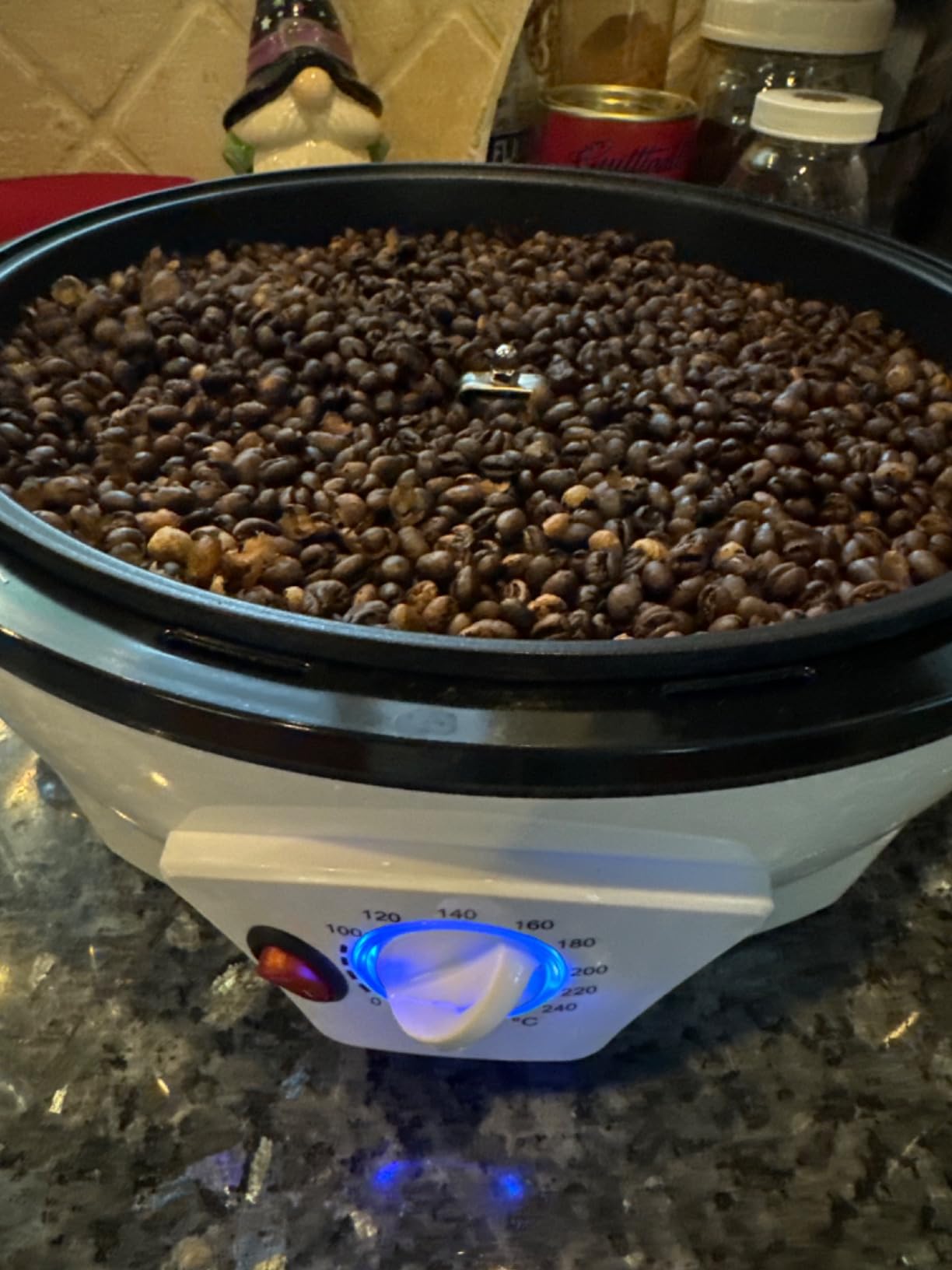
The optimum roasting amount of 400 to 500 g is stated plainly on the specifications, and that honesty is useful. Too few beans and the auger has nothing to work with, so the bottom of the drum scorches and the top stays pale. Fill it properly.
Owners also like that it handles nuts, barley and dried fruit, and that the shape of the chamber is designed to keep beans in the heated zone rather than letting them pool at the edges.
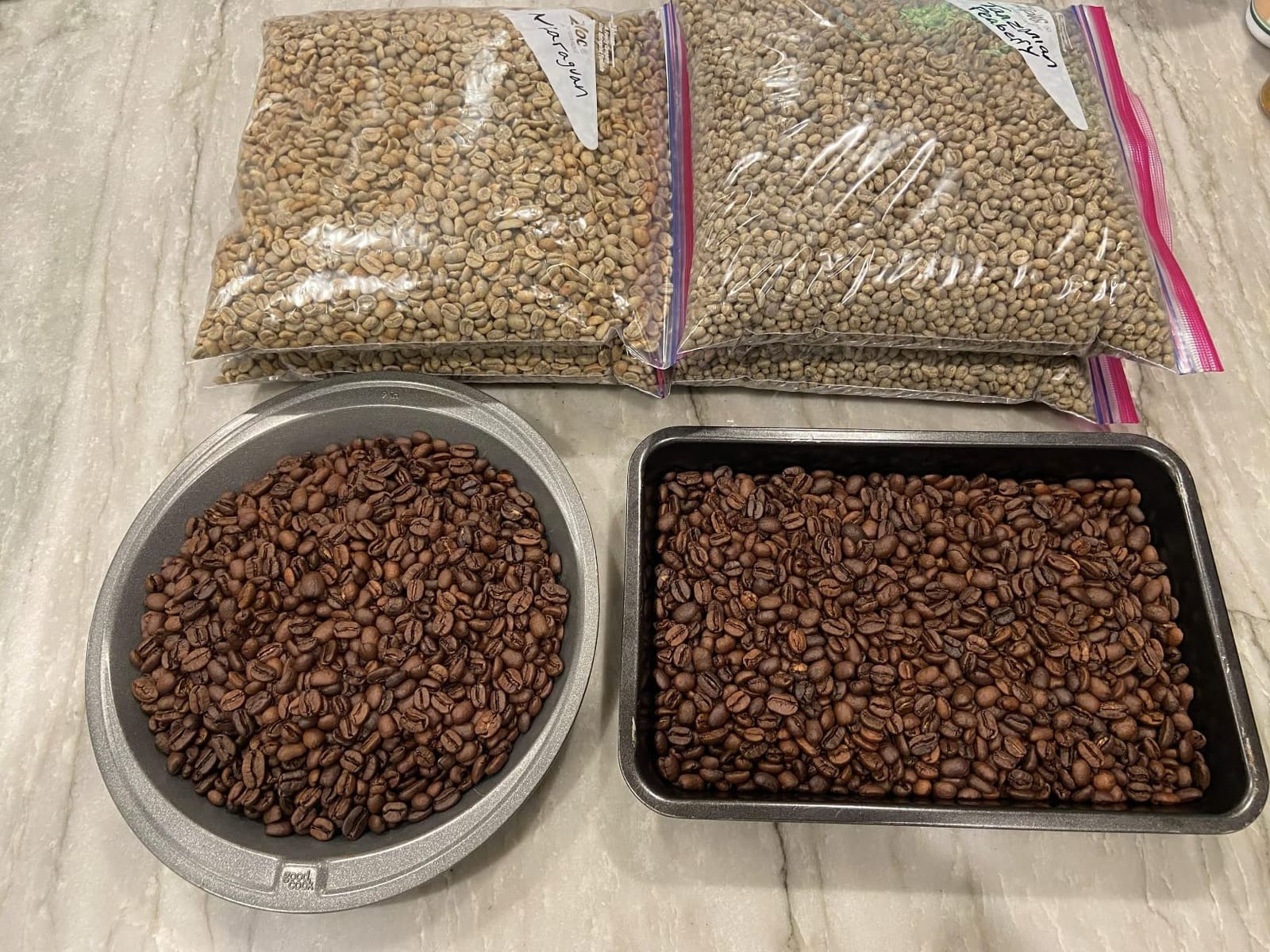
What to check before you buy it
You need to be willing to sort beans before every roast. That is not a complaint so much as a condition of using the machine, and it is the thing that separates smooth batches from frustrating ones on this type of roaster.
Also check that you have a genuine 110 V supply and a dedicated outlet. An 800W element cycling hard alongside a kettle will trip a light circuit in a small kitchen.
Where it disappoints
If a bean does jam the auger, recovery is not a button press. Owners report having to unplug it, remove the stirring strip and flatten it by hand before restarting, so it is worth keeping a soft brush and some patience nearby.
There is no built-in smoke handling and the cover is the only exit for vapour, so this still belongs under a hood or outdoors rather than in a small flat kitchen.
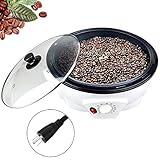
6. LUEUR Electric Drum Roaster – The Cheapest Way Into Electric Drum Roasting
LUEUR Electric Coffee Roasters For Home Use,Coffee Bean Roaster Machine Coffee Bean Roaster For Stovetop, Countertop, Commercial Coffee Bean Roasting Machine 110V
Batch: 300-500 g recommended
800W
Thermostat control
6.03 pounds
Pros
- Lowest cost entry to a heated drum
- Stirring rod keeps beans off the base
- Honeycomb non-stick with Teflon coating is easy to clean
- Transparent cover with four ventilation holes
Cons
- Flat rotating design can roast unevenly at full loads
- Basic controls with no profile memory
- Several owners report shortened heating element life
If your budget is the first constraint, this is the most straightforward electric drum roaster on the list. An 800W element, a thermostat dial, a stirring rod and a transparent lid is the whole feature set, and it will produce a decent light to medium roast on a first attempt.
The honeycomb non-stick base with a food-grade coating is the detail that matters most day to day. Coffee oils are sticky and go rancid in a drum, so a surface that wipes clean rather than needing degreaser is a real quality of life gain over a bare aluminium pan.
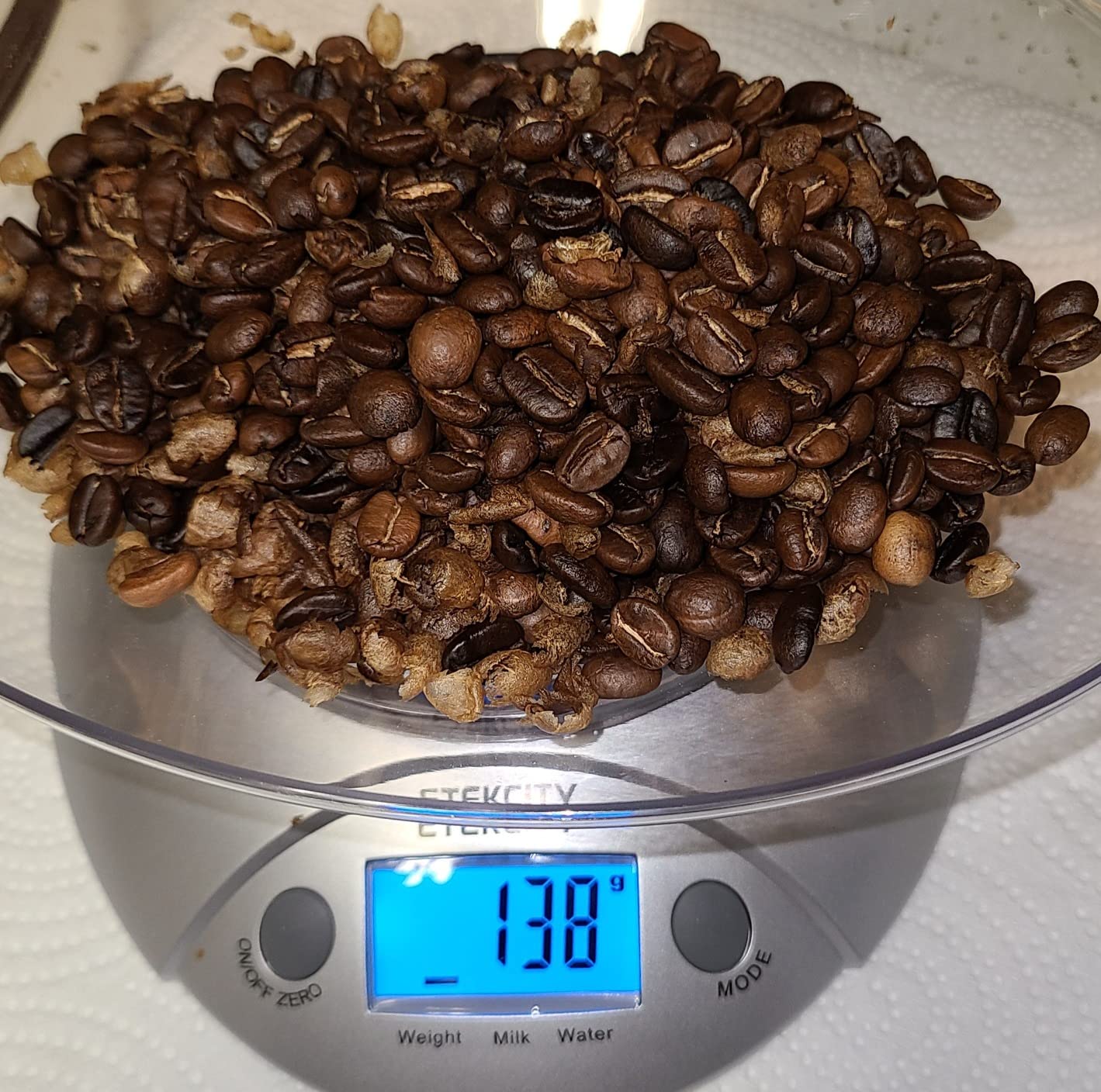
The 800 g drum again comes with a 300 to 500 g recommended working batch, and the difference between those two numbers is where most of the unevenness reports come from. Owners who stay inside the recommended load report good results; those who fill it to the stated maximum report patchy beans.
It also roasts peanuts, chestnuts, barley and dried fruit, so it earns its counter space even in a household that is not ready to drink a whole roast level of coffee.
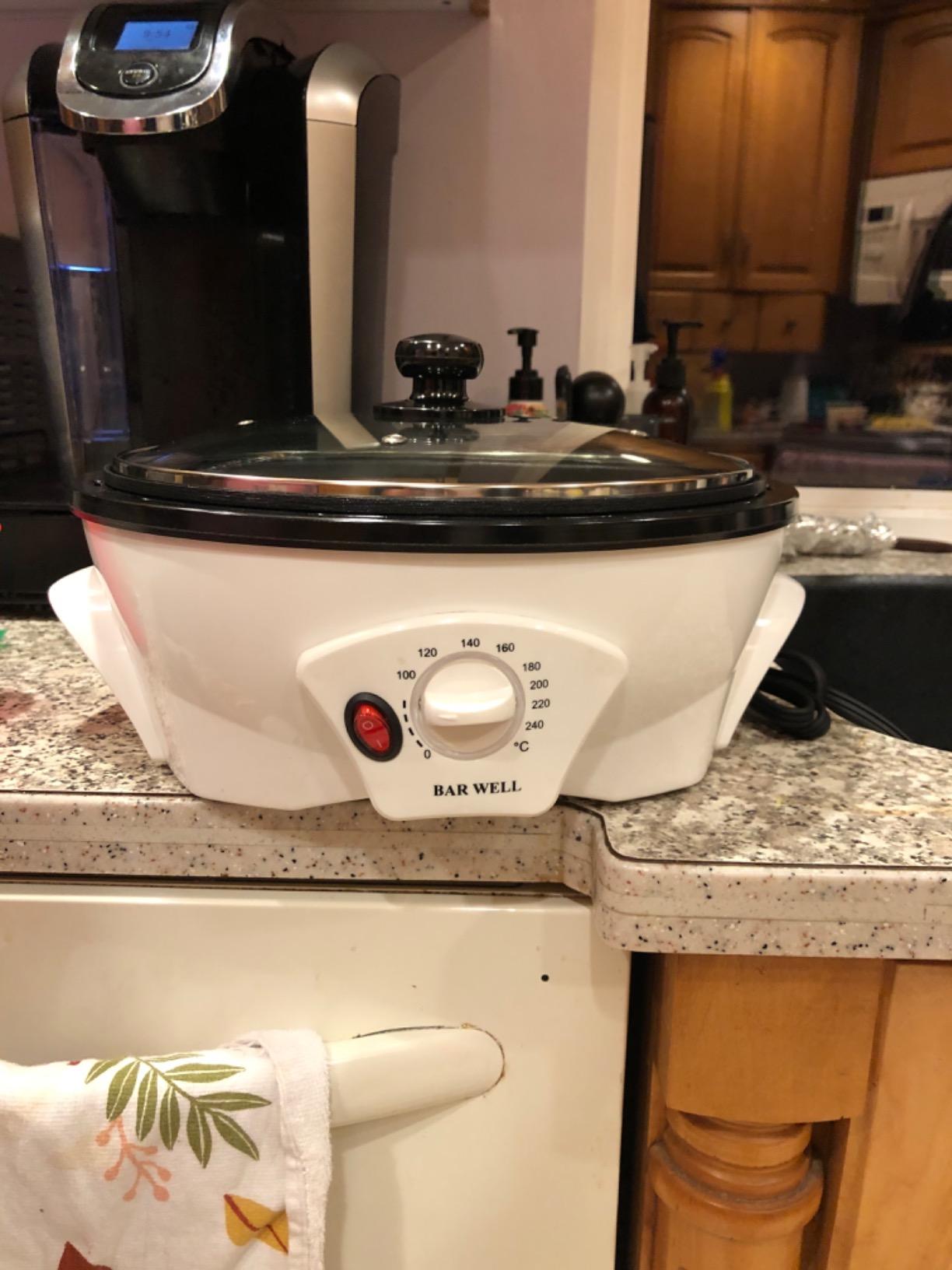
What to check before you buy it
Do not expect profile control. There is no memory, no timer that matters and no fan, so consistency depends on your nose and your eyes. That is a perfectly good way to learn roasting, and a poor way to chase a repeatable espresso profile.
Check the 14 by 13 by 6 inch package dimensions against your storage. These machines tend to live permanently on the counter because they are awkward to put away and you want them accessible for weekend sessions.
Where it disappoints
Several owners report shortened service life on the heating element, which is the risk with any very cheap appliance built around a single high-wattage component. If it fails, the replacement path is thinner than it is for an established brand.
Unevenness at higher loads is the other recurring theme, and the flat rotating design rather than a proper drum shape is the reason. Keep batches conservative and you will rarely notice.
7. NIASIA PKF-500g – Best for Roasting Indoors Without Guessing
500g Automatic Coffee Roaster Machine for Home Use Wth Smoke Filter(Suitable for Light Roasting), The Smoke Pipes (Suitable for Medium and Dark Roasting) and Chaff Collector
Batch: 350-400 g recommended
1000W
9 built-in profiles
Smoke purifier included
Pros
- Nine built-in profiles cover light
- medium and dark plus process methods
- Includes a smoke purifier for light roasts and smoke pipes for darker ones
- High-speed cooling fan with separate cooling tray
- Manual mode available when you want to experiment
Cons
- Highest cost in this group and the smoke pipes add footprint
- Automatic mode only runs preset profiles
- Manual mode demands a minimum airflow of 60 and 90-100 at first crack
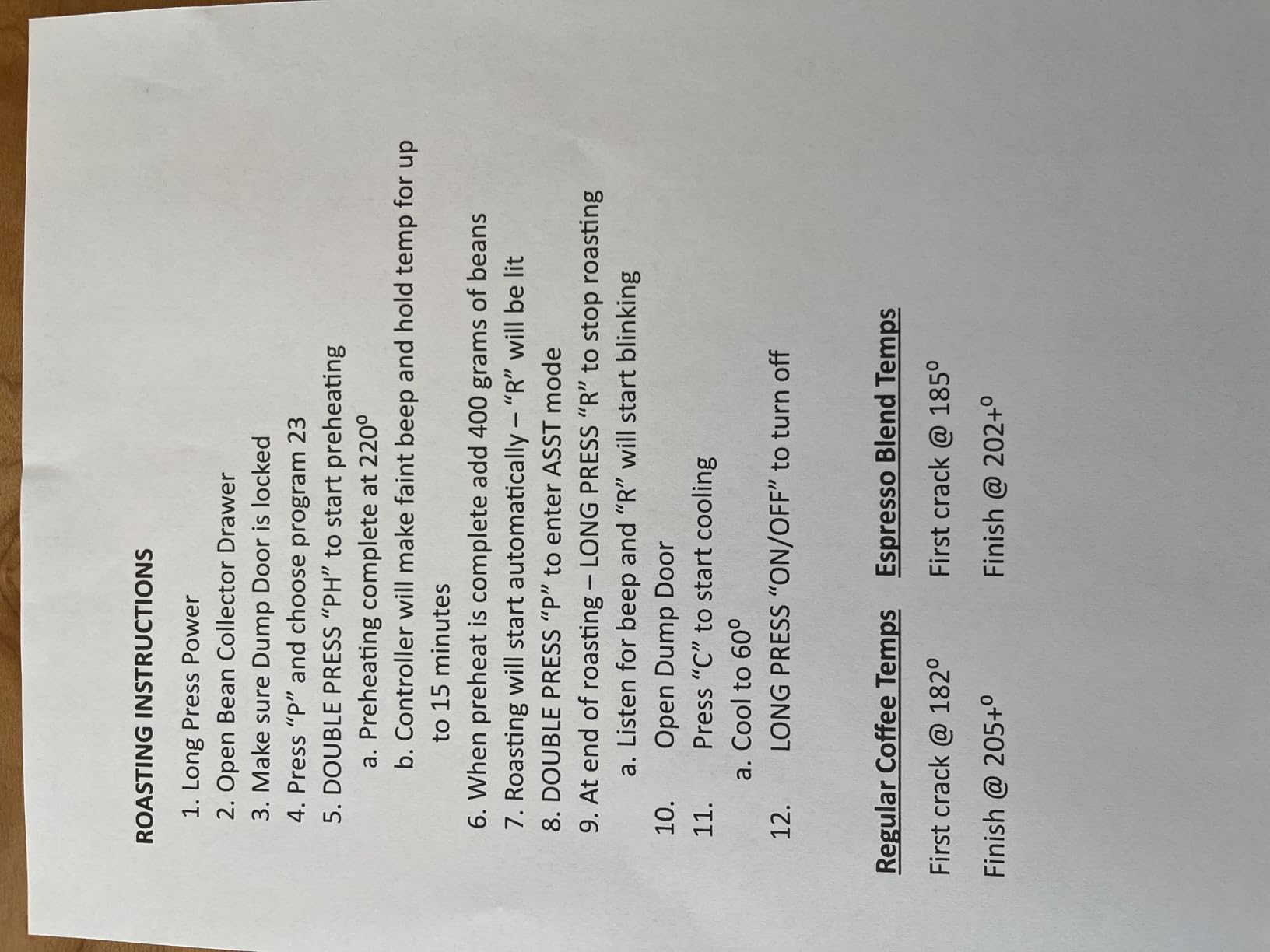
This is the one machine here that came with the indoor problem already considered. It ships with a smoke purifier intended for light roasting and two aluminium smoke pipes for medium and dark work, plus a cooling fan and a separate cooling tray, which is the combination that makes roasting in a kitchen realistic rather than aspirational.
Nine built-in profiles cover light, medium and dark as well as washed, natural and honey processed beans. A beginner can pick a profile and let the machine run the roast without understanding heat and airflow yet, then move to manual mode once they want to shape their own curves.
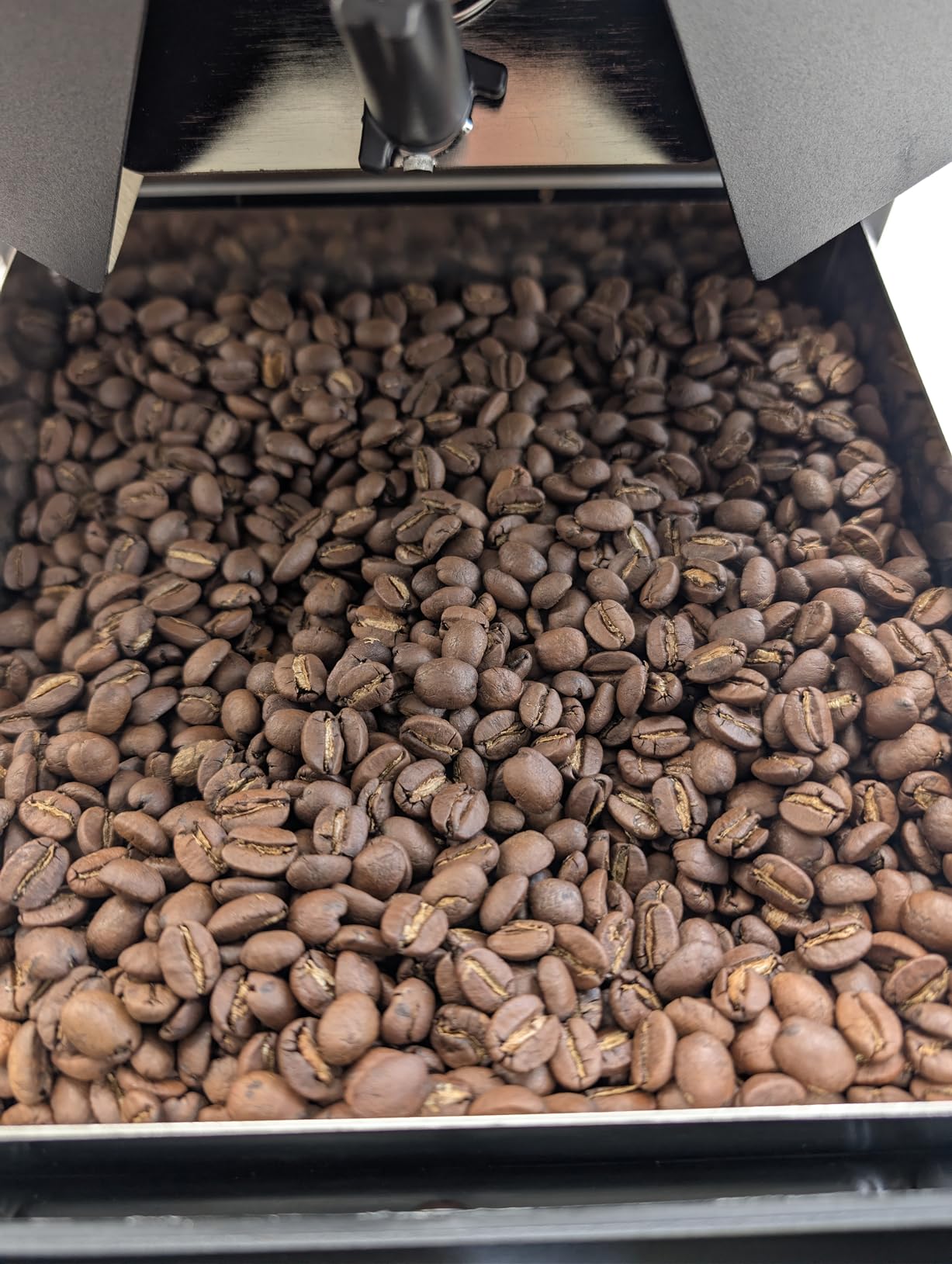
The stainless steel drum holds 500 g with 350 to 400 g recommended, which is a realistic ratio rather than an inflated headline figure. The temperature probe and intelligent temperature control are what let a preset profile land in roughly the same place twice.
Be clear about the size. At 16 by 12 by 20 inches this is a tall machine, and adding the smoke pipe to the top makes it taller still. Measure your clearance before committing.
What to check before you buy it
This is the most expensive machine in the guide and the one where the extras justify themselves. If you live in a flat, work in a home office or simply do not want to stand on a balcony in the winter, the smoke hardware and fast cooling are the reason to spend more.
Buy low-defect green beans. Reviewers specifically warn that inconsistent beans can jam the drum, and nothing in the machine design fixes a bad sample.
Where it disappoints
Automatic mode only runs the presets. Experimenting means learning the manual interface, which has a specific airflow requirement of at least 60 throughout and 90 to 100 at first crack. That is a real curve to climb before the machine feels like a creative tool.
With 119 reviews the long-term owner record is still thin compared with the machines above, so you are buying less battle-testing history for more money.
8. ZEVELOO 750g Electric Roaster – Best for Testing Different Bean Varieties
ZEVELOO 750g Electric Coffee Roaster Machine Home Coffee Roaster Coffee Bean Roaster for Home Use 110V
Batch: 300-500 g recommended
800W
100-240 C control
Transparent lid
Pros
- Automatic stirring rod starts with the machine and keeps beans moving
- Transparent lid shows colour changes through the roast
- 100-240 C range covers light through dark
- Honeycomb Teflon coating wipes clean
Cons
- Instructions are too thin to teach roasting
- Flat chamber can roast unevenly above about 250 g
- No built-in timer so timing comes from colour and sound
This is the machine owners most often describe as a learning tool. Because it roasts quickly and cheaply, you can put three small batches of different origins through it in an afternoon and start building the sensory vocabulary that separates a light roast from a medium one.
The stirring rod engages as soon as the machine starts, which removes the single biggest beginner failure mode on a flat pan: beans sitting still against the hot base. The transparent lid then lets you judge colour without opening the chamber and losing heat.
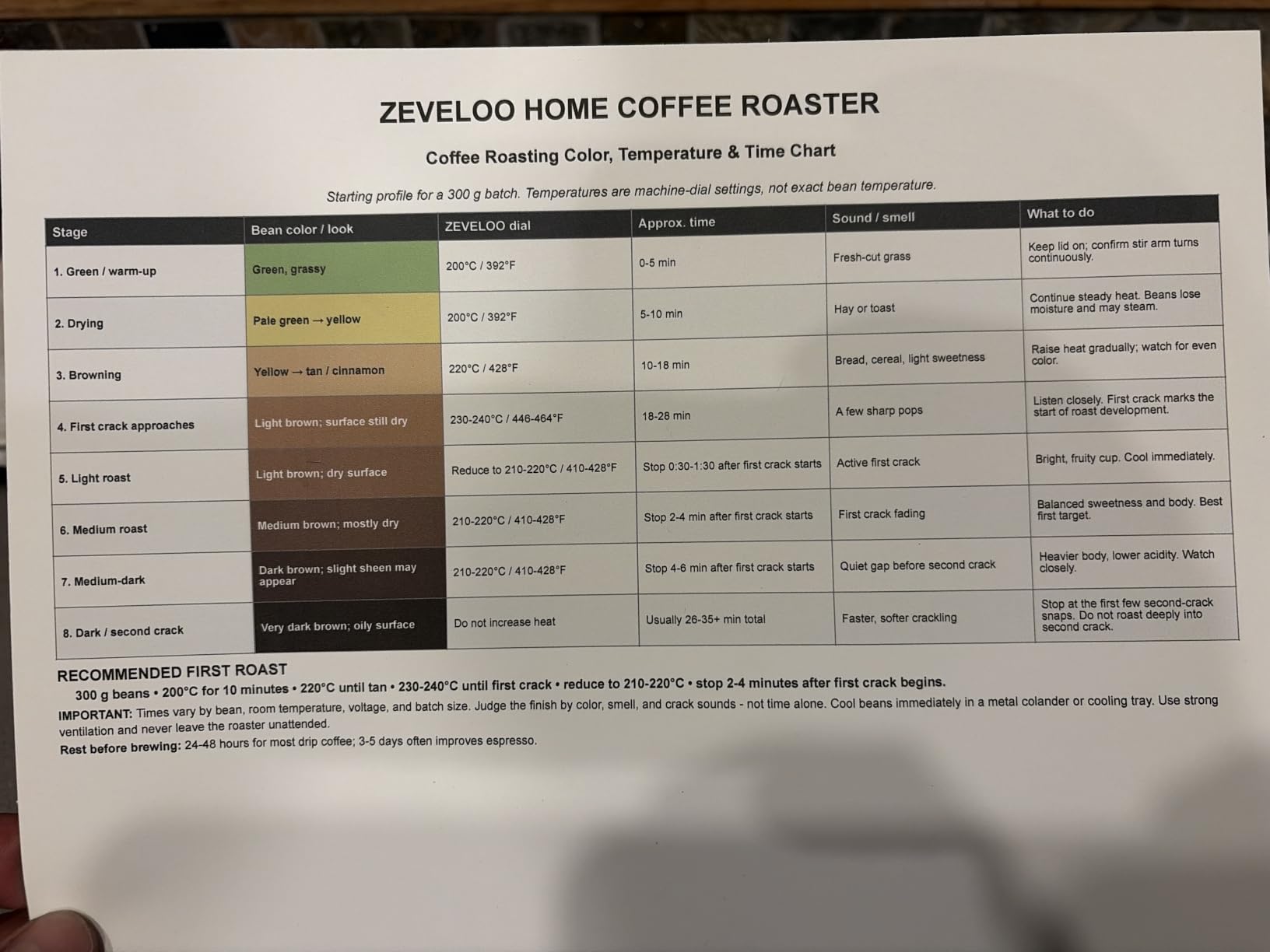
The 750 g drum with a 300 to 500 g working batch is a sensible ratio, and the 100 to 240 C range reaches dark territory. Reviewers who pair it with their own notes rate it well above bought coffee and appreciate that it doubles as a roaster for soybeans, mung beans and rice.
It is also the smallest machine here by footprint in one dimension, at 5.5 by 13.6 by 5.5 inches, which suits a counter that already carries a grinder.
What to check before you buy it
There is no built-in timer, so you are reading colour and listening for the crack. That is fine if you enjoy the craft side, but if you want repeatable numbers from the start you should pair it with an external bean thermometer.
Read up on roasting separately. Owners are emphatic that the instructions are too minimal to teach the craft, which means the machine is straightforward to run and the skill still has to come from somewhere else.
Where it disappoints
The flat rather than drum-style chamber roasts unevenly above roughly 250 g, and owners recommend shaking the unit periodically to compensate. If you need 500 g batches consistently, look at the machines with a proper auger or drum.
There are reports that the temperature dial reading does not always match the internal temperature, and dark roasts take noticeably longer than on higher-powered units. Treat the dial as a relative setting, not an absolute one.
9. lpylxingyan Glass Stovetop Roaster – Best for Roasting Without Electricity
Portable Glass Coffee Bean Roaster, 11.8 x 5.9 x 3.5
Batch: about 3 ounces
High borosilicate glass
Max 400 C
Stovetop powered
Pros
- Borosilicate glass tolerates high heat and thermal shock
- Transparent walls show the whole roast
- Needs no power and stores in a cupboard
- Cheapest way to sample roasting
Cons
- Around 3 ounces per batch
- No agitation at all so unevenness is constant
- Results depend entirely on manual shaking and timing
This is the smallest and simplest commitment on the list: a high borosilicate glass cylinder that goes straight onto a gas or electric hob. You shake it, you watch the beans through the glass, and you decide when to stop by ear and eye.
At roughly three ounces per batch it is a sampler rather than a household supply, and that is exactly how owners use it. Trying one small lot of an expensive green coffee before committing to a machine is a genuinely sensible first step, and almost nothing else on this list does that cheaply.
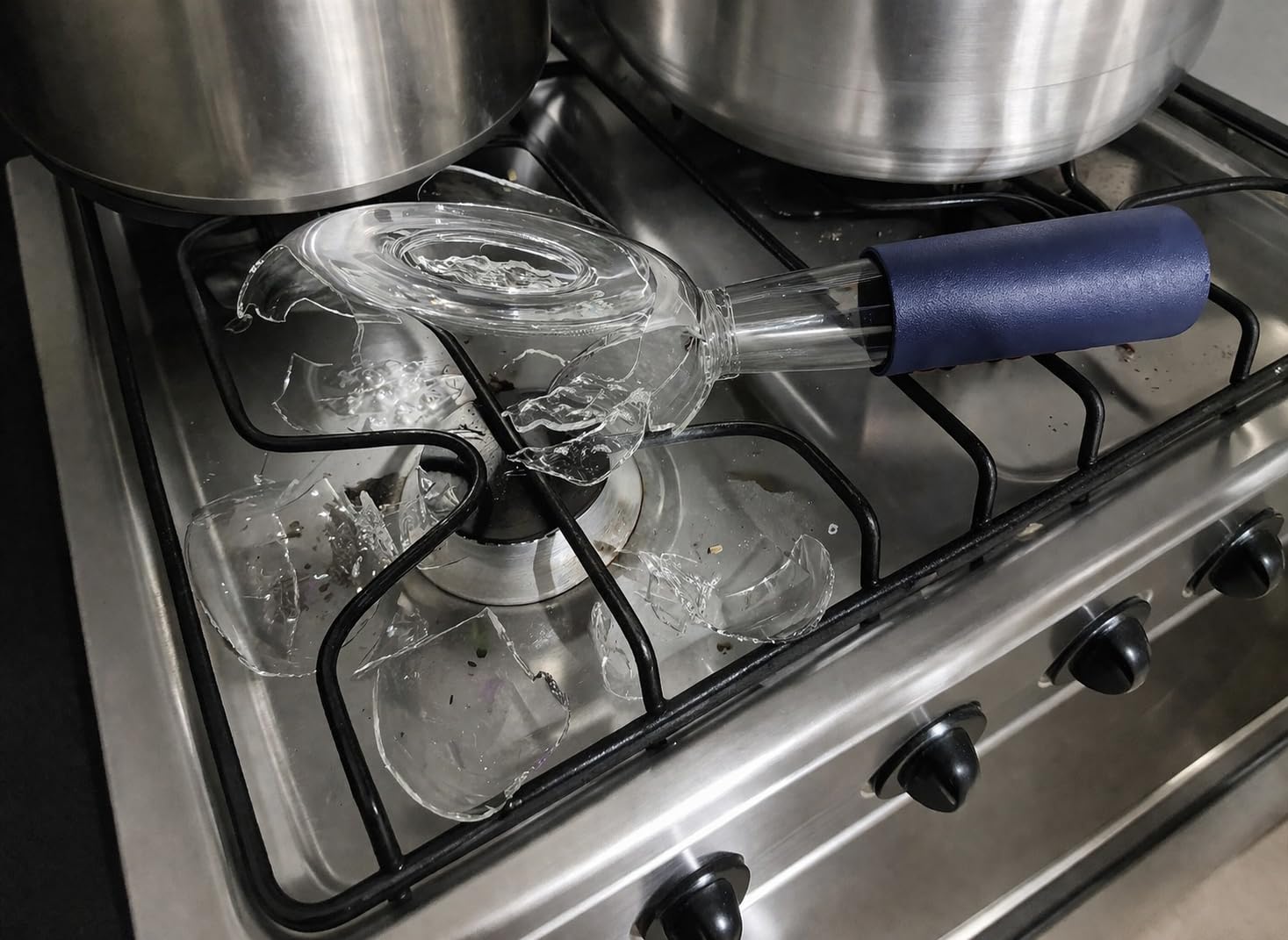
The borosilicate construction is the standout detail. Glass that tolerates thermal shock means you can move from a hot burner to a cold rinse without the vessel cracking, and unlike a cheap plastic pan it does not absorb or stain with coffee oils.
Measuring roughly 11.8 by 5.9 by 3.5 inches and weighing under a pound, it also stores in a drawer when you are not using it, which none of the electric machines here can honestly claim.
What to check before you buy it
Ask yourself whether a handful of beans will satisfy you. If your goal is to understand roast levels before committing to an appliance, this is the right tool. If you drink several cups a day, this will frustrate you within a fortnight.
You need constant manual movement. Without any built-in stirring, the beans only roast evenly to the degree that you shake and rotate the glass. Treat it as an attention exercise rather than a machine you set and walk away from.
Where it disappoints
The batch size is the hard limit, and no technique solves it. There is no fan, no timer and no temperature readout, so every batch is a fresh guess.
The 400 C maximum also means it cannot push the hard dark profiles, and thin glass walls mean the beans near the wall can outpace the ones in the middle. Fine for learning, not for espresso.
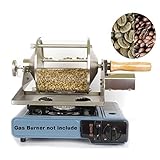
10. DYVEE Gas Quartz Glass Roaster – The Most Satisfying Traditional Drum Roast
DYVEE Coffee Roaster Gas Burner Coffee Roasting Machine for Home Use, 400g Capacity, Quartz Glass Drum, Stainless Steel Frame, Peanut and Nut Roaster
Batch: 200-300 g recommended
Quartz glass drum
304 stainless frame
17 pounds
Pros
- Quartz glass drum shows bean colour change across the whole roast
- 304 stainless frame and wooden handle handle heat well
- Powered drum rotation means constant movement
- 12V low-voltage motor with adapter included
Cons
- Needs a gas burner setup so it is less convenient to plug in
- Weighs 17 pounds and takes real storage space
- Maximum batch is 400 g with 200-300 g recommended
At 4.5 stars across 64 reviews this carries the highest average rating in the group, though on a much smaller sample than the machines above. The reason is straightforward: it is a real drum roaster, and the whole roast is visible from first crack to drop.
The quartz glass drum is heated directly by a gas burner, which gives you fast, aggressive heat response and a genuine flame-roast character that an electric element struggles to match. A 12V low-voltage motor turns the drum continuously, so you are not stirring anything by hand.
Watching green beans turn to brown through the glass is the fastest way to learn what first crack actually looks like. Combined with a clear four-step process that lets you stop at first or second crack, this is the most beginner-legible traditional roast on the list.
The build is also the sturdiest here: a 304 stainless steel frame and base with a wooden handle rated for heat, and a power adapter included for the motor so you are not hunting for a compatible supply.
What to check before you buy it
Do you have a gas burner you are happy using for several hours at a time? That is the main requirement, and if your only heat is a small electric hob, this format becomes much less convenient than a plug-in roaster.
At 17 pounds and roughly 8.5 by 8.3 by 17 inches it needs proper counter and cupboard space, and it is not something you will move between rooms casually.
Where it disappoints
Convenience is the honest weakness. Setup, burner management and cooling between batches all take longer than an electric machine with a cooling cycle, and the footprint is the largest here.
Batch size caps at 400 g with 200 to 300 g recommended, which is plenty for a household but well short of what the drum could theoretically hold. With only 64 reviews, the long-term parts record is also thinner than the well-reviewed electric options.
Air vs Drum vs Manual – Which Roaster Type Is Right for a Beginner?
An electric air roaster is the best type for most beginners because it heats fast, has simple heat, fan and time controls, roasts small batches and cools far quicker than a drum. A drum roaster produces fuller body and a more traditional flavour, but costs more, runs longer and has a steeper learning curve. A manual roaster teaches you the craft fastest and costs least, because every variable is your own hands.
Here is how the three types actually differ in daily use.
Air roasters hold beans in a glass chamber and blast them with hot air while a fan keeps them moving. They are fast, they cool quickly because the airflow is the same mechanism doing the work, and chaff blows into a basket. They struggle to reach very dark roasts. The Fresh Roast SR540 and SR800 are the clearest examples.
Electric drum roasters rotate beans in a pan or auger over a heating element. They reach darker roasts, hold more heat in reserve and handle larger batches, but they smell more, cool slower and need the beans sorted beforehand. Every budget drum machine in this guide falls into this group.
Manual roasters put you in charge of heat, movement and timing with no powered agitation. The Nuvo ceramic roaster and the borosilicate glass roaster are the two examples. They are cheap, quiet, nearly indestructible and completely unforgiving.
One more variable matters more than beginners expect: room temperature. Cheap hot-air machines rely on the fan to get cold dense beans moving in the first minute, and in a cold garage that job takes much longer. If you plan to roast somewhere unheated, plan for longer batches and be patient hitting first crack.
How to Choose a Home Coffee Roaster – 7 Checks
1. Match batch size to your drinking. Work out grams per day first, then divide by the number of roast days you want to run per month. A machine whose realistic batch is under 150 g suits one or two cups a day. Anything above that and you will be roasting two or three times a week, which is where the hobby starts to feel like a chore.
2. Use the realistic batch, not the headline number. Several machines here list 750 g or 800 g drums while recommending 300 to 500 g. The larger figure is a physical limit, not a working capacity. Loading to the headline number is the most common cause of uneven, scorched beans on this whole list.
3. Decide how you will handle smoke. Smoke is unavoidable and it is the dealbreaker people underestimate. If you have a range hood, a balcony or a garage, almost any machine works. If you do not, prioritise machines that include a smoke filter or purifier, and expect to roast outdoors for darker profiles.
4. Check how chaff is collected. Chaff is the papery skin that sheds off beans during roasting, and it is a fire risk and a mess on every surface. Air roasters with a chaff basket handle it well. Manual roasters produce less. Drum machines collect it in the base, which you then have to sift through cooled beans to remove.
5. Look at repeatability before control. A real-time temperature display and a timer matter more than the number of buttons. If you can see and record a number, you can repeat a good roast. If you cannot, you are guessing, and the guess will not survive contact with a second batch.
6. Consider cleaning and storage. Coffee oils go stale in a drum, so a non-stick coating you can wipe down is worth real money. A machine that lives permanently on your counter will annoy you; a machine that stores in a drawer will get used more often.
7. Check that parts and support exist. Established brands with long review histories publish replacement parts and respond to support requests. Generic machines with thin feedback may be cheaper today and impossible to fix later.
Smoke, Chaff and Roasting in an Apartment
Smoke is the reason many beginners quietly abandon the hobby. Roasted coffee smells wonderful, but a dark batch produces enough airborne particulate to set off a smoke alarm and reach the rest of the building. A few practical habits cover most of it.
Roast outdoors or under a hood. A balcony, a garden or a garage with the door open is the simplest answer. If you only have an extractor hood, roast on low heat and early in the batch, when moisture is still leaving the beans and chaff is loose, rather than at peak development.
Run machines with a purifier or smoke pipes on darker profiles. Light roasts produce far less smoke than dark ones, which is a practical reason to keep early batches light. Machines that ship with dedicated smoke hardware remove a lot of the guesswork.
Chaff is the mess you will not see. It gets into the fan housing, the microswitches, the extraction ducting and the gaps around your counter. Empty the chaff basket or filter between every roast and wipe the chamber while it is warm. Owners who skip this end up disassembling machines that stop switching on because of it.
Keep a hood filter clean. Coffee roasting puts a lot of fine particulate into kitchen extraction. A filter that has not been changed in months will coat the ducts and begin to smell permanently. Treat filters as a consumable from your first roast.
On noise, budget drum machines with a stirring motor are noticeably louder than manual roasters, and the manual options are effectively silent. If you share a wall with someone who works nights, the ceramic or glass roaster is the quiet choice.
How Much Green Coffee Should a Beginner Buy?
Buy less than you think. One kilogram is plenty to start, and it lets you try two origins without committing to a rotation you have not tested. Most beginners waste their first bag by roasting far past what they drink.
A simple starting point from the community is the 15-15-15 rule: 15 grams of green coffee, roughly 15 minutes of roast time, and around 15 days of rest before brewing. It is a rough scaffold rather than a roasting method, because roast time varies by bean density, moisture and the level you are chasing.
On rest and freshness, coffee is at its best in the first four to seven days after roasting and declines steadily after that. That window is the entire argument for roasting at home, and it is also the rule that stops you overbuying. Roast only what you will drink in about a week.
For a first order, look for washed beans from a single origin. They roast more predictably than naturals, which matters when you are still learning to read colour and sound, and a light to medium roast level is the most forgiving place to start.
Frequently Asked Questions
What is the best type of coffee roaster for beginners?
An electric air roaster is the best type for beginners because it heats fast, has simple heat, fan and time controls, roasts small batches, and is far easier to clean and cool than a drum roaster. Drum roasters produce fuller body but cost more, take longer, and have a steeper learning curve. A manual ceramic or glass roaster costs least and teaches the craft fastest, because every variable is under your own control.
What is the best coffee roasting machine for a beginner?
For most beginners the Fresh Roast SR540 is the best coffee roasting machine: about 120 g per batch, independent heat and fan control, a real-time temperature display and a chaff basket, all in a compact countertop footprint. If you drink more than a couple of cups a day, step up to the Fresh Roast SR800 for 226 g batches and changeable start settings.
Do home coffee roasters produce a lot of smoke?
Yes, especially during dark roasts. Light roasts produce far less smoke because most of it is moisture leaving the beans early. For indoor use, roast under an extractor hood, on a balcony, or in a garage, and consider a machine that includes a smoke purifier or smoke pipes. Empty the chaff basket between roasts, since loose chaff is a fire risk.
Can you roast coffee at home without a machine?
You can roast in a pan, on a baking tray in the oven, or in a modified popcorn popper, and all three work for small batches. The results depend entirely on your heat control and constant stirring, and you have no temperature reading or fan to help you. For a first experience, a ceramic or borosilicate glass roaster gives you the same manual process with a heatproof vessel built for it.
What is first crack in coffee roasting?
First crack is the audible popping sound that happens when moisture inside a green bean expands and breaks the bean structure open, usually somewhere between 8 and 12 minutes depending on the bean and machine. It marks the start of the development phase, which is the part of the roast that most shapes flavour. Light and medium roasts are dropped shortly after it; second crack is the louder, later pop used for very dark roasts.
What is the 15-15-15 coffee rule?
The 15-15-15 rule means start with 15 grams of green coffee, roast for about 15 minutes, and rest the beans for roughly 15 days before brewing. It is a simple starting point rather than a roasting method, because actual roast time and rest period vary by bean density, moisture content and the roast level you are aiming for.
Final Verdict
The best home coffee roasters for beginners split cleanly by how much involvement you want. Buy the Nuvo Eco Ceramic Roaster if you want to learn with almost no commitment and no electricity. Buy the Fresh Roast SR540 if you want fan and heat control and a temperature readout in a compact footprint, and step up to the SR800 the week your two-cup batches stop being enough.
Whichever you pick, sort your beans, stay inside the recommended working batch, roast light for the first dozen attempts, and put a ventilation plan in place before the first box arrives. That preparation does more for your coffee than the machine does.