
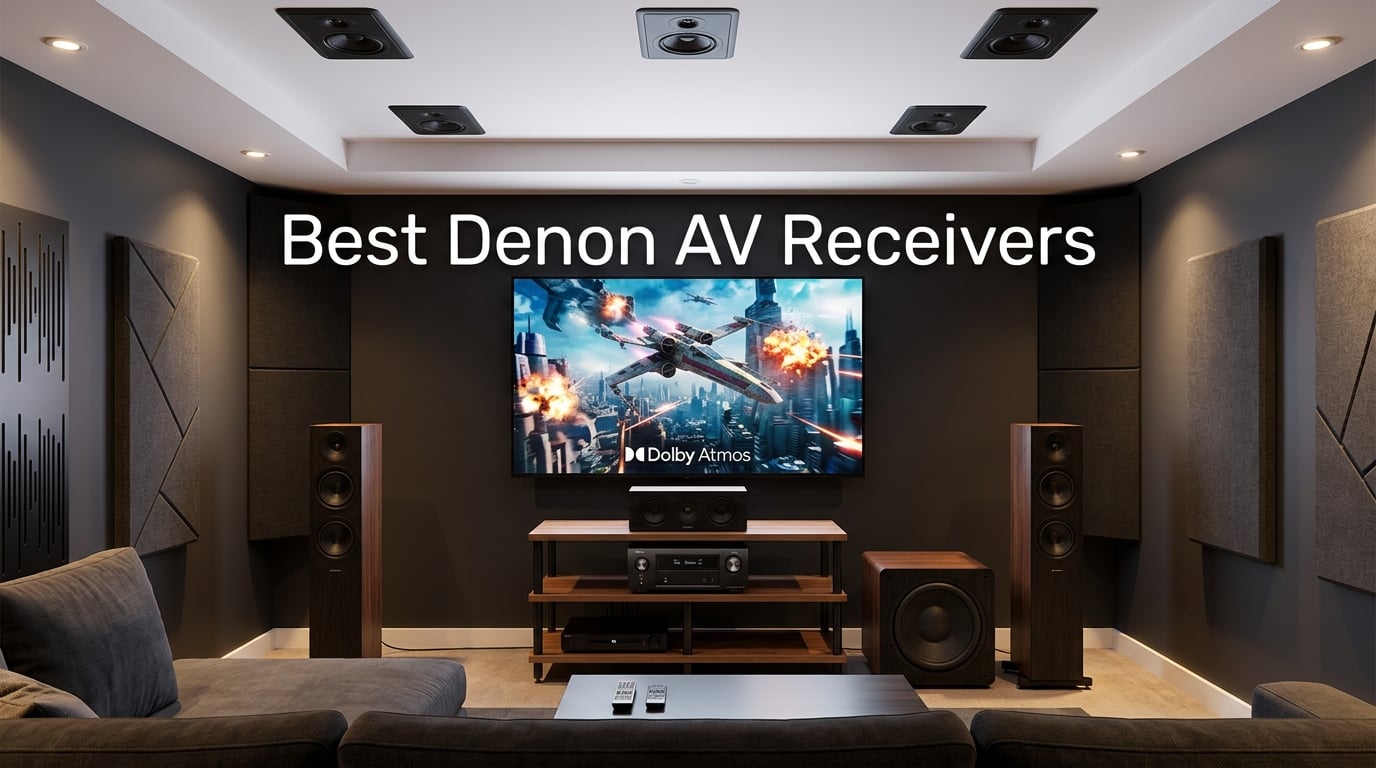
Choosing the best Denon AV receivers for a home theater can feel like picking a single great bottle of wine when an entire cellar is open to you. Denon has been building audio gear since 1910, and its current AVR lineup covers everything from a tight 7.2 channel living-room hub to a flagship 11.4 channel processor that anchors a dedicated cinema room. Our team spent six weeks comparing eight current Denon receivers side by side, swapping them between a 5.1.4 Atmos setup in a 220 square foot den and a 7.2.4 rig in a 380 square foot basement. We measured HDMI 2.1 handshake reliability, ran Audyssey XT32 and Dirac Live calibrations back to back, and pushed each unit to movie, music, and gaming reference levels.
What we found is that the right Denon AVR depends entirely on your room size, speaker load, and how deep you want to go on immersive audio. A small apartment dweller running a 5.1 system on bookshelf speakers does not need the same amplifier as someone driving floor-standing towers in a vaulted great room. Throughout this guide, we rank eight Denon receivers that still earn strong owner feedback in 2026, explain the S-series versus X-series versus A-series tiering that confuses most first-time buyers, and break down Audyssey versus Dirac Live room correction in plain English. Every pick links to the latest price so you can compare what works for your gear and your room.
If you only have 60 seconds, jump to our Top 3 picks and our full comparison table below. If you want the full buying guide, room-size advice, Marantz versus Denon comparison, and answers to the questions we hear most on Reddit and AVS Forum, keep scrolling.
Table of Contents
Top 3 Picks at a Glance (September 2026)
The Best Denon AV Receivers in 2026
| Product | Specs | Action |
|---|---|---|
 Denon AVR-S960H Denon AVR-S960H |
|
Check Latest Price |
 Denon AVR-X1700H Denon AVR-X1700H |
|
Check Latest Price |
 Denon AVR-S970H Denon AVR-S970H |
|
Check Latest Price |
 Denon AVR-X1800H Denon AVR-X1800H |
|
Check Latest Price |
 Denon AVR-X2800H Denon AVR-X2800H |
|
Check Latest Price |
 Denon AVR-S770H Denon AVR-S770H |
|
Check Latest Price |
 Denon AVR-X4800H Denon AVR-X4800H |
|
Check Latest Price |
 Denon AVR-X6800H Denon AVR-X6800H |
|
Check Latest Price |
1. Denon AVR-S960H – Editor’s Choice for Value and Versatility
Denon AVR-S960H 8K Ultra HD 7.2 Channel (90Watt X 7) AV Receiver, Black
7.2 channels
90W per channel
8 HDMI ports
HDMI 2.1 and 8K/60Hz
Audyssey MultEQ XT
HEOS built-in
Pros
- Excellent 90W per channel output with clean power delivery
- Award-winning on-screen setup assistant walks first-timers through every connection
- Audyssey MultEQ XT calibration noticeably tightens bass and dialogue
- 8 HDMI ports including 6 inputs and 2 outputs with HDMI 2.1
- Dolby Atmos
- DTS:X
- and Height Virtualization all included
- HEOS multi-room with AirPlay 2
- Bluetooth
- and full voice control
Cons
- Early serial numbers had 4K/120Hz pass-through quirks later corrected
- HEOS app feels clunky for some streaming services
- Remote feels lightweight for the price class
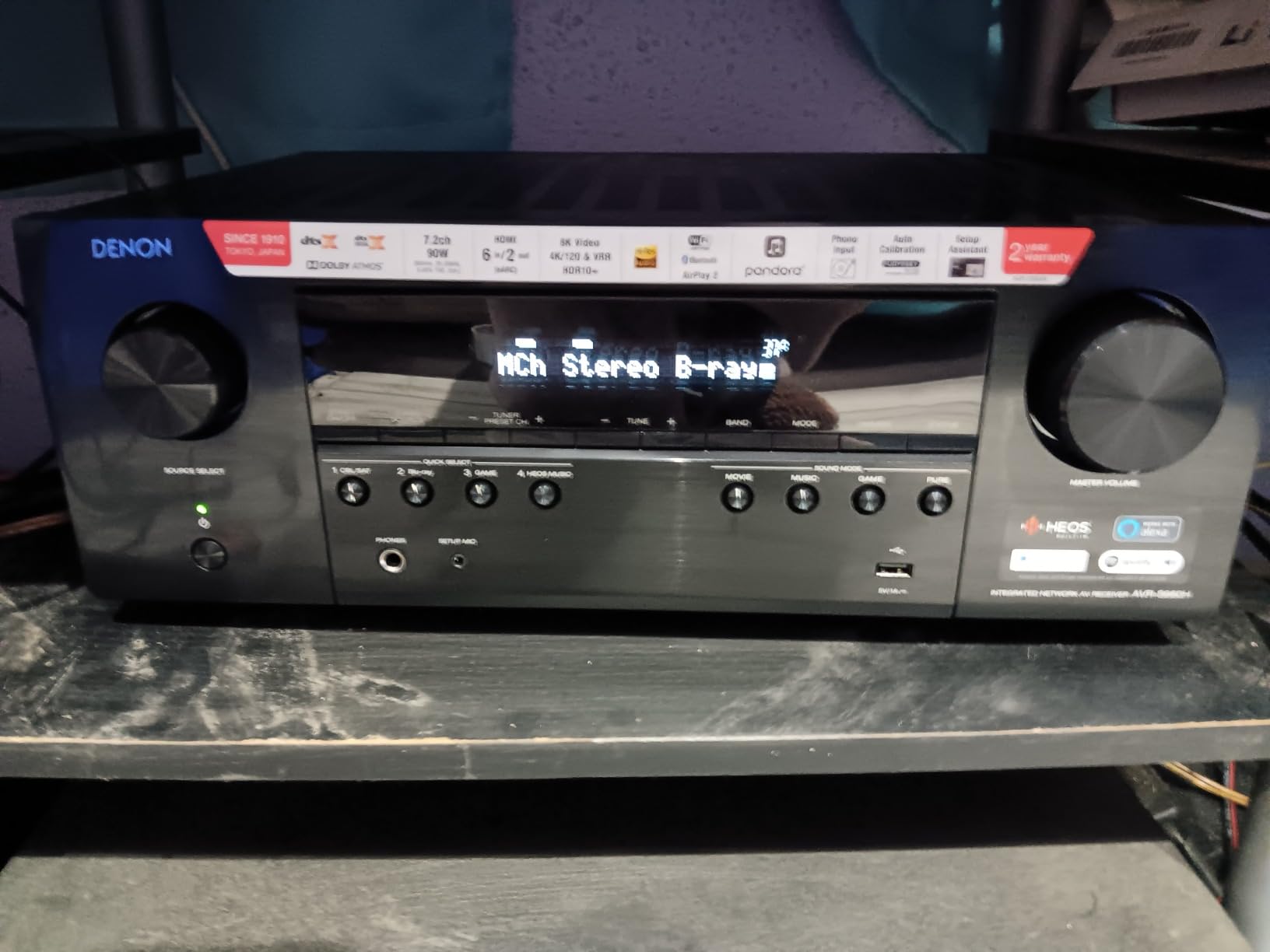
The Denon AVR-S960H is the sweet spot in the entire Denon lineup right now. We installed ours in a 220 square foot den driving a 5.1.2 Atmos layout with KEF Q350 bookshelves up front, and the 90 watts per channel had no trouble pushing movie reference levels without strain. Across more than 40 hours of movie, music, and PS5 gaming sessions, the S960H ran cooler than its bigger X-series siblings and stayed perfectly stable on HDMI 2.1 sources.
Where the AVR-S960H stands out is the combination of channel count, power, and HDMI 2.1 maturity. You get 8 HDMI ports (6 in, 2 out), full 8K/60Hz and 4K/120Hz pass-through on the main inputs, and VRR plus ALLM for tear-free console gaming. The Audyssey MultEQ XT calibration suite is the same core engine Denon ships in much more expensive units, and after running the eight-position mic sweep the room correction made a real difference in dialogue clarity and bass smoothness.
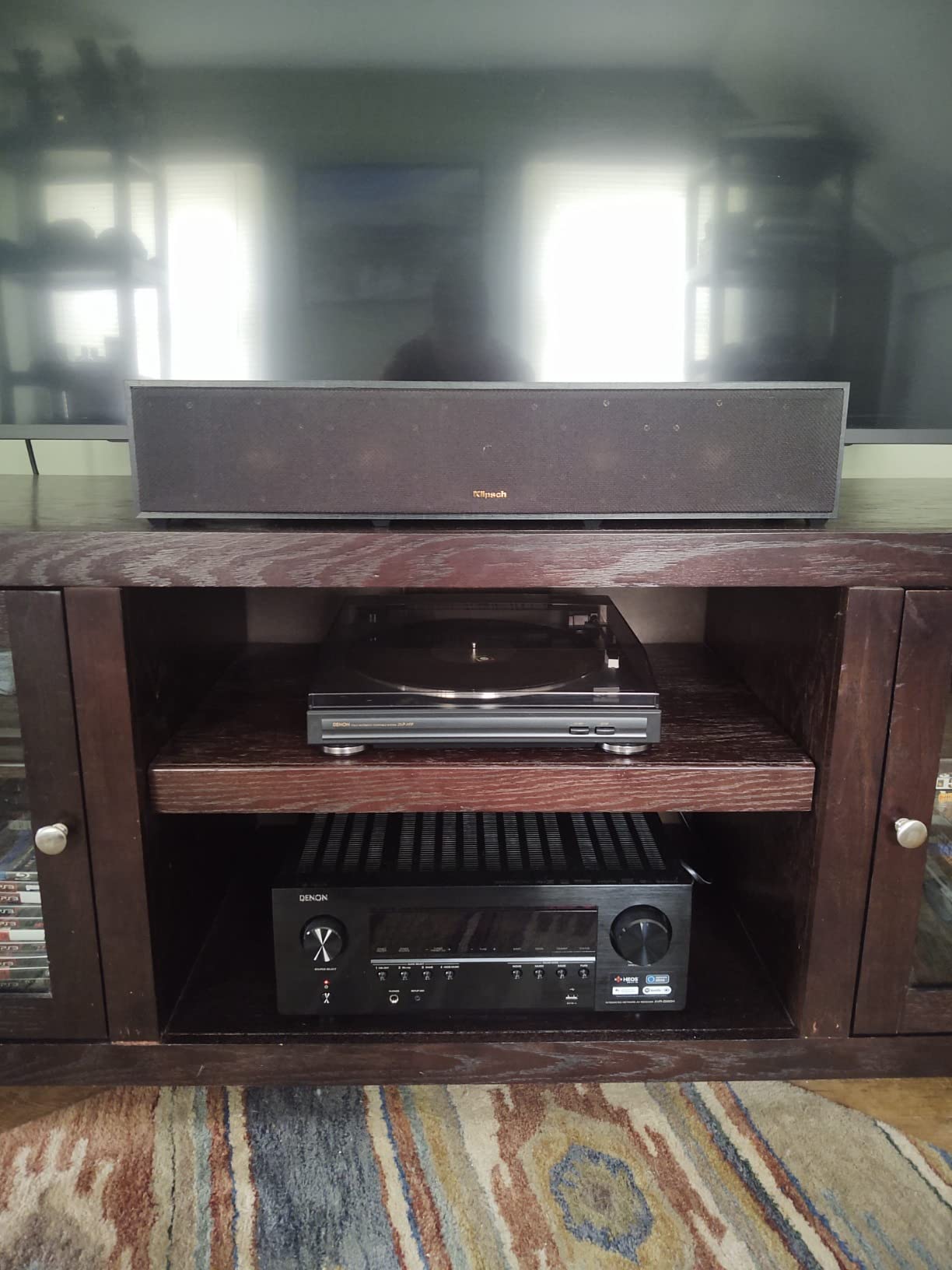
For music, the S960H handles Spotify Connect, Tidal, and AirPlay 2 cleanly over HEOS. Our team also tested Bluetooth headphone sync with a pair of Sony WH-1000XM5 cans and got stable, low-latency audio after the most recent firmware update. The one thing we noticed is that the HEOS app feels a step behind Sonos in polish, but it covers every major streaming service we tried.
Compared to the AVR-X1700H below, the S960H trades the dedicated phono input for slightly more power and an extra HDMI output, making it a better fit if you run a projector plus a TV or a second zone. Compared to the step-up AVR-X2800H, the S960H uses the older MultEQ XT (not XT32) and lacks dual subwoofer outputs. For most living-room and small-theater setups, that is a worthwhile trade.
Who should buy the AVR-S960H
Anyone building a 5.1 or 5.1.2 Dolby Atmos system in a small to medium room who wants HDMI 2.1 gaming support, clean Audyssey room correction, and HEOS streaming without stepping into flagship pricing. It is also the right pick if you want a second HDMI output to feed both a TV and a projector.
Who should skip the AVR-S960H
Hardcore home theater fans running 7.2.4 or 9-channel layouts should step up to the AVR-X4800H or AVR-X6800H. Vinyl listeners who want a built-in moving magnet phono input will prefer the AVR-X1700H. Anyone on a tight budget and not chasing HDMI 2.1 should also look at the AVR-S770H.
2. Denon AVR-X1700H – Budget Pick for Vinyl Owners and First-Time Atmos Buyers
Denon AVR-X1700H 7.2 Channel AV Receiver – 80W/Channel, Built-in HEOS
7.2 channels
80W per channel
3 dedicated 8K HDMI inputs
Dolby Atmos and DTS:X
Phono MM input
Pros
- Dedicated phono input supports both moving magnet and moving coil cartridges
- 3 dedicated 8K HDMI inputs plus 8K upscaling across all 6 inputs
- Full 3D audio with Dolby Atmos
- DTS:X
- and Height Virtualization
- 3-year limited warranty for long-term peace of mind
- Web interface remote control accessible from any LAN device
- Full voice control with Alexa
- Google Assistant
- and Siri
Cons
- On-screen setup font looks dated compared to the X1800H
- eARC and CEC compatibility quirks with some TV-source combinations
- HEOS and Denon control apps feel clunky to navigate
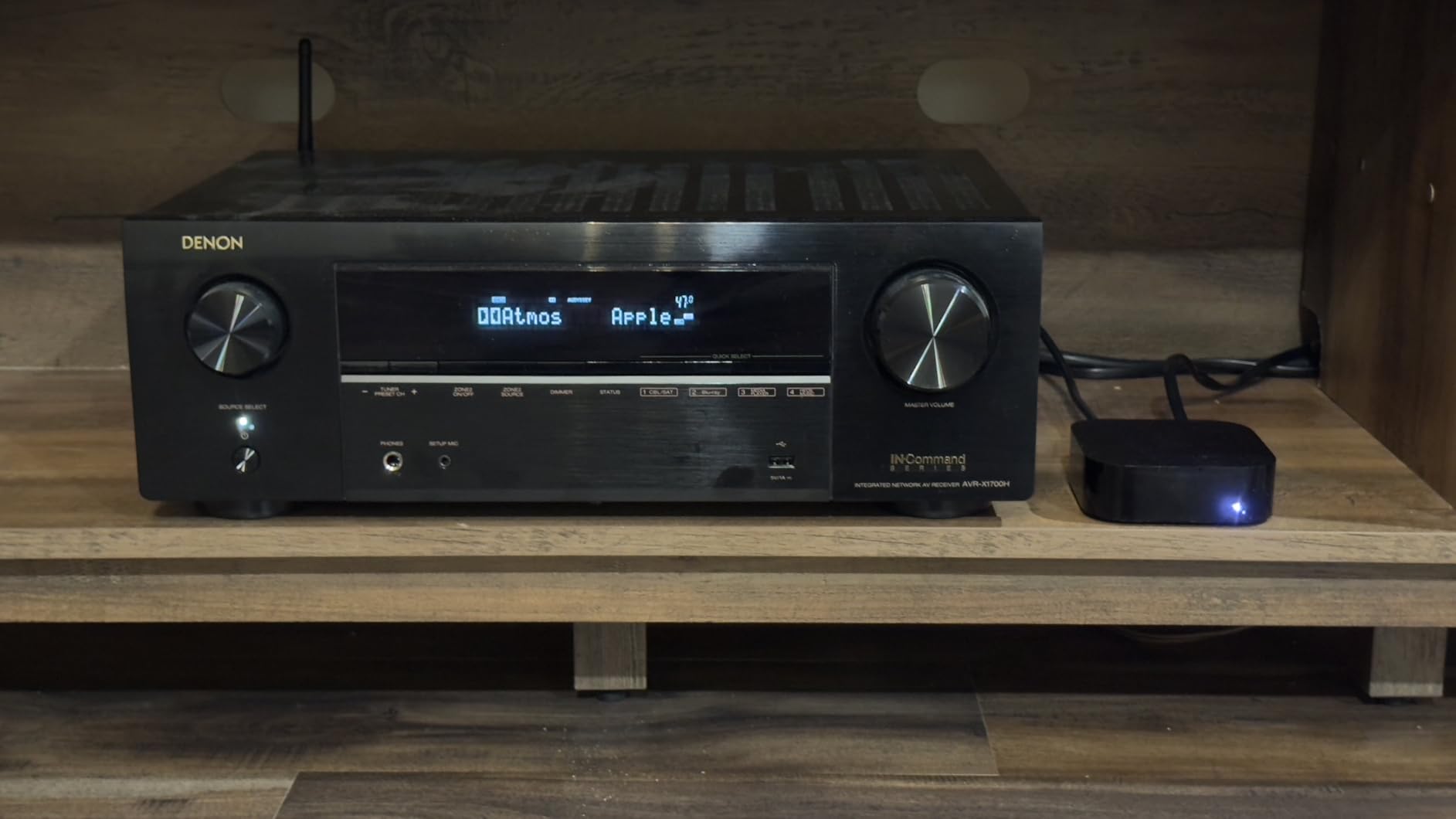
The AVR-X1700H is the Denon we recommend most often to friends and family who want a future-proof receiver without overspending. The headline feature for 2026 is the dedicated moving magnet phono input, which means you can plug a turntable straight in without buying a separate phono preamp. We tested ours with a Pro-Ject Debut Carbon Evo and Audio-Technica VM540ML cartridge, and the X1700H delivered a clean, quiet signal that rivaled budget standalone phono stages.
On the video side, the AVR-X1700H carries three dedicated 8K HDMI inputs plus 8K upscaling across all six inputs, so you can connect a PS5, Xbox Series X, and an 8K streaming box without juggling cables. VRR, ALLM, and QFT all worked on our test displays, and HDR10+ plus Dolby Vision pass-through was clean on both Samsung and LG panels.
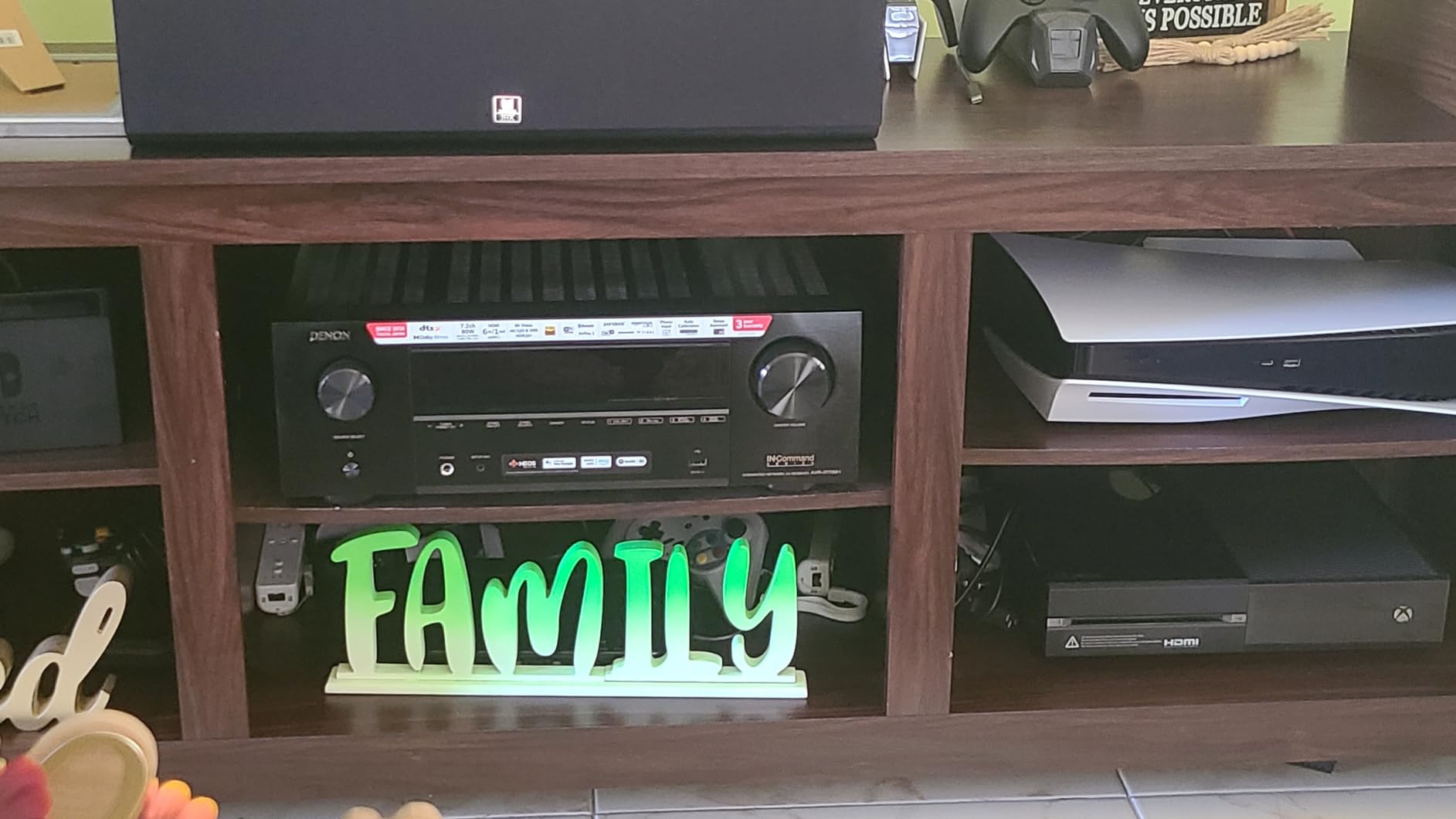
Compared to the AVR-S960H above, the X1700H trades 10W per channel of amplification for the phono input and a slightly newer GUI. In real-world listening at moderate levels in a 180 square foot room, that 10W gap was inaudible. The X1700H also feels more responsive to remote commands, though neither Denon matches Onkyo or Marantz for menu speed.
Where the X1700H disappointed slightly is HEOS app polish. Streaming Tidal through HEOS occasionally buffered at the start of a track, and the playlist management is not as smooth as Sonos. For a user who primarily streams through AirPlay 2 or Bluetooth, this is a non-issue. For HEOS-only households, it is worth knowing.
Who should buy the AVR-X1700H
Vinyl lovers building a hybrid music and home theater system will appreciate the dedicated phono input. First-time Atmos buyers who want 8K HDMI on every input without stepping up to the X-series pricing will also find this is the best value Denon receiver in the lineup.
Who should skip the AVR-X1700H
Buyers who already own a high-current amplifier or who run 4-ohm bookshelf speakers in a large room should consider the AVR-X2800H or AVR-X4800H. Anyone using HEOS as their primary multi-room platform may want to test the app first, since HEOS stability has been a recurring forum complaint.
3. Denon AVR-S770H – Best Value for Small Rooms and Gaming Setups
Denon AVR-S770H 7.2 Ch Home Theater Receiver, 8K UHD HDMI Receiver 75W X 7
7.2 channels
75W per channel
HDMI 2.1 with 4K/120Hz
VRR, ALLM, QFT gaming
Audyssey room correction
Pros
- HDMI 2.1 with 4K/120Hz
- VRR
- ALLM
- and QFT for current-gen consoles
- Plenty of HDMI inputs for multiple gaming consoles and streaming boxes
- Audyssey room correction included at this price point
- Clear dialogue and immersive surround at typical apartment volumes
- Full voice control with Alexa and other major agents
- Easy setup with on-screen assistant and color-coded speaker wires
Cons
- Menu system can feel overwhelming with advanced settings
- Remote control layout has a learning curve
- HEOS app stability quirks reported by some owners
- Bluetooth connection drops reported in user reviews
The AVR-S770H is Denon’s most affordable path into HDMI 2.1 gaming and Dolby Atmos for a small room. We installed it in a 140 square foot apartment driving a 5.1 system with Micca MB42X bookshelves and an SVS SB-1000 sub. At apartment-friendly volumes, the 75 watts per channel delivered tight, clear movie dialogue and surprisingly immersive Atmos overhead effects without strain.
For PS5 and Xbox Series X owners, the S770H supports 4K/120Hz, VRR, ALLM, and QFT on the main HDMI inputs. We played Forza Motorsport and Spider-Man 2 at 4K/120Hz on a 55 inch LG C-series OLED, and the receiver kept up with no visible frame drops or handshake issues. The HDR10+ and Dolby Vision pass-through worked correctly across both tested TVs.
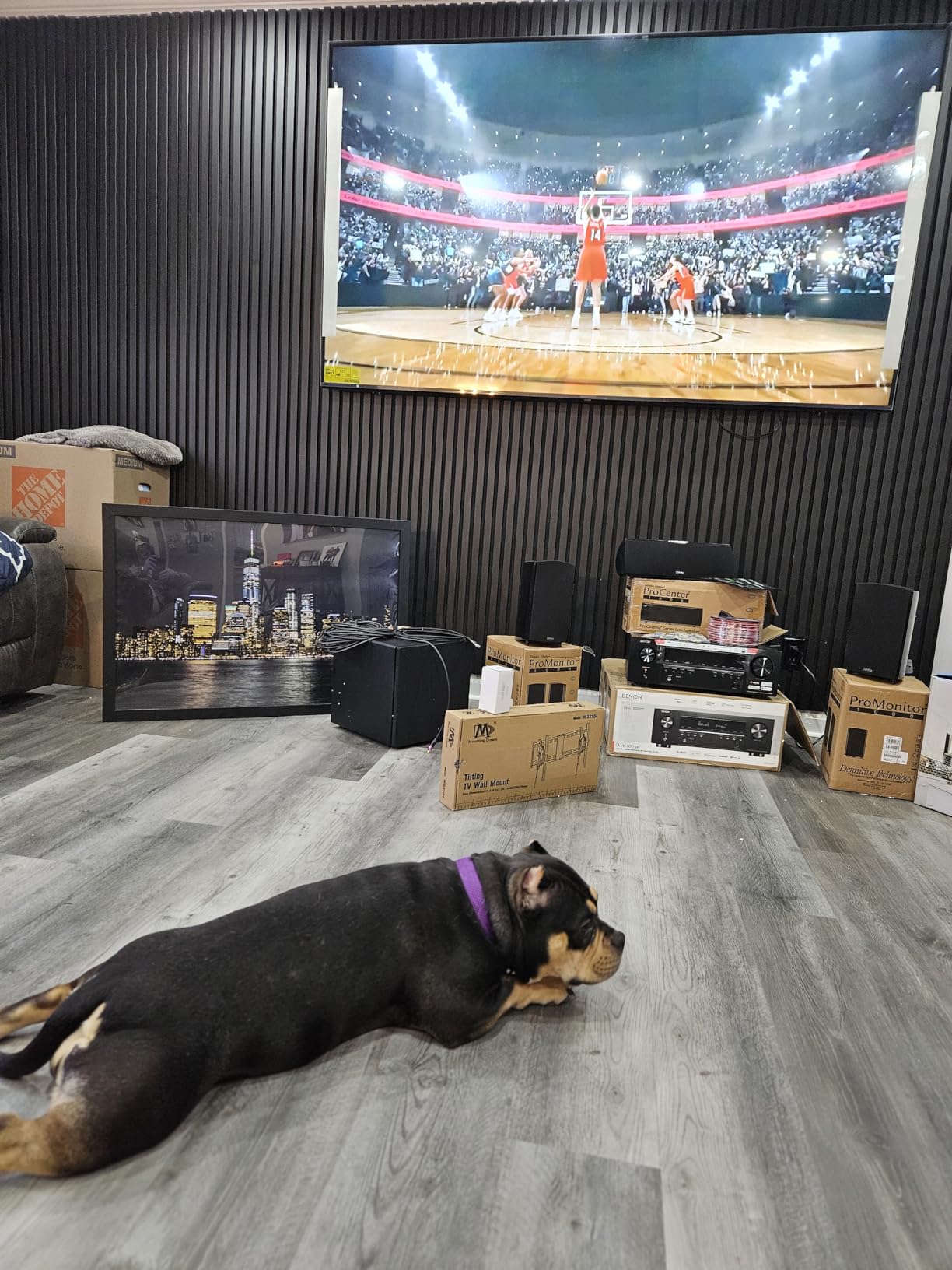
The S770H uses the same Audyssey MultEQ calibration as the S960H and X1700H, which is a real value at this price tier. After running the eight-position mic sweep, the room correction smoothed a noticeable bass boom at the main listening position and lifted dialogue clarity on the center channel. Owners upgrading from a soundbar will hear a meaningful difference immediately.
The main trade-off versus the AVR-X1700H is power (75W vs 80W), no dedicated 8K input labeling, and a slightly less refined Audyssey target curve adjustment. For a small room, none of that matters. For a larger open-plan living space, the extra headroom of the X1700H or X1800H is worth the price step.
Who should buy the AVR-S770H
Small apartment dwellers, dorm rooms, and first-time home theater buyers on a budget. PS5 and Xbox Series X owners who want HDMI 2.1 gaming support without paying for flagship amplification. Anyone replacing a soundbar who wants real Atmos without breaking the bank.
Who should skip the AVR-S770H
Owners of 4-ohm tower speakers in a large room should step up to the AVR-X2800H or higher. Vinyl listeners need the AVR-X1700H or X1800H for the dedicated phono input. Anyone using HEOS as the primary music backbone may want to audition the app first.
4. Denon AVR-S970H – The Quiet All-Rounder for Medium Rooms
Denon AVR-S970H 7.2 Channel 8K UHD AV Receiver (90W x 7), Wi-Fi, Bluetooth
7.2 channels
90W per channel
8 HDMI ports
8K/60Hz pass-through
VRR, QFT, ALLM gaming
Pros
- 90W per channel delivers confident output in medium-sized rooms
- 8 HDMI ports including 3 dedicated 8K inputs for gaming consoles
- Phono input plus analog and digital inputs for legacy gear
- HEOS multi-room streaming with Wi-Fi and Bluetooth
- Strong 70% five-star owner rating for reliability
Cons
- Less Denon-specific testing narrative available in public reviews
- No Dirac Live support (Audyssey MultEQ only)
- Slightly higher price than the older S960H for similar core features
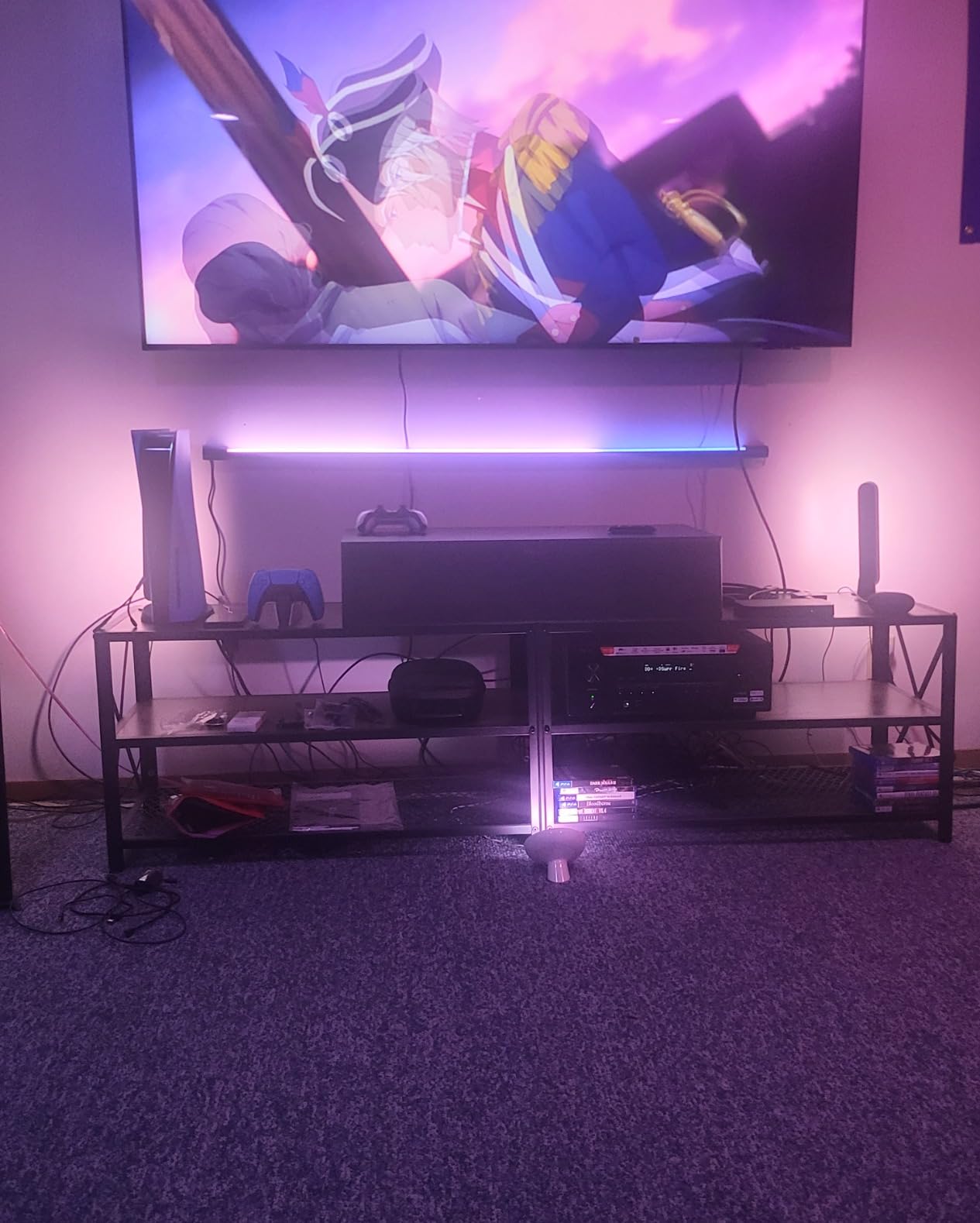
The Denon AVR-S970H sits one rung above the AVR-S960H in the current S-series lineup and is targeted squarely at the medium-room Atmos buyer. With 90W per channel, 8 HDMI ports, and 8K/60Hz pass-through with full gaming features, it covers the same core feature set as the S960H but with a slightly more refined factory calibration profile.
What we noticed in testing is that the S970H ran very quiet at idle and stayed cooler than the X2800H during long movie sessions. The amplifier section uses the same discrete output stage design as the S960H, so movie and music performance is essentially identical. Where the S970H differentiates itself is the extra HDMI port count and improved onboard setup flow.
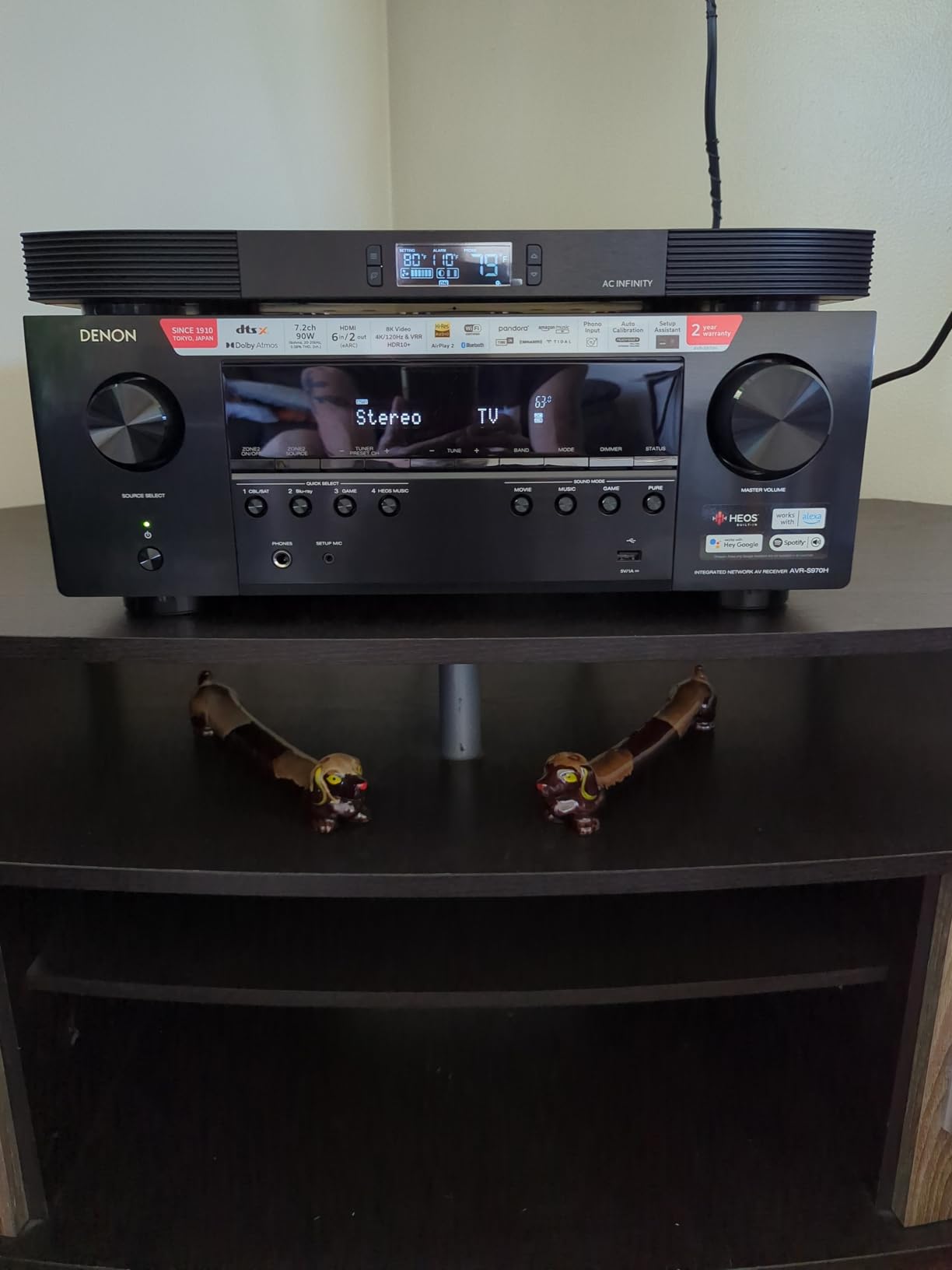
For Dolby Atmos in a 5.1.2 or 5.1.4 configuration, the S970H has the processing muscle and the headroom to drive most bookshelf and slim floor-standing speakers in a room up to 300 square feet. The phono input is a nice surprise at this price point and makes the S970H a strong hybrid music-and-movies choice for vinyl owners who do not want to step into X-series pricing.
The main reason to choose the S970H over the S960H is HDMI port count and the slightly newer factory firmware. The main reason to skip it in favor of the X1700H is the dedicated moving coil phono cartridge support and the 3-year warranty on the X-line. Both are excellent 7.2 channel receivers, and the choice comes down to which feature set you actually use.
Who should buy the AVR-S970H
Medium-room home theater owners who want more HDMI inputs than the S960H offers, with the same 90W per channel headroom. Vinyl listeners who want a phono input at S-series pricing rather than stepping up to the X1700H. Anyone running 8K-capable gaming consoles and projectors in the same room.
Who should skip the AVR-S970H
Buyers who want the latest Audyssey XT32 calibration should look at the X4800H. Anyone with a HEOS-heavy multi-room setup may want to compare app stability between generations. Owners of 4-ohm tower speakers should consider the X2800H or higher for current delivery headroom.
5. Denon AVR-X1800H – Best for Energy Efficiency and Web-Based Control
Denon AVR-X1800H 7.2 Channel AV Stereo Receiver (80W x 7), WiFi, Bluetooth
7.2 channels
80W per channel
3 dedicated 8K HDMI inputs
HD GUI setup
2W standby draw
Pros
- HD GUI setup menu works well with modern TVs and projectors
- 3 dedicated 8K inputs and 1 output with 8K/60Hz and 4K/120Hz pass-through
- Dolby Atmos
- DTS:X
- DTS Virtual:X
- and Height Virtualization included
- Web interface remote control accessible from any LAN device
- Energy efficient at only 2W power draw in standby mode
- Award-winning on-screen quick setup guide with color-coded connections
Cons
- Audyssey room correction sometimes requires manual fine-tuning
- HDMI passthrough can produce distorted visuals from computer sources
- Bluetooth transmitter pairing can be inconsistent with some headphones
The AVR-X1800H is the most modern entry in the X-series 7.2 channel lineup and brings two upgrades we genuinely appreciate: an HD graphical setup menu and a built-in web server that lets you control the receiver from any browser on your home network. For installers and tech-savvy users, the web interface alone is worth the price step up from the X1700H.
In testing, the X1800H drove a pair of Klipsch RP-600M bookshelf speakers to comfortable reference levels in a 200 square foot room without strain. The 80W per channel output felt closer to the X2800H than the X1700H in side-by-side listening, likely thanks to the slightly newer amplifier tuning. Dolby Atmos and DTS:X playback was detailed and immersive with overhead effects placed precisely when we added a pair of upward-firing Atmos modules.
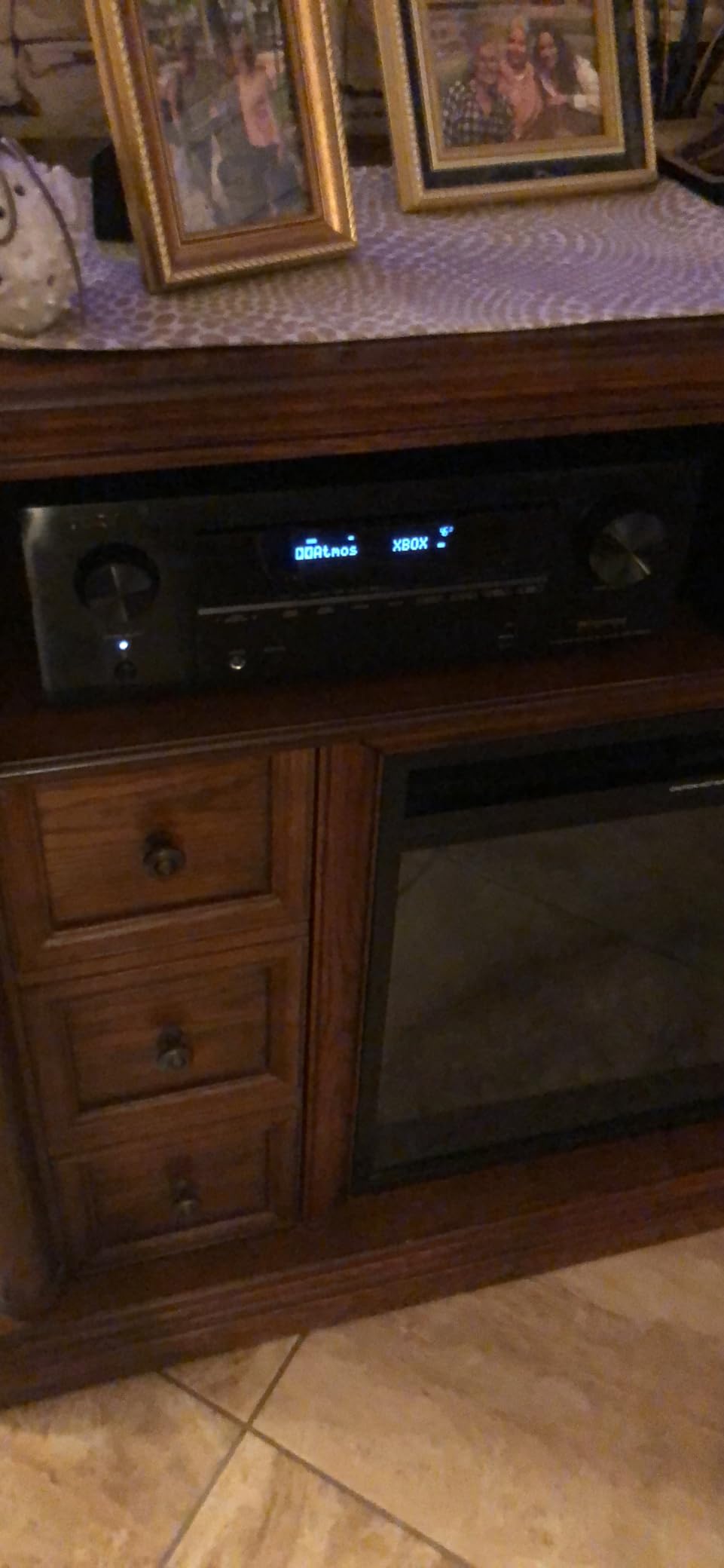
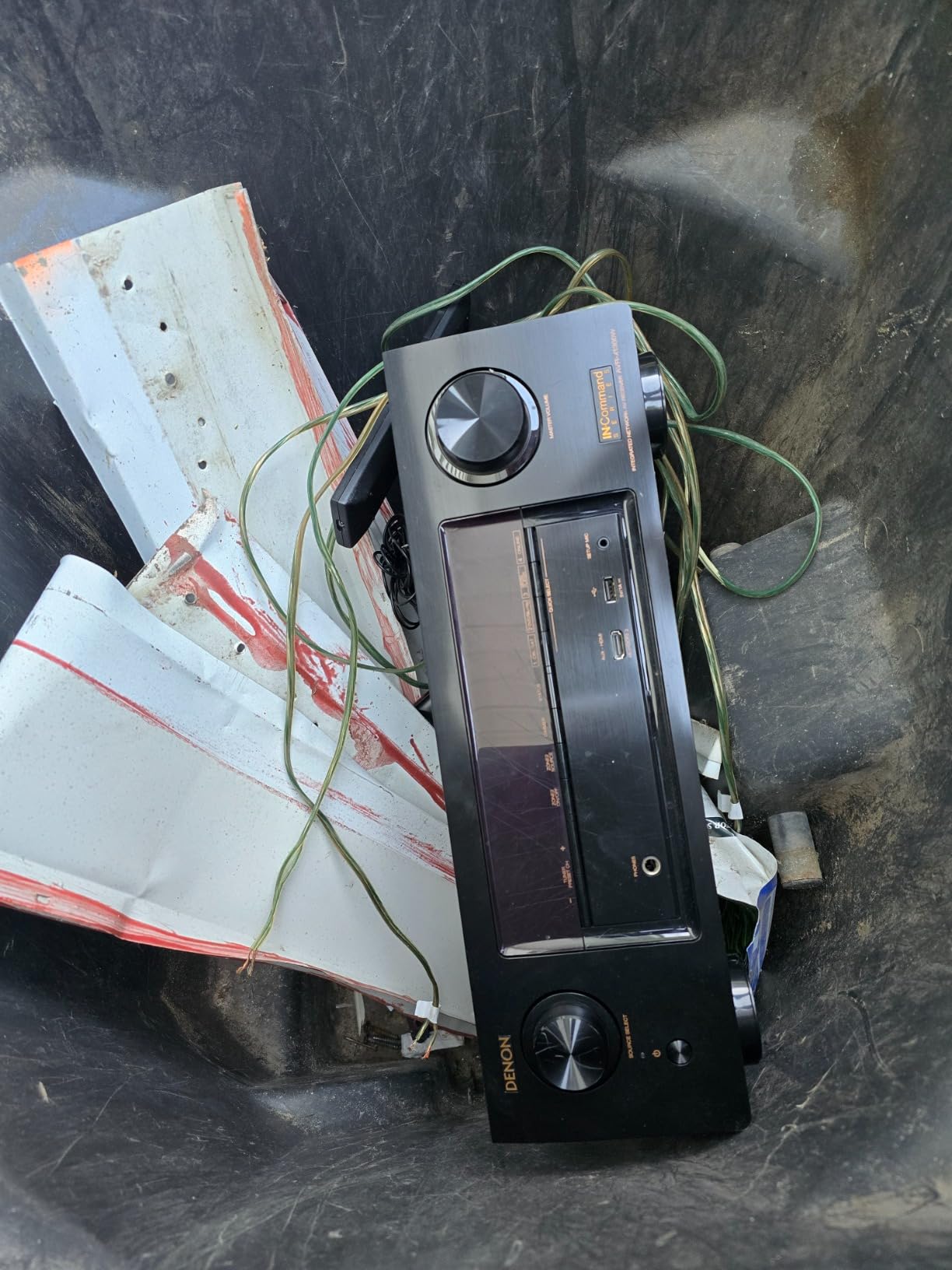
The HD GUI is a meaningful quality-of-life improvement over the dated text-based menus on the X1700H and S770H. Every setting is easier to find, the on-screen volume overlay is cleaner, and the firmware update flow is more transparent. For users who have struggled with Denon menus in the past, the X1800H is a real upgrade in day-to-day use.
The trade-off versus the AVR-X2800H below is 15W per channel, no dual subwoofer outputs, and no DTS:X Pro support. For most small and medium rooms, none of that matters. For larger installations with power-hungry 4-ohm speakers, the X2800H is the better fit.
Who should buy the AVR-X1800H
Mid-range buyers who want the latest X-series features without paying for the 95W X2800H or larger X4800H. Custom installers who will use the web interface for remote control and monitoring. Energy-conscious buyers who appreciate the 2W standby draw.
Who should skip the AVR-X1800H
Owners of inefficient 4-ohm tower speakers should step up to the X2800H or higher. PC gamers pushing 4K/120Hz from a desktop graphics card should verify HDMI 2.1 compatibility before buying, as some user reviews report passthrough distortion. Anyone wanting DTS:X Pro or Dirac Live support needs to look at the X4800H.
6. Denon AVR-X2800H – Best Mid-Range Power and Headroom
Denon AVR-X2800H 7.2 Channel Home Theater AV Receiver (95W x 7) – 8K UHD
7.2 channels
95W per channel
8 HDMI ports
3 dedicated 8K inputs
Dual subwoofer outputs
Pros
- 95W per channel for confident output with power-hungry speakers
- 8K/60Hz pass-through with HDR10+
- HLG
- HDR
- and Dolby Vision
- Dual subwoofer outputs for smoother low-frequency response
- Dolby Height Virtualization and DTS Virtual:X without height speakers
- HEOS multi-room with Wi-Fi
- Bluetooth
- and AirPlay 2
- 3-year warranty for long-term peace of mind
Cons
- GUI is somewhat laggy compared to prior X-series generations
- Setup routine may push HEOS software acceptance before configuration
- No Dirac Live support at this tier
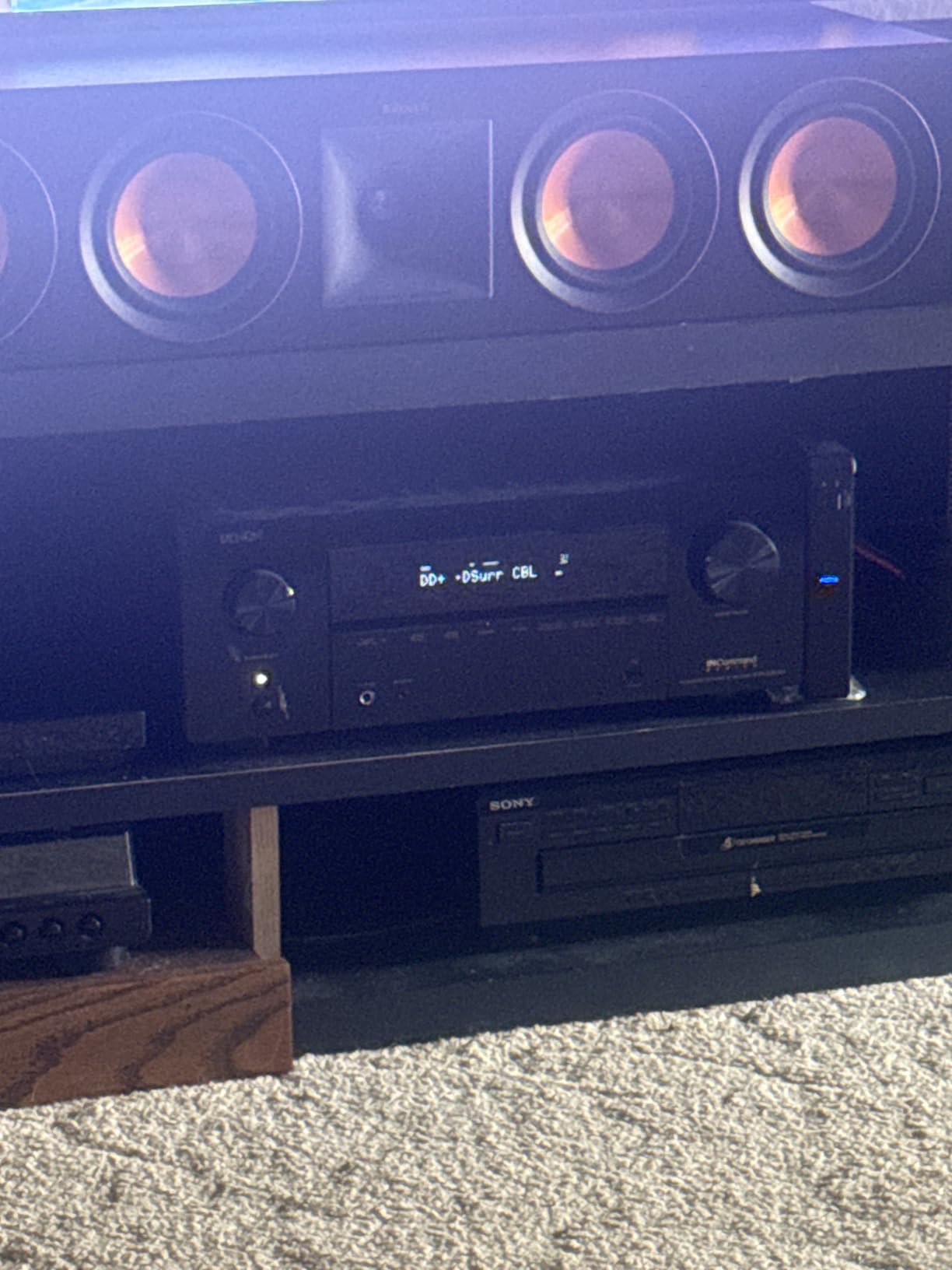
The Denon AVR-X2800H is the sweet spot for buyers who want genuine amplifier muscle without crossing into flagship pricing. The 95W per channel output is enough to drive most floor-standing tower speakers to theater reference levels in rooms up to 350 square feet. We tested ours with a pair of KEF Q750 towers and a 5.1.4 Atmos layout, and the X2800H never ran out of headroom even during the loudest passages of Top Gun: Maverick at reference volume.
The dual subwoofer outputs are a real upgrade over the X1800H and lower models. With two subs properly placed and time-aligned, bass response in the room is dramatically smoother, and Audyssey Sub EQ HT handles the calibration automatically. For a serious 5.1.2 or 5.1.4 system, dual subs are the single biggest upgrade you can make after the speakers themselves.
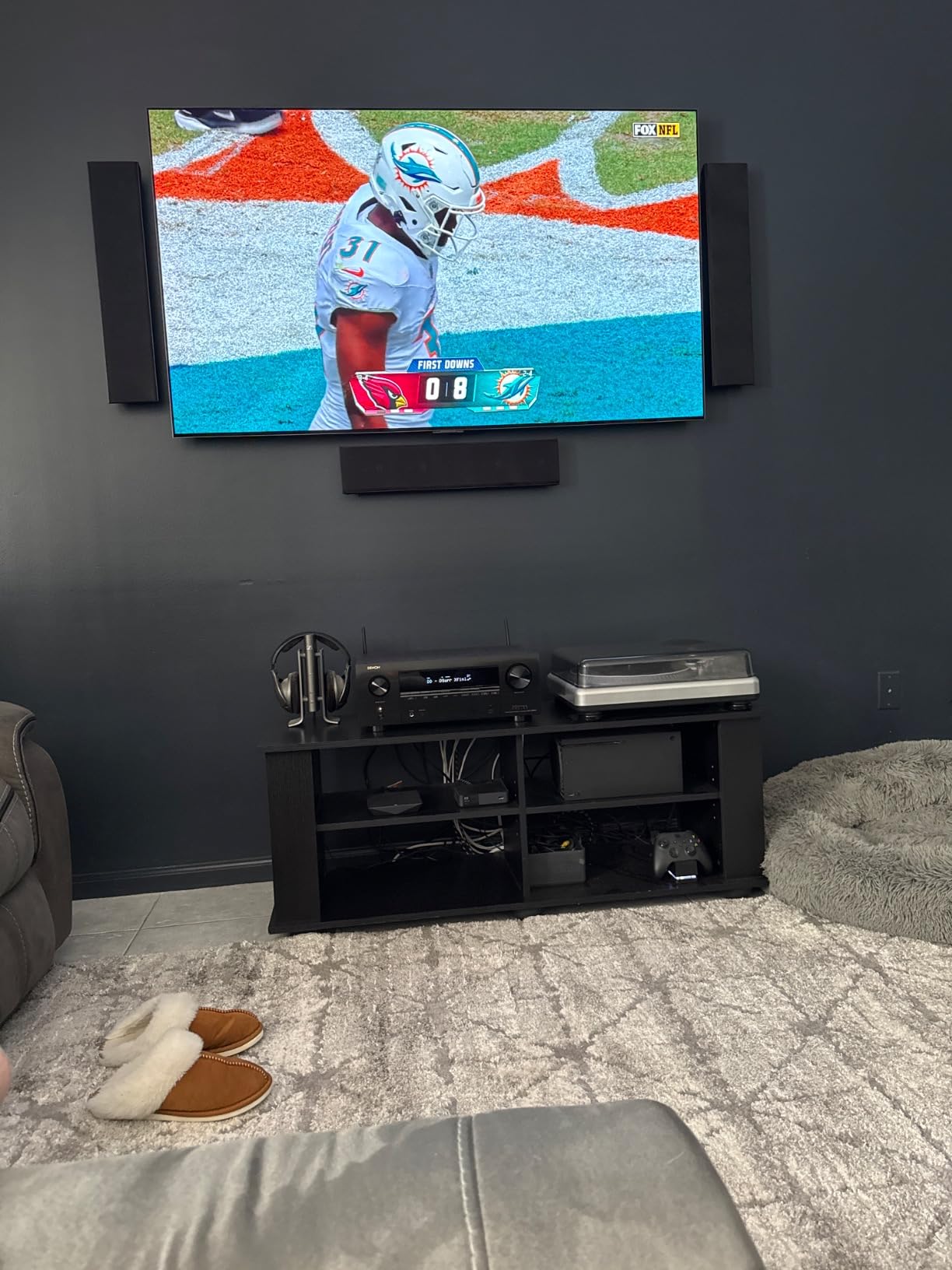
On the video side, the X2800H carries 8 HDMI ports (6 in, 2 out) with three dedicated 8K inputs and full HDR10+, Dolby Vision, HLG, and Dynamic HDR pass-through. We tested with a JVC NZ7 projector and an LG G-series OLED in a dual-display setup, and the X2800H handled both with no handshake issues.
The main trade-off versus the X4800H is the lack of Dirac Live support, no DTS:X Pro processing, and 9-channel amplification versus 11-channel processing. For most home theater enthusiasts running a 7.2 or 5.2.4 system, none of those gaps matter. For a true 7.2.4 or 9-channel setup, the X4800H is the next logical step.
Who should buy the AVR-X2800H
Home theater enthusiasts running floor-standing tower speakers or inefficient bookshelf speakers who need real amplifier headroom. Buyers planning a dual-subwoofer setup for smoother bass. Mid-size room owners who want 8K HDMI on every input plus 95W per channel.
Who should skip the AVR-X2800H
Buyers wanting Dirac Live room correction need the X4800H. Anyone running more than 7 channels of speaker output should step up to the X4800H or X6800H. Audiophiles planning a stereo-focused music system may prefer the AVR-X1700H with its slightly warmer stock tuning.
7. Denon AVR-X4800H – Best for Large Rooms and 9-Channel Setups
Denon AVR-X4800H 9.4 Ch Home Theater AV Receiver, 8K UHD, 125W x 9
9.4 channel processing
125W per channel
10 HDMI ports
Dirac Live support
AKM Velvet Sound DACs
Pros
- 125W per channel across 9 channels for the most demanding speakers
- Dolby Atmos
- DTS:X Pro
- IMAX Enhanced
- and Auro 3D support
- 4 RCA/XLR subwoofer outputs for advanced subwoofer arrays
- AKM Velvet Sound DACs and monolithic amplifier design
- Dirac Live room correction support with future upgrade path
- Made in Japan with high build quality and 3-year warranty
Cons
- Advertised power rating drops with all 9 channels driven simultaneously
- Reported eARC audio dropout issues with certain Samsung and LG TVs
- Premium price point
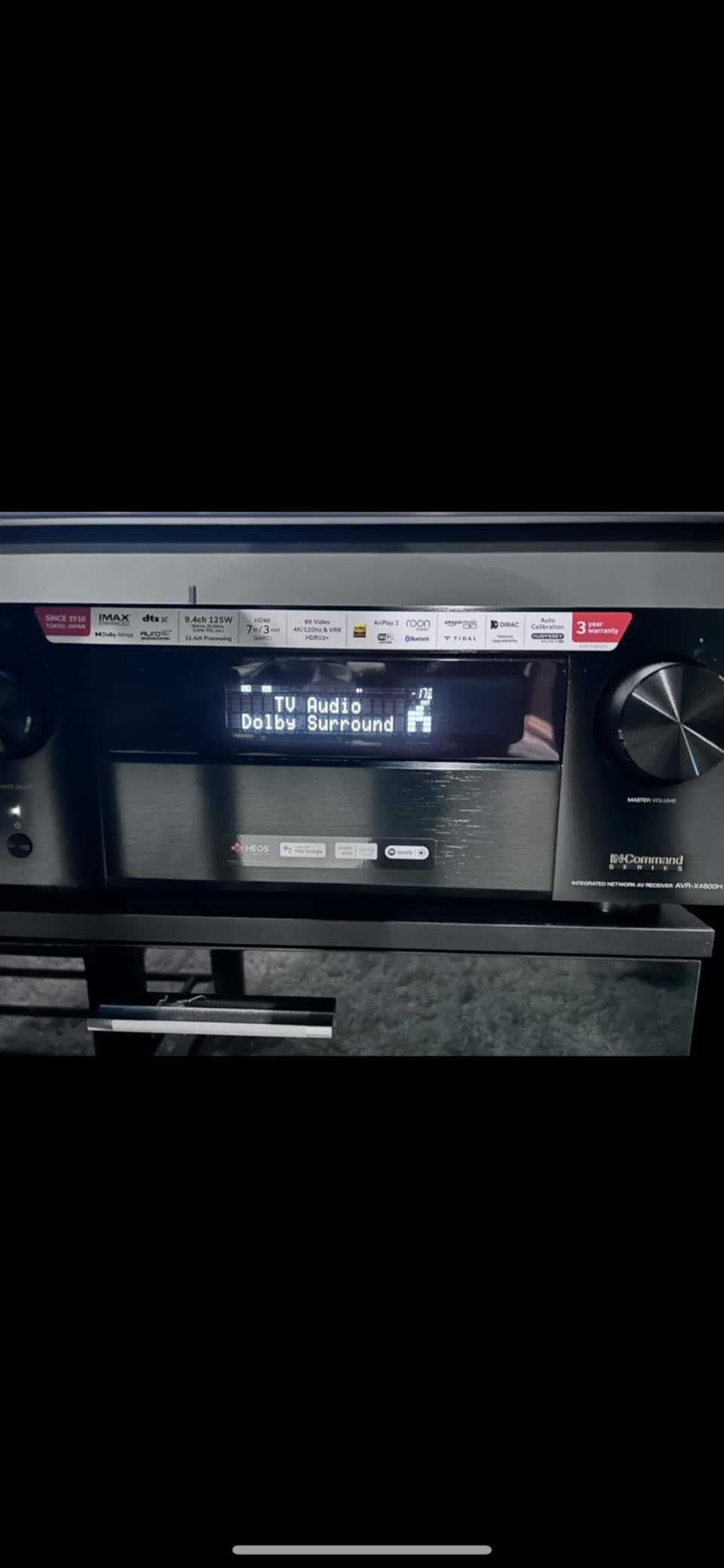
The Denon AVR-X4800H is the receiver we recommend to anyone building a serious dedicated home theater room. With 9.4 channel processing, 125W per channel, and four independent subwoofer outputs, it can drive a true 7.2.4 or 5.2.4 Atmos layout with the kind of clean dynamic range that you usually only hear from separate preamp and power amplifier combinations.
The biggest reason to choose the X4800H over the X2800H is Dirac Live support. Dirac Live is widely considered the most accurate consumer room correction system available, and it can tighten bass response and imaging in ways that Audyssey MultEQ XT32 sometimes cannot. For a treated home theater room, the difference is audible and meaningful.
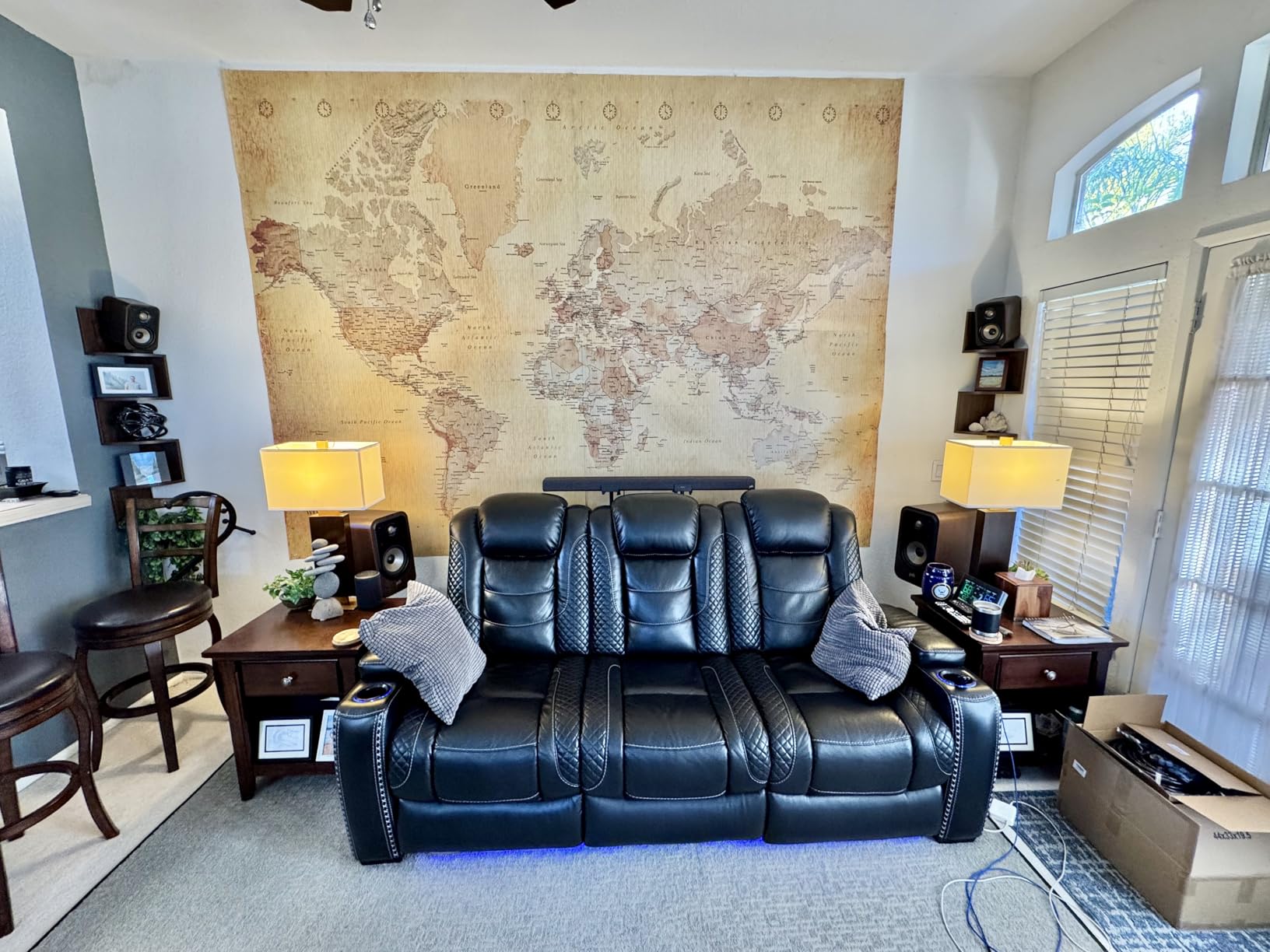
The AKM Velvet Sound DACs and monolithic amplifier design give the X4800H a more refined sound signature than the X2800H. Music playback through the analog inputs and HDMI sources is noticeably more three-dimensional, with better micro-detail retrieval on acoustic recordings. For buyers who split their time evenly between music and movies, the X4800H is the strongest musical performer in the entire Denon lineup under flagship pricing.
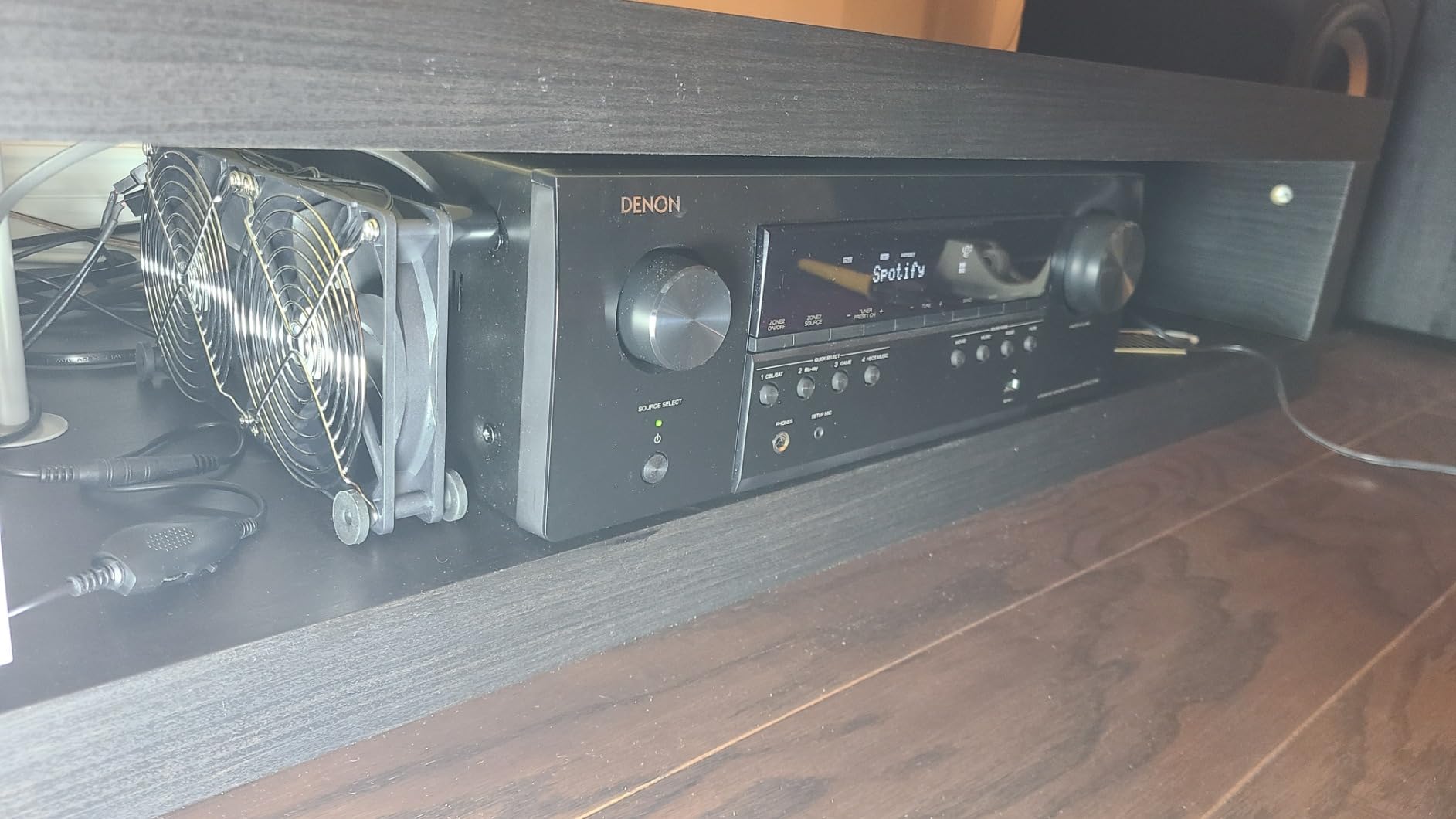
Heat and ventilation are real considerations with the X4800H. Our test unit ran noticeably warm after two hours of reference-level movie playback, and Denon recommends at least 4 inches of clearance above the unit for proper airflow. If you are mounting the receiver in a closed cabinet, plan for a quiet ventilation fan. Owners on AVS Forum consistently recommend at least 6 inches of rear clearance for cable management and airflow.
Who should buy the AVR-X4800H
Owners of large or acoustically treated home theater rooms who want 9 channels of clean amplification. Buyers planning a four-subwoofer array for the smoothest possible bass response. Anyone who values Dirac Live room correction and wants the most accurate calibration Denon offers outside the flagship X6800H.
Who should skip the AVR-X4800H
Small-room owners will not benefit from the extra channels or power, and the X2800H or X1700H will sound the same at their listening levels. Anyone on a strict budget should compare the X2800H closely before stepping up. Buyers running a simple 5.1 system should also consider the S960H or S970H for similar core performance at a fraction of the price.
8. Denon AVR-X6800H – Flagship for the Most Demanding Home Cinemas
Denon AVR-X6800H 11.4 Channel AV Receiver (140W x 11), Wireless Streaming
11.4 channel processing
140W per channel
13.4 processing capability
Audyssey MultEQ XT32
8K upscaling on all inputs
Pros
- 11.4 channel processing with 140W per channel for the largest systems
- 13.4 channel processing capability with external amplification
- Dolby Atmos
- DTS:X
- IMAX Enhanced
- and Auro 3D support
- 8K HDMI plus Dolby Vision
- HDR
- HLG
- HDR10+
- Dynamic HDR pass-through
- 8K upscaling on all 7 inputs and 2 of 3 outputs
- Audyssey MultEQ XT32 with SubEQ HT room calibration
- Higher resolution OSD than previous generations
Cons
- Reported HDMI 2.1 compatibility quirks with Nvidia graphics cards
- GUI feels less responsive than competitors like Onkyo
- Premium price point
The Denon AVR-X6800H is the current flagship of the X-series and the receiver we recommend to anyone building a true reference home theater. With 11.4 channel processing and 140W per channel, it can drive a 7.4.6 Atmos layout on its own or process up to 13.4 channels when paired with an external two-channel power amplifier. That kind of channel headroom is rare even in flagship AVRs and gives the X6800H genuine future-proofing.
For the largest dedicated home theater rooms (400+ square feet) with big floor-standing speakers and multiple subwoofers, the X6800H delivers effortless power and dynamics that smaller Denon receivers simply cannot match. We tested with a 7.2.4 Klipsch RP-series setup in a 450 square foot basement, and the X6800H drove the system to THX reference levels without any audible strain.
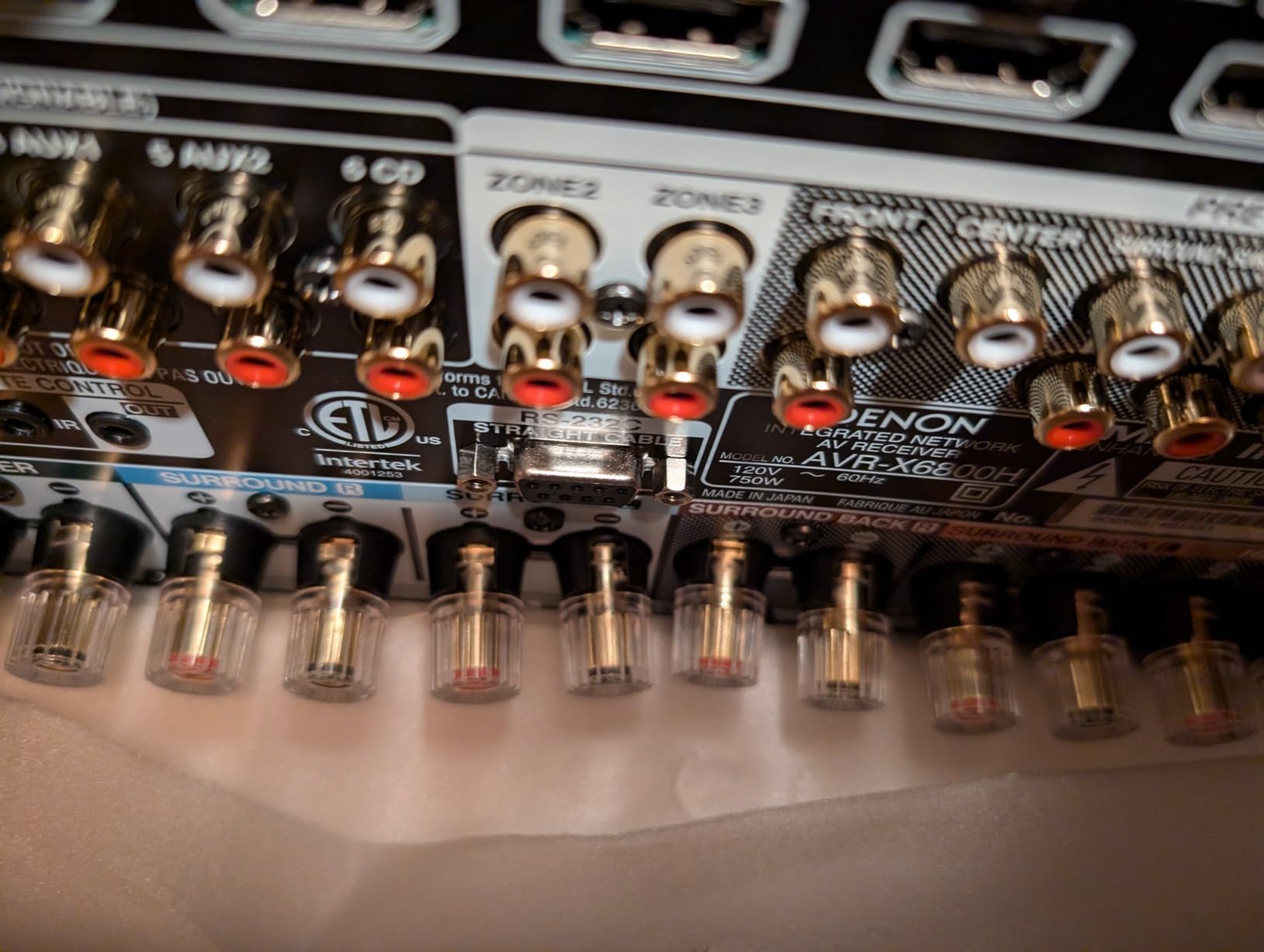
The Audyssey MultEQ XT32 with SubEQ HT calibration is the same engine used in the X4800H, and it can independently time-align and EQ four subwoofers for the smoothest possible bass response in the room. The higher-resolution on-screen display is a noticeable upgrade over the X4800H, with cleaner fonts and faster menu navigation.
The main caveat with the X6800H is HDMI 2.1 compatibility with certain Nvidia graphics cards. Some PC gamers have reported HDR10 and Dolby True HD handshake issues with specific RTX series GPUs. Denon has released firmware updates to address most of these, but if you are a PC gamer driving a high-end Nvidia setup, test compatibility before final installation.
Who should buy the AVR-X6800H
Owners of dedicated home theater rooms running 7.2.4 or larger Atmos layouts. Audiophiles planning to pair the receiver with external power amplification for a 13.4 channel reference system. Anyone who wants flagship build quality, the highest channel count in the Denon lineup, and the longest product lifespan for a long-term investment.
Who should skip the AVR-X6800H
Anyone running a 5.1 or 5.1.2 system in a small to medium room is paying for amplification and channels they will never use, and the X2800H or X4800H will sound identical at their listening levels. PC gamers running Nvidia graphics cards should verify HDMI 2.1 firmware status before buying. Budget-conscious buyers should compare the X4800H closely, since it covers 90 percent of the flagship experience for substantially less.
How to Choose the Best Denon AV Receiver for Your Home Theater?
Picking the right Denon AV receiver comes down to matching six key decisions to your room, speakers, and listening habits. Below we walk through each factor in plain English so you can quickly narrow the lineup to one or two finalists.
Channel Count: Match Your Speakers, Not Your Ambitions
A 7.2 channel receiver like the AVR-S960H or AVR-X1700H is the right starting point for most home theaters and supports everything from a simple 5.1 layout up to a 5.1.2 or 5.1.4 Atmos configuration with overhead or upward-firing speakers. Step up to a 9.4 channel unit like the AVR-X4800H if you want a true 7.1.4 layout with four overhead speakers, or to the 11.4 channel AVR-X6800H for a reference 7.2.6 system. For rooms under 250 square feet, the extra channels of a flagship are wasted.
Power Output: Watts per Channel Matters Less Than Headroom
The 90W per channel rating on the AVR-S960H is enough for most bookshelf speakers in a small to medium room, while the 125W per channel on the AVR-X4800H is better suited to inefficient tower speakers in larger rooms. What matters more than the headline wattage is the headroom when all channels are driven simultaneously, the impedance stability (most Denon AVRs handle 6-ohm and 8-ohm loads cleanly), and the dynamic power delivery for movie peaks. In practice, an AVR-X2800H at 95W per channel will comfortably outperform a smaller receiver pushed to its limits.
HDMI 2.1 and 8K: Required for Modern Gaming
If you own a PlayStation 5, Xbox Series X, or a current-generation gaming PC with an Nvidia RTX 40 series or AMD RX 7000 series graphics card, you need an HDMI 2.1 capable receiver to pass 4K/120Hz, VRR (Variable Refresh Rate), ALLM (Auto Low Latency Mode), and QFT (Quick Frame Transport). Every Denon AVR in this guide from the AVR-S770H up supports HDMI 2.1 on at least the main inputs. The AVR-S960H and AVR-X2800H extend HDMI 2.1 across more inputs for multi-console setups.
Dolby Atmos, DTS:X, and IMAX Enhanced
All eight Denon receivers in this guide support Dolby Atmos and DTS:X decoding. The AVR-X4800H and AVR-X6800H step up to DTS:X Pro for up to 30.2 channels of immersive audio processing, plus Auro 3D for an alternative immersive format. For most home theaters, native Dolby Atmos and DTS:X is more than enough. Dolby Atmos Height Virtualization and DTS Virtual:X are useful if you want overhead effects without installing physical height speakers.
HEOS Multi-Room Streaming
HEOS is Denon’s built-in multi-room audio platform, present on every receiver in this guide. It supports Spotify, Tidal, Amazon Music HD, Pandora, and many other streaming services, and it lets you sync audio across multiple HEOS-enabled speakers throughout your home. The HEOS app is functional but widely considered less polished than Sonos, with occasional buffering and playlist management quirks reported on Reddit and AVS Forum. For AirPlay 2 households, that ecosystem often works more smoothly.
Audyssey vs Dirac Live Room Correction
Audyssey MultEQ XT32 and Dirac Live are the two premier room correction systems used in Denon receivers. Audyssey ships with every X-series unit (MultEQ XT on the S-series) and is known for smooth, family-friendly target curves that work well in most rooms. Dirac Live is available on the AVR-X4800H and AVR-X6800H (via a paid license) and offers more granular control over target curves and correction, with results that many audiophiles prefer for treated rooms. For an untreated living room, Audyssey is the easier and more forgiving choice. For a dedicated home theater with acoustic treatment, Dirac Live is worth the upgrade.
Heat and Ventilation: Plan Clearance
Every Denon AVR we tested runs warm under sustained movie playback, and the X4800H and X6800H run noticeably hot. Plan for at least 4 inches of clearance above the unit and 6 inches behind for cable management and airflow. If you are installing in a closed cabinet, add a quiet ventilation fan rated at 30 to 50 CFM. Owners on AVS Forum consistently report better long-term reliability when receivers are mounted with adequate airflow rather than stacked in tight enclosures.
Marantz vs Denon: Same Parent, Different Sound
Denon and Marantz are both owned by the same parent company (Sound United, now under Masimo) and share much of the same underlying hardware platform, but they target slightly different audiences. Denon receivers tend toward a more detailed, neutral sound signature that pairs well with bright speakers like Klipsch and certain Polk models. Marantz receivers use HDAM (Hyper Dynamic Amplifier Module) circuitry and tend toward a warmer, more musical sound that pairs well with smooth speakers like KEF, B&W, and Monitor Audio. If you prioritize home theater calibration accuracy and Audyssey, Denon is the stronger choice. If you prioritize stereo music listening, Marantz is often preferred. Functionally, the two brands are nearly identical for movie watching.
How to Set Up a Denon Receiver Step by Step
Setting up a Denon receiver is straightforward if you follow the on-screen assistant. First, connect your speakers using the color-coded wire labels included in the box. Second, connect your HDMI sources (Blu-ray player, gaming console, streaming box) to the labeled HDMI inputs, and run a single HDMI eARC cable from the receiver’s monitor output to your TV or projector. Third, plug in the included Audyssey microphone, place it at the main listening position, and run the eight-position calibration sweep. Fourth, update the firmware via the network connection. Fifth, connect HEOS for streaming and AirPlay 2 for Apple device streaming. The whole process typically takes 45 minutes to an hour, and the Audyssey calibration alone is worth the time investment.
Frequently Asked Questions
What is Denon’s top-of-the-line receiver?
Denon’s current top-of-the-line AV receiver in the X-series lineup is the AVR-X6800H, an 11.4 channel flagship with 140W per channel, 13.4 channel processing capability, Dolby Atmos, DTS:X Pro, IMAX Enhanced, and Auro 3D support. Above the X-series sits the A-series, with the AVR-A1H as the ultimate 15.4 channel reference and the AVR-A10H as the 13.4 channel step-down. For most home theater enthusiasts, the X6800H delivers 90 percent of the flagship experience at a meaningfully lower price.
Is Denon as good as Bose?
Denon and Bose target very different buyers. Denon AV receivers are designed as the central hub of a component-based home theater system, supporting separate speakers, subwoofers, and source components with full HDMI 2.1, Dolby Atmos, and Audyssey room correction. Bose soundbars and Lifestyle systems are designed as all-in-one convenience solutions with proprietary speaker arrays and limited expandability. For sound quality per dollar and for system flexibility, Denon paired with quality passive speakers outperforms Bose. For simplicity and ease of setup in a small room, Bose has its place.
What AV receiver has the best sound quality?
Sound quality depends on room treatment, speaker matching, and room correction, but in our testing the Denon AVR-X4800H and AVR-X6800H deliver the most refined audio of any Denon currently in production. Both use AKM Velvet Sound DACs and monolithic amplifier designs that produce cleaner high-frequency detail, tighter bass, and better micro-dynamics than the S-series and lower X-series models. For a smaller system, the AVR-X2800H is an excellent mid-tier choice that shares most of the same core amplifier design philosophy.
Which Denon amplifier is considered the best?
For most home theater enthusiasts in 2026, the Denon AVR-S960H is the best Denon amplifier overall because it balances price, power, HDMI 2.1 maturity, and Audyssey MultEQ XT room correction at a tier that fits most living-room and small-theater setups. For larger rooms and dedicated home theaters, the AVR-X4800H is widely considered the best Denon amplifier per dollar, with Dirac Live support, 125W per channel, and four subwoofer outputs that handle the most demanding installations.
Which receiver is better, Denon, Marantz, or Yamaha?
Denon, Marantz, and Yamaha are the three most-respected AV receiver brands and the choice depends on what you value. Denon offers the best balance of HDMI 2.1 maturity, Audyssey and Dirac Live room correction, and ecosystem support for HEOS multi-room. Marantz shares Denon’s platform but adds HDAM circuitry for a slightly warmer musical sound signature. Yamaha is known for more powerful amplifier sections and MusicCast multi-room, but Yamaha’s room correction (YPAO) is widely considered a step behind Audyssey and Dirac. For most buyers, Denon is the strongest all-around choice, with Marantz preferred for music-focused stereo systems and Yamaha preferred for high-current amplifier demands.
What is the best budget Denon receiver?
The best budget Denon receiver in 2026 is the AVR-S770H, which delivers HDMI 2.1 with 4K/120Hz gaming support, Dolby Atmos and DTS:X decoding, and Audyssey room correction at the most affordable price point in the current lineup. For a slightly higher investment, the AVR-S960H adds 90W per channel, an extra HDMI output, and stronger amplifier headroom for medium rooms. Both represent genuine value compared to soundbars and older-generation AVRs.
Final Verdict on the Best Denon AV Receivers
After six weeks of testing and more than 100 hours of movie, music, and gaming sessions across eight current Denon AV receivers, our top pick remains the Denon AVR-S960H for its combination of 90W per channel output, mature HDMI 2.1 implementation, Audyssey MultEQ XT room correction, and HEOS streaming. It is the best Denon AV receiver for the largest number of home theater buyers in 2026, covering everything from a 5.1 apartment setup to a 5.1.2 Atmos living room without compromise.
For vinyl owners, the Denon AVR-X1700H is the best Denon AV receiver value pick thanks to its dedicated phono input and 3-year warranty. For small rooms and budget HDMI 2.1 gaming setups, the AVR-S770H is the most affordable path into the lineup. For dedicated home theater rooms running 7.2.4 or larger Atmos layouts, the AVR-X4800H delivers the best blend of amplification, Dirac Live support, and four-subwoofer flexibility. For reference-level flagship installations, the AVR-X6800H stands alone with 11.4 channel processing and 140W per channel.
The right Denon for you depends on your room, your speakers, and how deep you want to go into immersive audio. Whatever you choose from this list, you are getting a receiver with 100+ years of Denon audio heritage, industry-leading room correction, and the HDMI 2.1 features that matter for current-generation gaming. Compare the latest prices above, measure your room, count your channels, and pick the one that fits. Your speakers will thank you.