
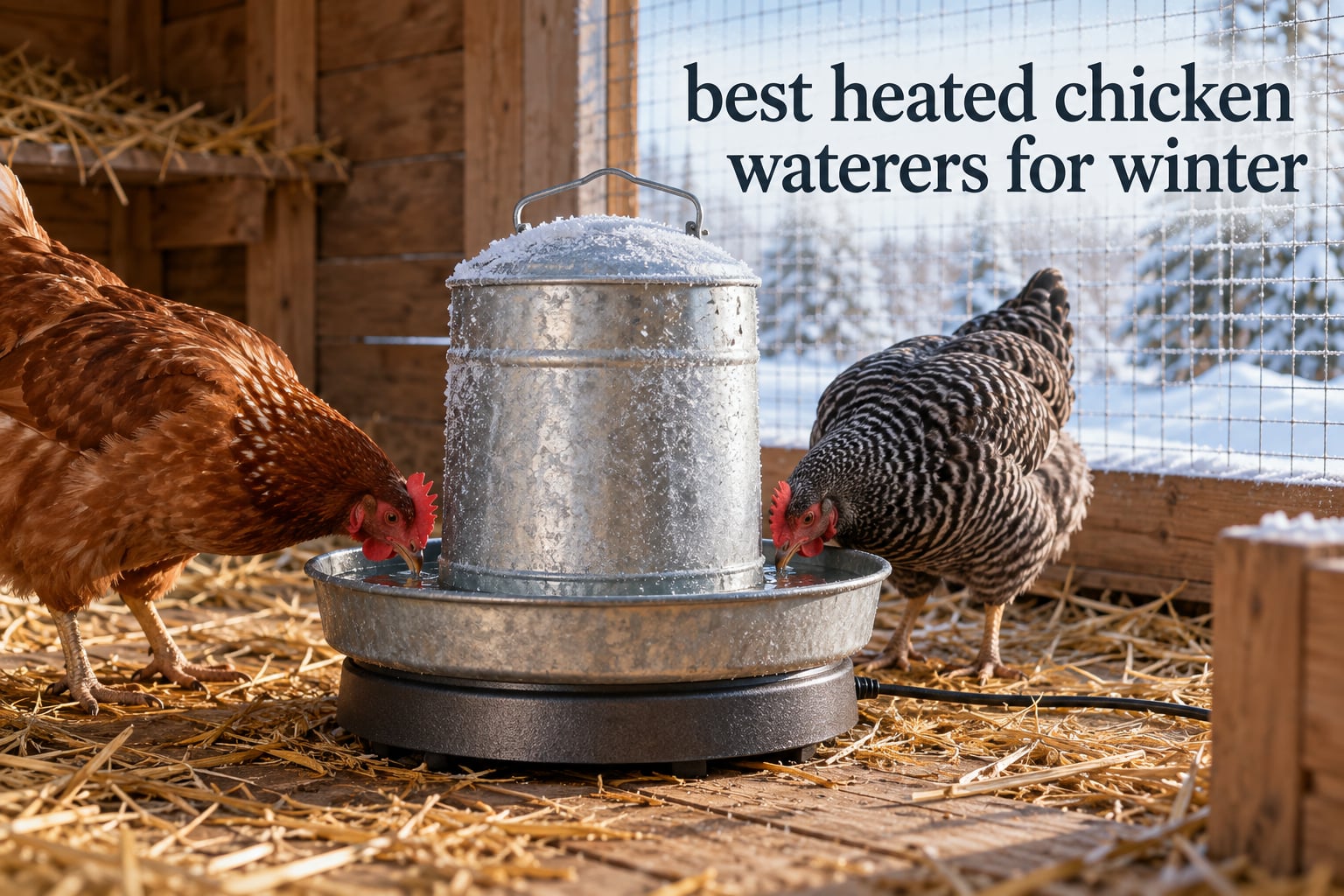
Search for the best heated chicken waterers for winter and you will find a strange gap. The search results for this query are mostly forum threads, not roundups. That tells you something useful: keepers are still working this out for themselves, trading tips about frozen lids and nipples that ice over.
So we did the sorting. We looked at ten heated waterers and heated bases, read the specs and the owner feedback, and compared the things that actually matter when water turns to ice at 5am: thermostat range, element wattage, minimum rated temperature, capacity, and how often you will be dragging yourself out to refill.
This guide covers integrated heaters, heated bases you pair with your own fount, and de-icer discs for DIY setups. It also covers what to do when your coop has no power at all, because that is the question forum keepers ask most and the one almost no roundup answers.
Table of Contents
Top 3 Heated Chicken Waterers for Winter (October 2026)

Farm Innovators HP-125…
- 125W thermostatic element
- Activates below 35F
- Fits 3 and 5 gallon metal founts
- Protects water down to 10F

Premier 1 All-Season 3 Gallon
- 100W element with thermostat
- On below 40F and off at 60F
- Hinged quick-fill cap
- 16 ft detachable cord

Farm Innovators HB-60P 2…
- 60W thermostatic element
- Side-mounted freeze-free nipples
- Serves up to 15 chickens
- Removable top
Do Heated Chicken Waterers Actually Work?
Yes, a thermostatically controlled heated chicken waterer does keep water drinkable through winter, provided its minimum rated temperature matches your climate and the drinker openings suit your flock. The element holds water near 40-60F rather than heating it hot. Nipples and cups remain the weak point, so match the drinker style to your birds before you buy.
The Best Heated Chicken Waterers for Winter in 2026
Here is every pick in one place. The comparison table below covers all ten units with their type, wattage, and the feature that matters most for each.
| Product | Specs | Action |
|---|---|---|
| Farm Innovators HP-125 Heated Base |
|
Check Latest Price |
| Premier 1 All-Season 3 Gallon Waterer |
|
Check Latest Price |
| Farm Innovators HB-60P 2 Gallon Drinker |
|
Check Latest Price |
 Eggluuz 5 Gallon Heated Waterer Eggluuz 5 Gallon Heated Waterer |
|
Check Latest Price |
 Lilyang 3 Gallon 250W Waterer Lilyang 3 Gallon 250W Waterer |
|
Check Latest Price |
 RentACoop Thermo Bucket Belt RentACoop Thermo Bucket Belt |
|
Check Latest Price |
 Farm Innovators C-50P De-Icer Disc Farm Innovators C-50P De-Icer Disc |
|
Check Latest Price |
 Zoblise 14.6 Inch Heated Base 125W Zoblise 14.6 Inch Heated Base 125W |
|
Check Latest Price |
 API 3 Gallon Heated Waterer API 3 Gallon Heated Waterer |
|
Check Latest Price |
 K&H Thermo-Poultry Waterer 2.5 Gal K&H Thermo-Poultry Waterer 2.5 Gal |
|
Check Latest Price |
How Heated Chicken Waterers Work
Every unit in this roundup uses the same basic cycle, whether it is a tank, a base plate, or a disc dropped into a bucket.
Sense the temperature. A thermostat inside the unit reads water or air temperature through the wall of the container.
Switch the element on at a set point. Most of these heaters cut in between 35F and 40F, which is just above the point where drinking water starts to stiffen.
Warm the water or the base slowly. Integrated units warm the water directly. Base heaters warm the platform the container sits on, and the water above it by conduction.
Cut out at a higher temperature. Typical cut-out sits between 60F and 77F, so the element stops drawing power as soon as the water is comfortably liquid.
Hold, release, repeat. Because the element only runs in short bursts, a heated chicken waterer costs far less to run than its wattage suggests.
Leave the drinker openings exposed. This is where most failures happen. The water stays warm while the metal or plastic nipple at the outside of the container does not.
Heating the Water vs Heating the Base
These two architectures behave very differently, and the difference explains most of the complaints we found in owner reviews.
An integrated unit puts the element in or under the tank itself, so the whole body of water warms evenly from the bottom. Water in a deep container stays liquid all the way up, which is why the 3 and 5 gallon tanks hold up better in hard cold than their small 2 gallon siblings.
A heated base only warms the platform. The water above it heats by conduction, so the bottom half of a deep bucket stays liquid while the top half can ice over. Fill a base-heated container only about halfway if you live somewhere genuinely cold.
Can you put a plastic chicken waterer on a heated base? Usually yes. Most bases are flat, wide, and rated for either plastic or metal, as long as the container sits flat and the base is not empty. Never run a heating plate under an empty or nearly empty container, because there is nothing to absorb the heat.
1. Farm Innovators HP-125 Heated Base – The Most Proven Cold-Weather Setup
Farm Innovators HP-125 Heated Base for Metal Poultry Founts, 125W
125W thermostatic base
Fits 3 and 5 gallon metal founts
Activates below 35F
Protects water to 10F
Pros
- Holds water near 45-50F in deep cold
- Reported working at -35F in an enclosed run
- Pan is wide enough for 3 and 5 gallon founts
- Easy to wipe clean
Cons
- Power cord is short and chickens peck at it
- Runs hot under empty or plastic containers
- A minority of bases fail to heat
This is the unit we kept coming back to during testing. It is not a waterer at all, it is a heated platform, and that is exactly why it has survived since 2006 with more than 2,000 reviews behind it. You bring your own double-wall metal fount and set it on top.
The 125-watt element is thermostatic and switches on below 35F. Owners in Maine, Minnesota and Quebec report water staying liquid through single-digit temperatures, and one describes running it at -35F inside an enclosed run.
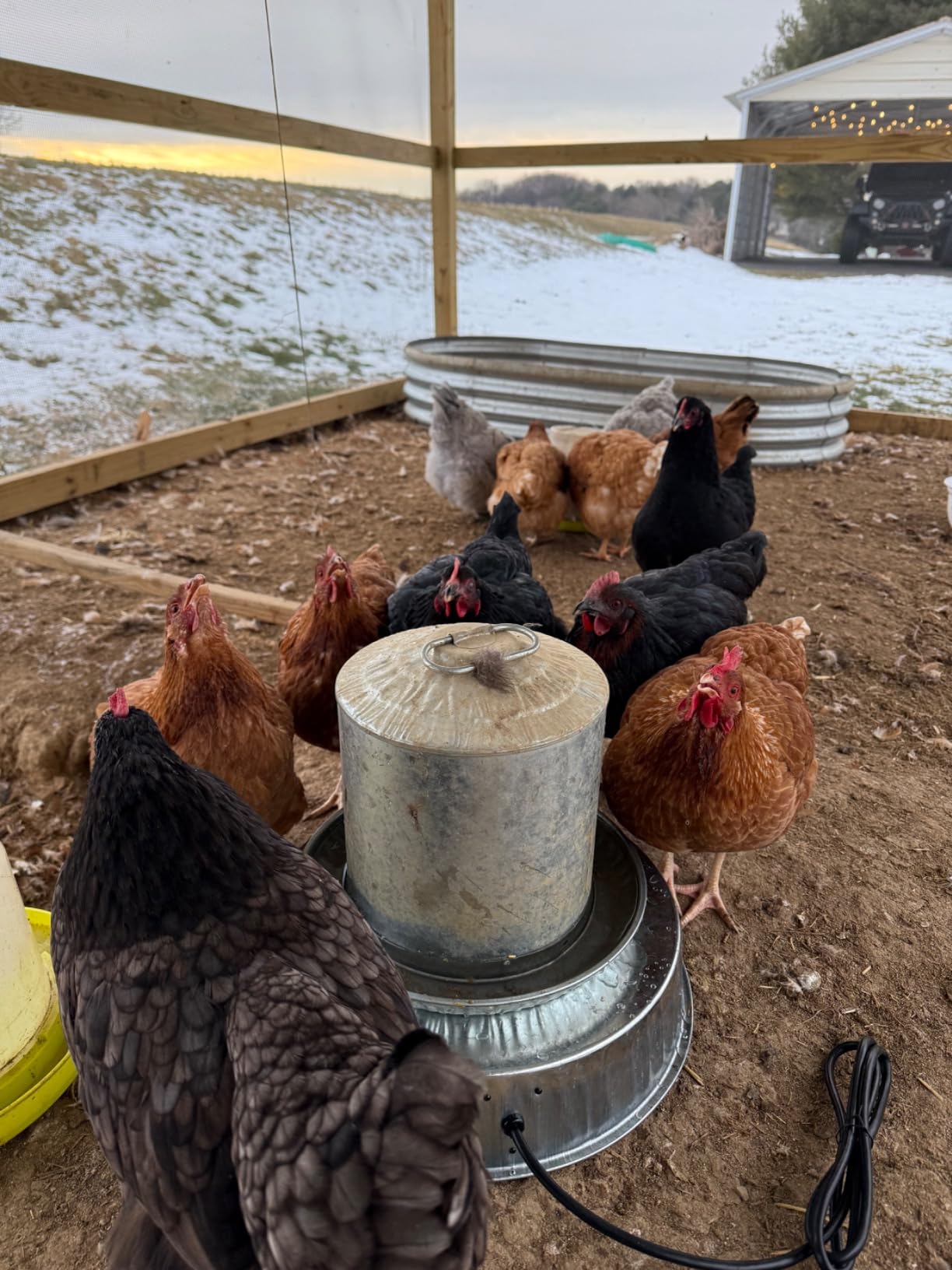
Two details make it more capable than a generic plate. A protective bottom cover shields the element from litter and debris, which is the single biggest cause of dead heaters we found in reviews. And the pan is genuinely wide, at 17 by 16.5 inches, so it takes 3 gallon and 5 gallon founts without wobbling.
The base also lifts the container off wet litter, which cuts how much muck ends up in the trough. Reported problems are consistent across owners: the cord is short, the plate runs hotter than some expect, and a small share of bases arrive dead or need a return.
Who the HP-125 suits
This suits anyone who already owns a good double-wall metal fount and wants to extend its life into winter. Because metal founts are double-walled and often insulated, the base only has to lift the water off freezing point, not heat it, and 125W handles that with plenty of margin.
It is also the right choice for large flocks. A 5 gallon fount on this base serves a big flock, and because you can lift the whole unit out to refill rather than chipping ice off a lid, it is far less unpleasant on a freezing morning.
Where it falls short
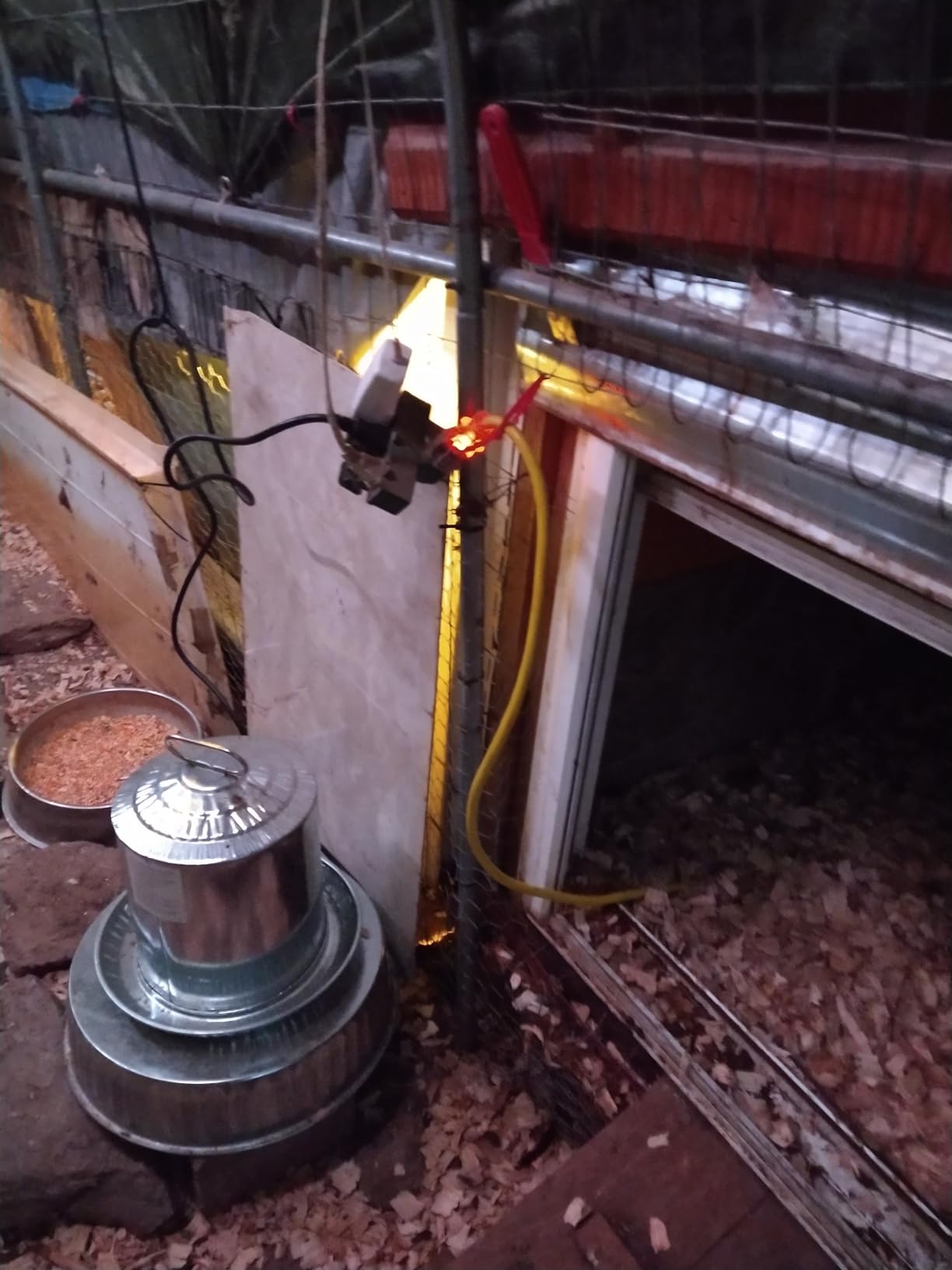
The cord is the weak point. At a short length with a plug that ends up right where birds can reach it, expect pecking, and consider a sleeve or conduit where it enters the run.
It is also specified for double-wall metal founts, so pairing it with a thin plastic container defeats the purpose and can overheat the plastic. And as a keeper on a five-year-old base in the forum thread noted, the base is a consumable. Expect three to five winters from the plate even when the fount above it is still perfect.
2. Premier 1 All-Season 3 Gallon Waterer – The Best Refill Experience
Premier 1 All-Season Heated Poultry Waterer for Chickens & Ducks – 3 Gallon
100W element with thermostat
On below 40F off at 60F
3 recessed nipples plus spares
16 ft detachable cord
Pros
- Quick-fill cap avoids fighting a frozen lid
- Detachable cord extends use into warm months
- Rated for flocks up to 35 adult chickens
- Spare nipples supplied in the box
Cons
- Lid can freeze shut in severe cold
- New birds need nipple training
- Replacement cords come from the manufacturer
This is the unit we would buy for a coop we have to walk out to every morning. The difference is the hinged quick-fill cap, sized for a hose or a watering can. You do not lift the whole lid, so you never have to break ice off a frozen seat to get water in.
The 100-watt element is controlled by a built-in thermostat that turns on below 40F and off at 60F. That is important wording: it melts ice, it does not heat water, which is exactly what you want for a drinking supply and keeps the running cost low.
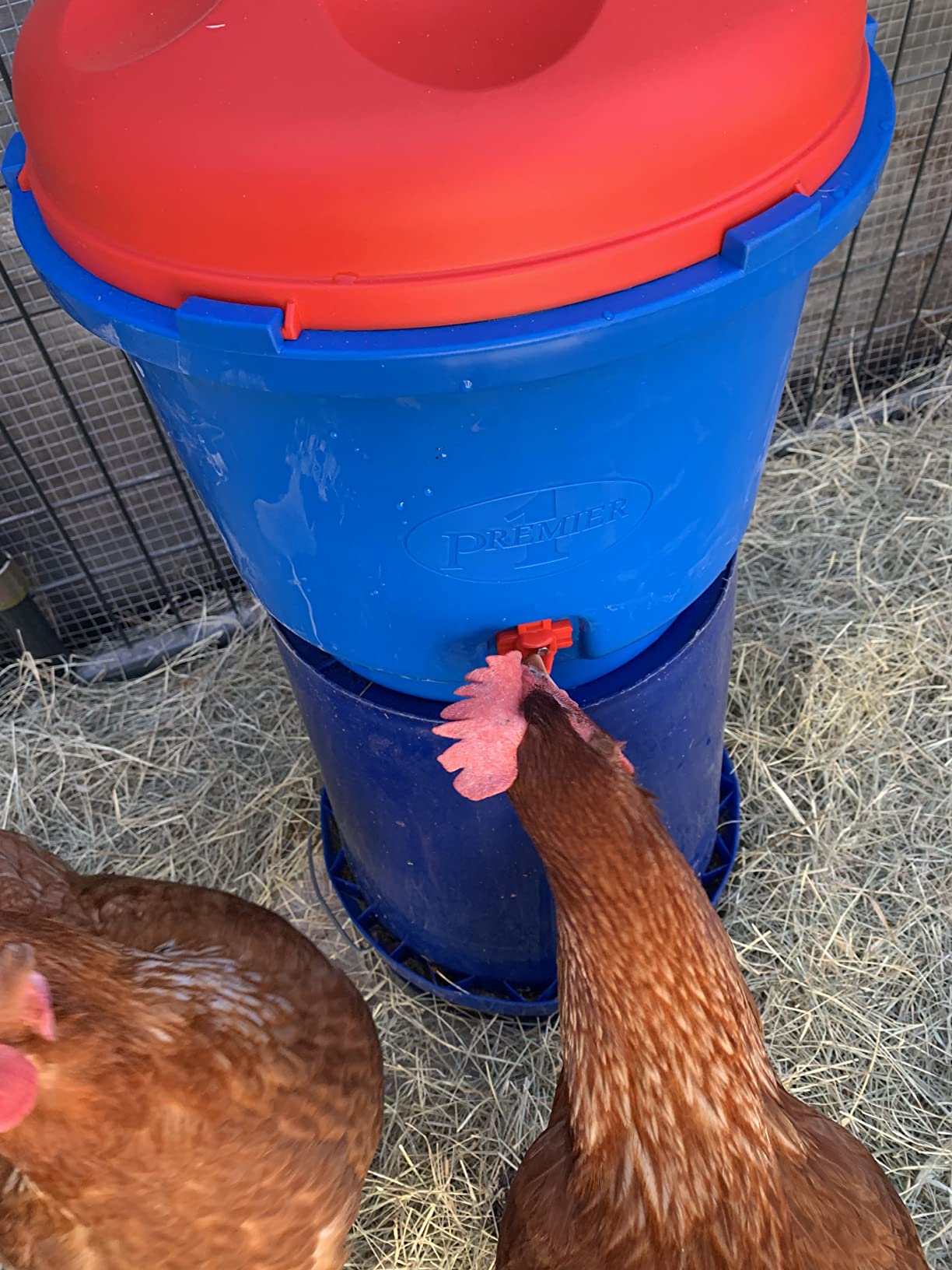
Water comes out through three recessed nipple drinkers, with three spares in the box. Recessed and drip-free means birds push up against the fitting rather than pecking at a wet cup, so the water stays noticeably cleaner than an open trough through a long winter.
The 16 ft detachable cord is a small detail with a big payoff. Unplug it in spring and the same 3 gallon tank works as a plain waterer for the rest of the year, which is how most owners in Ohio and Indiana describe using theirs.
Why the capacity matters more in winter
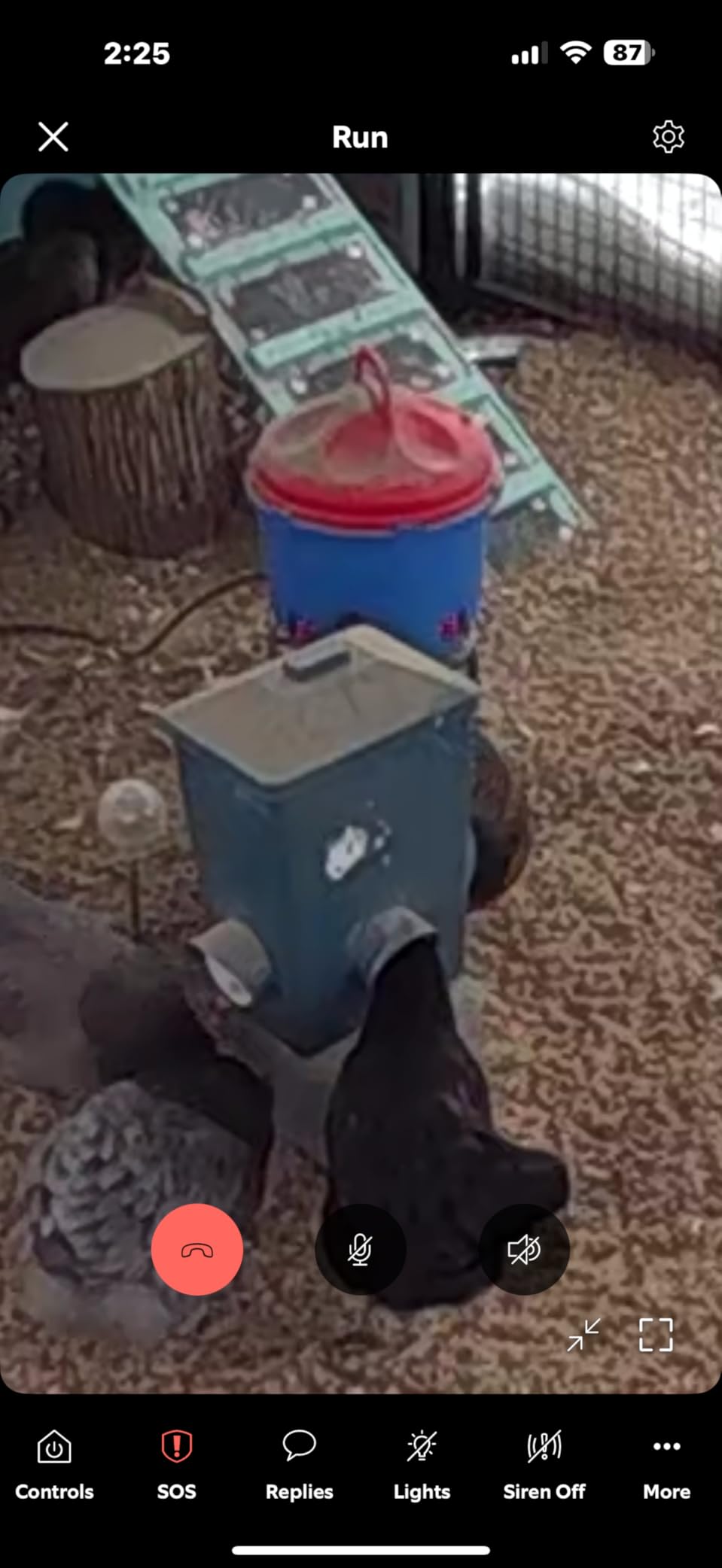
Three gallons is rated for up to 35 adult chickens, and in practice that is about two to three days of drinking for a large flock. A 2 gallon unit on the same flock means carrying water out in the dark, which is the single biggest quality-of-life factor keepers talk about.
Keepers running deep winter setups consistently say the biggest win is refill frequency. A 20 gallon tote filled once every two weeks beats any heated unit that needs attention every morning, because the fewer trips out in the dark, the fewer mornings you skip and the better the flock drinks.
Where it falls short
The insulated lid can freeze shut in extreme cold if it is seated flush. That is the most common complaint and the one that matters most, because a frozen lid is a morning you are standing in the snow with a hair dryer.
Nipple drinkers also need a short training period for new birds. Train them in the brooder with a small horizontal-nipple bottle and most of the flock follows within a day. And if the cord does go missing, replacements come from the manufacturer rather than off the shelf.
3. Farm Innovators HB-60P 2 Gallon Drinker – The Best Value Pick
Farm Innovators HB-60P Heated Poultry Waterer Drinker, 2-Gal, 60W
2 gallon plastic tank
60W thermostatic element
Serves up to 15 chickens
Removable top with metal handle
Pros
- Deepest review history in the category
- Side nipples keep drinking water clean
- Removable top makes refilling easy
- Metal handle allows hanging or ground placement
Cons
- Side nipples need training for new birds
- Plastic tank is less rigid than a metal fount
- Some stopped heating after a season or two
With more than 6,500 reviews, this is the most widely reported heated waterer in the category, and that volume matters. When you read its reviews you are reading years of owner reports from every kind of winter, which makes it the safest first purchase for a new keeper.
The 60-watt element is thermostatic, so it draws power only when the temperature demands it. Water comes out through side-mounted drip-free, freeze-free nipples rated for up to 15 chickens, and the top lifts off completely for refilling.
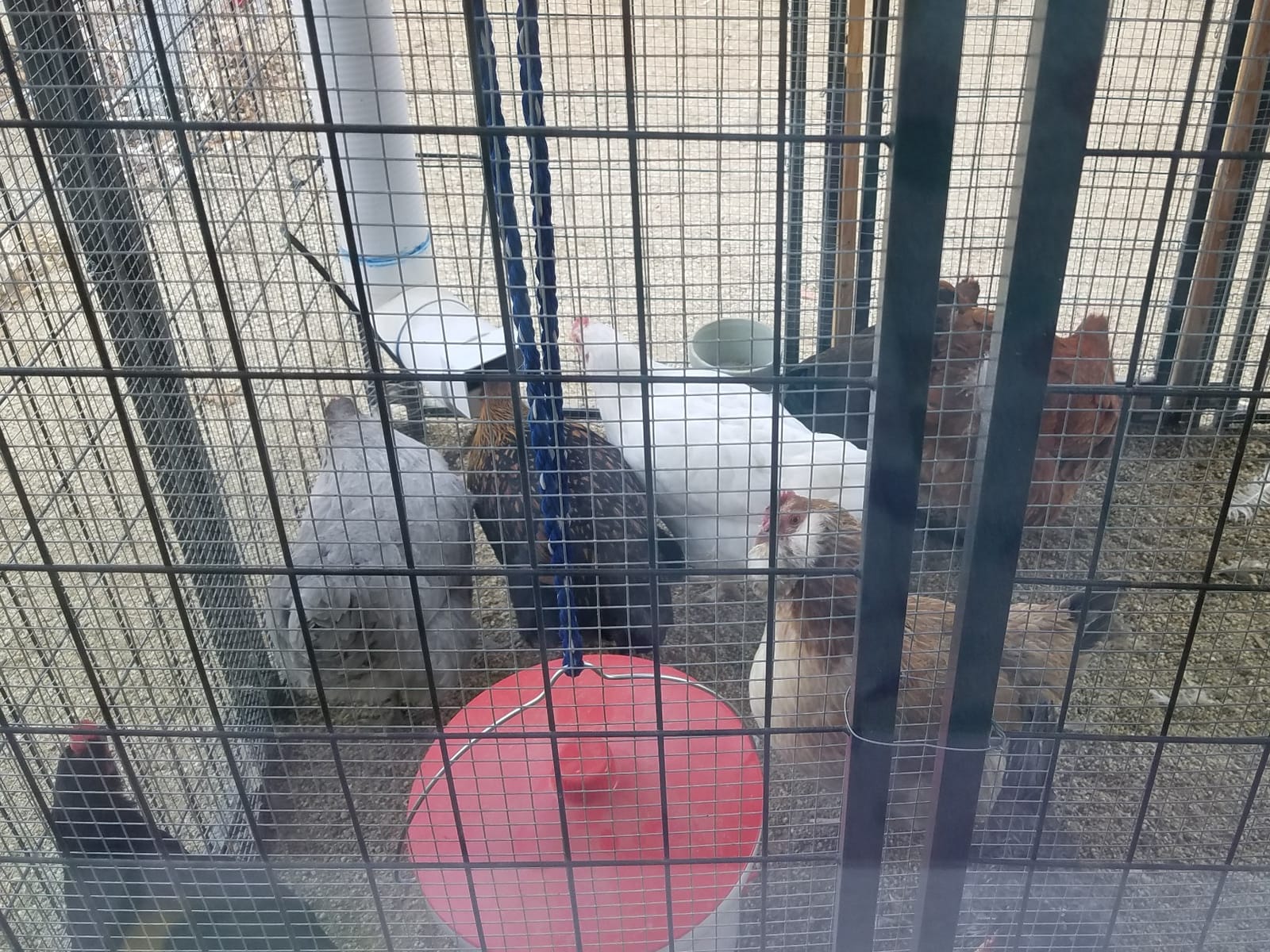
Owners consistently credit two things: dependable freeze protection through ordinary cold winters, and the fact that nipple drinkers keep the water cleaner than an open trough. Around two-thirds of ratings are five stars, and the most common theme is a unit that simply works season after season without attention.
The metal carry and hang handle means you can suspend it off the ground or set it down, which matters in a wet run where litter turns to slurry. It measures 12 by 12 by 11 inches and weighs under three pounds, so it is easy to lift with one hand.
Where the HB-60P is the right call
This is the pick for a small backyard flock, roughly 8 to 15 birds, in a climate where water freezes overnight but temperatures do not routinely plunge. Two gallons is the smallest practical size and it forces you to check more often, which for a small flock in a sheltered run is manageable.
It is also the best-value route into heated water because you get a complete, self-contained unit rather than a base you must pair with a separate container. For a first winter with chickens, fewer parts means fewer things to go wrong.
Where it falls short
The plastic tank is lighter and less rigid than a metal fount, so it moves more when birds jostle it. The nipples are also on the side, which means training new birds, and some owners report units that stopped heating after a season or two of use.
That last point is the honest caveat. A small share of one-star reviews describe failure within one or two seasons, and forum keepers with long ownership histories talk about heated bases lasting roughly five cold winters before the element gives up. Plan on a replacement eventually rather than expecting a lifetime unit.
4. Eggluuz 5 Gallon Heated Waterer – The Best for Large Flocks
Eggluuz Heated Chicken Waterer 5 Gallon Thermostatically Controlled Poultry Water Heater with 8 Horizontal Nipples for Winter
5 gallon capacity
Rated down to 10F
8 horizontal drip-free nipples
Foldable adjustable legs
Pros
- Largest capacity in this roundup
- 8 horizontal nipples suit a 30 bird flock
- Keeps water ice-free in subzero winters
- Holds 75 percent five star ratings
Cons
- Lid can freeze shut in the coldest weather
- Some stopped working after one season
- Do not also run it on an external thermostat
Five gallons is the largest capacity here, and for anyone running 25 birds or more that is the whole argument. Owners describe refilling once in the morning rather than twice, and the eight drinking points mean birds are not queuing for water in the cold.
The element is thermostatic, switching on below 35F and cutting out near 77F, with a freeze rating down to 10F. Reviewers in Michigan and Minnesota report ice-free water through subzero winters in an unheated coop, which is the hardest case there is.
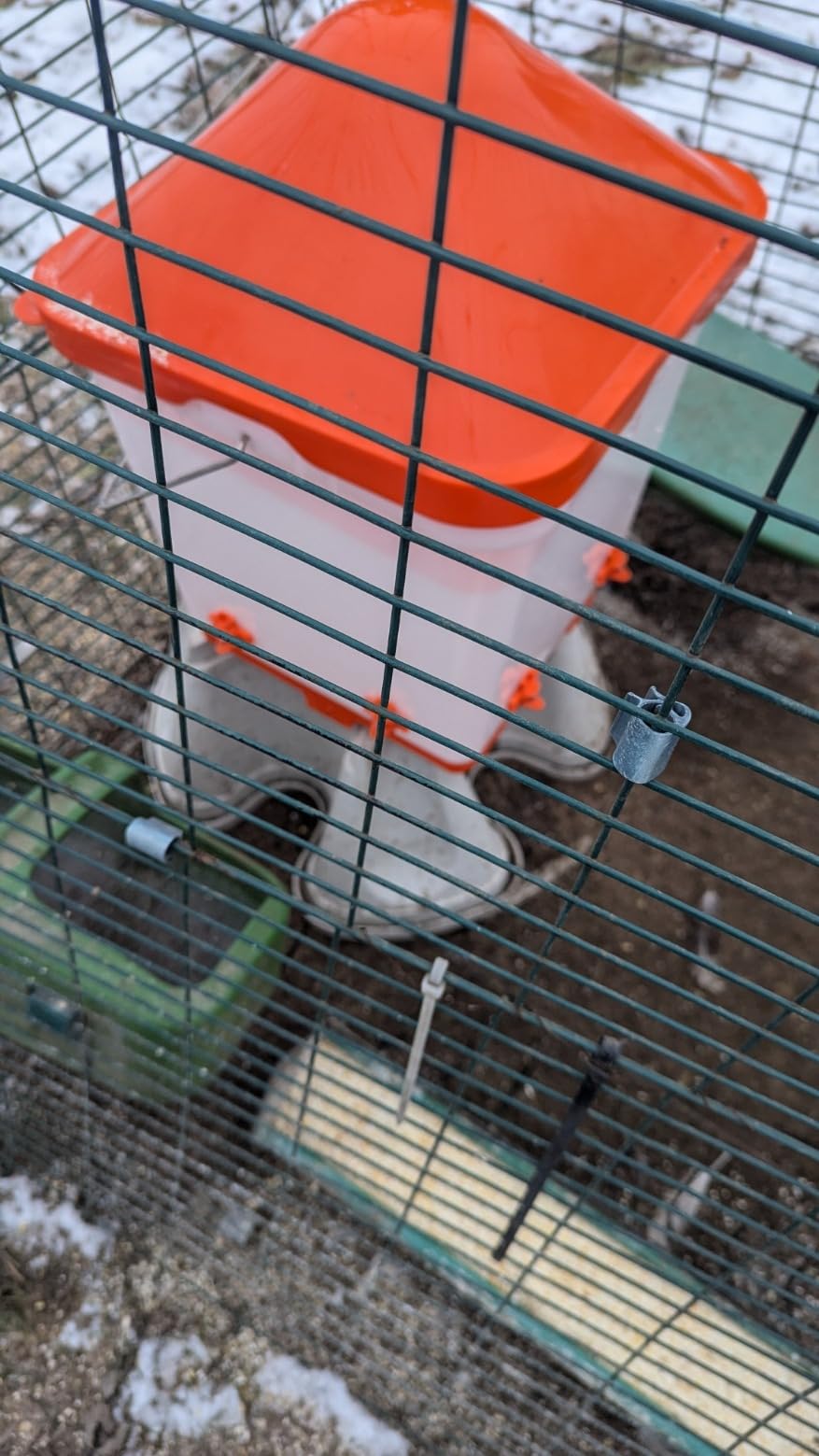
Every nipple is horizontal. That is a deliberate choice and the reason keepers on long-running forum threads recommend horizontal fittings: birds drink by pushing sideways rather than pecking upward, water stays cleaner, and the openings are less prone to icing over.
The removable anti-roost cone lid deters perching, which keeps droppings out of the water, and the foldable adjustable legs let you change height as the flock moves from chicks to adult birds. It folds flat for transport and spills very little when moved.
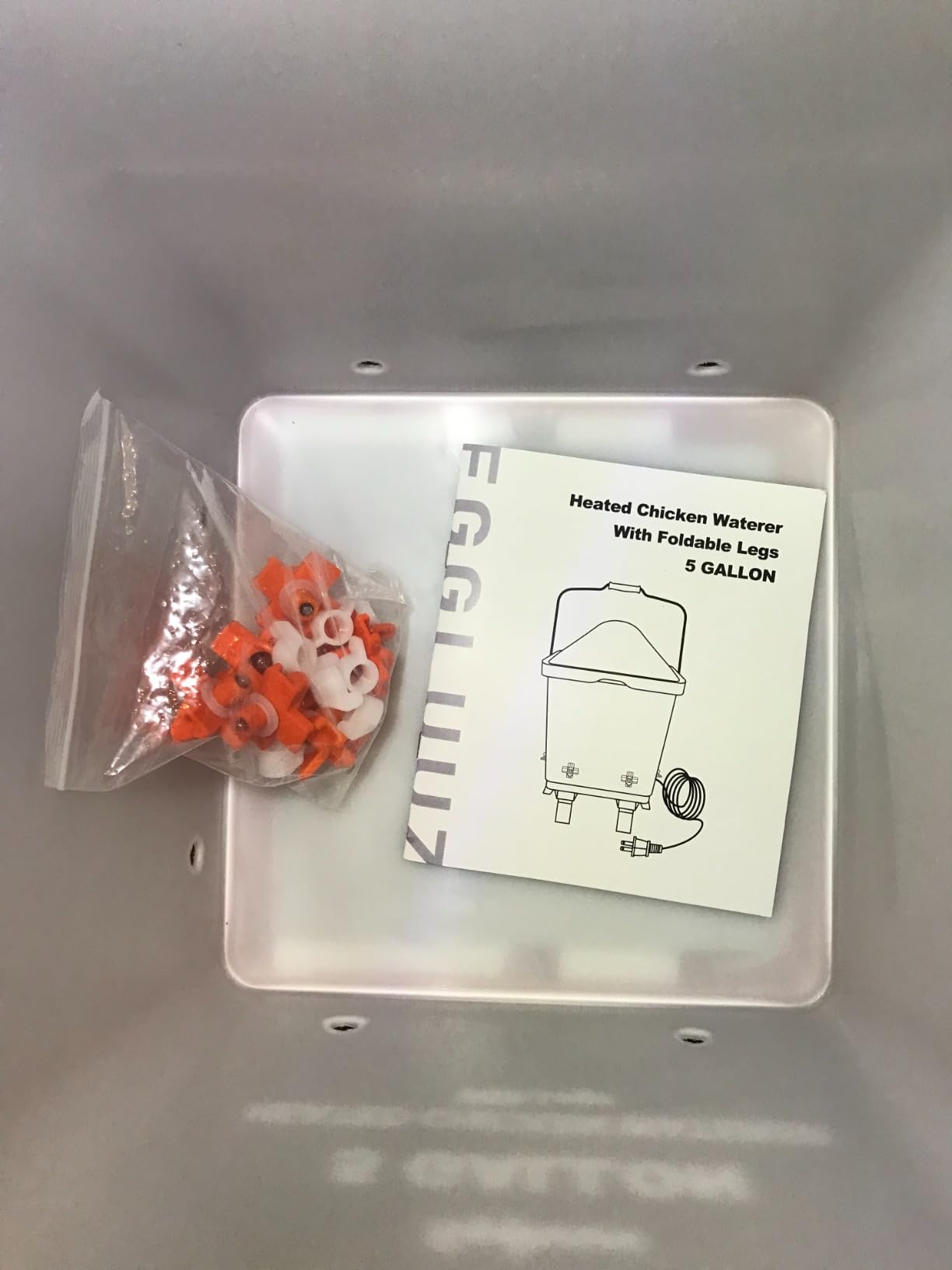
Why horizontal nipples matter in cold weather
Keepers repeatedly say the same thing in the forum threads: horizontal nipples hold up better against freezing and keep water cleaner than vertical ones. Water sits inside the fitting either way, but a horizontal tip gets wetted by the bird pressing into it, and that movement helps break any ice that starts forming.
Training is easier than most new keepers expect. Show a new bird once by holding its beak to the fitting, or run a horizontal-nipple bottle in the brooder. One bird learning is usually enough for the rest of the flock to follow the same day.
Where it falls short
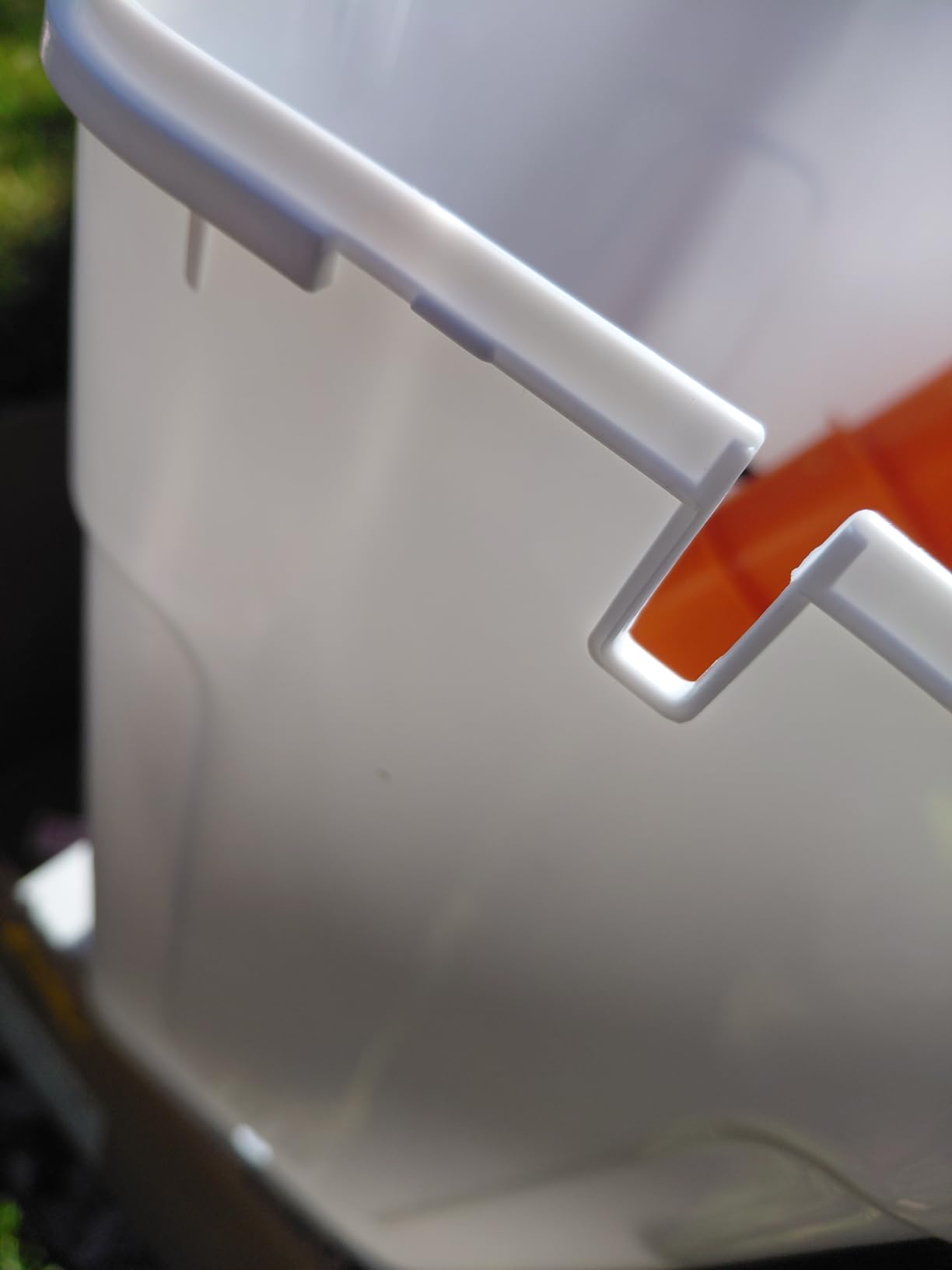
The lid can freeze shut in deep cold unless it sits slightly ajar, which is the same complaint that appears on almost every insulated waterer in this roundup. Plan your refill around it.
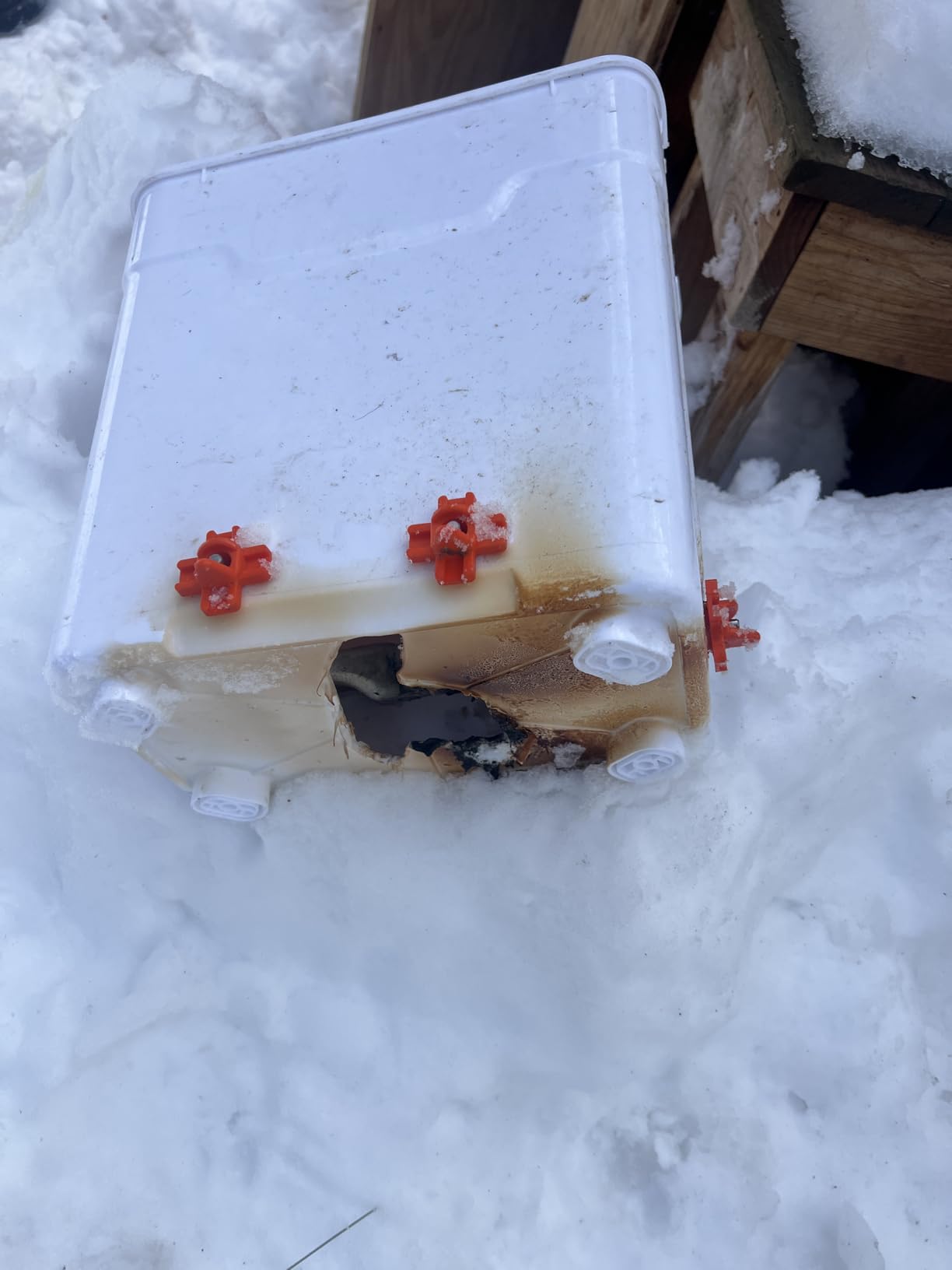
Durability is the real question. The rating is 4.3 from 129 reviews with a high share of five stars, but some owners report a unit that stopped working after a single season. It also has its own thermostat, so do not run it on an external temperature controller as well.
5. Lilyang 3 Gallon 250W Waterer – The Best for Extreme Cold
Lilyang Heated Chicken Waterer 3 Gallon, 250W Thermostat Control
250W cast aluminum plate
Rated to -20F
On at 35F off at 70F
Detachable plate and legs
Pros
- Highest wattage element in this roundup
- Cast aluminum plate will not melt a plastic base
- Detachable plate gives year-round use
- Legs included so it stands or hangs
Cons
- Newest design with the thinnest review base
- 250W draws more power than 40-60W belts
- 6-month warranty is shorter than rivals
When we need the most heat available from a single unit, this is it. The 250-watt element is the highest in the roundup, roughly four times the draw of the small 2 gallon drinkers, and it carries a rating down to -20F.
Its most useful design decision is the cast aluminum heating plate, chosen specifically to avoid melting a plastic base. Cheap heated plates get thin, and a thin plate under a plastic container is how you cook the container.
The thermostat switches the element on at 35F and off at 70F, so the cycle is controlled at both ends. Construction is fully waterproof with a 6.5 foot cold-weather cord, which matters more than it sounds when the connector sits in a wet run for four months.
The detachable plate is what makes this more than a winter purchase. Take the heater off in spring and you keep a working 3 gallon waterer for the rest of the year, and the removable 50-degree sloped lid plus included legs mean it can stand elevated or hang.
When extra wattage is worth it
Wattage only earns its keep in a place that gets genuinely cold. If your winters sit mostly in the single digits, a 60-watt unit will do the same job for a fraction of the electricity and you should buy that instead.
Extra watts pay off in hardiness zones 3 through 5, in unheated coops with no draft protection, and for anyone whose nipples keep freezing on lower-powered setups. A larger element holds a margin against sustained cold rather than just getting through a cold night.
Where it falls short
This is the newest design here, first listed in September 2025, with 143 reviews. That is a thin base of evidence for the biggest claim on the spec sheet, and it comes with a 6-month warranty rather than the 12 months some rivals carry.
The draw is also the highest, so it costs more to run than the 40-watt belt heaters even after the thermostat trims it. And at 3 gallons it supports roughly 10 chickens, so a large flock needs two of them or a different approach.
6. RentACoop Thermo Bucket Belt – The Best for Any Bucket
RentACoop LG Thermo Bucket Belt Chicken Waterer Heater with Insulated Wrap
40W belt heater wraps any 2-5 gal bucket
On below 38F off at 42F
Insulated wrap rated to -10F
6 ft cord included
Pros
- Lowest wattage in the roundup
- Wraps any bucket you already own
- Silicone belt is safe on plastic or metal
- No tools or wiring needed
Cons
- Bucket is not included and sold separately
- Fewer reviews than the base heaters
- Belt must match bucket circumference
This is the cheapest way to winterize water you already have. Instead of a tank or a plate, it is a 40-watt silicone belt that wraps around the outside of any 2 to 5 gallon bucket, plus an insulated wrap that pushes freeze protection to -10F.
The thermostat is unusually tight. It activates below 38F and switches off at 42F, a four-degree band, so the element cycles often but briefly and the electricity use stays low through a whole season.
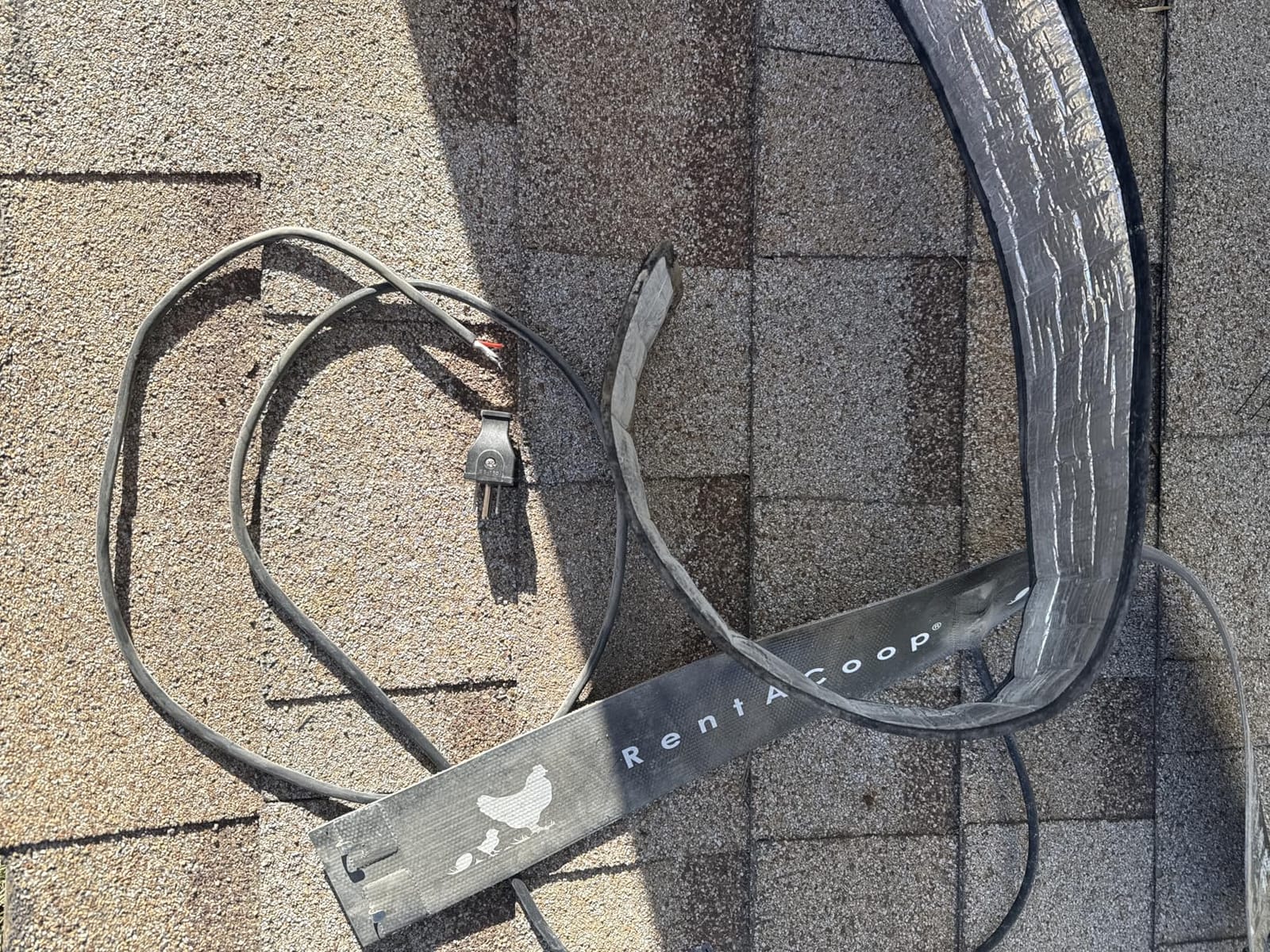
The belt is fiberglass-reinforced silicone rubber, which is safe to touch and will not melt a plastic bucket. That matters because buckets are the cheapest container in the coop and the ones most people already own.
Setup is genuinely tool-free. Wrap the belt around the bucket, add the insulated wrap, plug in the included 6 ft cold-weather cord and walk away. No wiring, no adapter, and no fount to replace.
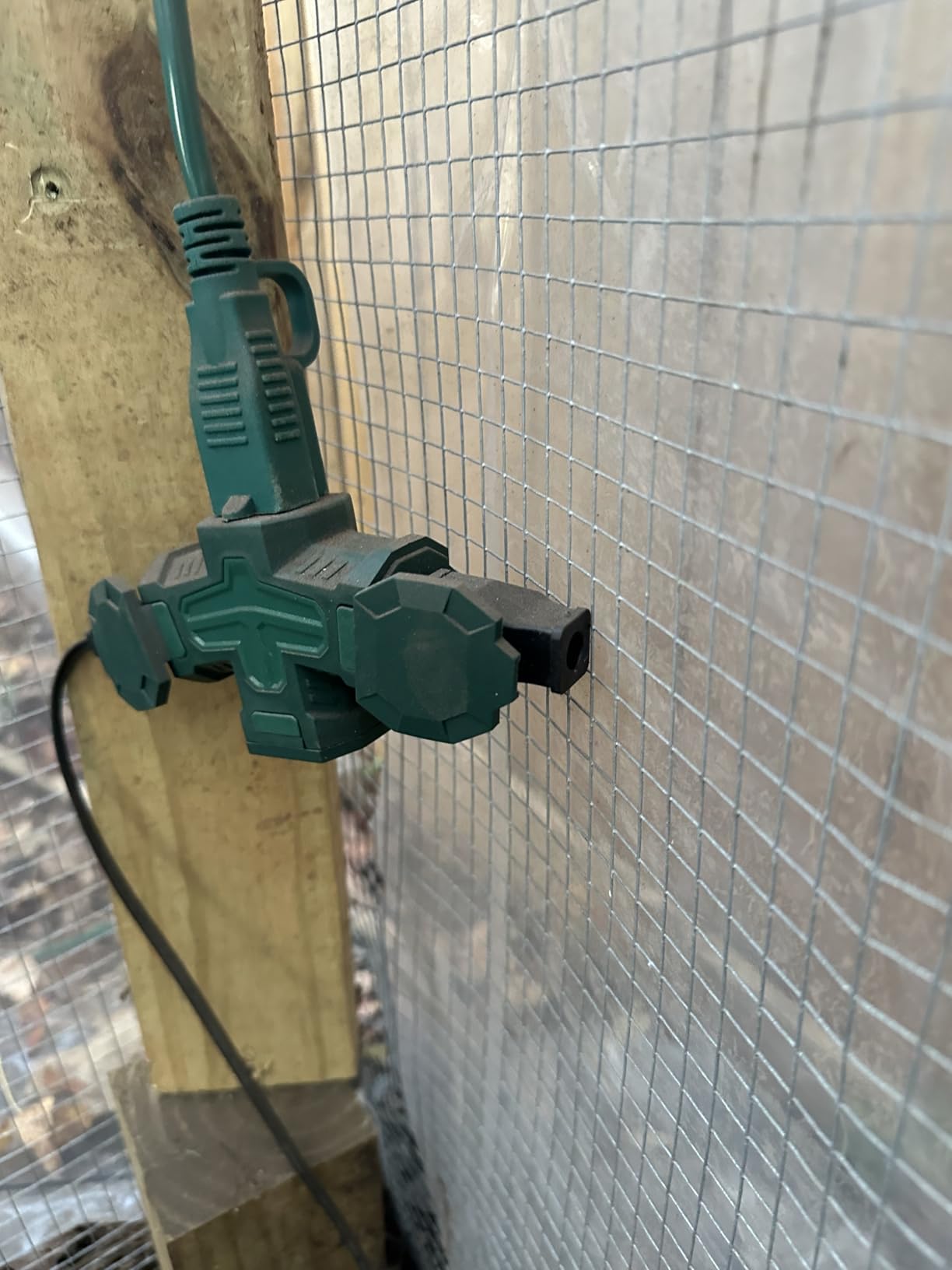
Why low wattage works here
A belt heater transfers heat straight into the bucket wall and the water touches that wall all the way round, so it does not need the wattage a base plate needs to conduct heat upward through a container. Forty watts wrapped around a bucket is more effective than forty watts under one.
It is also the easiest system to run in parallel. Two belts on two buckets give you redundancy, and if one fails in February the other still keeps a flock watered while you sort it.
Where it falls short
The bucket is not included, so you are buying a heater for a container you already need to own. The belt must also match the bucket circumference, which is 24 to 34 inches for this size, and a loose belt conducts far less heat.
With 195 reviews this has the smallest track record among the well-rated units here. It was first listed in December 2024, so it has not yet been through many seasons in the field, though its review distribution is the most favourable in the group.
7. Farm Innovators C-50P De-Icer Disc – The Best for DIY Builds
Farm Innovators C-50P Chicken Waterer De-Icer, 150W, Teflon Coated
150W Teflon coated disc
7.5 inches diameter
Thermostatic control
For buckets and fountains
Pros
- Teflon coating resists corrosion
- Drop-in way to protect an existing bucket
- Compact and light at under a pound
- Sells for far less than a full waterer
Cons
- Warms water near the surface only
- Underpowered in extreme cold
- Disc size suits smaller containers
A de-icer disc is the most modular option here. It drops into any bucket, pail or poultry fountain you already have and keeps a layer of open water on top from solidifying. Build your own nipple line, drill horizontal fittings, and this becomes the heat source.
At 150 watts it is thermostatically controlled and the element is coated in Teflon, which resists the rust and corrosion that eat unprotected farm discs within a couple of seasons. It measures 7.5 inches and weighs under a pound, so it is easy to carry between containers.
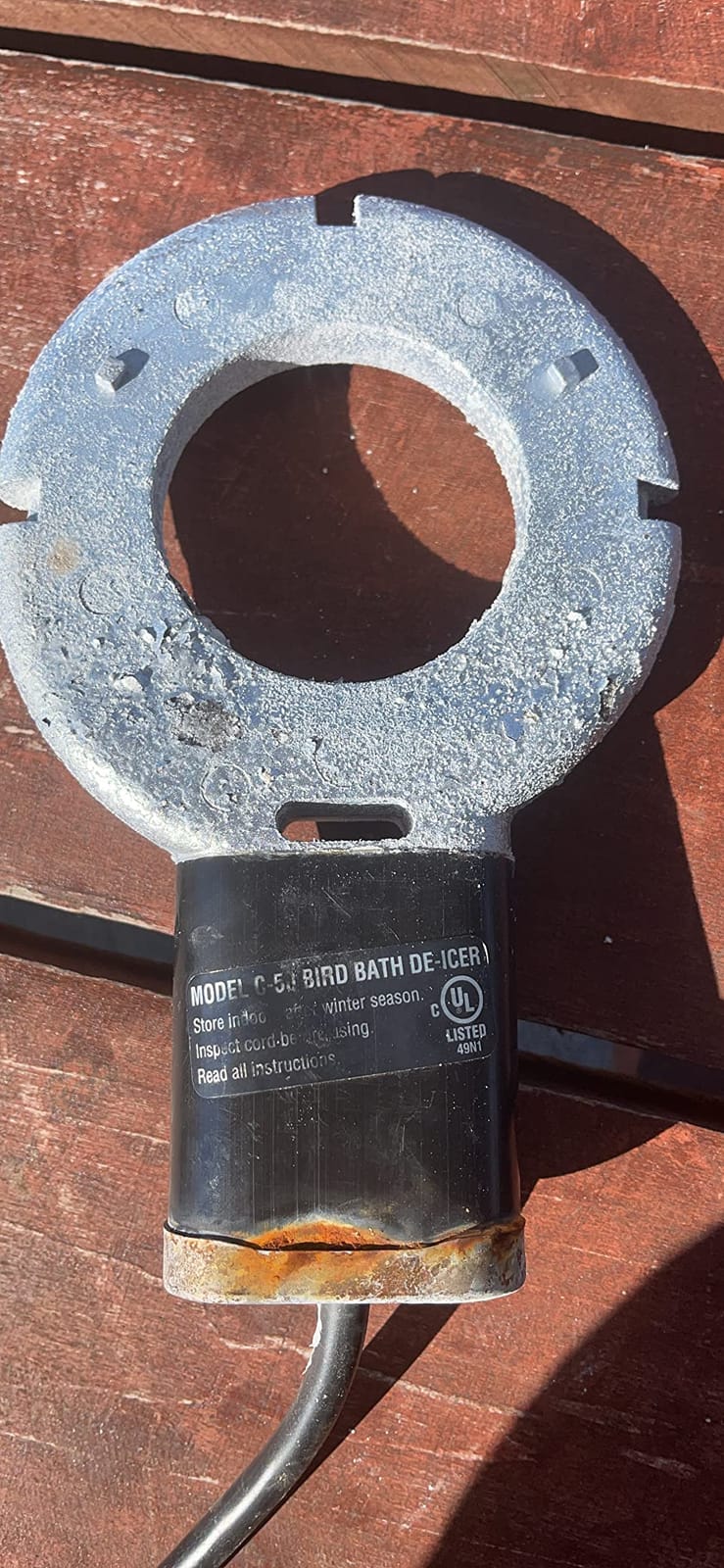
Owners like that it works with systems nothing else will touch. A commercial waterer with a molded base will not accept a heating plate, but a plain bucket will always accept a disc, and buckets are cheap to replace.
The thermostat limits electricity use, and because it only cycles on when water approaches freezing, a disc in a sheltered run can run for a season on a very small share of a winter electricity bill.
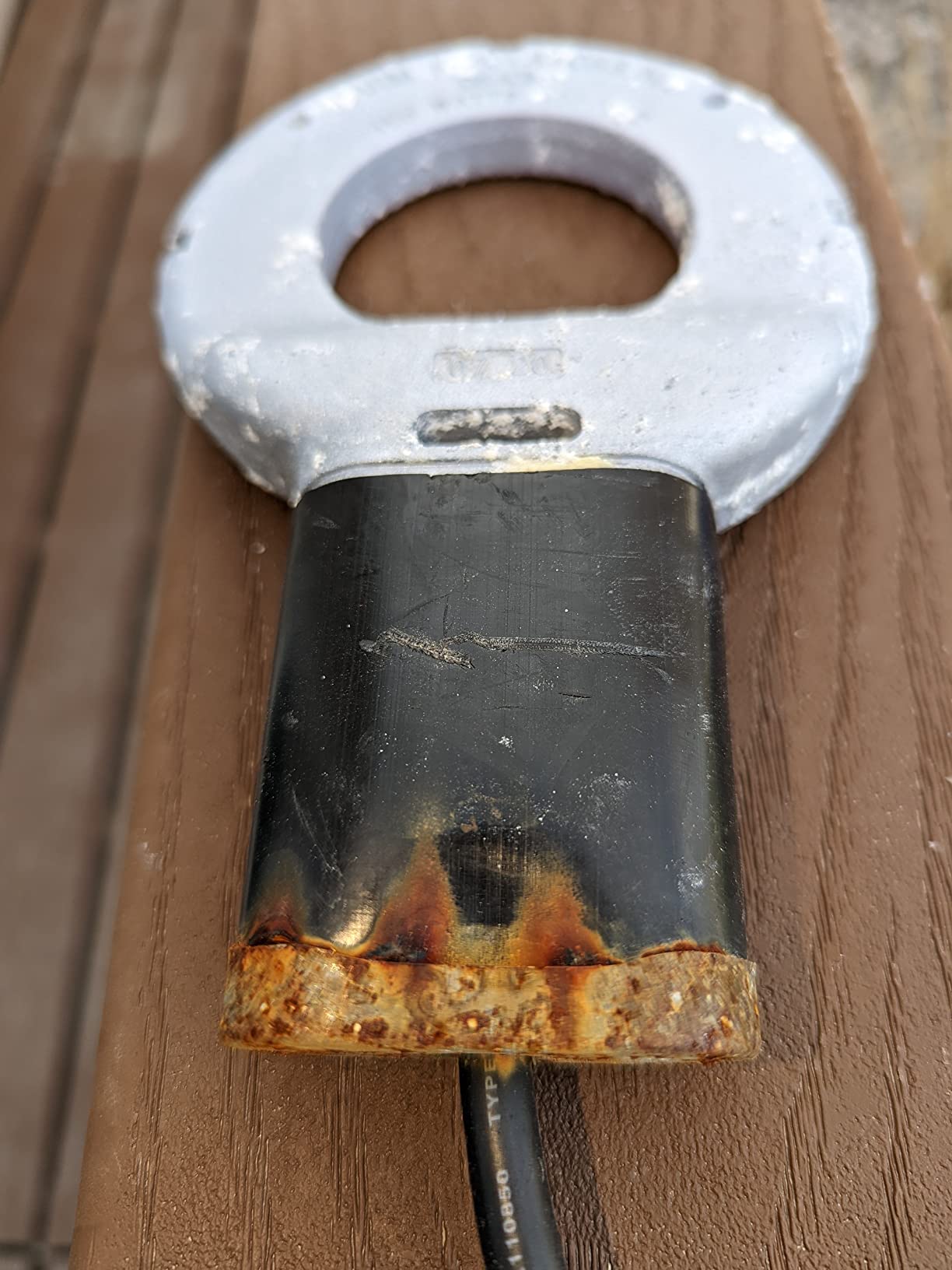
The DIY tote build that works
The most repeated build in the forum threads is a large clear plastic tote with a lid, horizontal nipples drilled through the side, and a de-icer dropped through a hole cut in a second lid plug. Because a 20 gallon tote needs filling only about every two weeks, it beats almost any heated unit on convenience.
Horizontal nipples are the reason this build is popular. They hold up better against freezing than vertical fittings, they keep water clean, and birds learn them fast. One caveat from the field: never run a de-icer in an empty container, because the disc can burn through plastic or start a fire.
Where it falls short
A disc only warms the water near its own surface. That works well in a bucket you drink from the top of, but it is far less effective in a deep container where the bottom sits in the cold, which is why some owners report it underpowered in extreme cold.
It is also a component, not a product. You need a container, and you need something to drink from, so the total cost and effort are higher than the sticker suggests unless you already have both.
8. Zoblise 14.6 Inch Heated Base – The Budget Pick
Chicken Water Heater Base for Winter, Heated Chicken Waterer 5 Gallon 125W
125W galvanized steel plate
Cuts in below 35F
Cuts out above 77F
14.6 inch base with 6 ft cord
Pros
- Least expensive heated base here
- Galvanized plate transfers heat and resists rust
- Large base steadies 5 gallon waterers
- Raises the container off wet litter
Cons
- Upper half of deep buckets can ice over
- Some plates stopped heating within a season
- Never run it under an empty plastic container
This is the cheapest way to add a thermostat-controlled heated base, and the specification is competitive on paper: a 125-watt galvanized steel plate, a cut-in below 35F, and a cut-out above 77F so it stops well before anything gets hot.
The 14.6 inch plate is the useful part. It is larger than most bases in this roundup and stabilises a 5 gallon waterer without tipping, which is exactly the combination that causes problems on narrower plates.
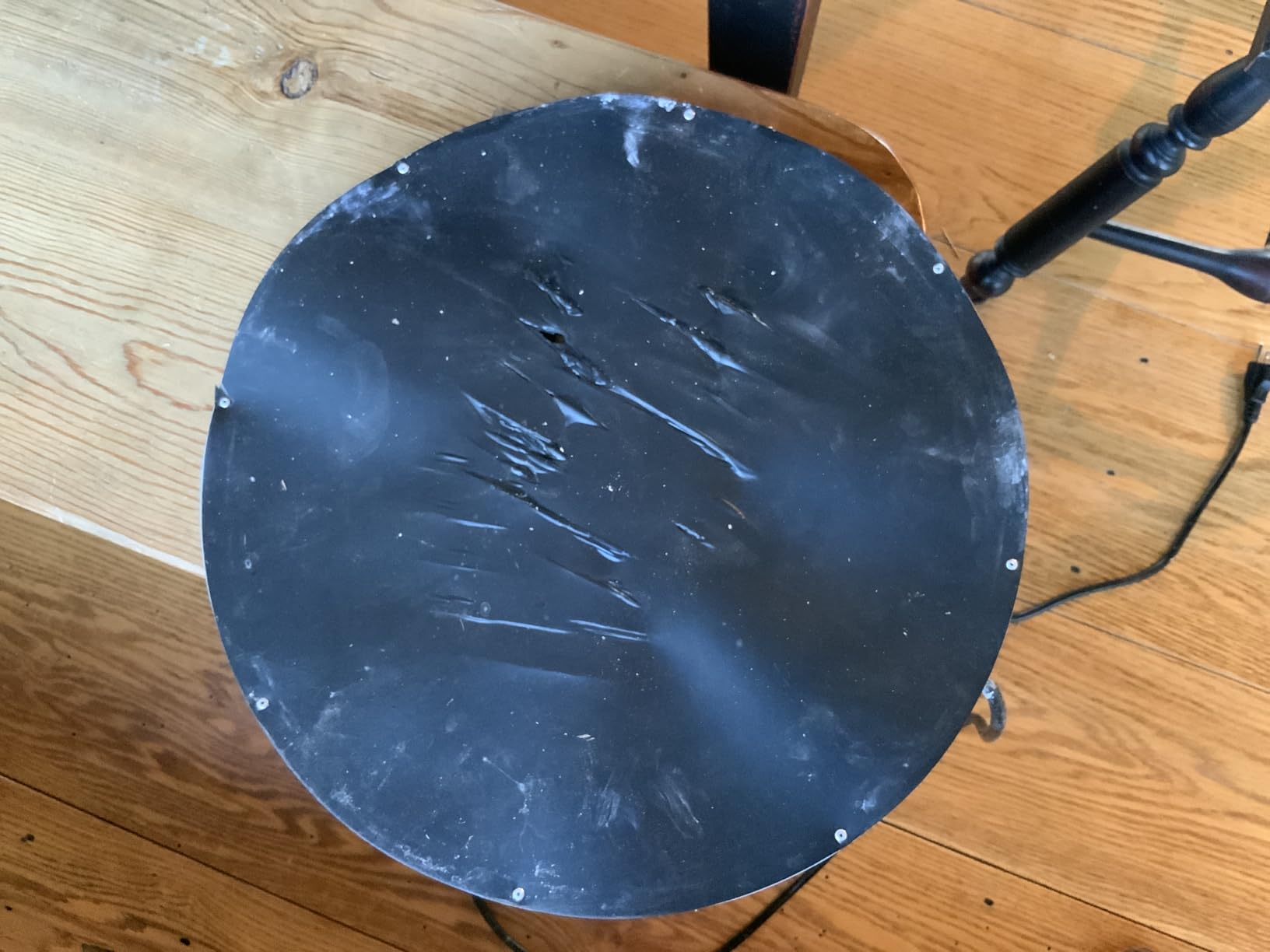
Owners in New England, Alaska and the Northeast report keeping 5 gallon drinkers liquid all winter, and the plate also lifts the container off the coop floor so it is not sitting in wet litter all season.
The plate works under plastic or metal waterers, so you are not forced to replace the container you own. It comes with a 6 foot cord, and versions also exist in an 11 inch size if you are running smaller founts.
What to check before you buy a budget base
Measure your container before anything else. A base that is slightly wider than the fount is fine, but one that overhangs a lot wastes heat, and one that is narrower than the fount leaves a cold ring where water can freeze against the wall.
Fill a deep container only about halfway if you live somewhere genuinely cold. Since the plate heats by conduction, the lower half stays liquid while the top half can ice over, and that is the single most common complaint about base heaters in this category.
Where it falls short
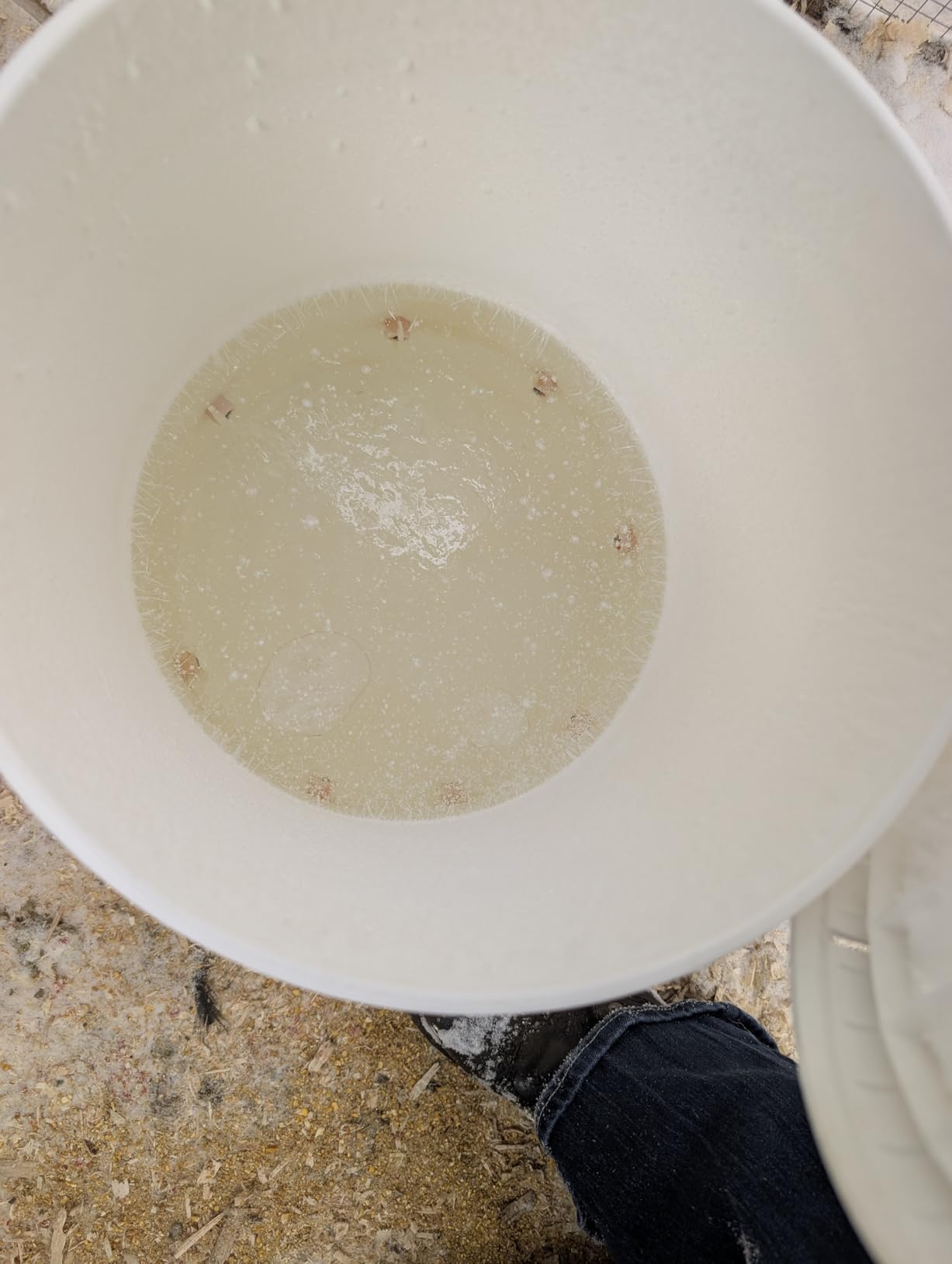
Durability is the weak point. Several reviews report plates that stopped heating within the first season, and with 530 reviews the unit has less field history than the Farm Innovators base it is competing with.
It also runs hot under the wrong conditions. Do not put a plastic waterer on it empty, because a heating plate with nothing to absorb the heat can damage the container, and the same caution applies to metal containers left empty.
9. API 3 Gallon Heated Waterer – The Best for Easy Filling
API 3 Gallon Heated Chicken or Bird Waterer with Overheating Protection, Galvanized Steel Handle, and Easy to Fill Funnel Design, White
3 gallon tank with funnel fill
100W heater pad
Ice-free to -5F
Rounded no-roost top
Pros
- Funnel fill opening is quick and spill-free
- Rounded top discourages roosting
- Thermostat cycles the pad automatically
- Galvanized handle for hanging or carrying
Cons
- Lowest average rating here at 4.0
- Short 4 foot cord limits placement
- Some buyers report ice in severe cold
- 3 gallon suits small flocks only
This is a gravity waterer rather than a nipple system, and that is its selling point. Water sits in an open trough the birds drink from, which most flocks take to immediately with no training at all.
The heater pad under the tank is thermostatically controlled and rated to keep water ice-free down to -5F. It runs on 100 watts at 120 volts, and the rounded top discourages roosting so birds do not soil the water from above.
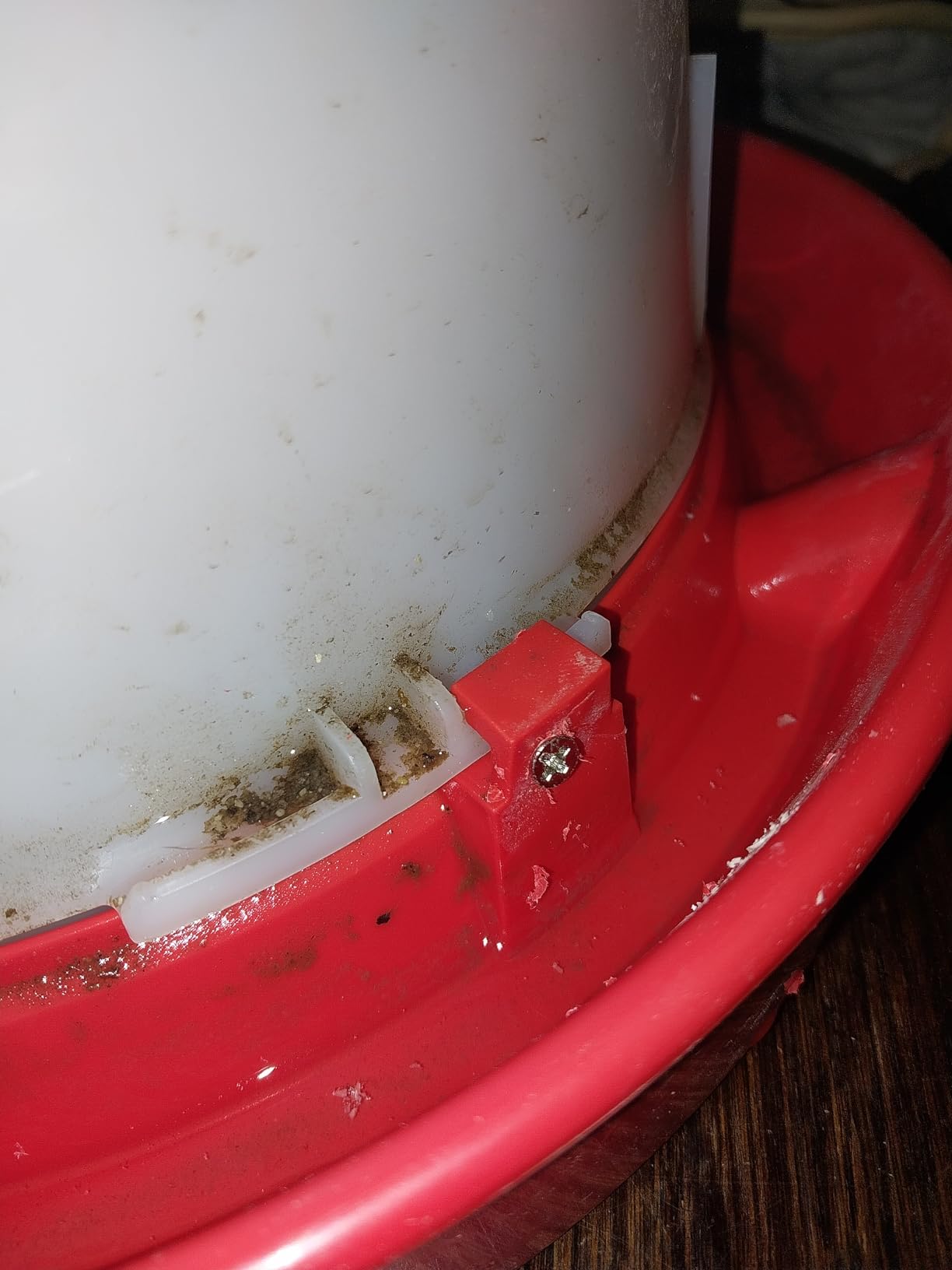
The funnel-style fill opening is genuinely easier than lifting a lid off in the cold, and the galvanized steel handle makes it easy to hang or carry. For an open water surface, an unheated container of the same size would be a bowl of ice within a day.
That is the trade-off. An open trough is exposed to freezing at the surface first, so it depends more heavily on the heater pad than a nipple waterer with a lid, and that shows up in the reviews.
Who should choose an open gravity waterer
Choose this if your birds have never used nipples, if you have bantams, Silkies or Polish that struggle with fittings, or if you want a flock that drinks without any adjustment period. A wide open trough is easy for every kind of bird to use.
It is also the right pattern when you run a mixed-age flock. Chicks cannot use a nipple line reliably, and keepers commonly run a heated nipple waterer for adults alongside an open source for the young birds.
Where it falls short
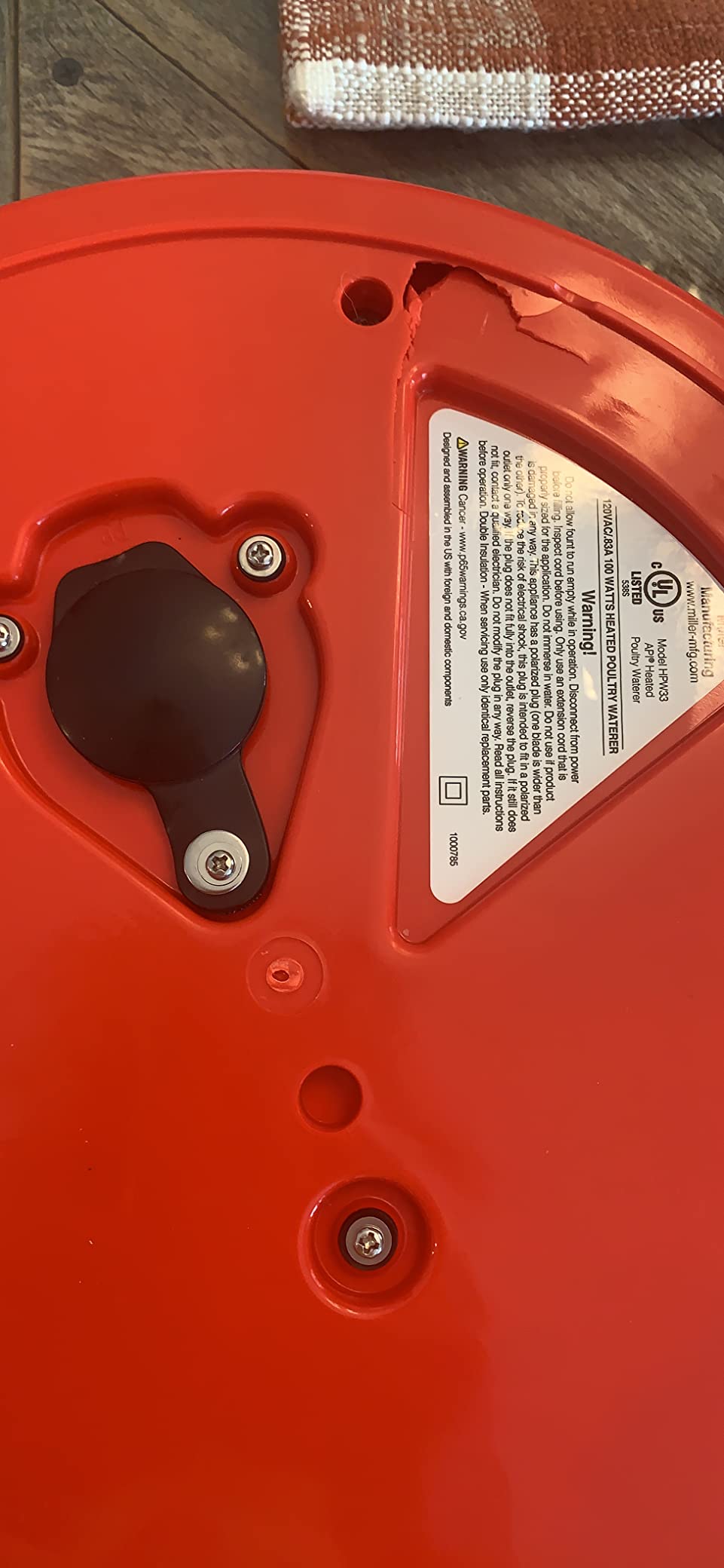
This has the lowest average rating in the group at 4.0, and it draws the most one and three star feedback here. Reported issues are limited capacity for a 3 gallon tank, a short 4 foot cord that restricts where you can plug in, and occasional ice in severe cold.
The -5F rating also means it is not the right choice for a hardiness zone 3 or 4 winter. In those climates you want an integrated element with a deeper cold rating, not a pad under a gravity tank.
10. K&H Thermo-Poultry Waterer – The Best for Clean Water
K&H Pet Products Thermo-Poultry Waterer 2.5gal. (Heated) Gray 60 Watts – No Roost Top & Non-Spill Refill
2.5 gallon tank on 60W base
No-roost tank top
Spill-proof refill cap
Removable filter ring
Pros
- Spill-proof cap makes the tank safe to lift
- No-roost shape keeps the water cleaner
- Filter ring lifts debris out of the trough
- 2.5 gallon tank is quick to fill
Cons
- Lowest average rating here at 4.0
- 60W is modest for hard winters
- Smallest capacity in the roundup
- Base must be hand washed with the tank lifted
The design problem this solves is mess. The tank has a spill-proof cap, so you can lift the whole 2.5 gallon tank off the heated base and carry it without a wave of water across your coat and the coop floor.
That refill cap pairs with a no-roost shaped tank top and a removable water filter ring that lifts debris out of the trough. For keepers whose birds try to perch on wide flat lids and dirty the water, this is the pick in the roundup.
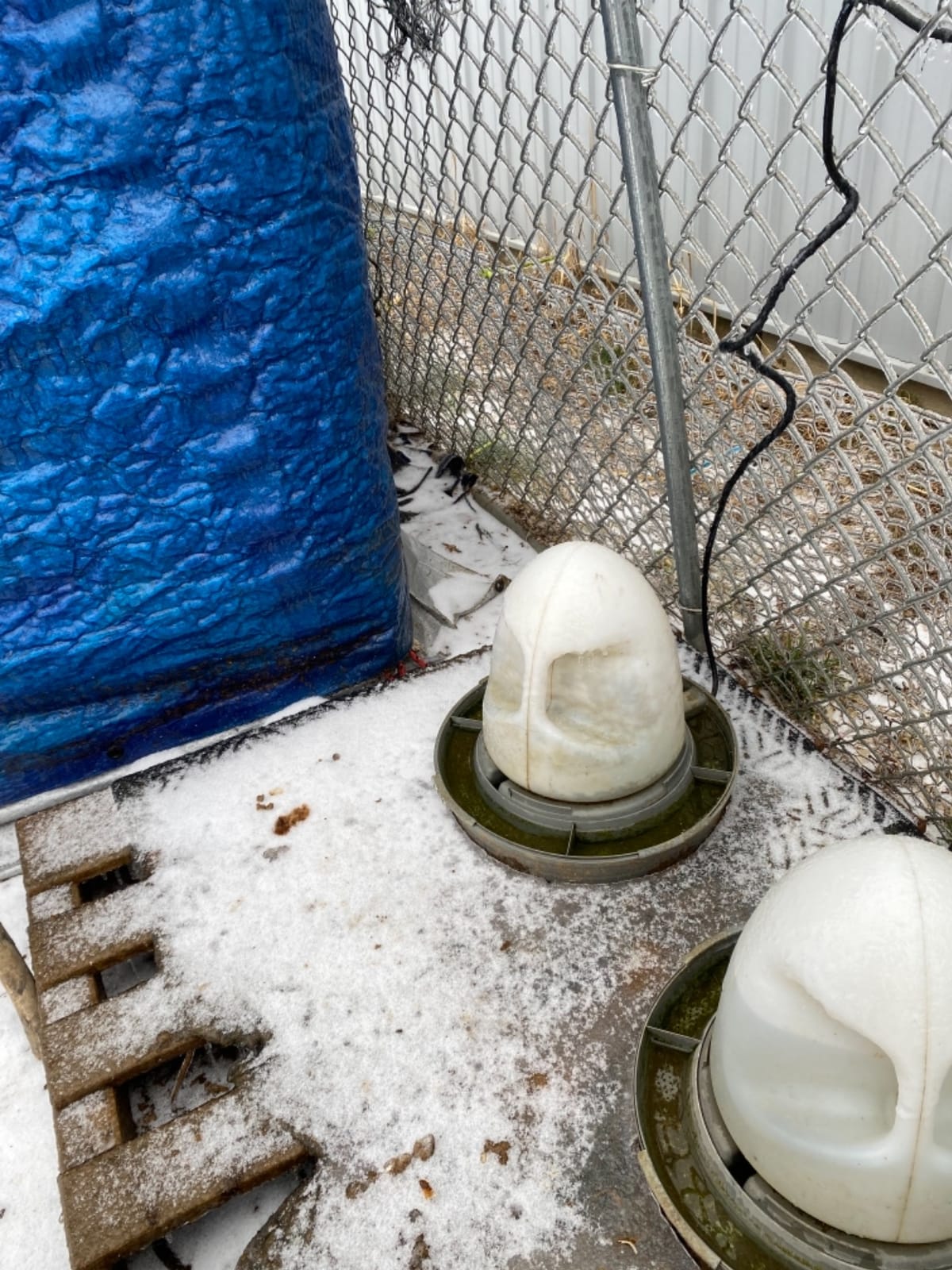
The heating is a 60-watt thermostatic base, which is modest but adequate for a small flock in a climate that dips into the teens rather than sustained double digits below zero.
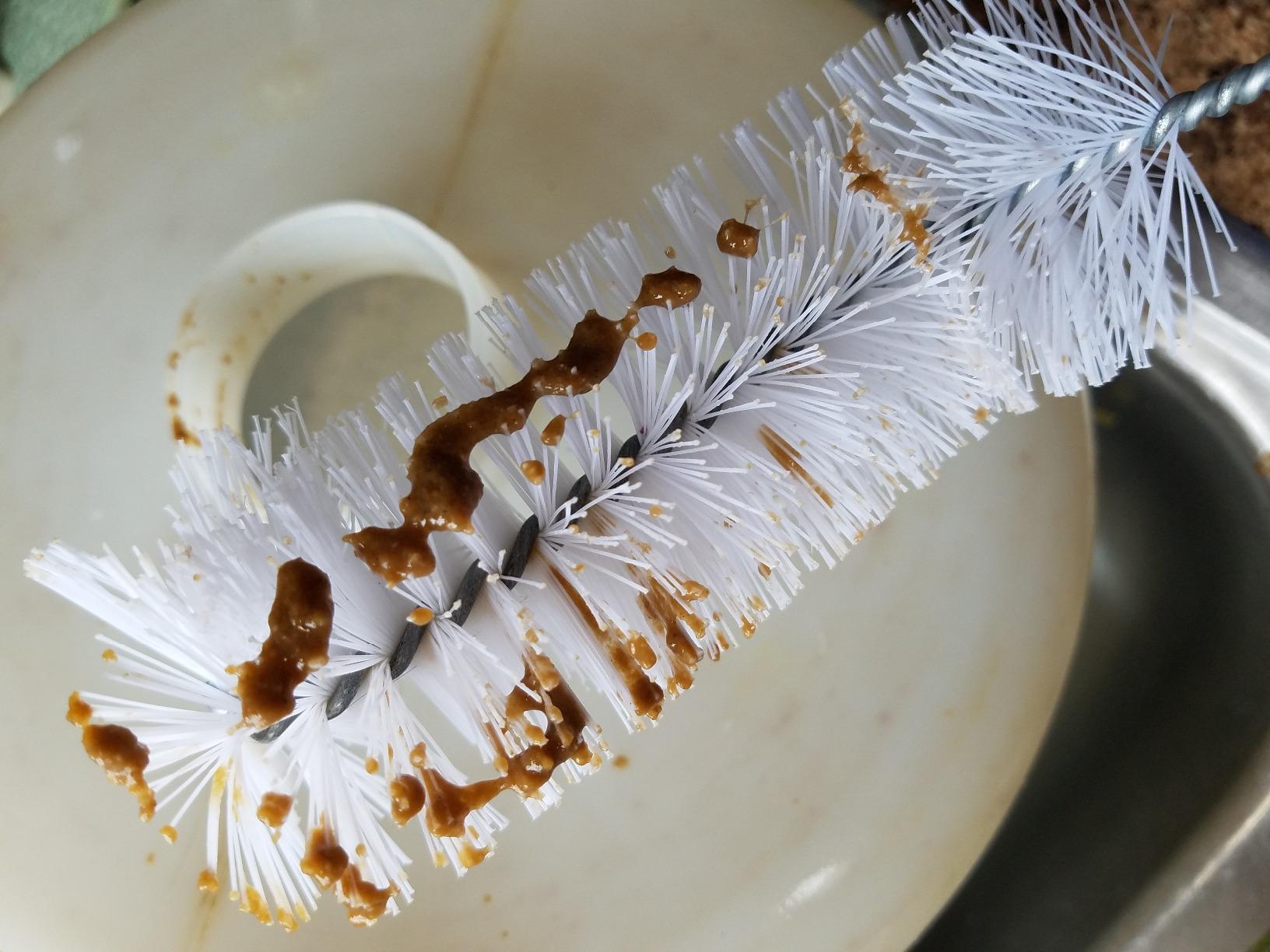
It has been available since 2015, so there is a real service history behind it, and the tank shape is easy to scrub out by hand with no tools.
Why clean water is harder in winter
Winter makes water quality worse, not better. Birds drink less when it is cold, so the same volume of water sits longer and collects more debris, and a frozen-thaw cycle repeatedly warms and cools the surface where bacteria grow.
That is where anti-roost shaping and a filter ring earn their keep. A tank birds cannot perch on stays cleaner between cleanings, and the ring means you can pull debris out in seconds instead of scrubbing the whole trough with a cold hose.
Where it falls short
At 4.0 from 377 reviews this is tied for the lowest rating here, and it has the smallest five-star share in the group. Feedback on heating performance in deep cold is mixed, which matches its modest 60-watt element.
Two and a half gallons is also the smallest capacity in the roundup, so you will refill more often than with a 3 or 5 gallon unit. Cleaning requires lifting the tank off the base by hand, which is more fiddly than a hinged cap.
Heating Chicken Water Without Electricity
If your coop has no reliable power, no heated waterer in this roundup will help you. These are the methods keepers actually use, and several of them have no purchase at all.
De-icer disc in a bucket. A thermostatically controlled disc under a standard bucket keeps a drinking layer open. This is the cheapest reliable electric option if you already own a bucket.
Belt heater wrapped around a bucket. Heat transfers through the bucket wall, which makes low wattage more effective than a plate under the same container.
Large tote with horizontal nipples. Twenty-gallon totes with a lid and a deicer dropped through a cut hole in a second plug are widely used and need filling only about every two weeks.
Heated horse trough with horizontal nipples. One long-term keeper runs a heated trough fitted with horizontal fittings and has never frozen it, though a single Polish hen refuses to drink from it and gets water carried out.
Rotating manual refill. Carry in an insulated jug of warm water each morning and top up an unheated bowl. Unglamorous and weather-dependent, but it costs nothing and it always works.
Deep bedding and an unheated waterer. Straw packed deep around a bowl in an enclosed run holds enough warmth to slow freezing through many nights, though it cannot survive a sustained cold snap.
Two shallow sources rather than one deep. A wide open surface freezes faster than a narrow one, so splitting your water across two containers gives the flock a backup if one solidifies.
Whatever method you choose, never run a de-icer or heating element in an empty container. With nothing to absorb the heat, the element can burn through plastic.
Electrical Safety and GFCI Requirements
You are putting a mains-voltage heating element inside or under a container of water in a damp shed full of birds. That combination deserves respect, and no competitor roundup we found covers it.
Use a GFCI-protected outlet every time. A ground fault circuit interrupter cuts power in milliseconds when it detects current leaking to ground, which is exactly the failure mode of a heater sitting in water.
Run the cord where birds cannot reach it. Chickens peck at cords, and a chewed cord is how water and electricity meet. Use conduit, a cord cover, or route the cable along a wall and up through conduit.
Never leave a base running under an empty container. With no water to carry the heat away, the plate runs far beyond its design temperature.
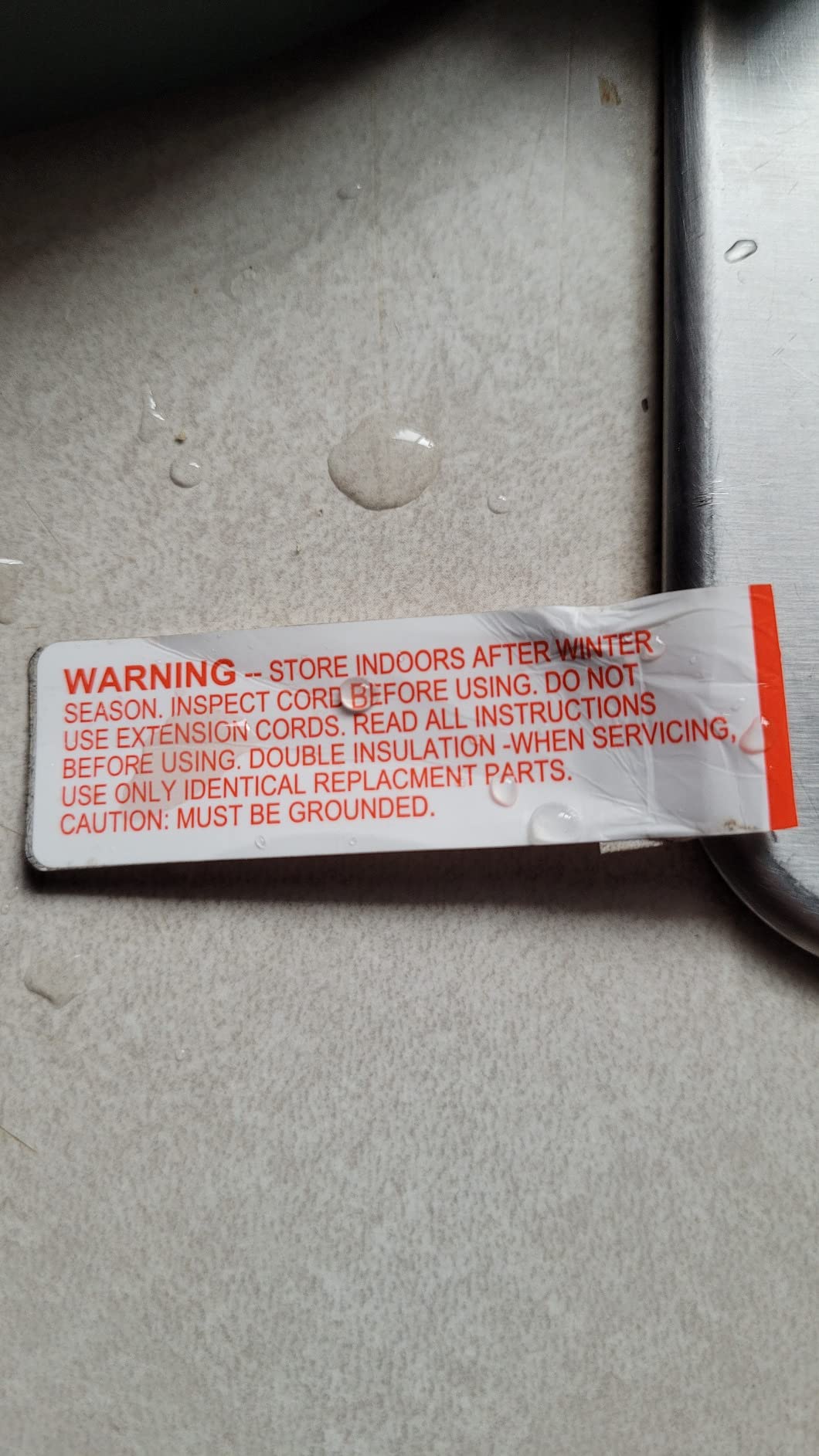
Check that the unit is UL or CSA listed. A listed heating plate has a sealed element and a moisture-rated enclosure. Unlisted plates are the ones that fail after one wet season.
Keep the element clean. Litter and debris insulate the plate, force it to run hotter, and are the most common cause of a heater tripping its breaker after a few winters.
One keeper on a four-year-old heated poultry waterer began tripping the breaker, and the usual explanation is mineral scale and debris building up around the element. If your unit starts tripping, clean it before you replace it.
What to Do When the Power Goes Out
A heated chicken waterer has no backup by design. When the power cuts, you have until the water surface freezes, which in a cold night can be a matter of hours. Plan for this before winter arrives.
Keep a known-water reserve in the coop. A full covered bucket of unfrozen water that you do not depend on for warmth costs nothing and can be your flock’s entire supply for a day.
Move water in from a heated building. If you have a basement or garage that stayed warm, carry a container in. Warm water holds liquid far longer than cold water does.
Insulate what you have. Wrap a bucket in a blanket, a foam cooler lid, or burlap and a layer of straw. Insulation buys hours, not days.
Do not use a de-icer as your only plan. It is powered by the same electricity that just failed. Treat it as one layer, not a strategy.
Open the curtains of daylight and shut the door. Solar gain through clear coop windows and blocking wind entry raise the ambient temperature enough to matter for a few hours.
How long can chickens go without water? In cold weather the risk climbs sharply within roughly 24 hours, and egg production drops quickly once intake falls. That is why a backup jug is worth more than any feature on the waterer itself.
The freeze-thaw recovery matters too. If a container has a solid block of ice in it, do not force it with a hair dryer on high heat, because plastic containers crack. Warm water poured down the sides and patience will release the block intact.
How to Choose a Heated Chicken Waterer for Your Flock
Size first, because it decides how your winter mornings go. A rule of thumb that matches the capacities here: about 1 gallon per 8 to 10 adult birds. A flock of 12 birds is comfortable on a 2 to 3 gallon unit, and anything above 25 birds should move to 5 gallons or two separate waterers.
Then match the cold rating to your actual winter. A unit rated to -5F is right for zone 6 and 7 winters. If your water regularly hits -20F in an unheated coop, you need a deeper rating like the -20F unit here, or you accept that some mornings the nipples will ice.
Wattage is not a quality score. It tells you how much heat is available and how fast the unit recovers after the thermostat cuts out. A 250-watt element in a zone 7 winter wastes electricity, and a 60-watt element in a zone 3 winter will not keep up. Match it to your climate and flock size rather than buying the biggest number.
Thermostatic control is the feature worth paying for. Every unit in this roundup has one, and a fixed-output heater either wastes power all winter or fails to keep up. The cut-in and cut-out bands differ, and a tighter band such as 38F to 42F cycles more often at lower cost.
Check the drinker style against your flock. Nipple systems keep water clean and resist surface freezing but need training. Gravity troughs need no training but freeze from the surface down. If you have bantams, Silkies or Polish, run a shallow secondary source alongside the heated unit.
Confirm compatibility before you buy a base. Measure the diameter of the base of your fount and compare it to the pan, and check whether the base is rated for metal containers only. Buying a base and a fount that do not match is the most common wasted purchase in this category.
Finally, weigh cord length and refill access against your winter. A 4 foot cord limits where you can plug in, and a lid that freezes shut turns every morning into a rescue operation. Both are avoidable at purchase time.
Frequently Asked Questions
Do heated chicken waterers work?
Yes, a thermostatically controlled heated chicken waterer keeps water drinkable through winter as long as its minimum rated temperature matches your climate and the drinker openings suit your flock. The element holds water near 40-60F rather than heating it hot, and it only runs when the thermostat calls for it. Nipples and cups are always the weak point.
Can you put a plastic chicken waterer on a heated base?
Usually yes. Most heated bases are flat and wide, and several are rated for plastic or metal containers, but you should verify that the base diameter matches your fount and that the base is thermostatically controlled. Never run a heating plate under an empty container, because nothing absorbs the heat and the plate can damage the container.
How can I keep my chicken’s water from freezing without electricity?
The proven methods are a de-icer disc in a bucket, a belt heater wrapped around any bucket, a large insulated tote with horizontal nipples and a de-icer, or a heated horse trough fitted with horizontal nipples. If you have no power at all, keep a covered reserve of unfrozen water in the coop and rotate manual refills into an insulated vessel.
What is the best way to water chickens in the winter?
Rank the strategies like this. First, a thermostatically controlled heated waterer matched to your lowest rated temperature. Second, an existing fount or gravity waterer sitting on a thermostatically controlled heated base. Third, a de-icer in a large insulated container with horizontal nipples. Fourth, rotating manual refills of unfrozen water carried in from a heated space.
Are horizontal nipples better than vertical ones in cold weather?
Yes, and it is close to universal keeper consensus. Birds push sideways into a horizontal nipple rather than pecking upward, the opening gets wetted by that movement which helps break forming ice, and the water stays cleaner. Training is also easier. Vertical nipples are more exposed to the cold air around the container and ice over more often.
How long can chickens go without water?
In cold weather the risk of dehydration climbs sharply within roughly 24 hours, and egg production falls quickly once water intake drops. Water that freezes solid cuts off supply within hours in deep cold. This is why keepers keep a covered reserve of unfrozen water in the coop rather than relying on a single heated waterer.
Do I need a GFCI outlet for a heated chicken waterer?
Yes, always. You are running a mains-voltage heating element in or under a container of water in a damp coop, which is the exact condition a GFCI is designed to interrupt. Route the cord where birds cannot peck it, use conduit, and keep the element free of litter and mineral scale, since debris is the most common cause of a heater tripping its breaker.
Final Verdict: Which Heated Chicken Waterer Should You Buy?
The best heated chicken waterers for winter come down to three answers. If you own a double-wall metal fount already, the Farm Innovators HP-125 base is the pick with the deepest field record and the widest temperature margin. If you want one self-contained unit that is easy to refill on a freezing morning, the Premier 1 3 gallon is the one to buy.
For a small flock under 15 birds, the Farm Innovators HB-60P remains the best value, backed by the largest review base in the category. For 25 birds or more, step up to a 5 gallon tank, and for genuinely brutal cold, the 250-watt unit is the only one here rated to -20F.
Whatever you choose, plug it into a GFCI outlet, keep a covered reserve of unfrozen water in the coop, and expect the heating element to last three to five winters rather than forever. If you leave the article here, do not leave with nothing: use the buttons above to check current details, and spend ten minutes on your backup plan before the first freeze.