
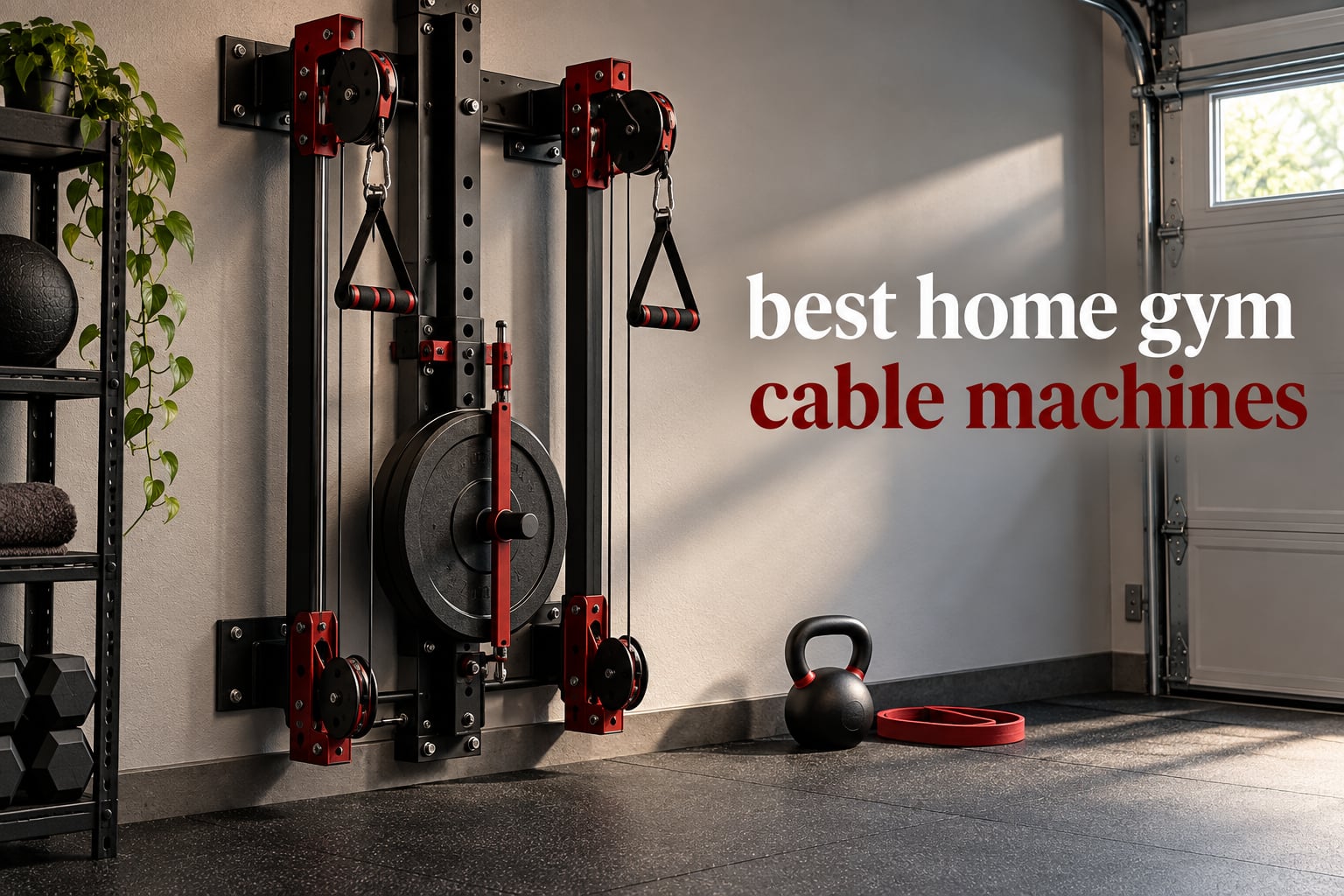
If you have ever tried to replace a barbell movement with something that fits in a spare room, you already know why cable machines keep showing up in garage gym conversations. The best home gym cable machines give you constant tension through the whole range of motion, cover nearly every upper body pattern, and take up a fraction of the floor space a rack plus a full plate tree would need. We spent weeks going through twelve of them, weighing build details, pulley carriage action, mounting requirements and real owner feedback before putting this list together.
A cable machine works by running steel or nylon-coated cable over pulleys attached to an adjustable carriage. You change the height of the carriage to pick the movement angle, and a weight stack or a set of loaded plates sets the resistance. What that buys you over dumbbells is a fixed line of pull, so a lat pulldown or a seated row loads the muscle through the entire lift instead of losing tension at the top, and you can change the angle of every exercise simply by moving the pulley.
For this roundup we looked at twelve machines spanning the full range: wall mounted cable stations that need under four square feet, plate loaded towers that use the plates you already own, folding squat racks with integrated pulleys, and full all-in-one cages. We paid close attention to four things that separate a good machine from a frustrating one: whether the cable runs smooth, how many usable pulley positions there really are, whether the frame and warranty hold up, and how honest the assembly process is. You will see those same four criteria reflected in every section below.
Table of Contents
Top 3 Home Gym Cable Machine Picks (October 2026)
Before the full list, here is where we would start. The Valor BD-62 is the most proven machine in this group and the one we would put in the most homes, the Body-Solid Best Fitness is the strongest value if you want a full length cable crossover, and the Inspire FTX is the premium answer for anyone who wants a complete functional trainer in a tight footprint.

Valor Fitness BD-62 Wall Mount
- Wall mounted with 16 pulley heights
- Plate loaded to 200 lb
- 25 x 25 in footprint
- Alloy steel frame

Body-Solid Best Fitness…
- Dual high and low pulley
- 133 lb stack capacity
- 10 year frame warranty
- Swiveling pulleys over 180 degrees

Inspire Fitness FTX Functio…
- Two independent 165 lb stacks
- 330 lb total cable tension
- 40 x 54 in footprint
- Full accessory kit included
Best Home Gym Cable Machines at a Glance (2026)
Every machine below uses a different approach to the same problem, so the fastest way to narrow the field is to compare how each one loads resistance. Three of these twelve use a weight stack, four are plate loaded towers or stations that take the plates you already own, and the rest combine a rack or cage with a dual adjustable pulley.
| Product | Specs | Action |
|---|---|---|
| Valor Fitness BD-62 Wall Mounted Cable Machine |
|
Check Latest Price |
| Body-Solid Best Fitness Functional Trainer |
|
Check Latest Price |
| Inspire Fitness FTX Functional Trainer |
|
Check Latest Price |
 Body-Solid Powerline Cable Crossover PFT100 Body-Solid Powerline Cable Crossover PFT100 |
|
Check Latest Price |
 Mikolo Folding Squat Rack with Cable Crossover Mikolo Folding Squat Rack with Cable Crossover |
|
Check Latest Price |
 Mikolo Wall Mount Cable Station M-G3 Mikolo Wall Mount Cable Station M-G3 |
|
Check Latest Price |
 Goimu WM1 Wall Mount Cable Station Goimu WM1 Wall Mount Cable Station |
|
Check Latest Price |
 Goimu LS01 Lat Pulldown and Row Tower Goimu LS01 Lat Pulldown and Row Tower |
|
Check Latest Price |
 Titan Fitness 80.5 in Pulley Tower Titan Fitness 80.5 in Pulley Tower |
|
Check Latest Price |
 ER KANG Wall Mount Cable Station ER KANG Wall Mount Cable Station |
|
Check Latest Price |
 YOLEO 9-in-1 Power Cage Package YOLEO 9-in-1 Power Cage Package |
|
Check Latest Price |
 Goimu DP01 Power Cage with Cable Crossover Goimu DP01 Power Cage with Cable Crossover |
|
Check Latest Price |
1. Valor Fitness BD-62 Wall Mounted Cable Machine – Best Overall for Small Rooms
Valor Fitness Wall Mounted Cable Machine with Dual Adjustable Pulley System, 16 Height Positions, Compact Home Gym for LAT Pulldowns, Rows, Triceps, and Full Body Strength Training
Wall mount
16 pulley heights
Plate loaded to 200 lb
25 x 25 in footprint
62 lb unit weight
Pros
- Footprint of roughly 4 square feet
- Smooth single side cable glide
- Works with 1 in and 2 in plates
- 16 listed pulley heights
- Alloy steel construction
Cons
- Top peg position blocked by the cable trolley
- Cheap pulleys add baseline resistance
- Wall bracket may not line up with studs
This is the machine we kept coming back to. The Valor BD-62 hangs flat against a wall in a footprint of about 25 by 25 inches, which means it disappears into a corner that was doing nothing but storing boxes. Owners describe years of regular use with no part failures, and with 699 reviews behind it, this is the most battle-tested cable machine we looked at.
The carriage glides smoothly on one side, and the range of exercises you can actually perform is far wider than the name suggests. Lat pulldowns, seated rows, chest presses, flyes, tricep pressdowns, high pulley work and rotational core movements all fall out of the same frame. You load it with plates rather than a fixed stack, so resistance tracks whatever you own.
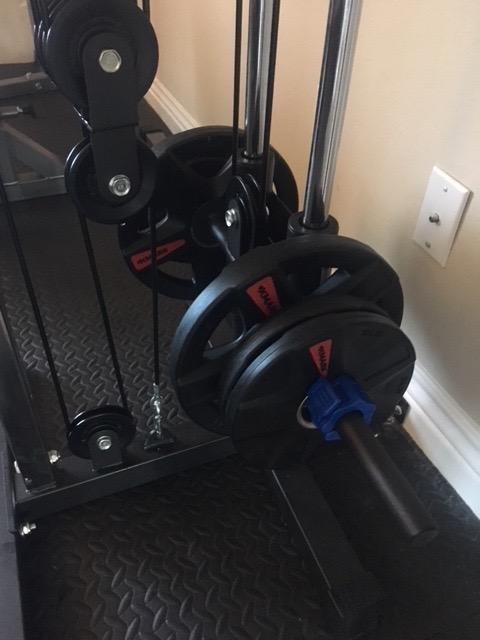
Two details matter more than they first appear. The listed maximum tension is 200 pounds, and the plate posts take both one inch and two inch plates, though Olympic plates need a separate adapter sleeve. The frame is alloy steel and the whole unit weighs 62 pounds, so it is a one person job to lift into position before it goes on the wall.
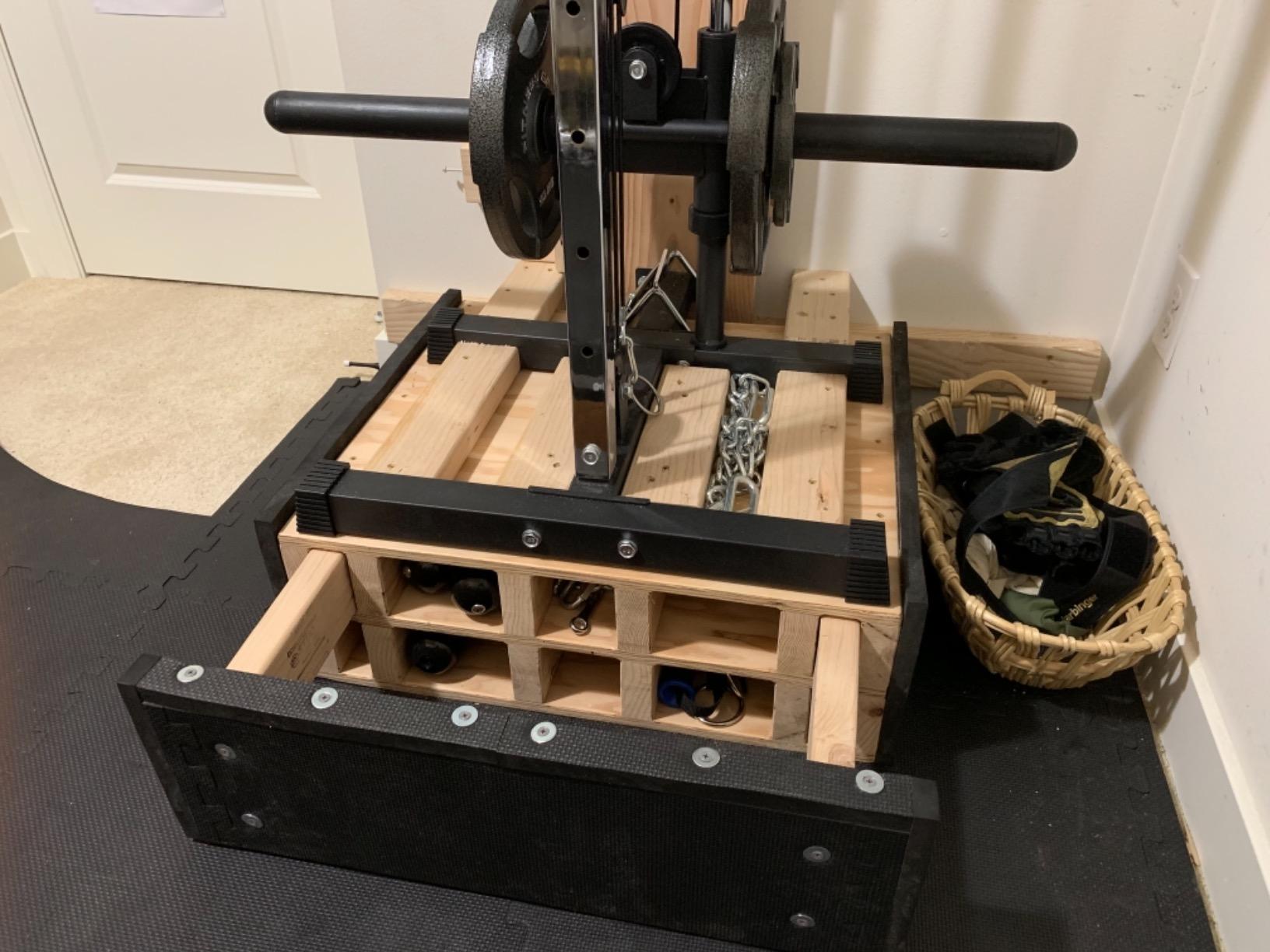
The honest caveat is resistance. This machine runs through a long line of inexpensive pulleys, and owners consistently report a noticeable baseline drag before the plates even start working. Some have swapped pulleys or drilled an extra height hole, which is a normal weekend modification rather than a defect.
Who the Valor BD-62 suits
This is the right pick for an apartment, a basement corner or a garage where floor space is the binding constraint. It is also the safest general answer for a first cable machine, because mounting is the only real installation step and the machine itself arrives light enough to handle alone.
Buyers who train solo at home get a lot from the fixed cable path here. A seated row or a chest press does not require a spotter, and the wall bracket keeps the whole load path anchored to the structure of the building.
Who the Valor BD-62 does not suit
Taller lifters should measure first. Owners call out a limited range of motion on lat pulldowns for taller users, and the top peg position is effectively unusable because the cable trolley fouls the upper pulleys, so the real count is fifteen positions rather than sixteen.
If you want a smooth, silent carriage with a long service life, look at the Inspire FTX or the Body-Solid Powerline instead. The trade you make here is footprint against refinement.
2. Body-Solid Best Fitness Functional Trainer – Best Value Cable Crossover
Body-Solid Powerline Cable Crossover Machine – High and Low Pulleys Gym Equipment for Home, Functional Trainer, Total Body Exercise, Cable Fly and Crossover Workouts
Dual high and low pulleys
133 lb usable resistance
112 x 39 in footprint
118 lb unit weight
10 year warranty
Pros
- Full length high and low pulley coverage
- Stable once the two bases are spread
- Sealed ball bearing pulleys
- 10 year frame warranty
- Silicone spray included
Cons
- About 1:2 ratio cuts usable resistance
- Mixed unlabeled hardware bag
- Carriages stick until lubricated
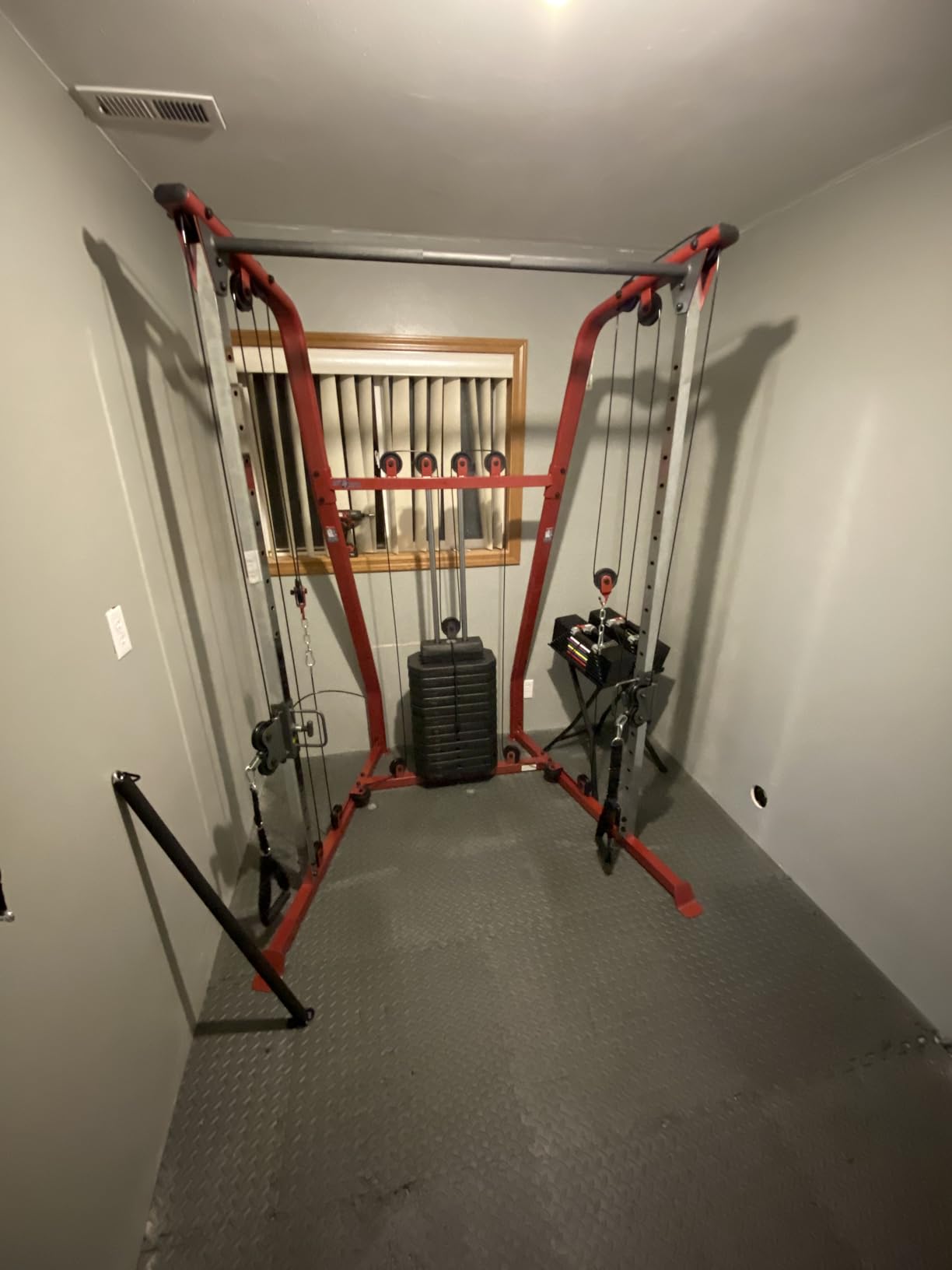
Most people picture a cable crossover as two tall uprights and a stack in the middle, and that is exactly what this is. At 112 inches wide and 39 inches deep it is a real footprint commitment, but it buys you a full length high pulley, low pulley and swiveling pulleys that rotate more than 180 degrees for crossover and fly work.
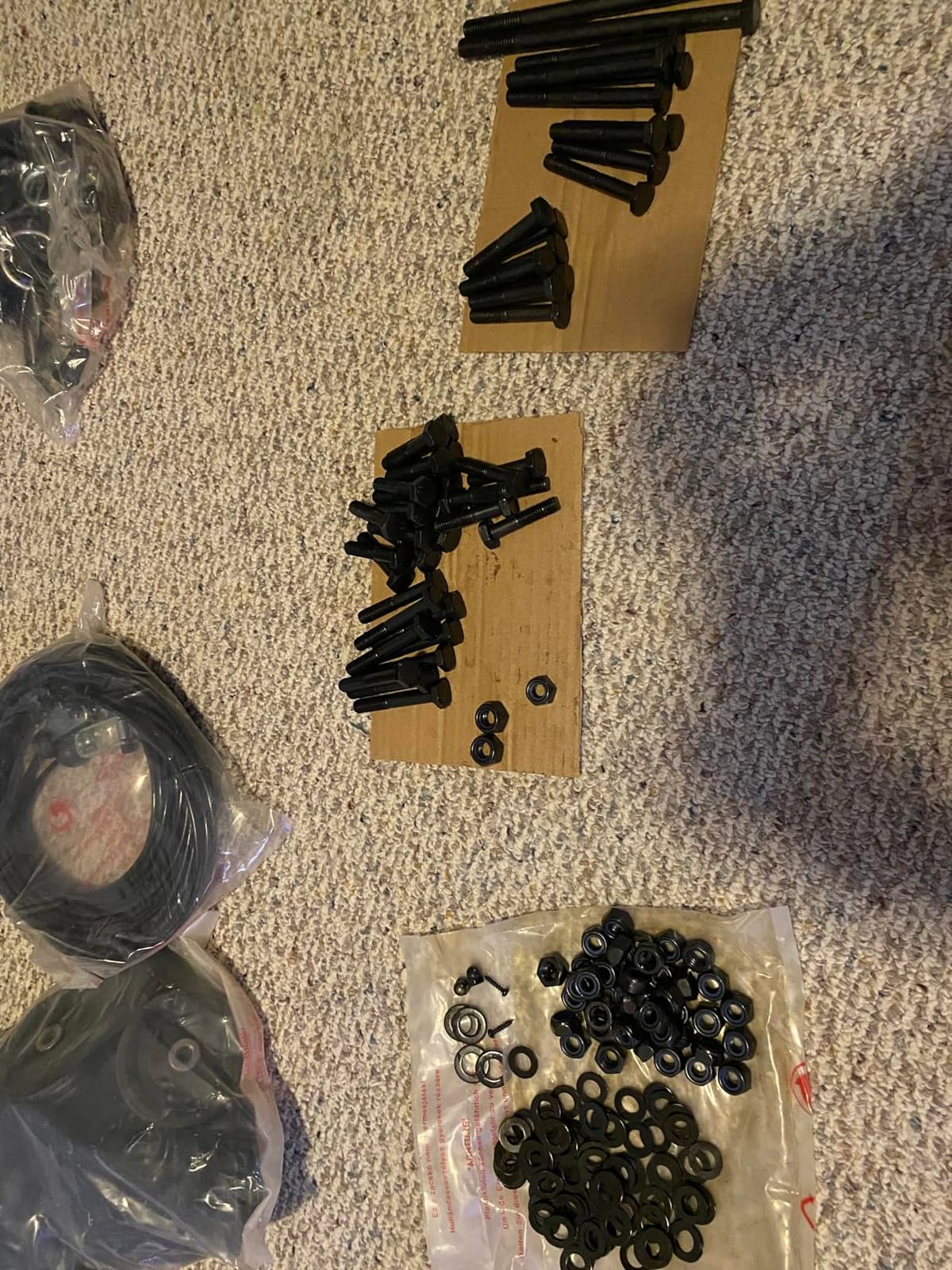
The pulley engineering here is the reason it feels better than the price suggests. Body-Solid uses a nylon bushing design paired with sealed ball bearing pulleys, and a small bottle of silicone spray ships in the box. Apply it to the carriages and the weight stacks glide the way they do in a commercial gym.
Warranty is the quiet strength. The frame carries a 10 year warranty with a one year parts warranty, and spare part availability is listed at a decade, which is far longer than anything else in this roundup. For a machine that will sit in a garage for a decade, that matters more than the last few pounds of cable smoothness.
The catch is the pulley ratio, which runs at roughly 1:2. Owners consistently describe the practical ceiling as around 120 to 130 pounds of useful resistance even though the listed maximum is 133 pounds, so roughly half of what you load does not reach the handle.
Who the Body-Solid Best Fitness suits
Pick this if you want one machine that supports pec fly, bench press, crossover, upright row, shoulder press, lat pulldown, bent over row, seated row, ab crunch, tricep pressdown, thigh abduction, calf press, reverse fly and glute kickback. That list comes from the manufacturer and it is not exaggerated.
It is also the sensible choice for anyone buying for a shared household gym where several people train different ways. Two independent sides mean two people can work at once.
Who the Body-Solid Best Fitness does not suit
Assembly is the weak point. Owners describe a large single bag of mixed, unlabeled hardware, carriages that stick on the uprights until lubricant is applied, and a few units arriving with missing pieces or a misaligned arm that had to be replaced. Budget an afternoon and read the manual before you open the bag.
Advanced lifters chasing heavy cable tension should step up to the Powerline PFT100 with its larger stacks, or accept the ratio as a limitation. Nobody loves the 1:2 feel, but for hypertrophy work it is entirely workable.
3. Inspire Fitness FTX Functional Trainer – Best Premium Compact Trainer
Inspire Fitness FTX Functional Trainer – Compact at Home Workout Machine with Accessories – Space Saving Design – Home Gym Cable Machine and Two 165 lb Weight Stacks
Two 165 lb stacks
330 lb total tension
40 x 54 in footprint
544 lb unit weight
Friction-free pulleys
Pros
- Two independent 165 lb weight stacks
- Very compact for a full trainer
- Smooth quiet cable carriage
- Complete accessory kit
- Phone holder and storage rack
Cons
- Stacks cannot be upgraded later
- Top pulley setting is low for tall users
- Very heavy and hard to move
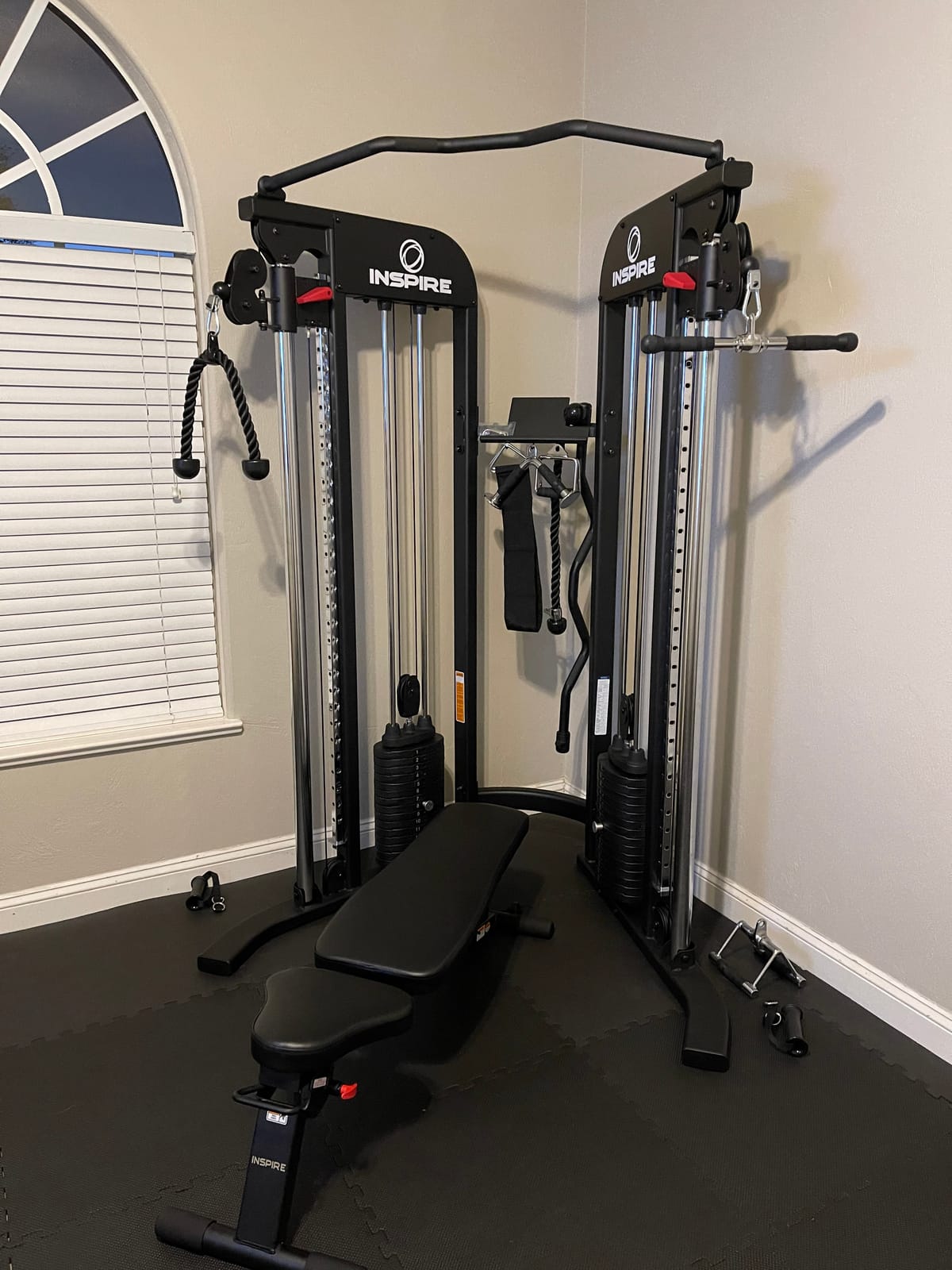
The FTX is the one that made us stop and reconsider what a compact trainer can be. At 40 inches wide and 54 inches deep, it holds two independent 165 pound weight stacks, and owners describe the cable feel as the smoothest in this group with no squeaks or rattles even under daily use.
It arrives as a full kit. You get a tricep rope, two deluxe D handles, a dual hook curl bar and a chin and dip belt, plus a pull-up bar, a phone or tablet holder and a small accessory rack. There is a 3 month subscription to the Centr training platform included as well, which is a bonus rather than a reason to buy.
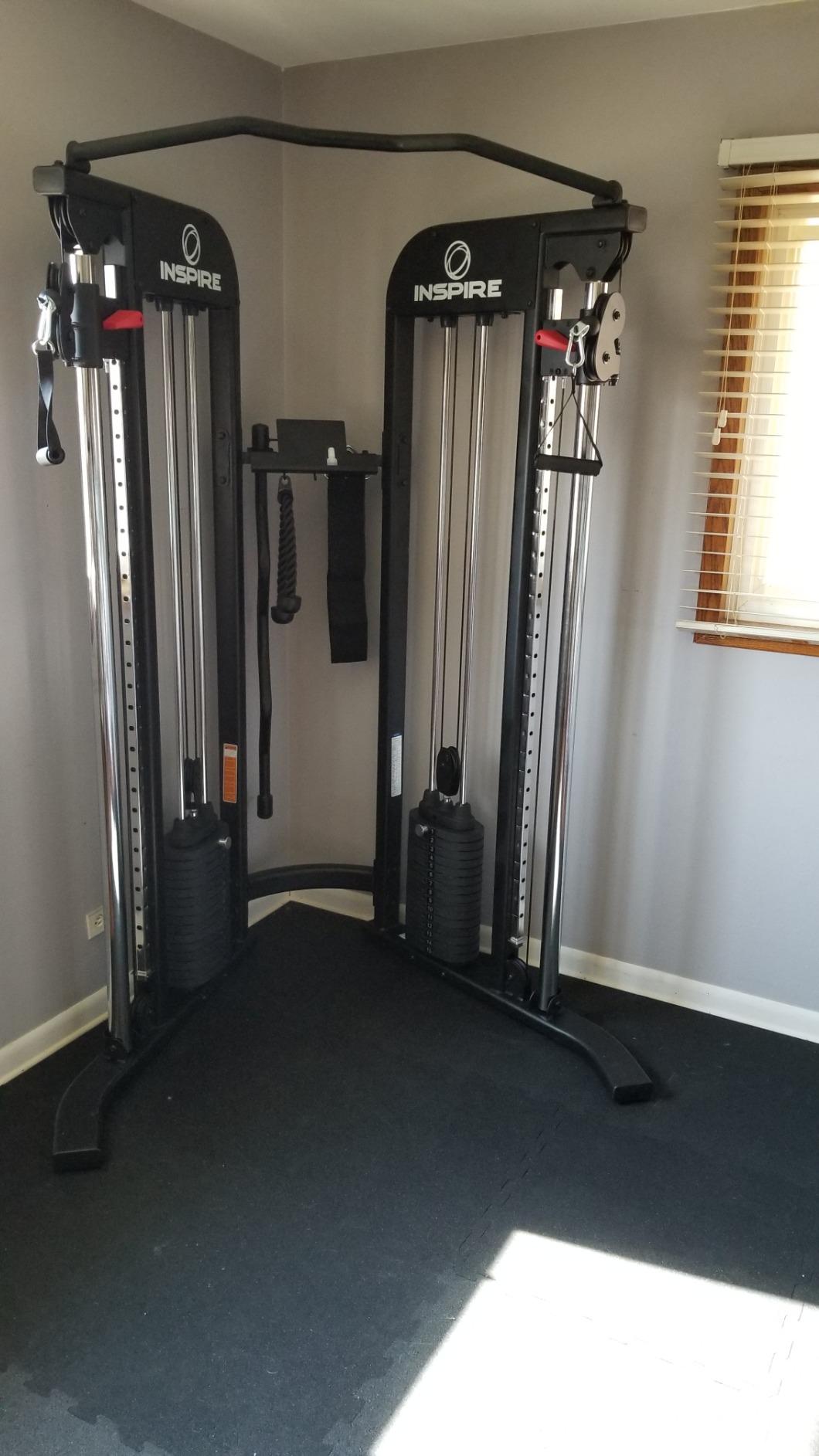
The build is what justifies calling this premium. It is alloy steel in matte black, rated to 165 pounds per side for 330 pounds of total cable resistance, and the sliding pulley carriage has the balanced, friction free travel you would find on a commercial functional trainer.
Two things to plan around. The unit weighs 544 pounds and arrives in multiple boxes, so realistically you want two or three people and a clear path to the final position. And the highest pulley setting sits lower than on a full crossover, which owners with above-average height mention as a limit on lat pulldown stretch.
Who the Inspire FTX suits
This is the pick for a dedicated garage gym where you want one high quality machine instead of a rack plus a separate cable tower. If you care about how the carriage feels under load, this is the machine in our group that owners describe most like commercial equipment.
Two independent stacks also make unilateral work and partner sessions straightforward. For a household where two people train at once, that independence is worth paying for.
Who the Inspire FTX does not suit
Buyers planning to grow their resistance should know the stacks are not upgradeable. If you think you will outgrow 165 pounds per side in a year or two, the Body-Solid Powerline is the more future-proof buy because a 210 pound dual stack variant exists for it.
It is also the wrong machine for a low ceiling garage with a difficult floor path, and support can be slow on questions about upgrade parts. Single lightweight accessories, including the 5 lb increment weights, are sold separately at a high cost.
4. Body-Solid Powerline Cable Crossover PFT100 – Best Dual Stack Machine
Body-Solid Powerline (PFT100) Cable Crossover Exercise Machine for Home & Commercial Gym, Functional Training Center with Dual 160lbs. Weights Stack for Cable Workout
Two 160 lb stacks
42 x 62 in footprint
210 lb stack option
1:2 cable ratio
10 year frame warranty
Pros
- True isolated movement on both sides
- Very smooth friction free glide
- Precise machining and hole alignment
- Extra wide stable mainframe
- No wall mounting needed
Cons
- Assembly takes 2 to 4.5 hours and needs two people
- Instructions list bolts that are not supplied
- 476 lb unit is hard to move indoors
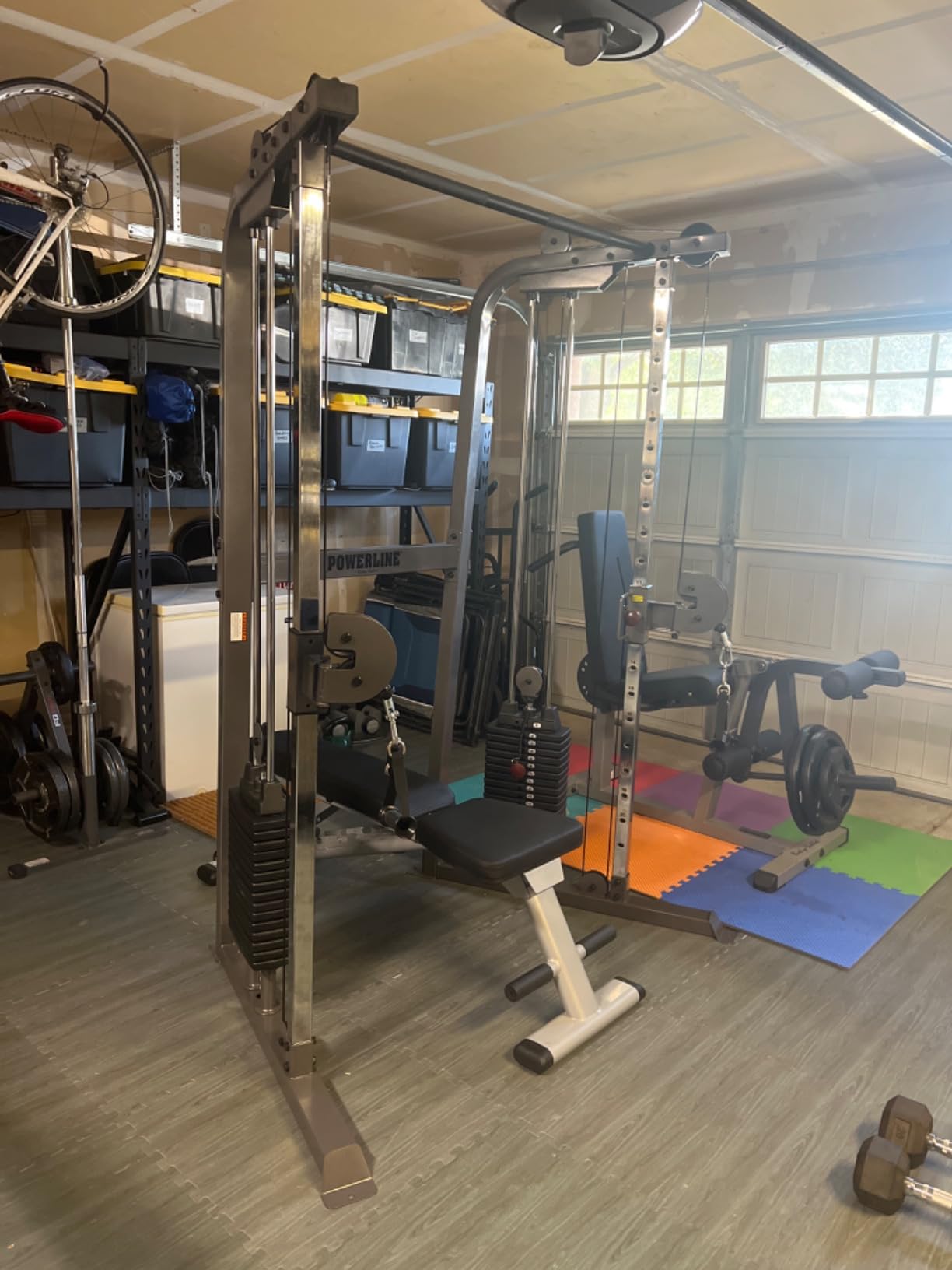
The Powerline is the machine to buy if cable tension is the thing you care most about. It carries two independent 160 pound weight stacks, and a 210 pound dual stack version of the same frame exists, so the resistance ceiling is genuinely higher than anything else in this roundup.
Everything about the machining is described well by owners. Holes line up precisely, the glide is smooth with no grinding or noise once assembled, and the extra wide mainframe stays solid even with both stacks fully loaded. It is a freestanding design, so no wall mounting is involved.
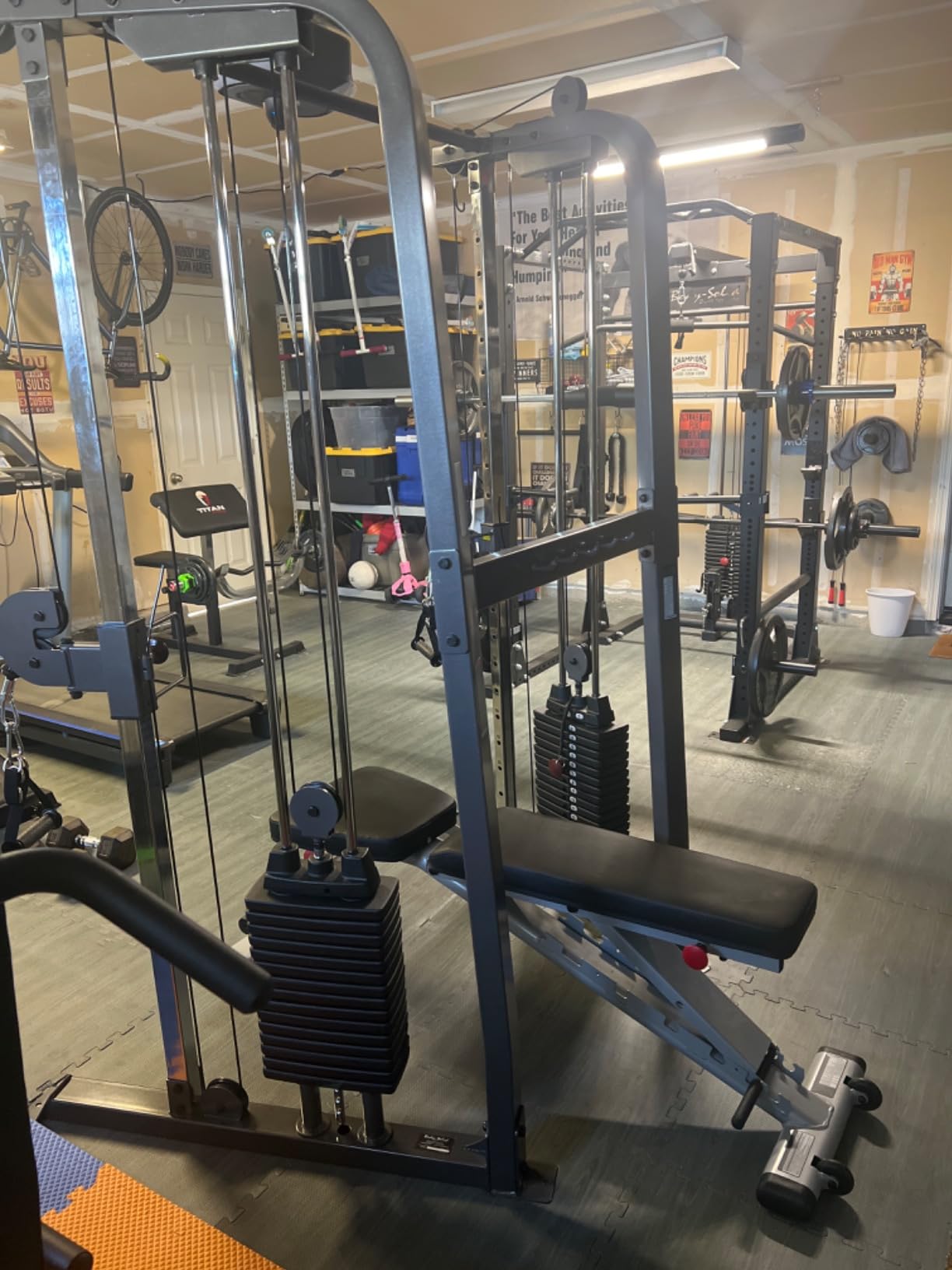
Warranty coverage matches the Best Fitness at 10 years on the frame and one year on parts, and the powder coat finish is applied electrostatically. The listed maximum weight recommendation is 210 pounds, which lines up with the heavier stack option.
It is not a small purchase in every sense. The frame is around 476 pounds, which is the second heaviest unit we covered, and it is the machine most likely to need a second pair of hands to move through a doorway and into a basement.
Who the Powerline PFT100 suits
Owners frame it as commercial performance without commercial pricing, and the exercise list is long: pec fly, crossover, upright row, shoulder press, lat pulldown, seated row, ab crunch, tricep pressdown, thigh abduction, calf press, reverse fly and glute kickback. It suits a garage with real floor space and someone training seriously.
If you already own plates and want to add cable work without changing your loading habit, the stack upgrade path makes this the flexible option in the group.
Who the Powerline PFT100 does not suit
Assembly is the honest drawback. Owners report two to four and a half hours of build time, realistically needing a second person to hold the uprights, plus instructions that are vague in places and list more set screws than are actually supplied.
It is also the wrong pick for a small room. At 42 by 62 inches you are giving up a meaningful block of floor, and the 1:2 ratio still means loaded weight translates to about half the perceived resistance unless you move up to the heavier stack.
5. Mikolo Folding Squat Rack with Cable Crossover – Best Machine That Folds Away
Mikolo Folding Squat Rack, Wall Mounted Power Rack with Cable Crossover Machine & LAT Pull Down, Functional Trainer with 5 Adjustable Function Modes, for Home Gym and Space Saving(Black)
Folding wall mounted rack
1:1 cable ratio
1000 lb rated frame
68 x 30 in footprint
15 pulley heights
Pros
- Folds from 9.5 sq ft down to 3 sq ft
- Power rack and cable crossover in one
- True 1:1 ratio for easy math
- 1000 lb rated 14-gauge steel frame
- Over 80 exercise variations
Cons
- Must be wall mounted to be stable
- Limited placement options in a room without studs
- 1 year manufacturer warranty
If your gym shares a room with a car, a drying machine or a treadmill, folding capacity changes the whole decision. The Mikolo WR00 expands to about 9.5 square feet for squatting and folds down to roughly 3 square feet for storage, and it is still a functional power rack when it is open.
What makes it interesting for cable work is the ratio. This is a true 1:1 pulley system, so the load on the handle matches the load on the plates exactly. No mental arithmetic, and no surprise at the top of a set.
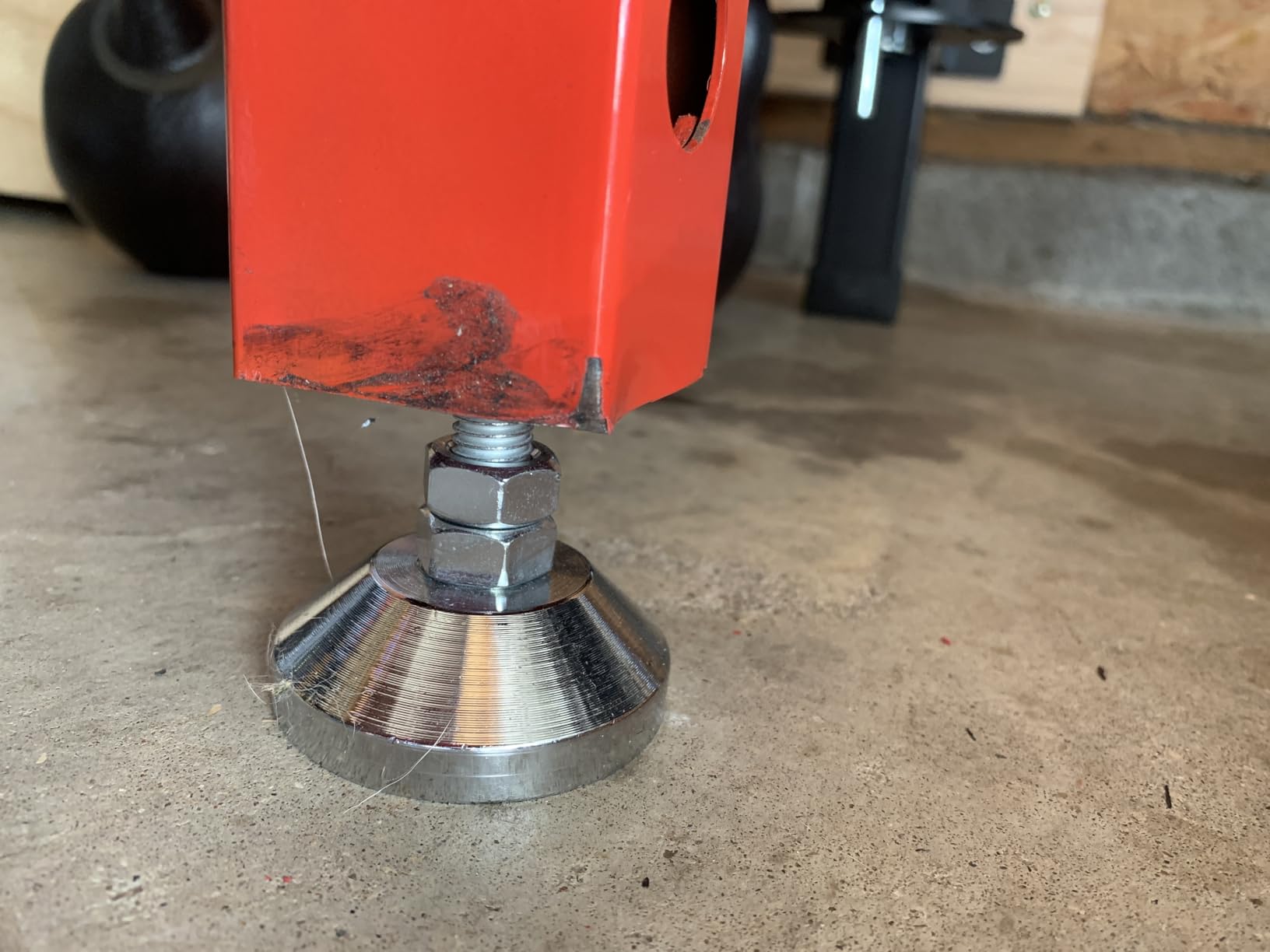
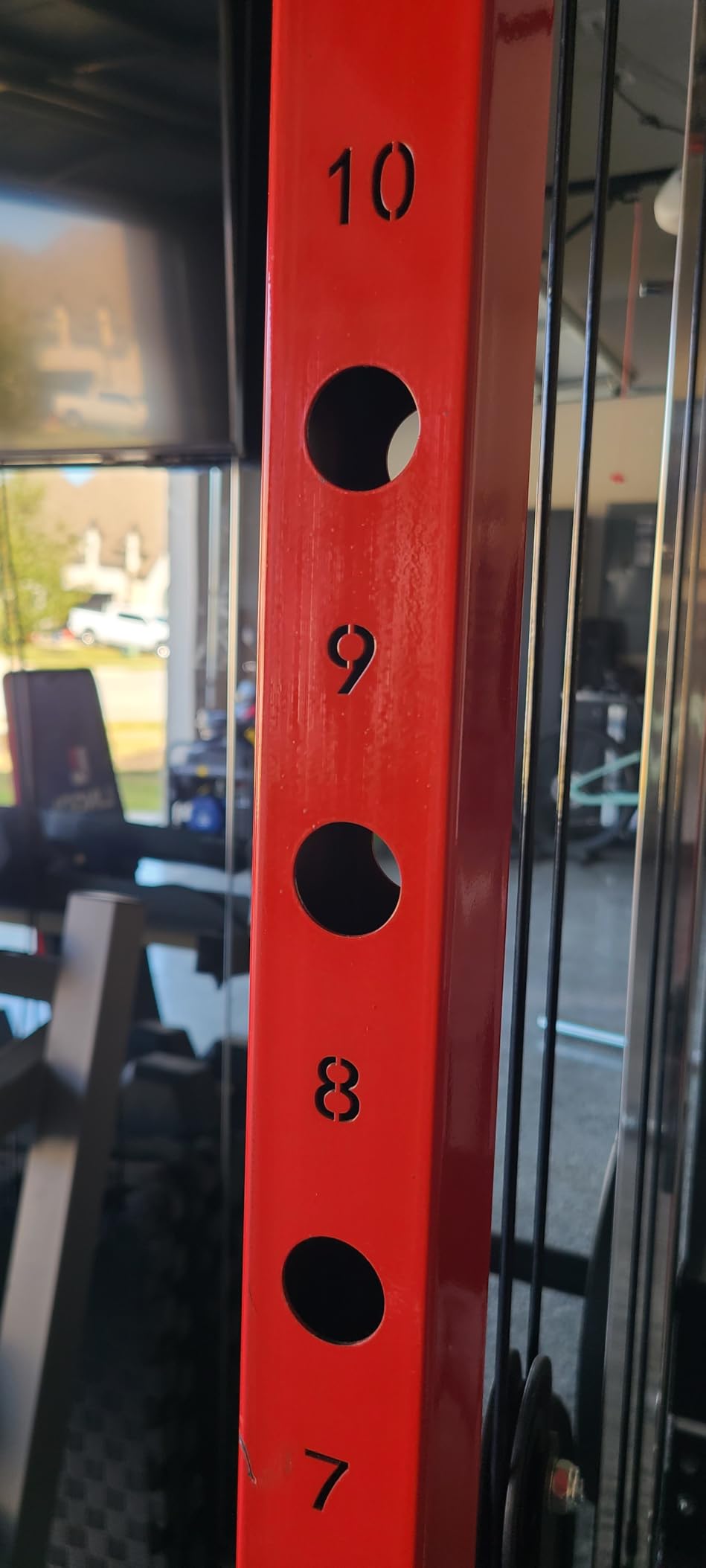
The frame is 2 by 2 inch 14-gauge steel rated to 1000 pounds, with reinforced wall mounts and four adjustable ground support feet. The single-handed pulley adjustment gives 15 height options across five function modes: folded, semi-open, power rack, functional trainer and cable crossover.
Also included are a detachable pull-up bar and premium J hooks, and owners cite the number of supported movements, more than 80 variations, as the reason it feels versatile rather than like an accessory bolted to a rack.
Who the Mikolo folding rack suits
This is for shared spaces and rentals, where a permanent machine bolted to the floor is not an option. It gives you a power rack and a cable crossover in one frame, so a single purchase covers squatting, pulling and pressing work.
For anyone who wants honest load numbers, the 1:1 ratio is the reason to pick it over a 2:1 cage. You know exactly what you are pulling.
Who the Mikolo folding rack does not suit
It has to be anchored. Owners are clear that wall mounting is required for stability, which means you need suitable studs or anchors and you give up freedom in placement. In a room with no suitable wall, this design does not work for you.
Warranty is also the thinnest in the group at one year, which is a real difference next to the 10 year frame coverage on the Body-Solid machines. If long-term support matters to you, budget for that.
6. Mikolo Wall Mount Cable Station M-G3 – Best for Heavy Plate Loading
Mikolo Wall Mount Cable Station, Cable Crossover Machine with Dual Pulley System and 19 Adjustable Positions for Home Gym Fitness Equipment, Red
Wall mount
19 pulley positions
400 lb load capacity
2200 lb tensile cables
27 x 26 in footprint
Pros
- Roughly 3 square foot footprint
- 19 pulley height positions
- 400 lb capacity on 14-gauge steel
- Lat bar cable bar and rope included
- H-shaped anti-shake base
Cons
- Included plastic pulleys add friction
- Locking pin feels flimsy
- Concrete wall anchors not included
This is the wall station for people who want to load serious weight. The M-G3 is rated to 400 pounds, the highest capacity of any wall mounted cable station we covered, on a 14-gauge powder coated steel frame with nylon coated cables rated to 2200 pounds of tensile strength.
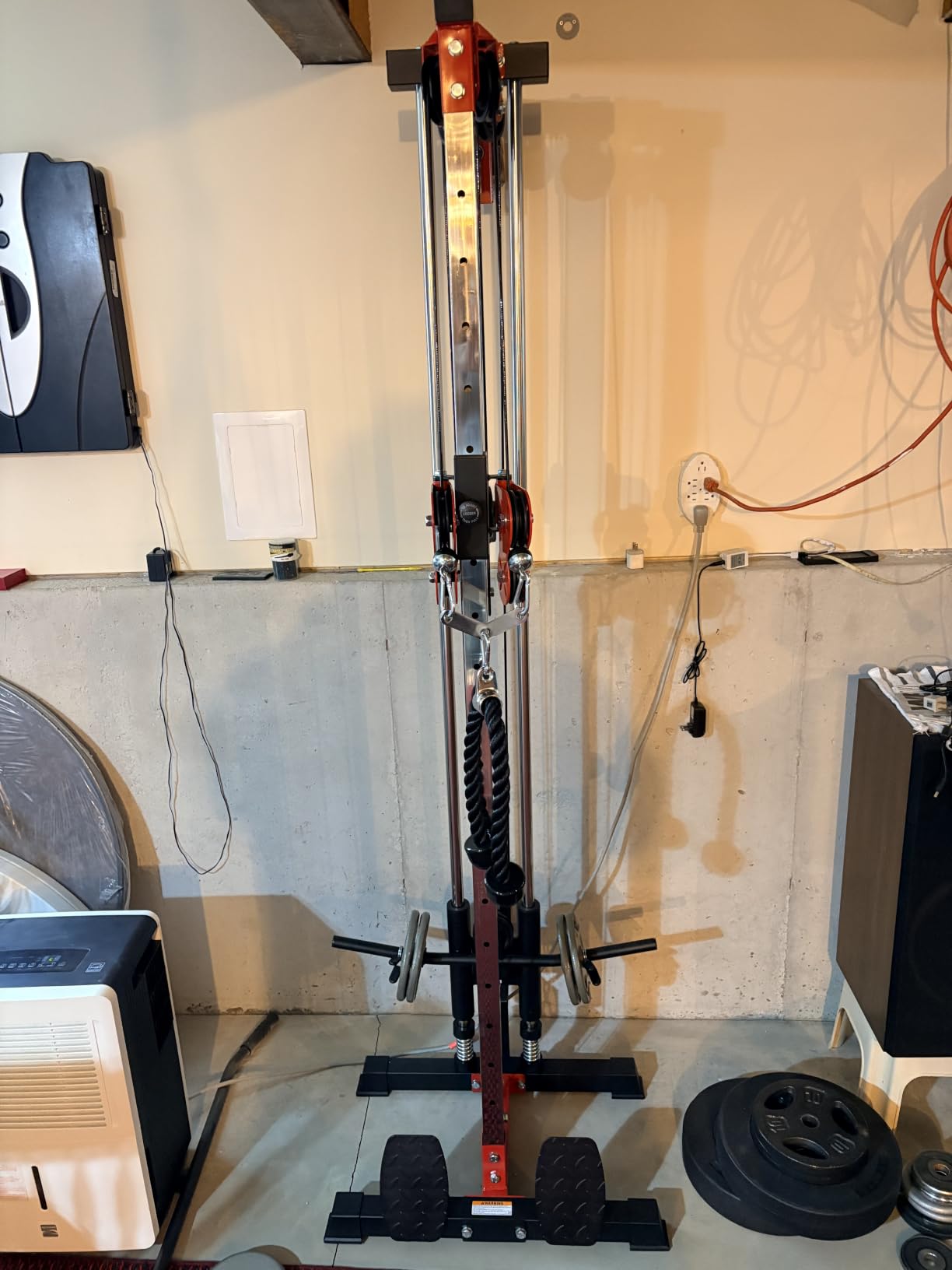
Nineteen pulley positions with a rotating pulley bracket give more usable range than most competitors, and several owners put together the unit solo in an hour or two. The H-shaped base is designed to stop the unit shaking when you load a heavy pull.
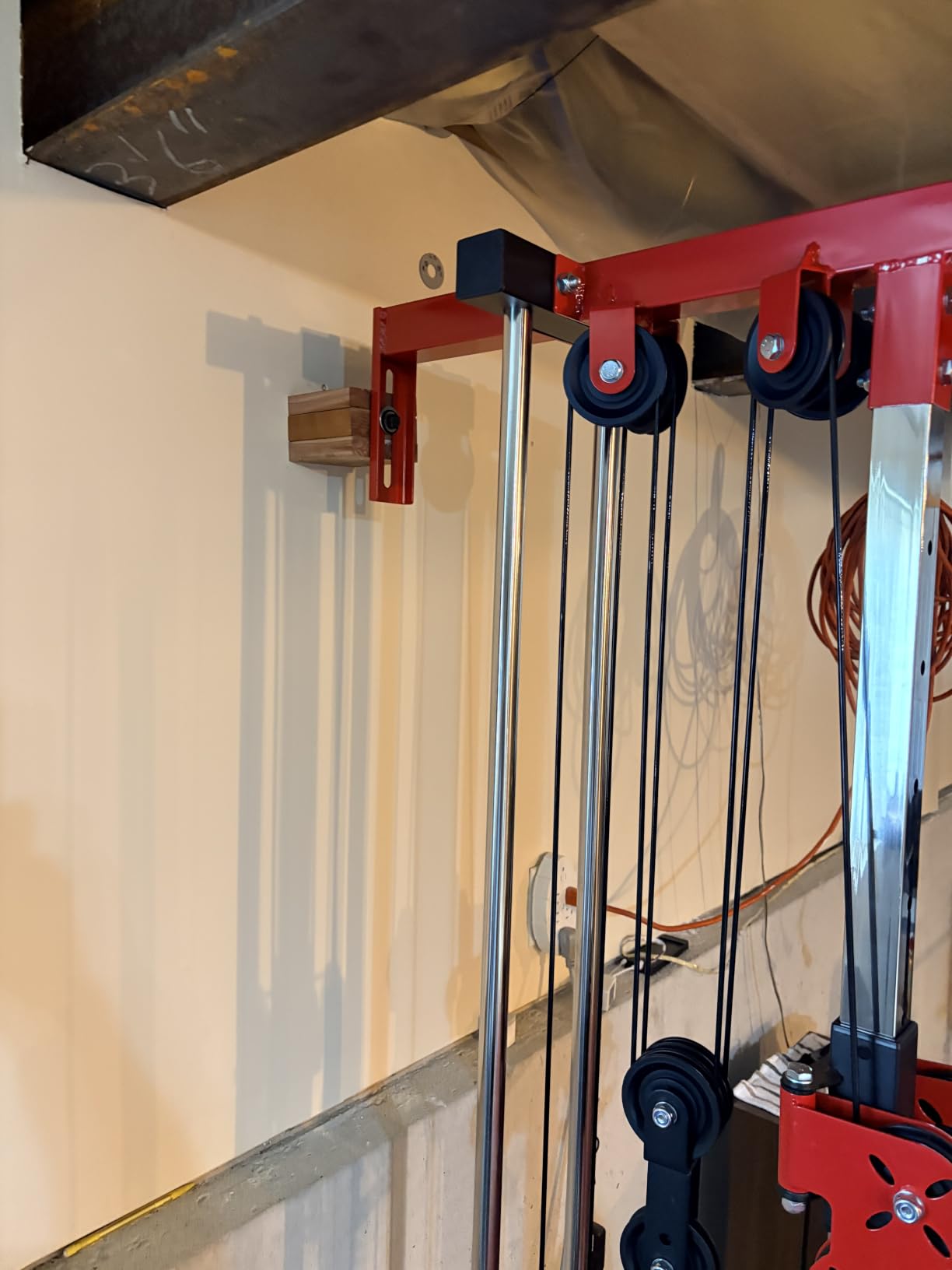
The extras are unusually good for a wall station. You get a lat bar, a cable bar, a tricep rope and adjustable strap handles with four buckles, plus detachable sleeves that accept both one inch and two inch plates. A large footboard makes seated rows comfortable, and the weight pegs angle upward about 10 degrees to stop plates sliding off.
The main thing owners upgrade is the pulley set. The included plastic pulleys add friction, and several people swap to aluminum versions for a smoother feel. A few also report that the pulley locking pin feels flimsy, and post clips that hold the plates can fit loosely.
Who the Mikolo M-G3 suits
Pick it if you train heavy on cables and your wall studs can handle the load. The 400 pound rating and 19 positions give you room to progress, and the rotating bracket widens the range of angles you can pull from.
It is also a strong choice for a shared attachment library, since the included bar, rope and handles cover most pressing, pulling and curling patterns out of the box.
Who the Mikolo M-G3 does not suit
If friction bothers you, be prepared to replace the pulleys. Several owners did that unprompted and reported the single biggest improvement in how the machine feels, but it is an extra step nobody should discover after a year of training.
Concrete wall anchors are not included, and the installation directions are picture only. A few units also arrive with a damaged wheel, and the frame is on the short side for very tall users.
7. Goimu WM1 Wall Mount Cable Station – Best for Switching Cable Ratios
Goimu Wall Mount Cable Station, WM1 Cable Crossover Machine with 17 Positions, High and Low Cable Crossover Machine with Removable Footplate for Garage Home Gym (WM1 Cable Station RD)
Wall mount
Switchable 1:1 and 2:1
17 pulley positions
300 lb capacity
3.28 sq ft footprint
Pros
- Switches between 1:1 and 2:1 ratios
- 3.28 square foot footprint
- Hardware bagged and labeled by step
- 14-gauge steel H-shaped base
- Lat bar cable bar and rope included
Cons
- Cables can arrive too long and need clamps
- Occasional cosmetic scuffs
- No quick release carabiner included
The WM1 solves the problem that trips up most buyers. Its SmartT dual pulley system switches between a 1:1 and a 2:1 ratio in seconds, so you can pull 100 pounds on one setting and 200 on the other from the same plate. Nothing else at this size gives you both.
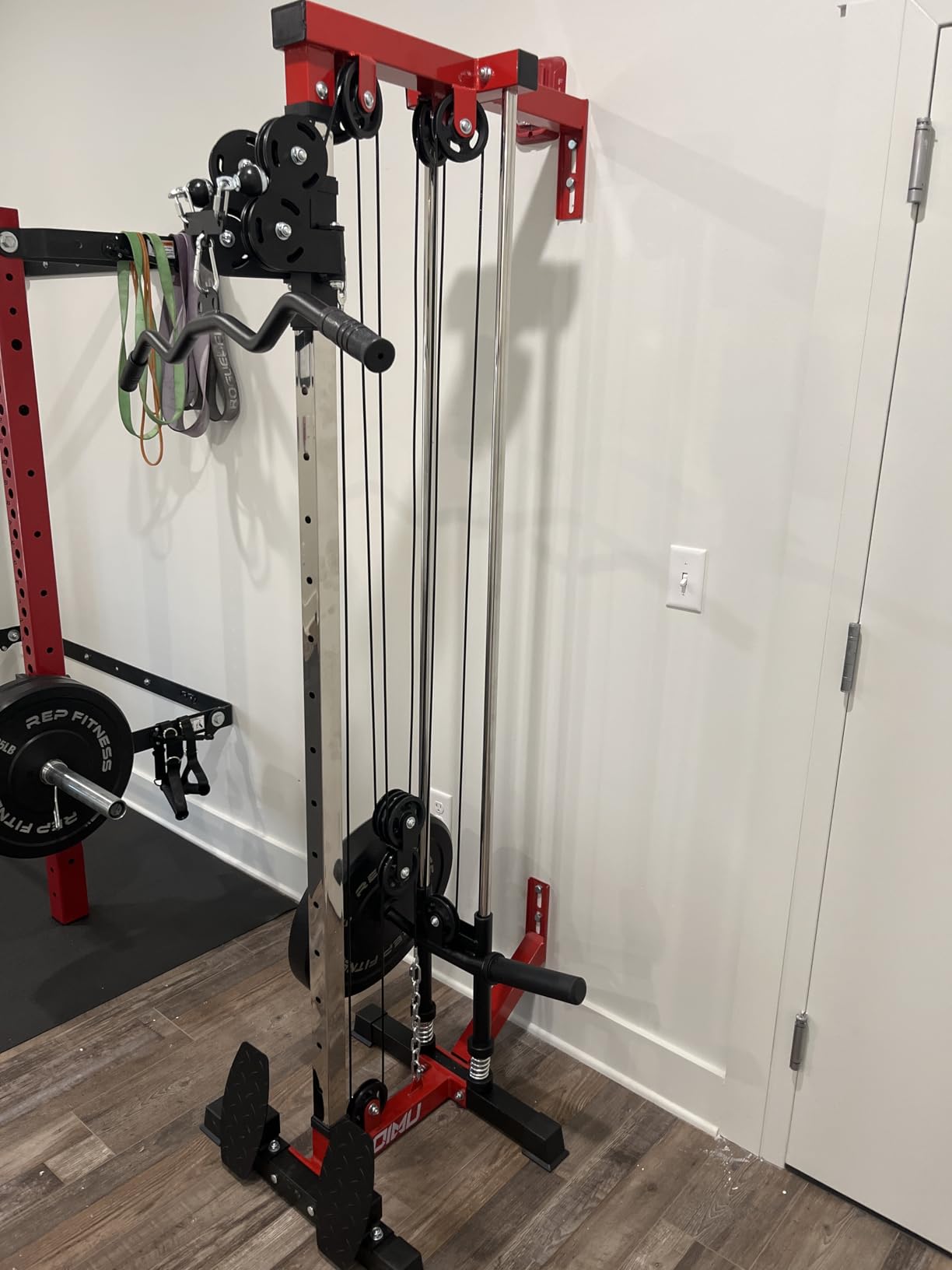
It is also one of the better assemblies in the group. The hardware is bagged and labeled by the step it belongs to, and owners report finishing setup in about an hour without a manual fight. The 3.28 square foot footprint tucks flush against a wall.
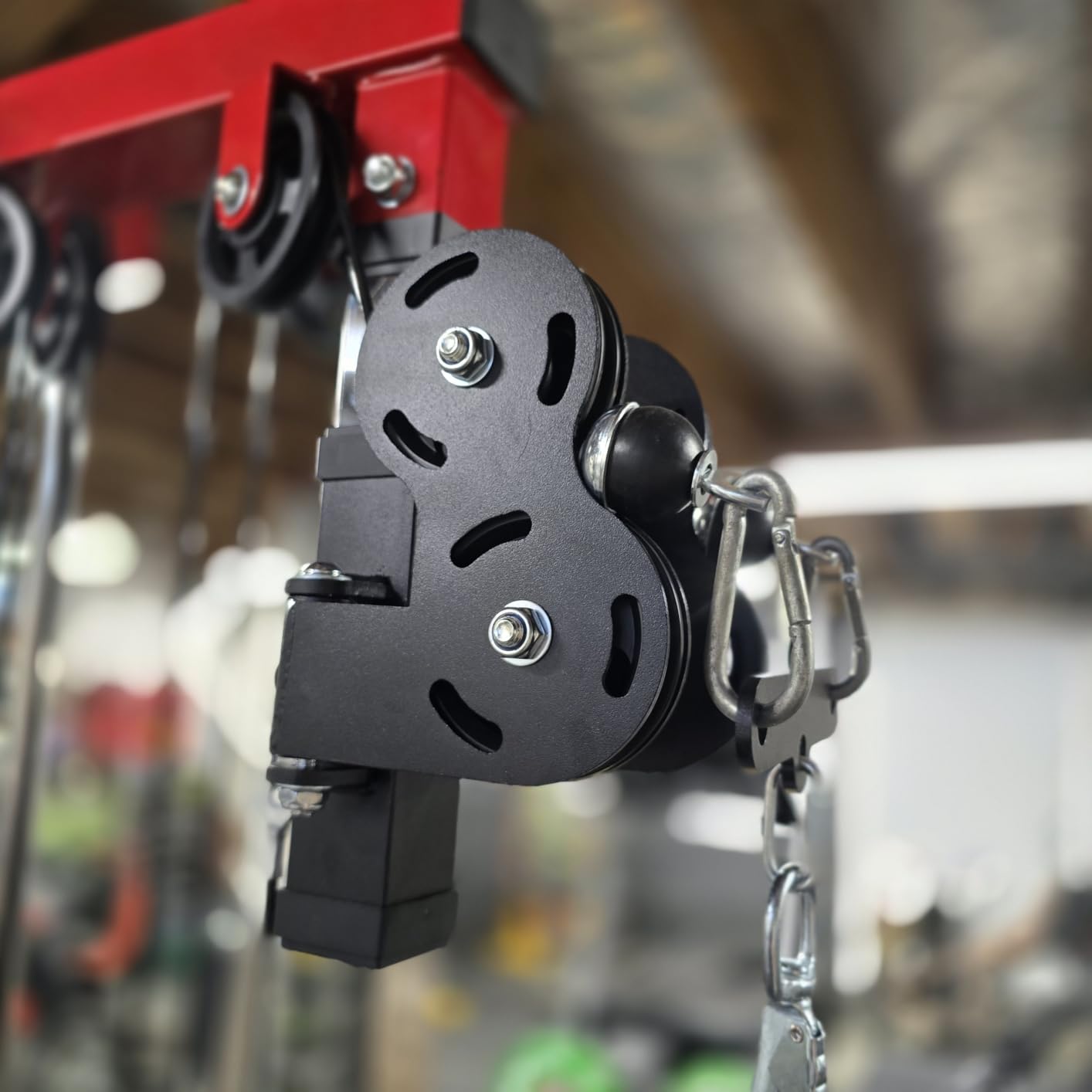
Capacity is 300 pounds on 14-gauge alloy steel with reinforced brackets and an H-shaped base that resists wobble. There are 17 pulley positions, and the removable footplate makes seated work easier. The box includes a lat pulldown bar, a cable bar, a tricep rope and two D-ring handles, and the warranty is two years.
Owners consistently report smooth, consistent cable travel once the unit is mounted correctly. The install step that matters is anchoring into studs rather than drywall, which applies to every wall mounted unit in this roundup.
Who the Goimu WM1 suits
This is the pick when you are still working out whether you want straight cable tension or a doubled mechanical advantage. Being able to try both on the same machine removes the guesswork entirely, which is why it works well for a first serious cable purchase.
It suits beginners too. The step-labeled hardware makes a solo build realistic, and the 17 positions cover presses, rows and flyes without a learning curve on the assembly.
Who the Goimu WM1 does not suit
Some cables arrive longer than they should be, which leaves slack until you add cable clamps. A few units also show cosmetic scuffs and finish rubs out of the box, and a mis-placed weld on a small number of units slightly affects how the pulley swivels.
Attachment changes are slower than they should be because no quick release carabiner is included. Buying a set of load rated carabiners is the first upgrade most owners make.
8. Goimu LS01 Lat Pulldown and Row Tower – Best for Pulldowns and Rows
GOIMU LAT Pulldown Machines, LAT Row Cable Machine, LAT Tower with Additional Pulley Cable, High & Low Pulley Stations(Red)
High pulley low row and ab crunch
3.12 sq ft footprint
80 lb unit weight
Adjustable padded seat
Detachable plate sleeves
Pros
- Three training modes in one tower
- Solid 2 mm steel tubing
- Three height padded seat with leg hold-down
- 3.12 sq ft footprint
- Staged blister packs ease assembly
Cons
- Short cable travel limits full extension
- Instructions are mostly pictures
- Short weight pegs limit plate loading
Not every cable machine is a crossover, and sometimes that is the point. The LS01 is a lat pulldown and low row tower with an ab crunch station built in, which is the combination most beginners picture when they say they want a home cable machine.
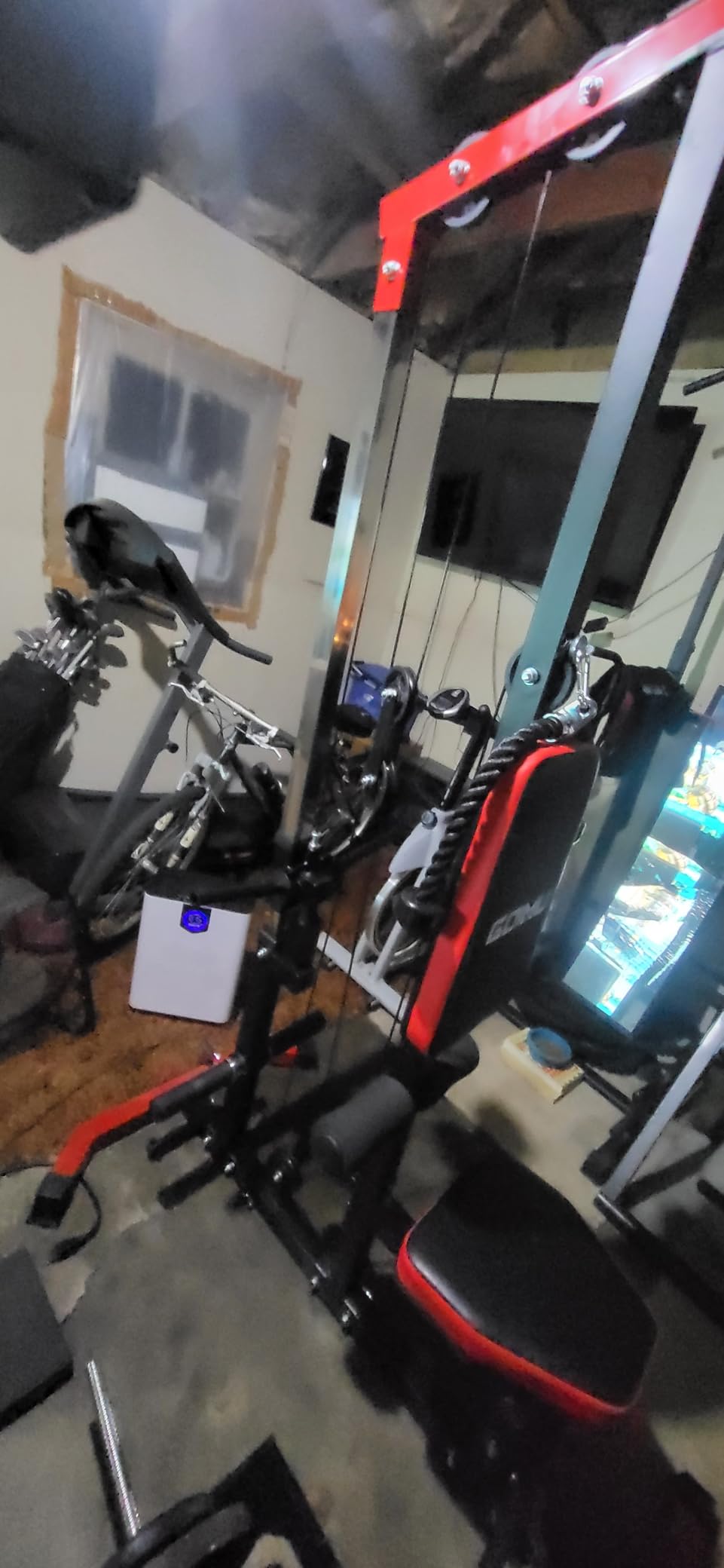
Once assembled it is genuinely sturdy. The frame uses 2 mm steel tubing, the padded seat adjusts to three heights, and a leg hold-down keeps you anchored for both rows and pulldowns. The 3.12 square foot footprint fits an apartment corner or the back of a garage.
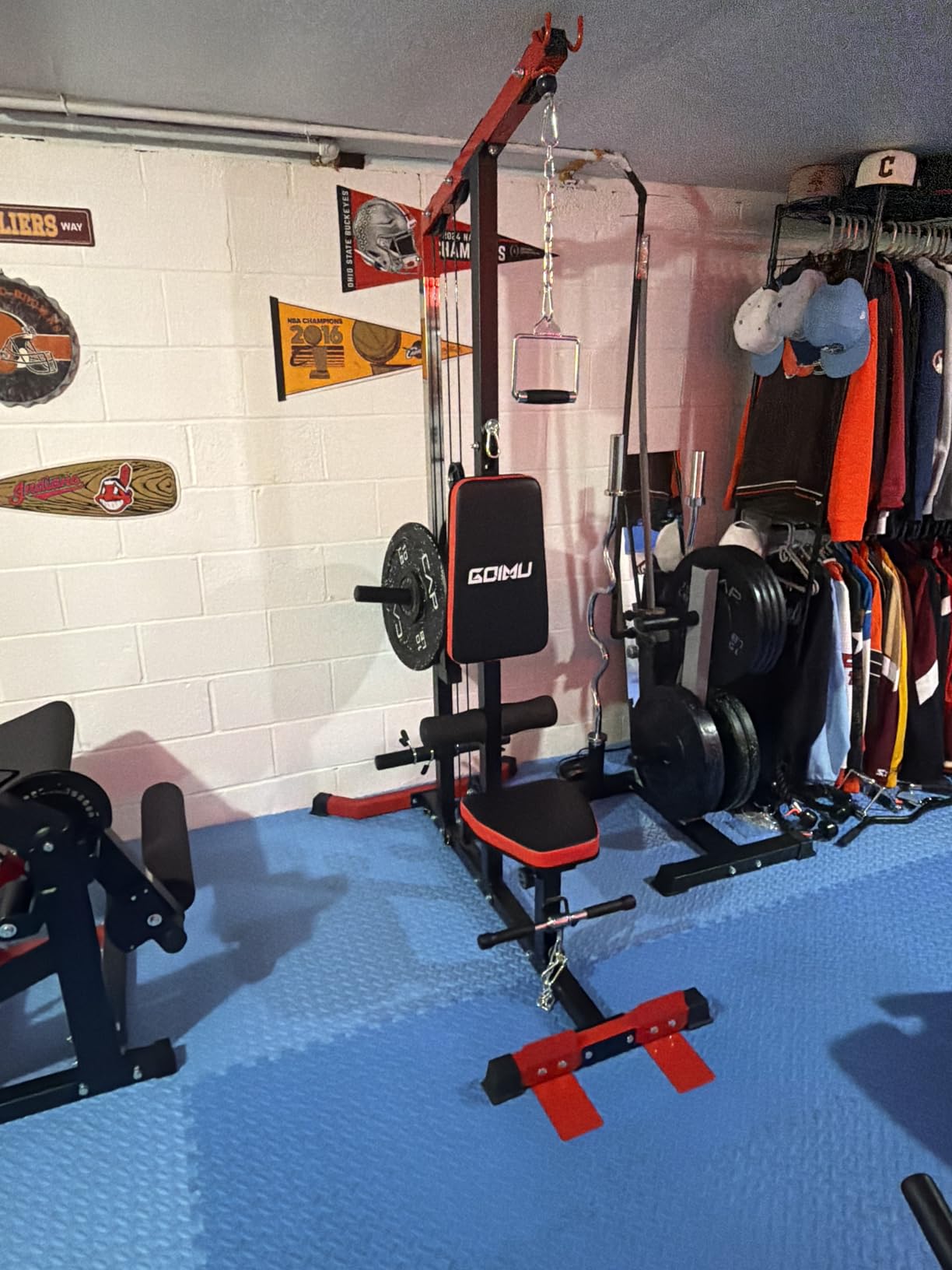
Assembly takes about two hours and the hardware comes in separate blister packs per stage, so nothing is left to guess at. You get a lat bar, a cable bar, a tricep rope, the ab crunch attachment and band pegs, and the detachable sleeve accepts one inch or two inch plates.
It is a genuinely capable tower for pull work, and the included seat and crunch attachment let you cover both vertical and horizontal pulling plus core training without buying anything else.
Who the Goimu LS01 suits
This is the right choice for someone whose training is mostly back work. If your program is built around lat pulldowns, seated rows and ab work, a crossover adds reach you would never use, and this tower does the job in a third of the floor space.
Owners treat it as excellent value, and the staged hardware packs make it a realistic first build for someone assembling alone.
Who the Goimu LS01 does not suit
Cable travel is the limitation to know about. It is short, which caps full extension on movements like face pulls and wood choppers. Taller users may also not reach full range of motion on the pulldown.
The instructions are largely pictographic, the pulleys have to be threaded in a specific sequence rather than fitted first, and a step in the manual mislabels H bolts as J bolts. The included weight pegs are also short, which limits how you can load them with bumper plates.
9. Titan Fitness 80.5 Inch Pulley Tower – Best for Low Ceilings
Titan Fitness 80.5″ Short Wall Mounted Pulley Tower, 350 LB Capacity Plate-Loaded Cable Machine, Adjustable Trolly Height, Standard & Olympic Plate Compatibility, Dual D-Handles Included
Plate loaded to 350 lb
18 trolley positions
80.5 in height
Standard and Olympic plate posts
Includes 12.5 in adapter sleeves
Pros
- Highest plate capacity among wall towers
- Standard and Olympic posts in one unit
- 18 trolley height positions
- D-handles adjust to four lengths
- Compact 80.5 in height
Cons
- Short frame limits usable positions
- Must be bolted to a wall or rack
- Rack mounting hardware not included
The Titan is built for one specific situation: a garage or basement where an 80 inch frame is the tallest thing that will fit and go through the door. At 80.5 inches tall, 25 inches wide and 28 inches deep, with a 65 pound unit weight, it is the easiest heavy unit here to install.
Where it outshines its wall station peers is loading. It is plate loaded to 350 pounds, the highest capacity of the wall mounted towers in this roundup, and it accepts both standard one inch and two inch Olympic plates out of the box with 12.5 inch nylon adapter sleeves in the box.
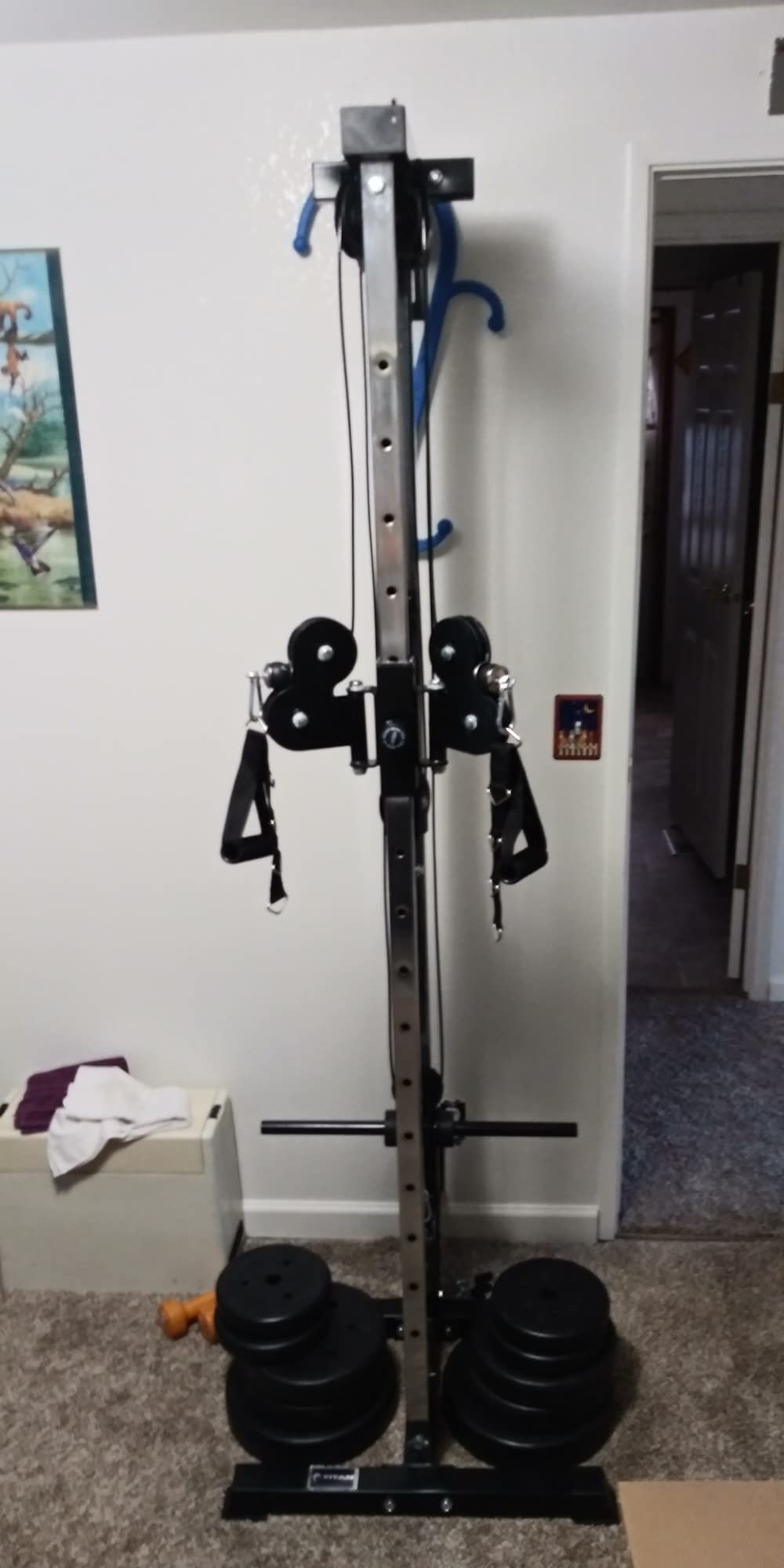
The chrome trolley adjusts across 18 height positions, and the included dual D-handle straps adjust to four lengths. Owners report steady 2:1 cable pulls from the D handles with a 1:1 option also available, so you are not locked into one feel.
It can also mount to a Titan T-3, X-3 or Titan Series power rack, which is the answer to the rack mounted cable question if your rack is from the same brand. The 2 by 2 inch powder coated tubing has rubber feet that protect the floor.
Who the Titan tower suits
Owners with low ceilings and standard plates are the clear target here. The dual plate posts mean you are not hunting for adapters you do not have, and 350 pounds of plate capacity handles a serious load.
If you already run a Titan power rack, this is the cheapest way to add cable work to it without a freestanding unit taking up the floor.
Who the Titan tower does not suit
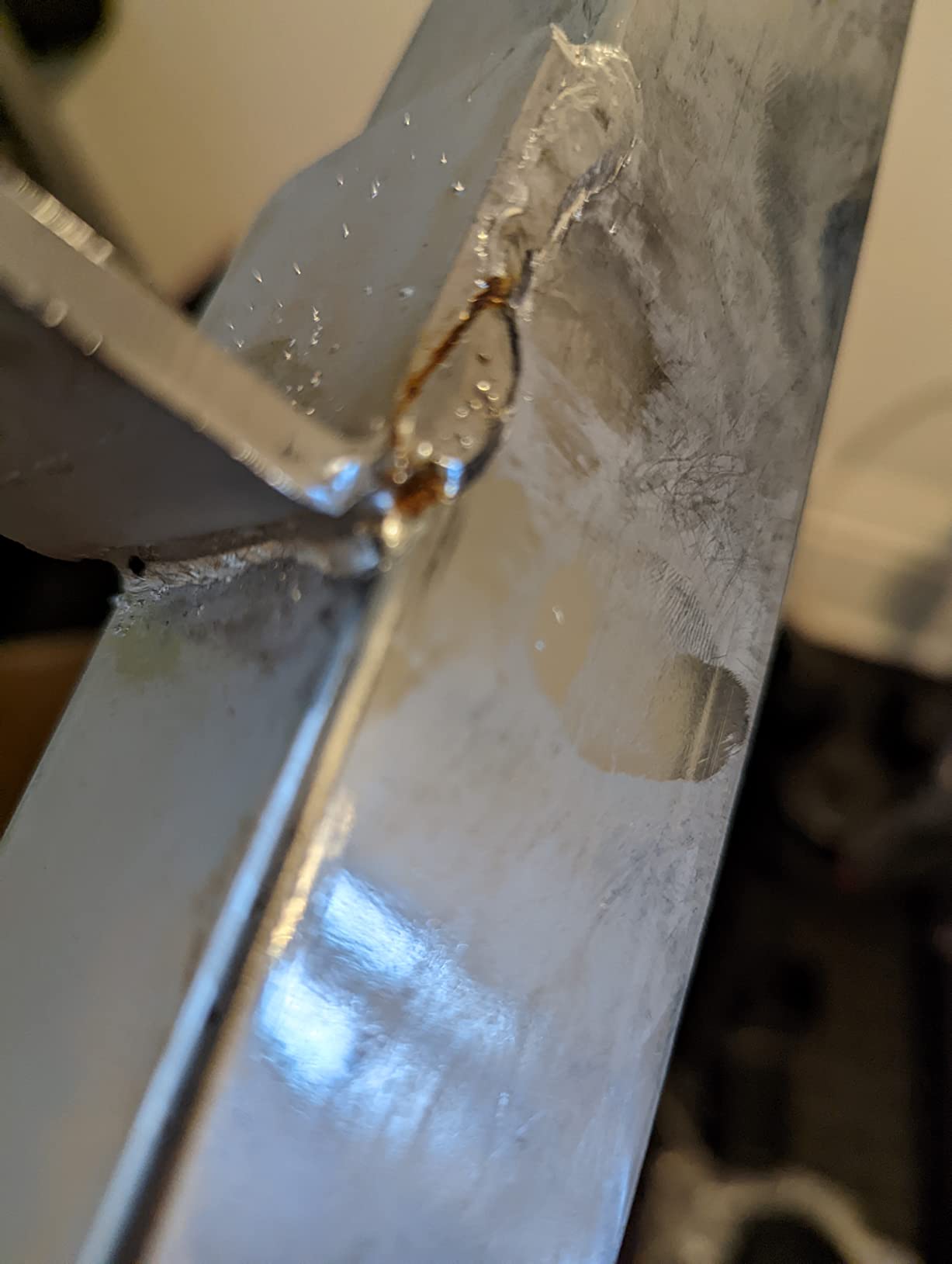
The short overall height is the trade. It reduces the number of positions that are genuinely comfortable and can feel tight for taller users, and it is the lowest rating of the wall towers we covered at 4.3 out of 5.
Mounting hardware for attaching to a Titan power rack is not included, so budget separately for that. It is also not freestanding, which means it does nothing until it is bolted to a wall or a rack.
10. ER KANG Wall Mount Cable Station – Best Included Attachment Bundle
ER Kang Cable Station Wall Mount, 18in Pulley Tower, Dual Pulley System, High & Low Cable Machine, LAT Pull-Down & Row Tower with Flip-Up Footplate, Home Gym Cable Crossover, Black
Wall mount
18 pulley positions
400 lb capacity
11-gauge steel frame
2200 lb tensile cables
Pros
- Highest average rating in the group
- Commercial grade 11-gauge steel frame
- 400 lb capacity with H-shaped base
- Lat bar cable bar and rope included
- Double pole track smooths cable travel
Cons
- Wall mounting is required
- Included accessories are basic
By owner satisfaction this is the strongest machine here, with a 4.7 average and 87 percent of reviewers at five stars. That number rests on a simple, well executed design: an 11-gauge powder coated steel frame, 400 pounds of load capacity, and nylon coated cables rated to 2200 pounds of tensile strength.
The cable path itself is worth noting. A double pole track smooths cable travel, and 18 adjustable pulley positions plus a rotating pulley bracket let you train unilaterally or bilaterally depending on the day. The H-shaped base handles the sway you would expect from a wall unit.
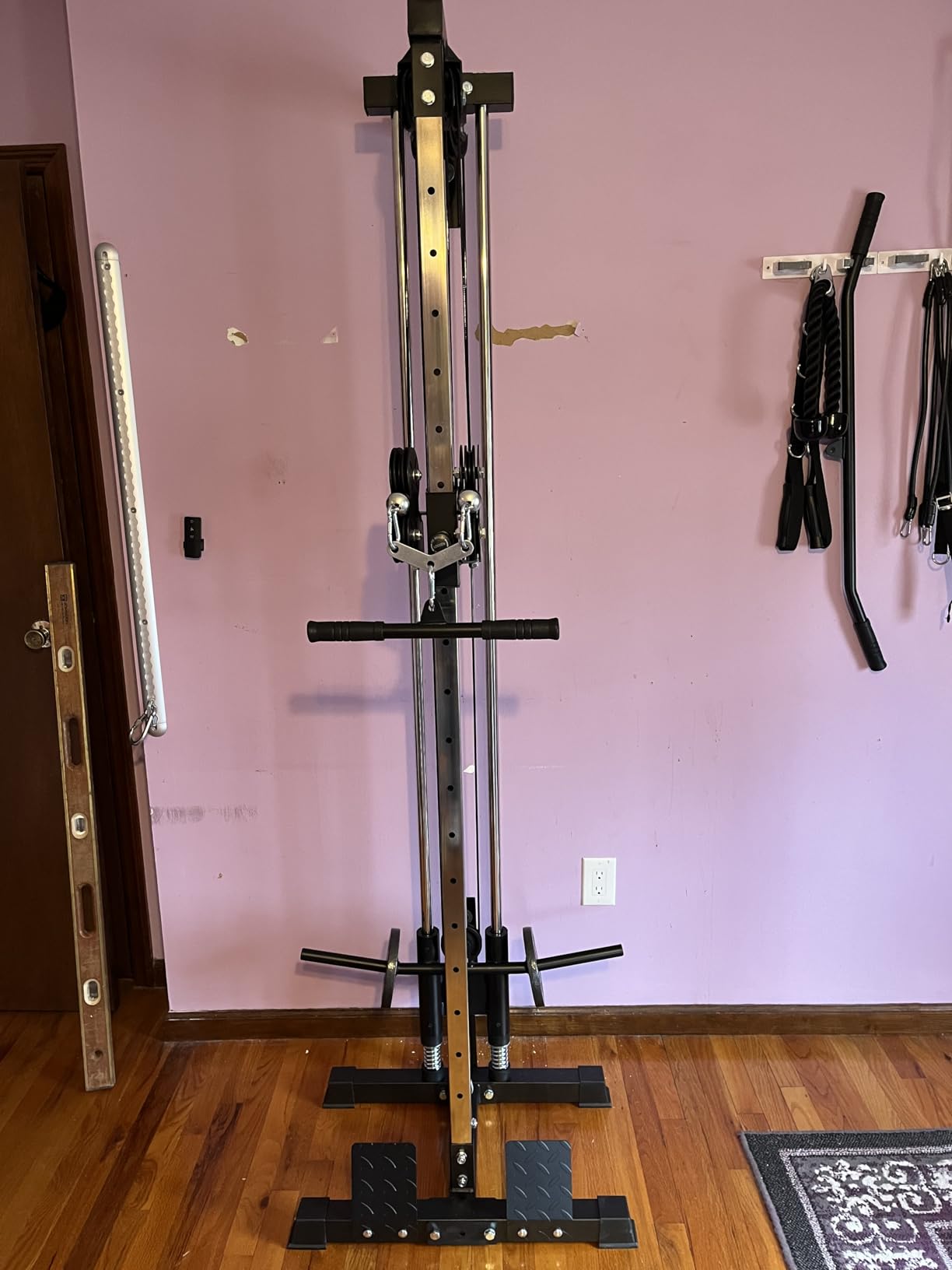
The included attachment set is the best of the wall stations. You get a lat bar, a cable bar, a tricep rope and four buckle strap handles, plus detachable sleeves for both one inch and two inch plates. That is more usable hardware than most competitors ship at all.
A large footboard makes seated rows practical, and the weight pegs angle upward about 10 degrees to stop plates from sliding. The frame stands 81.9 inches tall and fits a corner without dominating it.
Who the ER KANG station suits
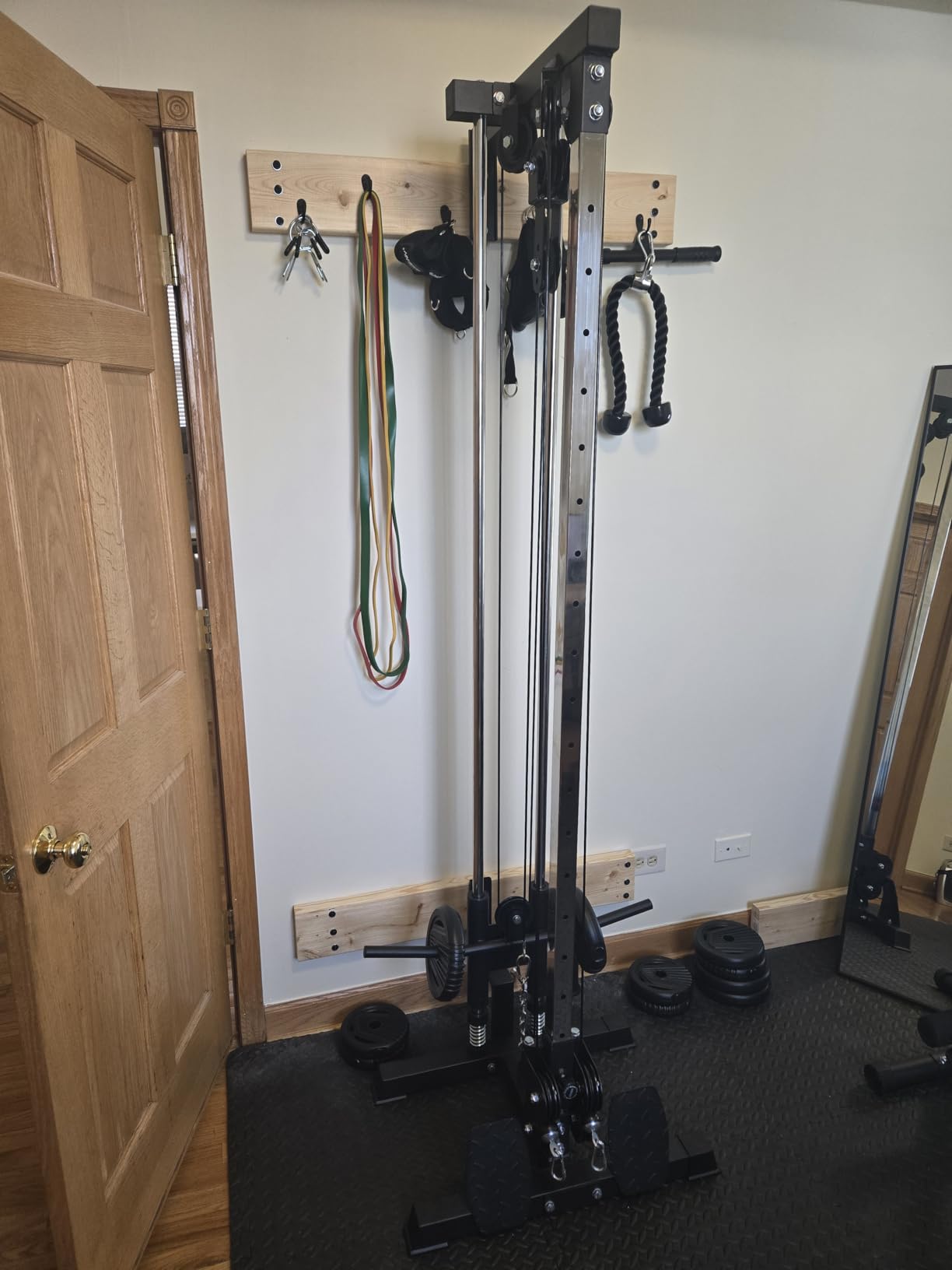
This suits someone who wants a complete cable station on day one. With the bar, rope, handles and plate sleeves included, you can run presses, rows, flyes and pressdowns immediately rather than building an attachment library over a year.
For an apartment or a spare room gym, the combination of an 18 position carriage and a compact wall footprint is a strong argument. Buyers consistently recommend anchoring into studs, and once that is done the stability concerns go away.
Who the ER KANG station does not suit
There is a real caveat on the 4.7 rating. It sits on 73 reviews, the second smallest sample in this roundup, so treat it as a strong signal rather than a settled one. The frame is the star; the accessories are described as adequate but basic.
Component replacement service is listed at eight months, which is the shortest support window here, and wall mounting is mandatory. If long-term parts support drives your decision, the Body-Solid machines carry a much longer commitment.
11. YOLEO 9-in-1 Power Cage Package – Best Cage With Cable Work Built In
YOLEO Power Cage, 9-in-1 Power Rack with Dual Pulley Cable Crossover System, Multi-Function Squat Rack with LAT Pulldown & Low Row Station, Heavy Duty Home Gym Workout Cage for Strength Training
Nine training stations
1600 lb rated frame
2:1 cable ratio
35 x 61 in internal cage
Bench included
Pros
- Nine stations in one footprint
- 1600 lb commercial grade frame
- Silent PU coated cable movement
- Full accessory kit in the box
- Matching bench with 10 backrest angles
Cons
- Bulky and needs real floor space
- Heavy components make moving it involved
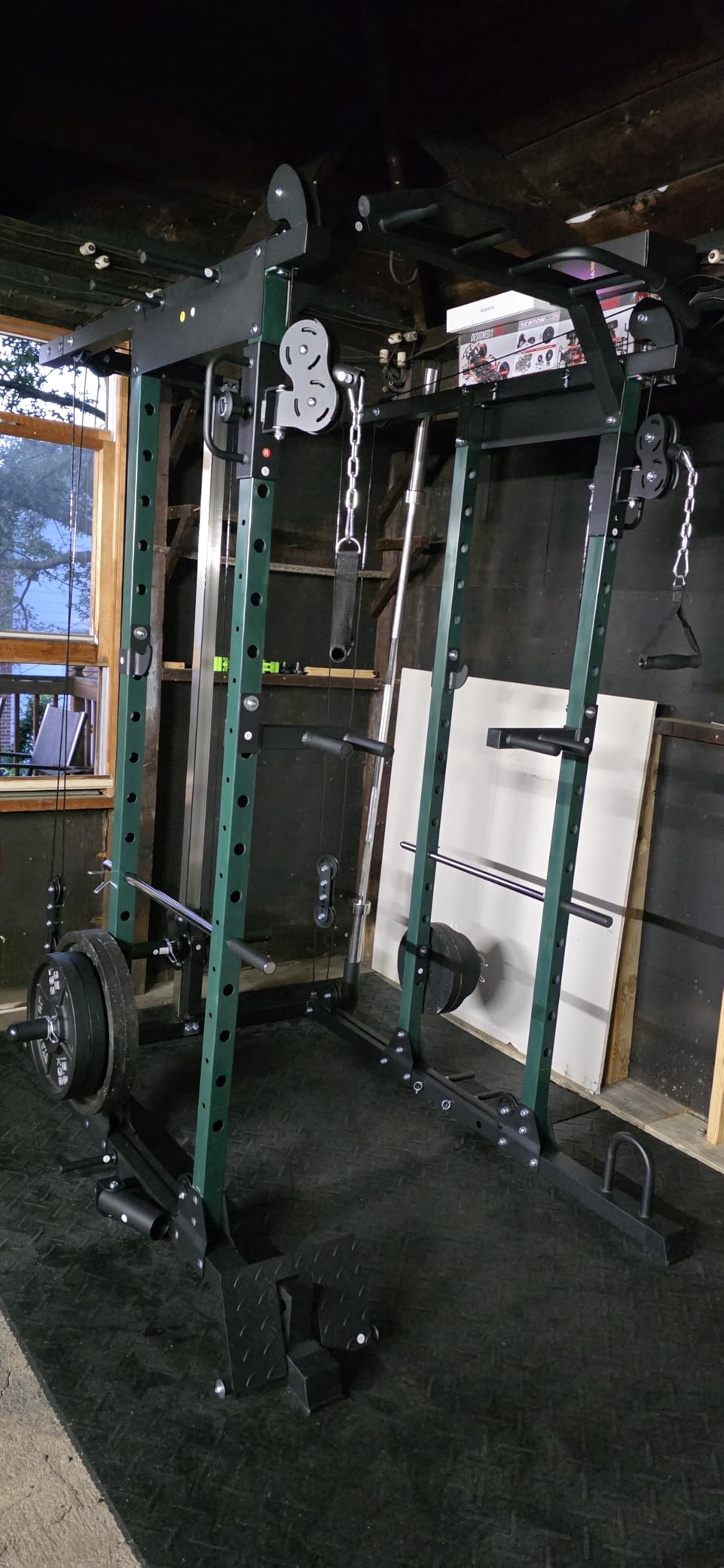
The YOLEO package is the one-stop answer. It combines a power rack, cable crossover, lat pulldown, low row, pull-up bar, dip station, core trainer and resistance band station, so the cable work comes as part of a full cage rather than as a separate purchase later.
The frame is built from 2 by 2 inch commercial grade uprights with 1.8 mm steel and welds at 12 stress points, rated to 1600 pounds. The internal cage measures 35 by 61 inches, which is enough to fit a standard bench for in-cage pressing.
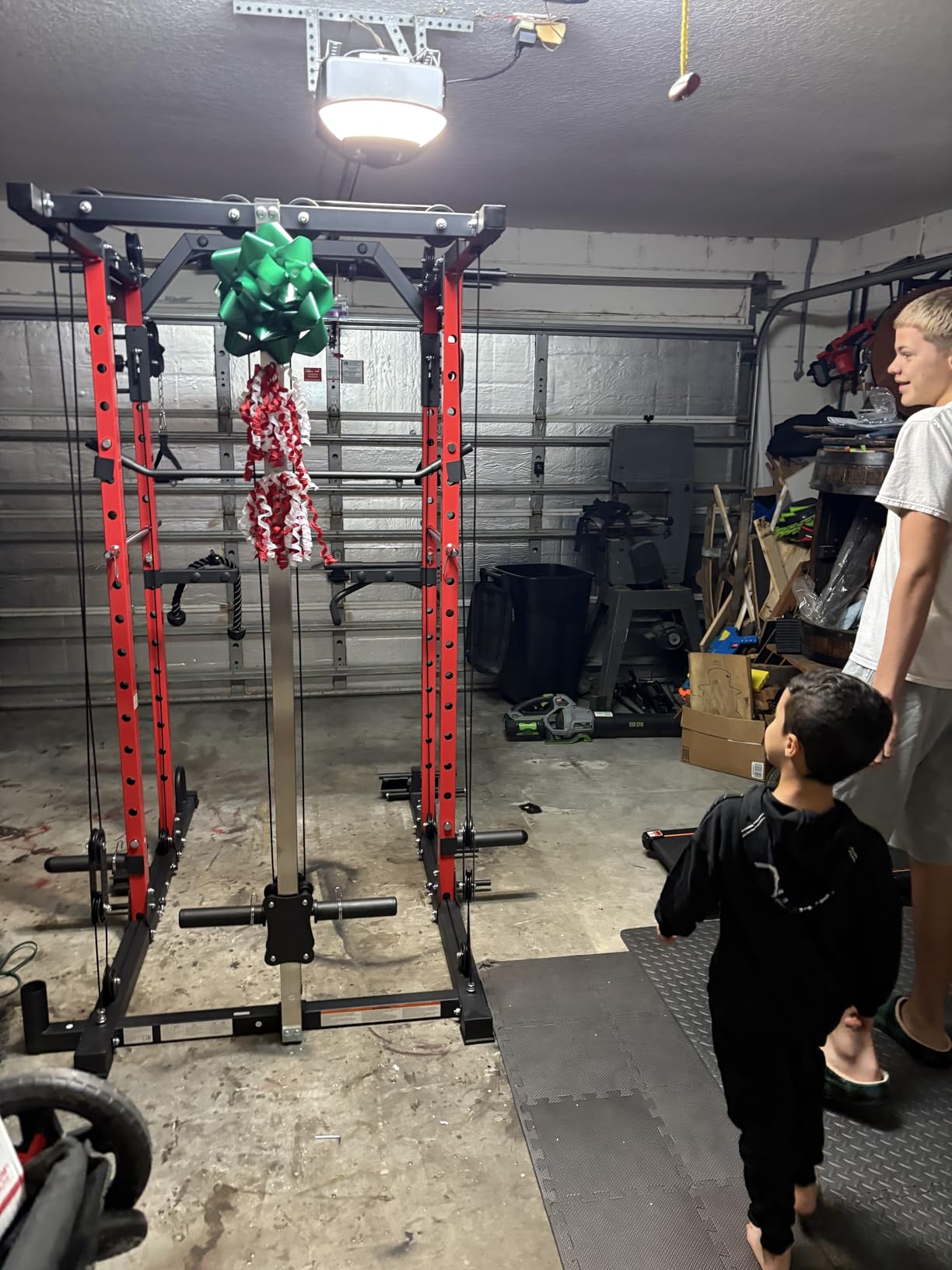
Cable performance is the quiet strength. The dual pulley crossover runs a 2:1 ratio, and PU coated high strength cables with bearing wheels give owners a silent, low friction pull with tool-free height adjustment between stations.
The accessory kit is extensive enough that no second purchase is needed: a T-bar, lat bar, tricep rope, cable bar, handles, J hooks, dip bars, a landmine attachment and a footboard. A matching bench rated to 2315 pounds with ten backrest angles and three seat positions is in the same package.
Who the YOLEO package suits
Buyers who want one purchase to cover rack work, pressing and cable work without a second delivery. The combination of nine stations, a 1600 pound frame, a full accessory set and a bench in a single box is unusual at this level.
It suits a garage with genuine floor space, and the two year warranty is more generous than the thin coverage some rack packages carry.
Who the YOLEO package does not suit
It is bulky. A full cage is a much larger commitment than a wall mounted station, and with 40 kg cage components plus the bench, moving the parts around during assembly is an involved job.
Also, the 2:1 ratio halves your effective load, so this is a hypertrophy and general strength package rather than a heavy cable setup. If your priority is the highest possible tension, the Body-Solid Powerline is the better target.
12. Goimu DP01 Power Cage with Cable Crossover – Best Compact Full Cage
GOIMU DP01 Power Cage, 2000LBS Squat Rack with Cable Crossover and Dual Independent Pulley System, Full Cage for Full Body Training, Power Rack with More Training Attachments for Home Gym (Red)
2000 lb rated frame
2:1 independent dual pulleys
31 cable heights
17.88 sq ft footprint
2 year warranty
Pros
- Combines rack crossover pulldown and low row
- 17.88 sq ft footprint
- 31 cable height options
- 29 one-inch-spaced J hook positions
- 2000 lb alloy steel frame
Cons
- Wall anchoring hardware not listed among the accessories
- Full cage still needs real floor space
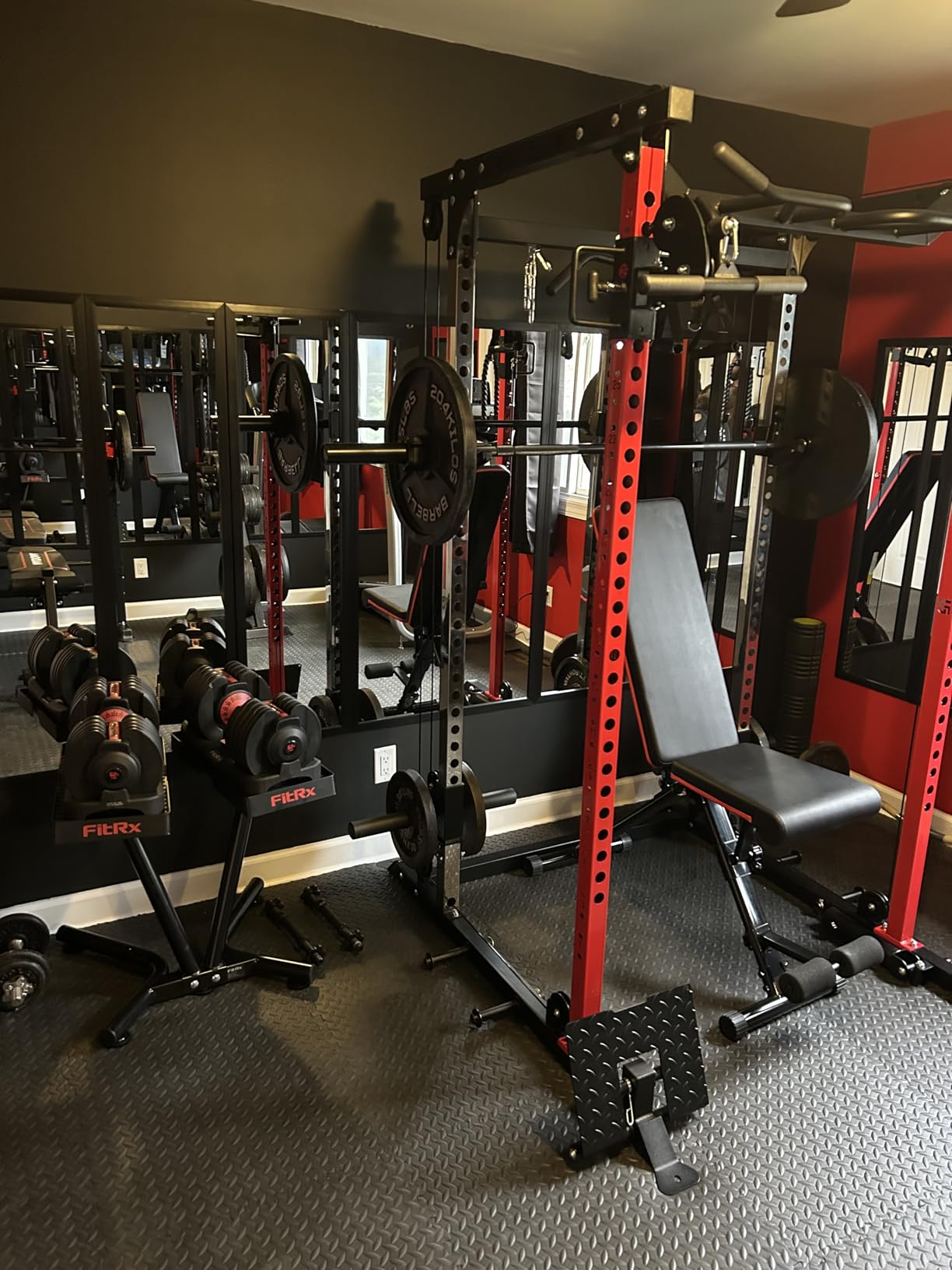
The DP01 is a full cage that has been engineered around apartment and garage dimensions. At 17.88 square feet it is a genuinely compact footprint for a machine doing the work of a squat rack, functional trainer, lat pulldown, low row, pull-up bar, landmine attachment and cable crossover.
The adjustment density is the story here. There are 31 cable height options and 29 J hook and safety bar positions spaced one inch apart, so a single rack can be set precisely for squats, presses, pulldowns and cable work without hunting for a hole.
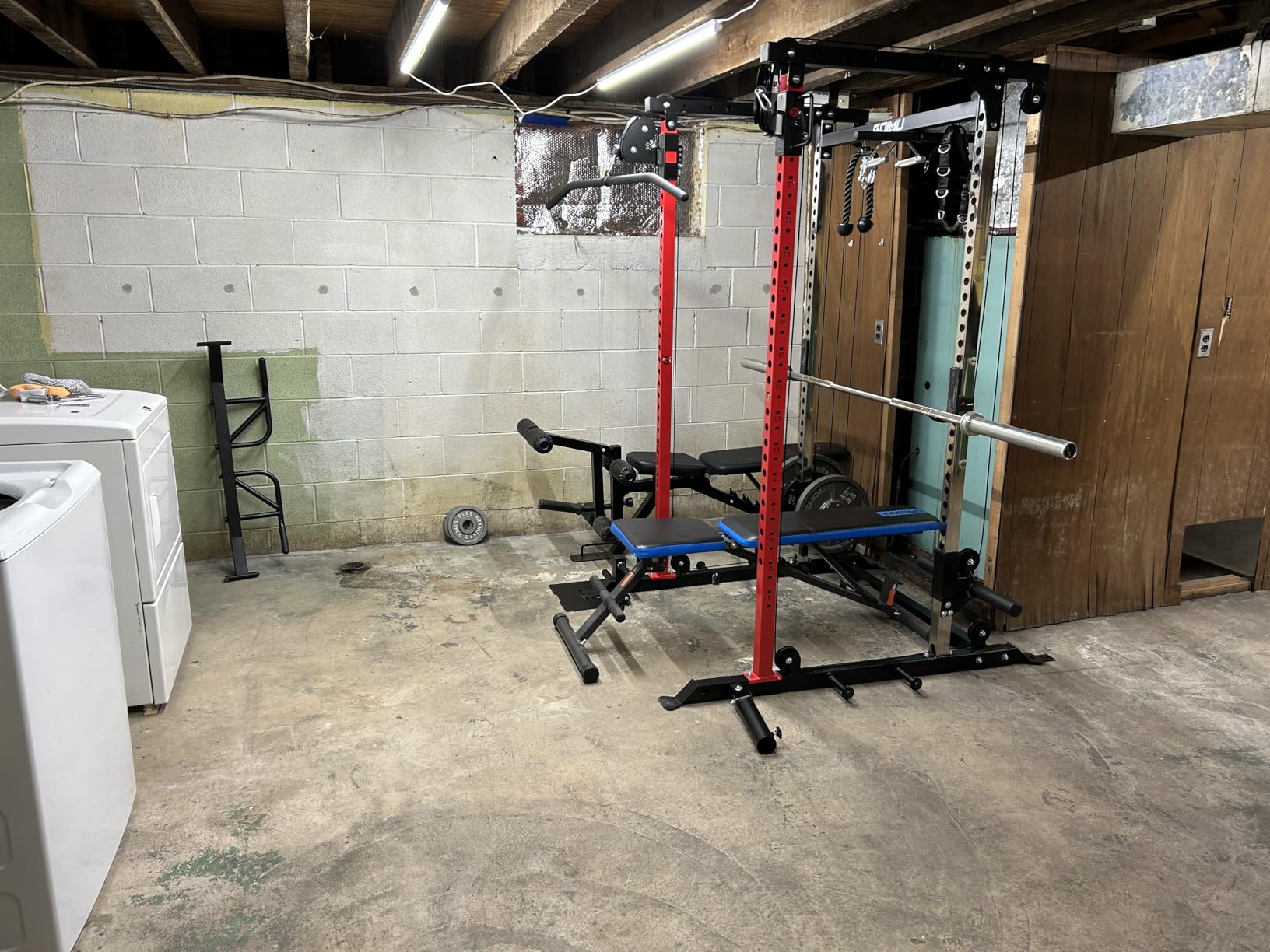
The frame is 2 by 2 inch alloy steel rated to 2000 pounds, with 47.64 inches of interior training space, enough for full-range bench pressing inside a full cage. The dual pulley system is fully independent at a 2:1 ratio, which lets you work one side, train with a partner or run a circuit.
The box includes a lat pulldown bar, tricep rope, T bar, safety bar, J hooks, a cable handle and a foot board, and the frame accepts add-ons such as plate storage and dip bars. Warranty is two years.
Who the DP01 suits
Buyers who want a single rack for a garage with limited room. The compact footprint, the 2000 pound rating and the fine adjustment make it easy to run barbell and cable sessions back to back on the same frame.
The independent dual pulleys make it a good partner machine, which matters if you train with someone else and do not want to alternate on a single cable line.
Who the DP01 does not suit
Wall anchoring hardware is not listed among the included accessories, so on a light structure stability depends on floor placement alone. If you want it fixed to a stud, plan for that separately.
A small share of reviews land in the one to three star range, with buyers noting the gap between the cage they expected at this level and what a full anchorable system offers. For cable work specifically, remember the 2:1 ratio halves your effective load.
Cable Ratio Explained: Why 1:1 and 2:1 Feel So Different
Cable ratio is the single specification that most often surprises new buyers, and it is the one worth understanding before you choose a machine. The ratio tells you how the load you add relates to the resistance you feel at the handle. A 1:1 system gives you one pound of pull for every pound loaded. A 2:1 system gives you two pounds. A 1:2 system, which is what the Body-Solid crossovers run, gives you half.
Here is the practical effect. Load 100 pounds on a 2:1 machine and the handle pulls like 200 pounds, which is how you get heavy-feeling cable work off a modest plate inventory. Load 100 pounds on a 1:2 machine and it feels like 50 pounds, which is why owners of the Body-Solid units describe a ceiling of useful resistance around 120 to 130 pounds.
There is a trade beyond the numbers. Mechanical advantage and smoothness trade against each other: a high ratio multiplies the load but adds cable drag and can feel slightly less direct, while a 1:1 system gives you exact, predictable numbers. Several owners in the home gym community describe 1:1 as the honest choice for tracking progressive overload, and the Mikolo folding rack and the Titan tower both give you that. Where a higher ratio is missing entirely, the Goimu WM1 is unusual in letting you switch between 1:1 and 2:1 on the same machine.
Plate Compatibility: Will It Take Your 1 Inch or 2 Inch Plates
This is the most common question we see from people who already own a plate collection, and it is the one most product pages leave vague. Plates come in two diameters: standard one inch plates and two inch Olympic plates. A machine that only accepts one type forces you to buy a full set of the other, which quietly turns a cable purchase into a plate purchase.
The good news is that most of the machines here handle both. The Valor BD-62 takes one inch plates directly and two inch plates through an adapter sleeve that is not included. The Mikolo M-G3 and the ER KANG station use detachable sleeves so both fit. The Goimu LS01 has a detachable weight sleeve for either size, and the Titan tower goes further with standard spring clip posts plus 12.5 inch Olympic adapter sleeves in the box.
The machines that do not use plates at all are the weight stack units, the Body-Solid Best Fitness, the Powerline PFT100 and the Inspire FTX, and there is no compatibility question to answer with them. Check the adapter situation before you order if you own standard plates, because that omission is the one detail that turns a good cable machine into an expensive one.
Does It Fit? Space and Ceiling Height Checklist
Measure before you order, because the gap between a published footprint and usable floor space is where most buyers get surprised. Tape out the footprint first, then add roughly two feet of clearance in front for a seated row or a lat pulldown, and check that your ceiling is taller than the machine height.
The small wall stations sit between about 3 and 4 square feet. The Valor BD-62 needs 25 by 25 inches, the Mikolo M-G3 is about 26.9 by 25.6 inches, the Goimu WM1 claims 3.28 square feet and the Goimu LS01 claims 3.12 square feet. All four are corner friendly, but all four require a stud or a proper anchor within reach of where you want them.
The mid-size crossovers are a different commitment. The Body-Solid Best Fitness needs 112 by 39 inches of floor, and the Powerline PFT100 needs about 62.6 by 42.3 inches with roughly 476 pounds to move. Plan the route to its final position before delivery, because doorway width and stairs are the real problem, not the footprint.
Cages are the largest. The Goimu DP01 lists 17.88 square feet at 84.25 inches tall, the YOLEO package has a 35 by 61 inch internal cage, and the Mikolo folding rack is the only one here that goes back to about 3 square feet when you put it away. For low ceilings, the Titan tower at 80.5 inches is the shortest full cable unit we covered.
How to Choose the Right Home Cable Machine
Start with the room, then the resistance, then the attachments. Most wrong decisions come from choosing the machine first and discovering the wall is in the wrong place. Every wall mounted unit in this roundup needs a stud, and that single fact eliminates more options than any specification.
Next decide how you want to load. If you own plates, a plate loaded tower is the cheapest path to heavy cable work and you can see exactly what you are lifting. If you want changeovers without touching a plate, a weight stack machine is more convenient, but you are limited by what the manufacturer built in. If you want the option to try both feels, the Goimu WM1 and the Titan tower both give you a choice.
Then check the carriage. More pulley positions is better in theory, but verify how many are genuinely usable, since a top position blocked by the cable trolley is a position you cannot use. Look for sealed bearing or bushing pulleys, because those are the difference between a machine that still feels smooth in year three and one that starts to grind.
Finally, look at warranty length and parts support. In this group that ranges from one year on the Mikolo folding rack to ten years on the frame of both Body-Solid machines, and that spread is a reasonable proxy for how long the manufacturer expects the machine to last. Buy for a decade if you can, because moving a heavy unit is the most expensive part of replacing one.
Cable Maintenance and When Cables Need Replacing
Steel and nylon coated cables are consumables, and the replacement interval depends far more on use than on brand. Inspect your cables before every heavy session and look for fraying, flattened spots, kinks or rust at the pulley contact points. A cable that has gone flat and stiff at a pulley is a cable that is about to fail.
Lubrication matters as much as replacement. Several owners in this roundup report carriages that stick until silicone lubricant is applied, and one Body-Solid unit includes a bottle of it precisely because the improvement is that visible. Spray the cable and the pulley grooves periodically, wipe off the excess, and the glide stays quiet.
Replacement costs are modest compared with the machine, and brands differ widely on how readily they sell spares. The Body-Solid units list a decade of spare part availability, the ER KANG station lists eight months of component replacement service, and the Inspire FTX is the one owners most often describe as slow to source parts from. That gap is worth checking before you buy rather than after a cable frays.
Frequently Asked Questions
What is the best all-in-one cable machine for a home gym?
For most home gyms, the best balance of build quality, footprint and resistance is the Inspire Fitness FTX, which packs two independent 165 lb weight stacks into a 40 by 54 inch frame. If you want a full squat rack with cable work included rather than a dedicated trainer, the Goimu DP01 and the YOLEO 9-in-1 package both combine a cage, a crossover and a lat pulldown in one frame.
Is a cable machine good for a home gym?
Yes, and for most trainees it is the single most useful addition after a rack. A cable machine gives you constant tension through the full range of motion, lets you train every major muscle group from multiple angles, and is far safer than free weights when you are training alone. The trade is floor space and a fixed cable path, which is why wall mounted stations are so popular in apartments and garages.
What cable machines do gyms use?
Commercial gyms most often use dual adjustable pulley functional trainers, full length cable crossover machines, and dedicated lat pulldown and low row units. The dual adjustable pulley is the most versatile because two independent sides allow isolation work and partner training. A selectorized weight stack is the most common resistance type because the pin change is fast between sets.
How much space does a home cable machine need?
A wall mounted cable station needs between about 3 and 4 square feet plus room to use it, so roughly 25 by 25 inches for the unit itself with a couple of feet of clear floor in front. A full crossover needs around 112 by 39 inches, and a full power cage can take close to 18 square feet. Always add clearance for a seated row and check your ceiling height before ordering.
Can I use my own standard 1 inch plates on a cable machine?
Most plate loaded cable stations accept both standard one inch and two inch Olympic plates, often through detachable sleeves or adapter posts. Check whether the adapter is included, because several machines take one inch plates directly but require a separate sleeve for two inch plates. Weight stack machines use fixed plates and that question does not apply.
How do cable ratios work and which is better for home use?
The cable ratio tells you how load translates to resistance. A 1:1 system gives one pound of pull per pound loaded, a 2:1 system gives two pounds, and a 1:2 system gives half. A 1:1 system is best for tracking progressive overload with exact numbers, while 2:1 is useful for feeling heavier loads off a small plate inventory. Some machines let you switch between both.
Are cable machines suitable for beginners?
They are, and they are arguably better for a beginner than free weights because the cable path guides the movement and the resistance stays consistent through the lift. A tower with a padded seat and a leg hold-down, such as a lat pulldown and low row combo, is especially beginner friendly since the machine supports your body position for you.
The Verdict: Which Home Gym Cable Machine Should You Buy
Start with the Valor BD-62 if you want the lowest-risk first cable machine, because it is the most proven option, it fits in a corner most homes do not have to give up, and it runs on the plates you likely already own. Choose the Body-Solid Best Fitness if you want a full length crossover and a 10 year frame warranty, and accept a longer assembly and a 1:2 ratio. Pick the Inspire FTX if you want the smoothest cable feel and a complete functional trainer in a small footprint, and understand that the weight stacks are fixed.
Beyond those three, the choice narrows fast. A folding rack solves shared rooms, a tall cage solves all-in-one training, and a plate loaded tower solves heavy cable work on a budget. Whichever direction you take, measure the wall, find a stud, check the plate compatibility and confirm the warranty length before you order.
We keep coming back to the same three numbers on any cable machine: the ratio, the usable resistance, and the warranty. Get those right and the best home gym cable machines in 2026 are a purchase you will still be using in a decade.