
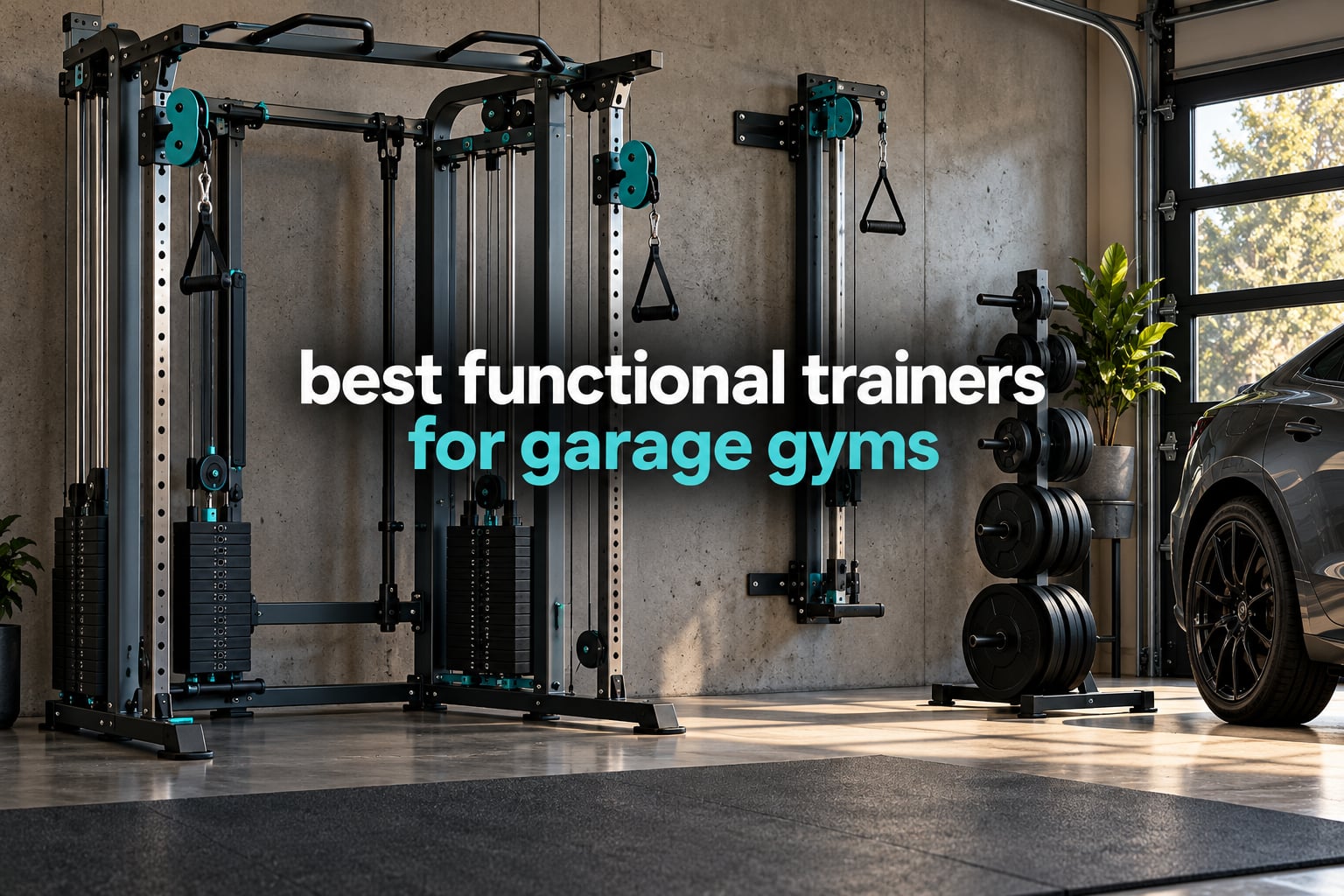
A functional trainer is a cable machine with two independent weight stacks on either side of a frame, each cable adjustable from the floor to overhead, so one unit replaces a whole cable station in a single garage bay. That is why the best functional trainers for garage gyms rank so high on home gym build lists: constant tension through the full range of motion, independent loading on both sides, and a footprint you can park a car beside.
We spent weeks reading spec sheets, assembly complaints and long-term ownership reports on the ten units below. The finding that shaped everything: this is not one category. Some are true dual-stack trainers with independent stacks and adjustable pulleys. Others are wall-mounted cable stations, folding racks or all-in-one Smith cages sold under the same keyword, and they disappoint people expecting a commercial crossover.
Below you get the cable ratio math, the clearance numbers that decide whether a unit fits your bay, and a straight verdict on each machine, including who should skip it.
Table of Contents
Top 3 Picks for Garage Gym Functional Trainers (October 2026)

Body-Solid Best Fitness
- 190 lb dual stacks
- 112 inch wide crossover
- 8 sealed ball bearing pulleys
All 10 Functional Trainers at a Glance in 2026
| Product | Specs | Action |
|---|---|---|
| Body-Solid Best Fitness Functional Trainer |
|
Check Latest Price |
 SunHome Smith Machine Power Cage SunHome Smith Machine Power Cage |
|
Check Latest Price |
 Inspire Fitness FTX Inspire Fitness FTX |
|
Check Latest Price |
 Mikolo Folding Squat Rack with Cable Crossover Mikolo Folding Squat Rack with Cable Crossover |
|
Check Latest Price |
 MAJOR FITNESS F22 Power Rack MAJOR FITNESS F22 Power Rack |
|
Check Latest Price |
 Body-Solid Powerline Cable Crossover Body-Solid Powerline Cable Crossover |
|
Check Latest Price |
 Mikolo Wall Mount Cable Station M-G3 Mikolo Wall Mount Cable Station M-G3 |
|
Check Latest Price |
 Goimu WM1 Wall Mount Cable Station Goimu WM1 Wall Mount Cable Station |
|
Check Latest Price |
 ROBORE All-in-One 160 lb Stack Station ROBORE All-in-One 160 lb Stack Station |
|
Check Latest Price |
 GMWD Dual-Station Smith Power Cage GMWD Dual-Station Smith Power Cage |
|
Check Latest Price |
How We Picked
Every machine was scored on five things that change your training: effective resistance at the handle, footprint and clearance, steel gauge and weld quality, cable smoothness after a few months, and attachment support with warranty length. Review counts mattered too, because 50 reviews tells you nothing about year three.
We also weighed garage realities most roundups skip: whether the unit needs a wall, whether it rocks on a slab, and whether a car door still clears it.
1. Body-Solid Best Fitness Functional Trainer: The Most Proven Dual-Stack Crossover
Body-Solid Powerline Cable Crossover Machine – High and Low Pulleys Gym Equipment for Home, Functional Trainer, Total Body Exercise, Cable Fly and Crossover Workouts
Dual 190 lb stacks
112 inch wide crossover
10 year frame warranty
Pros
- Widest exercise library of any unit here
- Smooth cable travel once guides are lubricated
- Stable once both bases are set wide
- Ten year frame warranty
Cons
- Terse assembly instructions with loose hardware
- Undocumented need to lubricate the upright guides
- No mid-stack cable attachment point
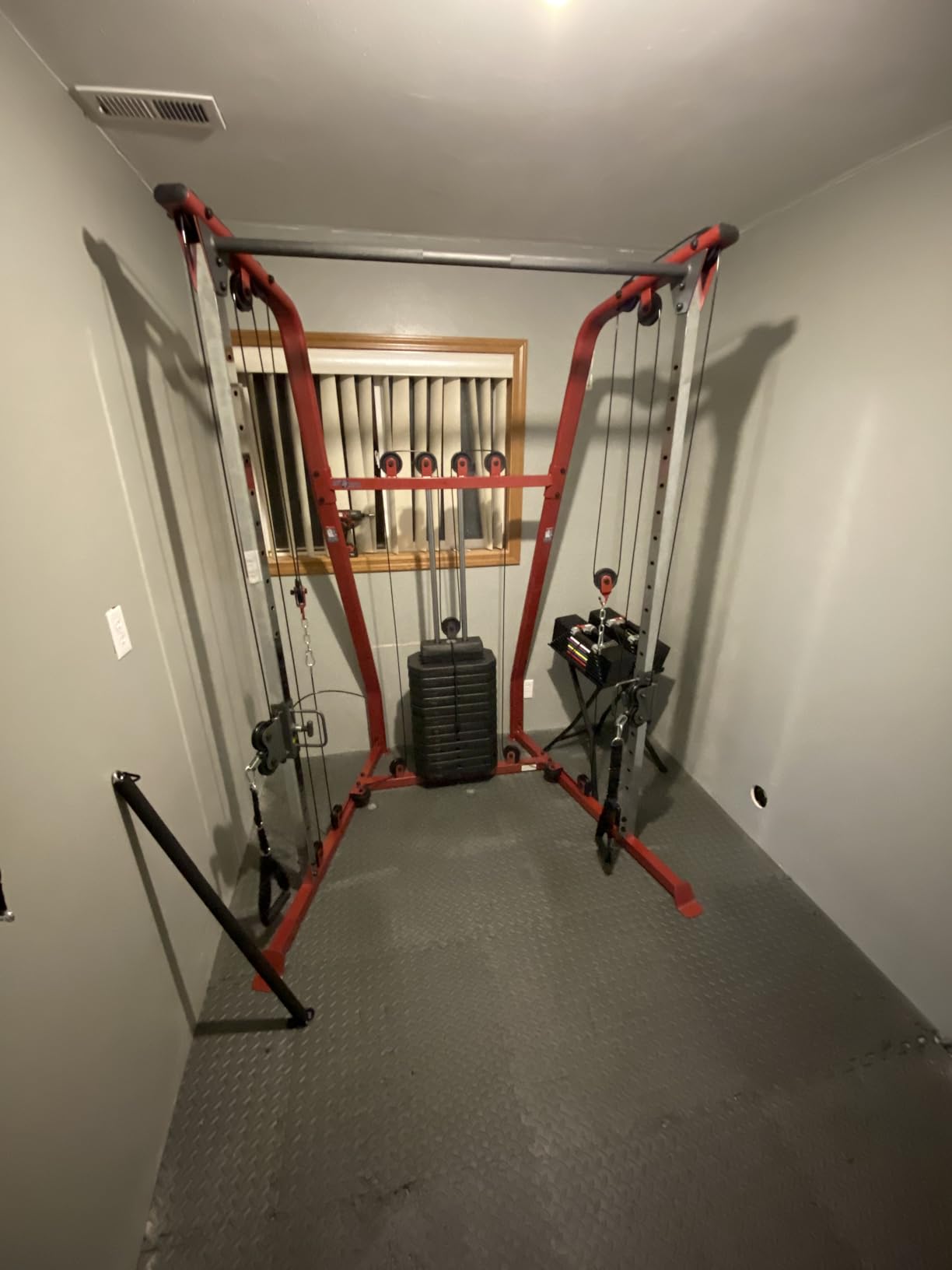
This is the one I recommend first to anyone with a normal two-car bay. It is a genuine dual-stack cable crossover with 190 lb per side, and at 467 reviews it has the largest owner base here by a wide margin, which means the failure modes are already known.
Owners describe smooth, commercial-feeling cable travel once the silicone spray in the box goes on the vertical guide tubes, plus an unusually wide exercise list from crossovers and flyes to rows, pressdowns and kickbacks. Touch-up paint is included.
The catch is the pulley ratio. The 1:2 system means about half the selected stack weight is what you feel, so 190 lb in the stack gives roughly 95 lb at the handle. The cables only attach at the high and low stations because there is no mid-stack point.
The included plates are concrete-look and bulky, so plan a plate tree. At 112 inch wide this is the widest unit in the list.
Measure the wall run first
The 39 by 112 by 82 inch frame needs a long wall and about 8 by 8 ft of clear floor with working space in front. If the car stays in the bay, run the numbers before you order, because nothing here folds away.
Be honest about the half ratio too. For rows, face pulls and pressdowns it is fine. Chasing a new personal record with plates on the handle, it is not.
Who should skip it
Skip it in a tight single-car garage, or if you want a high overhead pulley position. Anyone expecting a plate-loaded machine will also be disappointed, since this is pure cable.
2. SunHome Smith Machine Power Cage: The Big-Footprint All-in-One
SunHome Smith Machine with Weight Stack, 2000LBS Power Cage Squat Rack with LAT Pull-Down Systems, Cable Crossover Machine for Home Gym (Black, S4 Pro Set (with Bench & 230lb Color Bumper Plates))
2000 lb cage with Smith bar
120 lb selectorized stack
Rolling bearing pulleys
Pros
- Combines Smith rack lat pulldown and crossover in one frame
- Heavy steel frame that stays rigid under load
- Quiet rolling bearing pulleys
- Large accessory package included
Cons
- Diagram only instructions and no tools included
- Assembly commonly takes four to eight hours
- Fixed cable slack on the row and lat lines
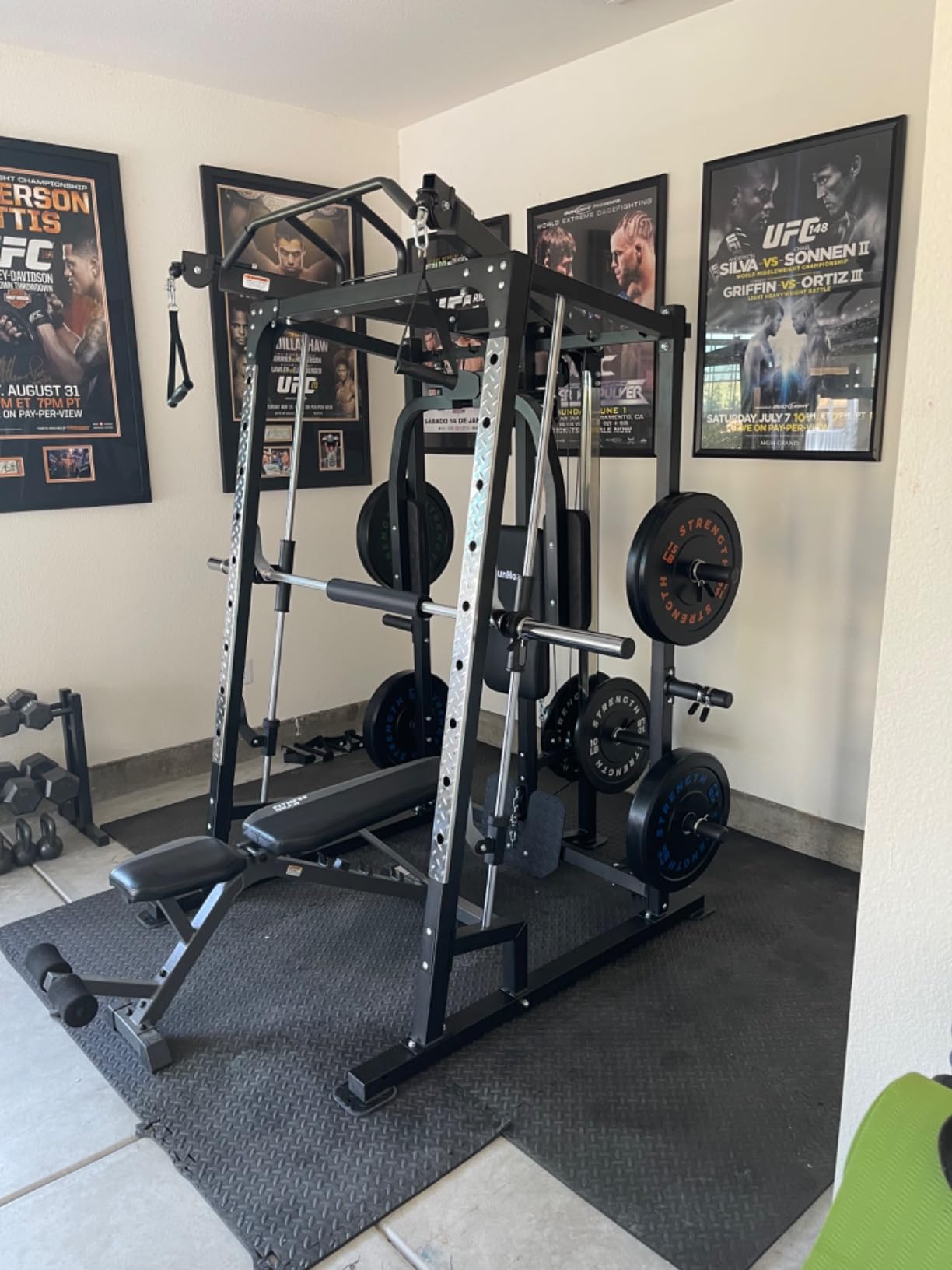
This is the value pick if your garage can swallow it. The commercial-style square steel cage has 2mm wall thickness and does not rock when you squat, and the Smith bar travels smoothly on a guided track. The accessory package is generous: lat bar, seated row handle, rope, T-bar pivot, crossover handles and ankle strap.
At 72 by 60 by 90 inches and 440 lb, two people should plan the move. The 120 lb selectorized stack is modest, and plate holders let you add individual plates when you outgrow it.
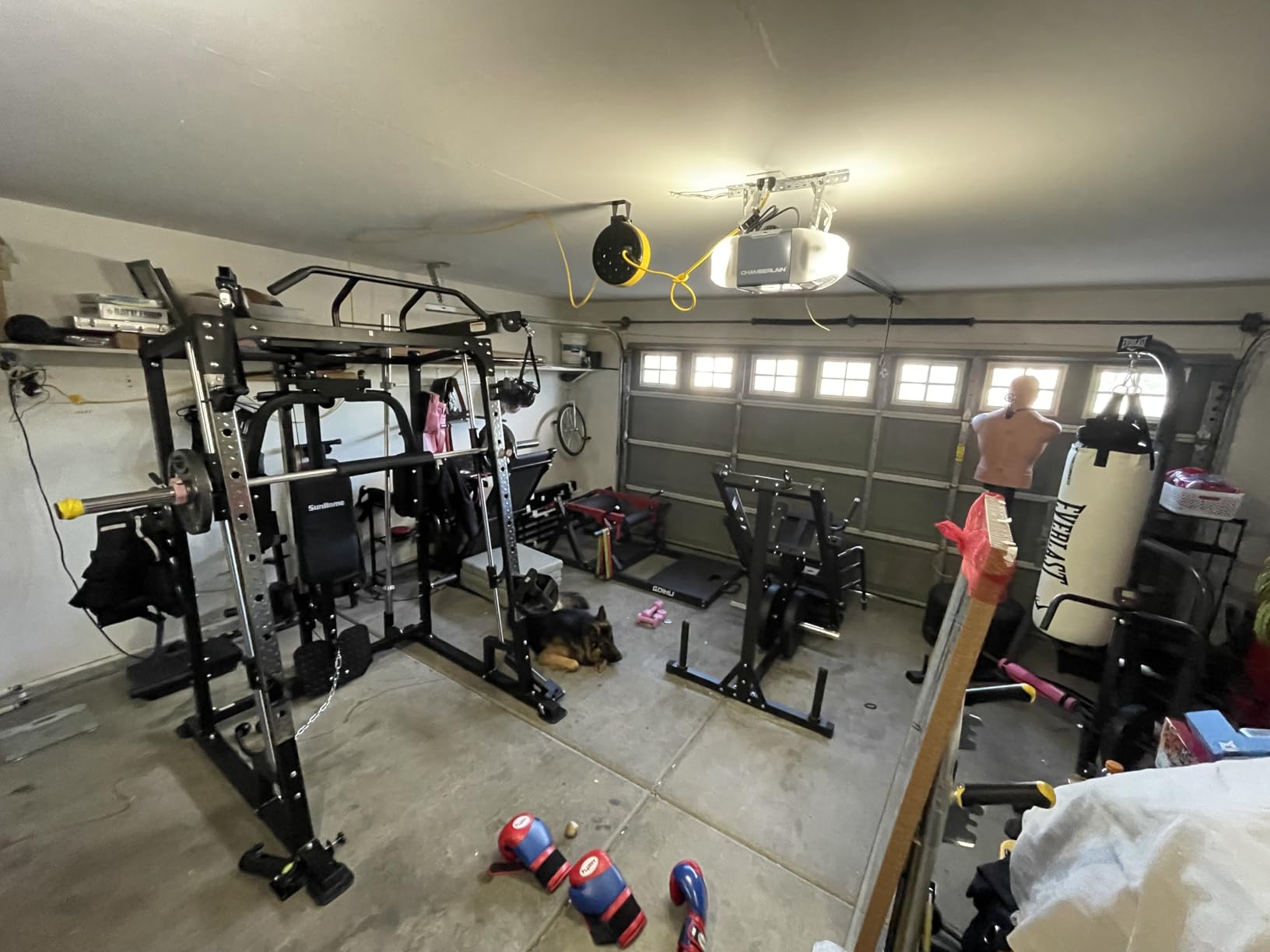
The dominant complaint is assembly. Instructions are diagrams with unnumbered parts, no tools are included, and experienced builders report four to eight hours.
Cable slack on the seated row and upper lat lines also limits full extension and cannot be adjusted out. The Smith bar is guided but not cable-captured, so one side can dip.
Pull the cables to the stops on day one
Full extension is the point of a cable station, and this unit does not fully deliver it. Check it before you build anything around the machine.
Also budget real assembly time rather than assuming an evening is enough for diagram-only instructions with unnumbered hardware bags.
Who should skip it
Skip it in a single-car garage, if the car must stay in the bay during the week, or if assembly time is a dealbreaker. The butterfly station can also crowd a deep squat.
3. Inspire Fitness FTX: The Compact Commercial-Feel Dual-Stack Trainer
Inspire Fitness FTX Functional Trainer – Compact at Home Workout Machine with Accessories – Space Saving Design – Home Gym Cable Machine and Two 165 lb Weight Stacks
Two 165 lb stacks
54 by 40 inch footprint
330 lb total resistance
Pros
- Smooth well balanced cable motion with no rattles
- Smallest footprint here for a full dual stack
- Stable during pull-ups with steel gussets
- Device shelf and accessory rack built in
Cons
- Very heavy at 544 lb and arrives in seven boxes
- Stacks cannot be upgraded later
- Top pulley is low for taller users
The FTX is where I would put a machine when a full crossover should not fit. At 54 by 40 inches it is genuinely compact for two 165 lb stacks and 330 lb of total resistance, and owners report a gym-quality feel with smooth, well-balanced cable motion and no rattles.
Steel gussets keep it stable enough to hang from during pull-ups, and the built-in device shelf and accessory rack get used daily. Touch-up paint and Teflon lubricant ship in the box.
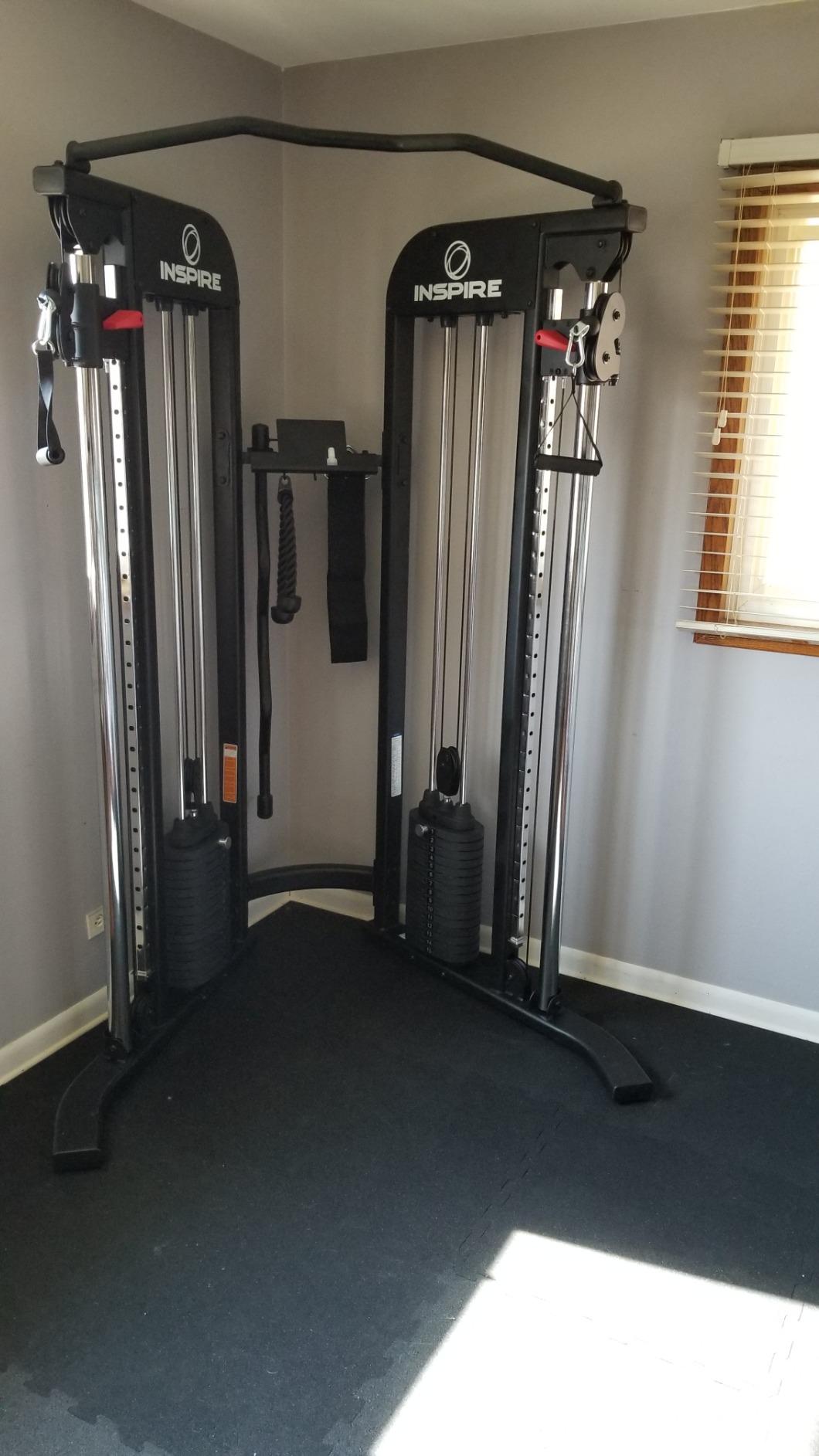
Two limits matter. The top pulley position is relatively low, which caps range of motion on pulldowns and pressdowns for taller users. And the stacks cannot be upgraded, so outgrowing 165 lb per side means buying a different model.
At 544 lb across seven boxes, treat the move and the assembly as two-person jobs.
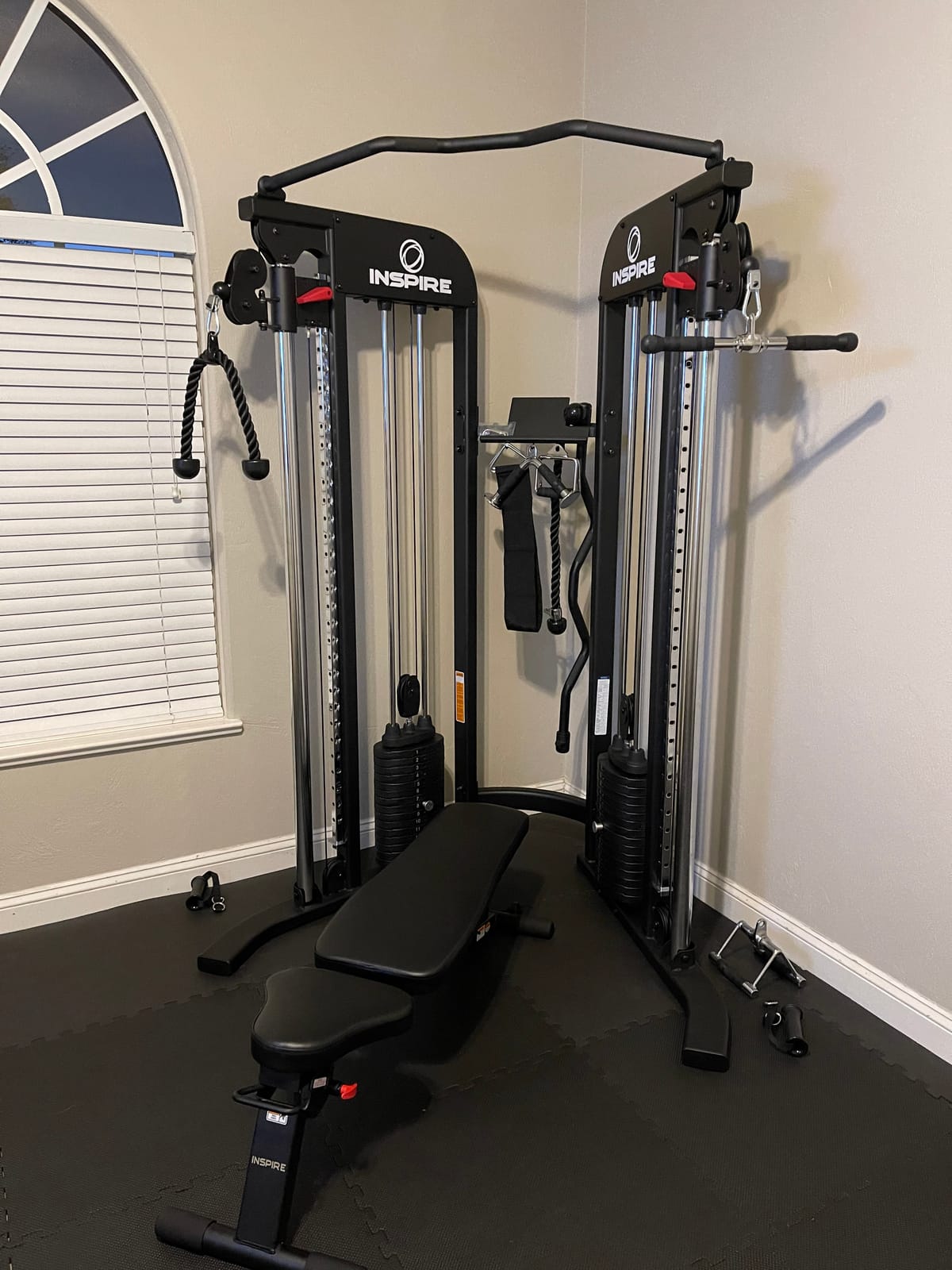
Check your height against the top pulley
Travel is smooth but the upper stop sits lower than on a full commercial tower, so a seated pulldown and a standing pressdown will not feel the same as they would at 84 inches. Shorter users will not notice.
You still need floor space in front of the carriage to lie down for a pulldown.
Who should skip it
Skip it if you are over six feet and want full overhead range, if you expect to outgrow 165 lb per side, or if you are moving it alone. If you want a rack in the same frame, look at the SunHome or MAJOR FITNESS units.
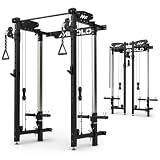
4. Mikolo Folding Squat Rack with Cable Crossover: The Best Choice for a Tight Garage
Mikolo Folding Squat Rack, Wall Mounted Power Rack with Cable Crossover Machine & LAT Pull Down, Functional Trainer with 5 Adjustable Function Modes, for Home Gym and Space Saving(Black)
Folds to about 3 sq ft
1:1 cable ratio
1000 lb wall-mounted rack
Pros
- Collapses from 9.5 sq ft to roughly 3 sq ft
- True 1:1 ratio so stacked weight reads honest
- Independent dual pulleys for two people
- Five function modes in one unit
Cons
- Wall anchoring into studs or masonry is mandatory
- Folded positions limit available exercises
- Fixed wall location limits repositioning
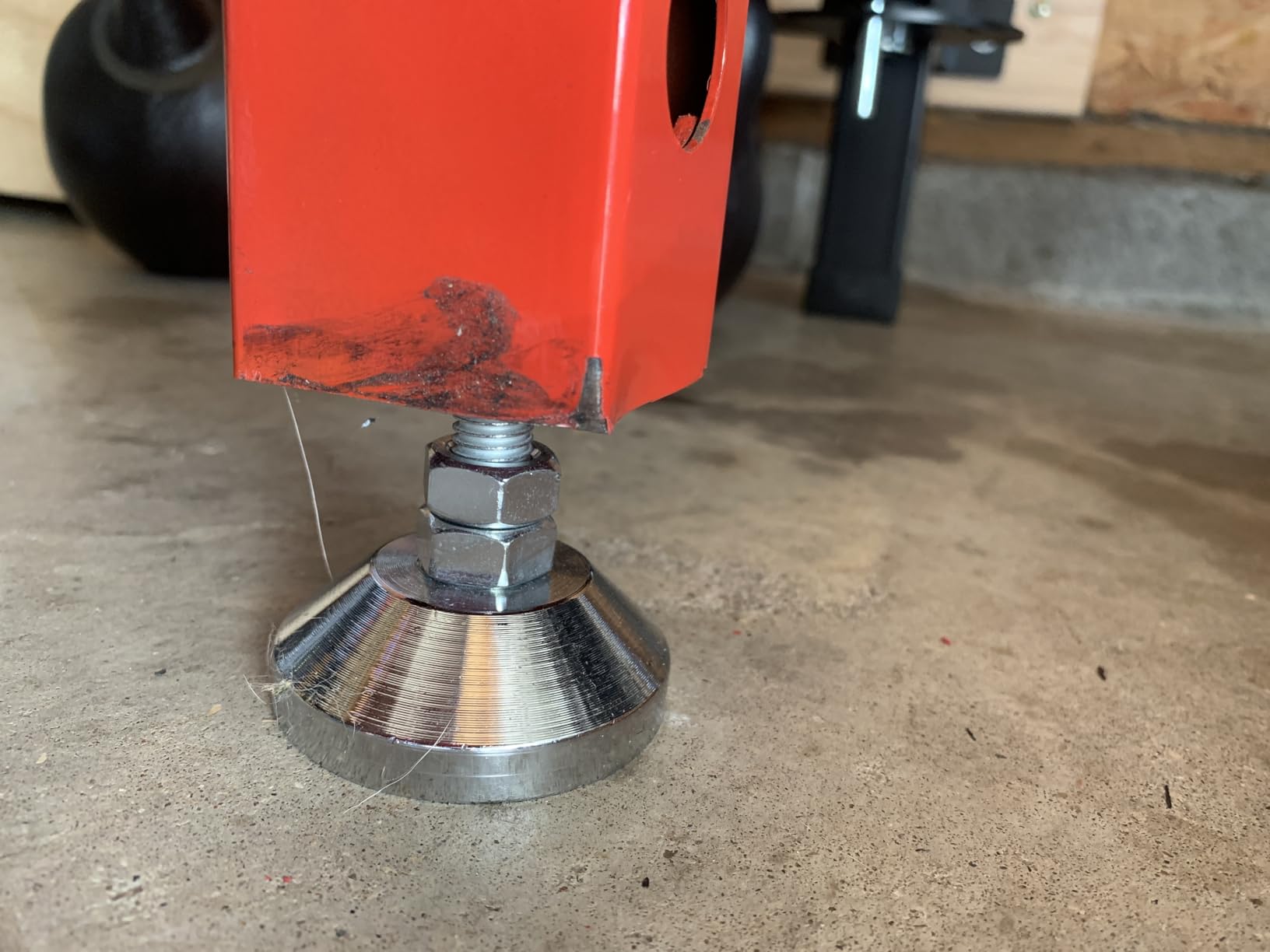
This is the answer when the car stays in the garage. The rack expands to about 9.5 sq ft for squatting and collapses to roughly 3 sq ft when idle, the best space story in this roundup. It uses 2×2 inch 14-gauge steel with reinforced wall mounts and four adjustable feet rated to 1000 lb.
The cable side beats the price. The 1:1 pulley ratio means loaded weight reads true, unlike the 2:1 designs that dominate this category, and the independent dual crossover lets two people train without one person through the other’s line. A single-handed pulley with 15 height options, a detachable pull-up bar and J-hooks are included.
Owners describe five modes in one frame: folded, semi-open, power rack, functional trainer and cable crossover, covering more than 80 movements.
The trade-off is the wall. Anchoring into studs or masonry is not optional, and you are not repositioning the unit for heavy squats in the middle of the floor.
Find the studs before the machine arrives
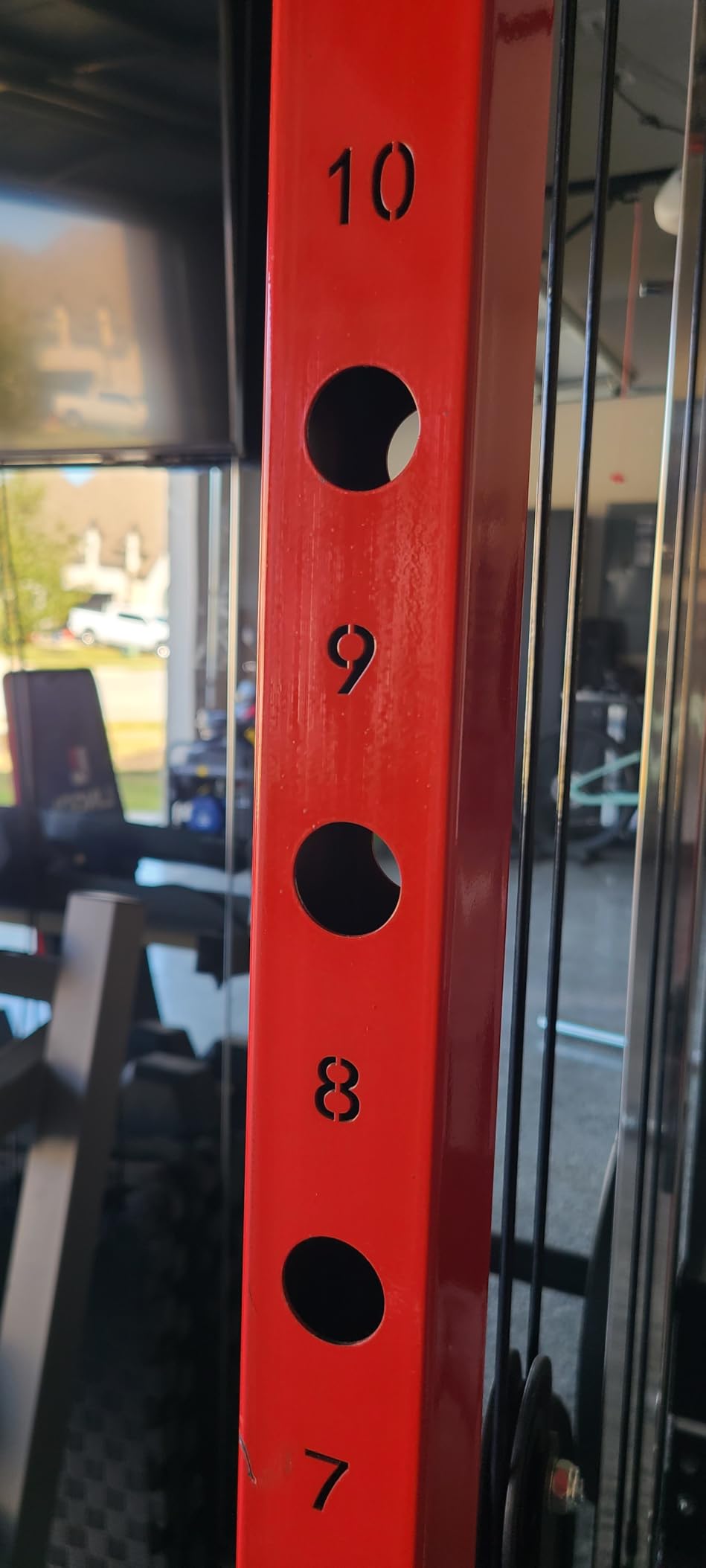
Measure where the uprights land, locate the studs, and use proper screws or masonry anchors. This is a stud question, not a product question.
Plan the folded position too. The value here is that it gets out of the way, which only works if the wall is clear.
Who should skip it
Skip it if you rent, if the wall is not stud or masonry, or if you need to move heavy barbell work to the centre of the garage. It is also the wrong tool for large-muscle cable loading.
5. MAJOR FITNESS F22 Power Rack: The Steadiest Rack With Cables Built In
MAJOR FITNESS F22 Power Rack, 1600lbs All-in-One Squat Rack with Cable Crossover, Dual Pulley System, Heavy-Duty Steel Frame, Attachments & Storage for Home Gym Strength Training, Khaki
1600 lb static capacity
Dual triangle base
2:1 independent dual pulleys
Pros
- Dual triangle base removes wobble without anchoring
- 2 by 3 inch 14 gauge steel with 1600 lb rating
- Independent 2:1 pulleys for two users
- Low profile height suits short ceilings
Cons
- Cable resistance uses plates rather than a selectorized stack
- Optional stack conversion attachment is costly
- Dip bar handles are narrow
The F22 is what I would build a garage around if squatting comes first. The dual-triangle base spreads load across the floor so the frame does not wobble, and 2 by 3 inch 14-gauge steel carries a 1600 lb static rating without flexing under heavy squats and deadlifts. No bolting to the slab needed.
The independent dual pulleys run at 2:1, so two people can train with no cable interference. The accessory suite is unusually complete: J-hooks, safety arms, foot pedals, landmine, T-bar, dip bars, lat pulldown and band pegs.
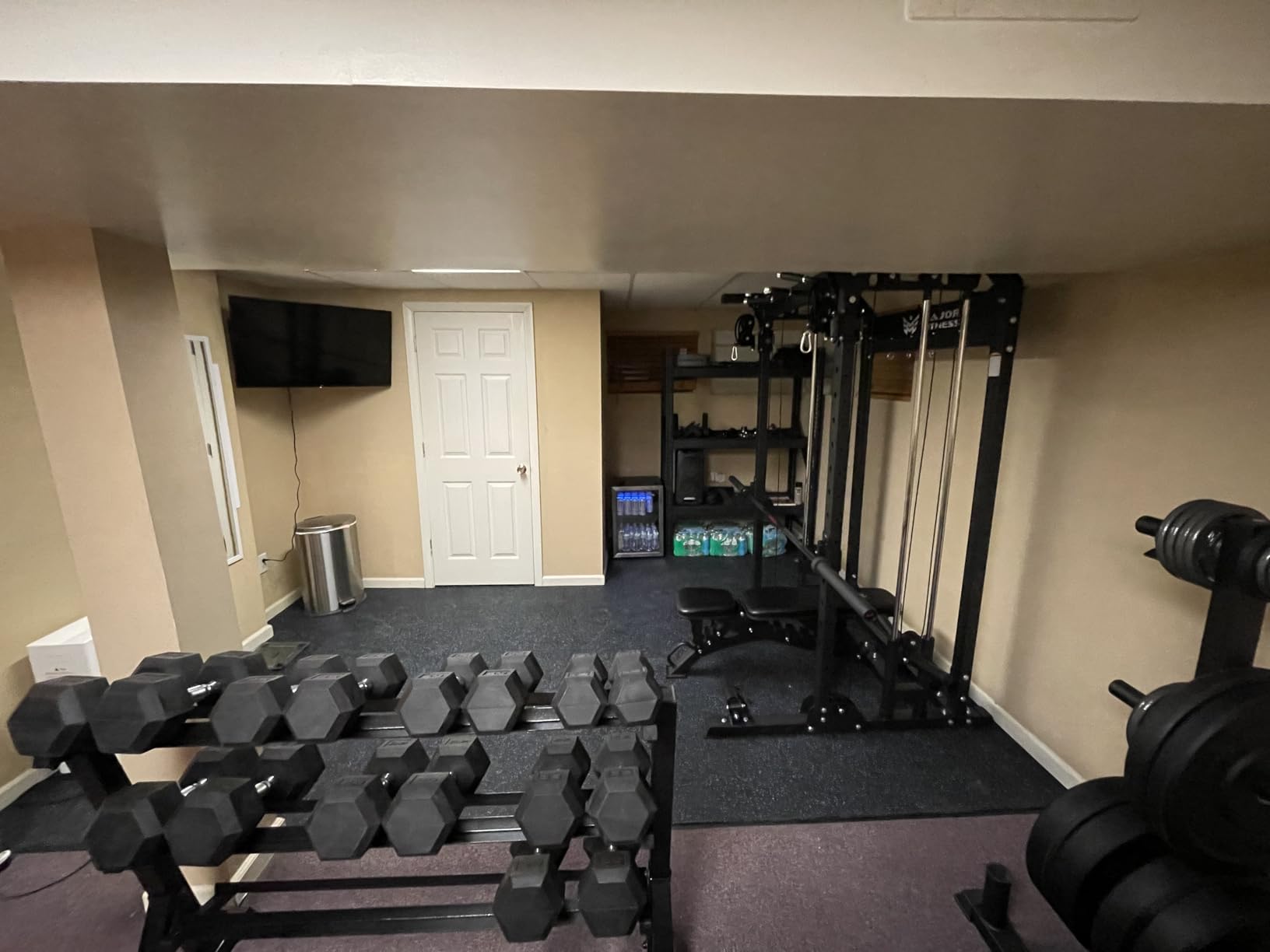
Owners with short ceilings call out the 82.5 inch height, and the 68.9 by 55.5 inch footprint can sit close to a wall without the plate storage posts. Reviewers also report no cable slack, which is more than most racks in this tier manage.
Assembly runs about three to four hours solo. The frame is the star of the reviews.
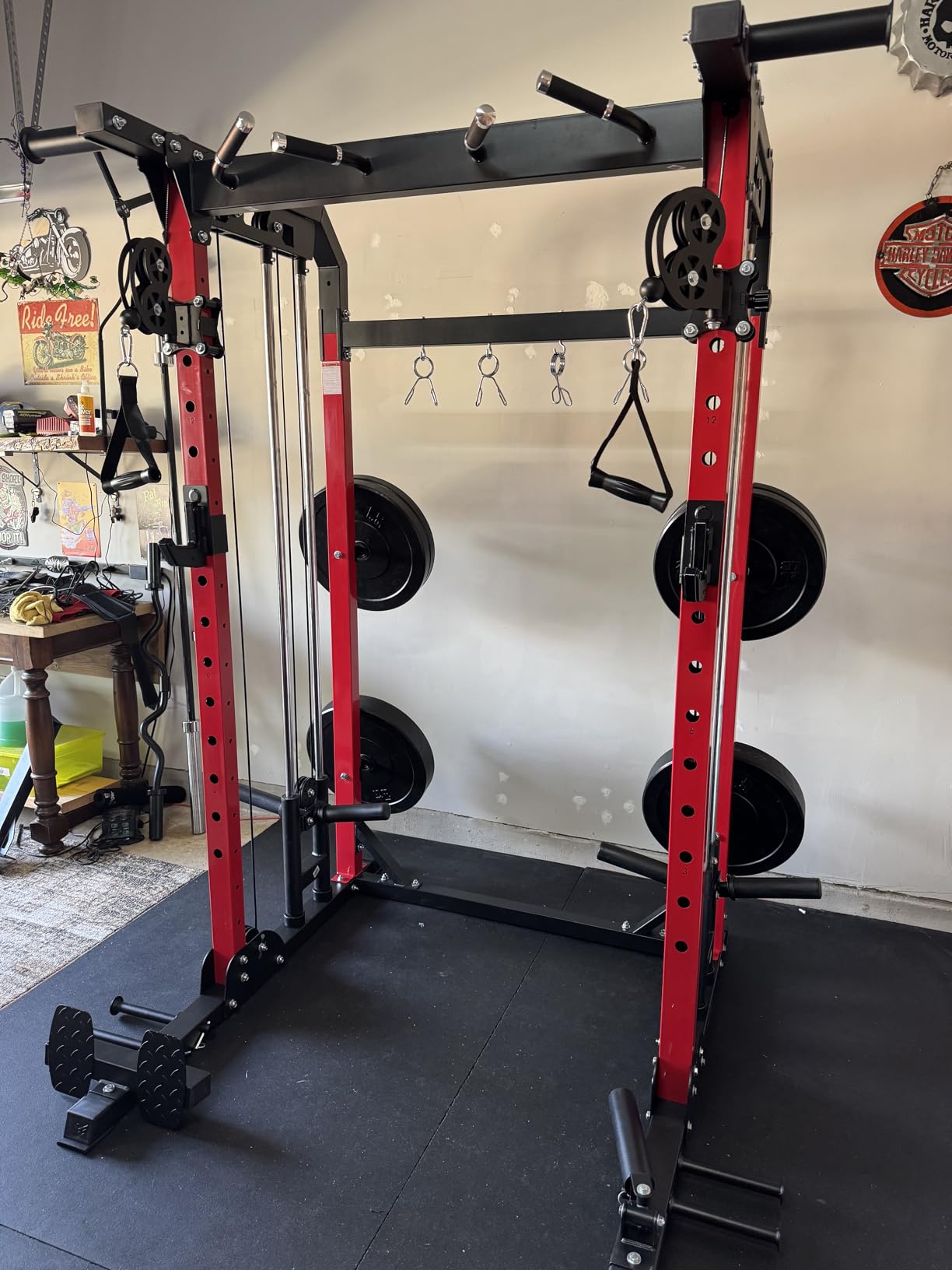
Decide between plates and a stack early
Cable resistance comes from standard circular plates on pegs, not a selectorized stack. That means unlimited loading, which is what a strong lifter wants, but every mid-workout change is a manual plate swap.
The stack conversion attachment exists, but owners note it costs close to what the rack cost. Decide before you buy.
Who should skip it
Skip it if fast weight changes matter more than load capacity, or if you want a true dual-stack unit and will trade squatting for it. The narrow dip handles are poor for heavy weighted dips.
6. Body-Solid Powerline Cable Crossover: The Upgradeable Dual-Stack Machine
Body-Solid Powerline (PFT100) Cable Crossover Exercise Machine for Home & Commercial Gym, Functional Training Center with Dual 160lbs. Weights Stack for Cable Workout
Dual 160 lb stacks
Upgradeable to 210 lb
10 year frame warranty
Pros
- Silky carriage and pulley travel with no noise
- Well machined parts that align without forcing
- Freestanding with no wall anchoring
- Body-Solid replaces cables quickly at no charge
Cons
- Very heavy at 476 lb and needs two people
- Assembly runs three to five hours
- Half the selected stack weight is felt at the handle
The Powerline is the one I would buy with my own money for a garage. Owners describe exceptionally smooth carriage and pulley travel with no friction or noise, and parts that align exactly so nothing has to be forced into position. That is what separates a good trainer from a great one after a year of daily use.
Two independent 160 lb stacks upgrade to 210 lb per side later, which is the flexibility the Inspire FTX lacks. The 42.3 by 62.6 inch footprint is compact, it is freestanding, and it does not shift at full stack weight. A pull-up bar and accessory hooks are built in.
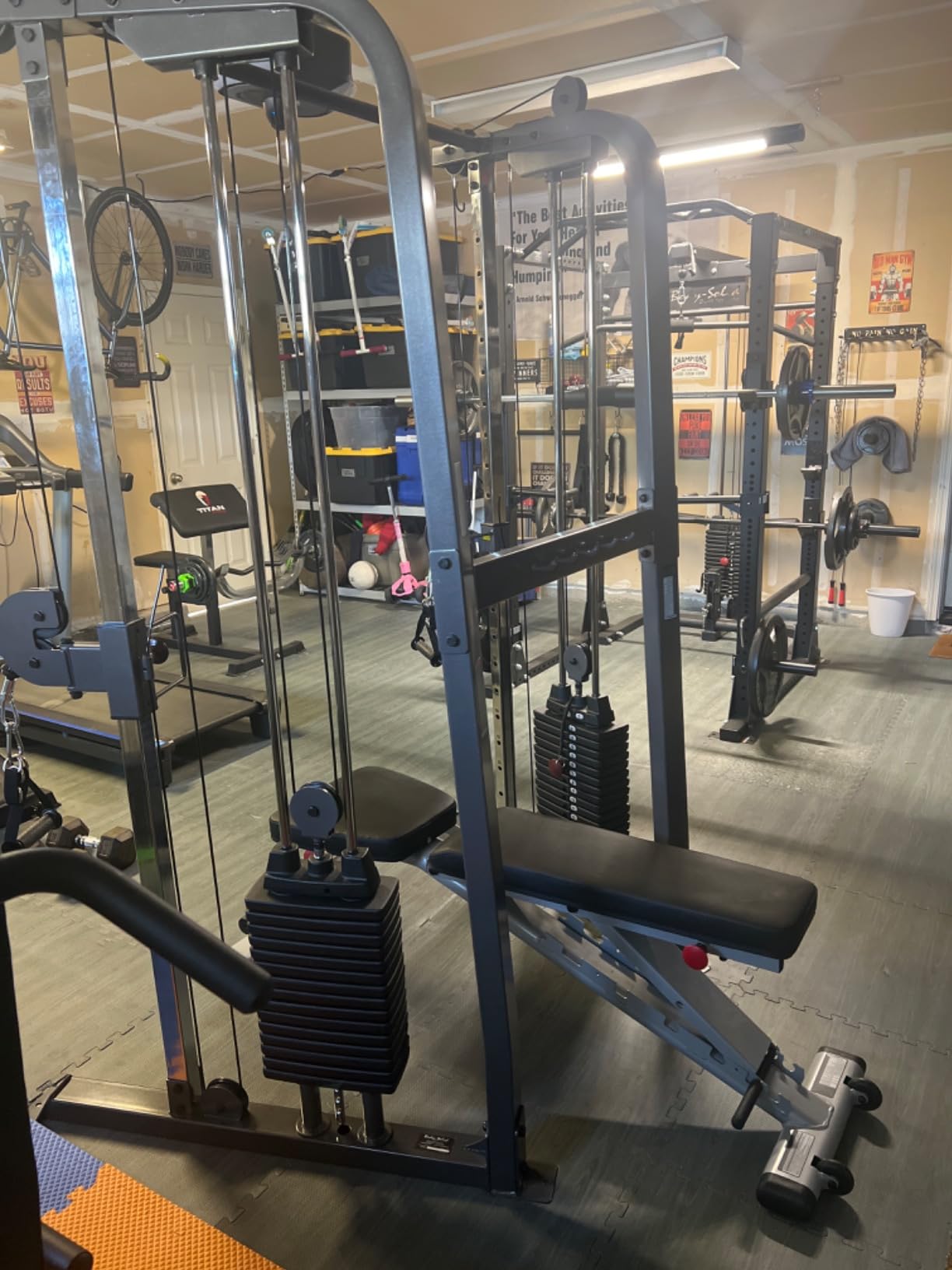
The warranty is the best in this group at 10 years frame and one year parts, with a support record of replacing cables quickly at no charge. The same mainframe covers pec and incline fly through pressdowns, reverse fly and glute kickback.
The cost is effort. At 476 lb it needs two people, and owners report three to five hours of build time with a few unclear manual steps.
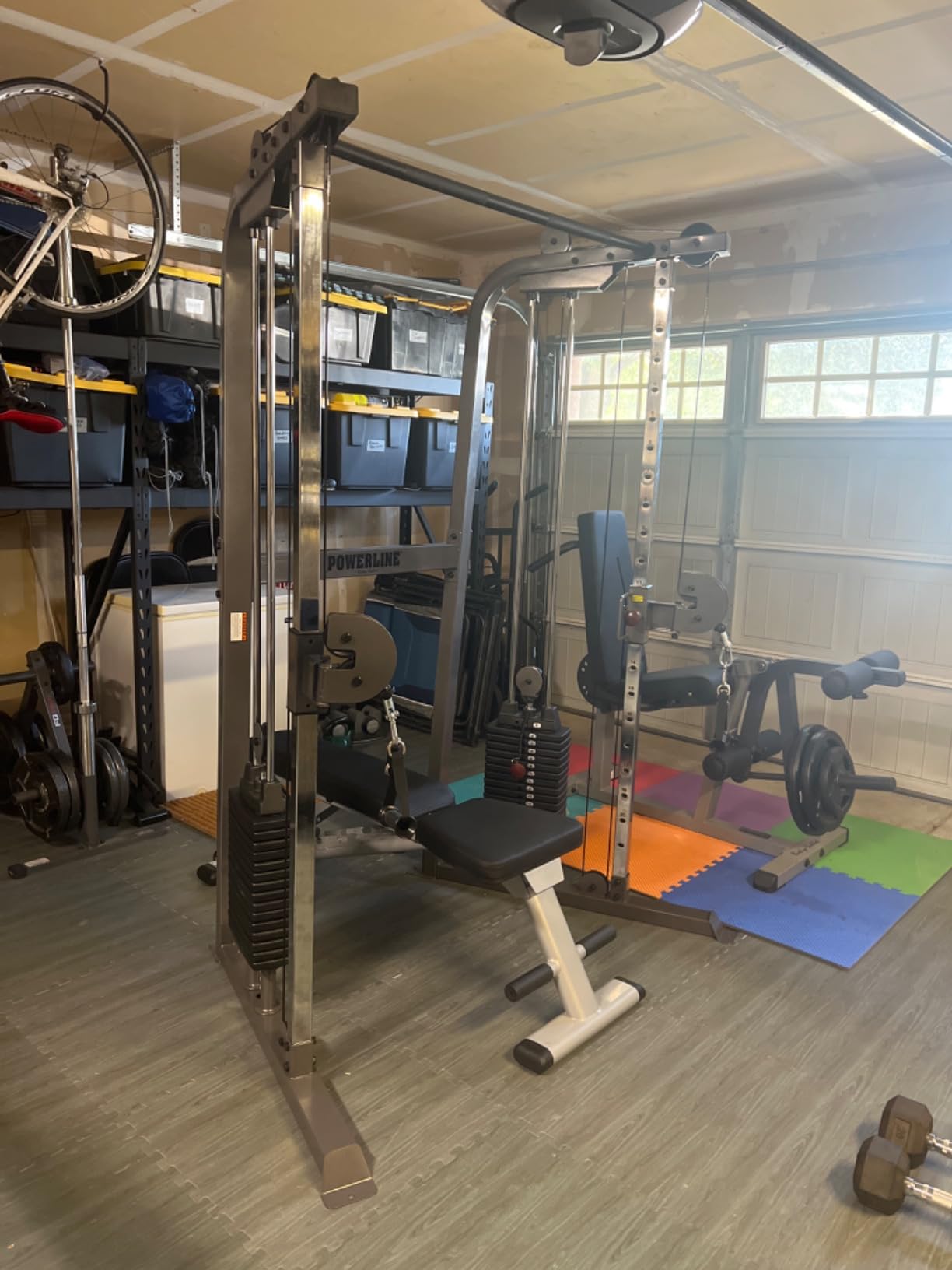
Know what the half ratio means before programming
Felt resistance is about half the selected stack weight, so 160 lb stacks work at roughly 80 lb at the handle and 105 lb after the upgrade. Program around the number you feel, not the number on the pin.
For heavy lifters that is enough for rows and pressdowns. For maximal loading on a pulldown, no cable setup is.
Who should skip it
Skip it if you are moving it solo, if you have under 8 by 8 ft of clear floor, or if heavy single-load cable work is the goal. The 476 lb weight is the most common reason buyers choose a lighter frame.
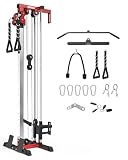
7. Mikolo Wall Mount Cable Station M-G3: The Corner Unit That Disappears
Mikolo Wall Mount Cable Station, Cable Crossover Machine with Dual Pulley System and 19 Adjustable Positions for Home Gym Fitness Equipment, Red
25.6 by 26.9 inch wall mount
19 pulley heights
400 lb max load
Pros
- Tiny corner footprint of 25.6 by 26.9 inches
- Dual adjustable pulley with 19 height positions
- Smooth out of the box with no lubricant needed
- Detachable sleeves take 1 inch and 2 inch plates
Cons
- Entry level plastic pulleys create more friction
- Weak pulley locking pin that can fail
- Loose weight peg clips on the accessories
This is the honest answer for a garage where a freestanding trainer will never fit. At 25.6 by 26.9 inches it occupies almost nothing, the nylon-coated aircraft-grade cable is rated to 2200 lb tensile against a 400 lb max load, and the dual pulley has 19 height positions with a rotating bracket for extra travel.
It is plate-loaded, which in a garage is an advantage. Detachable sleeves take both 1 inch and 2 inch plates, so the iron you own is the iron this uses. No selector pin, no stack ceiling.
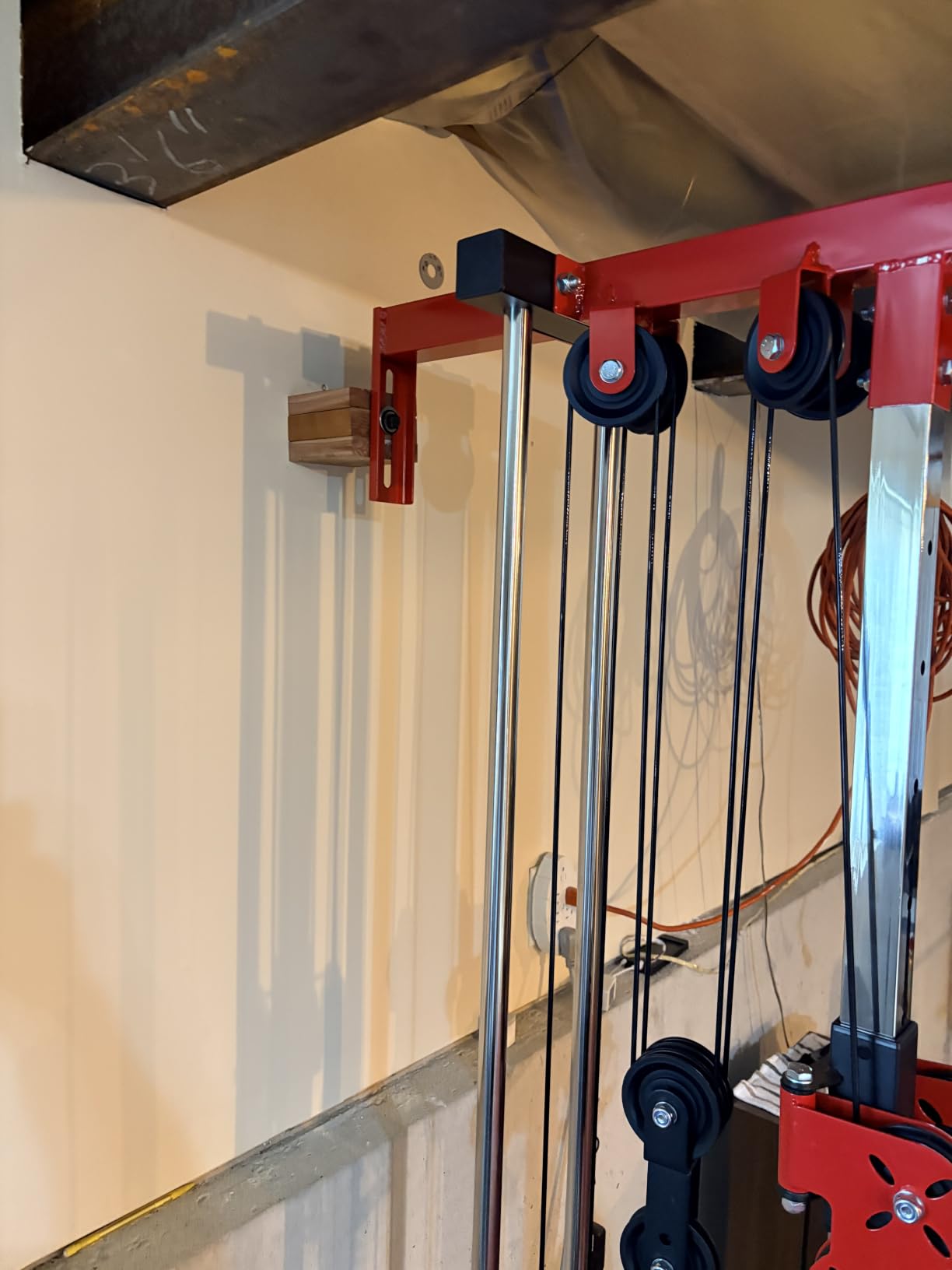
Owners report an H-shaped base that does not shake, a large footboard for seated rows, and upward-angled pegs that keep plates from sliding. Assembly is one to two hours solo, and a lat bar, cable bar, rope and strap handles are included.
Component complaints are consistent: the plastic pulleys create more friction than aluminium units and degrade, and the pulley locking pin is the weakest part on the machine. Concrete anchors are not included.
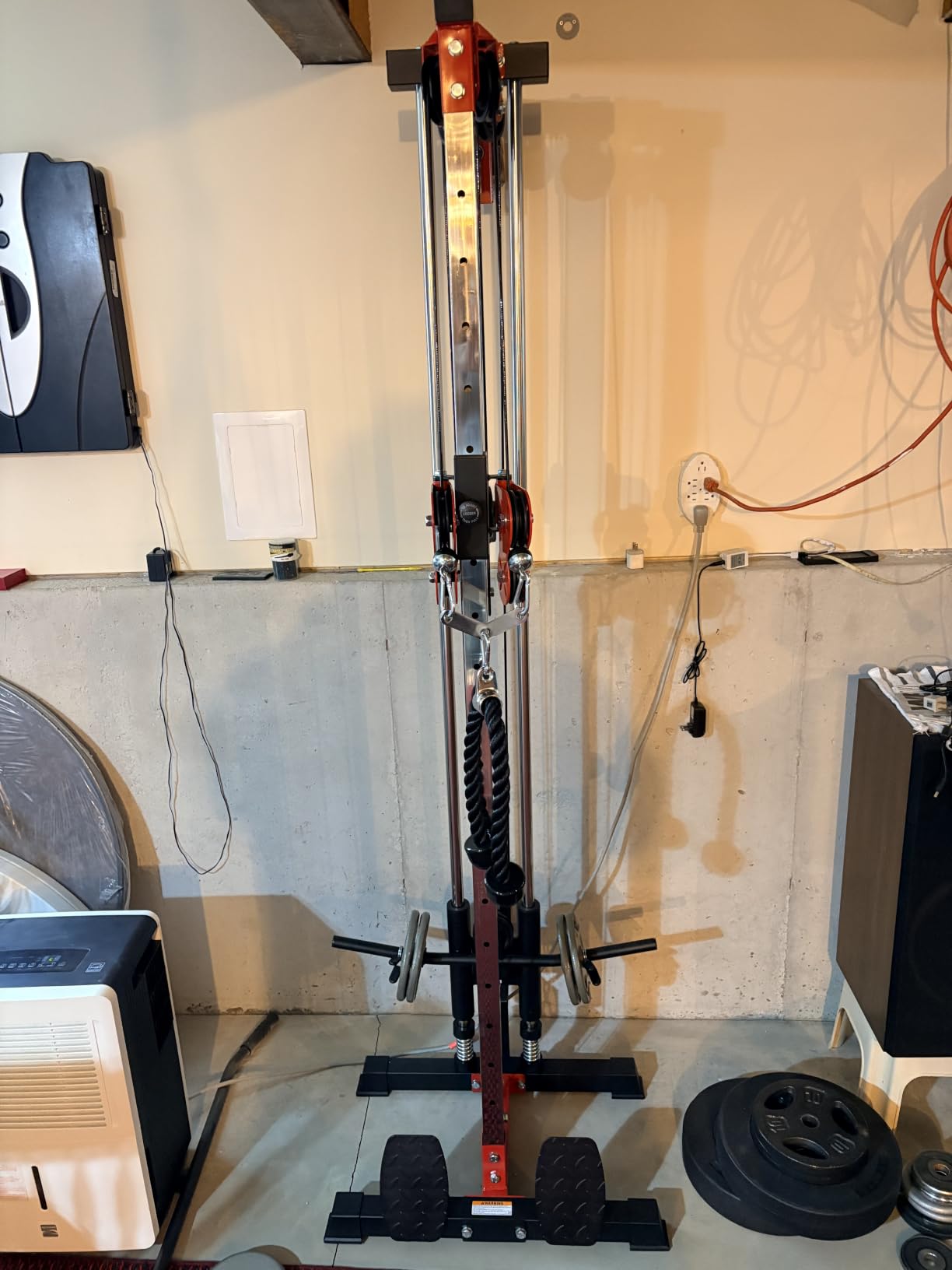
Anchor into structure, not drywall
Into studs or masonry with proper fasteners, and check plate loading before you hang 400 lb near the top of the unit. The missing masonry anchors are the detail buyers miss.
Plan cable threading carefully too, since the instructions are pictures only.
Who should skip it
Skip it for heavy leg development or for anyone who wants large-muscle loading and will notice plastic pulley friction. It is also wrong for a garage with no suitable stud wall.
8. Goimu WM1 Wall Mount Cable Station: The Smallest Usable Footprint
Goimu Wall Mount Cable Station, WM1 Cable Crossover Machine with 17 Positions, High and Low Cable Crossover Machine with Removable Footplate for Garage Home Gym (WM1 Cable Station RD)
About 3.12 sq ft floor area
Switchable 1:1 and 2:1
17 pulley heights
Pros
- Smallest footprint here with no floor anchors needed
- Switches between 1:1 and 2:1 in seconds
- Low friction cable travel and an anti-sway base
- Assembles in about 90 minutes alone
Cons
- Cables can arrive slightly long and need clamping
- No heavy duty quick release carabiner
- Concrete wall anchors not included
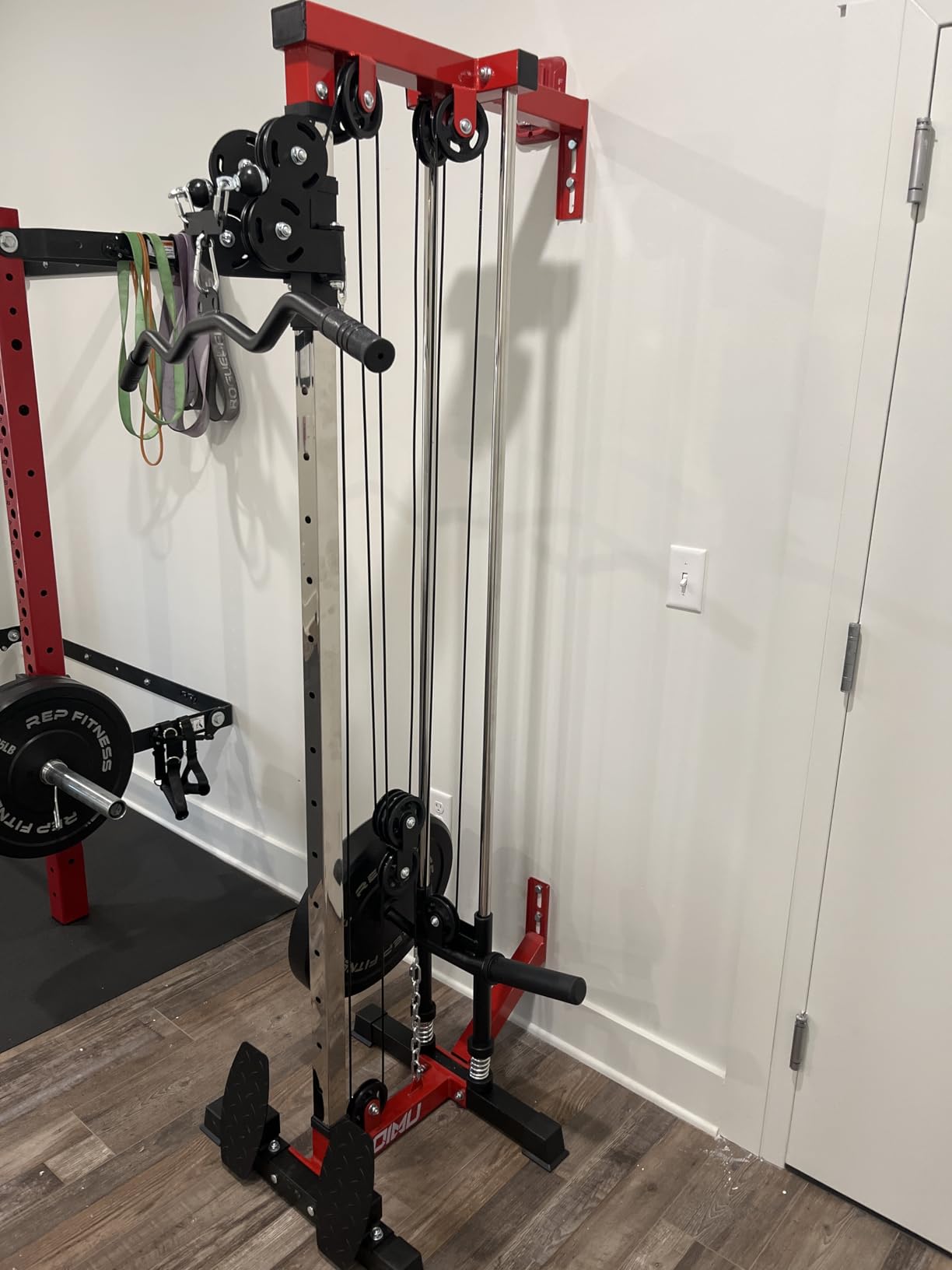
The WM1 has the most compact credible footprint in this roundup at roughly 3.12 sq ft and 81.4 lb, which makes it viable in a basement gym or a single-car bay where nothing freestanding works.
What separates it from cheaper wall stations is the SmartT dual pulley system, which switches between 1:1 and 2:1 through the cable adapter, so you can drop from a heavy set to a lighter one in seconds. Seventeen height settings, dual independent pulleys and a removable footplate for rows round it out.
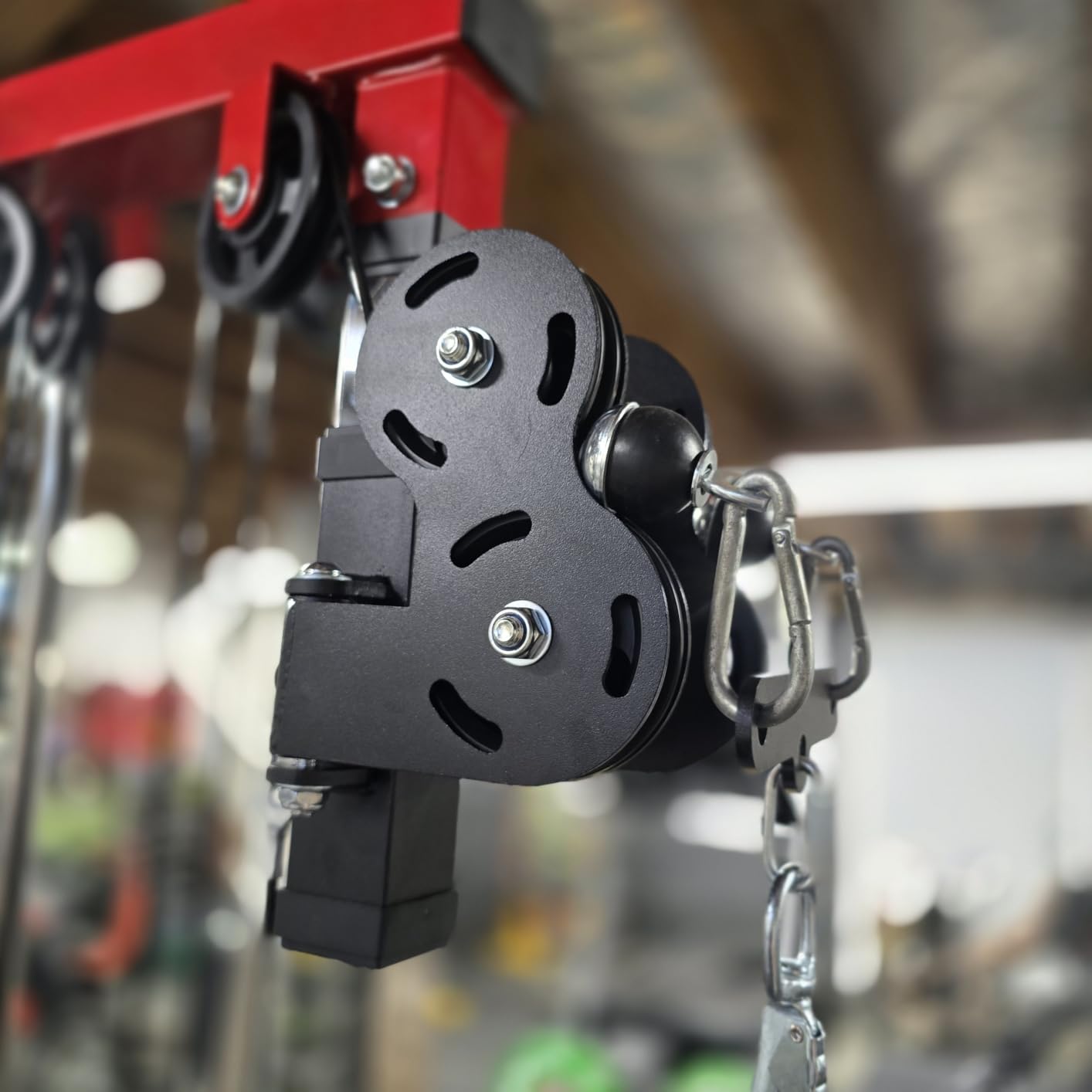
Reviewers who compared it with pricier branded wall stations report no meaningful performance gap. Welds and finish come across as solid, the H-shaped base prevents shaking, and hardware is bagged by assembly step. Assembly is about ninety minutes solo.
Two recurring issues: cables can arrive slightly too long and need clamping, and there is no heavy-duty quick-release carabiner. At 78.74 inches it is also shorter than some rivals.
Run the slack check on delivery
Pull both cables to their stops the day the box arrives. If they feel loose, clamp the excess before your first workout instead of adapting your form to it. Budget for clamps and concrete anchors, since neither ships.
Use 2:1 for heavy two-sided work and 1:1 when you want a true-to-weight single side.
Who should skip it
Skip it if you need more than 300 lb of load, if your ceiling is under about 79 inches clear, or if you want the smoothness of aluminium pulleys found on higher tiers. It is a cable station, not a squat station.
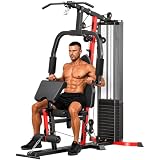
9. ROBORE All-in-One Station: The Best Starting Point for Beginners
Home Gym System with 160LB Weight Stack, Multifunctional All-in-One Workout Station, Full Body Strength Training System
160 lb selectorized stack
66 by 38 inch footprint
Selector pin changes
Pros
- More built-in resistance than typical stations this size
- One station covers eleven exercise variations
- Compact footprint with adjustable seating
- Fast selector pin changes for drop sets
Cons
- 160 lb stack is maxed out by intermediate lifters
- Limited leg exercise selection
- Confusing assembly and occasional missing hardware
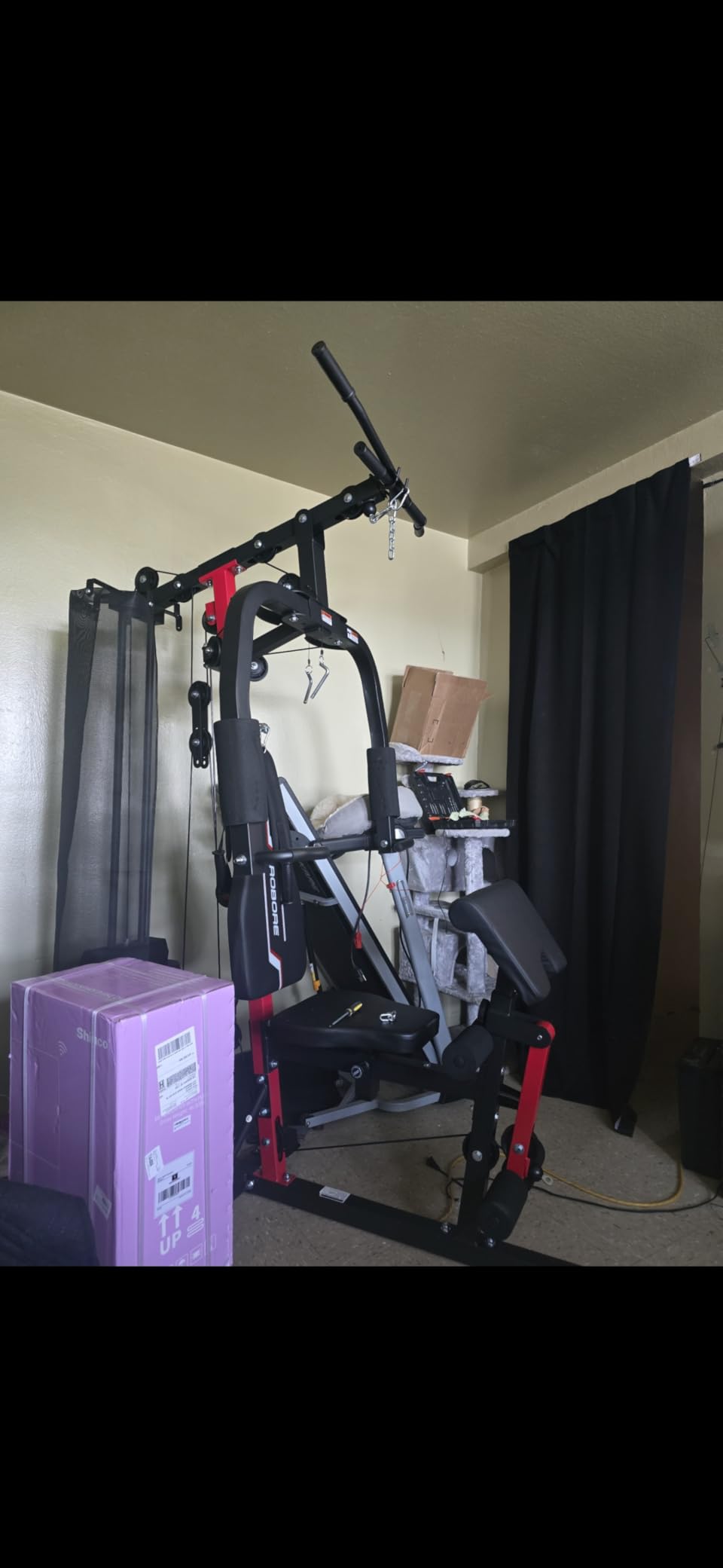
For a first piece of cable equipment this covers a lot of ground. One station handles chest press, pec fly, preacher curl, wide and close-grip pulldown, seated low row, leg extension, lateral raise, pressdown, cable curls and ab crunch, with high, mid and low pulley positions. The 66 by 38 inch footprint keeps it compact.
The 160 lb selectorized stack is more than most stations this size ship with, and the pin makes drop sets fast. Customer service has shipped replacement cables free of charge.
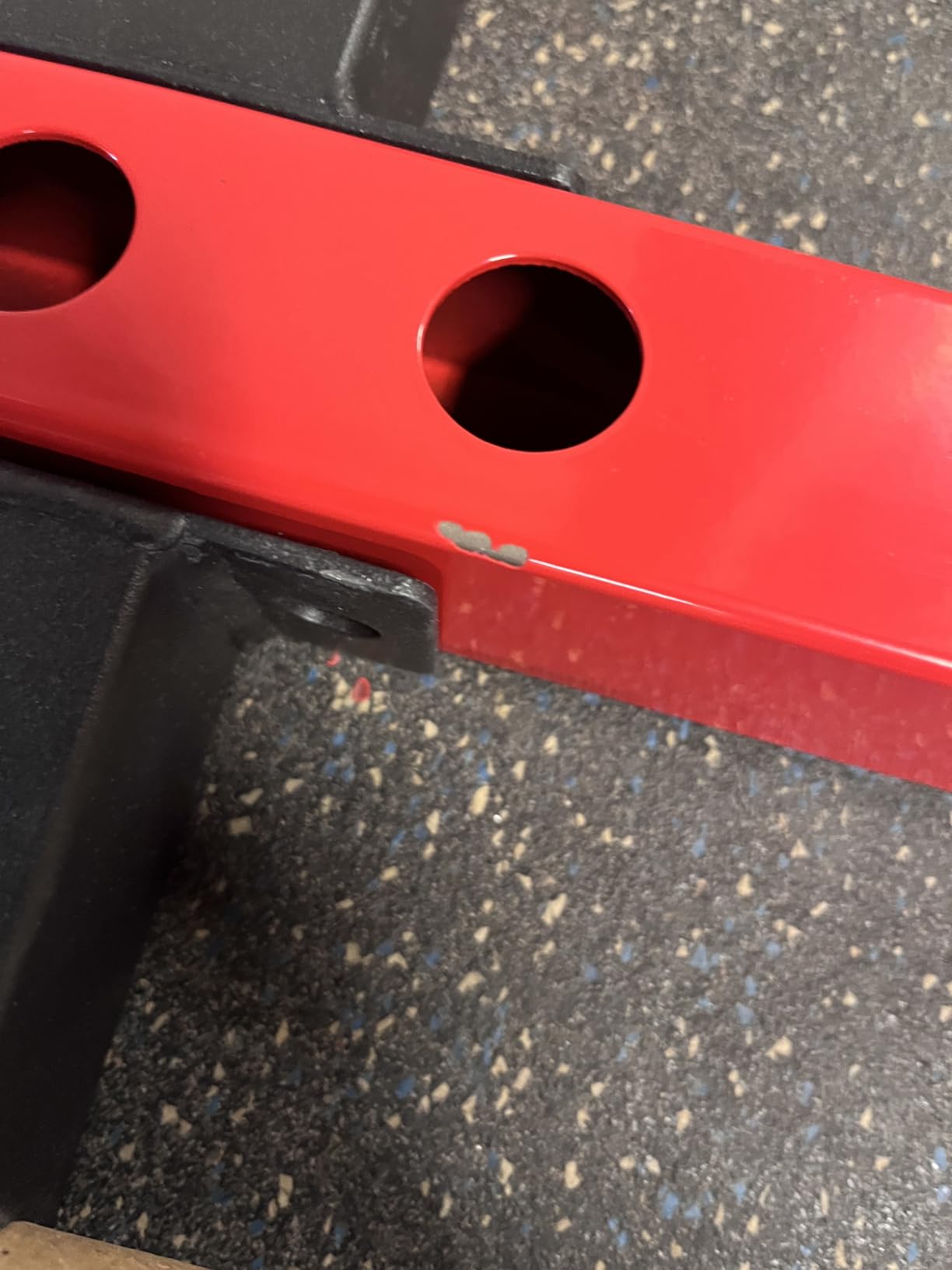
The honest limitation appears after a few months: 160 lb is quickly maxed out by intermediate lifters. Range of motion also feels short next to free weights, and leg programming is thin.
Assembly guidance is the other weak point. Instructions are confusing, the machine may need tipping to finish bolting, and some units arrive with loose hardware.
Know when to move up in weight
If your working sets already sit near the top of the selector range, plan a stack upgrade or a move to a dual-stack unit within a year rather than grinding against the pin.
At 66 by 38 inches it fits where a full trainer will not, which makes it a good partner for a rack in a shared garage.
Who should skip it
Skip it if you already train seriously with free weights, if heavy leg work is central, or if you need unilateral loading at real resistance. A dual-stack or plate-loaded wall station serves a trained lifter better.
10. GMWD Dual-Station Smith Power Cage: Built for Two People
GMWD Dual-Station Smith Machine Power Cage with Weight Stack for Home Gym
Two independent 121 lb stacks
2000 lb frame rating
16 pulley heights
Pros
- Two independent stacks so each user sets their own load
- Smith machine and power rack in the same frame
- Over 100 supported movements
- 2000 lb low-bounce frame rating
Cons
- Very large 109 inch by 71 inch footprint
- 121 lb per side is modest for advanced lifters
- Only a one-year warranty
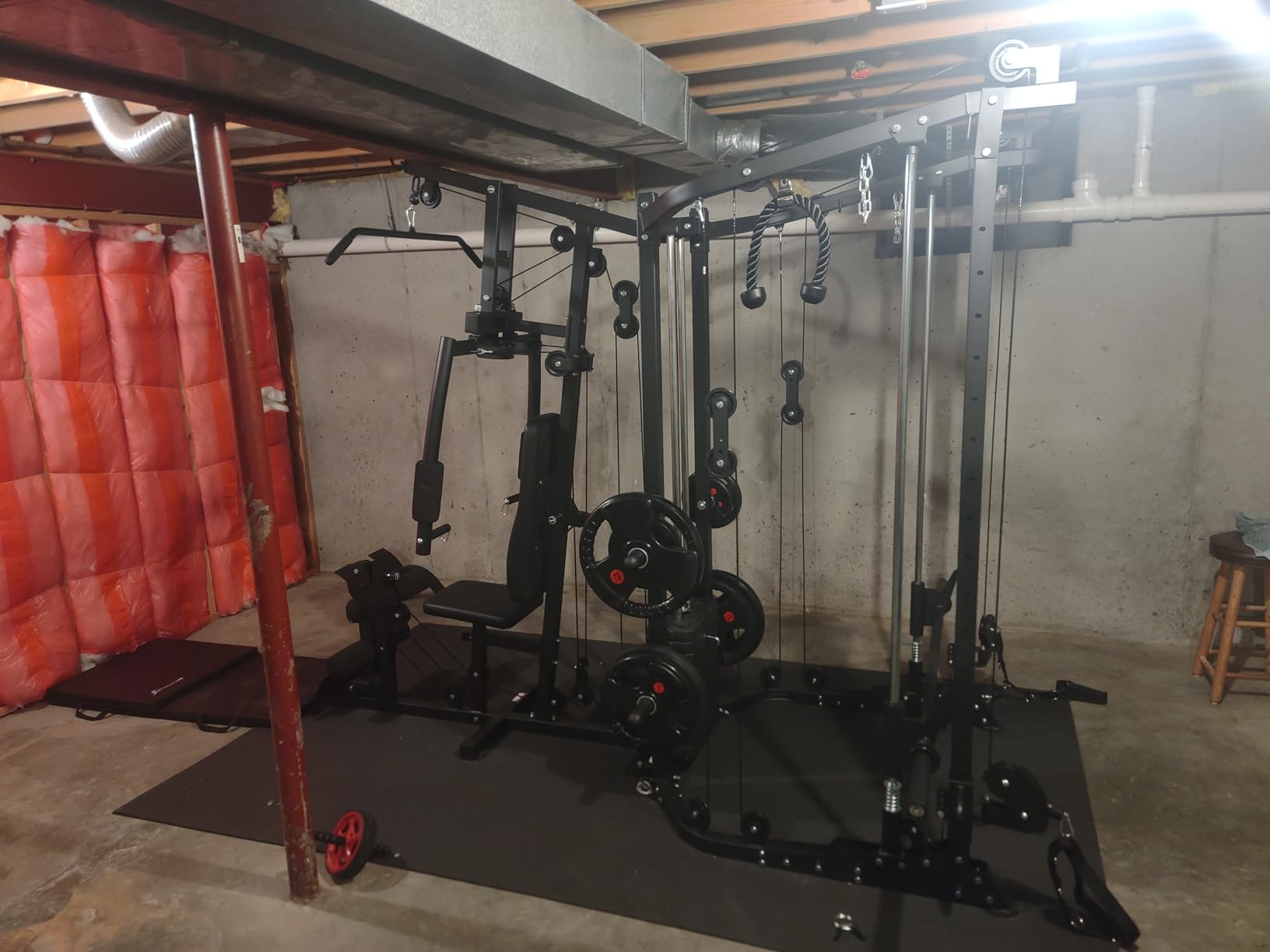
This is the couples and family pick. Two independent 121 lb stacks mean each person sets their own resistance and trains their own movement while the other is mid-set, with zero interference. The frame combines a Smith machine, power rack and functional trainer and supports more than 100 movements from bench press and deadlift to crossovers and pulldowns.
It is rated to 2000 lb with adjustable seating, multi-position backrests and 16 pulley height levels. Cable attachment set, dip bar attachment, spotter arms and a workout post are included.
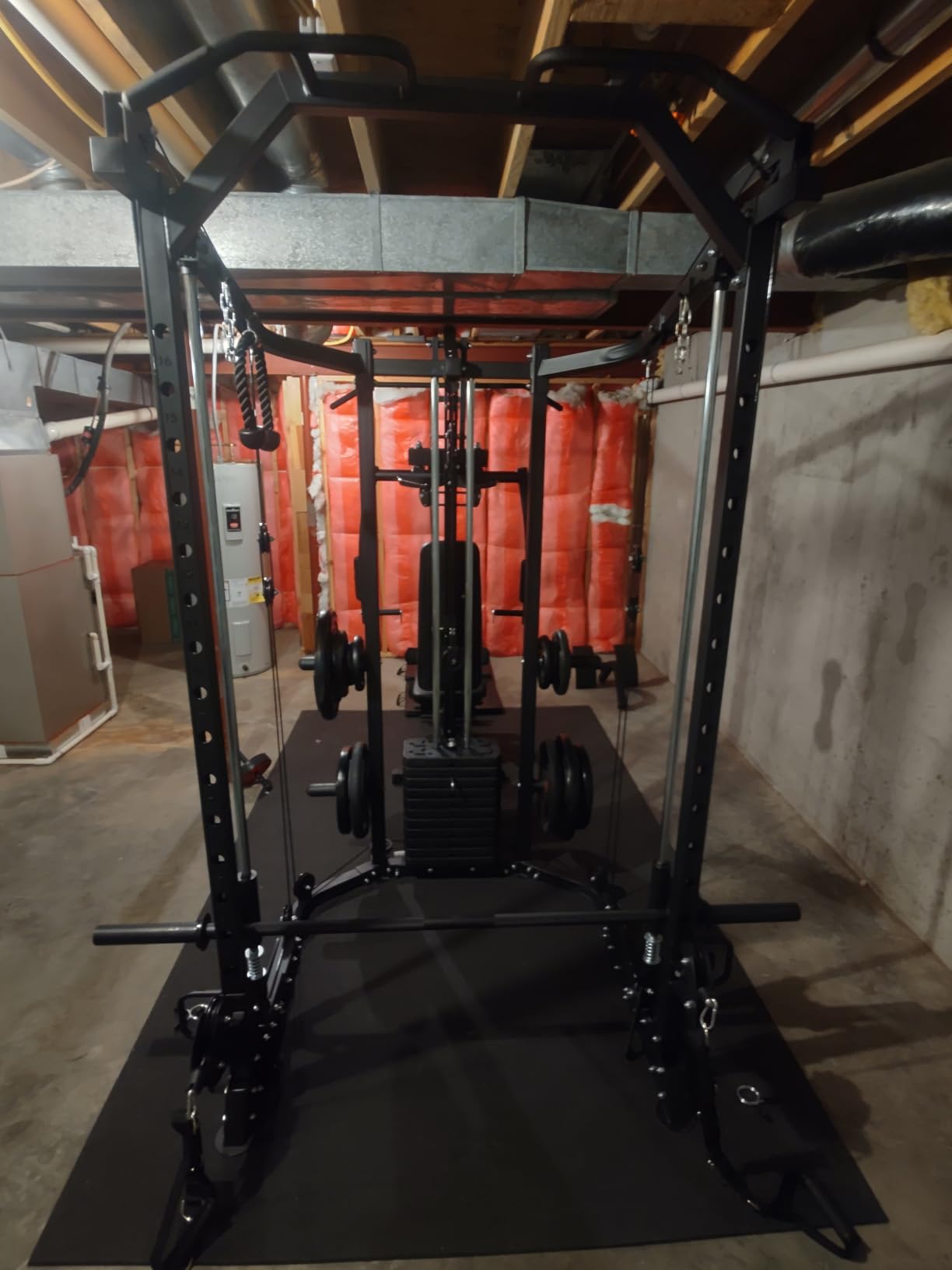
The problem is the 109.57 by 71.18 inch footprint. It dominates a single-car garage, and the 87.83 inch height leaves limited headroom in a low bay.
Two more cautions: 121 lb per side is modest past intermediate, and a one-year warranty on a machine this large is thin. The 56-review base also means little long-term feedback.
Measure the bay for two people, not one
Add three to four feet of working area at each open side, and check that 87.83 inch height clears your garage door tracks and any ducting.
Two users on one machine also concentrates wear on a single cable path, so budget for cable replacement sooner.
Who should skip it
Skip it if the car stays in the bay, if you train alone, or if you are past intermediate and will hit the 121 lb ceiling. The one-year warranty is reason enough to look elsewhere at this size.
Buying Guide: Cable Ratio, Clearance and Stack vs Plates
Cable ratio decides whether a trainer is heavy enough for you. At 2:1 you feel half the selected stack weight, so a 200 lb stack delivers roughly 100 lb of pull. A 1:1 ratio reads true, and the genuine 1:1 machines here are the Mikolo folding rack and the Goimu WM1. If your programming is heavy rows and pressdowns, a 2:1 machine can feel light at first.
Clearance is arithmetic. Add unit height, 6 to 12 inches of pulley clearance above it, and 3 to 6 feet of working area in front. That gives an 8 by 8 ft minimum bay and 10 by 10 ft preferred. On a single-car bay, plan for wall-mounted options only.
Stack or plates. A selectorized stack gives fast resistance changes and no loose iron, but has a hard ceiling. Plate-loaded cable has no ceiling and uses plates you already own, at the cost of a manual change between sets. Beginners and families do well with stacks; strong lifters doing heavy cable work outgrow one within a year.
Wall-mounted units need structure. Both the Mikolo M-G3 and the Goimu WM1 carry real load and neither includes concrete anchors. Locate studs, use the right fasteners, and re-check fixings every few months. Renting rules these out.
Attachments and upkeep. Budget a rope, D-handle, lat bar and ankle strap; the two Body-Solid machines and the SunHome package include most of that. Every six months, wipe the cables, lubricate the carriage guides and check pulley bolts. In an unheated garage in a humid climate, that routine is the difference between smooth cables and rough ones.
Order of purchase. Most owners buy a rack and plates first and add a trainer later, which is the right sequence on a tight budget. A T-Nation thread comparing an Xmark trainer to a REP unit includes an owner saying his machine is well built but not as smooth as more expensive units, a fair reason to spend on cable quality last.
Frequently Asked Questions
What is the most compact functional trainer?
The Goimu WM1 wall mount is the most compact unit here, occupying roughly 3.12 sq ft of floor area at about 81 lb, with 17 pulley heights and a switchable 1:1 or 2:1 ratio. Among freestanding dual-stack trainers, the Inspire FTX is the smallest at 54 by 40 inches. Both need a stud or masonry wall to anchor into.
Is a functional trainer good for a home gym?
Yes, for accessory and unilateral work. Cable tension stays roughly constant through the full range of motion, which is the stimulus barbells and dumbbells cannot replicate for rows, face pulls and single-leg pulls. It is not a substitute for a rack and a barbell on squats and presses, and it is worth it if you already own free weights or plan to.
How much space does a functional trainer need?
Add the unit height, 6 to 12 inches of pulley clearance above it and 3 to 6 feet of working area in front. That works out to an 8 by 8 ft bay as a minimum and 10 by 10 ft as comfortable. Most full dual-stack trainers are 82 to 90 inches tall, so check your ceiling and garage door tracks before ordering.
What are the must-haves for a garage gym?
A power rack with a bench for the big lifts, a set of plates that covers your working loads, a cable option for rows and pulldowns, matting to protect the slab, and a storage plan for the iron. Cardio is usually added last. Anchor wall-mounted cable gear into studs and keep the vehicle path clear before you add anything tall.
What is the best cardio equipment for a garage gym?
A rowing machine and a bike or air bike cover conditioning without adding much floor space, and both roll out of the way when you are lifting. A jump rope costs nothing. If the car has to stay in the bay, keep cardio gear on wheels and along a wall rather than in the middle of the lifting area, since floor space is the real constraint in most garages.
Why are there no budget functional trainers?
Because a true functional trainer needs two independent weight stacks, an adjustable pulley carriage and a steel frame heavy enough to stay planted. That combination does not exist in the cheap tier, where listings using the phrase are single-stack wall mounts, plate-loaded stations or all-in-one Smith cages. Reading the stack spec tells you which you are actually buying.
Which Functional Trainer Fits Your Garage
The Body-Solid Best Fitness is the best functional trainer for garage gyms for most readers: a true dual-stack crossover with the largest owner base here and a decade-long frame warranty. Buy the Inspire FTX if your bay is tight, and the Body-Solid Powerline if you want upgradeable stacks and the smoothest carriage in the group.
If the car stays in the garage, the answer is the Mikolo folding rack for a wall you can anchor into, or the Goimu WM1 if the corner is all you have. Save the all-in-one Smith cages for a spare bay, and add any of these after the rack and the plates.
Whichever you pick, measure the bay, check the ceiling and run the clearance math first. Updated for October 2026.