
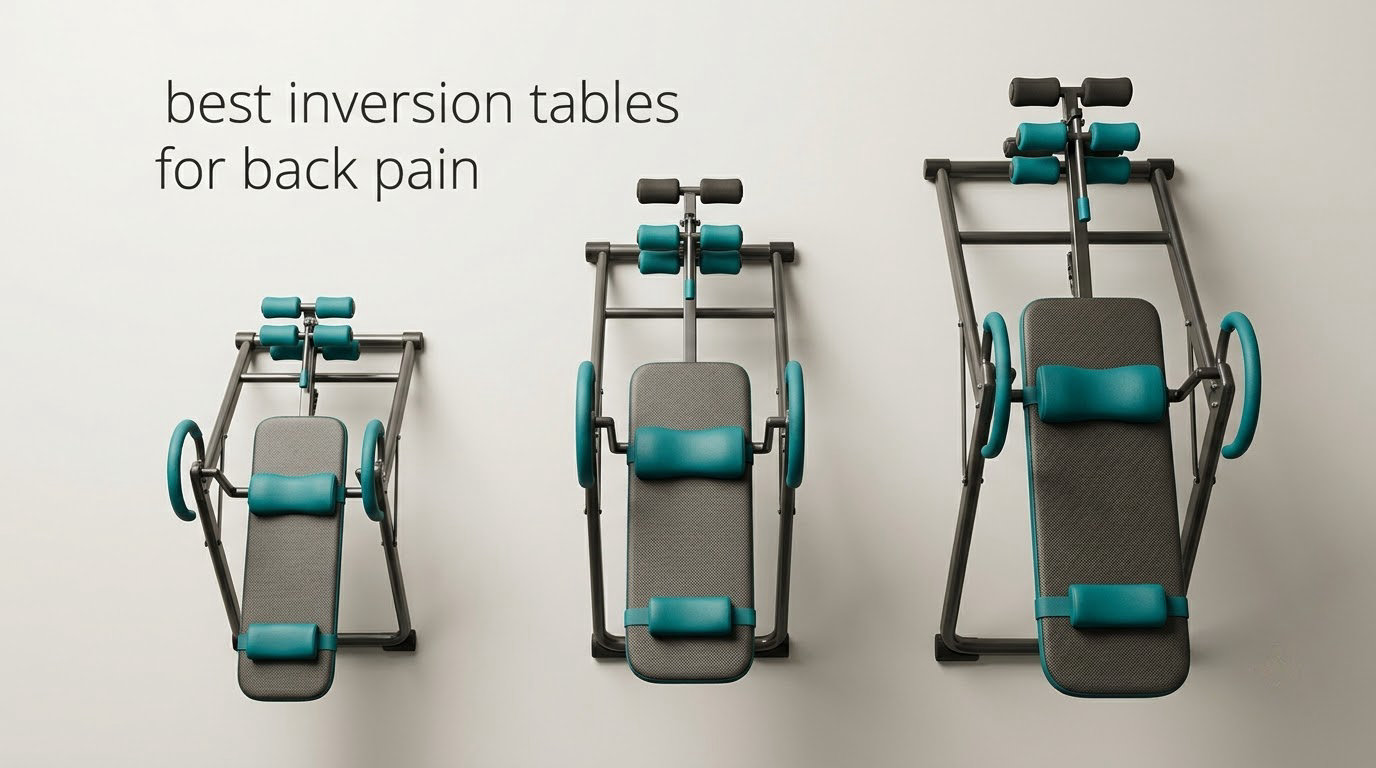
Short answer: yes, inversion tables do help many people with lower back pain, but the relief is real and temporary rather than a cure. Hanging upside down lets gravity pull the spine apart lengthwise, which takes pressure off compressed discs, joints and nerve roots for a short window after each session. Most people who feel results notice them within a few days of regular use, at shallow angles of 15 to 30 degrees rather than full 180-degree inversion.
This roundup covers the best inversion tables for back pain available now, ten models we compared across frame build, ankle lock quality, angle control, lumbar support, heat and massage features, storage footprint and warranty length. We also pulled in what actual owners report about relief, comfort and the parts that frustrate them after a few months of use.
A note before you start: inversion therapy is not for everyone, and it is not a substitute for diagnosis or rehab. If your pain started after an injury, radiates down your leg with numbness, or comes with weakness, see a clinician first. We cover the full list of contraindications further down the page.
Table of Contents
Top 3 Inversion Table Picks for Back Pain (October 2026)

All 10 Inversion Tables Compared in 2026
| Product | Specs | Action |
|---|---|---|
| Innova ITX9600 Inversion Table |
|
Check Latest Price |
 Innova ITM5900 Heat and Massage Innova ITM5900 Heat and Massage |
|
Check Latest Price |
 Innova ITX9900 with Air Lumbar Support Innova ITX9900 with Air Lumbar Support |
|
Check Latest Price |
| Teeter FitSpine LX9 |
|
Check Latest Price |
 Teclor 350 lb Steel Frame Teclor 350 lb Steel Frame |
|
Check Latest Price |
 Dripex Heavy Duty Gravity Table Dripex Heavy Duty Gravity Table |
|
Check Latest Price |
 Teeter EP-560 Teeter EP-560 |
|
Check Latest Price |
 YOLEO ITM280 Heat and Massage YOLEO ITM280 Heat and Massage |
|
Check Latest Price |
 YOLEO ITX320 with Lumbar Pad YOLEO ITX320 with Lumbar Pad |
|
Check Latest Price |
 Teclor AIT6118-A Heat and Massage Teclor AIT6118-A Heat and Massage |
|
Check Latest Price |
Do Inversion Tables Actually Work for Back Pain?
They work for a large share of people, and the mechanism is simple. Past 90 degrees, gravity draws the vertebrae apart, which opens space around compressed discs and takes load off the nerve roots in the lower spine. Conditions that tend to respond best are the ones where symptoms improve when you lie flat: disc-related lower back pain, sciatica, pinched nerves, muscle spasm and stiffness after long desk stretches.
Two things temper the enthusiasm. The relief tends to fade within hours unless you keep a consistent schedule, and the research base is small rather than decisive. A published review of clinical studies found inversion therapy reduced the need for back surgery in some patients, and the Mendelow lumbar disc disease trial is the study most often cited for a decompression effect in disc patients. A separate pilot randomised trial, Prasad and colleagues, looked at inversion therapy for lumbar disc disease and reported symptom improvement that outlasted the sessions themselves. Both are small studies, and neither proves the mechanism.
There is also a useful diagnostic trick that forum users stumbled on independently. Ask yourself whether lying down makes the pain better. On an r/Sciatica thread, people who reported meaningful relief consistently described symptoms that eased when flat and worsened under weight. On an r/backpain thread comparing inversion tables to dip stations, the majority conclusion was that neither device fixes the underlying source of the pain, and that the source matters more than the tool. If standing, sitting or loading your spine makes it worse, inversion is less likely to be your answer.
Longer-term satisfaction is genuinely split. On r/askanything, owners who keep a table tend to swear by it, with a common note that it relieves pressure without curing anything. On r/Biohackers, one long-running account concluded that yoga, Pilates and weight loss resolved chronic lower back pain where inversion had not. Both camps are describing real bodies, which is why we rank these tables on build, control and comfort rather than on medical claims.
How We Picked the Best Inversion Tables
We compared ten tables across the same six criteria so the ranking reflects what you will actually live with.
Balance and centre of gravity. The most common reason a new table feels jerky or unsafe is poor setup, not a bad product. Tables that let you adjust height, footrest and lumbar position independently are far easier to dial in for your own proportions.
Ankle lock quality. This is the single safety-critical component. We favoured pin and gear systems over strap limits, and easy-reach release handles over ankle bars you have to bend forward to engage.
Angle control. Four to six positive stops beat a single strap, because gradual progression is the whole point of a safe protocol.
Build and warranty. Heat-treated steel and a five year warranty are our durability proxies; one year on a new frame is a real cost of ownership signal.
Review confidence. We weighted aggregate ratings by review volume. A 4.6 from nearly 40000 reviews tells you far more than a 4.6 from a few hundred.
Footprint and assembly. Ceiling clearance, folded size and realistic assembly time matter for anyone who does not have a garage.
1. Innova ITX9600 Inversion Table: Best Overall for Back Pain Relief
Innova Health and Fitness Inversion Table with Adjustable Headrest, Reversible Ankle Holders, and 300 lb Weight Capacity – Standard
300 lb capacity
Users 4ft-10in to 6ft-6in
46 x 28 x 63 inches
One year warranty
Pros
- Sturdy steel frame that does not flex
- six-position pin readable from standing
- reversible ankle holders ease pressure points
- folds flat for storage
- widest review base in the class
Cons
- Thin ankle padding at steep angles
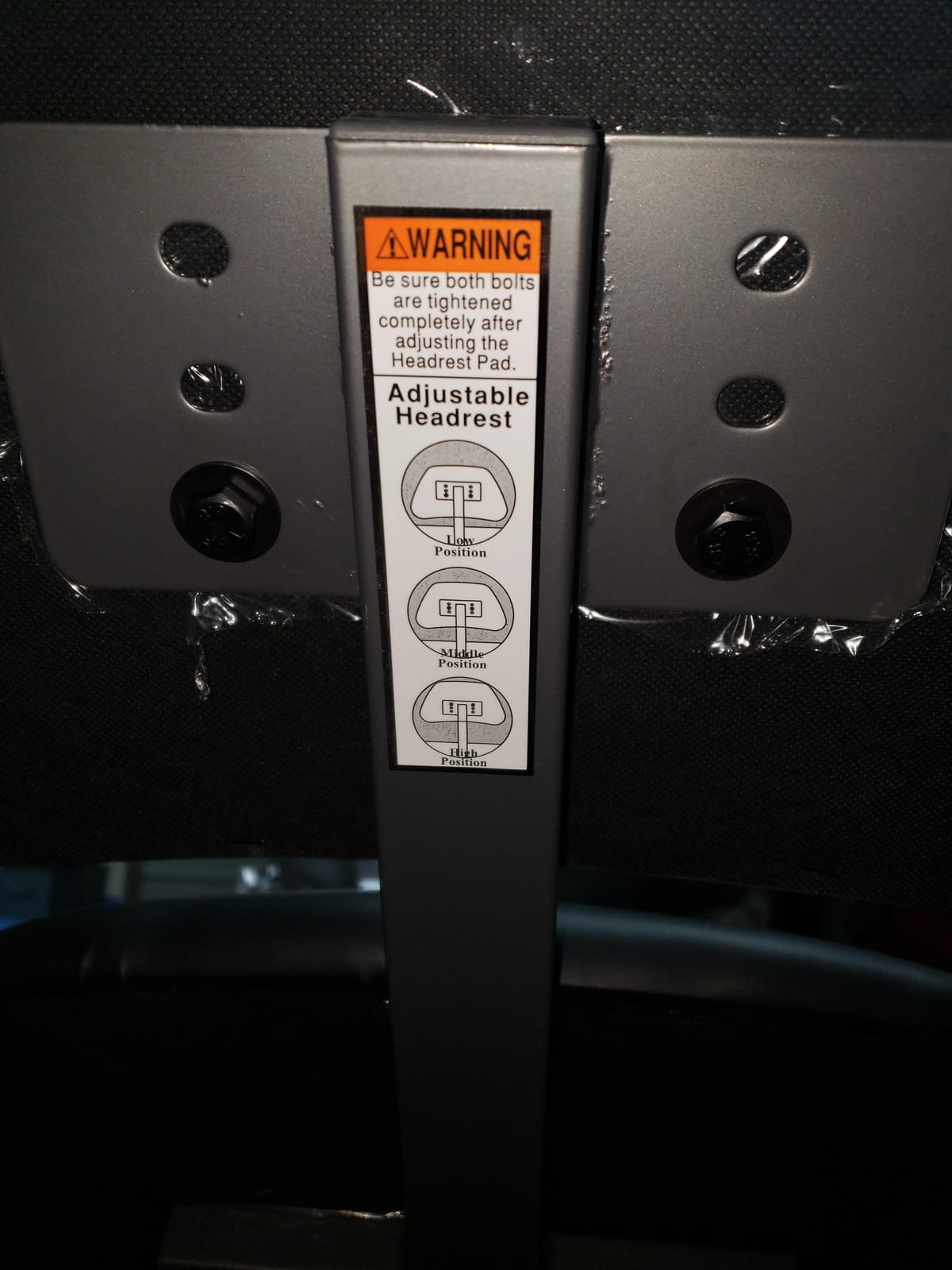
- headrest needs unbolting to adjust
- light-duty hardware can loosen
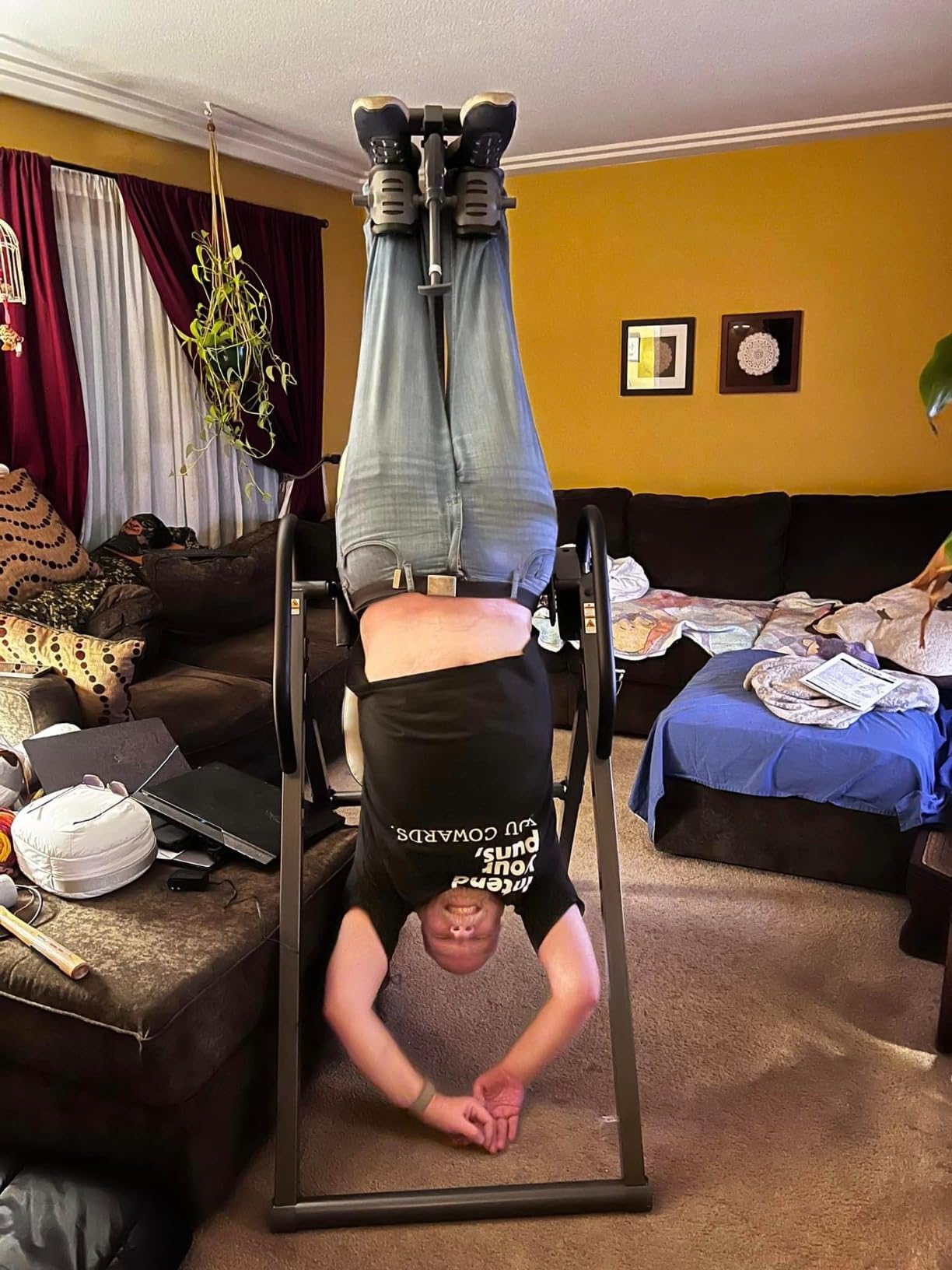
This is the table I recommend first for most people, and the reason is unglamorous: after weeks of use, this is the one where the number of complaints about the frame itself was close to zero. The steel does not flex, the rotation is smooth once the height balance is set, and the six-position pin is legible from a standing position so you can change angle before you commit to a session.
The reversible ankle holders are a small design decision that turned out to matter a great deal. Owners report that swapping the front and rear holders changes the pressure distribution enough to solve the ankle discomfort that spoils a lot of budget tables. Most people report noticeable relief from chronic lower back, neck and sciatica pain within days, at shallow angles.
The honest weakness is ankle padding, which is thinner than it looks in product photos. At steep angles it creates pressure on the ankles and the tops of the feet, and that is the caveat we hear more than any other. The fix is to reverse the holders and to keep your working angle in the 15 to 30 degree range, where traction is still meaningful and pressure is manageable.
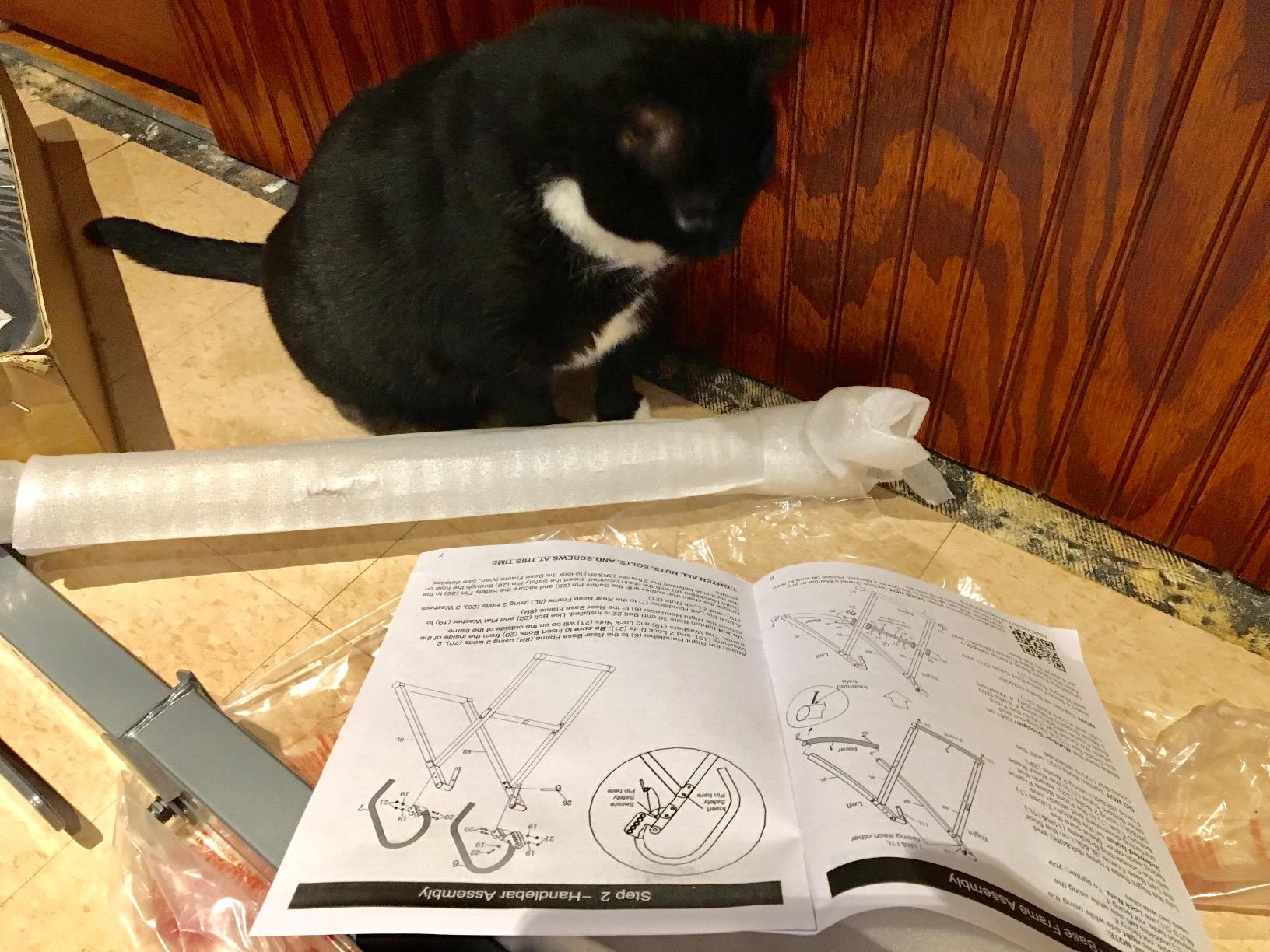
Assembly is the other time investment. Owners describe it as time-consuming but straightforward when the instructions are followed, with misaligned screw holes the main complaint. Budget roughly an hour with a second set of hands, and check every bolt before the first inversion.
Who this table suits
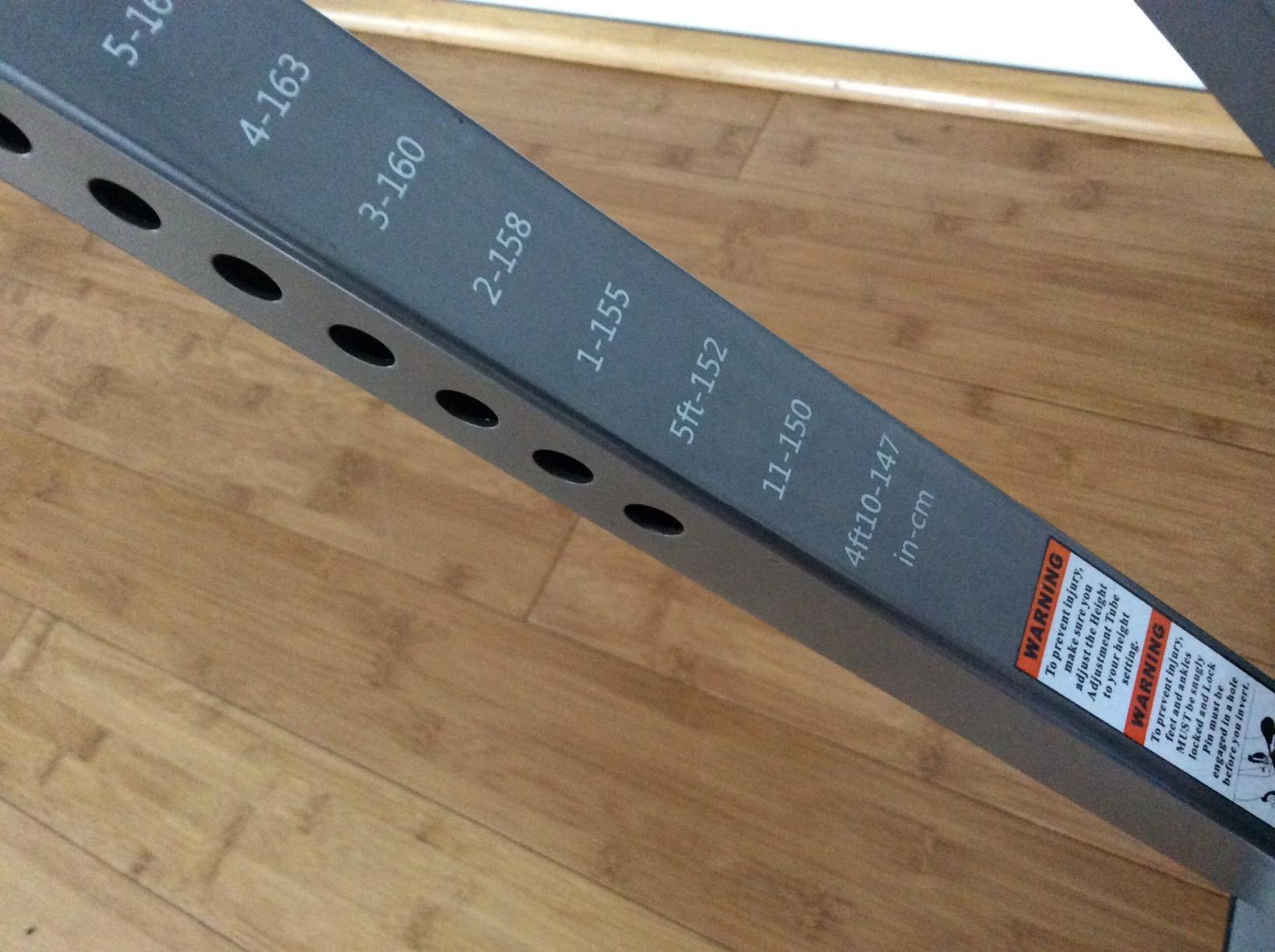
It suits anyone starting out, because 300 lb capacity, a 4ft-10in to 6ft-6in height range and a wide padded backrest cover most adults. It also suits cautious buyers who want evidence rather than marketing: a 4.6 rating across nearly 40000 reviews is the most reliable signal in this whole list.
For people who want something simpler than a premium table and do not need heat or massage, this is the honest recommendation. Nothing here is a gimmick.
Who should skip it
Skip it if you invert past 60 degrees regularly, since the thin ankle padding becomes a real problem there. Also skip it if you want a quick headrest adjustment mid-session, because changing it means unbolting and re-bolting it. And if you are over 300 lb, look at a 350 lb steel frame instead.
One more caution: the height balance needs fine-tuning per user, and incorrect setup is what makes inversion feel jerky. Spend the first ten minutes on setup rather than on inversion.
2. Innova ITM5900 Heat and Massage: Best Value With Added Comfort Features
INNOVA HEALTH AND FITNESS ITM5900 Advanced Heat and Massage Inversion Table, Gray/Black
300 lb capacity
Vertical massage pad
Six-position pin
47 x 28 x 62 inches
Pros
- Stable and heavy frame
- multi-mode heat and vibration adds relaxation
- ankle holders grip with less sliding
- integrated lumbar pad supports the lower back
- light enough to reposition
Cons
- Heat only reaches around 90F
- massage is vibration not kneading
- headrest is not height-adjustable
Buyers with herniated discs, sciatica and chronic lower back pain report that the traction itself is highly effective here, sometimes within two or three sessions. The frame stays stable through the whole range, which matters more than it sounds: a table that shifts under you erodes the confidence that lets you relax into a session.
The vertical massage pad covering the spine area, with an integrated lumbar pad, is the reason to step up from a basic model. Several owners find the vibration worth it for loosening tight muscles before inverting. The six-position pin and the lumbar pad together make a good combination of traction and support rather than pure hang.
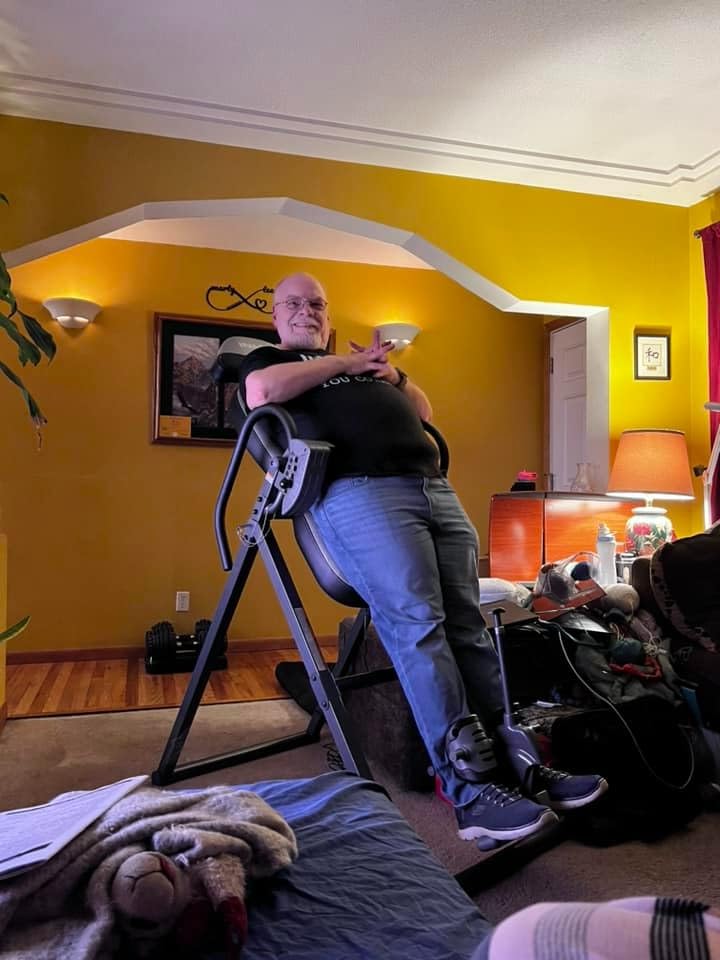
Here is the split in the reviews, and you should know it before buying: plenty of owners call the heat and massage a gimmick. The heat reaches roughly 90F, which many people barely notice, and the massage is a vibrating pad rather than a true kneading mechanism. If your goal is decompression, the plain ITX9600 gives you the same core machine for less money.
Two more practical notes. The headrest is not height-adjustable, so a rolled towel under the neck is a common workaround. Assembly runs around two to three hours solo, the largest time commitment in this group, and the folded footprint is genuinely large for a small apartment.
Who this table suits
It suits people who already know inversion helps them and want the session to feel more restorative. The multi-mode heat and vibration settings, with auto or manual selection, work well as a warm-up before a deeper angle.
It also suits anyone who wants a heavier, more planted frame in the 300 lb class. Owners consistently describe it as stable and substantial while still being light enough to move between rooms.
Who should skip it
Skip it if you are sensitive to heat, since the pad warms the back during inversion and the reported maximum is mild but not adjustable to nothing. The unit can also shut off unexpectedly, and the plug is US-only, which matters outside the US.
Skip it if your floor space is tight or if you invert near full 180 degrees, since the angle settings are coarse jumps and the jump past 45 degrees is a big one. There is also no lock on the upright storage position, so the folded unit can slide if you do not lean it.
3. Innova ITX9900 with Air Lumbar Support: Best for Adjustable Lumbar Support
Innova ITX9900 Inversion Table with Air Lumbar Support, Black/Gray
300 lb capacity
User-inflated air lumbar
Extended release rod
Six-position pin
Pros
- Air lumbar support adjustable while on the table
- long release rod avoids bending down
- pin changes from standing position
- sturdy build for heavier users
Cons
- Ankle holders lack a positive lock at full 90 degrees
- headrest needs a screw undone
- full inversion really wants a spotter
This is the one to pick if your pain is concentrated in the lower back rather than the hips or thighs. The air lumbar support is user-controlled, so you can inflate it further while you are already on the table and feel the arch deepen under your lower back. Owners report that this adjustable support is more useful than they expected at the time of purchase.
Two design decisions make daily use easier. The extended ankle release rod is long enough that you do not have to bend down to unlock, which matters enormously when bending is the activity that hurts. And the six-position pin can be changed from a standing position, unlike strap-based systems that need you to be inverted to change.
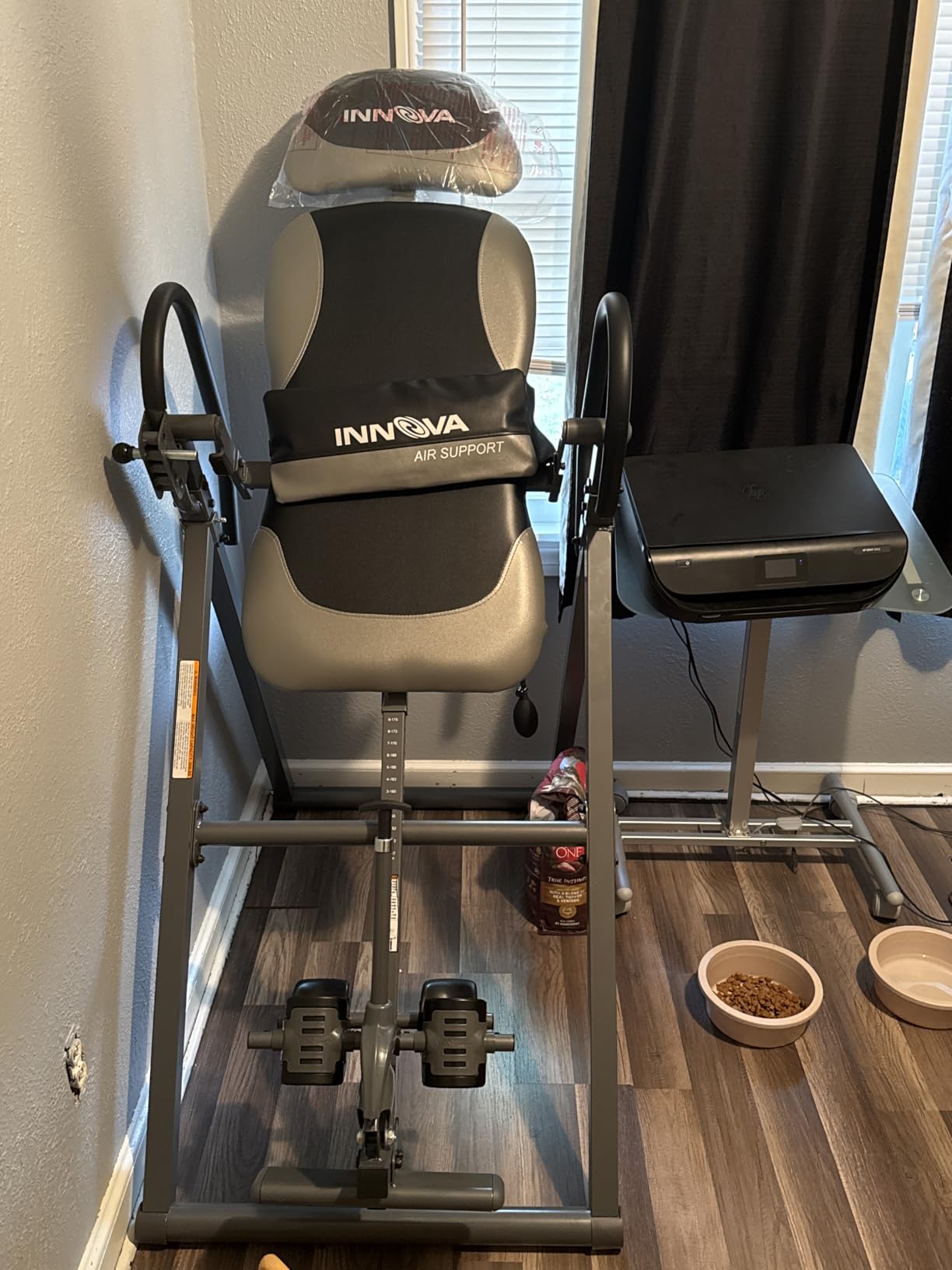
The limitation that shows up most is specific and worth understanding. At full 90 degrees the ankle holders do not lock positively, so your ankles can slip and shift the centre of gravity. The practical sweet spot for this table is roughly 30 to 75 degrees, and several owners say full inversion is not usable without a spotter. Assembly, by contrast, is consistently rated easy at 30 to 90 minutes.
Owners managing degenerative disc disease, stenosis, sciatica and pinched nerves report repeatable relief from short daily sessions, and a number of them describe being able to stop taking pain medication. That is a user-reported outcome, not a clinical trial result, and it should be read that way.
Who this table suits
It suits people whose pain is lower-lumbar and who want to fine-tune support rather than accept a fixed arch. It also suits anyone over 230 lb who wants a sturdy frame without moving up a size class.
Users with pinch nerves and stenosis are well represented in the reviews, and short daily sessions at moderate angles are the pattern that works for them.
Who should skip it
Skip it if your protocol depends on long holds at full inversion, because the ankle holders do not lock at that angle. Also skip it if you need frequent headrest changes, since the three headrest settings require undoing a screw each time.
Small hardware and occasional packing errors are reported, so inspect the contents on arrival and check the pin mechanism before the first use.
4. Teeter FitSpine LX9: Premium Pick for the Best-Engineered Build
Teeter FitSpine LX9 Inversion Table, Deluxe Easy-to-Reach Ankle Lock, Back Pain Relief Kit, FDA-Registered (LX9 – Black)
300 lb capacity
Heat-treated steel
FlexTechnology backrest
Five year warranty
Pros
- Rock-solid with no wobble at 250 to 350 lb
- ratcheting EZ-Reach ankle lock needs no forward bend
- smooth rotation controlled by arm position
- 5-year warranty and UL certification
Cons
- Highest cost in the group
- acupressure nodes add little for most users
- written instructions are vague
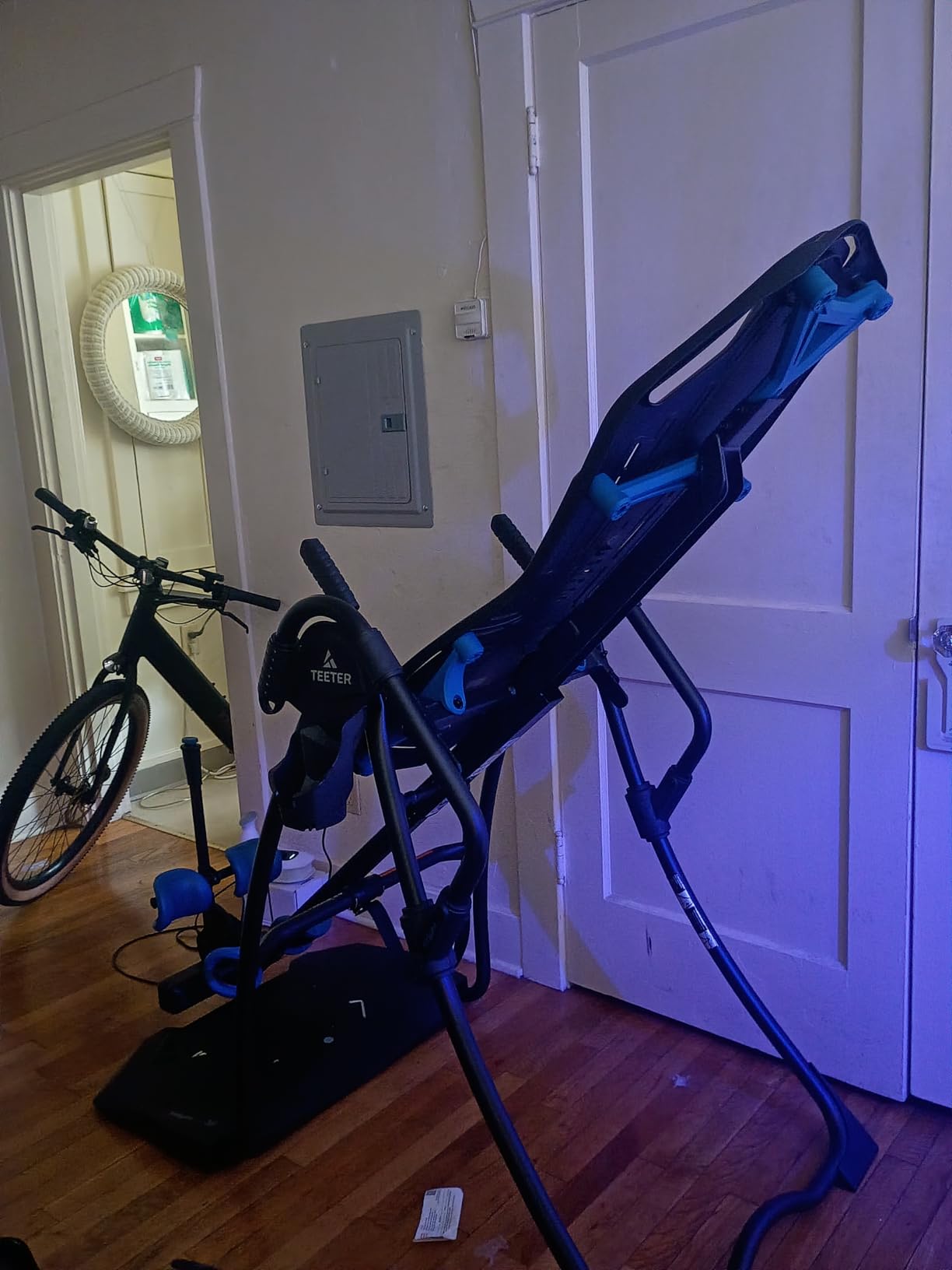
The LX9 earns its place on engineering rather than on marketing. Owners in the 250 to 350 lb range describe a rock-solid, non-wobbly feel, and the rotation is smooth enough that arm position alone controls it. The backrest contours to the body rather than presenting a flat board, which is the difference between a table you tolerate and one you look forward to.
The FitSpine backrest uses an eight-point floating suspension system that allows maximum body slide as you decompress. The EZ-Reach ratcheting ankle lock with its extra-long stainless steel handle and a secondary gravity-activated lock means you never bend forward to unlock, which is the single most underrated comfort feature in this category.
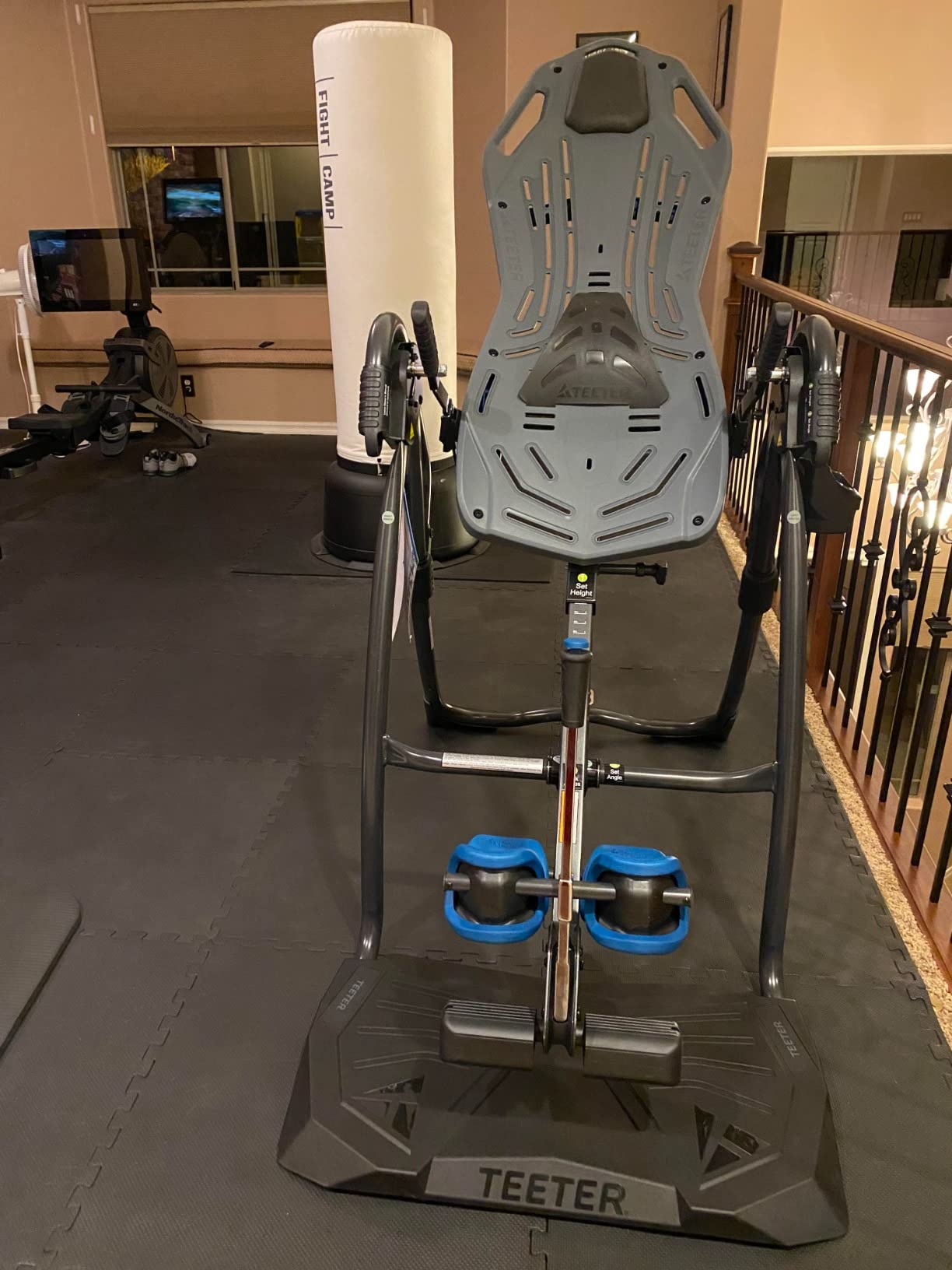
The EZ-Angle tether has preset markings at 20, 40 and 60 degrees, and the lumbar bridge with adjustable arch gives focused lower-back traction. Eight acupressure nodes in varied heights are included for trigger-point release, though owners are split and many find them less useful than advertised. The wrap-around ankle cups and two-position foot platform distribute pressure well, especially compared with bare foam cylinders.
Assembly runs 25 to 30 minutes solo if you use the free Teeter Move training app, because the written instructions are vague. The product listing claims the only inversion table brand registered with the FDA as a 510(k) medical device, and it is UL Safety Certified with heat-treated steel and a five year warranty. On a long-running Cathe forum thread, Teeter is repeatedly named the best brand available, with users reporting benefit for scoliosis-related pain.
Who this table suits
It suits people who will use a table daily for years and want the best-engineered mechanism available. The five year warranty, the UL certification and the medical device registration are the kinds of signals that matter when steel fatigue and pin failure are the failure modes you care about.
It also suits anyone who finds ankle pressure the thing that ruins inversion for them. The wrap-around cups and foot platform are the most refined pressure distribution in this group.
Who should skip it
Skip it if budget is the deciding factor. The build quality is real, but a basic Innova gives you the same traction for a fraction of the outlay, and the premium features here are engineering refinements rather than therapeutic breakthroughs.
Skip it if you are doing a trial of whether inversion helps you at all. Start with a cheaper table, confirm it works for your body, then upgrade. Also note the ankle clamp can sit uncomfortably on bare ankles, so wear socks or sweatpants, and use a spotter for your first inversion.
5. Teclor 350 lb Steel Frame: Best for Taller and Heavier Users
Teclor Inversion Table for Back Pain Relief, 350 lbs Capacity Strength Training Inversion Equipment, Decompression Table for Pain Therapy Training with Safe Belt & Comfortable Ankle Holders
350 lb steel frame
Users 4ft-3in to 6ft-8in
30.3 x 15.3 inch backrest
Safety belt included
Pros
- 350 lb steel frame confirmed stable by heavy users
- padded ankle holders cause less pain than rivals
- backrest wider and longer than the class
- quick assembly for some
Cons
- Lumbar pad can be unusable if the hook-and-loop anchor is missing
- cheap ankle foam slips from its sleeve
- stapled upholstery
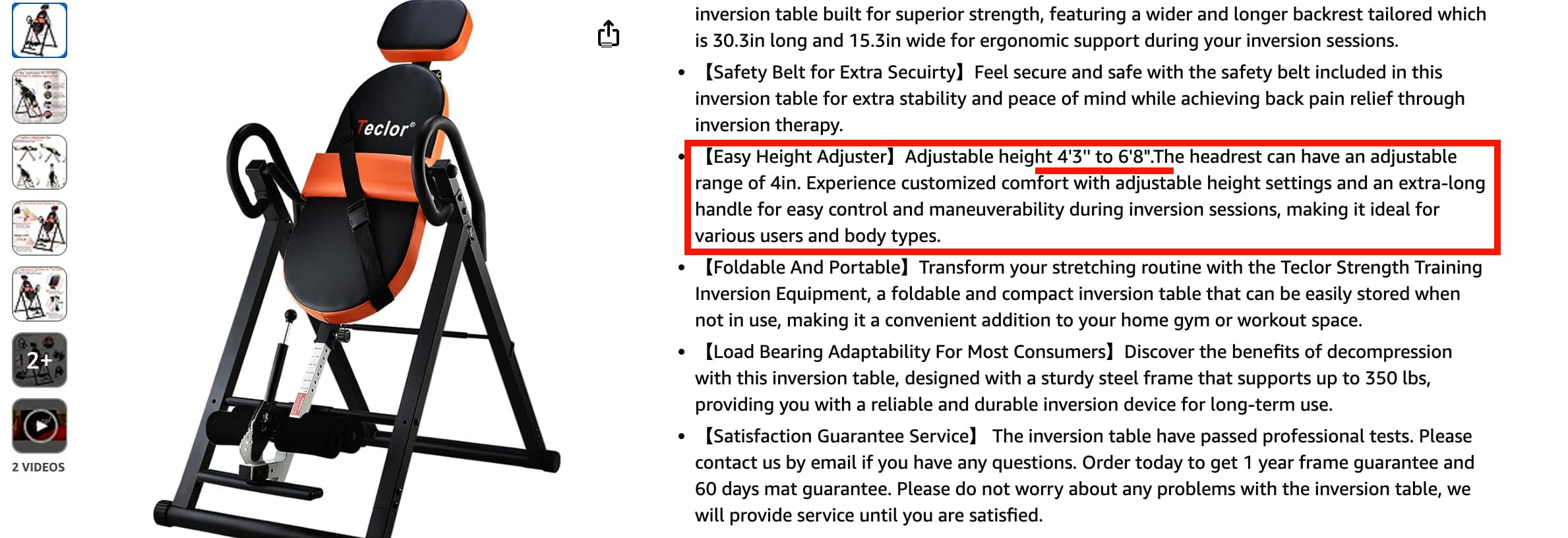
The headline number here is the height range. Accommodating users from 4ft-3in to 6ft-8in with a 4 inch adjustable headrest range makes this the most accommodating frame in the roundup for anyone above 6ft-4in, a group most tables in this class simply do not serve.
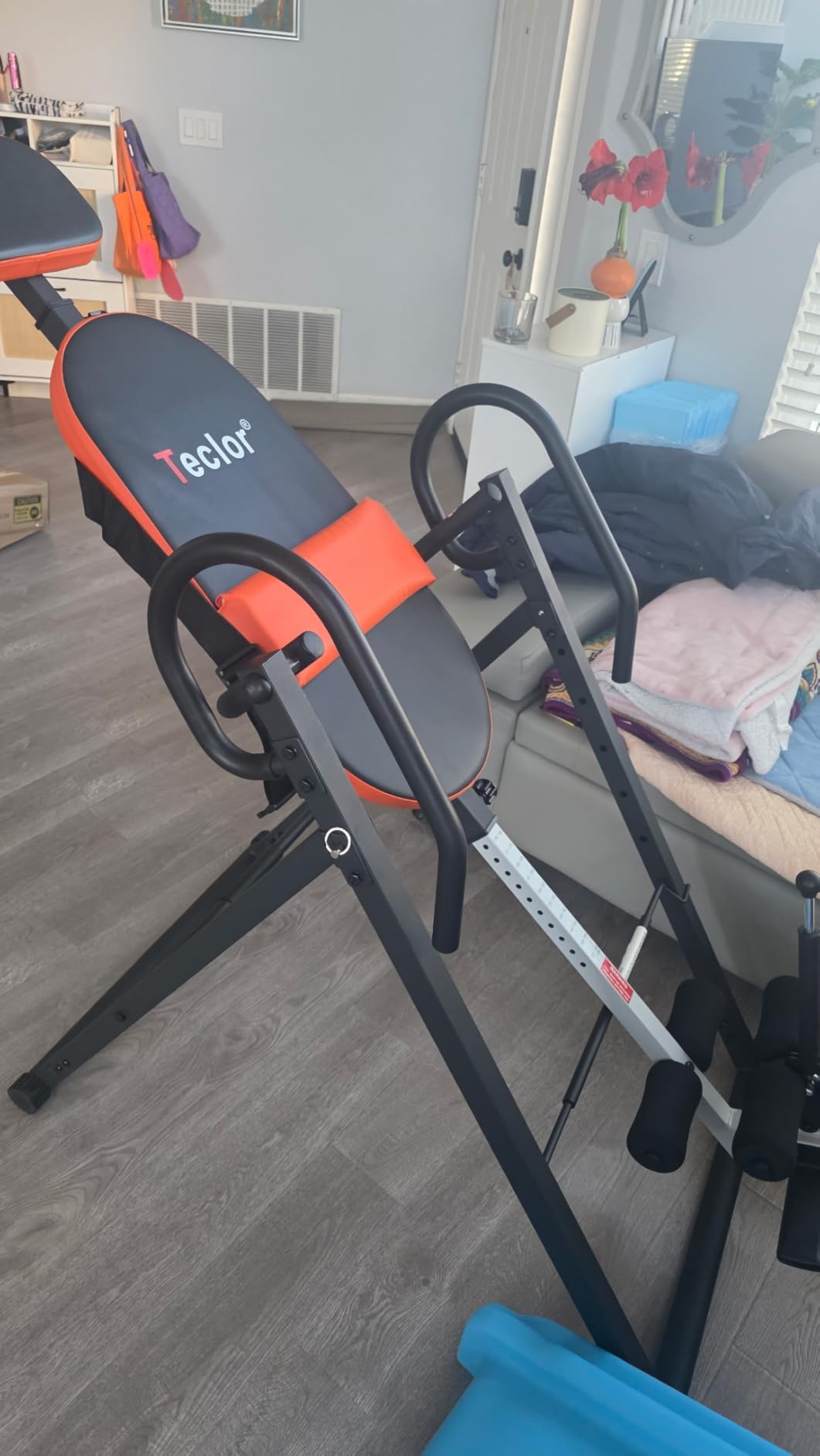
The 350 lb steel frame is the other draw, and heavy users confirm in reviews that it holds with no wobble. The backrest is 30.3 inches long and 15.3 inches wide, wider and longer than most competitors at this level, which matters for larger frames because a short backrest leaves the shoulders unsupported.
Where it loses ground is finishing quality rather than function, and the distinction matters when you are choosing. The lumbar pad has no hook-and-loop anchor on some units, which makes it dead weight in the box. The ankle and foot foam is cheap and can slip out of its sleeve, and the backrest upholstery is stapled on rather than properly fitted. The included safety strap and tools are low quality too, and the height indicators are metric only.
One functional complaint stands out: the handles do not help much at full inversion, so getting back upright can feel hard. The extra-long handle is a real help at moderate angles and much less help when you are fully inverted. Assembly is picture-driven, so plan on the diagrams rather than the text.
Who this table suits
It suits taller users and anyone above 300 lb, which is a genuine gap in most of this list. If the base model in this class stops at 6ft-6in, you will spend every session compressed with your knees bent up.
It also suits people who want a straightforward table with a clear capacity rating and an adjustable safety belt limiting the inversion angle without mechanical complexity.
Who should skip it
Skip it if build refinement matters to you. At a 4.3 rating from 861 reviews, the complaints cluster around hardware and upholstery rather than performance, and that will bother you if you are the type who notices a loose strap.
Skip it if you plan frequent full inversion, given the handle limitation at that angle, and check the lumbar pad anchor on arrival before assuming it works.
6. Dripex Heavy Duty Gravity Table: Best for Small Spaces
Dripex Heavy Duty Gravity Inversion Table 300 lbs Capacity
300 lb capacity
Folds in 3 seconds
Four-position pin
Height 1.5 m to 1.95 m
Pros
- Three second fold for small-space storage
- pin system replaces strap limits
- lumbar
- height and footrest all adjustable for balance
- integrated steel frame
Cons
- Only four angle positions
- shortest warranty here at one year
- newer listing with a thinner review history
Storage is the whole argument for this table. It folds in three seconds without disassembly and sits at a low profile, which makes it the most practical option in a flat, a loft, or any room without a garage. If your ceiling is low enough that a full-length table is not an option, this is the shape that works.
The other thing owners like is the pin system. Four positive angle positions replace the strap-based limits found on budget tables, so the stop you select is the stop you get, every time. That repeatability is what makes a gradual progression protocol possible rather than aspirational.
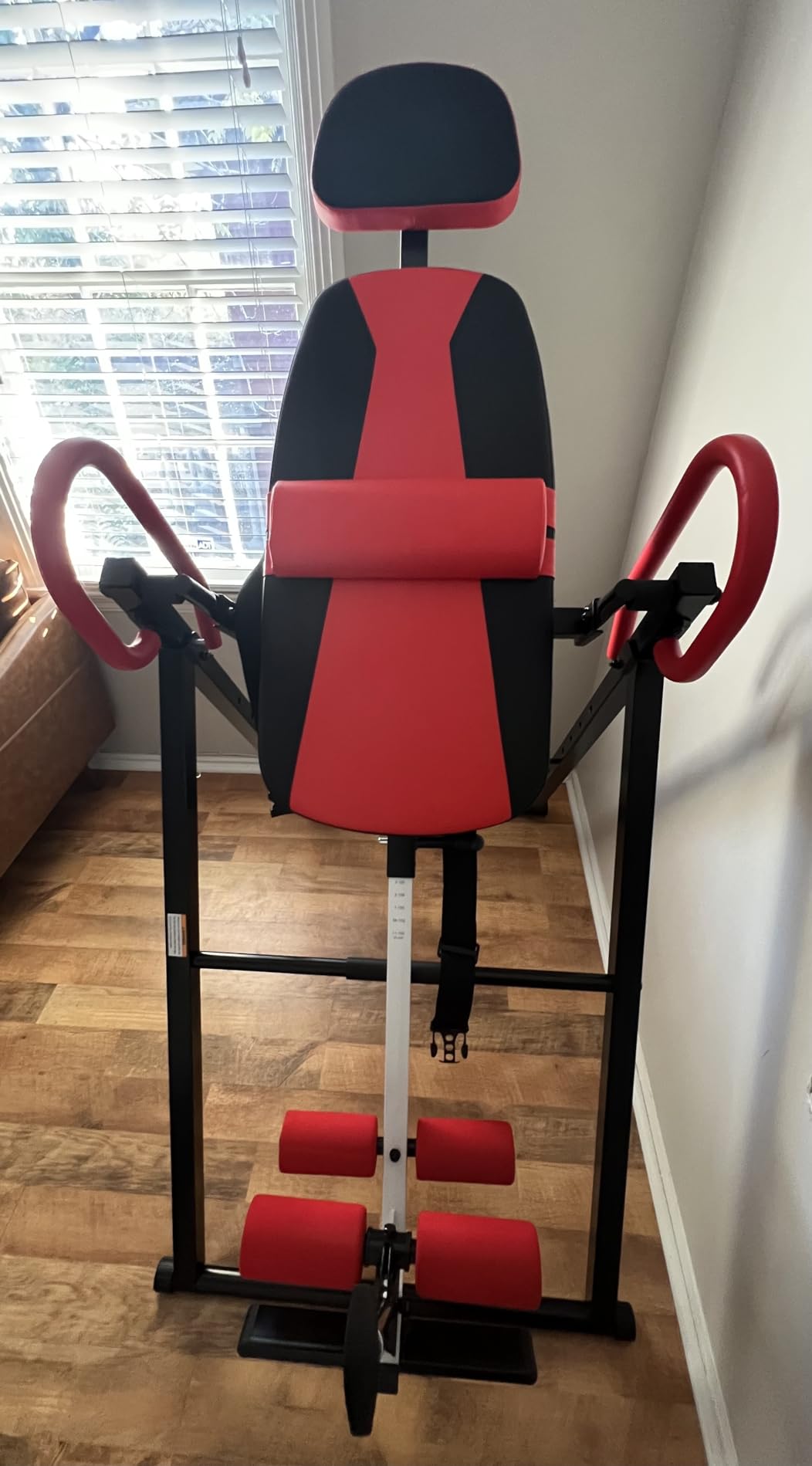
Balance is where this model separates itself. Lumbar support, height and footrest are all adjustable, giving you three ways to move the centre of gravity until the rotation feels smooth rather than abrupt. Owners report a smoother, more controlled inversion than cheaper strap-based designs, and the 300 lb capacity sits on an integrated steel frame.
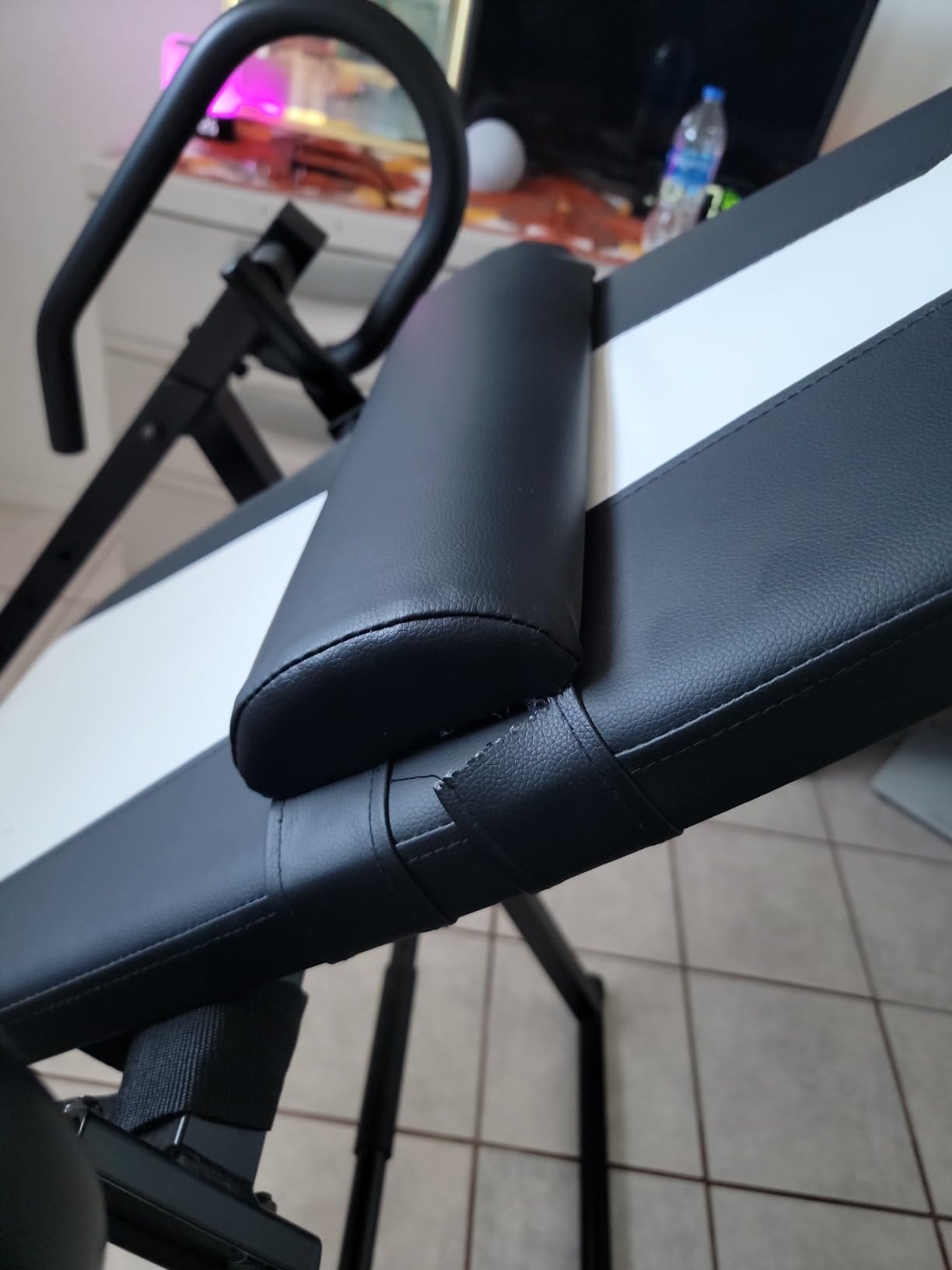
Two caveats. Four positions are coarser than the six available on the Innova models, so your progression steps are wider. And at a one year warranty this is the shortest in the group, which on a welded steel frame is a thinner durability backstop than the five year cover on the Teeter models.
Who this table suits
It suits apartment dwellers and anyone who needs the table to disappear when not in use. The height range of 1.5 m to 1.95 m covers most adults, and the adjustable footrest helps shorter users get a balanced pivot.
It suits people who dislike straps on principle. The pin system is the cleaner mechanism and there is nothing to fray or snap.
Who should skip it
Skip it if you want fine-grained angle progression or a long warranty. Four positions and one year of cover are the two compromises here, and neither is fatal, but both are real.
Also consider that this is a newer listing with 614 reviews, so there is less long-term durability feedback than the Innova and Teeter models have accumulated. Detailed long-form user feedback on this listing is thinner, which is worth factoring into your confidence.
7. Teeter EP-560: Best for Beginners and Straightforward Angle Control
TEETER ComforTrak EP-560 Inversion Table, Decompression Surface for Full-Body Stretch, Ergo Embrace Ankle Supports, Integrated Accessories, UL Safety Certified, Heavy-Duty 300 lb Capacity (EP-560)
300 lb capacity
ComforTrak backrest
Wrap-around ankle cups
Five year warranty
Pros
- Very stable with no wobble
- wrap-around cups grip better than foam cylinders
- simple reliable strap angle control
- folds flat against a wall
Cons
- Ankle bar lock requires bending over
- Allen-head fasteners are fiddly
- lumbar arch can feel too pronounced
The EP-560 is the one to buy if you are nervous about inversion and want the simplest possible control scheme. The angle limit strap is a single strap you set once, and unlike mechanical pin systems there is nothing to jam or misalign. Owners call it simpler and more reliable than pin or gear approaches, which is exactly the right property for a first table.
It is also genuinely stable. Owners using it for chronic lower back and sciatica pain report meaningful, cumulative relief, with many noting that pain returns less intensely after each session. The ComforTrak backrest flexes and allows body slide, and the wrap-around ankle cups hold more securely than bare foam cylinders.
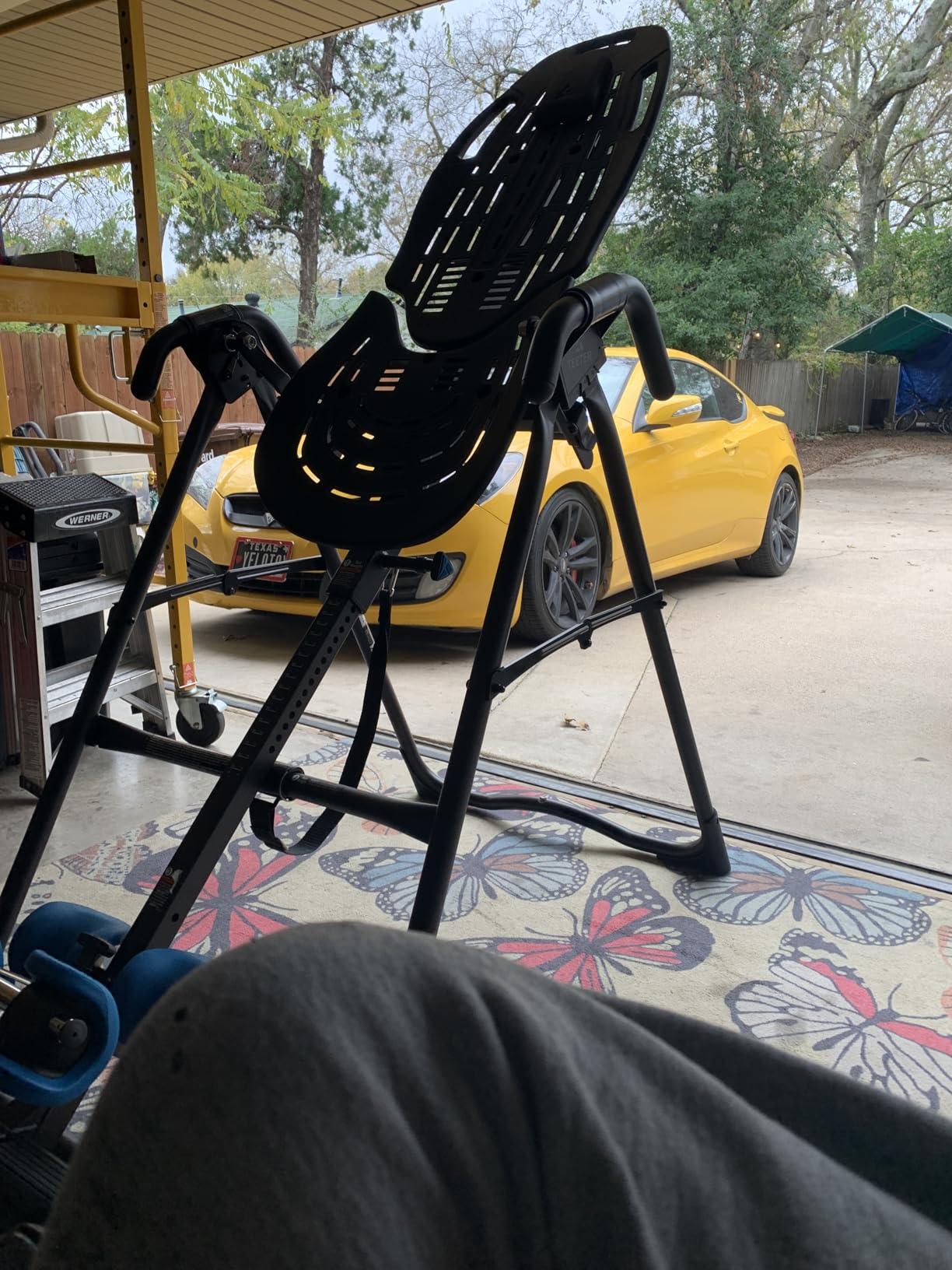
The grip-and-stretch handholds add useful stretching options, and the contoured, ventilated back is comfortable and easy to clean. This model is FDA registered as a 510(k) medical device for back pain, sciatica, herniated disc, stenosis and related conditions, and it is UL Safety Certified with heat-treated steel and a five year manufacturer warranty.
The friction point is the ankle bar lock, which requires bending forward to engage and release, and that is uncomfortable for exactly the people who need the table. Several fasteners are Allen-head rather than Phillips, which is fiddly, and the lumbar support arch can feel too pronounced for some users.
Who this table suits
It suits first-time inverters who want one control to learn rather than four. The strap-based angle limit is the gentlest learning curve in this roundup, and the boarding motion is straightforward.
It also suits anyone who wants a five year warranty without stepping up to the LX9, and anyone whose back pain makes heavy assembly a problem, since the frame folds flat without tools for storage.
Who should skip it
Skip it if bending forward is painful for you, because the ankle bar release asks you to do exactly that. If your pain is concentrated in the lumbar area and you already know you need a deeper arch, the EP-560 lumbar support may not be enough.
Assembly needs help for anyone with back pain, since the unit weighs 65 pounds and several fasteners are the wrong driver type. Budget for a second person on day one.
8. YOLEO ITM280 Heat and Massage: Best for Remote-Controlled Heat and Massage
YOLEO Inversion Table Massage & Heat for Back Pain Relief Equipment
320 lb capacity
Remote massage pad
Memory foam backrest
Users 4.75 to 6.4 ft
Pros
- Remote-controlled heat and massage during sessions
- angle pin gives repeatable stops
- reversible ankle holders reduce pressure
- memory foam back follows the waist curve
Cons
- One year warranty
- lowest review volume here so durability is unproven
- remote cord while inverted
- massage is vibration only
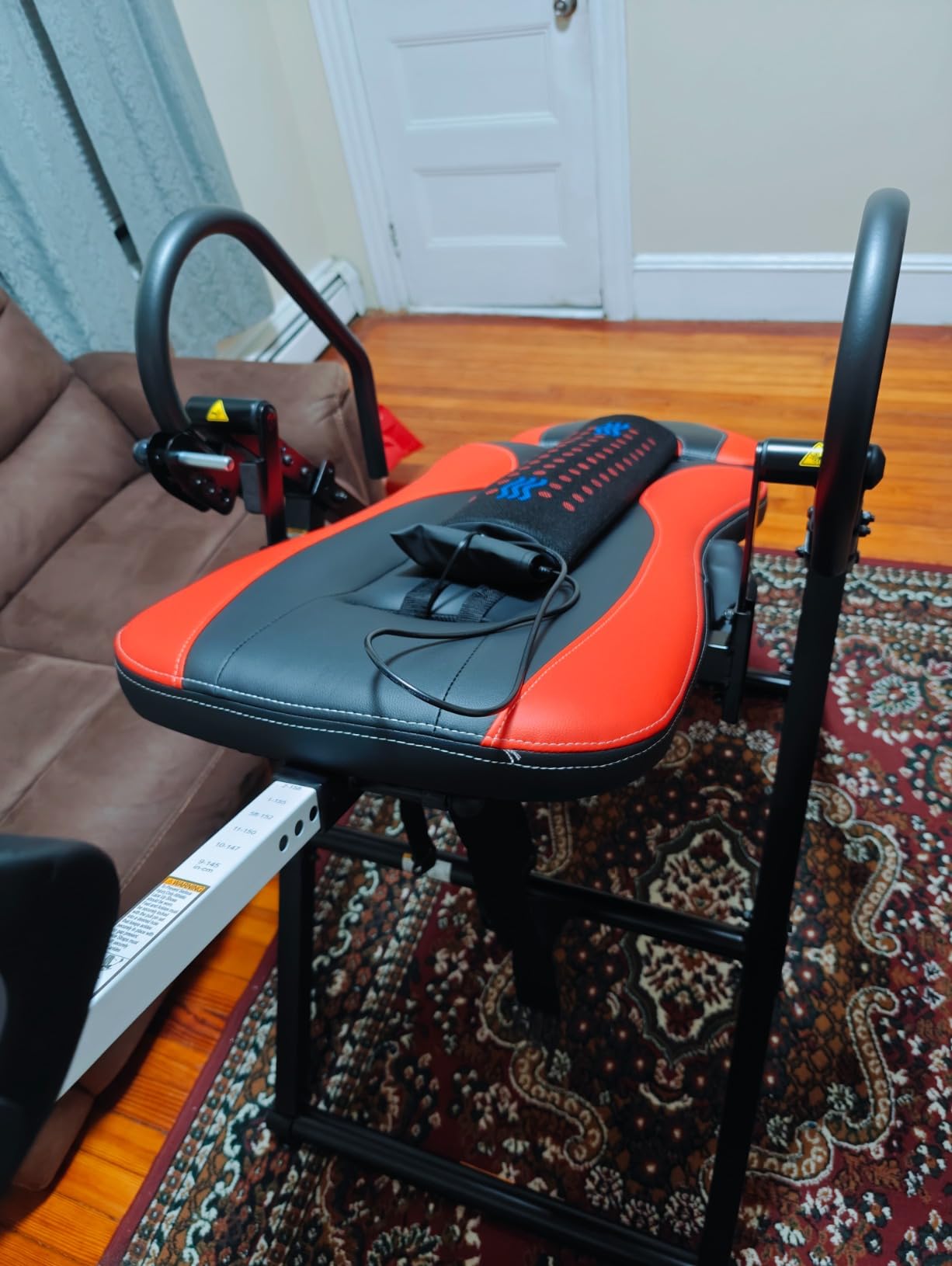
The distinguishing feature is control. A remote control lets you adjust the multi-mode massage and heat settings while you are inverted, which is something you cannot do with a pad wired to a fixed switch. Several owners name the massage and heat pad as the reason they stepped up from a basic model, and report real lower-back relief during the session.
The high-quality memory foam backrest is contoured to the waist curve, and the true balance system makes the rotation smooth. The safe angle pin system gives repeatable positioning without strap adjustment, and the reversible ankle holders are designed to reduce ankle pressure rather than merely hold you.
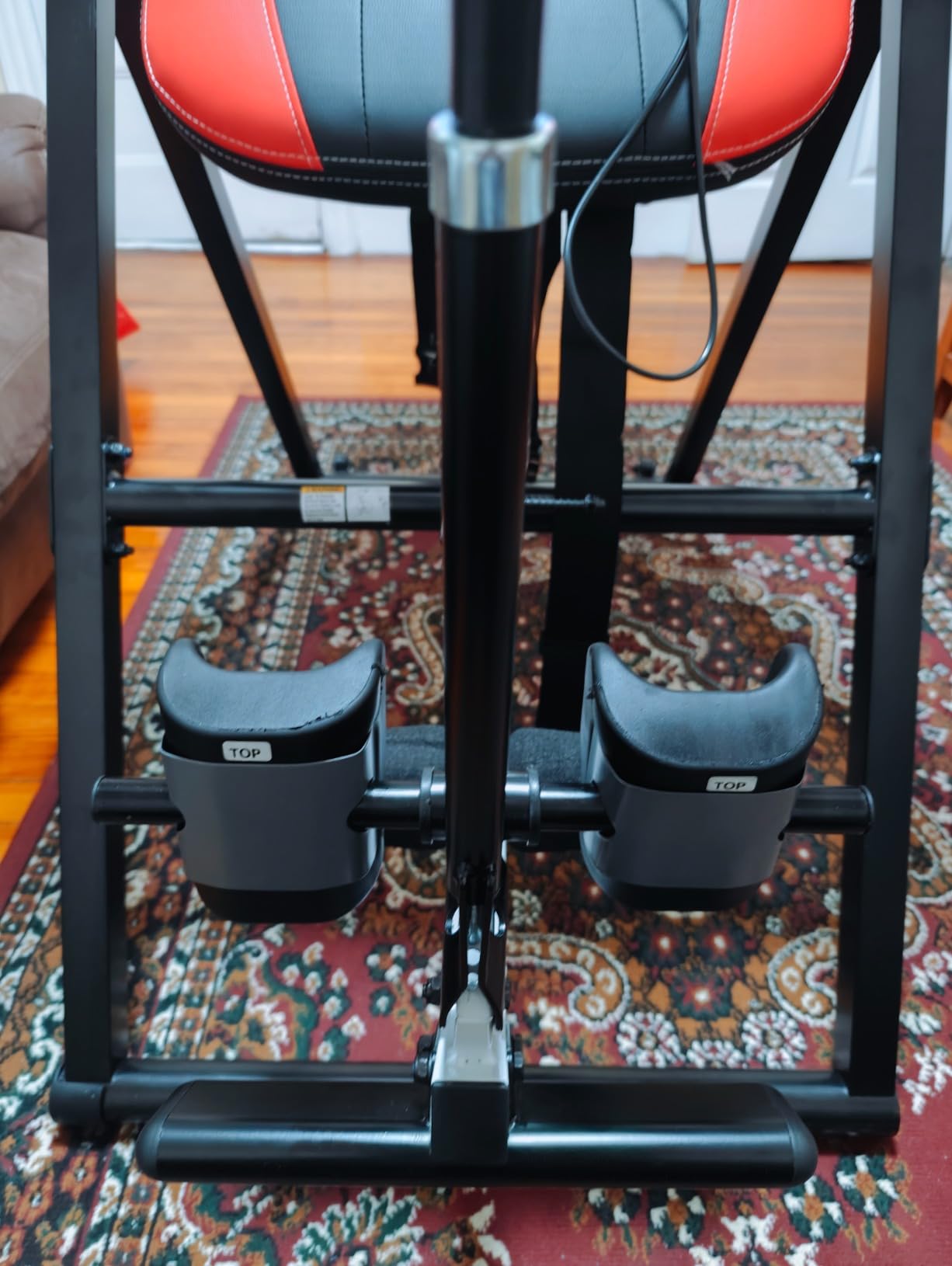
The capacity is worth flagging: 320 lb is higher than most tables at this level, and the height range of 4.75 to 6.4 ft suits a wide band of users. That is a genuine advantage if you are near the upper end of the usual 300 lb class.
The trade-offs are honest ones. The one year warranty is the shortest in this group, and at 226 reviews the long-term durability picture is genuinely unproven. The remote adds a cord and a controller to manage while inverted, which is a small annoyance, and the pad is a vibration unit rather than a true massage mechanism.
Who this table suits
It suits people who like heat and vibration as part of the session and want to change settings mid-inversion without stopping. The removable pad also means you can invert without it when you want pure traction.
It suits users between 300 and 320 lb, who fall just outside the standard capacity class of most competitors here.
Who should skip it
Skip it if you are risk-averse about durability, because a one year warranty and a small review base give you less to fall back on than the Teeter or Innova models. The one-star share in reviews is also larger than for the established brands, mostly around durability expectations.
Skip it if you dislike managing a cord while hanging upside down. And treat the massage as a comfort feature, not a treatment.
9. YOLEO ITX320: Budget Pick With a Removable Lumbar Pad
YOLEO ITX320 Inversion Table for Back Pain Foldable Inversion Table
Fits 4ft-10in to 6ft-6in
Removable lumbar pad
Four-position pin
Folds flat
Pros
- Wide padded backrest with a headrest that supports the neck
- removable lumbar pad you can tune or remove
- four-position pin safer than strap limits
- folds flat for small spaces
Cons
- Heavier than expected for shorter users returning upright
- large folded footprint
- thin printed instructions
- occasional surface rust reported
This is the table to buy if lumbar support is the feature you care about and you want to be able to remove it. The removable lumbar pad is the distinguishing element, and owners say it lets you tune the support for a given day, which matters when pain severity changes week to week.
The wider, well-padded backrest and adjustable headrest earn their own mention. Owners managing scoliosis, sciatica and chronic lower back pain report steady improvement in pain scores with two to three short daily sessions, and several say the back feels looser and less tight afterward. The improved ergonomic ankle system also reduces release pressure on the ankles without needing to reverse the holders.
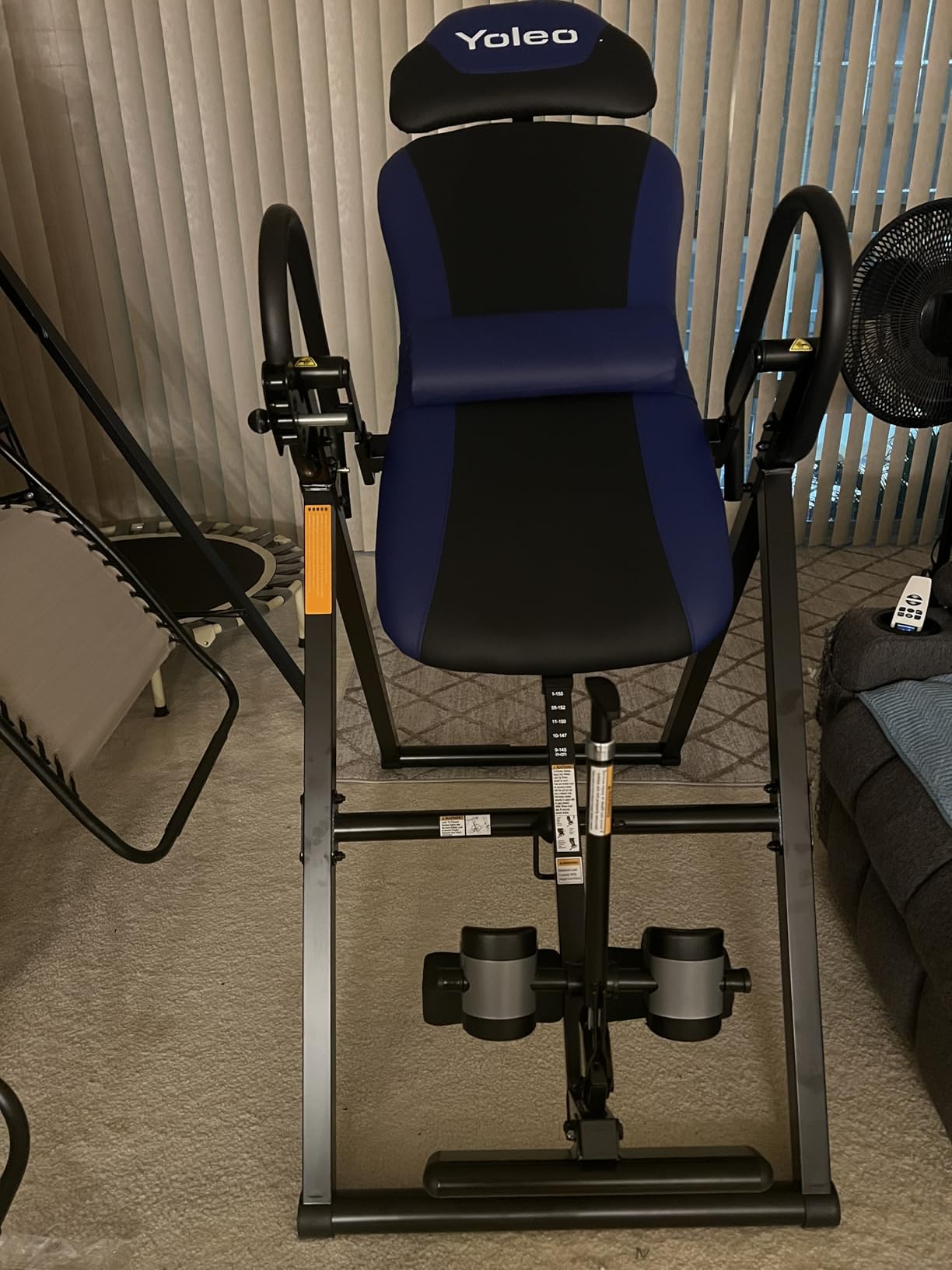
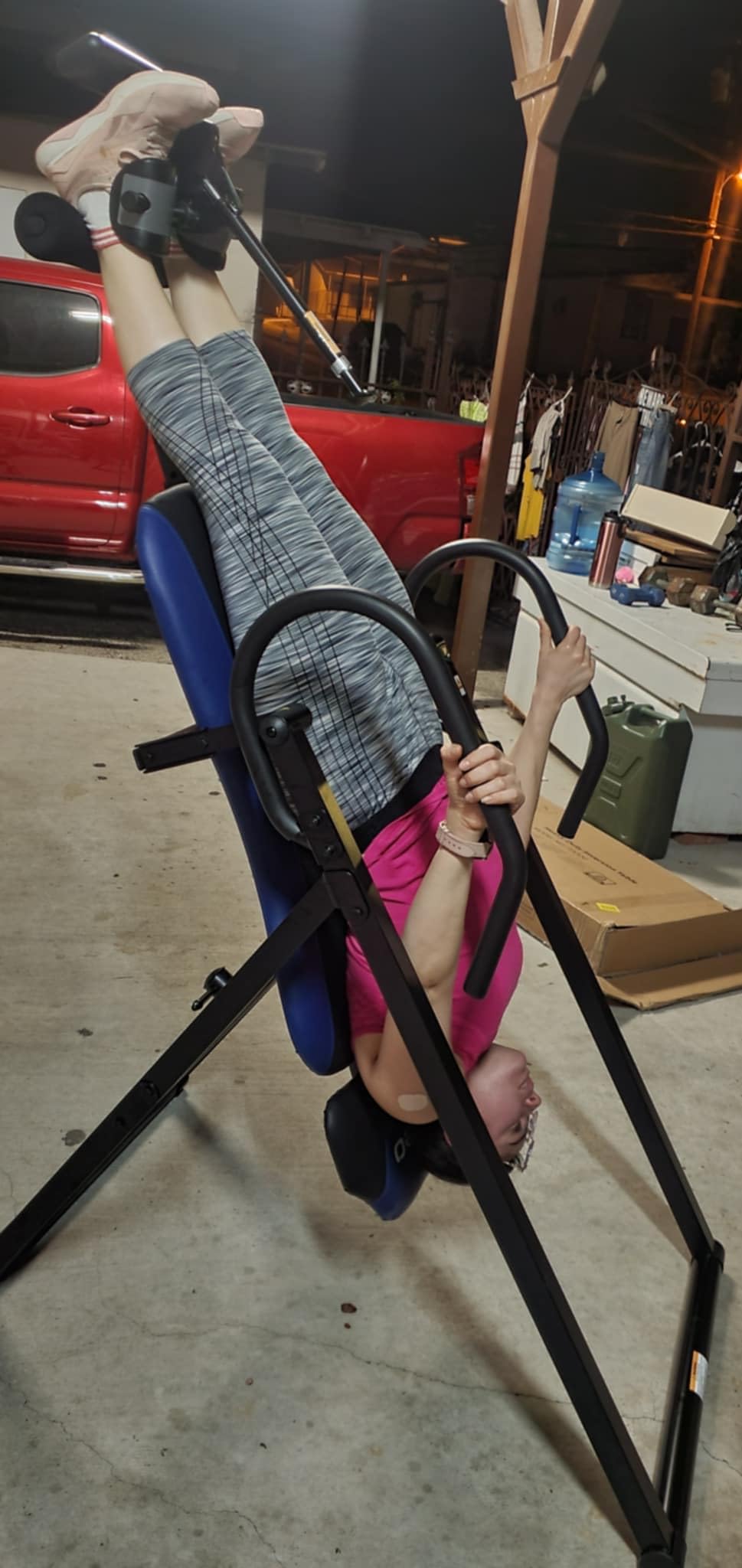
The four-position pin system is simple and safer than strap limits, and the height range of 4ft-10in to 6ft-6in covers a wide span of users in one household. The one drawback that comes up repeatedly is weight: at 24 kg this is heavier than expected, and shorter users can struggle to return upright alone from full inversion.
Assembly guidance is the other weak point. The illustrated booklet is described as not helpful, and a video walkthrough is the better teacher. One unit also showed surface rust inside two poles, resolved with a partial credit, so inspect the frame on arrival.
Who this table suits
It suits people who want adjustable lumbar support without paying for a heated or massage model. Remove the pad for a pure hang, add it for a focused lower-back session.
It suits households with a wide height spread, and anyone who wants the wider backrest that taller users tend to need without stepping up to a 350 lb frame.
Who should skip it
Skip it if you are shorter than average and plan to invert fully, because the weight makes self-recovery hard. It also has a large folded footprint, so measure your storage space before ordering.
And if you are assembling alone, watch the instructions video first. Fold-flat storage is a real benefit, but it is a large folded package rather than a slim one.
10. Teclor AIT6118-A Heat and Massage: Best for Locked Full Inversion
Teclor Inversion Table,Advanced Heat and Massage Function,Strength Training Inversion Table for Back Pain Relief,Heavy Duty Inversion Table 350 lbs Capacity with Wider and Thickened Backrest
350 lb capacity
Gear system to 180 degrees
Remote heat pad
One year frame guarantee
Pros
- Gear-based ratchet gives three solid repeatable angle stops
- remote heat and vibration pad
- thicker and wider backrest
- 350 lb steel frame for stable full inversion
Cons
- Highest one-star share here at nine percent
- remote and cord add complexity
- vibration is not kneading massage
- small review base
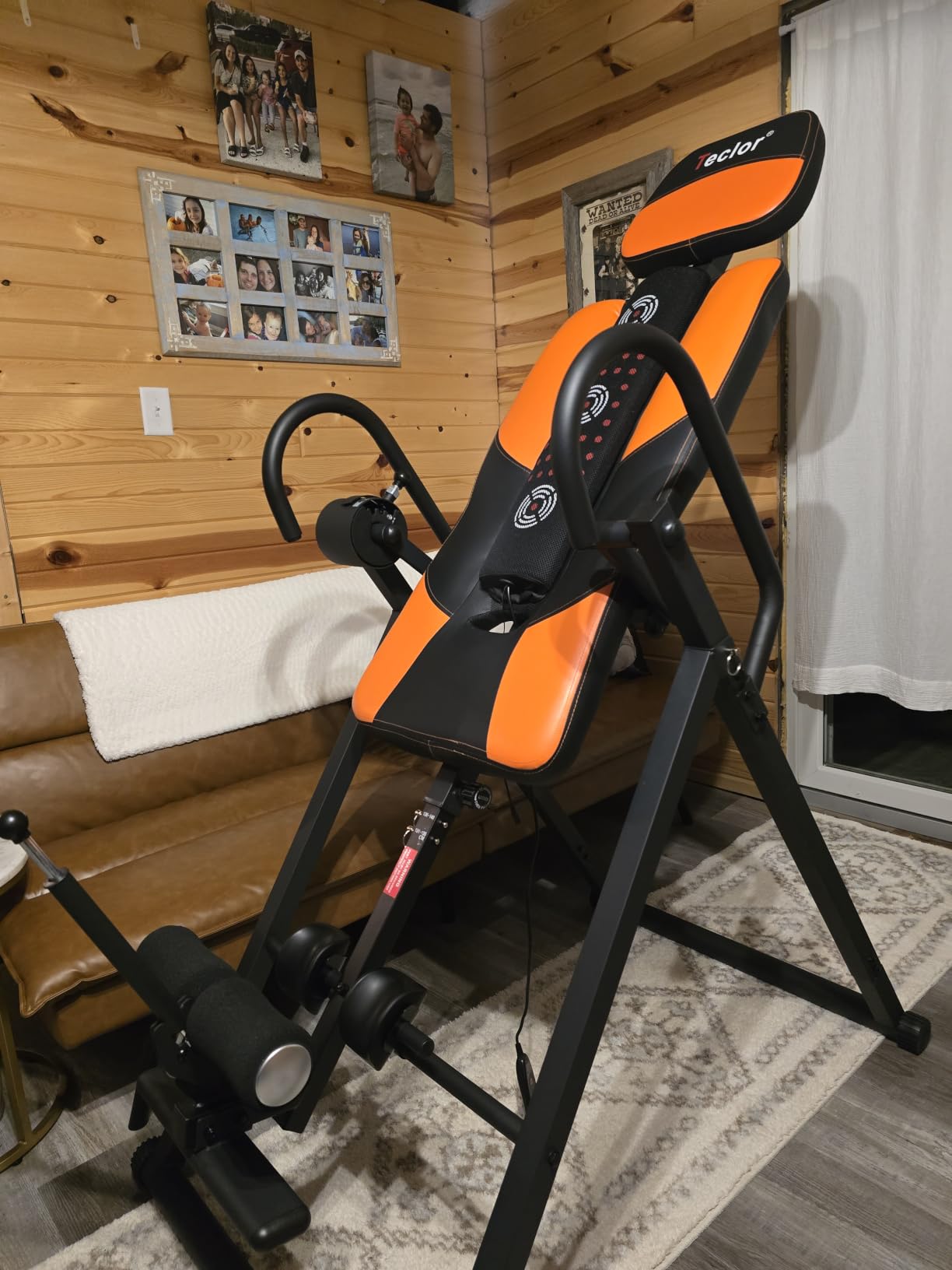
The mechanism is the reason to consider this model. A hand-independent gear system reaches up to 180 degrees with three locked positions, and owners call the gear-based ratchet more secure than strap-based limits. If you are one of the users who wants to go past 90 degrees rather than treating it as a theoretical endpoint, a positive mechanical lock matters.
The remote-controlled removable full-back heat and vibrating massage pad targets shoulder, neck and knee discomfort as well as the lower back, and the wider, thickened backrest feels more substantial than the base Teclor model. The 350 lb steel frame gives stable full inversion, and the table folds flat for small-space homes.
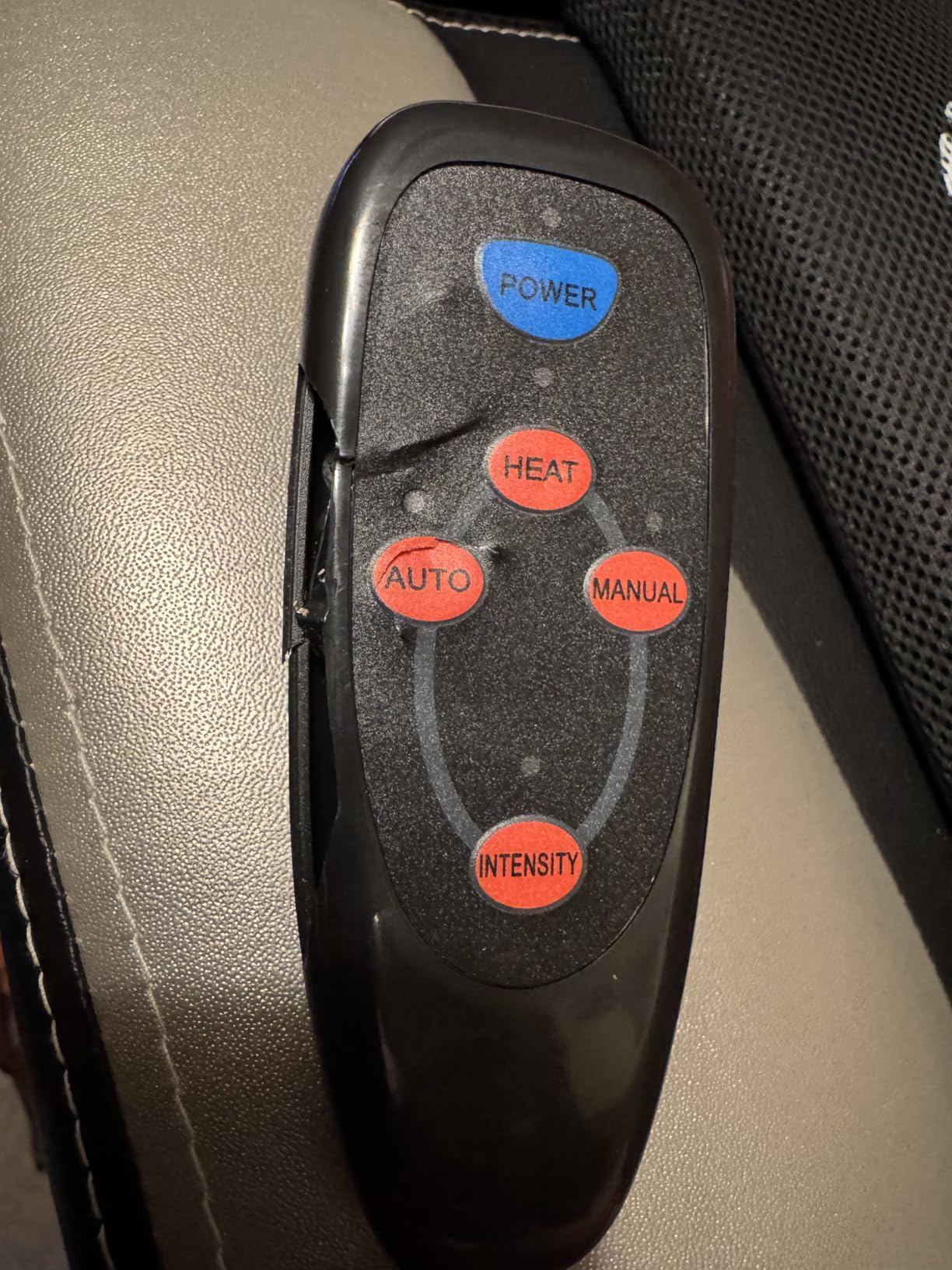
Be aware of the split in the reviews. The nine percent one-star share is the highest among the Teclor models here, and it points to a meaningful group of buyers disappointed by the value rather than the function. With 159 reviews, conclusions are less settled than for the Innova and Teeter models, and you should weight that accordingly.
Heat and massage are vibration-based rather than a true kneading mechanism, and the remote control plus powered pad add complexity and a cord to manage while inverted. The frame guarantee is one year with 60 days on the mat, the thinnest warranty in this roundup.
Who this table suits
It suits users who want to reach genuine full inversion and want a mechanical lock rather than a strap to hold that angle. The three locked gear positions are repeatable, which makes them safer for a progression protocol.
It also suits anyone over 300 lb who also wants heat and massage, a combination that is hard to find elsewhere in this class.
Who should skip it
Skip it if you are just testing whether inversion suits you. The small review base and higher one-star share make this a riskier place to start than an Innova with tens of thousands of reviews behind it.
Skip it if full inversion is not part of your plan, because you would be paying for a gear system you will not use. And check the 60 day mat guarantee, which is short for a padded surface you will lean on daily.
How to Use an Inversion Table Safely: A Beginner Protocol
Almost every safety problem with inversion tables comes from doing too much too soon. A gradual protocol costs you nothing and removes most of the risk.
1. Get clearance. If you have a diagnosed disc problem, a recent injury, unexplained numbness or weakness, speak to a clinician before your first session. For general stiffness with no red flags, a short trial is reasonable.
2. Adjust before you invert. Set the height, headrest, footrest and lumbar support while standing. Nobody should need a second person to balance you once this is right.
3. Start shallow. Invert to roughly 30 degrees and stop. Many physical therapists consider the steep angles unnecessary for lower back work, since most of the benefit arrives early in the rotation.
4. Start short. Thirty to sixty seconds for the first few sessions. Most owners report noticing relief within a few days, not within a few minutes.
5. Build gradually. Increase hold time before angle. A sensible ceiling is about five minutes, once or twice a day, and there is little evidence that longer holds add much.
6. Use a spotter at first. Have someone steady the table during your first session and any session where you go past 45 degrees. After that, use the table alone.
7. Come up slowly. Reverse the process, let your head clear the frame edge before your weight shifts, and stop if you feel light-headed. Feeling sick after inverting usually means you went too far too fast, or that you are in a group with contraindications.
If inversion makes symptoms worse rather than better, stop. Reduce the angle, shorten the hold, and if pain persists or worsens, see a clinician. Worsening pain is a signal, not a plateau.
What Works Better Than an Inversion Table?
It depends on why you are hurting, and the honest answer is that for several common problems a cheaper tool does the same job.
Back stretcher. A simple stretch bar in a doorway gives you mild lumbar extension for a fraction of the outlay and takes no floor space. Many people with desk-job stiffness get most of the benefit here. The inversion table earns its place when you want true traction, not just extension.
Stretching straps or a yoga strap. For hamstring and posterior chain tightness, a strap is more portable and more precise. Inversion decompresses; stretching straps lengthen. They are not substitutes.
Dip station. On r/backpain, users comparing the two split fairly evenly and landed on the same conclusion: neither is a treatment, and the source of the pain matters more. A dip station is free if you already have one, so try it before buying anything.
Inversion chair. Less traction than a table and more stable, which is why clinicians sometimes recommend it for people who are anxious. If your fear is the barrier, this is the compromise.
Walking and load management. The r/Biohackers accounts that resolved chronic lower back pain did it with yoga, Pilates and weight loss rather than a table. If your pain is driven by deconditioning or load, no device substitutes for progressive strengthening.
How to Choose an Inversion Table for Your Back Pain
1. Check weight capacity first. Most tables here stop at 300 lb. Two reach 350 lb. If you are above 300 lb, the choice is made for you.
2. Check height range against your frame. The Innova models fit 4ft-10in to 6ft-6in, the Teclor reaches 6ft-8in, and the YOLEO ITM280 covers 4.75 to 6.4 ft. A table that is too short leaves you compressed and defeats the purpose.
3. Prioritise the ankle lock. This is the safety-critical part. Prefer a positive pin or gear lock over a strap, and prefer a long release handle over an ankle bar you must bend forward to reach.
4. Count the angle positions. Four to six stops let you progress. A single strap limit does not, and a coarse four-position system means your steps are bigger.
5. Measure your room. You need ceiling clearance to invert fully, and floor length for the extended frame. The Dripex folds in three seconds; the Innova ITM5900 has one of the largest folded footprints in this group.
6. Decide on lumbar support. Fixed arch, adjustable air lumbar, or a removable pad. If your pain is concentrated in the lower back, this is worth paying for.
7. Treat heat and massage as comfort, not treatment. Reviewers split on these features. The vibration is pleasant, the reported heat tops out around 90F, and neither replaces traction.
8. Read the warranty as a durability signal. The Teeter models carry five year terms. Most others carry one. On a welded steel frame under rotational load, that difference is your fallback if a pin or weld fails.
9. Weigh review volume. A 4.6 from nearly 40000 reviews and a 4.6 from a few hundred are not the same claim. Use volume as your confidence filter.
10. Plan for assembly. Realistic times run from about half an hour to three hours solo, and misaligned screw holes are a common complaint. Clear two hours and assemble with a second person if you have back pain.
Who Should Not Use an Inversion Table
Some groups should not invert at all, or should only do so with explicit clinical supervision.
Uncontrolled high blood pressure. Inversion raises blood pressure and heart rate, and the head rush is the mechanism you are trying to avoid if your pressure is already high.
Heart disease or a history of stroke. Blood pressure and cardiac load change substantially when you go past horizontal.
Glaucoma. Increased pressure in the head is a specific concern for anyone with glaucoma or prior eye surgery.
Inner-ear problems and vertigo or dizziness. A shifting sense of gravity can aggravate these considerably.
Pregnancy. Inversion is not recommended during pregnancy.
Recent spinal surgery, fractures, or unstable injuries. Inversion loads the spine in a way that healing structures may not tolerate.
Hiatal hernia or reflux. Inverted positioning brings stomach contents upward, and reflux is a frequent reason people feel sick after a session.
Anyone in acute, severe or worsening pain. If pain is escalating or accompanied by numbness, weakness or bladder and bowel changes, see a clinician before spending on equipment.
Why do some chiropractors and physical therapists caution against inversion tables? Mostly because of unsupervised use rather than the mechanism. Many clinicians will support a conservative, shallow-angle trial once they have ruled out the conditions above. The objections we see repeatedly concern people inverting to full 180 degrees with no spotter, on a table with a poor ankle lock, while they have an undiagnosed disc or hip problem. Fix those three variables and the objection largely disappears.
Frequently Asked Questions
Do inversion tables really work for lower back pain?
They help many people, mainly by temporarily reducing pressure on compressed discs and nerve roots. Most users report noticing relief within a few days of regular use, and the effect is strongest for pain that eases when you lie flat. The relief is real but temporary, so think of inversion as one tool alongside strengthening and mobility work, not a cure on its own.
How long should I use an inversion table?
Start at 30 to 60 seconds per session at roughly 30 degrees, then build hold time before angle. A sensible ceiling for most people is about five minutes once or twice a day. The relief typically fades within hours unless you keep a consistent schedule, so frequency matters more than any single long session.
What are the downsides of using an inversion table?
Common downsides include pressure pain at the ankles and feet at steep angles, a head rush and brief light-headedness, and the fear factor of the first few sessions. Assembly is often longer than expected. Some people feel worse for a while if you invert too far too fast, and inversion is unsuitable if you have high blood pressure, heart disease, glaucoma, vertigo or are pregnant.
What works better than an inversion table?
For mild stiffness a back stretcher or stretch bar gives similar benefit for far less money and no floor space. A dip station is free if you own one, and stretching straps are better for hamstring tightness. Inversion remains the only option that delivers true spinal traction, so it is still the right tool for decompression rather than mobility or strengthening.
Are inversion tables safe with high blood pressure?
No. Inversion increases blood pressure and cardiac load, and the head rush is exactly the effect that can be dangerous if your pressure is already elevated. Uncontrolled high blood pressure, heart disease and a history of stroke are all reasons to avoid inversion entirely, and anyone with borderline or monitored blood pressure should speak to a clinician first.
Why do some chiropractors not like inversion tables?
The objection is usually about unsupervised use, not the mechanism. Chiropractors and physical therapists commonly support a conservative shallow-angle trial once they have ruled out disc, hip and blood pressure issues. What concerns them is full 180-degree inversion with no spotter on a table with a weak ankle lock, and treating a table as a substitute for diagnosis and rehab.
Bottom Line: The Best Inversion Tables for Back Pain in 2026
Start with the Innova ITX9600. It has the strongest review base in the class by an order of magnitude, a frame that does not flex, an angle pin you can read from a standing position and ankle holders you can reverse to solve pressure problems. For most people asking which inversion table is worth owning, that is the answer.
Buy the Teeter FitSpine LX9 instead if you plan to use a table daily for years and want the best mechanism available, including a five year warranty, UL certification and an easy-reach ankle lock that never requires bending forward. Buy the Innova ITM5900 if you want heat and vibration in the session, understanding that the heat is mild and the massage is a vibration pad.
Whatever you choose, the protocol matters more than the model. Start shallow, start short, use a spotter once, and give it a fortnight of consistent sessions before deciding it does not work. Anyone with high blood pressure, heart disease, glaucoma, vertigo or a recent injury should talk to a clinician first. Check the button below to see current availability and delivery details for your region.