
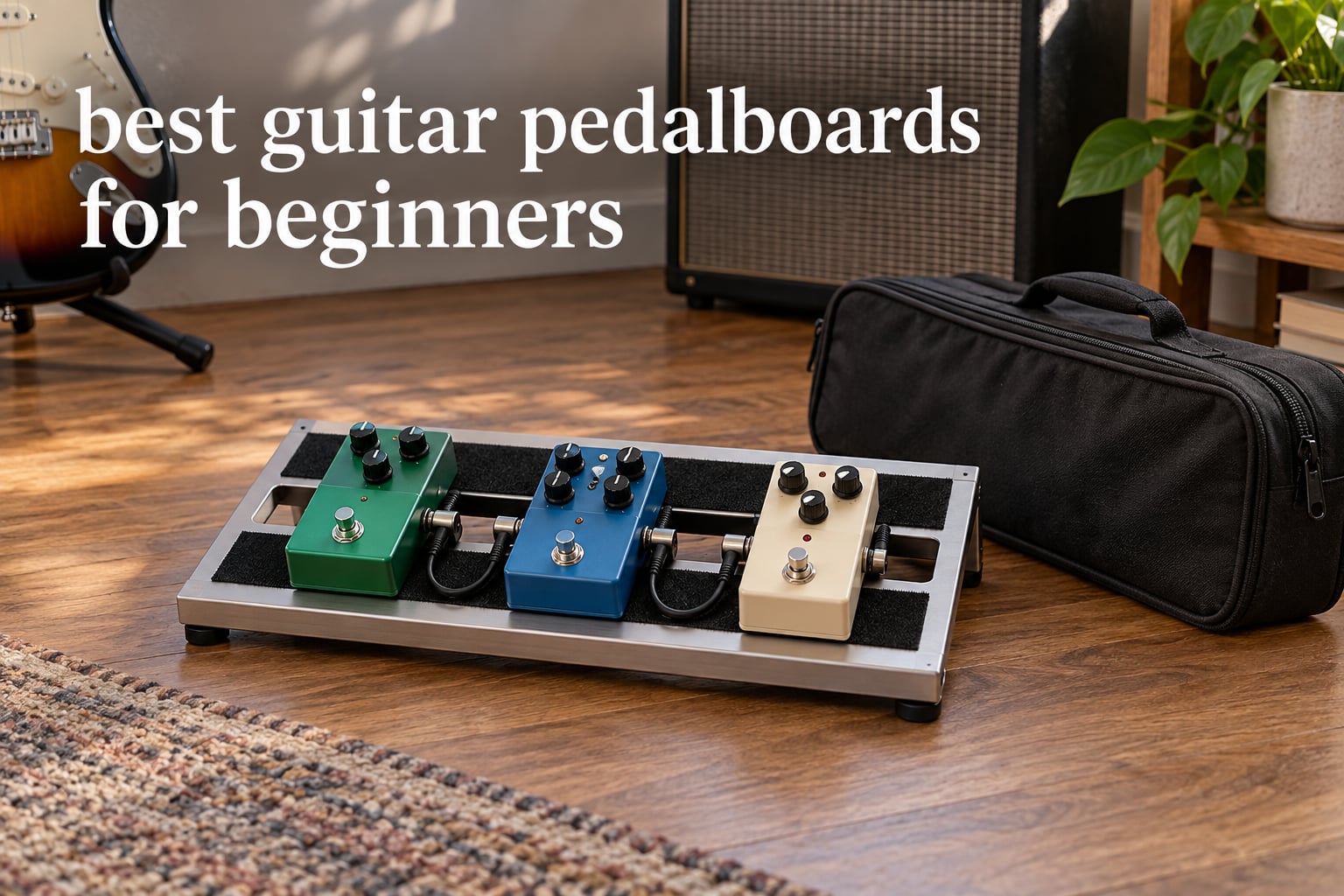
A pedalboard is a platform that mounts your effects pedals in a fixed signal-chain order, with patch cables routed underneath and a power supply mounted below the deck, so setting up takes seconds instead of minutes. It does not change your tone by itself. What it changes is how long you spend on the floor with cable spaghetti before you get to play.
That distinction matters when you are shopping for the best guitar pedalboards for beginners. You are not buying sound. You are buying a mounting surface, a way to route cables, a place to hang a power brick, and a bag to carry it all in. Every board on this list was judged on those four things first, then on weight and how it behaves once a real pedal is stuck to it.
We spent weeks laying boards out on the floor with real stompboxes, checking under-board clearance for a standard isolated supply, and noting which ones stayed flat when you stepped on them. The eight picks below cover the situations beginners actually end up in: a bedroom rig, a first band rehearsal room, a growing collection, and a narrow powered board for travel. Ratings and review counts come from the manufacturer listings, and every board here carries a stated reason to skip it.
Table of Contents
Do You Even Need a Pedalboard Yet?
The honest answer is no, not yet, if you own one or two pedals. A floor layout works fine, and a multi-effects unit or an amp modeler covers a lot of ground without any board at all. What a board buys you is repeatability and speed, and those only matter once you are moving the same rig between rooms, or you own enough pedals that the order matters.
Our rule of thumb, and the one that comes up most often on guitar forums: you need a board the moment you own three pedals you use regularly. Before that, measure your pedals laid out on the floor with a tape measure, add a couple of inches of slack for cable bends, and write that number down. That measurement is the only number that really drives this purchase.
One more warning before the picks. The most common beginner regret on the forums is buying a board that is too big. If you have space on a board, you will fill it, and a half-empty 22-inch board is a heavy thing to carry to every rehearsal. Aim for your current pedals plus two slots of headroom, not for the collection you might build in three years.
Top 3 Picks for Best Guitar Pedalboards for Beginners (October 2026)
Three boards stand out from the group. The Donner DB-3 has the deepest owner-review history and the most generous under-board space, the GHOSTFIRE SPL-04 is the lightest thing here that still holds a full eight-to-ten pedal rig, and the STRICH STANDARD 18 is the tidiest angled deck for a first home setup.

Donner DB-3 Board
- 20 x 11.4 inch aluminium deck
- Holds a full-size wah plus stompboxes
- Canvas bag with backpack straps
- Plenty of under-board power clearance

GHOSTFIRE SPL-04
- 1.76 lb aluminium frame
- Holds 8-10 pedals
- Fold-out tilting foot stand
- Large bag with cable pocket

STRICH STANDARD 18
- 18 x 12.5 inch angled deck
- 1.98 lb aluminium alloy frame
- Cable routing slots
- Carry case included
Best Guitar Pedalboards for Beginners in 2026
All eight boards, side by side. Deck size is the first thing to check against your measured pedal footprint, weight matters more than most sellers admit, and the power column tells you whether you need to buy a supply separately.
| Product | Specs | Action |
|---|---|---|
| Donner DB-3 |
|
Check Latest Price |
| GHOSTFIRE SPL-04 |
|
Check Latest Price |
| STRICH STANDARD 18 |
|
Check Latest Price |
 SOYAN 14 in Steel Board SOYAN 14 in Steel Board |
|
Check Latest Price |
 AKLOT Powered Board AKLOT Powered Board |
|
Check Latest Price |
 LEKATO PB-01S LEKATO PB-01S |
|
Check Latest Price |
 GOKKO 22 in Steel Board GOKKO 22 in Steel Board |
|
Check Latest Price |
 Donner Powered Board Donner Powered Board |
|
Check Latest Price |
1. Donner DB-3 Pedal Board: Best Overall for Beginners
Donner DB-3 Guitar Pedal Board, Aluminum, 20 x 11.4 x 4 in, Bag
20 x 11.4 x 4 in aluminium deck
1778 g board weight
Fits wah plus stompboxes
Under-board power space
Pros
- Lightweight welded aluminium that sits level on the floor
- Generous underside space for a standard power supply
- Works with a full-size wah and volume pedal
- Canvas bag with backpack straps in a zip compartment
- Thousands of owner reviews to learn from
Cons
- Side rails are plastic rather than metal
- Included hook-and-loop grips poorly on rubber pedal bases
- Soft bag is for moving gear rather than road protection
We used the DB-3 as the reference board for this whole roundup because it is the one most beginner owners will end up comparing against. The deck is 20 by 11.4 inches, and that width is what makes it forgiving. A wah pedal, a volume pedal and three or four standard stompboxes all fit with room to spare, which is more than most narrow beginner frames can manage.
The aluminium plate is welded rather than bolted, and at 1778 g it is light enough to walk with one hand while holding a guitar case in the other. It sat flat on our floor with no rocking, which matters more than it sounds, because a board that rocks makes every stomp feel uncertain.
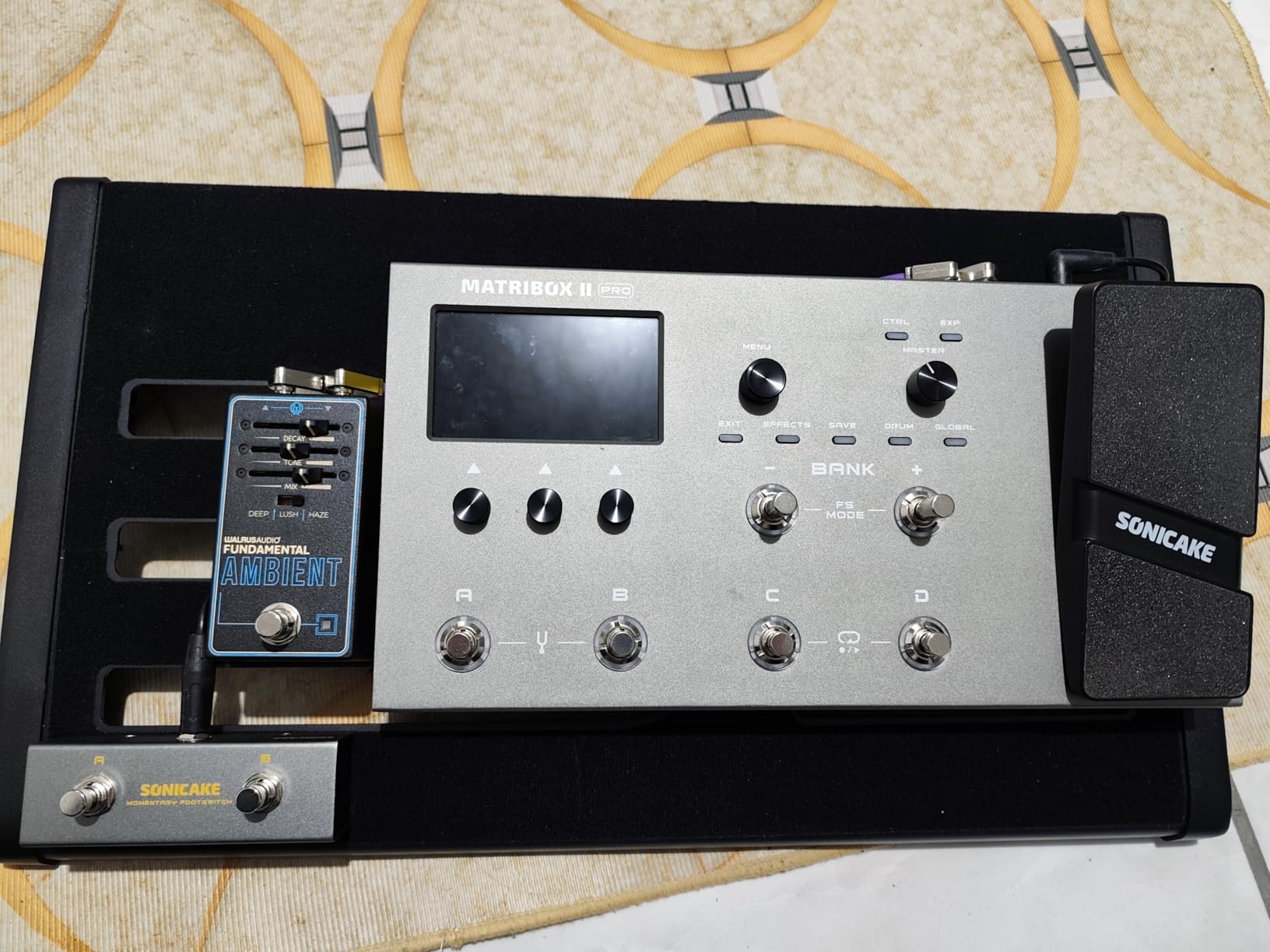
The underside is the reason this board keeps topping beginner lists. There is genuine clearance for a standard isolated pedalboard power supply, so you are not zip-tying a brick to the underside of the frame. That is the single most common post-purchase discovery in forum threads, and this board avoids it.
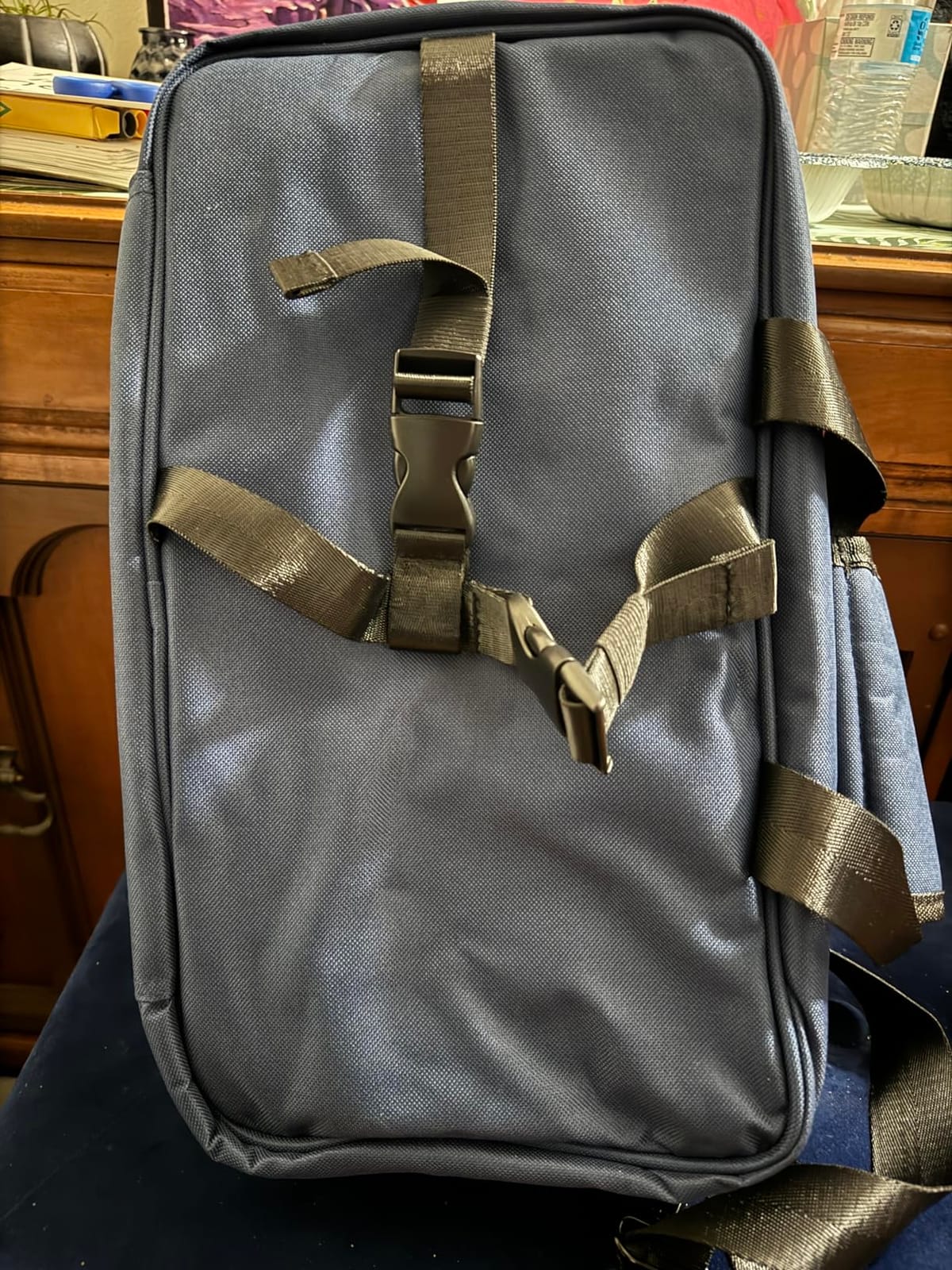
Hook-and-loop tape comes in the box, 60 inches of it, along with zip ties. Owners report that it grips well on smooth painted bases and poorly on textured rubber, so wipe the underside of each pedal with an alcohol wipe before you stick it down. The included canvas bag has backpack straps and an outer pocket, which makes it a genuine grab-and-go case rather than a decorative sleeve.
Who the Donner DB-3 suits
This suits the bedroom player who is about to add a tuner, an overdrive and a delay, and who wants the option to drop a wah in later without buying a second board. The 20-inch width means full-size pedals fit without shuffling everything around each time you change the order.
It also suits the first-band guitarist who will carry the same rig to a rehearsal room every week. The bag has backpack straps and a zippered compartment, so the board, the pedals and the power supply travel as one package instead of three loose items.
When to skip the Donner DB-3
Skip it if your rig is one row of mini pedals and nothing else. The 20 by 11.4 deck leaves empty space, and that is exactly the trap forum regulars warn about: a board with room on it tends to get filled with pedals you do not actually use.
Skip it for touring as well. The bag is thin canvas with modest padding, and the plastic side rails can take knocks from a car boot. For a rig that flies, look at a board that ships with a hard case or at a separate protective case for the bag.
2. GHOSTFIRE SPL-04: Best Value Lightweight Board
Ghost Fire Guitar Pedal Board Aluminum Alloy 1.76lb Super light Effect Pedalboard 19.8”x11.5” with Carry Bag,SPL-04
19.69 x 11.81 x 2.76 in deck
1.76 lb aluminium frame
Holds 8-10 pedals
Fold-out tilt foot stand
Pros
- Very light at 1.76 lb for a full eight-to-ten pedal board
- Generous space underneath for a power supply
- Patented foot stand tilts the deck then folds flat
- Rounded ABS corners that protect pedal bags
- Roomy bag with cable pocket and trolley attachment
Cons
- Tilt only works when the fold-out stand is deployed
- You must cut and apply the supplied hook tape yourself
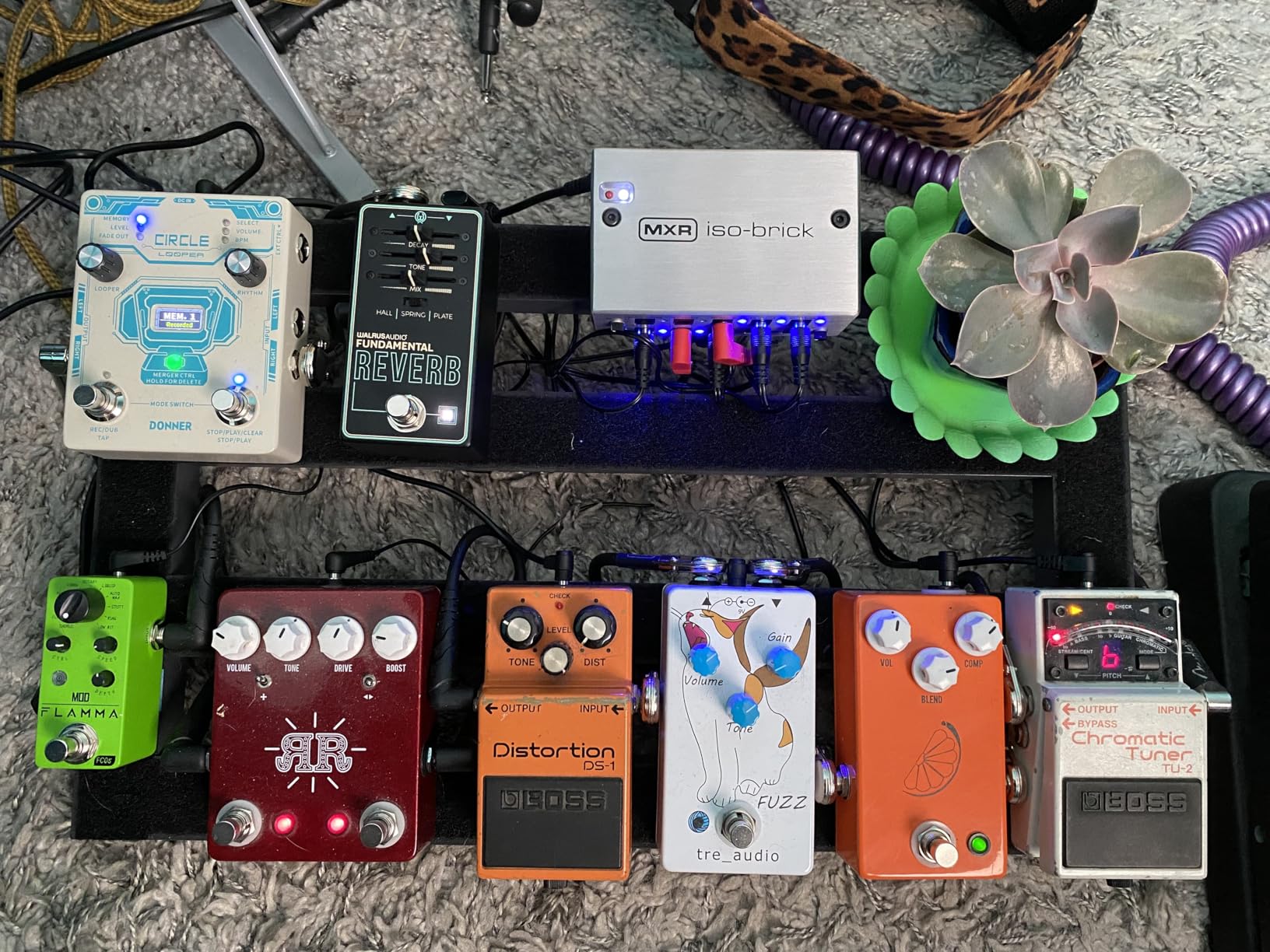
The GHOSTFIRE SPL-04 is the board we would hand to someone who has to carry their rig up stairs to a rehearsal room. At 1.76 lb it is the lightest frame in this roundup that still holds eight to ten pedals, and the 19.69 by 11.81 inch deck gives you two rows of standard stompboxes with space to move them around.
The construction is 5052 aluminium alloy, sandblasted and sprayed, with ultra-high hardness ABS rounded corner pieces. Those corners matter in practice, because a square aluminium edge is exactly what scratches a pedal bag when you lift the board with twelve pedals still mounted.
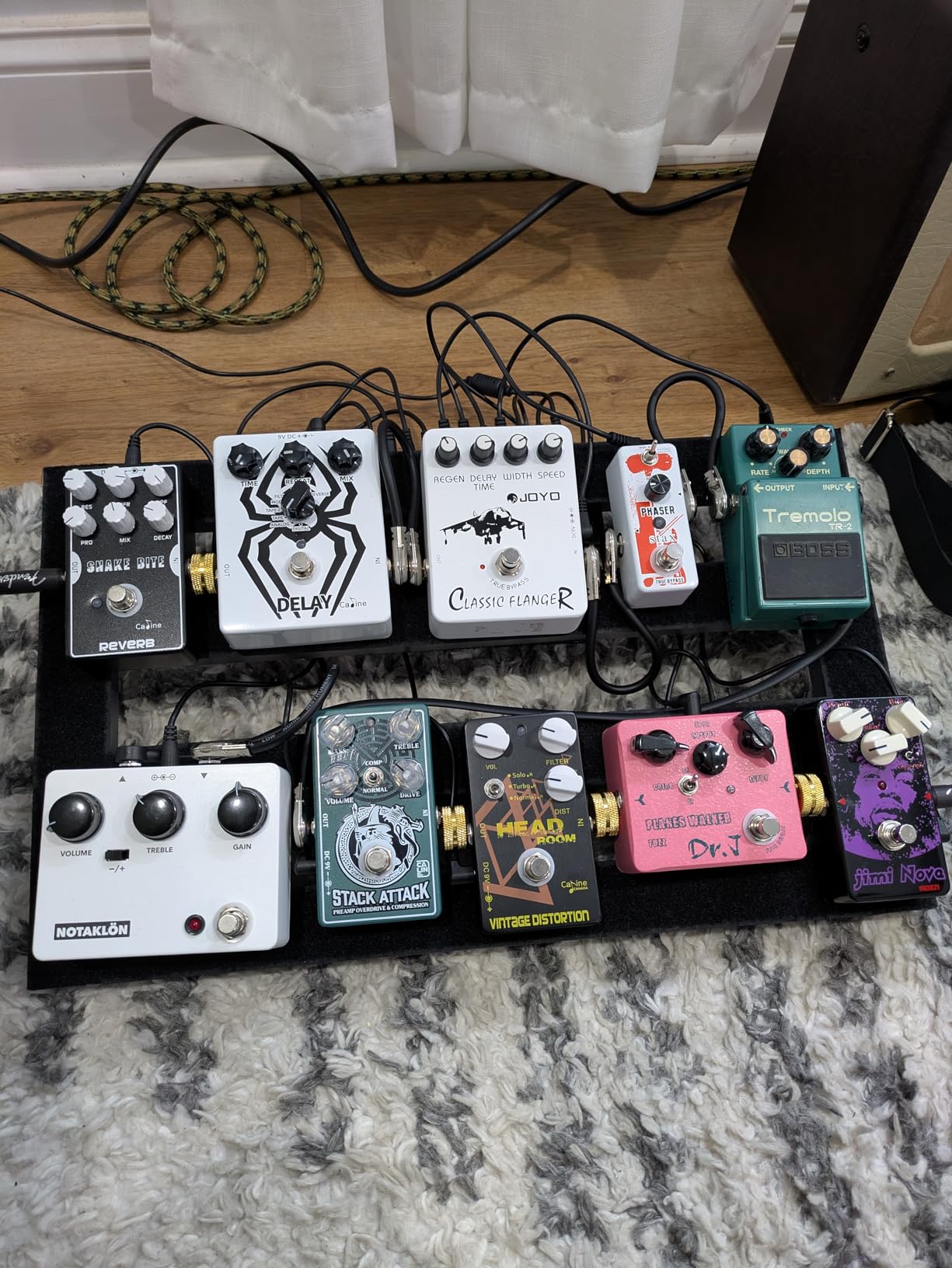
Underneath there is a lot of room, and the bag is unusually well thought out. It has an internal retaining strap for the board, an outside pocket for cables, and a strap that clips to the pull rod of a suitcase. Owners mention all three features when they describe it, which tells you they get used.
Two things to know before you buy. The angled playing surface is not fixed. A patented fold-out foot stand tilts the deck for easier stomping and folds back flat for storage, so if you want a permanent 8-degree angle you have to remember to deploy the stand every time you set up.
The second is that the 3.8 cm hook-and-loop strip is pre-fixed to the deck but the mating tape is supplied as a roll. You cut it to length and apply it to the back of each pedal yourself, so budget ten minutes before your first session rather than assuming everything is ready to go.
Who the GHOSTFIRE SPL-04 suits
It suits the rehearsal-room guitarist and the commuter who carries gear on public transport. At 1.76 lb with the bag it is the easiest board here to move between rooms, and the trolley attachment means you can clip it to a rolling case rather than carrying it separately.
It also suits anyone who wants an eight-to-ten pedal board without paying for the premium frame brands. The aluminium is light and rigid, the capacity is generous for a first rig, and the price sits at the accessible end of the range rather than the top.
When to skip the GHOSTFIRE SPL-04
Skip it if you play only seated or if you need a permanently angled surface and will forget the foot stand. The tilt is the whole ergonomic argument for a board, and it only works when the stand is open.
Skip it if you dislike doing assembly. Cutting and applying your own hook tape is a small task, but it is a task, and some players prefer rails or clamps where the pedal just sits and locks in.
3. STRICH STANDARD 18: Best Angled Board for a First Home Rig
STRICH Guitar Pedal Board Aluminum Alloy 1.98lb Super Light Effect Pedalboard 18” x 12.5” with Carry Bag, STANDARD 18 (Angled)
18 x 12.5 x 3.15 in angled deck
1.98 lb aluminium alloy
Cable routing slots included
Rugged carry case
Pros
- Light solid aluminium alloy at 1.98 lb
- Angled surface makes footswitches easy to reach
- Multiple cable routing slots reduce tangles
- Mounting strips and zip ties included
- Range of sizes in the same product line
Cons
- Pedals rely on user-applied hook-and-loop rather than fixed rails
- Bare aluminium with no dedicated power supply mount
The STRICH STANDARD 18 is the tidy choice. The 18 by 12.5 inch deck sits at an angle, so the footswitch row is genuinely easier to hit than on a flat board, and the frame weighs 1.98 lb. Owners rate the finish and the cable management highly, and 85 percent of the ratings are five stars.
Cable routing is where most cheap boards fail and this one does not. There are multiple slots and channels cut into the frame so patch cables drop down and run underneath rather than arching across the deck where you can trip on them. Fault-finding a noisy rig on a board with no routing takes ten minutes. On this one it takes two.
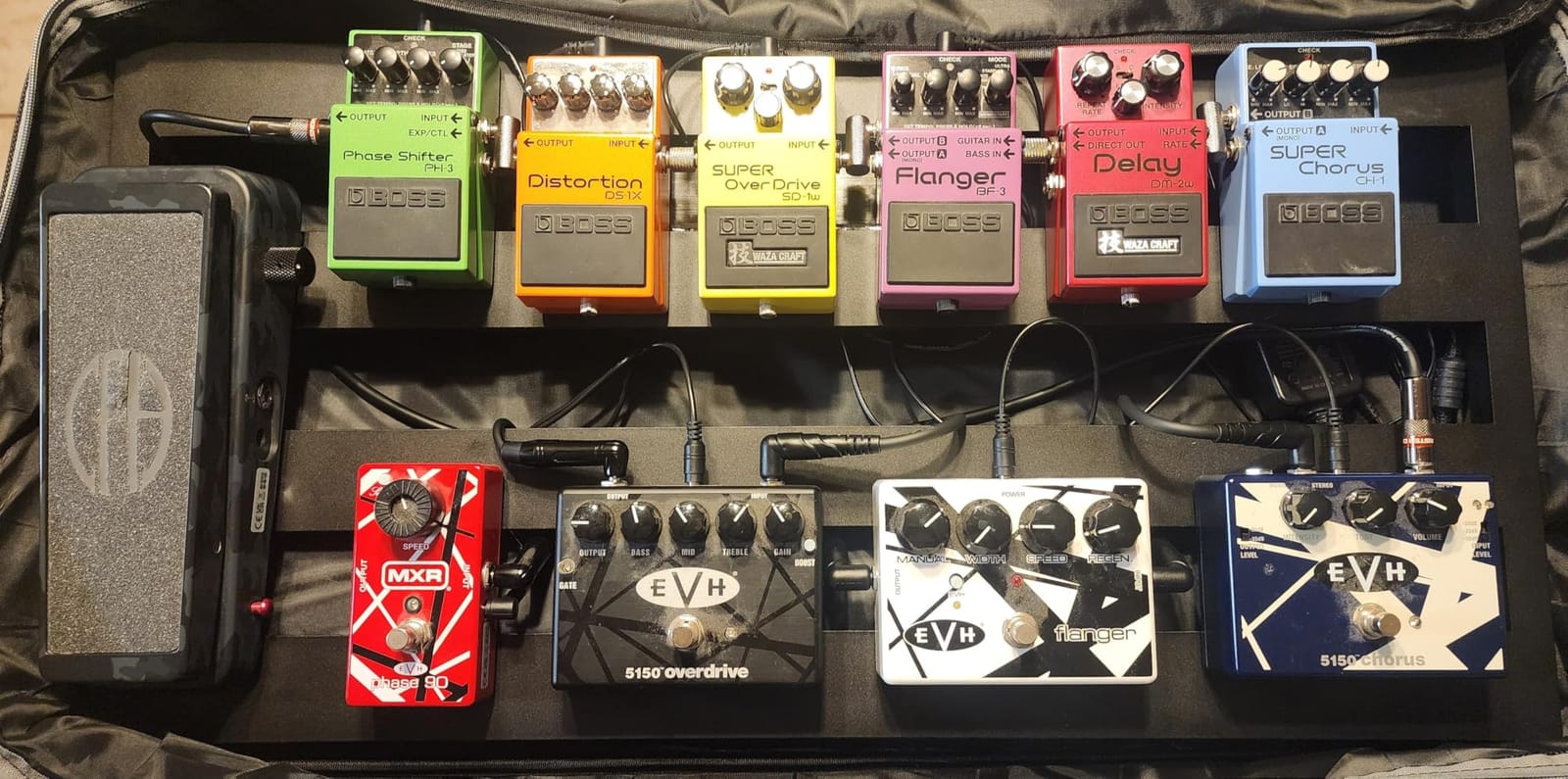
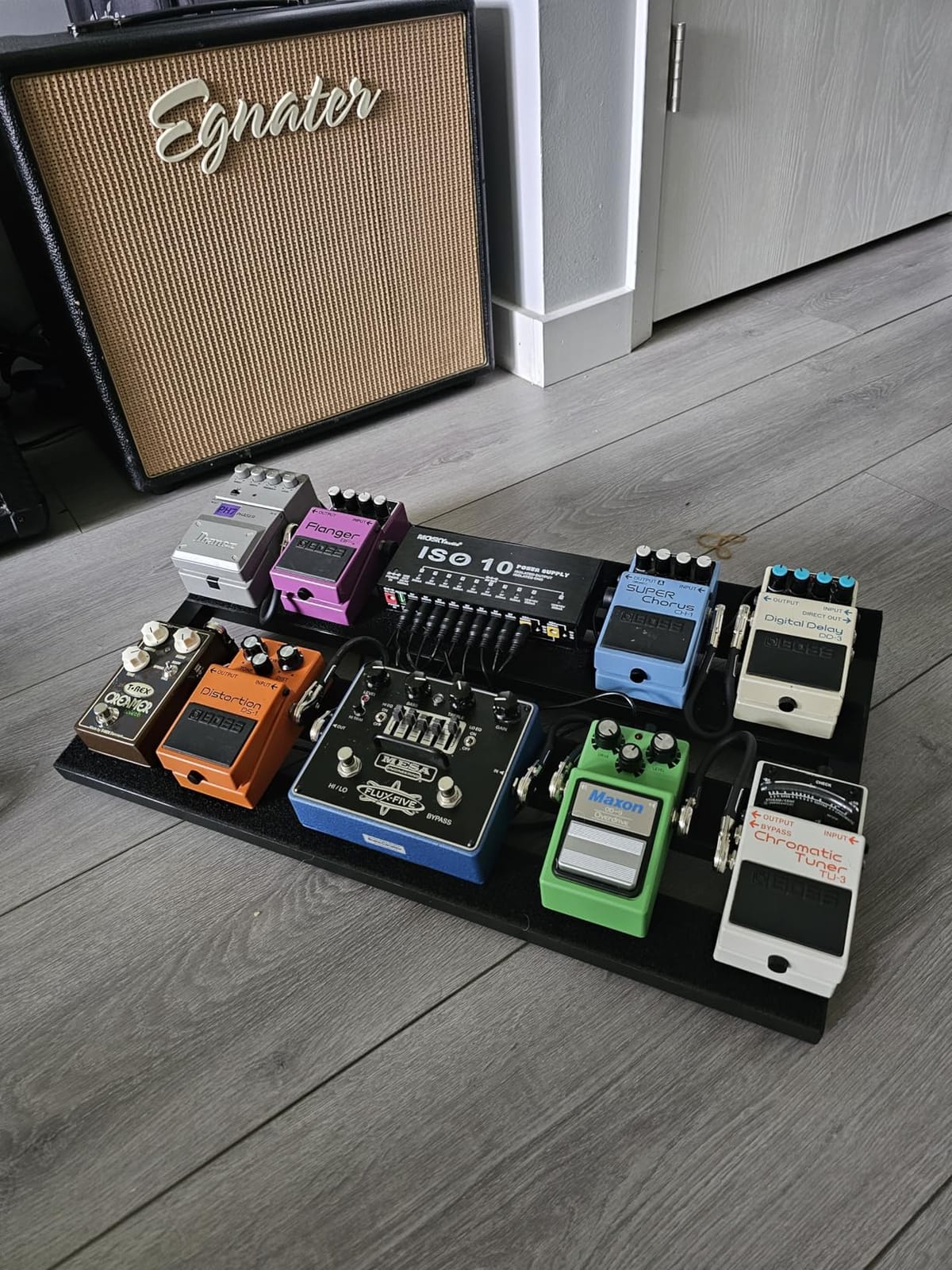
At 18 inches wide it suits a rig of five to seven stompboxes plus a tuner, which is a realistic two-year horizon for most beginners. It is narrower than the Donner DB-3, so a full-size wah and a volume pedal together will eat most of the width. Measure before you commit.
The board ships with a rugged carry case, mounting strips and zip ties. Note what it does not ship with: a power supply or a dedicated mount for one. Under-board clearance is present, but you will be attaching your supply with the supplied straps, so check your brick’s height against the frame gap first.
Who the STRICH STANDARD 18 suits
It suits players who care about a clean cable run more than about brand name. If you are the person who untangles the spaghetti before every practice session, the routing slots on this frame are the feature you will feel most.
The angled surface also helps players with limited reach or a seated practice position. The footswitches sit closer to you and slightly higher, which reduces the amount of ankle travel needed to hit them.
When to skip the STRICH STANDARD 18
Skip it if you plan to build a large rig quickly. At 18 inches it is a step up from a mini board, not a step up from a 22-inch deck. The same product line covers wider sizes if you know you will outgrow this one.
Skip it if you want pedals to lock into fixed rails rather than stick. Mounting here depends on hook-and-loop strips and zip ties you apply yourself, so swapping pedals takes a few seconds longer than on a rail-mounted frame.
4. SOYAN 14 x 10.6 Inch Steel Board: Best Compact Deck with a Power Tray
SOYAN 14″ x 10.6″ Guitar Pedal Board with Power Supply Tray
14 x 10.6 in steel deck
3.3 lb
8-degree angle
Power tray 10.8 x 4.45 x 1.89 in
Pros
- Solid steel plate that takes heavy stomping
- Built-in tray sized for a large isolated power supply
- Eight-degree tilt improves switch access
- Fits a compact rig and a backpack
- Velcro tape and a bag with shoulder strap included
- One-year warranty
Cons
- Power compartment design still needs some tidying
- Bare steel can move slightly when the board is unloaded
- Carry bag feels cheap next to the frame
The SOYAN board solves a problem most boards at this size ignore: where does the power supply go? Underneath, there is a metal tray with a mounting area of 10.8 by 4.45 by 1.89 inches, which is sized for a large isolated supply rather than a small daisy-chain brick. That is a deliberate design choice and it is the main reason this board appears here.
The deck is solid steel at 3.3 lb and sits at about 8 degrees. Steel is heavier than aluminium, and the weight is not accidental. It is what makes the board feel stable under a boot, and reviewers regularly describe it as heavy-duty. If your board keeps sliding or rocking while you stomp, this is the answer.
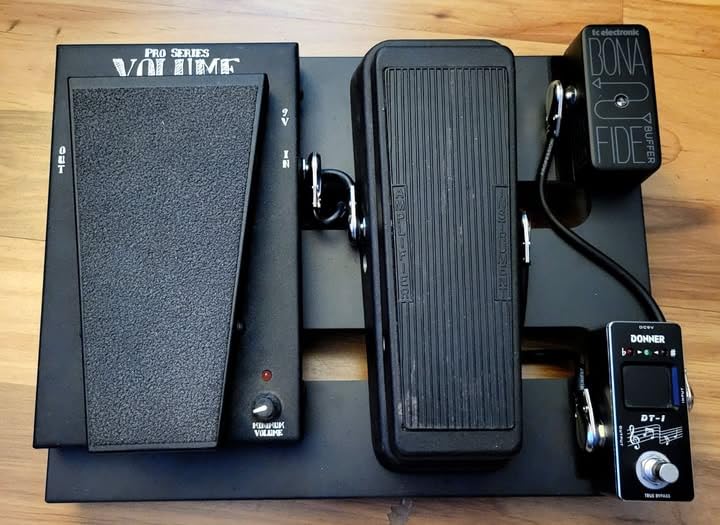
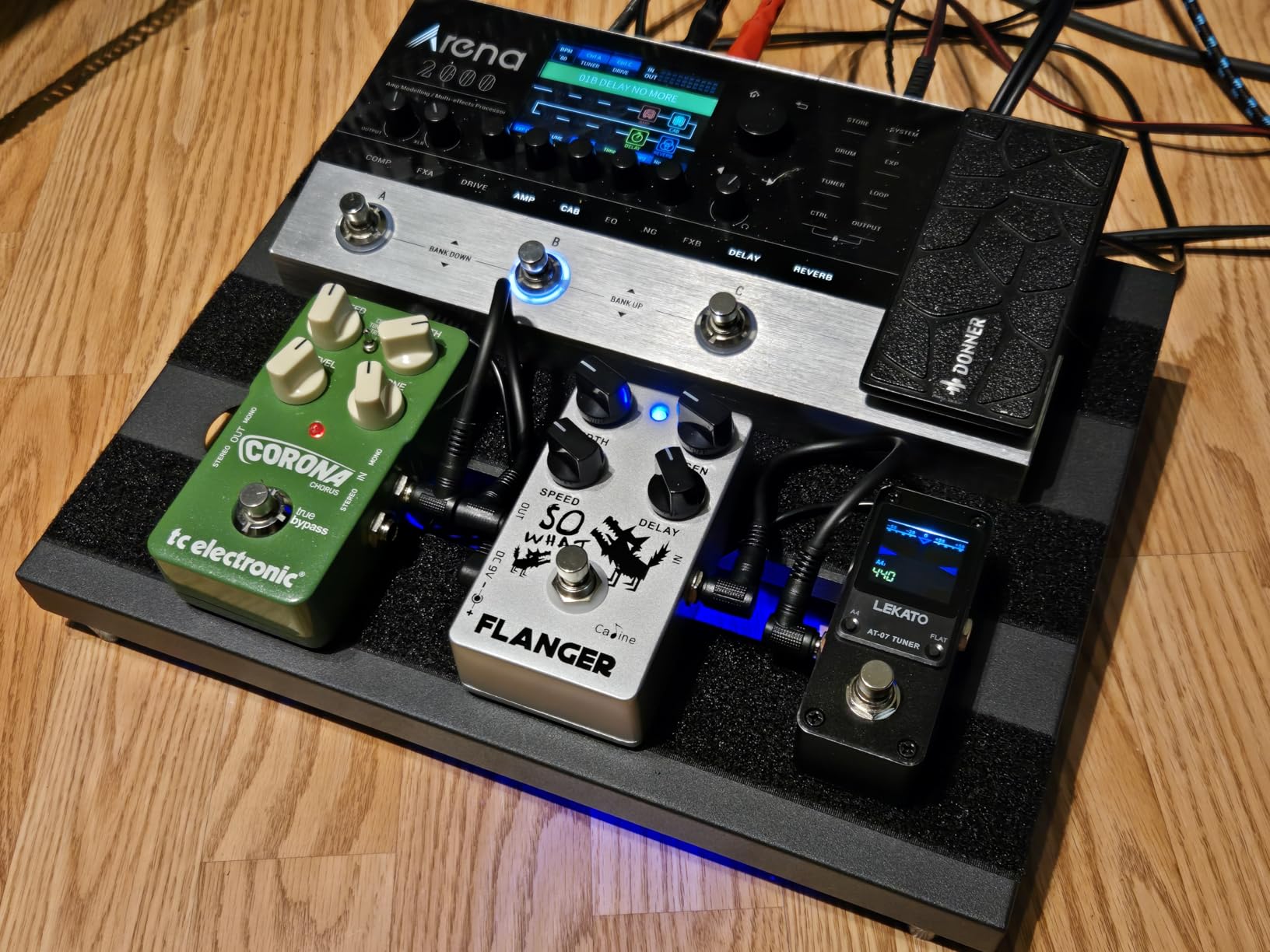
Capacity is around eight standard pedals in most configurations, with generous space underneath for cable runs. At 14 by 10.6 inches it is a genuine compact board, so it suits a three-to-five-pedal rig that you move around regularly rather than a collection that keeps growing.
The box includes the board, a carry bag with a shoulder strap, mounting tapes and a Velcro strap for securing the power supply to the tray. It carries a one-year warranty, which is shorter than the two years on some of the aluminium boards in this roundup but perfectly normal for a steel frame at this level.
Two honest caveats. Some buyers report a small amount of movement when the board sits unloaded on a flat surface, and the power compartment design is described as needing a little refinement. The carry bag works but feels inexpensive next to the steel plate.
Who the SOYAN steel board suits
It suits the player with a tight practice space or a small rehearsal room where a 20-inch board would be in the way. Fourteen inches fits on most desks, chairs and amps without moving the furniture.
It also suits anyone who already owns an isolated power supply and wants somewhere to mount it properly. The tray takes a large brick, which means you do not need to shorten cables or daisy-chain simply to make the power fit.
When to skip the SOYAN steel board
Skip it if weight matters to you more than stability. At 3.3 lb it is more than double the weight of the GHOSTFIRE board, and carrying it on public transport or up stairs is noticeably harder.
Skip it if your rig will pass eight pedals soon. The extra space is what makes the board feel future-proof, and this one runs out of it faster than the 18- and 22-inch options.
5. AKLOT Powered Pedal Board: Best for a Travel Rig
AKLOT Guitar Pedal Board with Built-in Power Supply Guitars Effect Pedalboard Aluminium Alloy Power Supply 19″ x 5″ with Bag, Pedal Cable
19 x 5 in narrow aluminium deck
About 2.6 lb
Built-in supply, 9 outputs plus USB
2-year warranty
Pros
- Built-in power supply removes a separate purchase
- Aluminium board is light at about 2.6 lb
- Short-circuit protection per output keeps the chain alive
- Slight incline is comfortable underfoot
- Complete kit with bag and hook-and-loop
- Two-year warranty
Cons
- Narrow 19 x 5 single-row format limits pedal size and count
- Seven included power leads run out on larger chains
This is the answer for anyone who wants one box instead of two. The AKLOT board has the power supply built into the frame, so there is no separate brick to buy, mount or forget. You run one mains cable to the board and every pedal on the deck is fed from there.
It provides nine pedal outputs plus one USB output, with independent short-circuit protection on each channel. That last part is the spec that actually matters. If one pedal faults, the other outputs keep working instead of taking the whole board down, which on a daisy chain is exactly what happens.
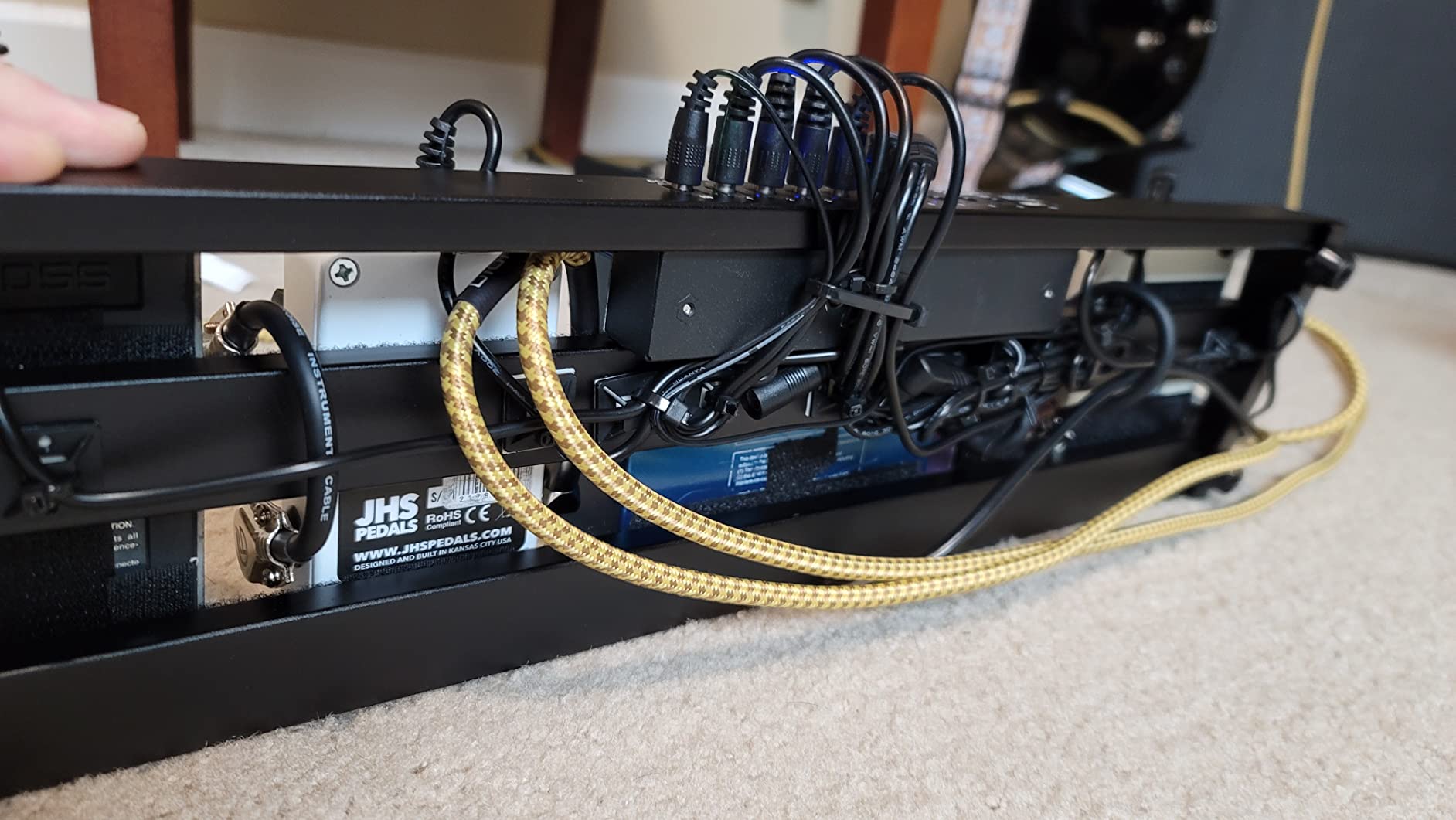
The deck is 19 by 5 inches and about 2.6 lb, and that narrow single-row format is the whole trade-off. It fits a row of standard stompboxes with the power section behind them. It does not fit a two-row layout, and it will not take a wah or a large expression pedal.
There is a slight incline to the playing surface so the pedals are more comfortable to step on, and status indicators on the side of the power section show whether each channel is live. That is genuinely useful when something is not working and you have no signal chain diagram in your head.
Seven pedal power lines are included in the box alongside the AC adapter, carrying bag, hook-and-loop and adjustable cable ties. If you build a chain longer than that, you will need more power cables. Budget for it rather than discovering it mid-rehearsal.
Who the AKLOT powered board suits
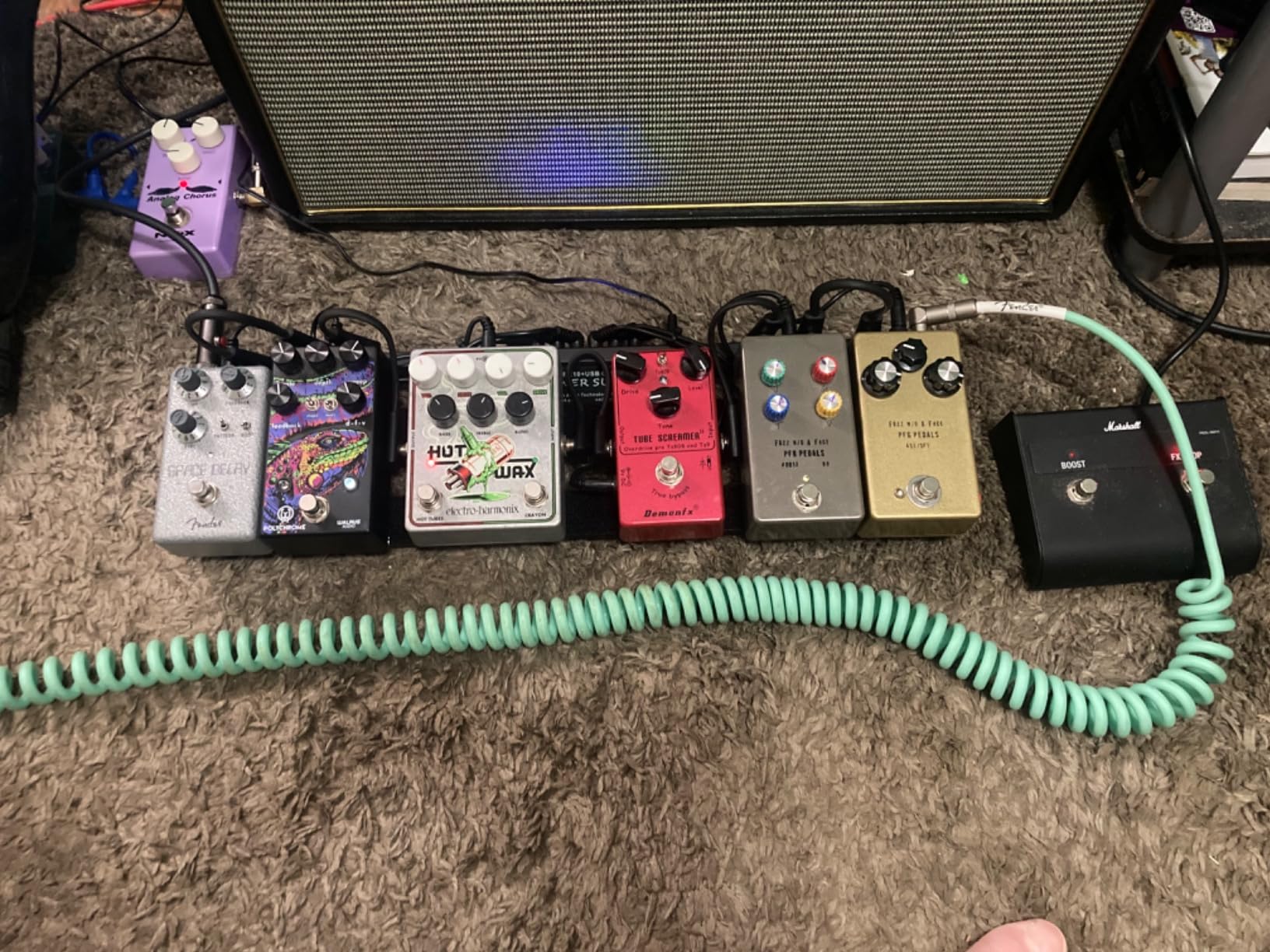
It suits a first electric guitarist who wants the simplest possible setup. No power supply shopping, no clearance measurements, no mounting brackets. You unbox it, stick three pedals on, and play.
It also suits a travelling rig where every gram counts. At about 2.6 lb with power integrated, it is the lightest complete setup in this roundup, and the two-year warranty is the longest alongside the Donner powered board.
When to skip the AKLOT powered board
Skip it if you want a two-row layout or if you plan to add a wah, a volume pedal or an expression pedal. At 5 inches deep, the board has no room for anything wider than a standard stompbox.
Skip it if you want to upgrade the power supply later. The integrated unit is fixed to the board, so you cannot swap in a higher-output isolated brick when a digital pedal joins the chain. Players running digital effects should look at a board with higher-current outputs.
6. LEKATO PB-01S Powered Board: Best for Digital Pedals
LEKATO Guitar Pedal Board, Pedal Board with Built-in Power Supply, 15.5×5.1×1.6″ 1.3LB, Aluminum Alloy Powered Pedal Board with Pedal Cables, Bag, Adhesive Hookside Tape
15.5 x 5.1 x 1.6 in board
1.3 lb aluminium alloy
9 DC outputs plus USB
Recessed inward-facing ports
Pros
- Lowest weight powered board here at 1.3 lb
- Nine independent outputs spanning 9V
- 12V and 18V
- High-current options including a 700mA and a 300mA output
- Built-in USB charging port
- Recessed ports and right-angled plug protect connections
- Aluminium frame resists warping better than wood
Cons
- Narrow single-row format restricts total capacity
- One-star ratings account for 6 percent of reviews
Almost every powered board we looked at shares one weakness: 100mA outputs. That is fine for an analogue overdrive and marginal for a digital delay or a modeller pedal, which is why the LEKATO board is worth a separate look. Its nine DC outputs are rated at 9V 100mA five times, 9V 300mA, 9V 700mA, 12V 500mA and 18V 300mA.
The 700mA channel alone changes what you can put on the board. Digital pedals draw far more current than analogue ones, and forum advice is blunt about it: never daisy chain a digital pedal. Having a dedicated high-output channel built in removes that problem before it starts.
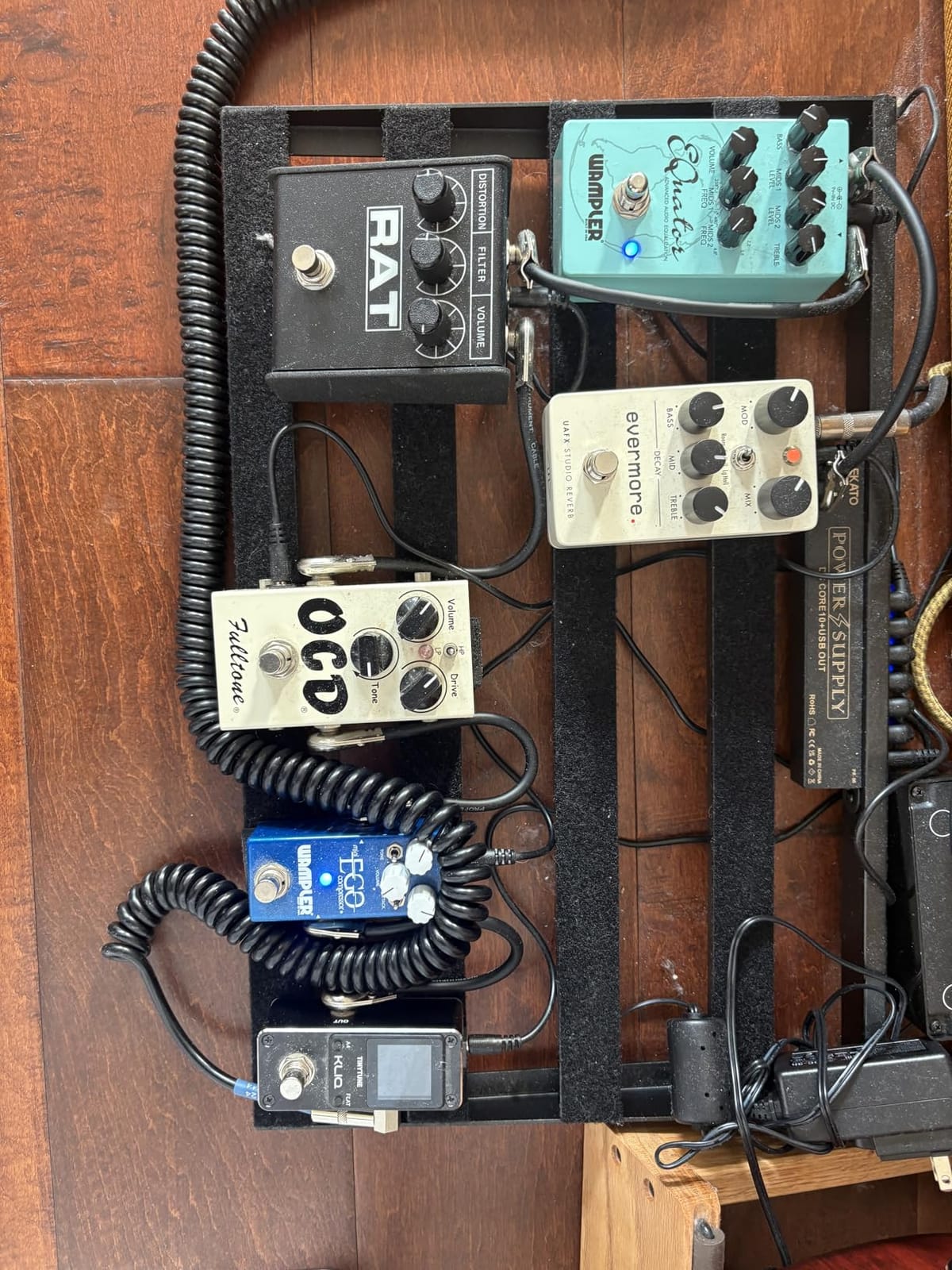
Weight is the other headline. At 1.3 lb this is the lightest frame in the roundup, powered section included. The aluminium alloy resists warping and handles moisture better than a wooden plank, which matters in a rehearsal room or a garage.
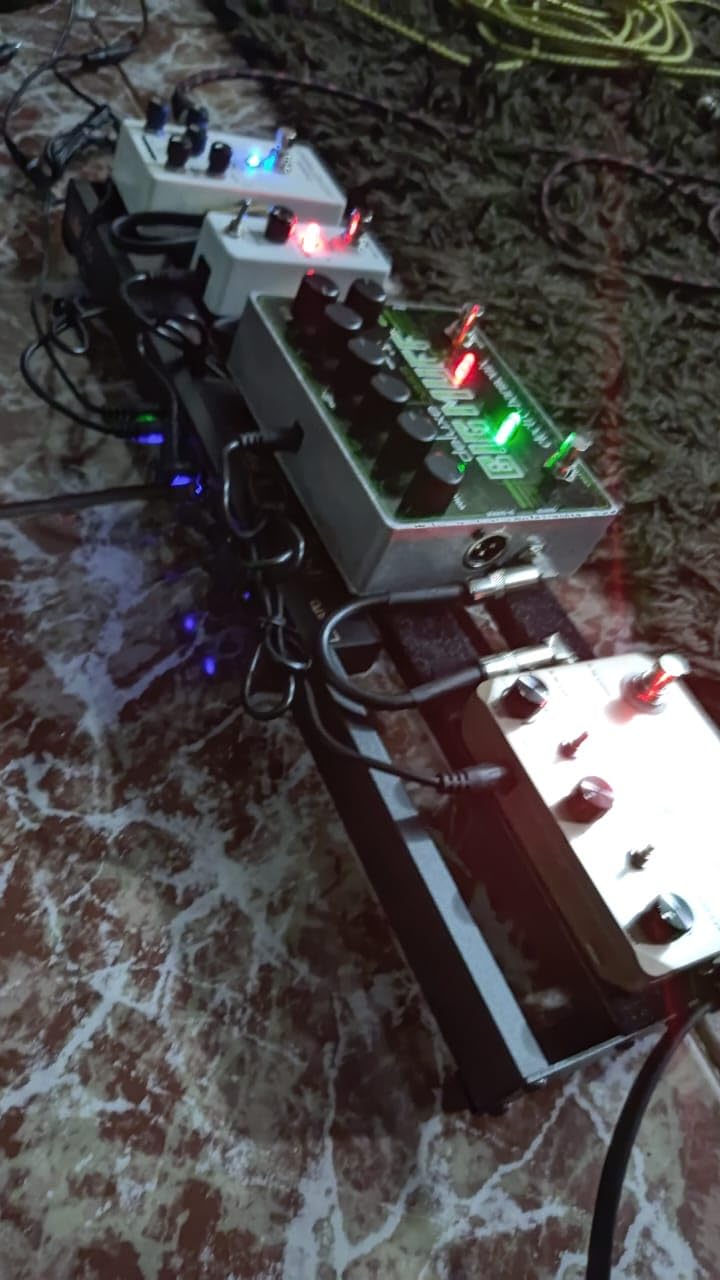
Port design shows real thought. The DC outputs are recessed and face inward, and the main power plug is right-angled, so a foot landing near the connection will not bend a pin sideways. There is also a 5V 800mA USB charging port on the side for a phone or a tuner accessory.
The honest caveat is capacity. At 15.5 by 5.1 inches it is a single narrow row, the smallest deck of the powered options here. It is also the lowest-rated board in the group at 4.4, with 6 percent of reviews at one star, so expect a small share of buyers who found the narrow format limiting.
Who the LEKATO PB-01S suits
It suits players adding their first digital pedal, whether that is a delay, a multi-effects unit or a looper. The spread of voltages and currents means you are not gambling on whether a pedal will run cleanly from a 100mA output.
It also suits anyone who wants the lightest possible powered setup, or who wants the 12V and 18V outputs for pedals that need them. The USB port is a small extra that most powered boards at this level do not include.
When to skip the LEKATO PB-01S
Skip it if you want room for a wah or a large expression pedal. A 5.1-inch depth does not accommodate anything wider than a standard stompbox, and there is no second row.
Skip it if you are building toward a larger collection. At 15.5 inches you will outgrow this deck before you outgrow your interest in effects. The board is a starting point for a compact rig, not a platform for growth.
7. GOKKO 22 Inch Steel Board: Best for Larger Rigs
GOKKO Guitar Pedal Board with Power Supply Bracket 22″ x 12.6″
22 x 12.6 x 2.7 in steel deck
5.5 lb
Holds 10-12 pedals
Power bracket 11 x 4.3 x 2.1 in
Pros
- Holds 10-12 pedals with room for a wah or expression pedal
- Removable and lockable under-board power bracket
- All four feet sit flat with no rocking
- Side holes double as carry handles
- Plenty of Velcro plus a zippered cable pocket in the bag
- Eight-degree angle works well underfoot
Cons
- Soft carry bag is thin and offers little padding
- Finish looks painted rather than powder coated
- At 5.5 lb it is noticeably heavy to carry
The GOKKO 22 is the board to buy if you already know your rig is going to grow past eight pedals. At 22 by 12.6 inches it holds ten to twelve pedals in most configurations, and the extra width leaves genuine space for a wah pedal or an expression pedal alongside a full row of stompboxes.
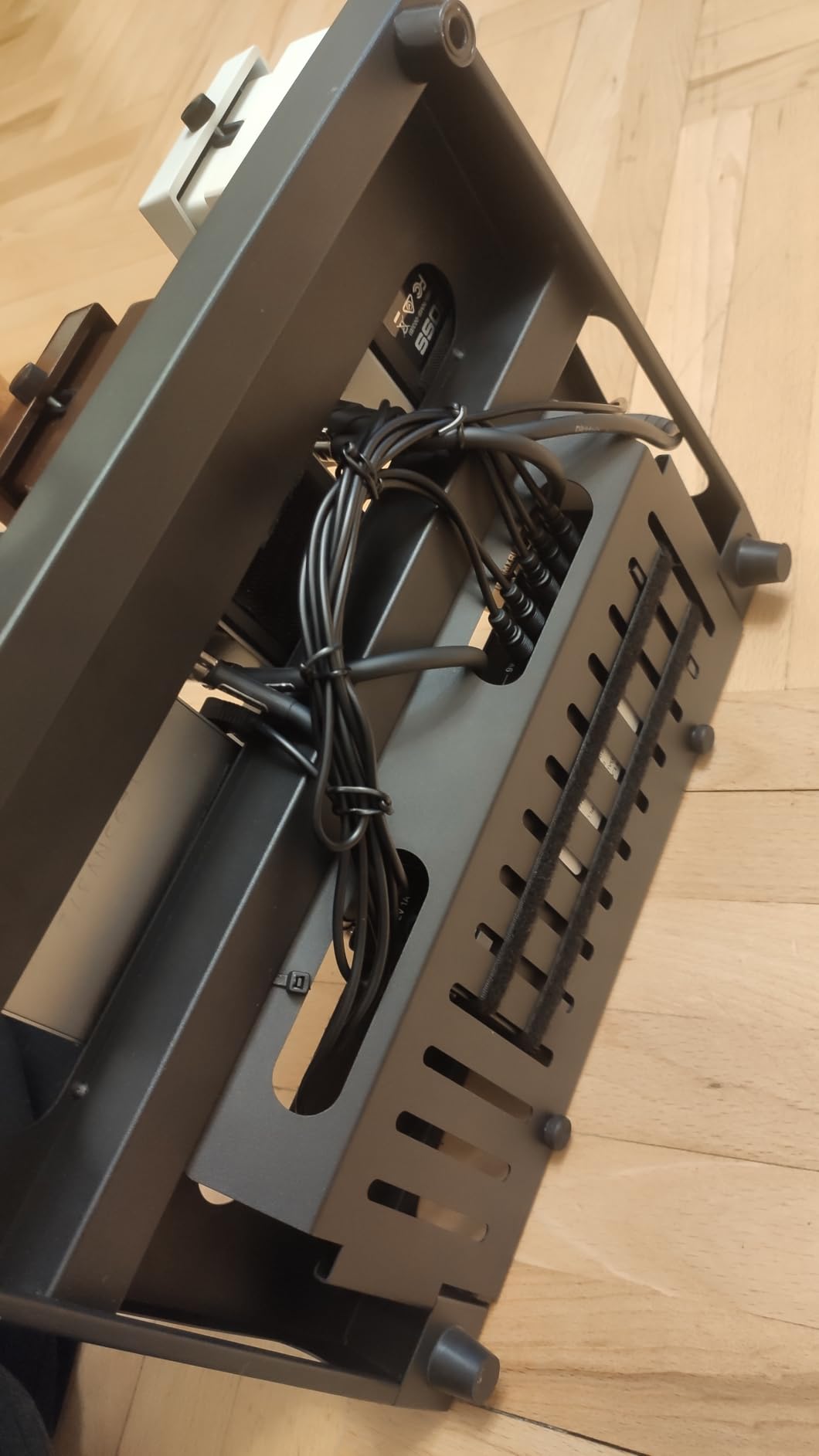
The power bracket underneath is the detail that sets it apart. It is removable and lockable, held on by three screws, and the mounting area measures 11 by 4.3 by 2.1 inches. Reviewers single it out repeatedly, and one owner reports it replaced a heavy homebuilt plywood rig without complaint.
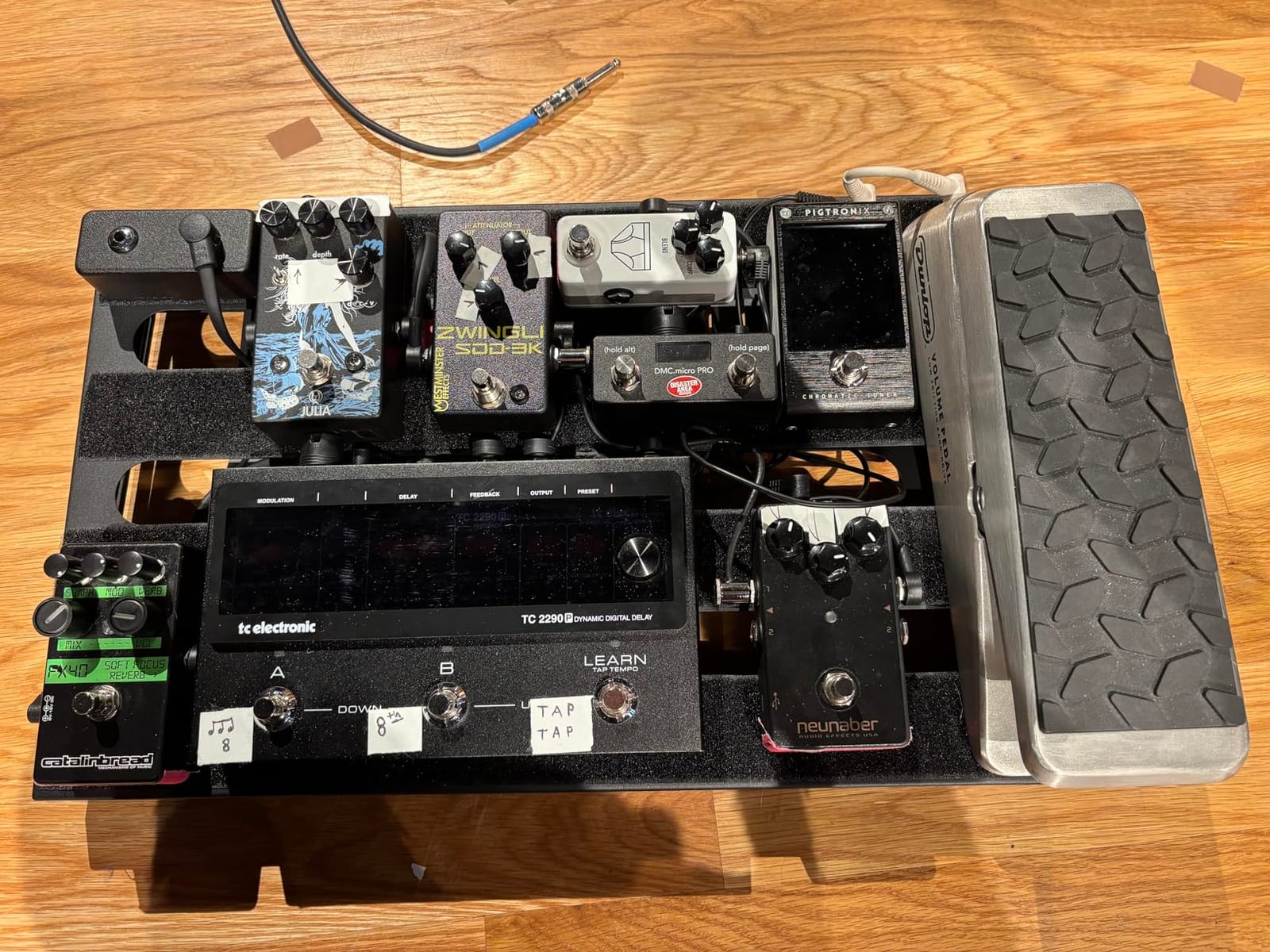
Build quality shows in small ways. All four feet sit flat on the ground with no rocking, which is not always true of steel frames at this price. Side holes double as handles for lifting the whole rig, and there is generous Velcro in the box plus a zippered cable pocket in the bag.
The board sits at about 8 degrees, the same angle that works well on the SOYAN, and it is solid steel at 5.5 lb. That is the heaviest board in this roundup by a clear margin. Stability is excellent and portability is poor, which is a fair trade only if your rig lives in one room or your car.
Be realistic about the bag. It is described as soft and thinly padded, good for carrying the board across a room or to a rehearsal space, not for protecting a loaded rig in a car boot or an aeroplane hold. Budget for a separate protective case if the board travels often.
Who the GOKKO 22 inch board suits
It suits players who are already past five pedals or who play a rig that includes a wah or volume pedal. The width is the point: it removes the constant reshuffling that happens when a full-size pedal forces a redesign of the layout.
It suits the gigging guitarist with a car, where the removable power bracket and the stable steel deck are worth the weight. It also suits anyone who previously built their own board and wants something that does not flex.
When to skip the GOKKO 22 inch board
Skip it if you own three pedals today. At 5.5 lb with a mostly empty deck, this is the clearest example of the too-big-board mistake that players regret. Measure your pedals first and come back in a year if you need the size.
Skip it if you carry your rig on foot, on a bike or on public transport. At 22 inches and 5.5 lb, it is a two-handed load before you add pedals and a power supply to it.
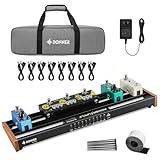
8. Donner Powered Pedal Board: Best All-in-One Starter Package
Donner Guitar Pedal Board with Built-in Power Supply
19 x 5 x 1.8 in aluminium board
3.98 lb
7 x 9V/200mA plus 12V, 18V and USB
Cords and Velcro included
Pros
- Board and isolated power supply arrive as one package
- Power output reported clean and quiet with no hum
- Individual short-circuit protection on each channel
- Cords and hook-and-loop tape in the box
- Five-inch depth tucks under a desk easily
- Angled deck with tidy underside cable routing
Cons
- 9V channels capped at 200mA for high-current pedals
- Carry bag is a snug fit
- One reviewer reported the included charger not working
The Donner powered board is the one that behaves most like a complete beginner package. You get the board and an isolated pedal power supply in one box, along with power cords and hook-and-loop tape, so there is no second shopping trip for a power brick before you can set up.
The power section provides seven 9V outputs at 200mA each, plus 12V, 18V and a 5V 500mA USB output, with individual short-circuit protection per channel. Owners describe the power as clean and quiet with no audible hum, which is exactly the noise problem forum members report with cheap daisy chains.
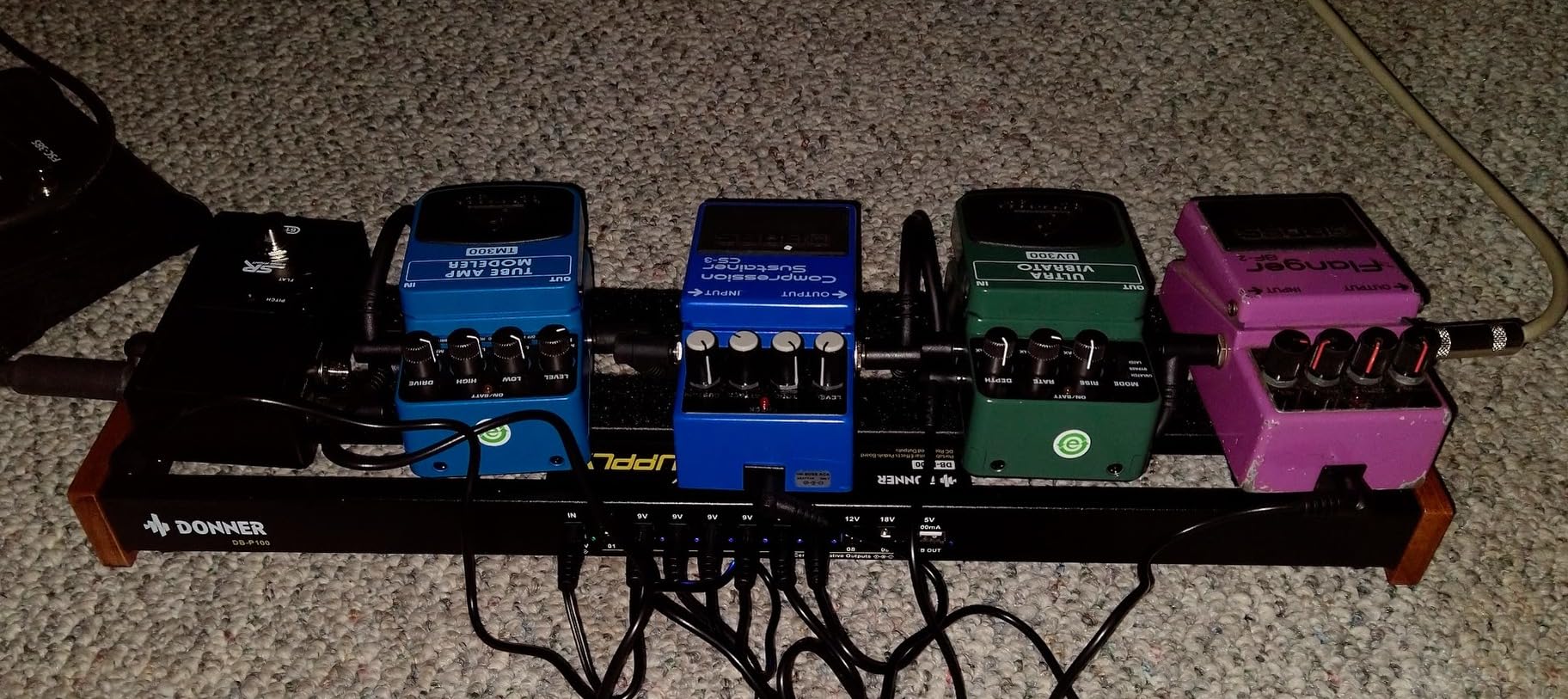
The deck measures 19 by 5 inches with an angled playing surface and tidy underside cable routing. At 5 inches deep it slides under a desk or a small amp stack, which makes it a good home-practice board rather than a stage board. A wider 19 by 12 inch variant exists in the same product line if you need more room later.
Understand the 200mA limit before you commit. That is comfortable for analogue overdrives, distortions and delays, and tight for digital pedals with screen and processing. If a digital pedal is going on the board early, look at a powered board with higher-current outputs instead.
The bag is reported as a snug fit, and one reviewer received an 18V charger that did not work. Both are worth checking on arrival, since a bag that is too tight puts pressure on pedal switches and a dead charger means a return trip.
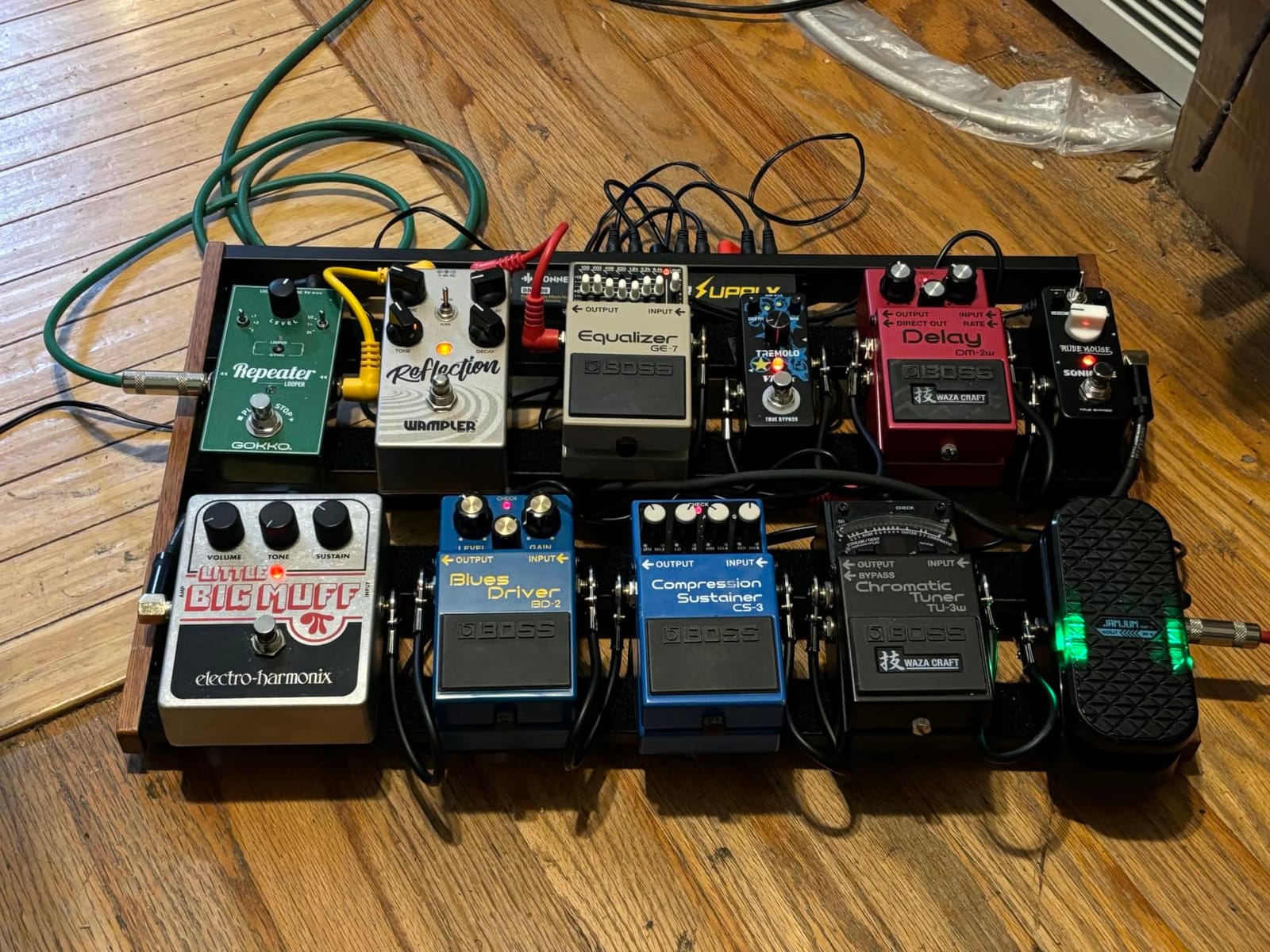
Who the Donner powered board suits
It suits the absolute first-time board buyer. The board, the supply and the mounting tape arrive together, so you can go from an unopened box to a working signal chain in one evening without researching power supplies first.
It suits home practice setups where desk space is limited. A 19-inch wide, 5-inch deep board with angled switches is a footprint you can live with in a bedroom, and it also works for a small amp stack setup.
When to skip the Donner powered board
Skip it if digital pedals are in your near-term plans. The 200mA ceiling on the 9V channels is the main reason buyers return boards like this, and it cannot be fixed with a different cable.
Skip it if you want a wide two-row layout now. At 19 by 5 inches it holds a single row of stompboxes. If you can already see a wah or an expression pedal in your rig, step up a size instead.
How to Choose Your First Pedalboard
Five decisions decide whether a board works for you, and only the first one is about size. Work through them in order, because buying on appearance first is how people end up with a beautiful empty deck.
1. Measure your pedals before you buy anything
Lay every pedal you own on the floor in the row order you want. Measure the total width and depth with a tape measure, then add two to three inches in each direction for cable bends and jack clearance. That measurement is your minimum deck size.
This is the single most repeated piece of advice across the guitar forums we checked, and it is more useful than any brand recommendation. It also settles the question of how many slots to leave free, which is where beginners over-buy.
2. Match capacity to pedal count, not ambition
Three to four pedals fits a 14 to 15 inch single-row board. Six to eight pedals wants an 18 to 20 inch deck, which is where you can fit a full-size wah alongside standard stompboxes. Ten or more pedals needs a 22 inch frame or a two-row layout.
Pedal width is the variable people forget. A mini pedal is roughly half the width of a standard stompbox, and a wah or a full-size delay takes up two or three slots on its own. Measure the widest pedal you own first, because that is your unit of measurement.
3. Decide how you will power your pedals
A daisy chain is one power output split into several leads. It is cheap and compact, and forum consensus is that it is fine until it is not. The moment you add a digital pedal, the shared cable run can bring back hum and noise.
An isolated supply gives every pedal its own output. It costs more and takes more space, but one shorted pedal no longer takes the whole board down, and current-hungry pedals get the power they need. For a beginner buying once, isolated outputs are the safer choice.
4. Check under-board clearance before you commit
This is the detail that shows up in post-purchase regret threads more than any other. Measure the gap between the deck and the floor, then measure the height of the power supply you plan to use. If the brick is taller than the gap, you are zip-tying it to the underside of the frame and your cable runs will be a mess.
Boards with a purpose-built tray solve this cleanly. The SOYAN tray measures 10.8 by 4.45 by 1.89 inches, the GOKKO bracket is 11 by 4.3 by 2.1 inches and locks in place, and the Donner DB-3 simply has enough open space underneath to accept a standard isolated supply. If you are buying a powered board instead, this decision is already made for you.
5. Choose a case that matches where the board lives
Soft canvas bags are for moving gear between rooms. They handle weight and knocks but offer almost no crush protection, so do not load a fully populated board into one for a long drive. Hard cases and flight cases cost more and are the only real option for a rig that flies.
Check what else is in the bag. A board with backpack straps or a trolley attachment, plus an outside pocket for cables, saves you from balancing loose items on top of the rig.
Boards for acoustic and bass
Acoustic guitar pedalboards work well for players using a pickup or a DI box. Most of the boards here handle the low-output, high-impedance signal from an acoustic pickup without issue, and the compact options suit a small stage better than a 22-inch deck. Bring a DI and a short cable for the pickup feed.
Bass players need the same boards, with one adjustment: start with a compressor or a boost rather than a high-gain distortion, and leave more space between pedals if you use an octave pedal, which is physically wide. The compact single-row boards fit a bass rig more easily than the deep two-row layouts.
What to actually put on the board first
Start with three pedals, not eight. The most common beginner recommendation across the forums is a tuner, an overdrive and a delay, with reverb as the fourth when you want more space in the sound. Add a looper at the end of the chain if you practise without a band.
Buy the board to fit those three plus two empty slots, then grow into it. A board that fits your current rig with headroom will last years, and it will not be a heavy, half-empty thing you leave at home.
Beginner Pedalboard Mistakes to Avoid
Most board regrets come from the same handful of mistakes, and every one of them has been discussed at length on guitar forums. They are worth reading before you buy rather than after.
Buying a board that is too big
This is the big one. If you have space on a board, you will fill it, and then you carry a heavy rig with pedals you never switch on. Buy for your current pedals plus two slots, then measure again in a year.
Skipping the under-board clearance check
Plenty of players buy a board, then discover their power supply is too tall to mount underneath. The fix is to measure the gap and the brick before you order. This costs thirty seconds and saves a return.
Relying on a cheap daisy chain with digital pedals
Community opinion is close to unanimous: daisy chains are fine until a digital pedal joins the chain, at which point noise comes back. If your rig has or will have any digital effects, buy isolated outputs from the start.
Not cleaning pedal bases before applying hook-and-loop
Velcro fails on textured or rubber pedal bases unless you wipe them first. A quick alcohol wipe on the underside of each pedal before you stick the tape on prevents pedals lifting mid-solo, which is both a noise problem and a safety problem.
Trusting the soft bag for road transport
Soft gig bags wear out at the seams and zippers long before the board does, and they protect nothing from crushing. Use them to move the rig. If the board travels in a car or an aeroplane, put it in something rigid.
Frequently Asked Questions
Do I really need a pedalboard?
No, not if you own one or two pedals. A floor layout works fine, and a multi-effects unit or amp modeler can cover a lot of ground without a board at all. A board earns its place once you own three pedals you use regularly, or as soon as you move the same pedals between rooms, rehearsals or gigs. At that point the board cuts setup time and keeps the signal chain consistent.
What size pedalboard do I need?
Measure your pedals laid out on the floor and add a couple of inches for cable bends. Three to four pedals need a 14 to 15 inch single row. Six to eight pedals want an 18 to 20 inch deck, which leaves room for a full-size wah. Ten or more pedals need a 22 inch frame or a two-row layout. Measure the widest pedal you own first, since that sets your unit of measurement.
Should I buy a pedalboard with a built-in power supply?
Yes, if you are buying one board and want it to work immediately. A powered board removes the need to research, buy and mount a separate supply, and the integrated units in this roundup include short-circuit protection per output. Check the per-output current rating first. Around 200mA suits analogue pedals, but digital effects need a higher-current channel.
What pedals should a beginner guitarist have?
Start with three, not a rack. A tuner, an overdrive and a delay will carry you through most playing situations, and reverb is a good fourth when you want more space in the sound. Add a looper at the end of the chain if you practise alone. Buy the board to fit those three plus two empty slots, then grow into it.
How do I set up my first pedalboard?
Work from the guitar to the amp: tuner first, then gain pedals such as overdrive and distortion, then modulation like chorus or phaser, then delay, then reverb last. Power each pedal from an isolated output rather than a daisy chain, route the patch cables through the underside slots, and secure each pedal with hook-and-loop after wiping its base clean.
What is the best pedal board for bass guitar?
The same boards work for bass. The main adjustment is the pedal choice rather than the board, since a compressor or a boost suits a bass rig better than a high-gain distortion. Leave extra width if you use an octave pedal, which is physically wide. The compact single-row formats fit a bass rig more easily than deep two-row layouts.
Final Verdict
For most beginners reading this, the Donner DB-3 is the right first pedalboard. Its 20-inch deck fits a wah alongside several stompboxes, the underside takes a standard isolated power supply, and thousands of owners have documented how it holds up. It is the pick we would put in front of someone who is serious about playing out.
If you need something lighter or smaller, the GHOSTFIRE SPL-04 carries a full rig at 1.76 lb and the STRICH STANDARD 18 keeps the cables tidy at a sensible size. For a rig that travels in one bag, the powered options remove the power supply from your shopping list entirely, and the LEKATO board is the one to pick if a digital pedal is coming first.
Measure your pedals before you order, check the under-board clearance against your power supply, and buy for three pedals plus two slots. The best guitar pedalboards for beginners are not the ones with the most features. They are the ones your actual rig fits on, with room to grow and nothing you have to carry empty. Get the measurements, then pick from the eight above.