
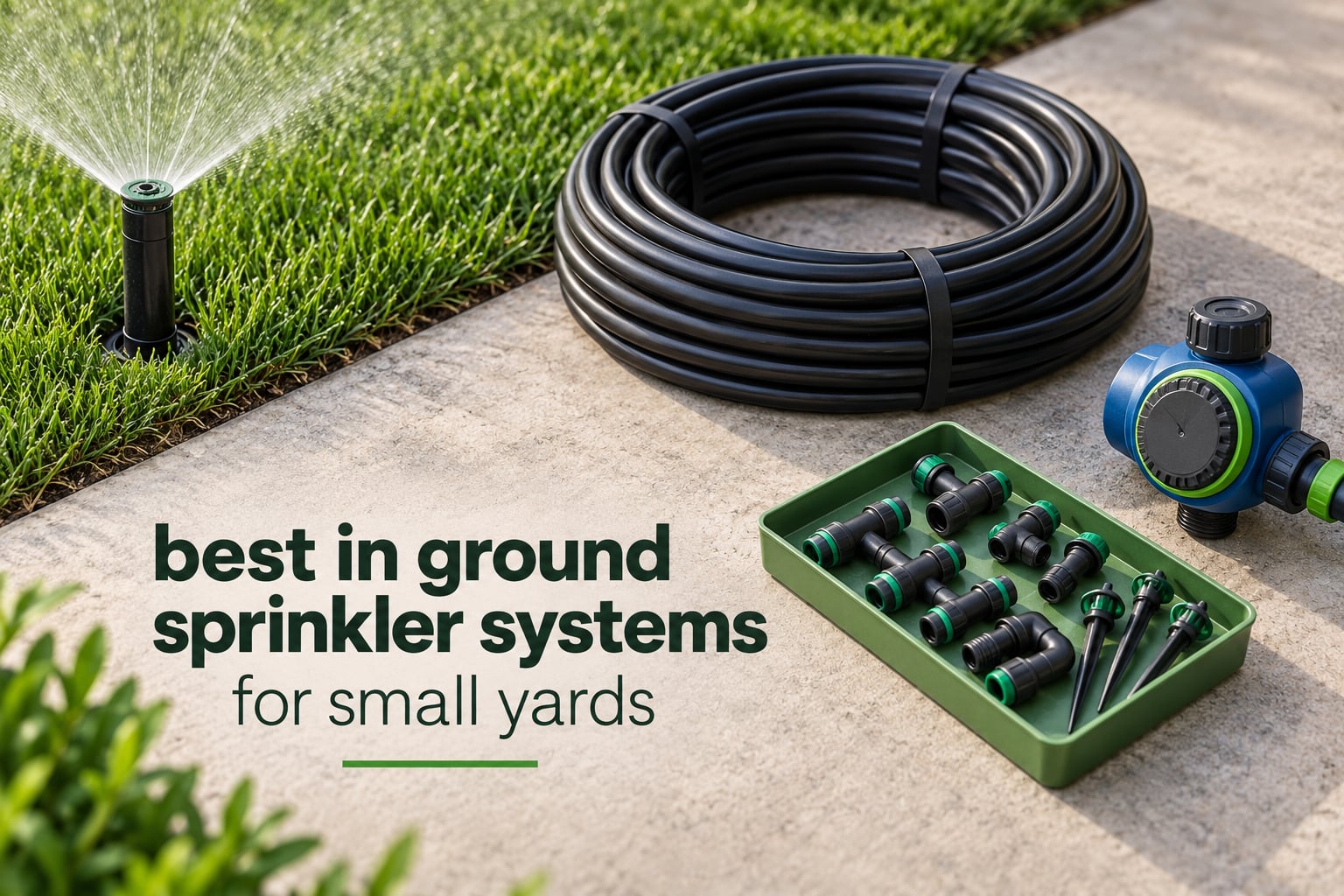
The best in ground sprinkler systems for small yards are fixed-spray pop-up heads on a single zone, fed by an outside faucet, spaced about 10 to 15 feet apart. At this scale you are not buying a multi-zone commercial system, and a kit that stays under roughly 3,000 square feet of coverage will do the whole job. Most yards under 4,000 square feet need one zone, not three.
That last point is where a lot of buyers waste money. They assume a real automatic system means valves, a controller, and a plumber. For a small lawn, most of that is overkill, and the more expensive multi-zone kits you will see next to these picks solve a problem you do not have.
I spent weeks comparing the kits and heads in this category, reading the long review histories on each, and mapping the coverage figures to real yard sizes. Ten products survived the cut. Below you will find what each one is actually good at, where it falls short, and the spacing and pressure math that decides the install.
Table of Contents
Top 3 In-Ground Sprinkler Picks for Small Yards (October 2026)


Gardena OS 140 Pop-Up System
- Waters 2 to 140 m2
- 16 nozzles
- Built-in drainage valve
- Flush to ground
Quick Overview: Every System and Head Compared in 2026
| Product | Specs | Action |
|---|---|---|
| Rain Bird 1804VAN Pop-Up Spray Head |
|
Check Latest Price |
| Rain Bird 32ETI In-Ground Kit |
|
Check Latest Price |
| Gardena OS 140 Pop-Up System |
|
Check Latest Price |
 Rain Bird LG3HE Impact Sprinkler Rain Bird LG3HE Impact Sprinkler |
|
Check Latest Price |
 Orbit 50020 All-in-One Watering System Orbit 50020 All-in-One Watering System |
|
Check Latest Price |
 Quick-Snap QSK-745 Pop-Up 5-Pack Quick-Snap QSK-745 Pop-Up 5-Pack |
|
Check Latest Price |
 K Rain K1 Smart Set Rotor K Rain K1 Smart Set Rotor |
|
Check Latest Price |
 Gardena SD80 Pop-Up Sprinkler Gardena SD80 Pop-Up Sprinkler |
|
Check Latest Price |
 Hunter PGP-ADJ Rotor Head Hunter PGP-ADJ Rotor Head |
|
Check Latest Price |
 Orbit 54070 Brass Pop-Up Head Orbit 54070 Brass Pop-Up Head |
|
Check Latest Price |
What You Are Actually Buying: Kits, Heads, and Hose-End Systems
Most listings under this search term are not complete irrigation systems. They fall into three groups, and telling them apart before you buy will save you a weekend.
A true in-ground system is plumbed into your home’s main water line, usually through a backflow preventer, and controlled by a timer or controller buried near the foundation. It costs more and it is permanent, but nothing needs reassembling each spring.
A faucet-fed in-ground kit buries shallow tubing and pop-up heads in the lawn, then connects the whole network to an outside spigot through a hose-end timer. It is a genuine in-ground install that looks like a contractor job once the hose is hidden, and it is what most small yards actually need. The Rain Bird 32ETI and the Orbit 50020 are both in this group.
A head or pack is just the component. You supply the pipe, the timer, and the labor. Several picks below are individual heads, which is the right buy if you already have a working zone and just need to expand or replace. The head spec you need to match is your line size and flow, not the lawn size.
Hose-end systems that sit on top of the grass are a different product again. Forum discussion on r/lawncare and r/Calgary keeps circling the same complaint about them: owners rebuild the same arrangement every spring after winter, and that seasonal reassembly is the strongest practical argument for burying the hardware once.
1. Rain Bird 1804VAN 4-Inch Pop-Up Spray Head – Best All-Around Head for Small Lawns
Rain Bird 1804VAN 1800 Series Professional – 4 Inch Pop Up Sprinkler Head
15 ft reach
0-360 degree variable arc
1/2 inch female inlet
Sold as a 5 pack
Pros
- Tool-free arc adjustment with a textured collar
- Stainless steel spring and wiper seal
- Retracts flush for mowing
- UV and weather resistant
- Made in the USA
Cons
- Fixed spray body with fewer nozzle choices than a rotor
- 15 ft reach is short for open turf
- Costs more per head than plastic-only spray heads
This is the head I keep coming back to for a small lawn, and it is the pick I would build a new zone from. It is a fixed-spray body with a variable-arc nozzle, throwing water up to 15 feet and stopping cleanly where you tell it to.
That 0 to 360 degree range is what makes it useful on small properties. A full circle head goes in the middle of an open lawn, quarter and half-circle heads go on the edges, and a half head handles a walkway border without throwing water onto the pavement.
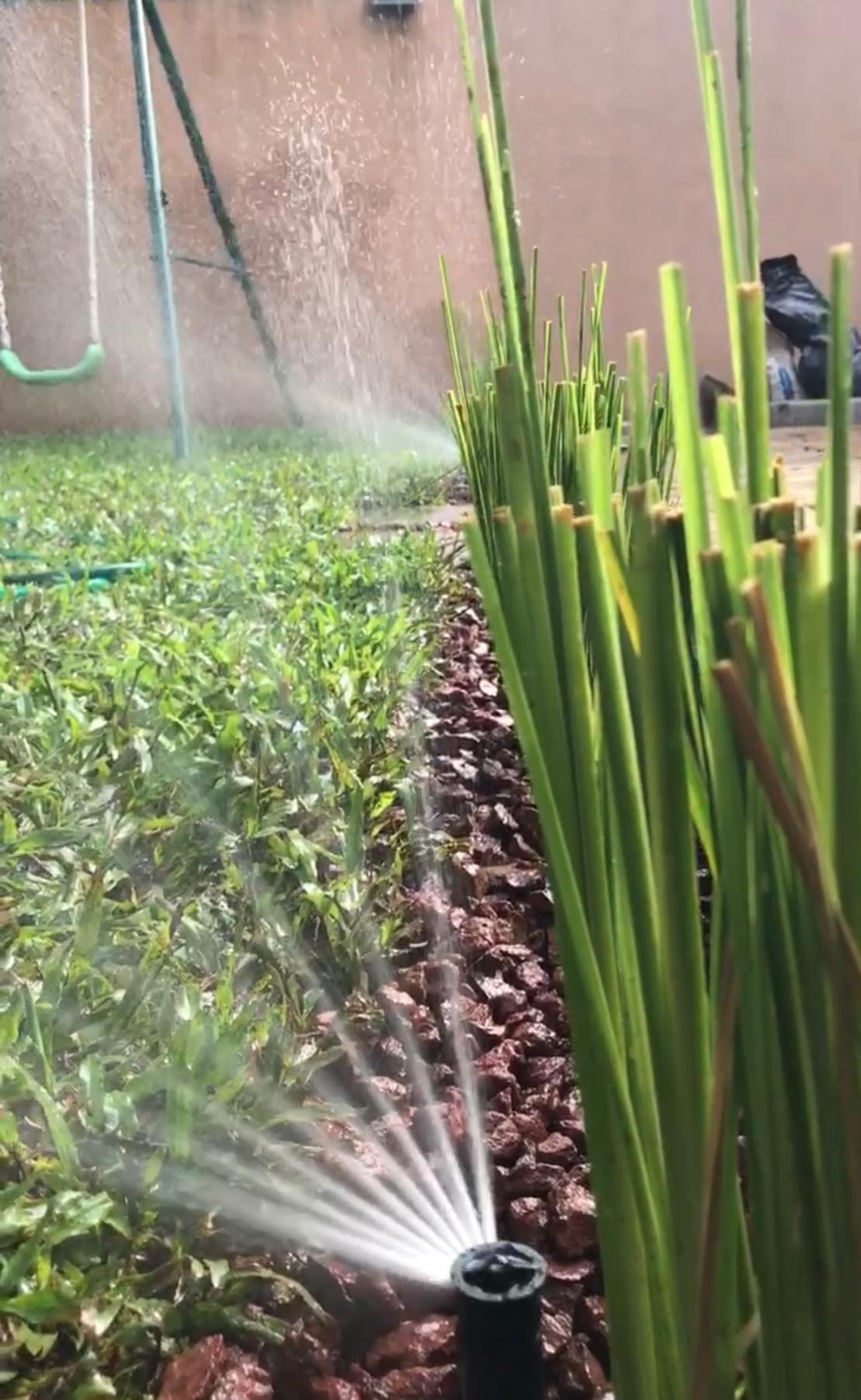
Owners consistently point at two things: the stainless-steel spring, which is why these heads still retract after years of use, and the pressure-activated wiper seal that keeps the head from weeping when it is off. With 4,291 reviews behind it, this is the most thoroughly documented product in the group.
The nozzle adjustment collar takes a quarter turn with no tools, and the 1/2 inch female inlet is the most common irrigation thread in residential work, so it will screw into nearly any small-yard lateral line you already have. Rated at spray distance up to 15 feet with matched precipitation, the head throws a consistent curtain rather than a heavy centre.
The honest limitation is reach. At 15 feet you need more heads than a rotor would demand, which means more trenching on a larger property. On a sub-3,000 square foot lawn that trade is worth making, because tight spacing is exactly what produces the even coverage that keeps dry patches out of a small space.
How it fits a small yard layout
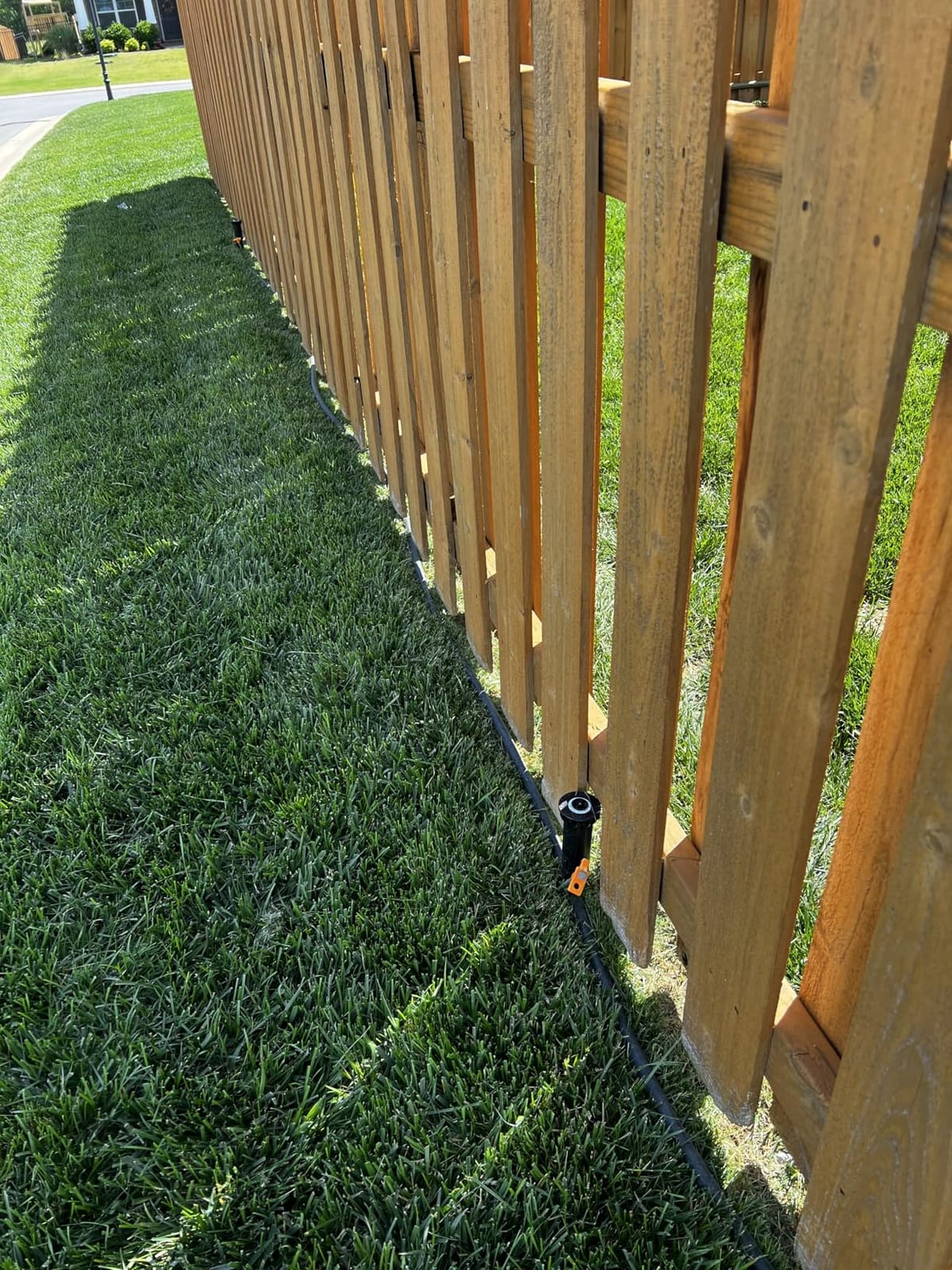
Plan on placing these on roughly 10 to 15 foot centres so each head’s throw overlaps the next. On a typical 2,000 square foot front lawn, four to six of these heads on one zone covers the whole area, which matches what buyers report about the coverage they actually achieve.
Quarter-circle nozzles on the corners and half-circle nozzles along the straight edges keep spray off the sidewalk and the neighbour’s fence. Mixing patterns within one zone is fine when the heads share the same precipitation rate.
What to check before you buy
Confirm your lateral line is 1/2 inch. This body is a fixed spray with a limited nozzle family, so if you later want rotors with a much longer throw on the same zone, you will be changing nozzles and bodies rather than just swapping tips.
Also factor in the head count honestly. At 15 feet of reach, a 3,000 square foot yard wants more heads than a rotor-based layout would, and each head is a hole you dig.
2. Rain Bird 32ETI DIY In-Ground Sprinkler Kit – Best for a Weekend Install
Rain Bird 32ETI DIY Install In-Ground Automatic Sprinkler Kit
Covers 1000-3000 sq ft
45-75 psi working range
125 ft of 1/2 inch tubing
Six pop-up rotary heads
Pros
- Covers 1000-3000 sq ft with tubing and timer included
- Retractable heads that mow cleanly
- Spare nozzles and adjustment tool in the box
- Automatic drain valves included
Cons
- Single zone only
- Needs steady residential pressure to hit its rating
- Faucet feed caps total watering capacity
When someone asks me what the best in ground sprinkler system for a small yard is, this is usually the kit I point them at. It covers 1,000 to 3,000 square feet, connects to an outside faucet, and includes everything else you need: 125 feet of 1/2 inch tubing, six pop-up rotary heads, fittings, a faucet connection kit, a pro-grade hose-end timer, and two automatic drain valves.
That drain valve detail matters more than it looks. They let you blow the lines out with an air compressor before frost, which is the difference between a system that survives several winters and one that splits a length of tubing in January.
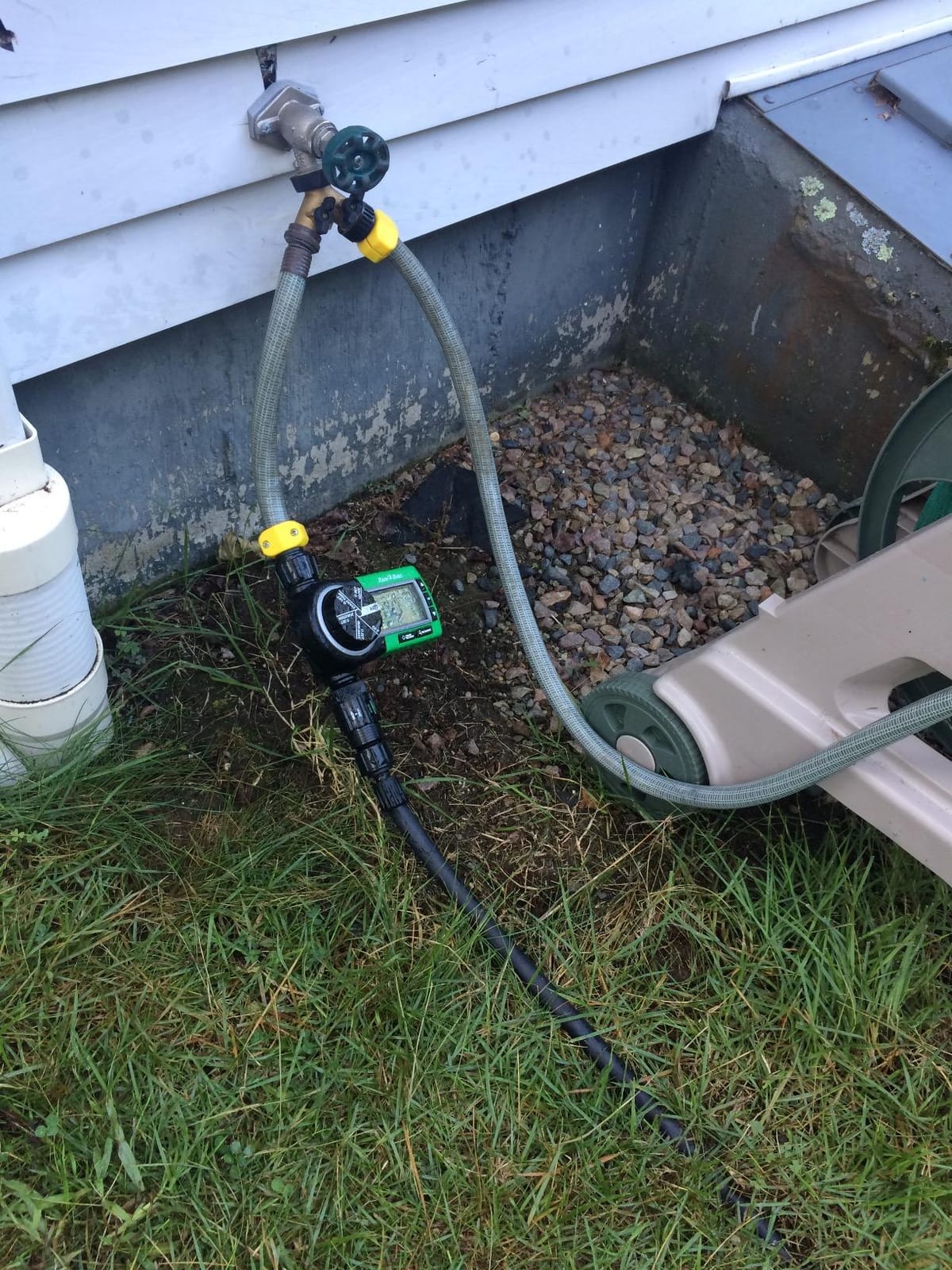
With 2,605 reviews averaging 4.2 stars, the pattern in the feedback is clear. People buy it to stop moving a hose, and they succeed at installing it in an afternoon. The lower-rated reviews cluster around the same lesson: head spacing depends on your actual pressure, so the coverage figure assumes the 45 to 75 psi range the kit is designed around.
Specs to know before you dig: maximum flow rate of 12 gpm, maximum pressure of 70 psi, and a design point for average residential pressure and flow. If your spigot cannot hold pressure when other things are running, this layout will disappoint you.
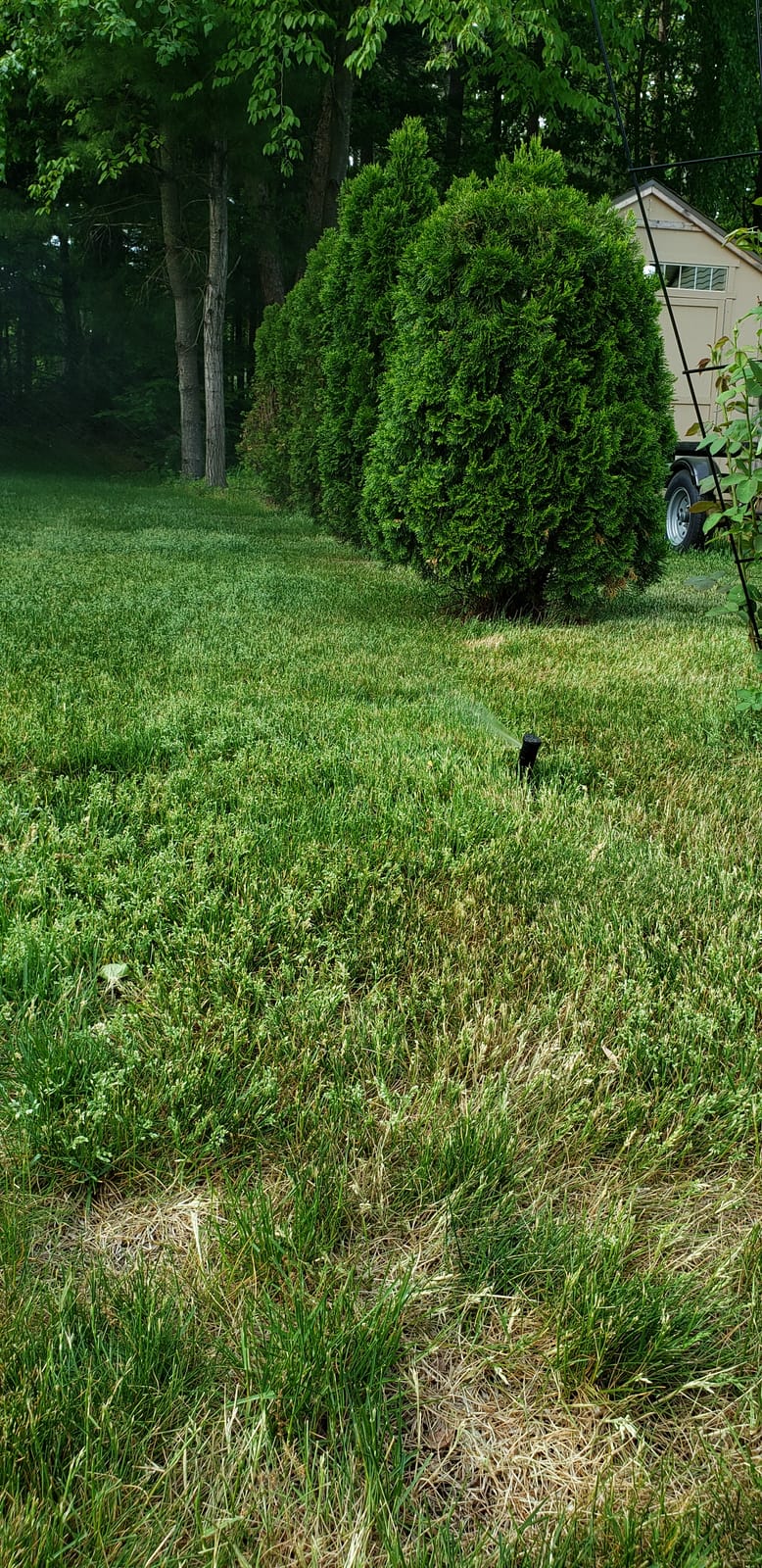
The six rotary heads retract flush for mowing, which is the small detail that makes an in-ground install feel like a finished job rather than a garden full of hardware.
How it fits a small yard layout
Six rotary heads is a sensible count for a lawn in the 1,500 to 3,000 square foot range, and rotary heads throw further than the fixed sprays in pick number one, so you need fewer holes. Lay the tubing in a shallow loop or a spoke pattern and space the heads so their circles touch.
The single zone is not a limitation here. On a small yard, one zone means one run time, one valve, and one schedule, and that simplicity is exactly why this kit suits the scale.
What to check before you buy
Measure your faucet pressure before opening a trench, and confirm your yard sits inside the 1,000 to 3,000 square foot window. Outside that range you either under-buy or waste heads.
Also decide how you will hide the run from the spigot. Exposed hose across a walkway is the first thing neighbours notice about an otherwise tidy install.
3. Gardena OS 140 Pop-Up System – Best Single Unit for Rectangular Plots
Gardena OS 140 pop-up Rectangular Sprinkler: Sprinkler System for Square and Rectangular Areas up to 140 m² in Size, Fitted Flush to The Ground (8223-20)
Waters 2 to 140 m2
16 flexible nozzles
Integrated drainage valve
Volume regulation
Pros
- Covers narrow rectangular areas from 2 m2 upward
- Oscillating spray gives even distribution
- Integrated drainage valve makes it frost-proof
- Volume control lets you set the area precisely
Cons
- Single unit rather than a multi-head kit
- Soft plastic nozzles can be damaged by traffic or mowers
- Capped at 140 m2 of coverage
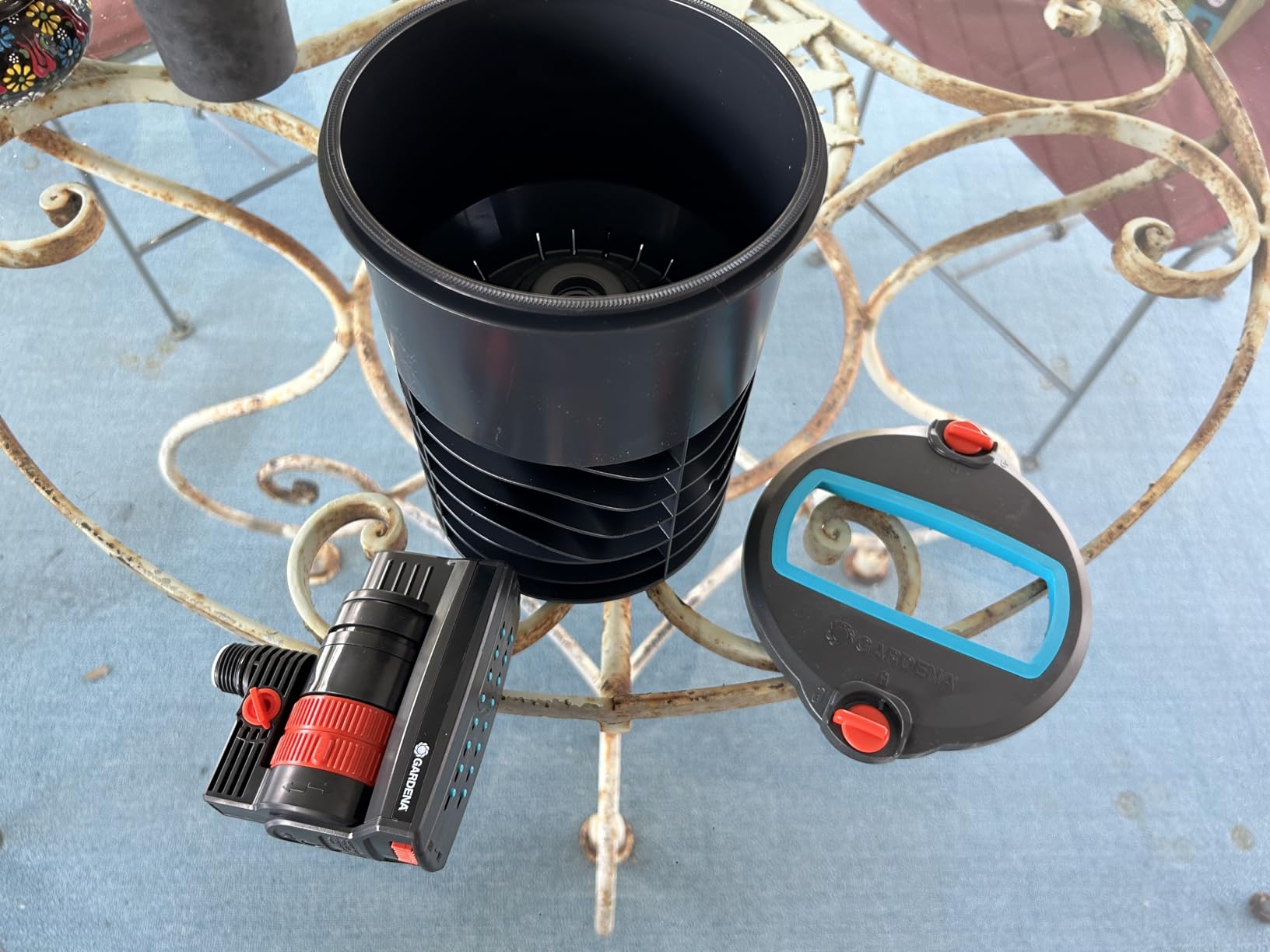
This is the odd one out in the lineup, and it solves a problem the others ignore. Instead of a spray head on your pipe, it is a complete buried oscillating unit you lay in a narrow rectangle, covering anywhere from 2 to 140 square meters.
That makes it a strong fit for a side-yard strip, a rectangular patch between a fence and a path, or a new-seeded lawn where you want even coverage without mapping out a zone. Sixteen flexible soft-plastic precision nozzles sweep back and forth and distribute water evenly instead of hitting one hot centre.
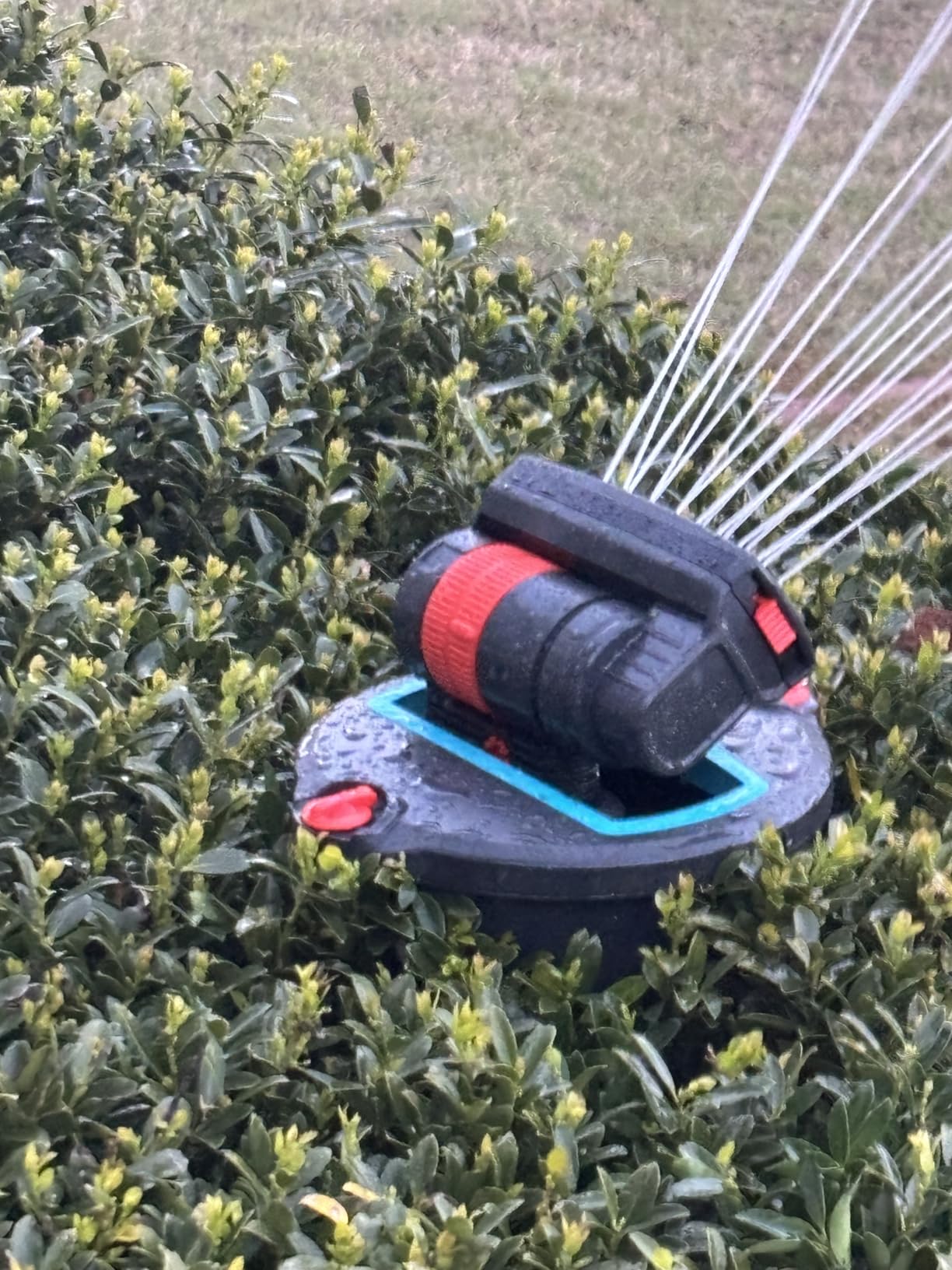
At 1,982 reviews and 4.4 stars, buyers return to the same two strengths: even distribution in a confined rectangle, and the fact that you can dial the volume down to match a small plot. The drainage valve in the pipe network is what makes it genuinely frost-proof rather than merely drainable.
Be realistic about the ceiling. At 1,100 liters per hour maximum flow and a 140 square meter limit, this is a component for a specific footprint, not a whole-yard solution. Installing it flush with the ground surface keeps it out of sight and safe under a mower.
How it fits a small yard layout
Use it when the shape is the constraint. A rectangular strip 3 meters by 10 meters is nearly impossible to cover evenly with circular spray heads, but it is exactly what an oscillating rectangle unit is built for. Volume regulation lets you shrink the wetted area to match.
For an open square lawn, this is the wrong shape of tool. Round heads placed on a triangle give you much more flexibility.
What to check before you buy
Measure your rectangle before anything else. If the plot exceeds 140 square meters, you need a different approach, and the micro-spray kits and spray heads elsewhere in this roundup scale more predictably.
Note that this is a single unit, not a head pack. If your property is broken into two small rectangles, you are buying two of these rather than adding a head to an existing line.
4. Rain Bird LG3HE Impact Sprinkler – Best for a No-Dig Hose Setup
Rain Bird LG3HE Impact Sprinkler, Click-N-Go
26-41 ft reach
3 inch pop-up height
25-50 psi at 3 gpm
Click-N-Go hose fitting
Pros
- Single-hole install with no trenching
- 26-41 ft reach covers a lot of lawn from one head
- Retracts out of sight for mowing
- Click-N-Go fitting works with a standard hose
Cons
- Impact heads are noisier than gear-drive rotors
- Hose-fed design limits you to one connected zone
- 50 psi ceiling is lower than rotor systems
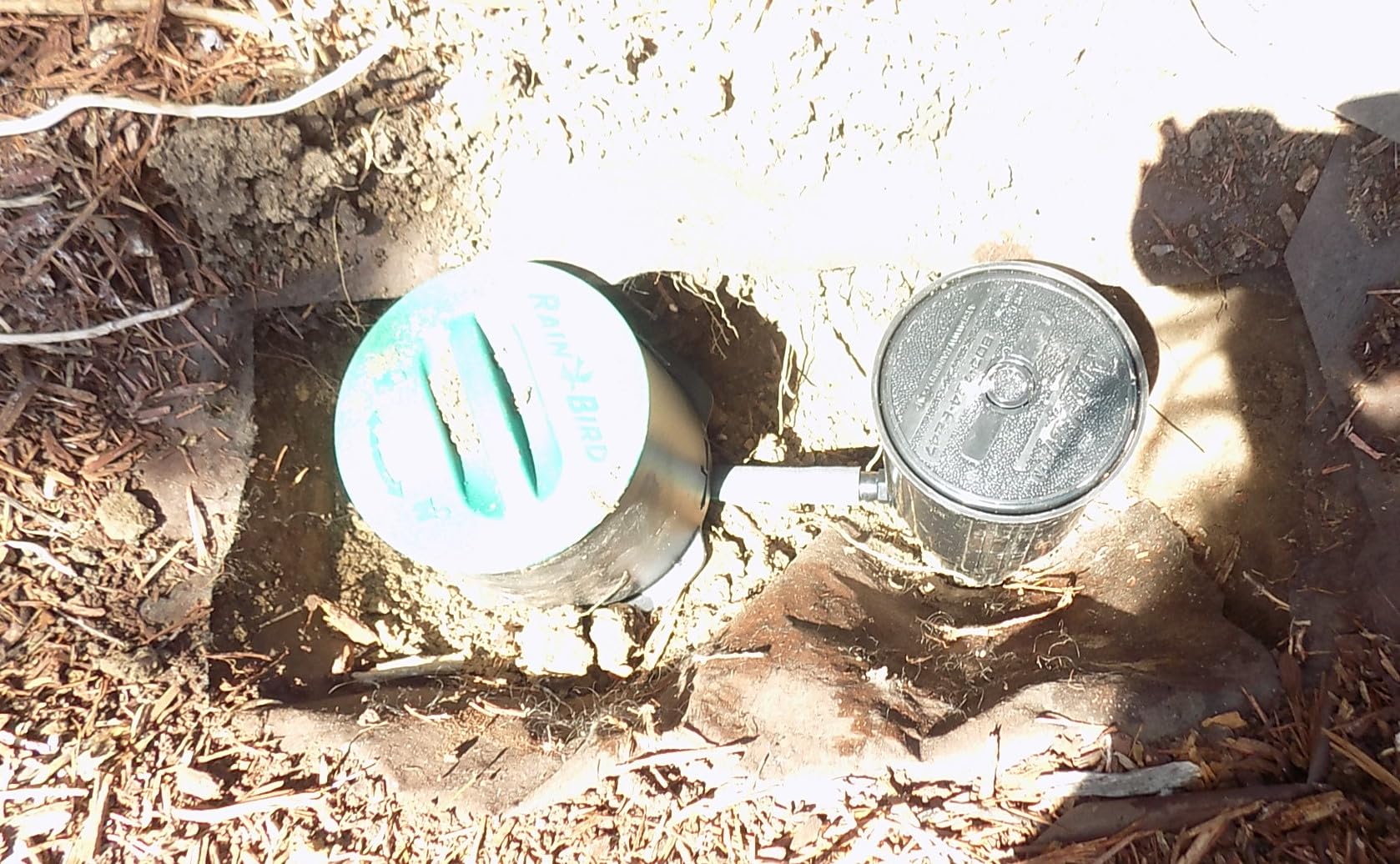
If you rent, or you are not ready to break ground, this head gets you most of the benefit of automatic watering without a trench. You dig one small hole, set the body in, and push a garden hose onto the Click-N-Go fitting.
It throws 26 to 41 feet, which is far more coverage per head than a fixed spray and reduces the number of holes to roughly a third. The body rises 3 inches when pressurized, high enough to clear tall grass, and drops out of sight when the water stops so you can mow straight over it.
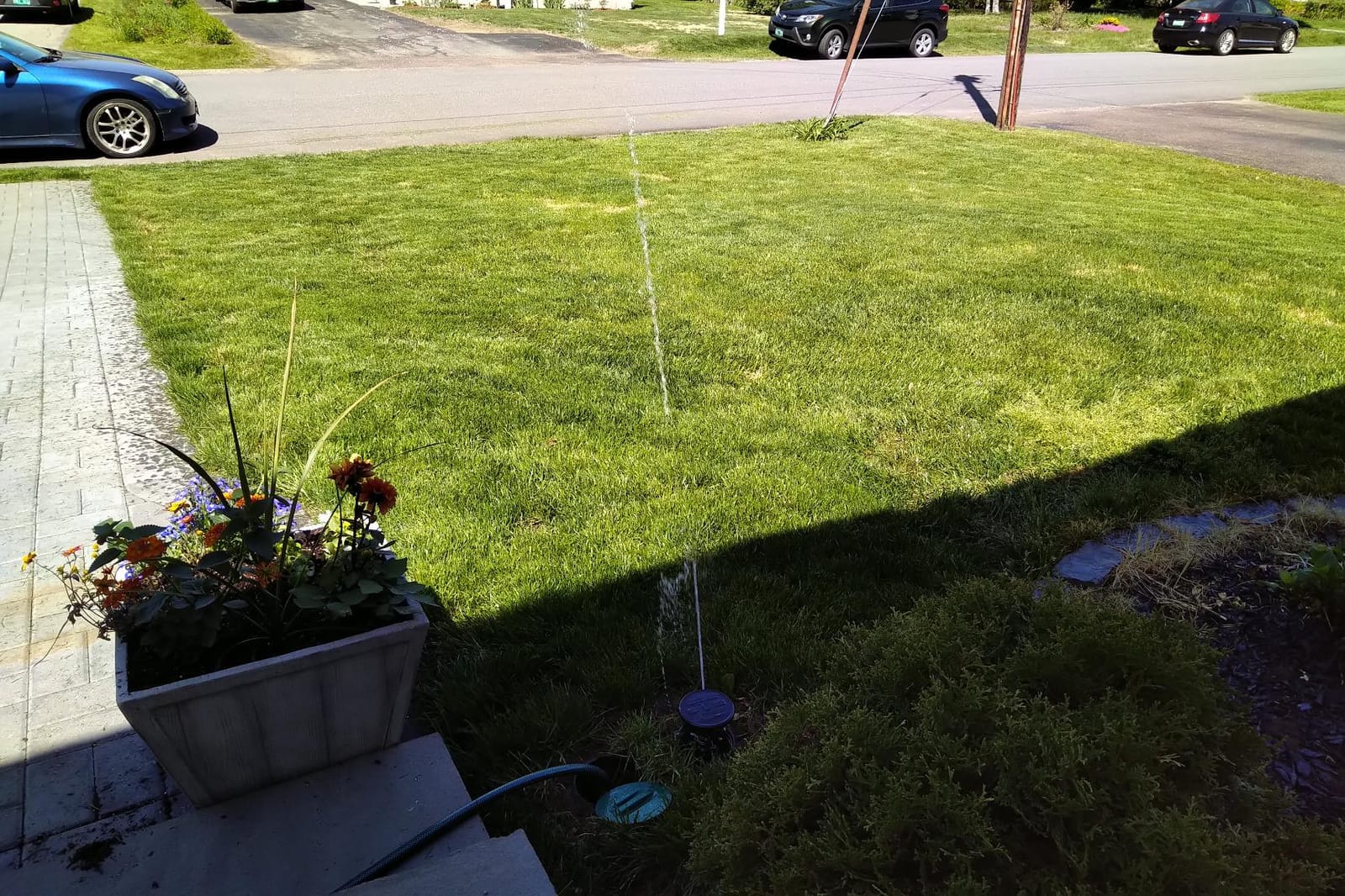
At 1,793 reviews and 4.4 stars, owners highlight the one-time setup and the reach. Coverage can be full circle or any part circle from 20 to 340 degrees with infinite adjustment, so you can aim it at an open lawn and still avoid a fence or a drive.
Operating range is 25 to 50 psi at 3 gpm, and the head includes a check mechanism so it does not drain back down the hose between cycles. That matters if you are running two of them off one splitter.
How it fits a small yard layout
At 26 to 41 feet of throw, one of these can serve a good share of a 2,000 square foot lawn on its own. Place it high on the slope so the circle covers downward, then trim the arc at the boundaries instead of burying extra heads.
This is also the practical answer for a rental, a condo yard, or a property where you want watering this season without deciding your landscaping forever.
What to check before you buy
Understand that the whole network hangs off a hose connection, so everything stops the moment you forget to connect it or a fitting fails. Reliability here depends on your spigot and your hose, not on the head.
Expect some noise. Impact heads chatter as the arm strikes the body, which is the standard trade for the price and reach.
5. Orbit 50020 All-in-One Watering System – Best Glue-Free Tubing Kit
Orbit 50020 All-in-One Automatic Watering System
125 ft of 1/2 inch tubing
Blu-Lock push-fit fittings
Six gear-drive heads
Digital faucet timer
Pros
- Push-to-connect tubing means no glue and shallow trenches
- Six gear-drive heads deliver true head-to-head coverage
- Timer
- cutter and pressure gauge all included
- Installs in about half a day
Cons
- All six heads share one nozzle size
- Single-zone layout only
- Spare fittings and drain parts are awkward to source locally
The Orbit 50020 is the kit I recommend to anyone who has never run a sprinkler line before, because it removes the single hardest DIY skill. The patented Blu-Lock push-to-connect fittings mean you push tubing into a fitting and it grips, with no solvent cement, no cure time, and noPVC cement cleanup.
You get 125 feet of 1/2 inch tubing, 15 fittings, six gear-drive heads, a digital hose-end faucet timer with programmable one, two, or three day intervals, plus a poly cutter and a pressure gauge. That gauge is not filler. Checking supply pressure before you lay the first length of tubing is how you avoid installing a system that underperforms.
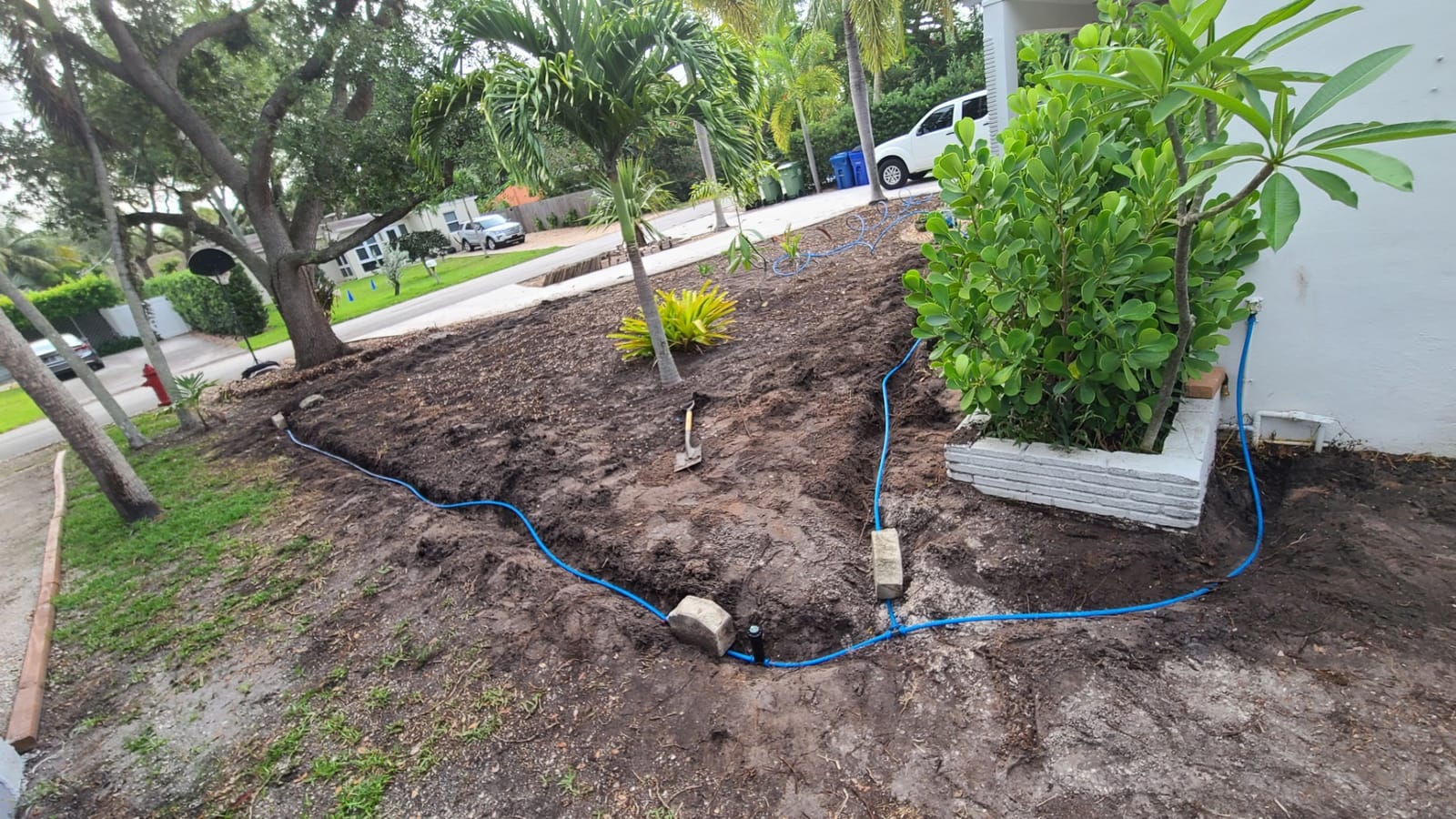
Six gear-drive heads give you rotor-style throw with head-to-head overlap, which is what prevents dry patches between heads. The trench depth needed is only about 8 inches, so you can cut shallow trenches and patch over them the same afternoon.
At 528 reviews and 4.1 stars, the praise centres on value, the timer, and the glue-free install. The recurring complaints are narrow: all six heads come with the same nozzle size, so you cannot easily mix patterns for edge heads, and replacement fittings are not always easy to find at a local hardware counter.
How it fits a small yard layout
Gear-drive heads reduce the number of holes compared with spray heads, which makes this the tidier choice on a lawn with awkward edging. Arrange the heads on a triangle so each one throws into the next, and use part-circle settings on the boundary heads.
The programmable intervals matter for slopes and clay soil, where a single long run would pool and run off. Splitting the schedule across two or three days delivers the same weekly water in a way grass can actually absorb.
What to check before you buy
Ask yourself whether one nozzle size is enough for your shape. If your lawn has a lot of edges and corners, a kit with mixed nozzle sizes gives you more to work with, and you can add nozzles later on a spray-head kit instead.
Note the maximum pressure rating of 100 psi, and be aware that the system is single-zone. Adding a second zone later means a different valve and a different timer, not just more tubing.
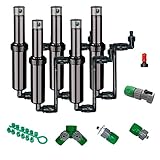
6. Quick-Snap QSK-745 In-Ground Pop-Up 5-Pack – Best for a Contractor Look
Quick-Snap QSK-745 In-Ground 5-Inch Pop-Up Adjustable Sprinkler 5-Pack With Quick Hose Connectors And Splitters
5 inch pop-up bodies
Snap-on hose connection
2.5 gpm per head
60 psi maximum
Pros
- Heads sit low and hide in the lawn like a plumbed install
- Hose snaps on from any direction
- Automatic retract lets you mow over them
- Generous accessory kit with splitters
- caps and nozzle set
Cons
- Hose-fed
- so coverage depends on supply pressure
- Permanent install with no easy relocation
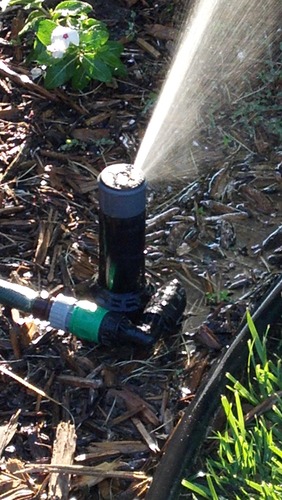
This five-pack of 5-inch pop-up bodies is the trick for a specific problem: you want the finished look of a plumbed in-ground system without tapping into the house supply. The heads install in the ground, pop up when the pressure arrives, and drop when it stops.
What makes it different from pick number four is the connection. The hose snap-on accepts a hose from any direction, so the line can approach each head neatly instead of leaving a hose stub sticking out at an awkward angle. With four connectors, three hose Y-splitters, an air purge, a manual connector, orange caps, and a nozzle set, the accessory bundle is unusually complete for a pack at this level.
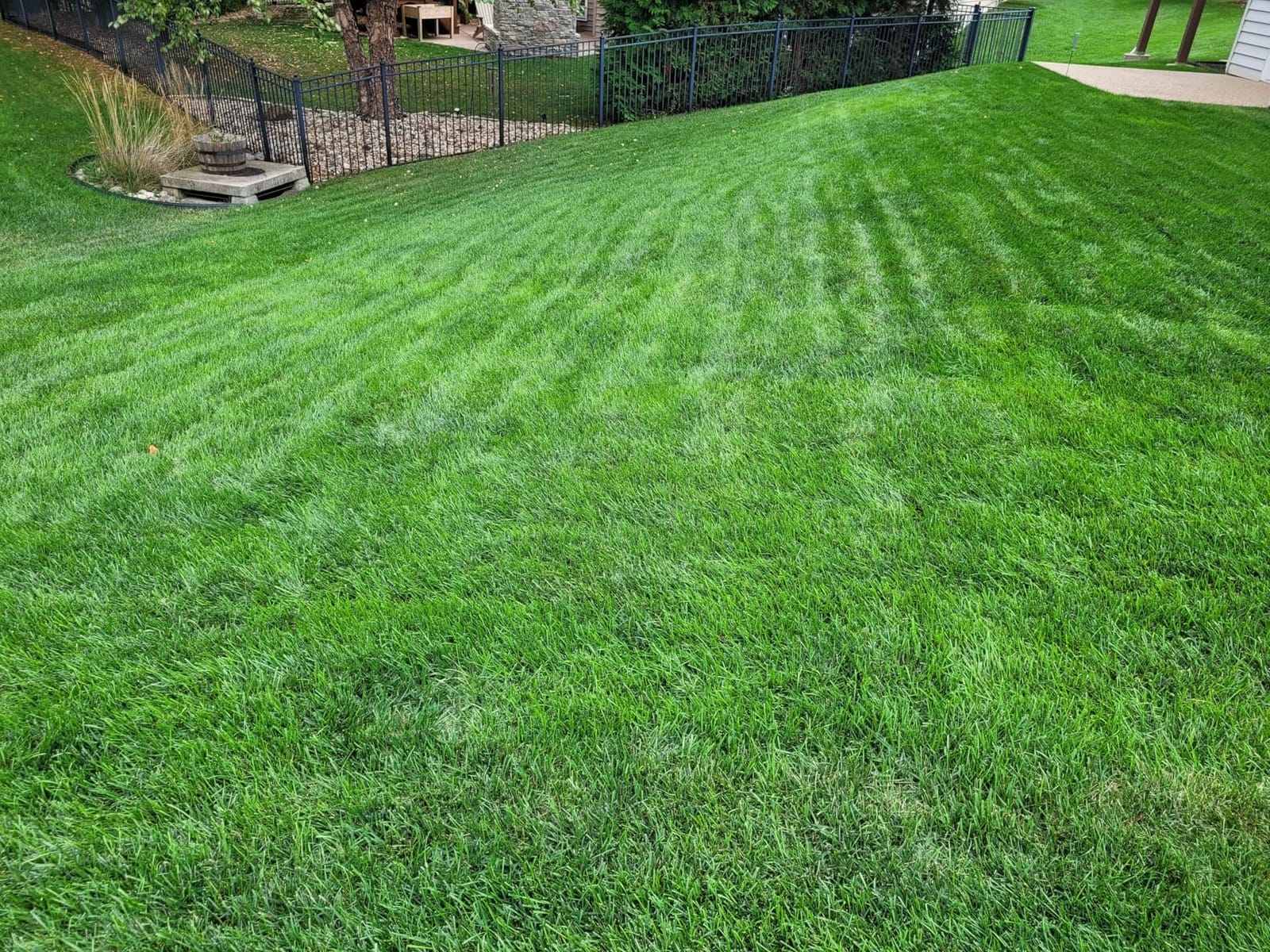
Each head is rated to water up to 5,000 square feet, though that is a nozzle figure rather than a real-world number, since your available flow per head is the binding constraint. Flow is 2.5 gpm and maximum pressure 60 psi, so plan your zone around total flow rather than that headline area.
With 448 reviews at 4.5 stars, buyers like the appearance and the quick connections. The standard caveat in the feedback is the one worth taking seriously: the whole network depends on adequate supply pressure, and pressure sag shows up as inconsistent reach head to head.
How it fits a small yard layout
Five heads is close to the right count for a small front lawn, and the low profile keeps them out of sight in a bed edge or a border. Place them where you want invisible hardware and run the supply hose along a fence line or planting border.
Because each head waters independently off the same feed, keep the pattern simple. Full circle in the open lawn, half circle on a straight edge, quarter circle in a corner.
What to check before you buy
Measure your hose run. A long hose run with several heads reduces the pressure at the far end, and uneven reach across the zone is the most common complaint pattern with hose-fed layouts.
Be clear that this is a permanent dig. There is no easy way to relocate the heads later without lifting the turf, which is fine if you own the yard and a problem if you are renting.
7. K Rain K1 Smart Set Rotor – Best for Precise Arc Adjustment
K Rain K1 1/2″ Smart Set Rotor 4″ Pop-Up| 15′ – 30′ Spray Distance, 40° – 360° Arc Spray Pattern | Includes Install Kit (5 Pack)
40-360 degree marked arc
15-30 ft spray distance
2.5 GPM preinstalled nozzle
5 pack with install kit
Pros
- Top arc set adjusts in seconds
- wet or dry
- Marked degrees make tuning repeatable
- Highest rating in this group at 4.7 stars
- Installation kit included with each pack
Cons
- 30 ft maximum throw is modest
- Plastic body is less durable than brass in busy zones
- Preinstalled nozzle limits flow choices
This rotor carries the highest average rating in the group at 4.7 stars across 376 reviews, and the reason is adjustment. The patented top arc set moves through a 40 to 360 degree range in seconds, works whether the head is wet or dry, and carries degree markings so you can return to a known setting.
That last feature sounds minor and is not. When you are tuning coverage on a lawn with a walkway and a fence line, being able to return a head to 90 or 180 degrees after a mower clips it saves you guessing.
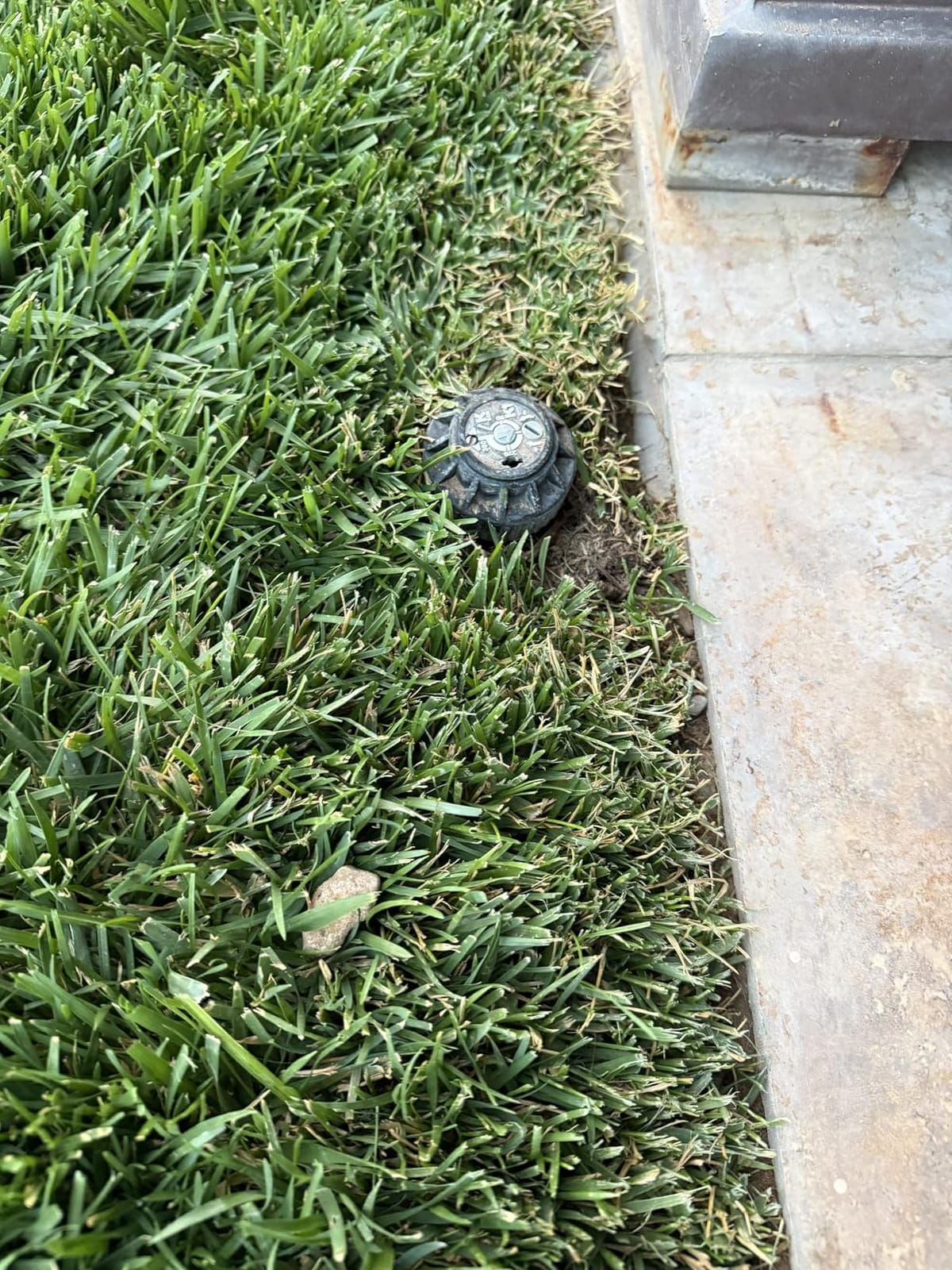
The rotor uses a patented reversing mechanism with a long service history, throwing 15 to 30 feet from a preinstalled 2.5 GPM nozzle. A rubber cover seals dirt out of the body, which is why the mechanism keeps turning cleanly after seasons in the ground.
Spec-wise you are working with a 1/2 inch threaded inlet, a 70 psi maximum, a two-year manufacturer warranty, and five heads plus an install kit in the box.
How it fits a small yard layout
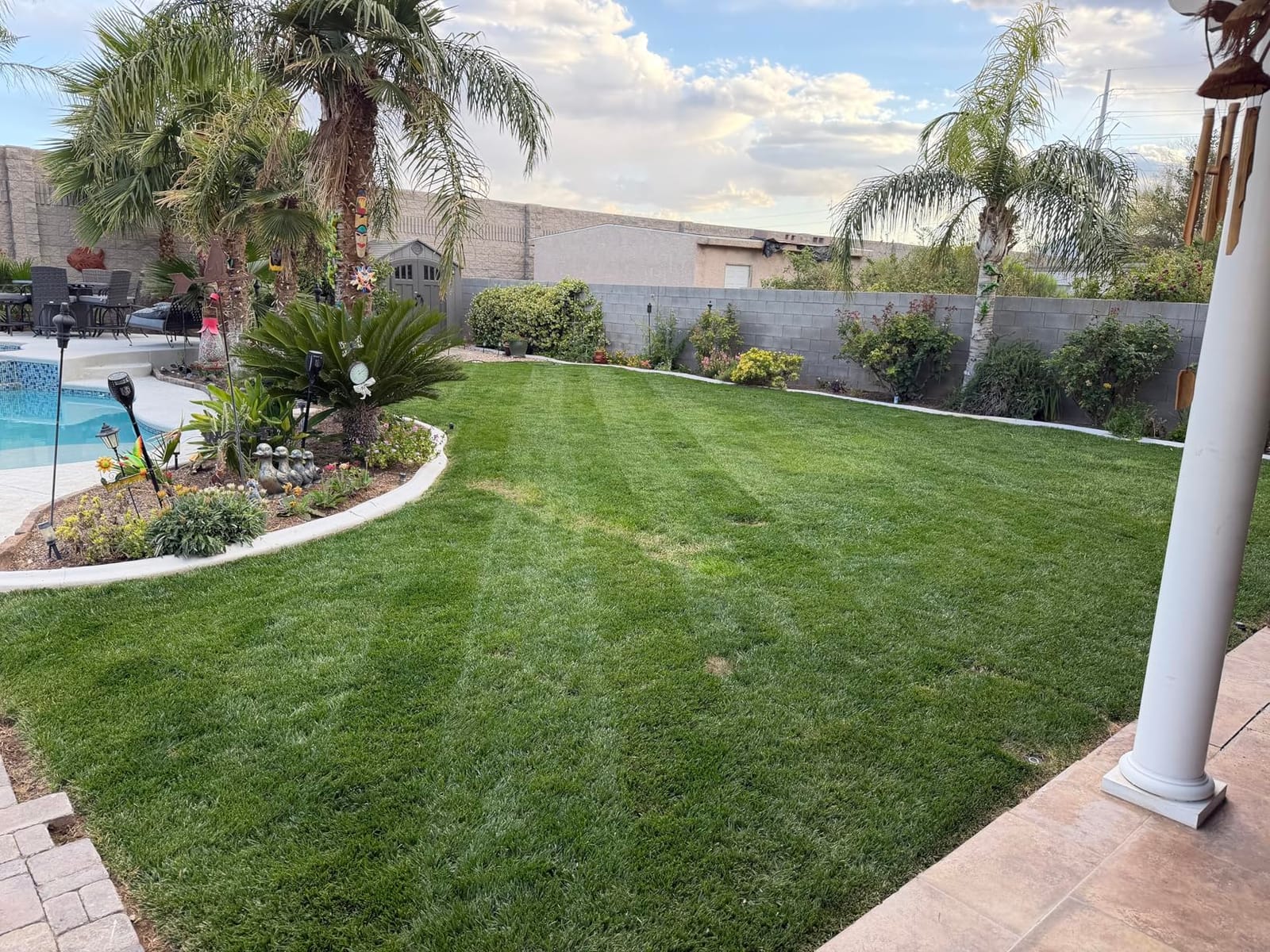
A 30 foot throw is the sweet spot for a compact lawn: wide enough that four heads can cover a 2,000 square foot area, tight enough that you are not overspraying a neighbour’s property. Rotor spacing generally sits at three-quarters of the throw distance, which means closer placement than a naive 30 foot grid.
Use the marked arcs at the perimeter. A rotor can be set to a quarter circle and give you the same edge control as a spray head while covering more ground per hole in the open areas.
What to check before you buy
If your water is hard or your zone is small, compare this throw against the Hunter rotor in pick number nine, which reaches considerably further. More reach means fewer holes and less trenching.
Note the plastic body. In a busy area where heads get kicked or clipped by a mower, a brass-bodied head will outlast this one.
8. Gardena SD80 Pop-Up Sprinkler – Most Versatile for Very Small Lawns
Gardena Sprinkler System Pop-up Sprinkler SD80: Pop-up Irrigation System for Small lawns up to 80 m², Range from 3–5 m, with Spray Nozzle, 1/2 inch Male Thread (8243-20)
Waters up to 80 m2
Tool-free 3-5 m width
5-360 degree arc
Built-in filter
Pros
- Lowest cost per head in this roundup
- Tool-free spray width and arc adjustment
- Integrated filter cuts nozzle clogging
- Direct retrofit for older Gardena S Sprinklers
Cons
- Covers a smaller area than the Gardena OS 140
- Sold as a single head rather than a pack
- Plastic construction
If your lawn is genuinely small, this head is hard to argue with. It waters areas up to 80 square meters, which covers a modest front yard or a generous garden bed, and it adjusts spray width from 3 to 5 meters and arc from 5 to 360 degrees entirely by hand.
Two things stand out for a DIY buyer. The adjustments are tool-free, so you do not dig the head back up to recalibrate it after a seasonal change, and a built-in filter keeps dirt out of the nozzle, which is the usual reason cheap heads stop spraying properly after a year.
At 305 reviews and 4.5 stars, with 77 percent five-star feedback, the feedback is consistent about the adjustment ease and the filter. The main limitation named is the smaller coverage footprint compared with the Gardena OS 140.
How it fits a small yard layout
A 3 to 5 metre spray width is a match for a compact rectangular plot, and the narrow adjustment range is a genuine advantage there, because you can dial the head to the exact width of your lawn rather than overspraying past it.
It is also a direct retrofit for older Gardena S Sprinklers and combines with the SD30 model, so an existing Gardena network can be extended head by head without changing the layout approach.
What to check before you buy
Check the coverage ceiling against your plot. Just over 880 square feet is the limit, and past that you need more heads or a different head type.
Remember this is a single head. Building a full zone from it means buying several, and there is no shared timer or tubing in the box.
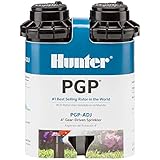
9. Hunter PGP-ADJ 3/4 Inch Rotor – Best for the Widest Reach per Head
Hunter PGP-ADJ 3/4″ Rotor Lawn Sprinkler Head, 22-52 ft, 4″ Pop Up, 2 Pack
22-52 ft spray distance
40-360 degree arc
3 GPM preinstalled nozzle
Water-lubricated gear drive
Pros
- Widest throw range in this group at 22-52 ft
- Quiet water-lubricated gear drive
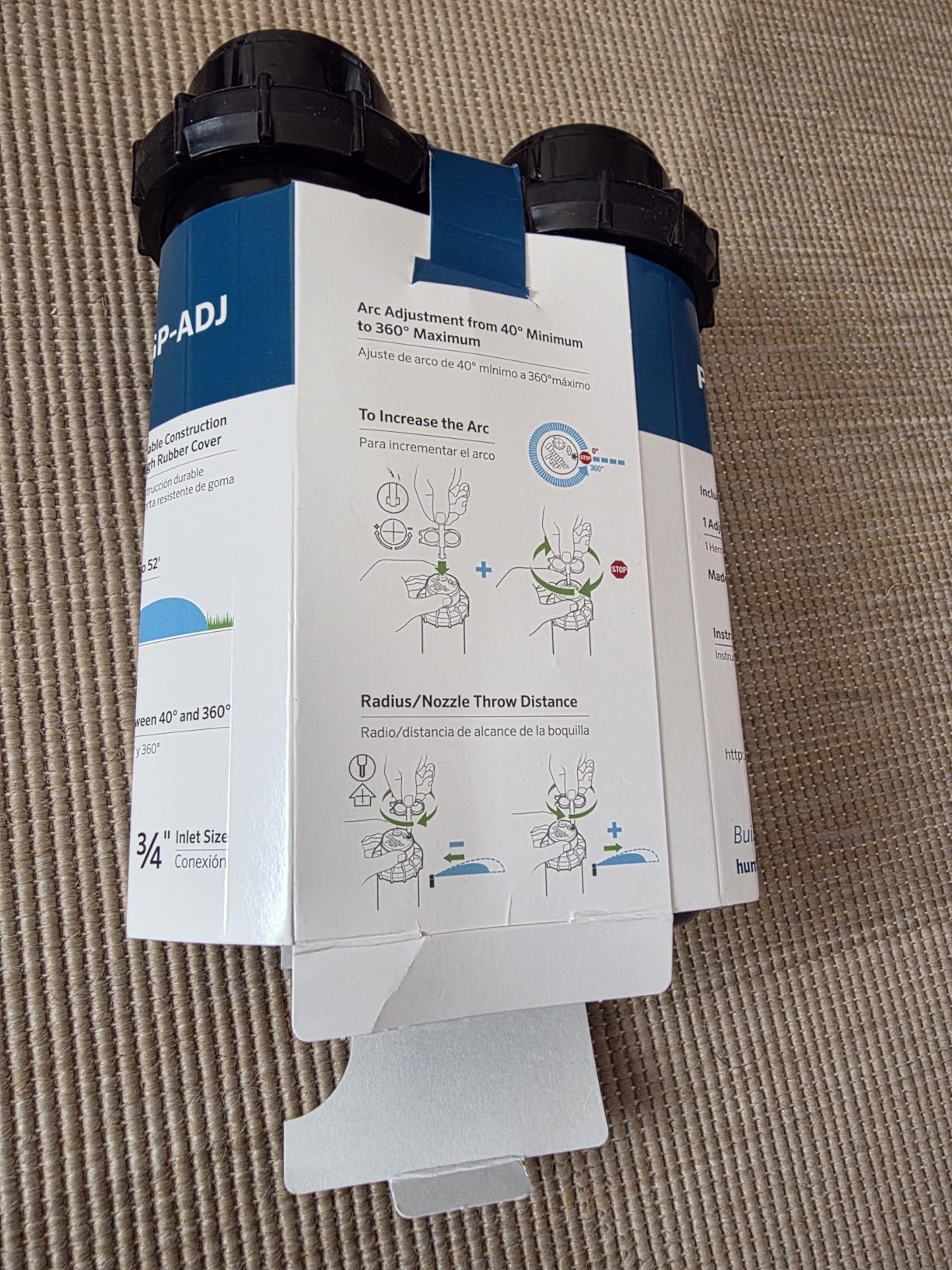
- Arc and radius tune in seconds with the included wrench
- 3/4 inch inlet fits most standard irrigation systems
Cons
- Adjustment wrench is occasionally missing from multi-packs
- Only one nozzle size included
- 3/4 inch inlet needs an adapter on 1/2 inch line
If you want the fewest possible holes in a small yard, reach is the number that matters, and this rotor delivers the widest throw range here at 22 to 52 feet from a single head. On a compact lawn with awkward corners, fewer heads means less trenching and a faster install.
It is also one of the more heavily reviewed products in this roundup at 2,006 ratings, and the feedback describes it as a common upgrade from other brands. Buyers cite the throw distance, the quiet rotation, and the ease of arc tuning as the reasons they moved to it.
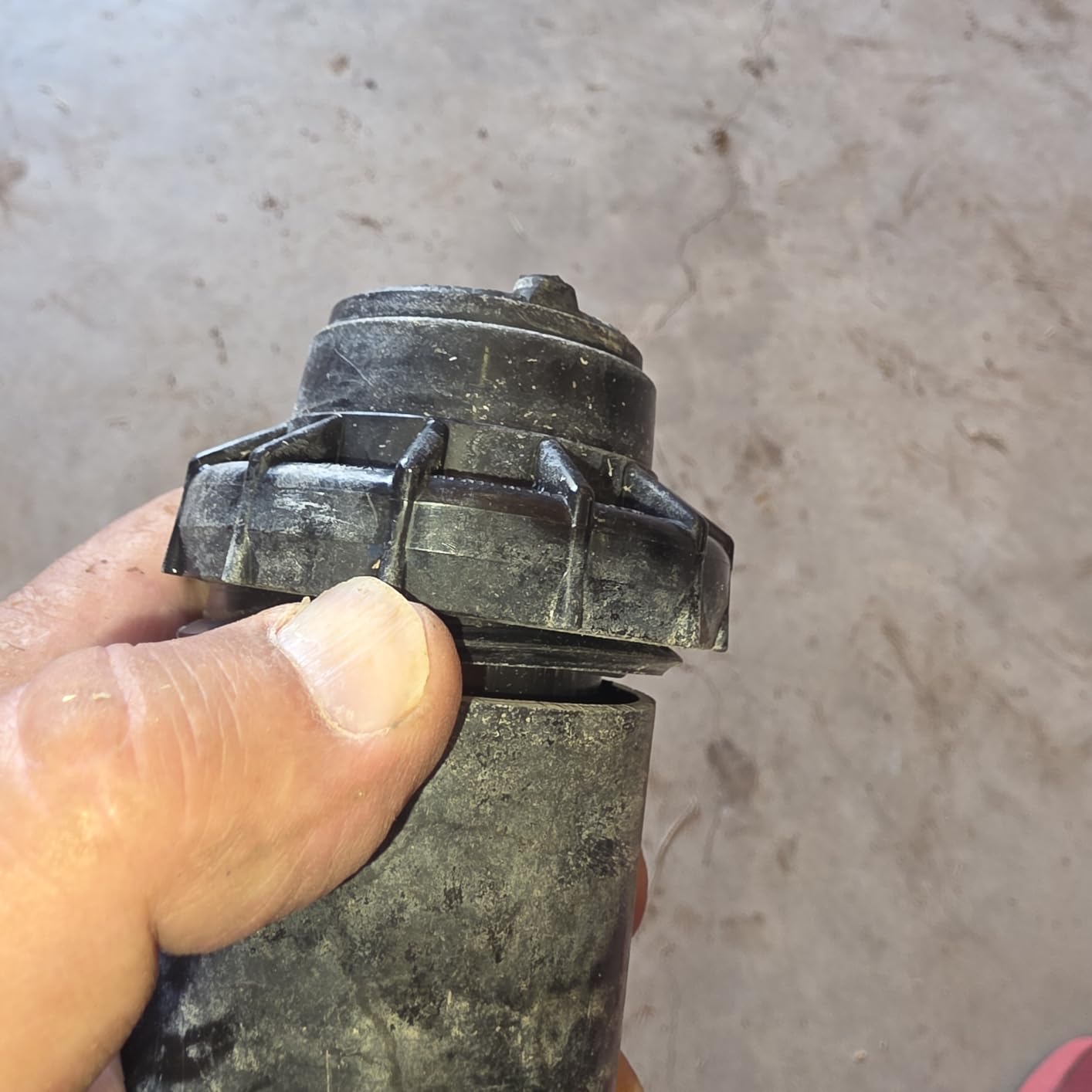
The drive is water-lubricated rather than oil-filled, which is why it runs quietly and smoothly with no seasonal servicing. Arc adjusts from 40 to 360 degrees with the included Hunter wrench, which also has a fast-forward feature for setting a head quickly before you lock it.
Physical specs: 3/4 inch female NPT inlet, 3 GPM preinstalled nozzle with optional nozzles sold separately, retracted body height of 7-3/4 inches, exposed diameter of 1-3/4 inches, and a 100 psi maximum pressure. It comes as a two-pack with a one-year manufacturer warranty.
How it fits a small yard layout
With a 52 foot maximum throw you can cover a small lawn from fewer positions than any other head here, and the adjustable radius means you can dial a head back to 22 feet when a bed or a path is in the way.
Rotors want to be spaced at roughly three-quarters of their throw distance for even coverage, so a 40 foot setting puts heads about 30 feet apart. On a small lawn that can mean four heads cover the whole area.
What to check before you buy
Check your line size first. The 3/4 inch inlet will not fit 1/2 inch tubing without an adapter, and getting that wrong mid-project is an annoying afternoon.
If you order the multi-pack, check that the adjustment wrench actually arrived. Its absence is the single repeated complaint across the reviews, and the wrench is required to set the arc.
10. Orbit 54070 Brass Pop-Up Flush Head – Best for Beds and Tight Corners
5-Pack Orbit 54070 Brass Pop-Up Flush Head Sprinkler with Full Pattern Spray Nozzle
Machined brass body
Full pattern spray nozzle
Adjustable flow
Low flush profile
Pros
- Brass body outlasts plastic pop-ups
- Lowest profile in the group for tight planting areas
- Full pattern nozzle gives even coverage with little tuning
- Adjustable nozzle lets you match flow to the zone
Cons
- Shorter throw than modern rotor heads
- Less arc flexibility than adjustable rotors
- Heavier and costlier per head than plastic sprays
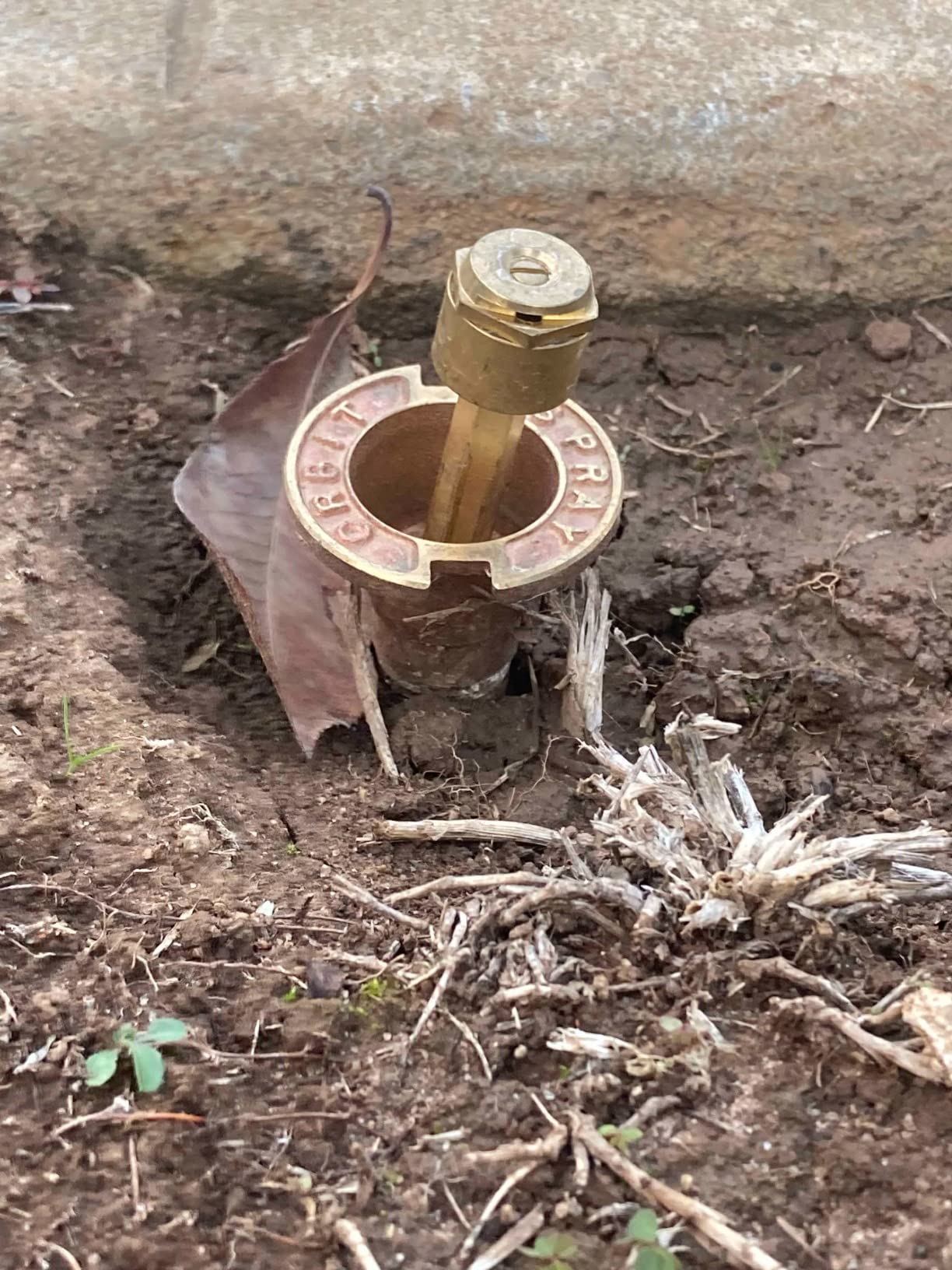
Durability is the reason to buy brass. The machined brass body on these flush heads resists the corrosion and cracking that takes out plastic pop-ups, and owners in the reviews talk about replacements still performing after more than two decades buried.
The second reason is shape. At roughly 2 by 3 inches with a low flush profile, this is the least intrusive head in the roundup, which makes it the right choice for planting beds, rock borders, and tight corners where a taller rotor body would sit awkwardly or get clipped.
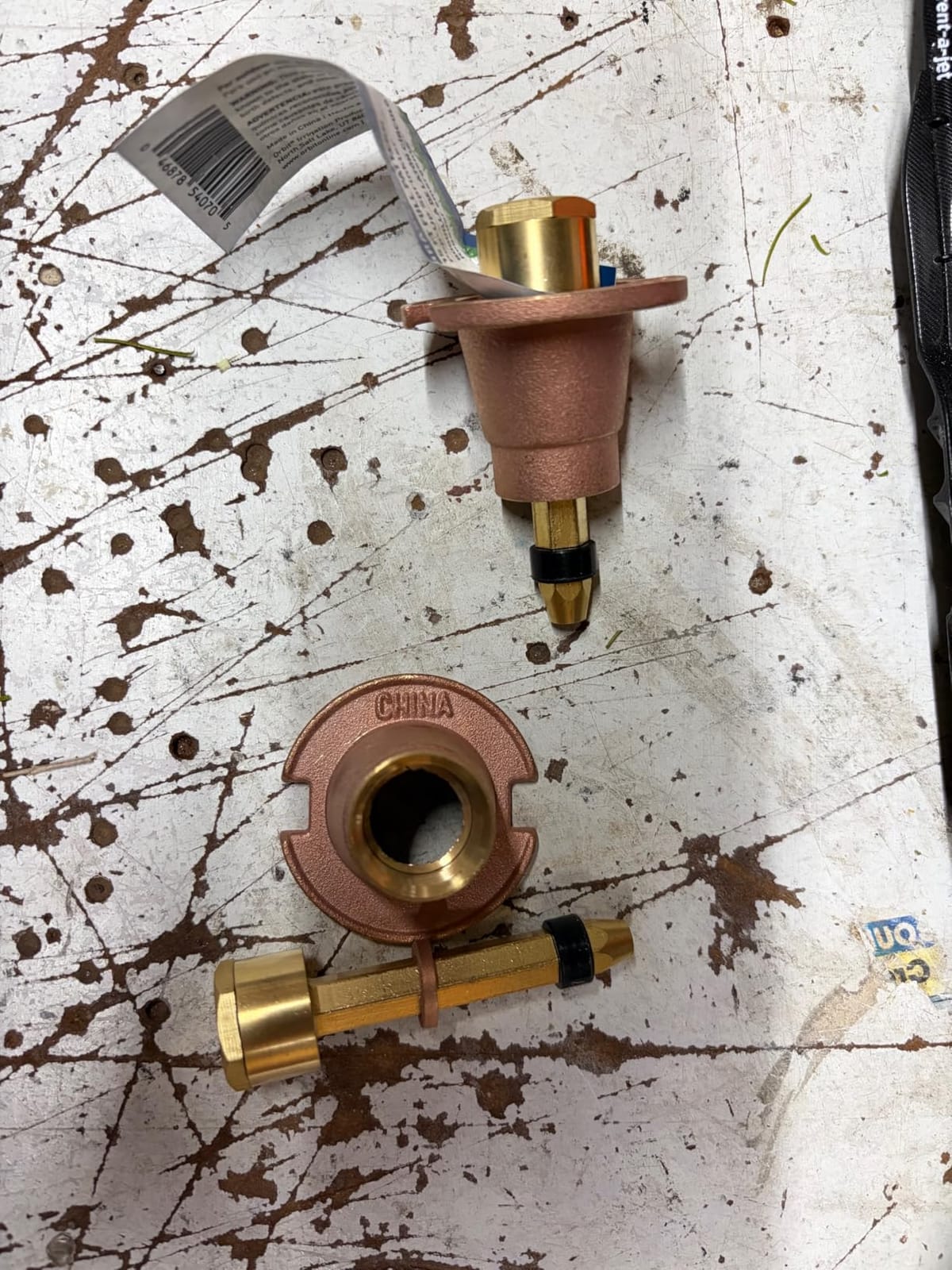
It ships as a five-pack with a full pattern brass nozzle that includes flow adjustment, so you can dial each head down rather than replacing nozzles to fit a low-flow zone. Rated flow reaches 18 gpm and the inlet is 1/2 inch, which is the standard residential thread.
At 358 reviews and 4.6 stars, with 79 percent five-star feedback, buyers consistently treat these as a durable replacement for cheap plastic heads. The complaint is reach. These are spray heads, so they do not throw as far as a rotor.
How it fits a small yard layout
Treat these as the border and bed heads in a mixed layout rather than the heads that cover the open lawn. A brass flush spray in a flower bed, under a drip line edge, or at the corner of a path keeps water where you want it and stays invisible.
The flow-adjustable nozzle is genuinely useful on a mixed small yard, where the bed zone and the lawn zone rarely want the same precipitation rate.
What to check before you buy
Do not plan a wide open turf area around these heads alone. The shorter throw means more heads and more holes than a rotor layout, which erodes the durability advantage.
Also expect the weight. Brass heads are noticeably heavier than plastic equivalents, which matters if you are hand-setting many of them without a wrench.
Buying Guide: Head Spacing, Zones, and Pressure for Small Yards
Pick the head type first, then work out how many you need. Spray heads cover 8 to 15 feet, rotors cover roughly 22 to 52 feet, and micro-spray units handle patches under about 20 feet across. Getting this ordering right is the difference between four heads and twelve.
For spacing, the practical rule on an in-ground lawn is head-to-head overlap: each head should throw far enough to reach the next one. The widely cited shorthand is the 3x spacing rule, which says the distance from a head to the next is about three times the head’s rise, and is used for pop-up spray bodies where the nozzle sits above grade.
The third rule of thumb is triangular placement rather than a straight grid. Offsetting alternate rows slightly evens out coverage and removes the straight dry line you get when heads are perfectly aligned.
As a starting point for planning, the ranges below reflect the published reach figures of the heads in this roundup rather than a single universal figure.
A rough head count for a small lawn, based on typical spray and rotor throw figures:
About 1,000 sq ft: 3 to 4 spray heads, or 2 rotors with part-circle settings at the edges
About 2,000 sq ft: 4 to 6 spray heads, or 4 rotors
About 3,000 sq ft: 6 to 8 spray heads, or 4 to 6 rotors
About 4,000 sq ft: 8 to 10 spray heads, or 6 rotors, and worth splitting into two zones
Zones are where most small-yard buyers overspend. A zone is a group of heads fed by one valve and watered at one time, and the practical limit is flow: a typical garden hose supply cannot deliver enough gallons per minute to run every head at once, so heads must be divided into groups that share the available water.
Most yards under about 3,000 square feet run fine as a single zone. That is why the Rain Bird 32ETI and the Orbit 50020 both use one zone, and why their single-zone design is not a compromise at this scale but the correct answer.
Watch your numbers when you plan. The Rain Bird 32ETI is rated to 12 gpm maximum at up to 70 psi, the Orbit heads in the 50020 run 3 GPM each, and a hose spigot commonly delivers far less than the sum of six open heads. If your total demand outruns supply, the far heads throw short and you get the dry patches that prompt most complaints.
On brand, forum consensus tends to favour Rain Bird for longevity, particularly the gear-driven rotor range, while Orbit is frequently described as the better value with more plastic in the build. The Hunter PGP rotor is the one most often recommended as an upgrade path. Buyers who switch usually do it for reach or for quieter rotation rather than for a brand name.
Nozzle choice is the last decision, and it is mostly about shape. Quarter-circle nozzles go in corners, half-circle nozzles along straight edges, strip patterns along narrow paths, and full circles in open areas. Mixing patterns on one zone is safe when precipitation rates match.
Installation and Seasonal Care for a Small In-Ground System
Lay the tubing first and decide the head positions as you go, rather than fixing head locations and then forcing the pipe to reach them. Mark the layout with spray paint on the turf, cut shallow trenches of about 8 inches, and lay the line.
Attach the faucet connection kit to your outside spigot and run the buried line from there. Route the feed hose along a fence or planting edge so it never crosses a path, and secure the hose-end timer where you can read it without walking to it.
Set the heads before you backfill, because you want to adjust arc and radius while you can still see the whole pattern. Turn the zone on and walk the perimeter to find overspray onto the sidewalk or the drive, then trim the arc or swap the nozzle.
Calibrate run time with a bucket. Place a straight-sided container under a head, run the system for ten minutes, and measure the depth collected. Multiply that by six to get inches per week at your chosen schedule, then adjust the timer until you land near one inch per week including rainfall.
Water early in the morning. Cooler air and lower wind cut evaporation, and watering at midday wastes a meaningful share of the water to the air rather than the grass.
Before the first frost, blow the lines out with an air compressor if the kit includes automatic drain valves, which both the Rain Bird 32ETI and the Gardena OS 140 do. Without it, trapped water freezes and splits the tubing, and you are buying replacement parts and repairing turf in spring.
Frequently Asked Questions
What is the best type of sprinkler system for a small yard?
For a lawn under about 3,000 square feet, the best choice is a fixed-spray pop-up head on a single zone fed by an outside faucet through a hose-end timer. Fixed sprays cover 8 to 15 feet, so space them about 10 to 15 feet apart on a triangular layout for head-to-head overlap. Most small yards need only one zone, which keeps the install to a weekend and the parts list short.
Are in-ground sprinklers worth it for a small yard?
They are worth it once the pipe is in the ground, mainly because you stop repositioning a hose and stop wasting water on pavement. A faucet-fed kit with buried tubing and pop-up heads installs in an afternoon and looks like a contractor job once the hose is hidden. The main benefit over an above-ground setup is that nothing has to be reassembled every spring.
Can you install in-ground sprinklers yourself?
Yes, for a small yard a faucet-fed kit is a realistic weekend project. You dig shallow trenches of about 8 inches, lay 1/2 inch tubing, attach the pop-up heads, connect the faucet kit, and set the hose-end timer. Push-to-connect fittings avoid solvent cement entirely. Tapping into the house main line is a different job and is where a plumber becomes worth hiring.
How far apart should pop-up sprinkler heads be?
Space spray heads so each one reaches the next, which for most fixed-spray bodies is about 10 to 15 feet. The 3x spacing rule gives a related shortcut: head-to-head distance is roughly three times the height the spray rises above the ground. For rotors, place them at about three-quarters of their throw distance, and offset alternate rows instead of aligning them in a straight grid.
What is the best sprinkler head for a small lawn?
For an open lawn, a fixed-spray pop-up with a variable arc nozzle gives the cleanest edge control and reaches up to 15 feet. For a lawn where you want fewer holes, a rotor such as the Hunter PGP-ADJ covers 22 to 52 feet per head. For narrow rectangles and planting beds, a micro or oscillating unit handles the shape better than round spray heads. Brass flush heads are the durable choice for beds.
The Best In-Ground Sprinkler Systems for Small Yards in 2026
The best in ground sprinkler systems for small yards are simpler than most shoppers expect. Buy fixed-spray pop-up heads for the open lawn, keep it to a single zone, and choose a faucet-fed kit when you want the whole thing installed in one afternoon.
For a straightforward open lawn, the Rain Bird 1804VAN is our pick. It carries the largest review base in the group at 4,291 ratings averaging 4.5 stars, and its variable arc nozzle handles corners and edges as well as the middle of the turf.
If you want everything in one box including tubing and a timer, the Rain Bird 32ETI covers 1,000 to 3,000 square feet and includes automatic drain valves for winterizing. The Orbit 50020 is the smoother install if you would rather not work with solvent cement.
For the fewest holes, the Hunter PGP-ADJ rotor throws 22 to 52 feet per head. For shapes a circle cannot cover, the Gardena OS 140 handles a narrow rectangle better than any round head here.
Measure your pressure and your yard before you buy. That one hour of planning decides whether the finished system waters evenly or leaves you chasing dry patches.