
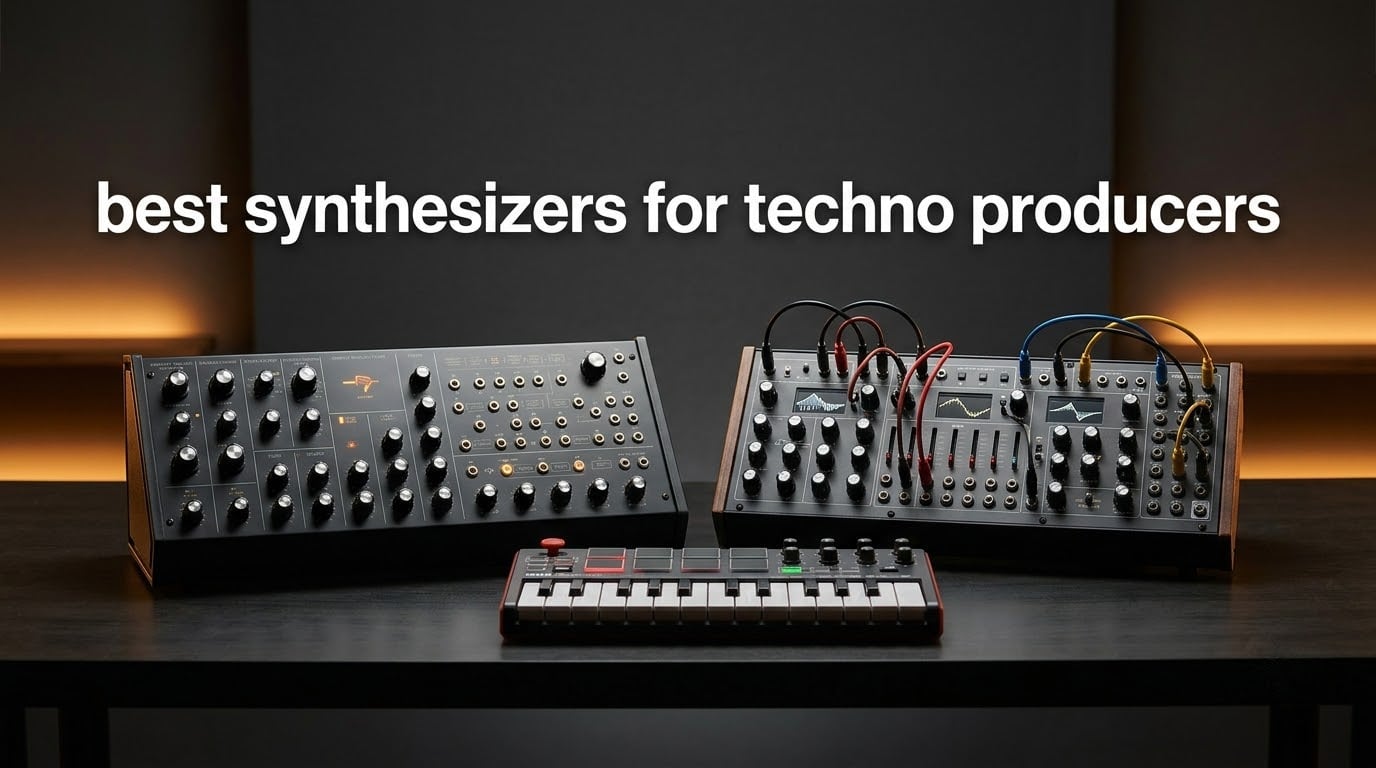
Techno is a genre where the synthesizer is not an accessory, it is the instrument. A Detroit kick, a squelching acid line and a hypnotic dub chord all come from voltage-controlled oscillators pushed through filters and envelopes, and the character of those circuits is what separates one techno record from the next. That is why the search for the best synthesizers for techno producers never really ends: every sub-genre asks for a different machine.
Acid wants a resonant low-pass filter and a step sequencer you can program by feel. Minimal techno wants a groovebox with enough pattern memory to hold a whole arrangement. Industrial wants noise, feedback and semi-modular routing. Melodic wants polyphony with aftertouch. If you buy the wrong one, you spend months fighting a machine that was never going to say the thing you wanted it to say.
So we put twelve instruments through their paces, focusing on the parts that matter for this genre: filter design, sequencer depth, polyphony, patch storage and the boring stuff around them like MIDI reliability and build quality. Some of these are obvious first buys. A few are specialists that earn their place for one specific job. The goal is a roundup that saves you from a bad impulse purchase, whether you are writing a warehouse track or a melodic peak-time record.
The market has shifted a lot in the last few years, and as of 2026 the interesting buying decision is no longer analog versus digital. Almost every serious option here is some blend of the two, with digital oscillators feeding an analog filter or genuinely analog voices wrapped in a modern workflow. That hybrid approach is what makes most of this list viable for techno in 2026, because it gives you raw analog character without giving up patch recall and MIDI stability.
Table of Contents
Top 3 Synths for Techno Producers (October 2026)
Before the full list, these are the three we would put in front of someone asking for one recommendation. The Arturia MicroFreak takes the top slot because it covers the most techno ground with the least fuss. The Korg microKORG is the value pick for anyone who just wants a playable machine on the desk. The Behringer CRAVE is the entry option that still gives you a real analog signal path.
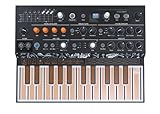
Arturia MicroFreak
- 17 paraphonic oscillator modes
- Analog Oberheim SEM filter
- CV pitch gate and pressure outputs
- 4 automation lanes with step sequencer

Korg microKORG
- Korg XMT analog modeling engine
- 4-voice polyphony
- 128 editable presets
- Built-in vocoder with gooseneck mic
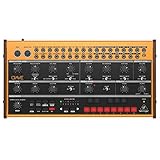
Behringer CRAVE
- Pure analog VCO VCF and VCA path
- Moog-style 24 dB ladder filter
- Semi-modular patch bay
- 32-step sequencer with poly chain
All 12 Synths at a Glance in 2026
Here is the short version. Every instrument below is included because it does something specific well, not because it fills a slot on the list.
| Product | Specs | Action |
|---|---|---|
| Arturia MicroFreak |
|
Check Latest Price |
| Korg microKORG |
|
Check Latest Price |
| Behringer CRAVE |
|
Check Latest Price |
 Korg monologue Korg monologue |
|
Check Latest Price |
 Behringer POLY D Behringer POLY D |
|
Check Latest Price |
 Novation MiniNova Novation MiniNova |
|
Check Latest Price |
 Novation Bass Station II Novation Bass Station II |
|
Check Latest Price |
 Arturia MiniFreak 37 Arturia MiniFreak 37 |
|
Check Latest Price |
 Elektron Model:Cycles Elektron Model:Cycles |
|
Check Latest Price |
 Moog DFAM Moog DFAM |
|
Check Latest Price |
 Moog Subsequent 37 Moog Subsequent 37 |
|
Check Latest Price |
 Behringer Pro VS Mini Behringer Pro VS Mini |
|
Check Latest Price |
1. Arturia MicroFreak – The Best Hybrid Engine for Techno Sound Design
Arturia MicroFreak Synthesizer Keyboard
17 paraphonic oscillator modes
12 dB Oberheim SEM analog filter
25-key touch-plate keybed with per-note aftertouch
2.3 lb body with CV pitch gate pressure
Pros
- 17 paraphonic oscillator modes spanning physical modeling to wavetable
- Resonant analog state-variable Oberheim SEM filter at the output
- Poly-aftertouch touch-plate keybed with no moving parts
- CV outputs for pitch gate and pressure
- Four automation lanes plus Spice and Dice sequencer functions
Cons
- Touch-plate keybed feels unlike a mechanical keybed for players used to weighted keys
- Modulation matrix is menu driven so deeper edits need screen time
- Listed at advanced skill level which can intimidate beginners
The MicroFreak is the machine I keep coming back to for techno work, and it is the first one I hand to people who ask what the best synthesizers for techno producers actually means in practice. The engine is a digital oscillator section feeding a genuinely analog resonant filter, which is the single most useful combination in this list for beat-driven music. The filter has bite, the oscillators have range, and you can cross the two without losing either.
Seventeen oscillator modes sit underneath, split between Arturia’s own engines, several Mutable Instruments designs and three developed with Noise Engineering. Some of them are odd: Karplus-Strings and the noise mode will not give you a 303 bassline on their own. What they do is supply the raw material for industrial and dub techno textures that sit next to the acid material on the same track.
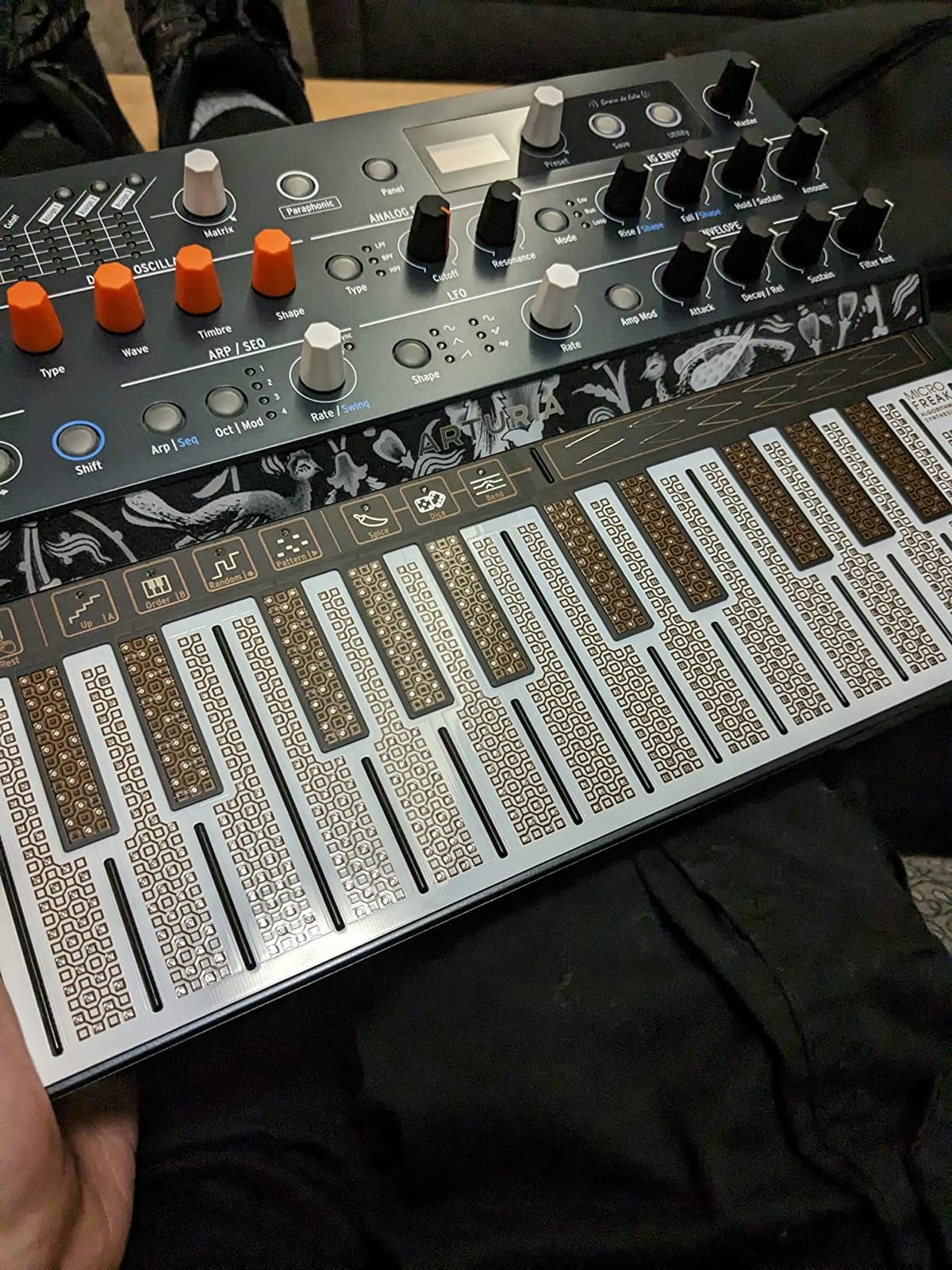
The sequencing side is genuinely useful. Four automation lanes let you record knob or parameter moves alongside the note data, and the Spice and Dice functions generate variations of a pattern rather than playing it straight. For a genre built on repetition, a machine that makes the fourth bar different from the first three without you hand-editing every step saves a lot of time.
At 2.3 pounds it is also the easiest thing here to move between the studio and a rehearsal room. It ships with adapters for 3.5mm to 5-pin DIN so the CV and gate outputs can drive modular or semi-modular gear, which means it can be a voice inside a bigger patch rather than a standalone box.
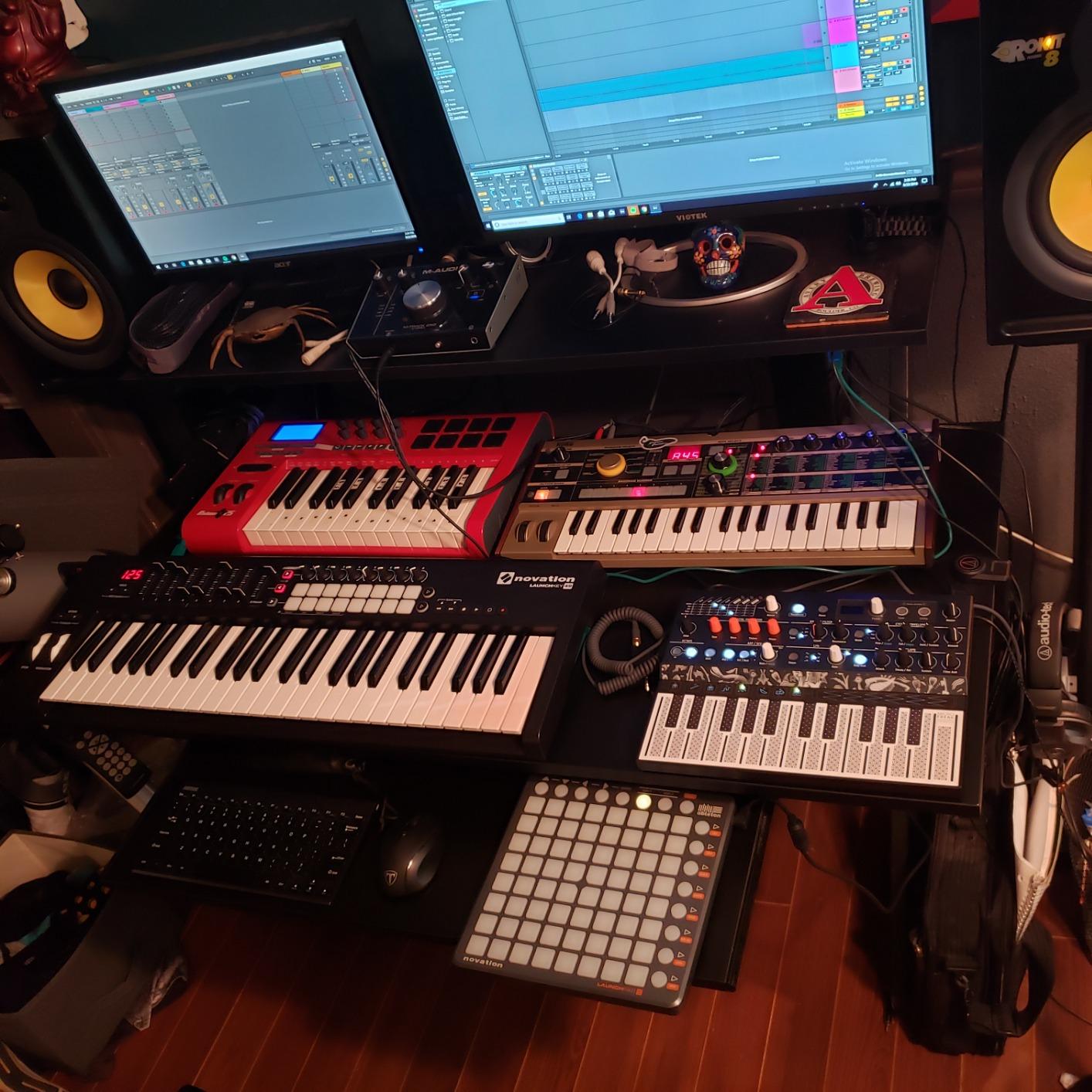
Who the MicroFreak suits for techno work
It suits producers who want one instrument to cover acid, minimal, dub and industrial without buying four boxes. The paraphonic voice and per-note aftertouch mean a single held note can be modulated note by note, which gives you movement on sustained chords that a plain monophonic monosynth cannot produce.
It also suits anyone building hybrid setups. Because the oscillators are digital and the filter is analog, it slots neatly into a chain with external processing. Run the output into a saturator and a delay, and the resonances stay controllable rather than turning to mush.
Where the MicroFreak falls short
The keybed is the honest compromise. It is a printed circuit board with no moving parts that senses velocity and per-note aftertouch, which is excellent for triggering and modulation but feels strange to anyone used to weighted keys. Fingerstyle players tend to adapt within a week, while players who come from piano often do not.
Deep edits happen in the modulation matrix, and the matrix is menu driven. On a small screen that is slow work, so plan your sound design sessions rather than expecting to sculpt a patch in the two minutes before a set.
It also lists an advanced skill level, which is fair. Nothing on the panel is obscure, but the number of oscillator modes and destinations rewards someone who already knows what they are listening for.
2. Korg microKORG – The Best Value Desktop Synth for Techno
Korg microKORG Compact Analog Modeling Synthesizer w/ Vocoder Mini Mic
Korg XMT analog modeling engine
4-voice polyphony
128 editable presets
37 full-size keys with built-in speaker
Pros
- Warm analog-modeling voice that reviewers compare favourably to dearer rivals
- 128 fully editable presets covering basses leads pads and textures
- Built-in vocoder with included gooseneck microphone
- 37 full-size keys in a genuinely portable 8.4 lb body
- Built-in speaker makes it playable straight out of the box
Cons
- Onboard display is not user friendly and parameter meanings require the manual
- Saving your own patches means overwriting factory presets
- Included vocoder microphone is weak and prone to feedback
- 4-voice polyphony is limited for layered arrangements
Long-term owners consistently treat the microKORG as one of the best entry points into hardware synthesis, and the reason is simple: it makes a genuinely warm sound immediately. The XMT analog modeling engine does not drift the way a real analog voice does, but the tone sits closer to vintage analog than most modeling instruments in its class, and that matters more to most techno producers than purity.
Four voices is not a lot, but for the material techno is built from it is enough. Rolling basslines, short stabs and single held notes all fit inside four voices, and the 128 preset bank covers basses, leads, pads and ambient textures out of the box. Long-term owners report tweaking factory sounds as much as they report using them, because the panels are direct and the sounds are one knob away from being something else.
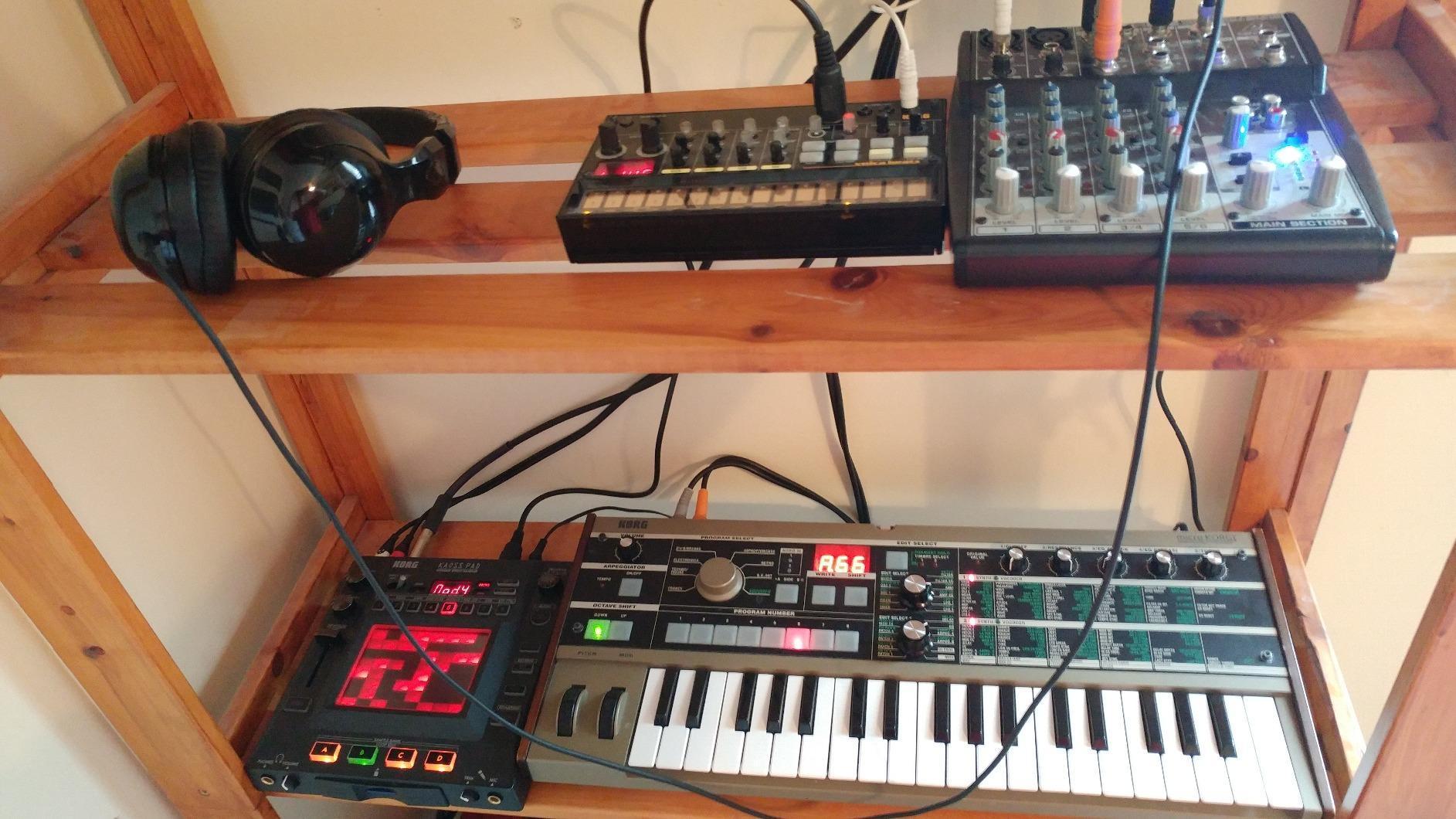
The built-in speaker is a small detail that changes how the instrument gets used. You can power it up and play a line without an interface, an amp or a monitor, which makes it a far more practical practice-room and writing-room machine than it looks. Thirty-seven full-size keys in an 8.4 pound body is an unusual combination, and it is why this one tends to stay in rotation.
It also holds up well to being moved around. Owners describe taking it to gigs, back seats and small rooms for years, and the USB and MIDI connectivity means it drops into an existing setup without an interface upgrade.
Who the microKORG suits for techno work
It suits a producer who wants a single instrument for melodic techno, minimal and dub-leaning material and does not want to think about synthesis architecture. The vocoder is a genuine bonus for dub techno, where talking vocal fragments pushed through a filter and delay are a genre staple rather than a gimmick.
It also suits anyone who plays the keyboard with both hands. Full-size keys mean chord progressions and basslines can be written in the same sitting without switching to a controller.
Where the microKORG falls short
Patch storage is the biggest frustration and the one owners mention most. The instrument is write protected, so storing your own sound means overwriting a factory preset. For a producer with a small library that is manageable, but it stops you building up a personal bank across sessions.
The display is the second complaint. The parameter names are abbreviated and the layout is not intuitive, so budget an hour with the manual before you start building sounds. The included gooseneck microphone is also the weakest part of the package. It is fine for experimenting and poor for a final mix.
3. Behringer CRAVE – The Best Budget Analog for Acid and Minimal Techno
Behringer CRAVE Analog Synthesizer Analog Semi-Modular Synthesizer with 3340 VCO, Classic Ladder Filter, 32-Step Sequencer and 16-Voice Poly Chain
Pure analog VCO VCF and VCA signal path
24 dB Moog-style ladder filter
Semi-modular patch bay with CV gate and clock
32-step sequencer and 16-voice poly chain
Pros
- Fully analog VCO VCF and VCA signal path with a Moog-style 24 dB ladder filter
- Prophet 5-style 3340 VCO architecture per voice
- Patch bay allows deep semi-modular routing and can drive other gear
- 32-step sequencer that is simple and flexible for acid patterns
- Compact body with a clear panel layout
Cons
- Sequencer cannot chain patterns together so each 32-step pattern is selected manually
- No random playback mode for generative playing
- Single oscillator per voice limits sound variety
- Stiff sequencer buttons and a power jack that can work loose
The CRAVE is the kind of machine that pulls people into hardware in the first place. A fully analog signal path with a ladder filter, a patch bay and a step sequencer packed into a small box is an unusual combination, and for acid-flavored techno the filter does the work. Push the resonance up and you get the squelchy, vocal-like bark that makes a line sound like acid rather than like a generic synth bass.
Each voice uses a 3340 VCO design, which is where the original Prophet 5 architecture came from. One oscillator per voice is a real limit, and the pitch and pulse controls do most of the work of keeping the sound interesting. Owners regularly describe it as a teaching and performance machine, which is accurate: it is simple enough to understand in a session and deep enough to keep you patching for months.
The 32-step sequencer is where a lot of the value sits. Thirty-two steps is enough for the kind of phrasing that feels slightly off-centre, which is a common trick in acid and minimal lines. The panel layout is clear, the knobs are where you expect them, and the whole unit is light enough to move with one hand.
The patch bay is the second reason to like it. CV, gate and clock routing means the CRAVE can be the oscillator in a bigger system, sending into a filter or effects unit and taking modulation from elsewhere. Several owners compare it to the Mother-32 platform, which is a fair description of the architecture and the size.
Who the CRAVE suits for techno work
It suits producers making acid and hard minimal techno who want real analog weight. The ladder filter and the 32-step sequencer cover the core jobs in this genre, and the switchable low-pass and high-pass modes let one line cover more ground than a fixed-filter machine.
It also suits anyone building a semi-modular system without a large budget. Owners use the patch bay to send clock and gate out to other gear, which turns a simple monosynth into one voice in a larger pattern.
Where the CRAVE falls short
The sequencer is the limitation to plan around. Patterns cannot be chained, so an eight-bar arrangement means selecting a pattern by hand every eight bars, and there is no random mode for generative playing. If your workflow depends on long automated arrangements, this is the wrong box.
Owners also report stiff sequencer buttons, single-oscillator voices that narrow the sound palette, and a power jack that can work loose when the cable is moved. Quality control on units that reach buyers is not perfect, so check the panel and the jack before you commit.
4. Korg monologue – The Best Monophonic Analog for Techno Basslines
Korg monologue Monophonic Analog Synthesizer w/ 16-step Sequencer – Blue
Monophonic analog voice with dual VCOs
16-step sequencer with microtuning
Battery powered and portable
Built-in oscilloscope
Pros
- Pure monophonic analog voice with a distinctive characterful tone
- 16-step sequencer with front-panel controls for acid and techno lines
- Battery powered and light enough for mobile and live use
- Microtuning allows custom scales for experimental material
- Aluminum top panel with chassis-mounted pots and rubber-coated knobs
Cons
- Monophonic only with no polyphonic or paraphonic voice
- Small keybed is not suited to piano-style playing
- Sequencer is limited to a single 16-step pattern without chaining
The monologue shares the highest rating in this list, and that rating comes from a specific thing: the tone. A pure monophonic analog voice with two VCOs, an aluminum panel and knobs that do not move, in an instrument light enough to carry with one hand. Users report owning it for years and still coming back to it for basslines because the low end is musical rather than just heavy.
Sixteen steps is short by modern standards, and reviewers repeatedly flag that as the thing they would change first. In practice it works because techno phrases are short. Acid lines, rim-driven stabs and off-beat patterns all live comfortably inside sixteen steps, and having to place every note by hand on the front panel keeps the phrasing human.
Battery operation is the other underrated part. It is one of very few analog monosynths in this roundup that works away from a wall, which makes it the practical choice for a rehearsal room or a small live setup where power is awkward. The built-in oscilloscope is a small touch that gives immediate visual feedback when you are dialling a resonant patch.
Connectivity covers the workflow gaps: MIDI, USB MIDI and audio sync mean it can be slaved to a drum machine or a DAW, and the sync input means the sequencer can run against an external clock rather than free-running.
Who the monologue suits for techno work
It suits producers who want a single monophonic voice dedicated to bass and who value character over polyphony. The microtuning capability is useful for dub and industrial material where you want intervals that are not equal-tempered, and the two VCOs cover detuning, sync and cross-modulation tricks that single-oscillator monosynths cannot do.
It also suits live performers. Battery power, a durable panel and a sequencer you can perform into make it one of the more reliable instruments here for a small stage.
Where the monologue falls short
It is monophonic and that is not negotiable. Any arrangement that needs chords, layered stabs or more than one note at a time has to come from somewhere else. Producers on forums describe keeping one alongside a polyphonic instrument specifically because of this.
The keybed is small, so it is an instrument for basslines and leads rather than for playing parts. And the single sixteen-step pattern without chaining means arrangement length is limited unless you sequence from outside.
5. Behringer POLY D – The Best Fat Analog Polyphony for Techno
Behringer POLY D Analog 4-Voice Polyphonic Synthesizer with 37 Full-Size Keys, 4 VCOs, Classic Ladder Filter, LFO, BBD Stereo Chorus, Distortion, 32-Step Sequencer and Arpeggiator
Quadruple VCO analog voice
4 voices with mono unison and poly modes
Classic ladder filter with BBD chorus and distortion
37 semi-weighted velocity-sensitive keys
Pros
- Quadruple VCO analog architecture produces fat bass-heavy warm tones
- 4-voice polyphony with mono unison and paraphonic modes
- 37 semi-weighted full-size keys with velocity
- Ladder filter plus BBD stereo chorus and distortion onboard
- 32-step sequencer and arpeggiator built in
- Premium component matching with 0.1 percent thin film resistors
Cons
- Heaviest instrument here at 26.1 pounds which limits portability
- Large desktop footprint at 31.4 by 19.6 inches
- 4-voice polyphony is modest against modern digital hybrids
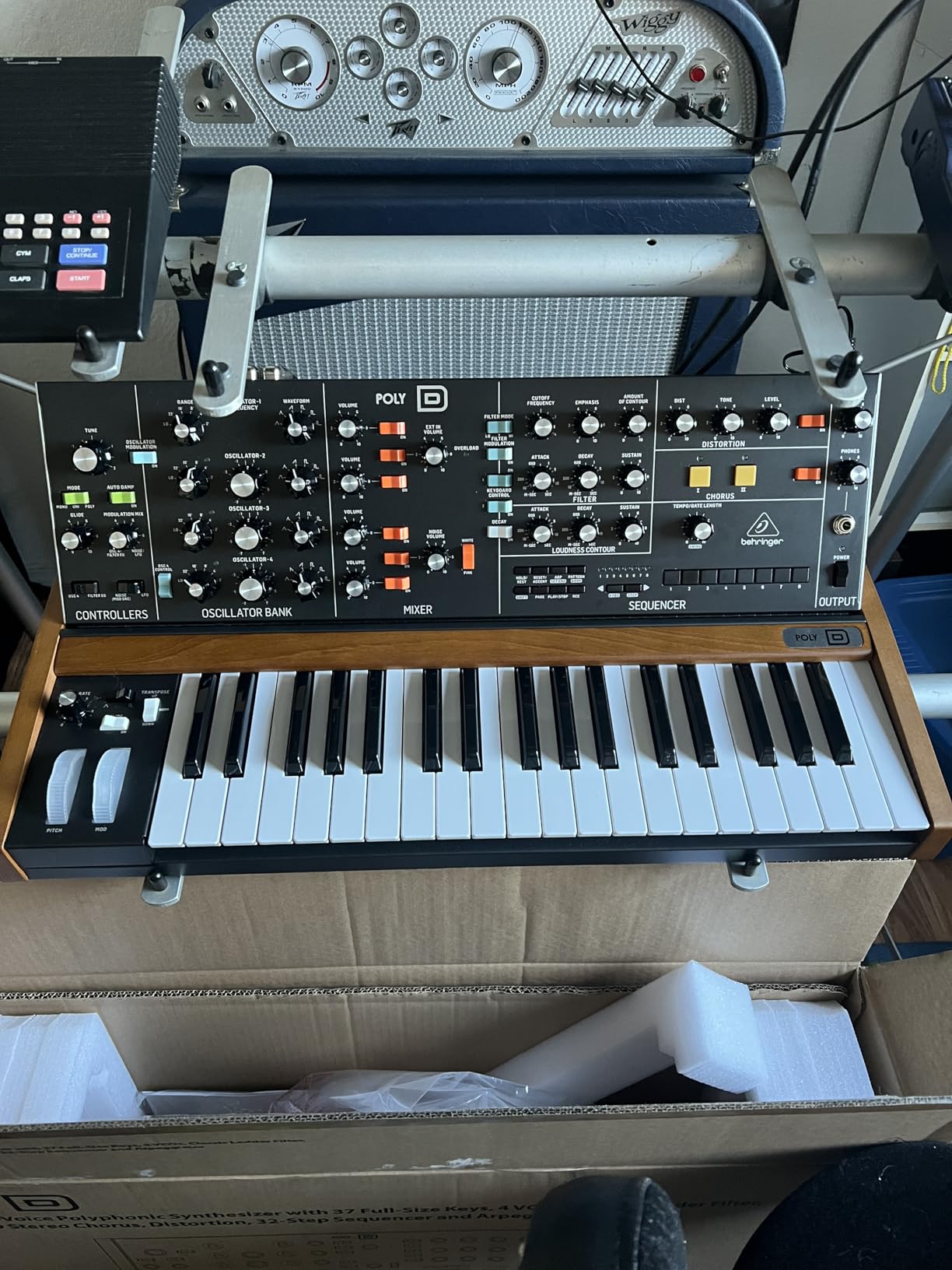
The POLY D is the fat one. Four oscillators per voice, four voices of polyphony and a classic ladder filter give you a dense, bass-heavy analog sound that sits well under a kick without needing much processing. For melodic techno and for chord-based minimal work, that density is the whole point, and reviewers consistently describe it as warm, rich and immediately musical.
The onboard effects are unusual at this level. A BBD stereo chorus and a distortion circuit sit in the signal chain alongside the ladder filter, and the chorus in particular is the kind of thing you would normally reach for a pedal to do. Having it internal means the sound works in a mix with no extra routing.
The build quality is a genuine strength. Matched transistors and JFETs, ultra-high precision resistors and semi-weighted full-size keys with velocity make it feel like a much more expensive instrument than the specification list suggests, and owners report it holding up well to regular transport.
It also runs in mono, unison and paraphonic modes, which means one instrument covers a bassline, a wide unison lead and a two-note pad depending on what the track needs. The 32-step sequencer and arpeggiator are basic by modern groovebox standards but adequate for writing parts quickly.
Who the POLY D suits for techno work
It suits producers of melodic and deep minimal techno who want analog warmth and polyphony on the same instrument. The four-oscillator architecture is the fattest in this roundup, and combined with the ladder filter it covers basses, chord stabs and leads without changing machines.
It also suits anyone who wants a permanent studio fixture. At 26.1 pounds and over 31 inches wide, it is not a portable instrument, it is a desk instrument, and it is built like it expects to stay in one room.
Where the POLY D falls short
Portability is the obvious limit. You are not carrying this to a rehearsal room, and the footprint means it dictates where your desk faces. If you need something that moves, this is the wrong shape entirely.
Four voices is modest. Modern hybrid instruments give you six or more plus a wider effect set, so for very dense arrangements you will hit the ceiling quickly. The polyphony is also strictly analog, so there is no wavetable material to escape into.
6. Novation MiniNova – The Best Analog Modeling Workhorse for Techno
Novation MiniNova Analog Modeling Synthesizer
Up to 18 voices with three oscillators per voice
256 factory sounds and 128 user slots
Eight backlit Animate buttons
Built-in vocoder with VocalTune
Pros
- 18 voices with three oscillators per voice across analog and digital waveforms
- Warm smooth versatile tone that reviewers compare to the Korg Minilogue
- Intuitive workflow with numeric display and plenty of front-panel knobs
- Eight backlit Animate buttons and a well-regarded arpeggiator
- High quality onboard reverb delay and distortion effects
- Comes with 128 blank user slots for sound design from scratch
Cons
- 37 mini keys are not suited to piano-style playing and lack aftertouch
- Mono-timbral so sounds cannot be layered or split
- Knobs can feel scratchy and the menu system is dense without the VST editor
- No polyphonic aftertouch and a small display for on-board editing
The MiniNova sounds wider than the rest of the desk-bound instruments here, and the reason is the voice count. Up to eighteen voices from three oscillators each means you can hold a pad, a bassline and a melodic layer at once without anything being stolen, which is exactly the situation melodic techno producers live in.
Long-term owners rank it among the best value 37-key analog-modeling synths and single out two things above everything else: the warmth and range of the tone, and the quality of the onboard effects. The reverb, delay and distortion per voice are the kind of effects that later releases in the same range did not match, and having five effects per voice means a patch sounds finished before it ever reaches a mixer.
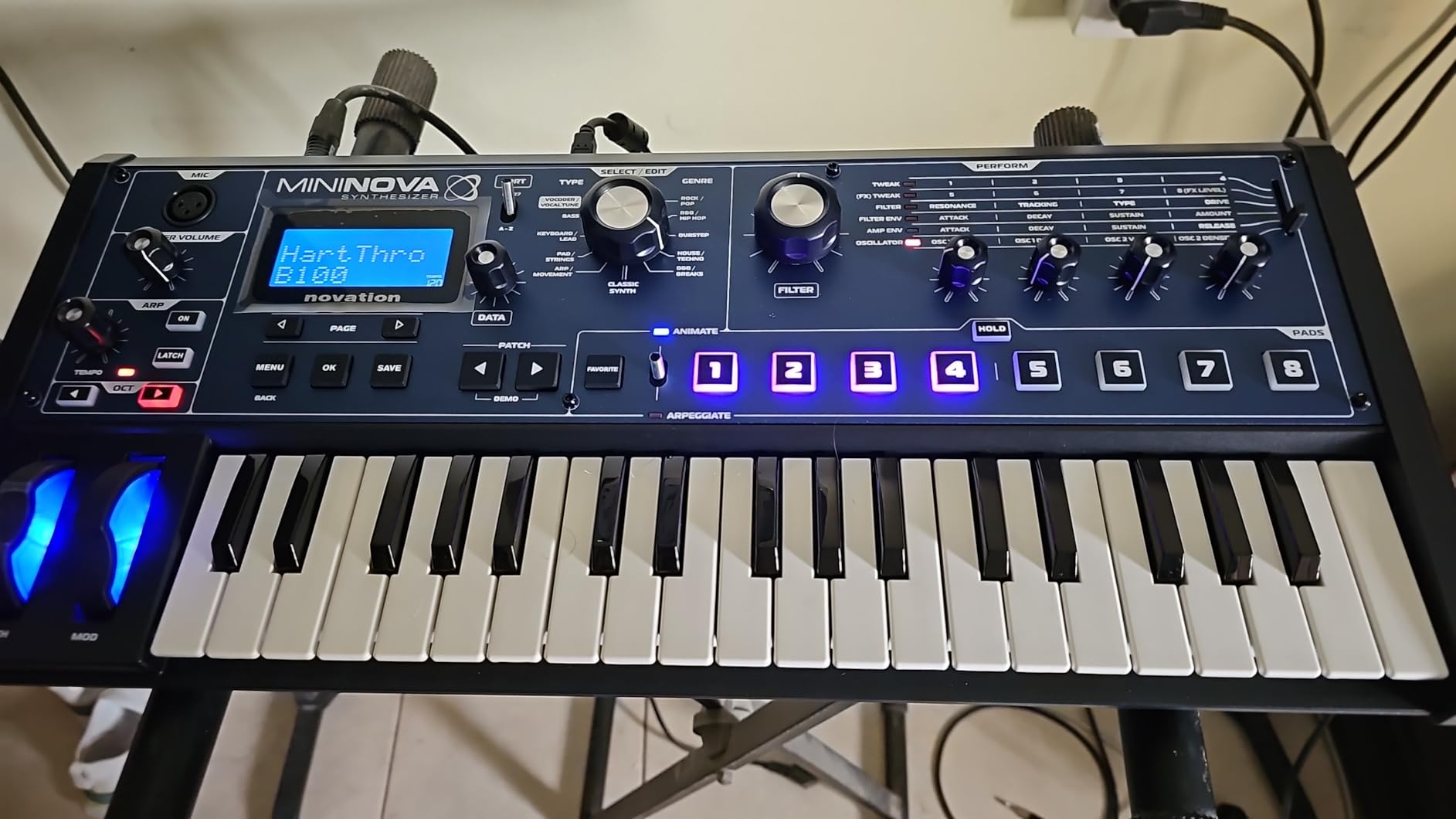
For techno specifically, the vocoder with VocalTune is more useful than it looks. Dub techno and hypnotic material both rely on processed vocal fragments, and the built-in vocoder with the included gooseneck microphone means you can get a robotic vocal layer without a plugin, an audio interface or a second synth.
The eight backlit Animate buttons turn the arpeggiator and filter into performance controls, and the real-time arpeggiator is well regarded for a keyboard of this type. It ships with an editor VST plugin and Librarian software, which matters because deep programming on the hardware alone is slow.
Who the MiniNova suits for techno work
It suits producers who write melodic techno and dub techno and want chords, layers and processed vocals from one instrument. The 128 blank user slots mean you can build a personal bank rather than overwriting anything, which is a real advantage for anyone who develops their own sound over months.
It also suits producers who want to move quickly. The display shows numerical values and there are enough front-panel knobs to make real changes without menus, so sound design does not require a computer in the loop.
Where the MiniNova falls short
It is mono-timbral. That means no layering and no splits, which is a genuine constraint for a dance producer who wants a bass sound and a pad sound from the same box at the same time. You can change programs, you cannot play two at once.
The 37 mini keys have no aftertouch, so expressive control depends on the mod wheel. Owners also note that deep editing really wants the VST editor, and that some units ship with the wrong power adaptor, so check what is in the box.
7. Novation Bass Station II – The Best Acid Filter for Techno Bass
Novation Bass Station II Analog Monosynth
Two analog oscillators with sub-oscillator noise and ring mod
Classic multi-mode filter plus 24 dB Acid Filter
Pattern arpeggiator and real-time step sequencer
128 patch slots and 25 full-size keys
Pros
- 24 dB Acid Filter delivers a Wasp-style resonant squelch for acid and techno basslines
- Build quality that owners describe as solid and near indestructible
- Pattern-based arpeggiator and step sequencer are among the best in class
- 25 full-size keys with aftertouch in a compact lap-friendly body
- External input can be routed through the analog filter and onboard effects
Cons
- No reverb or delay in the onboard effects chain
- Arpeggiator can only be triggered by the keys and ignores incoming MIDI
- Monophonic or paraphonic only with no true polyphony
- Step sequencer is limited compared with dedicated grooveboxes
If you write acid techno, the Acid Filter on this instrument is the reason to own it. It is a dedicated 24 dB resonant filter with the character of the Wasp lineage, and reviewers describe the squelch it produces as exactly the sound that makes a bassline read as acid rather than as a filtered saw. Alongside the classic multi-mode filter you get low-pass, high-pass and band-pass at 12 and 24 dB per octave, so the range is wider than the badge suggests.
Two analog oscillators with four waveforms each, plus a sub-oscillator, noise and ring modulation, is a complete monophonic voice. Overdrive can sit before or after the filter, and that choice matters more than it sounds: post-filter drive turns the resonance into a thicker, more aggressive version of the same sound, which is a cheap way to get movement into a static patch.
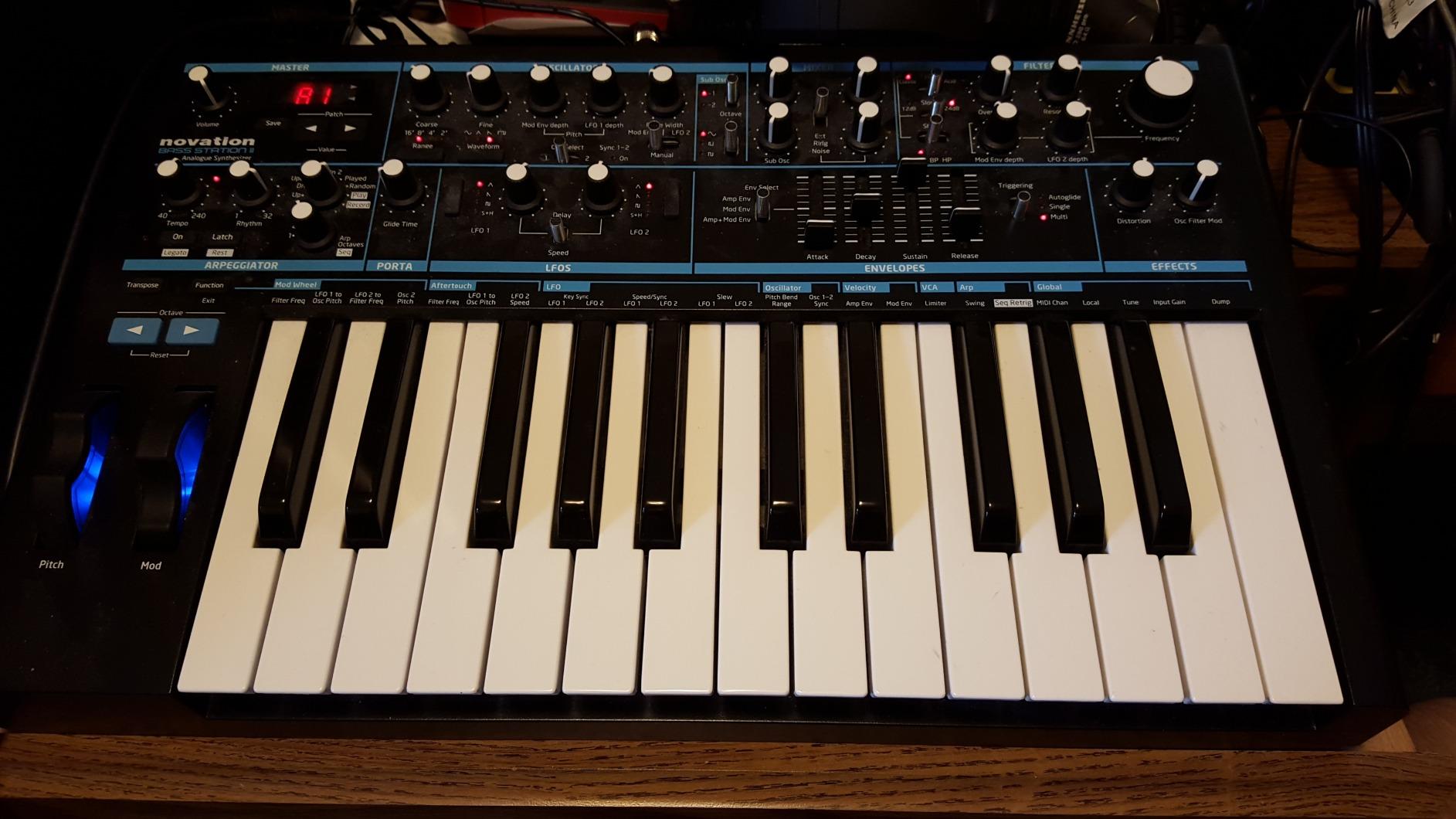
The pattern-based arpeggiator and real-time step sequencer are consistently called out as among the best in this class. Real-time note, tie, rest and rhythm recording means you can play a line in and have it stored, which is the difference between an instrument you use and an instrument you admire. Twenty-five full-size keys with aftertouch keep it playable rather than purely a sequencer box.
External audio input routing is the feature people underrate. You can feed a drum loop or a resampled vocal through the analog filter and the onboard effects, which turns it into a processing channel for techno material as well as a sound source.
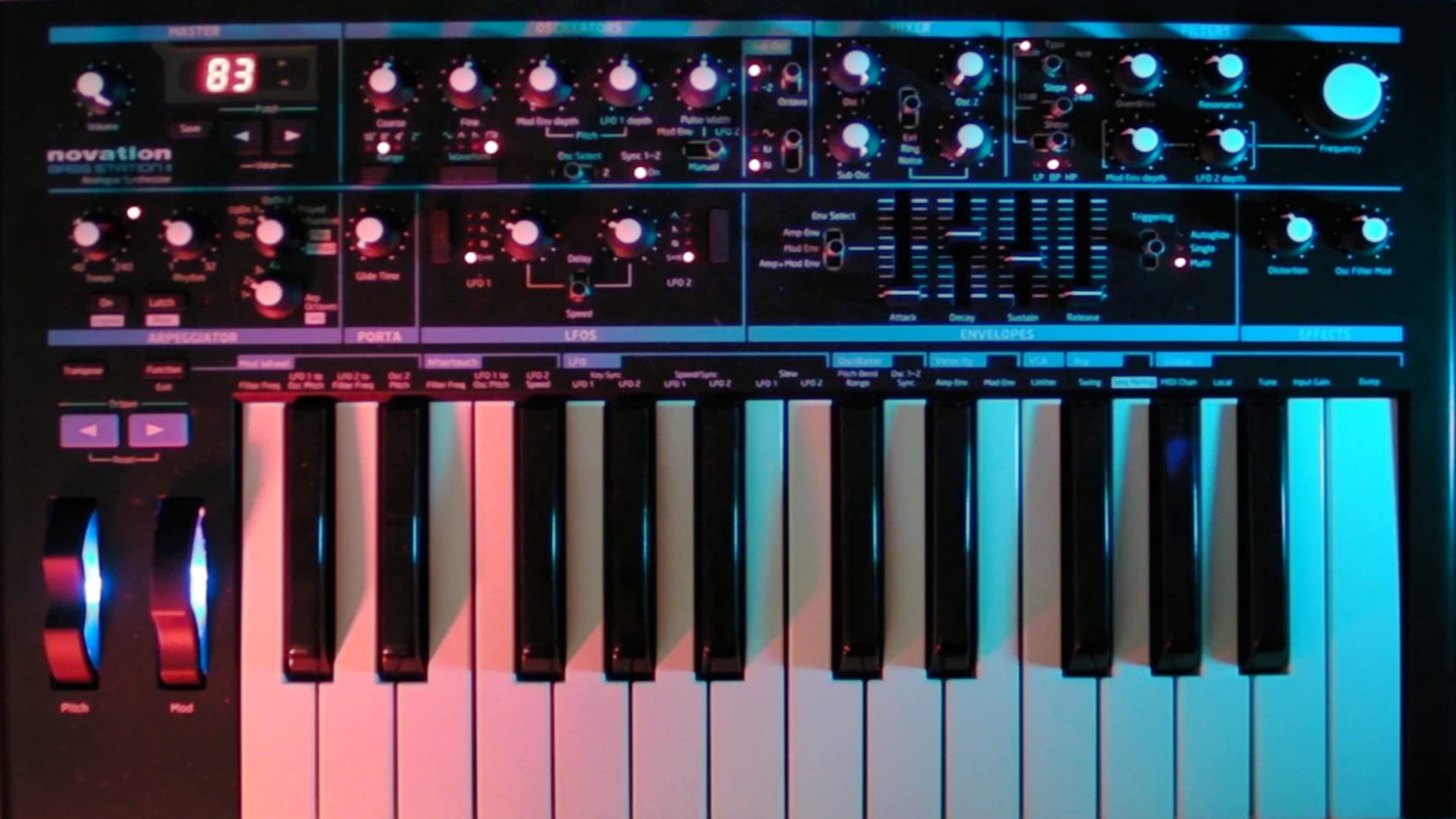
Who the Bass Station II suits for techno work
It suits acid and Detroit-leaning producers who want a benchmark monophonic bass voice with a filter that pushes hard. The 128 patch slots with 64 factory sounds mean your own patches have room without overwriting anything, and the artist packs that download into those slots are a decent starting library.
It also suits live performers. The build is rugged, the body is compact, and the external input makes it easy to fold a processed layer into a set without another device.
Where the Bass Station II falls short
There is no reverb or delay in the onboard effects chain, which is the single most repeated complaint in owner feedback. For a genre built on space and repetition, that means more outboard processing than some competitors ask for, or accepting a drier patch.
The arpeggiator cannot be triggered by incoming MIDI notes, only by the keys, so it does not respond to a drum machine playing alongside it without workarounds. And it is monophonic or paraphonic, with no true polyphony for chords.
8. Arturia MiniFreak 37 – The Best Polyphonic Aftertouch for Techno
Arturia MiniFreak 37 Key Polyphonic 6-Voice Hybrid Synthesizer Keyboard (Standard, 37 Key)
6-voice hybrid digital and analog architecture
Analog multimode filters and analog effects
37 mini keys with polyphonic aftertouch
256 presets each storing a sequence or arpeggio
Pros
- Multi-mode digital engine combined with analog multimode filters for a wide sonic range
- Strong value for a 37-key hybrid especially with the included MiniFreak V plugin
- Six voices with selectable retriggering and voice allocation that mimics classic mono and poly synths
- Deep arpeggiator and sequencer with each of the 256 presets storing its own pattern
- Polyphonic aftertouch and velocity that feel expressive rather than mushy
- Solid metal chassis light enough to carry to gigs
Cons
- Onboard screen and interface are small and less descriptive than the software version
- Capacitive buttons can be mispressed or double-triggered during a set
- Some features are only discoverable through long tutorials or the manual
- Minor issue with stereo voice separation
The MiniFreak 37 is the full-size sibling of the instrument at the top of this list, and it answers the main complaint about the smaller version. The keybed is real, it has velocity, and it has polyphonic aftertouch, so you can hold a chord and modulate individual notes inside it. For a producer writing sustained melodic techno chords, that is the feature that makes the difference between a static pad and a lead that moves.
The architecture is a digital oscillator engine with analog multimode filters and an analog effects section. Six voices with selectable retriggering and voice allocation let you emulate the behaviour of classic mono and poly instruments, so a patch can behave like a 1980s polysynth or like a modern supersaw without being either.
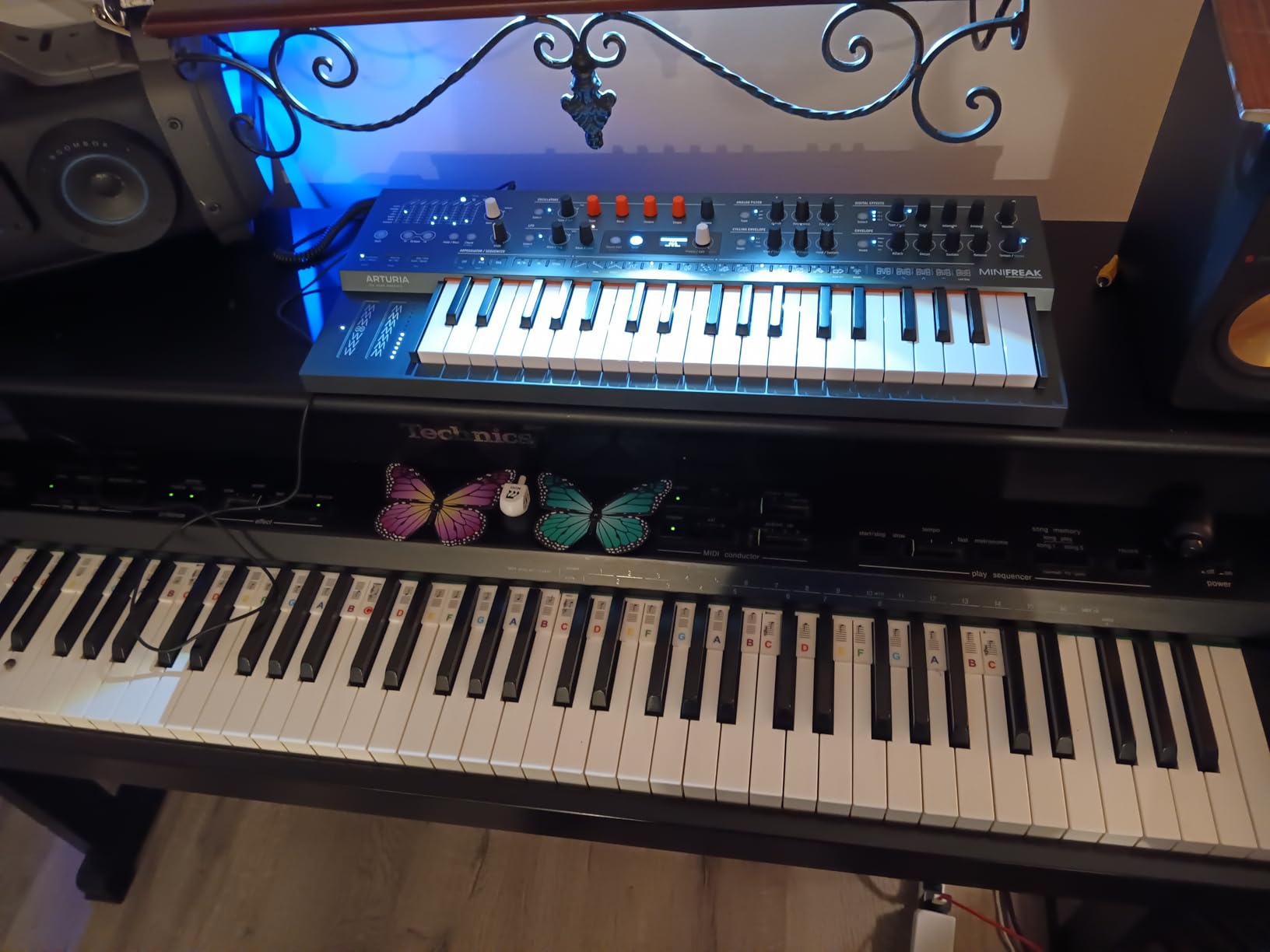
Each of the 256 presets stores its own sequence or arpeggio alongside the patch, which is a quiet but important workflow win. Program change recalls the sound and the pattern together, so a live set can move between complete sections rather than between bare sounds. Owners rate the sequencer and arpeggiator as deep without being difficult to reach.
The MiniFreak V virtual instrument is included with registration, which means the same engine is available inside a DAW. Owners treat that as a large part of the value, since it removes the reason to keep the hardware in two places at once.
Who the MiniFreak 37 suits for techno work
It suits melodic and minimal producers who want expressive polyphonic control without a heavy instrument. Six voices, per-preset sequences and polyphonic aftertouch cover pads, chord progressions and evolving stabs, and the metal chassis makes it light enough to move to a session.
It also suits hybrid producers, because the included plugin means a patch can be started in the room and finished in the session, or vice versa, without the sound changing character between the two.
Where the MiniFreak 37 falls short
The capacitive buttons are the practical concern owners raise most. They can be mispressed or double-triggered, and on an instrument where a sequence has to be active at the right moment that is not a cosmetic problem. The screen is also small and less descriptive than the software version, so deep navigation is faster on a computer.
Some features are genuinely hard to find without outside help, and there is a minor complaint about stereo voice separation in some patches. Reviewers also mention squeaking key springs appearing on long-term units, which matters if you keep a keyboard for years.
9. Elektron Model:Cycles – The Best Groovebox for Minimal Techno
Elektron Model:Cycles 6-Track FM Based Groove Box
Six sample tracks with dedicated per-track knobs
300 factory sounds from Splice
64 steps per track with Elektron sequencer
96 projects with 96 patterns each
Pros
- Six sample tracks with dedicated per-track knobs for hands-on performable tweaking
- 300 factory sounds give immediate material for techno percussion and textures
- Tracks can switch between audio sample and MIDI sequencing roles
- Deep Elektron sequencer with 64 steps per track and real-time parameter recording
- 96 projects with 96 patterns each supports very large arrangements
- Compact and light enough to move between studio and stage
Cons
- Sample-based engine gives less raw analog character than the analog synths in this roundup
- Small screen means deeper editing needs menu-based editing
- MIDI sequencing needs an external controller for full note control on tracks
The Model:Cycles is a groovebox, not a subtractive synth, and understanding that is the key to recommending it for techno. Six sample-based tracks each get a full column of dedicated knobs, which means every sound in an arrangement can be filtered, tuned and moved by hand during a live set without touching a menu. For minimal techno, where the performance of a loop is the composition, that layout is the whole argument.
Every one of the six tracks can act as an audio sample track or a MIDI track, so you can sequence an external synth from the same machine that plays your percussion. Reviewers note this is a groovebox first and a synth second, and that is exactly why it suits beat-driven work rather than melodic composition.
The sequencer is the deep part. Sixty-four steps per track with real-time and grid recording of parameter moves means the same pattern length most hardware gives you at eight is doubled here, and parameter automation is recorded rather than programmed, which keeps movement organic. Ninety-six projects with ninety-six patterns each is more arrangement capacity than most people ever fill.
Who the Model:Cycles suits for techno work
It suits producers who want to build an entire track on one machine and perform it. The 300 factory sounds cover percussion, textures and hits from the start, and the 1GB of internal storage holds your own samples. At 1.3 kg it moves between the studio and a small stage easily.
It also suits producers who use an external synth and want one sequencer to drive everything. The dual-role track design means percussion and melodic control live in the same pattern without a second clock source.
Where the Model:Cycles falls short
It does not deliver analog character, and this is a sample engine. If the reason you want hardware is drift, nonlinearity and the way analog filters behave under a saturated signal, this is the wrong tool. Owner feedback makes the same point: it is a groovebox doing groovebox work, and it earns its rating on pattern control rather than on tone.
The screen is small so deeper editing happens through menu-based editing, and MIDI sequencing on a track requires an external controller for full note control. If your material is melodic and chord-based, you will want a keyboard synth alongside it.
10. Moog DFAM – The Best Semi-Modular Voice for Techno Percussion
MOOG DFAM Semi-Modular Analog Percussion Synthesizer
Fully analog engine with two VCOs
Moog ladder filter and white noise generator
24-point patch bay
8-step sequencer with per-step pitch tone and decay
Pros
- Fully analog percussion voice built around the classic Moog ladder filter
- 24-point patch bay allows deep semi-modular routing with no patching needed to start
- 8-step sequencer with independent pitch tone and decay per step
- Works as a tabletop synth or mounts directly into 60HP of Eurorack
- Expands into a full Moog voice system when paired with other Mother-32 platform units
- Compact and lightweight metal chassis
Cons
- Mono voice only and not a melodic polyphonic synth
- 8-step sequencer is short for longer patterns
- No dedicated polyphonic performance keyboard
The DFAM solves a problem most producers hit about a year in: a drum machine gives you drums and a synth gives you melody, and neither makes the industrial clank or the tuned percussion that techno needs. The DFAM is a fully analog voice with two VCOs, a noise generator and the Moog ladder filter, and it turns any of those three sources into rhythm.
The eight-step sequencer is short, and owners say so. What makes it work is that pitch, tone and decay are set independently per step, so an eight-step pattern is not eight repetitions of one sound. It is eight related sounds, which is exactly how tuned percussion and melodic drum programming should behave.
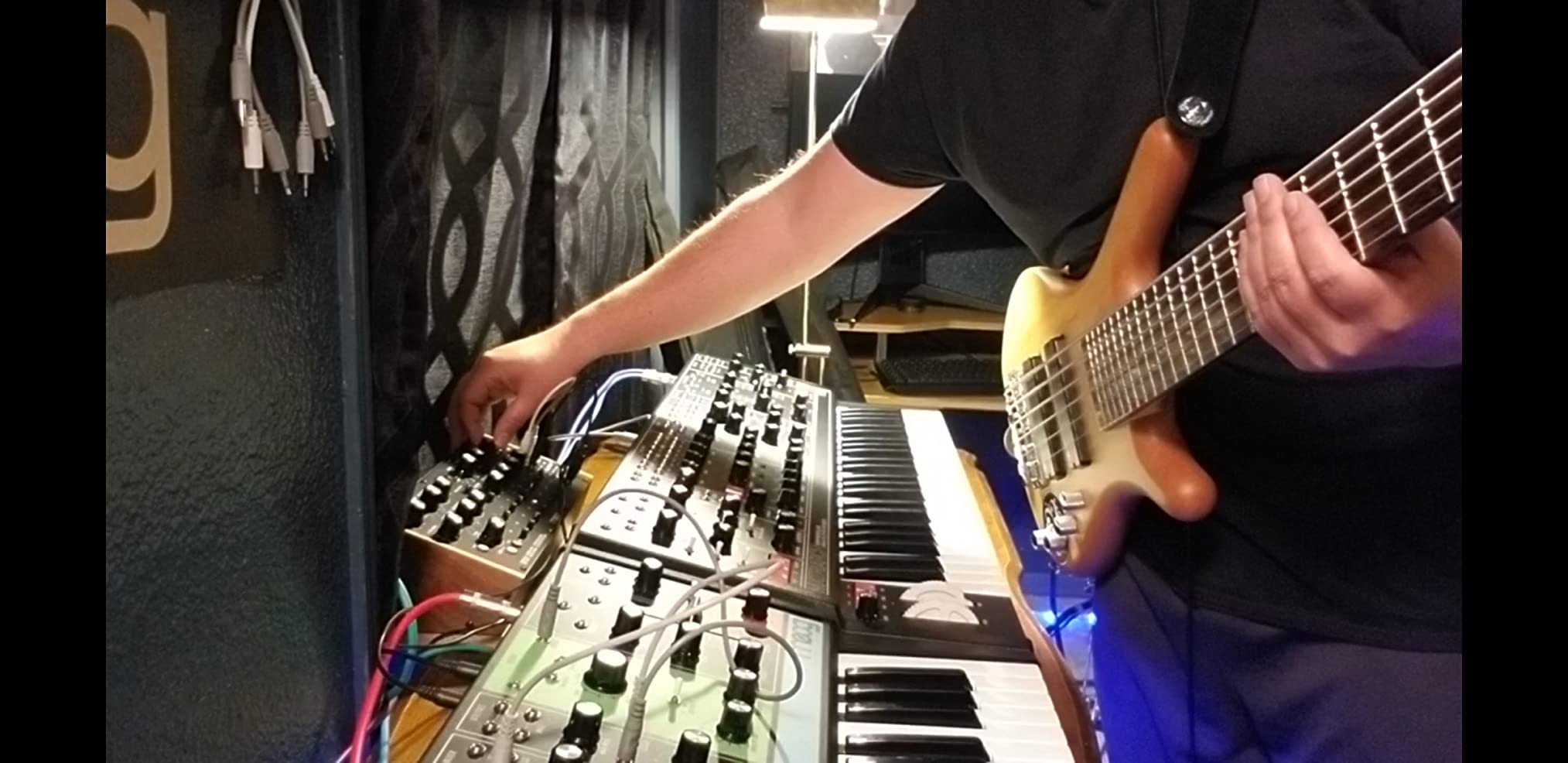
The 24-point patch bay is the reason to buy it. No cables are required to get started, so it plays like a normal instrument, but the moment you start patching, the pitch and decay inputs can be modulated by anything in reach, including its own sequencer. Owners regularly describe a short cable run as enough to produce a sound they could not get from a preset drum machine.
It also runs as a 60HP Eurorack module, so the desktop version can join a modular system later without buying again. Pairing it with a Mother-32 or a Subharmonicon gives you a fuller Moog voice architecture rather than a single percussion box.
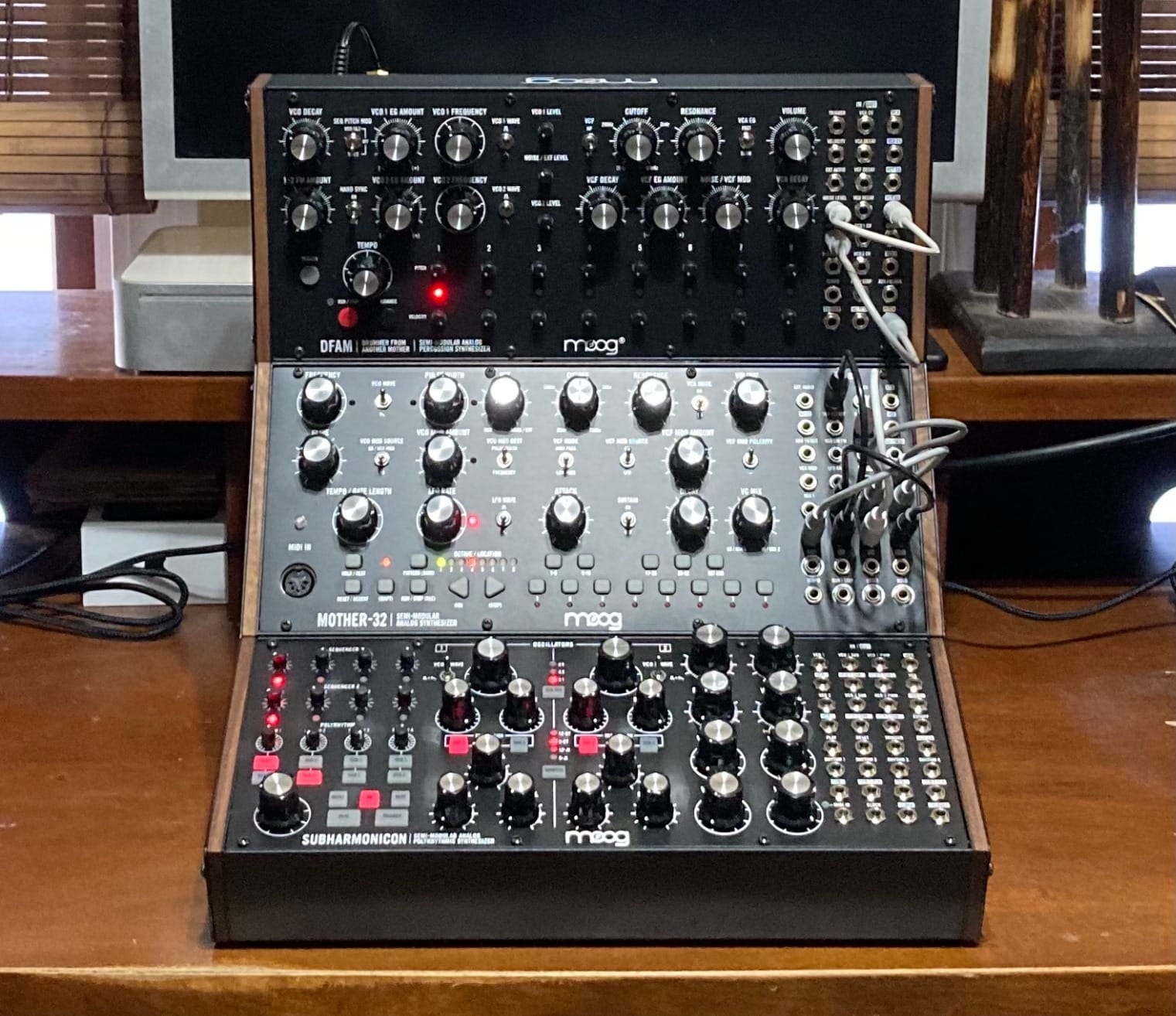
Who the DFAM suits for techno work
It suits producers of industrial and hard minimal techno who need percussion that sits between a drum machine and a tuned instrument. The ladder filter means you can push resonance into a self-oscillating tone for tonal percussion, and the noise generator covers the metallic layers that sampled 909-style sounds rarely give you.
It also suits anyone starting a semi-modular system, because the patch bay is large for the size and the Eurorack case option means the same purchase works in two setups.
Where the DFAM falls short
It is a single mono voice, so it cannot play chords, pads or anything harmonic. Owners are clear that it is a percussion and modulation voice rather than a melodic performance synth, and treating it as one leads to disappointment.
Eight steps is the limit of the onboard sequencer, so longer patterns need an external clock or a sequencer. And the small form factor means the panel is dense, which is fine if you patch but awkward if you want to play it fast.
11. Moog Subsequent 37 – The Best Premium Analog Tone for Techno
MOOG Subsequent 37 Paraphonic Analog Synthesizer
Two variable waveshape oscillators plus square sub
Moog ladder filter with two modulation busses
2-note paraphonic 37-key bed with aftertouch
256 presets with Editor software
Pros
- Fat rich Moog ladder-filter tone that owners consistently describe as the reason they kept the instrument
- 2-note paraphonic capability adds expressive layering beyond a plain monosynth
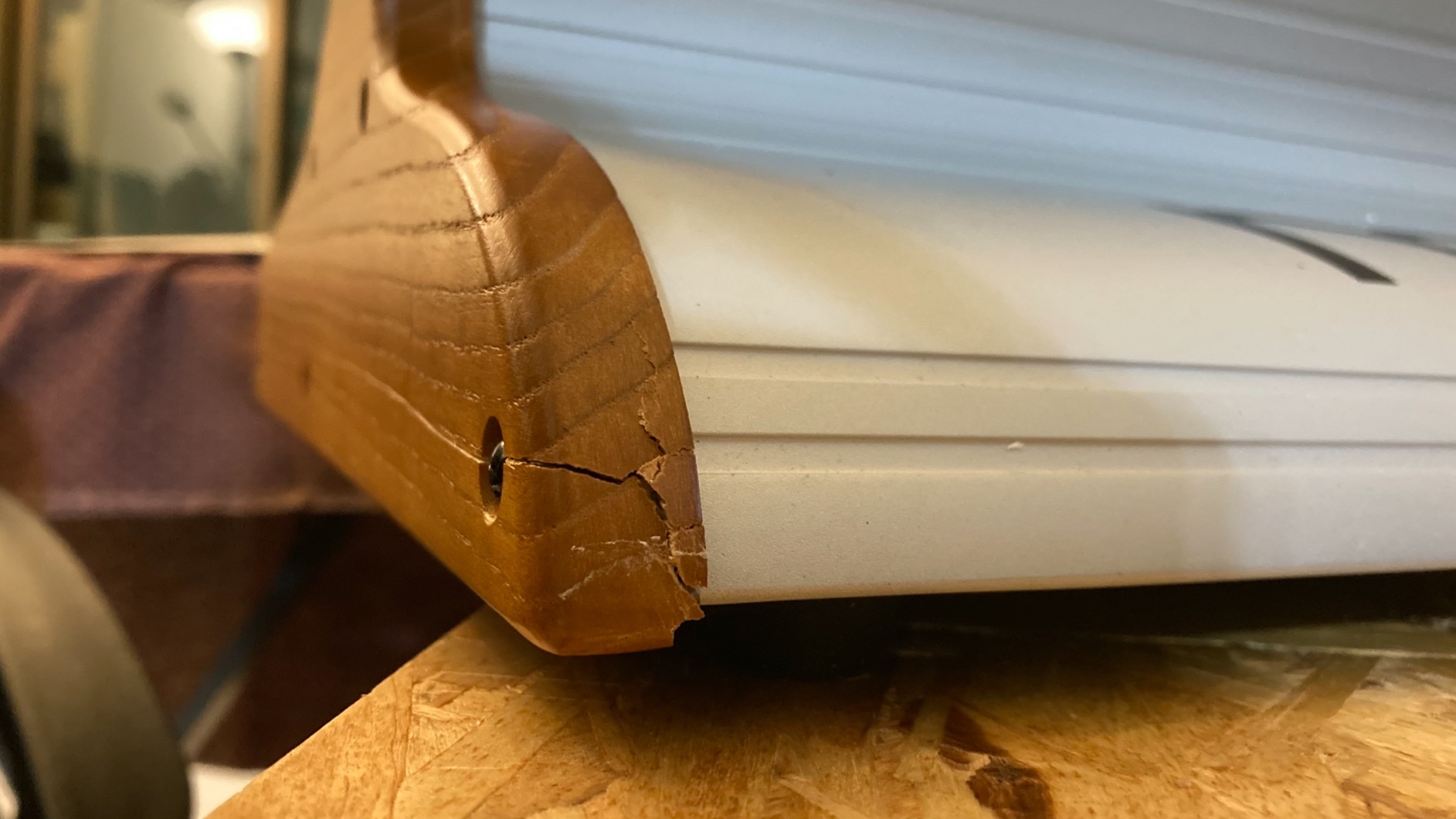
- Superb build with metal wood and alloy construction and smooth knob feel
- 37 semi-weighted keys with velocity and aftertouch plus integrated headphone amp
- Two modulation busses with LFO and programmable routing
- Full CV and Gate plus MIDI and USB connectivity
Cons
- Premium instrument where simpler ones in this roundup carry more features
- No built-in arpeggiator hold control or onboard step sequencer
- Only one LFO per modulation bus
- Heavy at 10 kg and the wooden case is bulky for travel
The Subsequent 37 exists because the tone is the product. Two variable waveshape oscillators, a square-wave sub oscillator, an analog noise generator and the Moog ladder filter with two modulation busses give a fat, rich voice that owners consistently describe as the reason the instrument earned its place. For a producer who wants a single timbre they can build an entire record around, that is a real argument.
The paraphrase is the second headline. A 2-note paraphonic keybed on 37 semi-weighted keys with velocity and aftertouch means held intervals behave like two separate notes with their own envelopes, so a two-note bass stab and a two-note pad are both available from a machine that is otherwise a monosynth.
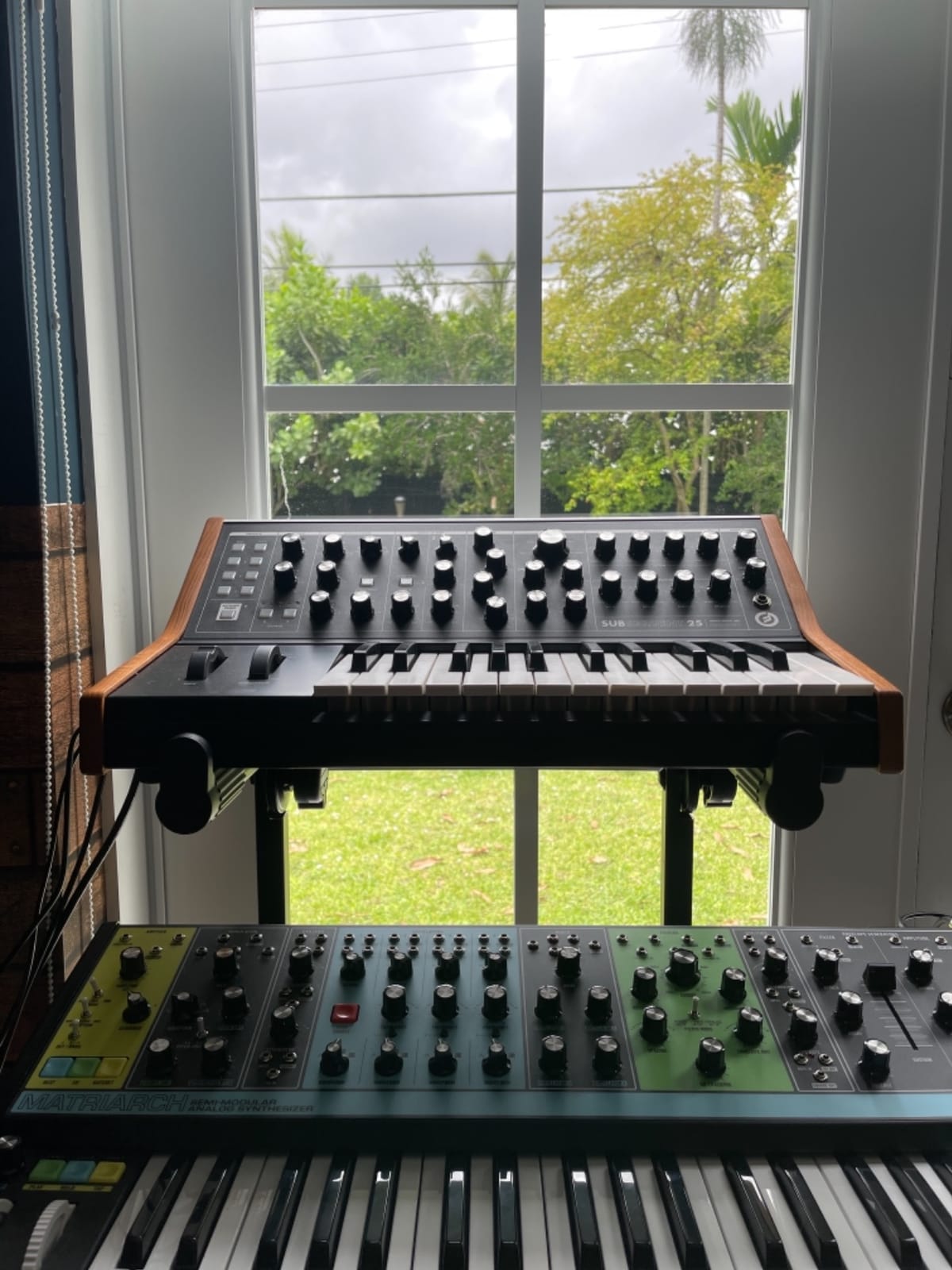
Connectivity is thorough: MIDI in and out, USB, quarter-inch audio in and out, a headphone output with its own amplifier, and CV and Gate inputs for filter CV, pitch CV, volume CV and keyboard gate. For a studio instrument that must sit alongside a modular system or a large analog setup, that list matters.
Forty knobs and seventy-four switches cover the panel. That sounds excessive until you realise there is no screen doing the work, and the included Editor and Librarian software handles preset management as a plugin or standalone for Windows and Mac.
Who the Subsequent 37 suits for techno work
It suits producers who have settled on a sound and want the best version of it. Deep, rolling basslines, sustained melodic chords and slow-moving material all benefit from the ladder filter and the two modulation busses, and the paraphonic bed covers the interval work that a plain monosynth forces you to sequence note by note.
It also suits anyone with a CV-capable system, because the full CV and Gate input set lets it be modulated by a sequencer or a drum machine directly.
Where the Subsequent 37 falls short
There is no arpeggiator, no hold control and no onboard step sequencer. Owners are candid that simpler instruments in this roundup give you more features, so the value case here is tone rather than capability.
Only one LFO per modulation bus is modest for a two-bus design, and at 10 kg with a wooden case it is not a travel instrument. The panel is also large enough that the learning curve is real, so budget time with it before a project.
12. Behringer Pro VS Mini – The Best Travel-Size Hybrid for Techno
Behringer Pro VS Mini Portable 5-Voice Hybrid Synthesizer with 4 Vector Morphing Oscillators Per Voice, Analog Low-Pass Filter, 16-Step Sequencer and Arpeggiator
4-voice hybrid engine with 16 vector oscillators
Wavetable synthesis with analog low-pass filter
16-step sequencer and arpeggiator
Runs on batteries or USB-C with sync input
Pros
- Exceptional value for a 4-voice hybrid with 16 vector oscillators
- Wavetable and vector morphing give a much wider timbral range than the size suggests
- Analog low-pass filter adds real analog colour to the digital oscillators
- 16-step sequencer and arpeggiator built in for hands-off pattern work
- Very compact at 8.45 by 5.45 by 2.35 inches running on batteries or USB power
- Sync In allows it to be clocked from external gear
Cons
- 27 mini keys and a tiny control surface limit hands-on playability
- Small screen means deeper editing needs menu-based editing
- 2.5mm jack connectivity rather than full-size quarter-inch outputs
- Tone is less distinctive than dedicated analog instruments
The Pro VS Mini packs more into less space than the rest of the list. Four voices with four vector-morphing oscillators each gives sixteen oscillators in total, and vector synthesis means you move through a waveform continuum rather than picking from a list. For a producer who wants timbral variety rather than a signature tone, that is an unusual amount of range in such a small body.
Wavetable synthesis supplies the material and the analog low-pass filter supplies the character, which is the same hybrid formula that makes the MicroFreak work so well for techno. Add the 16-step sequencer and arpeggiator and you have a pattern-generating machine that can run a whole acid or minimal section on its own.
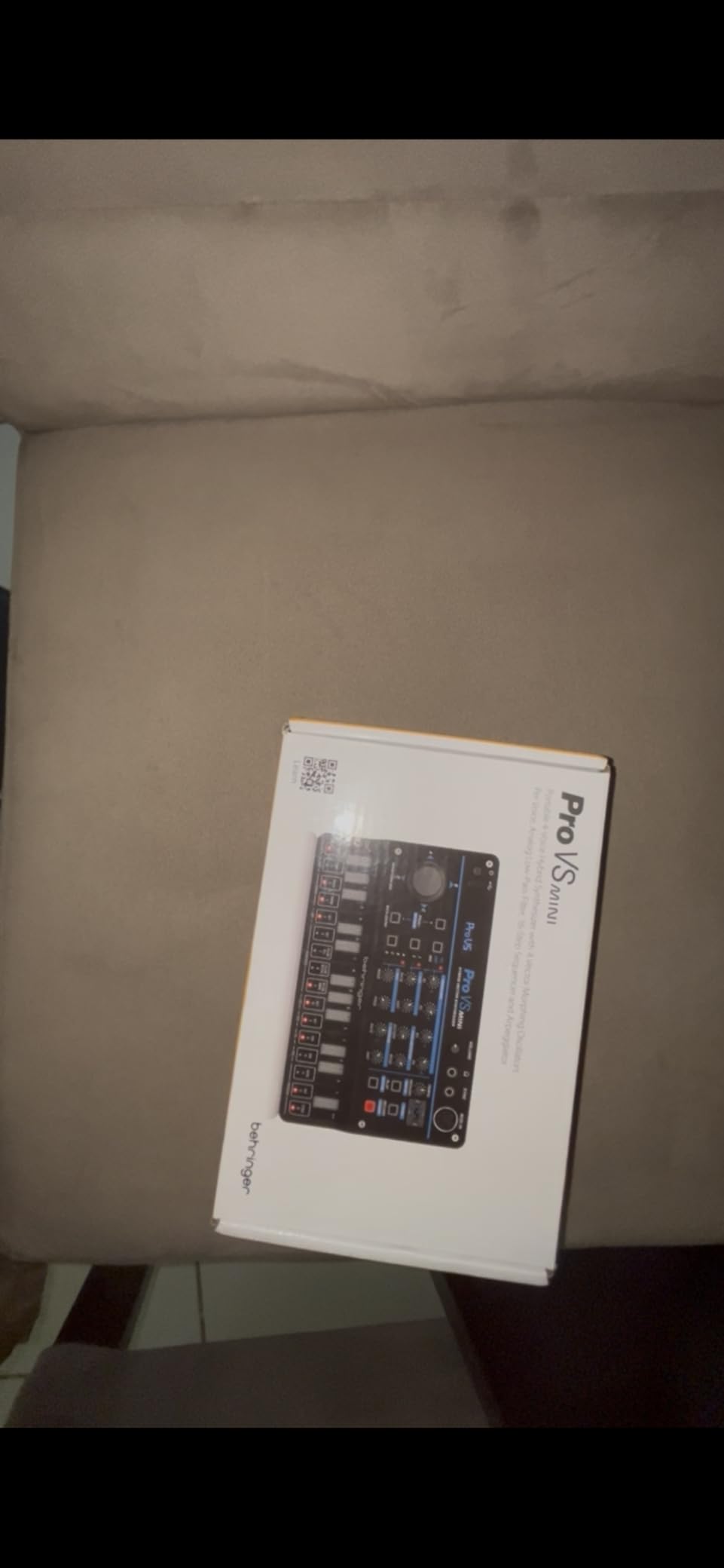
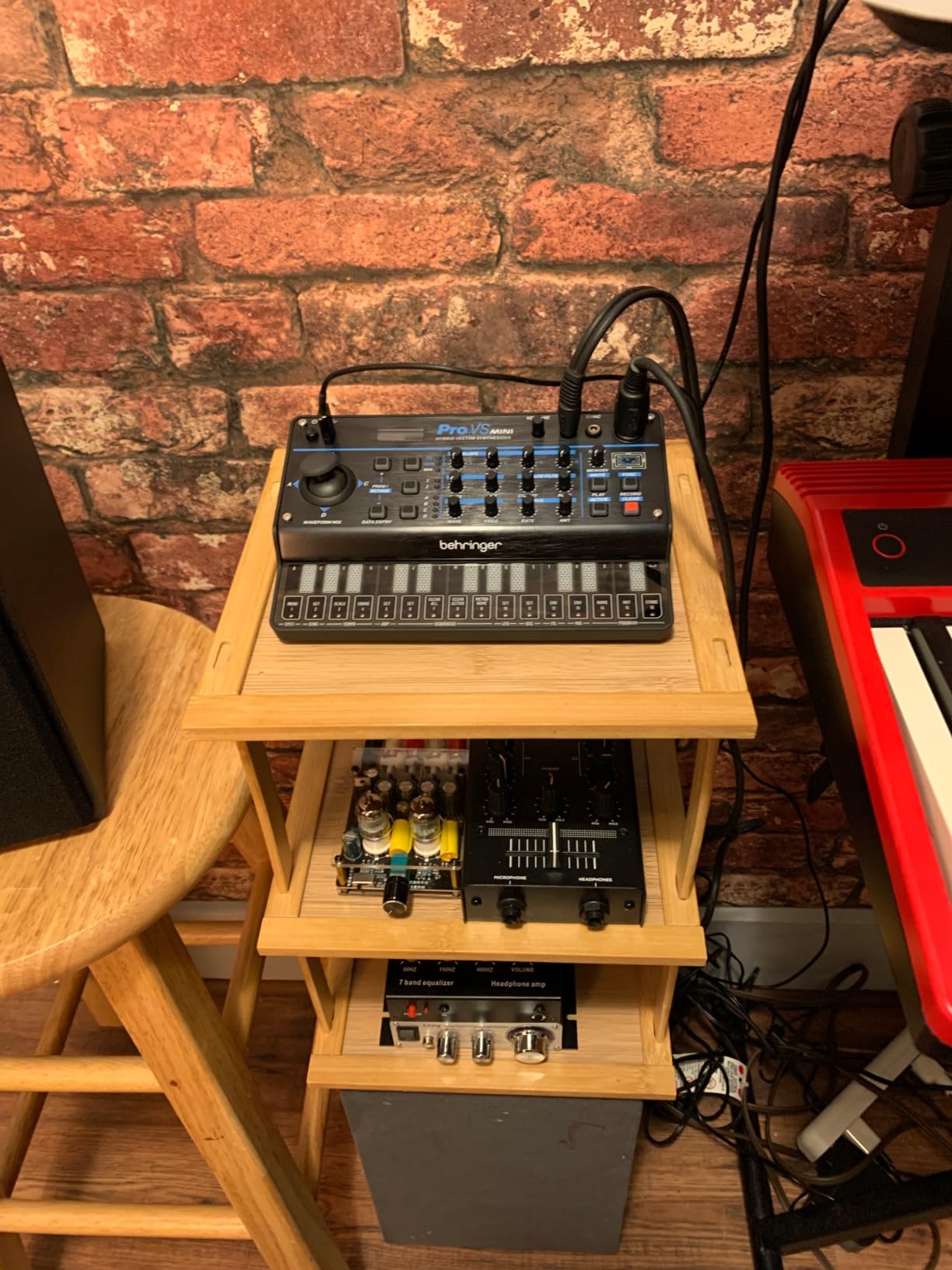
Battery or USB-C power is the reason it earns a place on this list at all. At 8.45 by 5.45 by 2.35 inches it fits in a bag, and the sync input means it can be clocked by a drum machine rather than free-running, so it can sit in a small live setup where a full-size keyboard is impossible.
Owners consistently rate it as an unusually capable budget machine, and the twenty-three percent four-star share in the ratings reflects the physical interface rather than the sound. It is a machine you program and play from a computer or a small controller.
Who the Pro VS Mini suits for techno work
It suits producers who move between locations, or who work in a small space where a 37-key instrument is not an option. The combination of wavetable range, an analog filter and a built-in sequencer covers acid, minimal and dub-leaning material in a box you can carry.
It also suits anyone building a small live rig. Clocked from an external source and controlled from a laptop or a pad controller, it can hold a pattern section while everything else is played.
Where the Pro VS Mini falls short
Twenty-seven mini keys and a small control surface make it hard to play hands on. If your technique involves playing parts rather than programming them, this is a sound module with a keyboard attached, and you should think of it that way.
Editing beyond the front panel means menu-based editing on a small screen, and the 2.5mm jack connectivity rather than full-size quarter-inch outputs means cables are an extra consideration in a live setup. The tone is also less distinctive than the analog instruments in this list, which is the trade for the flexibility.
How to Choose a Synth for Techno Production in 2026
1. Match the machine to your sub-genre
Start with the style, not the brand. Acid techno is a filter and sequencer problem, so a monophonic analog voice with a resonant low-pass and a step sequencer of at least sixteen steps is the fit. The Bass Station II and the Korg monologue both do this directly, and the CRAVE does it with a patch bay for extra modulation.
Minimal and deep techno is a phrasing problem. You need a machine that holds a pattern for a long time and lets you move parameters without stopping, which points at the Elektron Model:Cycles with its per-track knobs and 64 steps, or a groovebox with parameter locking. Hypnotic lines are easier to write when the interface does not require a menu.
Industrial is a texture problem. Noise sources, feedback routing and semi-modular patching matter more than polyphony, which makes the Moog DFAM and the CRAVE the more useful buys. Melodic techno is a polyphony and expression problem, where the POLY D, the MiniNova and the MiniFreak 37 cover chords, layers and aftertouch.
2. Monophonic, paraphonic or polyphonic
A monophonic synth plays one note at a time, which is all a bassline or a lead line requires. That simplicity is why instruments like the CRAVE and the monologue remain the backbone of techno hardware. Paraphonic sits between the two: one note per voice, but a shared filter, so held intervals have their own envelopes but share one filter sweep. The Moog Subsequent 37 uses this well.
True polyphony is needed the moment you write chords, which is most melodic techno. Four voices is enough for a bassline plus a pad. Six or more is more comfortable. Anything above that matters less than the filter and the effect chain, which is a lesson that comes up repeatedly on production forums when people ask whether more voices would change their records.
3. Analog, virtual analog or hybrid
Analog synthesis means a real signal path, and what you hear is what the circuit does: the drift, the nonlinearity, the way a filter changes shape as it opens. That character is the reason the CRAVE, the monologue, the POLY D and the Moog instruments appear here. It is also the reason they drift out of tune over a long set, which some producers prefer and some do not.
Virtual analog models an analog circuit digitally. The MiniNova and the microKORG are the clearest examples in this list, and both are praised for warmth and versatility rather than for instability. Hybrid designs put a digital oscillator engine in front of an analog filter, which is what the MicroFreak, the MiniFreak 37 and the Pro VS Mini do.
The hybrid approach has become the practical middle ground. You get a wide range of oscillator types and reliable tuning, then an analog filter at the output that colours everything passing through it. For most techno producers in 2026 that is the better trade than choosing a pure analog architecture, because it covers more ground without the maintenance.
4. Filters and resonance
Almost every bassline in this genre is a filter story. A 24 dB low-pass per octave with enough resonance to self-oscillate is the acid toolkit, and instruments with a dedicated filter character such as the Bass Station II Acid Filter or the Moog ladder filter will give you a recognisable result faster than a neutral design.
Check whether the distortion sits before or after the filter. Post-filter drive thickens the resonance and adds harmonics as you push the cutoff, which is how you get movement out of a patch that would otherwise be static. Several instruments in this list let you choose, and it is worth learning which setting suits which track.
5. Sequencer depth and pattern length
Eight steps is a limitation, sixteen is workable, thirty-two is comfortable and sixty-four means you can write whole arrangements in one box. Producers repeatedly flag short sequencers as the reason a machine ends up unused, so match the step count to how long your phrases are.
Parameter locking is the feature that separates a groovebox from a simple step sequencer. The Elektron Model:Cycles records real-time parameter moves per step, and the Arturia MicroFreak offers four automation lanes. Both let a pattern change across its own length, which is the difference between a loop and a progression.
6. MIDI program change and live patch switching
This is the most common frustration raised in producer discussions and worth solving before you buy. A hardware sequencer sending program change messages is only useful if the receiving instrument listens to them and responds quickly enough. Check for a program change or patch-select MIDI implementation on both devices, and confirm the receiving synth stores a full sound rather than a single parameter.
Some instruments store a sequence alongside each patch, which is the ideal case. The MiniFreak 37 keeps a sequence or arpeggio in every one of its 256 presets, so one program change moves the sound and the pattern together. The microKORG is the opposite case, and owners report that overwriting factory patches to store their own is a persistent irritation.
For live sets, test the behaviour rather than trusting the specification. Some instruments ignore incoming MIDI notes in their arpeggiator, which the Bass Station II does according to owner reports. Five minutes with a controller and a drum machine will tell you more than any feature list.
7. Build a hybrid hardware and software workflow
Most producers here run hardware for sound and software for arrangement. That is the sensible split, because hardware gives you hands-on modulation and software gives you unlimited recall and editing. The Arturia MiniFreak 37 includes its own virtual instrument, so the same engine is available in the session, which removes the reason to own the patch in two places.
Keep the audio path simple: hardware out to an interface, interface into the DAW, MIDI from the DAW or from a dedicated sequencer into the hardware. The devices here that take MIDI in and out, rather than only USB, give you the option of running a drum machine or a sampler as the master clock, which is how most live techno setups are organised.
8. Buying second-hand and checking quality
Used market advice is consistent across the forums. Ask for photographs of the panel, the keys and any display, ask whether every key and button has been tested, and ask about repairs. Entry-level clones in particular are worth buying only after confirming the panel and the power supply are sound, because quality control is the most common complaint in owner feedback.
For older analog instruments, potentiometers and key contacts are the parts that fail with age. A machine that has not been serviced in years may need work before it sounds right, and that cost should be part of the comparison. Panel-based instruments with no screen, like the Moog Subsequent 37, also tend to be easier to assess on inspection than menu-driven machines.
Frequently Asked Questions
What is the best synth for techno productions?
The Arturia MicroFreak is our top pick for most producers. It pairs seventeen paraphonic oscillator modes with a resonant analog Oberheim-style filter, adds a step sequencer with four automation lanes, and weighs 2.3 pounds. Producers who want pure analog weight should look at the Behringer CRAVE for acid work or the Novation Bass Station II for its dedicated 24 dB Acid Filter.
Which synth is best for acid techno basslines?
A monophonic analog voice with a resonant low-pass filter and a step sequencer of at least sixteen steps. The Novation Bass Station II has a dedicated 24 dB Acid Filter built for that squelch, the Korg monologue offers a battery-powered analog voice with a 16-step sequencer, and the Behringer CRAVE adds a semi-modular patch bay for extra modulation routing.
Which synth is best for minimal and hypnotic techno?
The Elektron Model:Cycles is built for this. Six sample-based tracks each have dedicated knobs for hands-on tweaking, every track can act as an audio or MIDI track, and the sequencer runs 64 steps per track with real-time parameter recording. The pattern length and per-track control are what make long hypnotic arrangements practical on one machine.
Do I need polyphony for techno?
Not for basslines. Monophonic voices such as the Behringer CRAVE and the Korg monologue handle acid and driving bass work, and a paraphonic keybed on the Moog Subsequent 37 covers two-note intervals. Polyphony becomes necessary as soon as you write chords, which is why the Behringer POLY D and the Novation MiniNova suit melodic and deep minimal styles.
How do I use MIDI program change with a hardware synth?
Both devices need a program change or patch select implementation, and the receiving synth must store a complete sound rather than a single parameter. The Arturia MiniFreak 37 stores a sequence or arpeggio with each of its 256 presets so one program change recalls sound and pattern together. Test the behaviour with a controller before a live set, because some instruments ignore incoming MIDI notes in their arpeggiator.
What is the best budget synthesizer for techno?
The Behringer CRAVE gives you a fully analog VCO, VCF and VCA signal path with a 24 dB Moog-style ladder filter, a semi-modular patch bay and a 32-step sequencer. The Behringer Pro VS Mini is the alternative if portability matters more, with four voices, sixteen vector-morphing oscillators, an analog low-pass filter and battery power in a much smaller body.
Is hardware better than software for techno production?
Neither is better on its own. Hardware gives hands-on modulation, analog character and something to perform with. Software gives unlimited recall, editing and recall between sessions. The most common workflow is hardware for sound and a DAW for arrangement, and instruments such as the Arturia MiniFreak 37 that include a virtual instrument version let you work in both without the sound changing character.
The Verdict: Which Techno Synth Should You Buy First?
The Arturia MicroFreak is the winner of this roundup and the reason is coverage. Seventeen oscillator types, an analog filter at the output, a sequencer with four automation lanes and CV outputs for modular integration means one instrument handles acid, minimal, dub and industrial sketches without a second purchase. At 2.3 pounds it also moves between rooms without becoming a project.
Buy something else if your needs are narrower. The Novation Bass Station II is the dedicated answer for acid basslines, the Behringer CRAVE is the analog value pick, the Elektron Model:Cycles is the pattern machine for minimal and hypnotic arrangements, and the Moog Subsequent 37 is the tone purchase for producers who have already found their sound.
Whichever one you choose, learn the filter before you learn anything else. In techno, the cutoff sweep and the resonance are where the genre lives, and the machine that lets you reach them quickly will be the one still in your setup a few years from now. That is how we found the best synthesizers for techno producers: by listening for the sweep.